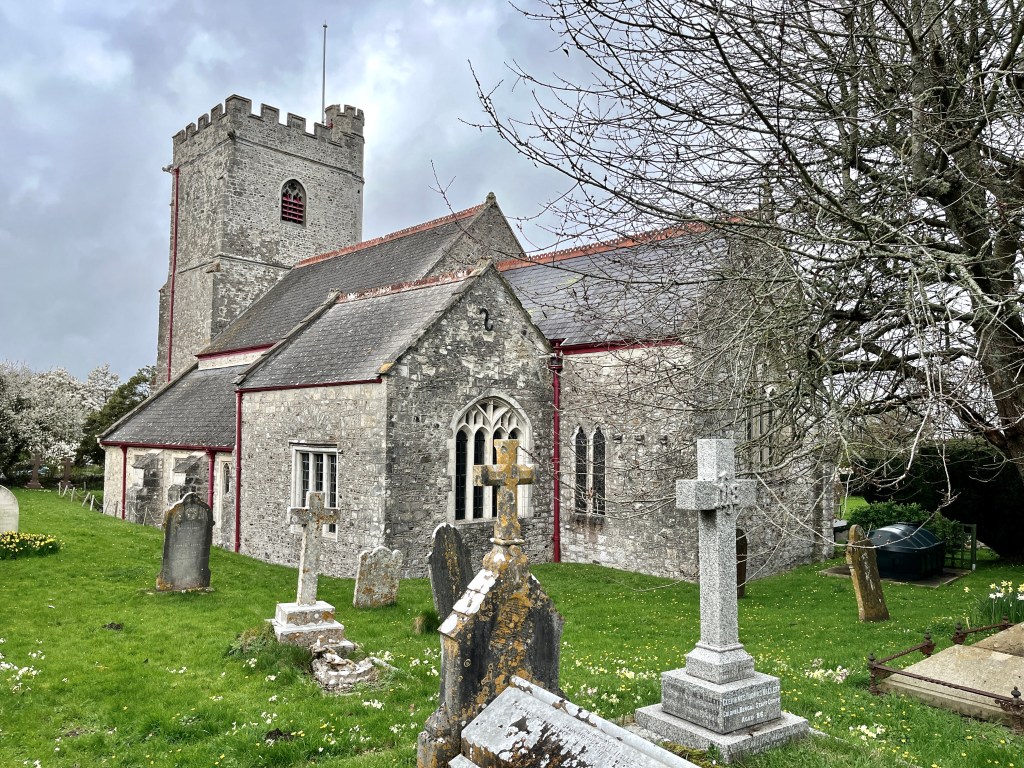
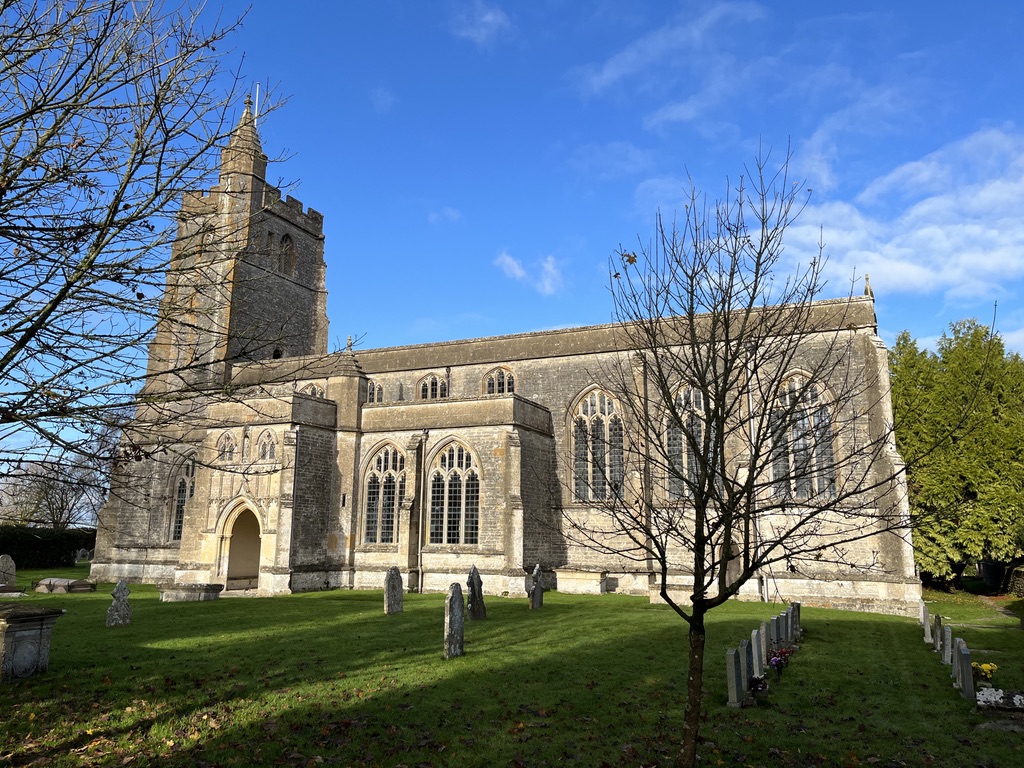
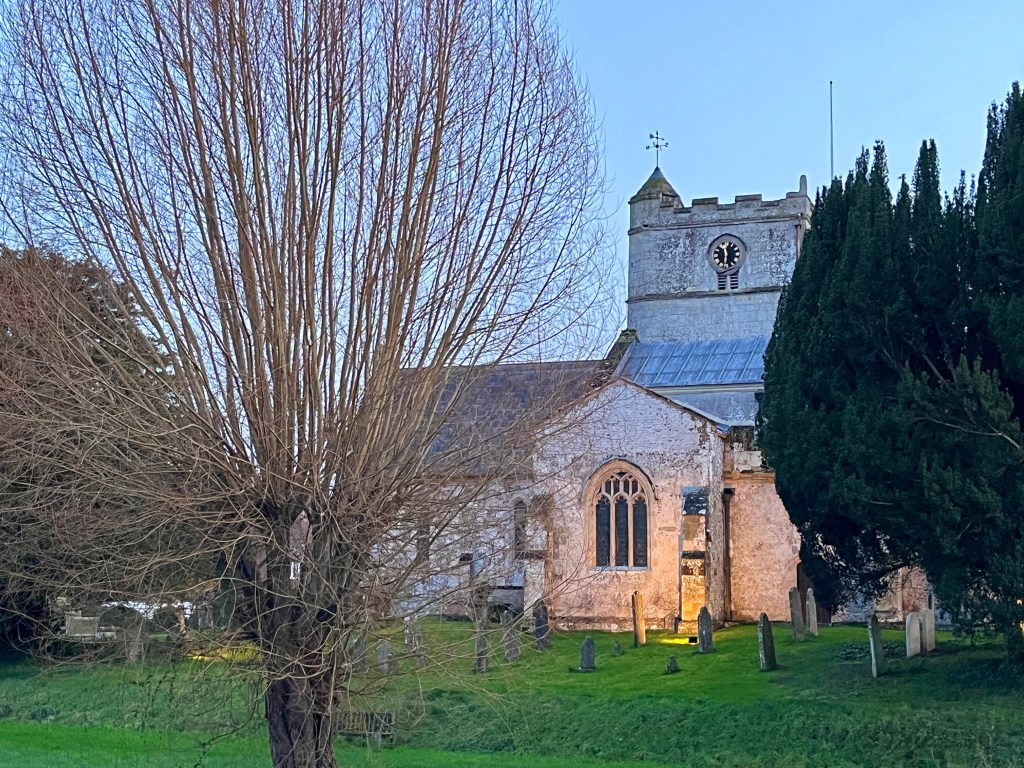
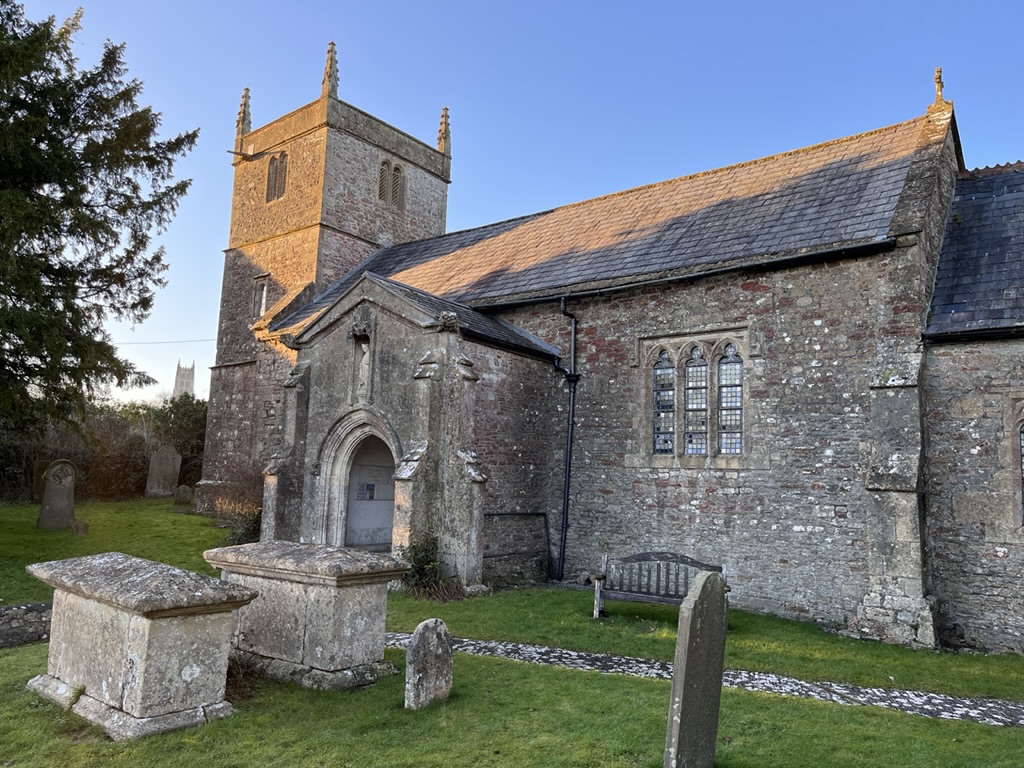
GRADE I † C12 origins (nave, chancel), gradual expansion C13, C14 and C15; restoration 1889. Norman doorway with fine Tympanum (long predating the inscription 1698). Good C15 wall paintings.Very close to the estuary, perfect for a walk or a bird-watch. 6m W of Lyme Regis. 50.7142 / -3.0546 / SY256910
DIALS
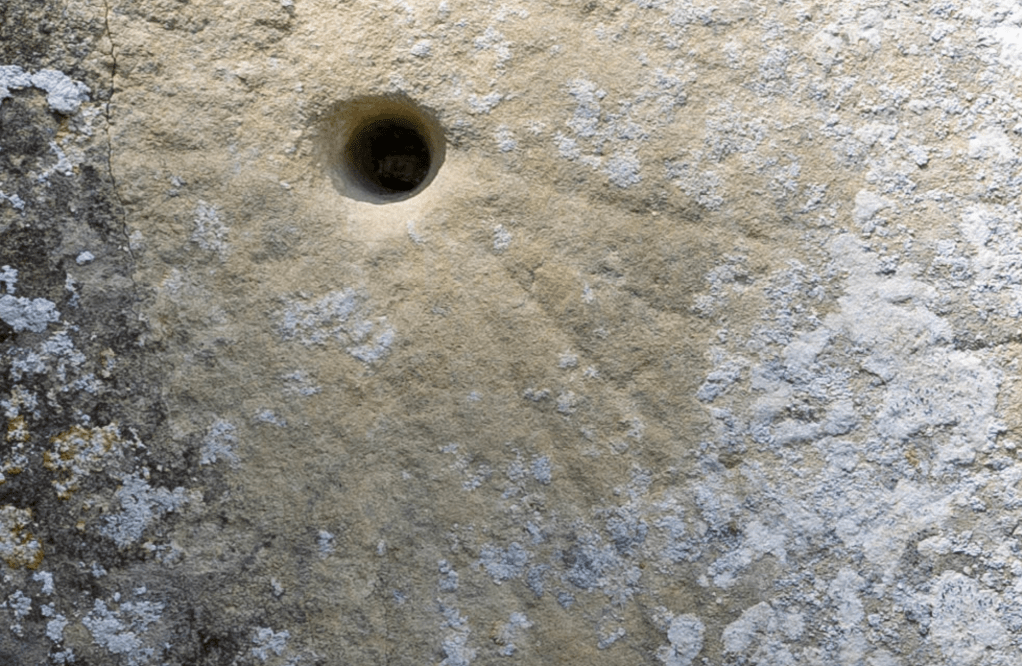
Three dials are recorded for St Michael. They are all similar and, unlike most multi-dial churches, their design give little sense of developing methods of marking the passage of the day.
DIAL 1
Dial 1 is located on the E quoin stone of the transept, with the gnomon hole in the mortar line. There are 3 distinct radials, and a 4th that is a faint trace. BSS records include the comment Rescratched and false gnomon added.
St Michael . Axmouth . Devon – Scratch Dial 1
The last record is dated 1994, since when the false gnomon has been removed. I have used an image from then; the dial is less easy to see now. The diagram below has a theoretical perimeter and time marks for a complete dial. The note no noon [line] is slightly surprising. Radial 3 looks vertical and possibly bifurcated in re-scratching.
St Michael . Axmouth . Devon – Scratch Dial 1
DIAL 2
St Michael . Axmouth . Devon – Scratch Dial 2
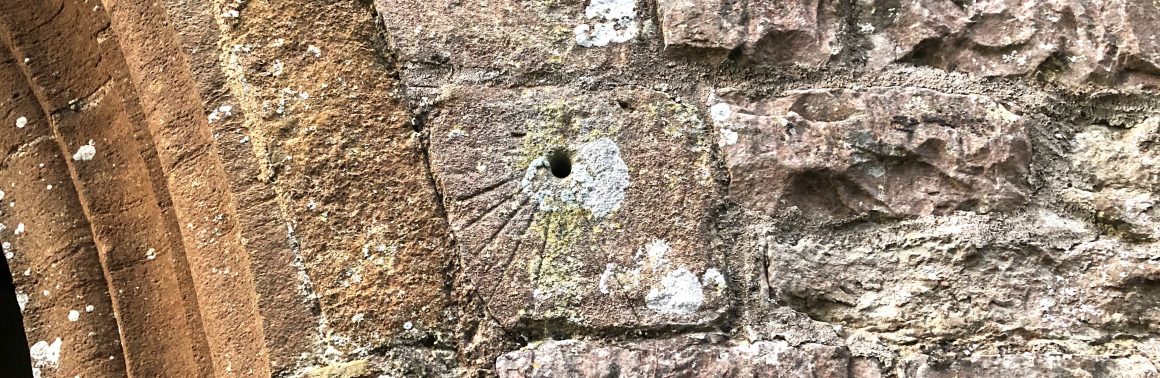
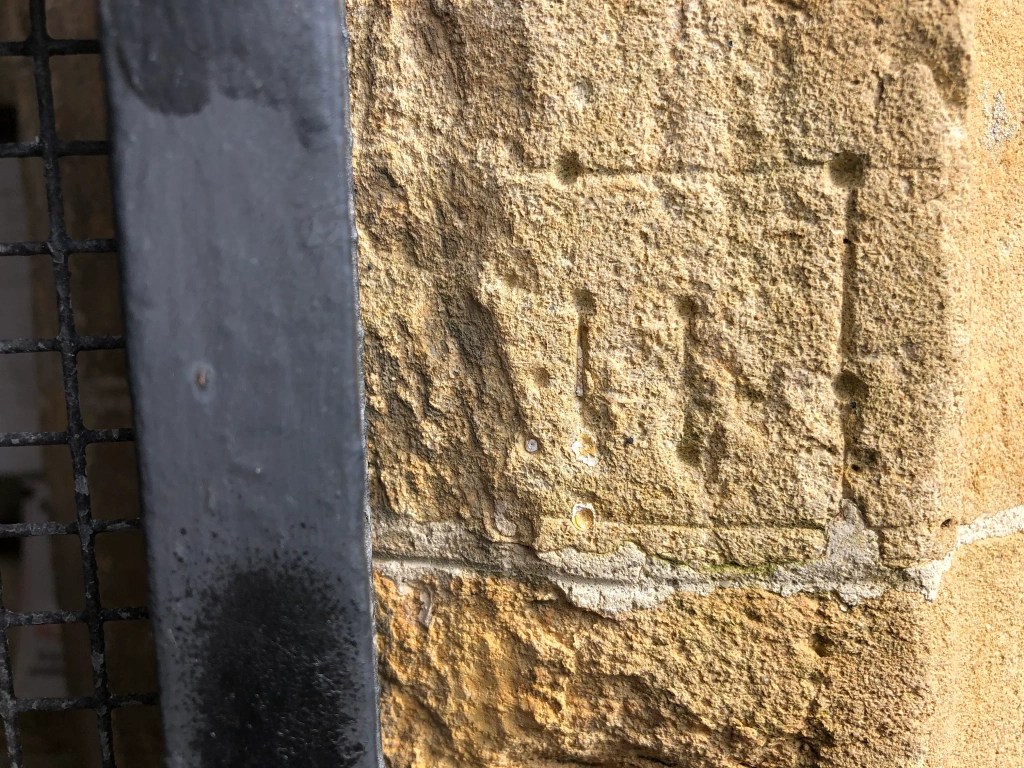
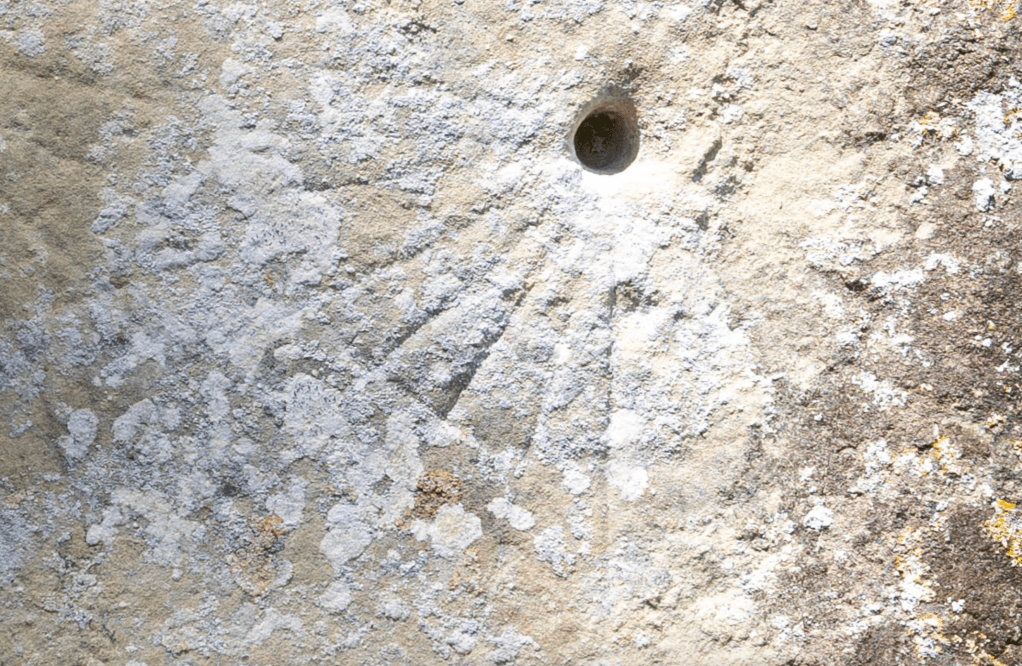
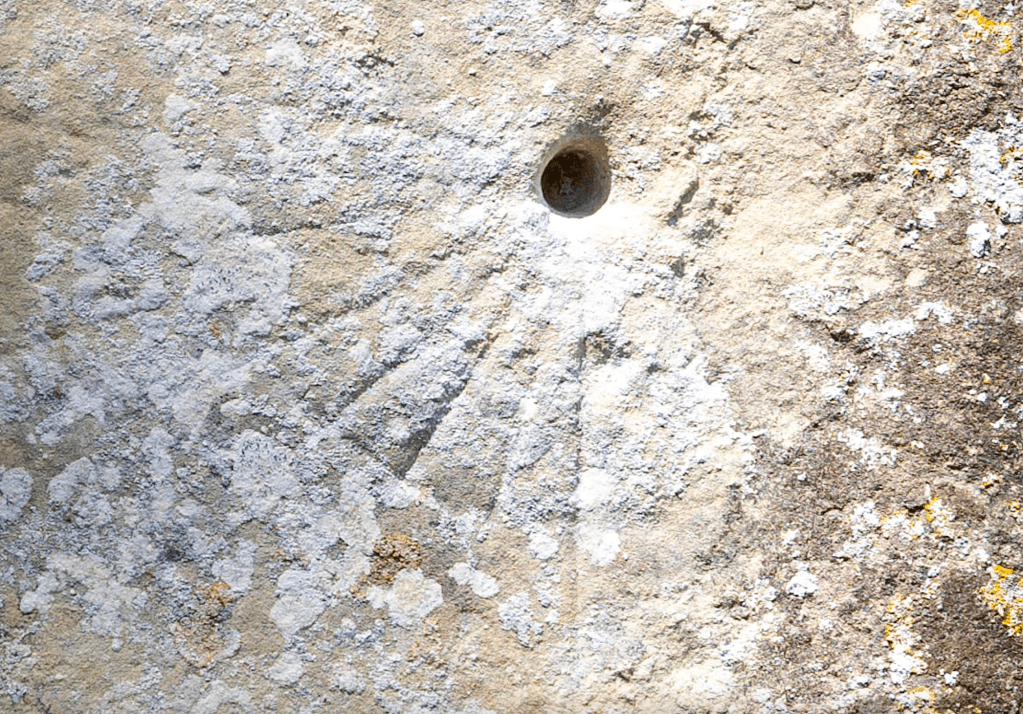
Dial 2 is cut on the Chancel chapel, E end of the wall, on a quoin stone. There are 4 lines radiating from a filled gnomon hole in the mortar line
In close-up (below) it is just possible to see that line 3 (L to R) is longer than the others. That could suggest a noon line incised slightly off true vertical. If so, on this simple dial it might be a casual approach to the medieval daylight hours. On a later, more sophisticated dial, it might represent a way to achieve accuracy on a church that was not square on to the true SWNE footprint.
DIAL 3
St Michael . Axmouth . Devon – Scratch Dial 3
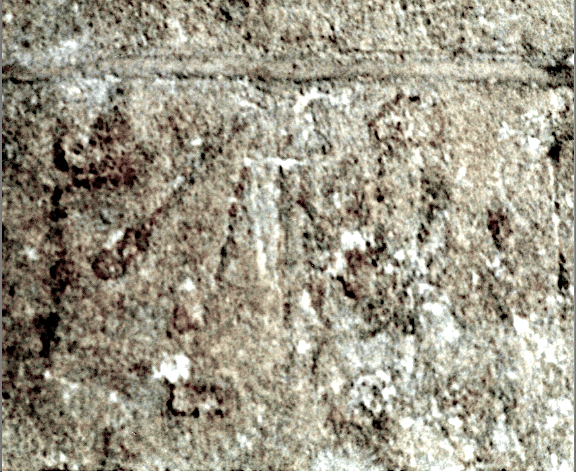
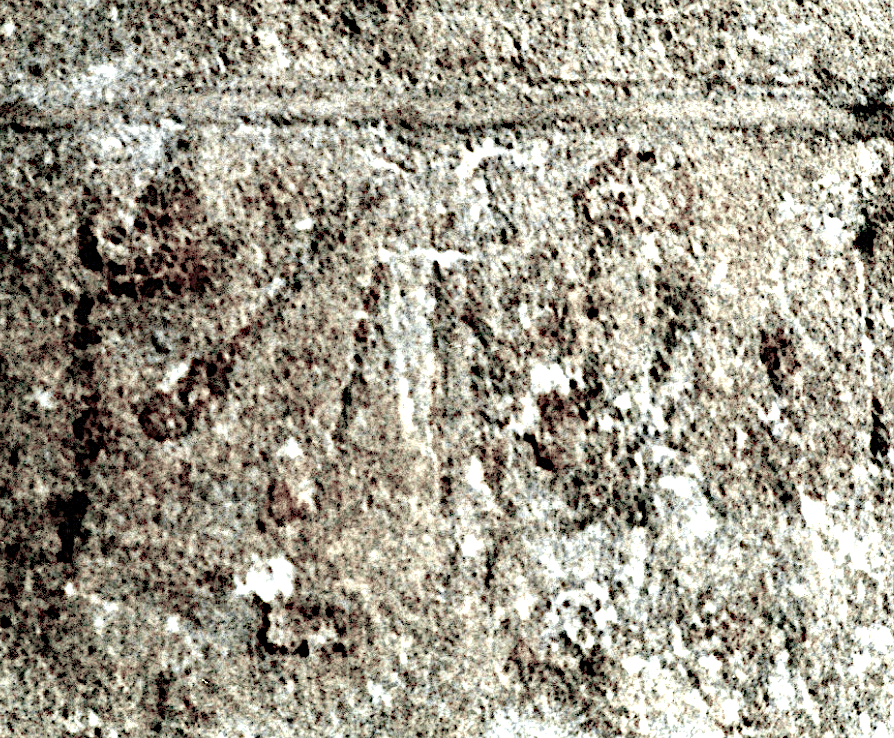
Also situated on the wall of the chancel chapel, and again radiating from the mortar line. BSS notes 4 lines, but 2 cannot now be detected. However the suggestion that noon is marked by double lines is plausible. This might be for emphasis (as with a terminal pock or cross); or because the vertical was re-scratched.
GSS Category: Scratch Dial
Photos. Keith Salvesen; diagram and other material, BSS
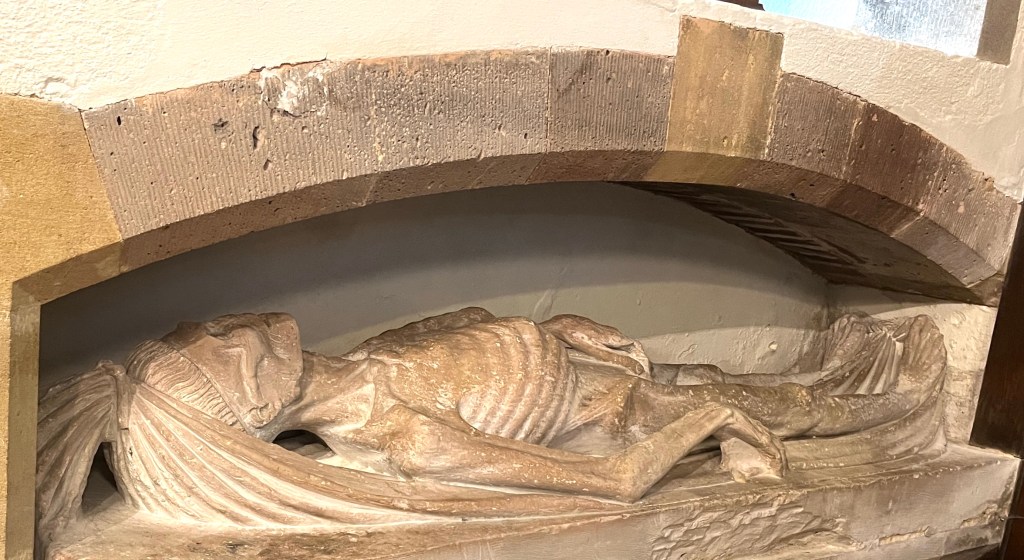
GRADE II* † Norman origins; rebuilding C15 & early C16; substantial restoration 1877. A church that repays one’s interest, with an intriguing Rood screen / reredos repositioning conundrum; and unusual chest tomb: on top lies the effigy of an emaciated cadaver partly covered by a shroudBLB. 14m E of Exeter, 5m W of Honiton. 50.7875 / -3.2659 / SY108994
DIALS
St Andrew has 3 scratch dials, the most obvious being visible from the lych gate and as one approaches S porch. The other 2 dials, very close together, are remarkable and probably unique (certainly so as a pair). Dial 3 may be doubtful. An additional basic but dial-ish scratching is shown below, as are various other church marks including a good example of a Consecration cross.
DIAL 1
St Andrew . Feniton . Devon – Scratch Dial 1
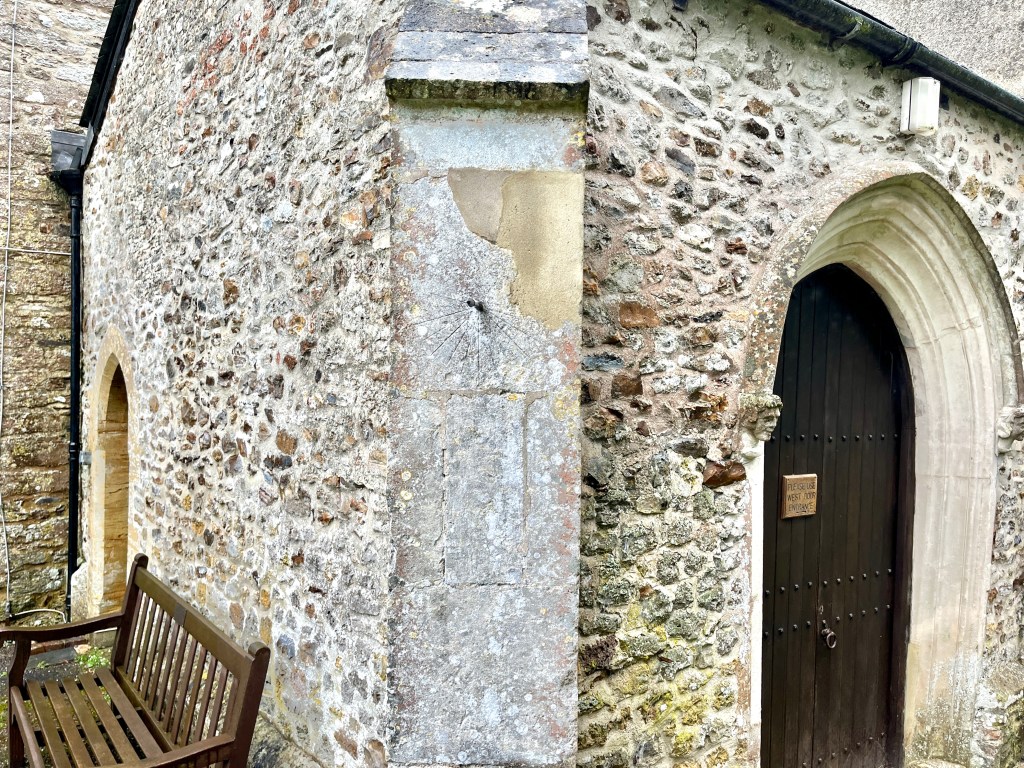
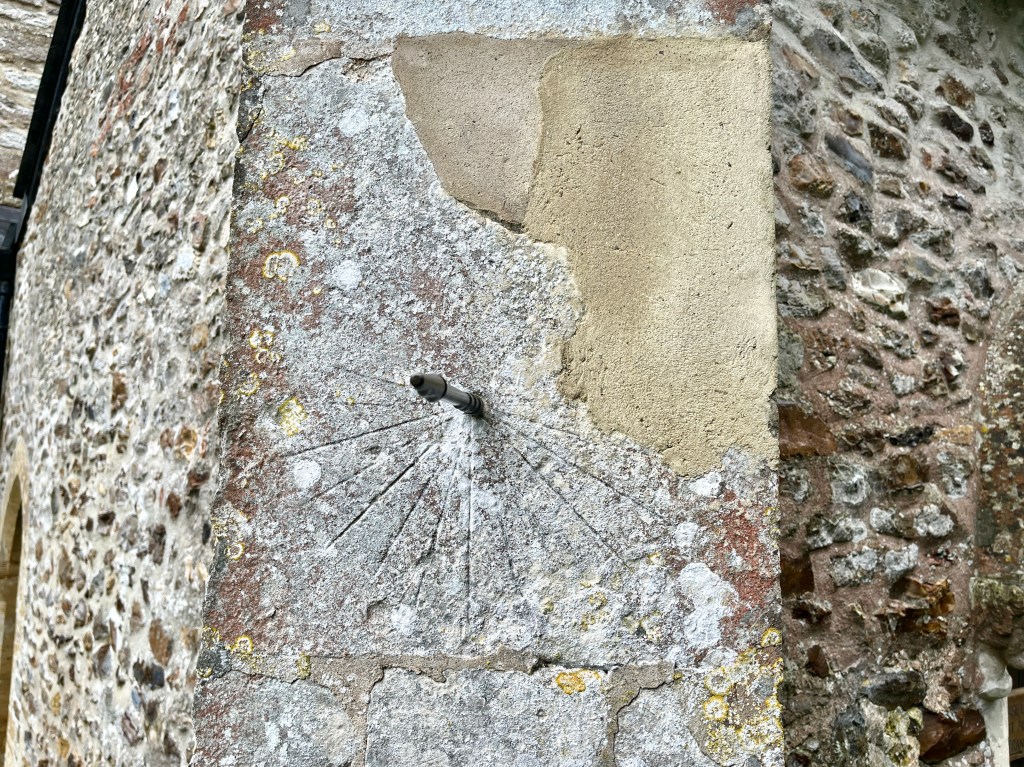
Dial 1 on the porch buttress is a straightforward design and easy to make out, but damaged and cement patched UR. There are 13 lines, some now very faint. The angles are more or less accurate at 15º. The vertical / noon line is not emphasised in any way, which is slightly unusual. The main Mass was presumably Terce, marked with a deeper cut line LHS. The gnomon hole has been filled with a rather well-chosen rounded arrow design; it is modern yet respectful of its purpose.
DIAL 2
St Andrew . Feniton . Devon – Scratch Dial 2
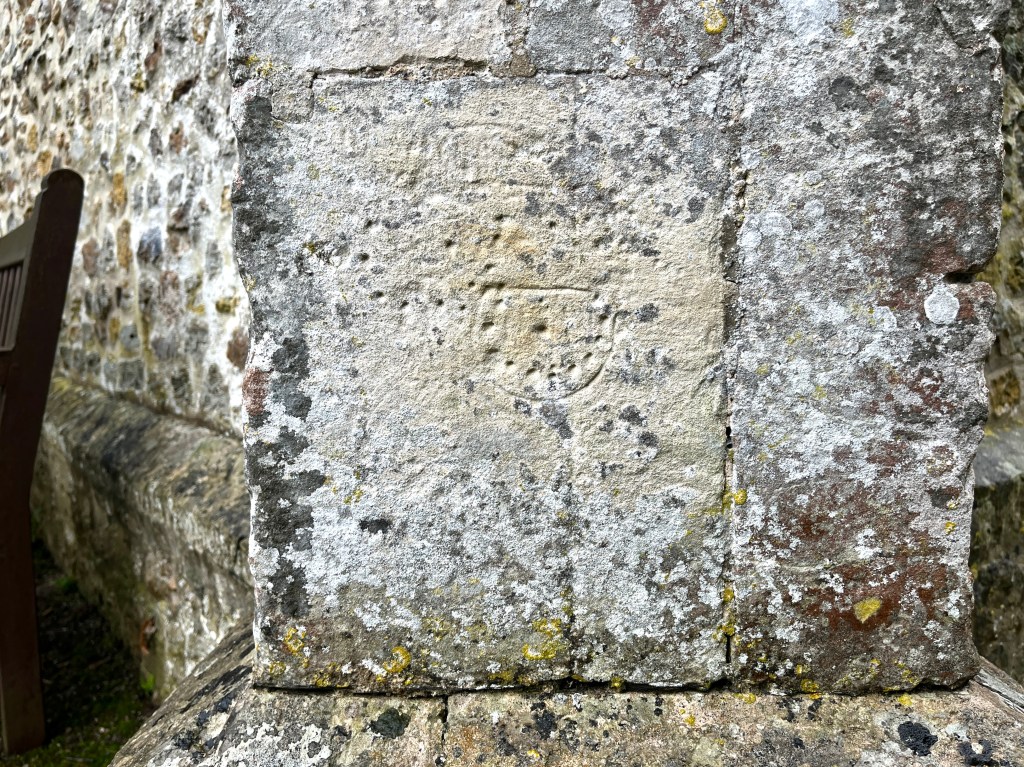
Dials 2 & 3 are adjacent low down on the same porch buttress as Dial 1. It is a remarkable juxtaposition. BSS suggests they are early dials – pre-1400?
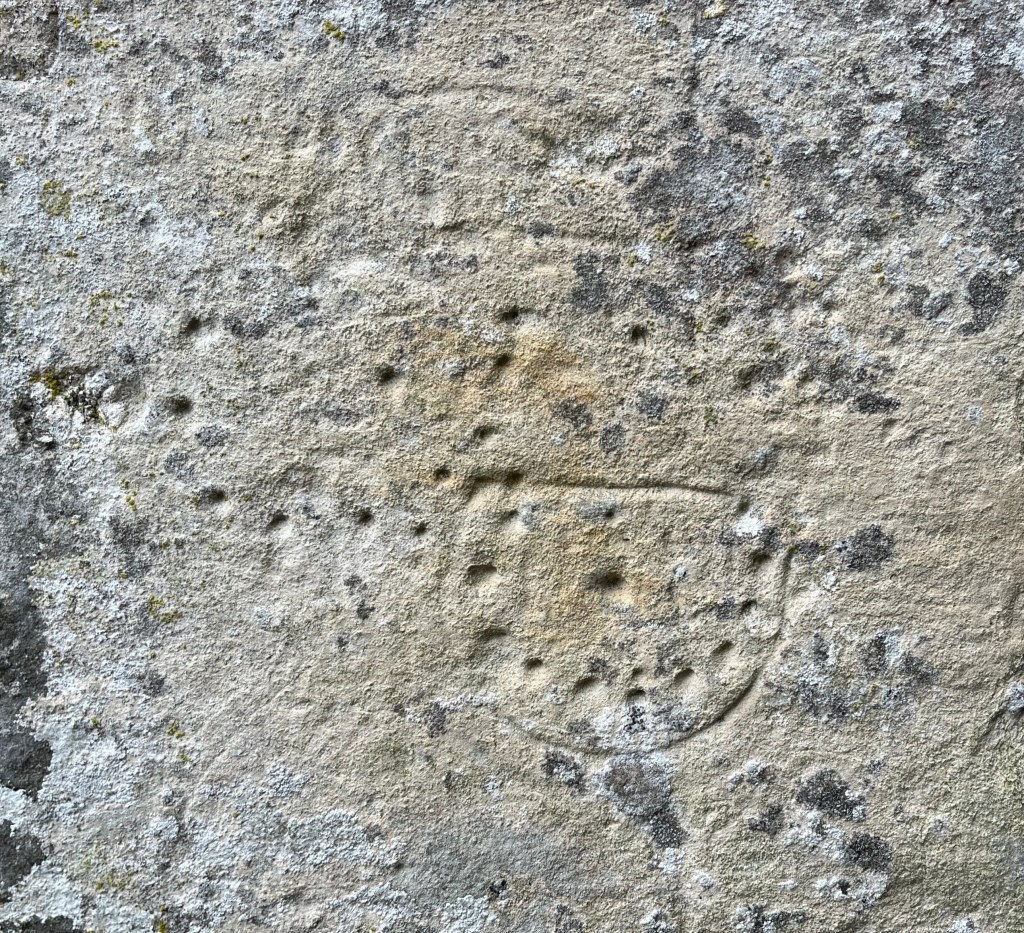
Dial 2 consists of a pattern of pocks contained within what could be termed geometrically as the major segment of a circle. The horizontal line is incised more deeply. BSS suggests that 13 pocks are identifiably associated with the dial, with a few random ones besides. The quite shallow gnomon hole in such a small design presumably contained a stud rather than a rod.
A noon line is seemingly marked by the sightly offset double pocks just R of the vertical. Theres’s also a very small pock directly above the gnomon hole, conceivably a decorative-use-only marker for midnight and symmetry.
DIAL 3
Dial 3 The BSS entry for this little configuration of dots describes a semi-circle of 8 pocks, with other associated pocks and no obvious gnomon hole. It concludes closely related to dial no. 2, possibly never used as a dial.
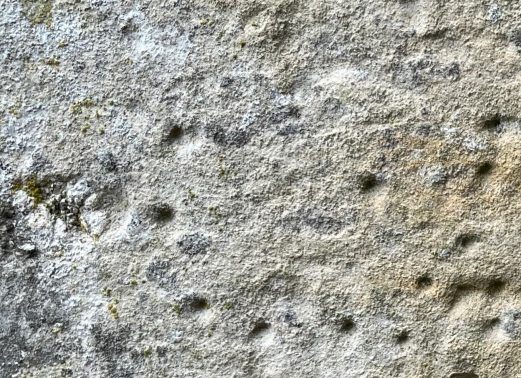
Perhaps it is not a dial at all. The rather untidy part-circle curves away NE after noon – pointlessly, if part of a dial. BSS notes that there is no central style hole. There is a single pock inside the perimeter that might have held a stud – but unlikely to be much use in that position. Some might suspect unserious pattern-copying efforts along the lines of Dial 2.
St Andrew . Feniton . Devon – Scratch Dial 3
My amateur reading of this buttress as a whole is firstly, that the low stone on which Dials 2 & 3 are located is not its original location. At some stage during all the rebuilding and restoration over the centuries it was re-sited. The little dial that ‘worked’ was then too low and would anyway have been an obsolete design. It was therefore superseded by a far larger, more modern (? mid C16) and very visible dial, accurately cut and ideal for marking the passage of the day for a larger, better educated community in a more modern era. Comparatively.
DIAL 4?
Both lines seem deliberately scratched. One is approximately vertical, the other could mark the Mass time Terce (cf Dial 1). The lines diverge from the mortar line, as do many simple dials – it means not having to drill a dial gnomon into stone. I have seen less convincing 2-line versions that have been recorded as dials. I am slightly in favour of it being a dial.
CONSECRATION CROSS
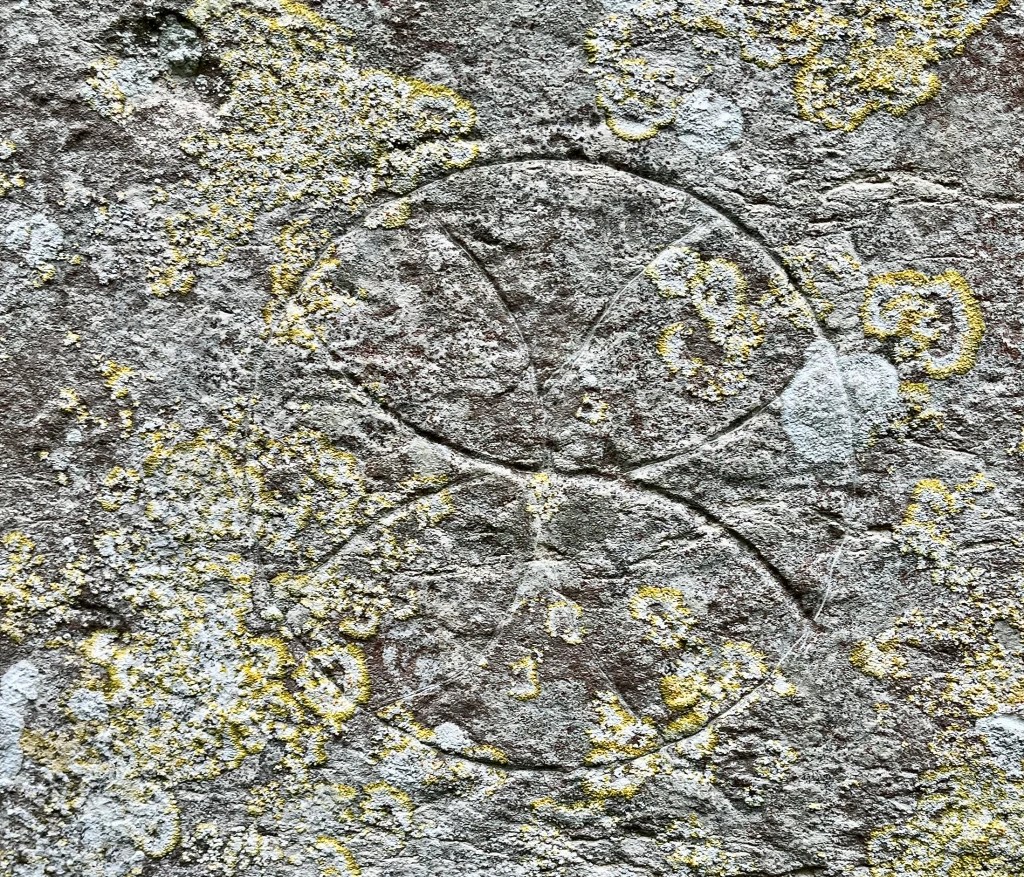
This is a good example of a rural consecration cross, incised on a buttress between 2 windows. From a distance the design might mislead and be seen as four petals, rather than a compass drawn cross. There are hints of an outer circle. This is a fairly common type of cross, but good see one that is relatively unworn. The four distinct quarters rule out ID as a protective hexfoil, although there is a similarity.
GRAFFITI
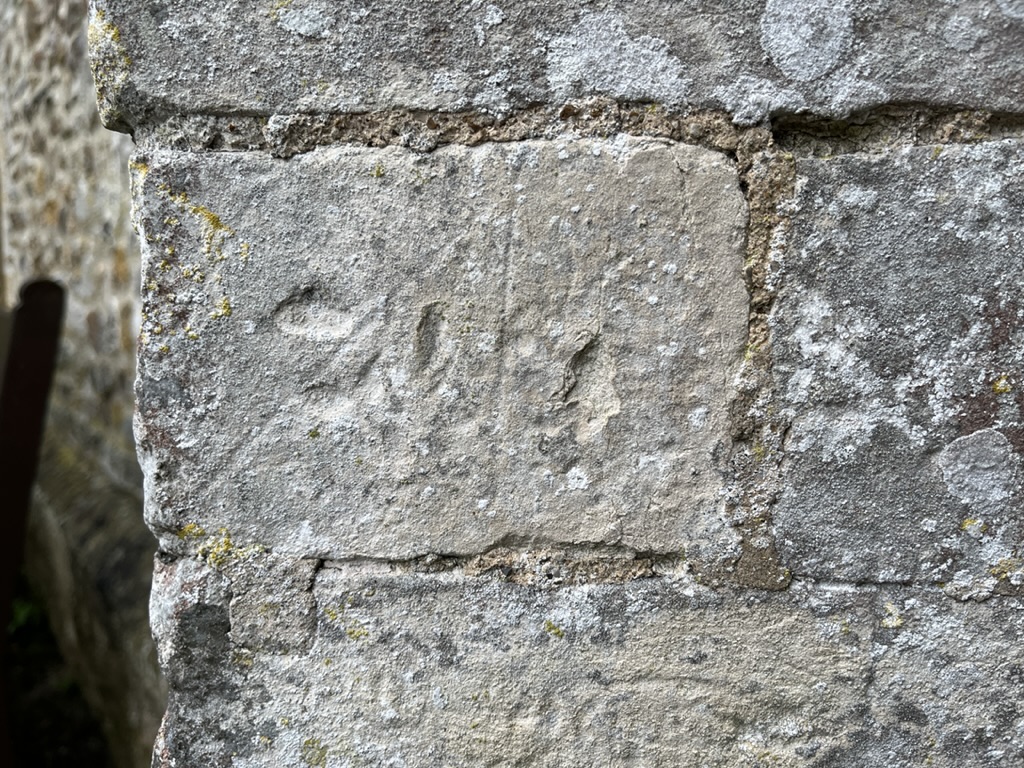
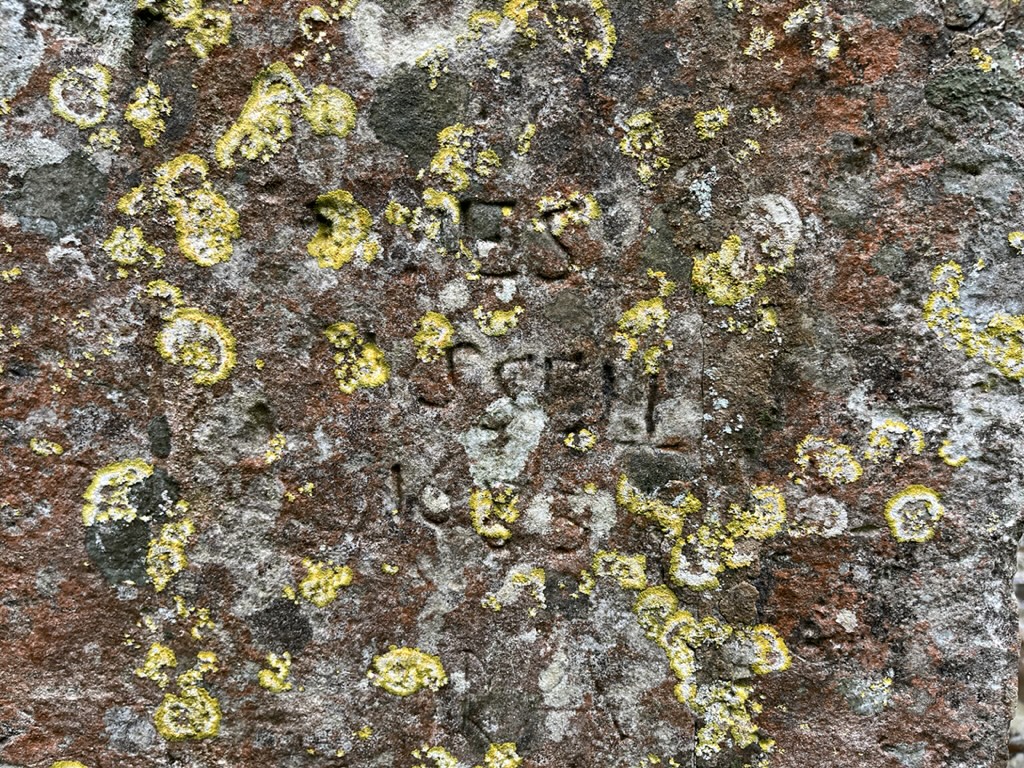
Graffiti on two adjacent stones, one example dated ?1675
PROTECTION MARK
This is very likely a ritual protection mark / apotropaic symbol designed both to prevent evil from entering the church, and to repel it. For that reason they are most often found inside or near porches. I haven’t encountered the pattern below before, but a group of dots with some joined by deep cut lines is a commonly found design – see an example from Dorset below.
GRADE I † Mainly early C15, some older fragments; later restorations. A huge church for a small village. Simon Jenkins awards it ** and with good reason. Wonderful bench ends, not to be missed. See BLB for more. Midway between Wincanton and Ilchester. 51.0417 / -2.5214 / ST635270
DIALS
DEH visited in April 1914 and recorded 3 dials, all on S facing buttresses, one close to the priest’s door. They are very eroded. There are possible remnants of 2 further dials, mentioned below.
DIAL 1
St Michael . North Cadbury . Som. – Scratch Dial
DEH169. (1) This dial is on the first buttress w. of the s. porch. It is 5 feet above the ground, the noon line is 4 inches in length, the stylehole is 5/8 of an inch in depth by 1/2 an inch in diameter, and the aspect is s. by 15° e.
Located on the buttress W of S porch. An obvious style hole with a semicircle (6 – 6) of unobtrusive small pocks. Photography has its limitations and St Michael tested them. Records mention 13 to 16 pocks. One can just make out the faintest of traces of lines at noon and 2.
BSS suggests a possible dial immediately above. Assuming a style hole in the mortar line, there are a few pocks in the immediate area, but rather disorganised. Doubtful rather than plausible.
DIAL 2
St Michael . North Cadbury . Som. – Scratch Dial
DEH170. (2) This dial is on the first buttress E. of the s. porch. It is 4 feet 10 inches above the ground, the noon line is 3 inches in length, the style hole is about 11/2 inches in depth by 3/4 of an inch in diameter. The aspect is s. by 15° e.
As with Dial 1, very eroded and with little visible detail even when one is quite close. There are 8 detectable lines with a perimeter of pocks, probably (BSS) 13 with extra pocks at 8.30 and 10.30 – presumably Mass indicators.
DIAL 3
St Michael . North Cadbury . Som. – Scratch Dial
DEH 171. (3) This dial is on a buttress e. of the priest’s door. It is 5 feet 8 inches above the ground, the noon line is 4 1/4 inches in length, the style hole is 7/8 of an inch in depth and 1/2 an inch in diameter, and the aspect is s. by 15° e.
Situated on S side of the chancel, on the buttress E of the Priests’ door. There are 13 lines and a full complement of 24 pocks. The line angles are at approx 15º intervals. BSS notes a possible ‘tiny dial’ above it.
MEDIEVAL GRAFFITI
The porch contains the original stone benches on either side. These are often troves of graffiti, in particular apotropaic symbols and other ritual protection marks designed to repel evil or to prevent its entering the church. These signs are quite common to find in other locations both outside and inside a church (see HERE). However, in many churches, stone benches were replaced in succeeding centuries. St Michael has retained the benches, on which there are excellent examples of marks that are relatively rare. There are hands here, and a medieval swastika (a Sanskrit word) from several centuries before its more recent symbolic adoption. It incorporates a repelling circle mark, where evil may be captured within its continuous circumference.
GRADE 1 † C12 south aisle, 2 Norman arches; C13 chancel; C14 tower; C15 nave & north transept. Restoration 1845 by T. H. Wyatt. Early (C12?) font carved from a single piece of Jurassic limestone. One of several fine Chalke Valley churches situated south of the A30 between Shaftesbury and Salisbury. It’s an attractive long cut between the two. 51.0361 / -1.8473 / SU108263
DIALS
On the S-facing central buttress of the tower there are two adjacent scratch dials on the same stone that merge. It isn’t immediately clear (to me) which came first. Whichever, presumably the time came as the church developed when more accuracy in marking the day’s passage was required.
BSS references a 3rd dial on S wall. Other records mention two scratch dials and one sundial on south side. See below for an attempt to ID the sundial.
DIALS 1 (L) & 2 (R)
Coombe Bissett . Wilts . St Michael – Scratch Dials
Dial 1 is recorded as: Irregular dial with 15° lines in both quadrants.
Dial 2 is noted as: Cannot be classified. Eroded, damaged. Mass or line deeply cut.
My visit was early evening, and the quality of the detail in my photos is unimpressive (see above). For example, there is only the hint of the part-circle of Dial 2. Fortunately, this is a church that another dial collector has visited and later he uploaded his photos to BHO / Disqus. Mark Wolstenholme’s excellent images give a much clearer and sharper view of the details of both dials and their intersection.
DIAL 3 (?)
Another dial is recorded as being on the tower, S wall, a short distance W of the ‘dial buttress’ above. The description states Early Christian ‘Tombstone’ dial. Accurately cut or made. Modern replacement. I found this baffling, and the only conceivable candidate I could find in the area may or may not fit the bill. Somehow I doubt it. Suggestions of its purpose would be welcome…
Coombe Bissett . Wilts . St Michael
GSS Category: Scratch Dial; Mass Dial
Photos: Keith Salvesen; special thanks to Mark Wolstonholme who uploaded his detailed photos to the BHO site os and to Disqus os
GRADE 1 † C12 origins; mainly C14; much rebuilt C15/C16; further rebuilding late C18; restoration C19. One of only two churches with this Dedication (Fulbourne Cambs is the other). A pleasing and unpretentious church. Very close to Downside Abbey/. 51.2552 / -2.4896 / ST659507
DIALS
Downside Abbey was home to Dom Ethelbert Horne, the pioneer dial collector and analyst who covered Somerset with skill and determination, using a motorcycle to get around. He began the project in 1913, and recorded the dials at St Vigor on Nov 3 – perhaps they were his first finds. His book with its careful explanations is a vade mecum for any dial enthusiast (even one with no connection with the County).
DIAL 1
Dial 1 is located at SW corner of the nave, high up (7′) on a quoin stone. DEH noted The Mass line in this dial is sharp and distinct, and made at a different time from the other lines. He makes no comment on the design. There are 6 lines each with a terminal pock, with hints of a couple more. DEH makes no mention of a gnomon, but with his usual thoroughness measured the depth of the hole. It is certain, therefore, that the existing (copper?) rod was inserted relatively recently.
DIAL 2
Dial 2 is on the buttress between S porch and E end of the nave. DEH commented: Encircled. No hour lines can be seen on this ancient and badly worn dial. the remains of 2 circles close apart. Were it not for the noticeable gnomon hole, it would be easy to pass this one by.
DIAL 3
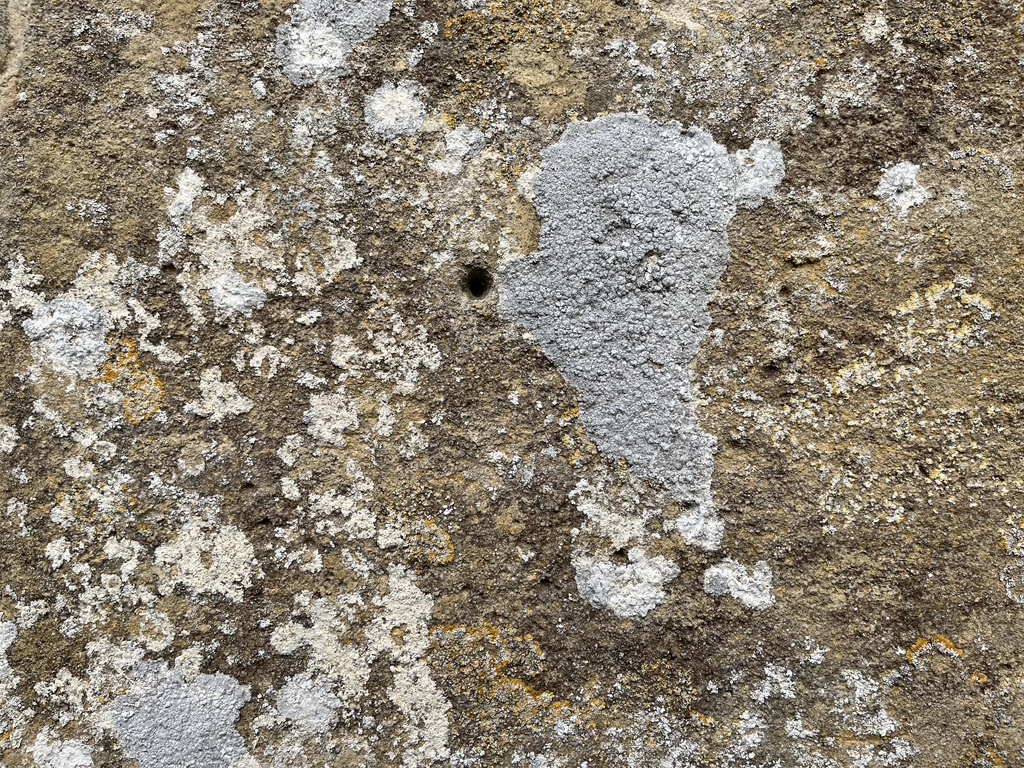
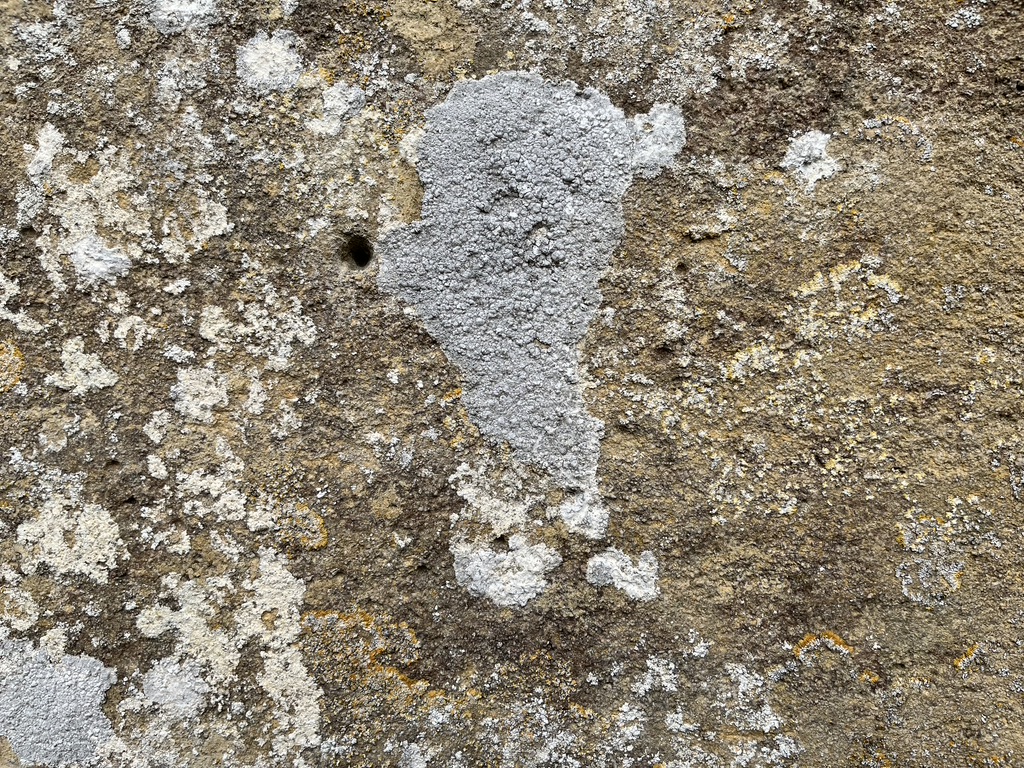
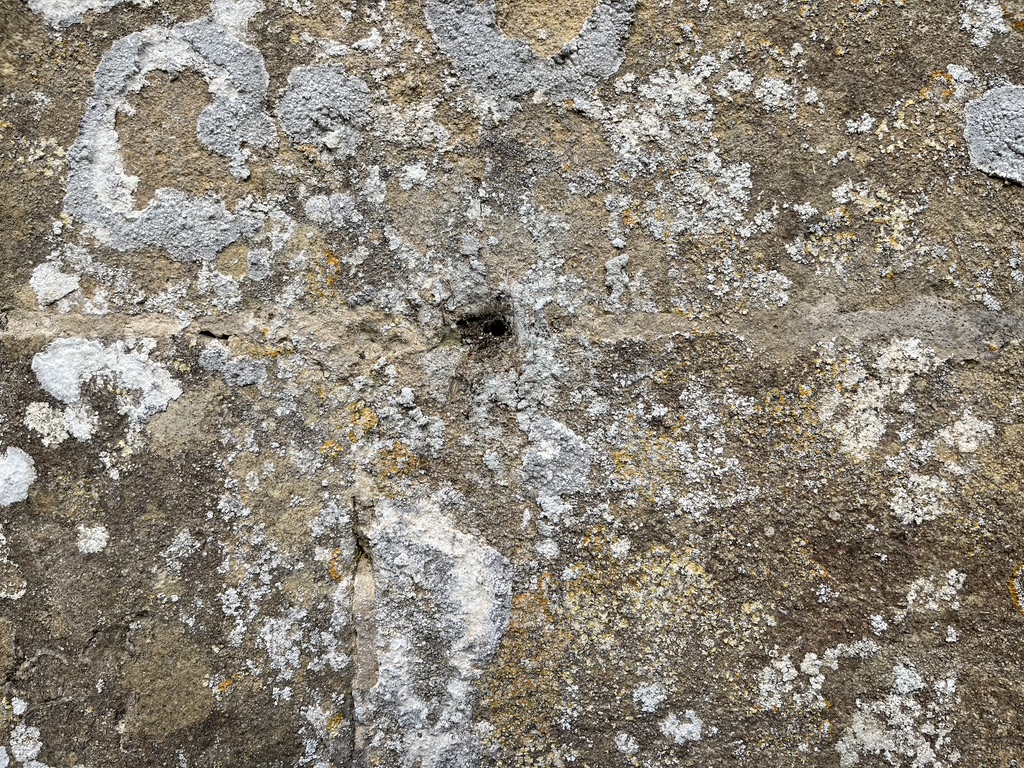
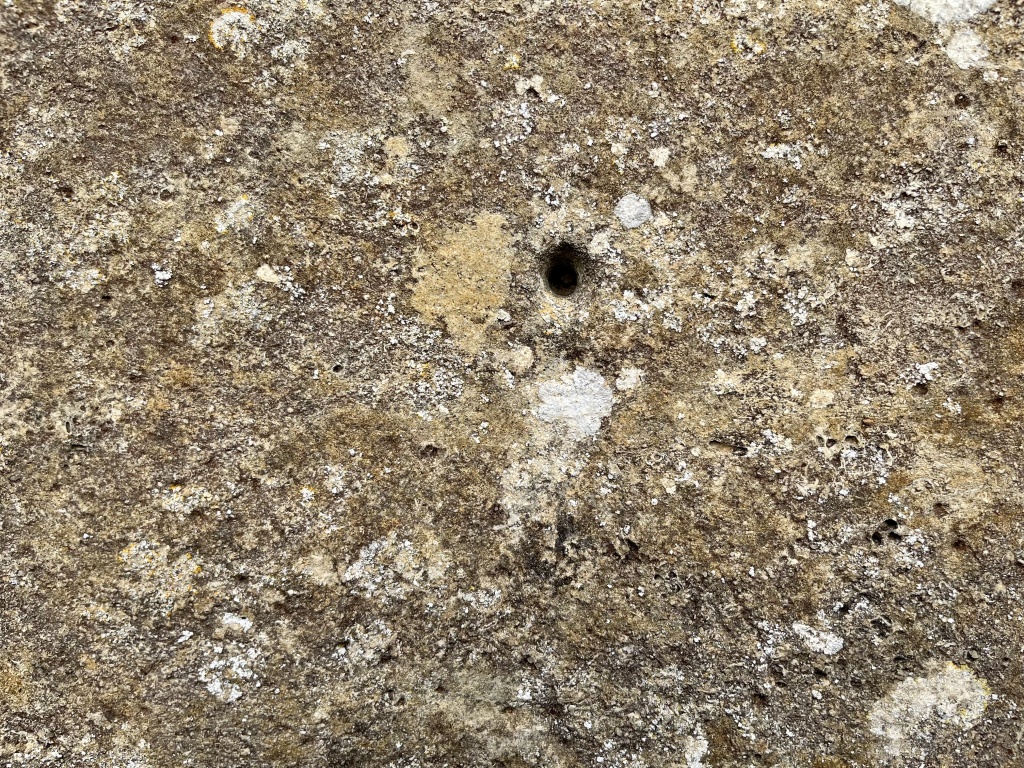
To be found on the W side of the entrance to S porch, 3′ 3″ high. Or so noted DEH very specifically. He mentions a style hole and a noon line 3½” long, but I spent some time examining this area and indeed the corresponding position on E side of the doorway (because field notes are occasionally confused), with no convincing dial identifiable. Here are photographs of the location, for what they are worth…
DEDICATION
In C6 there was a ‘hermit preacher’ and Christian missionary who became Bishop of Bayeux. He died c537 AD and was canonized as St Vigor (Lat.) or in due course Saint Vigeur (Fr.). The Norman conquest brought his followers to England and his name first appears in an eleventh-century breviary at Worcester.
Another account is that in the early C12, manorial rights for Stratton passed to a Norman family who came from Saint-Vigor-le-Grand, Normandy.
ST VIGOR IN FRESCO
Frescoes at the Churches of St Vigor Ste Suzanne Les Coevrons, and St Vigor de Neau cc / os / tourisme
GSS Category: Scratch Dials
All photos Keith Salvesen; St Vigor as credited; source material Bath Record Office, Wiki
BRYMPTON d’EVERCY . SOMERSET . CUBE DIAL with BALL FINIAL
Brympton d’Evercy is a fine Somerset country house with a long history of intertwined families down the ages. For more on the house & grounds, see HERE. The chapel of St Andrew has scratch dials that are featured HERE. The estate is a mere 2m W of the clatter of Yeovil yet hidden away in its own parkland, and best reached by map reading, satnav or luck. 50.9361 / -2.6847 / ST519154
CUBE DIAL(GVII)
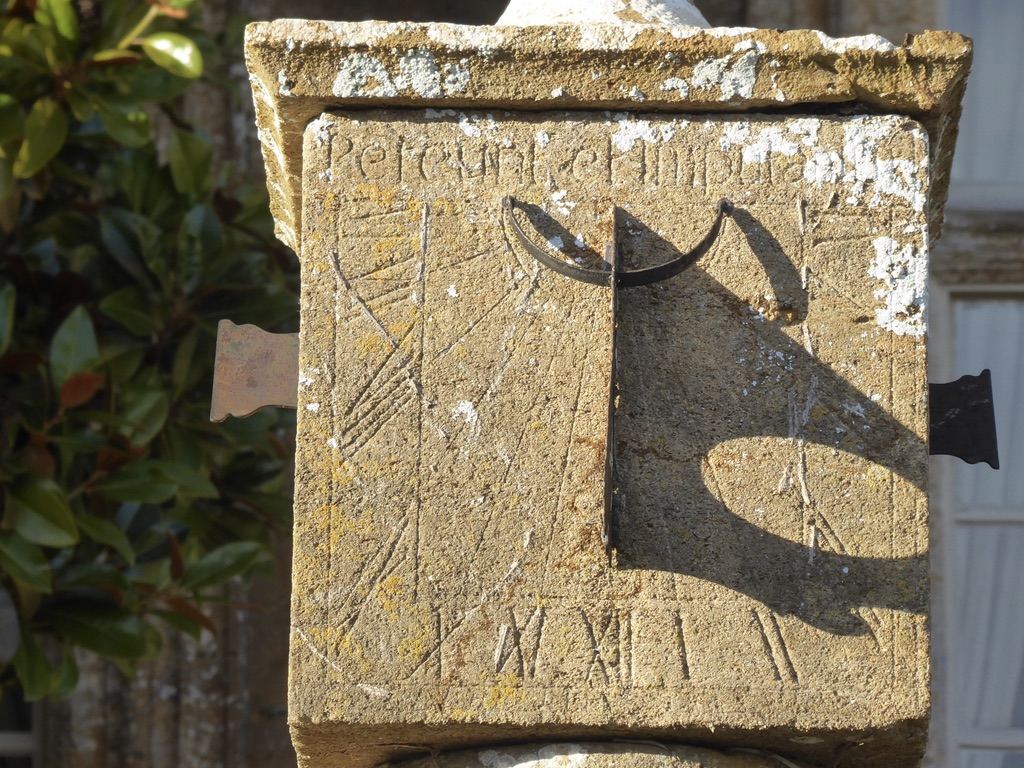
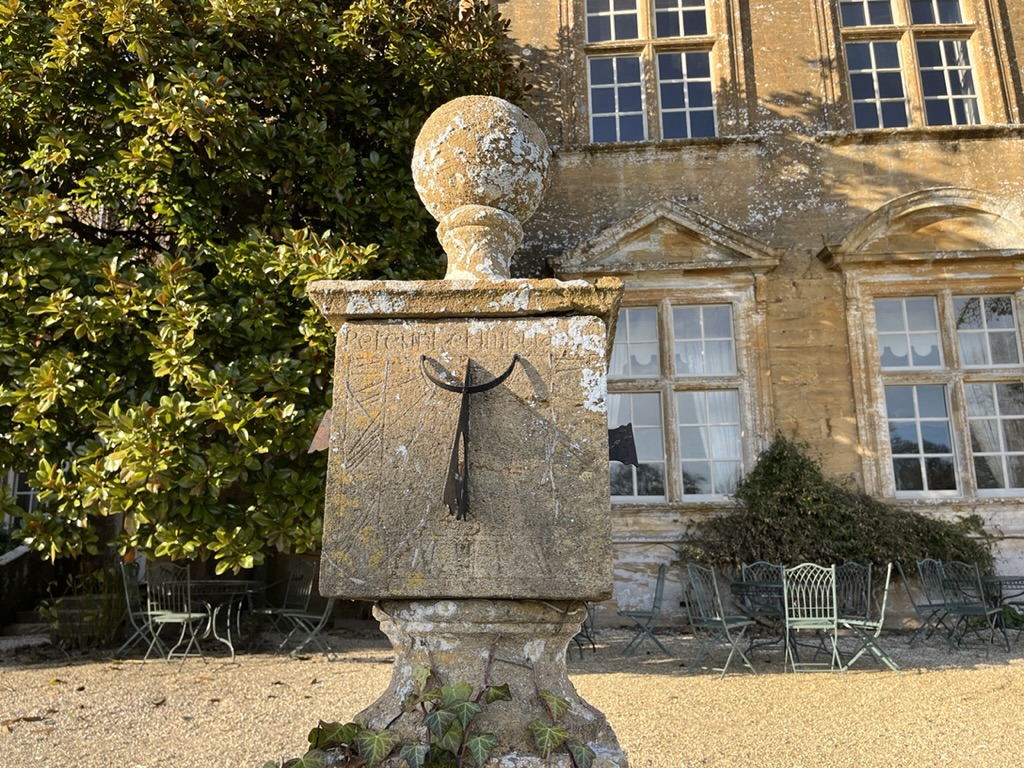
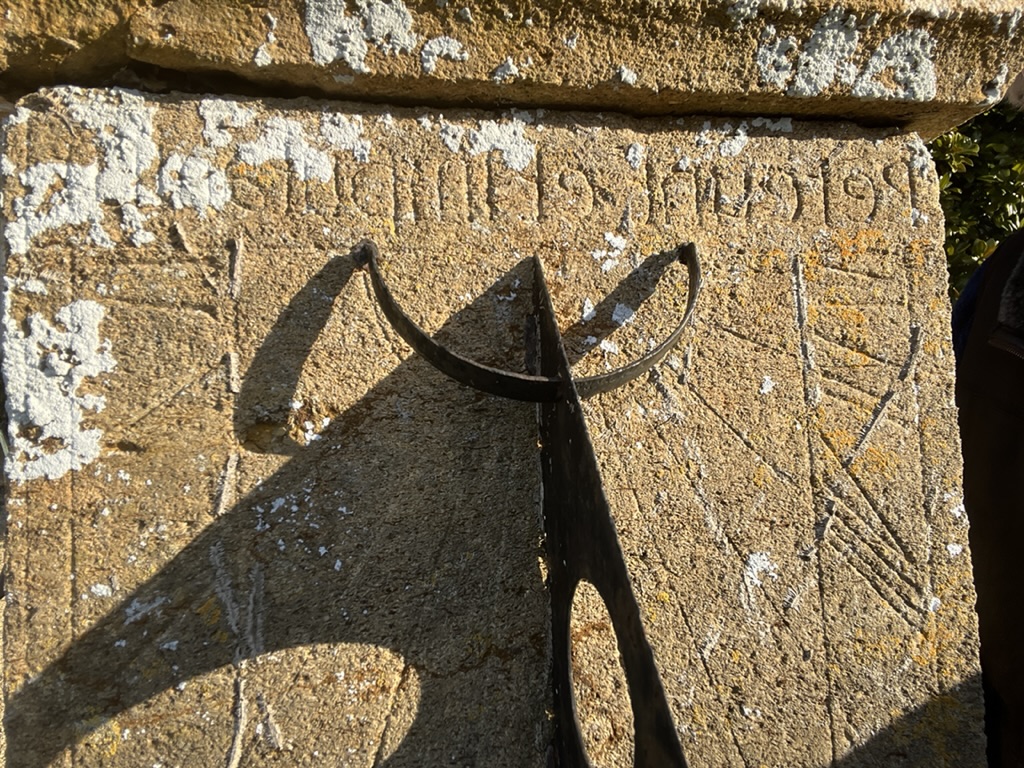
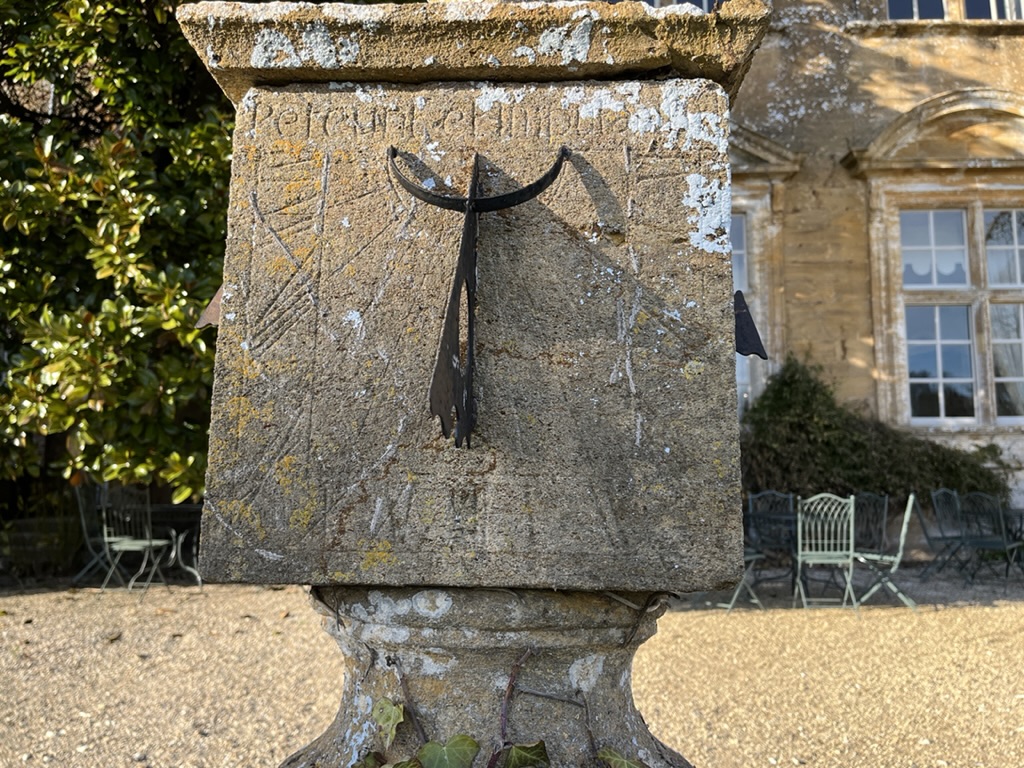
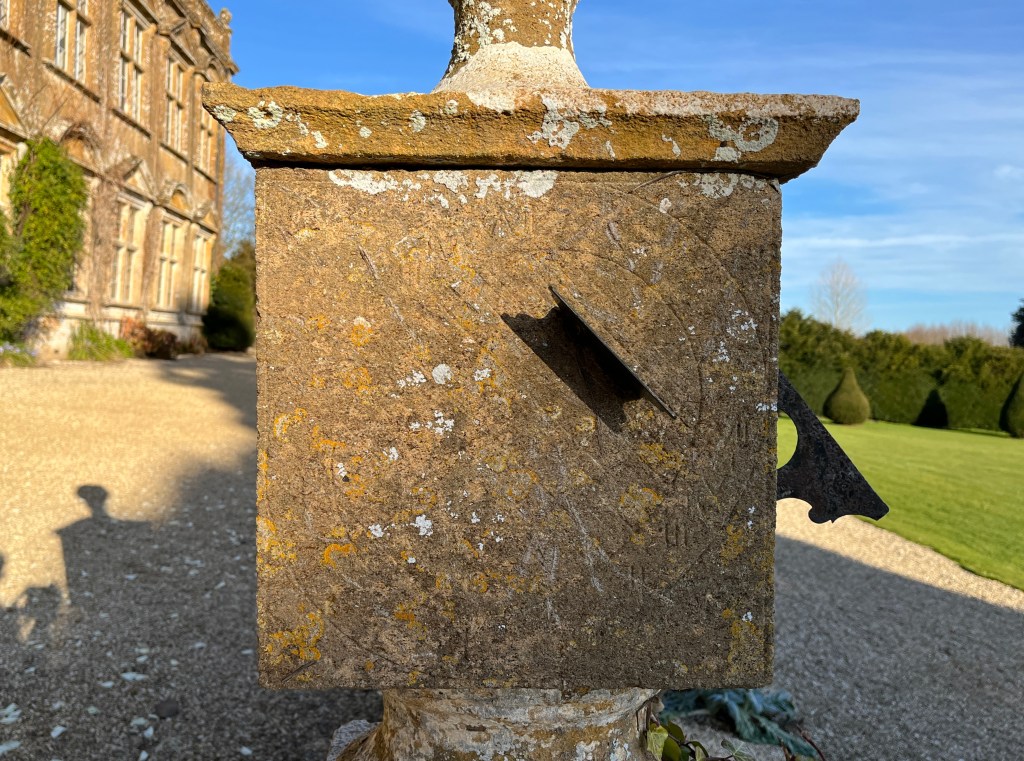
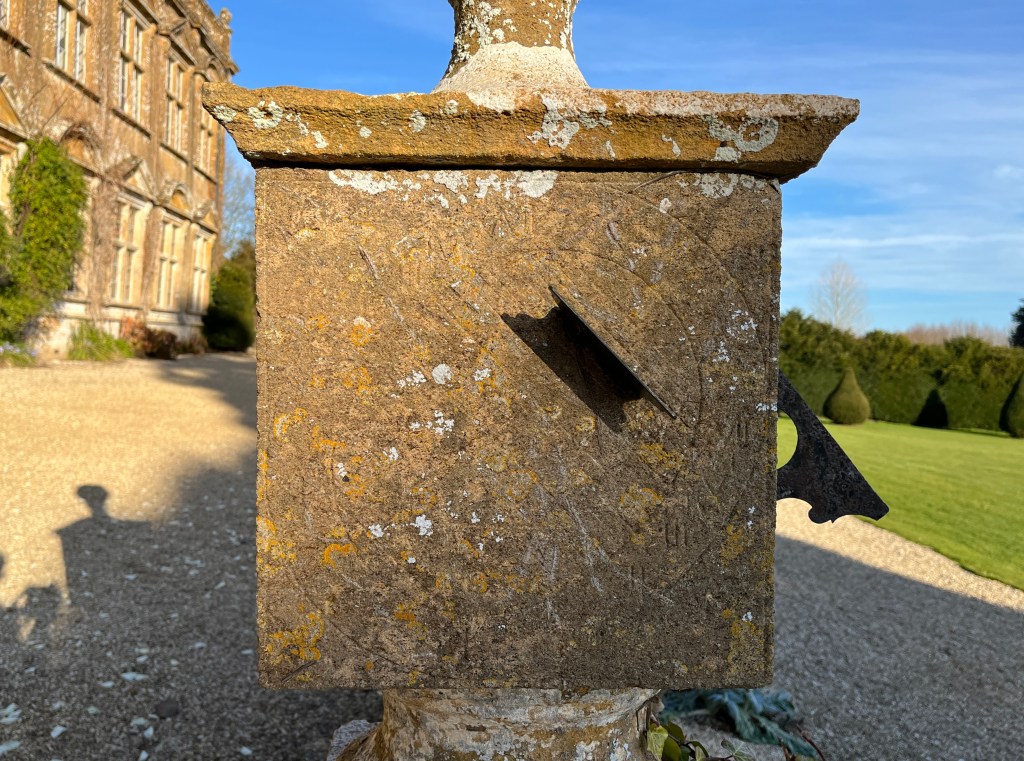
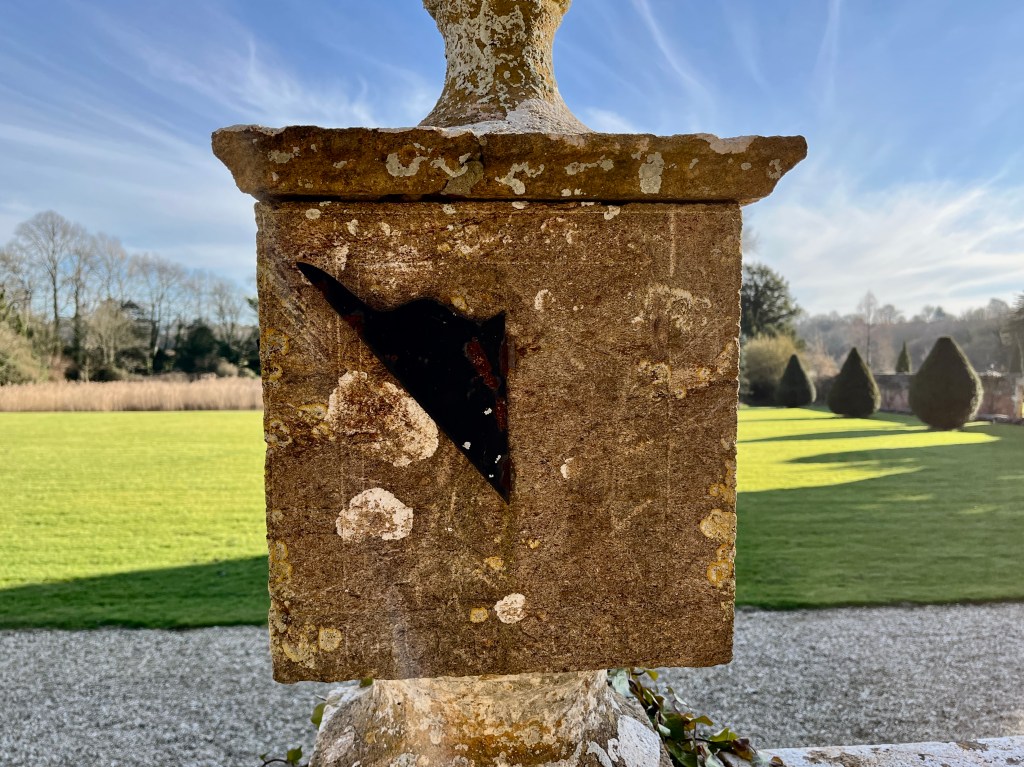
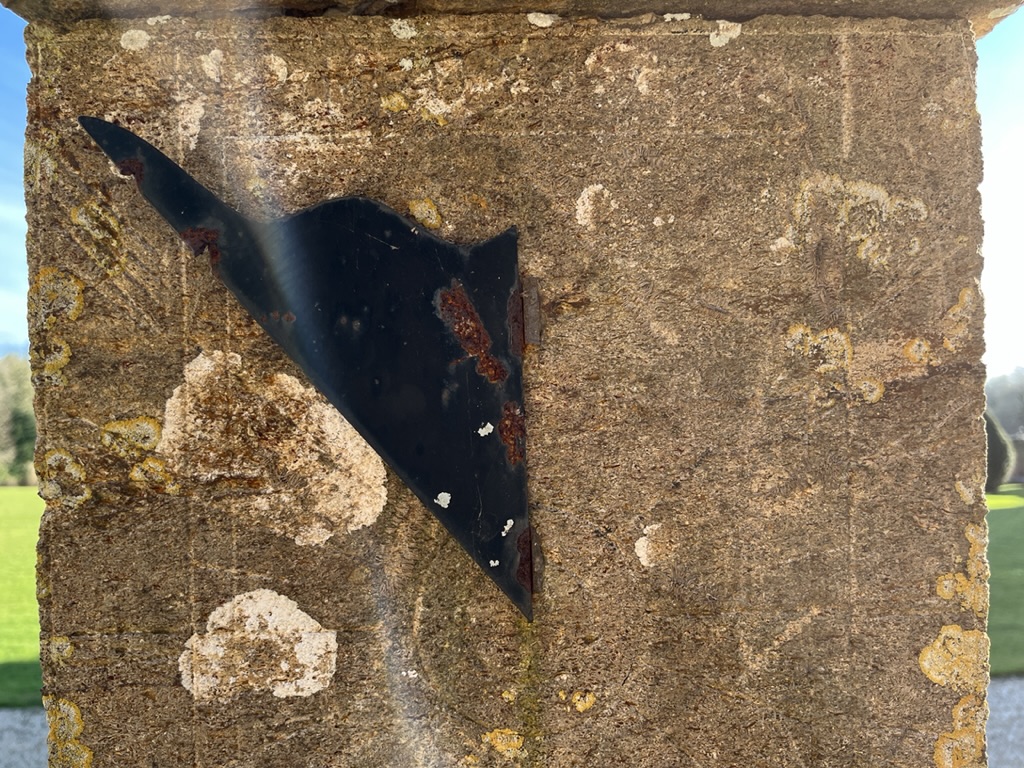
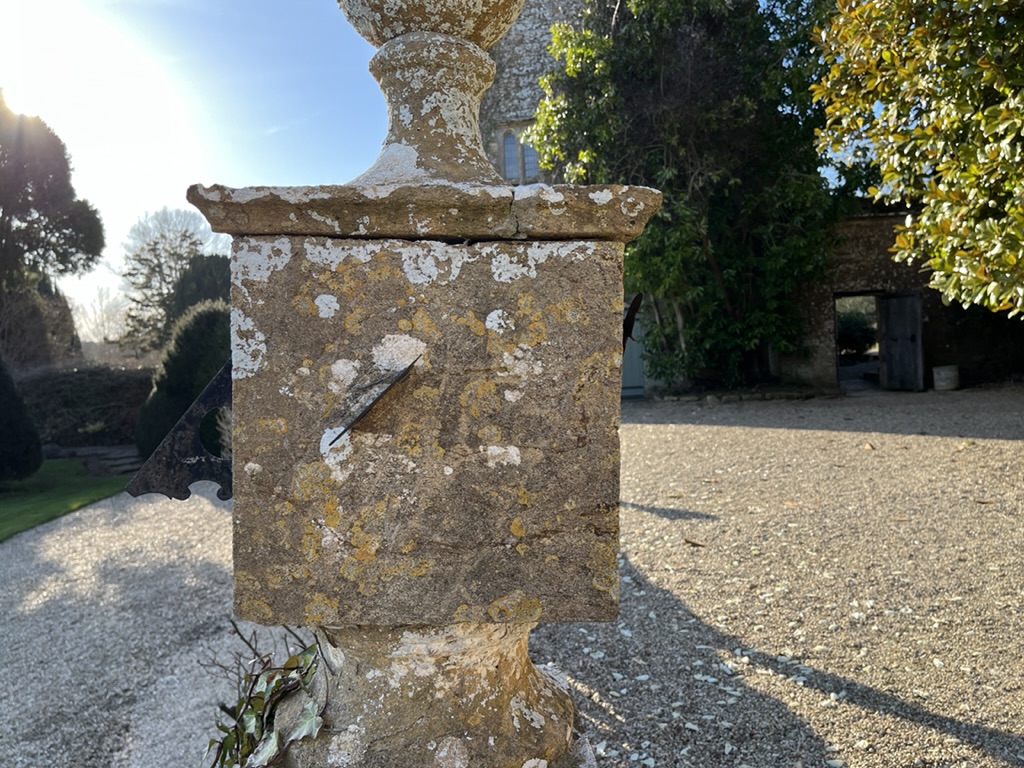
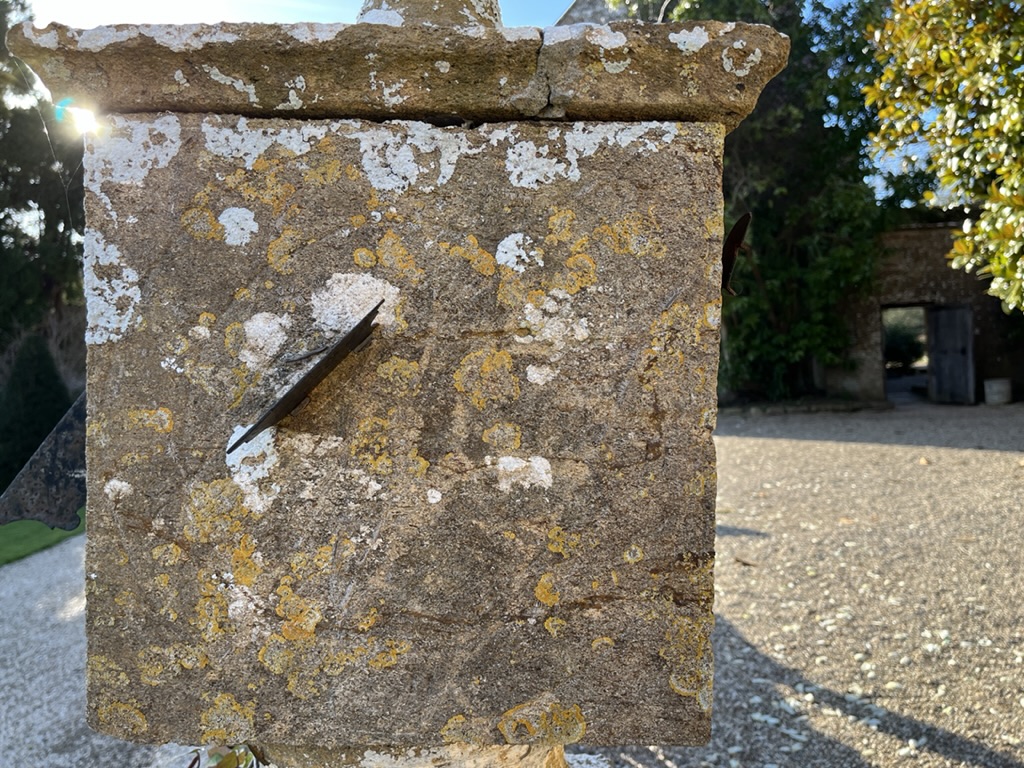
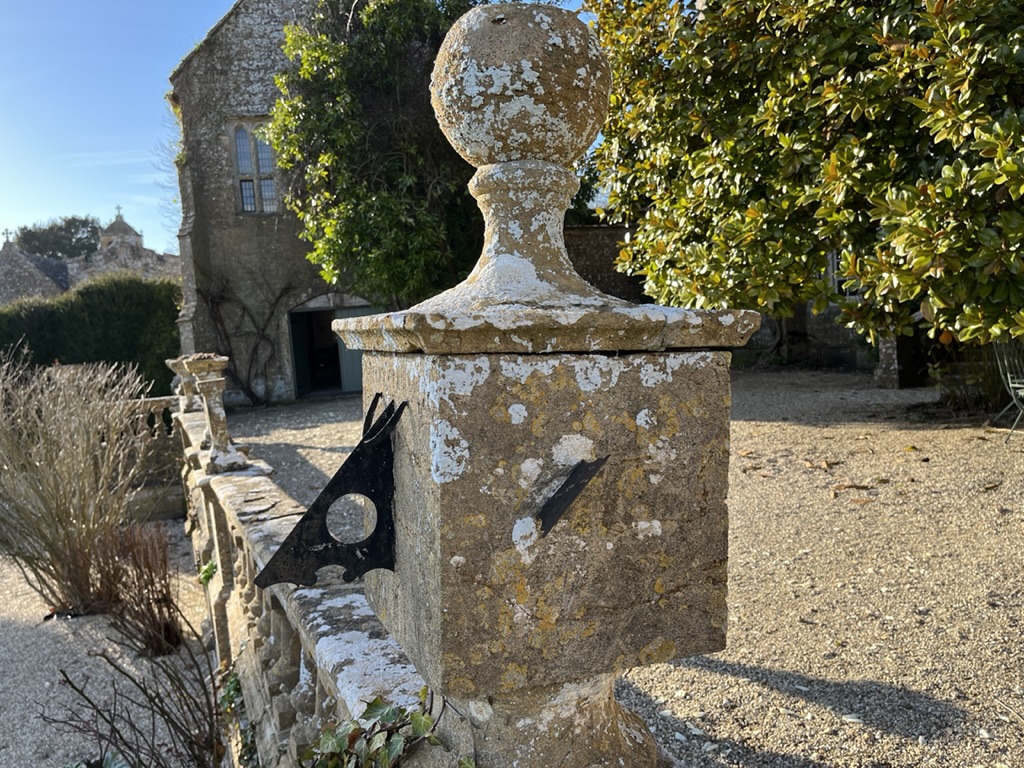
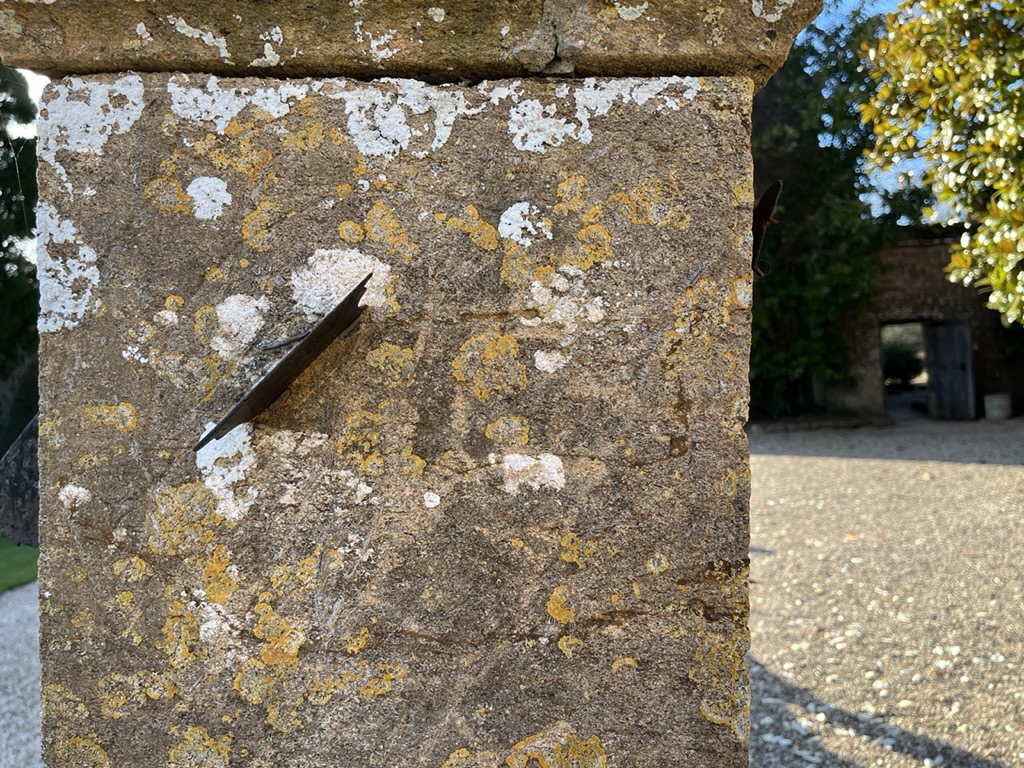
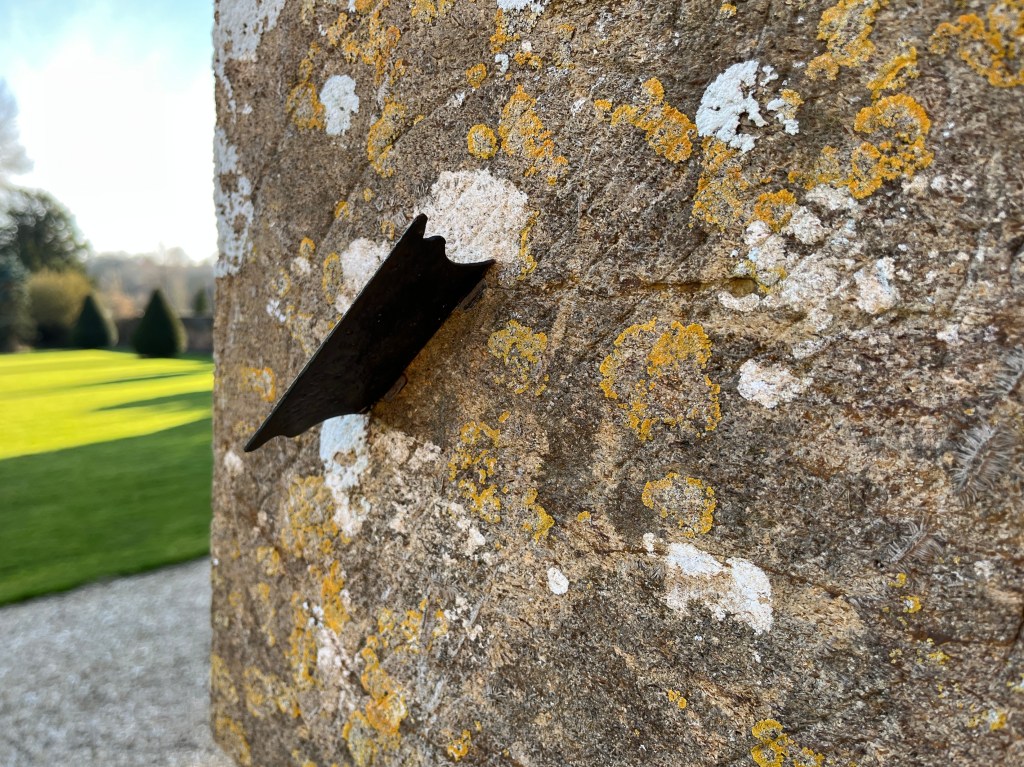
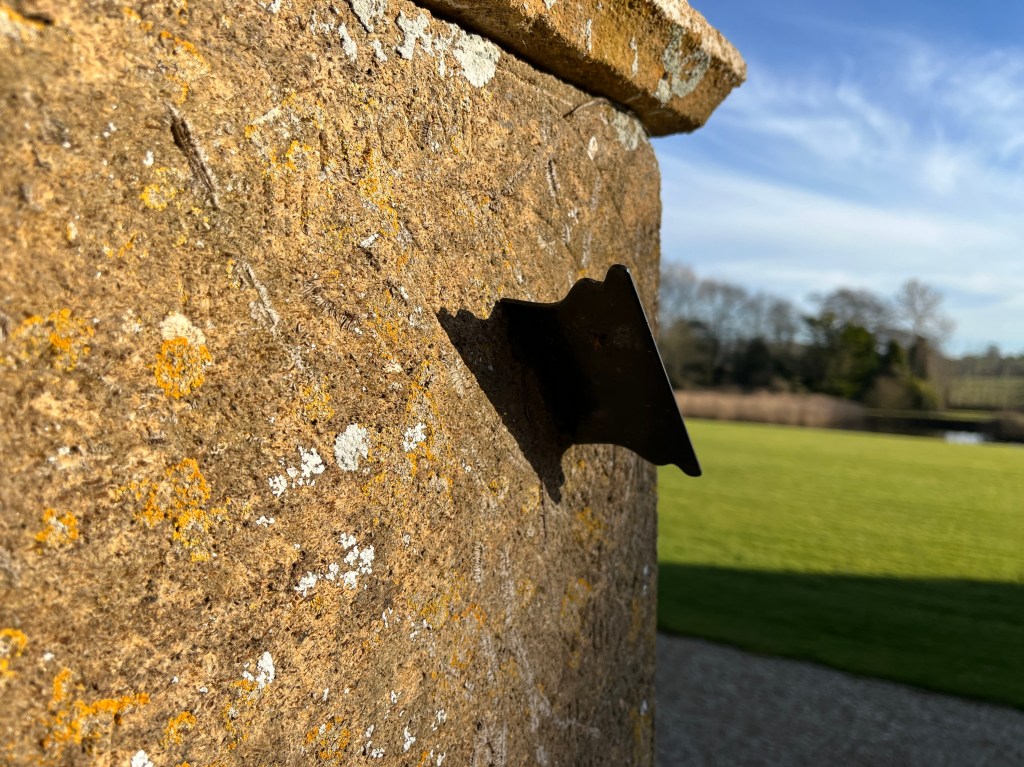
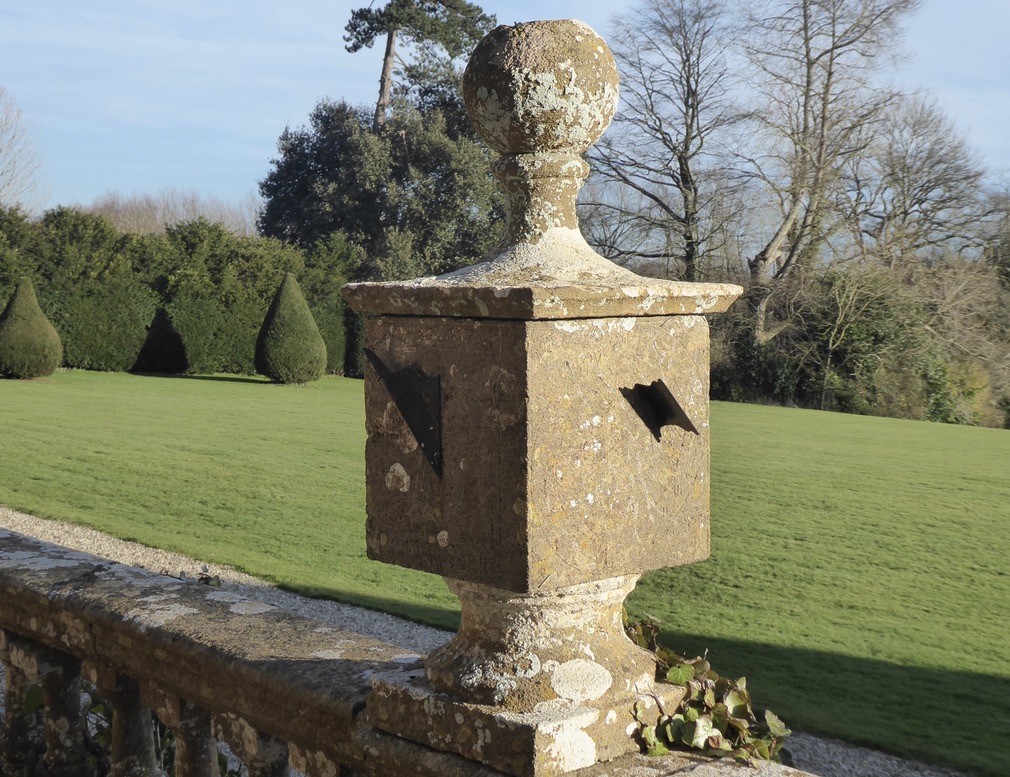
The long (75m) balustraded south terrace looks out over parkland with a small lake. The dial dates to mid-C19, probably added ± 1860 as part of the design for the terrace building project. If the dial is older, it must have been relocated. HE describes the ashlar retaining wall with chamfered plinth, capped with a stone balustrade with intermediate piers on which are set a variety of urns and other ornaments, and in the centre of the long western section a block sundial with ball finial, on which is inscribed LAT 50-56, 17.30, having sheet metal gnomons, 2 of which are broken. The 4 gnomons are shown together further down this page.
SOUTH
The motto on the S face of the dial reads PEREUNT ET IMPUTANTUR, which Gatty gives as ‘they perish and are reckoned’. Its original form as a Martial epigram directly references the sun’s involvement in this process.
GRADE II* † Cll Saxon / Norman origins with simple nave – some features survive; C15 chancel; later additions / restoration 1882. A most surprising Palladian / Venetian E window. Detached timber-framed bell cote. Attractively set in a well-wilded churchyard. 6m W of Andover. 51.1944 / -1.611 / SU272439
DIAL
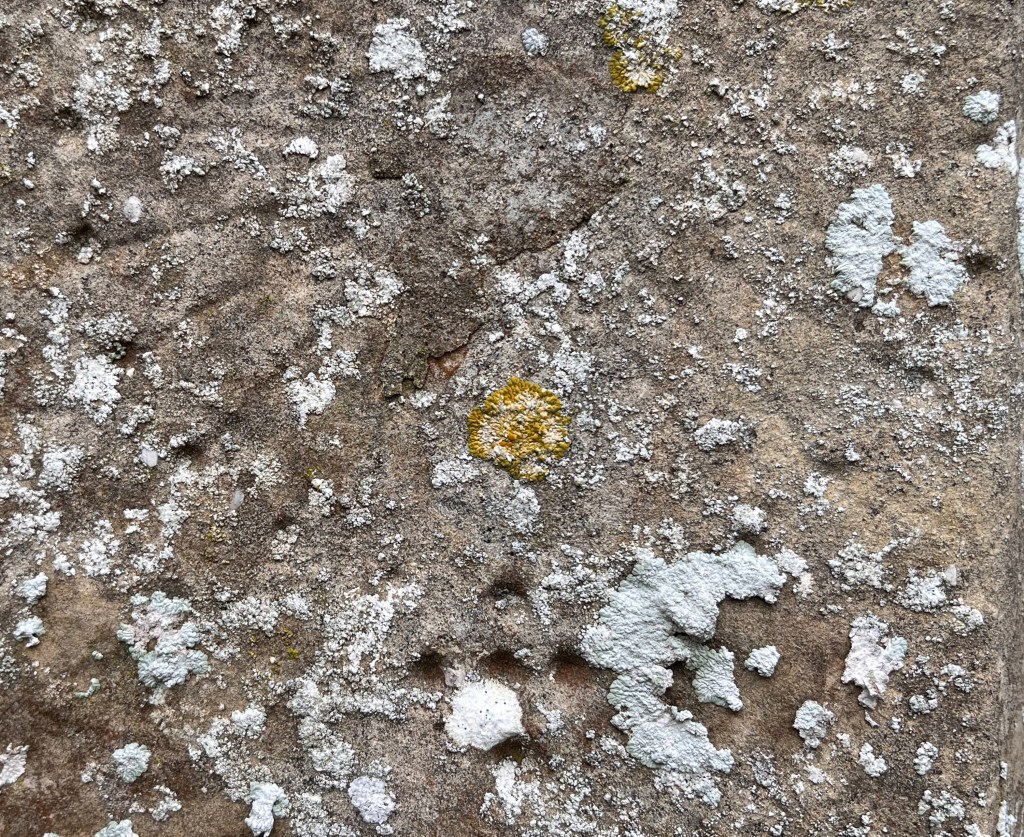
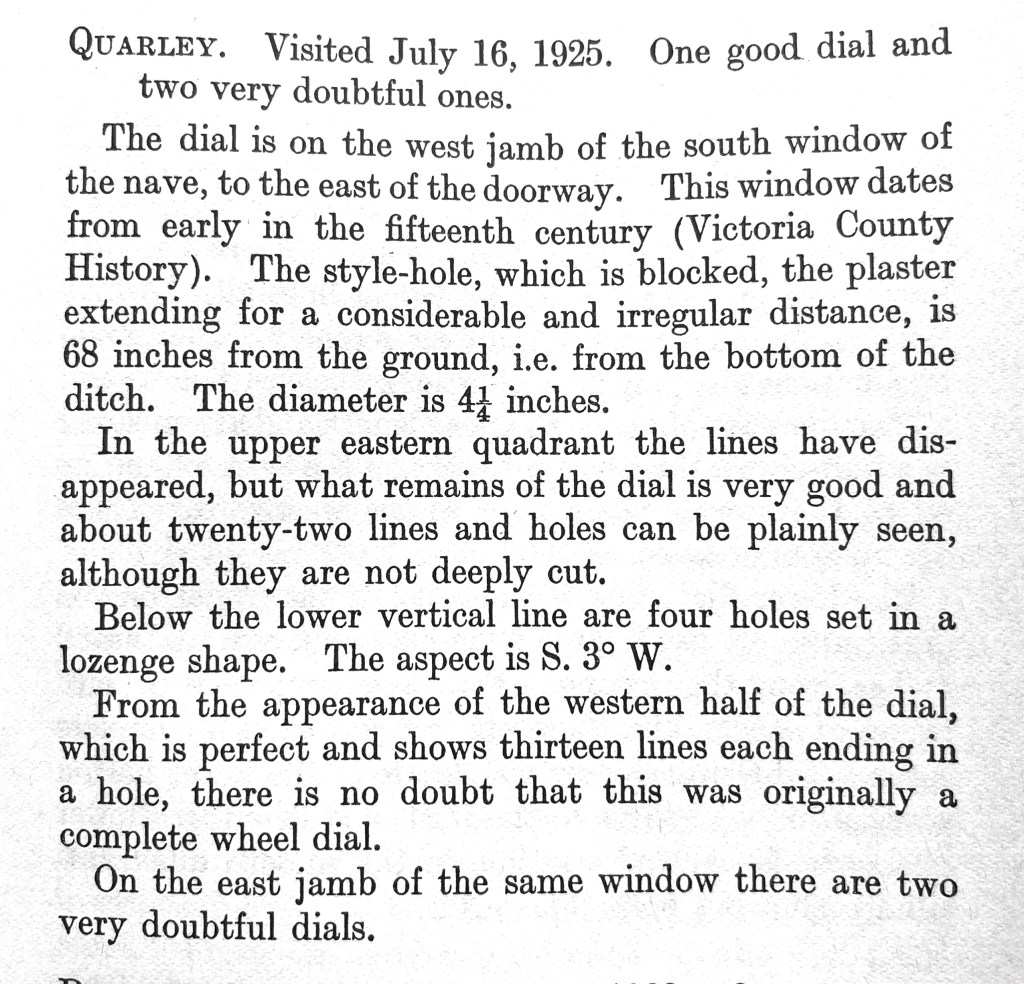
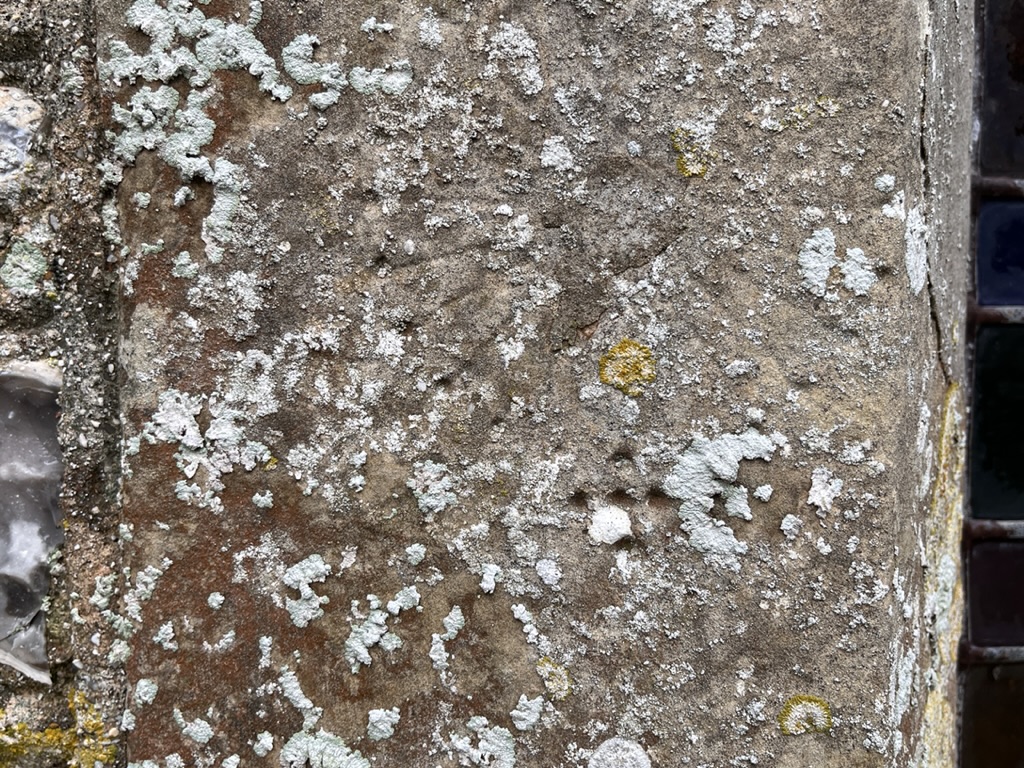
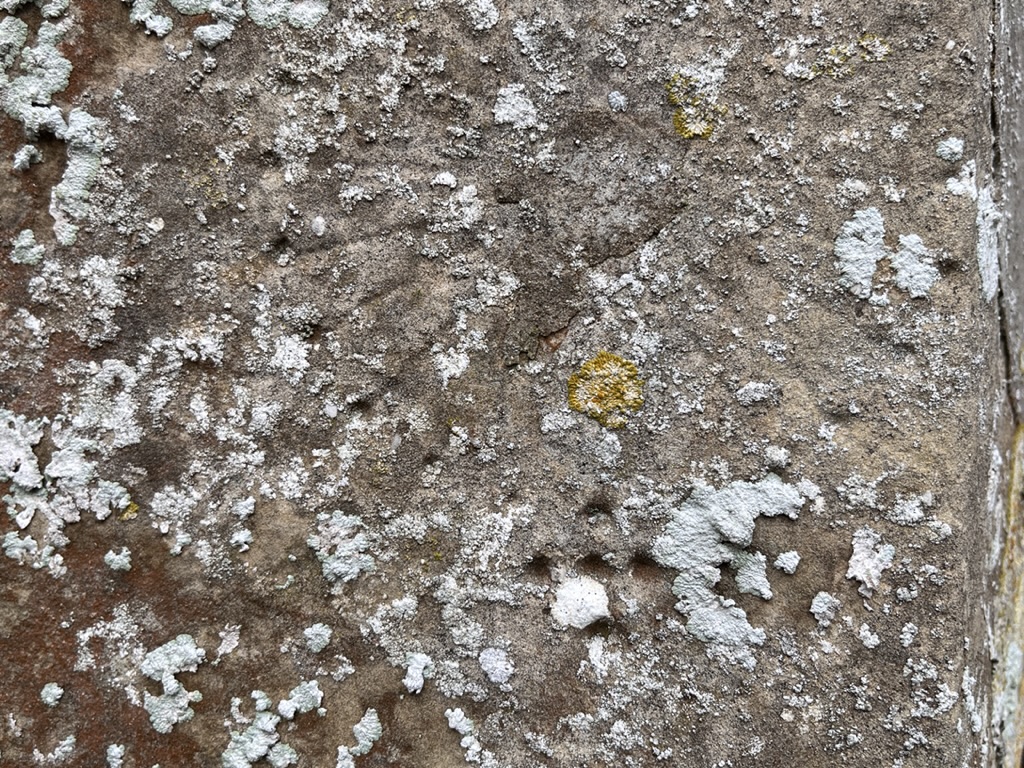
The dial is on the W jamb of the window E of the porch, first recorded by ARG in 1925. The gnomon hole is filled. ARG’s description is below. The more recent BSS entry records 19 visible / detectable lines and 21 pocks, with possible hints of a circle. On either view, this is an eroded 24-hour dial (esp URQ), with noon marked by a quincunx (like 5 on a die), which I haven’t seen before. One puzzle is why the dial was cut in such a position that it is truncated RHS.
ARG noted two very doubtful dials on the E jamb of the same window; and in his text he refers to another doubtful on the buttress of the S Chapel. I couldn’t make out dials.
St Michael . Quarley . Hants – Scratch Dialwith Quincunx
There was another mark that caught my eye, a small uneven circle of pocks. There’s no hint of a central hole. As I visit more churches, I see more of these little markings. They can’t be dials, and they seem unlikely to be purely decorative. My tentative theory is these little pock circles are a form of protection mark / apotropaic symbol). However I haven’t yet found such a design featured in the usual medieval building mark resources. Any theories welcome.
St Michael . Quarley . Hants – circle of pock marks
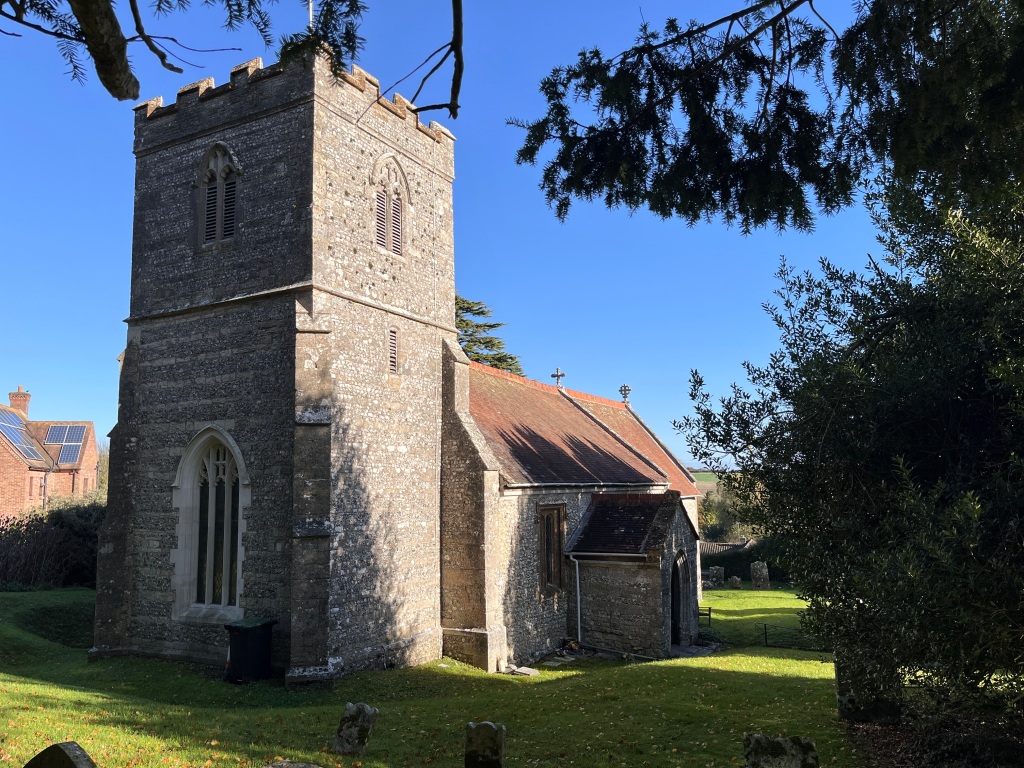
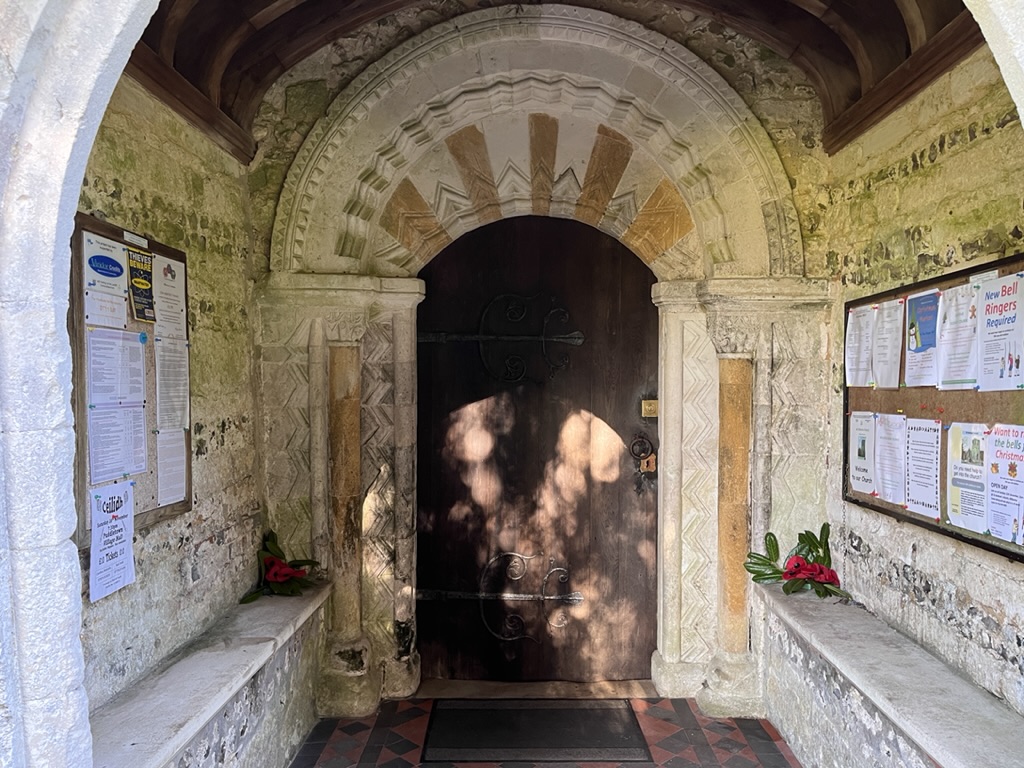
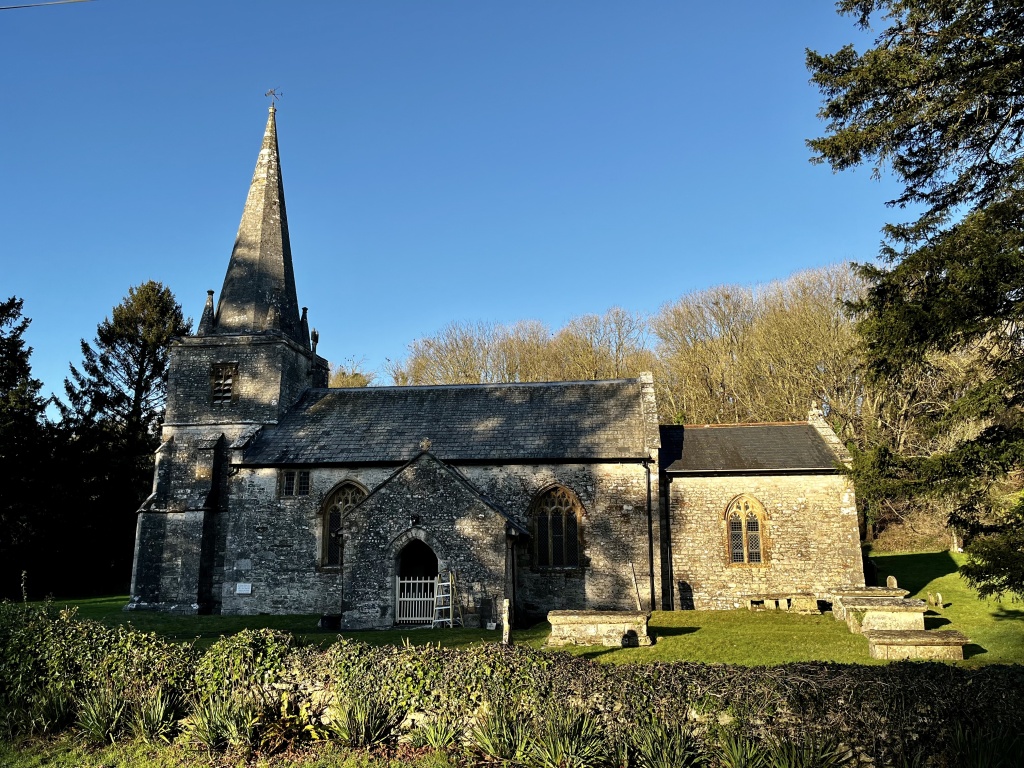
GRADE II* † C12 origins; tower & S porch C15; chancel, vestry, south aisle and chapel c1876 (G E Street). Wonderful C12 inner door with chevrons, shielded by porch; C12 font with a story to tell (below). A charming and very Dorset church. 4m SE of Bere Regis; 10m NE of Dorchester. 50.7759 / -2.2833 / SY801974
DIALS
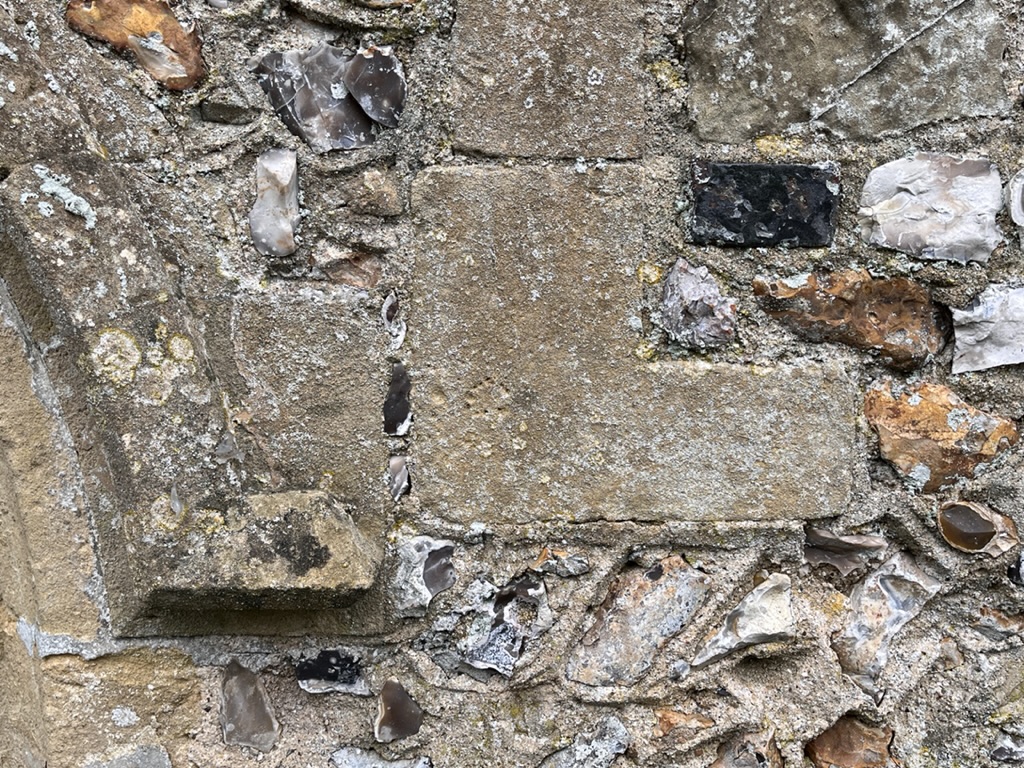
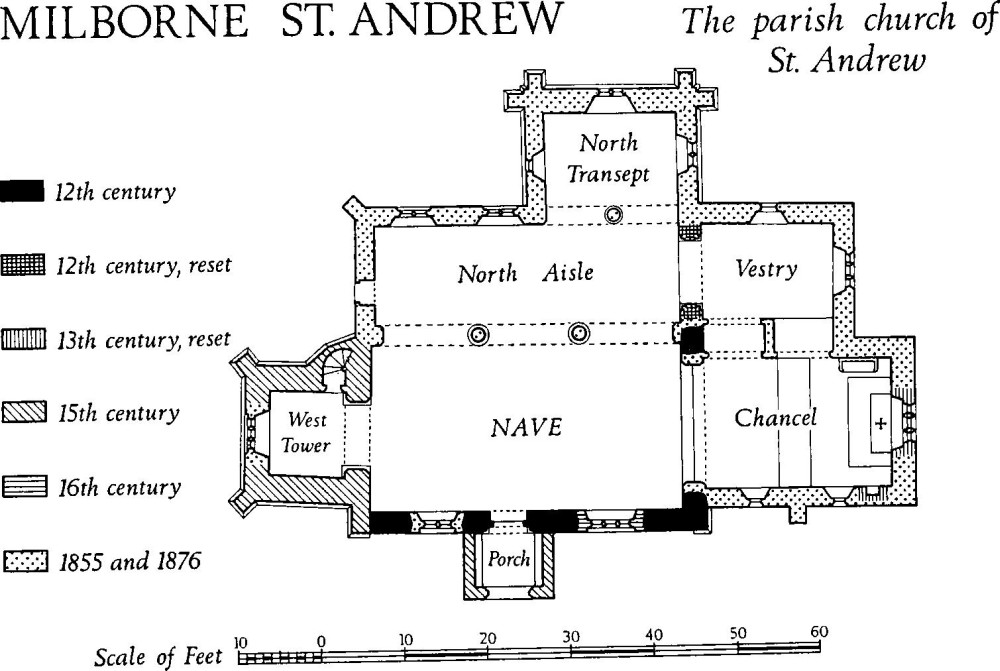
St Andrew has 3 dials. Dial 1 is a true scratch dial located in the NE corner of the nave, as is Dial 2 on the stone below (largely obscured by lichen, easy to overlook). Dial 3 is a transitional dial above the porch entrance.
DIAL 1
St Andrew . Milborne St Andrew . Dorset – Scratch Dial 1
Dial 1 is easily identified by its prominent filled gnomon hole from which 3 lines radiate in LLQ. There is also a perimeter curve of 5 (?6) pocks (diag).
St Andrew . Milborne St Andrew . Dorset – Scratch Dial 1
DIAL 2
St Andrew . Milborne St Andrew . Dorset – Dials 1 & 2, NE corner of the nave
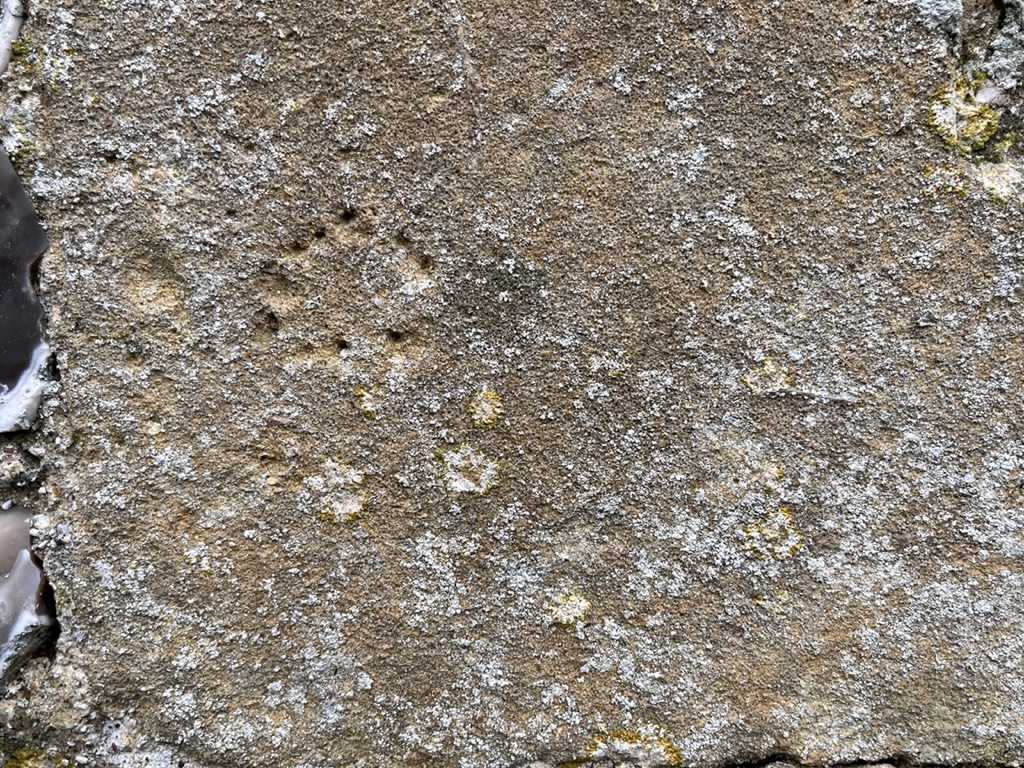
Dial 2, on the stone immediately below Dial, 1 has no discernible lines. BSS records 5 pocks of varying size that are (given the lichen) more or less visible seen in conjunction with the BSS diagram below. They are basically shallow dents, in contrast to the ‘drilled hole’ type of pock usually encountered.
St Andrew . Milborne St Andrew . Dorset – Scratch Dial 2
DIAL 3
St Andrew . Milborne St Andrew . Dorset – Scratch Dial 3
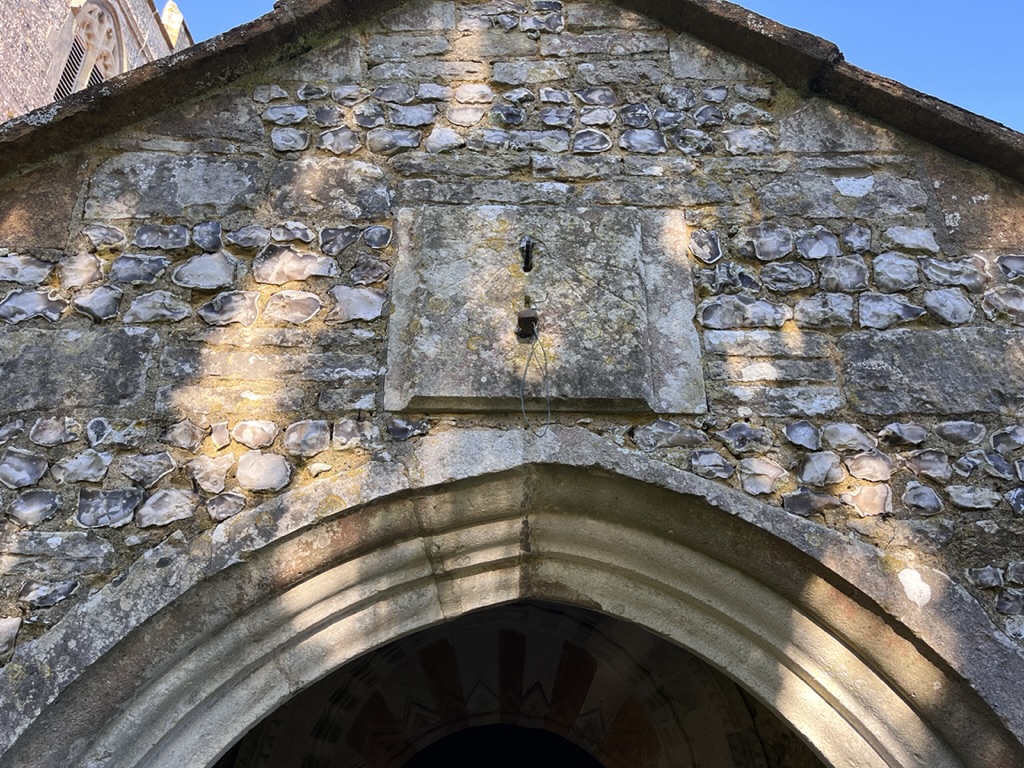
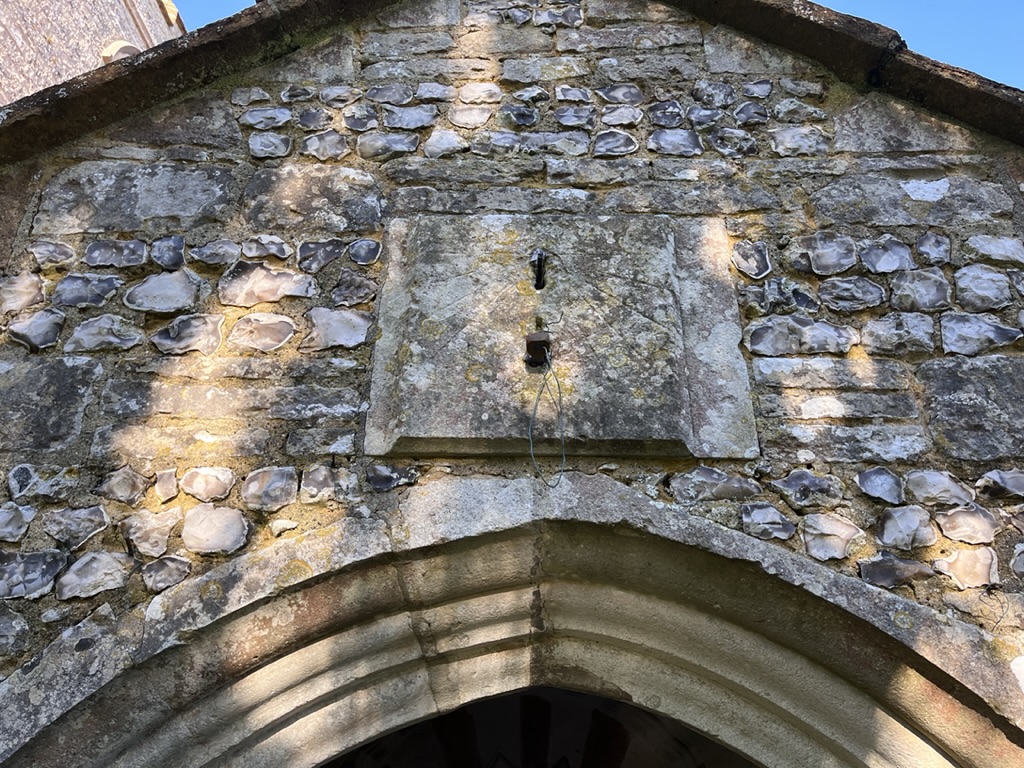
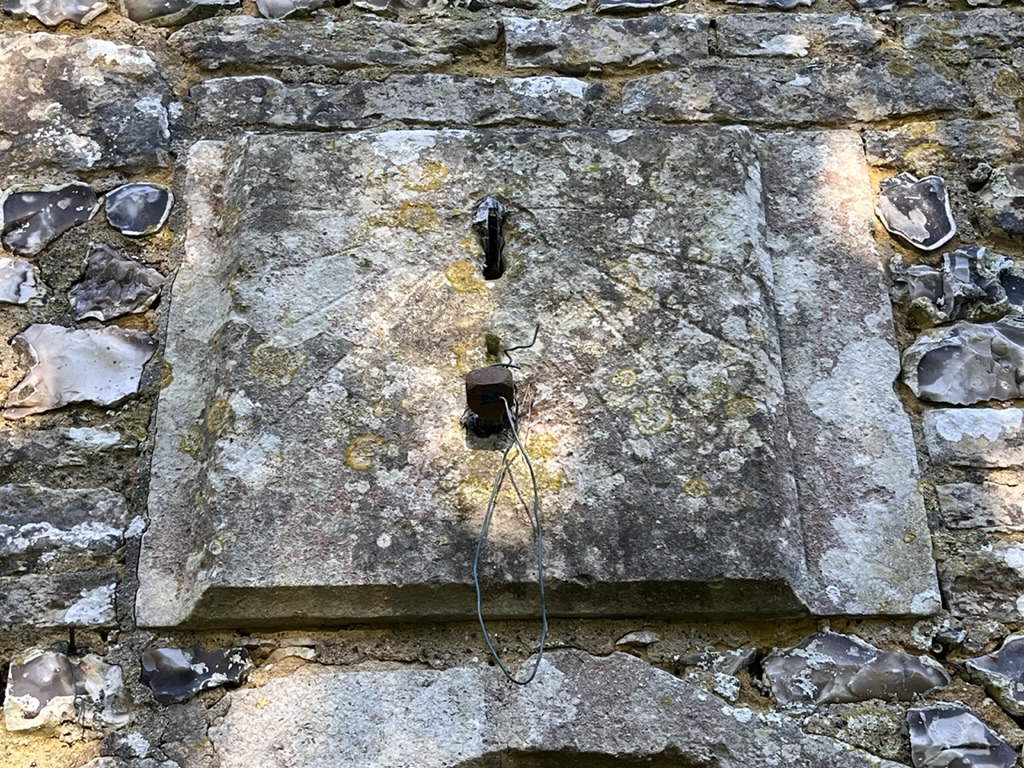
A transitional dial above the archway of the C15 S porch. Accuracy in marking the passage of time became increasingly important, not least with the advent of clocks. Dial design and construction involved taking a scientific approach to making time-telling more reliable and more legible. St Andrew is a good example. Rather than being scratched directly onto a stone intrinsic to the church structure, this dial stone is on what BHO describes as a square raised panel.
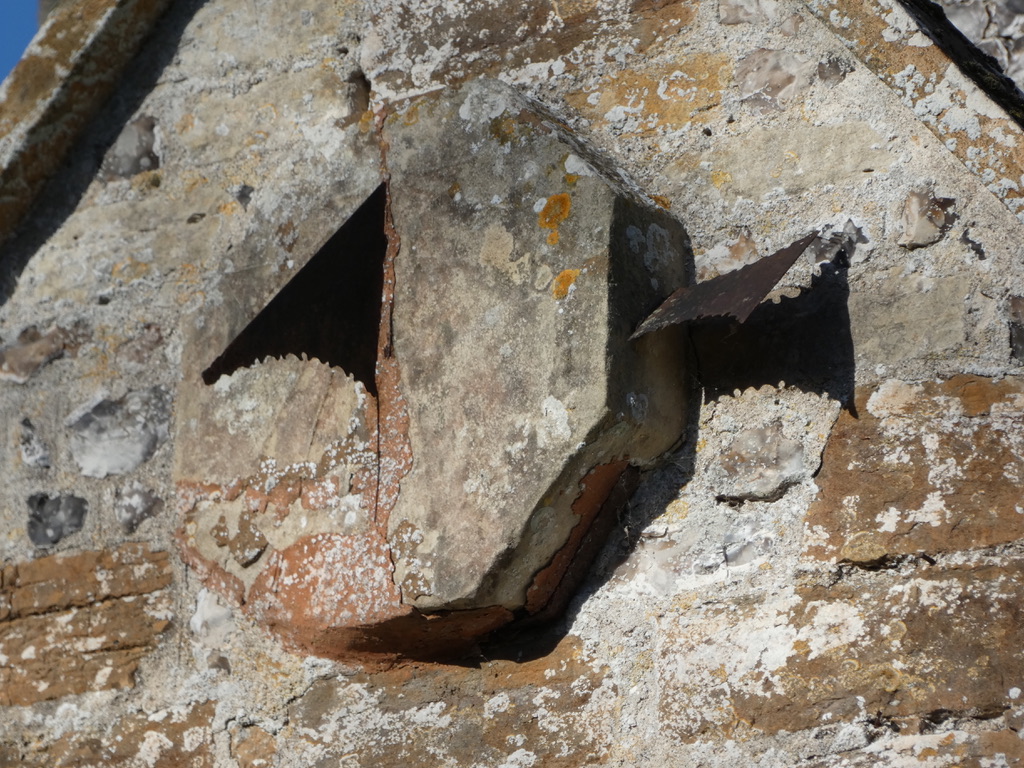
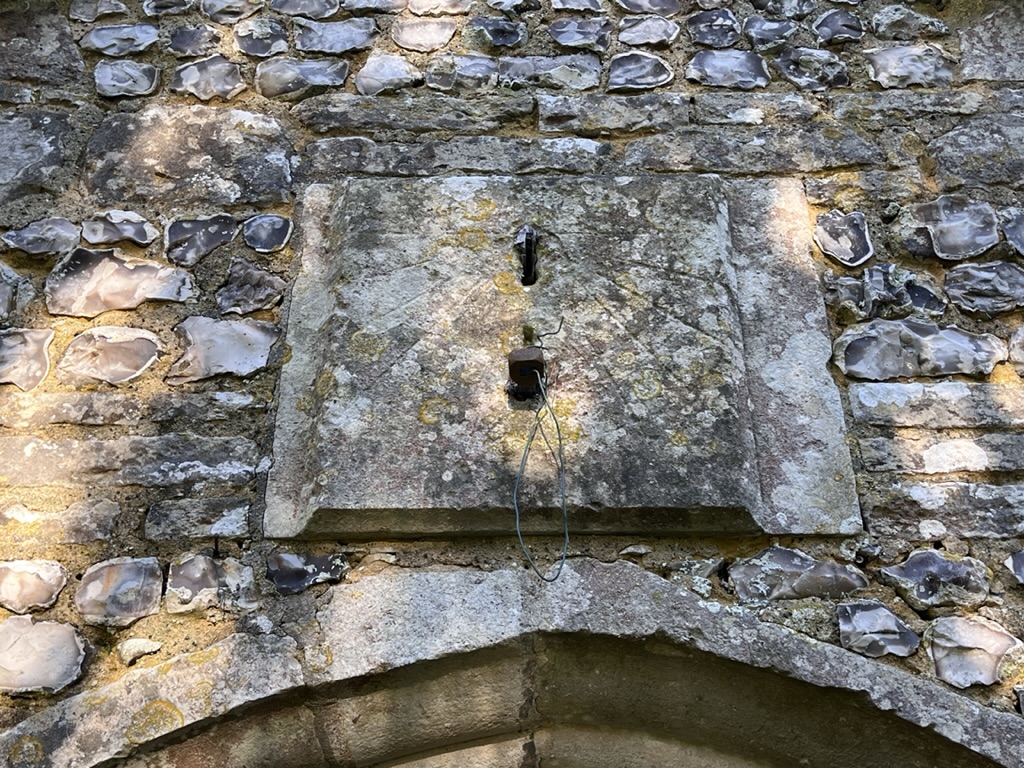
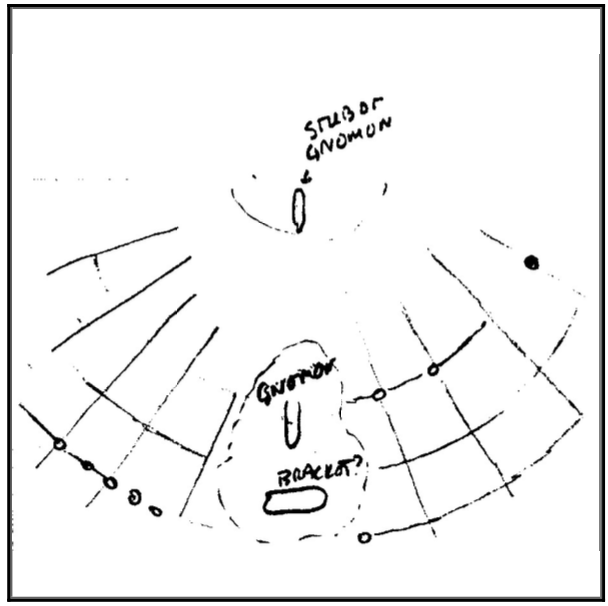
The dial has slightly angled edges with ‘extensions’ on both sides. It is not canted, so probably faces due S. It is a six-to-six dial with – originally – 12 lines (14, with the horizontal as 2). The hours 4 & 5 are cut deeper, perhaps denoting the most important Mass of the day. Some lines have weathered away in part or completely. There are a number of pocks. The recorder noted 4 trace (semi-)circles, one being close to the gnomon hole. The original gnomon was in the upper hole where there is now a square stub of iron rod. The lower arrangement indicates, I think, a later conversion / updating from a simple rod gnomon to a ‘proper’ one that required a footing; and perhaps a lamp bracket.
RARE FEATURE It’s not completely clear from my rather poor iPhone photos, but if you look carefully at the edge R side where there is the wide margin, you can see that the lines marking 4 & 5 extend onto the side of the dial face and continue down the side of the stone panel. Those short lines are visible from the side even if the rest of the dial is not. I wouldn’t have paid it much attention had I not also visited the neighbouring village of Winterbourne Whitchurch where there is an emphatic example of a ‘side-dial’ complete with a most unusual gnomon. My understanding is that this arrangement amounts to a morning dial read from E.
St Andrew . Milborne St Andrew . Dorset – Scratch Dial 3
This is the 4th church I have come across where church events have entailed the use of a dial to tie in decorations etc with wire. In each case the wire was effective as an improvised gnomon.
FONT STORY
During the Victorian period it was sometimes the fashion to throw out ancient fonts and Street did just that, installing in its place a new replacement. Fortunately, the old Norman font, decorated with a cable motif, was rediscovered in 1930 and put back in the north aisle, where it remains in use to this day.DHCT [This is an example of throwing the bath out with the baby water]
St Andrew . Milborne St Andrew . Dorset – S Porch and Norman Doorway
GSS Category: Scratch Dial; Mass Dial ; Transitional Dial
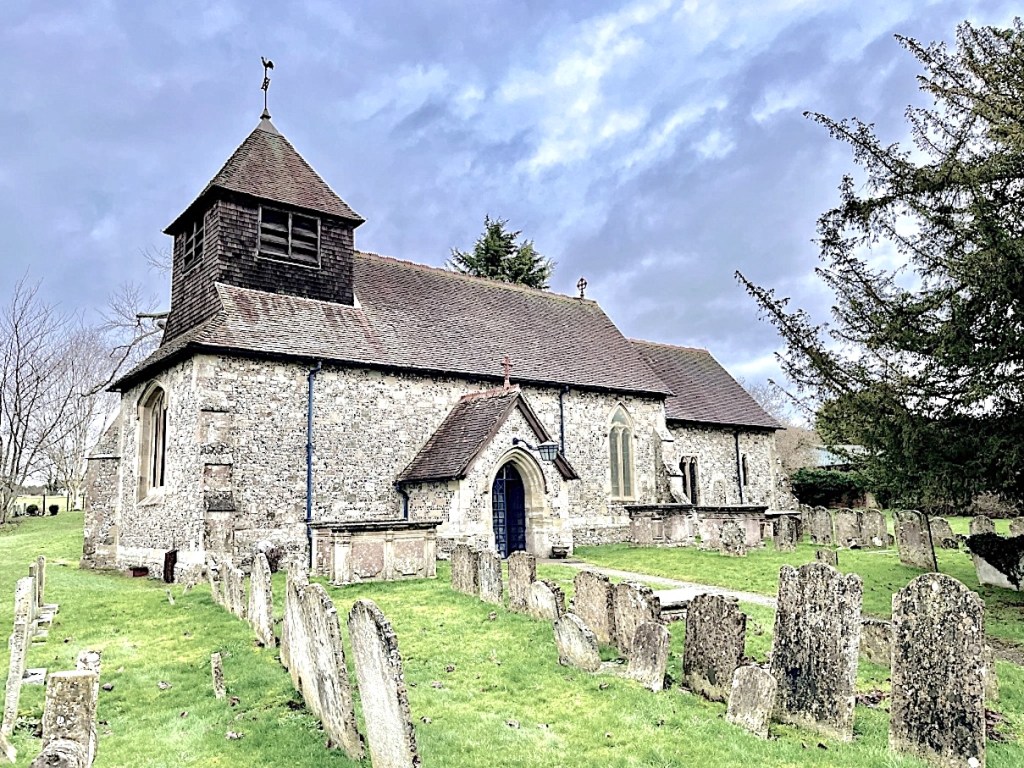
GRADE I † A fine early church in a lovely setting. C11 quoins to nave; C12 nave rebuilt; C14 3-stage W tower, porch; C15 chancel. Later alterations, restorations. Just W of Dorchester, yet seeming miles away in its peaceful valley. Visit Winterbourne Monkton while you are there (2 perhaps 3 dials). 50.7067 / -2.5266 / SY629898
DIALS
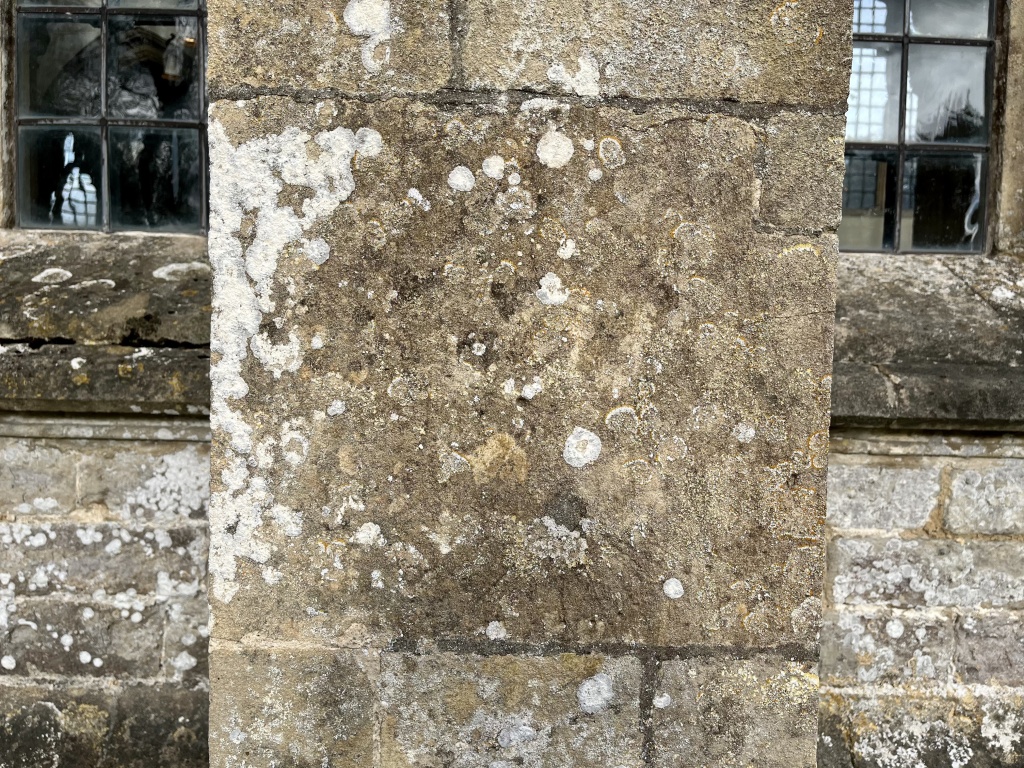
Two dials are recorded. The first is simple to find and simple in style. The second is so simple that I could not with certainty claim to have found it. It was registered quite a while ago, and possibly lichen spread has made what was already faint, no longer identifiable.
DIAL 1
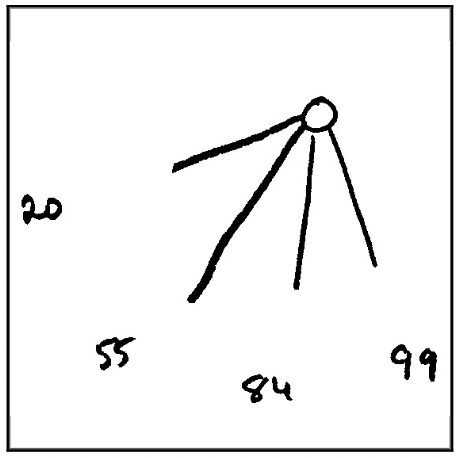
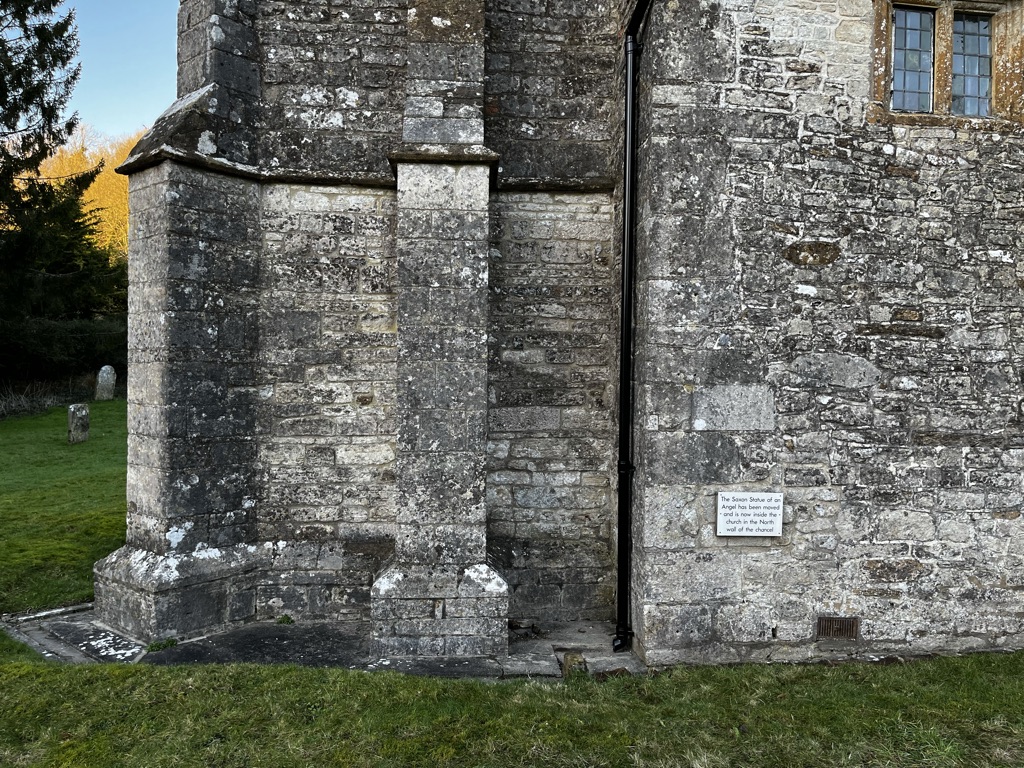
Dial 1 is located on a SW quoin stone of the nave. When examined in the 1990’s it was noted to be ‘behind a drainpipe’, which is no longer the case. By strange coincidence, when I visited the rest of the drainpipes were being repaired and repainted.
This is a straightforward little 4-line morning dial with a pleasingly casual approach to straight lines. The deeper incised line suggests that terce was the most significant Mass of the day. Do see the Saxon statue mentioned in the notice (there is a similar one in Bradford on Avon), and indeed spend some time inside this interesting small church.
DIAL 2
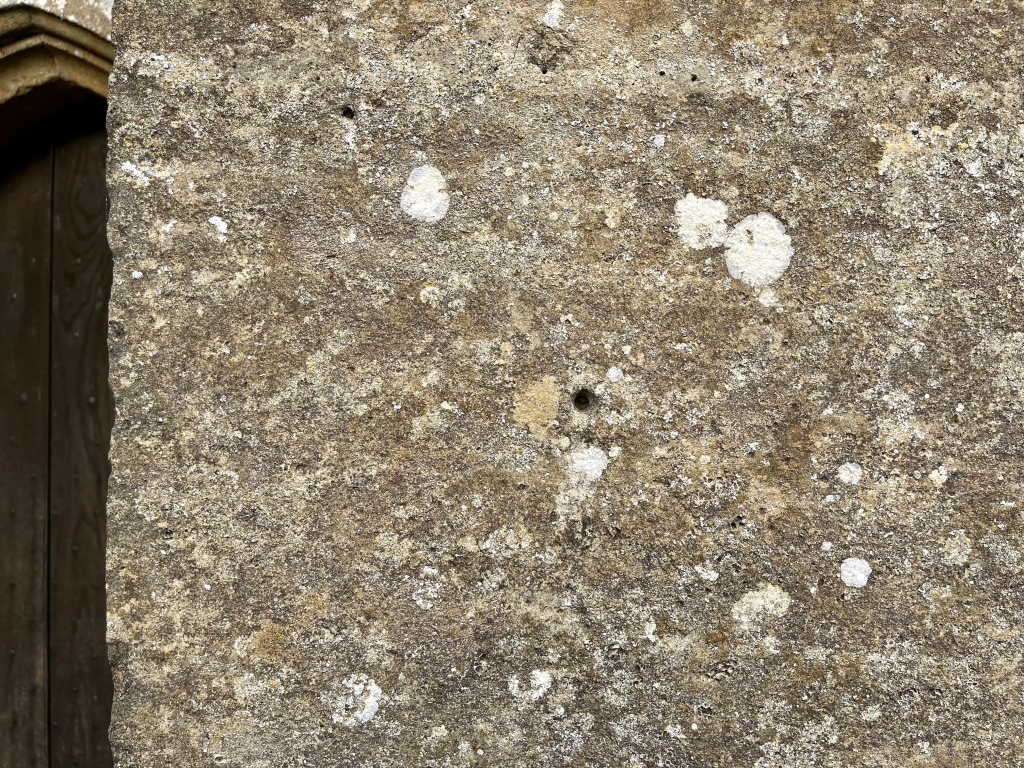
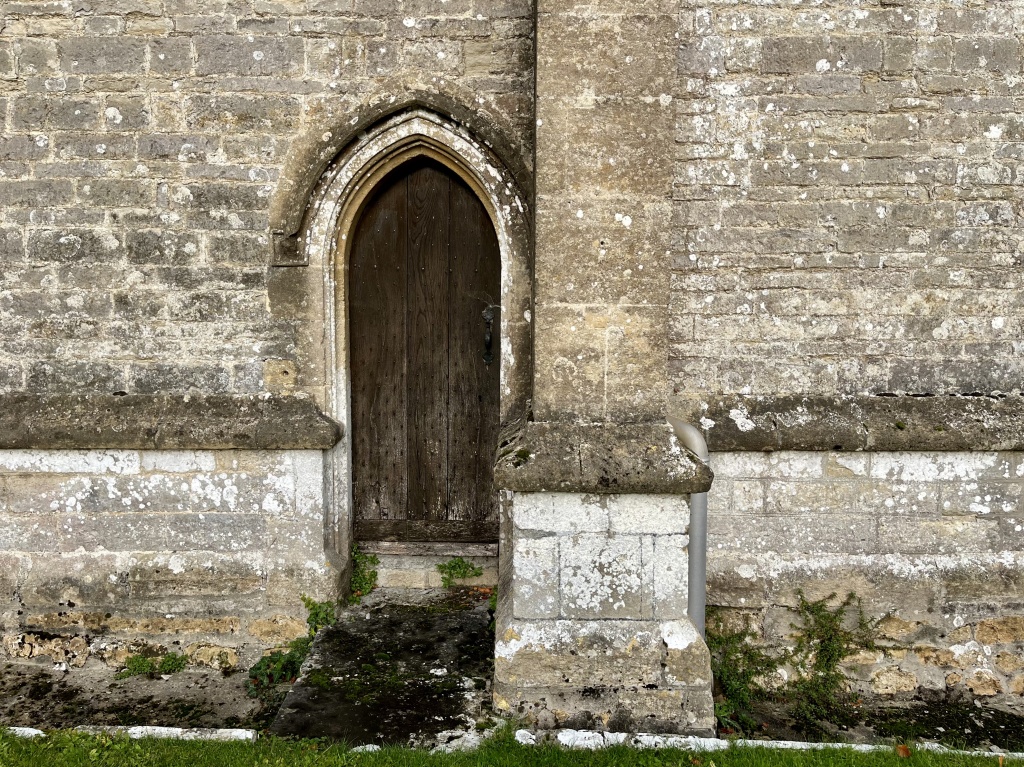
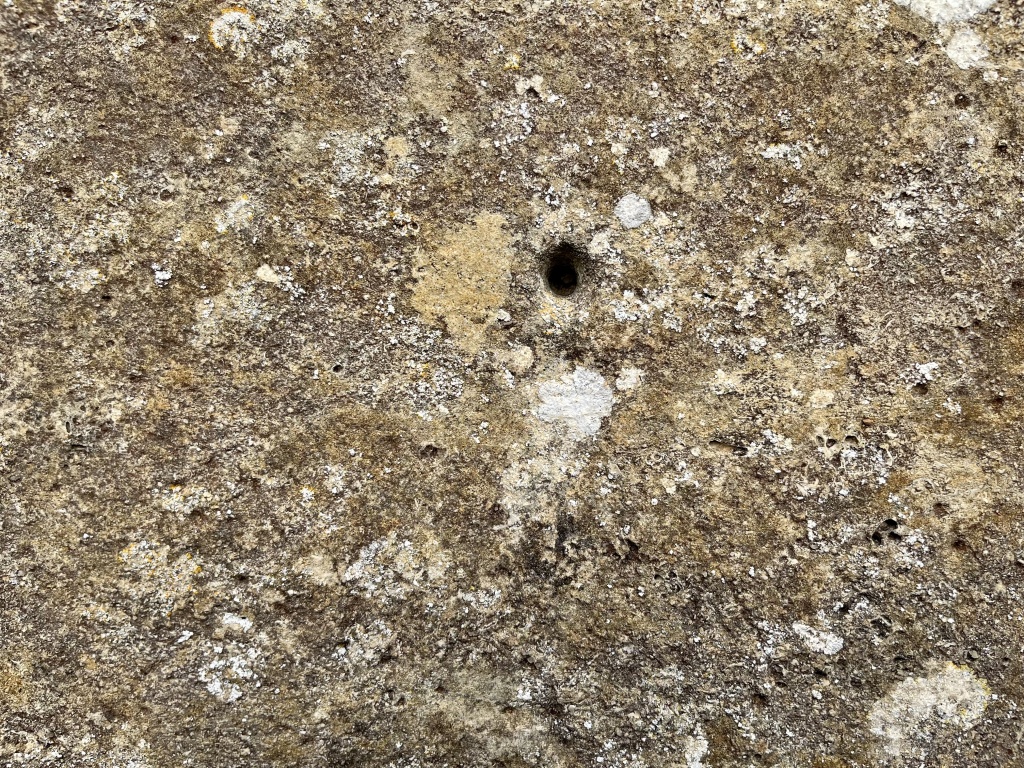
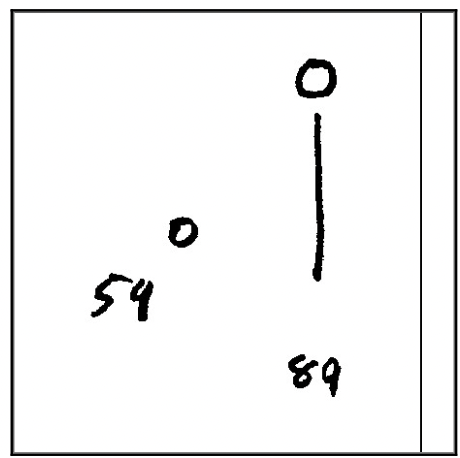
This dial was recorded as being on the S buttress of the tower, with 1 line 45mm long and a pock. It was noted then as ‘very faint’. While Dial 1 is mentioned elsewhere eg BHO, I have found no other reference. However, a drawing was made and is all I can offer for present purposes.
GRADE II † C14 origins; very little remains of the original church. Almost all refaced, restored (Withers 1879) or rebuilt. Registers date from mid-C16. Attractive with its squat wooden bell turret. Just N of A303 between Andover and Amesbury. 51.2076 / -1.6678 / SU233454
DIALS
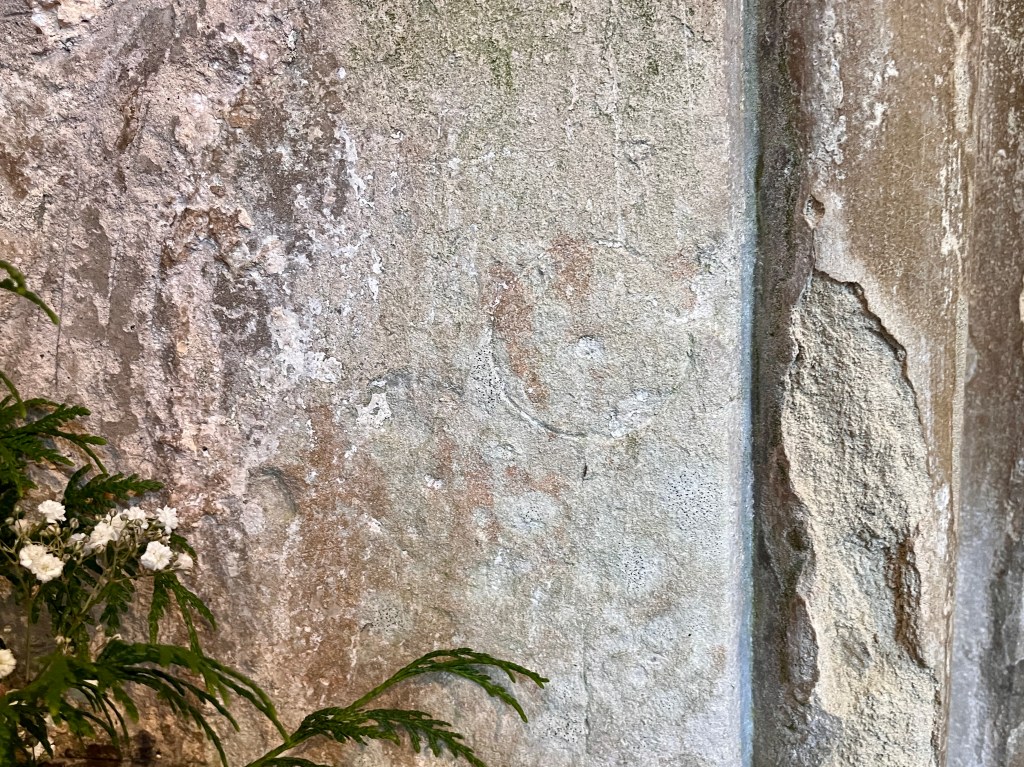
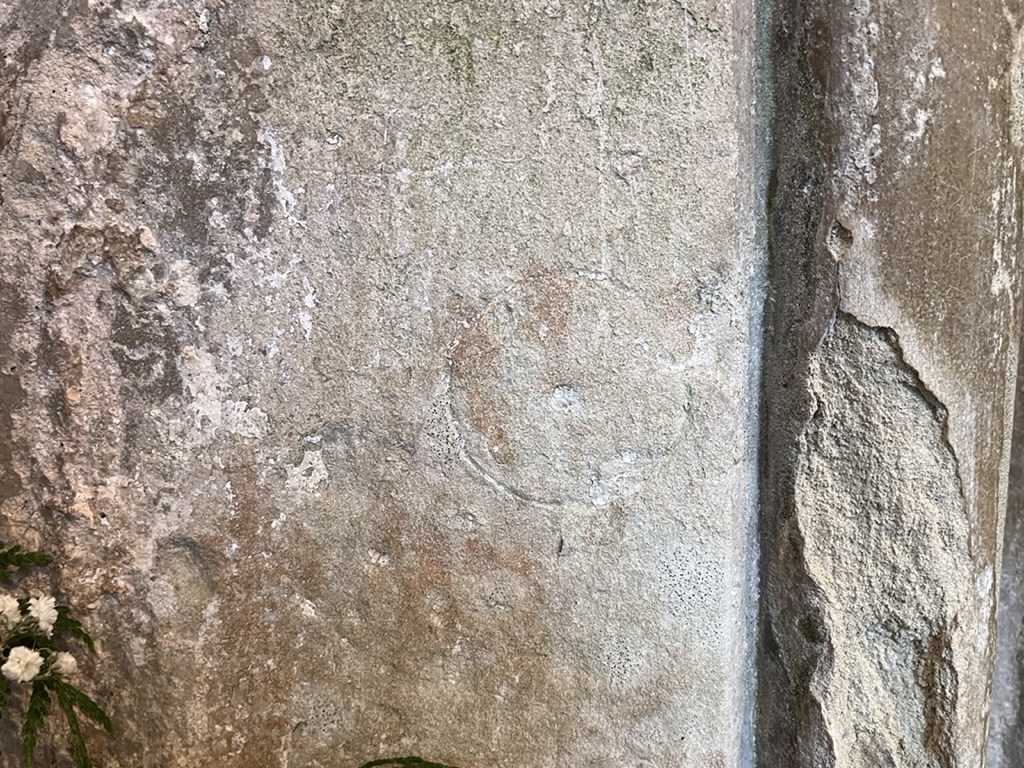
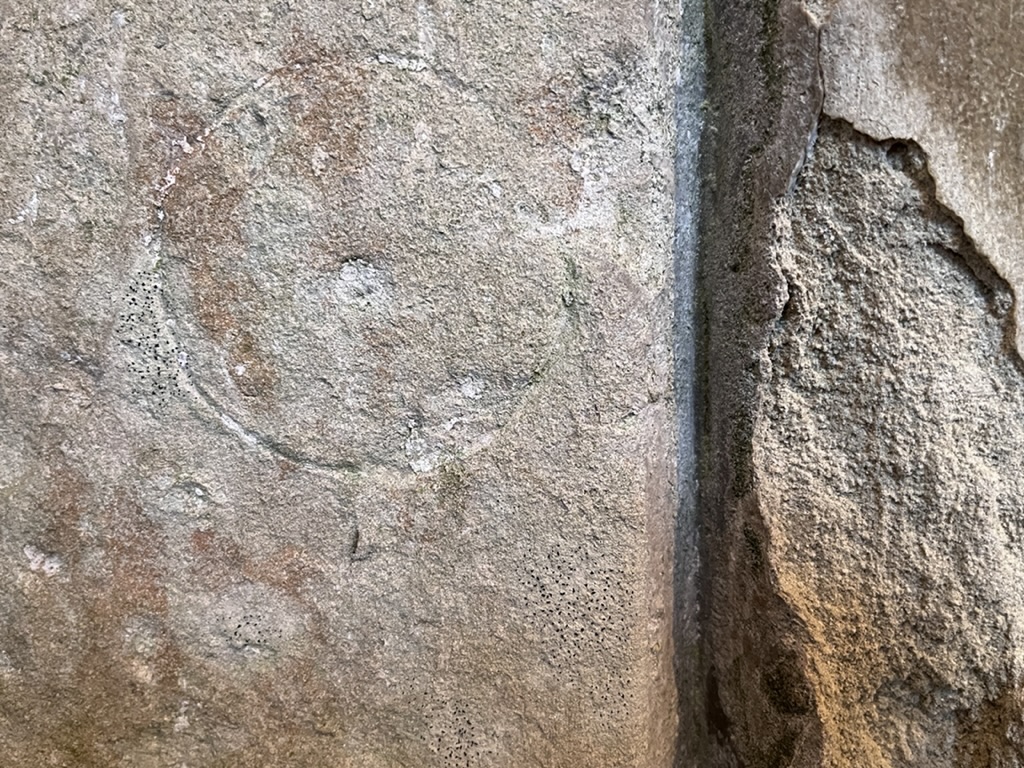
There are 2 dials recorded for St Peter, of quite different types. Dial 1 is a simple filled hole in the centre of a circle, without additional markings. Dial 2 is a sector of a fairly large dial that must have covered 2 or more stones.
DIAL 1
St Peter . Shipton Bellinger . Hants – Scratch Dial 1
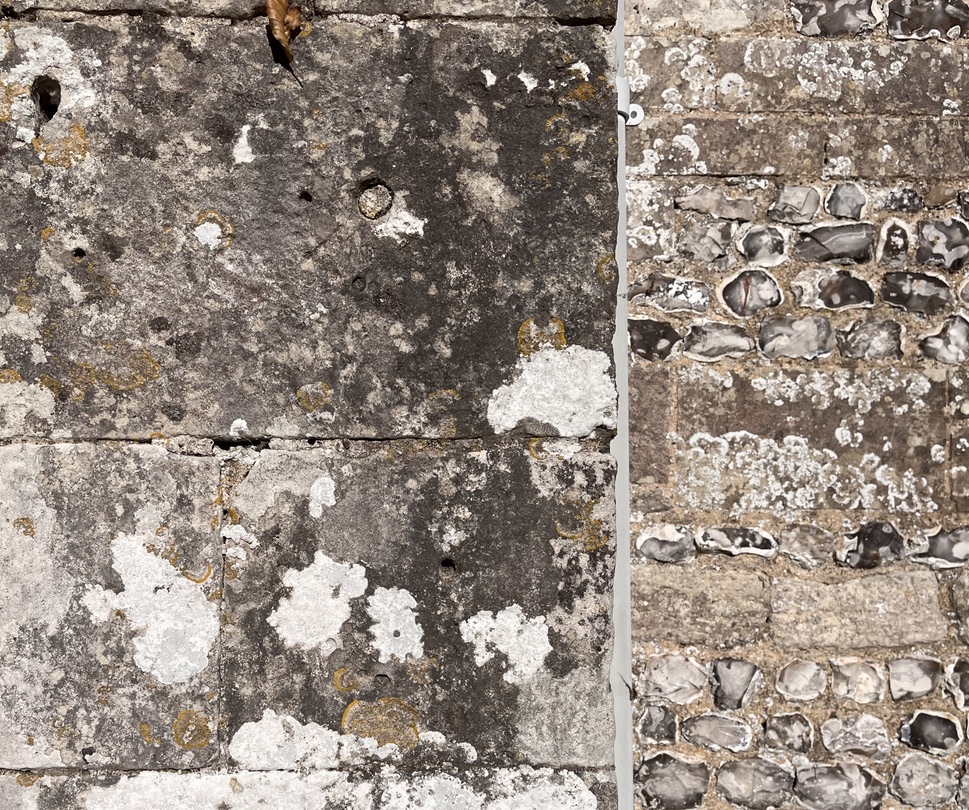
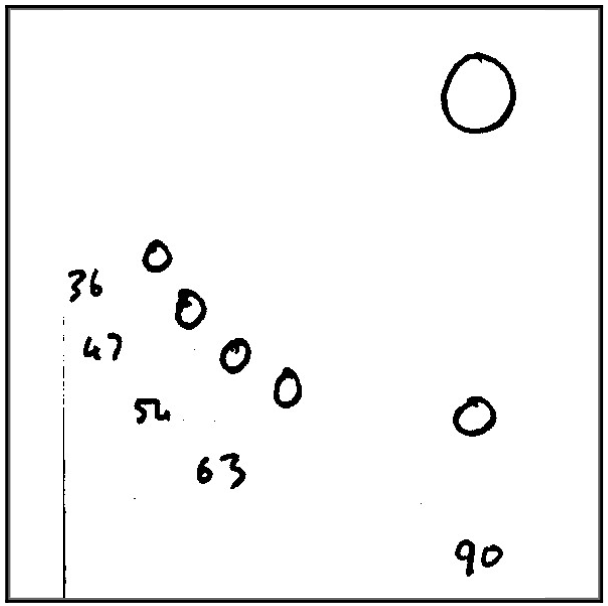
Dial 1 is inside the porch L of the doorway, quite low down. It consists of a filled central hole within a circle, with a pock (possibly unrelated) ULQ. With a rod as a gnomon, it would work as a basic marker of the the passing day, though at an inconvenient level if in its original position. The unusual shape of the large dial stone also suggests a significant relocation somewhere in the time-line of the various building works. One record dates the dial to C11, which seems unrealistic – it predates the known origins of the church. Also noted were faint traces of a similar circle LLQ, but I could not detect anything significant. There is a further possibility that, rather than a dial, this design is one of the many forms of ritual protection mark. However the size and the filled hole suggest not.
St Peter . Shipton Bellinger . Hants – Scratch Dial 1
DIAL 2
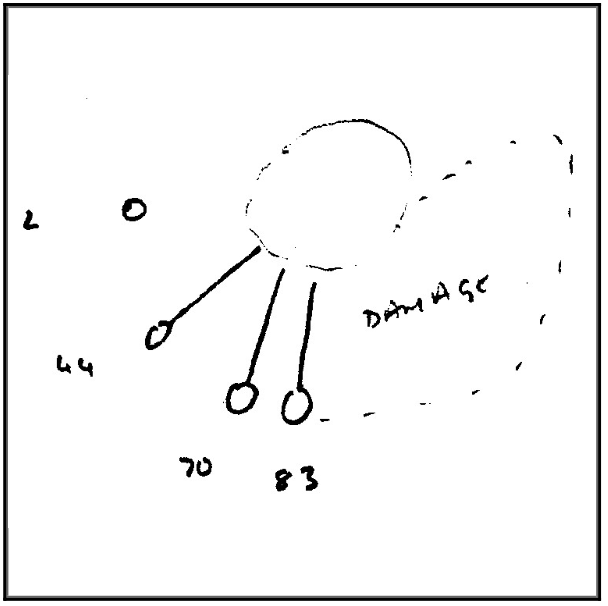
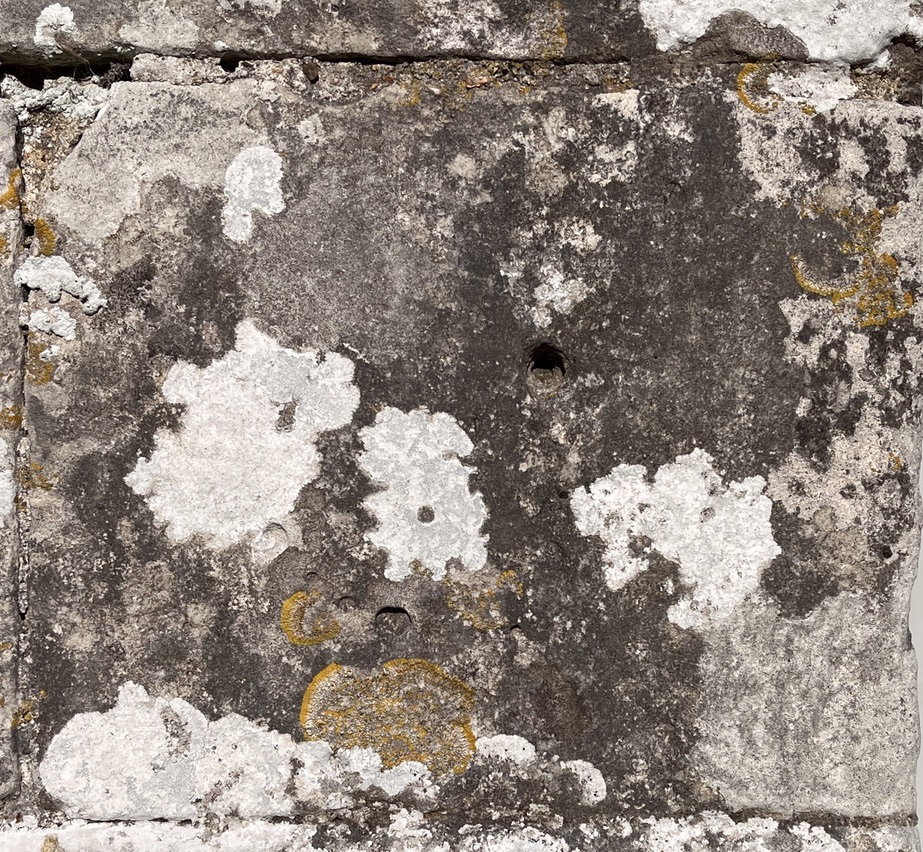
Located on S wall of the Nave, E of door, W of E Nave buttress, and about 2m high. All that can be seen is the LLQ part-perimeter of a quite large dial (if it is one) cut in the upper R corner of a large stone with no discernible dial-ish markings. Basically it is a plain quarter-circle using the mortar lines for the straights, and with a gnomon hole (not now obvious) in upper R corner. To work as a dial in that (or in any different) position, it would have required one additional stone if a semicircle; or at least 2 more if a complete circle. The absence of any lines or pocks on this fragment militates against it being part of a scratch dial. It would have been hard to resist using such a large blank area as a creative area for a proper dial design. Quite plausibly, this curved incision was part of some decorative feature displaced during rebuilding, with companion stones used elsewhere where needed.
St Peter . Shipton Bellinger . Hants – Scratch Dial 2
BBS PHOTOGRAPHIC RECORD
St Peter . Shipton Bellinger . Hants- Scratch Dial 1 BSSSt Peter . Shipton Bellinger . Hants – Scratch Dial 2 BSS














































 GAUDIUM SUB SOLE: Scratch Dials & Sundials Medieval to Modern