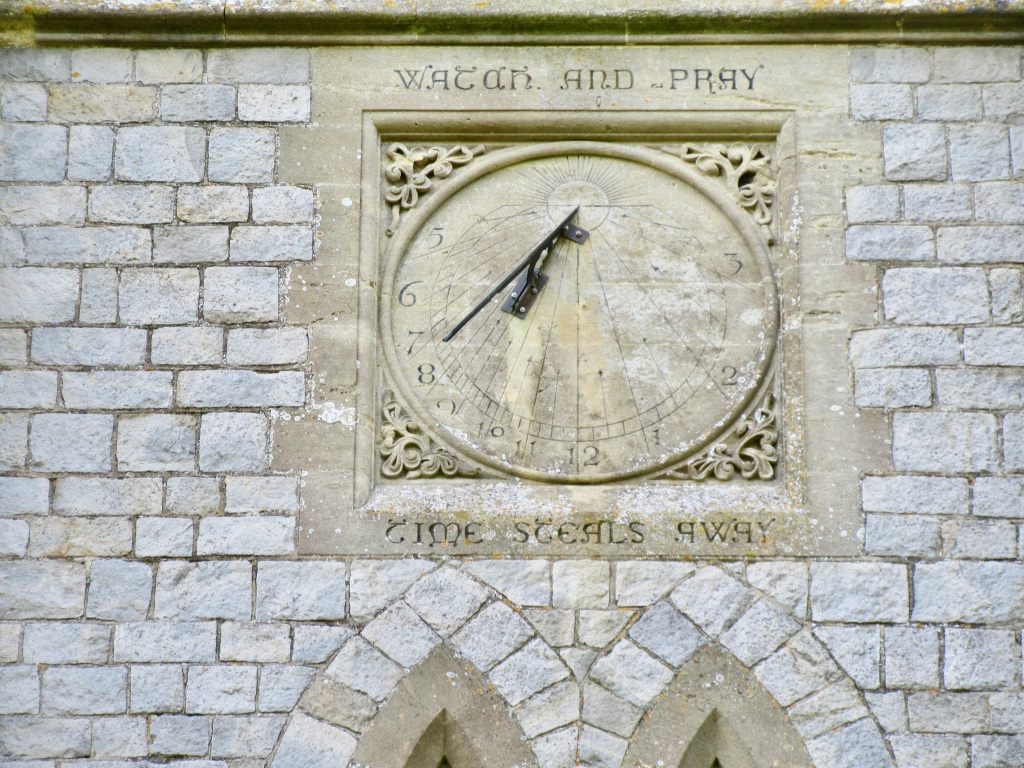
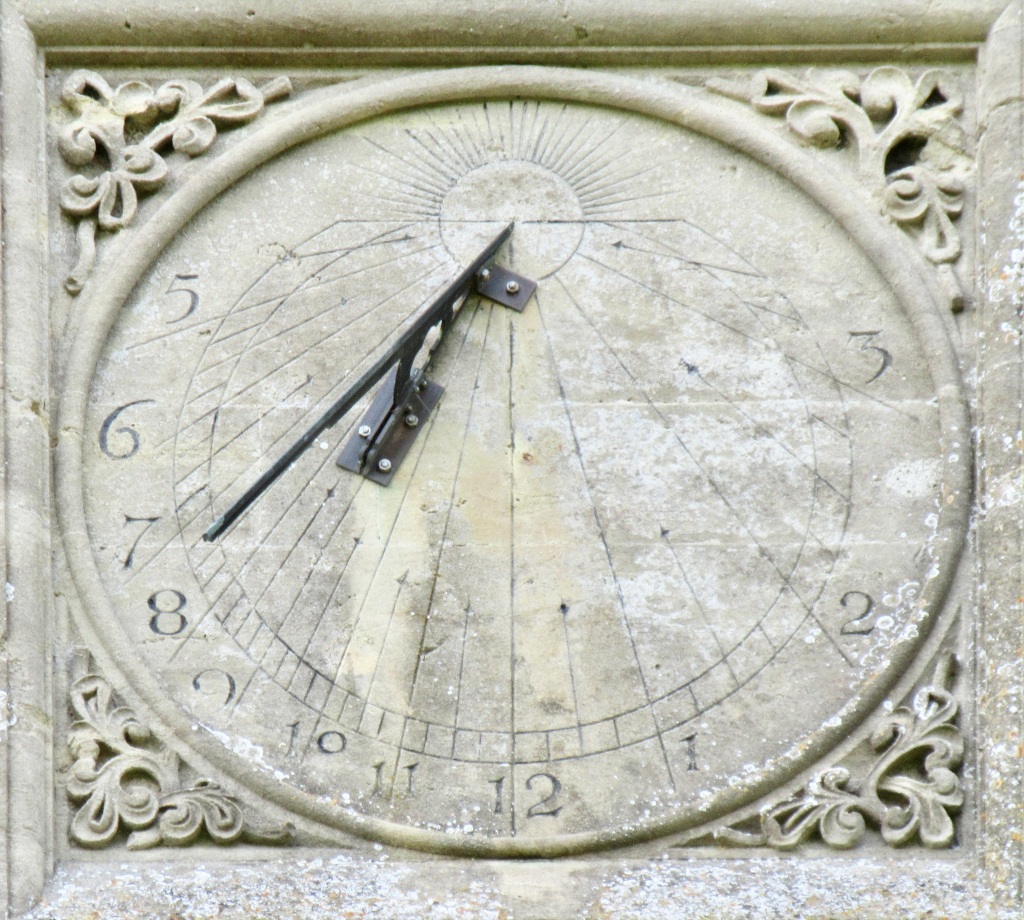
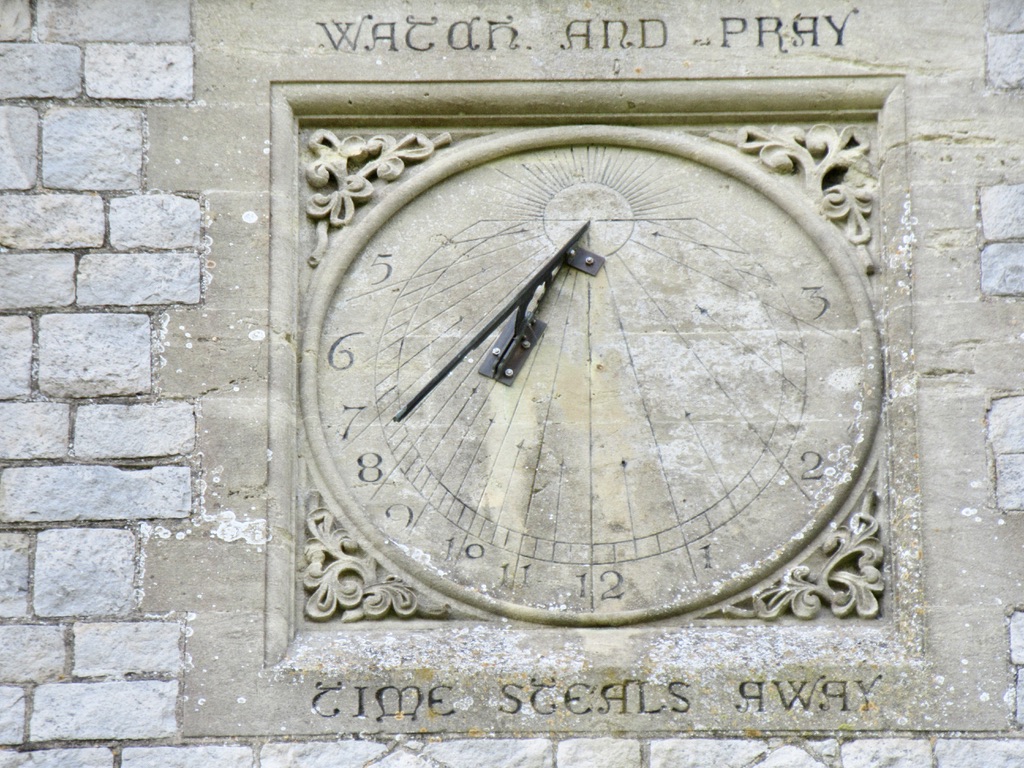
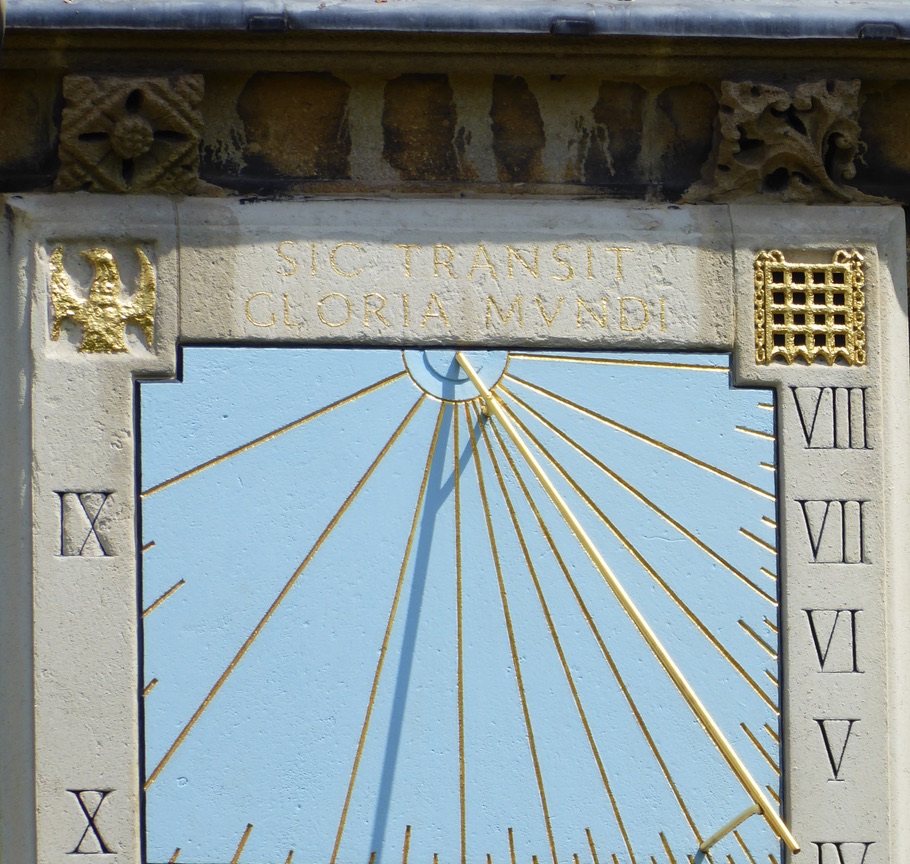
West Overton, 5m W of Marlborough, lies within the mystical area that includes Avebury, Silbury Hill, long barrows, tumuli, sarsens and so on. St. Michael was built in 1878, replacing an older church on the site. The Tower was completed last. High up on S side is a fine Victorian sundial complete with a motto in period lettering. The time scale shows 5am to 3pm in half and (some) quarter hours. The dial was restored in 2003, as detailed by the excellent SUNDIALS.CO, an eclectic site that no dialist should overlook.
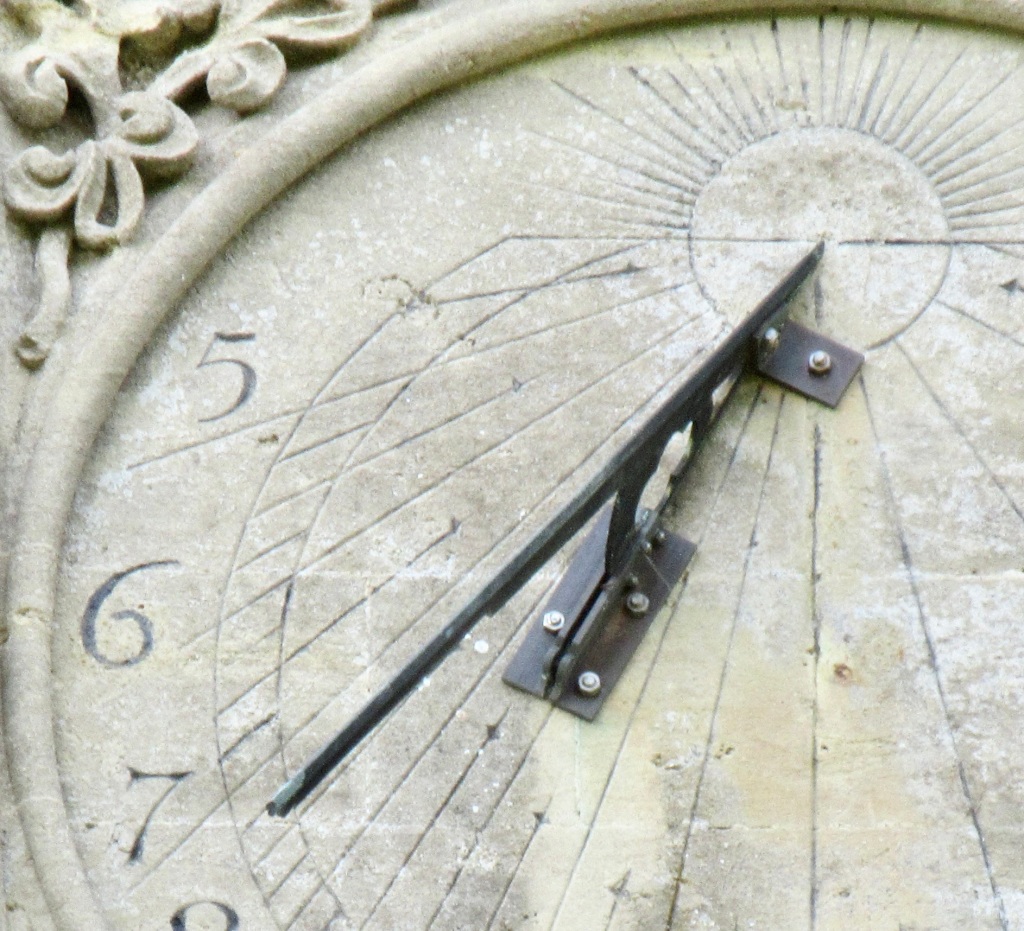
The dial was correctly delineated to face 38° east of south. The cast bronze gnomon fell off but was kept by the church wardens. Its original angle was incorrect, and it was set into a slot in the stone to compensate. Restoration involved re-engineering the gnomon and making new clamps to fix it. The dial itself was renovated [précis]
MOTTO
The motto Watch and Pray / Time steals away is quite frequently found in this or in similar forms. Gatty lists several examples from different parts of England. The source seems to be biblical, from Mark 13.33-37: Take ye heed, watch and pray: for ye know not when the time is.
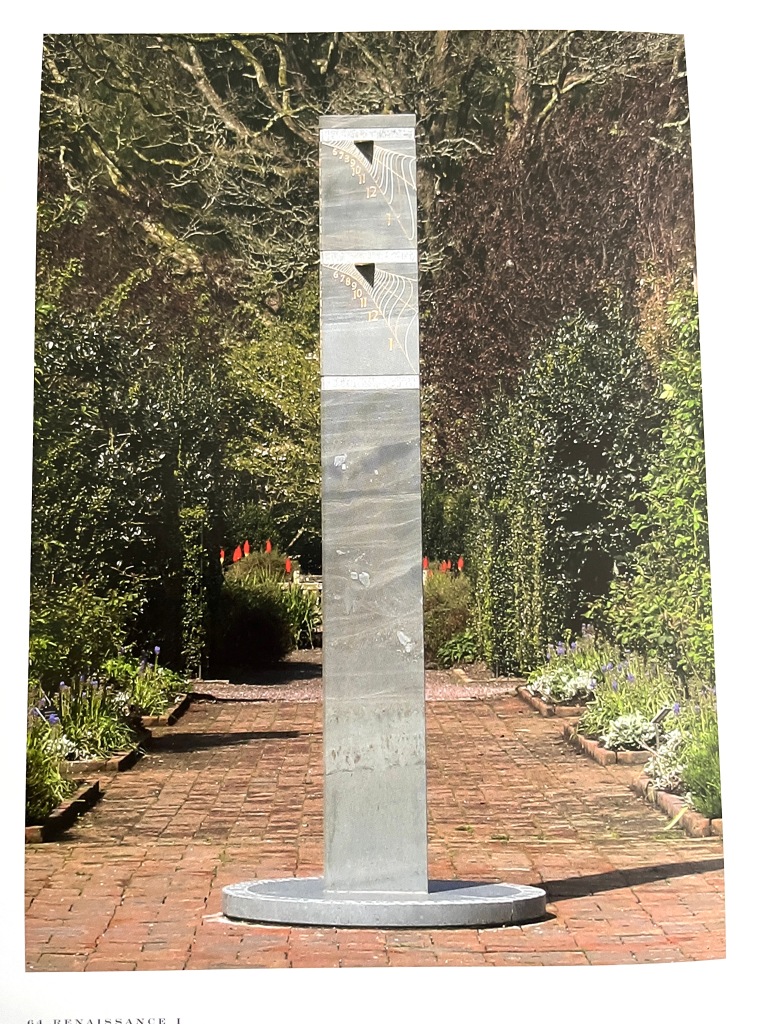
Renowned RHS gardens near Torrington, Devon. It’s a wonderful place. You can find out all about it HERE. For present purposes, the focus is on the very fine sundial installed in the gardens in 2004. This is a project of the BRITISH SUNDIAL SOCIETY and the description below is from the BSS record:
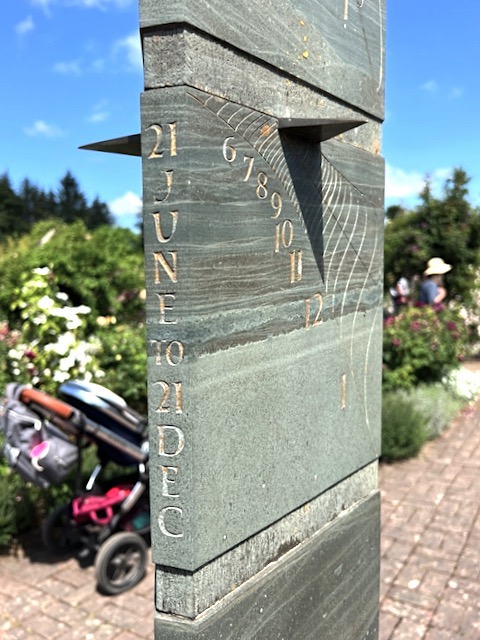
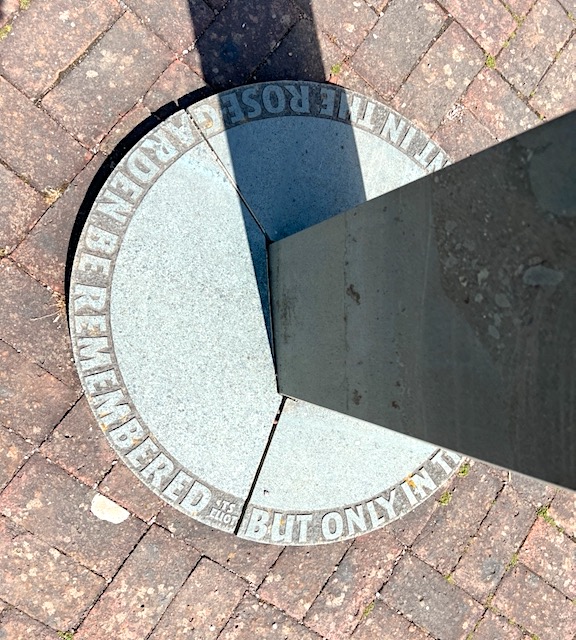
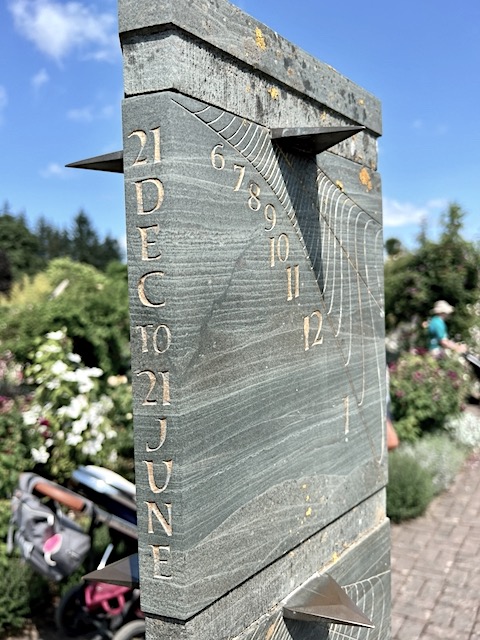
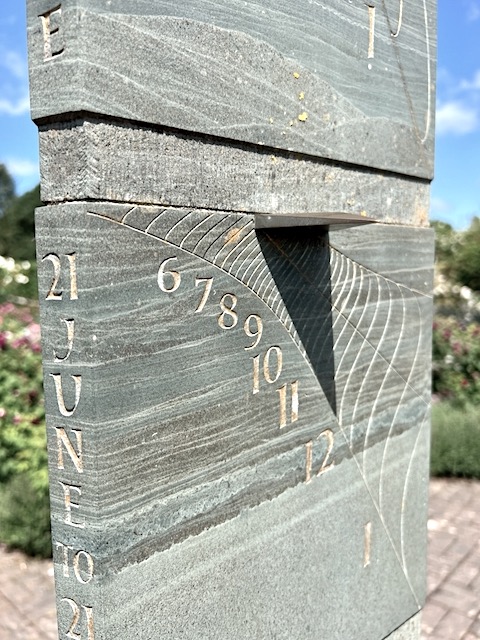
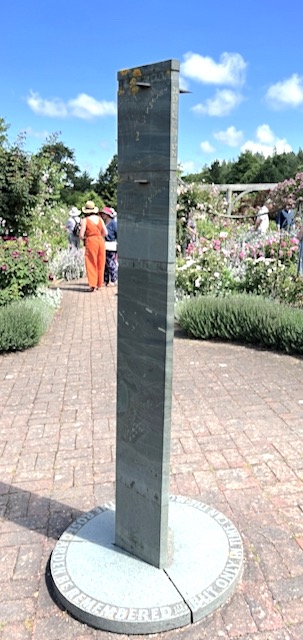
This is an unusual dial in the form of a triangular section pillar made of Delabole slate and 1820mm high. It was designed by Sir Mark Lennox-Boyd and made by Ben Jones. It carries a motto on the 610mm diameter slate base ‘But only in time can the moment in the rose-garden be remembered’ (T.S.Eliot, modified from a passage in Burnt Norton, the first of the Four Quartets).
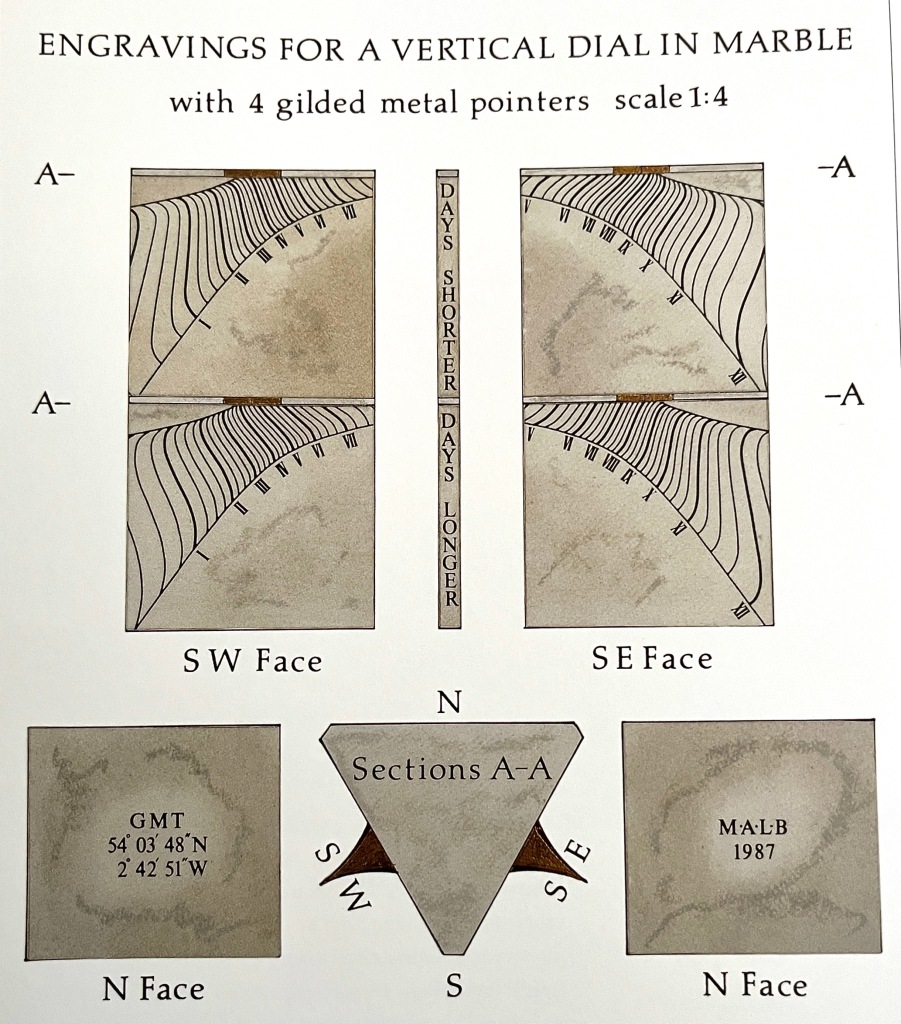
On two of the faces are pairs of declining dials one above the other. The upper ones are drawn for December to June and the lower ones for June to December. The hour lines are corrected for the Equation of Time.There are three declination lines on each dial. Arabic numerals are used and the dials show BST. The easterly dial shows 5:30am to 1:30pm in half and quarter hours while the westerly dial shows 12:30pm to 9:30pm similarly divided. The north dial has dedications to V M Dickinson, M J C Wright, H Addy and R Addy.
DIAL IMAGES 1
All Photos: John Renner
DIAL IMAGES 2
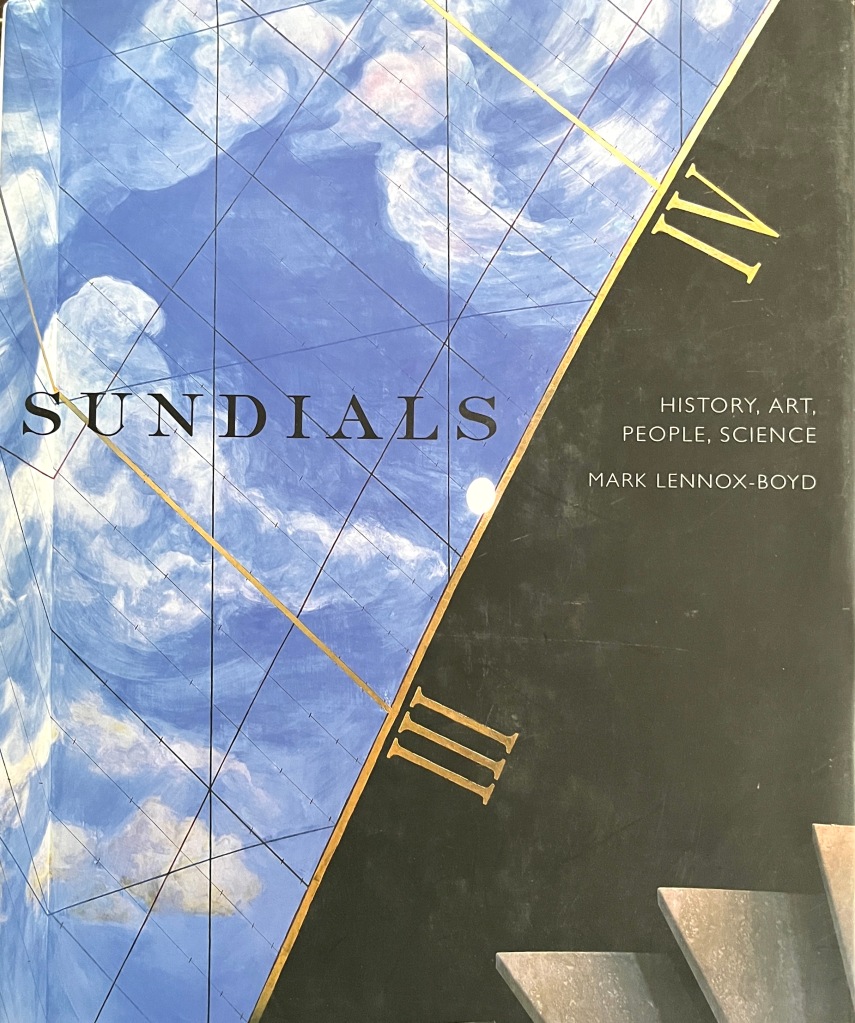
Images taken from the designer’s magisterial book Sundials: History, Art, People, Science. The design below seems an excellent example of art meeting science.
GSS Category: Pillar Dial; Modern Sundial; Pillar Sundial
Credits: Photos by John Renner; material from the book by Mark Lennox-Boyd; British Sundial Society
The sundial is located on the wall of the Hall, and – for those not entitled to enter the College – easily visible from the entrance by the Porters’ Lodge. It is dated 1927, replacing a dial known (from an old print) to have been in this position in C17 that was lost during C19 alterations to the Hall. The dial was the gift of a College benefactor. His initials and the year of installation are on the dial supports. The calculations were carried out by a Member of College who was a sundial expert.
The unequal positions of the hour markers take account of the SW aspect of the wall, showing more afternoon than morning hours for accuracy as the sun declines.
GSS Category: Vertical Dial; Old Dial; New Dial; Sundial Motto
All photos: Keith Salvesen
Text based on the entry for Christ’s College in the booklet ‘Cambridge Sundials’ by Margaret Stanier and Alex Brookes. This, and its companion for Oxford, are included in the bibliography.
I recently came across a very bad photo I took years ago of this elegant and ingenious dial in Magdalene College. My image is too awful to be the basis of a feature. However BSS has in its records this excellent quality photograph with a short account to accompany it.
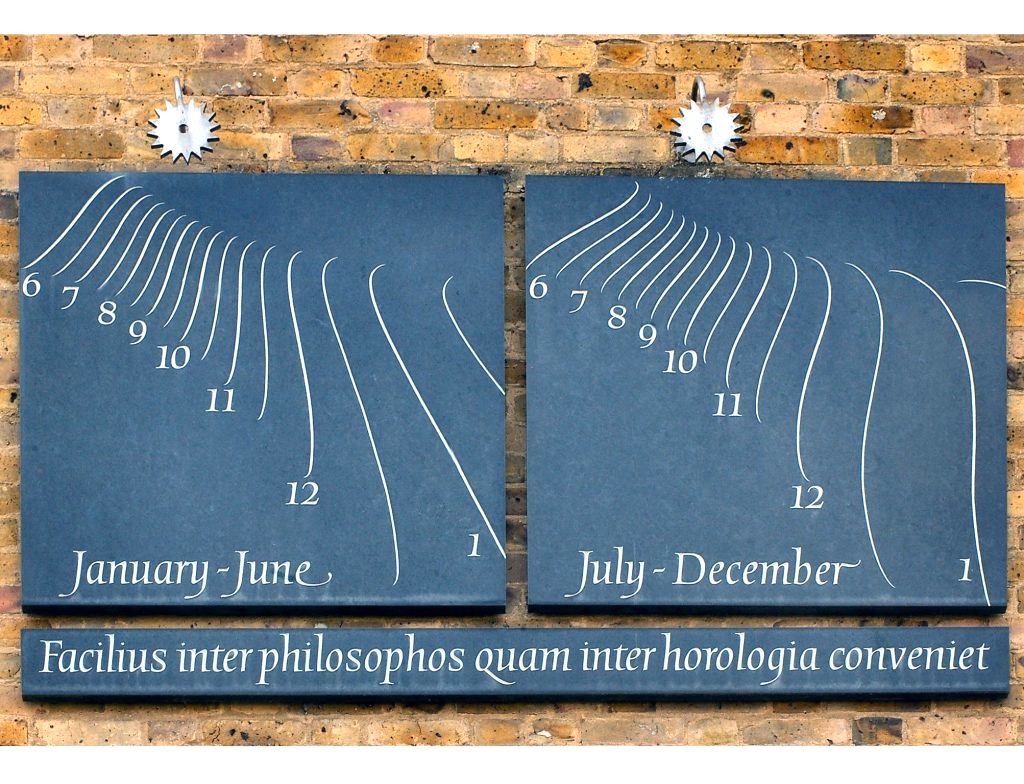
A competition among first year engineering students led to the creation of this most striking double vertical dial, mounted in 1987 on the south-facing wall of Benson Court. It was designed by Will Carter in stone and stainless steel and features the motto: ‘Facilius inter philosophos quam inter horologia conveniet.’ (It is easier to gain agreement among philosophers than among timepieces – Seneca) The prize-winning design has the Equation of Time built into the gracefully curving hour lines. A spot of light shining through a pierced stainless steel sun marks the time on each dial.
‘Facilius inter philosophos quam inter horologia conveniet.’ (It is easier to gain agreement among philosophers than among timepieces – Seneca)
GSS Category: Vertical Dial; Double Dial; Modern Dial; Competition Dial
Broughton Grange dates from early C17. Gradual development resulted in a fine house with an extensive estate owned by the Morrell family and associated with the Bloomsbury Group via Lady Ottoline. The whole estate was bought in the 1990s. New gardens have been beautifully landscaped and an arboretum created. The property is renowned as one of the finest contemporary private gardens, to which there is public access. You can find out more here: BROUGHTON GRANGE 3m SW of Banbury 52.0415 / 1.3776 / SP4338
The dial stands at the centre of the Parterre and Rose Garden, overlooking the smart box hedges. It is dated MDCCLI (1751). I’ve spent some time trying to figure out the inscription, some of which cannot be read even with a magnifying glass. I have settled (provisionally) on Tempora Servio, ‘I Serve the Times’ or a similar conjunction of tempus and servere. This formulation does not specifically appear in eg the expanded edition of Gatty; however tempora is in common usage, often with its companion, mores. Any other suggestions welcome, a definitive ruling would be ideal.
Wolfeton House (sometimes Wolveton) is a fine Grade 1 Elizabethan manor house with medieval origins. It stands amidst the the water meadows of the River Frome near Charminster, just N of Dorchester. Admired by Hardy. For more about the house, its history, and how to stay in the Gatehouse (dated 1534) see:
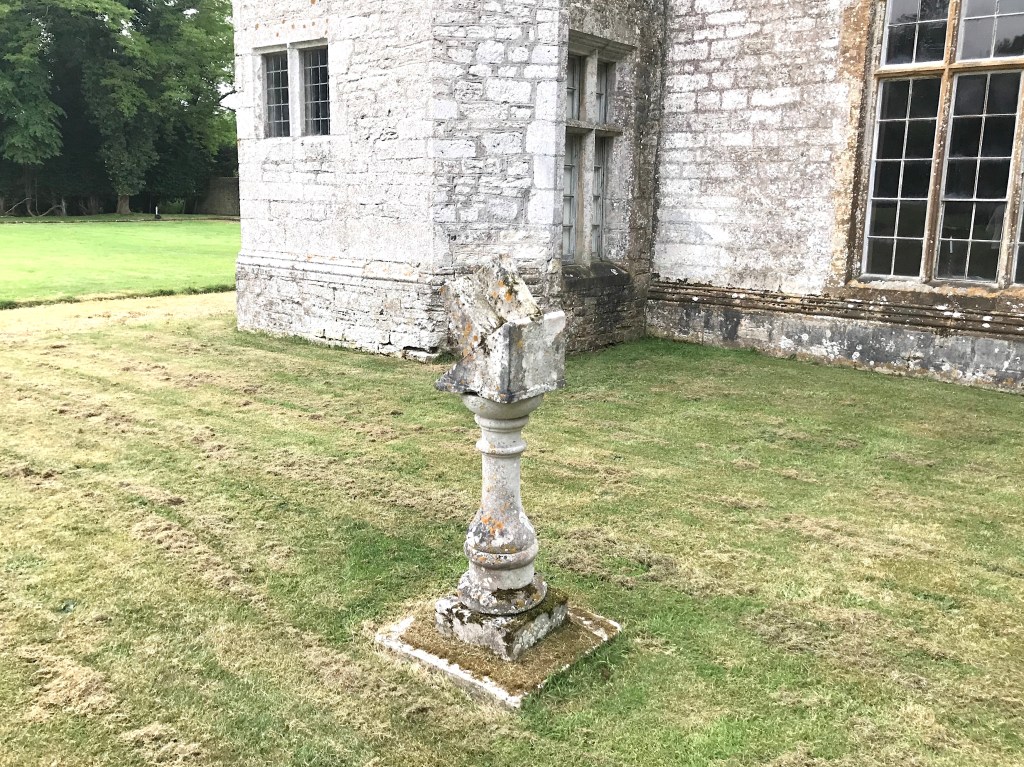
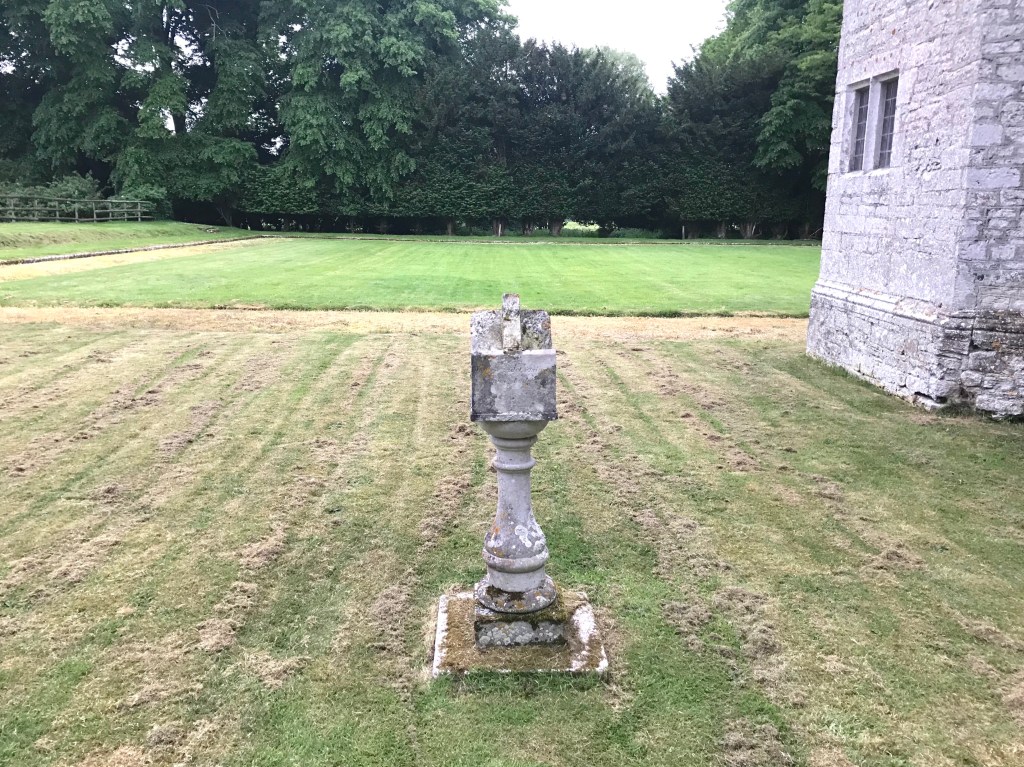
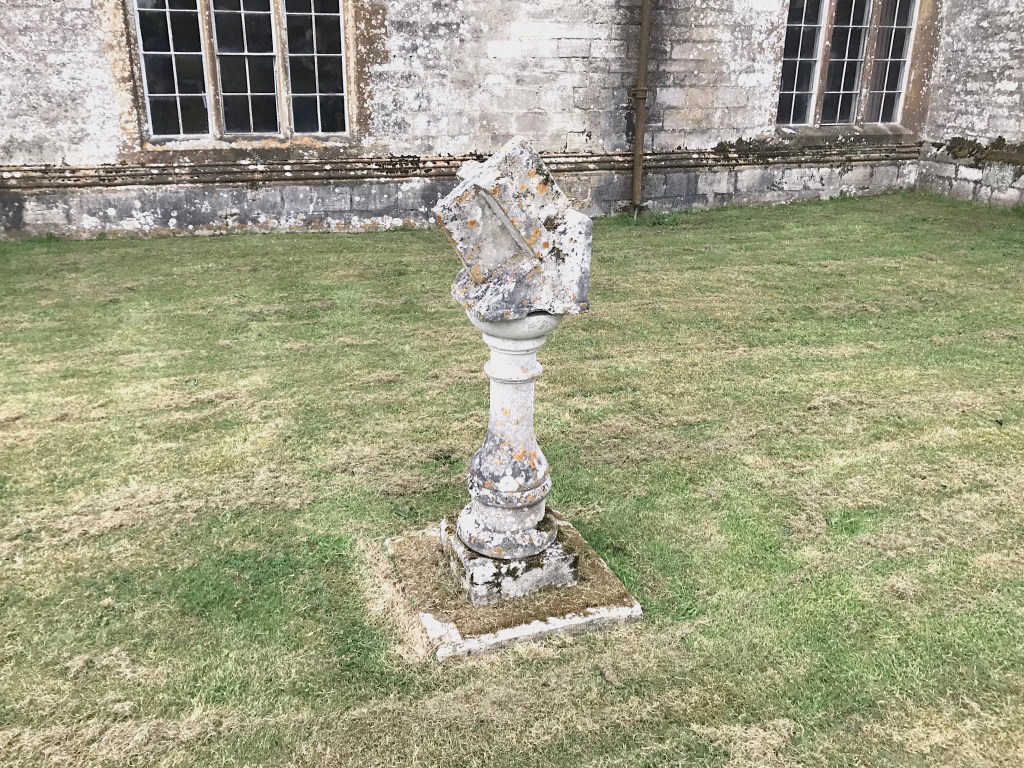
Some time ago we went to Wolfeton in connection with the the Pevsner Buildings of England series. I was able to photograph this most interesting sundial, though with a rather rustic camera and in low light. The dial is not in the optimum place for its primary purpose, but with its pleasing symmetrical design it suits where it stands.
INSCRIPTION
The inscription is an intriguing mystery. At the time I was less engaged with dials, or I might have made more effort to record the details and to take a decent photo. As it is, I cannot make much sense of it. The initial letter U… could perhaps be the start of Umbra? But that assumes the words are in Latin. I have checked the main motto resources including Gatty (original, and revised & expanded); and various less comprehensive sources. I will add the translation if I can make any more sense of the text. Meanwhile, any ideas would be welcome. Actual knowledge, the more so.
ADDENDUM *
UMBRA VIDET UMBRAM VIVE HODIE. A shadow marks the shadow. Live to day.
As it turns out, Gatty did record this dial, attributing it to a neighbouring village Bradford Peverell rather than Charminster. She noted the inscription is somewhat defaced. The dial was possibly erected by George Purling about 1815-20, when the garden was laid out). The same motto is on the tower of Broughton-Gifford Church, near Melksham,
HOW THE DIAL WORKS
This is a polar dial, with the end edges of the cross pieces acting as gnomons (cf the polar dial at Tintinhull). The dial should be oriented so these point north, ie with the inscription on the south face. However, it is clearly not orientated like that, so it now acts as an interesting garden ornament. John Foad (BSS) has kindly marked up a photo to show how the dial would work if correctly positioned.
DATE
The inscription might give a clue to the dial’s date. My amateur guess is that it is somewhere between mid-C18 and early C19.
Wolfeton House . Dorchester . Dorset – Multiple Garden Dial
GSS Category: Multiple Dial; Old Dial; Garden Dial
All photos: Keith Salvesen; *John Foad BSS for additional material / expertise (see Addendum)
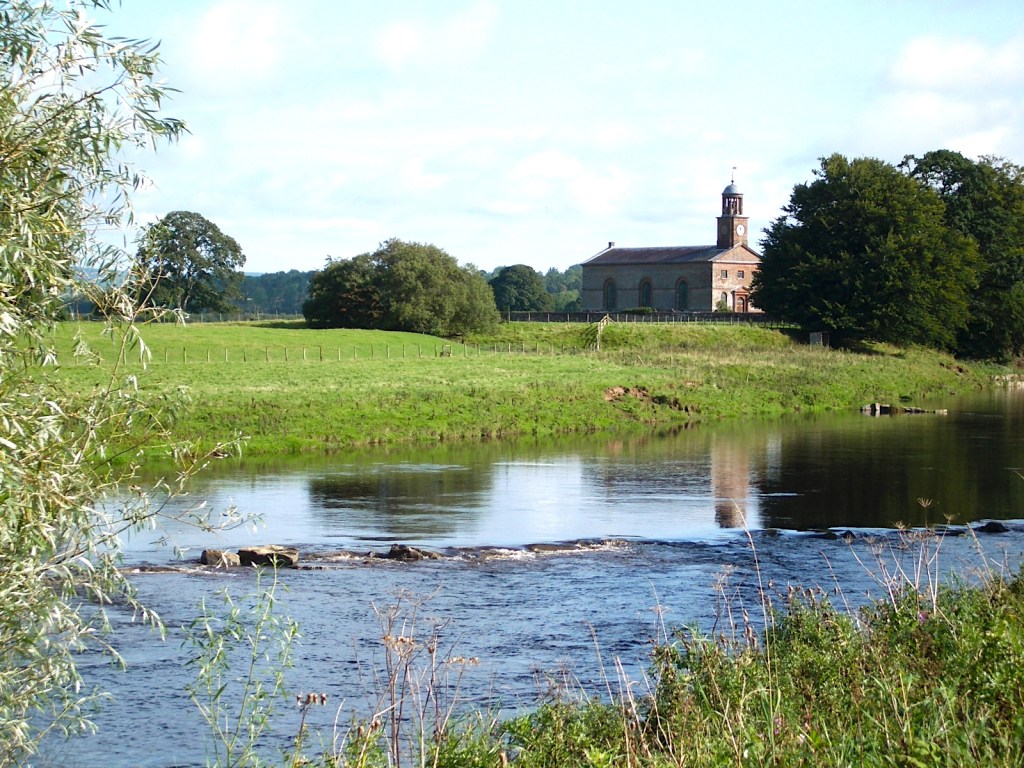
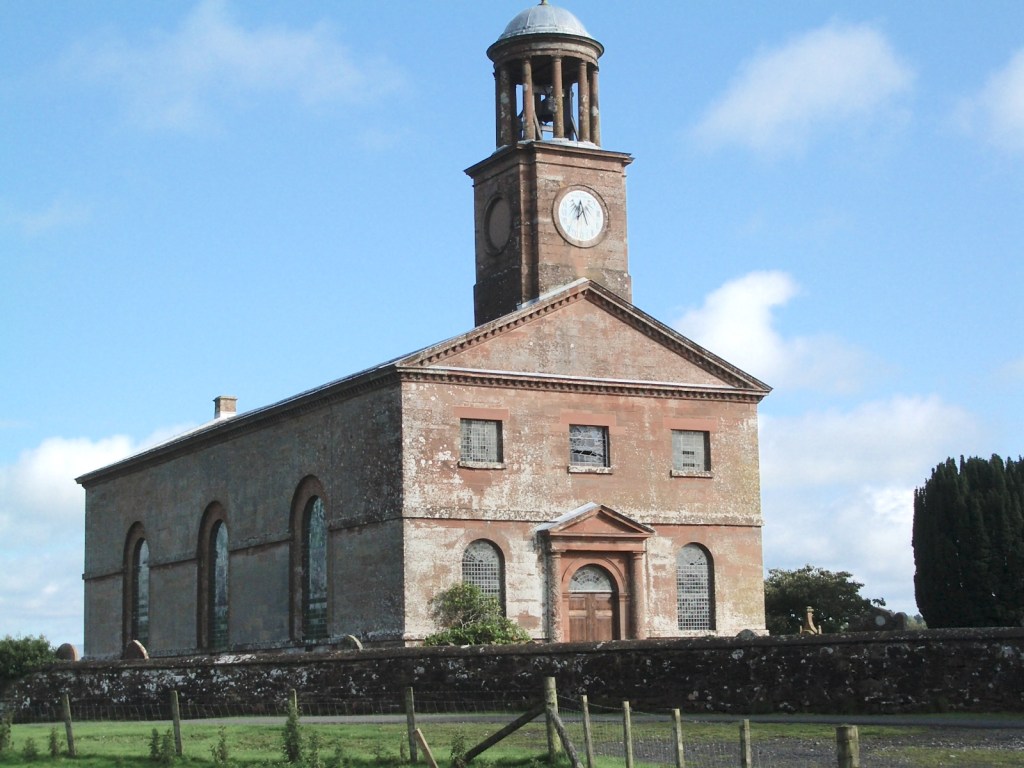
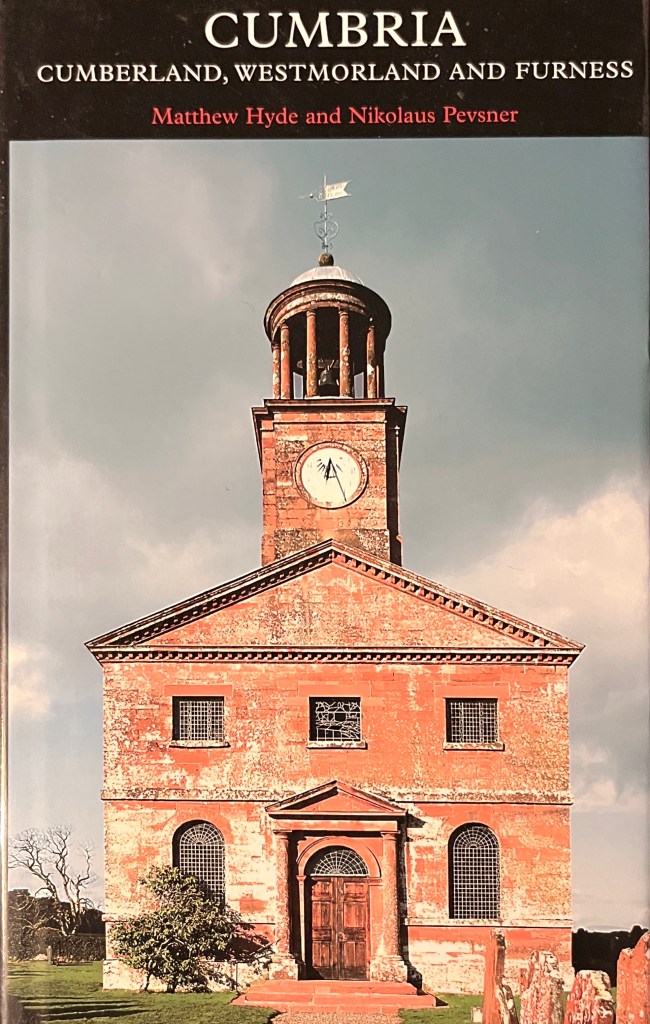
GRADE II* † Built 1776. A fine, uncomplicated Georgian building externally; restored and much remodelled internally 1890s by Temple Moore. ‘Urbane and assured‘PEV. Original clock on the bell tower replaced by a memorial sundial dated 19†18. Selected for the cover image for Cumbria in Pevsner’s Buildings of England series. 8m N of Longtown. 55.0386 / -2.9543 / NY391719
Kirkandrews . Cumbria . Walter Baxter Geo
DIAL
This handsome church has a moving story to tell. The tower originally had a clock. In 1918, this was replaced by a commemorative sundial to honour the two sons of the Graham family from nearby Netherby, after their safe return home from WW1.
The dial has an inscription around the circumference that reads in two parts, and a Motto
FOR OUR TWO DEAR SONS FFG & RPG WHO LIVED TO COME HOME FROM THE GREAT WAR THANKS BE TO GOD ALONE
LUX POST UMBRAM
The motto and its sentiments are self-explanatory. The same – or very similar – formula has been noted in northern Italy MG; and (I notice) for abstract art works that contain both light and shadow…
DIAL
The dial has an attractive design marking hours and 1/2 hours from 6 round 5. It appears to be hand-painted rather than machine made. The robust gnomon casts a clear shadow that also benefits sheep, cows, and salmon-fishermen in season.
Kirkandrews . Cumbria . Walter Baxter Geo
GSS Category: Vertical Dial; Sundial Motto; Memorial Mottos
Credits: Keith Salvesen; Walter Baxter dial close-up Geo ; Alun Bull English Heritage PEV; Yale University Press (cover image)
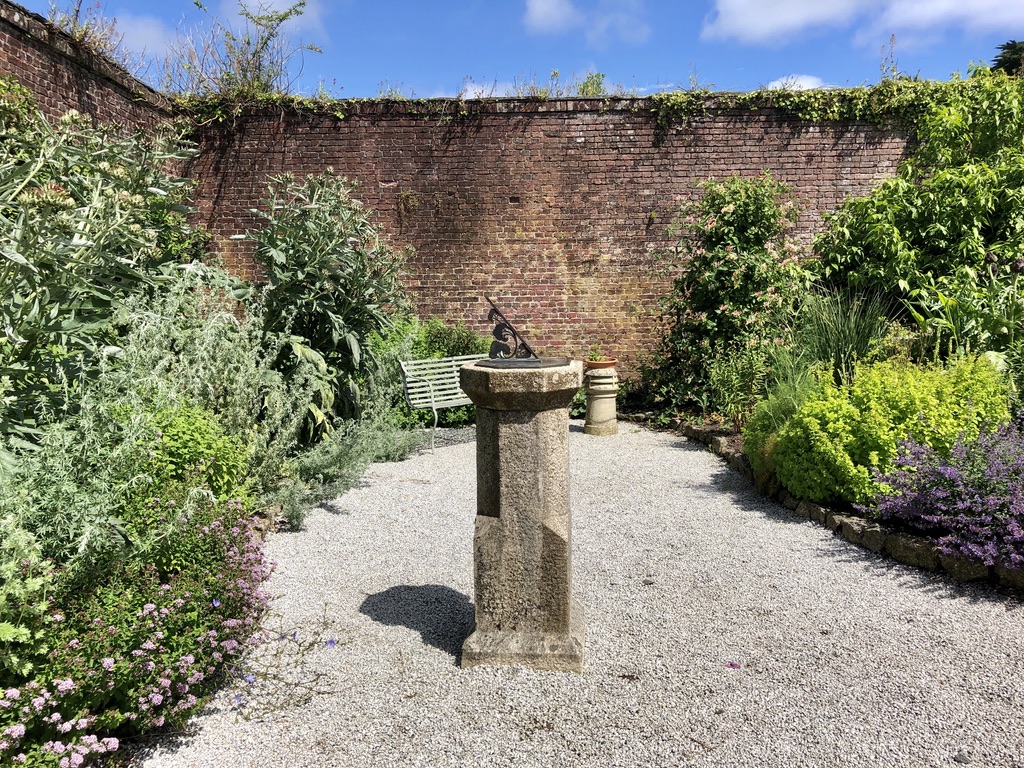
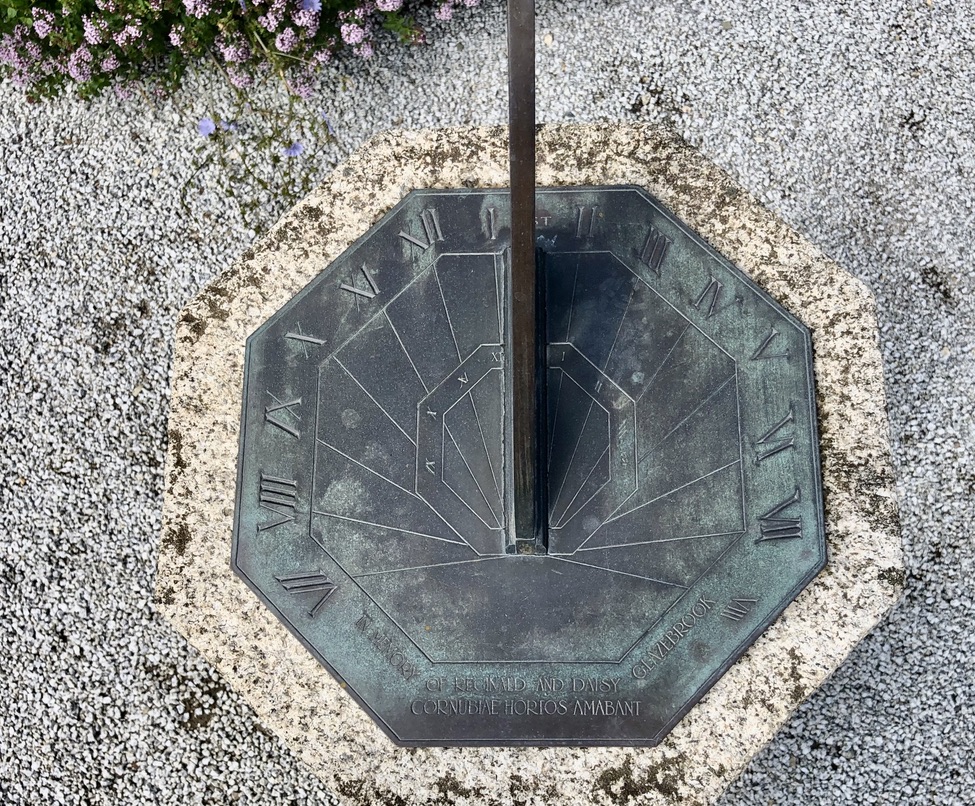
A modern dial in the walled garden at Trelissick NT, with a rather charming motto for the couple commemorated ‘Spouses (who) loved gardens’. It may be unique: I have found no other example, and it does not appear in Margaret Gatty’s compendious collection of Cornish sundial mottos.
Trelissick Gardens . Cornwall – modern commemorative sundial















 GAUDIUM SUB SOLE . SUNDIALS . MEDIEVAL TO MODERN