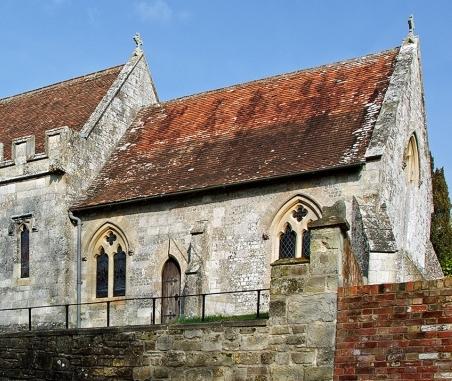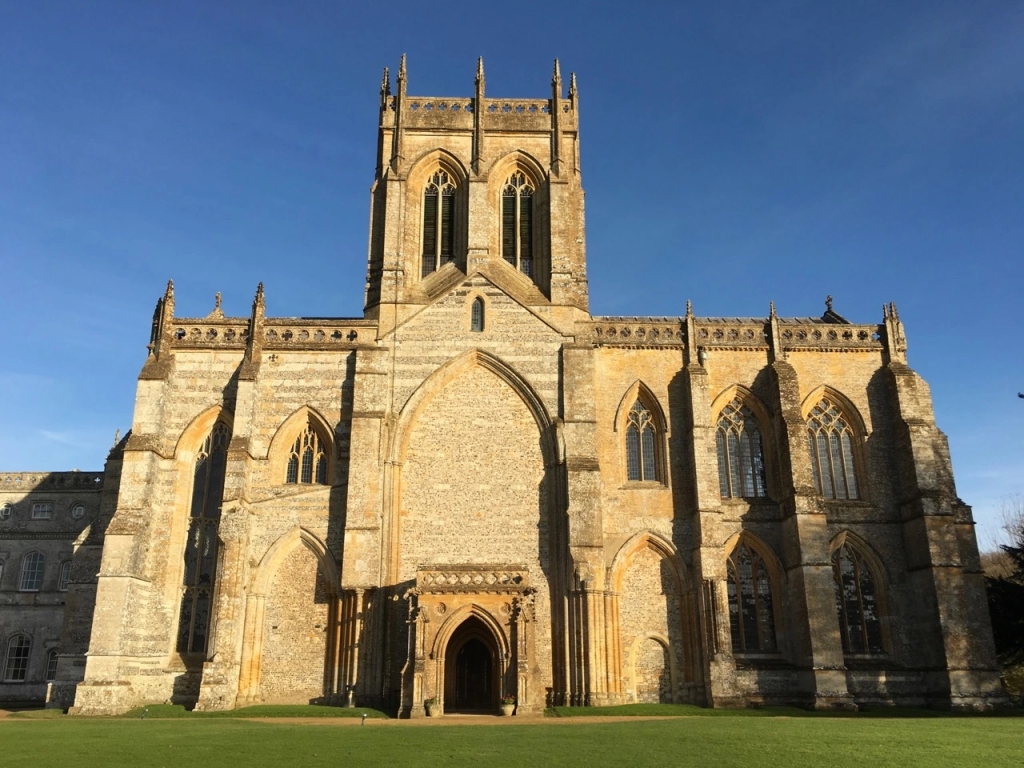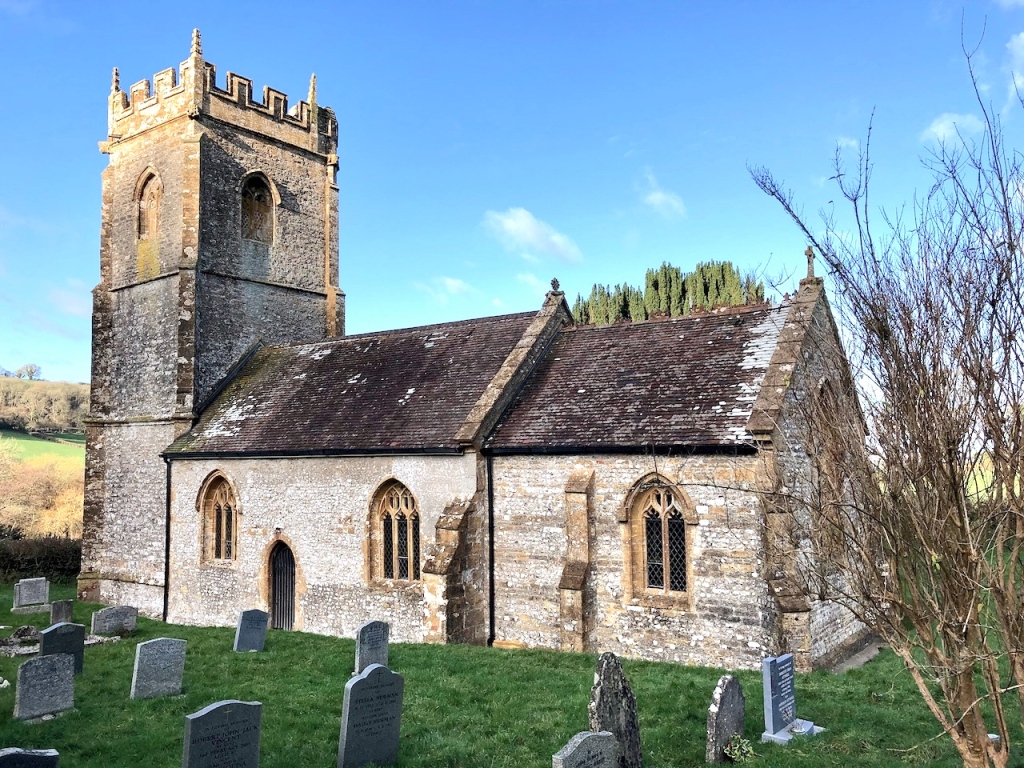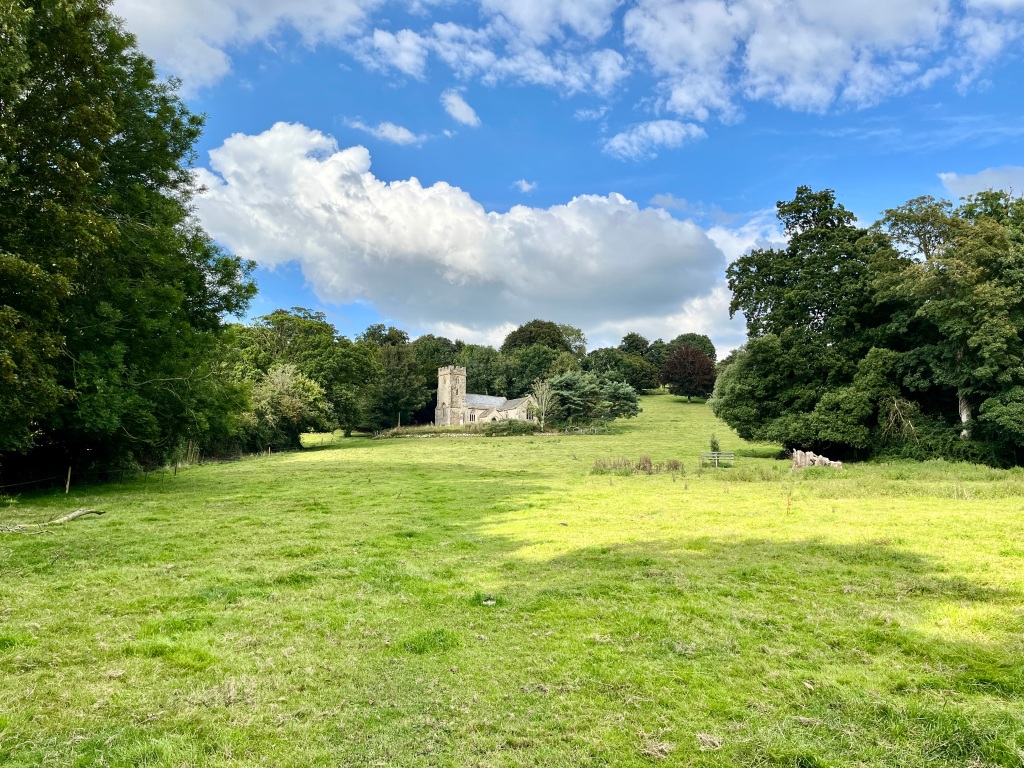
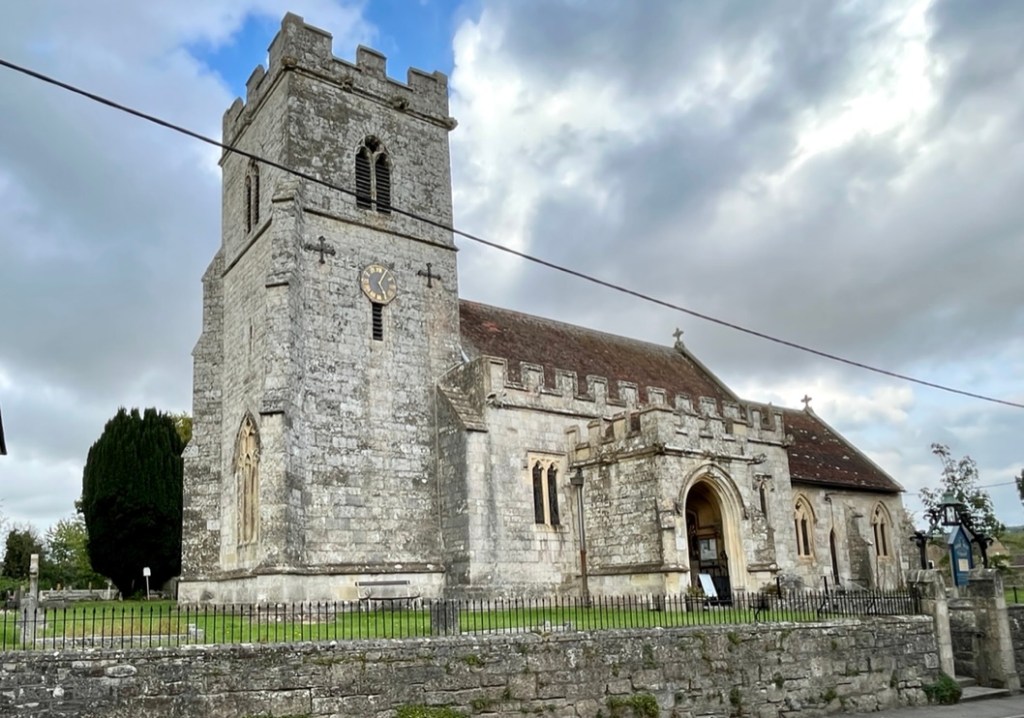
GRADE II* † Mainly C13, C14. Norman font. Alone on a hillside, accessible only on foot. Originally a separate parish from the close-by village of Stocklinch Magdalene; later amalgamated; now redundant and in the care of CCT. 3m NE of Ilminster. 50.9535 / -2.8813 / ST381174
DIAL
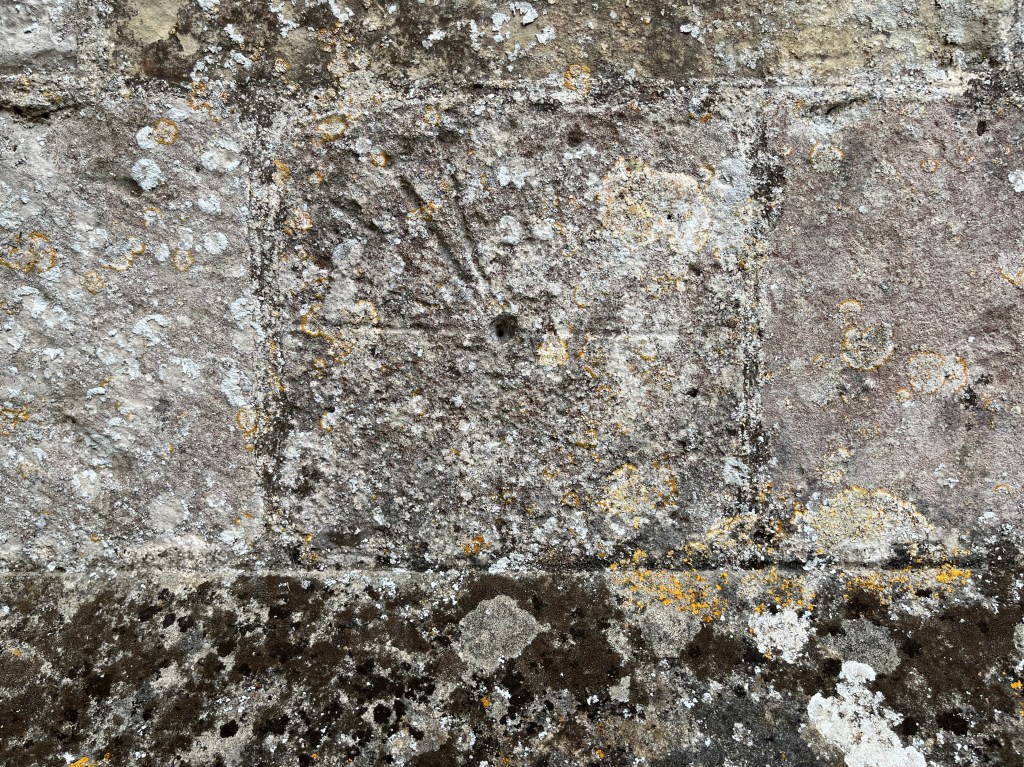
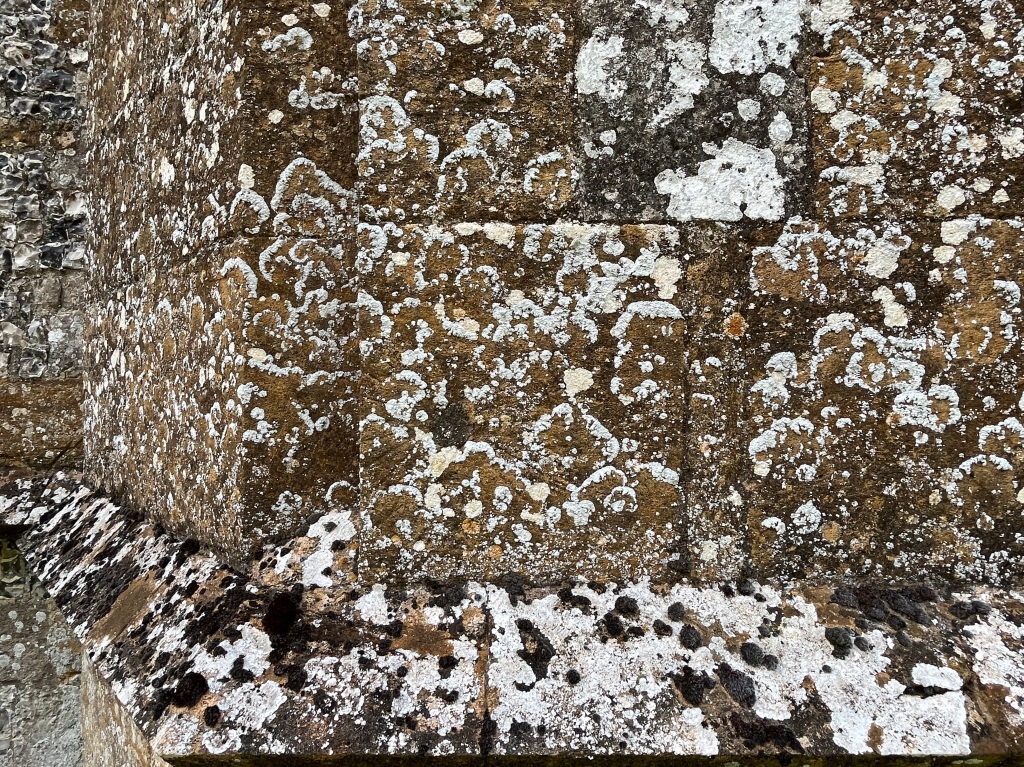
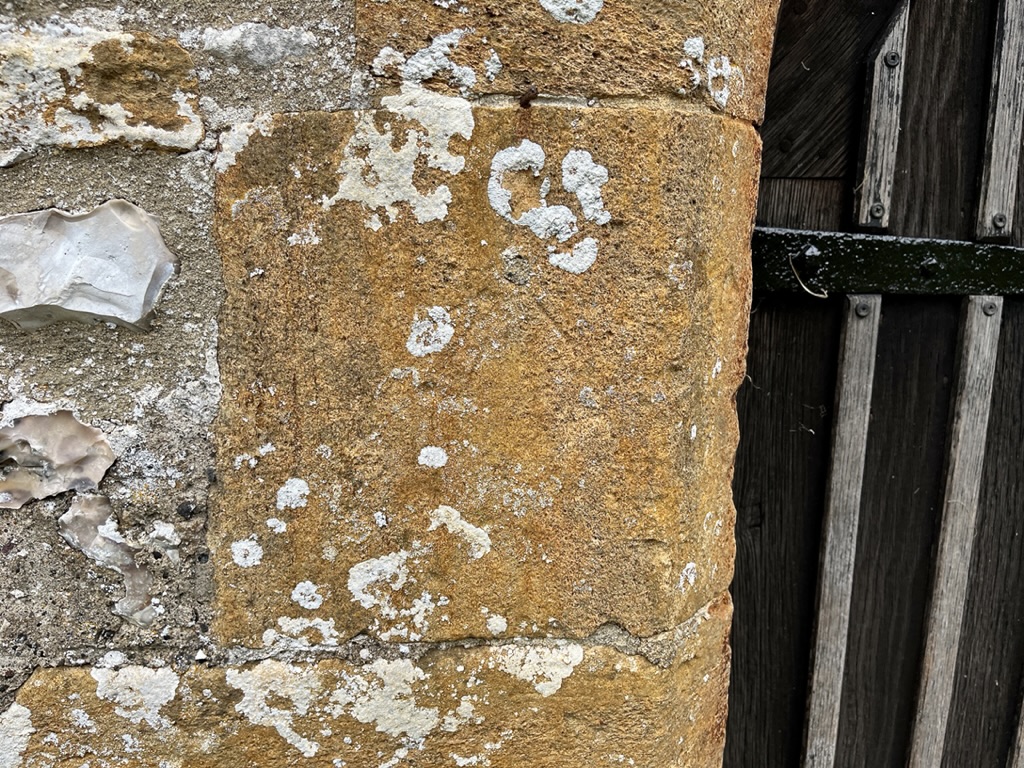
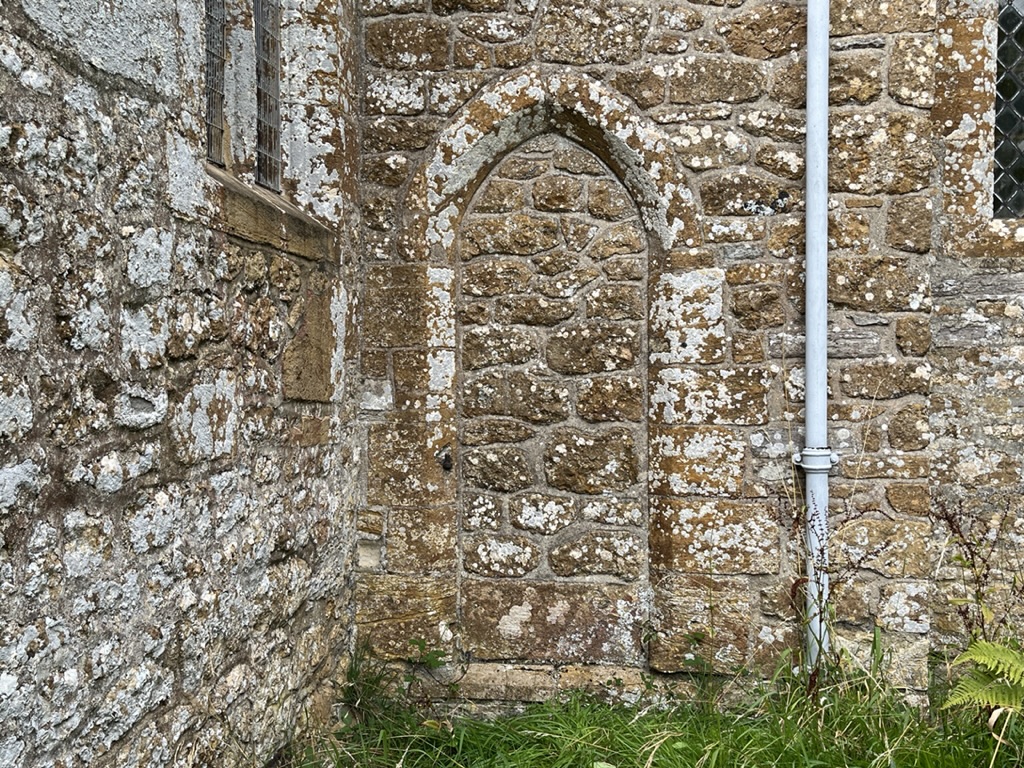
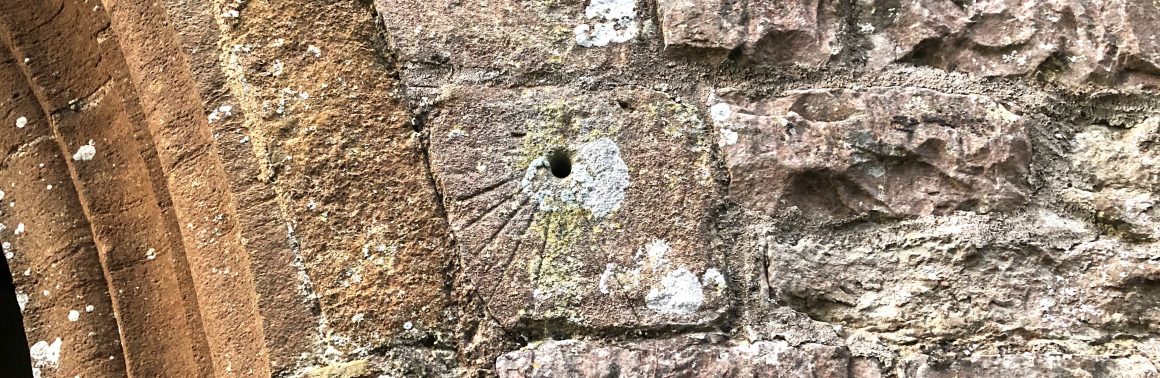
DEH visited St Mary in September 1912, one of his earliest field trips from Downside Abbey on his motorcycle in search of scratch dials. As he described it there is a doubtful dial on the E side of the Priest’s door. It is in a likely position, but the stone is so badly weathered that no lines can be traced upon it. To which I can only add even less so 100+ years later, especially with lichen obscuring scrutiny.
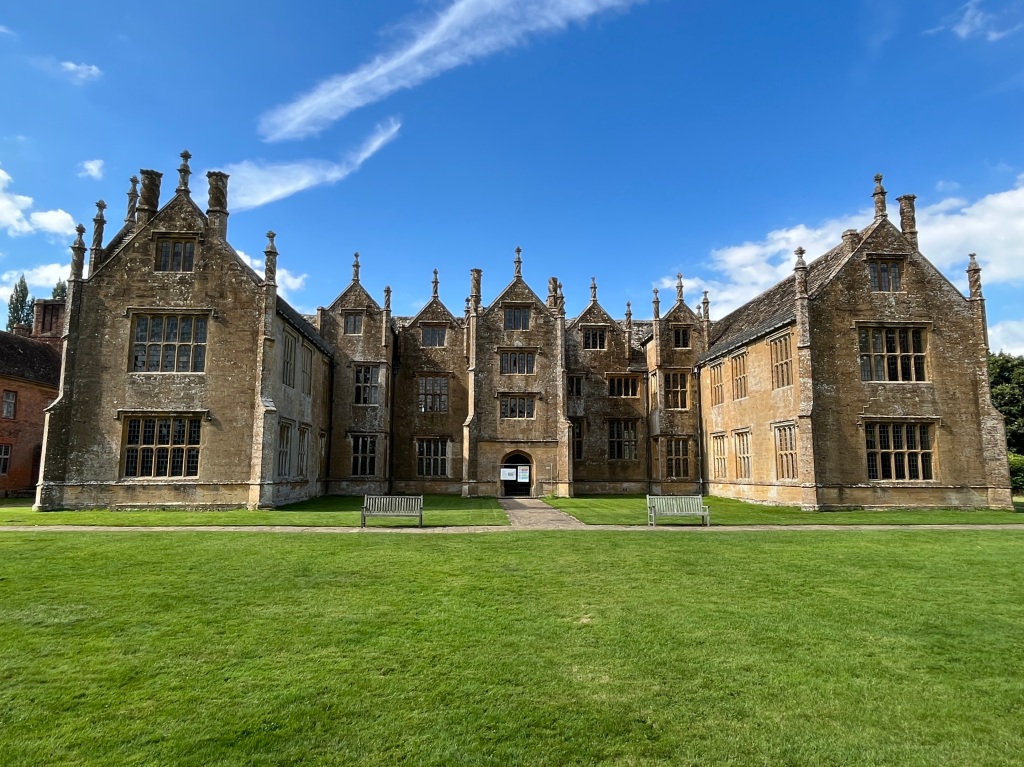
I include this record both because St Mary repays a visit for its location alone, and for completeness. Very close is the small Church of Stocklinch Magdalene, and it’s a short distance to BARRINGTON church with 4 scratch dials; and Barrington Court (NT) which has 2 outstanding pillar dials in the gardens.
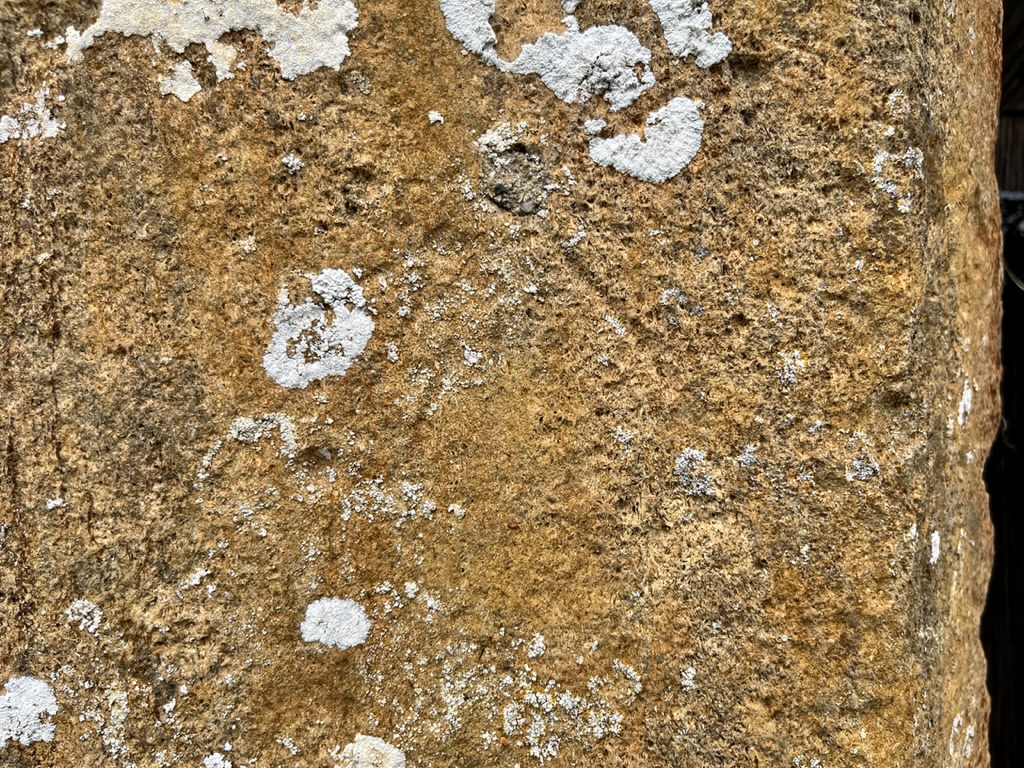
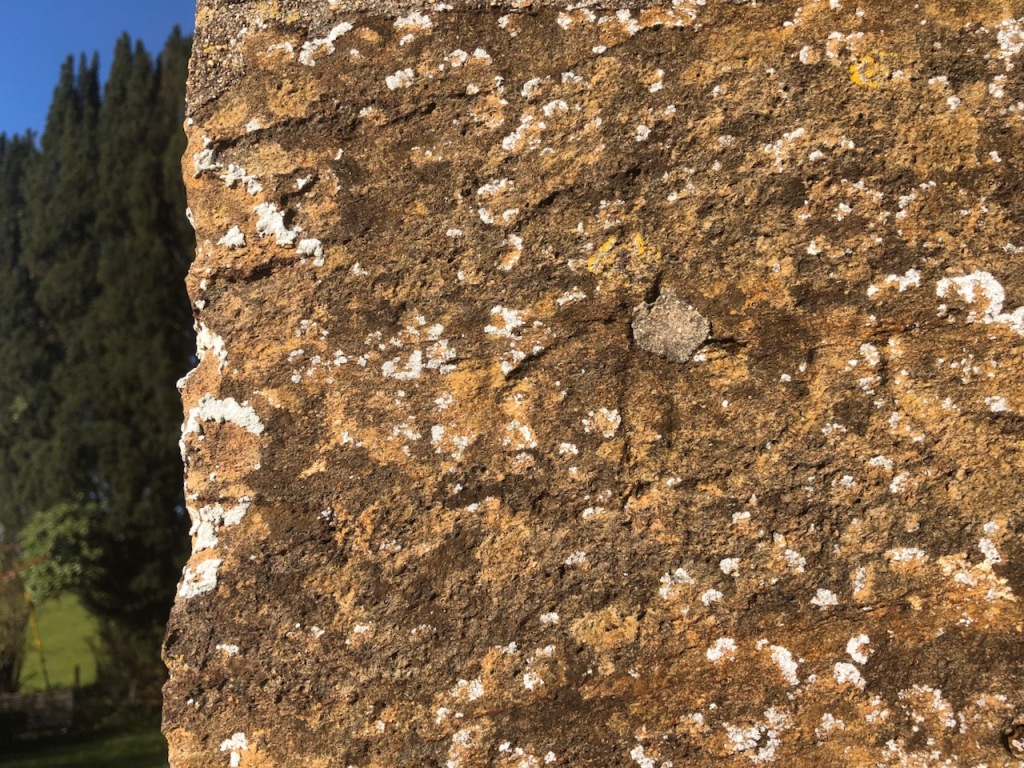
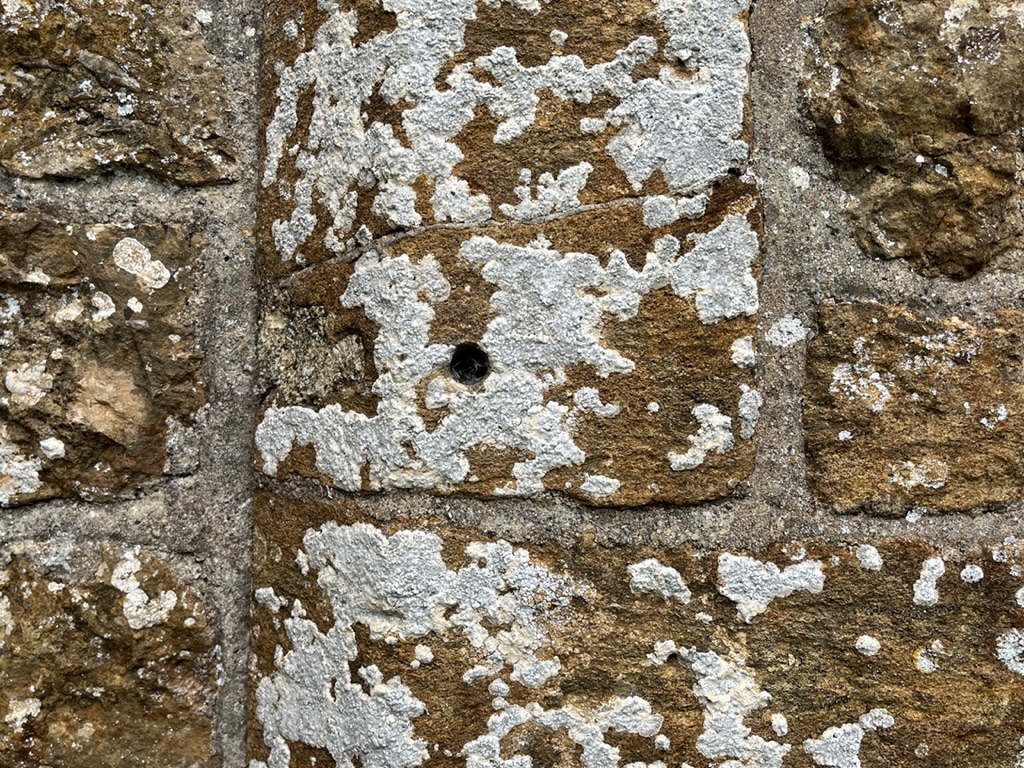
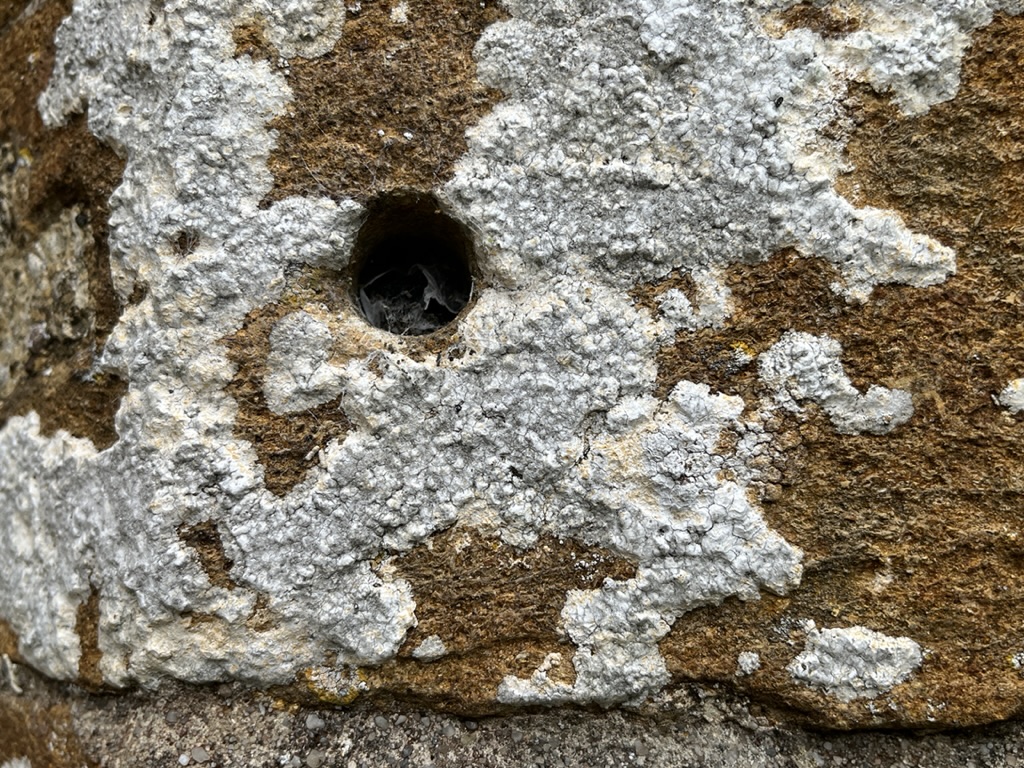
On the same side of the priest’s door, 2 stones lower, is a smaller apparently drilled hole with some sort of lining (?), but also no dial-ish features.
EGNAZIO DANTI* 1536 – 1586 (also, Ignazio), Dominican monk and polymath, became renowned for his wide learning and intellectual precision. He was a mathematician, cartographer, astronomer (some say ‘cosmographer’) to Cosimo I, and much more. There’s plenty about him – and indeed about his 3 very different dials at SMN – online.
Recommended sites for an informed overview of the dial include that of the Basilica itself SMN.IT; also ARTELEONARDO and ACCADEMIAGALLERY
For those wishing to dig deep into the complex analysis and the historical context of the dial, you can do no better than study the lead article by Simone Bartolini & Marco Pierozzi in the BULLETIN OF THE BRITISH SUNDIAL SOCIETY VOLUME 22(iv) – December 2010. You can download it.
Egnazio Danti
ARMILLARY SPHERE
The armillary sphere consists of two perpendicular bronze circles with a diameter of 1.30 cm. The vertical one represents the meridian and indicates the exact moment when the sun is at its highest point, noon. On the equinox day, these two circles create a cross-shaped shadow, while elongated circle shadows are formed on other days. (AG)
REFORMATION OF THE CALENDAR
Danti’s sphere was installed on the S facade of the SMN in 1572. This device enabled him to determine the equinox precisely, and thus the true length of the year. Measurements the following spring confirmed the conjecture that the equinox was earlier than indicated by the Julian calendar, in fact by 11 days. As Wiki (always good on this sort of topic) puts it: The reforms of Julius Caesar in 45 BC put the Roman world on a solar calendar. This Julian calendar was faulty in that its intercalation still allowed the astronomical solstices and equinoxes to advance against it by about 11 minutes per year. Pope Gregory XIII introduced a correction in 1582; the Gregorian calendar was only slowly adopted by different nations over a period of centuries, but it is now by far the most commonly used calendar around the world.
MERIDIAN DIAL SMN Link to the article on Danti’s marvellous dial inside the Basilica
St Mungo . Kirkwall . Orkney – Grave slab with stylised memorial dial for Patrick Prince d. 1673
BSS RECORD
DIAL
This image of a dial appears on a grave slab that is now mounted on the interior south wall of the nave alongside many other such slabs. It is one of a number of symbols associated with death, carved in relief. The symbols are in a central panel between upper and lower panels containing text. The dial is illustrative / symbolic only and is roughly square, with hour lines radiating downwards from the top.
ICONOGRAPHY
The image represents Death breaking the urn of Life with an arrow. A flame bursts forth from the punctured vessel, from the tip of which the soul flies away in a northwesterly direction. An hour-glass with the sand run out, a sun-dial, two spades, and a coffin complete the doleful ideogram. The grave slab is for Patrick Prince, died 1673.
GSS Category: Scratch Dial; Cathedral Dial; Church Dial; Dial inside church
PHOTOS: All photos John Renner, with many thanks; Cathedral Stevekeiretsu Wiki OS CC; Print from Cathedral Guide
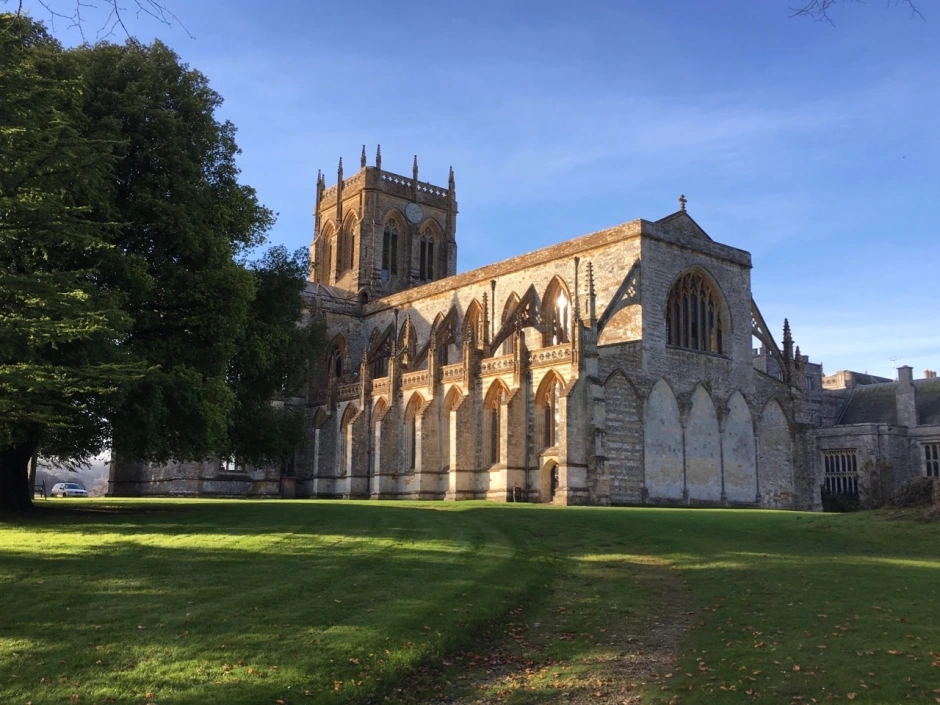
GRADE I ✣ C12 origins & remnants; C13 – C15 enlargement; C19 restorations (Wyatt). One of only 3 Dorset (early) churches with spires, with Trent and Winterbourne Steepleton (the Dorset village of Steeple only has a tower). The spire was originally much taller but has twice been reduced in height. The most important and interesting church in its neighbourhoodPEV. If you want to dig deeper there are plenty of excellent resources online eg HE, BLB, BHO. Midway between Shaftsbury and Blandford. 50.9295 / -2.1887 / ST868144
DIAL
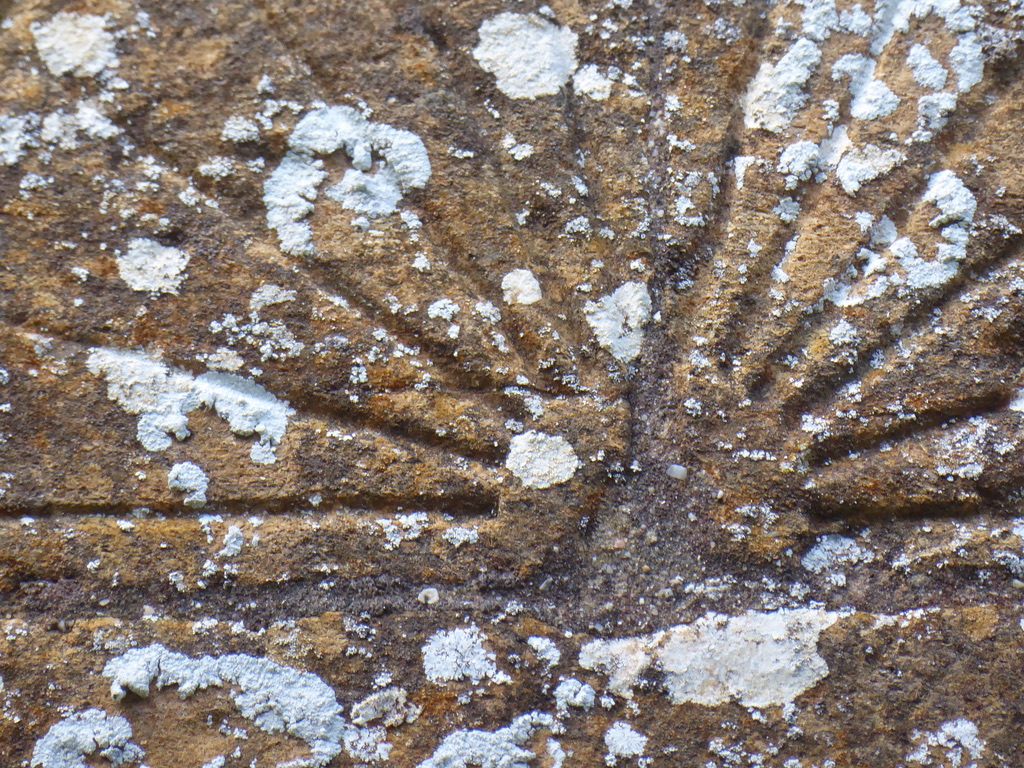
The dial is located on the SW buttress of the tower, about 2m high. There are 12 lines, 6 of which extend beyond the circumference. Some have terminal pocks; the noon line has 2. GLP notes that the dial is quite accurately cut, but is at an angle and of little use in its present position. Probably it was relocated during later work.
GLP dates it to C14, and notes quite sternly that, whereas RCHM suggests perhaps C16, it gives no reason for this opinion.
GRAFFITO ON THE STONE BENCH INSIDE THE PORCH: W.D. 1773
GSS Category: Scratch Dial; Dorset Church with Spire
All photos: Keith Salvesen; Thanks as always to Gordon le Pard for Dorset dials
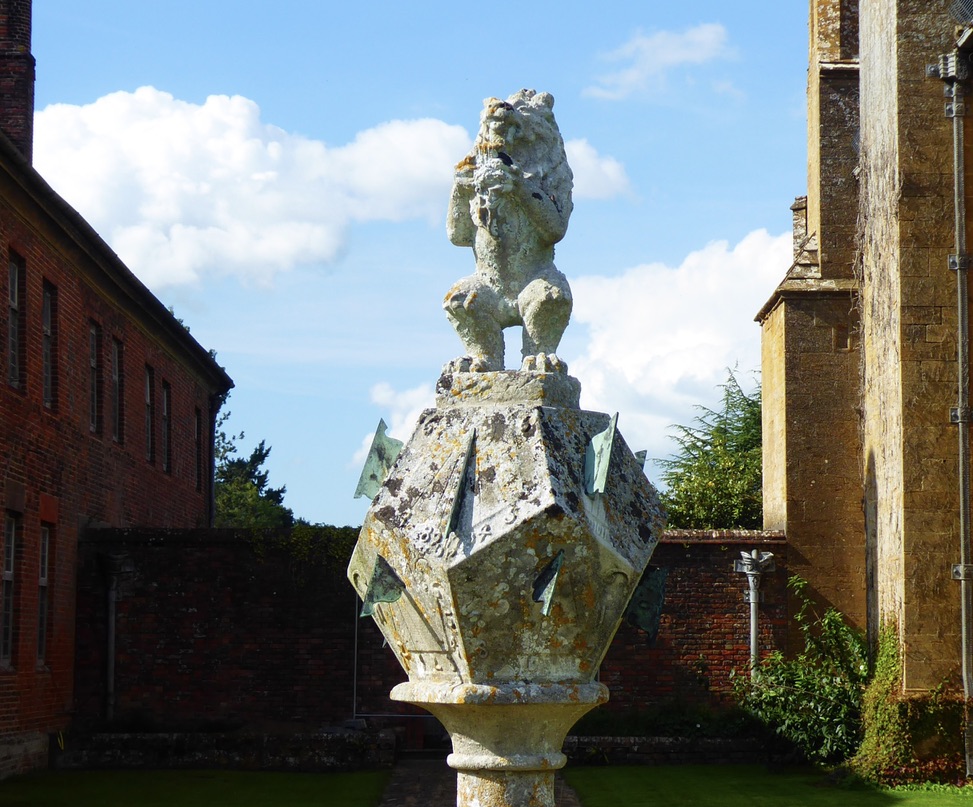
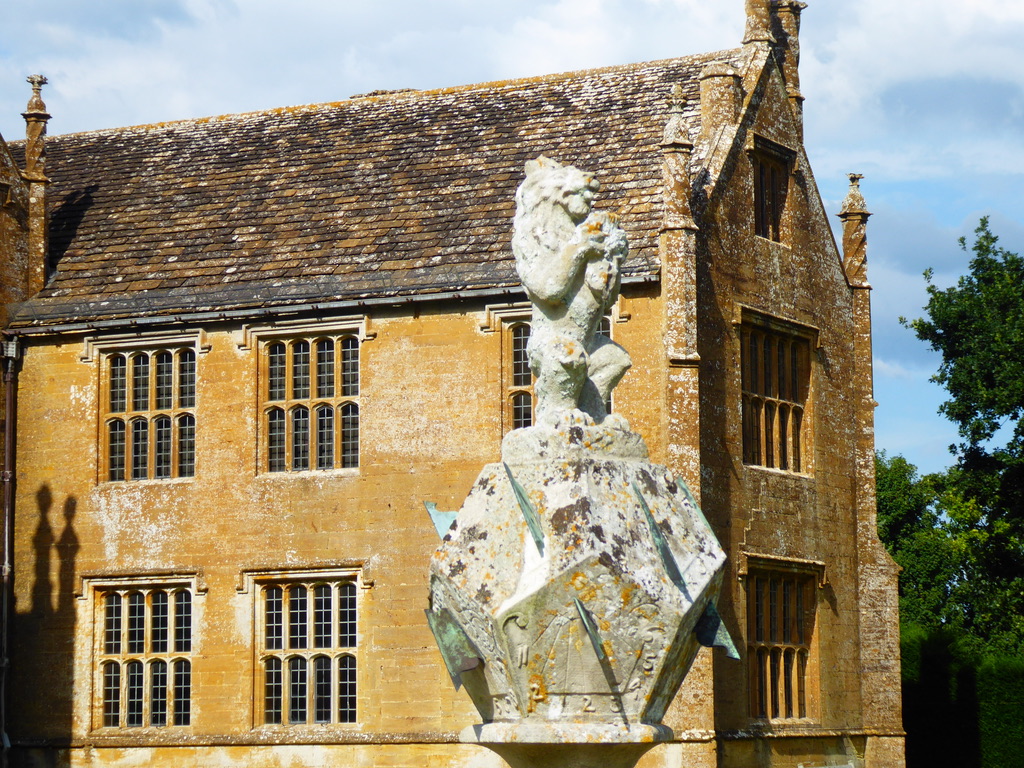
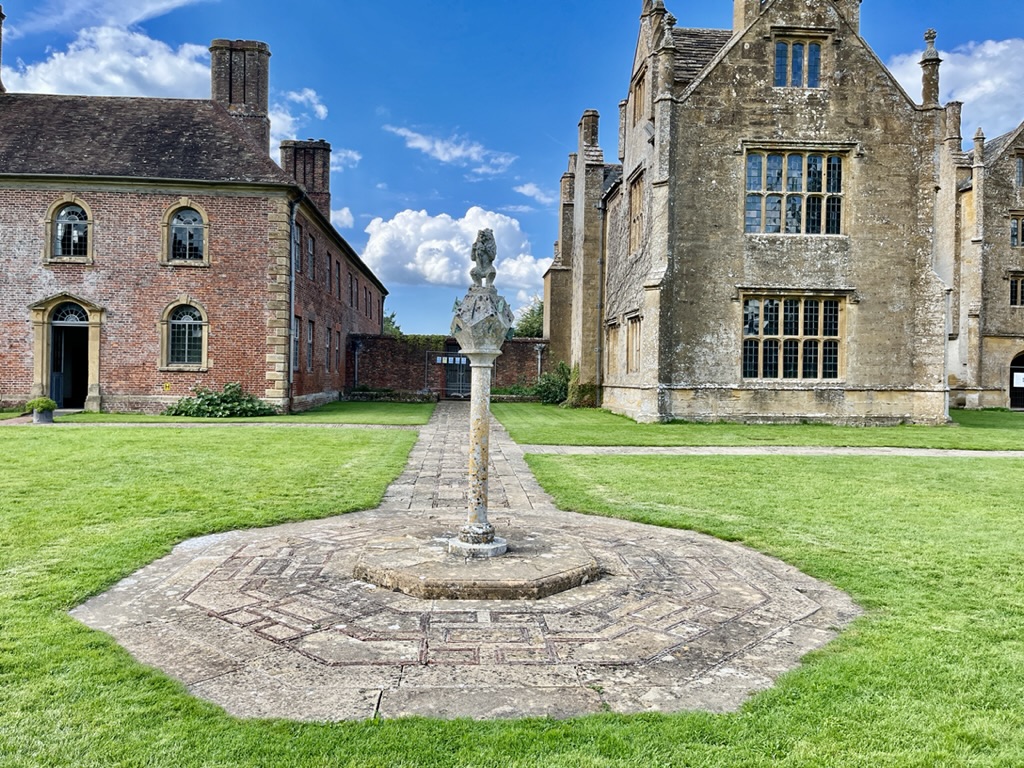
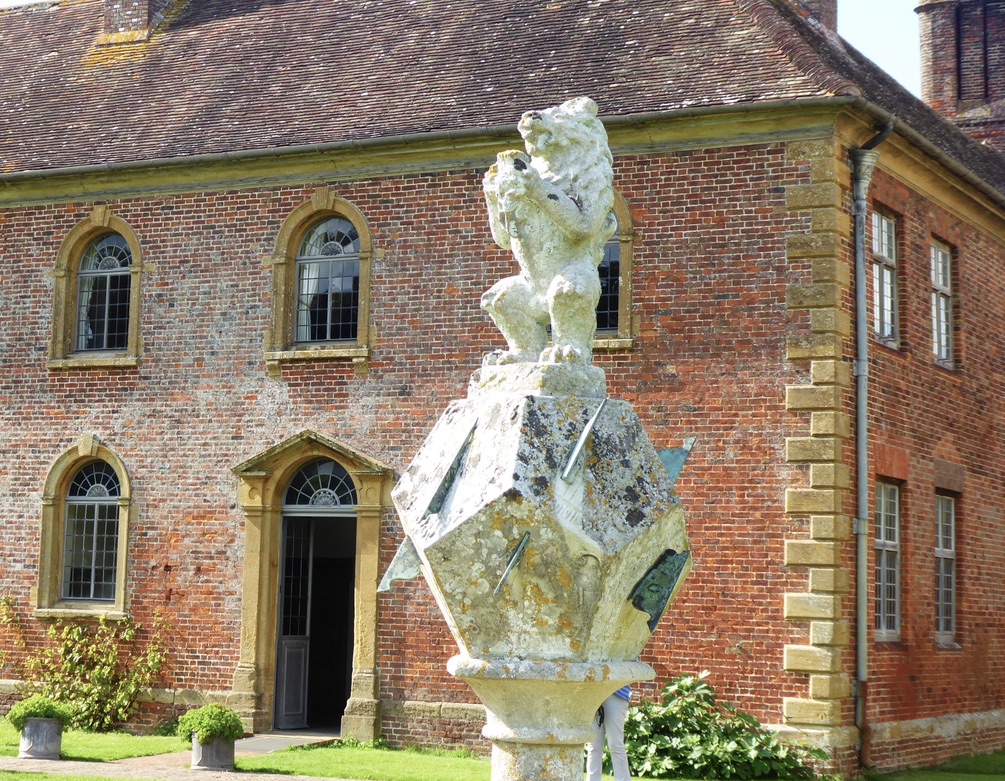
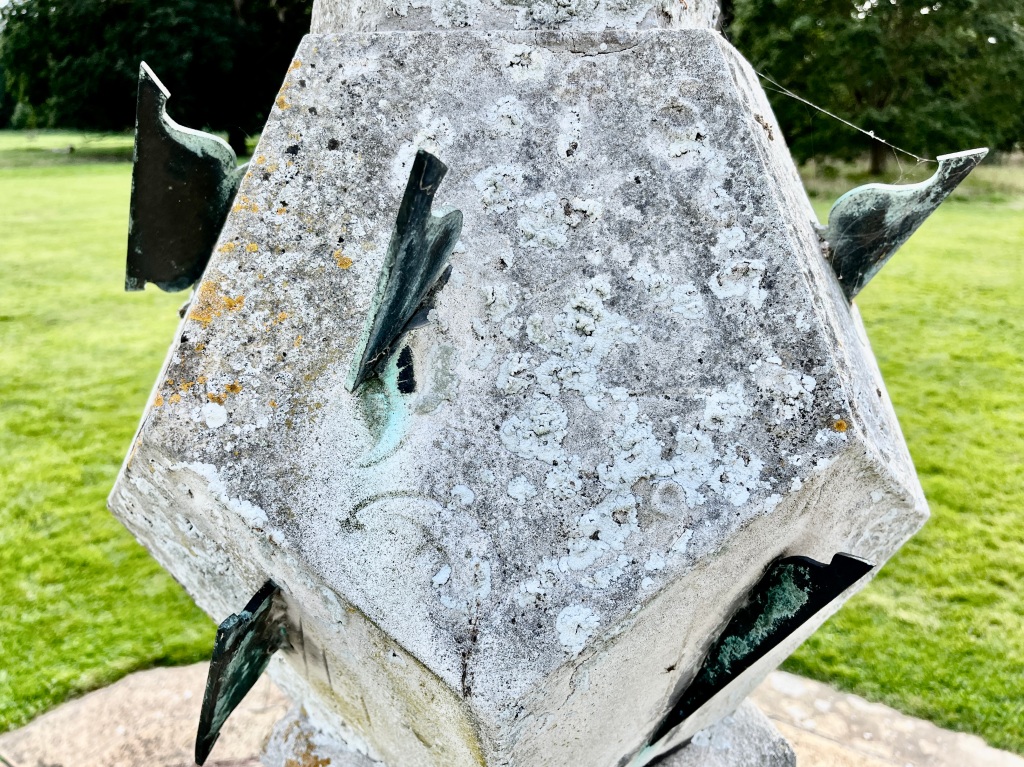
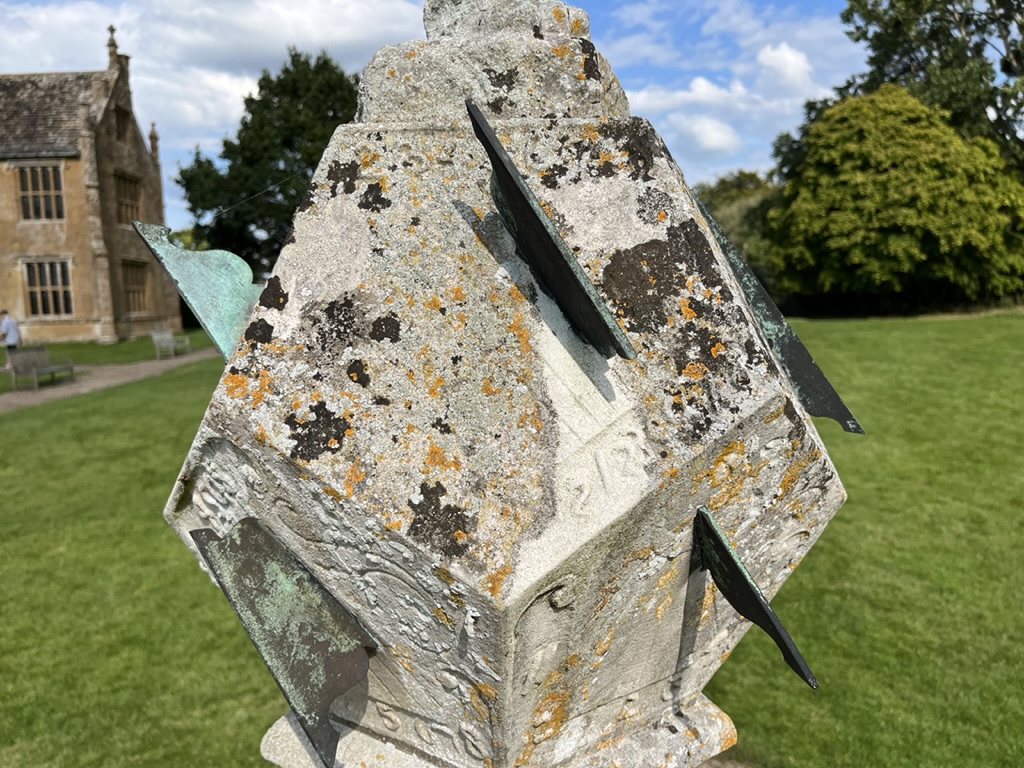
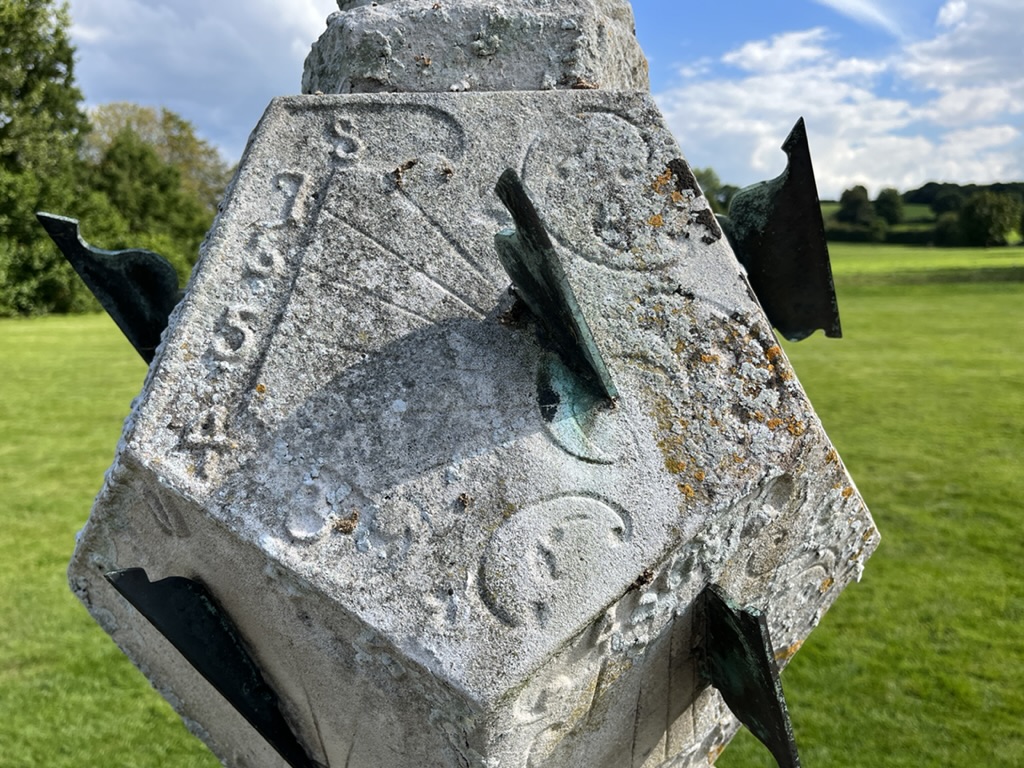
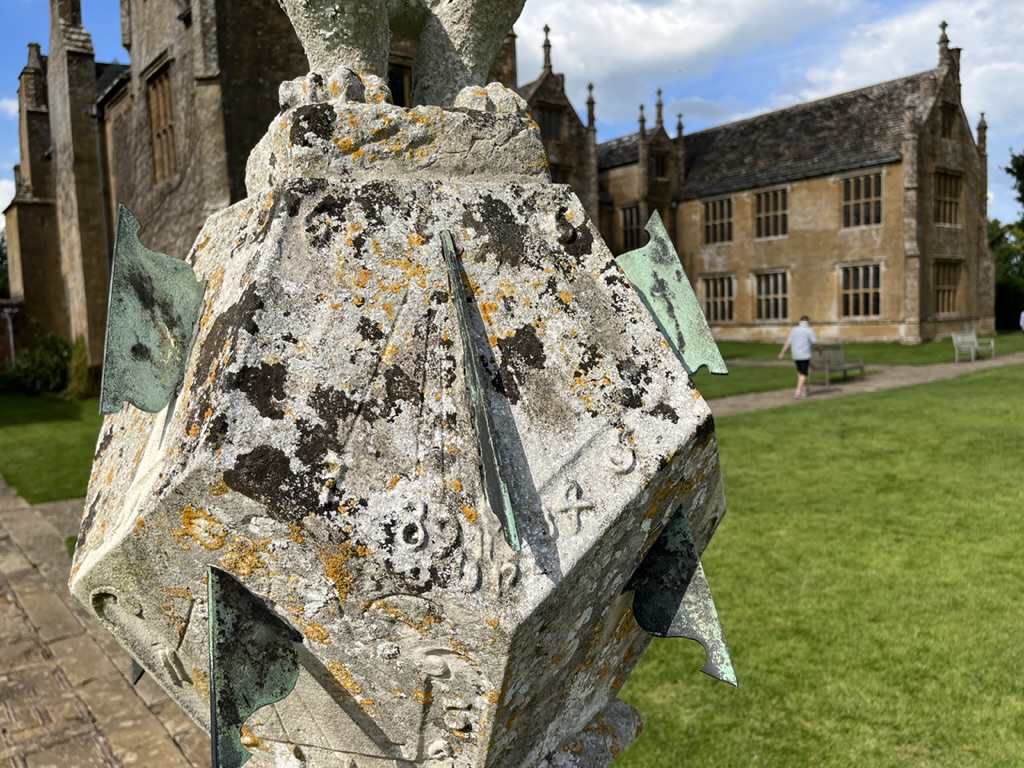
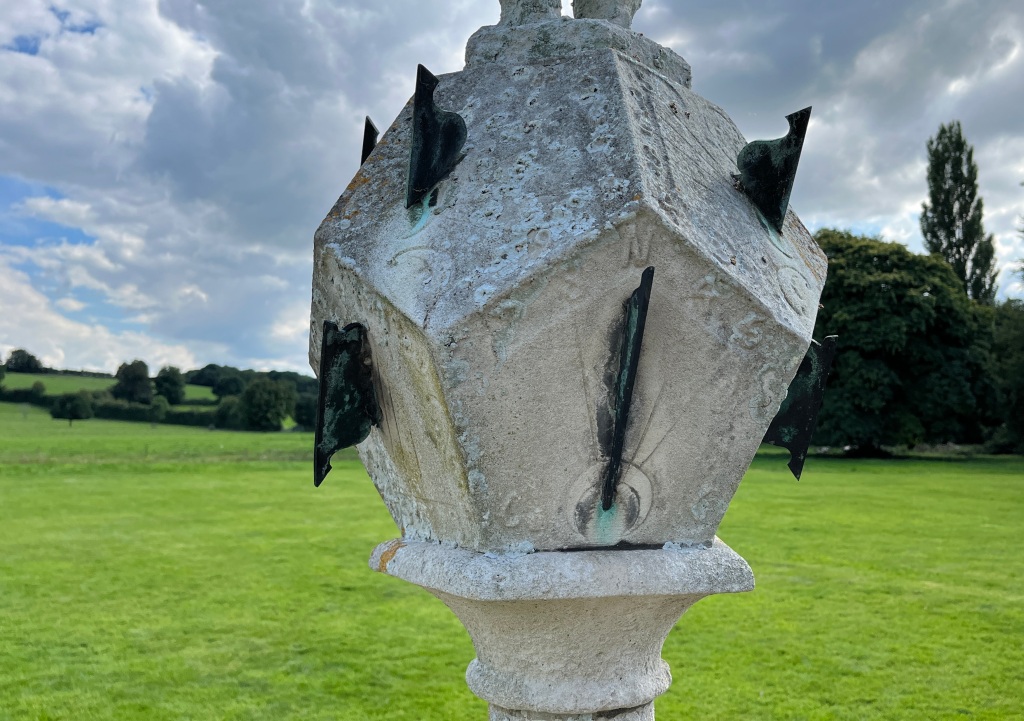
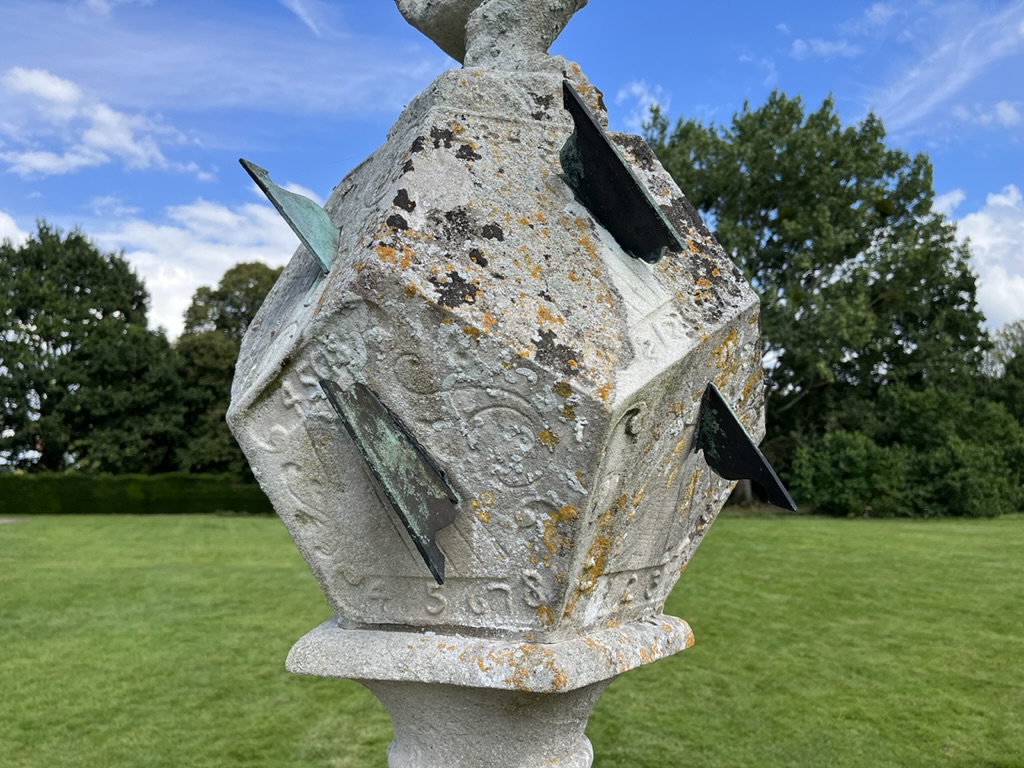
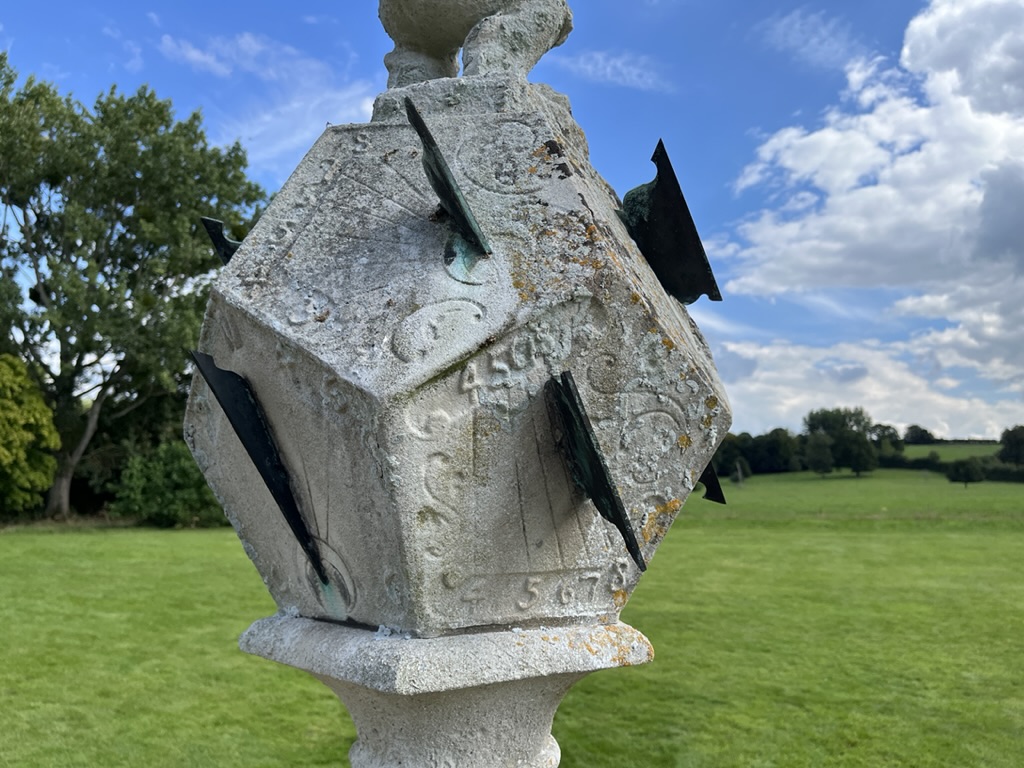
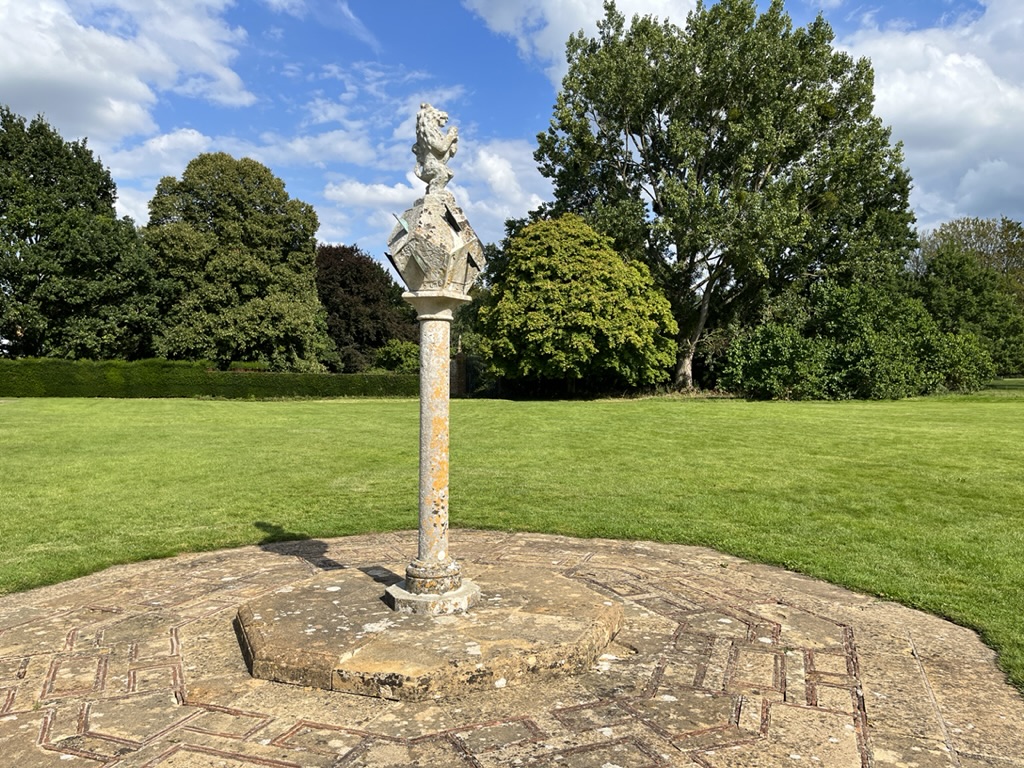
GRADE l † C13 origins; mainly C15 with C19 slightly controversial restoration. Dec and Perp. A fine-looking church with a handsome octagonal tower (one of a number in the area). Picturesque PEV. Combine with Barrington Court (NT) – 2 remarkable pillar dials: one is a dodecahedron with pentagonal faces (post in due course). 4m N of Ilminster. 50.9592 / -2.8712 / ST389181
DEH the pioneering Downside monk visited on Sept 10th 1912 on one of his early dialling expeditions using a motorbike to get around. He recorded 3 dials in a group on the buttress at the W corner of the S transept. There is a fourth plausible dial in the same location.
DIALS
DIAL BUTTRESS
DIAL 1
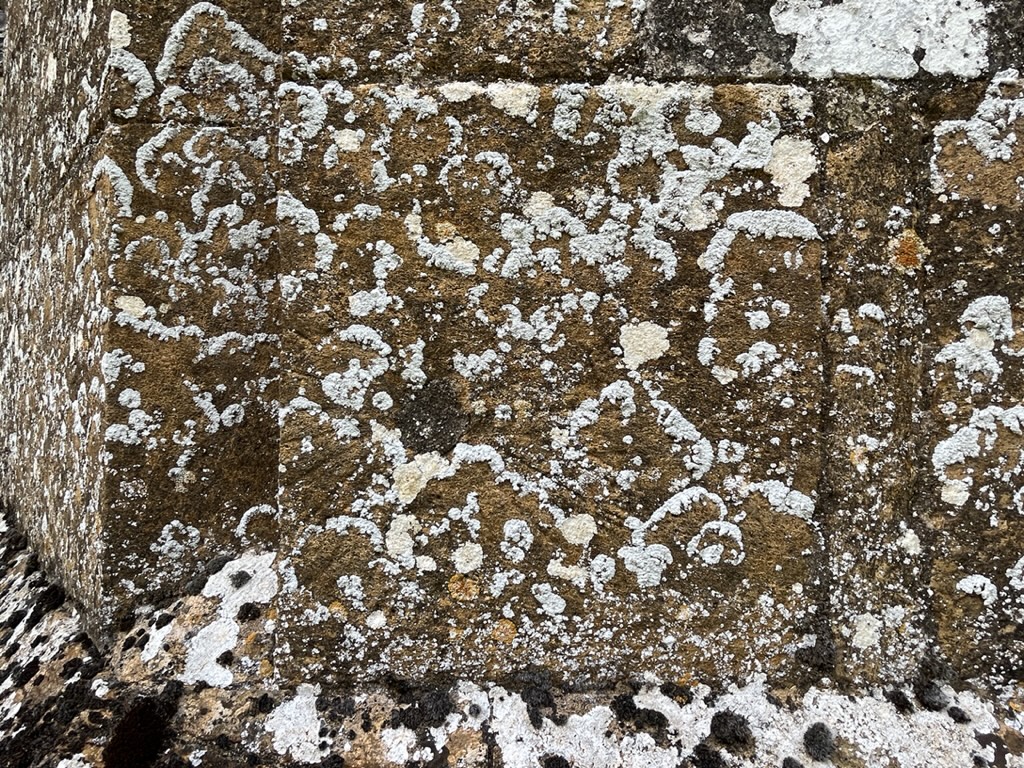
This interesting dial has 10 / 11 radials extending from an enlarged gnomon hole. 8 & 9 are marked by deeper cut lines, suggesting the most important Mass time was Terce. The lower half of the dial has a few pocks on or near the circumference. Intriguingly the top half of the dial has a complete semi-circle of pocks. These are quite carefully graduated so that midnight has the largest, and on either side the size of pock reduces. There’s a trace of a single line upwards from the gnomon hole to midnight. DEH noted This dial has been added to and made into a wheel.
DIAL 2
Immediately above Dial 1, with a blocked gnomon hole in the mortar-line. There are 2 clear lines and 3 (4?) others. 2 (3?) appear to end in pocks.
DIAL 3
Dial 3 is sandwiched between Dials 1 and 4. The most obvious feature is the blocked hole. There is a faint noon line and the hint of a 9 line.
DIAL 4
On a quoin stone E of Dial 1 is a shallow hole from which a single thin line extends to mark noon. Plausibly a dial – especially as in a group – but perhaps not definite.
GRADE I † C12 origins (?); C15 inc tower & porch; C16 rebuilding / additions. Material from nearby Milton Abbey incorporated. C19 restorations. In proximity, a fine early vertical sundial (1690); 2 date stones (1569); scratch dial (probable?). Several excellent gargoyles N side. 2m W of Milton Abbey. 50.8259 / 2.3114 / ST781029.
VERTICAL DIAL
A fine dial in very good condition for its age. The gnomon is an amusing extension of the sun’s nose. I took the design LL corner to be an hour-glass, which would be appropriate. In close-up I wonder if it is a religious symbol; and if the design LR corner is a square and compass.
DATE STONES
THE BAGPIPER
SCRATCH DIAL
The dial design of a double circle with a hole in the centre is far from unusual. No lines, no pocks; just a stick needed to mark the passage of the day. This type is generally included in the Scratch / Mass Dial category of church marks; and I go along with that. However, having recently researched Cyffe Pypard and Fovant (both Wilts) which have several dials including this design, I am beginning wonder. It’s hard to think of a reason why a dial-cutter would not to add lines, pocks or both to a device specifically made to mark the passage of the day. But what if these are apotropaic symbols cut into the walls of the church to catch evil: ‘Demon Traps’ from which, once entered, encircled evil could never escape?
GSS Categories: Vertical Sundial; Old Sundial; Date Stones; Gargoyles / Hunky Punks; Scratch Dial
GRADE I † C13 (recorded 1273), C15 nave & tower. C19 restorations (Butterfield). In a lovely position below a wooded stretch of the cliff PEV. Pevsner & his wife Lola are buried together in the churchyard**. Interior has much of interest: pulpit 1629; excellent monuments C13 on, medieval stained glass. 7m SW of Swindon. 51.4917 / -1.8939 / SU074769
Sir Nicolaus Pevsner
DIALS
As one approaches the porch from the lych-gate, there are two very visible dials, one on either side of the entrance. A third dial in that area is noted (eg BLB / HE). In fact there are more dials, but when I visited, finding them involved negotiating overgrown bushes and parting tree branches in light drizzle. There are also some dial-ish designs – eroded or incomplete – that are doubtful, but are included below for consideration.
DIALS 1 & 2
Dial 1 is LHS of the porch. This large dial is encircled, with the upper segment encroaching on the stone above. There are 7 / 8 lines, two of which are ULQ (so, not useful). The noon line extends well below the circumference and through a partial double circle. I think this is the BLB / HE third dial, though I think it is more a doodle than a dial. The emphasised line LLQ may mark Terce. The oddly inaccurately cut lines R of the noon line seem surprisingly casual for such a prominent dial.
Dial 2 is the counterpart of Dial 1, and far simpler. The overall design suggests that it is on its side, 90º anti-clockwise, perhaps re-sited.
DIAL 3
Obscured by foliage, Dial 3 is unconventional. The clear-cut circumference surrounds a single line with a dot at each end, slightly tilted from the horizontal. On the curve RHQ is a dot roughly corresponding to the Mass-time None. In the centre is a blocked gnomon hole. There are no lines or other markers of the passage of the day. In a sense , there is no necessity for lines to mark the hours – a stick’s shadow is almost as helpful.
DIAL 4
Dial 4 is largely hidden by foliage. Unusually, it consists of 4 concentric circles. These are now badly eroded; one is a trace only. Apart from the central gnomon hole, there are no other visible dial attributes: no lines, no pocks.
This type of dial is not unusual. Here is a similar dial in FOVANT Wilts, with 2 concentric circles and no other marks than the gnomon hole. However, I ought to mention that some consider that such designs are not dials, but may have a decorative and possibly an apotropaic function.
DIAL 5
Dial 5 (?) – if a dial – is a classic ‘drainpipe’ example, in part concealed by a more modern addition to the church wall. There must be some doubt here because it is hard to see how it – with the arc of a circle below – would have worked.
DIAL 6?
Dark and damp, this stone was difficult to read. If a dial, it is contained within a square with the top side being the mortar line. In favour of dial status is the location of the dial stone beside a window and the position of the dial; traces of a circle; a pock directly on the circumference LHS roughly corresponding with Terce; and the fact that the design is quite accurately framed as if to display it better. Equally, there are reasons to discount it.
OTHER DIAL CANDIDATES and CHURCH MARKS
Another interesting part double circle, endearingly wonky. Very doubtful as a dial. Most interesting for the graffito UR, which may be a simple form of a type of ritual protection symbol that consists of rectangles with line and dot patterns.
The two marks on this stone – with variations – are quite often used as protection marks.
Note again the the double curves RHS. Most probably an incised design, rather than a dial.
Further evidencing the incidence of protection symbols is this Marian VV mark close to Dial 2.
The handsome bier kept in the church, and in excellent condition.
**In 1951 Pevsner published the first volumes of his magnum opus, The Buildings of England, an enterprise that took nearly 25 years to complete. The substantial Wiltshire volume was recently revised, expanded, and published in 2021
GSS Category: Scratch Dials; Mass Dials ; Multiple Dials
St Mary . Castle Bank . Stafford – Geoff Pick Geo CC / OS
CHURCH OF ST MARY . CASTLE BANK . STAFFORD
GV II* † C15 tower; otherwise mainly C19. Tower has 2 diagonal buttresses, plinth, south 2-light straight-headed window with sundial to right: incised inverted semi-circle with gnomon and inscription: J 1624 L BLB . In Newport Road below the castle, not to be confused with the large ‘collegiate’ parish church, also St Mary. 52.7969 / -2.141 / SJ905221
St Mary . Castle Church . – Vertical Sundial
DIAL
The vertical dial is high up on the S side of the tower, a semicircle with Roman numerals, with the date 1624 and on either side of it the letters J and L. The date may fit with work carried out on the upper stage of tower in C17. As can be seen, there has been good repair work on the dial, so that it is observably both ancient and modern.
GSS Category: Vertical Dial; Church Sundial; Old Sundial
All photos: Erika Clarkson, with many thanks for this and her other contributions to this project; Geoff Pick for his photo of the church Geo CC / OS
ALCISTON CHURCH has no Dedication. That is quite unusual, inviting speculation and maybe inspiring research into the history. I didn’t get that far because this is a multiple scratch dial church, with 4 good examples to admire and write up. You can read my piece about them HERE
In the churchyard there was an object that attracted our attention. This eye-catching slender column had only recently been dug in, and was in pristine condition. Clearly it is a memorial, but no details were marked. The sides and the back are plain. The large hole at the top is lined with gold, which looks very good. As a whole, it is obviously designed with care and made with skill.
DIAL
The dial itself is pleasingly symmetrical, and the composition works very well. I think it is not necessarily intended to have a gnomon, though someone has chosen to improvise with a stick.
,
However, because it faces roughly E rather than S, its ability to mark the passage of the day is limited. Also, the divisions of the lines would be cut differently. However, as a memorial stone, strict accuracy as a sundial may well not be a consideration anyway. It is a fine piece of work in a lovely setting.
GSS Category: Modern Dial; Vertical Dial; Column Dial; Memorial Dial
All photos: Keith Salvesen; thanks to John Foad BSS
GRADE II † Almost entirely rebuilt & enlarged in successive stages from the beginning of C19, incorporating reused details of C12 fragments, C14 and C15 stonework. Rather incongruous neo-Norman features. C12 Purbeck marble font; fine nail-studded medieval door. Tower-less and Spire-less. 4m N of Weymouth. 50.6506 / 50°39’2″N / SY667835
DIAL
The dial is on the L jamb of the early doorway (inside later porch), and remains of a full circle are still visible. 6 lines radiate from a small filled hole that is significantly off-centre. One line is elongated beyond the circle. The None line is emphasised by a small pock near the end. The noon line (if it is one) is the most unassuming of them all. There’s a hint that very light graffiti has been superimposed on the dial.