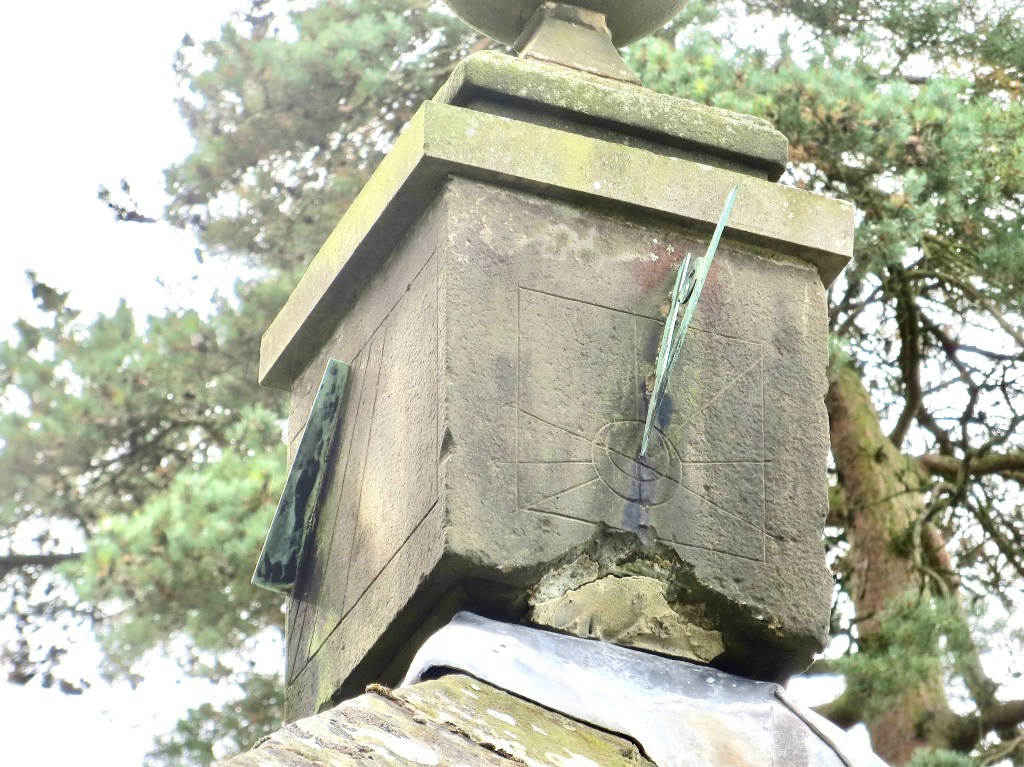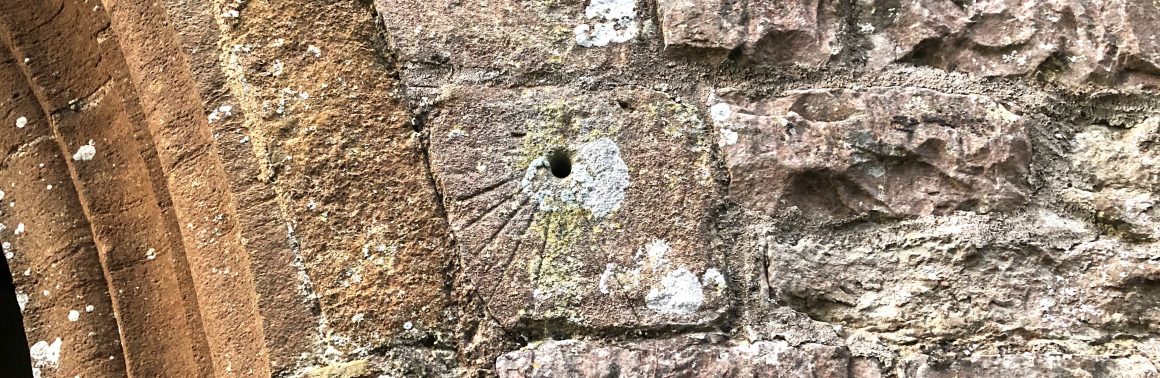
MONUMENTAL SUNDIAL . MUSEO GALILEO . FLORENCE

Lizard / Viper Gnomon of Monumental Dial . Museo Galileo . Florence

MONUMENTAL SUNDIAL . MUSEO GALILEO . FLORENCE

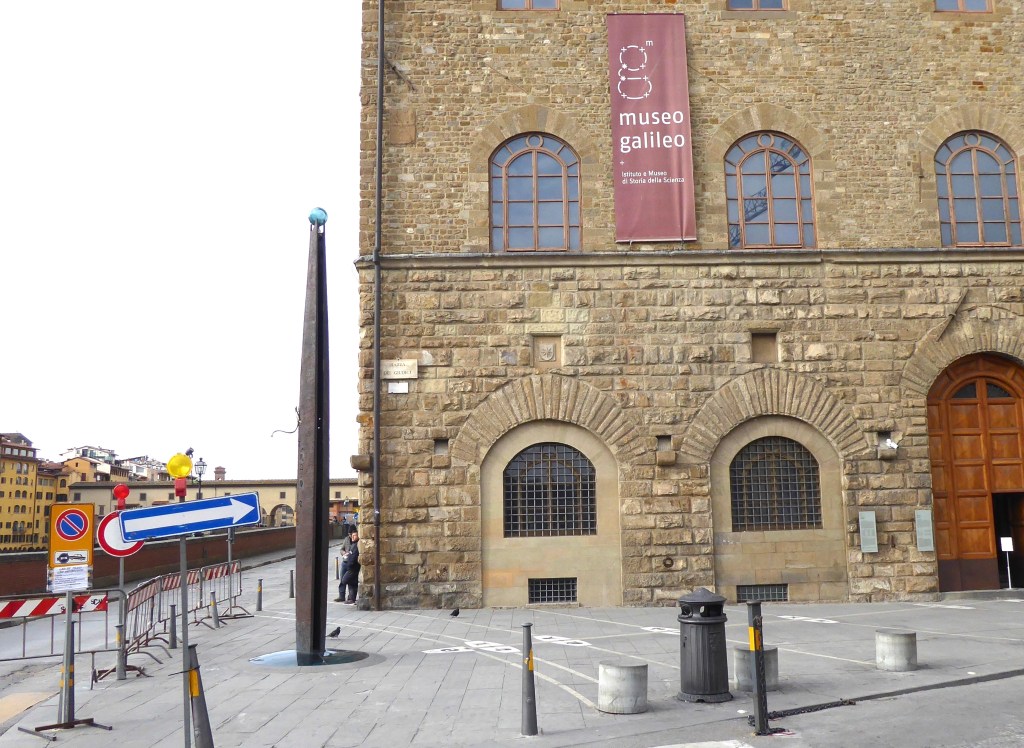
The Museo Galileo‘s Monumental Sundial was built as a mathematical ornament in 2007. The slender bronze column (stele) is in fact formed from two matching columns closely aligned, symbolising day and night. The (mid)day stele faces south, with a vertical meridian line on which the shadow is cast by a lizard’s tail (actually, an imaginary half-lizard, half-viper). The night stele faces north and signifies the constellations Ursa Major and Ursa Minor that enable the Pole Star to be identified.
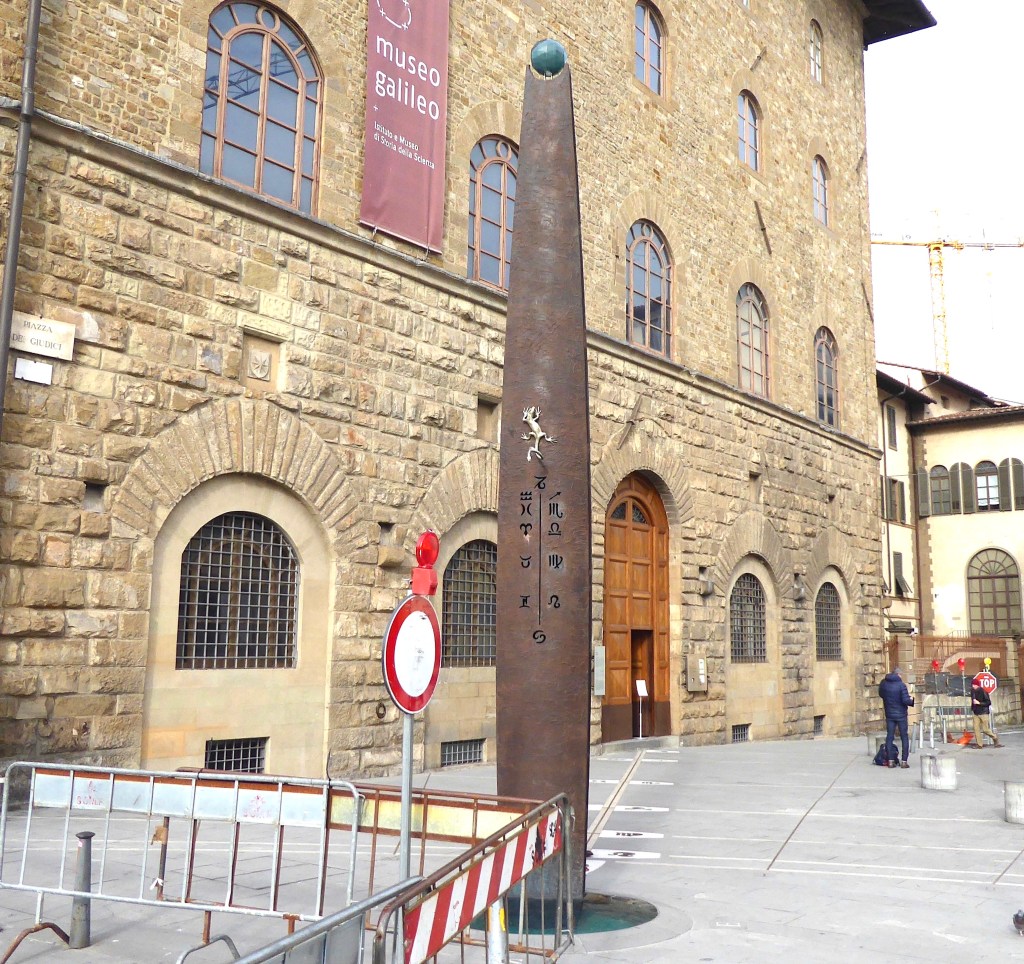
Monumental Dial . Museo Galileo . Florence

The encircled quadrant design on the pavement at the base of the bronze columns indicates the geographic orientation. This glass base of the gnomon, and also the Zodiac signs in the meridian line (below), are up-lit after dark.
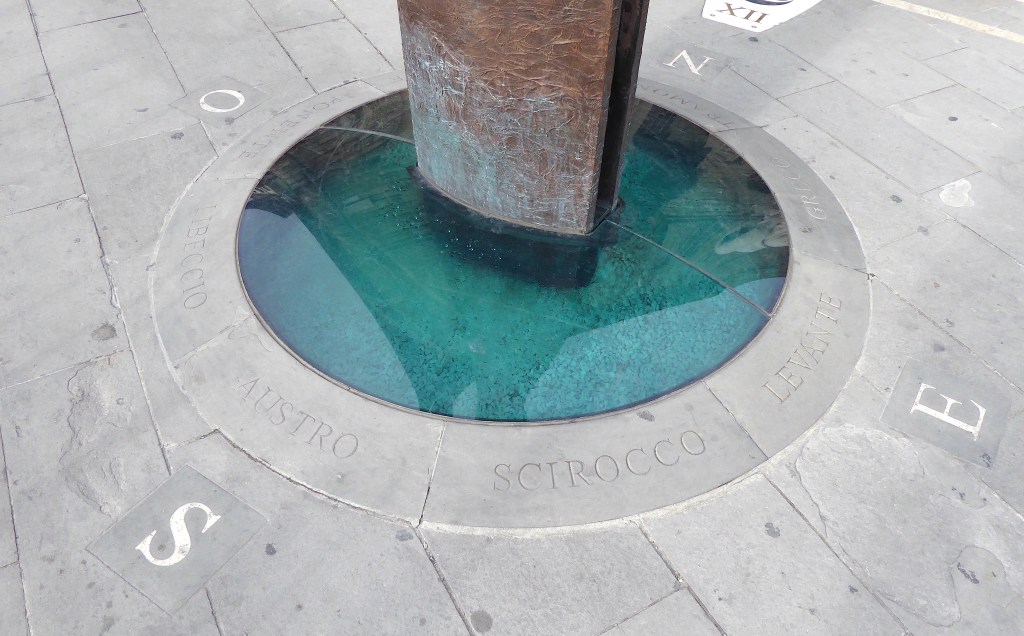
Orientation dial . Monumental Dial . Museo Galileo . Florence

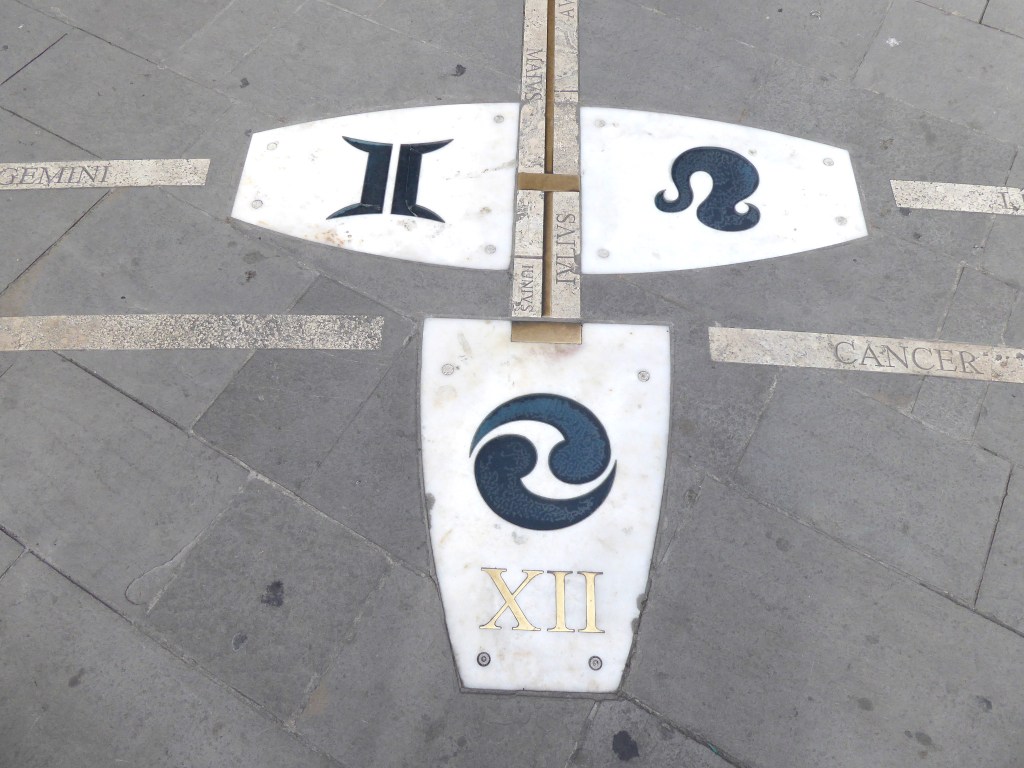
The Museo explains the meridian line in helpfully simple terms: A travertine and brass meridian line is drawn on the pavement, flanked with glass and marble signs of the Zodiac. The meridian line extends for about 15 metres from the museum entrance, where the winter solstice is marked, to the base of the gnomon, where the summer solstice is marked. The travertine curves crossing the meridian line indicate the date. The brass radial lines forming a grid with the two solstitial curves indicate the hours.

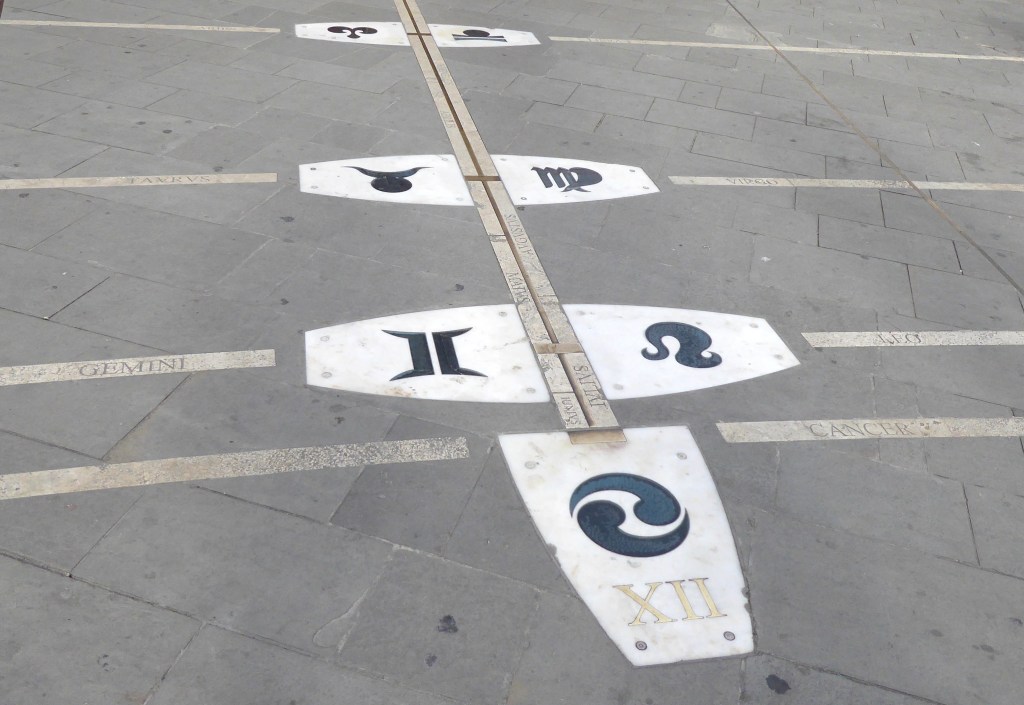
The seasons and the four elements are symbolised by the choice of materials: travertine for the earth and autumn; glass for the water and winter; grey stone for the air and spring; bronze for the fire and summer.

LIZARD / VIPER GNOMON ON THE SOUTH FACE OF THE COLUMN

This extraordinary sundial stands by the Arno with the Ponte Vecchio (which itself has a wonderful dial LINK) close by to the west. For anyone with even a minuscule interest in or curiosity about the gradual development of scientific instruments and techniques from medieval times onwards, pay a visit to the excellent online gallery LINK. Look in particular for the two astronomical telescopes made by Galileo himself.

The North American Sundial Society has very good online information about this unique dial. You can watch a short animation of how this gnomonic sundial works here LINK

For those interested in finer details of the way the dial works, the museum’s detailed account is included at the end of this article.

Museo Galileo – Istituto e Museo di Storia della Scienza

Museo Galileo – Monumental Sundial

NASS (North American Sundial Society) Video: Filippo Camerota, Luise Schnabel, Giorgio Strano
How the Sundial works

The shadow cast by the glass polyhedron atop the large bronze gnomon indicates the date and time. The hours from 9:00 AM to 2:00 PM are marked out by radial brass lines. The date is indicated by the travertine traversal lines which mark the Sun’s diurnal course for various periods of the year – precisely when the Star enters the signs of the Zodiac. The shadow cast by the gnomon changes in length during the course of the days and seasons, and indicates true solar time for the place where it is located, which is a different time than that of our wristwatches, known as mean time. In respect to mean timetrue solar time has a periodic variation that can exceed a quarter of an hour.
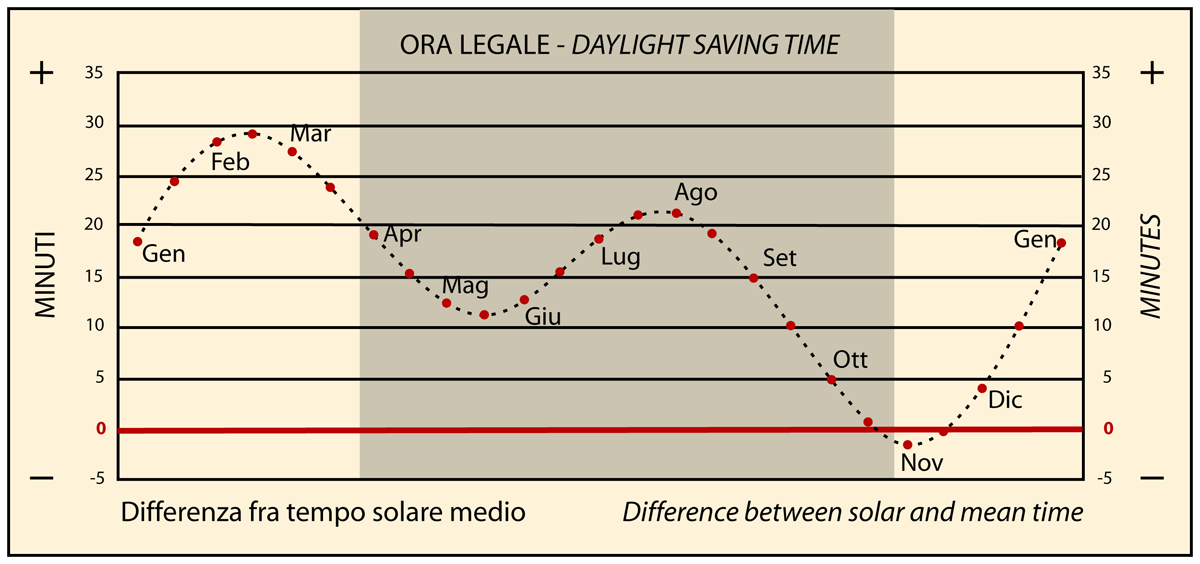
schema minuti

Moreover, during daylight saving time, the hands of a clock are moved forward one hour. For example, true midday in the month of February would be indicated by the sundial around 12:28 AM while in the month of July it would be indicated around 1:20 PM daylight saving time.

To read the hour and date, you have to identify the hour lines and the calendrical lines closest to the gnomon’s shadow. When the shadow does not fall exactly on a hour line, you can read the half-hours and quarters with close approximation by ideally subdividing the space between two hour lines in two or four parts. The date can also be read by referring to the Zodiac signs and the start of the months marked out along the meridian line.

© 2018 – 2022 Museo Galileo – Istituto e Museo di Storia della Scienza
Piazza dei Giudici 1 · 50122 Firenze · ITALIA
tel. +39 055 265 311 – P.I. 01346820481
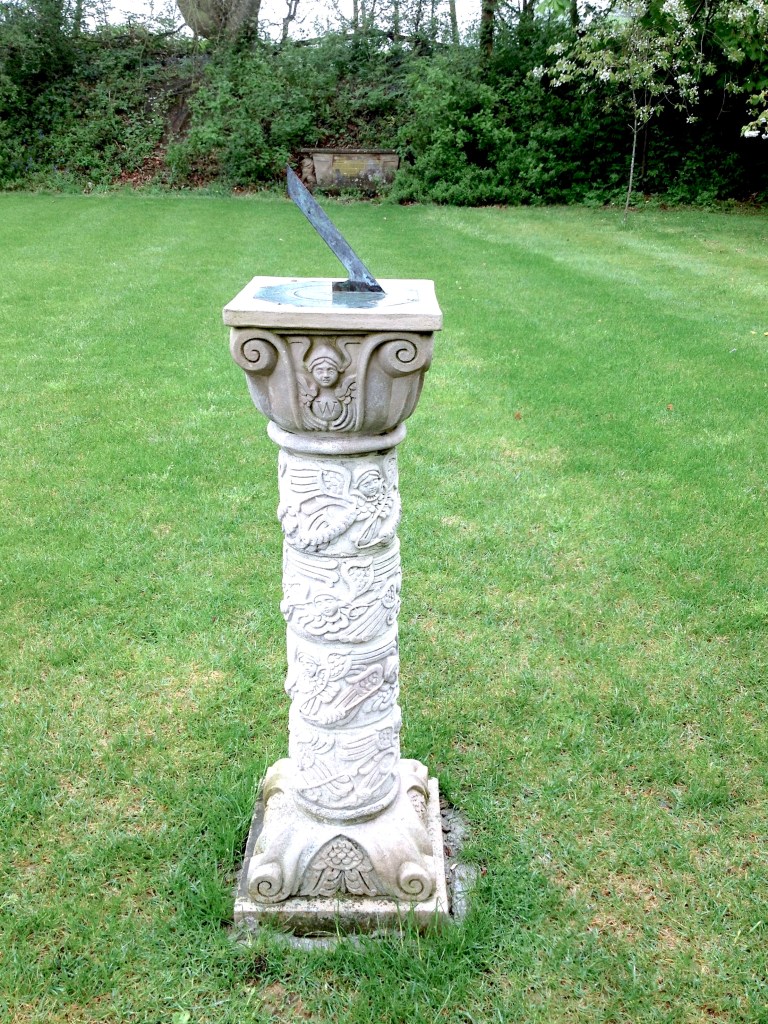
COMPTON . SURREY . THE WATTS GALLERY – Horizontal Dial by Mary Watts

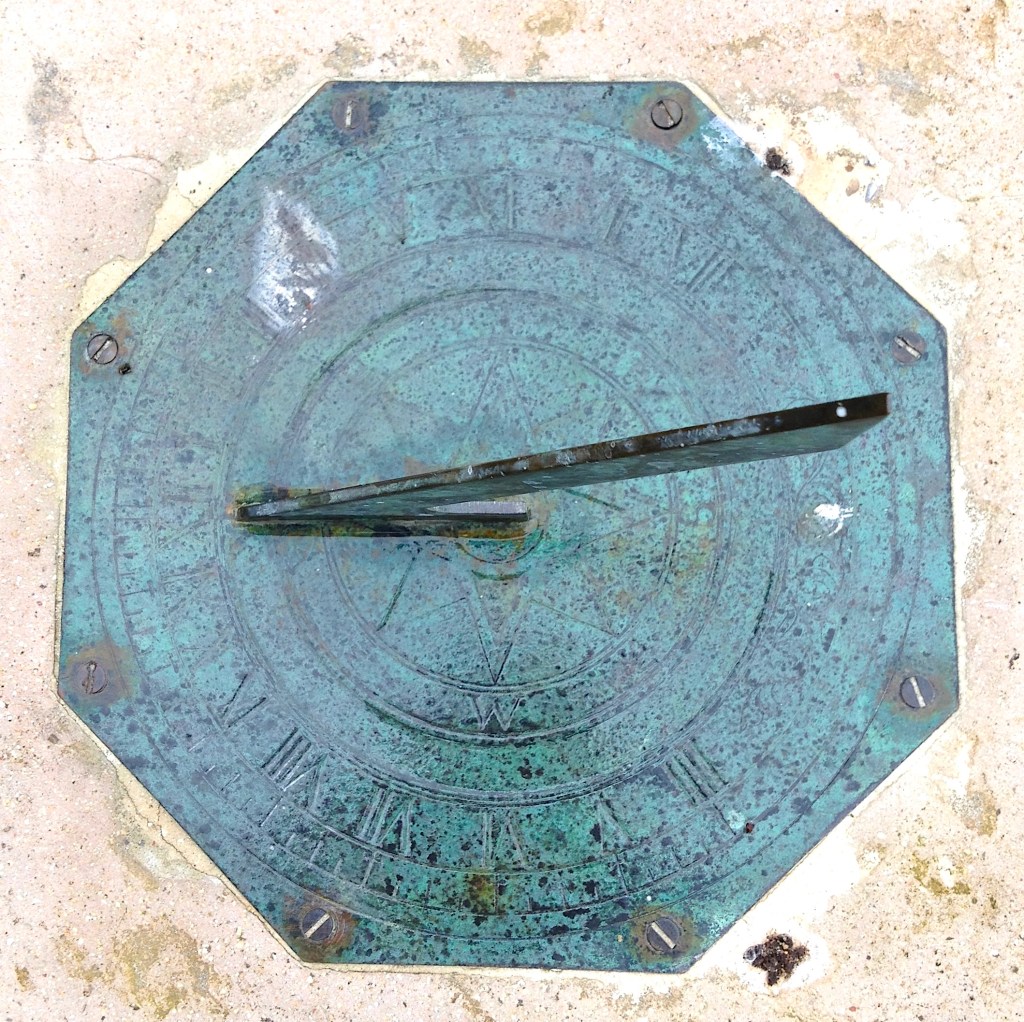
The WATTS GALLERY in Compton, Surrey showcases the work of artist G. F. WATTS and his wife MARY WATTS, exemplar of the Arts and Crafts Movement. The enterprise has expanded hugely since I last visited and took photos of the sundials there. The Gallery link above will give all the current information you could wish for.

You can find out about the remarkable Scaphe Dial at the gallery HERE

GSS Category: Horizontal Dial

All photos: Keith Salvesen

MARNHULL . DORSET . DIAL HOUSE

Vertical Dial on Village House . Marnhull . Dorset

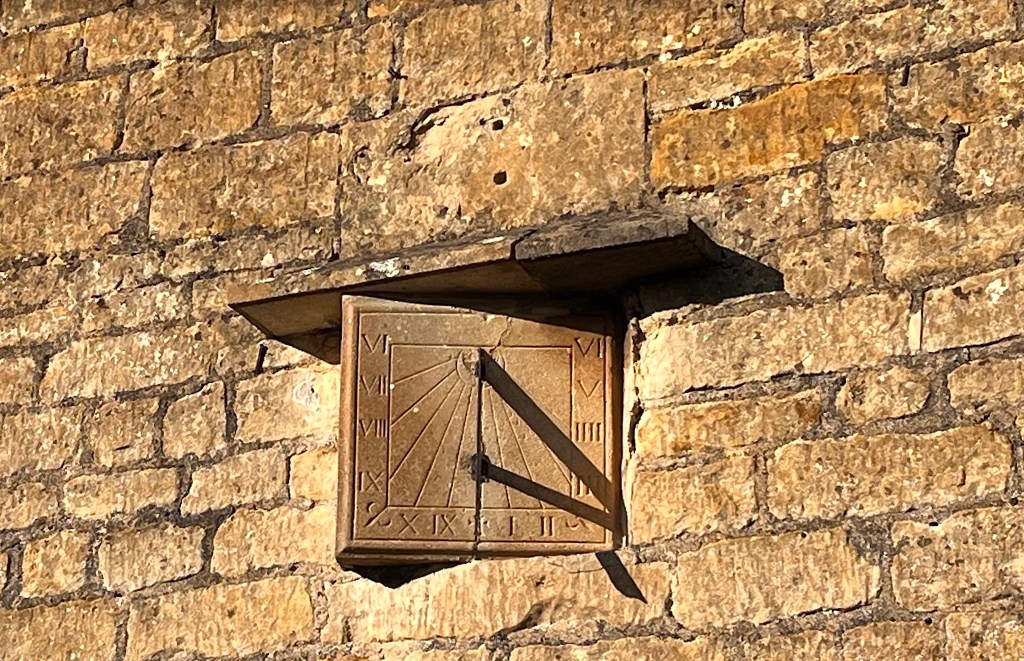
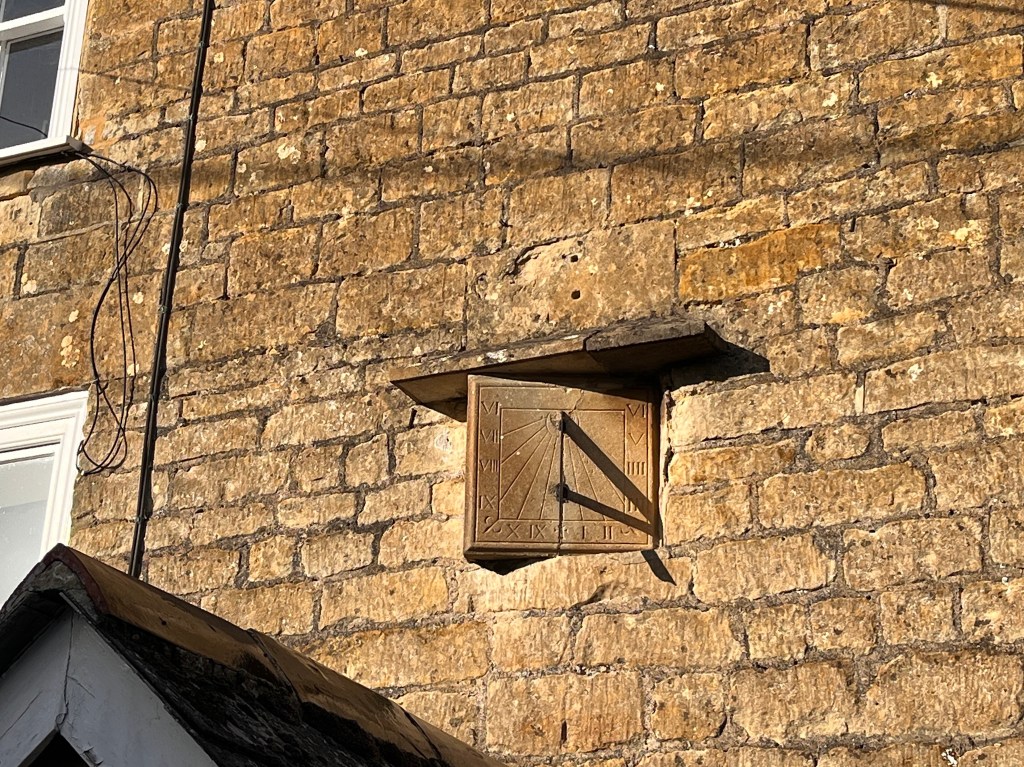
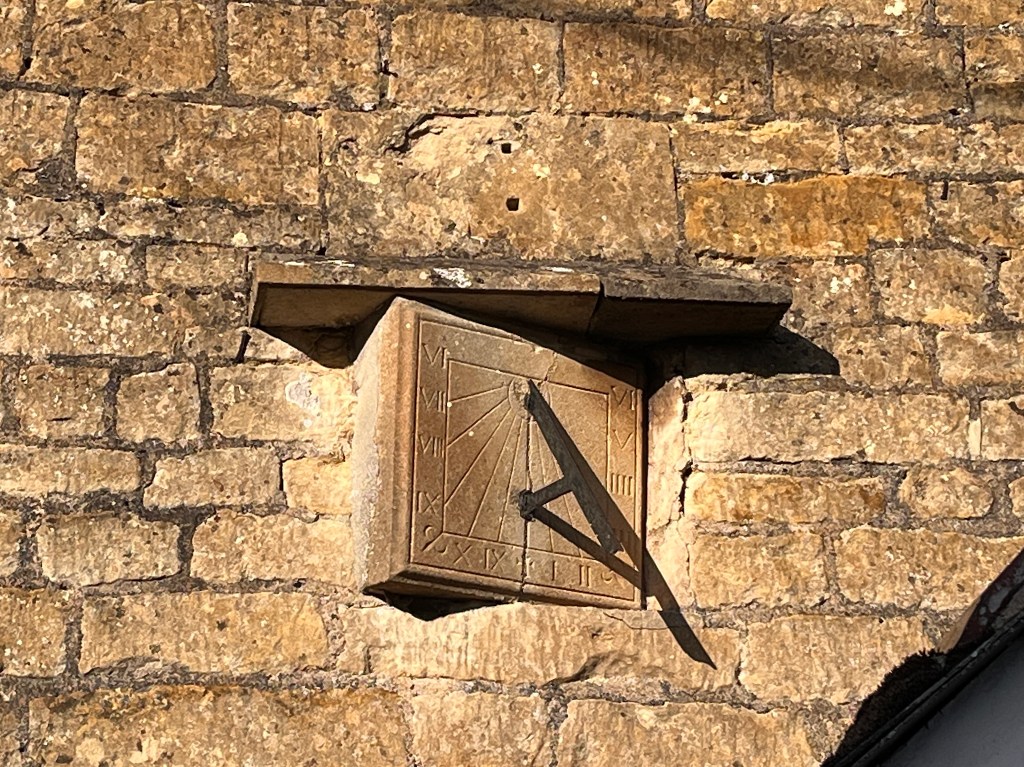
The dial is above the front door of a house in the village, with a stone ledge above it. It doesn’t give the impression of being old. There is little sign of weathering or erosion and the incisions are all equally clean. BSS gives it as C18?? and suggests it may be a replacement for an earlier dial. Given the design, I wonder if it is actually a modern C20 direct copy of the original?

The dial is canted to face south and provide an accurate reading. Noon is marked, as often, by a cross. The archaic use of IIII for IV might also suggest a careful copy of an old dial, as may the flourishes in the lower corners.

GSS Category: Vertical Dial; Canted Dial; Dial on house

All photos: Keith Salvesen

NEWTOWN LINFORD . LEICS . ALL SAINTS – 2 Scratch Dials, Vertical Dial

All Saints . Newtown Linford . Leics

ALL SAINTS . NEWTOWN LINFORD . LEICS

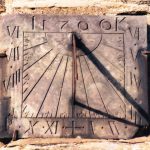
GRADE II* † C14 / 15 origins, with later / C19 enlargement. Besides 2 scratch dials there is a vertical dial on the tower dated 1706. 6m NW of Leicester. 52.6832 / -1.2292 / SK522097

DIALS

The scratch dials are both on the S side. One is on SW corner of the tower; the other on the lower part of the L jamb of a window (I don’t have a more precise location at the moment).

DIAL 1

All Saints . Newtown Linford . Leics – Scratch Dial 1

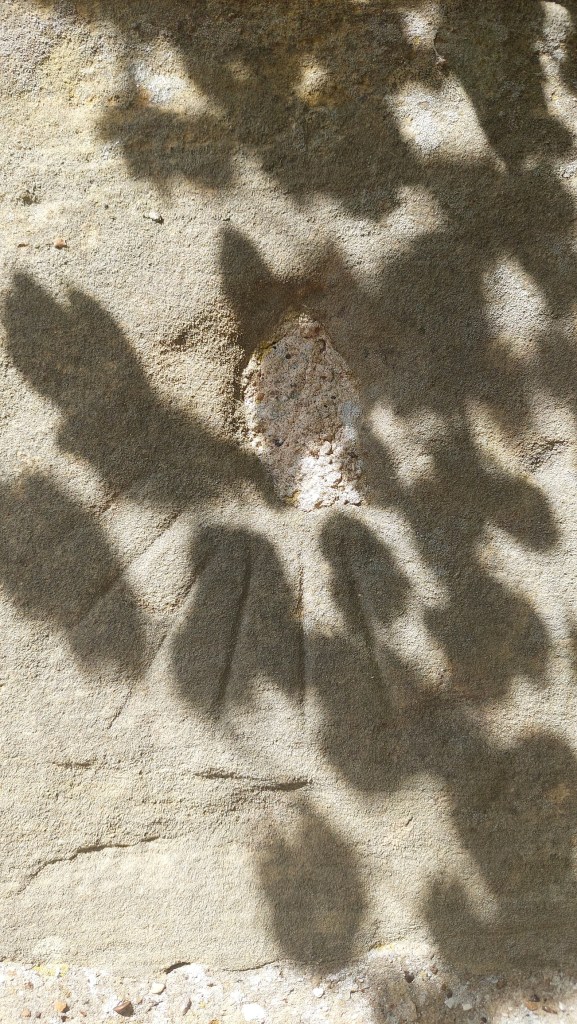
Dial 1 gives the impression of a spider, with legs radiating from the (blocked) gnomon hole in the centre of the dial stone. The clearest lines are at 11 and noon, the latter faintly extended. The others are rather randomly placed. There’s a line in the top L quadrant; and the hint of a line very roughly extending the noon line upwards. The 2 pocks don’t seem to be part of the design.

DIAL 2

All Saints . Newtown Linford . Leics – Scratch Dial 2

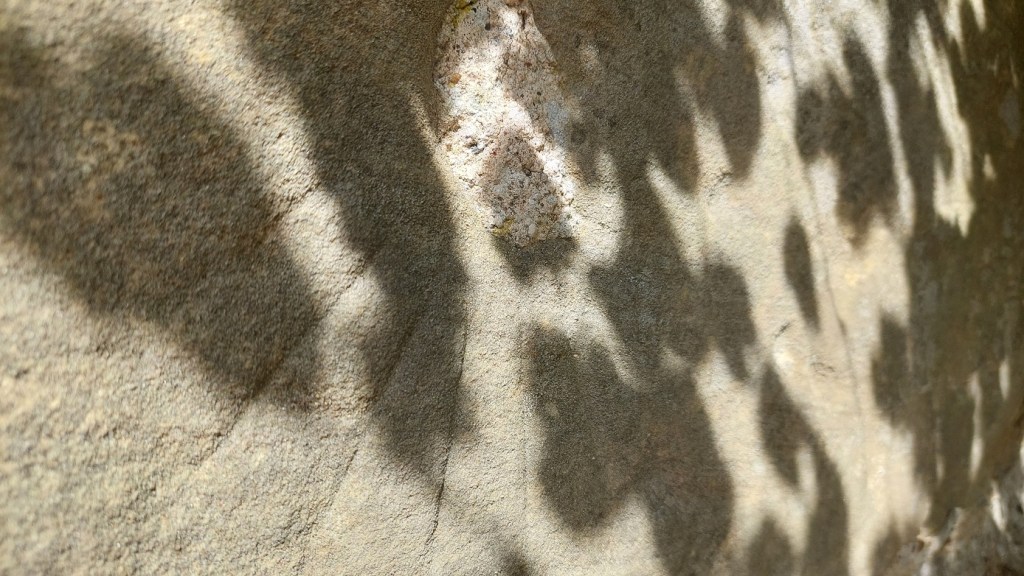
Dial 2 is more conventional ‘morning dial’, with 6 more or less evenly spaced lines descending (but not very accurately) from a large filled style hole. Only one of the lines is after noon. Simple and straightforward.

VERTICAL DIAL 1706

All Saints . Newtown Linford . Leics – Vertical Dial

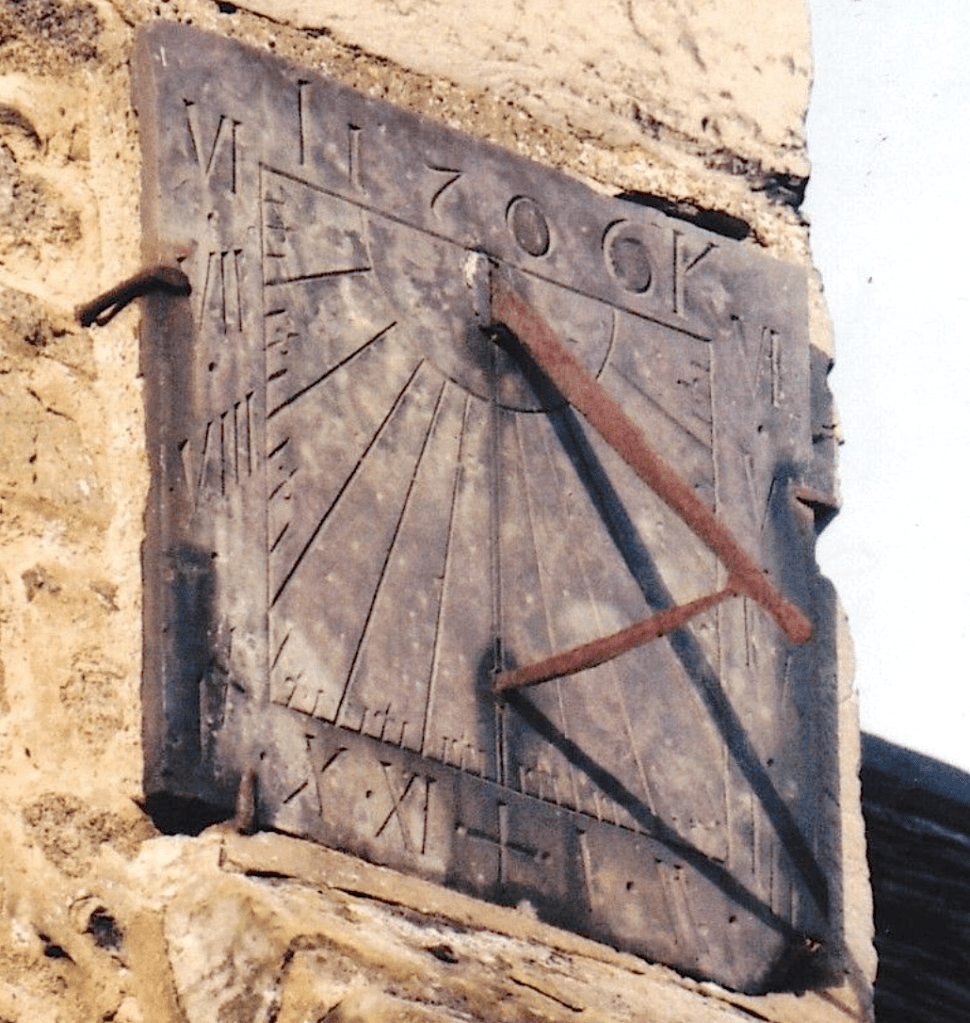
Set on the SE edge of the second stage of the tower, close to the intersection with the roof of the nave. Slate, made by Thomas Woodcock in 1706. Deeply cut and in excellent condition for its age. Initials I K. Cross for 12 noon. Quarter hours marked. The angles of the Roman numerals are carefully graduated as they descend and ascend, suggesting the work of a skilled craftsman dial-maker.

BSS notes very similar dials at Breedon on the Hill and at Leicester, all three being within a few miles of each other.

This interesting dial has been analysed and recorded in some detail by BSS:

The dial is fitted with iron dog nails to the south face of the tower, at the south-east corner, adjacent to the nave junction. The date 1706 is across the top, and being of the local slate, the dial is in remarkable condition for its age. Initials ‘I K’ are on each side of the date. Upright hours VI – + – IV – VI are aligned to the hour lines, which are drawn to a large semicircle around the gnomon root. Short lines mark the half hours, with fleur de lys or arrow heads, and quarter hours. The rusty iron bar gnomon has a straight horizontal support.

GSS Category: Scratch Dial; Vertical Dial

Photos of church and scratch dials, Erika Clarkson; vertical dial from BSS archive

WINTER OBELISK & HORIZONTAL SUNDIAL . SELBORNE . HANTS

Selborne in Hampshire was home to the C18 naturalist GILBERT WHITE (1720 – 93), renowned naturalist and considered to be one of the earliest ecologists. The link above will take you to the Wiki page about him. The history of the garden can be found at SELBORNE. If you are in the area, Selborne is well worth visiting. In particular, the extensive park contains examples of White’s propagation and conservation ideas that were way ahead of their time. And two very different dials.

Gilbert White . NPG

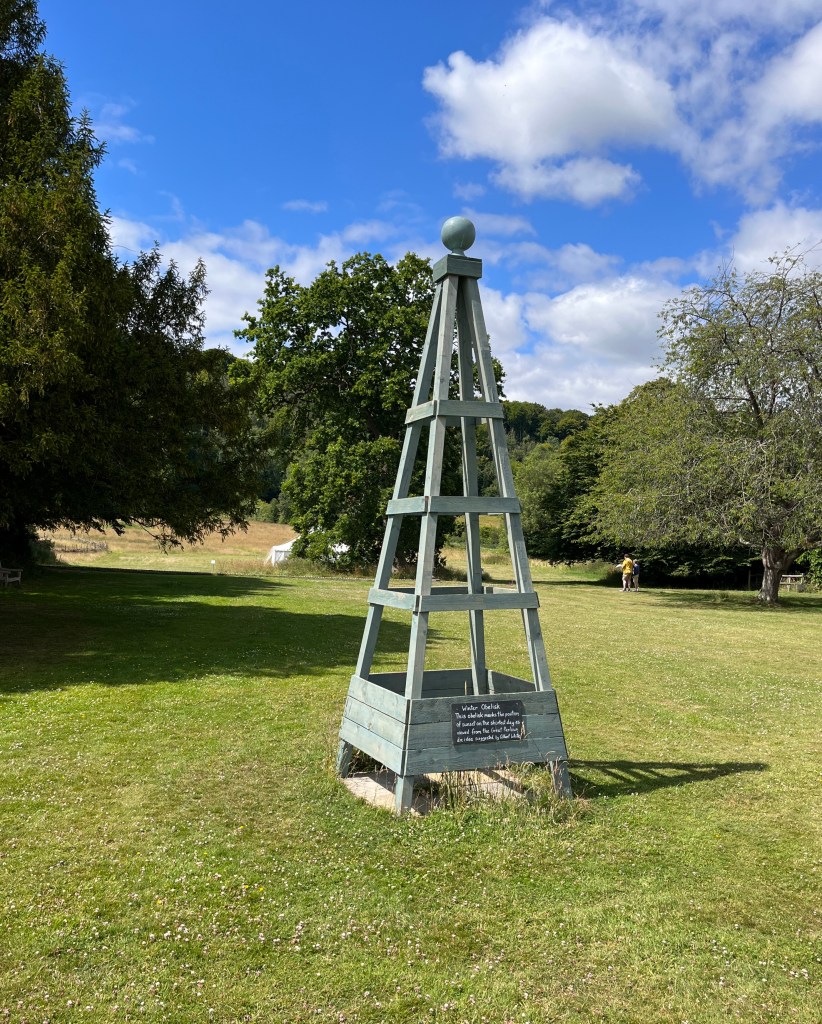
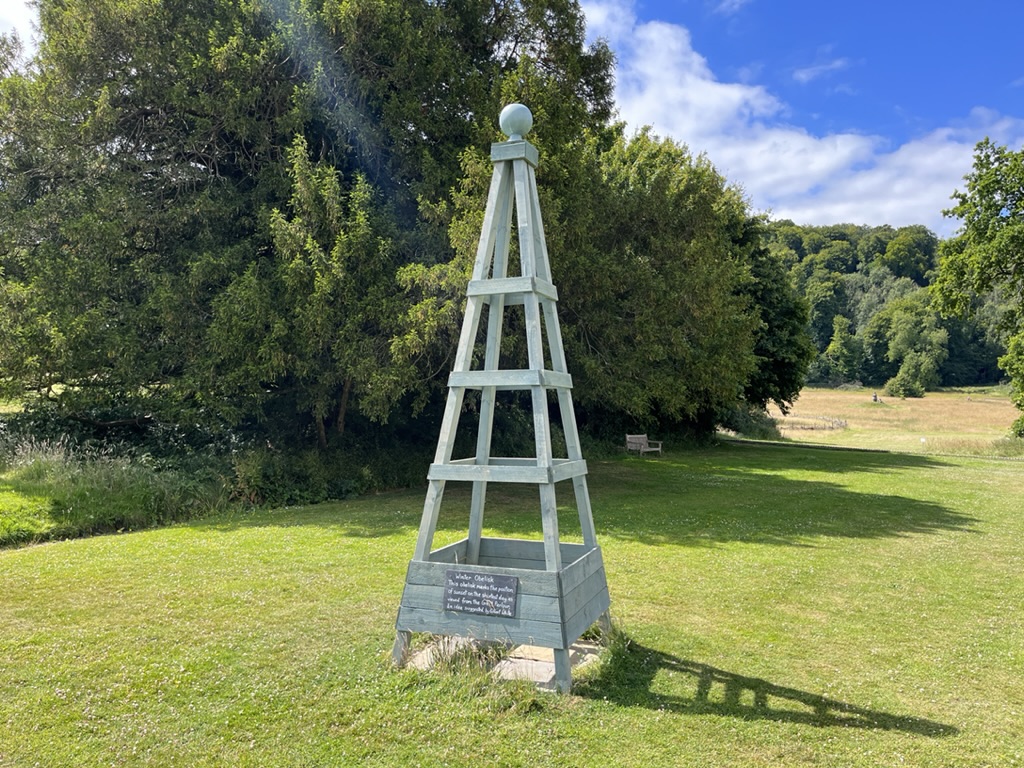
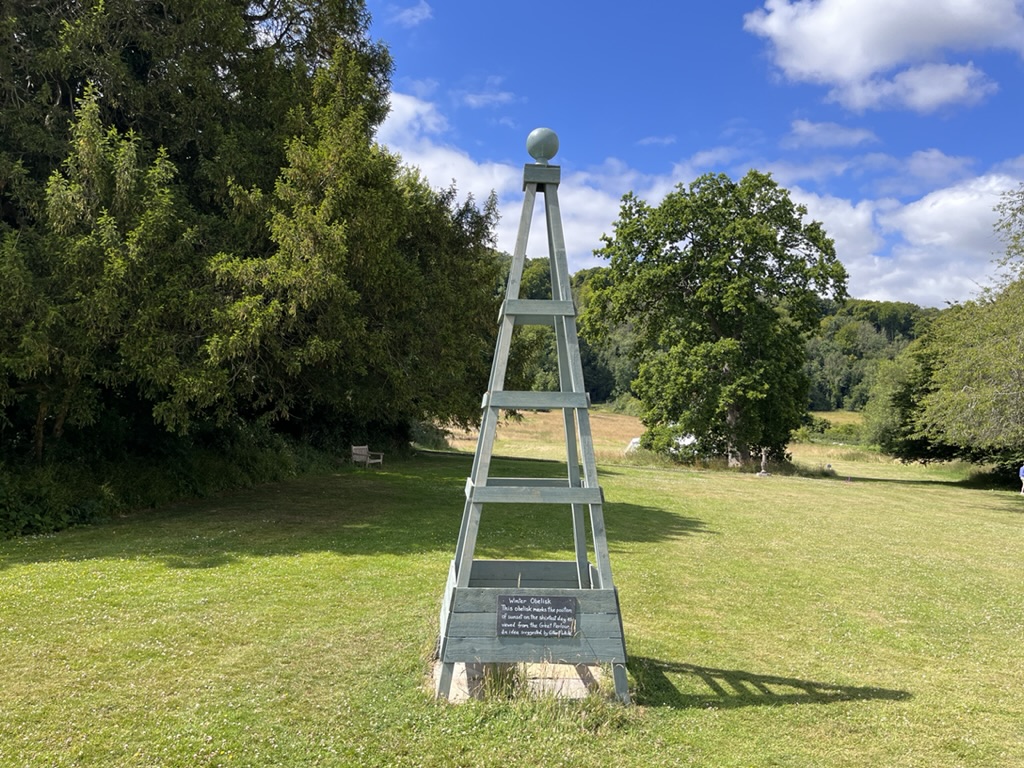
Much the most interesting feature at Selborne for present purposes is the Winter Obelisk, based on an idea by White. The structure is designed to ‘mark the position of sunset on the shortest day as viewed from the Great Parlour‘. Possibly it is a unique example of an obelisk dial having such a special – and limited – purpose. Perhaps it doesn’t count as a dial at all (cf Stonehenge / summer solstice). Seeing the shadows cast on the grass by the structure, perhaps there is scope to mark out a different kind of dial with a wider application (though not necessarily when viewed from the Great Parlour).

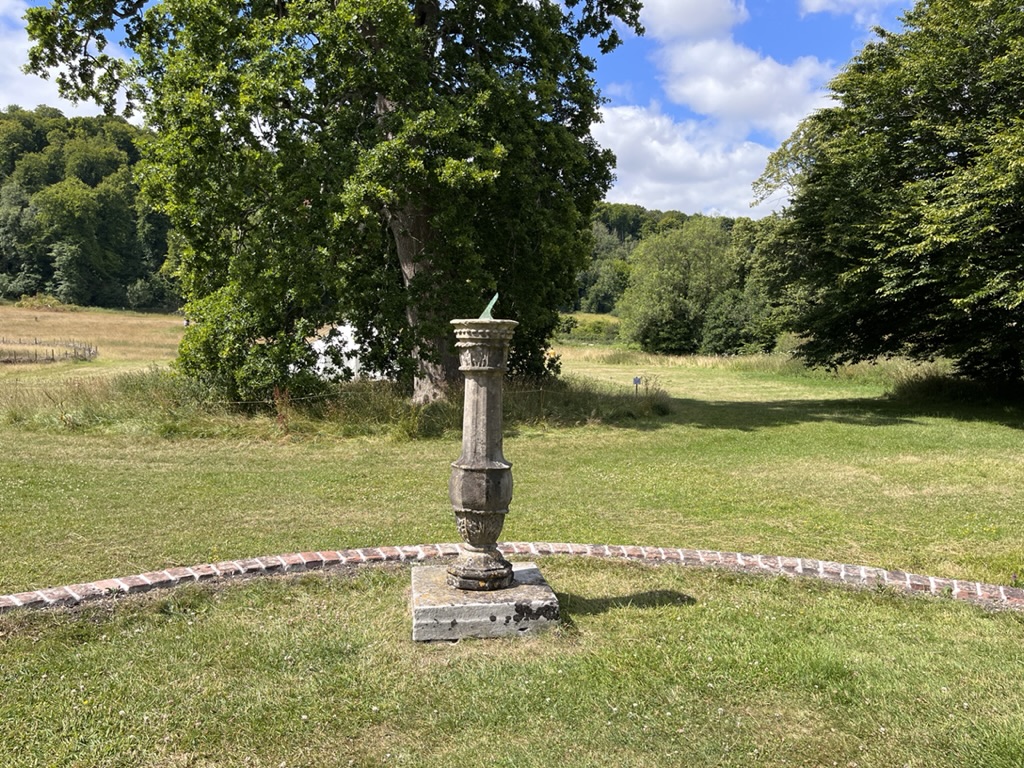
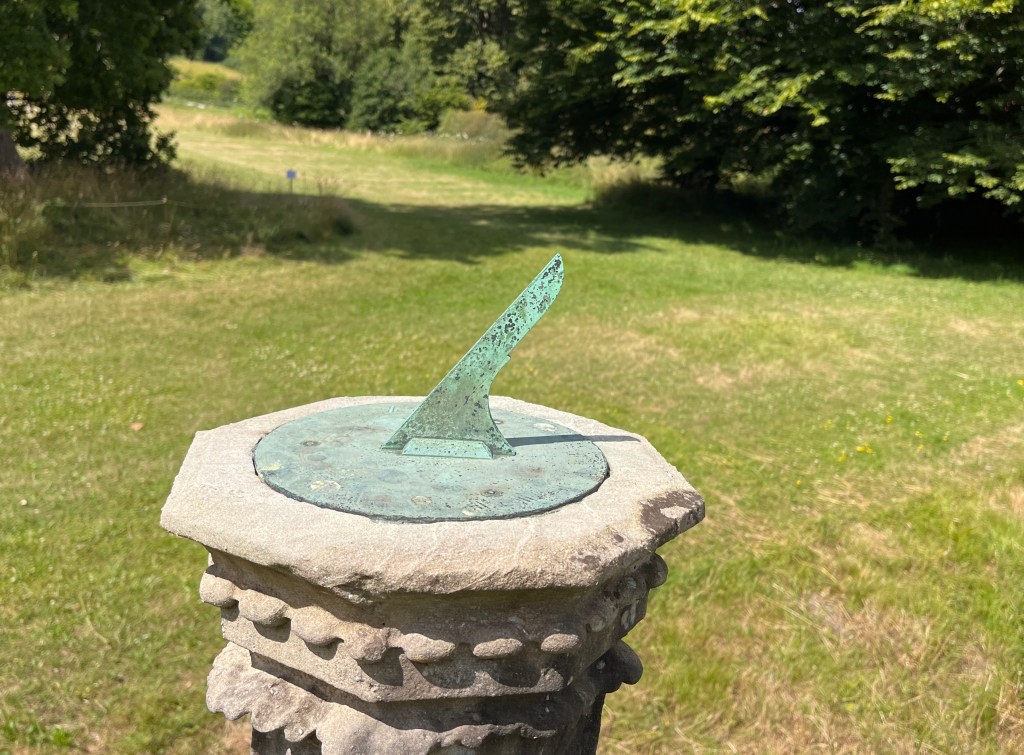
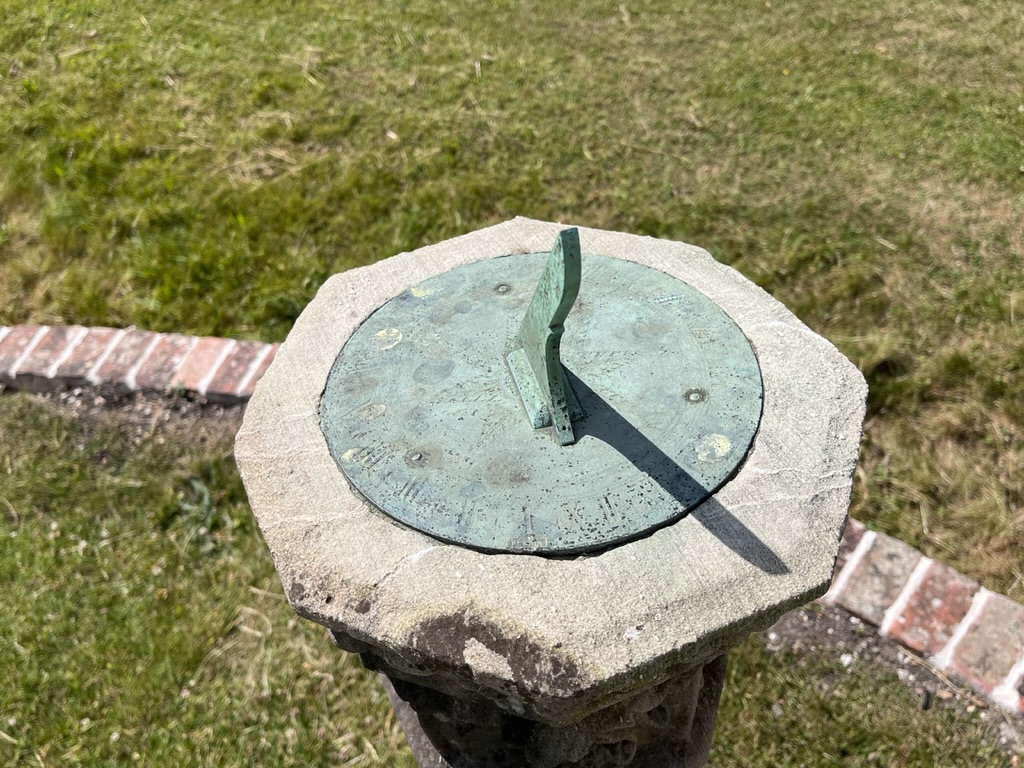
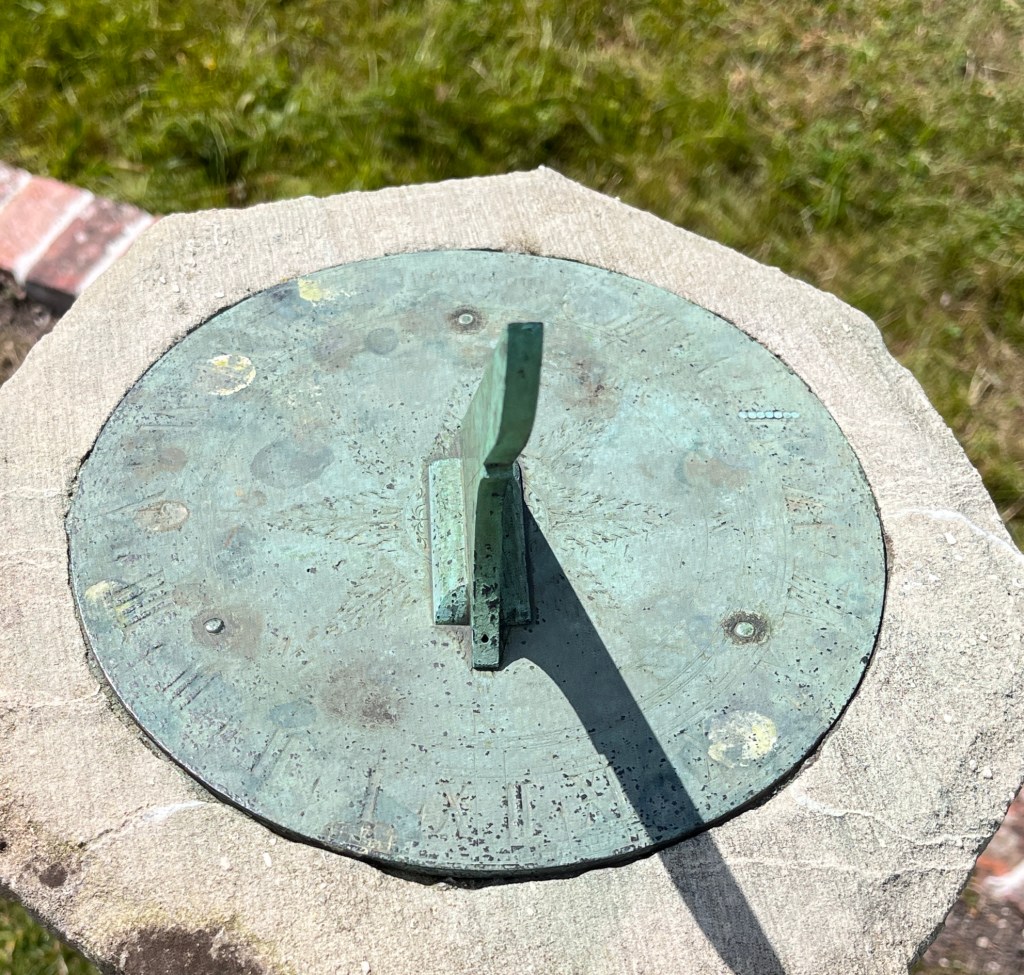
The second dial at Selborne is conventional and very much a park dial, standing above the Ha-ha. Is the dial contemporary in the historic sense, or in the modern sense (there are similar early C20 dials)? The former it seems: Both the ha-ha and the stone sundial standing on the lawn above it were features of White’s ‘New Gardens’. HE

GSS Category: Sundial; Horizontal Dial; Obelisk Dial

All photos: Keith Salvesen

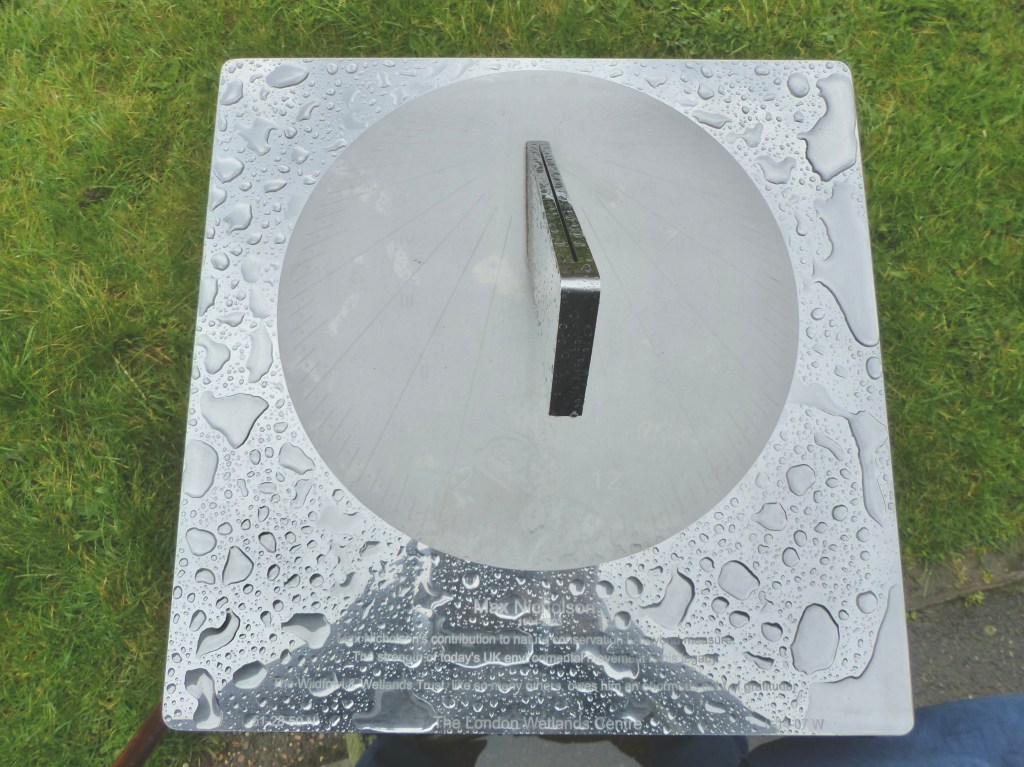
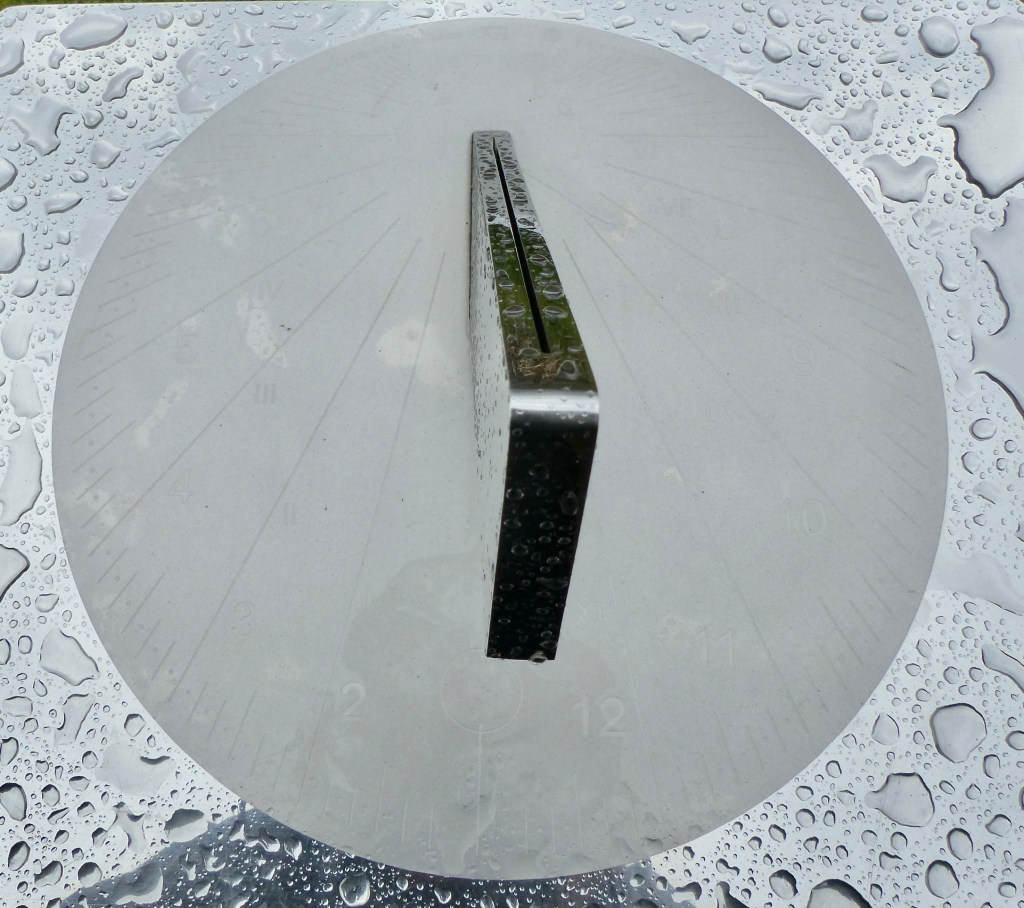
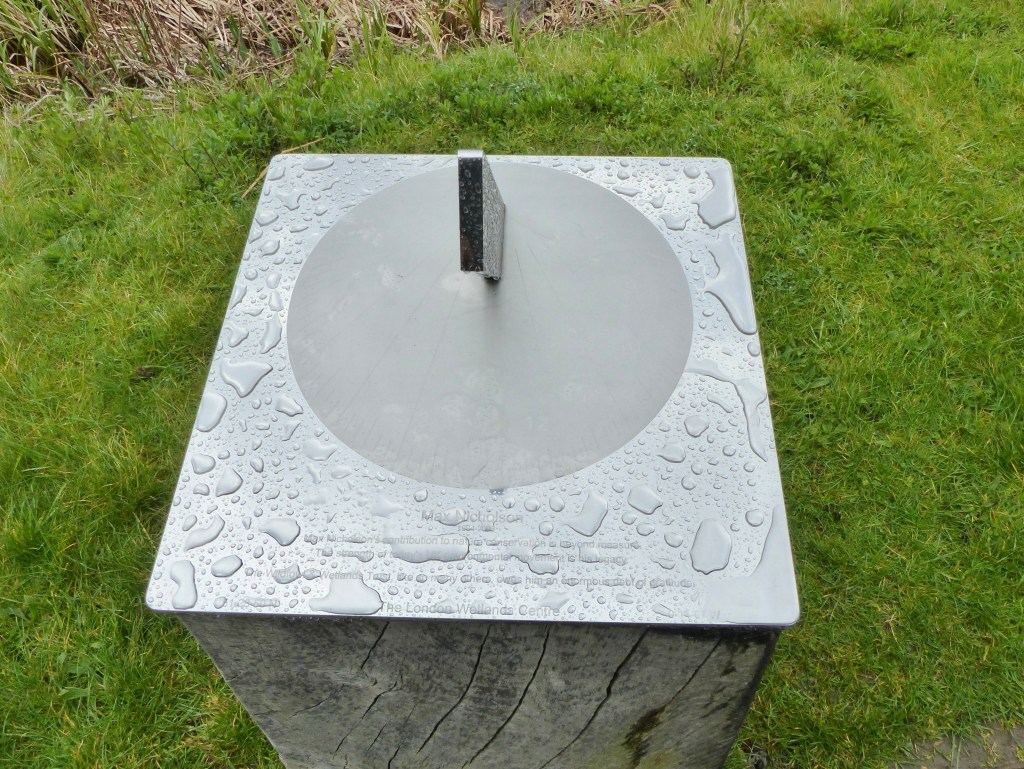
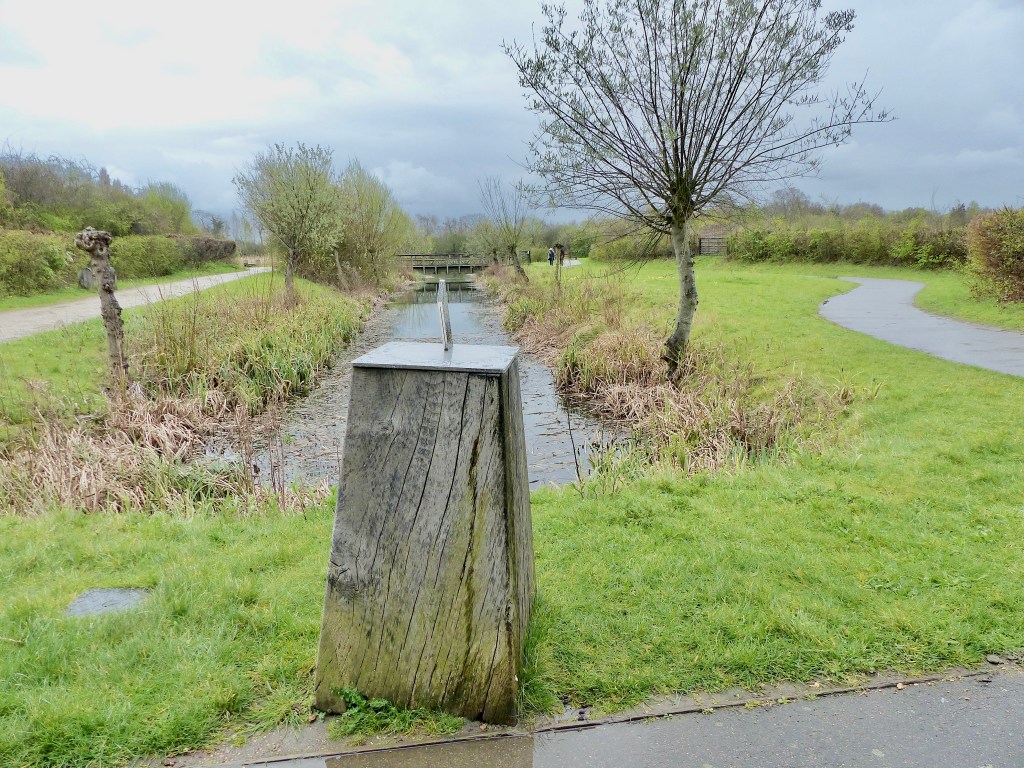
HORIZONTAL DIAL . LONDON WETLAND CENTRE (WWT) . BARNES

Max Nicholson Memorial Sundial . Wildlife & Wetlands

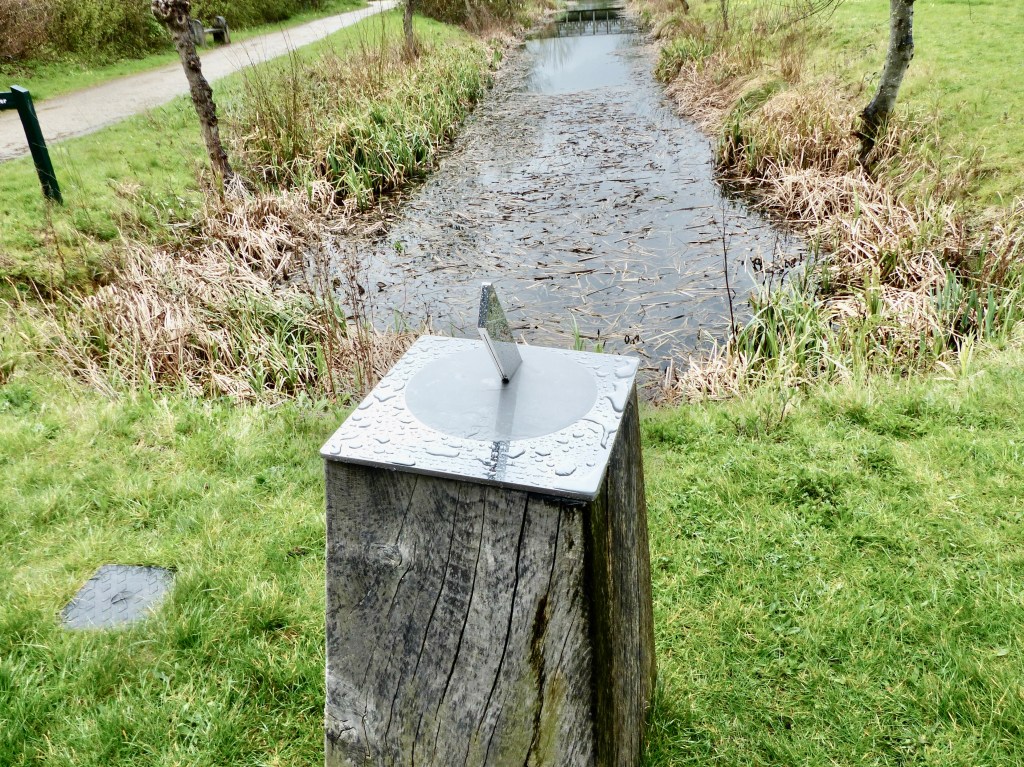
A memorial sundial for Max Nicholson (1904 – 2003), founder of the World Wildlife Fund WWF. The setting is at the wonderful LONDON WETLAND CENTRE at Barnes London, a short distance south of Hammersmith Bridge. Nicholson was a pioneering ornithologist, environmentalist, and conservationist. There is a second memorial sundial at Sedbergh, where Nicholson was at school. Both were designed by his son Piers.

The hour lines have Arabic numerals for summer time and Roman for winter time; between the hour lines are short ten-minute lines and five-minute spots.

The mirror-polished stainless steel gives strong reflections, and the gnomon, which casts the shadow, appears to “float in air” because the matt circle appears to be continuous though part of it is in fact a reflection.

For about 5 minutes at solar noon, when the sun is at its highest in the sky, a line of light shines through the slit in the gnomon. This design feature is used to orient the sundial exactly to true North so that it can be read to the narest minute or two.

Description Source: MAX NICHOLSON MEMORIAL SUNDIAL

GSS Category: Horizontal Dial; Memorial Sundial

All photos: Keith Salvesen

TARRANT GUNVILLE . DORSET . ST MARY – Scratch / Transitional Dial

St Mary . Tarrant Gunville . Dorset

ST MARY . TARRANT GUNVILLE . DORSET

GRADE II* † Mainly C14, tower C15. C12 vestiges of earlier church. General C19 restorations including by T H Wyatt. A slightly unharmonious impression reflects the changes. Roughly midway between Shaftsbury to NW & Blandford to SW. 50.9135 /  -2.1078 / ST925126

DIAL

A single dial on S porch E of doorway. GLP calls it a remarkable dial, somewhat damaged. Its perplexing design has provoked several theories. The most straightforward is that it is in fact a transitional dial rather than a true scratch dial. BHO notes: Scratch Dial: on S. wall of porch, with black-letter numerals and stump of iron gnomon, early 16th century, which is probably meant generically rather than specifically. GLP, with his compendious knowledge of Dorset dials, dates this one much earlier, late C14.

St Mary . Tarrant Gunville . Dorset – porch

The dial stone is far larger than any other porch stone and seems out of place. The first impression is of a large dial doubly encircled but with the upper half damaged and eroded over the centuries. GLP suggests remnants of large dial with all hour lines marked. The fact that the gnomon hole – still with the stub of an iron rod – is almost exactly at the centre of the dial stone supports the theory of an originally complete circular dial rather than partial arcs. In the upper L quadrant there are hints of double circumference lines continuing upwards.

St Mary . Tarrant Gunville . Dorset – scratch / transitional dial

LINES & POCKS

The details of the dial are intriguing. There are 10 lines leading to numerals carved in blackletter / Gothic form. Legible numbers run from 5am to noon, then there are 2 lines with eroded numerals. There is a plausible very faint near-horizontal line RHS. Hours 9, 10, 11, & 12 are marked with a cross rather than the roman numeral X (see diagram below).

There are also 5 pocks. 4 decorate the noon line. 1 is halfway down the 11 line which is nearly vertical, indicating (I think) that the dial was cut to take account of the orientation of the wall.

St Mary . Tarrant Gunville . Dorset – scratch / transitional dial

GNOMON

Unusually, the dial has the stump of an iron gnomon. It seems unlikely to be original and looks more square than round (cf GLANVILLES WOOTTON , also in Dorset). Whether original or not, there is no way of telling how (if at all) it was angled.

St Mary . Tarrant Gunville . Dorset – scratch / transitional dial

GLP suggests that the dial may be an interesting transitional dial and notes that it would probably not have been accurate. One theory is that this was a horizontal dial set vertically; or with a horizontal design used for this vertical dial. He concludes that it is as much a decorative feature as a real timekeeper. My query is whether C14 dials were sophisticated enough to be making the transition from basic scratch to accurate scientific dials.

St Mary . Tarrant Gunville . Scratch / Transitional Dial

GSS Category: scratch dial; transitional dial; vertical dial

All photos Keith Salvesen; dial diagram BSS / GLP

FORDE ABBEY. DORSET – 2 Unusual Sundials

FORDE ABBEY . DORSET

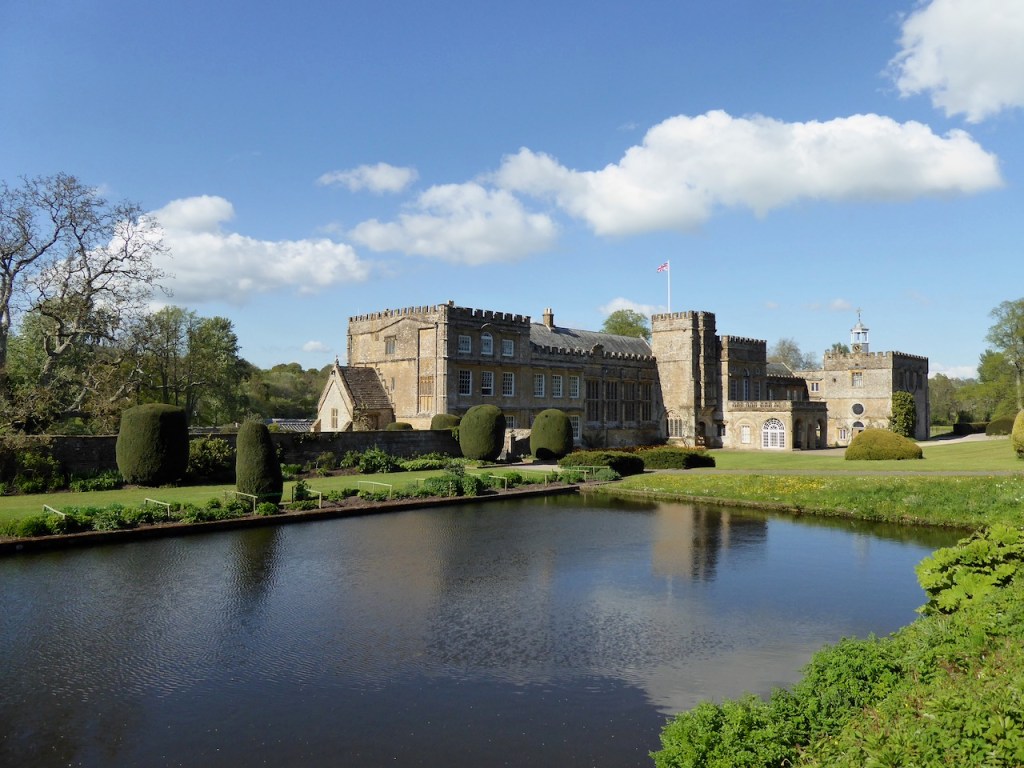
GRADE I † Cistercian Abbey dating from C12, becoming a fine stately home C17 with beautiful gardens and landscaping. Near Chard. 50.8434° N, 2.9113° W

DIAL 1

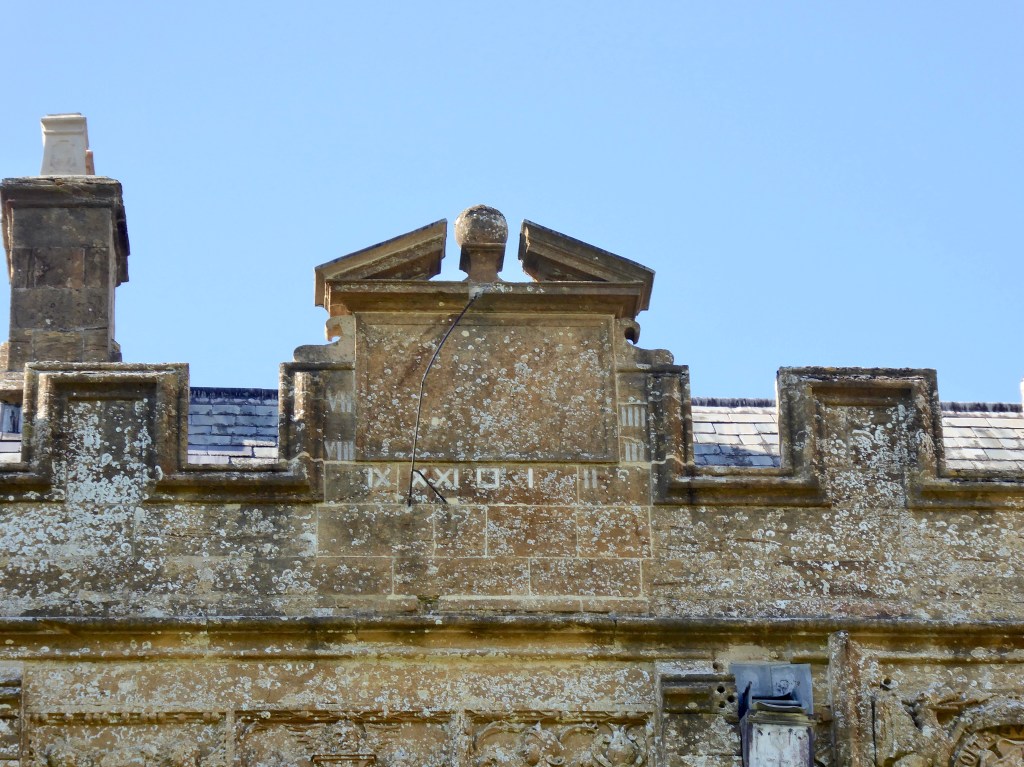
Dial 1 is prominently in the centre of the parapet, crowned with a broken pediment and ball. It has been dated late c17 or early c18. The spindly gnomon has been considerably bent to make the dial as accurate as possible (and see dial 2), given the orientation of the building. At some time, the top end has had to be re-fixed into the stone.

BSS records as Located in roof line castellations. An apparently blank dial plate with painted numbers on the stonework outside – possibly a later innovation. Upright white sans-serif hour numerals VII – IIII. Noon is marked with a square box and 4pm as IIII. Long thin rod gnomon with unusual support formed by a second rod to the tip, itself with a short stay near its foot. Declination is E.

DIAL 2

Dial 2 is located high on a tower, in effect at right-angles to dial 1. It is basically all gnomon and no actual dial face. I haven’t seen a large spindly design like this before. Although it has a rather home-made look to it, the design and positioning must have been carefully calculated, As with dial 1, the orientation of the building necessitated a corrective angle in relation to the sun’s movement. The shadow cast by this rather intriguing ‘gnomon sundial’ seems completely adequate for marking the passage of the day even without additional markings.

GSS Category: Old Dial; Gnomon Dial; C17 dial; C18 dial; Vertical Dial

All photos: Keith Salvesen

BERESFORD . STAFFS . CHARLES COTTON’S FISHING HOUSE – Cube Dial

Charles Cotton’s Fishing House . Beresford . Staffs – Cube Dial

CHARLES COTTON’S FISHING HOUSE . BERESFORD . STAFFS

CUBE DIAL

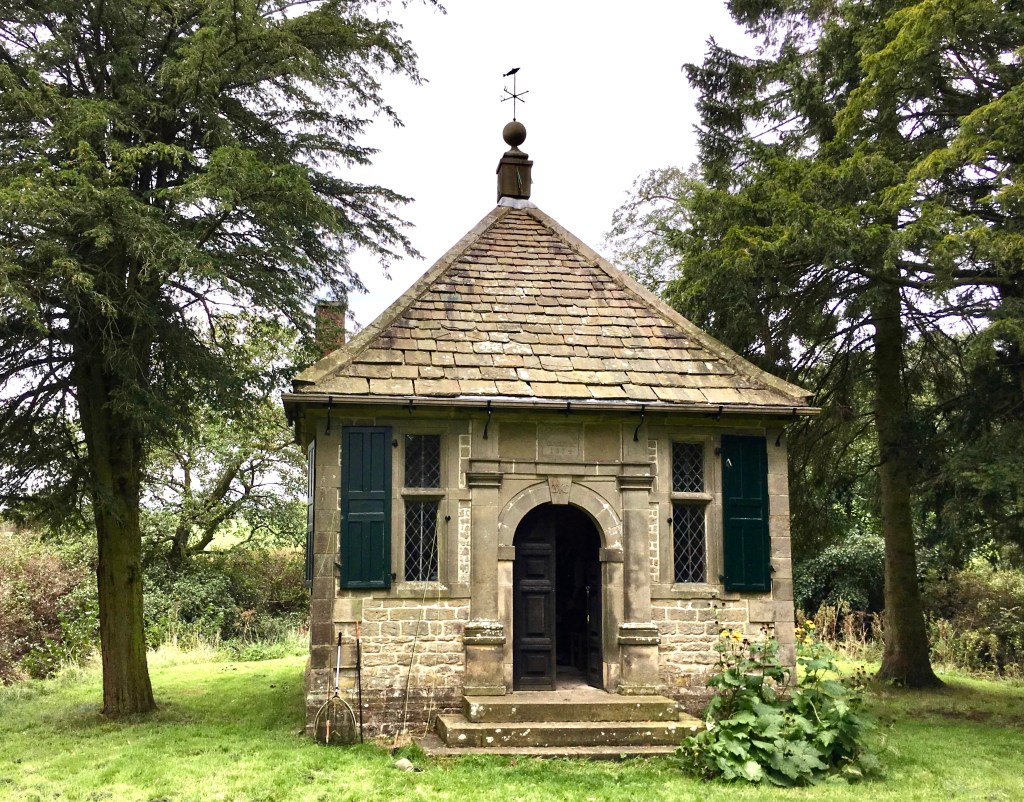
GRADE II* The most famous and piscatorially significant fishing ‘hut’ in the world, in a clearing beside the River Dove, near Hartington. By a quirk of a bend in the river, the hut is in Staffs rather than Derbyshire. Single cell square plan in an Artisan Mannerist style BLB SK127592

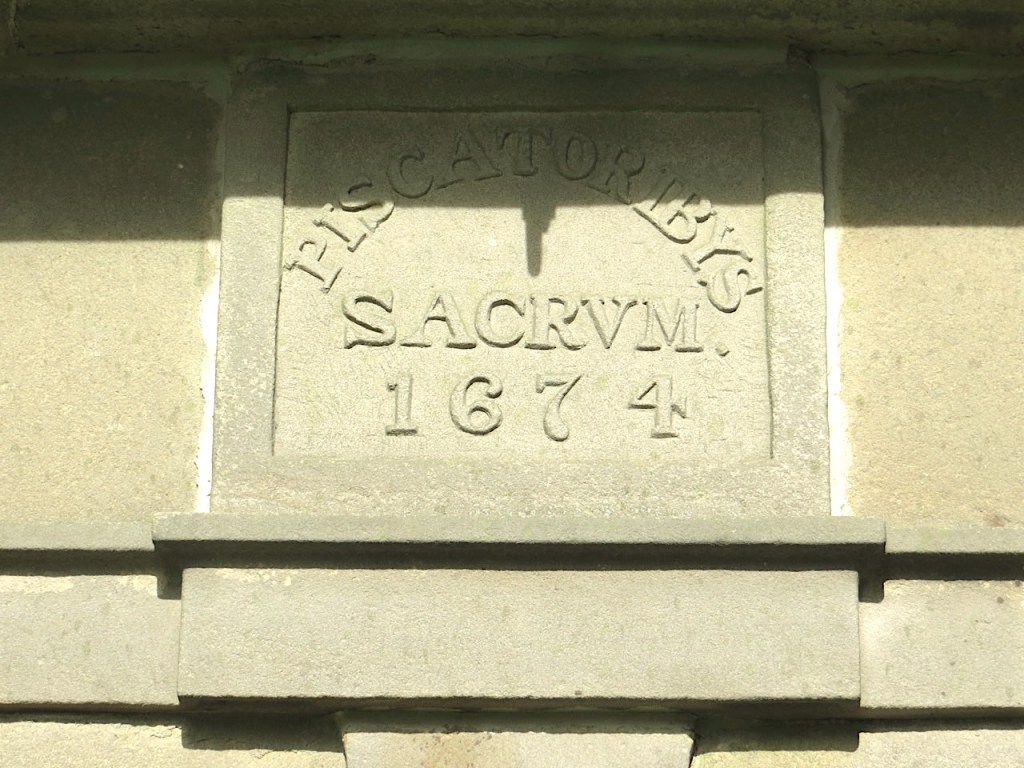
The inscription Piscatoribus Sacrum – a sacred place for anglers – gave rise to the hut’s reverential name among fishermen, The Temple. I can’t improve on this description from HE:

Charles Cotton’s fishing house is a unique building designed specifically for the sport of angling. It was an elaborate building in relation to its simple function, an expression of Cotton’s dedication to angling and to his entertainment of fellow anglers. Izaak Walton and Cotton’s The Compleat Angler was significant in the development and diversification of the sport from the 17th century. The fishing house is a fine preservation of Charles Cotton’s angling endeavours and its association with the popular work The Compleat Angler makes it of national significance.

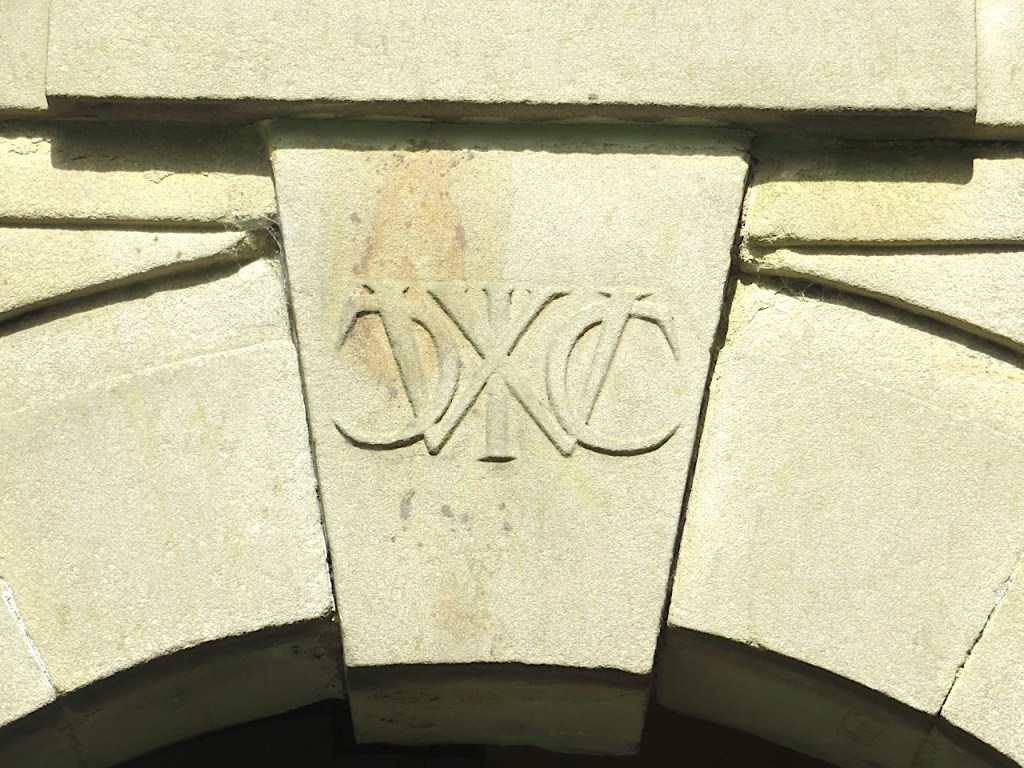
Dated inscription, and intertwined initials of Charles Cotton & Izaak Walton on the keystone

CHARLES COTTON’S CUBE DIAL

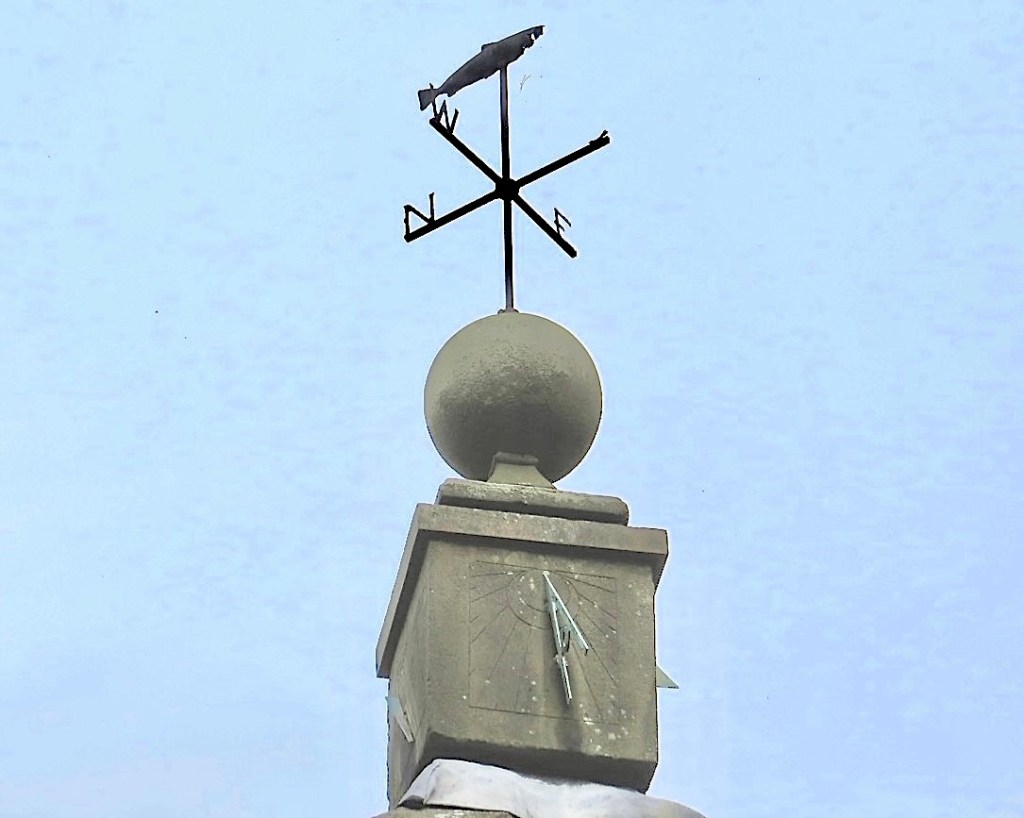
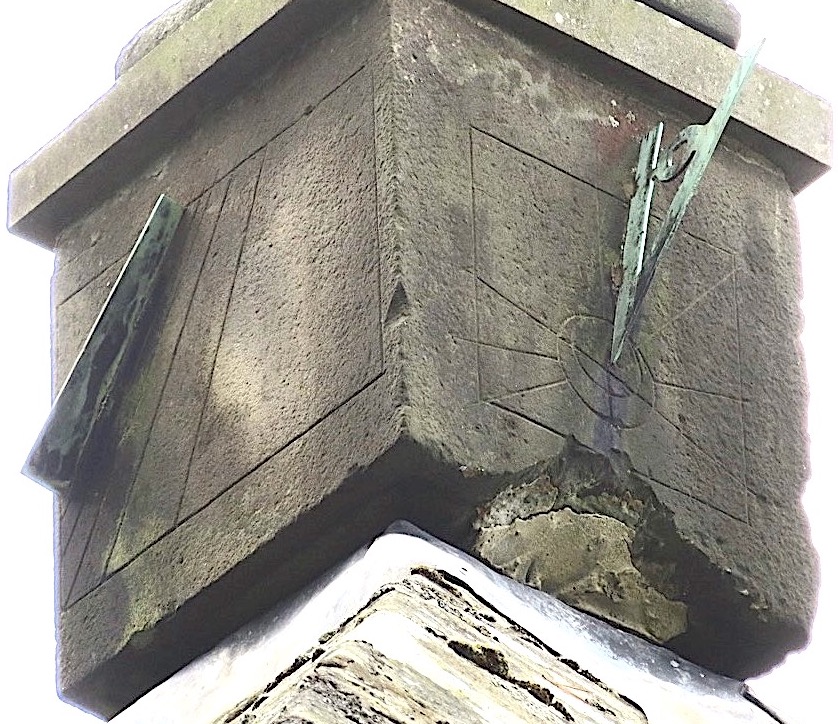
A while back I spent a couple of days fishing on the Beresford beat of the Dove (to little effect). Just seeing the hut close to – let alone actually using it for its intended purpose – was an amazing experience. The weather was quite poor; the photos (taken on a basic pocket Canon) poorer still. I’ve had to do some work on the images, which I hope are now clear enough to be informative. 3 faces are featured; images of the 4th, away from the sun, were useless.

Charles Cotton’s Fishing House . Beresford . Staffs – Cube Dial

The dial is fixed to the apex of the hut’s roof. It is surmounted by a round finial, then a weather vane, and – a final flourish – a trout.

Charles Cotton’s Fishing House . Beresford . Staffs – Cube Dial

Charles Cotton’s Fishing House . Beresford . Staffs – Cube Dial

Charles Cotton’s Fishing House . Beresford . Staffs – Cube Dial

GSS Category: Cube Dial

All photos: Keith Salvesen

LONGBURTON . DORSET . ST JAMES THE GREAT (2) – Scratch Dials (one ‘new’)& Vertical Dial

St James the Great . Longburton . Dorset

ST JAMES THE GREAT . LONGBURTON. DORSET (2)

Some time ago I wrote about the intriguing scratch dial rather hidden away through a low archway at the E end of the church: LONGBURTON SCRATCH DIAL 1

DIAL 1

St James the Great . Longburton . Dorset – Scratch Dial 1

The village is better known dial-wise for the vertical dial on the S-facing tower buttress (see below). Yesterday I went back to look for apotropaic and other church marks, and to my surprise found an excellent conventional sundial hidden in plain sight and hitherto unrecorded. I can’t think how I – or any dial gatherer – would miss it…

DIAL 2

The previously unrecorded dial is near the base of the same buttress as the vertical dial. There are 4 lines, the more clearly cut noon line being longer and reaching the edge of the dial stone (and possible trace of extension onto the stone below). The angles are almost equal. There is the distinct trace of a circle in around the top half, but strangely the gnomon hole would not be at its centre.

St James the Great . Longburton . Dorset – Scratch Dial and Vertical Dial, Tower Buttress

VERTICAL DIAL

The dial is high up on the buttress of the tower, and nearly as wide. It is quite eroded, esp. RHS. The lines are contained within a frame, and half hours and some quarter hours are also marked.

BSS notes Triple dot motif at head of half hour lines. Gnomon formed from iron strip with supporter. Supporter is detached at contact with gnomon

The dial numerals are Roman, yet there are Arabic numerals in both bottom corners signifying the date. It is hard to make it out, but I think it is 1798. There are the remains of an inscription along the top of the dial, just the last 2 letters being discernible (O & W?).

GSS Category: Scratch Dial; Old Dial

All photos: Keith Salvesen