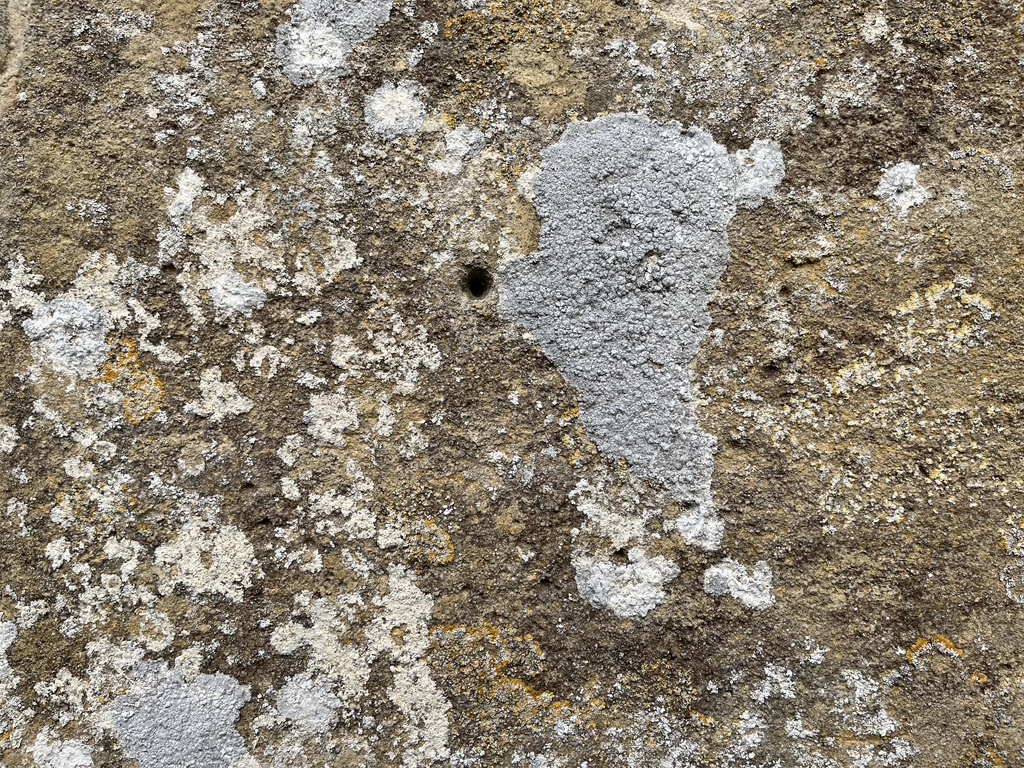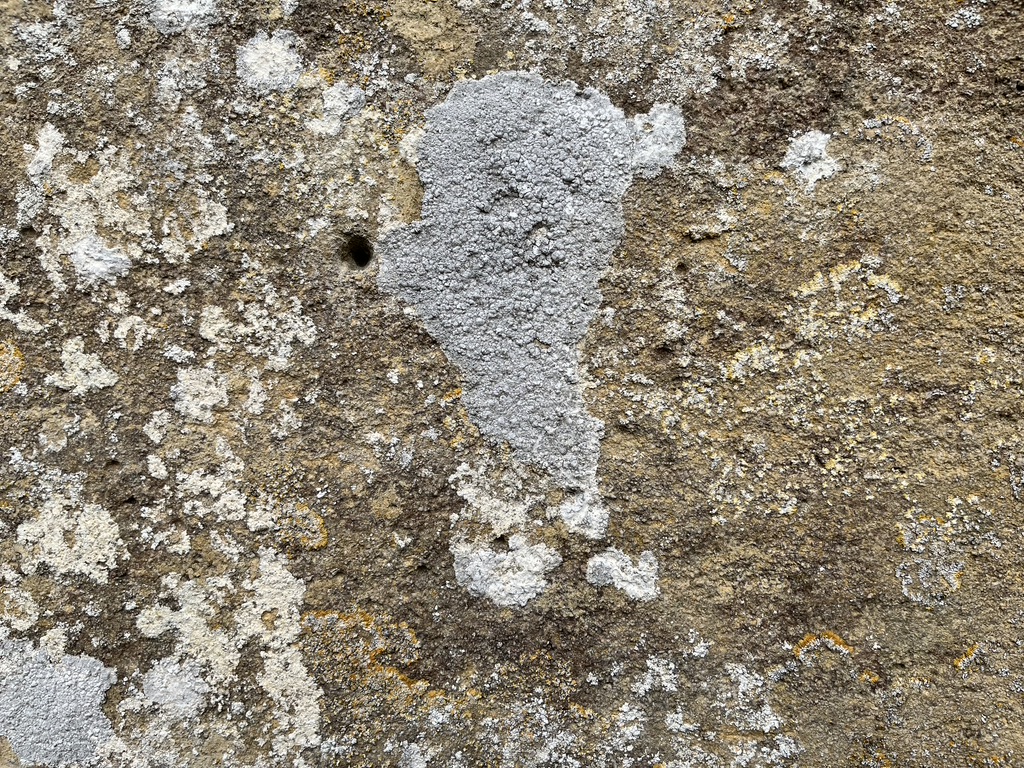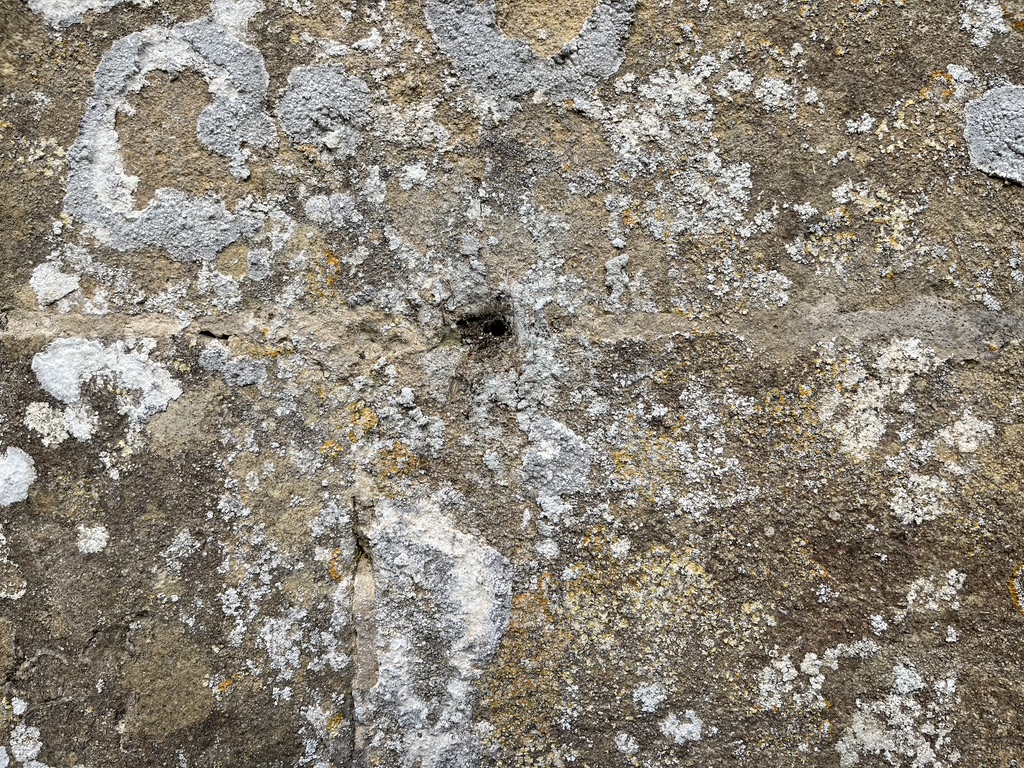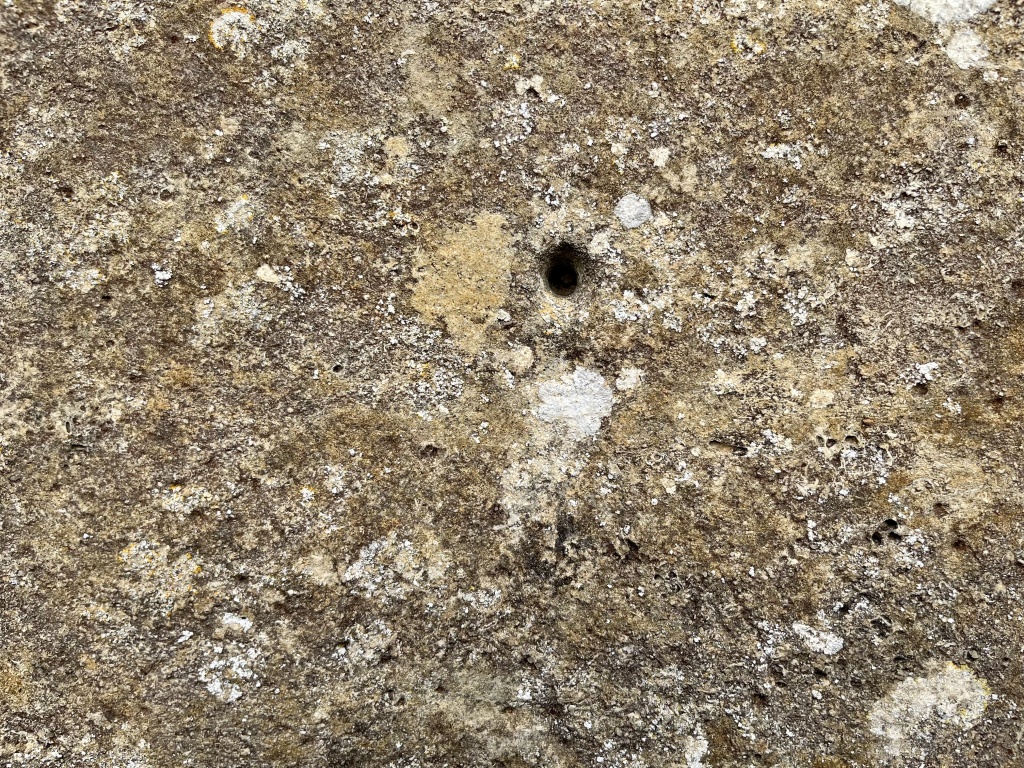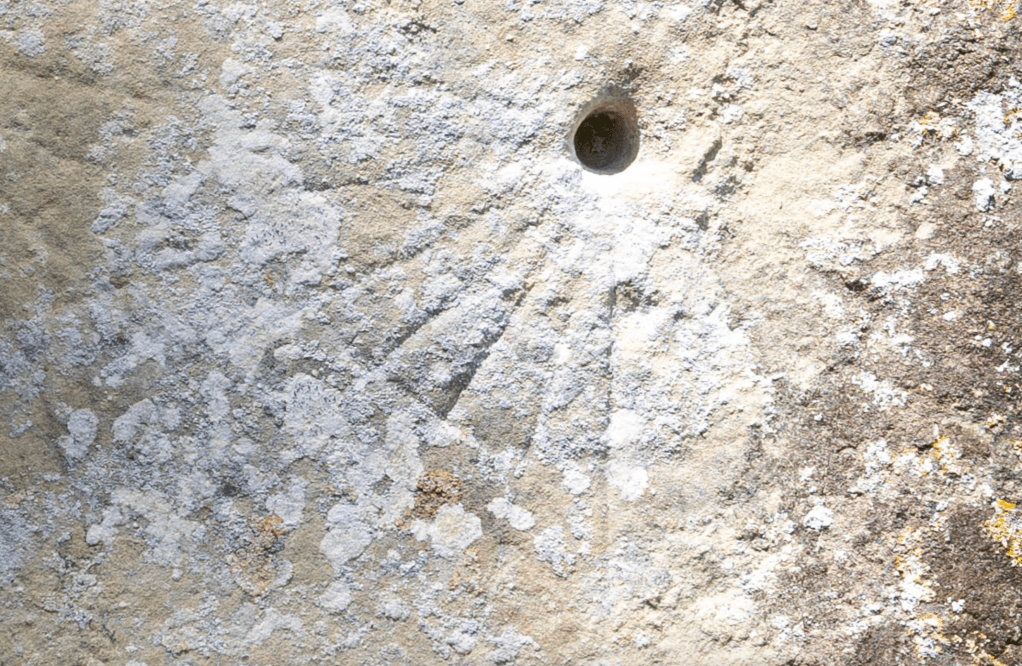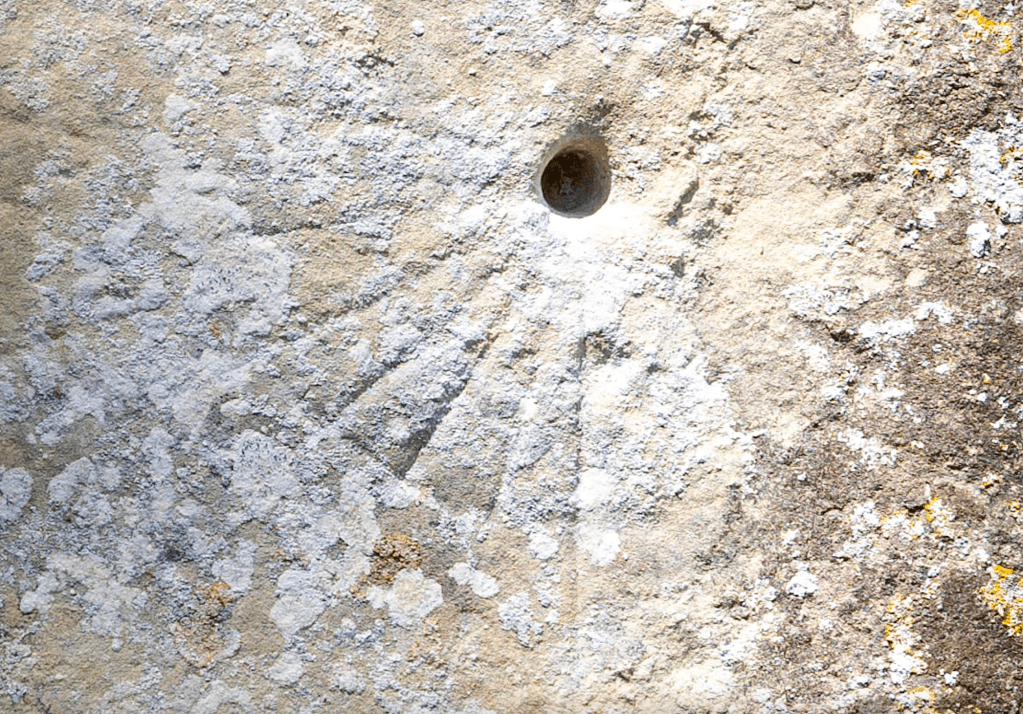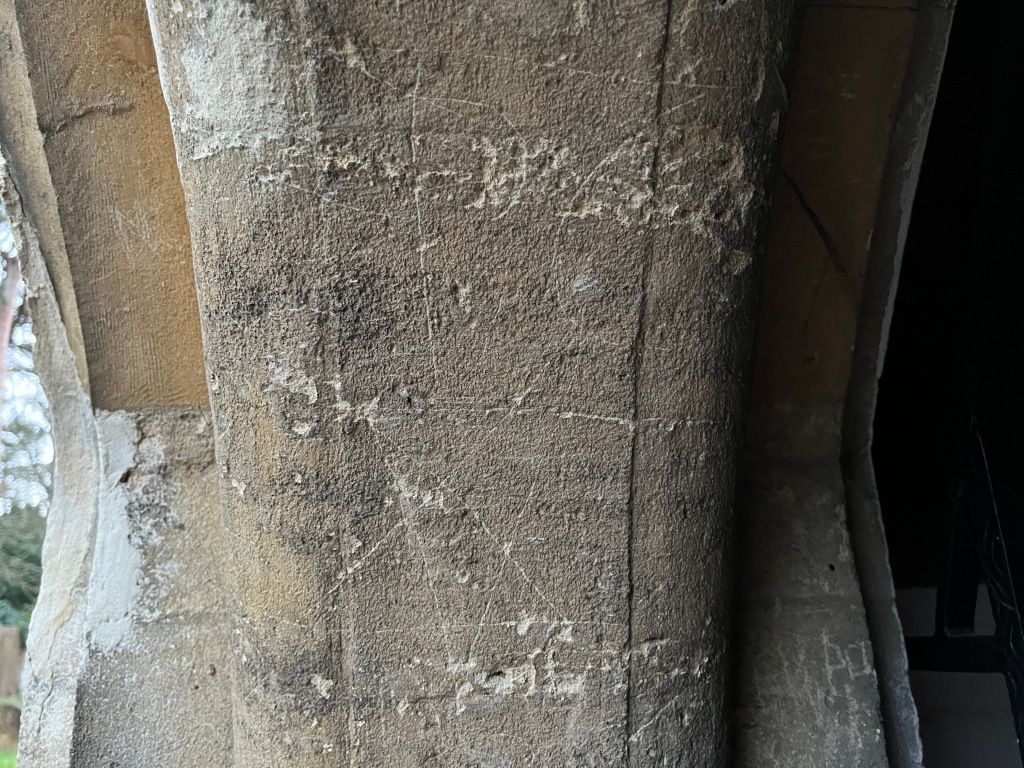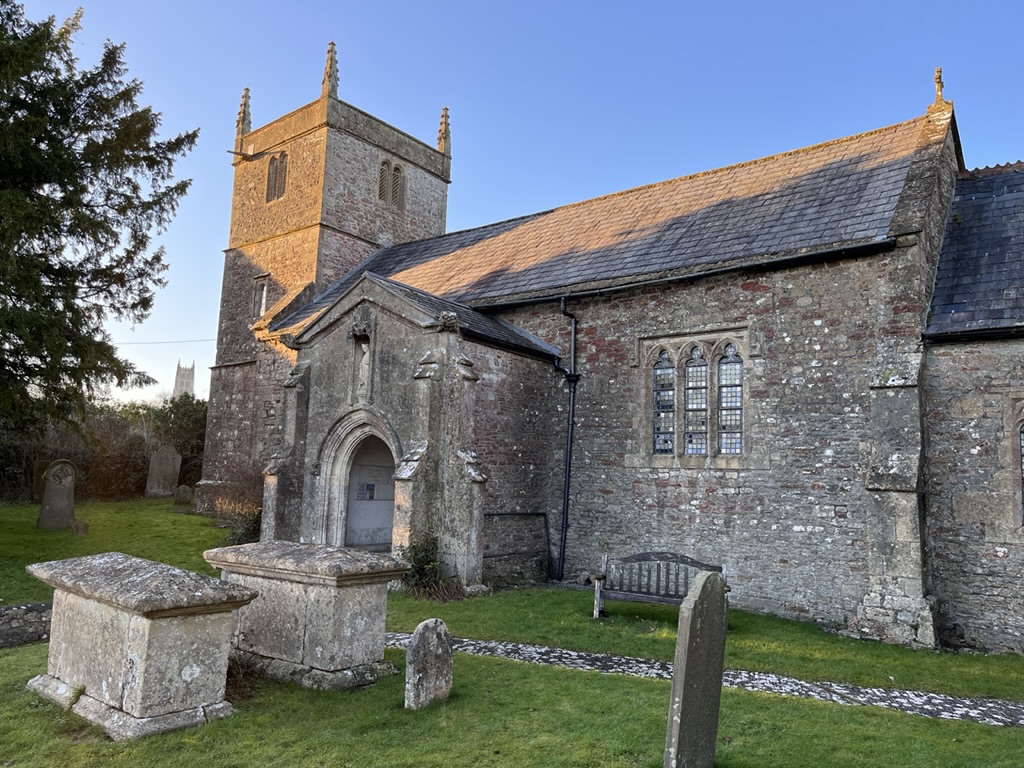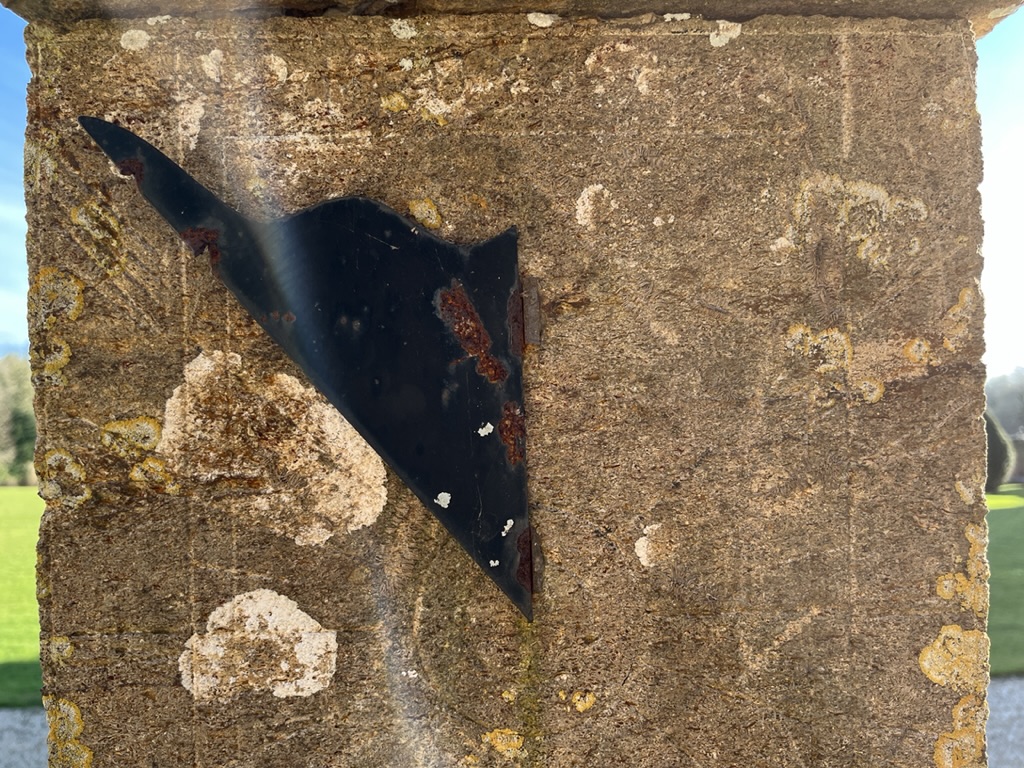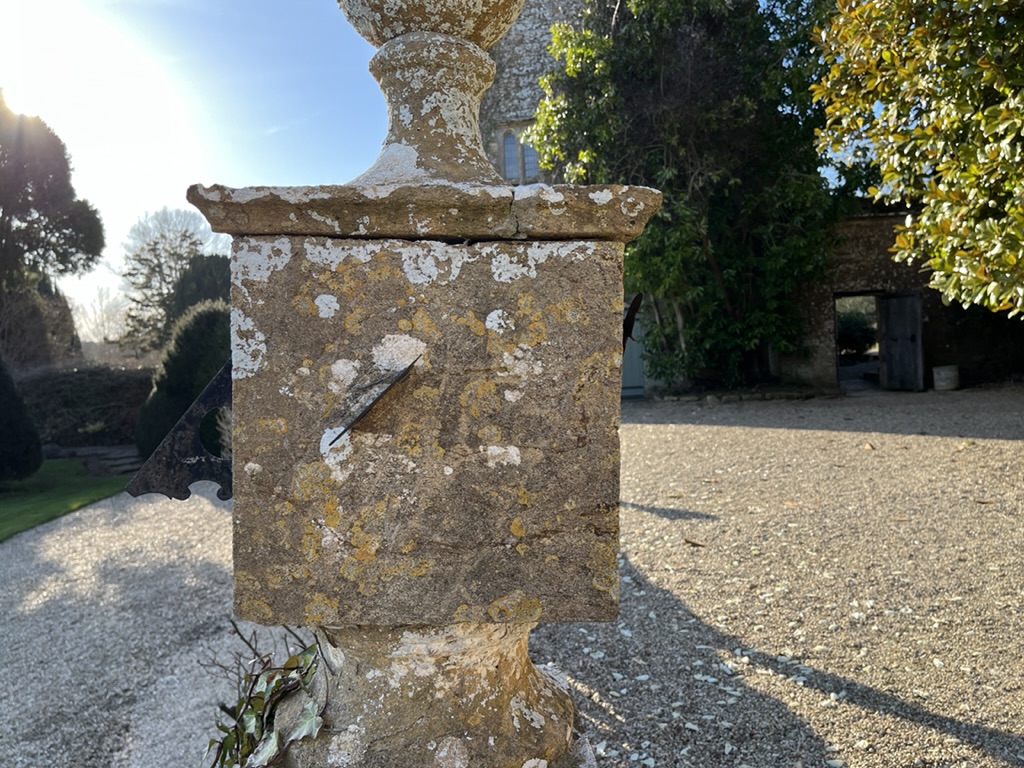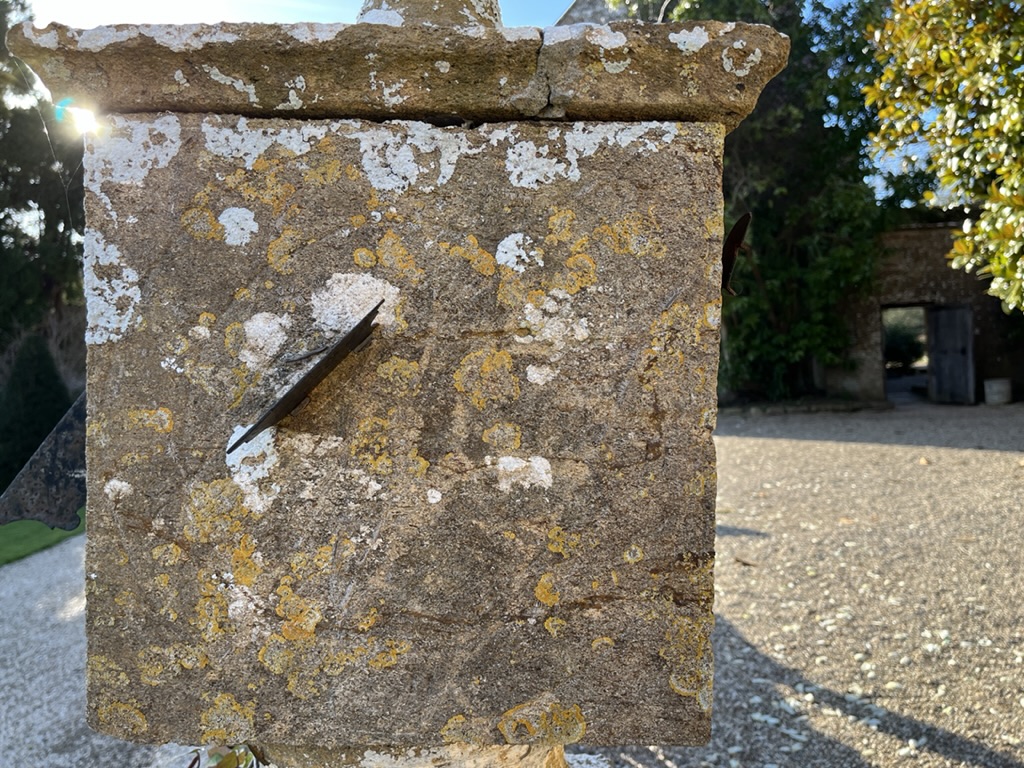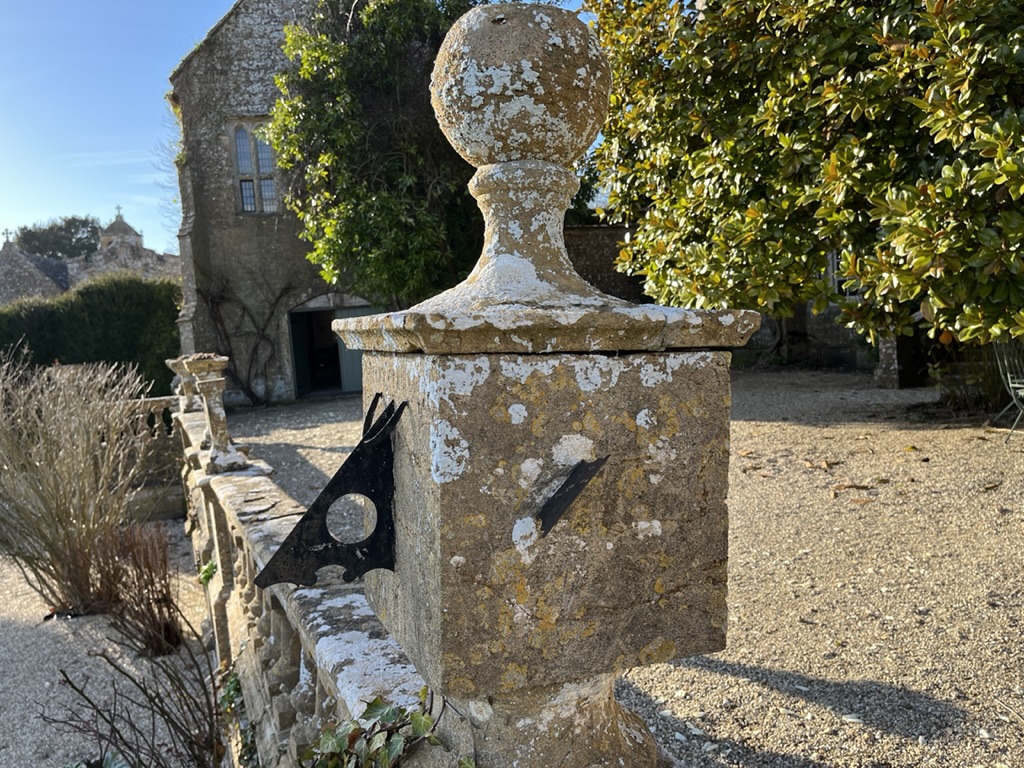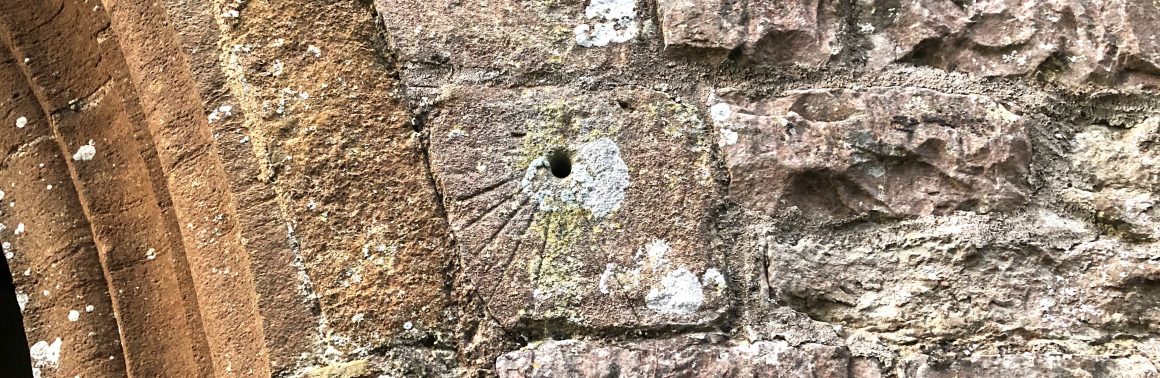
BRYMPTON d’EVERCY . SOMERSET . CUBE DIAL with BALL FINIAL
Brympton d’Evercy is a fine Somerset country house with a long history of intertwined families down the ages. For more on the house & grounds, see HERE. The chapel of St Andrew has scratch dials that are featured HERE. The estate is a mere 2m W of the clatter of Yeovil yet hidden away in its own parkland, and best reached by map reading, satnav or luck. 50.9361 / -2.6847 / ST519154
CUBE DIAL(GVII)
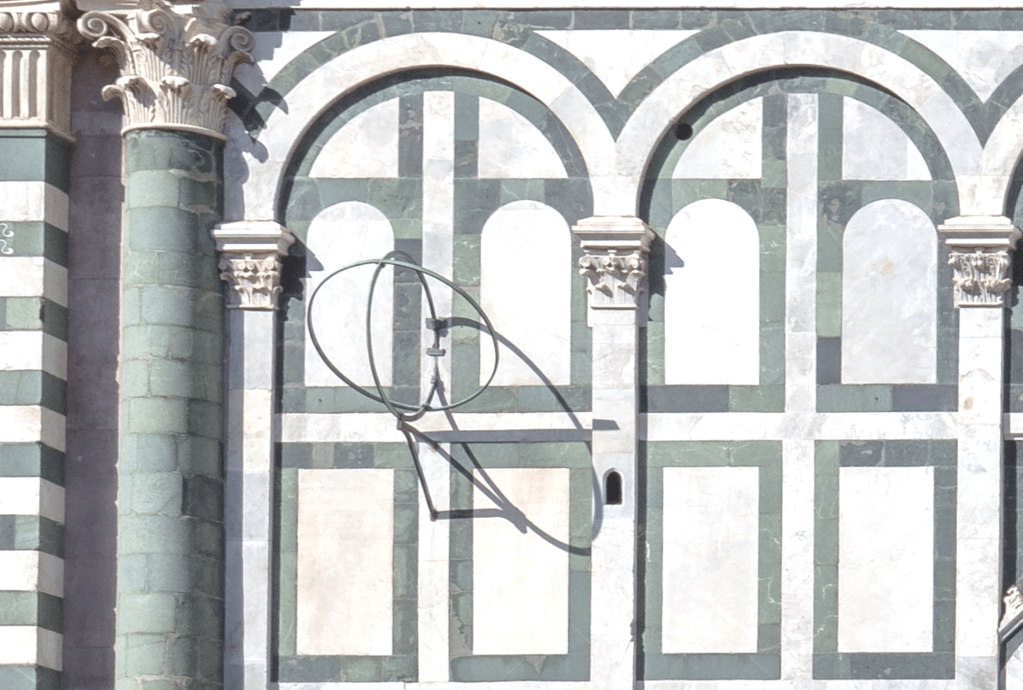
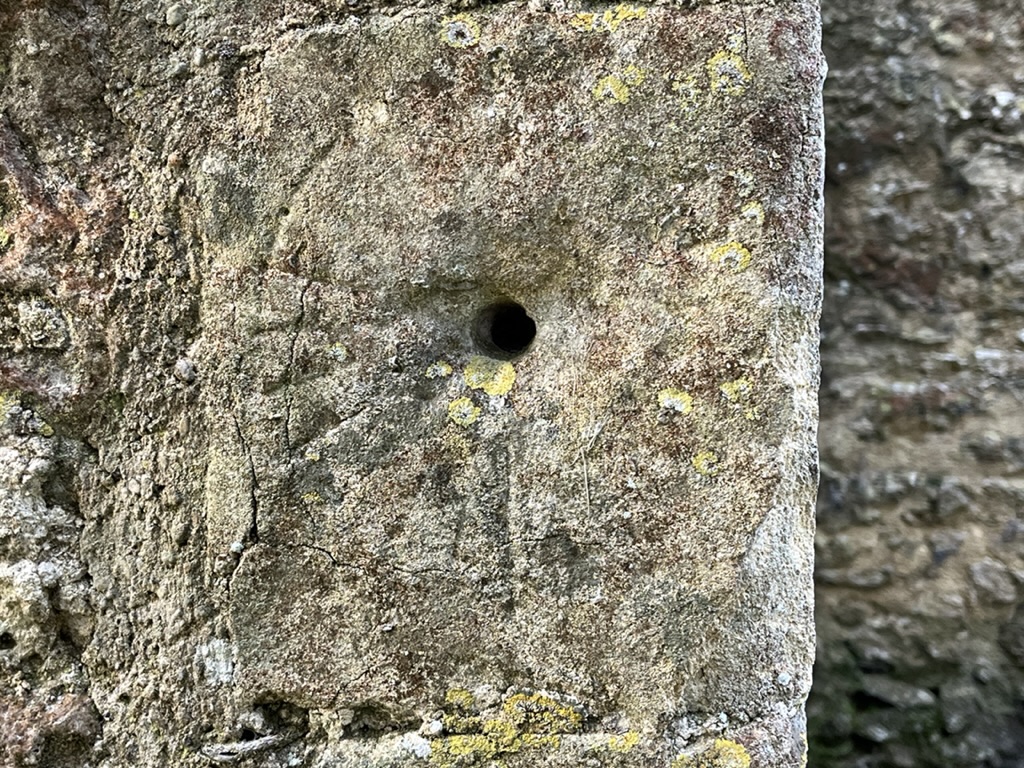
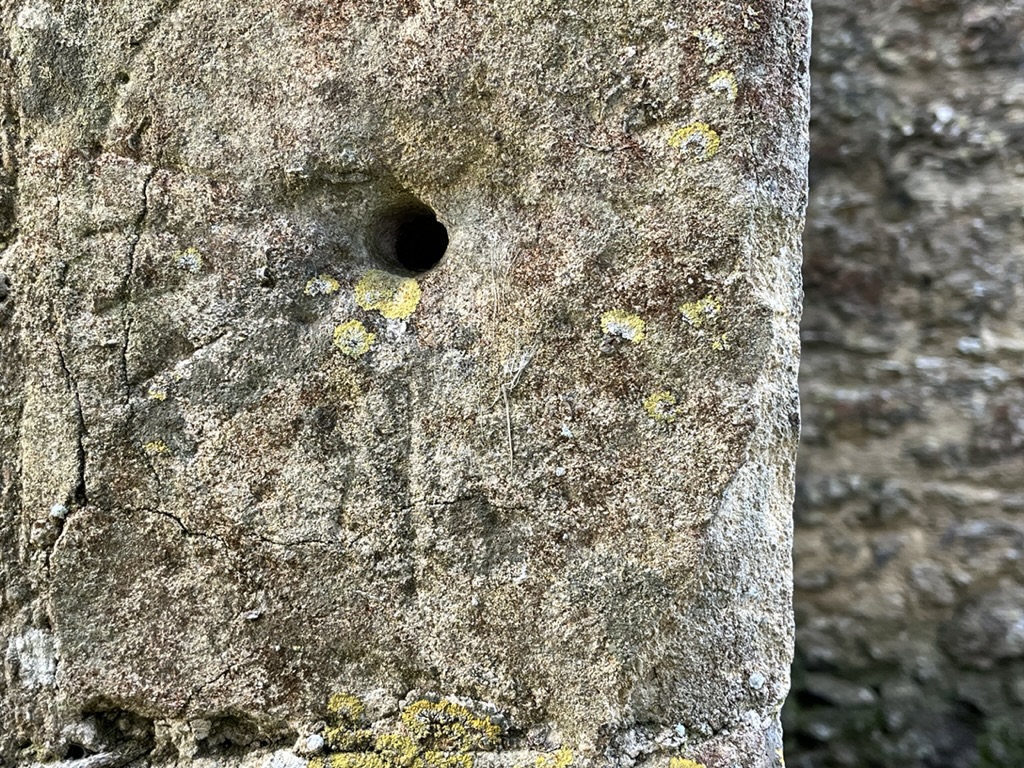
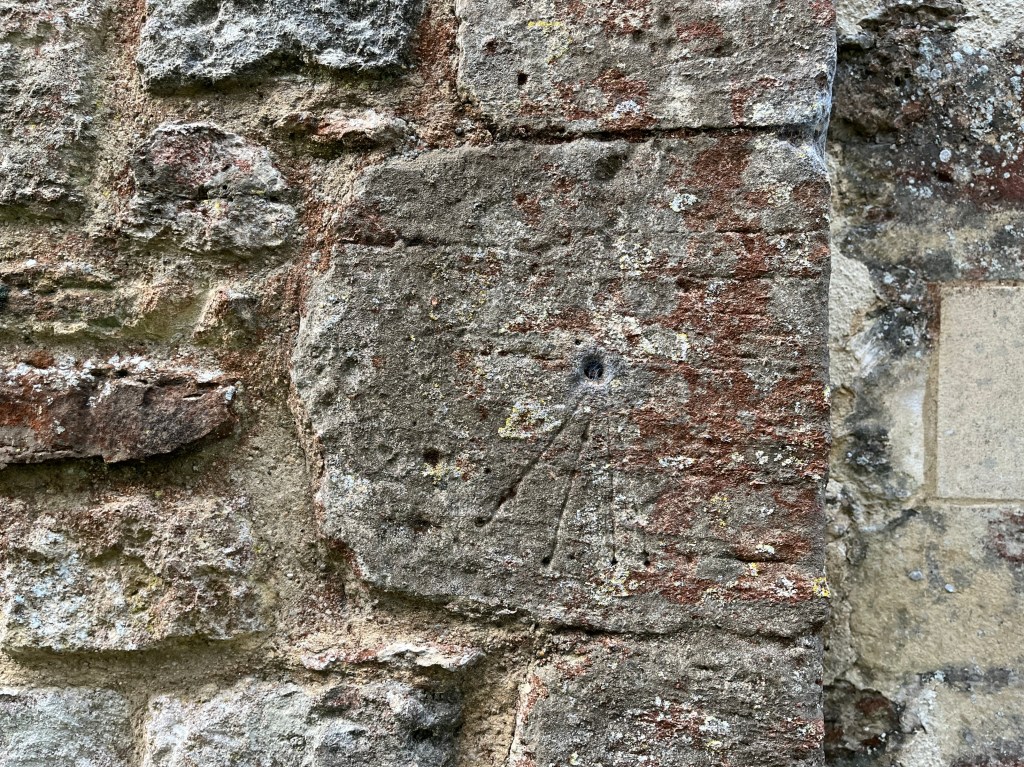
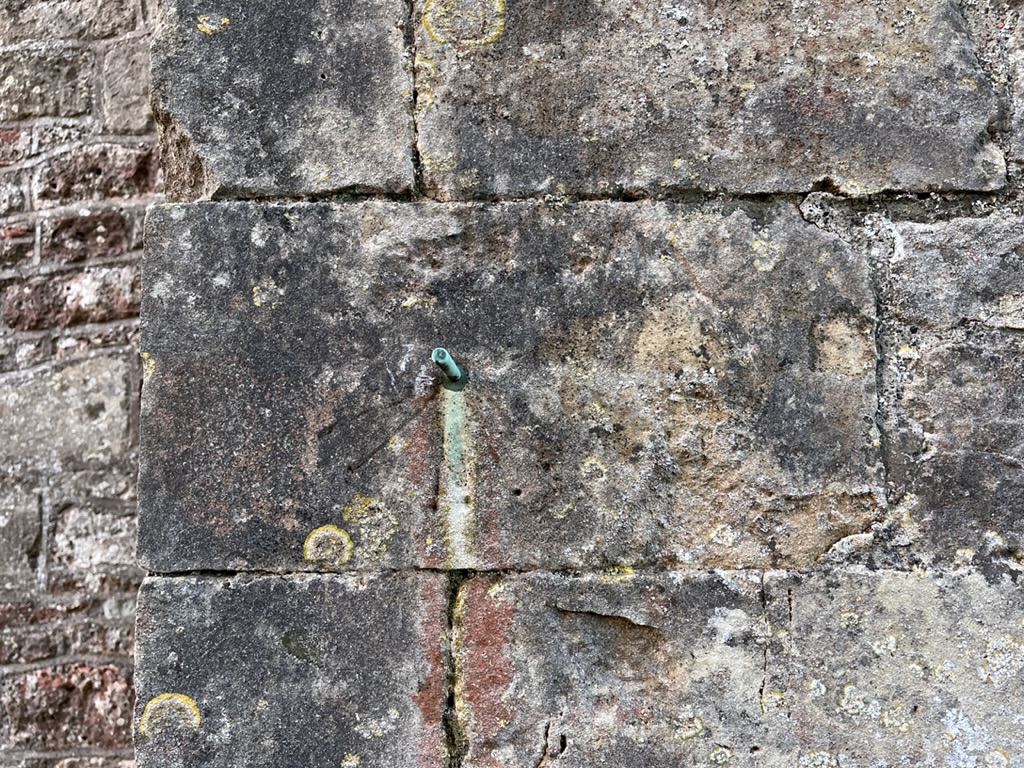
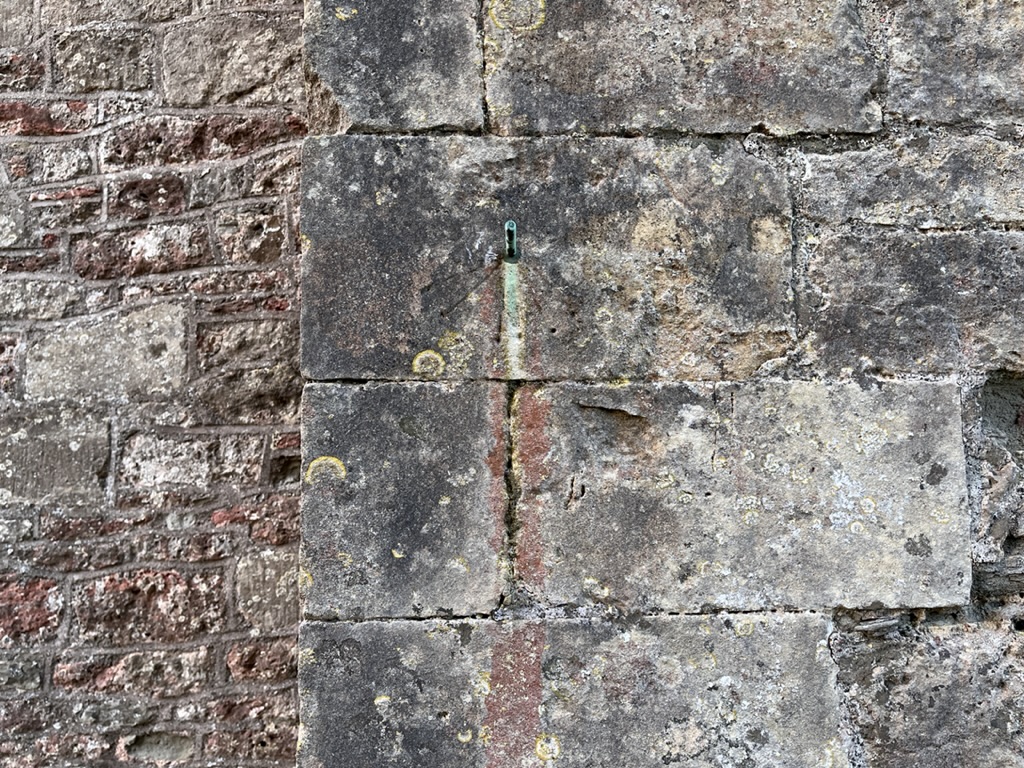
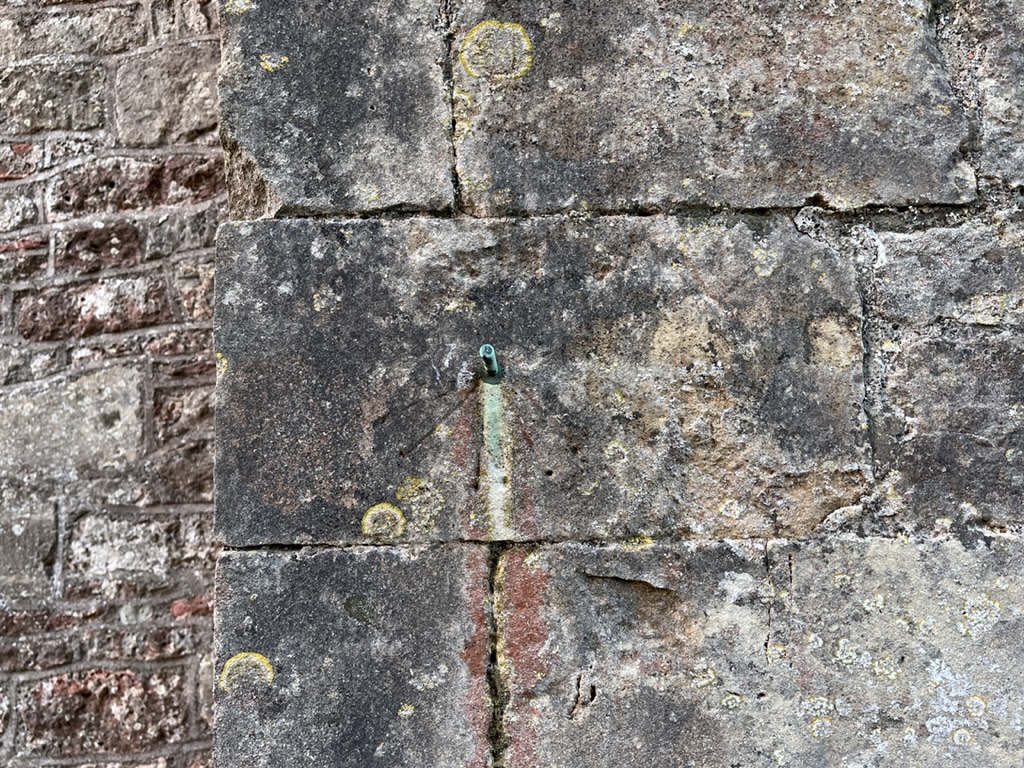
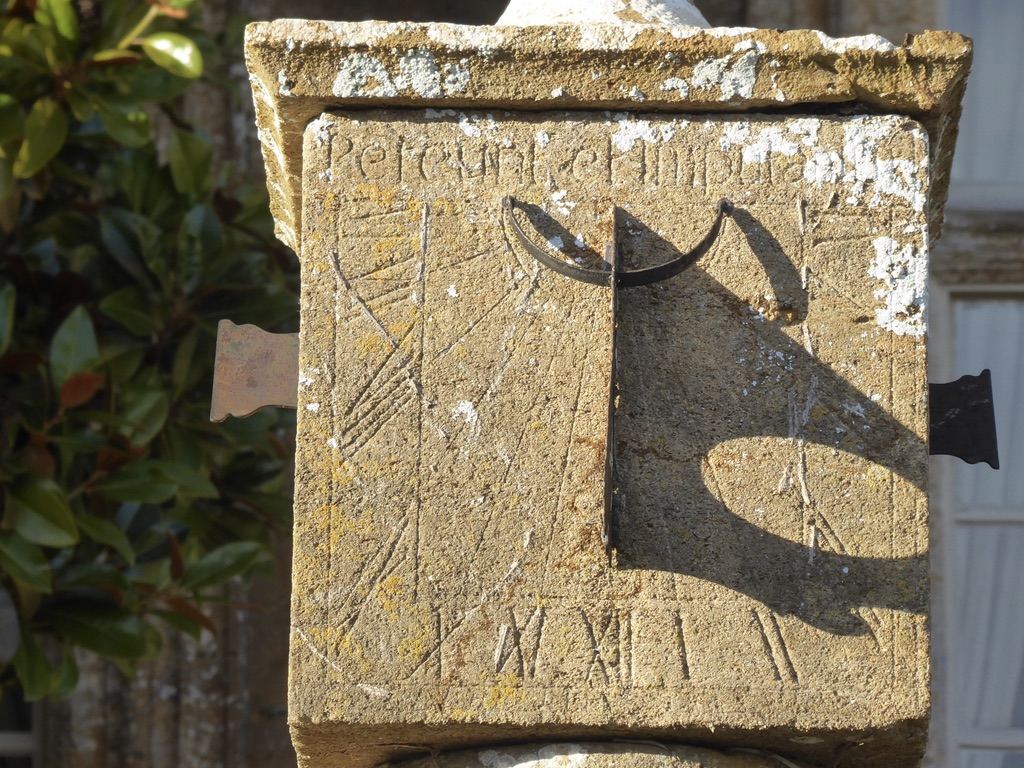
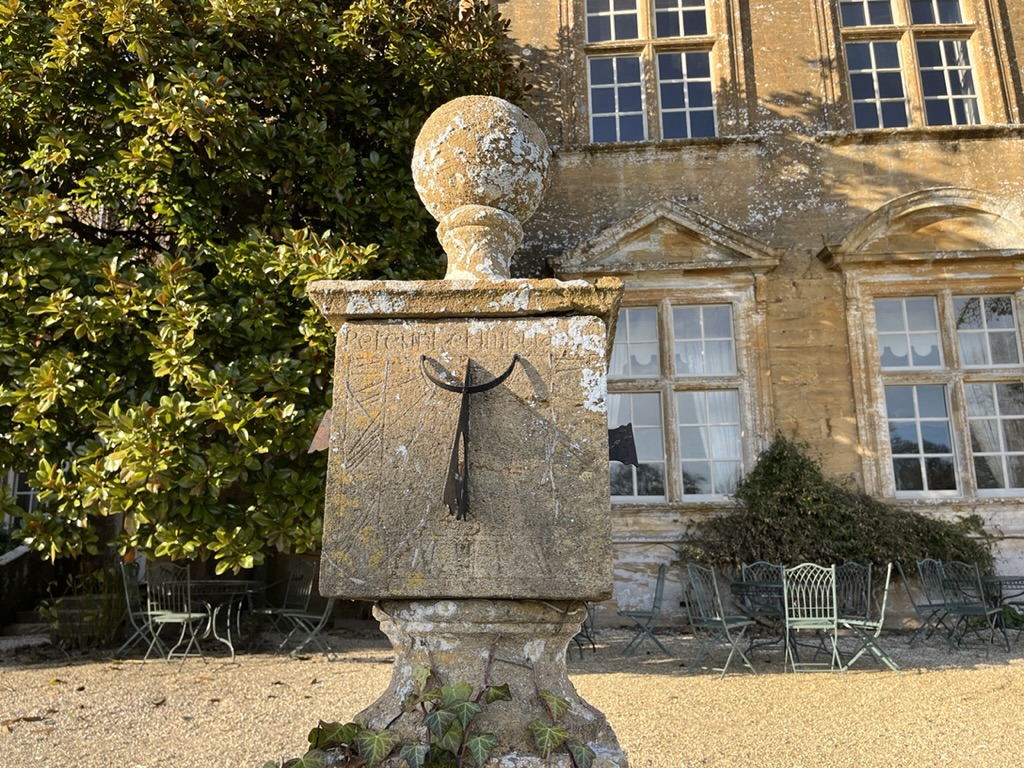
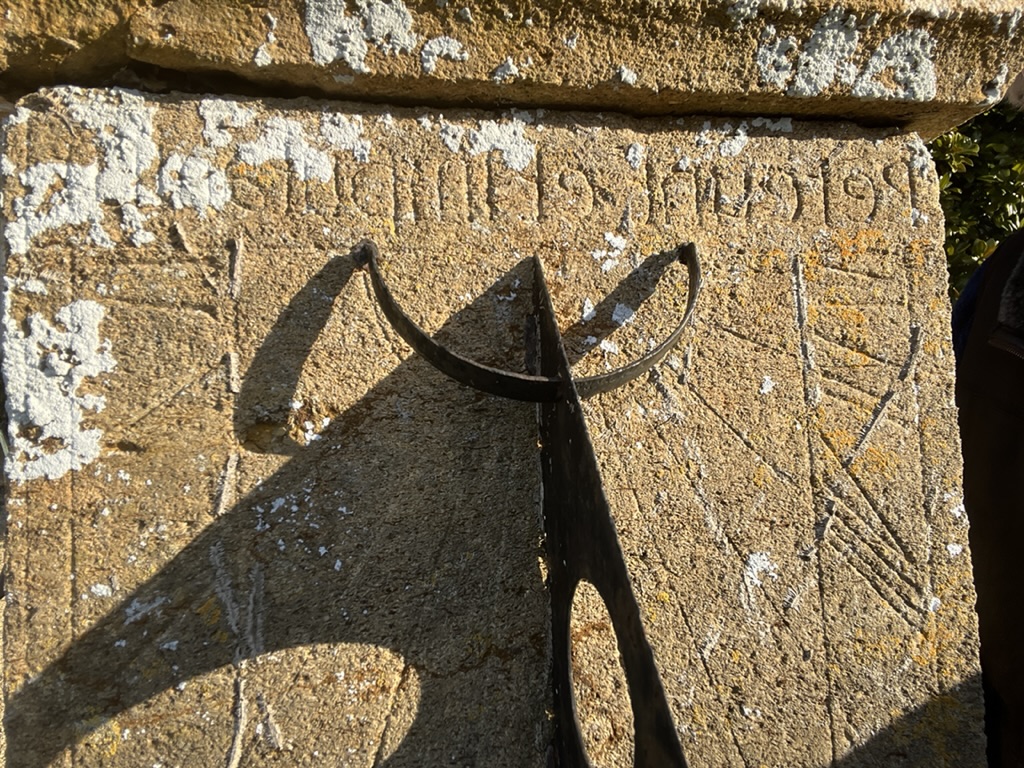
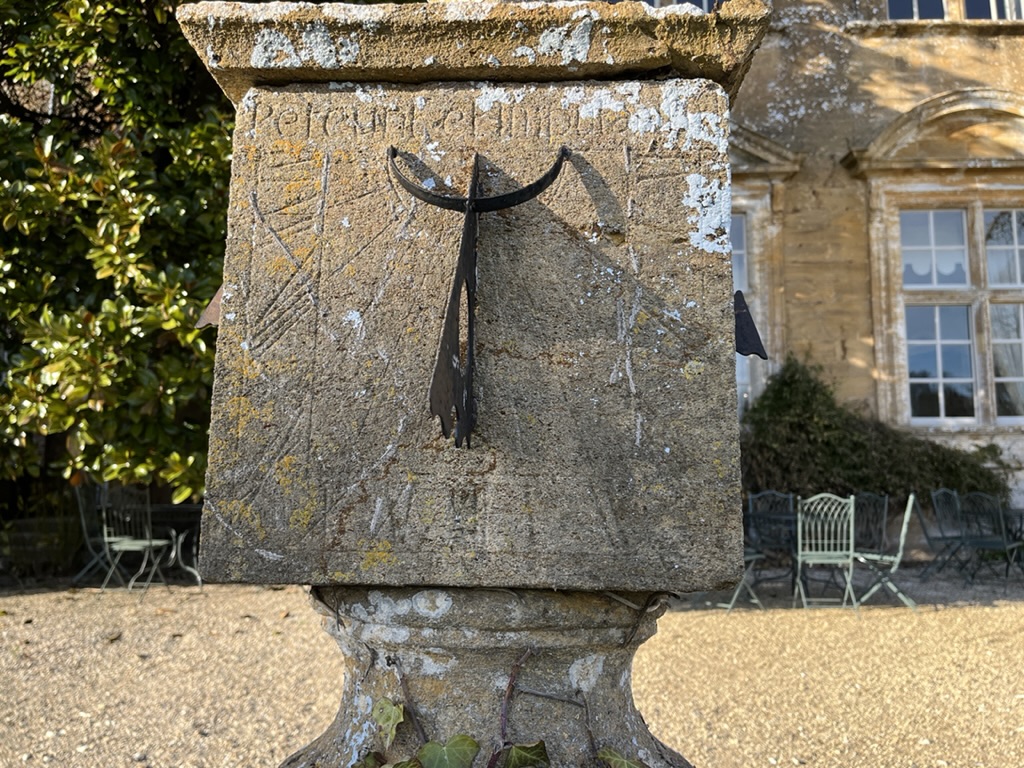
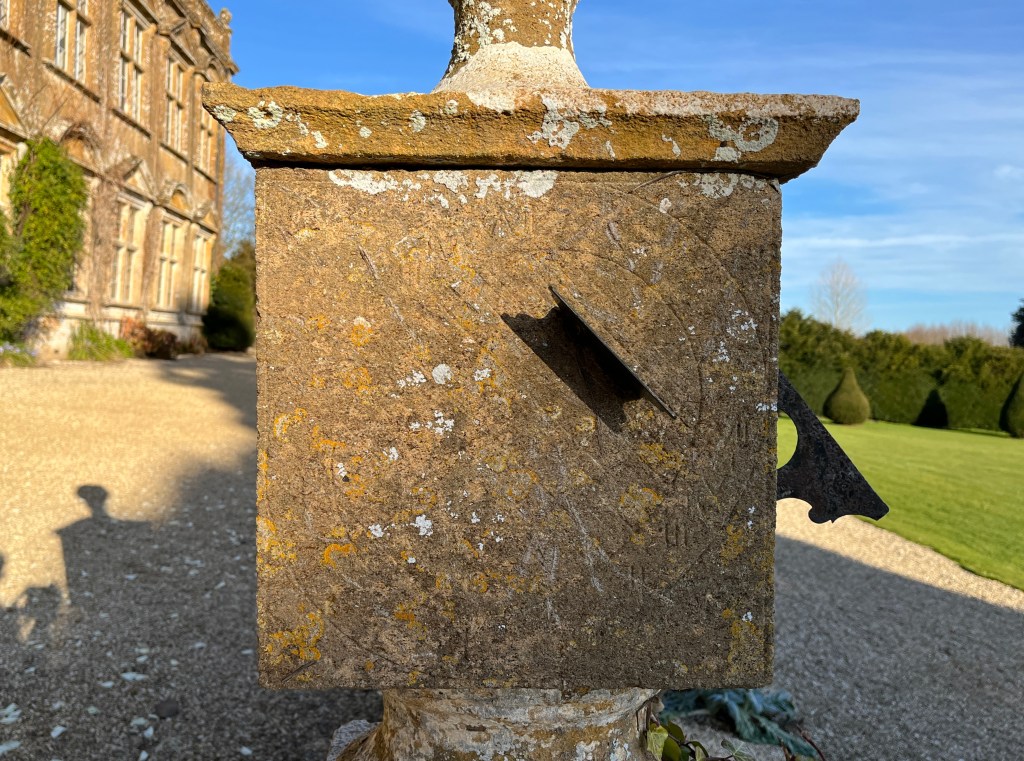
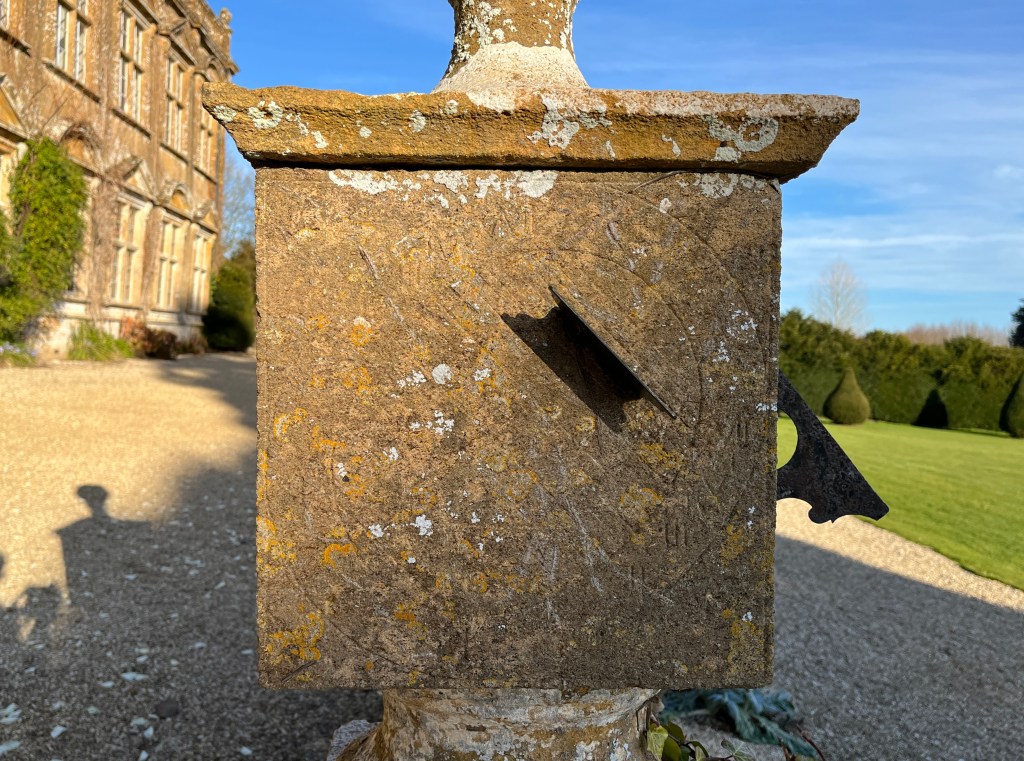
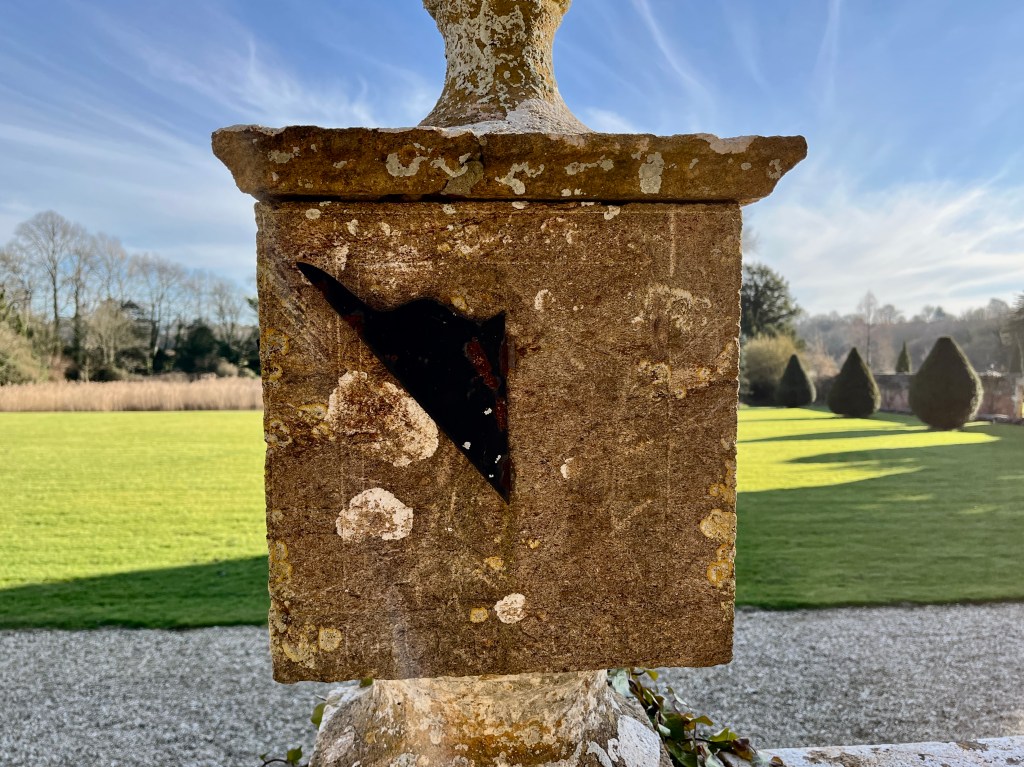
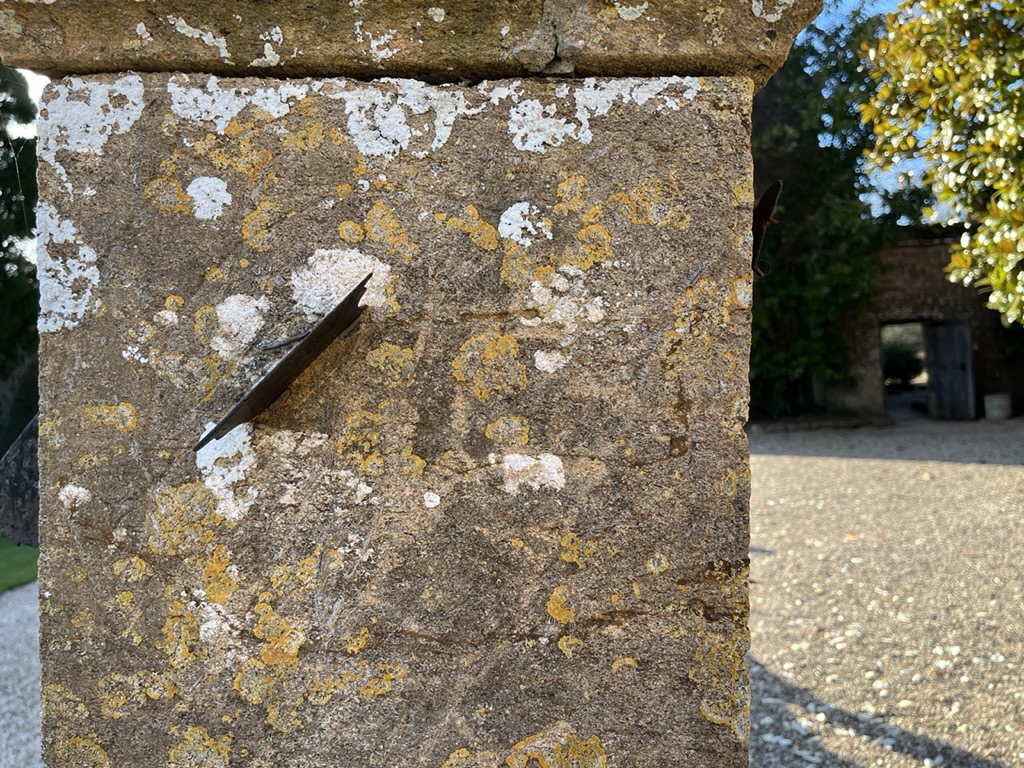
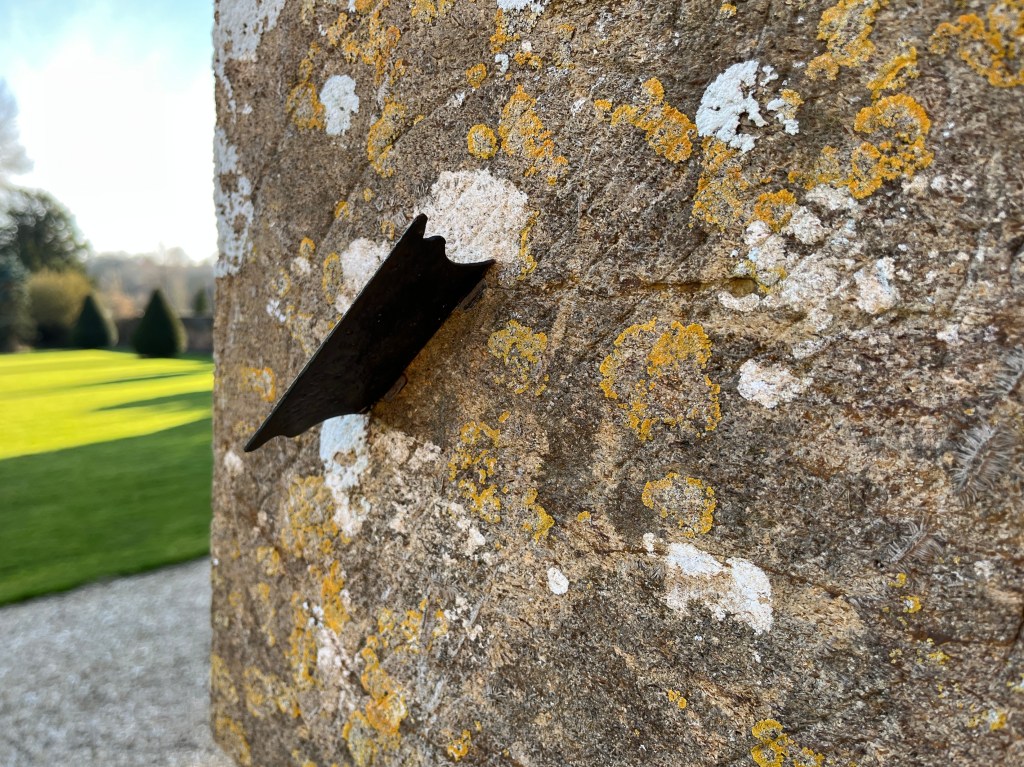
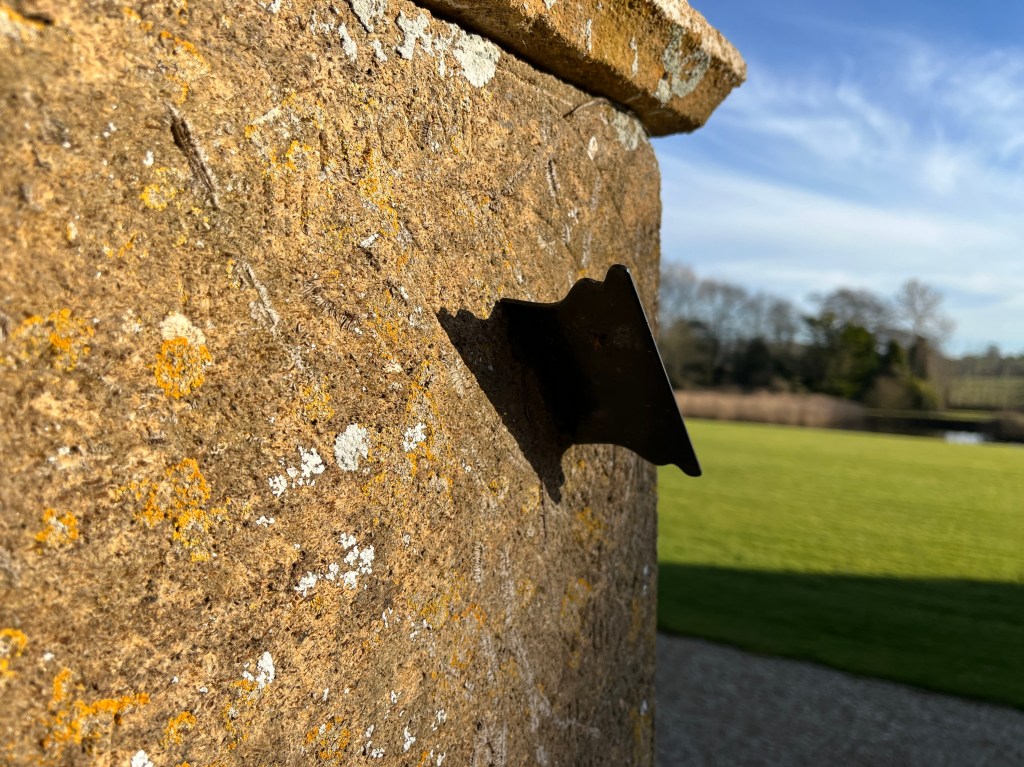
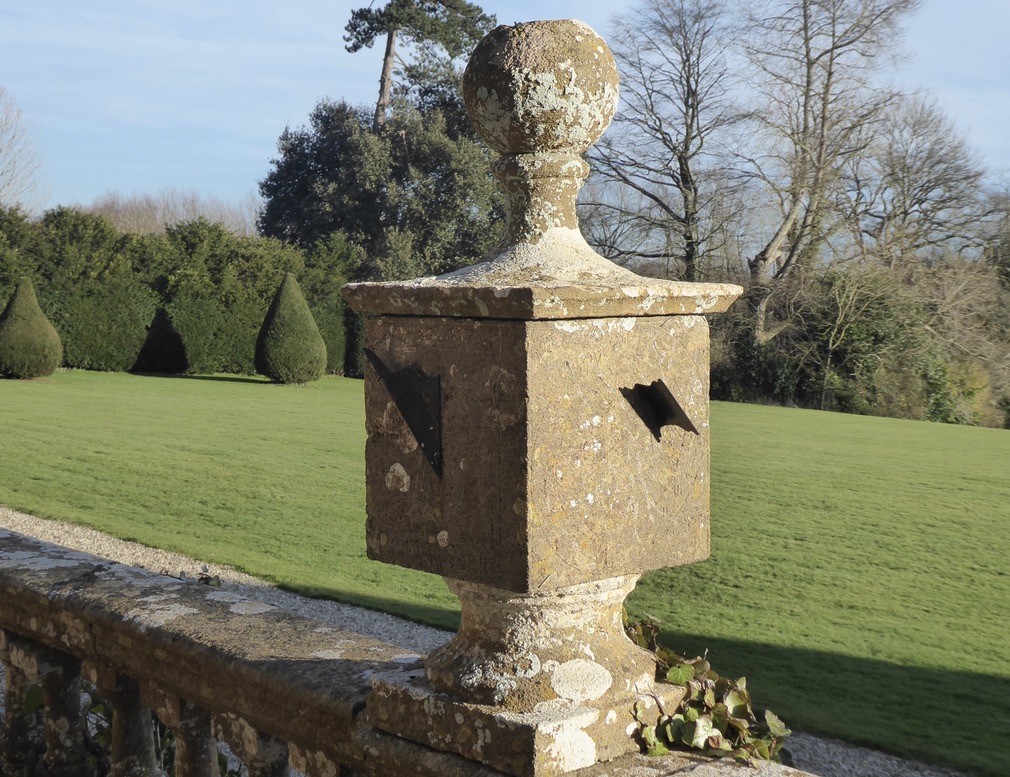
The long (75m) balustraded south terrace looks out over parkland with a small lake. The dial dates to mid-C19, probably added ± 1860 as part of the design for the terrace building project. If the dial is older, it must have been relocated. HE describes the ashlar retaining wall with chamfered plinth, capped with a stone balustrade with intermediate piers on which are set a variety of urns and other ornaments, and in the centre of the long western section a block sundial with ball finial, on which is inscribed LAT 50-56, 17.30, having sheet metal gnomons, 2 of which are broken. The 4 gnomons are shown together further down this page.
SOUTH
The motto on the S face of the dial reads PEREUNT ET IMPUTANTUR, which Gatty gives as ‘they perish and are reckoned’. Its original form as a Martial epigram directly references the sun’s involvement in this process.
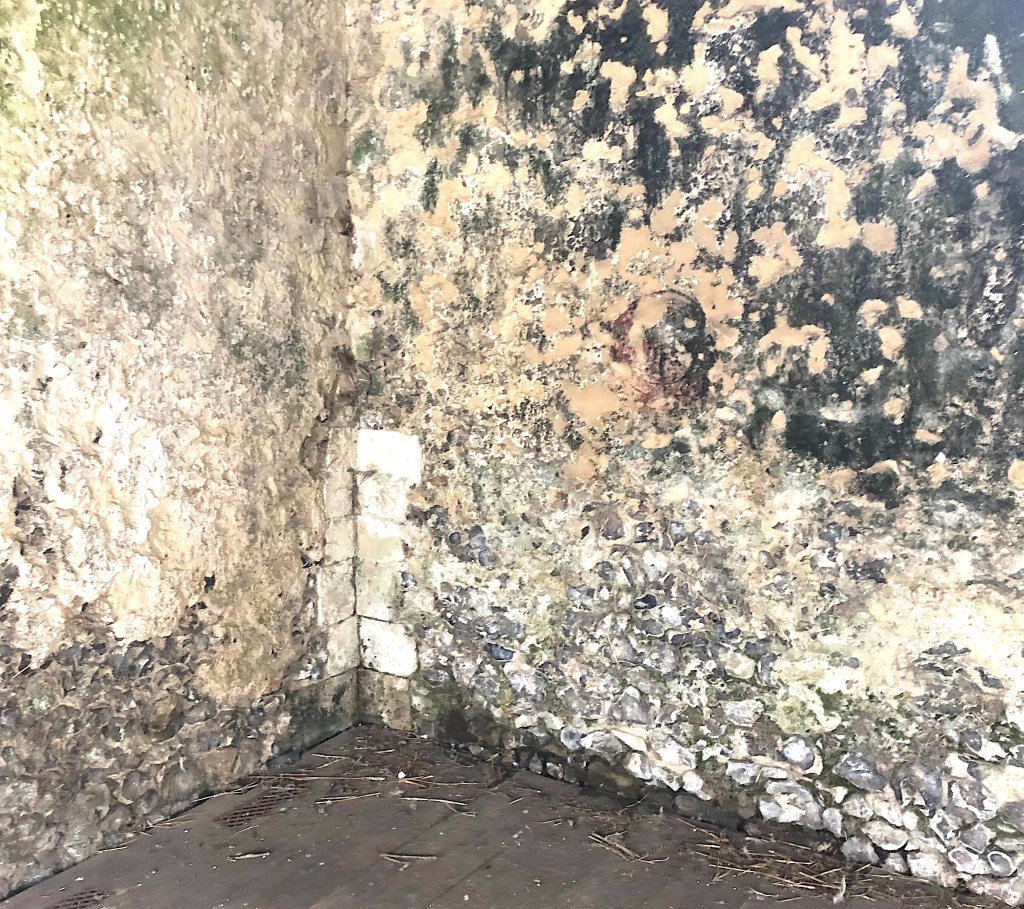
C13 chapel located within an Iron-age hill fort Chisbury Camp. The Lord of the Manor built it to assert his social status by allowing the household of the manor, as well as local people, to attend services and pay their taxes without having to travel to the parish church at Great BedwynEH. Thatched, with flint walls. The chapel was deconsecrated in 1547 and after three centuries of use as a barn it was reduced to its present dilapidated state. It is however a scheduled Ancient Monument, now in the care of English Heritage.
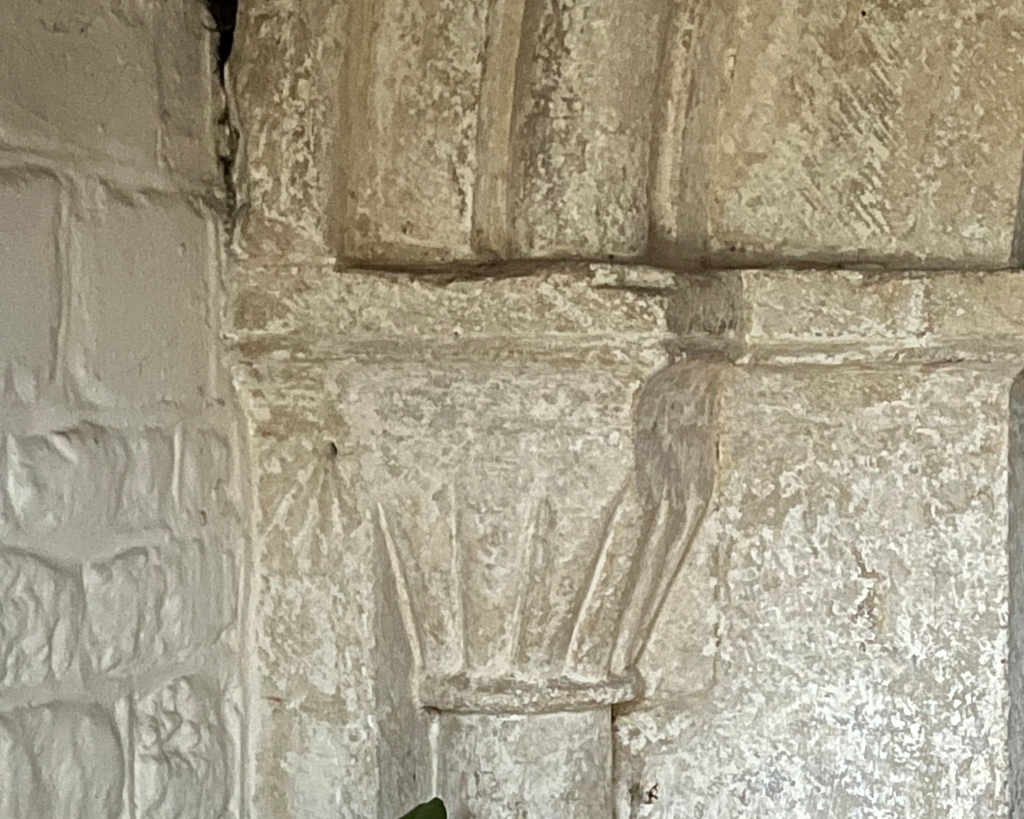
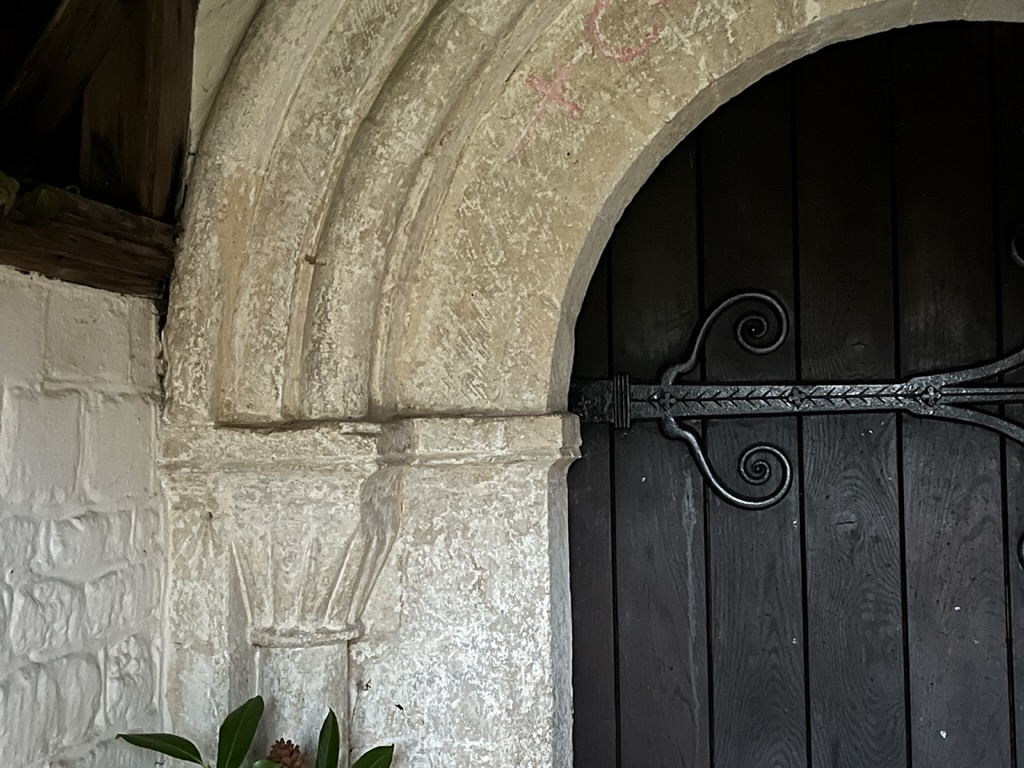
CONSECRATION CROSS
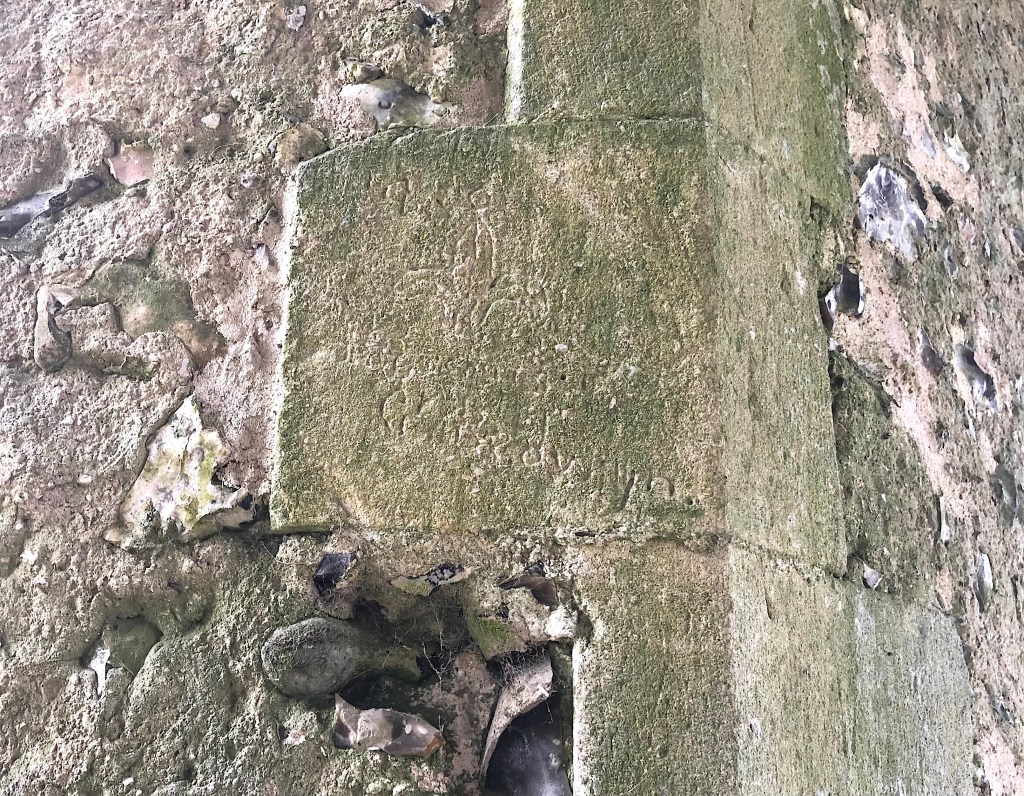
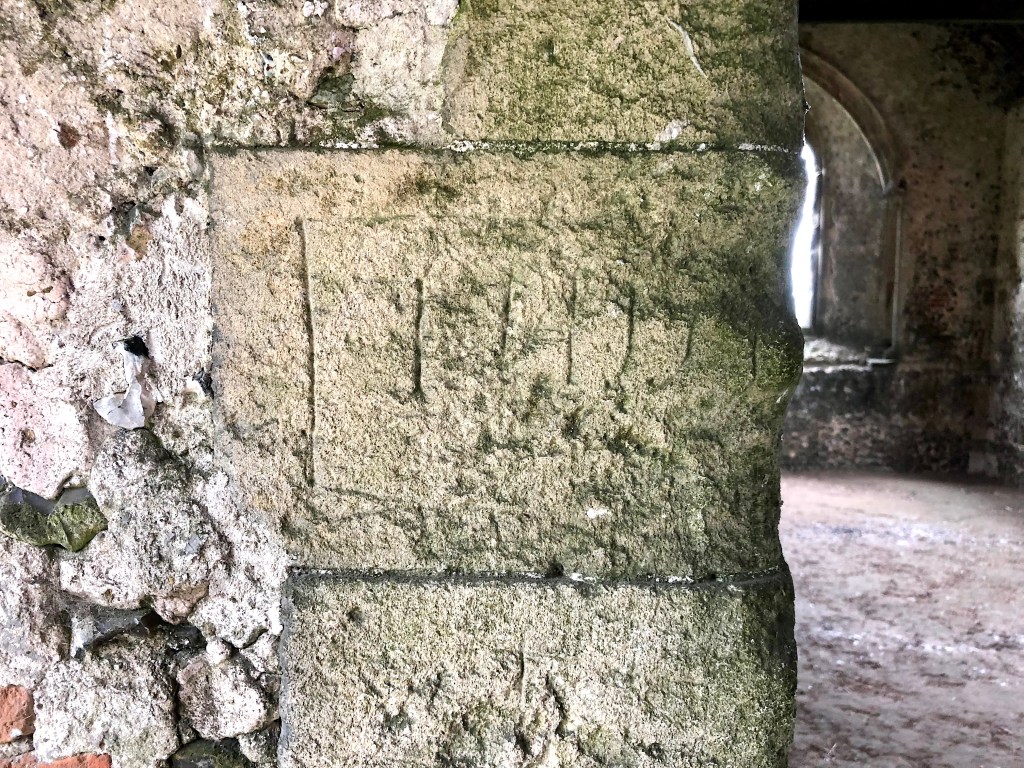
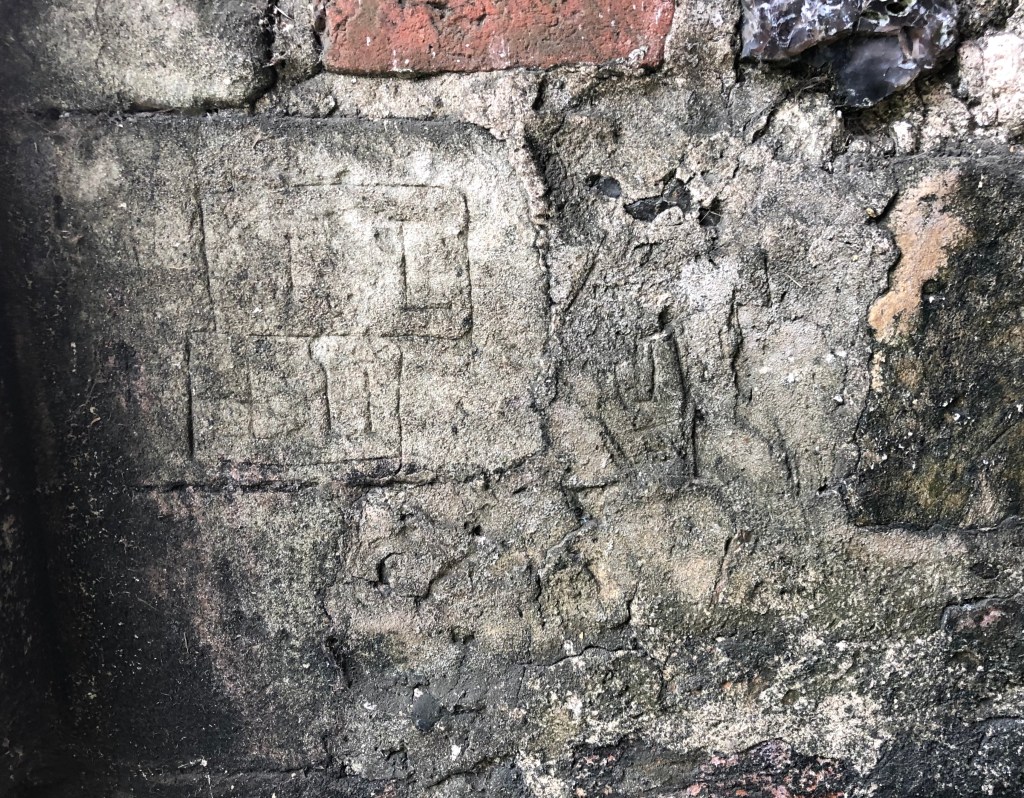
GRAFFITI & MARIAN MARKS (VV)
There was no scratch dial and I wasn’t expecting to find one. However the chapel is interesting enough to merit inclusion, not least because consercation crosses and church marks generally are catered for in this project.
1. shows a (possible? probable?) Fleur de Lys with G Bedwyn scrawled below – 2. is one form of protection mark – 3. enclosed initials – 4. Marian mark VV – 5. ‘scratchings’ – 6. Marian mark VV and a design with a heart that I initially thought must make it recent… However the form of the W (similar to a Marian mark) is from a much earlier time, as is the date (if it is one) in Roman numerals. I can’t decipher it beyond ..15
GSS Category: Consecration Cross; Church Marks; Marian Symbol; Medieval Graffiti
GRADE II* † Cll Saxon / Norman origins with simple nave – some features survive; C15 chancel; later additions / restoration 1882. A most surprising Palladian / Venetian E window. Detached timber-framed bell cote. Attractively set in a well-wilded churchyard. 6m W of Andover. 51.1944 / -1.611 / SU272439
DIAL
The dial is on the W jamb of the window E of the porch, first recorded by ARG in 1925. The gnomon hole is filled. ARG’s description is below. The more recent BSS entry records 19 visible / detectable lines and 21 pocks, with possible hints of a circle. On either view, this is an eroded 24-hour dial (esp URQ), with noon marked by a quincunx (like 5 on a die), which I haven’t seen before. One puzzle is why the dial was cut in such a position that it is truncated RHS.
ARG noted two very doubtful dials on the E jamb of the same window; and in his text he refers to another doubtful on the buttress of the S Chapel. I couldn’t make out dials.
St Michael . Quarley . Hants – Scratch Dialwith Quincunx
There was another mark that caught my eye, a small uneven circle of pocks. There’s no hint of a central hole. As I visit more churches, I see more of these little markings. They can’t be dials, and they seem unlikely to be purely decorative. My tentative theory is these little pock circles are a form of protection mark / apotropaic symbol). However I haven’t yet found such a design featured in the usual medieval building mark resources. Any theories welcome.
St Michael . Quarley . Hants – circle of pock marks
The much-anticipated RA Spanish Exhibition has opened, displaying works of magnificence and fascination from ancient to modern. Dialophiles and gnomonicists will however wish to concentrate on a single exquisite page spread from a book that dates to ± 1585, for this is the Manual of Nautical and Astronomical Instructions for Use by the Universidad de Mareantes. While the depiction is not of a sundial, the drawing demonstrates in very simple form the close relationship between sun, man, and ways in which the sun’s power can be harnessed scientifically. And anyway, Gaudium sub Sole goes beyond sundials…
The drawing is entirely charming, from the compass hole outwards. I enjoyed the sun’s rather grumpy / puzzled face and the man’s surprised / concentrating look. (He may be wondering why the ‘shadow’ is wearing boots while he wears shoes, but that is show-through from the reverse of the page).
Artist: , Unknown Artist Title: Manual de instrucciones nauticas y astronomicas para el uso de la Universidad de Mareantes de Sevilla Date: ca. 1585 Medium: Illustrated manuscript. 27 x 19.7 x 1.8 27 x 18 cm. Origin: Seville
GRADE II † Large Cube Dial on a tall column. BLB / HE give the most complete descriptions: Date uncertain, probably C17 or early C18; 1st recorded 1781. Ashlar. Tall quatrefoil pier on plinth, with ring and moulded capital supporting cube with dials and gnomons to each face, reeded domical (domed) cap. An unusual feature whose origin is unknown, removed in 1781 and re-erected to the west end of the cathedral in 1785, removed and sold in 1881, and returned and re-erected on its present site in 1929.
Lichfield Cathedral – Cube Dial on Column
BHO notes: A sundial near the south doorway of the cathedral was removed in 1781 and re-erected in 1785 at the west end in order to regulate the clock on the tower. It was removed in 1881 and passed into private hands. It was returned to the cathedral in 1929 and placed on a pedestal in its present position south of the nave.
The clock in question was (without going into detail) probably the first Cathedral clock, which was in position by 1491. BHO suggests that the original clock was still in place in early C17 and probably not replaced or superseded by another clock until late C18. If so, the dial’s removal and re-erection in 1780s would have been to regulate the original clock.
Lichfield Cathedral – Cube Dial on Column
The handsome domed dial has a single gnomon on each face. The gnomons and lines obviously differ on each side. Numerals are Arabic rather than Roman.
Assuming the Cathedral conforms to the usual church orientation, the Cube’s angle in its position on the S side of the building is some 45º out of true from what might be expected. Presumably the explanation is that the cube was originally cut for a different position, and after several relocations its present position and orientation provides optimum accuracy. Any other suggestions would be welcome.
St Anne . Ancroft . Northumberland – James Towill Geo cc
GRADE II* † C11th-century, built by monks of Holy Island as a chapel of ease. C13 / C14 pele tower added as protection from incursions by Scots. C19 restorations. At some time (? when the tower was built) the fine Norman entrance was blocked. Extensive views from the tower’s parapet. 3m S of Berwick-upon-Tweed. 55.7001 / -1.998 / NU002451
A weathered C18 vertical dial with a short gnomon that casts a very visible shadow. The shape of the dial stone, with its pedimented square, is very pleasing. The lines are enclosed in a frame, with Arabic numerals from 6 to 6 around its edge. The use of Arabic numerals rather than Roman suggests a later dial of this period. 9 lines are detectable, some only just. Only 6 numerals are clear. I can’t make any sense of the remains of the inscription. I wondered if some of the sandstone – especially LLQ – is repair or natural deterioration. Expanding this very good photograph, I think the latter: the dial is showing the signs of its age.
St Anne . Ancroft . Northumberland – Walter Baxter Geo cc
GSS Category: Vertical Dial; Old Dial; Gnomon Design
Credits: Erika Clarkson for introducing me to this church and for her photos that begat this post, so to speak; James Towill for his photo of St Anne’s uploaded to Geograph cc; Walter Baxter for his excellent close-up of the dial uploaded to Geograph cc and for his specific use permission to reproduce it full-size
The attractive gardens of the Van Loon Museum contains 3 very different dials. In the centre is an armillary sphere (C19?). By the steps is a complicated early scaphe dial dated 1582. I have included B&W images, which can sometimes be useful for seeing details on multiple dials. The third dial with a weather vane is high up in the centre of the upper gallery overlooking the garden. I am trying to find out a date for it.
ARMILLARY SPHERE
SCAPHE / LECTERN DIAL 1578
Correctly know as a lectern dial because of its angle. Scotland in particular has many of these (eg Culzean), as it also has with obelisk dials (eg Kelburn Castle).
VERTICAL DIAL AND WEATHER VANE
GSS Categories: Armillary Sphere; Cube Dial; Multi Dial; Scaphe Dial; Modern Dial; Amsterdam Dial
GRADE I † C14 The principal parts of a small stone manor house, built c1370 for the Sheriff of Somerset & Dorset. It has undergone many changes since, but the splendid timber roofs over the great hall and solar… (remain intact). Scheduled as an Ancient Monument. Under the care of English Heritage Two miles E of Sturminster Newton. 50.9213 / -2.2847 / ST800135
Fiddleford Manor . Sturminster Newton . Dorset – a wall of various types of church mark including a hexfoil
The most spectacular medieval manor house interior in Dorset PEV, an authoritative opinion that will never be challenged. There is no dial here, but the amazing graffiti could equally be found in a church, though generally not in such profusion. Besides dials of all kinds, this site includes medieval building marks – symbols, initials, dates, other graffiti. These categories can be found in the Menus on the front page. However, Fiddleford manor is so special that it deserves its own main entry rather than being relegated to a sub-menu.
HEXFOILS
MARIAN MARKS
GRAFFITI
GSS Category: Church Marks; Marian Marks; Ritual Protection; Hexfoils; Medieval Graffiti
BRITISH SUNDIAL SOCIETY . ARMILLARY SPHERE . PARADE GARDENS . BATH
Bath . Commemorative Sundial Plaque
Armillary Sphere . Parade Gardens . Bath
The plaque above gives all the details (including a bar code) necessary to admire and appreciate this excellent armillary sphere that was installed to celebrate the 30th anniversary of the foundation of BSS. My visit to Bath was spoiled by bad weather: gloom with only occasional respite from rain. Hence these rather unsatisfactory photos, which I have had to cheer up somewhat. I intend to replace them in due course, when a visit to Bath coincides with sunshine. The Motto, explained below, describes my predicament.
The gallery of images below gives a 360º view of the dial against glimpses of the Bath setting. One or two are meant to be ‘arty’, never my strong suit.
Armillary Sphere . Parade Gardens . Bath
MOTTO
‘I ONLY RECKON THE BRIGHT HOURS’ is the translation given by Margaret Gatty (p.45 of the compact volume). Other versions include I ONLY COUNT CLEAR HOURS and I ONLY COUNT THE HOURS THAT ARE SERENE. MG wrote (of the succinct Latin version) that the motto is too good to be uncommon, and gives a number of locations where it may be found in England, Scotland, and (unexpectedly) Venice, of which Hazlitt wrote …there is a softness and a harmony in the words and in the thought unparalleled. None of the above modern motto variations works very well; it’s hard to come up with a translation as elegant as the original in Latin. The word ‘serenas’ is the real problem….
ADDENDUM Dictionary research including Chambers – far the best for archaic words and usages – clarifies the motto. A subsidiary meaning of ‘serene’ was, in the past, ‘an expanse of clear sky’; ‘cloudless’; or in one source, ‘sunny’. On countless modern sundials, this Latin formulation is the familiar I only count the sunny hours.
GRADE II* † C12 origins; tower & S porch C15; chancel, vestry, south aisle and chapel c1876 (G E Street). Wonderful C12 inner door with chevrons, shielded by porch; C12 font with a story to tell (below). A charming and very Dorset church. 4m SE of Bere Regis; 10m NE of Dorchester. 50.7759 / -2.2833 / SY801974
DIALS
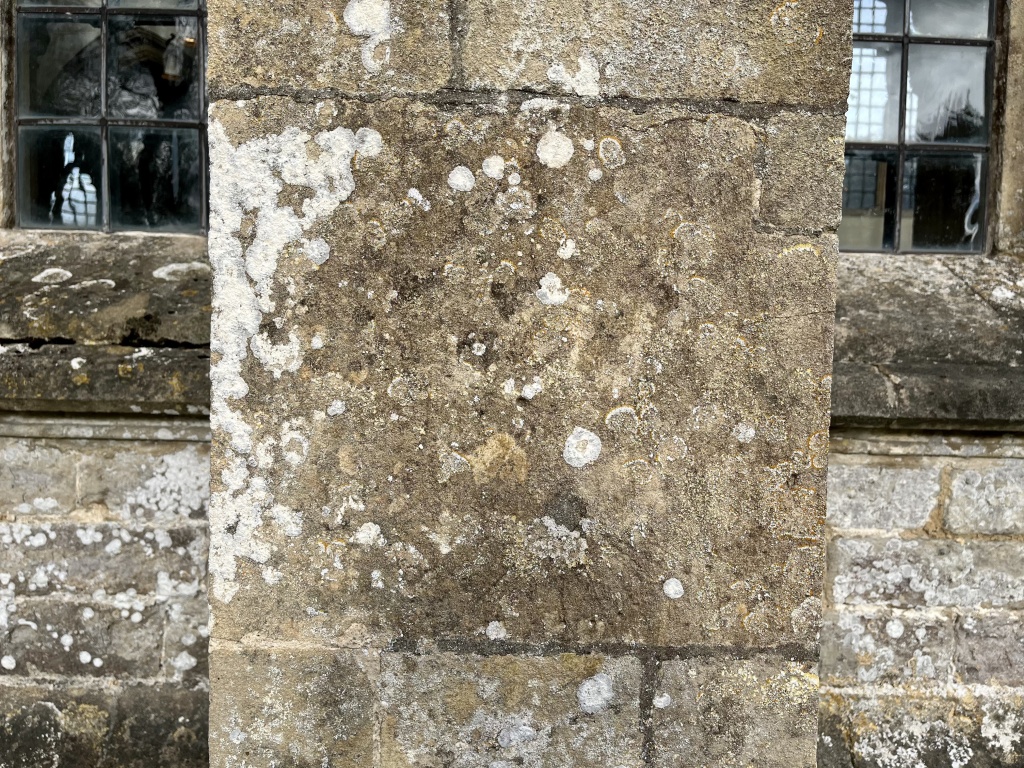
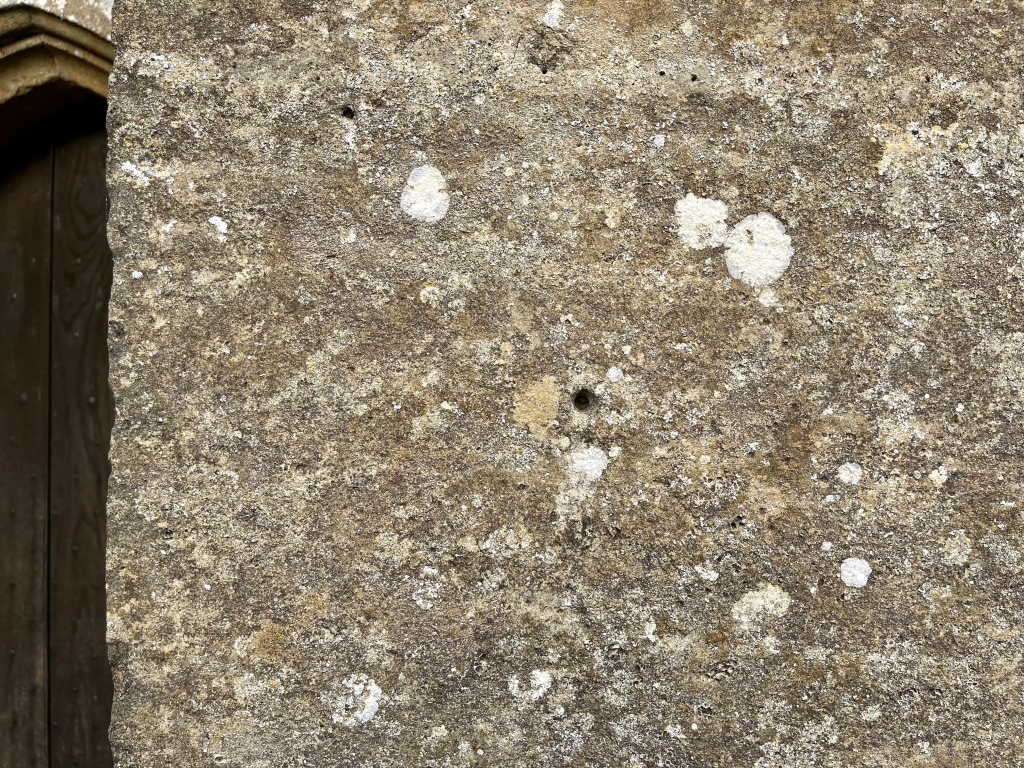
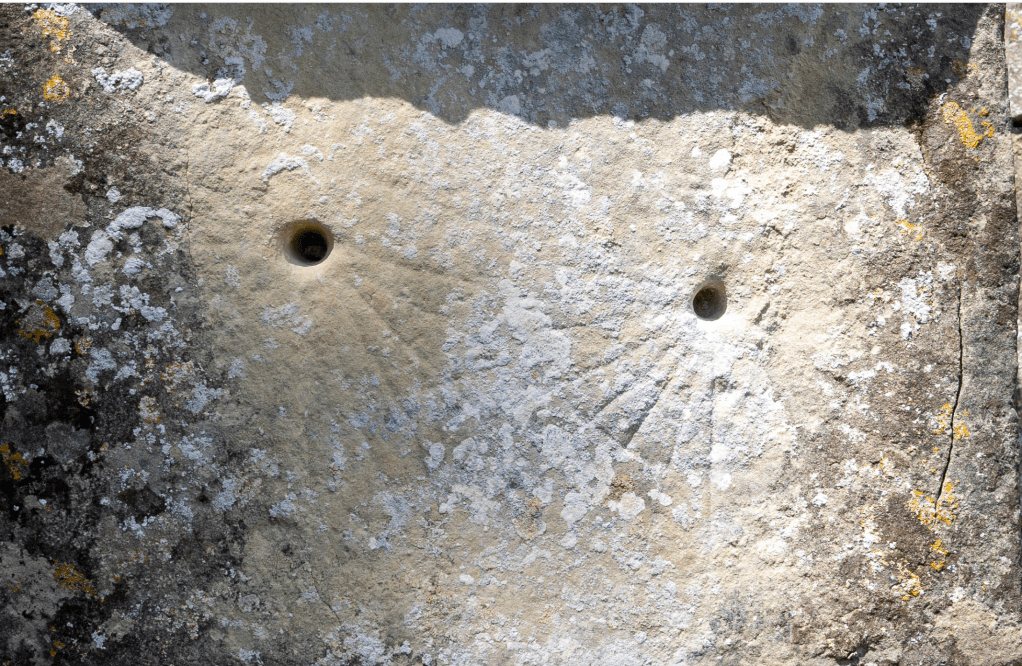
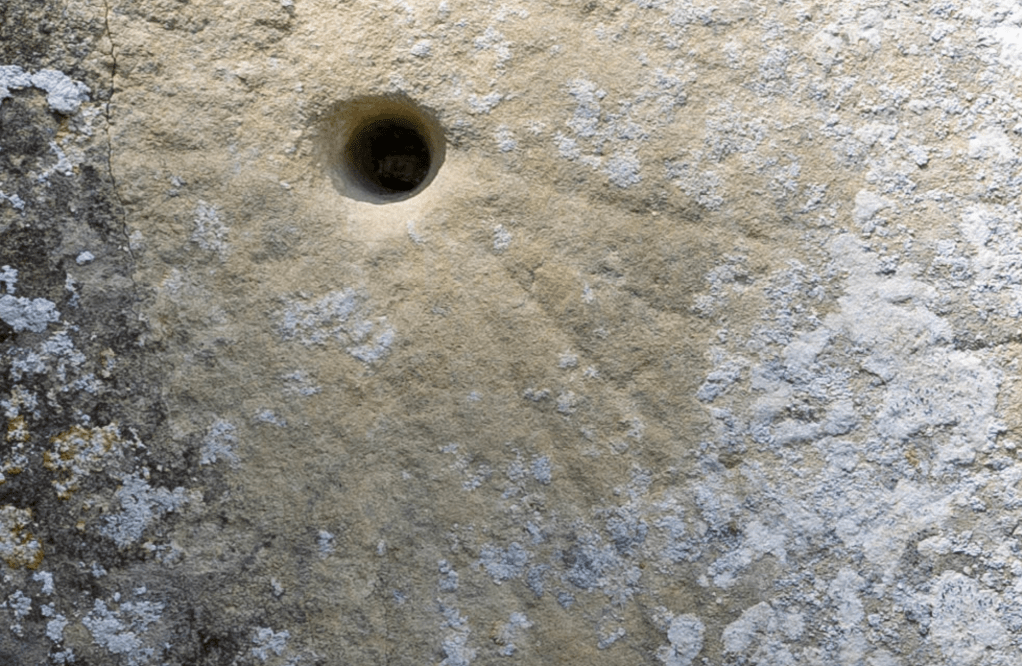
St Andrew has 3 dials. Dial 1 is a true scratch dial located in the NE corner of the nave, as is Dial 2 on the stone below (largely obscured by lichen, easy to overlook). Dial 3 is a transitional dial above the porch entrance.
DIAL 1
St Andrew . Milborne St Andrew . Dorset – Scratch Dial 1
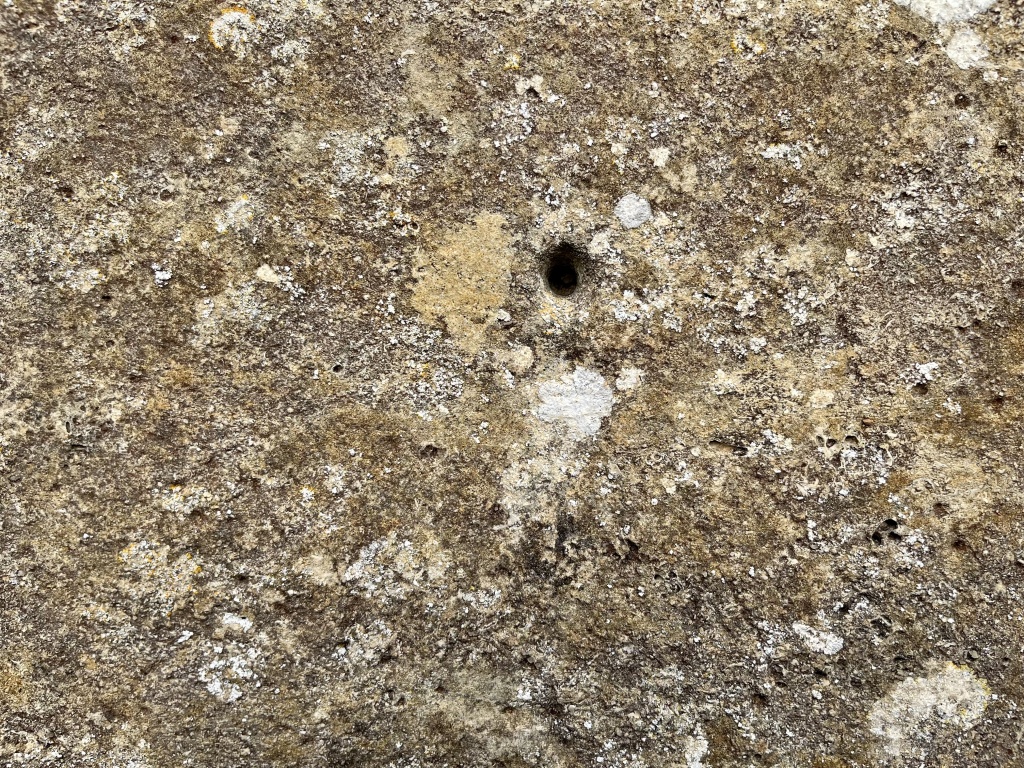
Dial 1 is easily identified by its prominent filled gnomon hole from which 3 lines radiate in LLQ. There is also a perimeter curve of 5 (?6) pocks (diag).
St Andrew . Milborne St Andrew . Dorset – Scratch Dial 1
DIAL 2
St Andrew . Milborne St Andrew . Dorset – Dials 1 & 2, NE corner of the nave
Dial 2, on the stone immediately below Dial, 1 has no discernible lines. BSS records 5 pocks of varying size that are (given the lichen) more or less visible seen in conjunction with the BSS diagram below. They are basically shallow dents, in contrast to the ‘drilled hole’ type of pock usually encountered.
St Andrew . Milborne St Andrew . Dorset – Scratch Dial 2
DIAL 3
St Andrew . Milborne St Andrew . Dorset – Scratch Dial 3
A transitional dial above the archway of the C15 S porch. Accuracy in marking the passage of time became increasingly important, not least with the advent of clocks. Dial design and construction involved taking a scientific approach to making time-telling more reliable and more legible. St Andrew is a good example. Rather than being scratched directly onto a stone intrinsic to the church structure, this dial stone is on what BHO describes as a square raised panel.
The dial has slightly angled edges with ‘extensions’ on both sides. It is not canted, so probably faces due S. It is a six-to-six dial with – originally – 12 lines (14, with the horizontal as 2). The hours 4 & 5 are cut deeper, perhaps denoting the most important Mass of the day. Some lines have weathered away in part or completely. There are a number of pocks. The recorder noted 4 trace (semi-)circles, one being close to the gnomon hole. The original gnomon was in the upper hole where there is now a square stub of iron rod. The lower arrangement indicates, I think, a later conversion / updating from a simple rod gnomon to a ‘proper’ one that required a footing; and perhaps a lamp bracket.
RARE FEATURE It’s not completely clear from my rather poor iPhone photos, but if you look carefully at the edge R side where there is the wide margin, you can see that the lines marking 4 & 5 extend onto the side of the dial face and continue down the side of the stone panel. Those short lines are visible from the side even if the rest of the dial is not. I wouldn’t have paid it much attention had I not also visited the neighbouring village of Winterbourne Whitchurch where there is an emphatic example of a ‘side-dial’ complete with a most unusual gnomon. My understanding is that this arrangement amounts to a morning dial read from E.
St Andrew . Milborne St Andrew . Dorset – Scratch Dial 3
This is the 4th church I have come across where church events have entailed the use of a dial to tie in decorations etc with wire. In each case the wire was effective as an improvised gnomon.
FONT STORY
During the Victorian period it was sometimes the fashion to throw out ancient fonts and Street did just that, installing in its place a new replacement. Fortunately, the old Norman font, decorated with a cable motif, was rediscovered in 1930 and put back in the north aisle, where it remains in use to this day.DHCT [This is an example of throwing the bath out with the baby water]
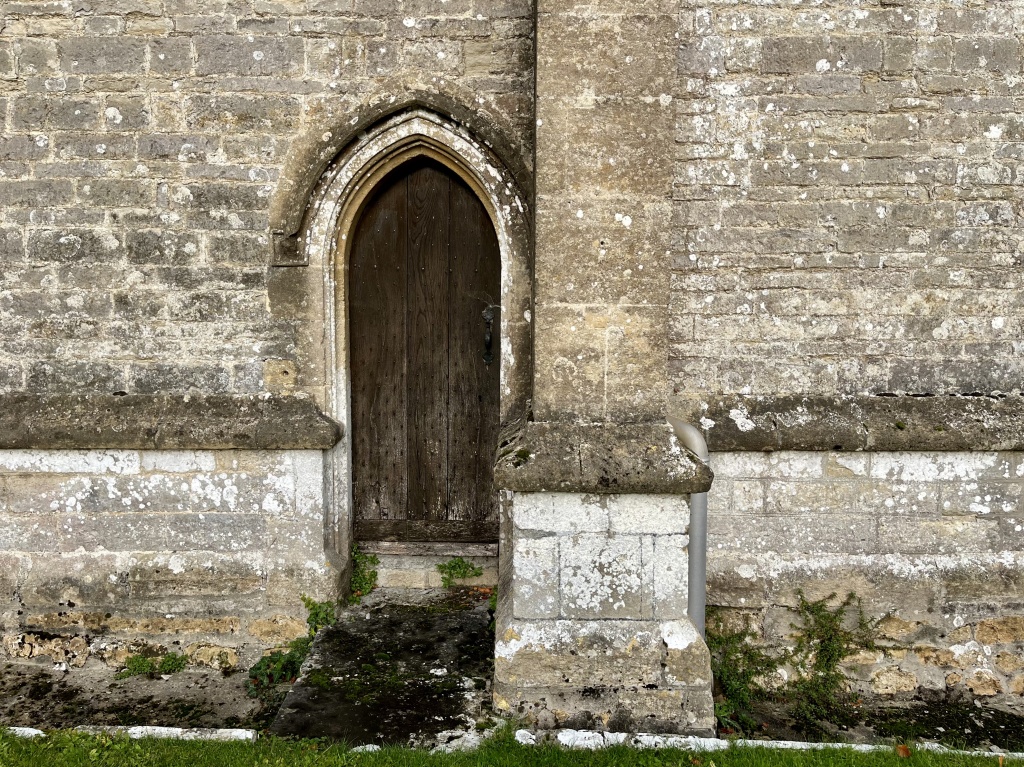
St Andrew . Milborne St Andrew . Dorset – S Porch and Norman Doorway
GSS Category: Scratch Dial; Mass Dial ; Transitional Dial