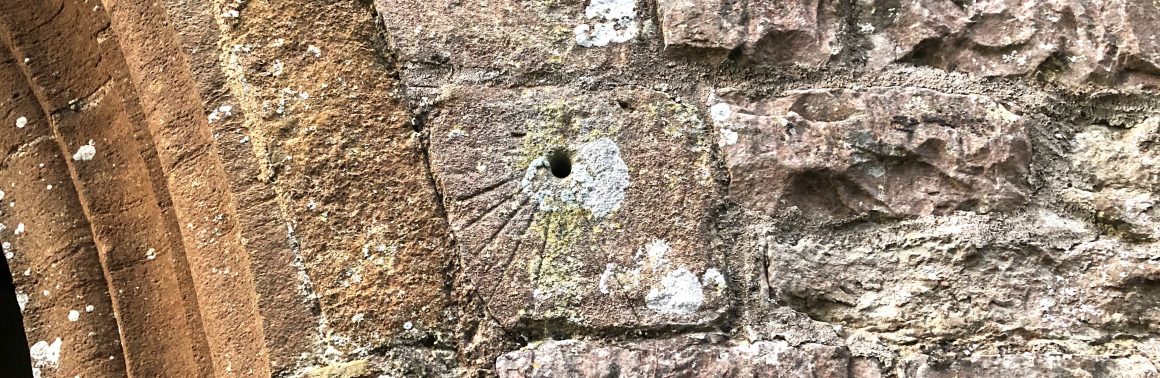
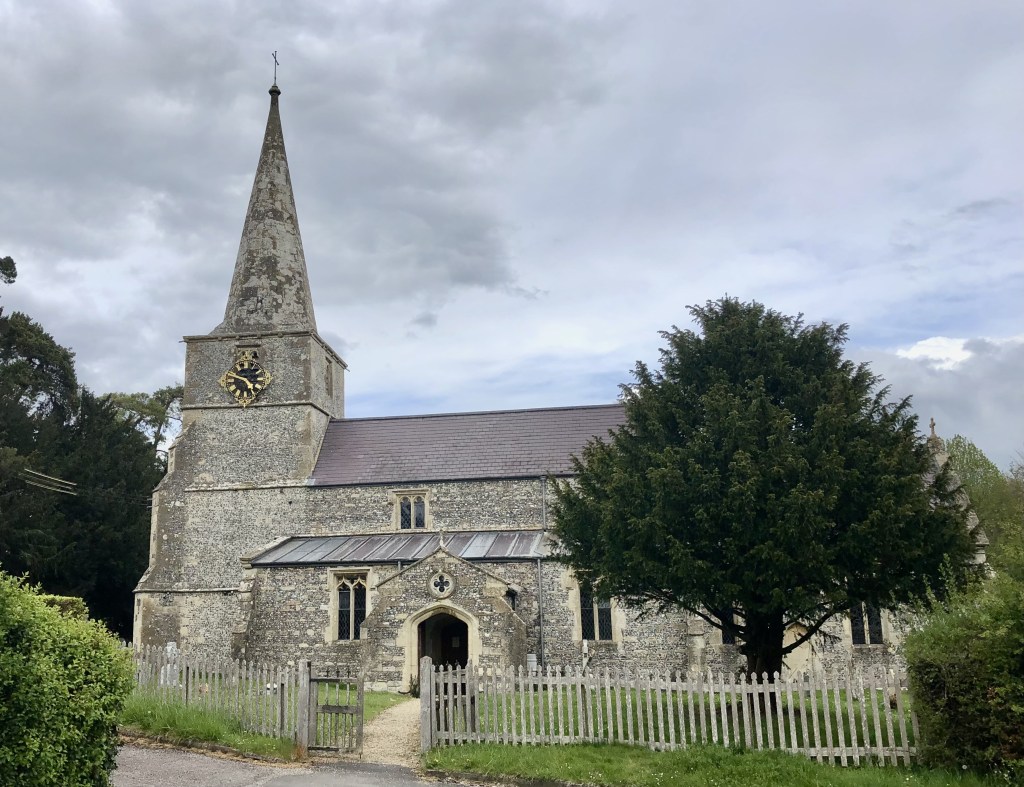
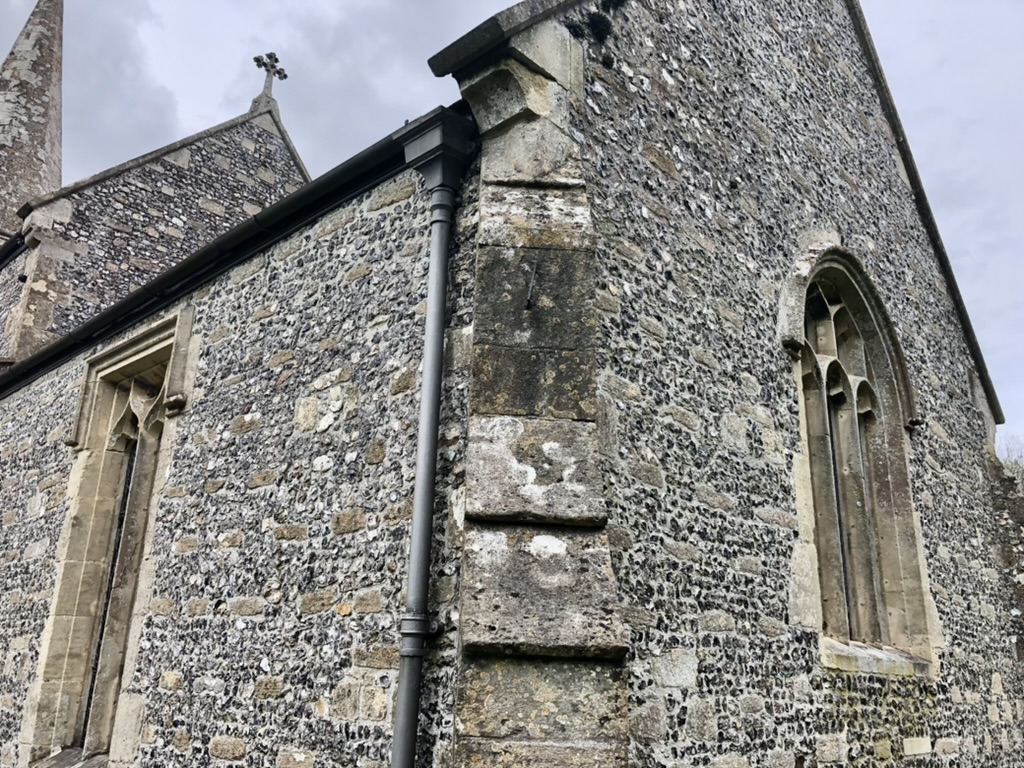
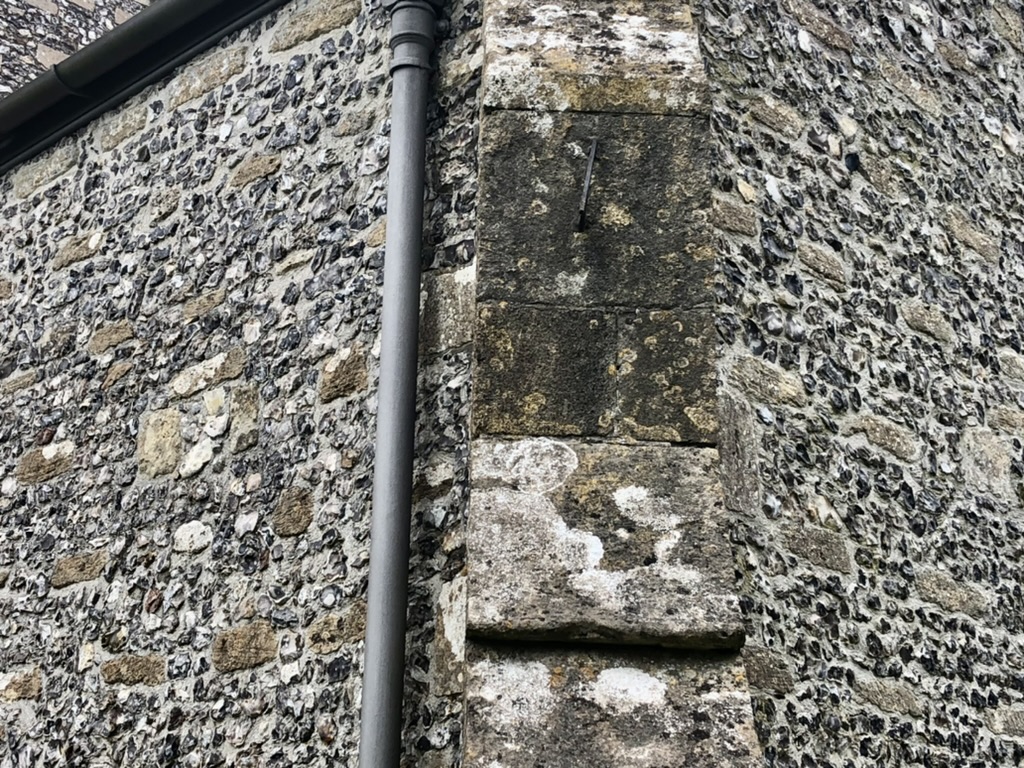
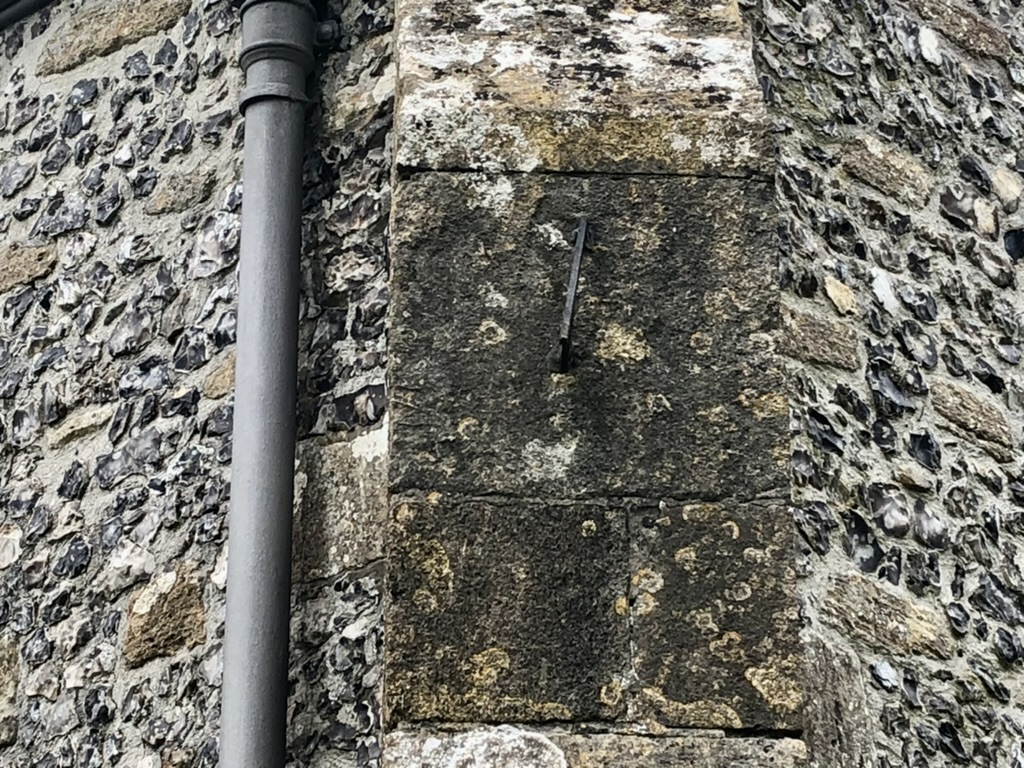
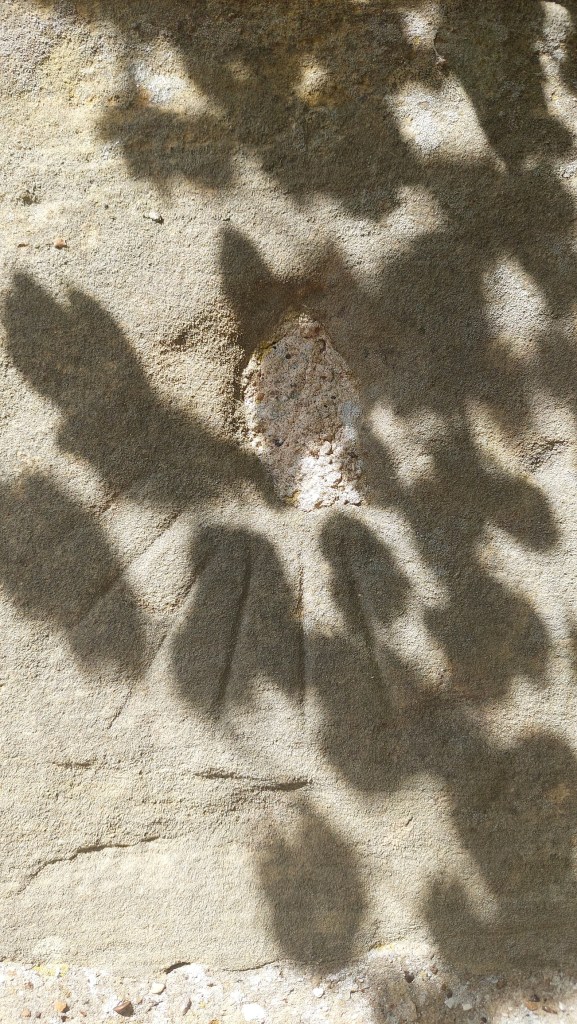
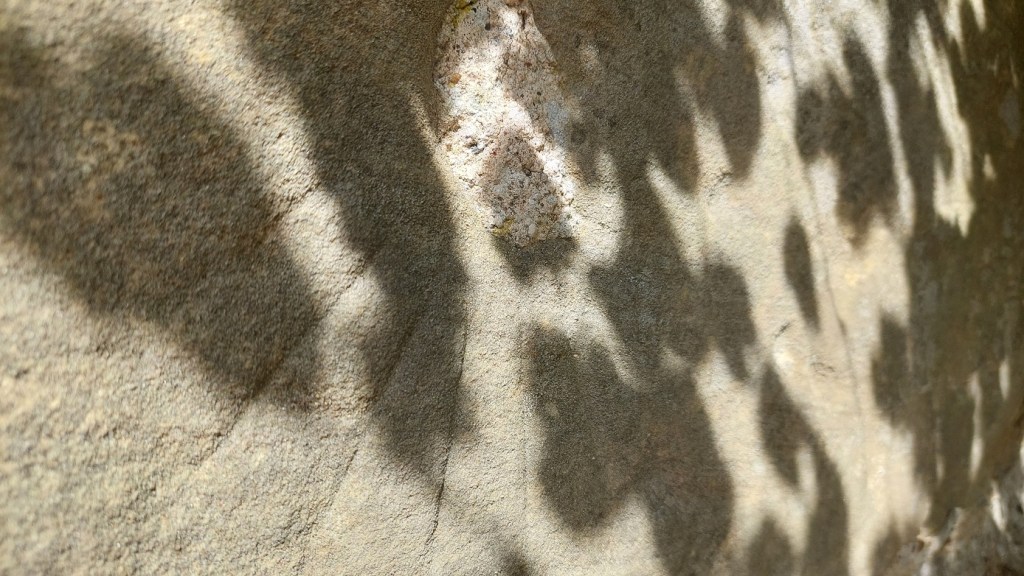
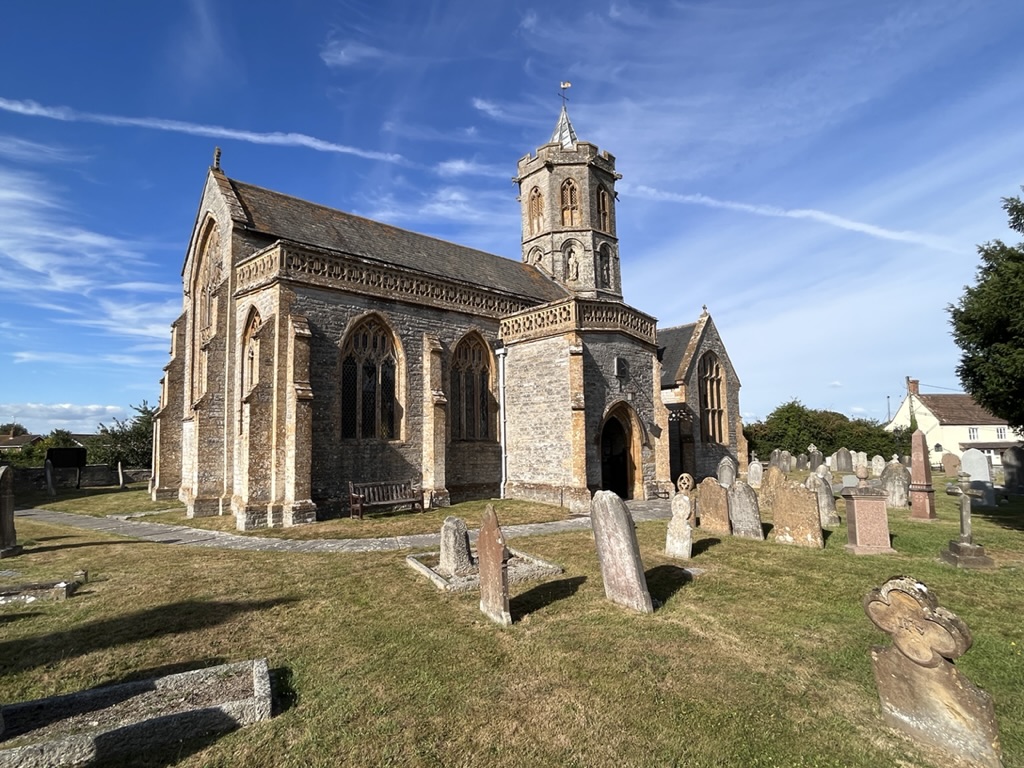
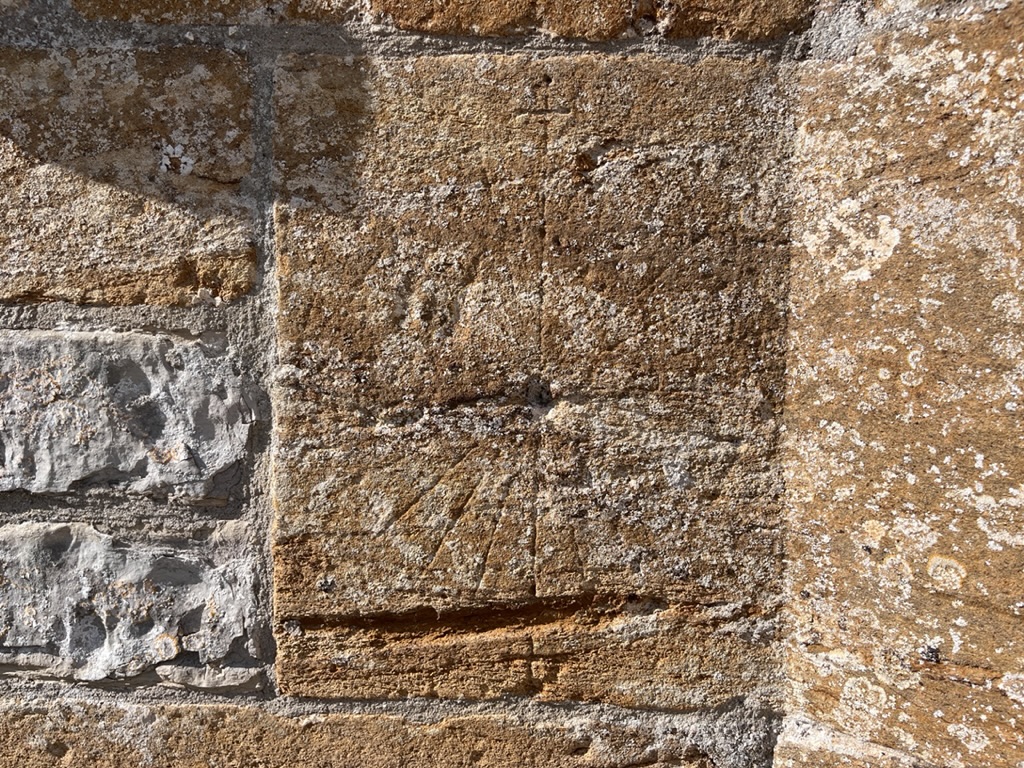
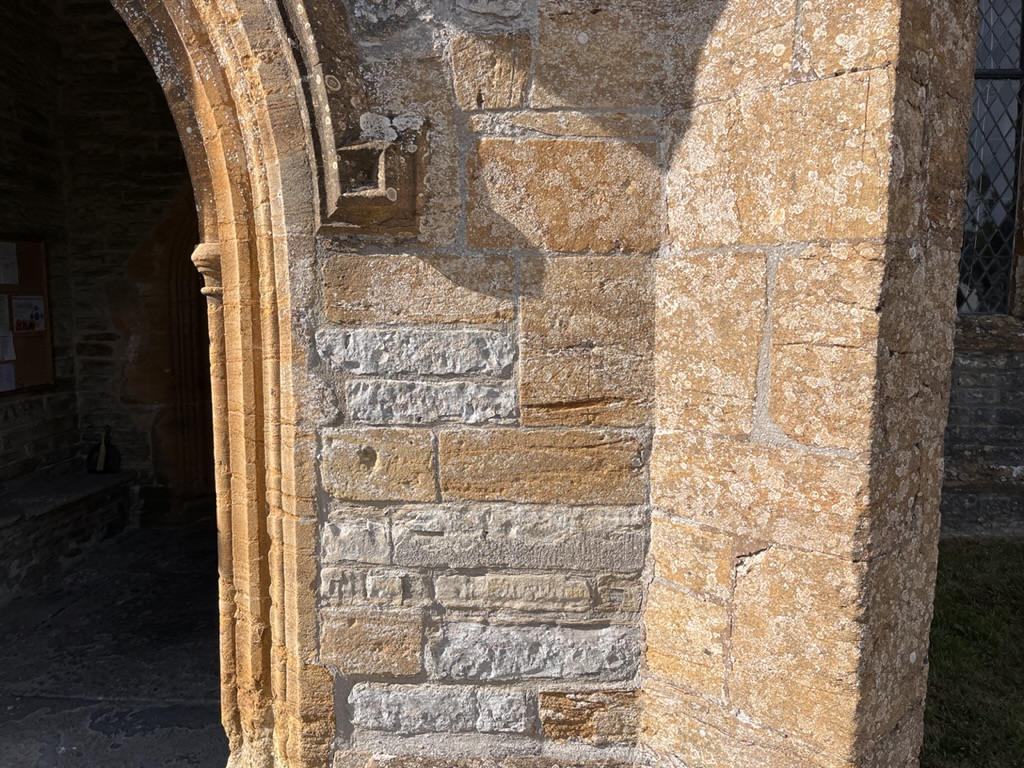
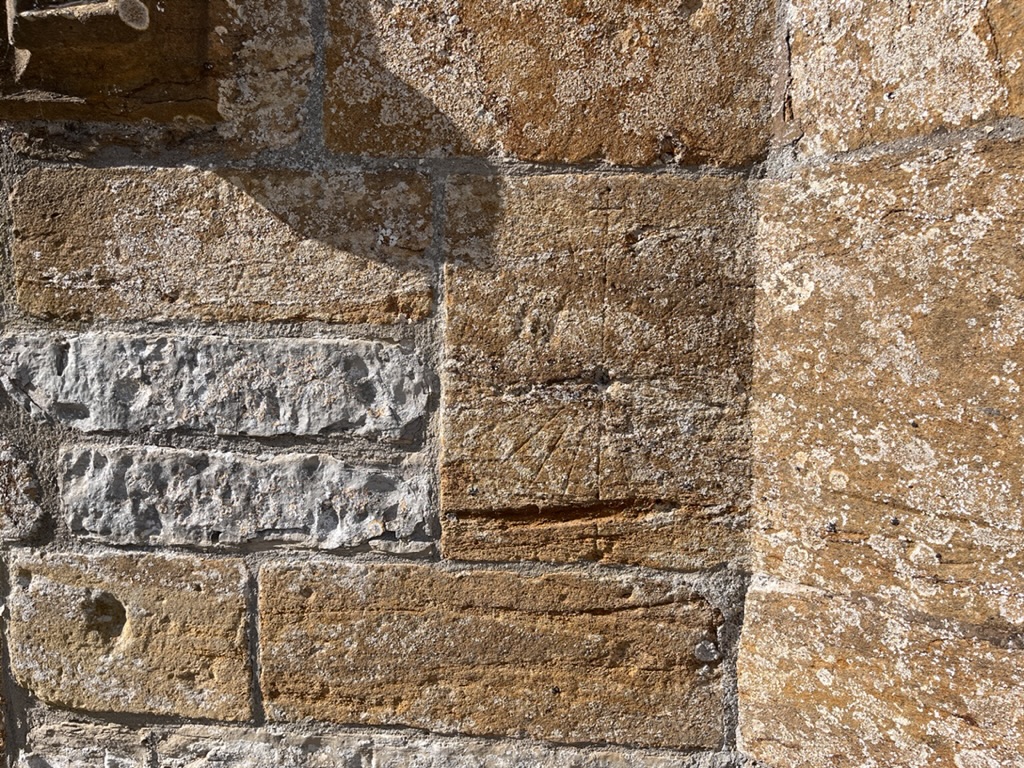
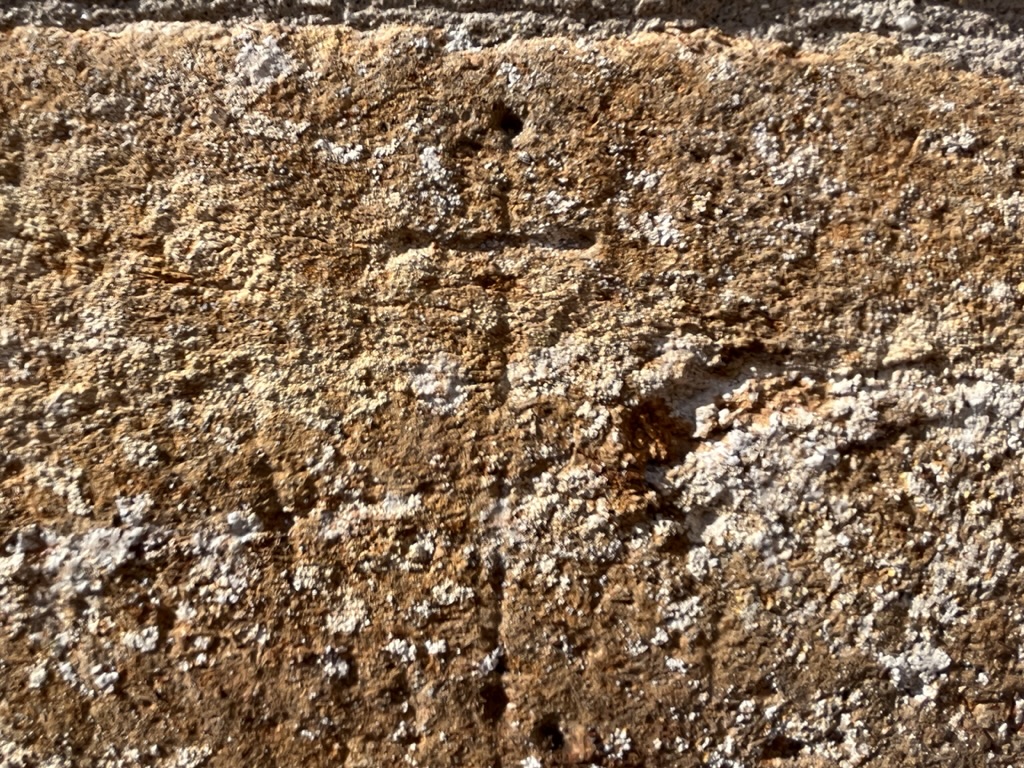
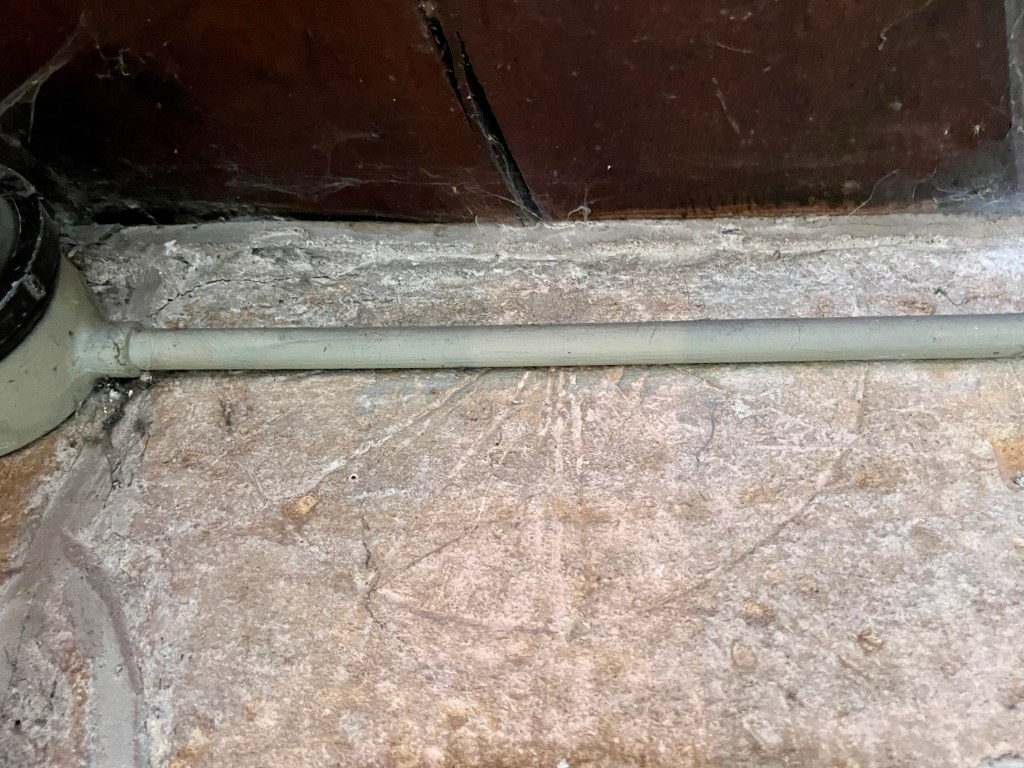
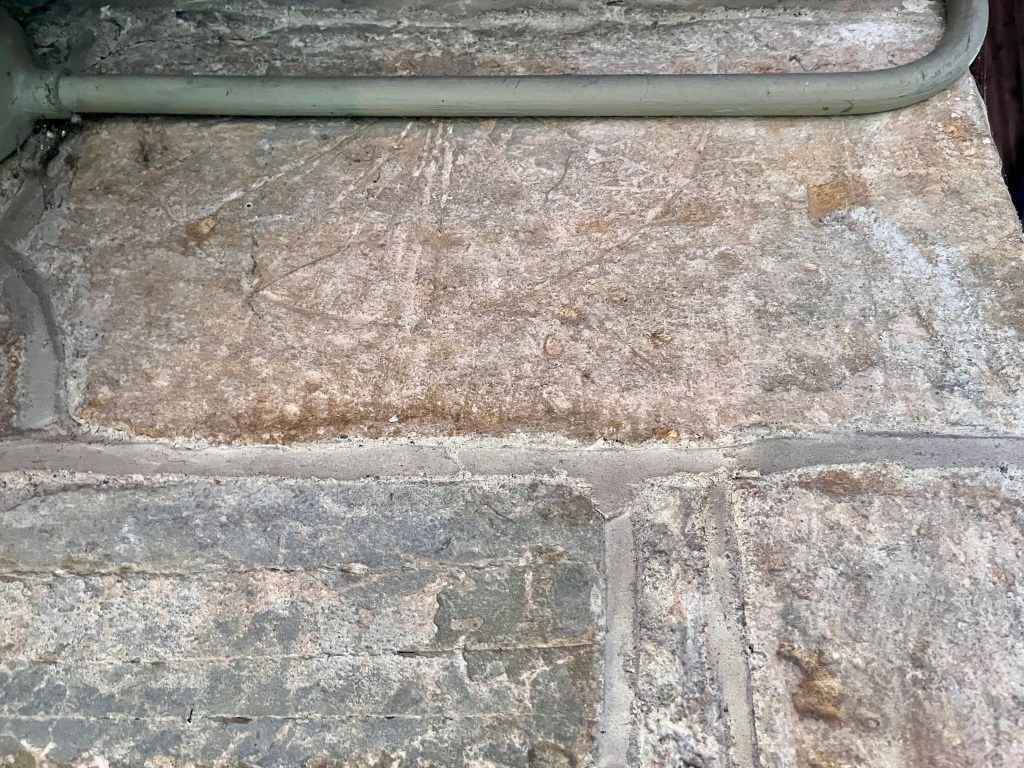
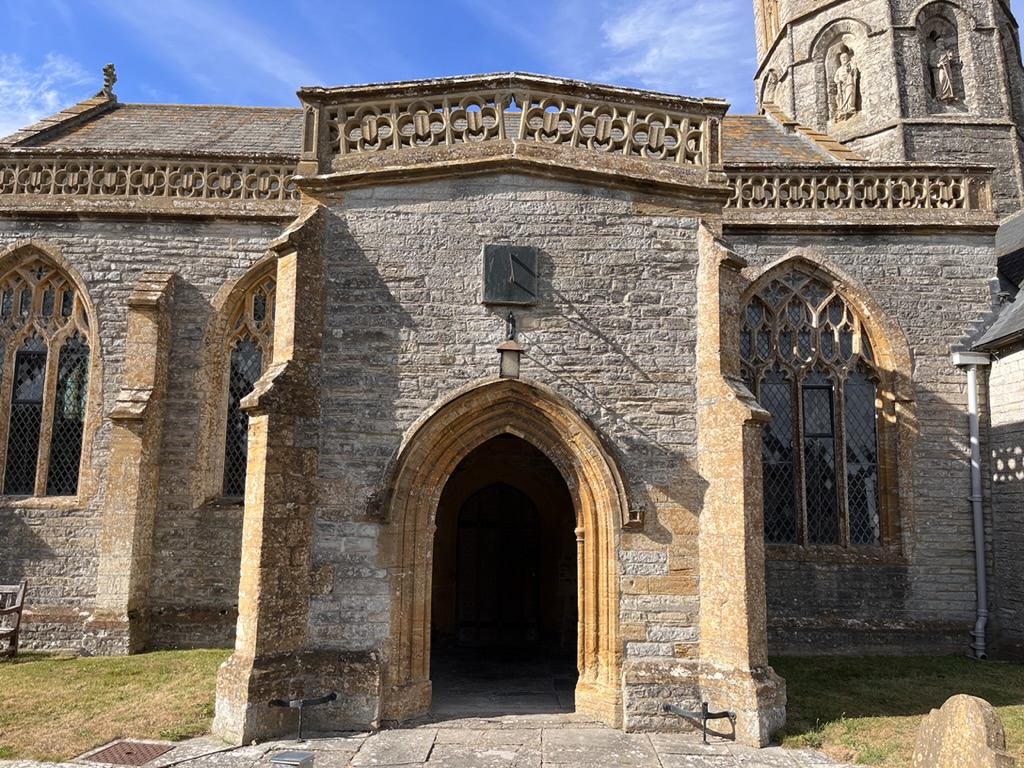
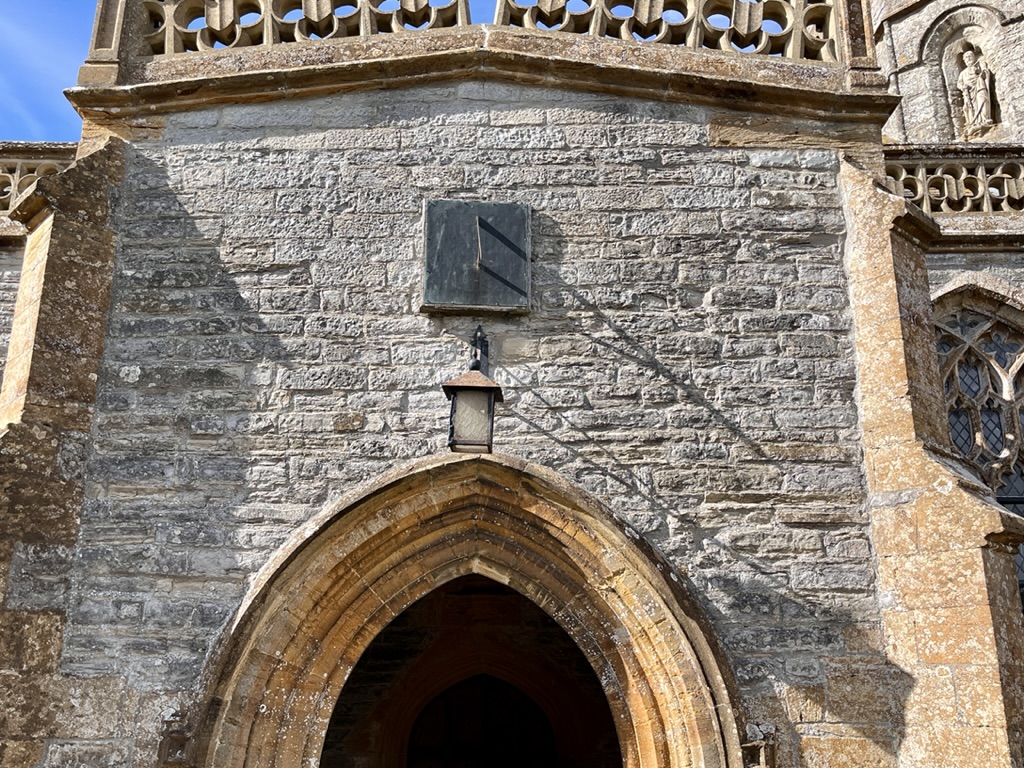
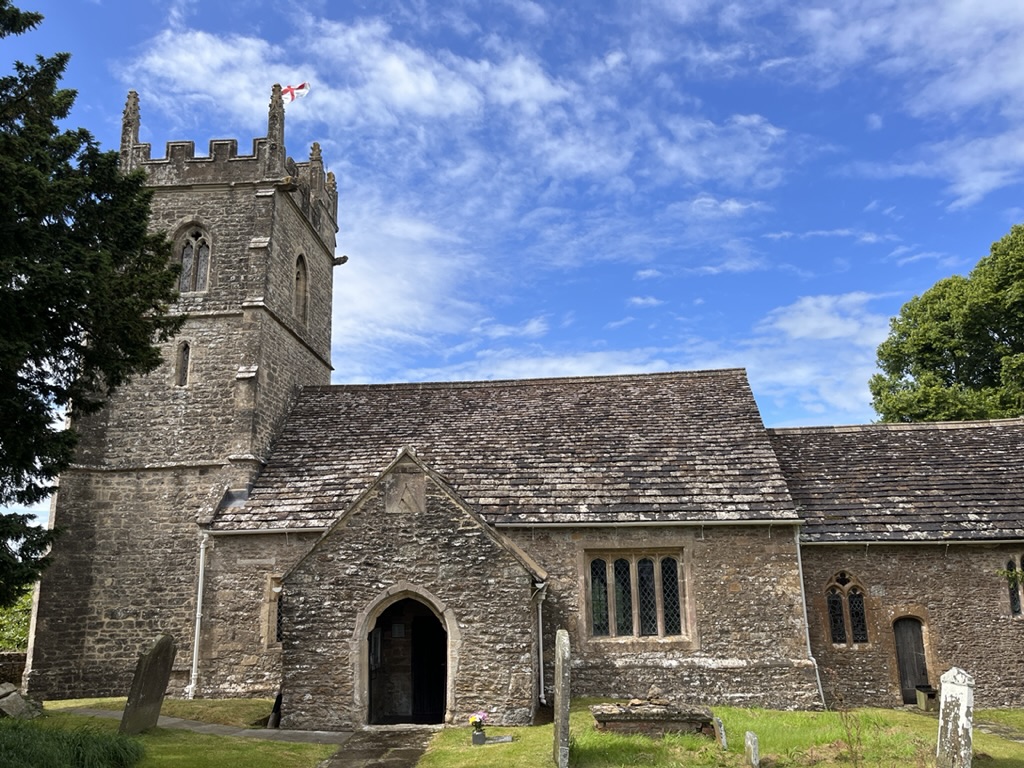
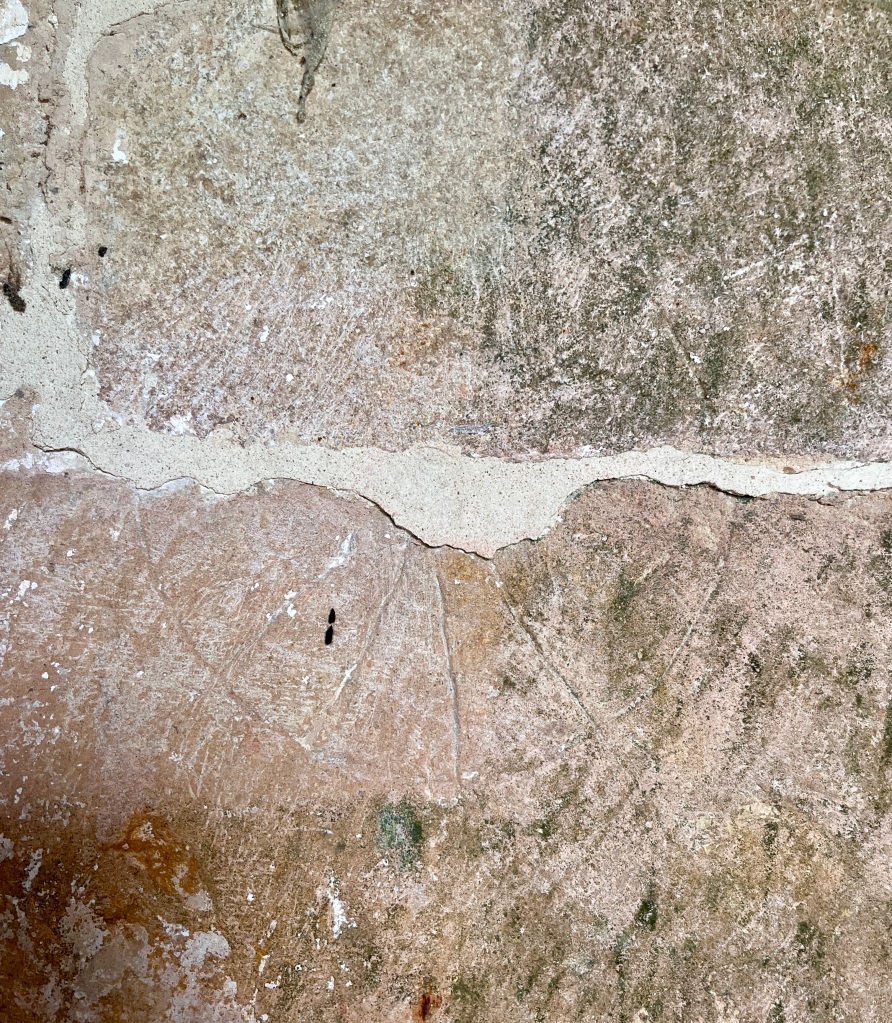
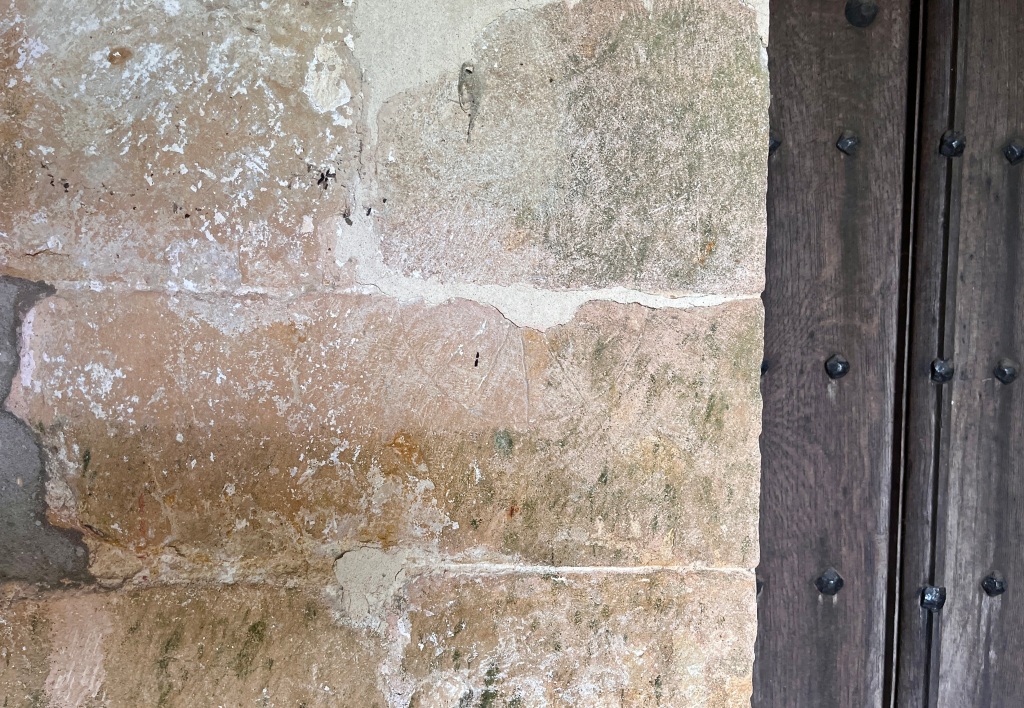
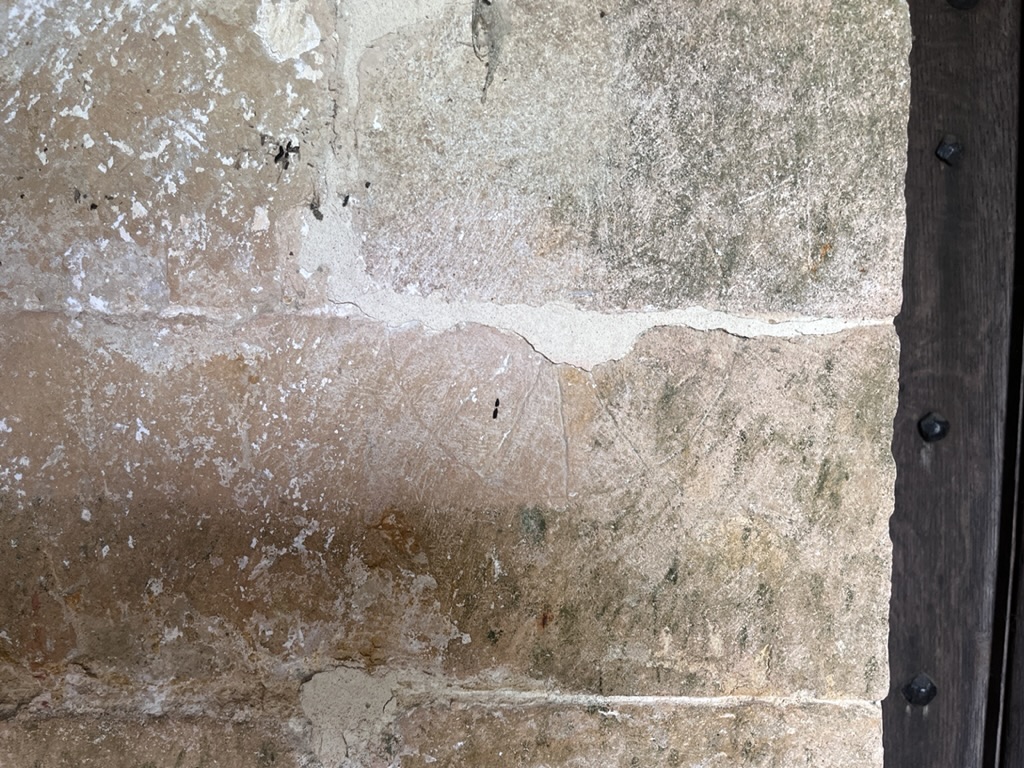
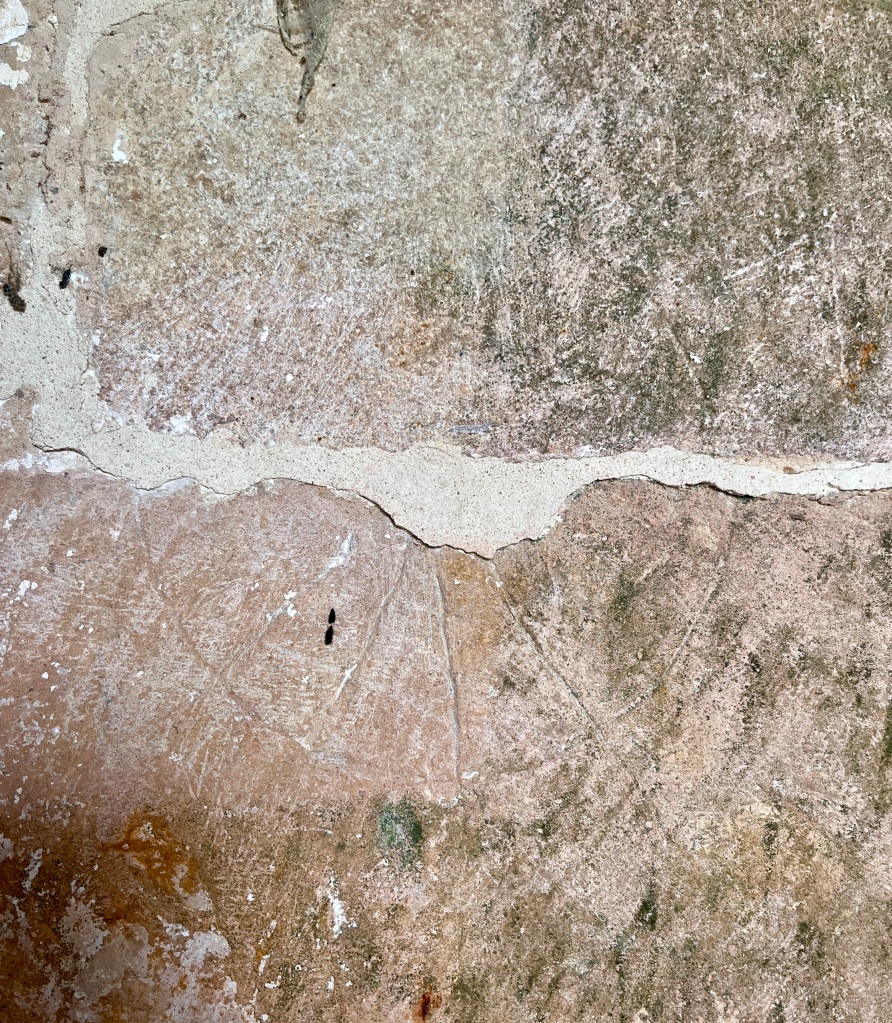
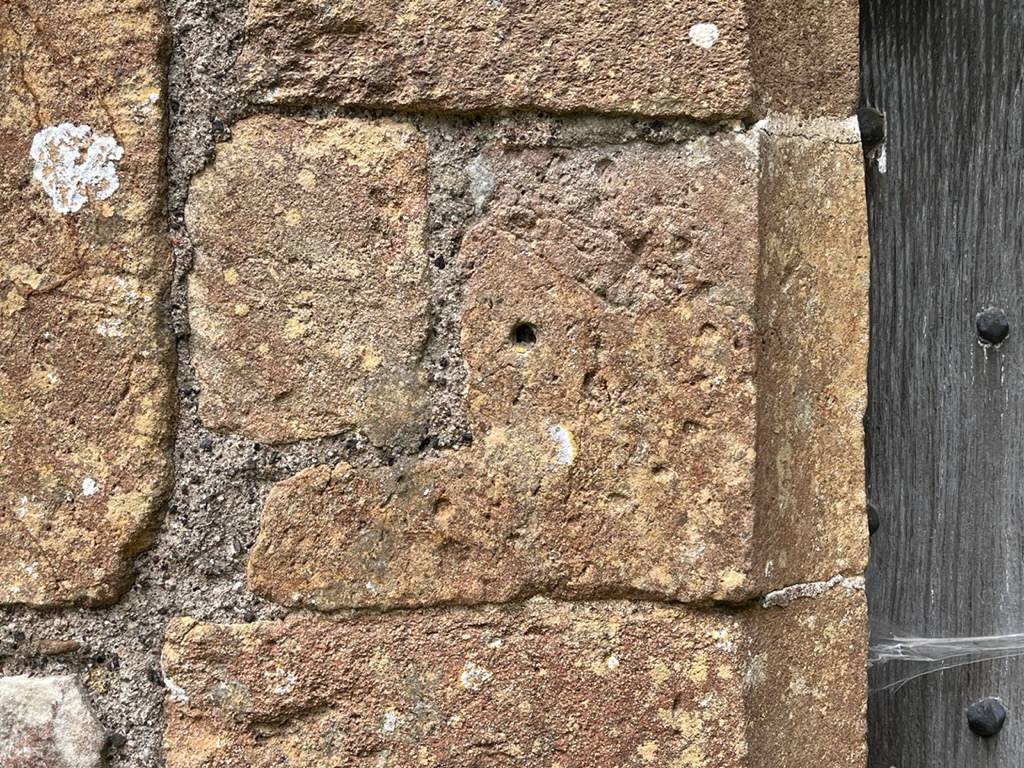
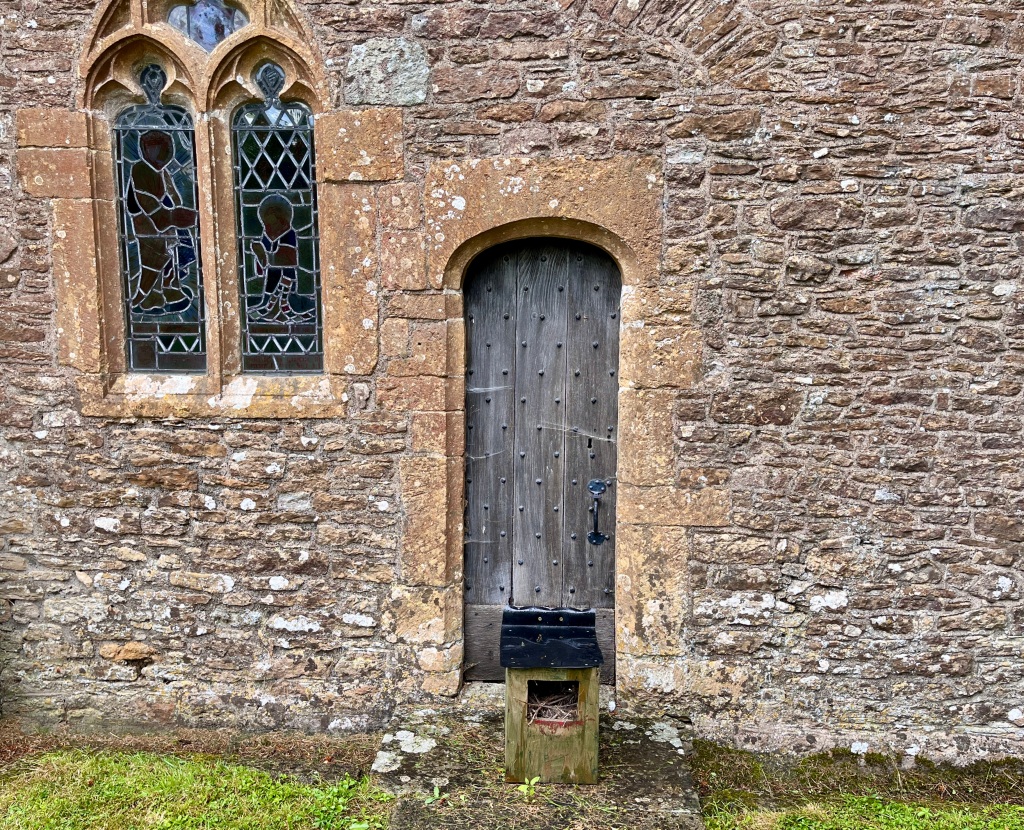
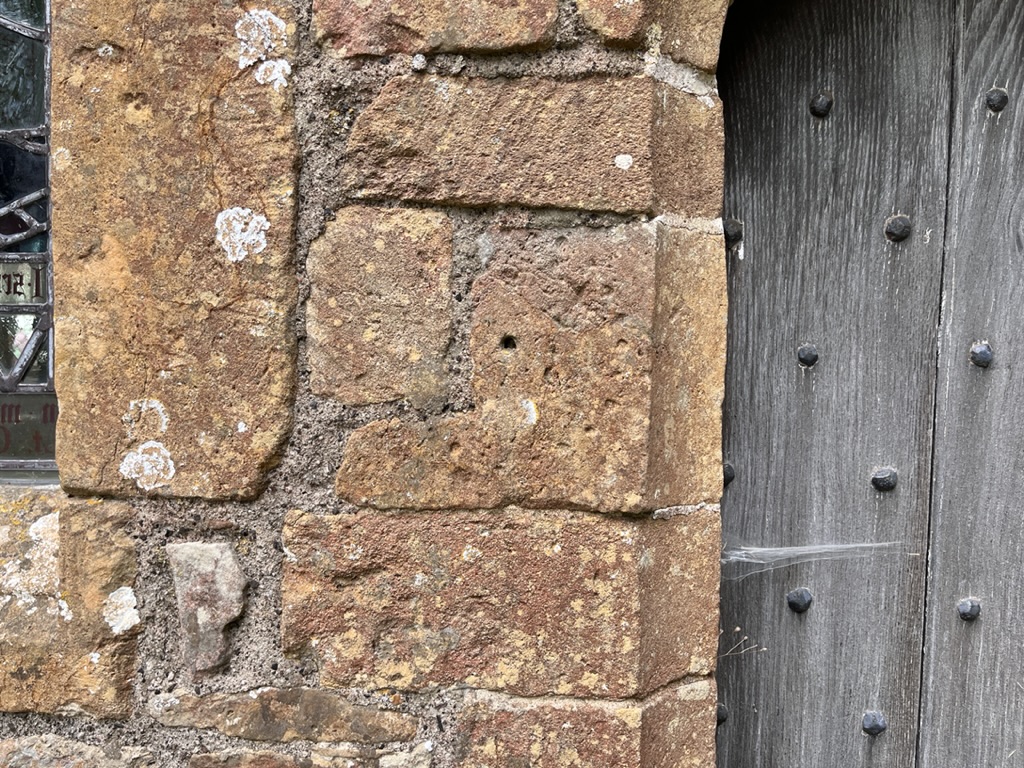
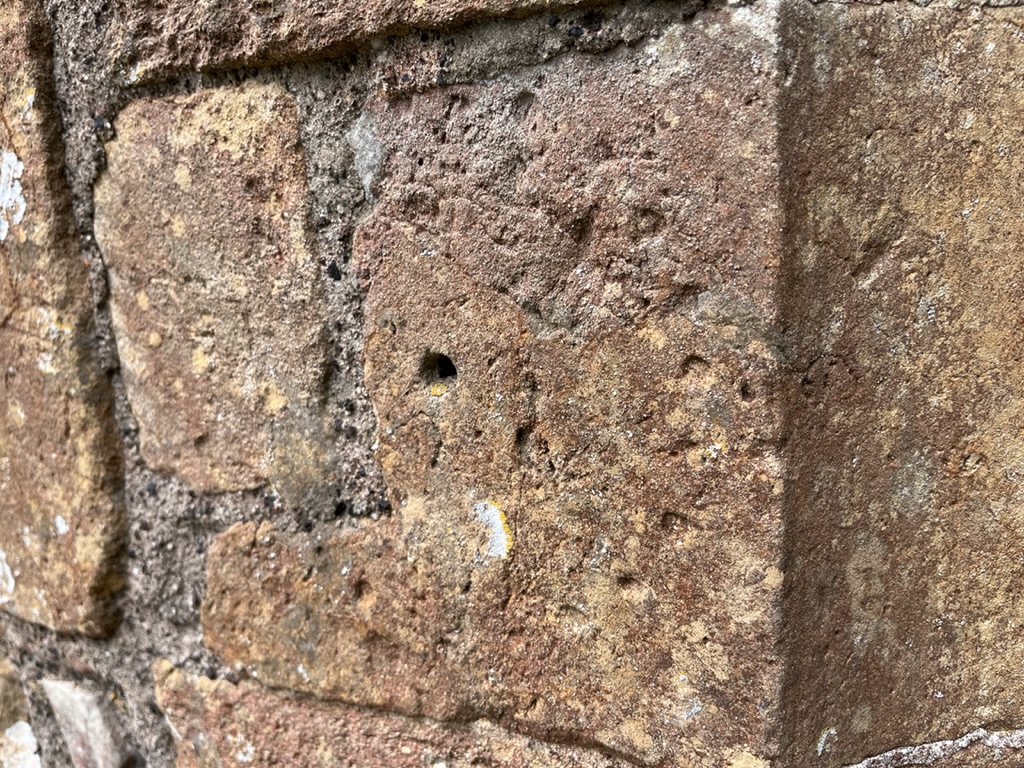
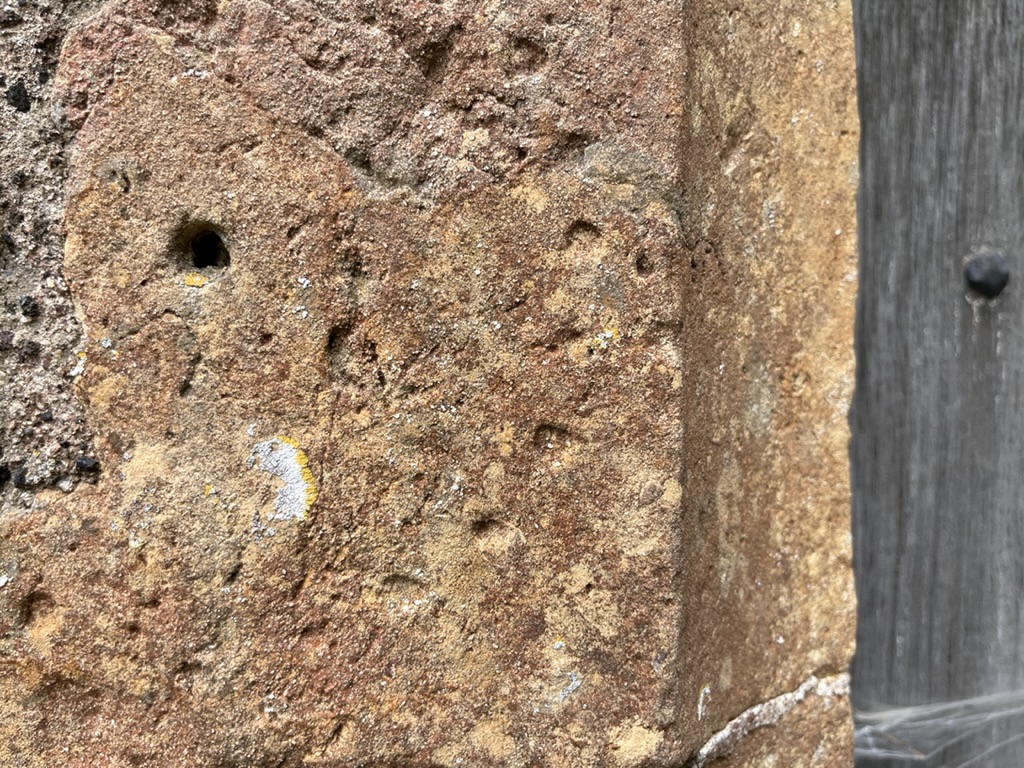
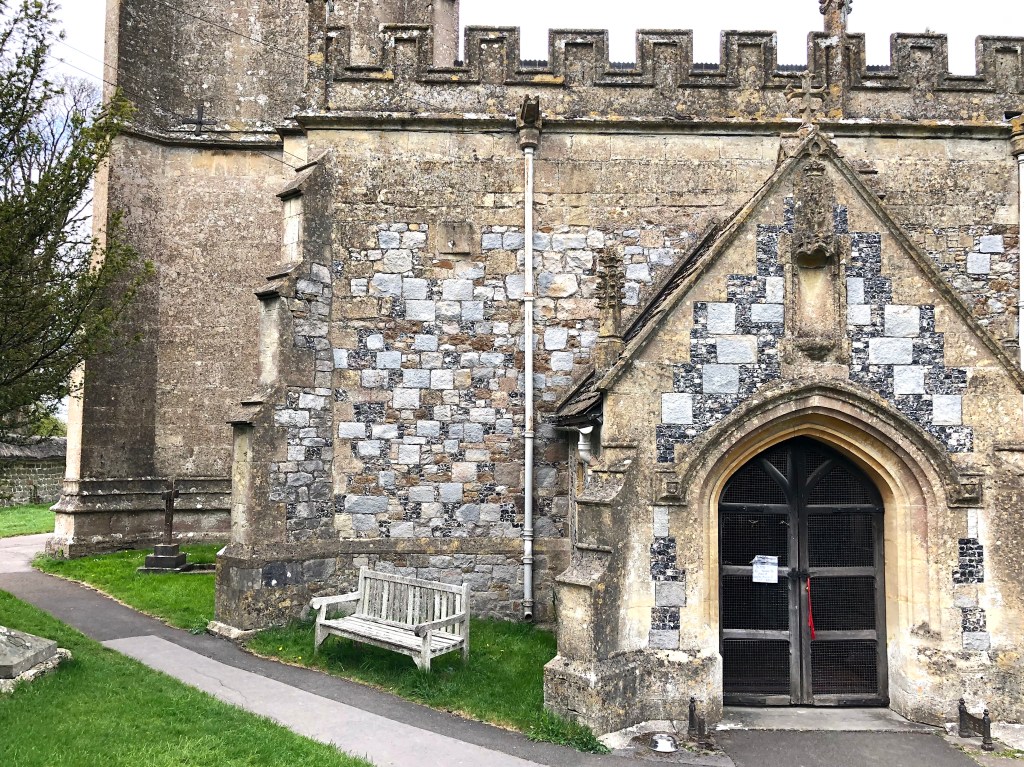
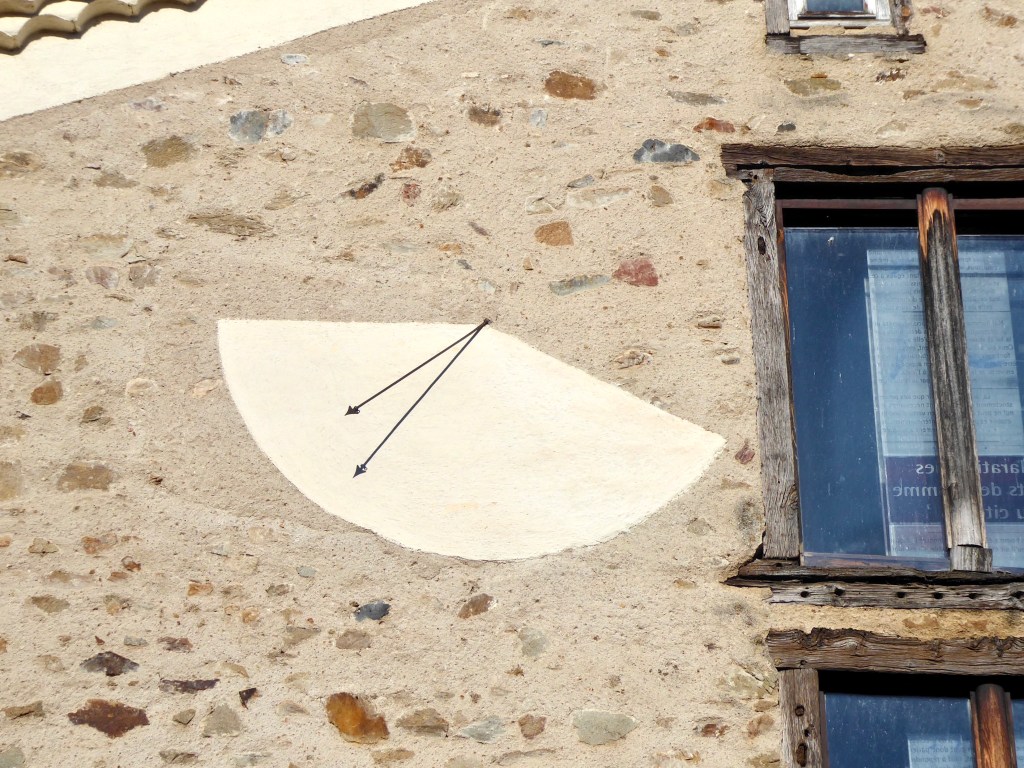
GRADE I † C12, C13, C15; C19 restoration. A pretty church with a 4-stage tower and short steeple, close by the Kennet & Avon canal. No discernible scratch dials though a likely-looking location. A single vertical dial, angled. 7 miles W of Hungerford. 51.3941 / -1.5828 / SU291661
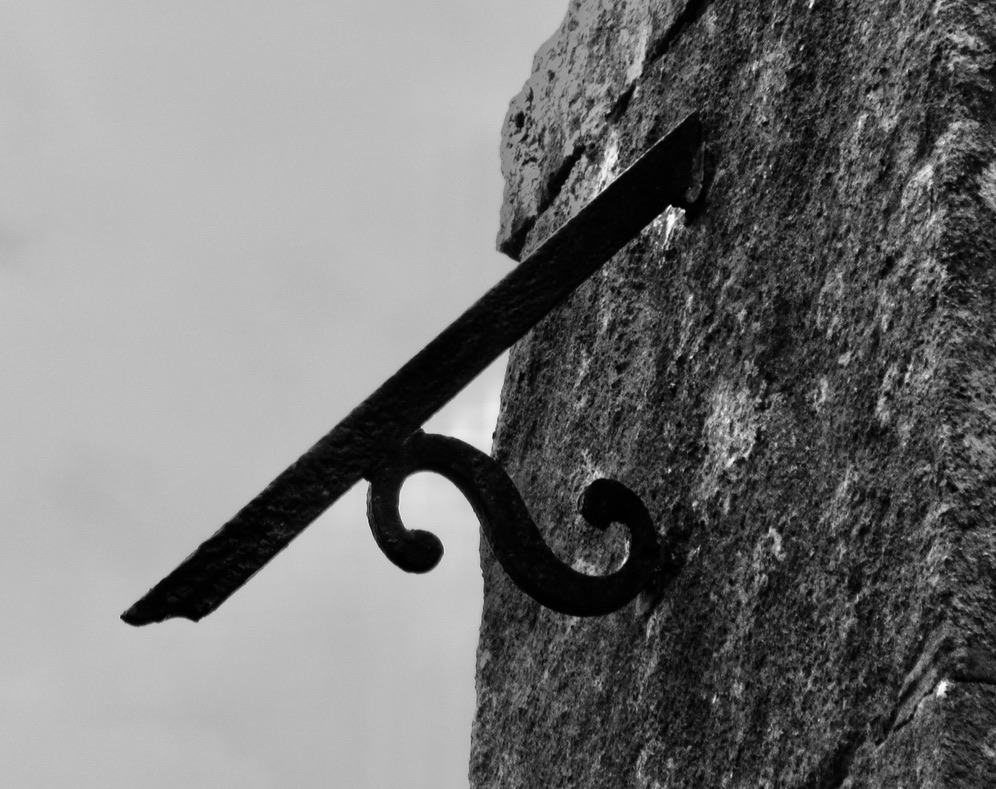
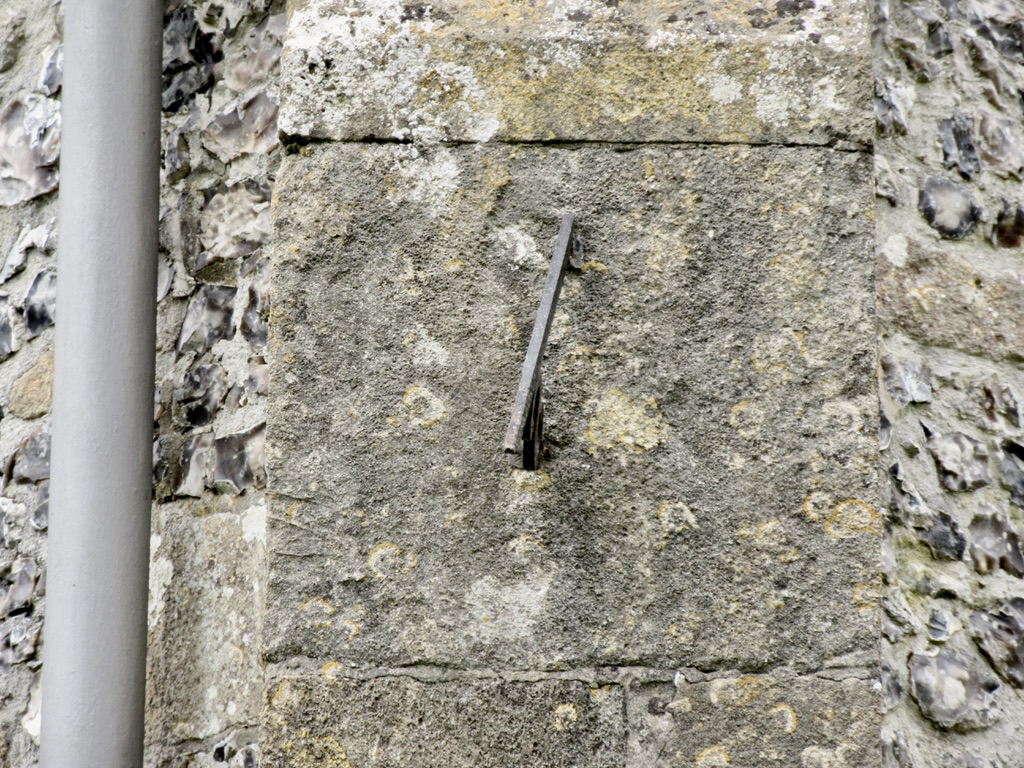
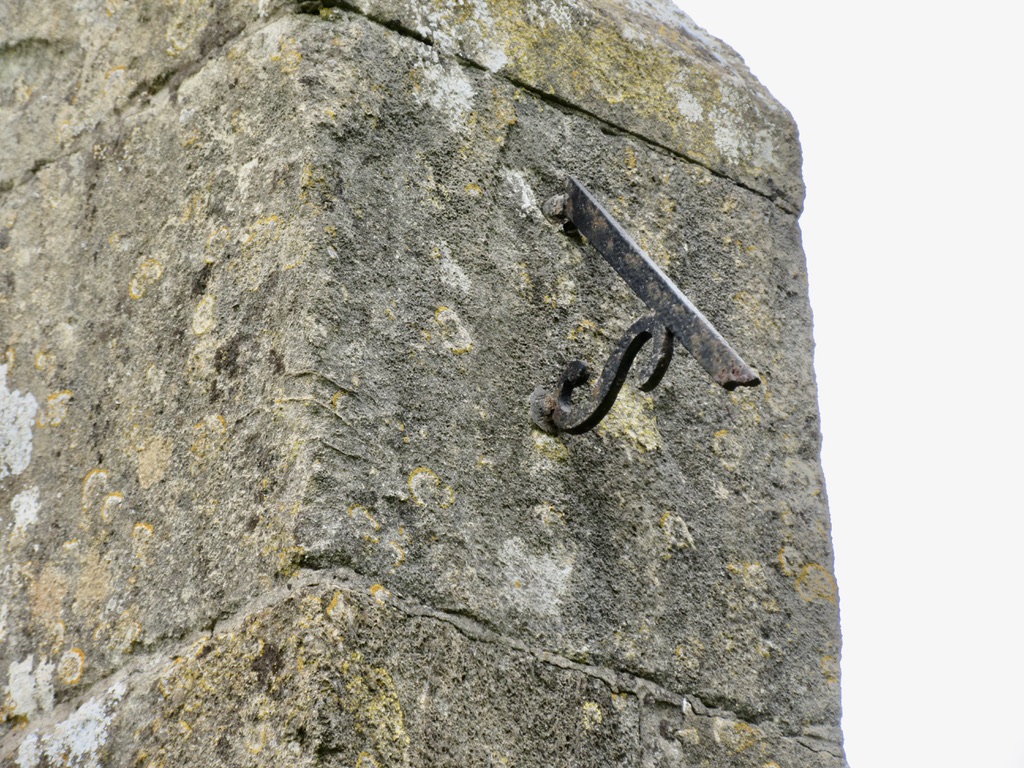
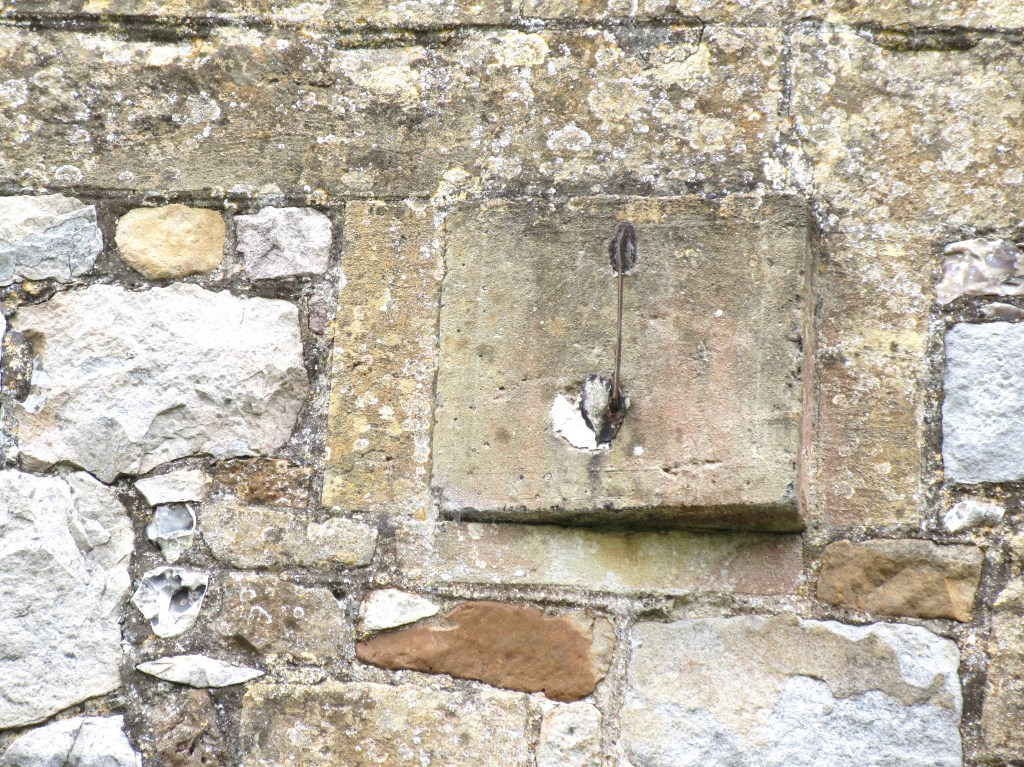
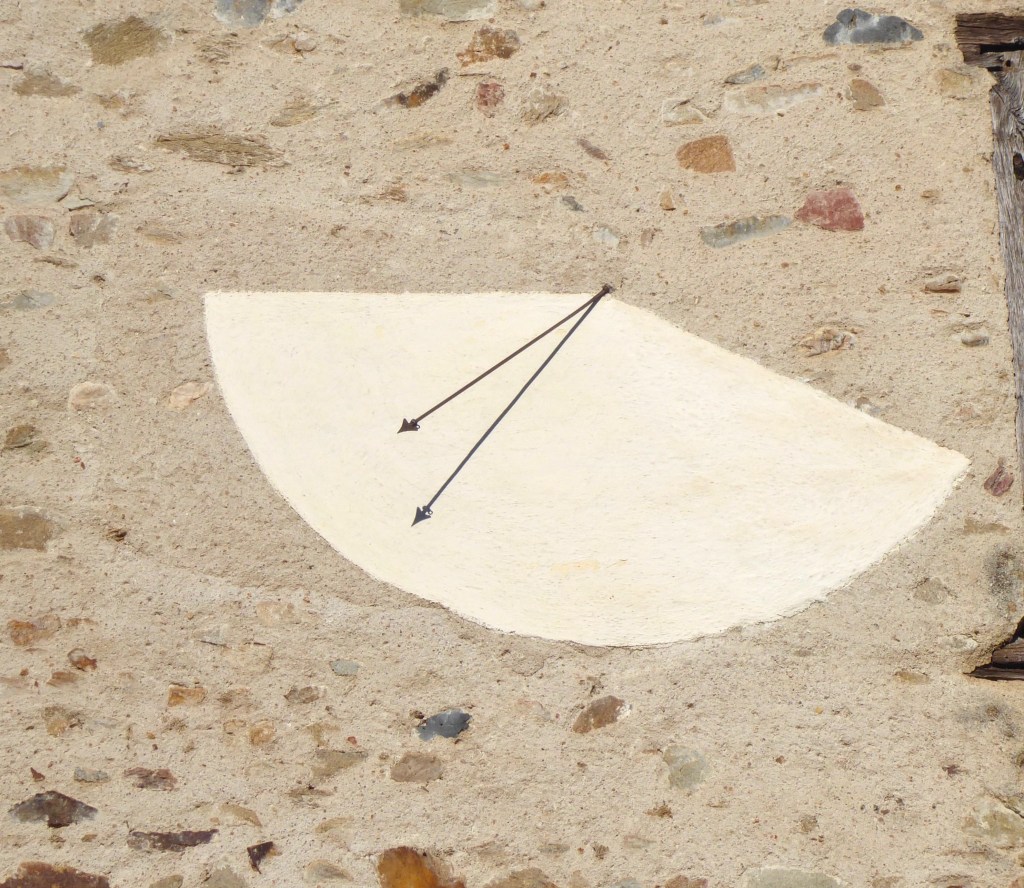
The dial is high up on a SE facing buttress, with an iron gnomon set into the stone. It has an S-shaped support. The face is completely plain, with no evidence of numbers, lines or a frame. Possibly it was originally painted. Hard to date, though the gnomon is plainly not original.
St Michael . Little Bedwyn . Wilts
Using a different camera sheds another light on the dial* and confirms the absence of markings
St Michael . Little Bedwyn . Wilts
*and demonstrates how 2 cameras, used at the same time, tell different stories
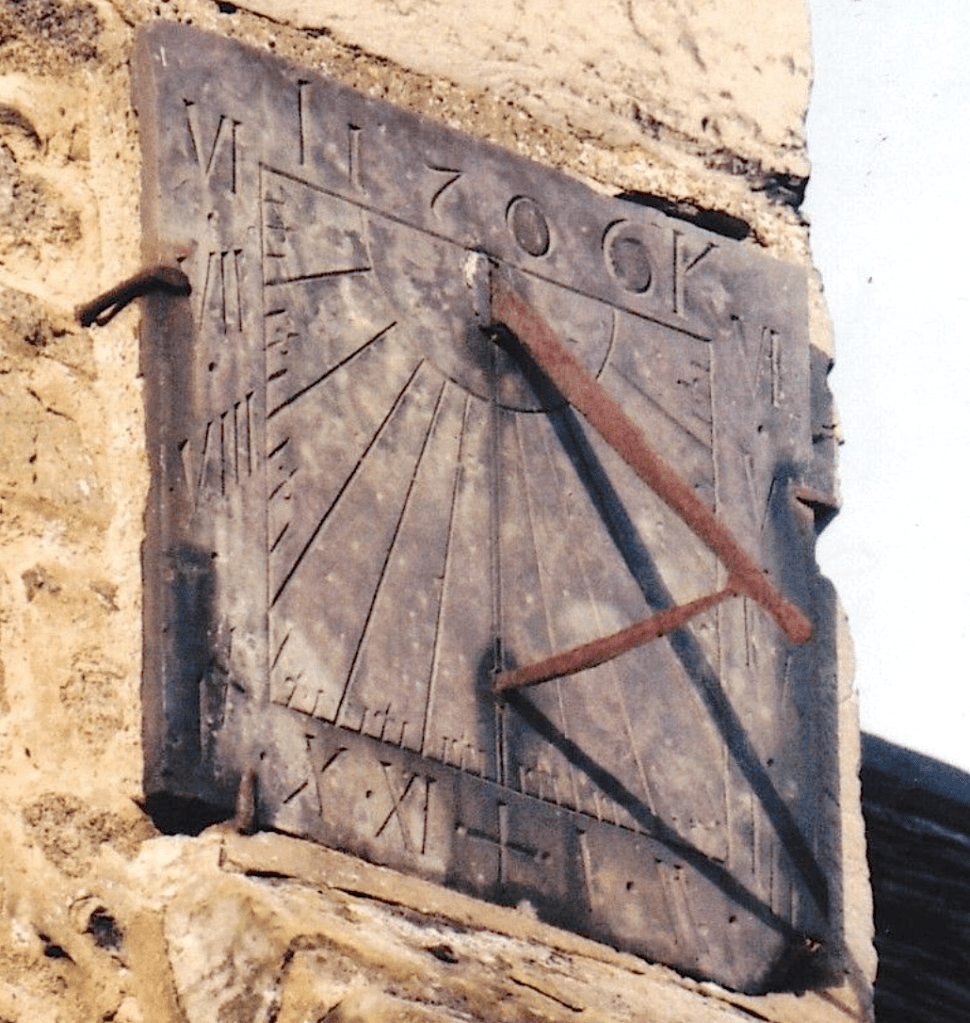
GRADE II* † C14 / 15 origins, with later / C19 enlargement. Besides 2 scratch dials there is a vertical dial on the tower dated 1706. 6m NW of Leicester. 52.6832 / -1.2292 / SK522097
DIALS
The scratch dials are both on the S side. One is on SW corner of the tower; the other on the lower part of the L jamb of a window (I don’t have a more precise location at the moment).
Dial 1 gives the impression of a spider, with legs radiating from the (blocked) gnomon hole in the centre of the dial stone. The clearest lines are at 11 and noon, the latter faintly extended. The others are rather randomly placed. There’s a line in the top L quadrant; and the hint of a line very roughly extending the noon line upwards. The 2 pocks don’t seem to be part of the design.
Dial 2 is more conventional ‘morning dial’, with 6 more or less evenly spaced lines descending (but not very accurately) from a large filled style hole. Only one of the lines is after noon. Simple and straightforward.
All Saints . Newtown Linford . Leics – Vertical Dial
Set on the SE edge of the second stage of the tower, close to the intersection with the roof of the nave. Slate, made by Thomas Woodcock in 1706. Deeply cut and in excellent condition for its age. Initials I K. Cross for 12 noon. Quarter hours marked. The angles of the Roman numerals are carefully graduated as they descend and ascend, suggesting the work of a skilled craftsman dial-maker.
BSS notes very similar dials at Breedon on the Hill and at Leicester, all three being within a few miles of each other.
All Saints . Newtown Linford . Leics – Vertical Dial
This interesting dial has been analysed and recorded in some detail by BSS:
The dial is fitted with iron dog nails to the south face of the tower, at the south-east corner, adjacent to the nave junction. The date 1706 is across the top, and being of the local slate, the dial is in remarkable condition for its age. Initials ‘I K’ are on each side of the date. Upright hours VI – + – IV – VI are aligned to the hour lines, which are drawn to a large semicircle around the gnomon root. Short lines mark the half hours, with fleur de lys or arrow heads, and quarter hours. The rusty iron bar gnomon has a straight horizontal support.
GSS Category: Scratch Dial; Vertical Dial
Photos of church and scratch dials, Erika Clarkson; vertical dial from BSS archive
GRADE I † Early C14, octagonal tower (cf neighbouring N Curry and nearby) completed C15. C19 restorations. BLB notes A very fine church, similar in design to Church of St Michael, North Curry CP but not so extensively restored in the C19. Admired by PEV. 12m E of Taunton. 51.04 / -2.9312 / ST348271
DIALS
Two dials are recorded for St Gregory, both of which merited additional comment by DEH. He recorded the first – remarkably decorative – on his visit in 1912. He revisited in 1916 and recorded the second dial, relocated to an obscure corner inside the church. In addition there is a (probable) 3rd dial, unrecorded.
DIAL 1
Dial 1 is on the E side of the S porch. It seems likely that there was originally a simpler dial that was embellished over the years. Although not all are now visible, it is reasonable to assume that there was a full complement of 24 lines.
DEH noted: this dial has been decorated. The noon line is lengthened outside the circle and ends in a small cross. This cross is plainly an addition. The noon line is also carried upwards above the circle and also ends in a cross. This cross may be original. The line throughout its length is true and clean cut, so that it may be part of the primitive dial.
DIAL 2
Dial 2 is a rare example of a scratch dial repositioned within a church during restoration / rebuilding (cf Thornford Dorset). DEH must, I think, have been told about it: under no normal circumstances would a dial researcher think of the location without a tip-off. Even knowing the right area, I didn’t spot it straight away.
DEH gives the precise location: This dial is within the church, on the w. splay of the easternmost window in the s. wall. It is on the top stone of the splay, the noonline is about 5 inches in length, and the stylehole, which appears to be an inch in diameter, is filled with plaster. DEH
The dial is a semicircle that looks as though it may originally been a full circle cut across 2 stones. The visible lines are mostly before noon. The noon line is possibly marked as the narrow gap between 2 almost vertical lines.
DEH noted: This dial is the only one that has been found inside a church. It was obviously placed in its present position at the time the late XV century window was inserted, and must have been brought from some other part of the building.
DIAL 3
Found on a buttress W of the porch. I have little doubt that this design is a dial, previously unrecorded. It is at least partly encircled, with 2 close candidates for style hole. There are several pocks that are somewhat random now but seem to have been deliberately made (and are not seen on adjacent stones). It seems convincing to me as a somewhat age-worn remnant.
VERTICAL DIAL
As plain a dial as you could wish to find, yet casting a strong shadow. BSS view is that it dates from the 1880s restoration and it doesn’t look as if the dial has been touched since then! It’s worth pointing out that (as the photos show) the lamp bracket works as effectively as the dial itself.
GSS Category: Scratch Dial; Mass Dial; Vertical Dial
GRADE II* † C13 (with earlier record), gradual development. An attractively simple and harmonious country church. A slightly canted C20 vertical dial over the doorway (see below). Not an easy church to find – it is not where the signposts suggest (you may end up in Barrow). There’s a sign to St Stephen at the Wincanton end of the racecourse. 51.0678 / -2.4008 / ST720299
DIALS
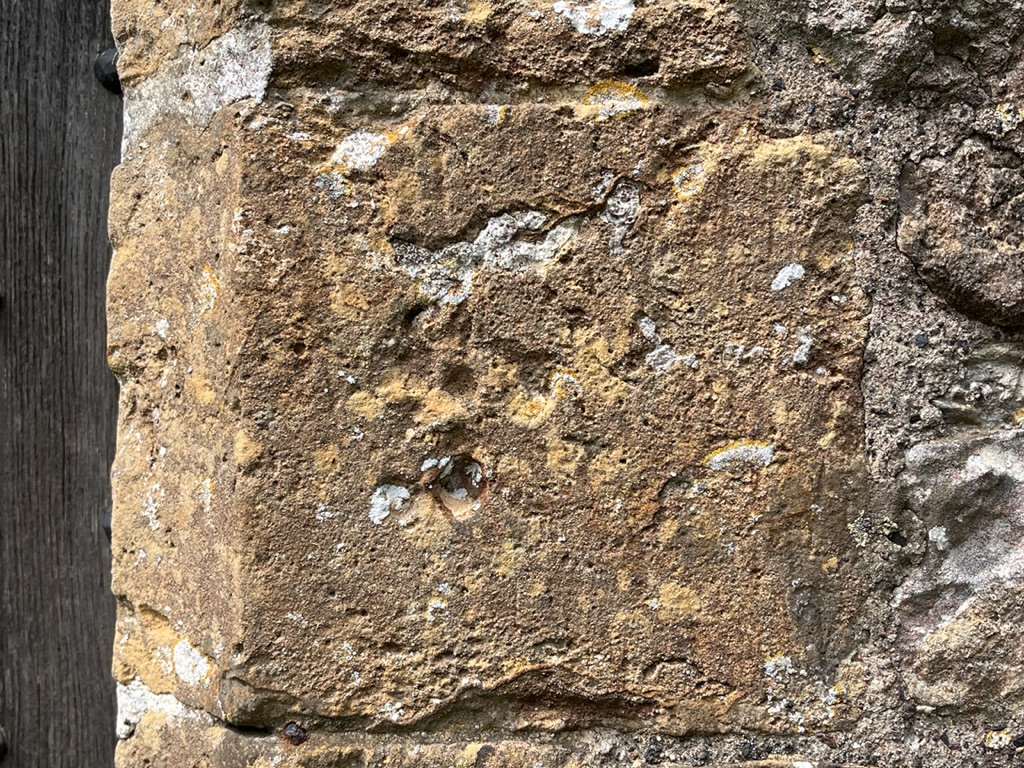
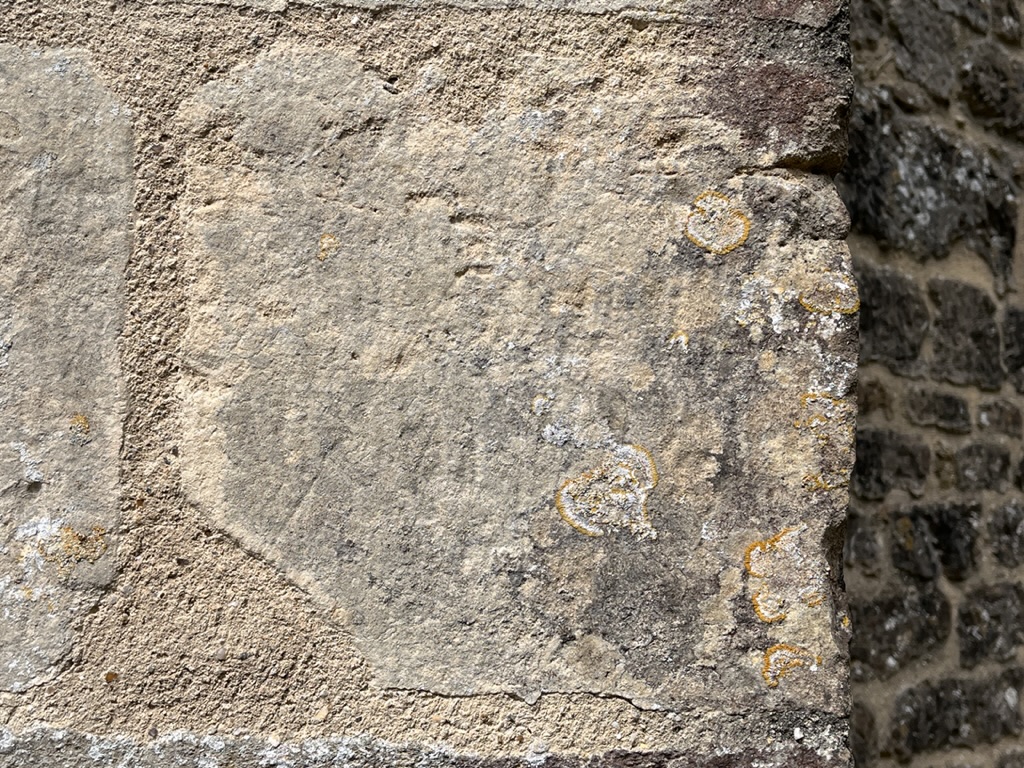
There is one scratch dial recorded for the church by DEH who visited in 1914, on LHS of the inner original doorway of the later added S porch. St Stephen is yet another S Somerset church, within a small radius, to have an inner dial. There is a second previously unrecorded dial, a completely different design, on the W side of the Priest’s door. The vertical dial is also shown below.
DIAL 1
DEH: This dial is on the e. side of the inner door of the s. porch. It is 5 feet 6 inches above the floor, the noonline is 2 inches in length, the stylehole, which is in a joint, is filled, and the aspect is due s. Type 2. April 17th, 1914.
St Stephen . Charlton Musgrove . Somerset – Scratch Dial 1
Dial 1 is quite large and half hidden by a prayer board that I briefly relocated. It is cut on 2 stones, with the gnomon hole in the mortar line between them. It is encircled with a complete circumference, the upper half having neither radials or dots. The horizontal / mortar line / gnomon hole must have been damaged, with later extensive repair across the middle of the dial.
St Stephen . Charlton Musgrove . Somerset – Dial 1
There are only 4 visible lines, none straight (in contrast with the accurate circle). The angles are roughly equal. The 2 a.m. lines (L of the noon line) terminate on the circumference. The single p.m. line extends some way beyond the circle; the noon line much more so, plunging downwards almost to the stone below. This feature is found even more dramatically at HOLTON 4m W
St Stephen . Charlton Musgrove . Somerset – Scratch Dial 1
DIAL 2
St Stephen . Charlton Musgrove . Somerset – Scratch Dial 2
Dial 2 is on W side of the priest’s door and features a ring of pocks with no lines at all. Judging from the position of the style hole in the centre (approx) of the dial stone, and the curvature of the dots, the dial was presumably a complete circle originally. The upper L quadrant must have been damaged at some time and at some stage replaced by the smaller stone, with additional mortar to make the fit. Most of the dots are quite clear, a few are not: certainly 12, possibly a couple more.
St Stephen . Charlton Musgrove . Somerset – Scratch Dial 2
DOUBTFUL DIALS
The first pattern below is on the E side of the Priest’s door, at the same height as Dial 2. It would not be unusual to have this arrangement. It is in some ways dial-ish but I can’t take it further. I tried inverting (reverting?) the image but to no great effect. The second scratching was worth a closer look and although I’ve seen similar ones counted as dials, this one isn’t very plausible.
ST STEPHEN . CHARLTON MUSGROVE . VERTICAL DIAL
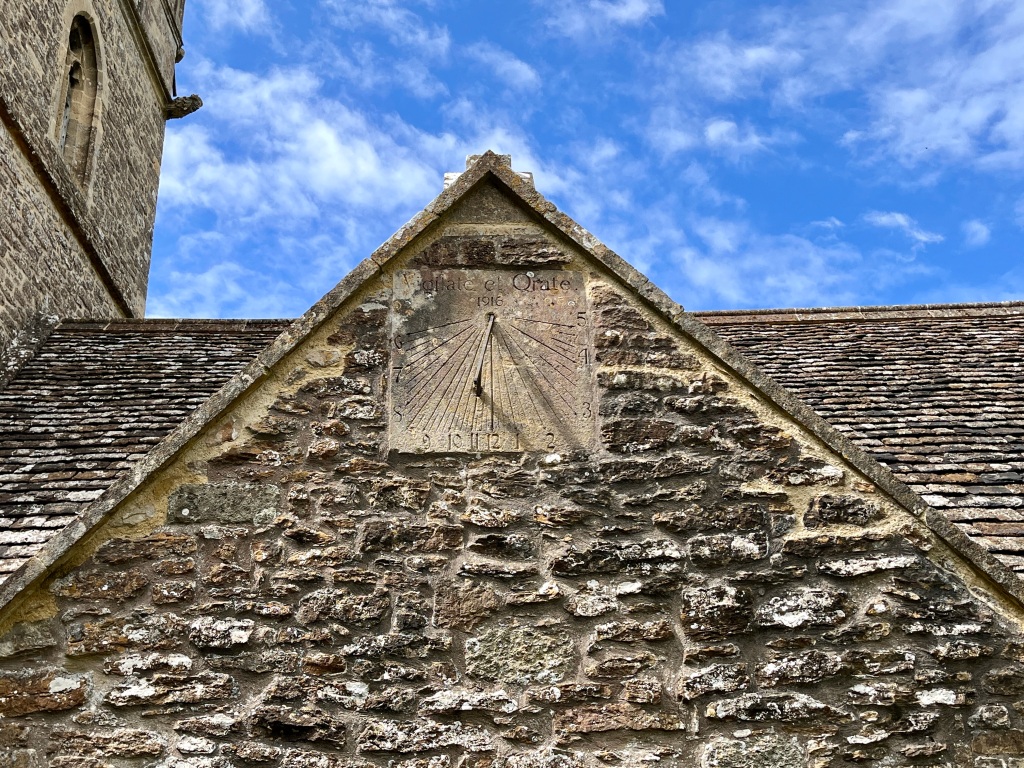
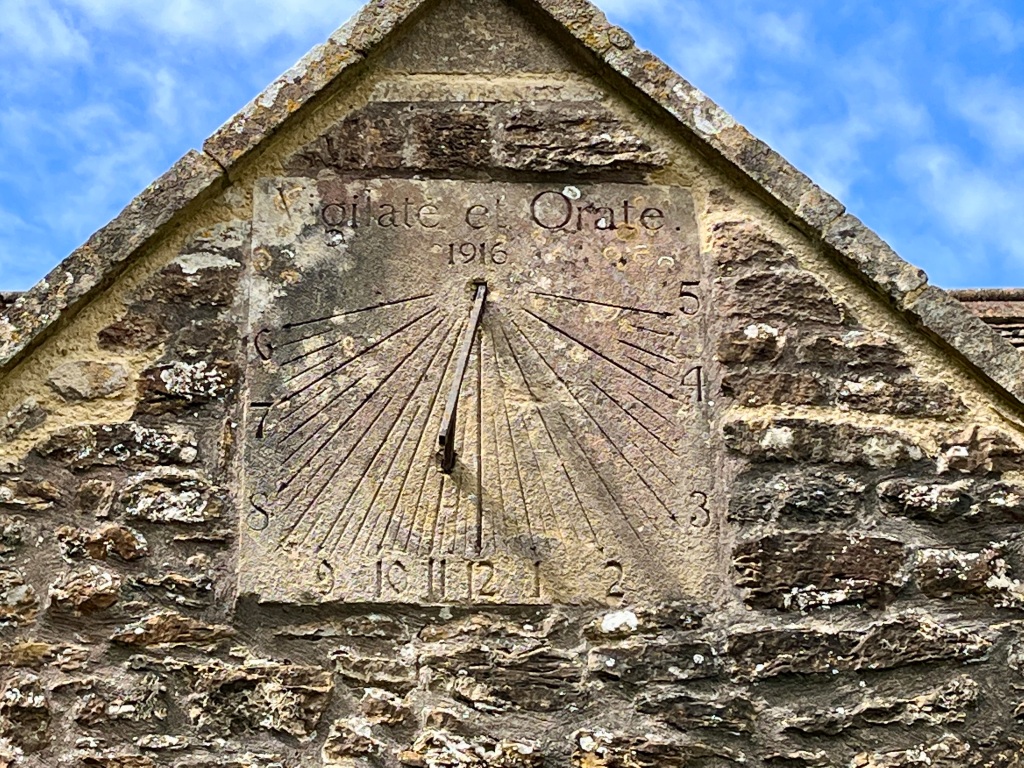
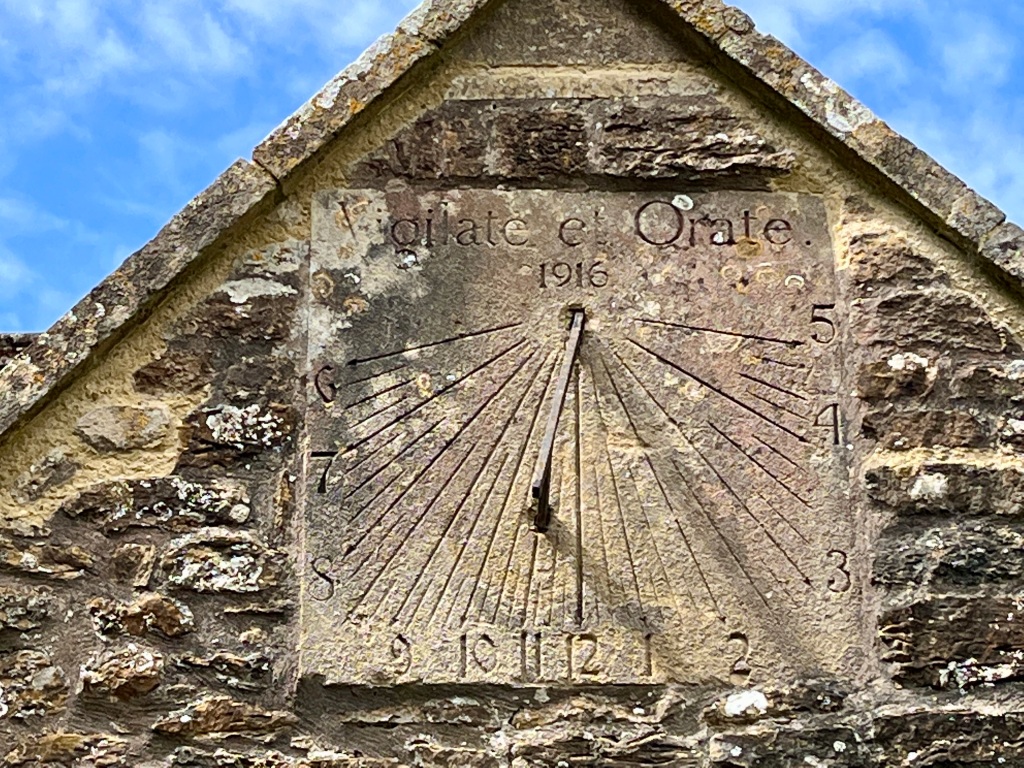
A modern dial dated 1916 set into the apex of the porch with the inscriptionVigilate et Orate (Watch and Pray). The dial shows hours, half-hours, and quarter-hours. Each hour line ends in a small arrowhead. The dial stone is slightly canted and the footing of the gnomon is on the 11 line for accuracy. The noon line is emphasised with a deeper incision.
GSS Category: Scratch Dial; Modern Dial All photos: Keith Salvesen
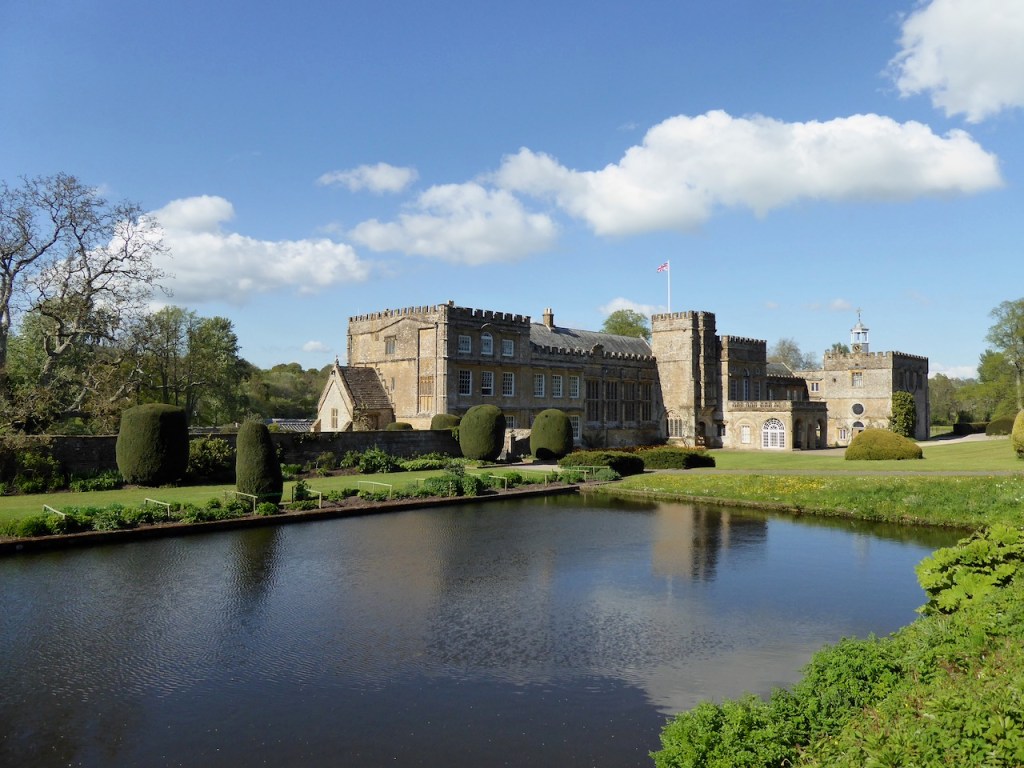
GRADE I † Cistercian Abbey dating from C12, becoming a fine stately home C17 with beautiful gardens and landscaping. Near Chard. 50.8434° N, 2.9113° W
DIAL 1
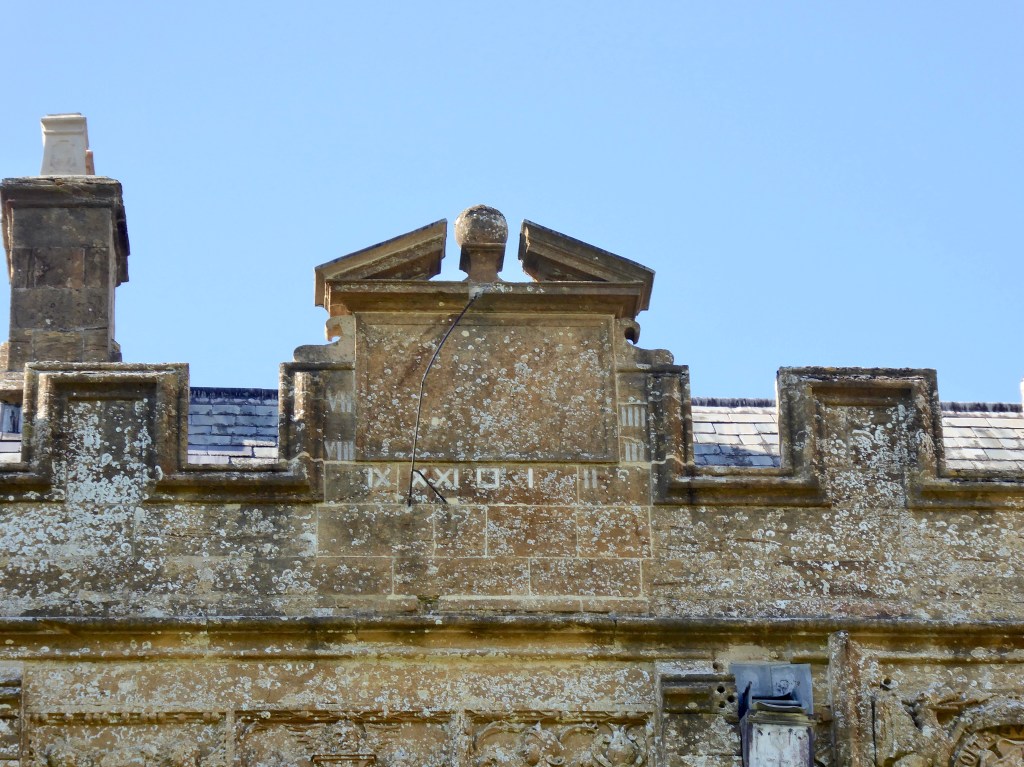
Dial 1 is prominently in the centre of the parapet, crowned with a broken pediment and ball. It has been dated late c17 or early c18. The spindly gnomon has been considerably bent to make the dial as accurate as possible (and see dial 2), given the orientation of the building. At some time, the top end has had to be re-fixed into the stone.
BSS records as Located in roof line castellations. An apparently blank dial plate with painted numbers on the stonework outside – possibly a later innovation. Upright white sans-serif hour numerals VII – IIII. Noon is marked with a square box and 4pm as IIII. Long thin rod gnomon with unusual support formed by a second rod to the tip, itself with a short stay near its foot. Declination is E.
FORDE ABBEY. DORSET: PARAPET SUNDIAL
DIAL 2
Dial 2 is located high on a tower, in effect at right-angles to dial 1. It is basically all gnomon and no actual dial face. I haven’t seen a large spindly design like this before. Although it has a rather home-made look to it, the design and positioning must have been carefully calculated, As with dial 1, the orientation of the building necessitated a corrective angle in relation to the sun’s movement. The shadow cast by this rather intriguing ‘gnomon sundial’ seems completely adequate for marking the passage of the day even without additional markings.
Some time ago I wrote about the intriguing scratch dial rather hidden away through a low archway at the E end of the church: LONGBURTON SCRATCH DIAL 1
DIAL 1
St James the Great . Longburton . Dorset – Scratch Dial 1
The village is better known dial-wise for the vertical dial on the S-facing tower buttress (see below). Yesterday I went back to look for apotropaic and other church marks, and to my surprise found an excellent conventional sundial hidden in plain sight and hitherto unrecorded. I can’t think how I – or any dial gatherer – would miss it…
DIAL 2
The previously unrecorded dial is near the base of the same buttress as the vertical dial. There are 4 lines, the more clearly cut noon line being longer and reaching the edge of the dial stone (and possible trace of extension onto the stone below). The angles are almost equal. There is the distinct trace of a circle in around the top half, but strangely the gnomon hole would not be at its centre.
St James the Great . Longburton . Dorset – Scratch Dial 2
St James the Great . Longburton . Dorset – Scratch Dial and Vertical Dial, Tower Buttress
VERTICAL DIAL
The dial is high up on the buttress of the tower, and nearly as wide. It is quite eroded, esp. RHS. The lines are contained within a frame, and half hours and some quarter hours are also marked.
BSS notes Triple dot motif at head of half hour lines. Gnomon formed from iron strip with supporter. Supporter is detached at contact with gnomon
The dial numerals are Roman, yet there are Arabic numerals in both bottom corners signifying the date. It is hard to make it out, but I think it is 1798. There are the remains of an inscription along the top of the dial, just the last 2 letters being discernible (O & W?).
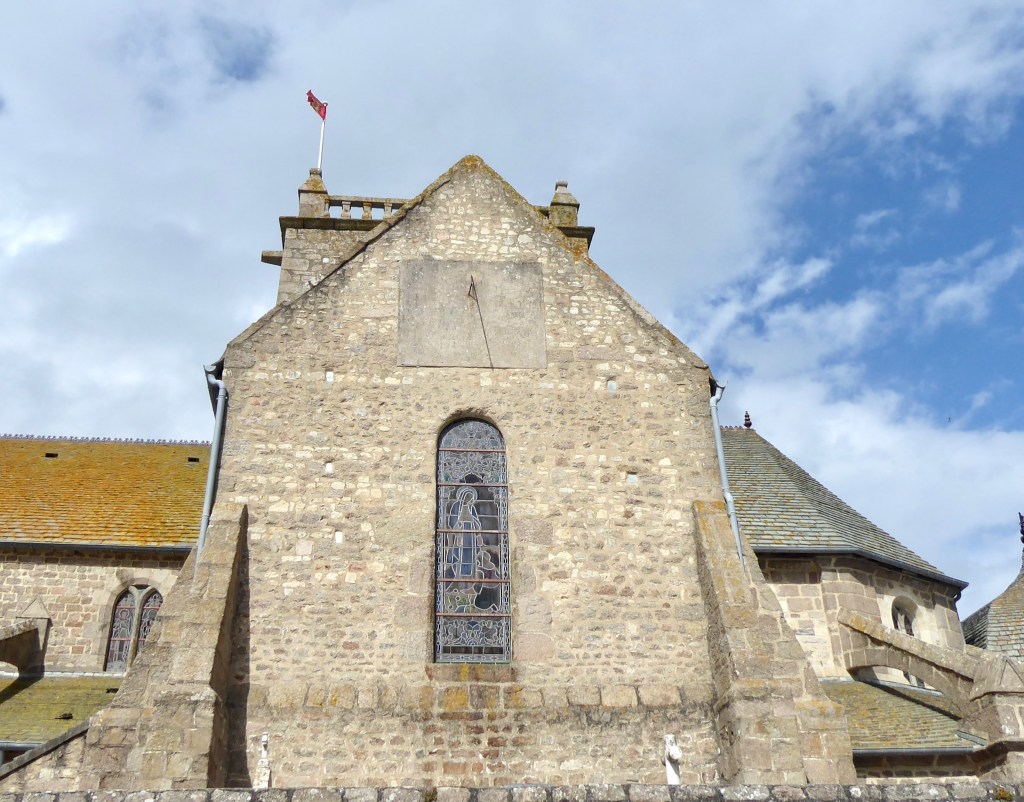
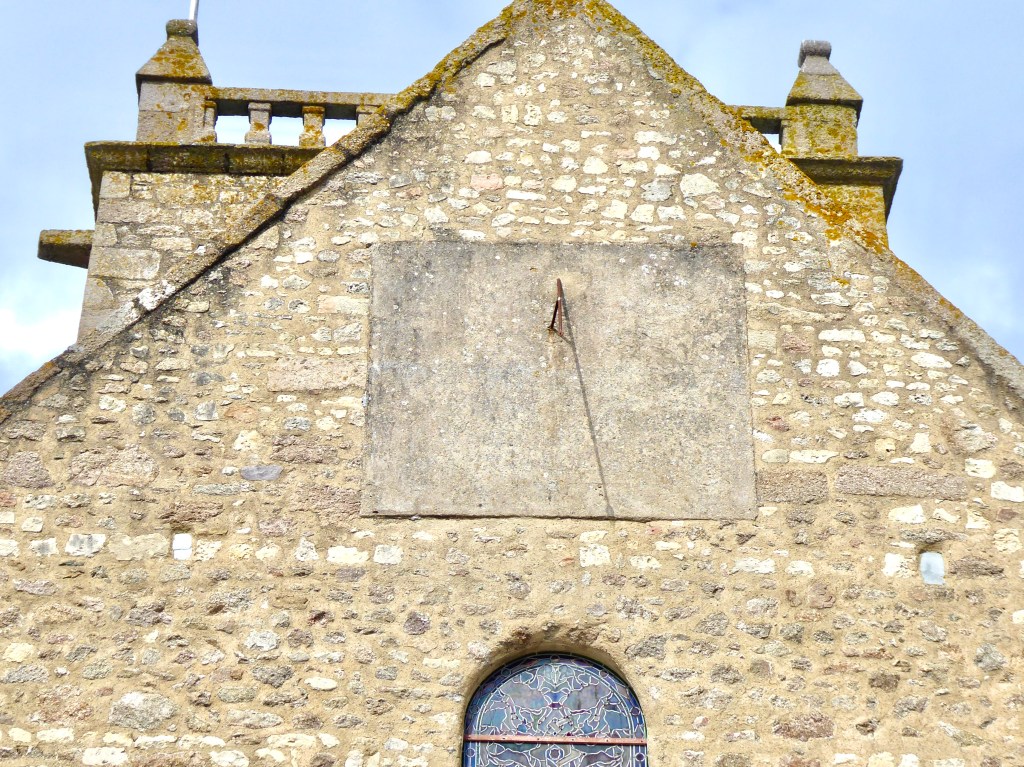
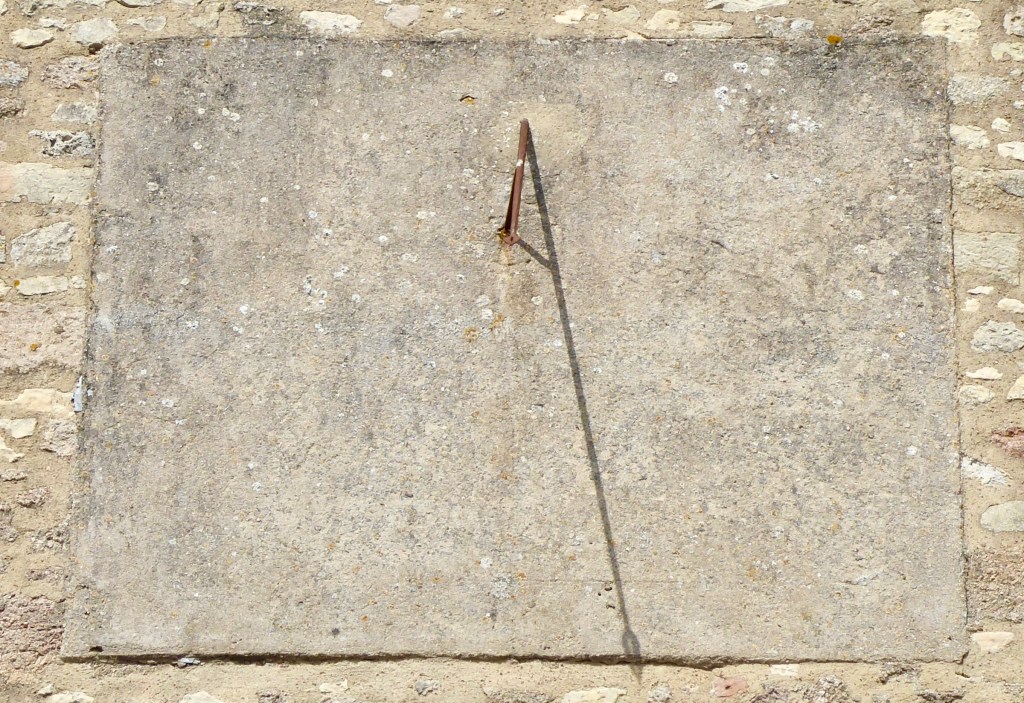
Barfleur is a small town / large village on the NE tip of the Contentin peninsula in Normandy, roughly due E of Cherbourg. The church of St Nicolas, despite the initial impression, was built mid-C17. Later additions and restoration mid-C19 incorporated an impressively large sundial (it doesn’t seem to have been a later addition).
The face of the dial has almost entirely been obliterated, with half a dozen very faint lines just visible in the lower L quadrant. There is also the hint of a frame under the cast shadow, though it might simply be the remains of a horizontal line. Erosion by the sea over many decades has made the details speculative. The gnomon may possibly be original. Whether or not, the design of the tip is clever and includes a small hole at the tip that creates a neat spearhead.
GRADE I † Pre-conquest origins. Significant Saxon features. Splendid Norman doorway. C12 font. Development C12 et seq, with C19 restoration. Archaeologically uncommonly interestingPEV; inc. by Simon Jenkins. BLB Listing. 51.4286 / -1.8579 / SU099699
The vertical dial is below the parapet, L of the porch. From a distance, the only distinct marking on the face is a faint square frame for the dial. Closer examination reveals at least the ‘X’ of noon. The footing of the gnomon is in a badly damaged area. Most notably, the dial is at a canted angle so that it faces south. Hard to date – there’s no clue in the usual resources. C18 perhaps, esp. as roman numerals were used?
Lavaudieu is a small Auvergne town with a fine romanesque Abbey. For present purposes, the sundial on the wall of the Mairie is the attraction. On a bright sunny day, the simplicity and legibility of this civic dial is hard to beat. The ‘arrowheads’ might be considered a little too ornate for the overall design.
‘Moins est plus’ might be a good motto for the dial, as it is more generally. As soon as I saw it I knew it would be in my top 20 non-medieval dials. It still is.
GRADE II* † Mainly C15 / C16, much reworking and restoration. Located down a longish lane S of the village. 10 miles E of Sherborne. BLB record HERE. Featured: the 3 sundials; church marks; the 3 seats inside the porch. 50.9192 / -2.3678 / ST742133
SUNDIALS
DIAL 1
The most obvious sundial is at the apex of the porch gable, a simple square stone containing a square dial with a narrow 3/4 frame, and an iron gnomon. Above it some form of stone finial, much eroded, a cross? The dial has graduated hour radials, with shorter lines for half-hours, and the quarter hours marked within the frame. Quite sophisticated, some damage upper R. BHO dates it C18.
Below this dial is an inscribed C18 plaque dedicated, it seems, to two [C]hurch [W]ardens 1753. It is interesting to compare the erosion of this soft stone with the dial stone.
Lydlinch . Dorset . St Thomas à Becket – Vertical sundial over the porchLydlinch . Dorset . St Thomas à Becket – plaque dated 17[5]3
DIALS 2 & 3
These dials are a near-matched pair on the C15 tower. Both are high up on the second stage, one on the SW buttress, the other on the SE buttress. BHO describes the former as a stone plate with Roman numerals, much worn; and the latter as traces of similar sundial. I think both dials must have had considerable attention since those words were written.
DIAL 2
This dial looks like a comparatively new replacement; BSS suggests C20. The modern design replicates Dial 3 mutatis mutandis. The radials are carefully graduated for its SW facing angle; very little of the afternoon can be indicated.
Lydlinch . Dorset . St Thomas à Becket – replaced vertical sundial on SW buttress of tower
DIAL 3
This dial is almost an exact converse of its pair, the radials being graduated in the opposite direction. C18. Note that the gnomons of both dials are the same design, copper I think, and presumably installed at the same time.
Lydlinch . Dorset . St Thomas à Becket – vertical sundial on SE buttress of tower
APOTROPAIC (WITCH) MARKS, MARIAN MARKS, HEXFOIL & GRAFFITI
Lydlinch . Dorset . St Thomas à Becket – Apotropaic (Witch) marks, Marian marks, Hexfoil, Graffiti
APOTROPAIC (WITCH) MARKS, MARIAN MARKS & GRAFFITI ON PORCH SEATS
Lydlinch . Dorset . St Thomas à Becket – Apotropaic (Witch) marks, Marian marks, Graffiti on seats
GSS Categories: Sundials, Vertical Dials, Old Dials, Witch Marks, Apotropaic Symbols, Church Graffiti