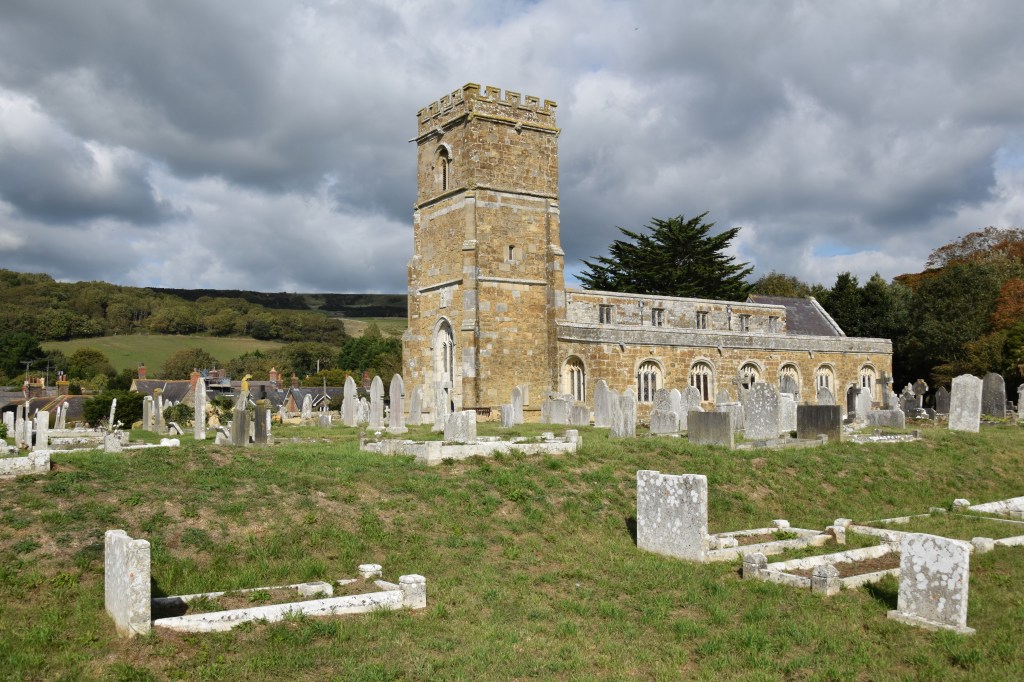
GRADE I † Early C13 chancel with trace transepts (BHO); C14 crossing tower; C15 south chapel and nave; restoration mid-C19 (Ferrey). A most unusual late C17 octagonal dial; 6m SW of Blandford Forum, just off the main road to Dorchester (12m). 50.8004 / -2.234 / ST836001
VERTICAL DIAL C17
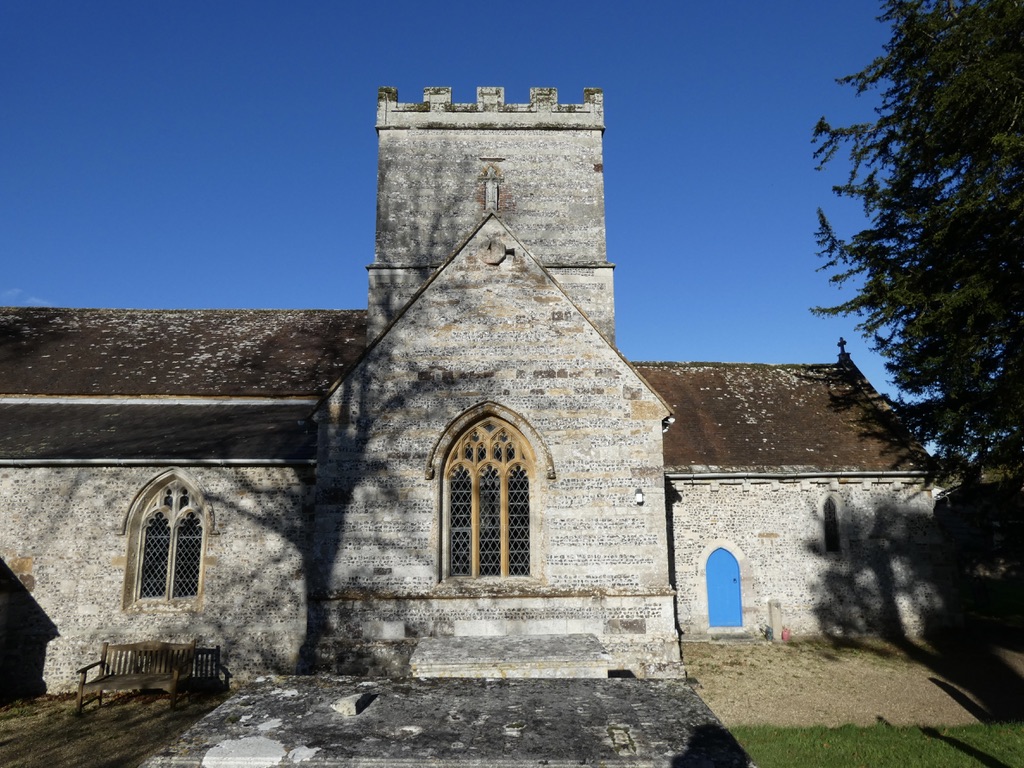
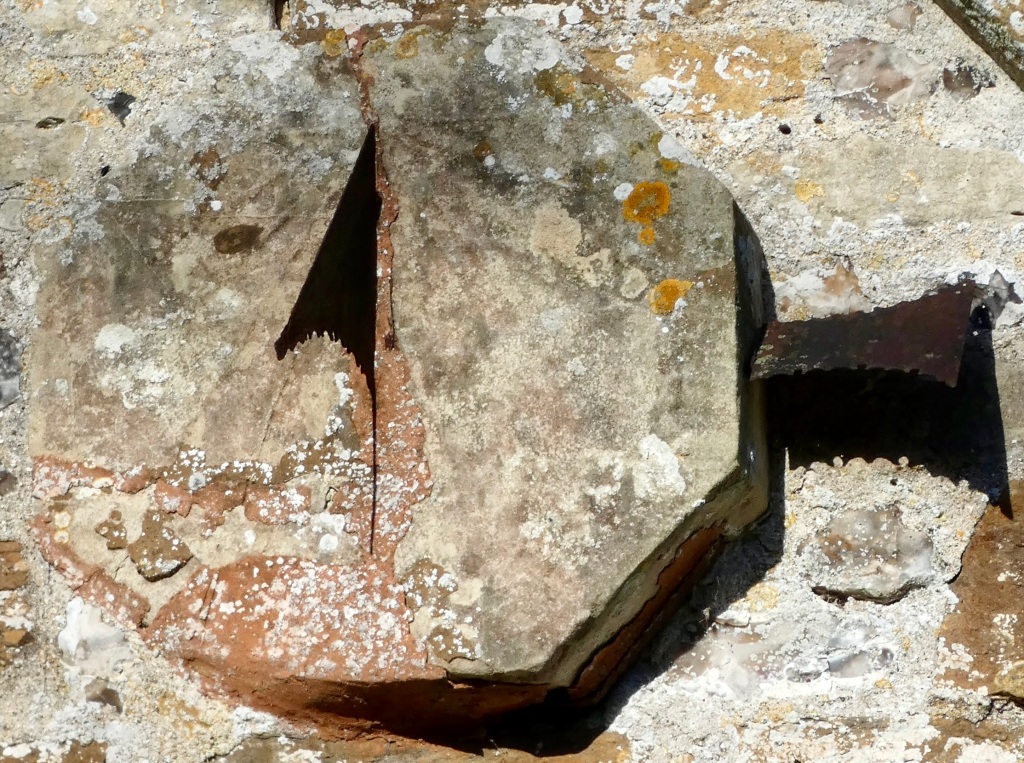
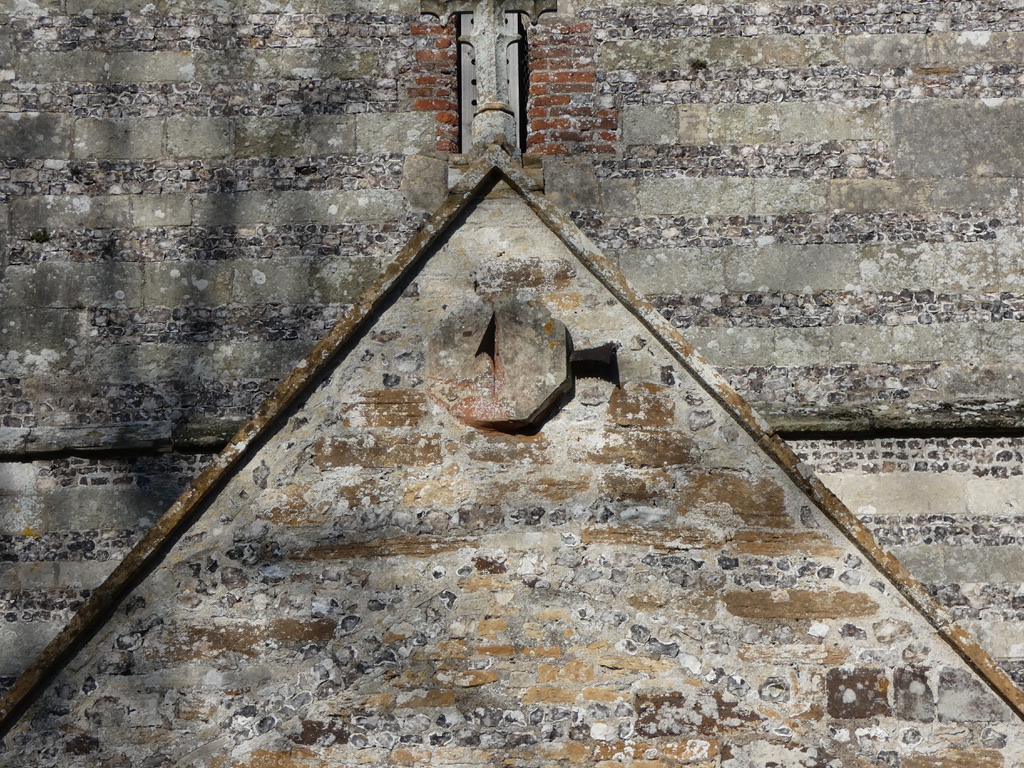
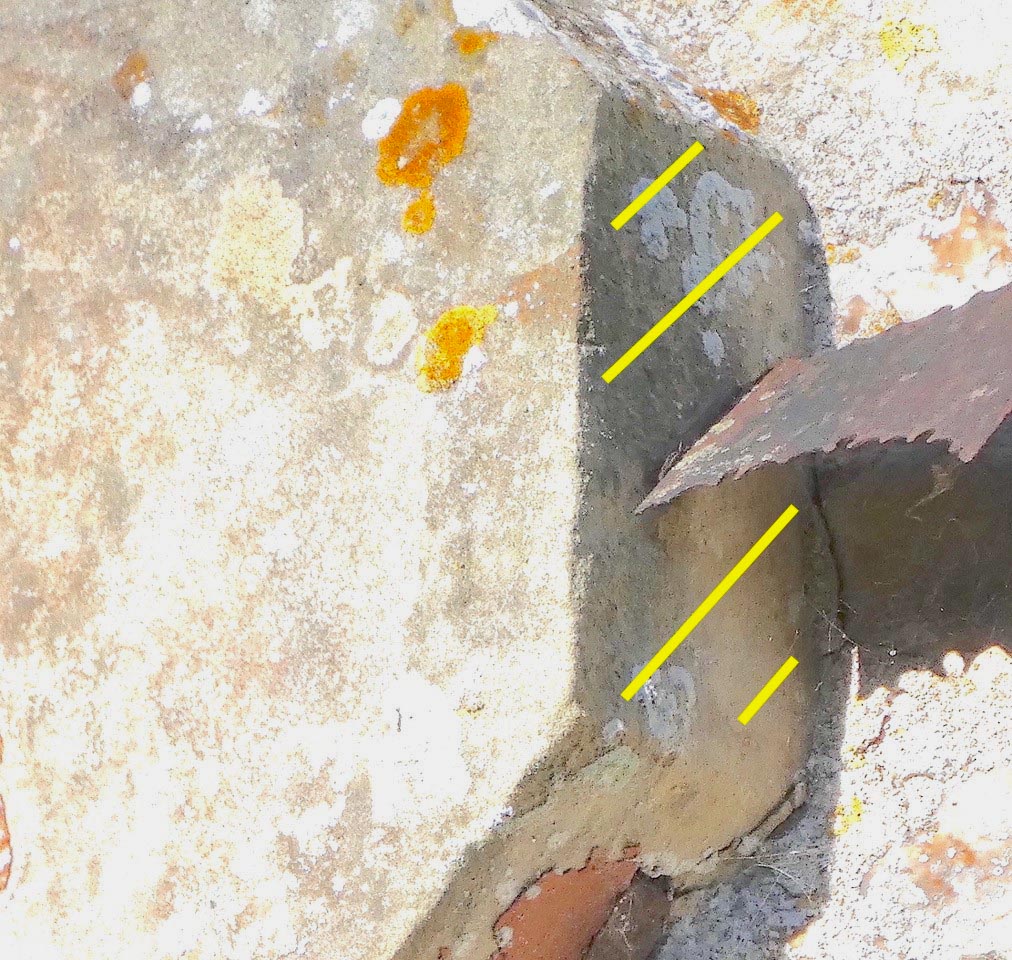
The remarkable vertical dial is located at the apex of the S Chapel gable. It dates to late C17 (BHO). The lines radiating from the top end of the gnomon are reminiscent of a scratch dial. The dial is canted for accuracy, and deeply enough to accommodate a rare E dial. Both gnomons are unusual, not least by being more toothed than merely serrated.
THE EAST DIAL
It is very unusual (and possibly unique) to bother to delineate the east or west edge of a canted dial; and really quite strange to use such a tall gnomon, which will only cast a shadow for an hour or two at most.JF / BSS
John Foad (BSS) kindly marked up a close-up of the E. dial to show how it would have worked. He writes: It should have diagonal hour lines on it, though there is probably only room for a couple, as it will only see the sun briefly around 6 each morning. There is a suggestion in the records that there were at one time 2 raised lines, but a magnified image reveals no surviving evidence.
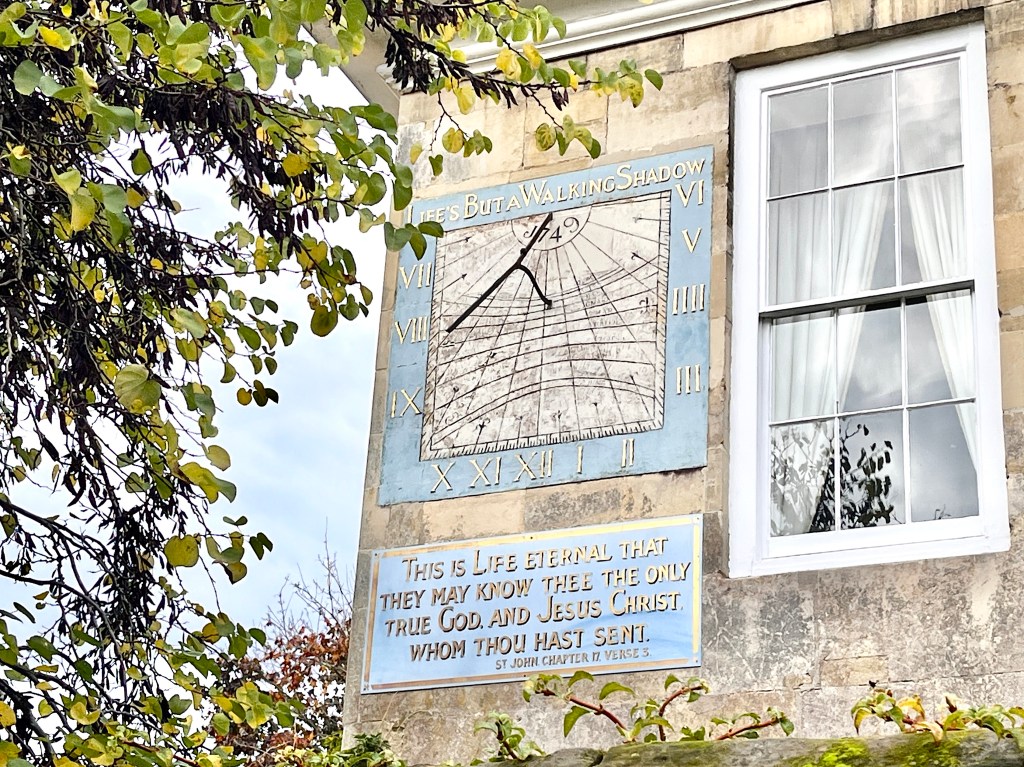
Malmesbury House . St Ann’s Gate . Salisbury . Wilts – Vertical Dial 1749
The Close in Salisbury has plenty to recommend it besides a central building for which superlatives are inadequate. Malmesbury House (GV I) by St Ann’s Gate has a particular claim to fame in sundial terms, with the context succinctly explained in the image below. 51.0659 / -1.7938 / SU145296
The very fine sundial on the house is dated 1749. The motto is part of the familiar speech taken from Macbeth Act 5 Scene 5 as Macbeth reacts to the news of Lady Macbeth’s death. It’s not exactly uplifting.
Below is a short text from the Gospel of St John. The dial itself is in very good condition. My amateurishness precludes any meaningful interpretation of the scientific aspect. I will add any significant details in due course.
Malmesbury House . St Ann’s Gate . Salisbury . Wilts – Vertical Dial 1749
GRADE I † Late C13; C15 enlargement and alterations. Tower c1730 with a plaque over the doorway: This Steeple was Built The Bells set in Order and Fixt. At the Charge of Robert Thinge Gent. Lately Deceased A.D. 1731-1732. Dial undated. 8m NE of Ipswich. 52.1133 / 1.2459 / TM223510
St Mary . Grundisburgh . Suffolk – Vertical Dial
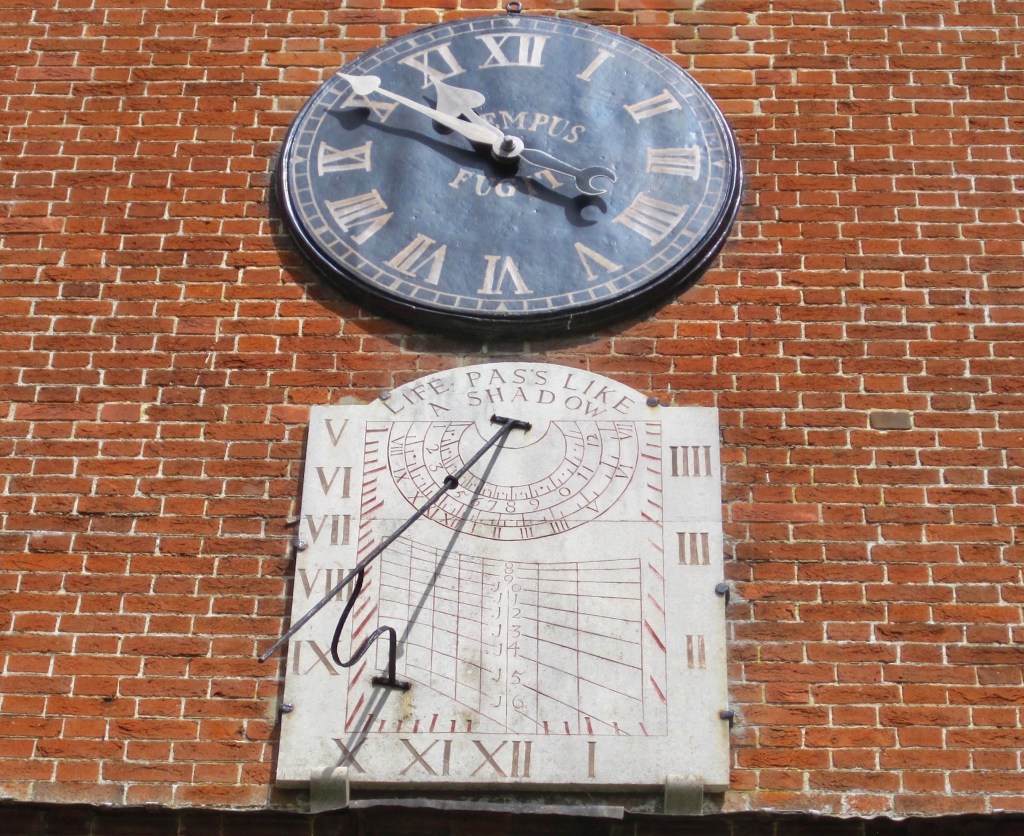
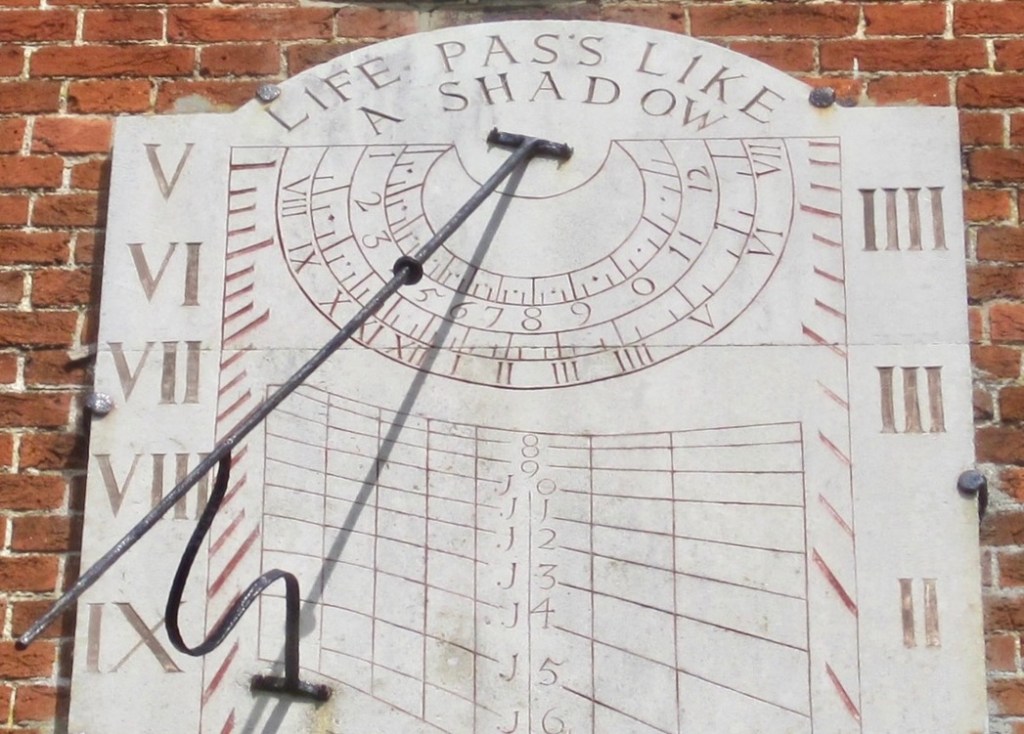
The vertical sundial is immediately below the clock. As David Ross has written, what is immediately obvious as you walk up the path to the door is a large sundial set against the south wall of the tower, below a Victorian clock – as if the Victorians did not quite trust the sundial. Both timepieces are set below a round-headed window that would be perfectly at home in a railway station. (David Ross, Britain Express)
PEV (Suffolk E) is also unenthusiasic about the tower, which showed how the Georgians could be every bit as insensitive as the much-maligned Victorians.
St Mary . Grundisburgh . Suffolk – Vertical Dial
HOW THE DIAL WORKS (1)
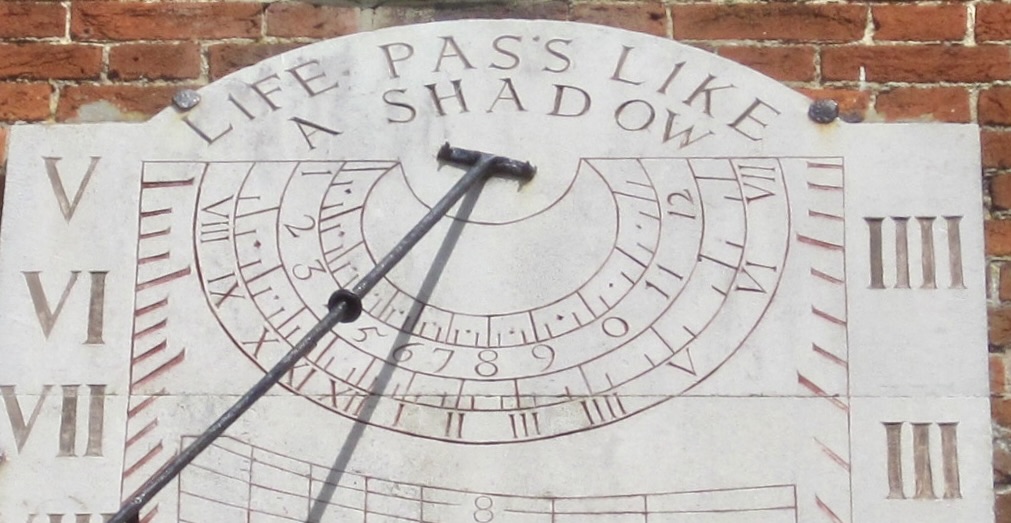
The break-arch shaped dial has a motto within the arch that reads: Life pas’s like a shadow. Roman and Arabic numerals are used to show the time. At the gnomon base are two arcs showing the time elsewhere. Analysis indicates that the scale with Roman numerals suggests Damascus; the scale with Arabic numerals suggests Barbados.
The main dial shows 5am to 4pm in Roman numerals, divided into quarter hours. The gnomon rod has an ‘S’ shaped supporter and a ball nodus. This is associated with the 11 declination lines numbered 8, 9, J0, J1, J2, J3, J4, J5, J6 (8 to 16 for daylight hours), with outer lines unnumbered.
The above notes are based on BSS records. The complete entry is below
HOW THE DIAL WORKS (2)
This break-arch shaped dial on the south wall of the church tower, below a clock, declines about 23° to the east. The tower dates from 1731-32, but it is not known whether the dial is contemporary.
A motto within the arch reads: LIFE PAS’S LIKE / A SHADOW. Scales around the gnomon root show the time at two other places, but they are not named. The outer scale, with Roman numerals for 8am to 7pm, using XII and IIII, shows the time at about 37° E, so may be intended to show Damascus time. The inner scale, with Arabic numerals 1 to 12, shows the time at about longitude 60° W, possibly for Barbados.
The main dial shows 5am to 4pm in upright Roman numerals using XII and IIII, divided to quarter hours. The gnomon rod has an ‘S’ shaped supporter and carries a ball nodus, which is associated with nine declination lines numbered 8, 9, J0,J1, J2, J3, J4, J5, J6 (8 to 16 for the hours of daylight).
The nine vertical lines crossing these are for azimuth, the nodus shadow showing the direction of the sun. They are also unlabelled, but will indicate bearings of SEbE, SE, SEbS, SSE, SbE, S, SbW, SSW and SWbS.
A report in September 1983 found the dial completely bare, presumably prior to a restoration.
St Mary . Grundisburgh . Suffolk – Vertical Dial Motto
MOTTOS
LIFE PAS’S LIKE A SHADOW
A rare variant of the many inscriptions that link Life with Shadow(s). Pas’s is said to reflect the Suffolk dialect at the time. There is another example of the ‘misspelling’ (as we might say now) of the word pass. At St Mary, Bucknall, Shropshire, the 1712 dial is inscribed Tyme Paseth.
Tempus Fugit on the C19 clock is… comfortingly familiar
If you want to find out more about St Mary and other churches in Suffolk, I recommend the website of Simon Knott SUFFOLK CHURCHESa journey through the churches of Suffolk
GRADE II* † C12 origin; alterations / enlargement in C14, C15, C16; restored 1872 (Wyatt). Walls mainly rubble stone and flint. A lovely setting, with a fine manor house. Much older-seeming even than the ubiquitous ‘Hardyesque’ description in these parts. Subtly hidden away 8m NE of Dorchester. 50.7827 / -2.3198 / SY775981
From the ground, this is a difficult dial to admire. It is high up, eroded, damaged, and gnomon-less. It would be easy to dismiss it as a disappointment after you have negotiated the narrow lanes that lead circuitously to the church. Luckily I brought a real camera with me (for scratch dials I just use my phone) to catch the details of 3 vertical dials on churches in the area.
The dial, on a rectangular stone slab, is dated 1671, and marks the hours from VIII am to VII pm. The motto across the top reads UT UMBRA SIC VITAAs a shadow so is life, one of several similar motto variants commonly found. The motto is enclosed within the initials A and R. (BHO elides the initials and the motto to form AUT UMBRA SIC VITAR).
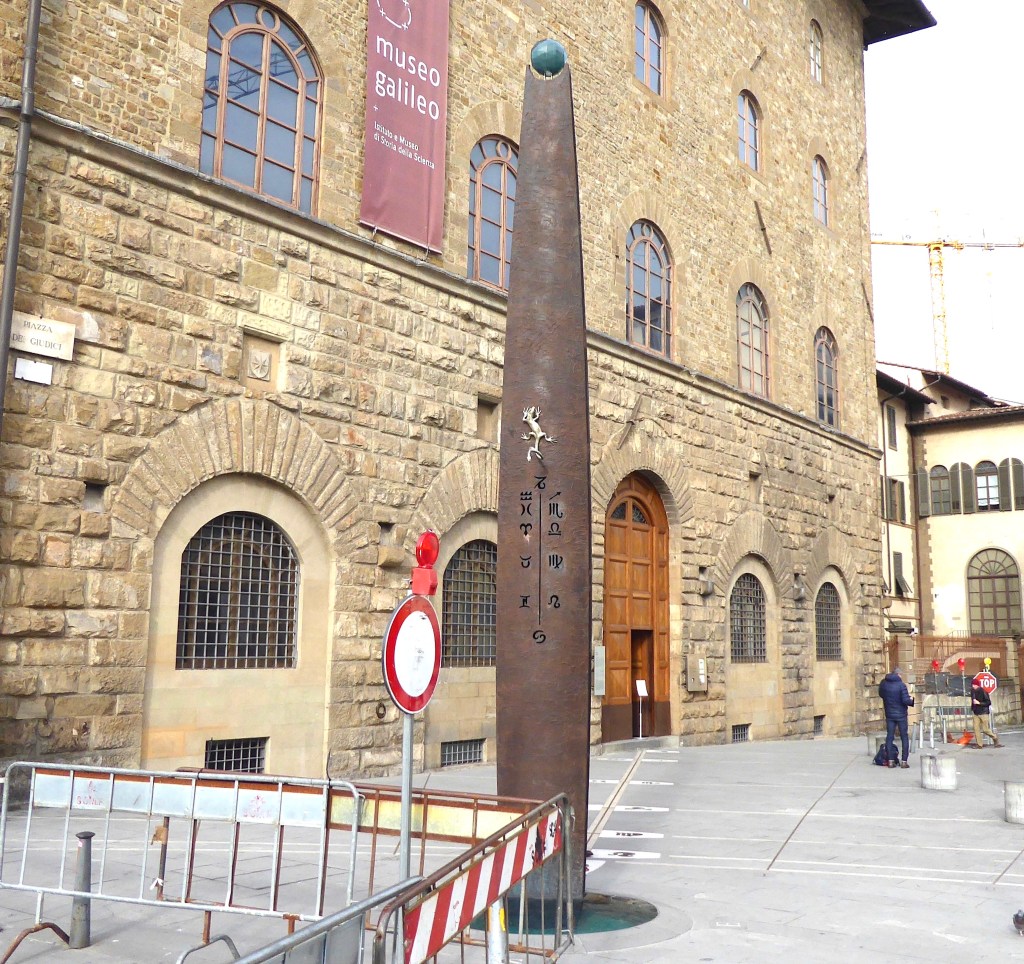
Lizard / Viper Gnomon of Monumental Dial . Museo Galileo . Florence
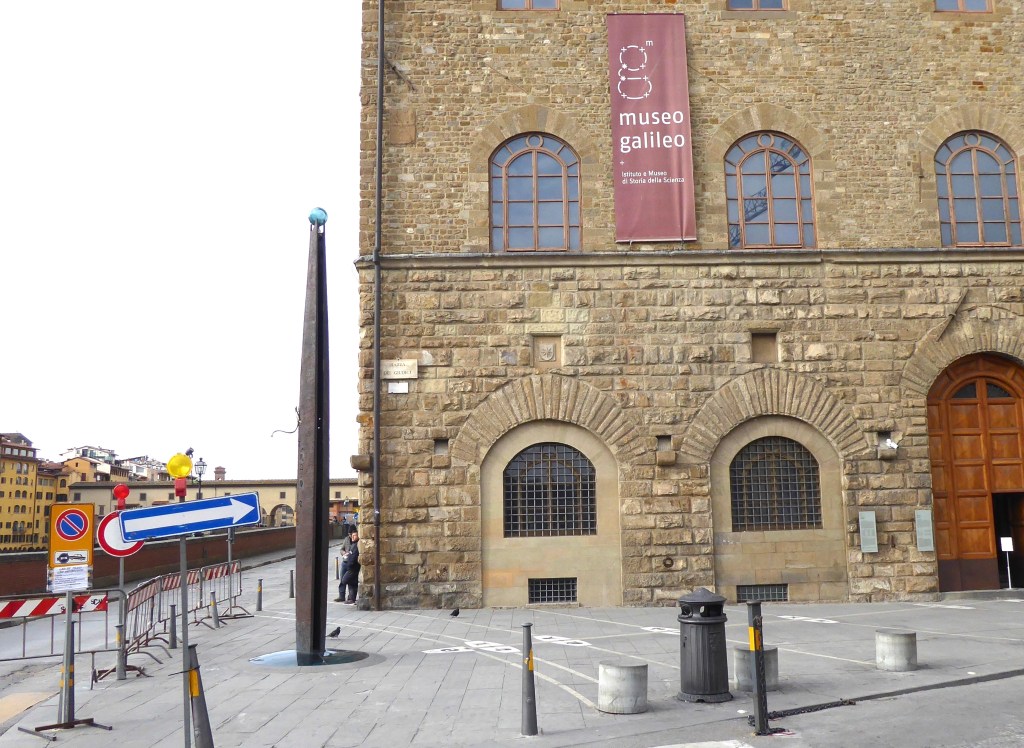
MONUMENTAL SUNDIAL . MUSEO GALILEO . FLORENCE
The Museo Galileo‘s Monumental Sundial was built as a mathematical ornament in 2007. The slender bronze column (stele) is in fact formed from two matching columns closely aligned, symbolising day and night. The (mid)day stele faces south, with a vertical meridian line on which the shadow is cast by a lizard’s tail (actually, an imaginary half-lizard, half-viper). The night stele faces north and signifies the constellations Ursa Major and Ursa Minor that enable the Pole Star to be identified.
Monumental Dial . Museo Galileo . Florence
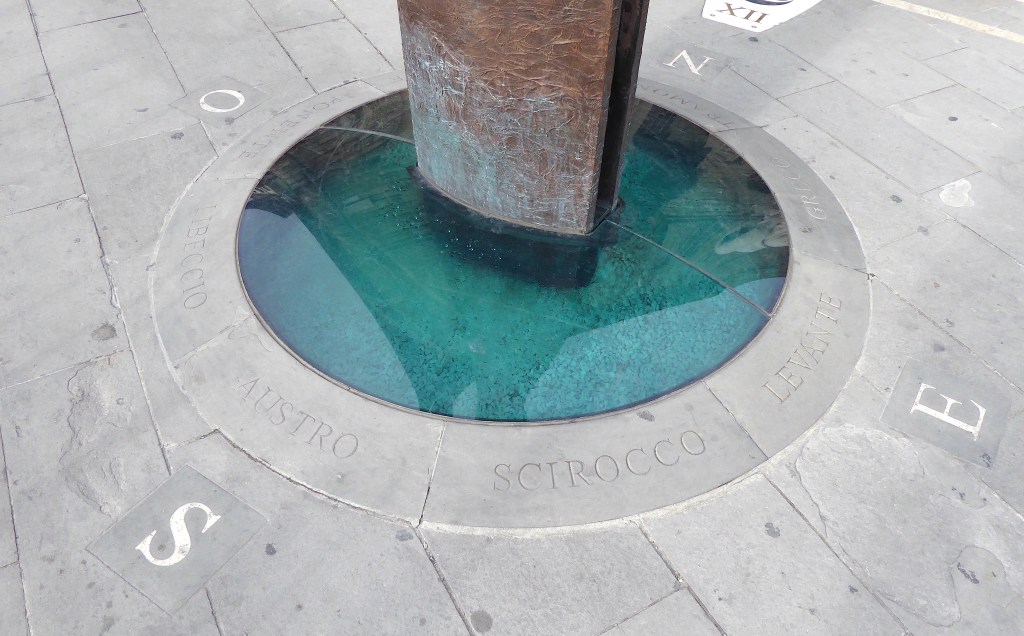
The encircled quadrant design on the pavement at the base of the bronze columns indicates the geographic orientation. This glass base of the gnomon, and also the Zodiac signs in the meridian line (below), are up-lit after dark.
Orientation dial . Monumental Dial . Museo Galileo . Florence
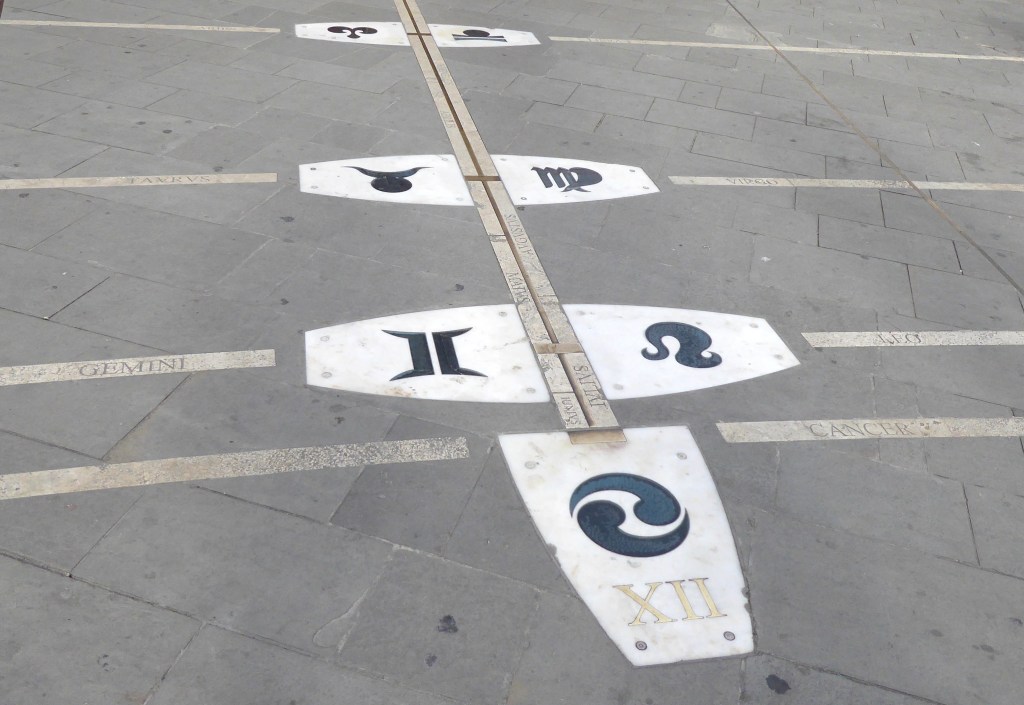
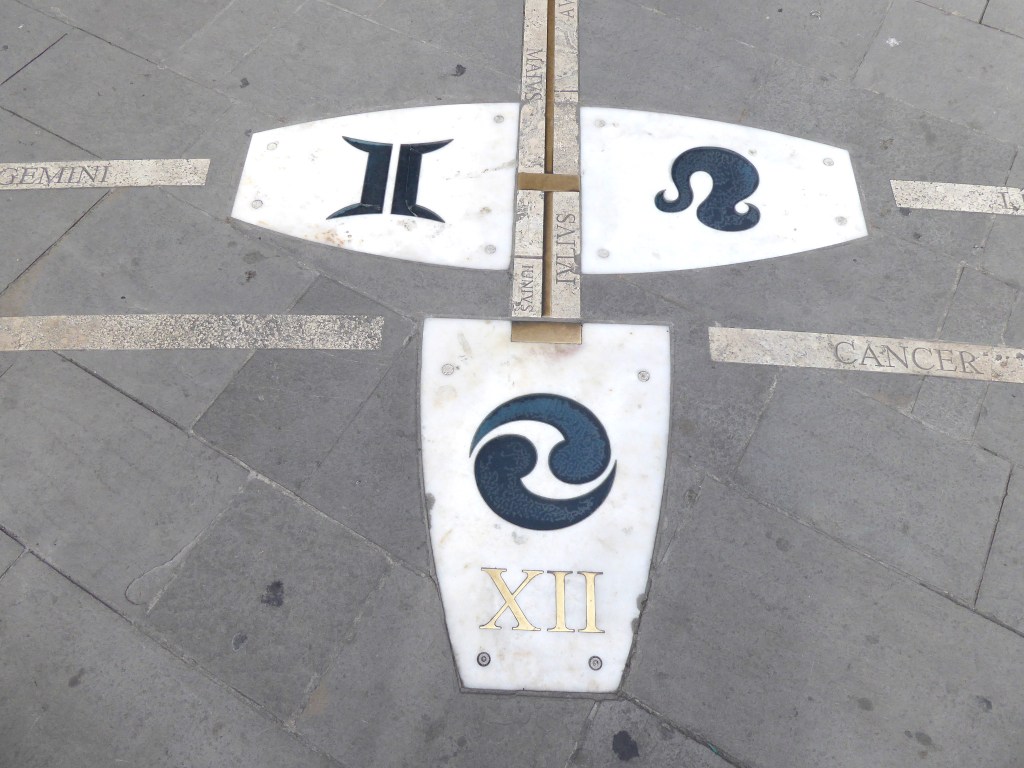
The Museo explains the meridian line in helpfully simple terms: A travertine and brass meridian line is drawn on the pavement, flanked with glass and marble signs of the Zodiac. The meridian line extends for about 15 metres from the museum entrance, where the winter solstice is marked, to the base of the gnomon, where the summer solstice is marked. The travertine curves crossing the meridian line indicate the date. The brass radial lines forming a grid with the two solstitial curves indicate the hours.
The seasons and the four elements are symbolised by the choice of materials: travertine for the earth and autumn; glass for the water and winter; grey stone for the air and spring; bronze for the fire and summer.
LIZARD / VIPER GNOMON ON THE SOUTH FACE OF THE COLUMN
This extraordinary sundial stands by the Arno with the Ponte Vecchio (which itself has a wonderful dial LINK) close by to the west. For anyone with even a minuscule interest in or curiosity about the gradual development of scientific instruments and techniques from medieval times onwards, pay a visit to the excellent online gallery LINK. Look in particular for the two astronomical telescopes made by Galileo himself.
The North American Sundial Society has very good online information about this unique dial. You can watch a short animation of how this gnomonic sundial works here LINK
For those interested in finer details of the way the dial works, the museum’s detailed account is included at the end of this article.
Museo Galileo – Istituto e Museo di Storia della Scienza
NASS (North American Sundial Society) Video: Filippo Camerota, Luise Schnabel, Giorgio Strano
How the Sundial works
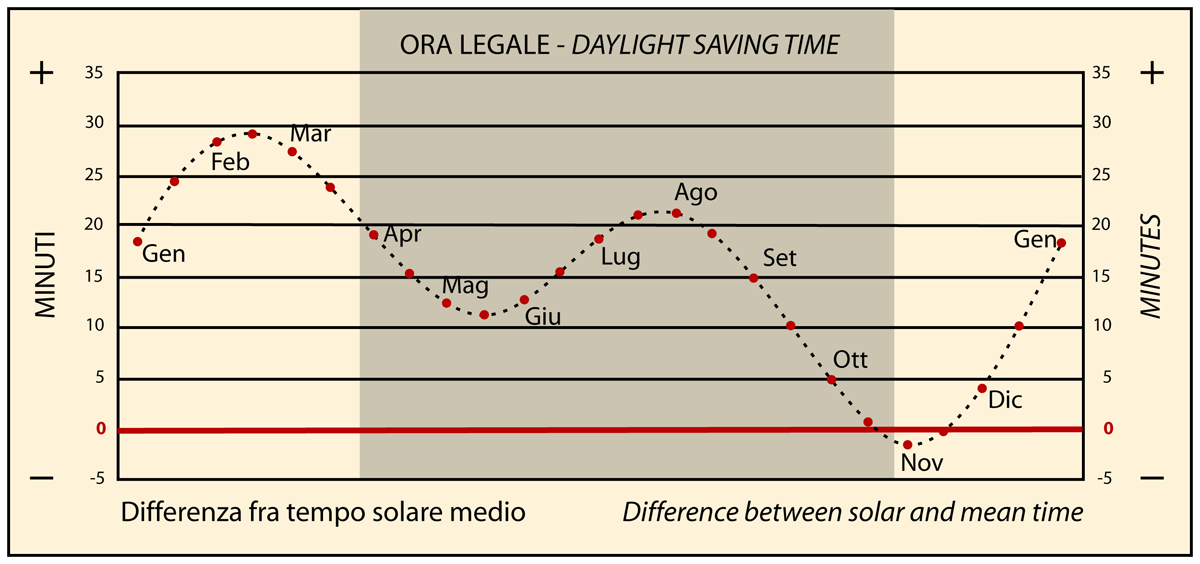
The shadow cast by the glass polyhedron atop the large bronze gnomon indicates the date and time. The hours from 9:00 AM to 2:00 PM are marked out by radial brass lines. The date is indicated by the travertine traversal lines which mark the Sun’s diurnal course for various periods of the year – precisely when the Star enters the signs of the Zodiac. The shadow cast by the gnomon changes in length during the course of the days and seasons, and indicates true solar time for the place where it is located, which is a different time than that of our wristwatches, known as mean time. In respect to mean time, true solar time has a periodic variation that can exceed a quarter of an hour.
Moreover, during daylight saving time, the hands of a clock are moved forward one hour. For example, true midday in the month of February would be indicated by the sundial around 12:28 AM while in the month of July it would be indicated around 1:20 PM daylight saving time.
To read the hour and date, you have to identify the hour lines and the calendrical lines closest to the gnomon’s shadow. When the shadow does not fall exactly on a hour line, you can read the half-hours and quarters with close approximation by ideally subdividing the space between two hour lines in two or four parts. The date can also be read by referring to the Zodiac signs and the start of the months marked out along the meridian line.
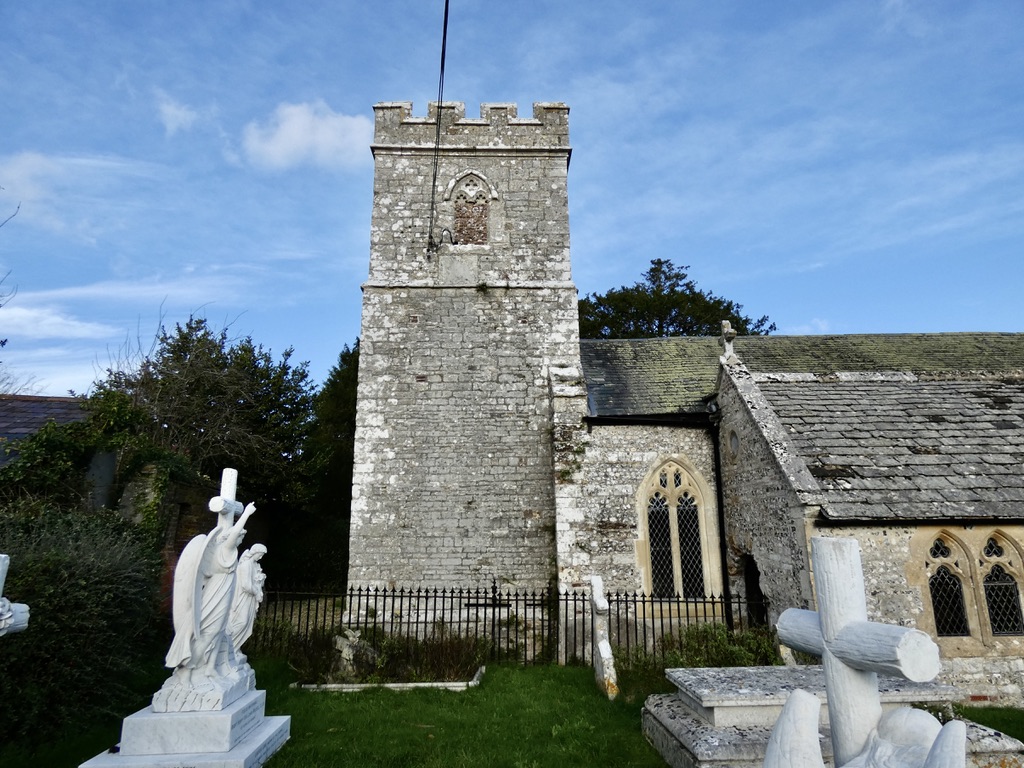
GRADE I † C14 with older origins; gradual development, rebuilding and restorations. This church represents a far wider history of the area ecclesiastically, architecturally and socially. There are a great many good online sources of information, both general and specific, accessible with a single Gxxgle search. One of the most authoritative resources for deeper delving is British History Online BHO. 50.665 / -2.5989 / SY577852
DIAL
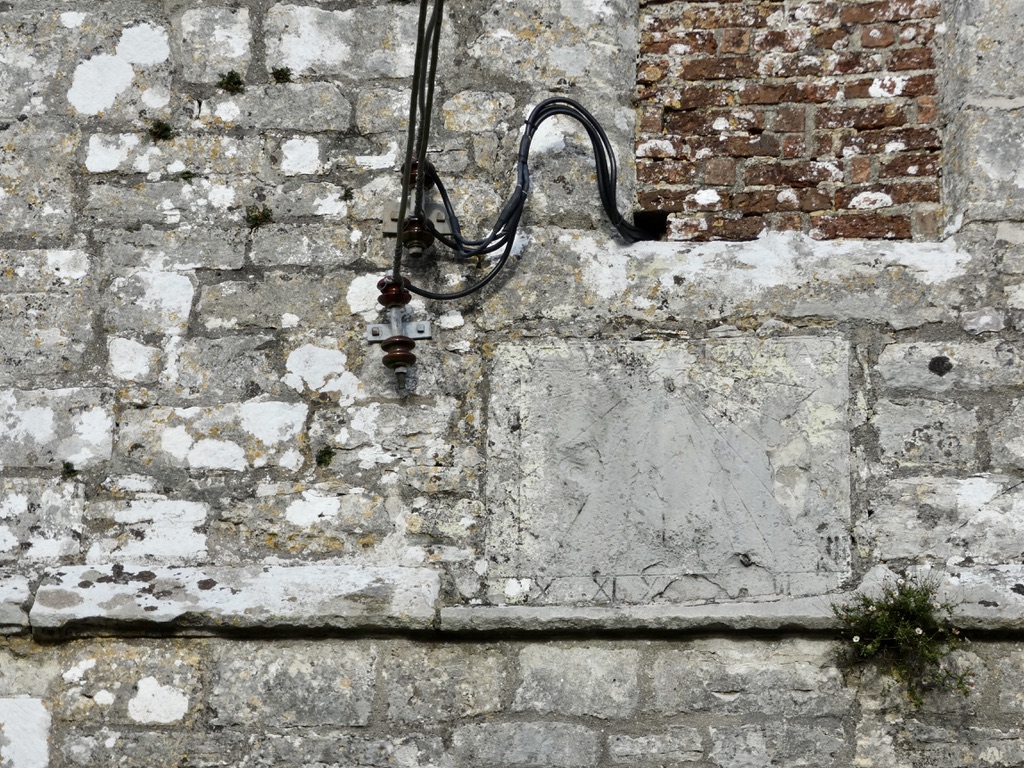
The vertical dial is set in the parapet of the south wall of the south aisle. It is weathered, like the stone around it. A survey some time ago found no visible markings; the high position, extent of weathering and prevailing light probably explains that. A long lens picks out more detail. It is hard to date the dial – ± 1800?
St Nicholas . Abbotsbury . Dorset – Vertical Sundial
The dial is cemented onto the parapet, supported by a ledge and with 2 iron supports at above it. A frame surrounds the dial. In the upper section is a semicircular dial, with the footing of the rather hefty gnomon centred within it. 2 clear lines descend either side of the noon line / gnomon blade.
St Nicholas . Abbotsbury . Dorset – Vertical Sundial
The hint of 2 converging lines above the bolts suggest they radiate down from the horizontal line of the dial. At the base of the semicircle there are traces of an outer semicircle and, significantly, of a few short lines between the two. These seem to be half hour markers. If so, there was once a more complex dial that has all but vanished.
St Nicholas . Abbotsbury . Dorset – Vertical Sundial
Beneath the lower gnomon footing, the number XII is very clear. Possibly it was recut (maybe more than once) to continue to emphasise the noon marker. Apart from that, all other numbers are completely erased except for a ghost of XI.
GNOMON
Is the rather clunky gnomon original? Initially I thought not, but some features suggest it might be. The precision of the tip of the top being exactly on the edge of the frame; the extent of the staining; and the degree to which it has protected the centre line of the dial and in particular XII. Against that, the angled view of the dial makes it seem rather incongruous.
St Nicholas . Abbotsbury . Dorset – Vertical Sundial GallerySt Nicholas . Abbotsbury . Dorset – Vertical Sundial / S. face with parapet dial above centre windows – stevekeirtsu cc
GSS Category: Vertical Dial; Church Sundial; Gnomon
All photos Keith Salvesen except the last, stevekeiretsu Geo cc
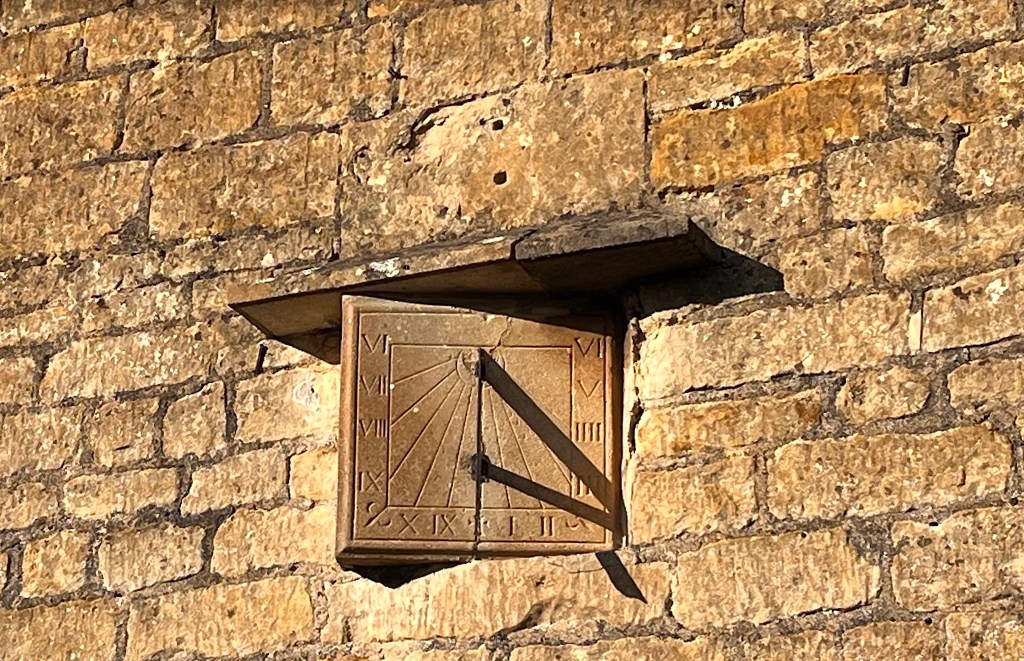
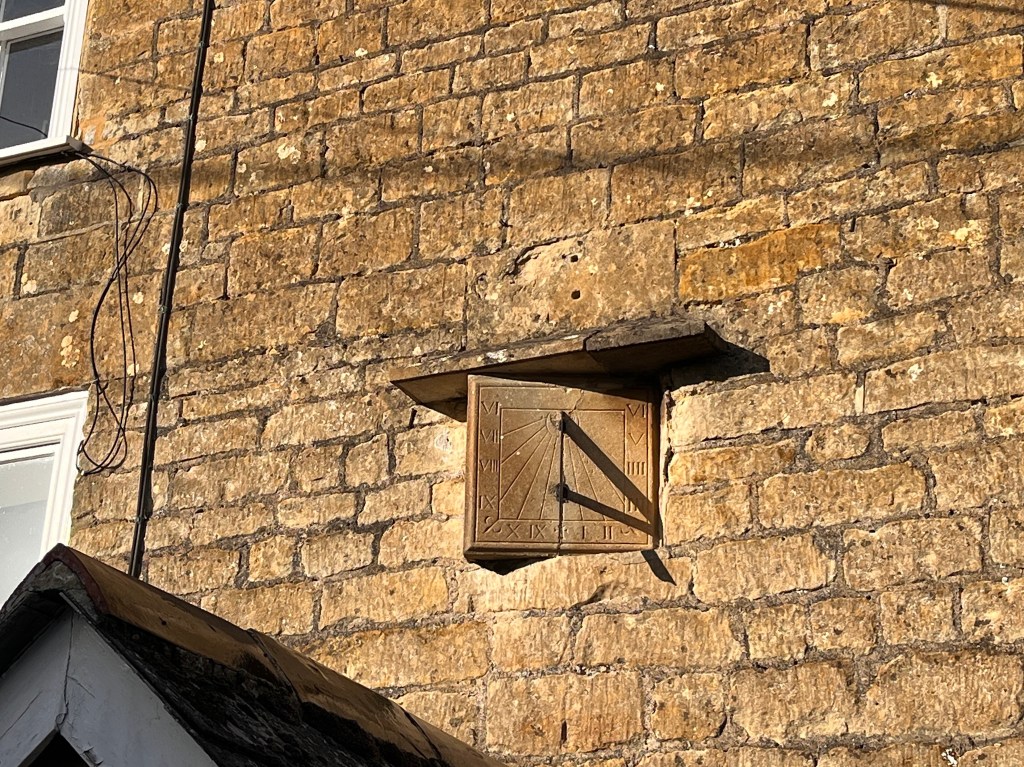
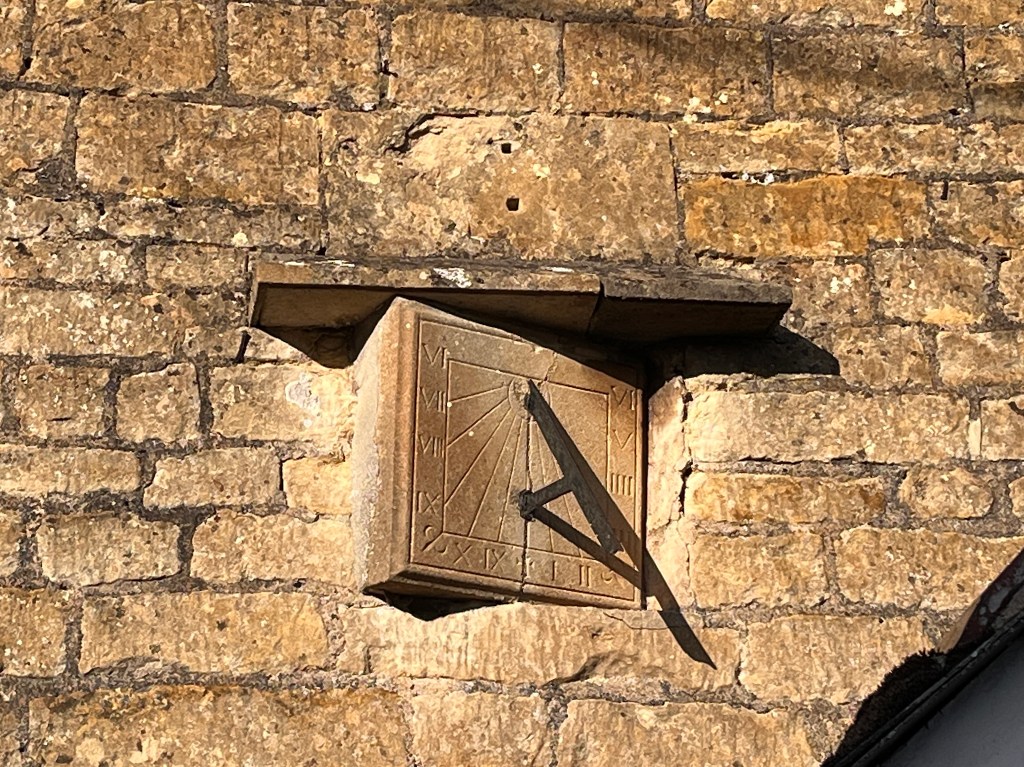
Vertical Dial on Village House . Marnhull . Dorset
The dial is above the front door of a house in the village, with a stone ledge above it. It doesn’t give the impression of being old. There is little sign of weathering or erosion and the incisions are all equally clean. BSS gives it as C18?? and suggests it may be a replacement for an earlier dial. Given the design, I wonder if it is actually a modern C20 direct copy of the original?
The dial is canted to face south and provide an accurate reading. Noon is marked, as often, by a cross. The archaic use of IIII for IV might also suggest a careful copy of an old dial, as may the flourishes in the lower corners.
Vertical Dial on Village House . Marnhull . Dorset
GSS Category: Vertical Dial; Canted Dial; Dial on house
GRADE I † The Church forms part of the Boconnoc Estate and has no Dedication*. Probably C12 origins as the Manor Chapel; gradual development; restored 1873. Now in the care of the Cornwall Historic Churches Trust. 10 m SW of Liskeard. 50.4159 / -4.6099 / SX146605
DIAL
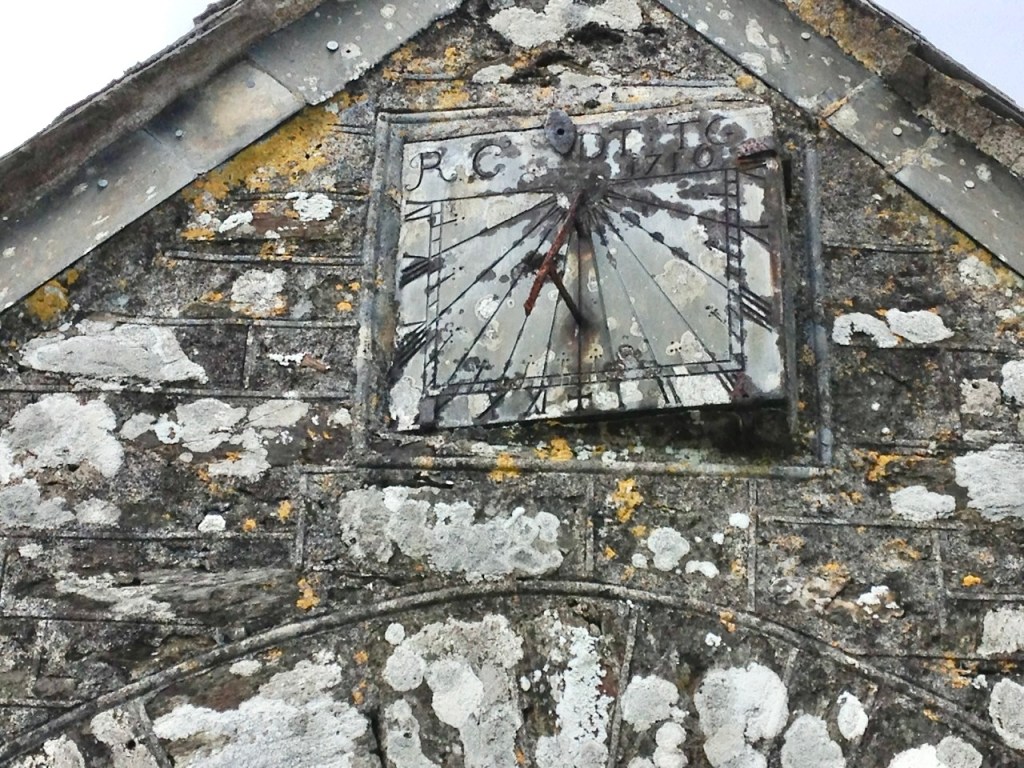
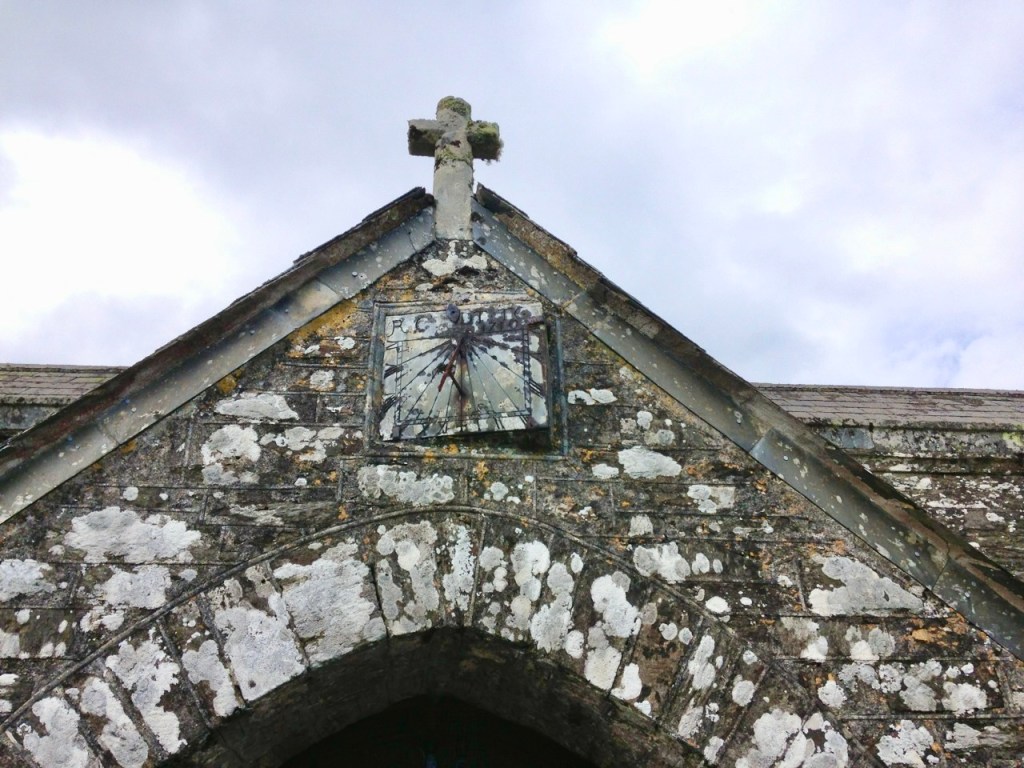
The time-worn dial is set into the apex of the porch and canted westwards. Dated 1716, it is also inscribed with a set of 3 double initials RC, DT, & TG. ‘RC’ is in a different style, and the date – perhaps significantly – is below the two other pairs of initials. Possibly the latter installed the dial in honour of the former.
The dial shows 1/4 as well as 1/2 hours. The 12 of noon is replaced by a cross. IIII is used for IV. The gnomon is presumably not original, but has clearly been in situ for a considerable time.
Boconnoc Parish Church – Sundial dated 1716
* Sadly no St Boconnoc is listed in the Ox. Book of Saints)
GSS Category: Vertical Dial. Old (post medieval) Dial
ST MARY † Grade 1. Early C13, alterations c.1500, N transept added C19. Between Sherborne & Marston Magna, on the Som. / Dorset boundary. Scratch dials, vertical dial, porch graffiti and protection (‘witch’) marks. 50.9948 / -2.5565 / ST610218
St Mary . Rimpton . Som. – Vertical Dial
Quite a while ago I wrote (in 2 parts) about the 4 main medieval scratch dials at the church. The links are below. I recently revisited St Mary for a further look at the dials (there are a couple of others to write up) as well as some interesting church marks including a small hexfoil within the porch. A revised single post featuring all of the above will emerge in due course.
DIAL
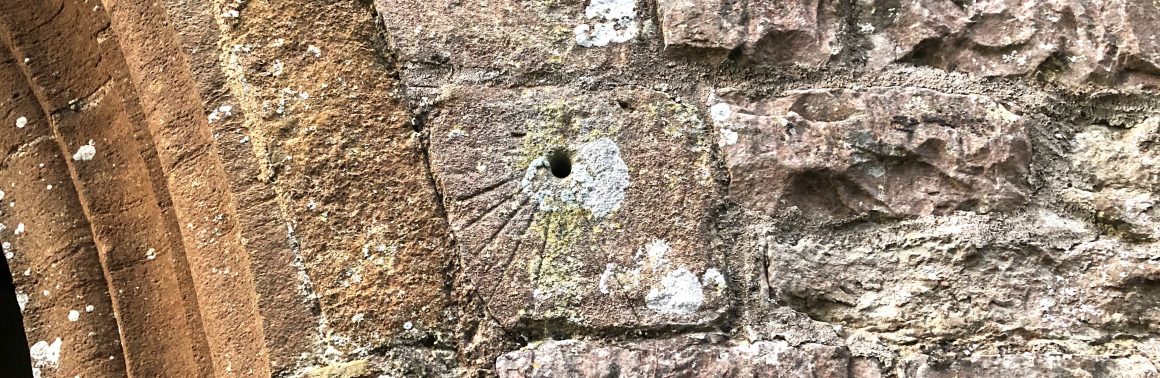
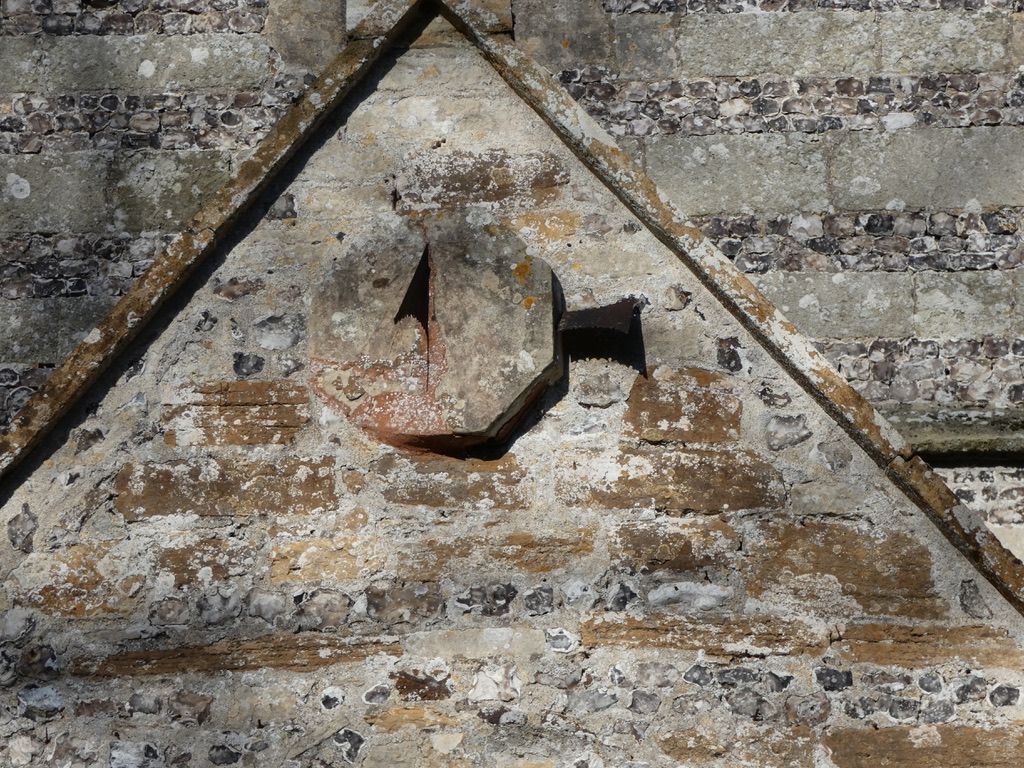
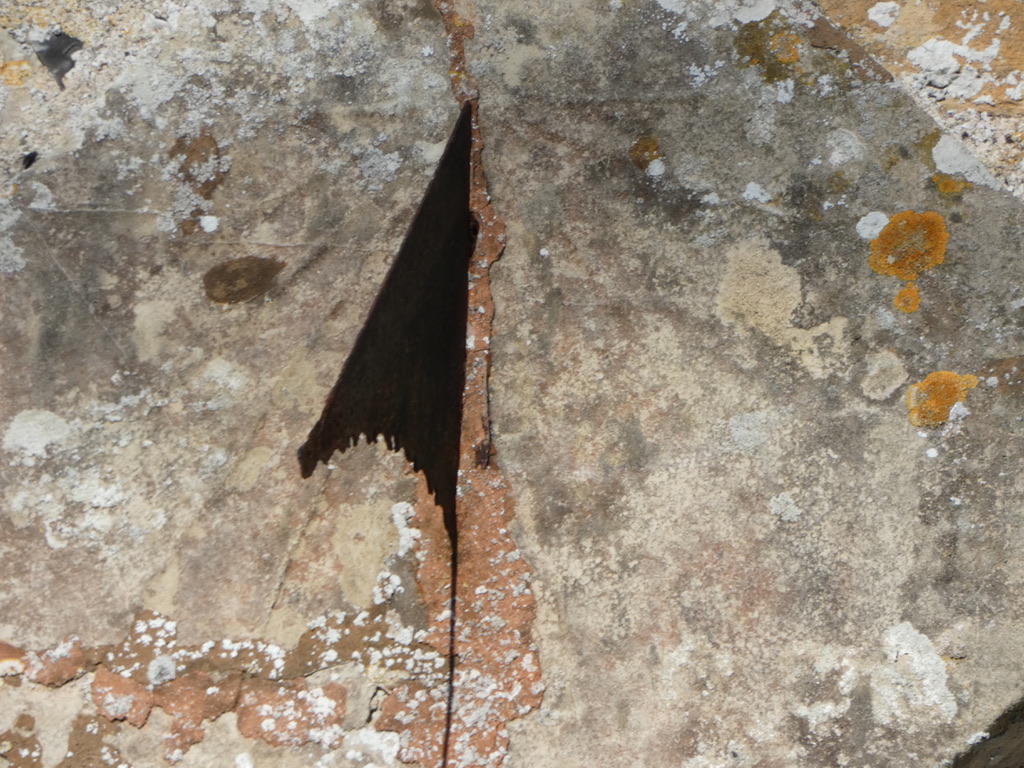
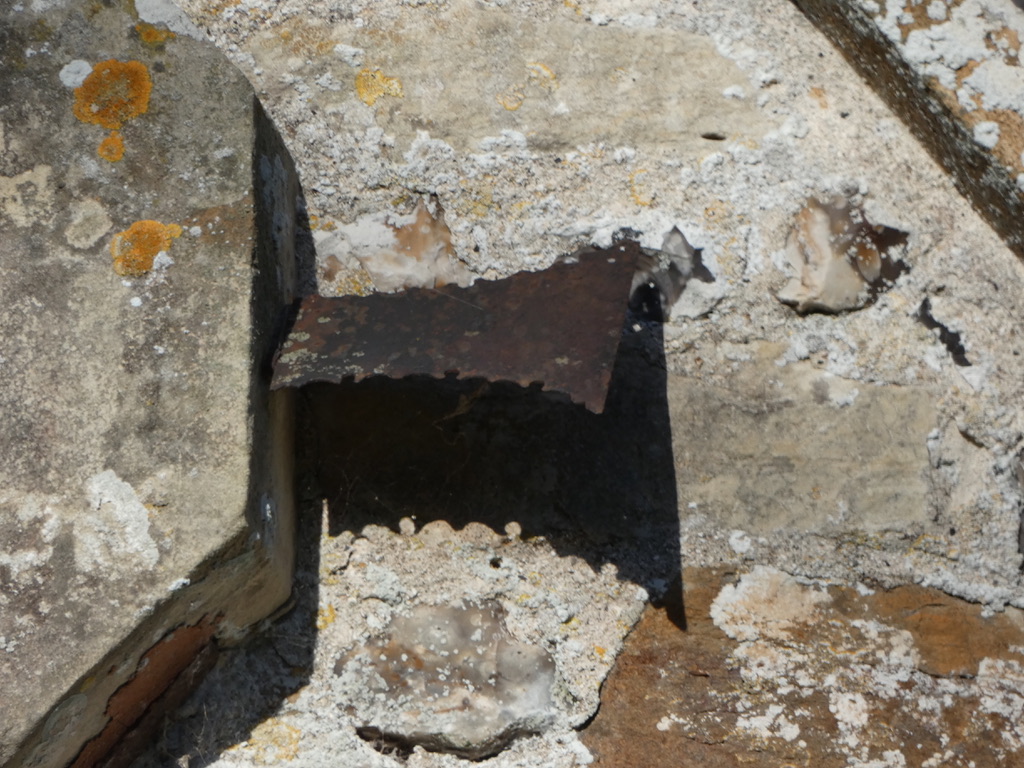
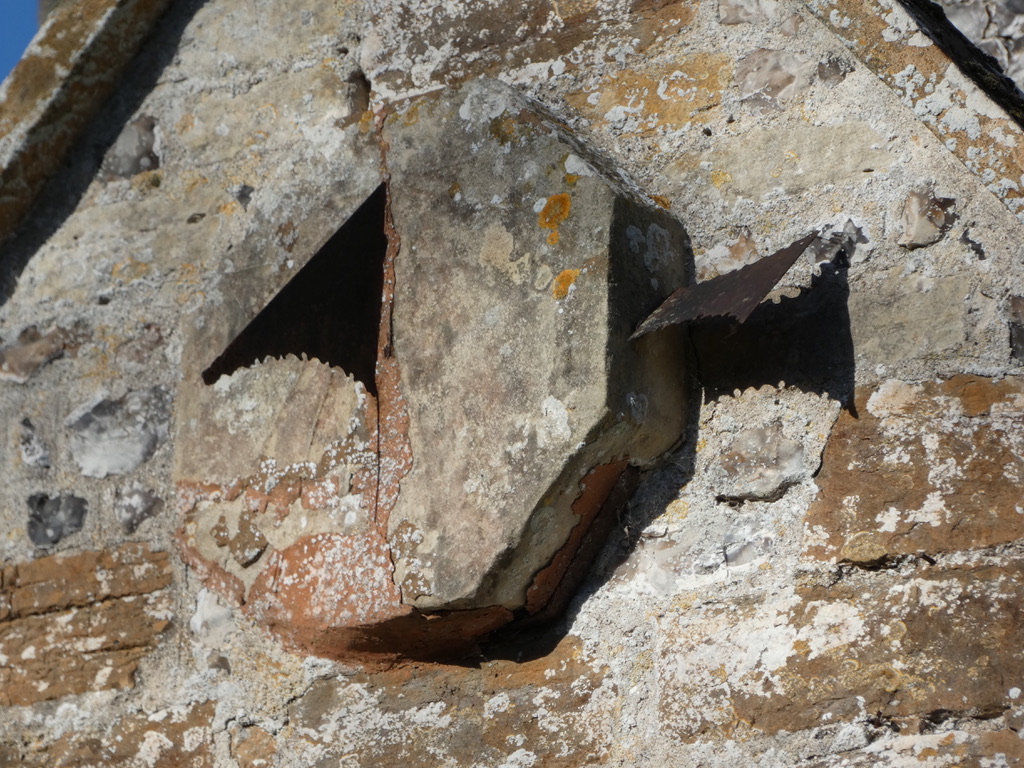
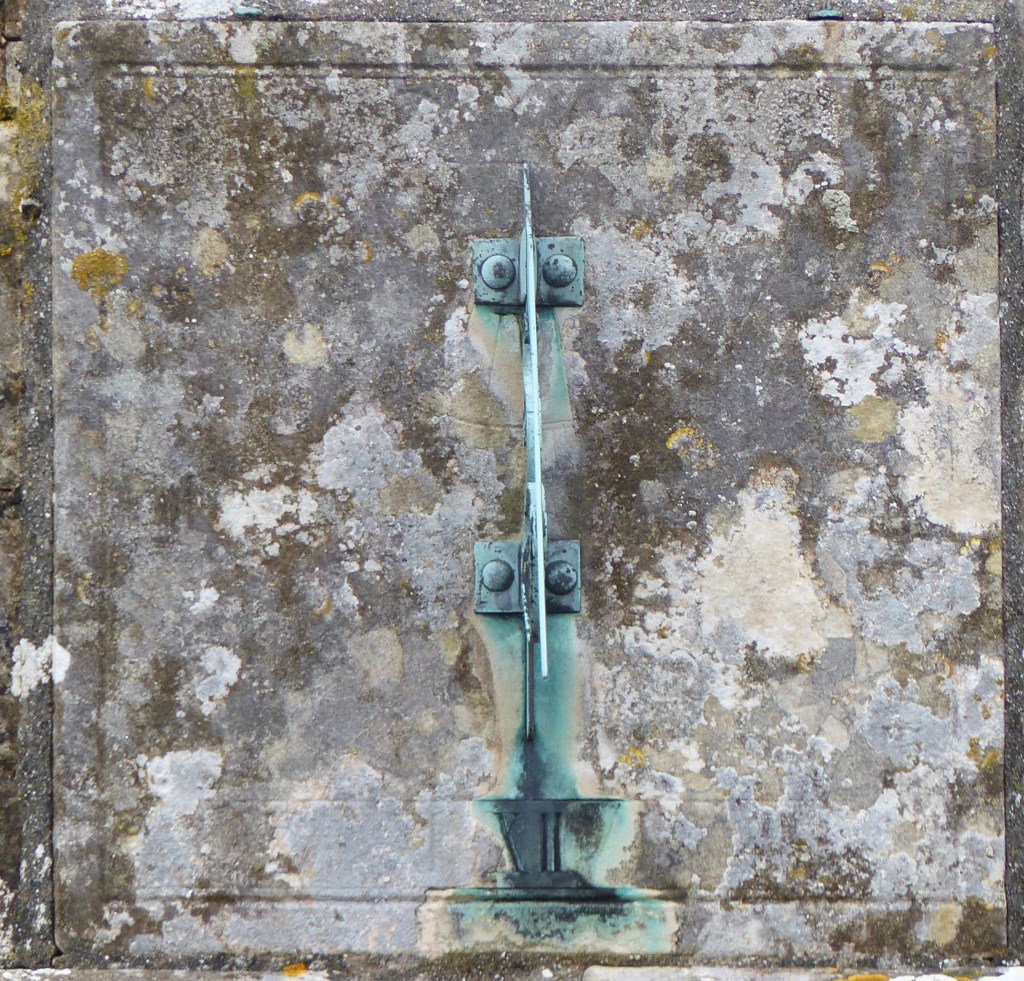
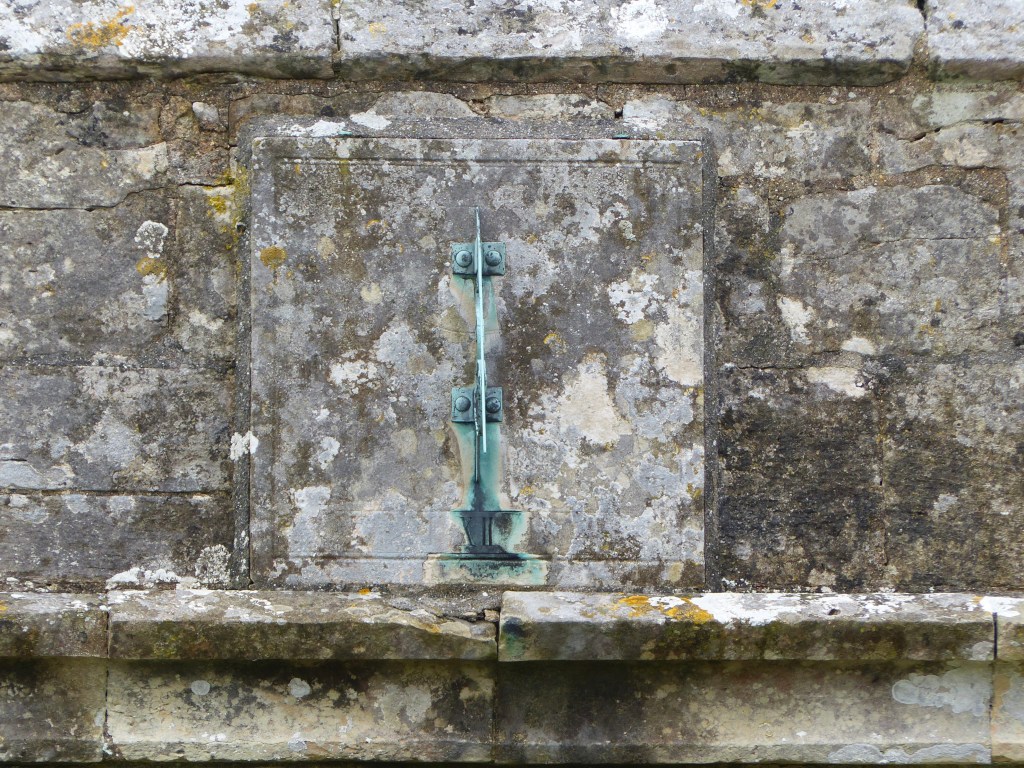
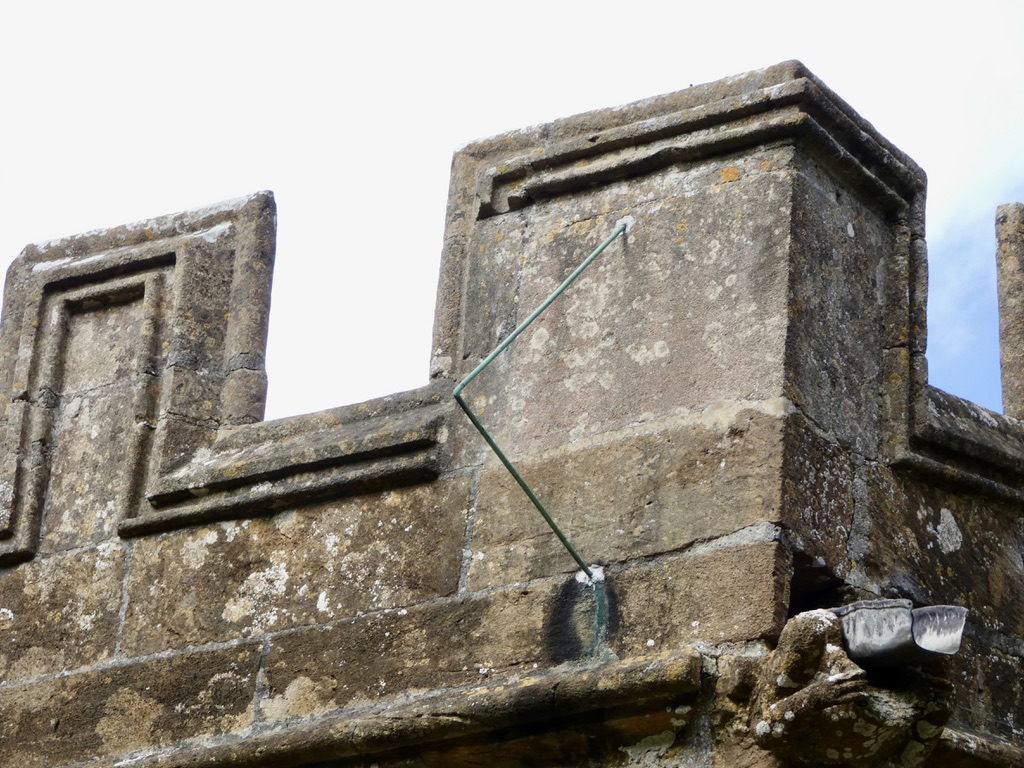
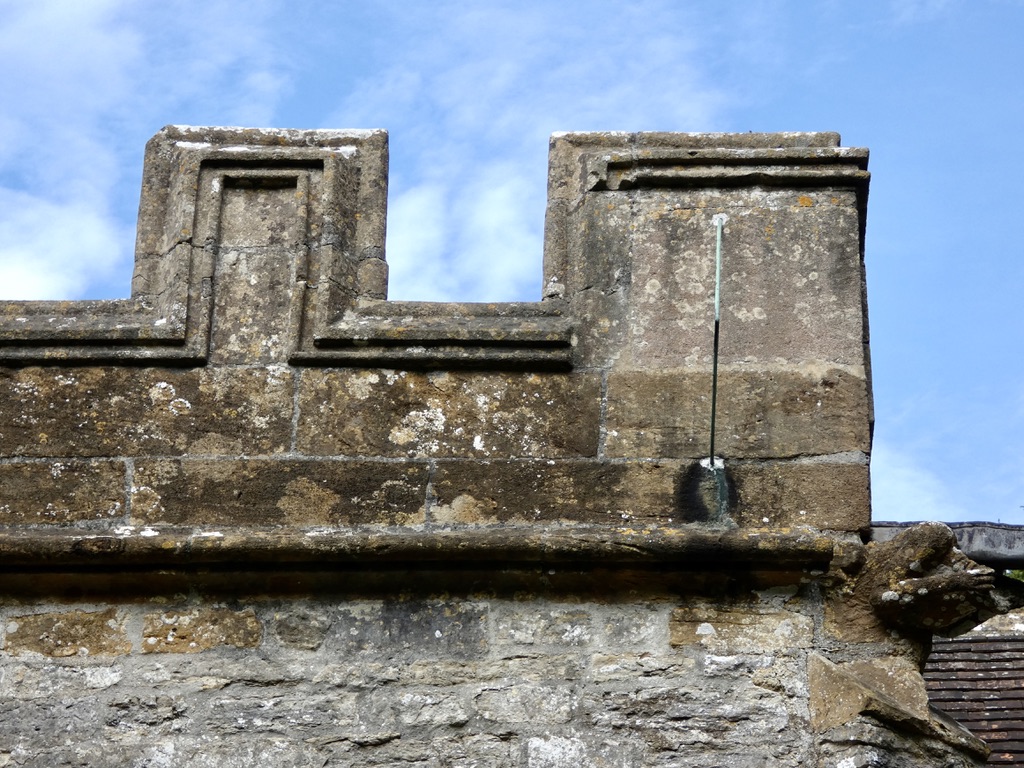
I also photographed the Vertical Dial for BSS records. It is located on the end merlon of the parapet, easily visible. It has a simple, almost square face. The plain metal gnomon is fixed into the top of the dial stone, and into the mortar line under the stone below it.
There are other unmarked (no lines, pocks, numerals) dials in the S Somerset / W Dorset region and I though this was one. However, later examining the main photograph in the gallery below, I detected 2 faint lines in U L quadrant that seem deliberately cut. There’s a ghost of a line on the opposite side. So possibly this was once a conventionally marked dial that has slowly and very evenly eroded.
It is hard to date. The dial stone differs from the ones around it. At a guess, it was added C19, perhaps when other work was carried out (eg adding the N transept). BHO notes that in 1827 the church was ‘repaired and beautified’. Perhaps adding the dial was part of that process.
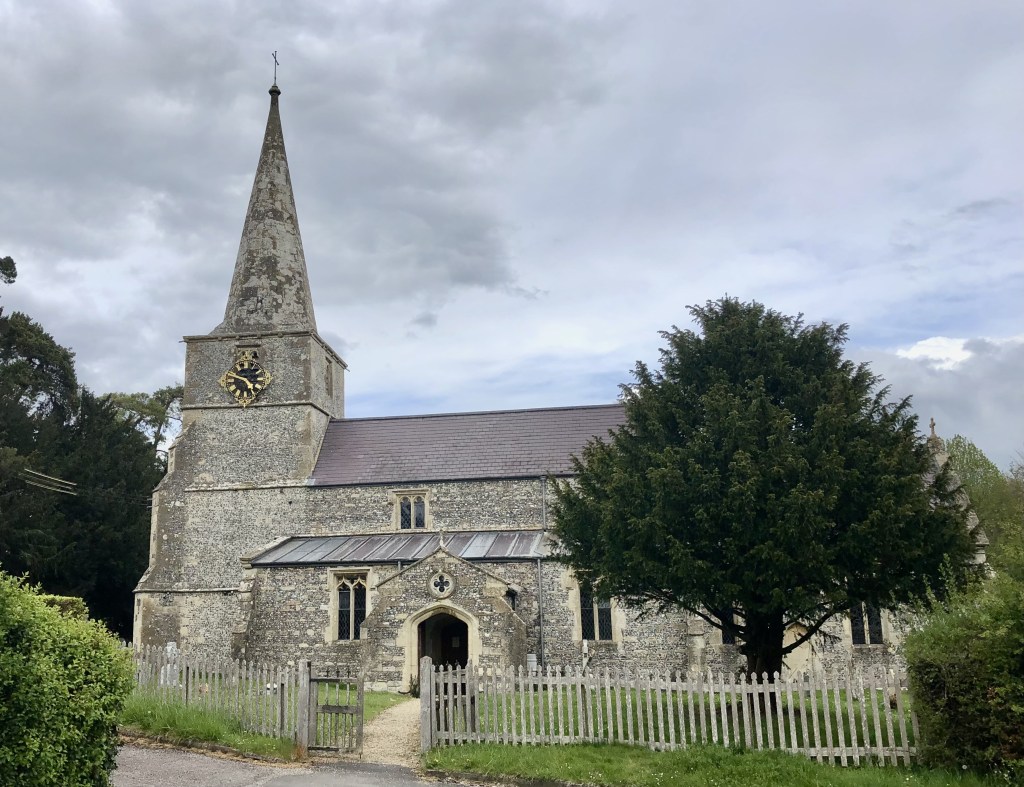
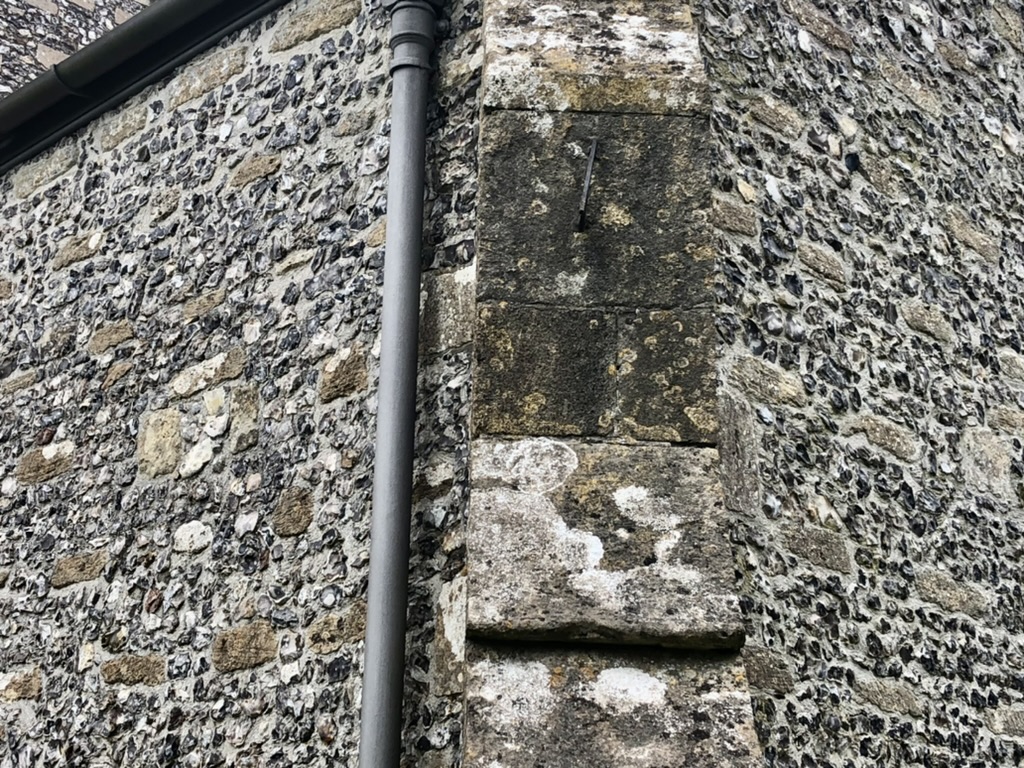
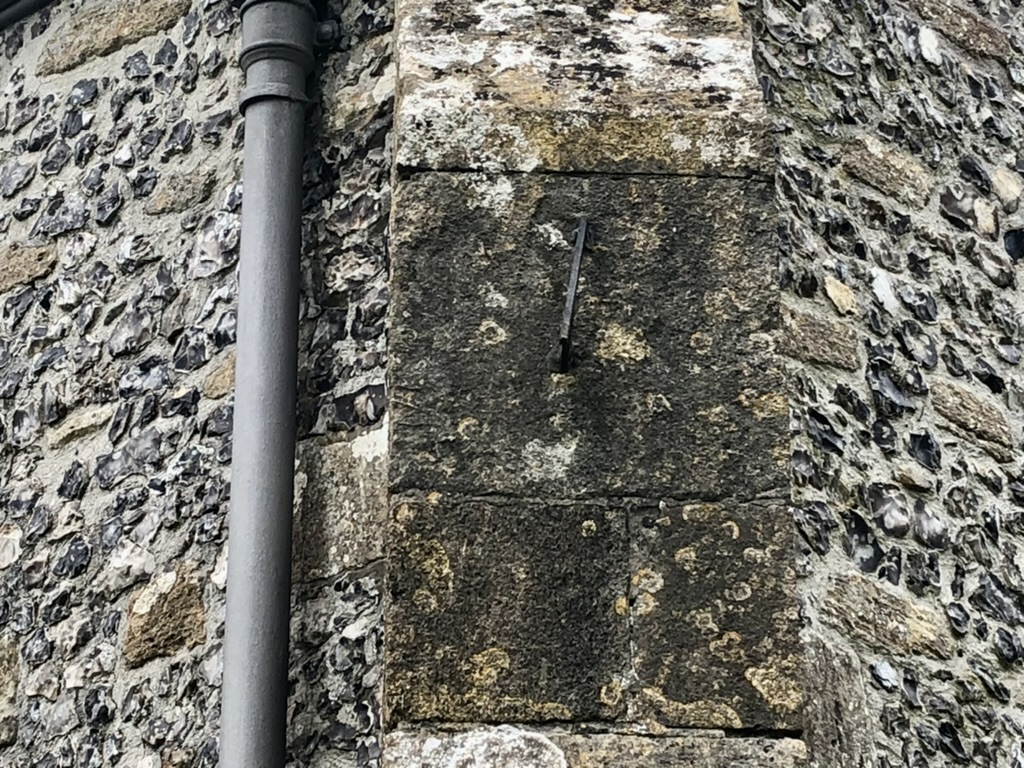
GRADE I † C12, C13, C15; C19 restoration. A pretty church with a 4-stage tower and short steeple, close by the Kennet & Avon canal. No discernible scratch dials though a likely-looking location. A single vertical dial, angled. 7 miles W of Hungerford. 51.3941 / -1.5828 / SU291661
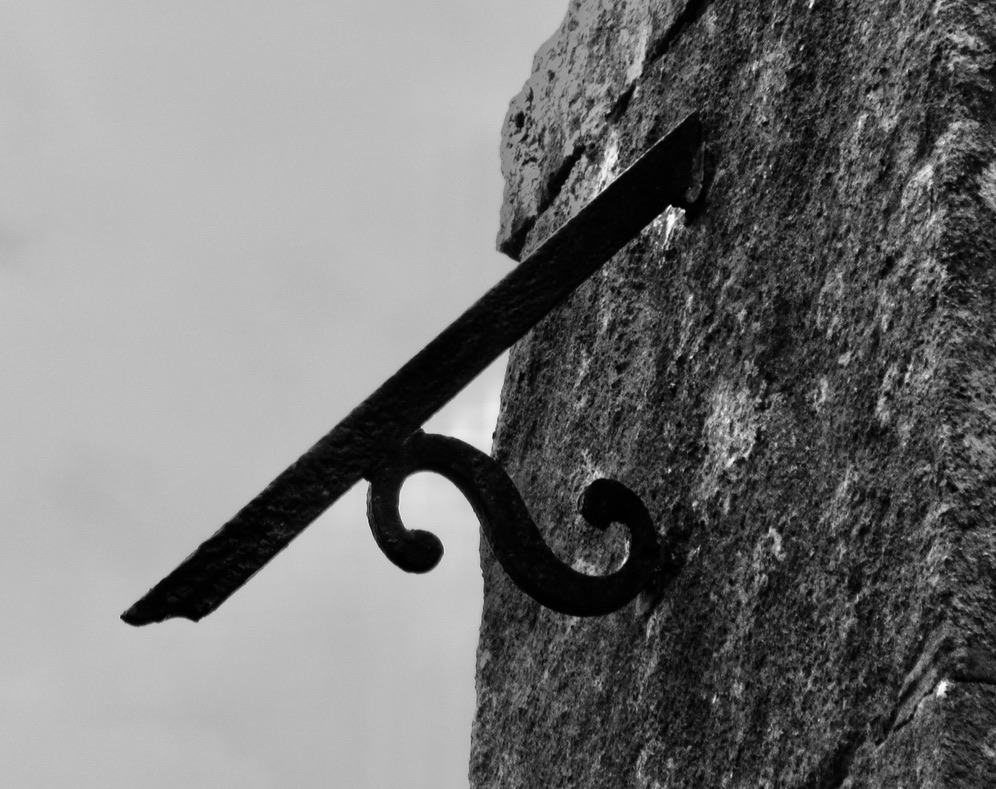
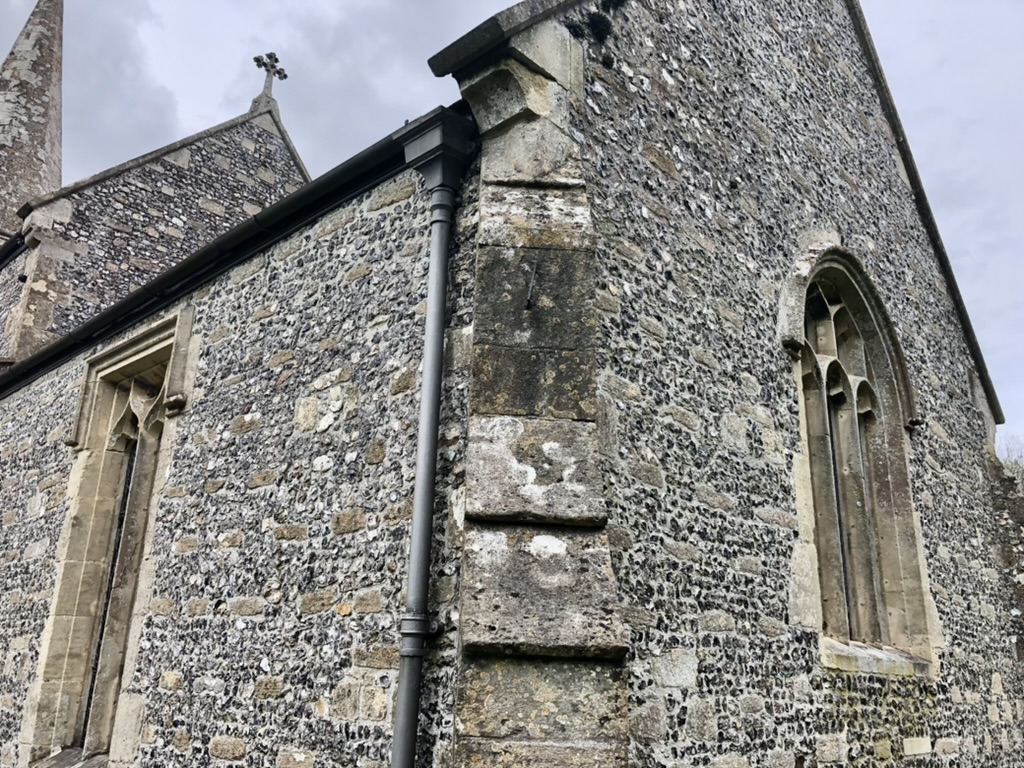
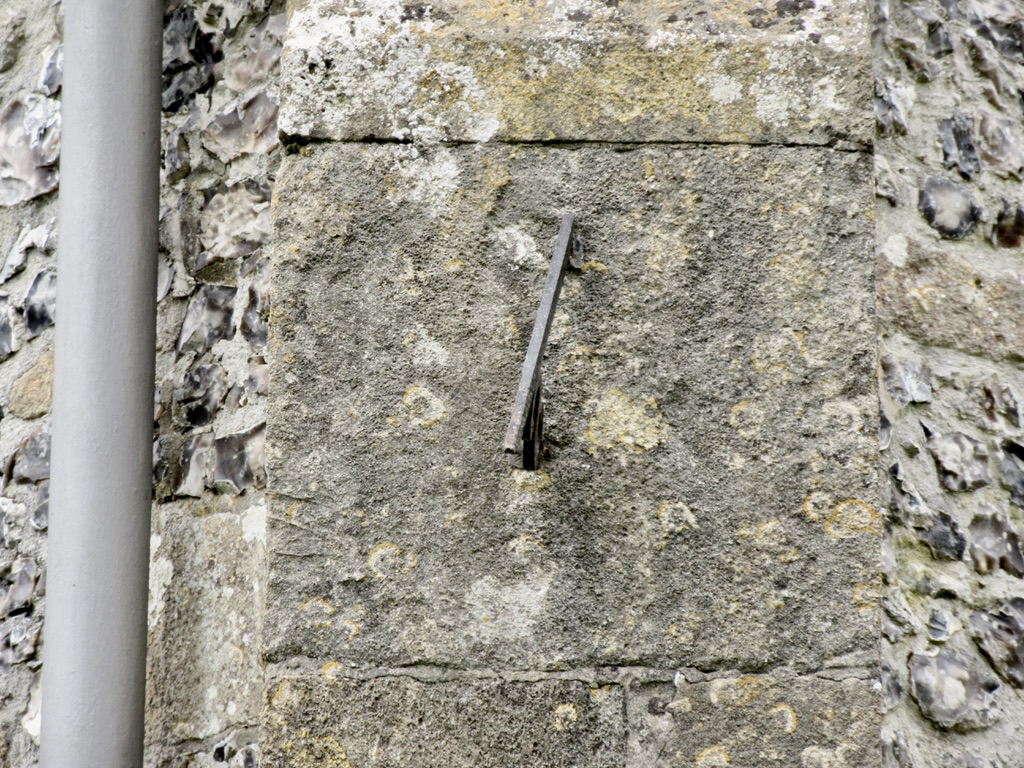
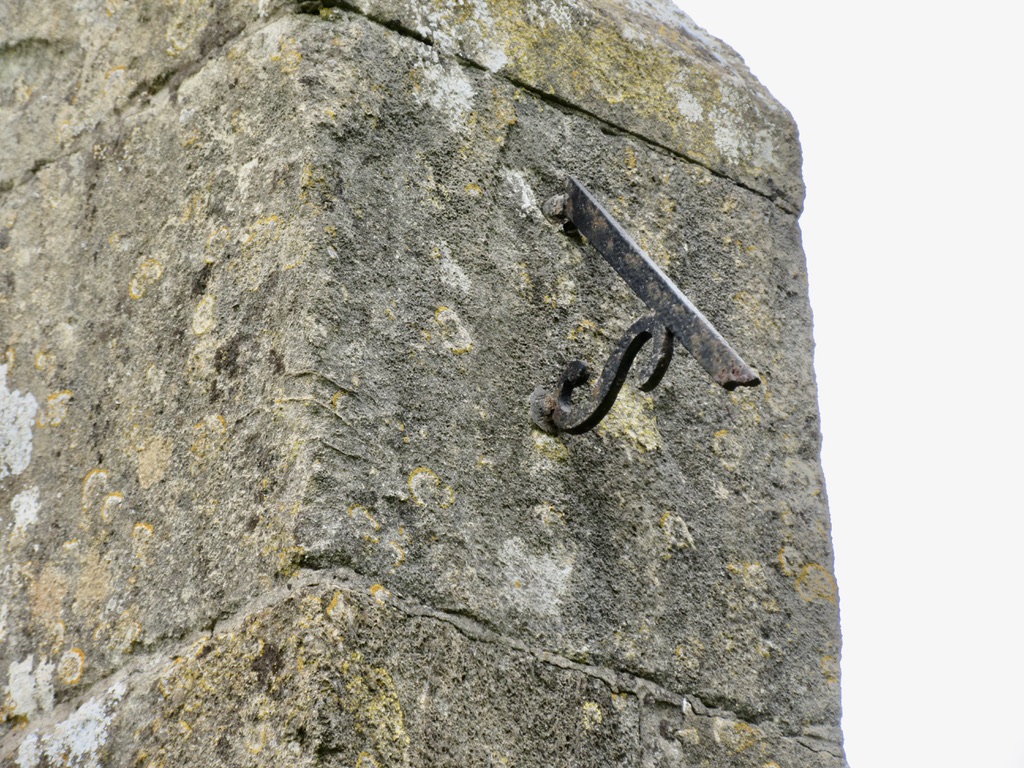
The dial is high up on a SE facing buttress, with an iron gnomon set into the stone. It has an S-shaped support. The face is completely plain, with no evidence of numbers, lines or a frame. Possibly it was originally painted. Hard to date, though the gnomon is plainly not original.
St Michael . Little Bedwyn . Wilts
Using a different camera sheds another light on the dial* and confirms the absence of markings
St Michael . Little Bedwyn . Wilts
*and demonstrates how 2 cameras, used at the same time, tell different stories























 GAUDIUM SUB SOLE . SUNDIALS . MEDIEVAL TO MODERN