
HAMPTON COURT PALACE . PRIVY GARDEN . THOMAS TOMPION’S DIAL

Hampton Court Palace – CC / OS

HAMPTON COURT . TOMPION DIAL

Hampton Court Palace . Privy Garden . Tompion Sundial – Keith Salvesen

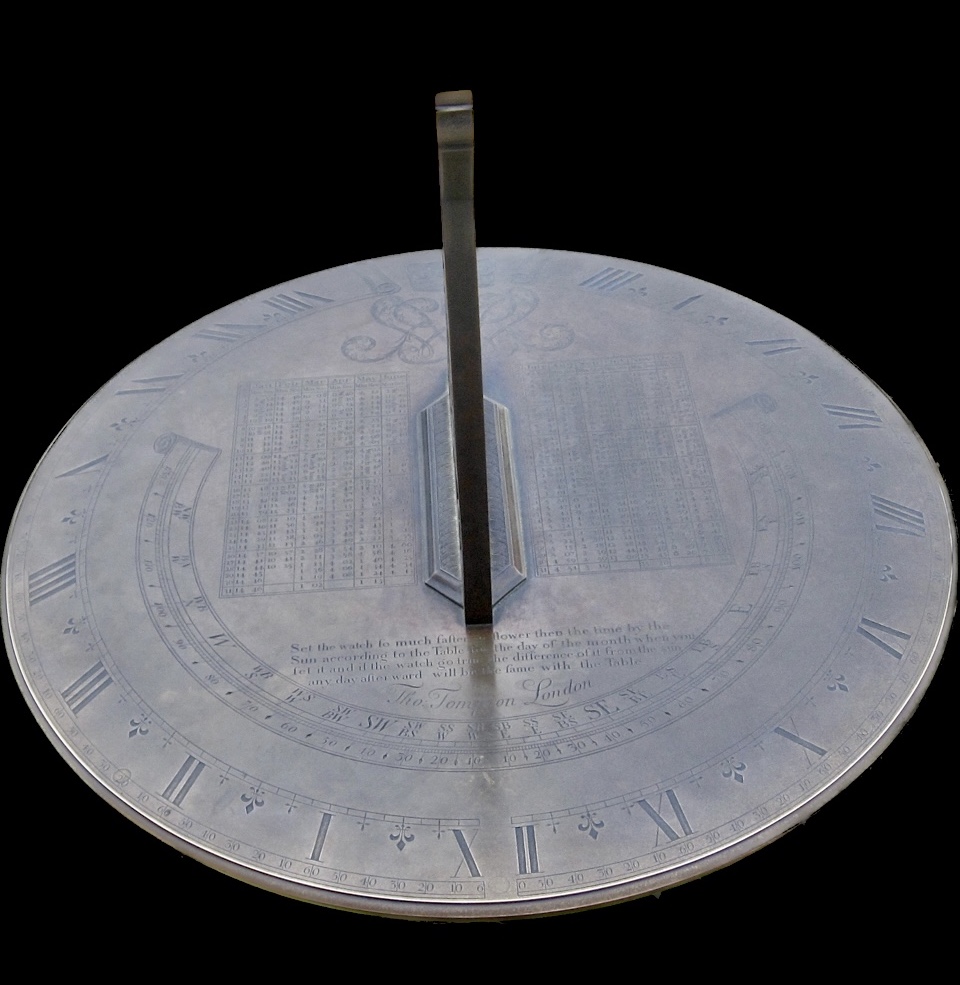
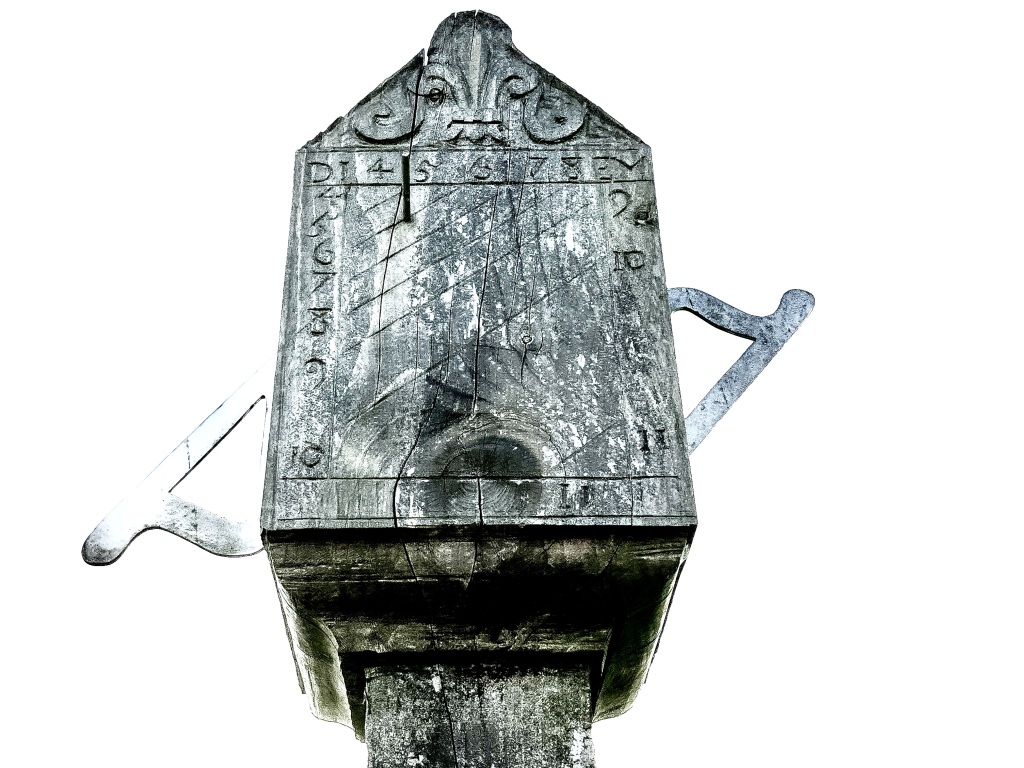
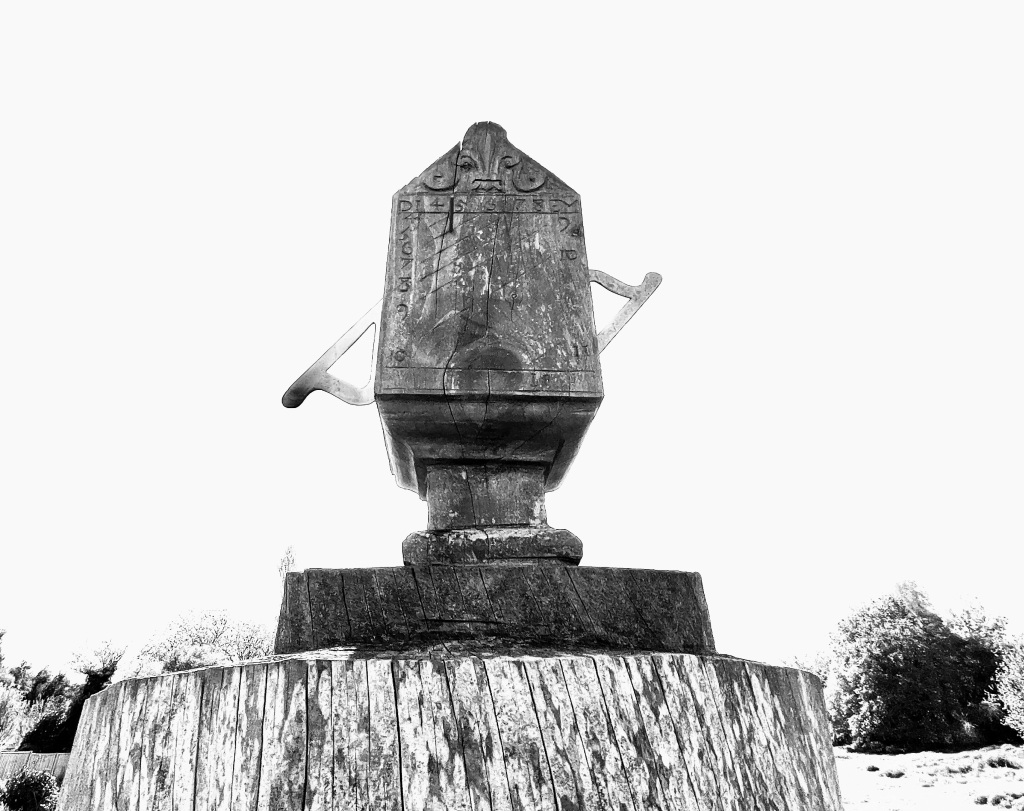
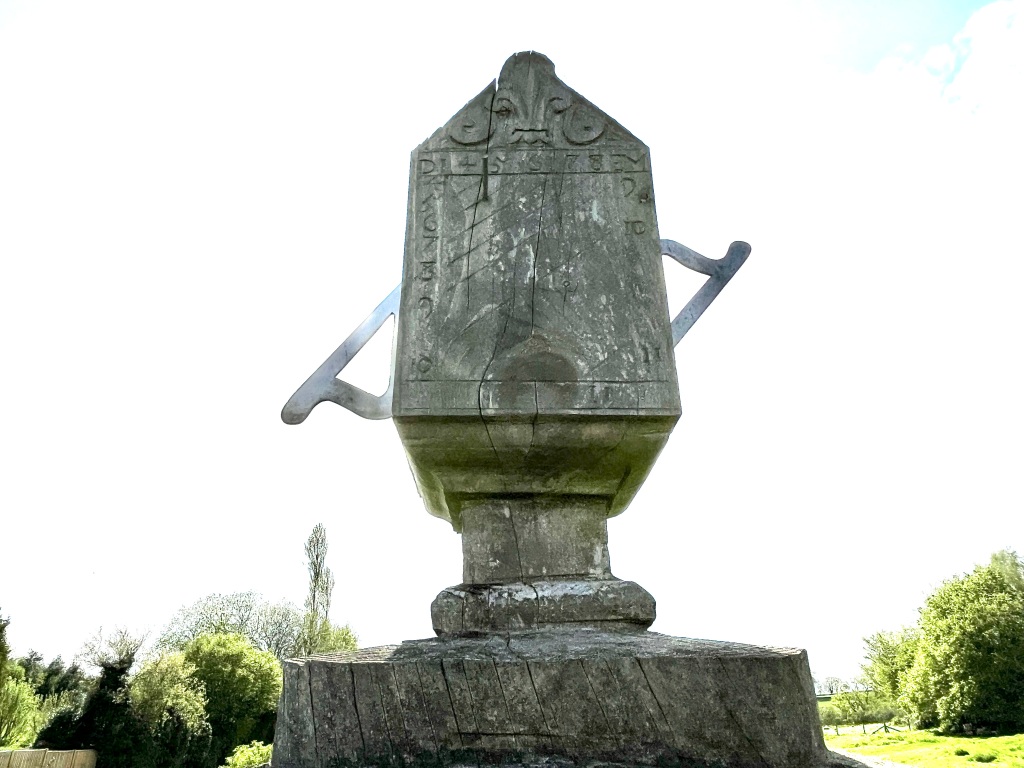
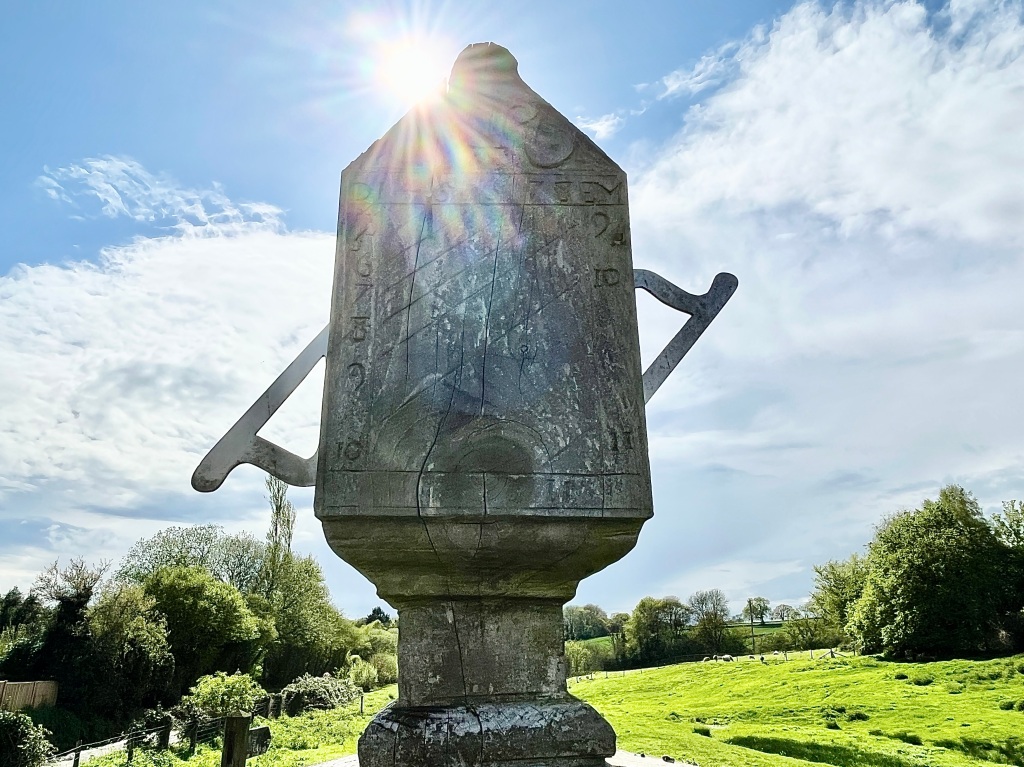
This famous Tompion dial in the Privy Garden at Hampton Court is one of a pair, the other being transferred in due course to Kew Gardens. The BSS Bulletin Jan 1997 includes side-by-side photos of both. The dial that stayed in situ, featured here, being on the left. The other dial was transferred to Kew in 1832 and not restored to Hampton Court until 1995.
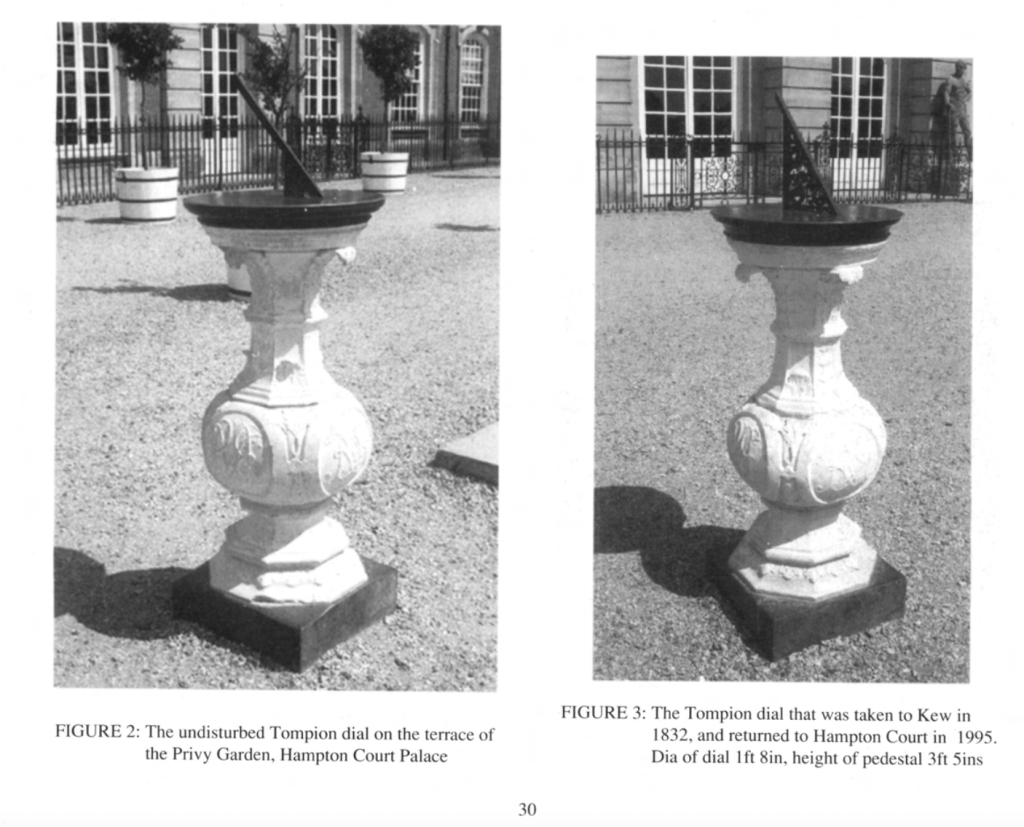
I took these photos in 2011 when I was dialling-lite, and probably with an iPhone 3. Revisiting these images, I’m pleased at what a good job it did. Puzzlingly, during a quick trawl through the usual resources, inc. the Royal Collection, I have found it difficult to find any detailed images of this dial, though I found a RC image of dial 2.

Hampton Court . Tompion Dial 2 . Royal Collection

Hampton Court Palace . Privy Garden . Tompion Sundial – Keith Salvesen

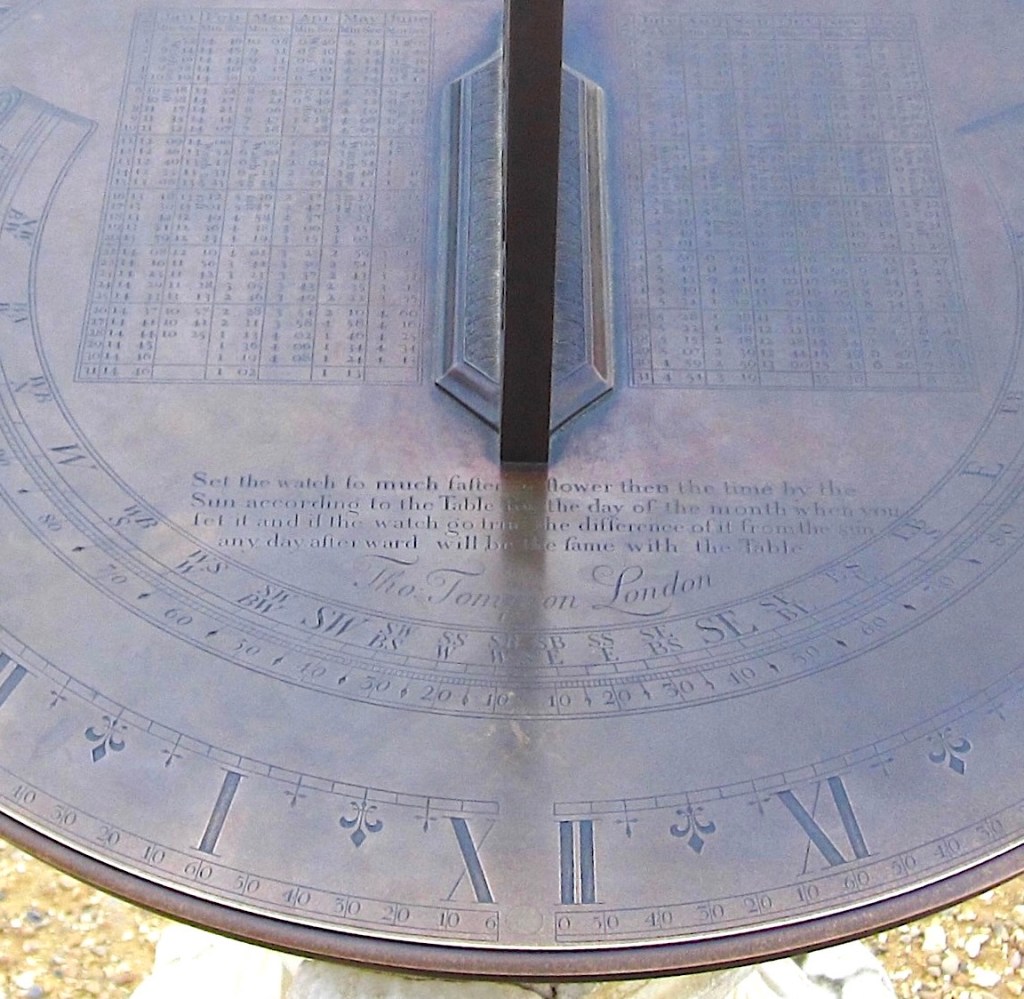
Only the front of the plate is clear, and it is in remarkable good condition. There is just enough definition to give a good idea of the complexity of the calendar further back on the plate.

INSCRIPTION
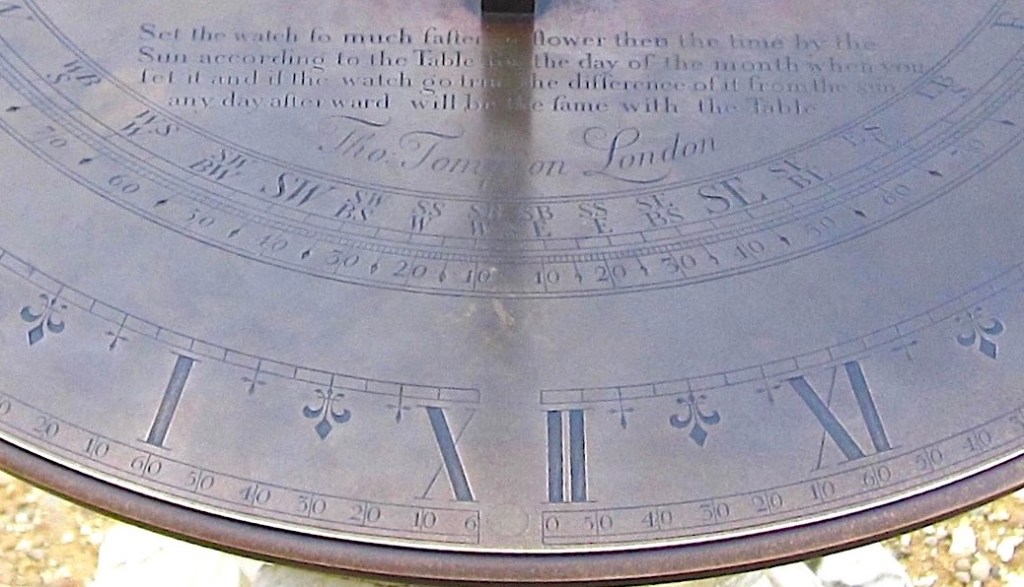
Hampton Court Palace . Privy Garden . Tompion Sundial – Keith Salvesen

The precise date for the two dials in unclear. Tompion was baptised in 1639 and died in 1713. I have seen ‘towards the end of C17’; and the excellent Border Sundials points to evidence of installation in 1699.


Royal Museums . Greenwich

Royal Museums . Greenwich – crop

Hampton Court Palace . Privy Garden . Tompion Sundial – Keith Salvesen

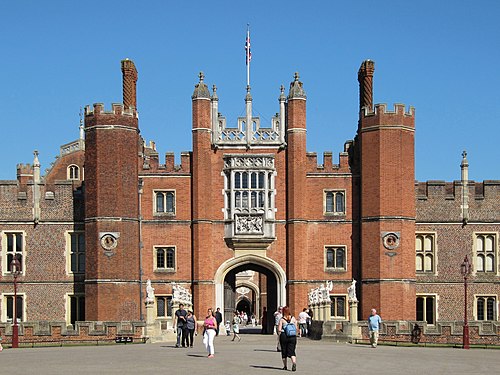
Probably, in a sundial resource, it is permissible to include an occasional linked item, and the wonderful Hampton Court astronomical clock merits admiration at any time. I was pleased to get a straight-on shot without resorting to trickery (of which there was not much available in 2011).

.

Hampton Court Palace . Privy Garden . Tompion Sundial . Keith Salvesen

GSS Category: Horizontal Dial; Horizontal Dial with Calendar; Tompion Sundial; Pedestal Dial

All photos; Keith Salvesen except as stated
CLOSWORTH . SOM . ALL SAINTS – Horizontal Dial

ALL SAINTS . CLOSWORTH . SOM

GV II* C13 origins with some C15 work but drastically restored in 1875 BLB. Fine chest tombs. Village of historical importance as a bell-foundry between C16 and C18, originating with the Purdue family. Notable bells survive from its earliest days eg. Wells Cathedral. Somerset / Dorset border 50.8883 / -2.6214 / ST563100

DIAL

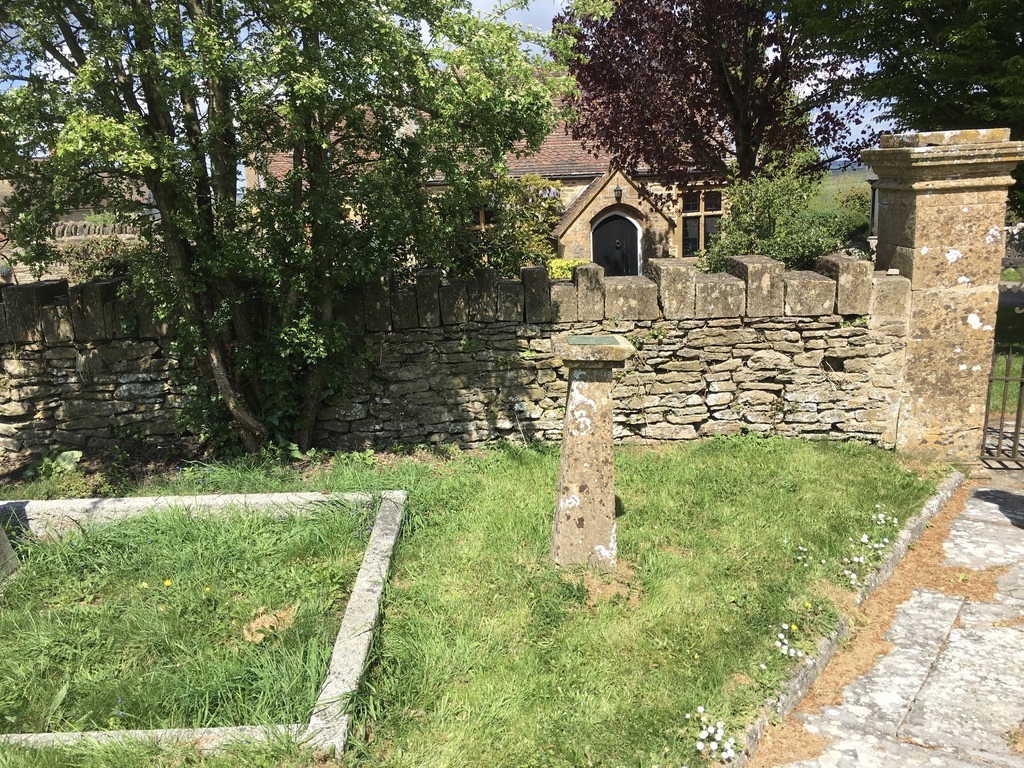
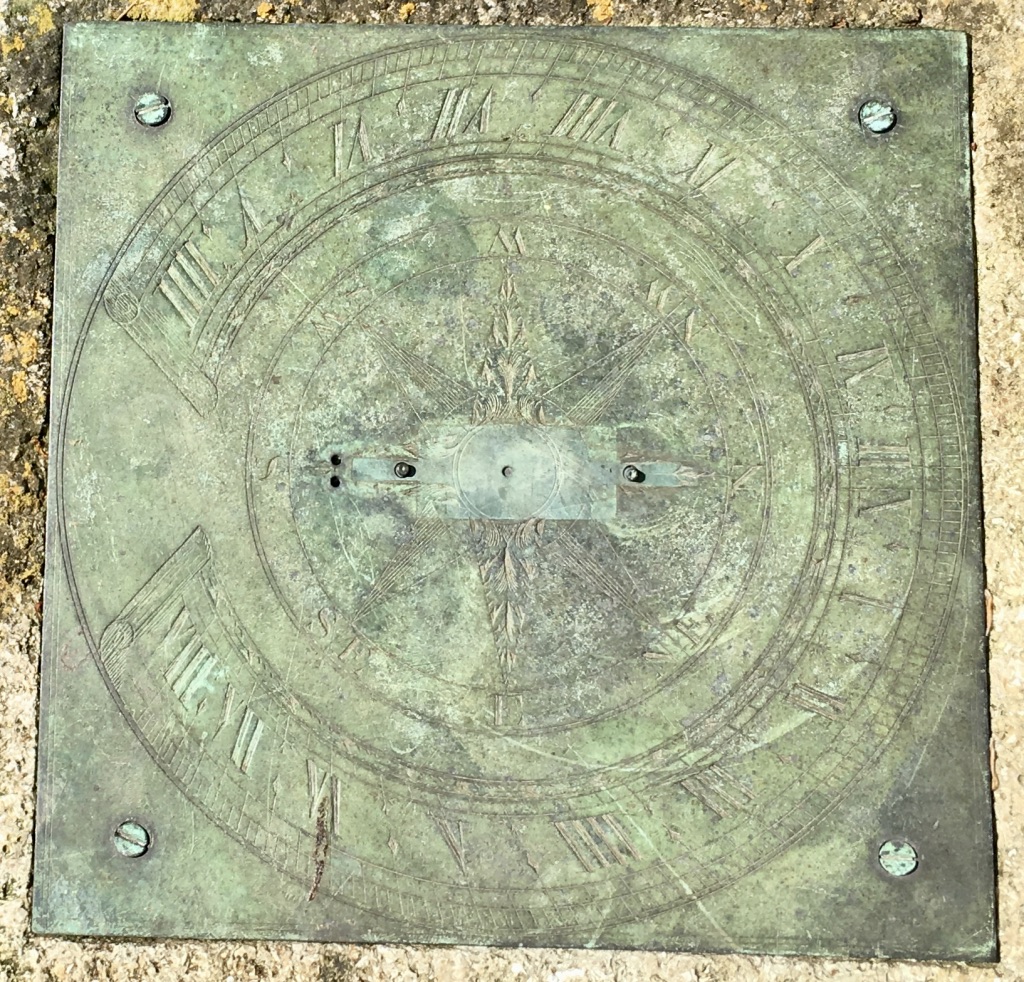
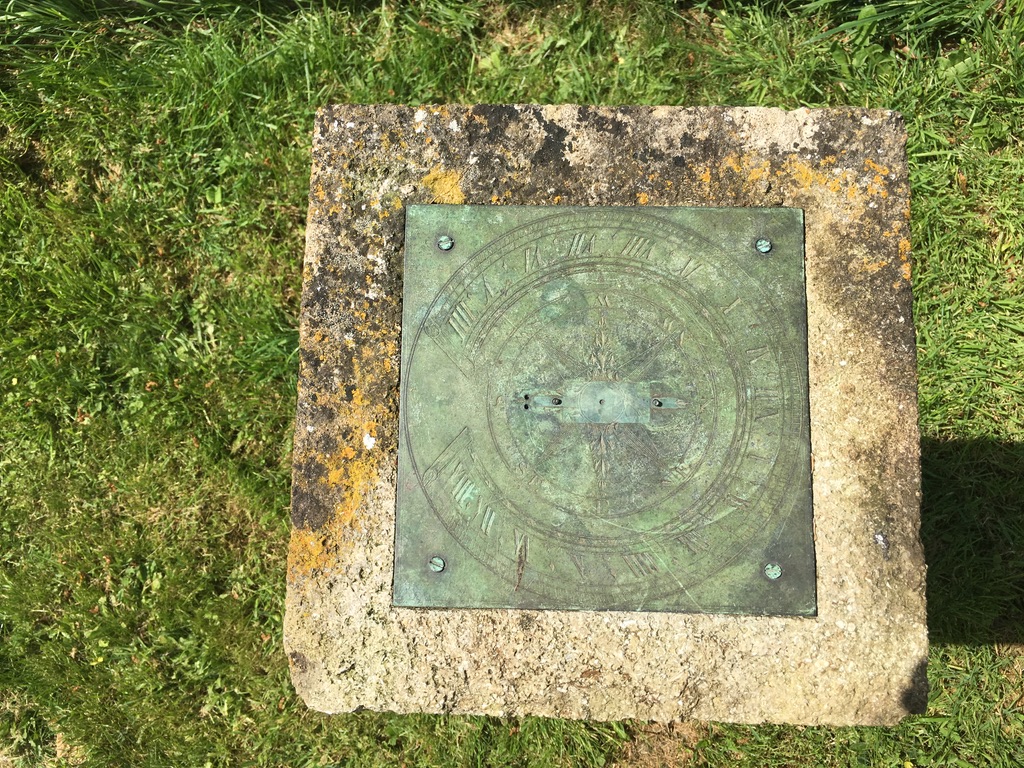
An agreeable churchyard dial in a pretty setting. Missing its gnomon, possibly vandalised (cf Lillington quite nearby). The dial plate is a familiar design, though without a maker’s mark or other indication of its origins.

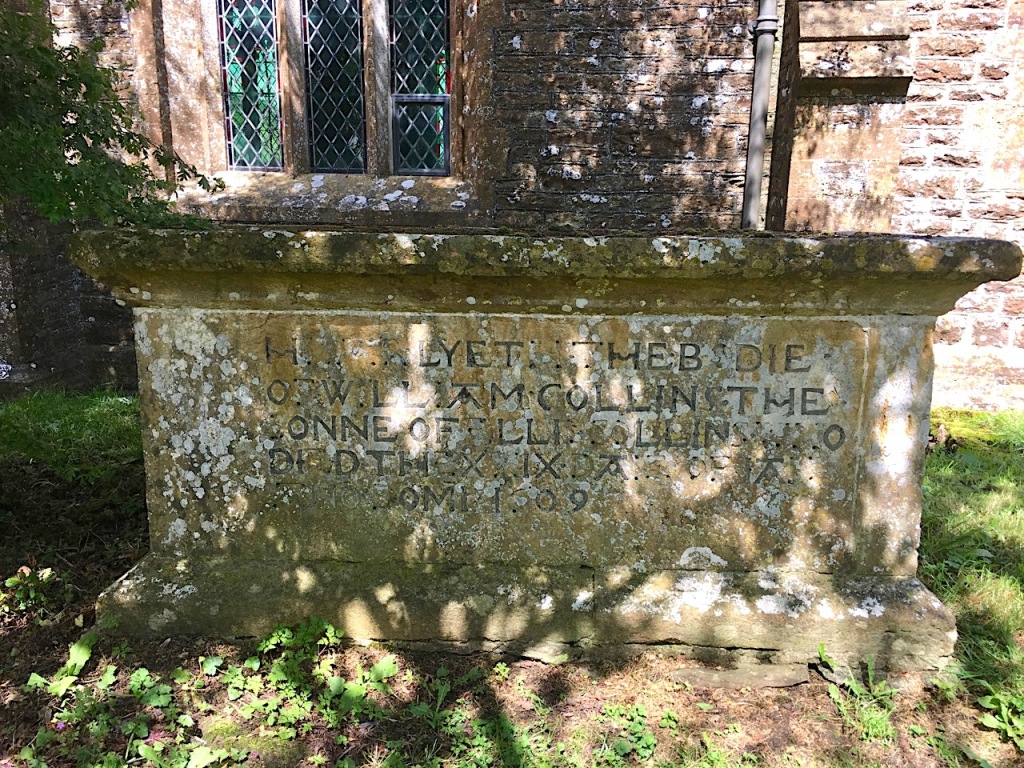
TOMB OF WILLIAM COLLINS, 1609

HERE . LYETH . THE . BODIE . OF . WILLIAM . COLLINS . THE . SONNE . OF . ELLIS . COLLINS . WHO DIED . THE . XXIX . OF . IAN . ANO . DOMI . 1609

GSS Category: Horizontal Sundial; Pedestal Sundial; Churchyard Sundial

All photos: Keith Salvesen

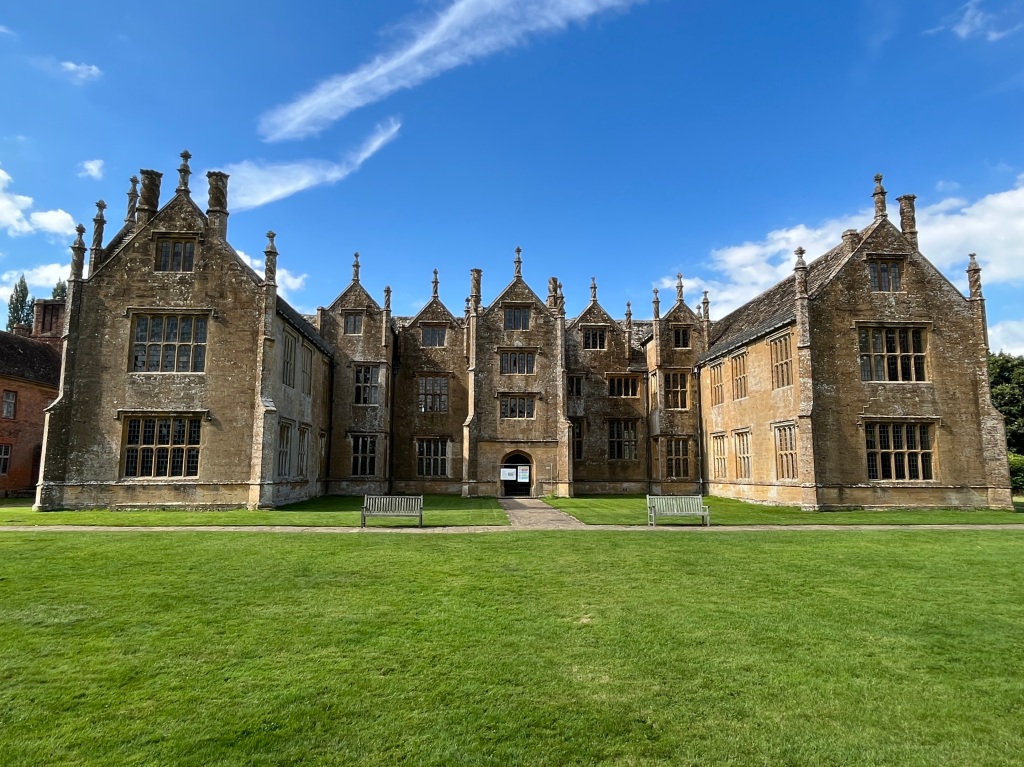
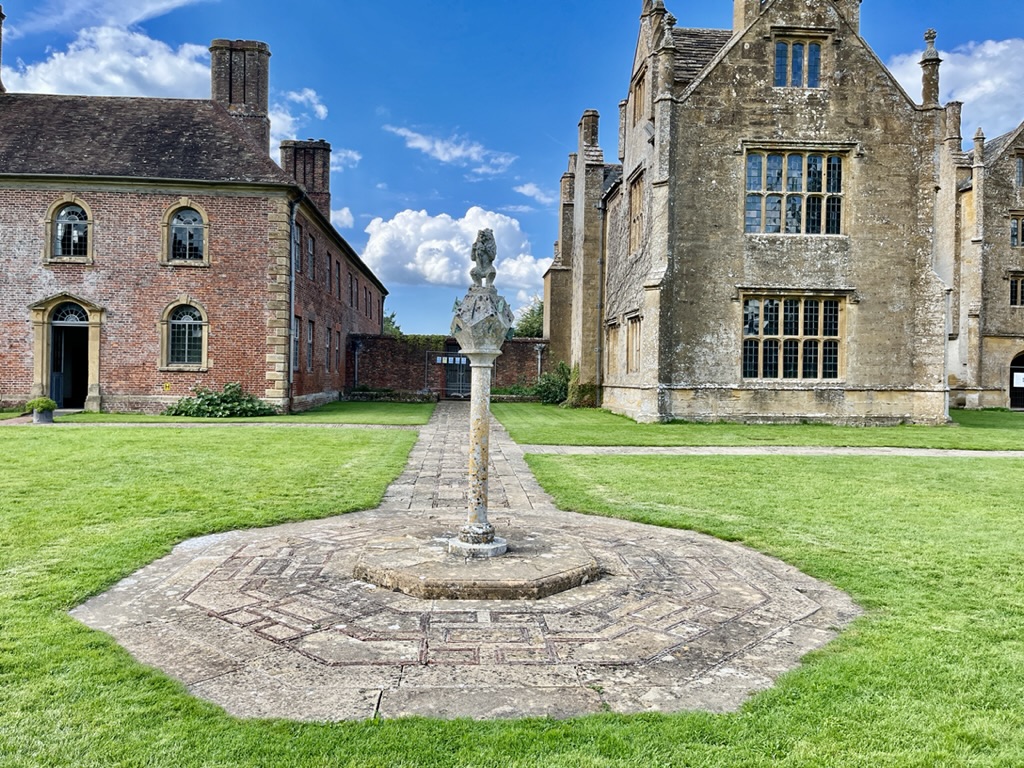
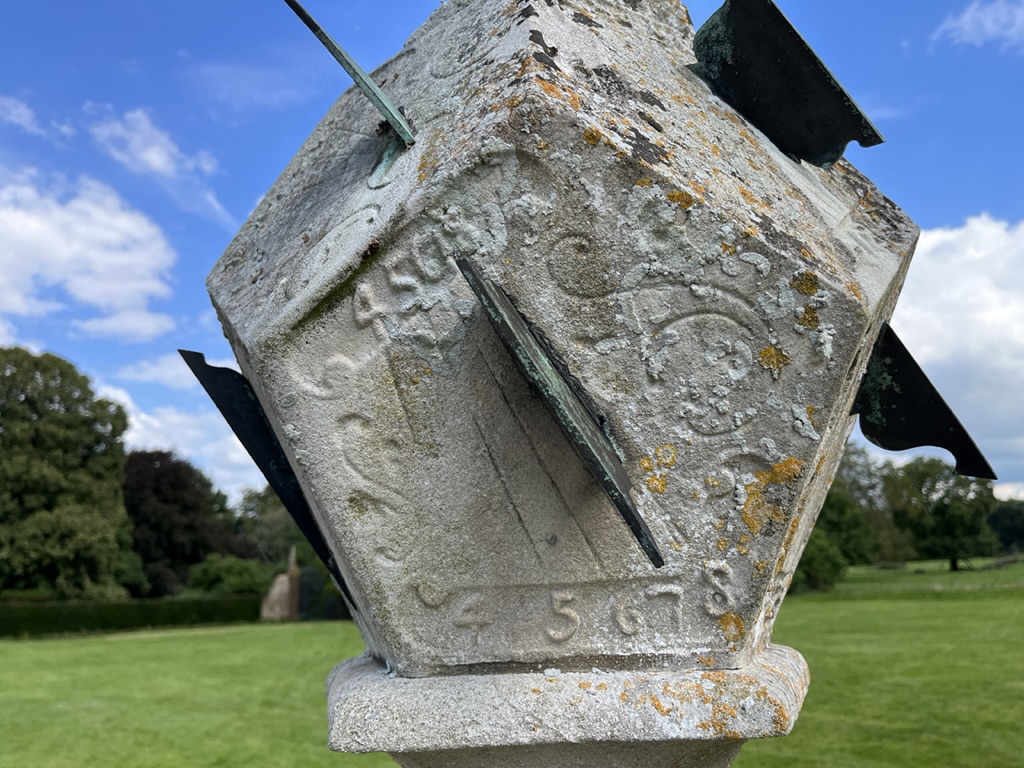
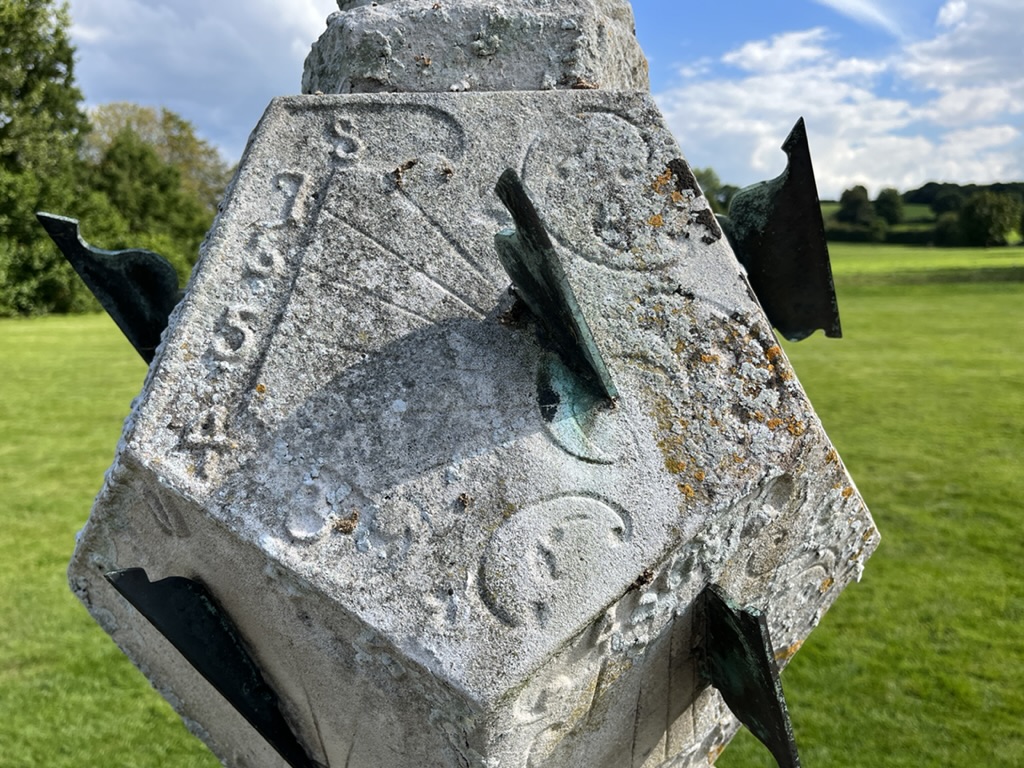
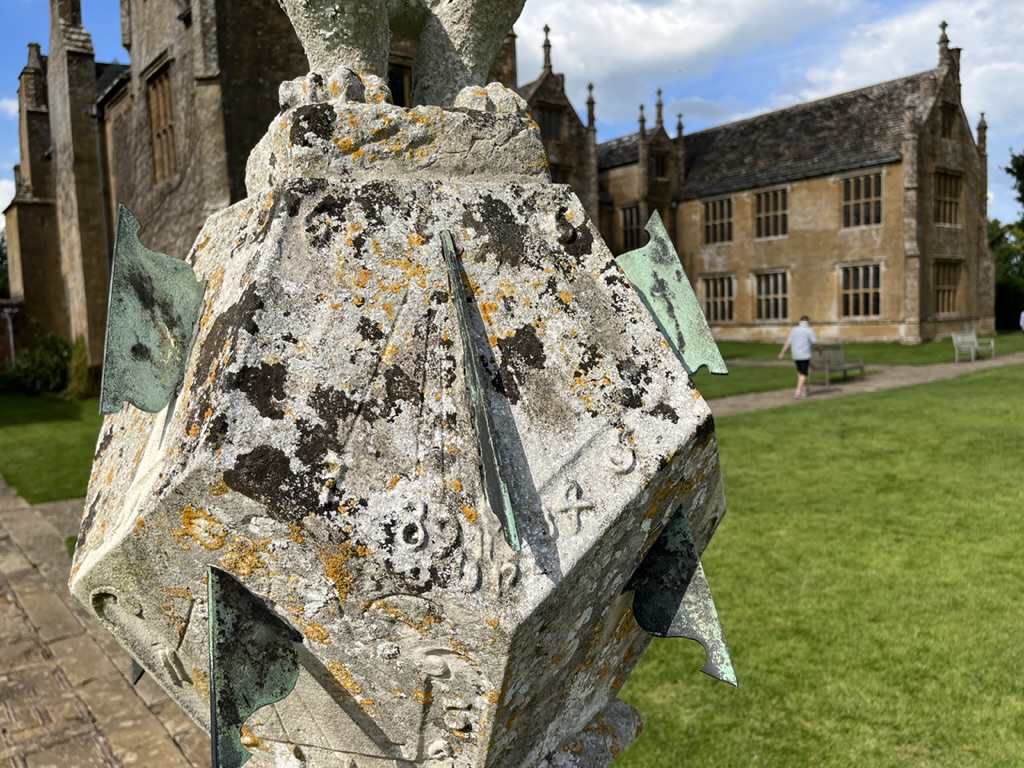
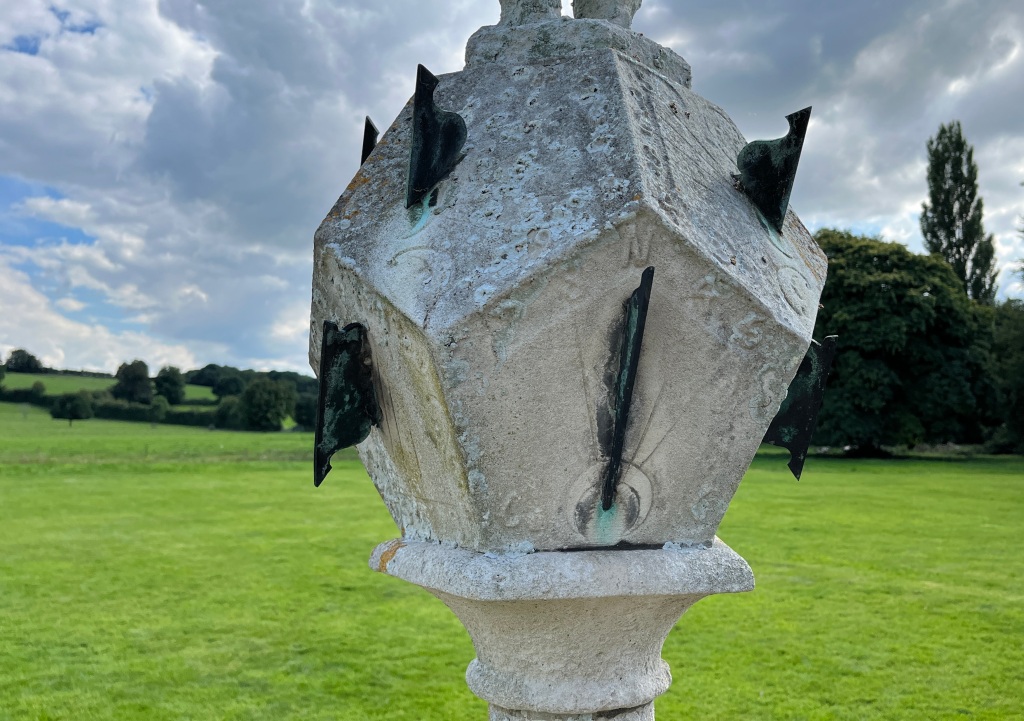
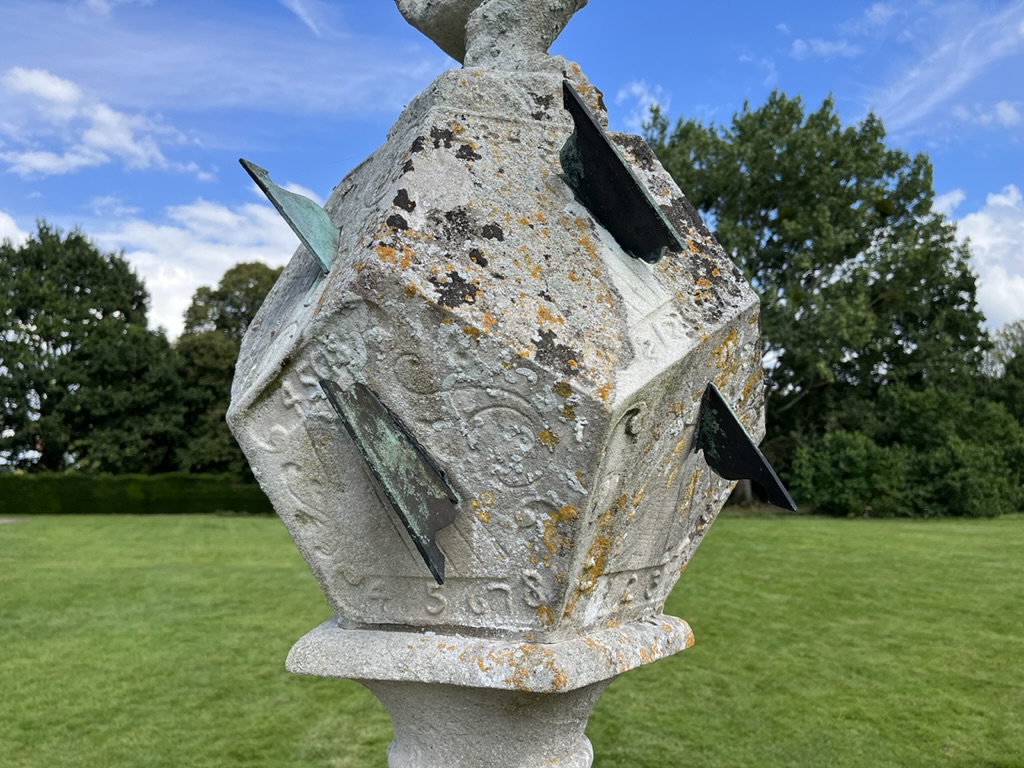
BARRINGTON COURT (NT) . SOMERSET: Dodecahedral Dial

BARRINGTON COURT (NT) . ILMINSTER . SOMERSET

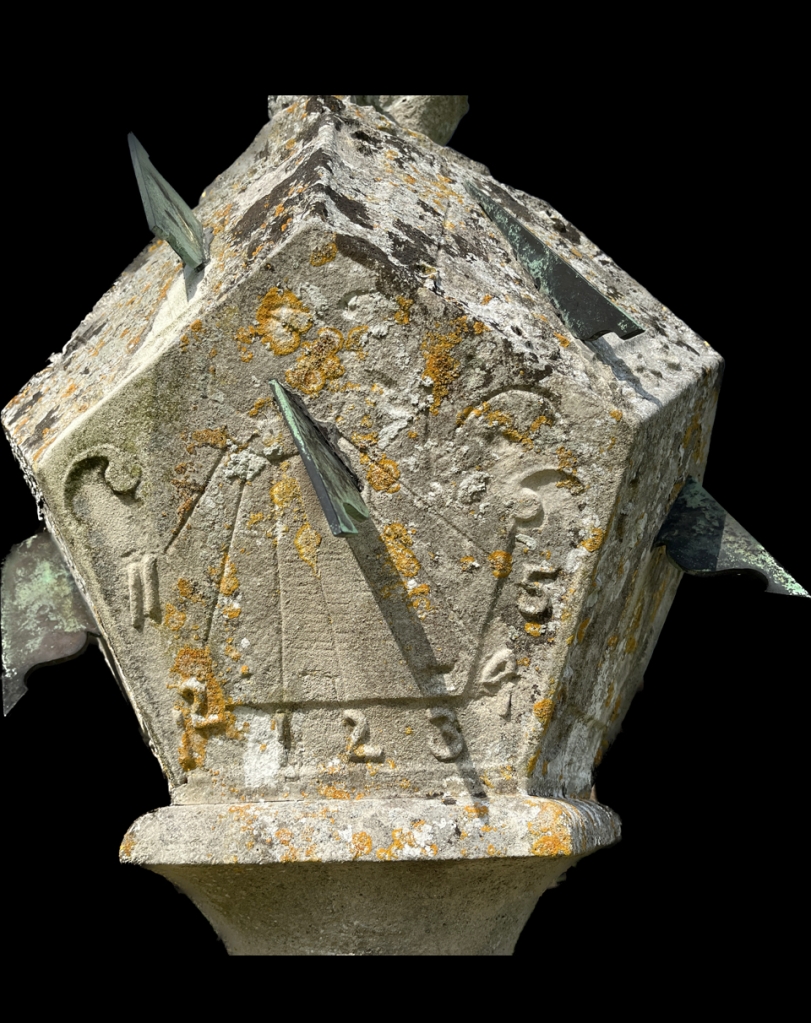
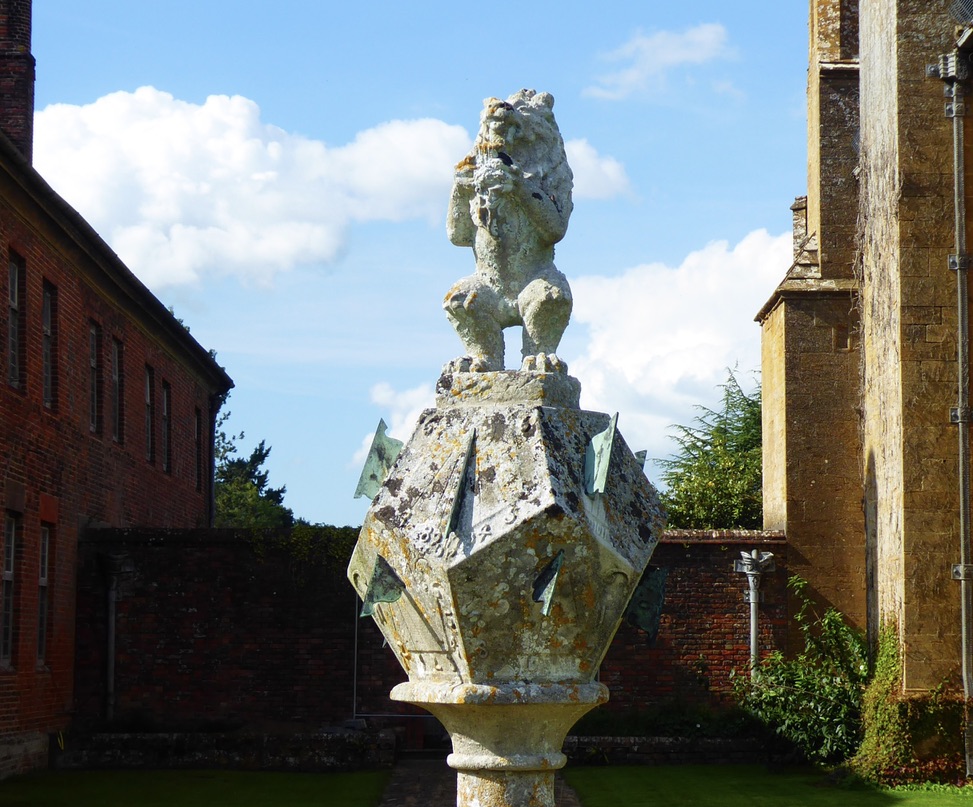
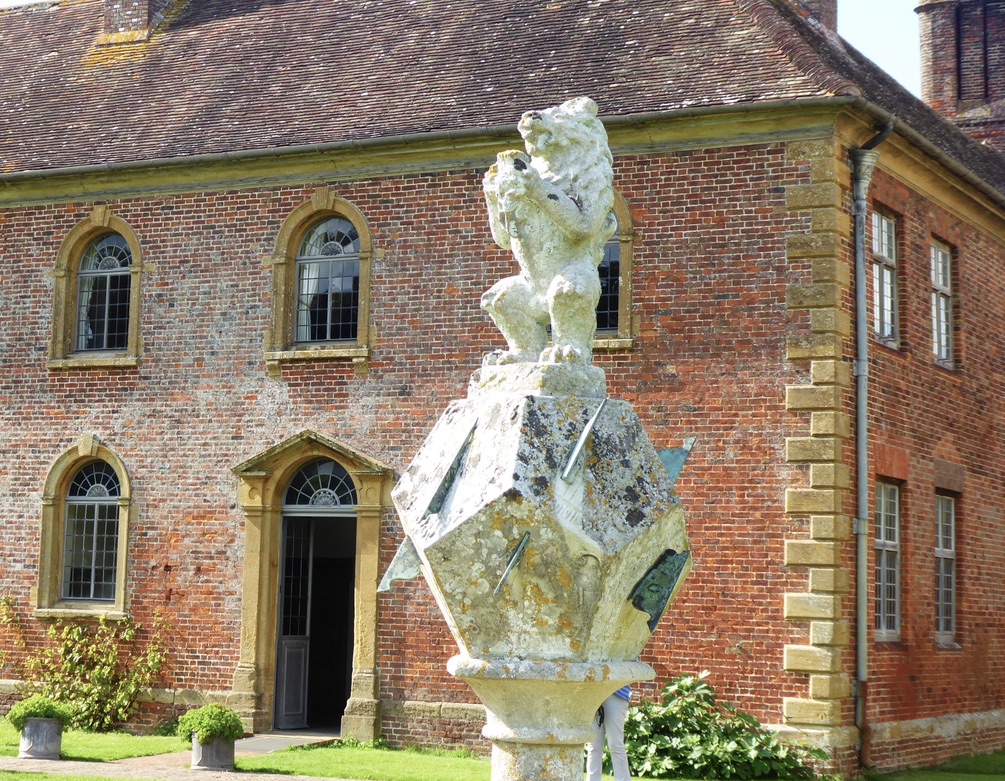
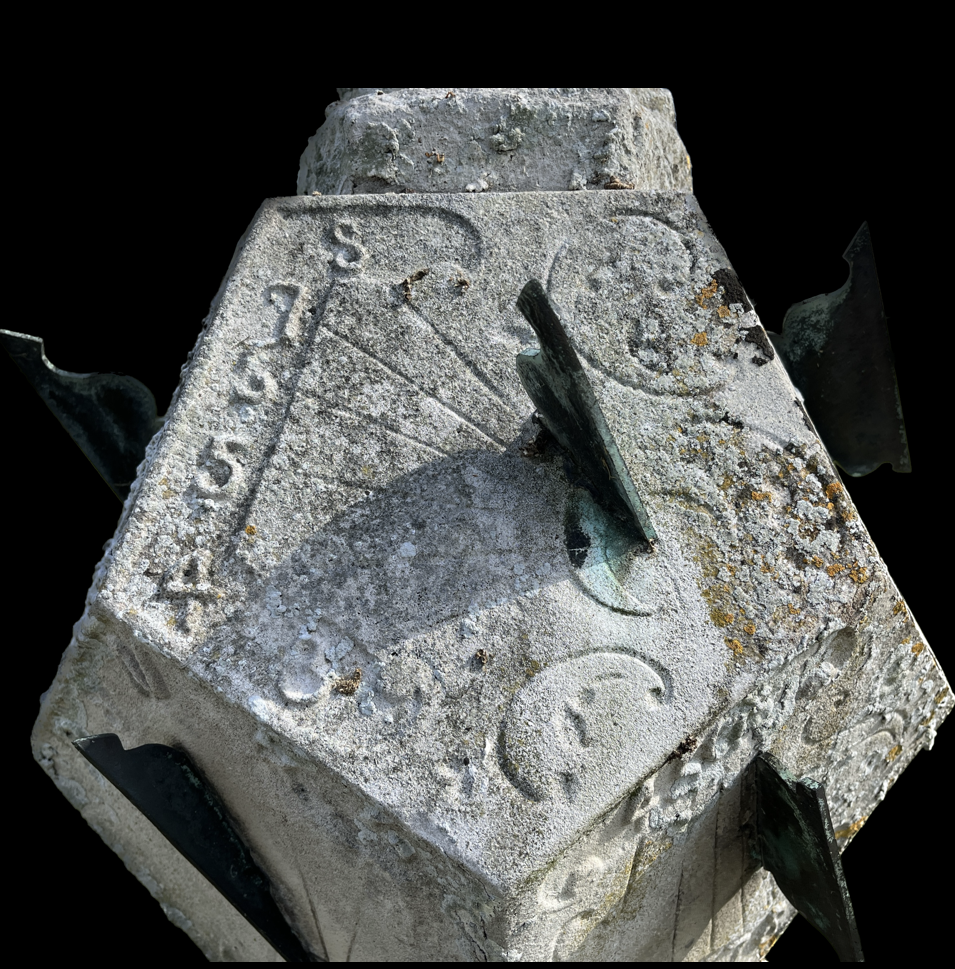
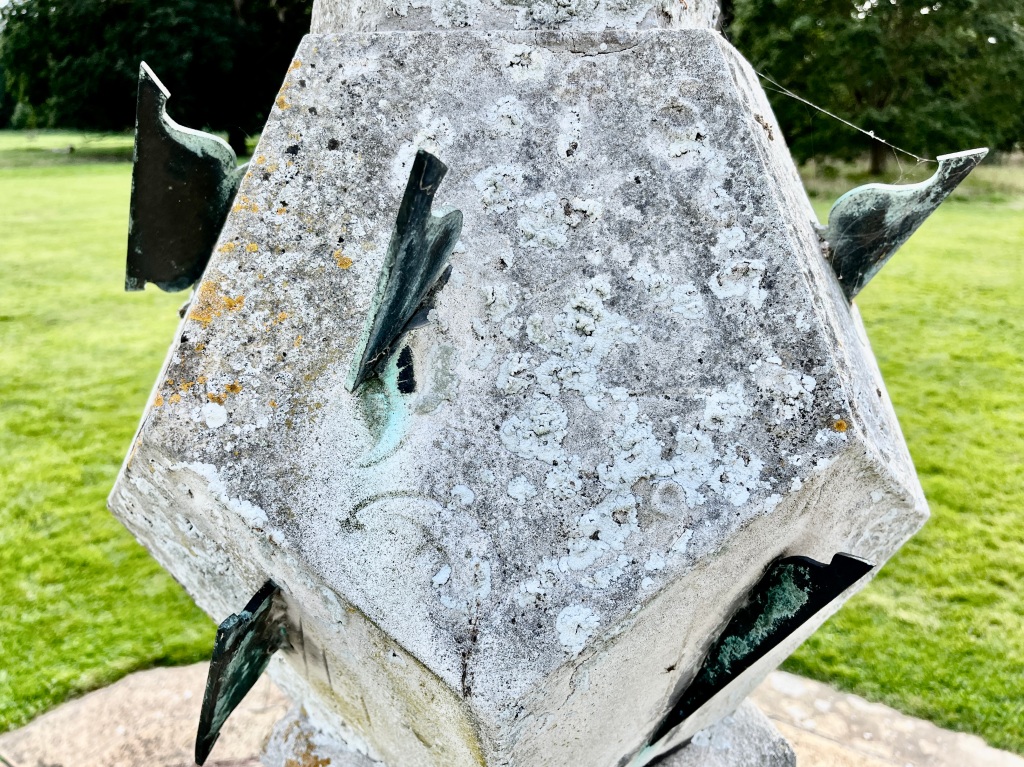
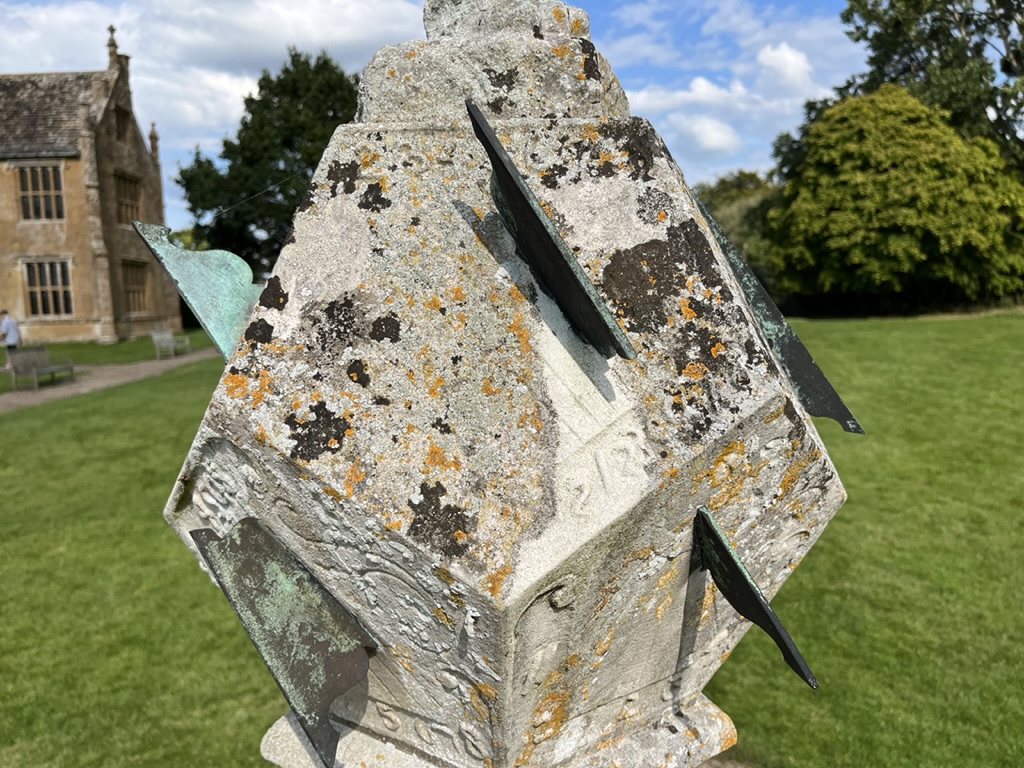
DODECAHEDRAL DIAL WITH PENTAGONAL FACETS

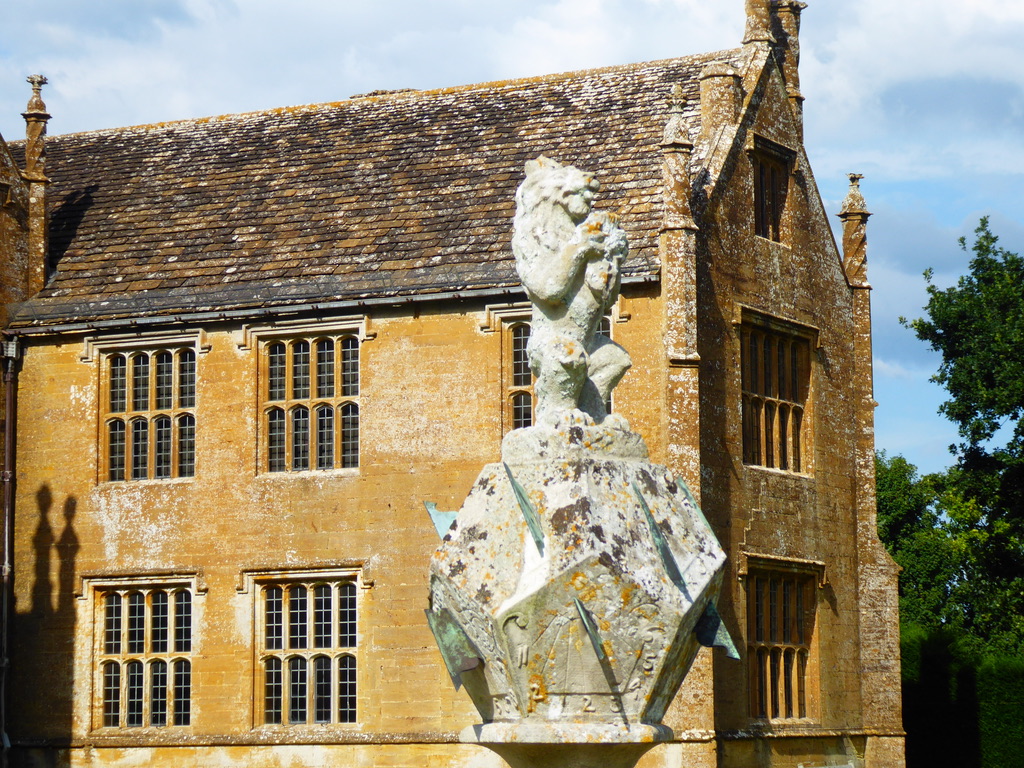
A SPECTACULAR DIAL IN A PERFECT SETTING

BSS RECORD

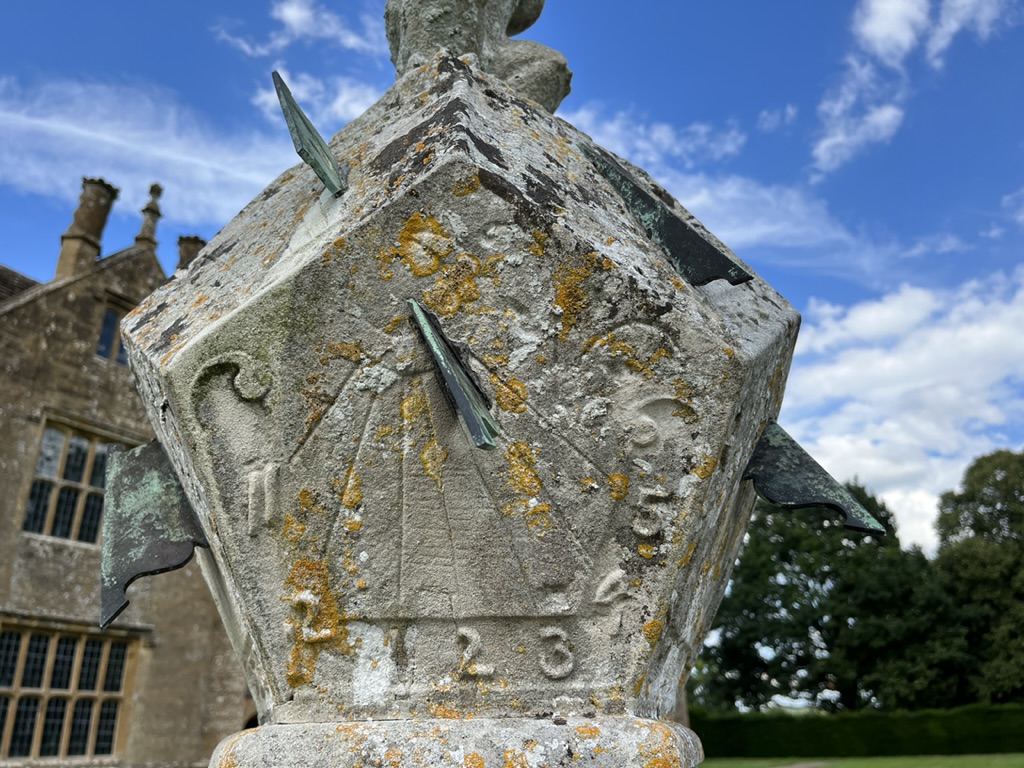
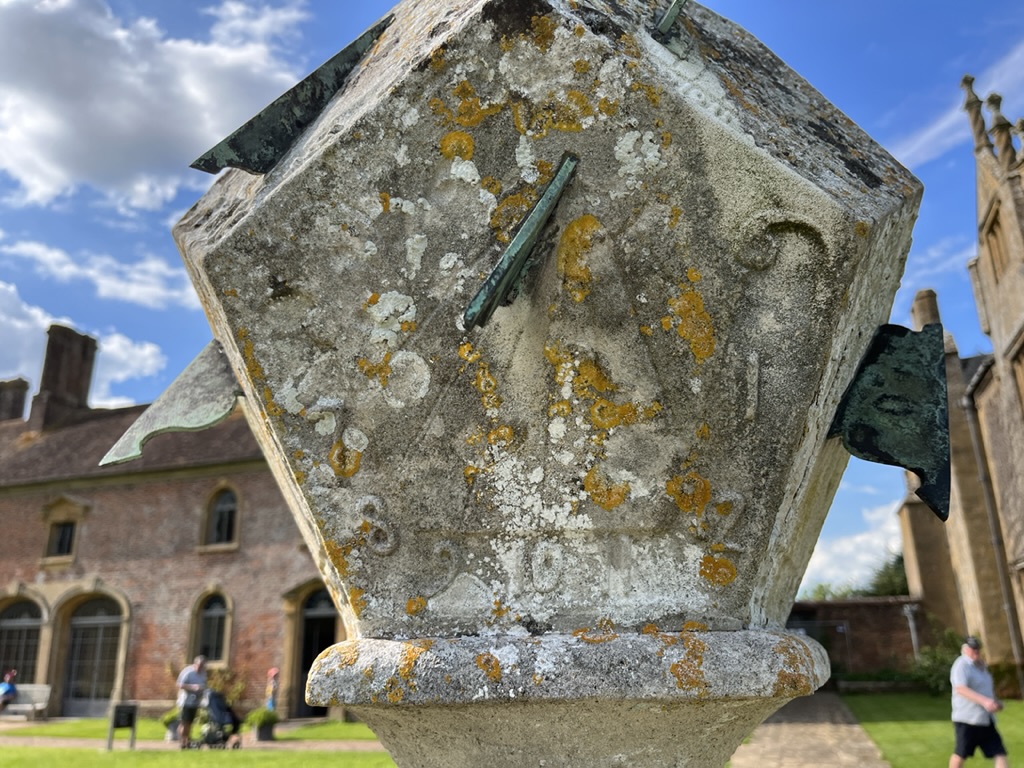
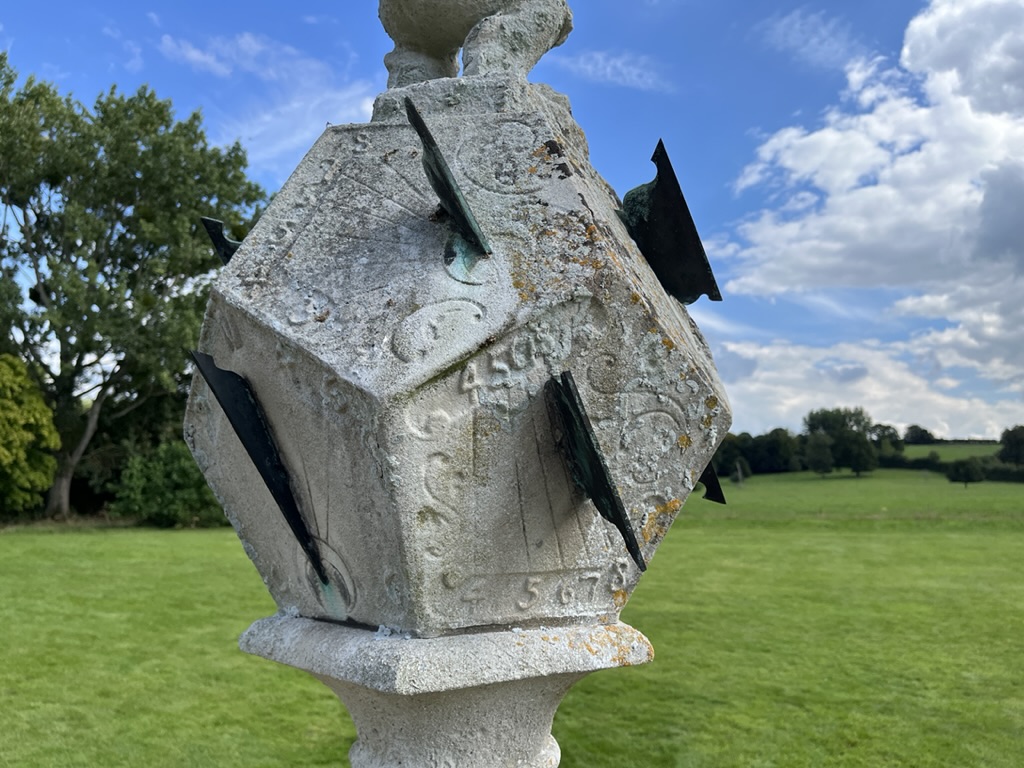
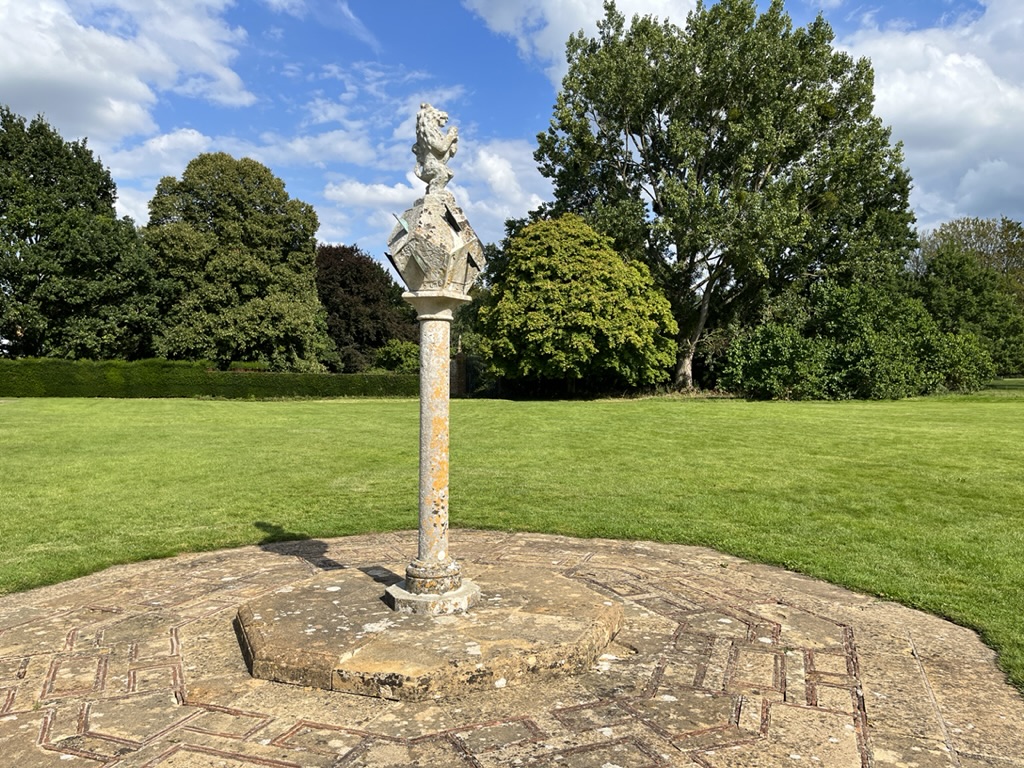
Located on the south lawn. Dodecahedron dial with pentagonal faces. Two ‘rows’ of five dials. The top row reclines, the bottom row inclines. All lines and numerals are visible, all gnomons are intact and 4mm thick. Overall the dial shows 4am to 8pm in hours. The numerals are Arabic, and are in relief, as is light scroll work on some faces. The dial is mounted 1760 mm high on a stone pedestal. It is surmounted by a weathered lion rampant 460 mm tall. The dial is said to have come from Scotland about 1910. SRN 8046 at East Ruston, Norfolk, appears to be a direct copy of this dial.
LOWER FACETS

UPPER FACETS

MIXED FACETS

GSS Category: Dodecahydron Dial; Polyhedral Dial; Multi-Dial; Cube & Similar Dials

All photos: Keith Salvesen

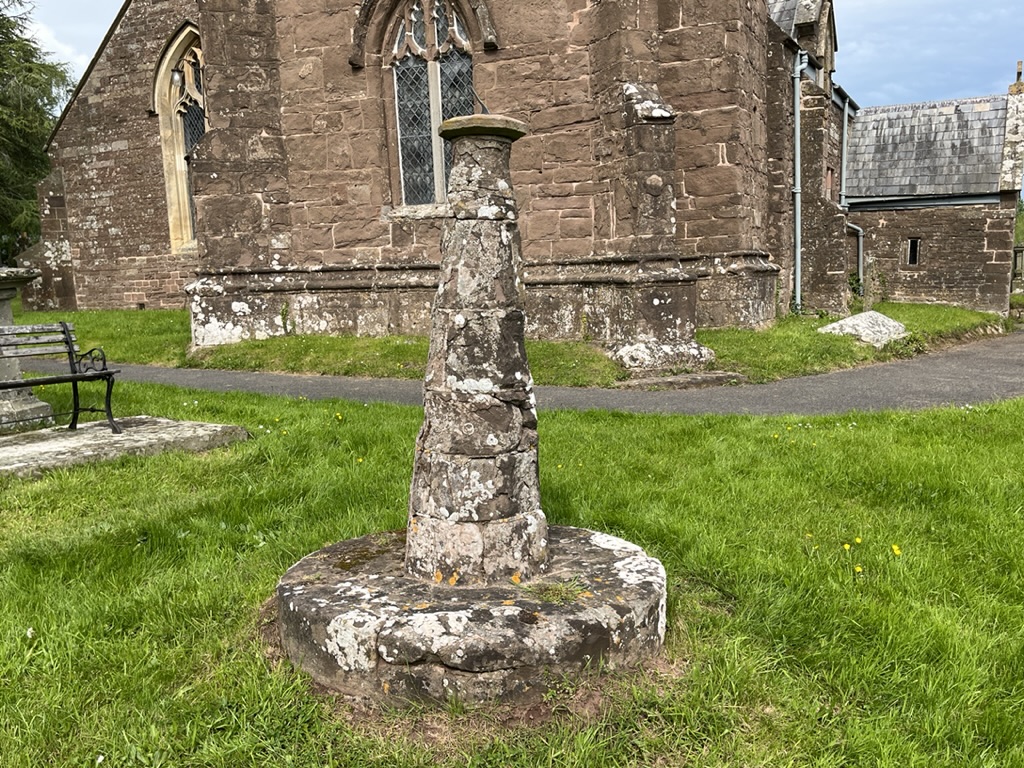
LLANGARRON . HEREFS . ST DEINST – Pillar Dial; Scratch Dial(?); Consecration Cross

St Deinst . Llangarron . Herefs

ST DEINST . LLANGARRON . HEREFS

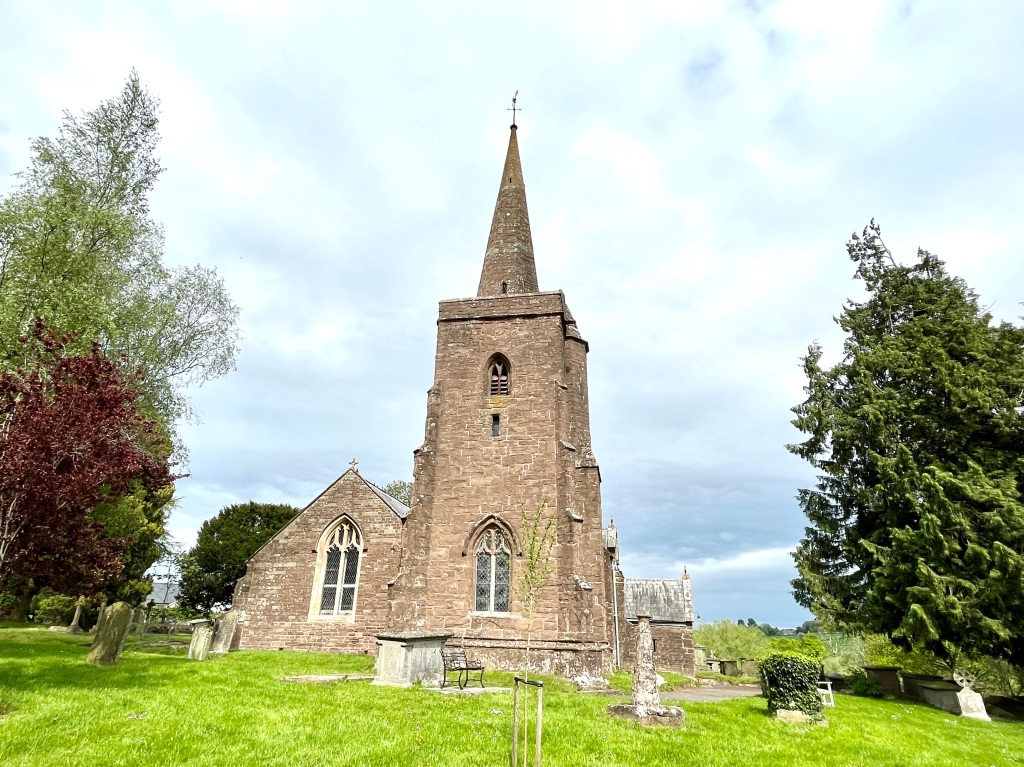
GRADE 1 † C14 & C15; records of C11 origins; trace Norman interlace patterns. Restorations ±1900; later replacement of the top of the spire, repurposed as sundial pillar. Only 1 other church (Itton, nearby) with this Dedication.  7m N of Monmouth; 7m SW of Ross-on-Wye. 51.8871 / -2.6838 /  SO530211

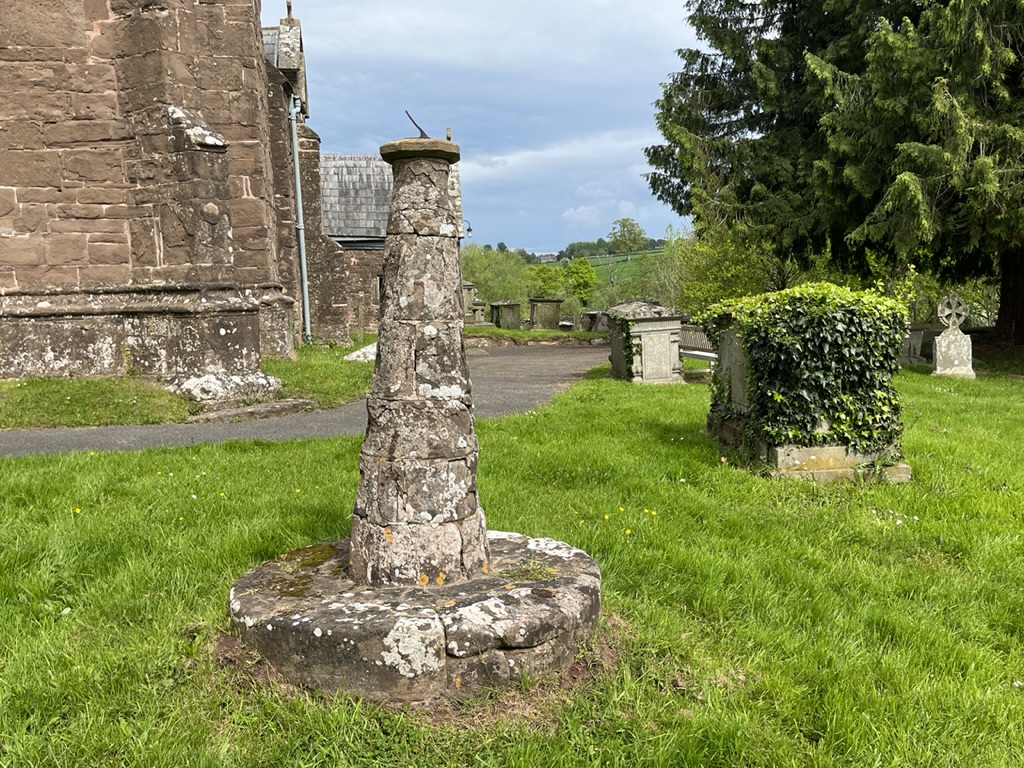
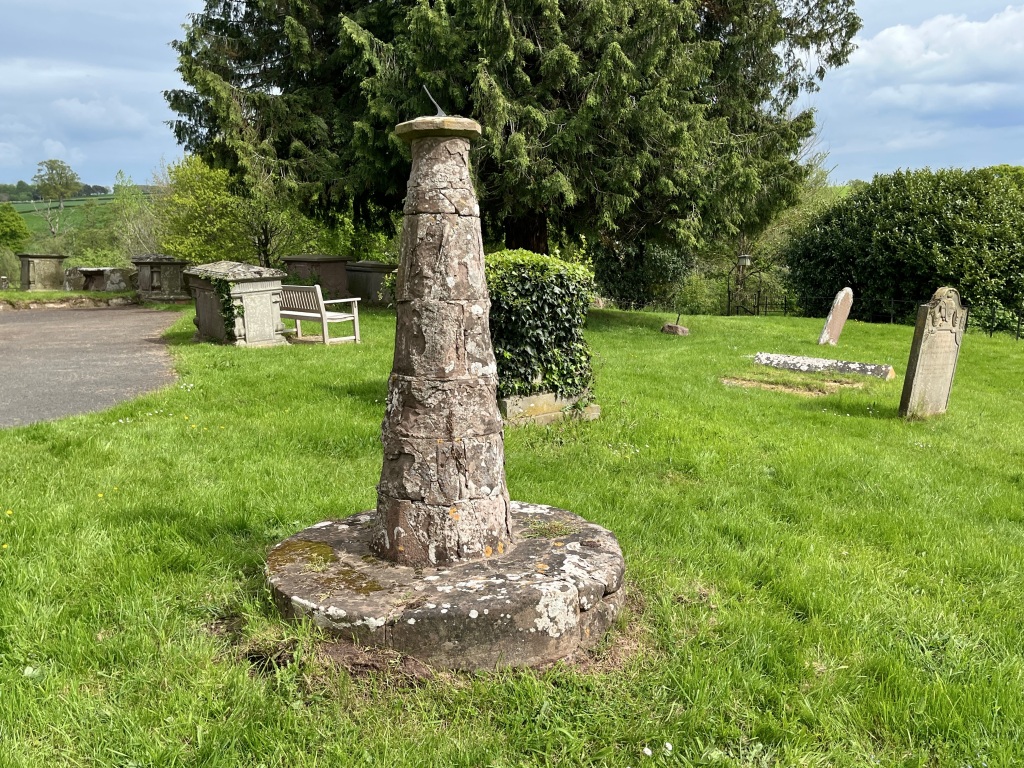
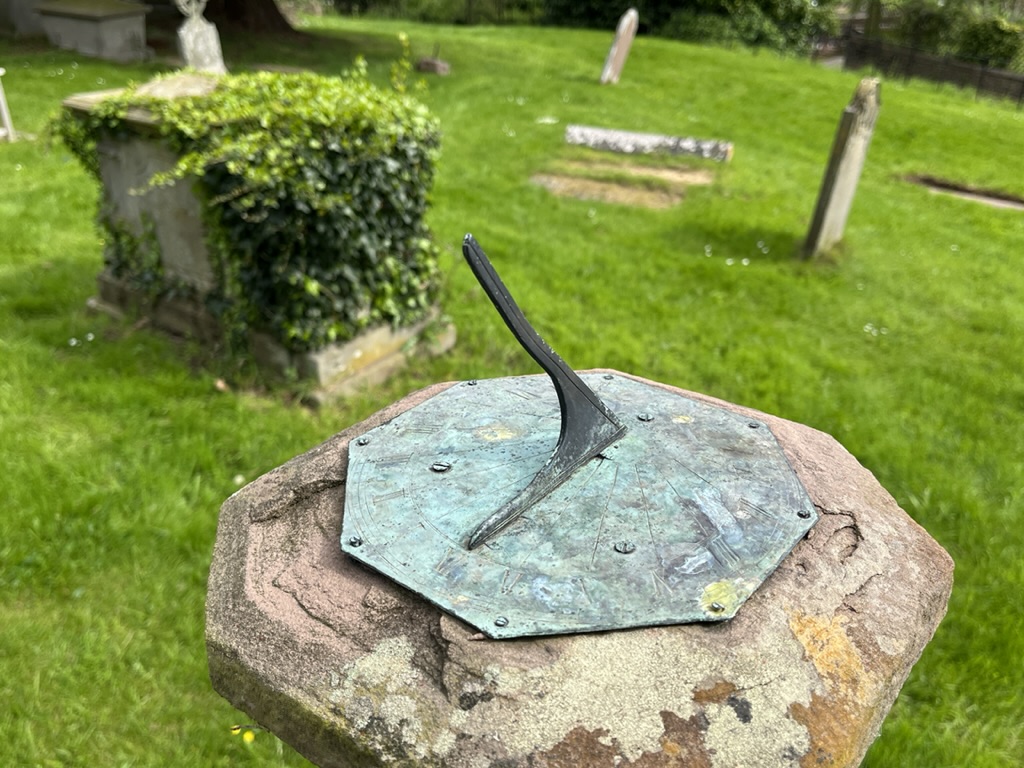
PILLAR (STEEPLE) DIAL

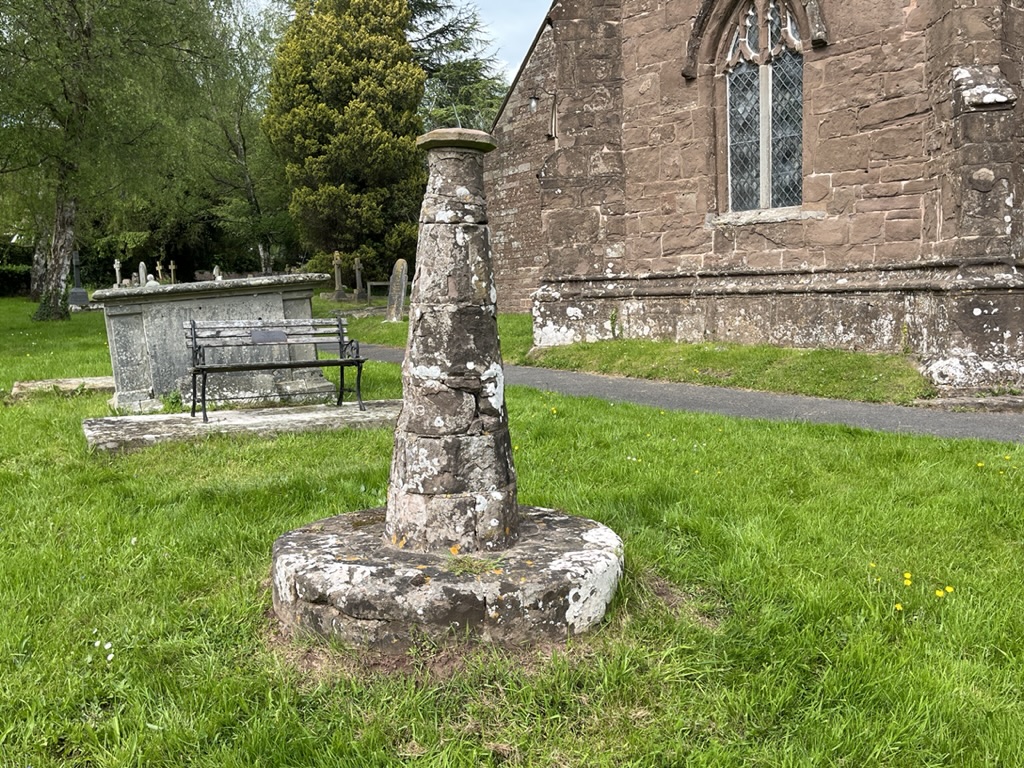
GV II Tip of spire C14 adapted as horizontal sundial pillar late C19. In churchyard SW of the tower in an ideal place for admiration. Coursed & squared sandstone rubble, circular base. C14 masonry BLB

1. CHURCHYARD VIEW

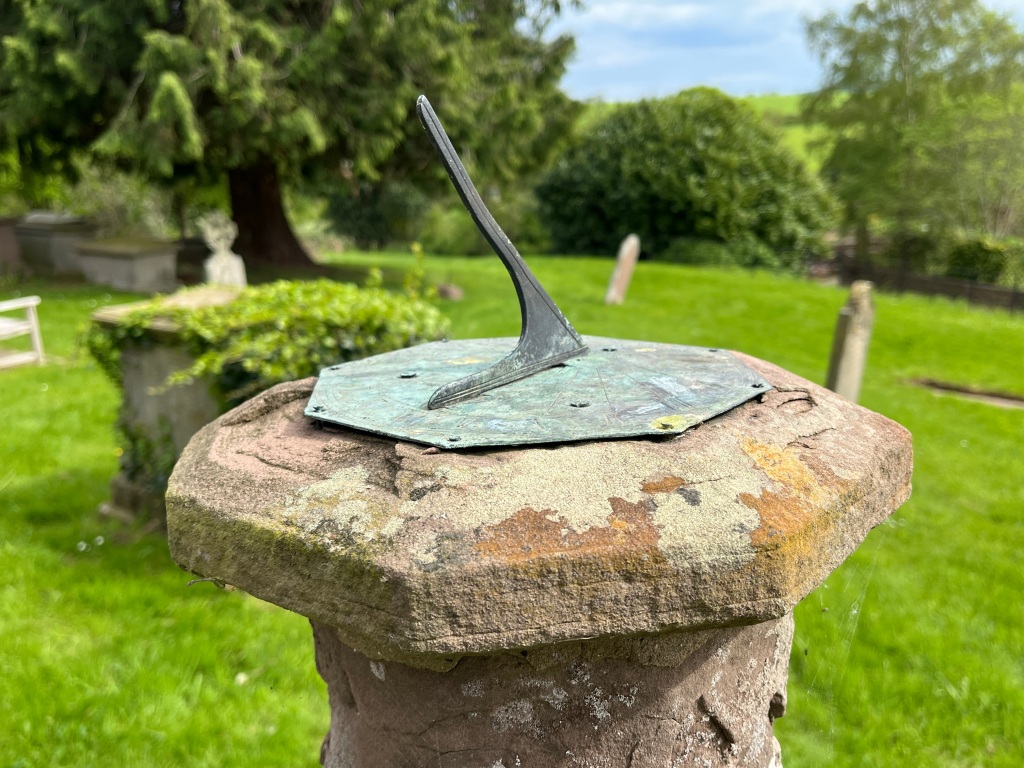
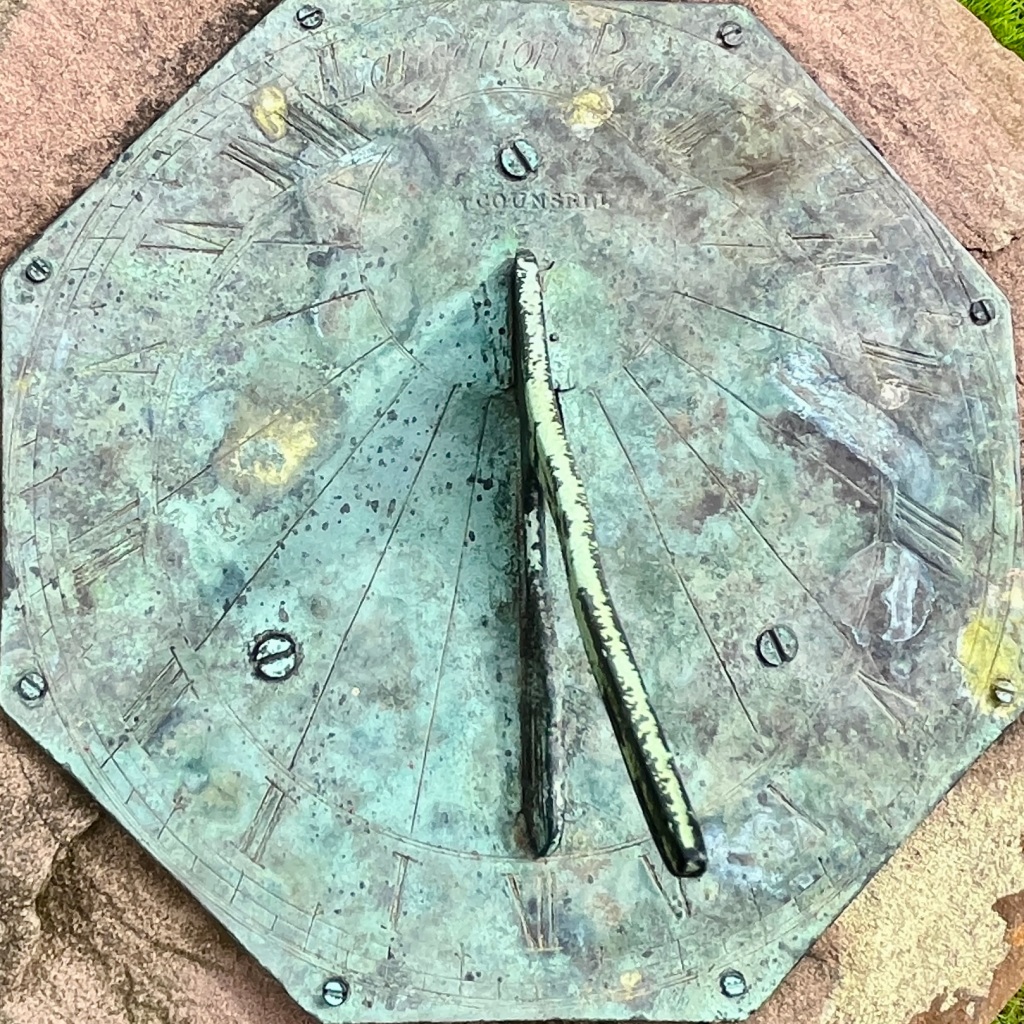
2. HORIZONTAL DIAL

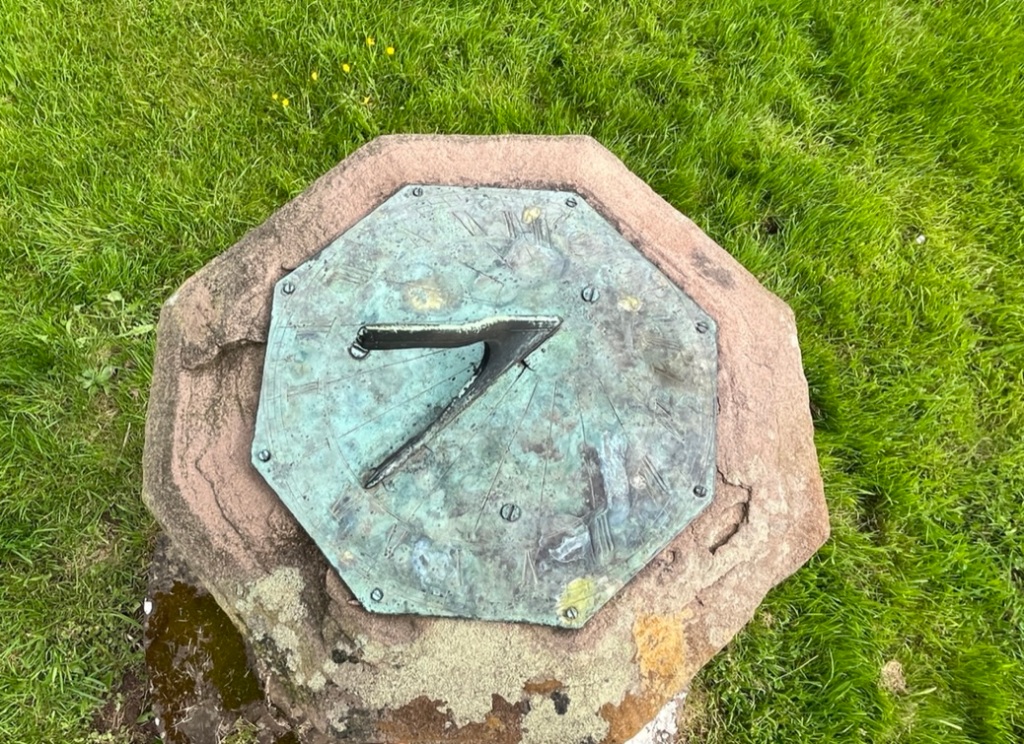
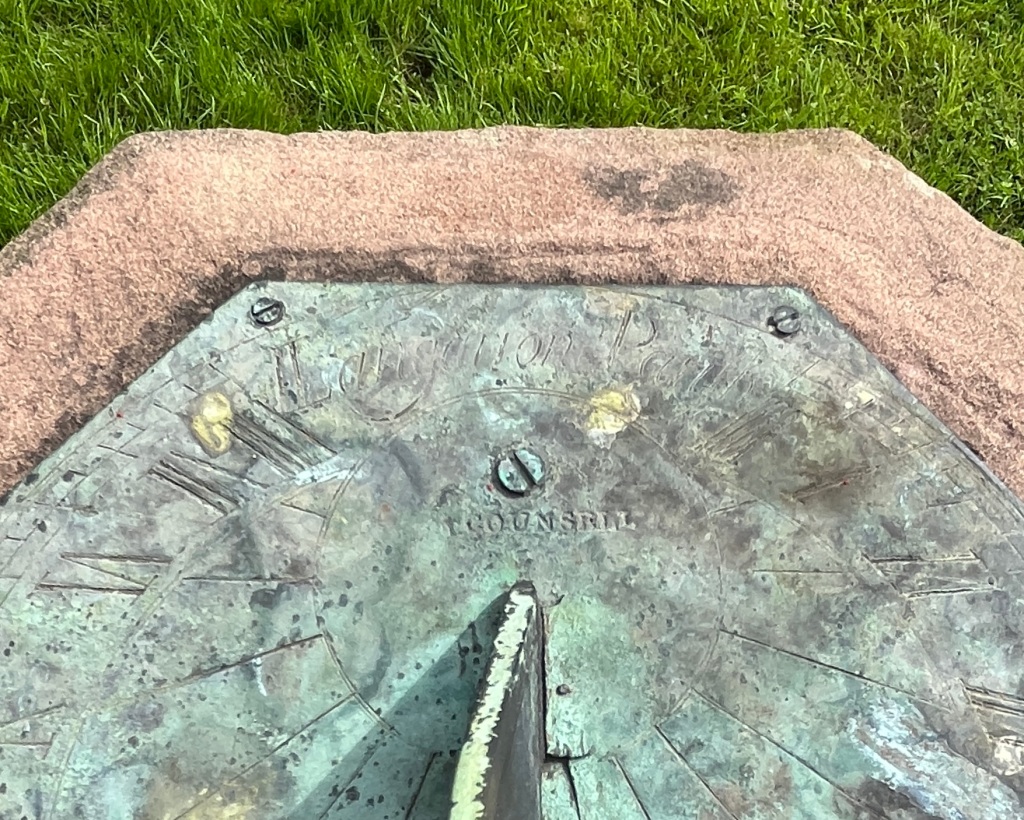
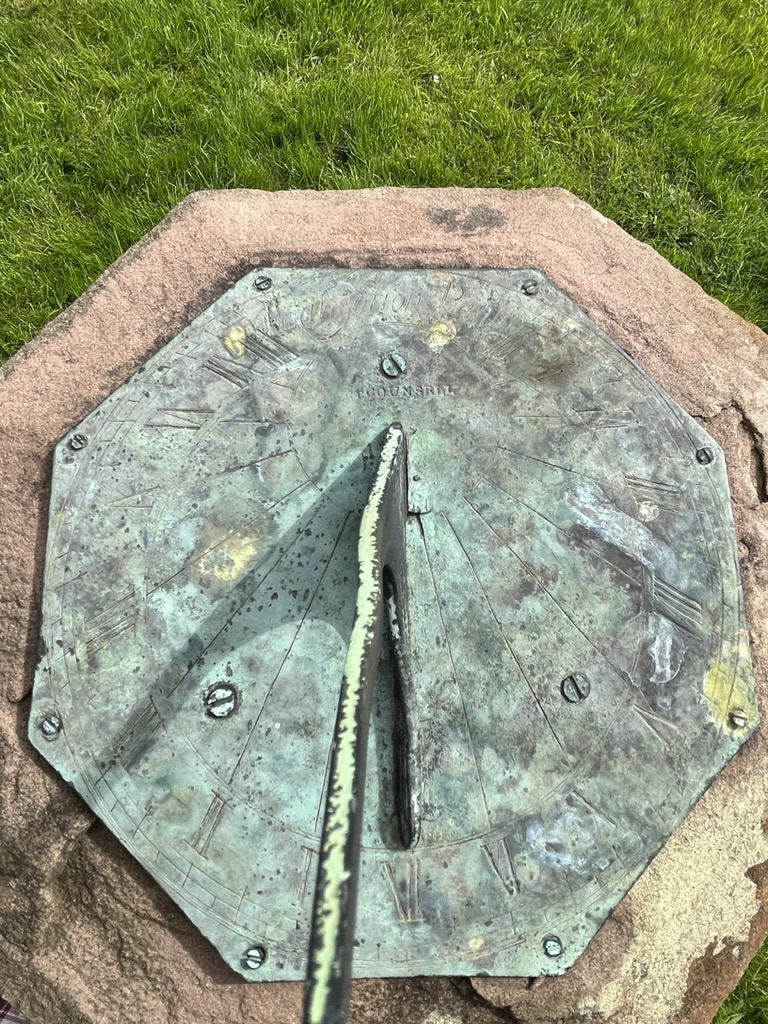
The dial is octagonal, with quarter-hours marked. IV as IIII. The inscription seems to be Llangarron Parish; and the maker’s name Counsell (though I can find no reference). The Roman numerals are conventional.

SCRATCH DIAL

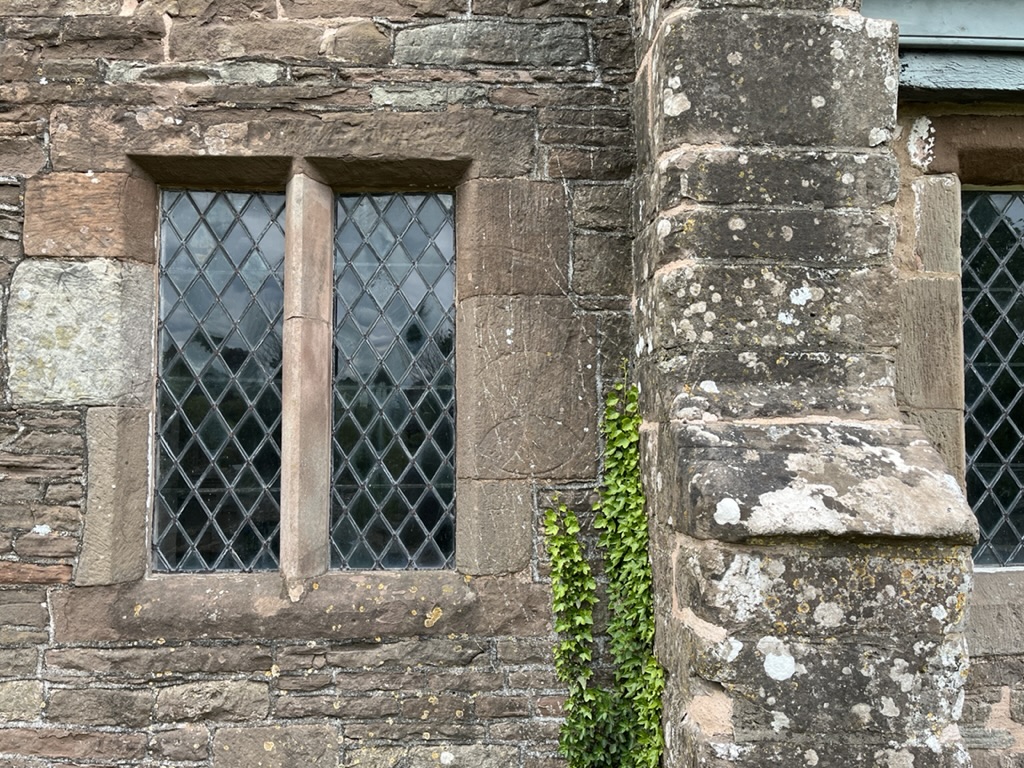
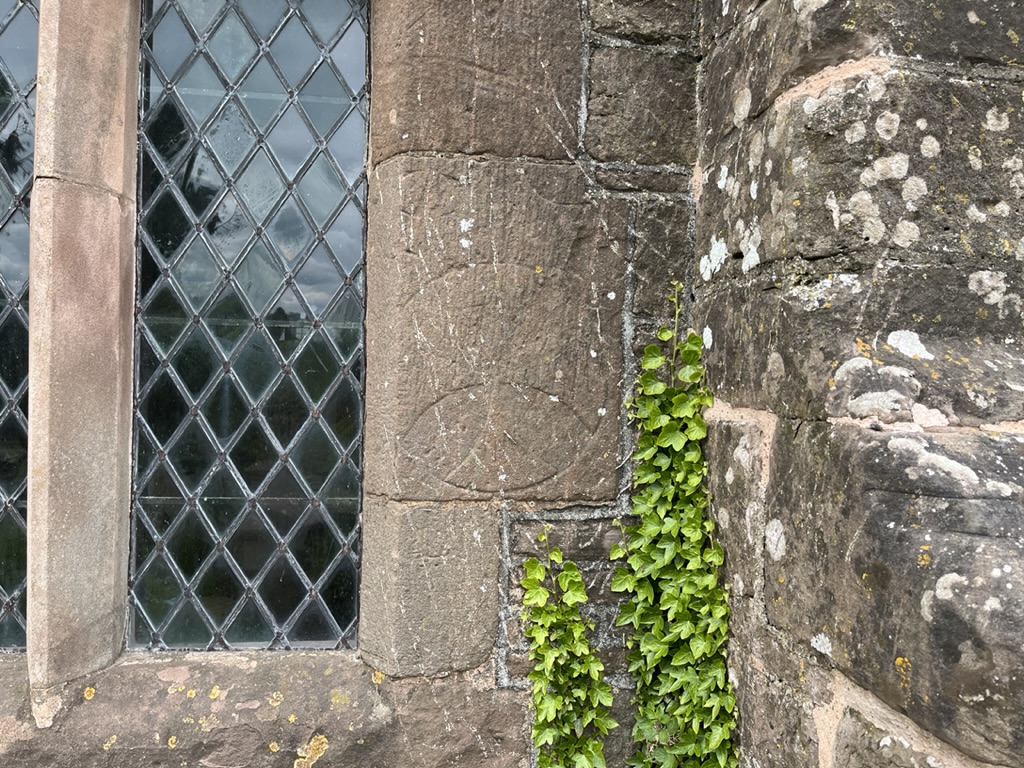
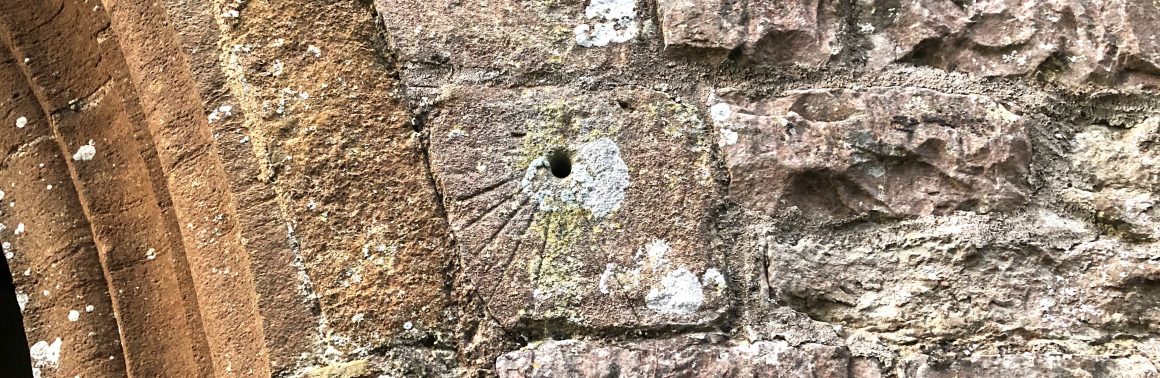
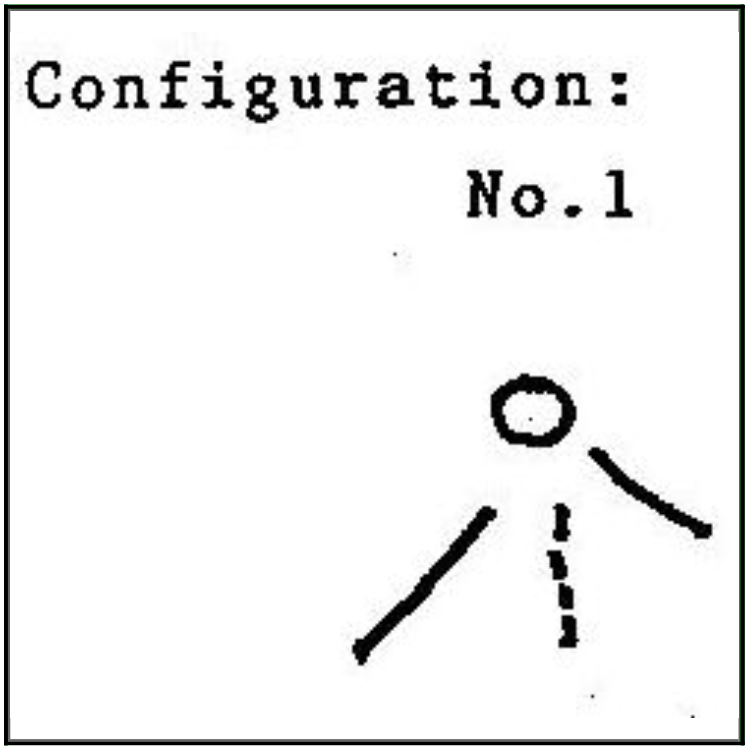
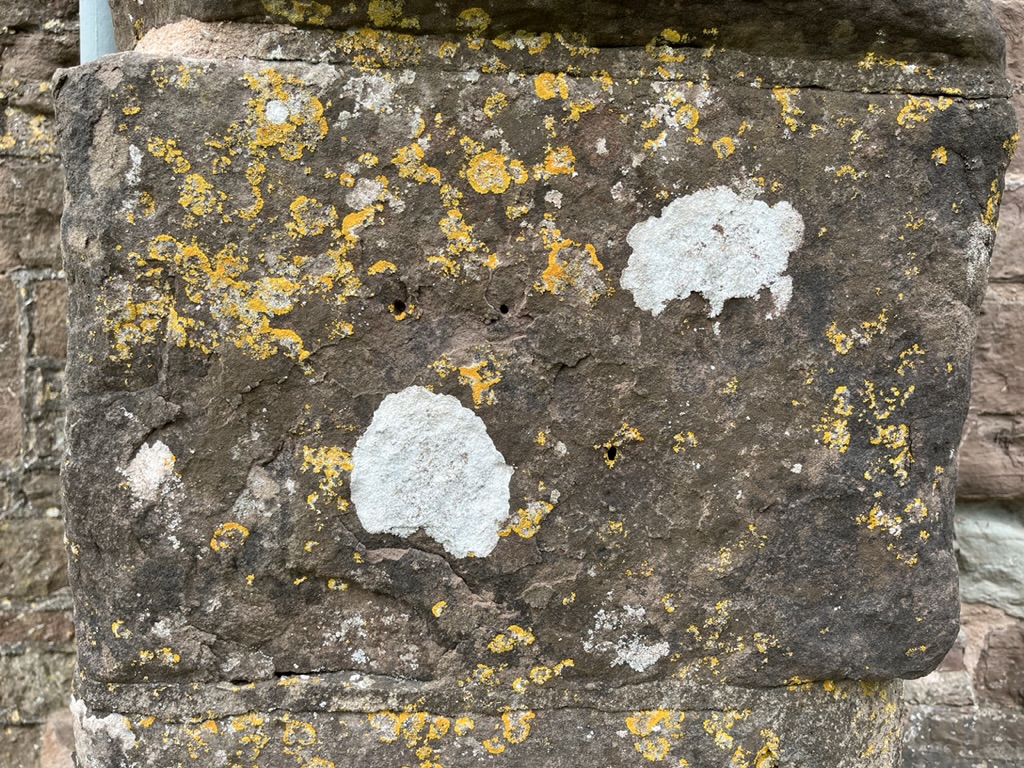
BSS records a scratch dial with 3 lines on the buttress to W of S porch, in a poor state. Notes include Max. length lines, mm 80. Hard as I looked, I couldn’t find a dial in the given location, or at any height on the buttress. Or elsewhere. Possibly the stonework has deteriorated since the original record was made. The best I can offer is the BSS sketch; and the most promising dial-like area of the buttress.

CONSECRATION CROSS

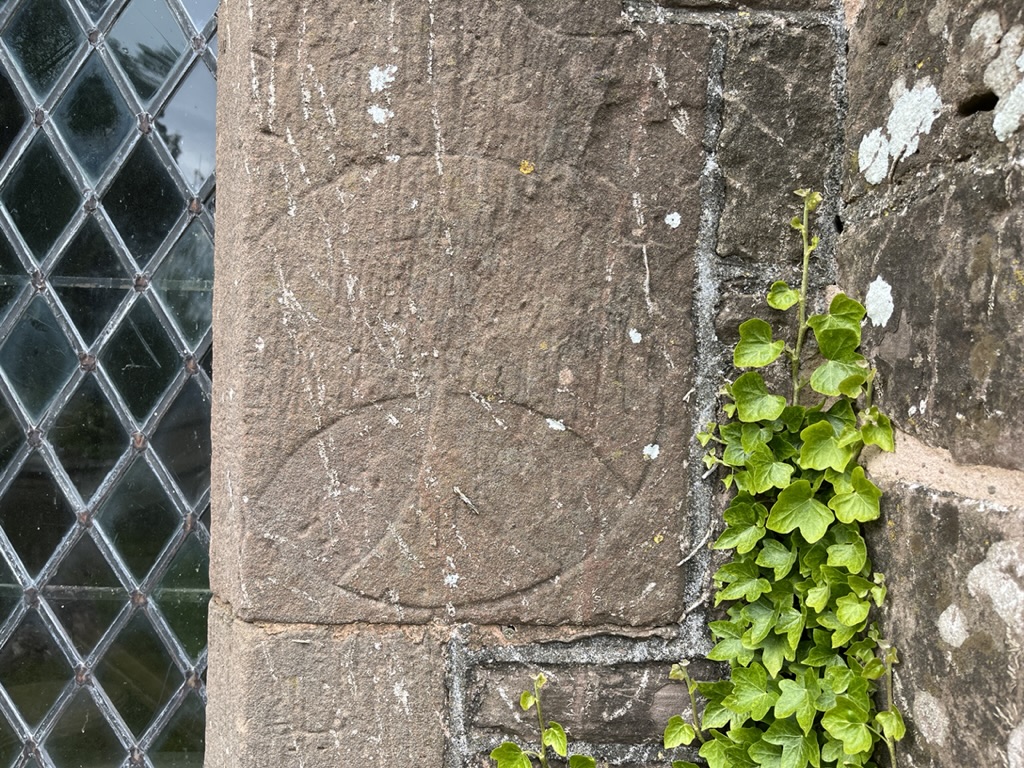
A fine consecration cross, one of the largest I have seen. One puzzle is that the cross is too large for the stone, so that LHS is cut off at the edge. It seems unlikely that the designer mis-measured to that extent. Possibly the stone was moved and trimmed to fit its present position during restoration.

St Deinst is well described in an online page LLANGARRON HISTORY

GSS Category: Horizontal Dial; Pillar Dial; Scratch Dial; Consecration Cross

All photos: Keith Salvesen

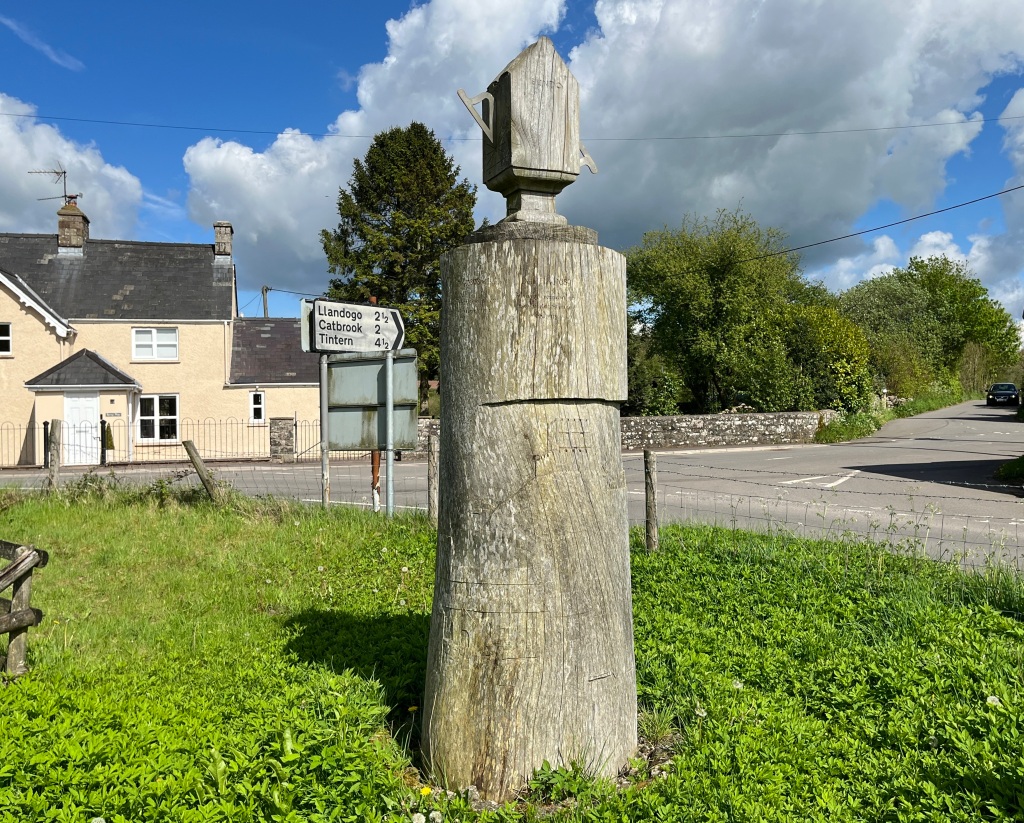
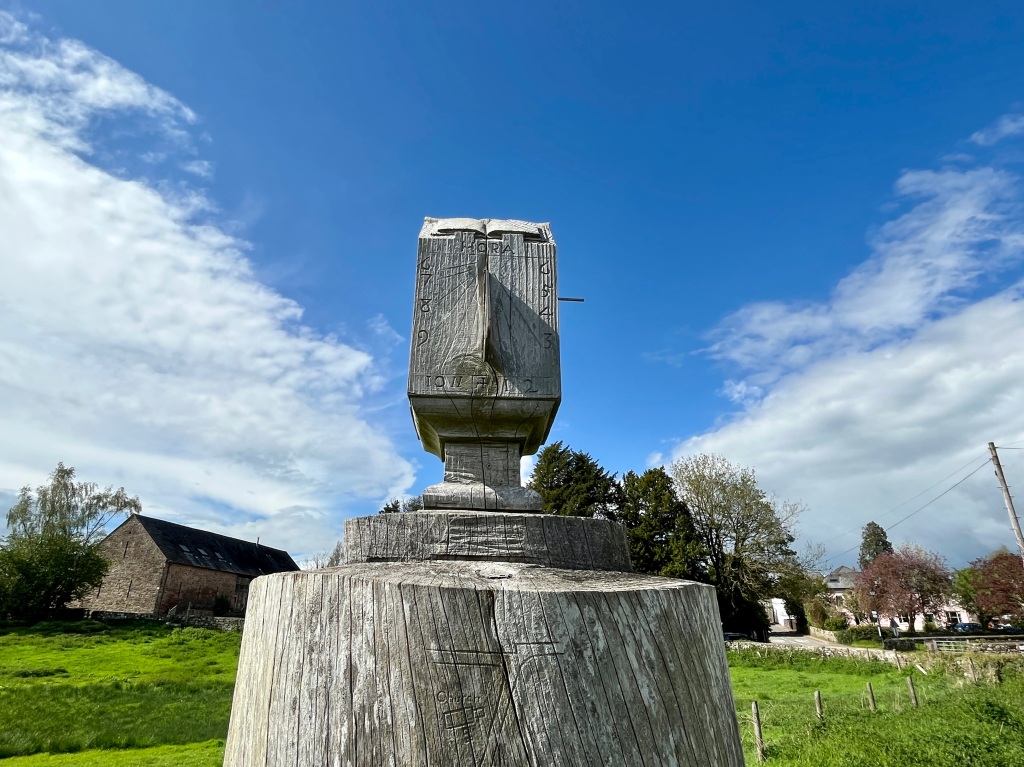
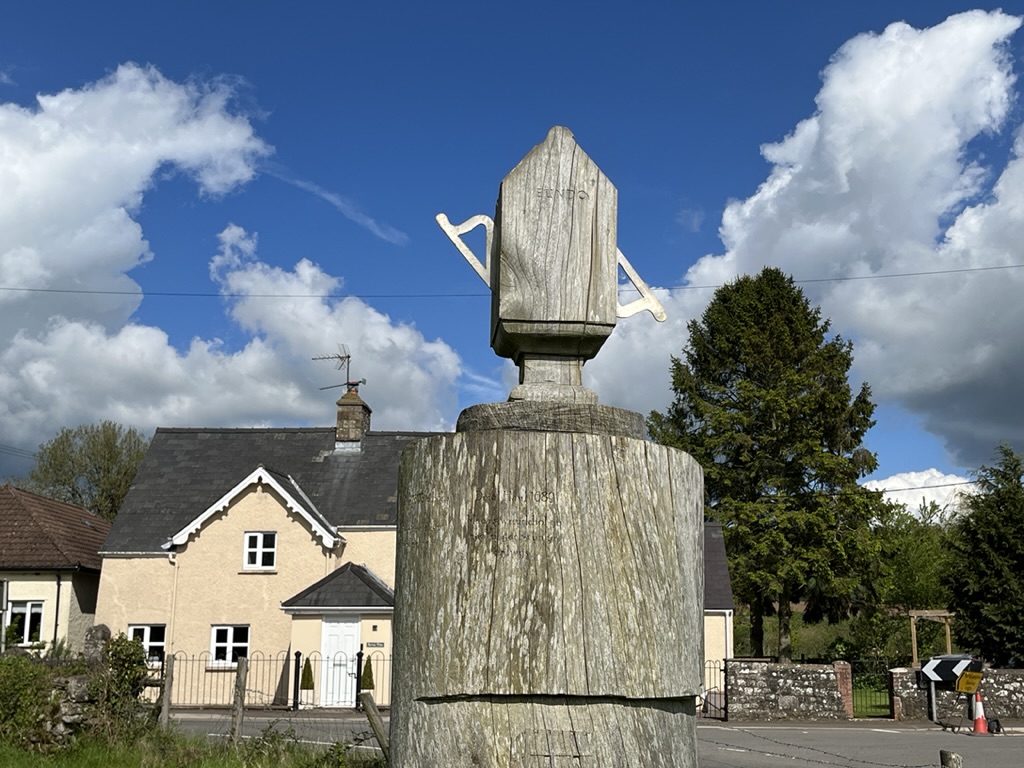
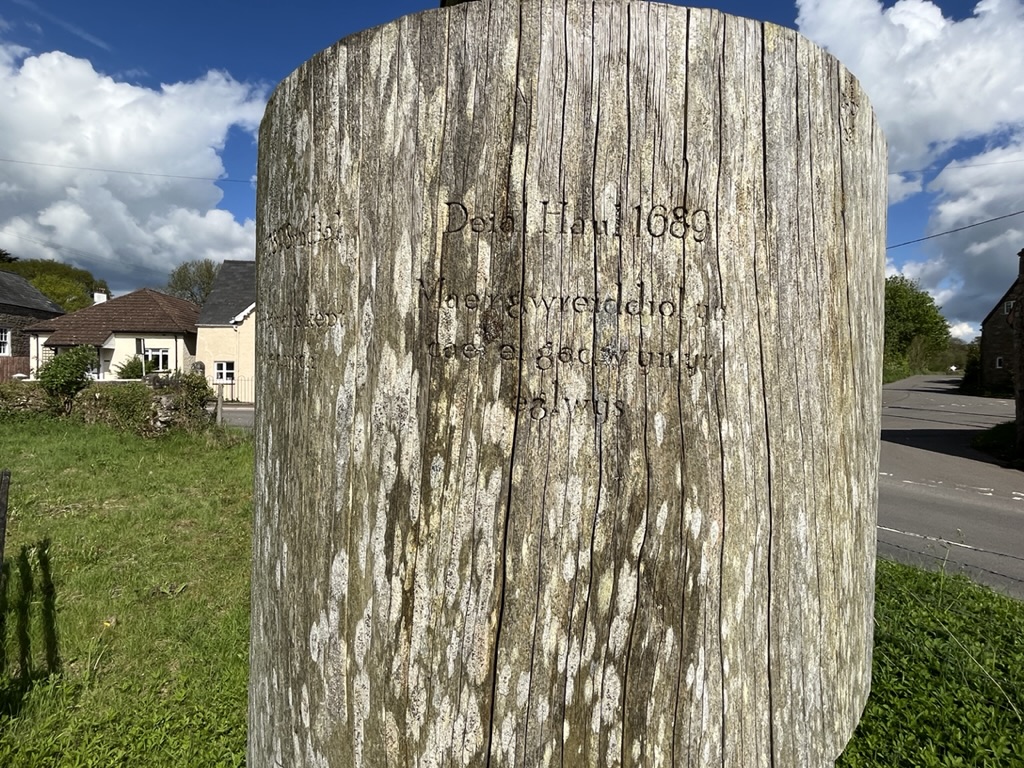
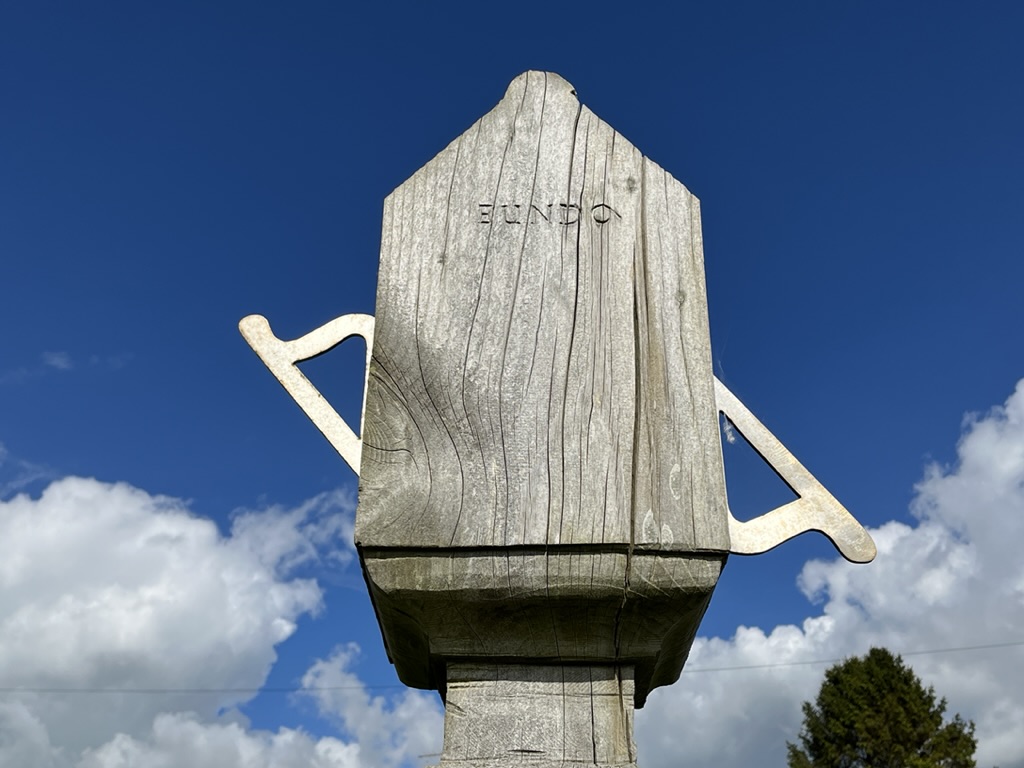
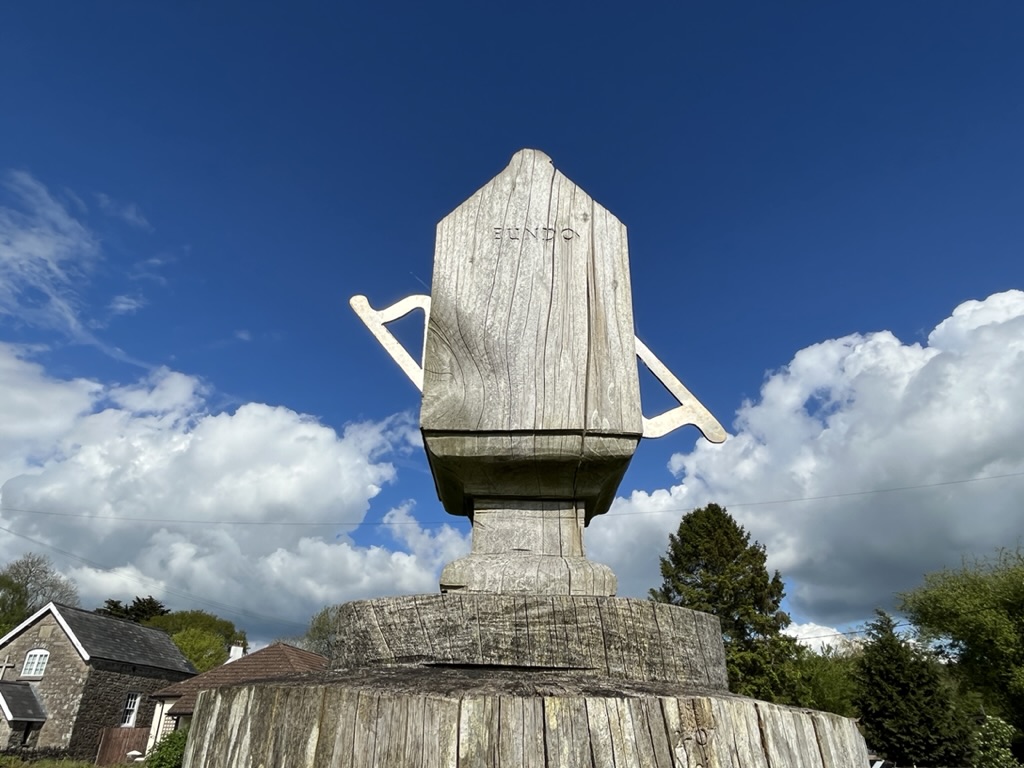
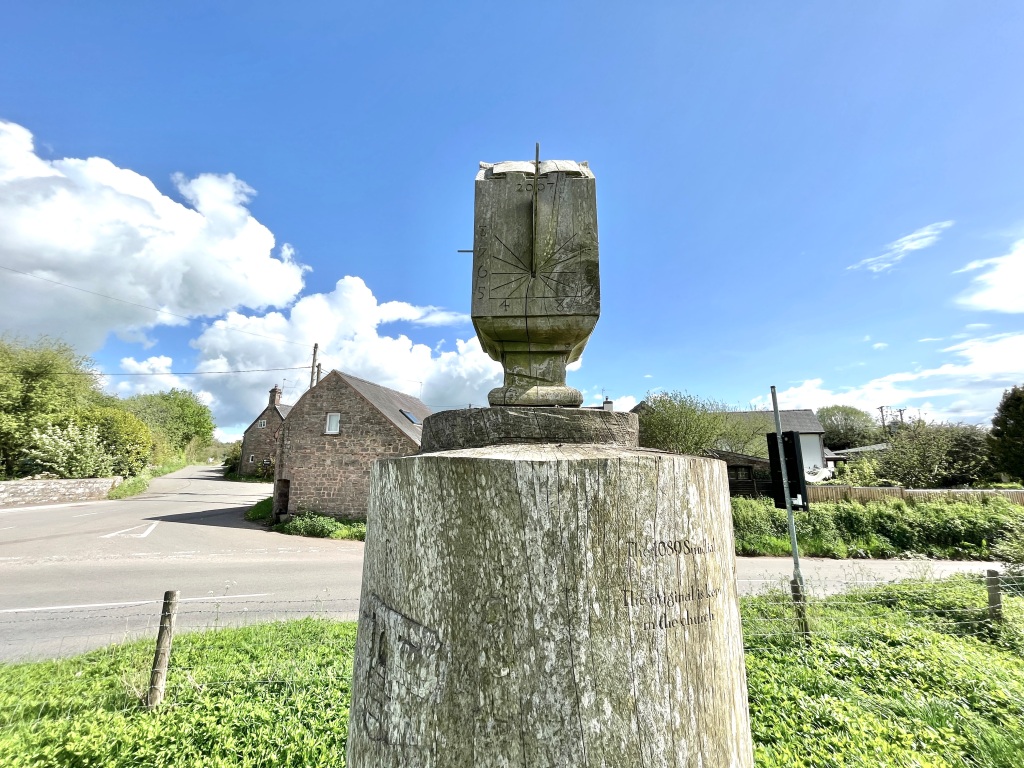
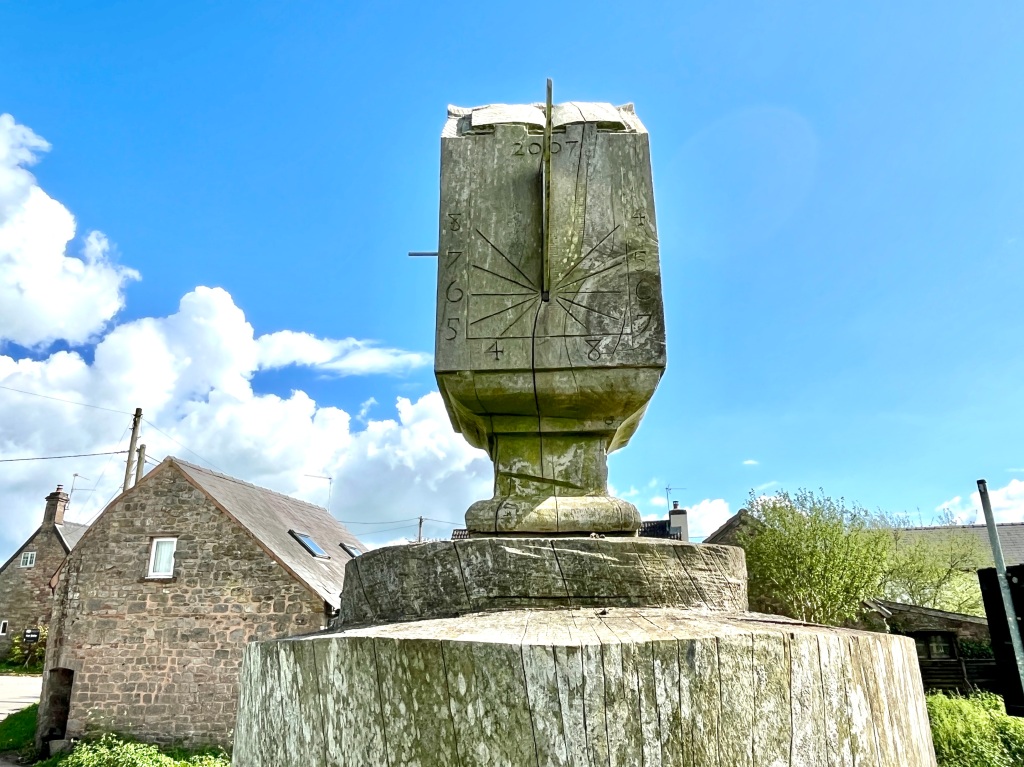
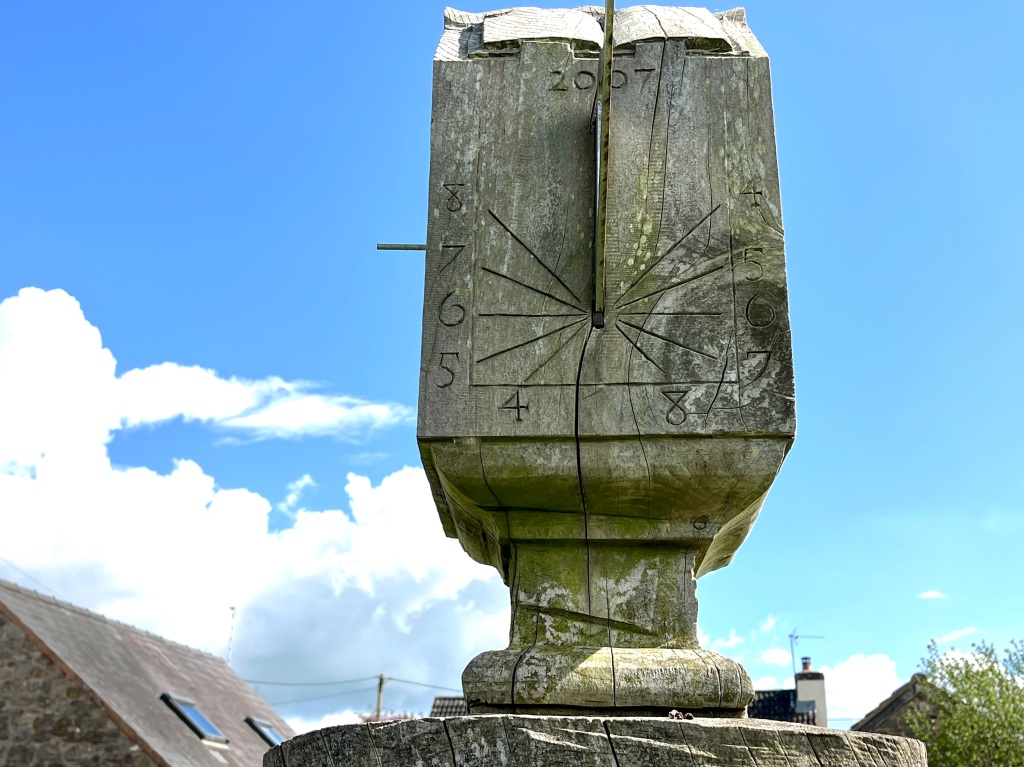
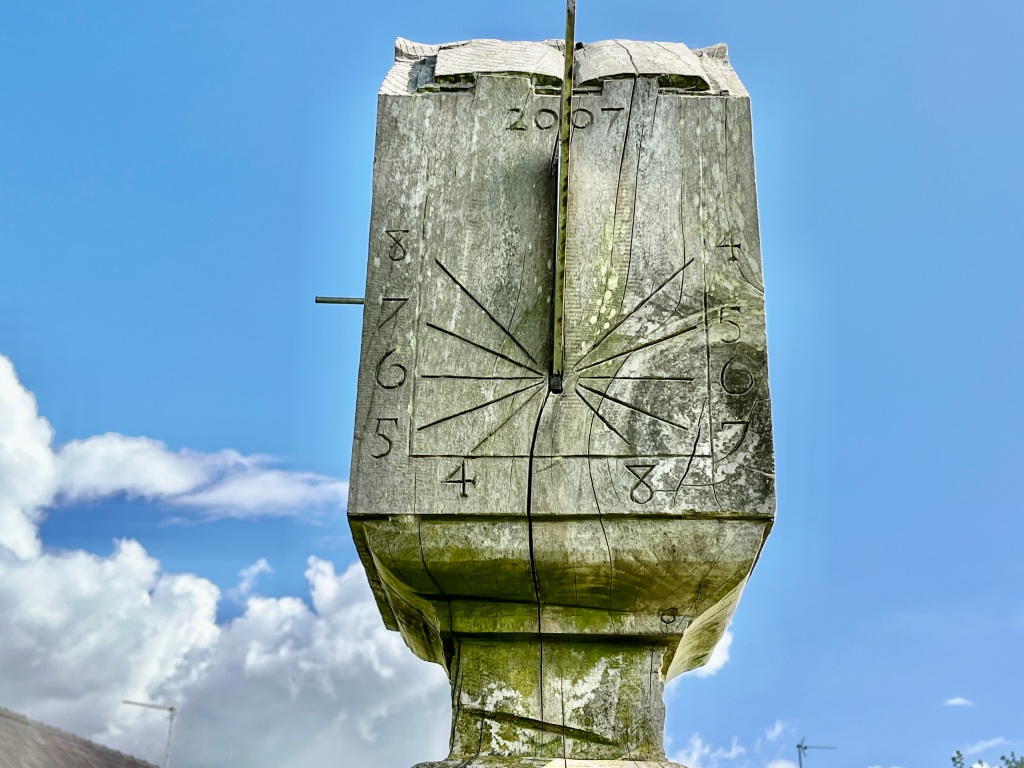
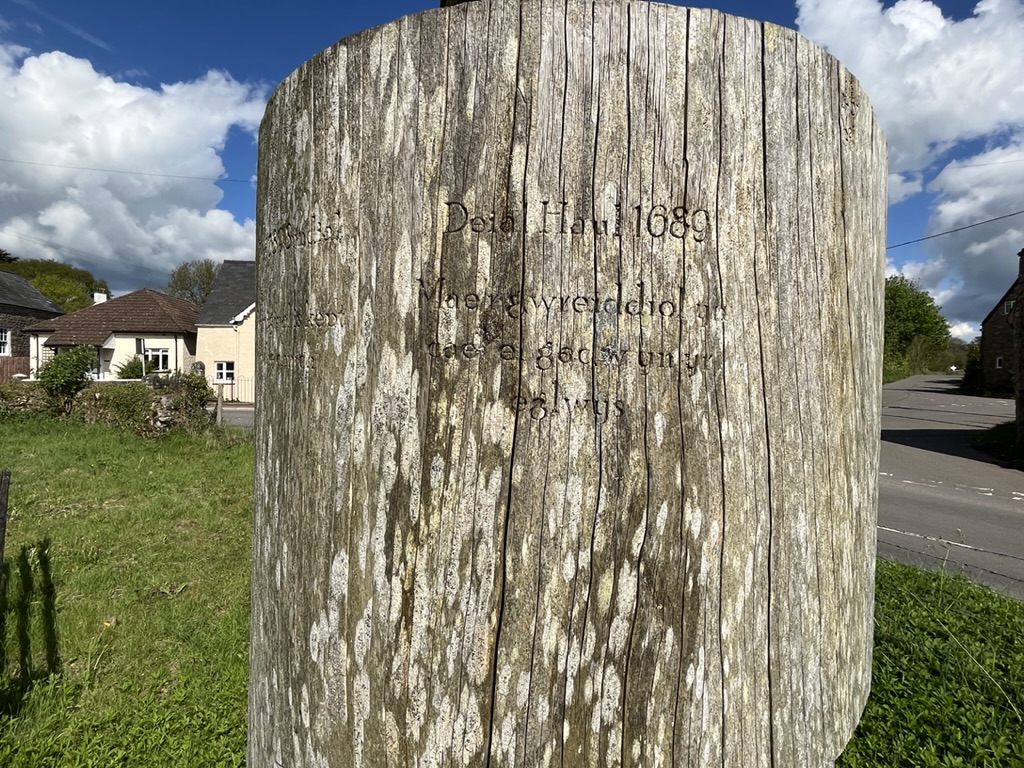
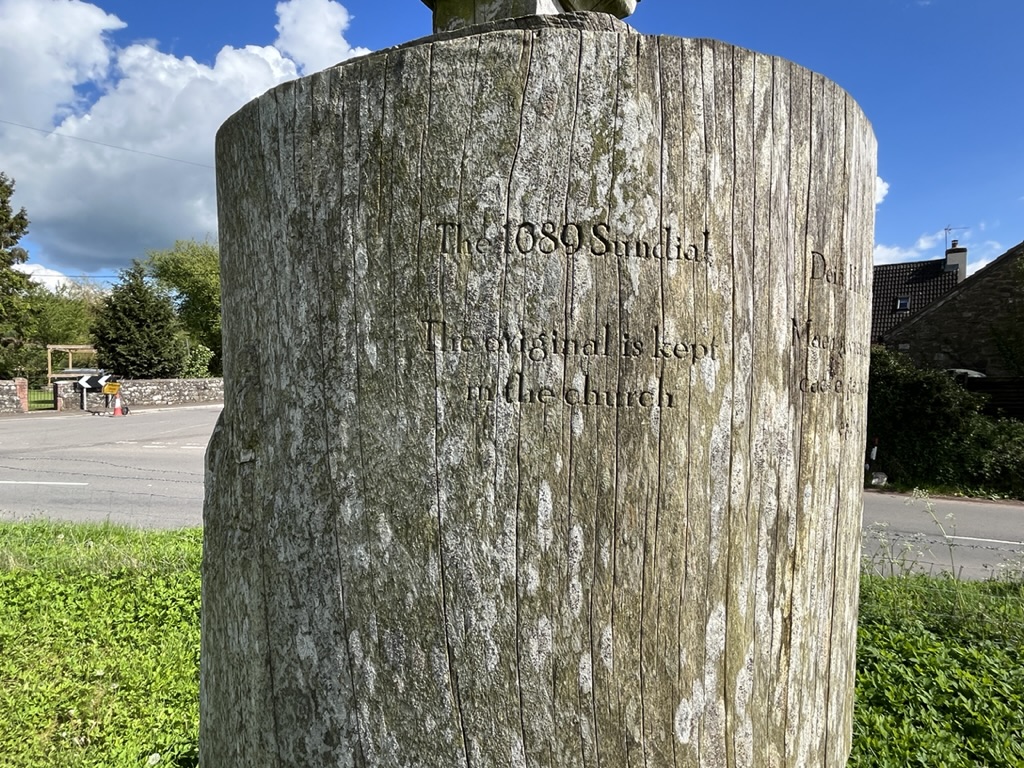
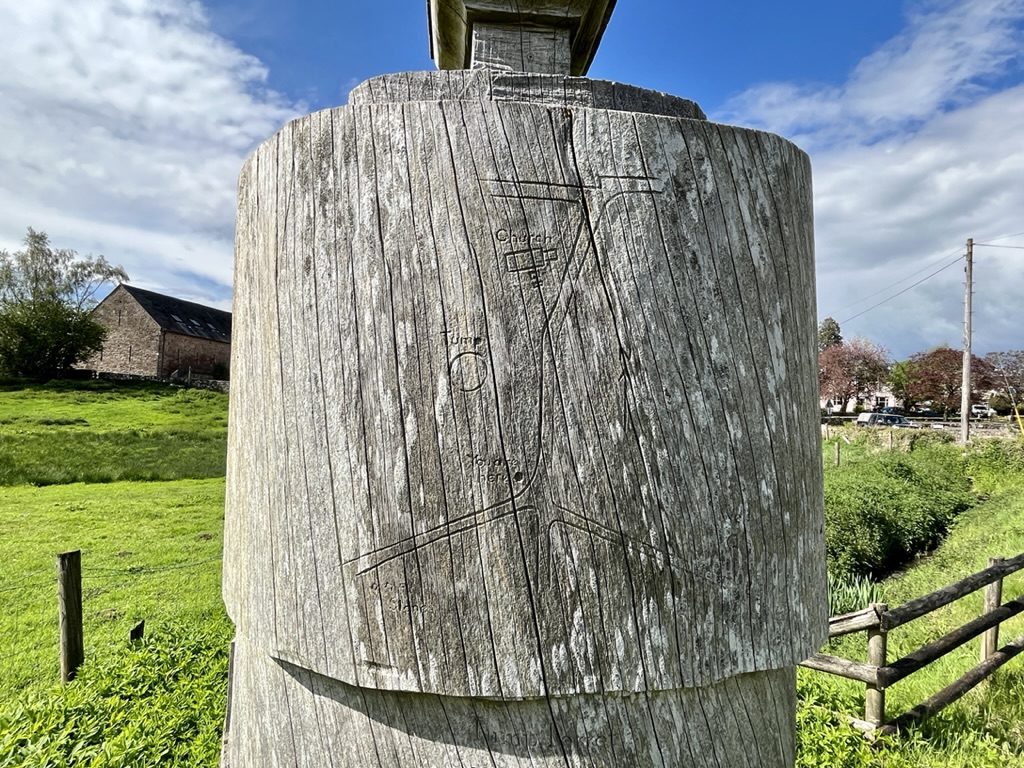
TRELLECH . MON . ST NICHOLAS – Lady Probert’s dial 1689 (pt 2): a fine wooden replica (2007)

St Nicholas . Trellech . Mon – Cube Multidial

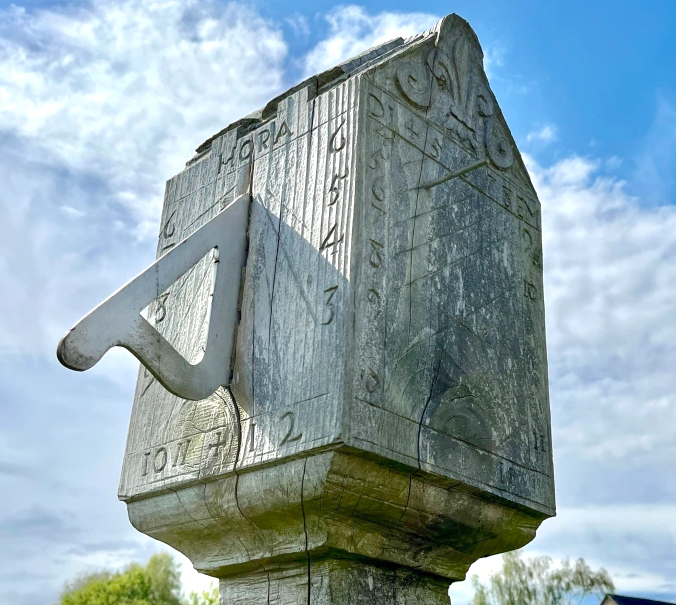
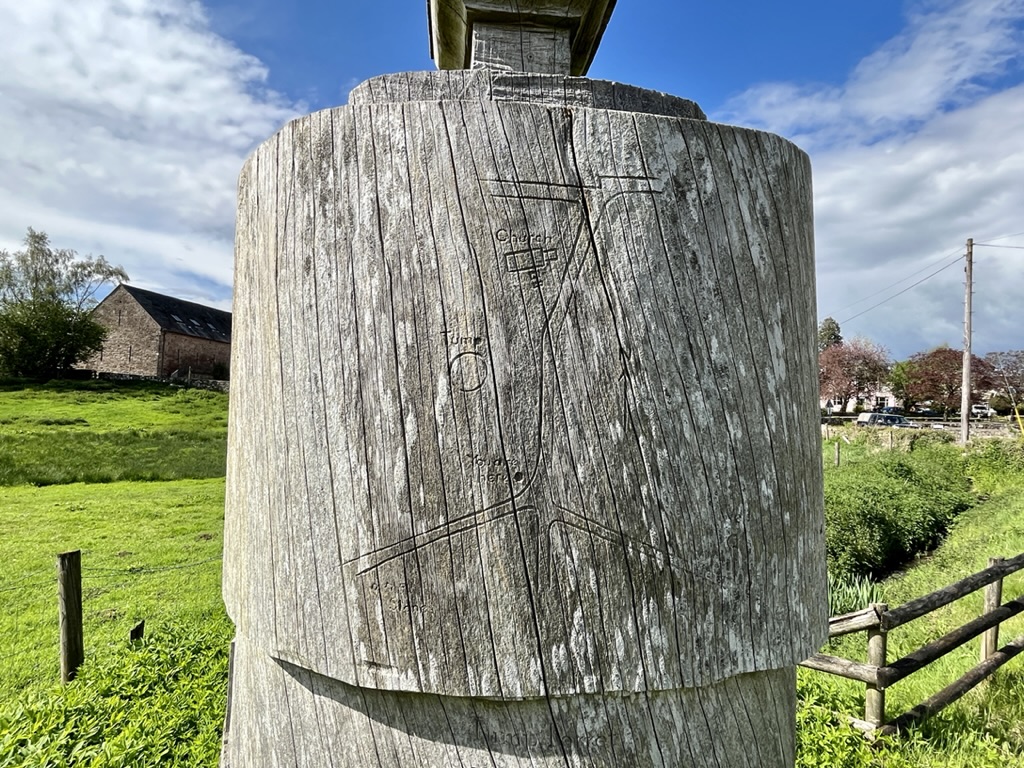
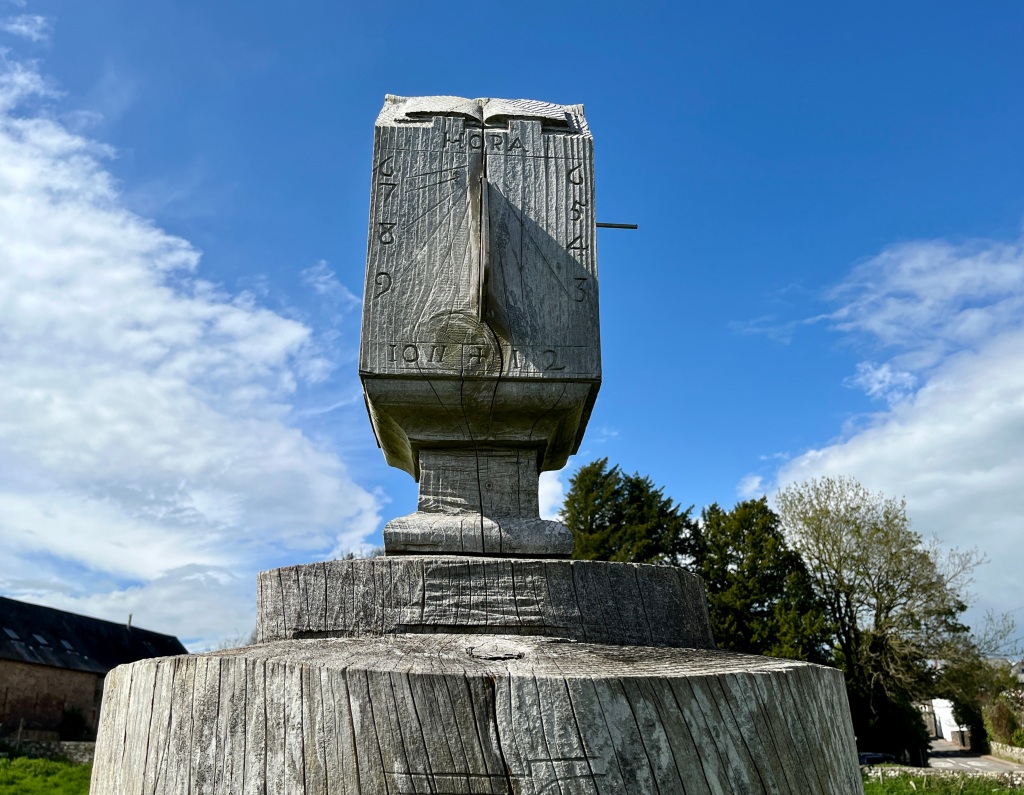
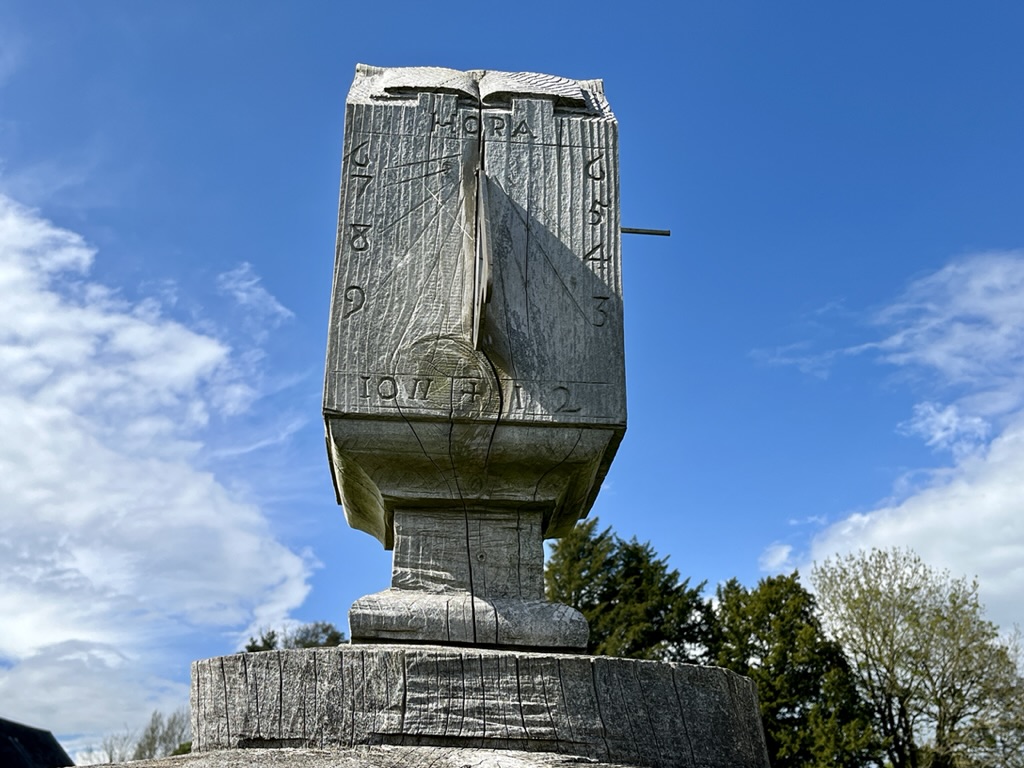
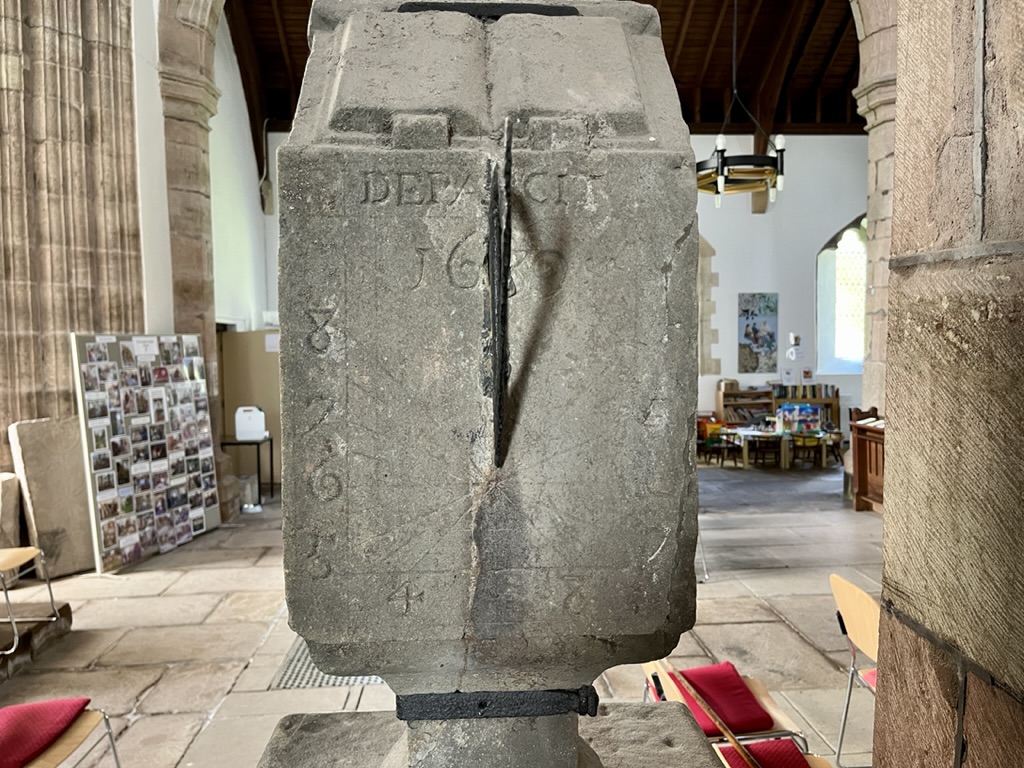
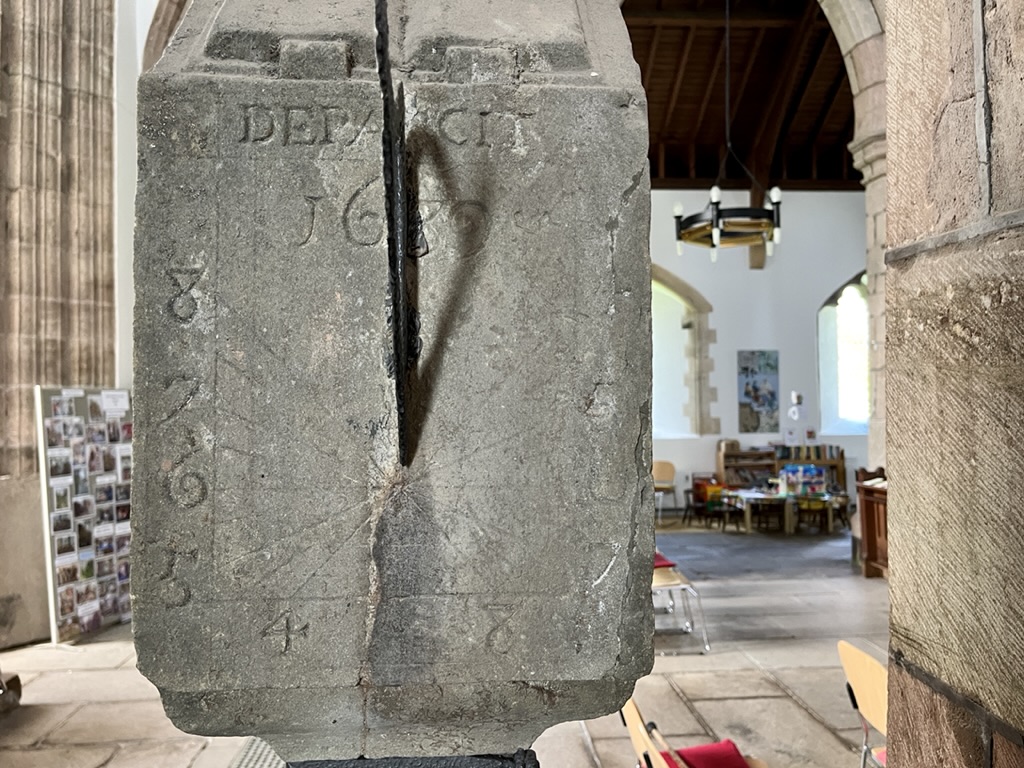
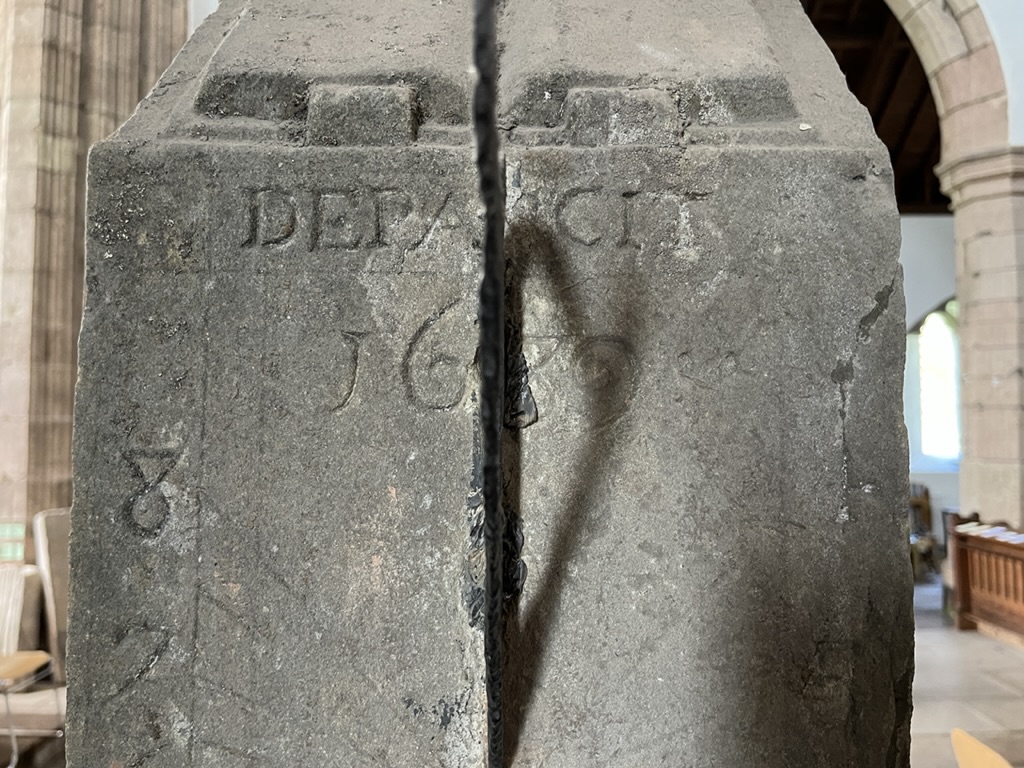
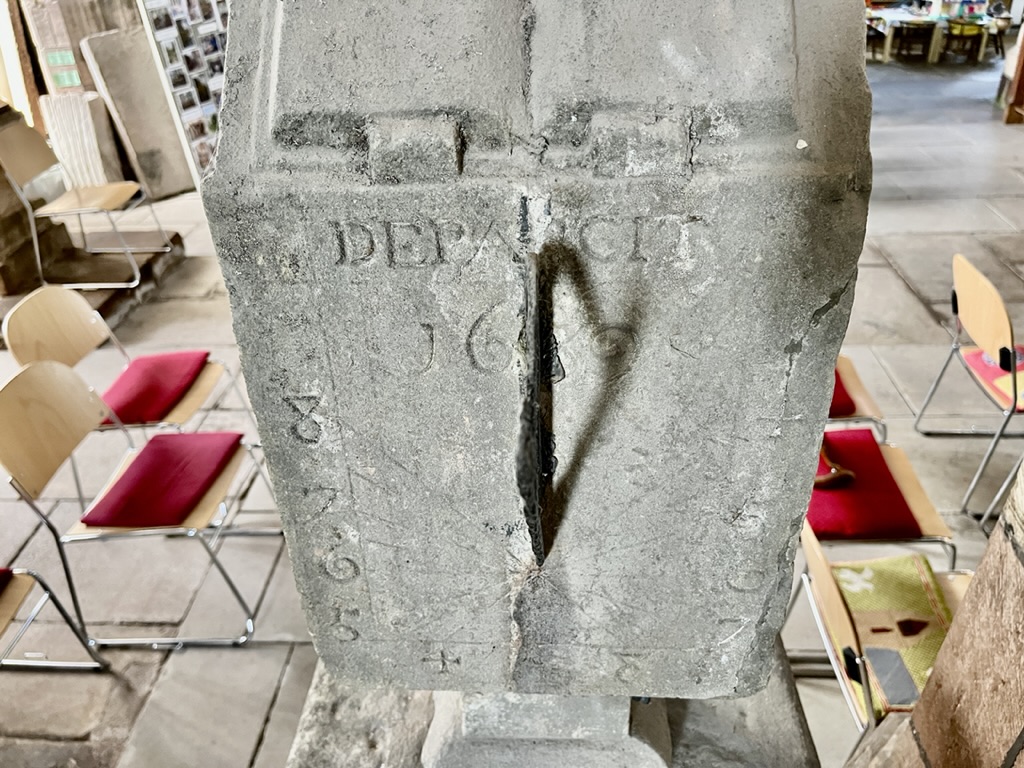
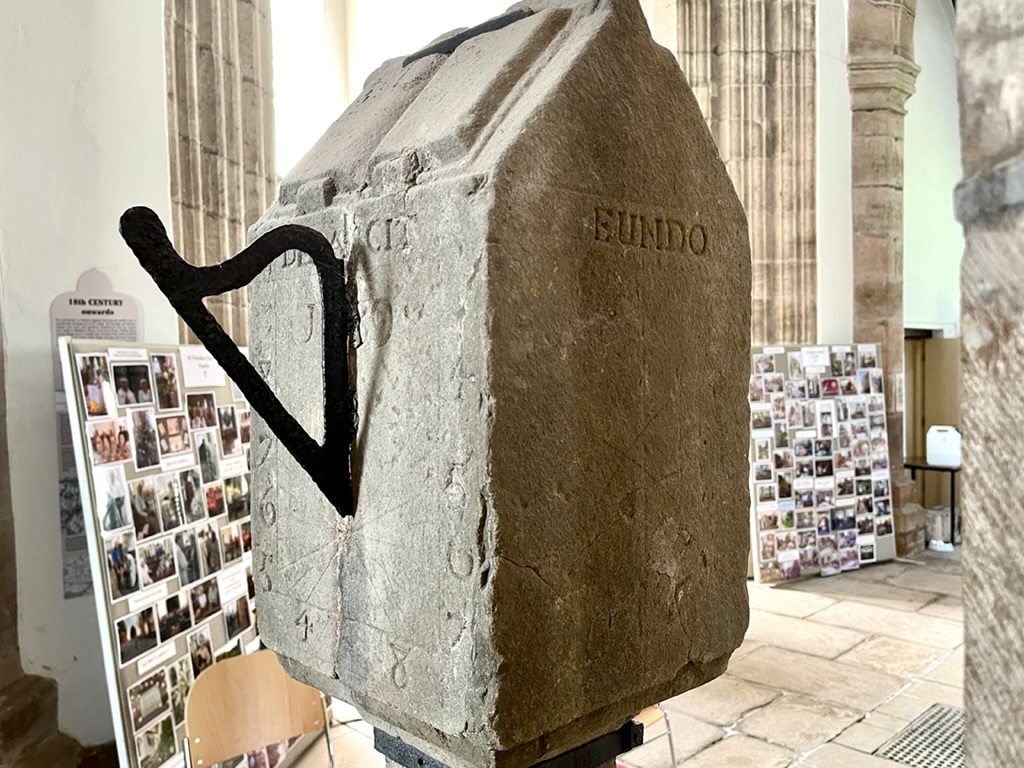
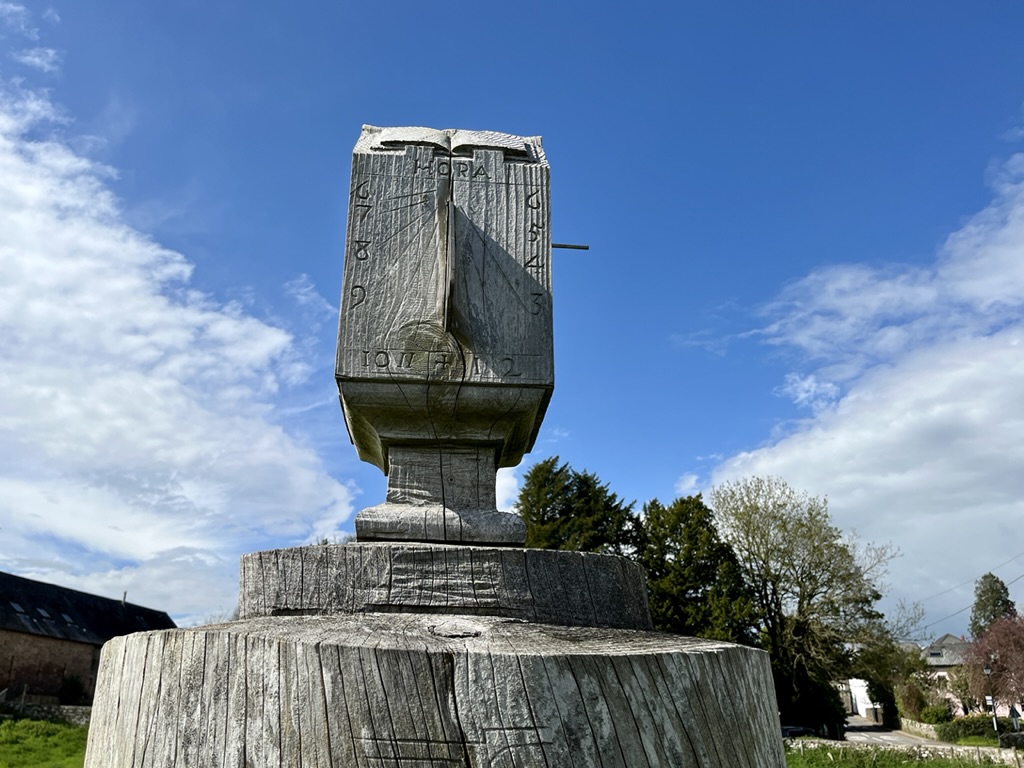
This post relates directly to its companion in Pt 1. Both articles feature the remarkable cube dial dated 1689, now preserved inside the Grade I listed church of St Nicholas, Trellech, Monmouth – the original and a fine recent (2007) wooden replica. You can find images of the original dial and each of its faces, with detailed descriptions, HERE. The location is 5m S of Monmouth 51.7459 / -2.725 / SO500054
DIAL . 2007

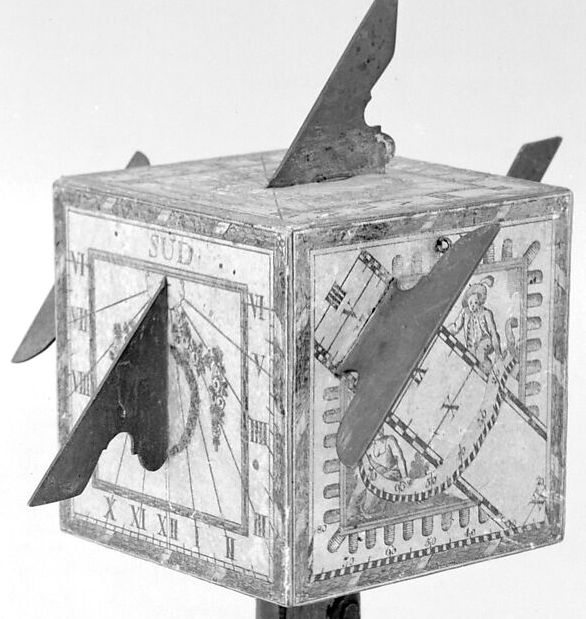
The images of Face 4 below illustrate a frequent experience with cube dials. Invariably, prevailing conditions preclude more than 3 faces being properly photographed. One face will always frustrate all attempts to get a decent photo. Furthermore, it is very difficult to improve a poor photo – it just becomes a different kind of poor. Quite often the only answer is to make the image B&W to catch detail .With apologies, this is what has emerged from the darkroom.

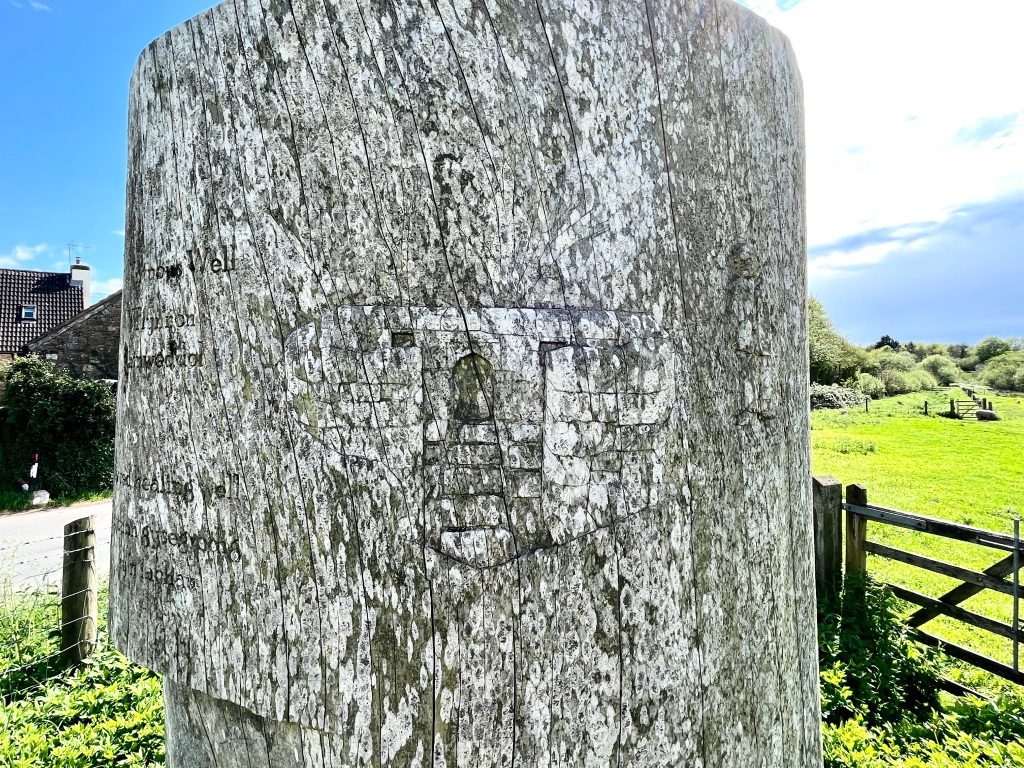
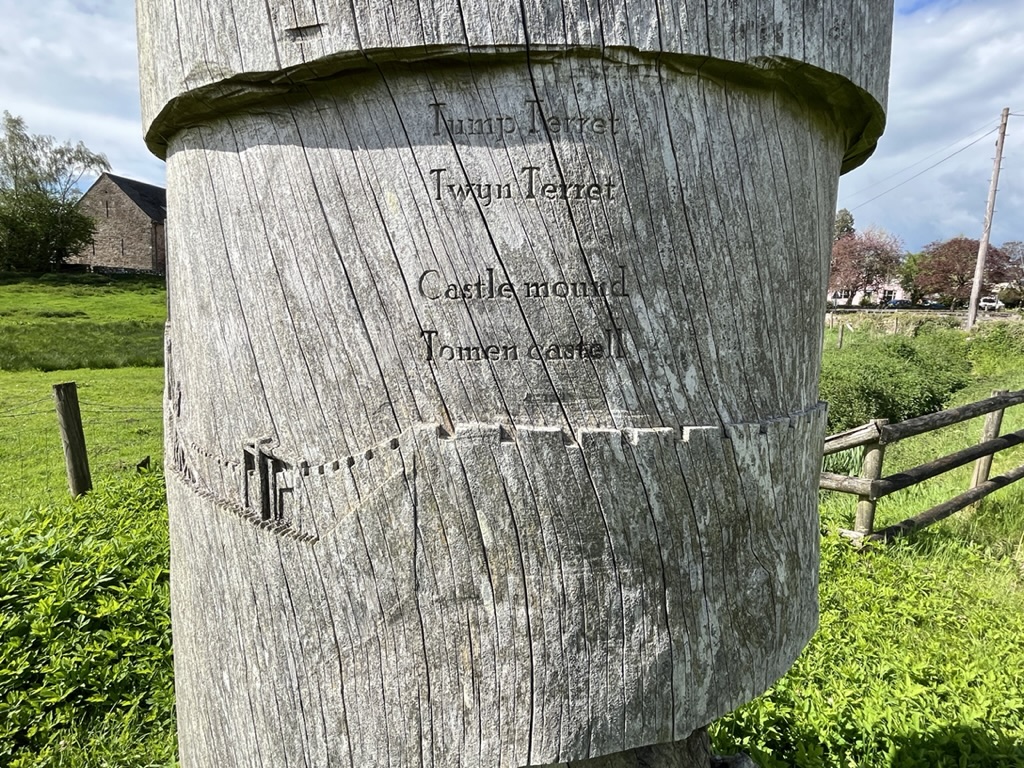
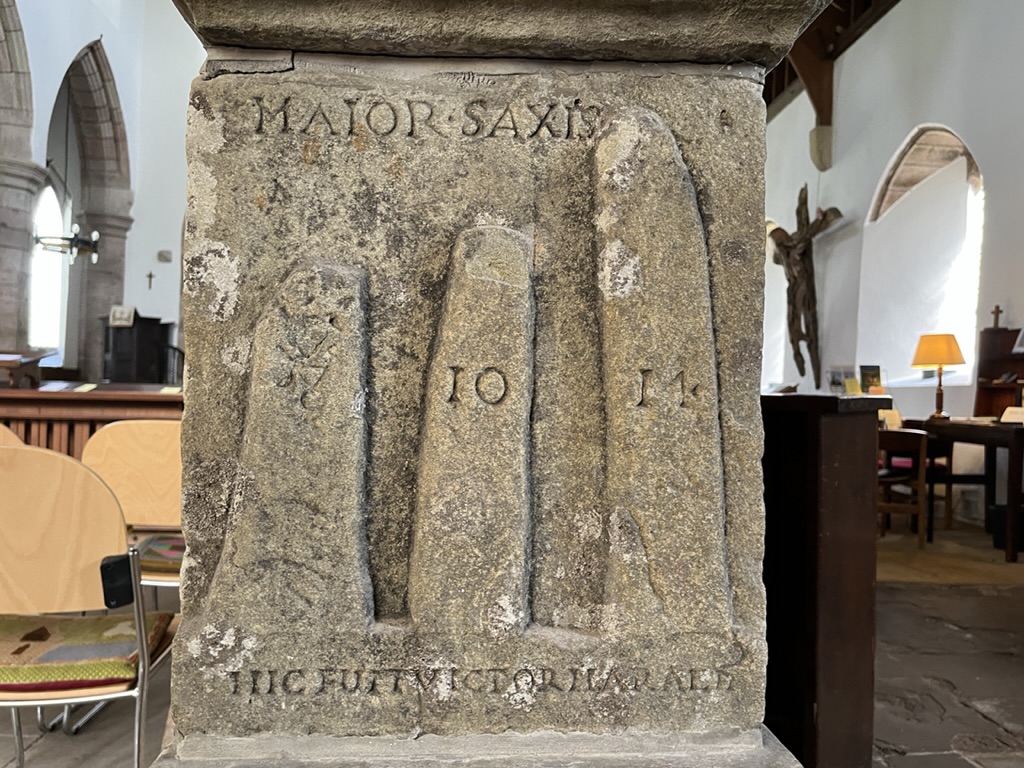
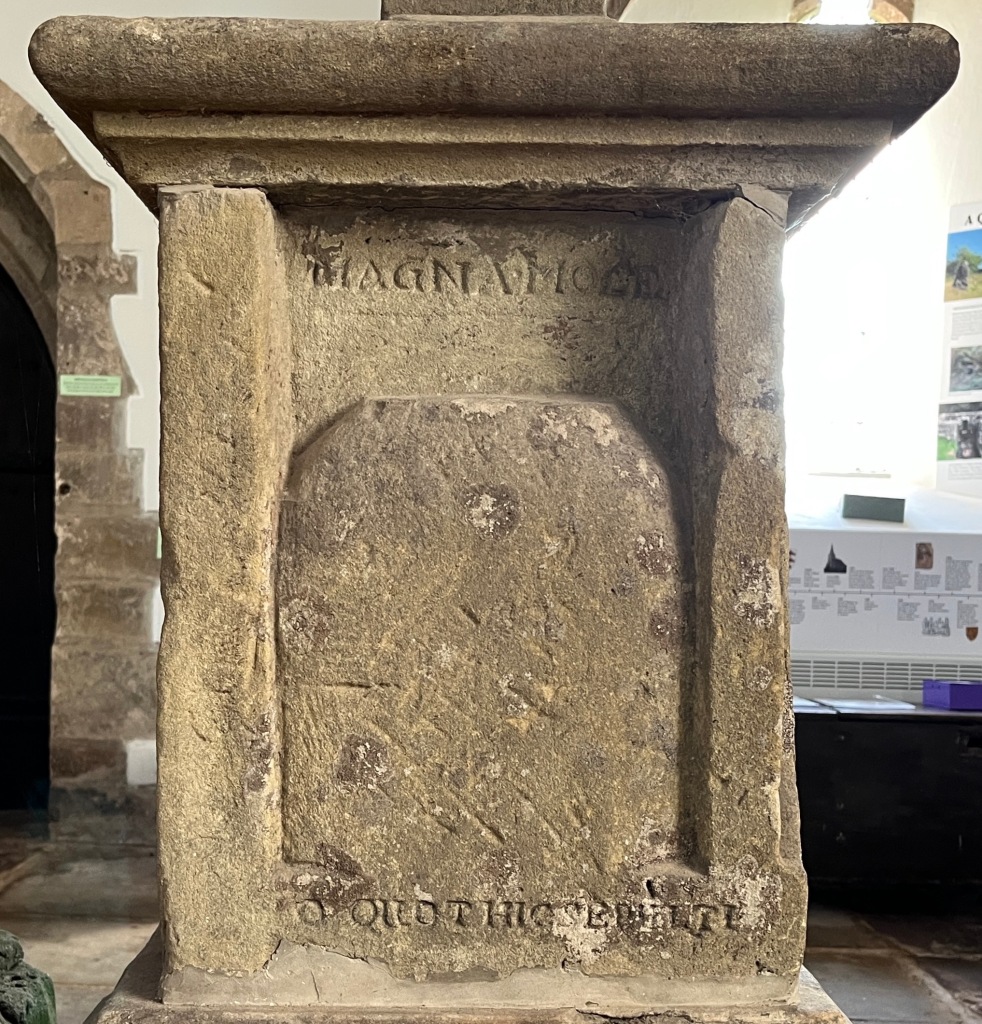
Below the dial are inscriptions on the substantial columns, with carvings that relate to the 3 features of historical importance to the village and its community: Tump Terret; Harold’s Stones; and Virtuous Well.

LINK TO PT 1 HERE.

GSS Category: Cube Dial; Multiple Dial

All photos Keith Salvesen; Pevsner extract Gwent & Monmouthshire; BSS records

TRELLECH . MON . ST NICHOLAS – Lady Probert’s dial 1689 (pt 1): Interior

St Nicholas . Trellech . Mon – Cube Multidial

GRADE I Early C14 with earlier origins; reconstruction & restorations 1890s. An exceptionally fine and well preserved medieval church (Cadw); One of the finest churches in the county (PEV).  Coat-of-Arms of Charles II dated 1683. Weathercock of 1792. You need no further recommendation. 5m S of Monmouth. 51.7459 / -2.725 / SO500054

DIAL

St Nicholas . Trellech . Mon – Cube Multidial

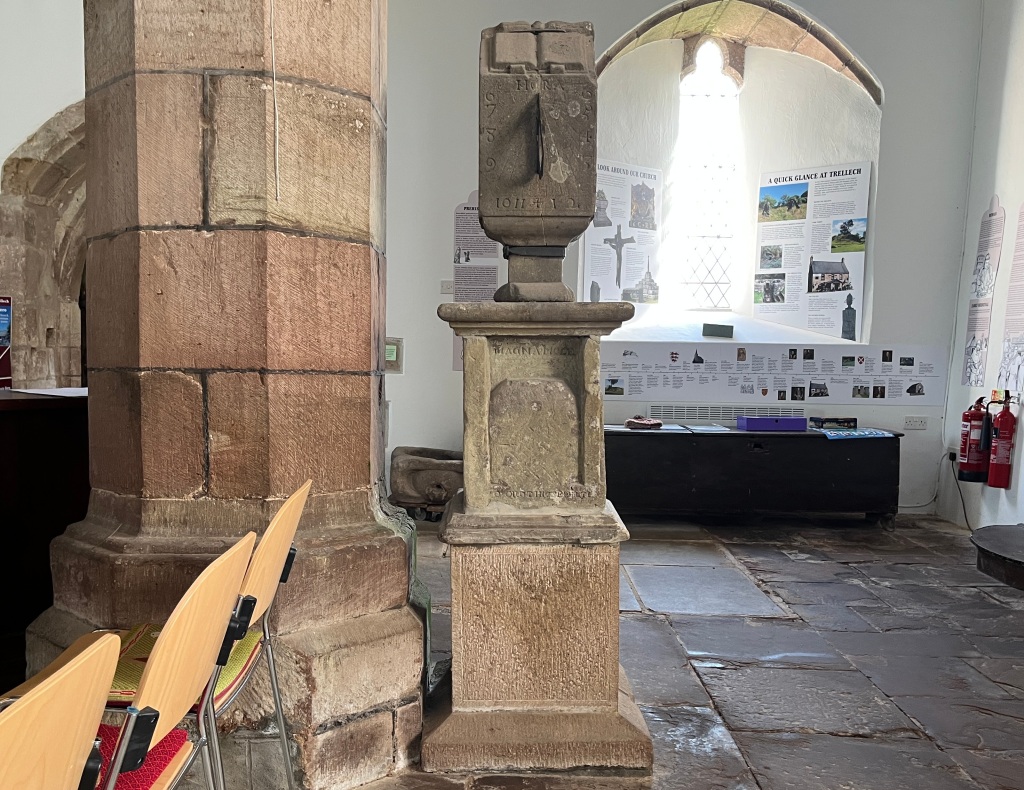
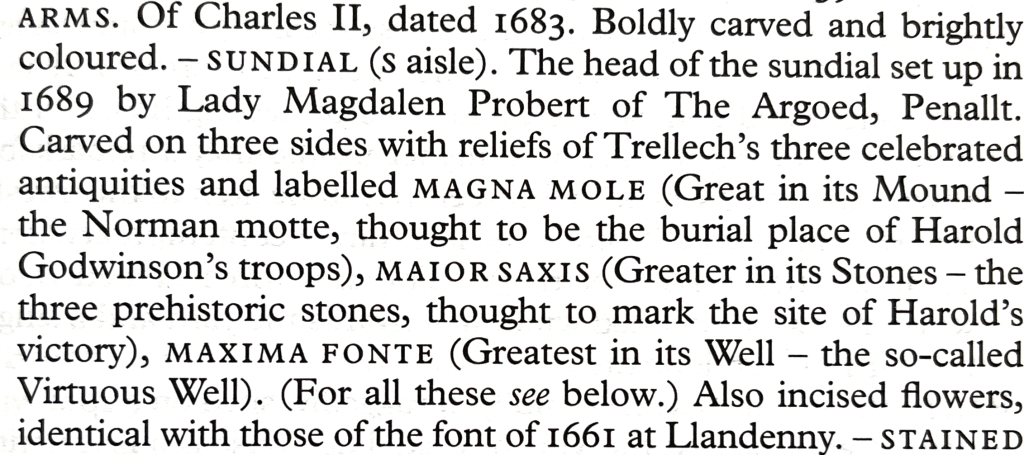
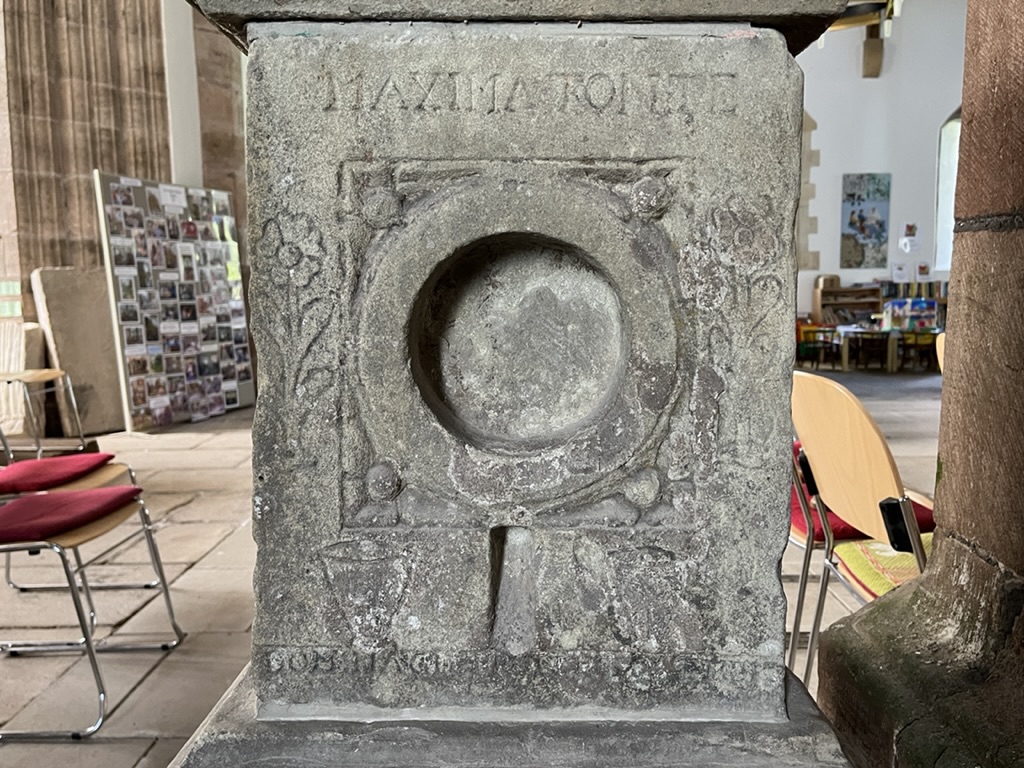
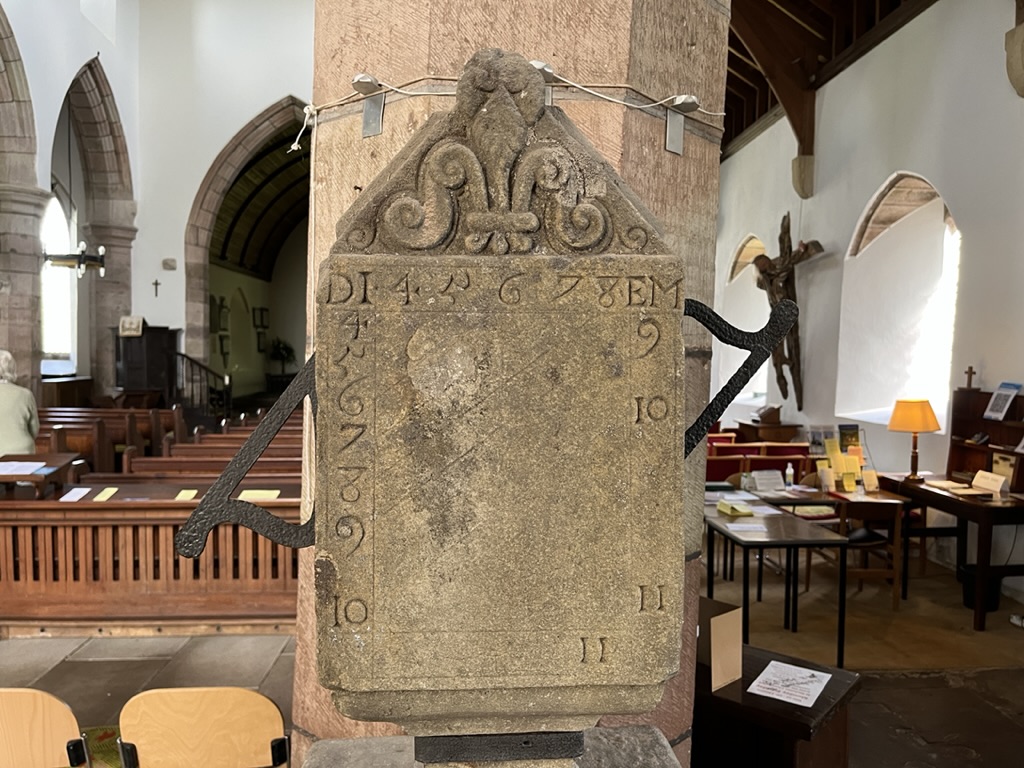
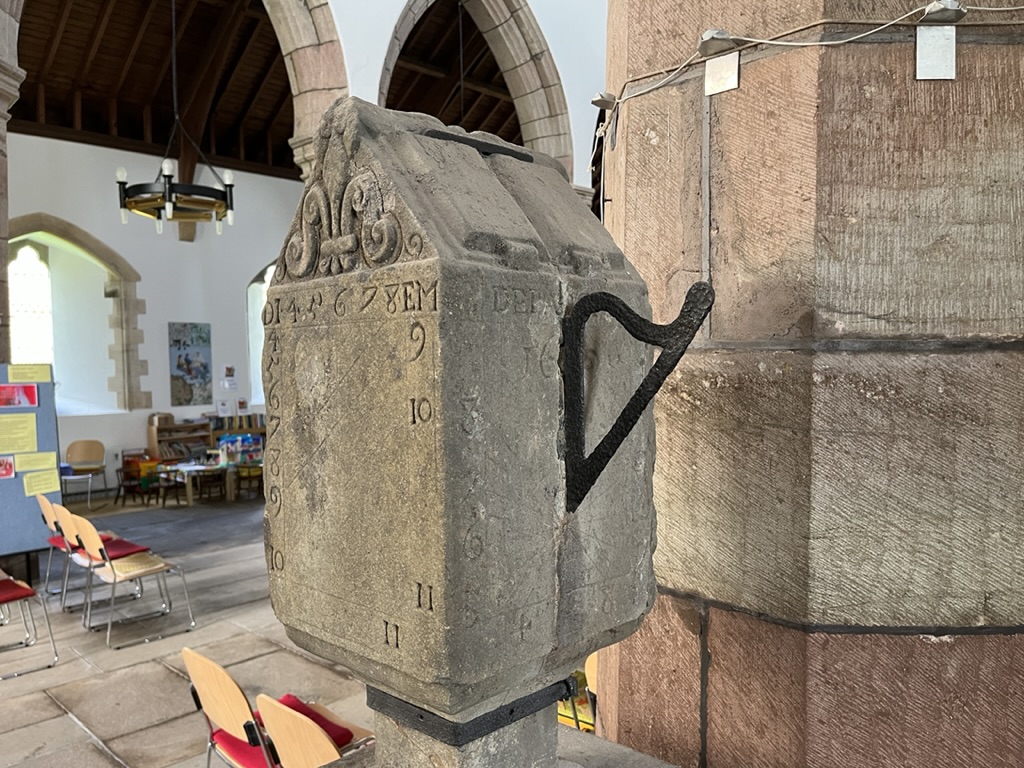
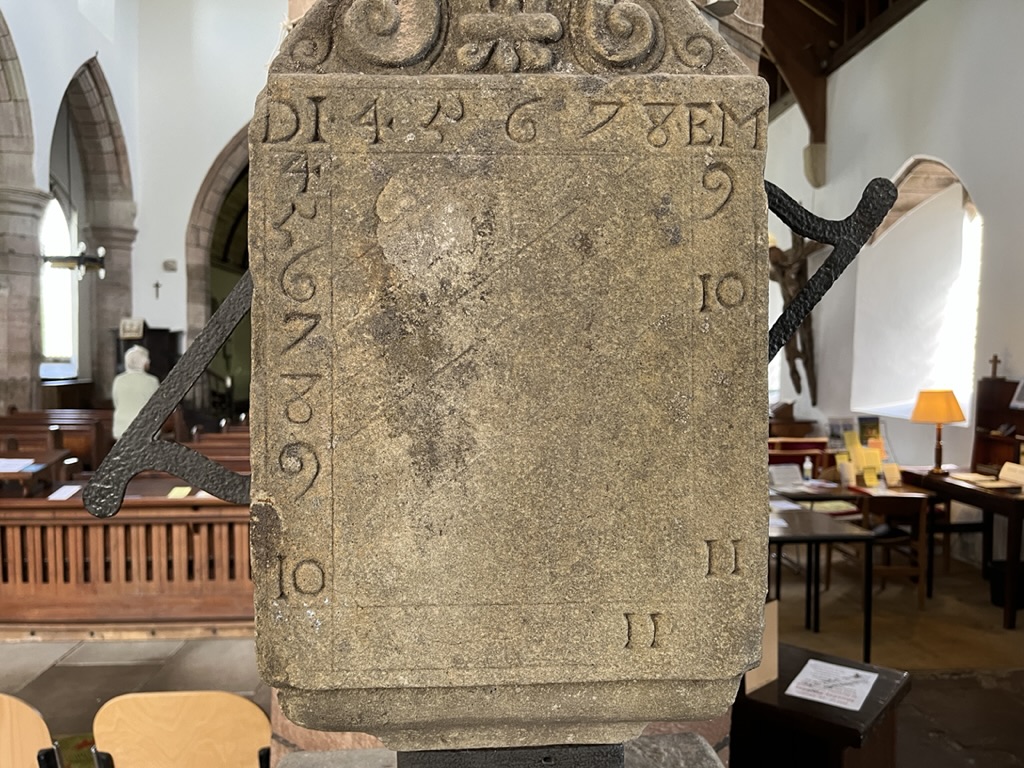
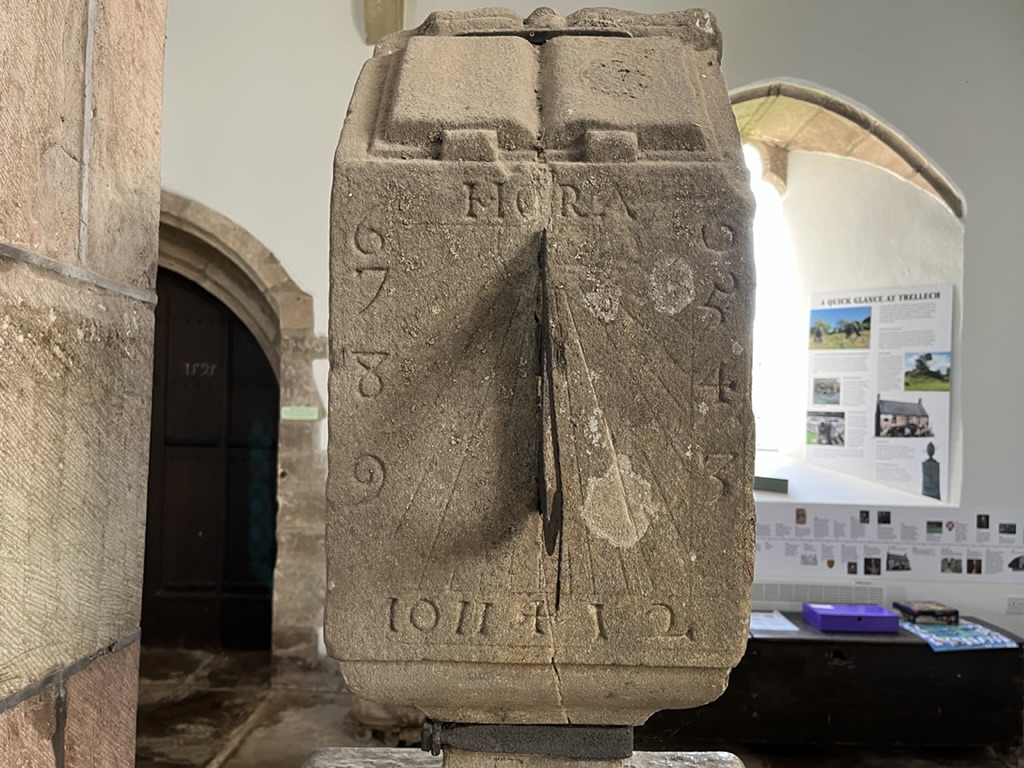
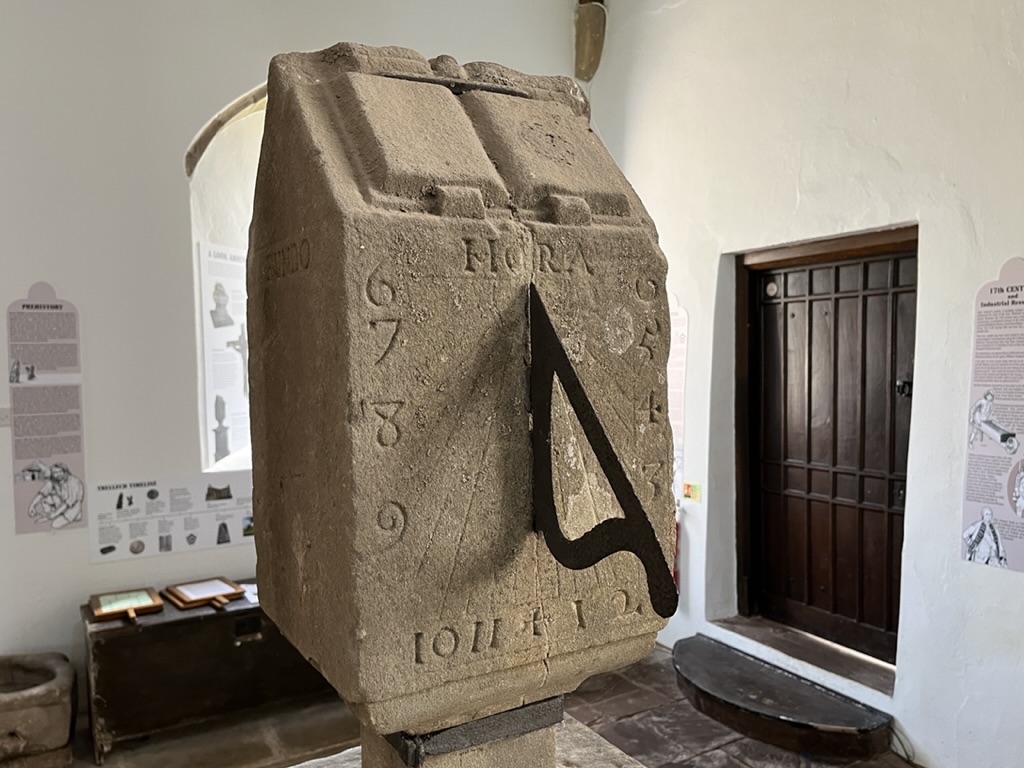
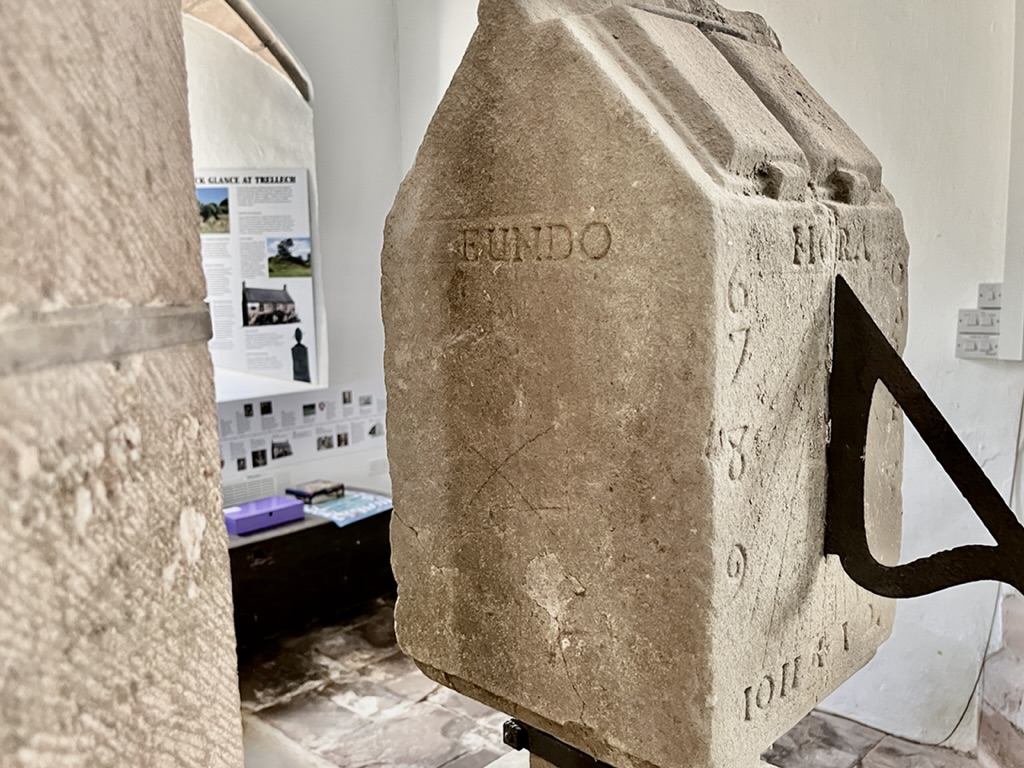
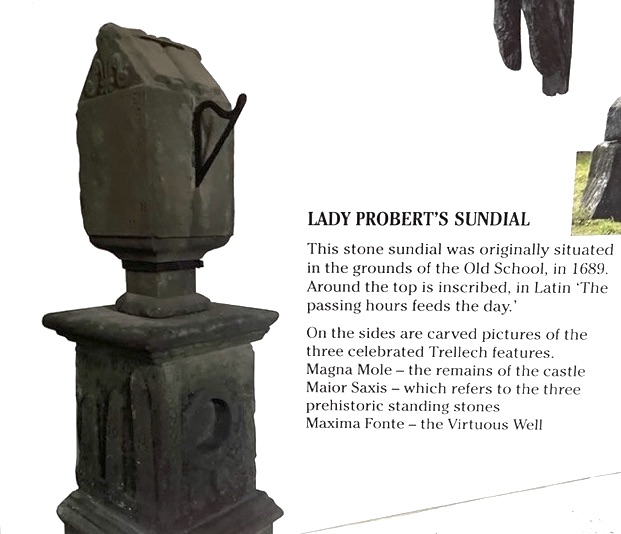
A wonderful C18 cube dial dated 1689, the gift of Lady Probert. Once, it stood in the village near the school. It was moved in 1895 and one source suggests that a concrete cast was made. The Latin inscriptions on the dial are descriptive of 3 features that are of historical importance to the village: Tump Terret; Harold’s Stones; and Virtuous Well. The details (PEV) are:

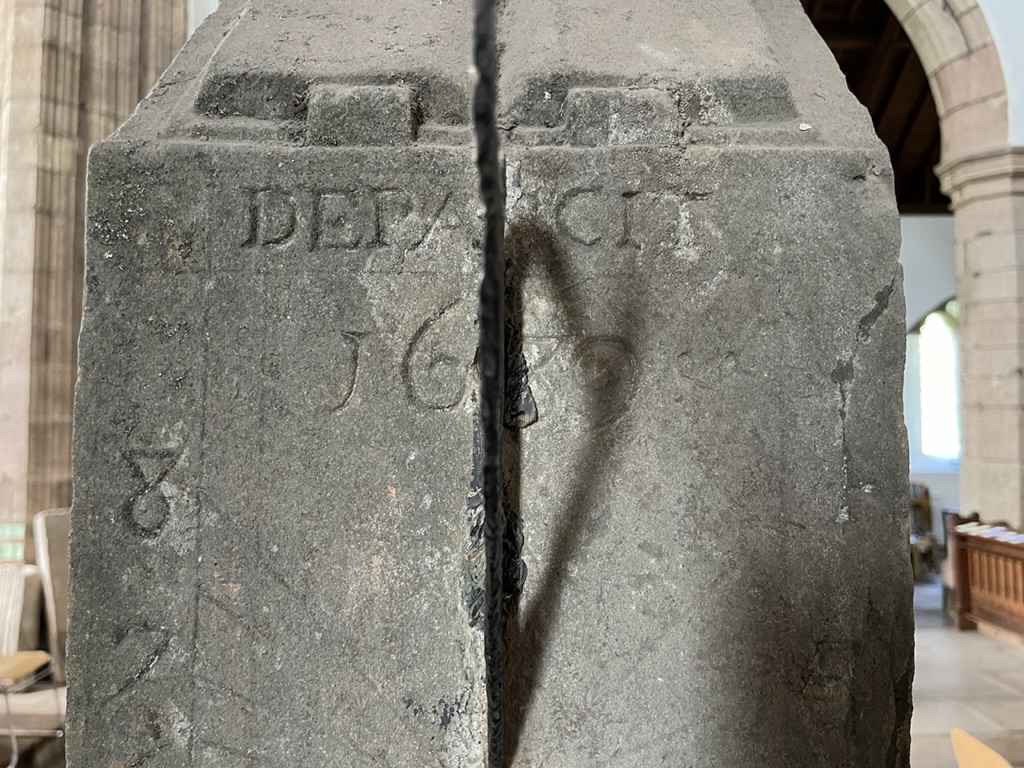
The detailed BSS record adds further details, including the full Latin motto on S, N & E faces: EUNDO HORA . DI…EM . DEPASCIT (The Hour Itself Consumes the Day).

Also included are the inscriptions on the square stone below the dial: 1. Terret Tump – O QUOT HIC SEPULTI (O How Many Buried Here); 2. Harold’s Stones – HIC FUIT VITOR HAROLD (Here was Harold Victorious); 3. DOM MAGD PROBERT OSTENDIT (Lady Maud Probert set this out to view).

DIAL DETAILS

SOUTH FACE

WEST FACE

NORTH FACE

EAST FACE

PART 2 will examine the excellent modern wooden replica (out)standing in a small field by a crossroads. It has been beautifully designed and is a dial of distinction in its own right.

GSS Category: Cube Dial; Multiple Dial

All photos Keith Salvesen; Pevsner extract Gwent & Monmouthshire; BSS records; church noticeboard

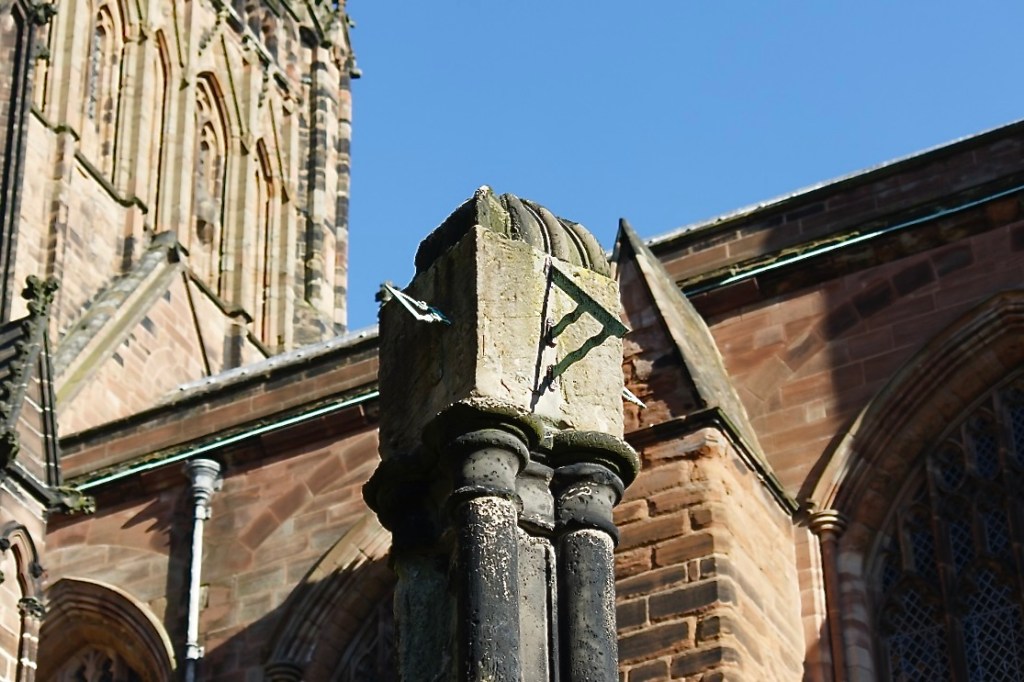
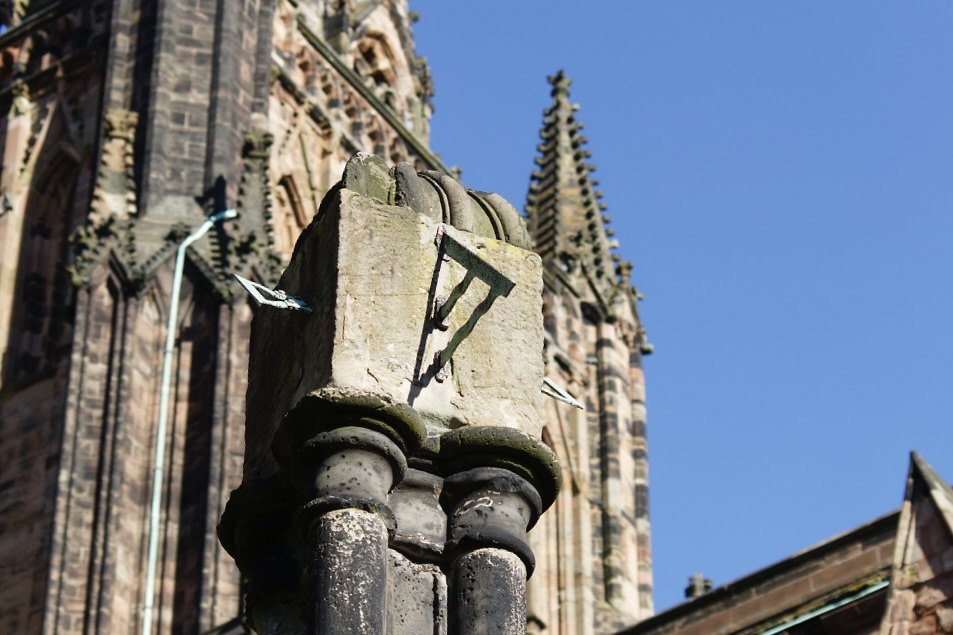
LICHFIELD CATHEDRAL . STAFFS – C17 / C18 Cube Dial on a Column

Lichfield Cathedral – Cube Dial on Column

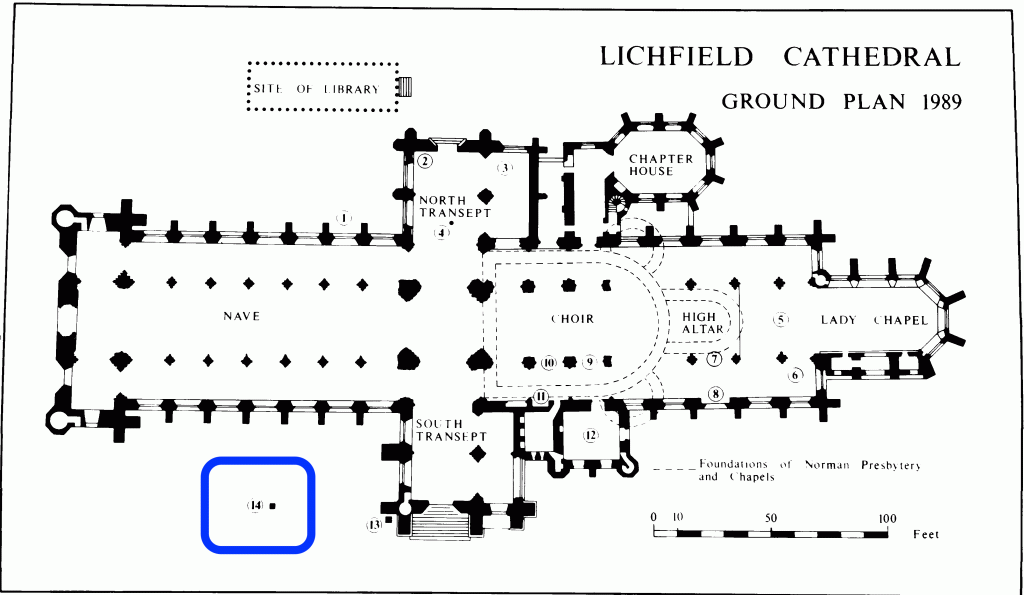
GRADE II Large Cube Dial on a tall column. BLB / HE give the most complete descriptions: Date uncertain, probably C17 or early C18; 1st recorded 1781. Ashlar. Tall quatrefoil pier on plinth, with ring and moulded capital supporting cube with dials and gnomons to each face, reeded domical (domed) cap. An unusual feature whose origin is unknown, removed in 1781 and re-erected to the west end of the cathedral in 1785, removed and sold in 1881, and returned and re-erected on its present site in 1929.

BHO notes: A sundial near the south doorway of the cathedral was removed in 1781 and re-erected in 1785 at the west end in order to regulate the clock on the tower. It was removed in 1881 and passed into private hands. It was returned to the cathedral in 1929 and placed on a pedestal in its present position south of the nave.

The clock in question was (without going into detail) probably the first Cathedral clock, which was in position by 1491. BHO suggests that the original clock was still in place in early C17 and probably not replaced or superseded by another clock until late C18. If so, the dial’s removal and re-erection in 1780s would have been to regulate the original clock.

The handsome domed dial has a single gnomon on each face. The gnomons and lines obviously differ on each side. Numerals are Arabic rather than Roman.

Assuming the Cathedral conforms to the usual church orientation, the Cube’s angle in its position on the S side of the building is some 45º out of true from what might be expected. Presumably the explanation is that the cube was originally cut for a different position, and after several relocations its present position and orientation provides optimum accuracy. Any other suggestions would be welcome.

Lichfield Cathedral – Cube Dial on Column

GSS Category: Cube Dial; Column Dial; Pillar Dial; Pedestal Dial

Credits: Erika Clarkson for amazing photos, with thanks

BROUGHTON GRANGE GARDENS . OXON – Pedestal Dial

Broughton Grange dates from early C17. Gradual development resulted in a fine house with an extensive estate owned by the Morrell family and associated with the Bloomsbury Group via Lady Ottoline. The whole estate was bought in the 1990s. New gardens have been beautifully landscaped and an arboretum created. The property is renowned as one of the finest contemporary private gardens, to which there is public access. You can find out more here: BROUGHTON GRANGE 3m SW of Banbury 52.0415 / 1.3776 / SP4338

The dial stands at the centre of the Parterre and Rose Garden, overlooking the smart box hedges. It is dated MDCCLI (1751). I’ve spent some time trying to figure out the inscription, some of which cannot be read even with a magnifying glass. I have settled (provisionally) on Tempora Servio, ‘I Serve the Times’ or a similar conjunction of tempus and servere. This formulation does not specifically appear in eg the expanded edition of Gatty; however tempora is in common usage, often with its companion, mores. Any other suggestions welcome, a definitive ruling would be ideal.

GSS Category: Horizontal Dial; Pedestal Dial; Garden Dial

All photos: Keith Salvesen