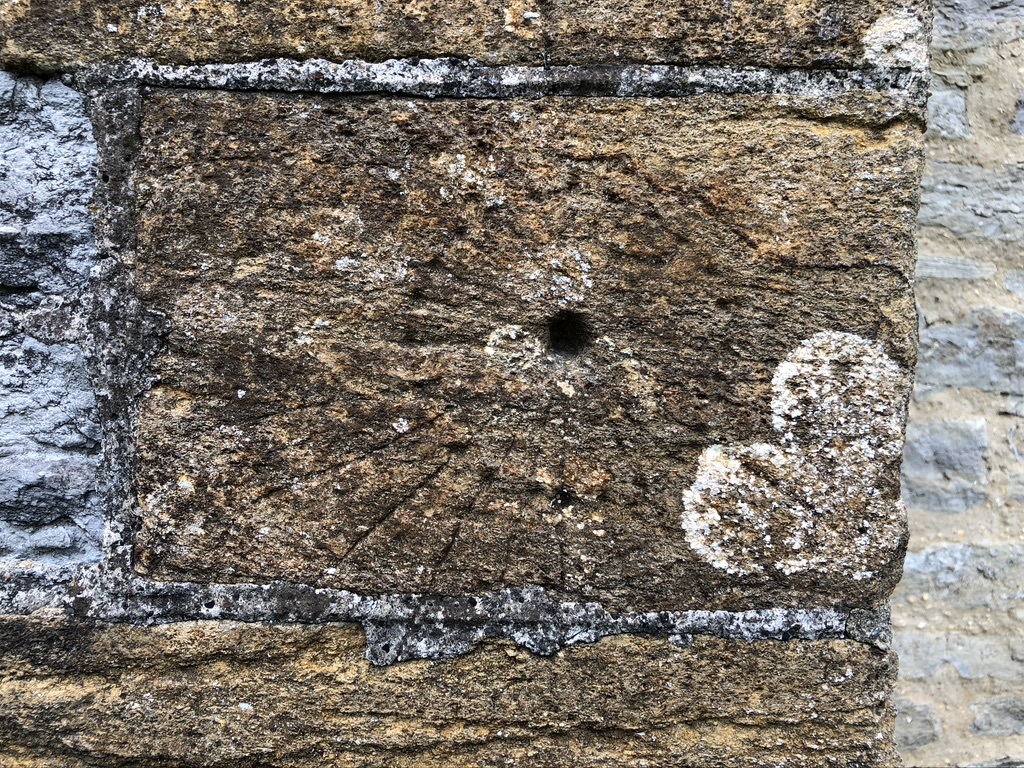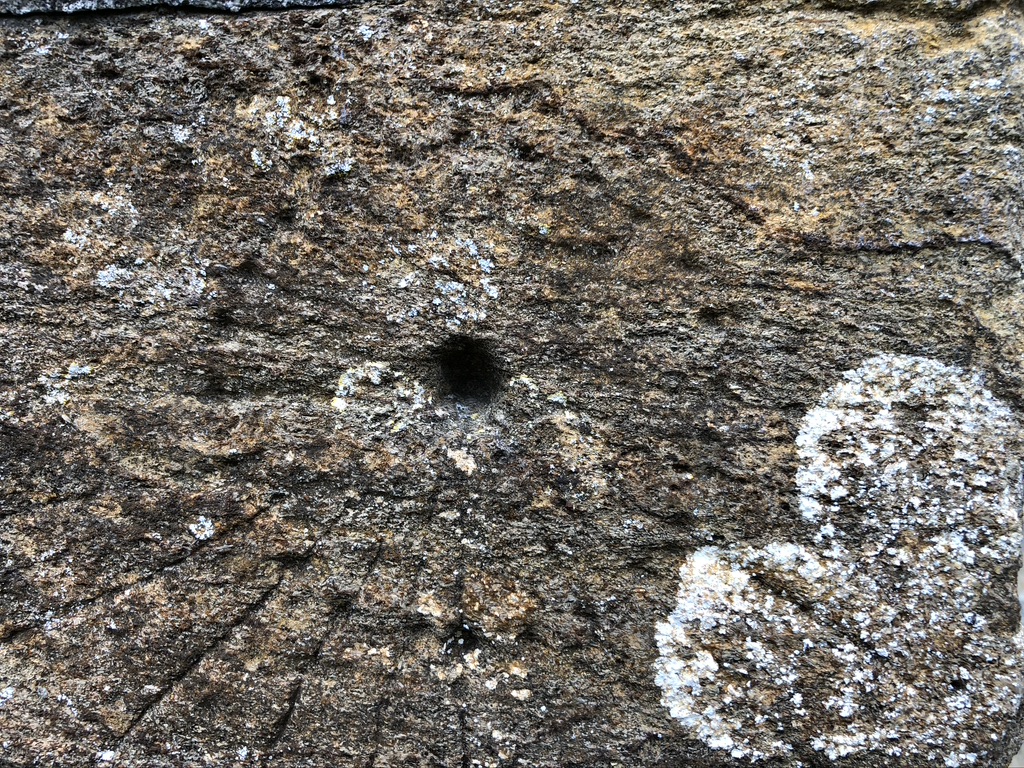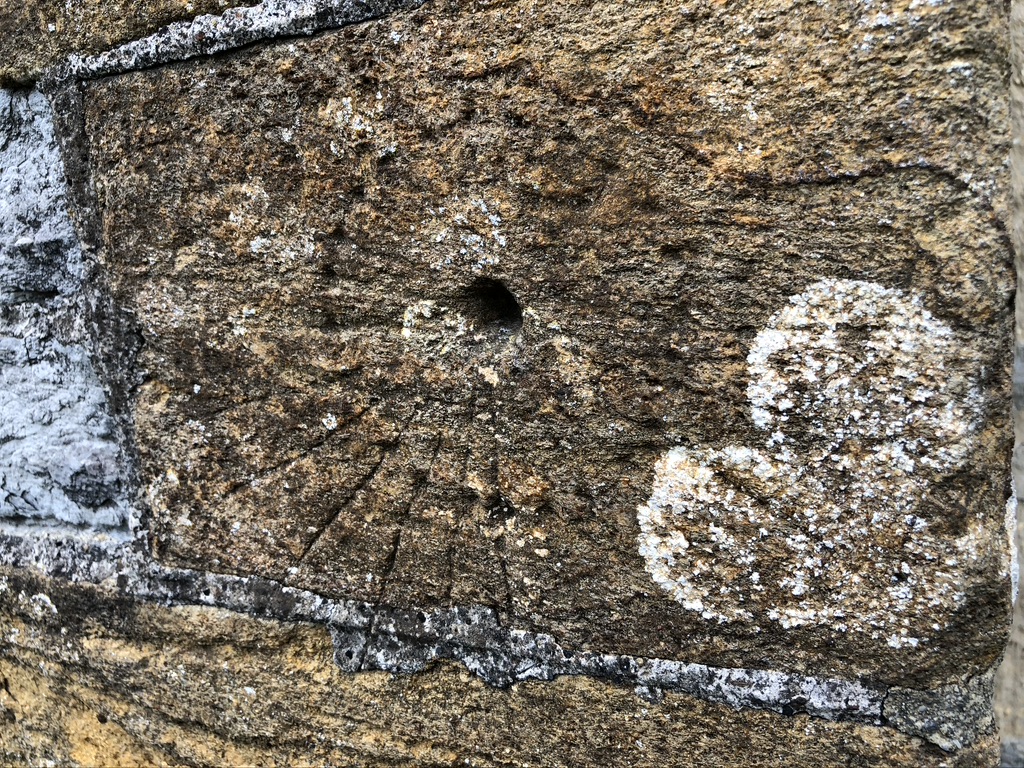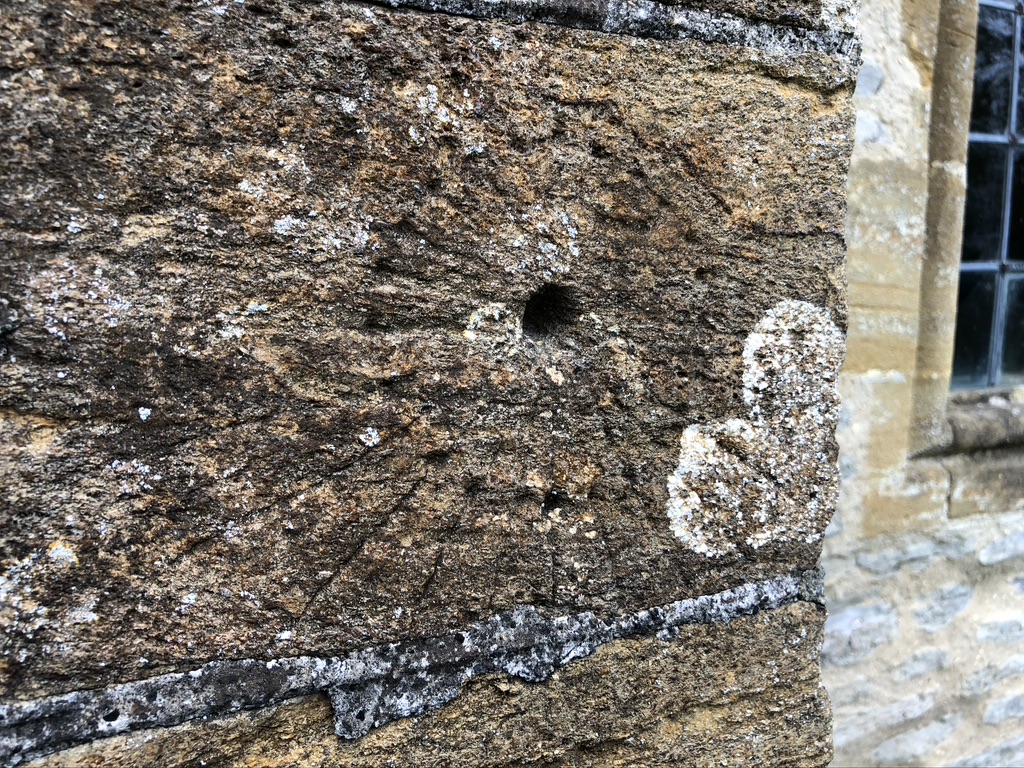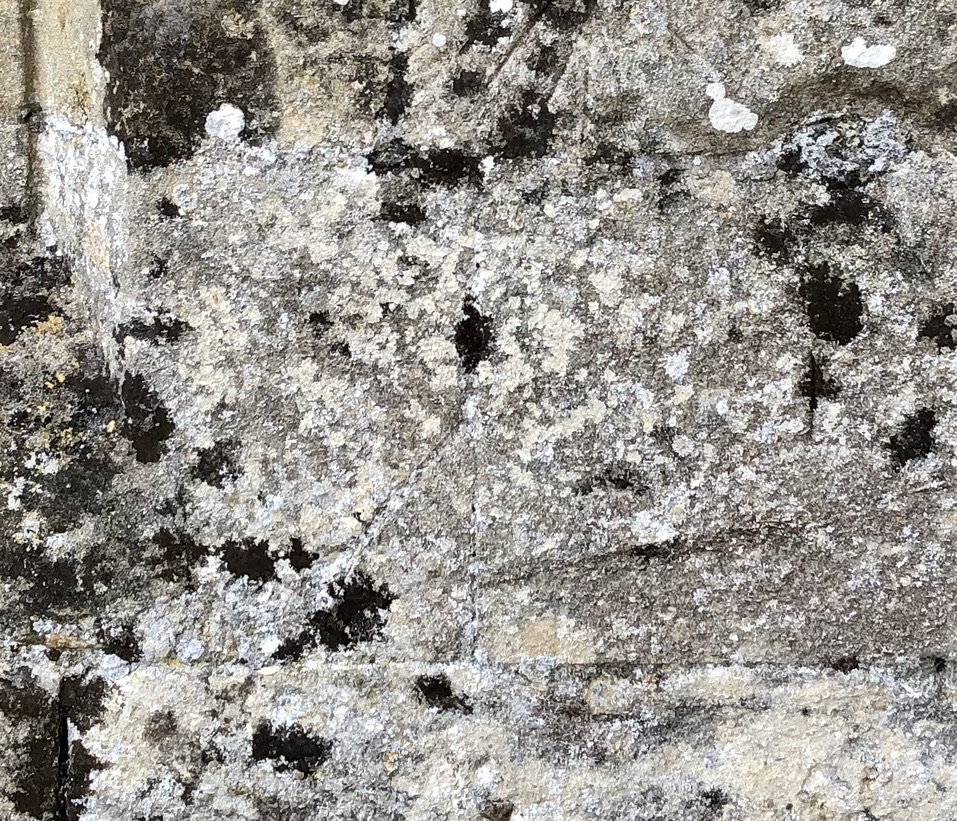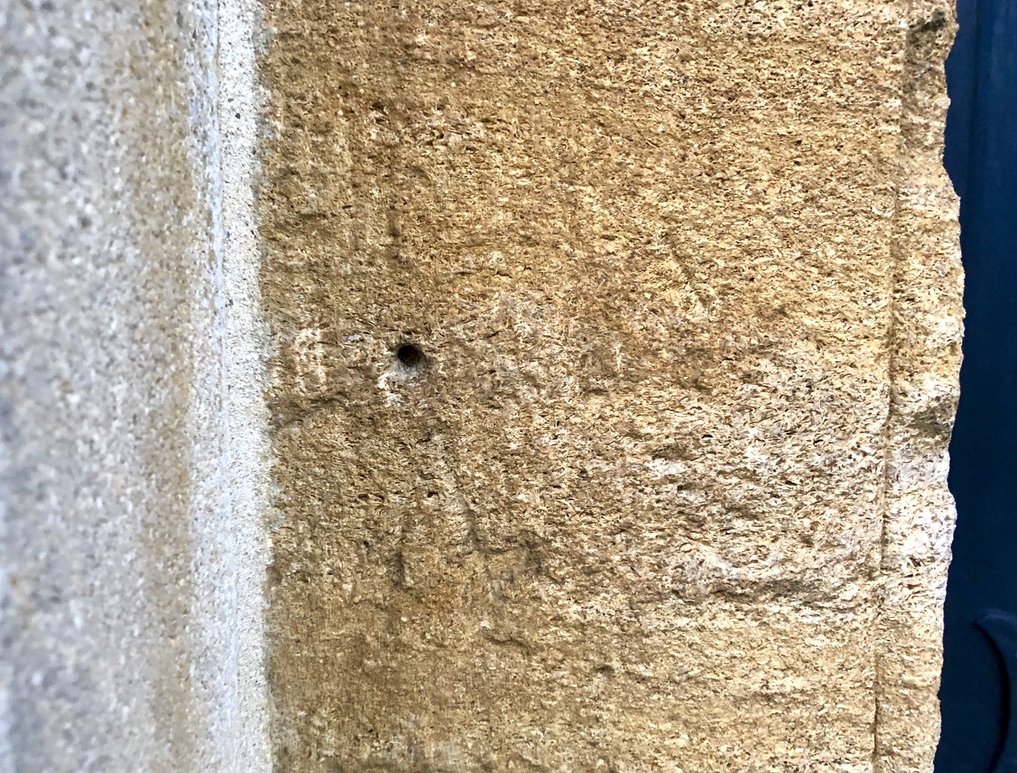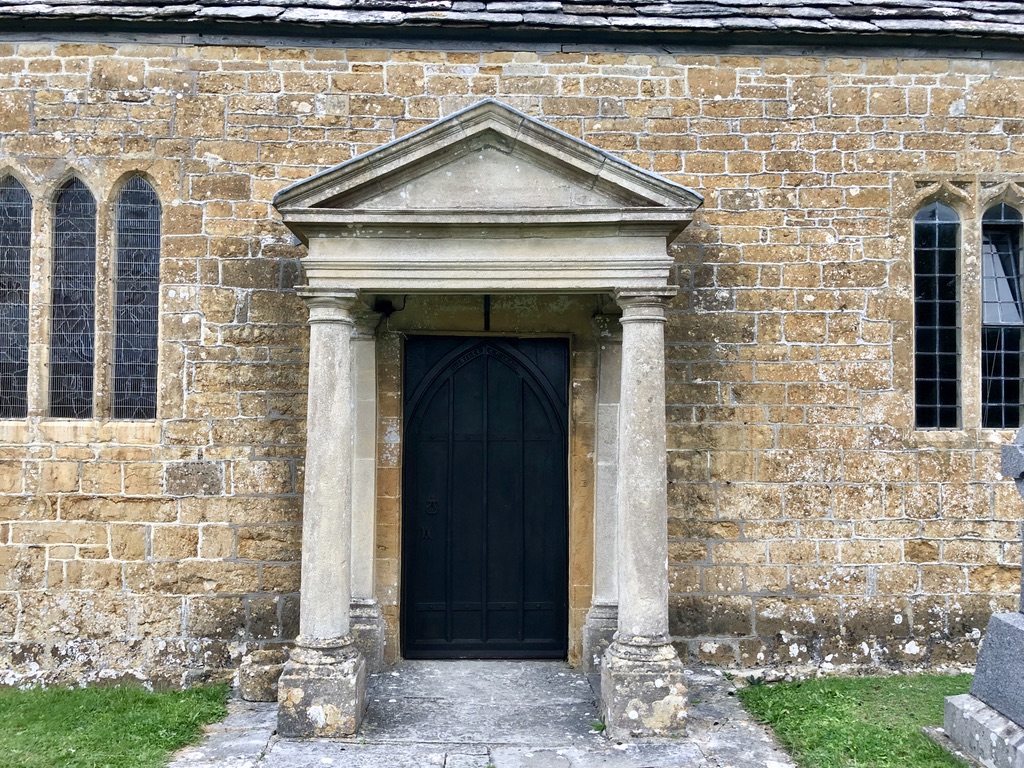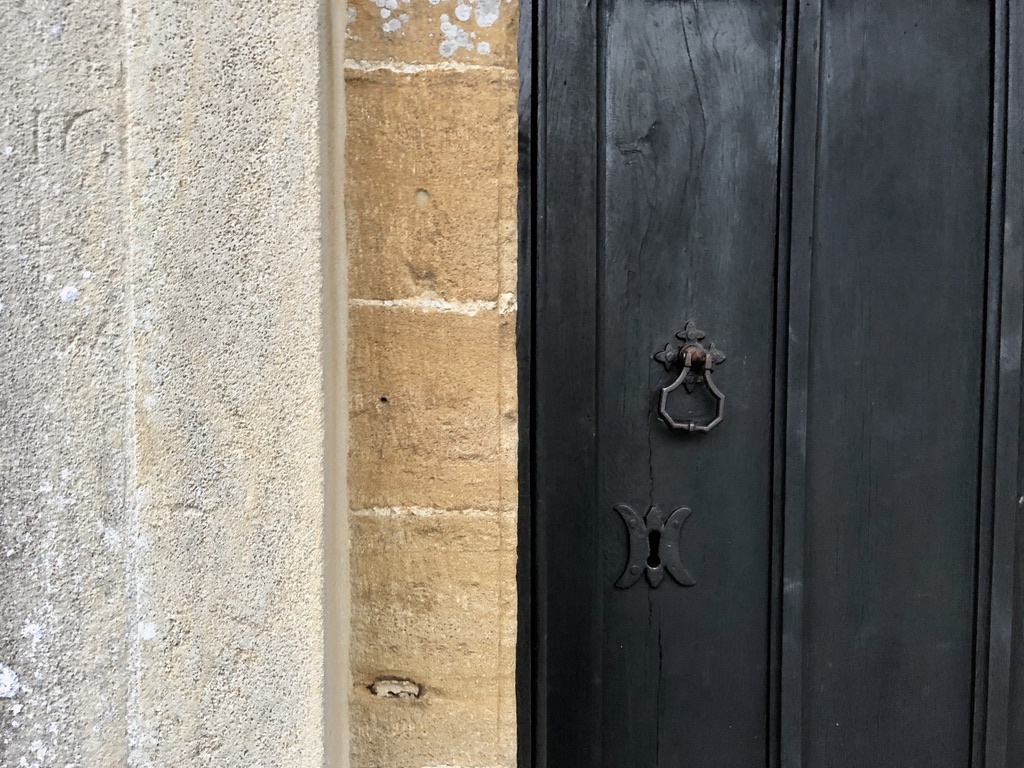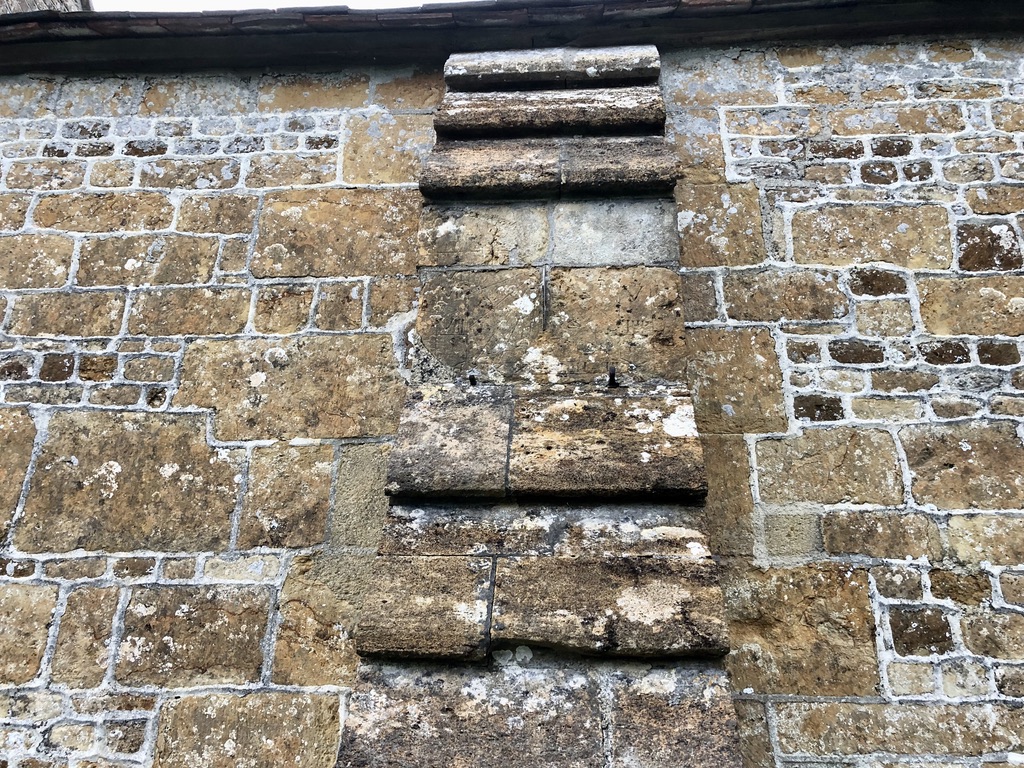
QUEEN CAMEL . SOMERSET . ST BARNABAS – Scratch Dial(s)

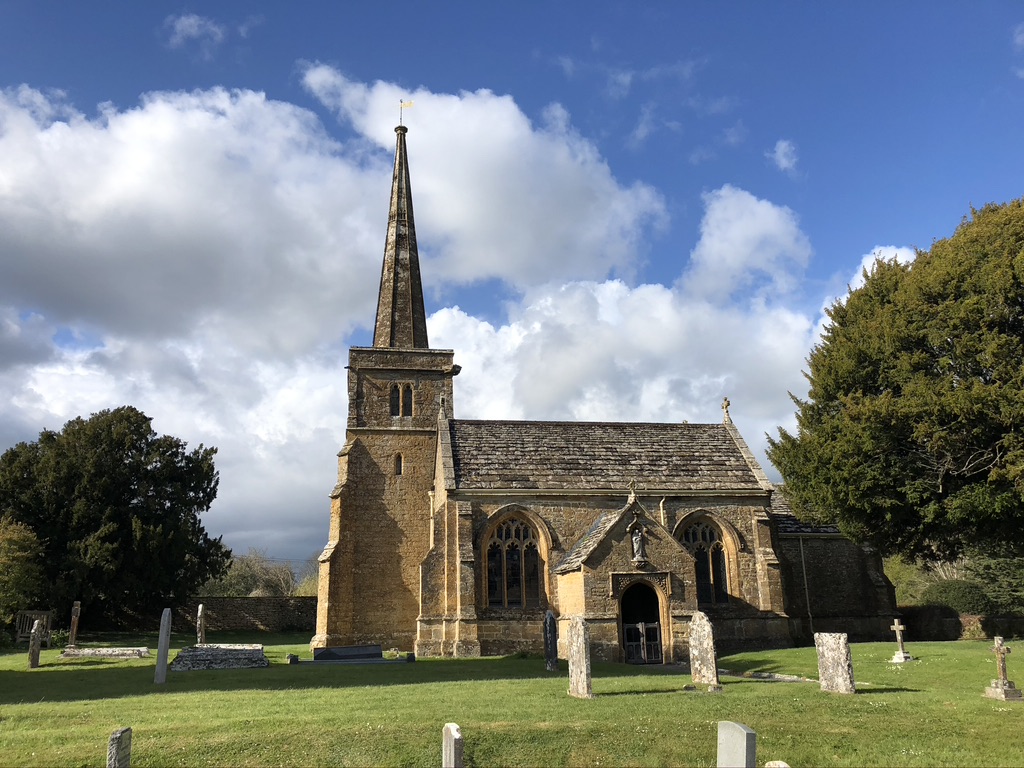
Queen Camel . Somerset . St Barnabas

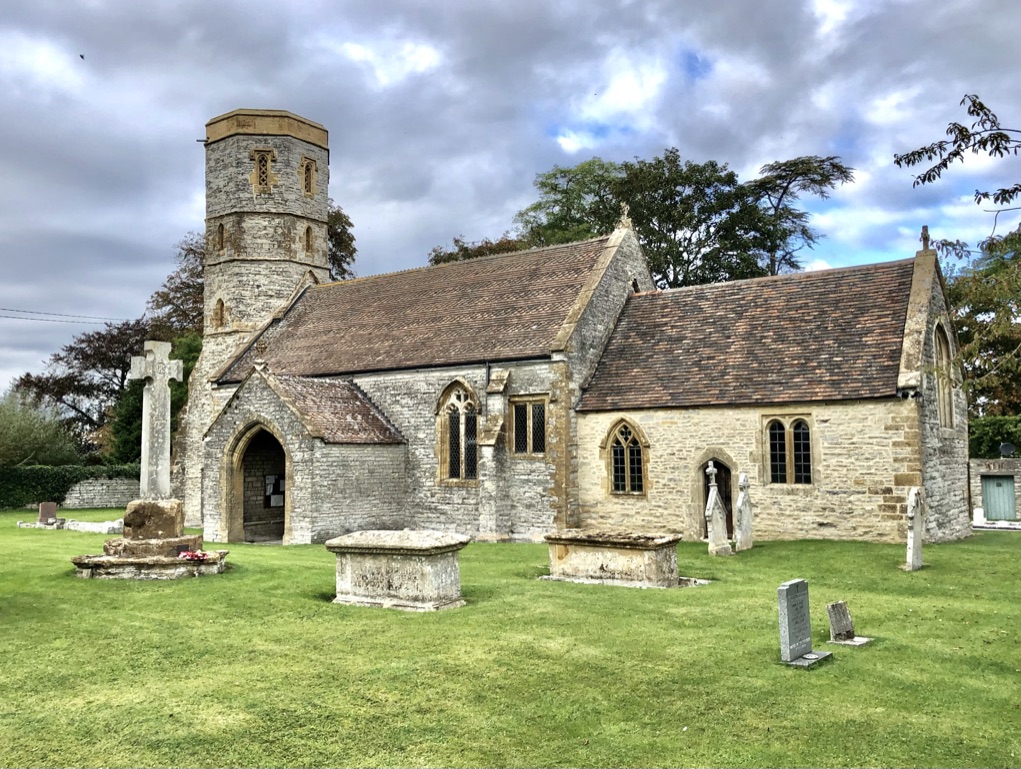
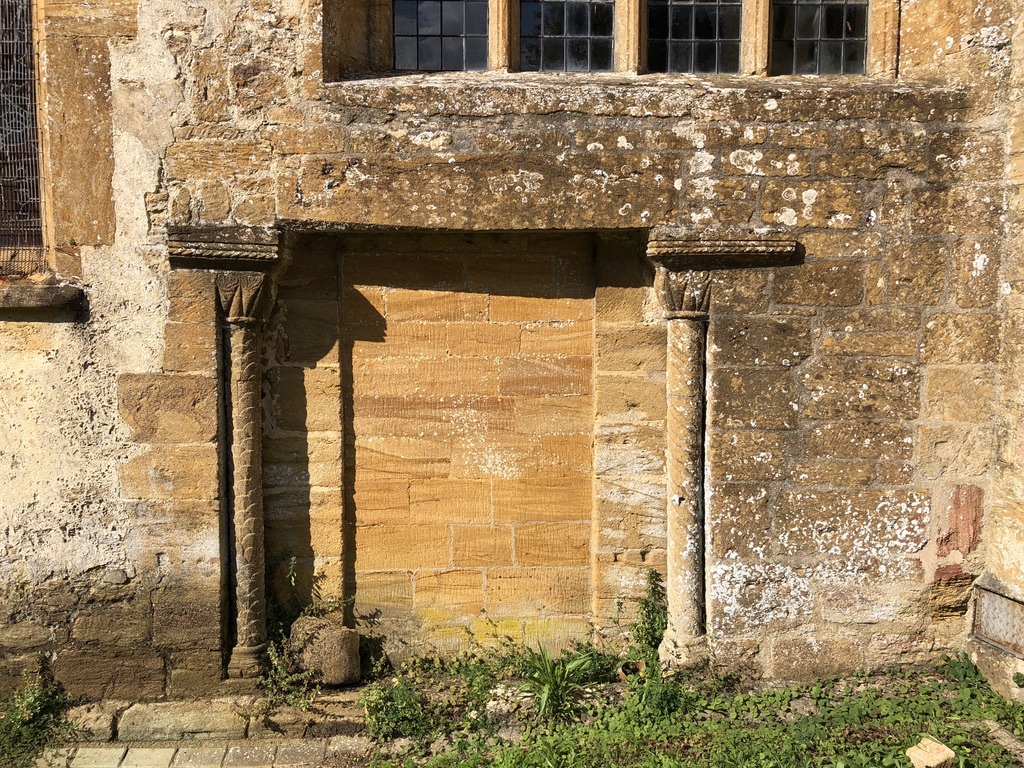
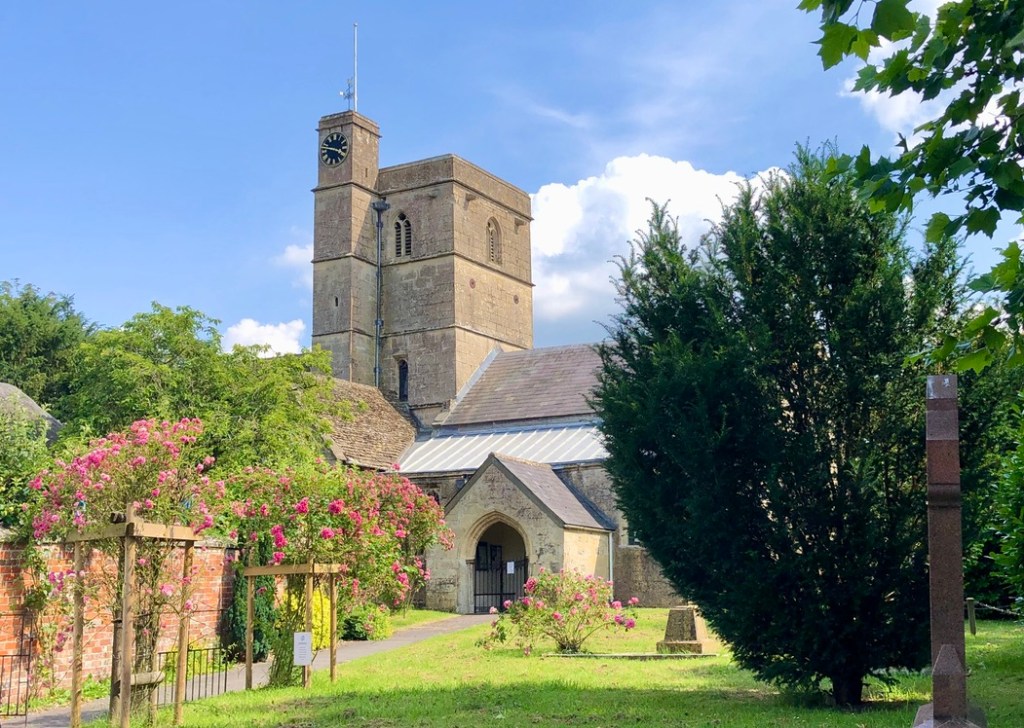
GRADE I . C14 (first record 1291); C15 expansion; late C19 work. See HE for details of this interesting church, with its fine portico. A few miles N. of Sherborne or Yeovil. 51.0225 / -2.5754 / ST597249

DIALS

DIAL 1

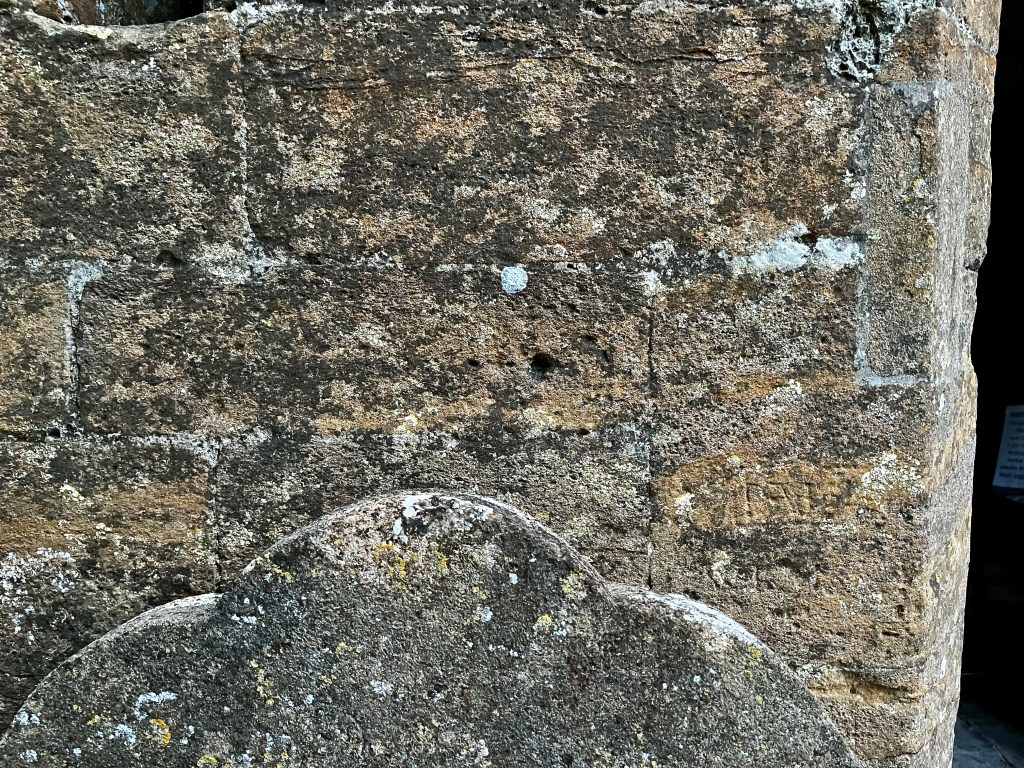
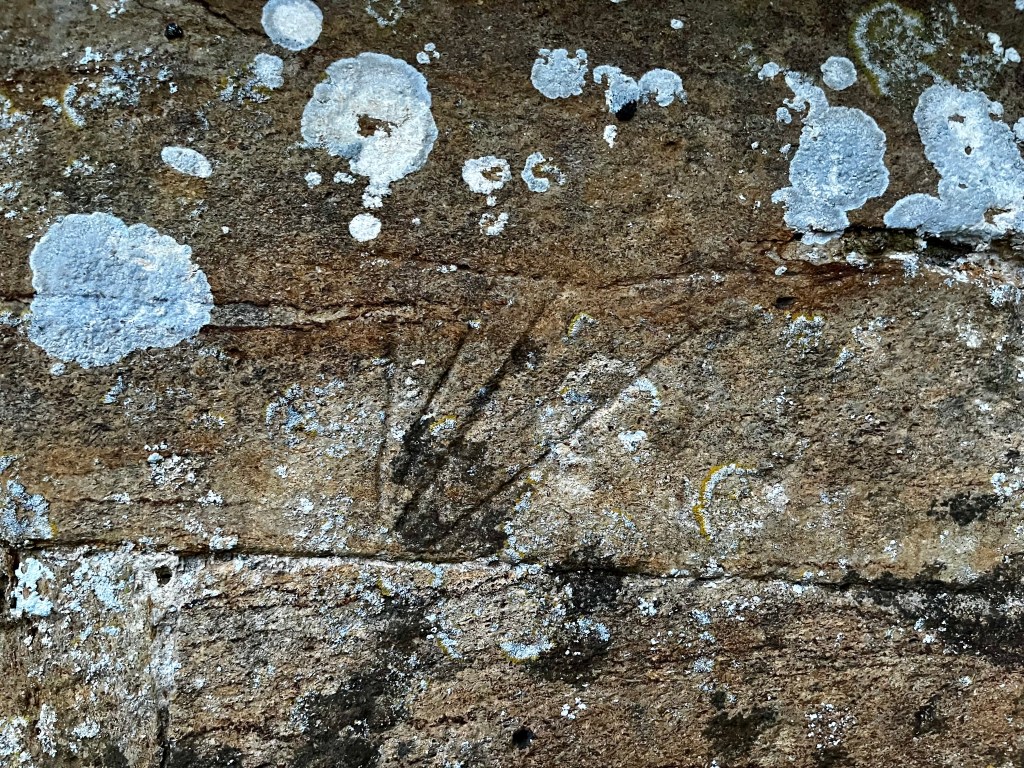
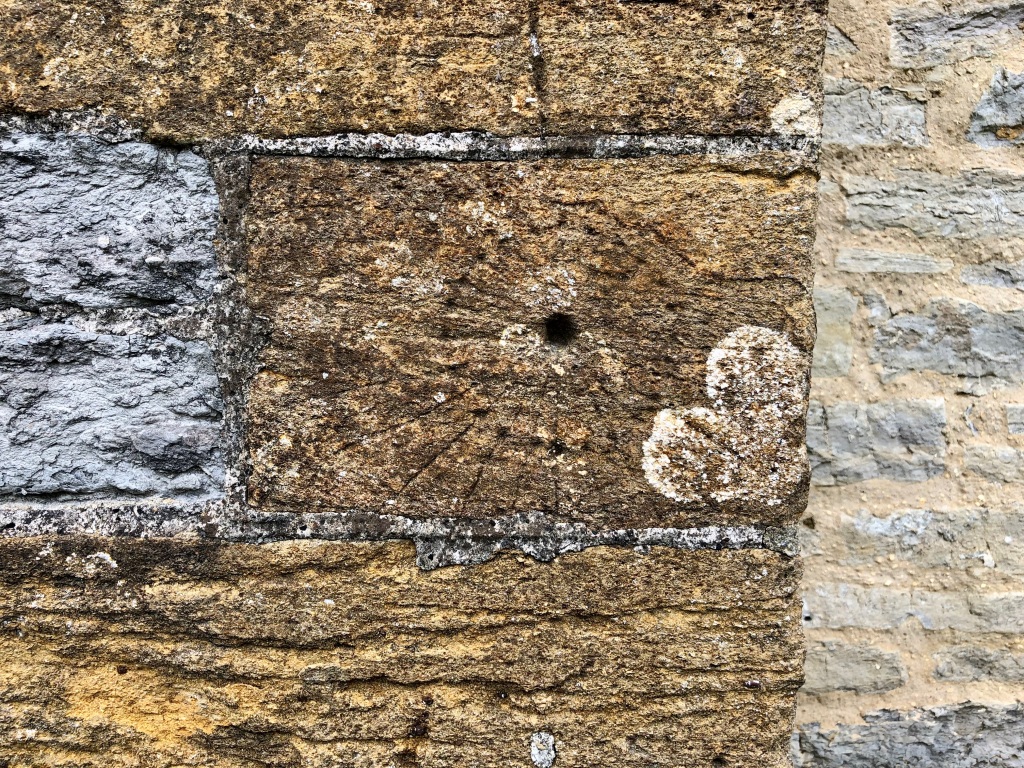
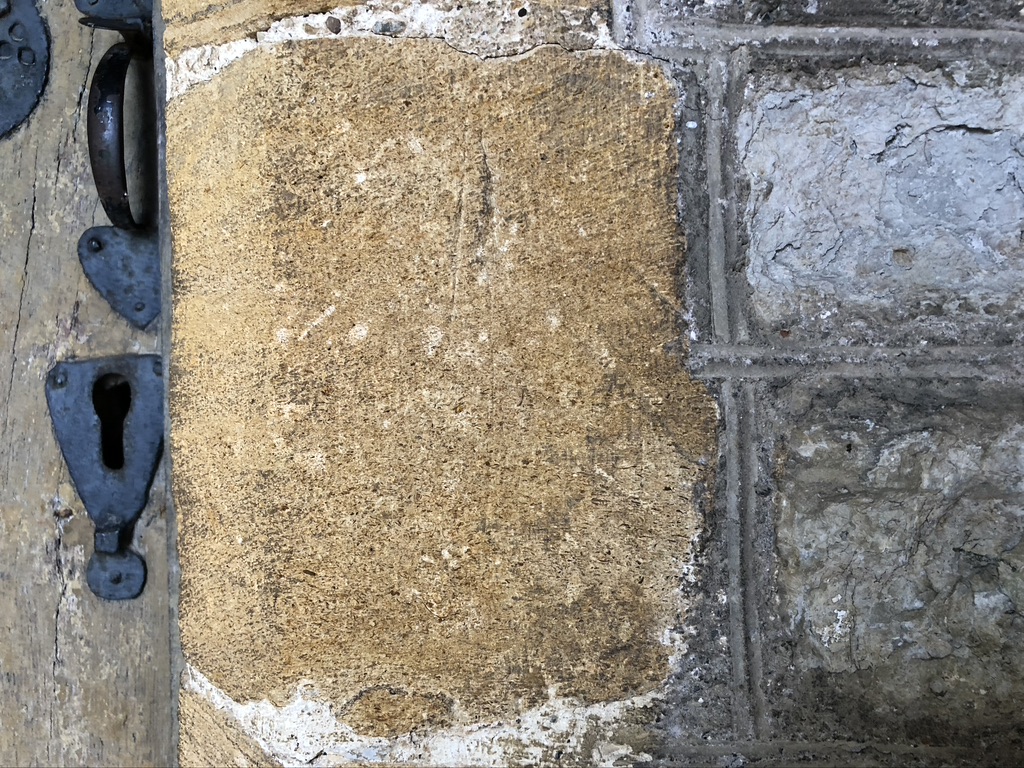
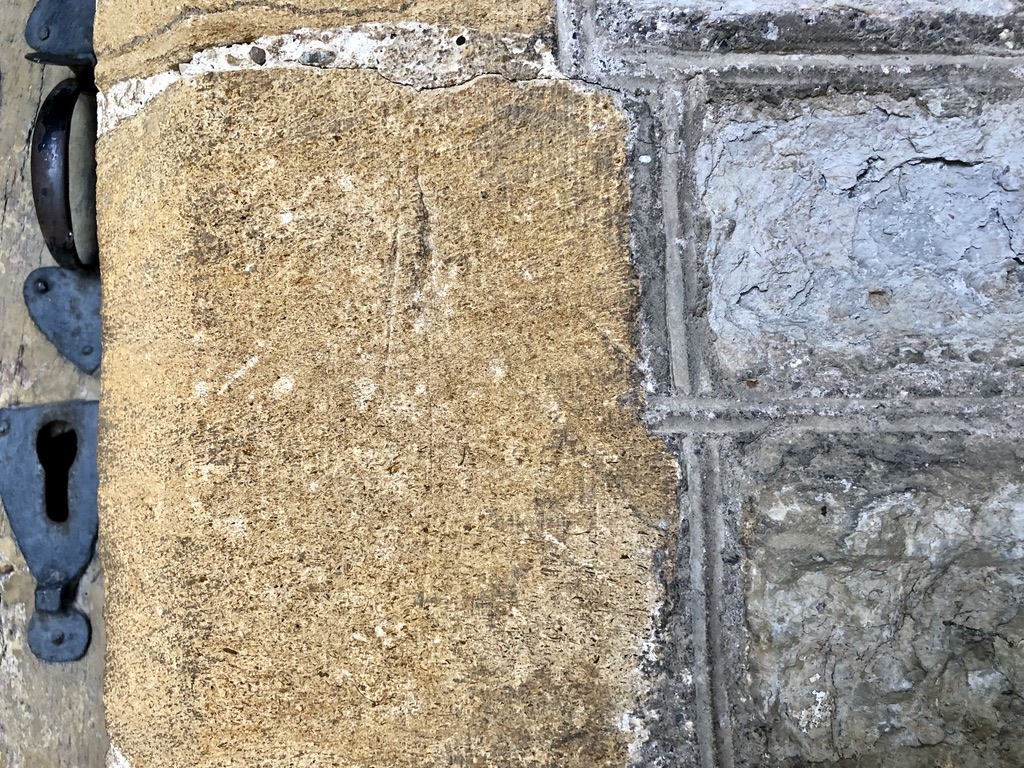
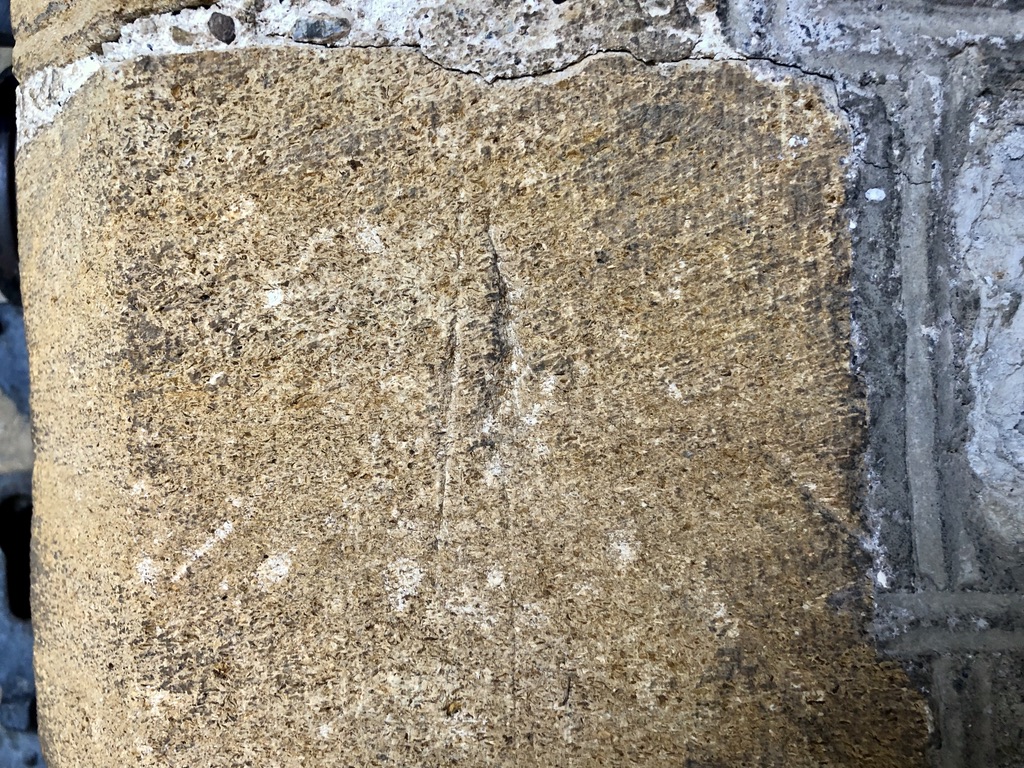
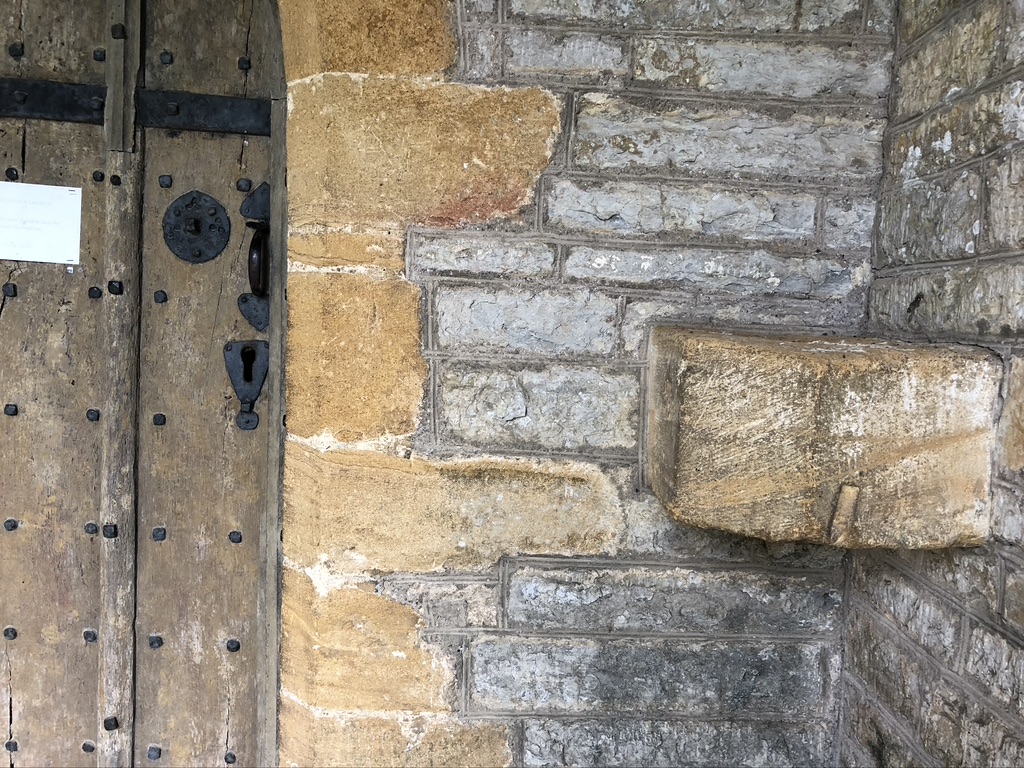
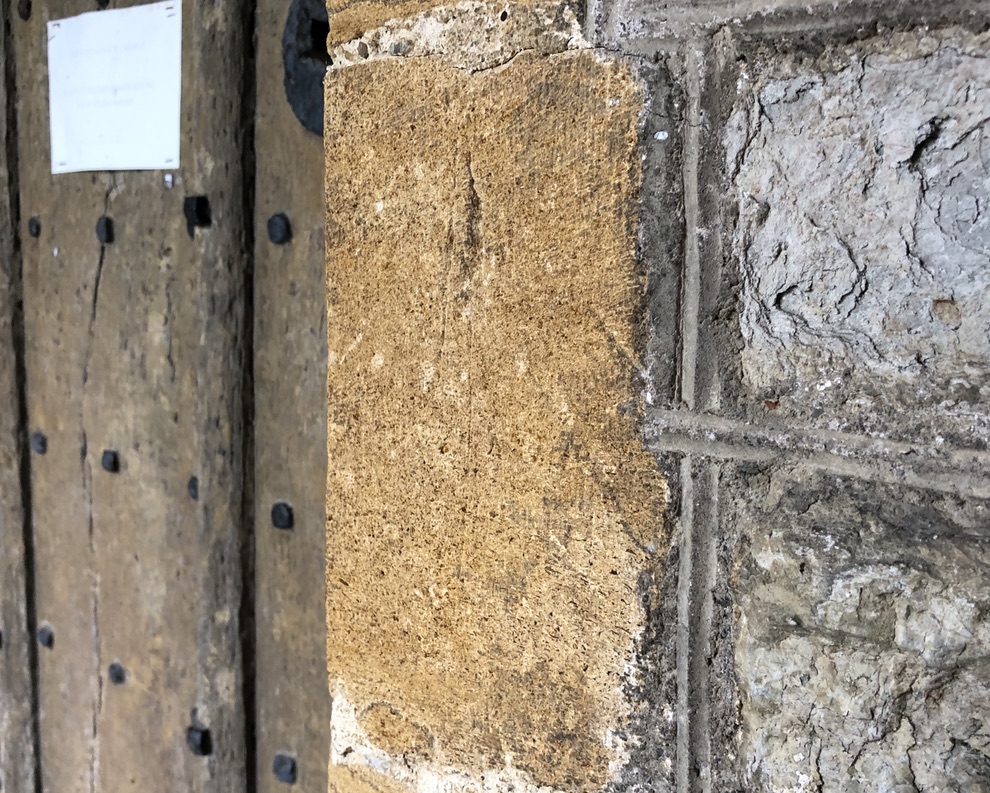
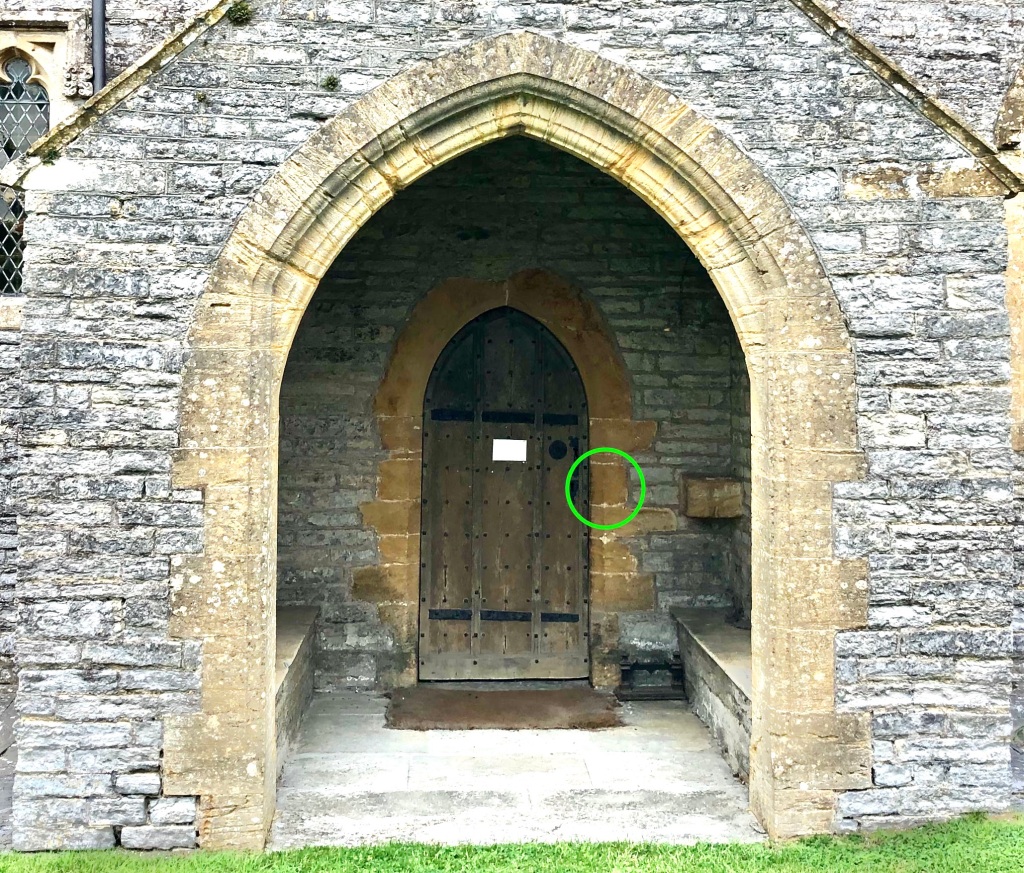
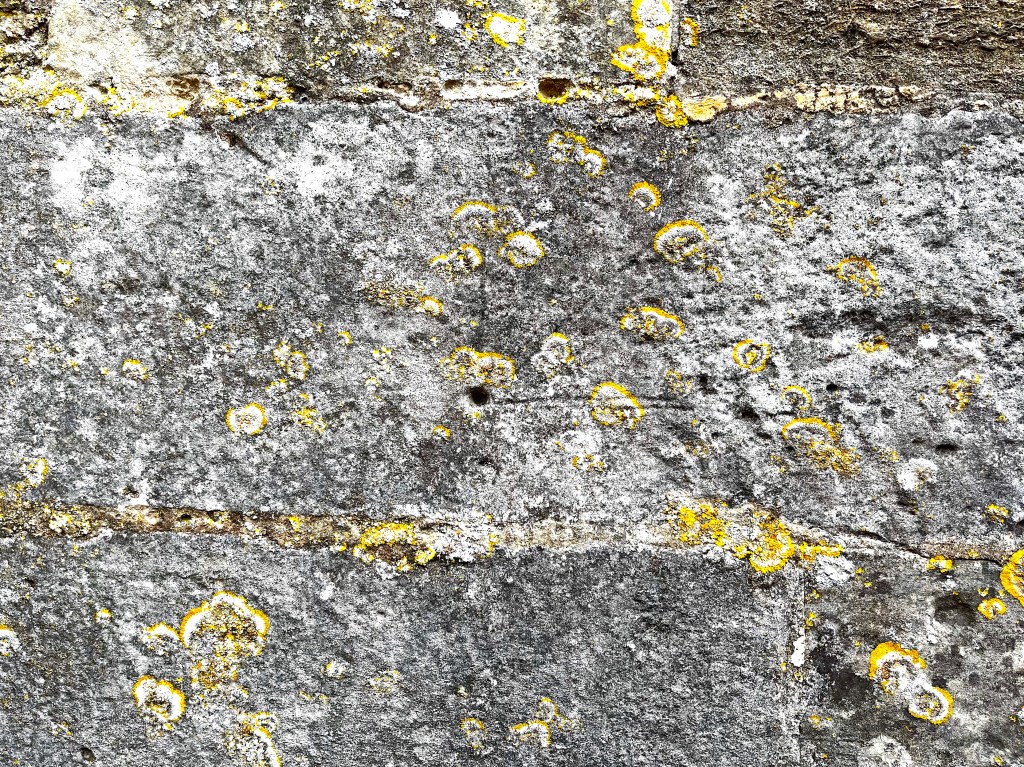
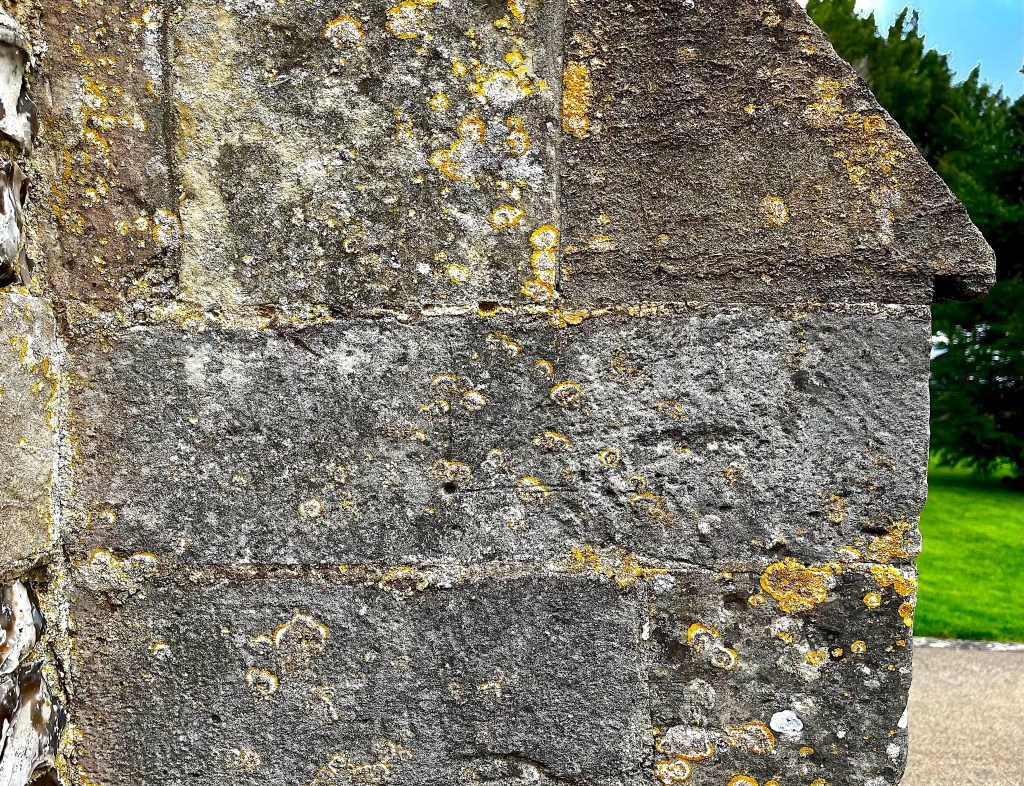
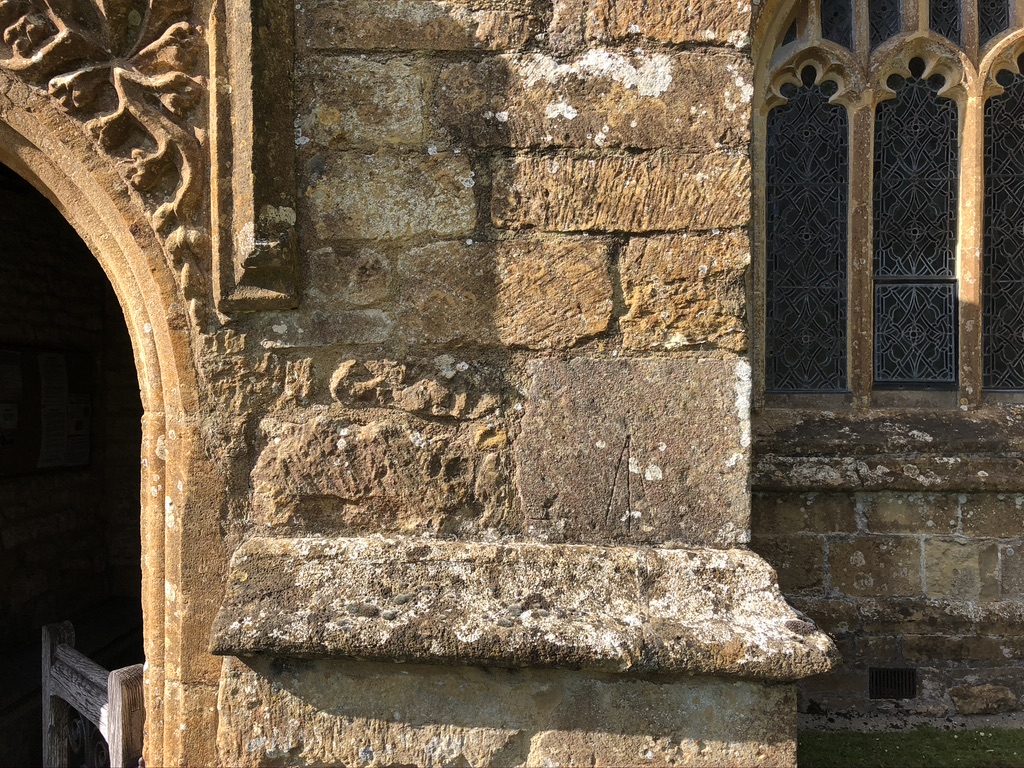
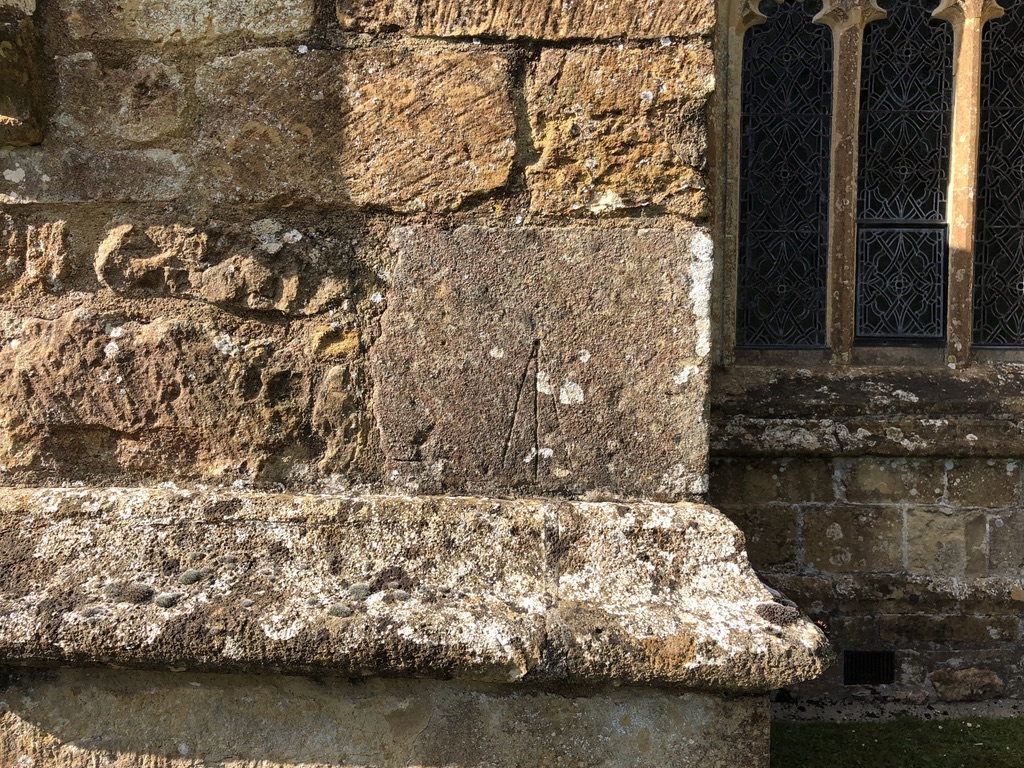
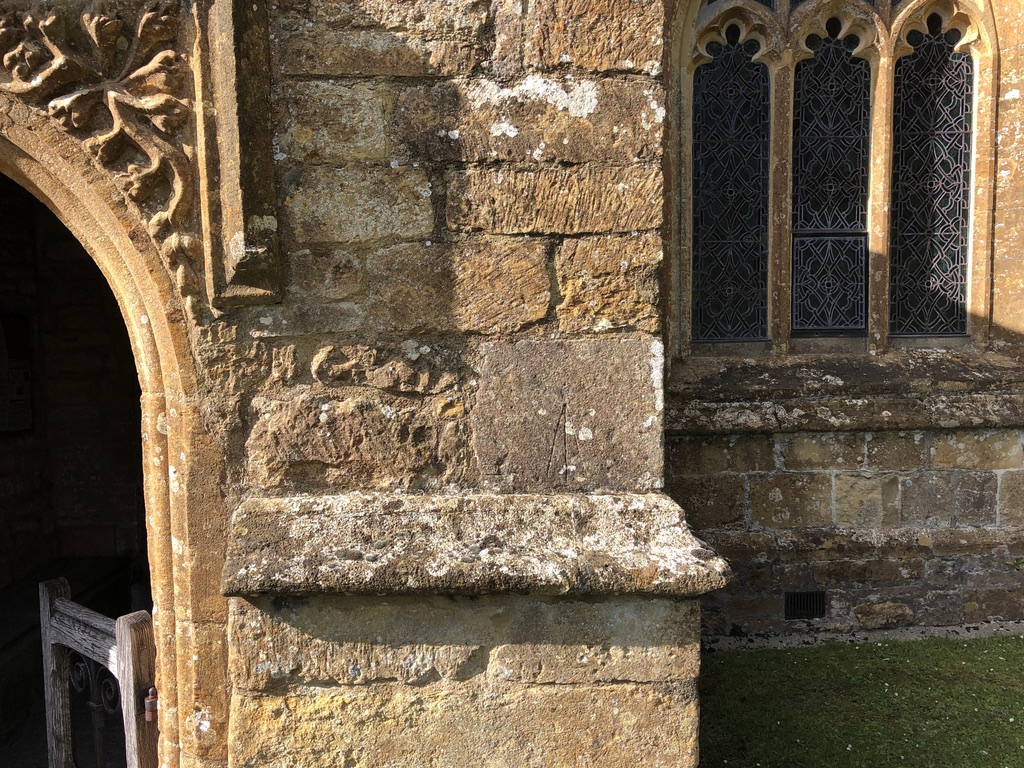
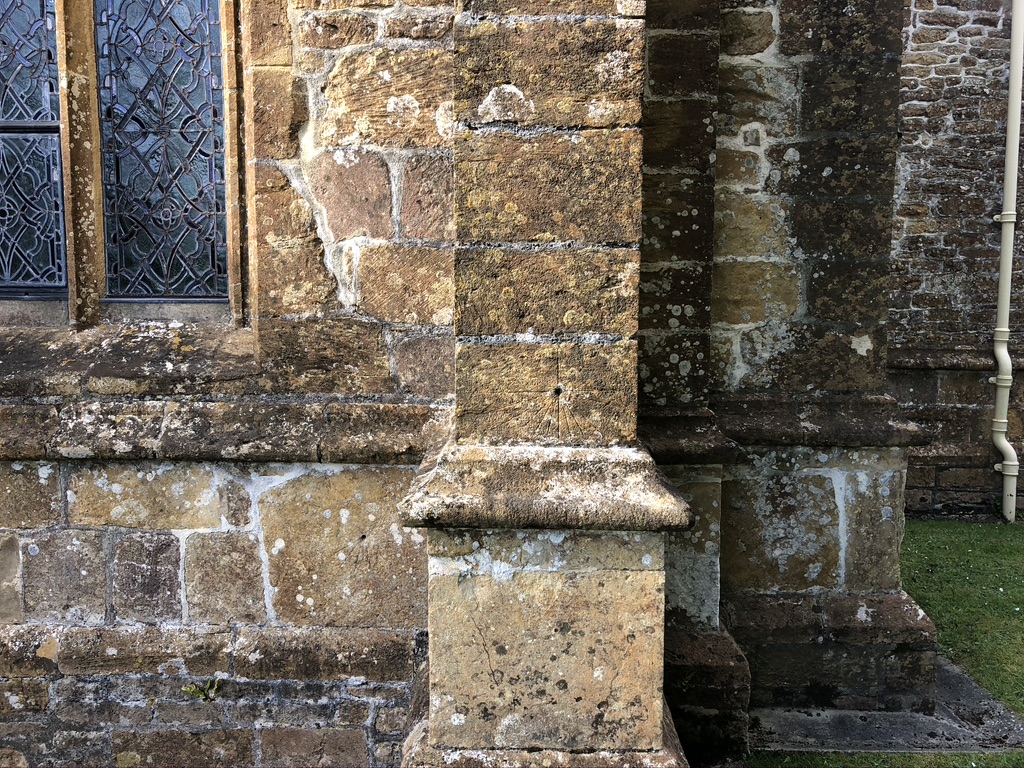
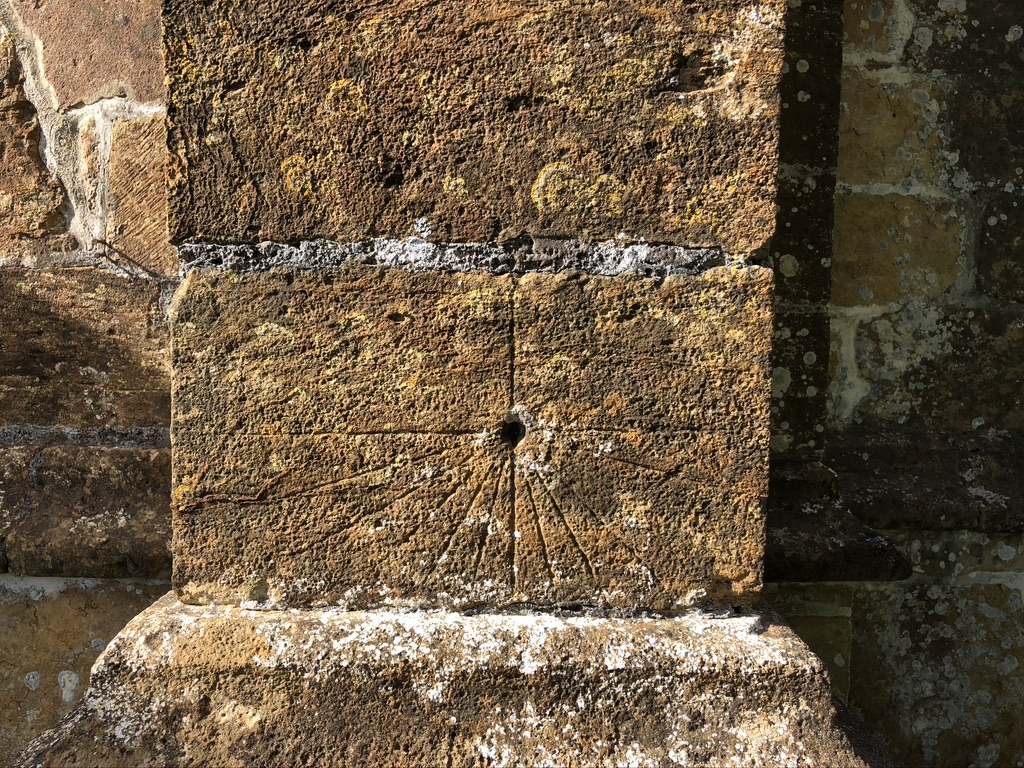
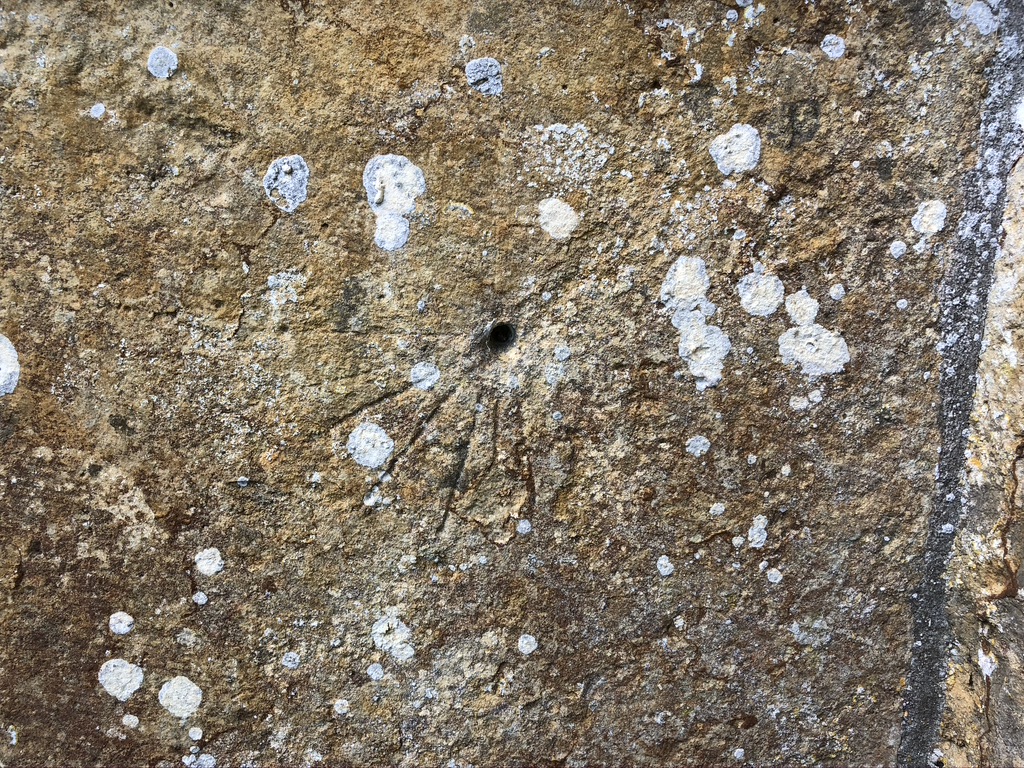
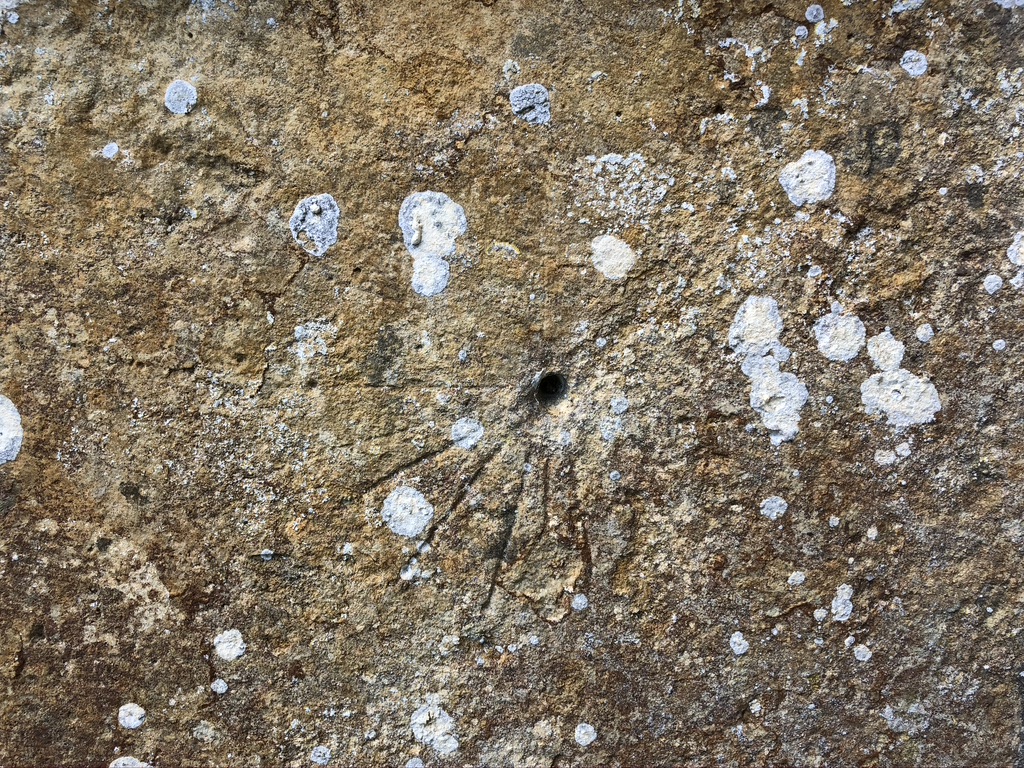
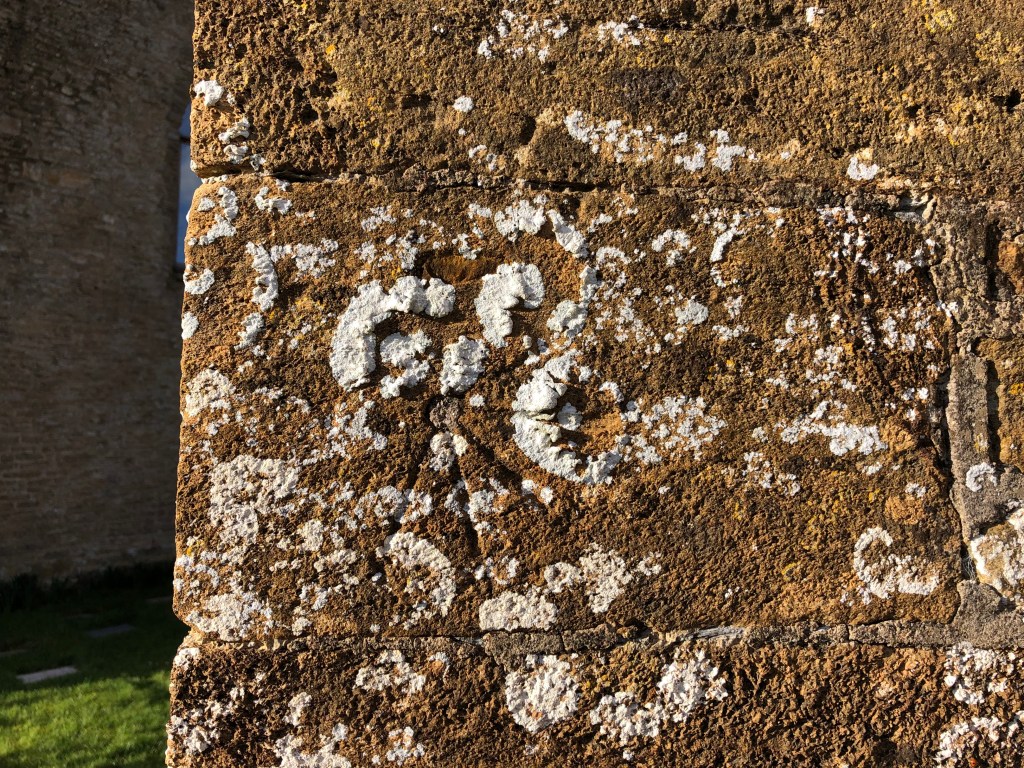
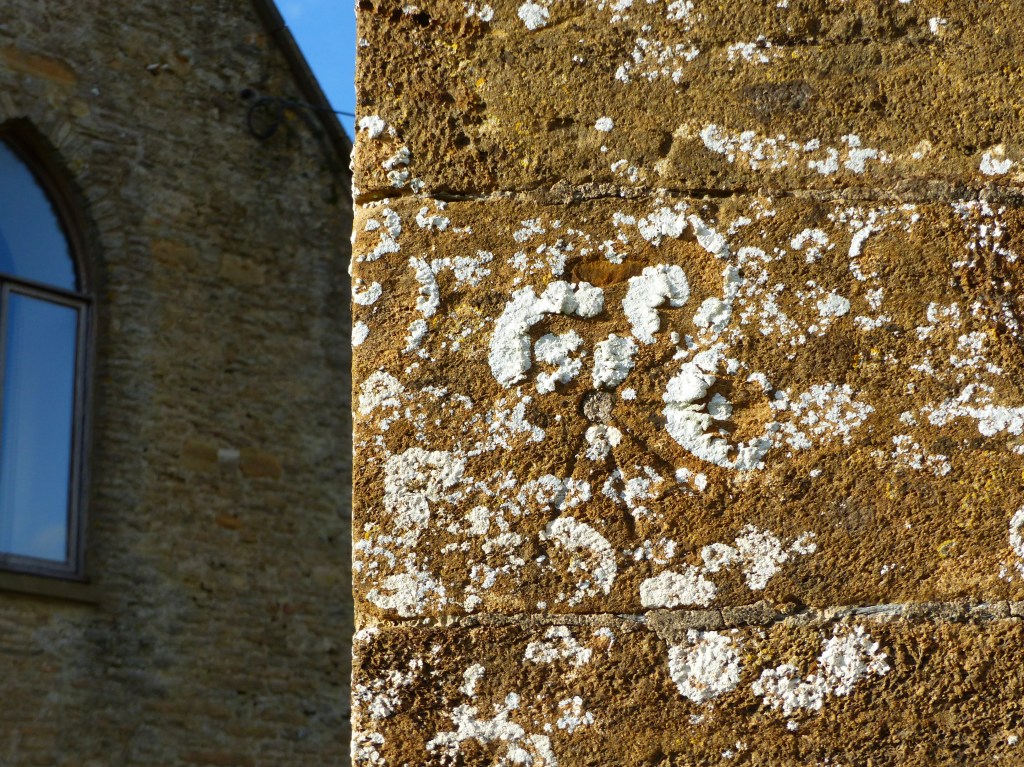
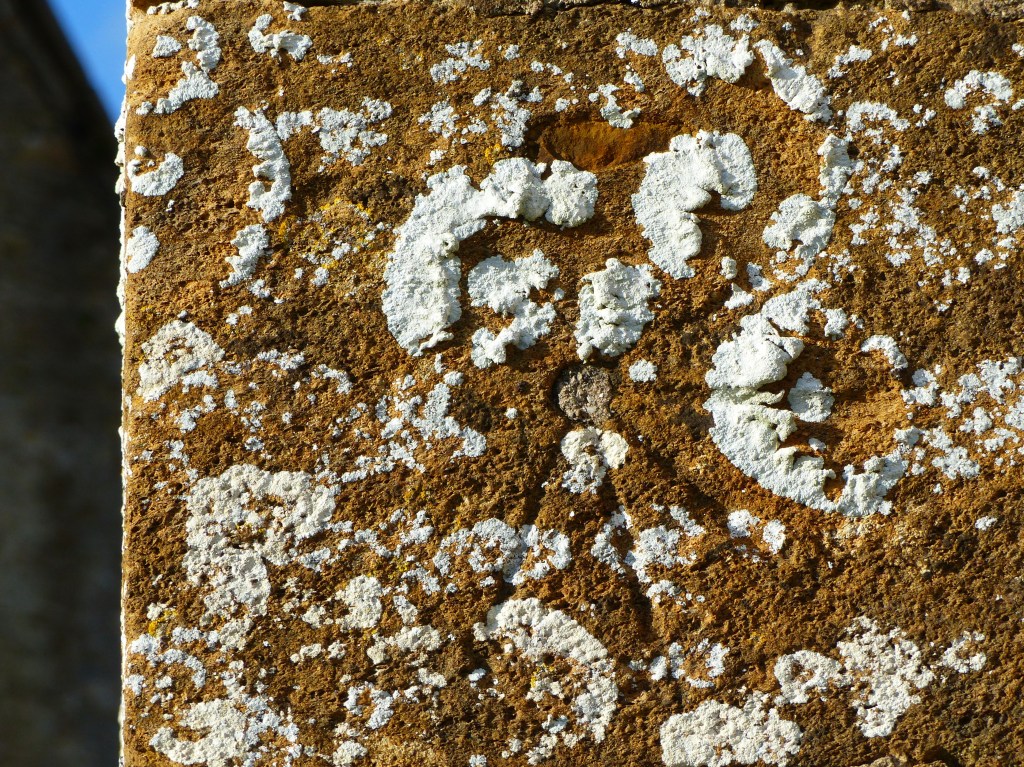
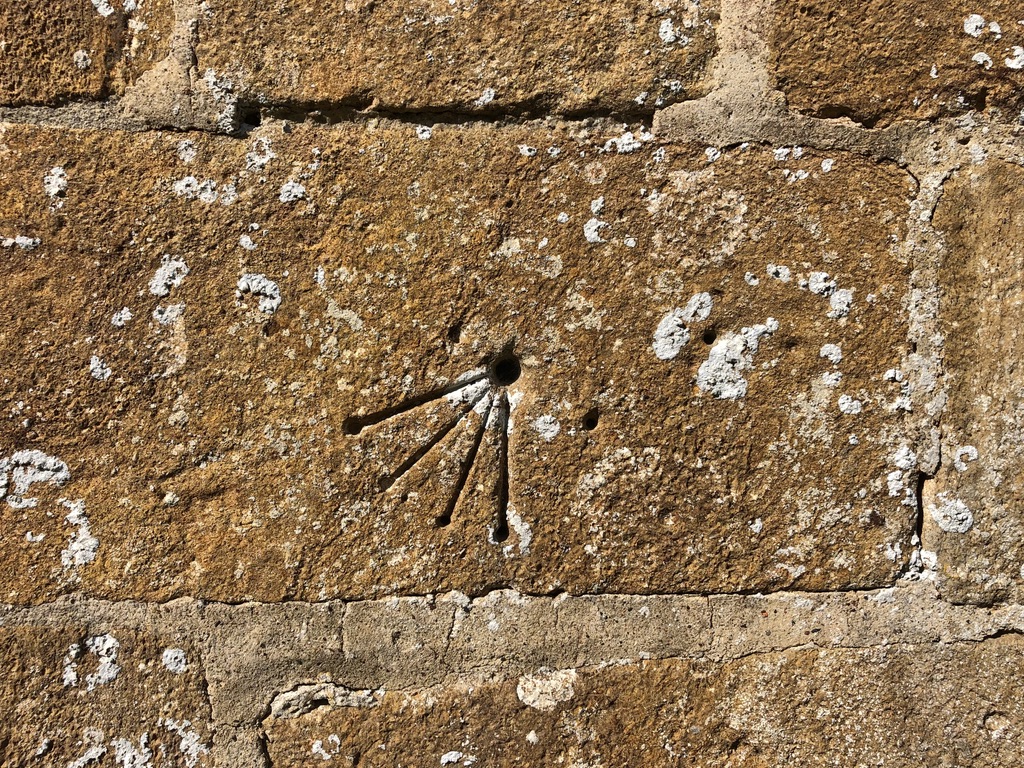
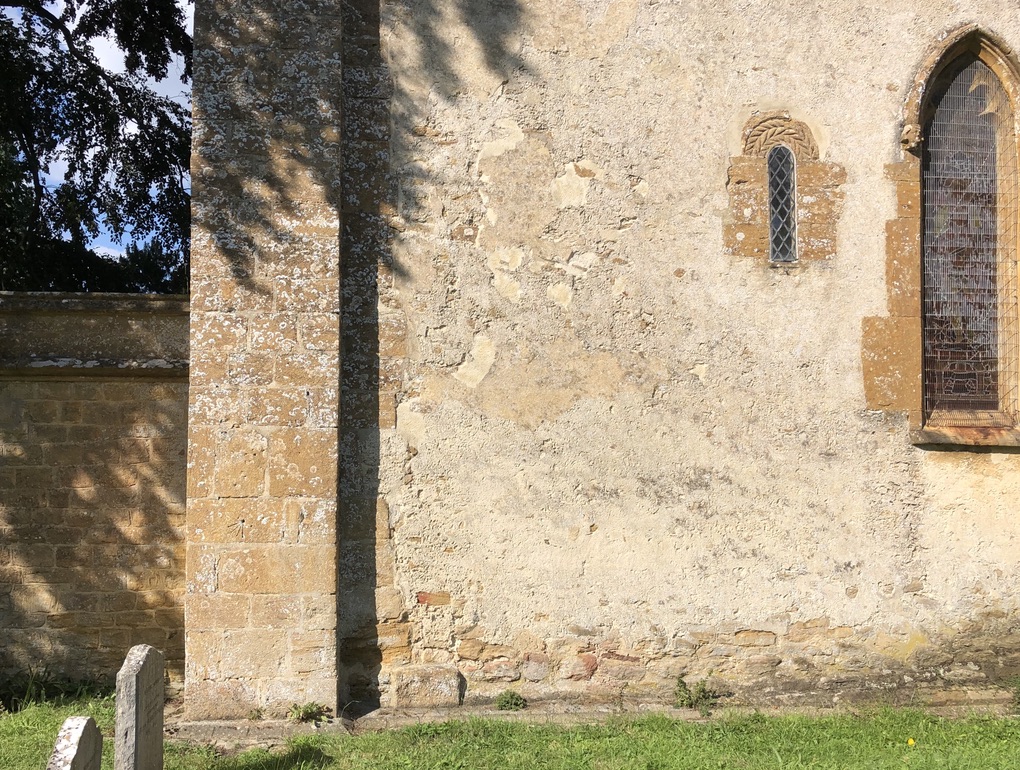
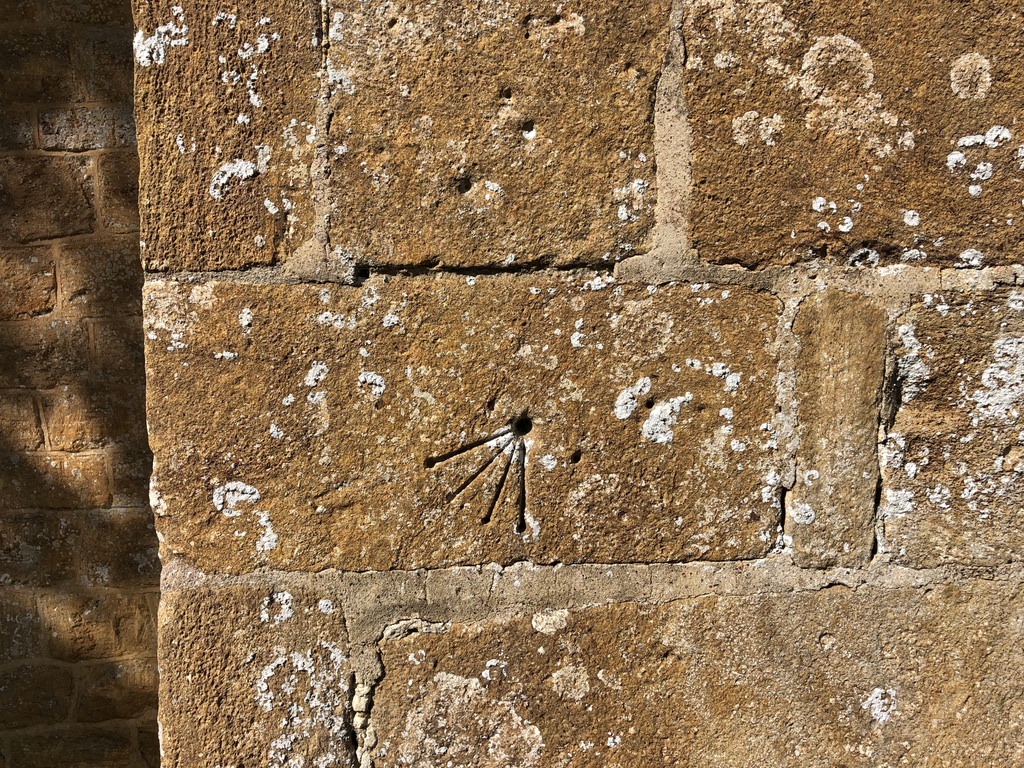
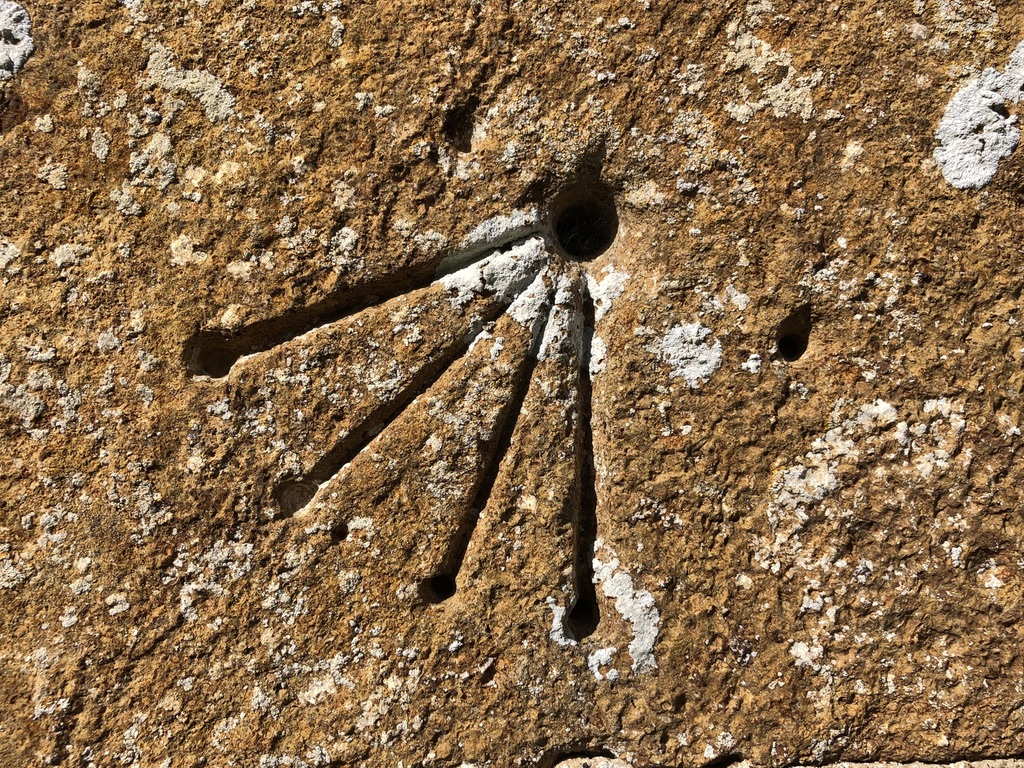
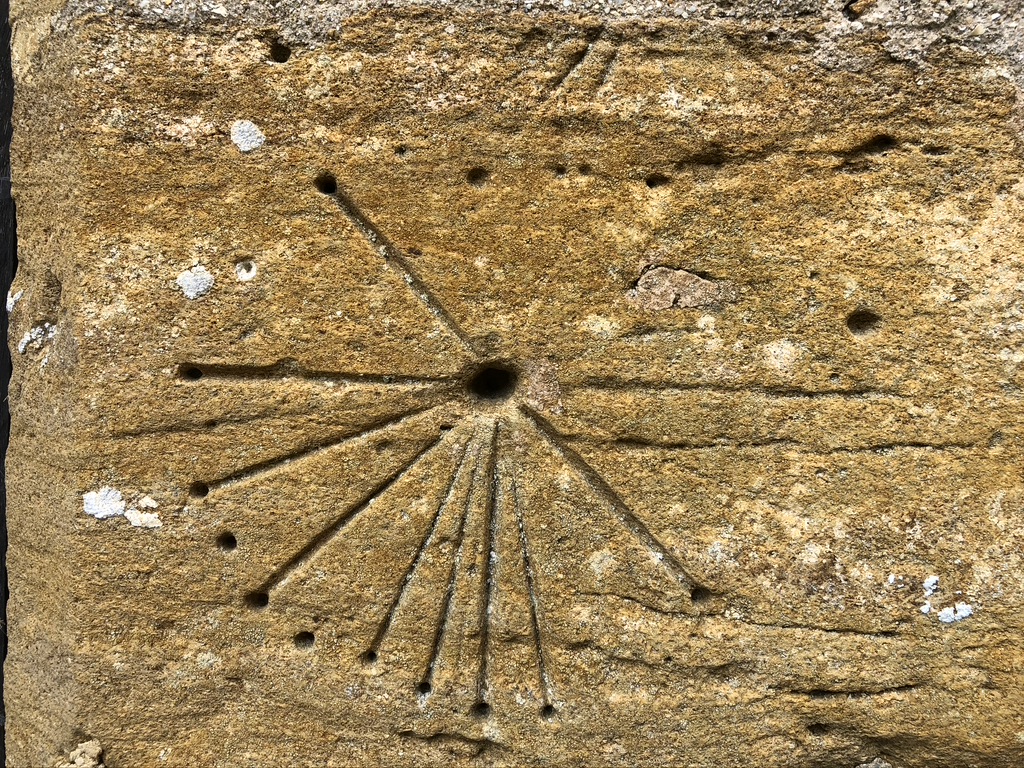
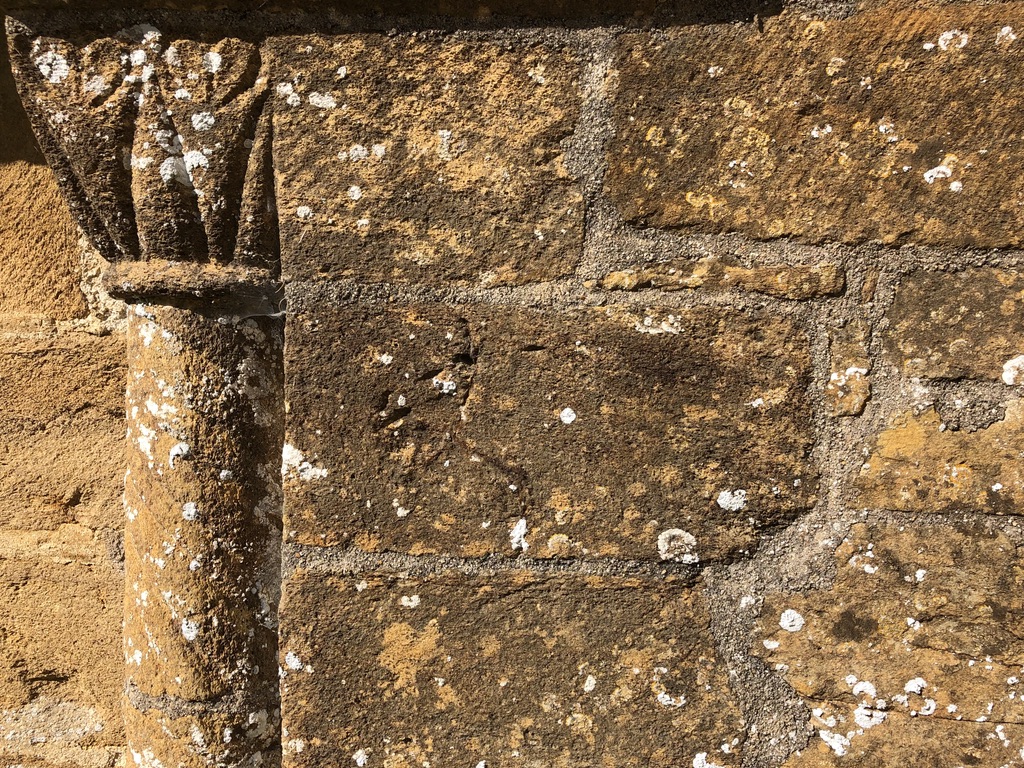
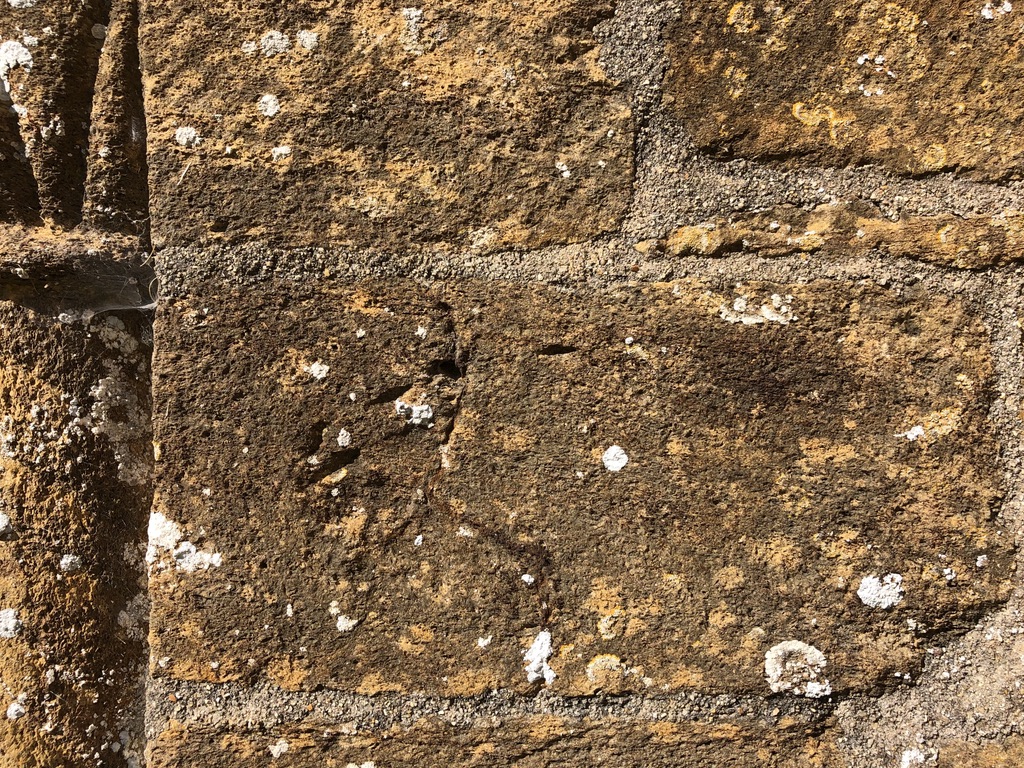
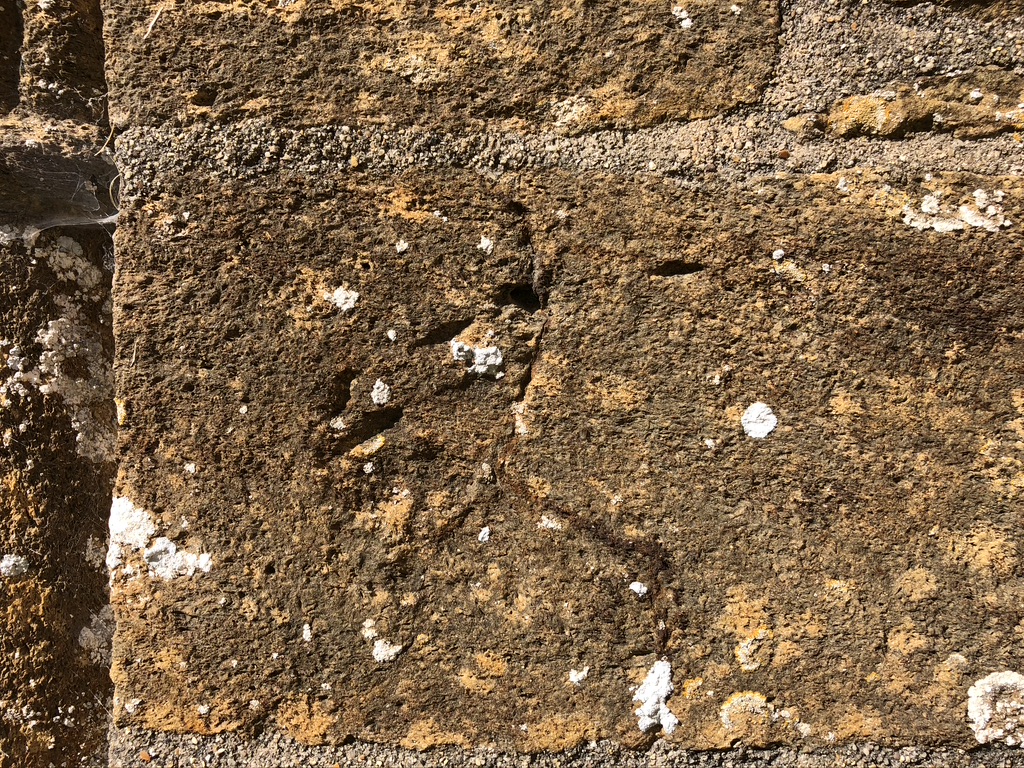
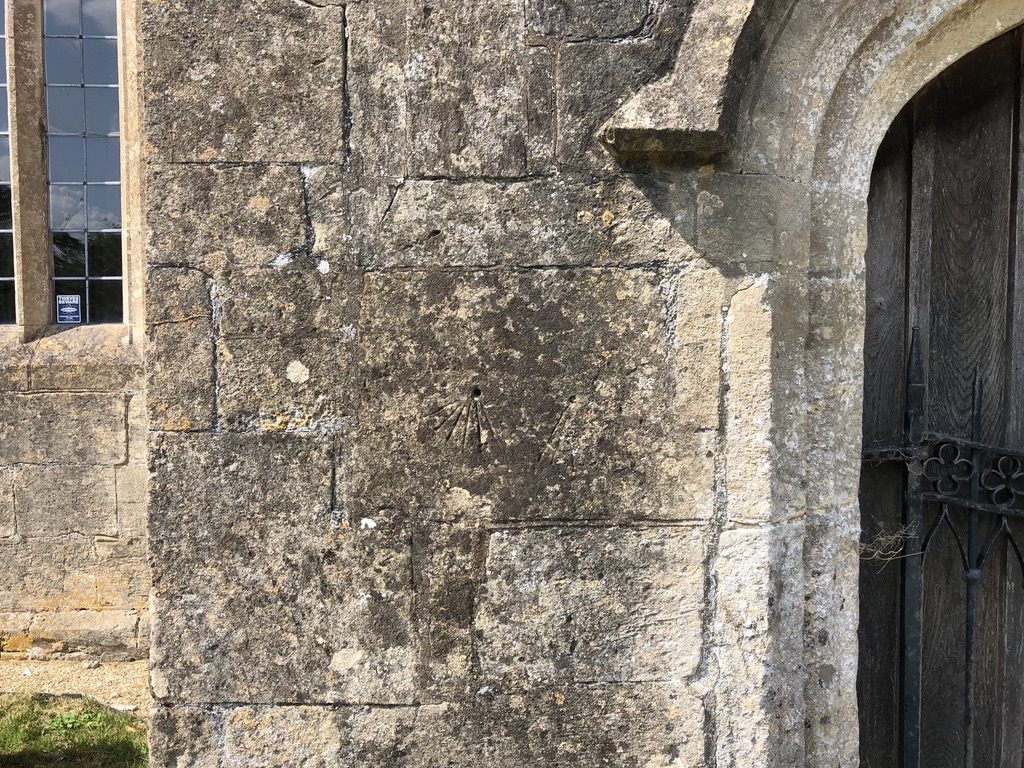
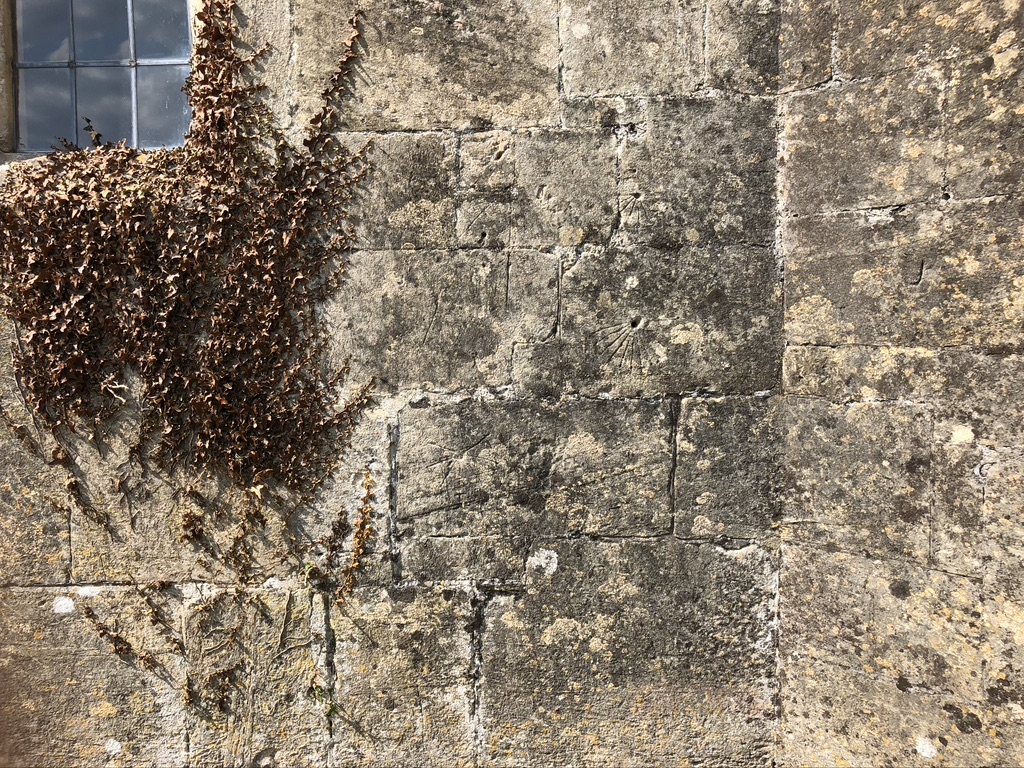
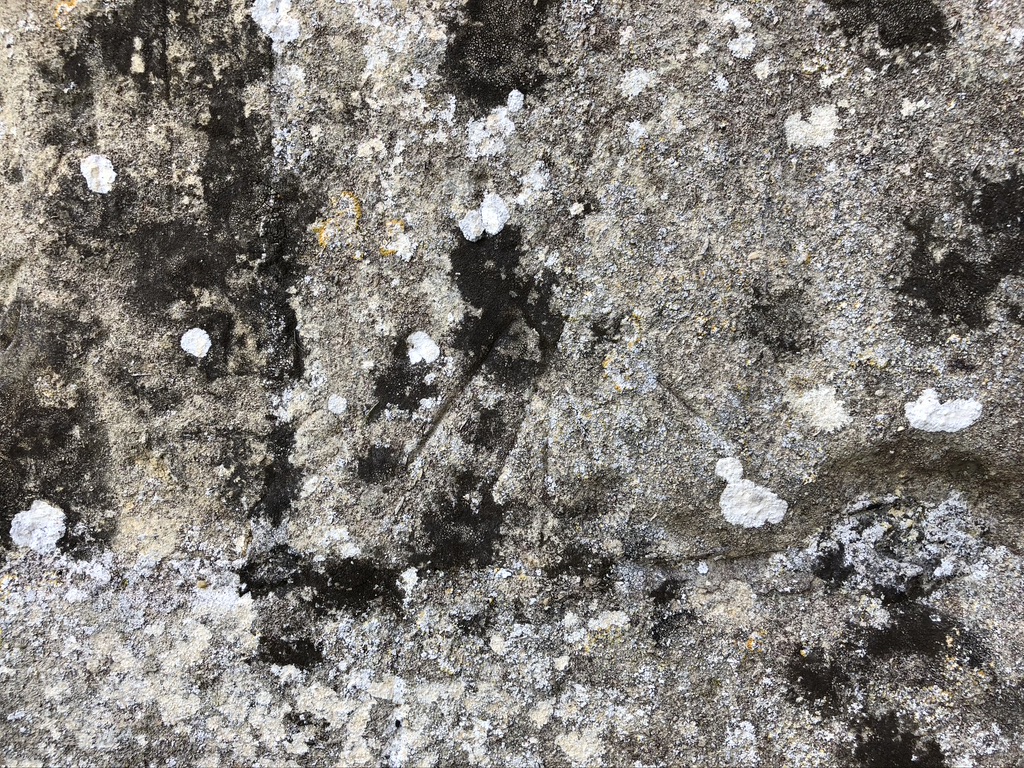
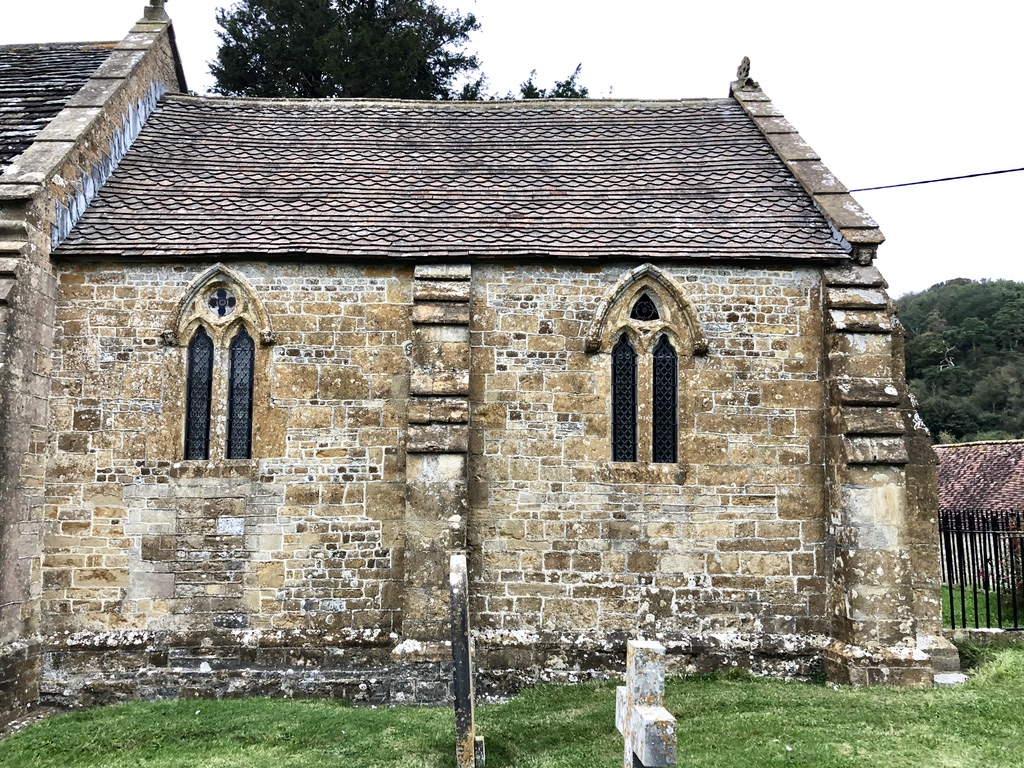
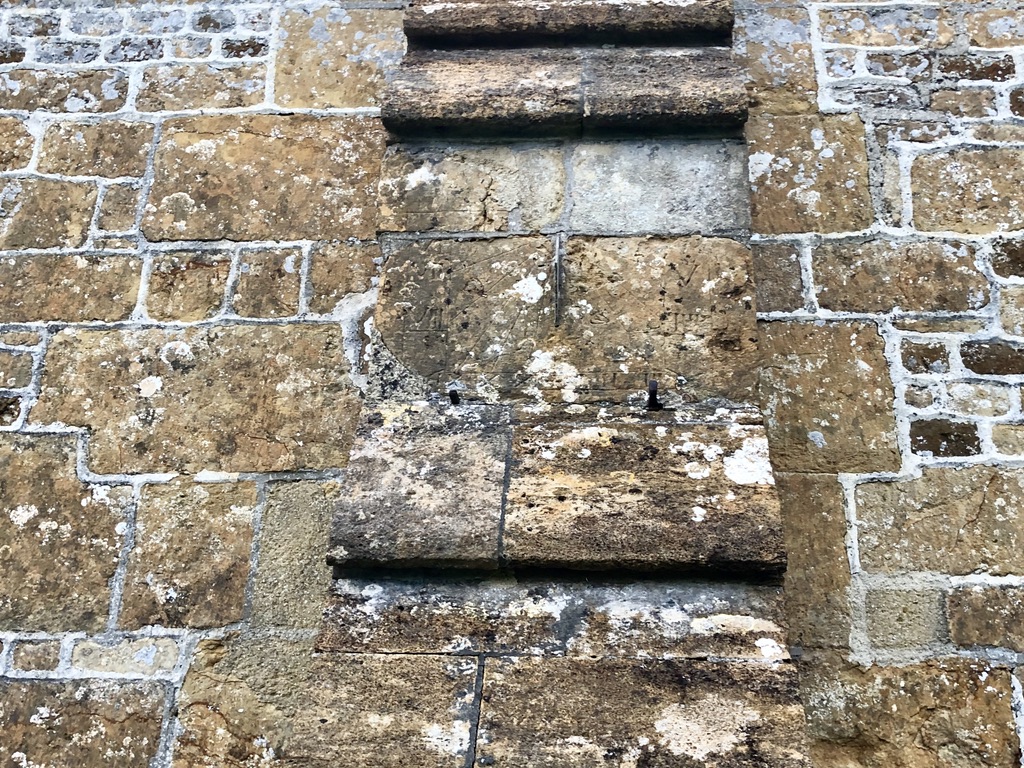
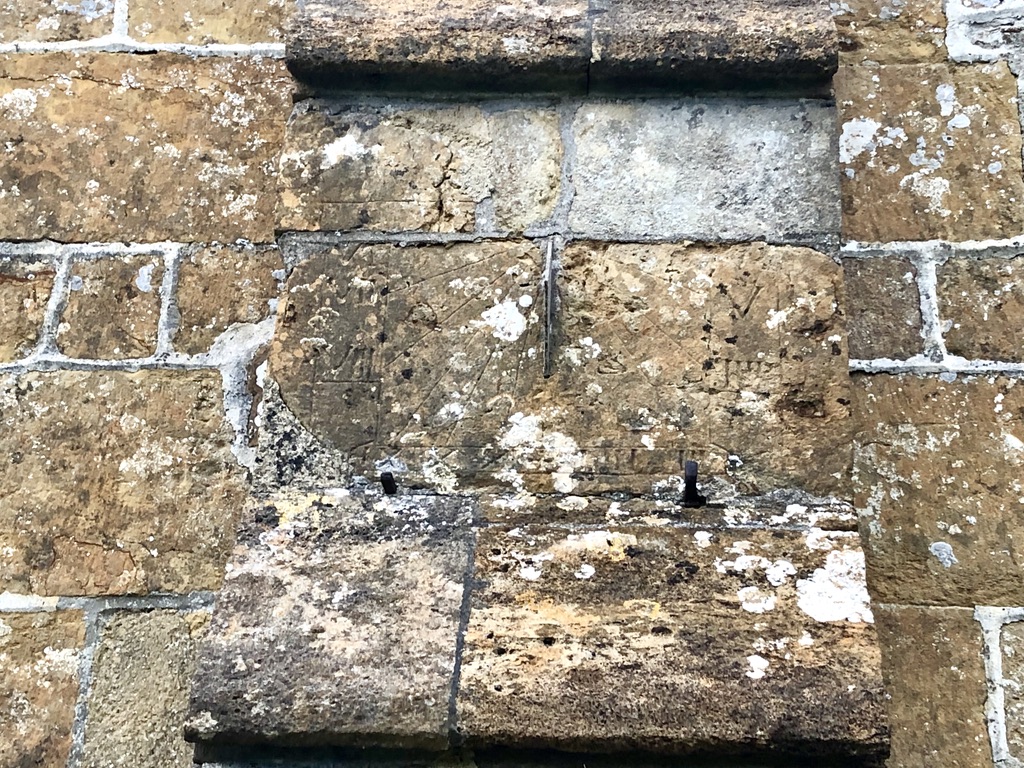
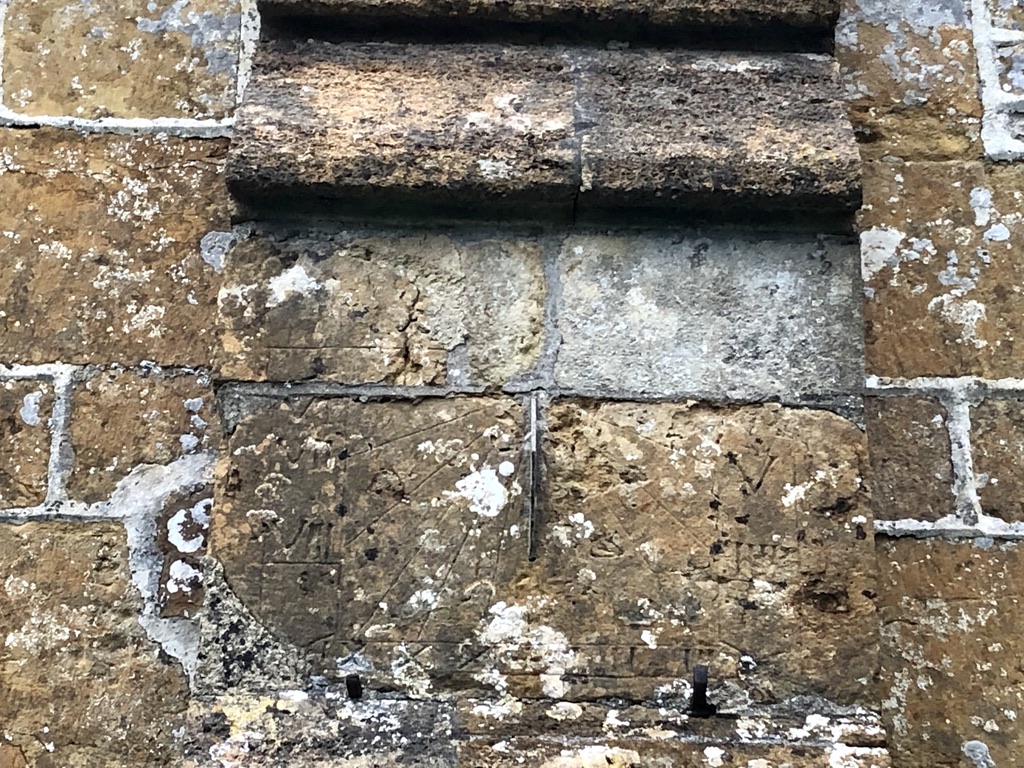
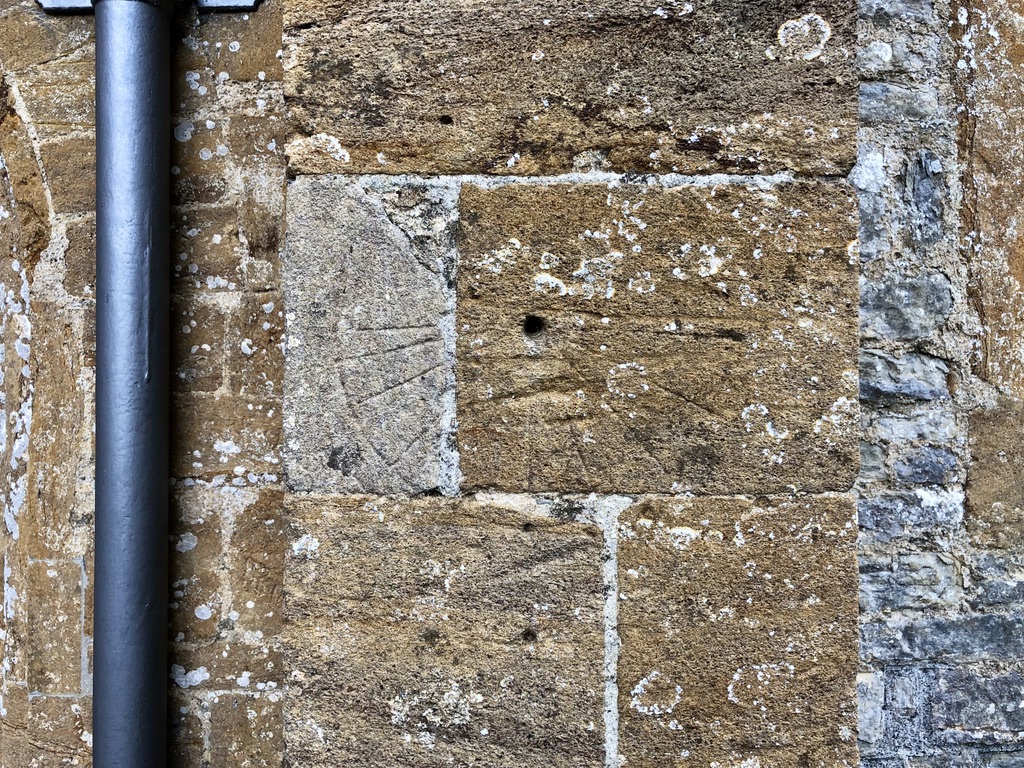
The medieval dial is easily found on S wall of the chancel, on the buttress E of the priest’s door. The approximate semicircle embraces an almost compete set of 6-to-6 lines. There are several pocks, large and small. BSS notes include: 1. Worn. Repositioned. Octaval, Tides. 2. Dial (Norman?) with tides, with duodecimal, sometimes both. 3. Mason-cut or roughly scratched. 4. Tide dial, roman numerals, extra line at 7. I have to say (as an amateur) that I can’t match all these features to this dial or either of them if both are being described together (see below).
Queen Camel . Somerset . St Barnabas – scratch dial 1

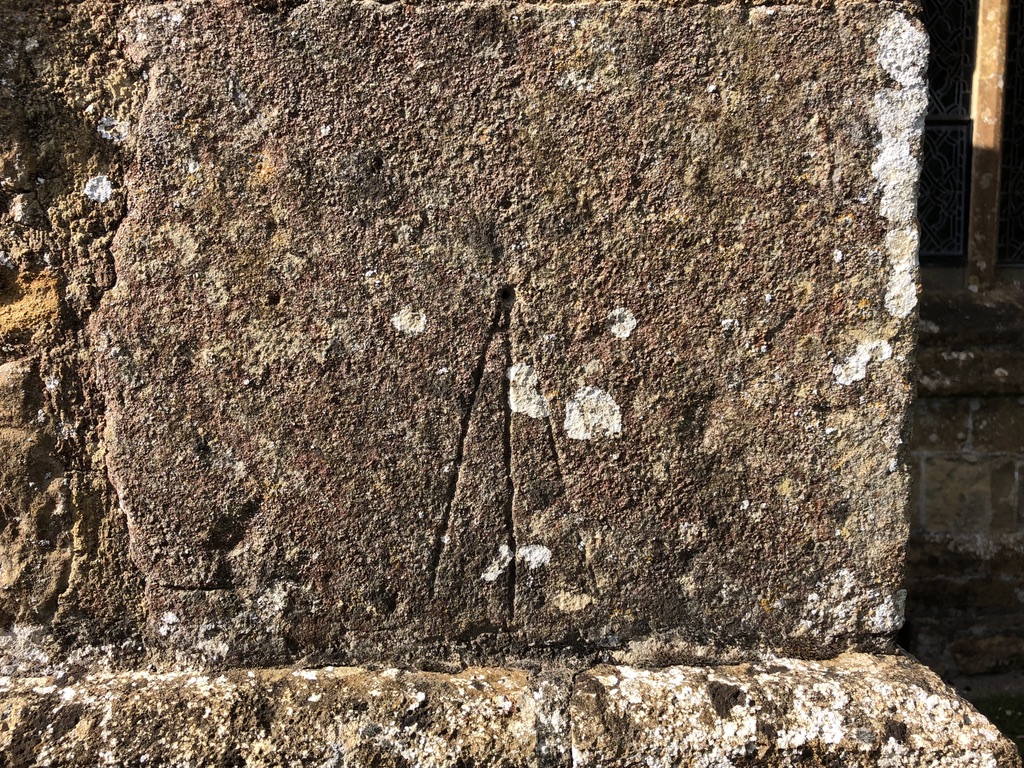
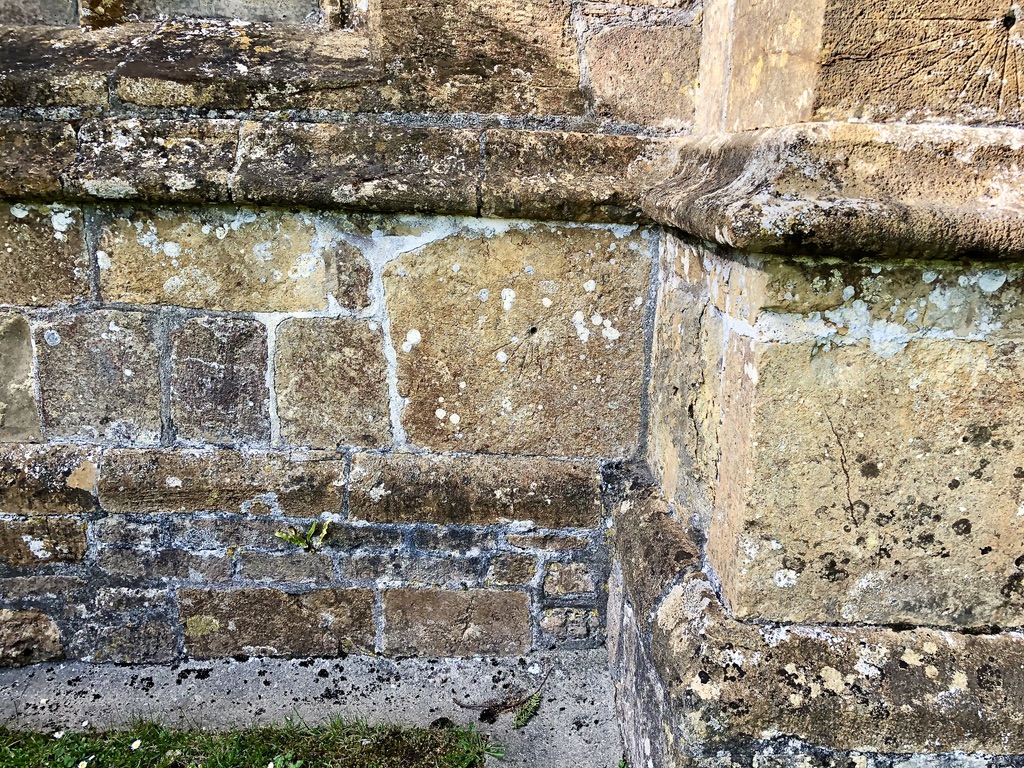
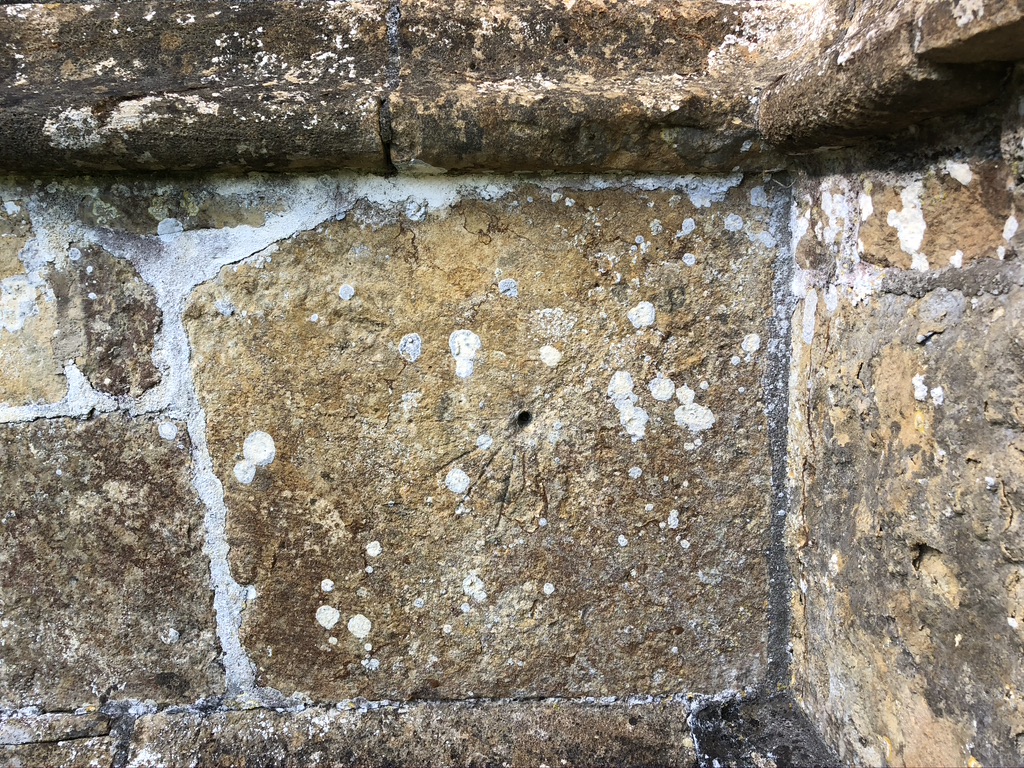
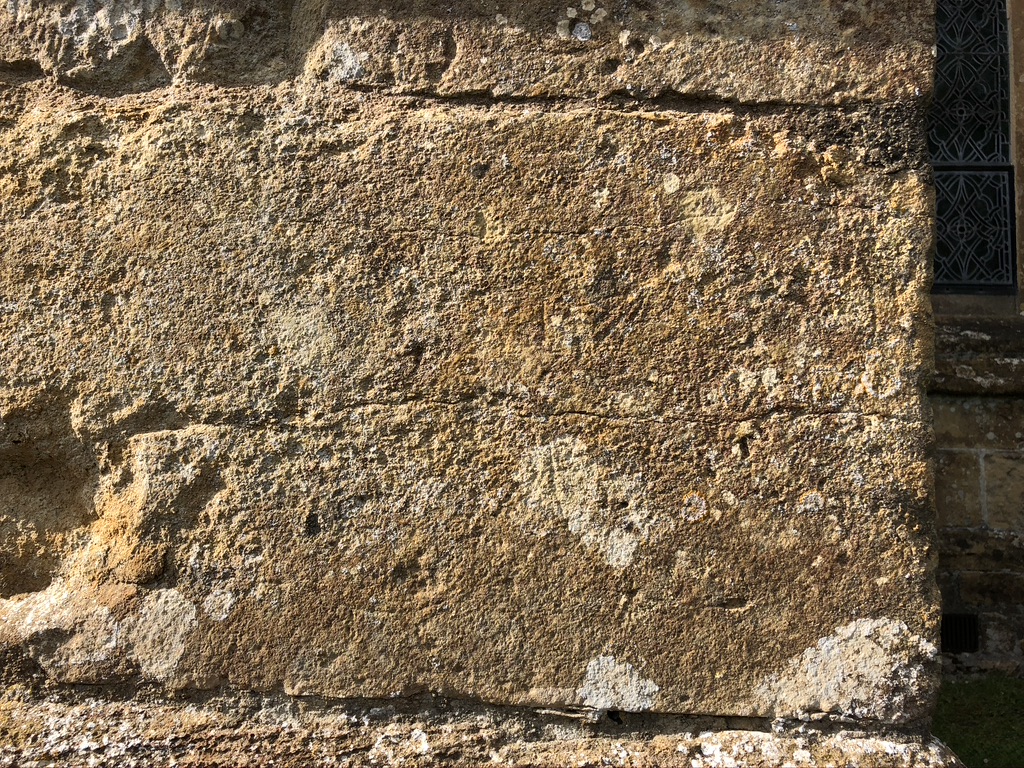
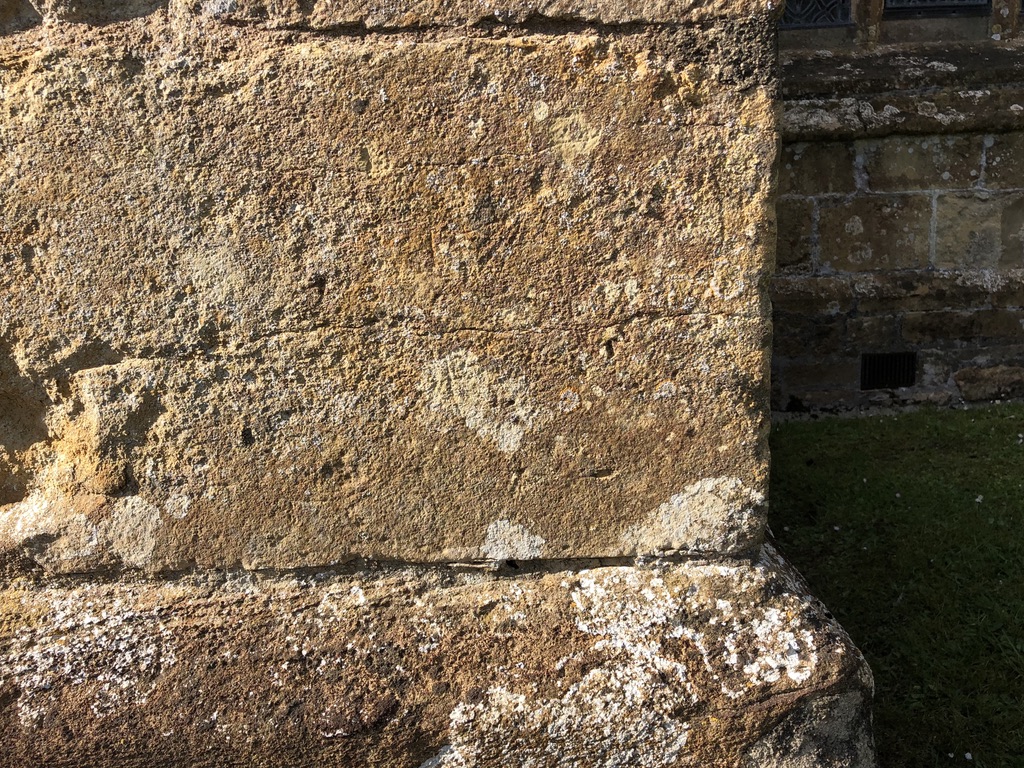
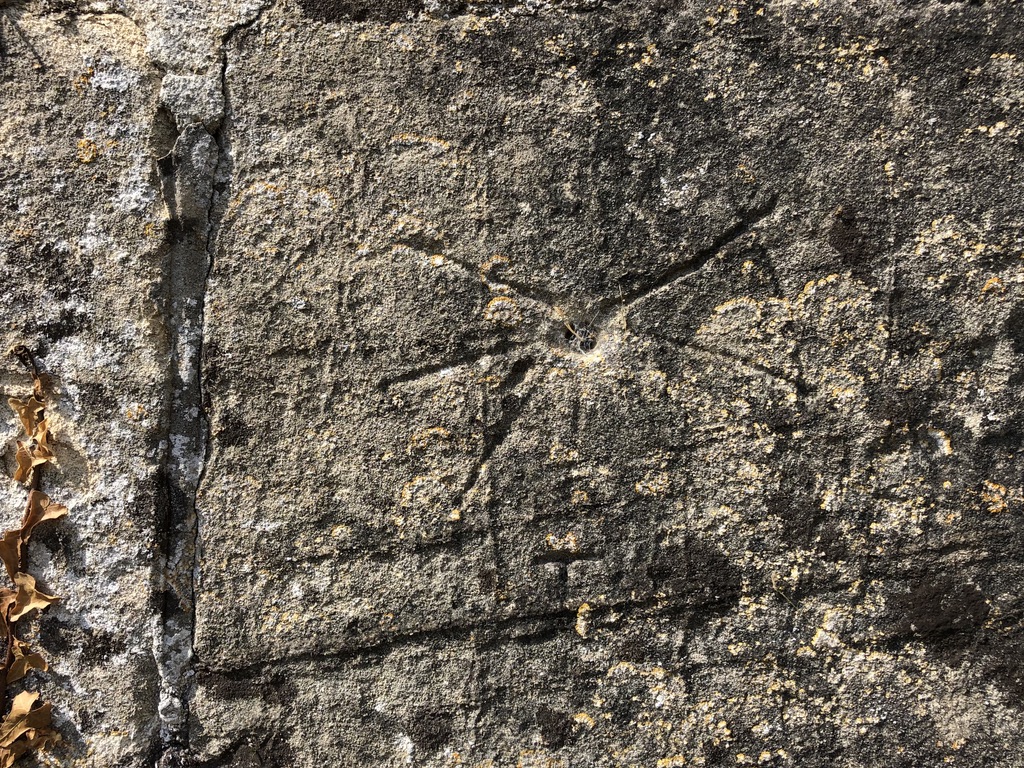
The dial is large, almost the full width of the buttress. Unusually, it is cut over 4 stones. Note the low pock some way directly below the noon line. Most of the dial is cut on the Hamstone E quoin, the lower rim extending onto the 2 stones below. These stones match those around them. However the L side of the dial is cut on grey stone not matched elsewhere nearby.

I was puzzled by the suggested repositioning of the (entire) dial. An alternative theory might be that the dial was positioned where it is now. Over time, the L side became eroded or damaged and was replaced with a different kind of stone (perhaps being used for repairs elsewhere on the church). The new stone was then cut to match the design of the original. Looked at closely, the ‘new’ L side design does not in fact match the rest accurately. Not all lines follow exactly; there are no pocks; the incisions are clearer. Does this support a later replacement (and possibly harder) stone?

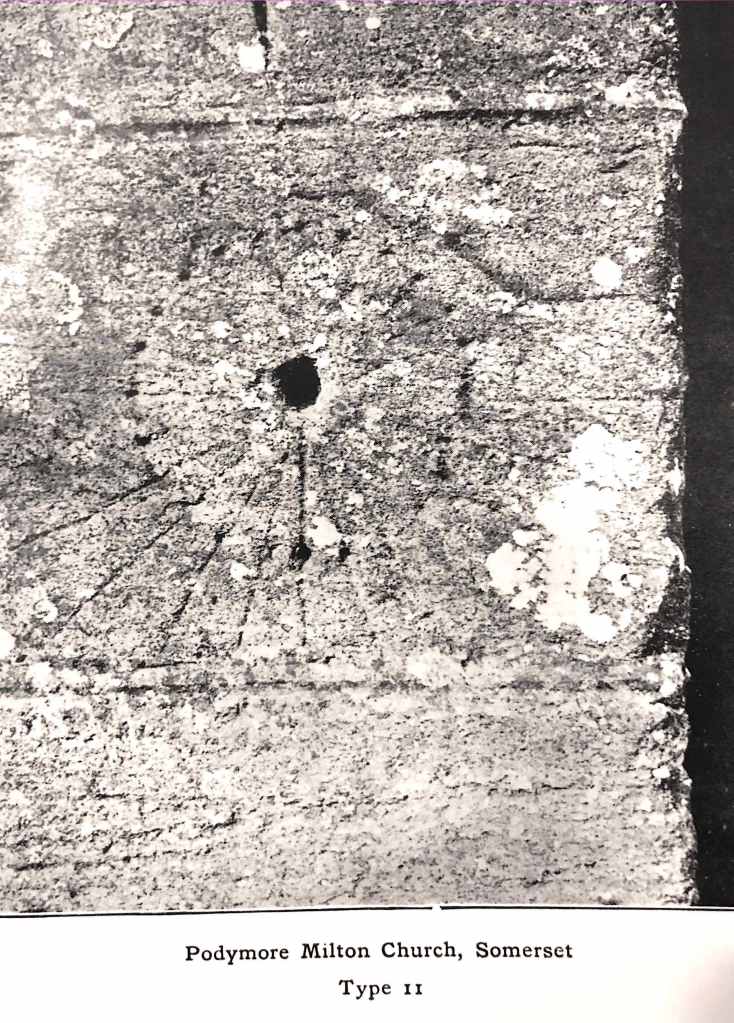
DEH visited in May 1914 and recorded 182. (2) This dial is on the first buttress to the e. of the priest’s door. It is 5 feet 9 inches above the ground, the noonline is 5 1/2 inches in length, the stylehole is 1 1/8 inches in depth by 3/4 of an inch in diameter, and the aspect is s. by 10° e. Type 5c. May 18th, 1915.
DIAL 2

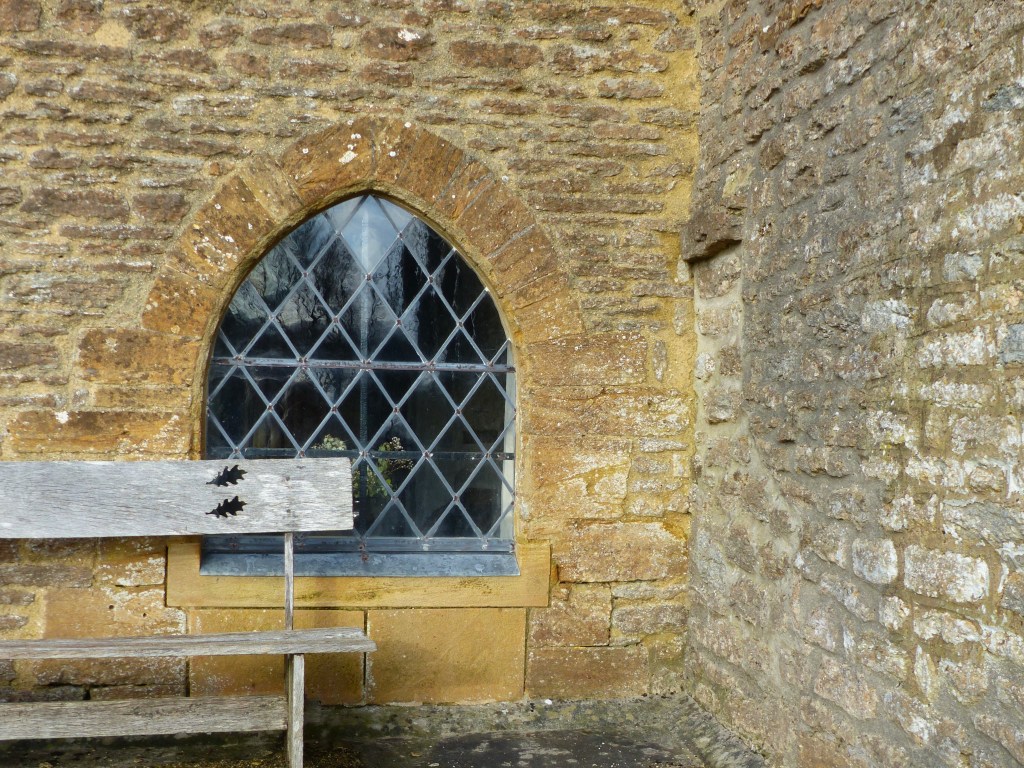
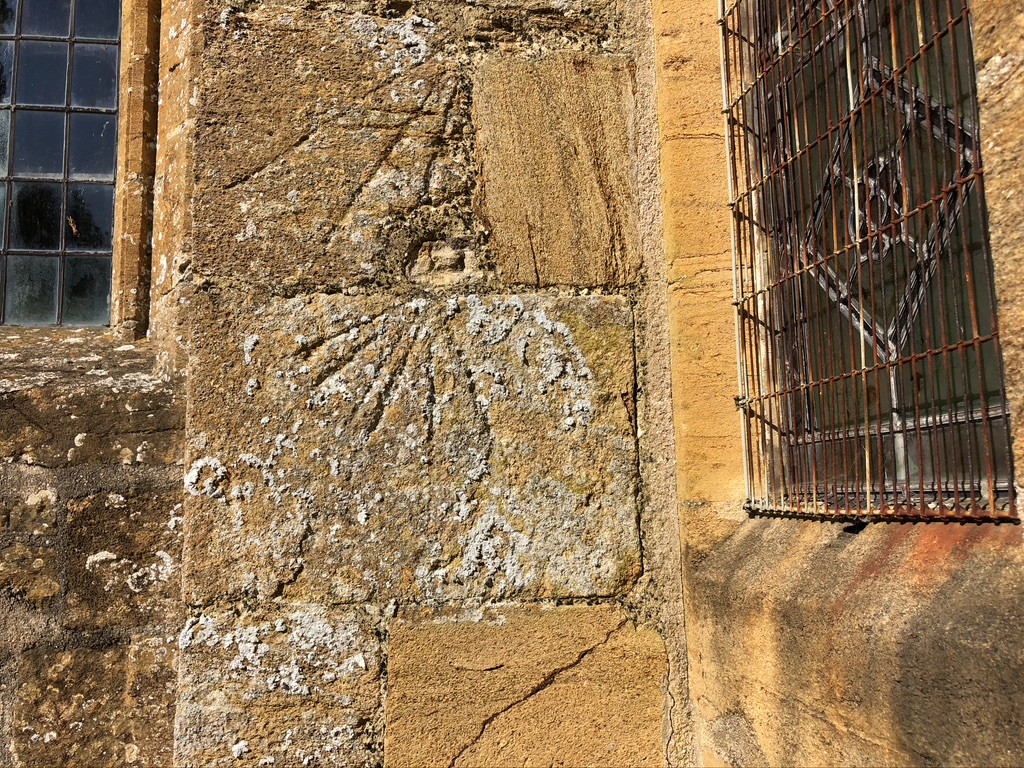
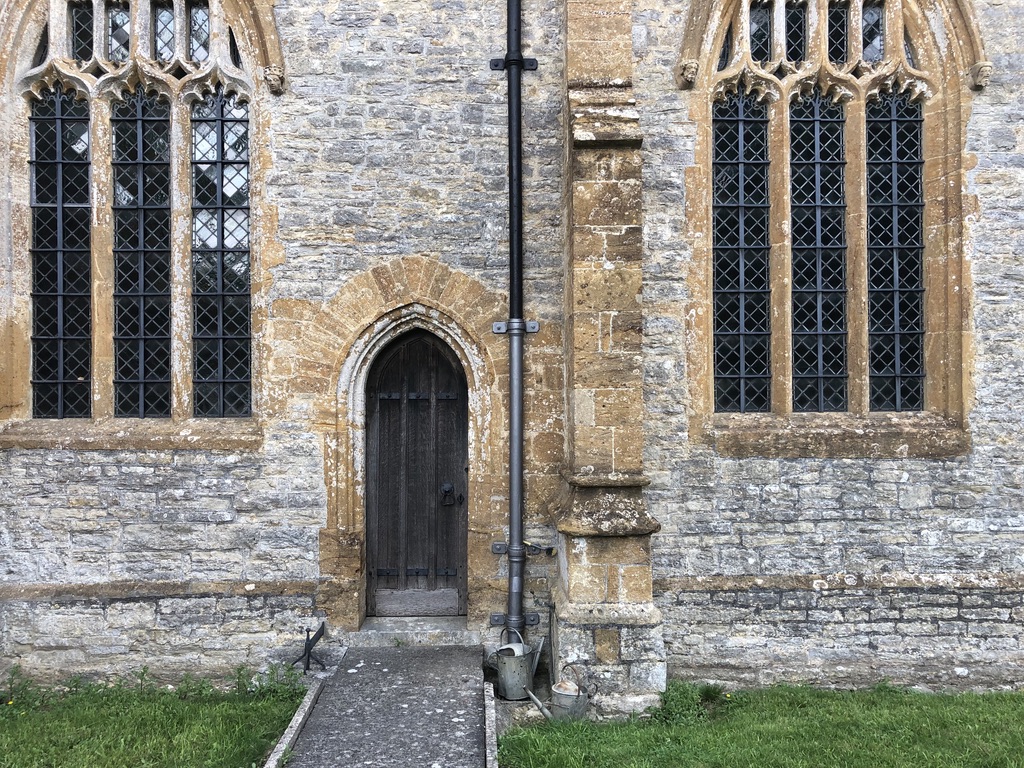
Dial 2 also creates some confusion, not least its location. BSS does not record this dial as a separate entry from Dial 1 but may be referring to it especially in the note 4. Tide dial, roman numerals. Dial 1 does not have visible roman numerals but Dial 2 does.

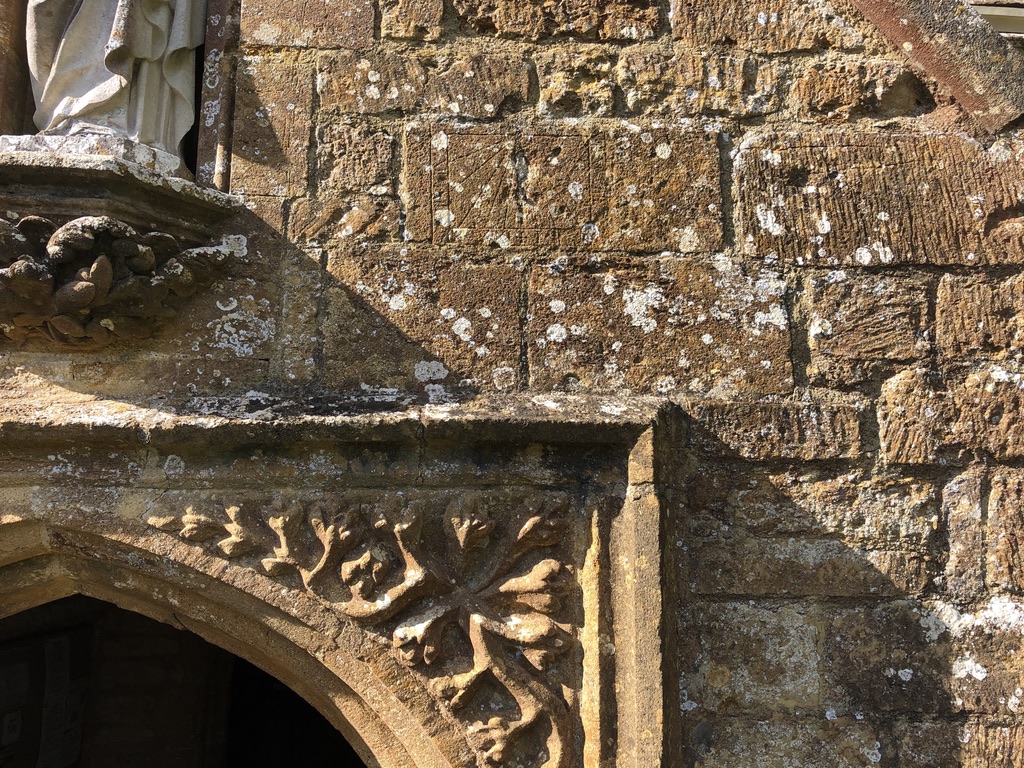
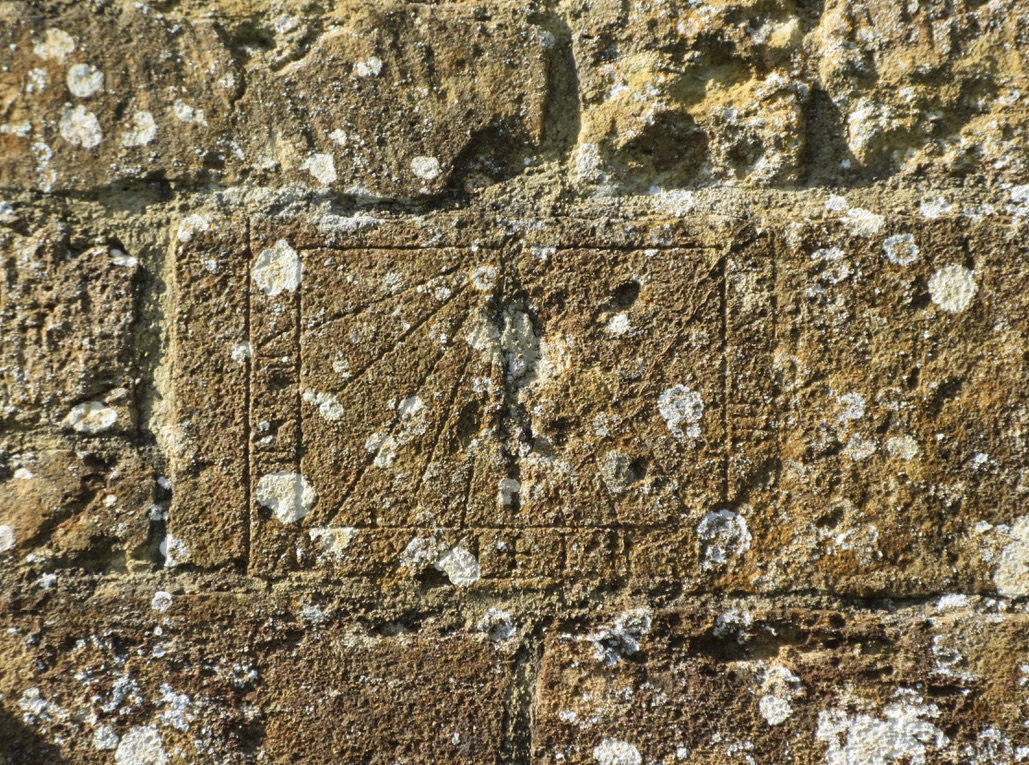
Queen Camel . Somerset . St Barnabas – dial 2

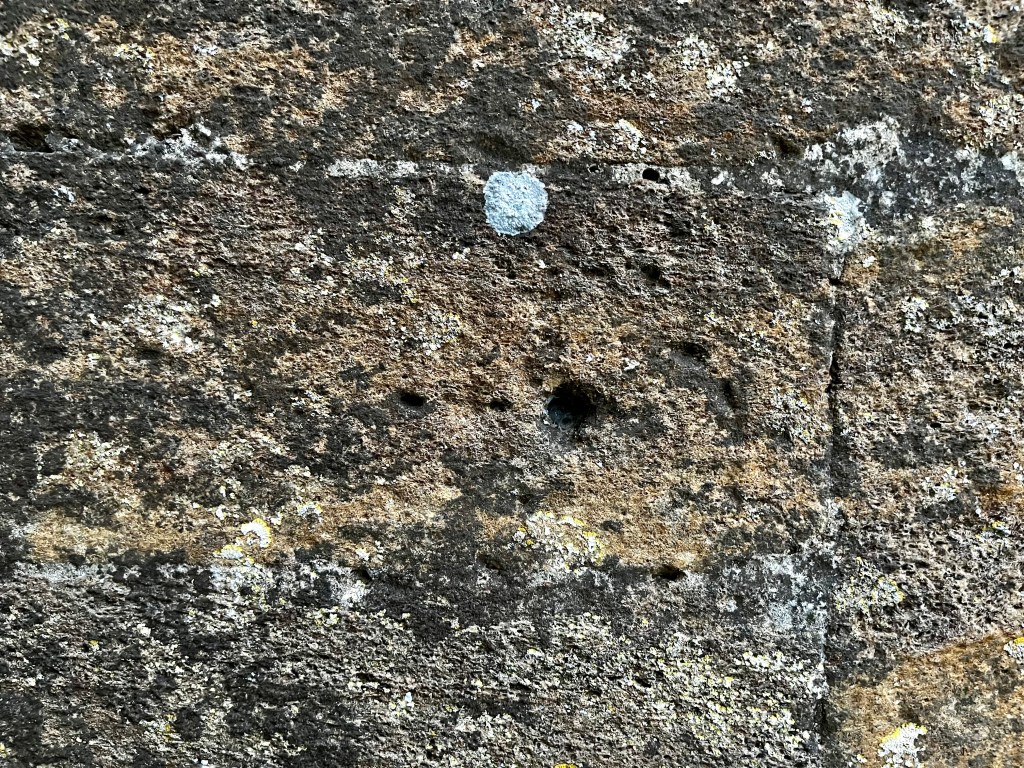
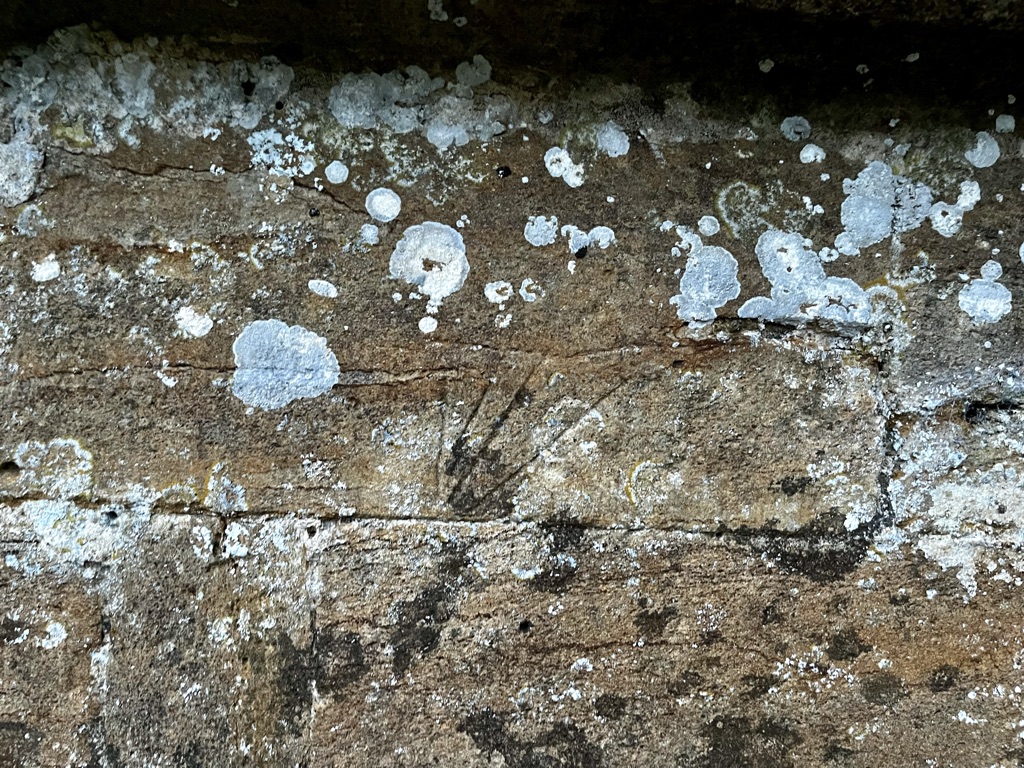
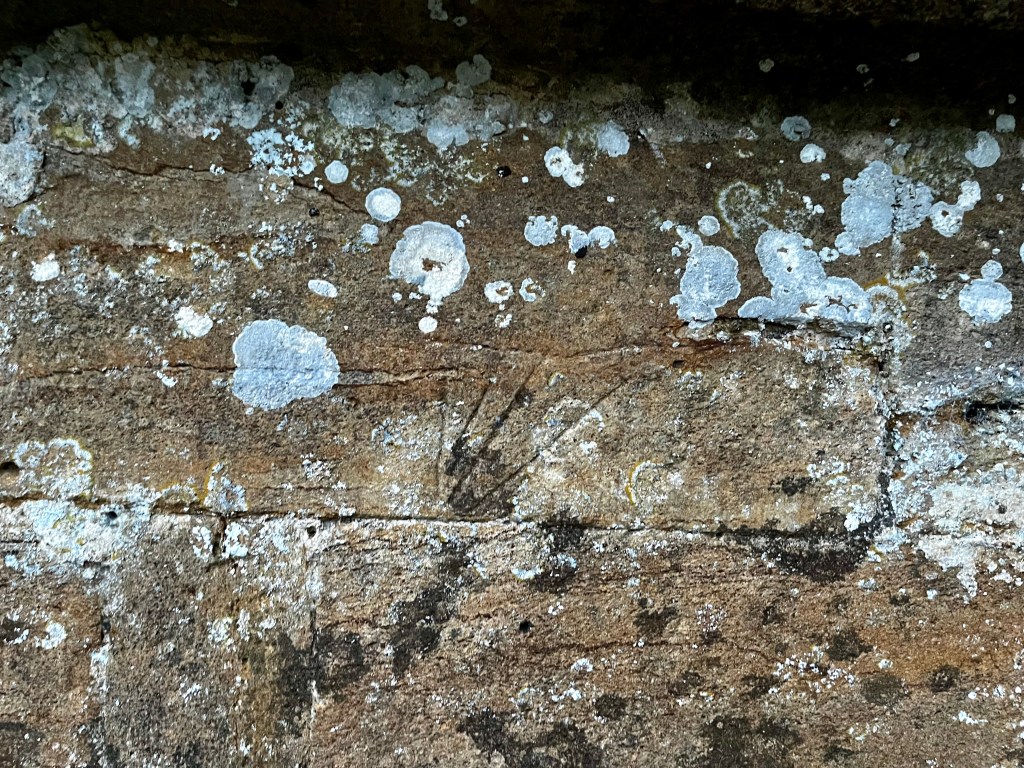
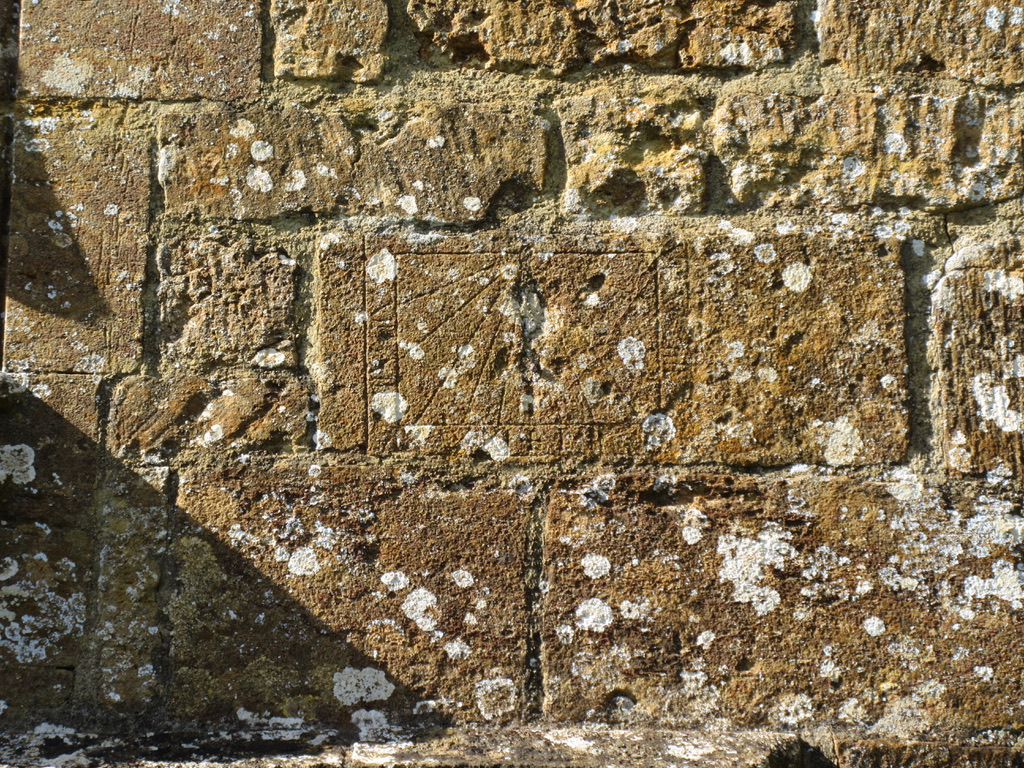
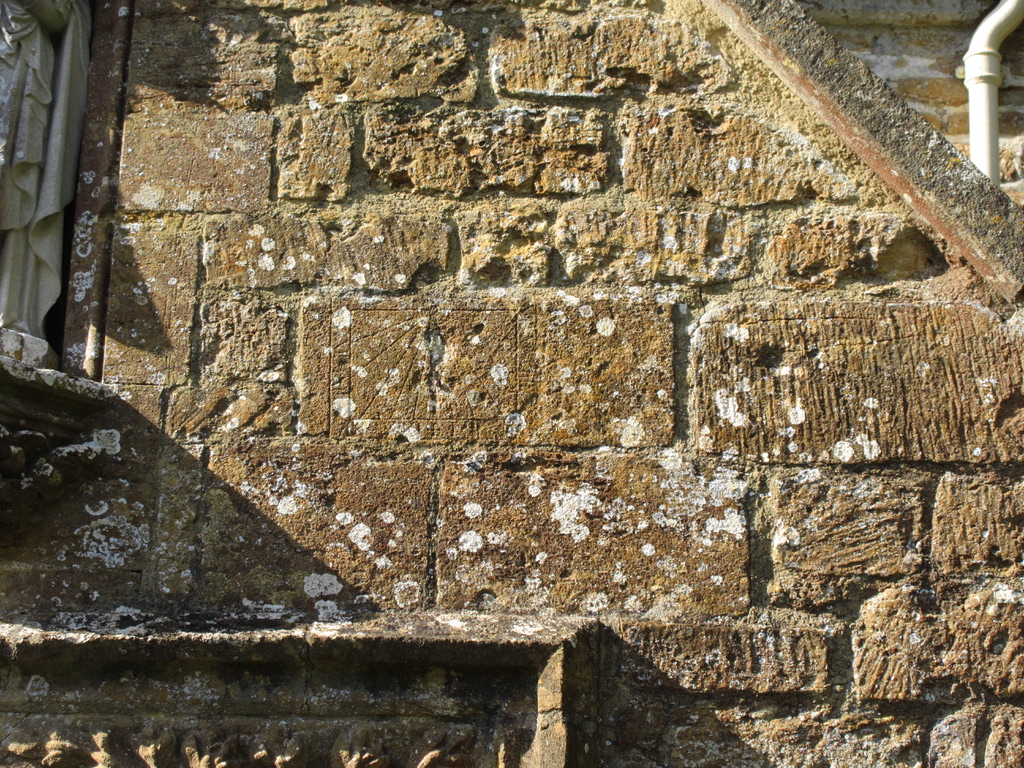
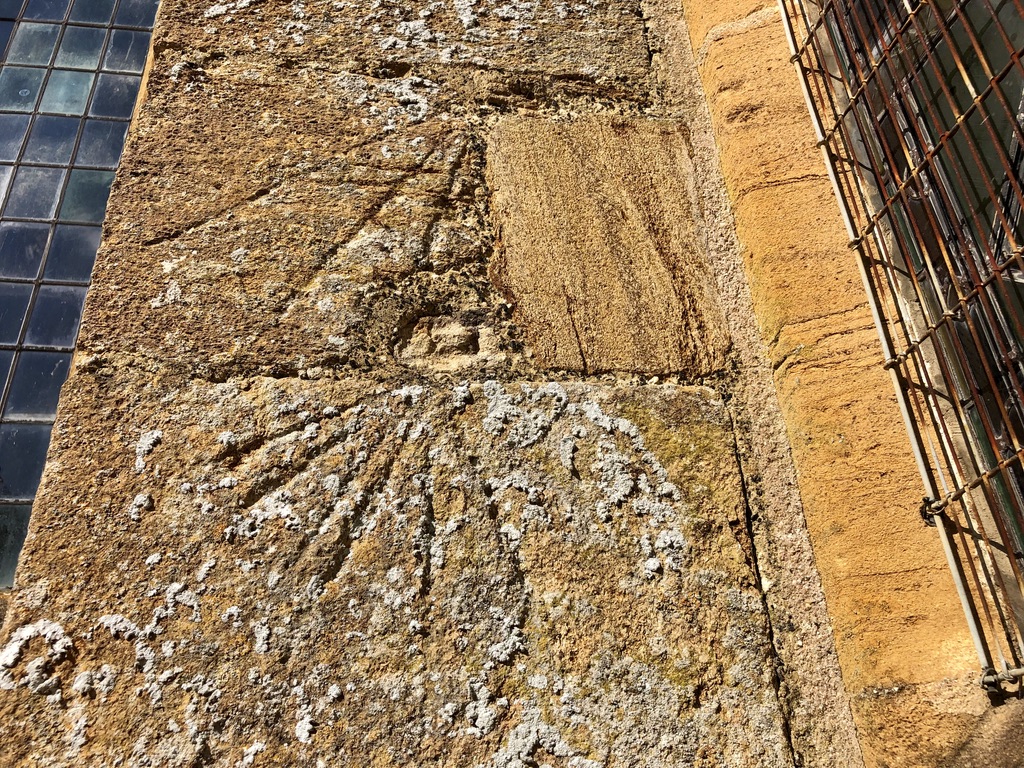
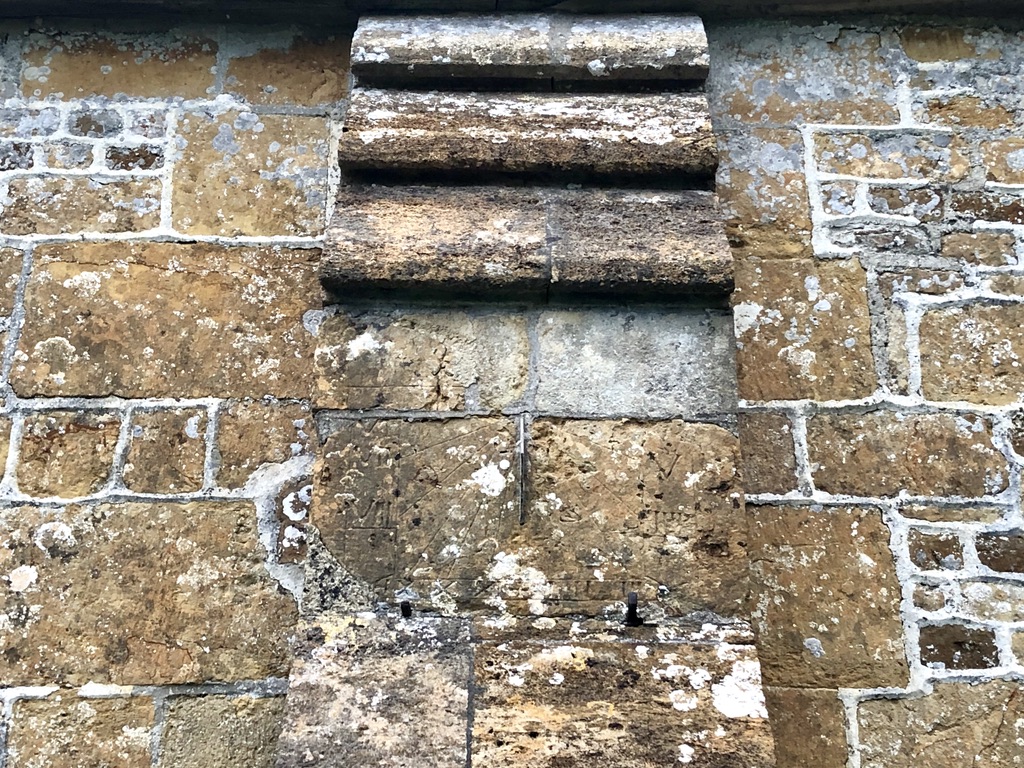
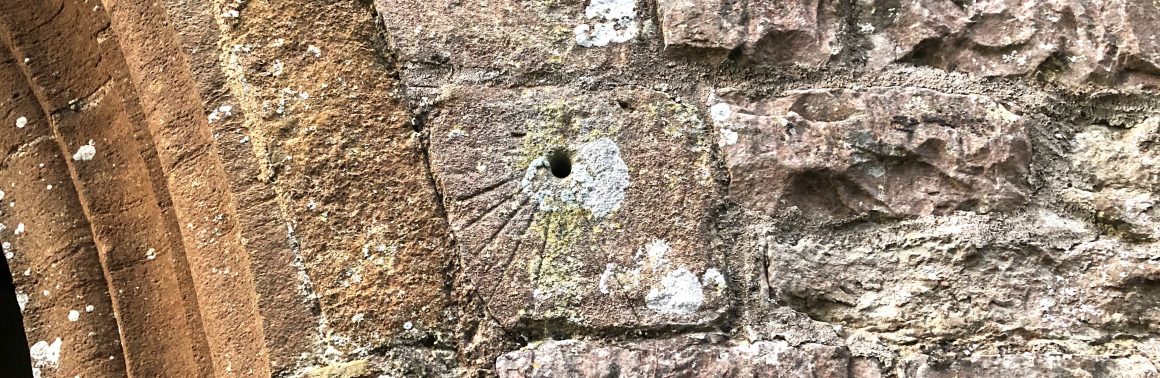
This dial is located high up above the portico, below the parapet of the nave seen as clerestory with parapet BLB. It is quite damaged, with a modern gnomon and a flaking layer of blue paint that makes it stand out (see header image). It’s hard to date the dial. Similar dated dials in the region are quite often early C18 or even C17. The dial is conventional of its kind, carefully graduated. The numerals are set in a frame, and italicised each side of the noon line.

DEH’s description of his second St Barnabas dial is another puzzle:

181. (1) This dial is on the s.e. buttress of the s. aisle. It is 6 feet 7 1/2 inches above the ground, the noonline is 5 inches in length, the stylehole is invisible, and the aspect is s. by 10° e. The dial is curious, as it has the lines arranged much as they are in an ordinary sundial, with Roman numerals cut at the ends. There may have been a slit for a gnomon, now carefully cemented up. Probably this should not rank as a Scratch dial.

There is a significant problem. The location DEH gives for it, six feet up on a buttress, is totally different from this now blue dial, yet his description broadly matches it and his comment that it probably should not rank as a Scratch dial is clearly apposite. I may have missed a second buttress scratch dial, even though I have been back to check. Or else perhaps DEH made a simple error in compiling his notes of several churches visited at one time in one area (I have come across a couple of similar instances). So this dial, now blue, is the one he meant but mis-located.

Queen Camel . Somerset . St Barnabas – dial 2

GSS Category: Scratch Dial; Old Dial

All photos: Keith Salvesen

EAST CHINNOCK . SOM . ST MARY – 2 Scratch Dials (1 unrecorded)

East Chinnock . Somerset . St Mary. Scratch Dials
East Chinnock . Somerset . St Mary

EAST CHINNOCK . SOM . ST MARY

GRADE II † C14 origins on earlier site; mostly C15 and later C19 work. South porch very simple, possibly C14 BLB. Cinnuc in Saxon times. 4 miles W of Yeovil, attractively set on the steep hillside at the E end of the village though right beside the A30. 50.9164 /  -2.7145 / ST498132

DIALS

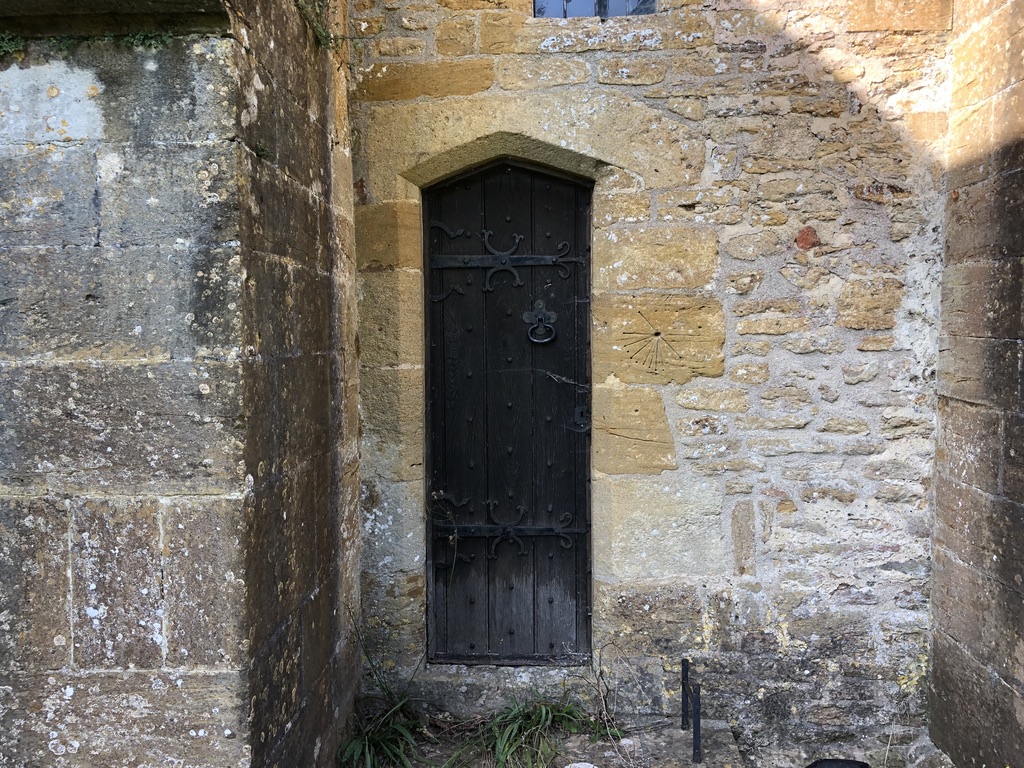
St Mary has 2 dials. Both are on the S porch, one of the earliest parts of the church. One was recorded by DEH on his visit in June 1915. The other is a new find I believe.

DIAL 1

The dial is halfway up the L side of the porch immediately above a gravestone. It comprises pocks with a large style hole. The pattern is haphazard and the dial might actually make more sense if rotated 90º L, producing a double pock noon line.

East Chinnock . Somerset . St Mary. Scratch Dials
East Chinnock . Somerset . St Mary – Scratch Dial 1

DEH 196. This dial is on the w. side of the s. porch, at a height of 4 feet 8 inches above the ground. The noonline is 2 1/4 inches in length, the stylehole is 7/8 of an inch by 1/2 an inch in diameter, and the aspect is s. by 30° e. Type 10. June 15th, 1915.

DIAL 2

East Chinnock . Somerset . St Mary. Scratch Dials
East Chinnock . Somerset . St Mary – Scratch Dial 2

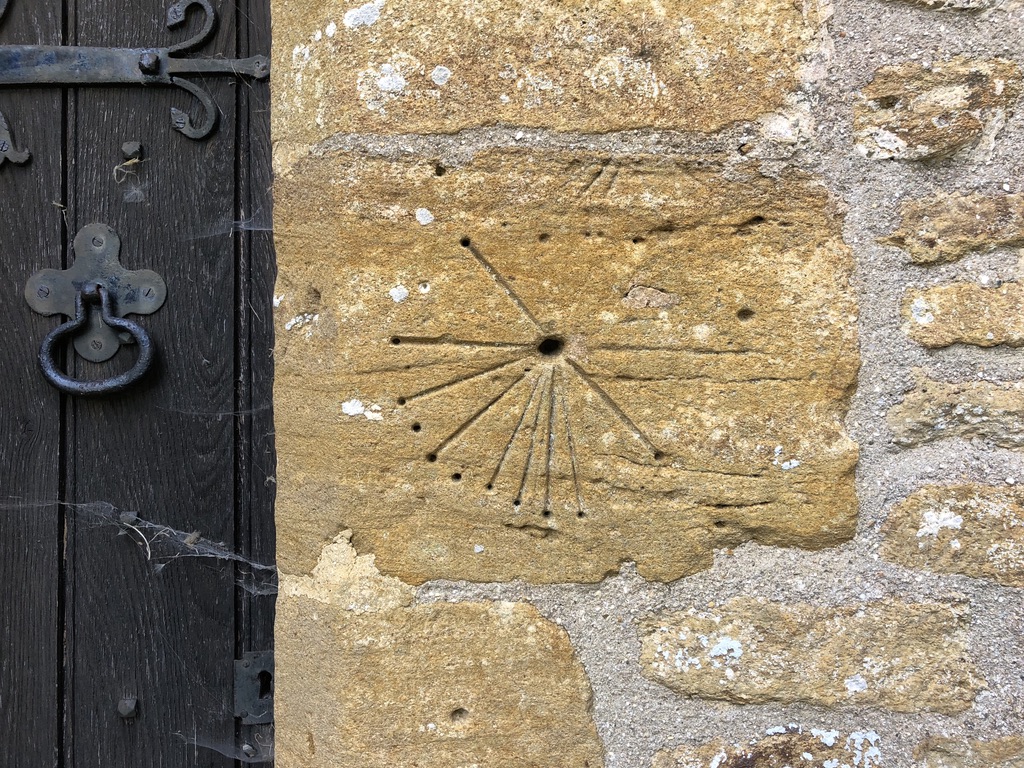
Dial 2 is located quite high on the E face of the S porch, a simple 4-line fan dial. The position makes no sense for a sundial, and it was plainly relocated at some stage. In the process, as is often the way, it was inverted. This re-siting with a rotation of the stone retains the decorative feature even though no longer a reliable time indicator. This is the sort of find that reminds me always to search beyond the normal dial locations of porch, buttress and priest’s door.

GSS Category: Scratch Dial

All photos: Keith Salvesen

PODIMORE . SOM. ST PETER – Scratch Dial

St Peter . Podimore . Somerset

ST PETER . PODIMORE . SOMERSET

GRADE I. Early C14 on the site of an earlier ?C12 church. Unusual three octagonal stages on the square base of the tower. Porch of significance, with dial by inner door. Church situated close to the N. perimeter of RNAS Yeovilton. Historically spelled Podymore, sometimes adding Milton. 51.0219 / -2.6492 /  ST545249

DIALS

St Peter has a fine dial on a quoin stone at E. end of the nave, an unusually complete and very satisfying symmetrical design. DEH records this dial (as does BSS), and also a second dial inside the porch (a feature of churches in the area) that is rather a puzzle.

DIAL 1

St Peter . Podimore . Somerset – Scratch Dial 1

There is a full complement of 24 lines, each passing through a pock on its way to the perimeter. The line spacing is regular, each angle at 15º. The style hole is large relative to the careful proportions of the design. Overall the condition is good, the lower half more so than the upper. Some lines pass into (and perhaps beyond) the mortar joints, suggesting that a very strong and weather-resistant mix was used in medieval times (or extreme care taken with mortar repairs).

St Peter . Podimore . Somerset Scratch Dial 1

DEH visited in Oct 1914 and noted that the dial is elaborate and has lines and dots, and is also of unusual pattern. This dial is one of very few photographs included in his book. Note the spelling of the village in the caption. I wonder what kind of camera he took with him on his travels round Somerset?

211. (2) This dial is on a quoin at the s.e. corner of the nave. It is 4 feet 9 inches above the ground, the noonline is 4 1/2 inches in length, the stylehole is 3/4 of an inch deep by 3/4 of an inch in diameter, and the aspect is s. by 15° e. Type 11.

DIAL 2

The dial inside the porch of St Peter is RHS of the door. BLB notes S porch, gabled, with outer 2-centre arch of 2 orders, the outer segmental, and inner plain pointed arch door and a possibly C16 door with old ironwork. The date of the original porch – restored 1871 – that covered the dial is unclear.

St Peter . Podimore . Somerset – Scratch Dial 2

The dial, at latch level, is rustic and in poor condition. There are 2 clear lines, with the noon line cut deep at the top then scratched roughly a long way downwards before petering out. There’s no sign of a style hole where the lines meet, so the gnomon was presumably fixed in the mortar line just above. A partial / eroded line at the edge of the lower R quadrant could be consistent with Nones in the canonical Mass.

MYSTERY

A mystery arises from DEH‘s record for this ‘within-porch’ dial: He noted 210. (1) This dial is on the w. side of the inner door of the s. porch. It is 4 feet 6 inches above the floor, the noonline is 1 inch in length, the stylehole is in a joint and filled, and the aspect is s. by 20° e. Type 2. I found no dial in that position nor with that description. My tentative theory is that, very rarely, DEH’s notes of a day’s dialling are unclear; features of one church / dial appear to be ascribed to another nearby. Probably I should return to the area and check the churches for a dial as he describes.

St Peter . Podimore . Somerset – Scratch Dial 2 within porch

GSS Category: Scratch Dial

All photos: Keith Salvesen

STOCKBRIDGE NEW CHURCH . HANTS . ST PETER – Scratch Dials

St Peter . Stockbridge . Hants

STOCKBRIDGE NEW CHURCH . HANTS . ST PETER

GRADE II † Built 1860s in the centre of a pleasant, prosperous small town on the River Test. Fishing tackle emporia, smart gift shops, good restaurants and pubs, predominate. The flinty New Church replaced the crumbling C12 STOCKBRIDGE OLD CHURCH that had fallen into decay and disuse. Its fascinating remnants merit a visit. 51.1145 / -1.4934 /  SU355351

DIALS

The excellent resource BRITAIN EXPRESS by David Ross gives a graphic account (below) of the move from the near-defunct medieval church on the edge of the town to the new-build glory in the High Street. Included in the upheaval was a scratch dial on a stone window jamb; and as I recently discovered while locating it, an unobtrusive second dial now on the side of a buttress.

Most of the 12th-century building was pulled down, leaving only the chancel, and a new church in Victorian Gothic style was built on Stockbridge High Street. Reports show that the townsfolk played an active part in transferring monuments, paintings, window frames, corbels, and other pieces of carved stonework from the old church to the new site. People brought their wheelbarrows and trundled down the High street carrying pieces of medieval masonry.

DIAL 1

St Peter . Stockbridge . Hants – scratch dial 1

Dial 1 is on RHS of the double lancet window at the W end of the church. It is inverted, as is often the case with a relocated dial. The window is high enough to be awkward to photograph with only a phone to hand. There are 12 (13?) visible lines, each ending in a pock. Traces of others might be found with closer inspection or a decent photo. The style hole is relatively large, and the lines radiating from it are more or less evenly spaced rather than graduated.

ARG visited Stockbridge in May 1922. He recorded there is a style hole with a line above, and on each side of this four radiating lines. He added it is too high for a photo or for measurement. Which may explain his lower count of radials.

DIAL 2

By complete chance, in walking away from Dial 1, I noticed a small but familiar design in the inside W face of a buttress L of the porch.

St Peter . Stockbridge . Hants – scratch dial 2

This simple dial is unusual in being a quadrant with a quarter-circle border, like a small fan. In relocation, it looks as if it was rotated 90º. It makes most sense that the close-cut double lines originally formed the noon-line and the others mark 3 and 6: an afternoon dial.

St Peter . Stockbridge . Hants – scratch dial 2 rotated 90º

GSS Category: Scratch Dial

All photos: Keith Salvesen

COMPTON PAUNCEFOOT . SOM . ST MARY – Scratch Dials

Compton Pauncefoot . Somerset . St Mary

GRADE II* † C15 (C13 origins). Restored and N. aisle added C19. A handsome spired church, unusual in a region where most churches have towers, in the lovely setting of a small hamlet reached by a network of lanes. 51.0337 / -2.509 /  ST644261

DIALS

St Mary is a most rewarding church to visit, both the exterior and interior. You will find brief points of note at Camelot Parishes. DEH on his visit in April 2014 recorded 2 medieval dials (2 & 3 below) but there are others, including a more elaborate later one with Roman numerals (C17?) above the porch.

DIAL 1

Compton Pauncefoot . Somerset . St Mary – scratch dial on the porch

Dial 1 A very visible 3-line dial on a large stone RHS of the porch. It consists simply of a small style hole with a long noon line and a single line the same length cut on each side. Despite its prominent location, the dial seems largely unremarked though perhaps it is mentioned in the church archives. The actual stone differs from the ones around it – perhaps it was relocated during restoration to a more prominent position on the porch. It is strange that DEH didn’t include this dial in his records for the church.

DIAL 2

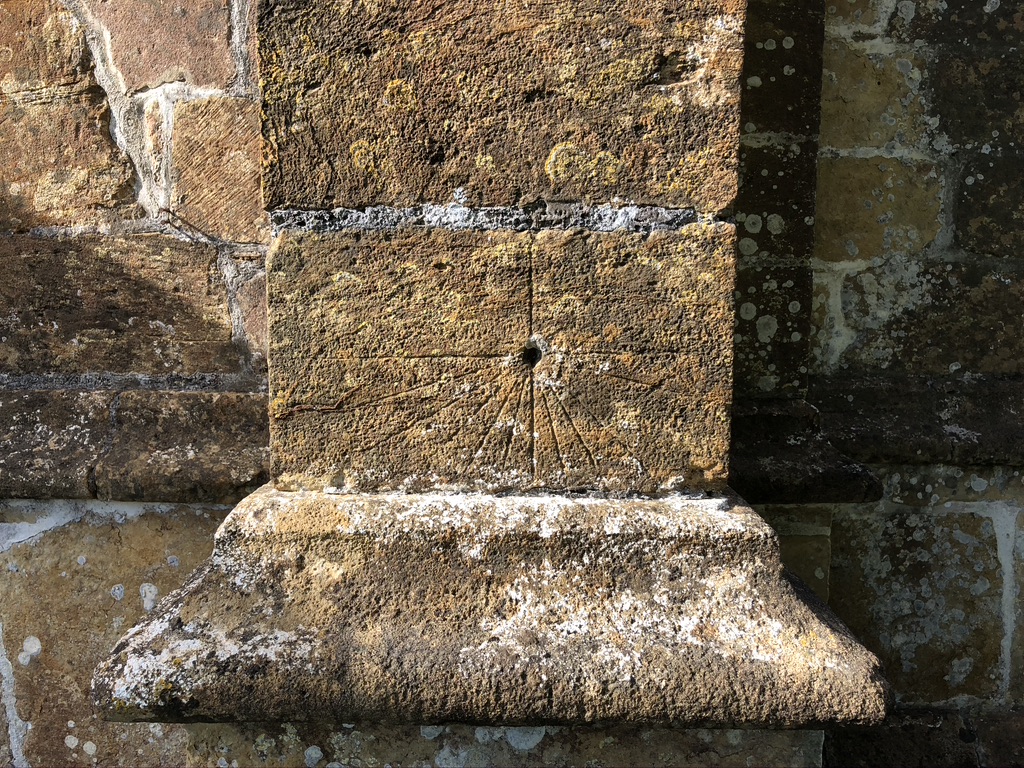
Compton Pauncefoot . Somerset . St Mary – scratch dial on the E buttress of the nave

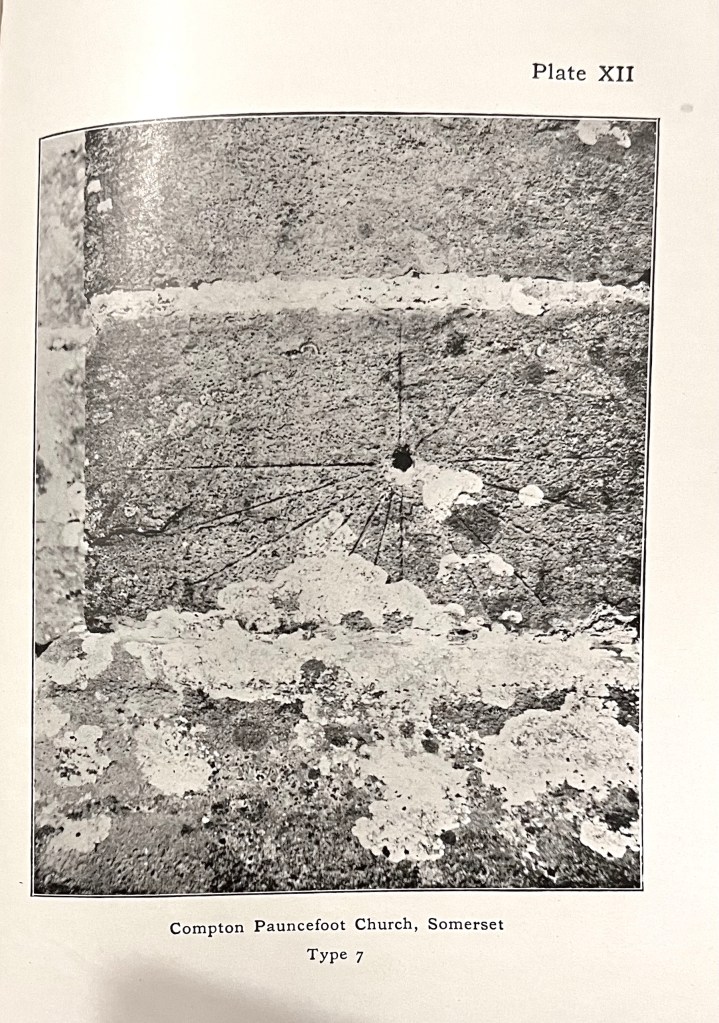
Dial 2 is located on the buttress at E end of the nave. It is close to being an ideal dial for study. The style hole is (nearly) centred on the stone. The noon line is not only emphasised, it extends upwards to ‘midnight’. There’s a distinct optical impression of a circle. The horizontal (6-to-6) line extends almost the full width of the stone. Other lines are unusually long, reaching beyond the notional circle. They are carefully graduated to optimise the accuracy of the dial. One mystery is the absence of the 4-line. I couldn’t find a trace of one. It seems unlikely that a single line has eroded completely; but a reason for omitting one line on an otherwise complete and indeed symmetrical dial is hard to think of.

DEH chose the dial to illustrate Type 7

DEH 177. (2) This dial is on the buttress at the s.e. corner of the nave. It is 4 feet 6 inches above the ground, the noon- line is 4 1/2 inches in length, the stylehole is 1 inch in depth by 3/4 of an inch in diameter, and the aspect is s. by 20°e. Type 7. April 24th, 1914.

DIAL 3

Compton Pauncefoot . Somerset . St Mary – scratch dial beside the E buttress of the nave

Dial 3 is close to the same buttress, smaller, more rustic (earlier) and lower down. There are 9 certain lines and a couple of traces (one possibly above the 6 am horizontal). Their spacing is somewhat random. 4 lines end in pocks.

DEH 176. (1) This dial is on the wall w. of the buttress at s.e. corner of the nave. It is 2 feet 8 inches above the ground, the noonline is 4 1/2 inches in length, the stylehole is open, and the aspect is s. by 20° e. Type 3.

DIALS 4 a – d

Compton Pauncefoot . Somerset . St Mary – scratch dial(s)

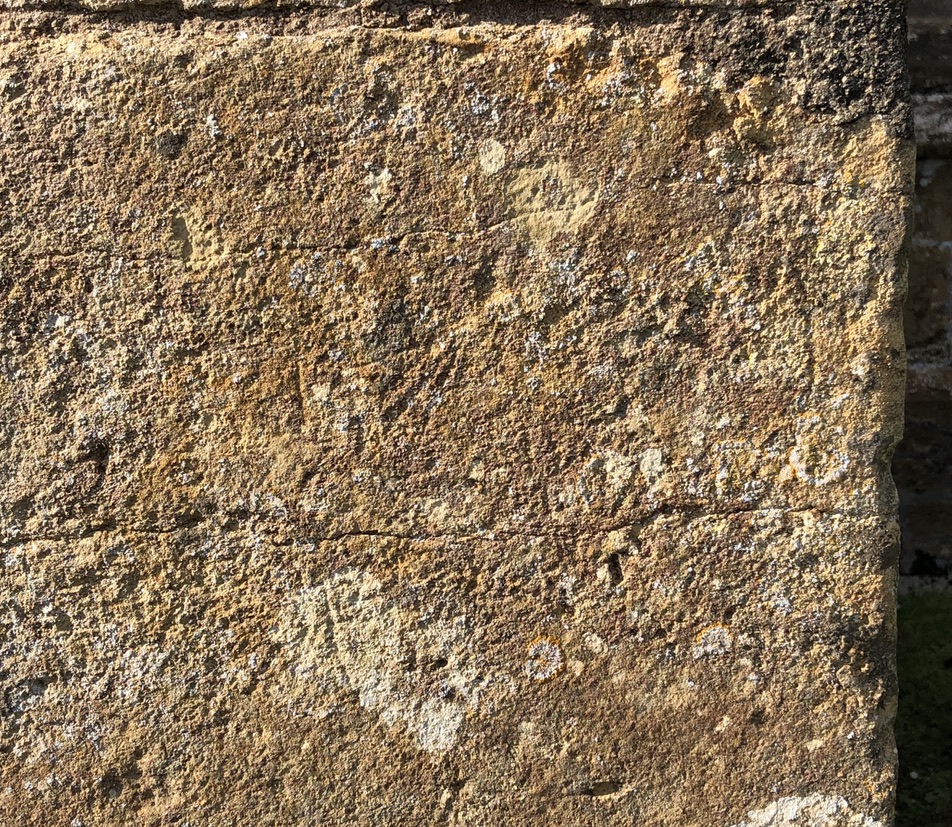
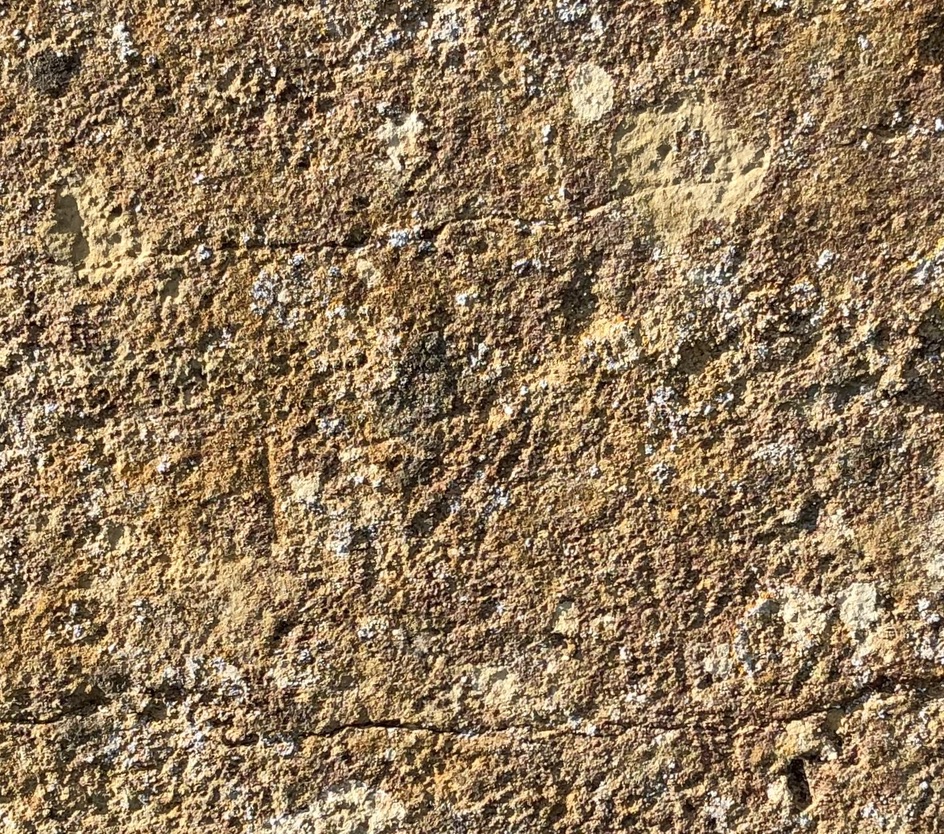
Dial 4 This is in fact a dial / dial-related group on a single quoin stone, but treated as a dial unit for convenience. The overall design has 4 elements. There are 3 eroded (part) circles – two overlapping – with a small rough dial within the top circle. In this group of interlinked components, each is of a type often identified either as dials or as remnants of eroded dials. See eg CHURCH STRETTON Such a collection on a single stone perhaps suggests experimentation with dial-making. Or the (part-)circles may simply be decoration or (not unknown) doodles. Anyway, I decided to lump them together as one dial rather than to try to sort out the tangle. Any interpretations would be welcome.

Compton Pauncefoot . Somerset . St Mary – scratch dial(s)

DIAL 5

Compton Pauncefoot . Somerset . St Mary – scratch dial / C17 sundial

Dial 5 is a C17 later accurately incised dial on the fine porch above a cusped ogee-arched statue recess with foliated base BLB with its C19 statue of Virgin and Child. This dial is similar to several others in S. Somerset & W. Dorset (some are included under the heading OLD DIALS). The radials are contained within a rectangle, carefully incised and graduated. The noon line is more deeply cut, and leads down from the damaged area at the top of which is a filled style hole. Possibly the area of damage immediately below it indicates that a metal gnomon plate was later fixed there. The frame round the dial shows Roman numerals (IV as IIII) except for noon, which is marked by a cross (a conventional style).

GSS Category: Scratch Dial ; Old Dial

All photos: Keith Salvesen

LILLINGTON . DORSET . ST MARTIN – 3 scratch dials & a theory

St Martin . Lillington . Dorset

ST MARTIN . LILLINGTON . DORSET

GRADE I † C13 origin, chancel & tower C15, porch C17, south chapel C18. Restored 1848. A small hamlet, a fine church, a tithe barn, a manor house. Sir Walter Raleigh prayed here. Perfect rural Dorset – secluded in a valley, reached only by narrow lanes, and very much a longcut for traffic. 2m over the fields from our house, 15+ minutes drive. 50.9127 /  -2.5283 / ST629127

DIALS

St Martin has 3 scratch dials, all very different. There is a further contender that I put forward as a plausible but very rare type of dial (with a small degree of approval from BSS).

DIAL 1

St Martin . Lillington . Dorset – Scratch Dial 1

Dial 1 is located on the SW. face of the buttress at the W. end of the tower. It consists of a style hole encircled by a somewhat elliptical ring. There are traces of an inner circle or partial circle, clearest seen at the bottom of the dial. GLP describes it as very eroded, and dates it as C15 (ie when the tower was built). He refers to 2 lines but I did not notice them and I can’t pick them out in the photos.

DIAL 2

St Martin . Lillington . Dorset – Scratch Dial 2

Dial 2 is at 90º to Dial 1, on the SE. face of the same buttress and indeed on the same stone. There are 5 clear lines radiating from a filled style hole, forming what might be called an ‘afternoon dial’. It’s hard to tell which is the noon line: possibly the lowest lines are angled to allow for the dial not facing due S.

GLP also dates this dial as C15. He notes that it may not be in its original position, or may have been (partly) rotated ‘then it might… have been reasonably accurate’. BSS records ‘possibly re-positioned and rotated’. But because this dial and Dial 1 are on the same stone, rotation may be less likely.

DIAL 3

St Martin . Lillington . Dorset – Scratch Dial 3

Dial 3, between of the nave window and the side-chapel, is possibly C13. The chapel, added in C18, shades the dial for half the day. GLP counts 4 lines, at least one ending in a pock, and notes shallow marks between lines possibly marking 1/2 hours. BSS also records 4 lines. I presume the uppermost mark or scar is viewed as subsequent damage. The style hole looks as if it has, or has had, metal in it.

VERTEX DIAL?

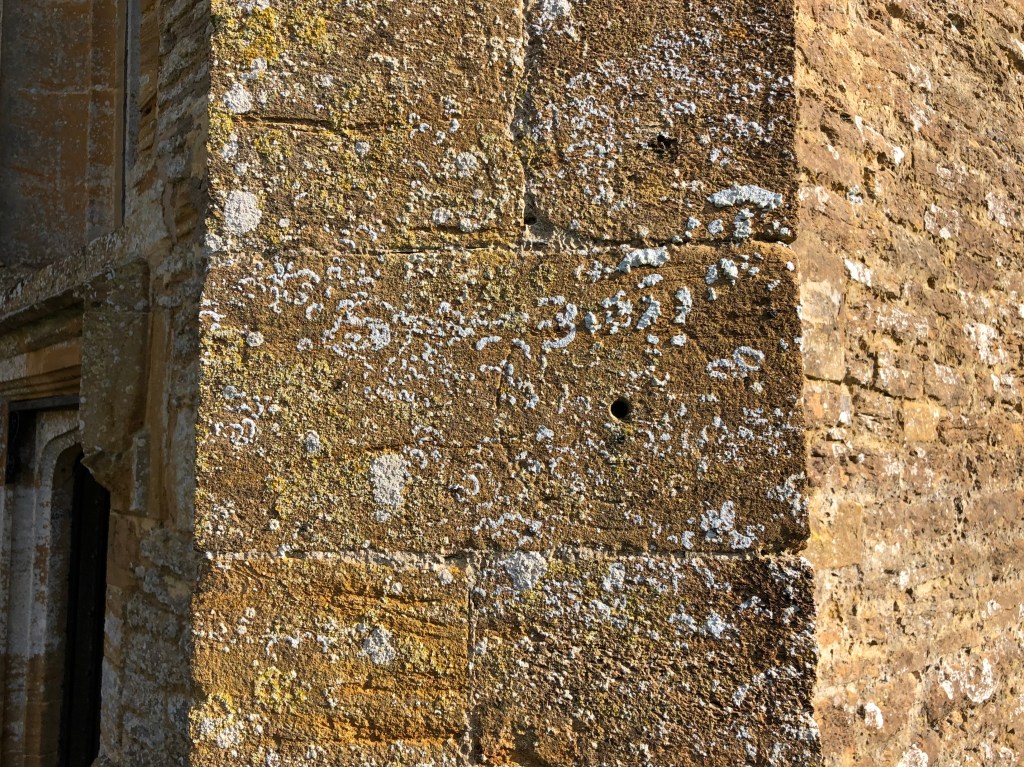
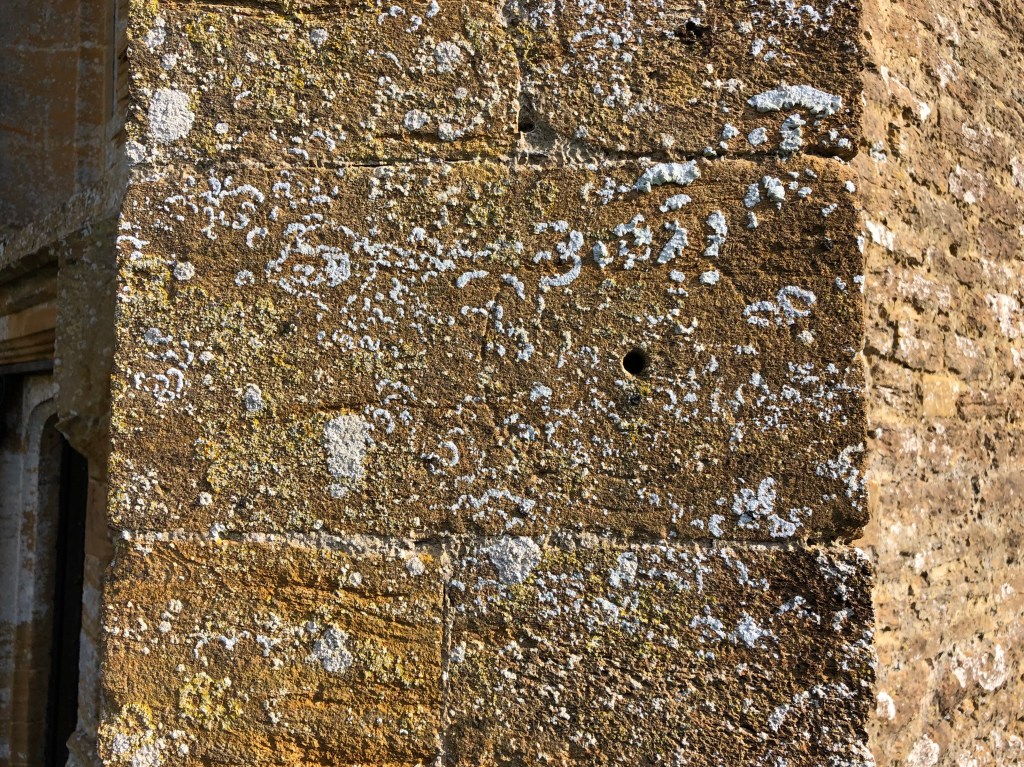
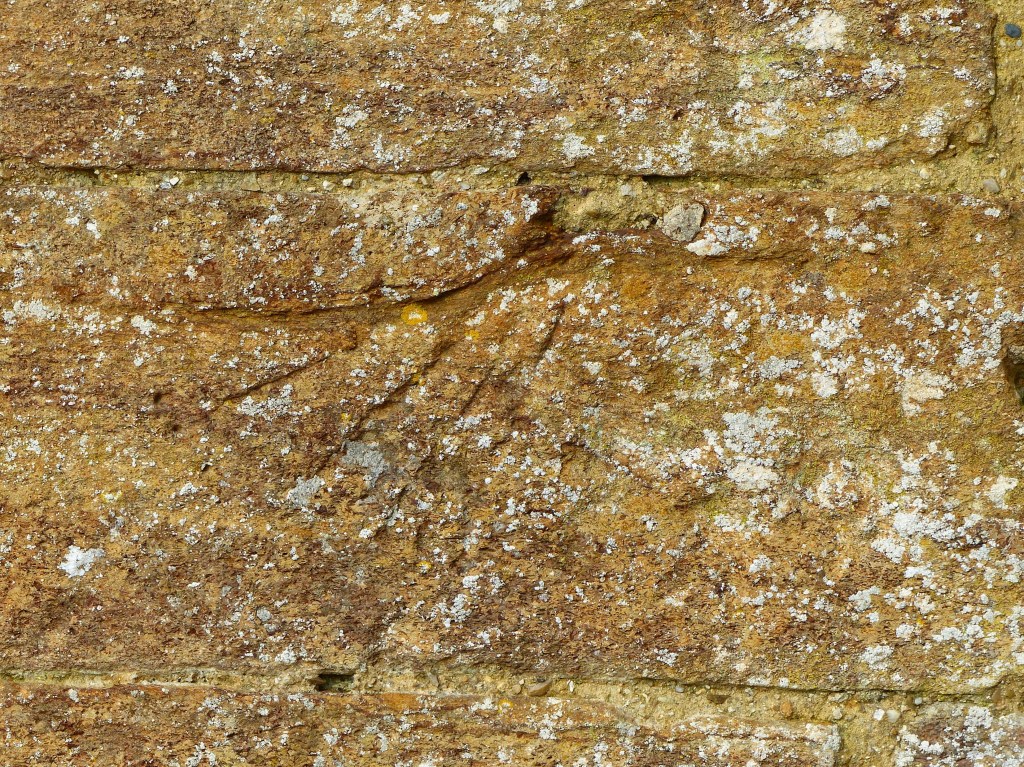
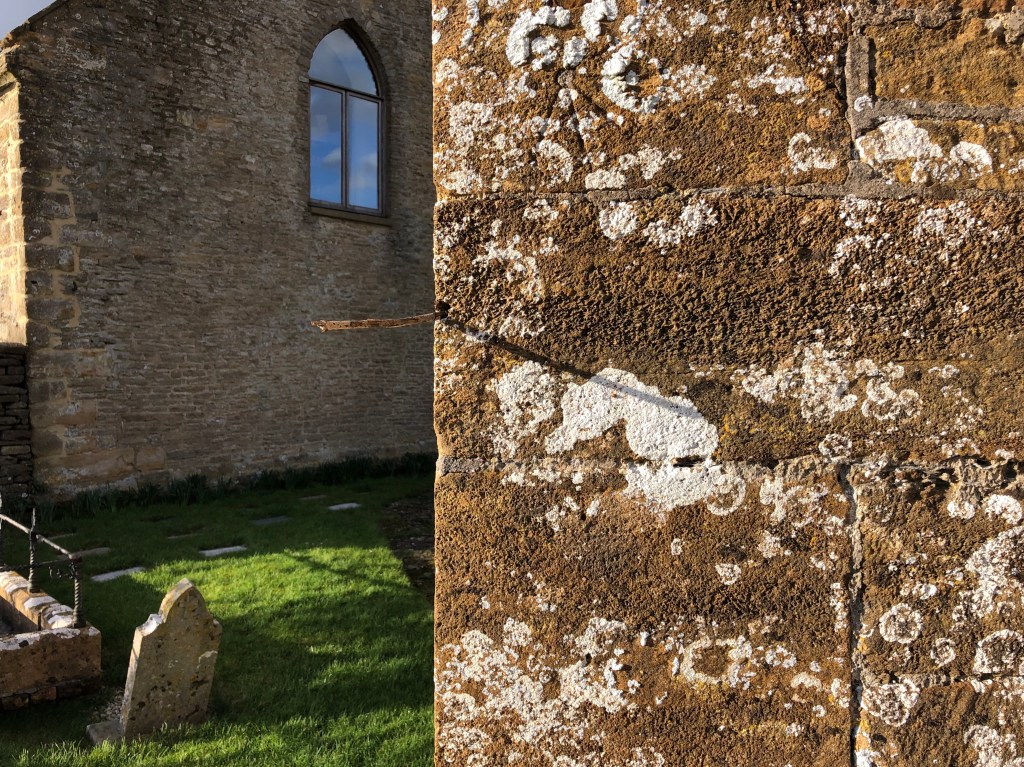
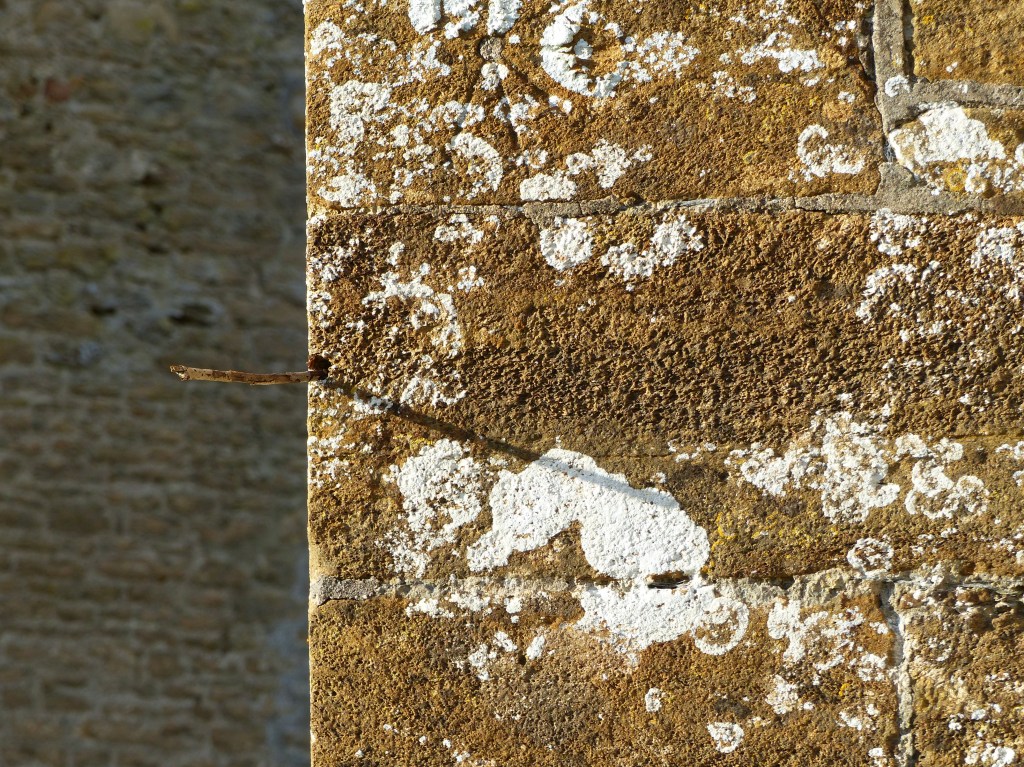
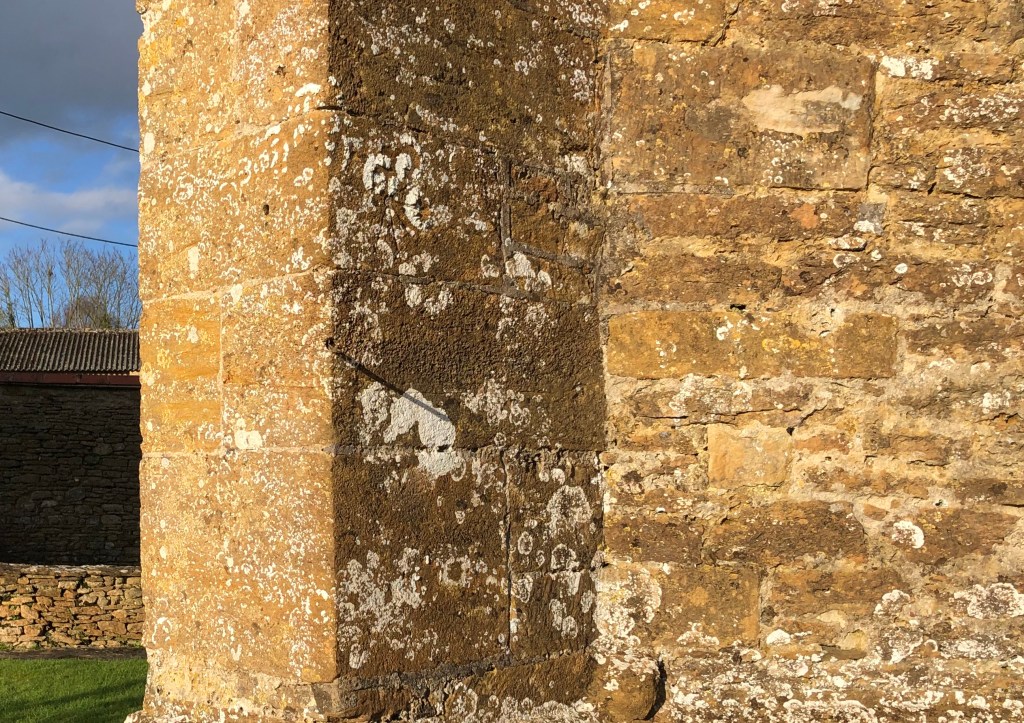
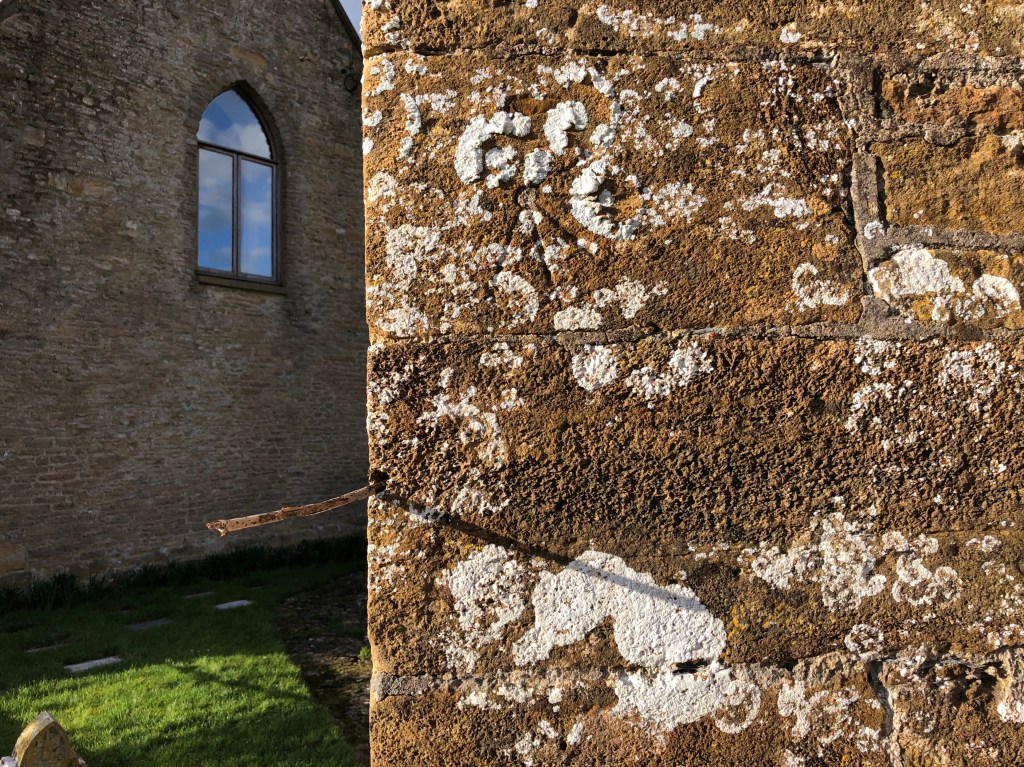
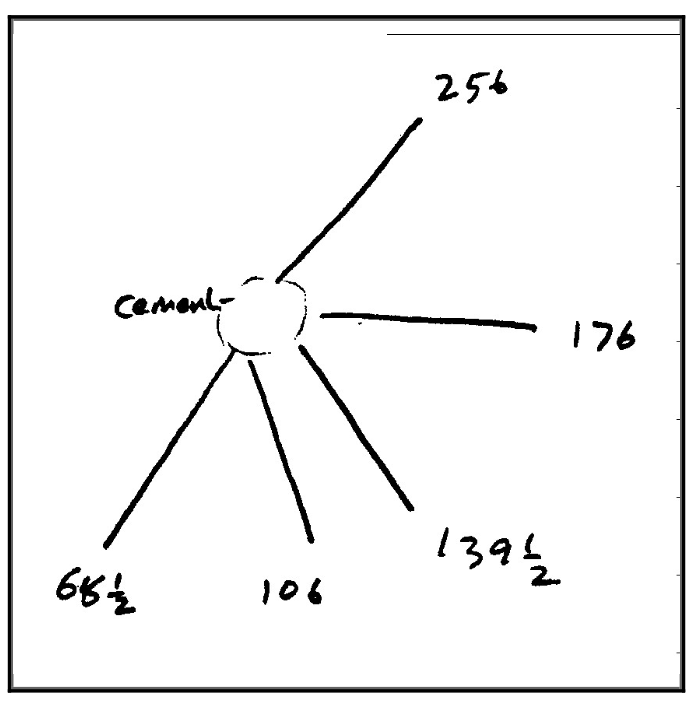
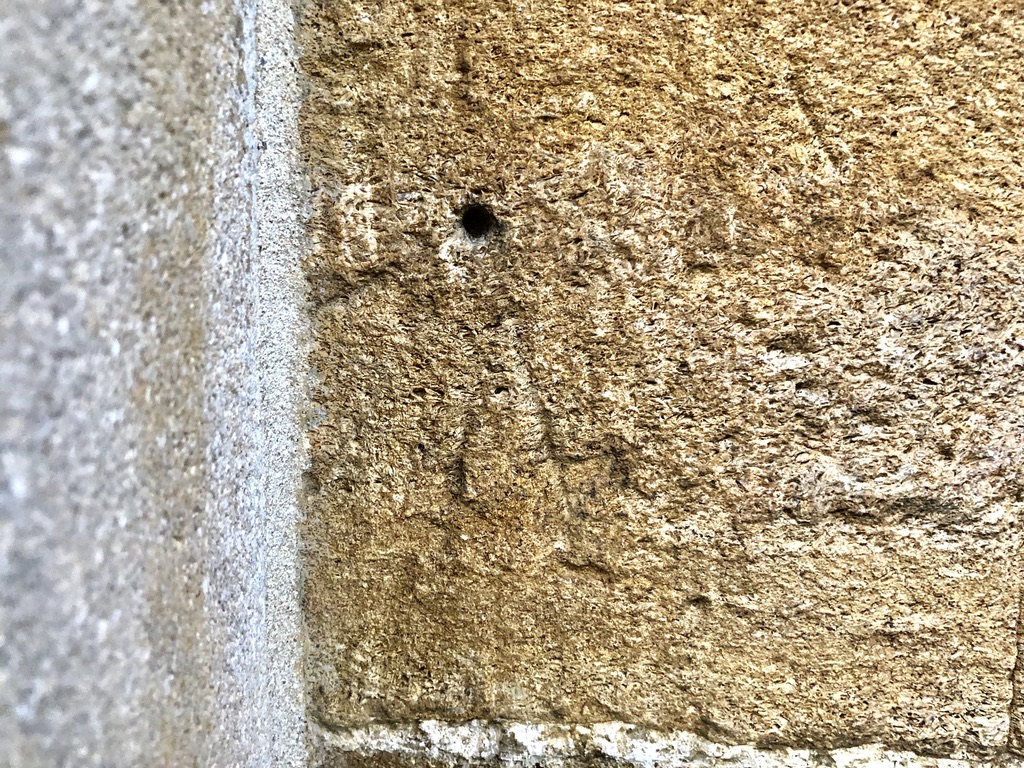
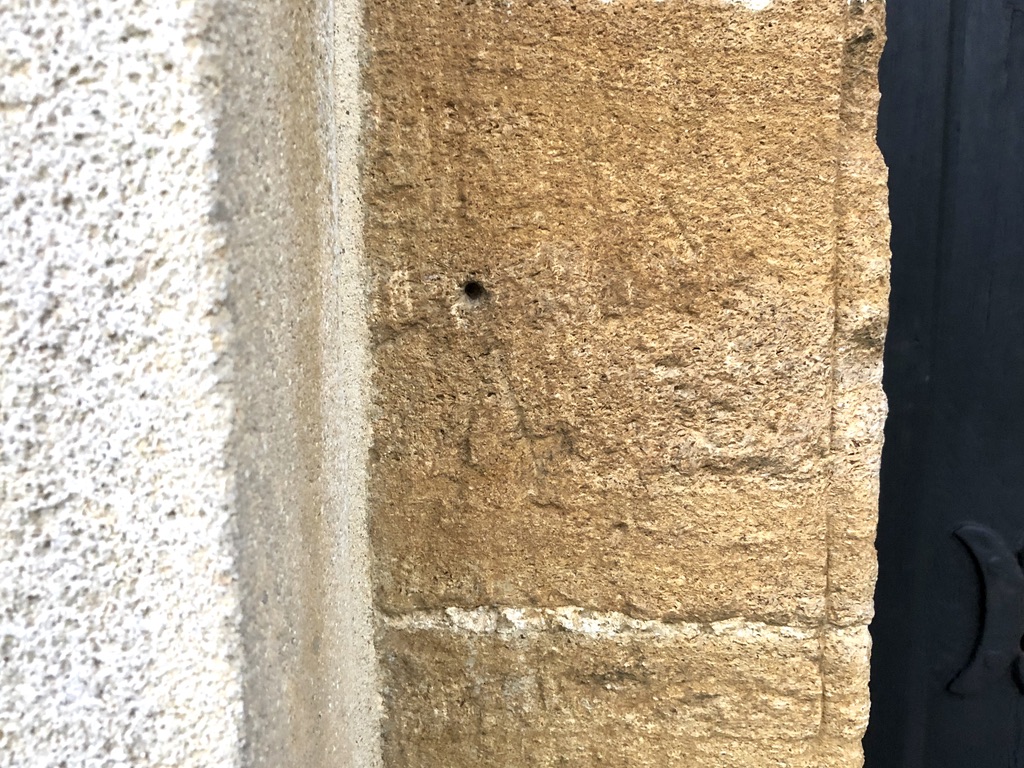
On the same buttress as dials 1 & 2 and on the stone immediately below them, is a fairly deep hole drilled precisely and straight into the corner of the stone. Because of the proximity to the other dials at right-angles to each other, I wondered if this strangely-placed hole was also a dial (and if so, whether unique). So I experimented with a stick, with the result shown below. My conclusion is that a prominent gnomon in the vertex would give a clear indication of the passage of time throughout daylight hours. In a way, it might be rather more effective than a normal dial. I could clearly see the shadow from the E. end of the church.

I put the theory out there. As always, any observations would be welcome.

STOKE-sub-HAMDON . SOM . ST MARY THE VIRGIN – 4 scratch dials

St Mary the Virgin . Stoke-sub-Hamdon . Som

ST MARY THE VIRGIN . STOKE-sub-HAMDON . SOM

GRADE I † C12 origins (Chancel c1100), C13 et seq, restored 1862. A pleasingly geometric church in a fine setting below Ham Hill, the Iron Age hill fort where the original stone for the Norman church was quarried. Close to Montacute House (NT) and St Catherine Montacute. 50.9526 /  -2.7361 /  ST483172

DIALS

St Mary has 4 dials on the S. side, all of different types and all quite easily found. The different styles and levels of sophistication on a single church reflect the development of scratch dials with increasing scientific knowledge, and their continuing usefulness to the church and the community.

DIAL 1

St Mary the Virgin . Stoke-sub-Hamdon . Som – Scratch Dial 1

Dial 1 is low-down on a quoin at the W. end, unusually assertive and straightforward. However, in the middle of the 4 strong lines is a very faint one with a dot at the end. Since it adds little to the dial’s purpose, I wonder if evidences eroded remains of an earlier dial? Also, are the dots either side of the gnomon hole part of the original dial or were they added later? It’s hard to see how they might help the dial’s function. Or so I thought until I saw similar oblique marks in Dial 2, in that case lines (see below).

DEH visited St Mary in July 1914 and recorded: 216. (1) This dial is on the s.w. corner of the nave on a quoin. It is 4 feet 3 inches above the ground, the noonline is about 4 inches in length or a little less, the stylehole is 1 3/4 inches in depth by 3/4 of an inch in diameter, and the aspect is s. by 30° e. Type 3.

In the first image, note the Norman window, one of 2 that survive. The other is shown below.

DIAL 2

St Mary the Virgin . Stoke-sub-Hamdon . Som – Scratch Dial 2

Dial 2 on the E. side of the recessed priest’s door, is a fine example of a later, more complex design. It certainly marks the hours with clarity and precision. Its sophistication suggests it must be a late dial, my guess being late C15 / early C16. The morning hours are all marked with carefully graduated lines down to the noon line. All terminate in pocks which themselves are graduated from large to small at noon. Two half-hours are marked with pocks. The emphatic oblique incision is hard to analyse other than in terms of marking canonical hours (Compline & Nones?) cf the pocks on Dial 1. Any help to explain it would be welcome.

DEH recorded: 219. (4) This dial is on the e. side of the priest’s door. It is 4 feet 6 inches above the ground, the noonline is 5 inches in length, the stylehole is 1 1/2 inches in depth by 3/4 of an inch in diameter, and the aspect is s. by 25° e. Type 3.

A final note for Dial 2. There is some evidence that there was originally a dial on a stone above it, later replaced. There are scratch marks that suggest the end of radials; and a row of dots, including a double dot that might relate to a noon line.

DIALS 3 & 4

St Mary the Virgin . Stoke-sub-Hamdon . Som – Scratch Dials 3 & 4

Dials 3 & 4 are together, one above the other, E. of the blocked doorway with its slender columns. They are quite high (about 10′) in the angle where the S. wall meets the transept.

Dial 3 is the lower of the two. The style hole would have been in the mortar line acting as the horizontal ‘6-to-6’ line, but the area has a large repair that presumably covers it. 6 lines descend from it in a conventional fan, mainly in the lower L. quadrant. Their spacing is imprecise; the noon line is extended.

Dial 4 above is less ambitious. I imagine it is the earlier of the two. There are 3 long lines emerging from a filled style hole. The noon line runs down the edge of the adjacent stone, which looks as though it was a replacement from later restoration work. If so, perhaps the dial originally had lines in the lower R. quadrant.

DEH wrote: 217. (2) This dial is on the s.w. corner of the s. transept. It is 5 feet 1 inch above the ground, the noonhole is 2 inches distant, the stylehole is 1 inch in depth by 1/4 of an inch in diameter, and the aspect is s. by 20° e. Type 9.

His record for this location is puzzling because there are in fact 2 dials not one; and they are much higher than he gives. It’s quite possible I missed a dial – his single dial – nearby and at the height DEH specifies. However, since DEH records only 3 definite dials for St Mary, he must therefore have missed (for height?) this pair.

St Mary . Stoke-s-Hamdon – Norman window

DOUBTFUL DIAL

DEH recorded a possible 4th dial, but with reservations. He wrote: 218. (3) This doubtful dial is on the e. side of the closed doorway in the nave. It is 5 feet 2inches above the ground, the noonline is 3 1/2 inches in length, the stylehole, if it exists at all, is filled.

I had already photographed it thinking it might be a damaged dial. I’m an optimist and an amateur, not the best combination for a balanced judgement. If this is the dial candidate referred to by DEH, then the style hole is no longer blocked. It looks plausible as a very crude dial, and it is a conventional dial location. Is it a much earlier dial than the others, cut beside what was clearly a significant doorway and now degraded by time and weather? Any views welcome.

GSS Category: Scratch Dials (multiple)

All photos: Keith Salvesen

ALL CANNINGS . WILTS . ALL SAINTS – multiple scratch dials

All Saints . All Cannings . Wilts

ALL SAINTS . ALL CANNINGS . WILTS

GRADE II* † Early C13 with additions, enlargement and ‘remodelling’ thereafter; restoration 1869 by Henry Weaver. Cruciform plan of Norman origin. Purdue bells. S. of the Kennet & Avon canal between Devizes and Pewsey (close to Woodway Bridge which I ‘adopted’ many years ago). Wonderful views to the escarpments of the S. edge of the Marlborough Downs. 51.3531 / -1.9013 / SU069615

DIALS

All Saints is an attractive multi-dial church. Wilts is well-served by the Council, which publishes online Wiltshire Community History. It is a valuable resource, informative and thorough while keeping entries short. It helpfully notes: there are six scratch dials on the exterior south wall, once used to determine the correct time for services. Apart from featuring in the county lists by TWC, there is little other information to be found about them. The W C link: ALL CANNINGS In fact, there are more than 6 dials.

DIALS 1 & 2

Side by side on LHS. of the porch, a pair of dials of a broadly similar type. Dial 1 is the more sophisticated in design and ‘clock range’. I wondered if it was a replacement for the obviously less informative Dial 2.

All Saints . All Cannings . Wilts – Scratch Dials 1 & 2

Dial 1 has distinct lines, of which 4 are more deeply cut. Above these, on both sides, are a further 5 (possibly 6) faint lines. There are pocks at or near the end of some lines. The style hole is quite large and deep.

Dial 2 is simpler and more rustic, with 3 lines of different depths, each with a terminal pock. The noon line is slightly longer. There are a couple of other faint marks and pocks that suggest other lines now eroded.

DIALS 3 – 6

These 4 dials are R. of the transept window, L. of the buttress. The image below shows them all: a prominent dial with a semicircle of lines; above it, a similar, smaller dial with lines mainly in the lower L. quadrant; a rustic spider of a dial below them; and a strange dial with a long noon line and one even longer straggling line.

All Saints . All Cannings . Wilts – Scratch Dials 3 – 6

Dial 3 has 12 lines, perhaps more, ranging from distinct in lower L. quadrant and eroded / faint on RHS. All have terminal dots – the noon line has a cross. The style hole is surprisingly deep. A pleasing design.

All Saints . All Cannings . Wilts – Scratch Dial 3

Dial 4 is smaller, with the 9 lines mainly in lower L. quadrant. Some are straight, some have slight curves. The noon line is slightly extended. The short lines LHS terminate in the mortar line and do not extend onto the adjacent stone. After some thought, I discounted the smaller hole above either as related or as a residual dial in its own right.

All Saints . All Cannings . Wilts – Scratch Dial 4

Dial 5 sprawls at a slightly tipsy angle across a stone lower down. 6 distinct lines of differing depths and a couple of traces; partial pocks; and a large cross at the end of the noon line. Other marks, whether existing or added later, rather confuse the overall picture.

All Saints . All Cannings . Wilts – Scratch Dial 5

Dial 6 is the strangest of this group. It consists of a filled gnomon hole and a very long noon line cut with some precision, and deeper (separately?) on the stone below. The line also extends slightly upwards from the style hole. As such, it forms a very simple but workable dial, perhaps casting a long shadow easily visible from a distance. The other line is notably longer. It runs at roughly 45º to the junction of 3 stones before swerving downwards, fading, then finishing strongly. Were they cut at the same time? By the same person?

All Saints . All Cannings . Wilts – Scratch Dial 6

DIALS 7 – 9

Three dials additional to the six noted in Wiltshire Community History. Two are W. side of the transept; the third is at the W. end between the window and the end buttress.

All Saints . All Cannings . Wilts – Scratch Dials 7 & 8

Dial 7 has 5 lines (one a trace) descending from a patch of black lichen, with no visible style hole. The noon line is longer and a true vertical. The 2 outer ones are perhaps Mass indicators.

All Saints . All Cannings . Wilts – Scratch Dial 7

Dial 8 is immediately below Dial 7, and the simplest of all. A small filled style hole; an accurately cut noon line; and a single morning line in the same position as the emphasised line in Dial 7. This perhaps reinforces the theory that a Mass time thus marked was the important one at All Saints.

All Saints . All Cannings . Wilts – Scratch Dial 8

Dial 9 is quite different for all the others, and on its own at the W. end between window and buttress. A small simple circle precisely cut, a large style hole for its size, and a single line with a (possibly related) pock. The line is in almost the same position as the those noted above as possibly marking the most significant Mass for the church. Possibly a trace of a noon line (and extended?). I didn’t notice it at the time but the image hints at one.

All Saints . All Cannings . Wilts – Scratch Dial 9

CHURCH MARKS

All Saints is also rewarding for those interested more broadly in Church marks – graffiti, dates, initials, and witch marks (aka apotropaic symbols / ritual protection marks for warding off Evil).

All Saints . All Cannings . Wilts – graffiti

GSS Category: Scratch Dials (multiple)

All photo: Keith Salvesen

SUTTON MONTIS . SOM . HOLY TRINITY – 2 Dials (one unrecorded)

Holy Trinity . Sutton Montis . Somerset

GRADE I † Saxon origins; surviving work of C12 and all subsequent periods BLB. Chancel C12 / late C13, Victorian restorations. An attractive church with its squat tower and portico; secluded and approached by narrow lanes. 6m N. of Sherborne; 7m W. of Wincanton. 51.0214 / -2.537 / ST624248

DIALS

Holy Trinity has 2 dials. The first is a small unobtrusive scratch dial by the S. doorway, possibly unrecorded unless in the church archives. It was not noted by DEH during his thorough coverage of the area; and it is not in the BSS register. The second (C18?) is clearly not strictly a scratch dial but an early vertical sundial. It definitely deserves inclusion as a most intriguing dial from a later period.

DIAL 1

This simple conventional scratch dial is inside the portico on LHS of the door. There are 2 clear lines from the style hole, with a fainter 3rd somewhat offset between them. The deeper cut line possibly indicates a Mass time (Terce).

Holy Trinity . Sutton Montis . Somerset – Scratch Dial

DIAL 2

Holy Trinity . Sutton Montis . Somerset – C18? sundial

On the central buttress of the chancel. A single oblong stone slab with the mortar line as the horizontal ‘6-to-6’ and the numerals framed. The top edge of the frame is cut along the stones above; clear on the left one, faint on the right. Large Roman numerals on each side; small ones along the bottom of the dial. IIII for IV. The radials – more distinct on RHS – are graduated, with the noon line termination in a cross. The present gnomon is a simple metal triangle. It is hard to tell whether there was originally a wood or iron style or not.

It is unclear what the 2 iron pegs at the bottom are for, though they appear to be designed to hold up a stone tablet – perhaps at one time a different dial or a memorial slab was placed over the original dial.

ADDITIONAL FEATURES

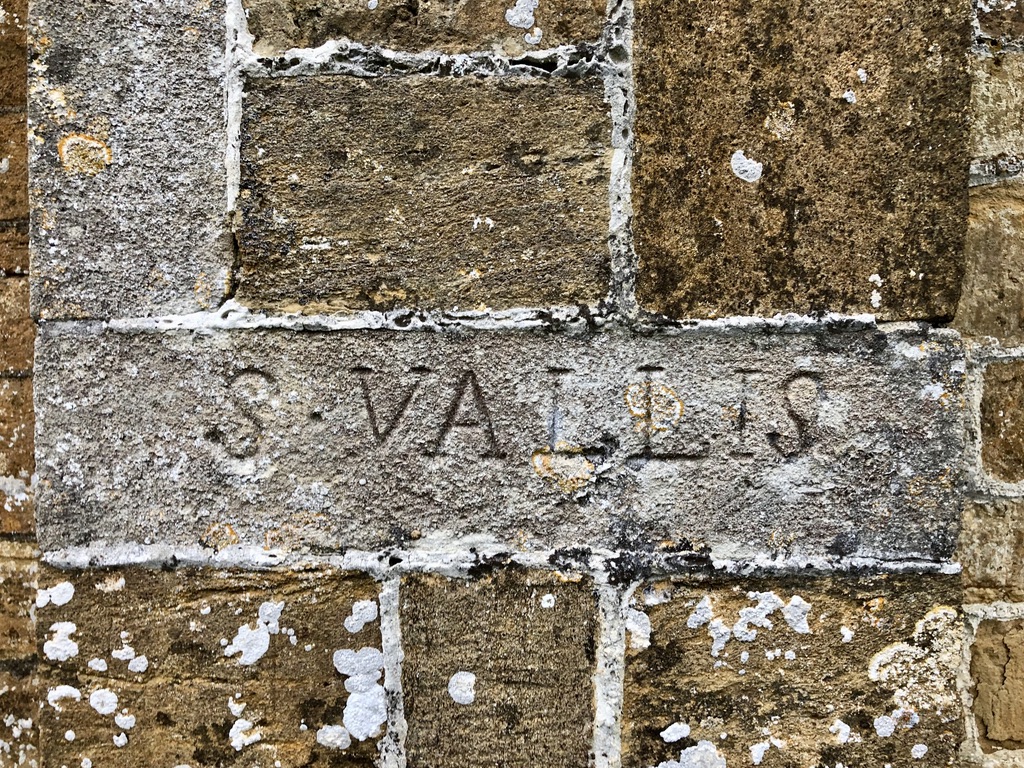
Holy Trinity has other features to note – graffiti including dates and initials; at least one Marian (witch) symbol; and a mystery inscription. Sutton Montis indicates a hill hamlet and is clearly marked on historical maps. However I can find no historical or cartographic reference to the ‘valley hamlet’ of Sutton Vallis. And yet…

GSS Categories: Scratch Dial; Old Dial

All photos: Keith Salvesen
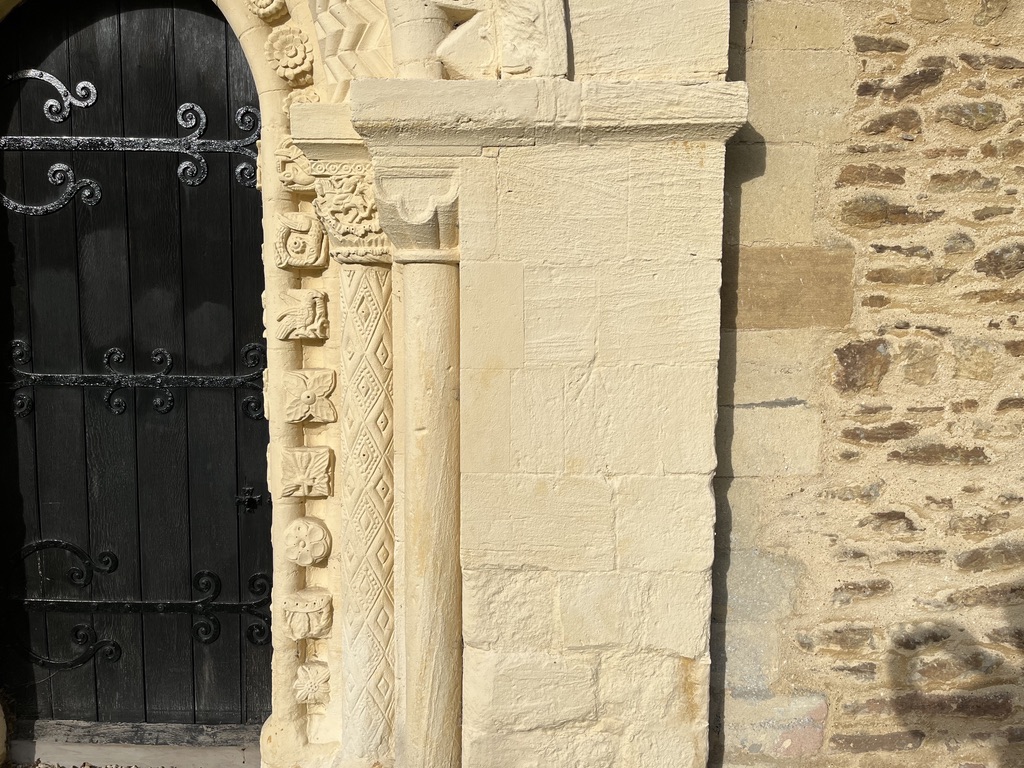
IFFLEY . OXFORD . ST MARY THE VIRGIN – 2 scratch dials

St Mary . Iffley . Oxford

IFFLEY . OXFORD . ST MARY

GRADE 1 † An exceptional Romanesque church built mid to late C12 (nave, tower, chancel) with later additions, restoration, and conservation. The Norman features dominate, especially the wonderful doorways. There’s too much history here (and in Iffley village) to distil: PEV should be the first stop, or BHO online Best of all, go there. SE. Oxford 51.7274 / -1.2382 / SP527034
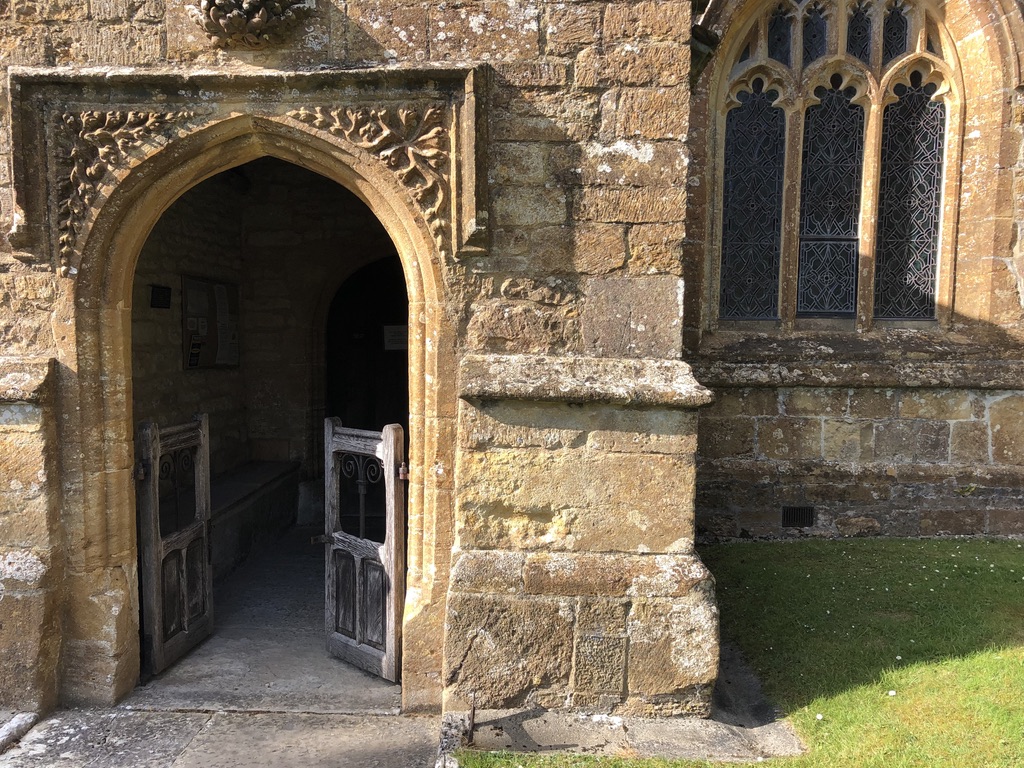
DIALS

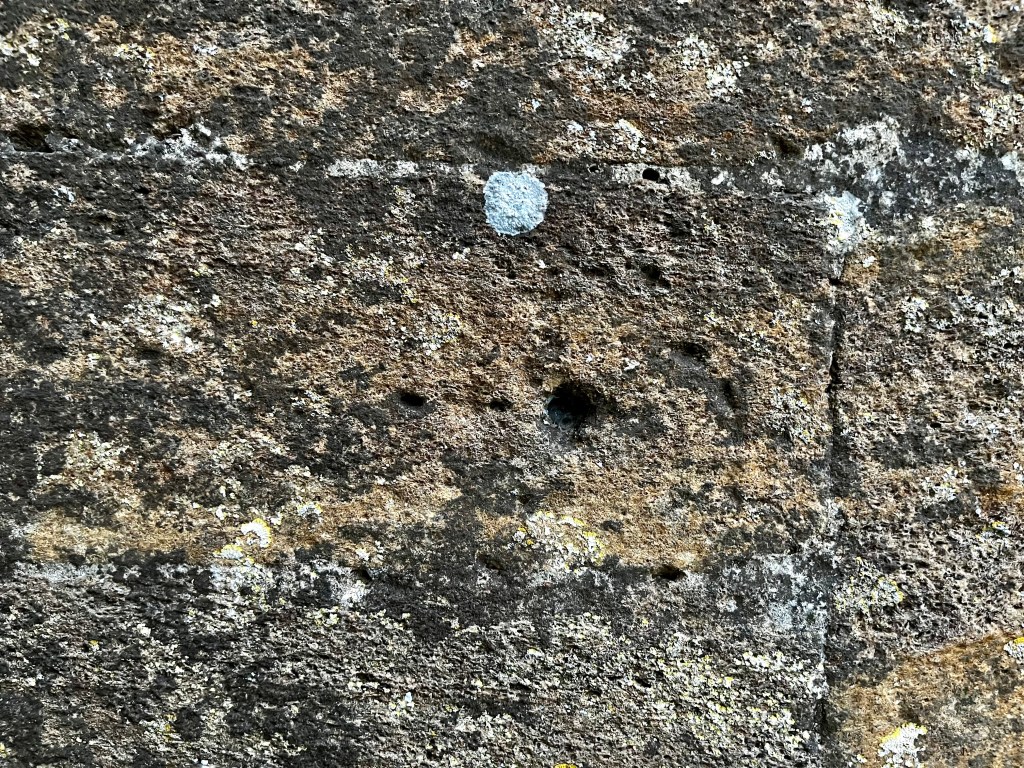
St Mary has two dials, one conventional, and one of a most unusual type that I haven’t met before. In relation to Dial 1, it’s worth mentioning that in 2017 conservation architects oversaw “a programme of conservative repair to the exuberant Romanesque masonry of the church’s west front and south door. This included the application by stone conservators of a pigmented limewash, helping to preserve the stone and improve the overall legibility of the facade”.

DIAL 1

St Mary . Iffley . Oxford – Scratch Dial 1

Dial 1 is on the right side of the lovely S. doorway. It has 4 straight radials, 3 with terminal pocks. The noon line may have a second pock above the end one; there are perhaps other dots. The style hole in the join of the stones creates the horizontal line. The careful preservation methods noted above have to an extent made the dial hard to analyse in greater detail. Fortunately BSS has an archive image that predates recent work. Much more detail is evident; for example the pocks are clearer (and there are more of them). It makes for an interesting comparison.

St Mary . Iffley . Oxford – Scratch Dial 1 (BSS archive)

DIAL 1 GALLERY

DIAL 2

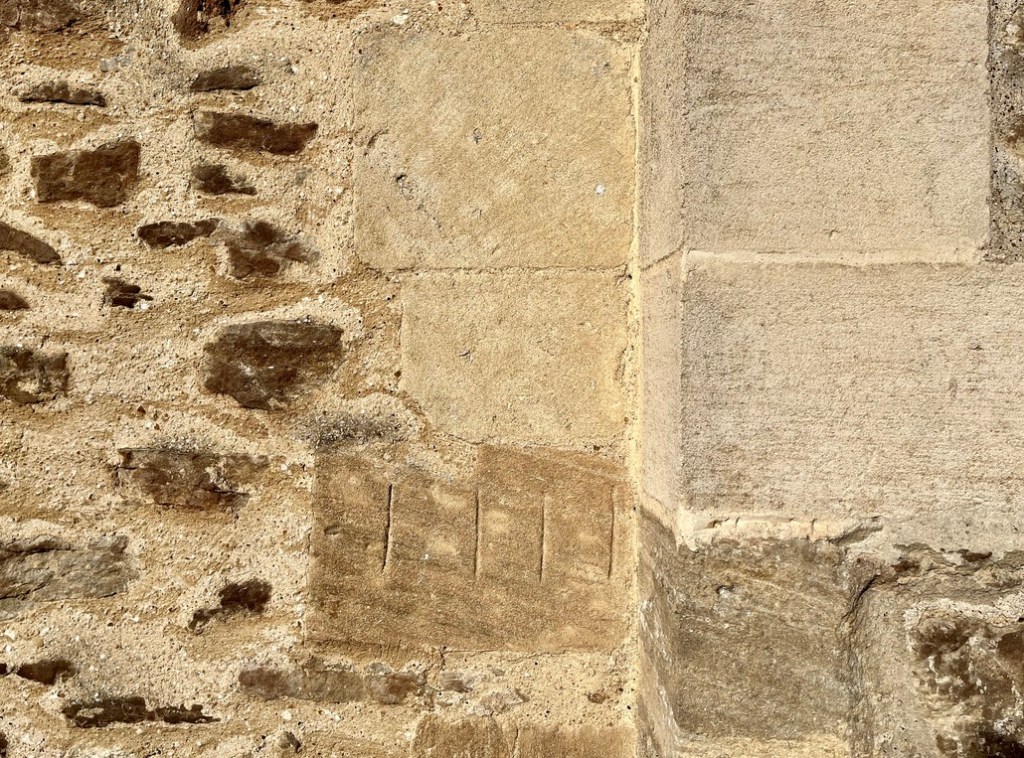
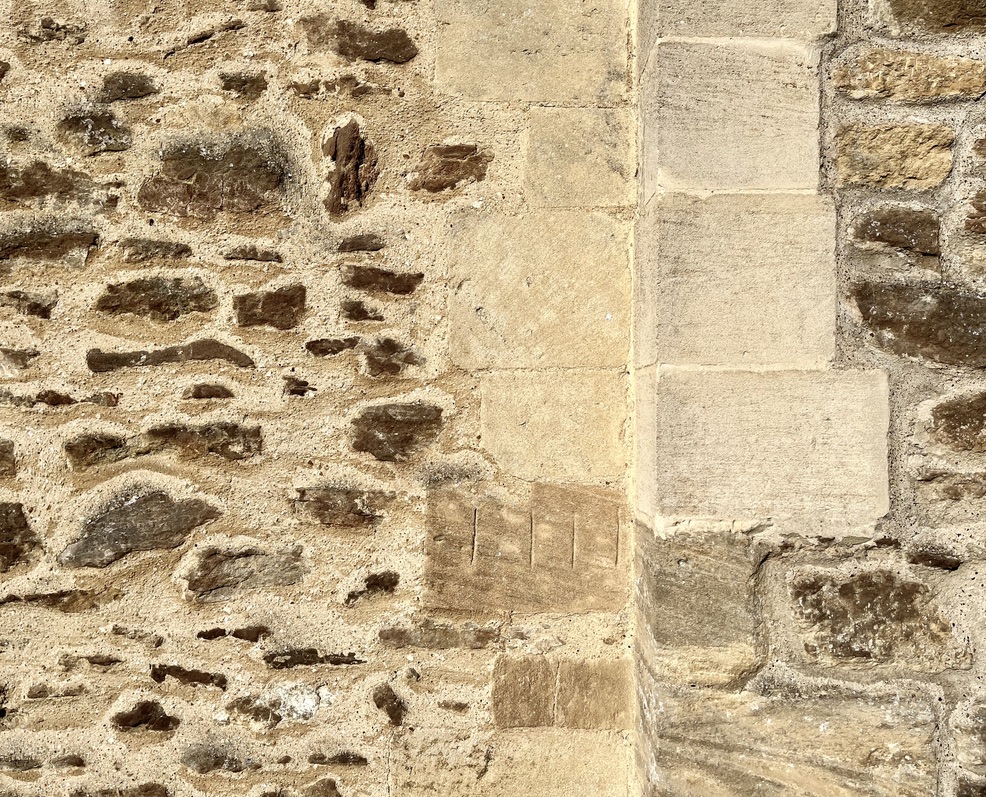
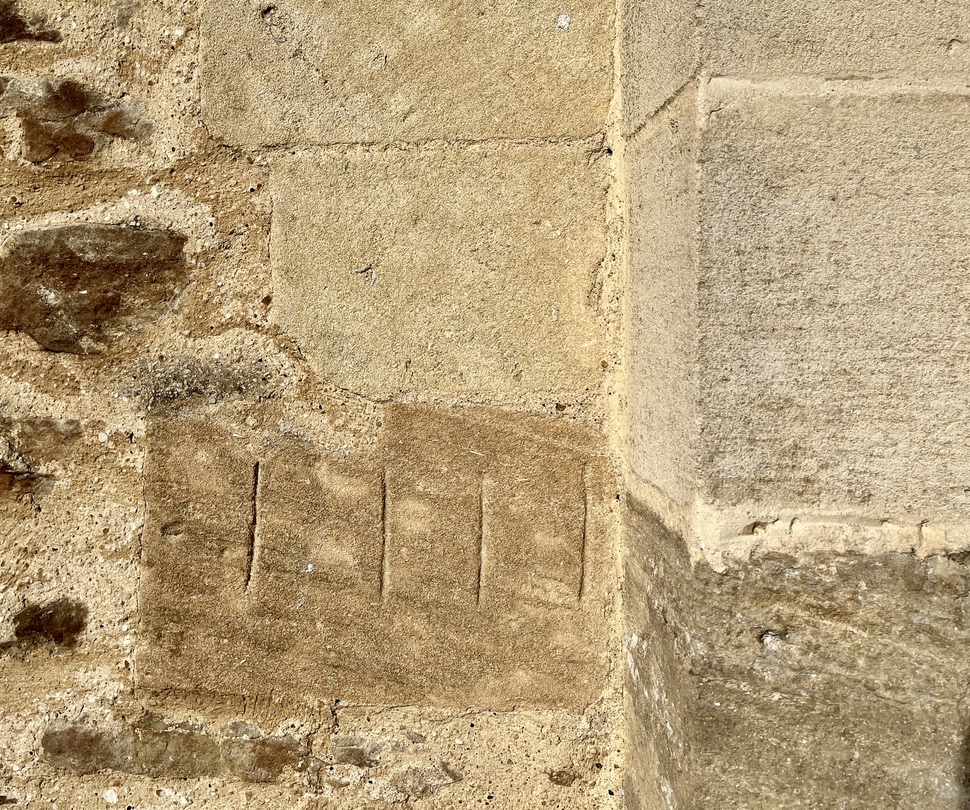
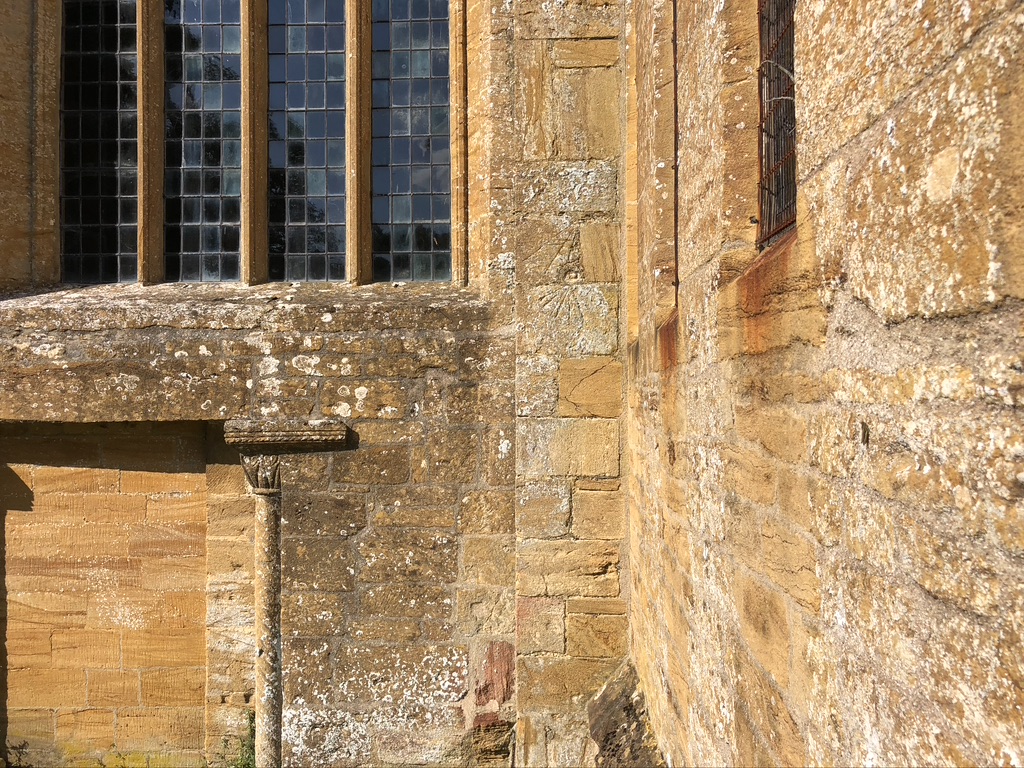
This highly unusual dial (if it is one at all) is on the S. side of the church, in the angle where the tower meets the nave. It consists of 4 incised parallel lines on a single stone. Just that. The passage of the day can be observed as the sun moves round, with the quoin acting as a vertical gnomon. The shadow cast moves gradually over the 4 lines from left to right, indicating the time of day. Its position suggests that it was primarily of use as a morning dial, perhaps signifying the Canonical hours for Mass. BSS records it as a ‘linear scale of markings from the wall shadow’.

St Mary . Iffley . Oxford – Scratch Dial 2

The photos below give an idea of how the dial works in practice. I visited on a sunny day, but unfortunately at the wrong time of day to test the shadow theory. This dial is yet another that I need to revisit to understand it.

GSS Category: Scratch Dial

All photos: Keith Salvesen