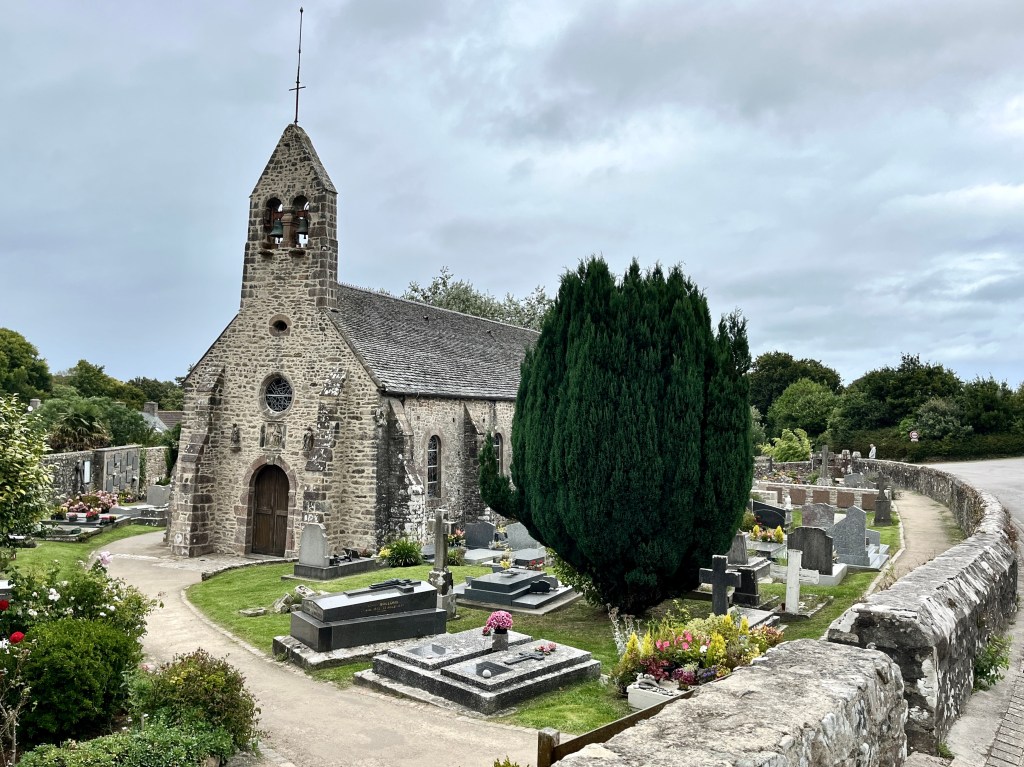
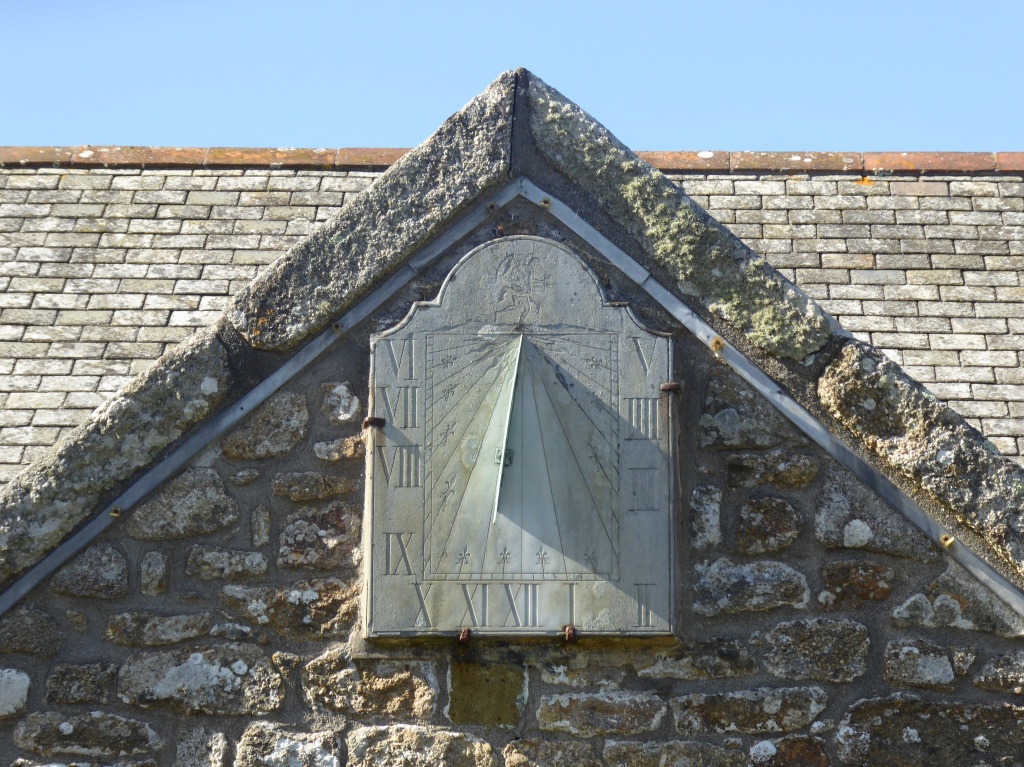
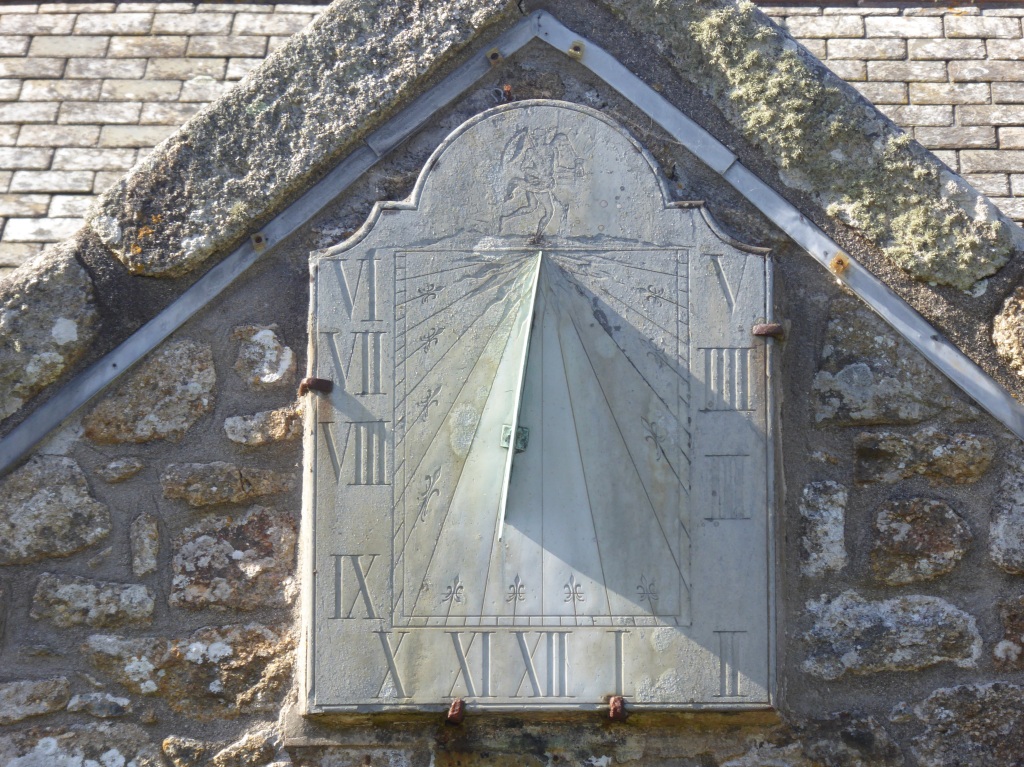
An attractive vertical dial, accurately angled, with Arabic numerals. Semi-circle perimeter and round top gnomon stay. There’s a slight jeux d’ésprit feel to the gnomon. There was no sun on the dial when we visited: I wondered how well it would work in practice.
GSS Category: Vertical Dial; Church Sundial France; Ornamental Gnomon
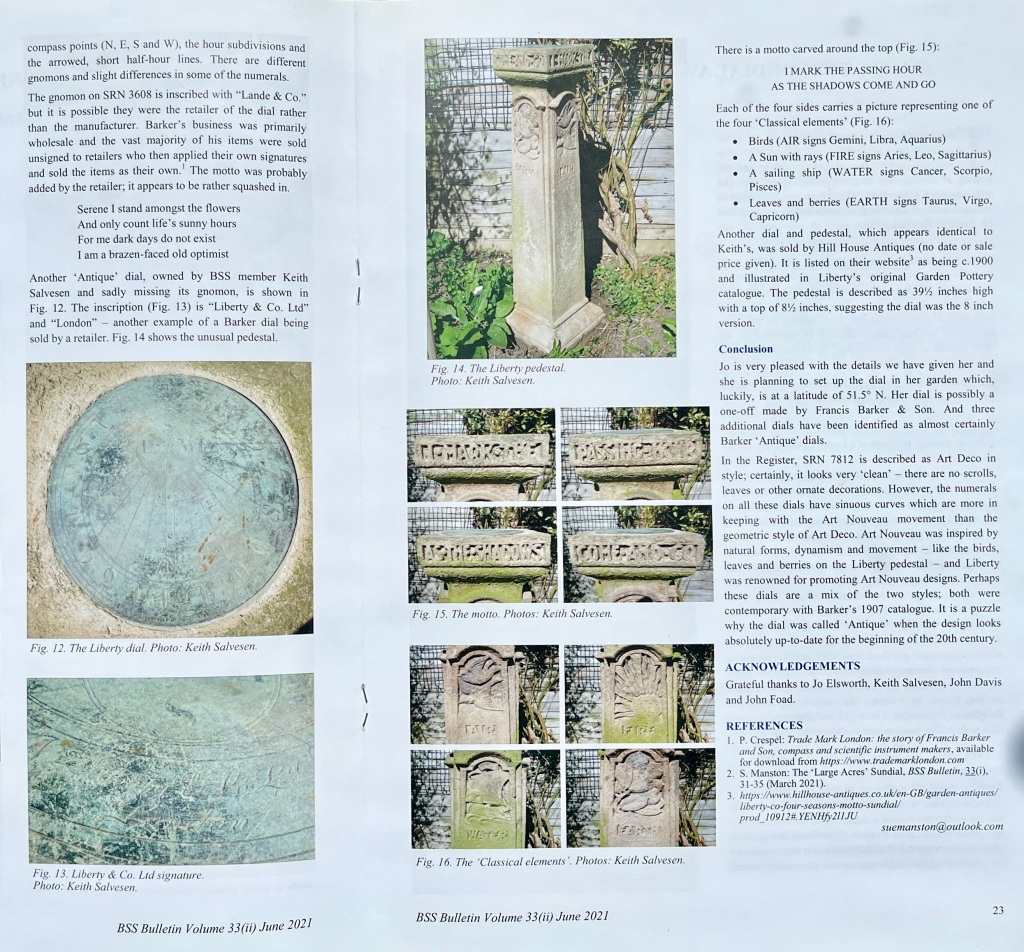
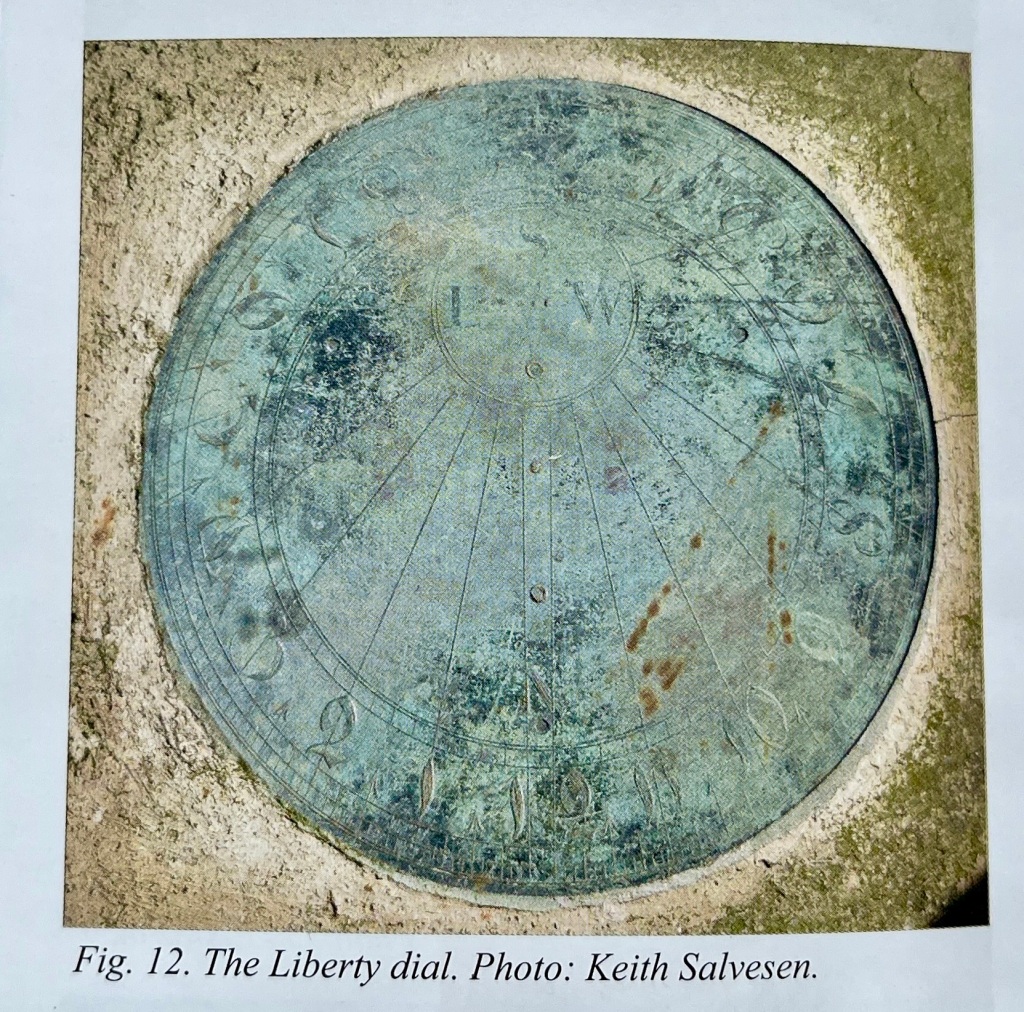
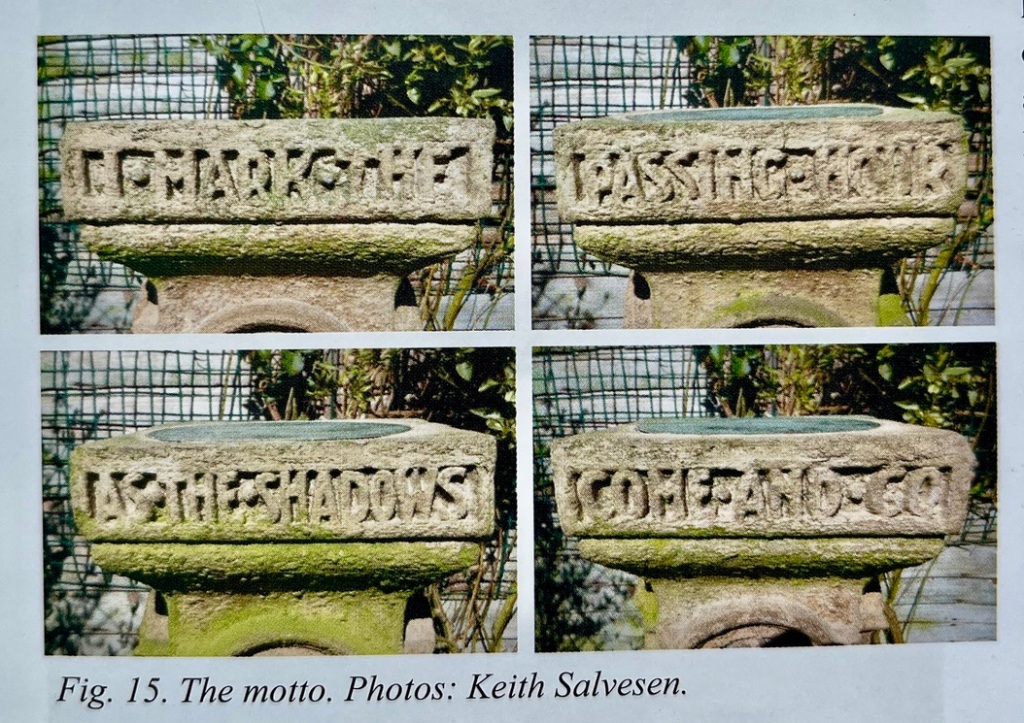
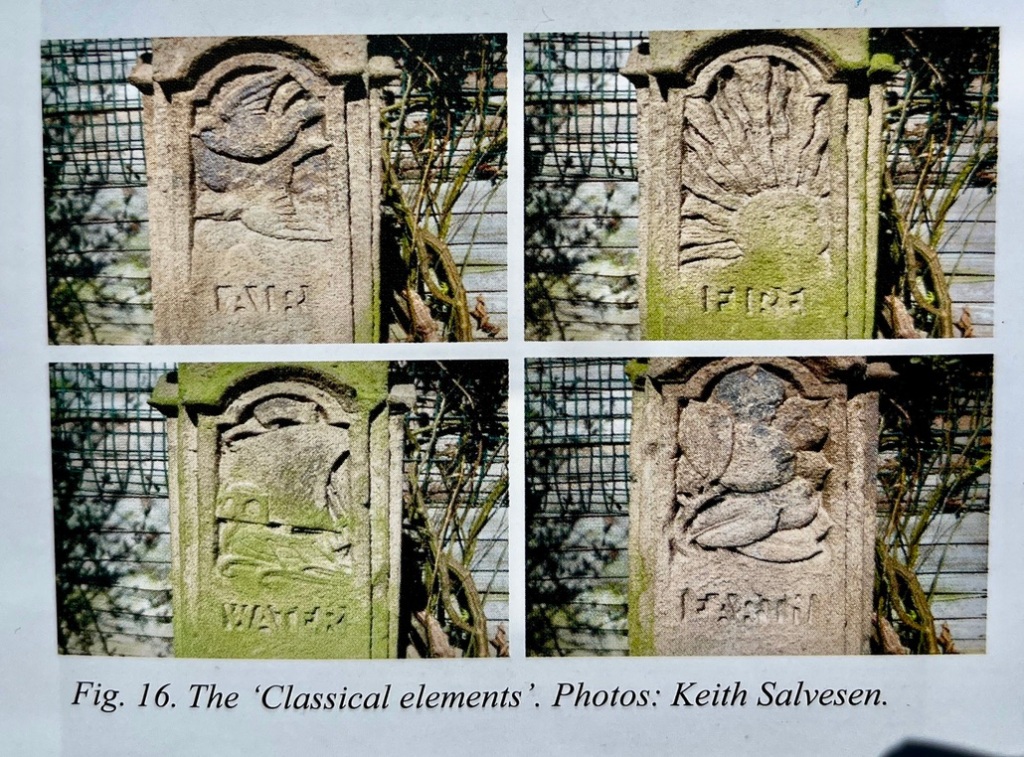
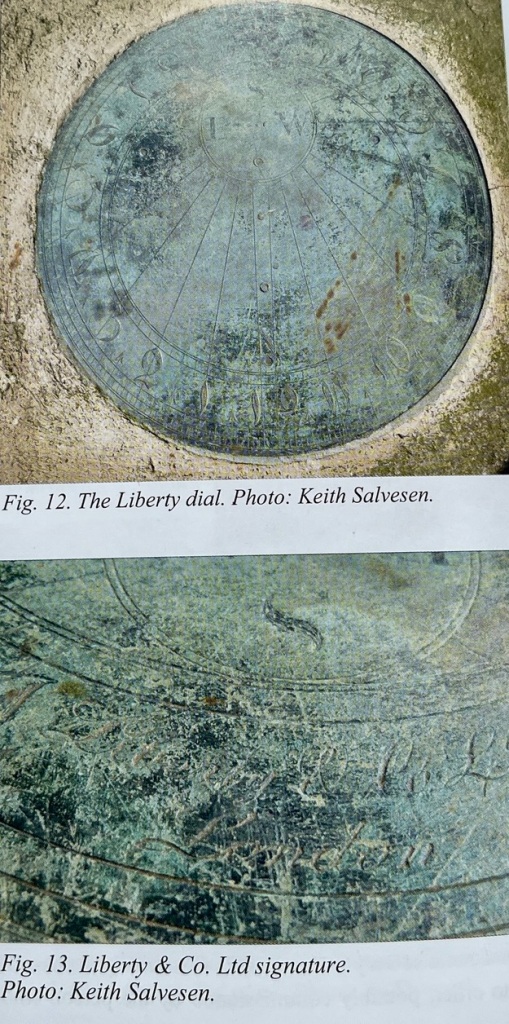
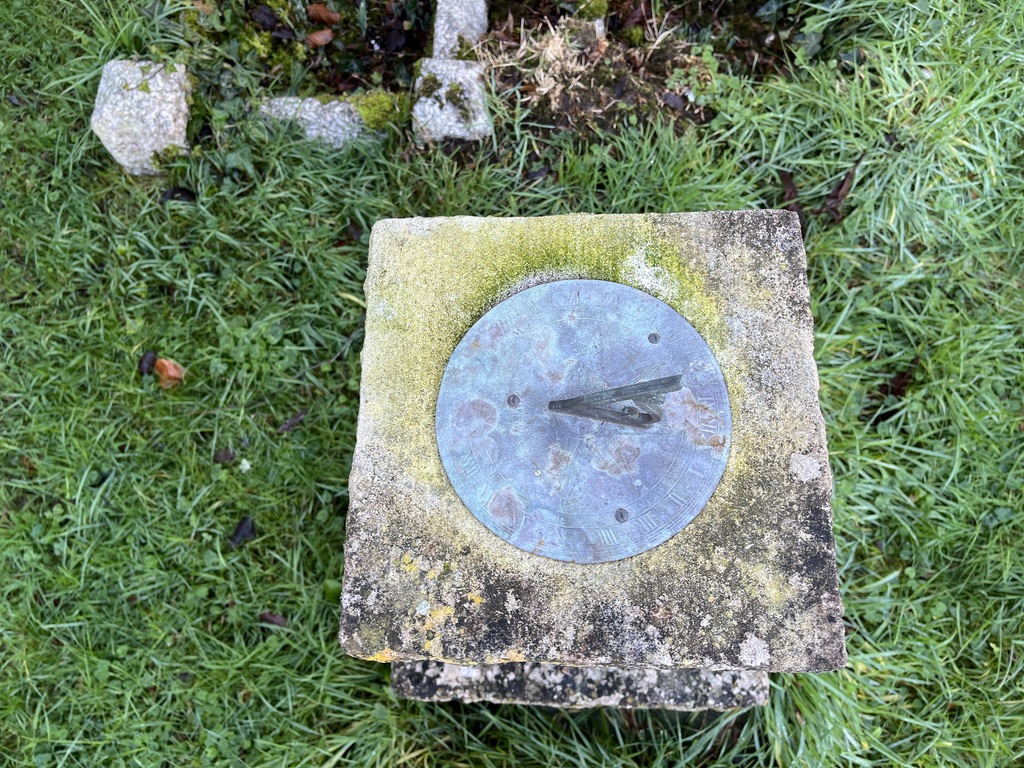
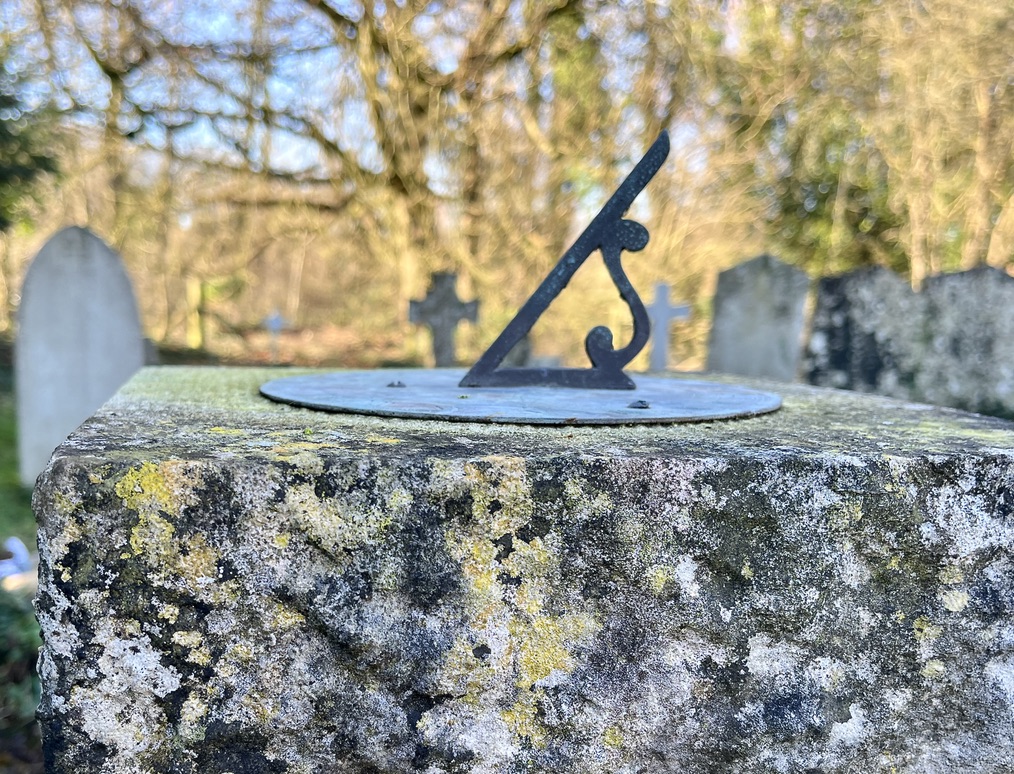
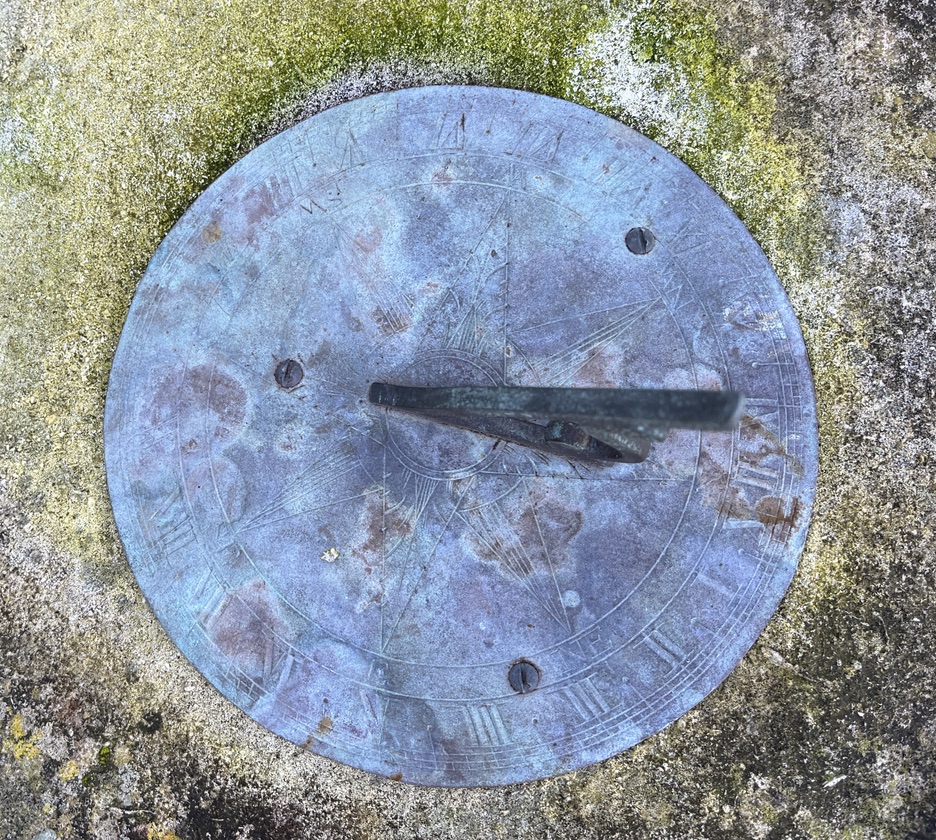
FRANCIS BARKER DIAL with LIBERTY ART NOUVEAU PEDESTAL
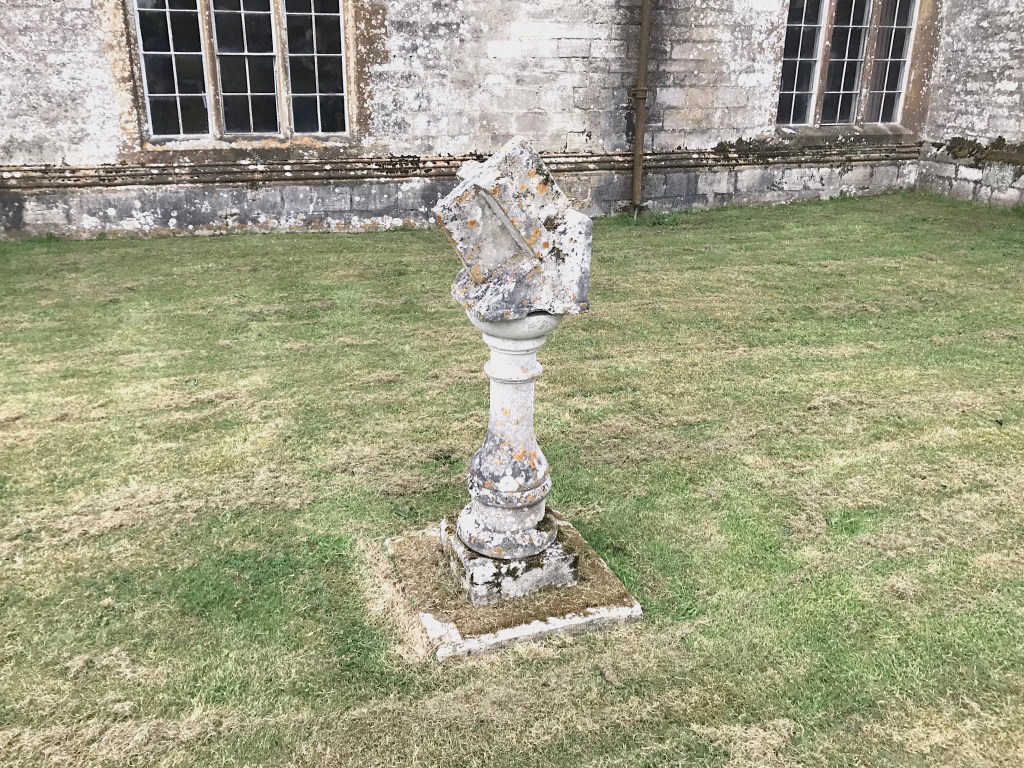
This is a gnomon-less sundial that I dug out of a pigsty at my home. I was about 10. The sty had layers of compacted earth and garden material that almost reached the top, the legacy of the previous owners. I had always wondered whether there might be hidden treasure, and eventually my curiosity got the better of me.
I gradually dug down until, suddenly, my spade hit something with a loud clonk. It took a while but eventually I was able to prise out… a prize. It has lived on as a garden ornament / flower pedestal for many years, with 4 changes of address. Eventually it has settled in Dorset.
Later – by then a BSS member – I sought advice about my dial. In due course Sue Manston included the dial in an detailed article by Jo Elsworth in the BSS Bulletin 118. Volume 33(ii) – June 2021
The author Jo Elsworth notes that similar dials have been described as ‘Antique’ and Art Deco. For the reasons she gives, the classification as Art Nouveau is the most approriate,
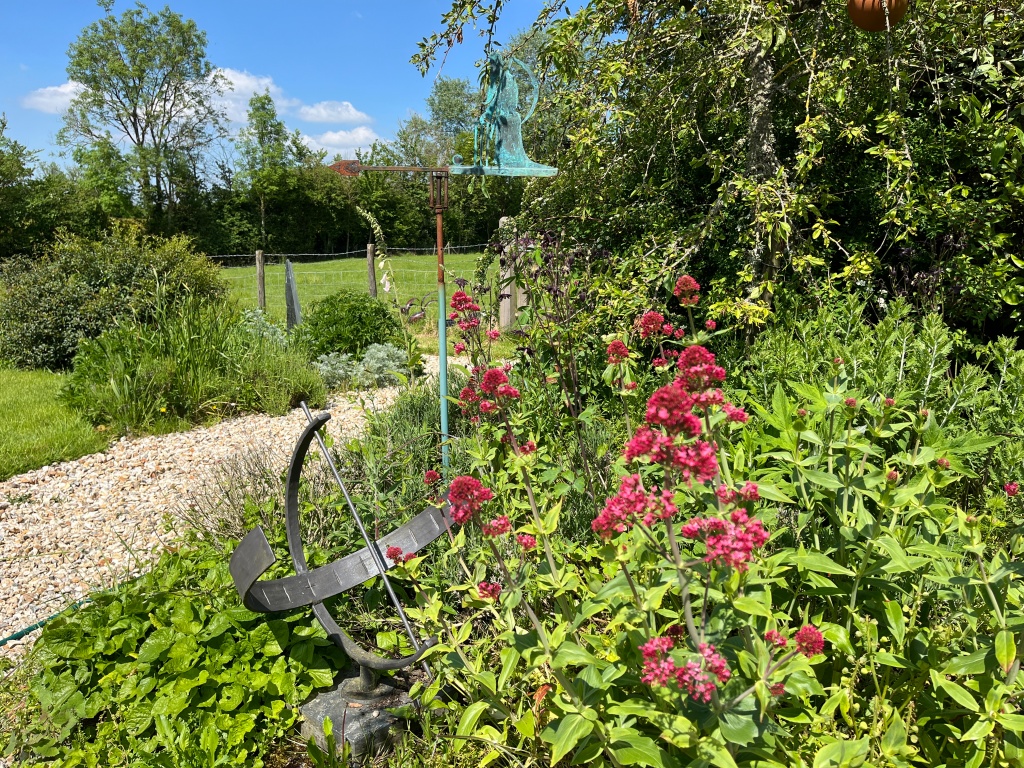
Also in the garden: a modern armillary sphere, watched over by Father Time
GSS Category: Horizontal Dial; Barker Sundial Plate; Liberty Sundial Pedestal; Art Nouveau Sundial.
All photos: Keith Salvesen; BSS article – Sue Manston, with thanks
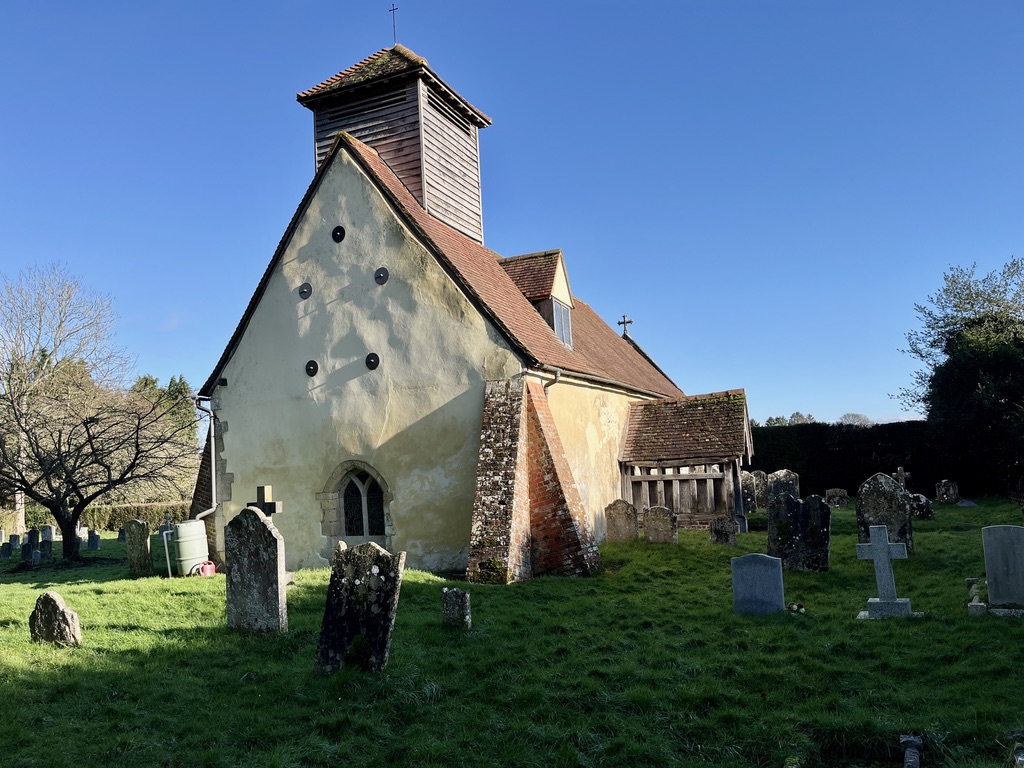
St Andrew is a fine church, and fully lives up to the interest its appearance suggests. Before looking closely at and inside the church for dials and apotropaic marks, I walked over to the sundial in the churchyard.
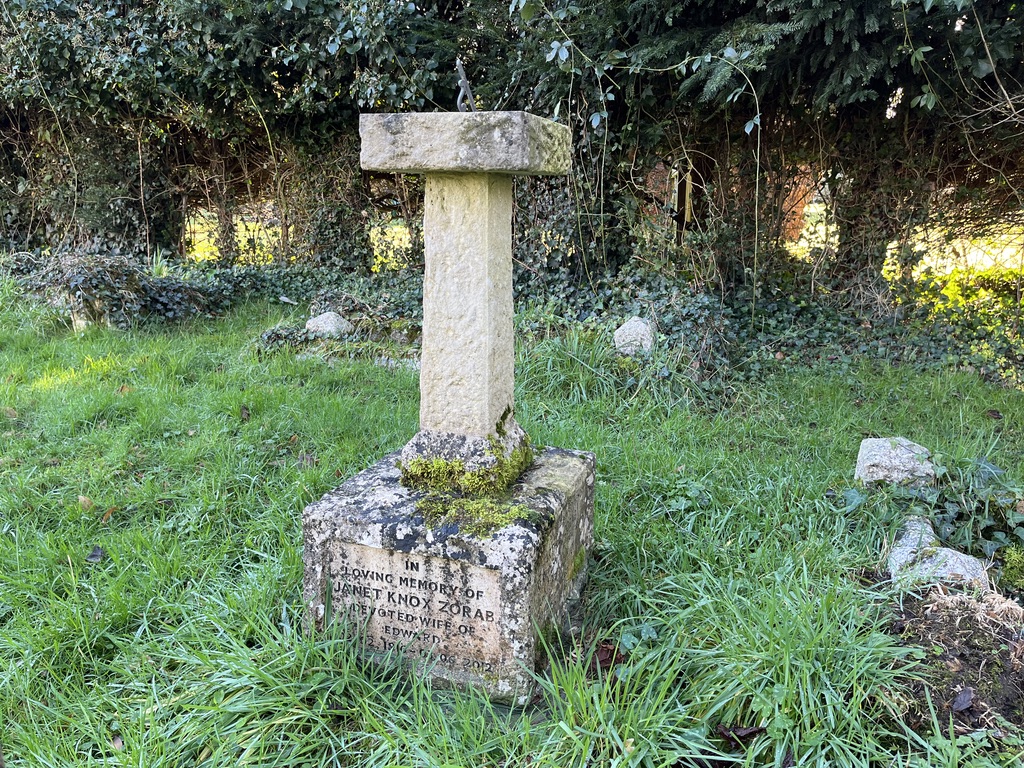
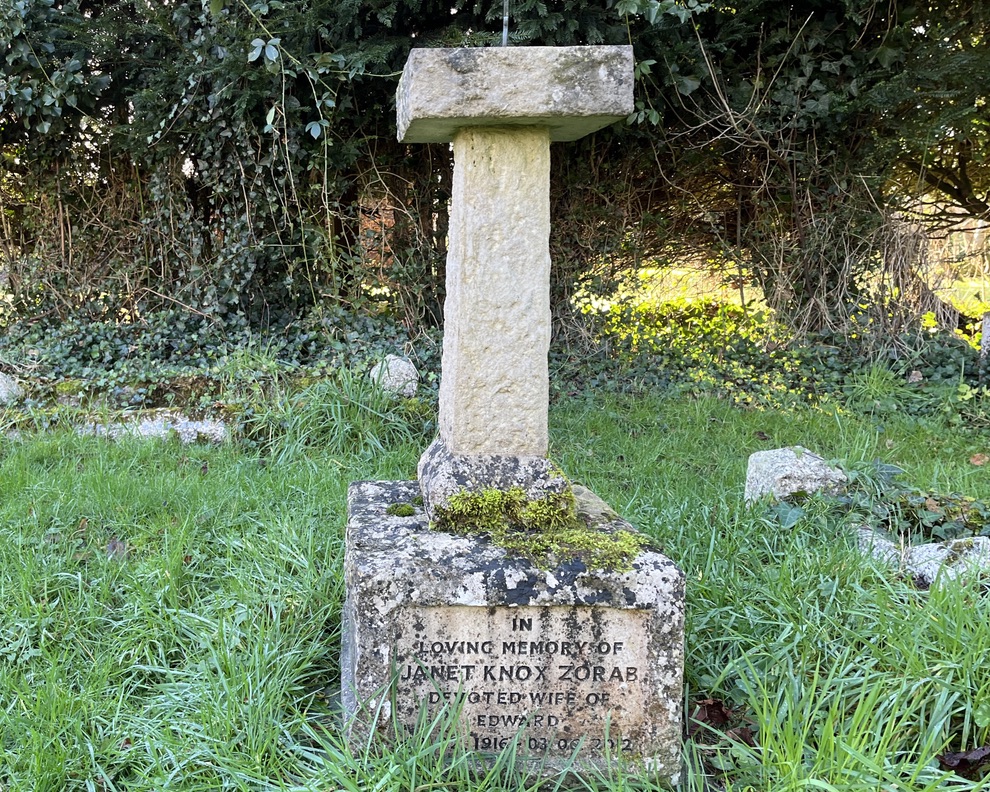
It proved to be a simple and quite elegant Memorial sundial for Janet Knox Zorab who lived to be nearly 100.
The dial plate and gnomon are conventional. The rustic feel to the churchyard and the closeness to a rather special church provide a peaceful setting for a memorial.
GSS Category: Horizontal Sundial; Pedestal Sundial; Memorial Sundial
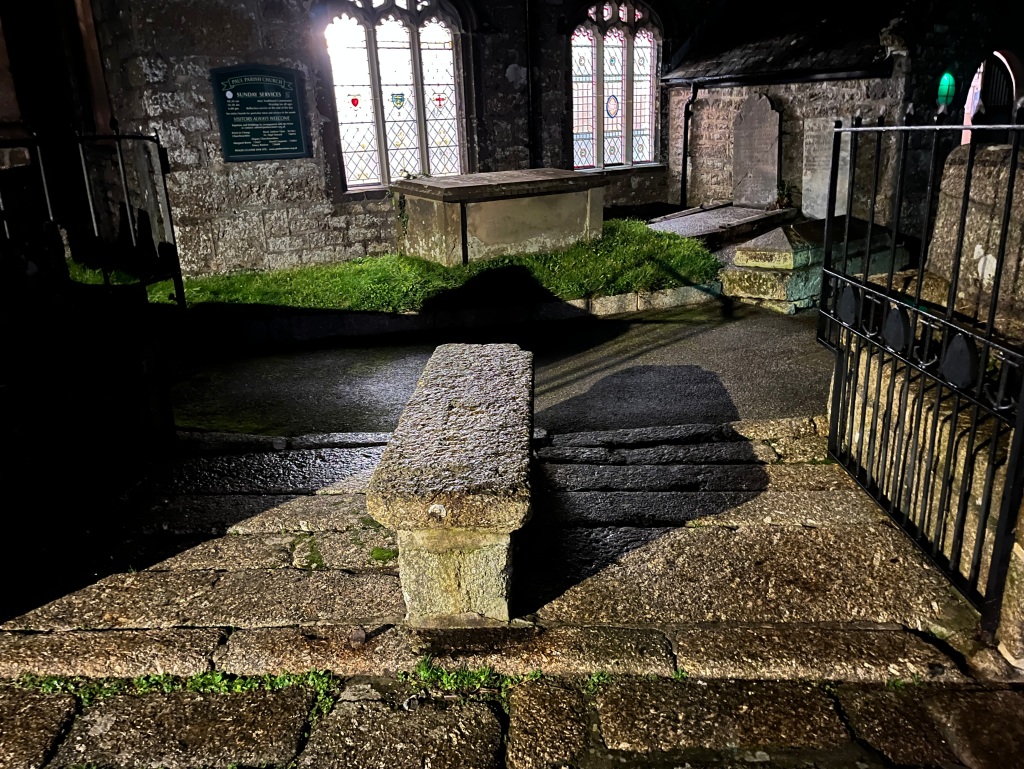
GRADE I ✣ C15; enlarged 1600; Restoration 1875. A most interesting church set on the hill above the famous small fishing village of Mousehole. St Pol has much to offer, not least a memorial to Dolly Pentreath, supposed last monoglot Cornish speaker; and a fine example of a coffin stone in the lychgate. The village churchyard has a small maze with a wonderful view LINK. Congenial pub. 50.0896 / -5.5461 / SW464270
DIAL
BSS notes that the engraving is excellent and remains clear to this day. The half hour lines each have a fleur de lys and all the lines originate from the sun’s rays around the gnomon root. Caroline Martin’s delightful small book on Cornish Sundials notes the interesting and unusual gnomon. To which one adds that the gnomon points to XI rather than noon.
MRS CROWLEY
One benefit from a recent visit to the Penzance area was to make the acquaintance of Mrs Crowley and her remarkable sketch books of the dials of Devon and Cornwall. Her progress around both counties in the 1950s produced dozens of beautifully produced drawings of dials. The details are so closely observed and the drawings so clear that it is difficult to imagine how she managed the task.
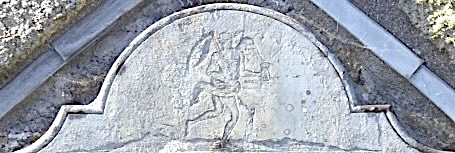
On this page, Mrs Crowley – who usually drew compete dials – has focussed on 3 dials with similar designs on the ogee tops above the gnomon. I think it probable that she chose not to make drawings of the complete dials because she was so taken with the similar depictions of Old Father Time with his scythe and hourglass. All 3 churches are within 10 miles of each other.
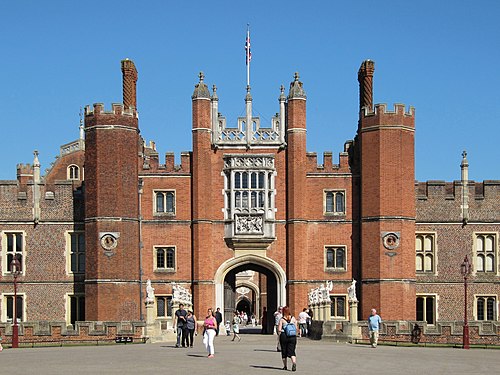
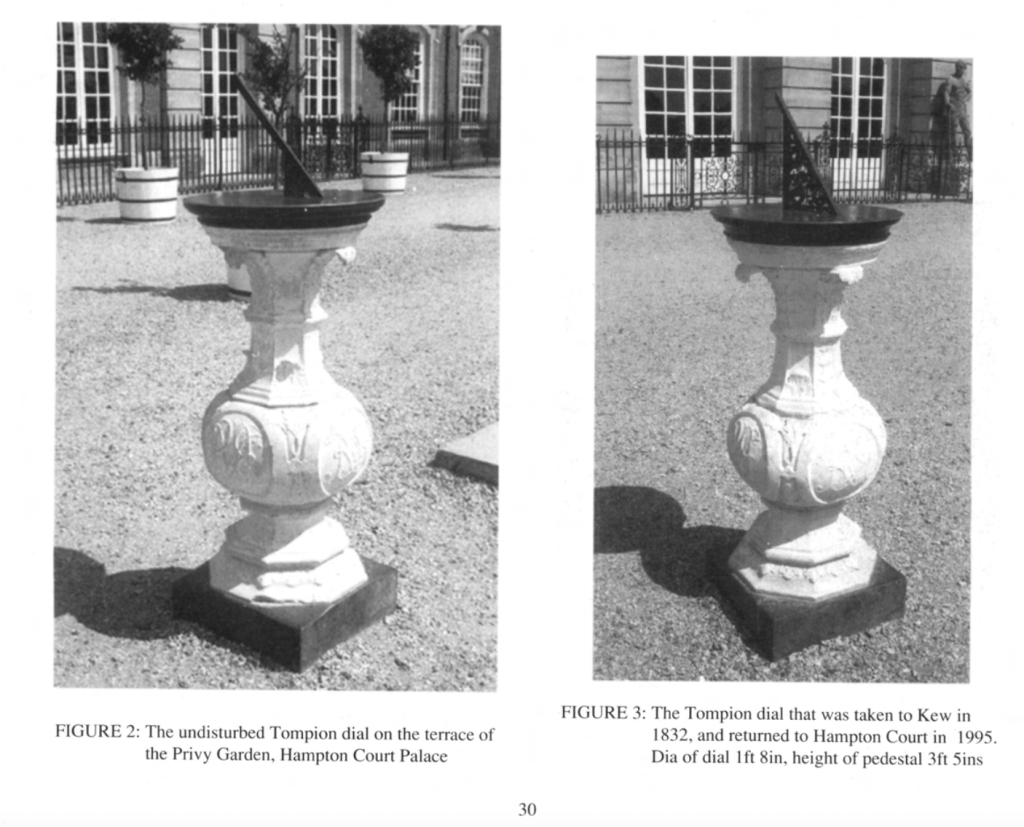
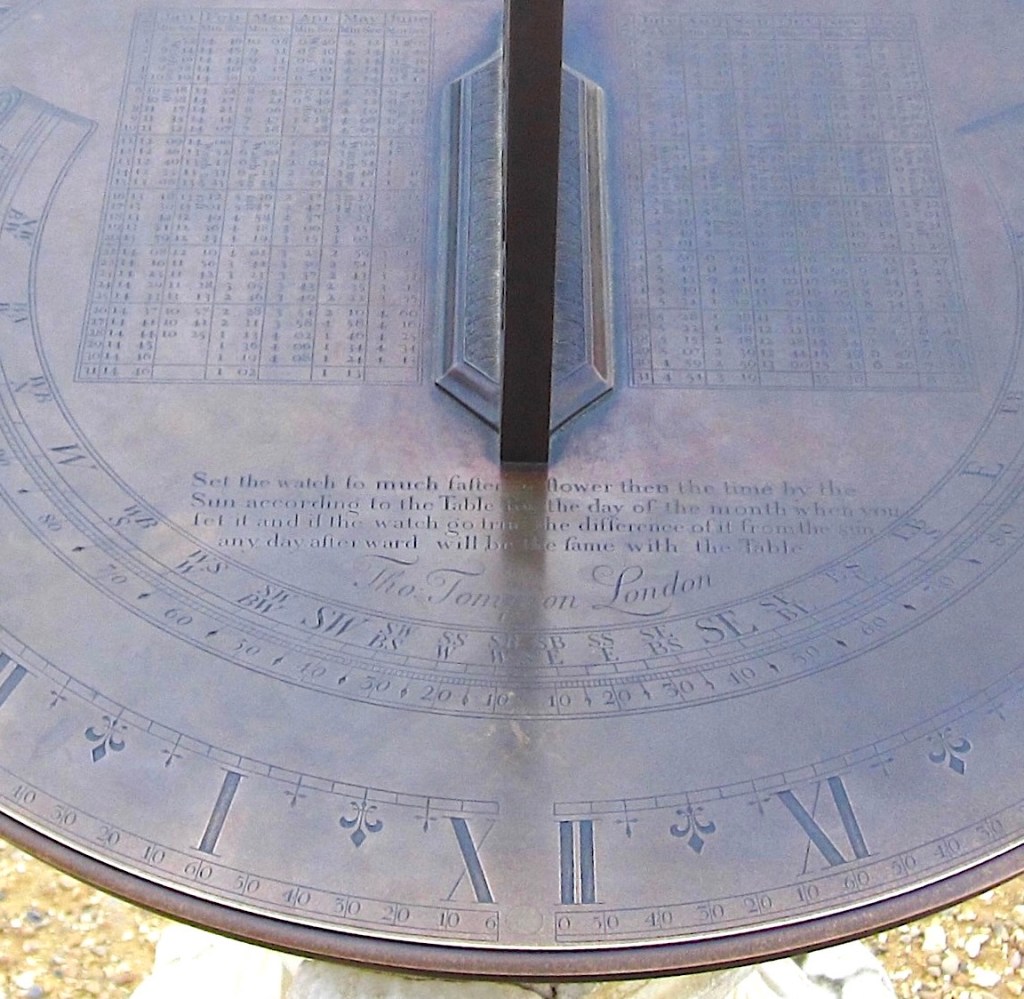
This famous Tompion dial in the Privy Garden at Hampton Court is one of a pair, the other being transferred in due course to Kew Gardens. The BSS Bulletin Jan 1997 includes side-by-side photos of both. The dial that stayed in situ, featured here, being on the left. The other dial was transferred to Kew in 1832 and not restored to Hampton Court until 1995.
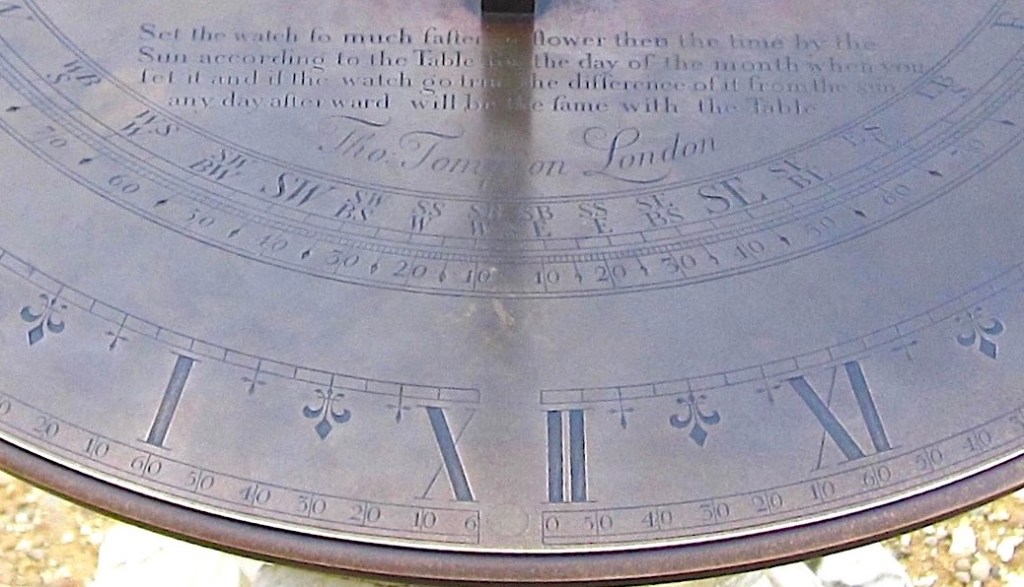
I took these photos in 2011 when I was dialling-lite, and probably with an iPhone 3. Revisiting these images, I’m pleased at what a good job it did. Puzzlingly, during a quick trawl through the usual resources, inc. the Royal Collection, I have found it difficult to find any detailed images of this dial, though I found a RC image of dial 2.
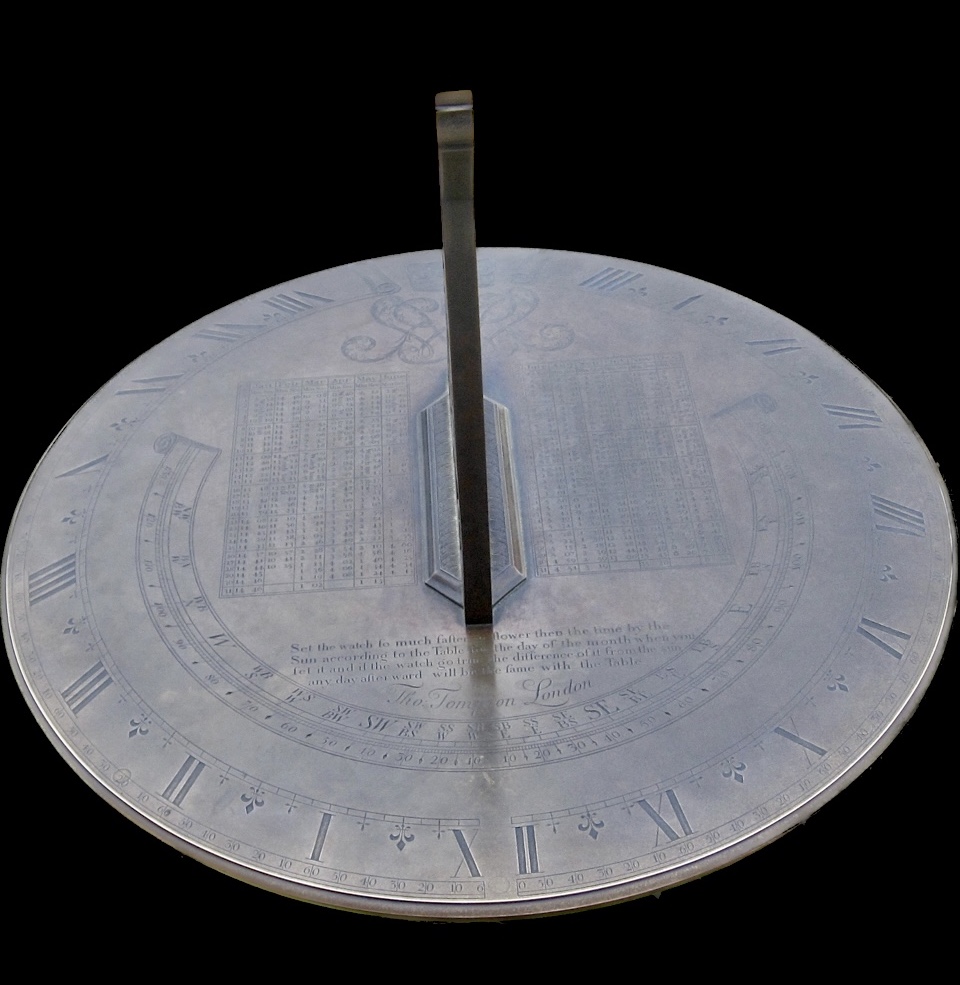
Only the front of the plate is clear, and it is in remarkable good condition. There is just enough definition to give a good idea of the complexity of the calendar further back on the plate.
The precise date for the two dials in unclear. Tompion was baptised in 1639 and died in 1713. I have seen ‘towards the end of C17’; and the excellent Border Sundials points to evidence of installation in 1699.
Probably, in a sundial resource, it is permissible to include an occasional linked item, and the wonderful Hampton Court astronomical clock merits admiration at any time. I was pleased to get a straight-on shot without resorting to trickery (of which there was not much available in 2011).
St Anne . Ancroft . Northumberland – James Towill Geo cc
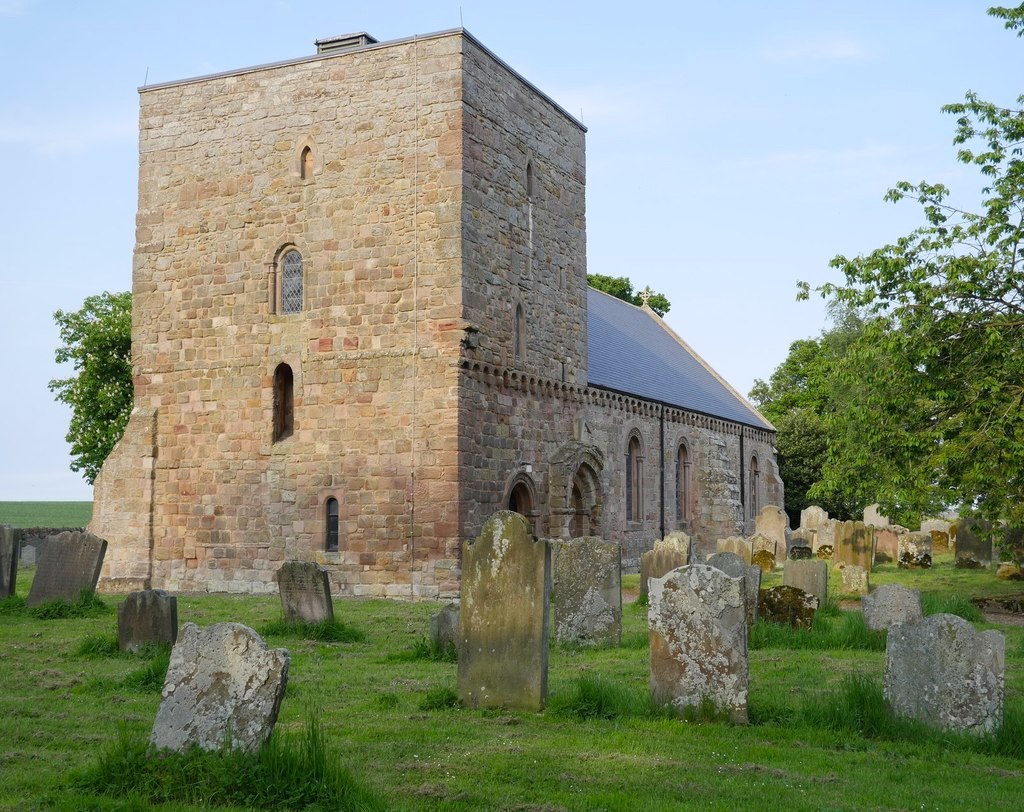
GRADE II* † C11th-century, built by monks of Holy Island as a chapel of ease. C13 / C14 pele tower added as protection from incursions by Scots. C19 restorations. At some time (? when the tower was built) the fine Norman entrance was blocked. Extensive views from the tower’s parapet. 3m S of Berwick-upon-Tweed. 55.7001 / -1.998 / NU002451
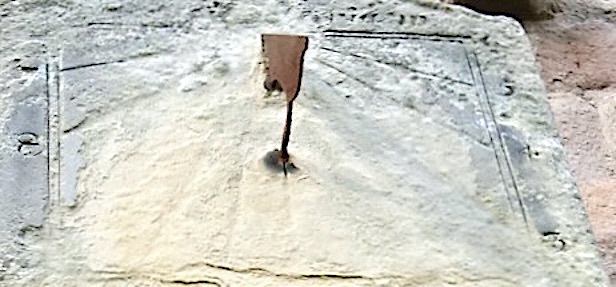
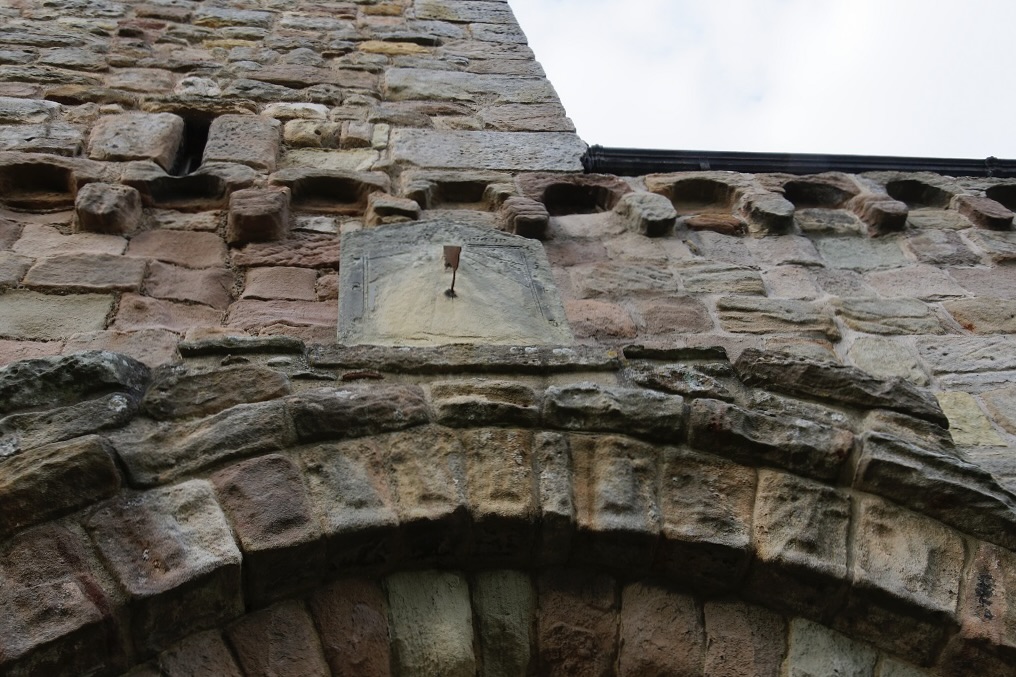
A weathered C18 vertical dial with a short gnomon that casts a very visible shadow. The shape of the dial stone, with its pedimented square, is very pleasing. The lines are enclosed in a frame, with Arabic numerals from 6 to 6 around its edge. The use of Arabic numerals rather than Roman suggests a later dial of this period. 9 lines are detectable, some only just. Only 6 numerals are clear. I can’t make any sense of the remains of the inscription. I wondered if some of the sandstone – especially LLQ – is repair or natural deterioration. Expanding this very good photograph, I think the latter: the dial is showing the signs of its age.
St Anne . Ancroft . Northumberland – Walter Baxter Geo cc
GSS Category: Vertical Dial; Old Dial; Gnomon Design
Credits: Erika Clarkson for introducing me to this church and for her photos that begat this post, so to speak; James Towill for his photo of St Anne’s uploaded to Geograph cc; Walter Baxter for his excellent close-up of the dial uploaded to Geograph cc and for his specific use permission to reproduce it full-size
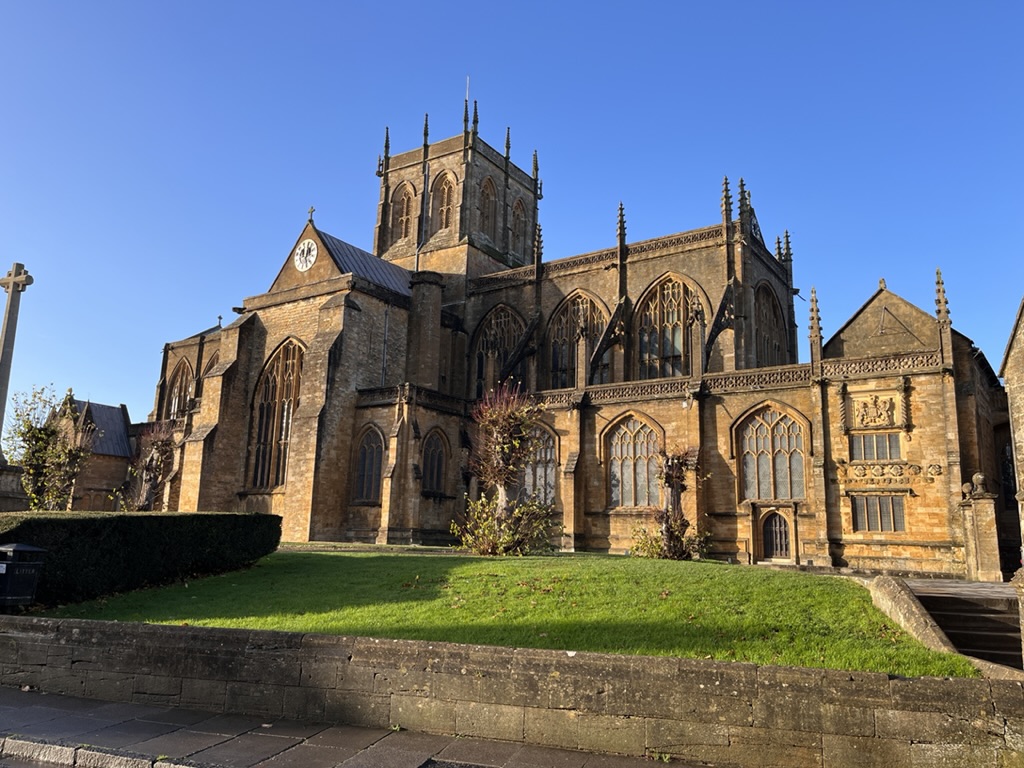
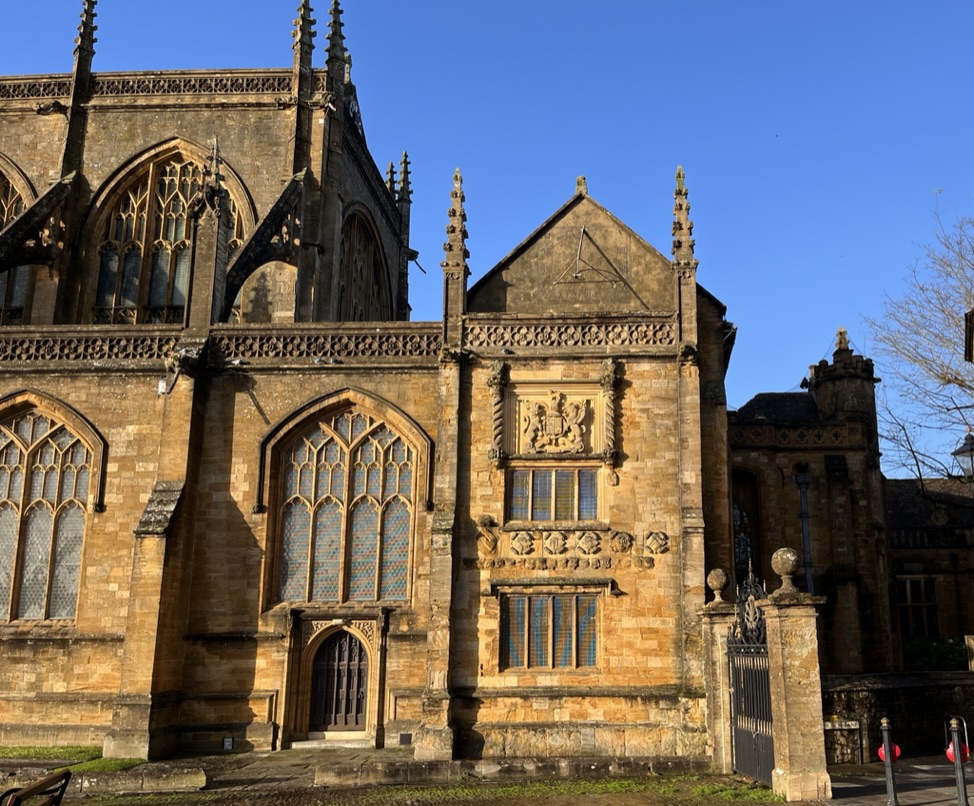
GRADE I † Founded by St. Aldhelm in AD 705 as a Saxon Cathedral, Sherborne Abbey became a Benedictine monastery, and following the Dissolution of the monasteries, a Parish Church of some splendour. Of all the architectural features, the astonishing [earliest majorPEV] fan vaulting is arguably the finest. This is not the place for discussion of the merits of the church. The Wiki entry is a helpful source for an overview of SHERBORNE ABBEY
St Mary the Virgin . Sherborne Abbey . Dorset
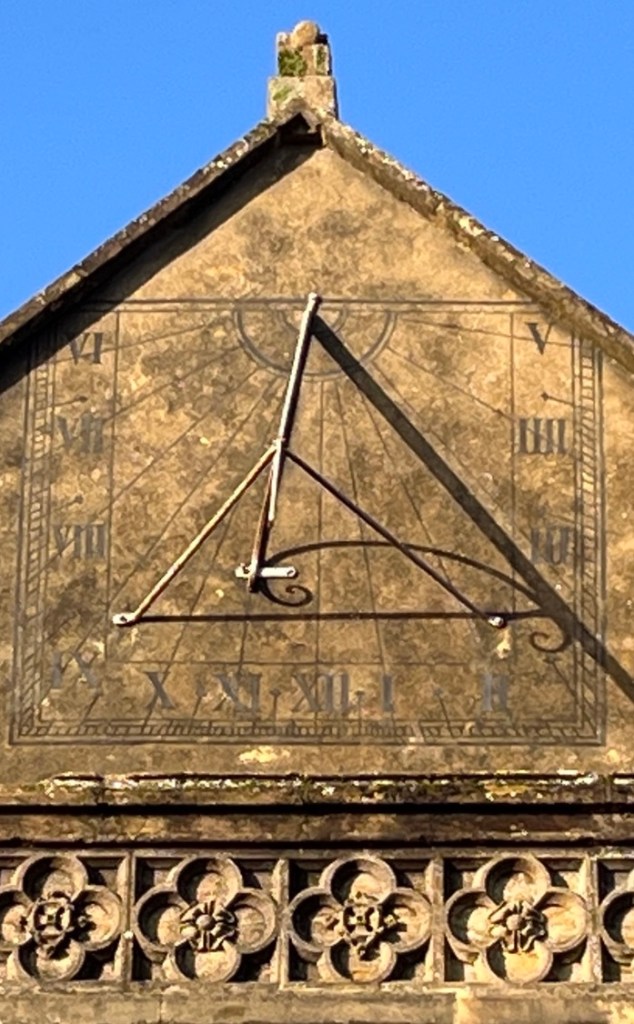
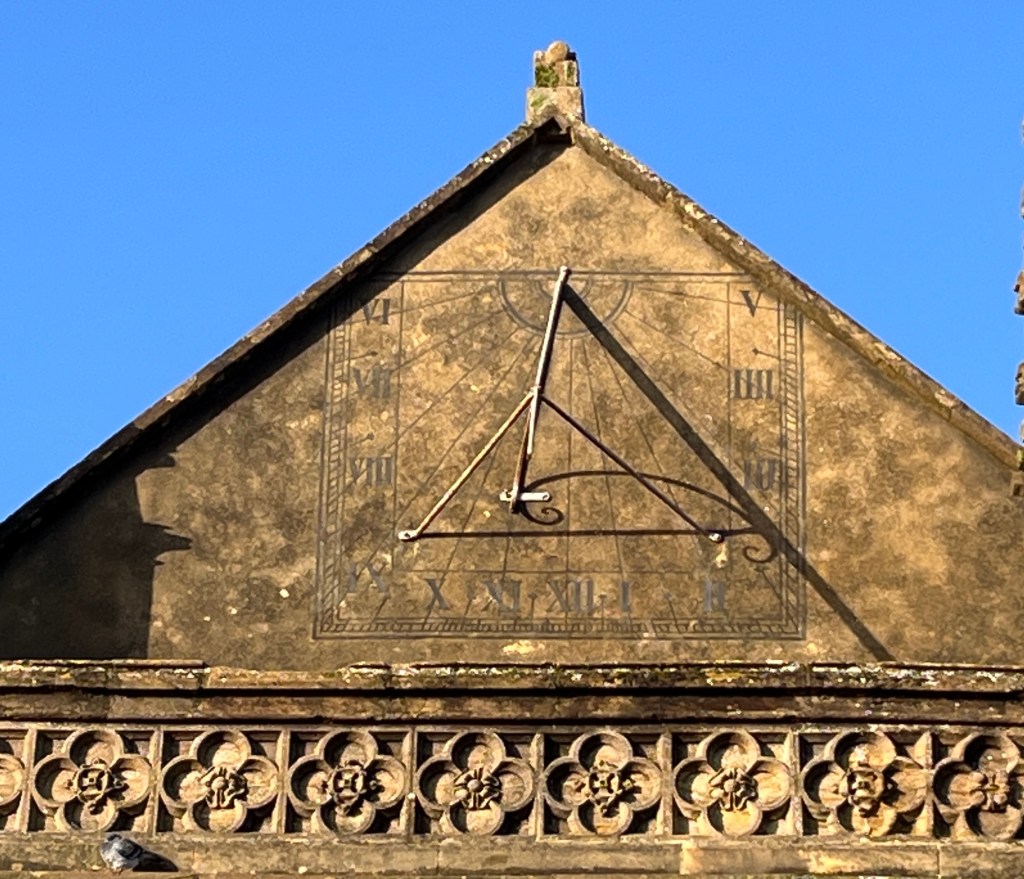
The large Vertical dial at the E end is impressive and visible from some distance. The Old Shirburnian Society records:
The south-facing vertical dial on the south-east end of Sherborne Abbey was erected in 1745 by Sherborne School at a cost of £5.5s.0d. It was built by the Sherborne architect Benjamin Bastard (1690-1776), son of Thomas Bastard of Blandford Forum.
The modern gnomon is effective and casts an attractive shadow; it could be argued that its style and fixings do not quite do justice to a C18 dial.
St Mary the Virgin . Sherborne Abbey . Dorset – Vertical Sundial
The gallery above might suggest overuse of saturation, but the photos – at various distances to show other features – were taken on an iPhone on a bright sunny early winter’s morning, and are un-enhanced (not always the case, I must admit). We were fortunate enough to be married in this glorious building.
Broughton Grange dates from early C17. Gradual development resulted in a fine house with an extensive estate owned by the Morrell family and associated with the Bloomsbury Group via Lady Ottoline. The whole estate was bought in the 1990s. New gardens have been beautifully landscaped and an arboretum created. The property is renowned as one of the finest contemporary private gardens, to which there is public access. You can find out more here: BROUGHTON GRANGE 3m SW of Banbury 52.0415 / 1.3776 / SP4338
The dial stands at the centre of the Parterre and Rose Garden, overlooking the smart box hedges. It is dated MDCCLI (1751). I’ve spent some time trying to figure out the inscription, some of which cannot be read even with a magnifying glass. I have settled (provisionally) on Tempora Servio, ‘I Serve the Times’ or a similar conjunction of tempus and servere. This formulation does not specifically appear in eg the expanded edition of Gatty; however tempora is in common usage, often with its companion, mores. Any other suggestions welcome, a definitive ruling would be ideal.
GRADE I † Late C13; C15 enlargement and alterations. Tower c1730 with a plaque over the doorway: This Steeple was Built The Bells set in Order and Fixt. At the Charge of Robert Thinge Gent. Lately Deceased A.D. 1731-1732. Dial undated. 8m NE of Ipswich. 52.1133 / 1.2459 / TM223510
St Mary . Grundisburgh . Suffolk – Vertical Dial
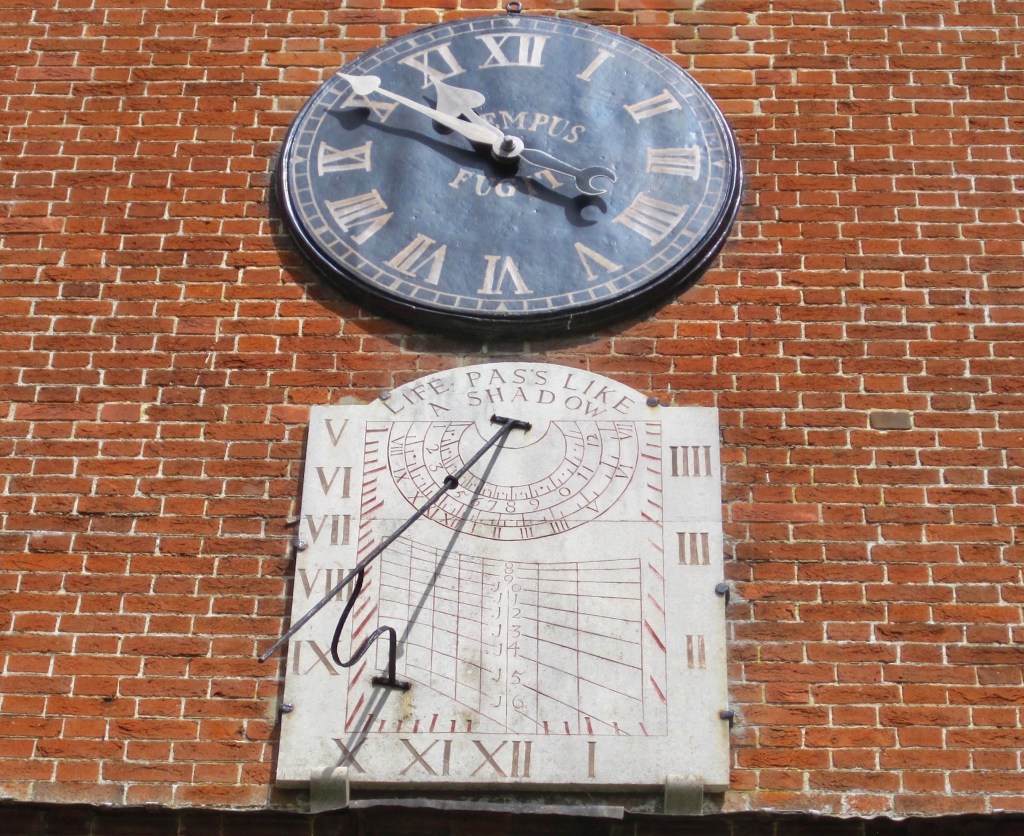
The vertical sundial is immediately below the clock. As David Ross has written, what is immediately obvious as you walk up the path to the door is a large sundial set against the south wall of the tower, below a Victorian clock – as if the Victorians did not quite trust the sundial. Both timepieces are set below a round-headed window that would be perfectly at home in a railway station. (David Ross, Britain Express)
PEV (Suffolk E) is also unenthusiasic about the tower, which showed how the Georgians could be every bit as insensitive as the much-maligned Victorians.
St Mary . Grundisburgh . Suffolk – Vertical Dial
HOW THE DIAL WORKS (1)
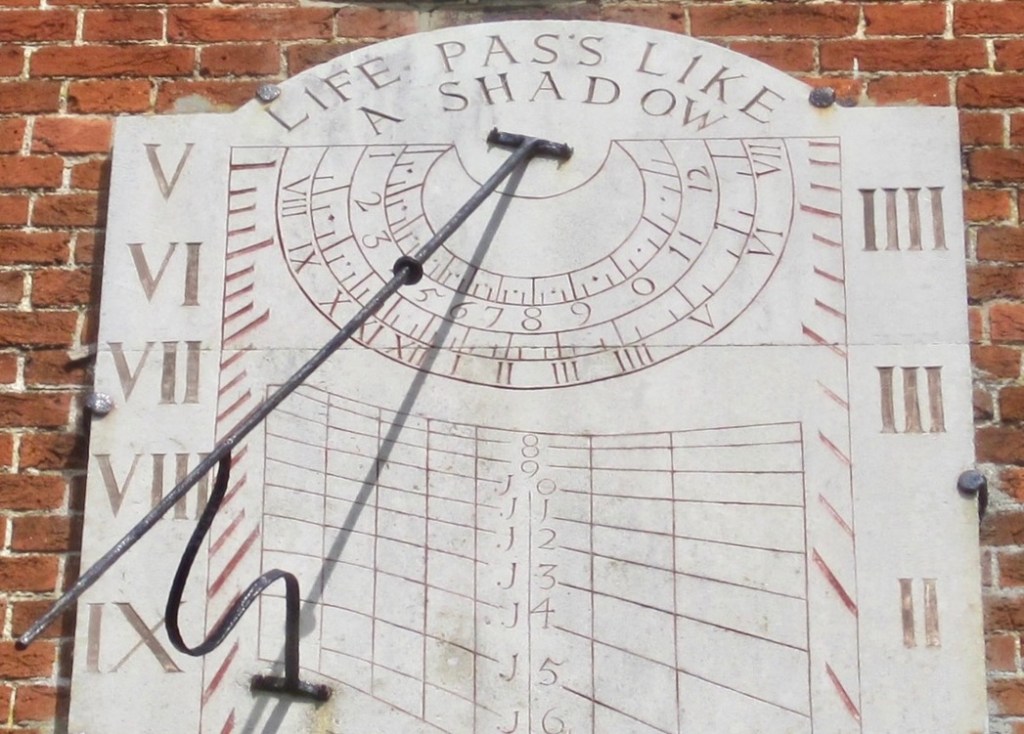
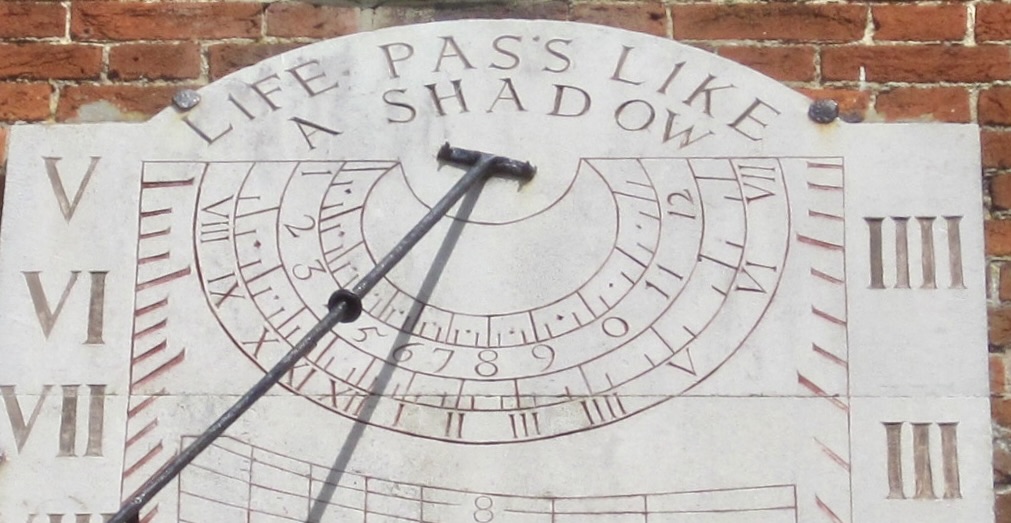
The break-arch shaped dial has a motto within the arch that reads: Life pas’s like a shadow. Roman and Arabic numerals are used to show the time. At the gnomon base are two arcs showing the time elsewhere. Analysis indicates that the scale with Roman numerals suggests Damascus; the scale with Arabic numerals suggests Barbados.
The main dial shows 5am to 4pm in Roman numerals, divided into quarter hours. The gnomon rod has an ‘S’ shaped supporter and a ball nodus. This is associated with the 11 declination lines numbered 8, 9, J0, J1, J2, J3, J4, J5, J6 (8 to 16 for daylight hours), with outer lines unnumbered.
The above notes are based on BSS records. The complete entry is below
HOW THE DIAL WORKS (2)
This break-arch shaped dial on the south wall of the church tower, below a clock, declines about 23° to the east. The tower dates from 1731-32, but it is not known whether the dial is contemporary.
A motto within the arch reads: LIFE PAS’S LIKE / A SHADOW. Scales around the gnomon root show the time at two other places, but they are not named. The outer scale, with Roman numerals for 8am to 7pm, using XII and IIII, shows the time at about 37° E, so may be intended to show Damascus time. The inner scale, with Arabic numerals 1 to 12, shows the time at about longitude 60° W, possibly for Barbados.
The main dial shows 5am to 4pm in upright Roman numerals using XII and IIII, divided to quarter hours. The gnomon rod has an ‘S’ shaped supporter and carries a ball nodus, which is associated with nine declination lines numbered 8, 9, J0,J1, J2, J3, J4, J5, J6 (8 to 16 for the hours of daylight).
The nine vertical lines crossing these are for azimuth, the nodus shadow showing the direction of the sun. They are also unlabelled, but will indicate bearings of SEbE, SE, SEbS, SSE, SbE, S, SbW, SSW and SWbS.
A report in September 1983 found the dial completely bare, presumably prior to a restoration.
St Mary . Grundisburgh . Suffolk – Vertical Dial Motto
MOTTOS
LIFE PAS’S LIKE A SHADOW
A rare variant of the many inscriptions that link Life with Shadow(s). Pas’s is said to reflect the Suffolk dialect at the time. There is another example of the ‘misspelling’ (as we might say now) of the word pass. At St Mary, Bucknall, Shropshire, the 1712 dial is inscribed Tyme Paseth.
Tempus Fugit on the C19 clock is… comfortingly familiar
If you want to find out more about St Mary and other churches in Suffolk, I recommend the website of Simon Knott SUFFOLK CHURCHESa journey through the churches of Suffolk
Wolfeton House (sometimes Wolveton) is a fine Grade 1 Elizabethan manor house with medieval origins. It stands amidst the the water meadows of the River Frome near Charminster, just N of Dorchester. Admired by Hardy. For more about the house, its history, and how to stay in the Gatehouse (dated 1534) see:
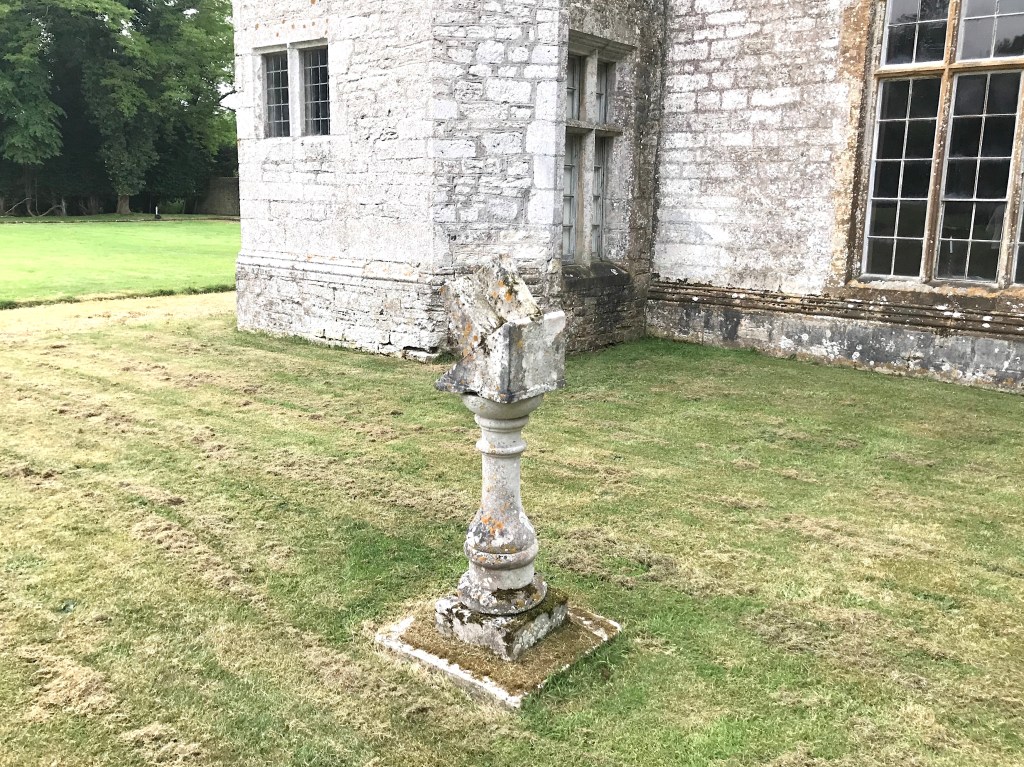
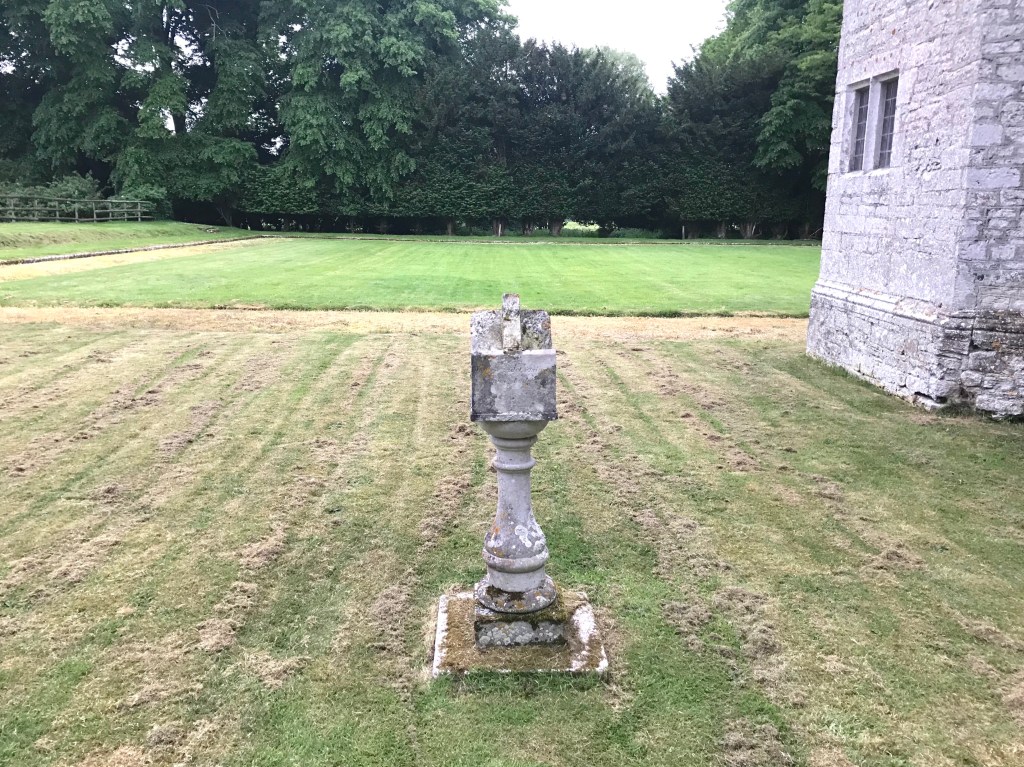
Some time ago we went to Wolfeton in connection with the the Pevsner Buildings of England series. I was able to photograph this most interesting sundial, though with a rather rustic camera and in low light. The dial is not in the optimum place for its primary purpose, but with its pleasing symmetrical design it suits where it stands.
INSCRIPTION
The inscription is an intriguing mystery. At the time I was less engaged with dials, or I might have made more effort to record the details and to take a decent photo. As it is, I cannot make much sense of it. The initial letter U… could perhaps be the start of Umbra? But that assumes the words are in Latin. I have checked the main motto resources including Gatty (original, and revised & expanded); and various less comprehensive sources. I will add the translation if I can make any more sense of the text. Meanwhile, any ideas would be welcome. Actual knowledge, the more so.
ADDENDUM *
UMBRA VIDET UMBRAM VIVE HODIE. A shadow marks the shadow. Live to day.
As it turns out, Gatty did record this dial, attributing it to a neighbouring village Bradford Peverell rather than Charminster. She noted the inscription is somewhat defaced. The dial was possibly erected by George Purling about 1815-20, when the garden was laid out). The same motto is on the tower of Broughton-Gifford Church, near Melksham,
HOW THE DIAL WORKS
This is a polar dial, with the end edges of the cross pieces acting as gnomons (cf the polar dial at Tintinhull). The dial should be oriented so these point north, ie with the inscription on the south face. However, it is clearly not orientated like that, so it now acts as an interesting garden ornament. John Foad (BSS) has kindly marked up a photo to show how the dial would work if correctly positioned.
DATE
The inscription might give a clue to the dial’s date. My amateur guess is that it is somewhere between mid-C18 and early C19.
Wolfeton House . Dorchester . Dorset – Multiple Garden Dial
GSS Category: Multiple Dial; Old Dial; Garden Dial
All photos: Keith Salvesen; *John Foad BSS for additional material / expertise (see Addendum)



























 GAUDIUM SUB SOLE . SUNDIALS . MEDIEVAL TO MODERN