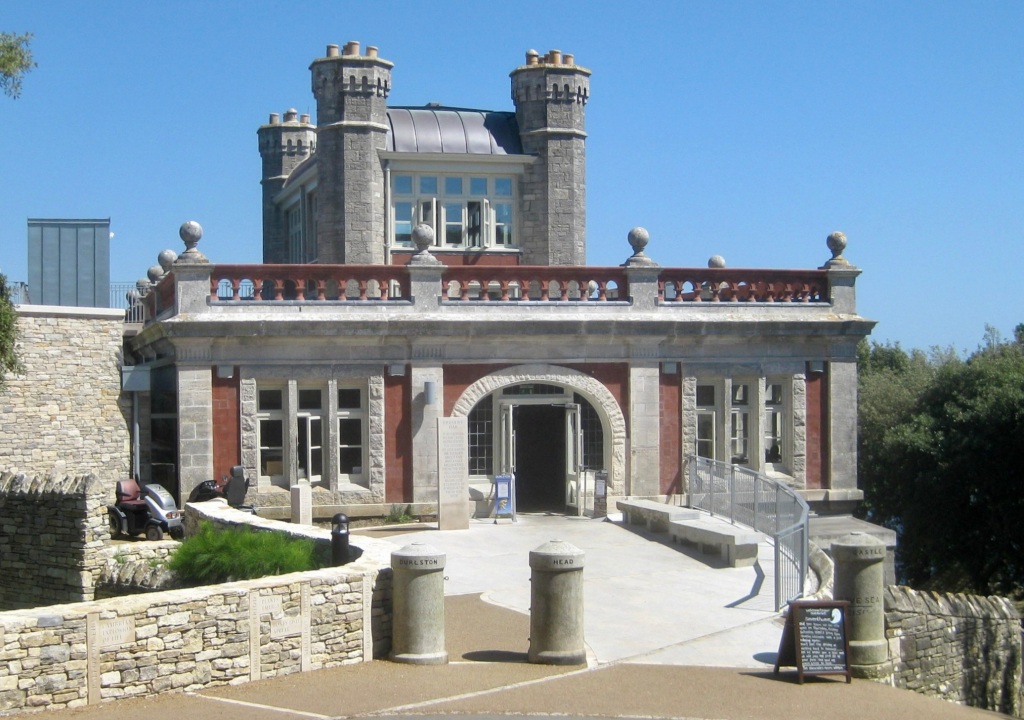
Durlston Country Park is close to Swanage and has much to offer. The ‘modern’ Castle was completed in 1891. There are extensive grounds, 5 walking / nature trails, sculptures, epochal details chiseled into stone tablets, Art Gallery, tea room, views across to IoW, a huge C19 stone globe, significant jurassic finds.
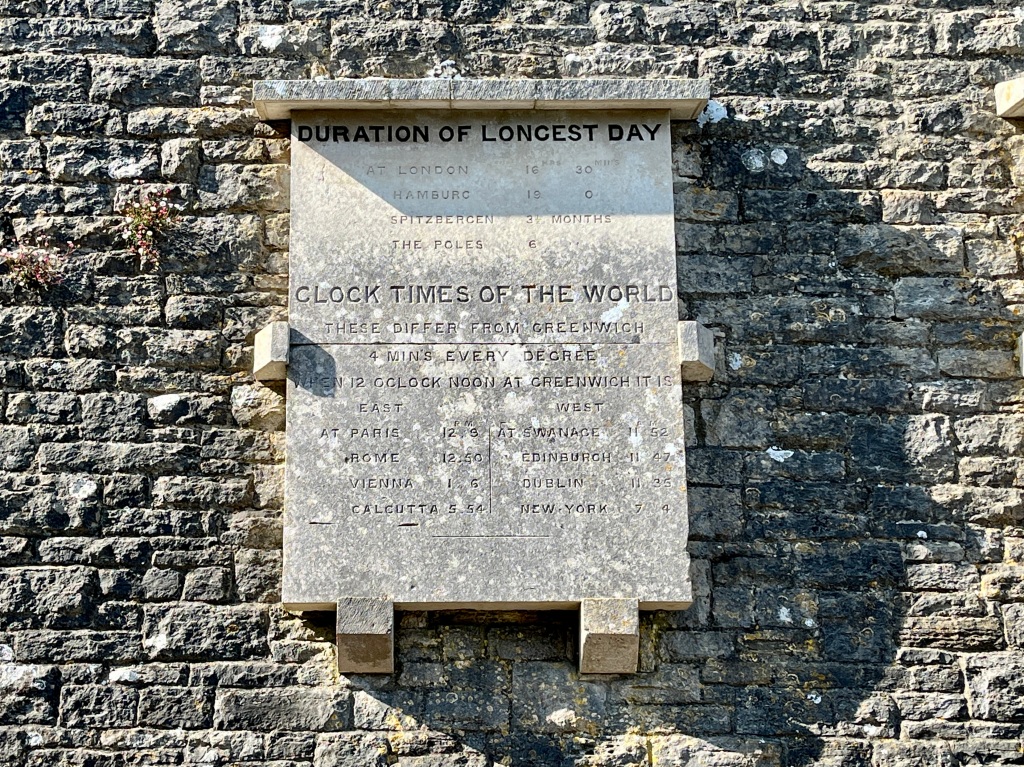
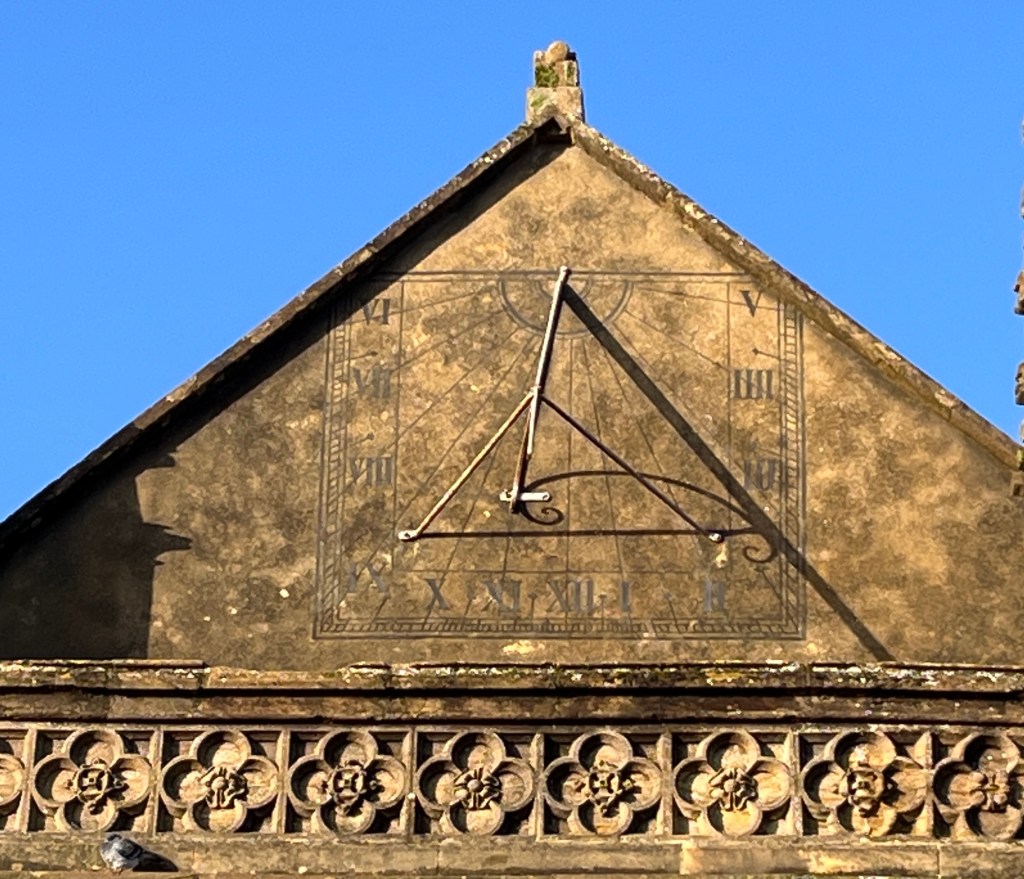
More germane here, high on S face is a fine vertical sundial (1887). Below it are two stone tablets inscribed with times and tides worldwide.
❖
DIAL
The dial is inset in the South wall about 5 m above the ground. It shows 6am to 6pm in half and quarter hours. Uses XII & IIII. White lines and chapter ring on a beige rectangular dial-plate all within a four piece chamfered stone frame. The Roman numerals arranged vertically. BSS
❖
An angled view reveals that the gnomon incorporates the initial B, standing for (George) Burt, the Victorian entrepreneur owner who conceived the idea of what we can still see today. It was (oddly?) described at the time as the most magnificently conceived restaurant.
❖
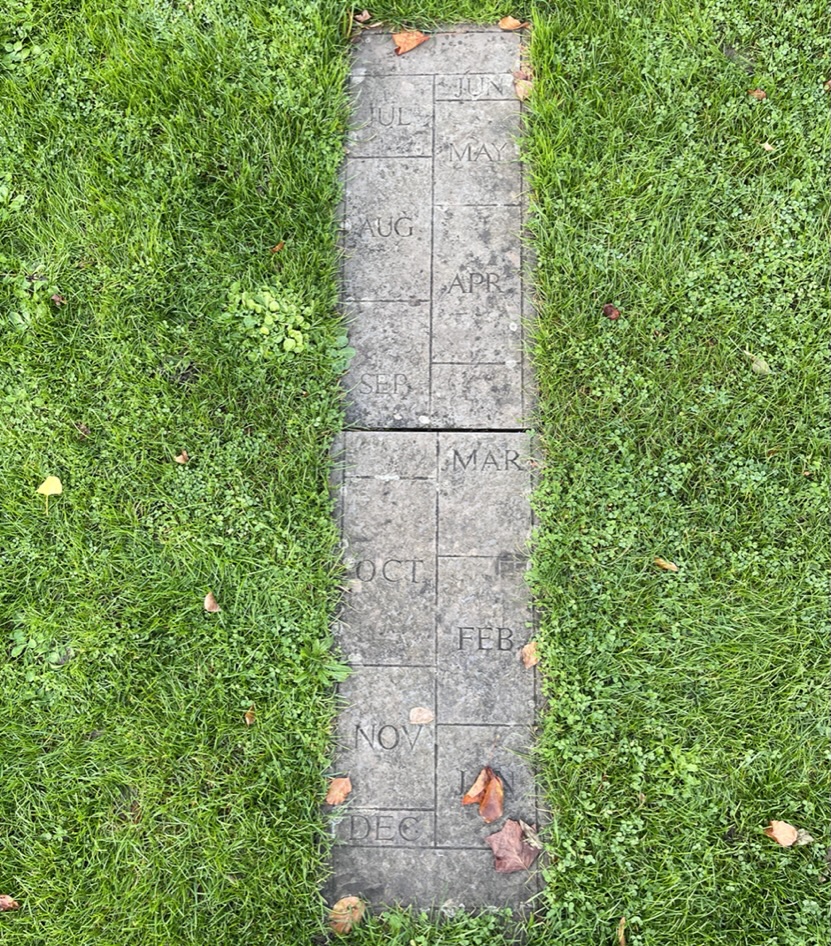
Two large incised tablets: essentially they deal with Time & Tides respectively
❖
GREAT GLOBE
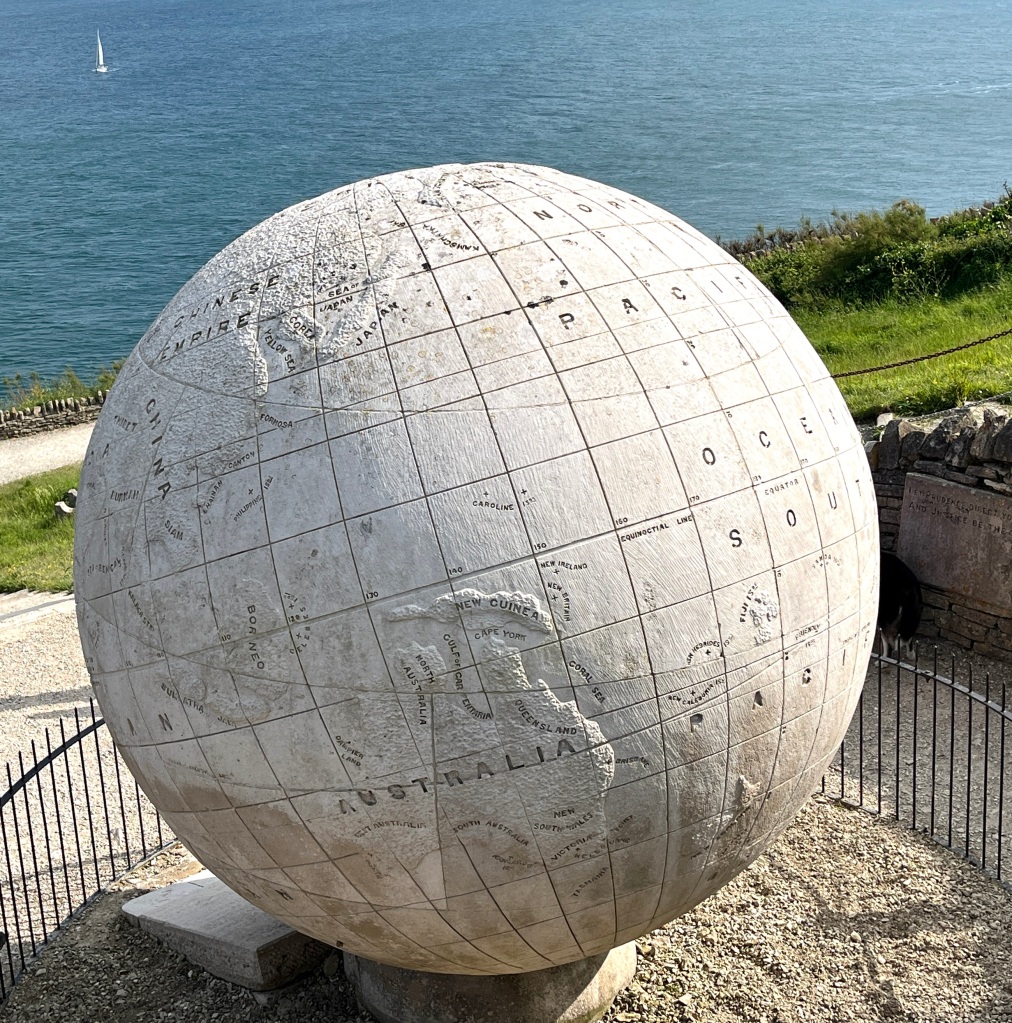
Great Globe (1887), a vast perfectly formed stone ball inscribed with an eclectic selection of places. Many will be little known or unknown to random visitors such as me. The Society Isles (Pacific) sound pleasant.
❖
COMPASS POINTS
Stone Benches Surrounding the globe, at various heights and angles on a steep stope, are stone benches, each clearly marked with a compass point. In an ideal world there would be an equally fine analemmatic sundial.
GSS Category:
All photos by Keith Salvesen except header image Huligano0 OS CC
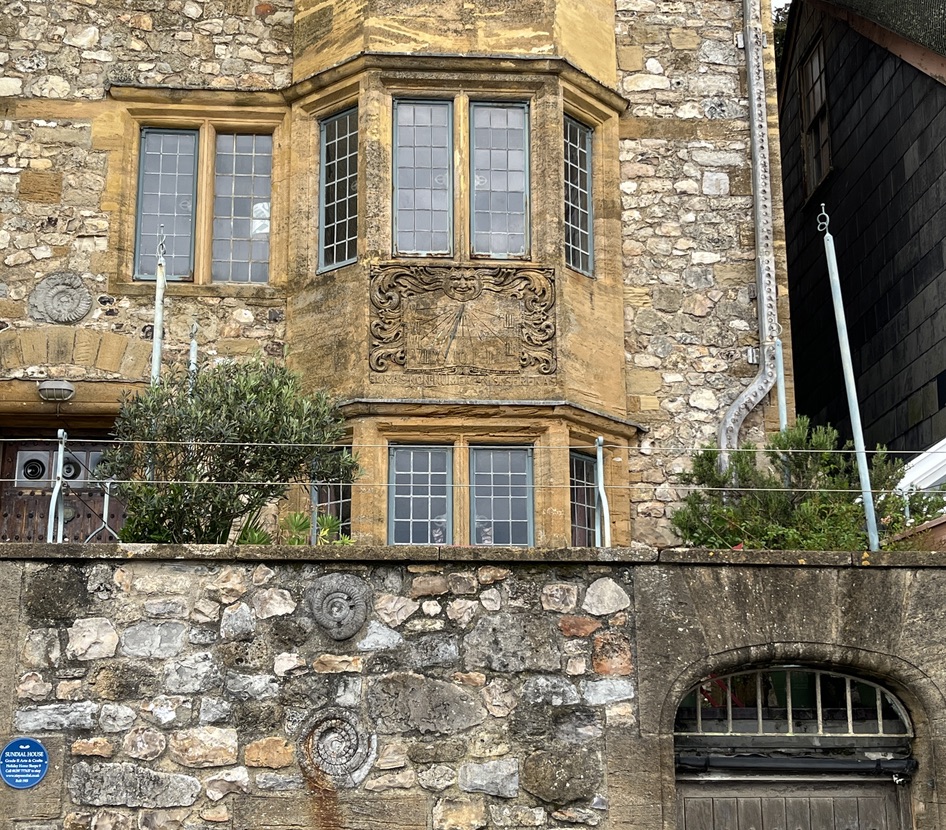
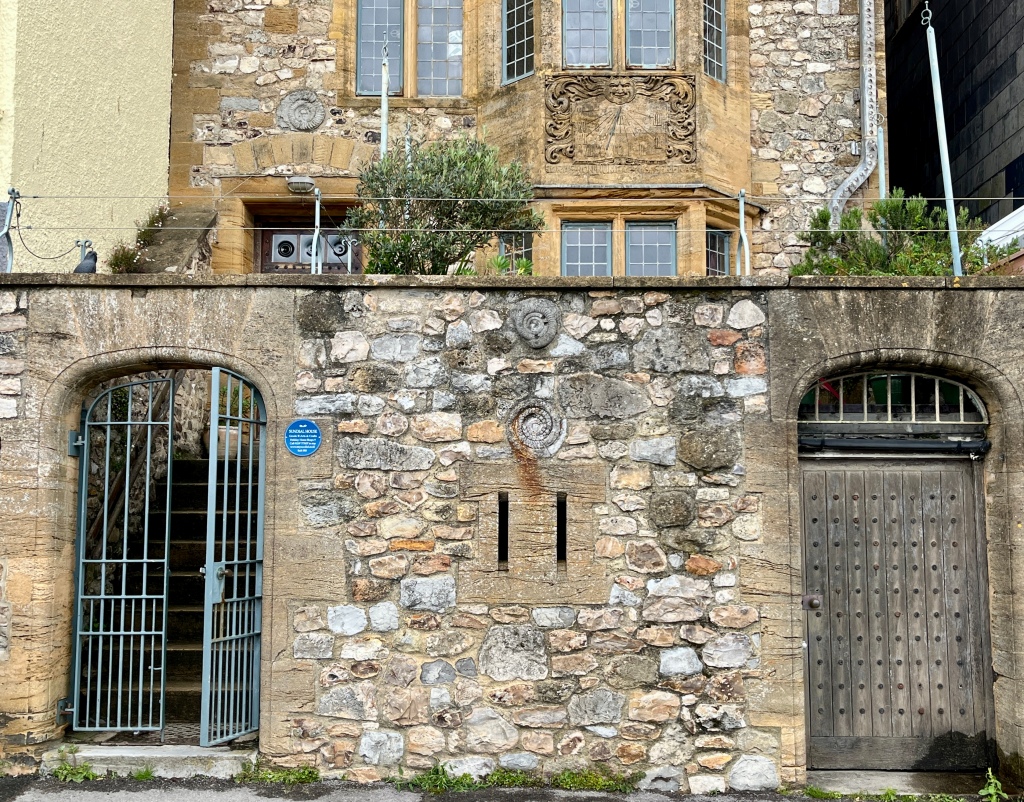
GRADE II ✤ Set back from the Parade, the very visible sundial on what is described (BLB) as a 4-light splayed bay which descends through all storeys to ground floor, with sundial built into wall between 1st and ground floors. The house can be rented. The views of the Jurassic coastline and out to sea are wonderful (on a sunny Spring day, anyway). 50.7238 / -2.9358 / SY340919
DIAL
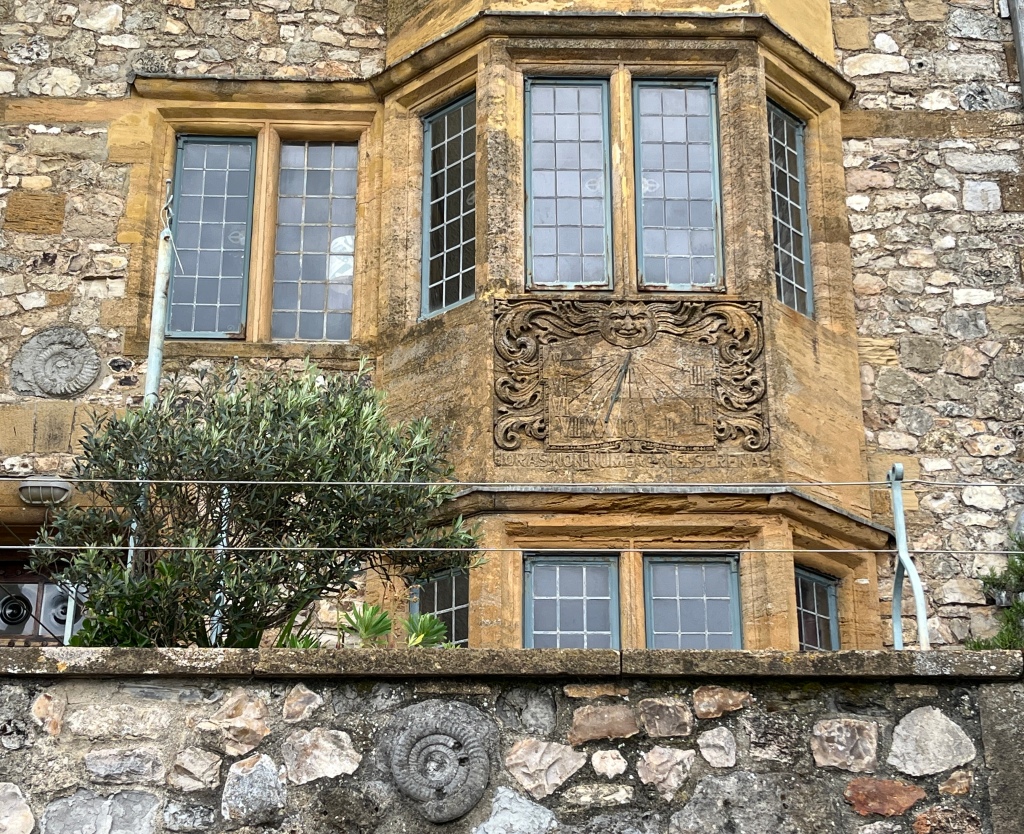
The dial itself has roman numerals from 5am to 4pm with a long slender gnomon. It is set within an exuberantly decorative frame, with a somewhat enigmatic ‘sun in splendour’ beaming down on it. The house is dated 1903, and the dial must have been designed as a prominent decorative feature. It is in very good condition. The town’s unbeatable Jurassic credentials are show in the large ammonites set into the surrounding stonework.
MOTTO
HORAS NON NUMERO NISI SERENAS
Gatty has a long entry (115) on this motto. Her translation is I only reckon the bright hours. She notes its use as a popular inscription, giving a dozen other locations where it can be found: the motto is too good to be uncommon. The earliest example of its use dates to c1500.
GSS Category: Vertical Dial; Modern Sundial; Sundial Motto
The entire contents of Sandford Orcas Manor, a fine example of country house Tudor, have been auctioned following 4 days of viewings. The sale has generated much interest and excitement both locally and well beyond. Such a complete disposal – even the family Bible (1702) was included – is quite rare. The house dates from mid C16 and has been in the same family for 300 years. It has a reputation for being ‘the most haunted house in England‘. The task of gathering statistics to support this proposition must have been a nightmare.
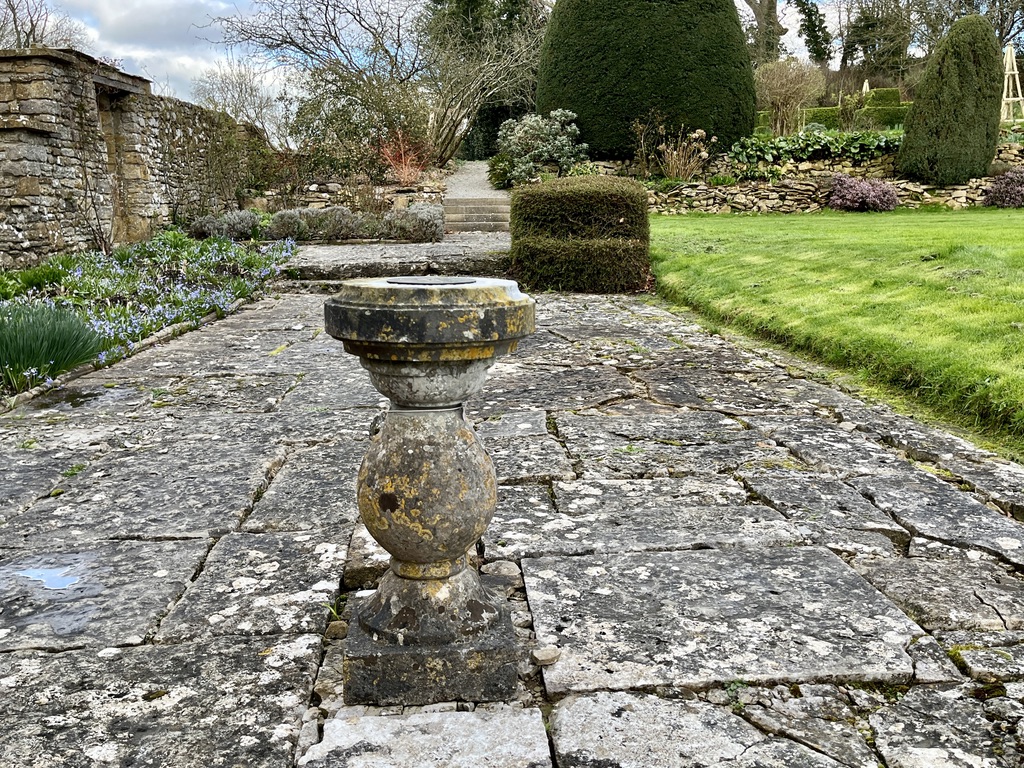
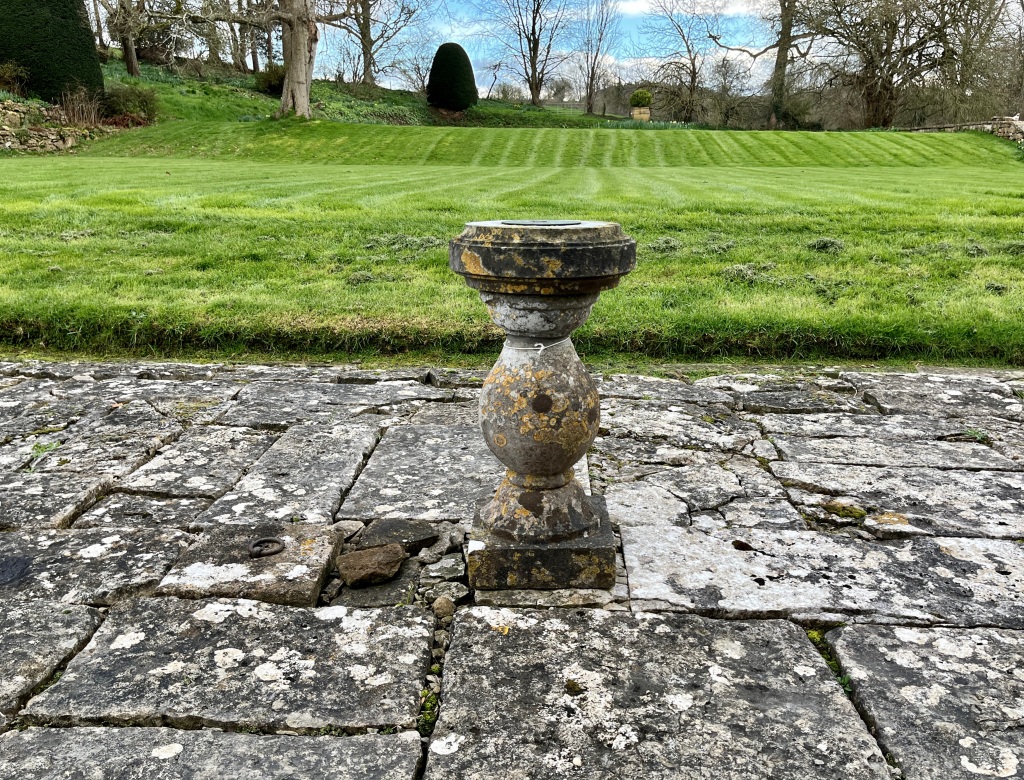
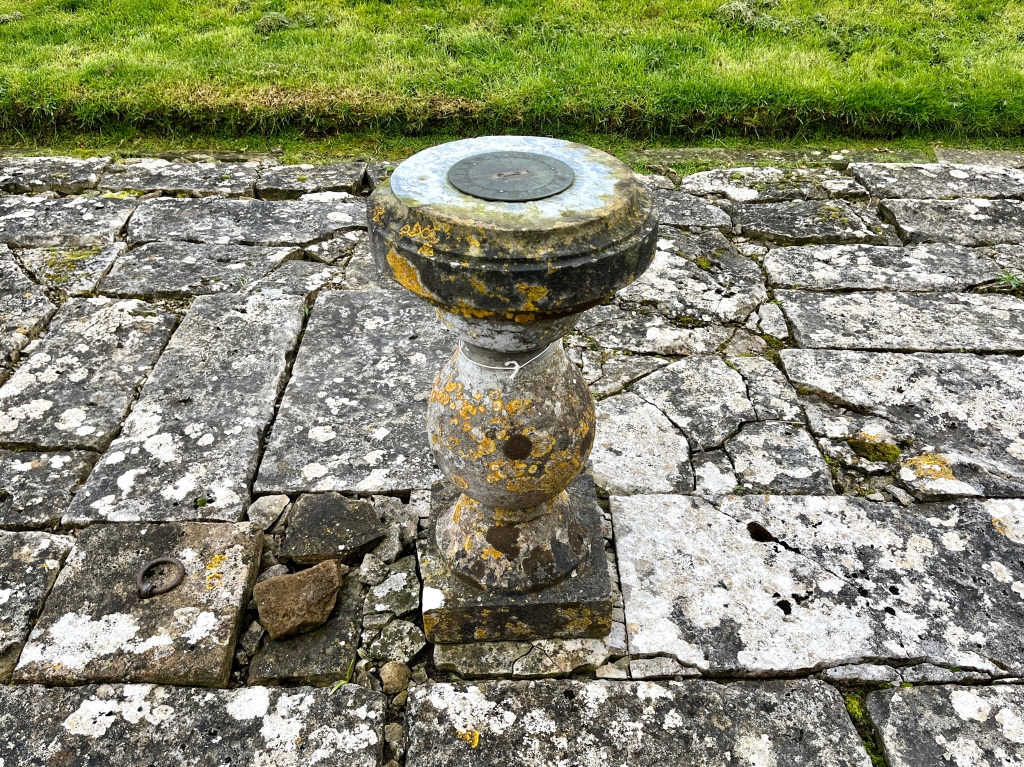
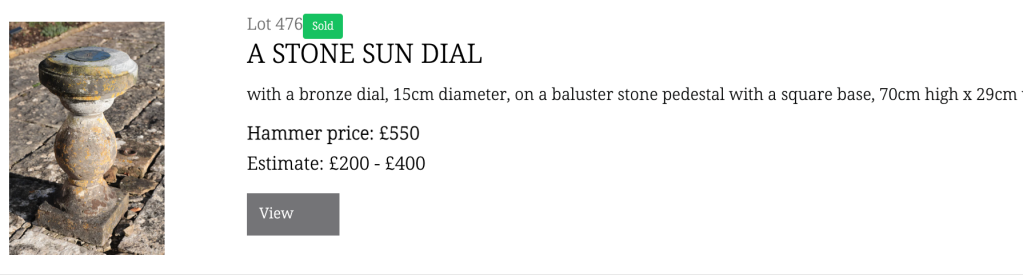
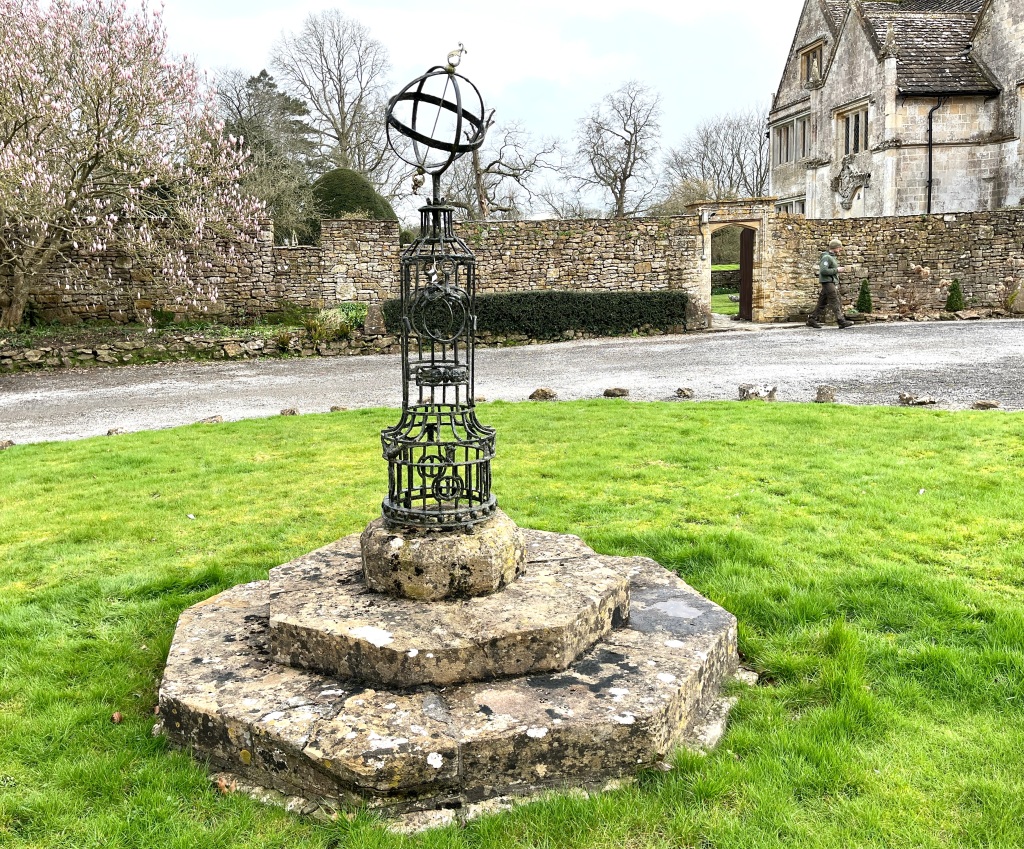
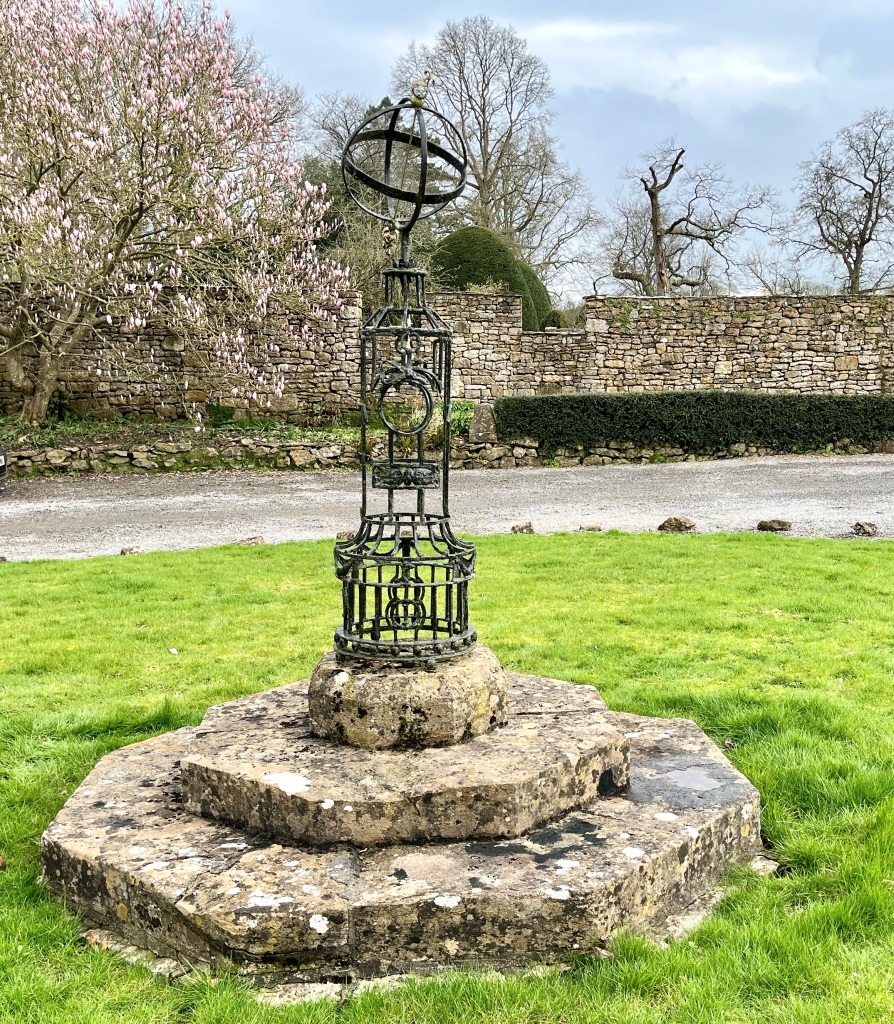
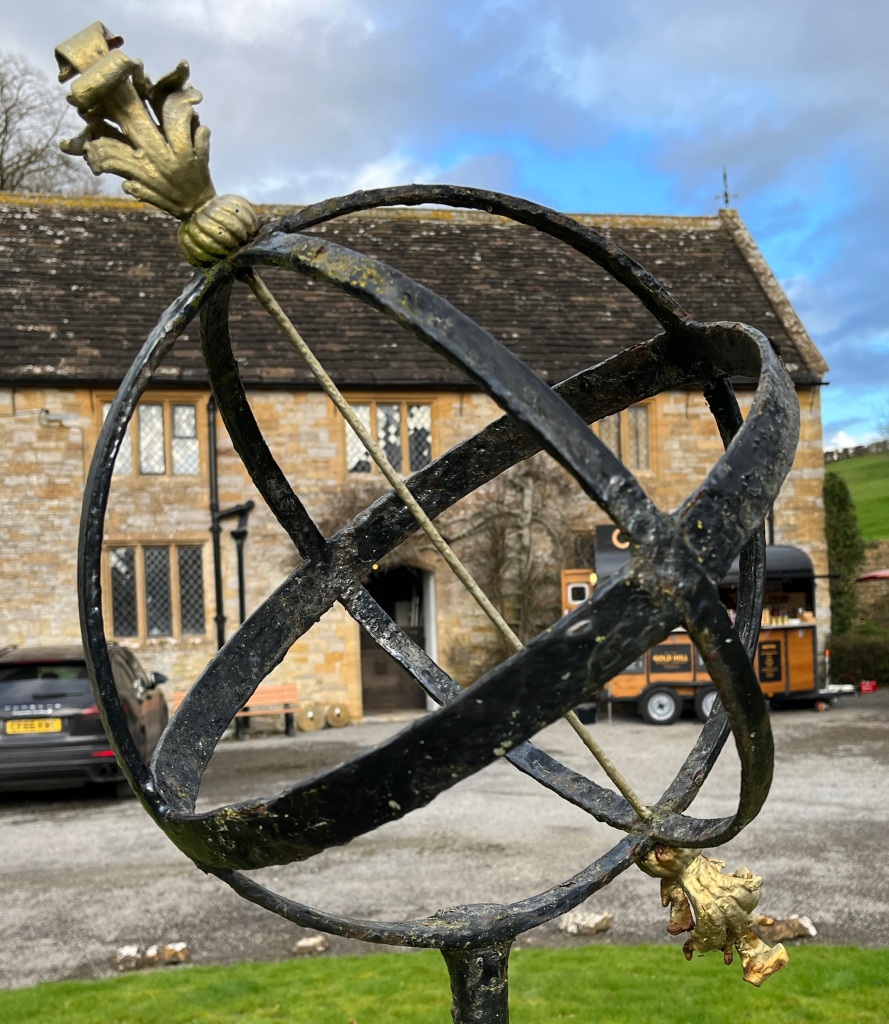
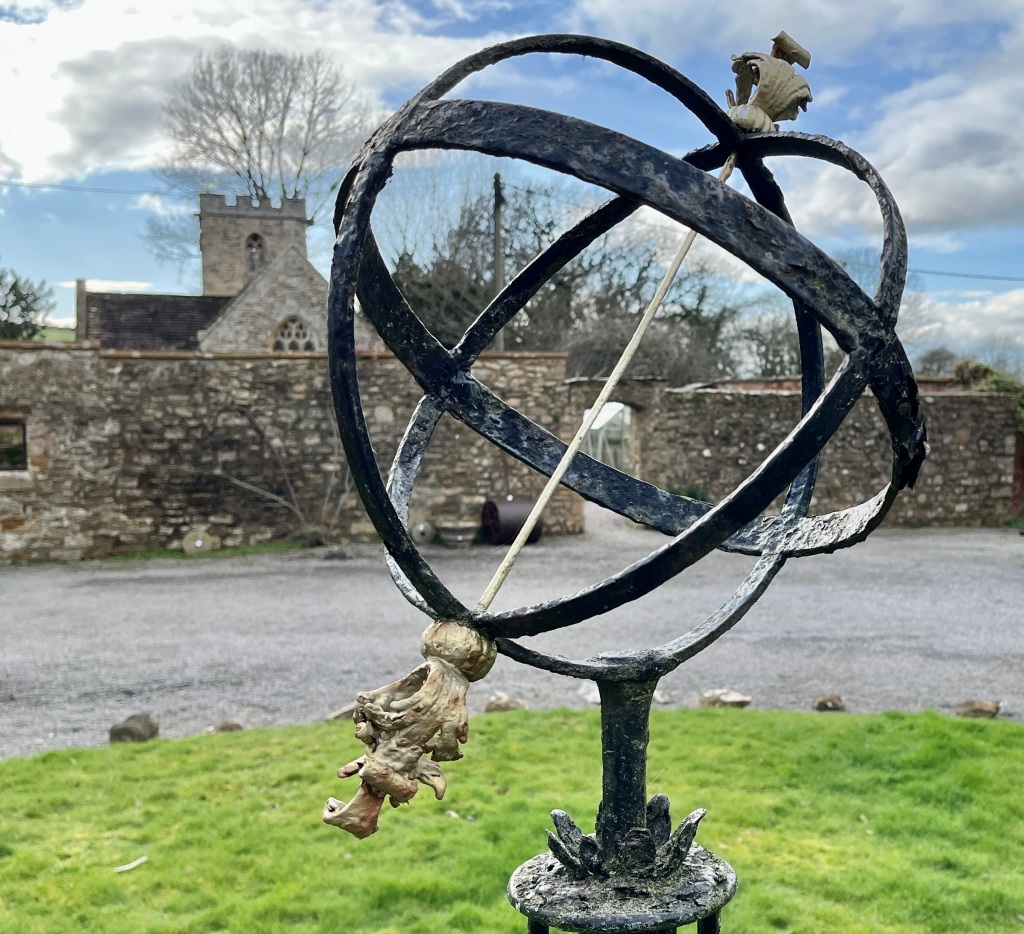
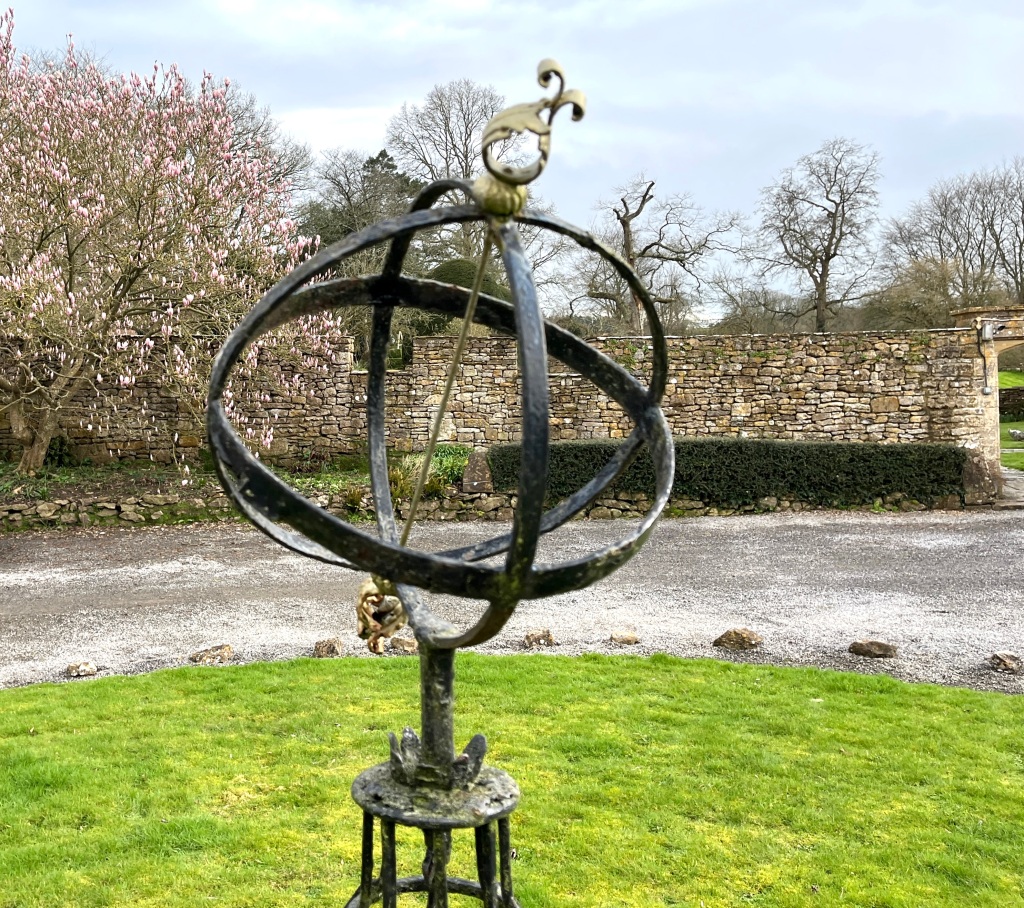
Two sundials were sold and are now removed from the property. One is a conventional garden dial, gnomon-less, on a baluster stone pedestal. The other is an armillary sphere grandly resting on a substantial triple plinth and supported by a tall ironwork obelisk.
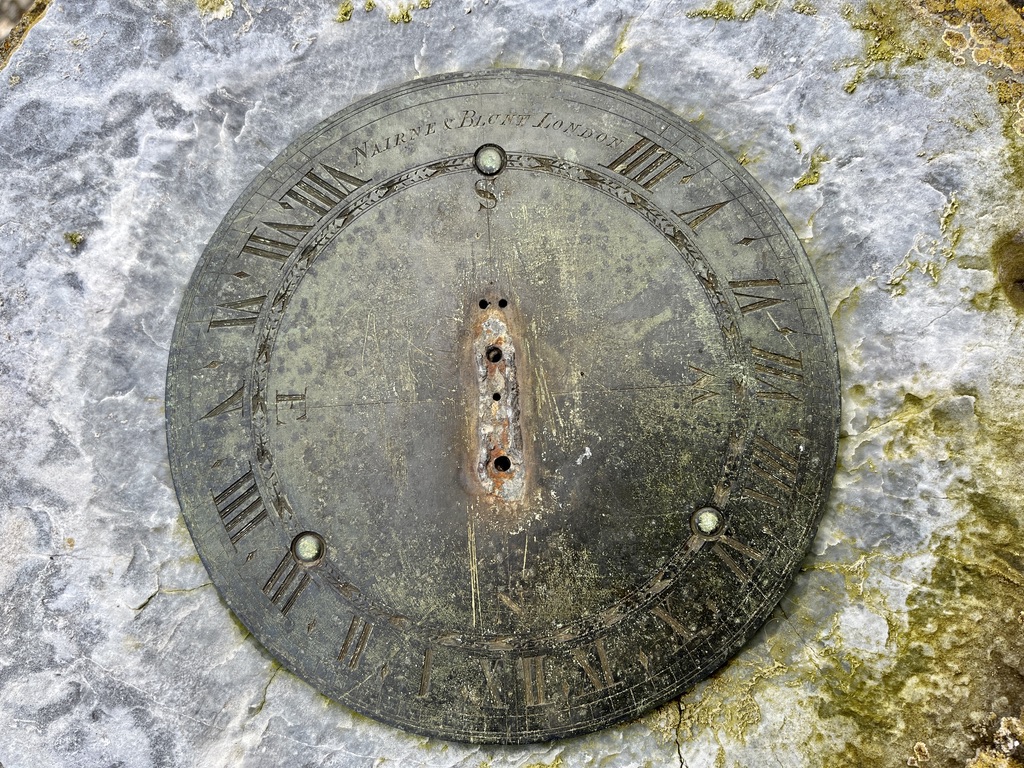
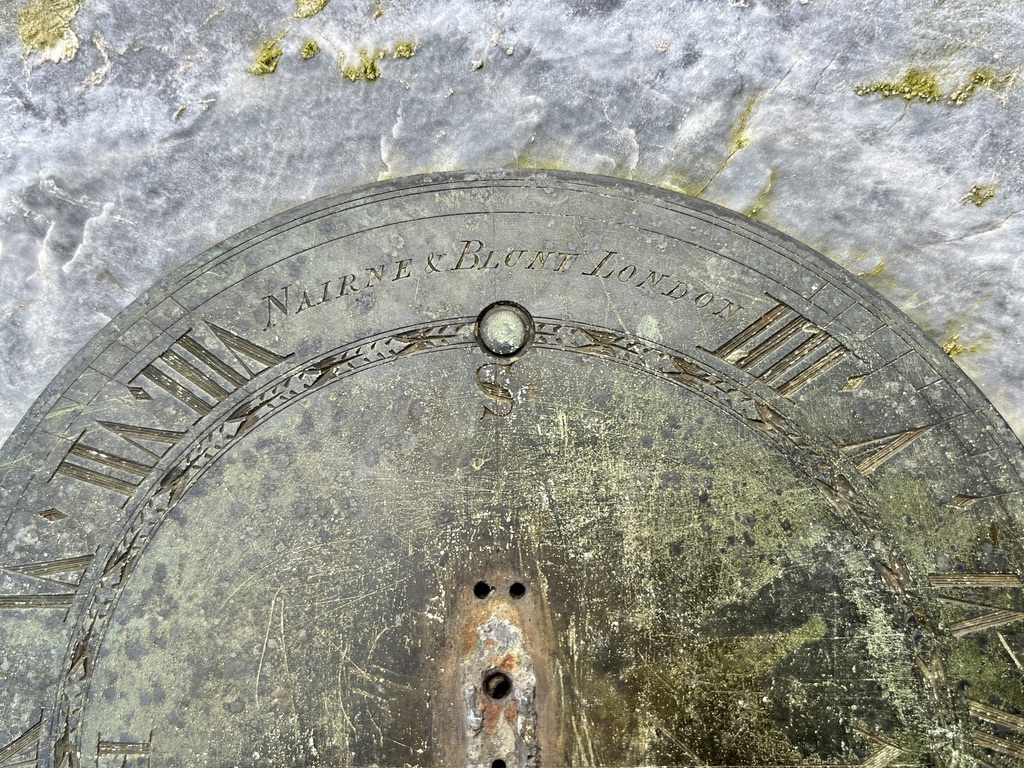
HORIZONTAL DIAL (C18) BY NAIRNE & BLUNT
Edward Nairne and Thomas Blunt established themselves in London as scientific instrument makers. They worked together between 1774 and 1793 and this dial must be from that period.
East Stour is a small village 5m W of Shaftsbury, with the A30 dividing its church from the majority of its (potential) congregation. I had a good lunch in the pub as bell-ringing issues were being keenly discussed around me..
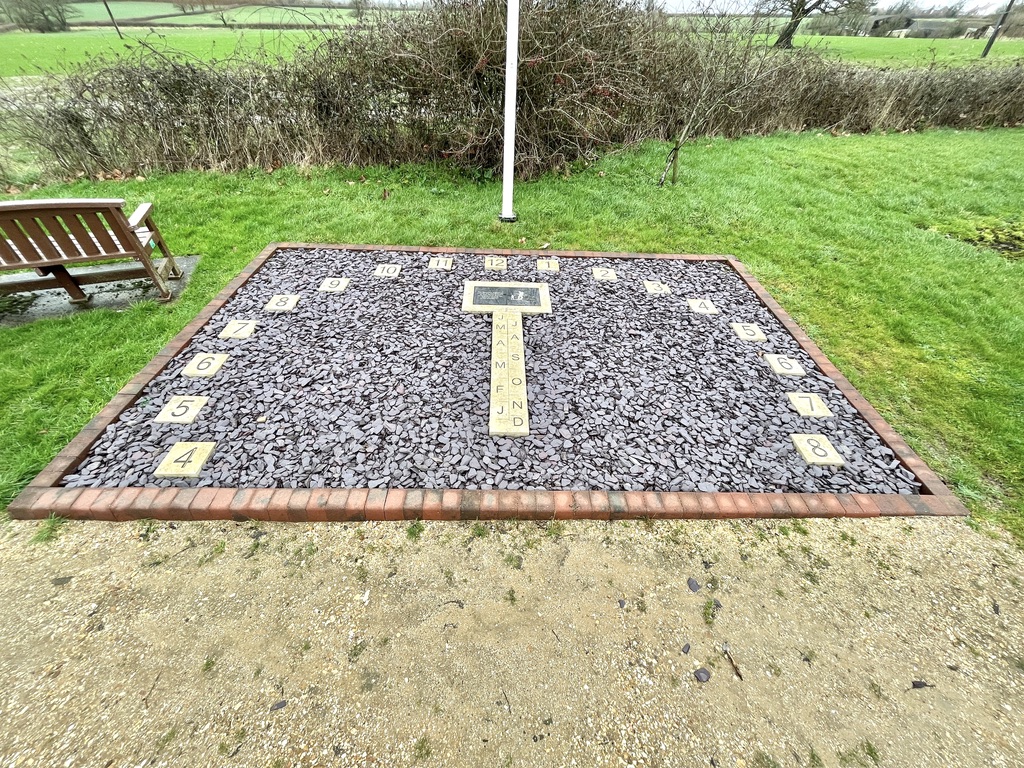
A short but perilous (no pavements) walk away is a very fine and beautifully designed analemmatic sundial in a small park by the Village Hall. It is a war memorial, and the dedication poignantly extends the commemoration to everyone from East Stour who has been affected by war.
BSS RECORD
The dial is in the north corner of East Stour playing field. It is made from Portland stone and black granite with slate shingle infill. Granite tablet set into portland stone slab to N of date scale is all slightly canted and carries the laser-etched inscription: 4This Memorial is dedicated everyone from East Stour who has been affected by war. At the going down of the sun and in the morning, we will remember them.X To the right of the words is an etched image of a soldier, a child and three crosses. The dial shows Arabic hours for 5am to 8pm.
Delineation was by David Brown, content by Guy Gilding, letter-cutting and stone-laying by lan Viney of Stonemasons of Dorset Ltd, and groundwork by local builder.
GSS Category: Analemmatic Sundial; Memorial Sundial
GRADE I † C12 origins (?); C15 inc tower & porch; C16 rebuilding / additions. Material from nearby Milton Abbey incorporated. C19 restorations. In proximity, a fine early vertical sundial (1690); 2 date stones (1569); scratch dial (probable?). Several excellent gargoyles N side. 2m W of Milton Abbey. 50.8259 / 2.3114 / ST781029.
VERTICAL DIAL
A fine dial in very good condition for its age. The gnomon is an amusing extension of the sun’s nose. I took the design LL corner to be an hour-glass, which would be appropriate. In close-up I wonder if it is a religious symbol; and if the design LR corner is a square and compass.
DATE STONES
THE BAGPIPER
SCRATCH DIAL
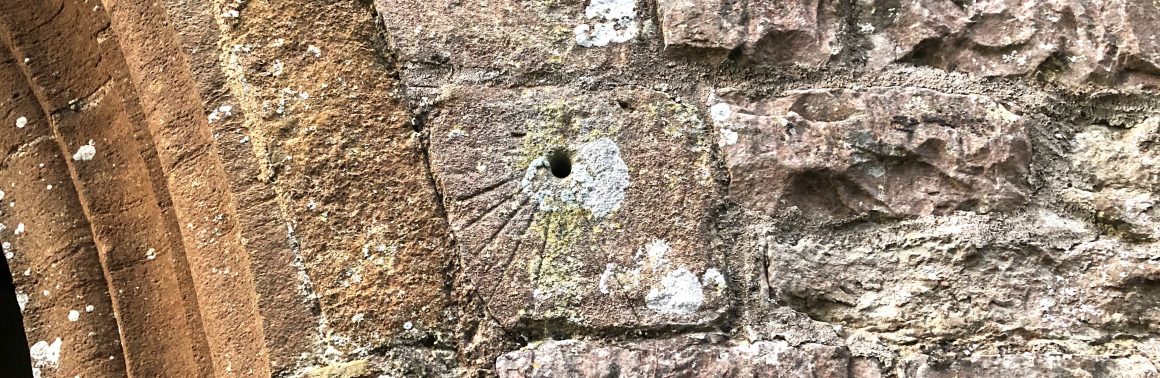
The dial design of a double circle with a hole in the centre is far from unusual. No lines, no pocks; just a stick needed to mark the passage of the day. This type is generally included in the Scratch / Mass Dial category of church marks; and I go along with that. However, having recently researched Cyffe Pypard and Fovant (both Wilts) which have several dials including this design, I am beginning wonder. It’s hard to think of a reason why a dial-cutter would not to add lines, pocks or both to a device specifically made to mark the passage of the day. But what if these are apotropaic symbols cut into the walls of the church to catch evil: ‘Demon Traps’ from which, once entered, encircled evil could never escape?
GSS Categories: Vertical Sundial; Old Sundial; Date Stones; Gargoyles / Hunky Punks; Scratch Dial
GRADE I † C12 origins; gradual development C13 on, with later restorations C15 / C16. S porch (where the dials are) added C16, with earlier material reused. 8m SW of Dorchester. 50.6709 / -2.5638 / SY602858
DIALS
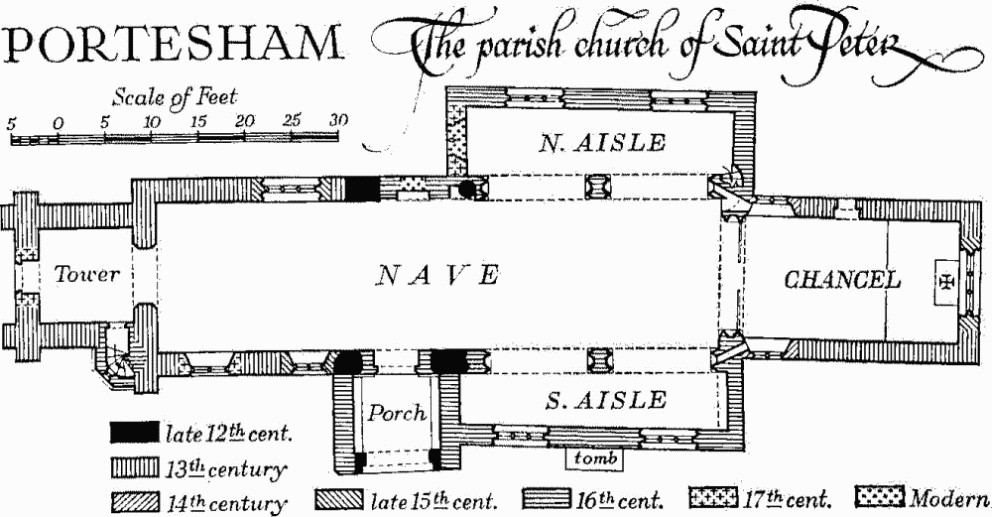
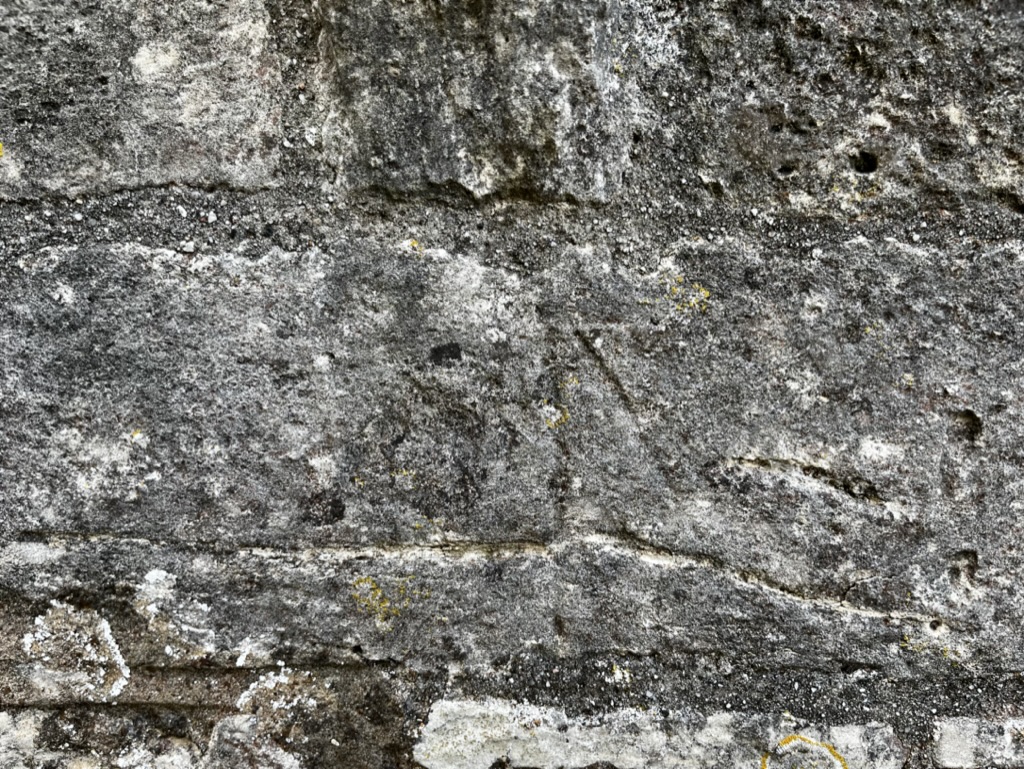
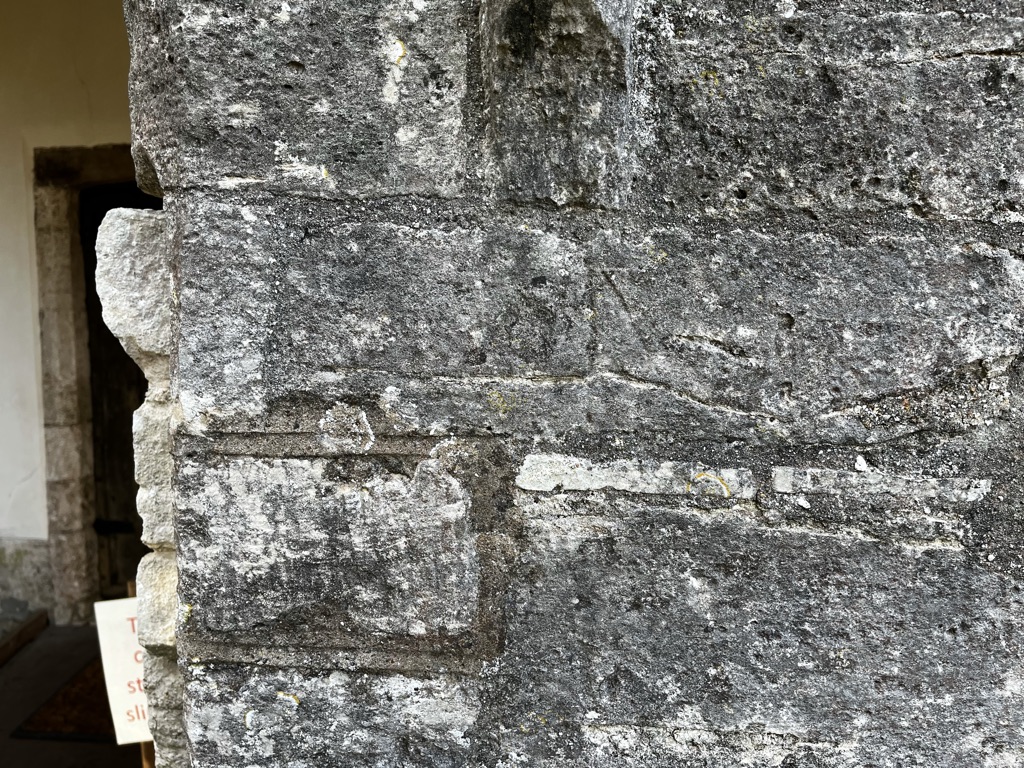
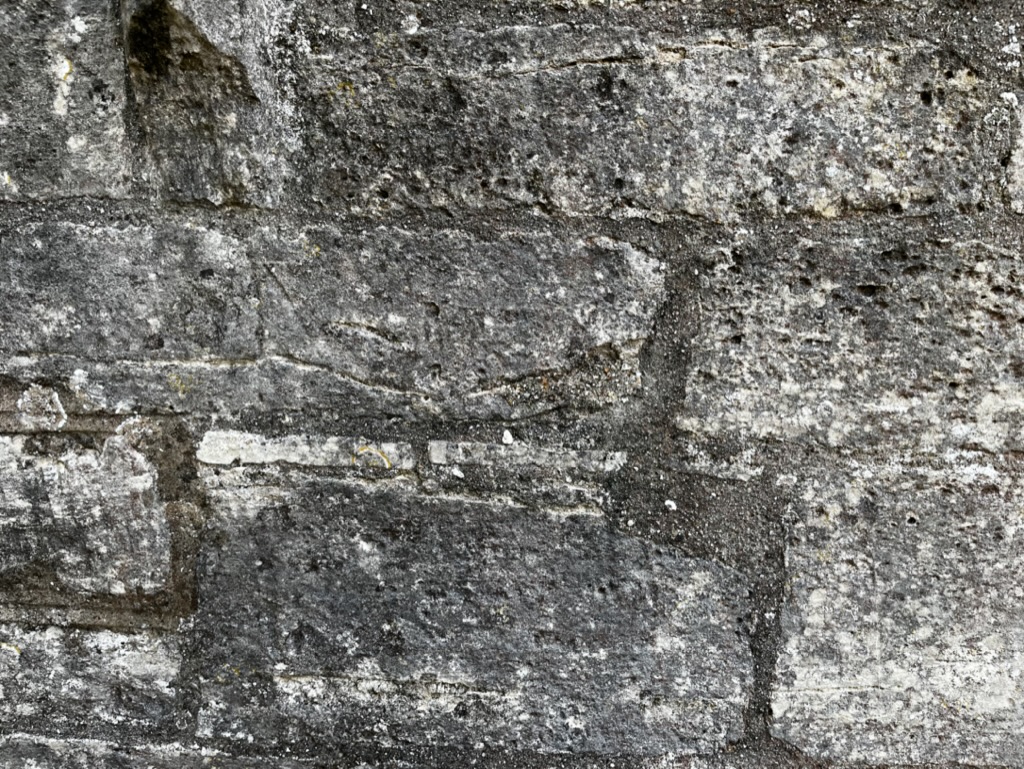
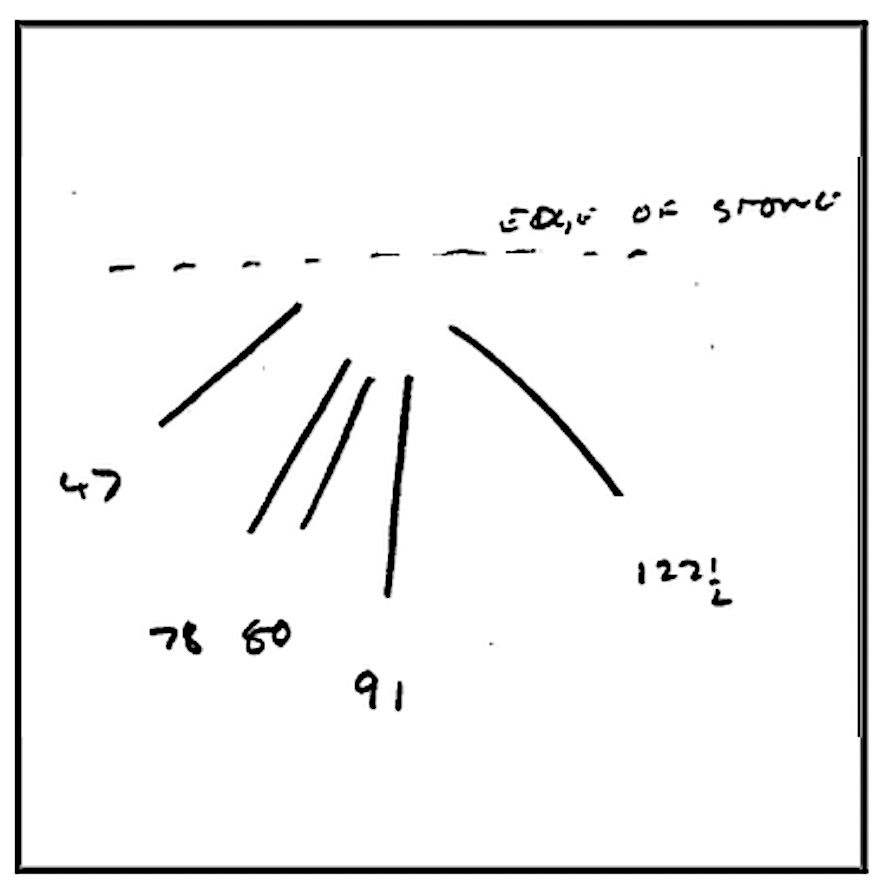
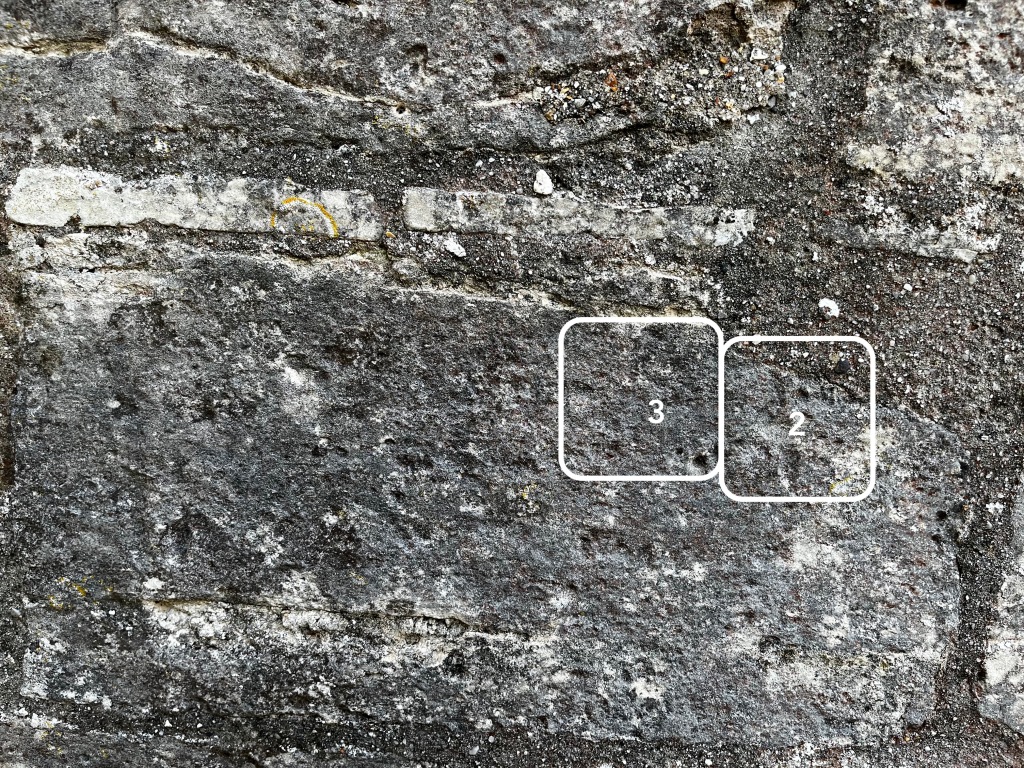
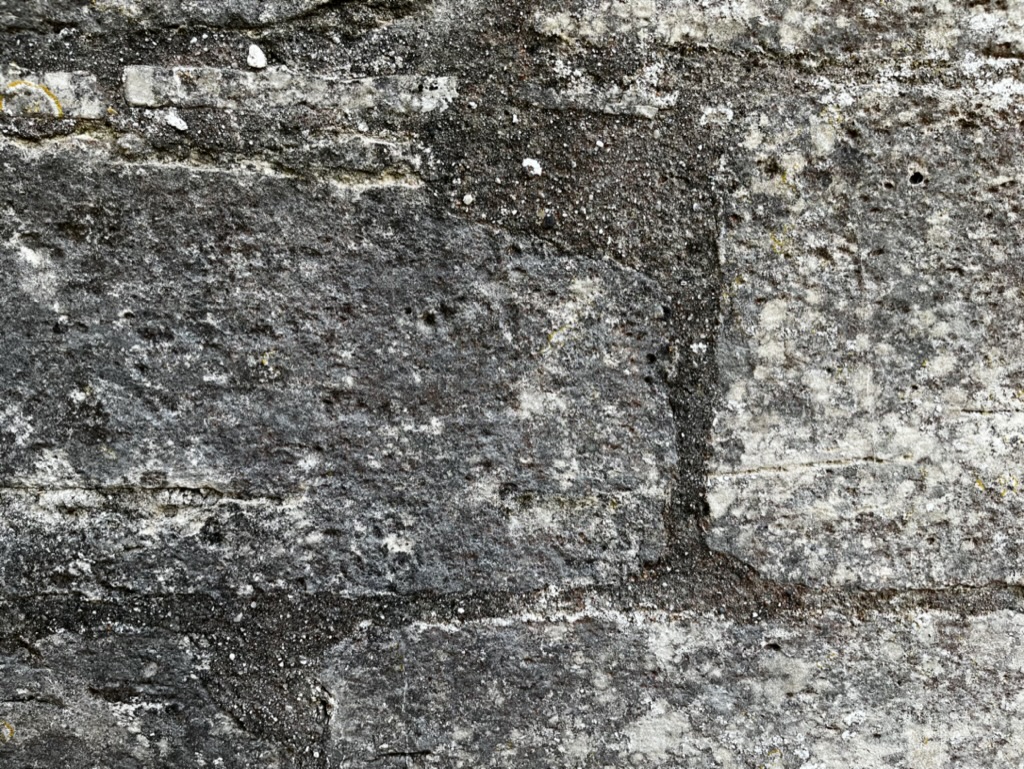
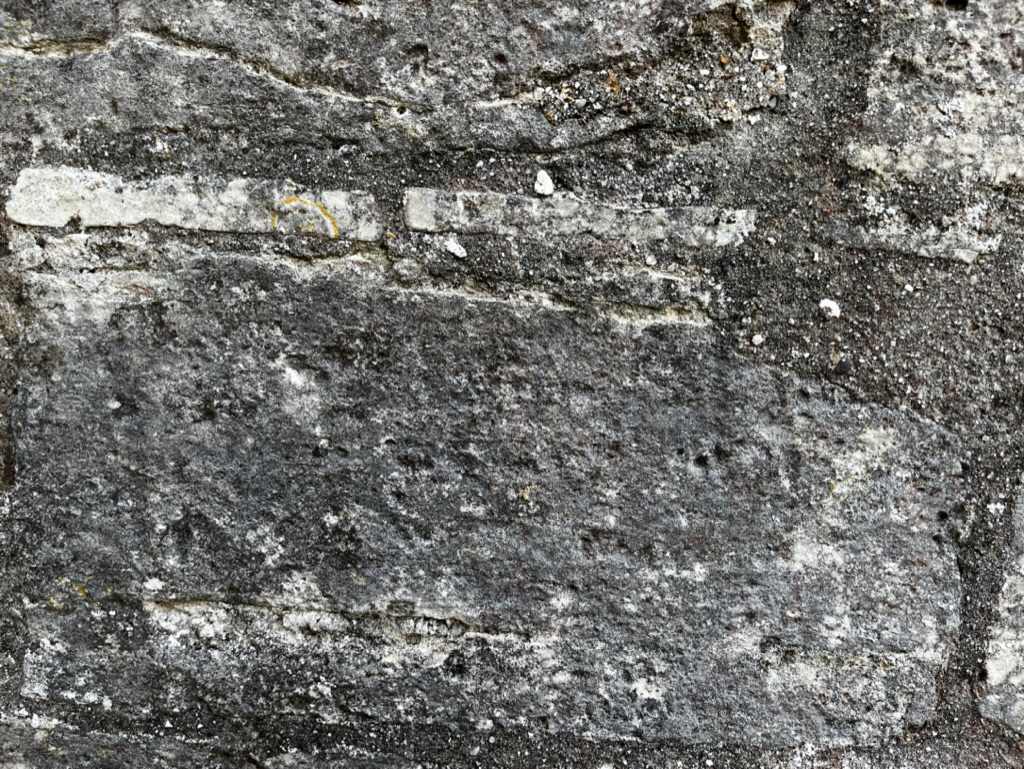
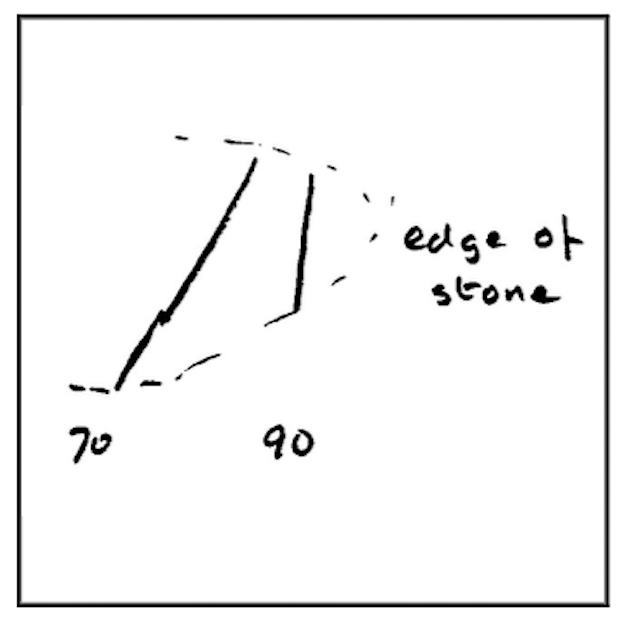
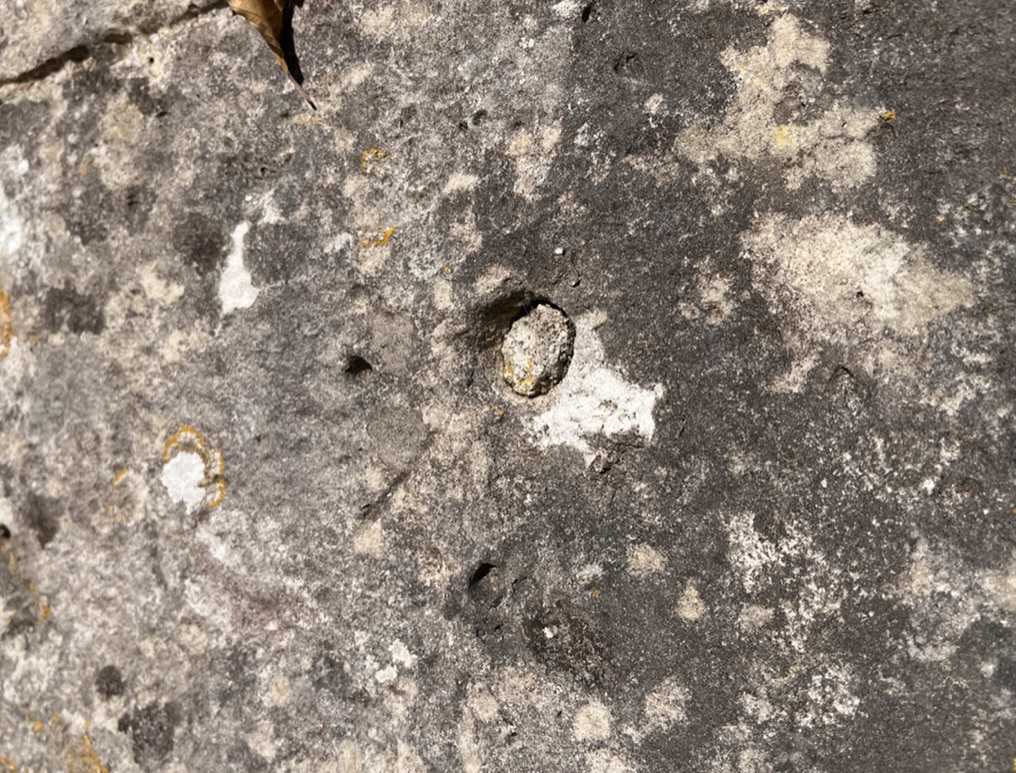
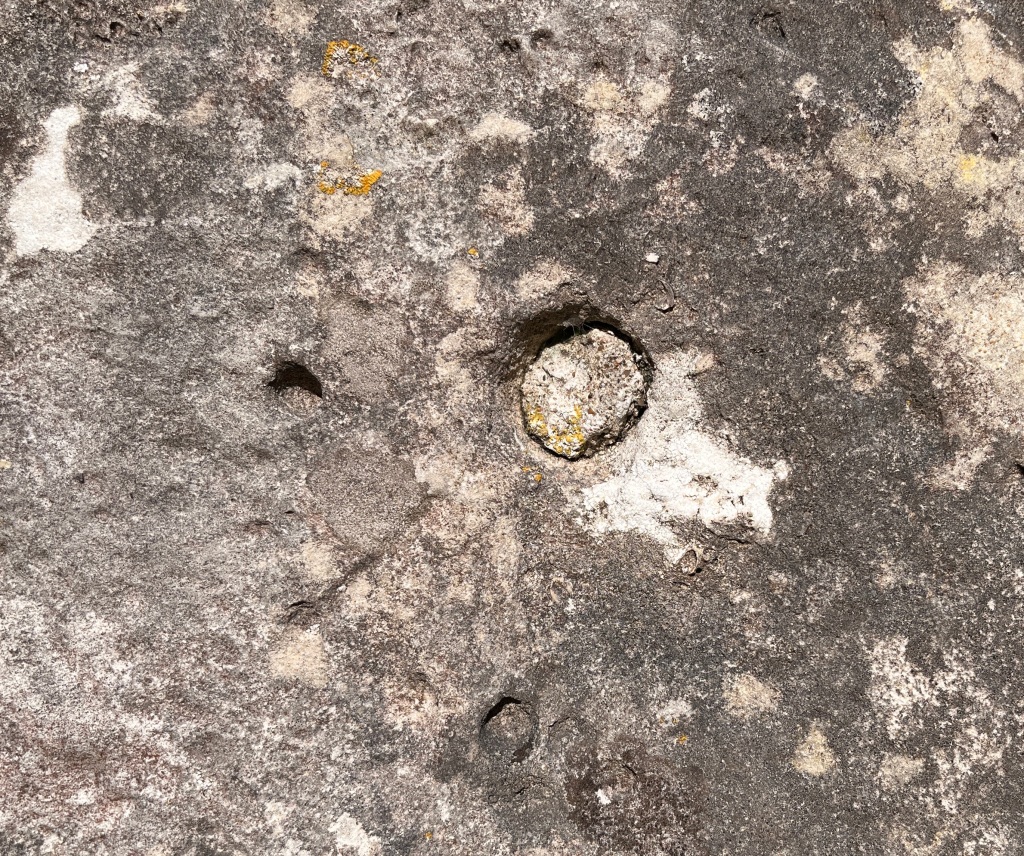
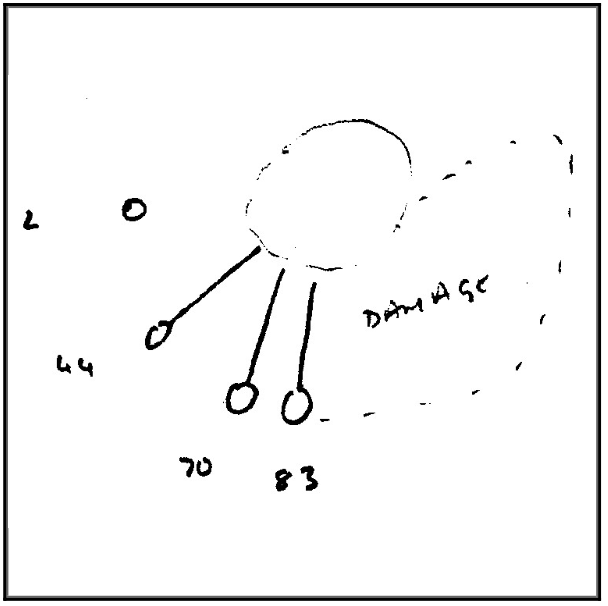
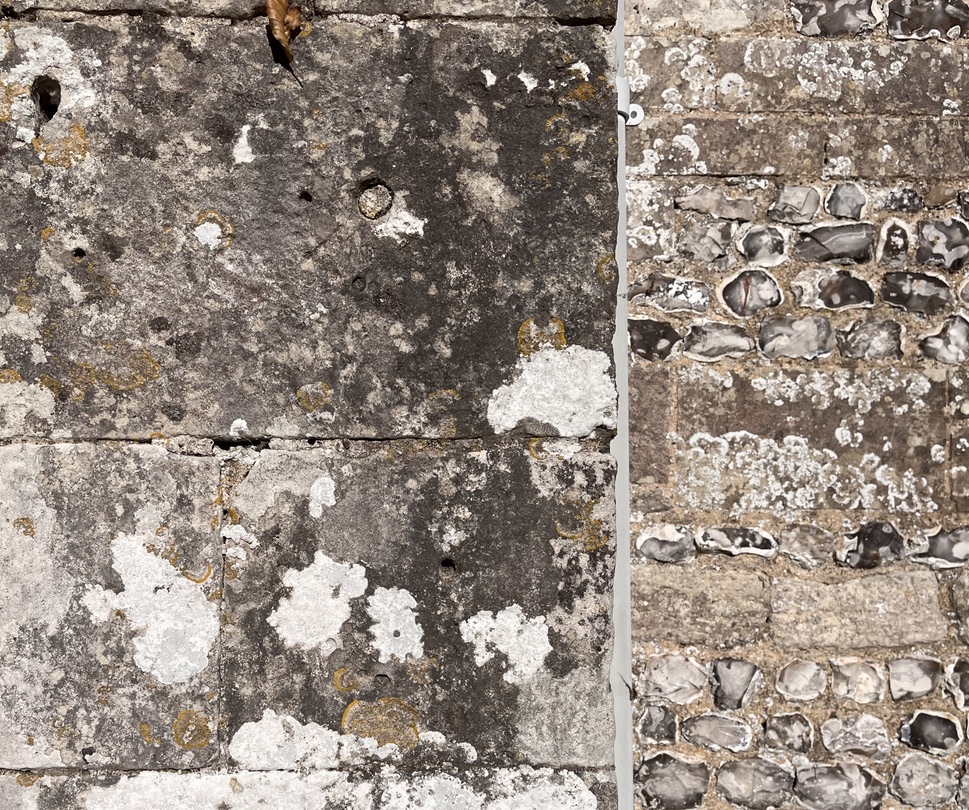
St Peter has 4 scratch dials, 3 on the E side of the S porch, 1 on the W side. One of my nemesis churches. I have visited in rain, in cloud, and in sunshine. Of the cluster of 3 on E side, I could only make out the obvious one. Eventually I managed to identify them from an enlarged photo. The BSS recorder’s diagram below gives an idea of the dials rather more clearly than my photos can.
DIAL 1
Dial 1 is located on the E side of S porch. Five lines are noted in the BSS records, of which 3 are clear and reasonably accurate. The gnomon hole is in the mortar line, where the lines converge.
DIALS 2 & 3
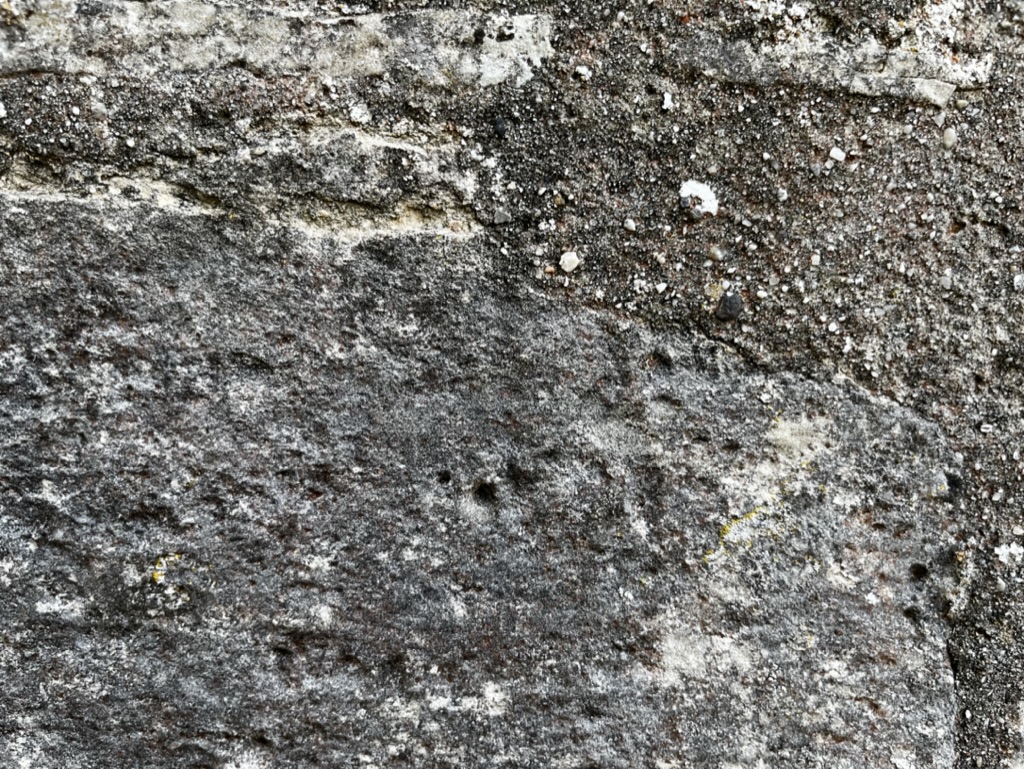
Dial 2 is very basic, and would be easy to overlook. There are 2 faint lines, with the top part including the gnomon hole cemented over a damaged area.
Dial 3 is even less conspicuous: a faint wishbone shape, 2 (3?) lines, one with a pock at the end.
I would doubtless have passed over this pair; and even had I noticed them I would have discounted them in my amateur way.
DIAL 4
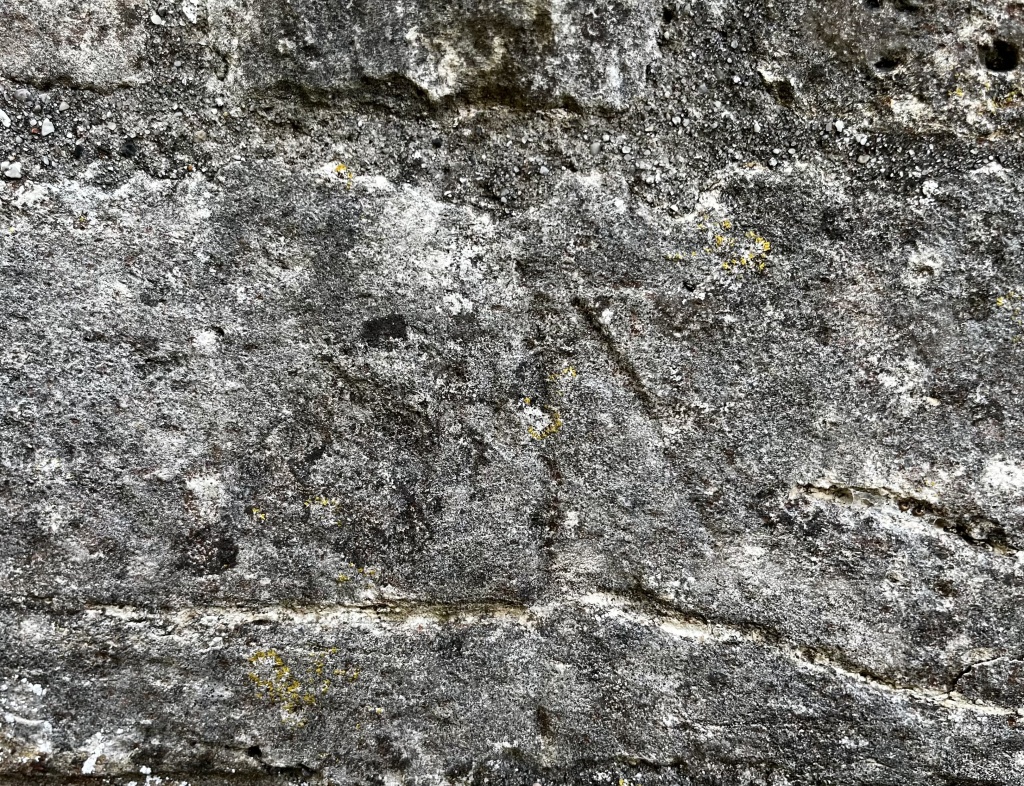
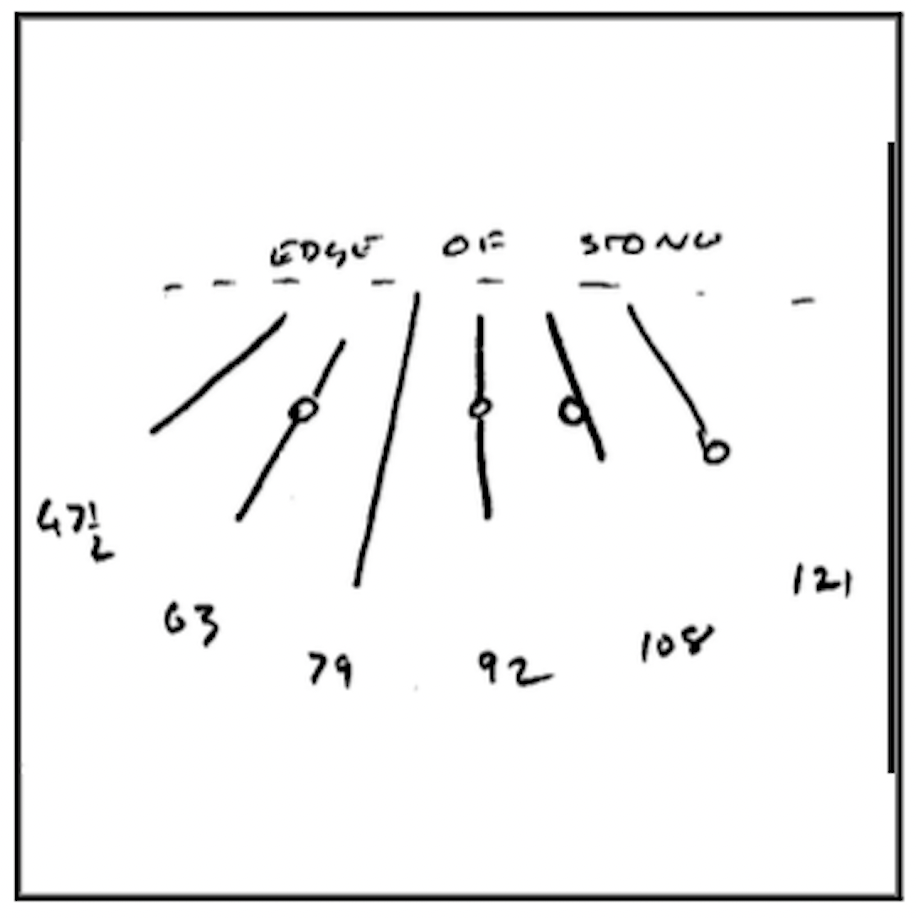
Dial 4 is on the west side of the south porch, on an inner quoin stone. At first glance it might be taken for an area of damage. In fact it is a dial with 6 lines, 4 of which end in pocks. It was described many years ago as not very accurately laid out and the passage of time has not improved the situation.
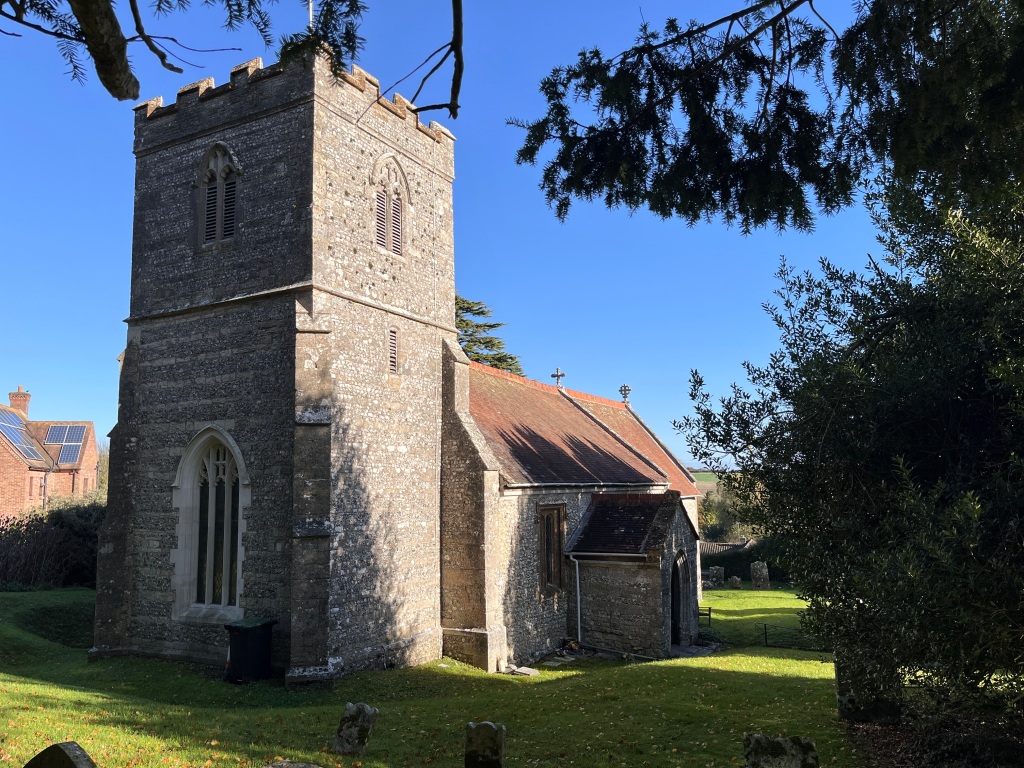
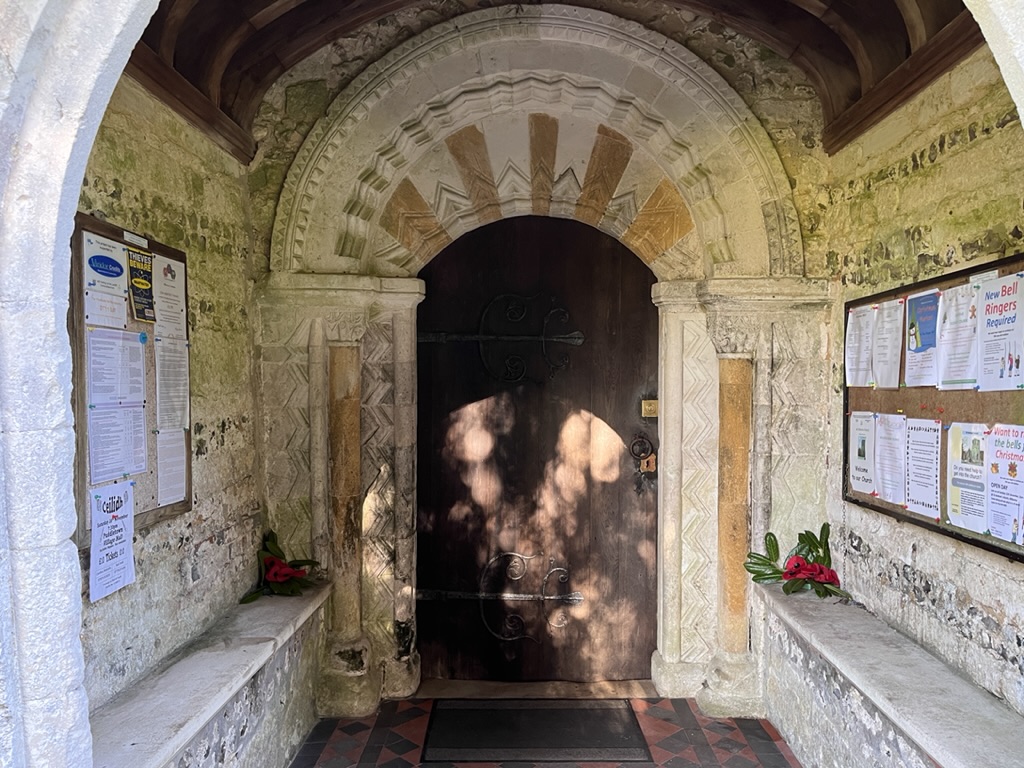
GRADE II* † C12 origins; tower & S porch C15; chancel, vestry, south aisle and chapel c1876 (G E Street). Wonderful C12 inner door with chevrons, shielded by porch; C12 font with a story to tell (below). A charming and very Dorset church. 4m SE of Bere Regis; 10m NE of Dorchester. 50.7759 / -2.2833 / SY801974
DIALS
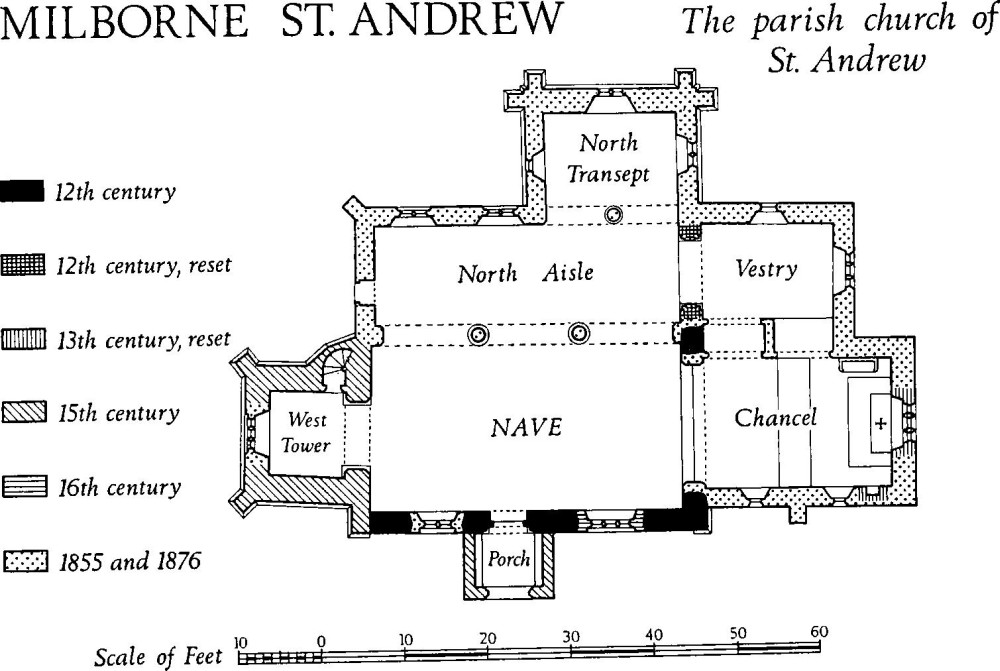
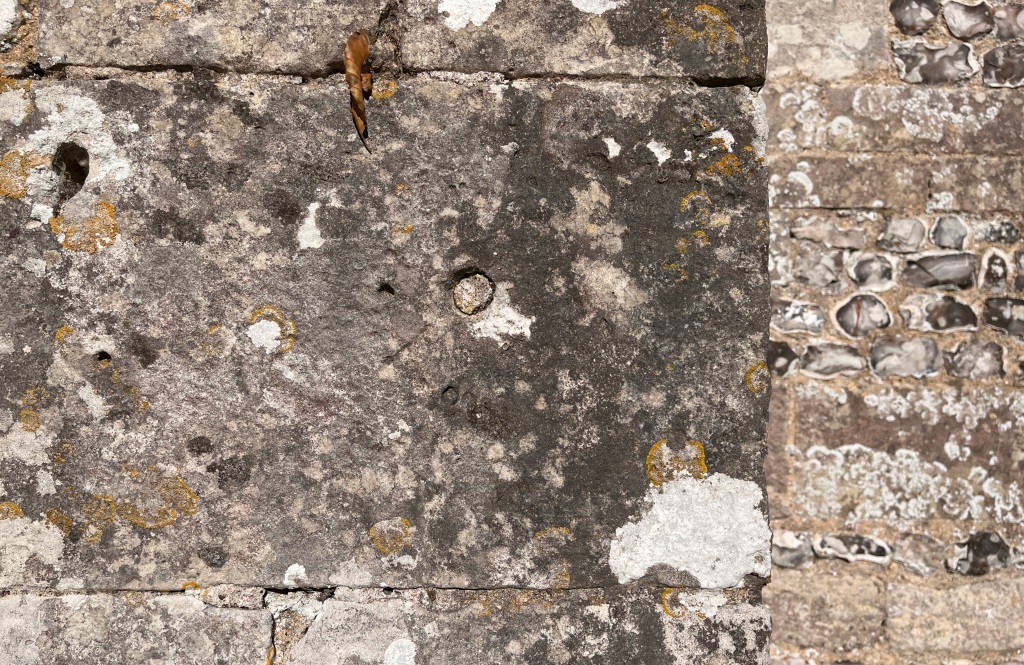
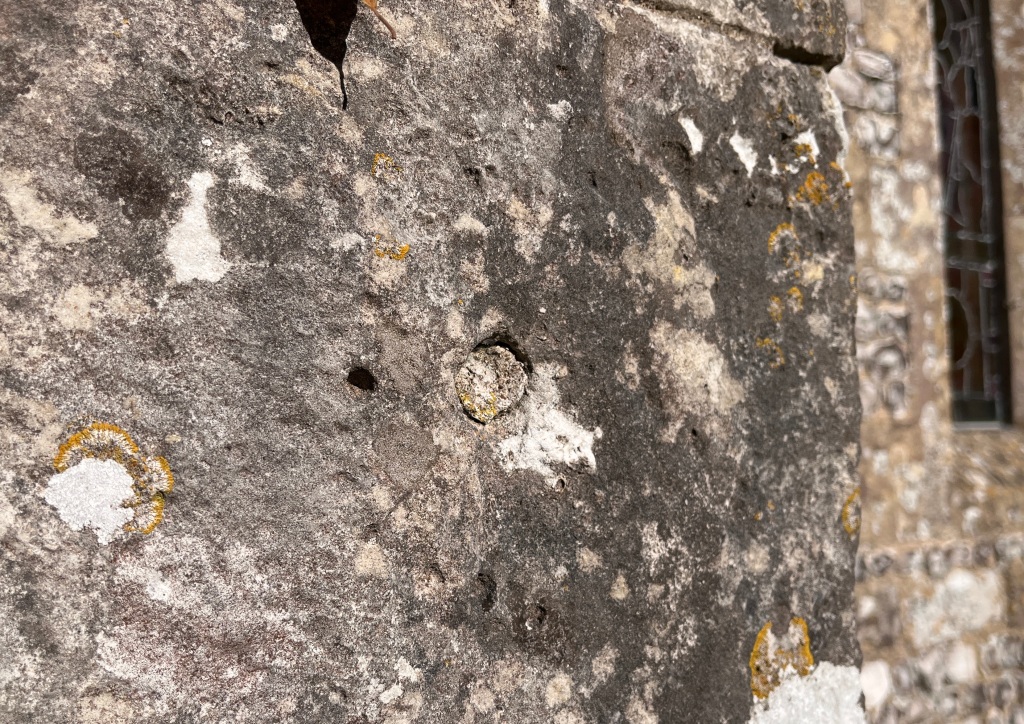
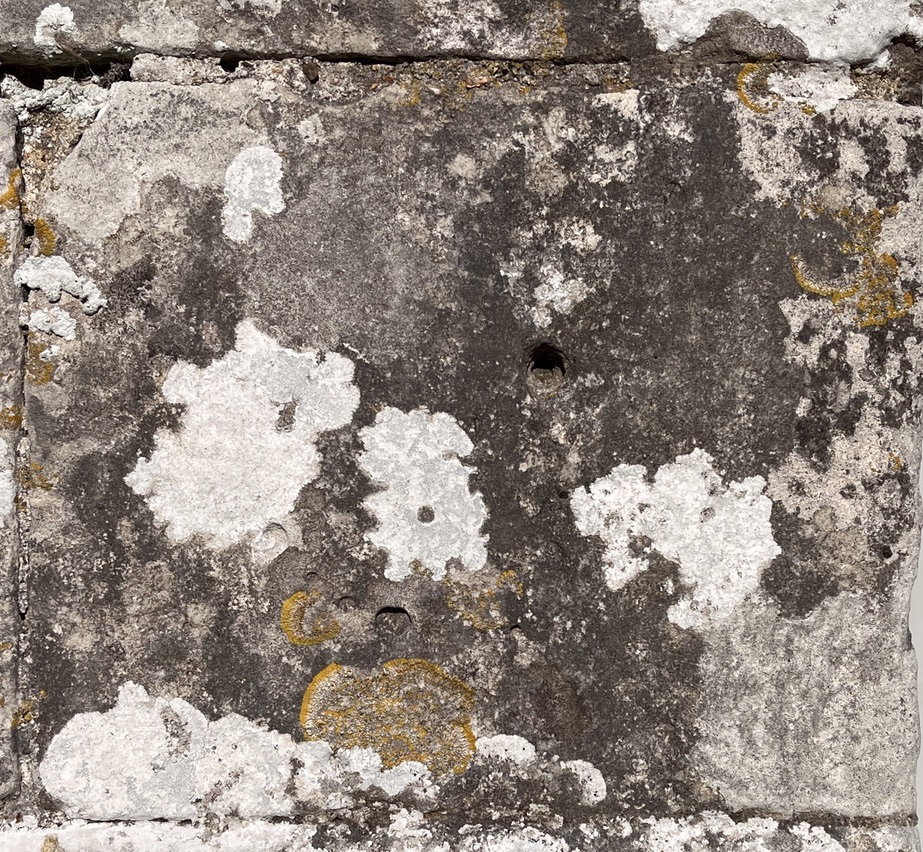
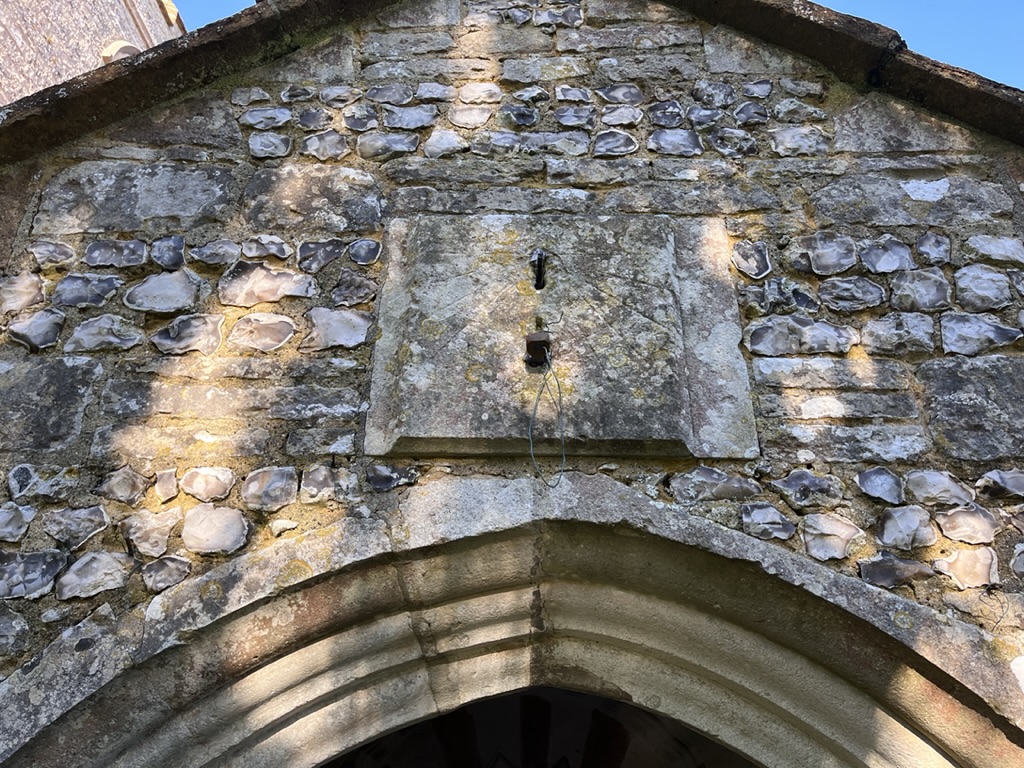
St Andrew has 3 dials. Dial 1 is a true scratch dial located in the NE corner of the nave, as is Dial 2 on the stone below (largely obscured by lichen, easy to overlook). Dial 3 is a transitional dial above the porch entrance.
DIAL 1
St Andrew . Milborne St Andrew . Dorset – Scratch Dial 1
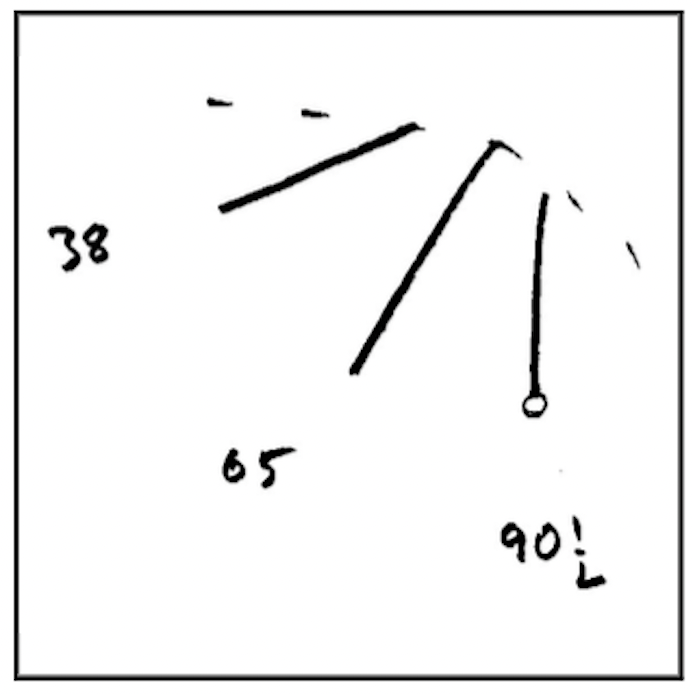
Dial 1 is easily identified by its prominent filled gnomon hole from which 3 lines radiate in LLQ. There is also a perimeter curve of 5 (?6) pocks (diag).
St Andrew . Milborne St Andrew . Dorset – Scratch Dial 1
DIAL 2
St Andrew . Milborne St Andrew . Dorset – Dials 1 & 2, NE corner of the nave
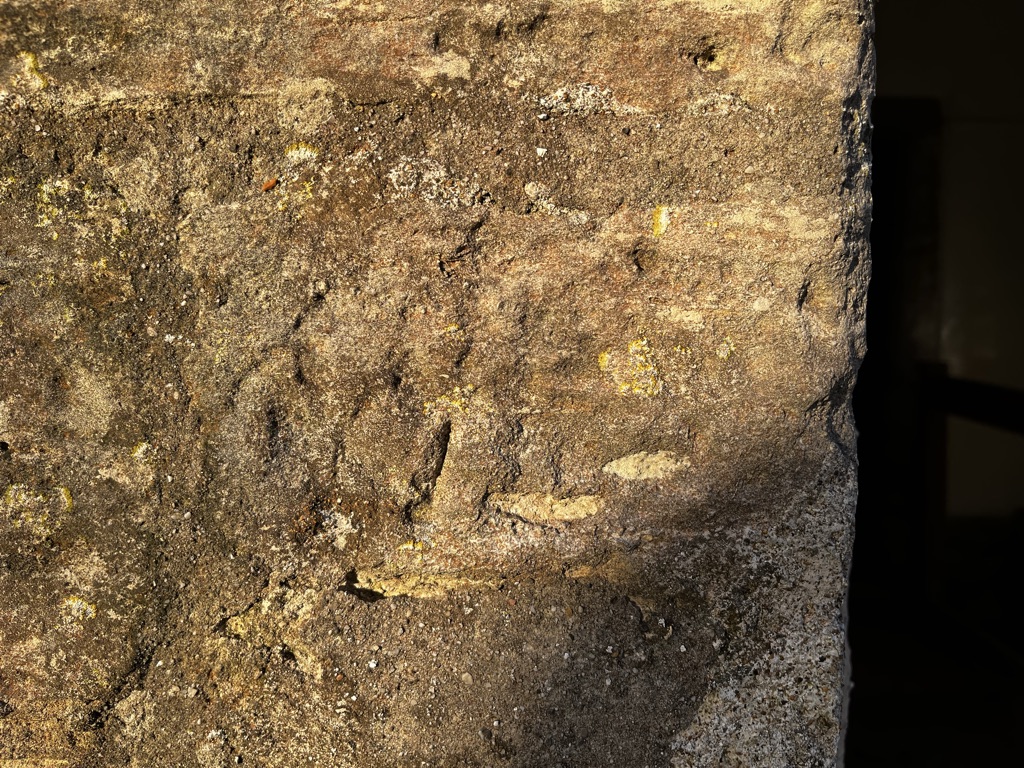
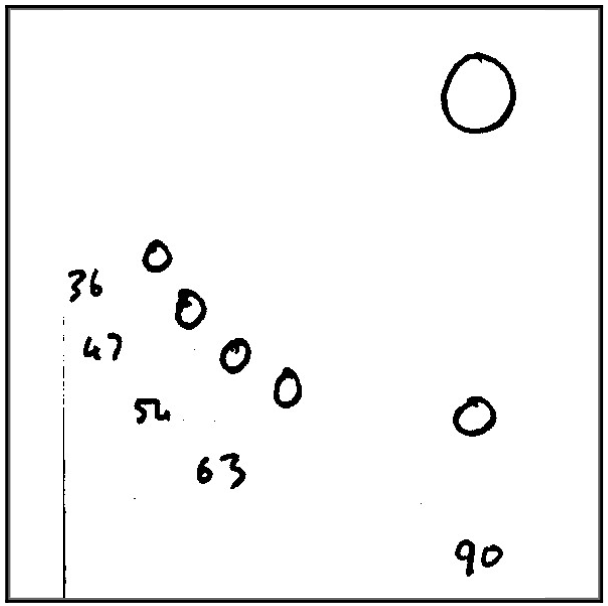
Dial 2, on the stone immediately below Dial, 1 has no discernible lines. BSS records 5 pocks of varying size that are (given the lichen) more or less visible seen in conjunction with the BSS diagram below. They are basically shallow dents, in contrast to the ‘drilled hole’ type of pock usually encountered.
St Andrew . Milborne St Andrew . Dorset – Scratch Dial 2
DIAL 3
St Andrew . Milborne St Andrew . Dorset – Scratch Dial 3
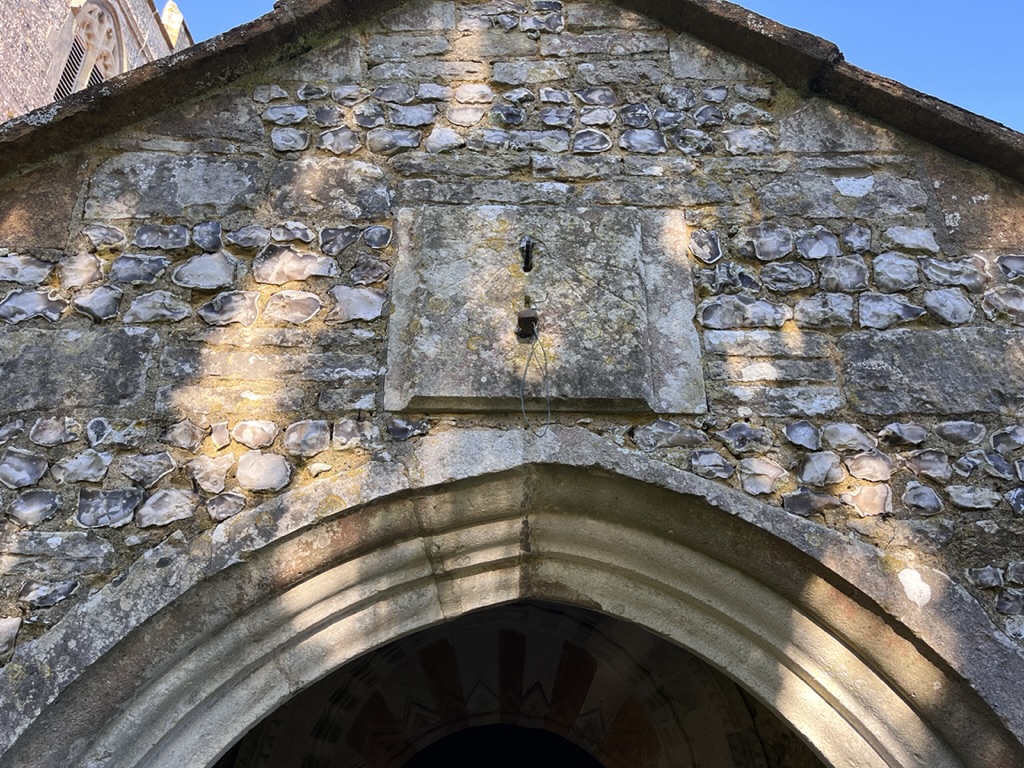
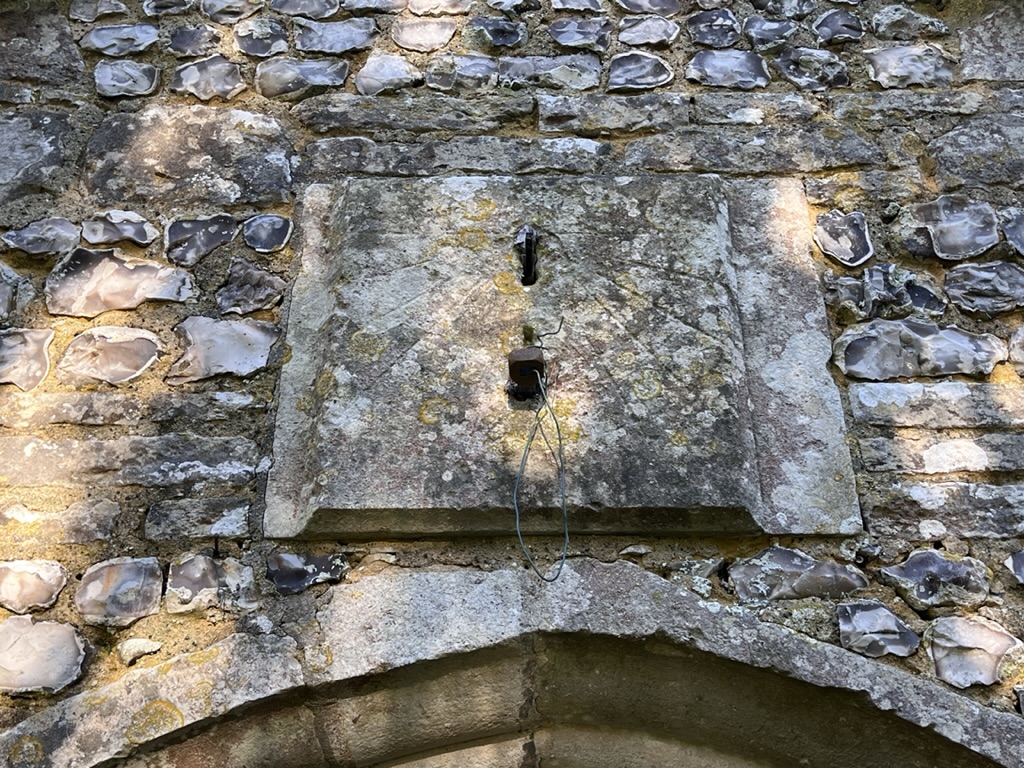
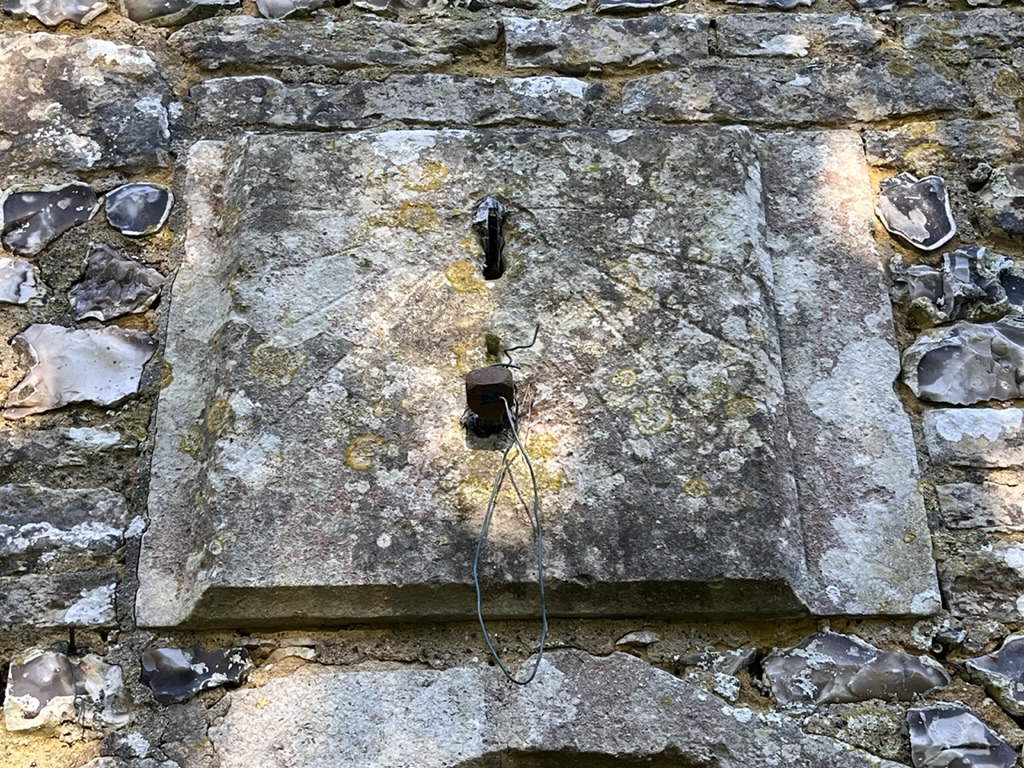
A transitional dial above the archway of the C15 S porch. Accuracy in marking the passage of time became increasingly important, not least with the advent of clocks. Dial design and construction involved taking a scientific approach to making time-telling more reliable and more legible. St Andrew is a good example. Rather than being scratched directly onto a stone intrinsic to the church structure, this dial stone is on what BHO describes as a square raised panel.
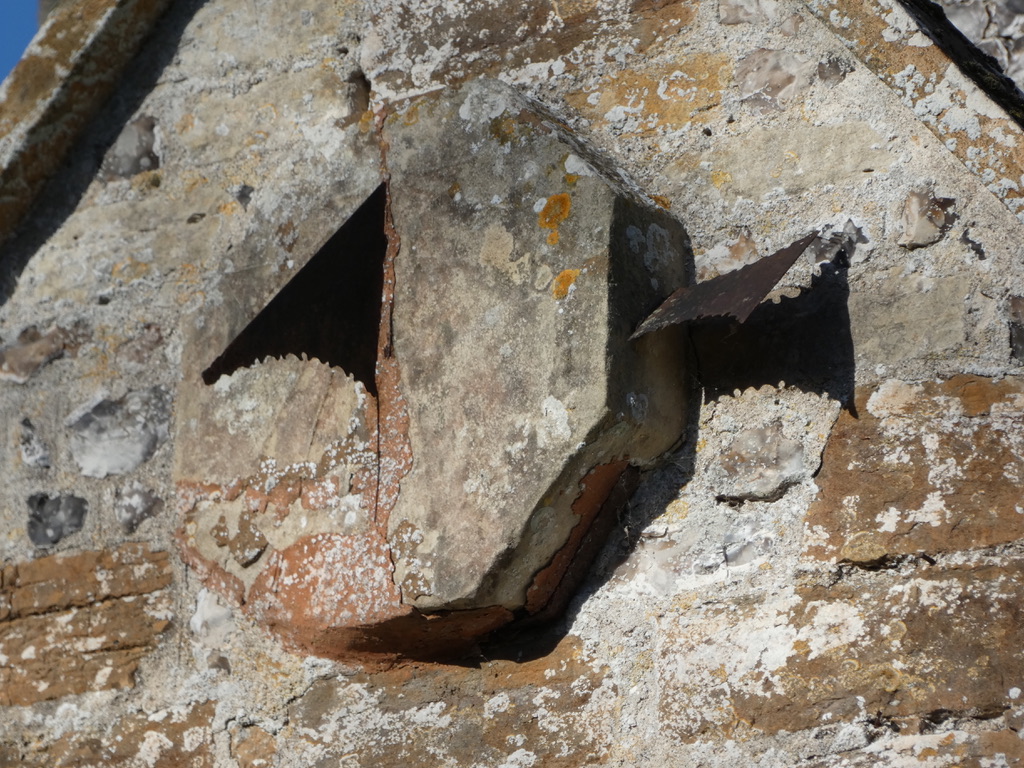
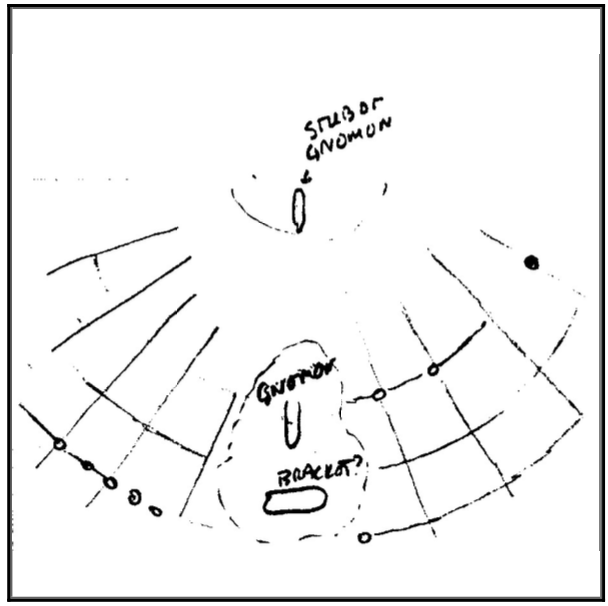
The dial has slightly angled edges with ‘extensions’ on both sides. It is not canted, so probably faces due S. It is a six-to-six dial with – originally – 12 lines (14, with the horizontal as 2). The hours 4 & 5 are cut deeper, perhaps denoting the most important Mass of the day. Some lines have weathered away in part or completely. There are a number of pocks. The recorder noted 4 trace (semi-)circles, one being close to the gnomon hole. The original gnomon was in the upper hole where there is now a square stub of iron rod. The lower arrangement indicates, I think, a later conversion / updating from a simple rod gnomon to a ‘proper’ one that required a footing; and perhaps a lamp bracket.
RARE FEATURE It’s not completely clear from my rather poor iPhone photos, but if you look carefully at the edge R side where there is the wide margin, you can see that the lines marking 4 & 5 extend onto the side of the dial face and continue down the side of the stone panel. Those short lines are visible from the side even if the rest of the dial is not. I wouldn’t have paid it much attention had I not also visited the neighbouring village of Winterbourne Whitchurch where there is an emphatic example of a ‘side-dial’ complete with a most unusual gnomon. My understanding is that this arrangement amounts to a morning dial read from E.
St Andrew . Milborne St Andrew . Dorset – Scratch Dial 3
This is the 4th church I have come across where church events have entailed the use of a dial to tie in decorations etc with wire. In each case the wire was effective as an improvised gnomon.
FONT STORY
During the Victorian period it was sometimes the fashion to throw out ancient fonts and Street did just that, installing in its place a new replacement. Fortunately, the old Norman font, decorated with a cable motif, was rediscovered in 1930 and put back in the north aisle, where it remains in use to this day.DHCT [This is an example of throwing the bath out with the baby water]
St Andrew . Milborne St Andrew . Dorset – S Porch and Norman Doorway
GSS Category: Scratch Dial; Mass Dial ; Transitional Dial
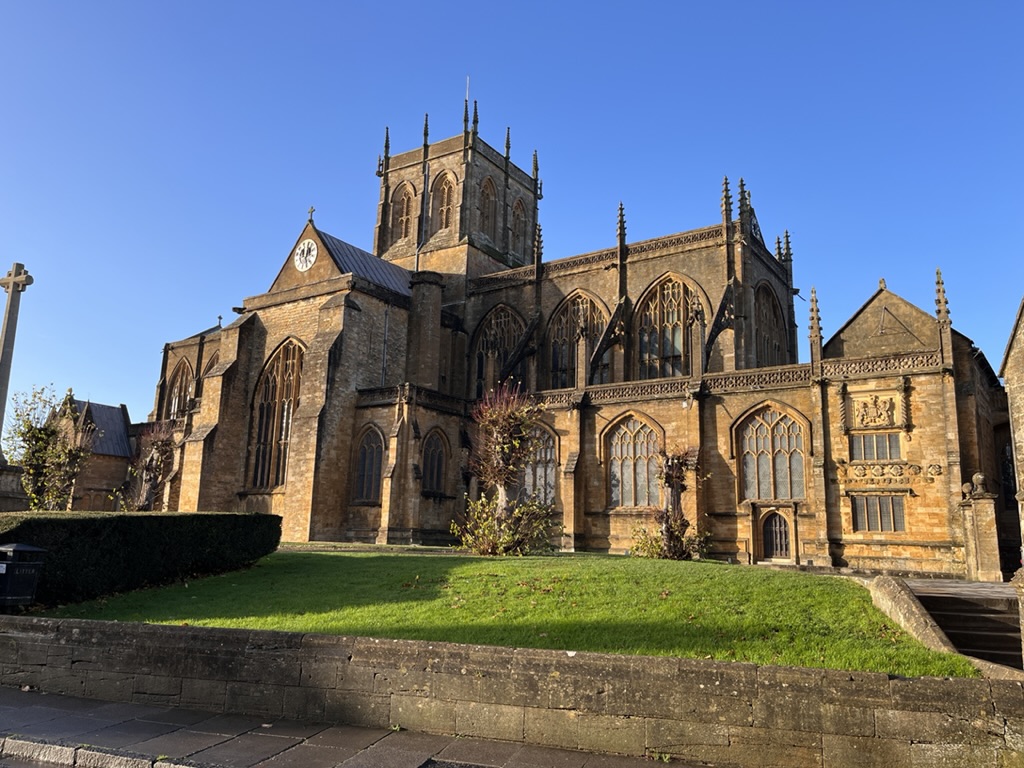
GRADE I † Founded by St. Aldhelm in AD 705 as a Saxon Cathedral, Sherborne Abbey became a Benedictine monastery, and following the Dissolution of the monasteries, a Parish Church of some splendour. Of all the architectural features, the astonishing [earliest majorPEV] fan vaulting is arguably the finest. This is not the place for discussion of the merits of the church. The Wiki entry is a helpful source for an overview of SHERBORNE ABBEY
St Mary the Virgin . Sherborne Abbey . Dorset
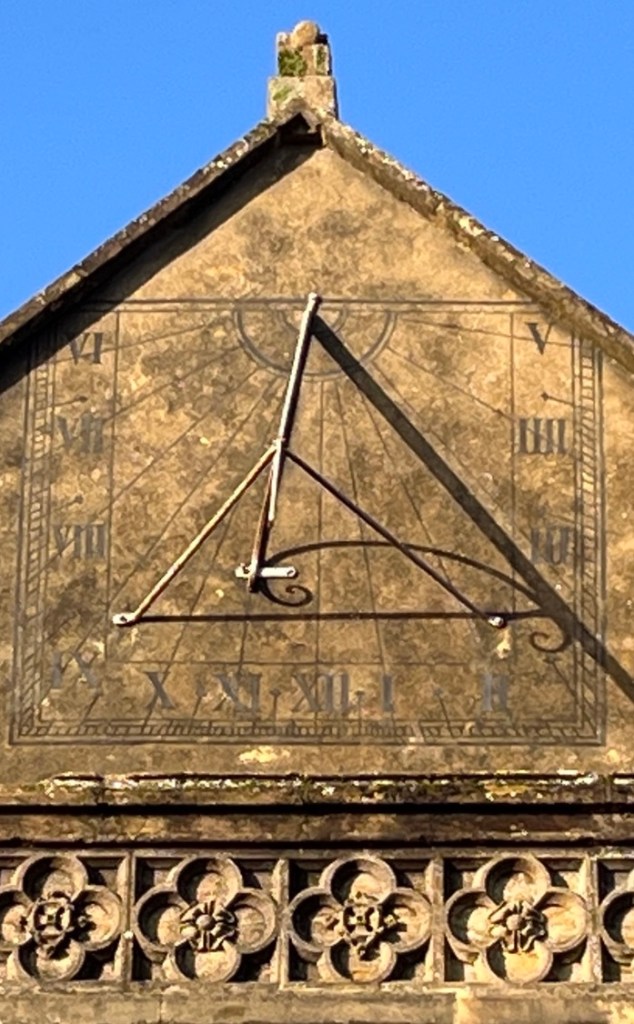
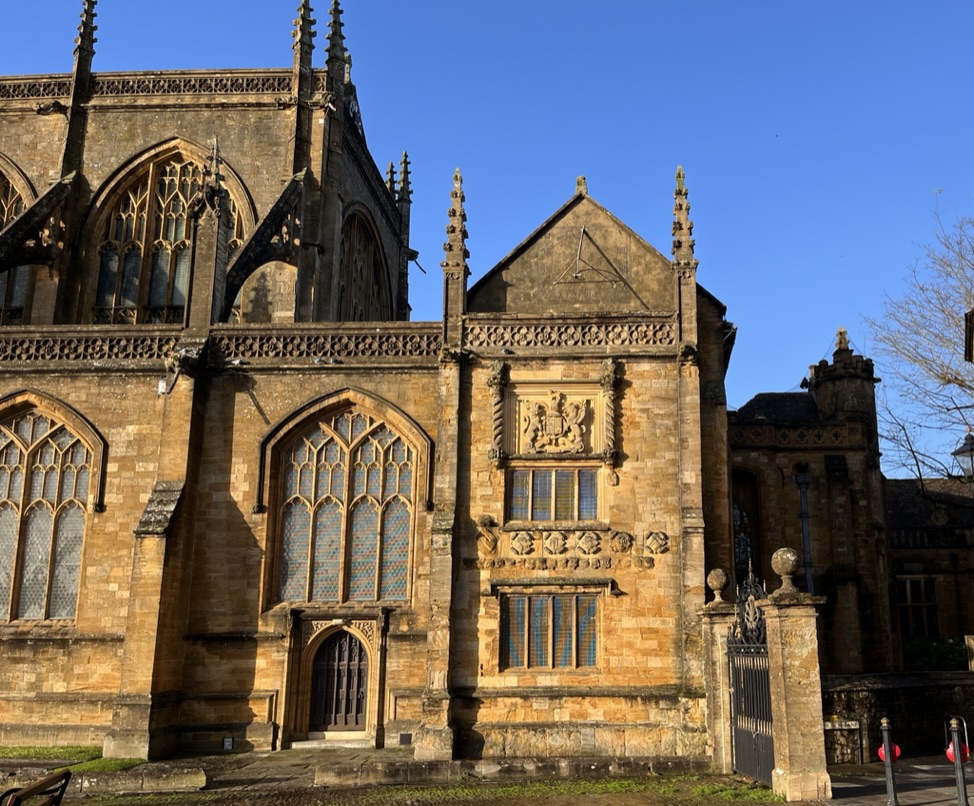
The large Vertical dial at the E end is impressive and visible from some distance. The Old Shirburnian Society records:
The south-facing vertical dial on the south-east end of Sherborne Abbey was erected in 1745 by Sherborne School at a cost of £5.5s.0d. It was built by the Sherborne architect Benjamin Bastard (1690-1776), son of Thomas Bastard of Blandford Forum.
The modern gnomon is effective and casts an attractive shadow; it could be argued that its style and fixings do not quite do justice to a C18 dial.
St Mary the Virgin . Sherborne Abbey . Dorset – Vertical Sundial
The gallery above might suggest overuse of saturation, but the photos – at various distances to show other features – were taken on an iPhone on a bright sunny early winter’s morning, and are un-enhanced (not always the case, I must admit). We were fortunate enough to be married in this glorious building.
GRADE II* † C12 origin; alterations / enlargement in C14, C15, C16; restored 1872 (Wyatt). Walls mainly rubble stone and flint. A lovely setting, with a fine manor house. Much older-seeming even than the ubiquitous ‘Hardyesque’ description in these parts. Subtly hidden away 8m NE of Dorchester. 50.7827 / -2.3198 / SY775981
From the ground, this is a difficult dial to admire. It is high up, eroded, damaged, and gnomon-less. It would be easy to dismiss it as a disappointment after you have negotiated the narrow lanes that lead circuitously to the church. Luckily I brought a real camera with me (for scratch dials I just use my phone) to catch the details of 3 vertical dials on churches in the area.
The dial, on a rectangular stone slab, is dated 1671, and marks the hours from VIII am to VII pm. The motto across the top reads UT UMBRA SIC VITAAs a shadow so is life, one of several similar motto variants commonly found. The motto is enclosed within the initials A and R. (BHO elides the initials and the motto to form AUT UMBRA SIC VITAR).
The Borough Gardens in Dorchester are close to the centre of town. They were laid out and opened in the 1890s as ‘pleasure grounds’, as they remain. There is plenty to offer for all ages in an agreeable undulating space. Lawns, tennis courts, a bandstand, paddling pool, playground, a fountain, a memorial obelisk and more.
ANALEMMATIC SUNDIAL
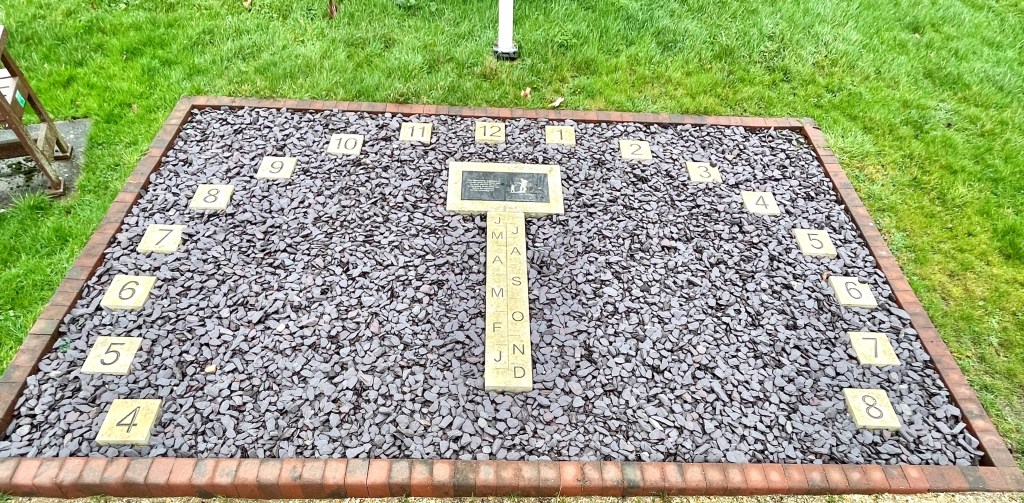
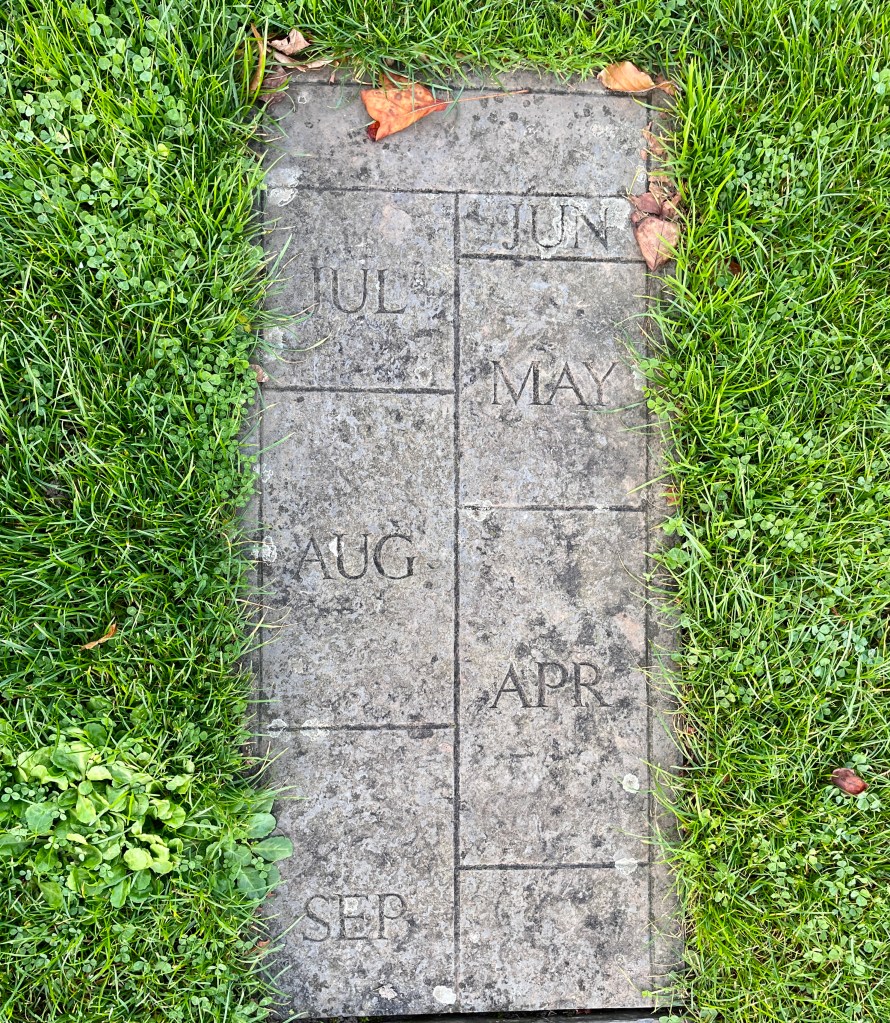
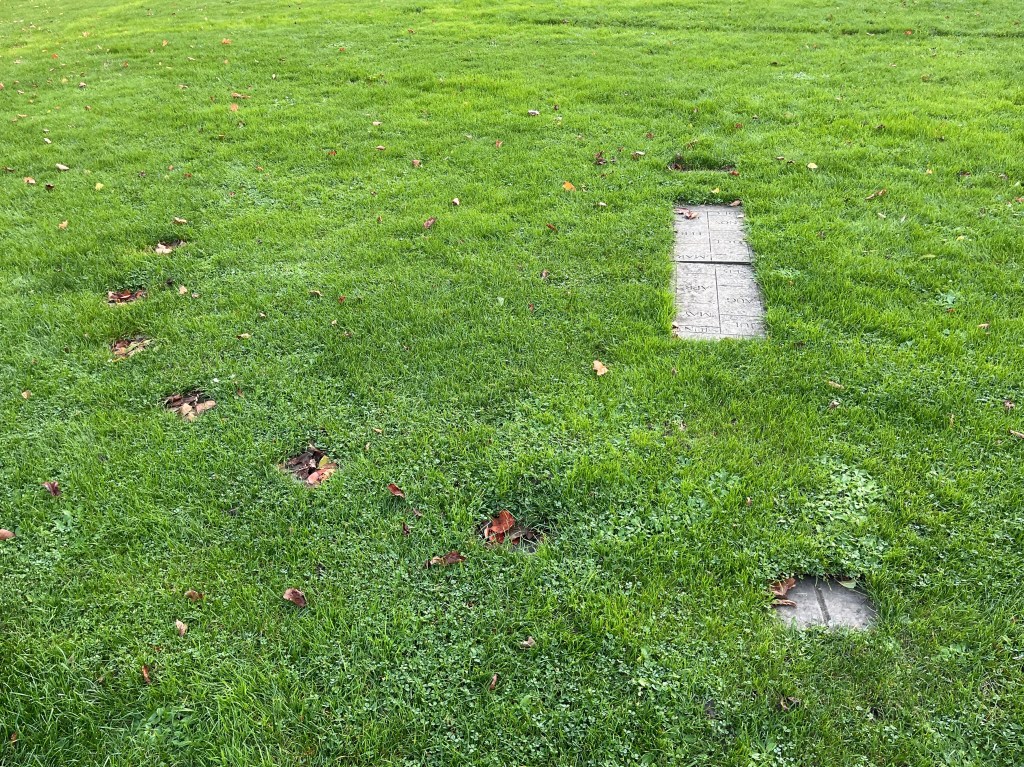
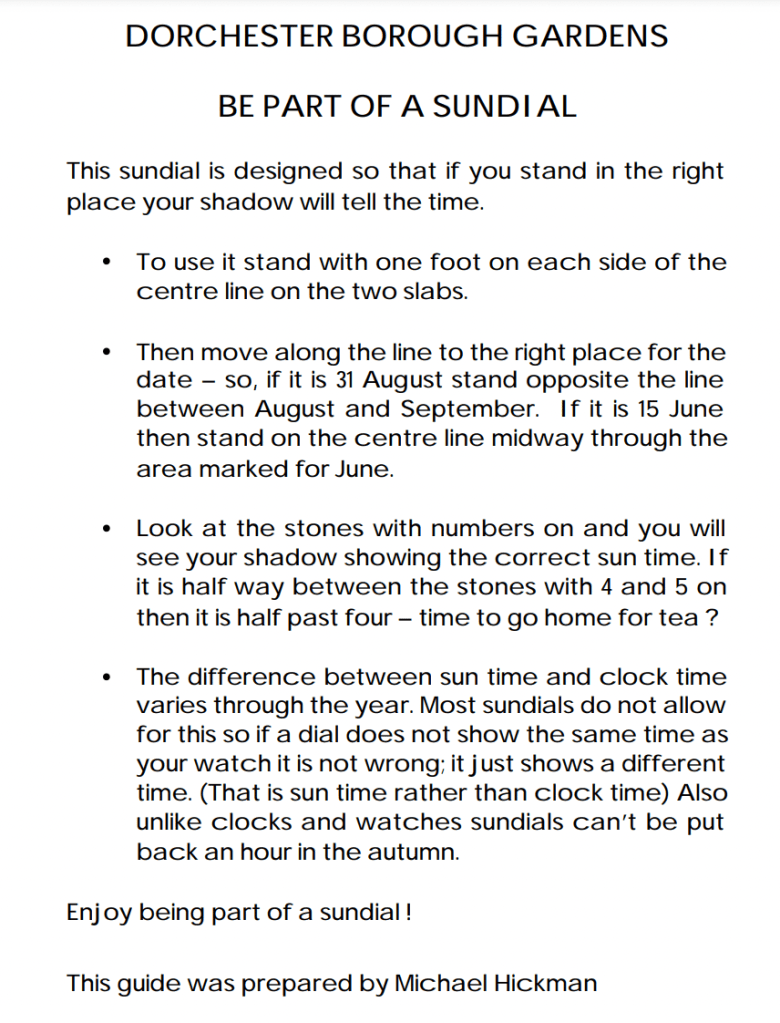
Amongst the attractions, close to the bandstand, is a modern analemmatic sundial. I don’t know the date it was laid out, but the BSS record is 1998 with the note: The dial is laid out in the play area near the bandstand. Hour markers adjusted for longitude, an hour added for summertime use. Shows hours from 7am to 7pm.
When I visited a few days ago, several small boys were having a kick around, with the dial in the centre of the pitch. No other type of dial would have worked for the purpose. The dial was partly concealed by uncut grass and leaves – the latter covering each numbered stone completely (I had to move some). I liked the way that the dial has several roles: time-telling in an interesting way; an open invitation to be the gnomon; an educative function; and artful horizontal stonework blending in with grassy and leafy surroundings. And a ‘jumpers for goalposts’ pitch into the bargain.




























 GAUDIUM SUB SOLE . SUNDIALS . MEDIEVAL TO MODERN