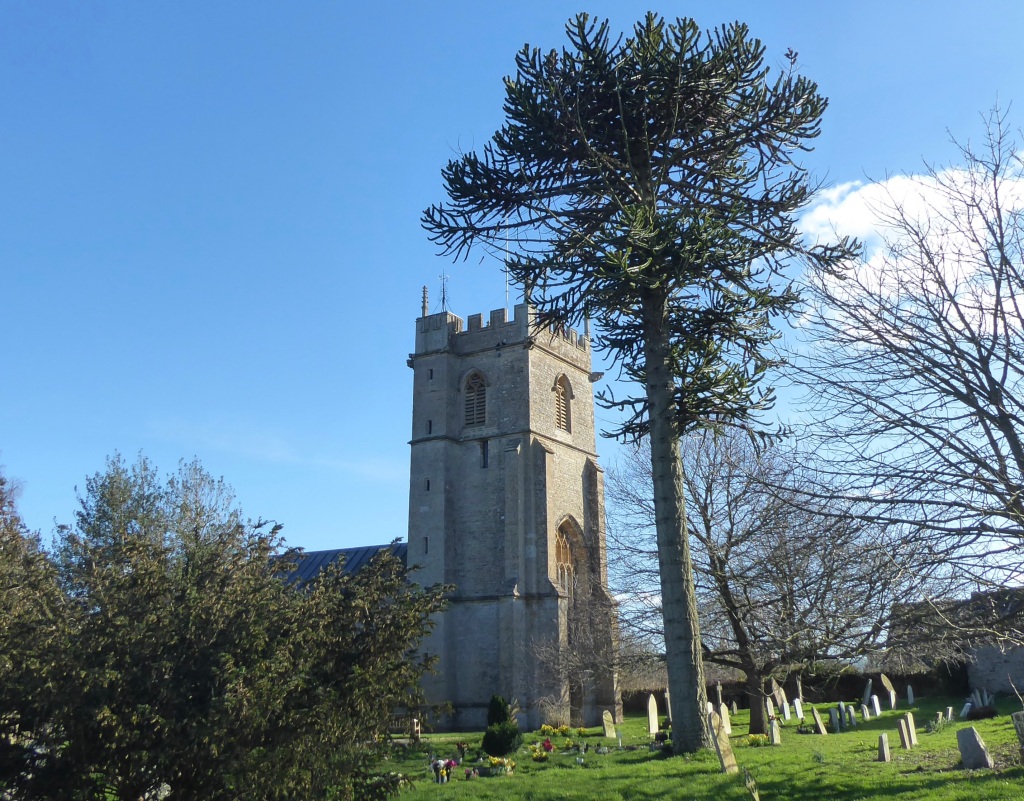
GRADE I † C11 nave; C13 transepts; C14 chancel. From C17, alterations and restorations inc by Wyatt in 1860. Large and interesting cruciform churchPEV. Marble Feversham family monuments by Scheemakers. Significant local legacy from Neolithic, Iron Age, Roman (Villa) and Saxon times. 9m S of Salisbury. 50.9937 / -1.7433 / SU181216
✣
DIALS
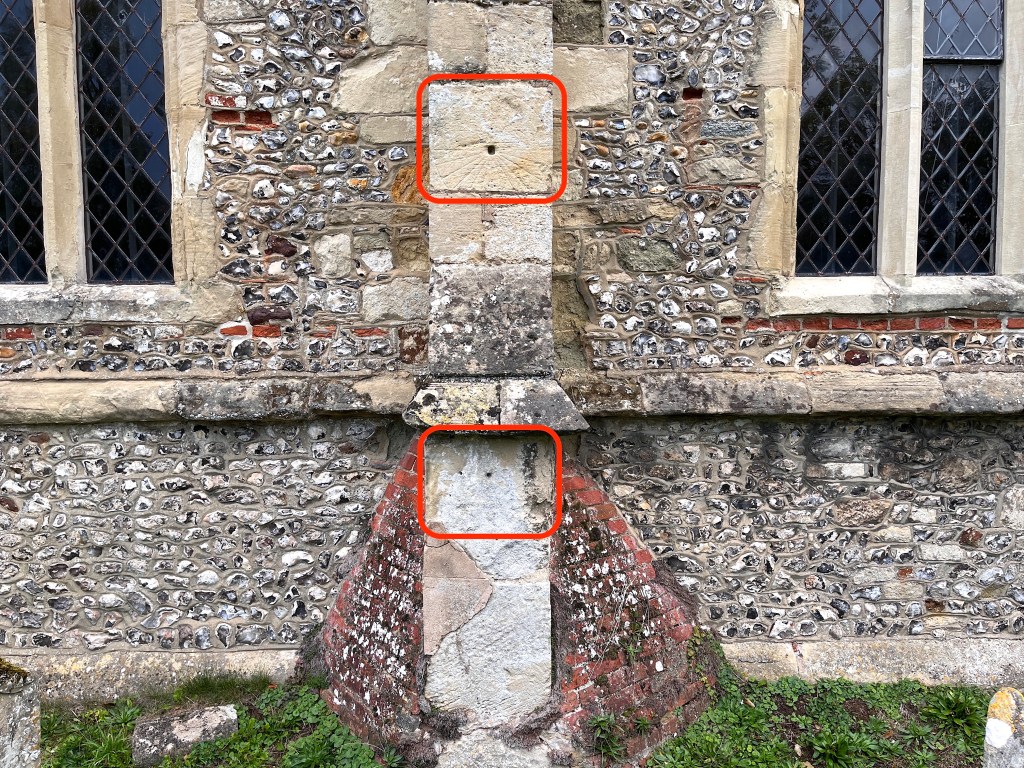
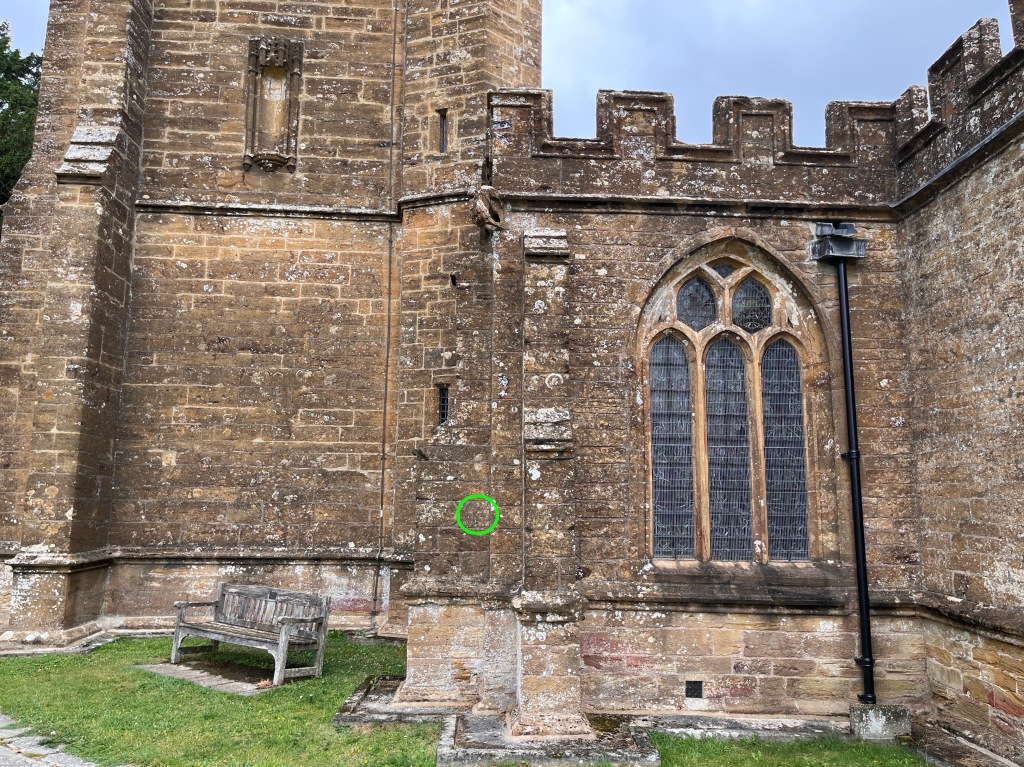
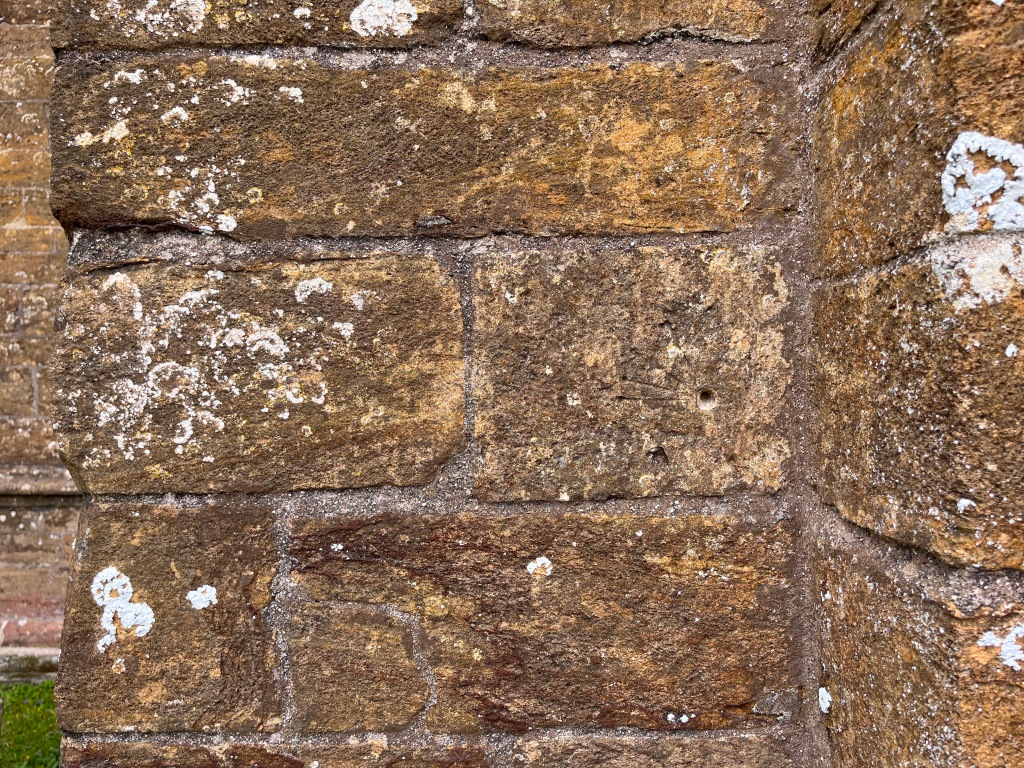
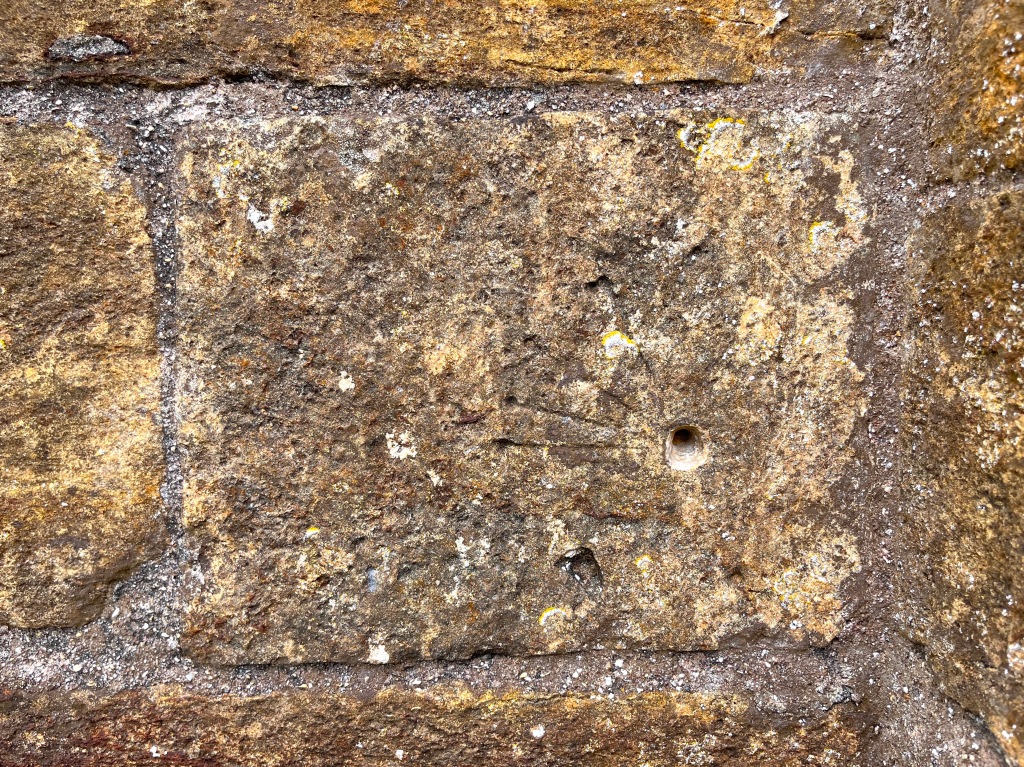
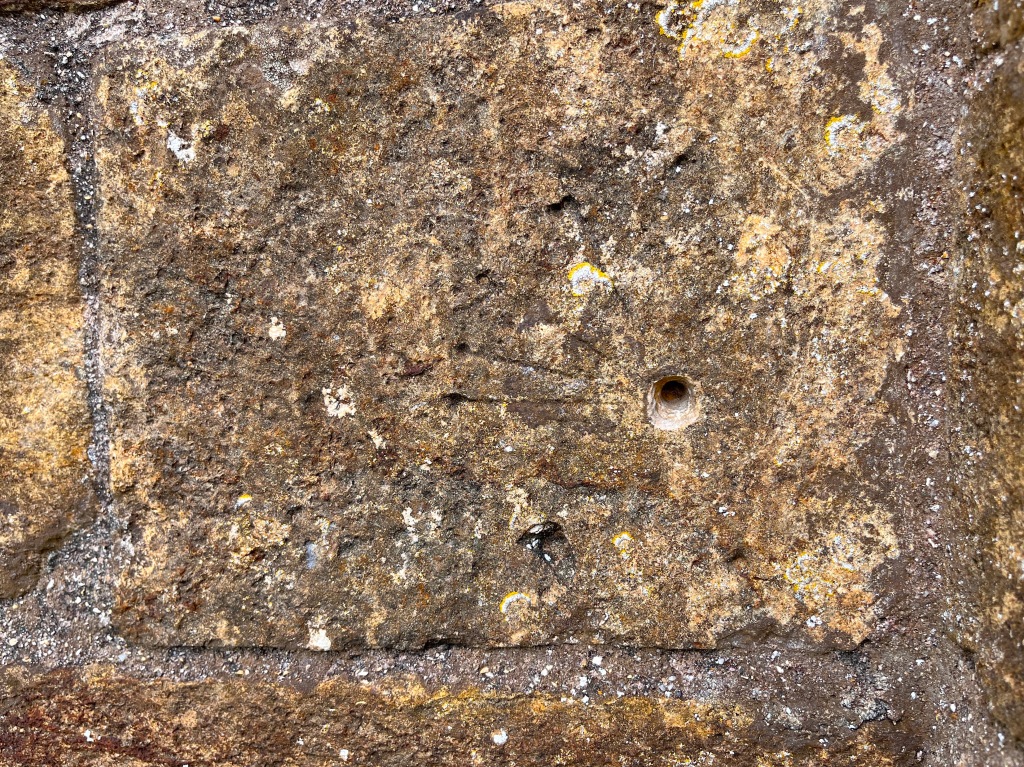
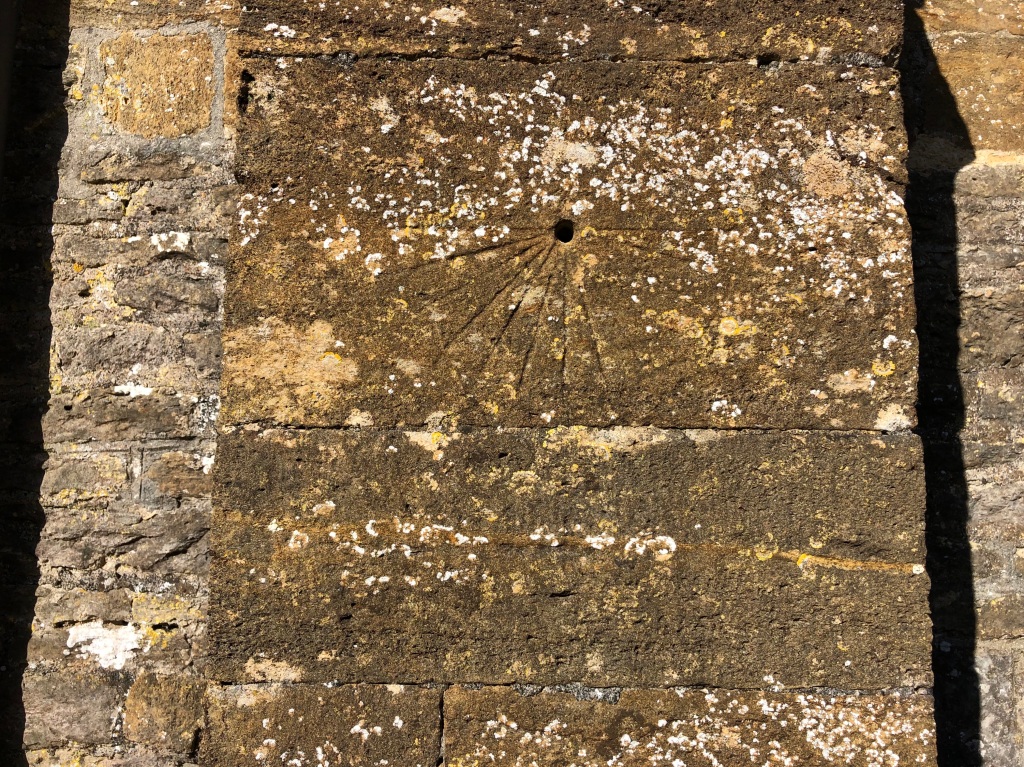
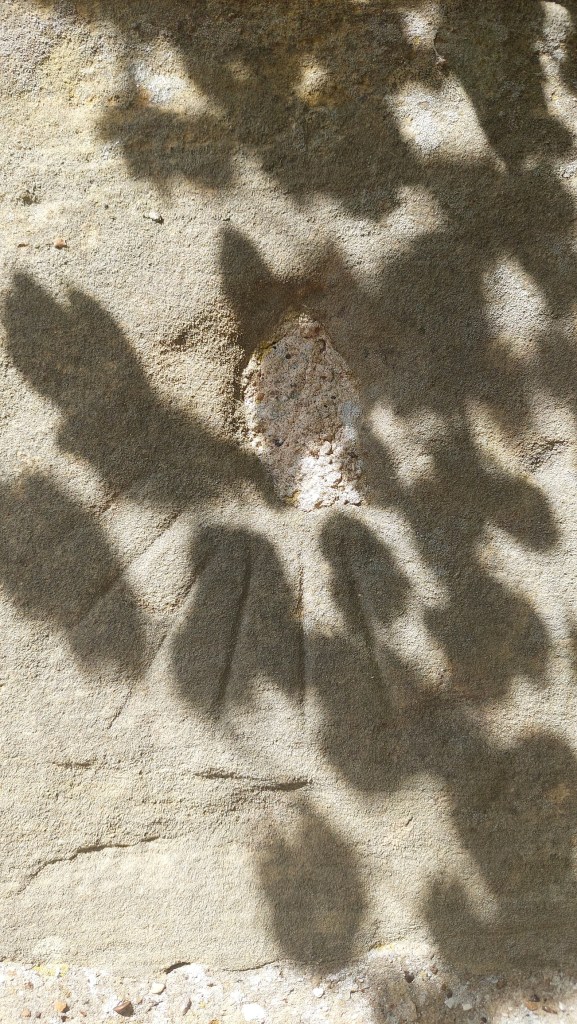
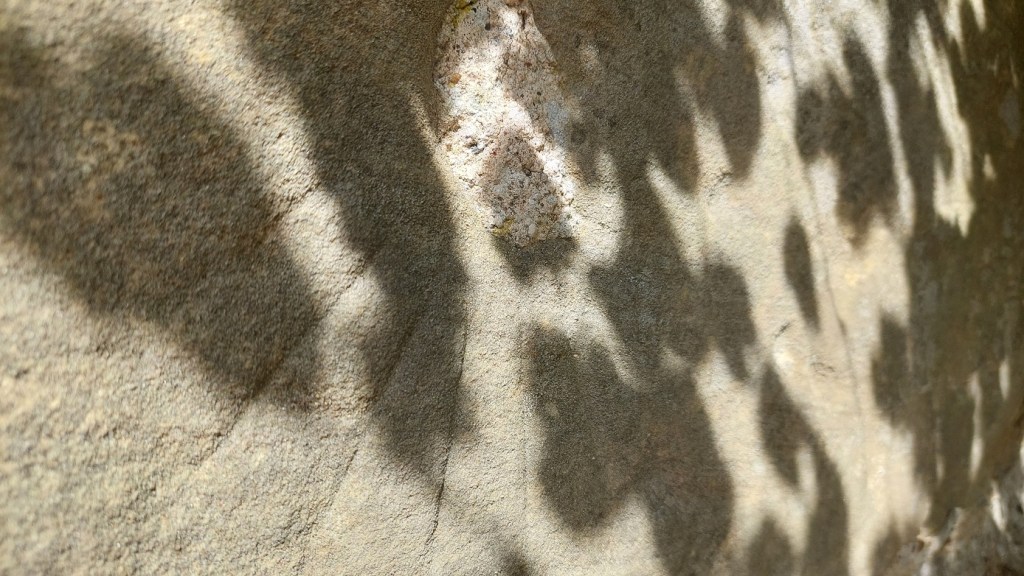
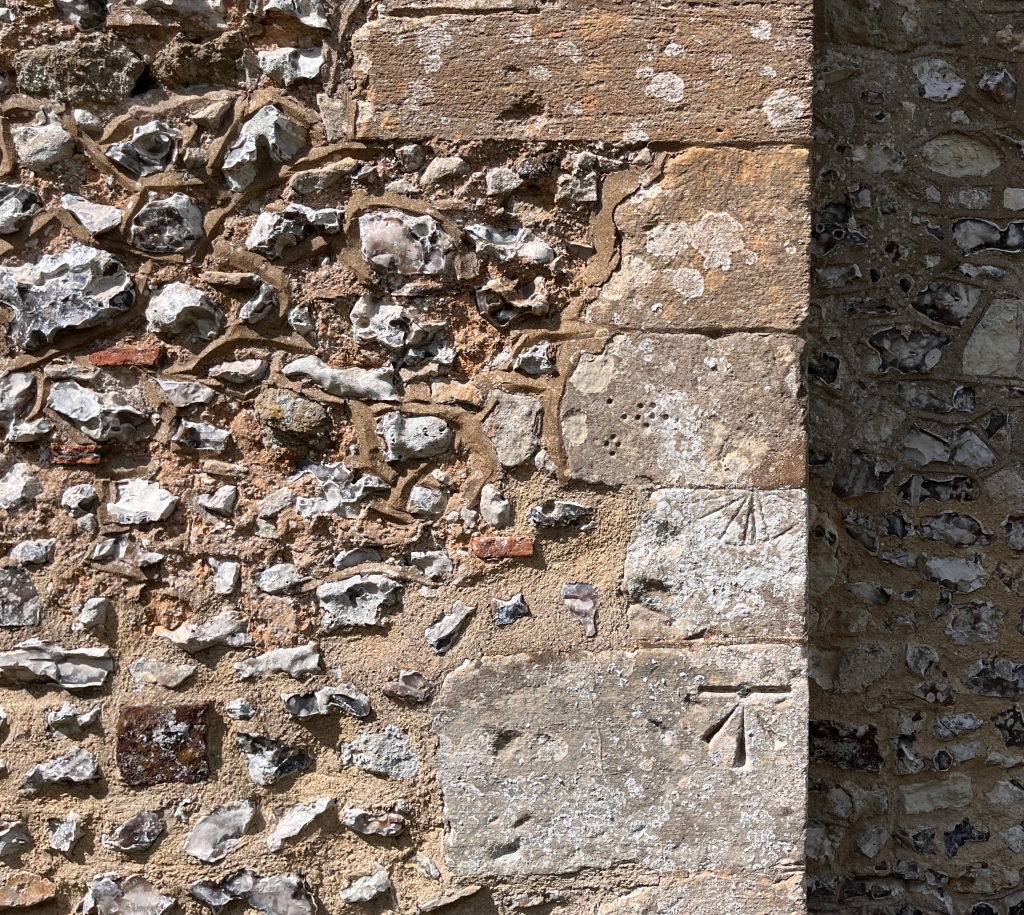
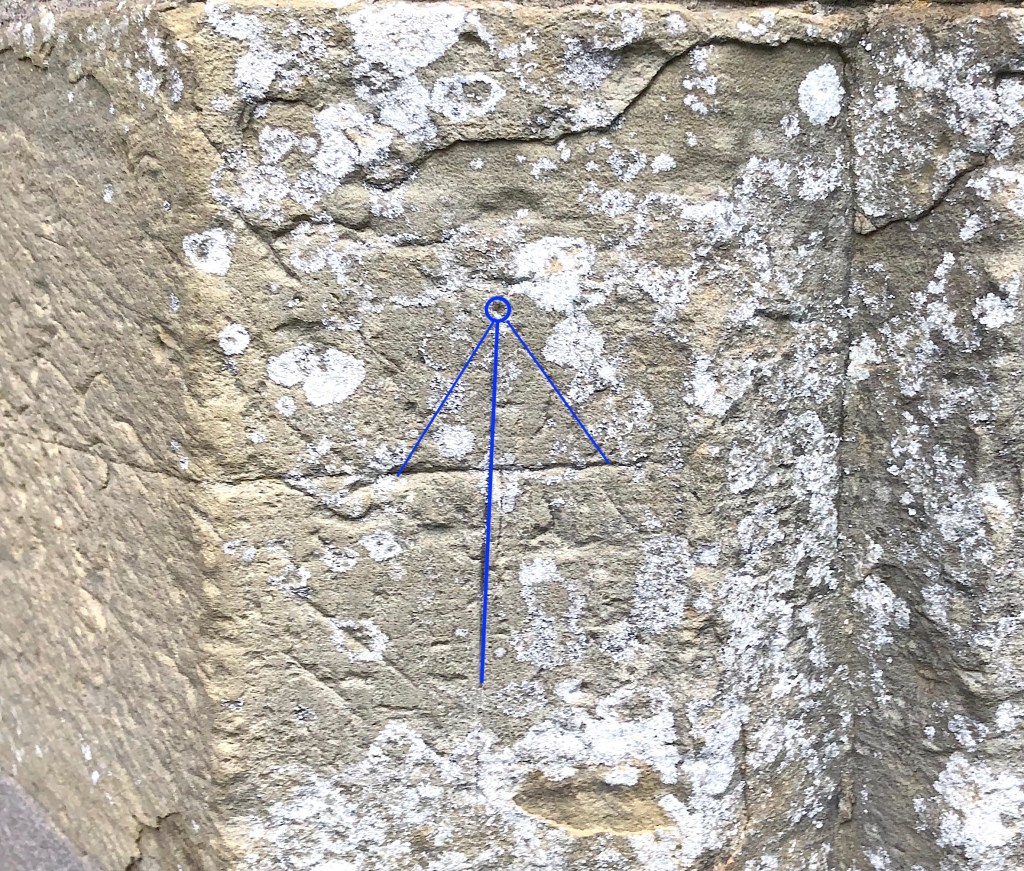
St Laurence has 2 dials on the 2nd buttress E of the porch, one above the other. The upper one is a fine example of a large dial filling the dial stone. The lower is so badly damaged / eroded that it would be easy miss; and it is quite hard to imagine what it looked like originally.
✣
DIAL 1
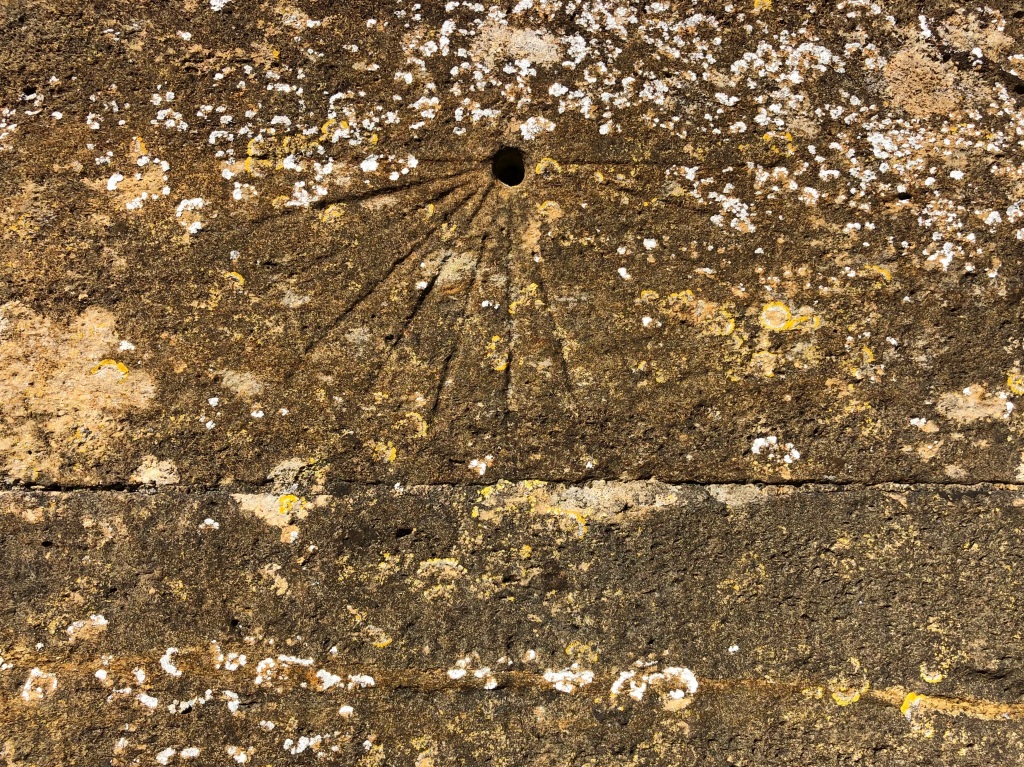
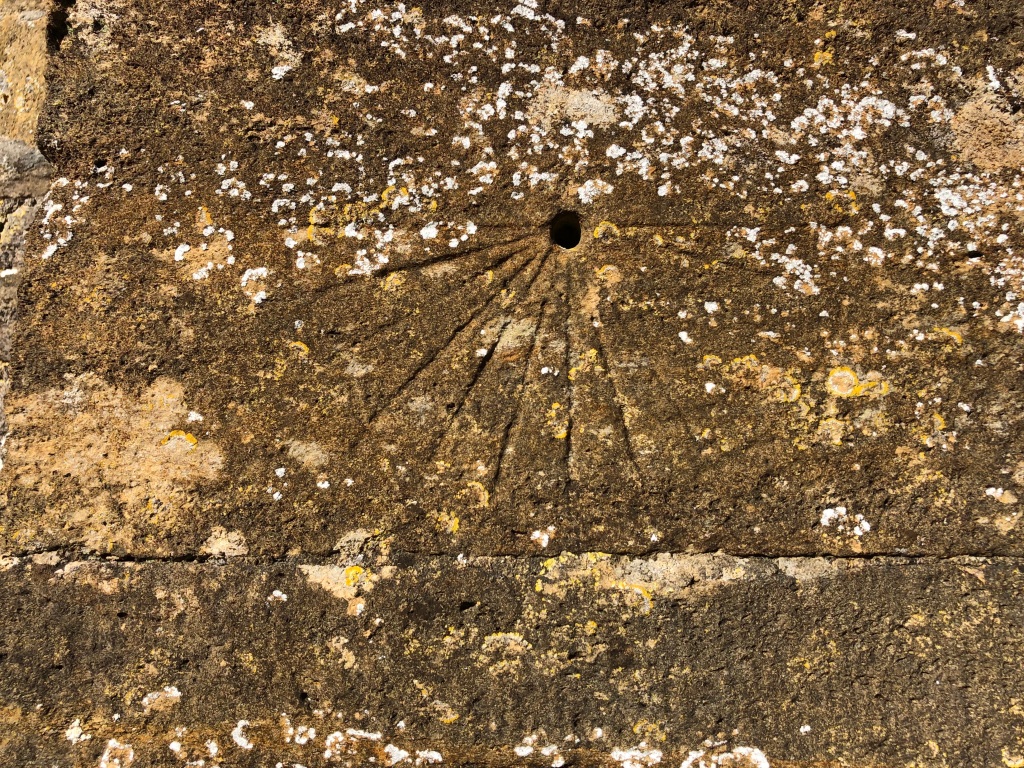
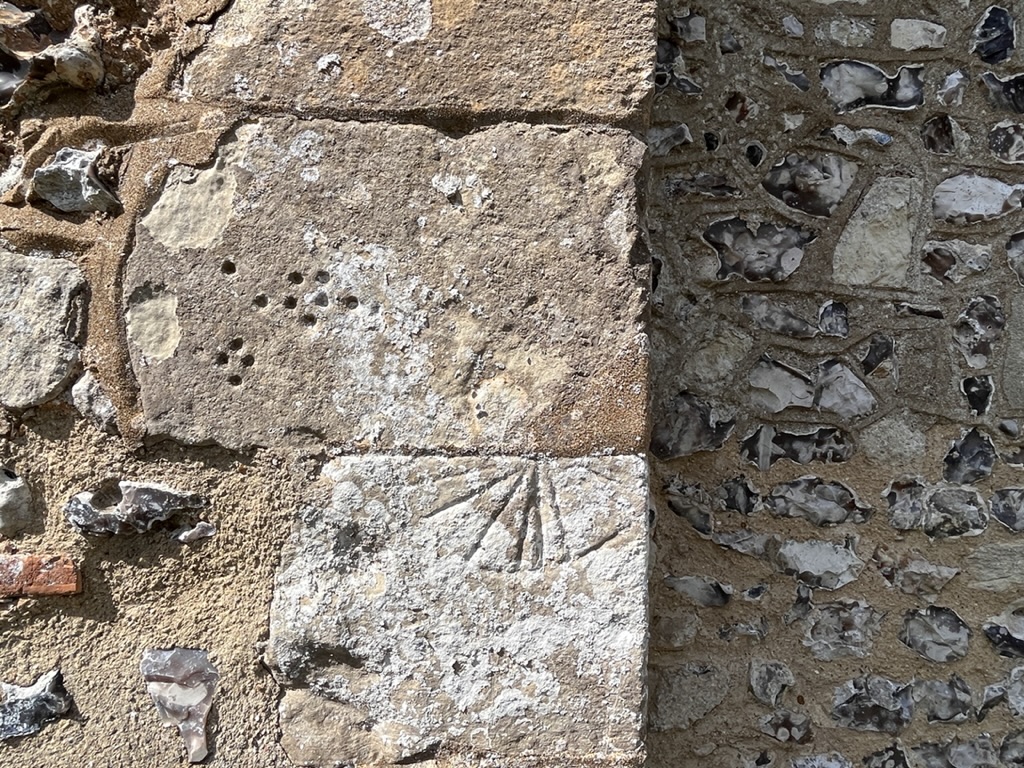
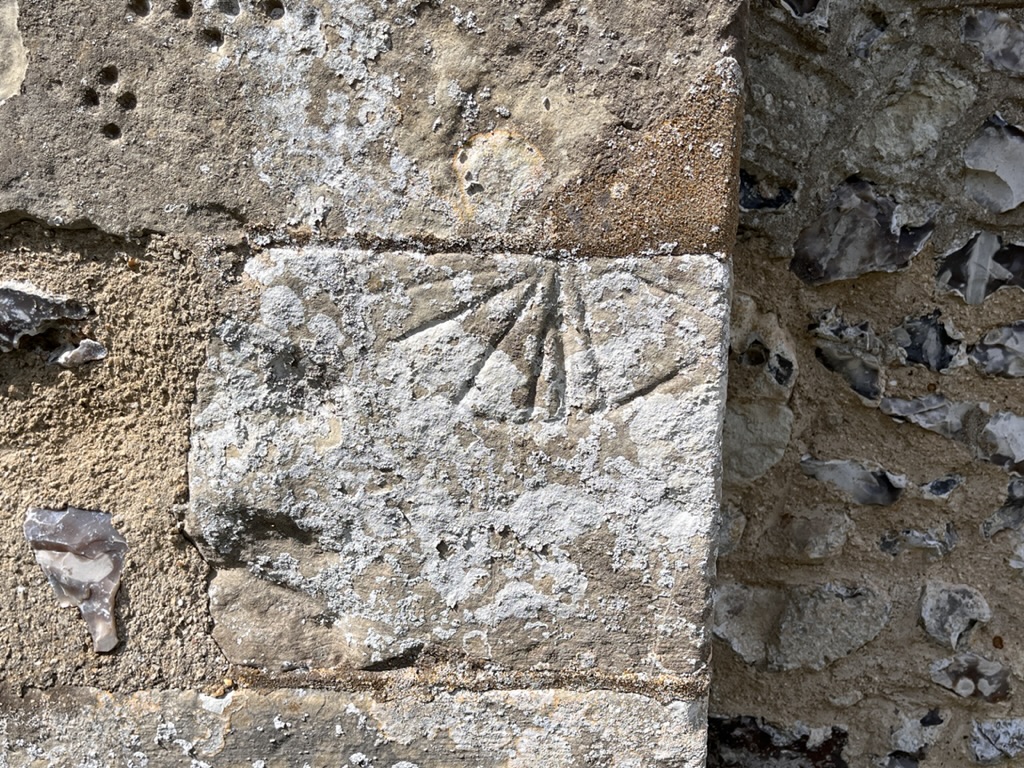
Dial 1 is encircled, with 13 lines and 24 pocks around the perimeter and forming 2 crosses . This large dial not only takes up the width of the stone, the circumference continues onto the stone below as do some lines (esp. 11am). The noon line ends in a 4-dot cross on the main stone, and the 9am line has a 5-dot cross on the lower stone.
The gnomon hole is of particular interest; I haven’t come across a square hole with (apparently) a circular one inside it before. Possibly the original gnomon was a basic rod, and its round hole later enlarged to accommodate a more visible square rod.
St Laurence . Downton . Wilts – Scratch Dial 1
✣
DIAL 2
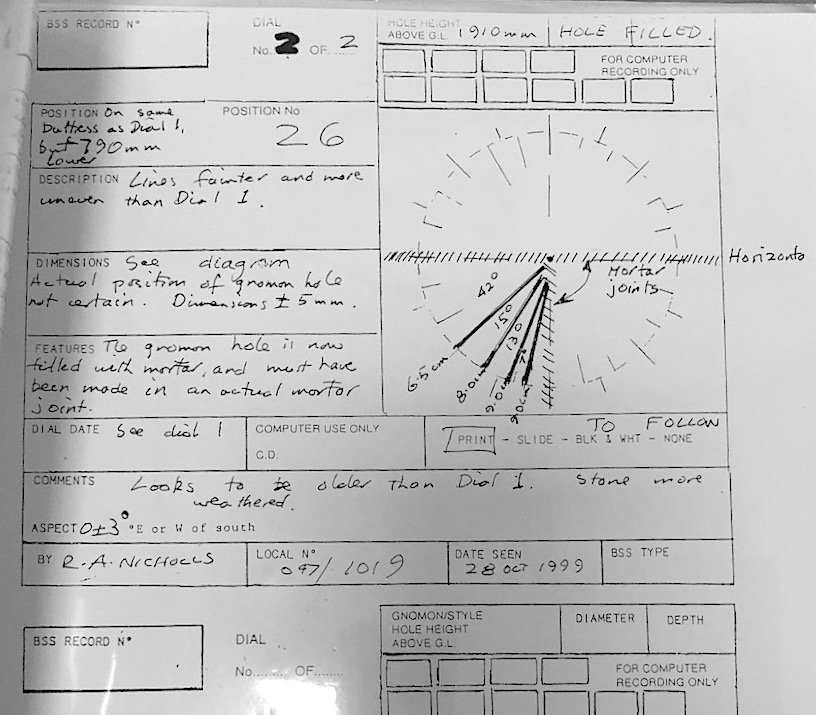
St Laurence . Downton . Wilts – Scratch Dial 2
Dials Locations
GSS Category: Scratch Dial; Mass Dial; Medieval Sundial; Church Dated Initials
GRADE I † C13 origins: masons’ marks on the fabric date from C13 and are identical with some found at Wells cathedralBHO. Development mainly C15 (tower) and C16, with C19 work by Wyatt and later attention. Poulett family much in evidence. Good graffiti / protection marks. Fine gilded weathercock dated to 1756. 4m N of Crewkerne . 50.9107 / -2.8286 / ST418126
DIAL
Hinton St George Church . Som – Scratch Dial
A single scratch dial tucked away on the W side of a buttress, and of doubtful value as a time marker, both for position and orientation. There are 4 lines with terminal pocks on the left side; and a single pock at the top (ie midnight). The gnomon hole, already quite big, has been crudely enlarged – and quite recently, by the look of it.
Hinton St George Church . Som – Scratch Dial
An explanation for the unpromising location and the unsatisfactory design is that the dial was relocated at some stage, perhaps when the tower was built (and the buttress added?). It is far from unusual for a dial reused in this way to be inverted, as if decommissioning it. An inversion of the image above makes far more sense, with the noon line marked by a single pock, and the radials to its right. An afternoon dial.
Hinton St George Church . Som – Scratch Dial (inverted)
GRAFFITI & APOTROPAIC SYMBOLS / PROTECTION / MARIAN MARKS
Graffiti & Apotropaic Symbols / Protection Marks / Marian VV Marks
ST MARY † Grade 1. Early C13, alterations c.1500, N transept added C19. Between Sherborne & Marston Magna, on the Som. / Dorset boundary. Scratch dials, vertical dial, porch graffiti and protection (‘witch’) marks. 50.9948 / -2.5565 / ST610218
St Mary . Rimpton . Som. – Vertical Dial
Quite a while ago I wrote (in 2 parts) about the 4 main medieval scratch dials at the church. The links are below. I recently revisited St Mary for a further look at the dials (there are a couple of others to write up) as well as some interesting church marks including a small hexfoil within the porch. A revised single post featuring all of the above will emerge in due course.
DIAL
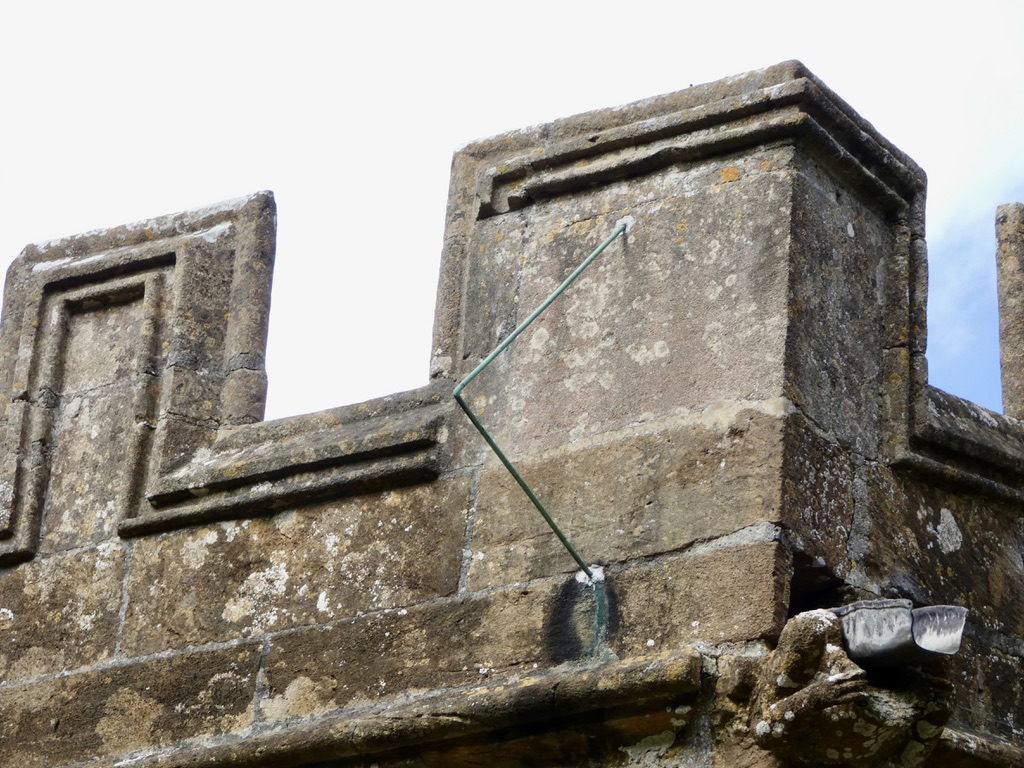
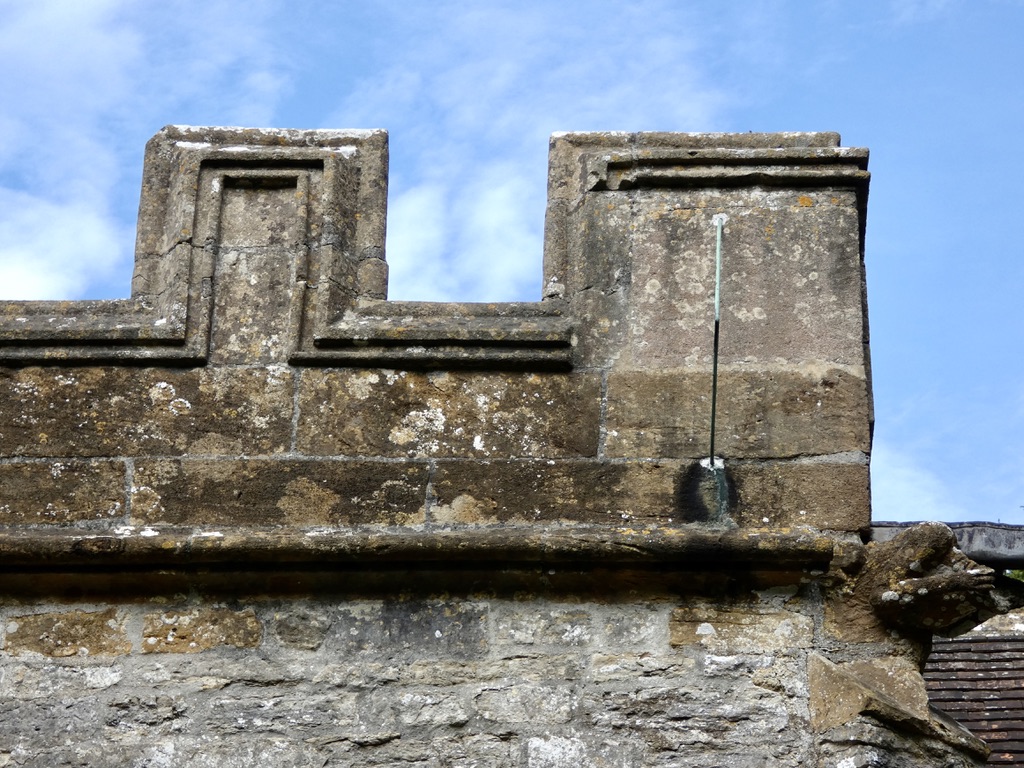
I also photographed the Vertical Dial for BSS records. It is located on the end merlon of the parapet, easily visible. It has a simple, almost square face. The plain metal gnomon is fixed into the top of the dial stone, and into the mortar line under the stone below it.
There are other unmarked (no lines, pocks, numerals) dials in the S Somerset / W Dorset region and I though this was one. However, later examining the main photograph in the gallery below, I detected 2 faint lines in U L quadrant that seem deliberately cut. There’s a ghost of a line on the opposite side. So possibly this was once a conventionally marked dial that has slowly and very evenly eroded.
It is hard to date. The dial stone differs from the ones around it. At a guess, it was added C19, perhaps when other work was carried out (eg adding the N transept). BHO notes that in 1827 the church was ‘repaired and beautified’. Perhaps adding the dial was part of that process.
DEDICATION † ST ANDREW . Parish church. Late C13, consecrated 1312, completed C15, restoration from C19. A ‘major church’PEV. A good place to find out more is the RCHM entry ST ANDREW YETMINSTER. Carefully compiled church and Parish Archive. 10 Consecration Crosses from medieval to (relatively) modern. An important very early (1683) clock, now in restoration (see below).
LISTING † Grade 1
LOCATION † 5 miles SW of Sherborne, / SE of Yeovil. Noteworthy village easily accessed. Fine vernacular Ham stone buildings give the feel of an earlier era. Many listed buildings. Village also highly regarded by PEV. Station in village (not, as elsewhere locally, a wayside halt). Etiminstre in DB 50.8939 / -2.578 / ST594106
DIALS † Two dials on the buttress E. of S door, both C15
DIAL 1
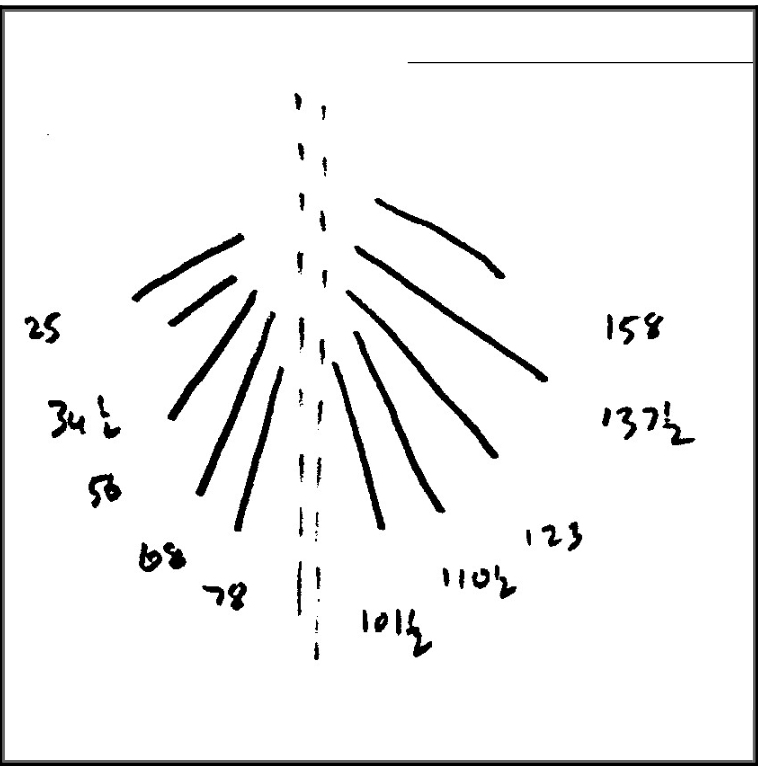
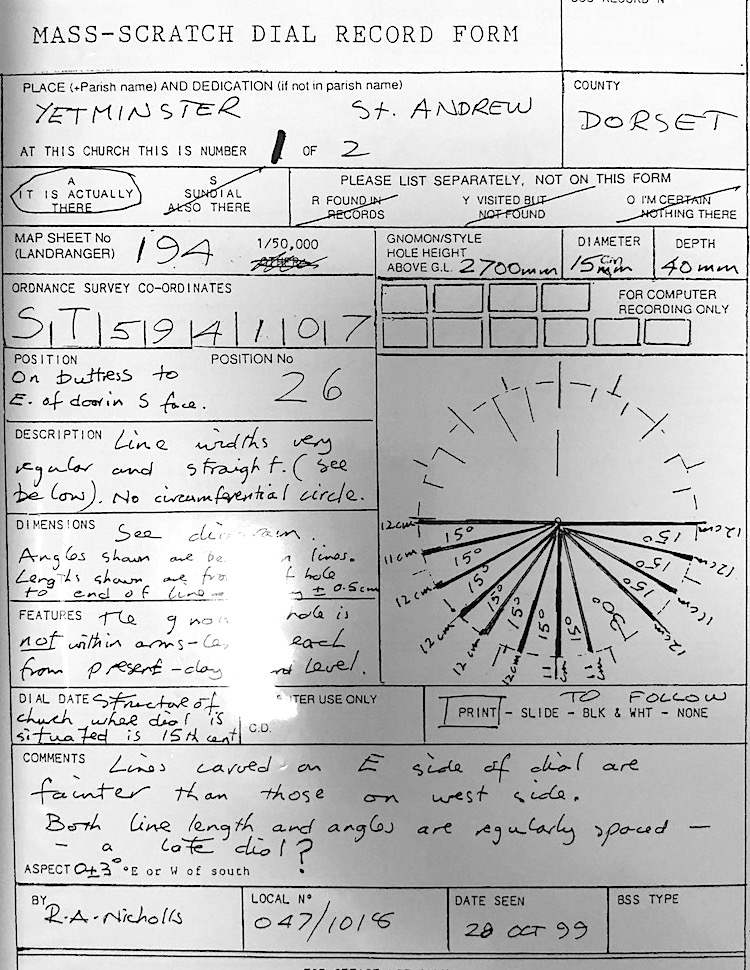
A semicircle dial with 13 lines (including the horizontal). BSS notes no circumferential circle. The noon line is extended, and 4 others end slightly beyond the circumference . GLP describes it as very neat and accurately marked. Both dials have been thoroughly examined – clips of the original records from the excellent church archive are below.
St Andrew . Yetminster . Dorset – Scratch Dial 1
St Andrew . Yetminster . Dorset – Scratch Dial 1St Andrew . Yetminster . Dorset – Scratch Dial 1
DIAL 2
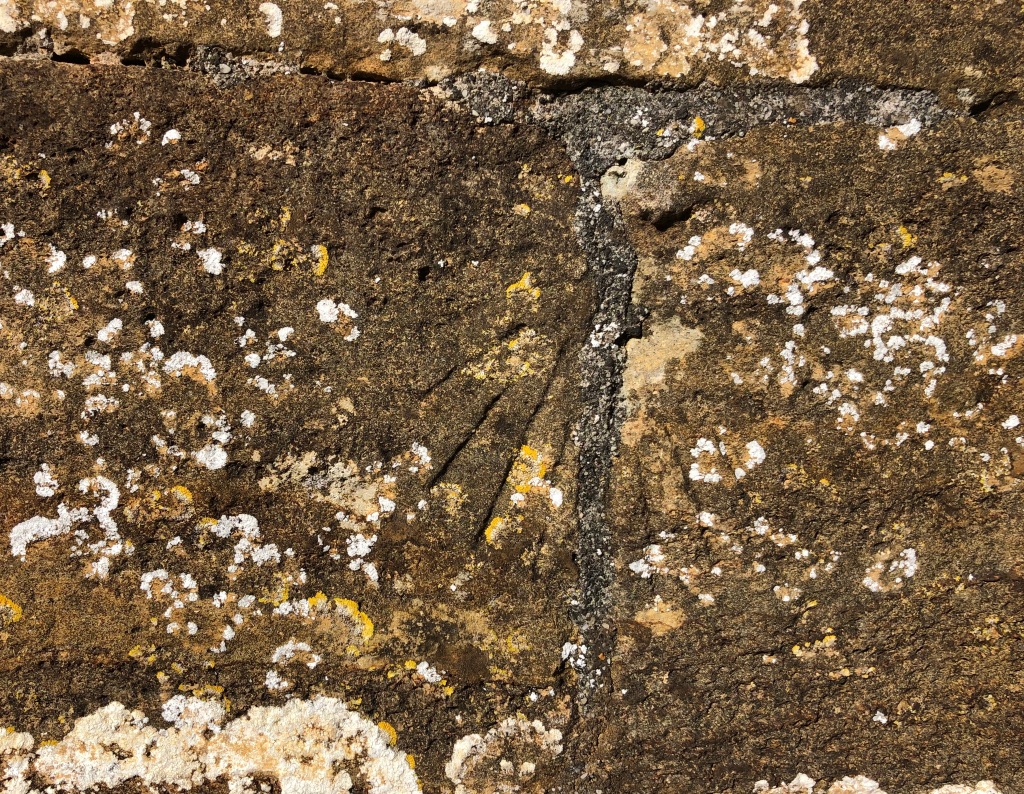
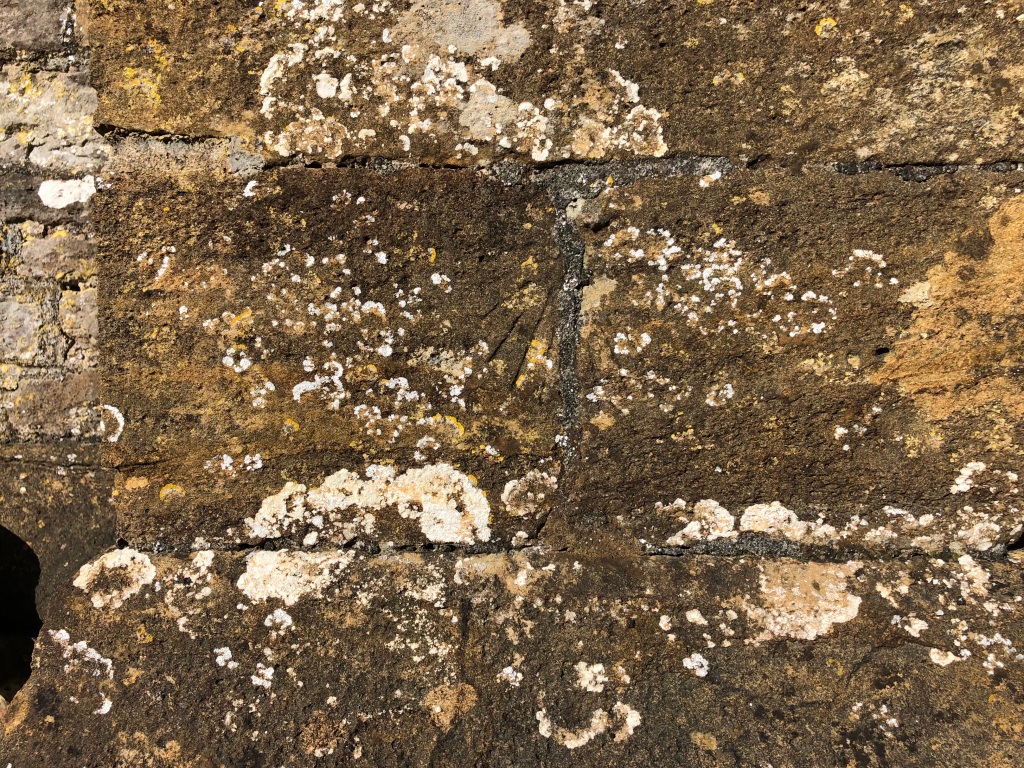
An unusual rather drooping design, explained below. Gnomon hole in the mortar line. The dial is split across 2 stones by a vertical mortar line. There are 11 lines, if one includes the mortar joint as the vertical / noon line. The lines RHS are badly eroded.
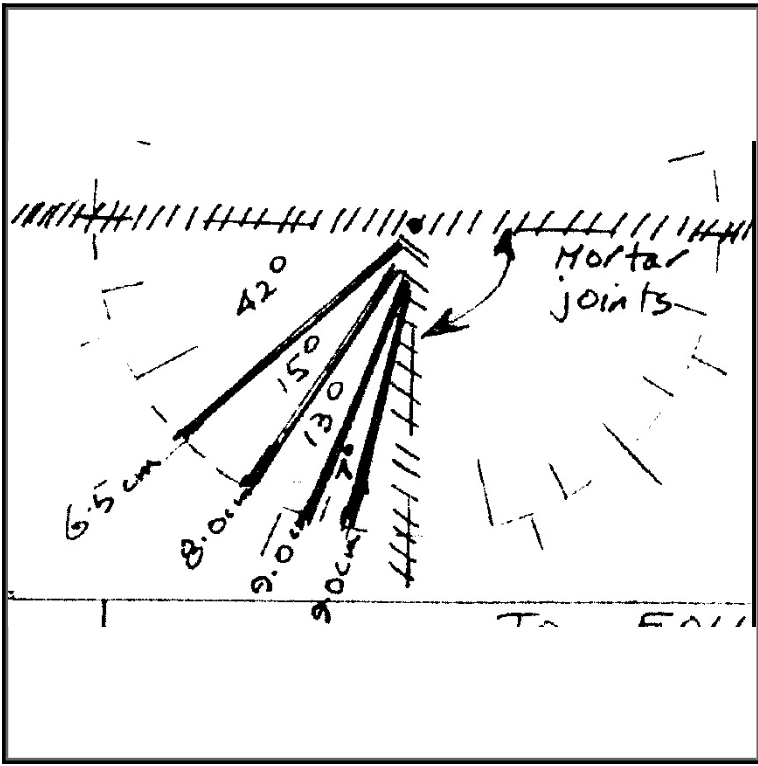
GLP noted that this dial is of particular interest as the angle of the lines suggest that it may be an early Scientific Dial. Comparing the lines with the correct angles for the latitude only one of the lines is more than 4º out. A further even more technical conclusion is that to function this dial would have needed a gnomon at an angle of 39º to the wall. This evidences an advance from earlier dials where the gnomon was simply inserted into its hole straight rather than angled.
St Andrew . Yetminster . Dorset – Scratch Dial 2St Andrew . Yetminster . Dorset – Scratch Dial 2
CLOCK † The historic faceless pendulum clock (1683) is being restored at the moment. I am writing the day after the Queen’s death, and by coincidence the clock has a specific significance: The Clock carillon plays the National Anthem at 3-hourly intervals. This dates from 1897 when it was installed by local benefactors for Queen Victoria’s Diamond Jubilee, and is very rare, and possibly unique. For the Platinum Jubilee of HM The Queen this year, the carillon was operated manually to ring out as part of our Jubilee Celebrations.
NOTES † 10 ‘formy’ Consecration Crosses in sunk round panels on external wall-facesBHO (locations specified); C10 Saxon cross shaft fragment; faceless clock of interest; good hunky punks. Links with Robert Boyle (chemistry, founder of the school) and Benjamin Jesty (smallpox); quite a lot of external graffiti – initials, dates and some Marian (‘witch’) marks
St Andrew . Yetminster . Dorset – Hunky PunksSt Andrew . Yetminster . Dorset – Consecration Crosses
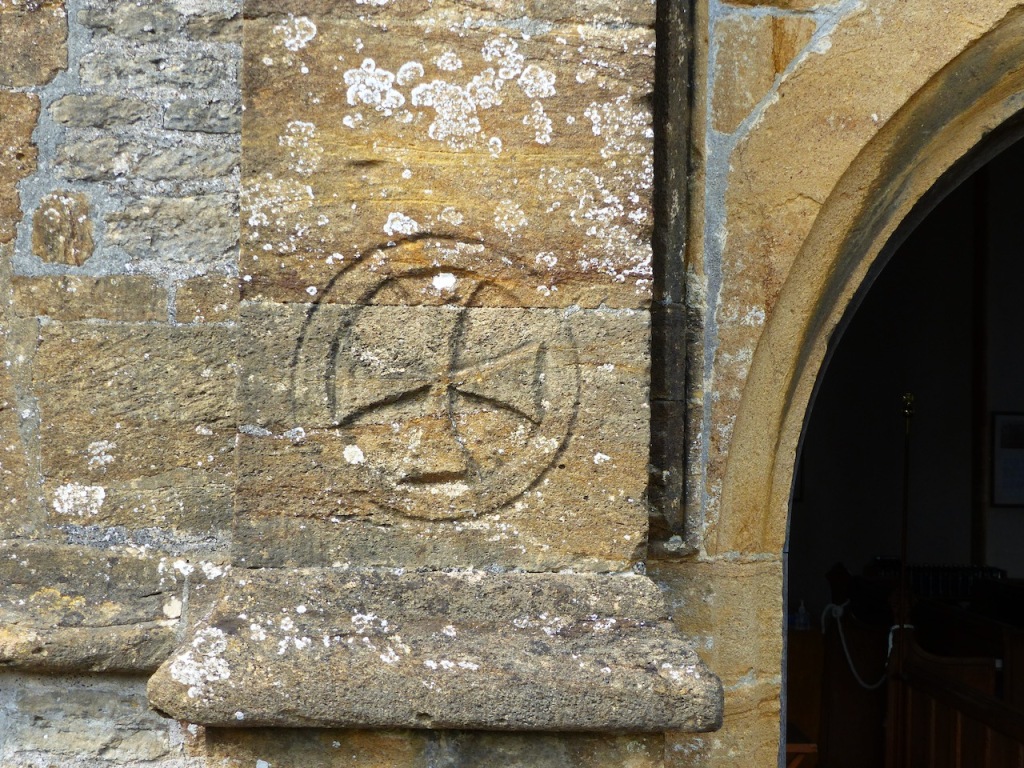
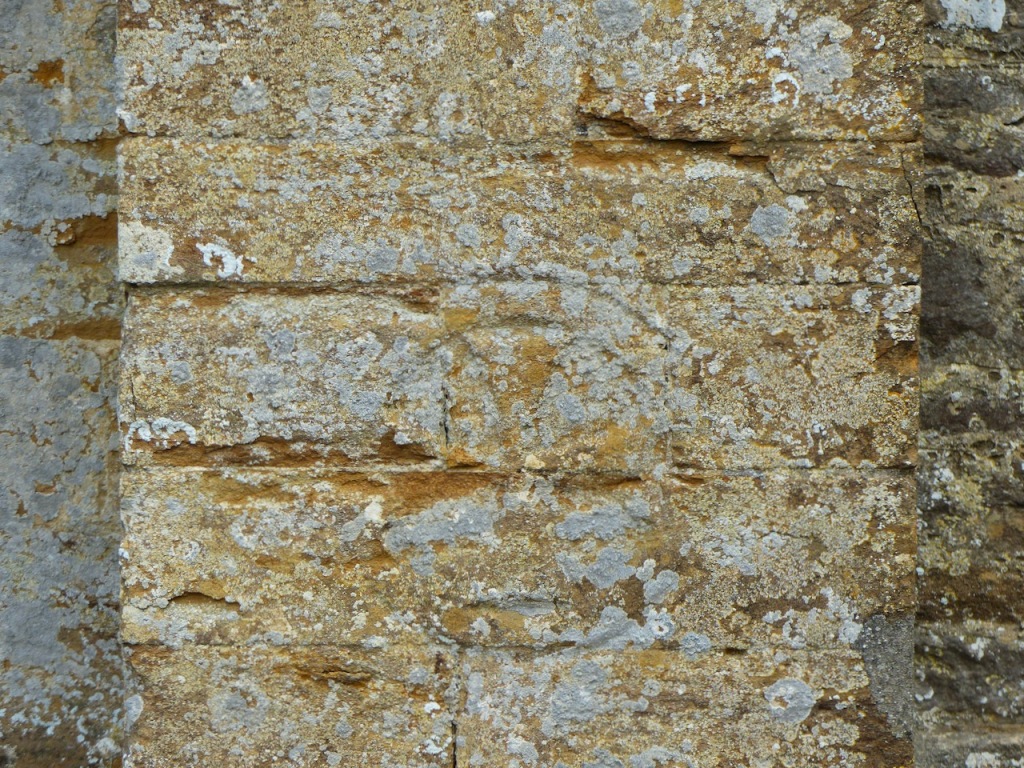
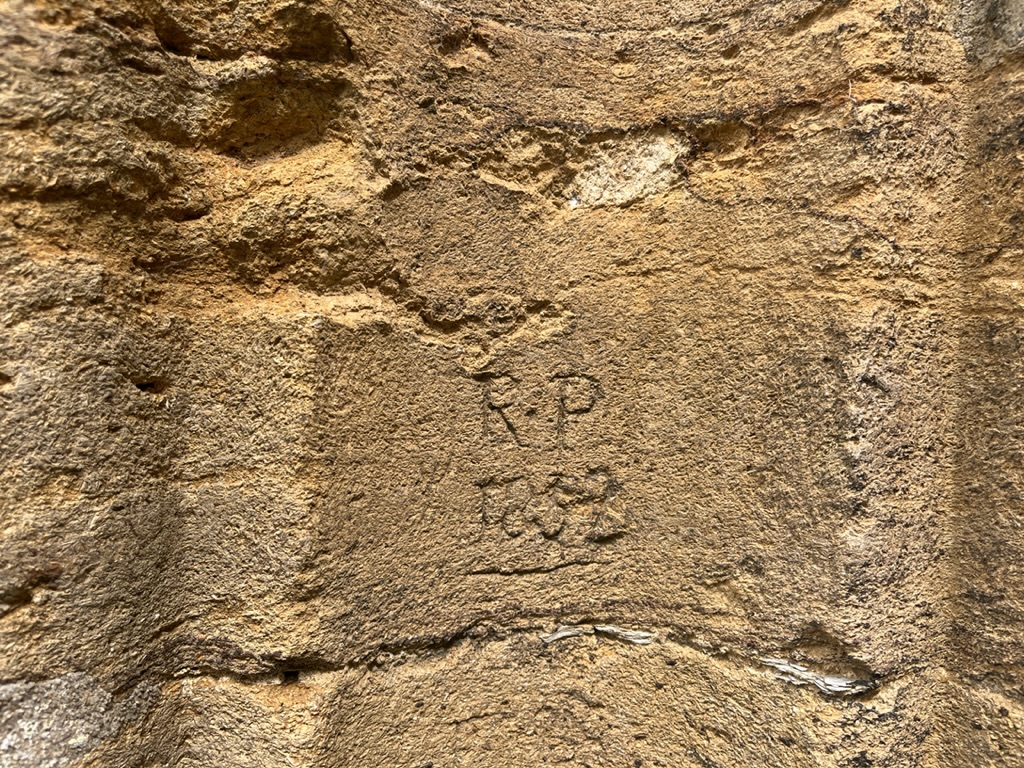
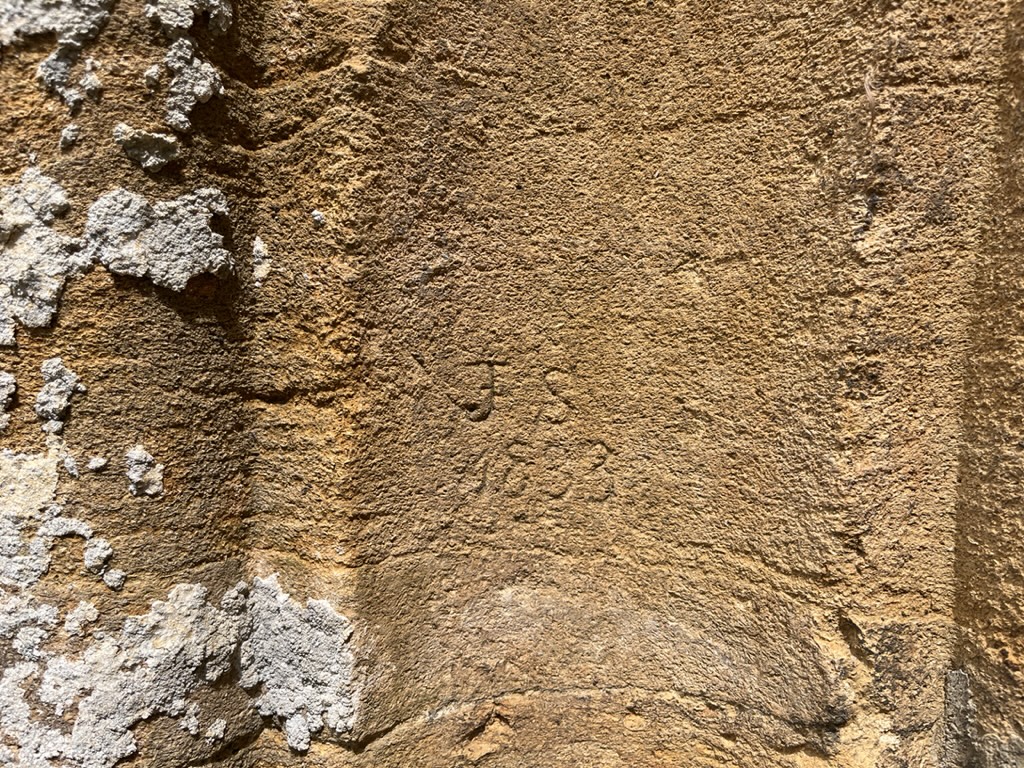
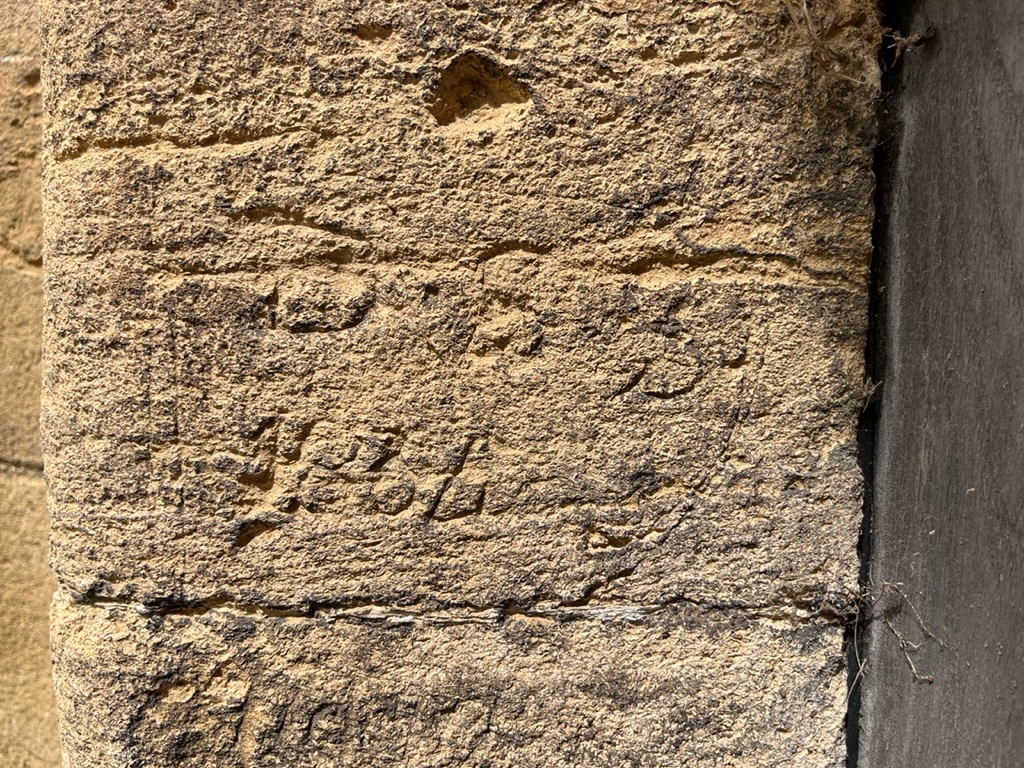
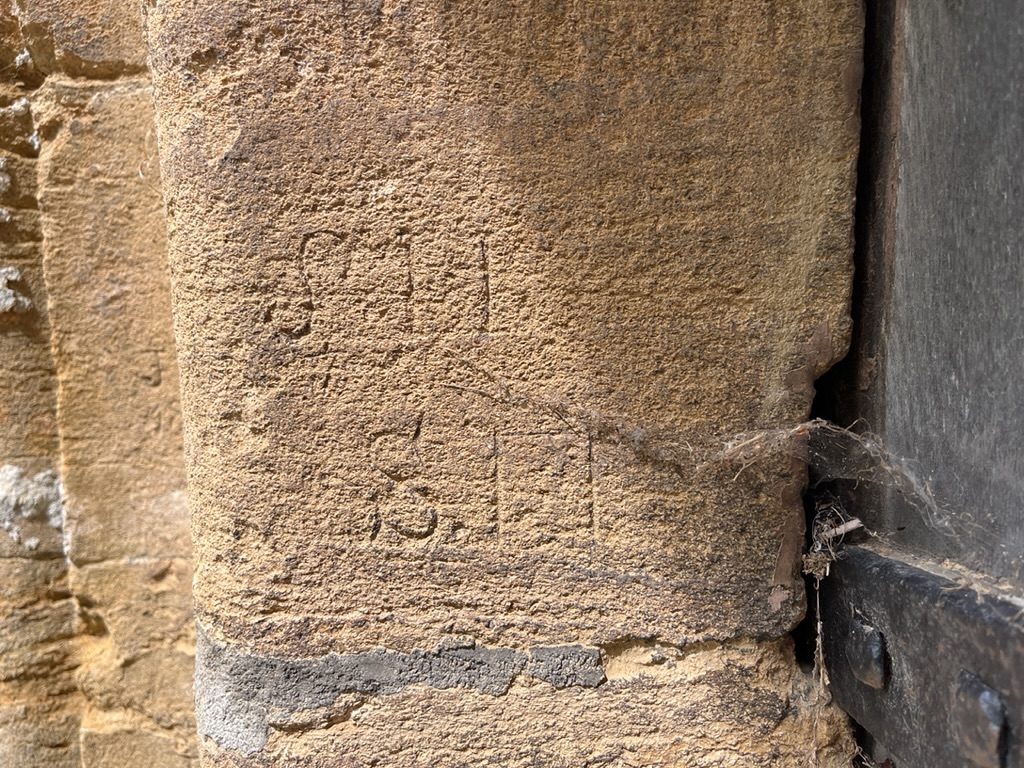
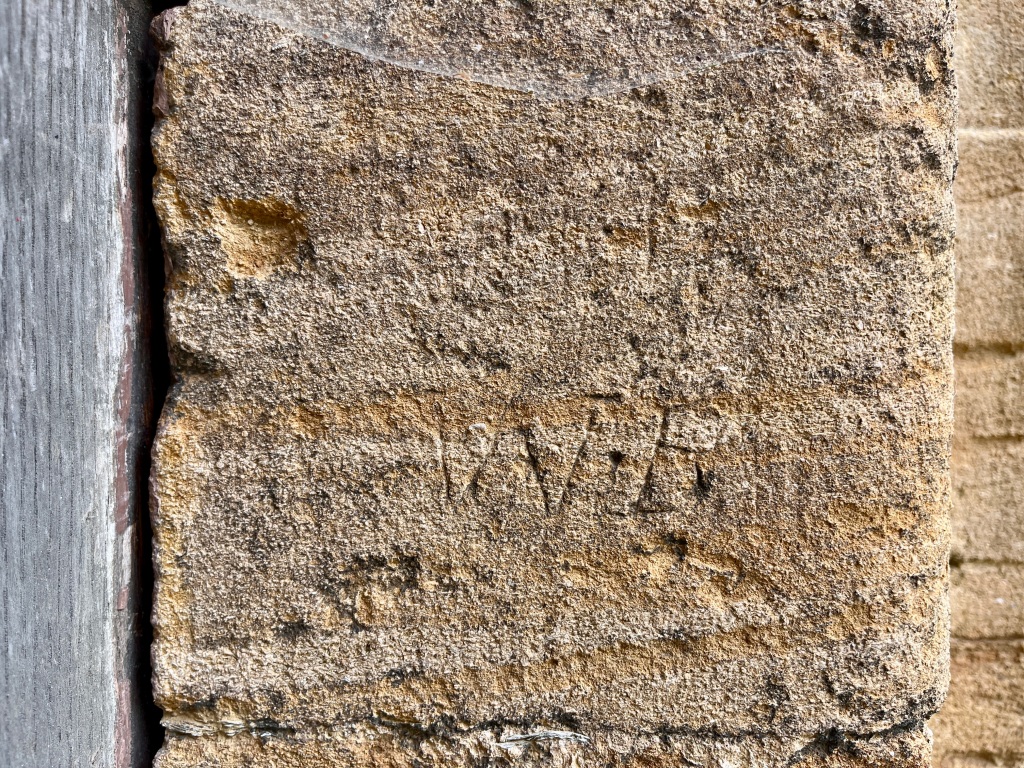
St Andrew . Yetminster . Dorset – Graffiti and a Marian (ritual protection) mark. The 3 initialled and dated marks are likely to be cut by masons who did work on the church in the 1830s (cf Melbury Osmond)
St Andrew Yetminster – the detailed BSS records for the scratch dials
GRADE II* † C14 / 15 origins, with later / C19 enlargement. Besides 2 scratch dials there is a vertical dial on the tower dated 1706. 6m NW of Leicester. 52.6832 / -1.2292 / SK522097
DIALS
The scratch dials are both on the S side. One is on SW corner of the tower; the other on the lower part of the L jamb of a window (I don’t have a more precise location at the moment).
Dial 1 gives the impression of a spider, with legs radiating from the (blocked) gnomon hole in the centre of the dial stone. The clearest lines are at 11 and noon, the latter faintly extended. The others are rather randomly placed. There’s a line in the top L quadrant; and the hint of a line very roughly extending the noon line upwards. The 2 pocks don’t seem to be part of the design.
Dial 2 is more conventional ‘morning dial’, with 6 more or less evenly spaced lines descending (but not very accurately) from a large filled style hole. Only one of the lines is after noon. Simple and straightforward.
All Saints . Newtown Linford . Leics – Vertical Dial
Set on the SE edge of the second stage of the tower, close to the intersection with the roof of the nave. Slate, made by Thomas Woodcock in 1706. Deeply cut and in excellent condition for its age. Initials I K. Cross for 12 noon. Quarter hours marked. The angles of the Roman numerals are carefully graduated as they descend and ascend, suggesting the work of a skilled craftsman dial-maker.
BSS notes very similar dials at Breedon on the Hill and at Leicester, all three being within a few miles of each other.
All Saints . Newtown Linford . Leics – Vertical Dial
This interesting dial has been analysed and recorded in some detail by BSS:
The dial is fitted with iron dog nails to the south face of the tower, at the south-east corner, adjacent to the nave junction. The date 1706 is across the top, and being of the local slate, the dial is in remarkable condition for its age. Initials ‘I K’ are on each side of the date. Upright hours VI – + – IV – VI are aligned to the hour lines, which are drawn to a large semicircle around the gnomon root. Short lines mark the half hours, with fleur de lys or arrow heads, and quarter hours. The rusty iron bar gnomon has a straight horizontal support.
GSS Category: Scratch Dial; Vertical Dial
Photos of church and scratch dials, Erika Clarkson; vertical dial from BSS archive
GRADE II* Late C12, porched c1291; C15 alterations, C19 restoration. Attractively simple with its welcoming footpath, porch, and modest bell turret. Adjacent to S St Mary and 4m E of Ilminster. 50.931 / -2.8407 / ST410149
DIALS
BLB notes that the centre bay on south side has a blocked chamfered pointed-arched doorway, with diamond-leaded window inserted with cill just below springing. The dials are one above the other on W side of the doorway. Strangely, although DEH on his visit in 1915 records one dial in precisely this location, he doesn’t mention the second.
DEH noted that the buttresses either side of the recessed doorway inevitably block out the light for much of the day, as it had on the day he visited (possibly why he only found one dial?). He concluded that the buttresses were a later addition to the church (probably XVII Century), when the doorway was filled up.
DIAL 1
Seavington St Michael . Somerset – Scratch Dial 1
The uppermost, larger, less sophisticated, and the earliest of the 2 dials. 6, perhaps 7 lines. The ones either side of the noon line are slightly curved. Gnomon hole plugged though not with cement.
DIAL 2
Seavington St Michael . Somerset – Scratch Dial 2
Beneath Dial 2 and far more visible. There are 6, perhaps 7 lines, of which the the afternoon lines are much the clearest. The noon line has an unusually prominent pock. The adjacent lines LRQ are even deeper cut. One is also elongated, probably indicating the most significant Mass of the day. One of the fainter lines LHS heads ineffectively above the horizontal. The gnomon hole is surprisingly deep.
MEDIEVAL GRAFFITI
The church porch has plenty of graffiti including initials, Marian marks, ritual protection (witch) marks, and pilgrim crosses
Seavington St Michael . Somerset – medieval graffiti
GRADE I † C12 origins (nave c1150) on Saxon site, still with Norman features. Gradual C13 / C14 development and C18 / C19 works / restoration. Wooden-shingled bell turret, as other churches locally (eg Medstead.) Of relevance here, S porch added C18. 2m E of Alresford. 51.0843 / -1.1362 / SU605320
DIALS
ARG visited in 1923 and recorded dials 1, 2, 3 but not dial 4 (high up above dial 3). Dials 1 & 2 are LHS of the original Norman doorway, within the later-added porch. ARG rightly discounted the very prominent OS benchmark below dial 3 that had elsewhere been recorded as a dial.
DIAL 1
The most striking of the dials, not least because of the graffiti that surrounds it. It is cut on the W jamb (outer) of the original Norman doorway (c1150), inside the much later S porch. There are 4 strong lines descending from the style hole in the mortar line, and a short arc LHS.
St Nicholas . Bishops Sutton . Hants – Scratch Dial 1
The image above also shows the much less distinct dial 2 at the same level on the inner jamb. The triangular design above both is ornamentation on the slim column. Dial 1 is remarkably undamaged / unweathered considering the long period before the porch was added. It must have predated the C17 graffiti, which is itself in very good condition.
St Nicholas . Bishops Sutton . Hants – Scratch Dial 1St Nicholas . Bishops Sutton . Hants – Scratch Dial 1
DIAL 2
Dial 2 is also cut on the W jamb (inner) of the original Norman doorway (c1150) within the S porch. Very faint and hard to make out, even close to; easy to overlook. There are 4 discernible lines, with the hint of a double line at noon. The remains of whitewash make examination even more difficult.
St Nicholas . Bishops Sutton . Hants – Scratch Dial 2St Nicholas . Bishops Sutton . Hants – Scratch Dial 2
DIAL 3
St Nicholas . Bishops Sutton . Hants – Scratch Dial 3
Very visible as one walks up the church path, on a quoin stone on the SE corner of the nave. The dial is cut inside an eroded semicircle, with the style hole in the mortar line. Unsophisticated. There are 11 lines radiating below the horizontal, at rather random angles. It looks uncomfortable, as if it may originally have extended upwards onto an earlier stone: ARG notes that it is on one of the original large quoins C1150 (which does not match nearby stones), suggesting relocation of the adjacent stones or even of the dial stone itself.
St Nicholas . Bishops Sutton . Hants – Scratch Dial 3
ARG suggests that there is no obvious vertical / noon line. However the 2 deeper cut lines either side of noon may be intended to emphasise a ‘noon space’ between them, as is occasionally found elsewhere. ARG also posits that Dial 3 may be an interesting example of a ‘summer-only’ dial, though I can’t tell why: it faces more or less due S.
DIAL 4
Dial 4 is high up on a quoin stone above Dial 3. It’s a very simple small dial with 4 lines leading from a style hole in the dial stone. There is a presumed Mass line (Terce), a noon line, a very faint short line, and an extended slightly curved line. BSS comments that the dial was at some time repositioned, being of little use in its present location.
St Nicholas . Bishops Sutton . Hants – Scratch Dial 4
St Nicholas . Bishops Sutton . Hants – Benchmark below Dial 3
St Nicholas . Bishops Sutton . Hants – Graffiti RHS doorway inc. apotropaic VV mark
GSS Category: Scratch Dial; Mass Dial; Medieval Sundial
Some time ago I wrote about the intriguing scratch dial rather hidden away through a low archway at the E end of the church: LONGBURTON SCRATCH DIAL 1
DIAL 1
St James the Great . Longburton . Dorset – Scratch Dial 1
The village is better known dial-wise for the vertical dial on the S-facing tower buttress (see below). Yesterday I went back to look for apotropaic and other church marks, and to my surprise found an excellent conventional sundial hidden in plain sight and hitherto unrecorded. I can’t think how I – or any dial gatherer – would miss it…
DIAL 2
The previously unrecorded dial is near the base of the same buttress as the vertical dial. There are 4 lines, the more clearly cut noon line being longer and reaching the edge of the dial stone (and possible trace of extension onto the stone below). The angles are almost equal. There is the distinct trace of a circle in around the top half, but strangely the gnomon hole would not be at its centre.
St James the Great . Longburton . Dorset – Scratch Dial 2
St James the Great . Longburton . Dorset – Scratch Dial and Vertical Dial, Tower Buttress
VERTICAL DIAL
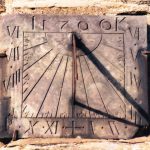
The dial is high up on the buttress of the tower, and nearly as wide. It is quite eroded, esp. RHS. The lines are contained within a frame, and half hours and some quarter hours are also marked.
BSS notes Triple dot motif at head of half hour lines. Gnomon formed from iron strip with supporter. Supporter is detached at contact with gnomon
The dial numerals are Roman, yet there are Arabic numerals in both bottom corners signifying the date. It is hard to make it out, but I think it is 1798. There are the remains of an inscription along the top of the dial, just the last 2 letters being discernible (O & W?).
GRADE I † Dated from c1300, with a C12 tower that was originally separate, later incorporated when the church was extended and (BLB) much altered. Attractively distinctive to look at. 15m W of Leominster. 52.2045 / -3.0384 / SO29156
DIALS
St Mary is a multi-dial church with 6 recorded, one of which is doubtful. They range from conventional to basic. 3 are clustered on adjacent stones.
DIAL 1
Dial 1 is on the S wall, a fan-shaped edged quadrant radiating from the mortar line and stretching across 3 stones. It is near-symmetrical along the noon line. The 5 lines are spaced almost equally, the outer ones being incised more deeply, perhaps to draw attention to service times. The ‘1’ line is of interest, less accurately cut, bifurcating as it crosses onto the stone below, and ending in a single pock. This feature is so specific that it was presumably intended to emphasise a time of day of particular significance in the local community.
Kington Herefs St Mary – Dial 1
DIAL 2
Dial 2, on the S wall, is far simpler than Dial 1 but is also near-symmetrical from the noon line. 3 lines, the one to the L more of a straight scratch than a cut. The style hole is in a fault line in the stone (which may well be subsequent damage). Possibly the ‘1’ line crudely divides halfway down, beginning with a pock. This would match the similar emphasis in Dial 1, and perhaps supports the theory of a special ‘event’ mark.
Kington Herefs St Mary – Dial 2
DIAL 3
Dial 3 is also located by the door on the S wall, very damaged and eroded. 4 clear lines radiate from a style hole in the mortar line (there are also 2 very faint lines). Only the uppermost in the lower R quadrant survives for its full length.
Kington Herefs St Mary – Dial 3
DIALS 4 & 5
Dials 4 & 5 are beside and below Dial 2. Both are faint and barely more than token efforts at a dial, as if a youthful assistant priest had a knife and time on his hands.
Kington Herefs St Mary – Dial 4 & 5
Kington Herefs St Mary – Dial 2, 4, 5
DIAL 6
Dial 6 is a very simple dial (if it is one): a style hole within a deeply cut circle, and what could be a stubby noon line. The close-up b&w BSS photograph gives a good idea of it. There’s not a lot of confidence in the record: Position not known. Noon line only? Circle only and faint line at 90L. Possible noon marker. Doubtful dial.
Richard & Catherine Boztum, in their excellent illustrated booklet (cited below) of Herefordshire Church marks and scratch dials include dials 1 – 5, but not this one.
Kington Herefs St Mary – Dial 6 – BSS
I also have my doubts. St Mary has plenty of Church graffiti – initials, scratchings, small crosses, and in particular a number of apotropaic symbols (ritual protection marks). The design of ‘Dial 6’ is one of many forms of ‘witch mark’. And on St Mary itself, there is a more elaborate version of the circle-and-centre-hole mark.
Kington Herefs St Mary – Apotropaic mark
OTHER CANDIDATES?
Having in mind the rather basic design of some of the dials above, there are a couple of candidates that I photographed for later inspection. The first is at least plausible and matches the noon line symmetry of dials 1 & 2. The other is unconvincing. You be the judge…
Kington Herefs St Mary – Plausible Scratch Dial
Kington Herefs St Mary – doubtful scratch dial
GSS Category: Scratch Dials; Multi-dials
Photos: Header image: Ruth Harris (Geograph / Wiki / CC); all other photos Keith Salvesen except dial 6 BSS
REF: Botzum R and C : Scratch Dials, Sundials and unusual Marks on Herefordshire Churches. Lucton, Herefs, 1988
GRADE II* C13 origins; mainly C14 with C15 porch; extensive C19 alteration / restoration including complete rebuild of the tower (1861), & later work by Crickmay. A pleasant aspect as one walks up the church path. 5m SE of Wincanton. 51.0213 / -2.348 / ST756247
DIAL
Sundial: reset on S. wall of tower, square stone plate with arabic numerals and inscription ANNO DO 1599.BHO
St John the Baptist . Buckhorn Weston . Dorset – Scratch / Scientific Dial
A most interesting dial set into the upper stage of the tower. Presumably re-fixed in that position (or perhaps relocated there) during the C19 rebuilding. Despite erosion and damage, the unaffected features are quite well defined. GLP notes that it is one of the earliest dated dials (of any sort) in Dorset.
St John the Baptist . Buckhorn Weston . Dorset – Scratch / Scientific Dial
Although giving the appearance of a large scratch dial with an inscription above it, GLP classifies it as a more sophisticated ‘scientific’ dial, because the angles between the lines measure standard hours. The use of numerals fits in with the inscribed date. GLP calls them roman; BHO has them as arabic. My detailed photos don’t help either way. They do show that the stone was cracked in two at some stage; and they raise the question “where was the gnomon?”
St John the Baptist . Buckhorn Weston . Dorset – Scratch / Scientific Dial




























 GAUDIUM SUB SOLE . SUNDIALS . MEDIEVAL TO MODERN