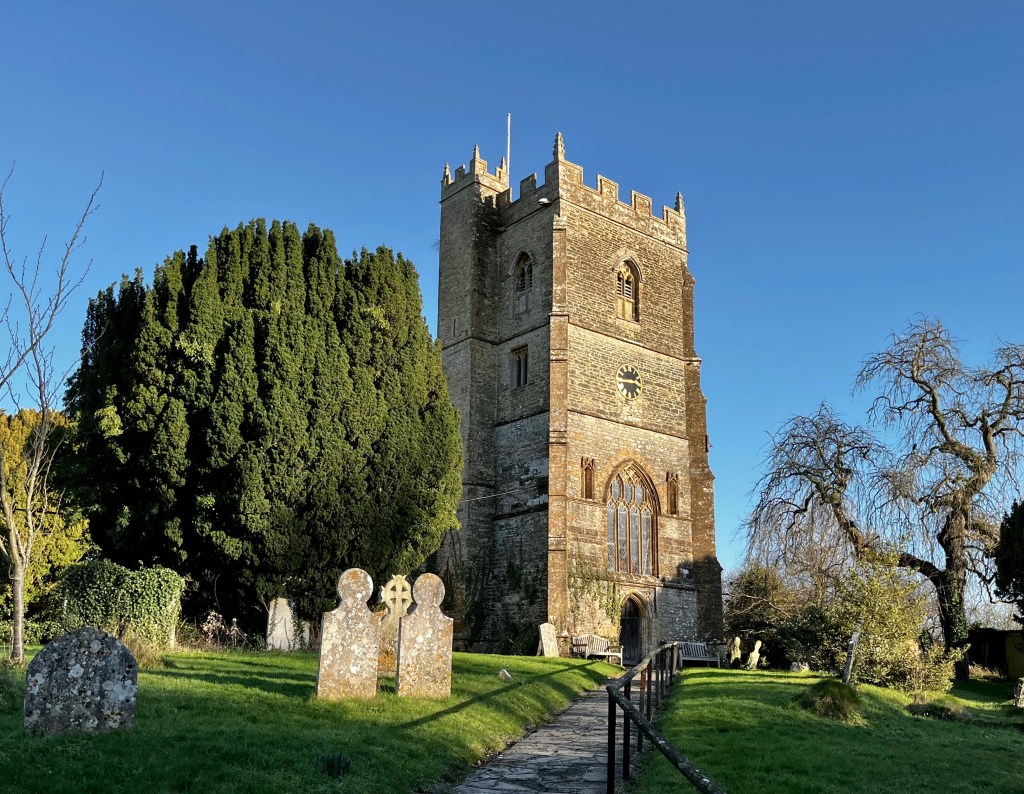
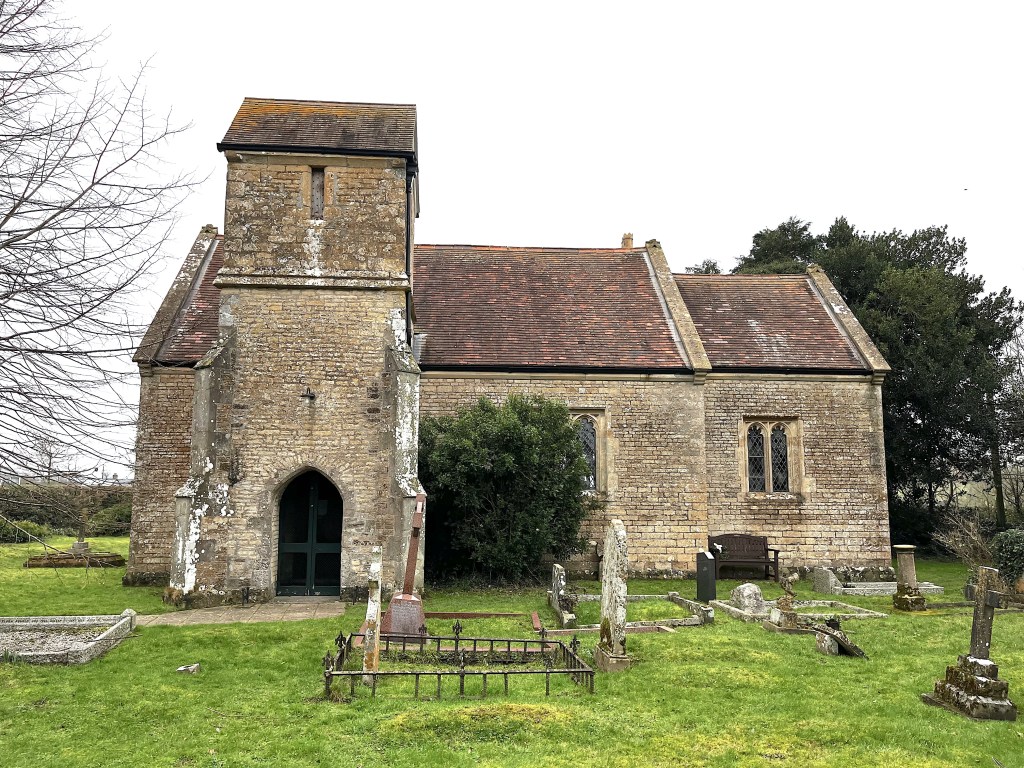
GRADE I † A fine church with C12 origins, gradually enlarged C13 & C14. C19 restoration by T H Wyatt. BLB link. A village irrevocably associated with the 6 Martyrs, at least one of whom (James Hammett) lies in the churchyard. The tree where the Martyr’s met stands just outside the churchyard of St John the Baptist, on the main road through the villageBE. 10m E of Dorchester. 50.7497 / -2.298 / SY790945
DIALS
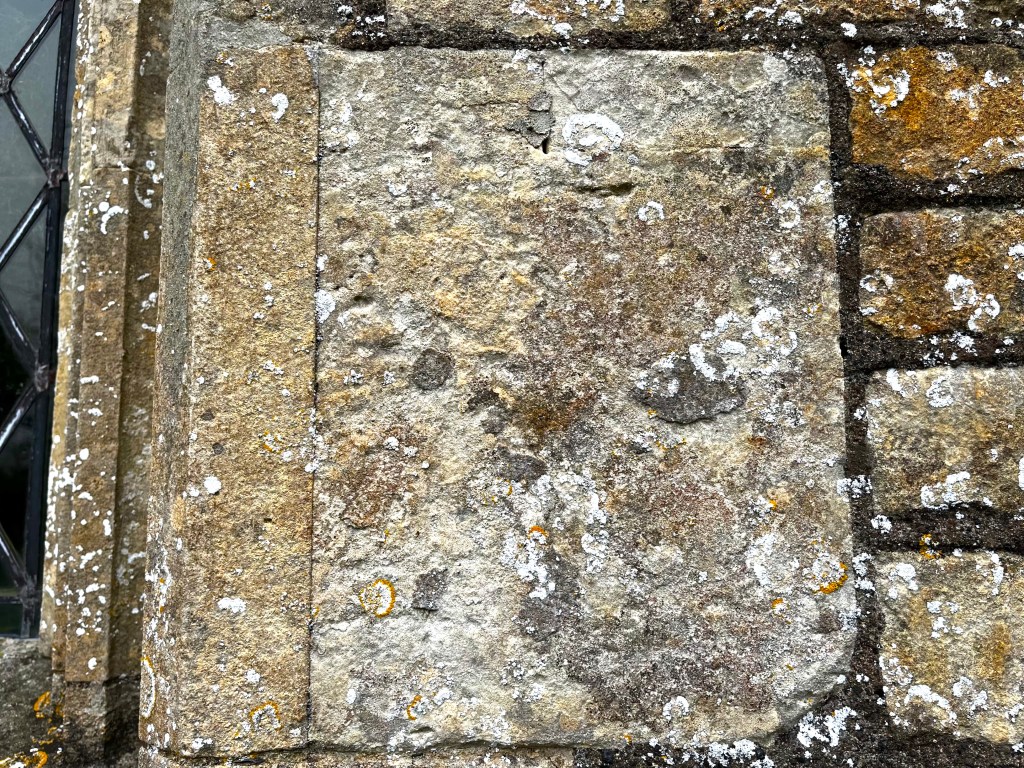
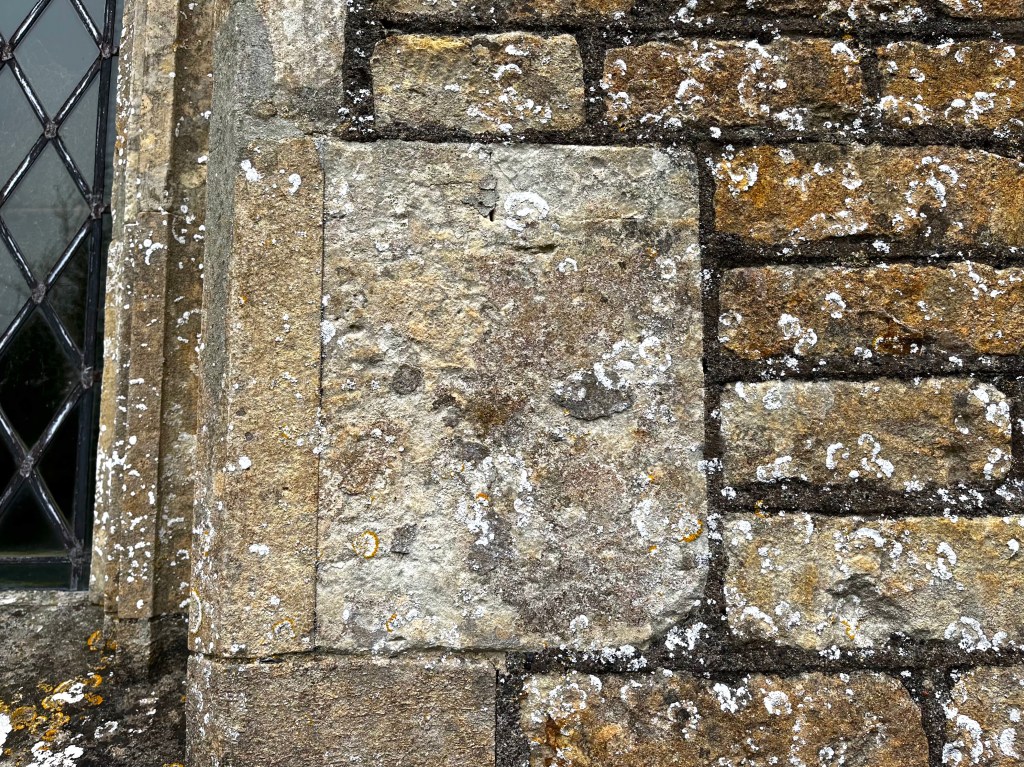
Both dials are on the S transept wall, dial 1 being on a quoin stone and dial 2 being below a window. They are easily visible. GLP has some doubts about dial 2, explained below.
DIAL 1
St John the Evangelist . Tolpuddle . Dorset – scratch dial 1
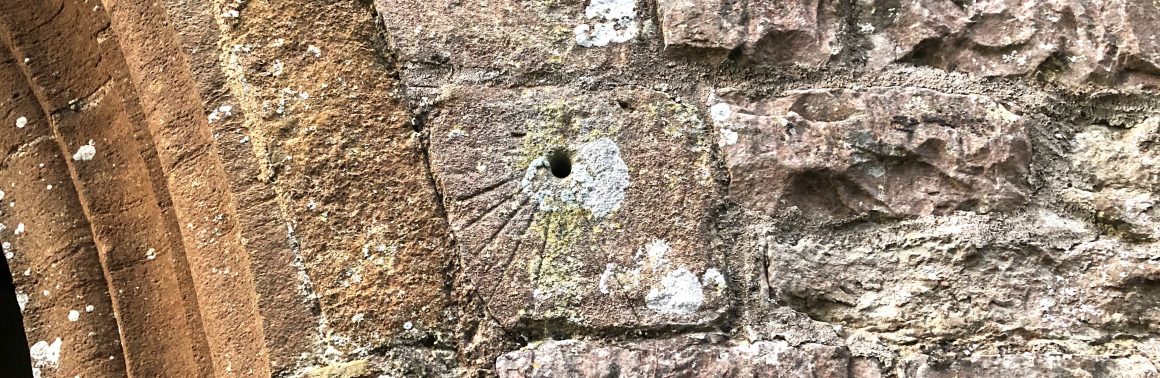
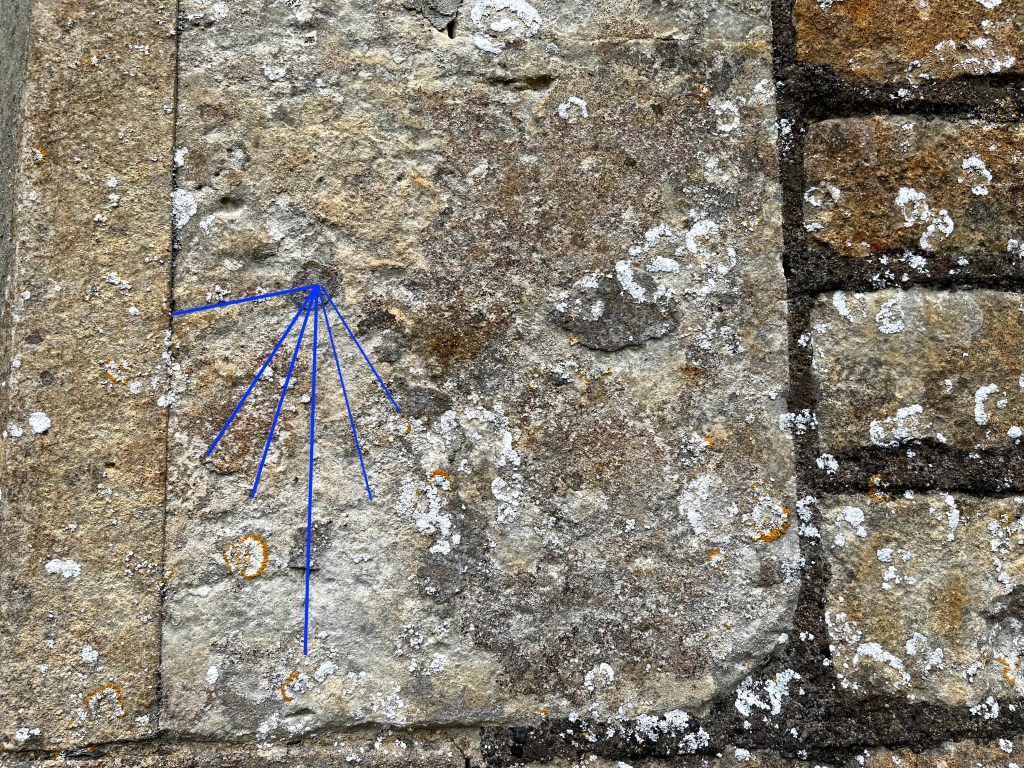
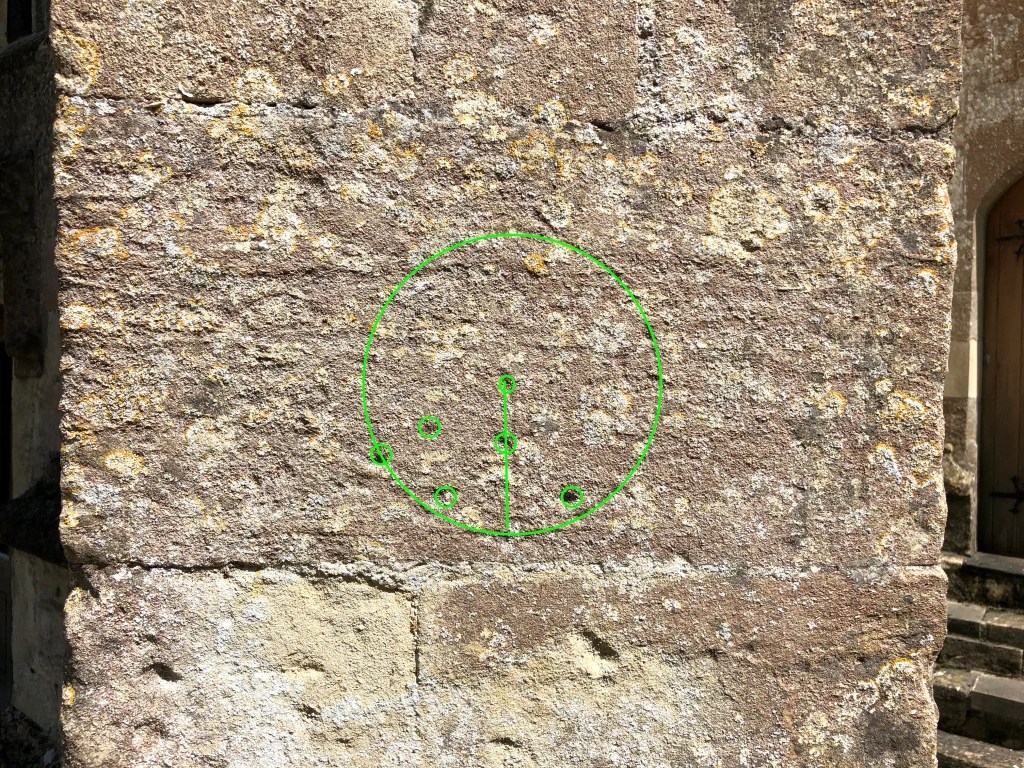
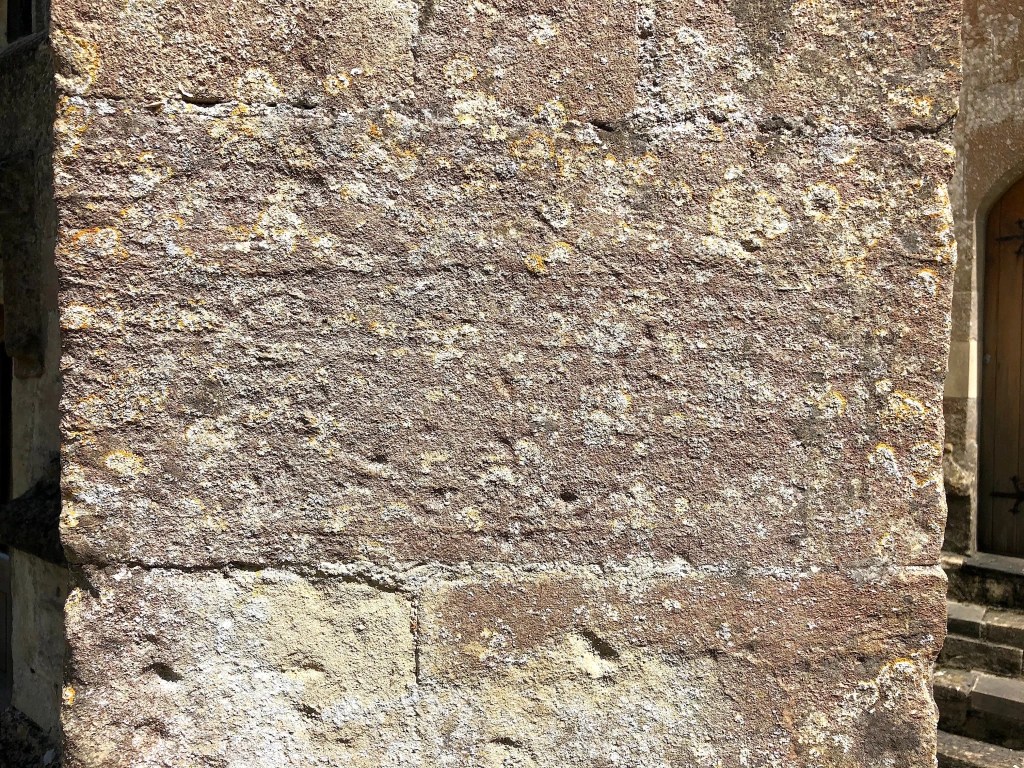
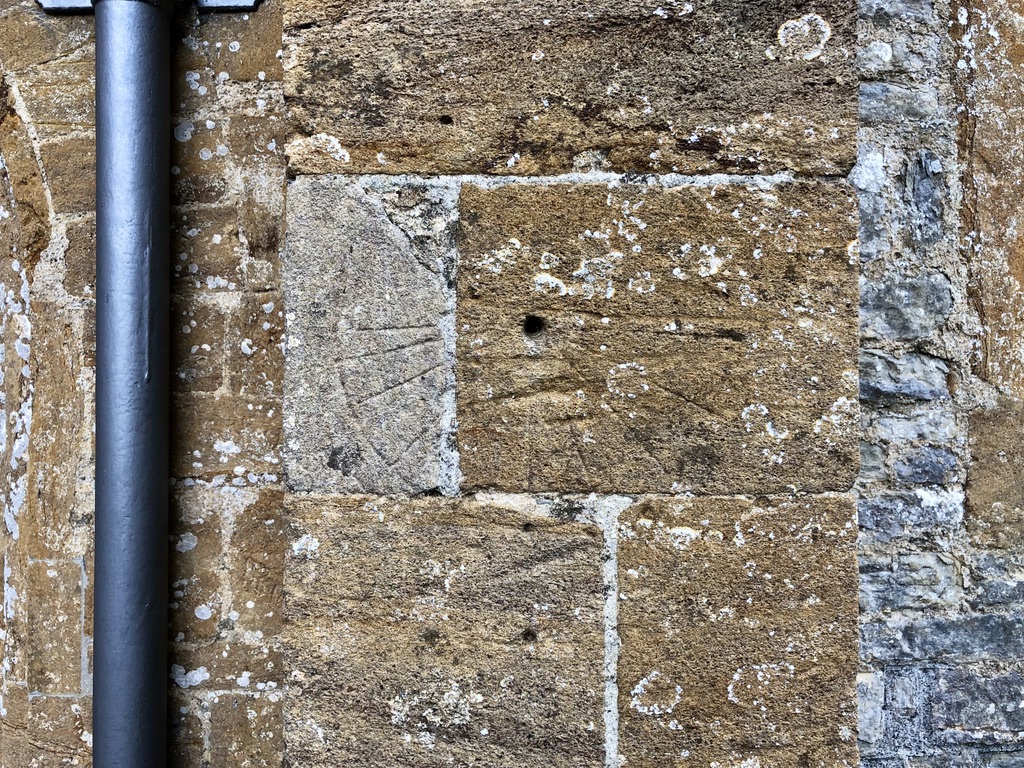
Dial 1 is located on a quoin stone of the S transept, with the gnomon hole in the lower half. There are 6 detectible lines, 2 of which point upwards. In addition there are about 11 pocks, though it is hard to be sure of the exact number. The BSS recorded configuration shows 3 holes marking the horizontal, with the main cluster either side of the noon line, which is emphasised with 2 holes (as are 2 other lines). GLP notes the dial is very accurately laid out and no line is more than 1″ from its ideal position
Tolpuddle – BSS diagram
St John the Evangelist . Tolpuddle . Dorset – scratch dial 1
DIAL 2
This design cut just below a window on S wall looks decidedly dial-ish as a very simple way to record the passage of the day. There are no detectable lines or pocks, but a stick in the now-cemented style hole would have served some purpose. The circle was perhaps to attract attention and / or highlight the shadow cast. This minimalist approach is not especially rare: for example there’s a similarly-sized slightly more elaborate dial at HAZELBURY BRYAN.
GLP calls it a dubious dial, and suggests that it would work if hour lines were marked in some other way, possibly with paint. It is not included in the BSS record for Tolpuddle
St John the Evangelist . Tolpuddle . Dorset – scratch dial 2
GRADE 1 † C12 Norman origins, mostly enlarged and rebuilt C13 -C15 with relatively little remaining of the earlier church. One of several ‘Puddle’ villages in the Piddle valley, each of considerable merit. St Mary is of exceptional interest for its furnishings and monuments (RCHM Dorset Vol III), including a C12 font. Atmospheric interior; like a Dickensian law court (SJ 1000 *** p.159). 50.7483 / -2.3433 / SY758943
DIAL
St Mary . Puddletown . Dorset – scratch dial
From a distance the dial of St Mary might easily be taken for an ammonite, especially as the church is only 20 miles from the famed Jurassic Coast. It is located on the E buttress W of the S chapel, on the L side of a large quoin stone. This is a very crudely cut dial (GLP) with 13 rather randomly cut lines extending from a now-filled gnomon hole. Its position and condition suggest that it was relocated during rebuilding or restoration. The left side is badly damaged: it would be interesting to know how it originally looked when intact.
St Candida & Holy Cross . Whitchurch Canonicorum . Dorset
ST CANDIDA & HOLY CROSS . WHITCHURCH CANONICORUM . DORSET
GRADE I † C12 onwards on a Saxon site, with tower not until C15; C19 restoration. Also known as St Wite (hence Candida?), whose relics are in a shrine inside the church.* A building of outstanding interest in a secluded valley, the Cathedral of the Vale. Too much else to be said for inclusion here. For more details, see BLBBE & ST CANDIDA WIKI 5m NW of Bridport. 50.7554 / -2.8565 / SY396954
Dial 1 can be found in a corner of the W buttress of the S transept. It has 12 lines, and the stone has been cut to give a rectangular outline to the dial, the gnomon hole being R of centre. Sited uncomfortably in a corner, the dial seems unlikely to have been effective and certainly not year-round. Nor would it have been very visible to passers-by. So it seems likely – given the way the lower lines are truncated – that the dial was re-sited during later renovation.
St Candida & Holy Cross . Whitchurch Canonicorum BSS Diagram
DIAL 2
This dial (if it is one) is as simple as could be – 2 holes, large and small, on the vertical. It is located on the W jamb of the C13 blocked door of the chancel. BSS describes it as a ‘Noon Mark’, a style in the upper dial indicating the passage of the day either side of noon. GLP suggests this might originally have been a painted (as opposed to incised) dial. I wondered if the 2 slightly inward-curving faint lines descending from each side of the lower hole were there to emphasise noon (as was done using pocks).
St Candida Whitchurch Canonicorum – Dial 2
St Candida Whitchurch Canonicorum Dial 2
* In 1900 the tomb was opened and was found to hold a lead casket containing the bones of a small woman.[8] On the casket was the Latin inscription “HIC-REQESCT-RELIQE-SCE-WITE” (“Here lie the remains of St Wite”) ST CANDIDA WIKI
GRADE II* C13 origins; mainly C14 with C15 porch; extensive C19 alteration / restoration including complete rebuild of the tower (1861), & later work by Crickmay. A pleasant aspect as one walks up the church path. 5m SE of Wincanton. 51.0213 / -2.348 / ST756247
DIAL
Sundial: reset on S. wall of tower, square stone plate with arabic numerals and inscription ANNO DO 1599.BHO
St John the Baptist . Buckhorn Weston . Dorset – Scratch / Scientific Dial
A most interesting dial set into the upper stage of the tower. Presumably re-fixed in that position (or perhaps relocated there) during the C19 rebuilding. Despite erosion and damage, the unaffected features are quite well defined. GLP notes that it is one of the earliest dated dials (of any sort) in Dorset.
St John the Baptist . Buckhorn Weston . Dorset – Scratch / Scientific Dial
Although giving the appearance of a large scratch dial with an inscription above it, GLP classifies it as a more sophisticated ‘scientific’ dial, because the angles between the lines measure standard hours. The use of numerals fits in with the inscribed date. GLP calls them roman; BHO has them as arabic. My detailed photos don’t help either way. They do show that the stone was cracked in two at some stage; and they raise the question “where was the gnomon?”
St John the Baptist . Buckhorn Weston . Dorset – Scratch / Scientific Dial
GRADE I † Mainly C15, chancel rebuilt 1827, general restoration 1895 and early C20. A fine Church some way out of the centre of the village (as with several other churches in the area, eg Pulham, Lydlinch). Nave and N aisle have C15 wagon roofs. Graffiti & witch marks in the porch. SW of Sturminster Newton. 50.8736 / -2.352 / ST753082
DIAL
St Mary & St James . Hazelbury Bryan . Dorset – scratch dial
A small simple dial within a complete circle on the face of the SW buttress of the tower. There are 4 lines that extend slightly beyond the circumference and one quite large pock in lower R quadrant. GLP notes that the lines, with the pock, divide the day into quarters marking the canonical hours of tierce, sext & none.
St Mary & St James . Hazelbury Bryan . Dorset – Scratch Dial
GLP also noted a ‘doubtful dial’ on the NW face of the buttress: an eroded circle with a shallow central hole. This is nearest candidate I could find in that location, one I would never have noticed without a prompt. I share the doubt despite my usual optimistic amateur instincts.
St Mary & St James . Hazelbury Bryan . Dorset – doubtful dial?
MARIAN MARK IN THE PORCH
The porch is worth checking for graffiti and other church marks like the emphatic Marian mark below boldly repelling evil.
St Mary & St James . Hazelbury Bryan . Dorset – Marian Mark in the Porch
GRADE II † C15 origins, substantially rebuilt 1879. Surprisingly for a church in a village recorded in DB (Todeberie) 1086, no Dedication. Midway between Shaftsbury & Sturminster Newton. 50.9795 / -2.2865 / ST799200
DIAL
Todber Church – Scratch Dial
The dial of this unusual-looking small church is on the S wall of the chancel, R of the window. The dial is very eroded. There are 6 visible / detectable lines, the noon line longer than the rest. The gnomon hole is filled, and there is a patch of cement on the noon line that BSS / GLP suggest may be a filled pock.
Todber Church – Scratch Dial
The large block of stone was obviously relocated to the side of the window during (or before?) C19 rebuilding: it stands out from the smaller brick-like stones that form the wall. GLP comments it looks as if the dial was recognised as something interesting, and preserved accordingly.
GRADE 1 † C14 origins, mainly C15 expansion; customary C19 work. A surprisingly large church for a small community hidden away in deepest (though not darkest) Dorset. Approached by lanes. The unusual name may derive from OE word ‘mapluldor’ (maple tree); shown as ‘Mapledre’ in DB*. 50.8528 / -2.3773 / ST735059
DIAL
Mappowder . Dorset . St Peter & St Paul – Scratch Dial
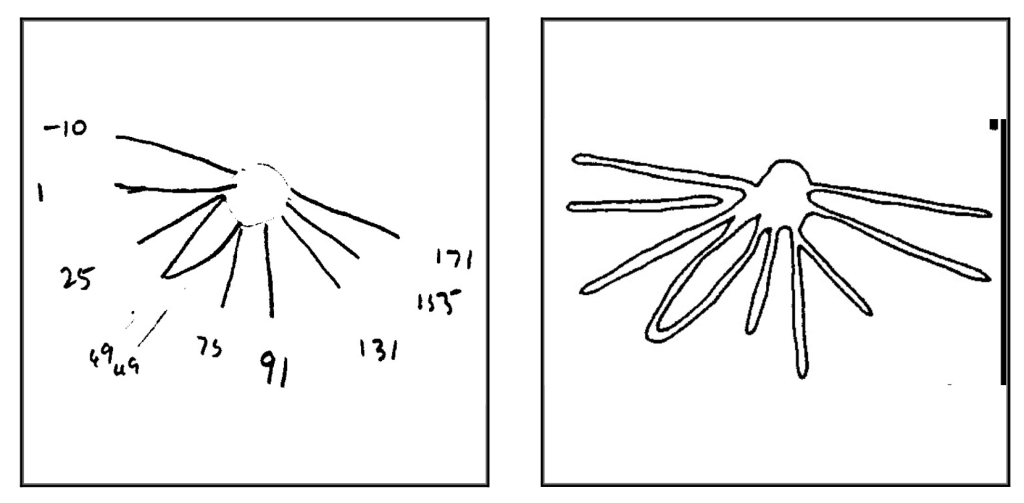
Located on the S wall near E window, a small single dial with 10 lines radiating from a fairly large style hole. C15. Of particular interest is that, most unusually, 2 of the lines meet at their outer ends (GLP) or even cross (BSS). The angled shot shows it best – and see diagram below. GLP suggests this arrangement roughly coincides with the Mass time Terce (9h) and may emphasise it, as a pock or a deeper cut radial might.
Mappowder . Dorset . St Peter & St Paul – Scratch Dial
St George is a wonderful church with Saxon origins, C12 foundation, C15 tower; and much T H Wyatt work / restoration mid C19. Treasures include the C12 font, a `truly amazing piece’ (Pevsner) of black Tournai marble. High up on the third stage of the C15 tower is a magnificent C18 sundial: details HERE and an image below.
SCRATCH DIAL
While visiting St George, I decided to have a brief look at the exterior for church marks in general: graffiti, dates, masons’ marks etc. I was not expecting much, in particular because of the extensive C19 work. However on the W end buttress of the C15 tower, facing SW, there was a large incised design worth inspection.
St George . Preshute . Wilts – scratch dial on the W buttress of the tower
The design is a partial / eroded circle with a central shallow style hole. A noon line extends downwards to the edge of the circle, passing through a pock on the way and ending with a shallow pock. Other pocks mark the approximate edge of the circle on both sides of the noon line. In the lower L quadrant, the pock between the style hole and the pock at the edge of the circle may have been to emphasise the 9-line as indicating the time of a morning Mass, in this case Terce.
St George . Preshute . Wilts – scratch dial on the W buttress of the tower
The British Sundial Society BSS has considered the evidence and added the Preshute dial to its Mass Dial records. In many ways a lucky find, since I was not looking for nor expecting a dial at all.
St George . Preshute . Wilts – scratch dial on the W buttress of the tower
GRADE I . C14 (first record 1291); C15 expansion; late C19 work. See HE for details of this interesting church, with its fine portico. A few miles N. of Sherborne or Yeovil. 51.0225 / -2.5754 / ST597249
DIALS
DIAL 1
The medieval dial is easily found on S wall of the chancel, on the buttress E of the priest’s door. The approximate semicircle embraces an almost compete set of 6-to-6 lines. There are several pocks, large and small. BSS notes include: 1. Worn. Repositioned. Octaval, Tides. 2. Dial (Norman?) with tides, with duodecimal, sometimes both. 3. Mason-cut or roughly scratched. 4. Tide dial, roman numerals, extra line at 7. I have to say (as an amateur) that I can’t match all these features to this dial or either of them if both are being described together (see below).
The dial is large, almost the full width of the buttress. Unusually, it is cut over 4 stones. Note the low pock some way directly below the noon line. Most of the dial is cut on the Hamstone E quoin, the lower rim extending onto the 2 stones below. These stones match those around them. However the L side of the dial is cut on grey stone not matched elsewhere nearby.
I was puzzled by the suggested repositioning of the (entire) dial. An alternative theory might be that the dial was positioned where it is now. Over time, the L side became eroded or damaged and was replaced with a different kind of stone (perhaps being used for repairs elsewhere on the church). The new stone was then cut to match the design of the original. Looked at closely, the ‘new’ L side design does not in fact match the rest accurately. Not all lines follow exactly; there are no pocks; the incisions are clearer. Does this support a later replacement (and possibly harder) stone?
DEH visited in May 1914 and recorded 182. (2) This dial is on the first buttress to the e. of the priest’s door. It is 5 feet 9 inches above the ground, the noonline is 5 1/2 inches in length, the stylehole is 1 1/8 inches in depth by 3/4 of an inch in diameter, and the aspect is s. by 10° e. Type 5c. May 18th, 1915.
Dial 2 also creates some confusion, not least its location. BSS does not record this dial as a separate entry from Dial 1 but may be referring to it especially in the note 4. Tide dial, roman numerals. Dial 1 does not have visible roman numerals but Dial 2 does.
Queen Camel . Somerset . St Barnabas – dial 2
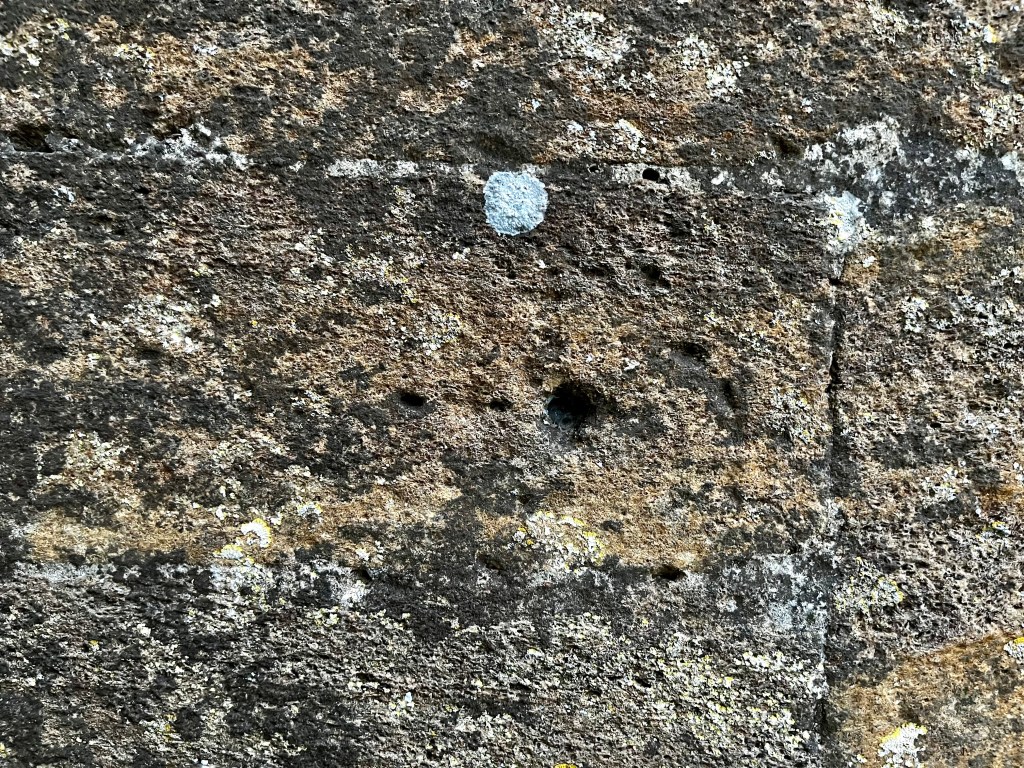
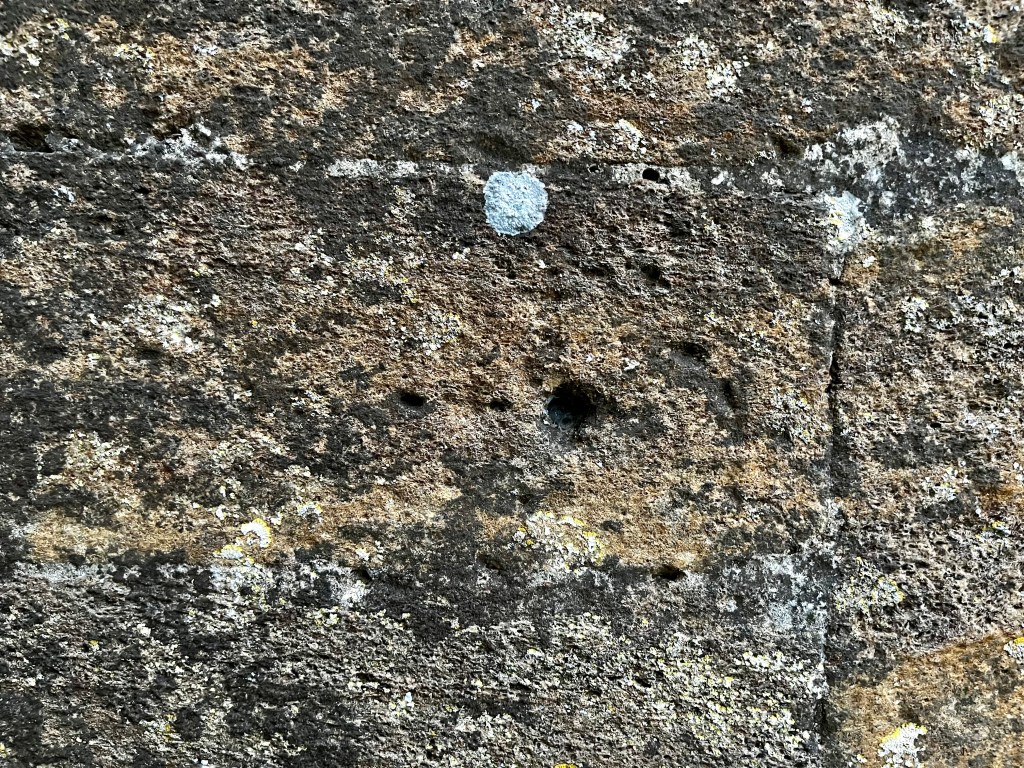
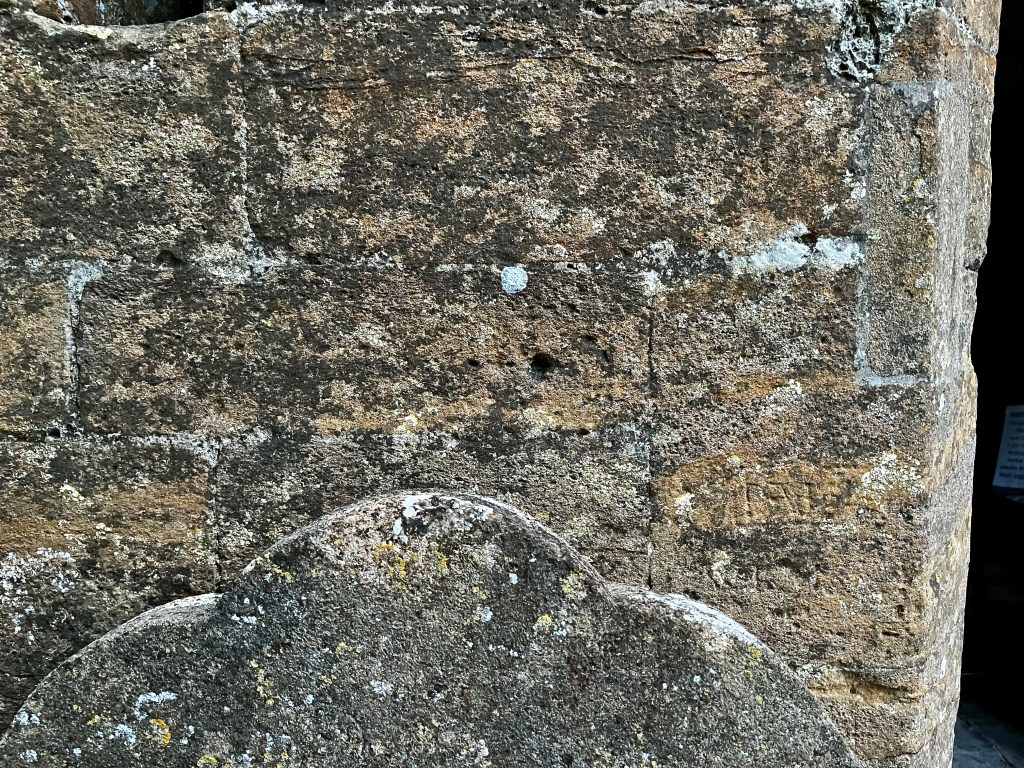
This dial is located high up above the portico, below the parapet of the nave seen as clerestory with parapetBLB. It is quite damaged, with a modern gnomon and a flaking layer of blue paint that makes it stand out (see header image). It’s hard to date the dial. Similar dated dials in the region are quite often early C18 or even C17. The dial is conventional of its kind, carefully graduated. The numerals are set in a frame, and italicised each side of the noon line.
DEH’s description of his second St Barnabas dial is another puzzle:
181. (1) This dial is on the s.e. buttress of the s. aisle. It is 6 feet 7 1/2 inches above the ground, the noonline is 5 inches in length, the stylehole is invisible, and the aspect is s. by 10° e. The dial is curious, as it has the lines arranged much as they are in an ordinary sundial, with Roman numerals cut at the ends. There may have been a slit for a gnomon, now carefully cemented up. Probably this should not rank as a Scratch dial.
There is a significant problem. The location DEH gives for it, six feet up on a buttress, is totally different from this now blue dial, yet his description broadly matches it and his comment that it probably should not rank as a Scratch dial is clearly apposite. I may have missed a second buttress scratch dial, even though I have been back to check. Or else perhaps DEH made a simple error in compiling his notes of several churches visited at one time in one area (I have come across a couple of similar instances). So this dial, now blue, is the one he meant but mis-located.
GRADE II † C14 origins on earlier site; mostly C15 and later C19 work. South porch very simple, possibly C14BLB. Cinnuc in Saxon times. 4 miles W of Yeovil, attractively set on the steep hillside at the E end of the village though right beside the A30. 50.9164 / -2.7145 / ST498132
DIALS
St Mary has 2 dials. Both are on the S porch, one of the earliest parts of the church. One was recorded by DEH on his visit in June 1915. The other is a new find I believe.
DIAL 1
The dial is halfway up the L side of the porch immediately above a gravestone. It comprises pocks with a large style hole. The pattern is haphazard and the dial might actually make more sense if rotated 90º L, producing a double pock noon line.
East Chinnock . Somerset . St Mary – Scratch Dial 1
DEH196. This dial is on the w. side of the s. porch, at a height of 4 feet 8 inches above the ground. The noonline is 2 1/4 inches in length, the stylehole is 7/8 of an inch by 1/2 an inch in diameter, and the aspect is s. by 30° e. Type 10. June 15th, 1915.
East Chinnock . Somerset . St Mary – Scratch Dial
DIAL 2
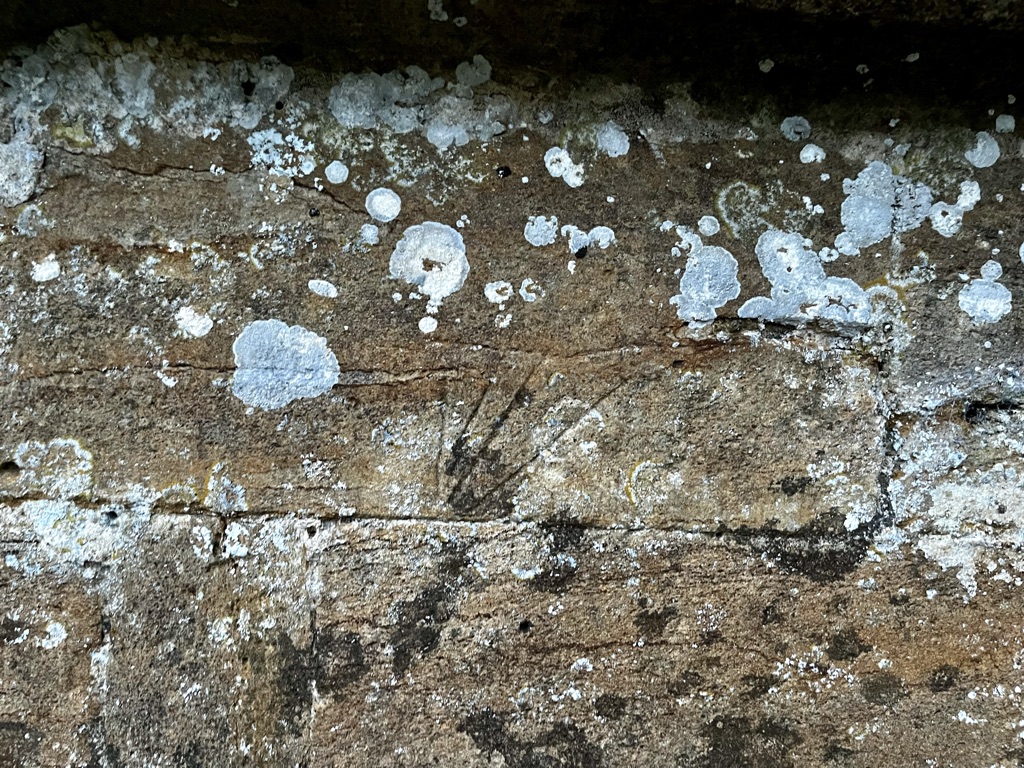
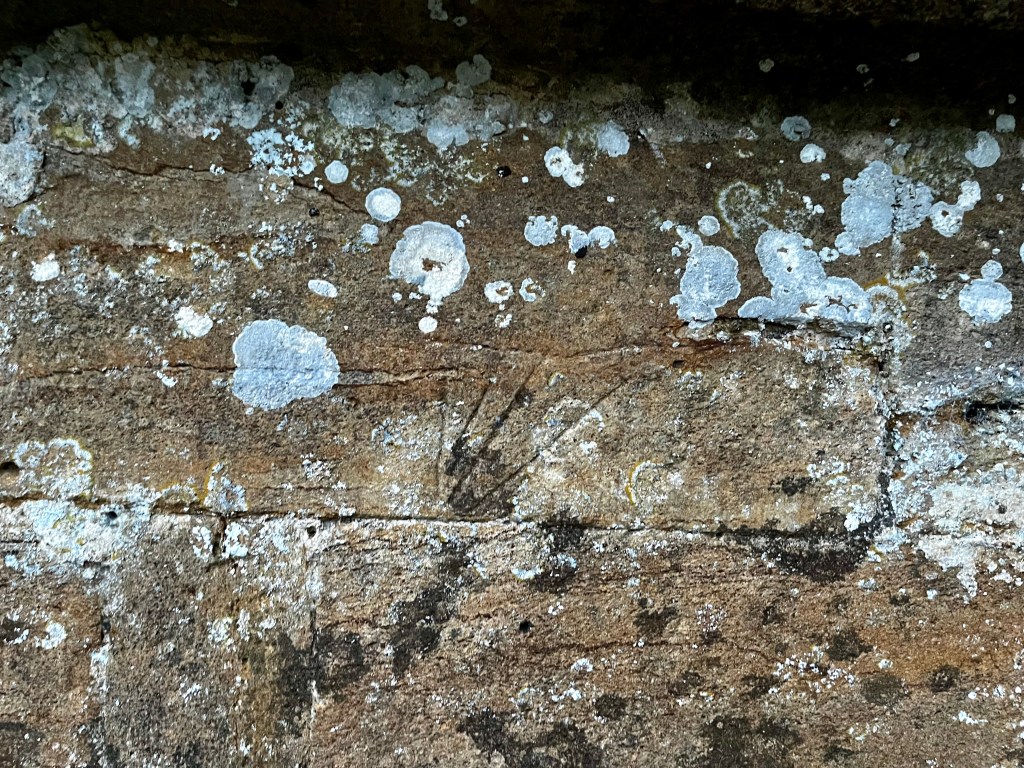
East Chinnock . Somerset . St Mary – Scratch Dial 2
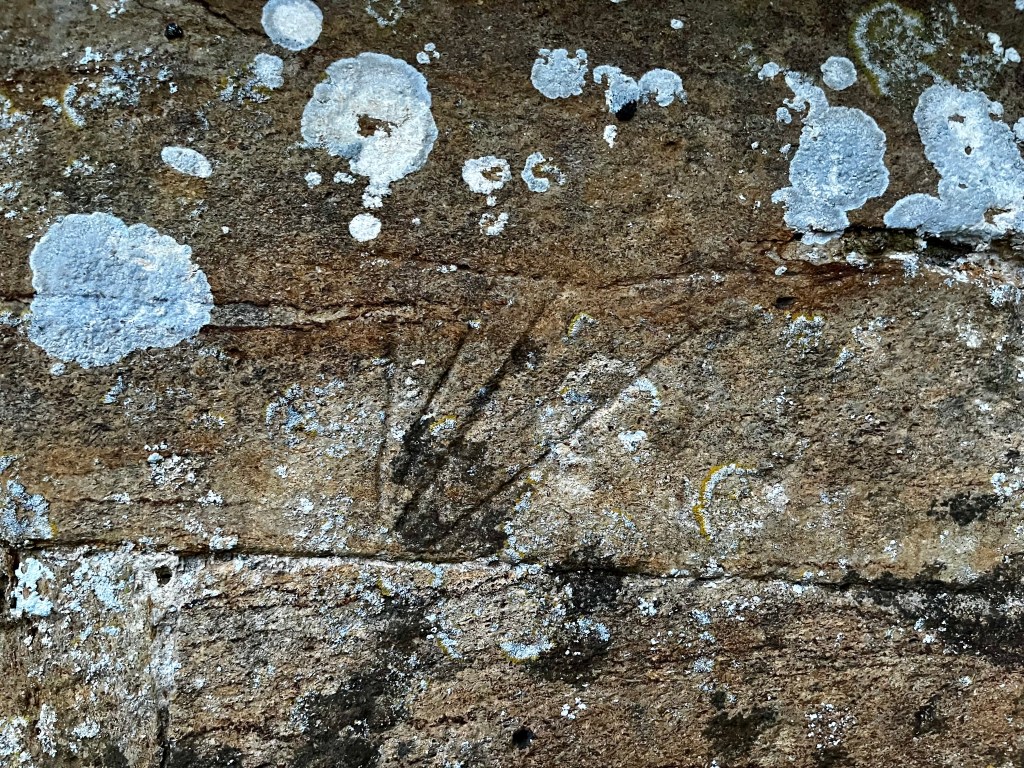
Dial 2 is located quite high on the E face of the S porch, a simple 4-line fan dial. The position makes no sense for a sundial, and it was plainly relocated at some stage. In the process, as is often the way, it was inverted. This re-siting with a rotation of the stone retains the decorative feature even though no longer a reliable time indicator. This is the sort of find that reminds me always to search beyond the normal dial locations of porch, buttress and priest’s door.
























 GAUDIUM SUB SOLE . SUNDIALS . MEDIEVAL TO MODERN