GRADE I † C13 origins; C14, C15 development; extensive restoration 1873 (Carpenter). C12 font. 3 scratch dials; and a fine Millennium dial LINK. 10m NW of Salisbury. 51.1363 / -1.9493 / SU036374
DIALS
All Saints is unusual in having 3 dials of very similar design, without the often-found stylistic developments on churches that have more than one dial.
DIAL 1
The most complete dial in terms of information for the passer-by. A complete circle with several lines clear and faint, some with a terminal pock. The noon line extends beyond the circumference, with the lines RHS indicating an afternoon dial.
DIAL 2
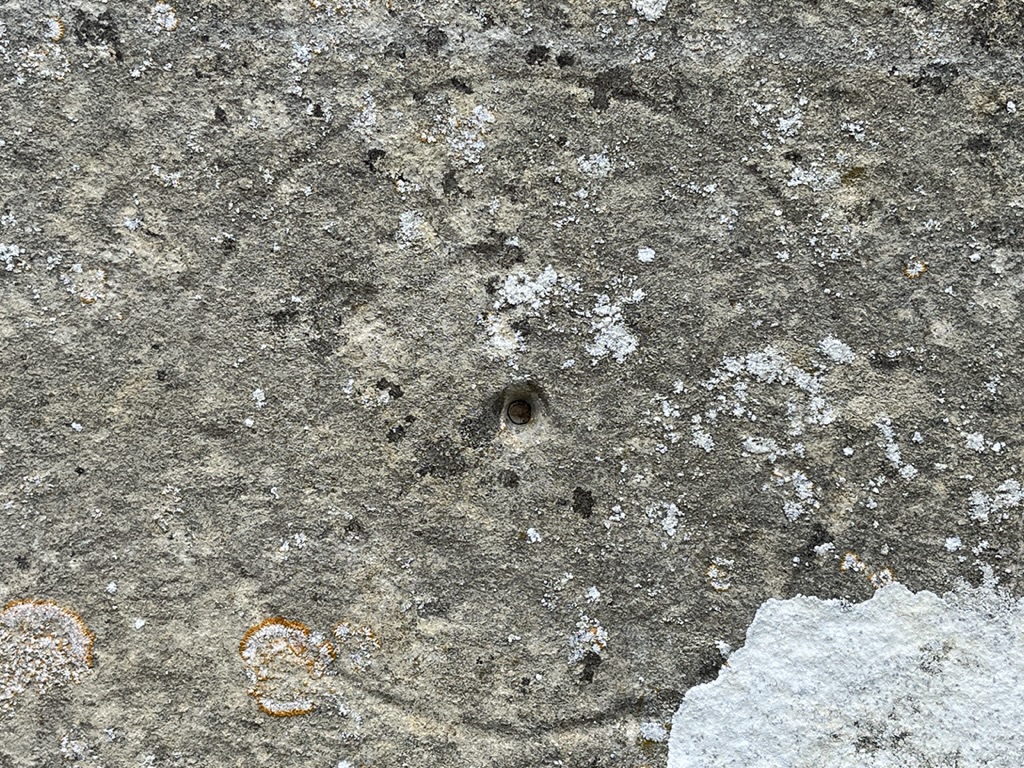
The dial’s circle is clear and the gnomon hole is large (with signs of recent enlargement). Apart from that only the faintest traces of lines remain, presumably lightly cut initially and eroded over the centuries.
DIAL3
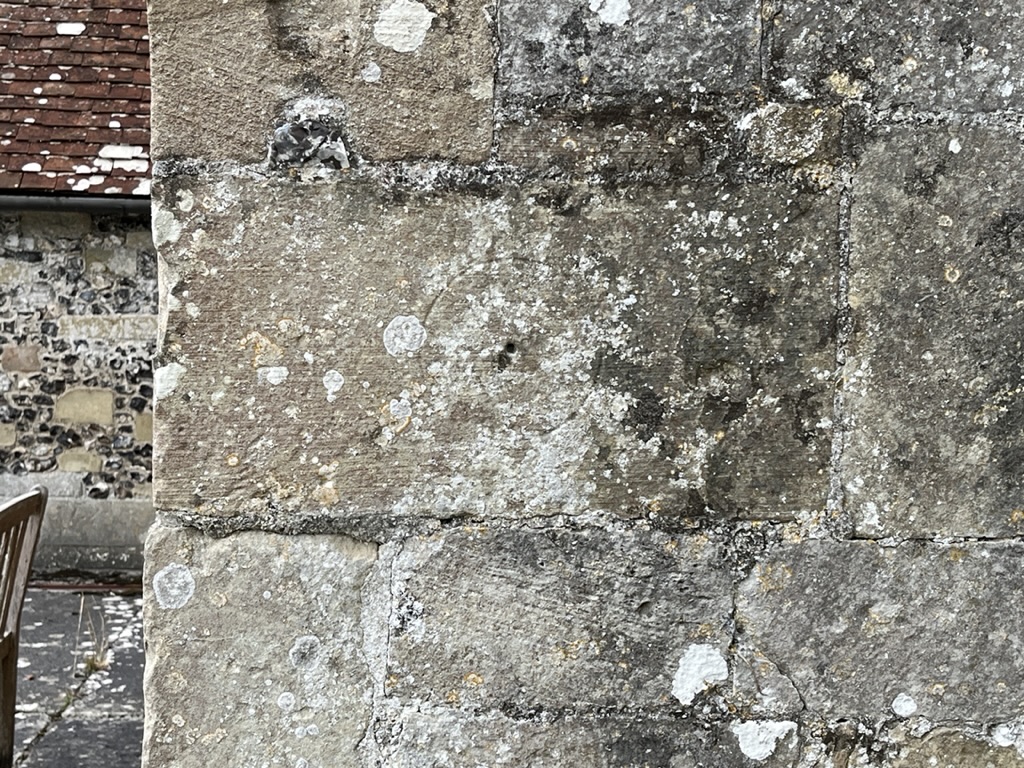
A partially obliterated circle; a gnomon hole; hints of 3 pocks LRQ. Perhaps we can deduce that this was the first of the dials. Of course, even a stick in the centre hole would give a fair idea of the time of day to the passing parishioner.
GRADE 1 † Mid-C13 with earlier origins; expansion to C16; restorations by Ferrey and Scott 1860 and later. A most impressive Parish church with a 4-stage tower. Admired by PEV as one of the loveliest of Somerset churches on account of its splendid Perp. work on the nave; and for being remarkably airy and spacious. 50.9693 / -2.7687 / ST461191
DIALS
A most rewarding multi-dial church. As often, estimates of the number vary. DEH recorded 5 dials in June 1915 and included a photograph of the dial above in his book.
BHO refers to 7 dials [and also notes that one buttress on the north side has footholds cut in it to aid the recovery of fives balls from the leads when the game was played there in the 18th century. There’s a whole book to be written about the fives courts of Wessex] BSS records 7 dials, without details.
There are so many excellent dials to admire that I am not including interpretations of individual dials. The light was good for photos and the various designs speak for themselves. I haven’t given locations either. Most are in obvious places; also check sides of buttresses. It was a lot of fun finding a couple of new dials, and anyone reading this may prefer to investigate for themselves. DEH’s record is given at the end.
DIAL 1
✣
DIAL 2
✣
DIALS 3 & 4
DIAL 3
DIAL 4
✣
DIAL 5
✣
DIAL 6
✣
DIAL 7
✣
DIAL 8
✣
DIAL 9
✣
DIAL 10
✣
DIAL 11
ARCS etc
Having recently written up Winterbourne Stoke and a few other multi-dial churches, I have decided not to include a plain arc as (part of) a dial unless there’s at least one other dial-ish feature – evidence of a centered hole in the mortar line; perceptible lines; pocks; and so on. I’ll still feature them but not as part of a dial count. Unless corrected of course – please do.
✣
CONSECRATION CROSS OUTSIDE PORCH
ADDITIONAL NOTES
The pride of Martock Church is its superb angel roof, installed in the first decade of the 16th century and completed in 1513. The roof design is a king-post style with tracery infill between the truss beams. There are central pendants from each cross-beam, above which rise beautifully carved figures. (David Ross, Britain Express)
DOM ETHELBERT HORNE’S 5 DIALS
200. (1) This dial is on the w. side of the s. porch. It is 6 feet 1 inch above the ground. The noon line is 3 3/4 inches in length, the style hole is 1 inch deep, and is in a joint. The aspect is s. by 5° e. (See No. 12.)
201. (2) This dial is under the first window E. of the s. porch. It is 4 feet 7 inches above the ground, the noon line is 3 inches in length, the style hole is 1 3/4 inches deep, and the aspect is s. by 15° e. Type 6.
Dial No. 2 is of the unique shape that exists at Tintinhull (224) and Swainswick (25).
202. (3) This dial is on the second buttress e. of the s. porch. It is 5 feet 9 inches above the ground, the noon line is 3 1/2 inches in length, the style hole is very shallow, and the aspect is s. by 15° e. Type 3.
203. (4) This dial is under the third window e. of the s. porch. It is 3 feet 10 inches above the ground, the noon line is 2 inches in length, the style hole is If inches deep, and the aspect is s. by 15° e. Type 10.
204. (5) This dial is on the fifth buttress e. of the s. porch. It is 5 feet 1 inch above the ground, the noon line is 5 1/4 inches in length, the style hole is 1 1/4 inches deep, and the aspect is s. by 15° e. Type 5c.
GSS Category: Scratch Dial; Mass Dial; Multiple Dial Church
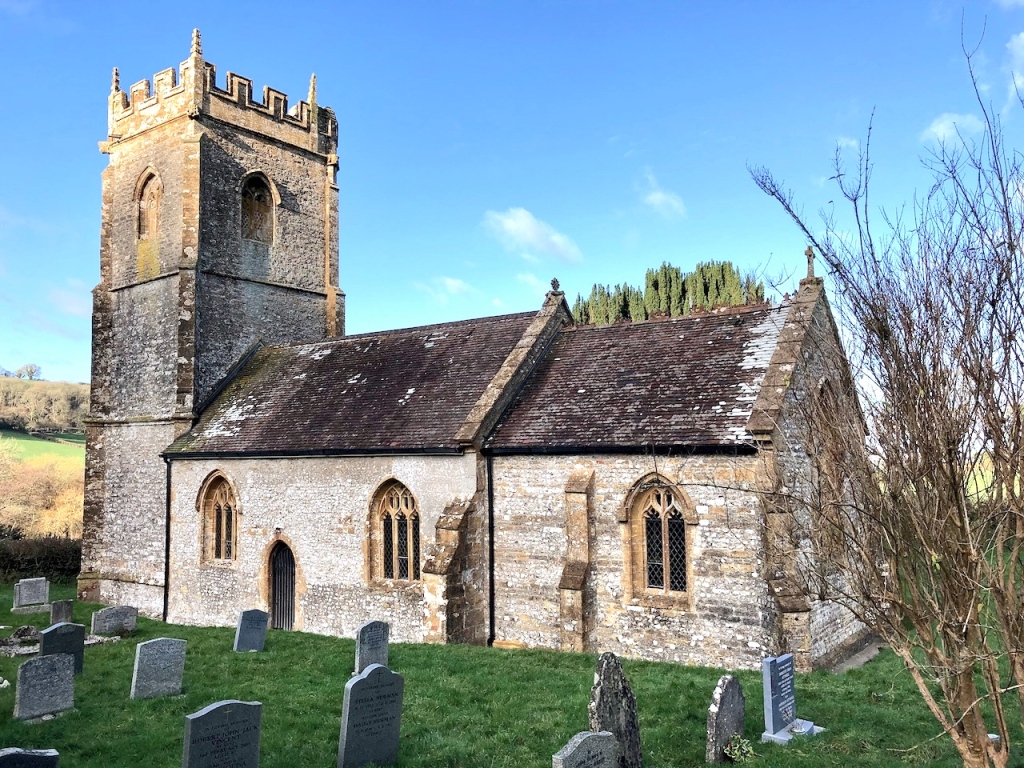
GRADE I † Early Church recorded at HestrebeDB. C12 origin as collegiate church; continuing development to C16; mid-C19 restoration (Butterfield). C13 work of particular note. One of the excellent churches to be found in the Wylye valley between Steeple Langford and Sutton Veny. 51.1821 / -2.1086 / ST925425
DIAL
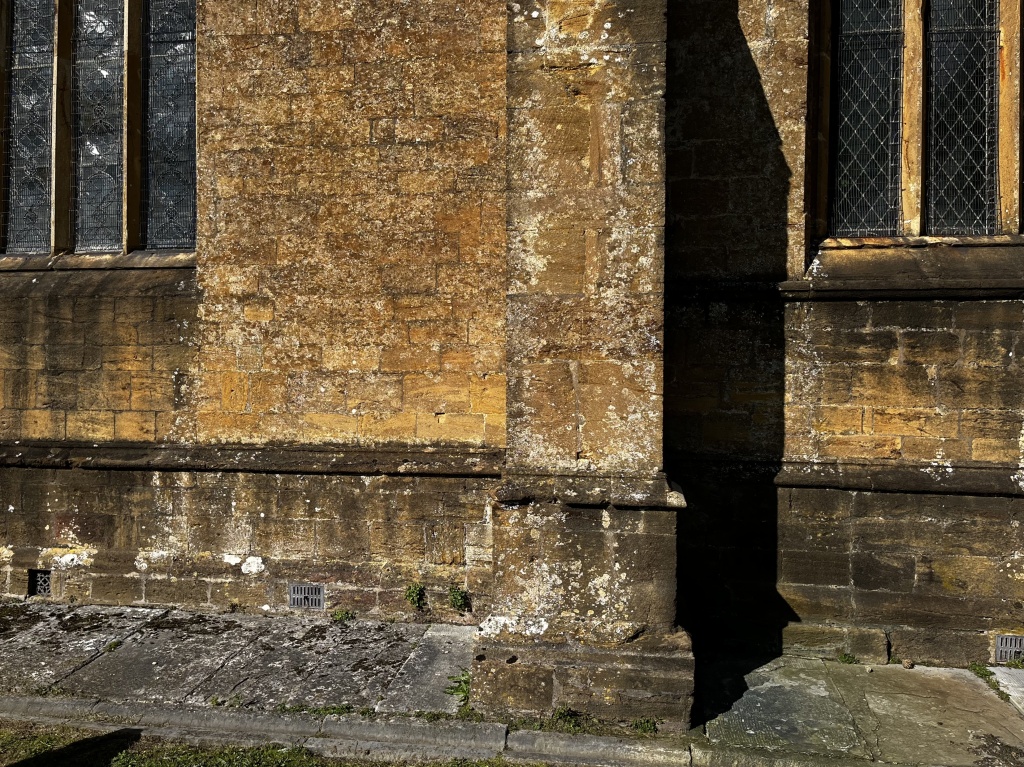
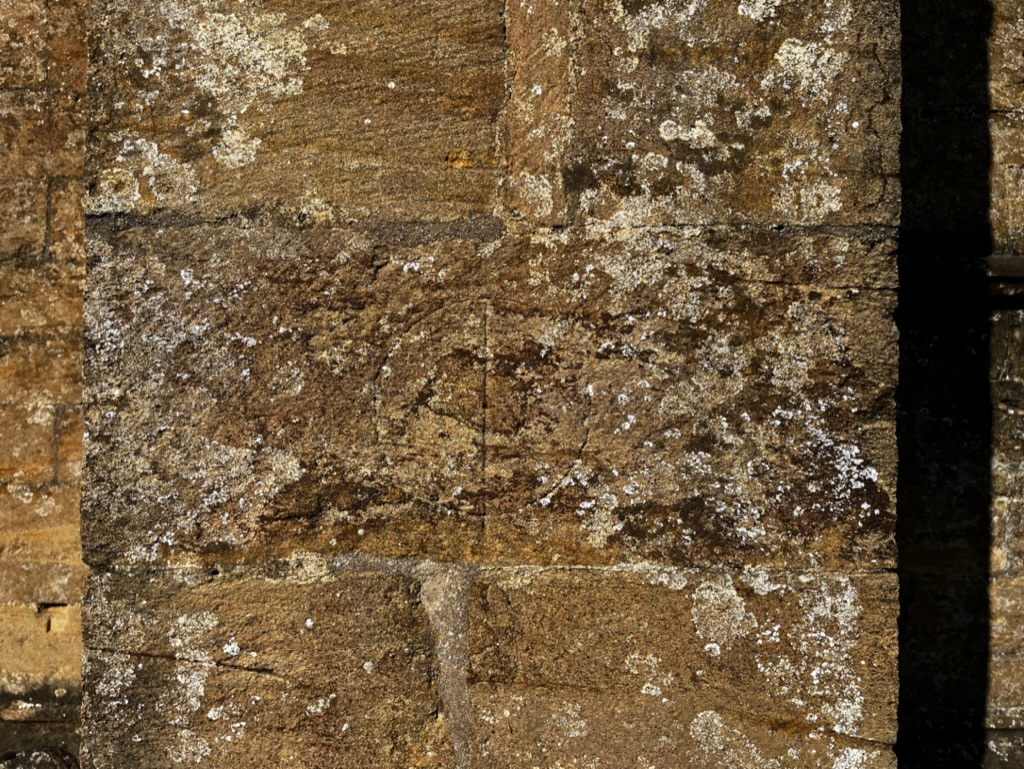
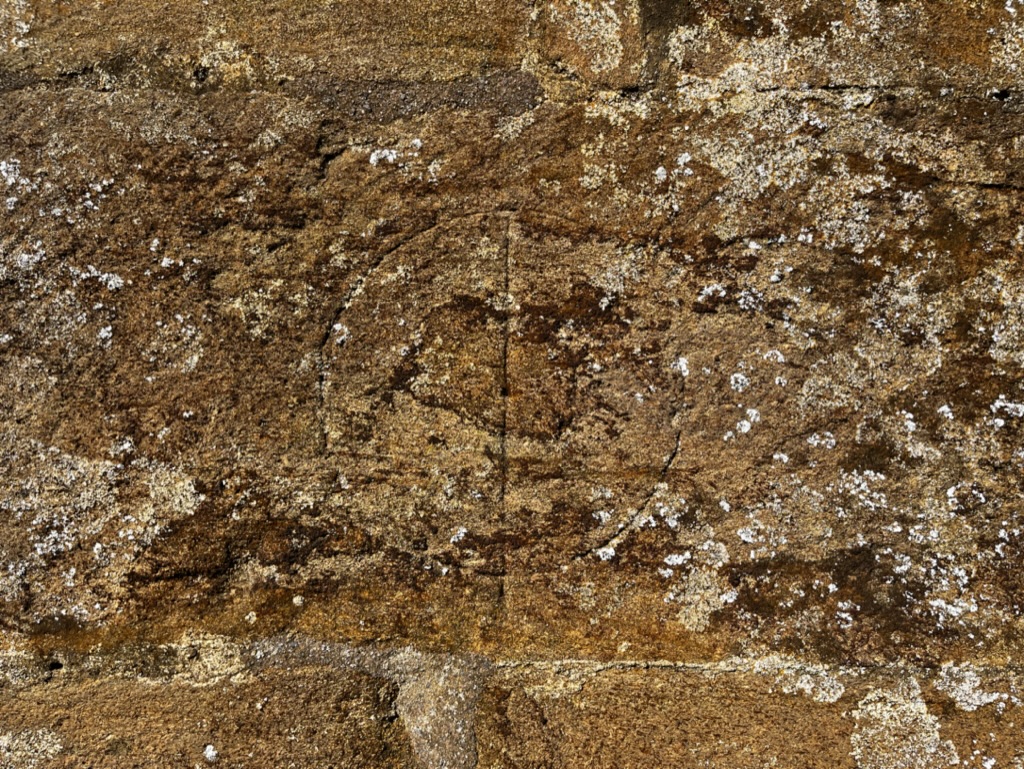
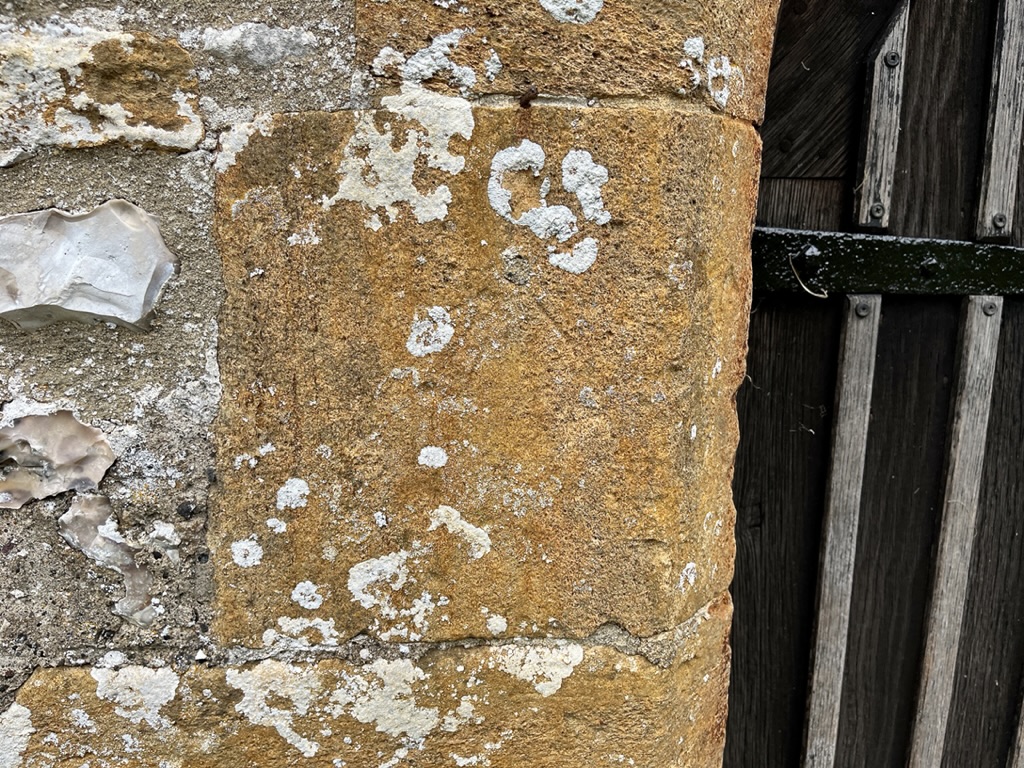
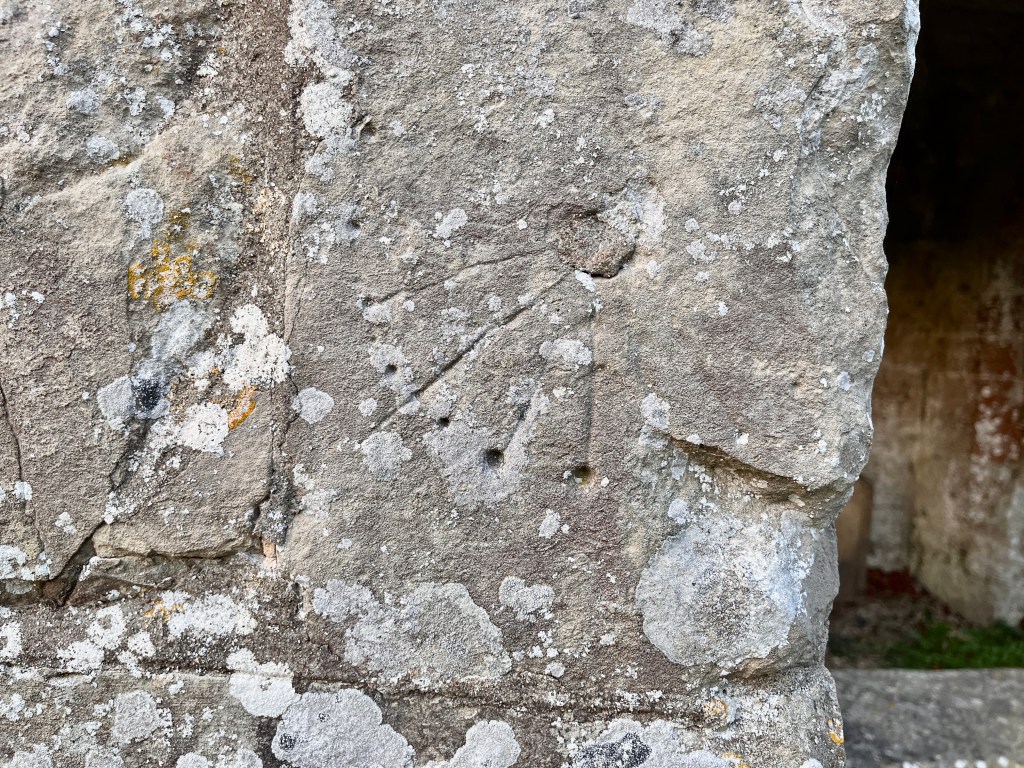
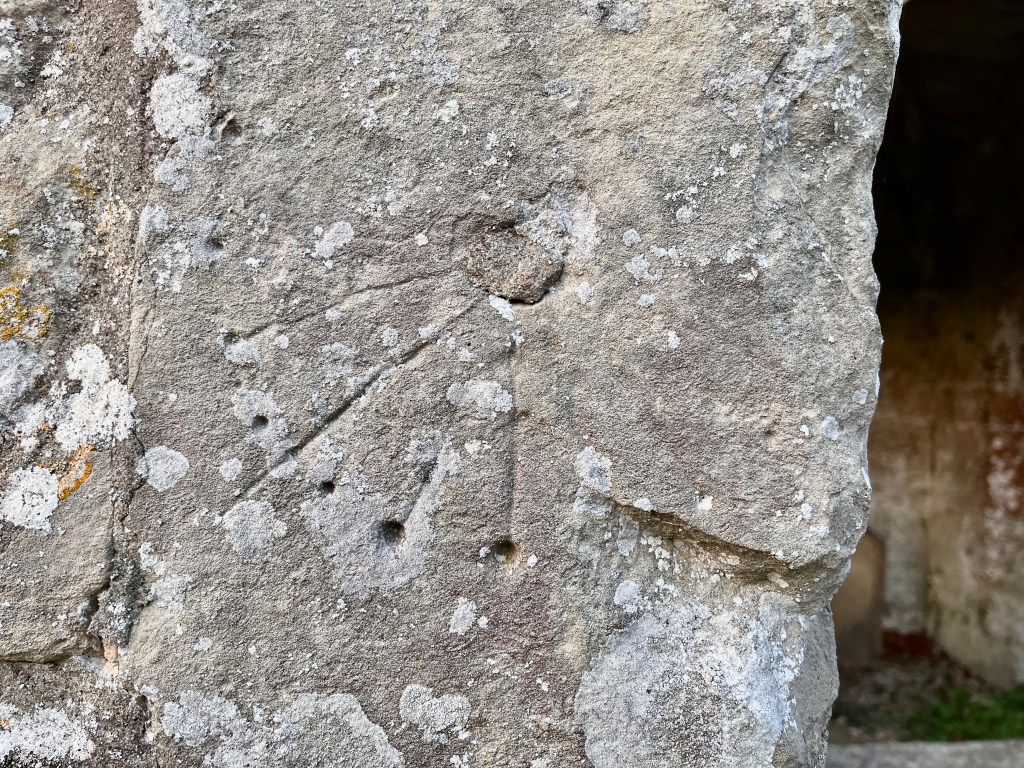
The dial is on the SE face of the angled buttress at E end (by the green tank). It is a fine example of a dial on which all the lines have terminal pocks. At some time it was inverted, and I have shown it reverted below. I cannot find any record of it, BSS or elsewhere.
REVERSION
This dial is primarily a morning dial, with lines marking (in clock terms) the 5 hours from 8 to noon. The deeper lines marking 9 & 10 correspond to the morning Mass time Terce. Possibly, the fainter line LRQ indicates None, another significant time during the day’s observations. In all there are 9 visible lines with terminal pocks during daytime, and a hint of a line above the horizontal in URQ. The vertical ‘midnight’ groove above the gnomon hole can be discounted as part of the dial, I think. It is certainly out of keeping with the carefully thought overall design. Also, it doesn’t reach the gnomon hole.
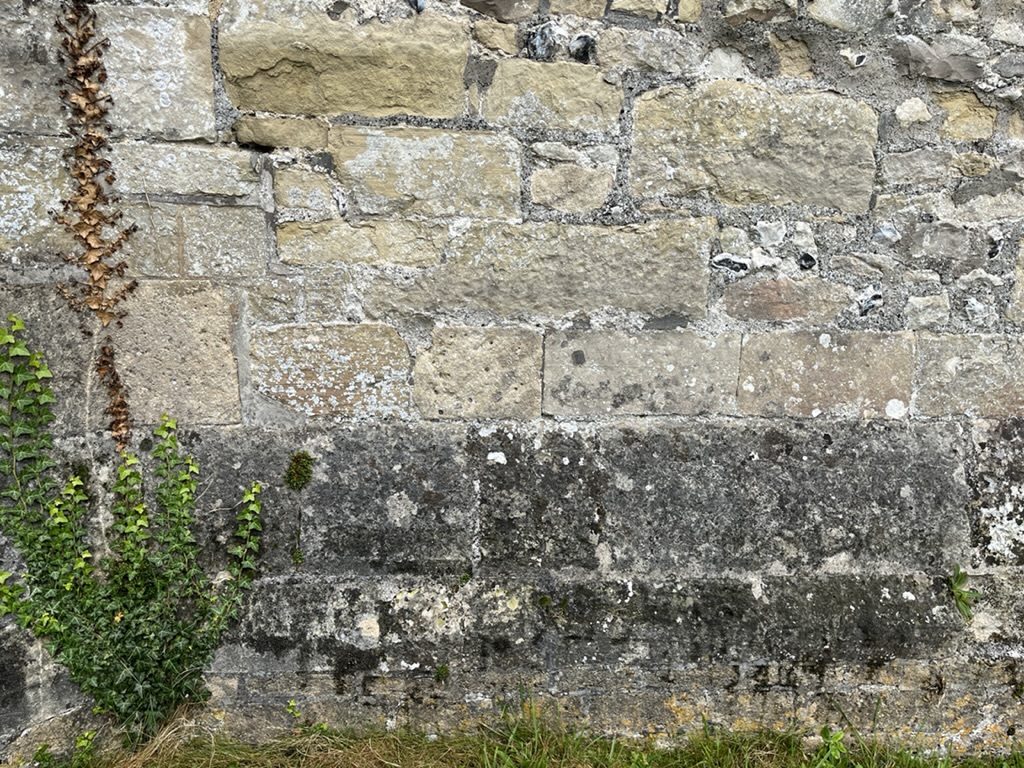
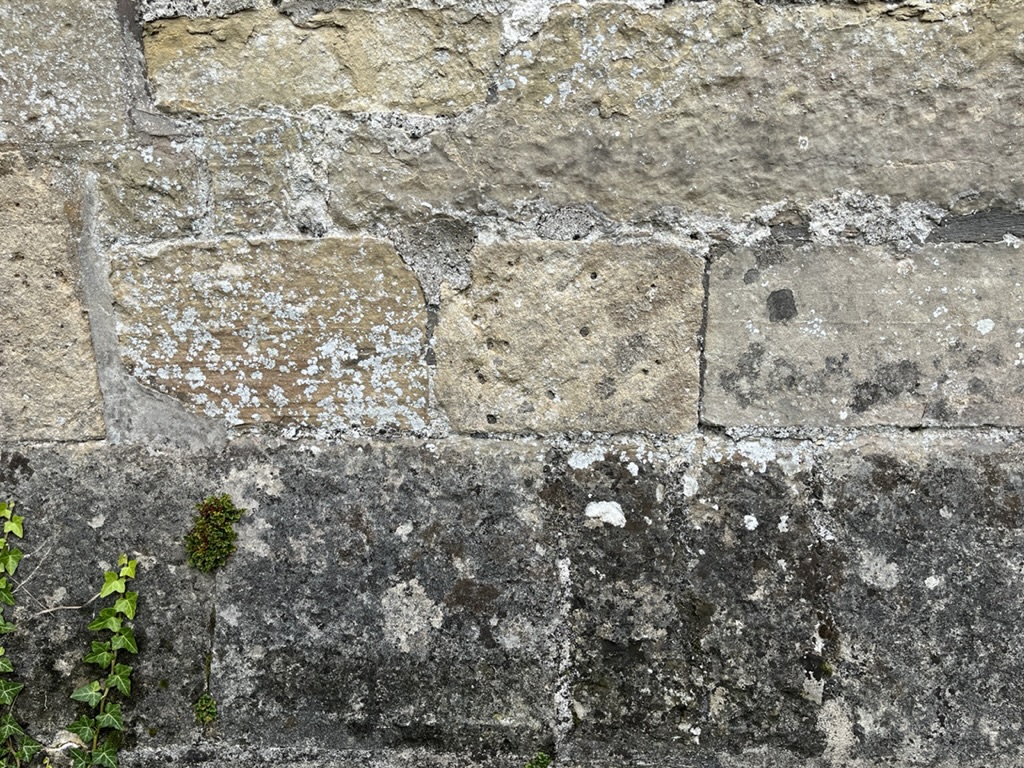
PLAUSIBLE DIAL?
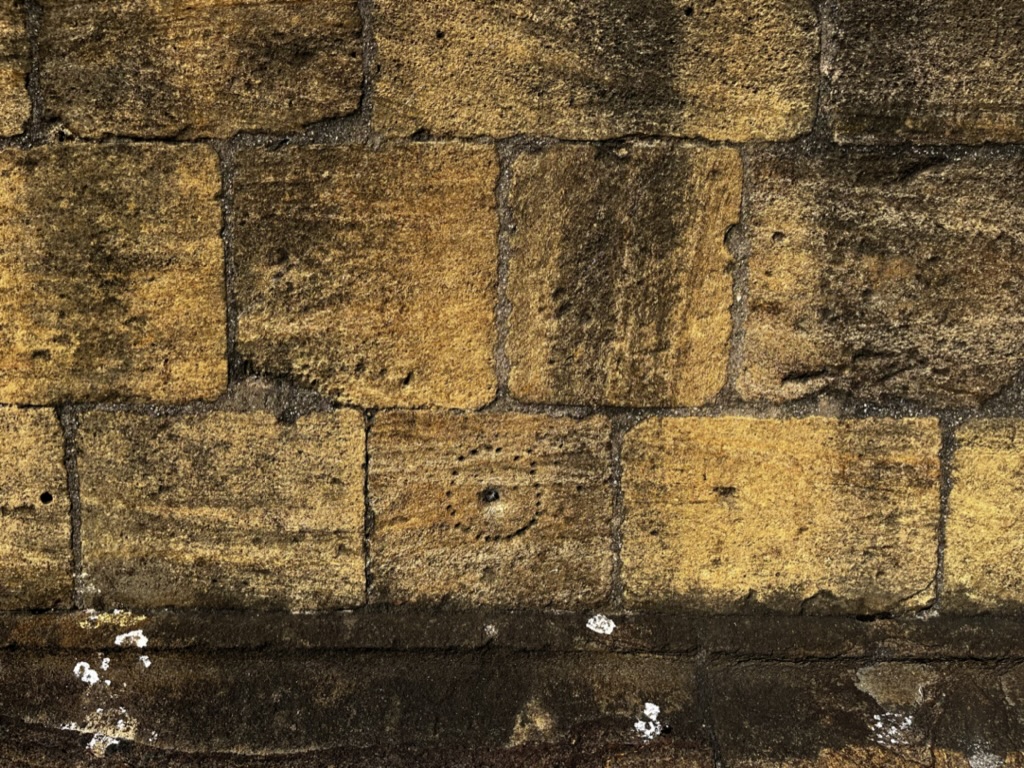
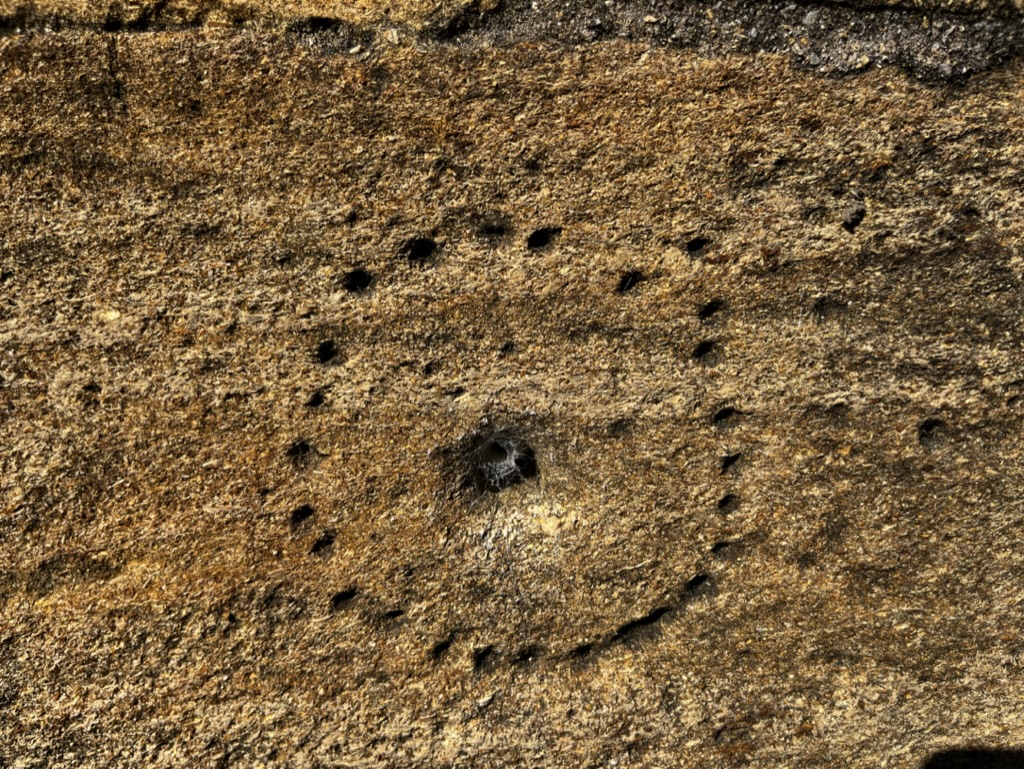
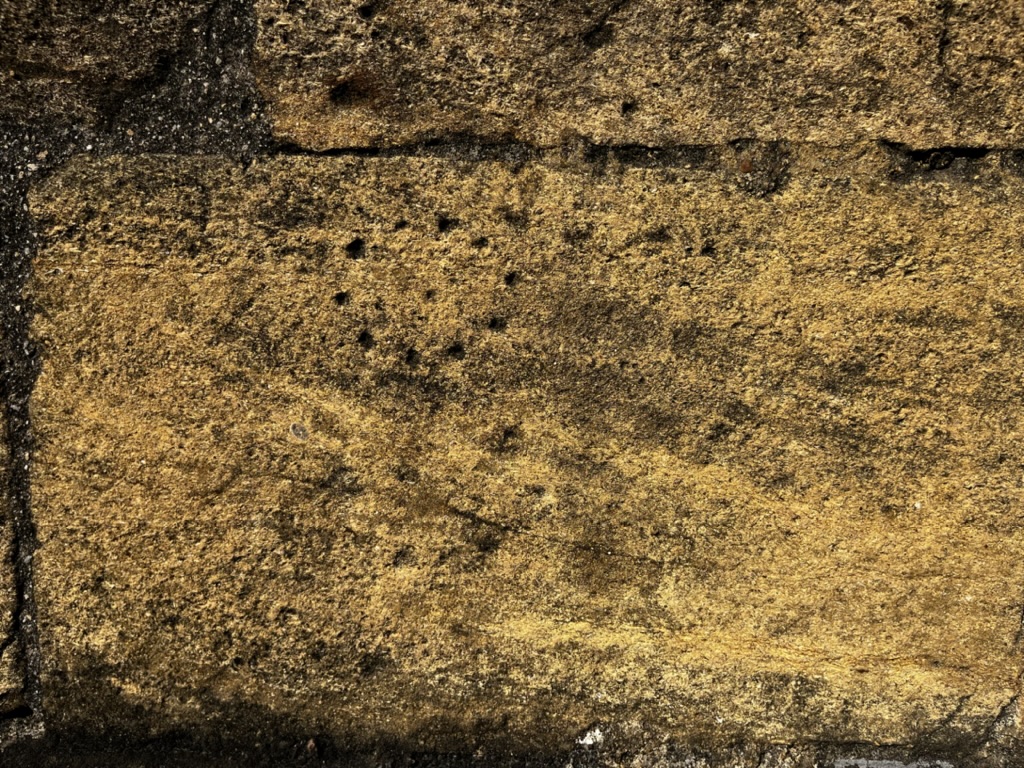
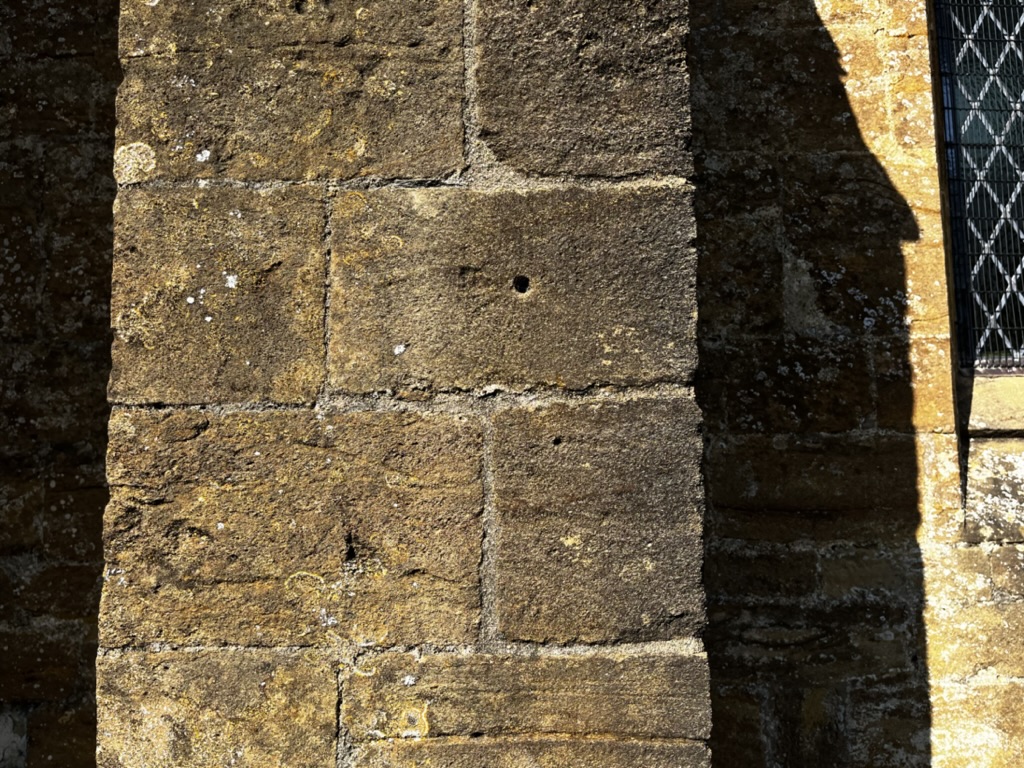
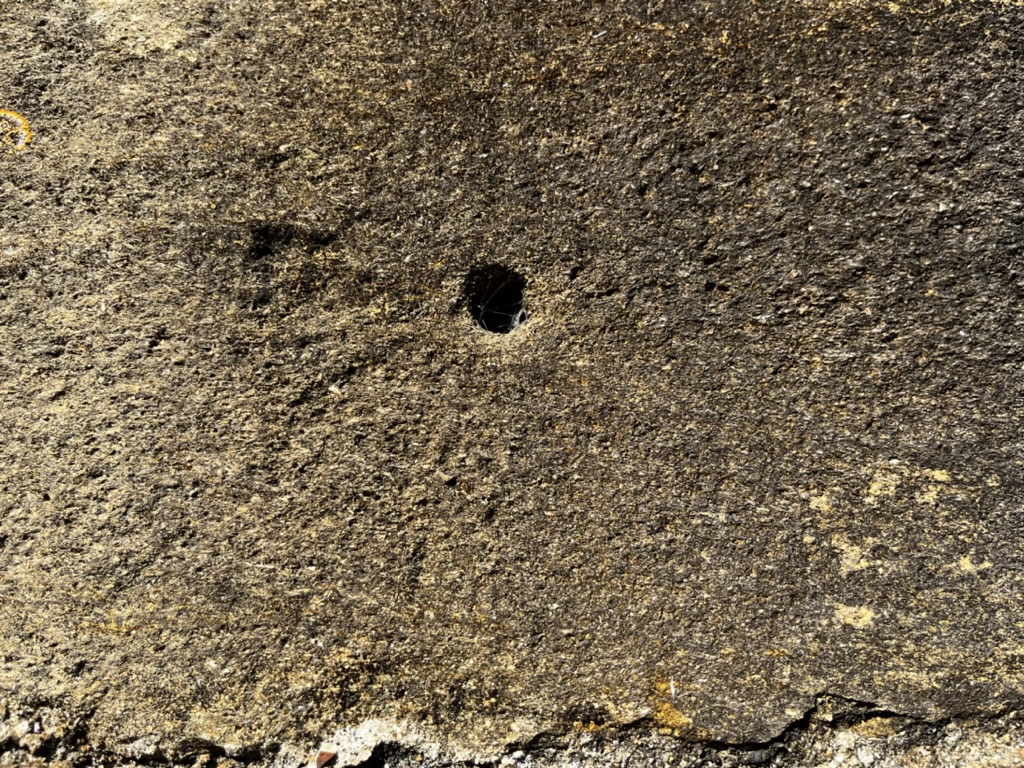
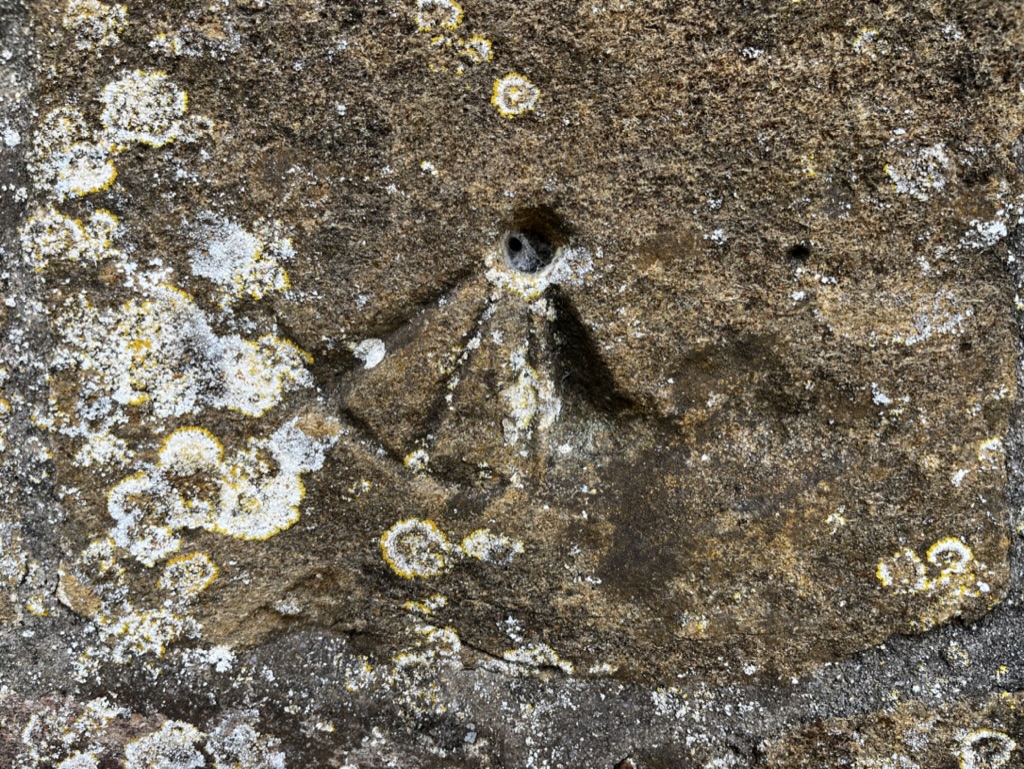
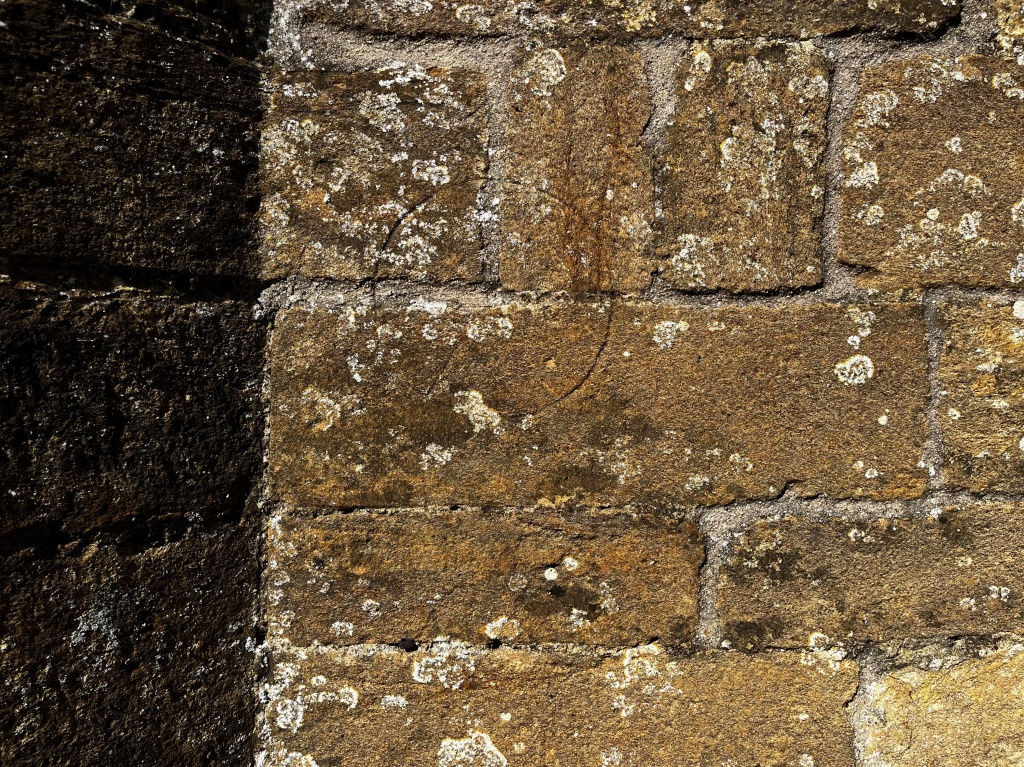
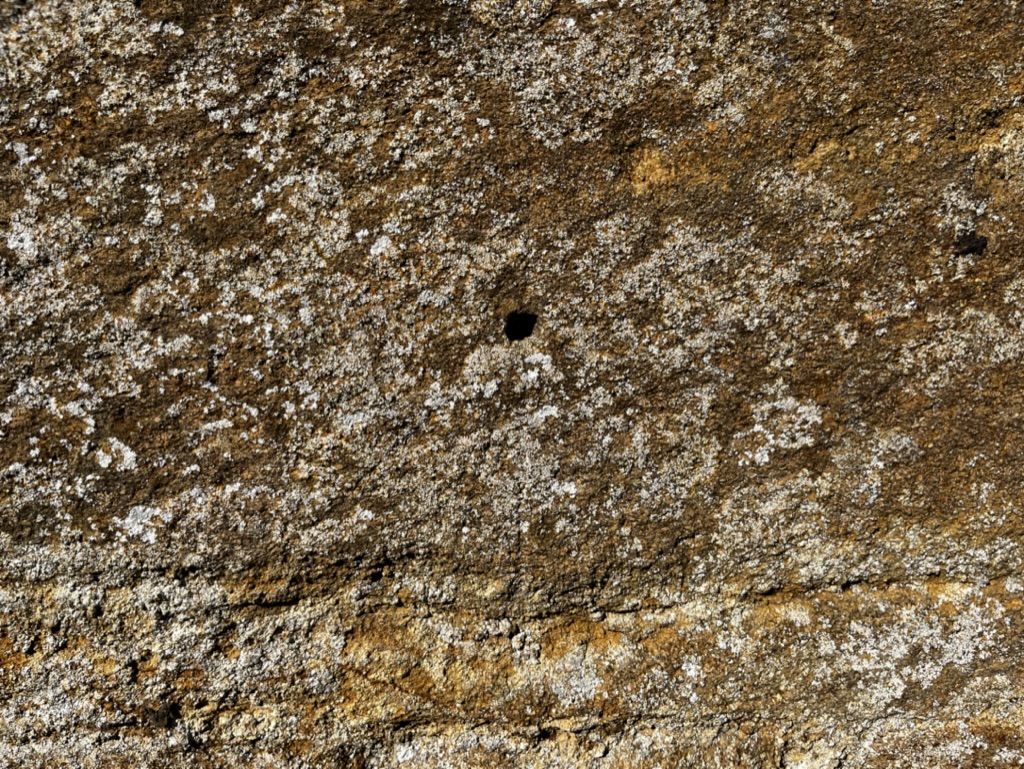
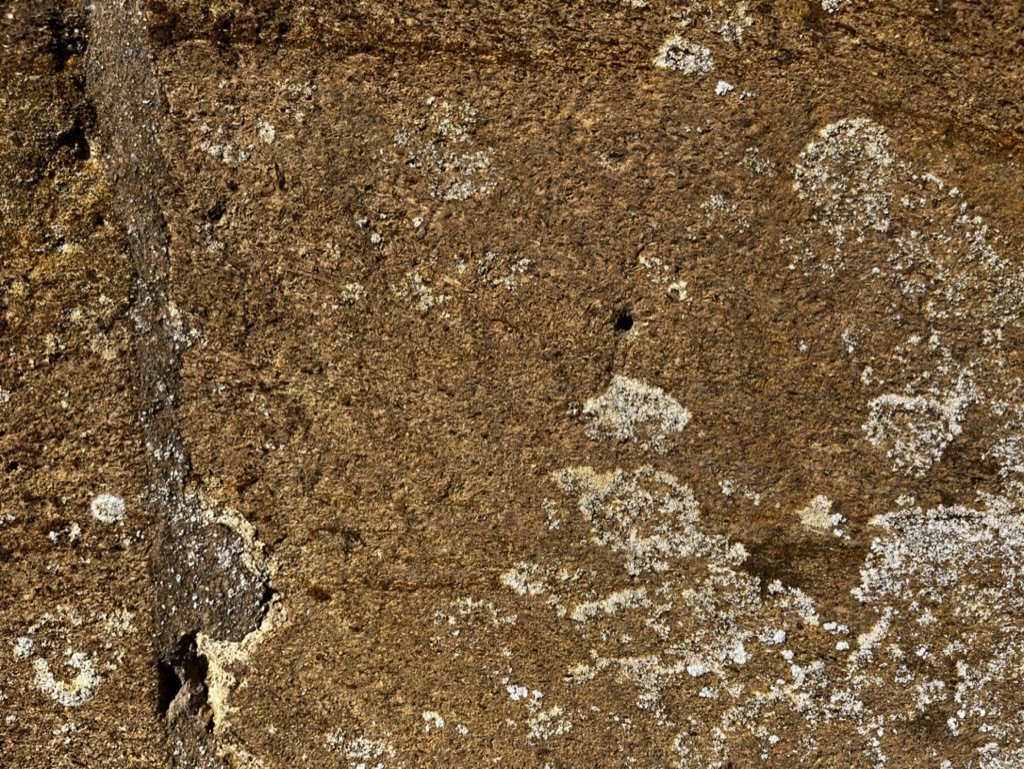
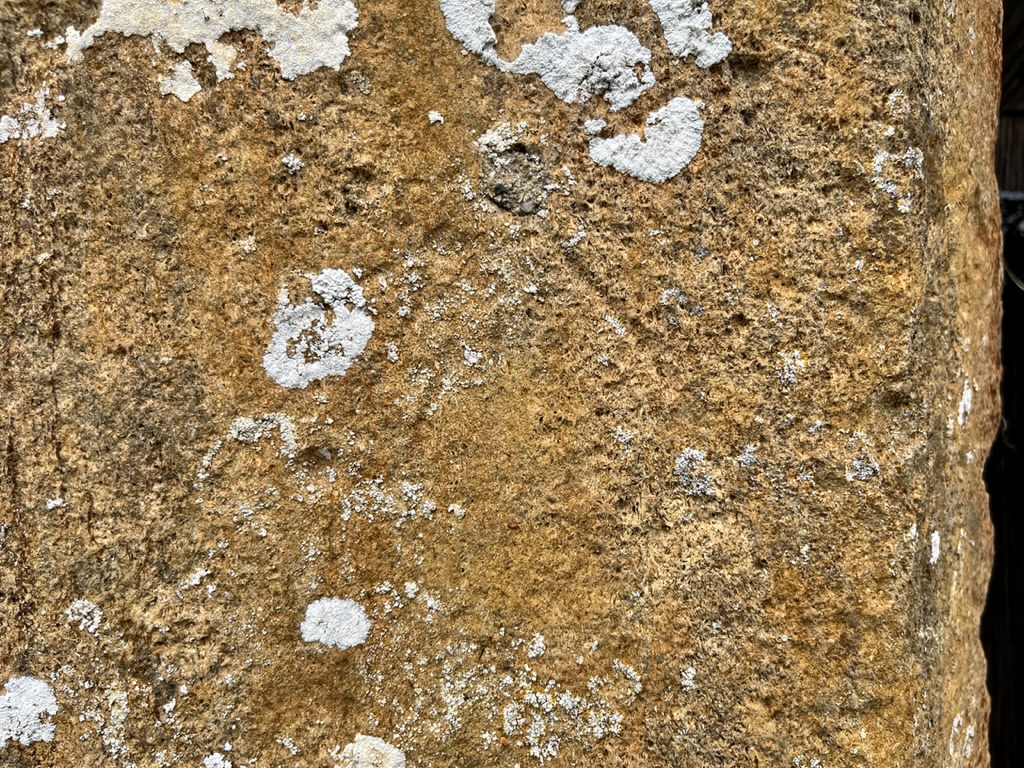
I noticed this patterned stone and photographed it as I walked past. I would very much like it to be a ‘pock-only’ dial. There is certainly a hole close to the centre of the stone, with a pattern of small holes that look crudely drilled, approximately forming a perimeter. Probably I am overthinking this.
CHURCH MARKS
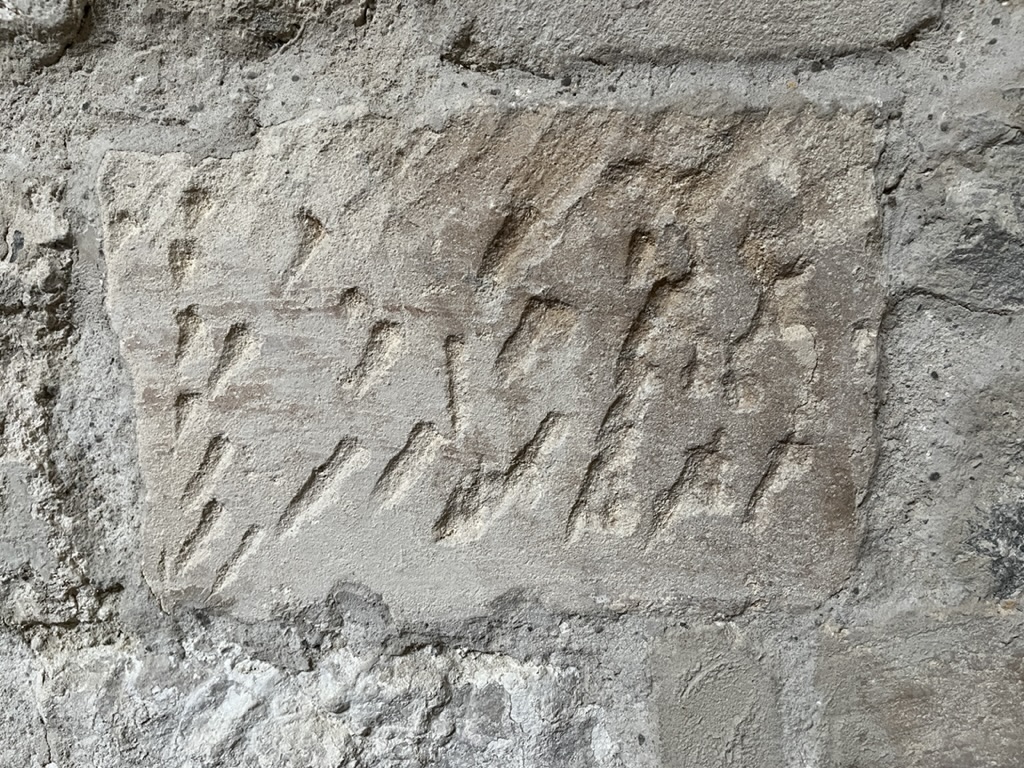
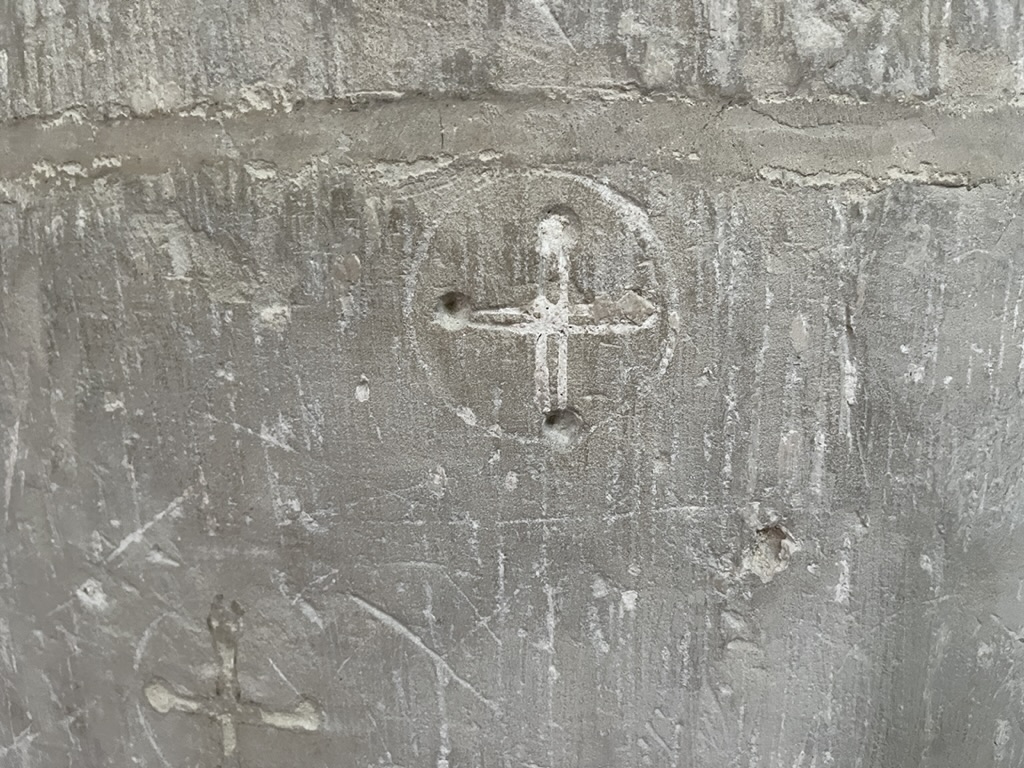
Here is a selection of church marks – masons’ marks, consecration cross; ‘pilgrim’ crosses; graffiti; a small dial-like design that merits further investigation.
GRAFFITI INCLUDING RITUAL PROTECTION SYMBOLS
GSS Category: Scratch Dial; Mass Dial; Church Marks; Consecration Cross; Masons’ marks; Pilgrim Cross; Graffiti
An extraordinary and diverse collection of dials on a lovely church that is a short walk from the dreaded A303. The village is the first traffic choke-point on the road W of Stonehenge. Who would guess, inching forwards in your car where pedestrians daily take a life-or-death decision when to cross, that a lane to the south offers such a rich treat?
DIALS
St Peter is a multiple scratch dial church. Estimates vary of precisely how many: perhaps 8 or 9, depending on individual interpretation. BSS records 4. The range of plausibility covers all bases: obvious dials, probable dials, possible dials, not-a-dials. Some candidates – whole or partial – may simply be decorative. Others look promising but are unlikely to work as dials in design or (present) position. I have grouped various candidates, accepting that my choices may be lightly contentious. Note that I have mostly not specified locations. I started (2 visits) on the SE corner, if that helps. I have given links below with helpful details. Anyway, a multi-dial church is always a pleasing challenge for locating them.
DIAL 1
A simple dial on a RHS window jamb, consisting of 2 circles and a central gnomon hole. The double rings, badly eroded, look compass drawn. There are no visible lines, nor any pocks.
DIAL 2
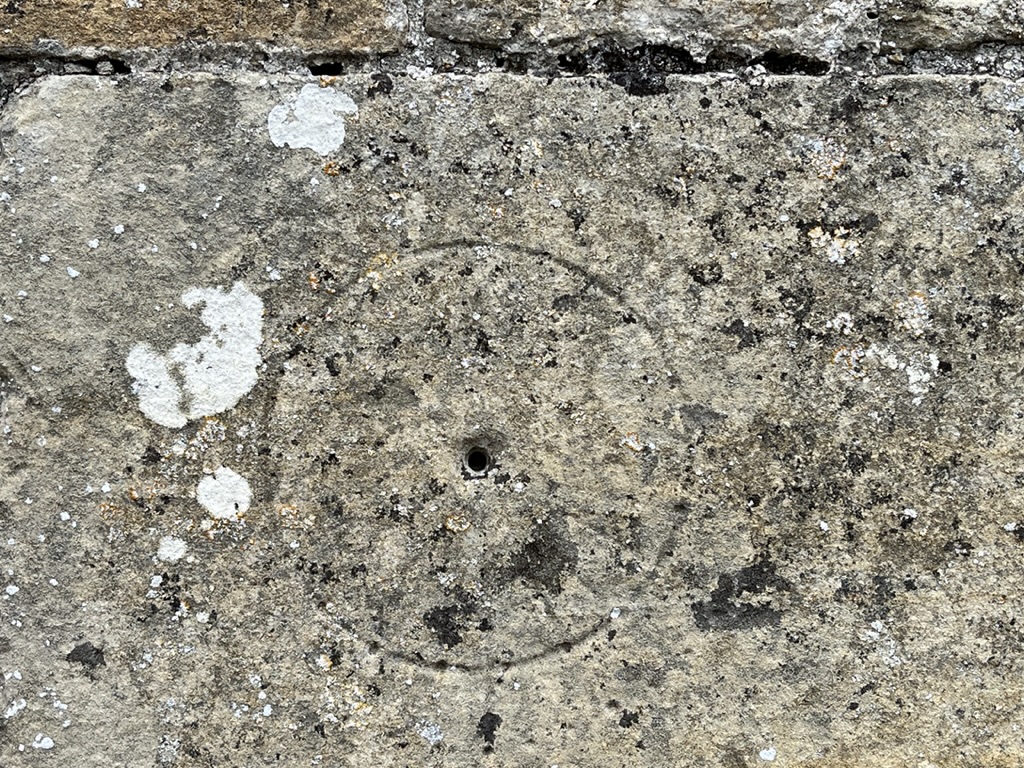
On a LHS window jamb, a plugged gnomon hole with very little else remaining. Enlarging the image reveals a faint trace of what might once have been a circle; and the ghost of a noon line.
DIAL 3
A much clearer dial on a quoin stone, though quite badly eroded. Originally it was presumably a complete circle of lines with terminal pocks. Only about 12 lines and 9 pocks are visible.
DIAL 4
Another quoin stone dial, with 2 lines emerging downwards from the gnomon hole, diverging either side of noon. L line possibly has a terminal pock; R line is badly eroded, barely visible. It’s hard to make sense of the bent grooves LLQ – somewhat pointless as parts of a dial.
DIAL 5
Dials 5, 6, and 7 are collected together in corner, one above the other. Dial 5 is at the top. Heavy-handed repairs have been carried out in this area. The gnomon hole is in the mortar line, with 4 defined radials and traces of 1 or 2 more. There’s a hint of an arc LRQ, perhaps the remains of a semi-circle.
DIAL 6
The lowest dial of the 3. Again the gnomon is in the mortar line. It looks as though the dial stone must have split vertically at some time. 3 lines LRQ, the noon line less deeply cut. The single line LLQ corresponds to the Mass time Terce.
DIAL 7 (?)
Dial 7 is (as others note) a doubtful dial, and I share reservations. It would certainly work in a most rustic way, with a stick in the large hole and the smaller indentation below denoting noon. However, in a multi-dial church one might expect something rather more complex or decorative..
DIAL 8 (?)
Again, this design is taken to be a dial, which it may well be. I’ve never seen one quite like it, with a short arc at one side with no sign of a semi- or complete circle. The large deep hole has a minimal cut at noon, hardly a call to prayer. I wonder if this is in fact apotropaic in purpose, a protection symbol to ward off evil.
DIAL 9 (?)
I originally discounted this as a dial but reviewing photographs made me look more closely. The slapped-on filler helps to the extent that it suggests a gnomon hole in the mortar line that was large enough to need filling. There is a faint near-vertical that might be a noon line with a pock to mark it; and a hint of a line with a pock at roughly 9 / Terce. Doubtful.
SEMI-CIRCLES
Although these semi-circles are generally included in mentions of the dials of St Peter’s, I have reservations, in particular for the double circle in the fine archway. It is very large for a scratch dial, and the church is quite small to require such a one. There are no marks – radials, pocks, numbers – to suggest use as a dial. I wonder if is an example of simple compass-drawn decoration on a large scale. Also the blocked door and its arch are set back, with a buttress in front on either side. The position is a most unlikely one for enabling the community to mark the passage of the day.
This double semi-circle is more dial-ish, but is still quite large, with (it seems) damage but no relevant dial marks. Too small in diameter to be the other half of the semicircle above.
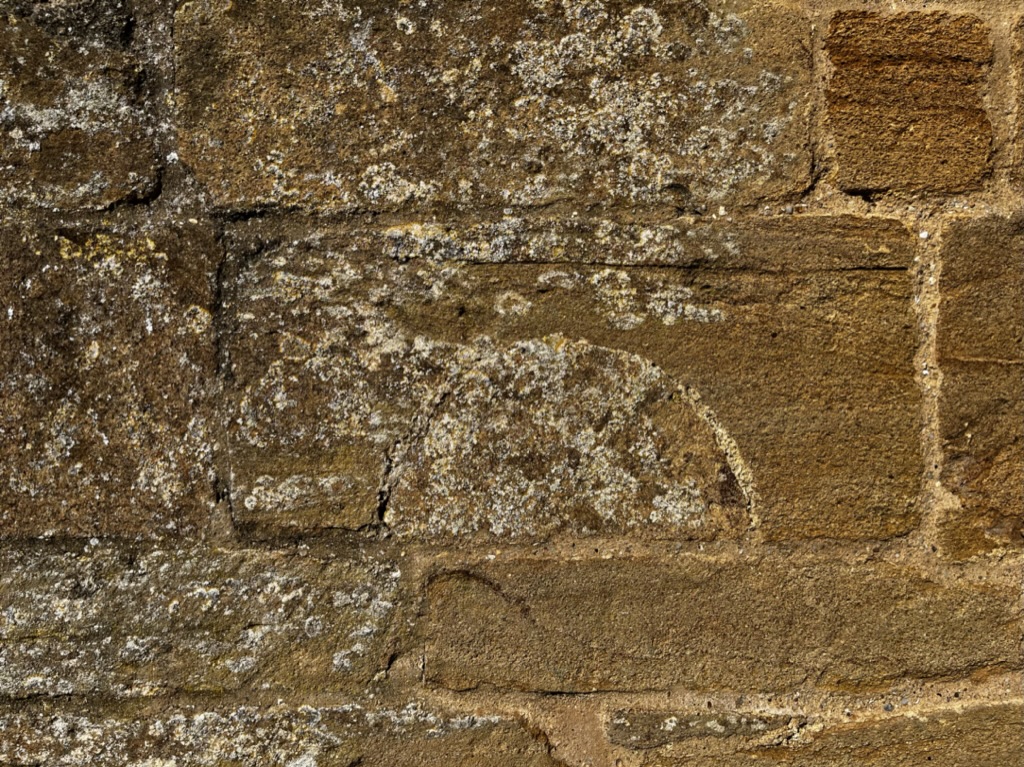
A segment of a single circle on the edge of a clean-edged stone, clearly re-sited at some time. If a dial, one would expect there to be lines / pocks in the lower half ie from 6 to noon.
NOT-A-DIALS
I include these without conviction that any one of them is a dial. The top one, similar to Dial 8 above and on the same kind of stone, is simply a shallow hole. There’s no hint of another relevant mark.
A very helpful analysis by the Parish Council of the dials of St Peter is recommended HERE
GSS Category: Scratch Dial; Mass Dial; Multiple Dials
All photos: Keith Salvesen; Winterbourne Stoke PC (A. Shuttleworth)
DEDICATION † St Mary Magdalene. C15 (on the site of a ?C11 church). Mid C18 rebuilding / restoration (after collapsed chancel). A few early fittings. Screen, font, bells, wall tablets of note. Fragment of stone in middle S. buttress of chancel with pre-conquest interlacementBHO.
LOCATION † Remote extended hamlet deep in farming country a few miles SW. of Sherborne and NE. of Dorchester. Nestled under the north flank of a long ridge. Reached by lanes to N. and a very steep narrow lane down from the ridge. The church is immediately below, set into the hillside. 50.8331, -2.543, ST618038
DIAL 2 (new record)
A while ago, I featured a dial, not previously recorded, on the SW face of the LHS buttress by the entrance door. We live close to St Mary but I had never noticed the dial until I saw it in direct evening sunlight, spotting the filled gnomon hole first (see below).
On a visit to the church last week, I looked more carefully at the S doorway. And there was another dial, LHS, that I (and others) had overlooked. It’s a much clearer dial than the first.
St Mary Magdalene . Batcombe . Dorset – Scratch Dial 2
The filled gnomon hole is in the upper half of the dial stone. There are 6 / 7 lines, one with an apparent terminal pock. There is no clear noon line, but the lines from 9 to 12 suggest a significant time of the day for observance. The deeper none line may also mark a mass time mid-pm. There is a very distinct line URQ that ends in a pock but can have had no meaningful role in marking the passage of the day.
Batcombe . Dorset . St Mary Magdalene . Scratch Dial 1
NOTES † A small ritual protection mark – a tiny shield-shaped face – R of the entrance door. Such apotropaic symbols were carved or scratched usually by a door or window or in the porch to prevent evil from entering the church and to repel it from the vicinity.
GRADE II* † Mainly C13, C14. Norman font. Alone on a hillside, accessible only on foot. Originally a separate parish from the close-by village of Stocklinch Magdalene; later amalgamated; now redundant and in the care of CCT. 3m NE of Ilminster. 50.9535 / -2.8813 / ST381174
DIAL
DEH visited St Mary in September 1912, one of his earliest field trips from Downside Abbey on his motorcycle in search of scratch dials. As he described it there is a doubtful dial on the E side of the Priest’s door. It is in a likely position, but the stone is so badly weathered that no lines can be traced upon it. To which I can only add even less so 100+ years later, especially with lichen obscuring scrutiny.
I include this record both because St Mary repays a visit for its location alone, and for completeness. Very close is the small Church of Stocklinch Magdalene, and it’s a short distance to BARRINGTON church with 4 scratch dials; and Barrington Court (NT) which has 2 outstanding pillar dials in the gardens.
On the same side of the priest’s door, 2 stones lower, is a smaller apparently drilled hole with some sort of lining (?), but also no dial-ish features.
GRADE I ✣ C12 origins & remnants; C13 – C15 enlargement; C19 restorations (Wyatt). One of only 3 Dorset (early) churches with spires, with Trent and Winterbourne Steepleton (the Dorset village of Steeple only has a tower). The spire was originally much taller but has twice been reduced in height. The most important and interesting church in its neighbourhoodPEV. If you want to dig deeper there are plenty of excellent resources online eg HE, BLB, BHO. Midway between Shaftsbury and Blandford. 50.9295 / -2.1887 / ST868144
DIAL
The dial is located on the SW buttress of the tower, about 2m high. There are 12 lines, 6 of which extend beyond the circumference. Some have terminal pocks; the noon line has 2. GLP notes that the dial is quite accurately cut, but is at an angle and of little use in its present position. Probably it was relocated during later work.
GLP dates it to C14, and notes quite sternly that, whereas RCHM suggests perhaps C16, it gives no reason for this opinion.
GRAFFITO ON THE STONE BENCH INSIDE THE PORCH: W.D. 1773
GSS Category: Scratch Dial; Dorset Church with Spire
All photos: Keith Salvesen; Thanks as always to Gordon le Pard for Dorset dials
GRADE II † Almost entirely rebuilt & enlarged in successive stages from the beginning of C19, incorporating reused details of C12 fragments, C14 and C15 stonework. Rather incongruous neo-Norman features. C12 Purbeck marble font; fine nail-studded medieval door. Tower-less and Spire-less. 4m N of Weymouth. 50.6506 / 50°39’2″N / SY667835
DIAL
The dial is on the L jamb of the early doorway (inside later porch), and remains of a full circle are still visible. 6 lines radiate from a small filled hole that is significantly off-centre. One line is elongated beyond the circle. The None line is emphasised by a small pock near the end. The noon line (if it is one) is the most unassuming of them all. There’s a hint that very light graffiti has been superimposed on the dial.
GRADE I † C13 origins (c1258 on); C14 development, Perp windows, C15 tower (BHO – sources vary on dates). C17 extensive repairs; mid-C19 restorations to Wyatt plans. Cecil Beaton is buried in the churchyard. One of several Ebble valley churches between Salisbury and Shaftsbury (cf Alvediston). 51.0275 / -1.9432 / SU040253
DIAL
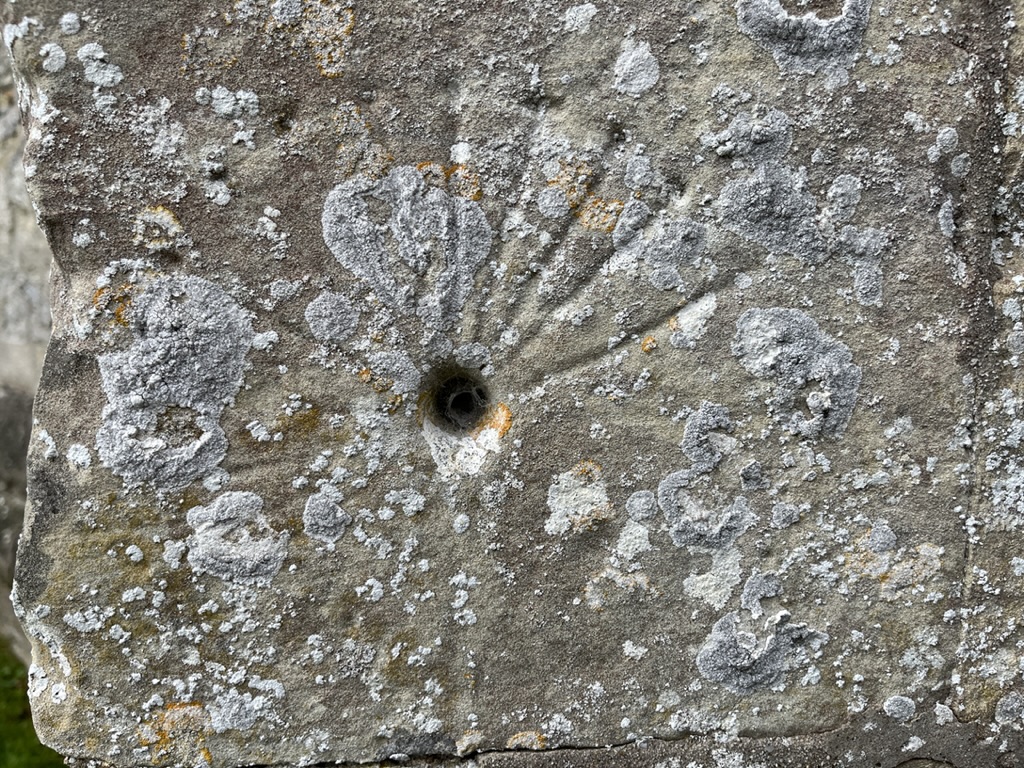
A distinctive and easily visible dial on S buttress between 2 recesses. 4 clear lines with faint traces of others. There are 5 obviously related pocks, with a couple of outliers above UL in a position corresponding to the curvature of the dial. The filled gnomon hole in the centre of the dial stone is large, perhaps enlarged over succeeding centuries (it’s not uncommon to find disproportionately large holes)
This dial is of particular interest for 2 reasons: i. the size of the pocks are graduated from small to large along the perimeter down to the noon line, which has the most emphatic hole. I can’t remember coming across such a clear example before. ii the Mass line – terce – is very clearly indicated both by being elongated, and by having pocks on either side of it, neither of which links to a line.
GRAFFITI
All Saints has some graffiti in the porch area. Here are 2 examples – image includes ‘witch marks’
GRADE II* † C12 origins; a chapel of Broad Chalke by 1299, from which date Vicars were recorded. From that period, C12 font bowl. Many sources only date the church to C17 with restoration by T. H. Wyatt 1866. One of several pretty villages in the secluded Ebble valley between Salisbury and Shaftsbury. 51.0149 / -2.0345 / ST976239
DIAL
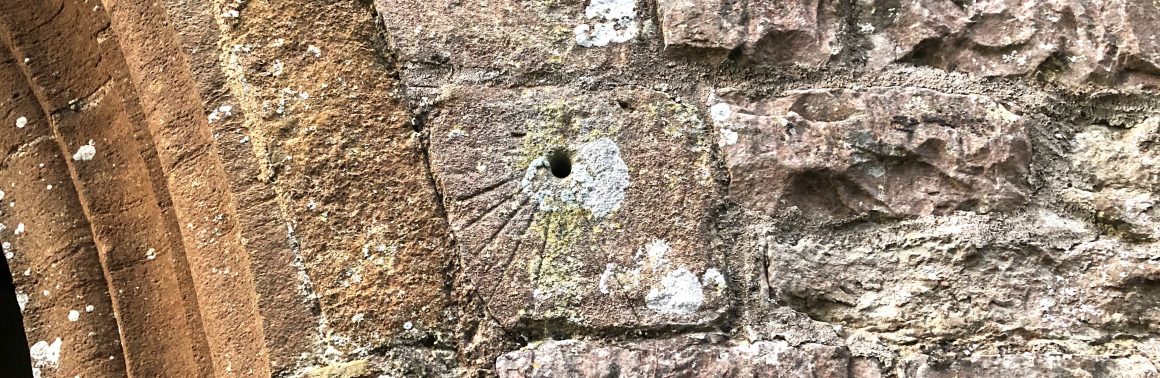
The dial is on the W jamb of the porch, described elsewhere as a C19 lean-to. Restorations clearly entailed considerable relocation of stones over time. The dial is easy to overlook, being small, weathered, and upside-down.
St Mary . Alvediston . Wilts – Scratch Dial
The dial is located 1m high, W of the S doorway, inverted. BSS records it as accurately cut, upside-down, eroded and damaged. Unexpectedly it is described as a Rudimentary (Norman) dial, which dates it back to the C12 / C13 origins of St Mary. If so, the dial has survived intact for several hundred years, only to end up inverted on a C19 lean-to porch.
St Mary . Alvediston . Wilts – Scratch Dial
It is sometimes useful to revert a dial that has been rotated, so that the original design is clearer. There are 2 definite lines. There is no visible noon line but the line LRQ has both a mid-line pock and a terminal pock. Presumably this marked the most significant Mass time during the passage of the day, in this case equating roughly with the canonical Nones.
St Mary . Alvediston . Wilts – Scratch Dial
NOTES When I originally checked some usual resources for St Mary, it was intriguing to find that its history began in C17. A simple (or any?) scratch dial could not be expected. So I turned to the comprehensive BHO entry for the Parish, which explains the origins of St Mary and its medieval dial in more detail:
Of the 12th-century church, only the nave, small and with thick walls, appears to survive. The chancel was possibly replaced in the 13th century but may have survived longer. In 1585 it was said to be ‘down’ and was afterwards presumably rebuilt or repaired. The south transept or chapel was built in the 14th century; there is an effigy of a knight in armour below the south window. The north transept may also have been built in the 14th century. The tower was built in the 17th century. In 1865 the church was extensively restored to designs by T. H. Wyatt. The north transept was rebuilt, the north chapel was built, and the chancel was given 13th century features.

















































 GAUDIUM SUB SOLE . SUNDIALS . MEDIEVAL TO MODERN