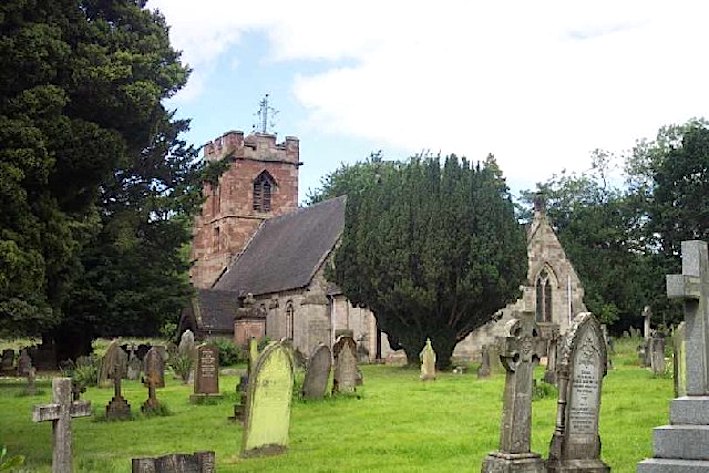
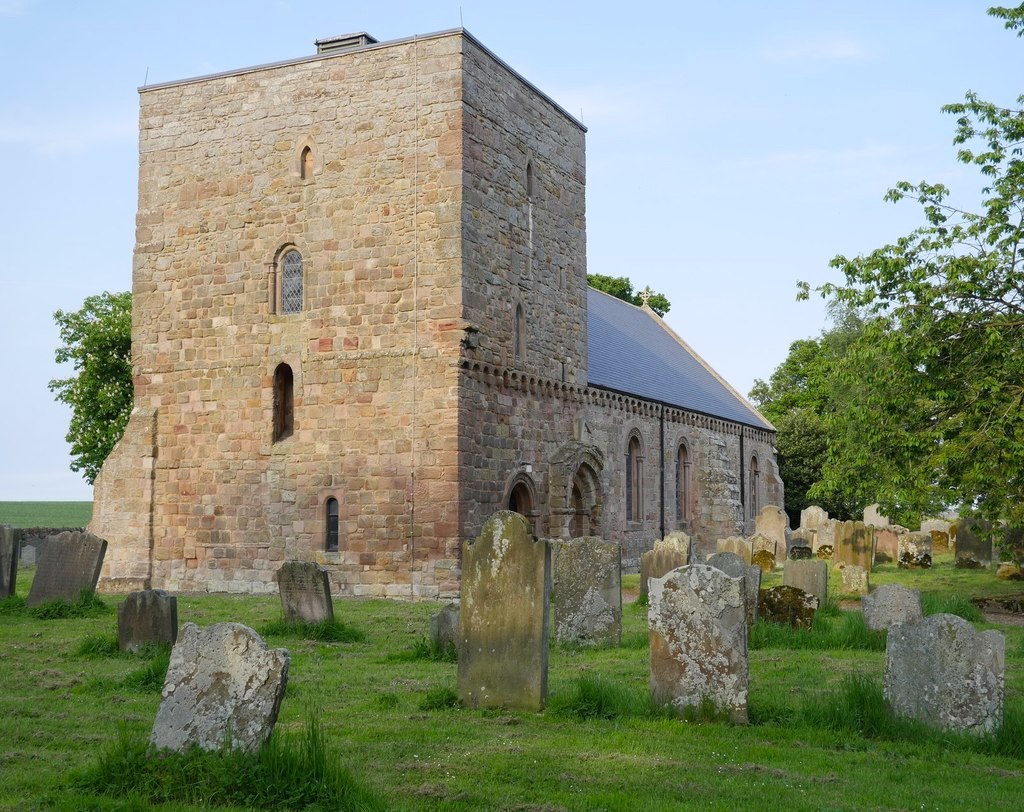
St Mary . Castle Bank . Stafford – Geoff Pick Geo CC / OS
CHURCH OF ST MARY . CASTLE BANK . STAFFORD
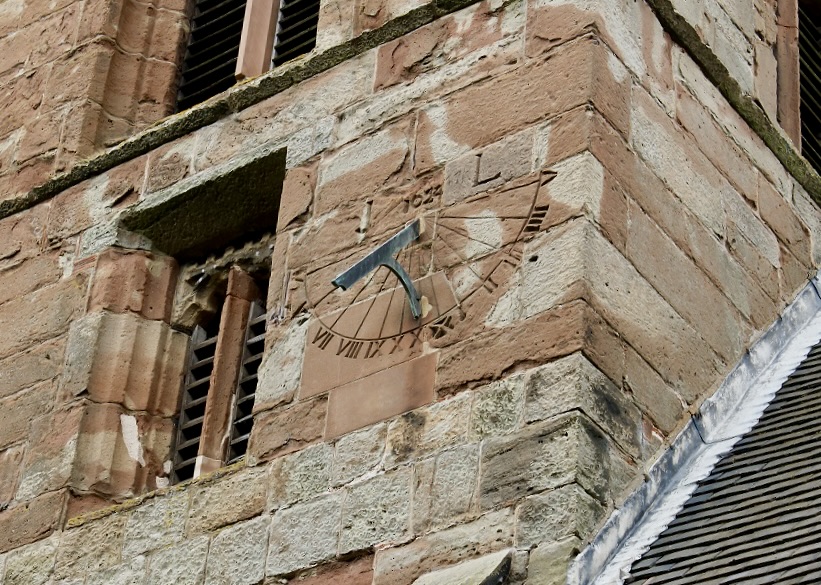
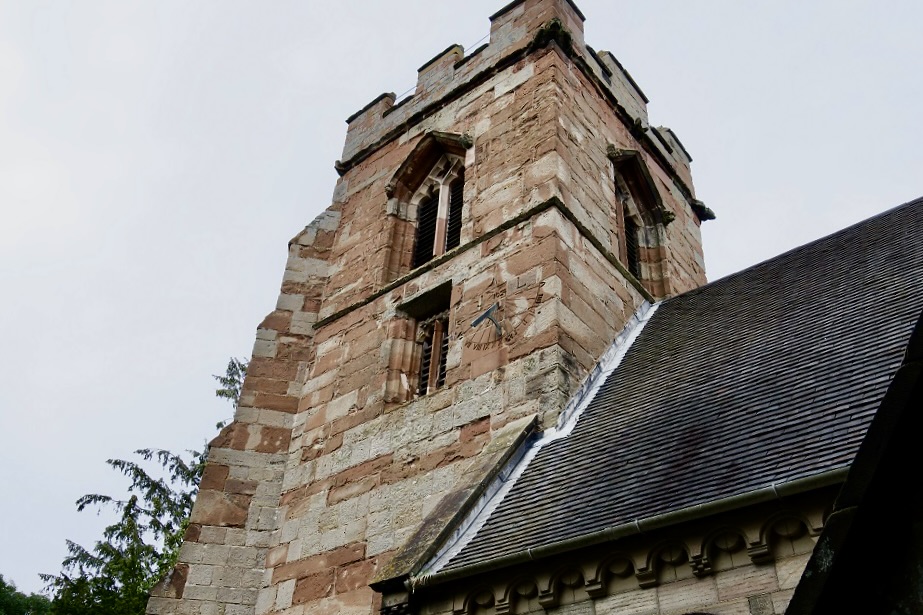
GV II* † C15 tower; otherwise mainly C19. Tower has 2 diagonal buttresses, plinth, south 2-light straight-headed window with sundial to right: incised inverted semi-circle with gnomon and inscription: J 1624 L BLB . In Newport Road below the castle, not to be confused with the large ‘collegiate’ parish church, also St Mary. 52.7969 / -2.141 / SJ905221
St Mary . Castle Church . – Vertical Sundial
DIAL
The vertical dial is high up on the S side of the tower, a semicircle with Roman numerals, with the date 1624 and on either side of it the letters J and L. The date may fit with work carried out on the upper stage of tower in C17. As can be seen, there has been good repair work on the dial, so that it is observably both ancient and modern.
GSS Category: Vertical Dial; Church Sundial; Old Sundial
All photos: Erika Clarkson, with many thanks for this and her other contributions to this project; Geoff Pick for his photo of the church Geo CC / OS
GRADE 1 † Records from 1254; low C14 tower (1st stage) later heightened; mainly C15 / 16. C16 waggon roofs. Bells from C17. Restorations 1870s. BLB notes coped gable with apex cross, but omits the prominent dial. A fine hillside church with wonderful views from high above the Wye valley. 6m S of Monmouth. 51.7932 / -2.6945 / SO521107
St Mary . Penallt Old Church . Monmouth – Vertical Dial
DIAL
An excellent dial, easy to miss. The tree-lined avenue that now leads to the church completely obscures the dial as you approach up the path. Trying to view the dial from other vantage points gives a sideways view. Attempting to take clear shots of the dial is a pleasurable challenge. Move branches aside.
The dial makes for an attractive gable end, and is surmounted by a cross. It is fairly damaged / eroded. A 6-to-6 dial with noon marked by a cross; IIII as IV. The gnomon is modern and rather squiggly / shiny for an old dial.
Dating the dial is not easy. A broad comparison with similar dial designs suggests ± 1800.
The Old Church is in a lovely setting, and besides TRELLECK this is the most rewarding dial to admire in the immediate area. Take a small picnic and sit in the churchyard for peak enjoyment. Other treats include a handsome door (1532) and a walk-though squint.
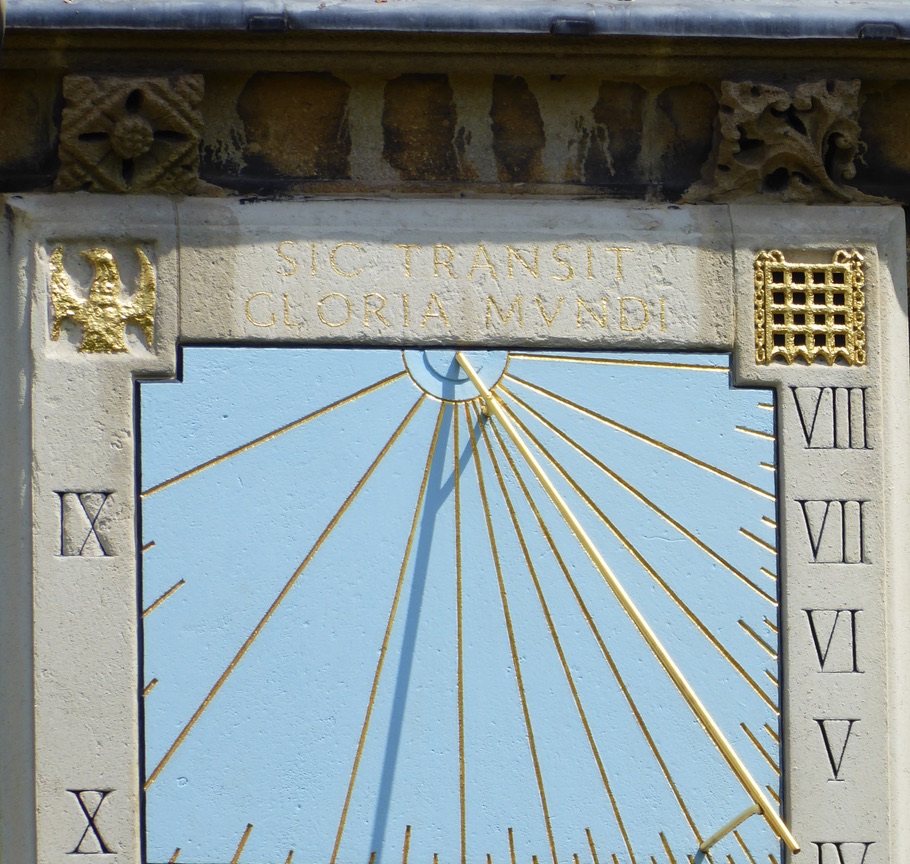
The sundial is located on the wall of the Hall, and – for those not entitled to enter the College – easily visible from the entrance by the Porters’ Lodge. It is dated 1927, replacing a dial known (from an old print) to have been in this position in C17 that was lost during C19 alterations to the Hall. The dial was the gift of a College benefactor. His initials and the year of installation are on the dial supports. The calculations were carried out by a Member of College who was a sundial expert.
The unequal positions of the hour markers take account of the SW aspect of the wall, showing more afternoon than morning hours for accuracy as the sun declines.
GSS Category: Vertical Dial; Old Dial; New Dial; Sundial Motto
All photos: Keith Salvesen
Text based on the entry for Christ’s College in the booklet ‘Cambridge Sundials’ by Margaret Stanier and Alex Brookes. This, and its companion for Oxford, are included in the bibliography.
I recently came across a very bad photo I took years ago of this elegant and ingenious dial in Magdalene College. My image is too awful to be the basis of a feature. However BSS has in its records this excellent quality photograph with a short account to accompany it.
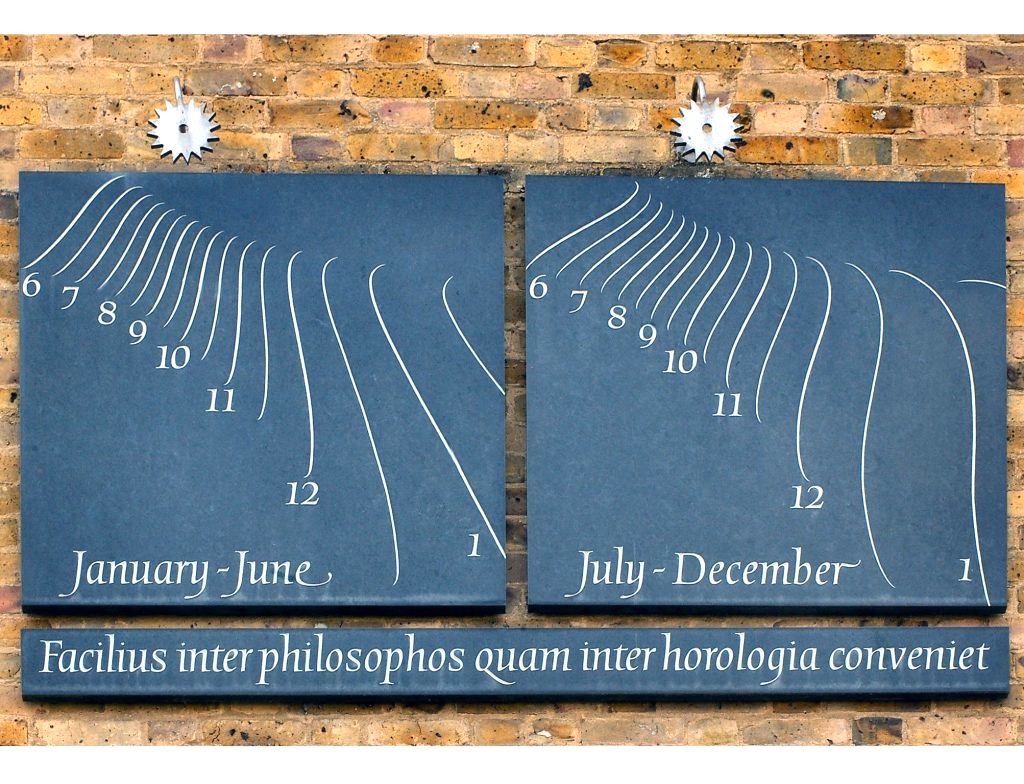
A competition among first year engineering students led to the creation of this most striking double vertical dial, mounted in 1987 on the south-facing wall of Benson Court. It was designed by Will Carter in stone and stainless steel and features the motto: ‘Facilius inter philosophos quam inter horologia conveniet.’ (It is easier to gain agreement among philosophers than among timepieces – Seneca) The prize-winning design has the Equation of Time built into the gracefully curving hour lines. A spot of light shining through a pierced stainless steel sun marks the time on each dial.
‘Facilius inter philosophos quam inter horologia conveniet.’ (It is easier to gain agreement among philosophers than among timepieces – Seneca)
GSS Category: Vertical Dial; Double Dial; Modern Dial; Competition Dial
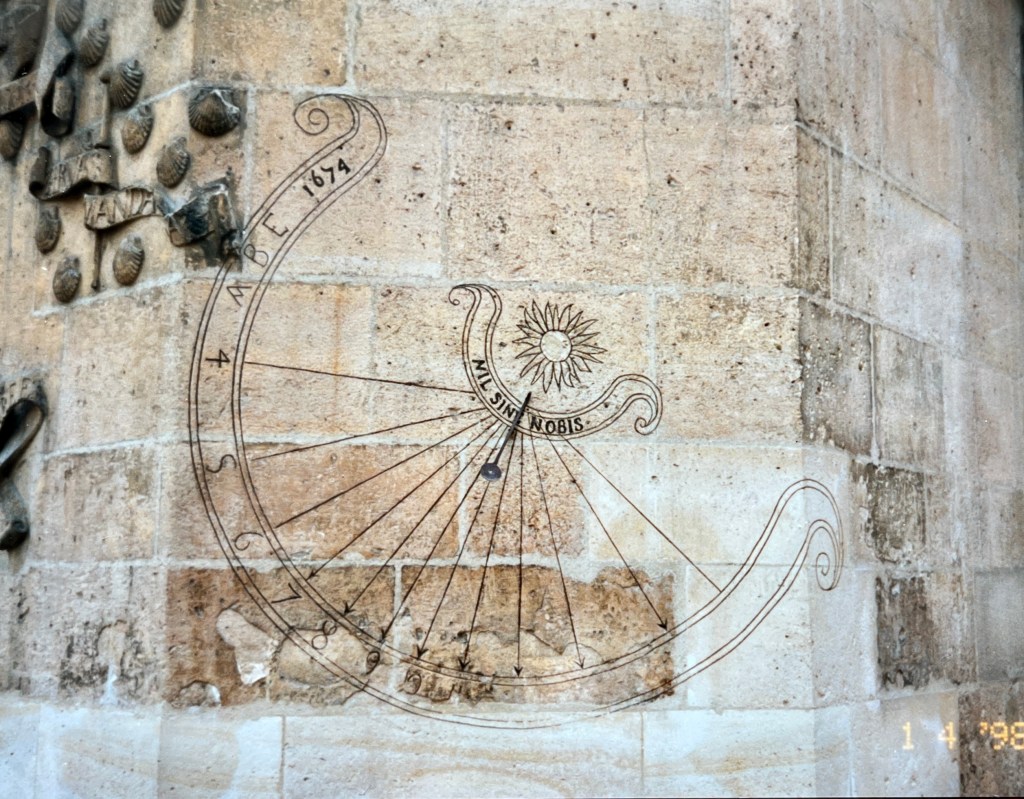
The collection of the National Museum of the Middle Ages is housed in a wonderful building, at one time an abbatiale. There is some debate about the dates of the origins and the building of the Hôtel; and of later rebuilding / restoration. The large sundial on the south wall of the courtyard is dated 1674. This was the reign of the Sun King (1643 – 1715), and a sun with its rays was an obviously fitting theme for the times.
See addendum Sep 2025 below, with thanks to Linda Roundhill
DIAL
The lines on the dial face are carefully graduated and the hours marked with Arabic numerals. Several lines terminate in arrows, suggesting a busy schedule of mainly forenoon masses.
MOTTO
NIL SINE NOBIS. A. B. F. 1674.
The inscription is usually translated as Nothing [Exists] Without Us. Margaret Gatty (1809-18730, in her comprehensive work The Book of Sun-Dials, gave the Cluny dial an unusually detailed entry:
NIL SINE NOBIS. A. B. F. 1674. Nothing exists without us.
A dial on the wall of a courtyard on the south side of the Hôtel Cluny, Paris, had this inscription. The word nobis referred to the rays of the sun which were represented on its face. The Hôtel Cluny, a very beautiful specimen of rather elaborate fourteenth century Gothic architecture, was bought in 1625 for the abbess and nuns of Port Royal, and was known as Port Royal de Paris. It was re-established by Louis XIV. in 1665, on a fresh basis, and was looked upon as schismatic by the community of Port Royal des Champs. This dial must have been erected in the time of the first abbess of the new foundation, Sœur Dorothée Perdreau, who held office till 1684.
Cluny Museum and its sundial: detailed entry by Margaret Gatty
SCALLOP SHELLS and HERALDIC MOTTOS
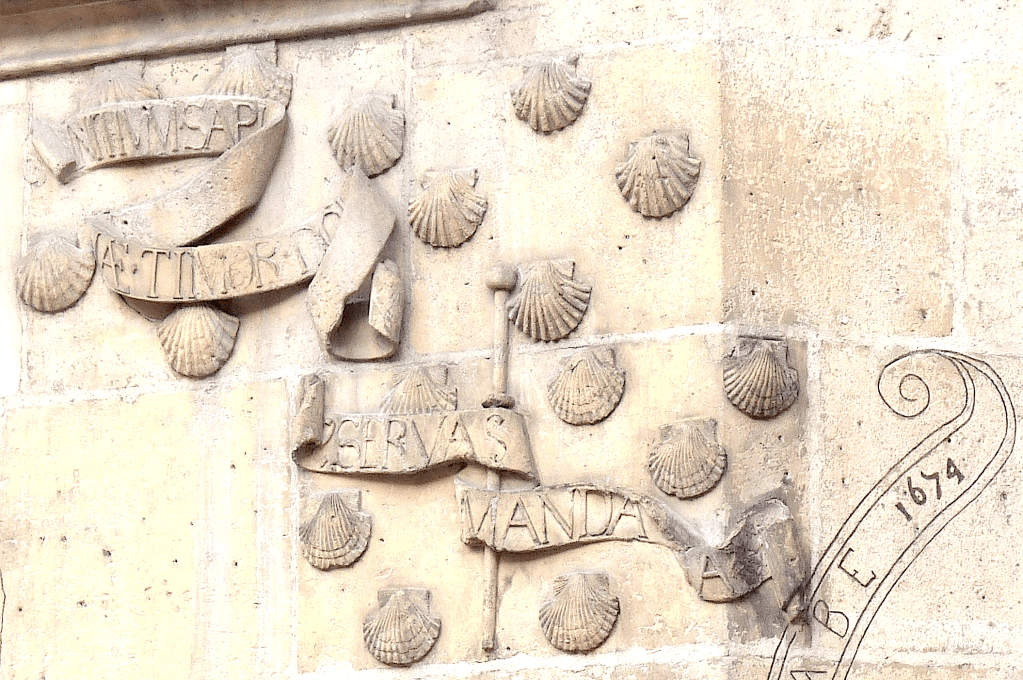
The scallop shells are interwoven with two inscriptions (or possibly a single one in two parts) which deserve a mention as part of the overall design. The shells themselves evidence an ancient Pilgrimage route that passed close by – the long Rue St Jacques is a few meters to the North.
The heraldic mottos are said to read, firstly: Servire Deo Regnare Est – To Serve God Is To Reign; MG suggests, without much conviction, that the other (or part of it) may be as shown below.
With very rusty Latin and a bit of internet work, I can’t make either interpretation fit the scrolls we can see. Possibly they relate to a different part of the Musée, and the shell one(s) are different. I’ll have to leave the reader to try to puzzle this out (all suggestions welcome).
ADDENDUM SEPTEMBER 2025
Many thanks to Linda Roundhill for solving the puzzle that I feebly left for others to interpret
The top left ribbon scroll with the scallop shells is a scripture verse “The fear of God is the beginning of wisdom”. From Proverbs 9. The lower left is a Christian catch phrase, ‘To serve God is to reign’, derived from John 12. This was hard because some of the letters are missing or hidden. The scroll on the right says “Keep My commandments” which is a short version of Matthew 19:17, and many other passages. Again, some letters are obscured.
GSS Category: Early Sundial / Vertical Dial; French Sundial; Sundial Motto
Credits: all photos Keith Salvesen – please seek use permission for these detailed ones; Musée Cluny for the Unicorn
St Anne . Ancroft . Northumberland – James Towill Geo cc
GRADE II* † C11th-century, built by monks of Holy Island as a chapel of ease. C13 / C14 pele tower added as protection from incursions by Scots. C19 restorations. At some time (? when the tower was built) the fine Norman entrance was blocked. Extensive views from the tower’s parapet. 3m S of Berwick-upon-Tweed. 55.7001 / -1.998 / NU002451
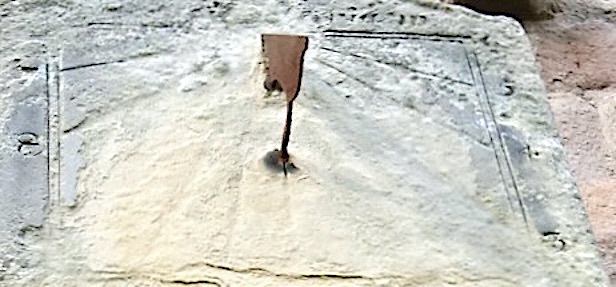
A weathered C18 vertical dial with a short gnomon that casts a very visible shadow. The shape of the dial stone, with its pedimented square, is very pleasing. The lines are enclosed in a frame, with Arabic numerals from 6 to 6 around its edge. The use of Arabic numerals rather than Roman suggests a later dial of this period. 9 lines are detectable, some only just. Only 6 numerals are clear. I can’t make any sense of the remains of the inscription. I wondered if some of the sandstone – especially LLQ – is repair or natural deterioration. Expanding this very good photograph, I think the latter: the dial is showing the signs of its age.
St Anne . Ancroft . Northumberland – Walter Baxter Geo cc
GSS Category: Vertical Dial; Old Dial; Gnomon Design
Credits: Erika Clarkson for introducing me to this church and for her photos that begat this post, so to speak; James Towill for his photo of St Anne’s uploaded to Geograph cc; Walter Baxter for his excellent close-up of the dial uploaded to Geograph cc and for his specific use permission to reproduce it full-size
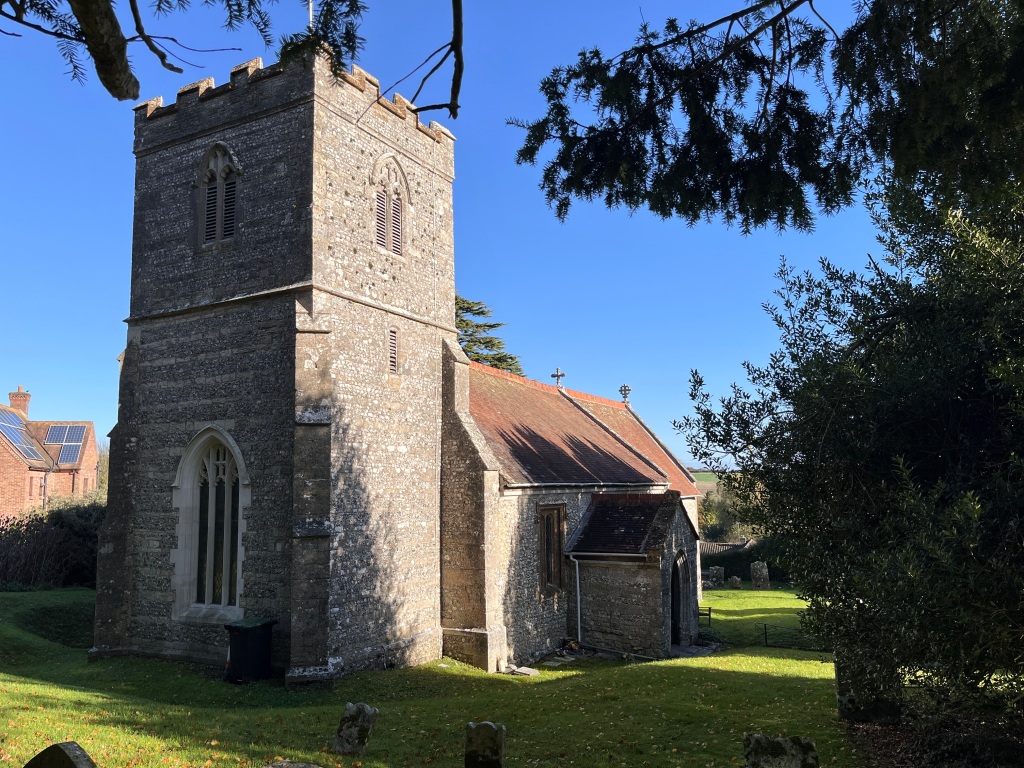
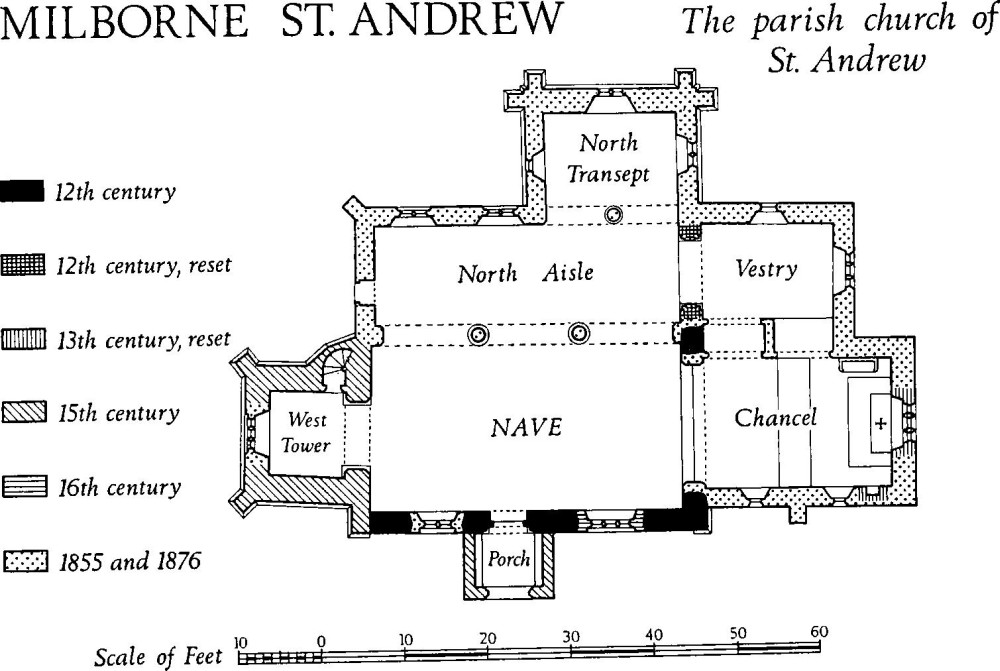
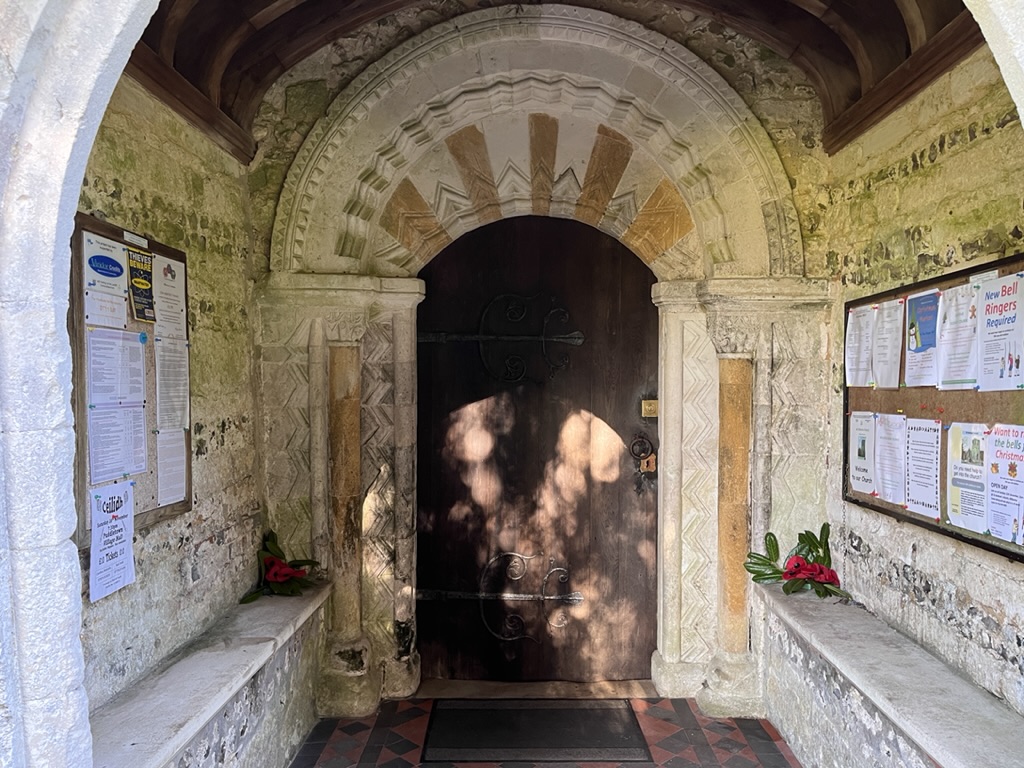
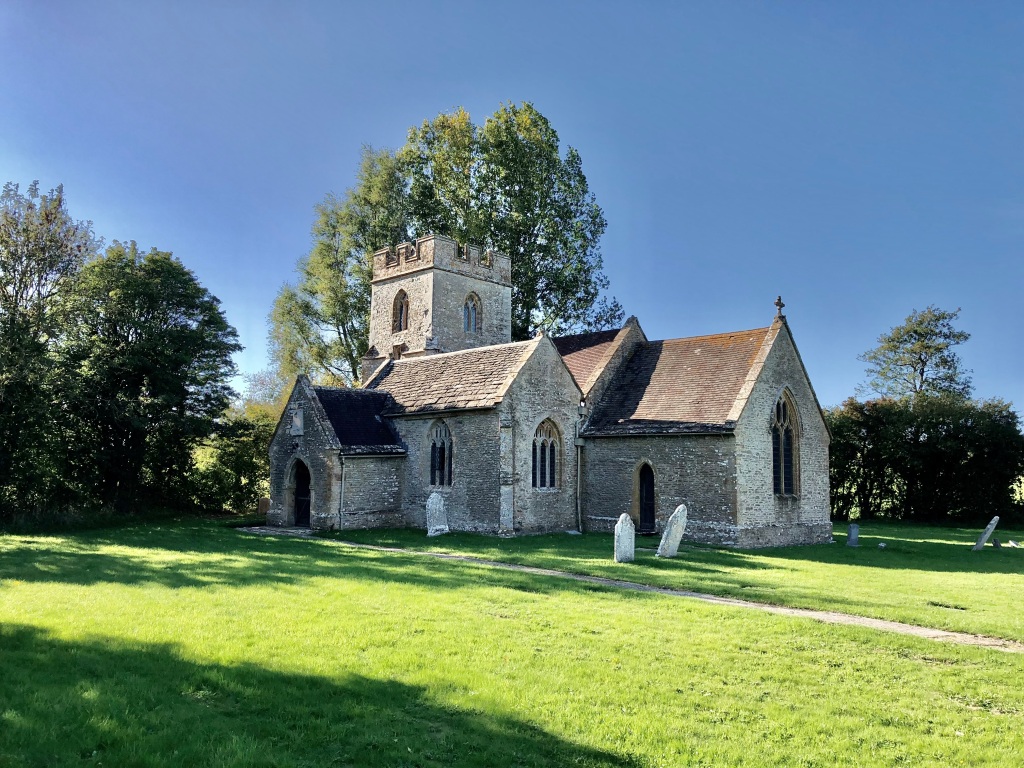
GRADE II* † C12 origins; tower & S porch C15; chancel, vestry, south aisle and chapel c1876 (G E Street). Wonderful C12 inner door with chevrons, shielded by porch; C12 font with a story to tell (below). A charming and very Dorset church. 4m SE of Bere Regis; 10m NE of Dorchester. 50.7759 / -2.2833 / SY801974
DIALS
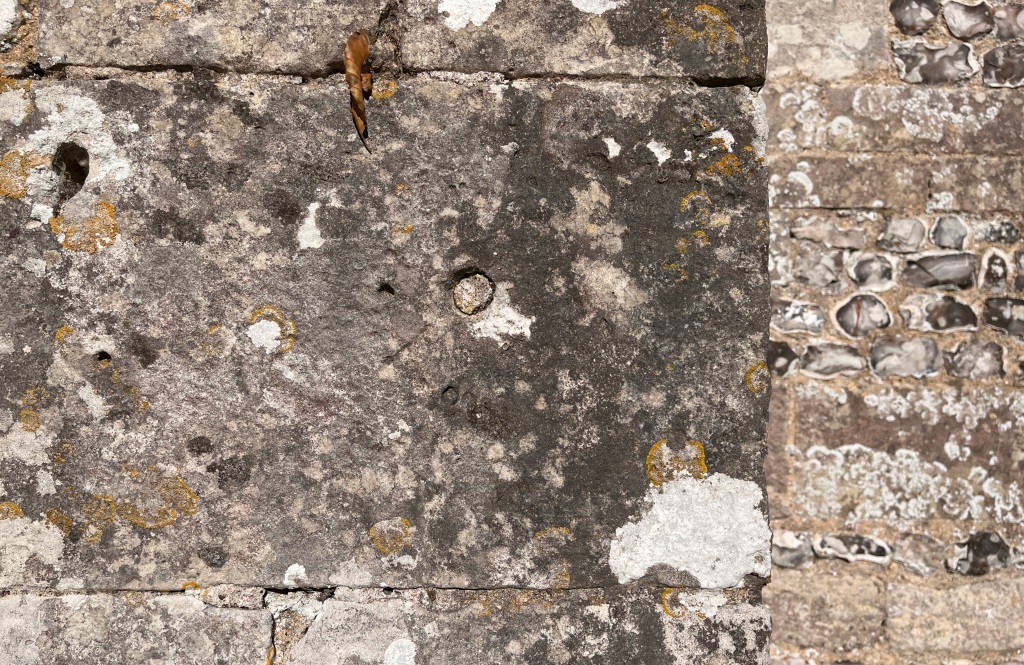
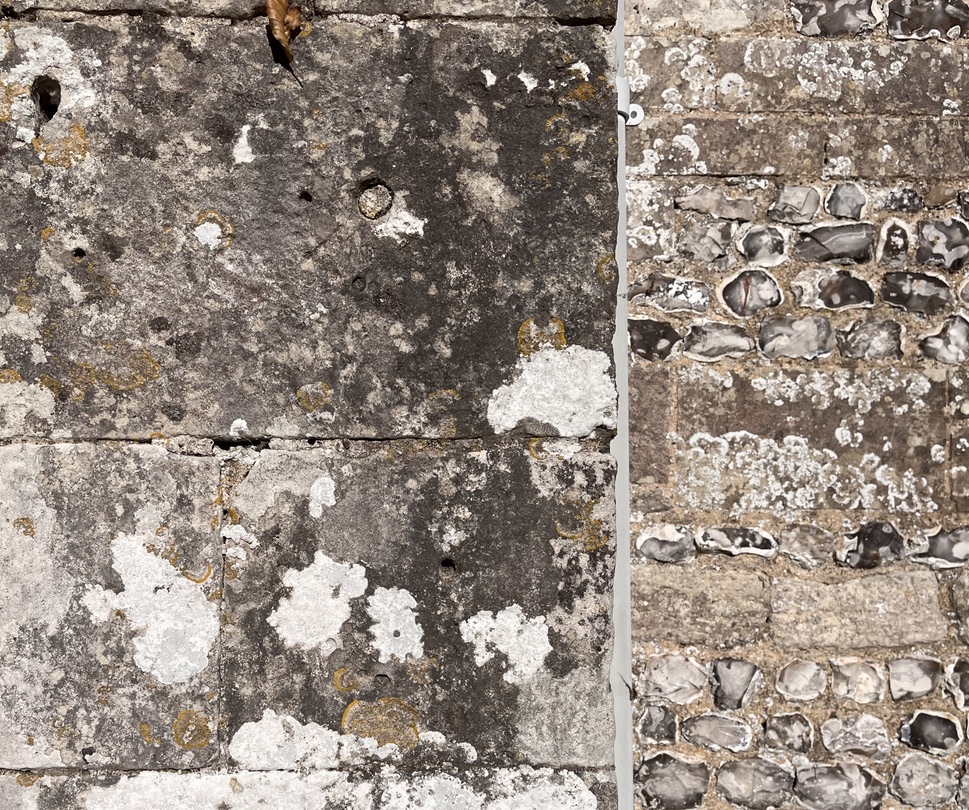
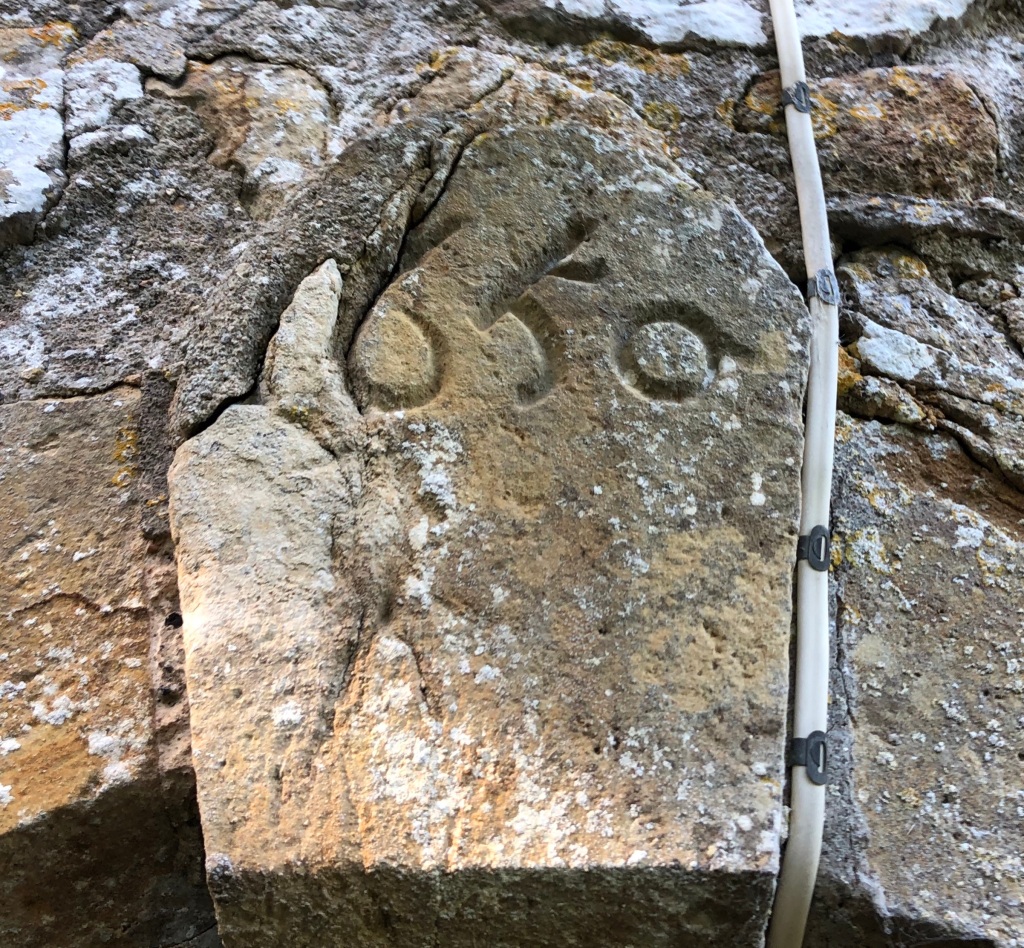
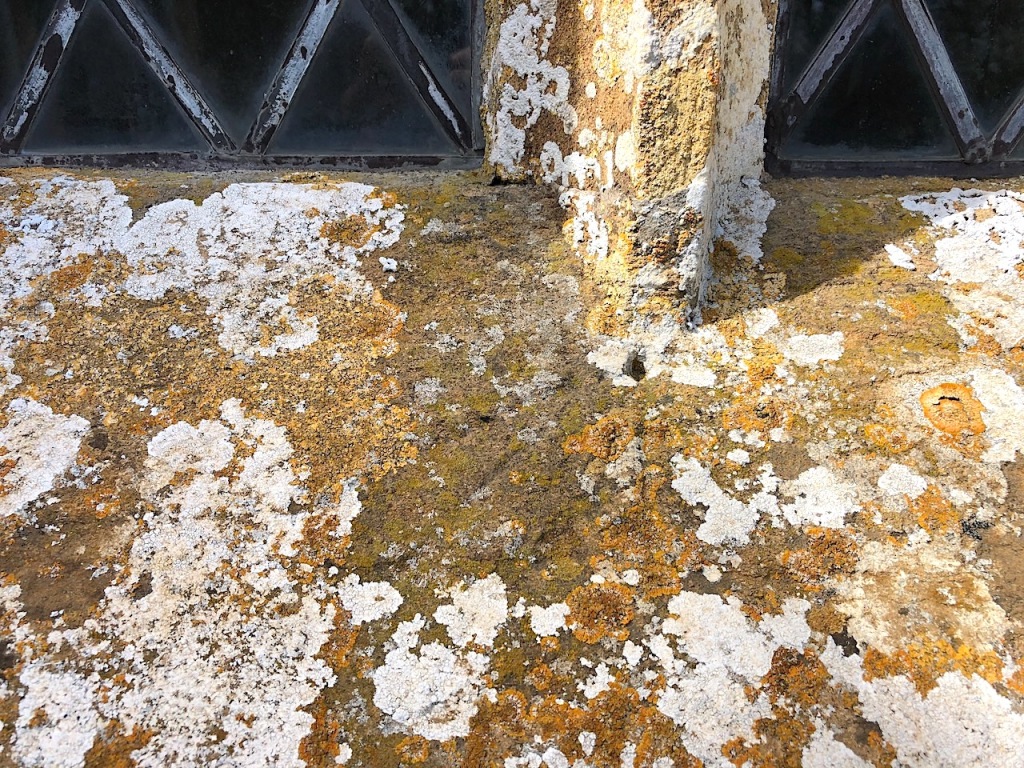
St Andrew has 3 dials. Dial 1 is a true scratch dial located in the NE corner of the nave, as is Dial 2 on the stone below (largely obscured by lichen, easy to overlook). Dial 3 is a transitional dial above the porch entrance.
DIAL 1
St Andrew . Milborne St Andrew . Dorset – Scratch Dial 1
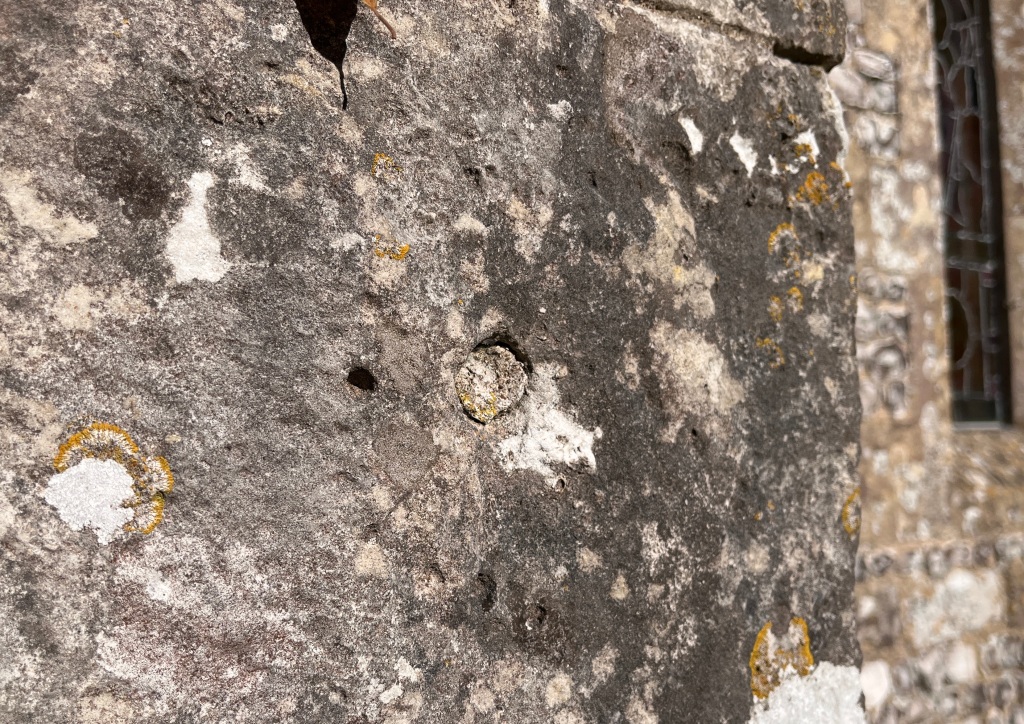
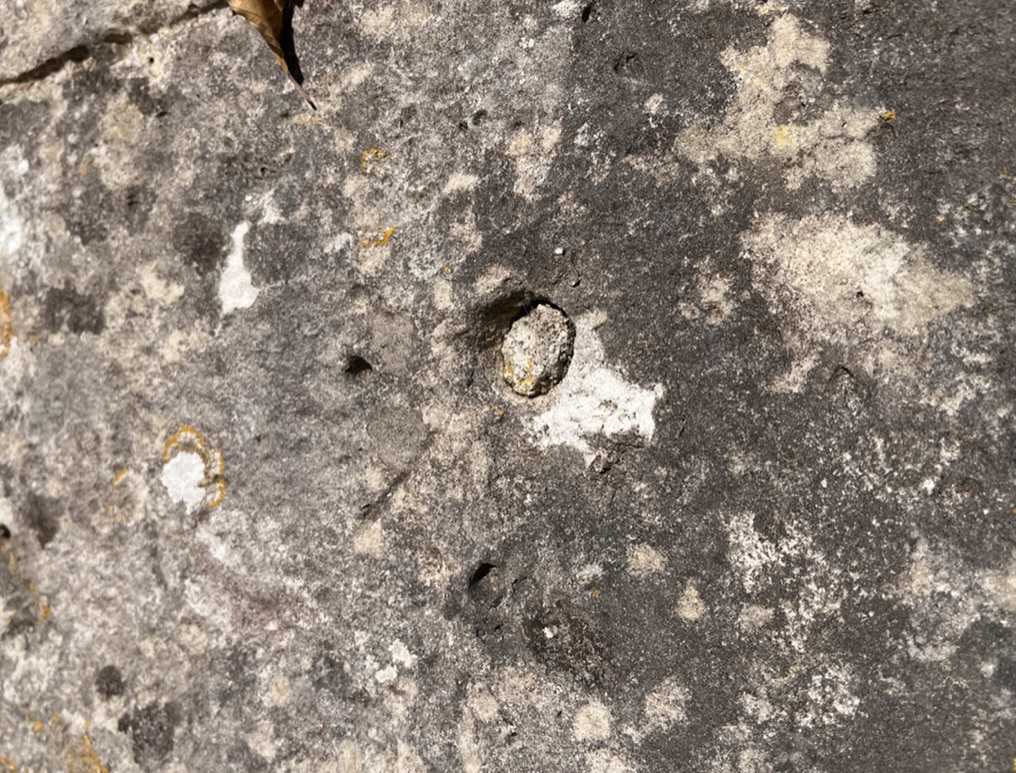
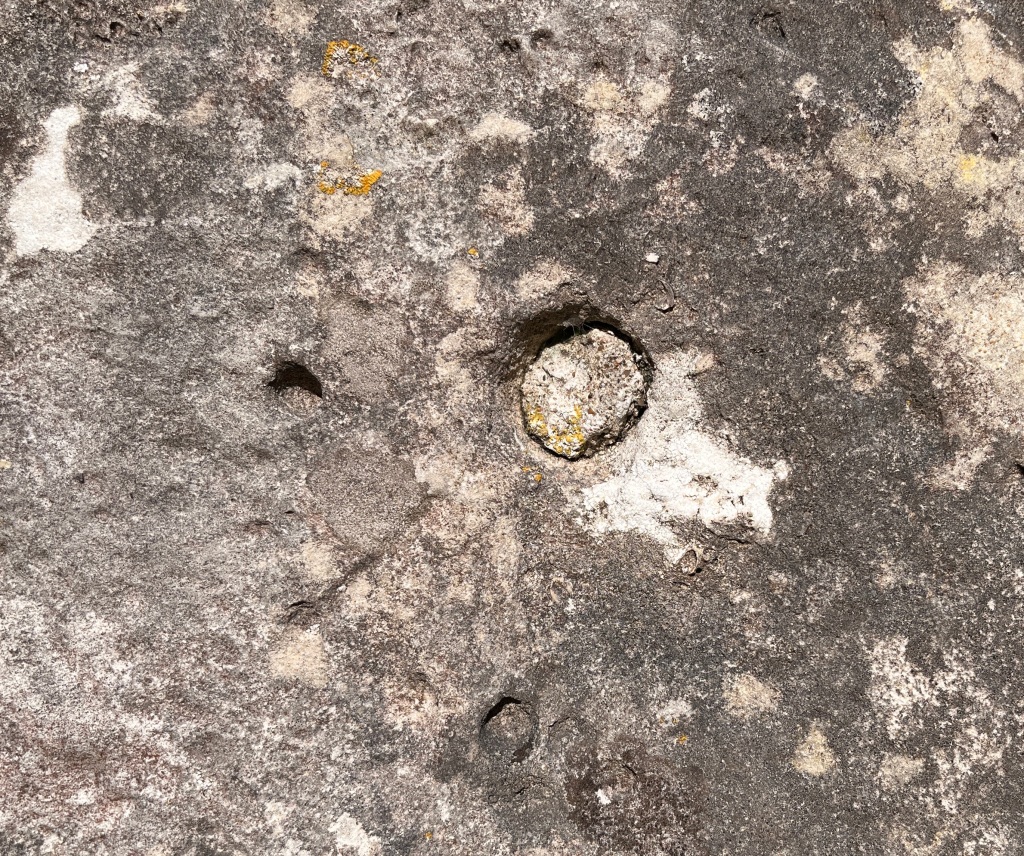
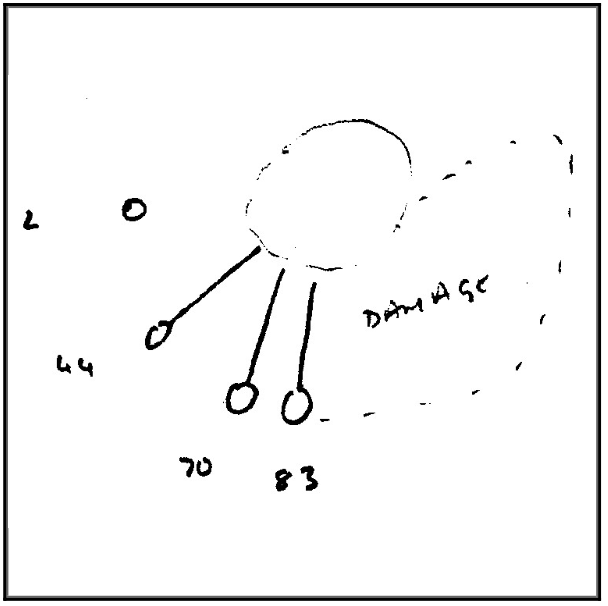
Dial 1 is easily identified by its prominent filled gnomon hole from which 3 lines radiate in LLQ. There is also a perimeter curve of 5 (?6) pocks (diag).
St Andrew . Milborne St Andrew . Dorset – Scratch Dial 1
DIAL 2
St Andrew . Milborne St Andrew . Dorset – Dials 1 & 2, NE corner of the nave
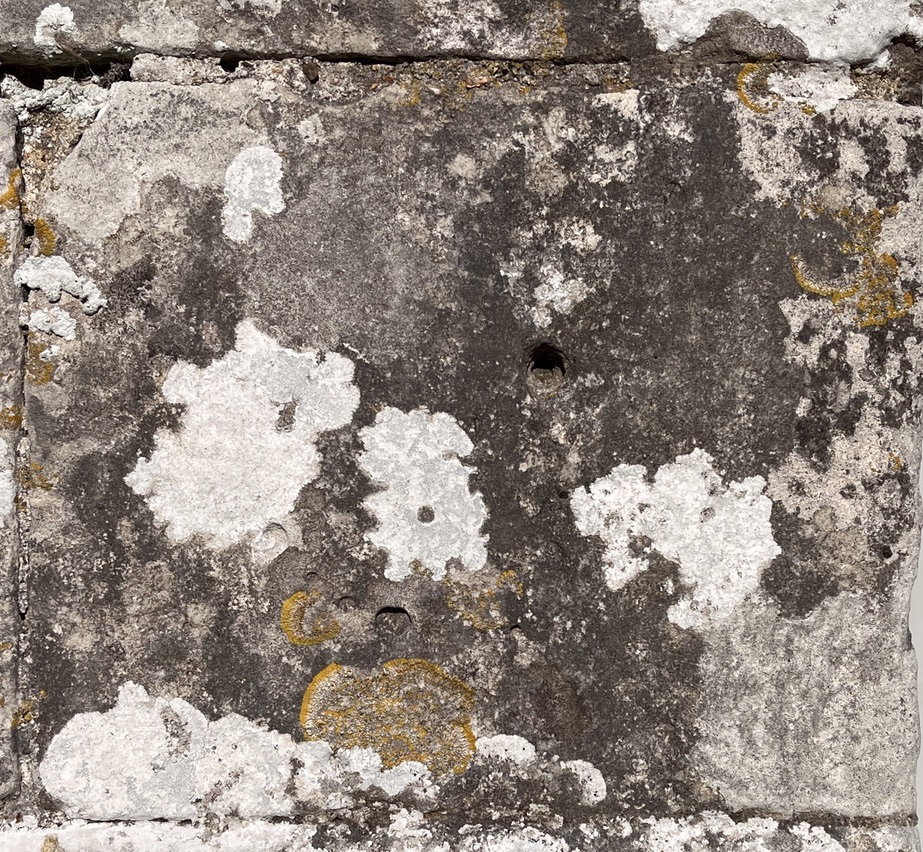
Dial 2, on the stone immediately below Dial, 1 has no discernible lines. BSS records 5 pocks of varying size that are (given the lichen) more or less visible seen in conjunction with the BSS diagram below. They are basically shallow dents, in contrast to the ‘drilled hole’ type of pock usually encountered.
St Andrew . Milborne St Andrew . Dorset – Scratch Dial 2
DIAL 3
St Andrew . Milborne St Andrew . Dorset – Scratch Dial 3
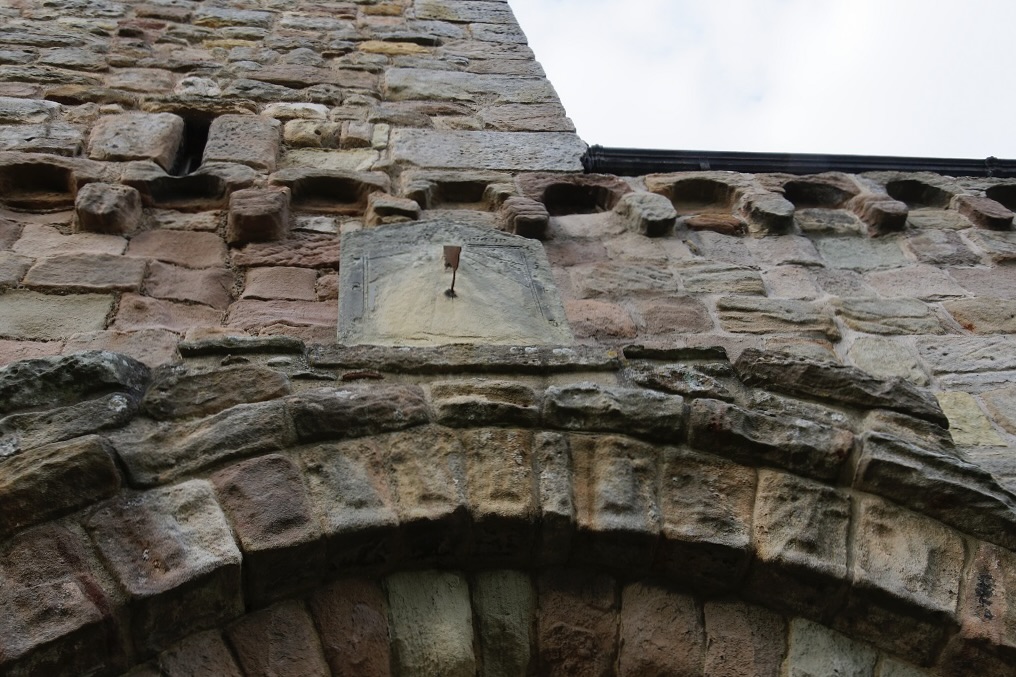
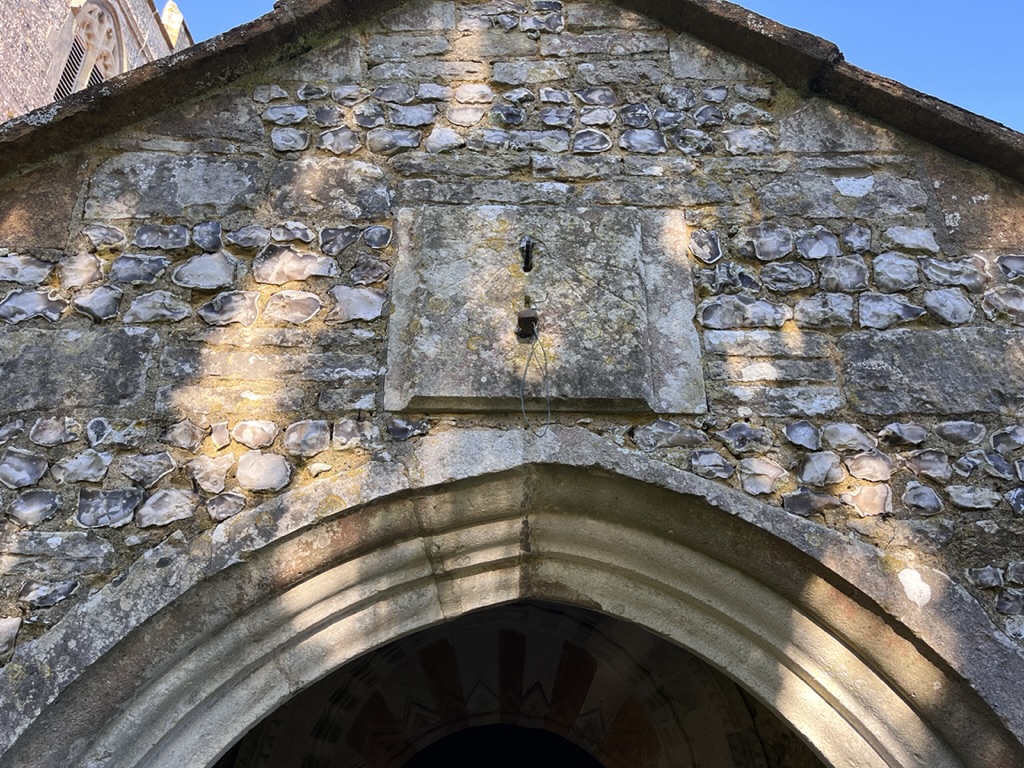
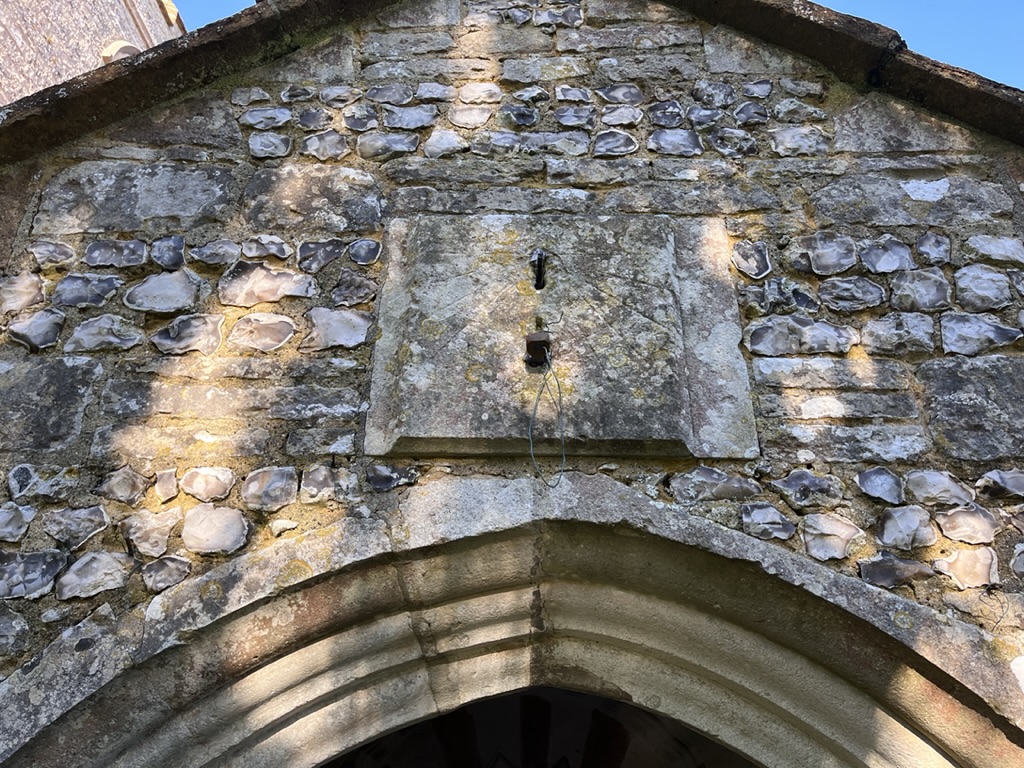
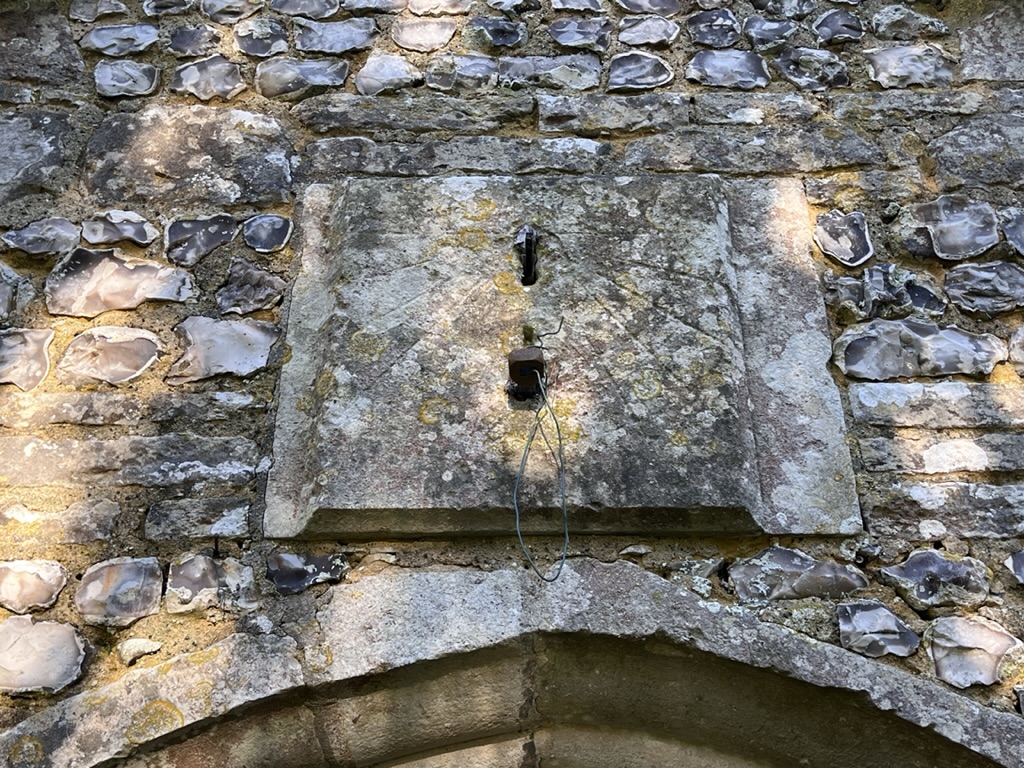
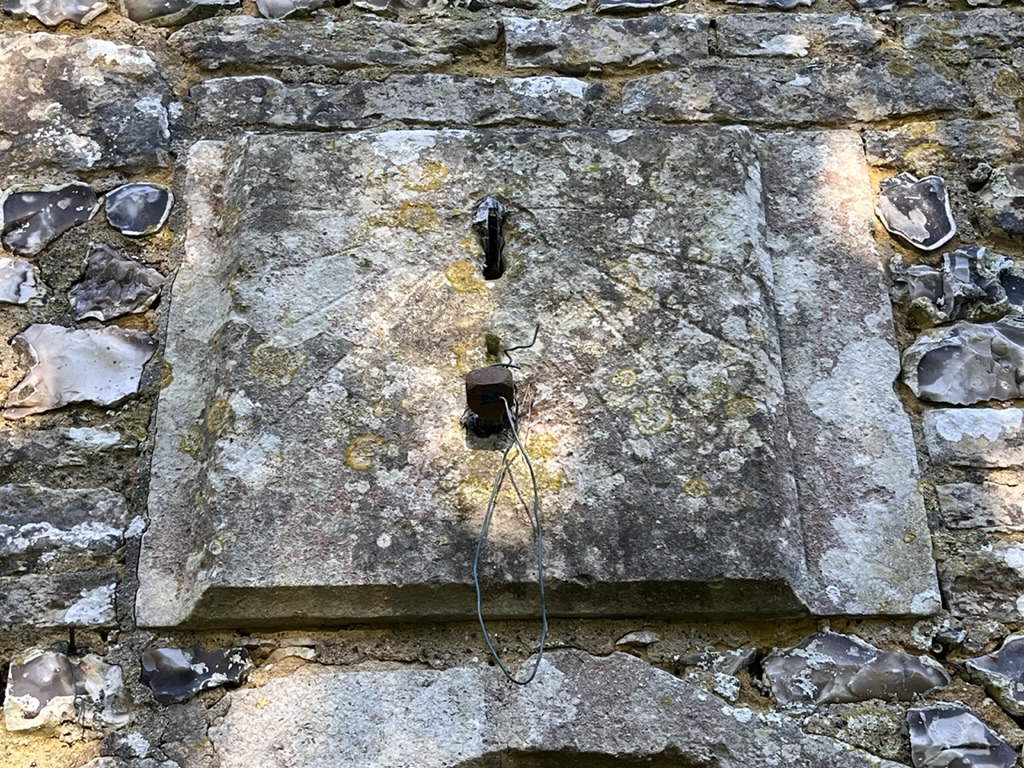
A transitional dial above the archway of the C15 S porch. Accuracy in marking the passage of time became increasingly important, not least with the advent of clocks. Dial design and construction involved taking a scientific approach to making time-telling more reliable and more legible. St Andrew is a good example. Rather than being scratched directly onto a stone intrinsic to the church structure, this dial stone is on what BHO describes as a square raised panel.
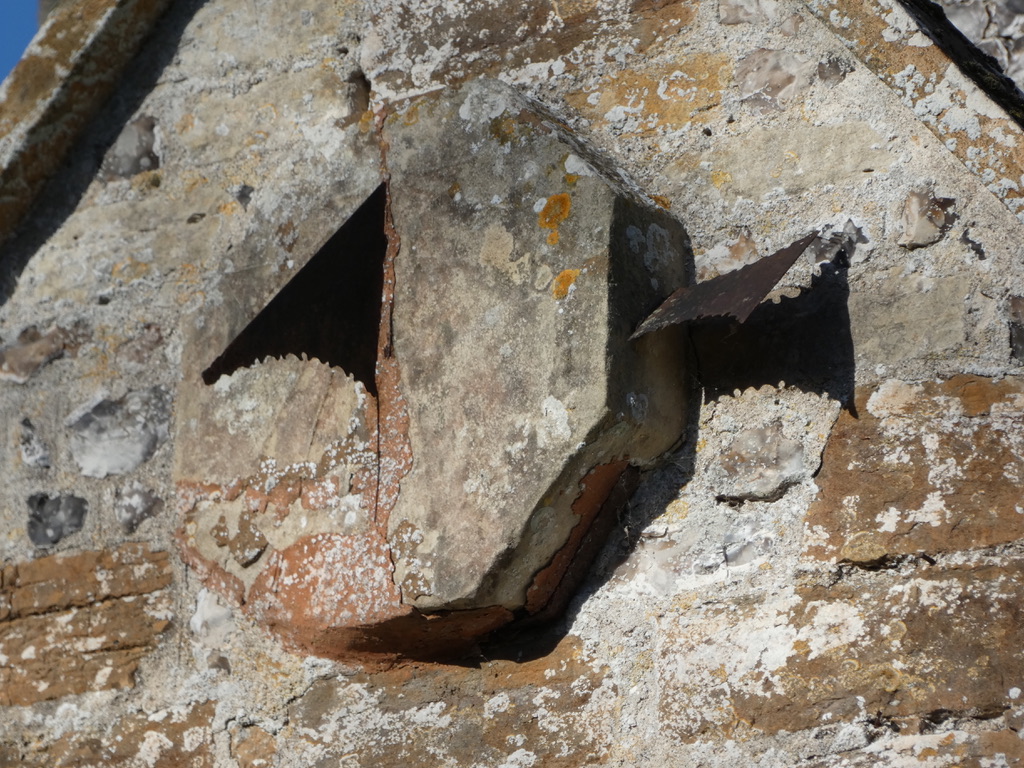
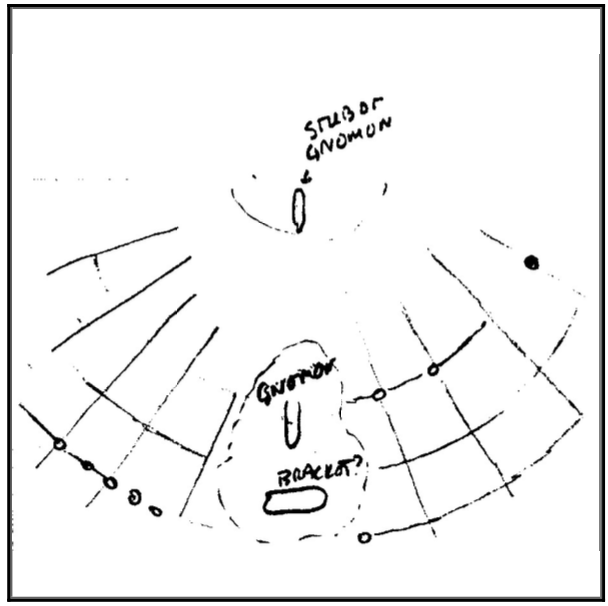
The dial has slightly angled edges with ‘extensions’ on both sides. It is not canted, so probably faces due S. It is a six-to-six dial with – originally – 12 lines (14, with the horizontal as 2). The hours 4 & 5 are cut deeper, perhaps denoting the most important Mass of the day. Some lines have weathered away in part or completely. There are a number of pocks. The recorder noted 4 trace (semi-)circles, one being close to the gnomon hole. The original gnomon was in the upper hole where there is now a square stub of iron rod. The lower arrangement indicates, I think, a later conversion / updating from a simple rod gnomon to a ‘proper’ one that required a footing; and perhaps a lamp bracket.
RARE FEATURE It’s not completely clear from my rather poor iPhone photos, but if you look carefully at the edge R side where there is the wide margin, you can see that the lines marking 4 & 5 extend onto the side of the dial face and continue down the side of the stone panel. Those short lines are visible from the side even if the rest of the dial is not. I wouldn’t have paid it much attention had I not also visited the neighbouring village of Winterbourne Whitchurch where there is an emphatic example of a ‘side-dial’ complete with a most unusual gnomon. My understanding is that this arrangement amounts to a morning dial read from E.
St Andrew . Milborne St Andrew . Dorset – Scratch Dial 3
This is the 4th church I have come across where church events have entailed the use of a dial to tie in decorations etc with wire. In each case the wire was effective as an improvised gnomon.
FONT STORY
During the Victorian period it was sometimes the fashion to throw out ancient fonts and Street did just that, installing in its place a new replacement. Fortunately, the old Norman font, decorated with a cable motif, was rediscovered in 1930 and put back in the north aisle, where it remains in use to this day.DHCT [This is an example of throwing the bath out with the baby water]
St Andrew . Milborne St Andrew . Dorset – S Porch and Norman Doorway
GSS Category: Scratch Dial; Mass Dial ; Transitional Dial
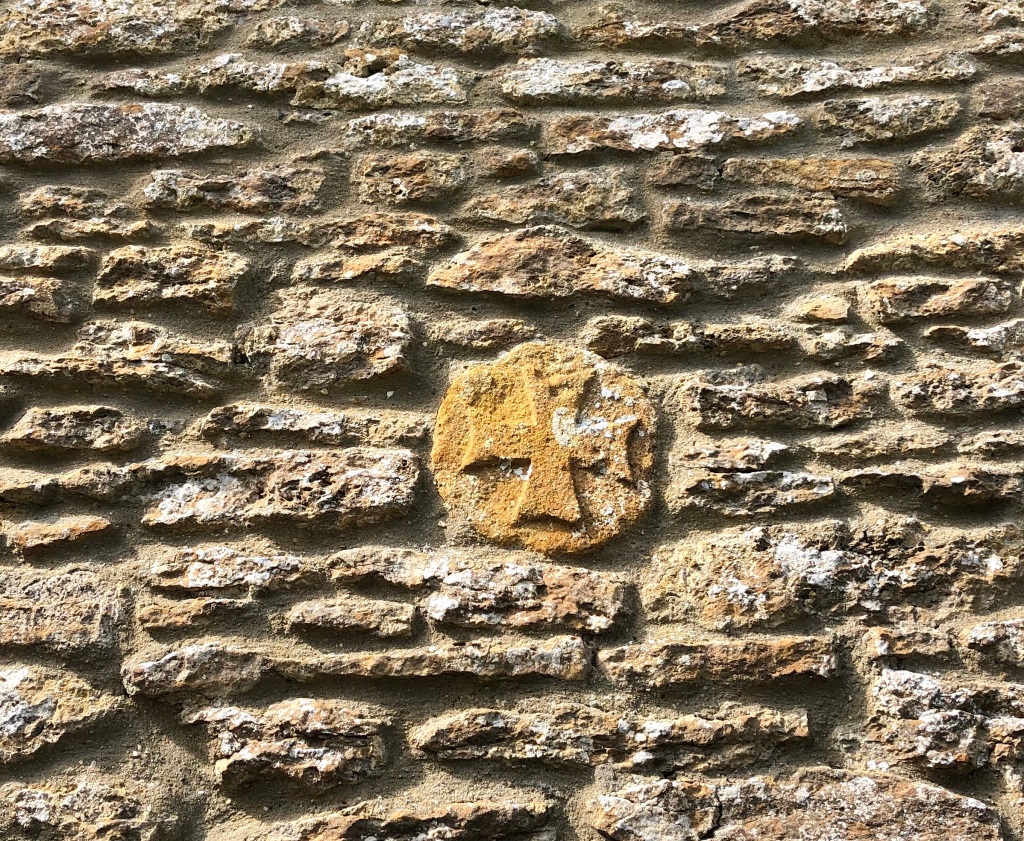
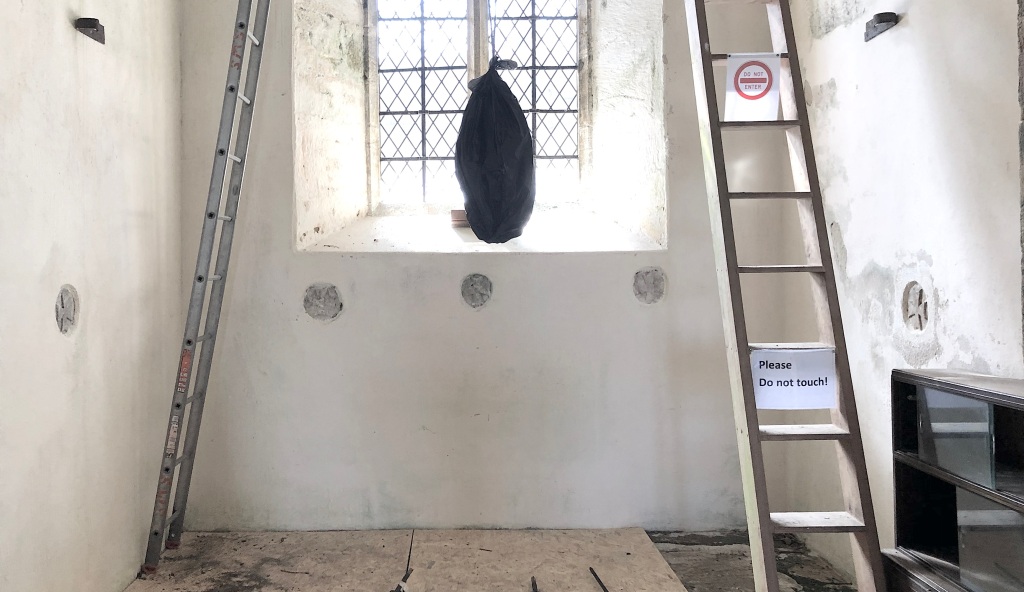
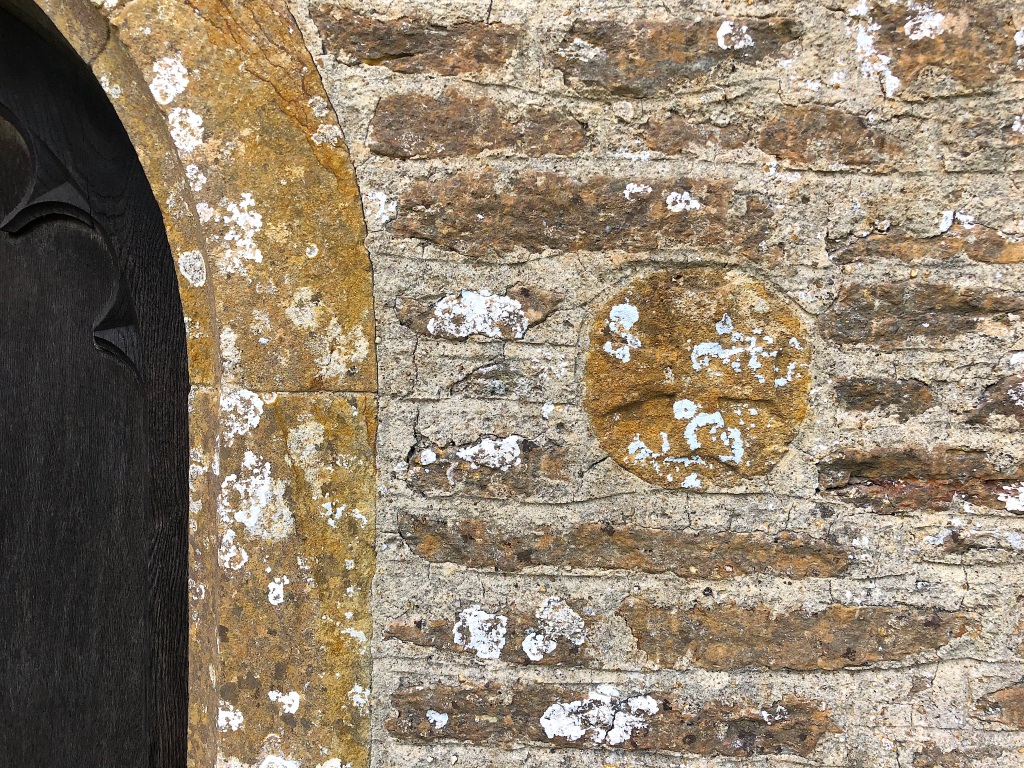
GRADE I † Late C14, C15; C17 alterations inc. porch with date 1650 on keystone. Restorations mid-C19. Very recent skilled restoration 2020. Millennial dial with date-casting gnomon (cf BUCKLAND NEWTON). C18 box pews, candlelit services, Purdue bell c1580. Graffiti and witch marks. 14 formy consecration crosses both outside and inside (see locations below). A perfect small Dorset church standing alone, remnant of a plague village. There has been a recent very skilful restoration that has not impacted on the original charm of St Mary. 6m S of Sherborne. 50.8868 / -2.4902 / ST656098
,
St Mary . Holnest . Dorset – Keystone
SCRATCH DIAL
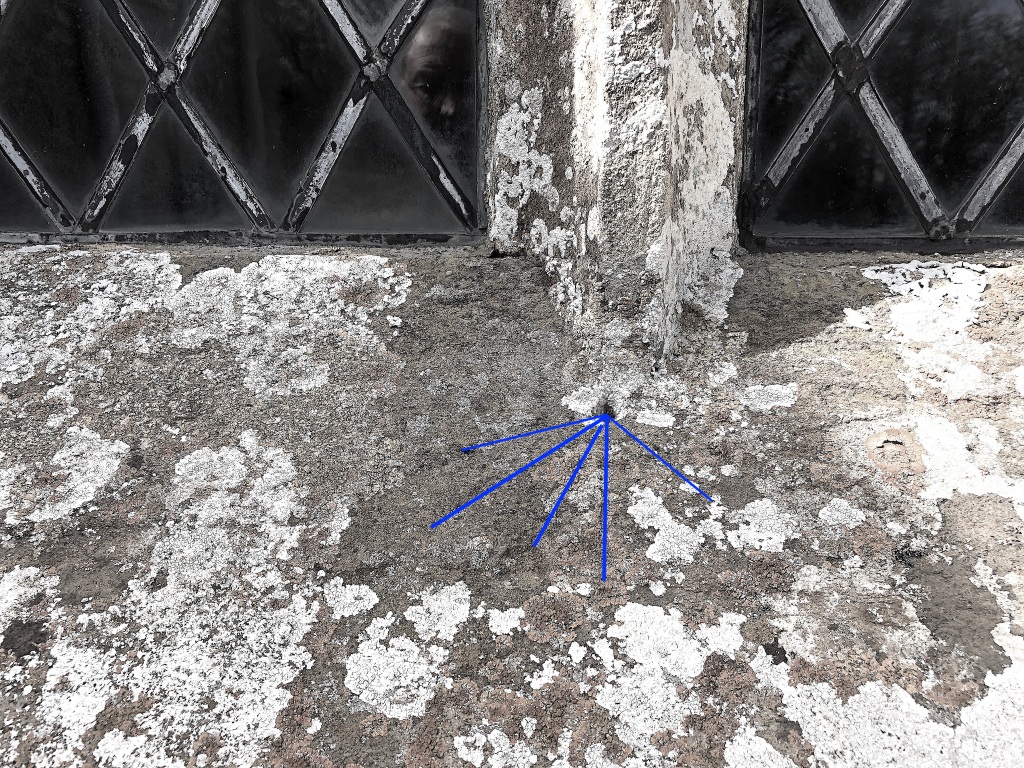
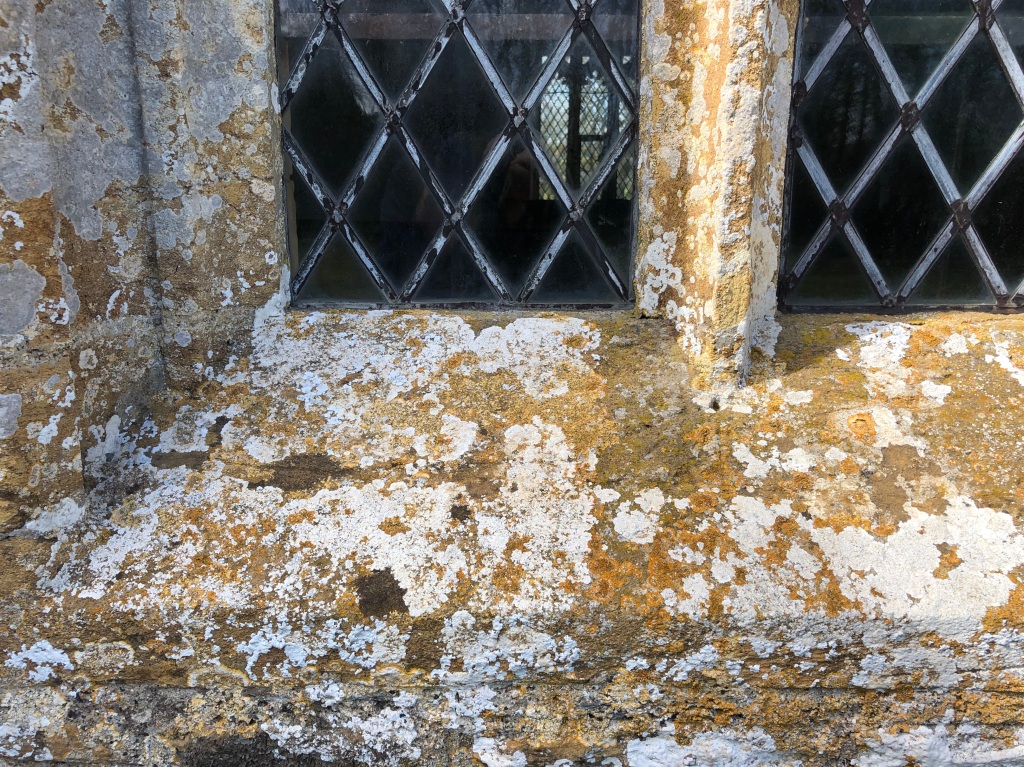
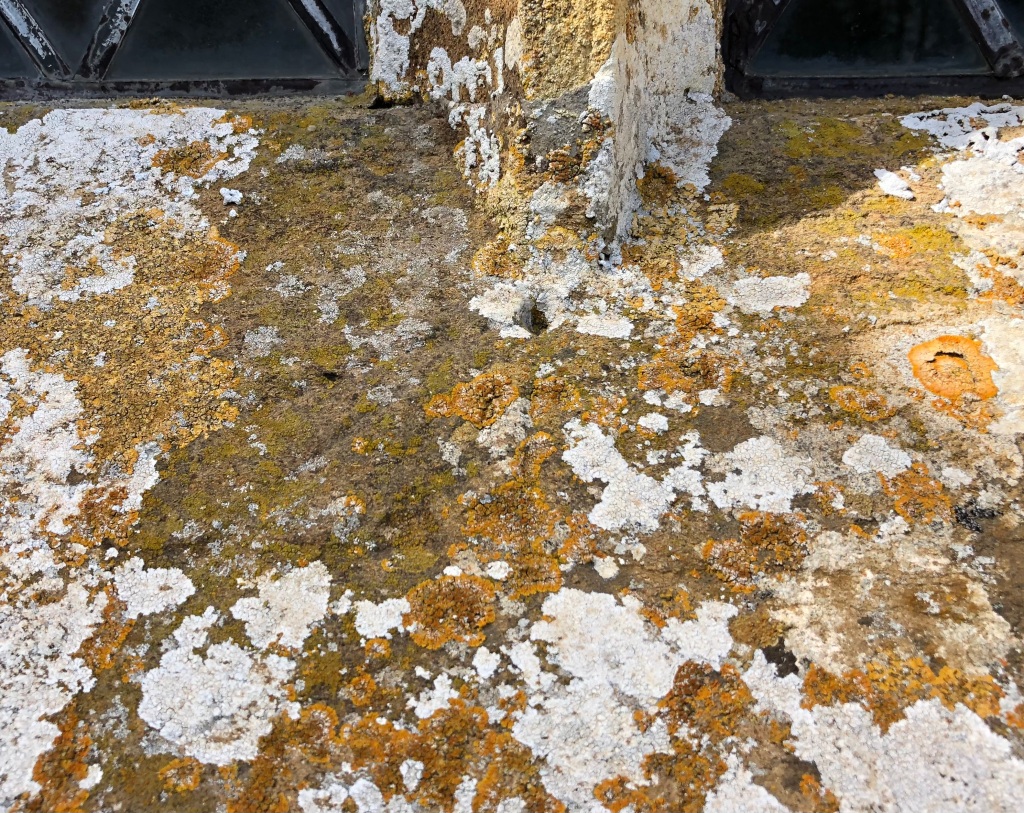
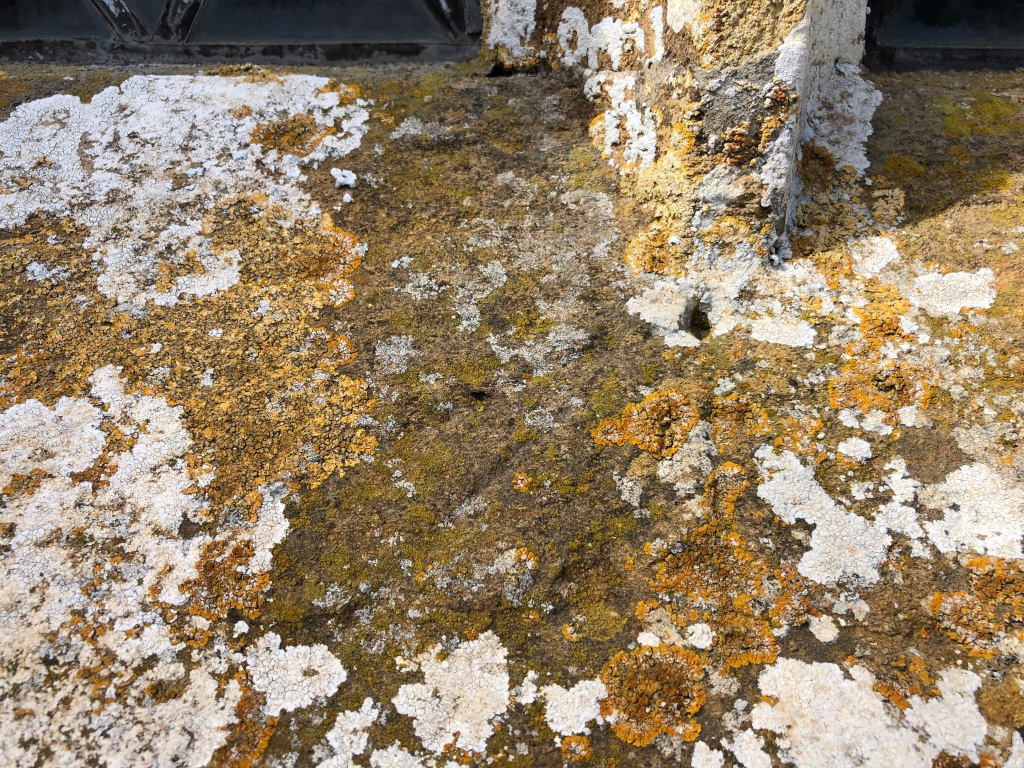
St Mary . Holnest . Dorset – rare scratch dial on window-sill
A remarkable and very rare C15 dial, possibly unique (cf nearby THORNFORD). It is located on a window sill of the S aisle, incised at an angle of 35º. It is quite difficult to examine – even close to – because of erosion and lichen. The style hole is centred on the stone divide between 2 windows. To be effective it must have been angled forwards: C15 dial deliberately positioned centrally. Gnomon must have been bent over, perhaps horizontally. Lines are quite accurately cut GLP.
There were originally 12 lines – the full complement for a semicircular dial. However, many are so weathered that they are barely visible – some not at all. The church is across the fields from us and I have spent some time with the dial, examining it and photographing it at different angles and in different light. I’ve managed to identify 8 lines including the horizontals, much as shown on the second BSS diagram below. The most visible lines are these:
St Mary . Holnest . Dorset – diagram of scratch dial on window-sill
St Mary . Holnest . Dorset – scratch dial diagrams BSS
St Mary . Holnest . Dorset – rare scratch dial on window-sill
VERTICAL DIAL
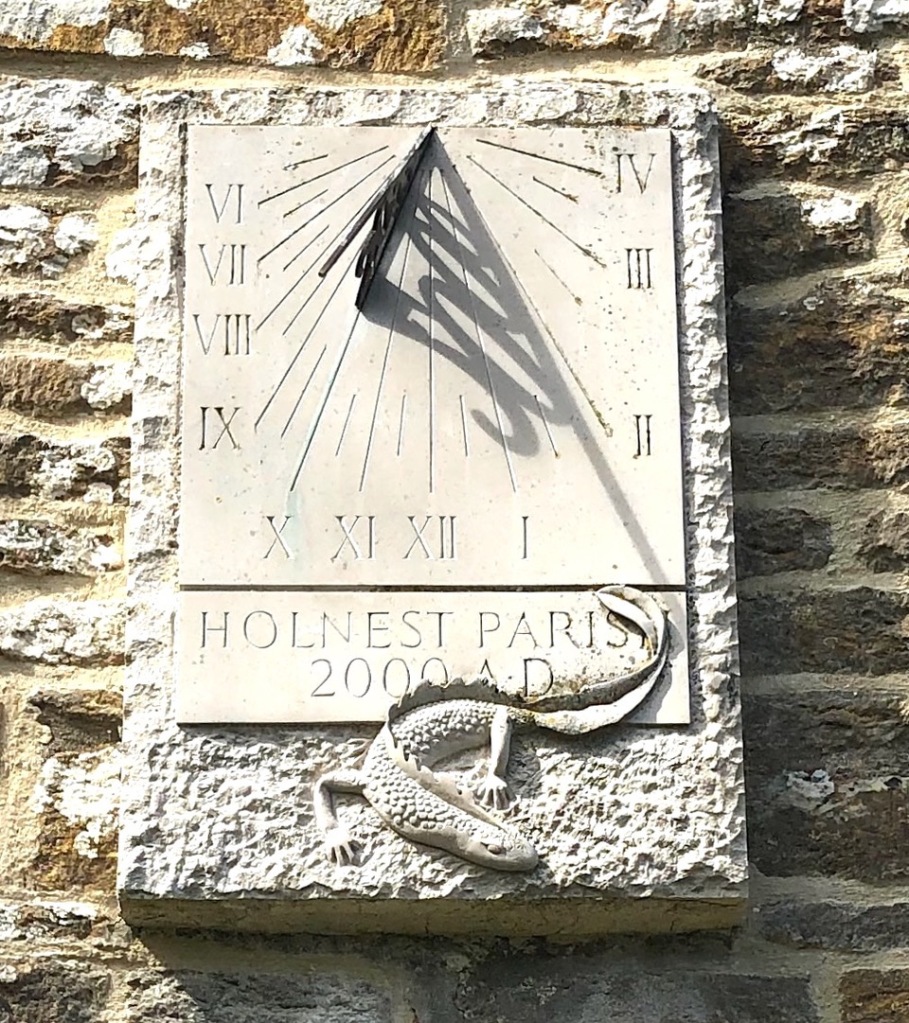
The porch has a date of 1650 and a new [millennium] sundial commemorates the Great Crested Newt that meant that a field nearby could not be developed for housing. Friends of Holnest Church.
A particularly good example of a meaningful local dial designed specifically for its location and time. The Battle of the Newt being won as the new Millennium approached, a fine dial to record both events was fully merited.
St Mary Holnest: millennial vertical dial dated 2000 with unique Newt Protection Symbol
WITCH MARKS & GRAFFITI
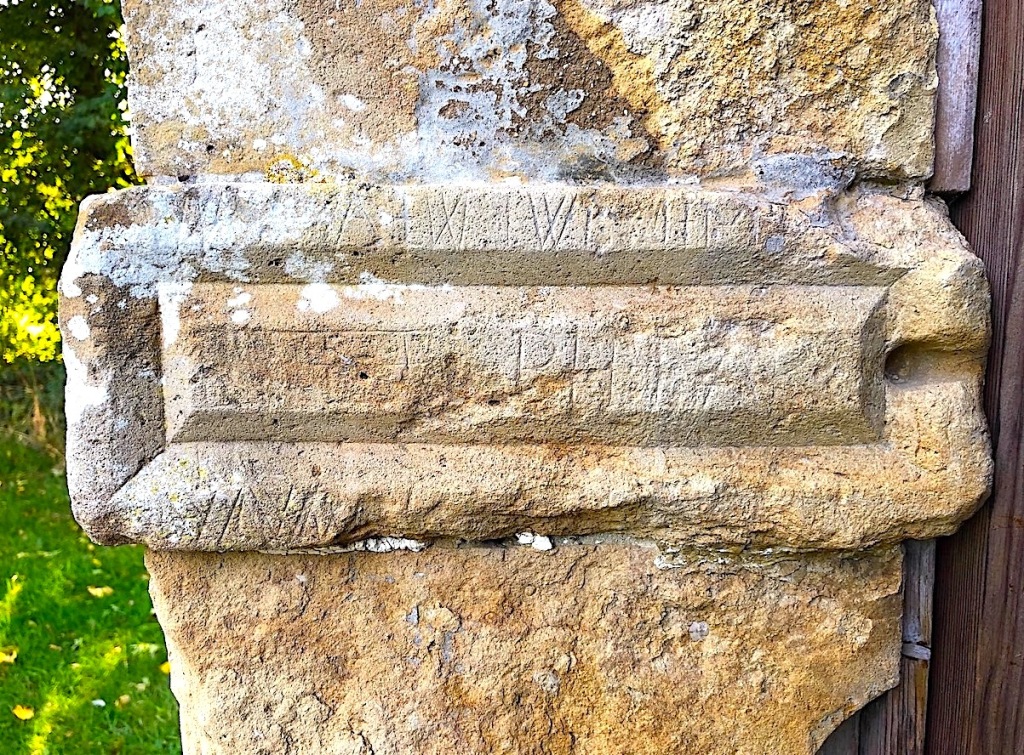
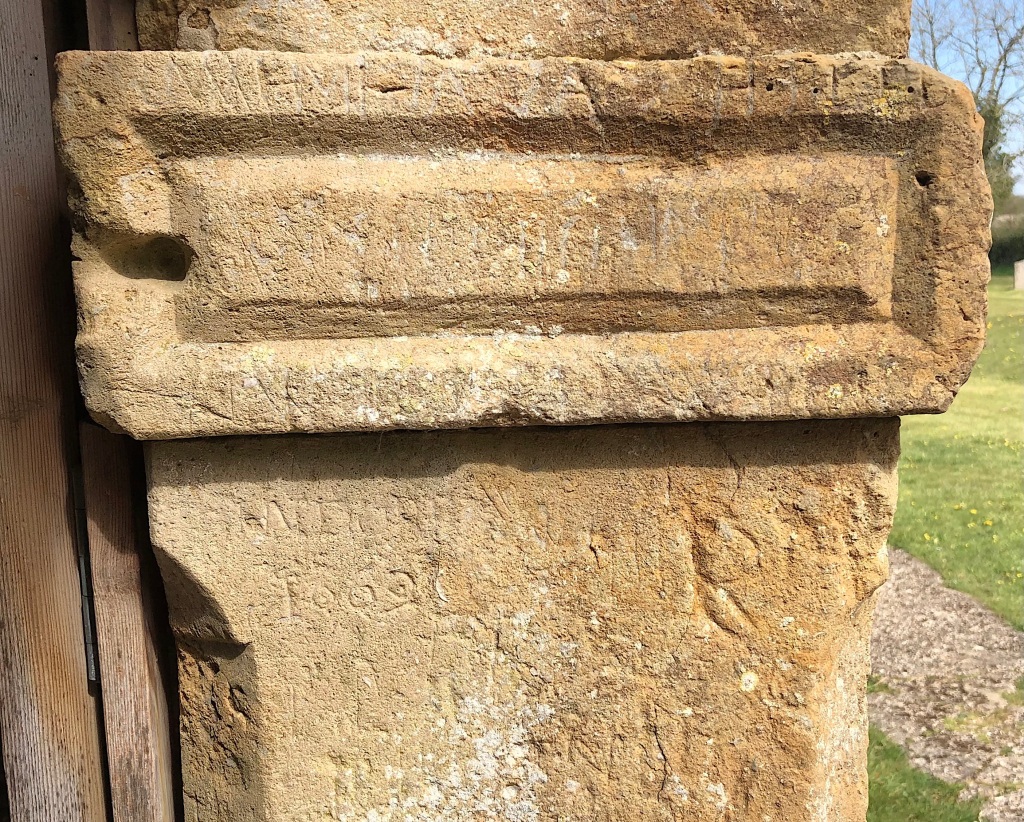
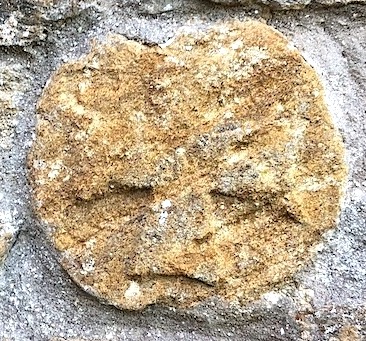
St Mary . Holnest . Dorset – witch marks, Marian marks, graffiti
The S porch has a rich variety of medieval church marks. The example stones shown above have witch / ritual protection / apotropaic marks to ward off evil, in particular a number of Marian marks VV (Virgo Virginum / Virgin of Virgins). There are also initials and C17 dates.
CONSECRATION CROSSES
There are 14 in all, 12 being the usual maximum. 5 are inside the church on the tower walls
Consecration Crosses: On chancel— flanking E. window externally, four crosses; flanking S. doorway, two crosses. On nave—W. of heads of N. windows, two crosses. On S. aisle—over E. window and W. of S. window, two crosses. On W. tower, on N. and S. walls, one cross and below W. window, two crosses; formy crosses fourteen in all, mediæval. BHO
St Mary . Holnest . Dorset – Consecration Crosses
GSS Category: Scratch Dial, Mass Dial; Church Marks, Witch Marks, Protection Marks; Consecration Crosses
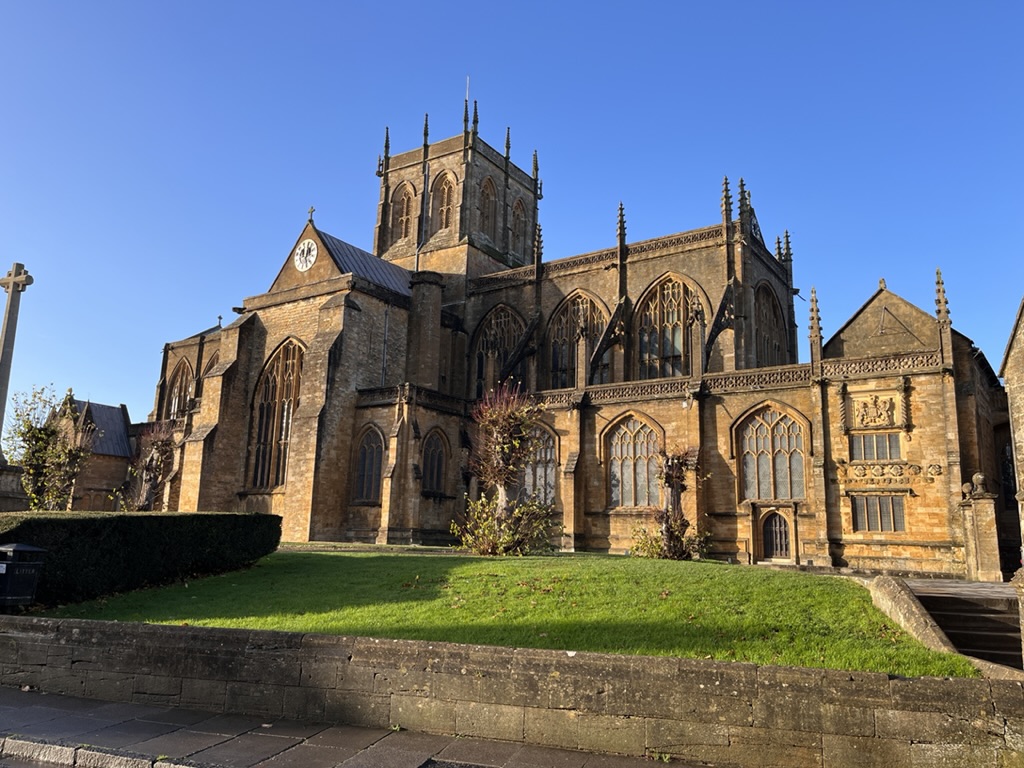
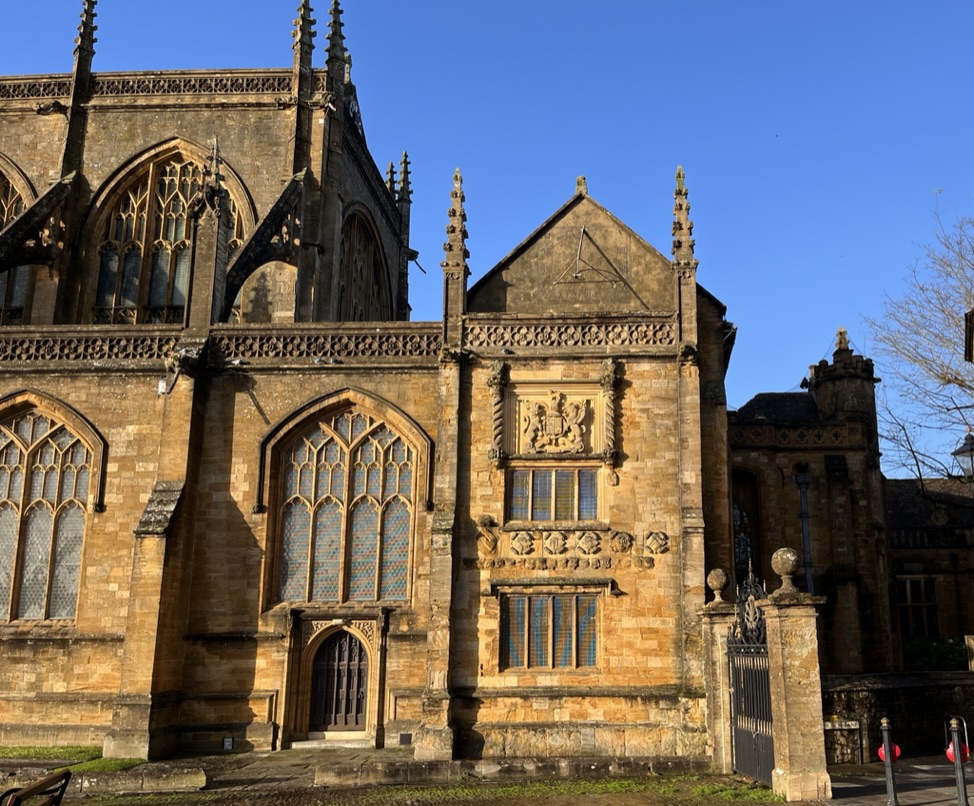
GRADE I † Founded by St. Aldhelm in AD 705 as a Saxon Cathedral, Sherborne Abbey became a Benedictine monastery, and following the Dissolution of the monasteries, a Parish Church of some splendour. Of all the architectural features, the astonishing [earliest majorPEV] fan vaulting is arguably the finest. This is not the place for discussion of the merits of the church. The Wiki entry is a helpful source for an overview of SHERBORNE ABBEY
St Mary the Virgin . Sherborne Abbey . Dorset
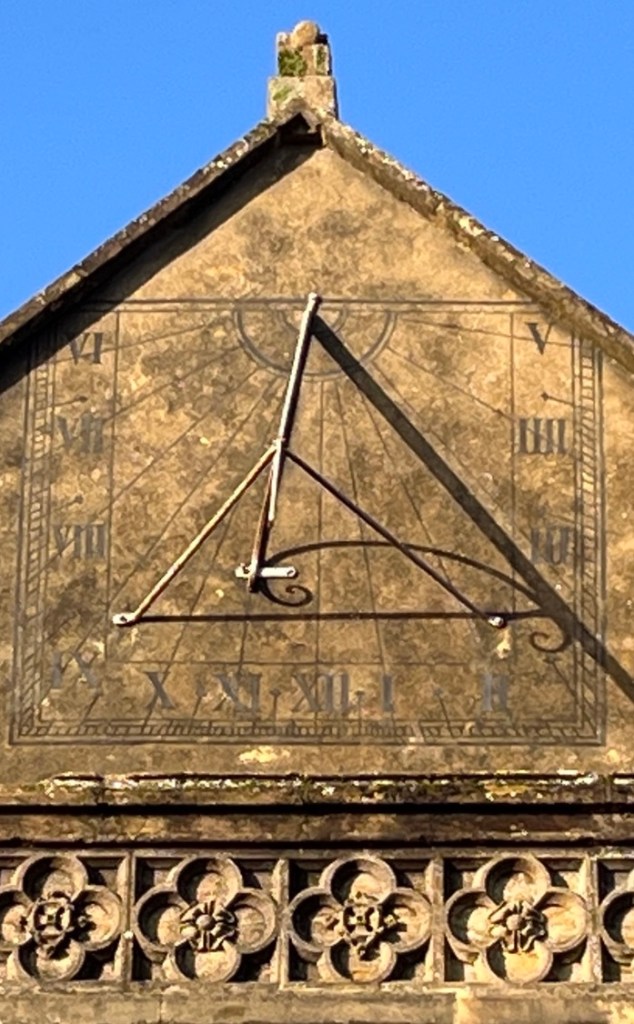
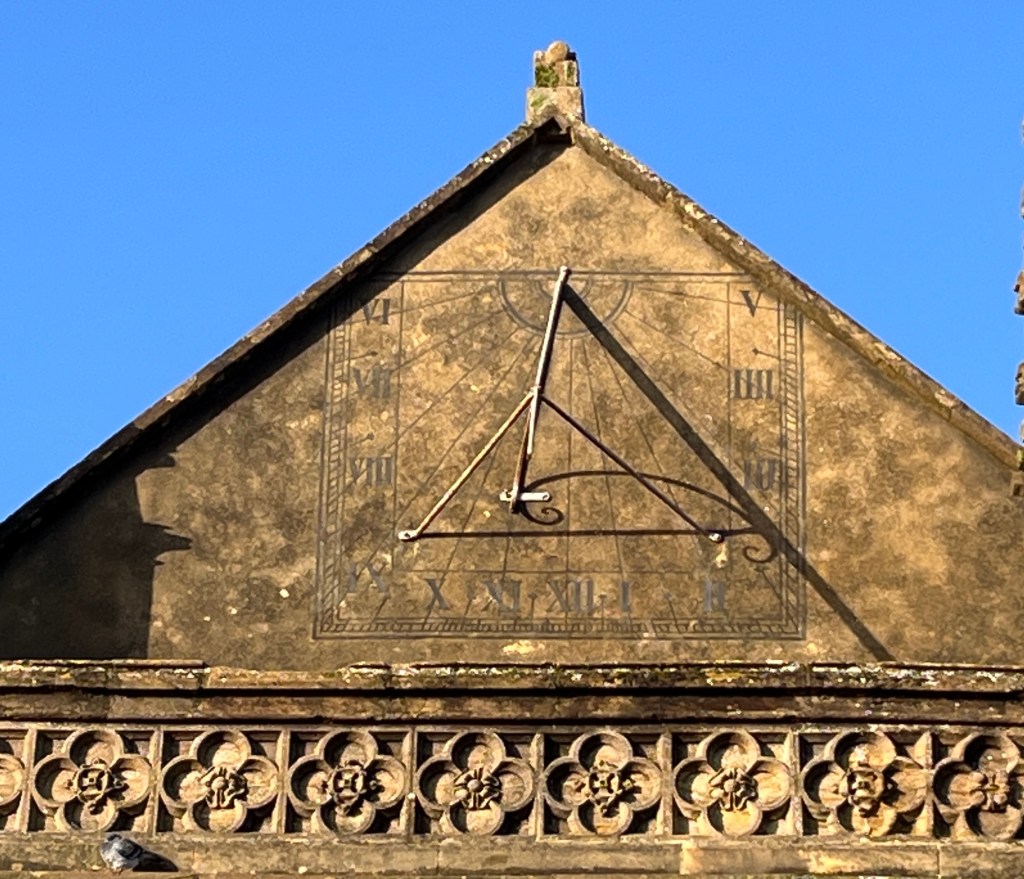
The large Vertical dial at the E end is impressive and visible from some distance. The Old Shirburnian Society records:
The south-facing vertical dial on the south-east end of Sherborne Abbey was erected in 1745 by Sherborne School at a cost of £5.5s.0d. It was built by the Sherborne architect Benjamin Bastard (1690-1776), son of Thomas Bastard of Blandford Forum.
The modern gnomon is effective and casts an attractive shadow; it could be argued that its style and fixings do not quite do justice to a C18 dial.
St Mary the Virgin . Sherborne Abbey . Dorset – Vertical Sundial
The gallery above might suggest overuse of saturation, but the photos – at various distances to show other features – were taken on an iPhone on a bright sunny early winter’s morning, and are un-enhanced (not always the case, I must admit). We were fortunate enough to be married in this glorious building.
Kilmainham . Dublin . Royal Hospital / IMMA -Vertical Dial
A painted (gold Roman numerals and hour lines on white) vertical timber dial 1000 mm wide by 1200 mm high on the south wall of the courtyard of the Royal Hospital Kilmainham over the entrance to the dining hall. It has an ornate scroll gnomon also painted gold. The RHK, built in 1684, was in use as a retirement home for soldiers until 1927. Following restoration the building was reopened in 1991 as the Irish Museum of Modern Art .
Kilmainham . Royal Hospital / IMMA -Vertical Dial BSS
I am hoping to be able to get more detailed / close-up photos of the dial…
Kilmainham . Dublin . Royal Hospital / IMMA -Vertical Dial
GSS Category: Vertical Dial
Photos: Keith Salvesen; BSS Archive; Text M. J. Harley BSS

















 GAUDIUM SUB SOLE . SUNDIALS . MEDIEVAL TO MODERN