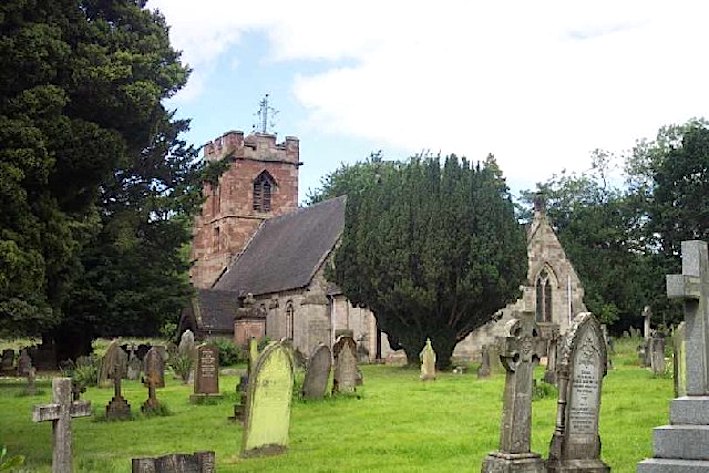
GRADE II* † C13 origins; C15 tower; C19 restorations esp by Wyatt, some work reflecting the older styles. PEV – with an eye for quirks – notes Manual fire engine said to be early C18. 4m N of Wilton. 51.1188 / -1.8863 / SU080355
VERTICAL DIAL
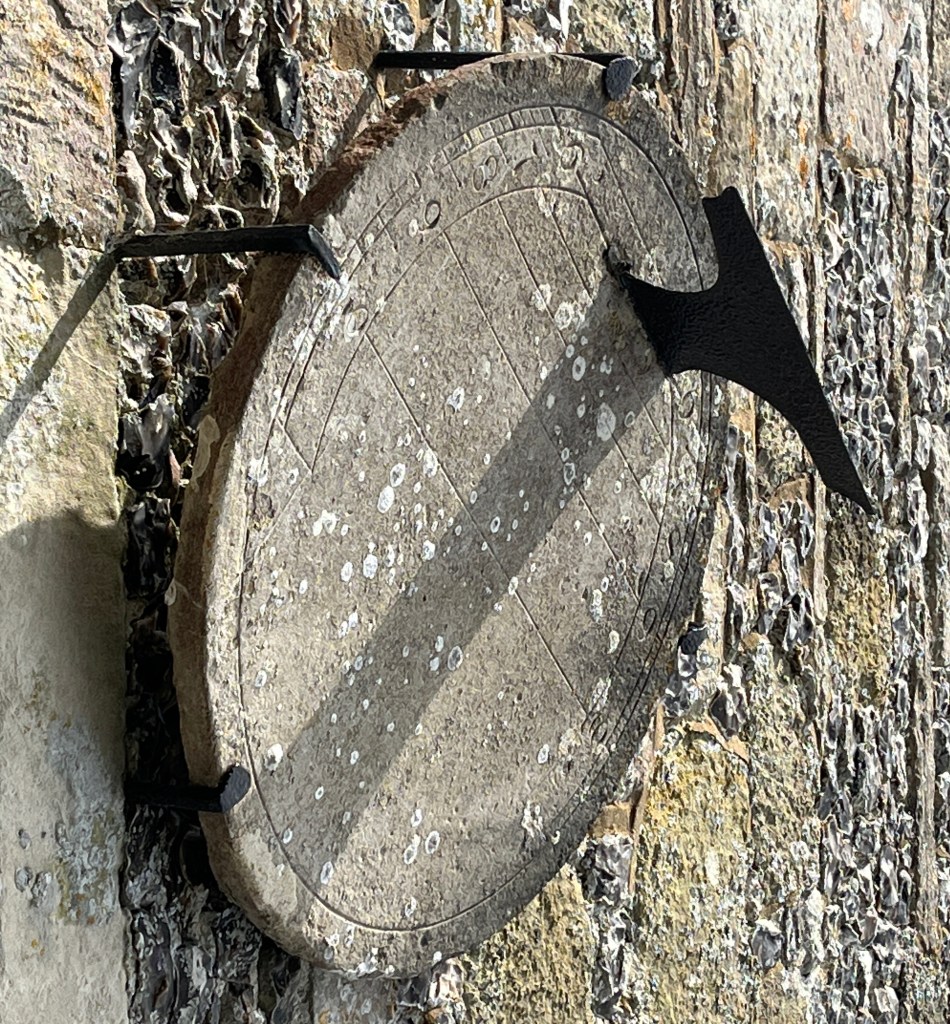
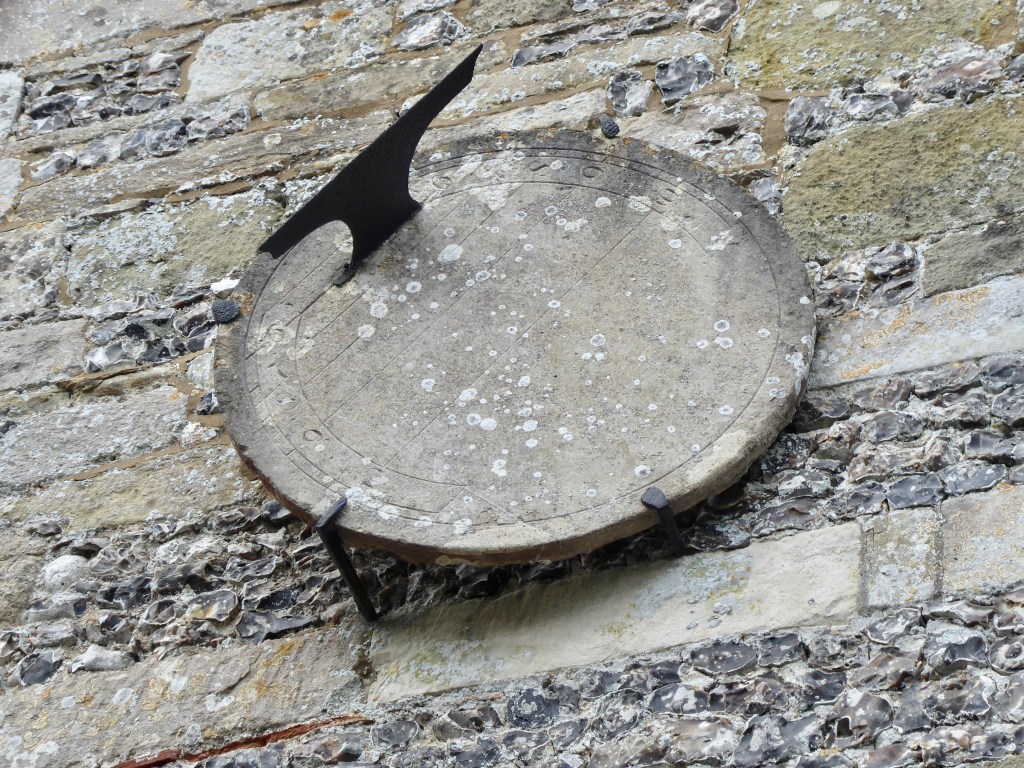
On a recent trip to the Wylye Valley to look at specific churches for scratch dials, I passed through Great Wishford. I stopped, not because I expected to find a scratch dial, but because I noticed an unusual circular dial on the E end – something like a satellite dish for receiving the sun’s rays. I hope someone will enjoy working out how the dial works in practice; or even whether, in its position and at that angle, it is accurate.
My amateur skills fall well short of understanding how the dial works in the technical sense. The position and angles of the dial and gnomon seem all wrong. The numbering, too. On a dull day I was fortunate to catch a moment when the sun cast a shadow.
EGNAZIO DANTI* 1536 – 1586 (also, Ignazio), Dominican monk and polymath, became renowned for his wide learning and intellectual precision. He was a mathematician, cartographer, astronomer (some say ‘cosmographer’) to Cosimo I, and much more. There’s plenty about him – and indeed about his 3 very different dials at SMN – online.
Recommended sites for an informed overview of the dial include that of the Basilica itself SMN.IT; also ARTELEONARDO and ACCADEMIAGALLERY
For those wishing to dig deep into the complex analysis and the historical context of the dial, you can do no better than study the lead article by Simone Bartolini & Marco Pierozzi in the BULLETIN OF THE BRITISH SUNDIAL SOCIETY VOLUME 22(iv) – December 2010. You can download it.
Egnazio Danti
ARMILLARY SPHERE
The armillary sphere consists of two perpendicular bronze circles with a diameter of 1.30 cm. The vertical one represents the meridian and indicates the exact moment when the sun is at its highest point, noon. On the equinox day, these two circles create a cross-shaped shadow, while elongated circle shadows are formed on other days. (AG)
REFORMATION OF THE CALENDAR
Danti’s sphere was installed on the S facade of the SMN in 1572. This device enabled him to determine the equinox precisely, and thus the true length of the year. Measurements the following spring confirmed the conjecture that the equinox was earlier than indicated by the Julian calendar, in fact by 11 days. As Wiki (always good on this sort of topic) puts it: The reforms of Julius Caesar in 45 BC put the Roman world on a solar calendar. This Julian calendar was faulty in that its intercalation still allowed the astronomical solstices and equinoxes to advance against it by about 11 minutes per year. Pope Gregory XIII introduced a correction in 1582; the Gregorian calendar was only slowly adopted by different nations over a period of centuries, but it is now by far the most commonly used calendar around the world.
MERIDIAN DIAL SMN Link to the article on Danti’s marvellous dial inside the Basilica
GRADE I † C12 origins (?); C15 inc tower & porch; C16 rebuilding / additions. Material from nearby Milton Abbey incorporated. C19 restorations. In proximity, a fine early vertical sundial (1690); 2 date stones (1569); scratch dial (probable?). Several excellent gargoyles N side. 2m W of Milton Abbey. 50.8259 / 2.3114 / ST781029.
VERTICAL DIAL
A fine dial in very good condition for its age. The gnomon is an amusing extension of the sun’s nose. I took the design LL corner to be an hour-glass, which would be appropriate. In close-up I wonder if it is a religious symbol; and if the design LR corner is a square and compass.
DATE STONES
THE BAGPIPER
SCRATCH DIAL
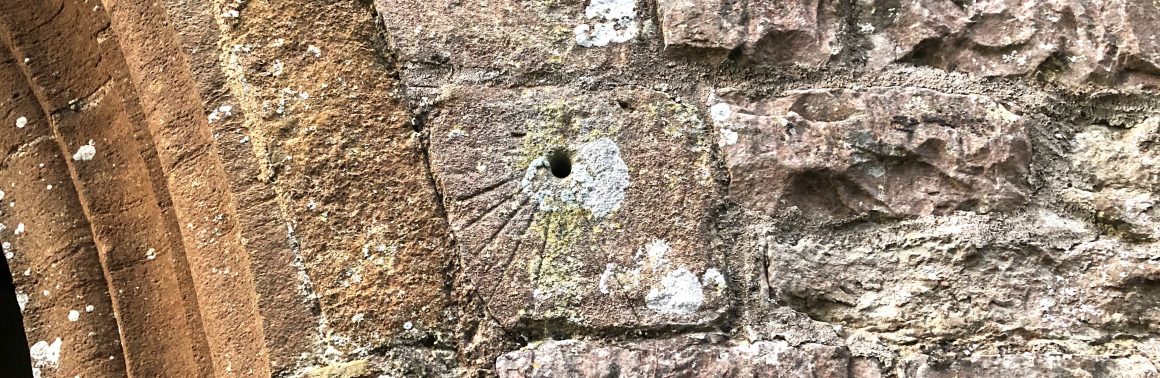
The dial design of a double circle with a hole in the centre is far from unusual. No lines, no pocks; just a stick needed to mark the passage of the day. This type is generally included in the Scratch / Mass Dial category of church marks; and I go along with that. However, having recently researched Cyffe Pypard and Fovant (both Wilts) which have several dials including this design, I am beginning wonder. It’s hard to think of a reason why a dial-cutter would not to add lines, pocks or both to a device specifically made to mark the passage of the day. But what if these are apotropaic symbols cut into the walls of the church to catch evil: ‘Demon Traps’ from which, once entered, encircled evil could never escape?
GSS Categories: Vertical Sundial; Old Sundial; Date Stones; Gargoyles / Hunky Punks; Scratch Dial
St Mary . Castle Bank . Stafford – Geoff Pick Geo CC / OS
CHURCH OF ST MARY . CASTLE BANK . STAFFORD
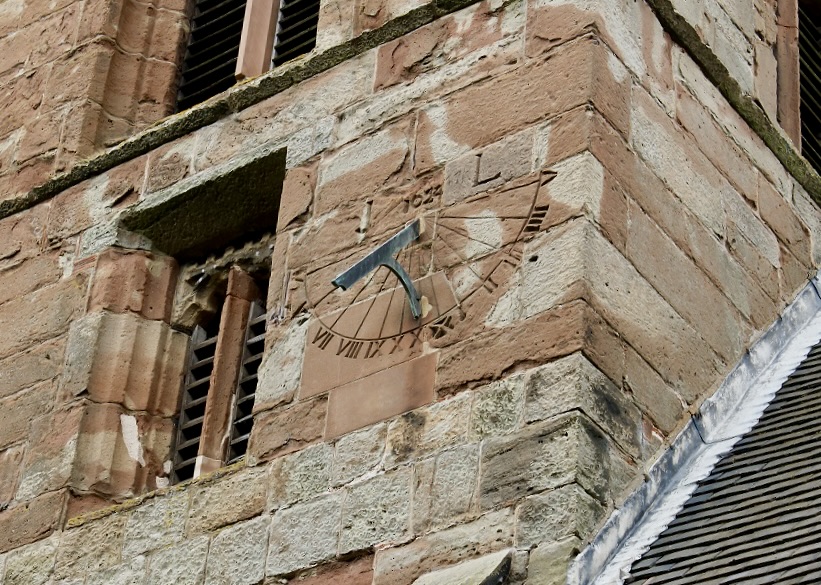
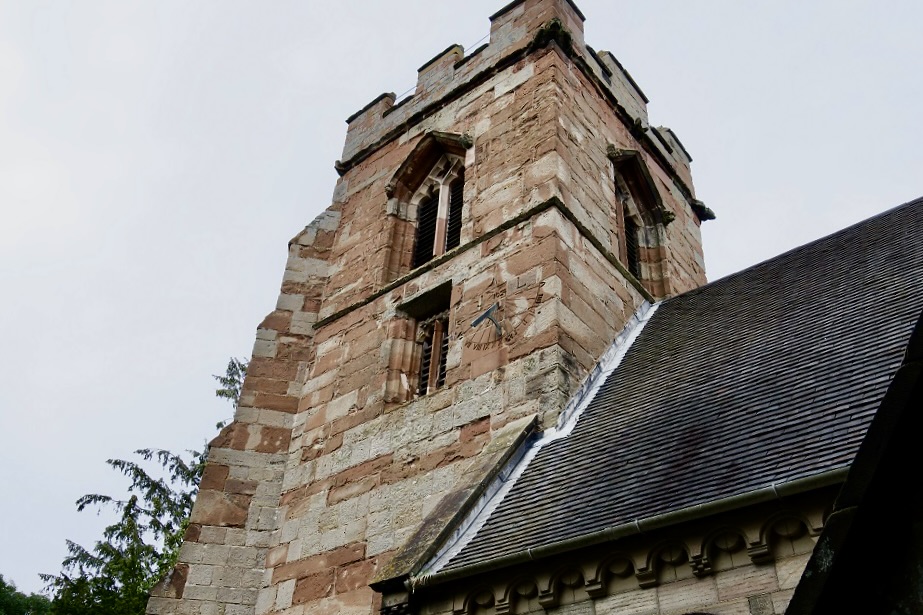
GV II* † C15 tower; otherwise mainly C19. Tower has 2 diagonal buttresses, plinth, south 2-light straight-headed window with sundial to right: incised inverted semi-circle with gnomon and inscription: J 1624 L BLB . In Newport Road below the castle, not to be confused with the large ‘collegiate’ parish church, also St Mary. 52.7969 / -2.141 / SJ905221
St Mary . Castle Church . – Vertical Sundial
DIAL
The vertical dial is high up on the S side of the tower, a semicircle with Roman numerals, with the date 1624 and on either side of it the letters J and L. The date may fit with work carried out on the upper stage of tower in C17. As can be seen, there has been good repair work on the dial, so that it is observably both ancient and modern.
GSS Category: Vertical Dial; Church Sundial; Old Sundial
All photos: Erika Clarkson, with many thanks for this and her other contributions to this project; Geoff Pick for his photo of the church Geo CC / OS
GRADE 1 † Records from 1254; low C14 tower (1st stage) later heightened; mainly C15 / 16. C16 waggon roofs. Bells from C17. Restorations 1870s. BLB notes coped gable with apex cross, but omits the prominent dial. A fine hillside church with wonderful views from high above the Wye valley. 6m S of Monmouth. 51.7932 / -2.6945 / SO521107
St Mary . Penallt Old Church . Monmouth – Vertical Dial
DIAL
An excellent dial, easy to miss. The tree-lined avenue that now leads to the church completely obscures the dial as you approach up the path. Trying to view the dial from other vantage points gives a sideways view. Attempting to take clear shots of the dial is a pleasurable challenge. Move branches aside.
The dial makes for an attractive gable end, and is surmounted by a cross. It is fairly damaged / eroded. A 6-to-6 dial with noon marked by a cross; IIII as IV. The gnomon is modern and rather squiggly / shiny for an old dial.
Dating the dial is not easy. A broad comparison with similar dial designs suggests ± 1800.
The Old Church is in a lovely setting, and besides TRELLECK this is the most rewarding dial to admire in the immediate area. Take a small picnic and sit in the churchyard for peak enjoyment. Other treats include a handsome door (1532) and a walk-though squint.
Chartreuse de Mélan . Taninges . France – Vertical Dial
Cat / Salamander Hunky Punk
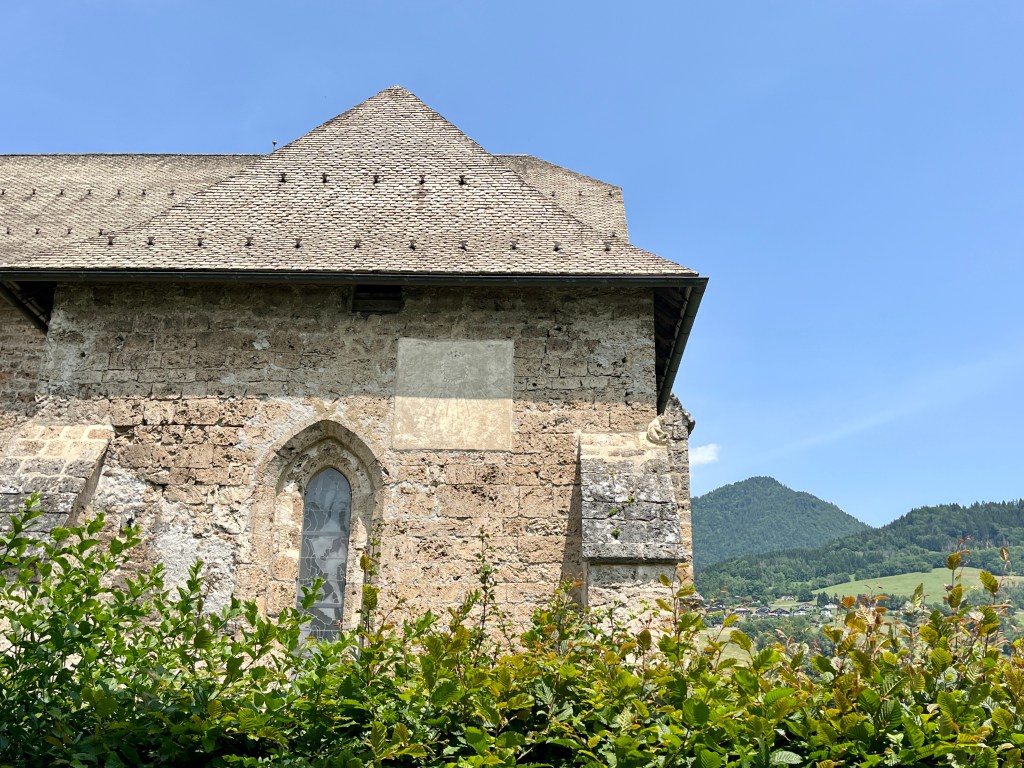
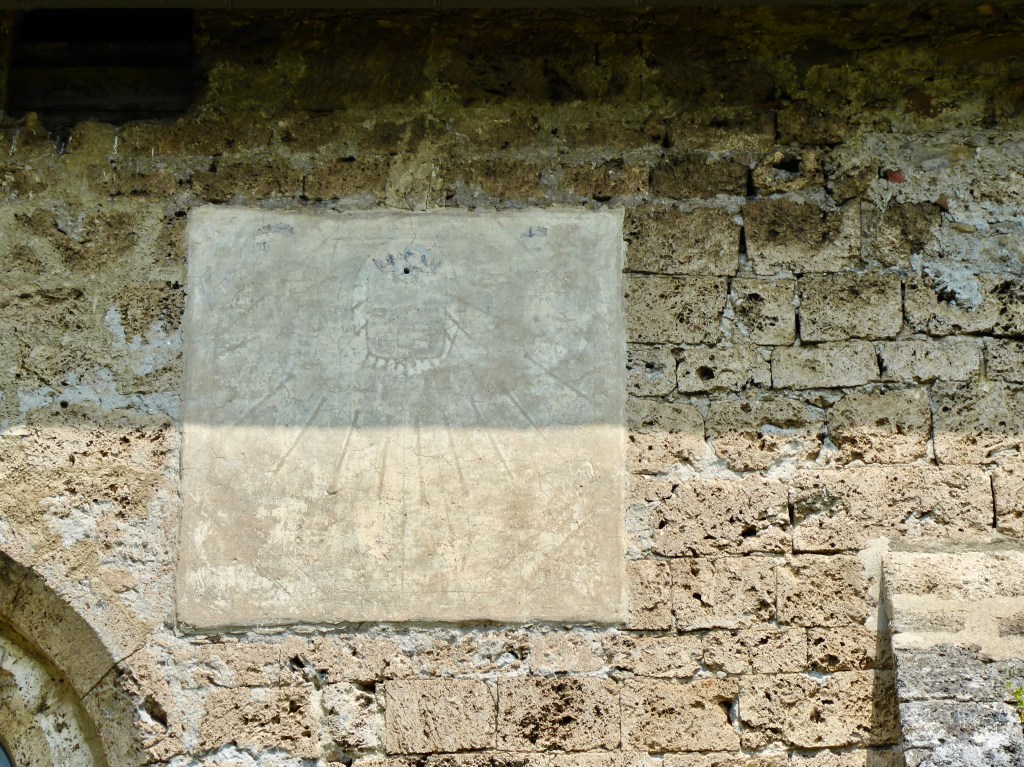
The Chartreuse was founded in 1285 as a Carthusian nunnery and continued its religious functions until the French Revolution. Thereafter it became a school and in due course an orphanage. A disastrous fire in 1967 destroyed almost all the buildings on the site, with loss of life. Only the church and its cloister now remain. The church is an exhibition space and the lawns around it feature examples of modern art, from interesting via enjoyable to a few that are a matter of personal taste.
Chartreuse de Mélan . Taninges . France – Vertical Dial
The dial is included by MICHEL LALOS in his excellent French Cadrans Solaires site. Anyone who has in interest in sundials in France will benefit hugely by using this free resource. It is accessible, informative, and easy to use – not least because the dials are featured by Départment with a map for dial locations. The entry for Mélan is :
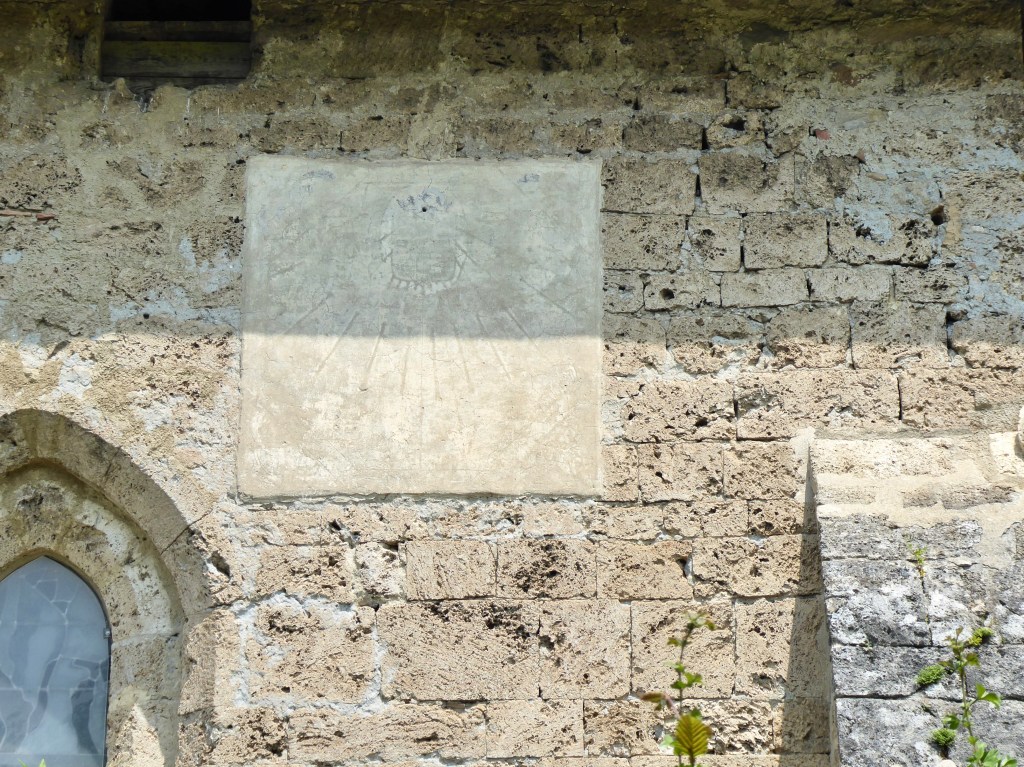
Cadran peu déclinant de l’après-midi, gravé et peint sur enduit, très dégradé, fines lignes, demies, plus de chiffres dans bandeaux, traces de blason et décor
Dial slightly declining in the afternoon, engraved, painted on rendering, very degraded, fine lines, half-hour lines, numbers within a frame, traces of coat of arms and decoration.
There are paint remnants at the top of the dial, where (presumably) it has been protected by the eaves. The gnomon hole at the top of the coat of arms is square. The dial is obviously old and I wondered if it might be dateable. Checking the apparent shape of the escutcheon, I discovered that it was first recorded as an armorial design in late C17 and (conveniently) turns out to be known as French-style. Overall, one might reasonably conclude that this dial is C18.
MEMORIAL STONE 1690
Chartreuse de Mélan . Taninges . France – Memorial Tablet 1690
GSS Category: Vertical Dial; France Sundial; Cadrans Solaires; Dials Abroad
All photos: Keith Salvesen; source used MICHEL LALOS
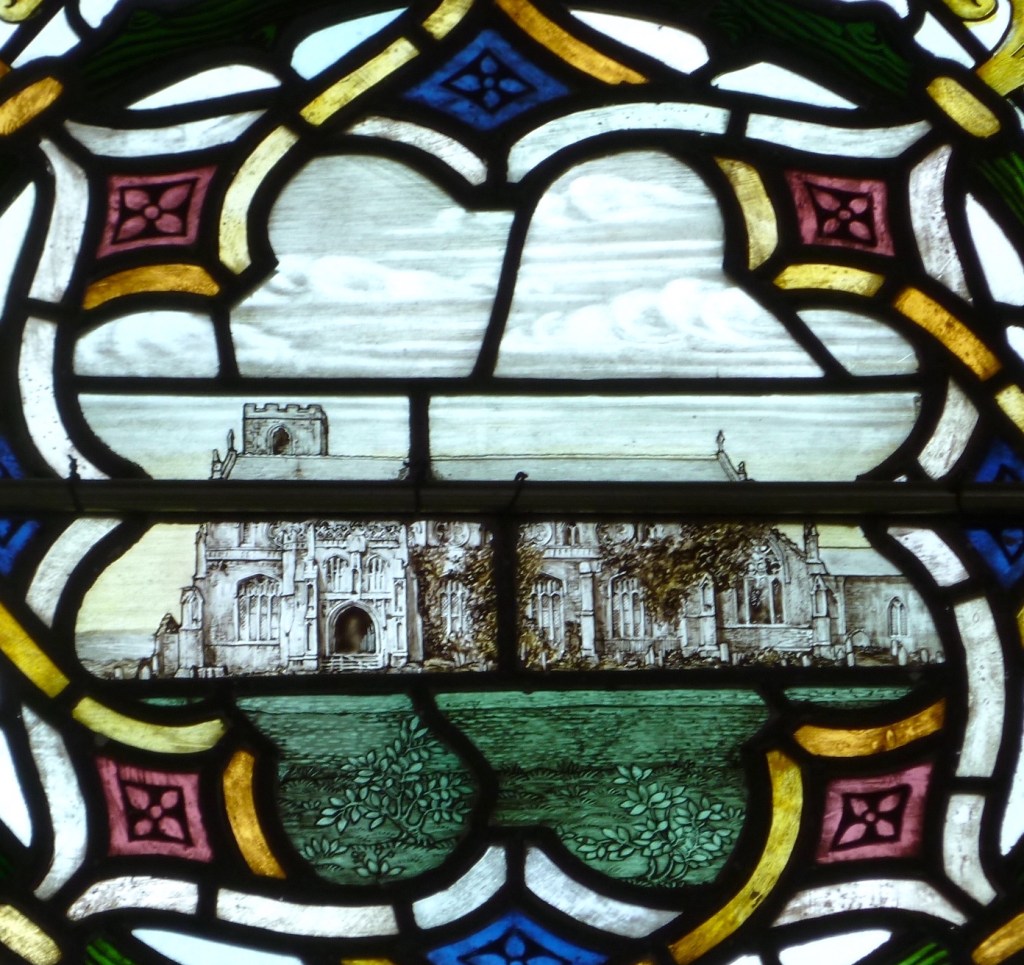
St Margaret of Antioch . Cley-Next-The-Sea . Stained Glass Window (cr Keith Salvesen)
ST MARGARET . CLEY-NEXT-THE-SEA . NORFOLK
GRADE 1 † C14 and C15. An important and rather wonderful church, part-ruined. One of SJ‘s 1000 Best Churches: a sea church stranded inland.PEV describes a most striking and improbable-looking building, splendid from the S, but splendid in large parts rather than as a whole. 52.9464 / 1.0475 / TG048431
DIAL
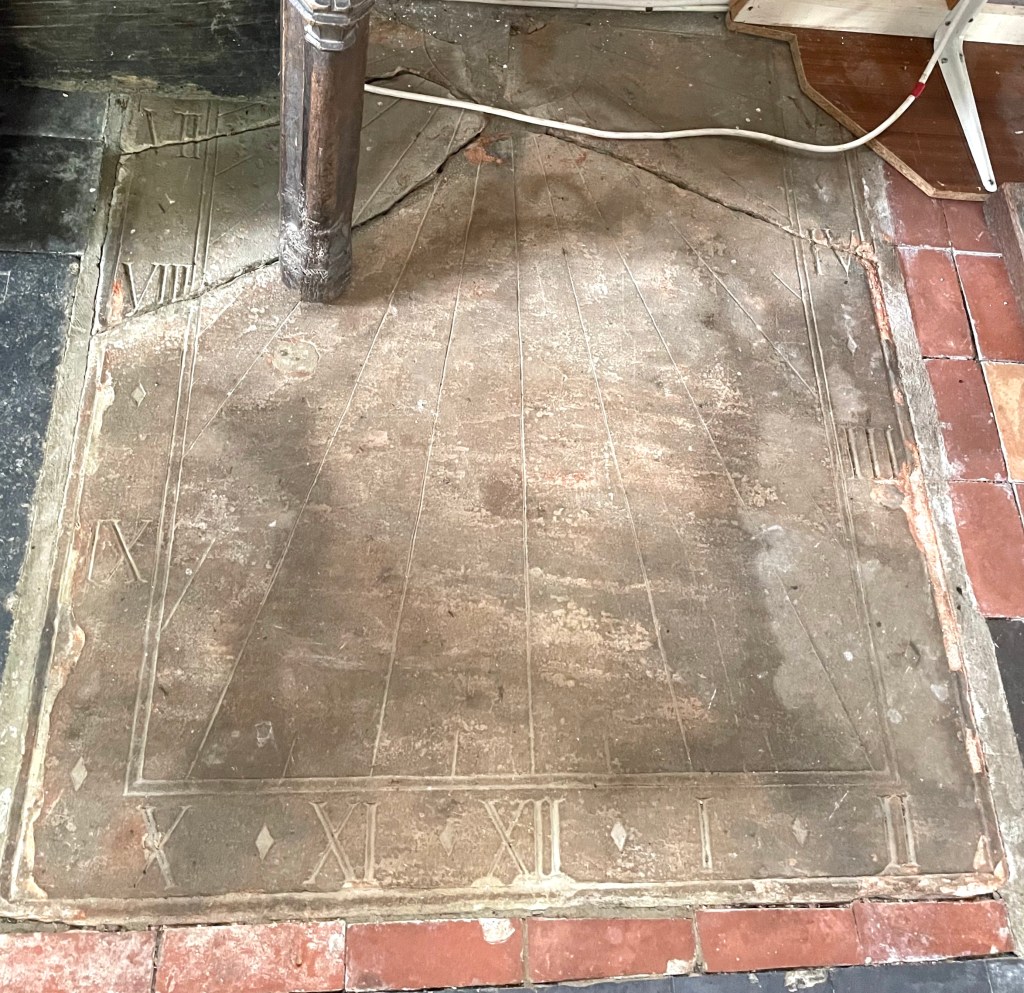
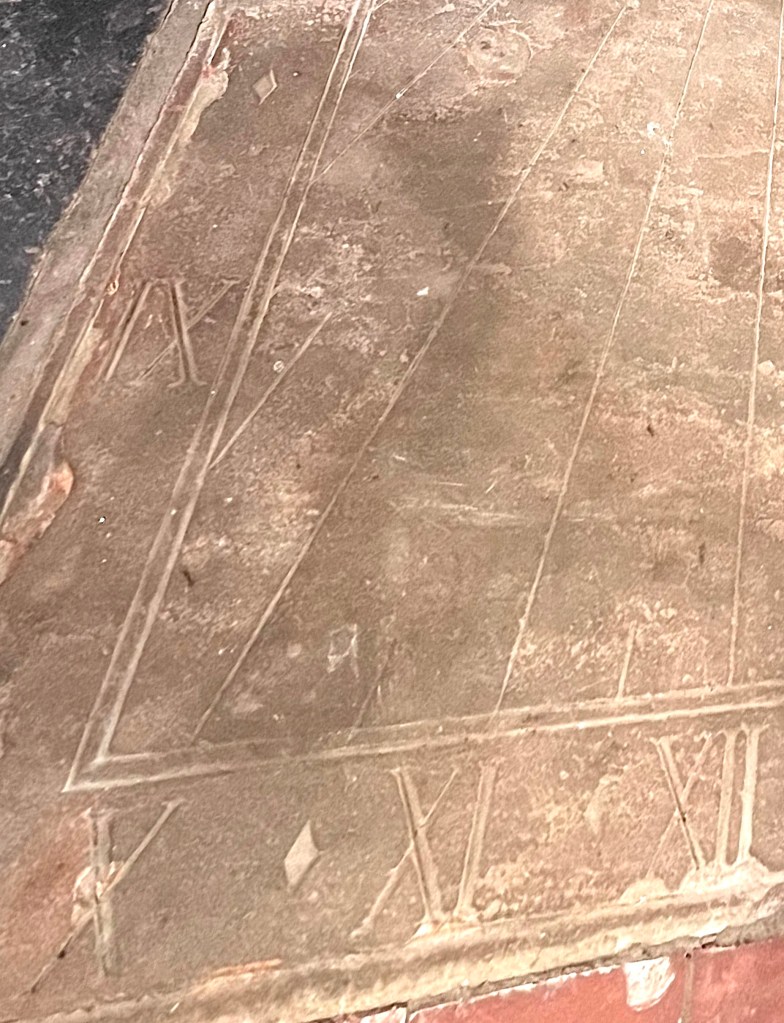
I am grateful to my friends in Cley, Hanne Siebers and Klausbernd Vollmar, for discovering and photographing this most unusually positioned dial that has been incorporated into the floor of the church, serving a new purpose despite its damaged state.
St Margaret . Cley-next-the-Sea – Vertical Dial set in the Chancel Floor (Hanne Siebers & Klausbernd Vollmar
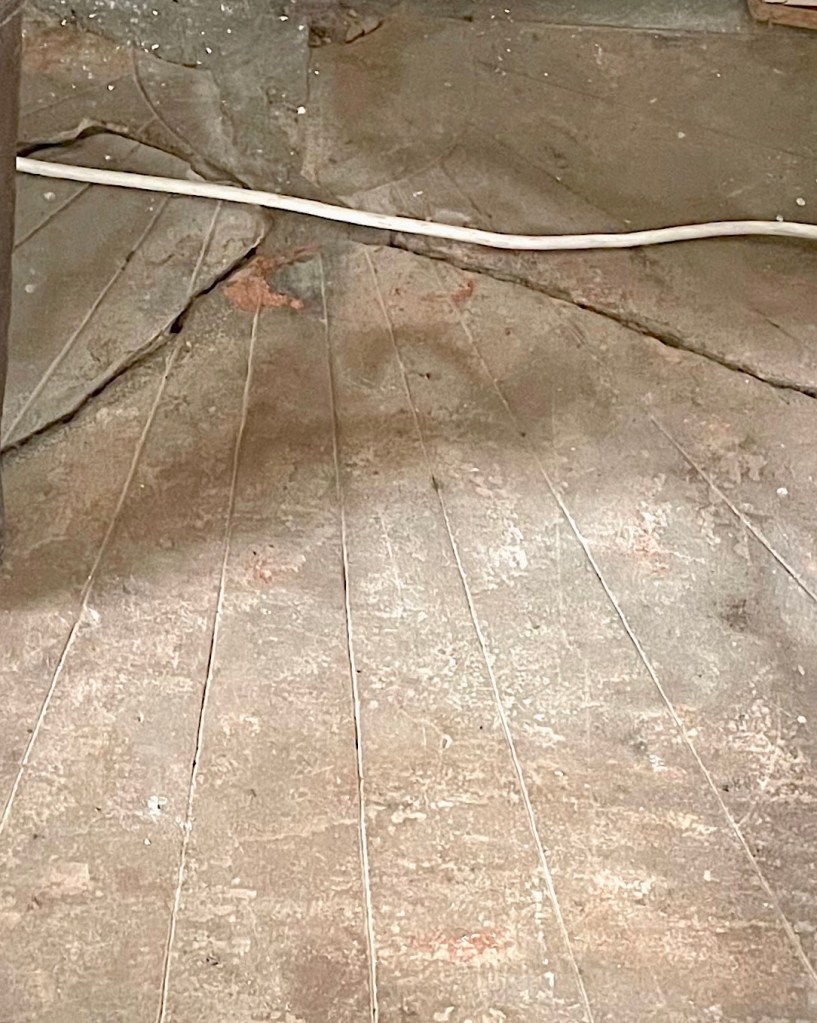
The lines are more-or-less equally spaced, suggesting that the dial’s aspect was originally due S. The hours are separated by lozenges, and half-hours are marked. At the back / top end of the dial, there is considerable damage. It is just possible to make out a semicircle with a hole where the gnomon would have been. The incised numerals VII, VIII, III, and IV are less worn and indeed are surprisingly sharp, which might suggest that the dial was below a ledge of some sort that protected the upper part from weathering. One puzzle is the way in which VIII is split by a single crack, yet part of the numeral appears to be missing completely.
DATING THE DIAL
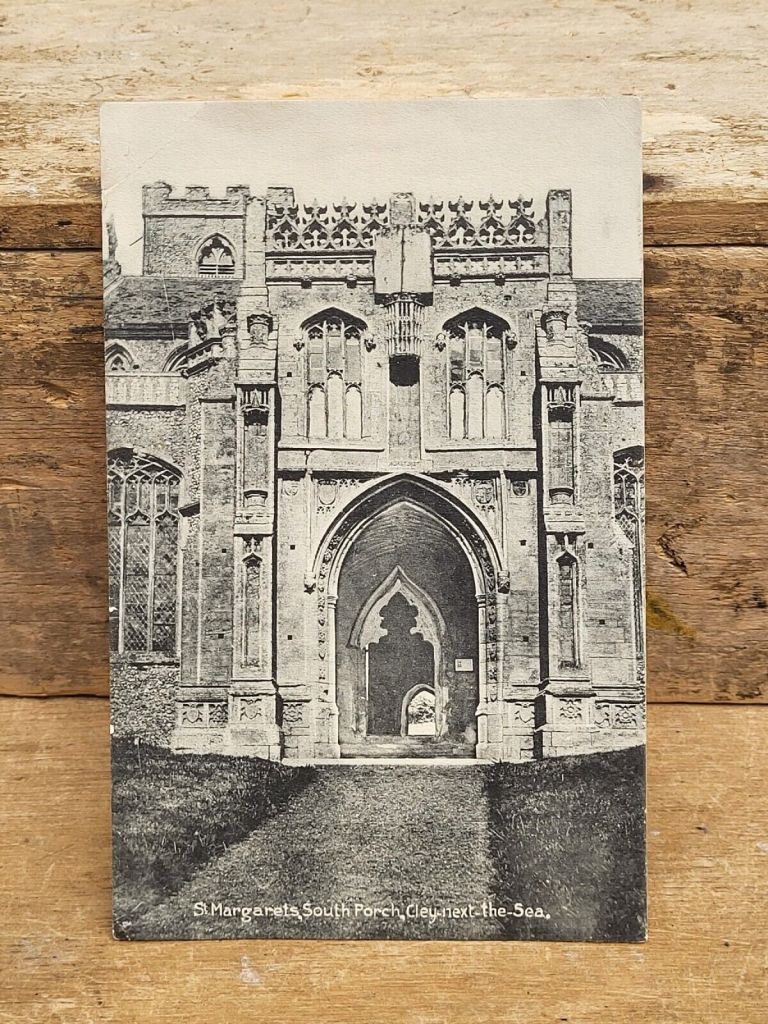
I initially thought that the dial was ±1800. The date of its removal and repositioning was unrecorded in the usual sources. As it turns out (with many thanks to Rev. Richard Lowery and Richard Jefferson) the change of location happened within the last 50 years or so. The dial had been high up on the S porch, but had become a danger. It was taken down and set in the floor of the chancel. The damage occurred at some stage during the relocation.
The earliest depiction I can find is a lovely drawing by John Sell Cotman dated 1818. It gives the dial due prominence and I think it can be confidently dated to ±1750. The work interestingly show the state of ruination as Cotman saw it.
St Margaret . Cley-next-the-Sea – John Sell Cotman – Art Institute of Chicago
Old photos and postcards can be a good way to approximate a date (or a span)
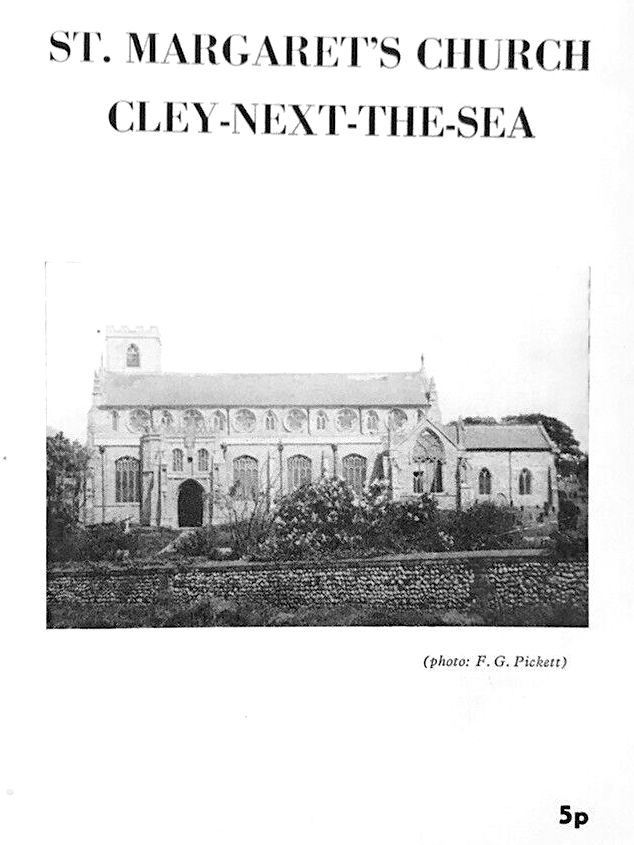
In 1959, C L S Linnell produced a Booklet for the Church. It was obviously successful – there were 4 reprints, the last in 1973. The cover photo of the Church shows the dial in its rightful place (though quite probably it was not updated for the reprints). Certainly by 2000, the dial had been repurposed.
An excellent account of the church and some of its medieval details (roof bosses &co) can be found with this link NORFOLK CHURCHES.
GSS Category: Sundial; Vertical Dial; Old Dial; Repositioned Dial
Photographs: header photo, Keith Salvesen; dial photos (with edits for clarity), Hanne Siebers and Klausbernd Vollmar with thanks as ever for their interest in this dial project and for their excellent contributions from other churches; other images os / cc / as shown
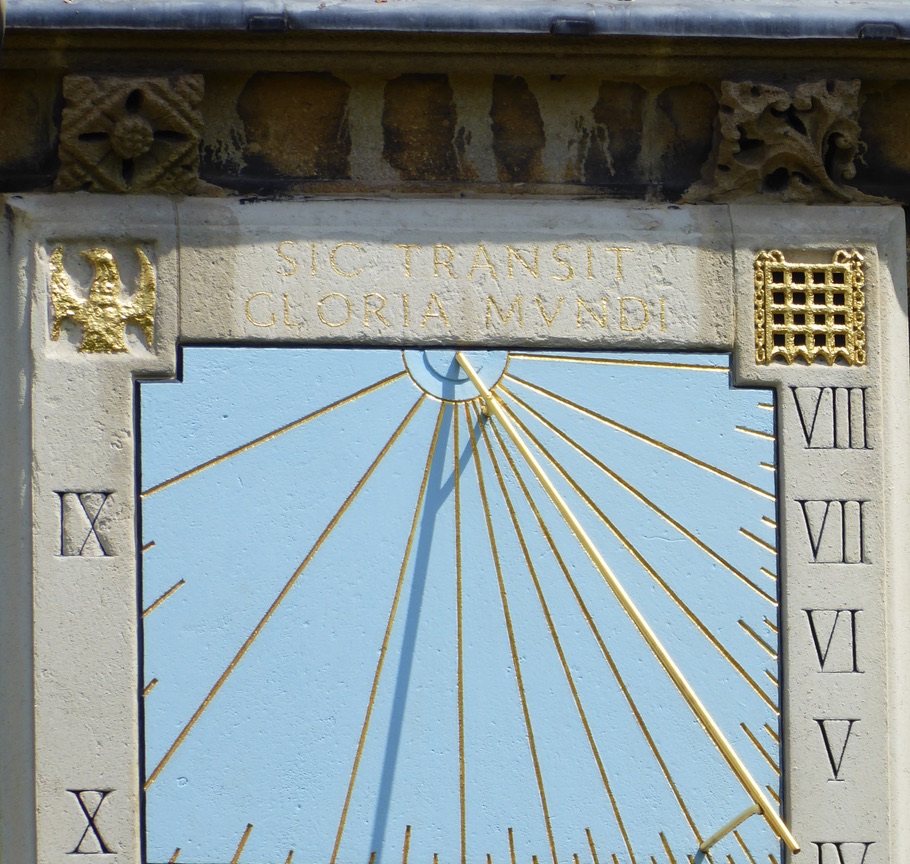
The sundial is located on the wall of the Hall, and – for those not entitled to enter the College – easily visible from the entrance by the Porters’ Lodge. It is dated 1927, replacing a dial known (from an old print) to have been in this position in C17 that was lost during C19 alterations to the Hall. The dial was the gift of a College benefactor. His initials and the year of installation are on the dial supports. The calculations were carried out by a Member of College who was a sundial expert.
The unequal positions of the hour markers take account of the SW aspect of the wall, showing more afternoon than morning hours for accuracy as the sun declines.
GSS Category: Vertical Dial; Old Dial; New Dial; Sundial Motto
All photos: Keith Salvesen
Text based on the entry for Christ’s College in the booklet ‘Cambridge Sundials’ by Margaret Stanier and Alex Brookes. This, and its companion for Oxford, are included in the bibliography.
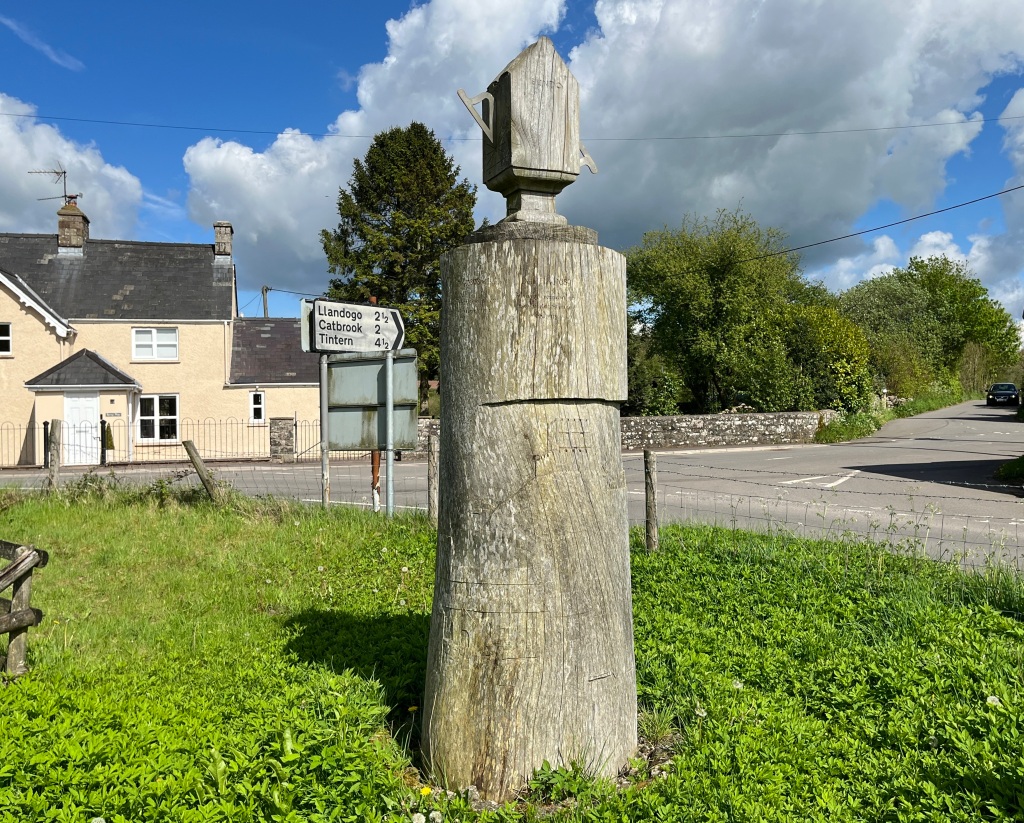
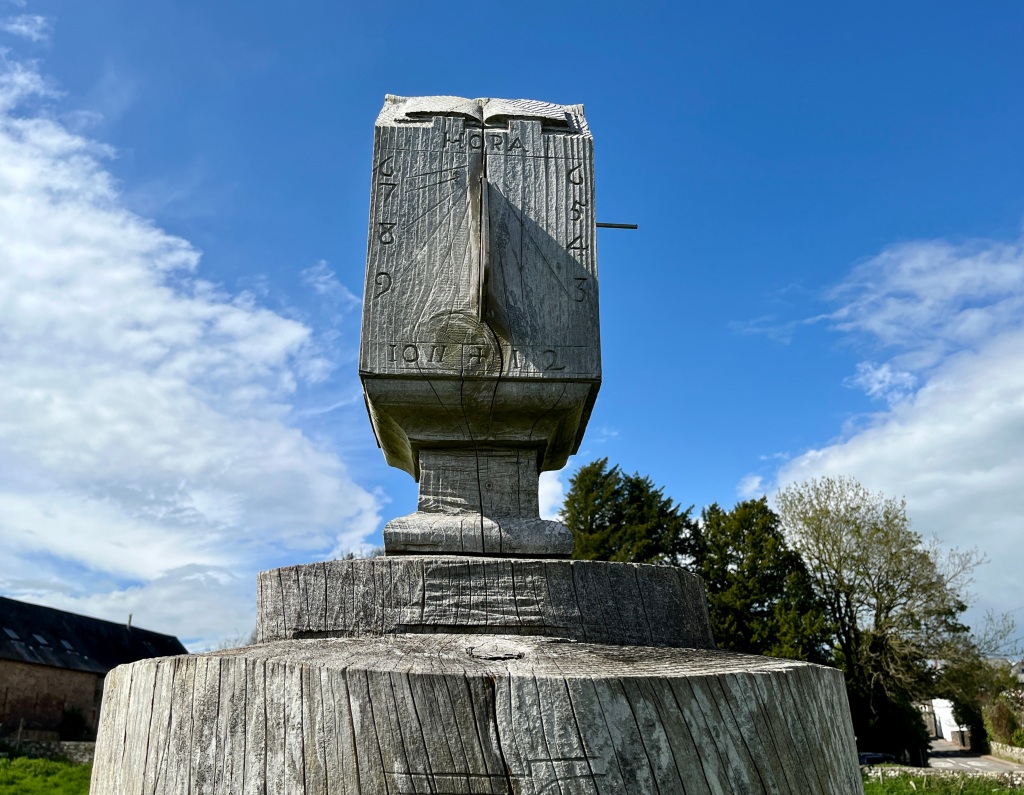
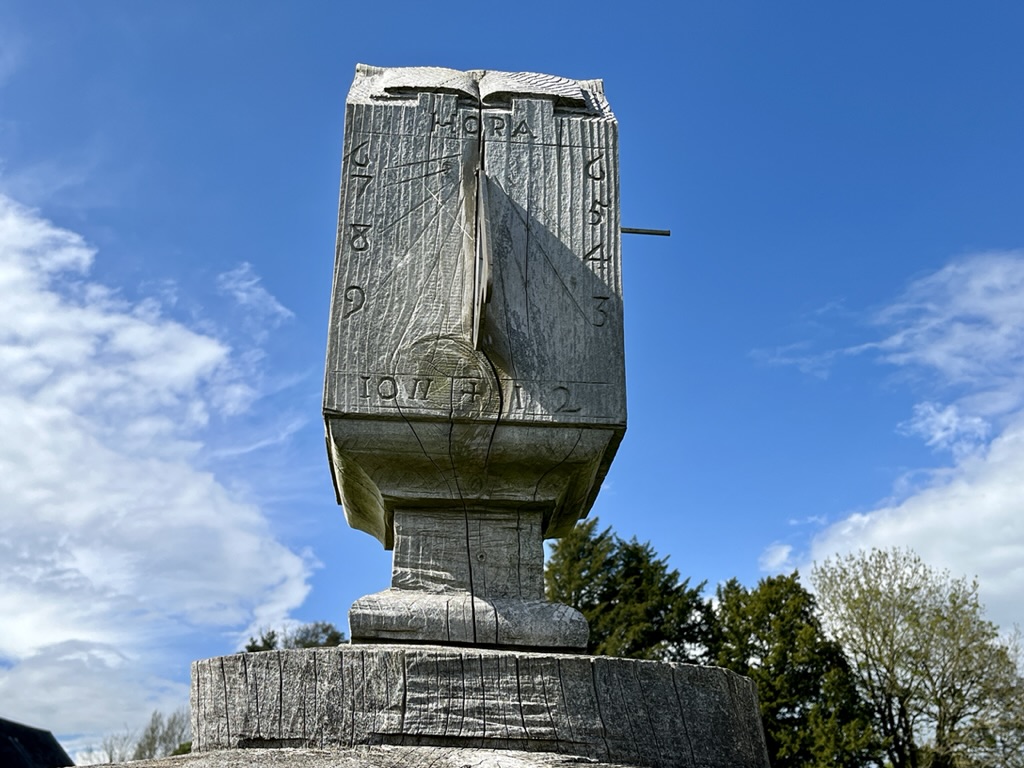
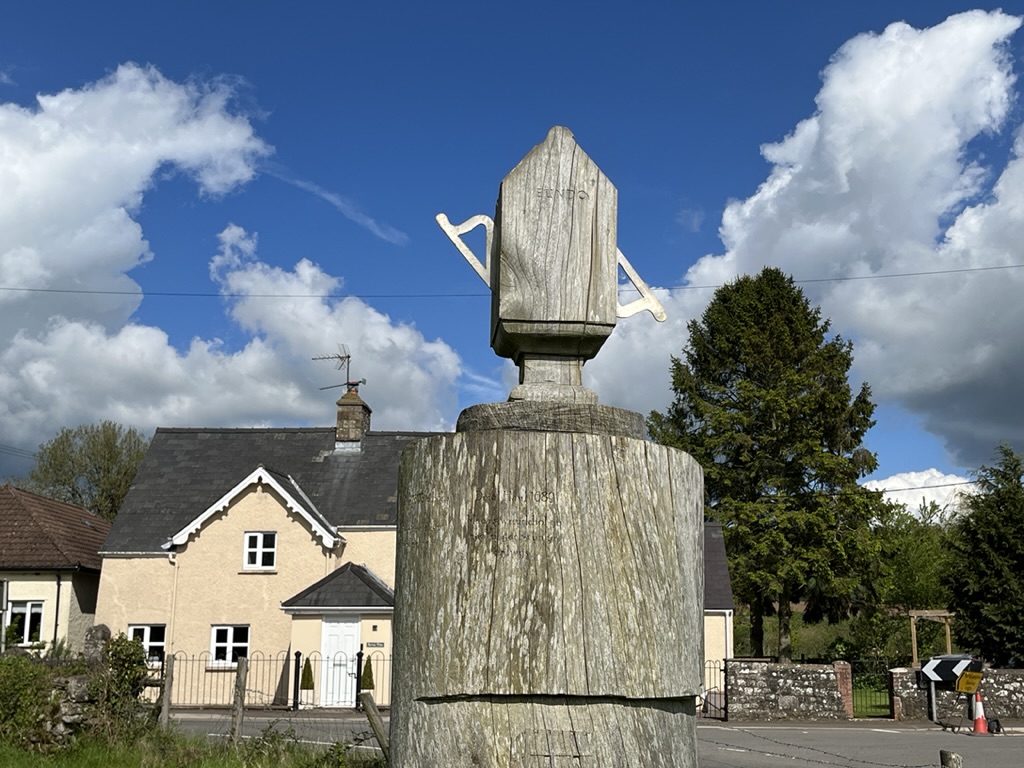
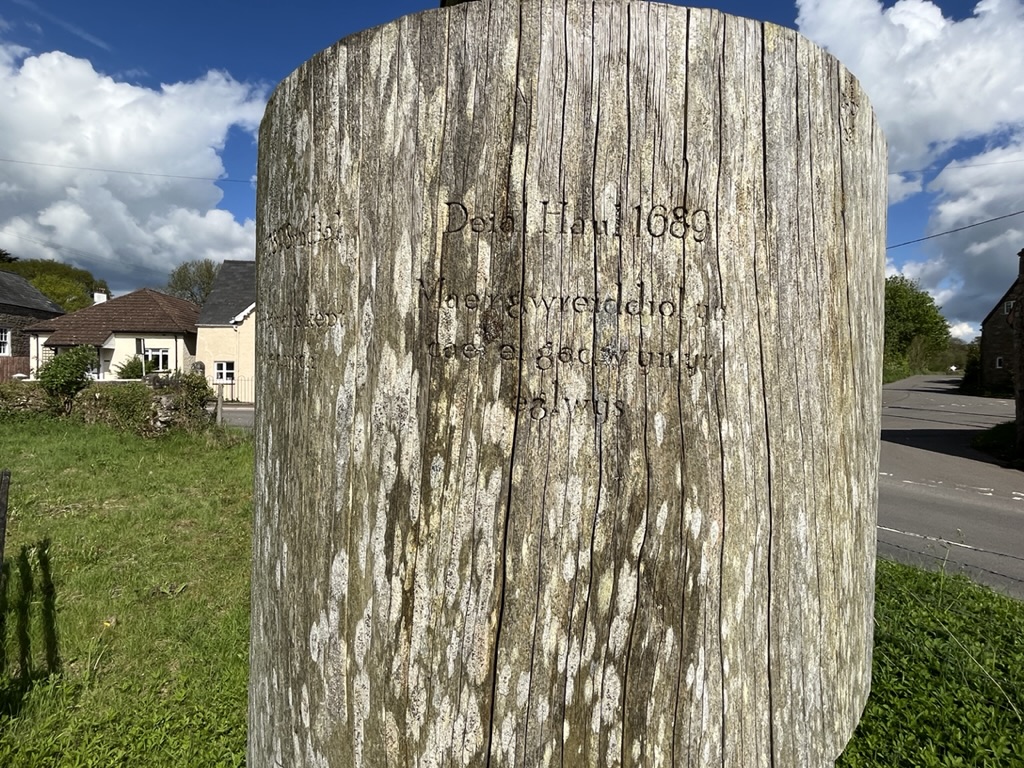
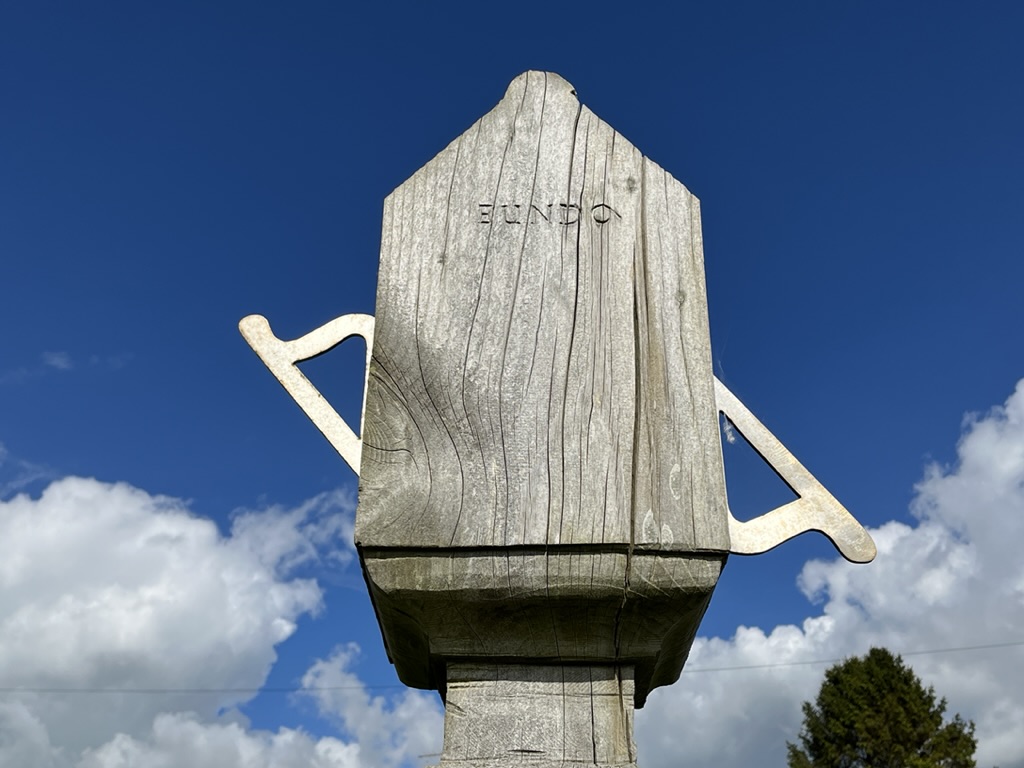
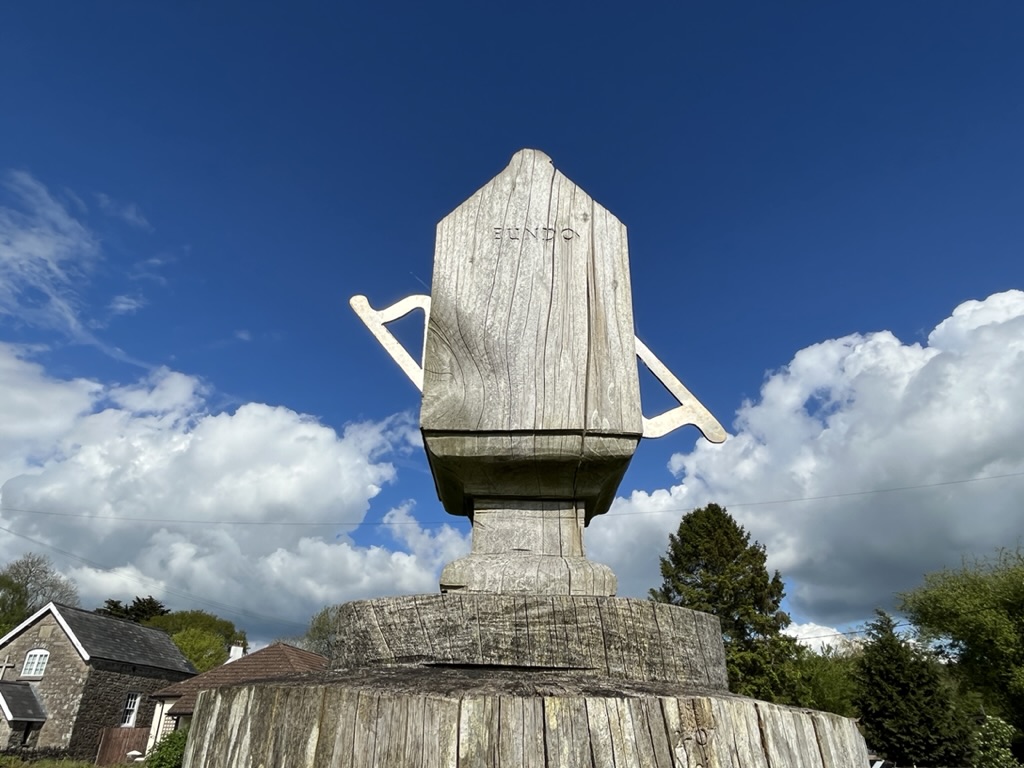
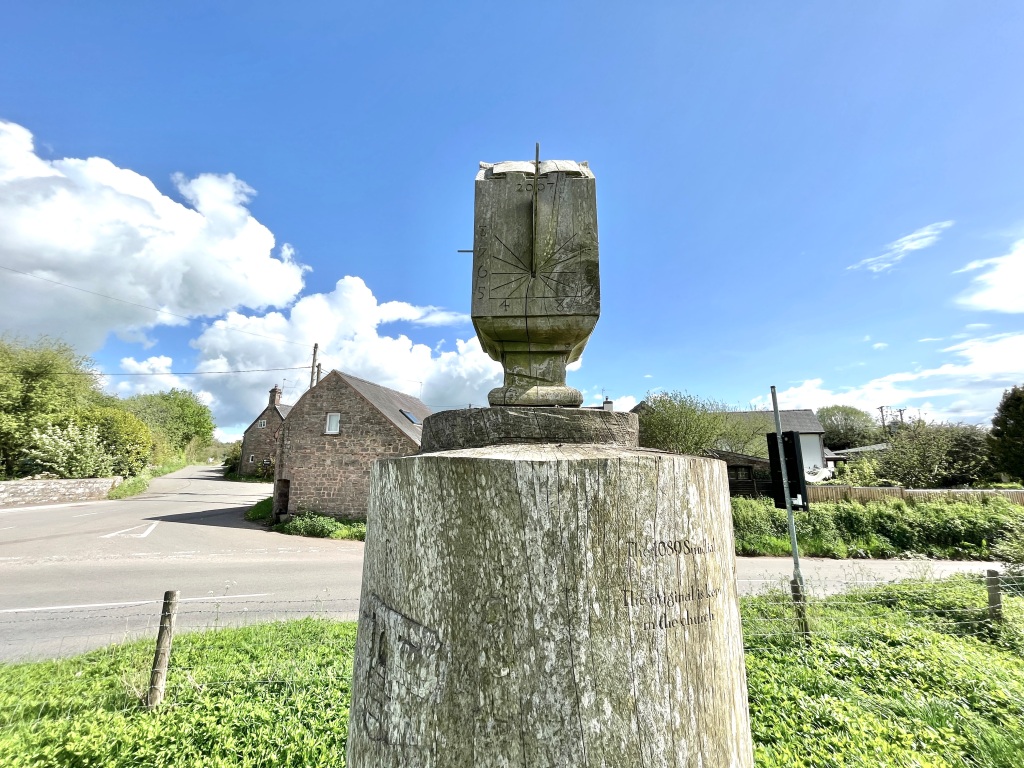
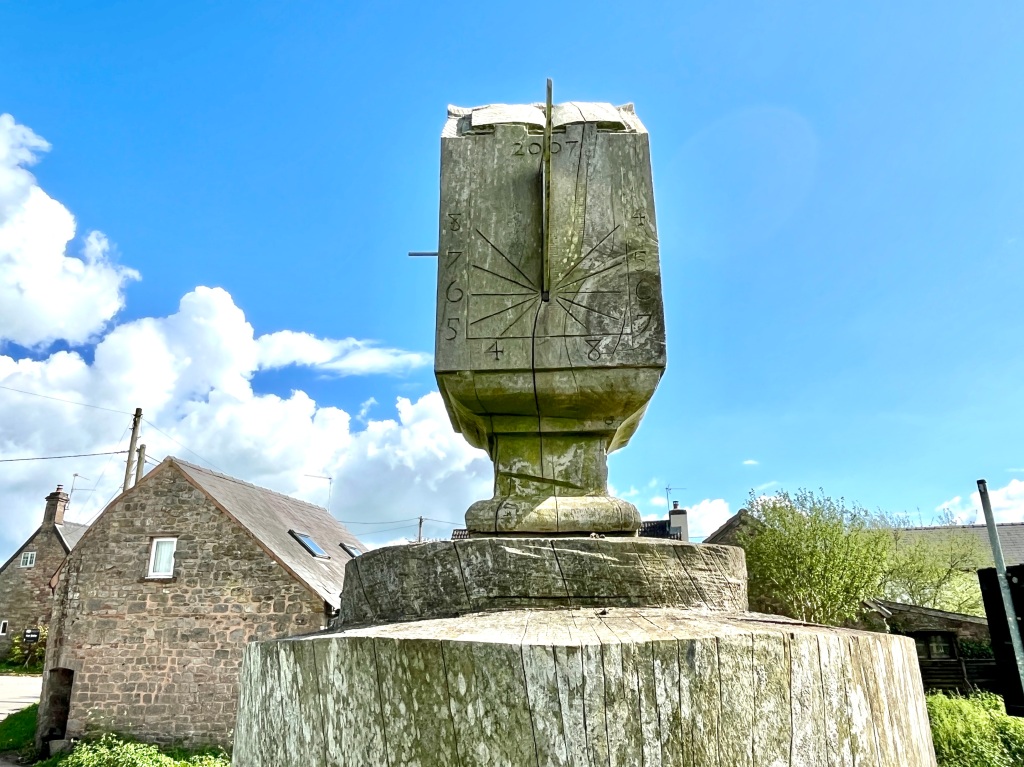
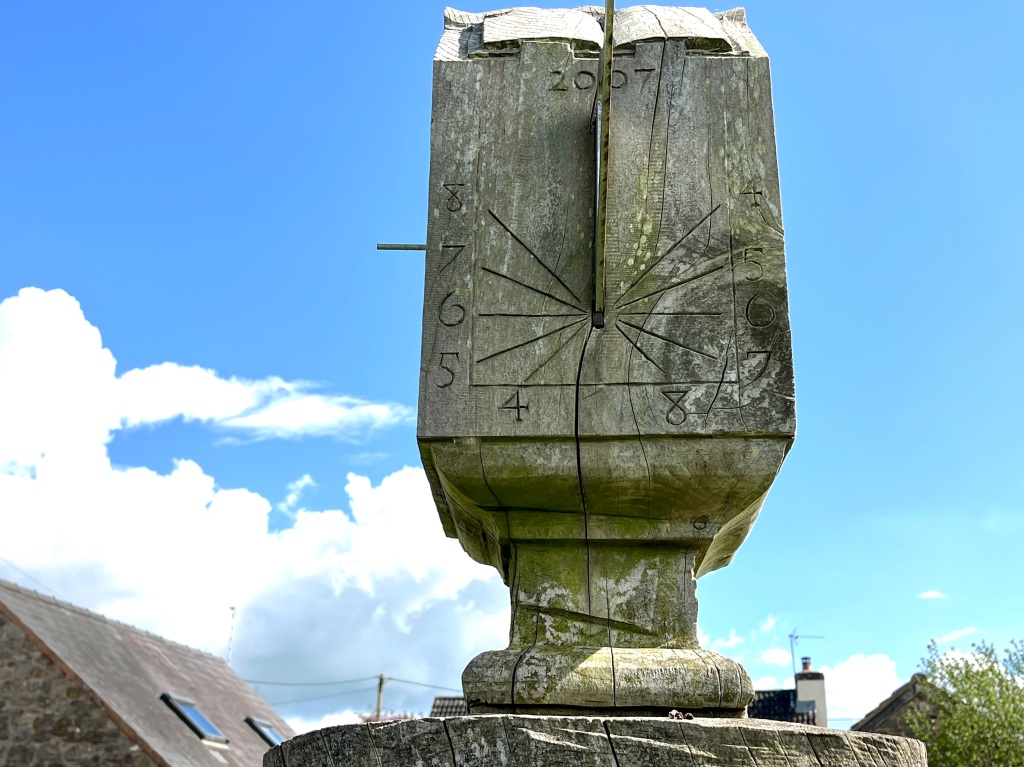
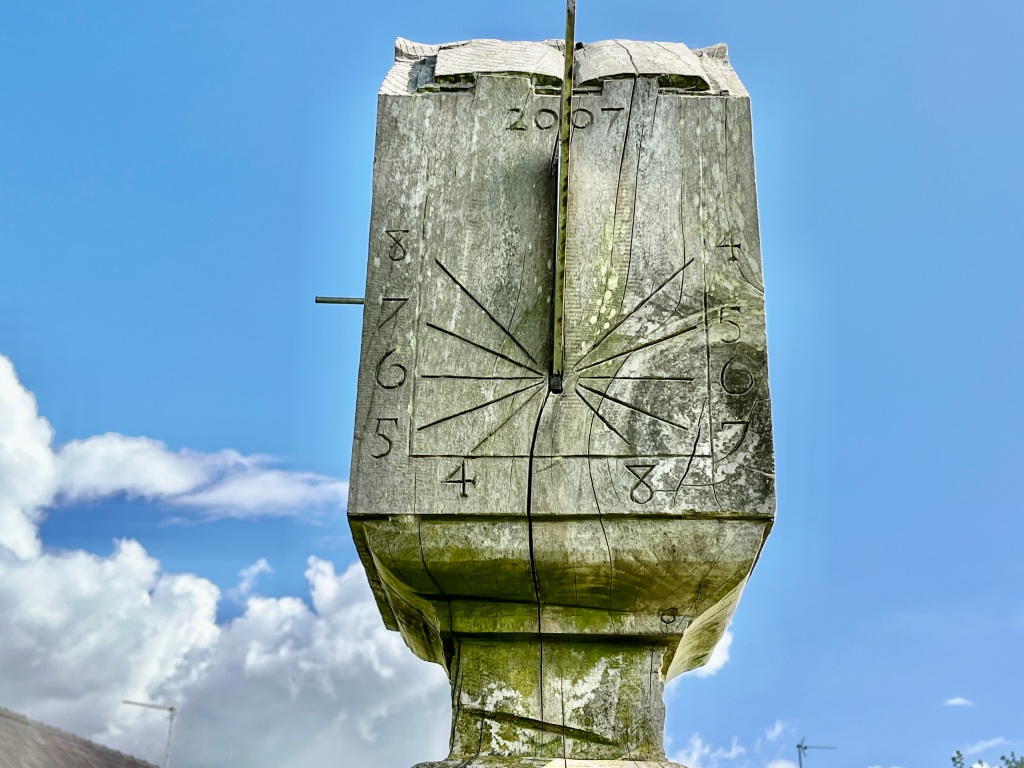
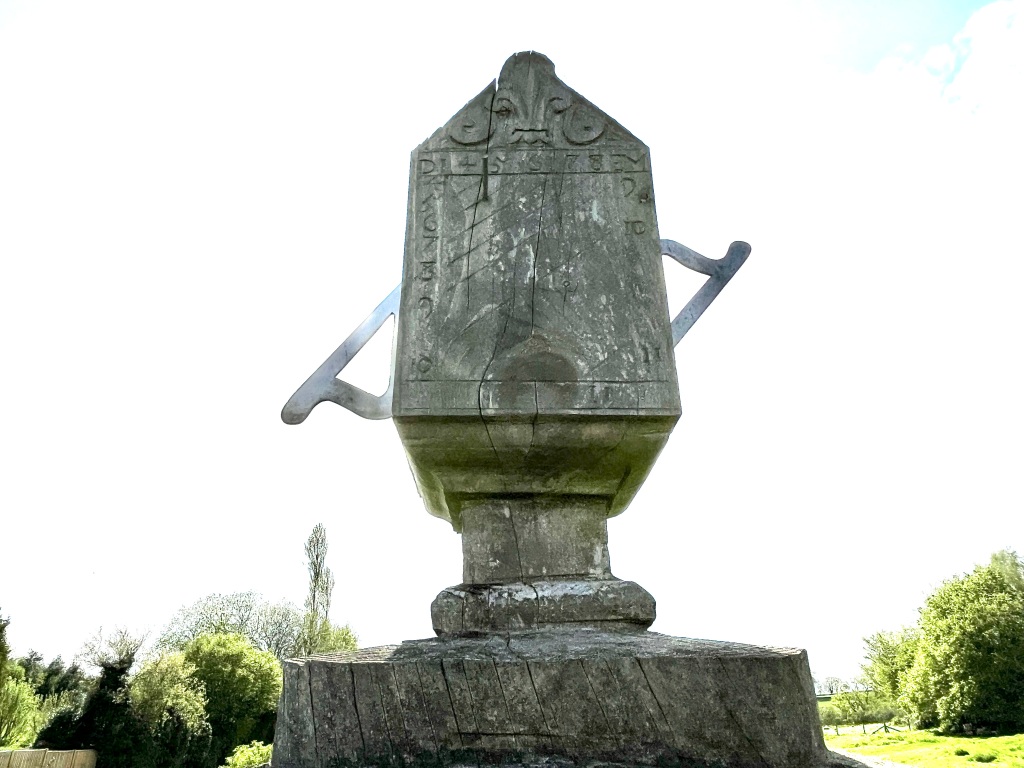
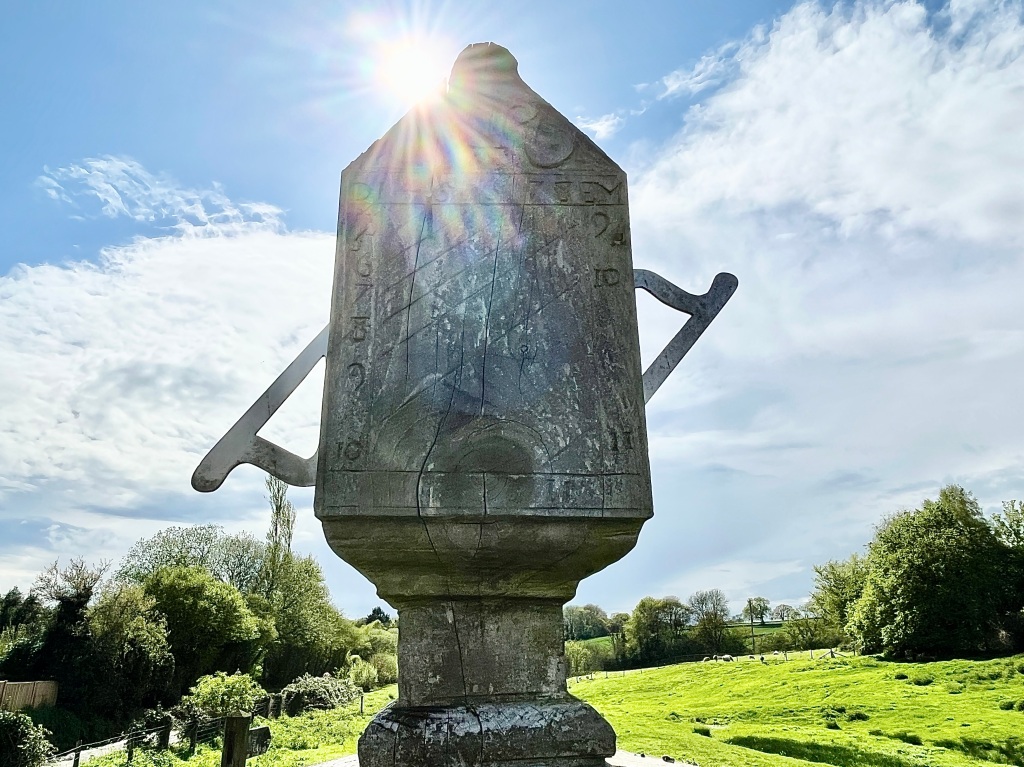
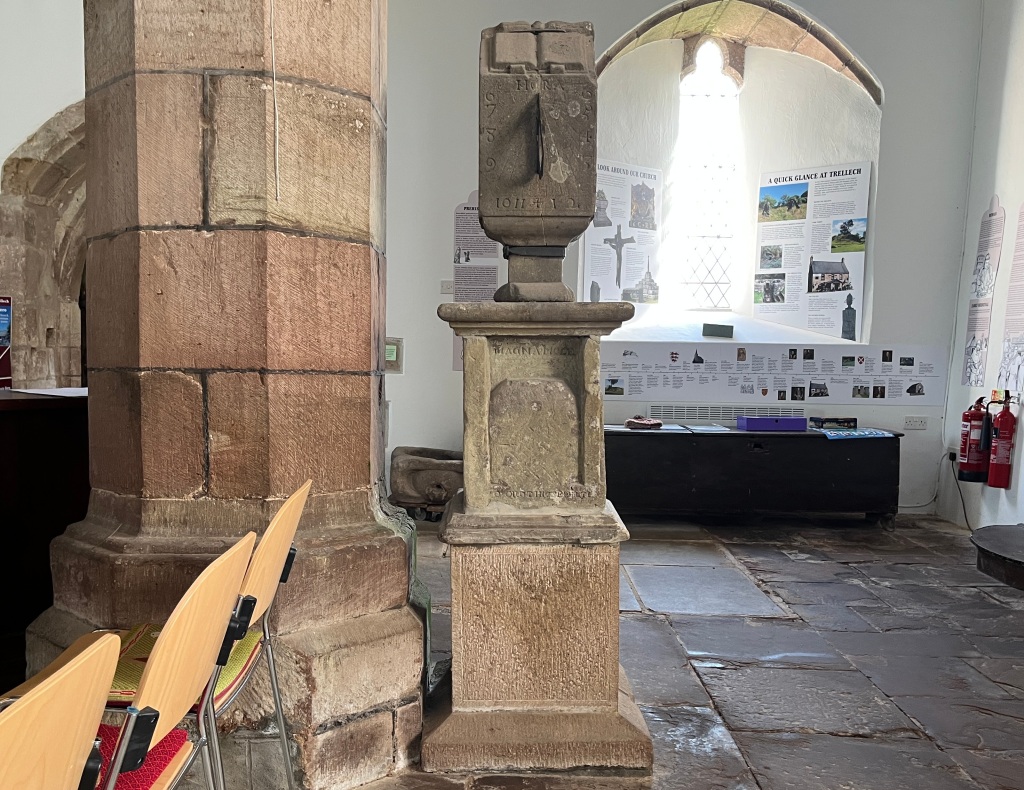
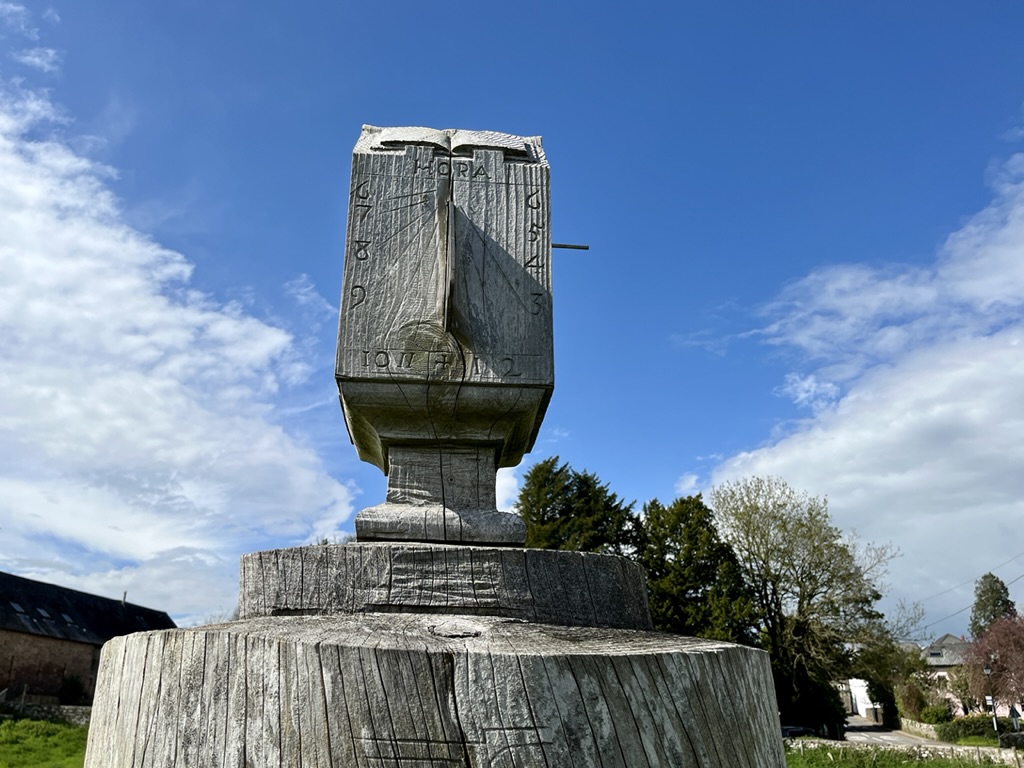
This post relates directly to its companion in Pt 1. Both articles feature the remarkable cube dial dated 1689, now preserved inside the Grade I listed church of St Nicholas, Trellech, Monmouth – the original and a fine recent (2007) wooden replica. You can find images of the original dial and each of its faces, with detailed descriptions, HERE. The location is 5m S of Monmouth 51.7459 / -2.725 / SO500054
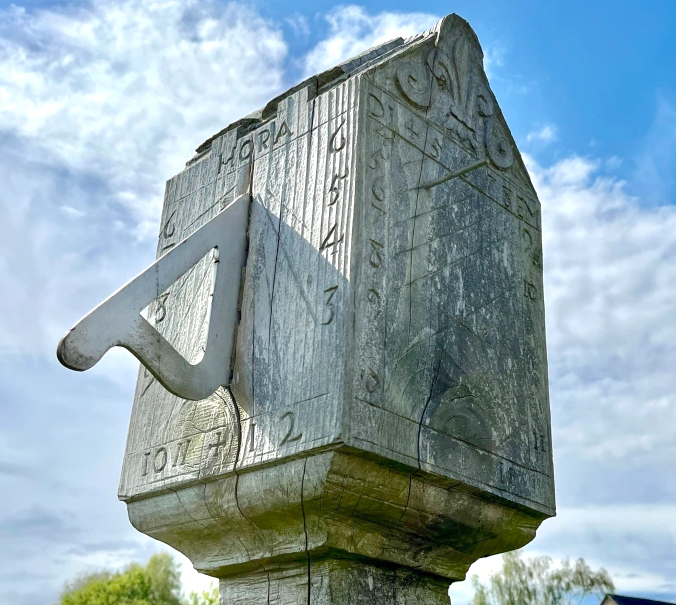
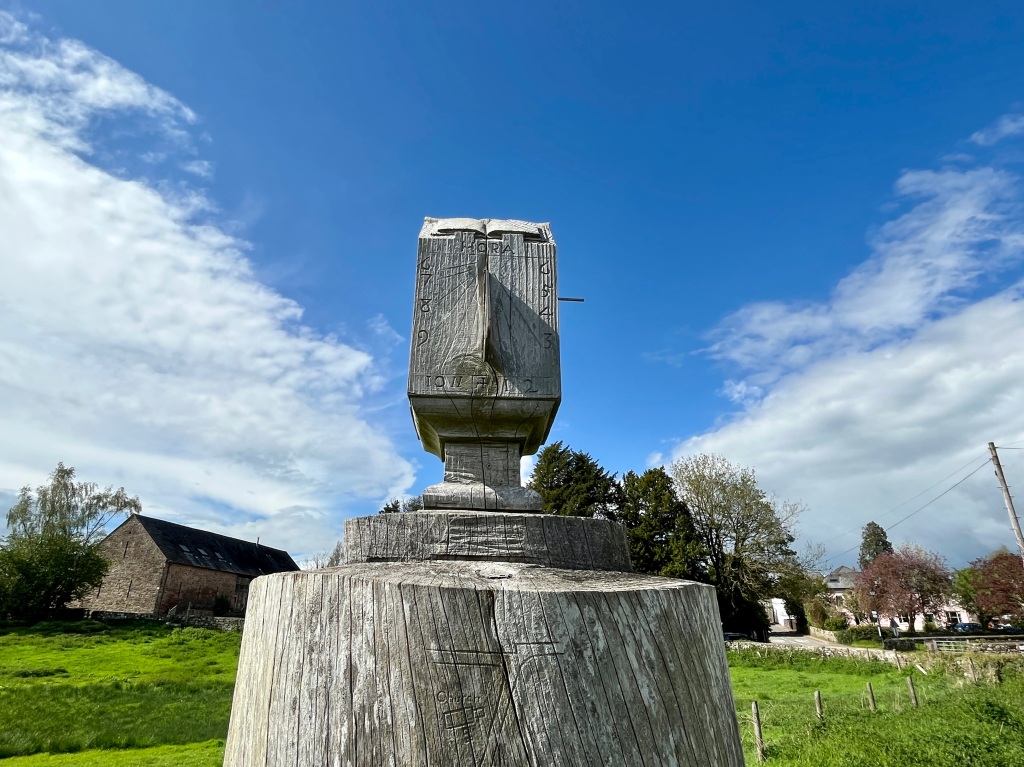
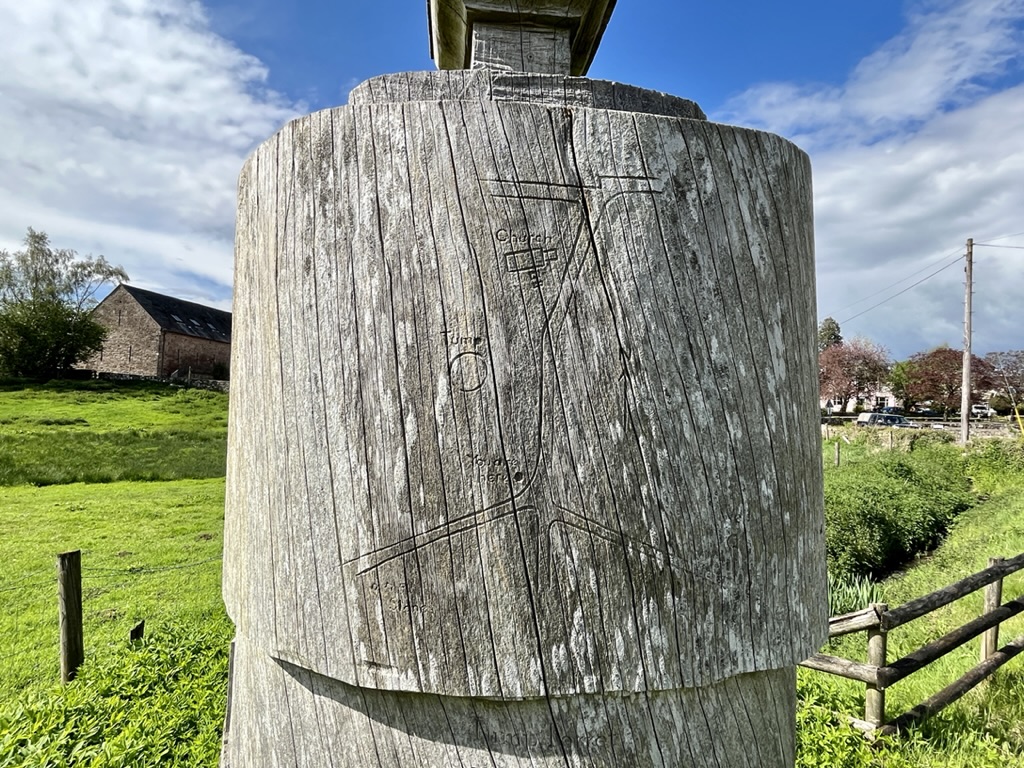
DIAL . 2007
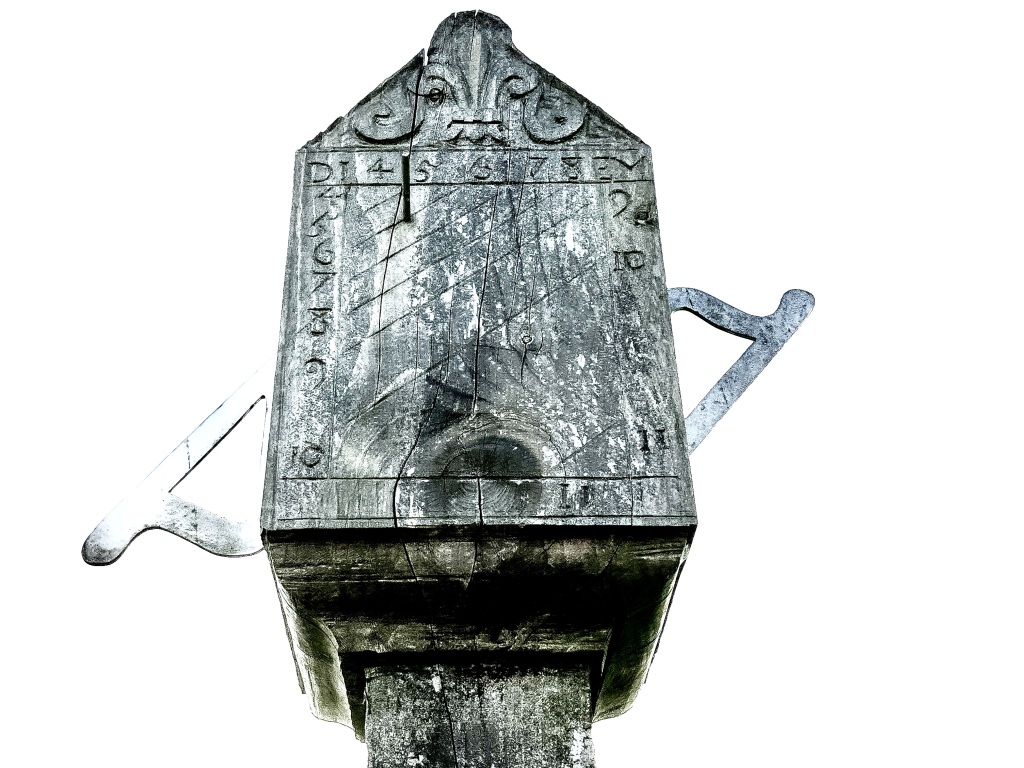
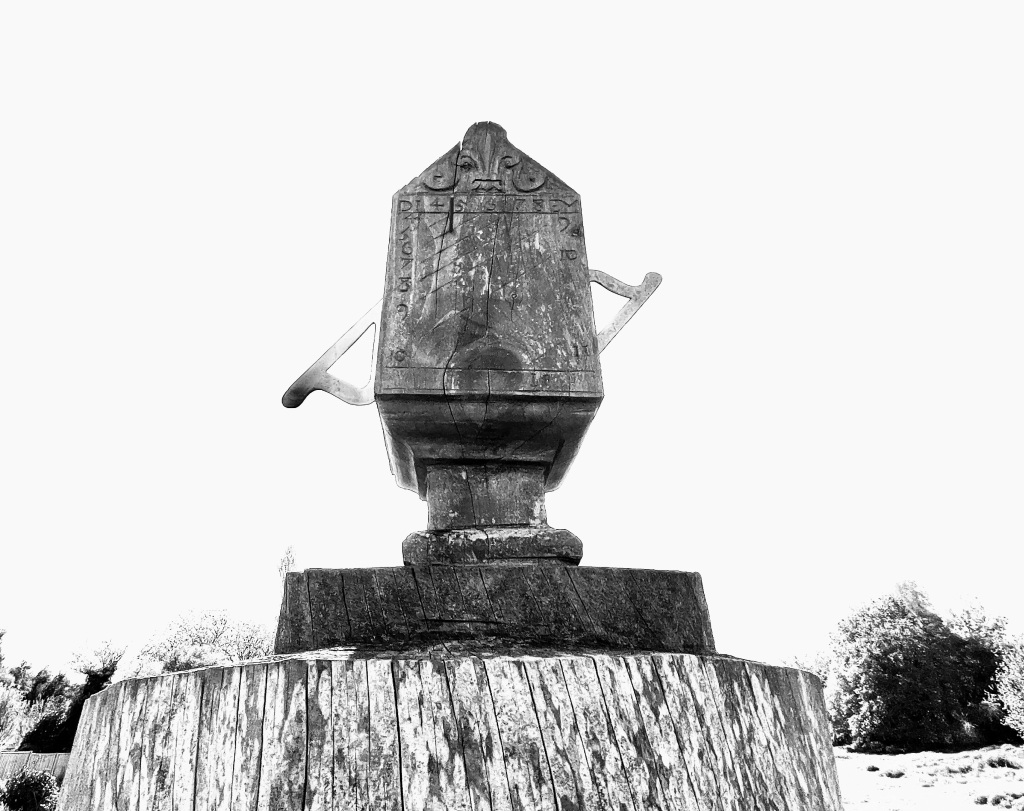
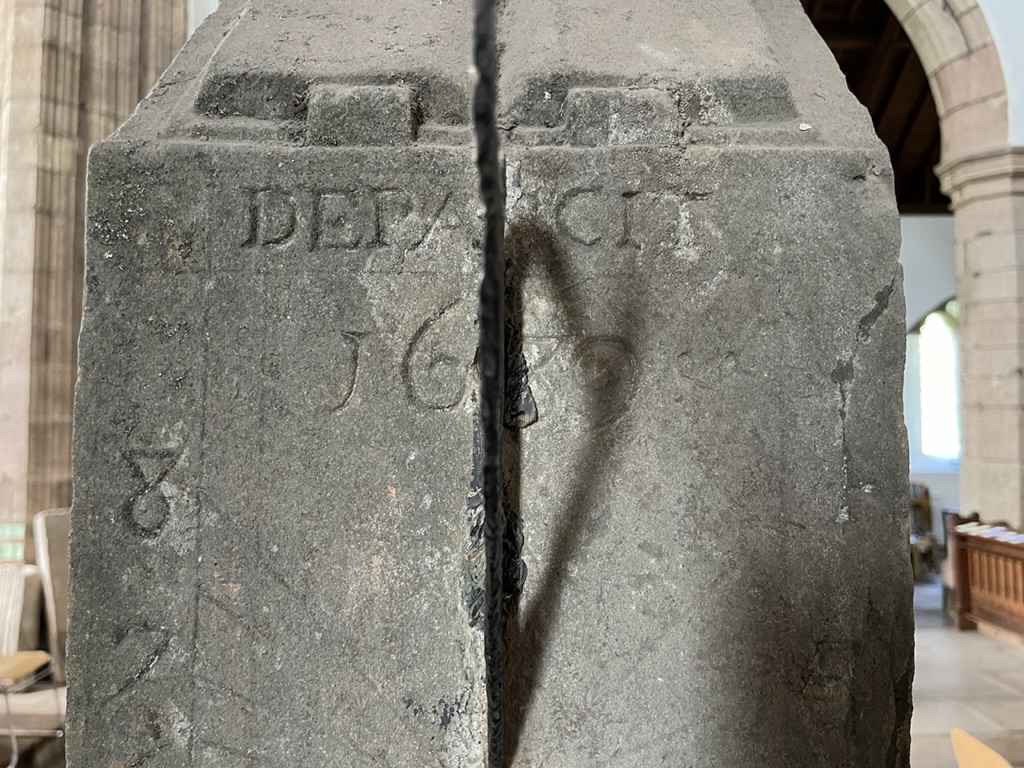
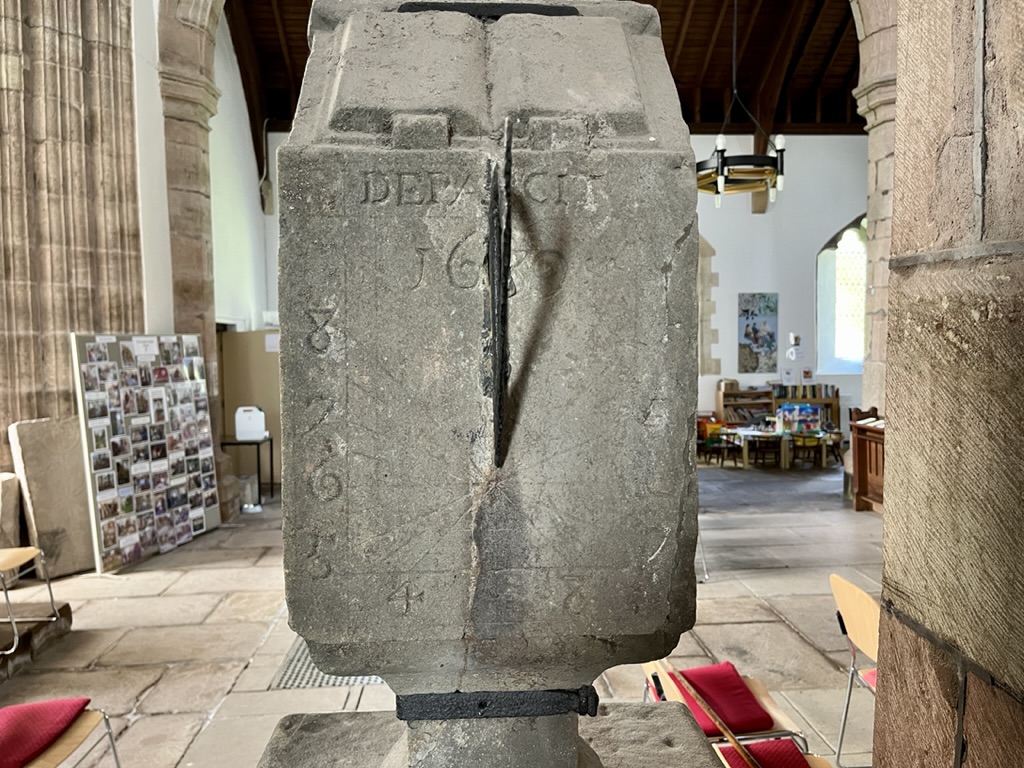
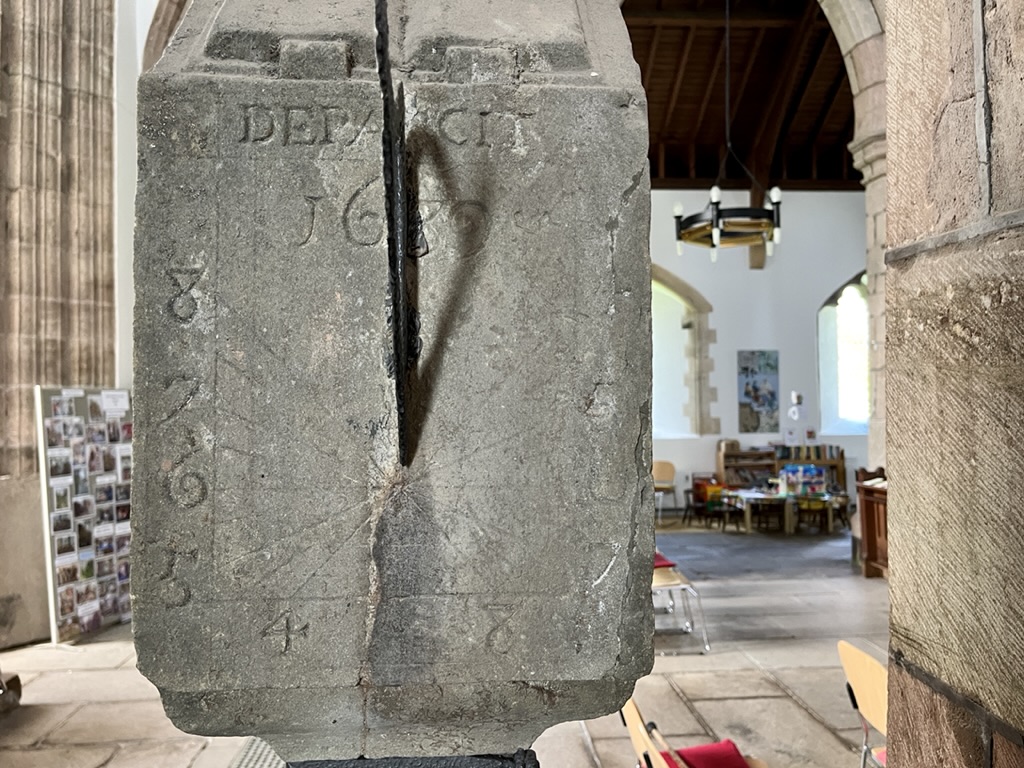
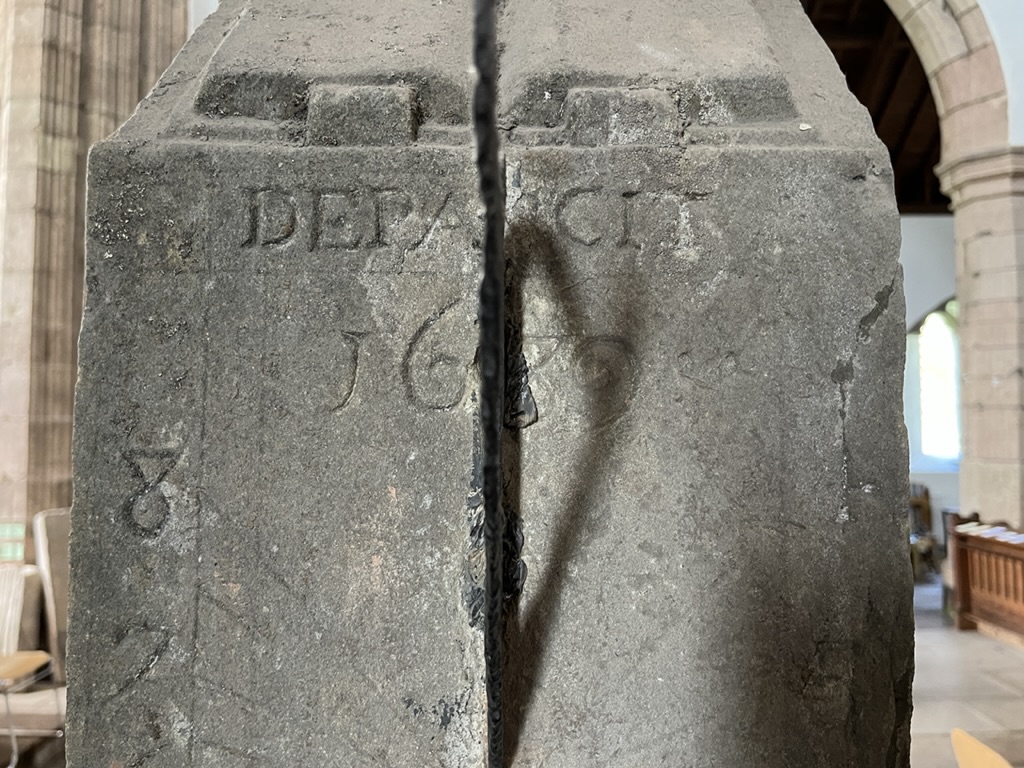
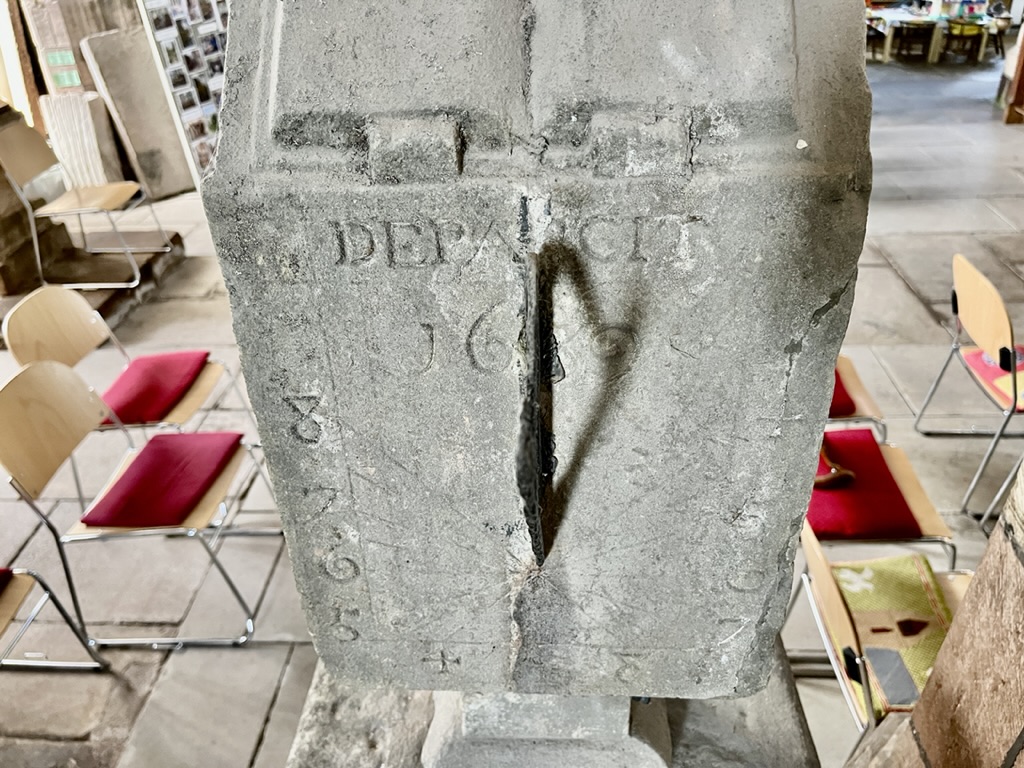
The images of Face 4 below illustrate a frequent experience with cube dials. Invariably, prevailing conditions preclude more than 3 faces being properly photographed. One face will always frustrate all attempts to get a decent photo. Furthermore, it is very difficult to improve a poor photo – it just becomes a different kind of poor. Quite often the only answer is to make the image B&W to catch detail .With apologies, this is what has emerged from the darkroom.
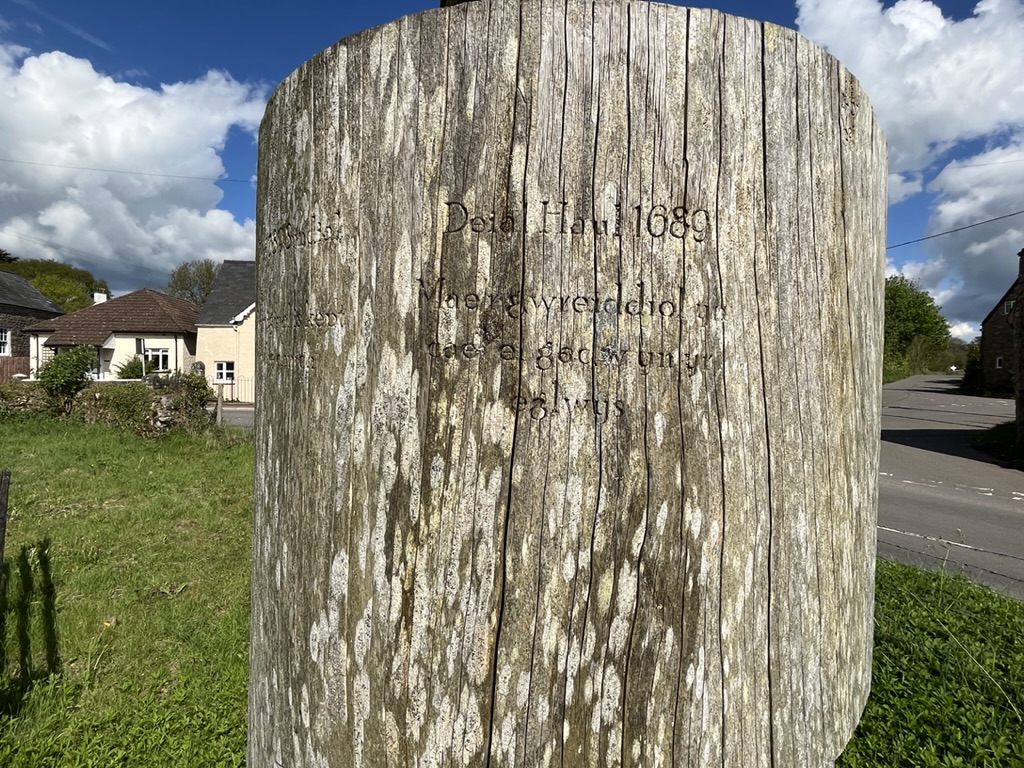
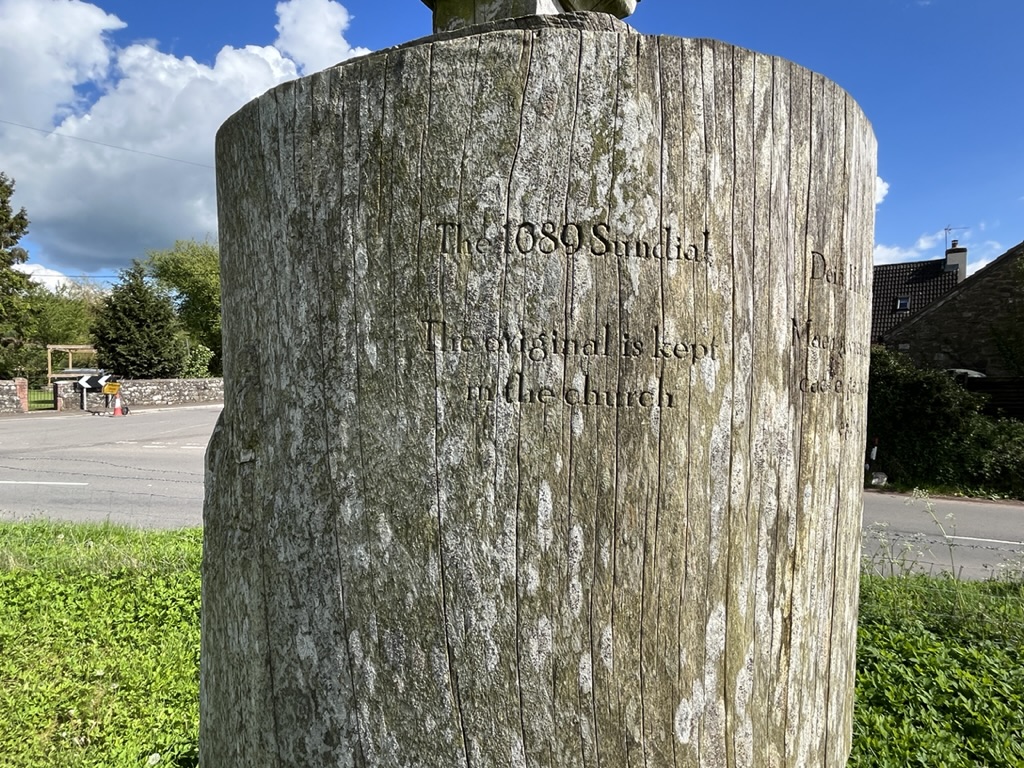
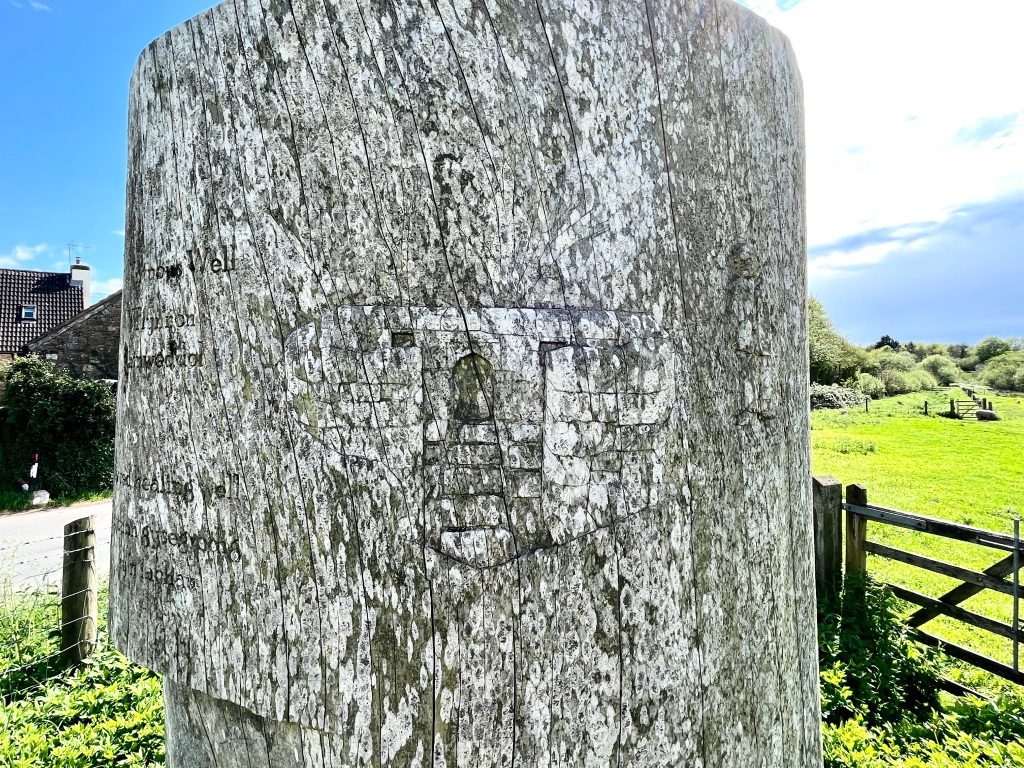
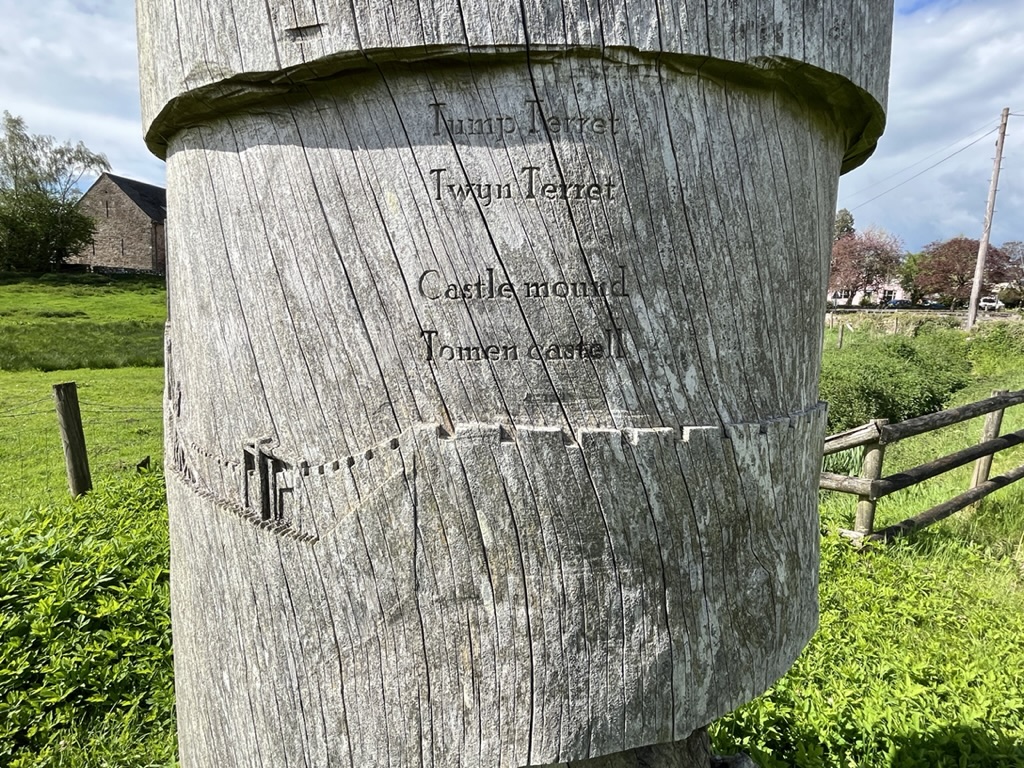
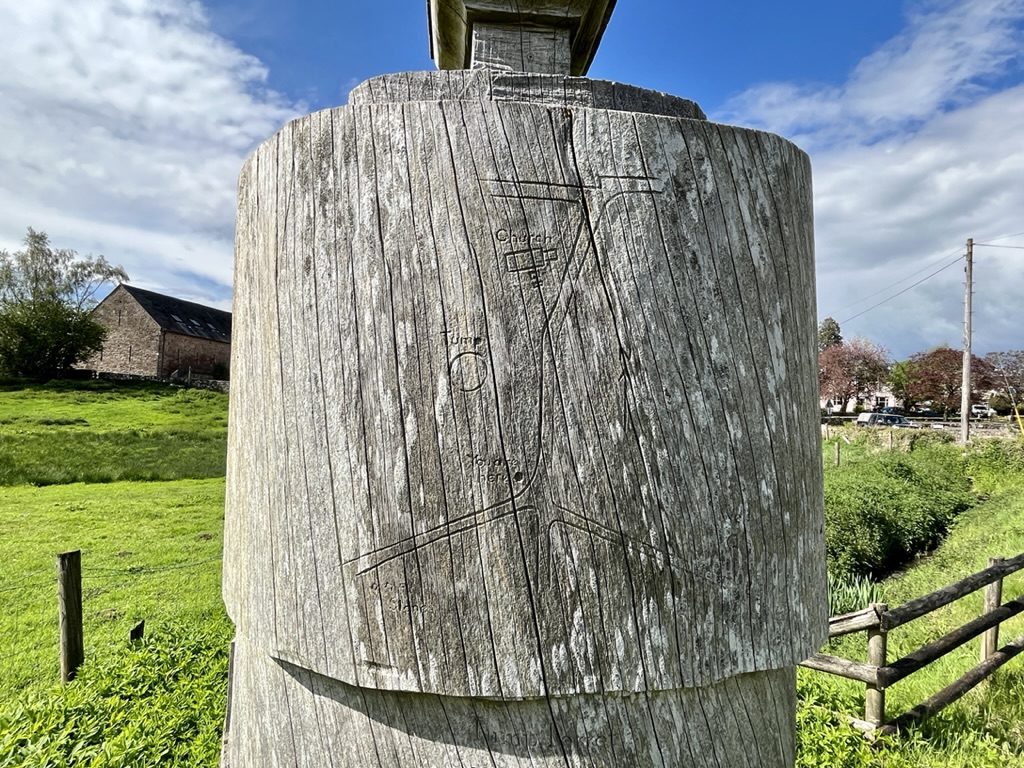
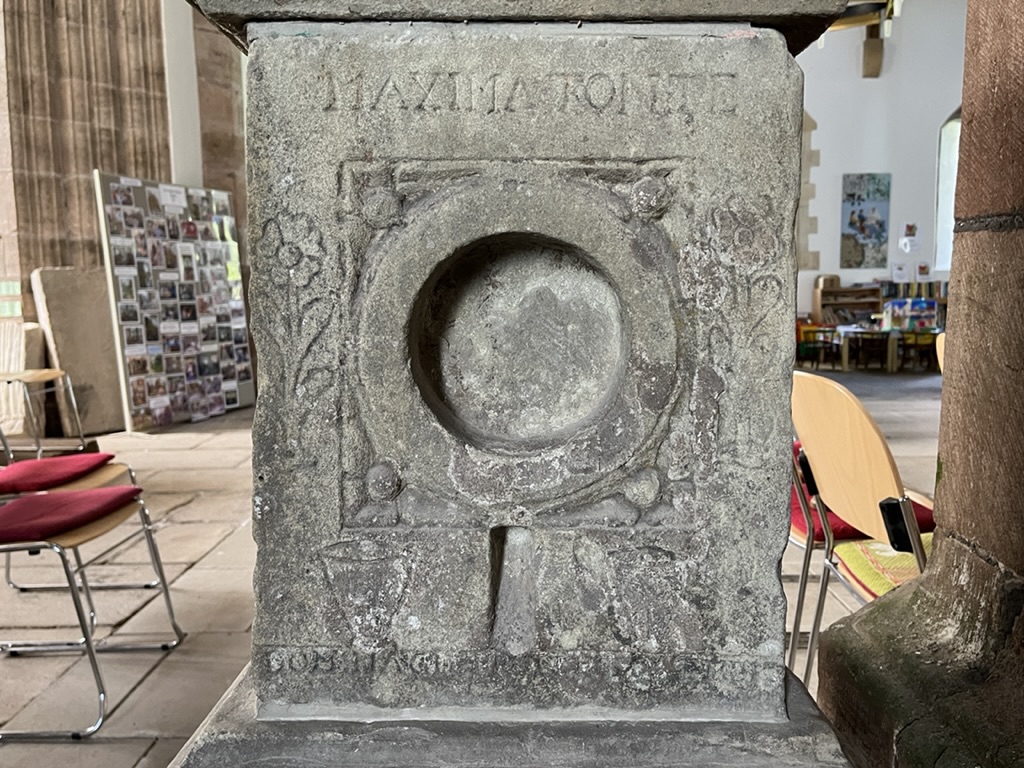
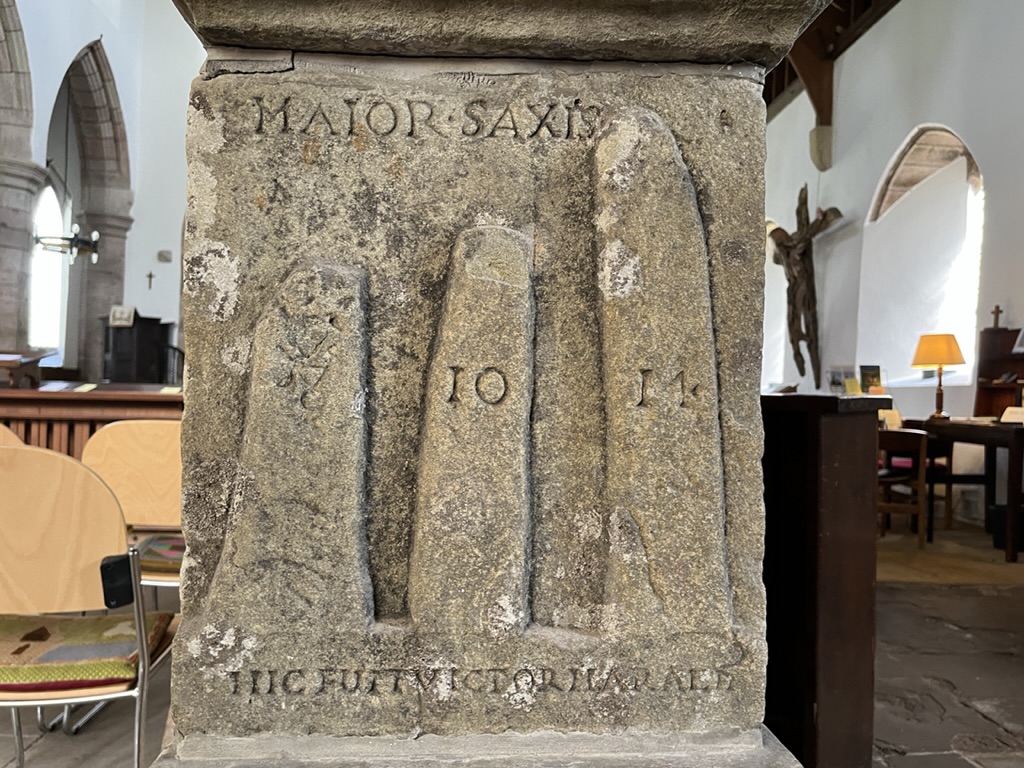
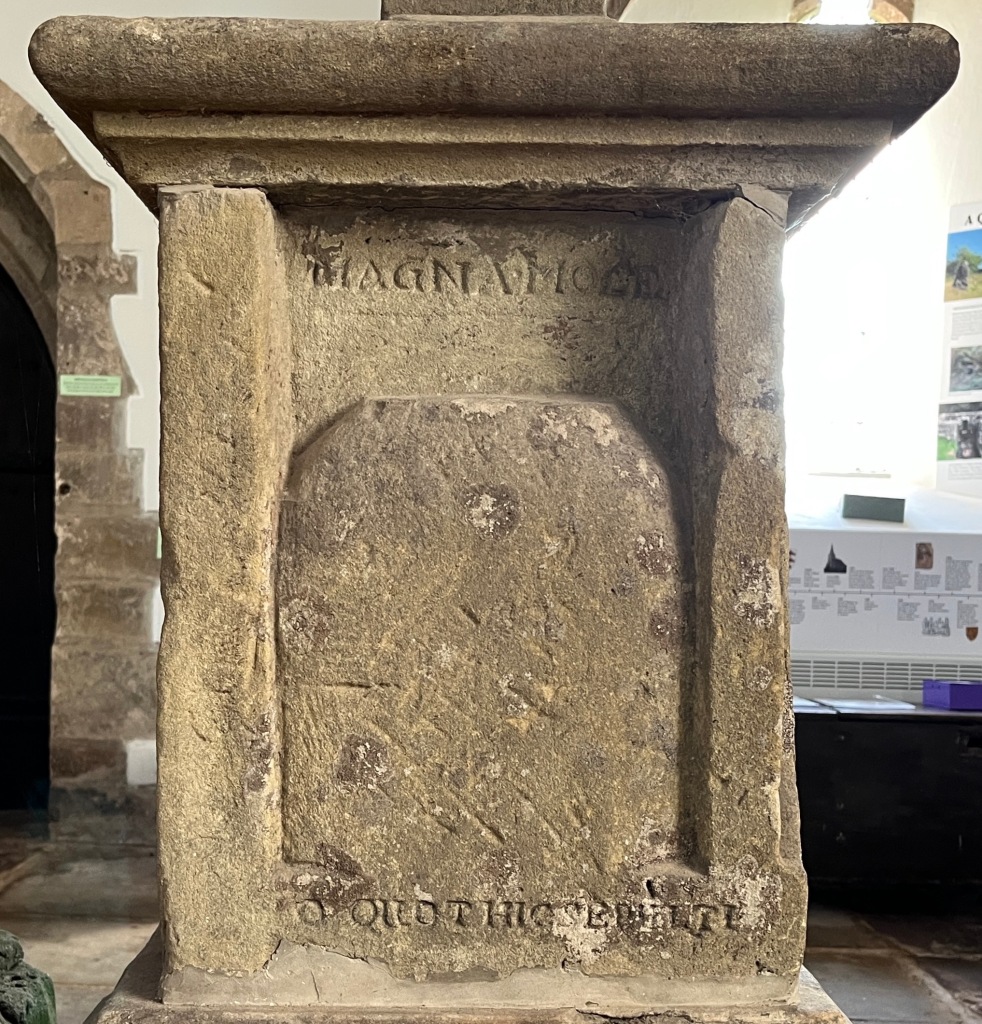
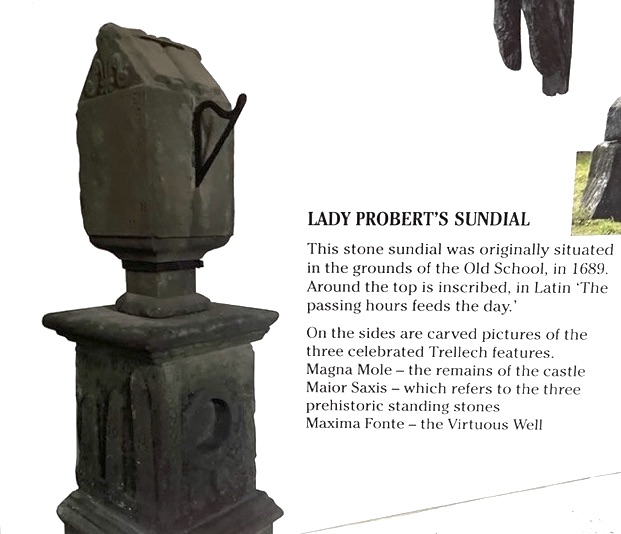
Below the dial are inscriptions on the substantial columns, with carvings that relate to the 3 features of historical importance to the village and its community: Tump Terret; Harold’s Stones; and Virtuous Well.
GRADE I † Early C14 with earlier origins; reconstruction & restorations 1890s. An exceptionally fine and well preserved medieval church (Cadw); One of the finest churches in the county (PEV). Coat-of-Arms of Charles II dated 1683. Weathercock of 1792. You need no further recommendation. 5m S of Monmouth. 51.7459 / -2.725 / SO500054
DIAL
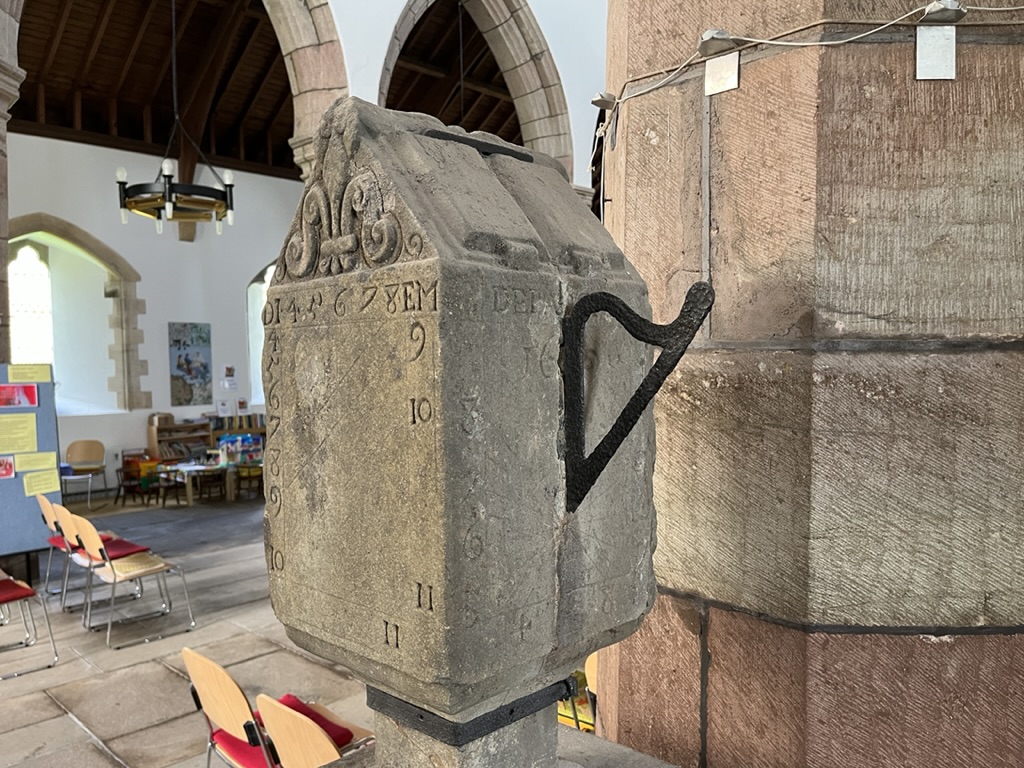
St Nicholas . Trellech . Mon – Cube Multidial
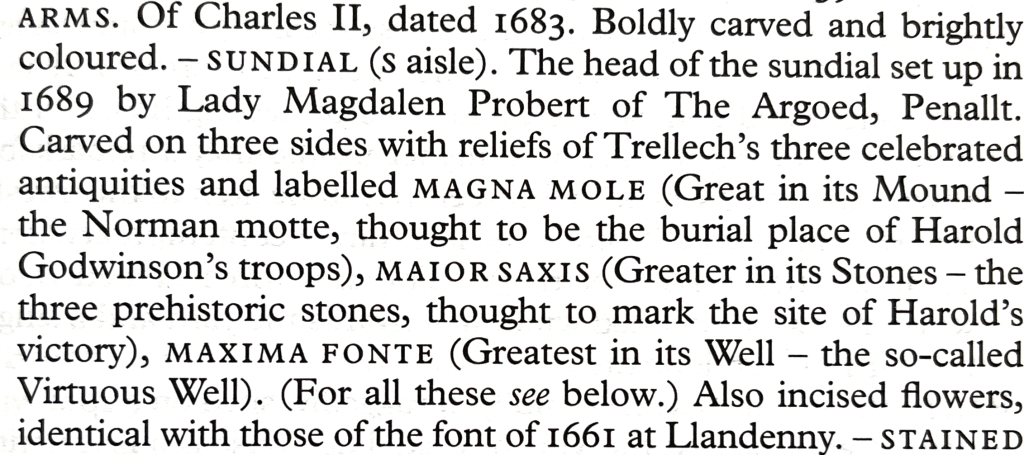
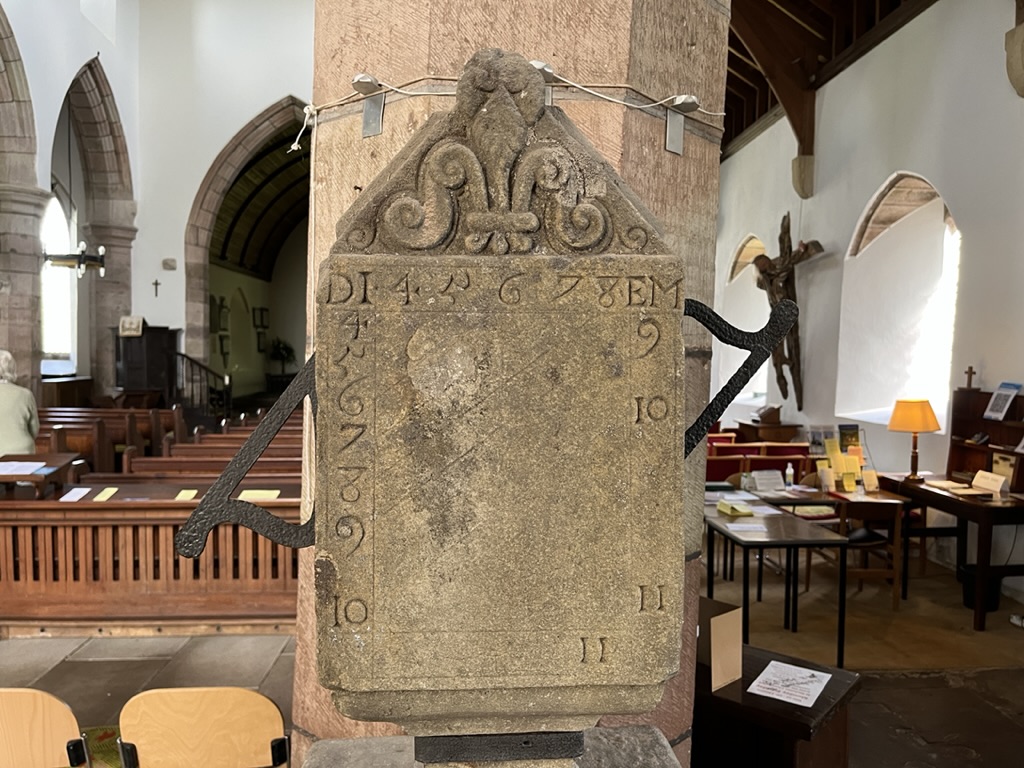
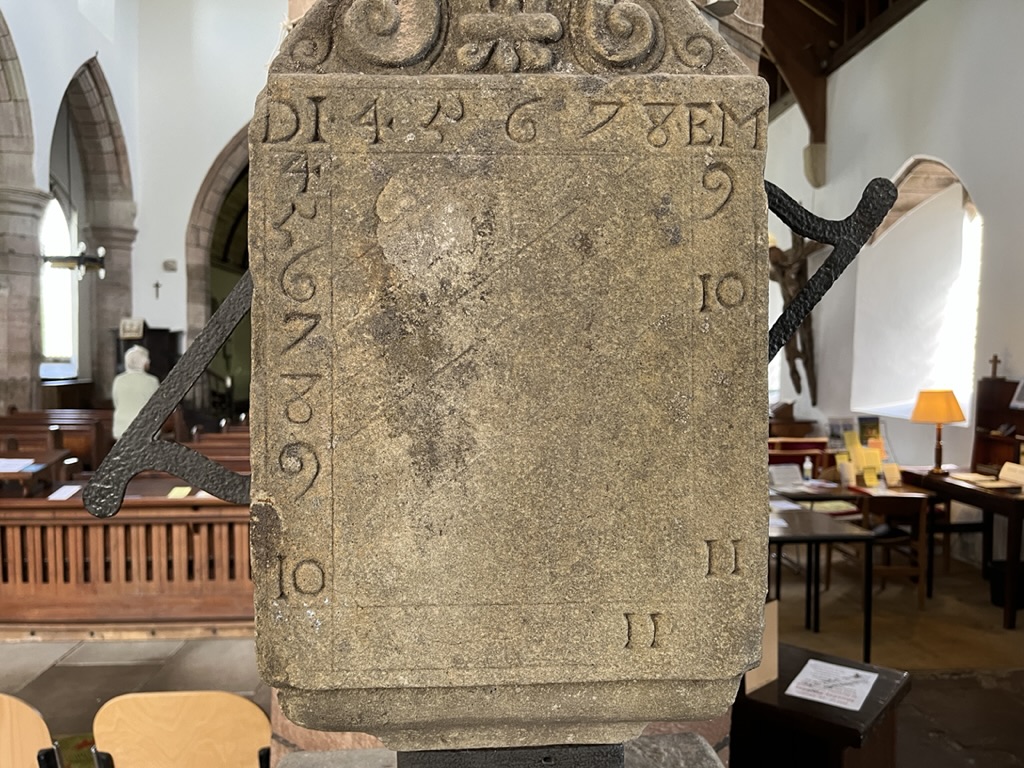
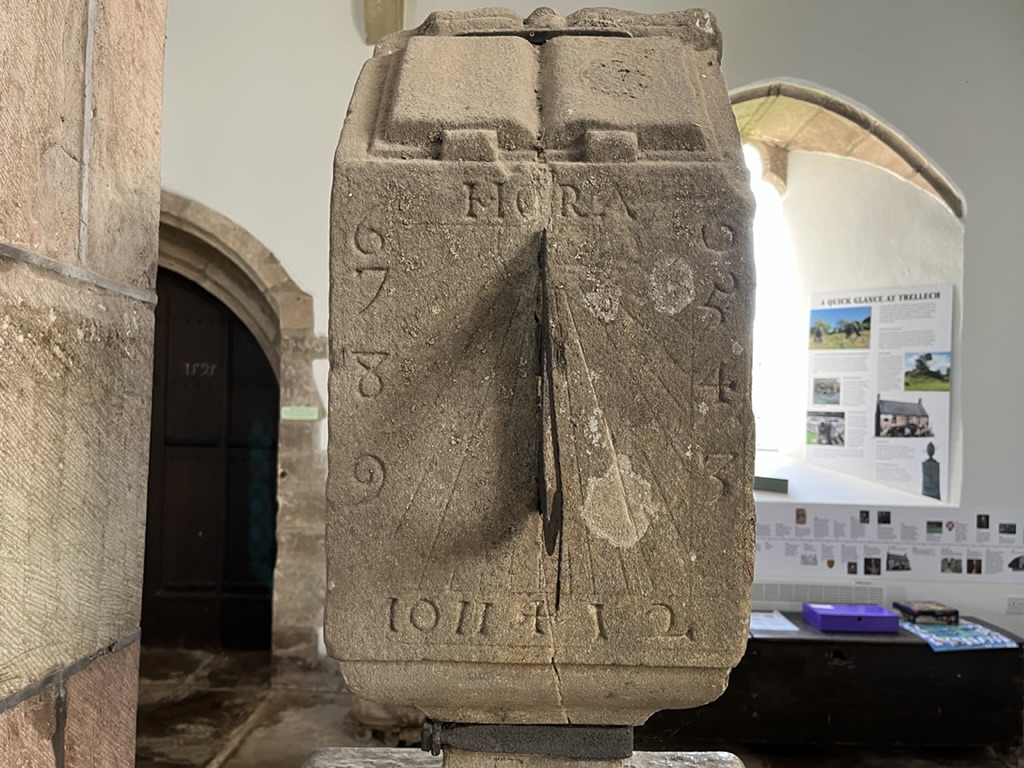
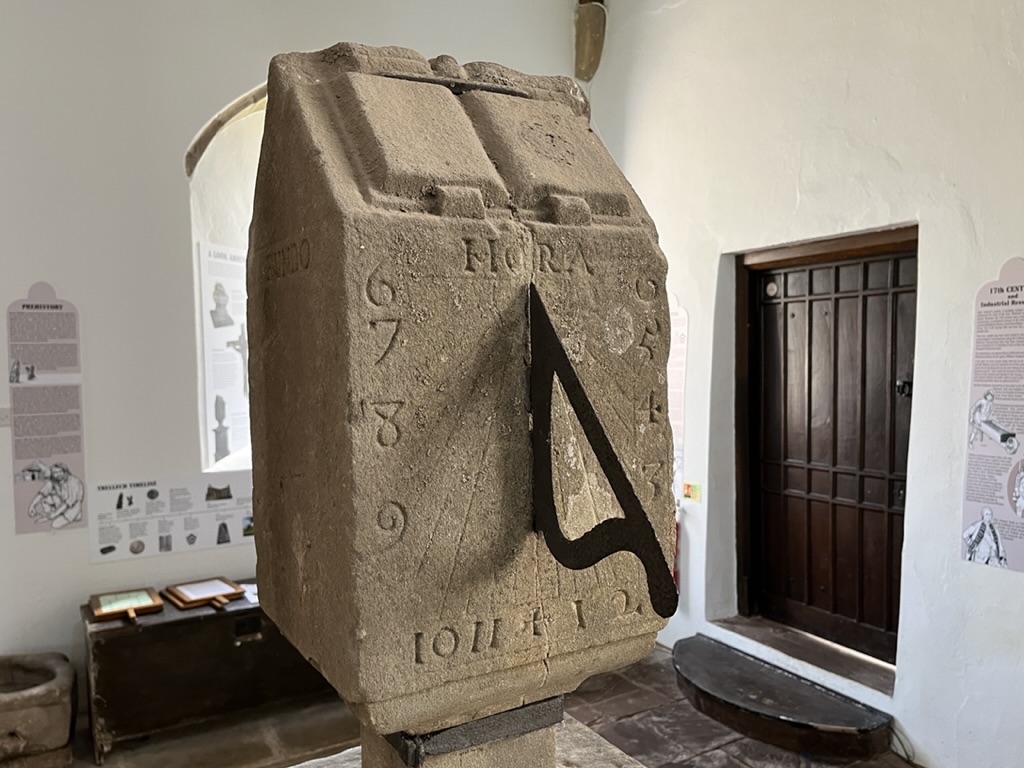
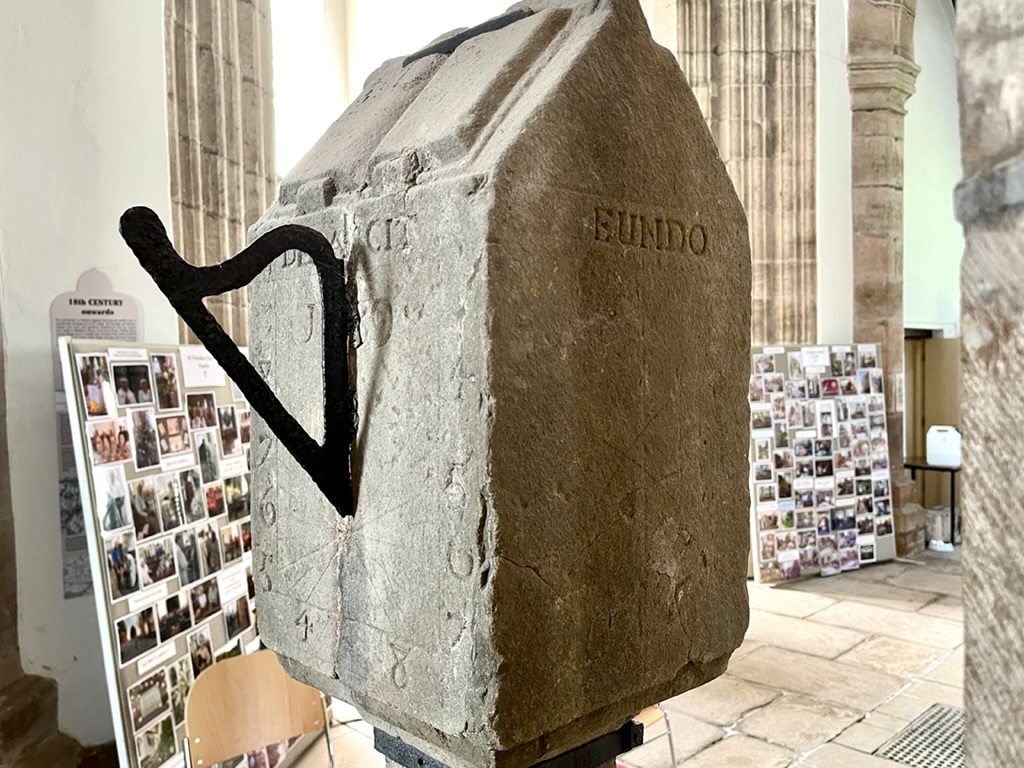
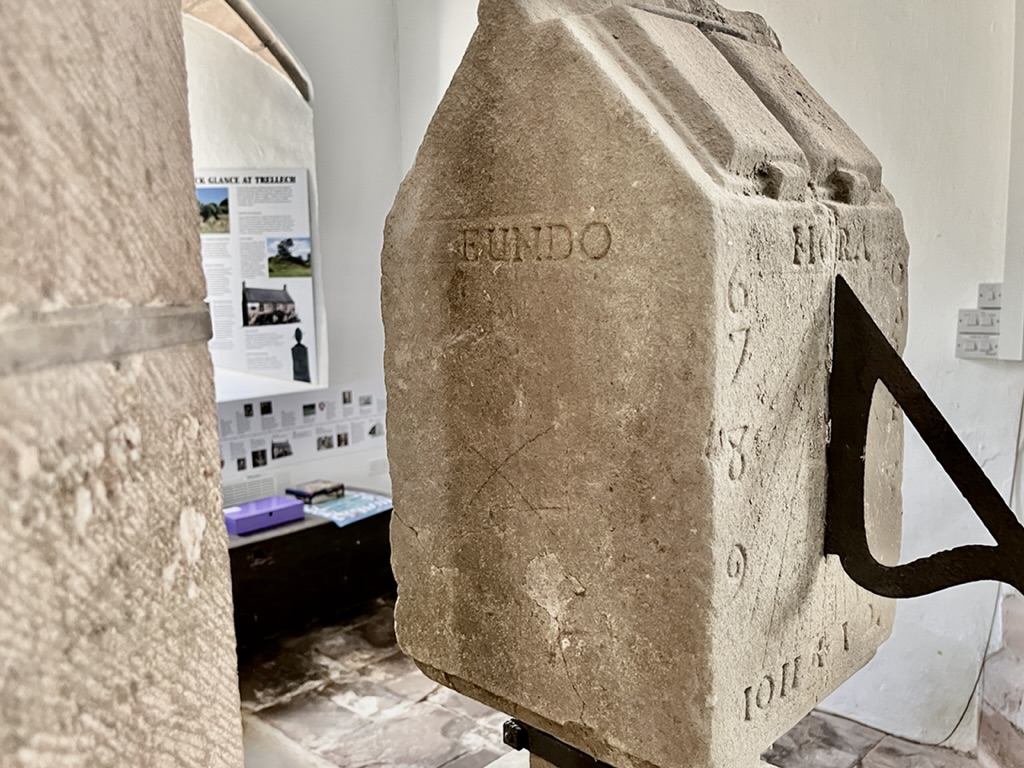
A wonderful C18 cube dial dated 1689, the gift of Lady Probert. Once, it stood in the village near the school. It was moved in 1895 and one source suggests that a concrete cast was made. The Latin inscriptions on the dial are descriptive of 3 features that are of historical importance to the village: Tump Terret; Harold’s Stones; and Virtuous Well. The details (PEV) are:
The detailed BSS record adds further details, including the full Latin motto on S, N & E faces: EUNDO HORA . DI…EM . DEPASCIT (The Hour Itself Consumes the Day).
Also included are the inscriptions on the square stone below the dial: 1. Terret Tump – O QUOT HIC SEPULTI (O How Many Buried Here); 2. Harold’s Stones – HIC FUIT VITOR HAROLD (Here was Harold Victorious); 3. DOM MAGD PROBERT OSTENDIT (Lady Maud Probert set this out to view).
DIAL DETAILS
SOUTH FACE
WEST FACE
NORTH FACE
EAST FACE
PART 2 will examine the excellent modern wooden replica (out)standing in a small field by a crossroads. It has been beautifully designed and is a dial of distinction in its own right.
GSS Category: Cube Dial; Multiple Dial
All photos Keith Salvesen; Pevsner extract Gwent & Monmouthshire; BSS records; church noticeboard



























 GAUDIUM SUB SOLE . SUNDIALS . MEDIEVAL TO MODERN