GRADE II ✣ C12, C15; T.H.Wyatt restoration 1845. A fine church by the R. Avon, with plenty of interest. Focus here is on the splendid C12 inner doorway of the porch with nook shafts and scalloped capitals, and an outer order of arch lozenges, inner of horizontal chevronsBHO. See below for Church History. 5m N of Salisbury. 51.1244 / -1.8301 / SU119361
SCRATCH DIALS
DIAL 1
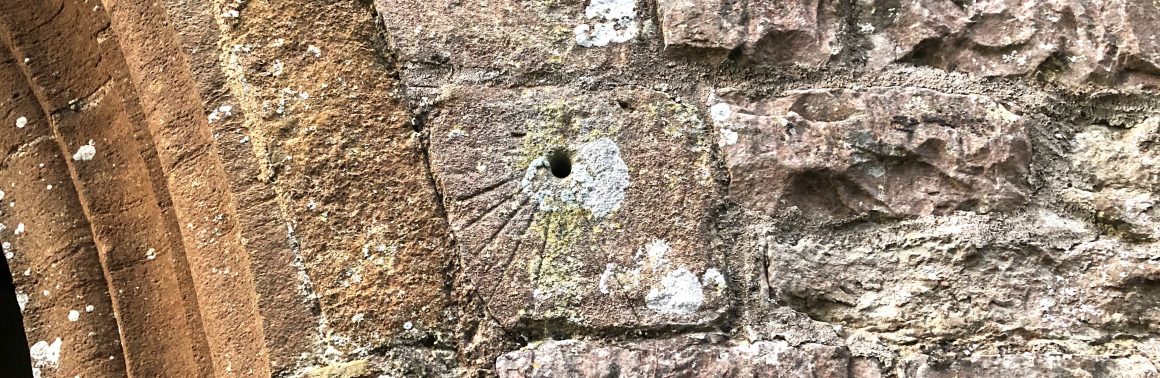
Dial 1 is by the capital LHS of the door, and quite easy to overlook. Weathered and damaged, with 3 lines visible within what remains of a double circle. Filled gnomon hole.
DIAL 2
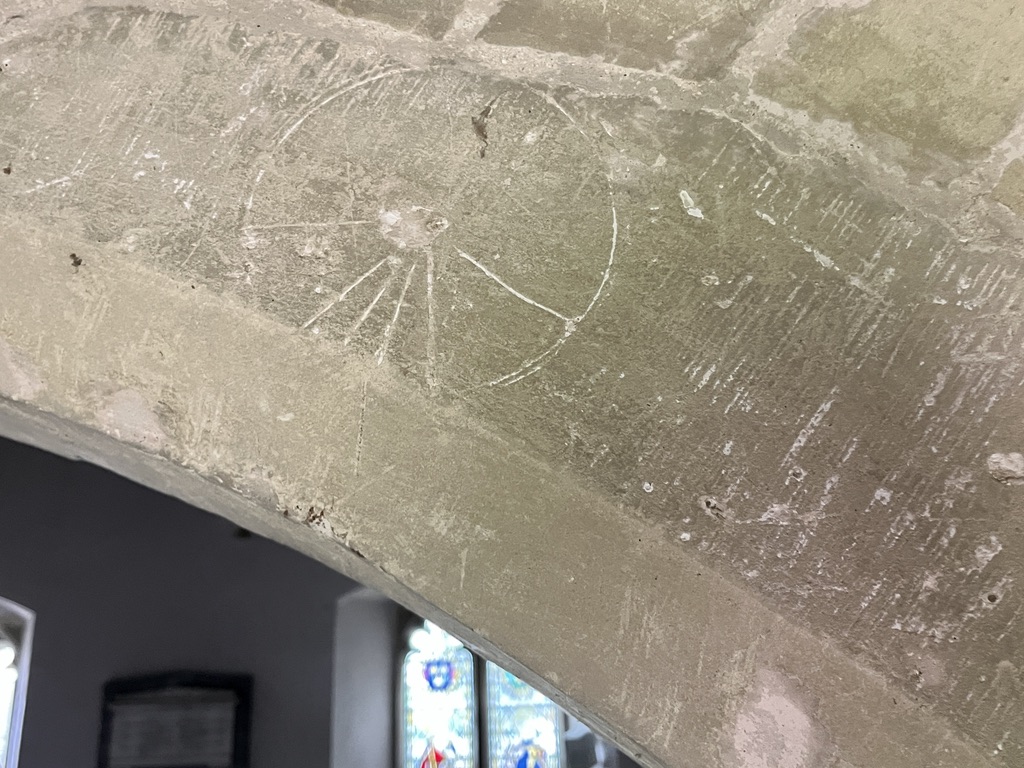
Dial 2 is RHS on the arch of the doorway, and much easier to read. A morning dial with 4 clear lines from 9 (terce) to noon, and another fainter line earlier. The random line LRQ was evidently added some time later. Filled gnomon hole and remnants of a narrow double circle, as with dial 1. Perhaps this dial was cut as a replacement for dial 1 which certainly seems earlier; they could hardly be contemporary.
DIALS 1 AND 2
CHURCH HISTORY
VERTICAL DIAL (CHANCEL BUTTRESS)
The dial is on a south buttress. Motto across the top in angular lettering reads: ‘Tempus Fugit’. Upright Arabic numerals – 10, 11, 12, 1, 2, 3, 4, 5 and 6 still just visible. Divided to 5 mins? Three-dot half hours (remnants of fleur-de-lys? Square frame with wide border, inset into stone of second buttress RHS of south porch. Needs restoring soon if it is to be saved. Would have been quite a good dial originally BSS
The most recent report was in 2005. Given the details mentioned above, the prediction of further deterioration has sadly come to pass.
GSS Category: Scratch Dial; Scratch Dial within porch; Vertical Dial
Kenilworth Castle has a long and intriguing history, with royal, civil and military significance over C7 centuries or so. There is an excellent Wiki entry HERE . Anyone who learnt history at any level will be transported back to the classroom. Simon de Montfort C13; the insulting gift of tennis balls from the French to Henry V; Lady Jane Grey; Civil War(s); slighting. The entry is erudite yet clear and concise.
Erika Clarkson
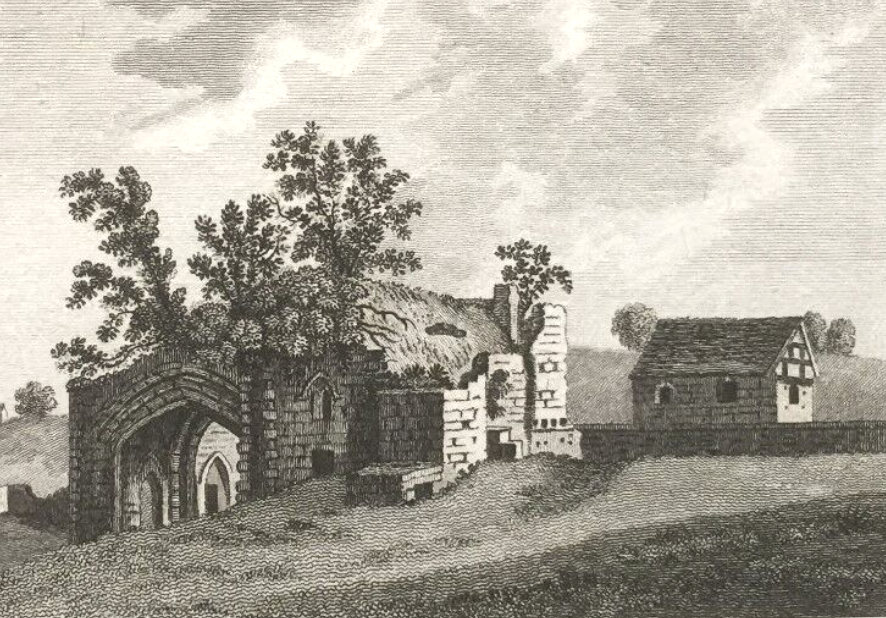
HE Historic Print Archive
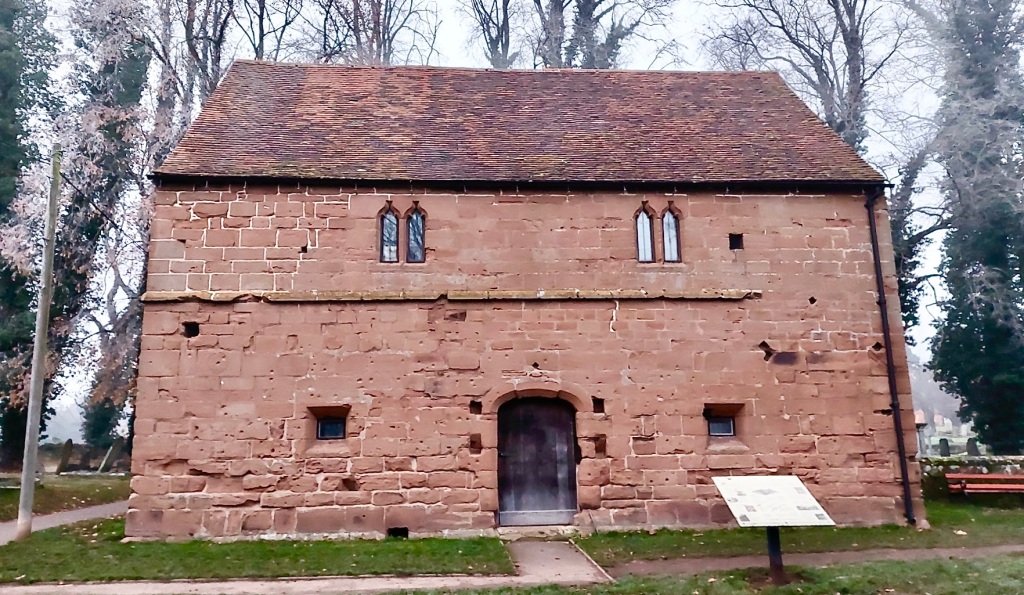
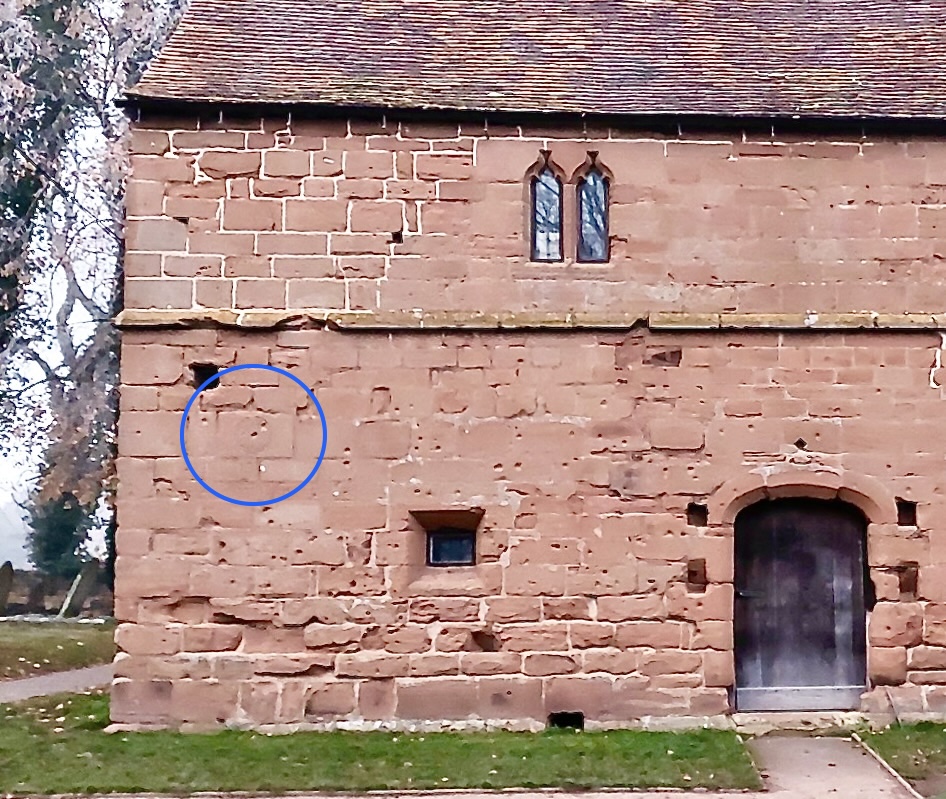
In the grounds close to the C14 gatehouse is a small 2-storey building known as the Barn, now thought unlikely to have been built as, or used as, a barn. The general view seems also to be that it had no monastic function. There were 2 latrines, which makes me wonder if it might have been some sort of lodging house for low-level family, or for visitors with a servant or two. The barn now serves as the Kenilworth Abbey Museum & Heritage Centre.
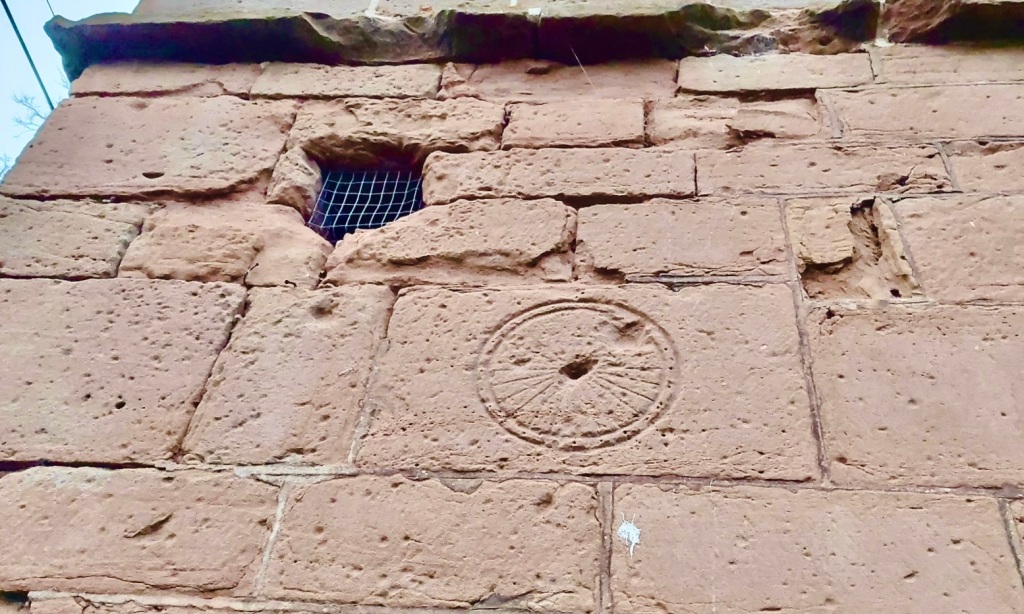
For present purposes, the barn’s significance is the scratch dial LHS on the front of the building. It is relatively rare for a dial to be cut on a secular building. Where found, it is most likely to be on a barn (Bradford-on-Avon has one on its famous tithe barn).
Erika Clarkson
DIAL
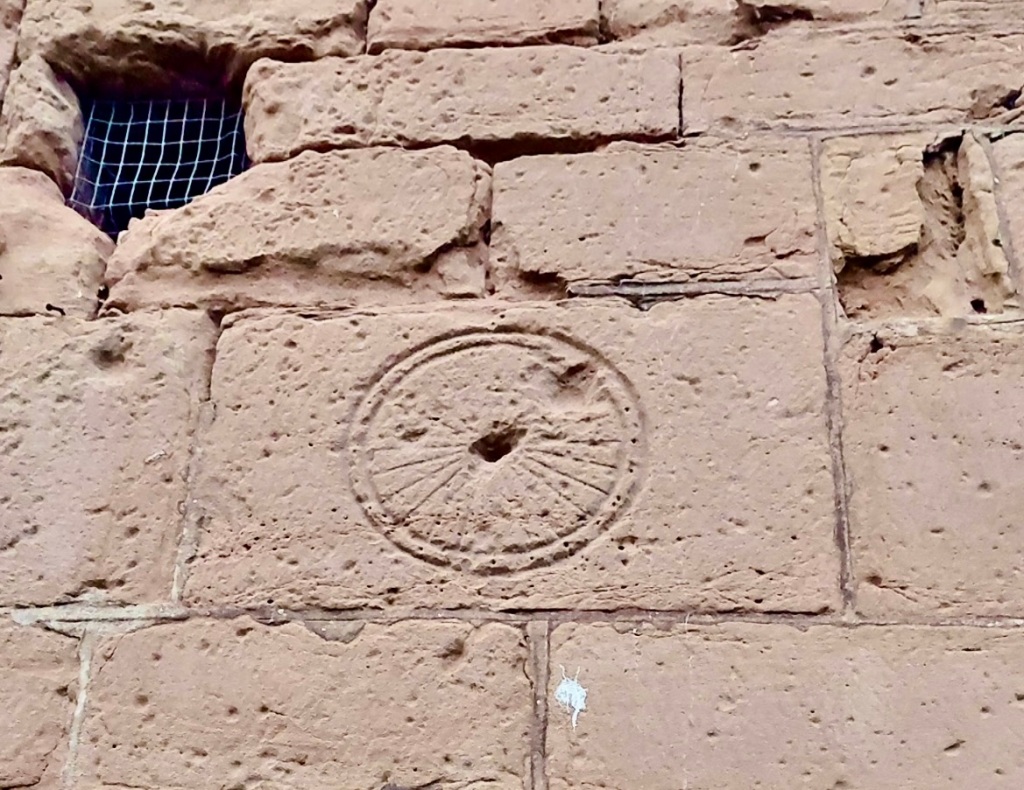
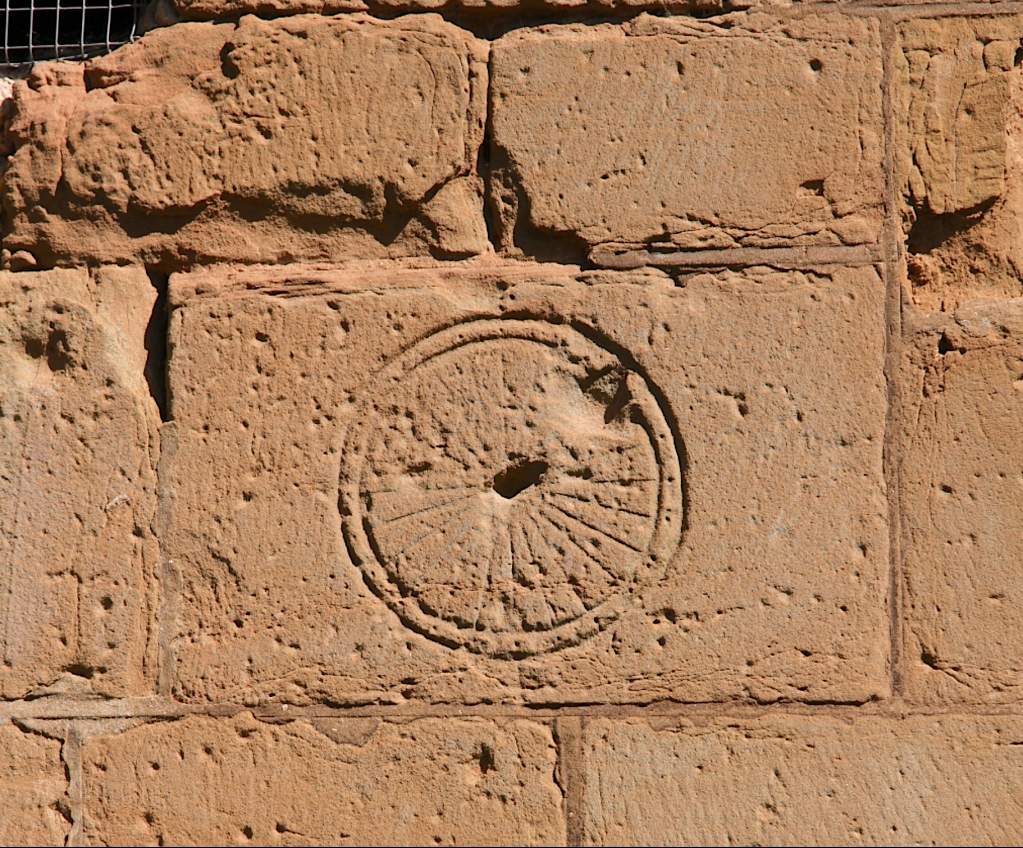
The dial is within a double circle. It has suffered from both erosion and damage – it has indeed been in the wars. There appears to be a complete set of 24 lines spaced fairly equally at 15º to form a complete circle of radials. Unusually I think, each line is matched to a small terminal pock on the ridge between the 2 circles. Those at 3, 4, and 5 have double pocks, perhaps an indication of the most important part of the day for observance. It corresponds with the canonical mid-afternoon hour NONE. The lines are also deeper cut (and thus less eroded), a common form of emphasis. It’s difficult to say whether the other more random pocks on the dial face were intended as part of it.
The gnomon hole is clearly not as it was originally. I expect there was a conventional central hole, (as the curve LHS hints) and at some stage something wedge-shaped was a clumsy substitute or replacement; or perhaps sword tips were sharpened there.
Motacilla . WIKI . OS / CC
The dial is difficult to date. Various features suggest a later date than medieval. The full 24 hour ‘clock’; the reasonably accurate c15º divisions and double circle; the decorative use of the little pocks. Overall a degree of sophistication compared with earlier dials. My uneducated amateur guess is late C15 / early C16.
One mystery is why a dial was cut onto the barn at all – why did it need one? Perhaps my ‘occasional lodging’ theory has a place here – to assist outlying guests to comply with Castle timings for Mass, feasting, or jousting.
The building has been liberally decorated with musket shot (cf All Saints Alton Priors, below), most plausibly during the Civil War, in which the Castle played a significant part. For building mark / symbols / graffiti enthusiasts, there are quite a few masons’ marks to collect.
All Saints . Alton Priors . Wilts – Musket damage
GSS CATEGORY: Scratch Dial; Scratch Dial on Barn; Scratch Dial on Secular Building
CREDITS: Erika Clarkson (dial detection, images); Motacilla (image OS CC); HE print archive; Kenilworth History and Archaeology Society; Warwickshire World Article by George Evans-Hulme
GRADE I ✣ Origins pre-date 1159 building; some C12 features; S chapel c1280. Mainly late C13 to C15; 1860 restoration by Wyatt. Fine Giffard Chapel. Described 1850 (Hoare) as one of the most interesting parish churches in the Vale of Wily [Wylye], and its architecture has been very little altered since the death of Bishop Giffard in 1301. W window described by PEV as a tour-de-force. Painted pews. Turkeys feature in the church decoration – for why, see below. 4m NW of Wylye. 51.1553 / -2.0722 / ST950395
DIAL 1
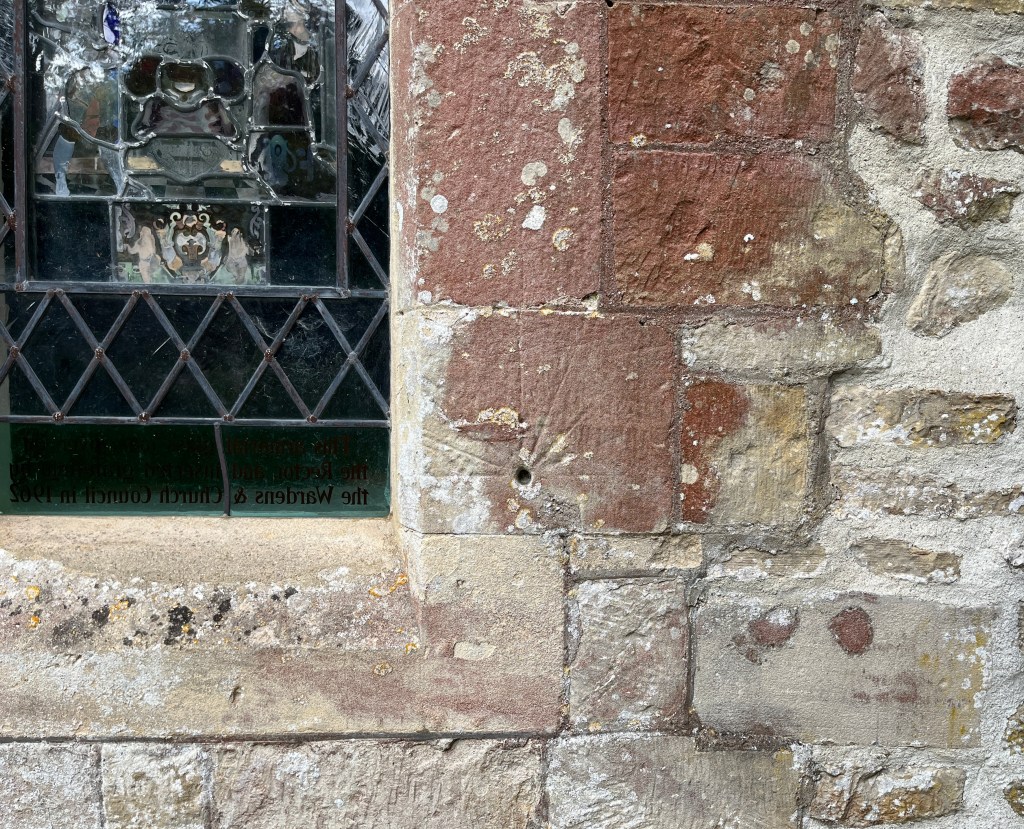
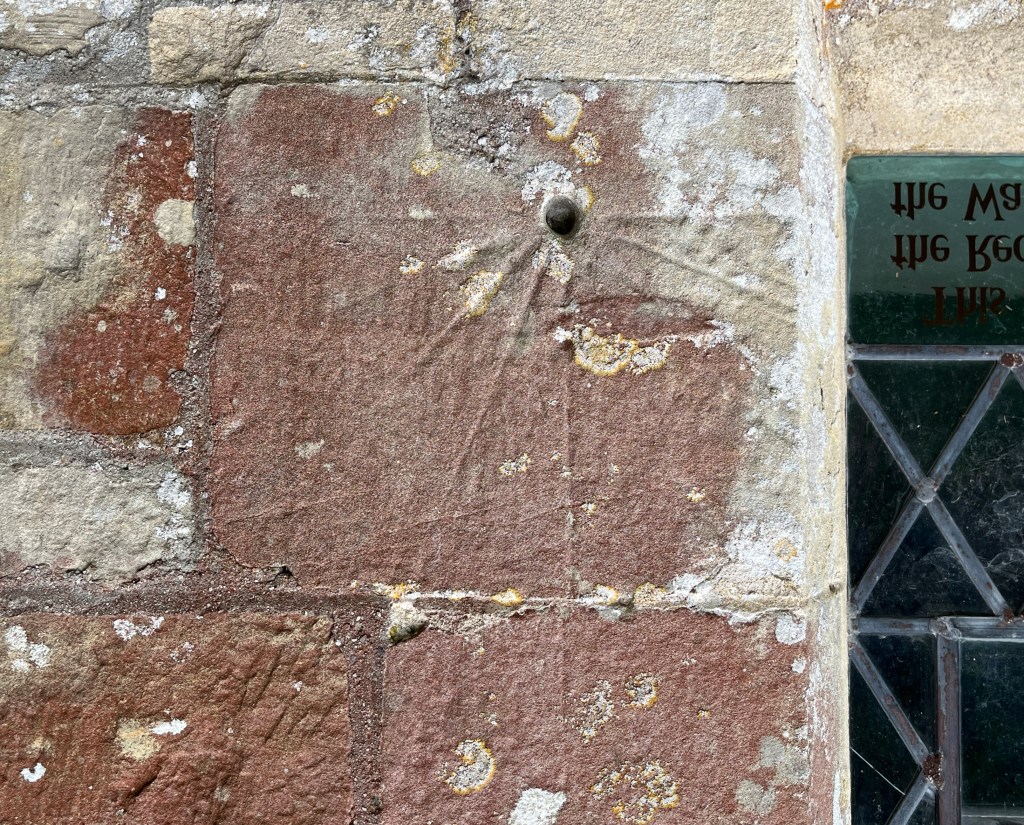
The dial is prominent on the lower right corner of the transept window. It is cut into the attractive red stone. At some time it was inverted, along with the stone above it. It’s an assertive dial, unlikely to be missed. There are 9 lines, with the noon having a pock close to the gnomon hole, then extending onto the stone below. A reverted image is shown below.
REVERTED DIAL
DIAL 2
BSS records 2 other scratch dials. Examining the separate but very similar entries for these 2 dials, it seems near-certain that they are in fact one and the same. The notes for one includes worn, error, omission, query. Report date uncertain. They differ as to whether there is a large gnomon hole or none at all; and whether there may be a circle. As it happens, I could only find one plausible candidate in the given location, so I will leave it at that.
The dial is difficult to interpret, not least because it is so eroded. The larger image below hints at a noon line, with perhaps a trace of a line at XI and on the pm horizontal. There is a rough curve LRQ but no certainty that it was ever part of a circle. I doubt that the 3 shallow circular dents relate to the dial. A simple dial, then, but of use (in that location) to those passing after daybreak.
St Mary . Boyton . Wilts – Hypocrite Stone in the aisle
SIDE NOTE William Strickland, builder of Boyon Hall, was said to have brought the first wild turkey to Britain from America in the late 16th century. As a result, there are carved and painted turkeys all over the church; most notable is the lectern, shaped like a turkey instead of the traditional eagle. (David Ross – Britain Express BE)
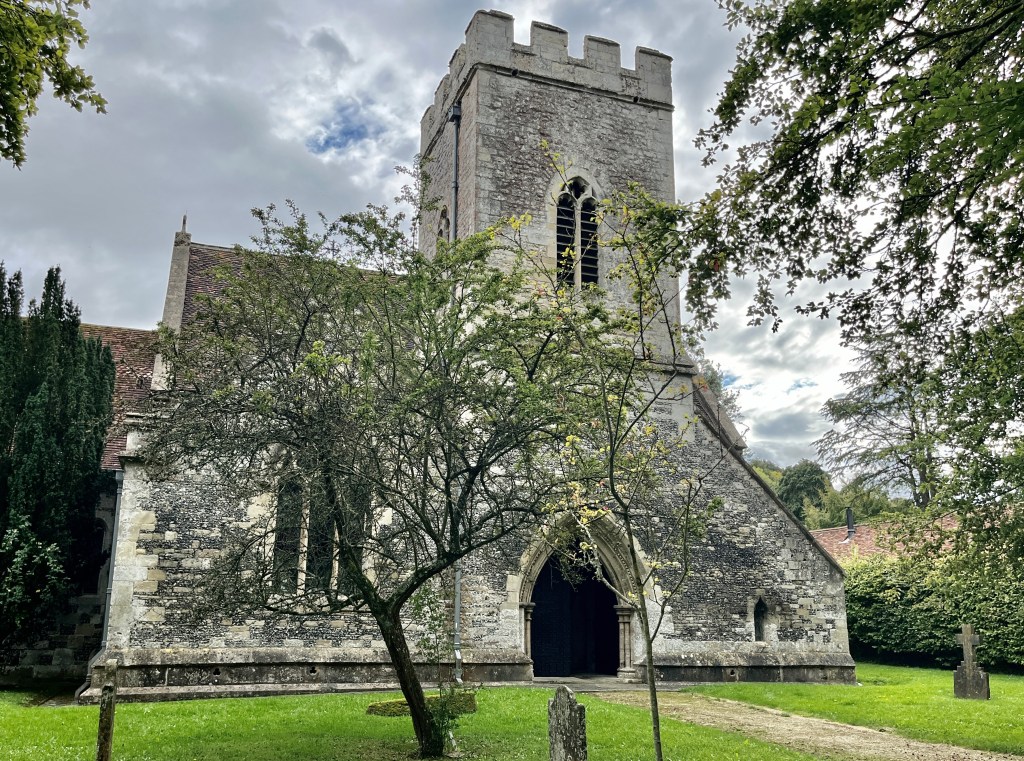
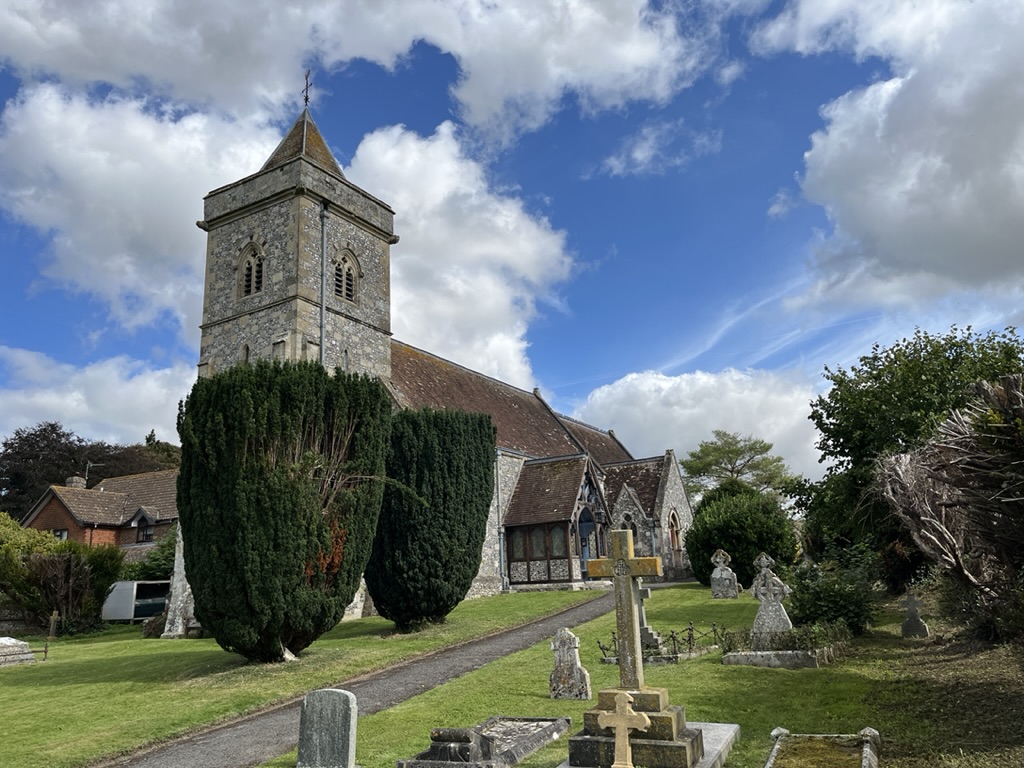
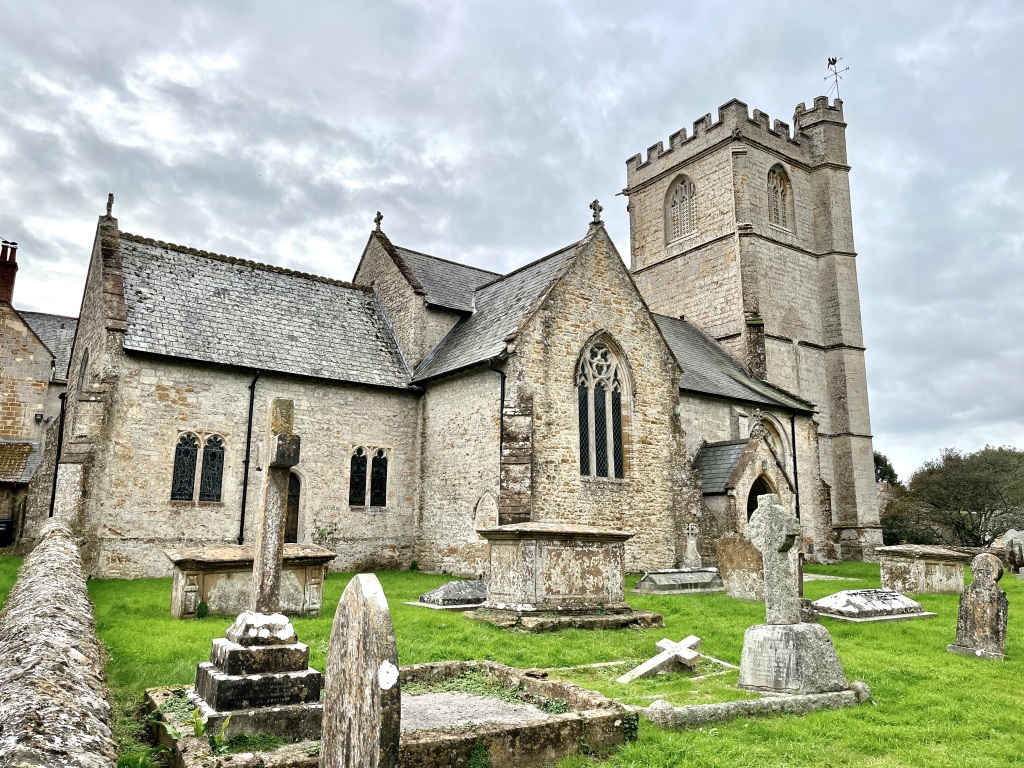
GRADE II ✣ C12 traces (BHO); then C13 on; C15 tower; Wyatt rebuilding 1860s. A few early features remain. An interesting, well-kept building and churchyard. 6m NW of Salisbury via Wilton. 51.1079 / -1.8758 / SU087342
DIALS
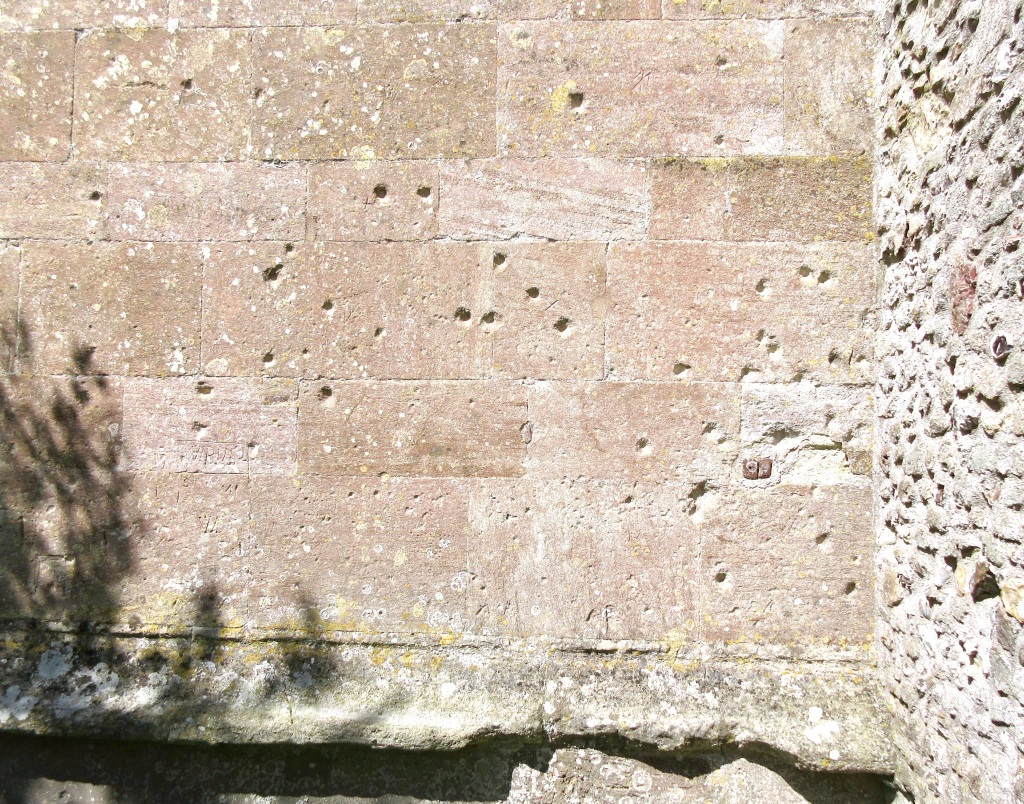
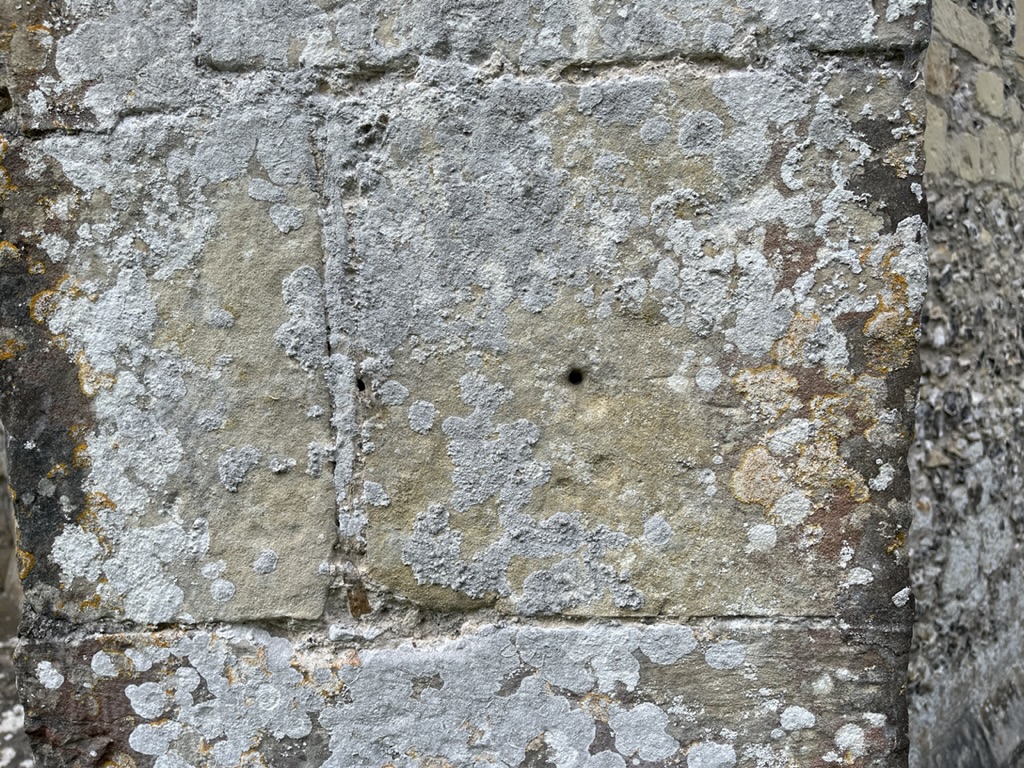
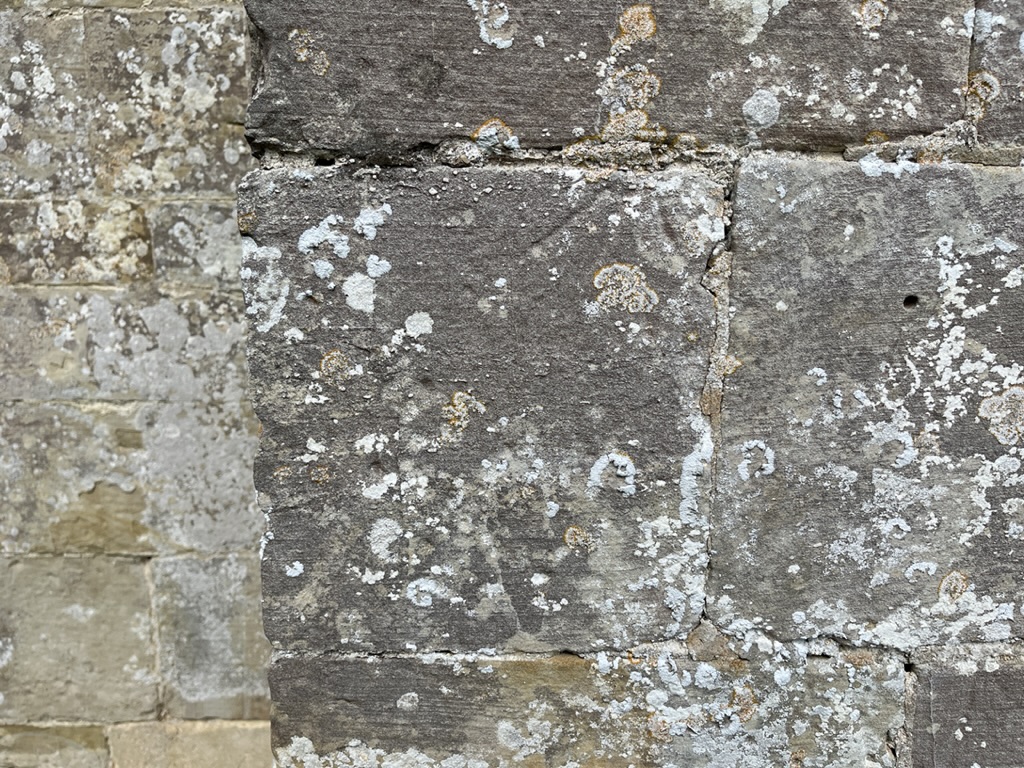
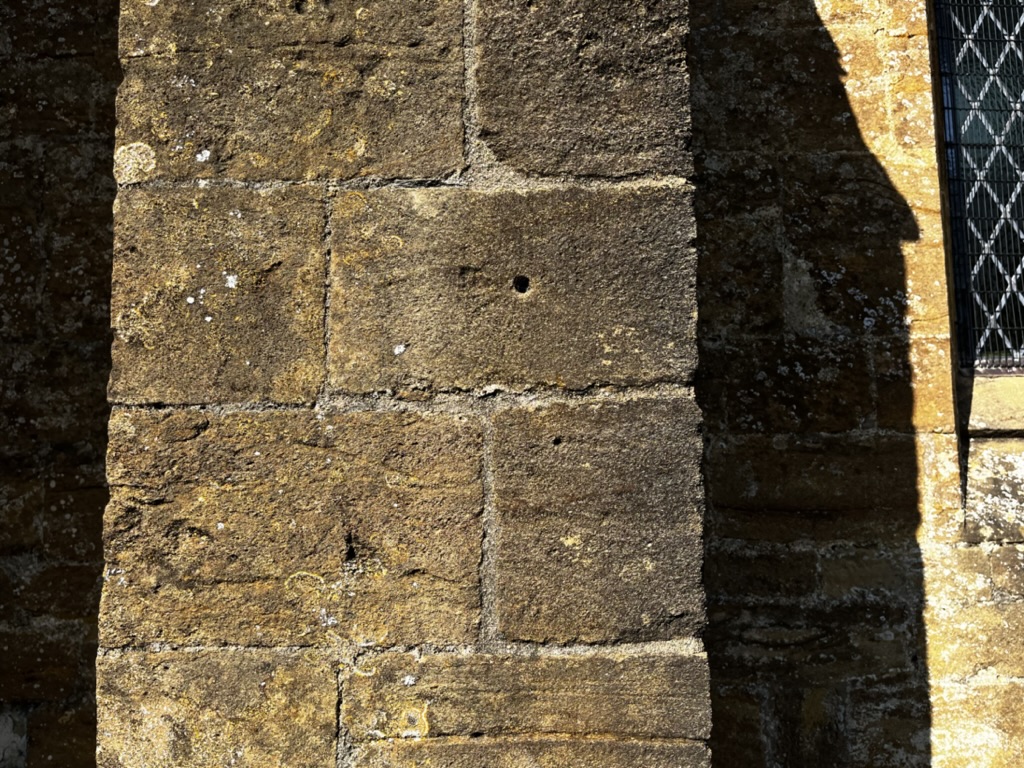
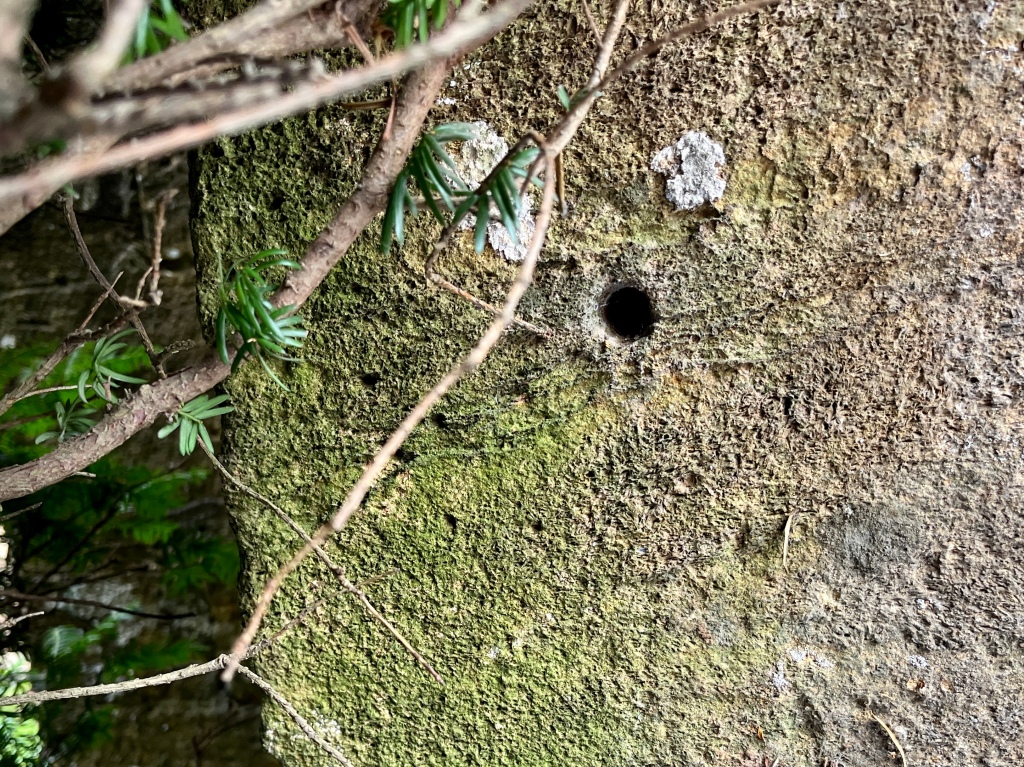
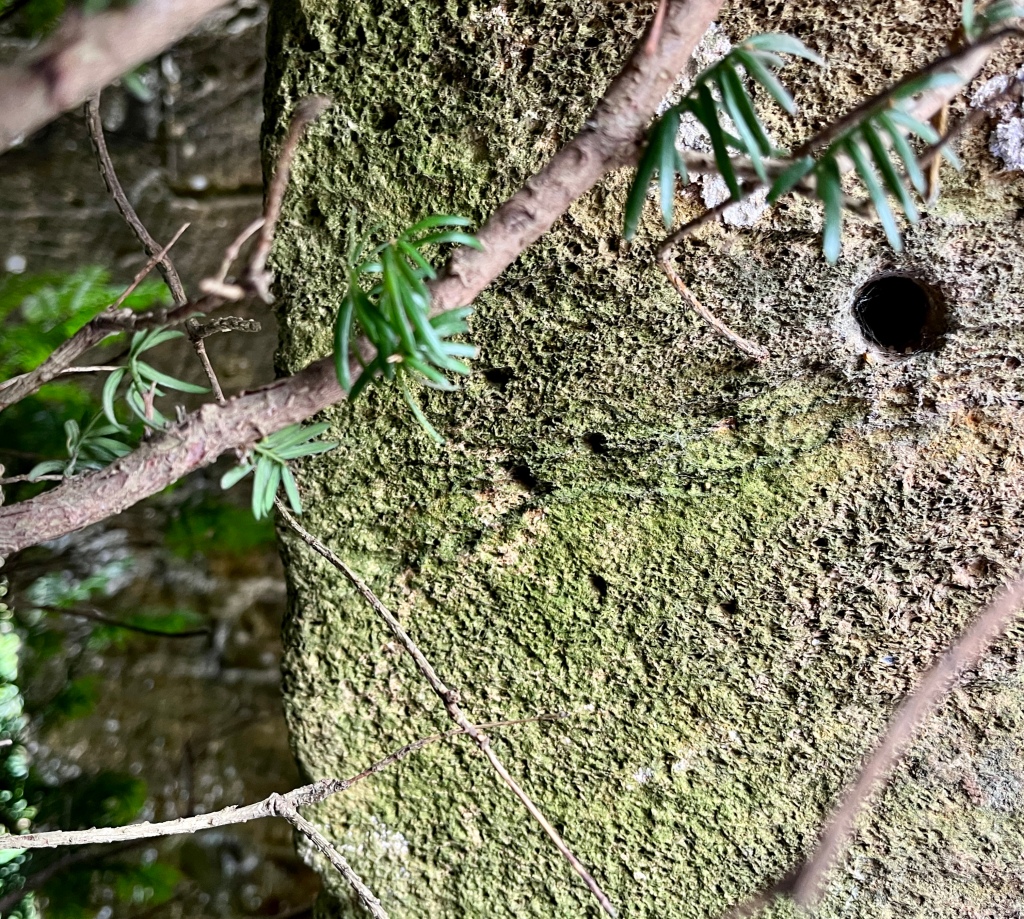
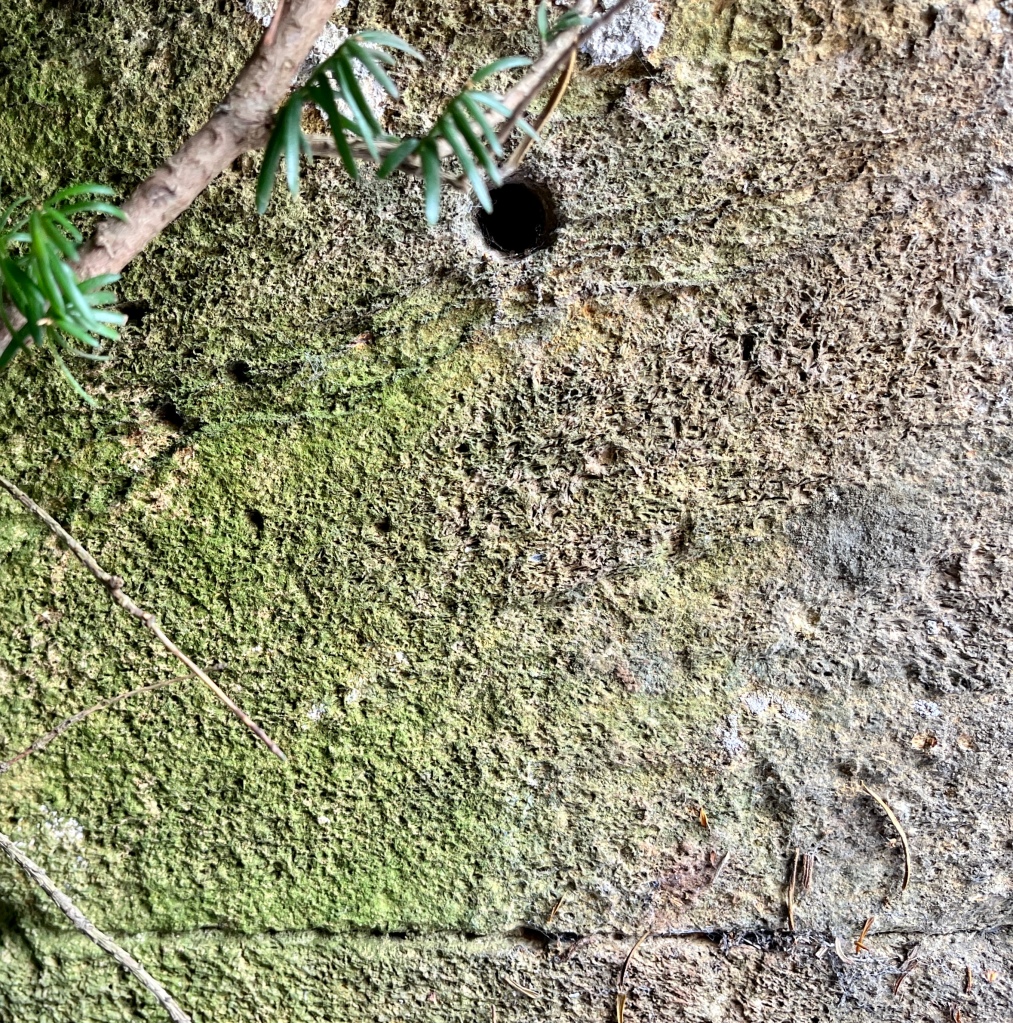
Two scratch dials are recorded with descriptions, with a third mentioned in tentative terms (BSS). When I visited, the only dial I found didn’t match the descriptions nor was it in any location mentioned. There were a few quite plausible gnomon holes but none had any additional dial-ish features, not even eroded traces. Clearly I need to return and try harder next time I’m in the area.
DIAL
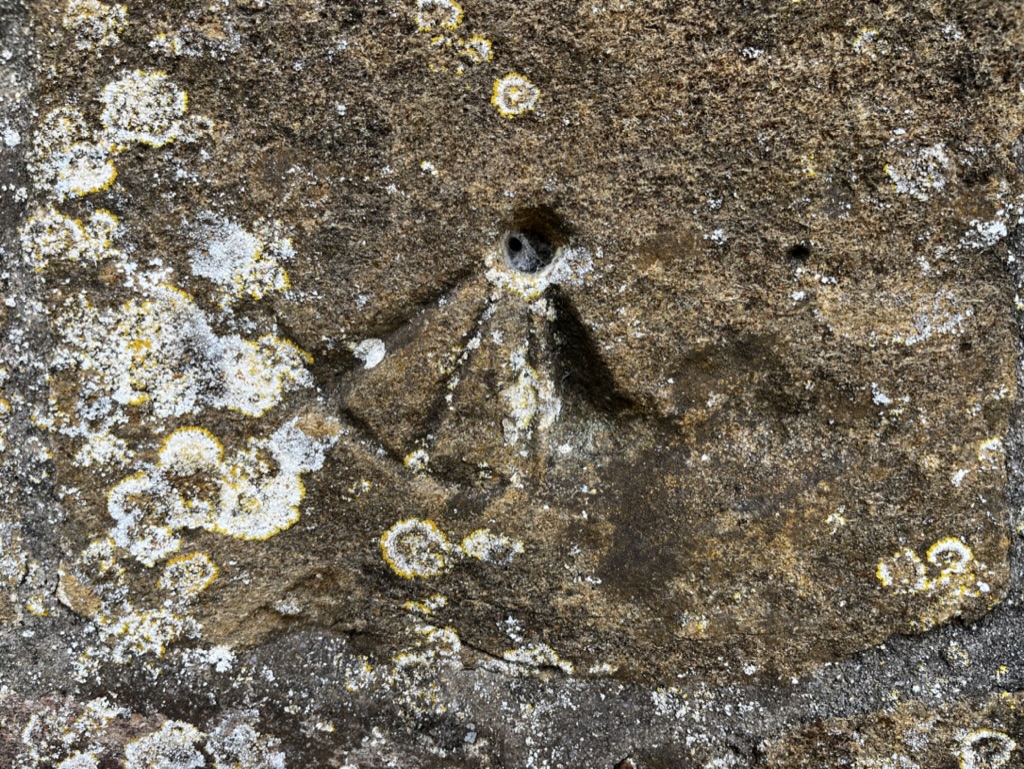
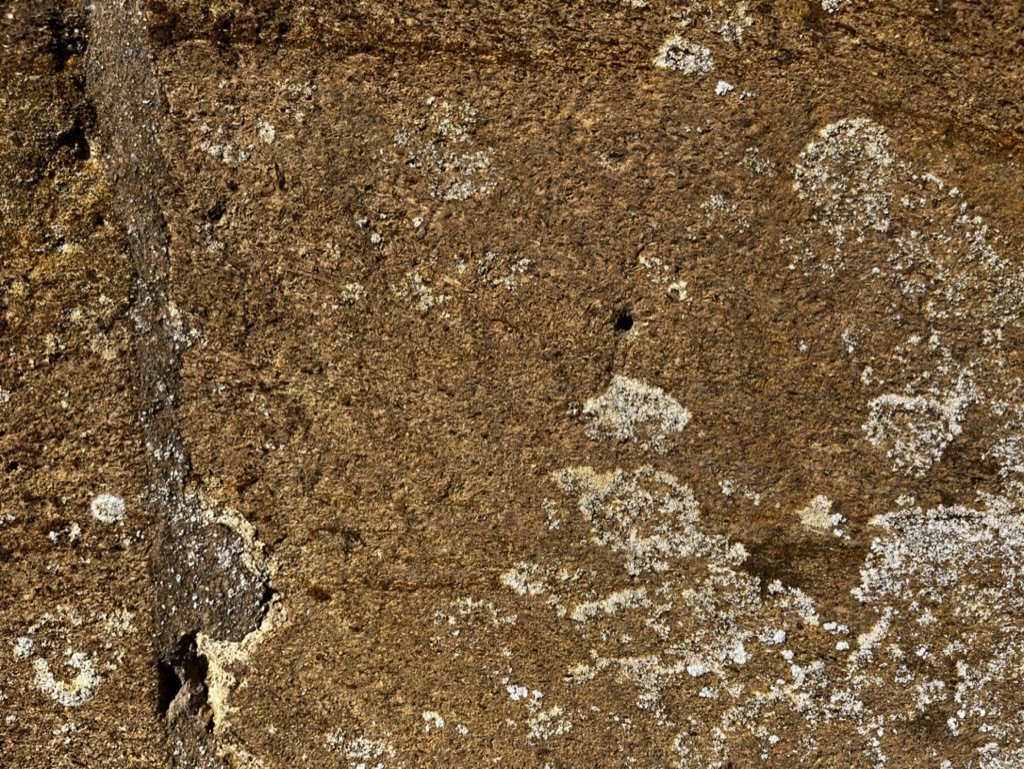
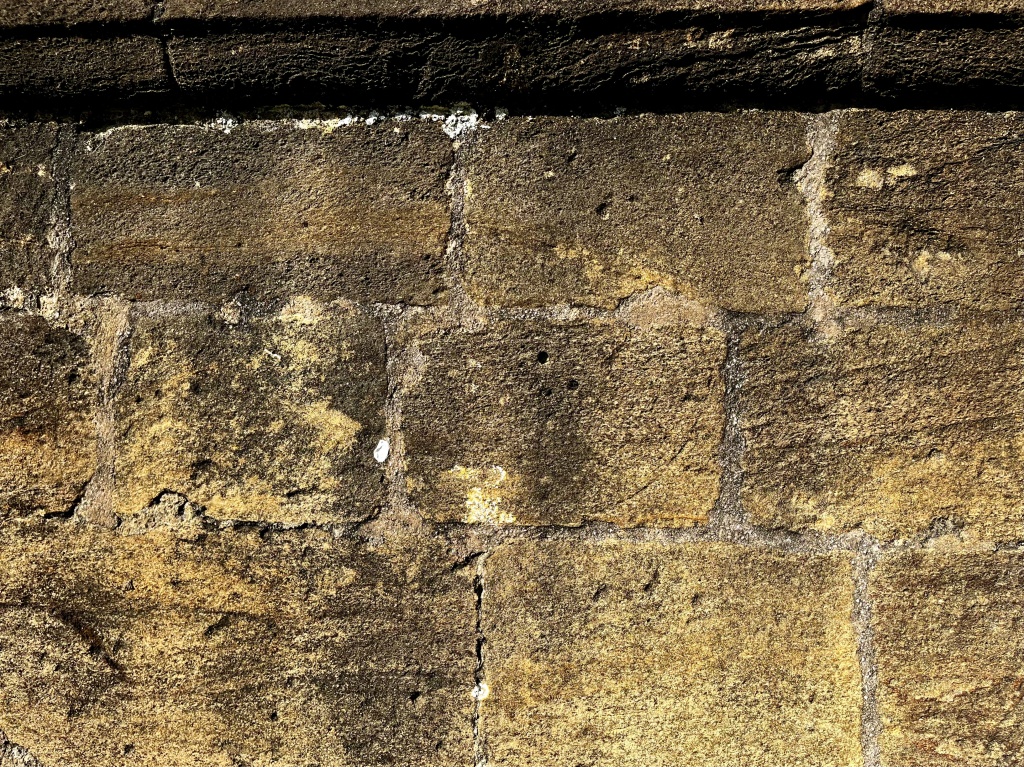
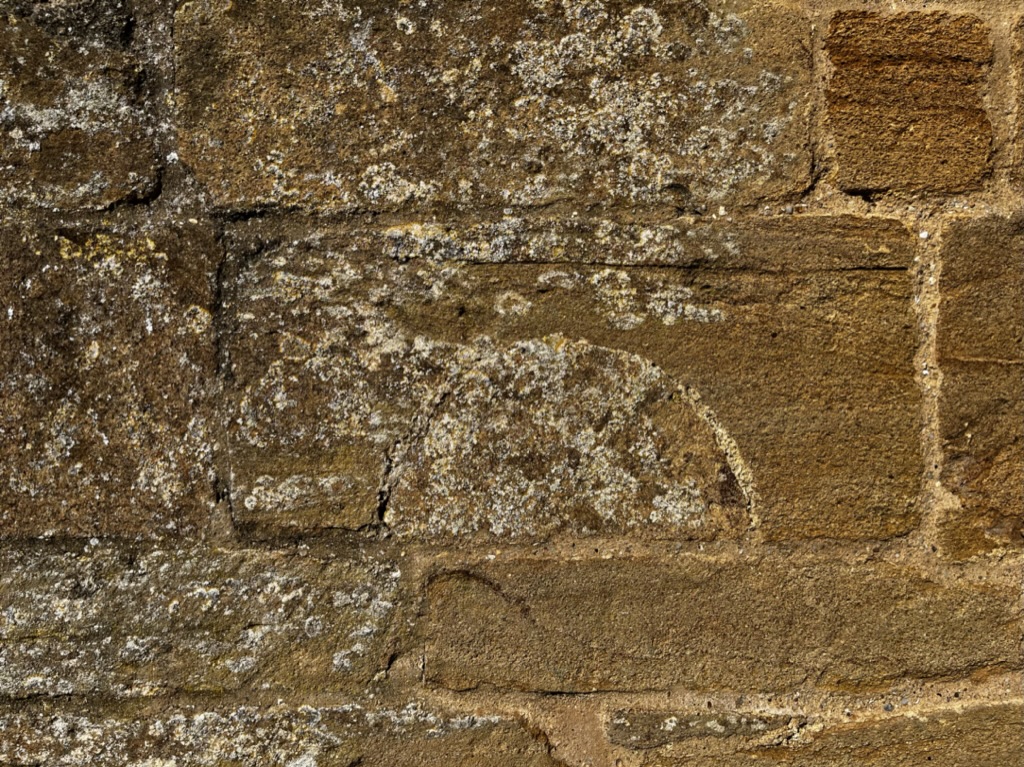
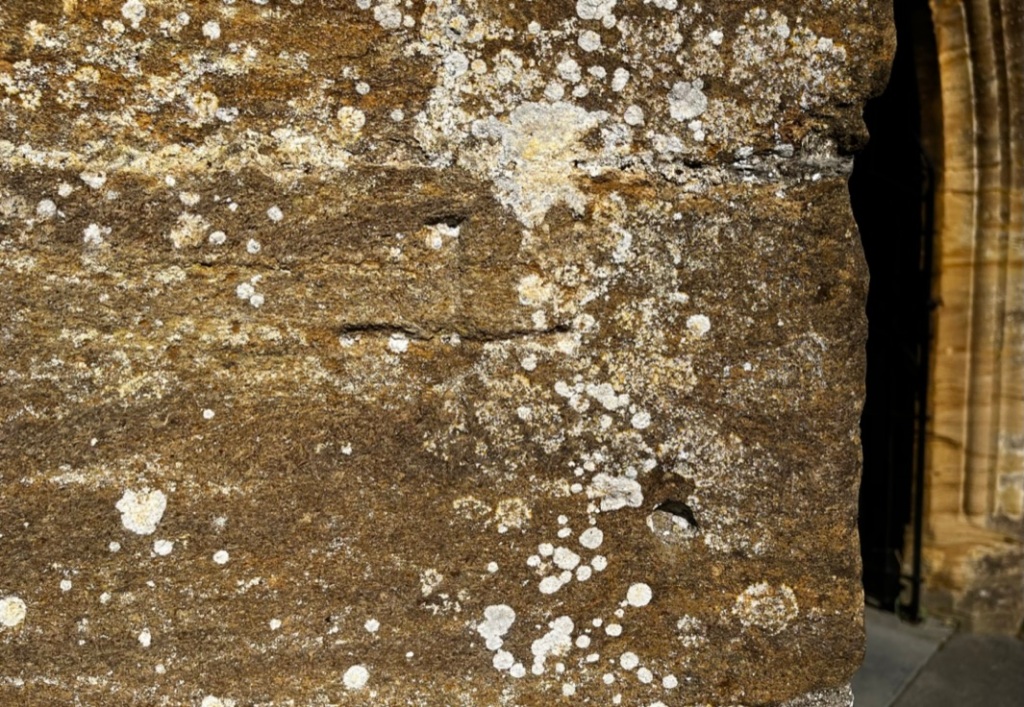
A very basic dial with the gnomon hole in the mortar line. Two clear lines either side of noon, possible terminal pocks (if so, perhaps later additions). LLQ there’s a faint trace of a third line.
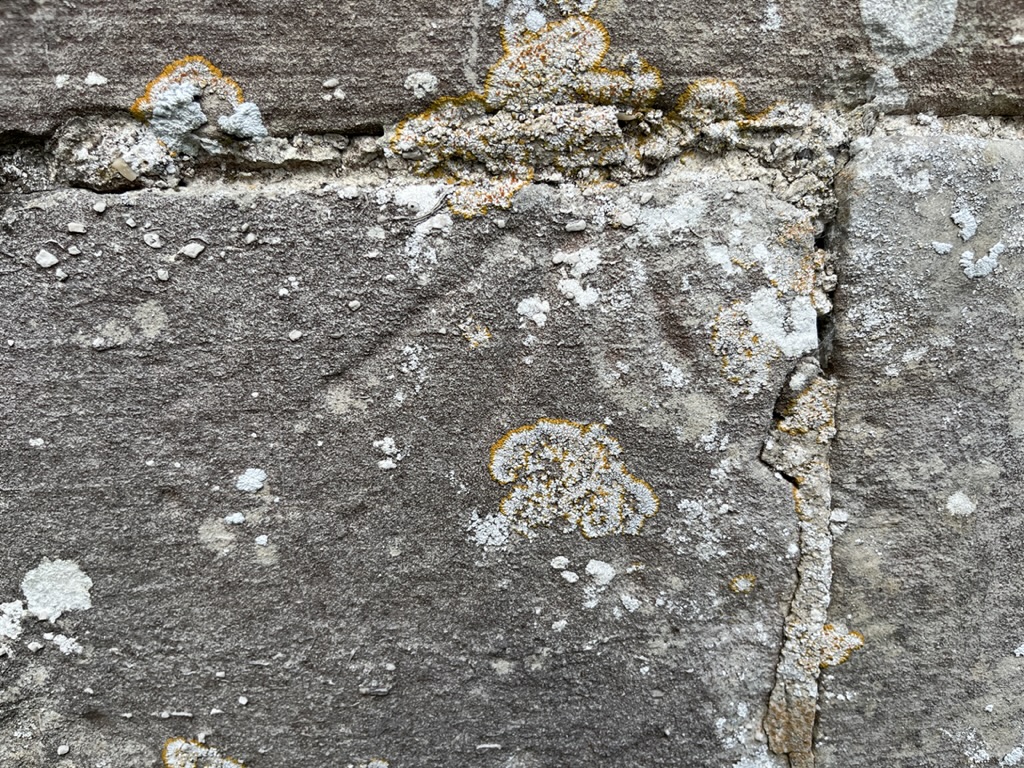
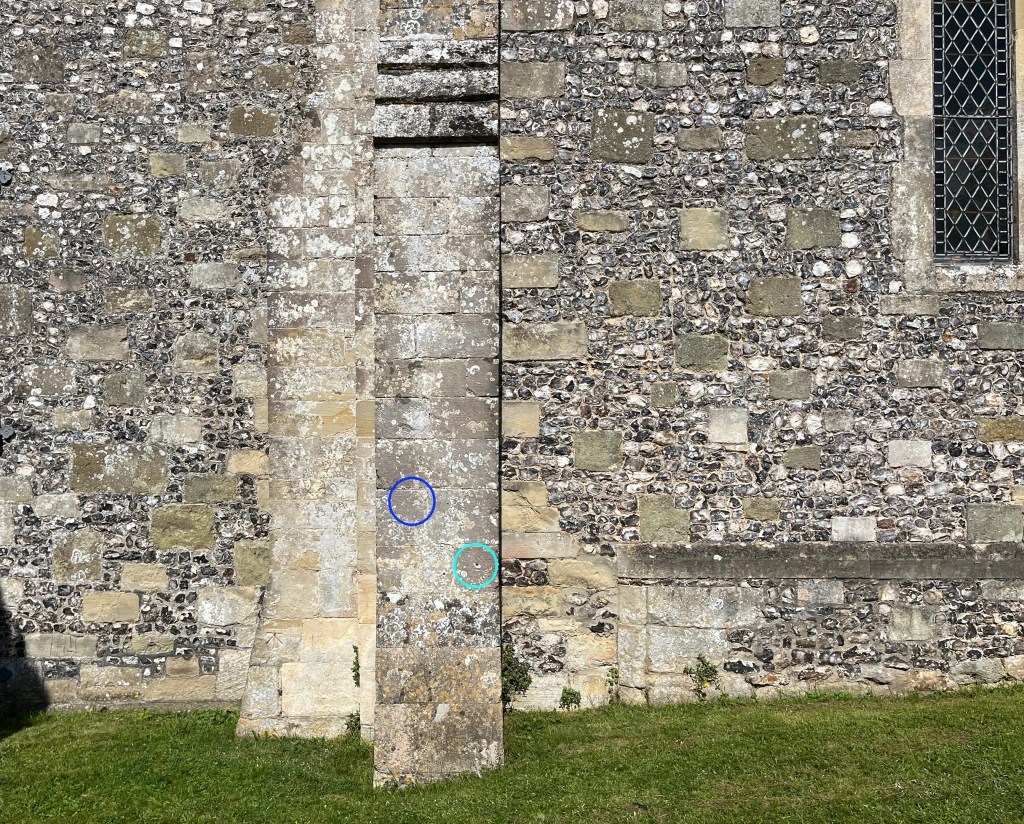
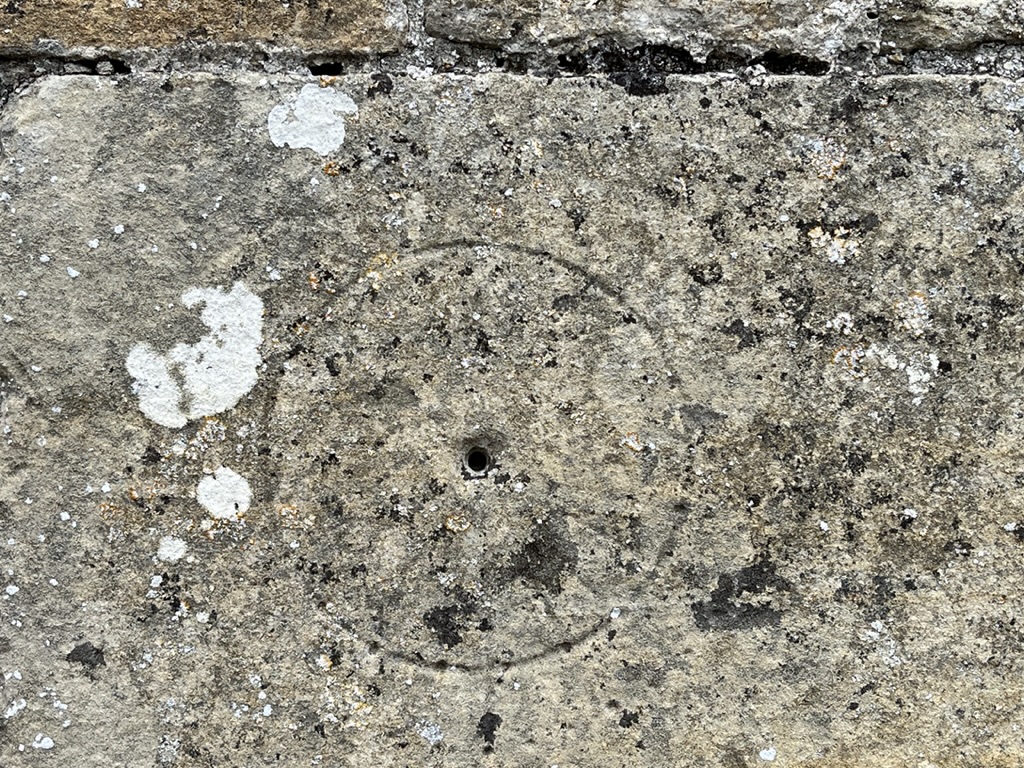
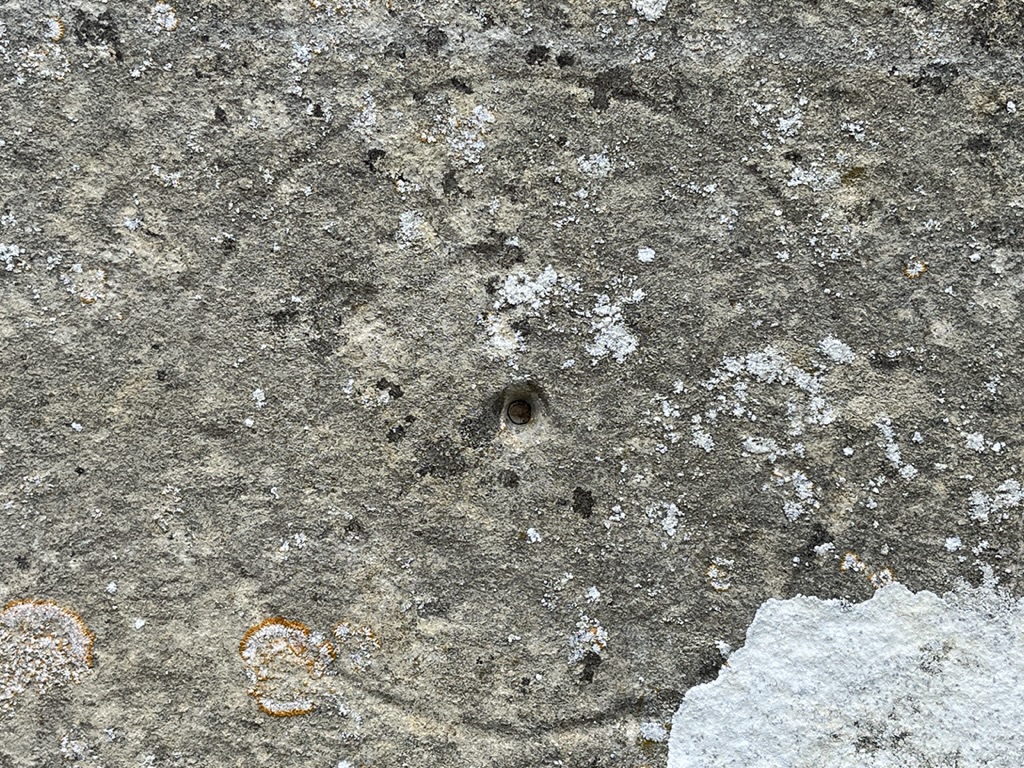
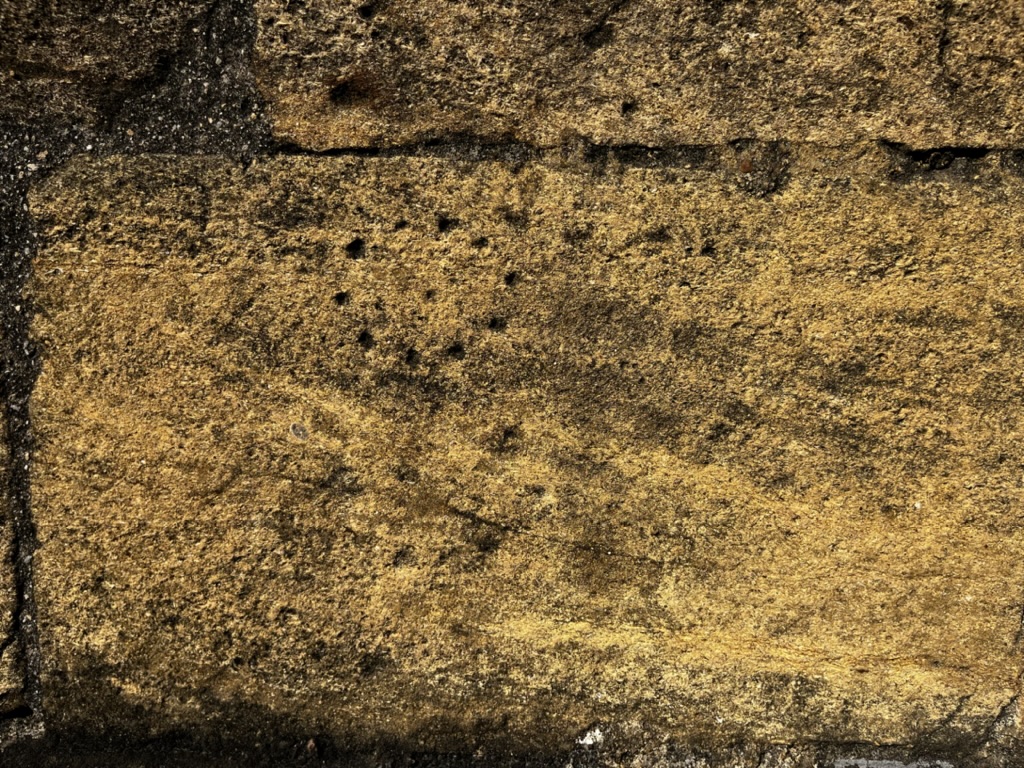
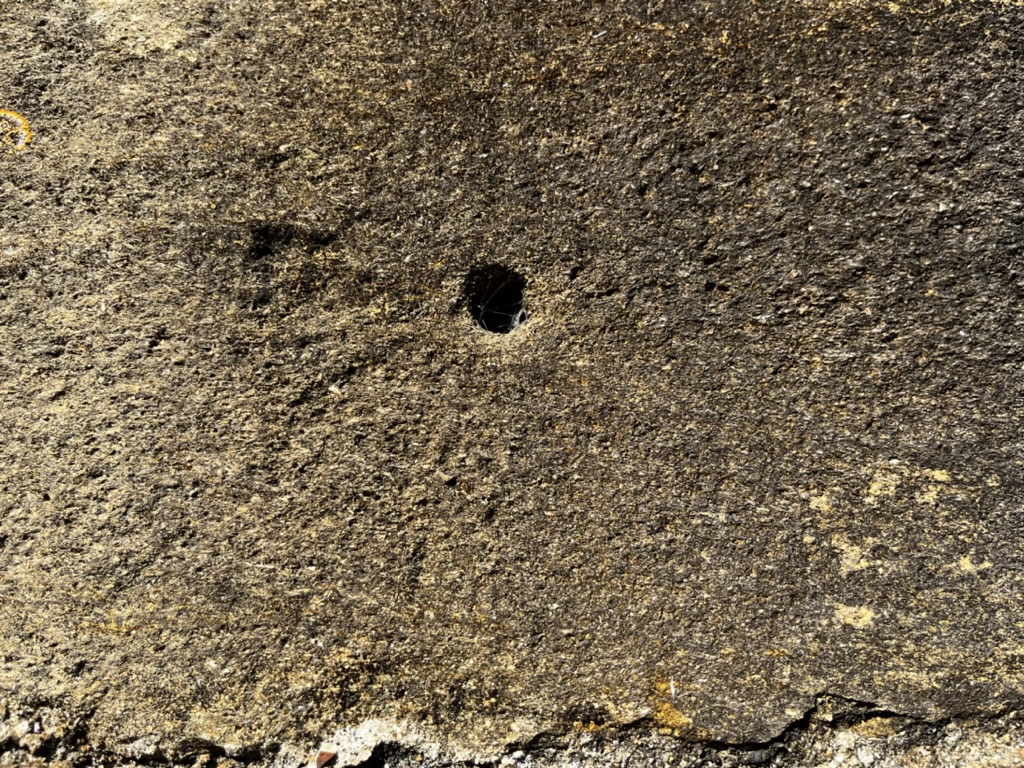
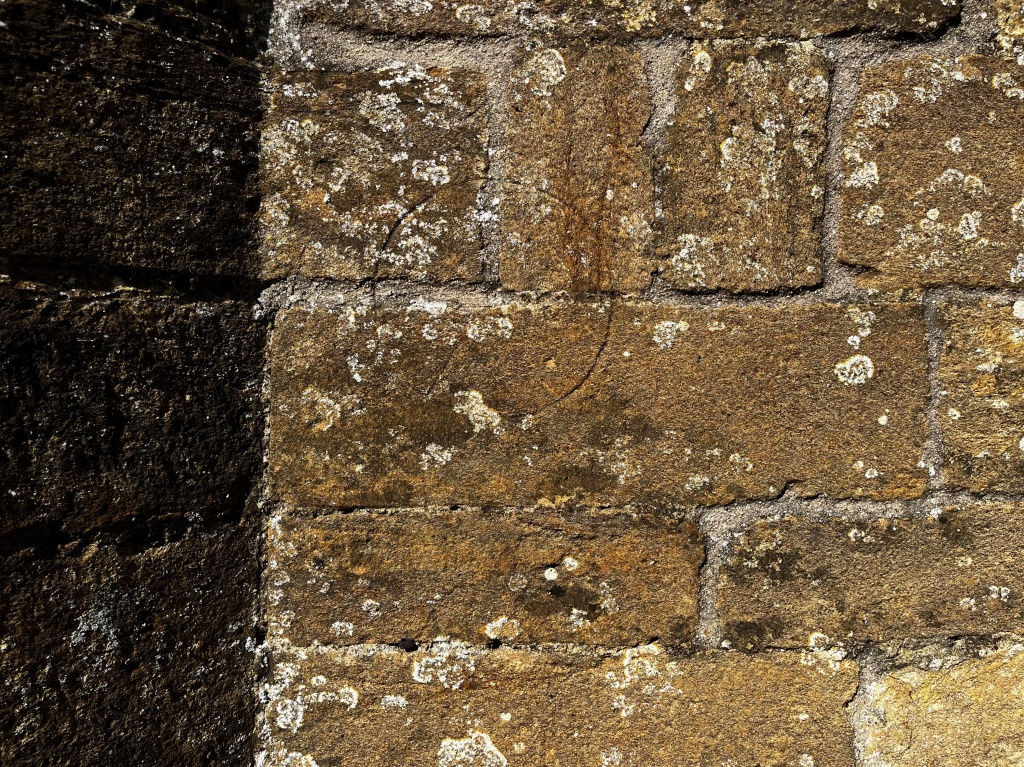
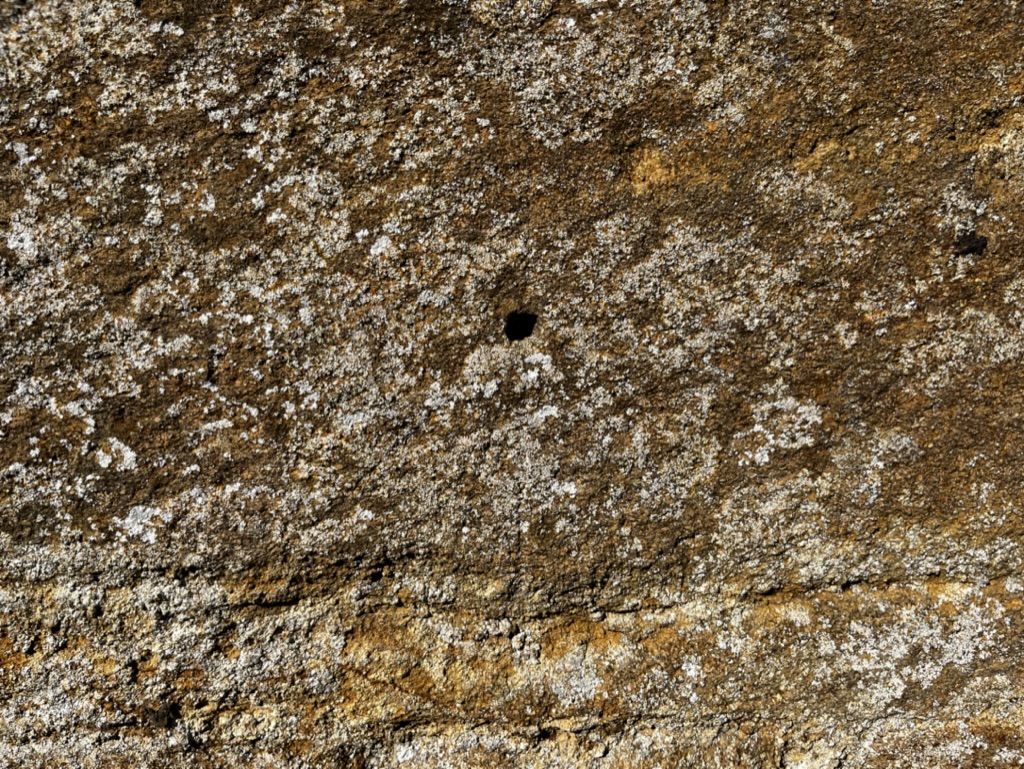
The dark blue circle in image 1 below marks the dial above; the pale blue circle marks image 2. Image 3 is one of several examples that, apart from holes, have no visible dial characteristics.
GRADE I † C13 origins; C14, C15 development; extensive restoration 1873 (Carpenter). C12 font. 3 scratch dials; and a fine Millennium dial LINK. 10m NW of Salisbury. 51.1363 / -1.9493 / SU036374
DIALS
All Saints is unusual in having 3 dials of very similar design, without the often-found stylistic developments on churches that have more than one dial.
DIAL 1
The most complete dial in terms of information for the passer-by. A complete circle with several lines clear and faint, some with a terminal pock. The noon line extends beyond the circumference, with the lines RHS indicating an afternoon dial.
DIAL 2
The dial’s circle is clear and the gnomon hole is large (with signs of recent enlargement). Apart from that only the faintest traces of lines remain, presumably lightly cut initially and eroded over the centuries.
DIAL3
A partially obliterated circle; a gnomon hole; hints of 3 pocks LRQ. Perhaps we can deduce that this was the first of the dials. Of course, even a stick in the centre hole would give a fair idea of the time of day to the passing parishioner.
GRADE 1 † Mid-C13 with earlier origins; expansion to C16; restorations by Ferrey and Scott 1860 and later. A most impressive Parish church with a 4-stage tower. Admired by PEV as one of the loveliest of Somerset churches on account of its splendid Perp. work on the nave; and for being remarkably airy and spacious. 50.9693 / -2.7687 / ST461191
DIALS
A most rewarding multi-dial church. As often, estimates of the number vary. DEH recorded 5 dials in June 1915 and included a photograph of the dial above in his book.
BHO refers to 7 dials [and also notes that one buttress on the north side has footholds cut in it to aid the recovery of fives balls from the leads when the game was played there in the 18th century. There’s a whole book to be written about the fives courts of Wessex] BSS records 7 dials, without details.
There are so many excellent dials to admire that I am not including interpretations of individual dials. The light was good for photos and the various designs speak for themselves. I haven’t given locations either. Most are in obvious places; also check sides of buttresses. It was a lot of fun finding a couple of new dials, and anyone reading this may prefer to investigate for themselves. DEH’s record is given at the end.
DIAL 1
✣
DIAL 2
✣
DIALS 3 & 4
DIAL 3
DIAL 4
✣
DIAL 5
✣
DIAL 6
✣
DIAL 7
✣
DIAL 8
✣
DIAL 9
✣
DIAL 10
✣
DIAL 11
ARCS etc
Having recently written up Winterbourne Stoke and a few other multi-dial churches, I have decided not to include a plain arc as (part of) a dial unless there’s at least one other dial-ish feature – evidence of a centered hole in the mortar line; perceptible lines; pocks; and so on. I’ll still feature them but not as part of a dial count. Unless corrected of course – please do.
✣
CONSECRATION CROSS OUTSIDE PORCH
ADDITIONAL NOTES
The pride of Martock Church is its superb angel roof, installed in the first decade of the 16th century and completed in 1513. The roof design is a king-post style with tracery infill between the truss beams. There are central pendants from each cross-beam, above which rise beautifully carved figures. (David Ross, Britain Express)
DOM ETHELBERT HORNE’S 5 DIALS
200. (1) This dial is on the w. side of the s. porch. It is 6 feet 1 inch above the ground. The noon line is 3 3/4 inches in length, the style hole is 1 inch deep, and is in a joint. The aspect is s. by 5° e. (See No. 12.)
201. (2) This dial is under the first window E. of the s. porch. It is 4 feet 7 inches above the ground, the noon line is 3 inches in length, the style hole is 1 3/4 inches deep, and the aspect is s. by 15° e. Type 6.
Dial No. 2 is of the unique shape that exists at Tintinhull (224) and Swainswick (25).
202. (3) This dial is on the second buttress e. of the s. porch. It is 5 feet 9 inches above the ground, the noon line is 3 1/2 inches in length, the style hole is very shallow, and the aspect is s. by 15° e. Type 3.
203. (4) This dial is under the third window e. of the s. porch. It is 3 feet 10 inches above the ground, the noon line is 2 inches in length, the style hole is If inches deep, and the aspect is s. by 15° e. Type 10.
204. (5) This dial is on the fifth buttress e. of the s. porch. It is 5 feet 1 inch above the ground, the noon line is 5 1/4 inches in length, the style hole is 1 1/4 inches deep, and the aspect is s. by 15° e. Type 5c.
GSS Category: Scratch Dial; Mass Dial; Multiple Dial Church
GRADE II* ✣ C14 / C15. Pleasantly situated by the Manor. Note that the church is up a driveway the opposite side of the busy road from the signposted village itself. 50.9335 / -2.8843 / ST379152
DIAL
The Whitelackington dial eluded me a year ago when I was looking at several churches either side of the road between Yeovil and Taunton. Cricket at SCC was due to start and took precedence. Having in mind that DEH was enthusiastic enough to include a photo of the dial (taken 5 Sep 1912) in his pioneering treatise, I knew I should try again, and harder.
As it turned out, the dial was invisible until parting the branches of a yew hedge on the Manor side. The S side of St Mary blends into the Manor gardens and It feels sightly transgressive to be poking about in the greenery.
DEH’s RECORD
115 YEARS LATER
Photo 3 shows the features noted by DEH, including the possible noon hole in the lower joint
THE BUTTRESS
GSS Category: Scratch Dial; Mass Dial; Hidden Dial
All photos: Keith Salvesen except B&W, Dom Ethelbert Horne
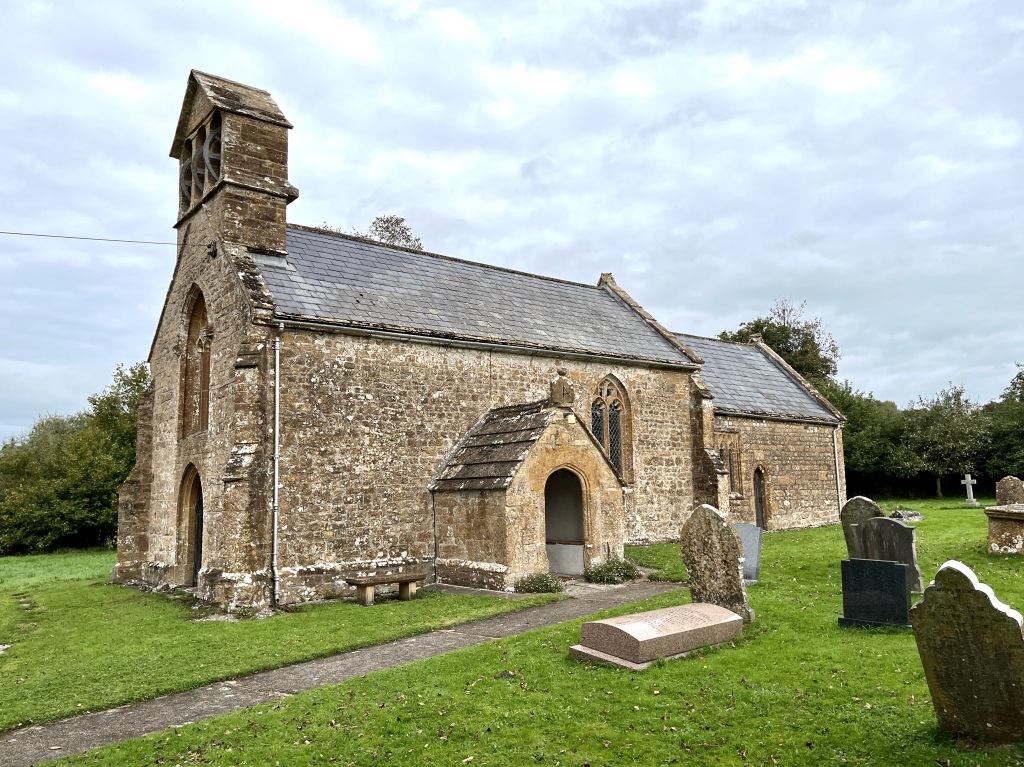
GRADE I ✣ Late C13, records from 1334. A charming small church, with its 3 bells hung on wheels. A plaque lists 19 men who returned safely from WW1; it is a ‘Doubly Thankful’ village with no casualties in WW2 either. See also neighbouring STOCKLINCH OTTERSEY, a closely linked church. Close to Barrington Court NT. 50.9508 / -2.8797 / ST383171
✣
DIAL
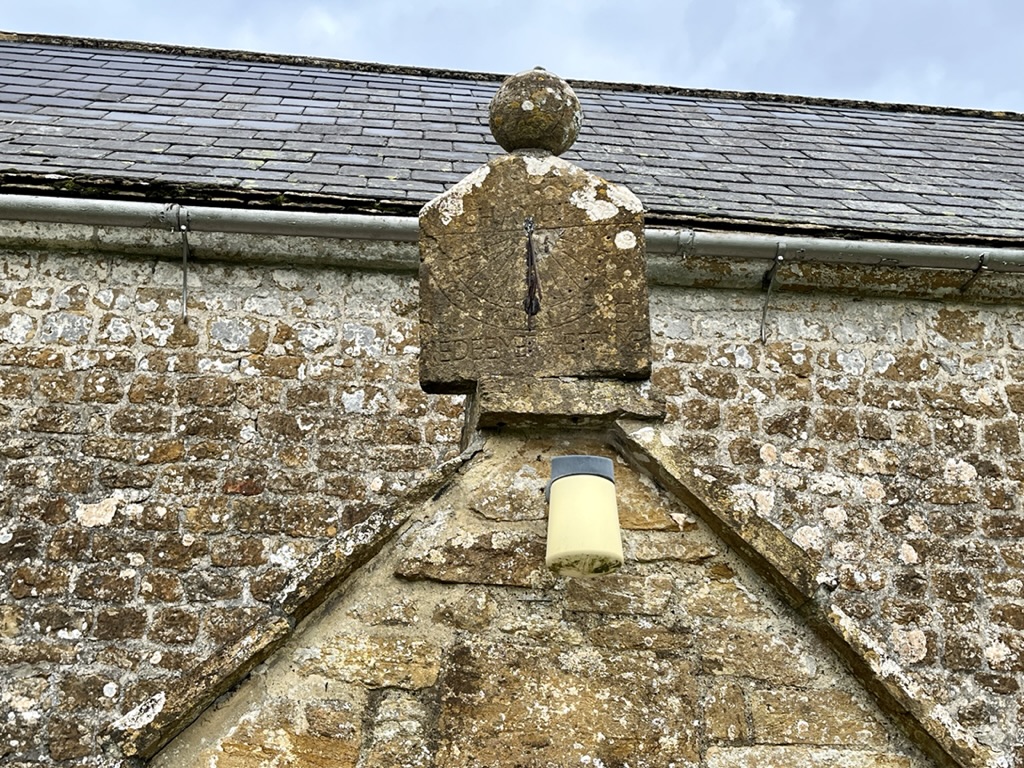
The dial is perched on the apex of the squat porch. It is square, significantly canted, and with ‘shoulders’ upon which rests a ball finial. Given its exposed position, the dial is in good condition. BSS dates it to 1612. There is a clear-cut semicircle with a full complement of lines, and with pocks marking the half hours.
CANTING
GNOMON ANGLES
INSCRIBED MOTTO
The words WATCH AND PRAY are inscribed above the dial face. Erosion and lichen have made it hard to see. Below the dial are the words REDEEME THE TIMES, with the final S fitted in above the line. The numerals – damaged LHS – are Arabic.
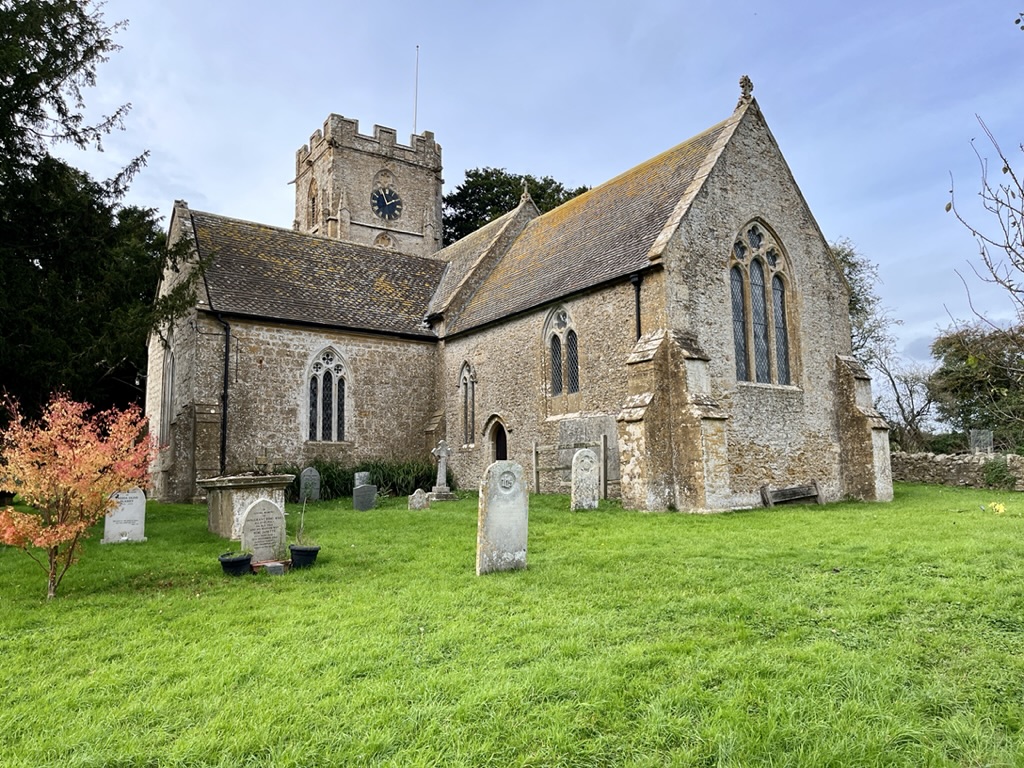
GRADE I † Early Church recorded at HestrebeDB. C12 origin as collegiate church; continuing development to C16; mid-C19 restoration (Butterfield). C13 work of particular note. One of the excellent churches to be found in the Wylye valley between Steeple Langford and Sutton Veny. 51.1821 / -2.1086 / ST925425
DIAL
The dial is on the SE face of the angled buttress at E end (by the green tank). It is a fine example of a dial on which all the lines have terminal pocks. At some time it was inverted, and I have shown it reverted below. I cannot find any record of it, BSS or elsewhere.
REVERSION
This dial is primarily a morning dial, with lines marking (in clock terms) the 5 hours from 8 to noon. The deeper lines marking 9 & 10 correspond to the morning Mass time Terce. Possibly, the fainter line LRQ indicates None, another significant time during the day’s observations. In all there are 9 visible lines with terminal pocks during daytime, and a hint of a line above the horizontal in URQ. The vertical ‘midnight’ groove above the gnomon hole can be discounted as part of the dial, I think. It is certainly out of keeping with the carefully thought overall design. Also, it doesn’t reach the gnomon hole.
PLAUSIBLE DIAL?
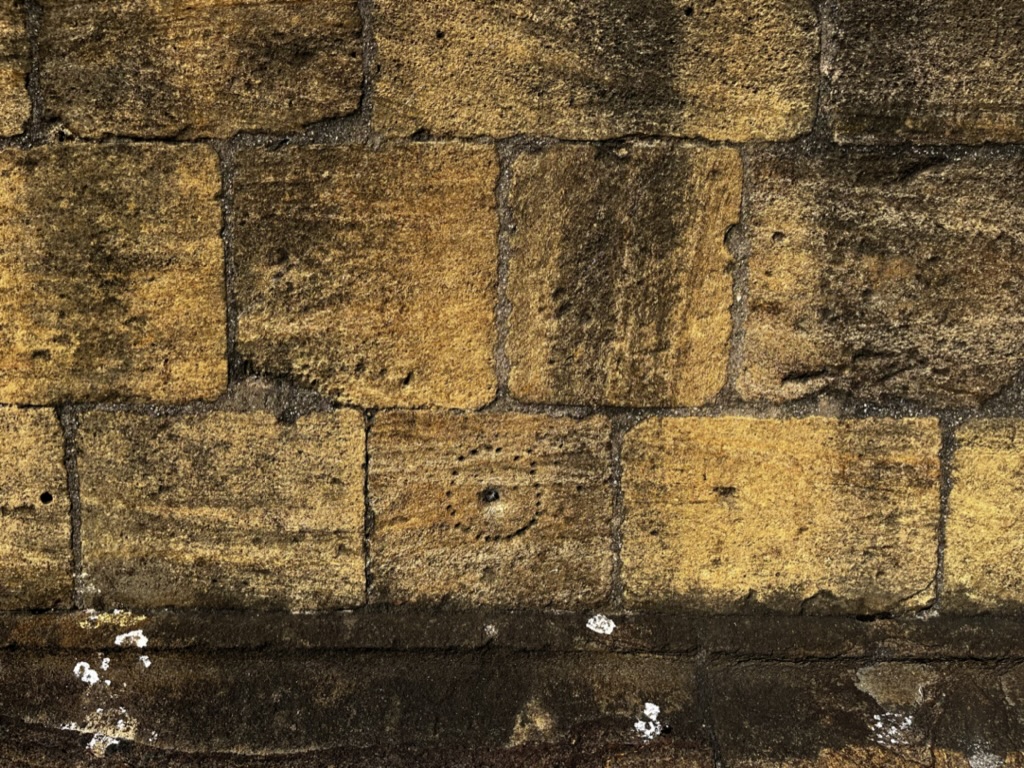
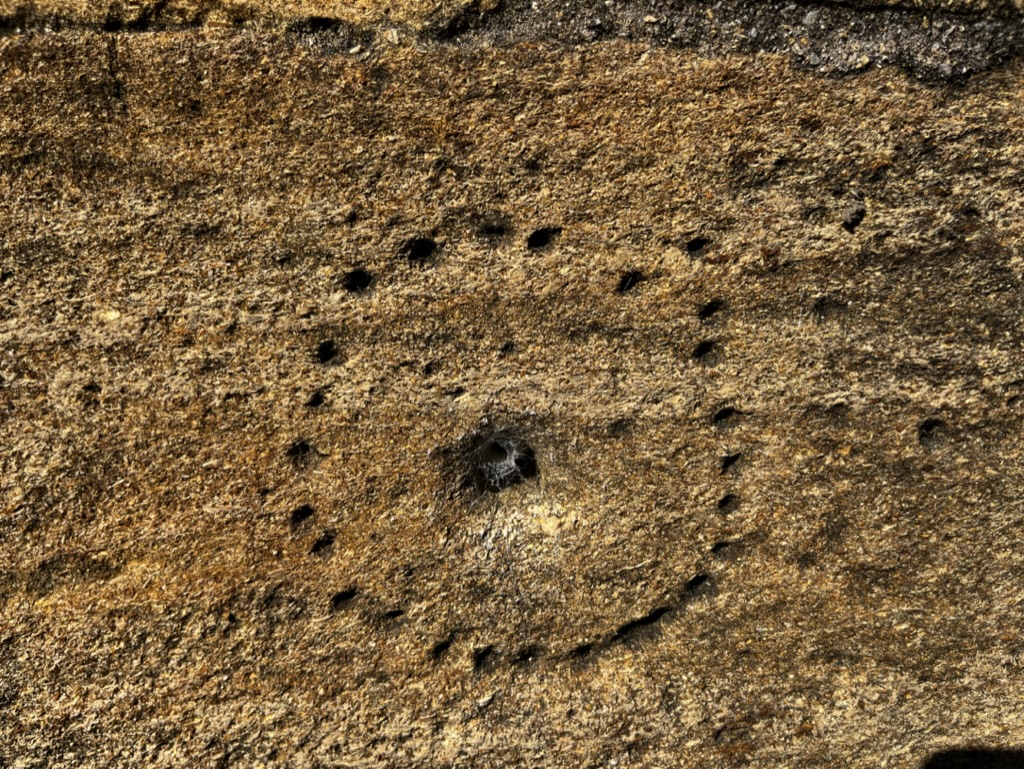
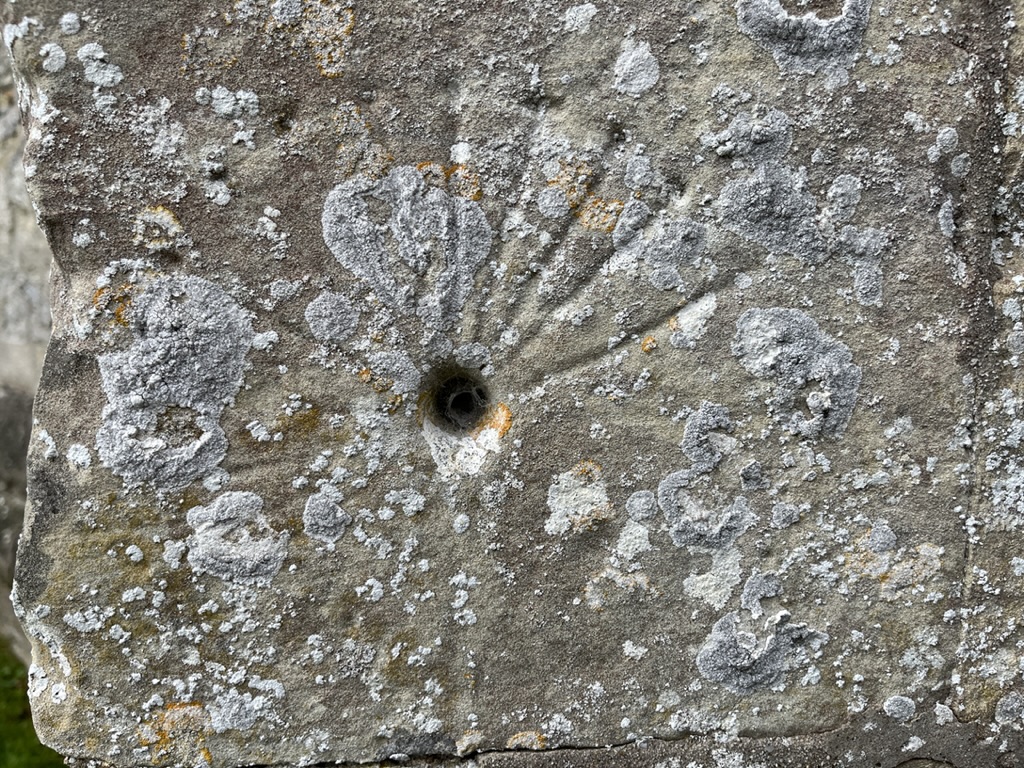
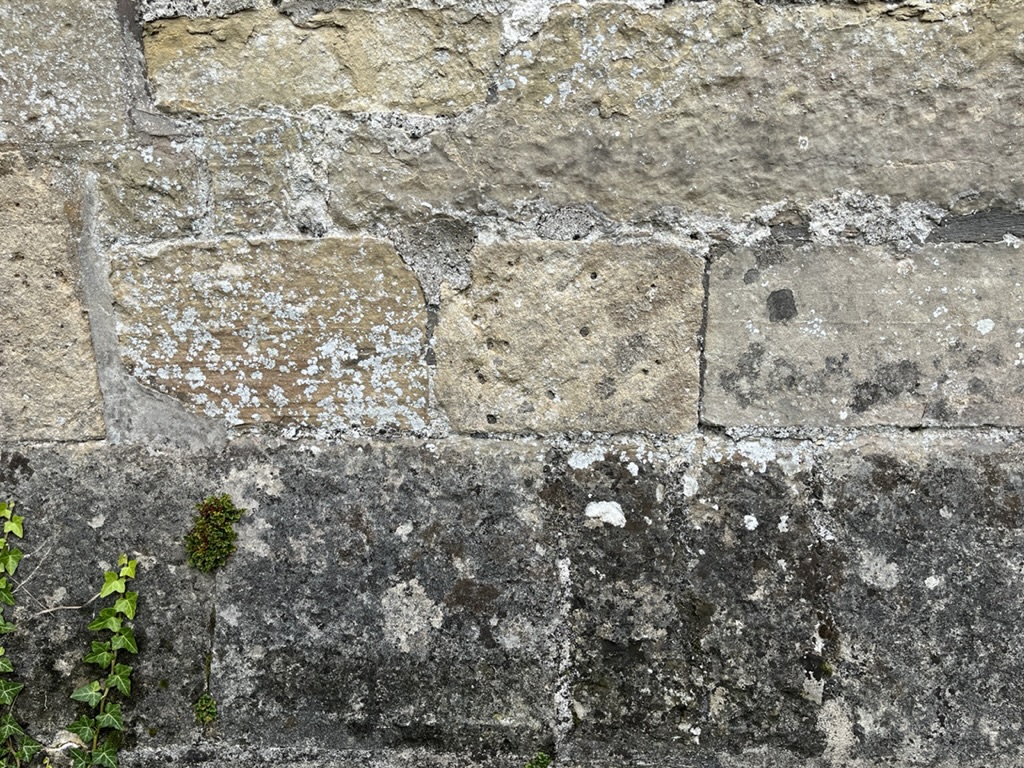
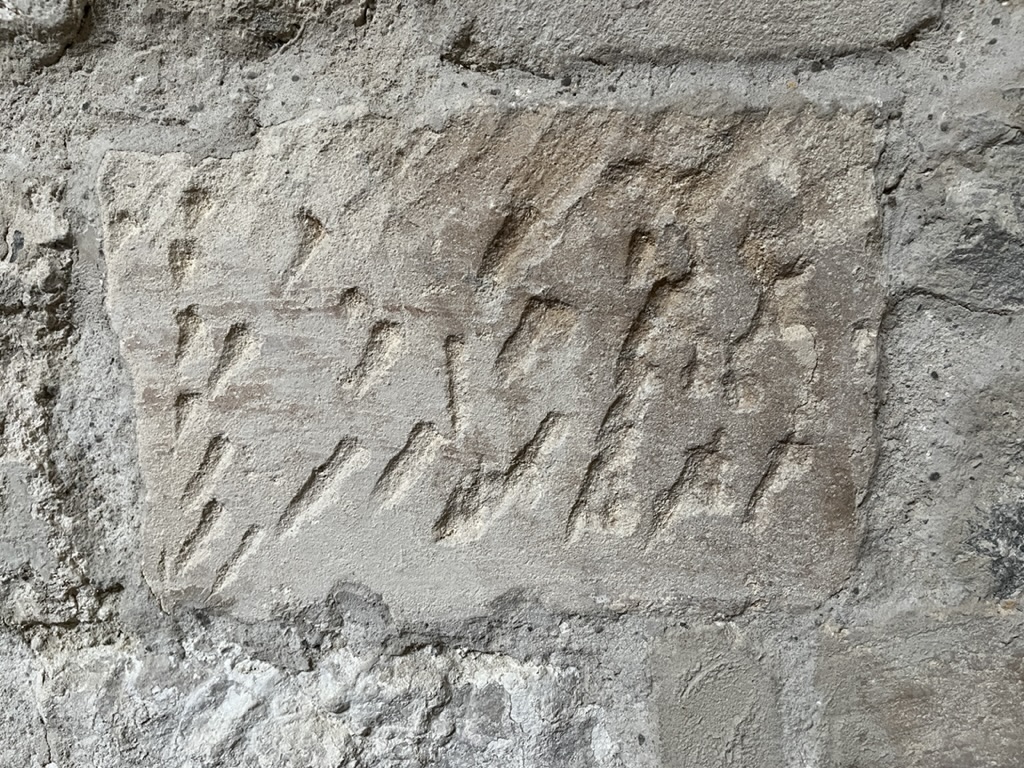
I noticed this patterned stone and photographed it as I walked past. I would very much like it to be a ‘pock-only’ dial. There is certainly a hole close to the centre of the stone, with a pattern of small holes that look crudely drilled, approximately forming a perimeter. Probably I am overthinking this.
CHURCH MARKS
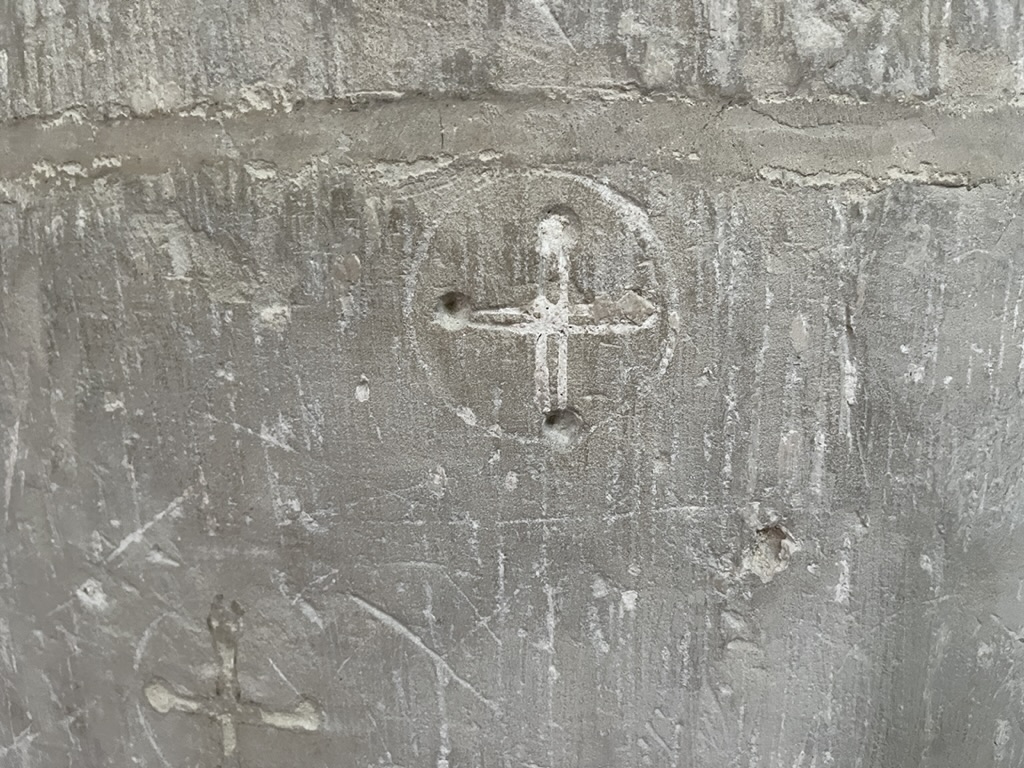
Here is a selection of church marks – masons’ marks, consecration cross; ‘pilgrim’ crosses; graffiti; a small dial-like design that merits further investigation.
GRAFFITI INCLUDING RITUAL PROTECTION SYMBOLS
GSS Category: Scratch Dial; Mass Dial; Church Marks; Consecration Cross; Masons’ marks; Pilgrim Cross; Graffiti
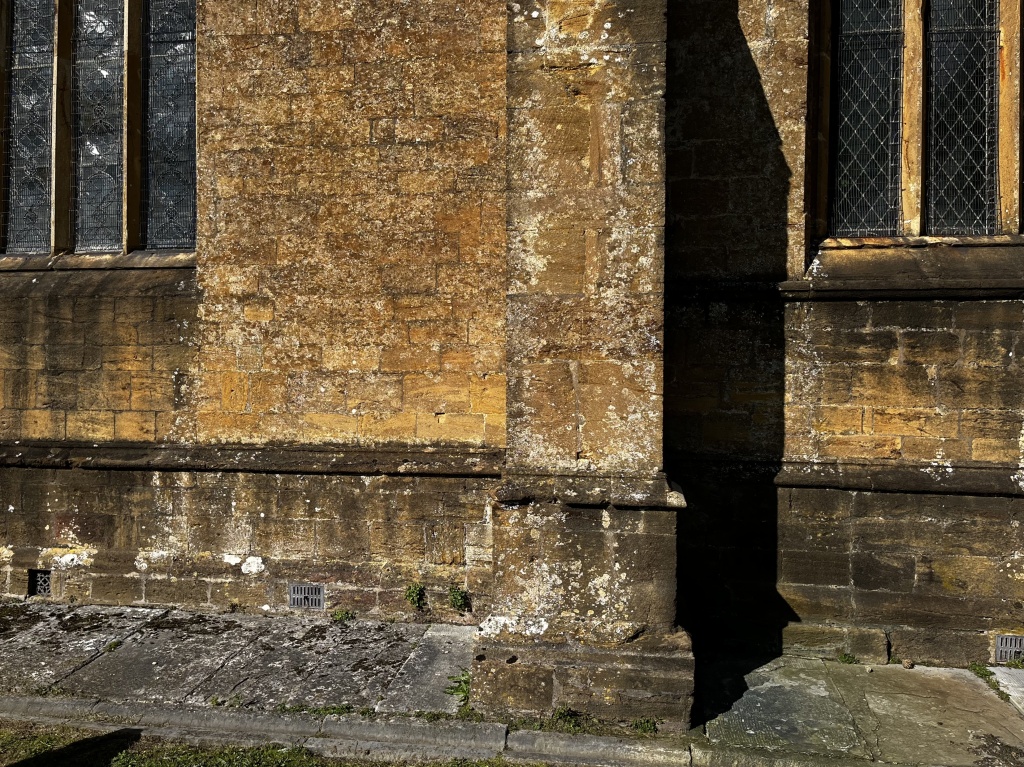
GRADE II* † C13 (of which traces), C15, major C19 restoration. An attractive church to visit, close to Barrington Court NT. 50.9606 / -2.8884 / T377182
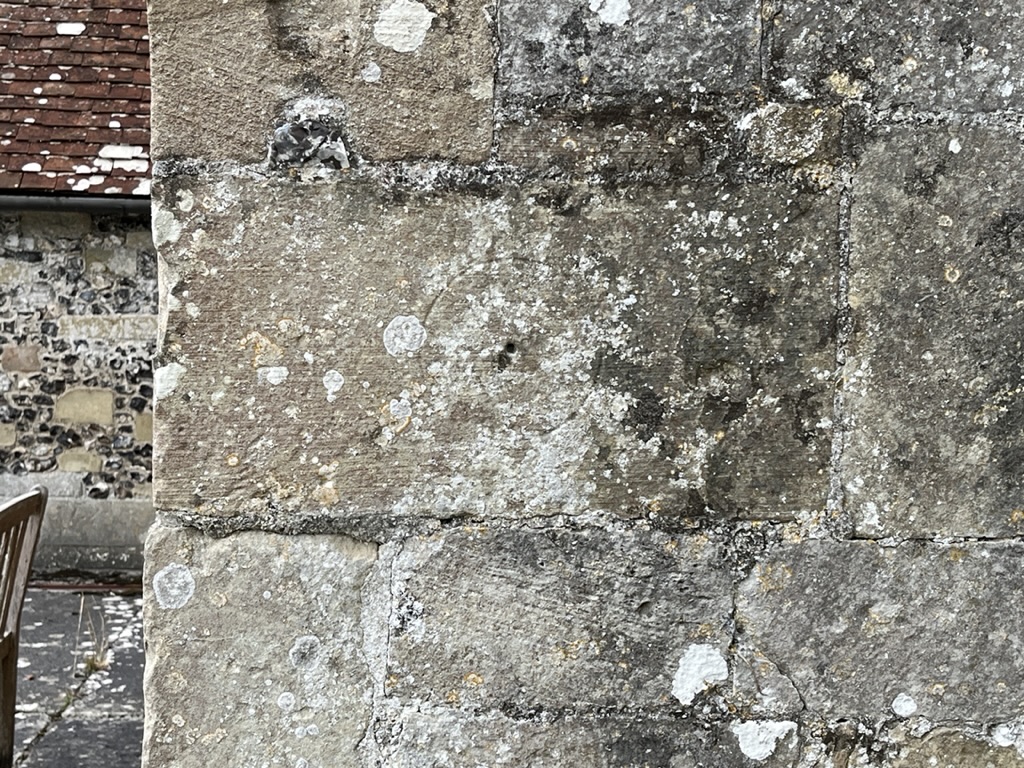
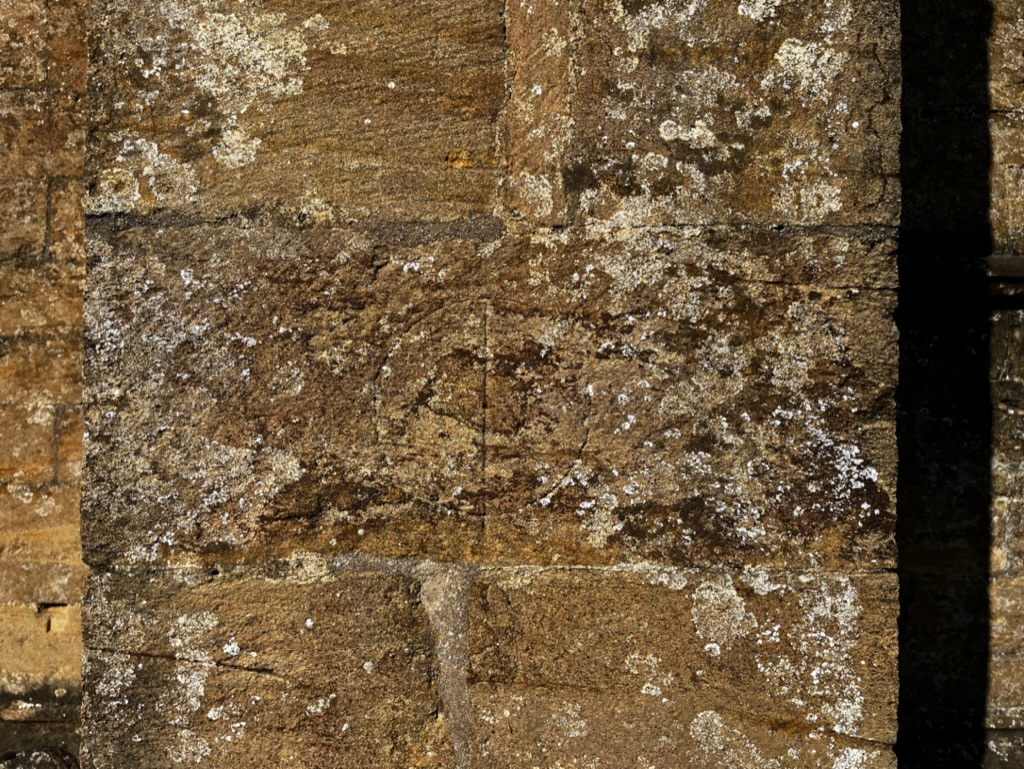
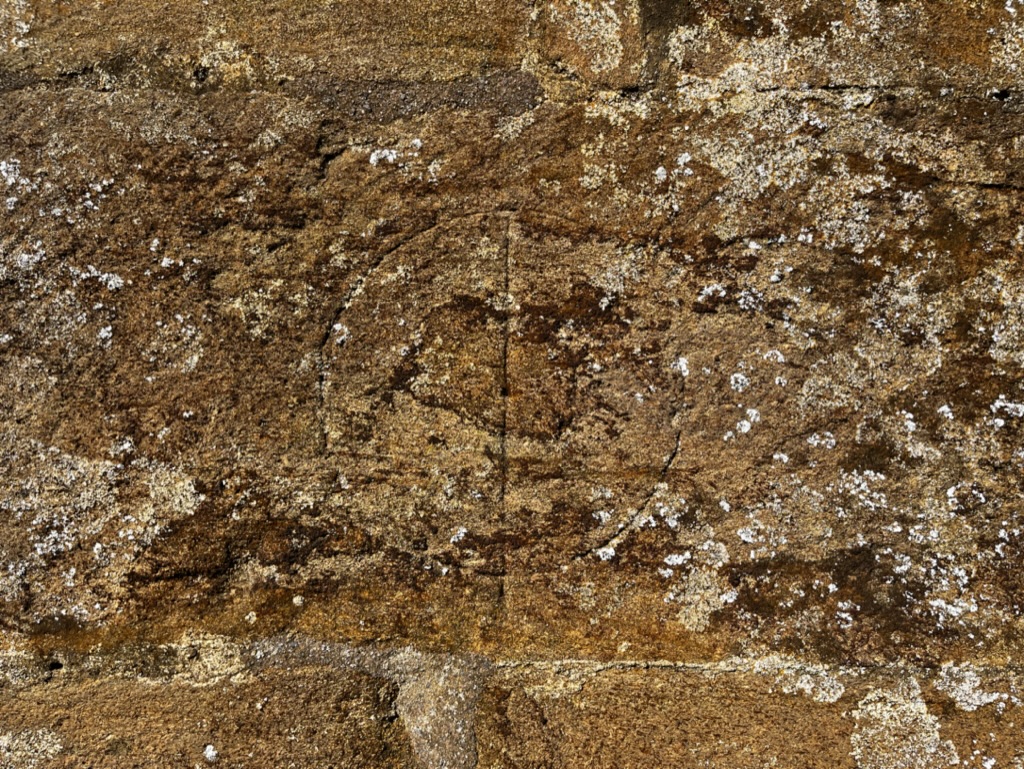
DIAL
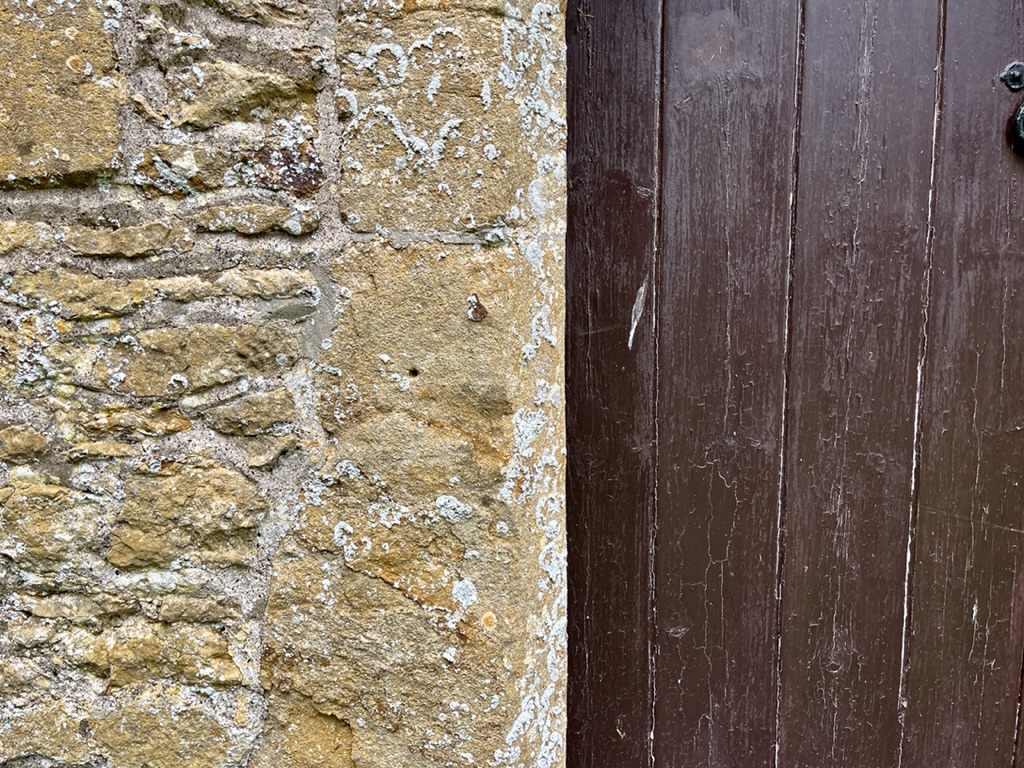
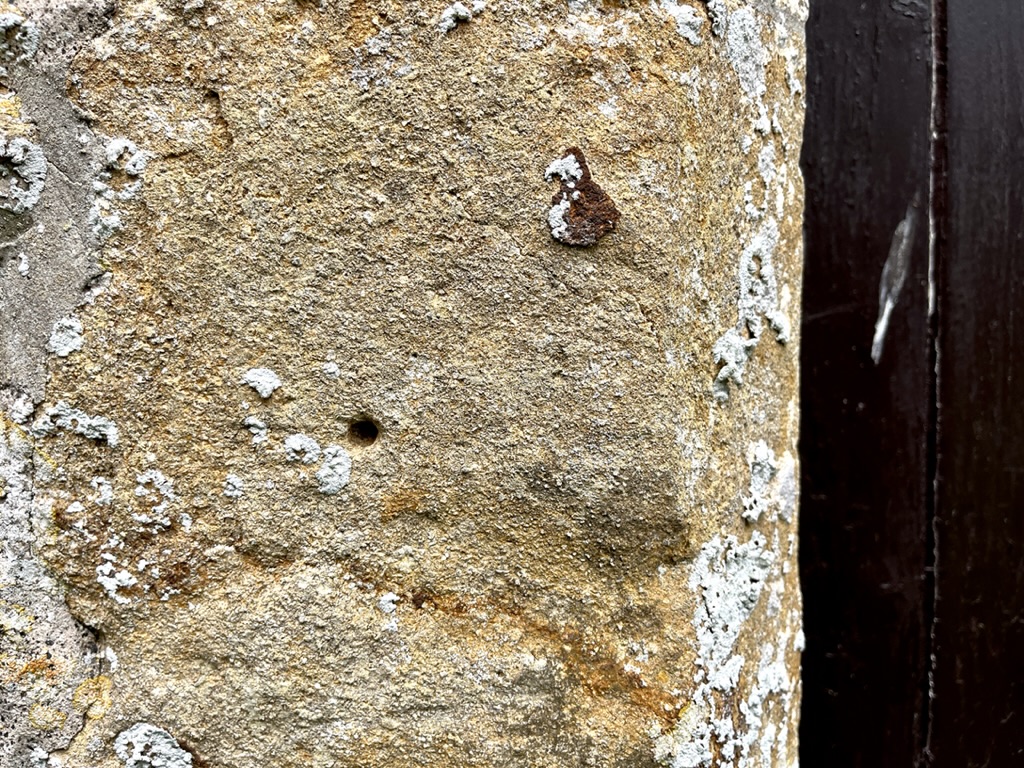
DEH visited in Sept 1912 and recorded: The dial is on the W side of the Priest’s door… 2 early A.M. lines are all that show but the stone is badly weathered and others may have been on it.
The erosion is doubtless worse now. One can just about make out a short horizontal 6-line L side, and a trace line below. Without DEH’s pioneering scratch dial project, I doubt that this little dial would ever have achieved a later mention.



















































 GAUDIUM SUB SOLE . SUNDIALS . MEDIEVAL TO MODERN