GRADE I ✠ C7 origins with a long and fascinating history amply covered by many sources. The Wiki entry gives a good brief account. Now only the Abbot’s House and the Lavatorium remain intact. The ruined foundations are all that can be seen of the Abbey buildings and layout.
The Abbot’s House has a number of apotropaic marks including hexfoils and taper burns, noted on the relevant pages here.
✠
DIAL
We visited the Abbey knowing approximately what to expect from the Abbot’s House. It is well worth exploring, and there are helpful EH volunteers on hand to give information.
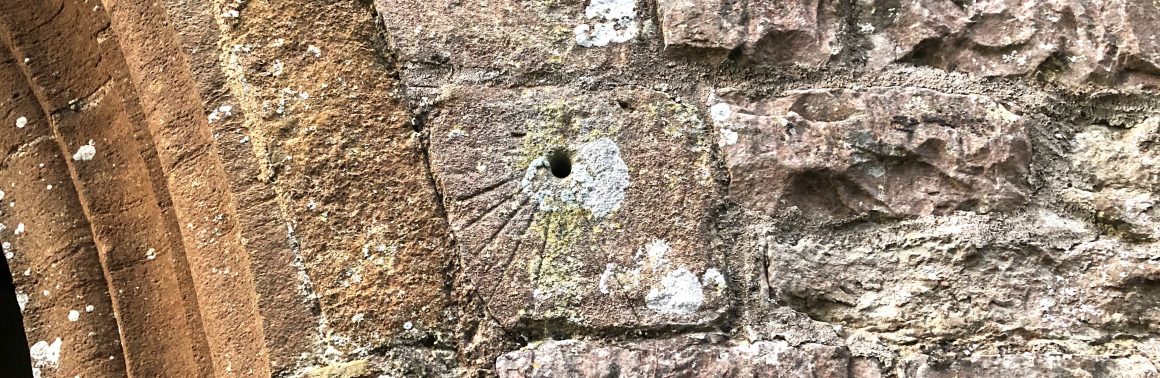
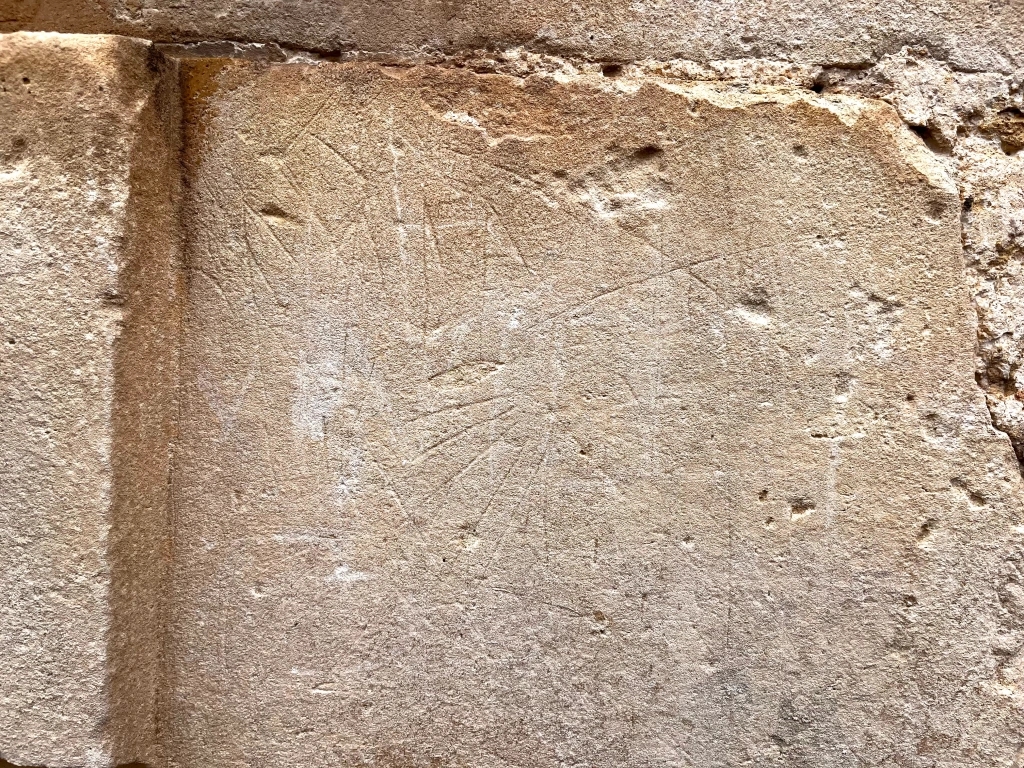
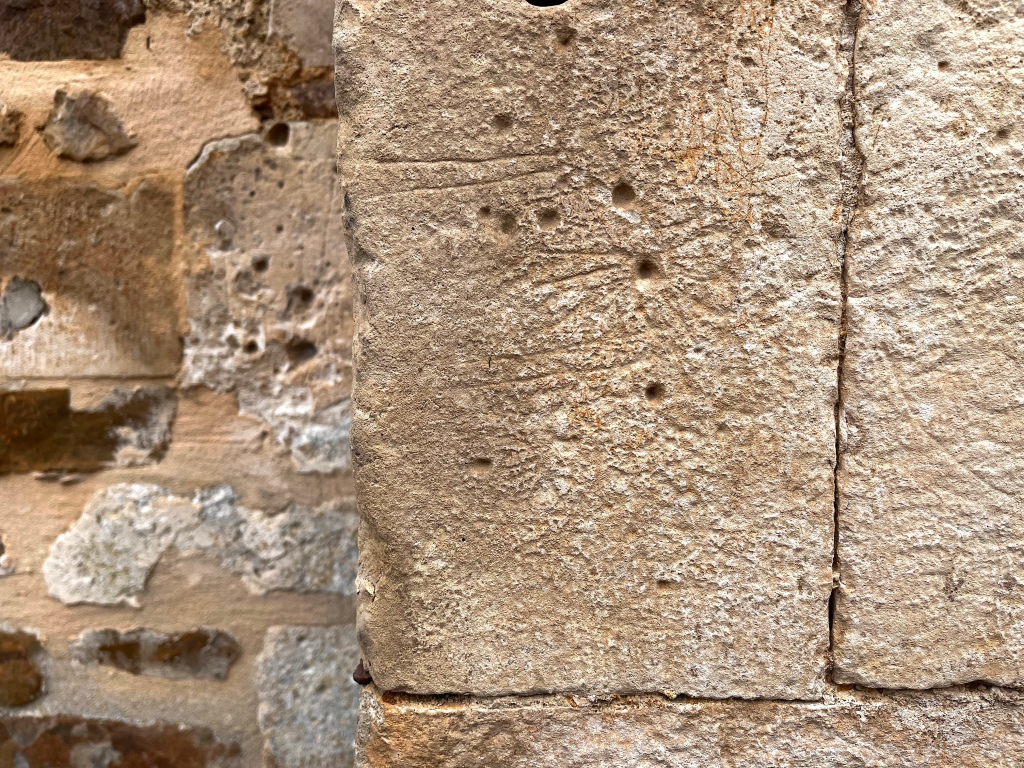
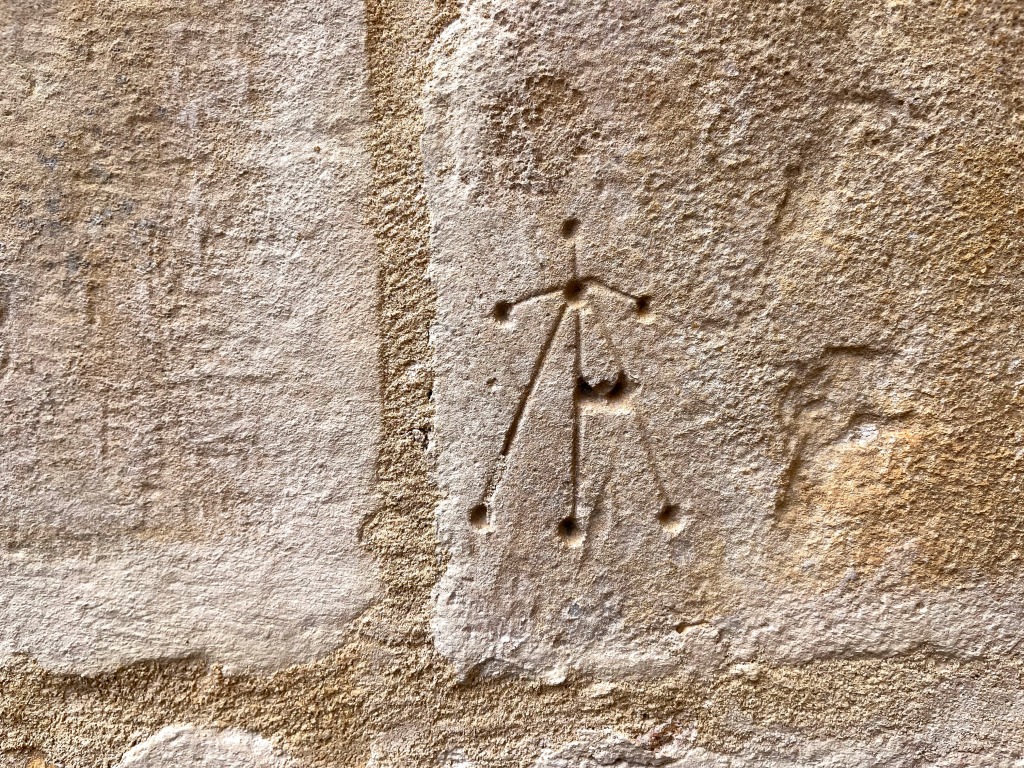
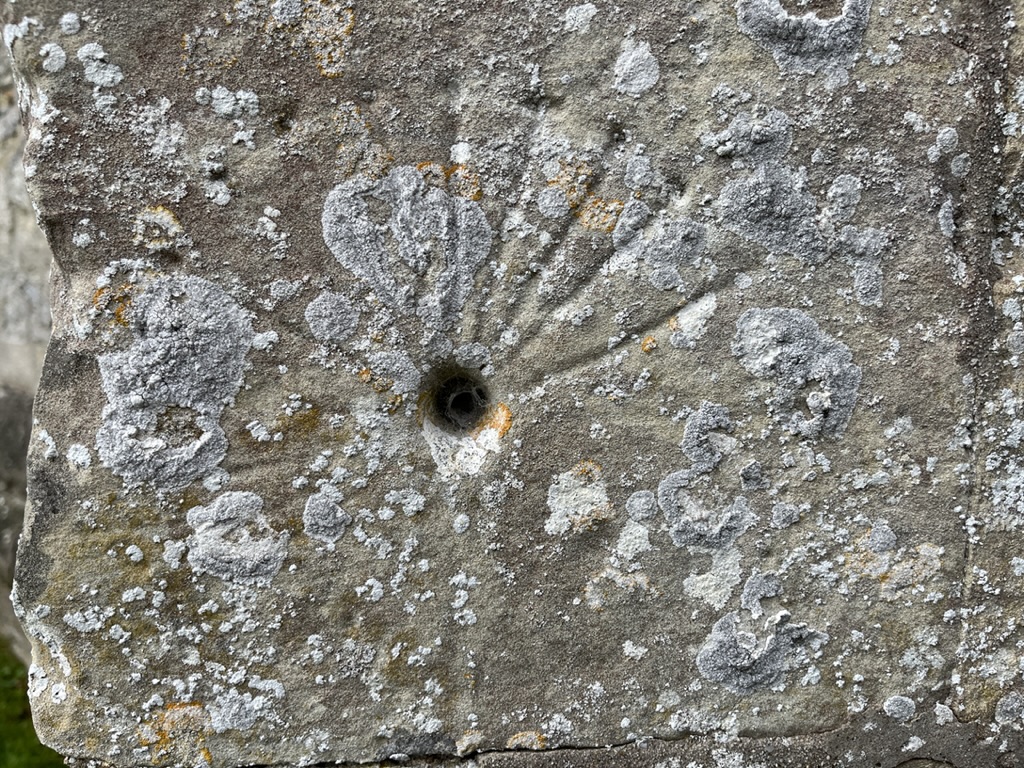
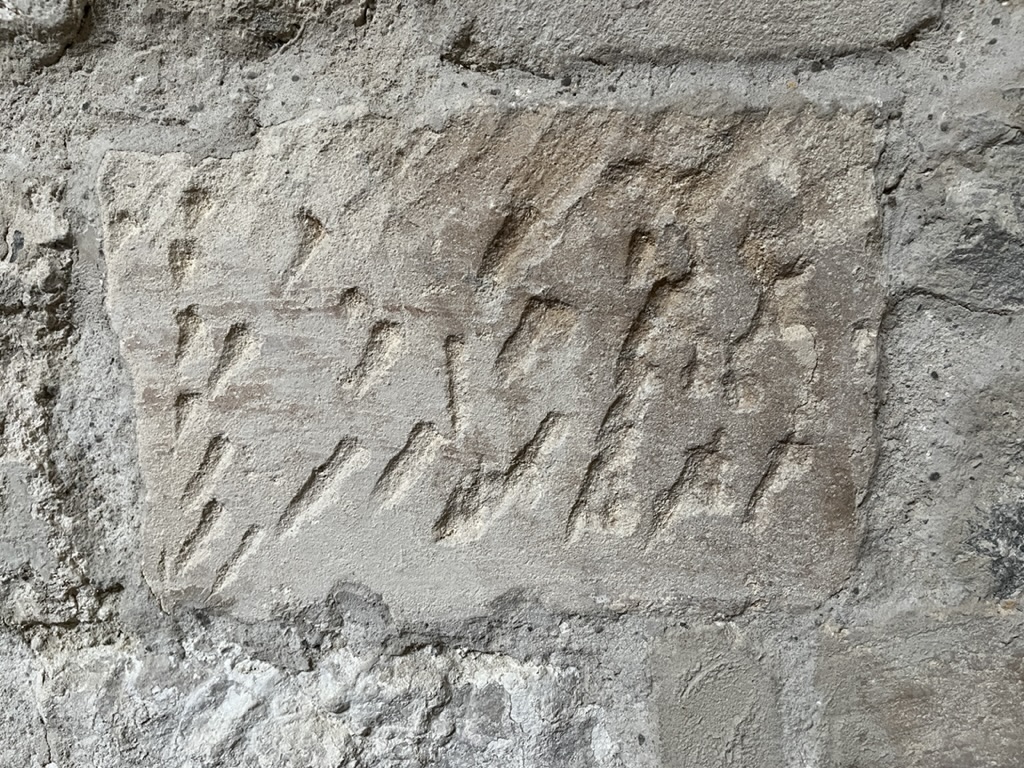
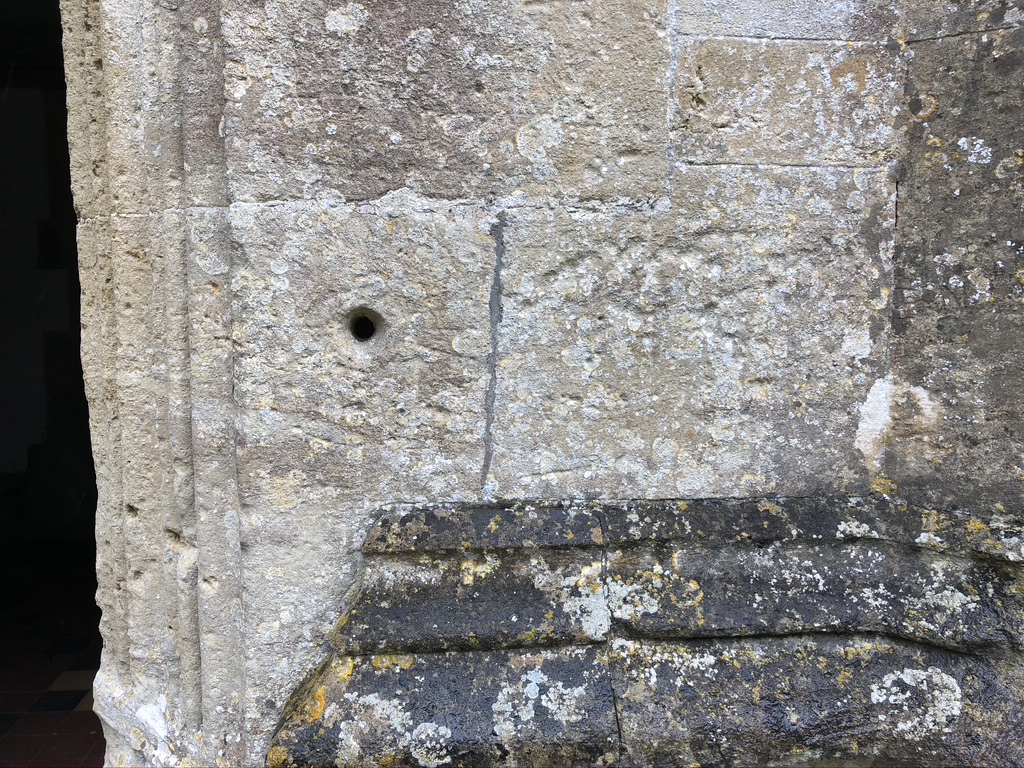
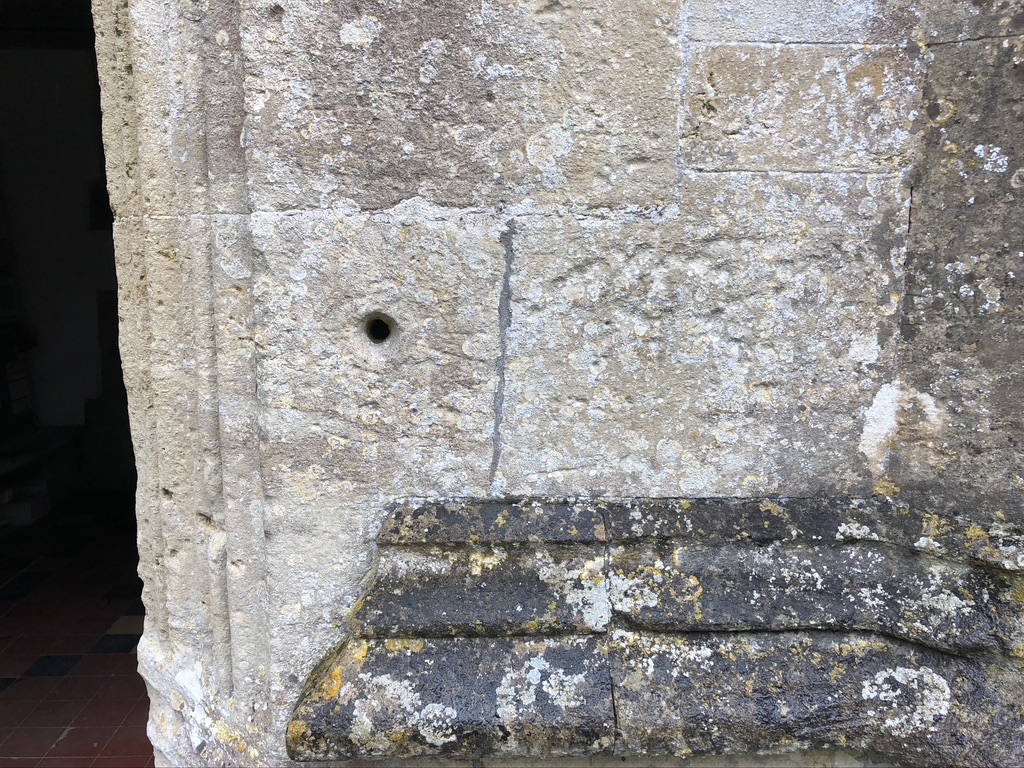
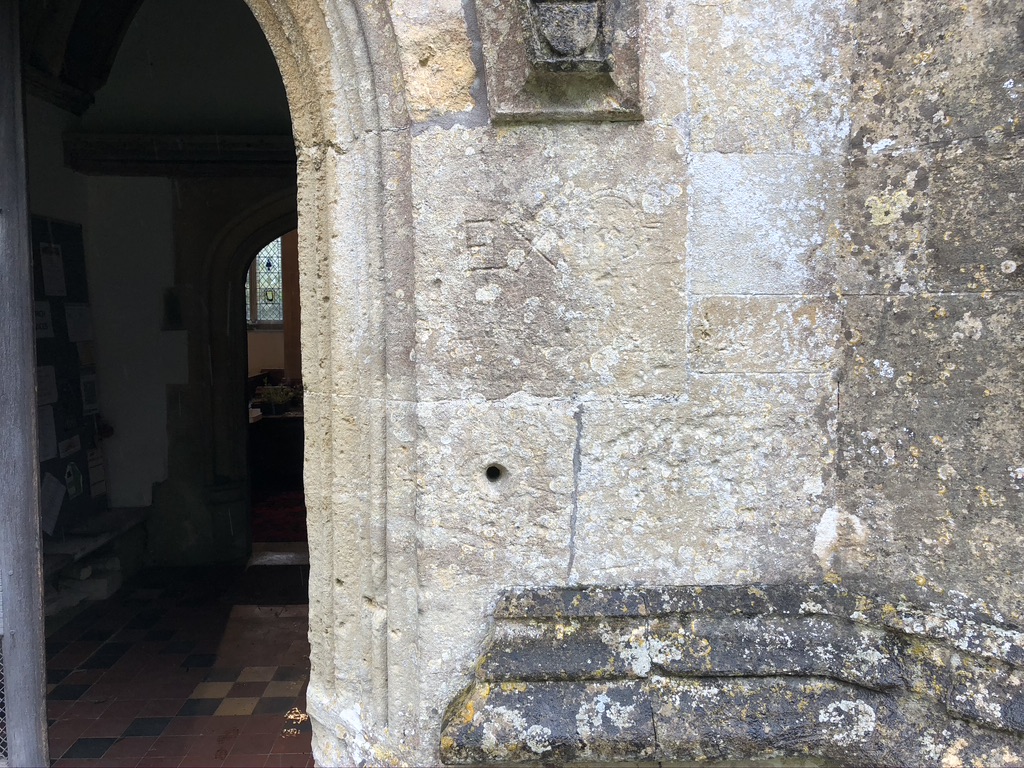
We eventually reached the West Kitchen, which has a door to the S side of the building. It was a great surprise to find a simple and eroded scratch dial between the doorway and the East Kitchen window. It is quite rare to find a scratch dial on a building other than a church. Non-secular dials can occasionally be found on medieval barns. Perhaps the Abbot’s dial was originally part of the original abbey building, and re-sited. I’d prefer to think that a factotum had cut the dial specially for an Abbott so that he could keep track of the important times of the monastic day for which he was responsible.
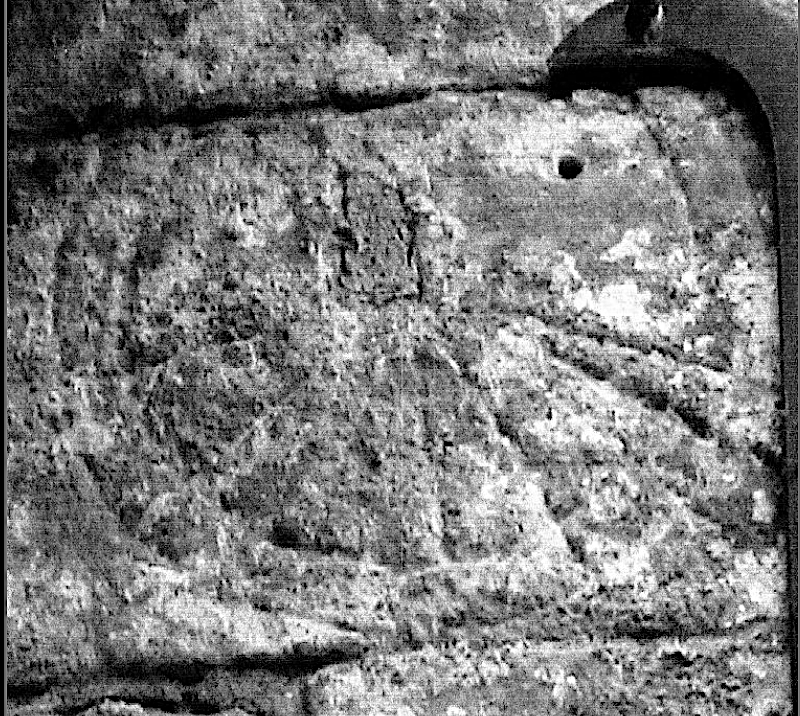
This is not an easy dial to analyse. Certainly there is a horizontal line ( 6-to-6) that runs through the gnomon hole (very faint RHS). There is a deeper cut noon line that seems to extend above the hole to the mortar line.
As often, a b&w image can assist with finer details. There is a faint 9-line, suggesting that Terce was the primary time for observance. Possibly a further line at 11? No relevant markings LRQ. Possibly there is a line ULQ just above the horizontal.
It is clear that EH and the guides know about the dial, but I have been unable to find a reference to it elsewhere. Probably a local research group will have recorded it, but otherwise it seems that this unusual dial (for location) is very little known
MUCHELNEY ABBEY . SOUTH FRONT
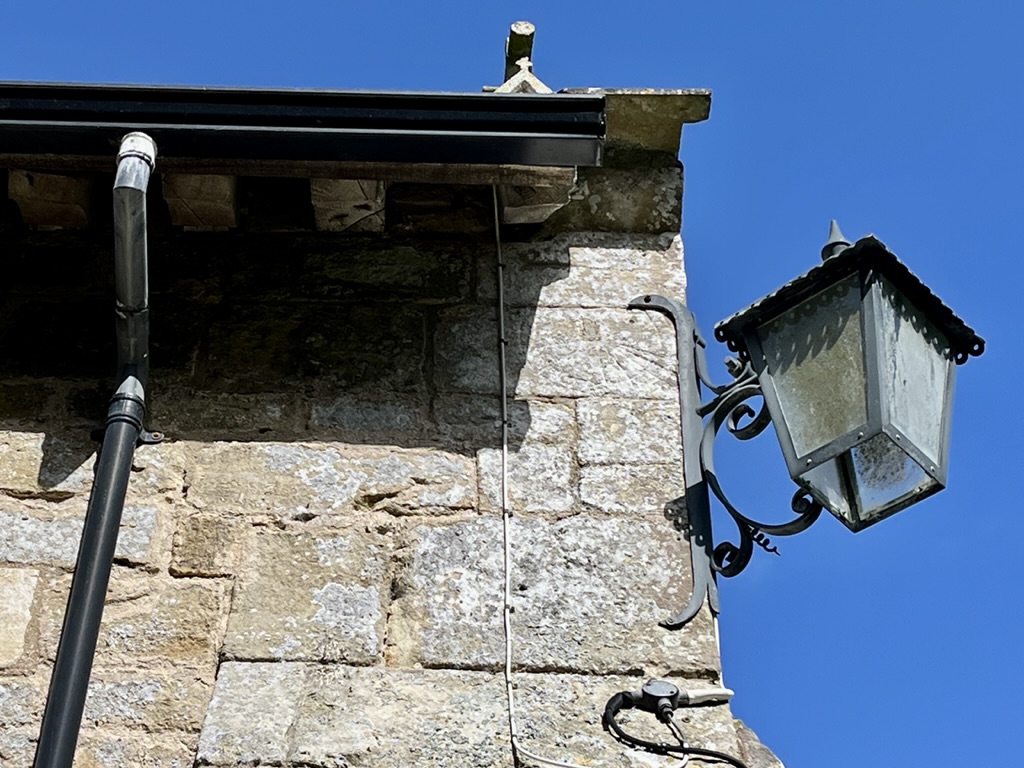
Muchelney Abbey – Abbot’s House S side showing W kitchen door . Photo by DeFacto OS CC
GRADE II ✣ A fine Norman church built late C11 (nave); chancel c1200; tower C13. Major restorations ±1900 (Ponting). An estimable entrance. Worthwhile (PEV) and (more graciously) one of Wiltshire’s most delightful churches (Betjeman). Lovely font; wall paintings; pilgrim crosses, protection marks & graffiti. 6m N of Salisbury. 51.1244 / -1.8301 / SU119361
All Saints also has a vertical dial which will feature separately
DIAL 1
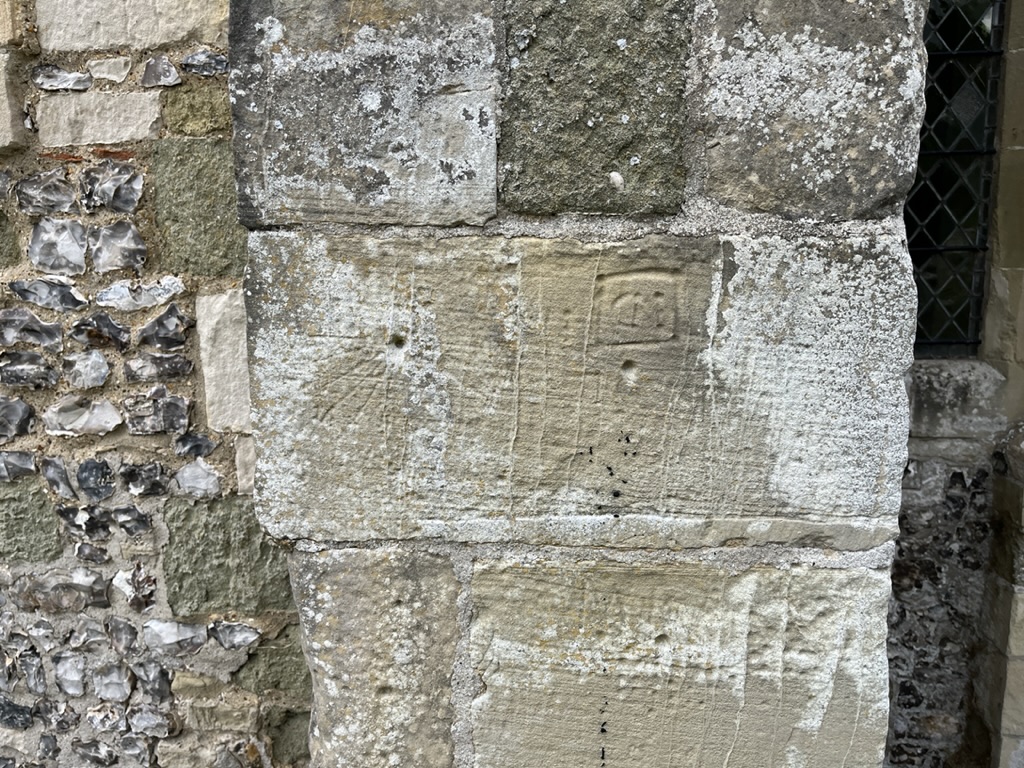
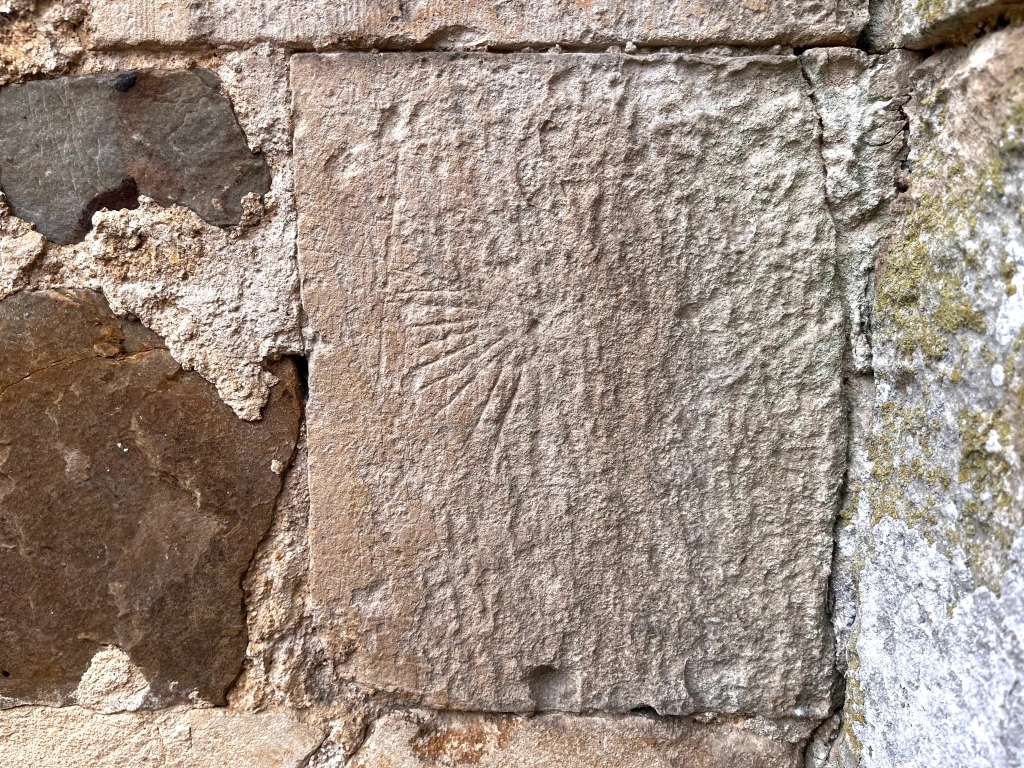
Dial 1 is semicircular, located on the E buttress of the nave, close to the Priest’s door. It is in pleasingly good condition. Almost all lines of this 6-to-6 dial are visible, though much eroded RHS. The incisions are somewhat haphazard, and it is slightly odd that the most significant cut – the noon line – is so random.
DIALS WITHIN THE SOUTH PORCH
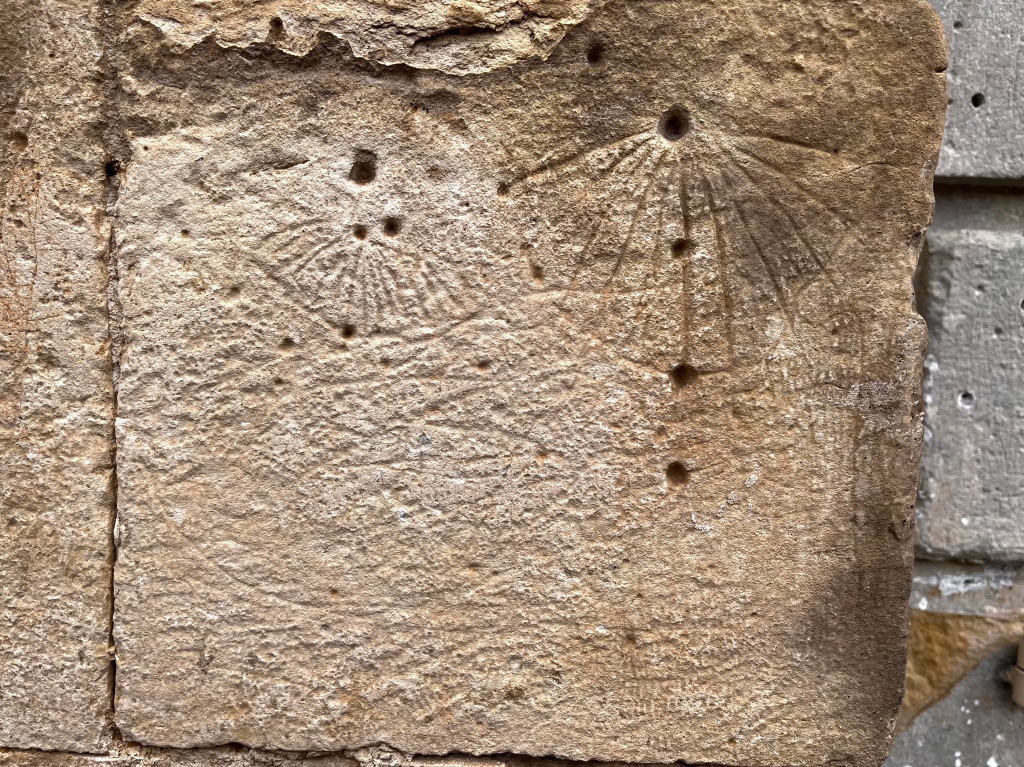
On entering the porch, the splendid door into the church itself invites immediate exploration inside. However, the porch conceals 3 scratch dials that a handful of people might like to investigate. There is scant reference to the scratch dials either side of the doorway. A dial LHS is recorded by BSS; one RHS is vaguely hinted at; another dial RHS is not noted anywhere that I can find, perhaps a new (modern) discovery.
DIAL 2
This dial is quite easy to find, half-concealed LHS but visible as one walks past. There are well defined lines, with the noon line probably the almost vertical one with a small pock at the end. I wondered if the straggly lines LRQ were later additions. Without them, the lines are all LLQ and (as with Dial 4 below) indicate mid-morning as the main part of the day for a service.
DIAL 3
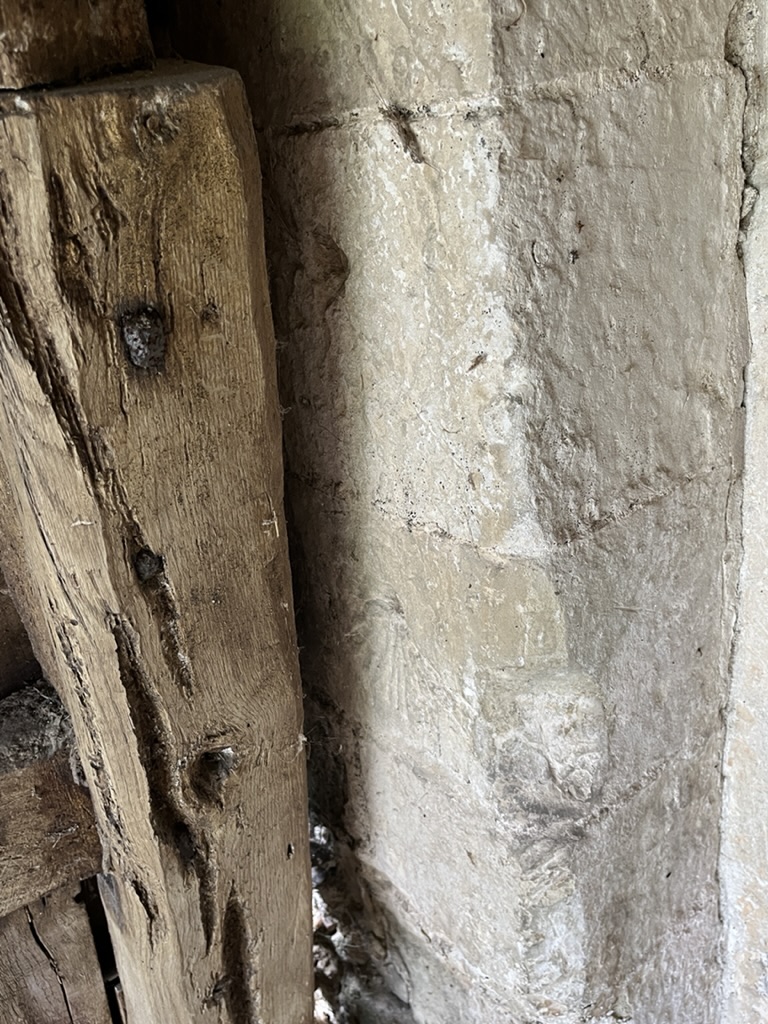
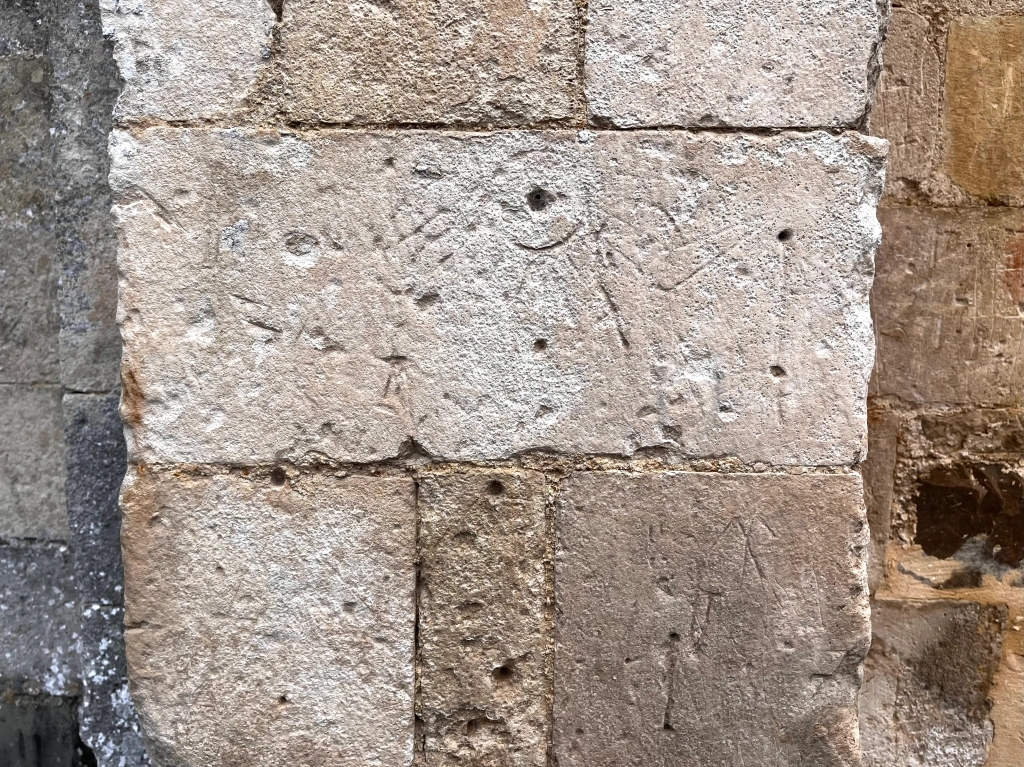
Dial 3 is hidden away RHS of the fine door, even less accessible than dial 2. It is a fascinating example of a ’24 hour’ dial, with a full complement of spidery lines of random length of which almost all are still visible.
DIAL 4
Also RHS and even less visible is a conventional ‘morning’ dial, with 4 lines (the upper one is faint) leading down to the slightly deeper cut noon line. This configuration again suggests that mid-morning began the important part of the day for observance before noon.
If you want to know more about this church, in particular the inside, there is a good article HERE
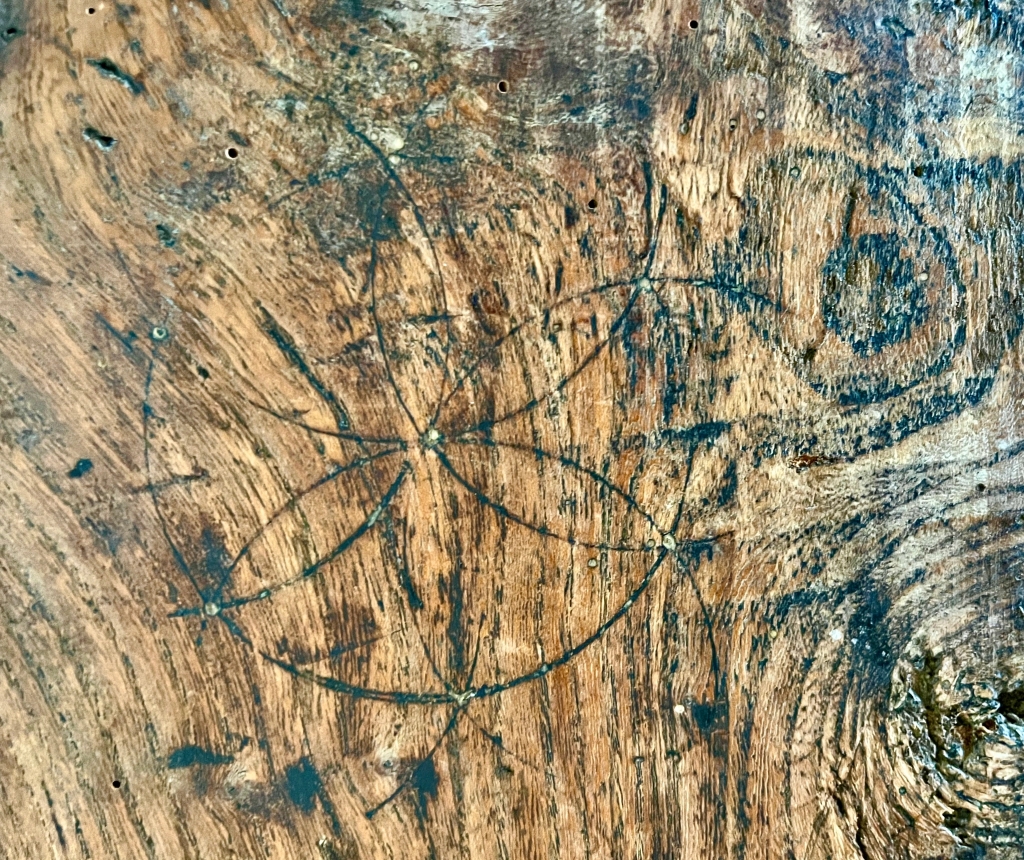
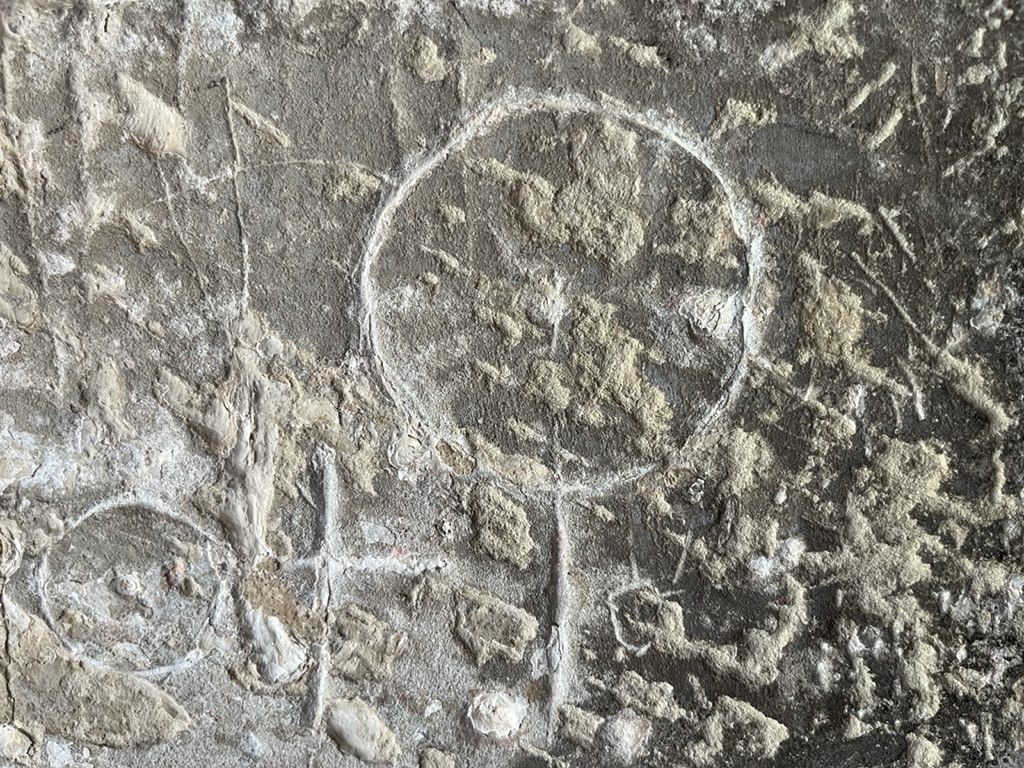
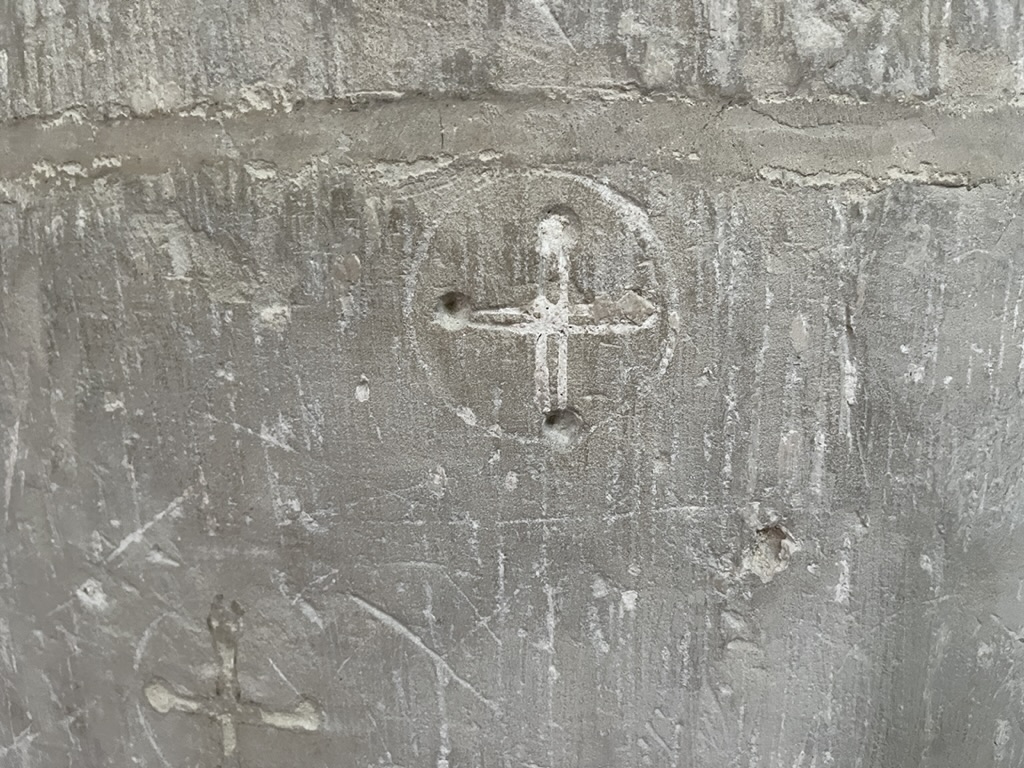
A selection of church marks in the porch. The 2 compass-drawn circles are not dials but [probably] ‘demon traps’. In superstitious medieval times it was believed that evil could be prevented from entering the holy building with protection marks. In this type, evil would become trapped within the never-ending circle. The VV and the M on the wooden door are Marian marks standing for the Virgin Mary, who bars entry to the church by evil.
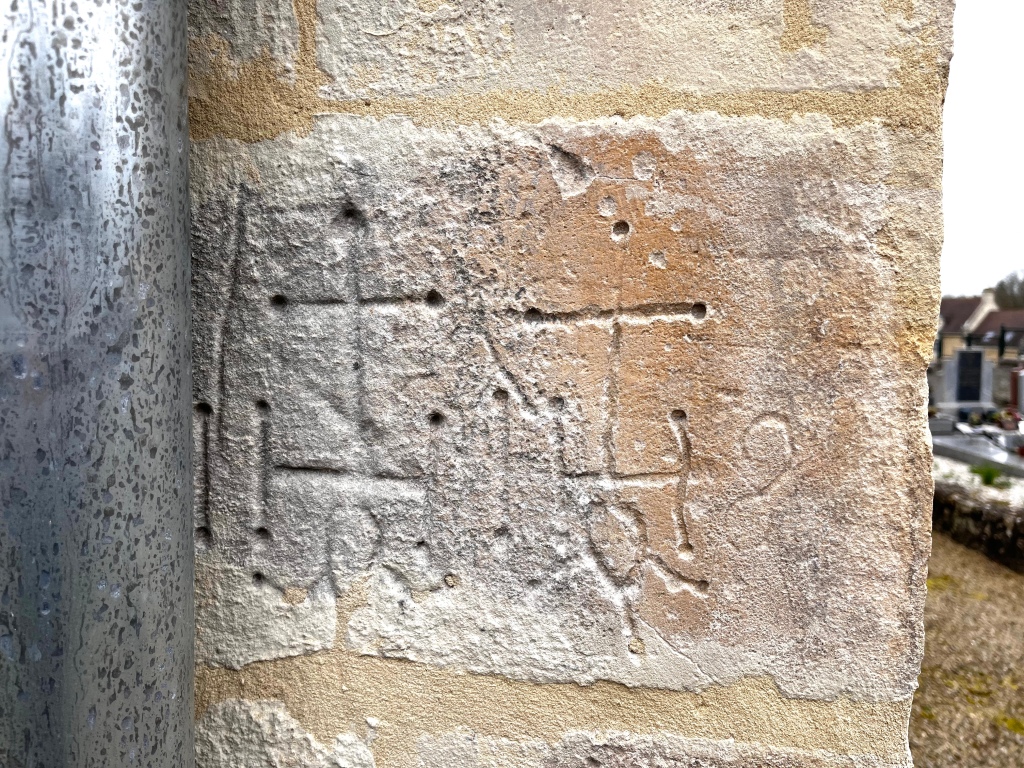
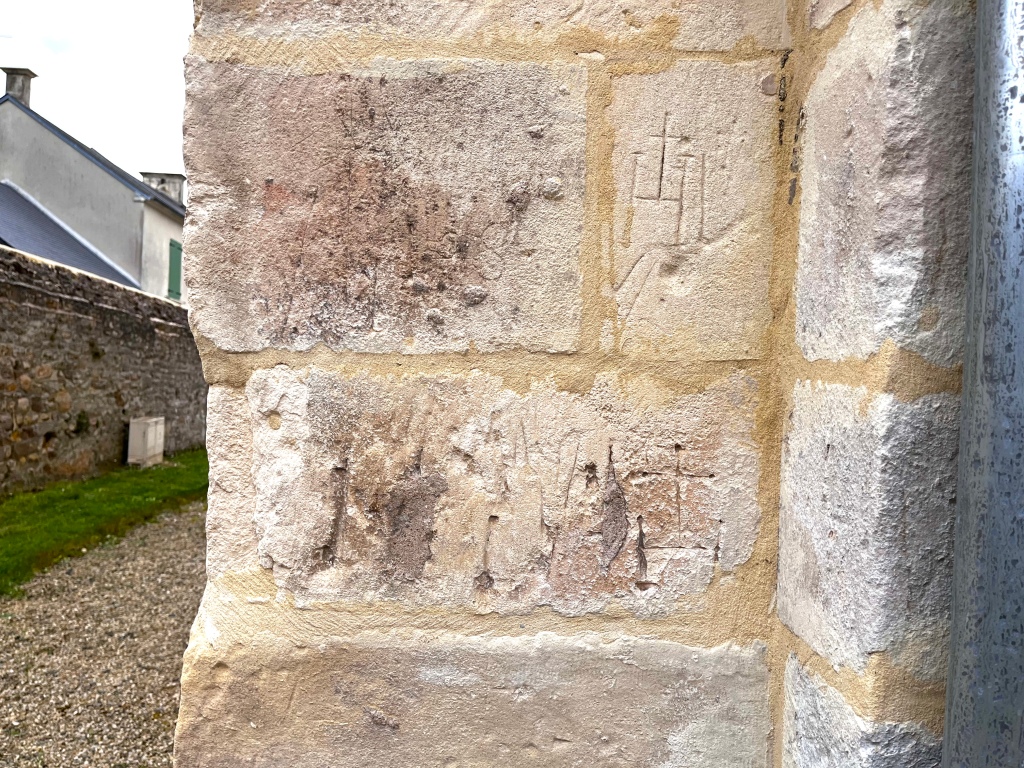
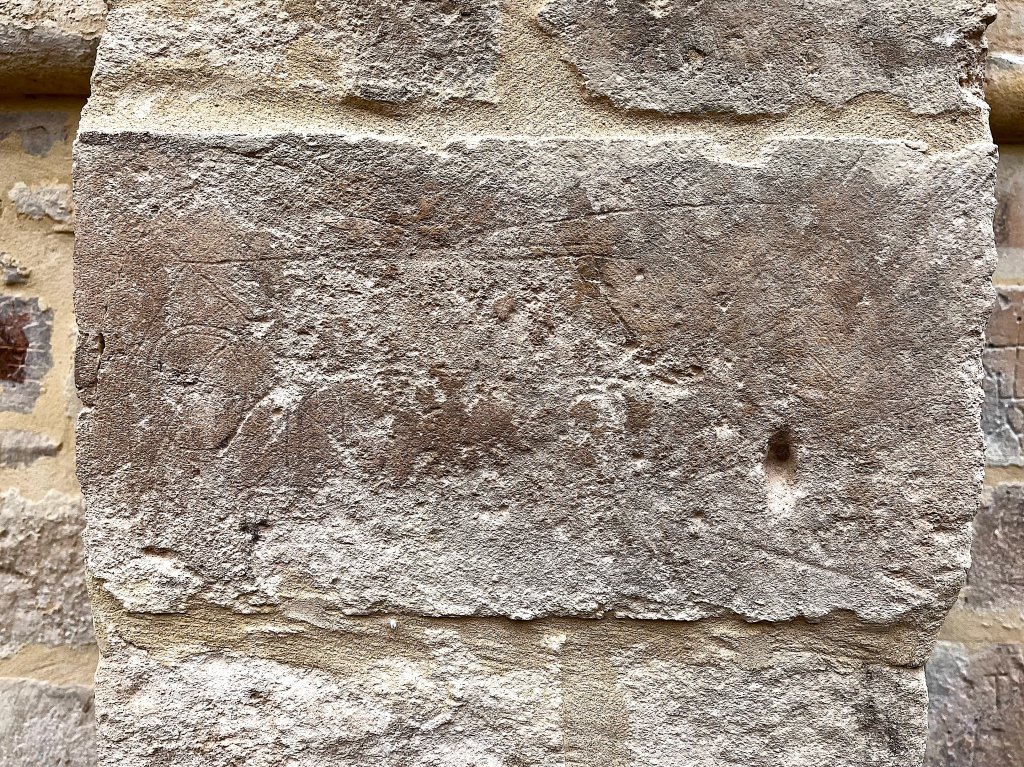
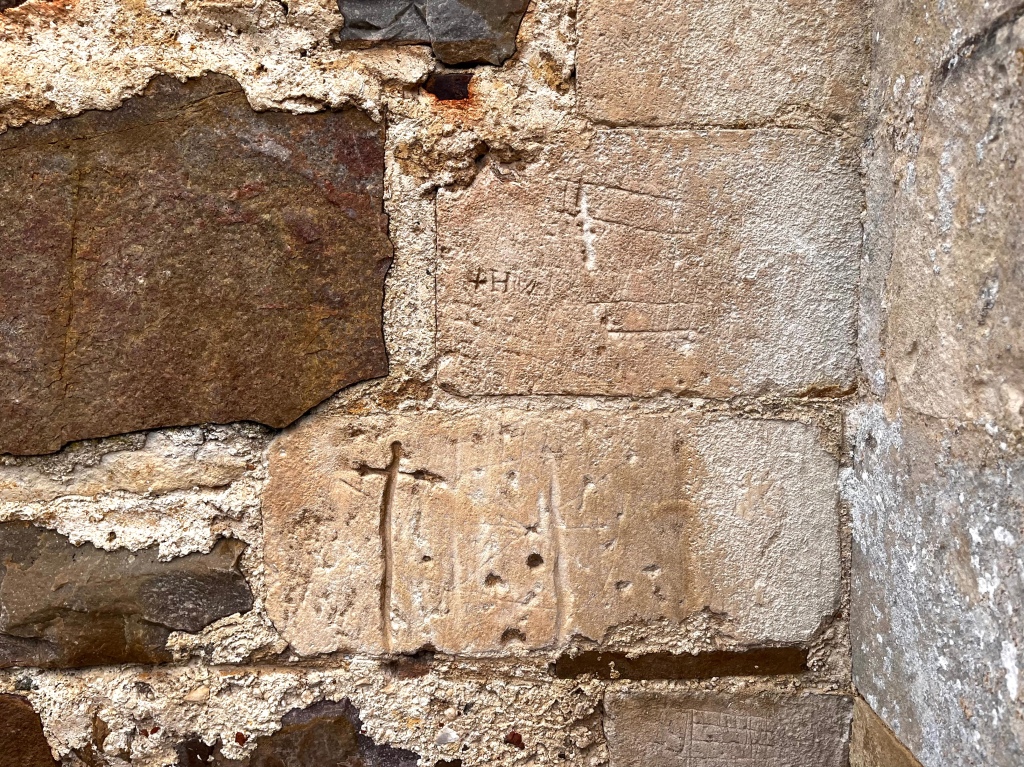
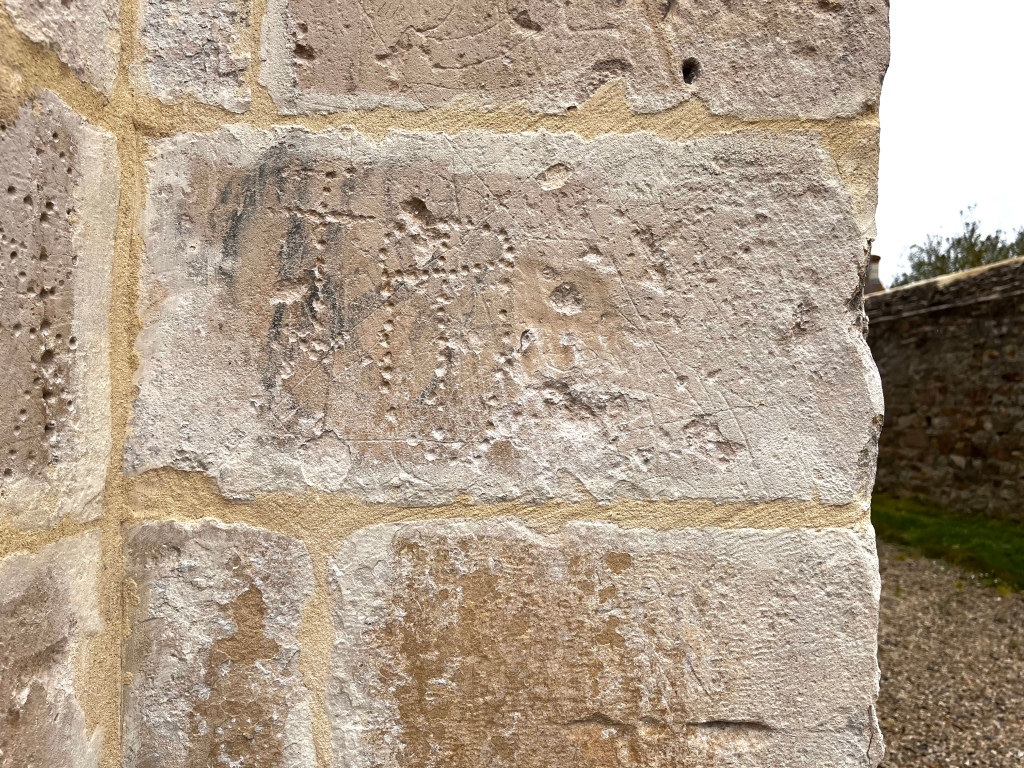
The area between Caen and Alençon contains a surprising number of churches with scratch dials. There are some rich pickings for scratch dial and church mark enthusiasts. It is not exactly a destination in itself, but is certainly vaut le voyage if you are in the region. Several churches have a plethora of designs and Urville is one of them. I gave up counting the dials and disentangling overlapping ones when the score reached twenty. 49° 01′ 31.44″ N, 0° 17′ 53.88″ W
There is no point in trying to analyse this amazing collection of dial art, nor guess its significance. It’s hard to find out much about the church at all except for the official write up to the effect This parish church, built in the village centre, replaced the former place of worship which had become too small. The present church is said to be C17. Using British churches as a guide, some of the dials & graffiti seem earlier. Presumably some of the original church’s stones were reused. It might make sense that the new church tempted the villagers to add to an existing display. Here is a varied selection.
DIALS
APOTROPAIC SYMBOLS, GRAFFITI and other designs
GSS Category: Scratch Dial (Normandy France); Mass Dial (Normandy France); Medieval Sundial (Normandy France); Church Graffiti; Apotropaic Symbols; Protection Marks
GRADE I ✣ Saxon origins (c995?) perhaps on pagan site; Norman with continuing development. Vicars recorded from 1269. Careful restorations. Among the oldest and most architecturally significant parish churches of DevonSJ. A lovely location, concealed from potential marauders from the sea. Of great interest both inside and out; a church to explore thoroughly. The Church Guide (40pp) is excellent. Midway between Sidmouth and Seaton. 50.6902 / -3.1403 / SY195884
DIALS
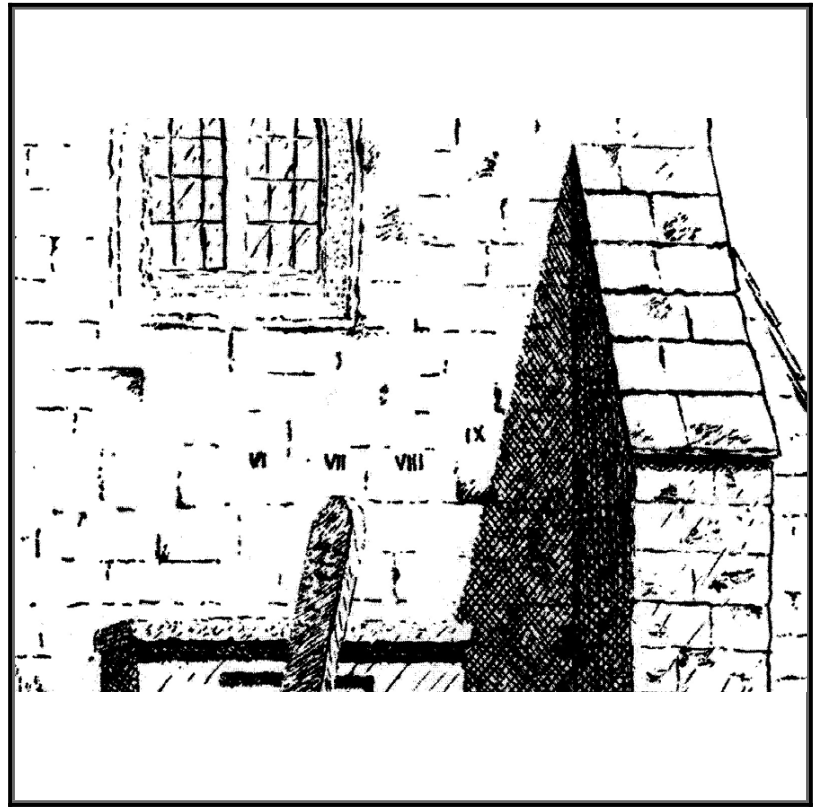
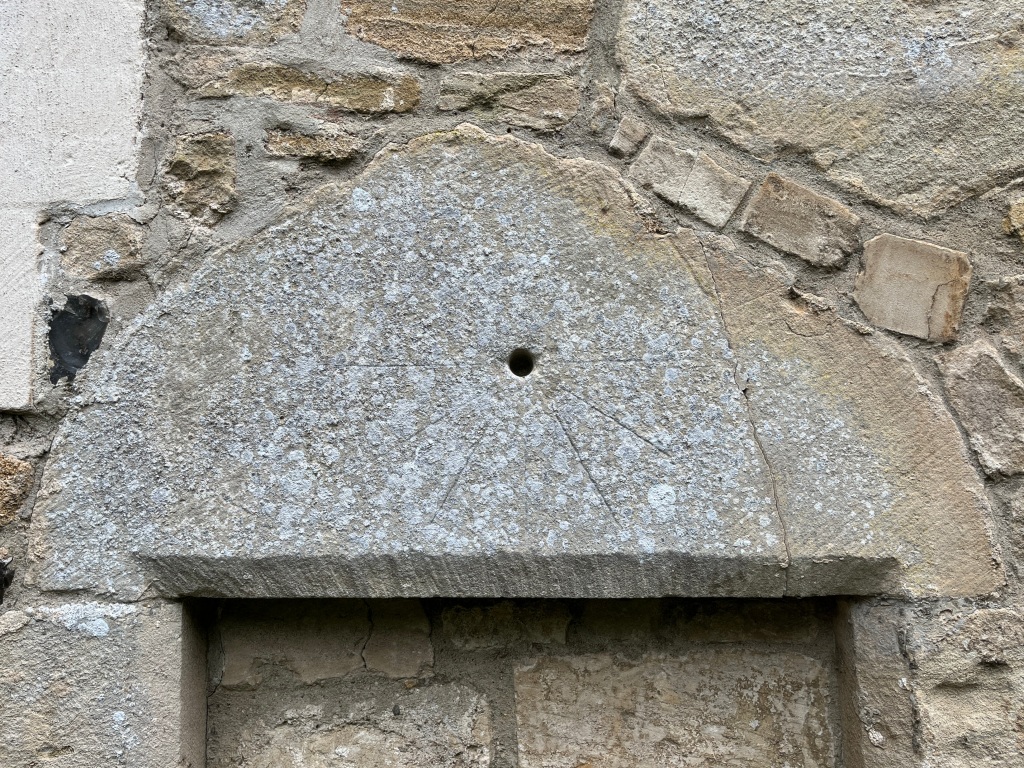
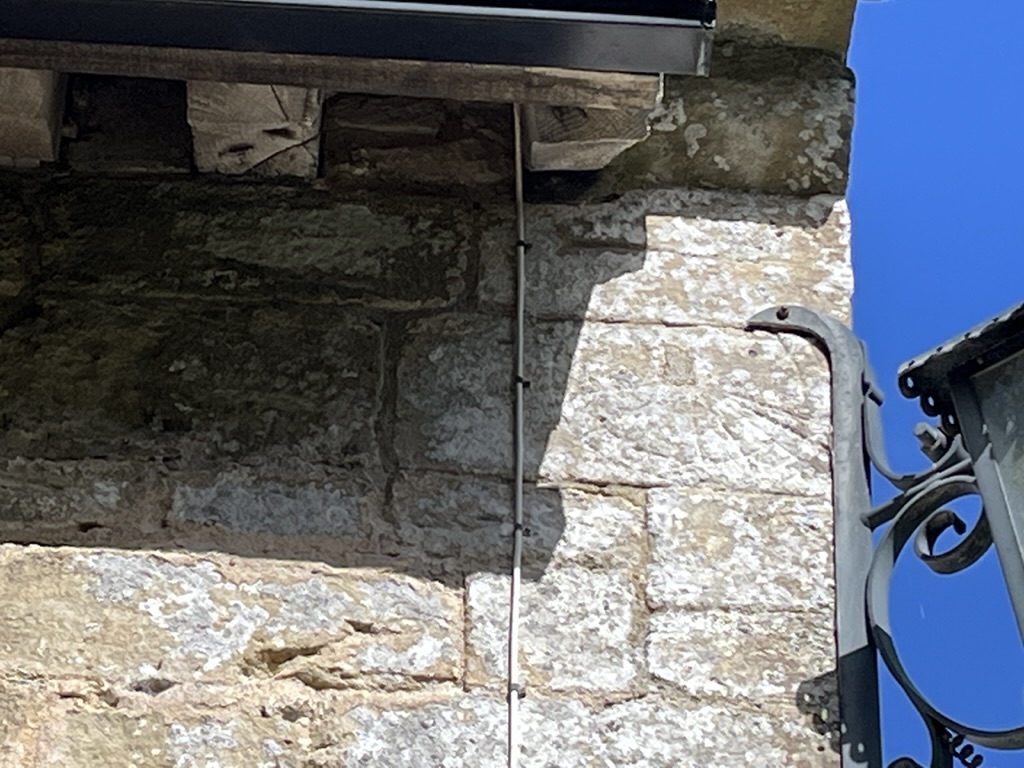
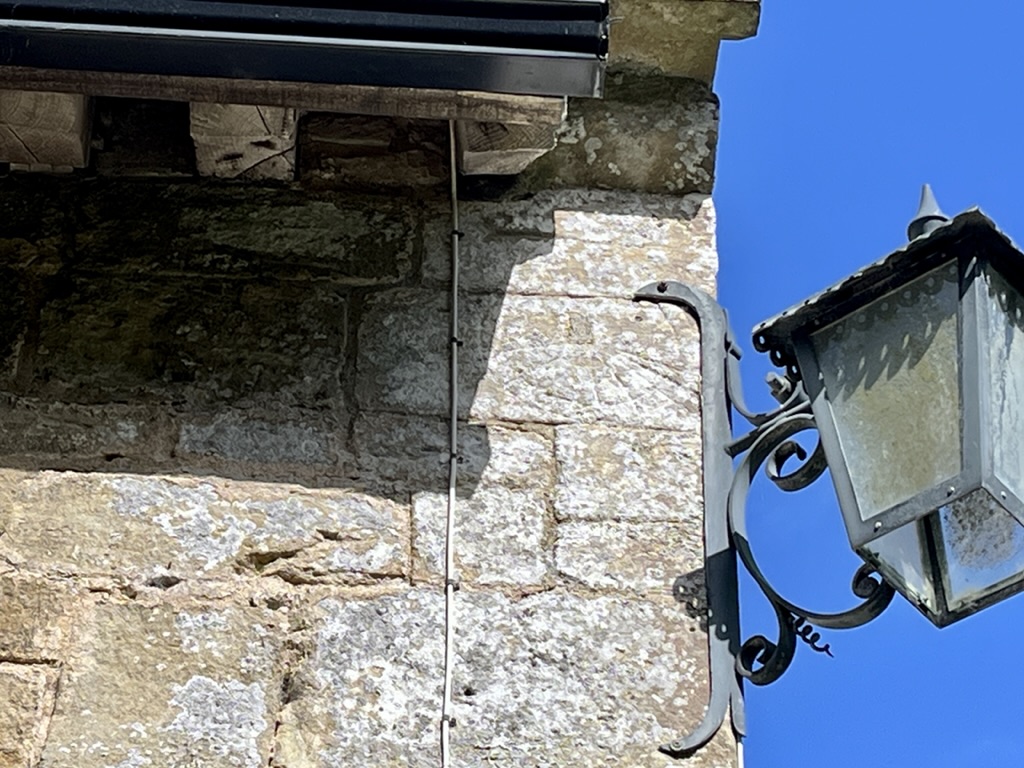
There are three completely different dials. Dial 1 is a linear dial thought to be unique in Britain, with a buttress acting as gnomon. Dial 2, cut on the lintel of a blocked doorway, may be Saxon. Dial 3 is relatively conventional and located high on E corner quoin of the chancel.
DIAL 1
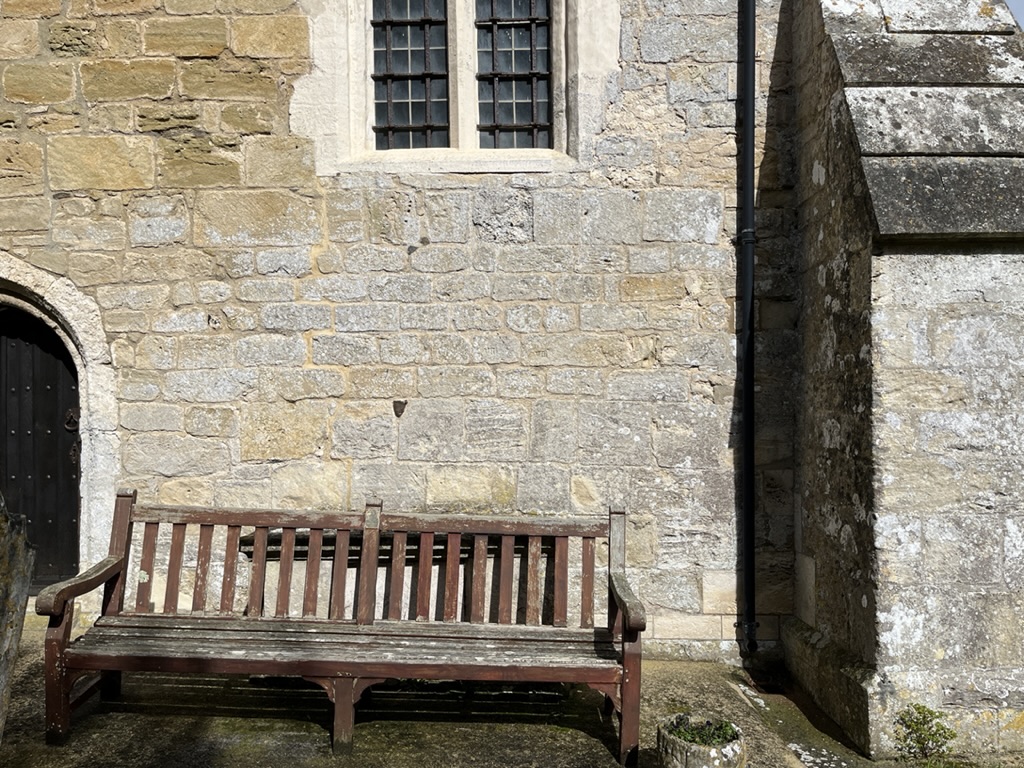
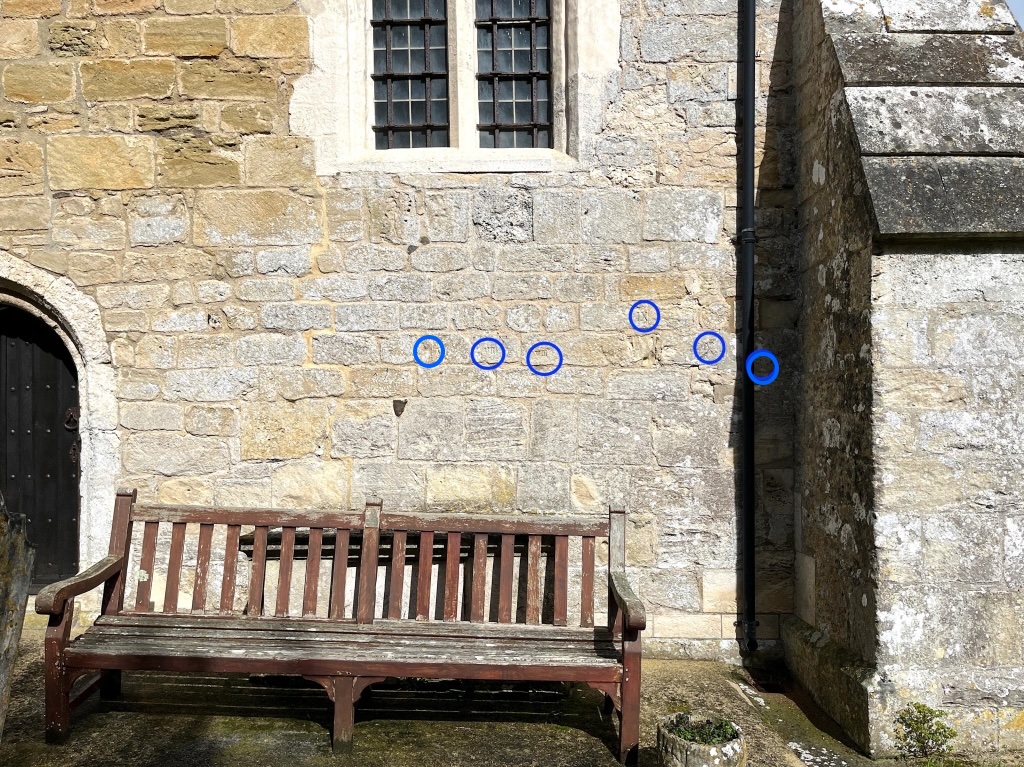
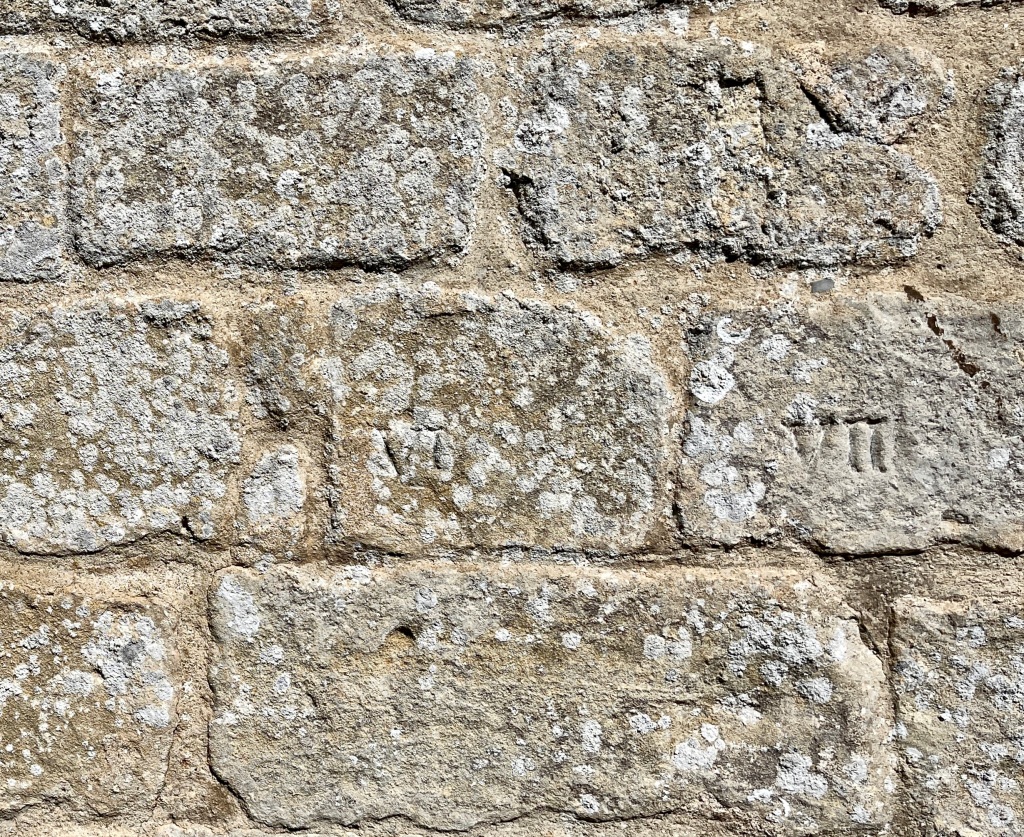
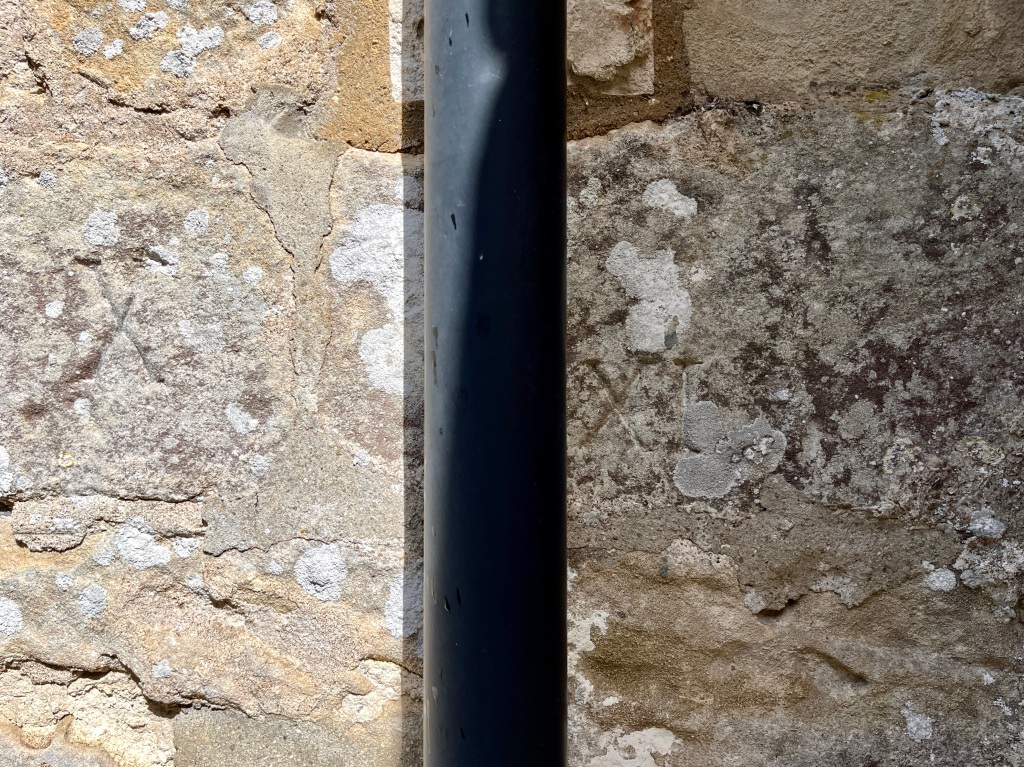
This remarkable dial is not circular but linear, and is thought to be unique. Roman numerals are cut in an approximate row along the chancel wall, so that the chancel buttress acts a gnomon casting a shadow that moves across the longitudinal numbers. XI is obscured behind the drainpipe.
VI, VII and VIII are thought to be original numerals; IX, X and XI are larger and later. The Guide to the church describes this dial as a ‘sun-clock’, which is surely a more appropriate and accurate name for it than ‘scratch dial’, and reflects its uniqueness.
There is another notable ‘buttress gnomon’ dial of a different kind at St Mary the Virgin, Iffley. It has 4 vertical incisions in a row, a compact marker of the passage of the day. Presumably it was designed to focus seasonally on the significant part of the day for Mass.
DIAL 2
Incised in the grey stone lintel of a blocked doorway believed to be Saxon. Unusual in that it has 6 lines (2 on the horizontal) cut almost with vertical symmetry, with no visible noon line. The 2 deeper cuts RHS suggest the time of day for the main Mass (None). The gnomon hole is big, perhaps enlarged at a later date. The BSS record includes the note Late Saxon / Norman? Originally on earlier church?
DIAL 3
A more familiar dial design high on a quoin stone at E end of chancel. There are 7 lines within a double circle. BSS notes that it has been re-sited, the top of the dial being on an adjacent stone. The gnomon is filled in a rectangle. Again, the two deeper cut afternoon lines suggest None as the main Mass time.
Drawings displayed inside the church
GRAFFITI
If you climb the stairs, as you surely will during your visit, you will find plenty of graffiti, much of it overpainted with long-weathered whitewash.
GSS Category: Scratch Dial; Mass Dial; Sun-clock; Unique Linear Sundial; Buttress as Gnomon; Medieval Graffiti
All photos Keith Salvesen; Drawings from Church & BSS
GRADE I † Early Church recorded at HestrebeDB. C12 origin as collegiate church; continuing development to C16; mid-C19 restoration (Butterfield). C13 work of particular note. One of the excellent churches to be found in the Wylye valley between Steeple Langford and Sutton Veny. 51.1821 / -2.1086 / ST925425
DIAL
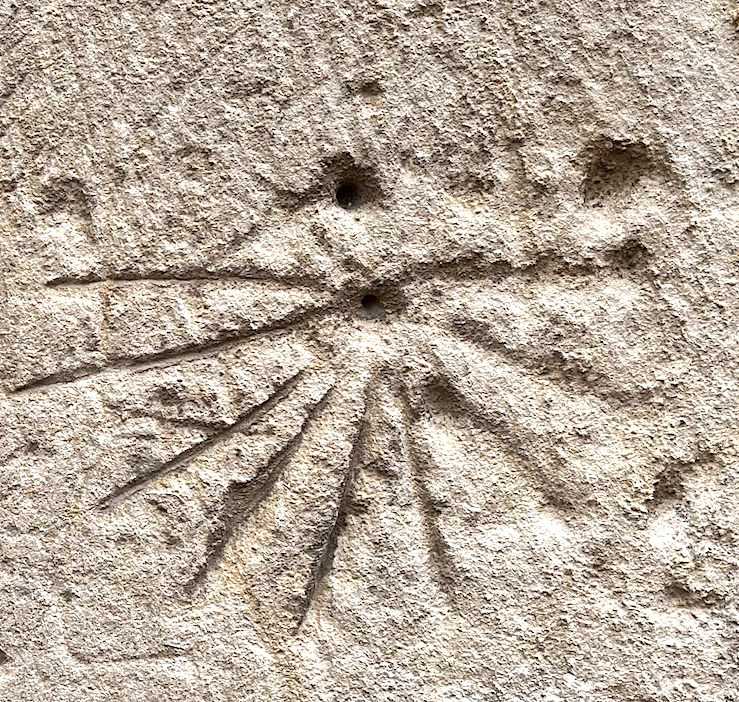
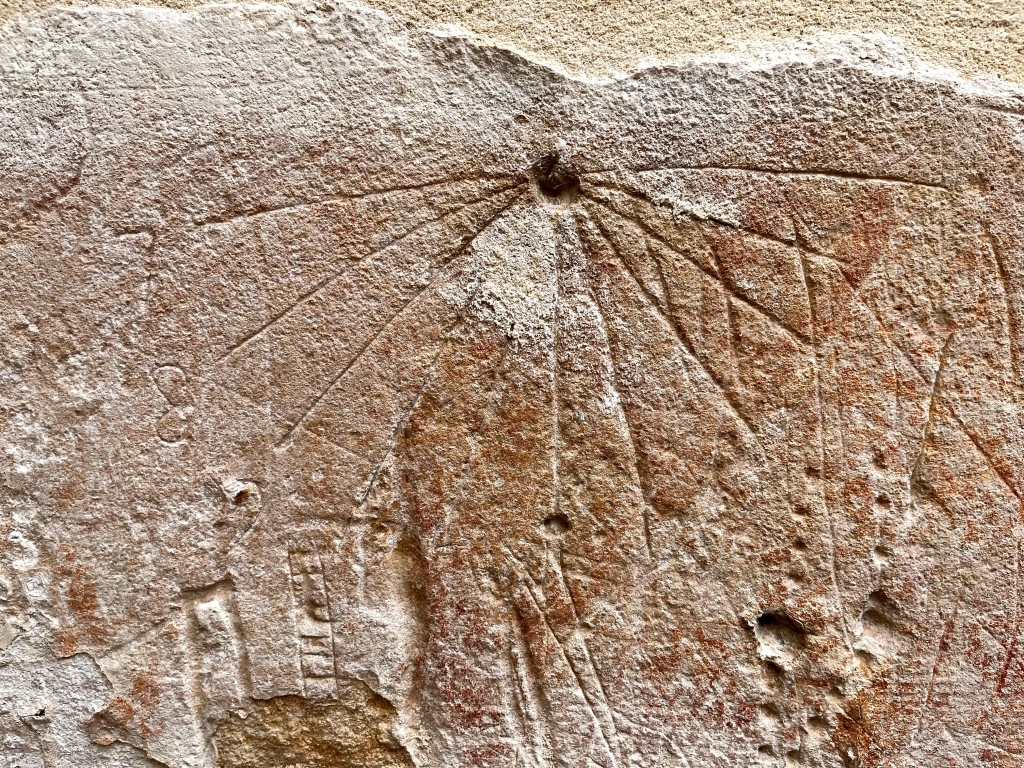
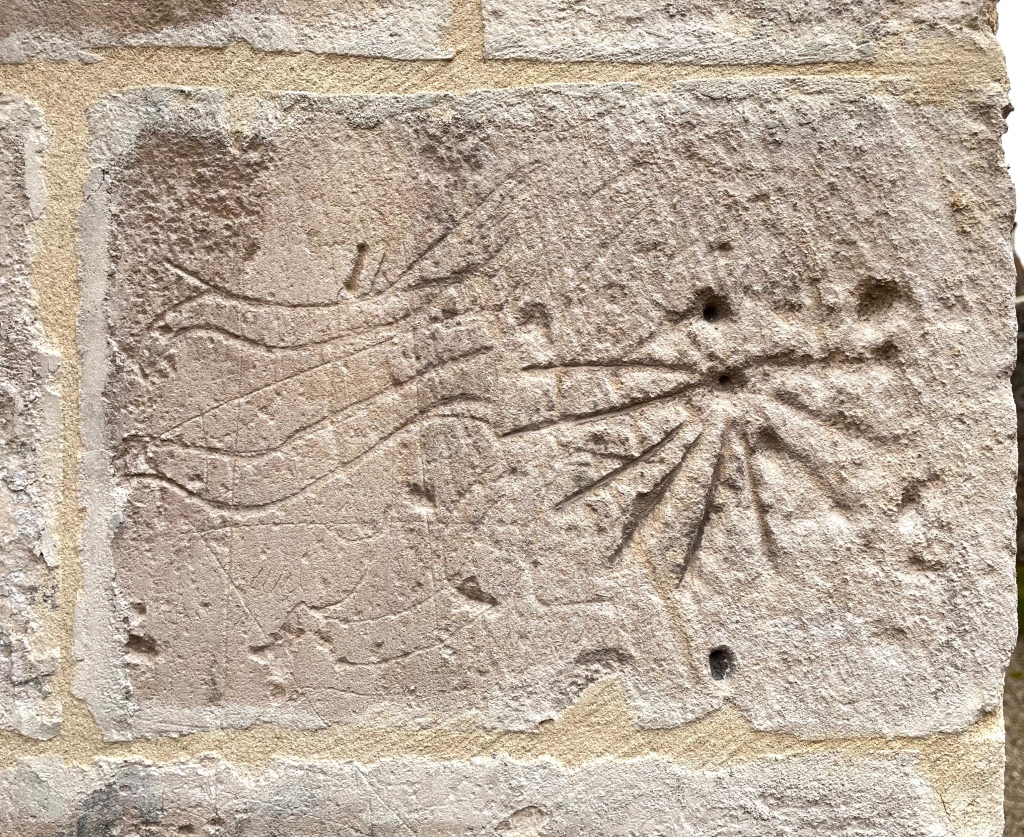
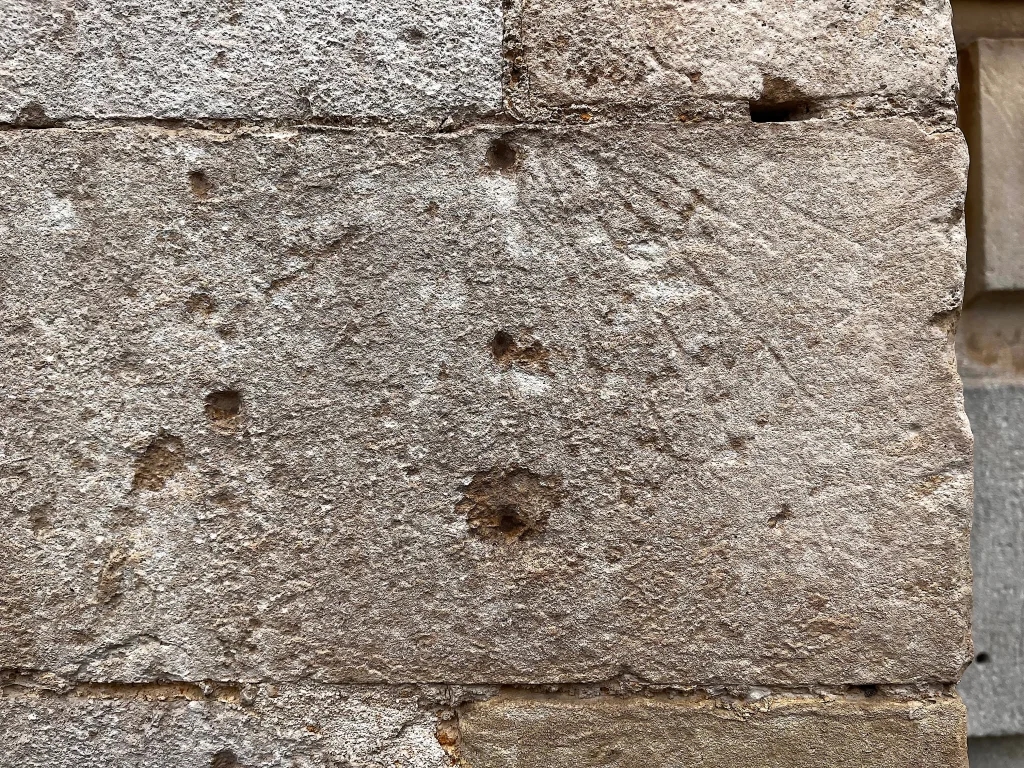
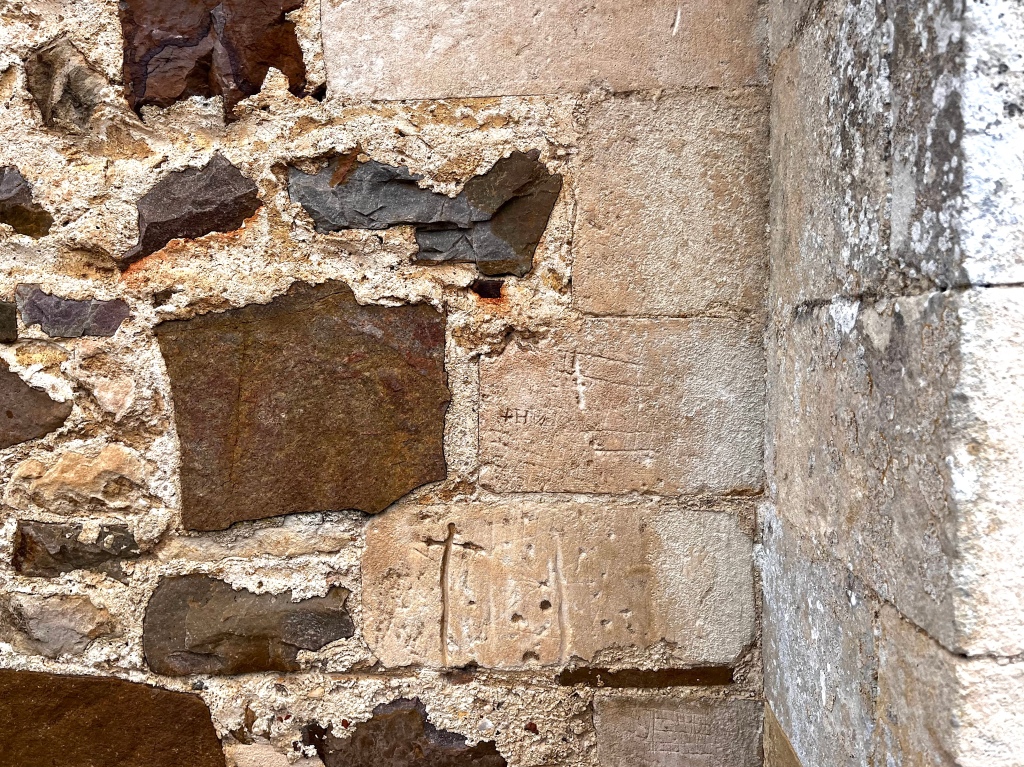
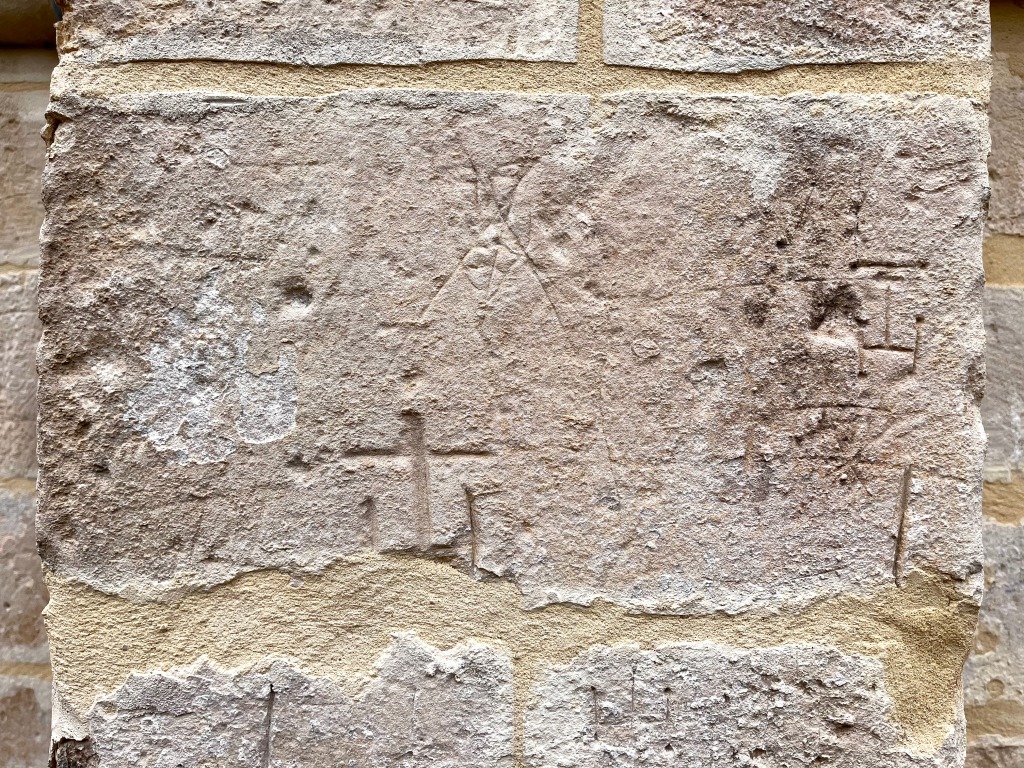
The dial is on the SE face of the angled buttress at E end (by the green tank). It is a fine example of a dial on which all the lines have terminal pocks. At some time it was inverted, and I have shown it reverted below. I cannot find any record of it, BSS or elsewhere.
REVERSION
This dial is primarily a morning dial, with lines marking (in clock terms) the 5 hours from 8 to noon. The deeper lines marking 9 & 10 correspond to the morning Mass time Terce. Possibly, the fainter line LRQ indicates None, another significant time during the day’s observations. In all there are 9 visible lines with terminal pocks during daytime, and a hint of a line above the horizontal in URQ. The vertical ‘midnight’ groove above the gnomon hole can be discounted as part of the dial, I think. It is certainly out of keeping with the carefully thought overall design. Also, it doesn’t reach the gnomon hole.
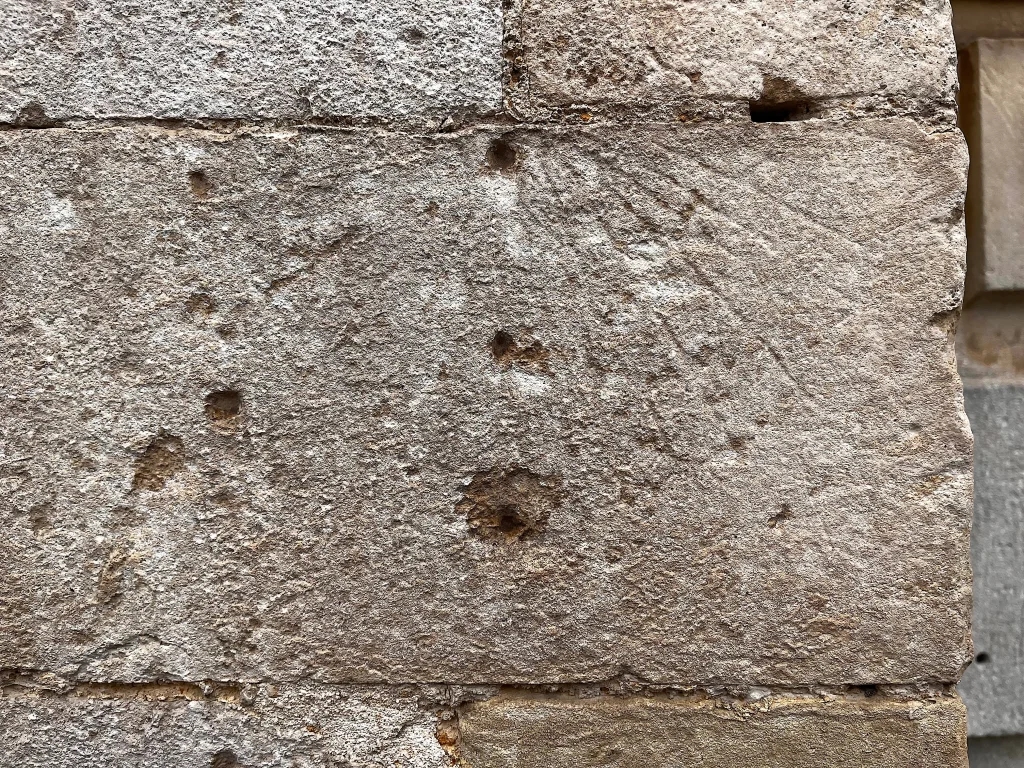
PLAUSIBLE DIAL?
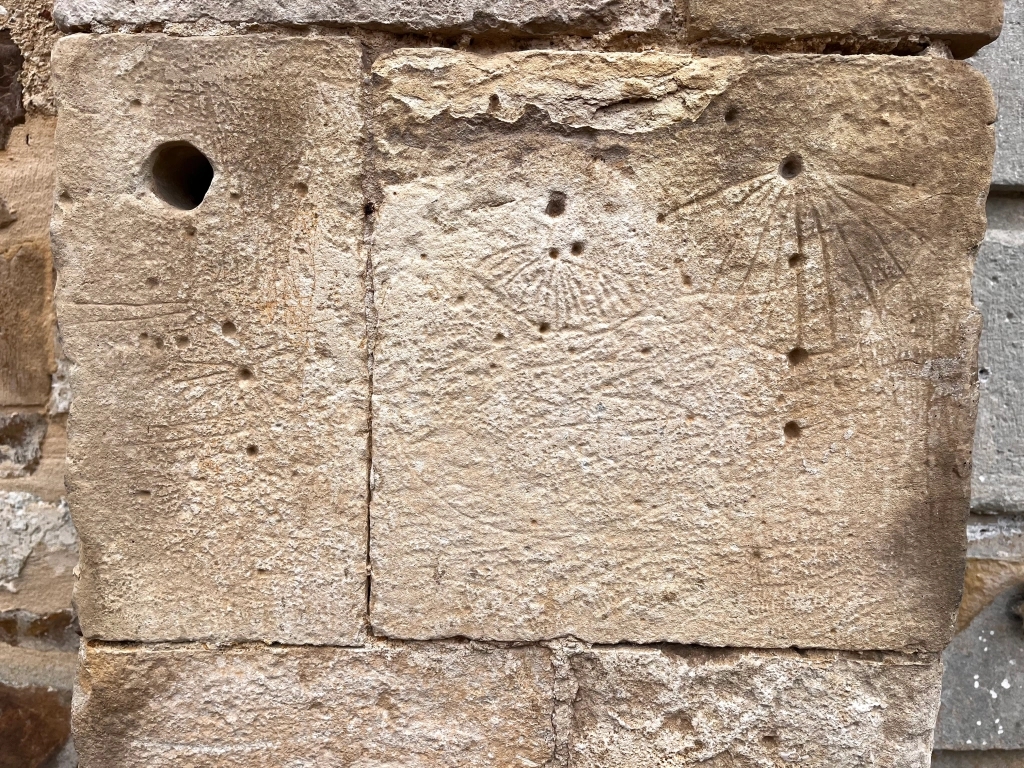
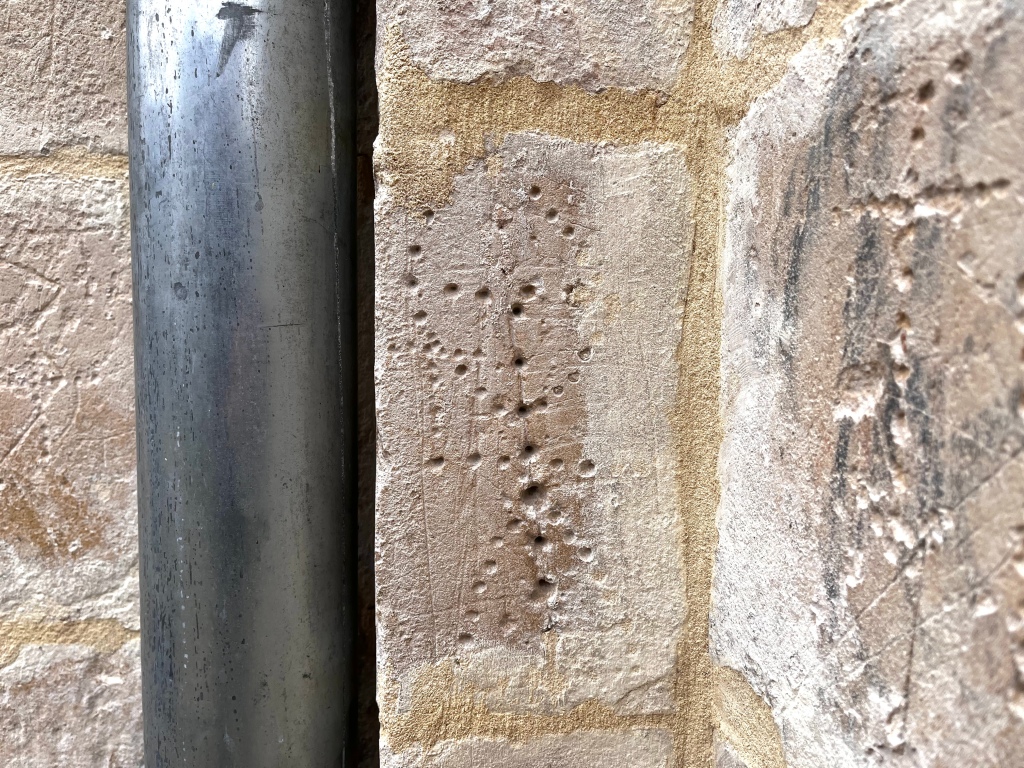
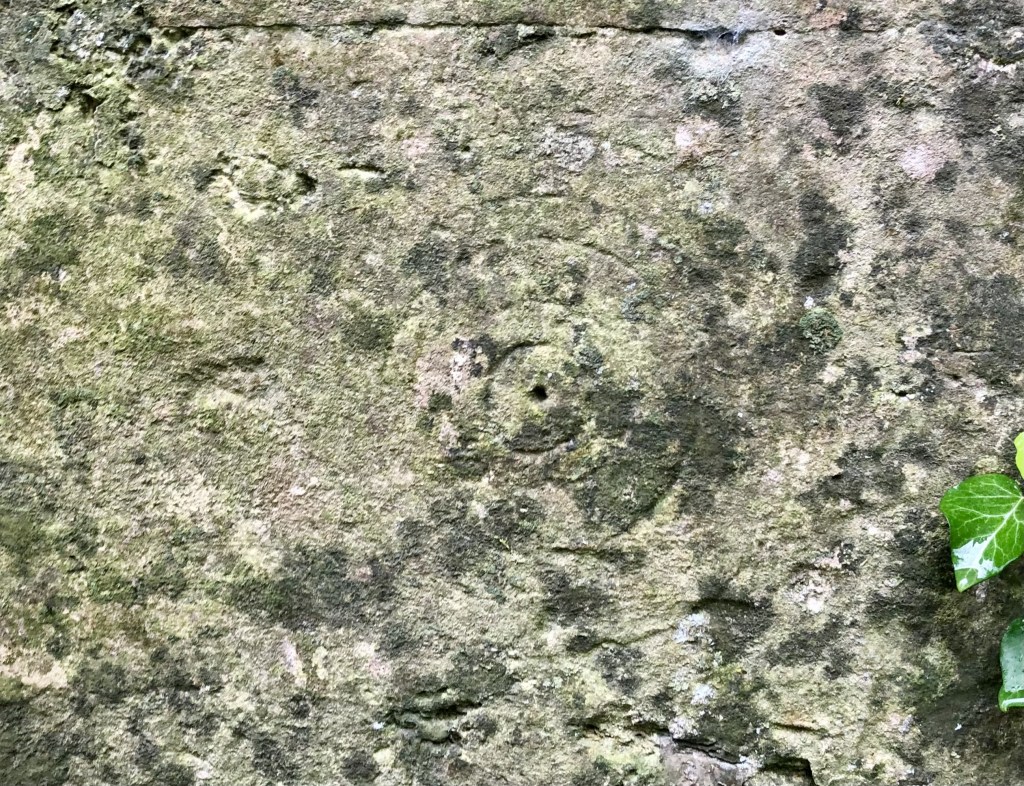
I noticed this patterned stone and photographed it as I walked past. I would very much like it to be a ‘pock-only’ dial. There is certainly a hole close to the centre of the stone, with a pattern of small holes that look crudely drilled, approximately forming a perimeter. Probably I am overthinking this.
CHURCH MARKS
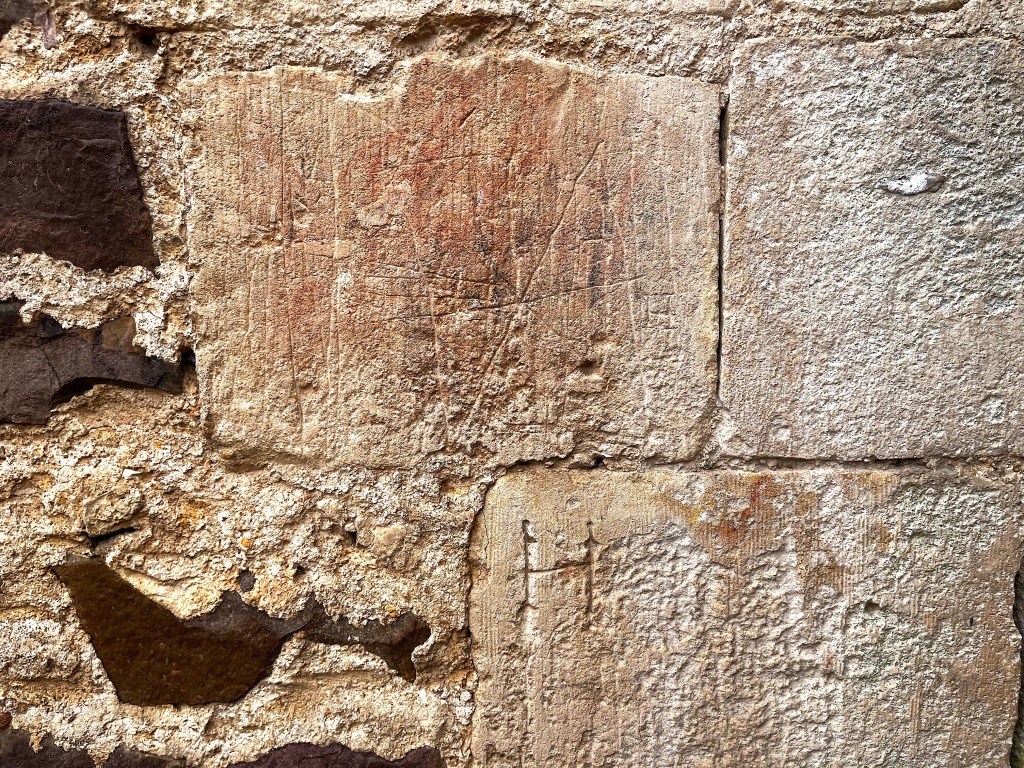
Here is a selection of church marks – masons’ marks, consecration cross; ‘pilgrim’ crosses; graffiti; a small dial-like design that merits further investigation.
GRAFFITI INCLUDING RITUAL PROTECTION SYMBOLS
GSS Category: Scratch Dial; Mass Dial; Church Marks; Consecration Cross; Masons’ marks; Pilgrim Cross; Graffiti
The barn is part of Gorwell Farm about 3m N of Abbotsbury, deep within the folds of steep hills, with ancient trackways, a stone circle, and strewn with sarsen stones. It has several uses, including as an excellent wedding venue; a lecture venue in particular for historical, geological, and similar types of research; and an educational centre.
The barn is C17 and has been sympathetically restored. During the process, work on the interior walls uncovered a fine hexfoil, and stones with graffiti and other marks. These are usually associated with churches, but barns were also ornamented in this way.
This is not a dial post, but it fits in with the ancillary purpose of including related matters of interest (see MENU and the various subcategories)
HEXFOIL
Hexfoils (hexafoils), also called daisy wheels or petals, are not uncommon. They are mostly found in churches; less often in secular buildings. Generally they are compass-drawn and symmetrical. There are three main theories to explain them, not mutually exclusive.
1. A form of Consecration Cross (an attribution given eg to the fine hexfoil at St Mary, Cerne Abbas, Dorset below). However, the many thousands of conventional crosses on churches all over the country suggest that there would be little need for a large daisy wheel except perhaps in a significant church. Often there are several on a church, each marking a particular event such as a Bishop’s visit or blessing. The maximum is generally 12, though a few churches (eg St Mary, Holnest, Dorset) have 14.
2. Symbols created by masons in the course of construction, a theory debunked firmly by medieval graffiti expert Matthew Champion on several irrefutable grounds.
3. Ritual protection marks (apotropaic symbols) designed to ward off / neutralise evil. To this can be added the concept of the Demon Trap whereby evil is confined within the circle – a line with no end – rendering it powerless.
Hexfoil . St Mary . Cerne Abbas . Dorset
‘4-LEAF CLOVER’ and GEOMETRIC SYMBOLS
I haven’t found such a clear example of a 4-petal style before. It is both decorative and protective: again, evil is attracted to it and then caught by the unbroken lines. Strengthening the case, the design to the left is an eroded example of a fairly common protection mark. These involve a geometric shape – usually a rectangle – with a pattern of joined dots. More complex ones look something like a square solitaire board.
SEMICIRCLE
This looks compass drawn. There is a hole on the lowest part of the circumference which – if a sundial – would be significant as marking noon.
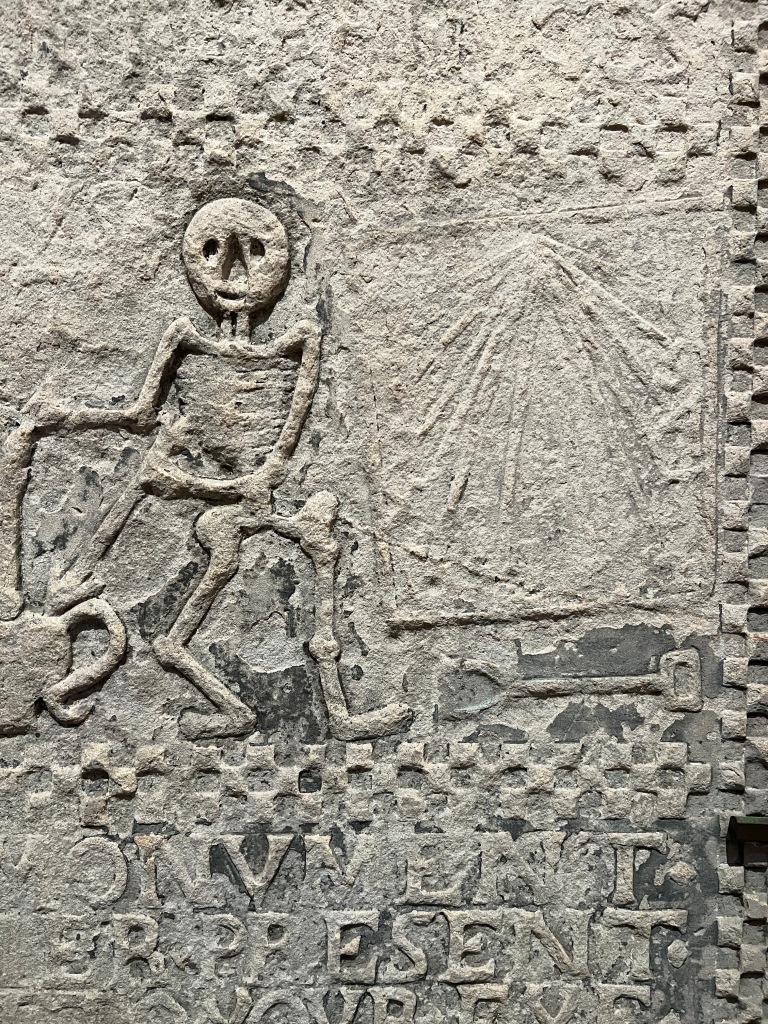
St Mungo . Kirkwall . Orkney – Grave slab with stylised memorial dial for Patrick Prince d. 1673
BSS RECORD
DIAL
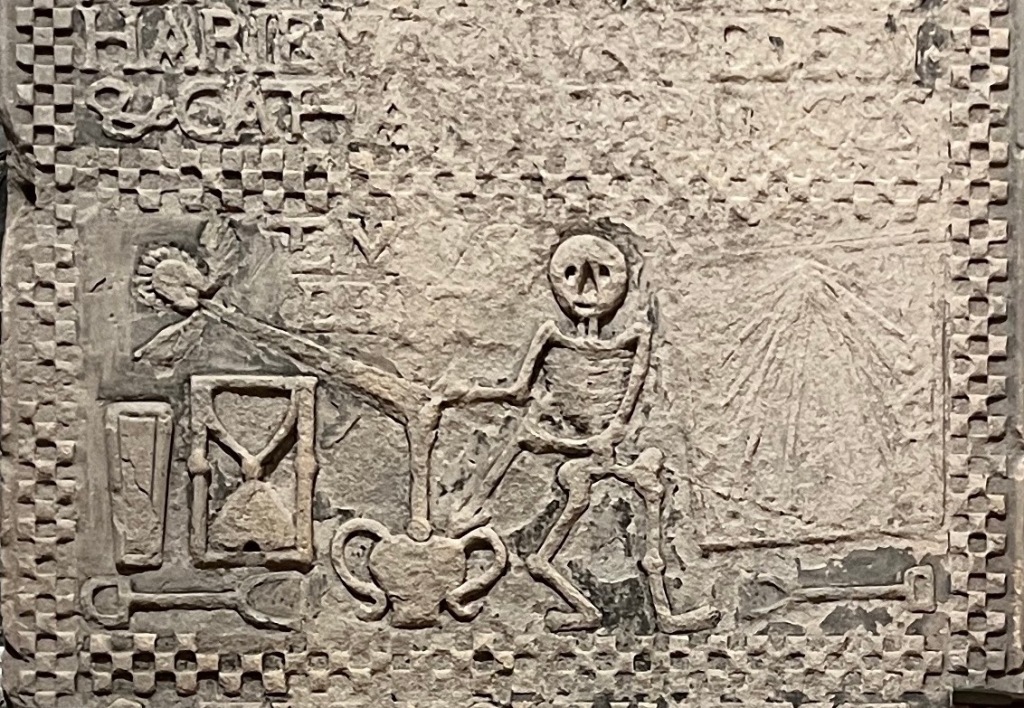
This image of a dial appears on a grave slab that is now mounted on the interior south wall of the nave alongside many other such slabs. It is one of a number of symbols associated with death, carved in relief. The symbols are in a central panel between upper and lower panels containing text. The dial is illustrative / symbolic only and is roughly square, with hour lines radiating downwards from the top.
ICONOGRAPHY
The image represents Death breaking the urn of Life with an arrow. A flame bursts forth from the punctured vessel, from the tip of which the soul flies away in a northwesterly direction. An hour-glass with the sand run out, a sun-dial, two spades, and a coffin complete the doleful ideogram. The grave slab is for Patrick Prince, died 1673.
GSS Category: Scratch Dial; Cathedral Dial; Church Dial; Dial inside church
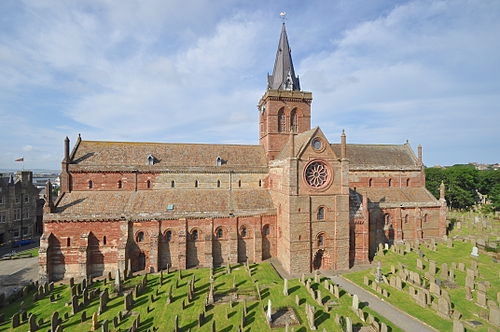
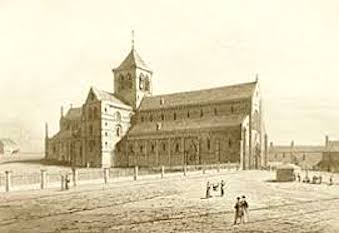
PHOTOS: All photos John Renner, with many thanks; Cathedral Stevekeiretsu Wiki OS CC; Print from Cathedral Guide
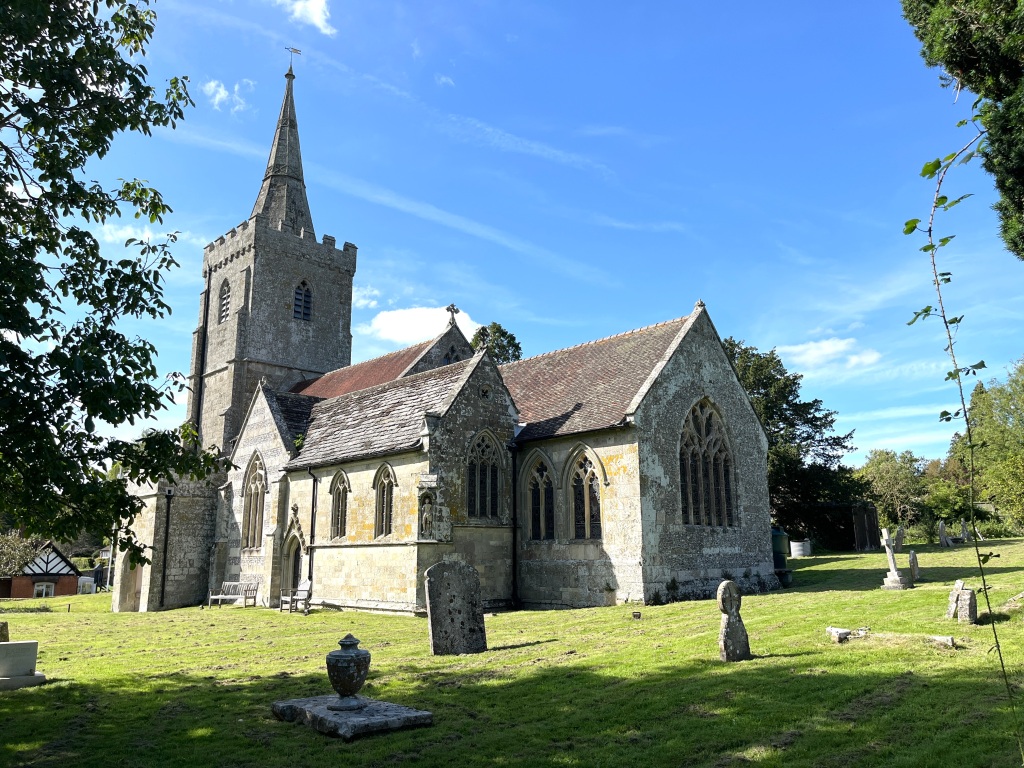
GRADE I ✣ C12 origins & remnants; C13 – C15 enlargement; C19 restorations (Wyatt). One of only 3 Dorset (early) churches with spires, with Trent and Winterbourne Steepleton (the Dorset village of Steeple only has a tower). The spire was originally much taller but has twice been reduced in height. The most important and interesting church in its neighbourhoodPEV. If you want to dig deeper there are plenty of excellent resources online eg HE, BLB, BHO. Midway between Shaftsbury and Blandford. 50.9295 / -2.1887 / ST868144
DIAL
The dial is located on the SW buttress of the tower, about 2m high. There are 12 lines, 6 of which extend beyond the circumference. Some have terminal pocks; the noon line has 2. GLP notes that the dial is quite accurately cut, but is at an angle and of little use in its present position. Probably it was relocated during later work.
GLP dates it to C14, and notes quite sternly that, whereas RCHM suggests perhaps C16, it gives no reason for this opinion.
GRAFFITO ON THE STONE BENCH INSIDE THE PORCH: W.D. 1773
GSS Category: Scratch Dial; Dorset Church with Spire
All photos: Keith Salvesen; Thanks as always to Gordon le Pard for Dorset dials
GRADE I † C12 origins (?); C15 inc tower & porch; C16 rebuilding / additions. Material from nearby Milton Abbey incorporated. C19 restorations. In proximity, a fine early vertical sundial (1690); 2 date stones (1569); scratch dial (probable?). Several excellent gargoyles N side. 2m W of Milton Abbey. 50.8259 / 2.3114 / ST781029.
VERTICAL DIAL
A fine dial in very good condition for its age. The gnomon is an amusing extension of the sun’s nose. I took the design LL corner to be an hour-glass, which would be appropriate. In close-up I wonder if it is a religious symbol; and if the design LR corner is a square and compass.
DATE STONES
THE BAGPIPER
SCRATCH DIAL
The dial design of a double circle with a hole in the centre is far from unusual. No lines, no pocks; just a stick needed to mark the passage of the day. This type is generally included in the Scratch / Mass Dial category of church marks; and I go along with that. However, having recently researched Cyffe Pypard and Fovant (both Wilts) which have several dials including this design, I am beginning wonder. It’s hard to think of a reason why a dial-cutter would not to add lines, pocks or both to a device specifically made to mark the passage of the day. But what if these are apotropaic symbols cut into the walls of the church to catch evil: ‘Demon Traps’ from which, once entered, encircled evil could never escape?
GSS Categories: Vertical Sundial; Old Sundial; Date Stones; Gargoyles / Hunky Punks; Scratch Dial
GRADE I † C13 (recorded 1273), C15 nave & tower. C19 restorations (Butterfield). In a lovely position below a wooded stretch of the cliff PEV. Pevsner & his wife Lola are buried together in the churchyard**. Interior has much of interest: pulpit 1629; excellent monuments C13 on, medieval stained glass. 7m SW of Swindon. 51.4917 / -1.8939 / SU074769
Sir Nicolaus Pevsner
DIALS
As one approaches the porch from the lych-gate, there are two very visible dials, one on either side of the entrance. A third dial in that area is noted (eg BLB / HE). In fact there are more dials, but when I visited, finding them involved negotiating overgrown bushes and parting tree branches in light drizzle. There are also some dial-ish designs – eroded or incomplete – that are doubtful, but are included below for consideration.
DIALS 1 & 2
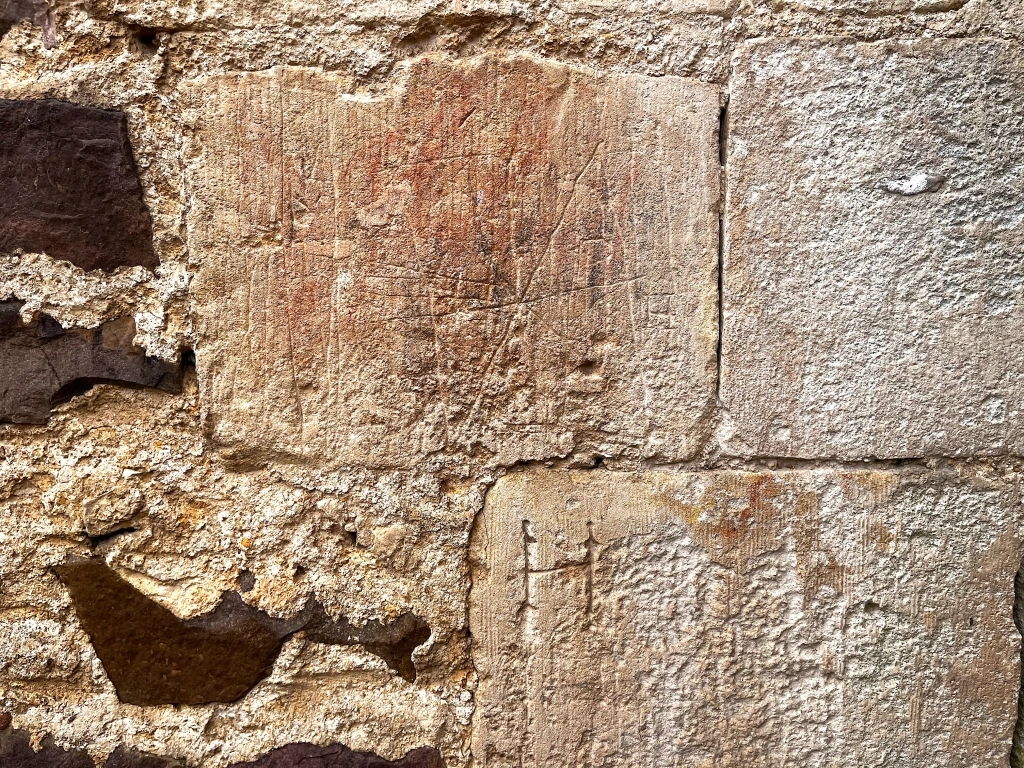
Dial 1 is LHS of the porch. This large dial is encircled, with the upper segment encroaching on the stone above. There are 7 / 8 lines, two of which are ULQ (so, not useful). The noon line extends well below the circumference and through a partial double circle. I think this is the BLB / HE third dial, though I think it is more a doodle than a dial. The emphasised line LLQ may mark Terce. The oddly inaccurately cut lines R of the noon line seem surprisingly casual for such a prominent dial.
Dial 2 is the counterpart of Dial 1, and far simpler. The overall design suggests that it is on its side, 90º anti-clockwise, perhaps re-sited.
DIAL 3
Obscured by foliage, Dial 3 is unconventional. The clear-cut circumference surrounds a single line with a dot at each end, slightly tilted from the horizontal. On the curve RHQ is a dot roughly corresponding to the Mass-time None. In the centre is a blocked gnomon hole. There are no lines or other markers of the passage of the day. In a sense , there is no necessity for lines to mark the hours – a stick’s shadow is almost as helpful.
DIAL 4
Dial 4 is largely hidden by foliage. Unusually, it consists of 4 concentric circles. These are now badly eroded; one is a trace only. Apart from the central gnomon hole, there are no other visible dial attributes: no lines, no pocks.
This type of dial is not unusual. Here is a similar dial in FOVANT Wilts, with 2 concentric circles and no other marks than the gnomon hole. However, I ought to mention that some consider that such designs are not dials, but may have a decorative and possibly an apotropaic function.
DIAL 5
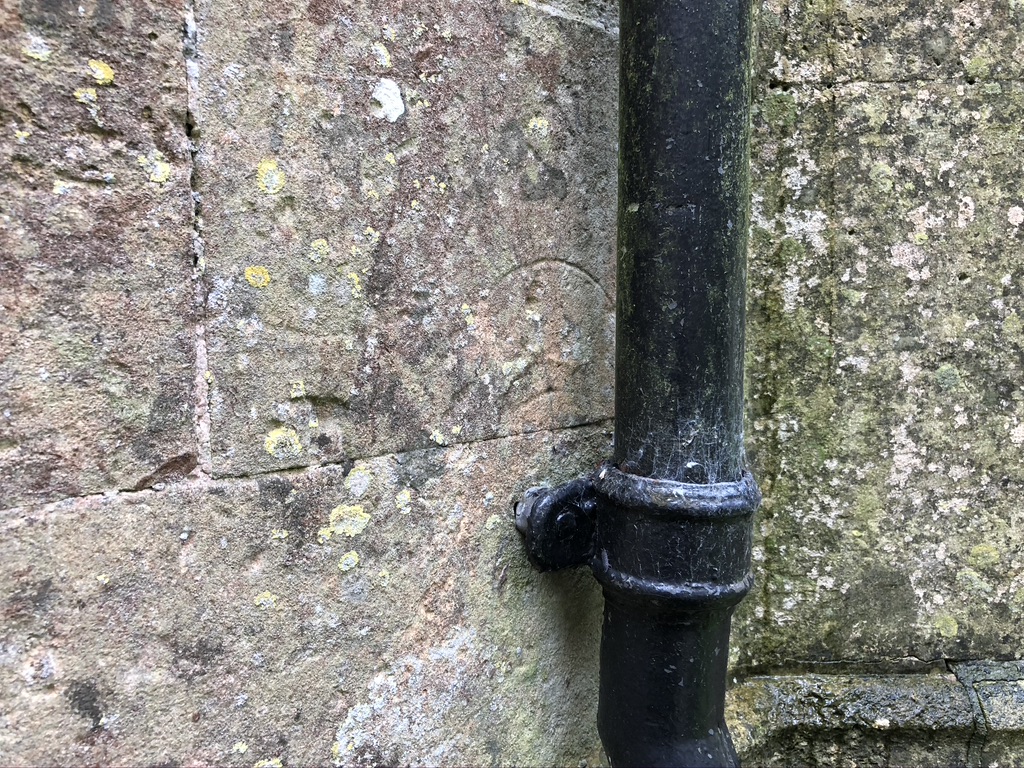
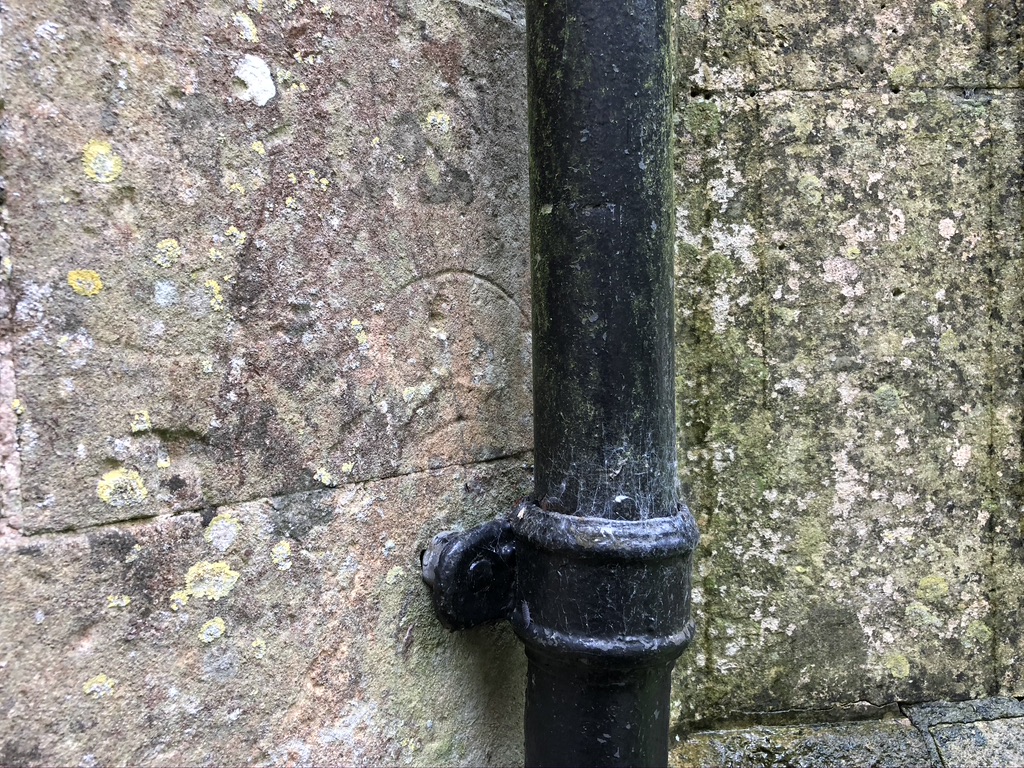
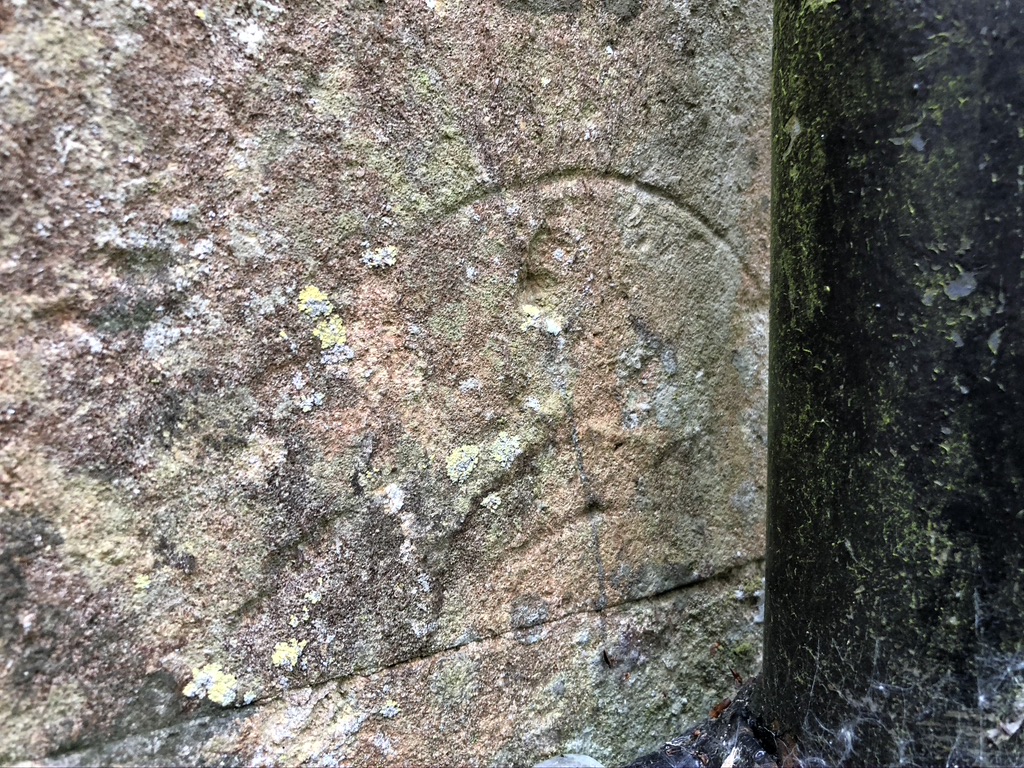
Dial 5 (?) – if a dial – is a classic ‘drainpipe’ example, in part concealed by a more modern addition to the church wall. There must be some doubt here because it is hard to see how it – with the arc of a circle below – would have worked.
DIAL 6?
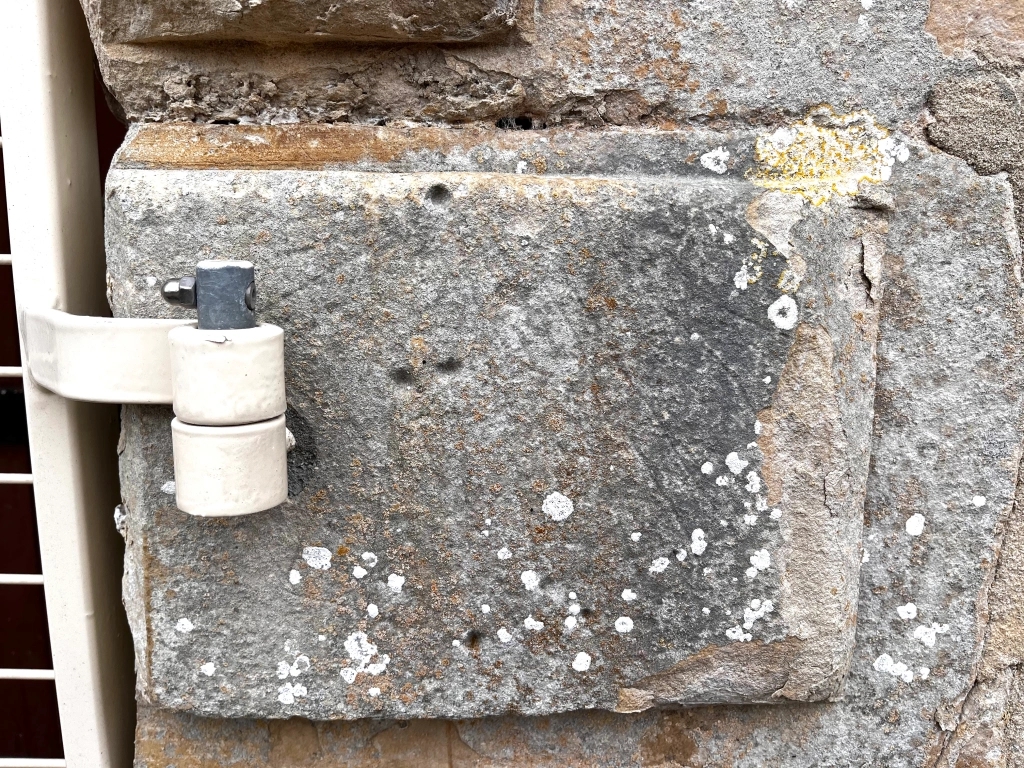
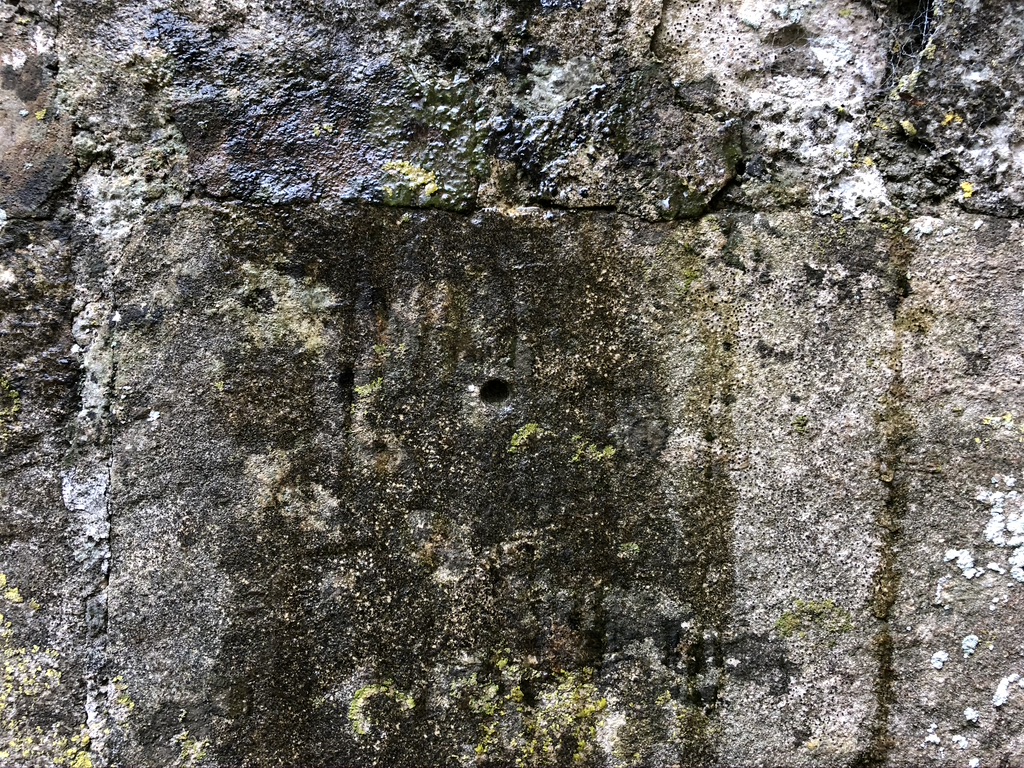
Dark and damp, this stone was difficult to read. If a dial, it is contained within a square with the top side being the mortar line. In favour of dial status is the location of the dial stone beside a window and the position of the dial; traces of a circle; a pock directly on the circumference LHS roughly corresponding with Terce; and the fact that the design is quite accurately framed as if to display it better. Equally, there are reasons to discount it.
OTHER DIAL CANDIDATES and CHURCH MARKS
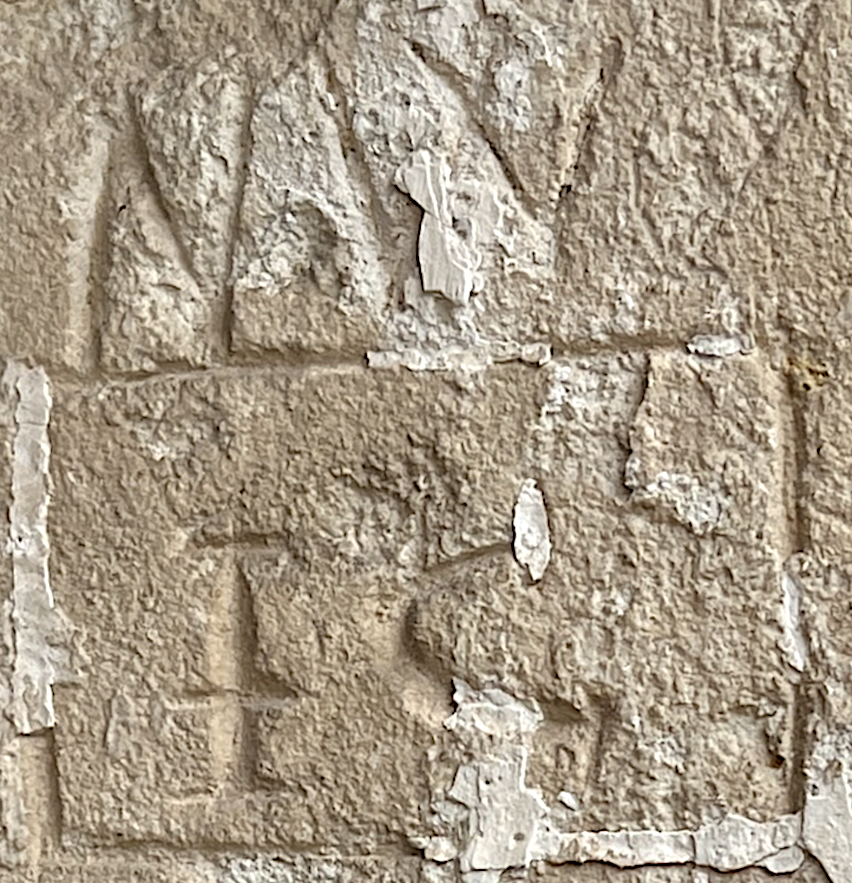
Another interesting part double circle, endearingly wonky. Very doubtful as a dial. Most interesting for the graffito UR, which may be a simple form of a type of ritual protection symbol that consists of rectangles with line and dot patterns.
The two marks on this stone – with variations – are quite often used as protection marks.
Note again the the double curves RHS. Most probably an incised design, rather than a dial.
Further evidencing the incidence of protection symbols is this Marian VV mark close to Dial 2.
The handsome bier kept in the church, and in excellent condition.
**In 1951 Pevsner published the first volumes of his magnum opus, The Buildings of England, an enterprise that took nearly 25 years to complete. The substantial Wiltshire volume was recently revised, expanded, and published in 2021
GSS Category: Scratch Dials; Mass Dials ; Multiple Dials













































 GAUDIUM SUB SOLE . SUNDIALS . MEDIEVAL TO MODERN