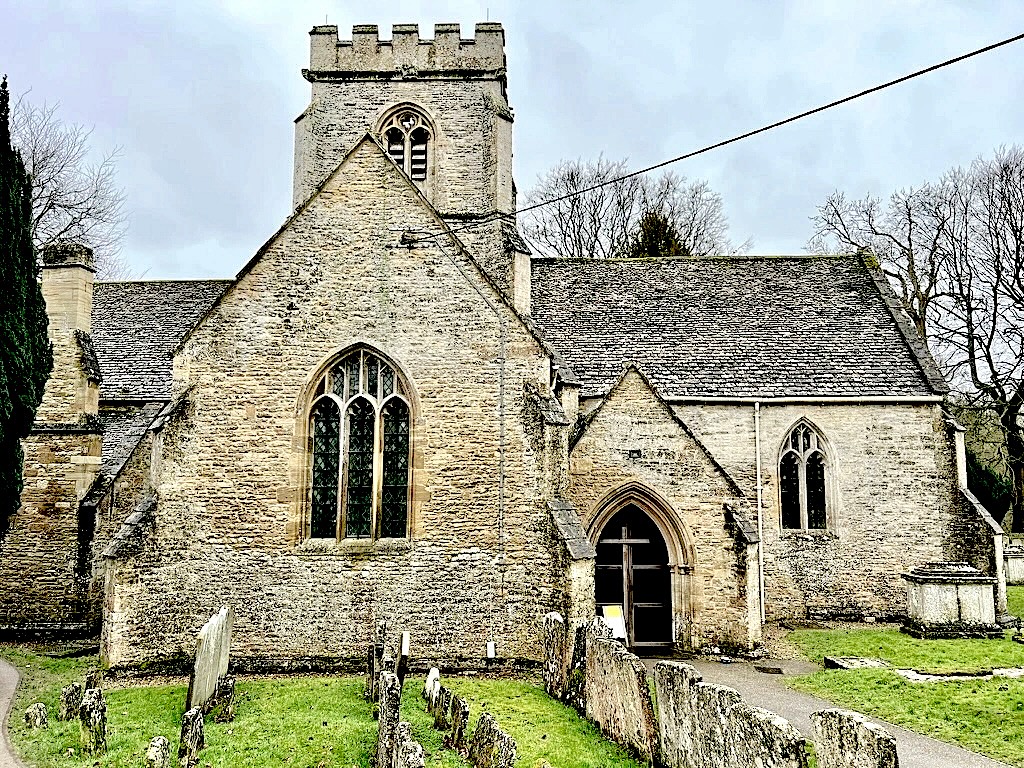
GRADE I ✣ Entirely rebuilt in the mid-15th century, incorporating earlier foundations and materials. C15 font and pews. Other details of the interior at BLB. Behind the church are ruins of its predecessor. 51.8001 / -1.5315 / SP324113
St Kenelm . Minster Lovell . ACNY cc/os
DIAL
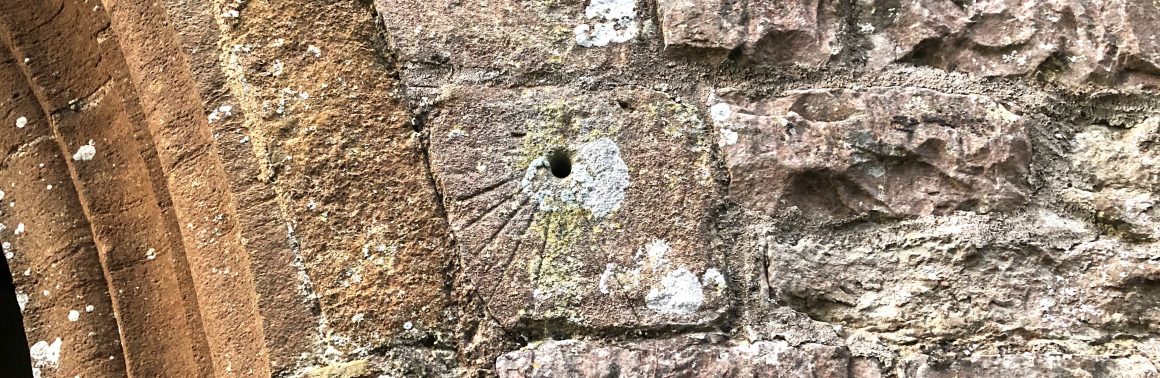
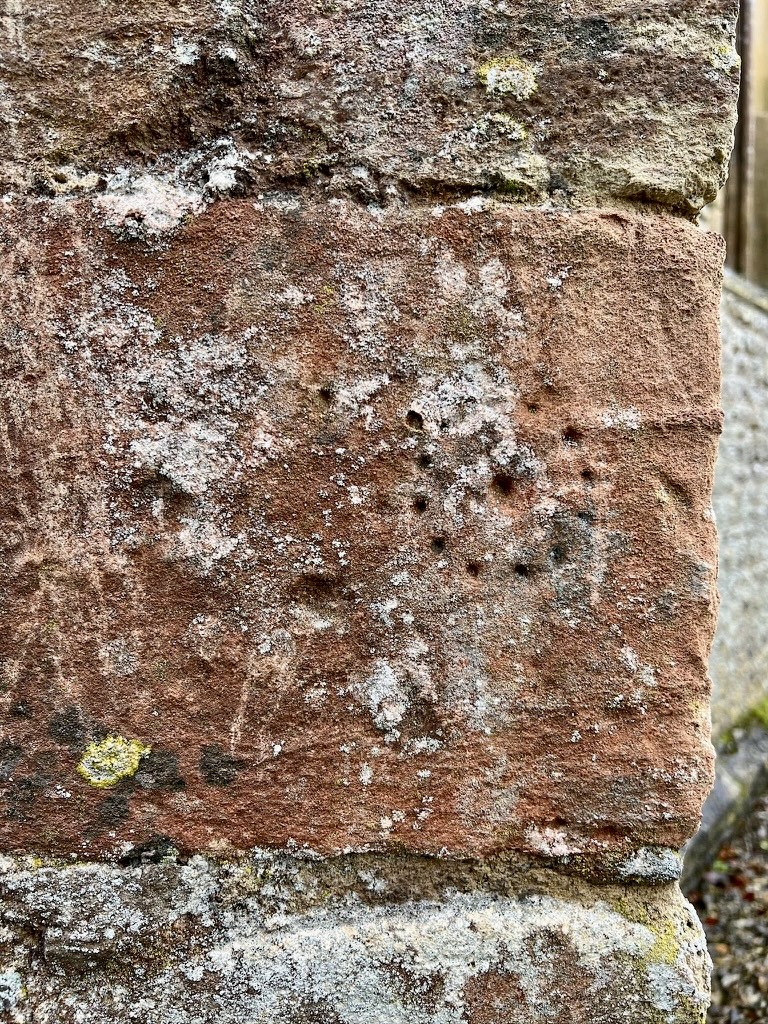
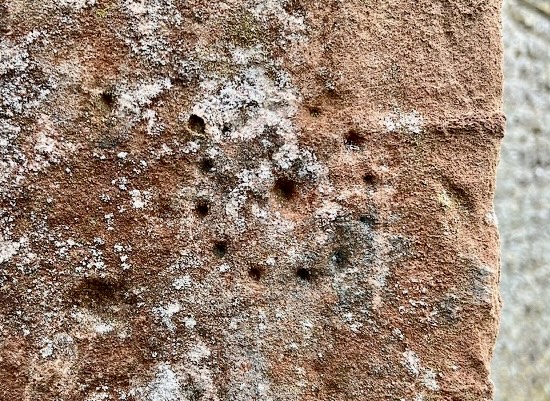
The dial consists of an incomplete circle of 9 holes, and no radials. There are a couple of eroded marks at the top that might have been linked to the design. A pleasingly small, neat dial.
LOCATION
The dial is on the buttress on L corner of N transept chapel, to the left of entrance porch. It was obviously repositioned at some time, given its orientation and the dissimilarity of the stone to those around it.
GSS Category: Scratch Dial; Mass Dial; Relocated Dial
Photos: John Renner with thanks, except 2 ACNY cc/os
Rousham is a fine country house less than 20m N of Oxford, built for the Dormer family in 1635 and still in their possession. Its landscape gardens were designed by William Kent, the inspired founder of the great tradition of such gardens in England. Little has changed at Rousham since C18. The RH site notes: In ‘Around the World in Eighty gardens’ Monty Don says (William) Kent is the great genius of eighteenth-century garden design and Rousham is his masterpiece, one of the greatest gardens in the world”
DOLLAND SUNDIAL AT ROUSHAM HOUSE OXON
BSS RECORD
By the pigeon house in the rose garden east of the house is a bronze horizontal dial 314mm in diameter made by Dollond of London.. It shows the customary hours IV – VIII divided into halves and quarters.The hours are also displayed in Arabic numerals and divided into periods of 10 And 2 minutes. There is an Equation of Time scale and round the centre of the dial a 16-point compass rose. There is a noon gap to compensate for the 7/16″ thick gnomon. The dial is mounted on a tapering stone column with a circular capital.
DOLLAND
Dolland workshops were active from approx 1750 to 1850. The business was founded by John Dolland who was joined by his son Peter, and later other members of the family. The name became synonymous with the crafting of intricate and precise scientific instruments. Sundial plates were a (rare, I think) sideline. Dolland collections can be found in many museums and individual pieces in auction rooms. All items have the Dolland mark, but some cannot be attributed with certainty to a particular member of the family.
George Dollond was elected to a fellowship into the Royal Society in 1819 and was an active participant in founding the Astronomical Society in 1820 (Confusingly, his son was also called George)
Broughton Grange dates from early C17. Gradual development resulted in a fine house with an extensive estate owned by the Morrell family and associated with the Bloomsbury Group via Lady Ottoline. The whole estate was bought in the 1990s. New gardens have been beautifully landscaped and an arboretum created. The property is renowned as one of the finest contemporary private gardens, to which there is public access. You can find out more here: BROUGHTON GRANGE 3m SW of Banbury 52.0415 / 1.3776 / SP4338
The dial stands at the centre of the Parterre and Rose Garden, overlooking the smart box hedges. It is dated MDCCLI (1751). I’ve spent some time trying to figure out the inscription, some of which cannot be read even with a magnifying glass. I have settled (provisionally) on Tempora Servio, ‘I Serve the Times’ or a similar conjunction of tempus and servere. This formulation does not specifically appear in eg the expanded edition of Gatty; however tempora is in common usage, often with its companion, mores. Any other suggestions welcome, a definitive ruling would be ideal.





 GAUDIUM SUB SOLE . SUNDIALS . MEDIEVAL TO MODERN