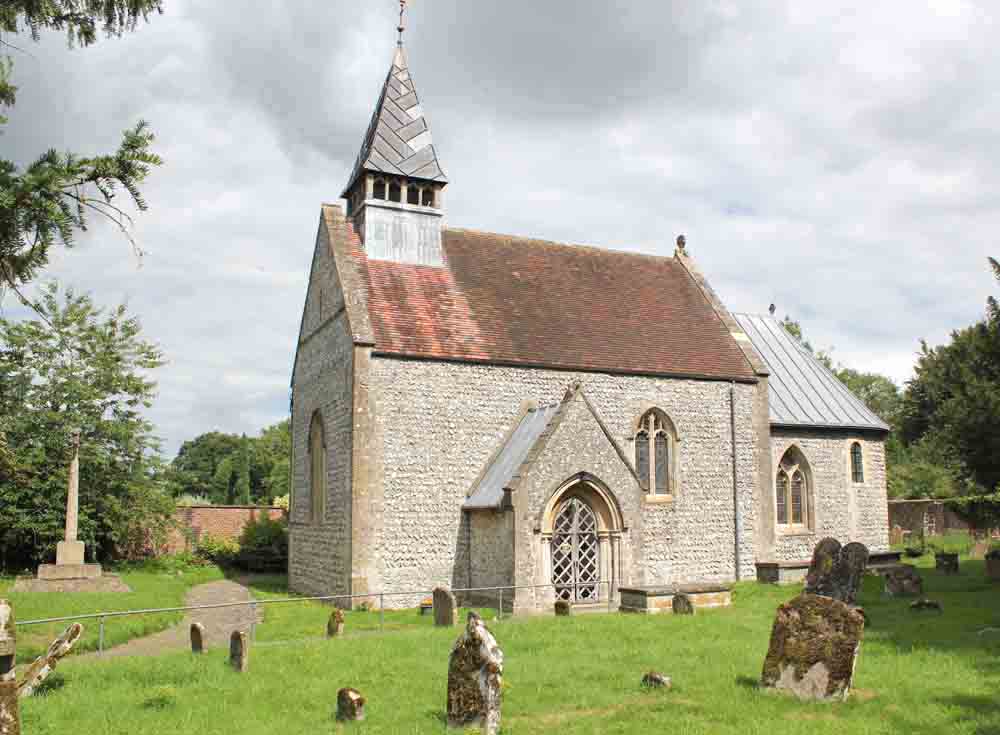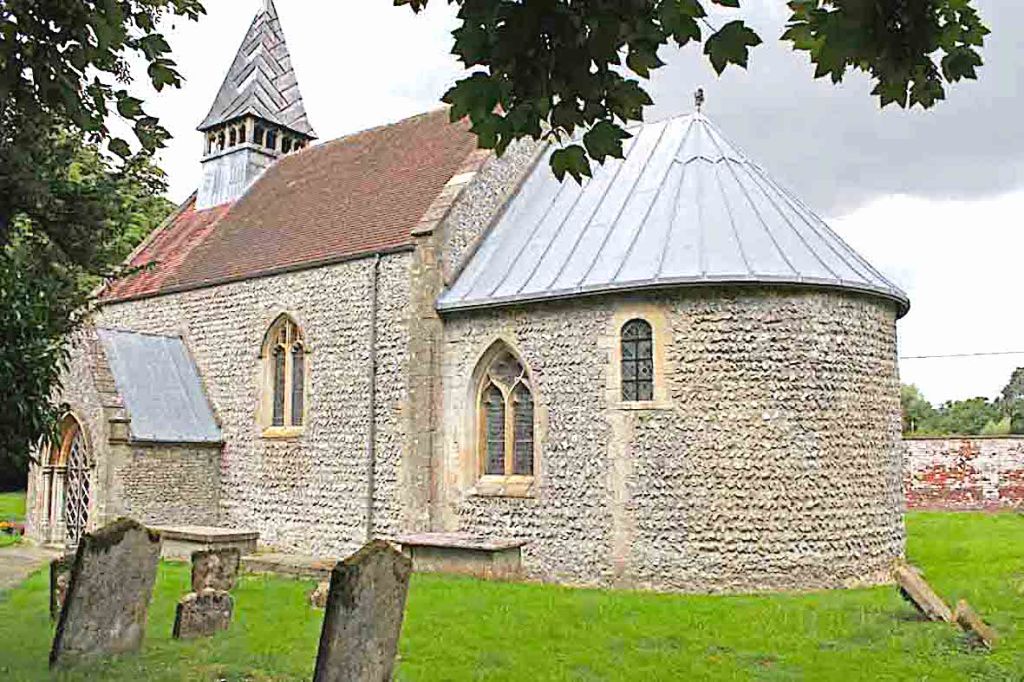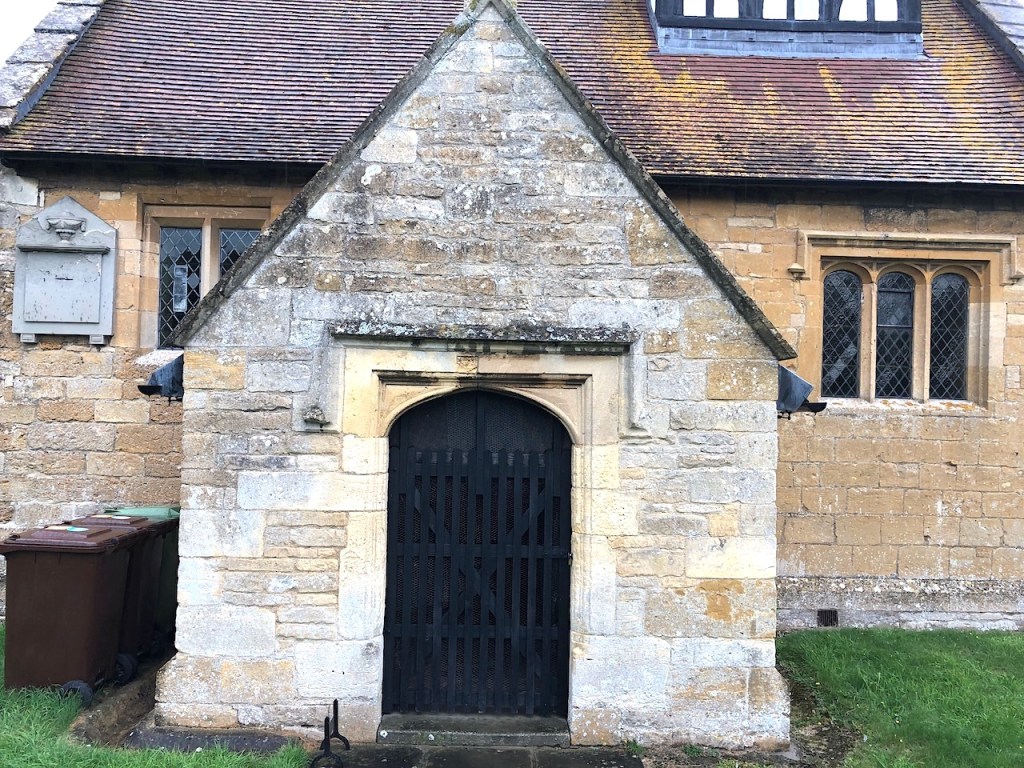
STOCKBRIDGE OLD CHURCH . HANTS . ST PETER – Early Scratch Dial

St Peter Old Church . Stockbridge . Hants

ST PETER OLD CHURCH . STOCKBRIDGE . HANTS

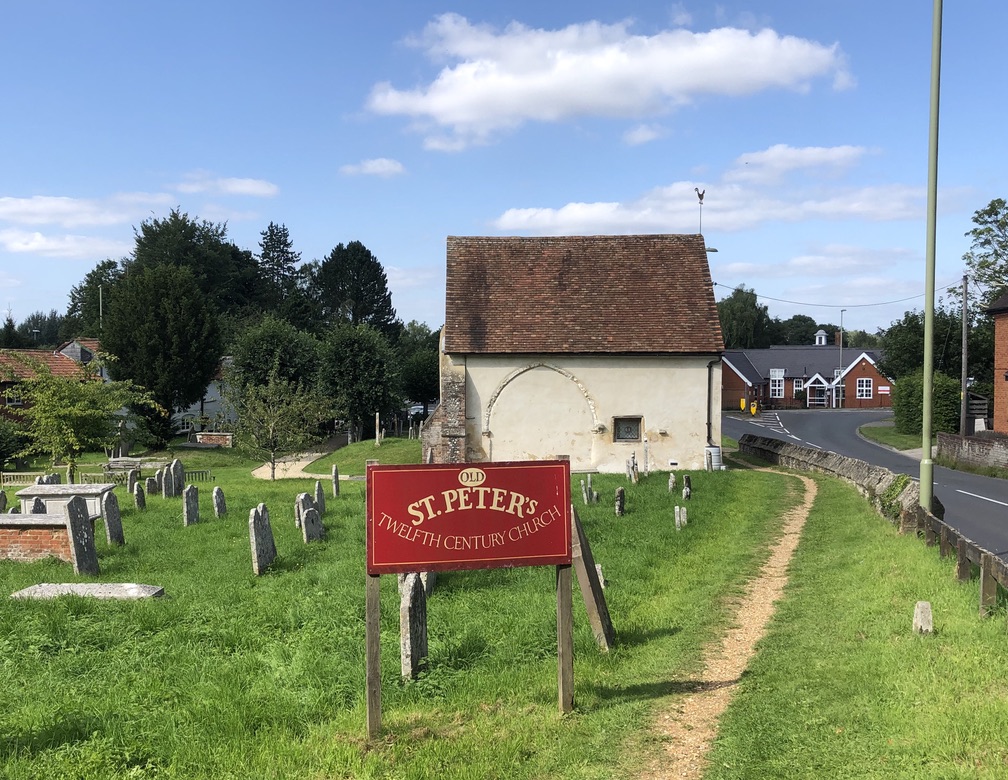
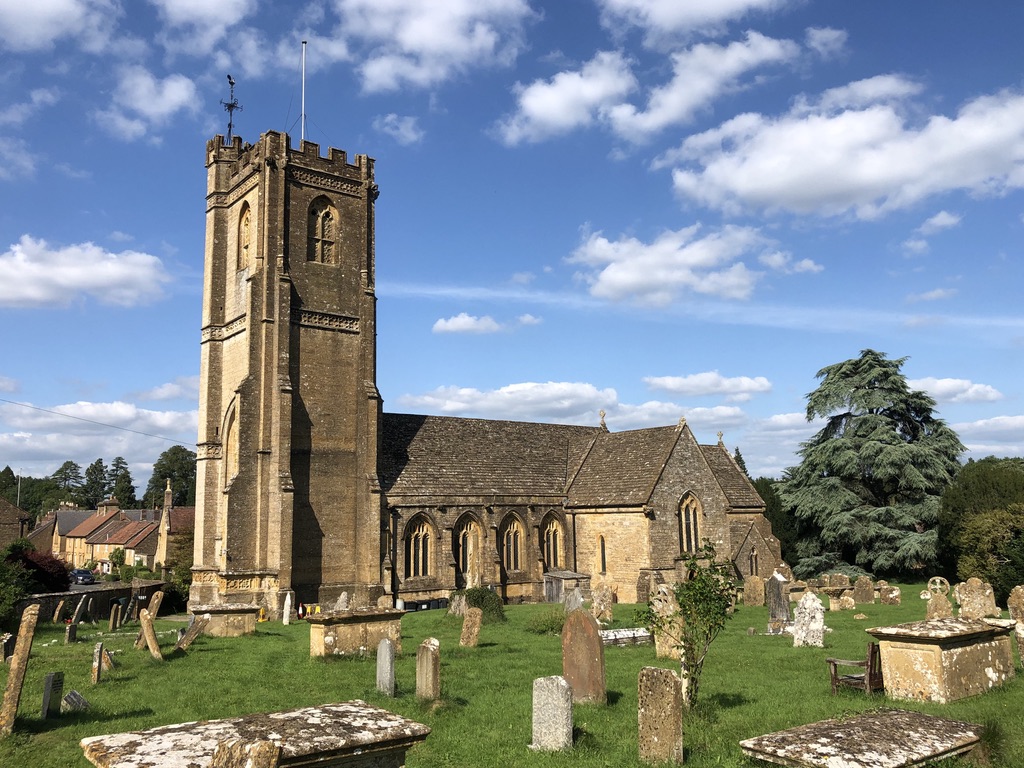
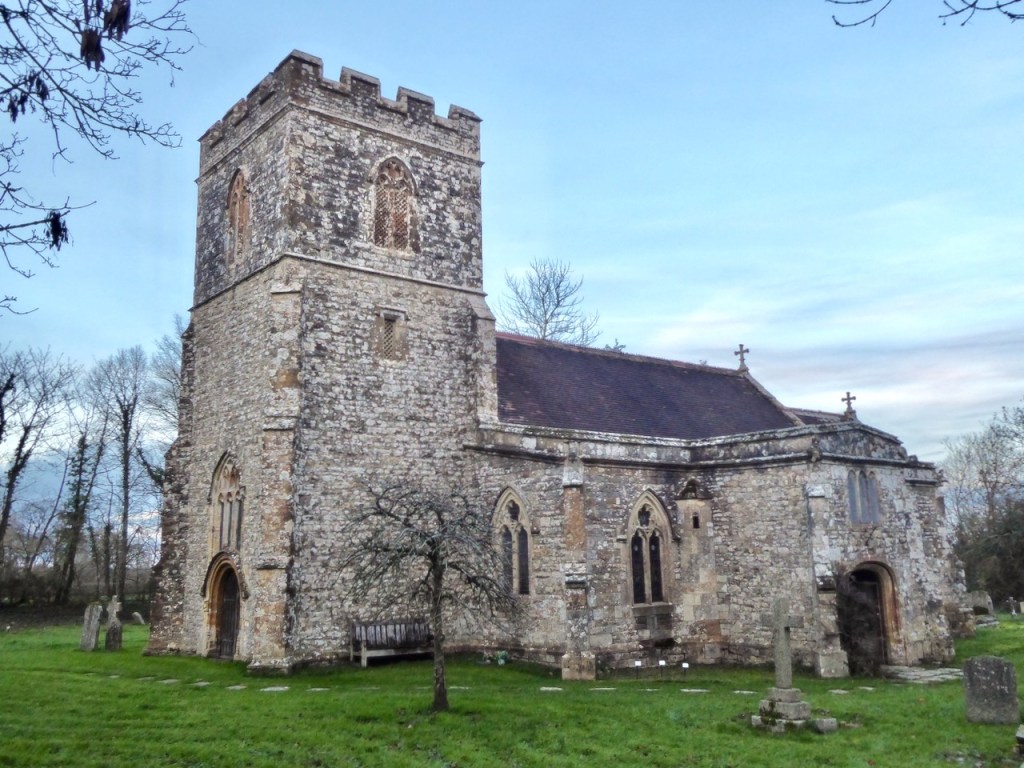
GRADE II* . C12, later expansion until decay by C19 rendered it ‘unfit for public worship‘. Radical action was taken and the church demolished leaving only the chancel. The ‘new church’ was built in contemporary style on the High Street. Much of the old church was transferred to the new one (including a dial stone, to be featured another time). The old church is still in use and much of interest remains including Elizabethan wall paintings, early bells, and a C13 (or C12?) font. Also a medieval oak door carbon-dated to 1354. 51.1131 / -1.4876 / SU359349

DIAL

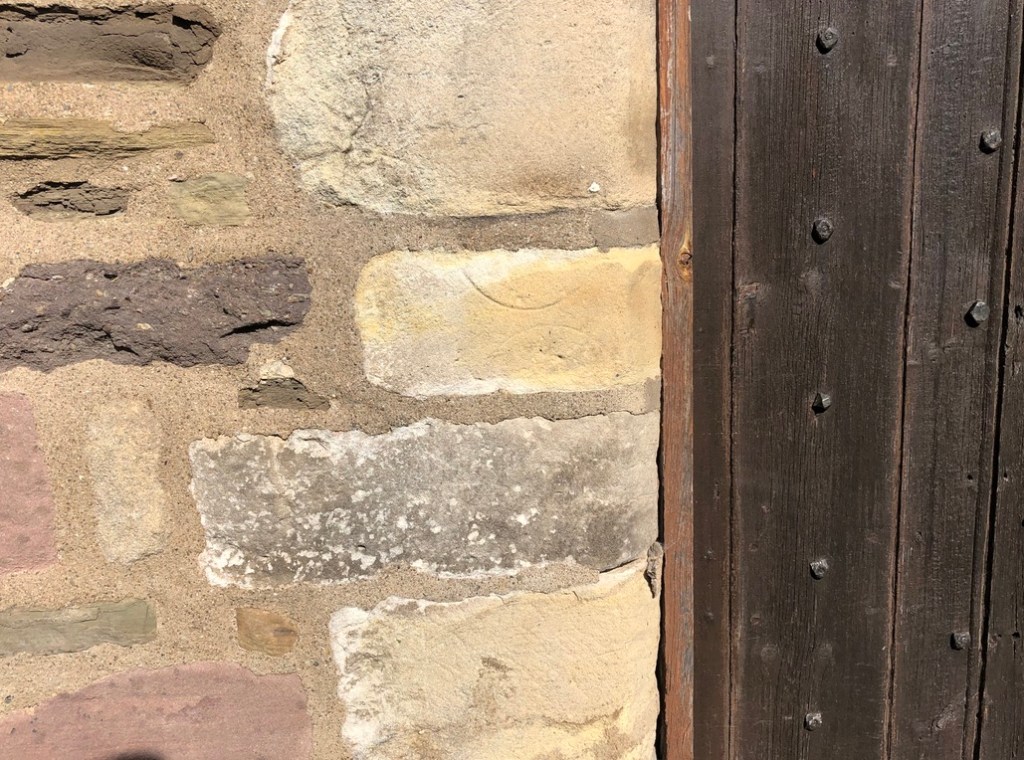
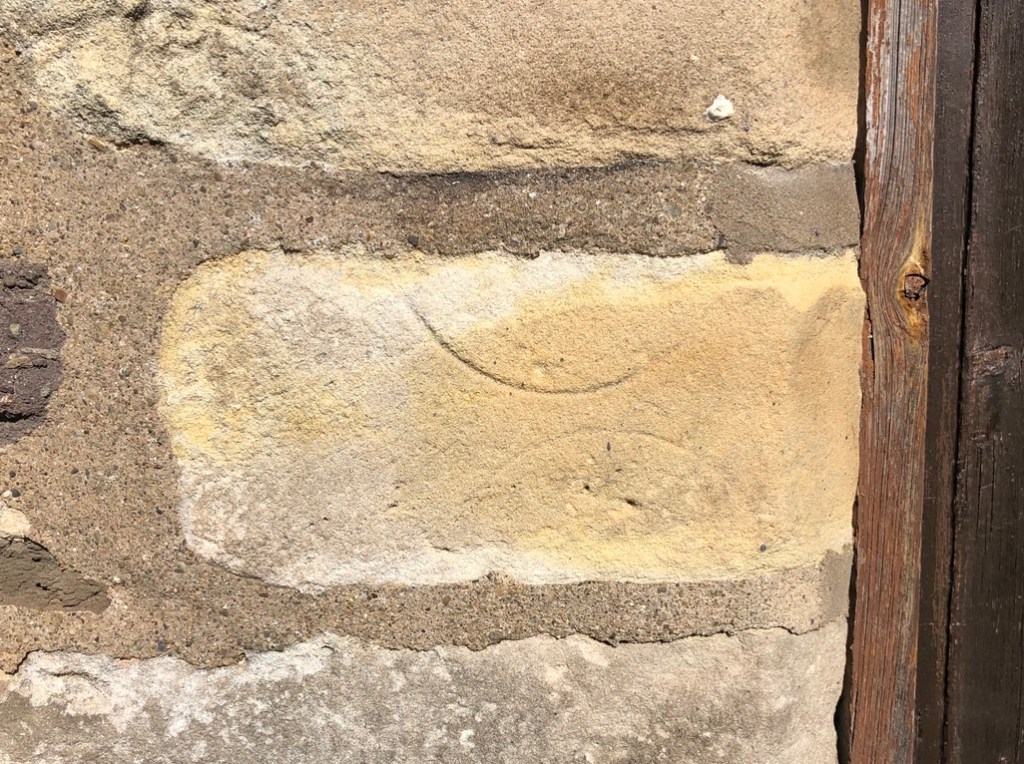
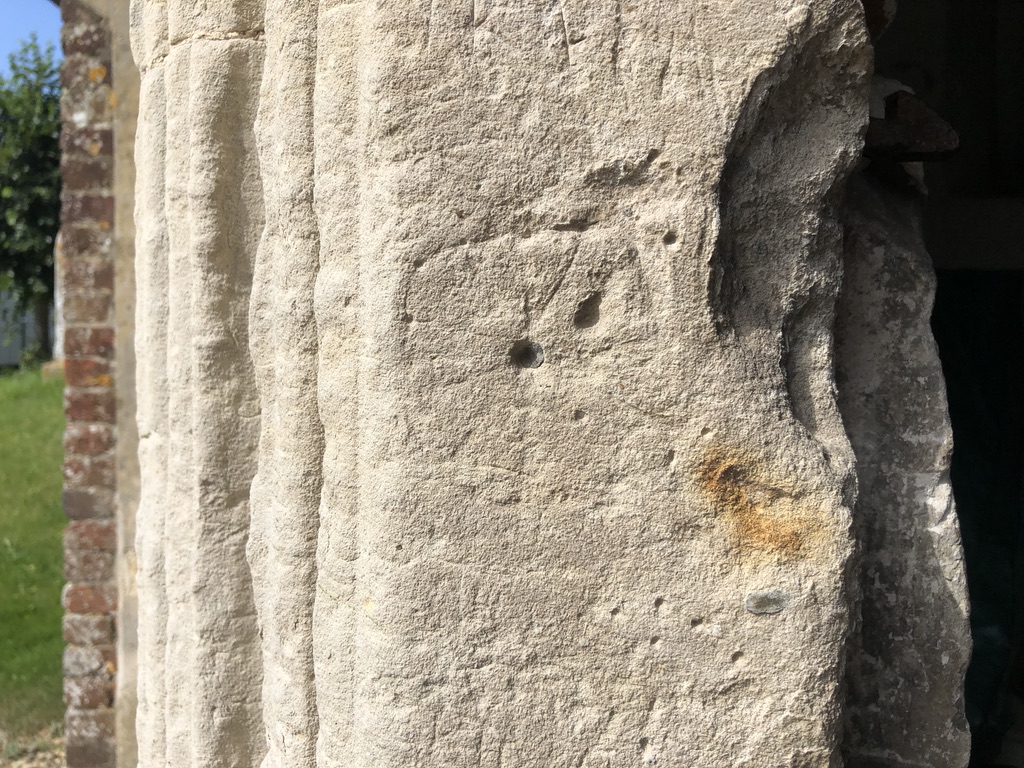
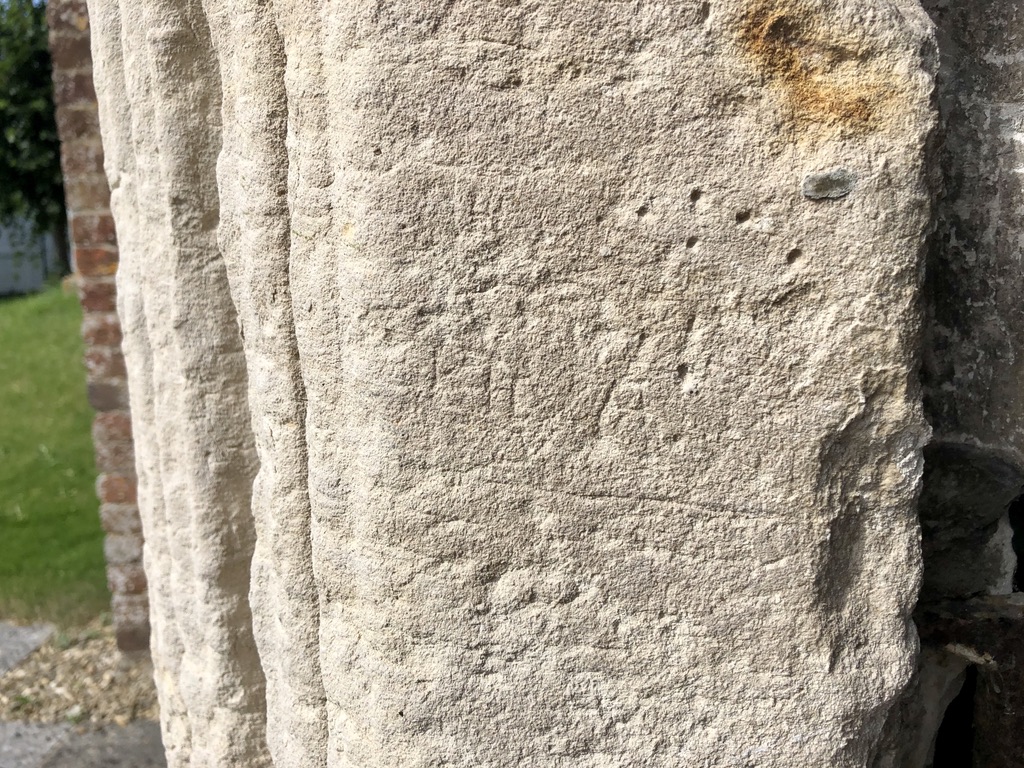
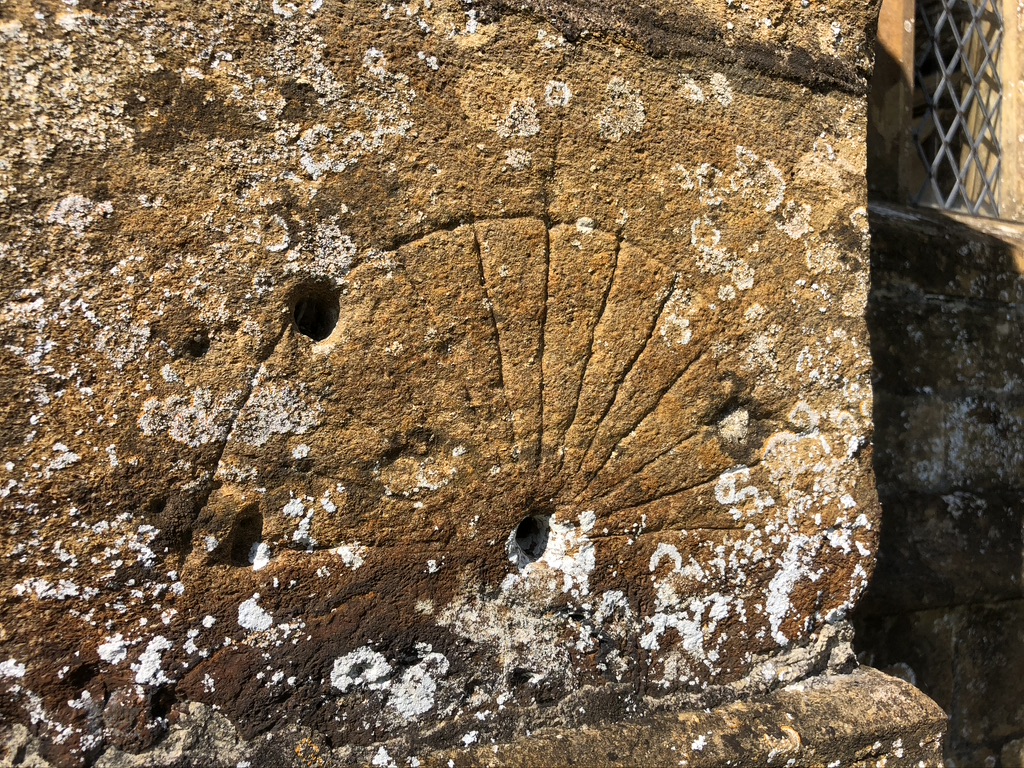
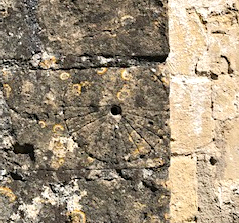
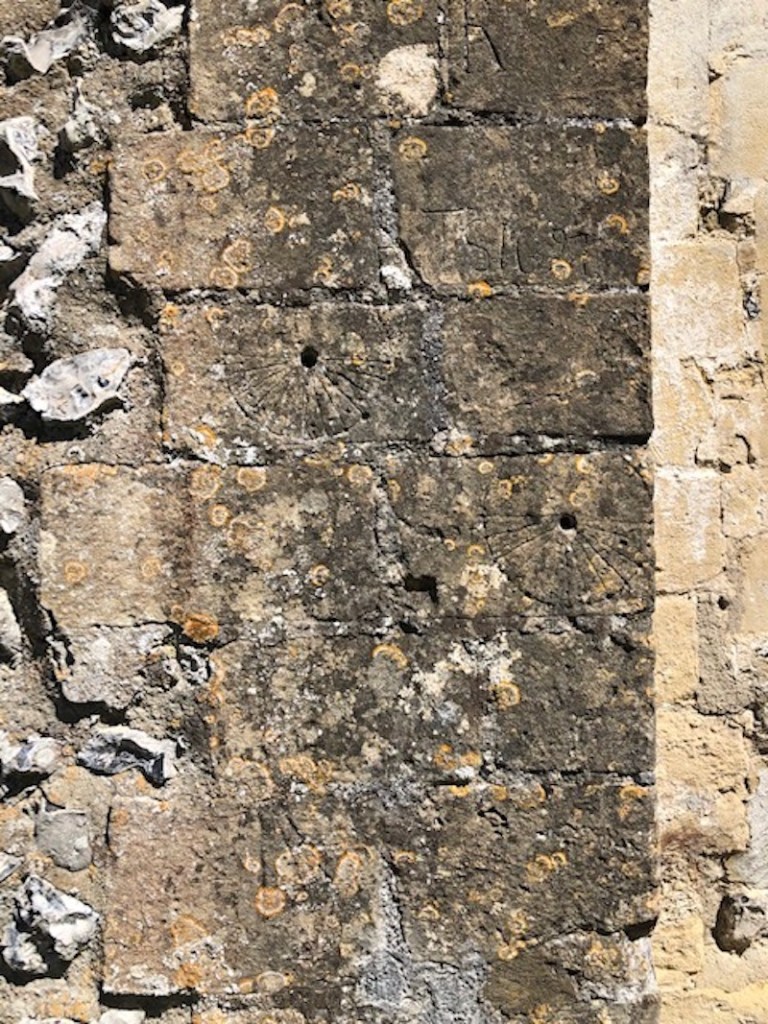
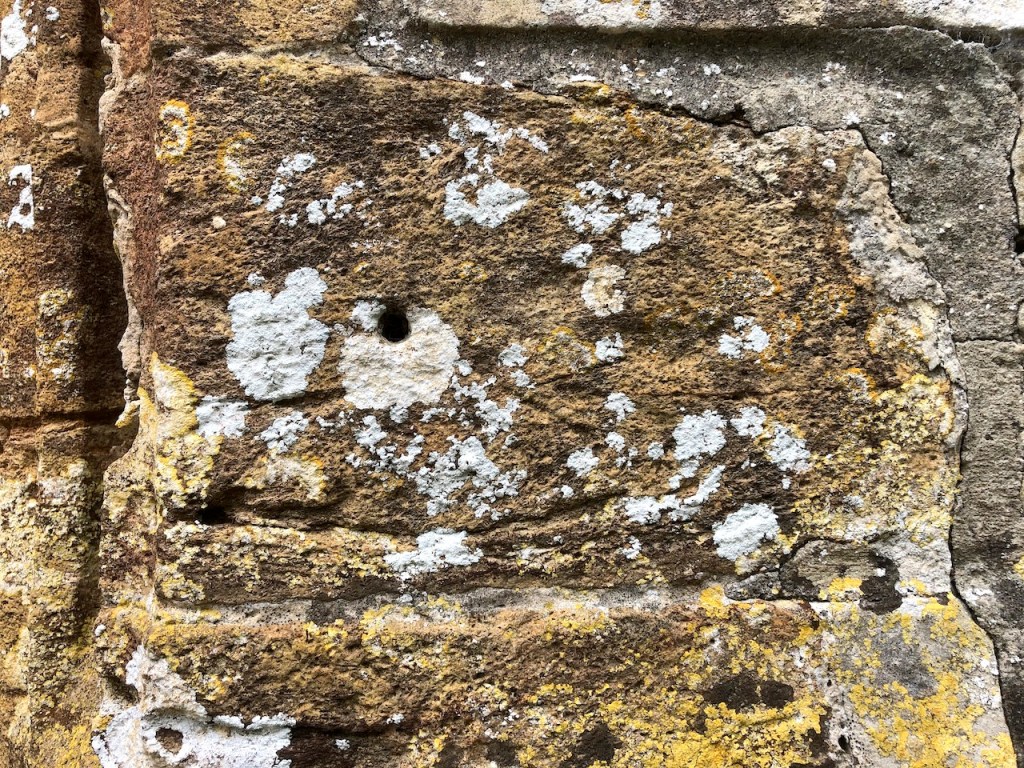
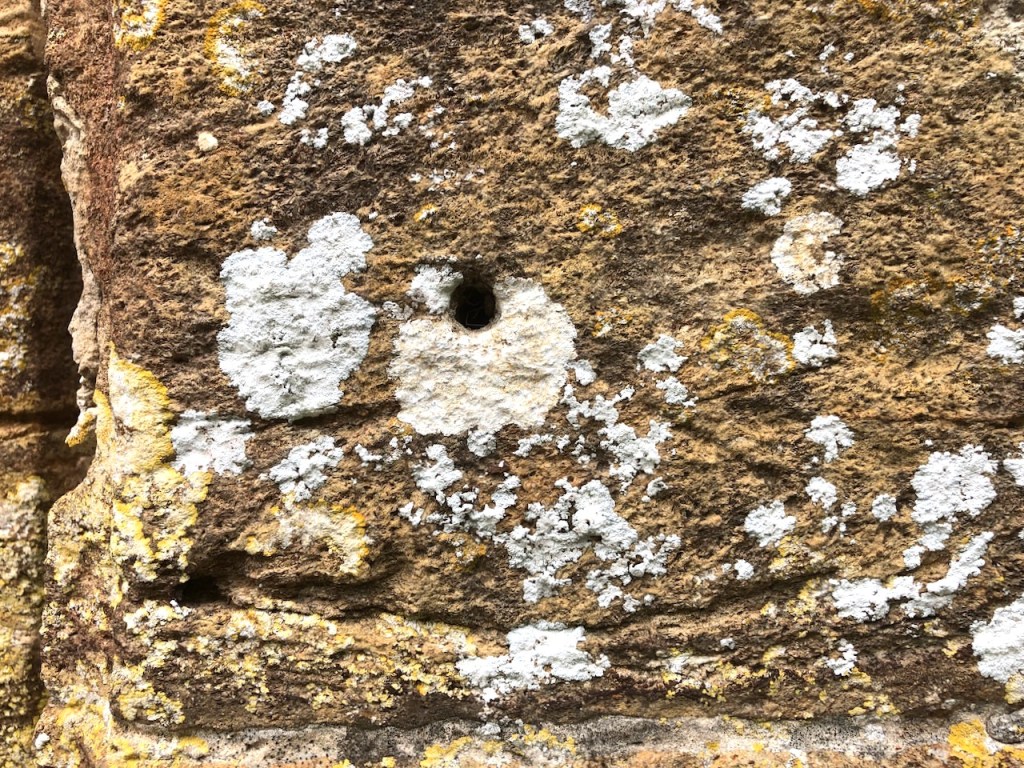
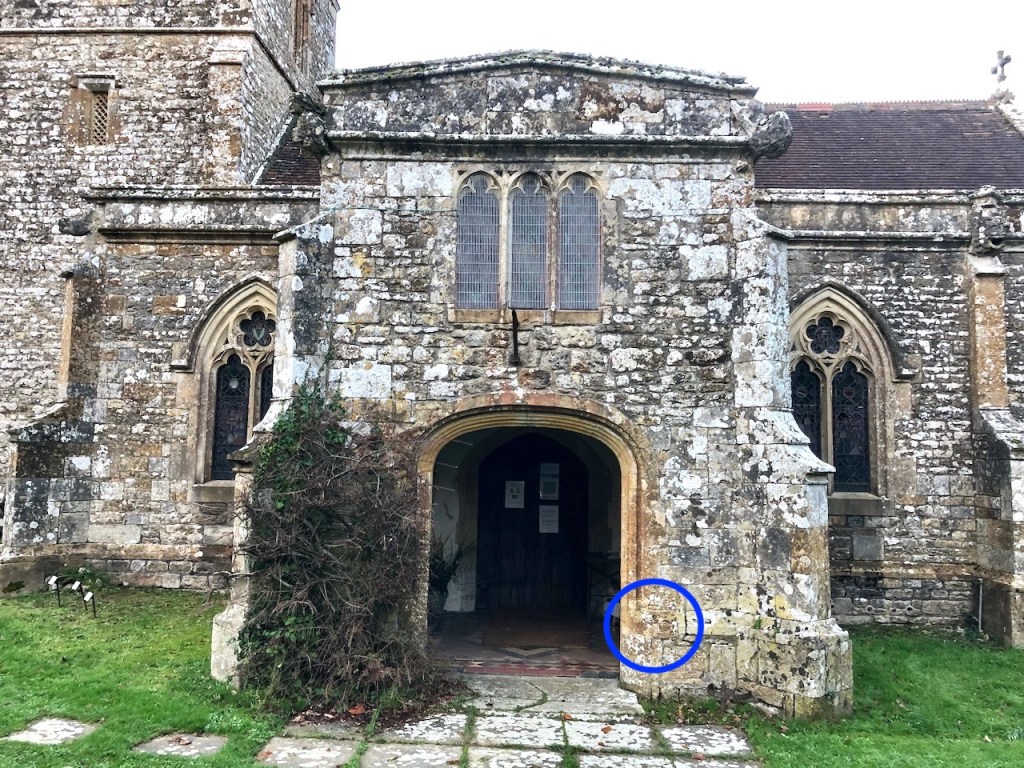
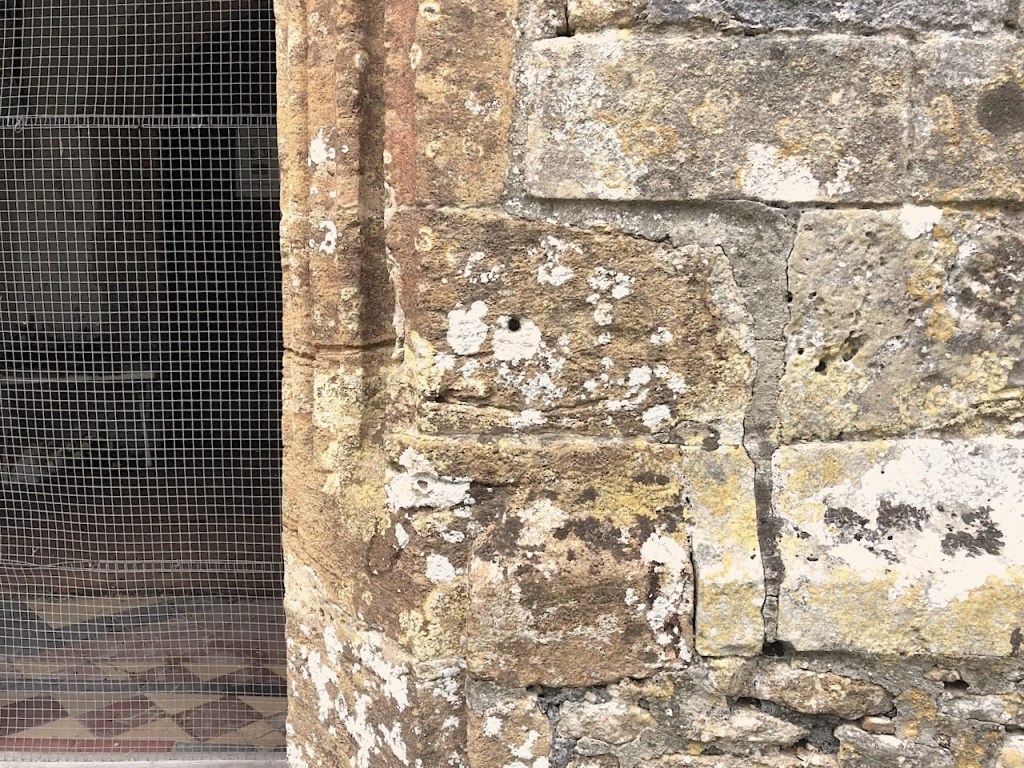
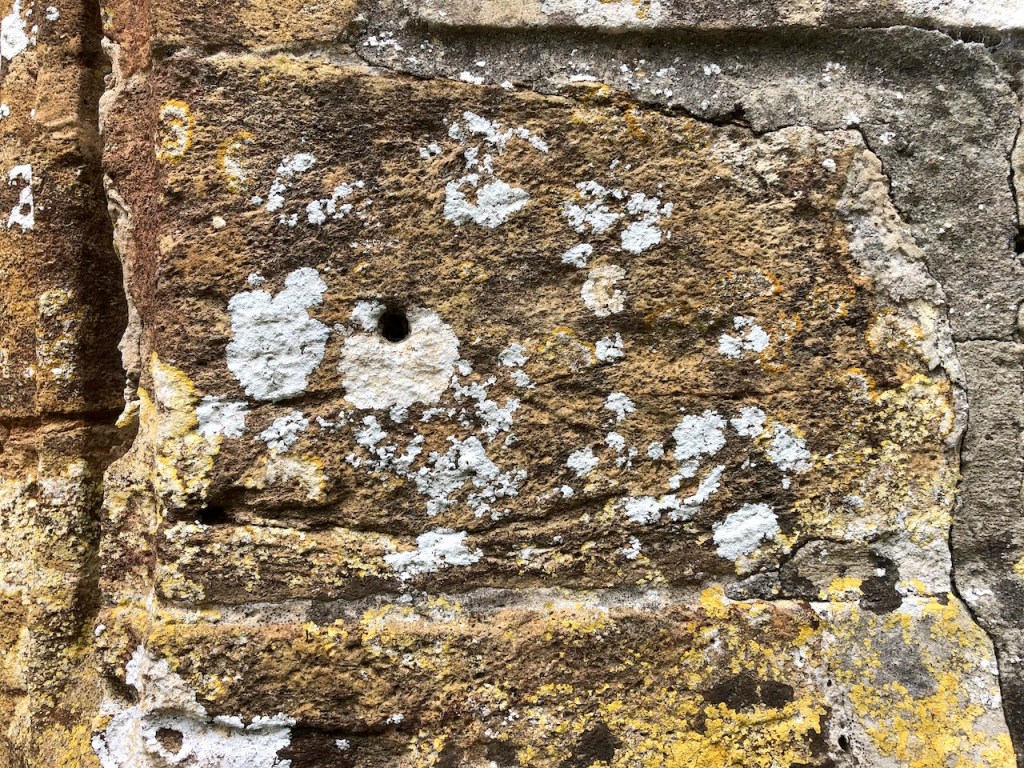
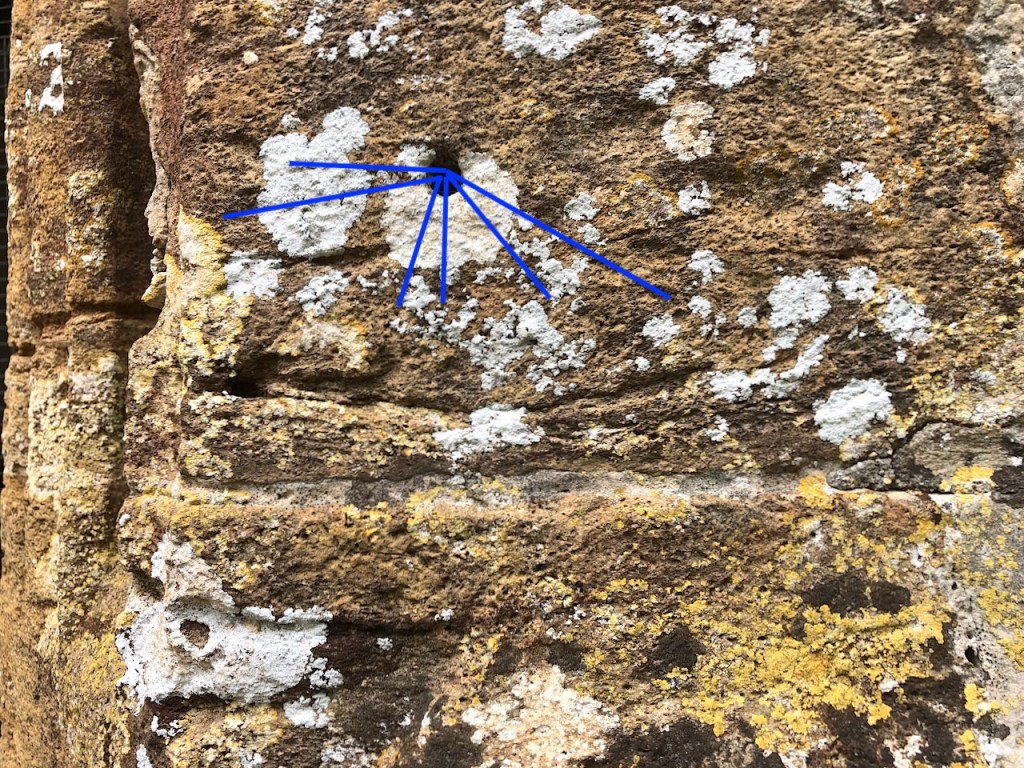
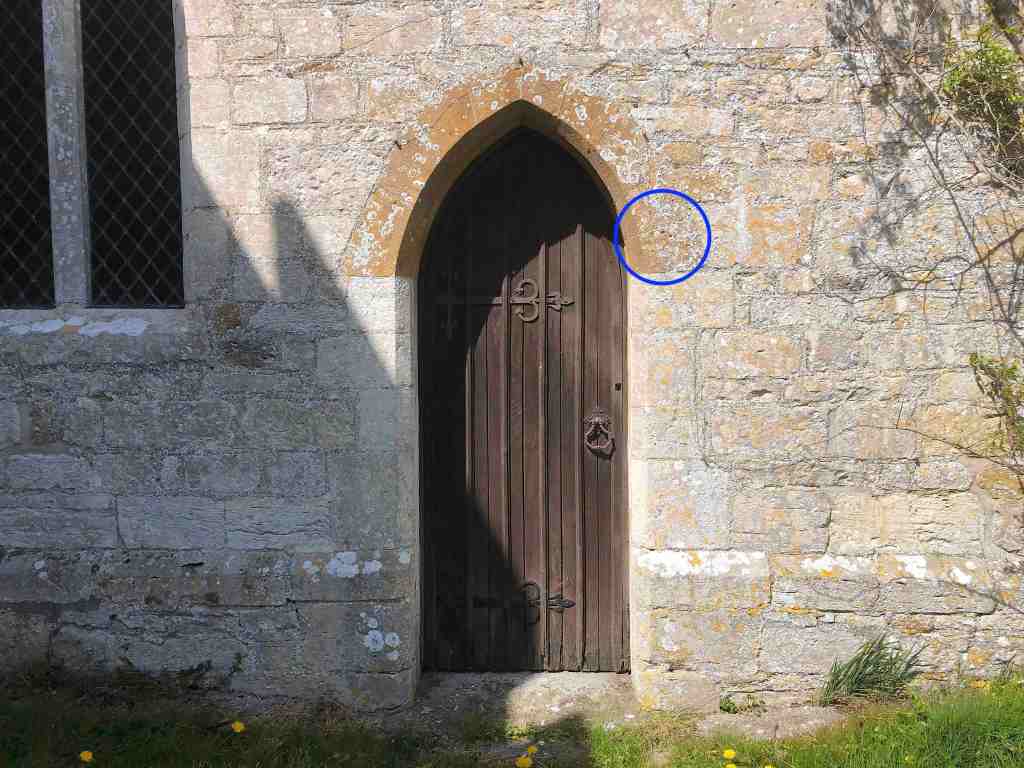
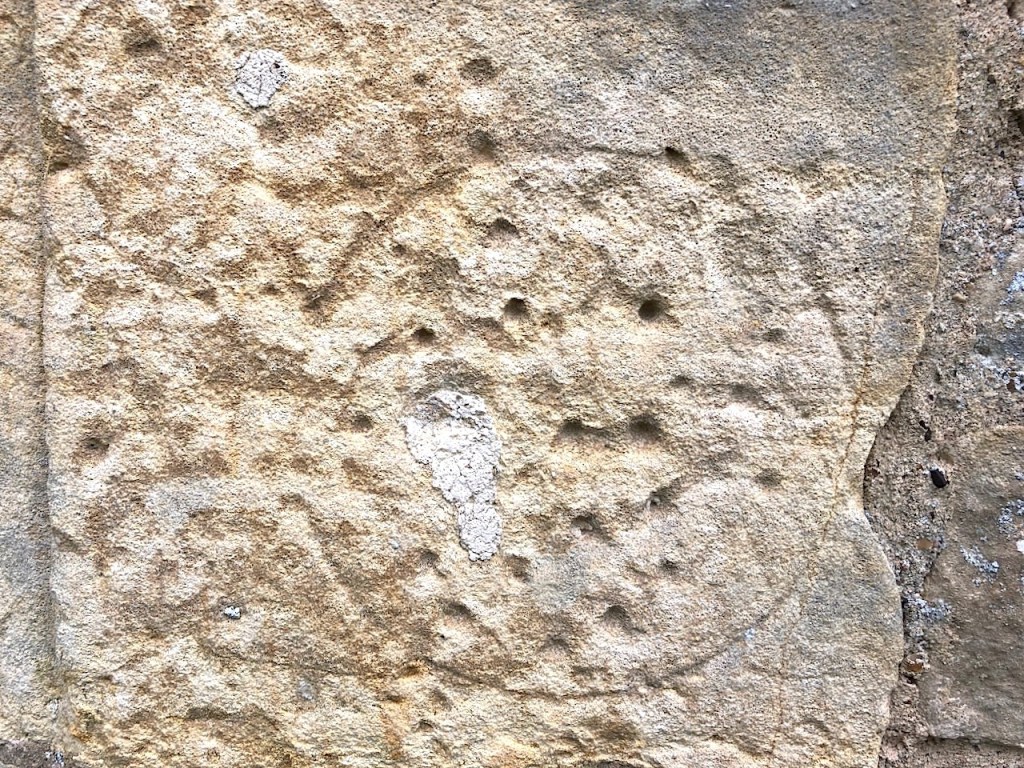
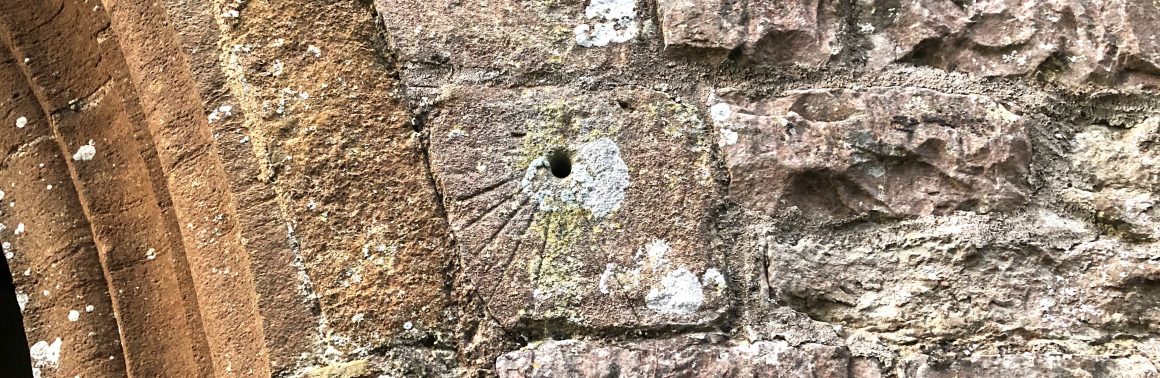
The church information leaflet notes ‘…a Mass Clock ca. 1214 on the door jamb of the west door’. However such a precise date is arrived at, this is a striking example of an early dial and a most unusual one in being set in an approximate rectangle rather than (if anything) a semi or complete circle. In Hants I know of one other, at Laverstoke.

St Peter Old Church . Stockbridge . Hants – Scratch Dial

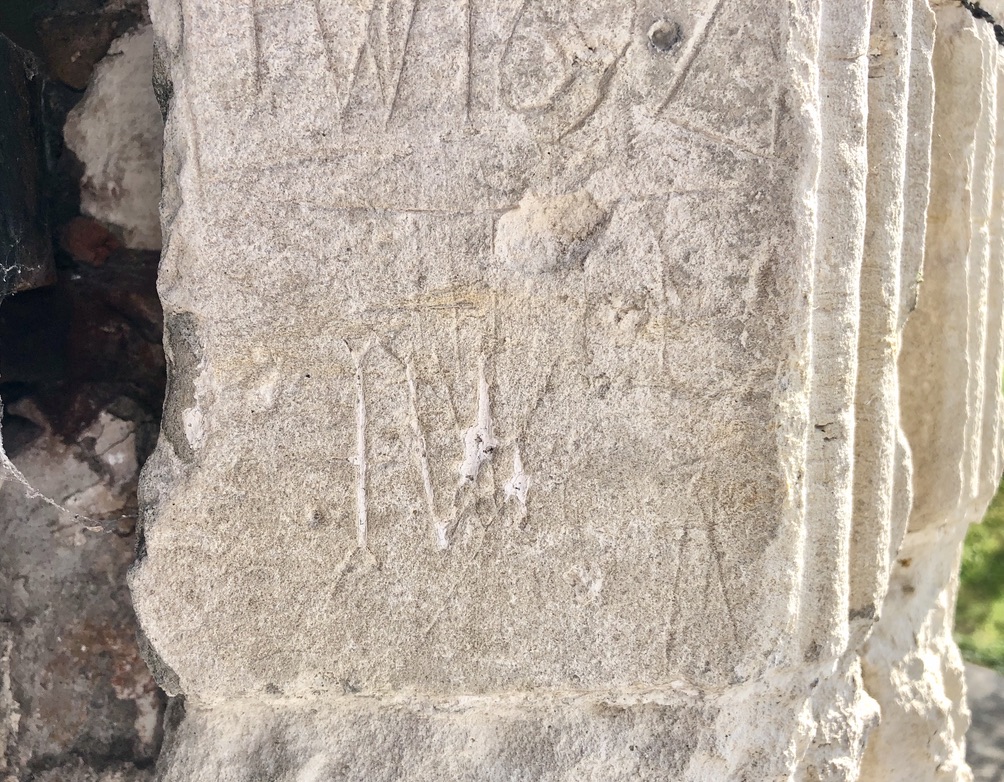
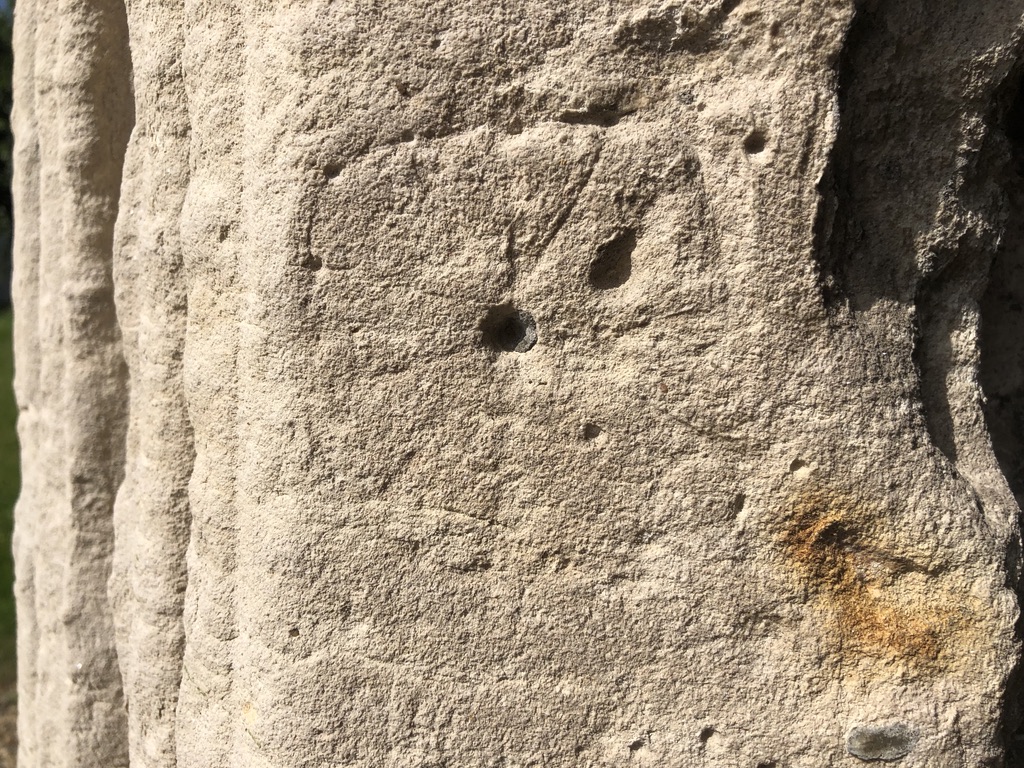
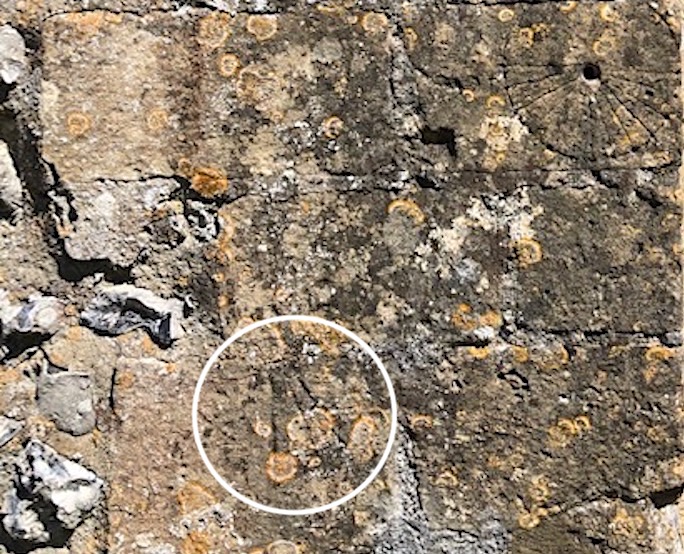
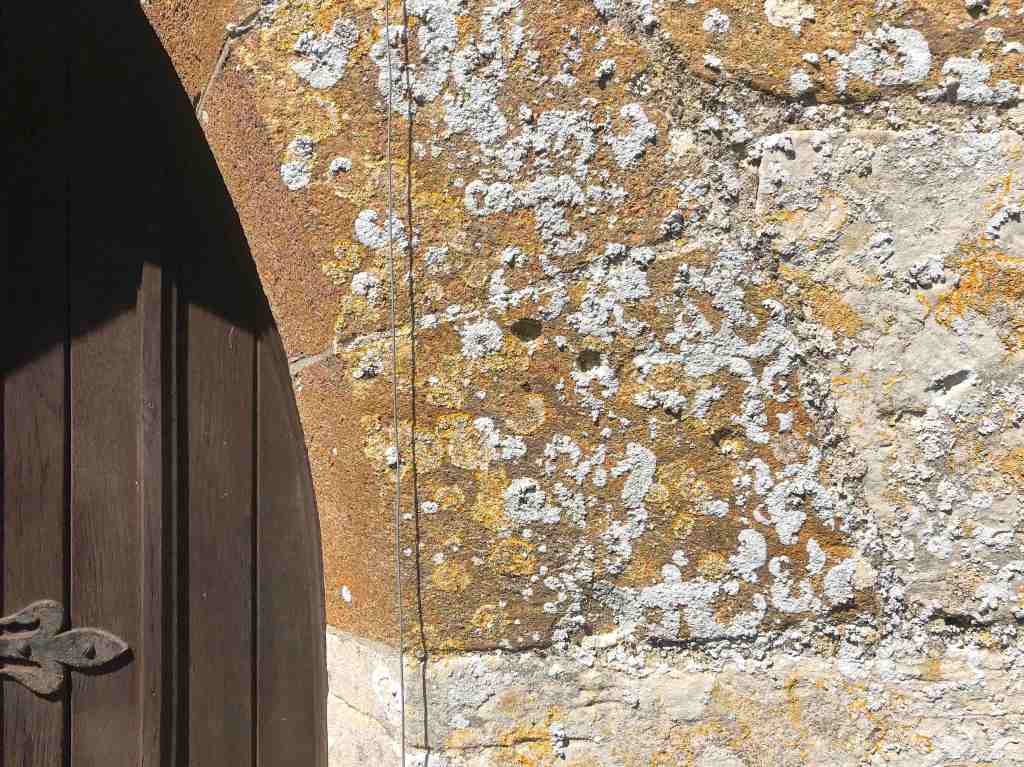
The dial is set facing south among a selection of witch marks and graffiti scratched around the doorway. I counted 8 (possibly 9) lines rather haphazardly drawn and positioned ’round the clock’, with several pocks on the dial and its perimeter (also a dot pattern below). The noon line seems faintly to be extended. The style hole is filled. I wonder if it is unusual for such a very early dial to mark a full 24-hour cycle?

BSS gives the condition as fair and specifies 8 lines. Pocks are not noted. Comment: Repositioned?Irregular outline. Crudely cut or made. Cannot be classified. Unique shape.

Green ARG includes Stockbridge new church in his indispensable book of 1926 ‘Sundials – Incised Dials or Mass Clocks’. He visited in May 1922 and there is a detailed entry covering the dial stone removed from the old church and repositioned, inverted, high up at the W. end of the N. aisle. I will post about this dial in due course. However ARG makes no specific mention of visiting the old church, and there is no entry for it except in his concluding list of Hants dials.

NOTE: for a short summary of the Stockbridge churches & dials, see the entry on BRITAIN EXPRESS

GSS Category: Scratch Dial; Witch Mark; Church Graffiti

All photos – Keith Salvesen

MONTACUTE . SOMERSET . ST CATHERINE . 2 dials

St Catherine . Montacute . Somerset

MONTACUTE . SOMERSET . ST CATHERINE

GRADE II*. C12 origins on earlier pre-conquest site; extended in C13; tower C15; Victorian restoration. Outcompeted as an historic building by Montacute (the house) NT, worth a visit in its own right, obviously. 4 miles NW of Yeovil. 50.9498 / -2.7178 / ST496169

DIALS

DIAL 1

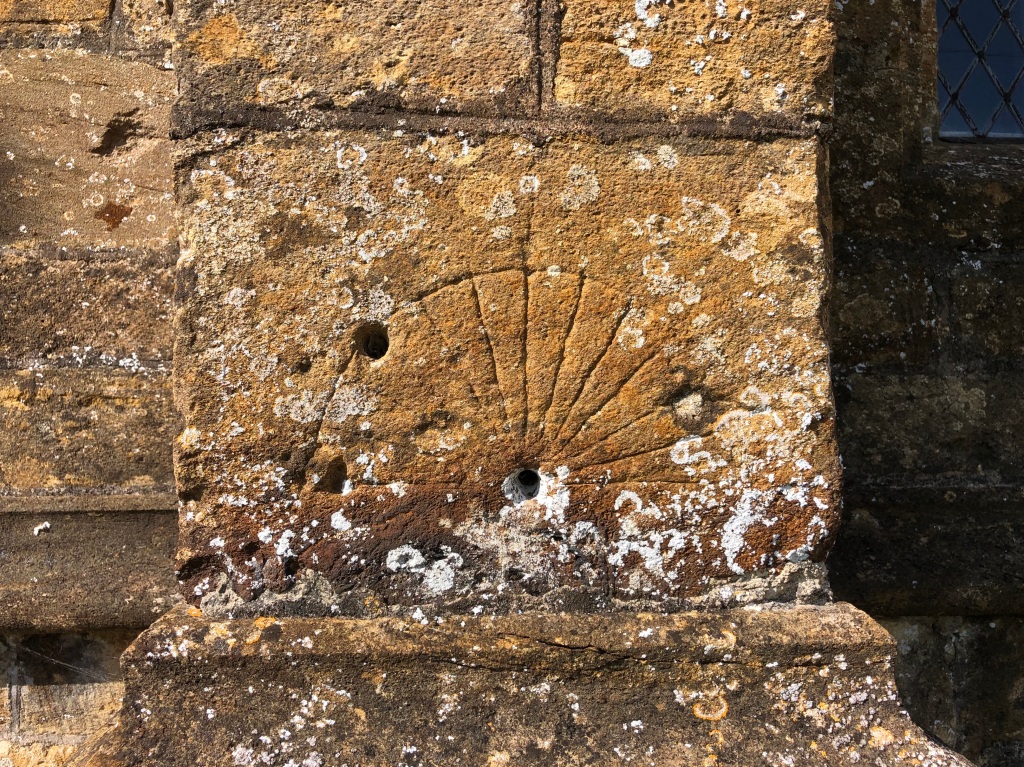
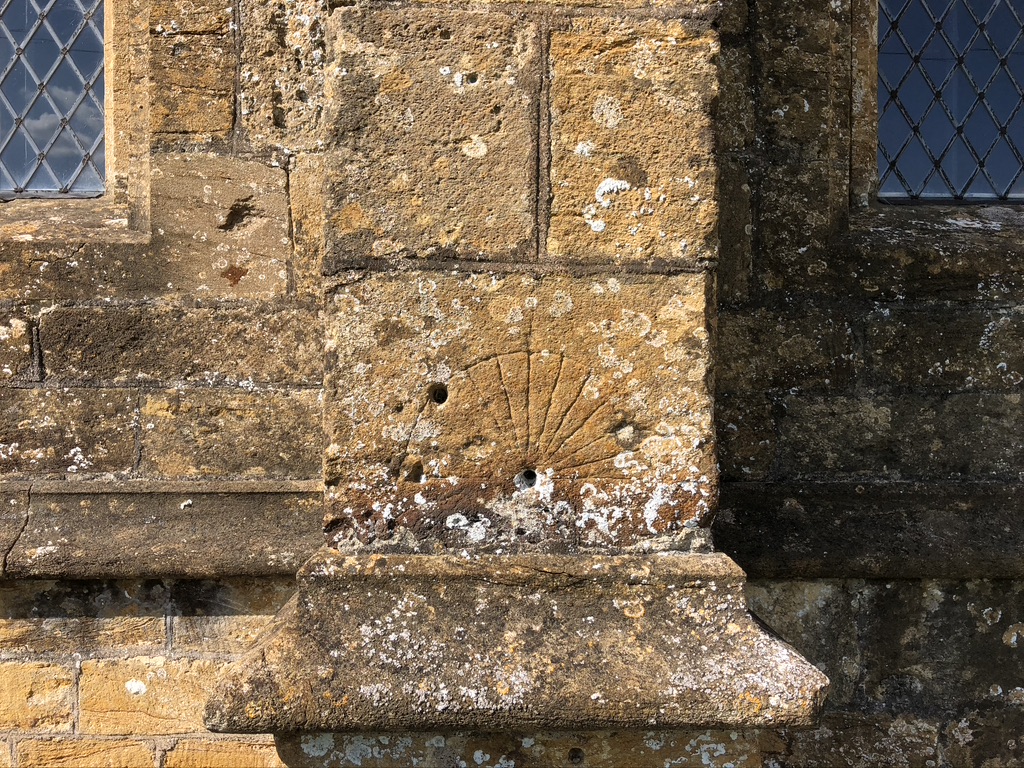
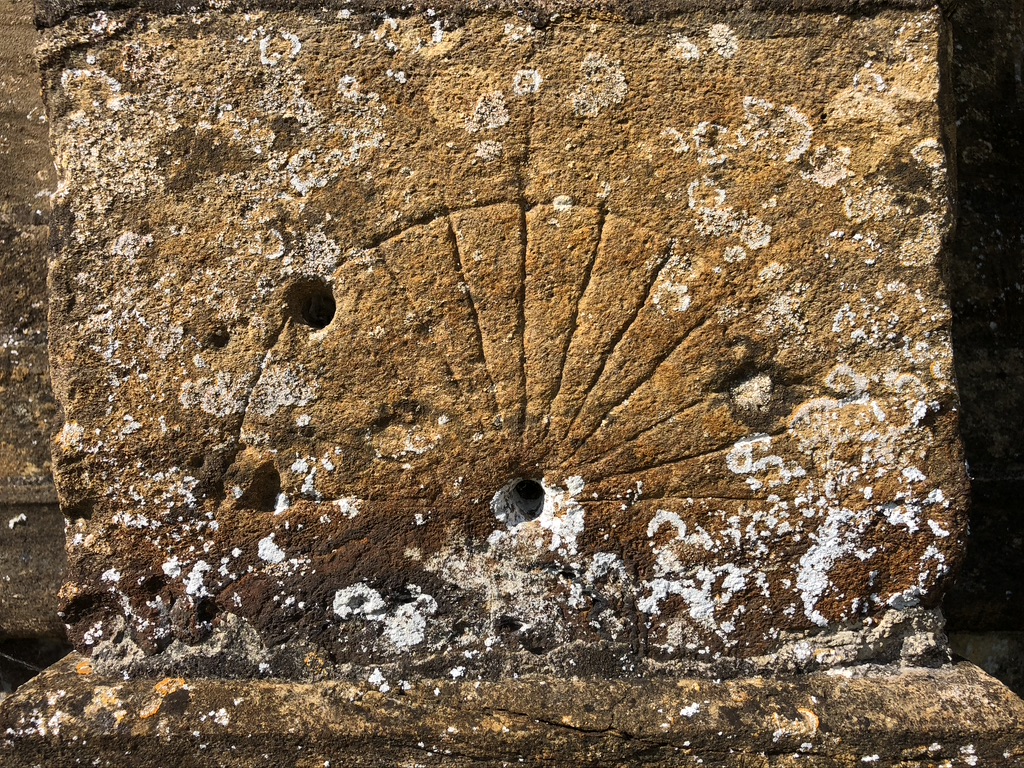
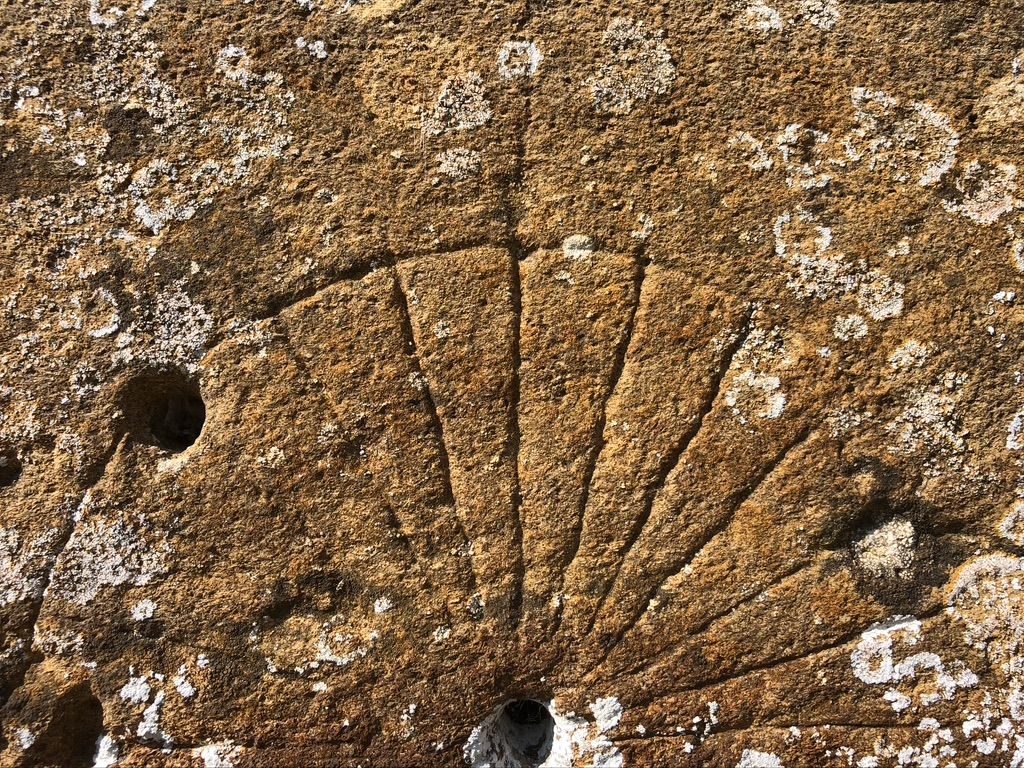
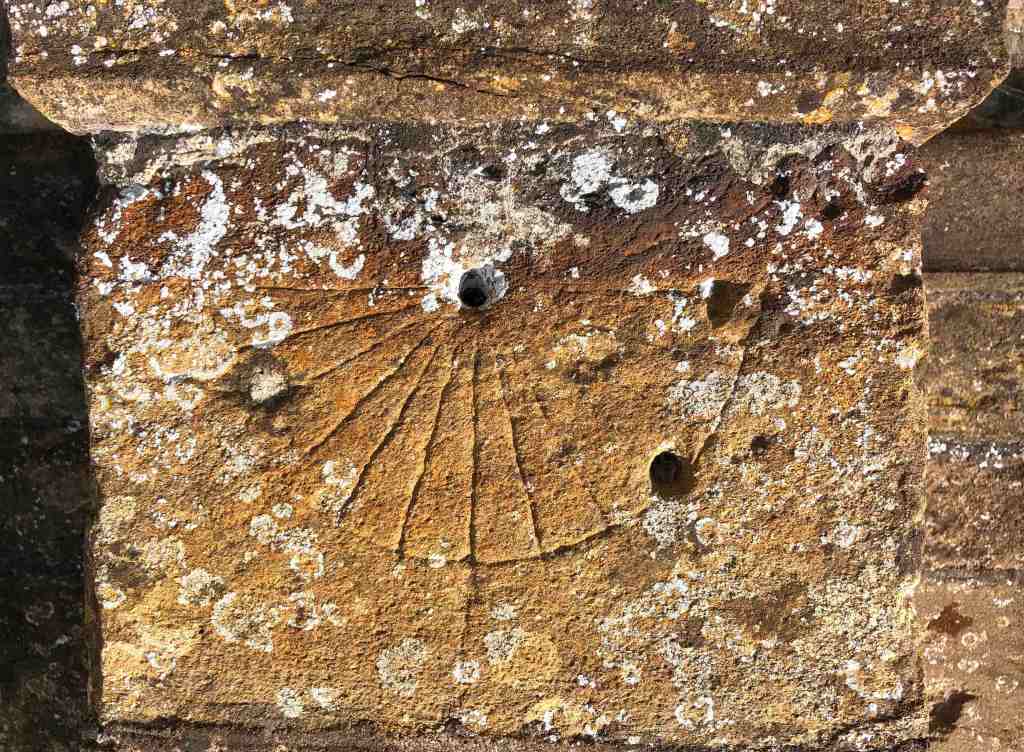
Repositioned and inverted on a S. buttress. An unusually large style hole, with other holes and pocks that may be markers, or perhaps irrelevant. The top left hole, on the circle, is the most likely to be related – perhaps a emphatic reminder for Mass. The afternoon lines are emphasised and the noon line elongated, though it looks a casual later addition. See below for image with the dial reverted

St Catherine . Montacute . Som – Scratch Dial 1

Father Horne DEH visited Montacute on 18 June 1914 and recorded it thus:

205. This dial is on the second buttress from the tower, at a height of 5 feet 7 inches above the ground. The noonline is 5 inches in length, the stylehole is 1 1/4 inches deep by 3/4 of an inch in diameter, and the aspect is s. by 12° e. Type 5b.

This is a rare example (and perhaps none exists now, a century later) of a possible style fragment found in situ. The record continues:

This dial is upside down, and hence has been moved from its original place. A fragment of the metal style was extracted about an inch in length, and which had rusted down to about 1/2 of an inch in diameter. It appears to be a piece of iron. June 18th, 1914.

DIAL 1 REVERTED

St Catherine . Montacute . Som – Scratch Dial 1 Reverted

DIAL 2

On the second (E.) tower buttress on the S. side, another dial, unrecorded by Father Horne presumably because it doesn’t strictly fall within the – or his – scratch dial definition. However, it is a fine dial in its own right and deserves to feature here even if not quite qualified for inclusion.

I haven’t yet found an analysis of this dial in the usual resources. The lines are unevenly spaced but not graduated. The hours are clearly marked from 8 to noon in Arabic numerals; then faintly (eroded?) from 1 to 5 in Roman numerals. The 3-line is barely visible.

This Arabic / Roman numbering mix is not something I have come across before. It may help to date the dial – late C16 perhaps? Any further information would be welcome.

Ref: Somerset Historic Environment Record: There are two engraved sundials on the south side of the church. The first is semicircular and reset upside down on the second buttress west from the steps down to the boiler house. There are three marker holes. The second is on the E buttress for the tower and the divisions are numbered in a combination of Roman and arabic numbers. 

GSS Category: Scratch Dial(s); Old Dial

All photos: Keith Salvesen
MAIDEN NEWTON . DORSET . ST MARY (3) . SCRATCH DIAL 2? (unrecorded)

St Mary . Maiden Newton . Dorset

DEDICATION † St Mary. Mid C12 / earlier foundation; main development C15; C19 restoration

LISTING † Grade I

LOCATION † 8 miles NE. of Dorchester, 12 miles SE. of Yeovil, in the valley below the A37 racetrack. Hardy’s ‘Chalknewton’. More of a small town than a village, with a few shops, a garage and a station rather than (as elsewhere locally) a single shop and a halt. 50.7775 2.5727 SY597977

DIAL 1

See detailed post for the recorded dial in the chancel doorway (RHS) HERE

St Mary . Maiden Newton . Dorset . Scratch Dial on Chancel doorway

DIAL 2 (?)

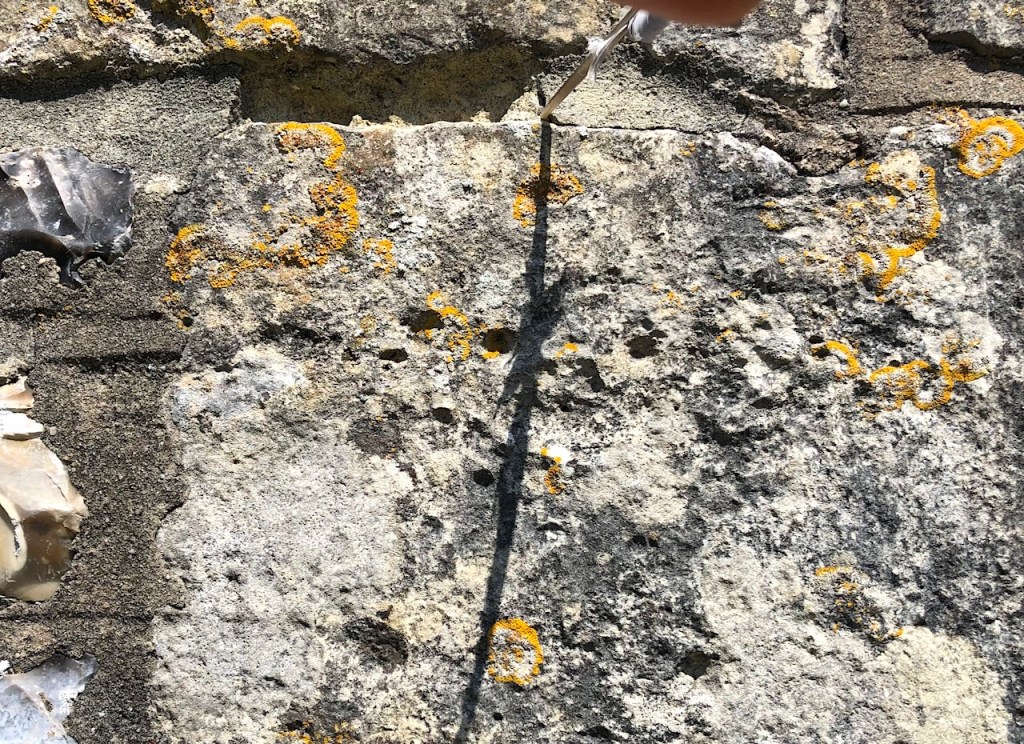
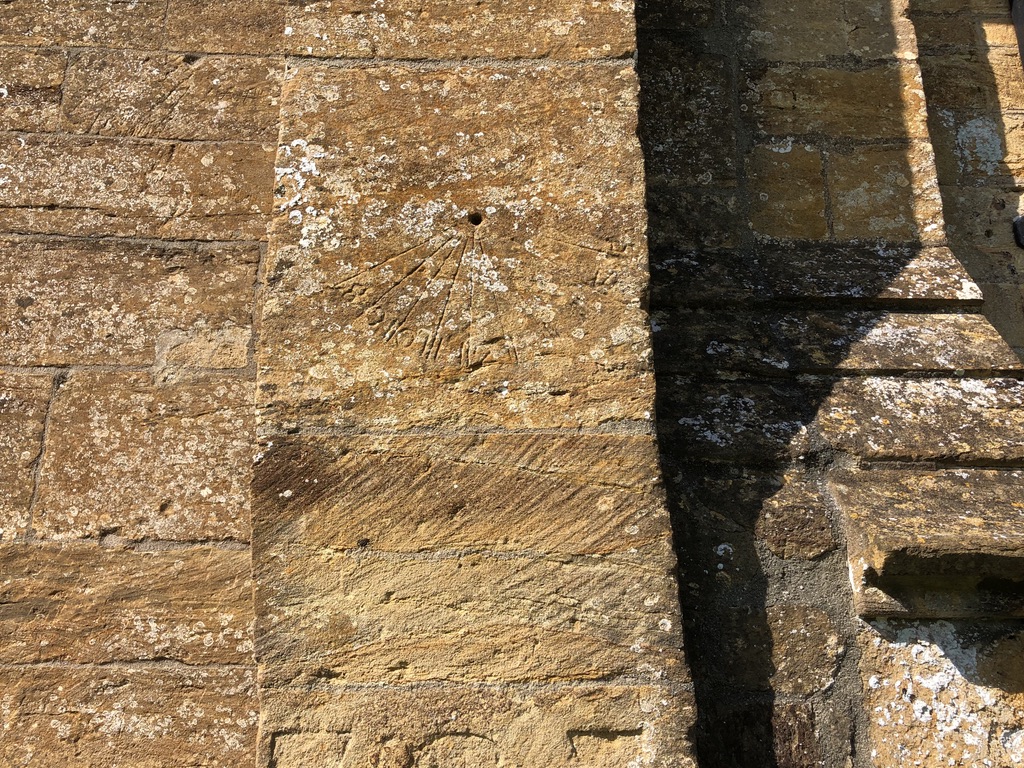
The dial is at eye-level on the quoin of the buttress between the porch and the Chancel door. It is not recorded, and I can see why (a) it may have been overlooked and or (b) why, if noticed, it may have discounted as a definite dial. So I’ll argue the case.

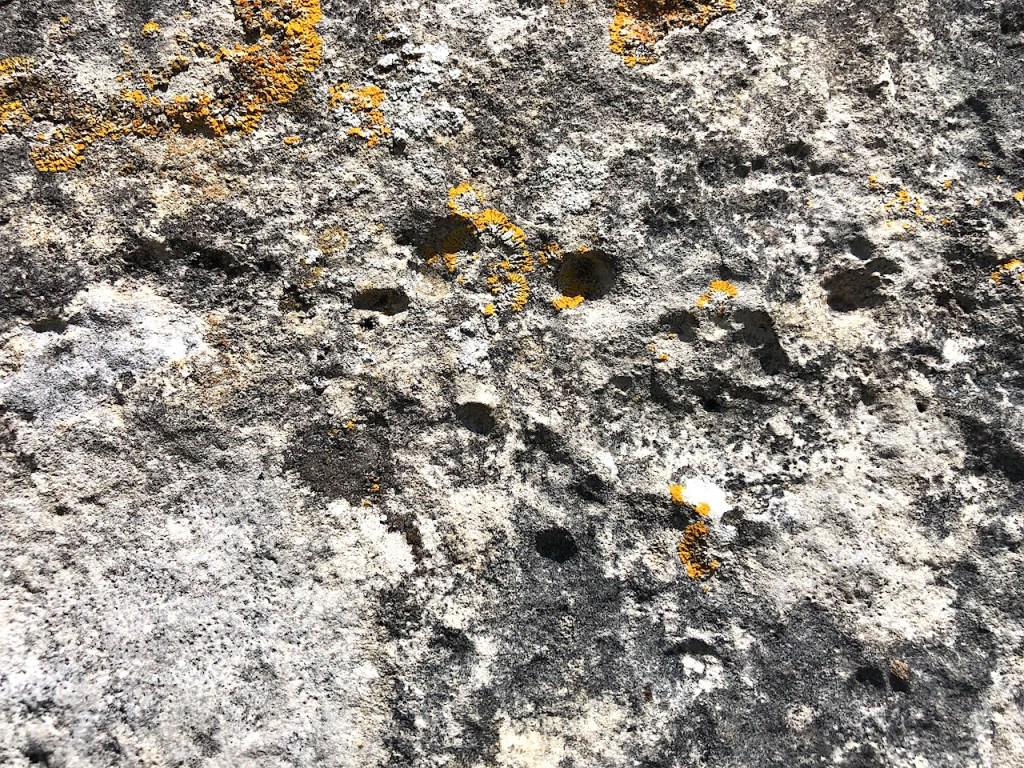
This is a pock dial with no radials. There are 3 large pocks on a slight curve, and a couple of small ones slightly out of line. There are other pocks lower down, two of which (presuming a gnomon in the mortar immediately above) seem to relate to the large pocks – one might even be a noon indicator.

Using a crow’s feather as a style centred in the mortar above the large pocks, the shadow cast was photographed at about 11.30

St Mary . Maiden Newton . Dorset . Scratch Dial 2? (unrecorded)

St Mary . Maiden Newton . Dorset . Scratch Dial 2? (unrecorded) . ‘Timed’ with a crow’s feather
St Mary . Maiden Newton . Dorset . Scratch Dial 2? (unrecorded) . Details of the pocks
St Mary . Maiden Newton . Dorset . Scratch Dial 2? (unrecorded) . Location c/w Dial 1 beside the Chancel door

NOTES † There is a fine sundial ‘on S. face of tower, square slab with simple capping, iron gnomon and date 1630BHO. See OLD DIAL menu LINK

GSS Category: Scratch Dial

All photos : Keith Salvesen

FEOCK . CORNWALL . CHURCH OF ST FEOCK . SCRATCH DIAL

Church of St Feock . Feock . Cornwall


CHURCH OF ST FEOCK. FEOCK . CORNWALL

GRADE ll*. C15 with earlier origins. Complete rebuild in C18 ‘incorporating C15 windows, arcade and doorways’ HE. Separate C13 bell tower (cf Gunwalloe), listed G ll. 5m S. of Truro. 50.2057 / -5.0502 / SW824384

Only 4 scratch dials are recorded for Cornwall, this being one (see also Manaccan). I assume the main reason is that the local building materials – granites, serpentine, and other hard rock – are unrewarding to work with when cutting a dial

DIAL

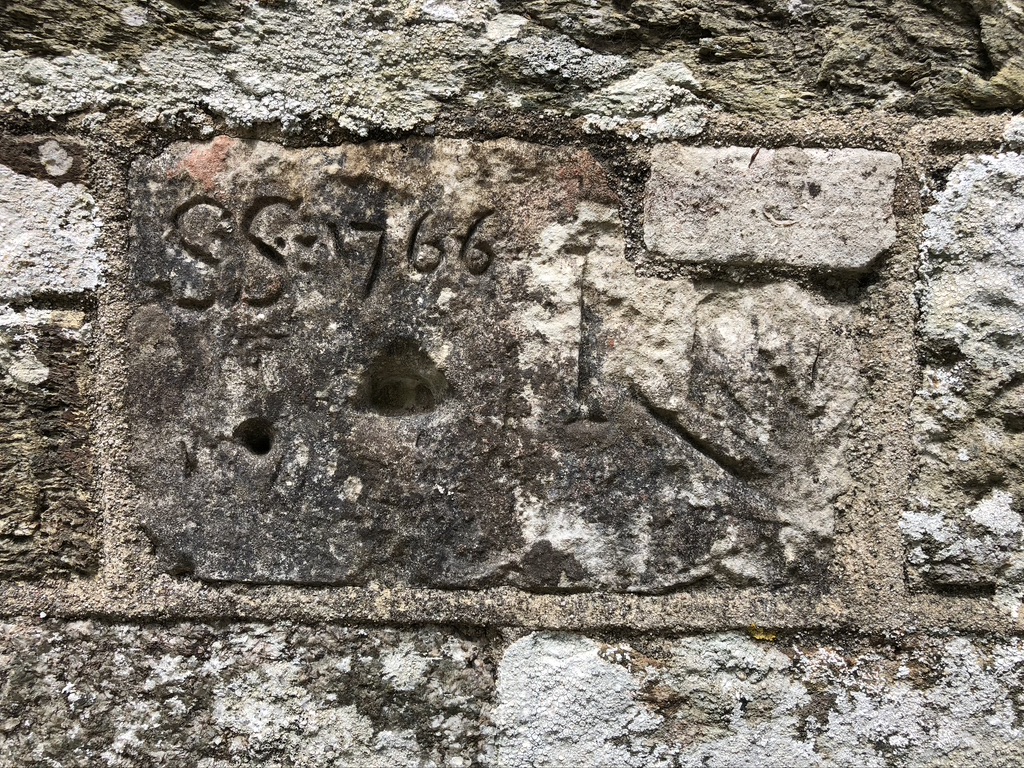
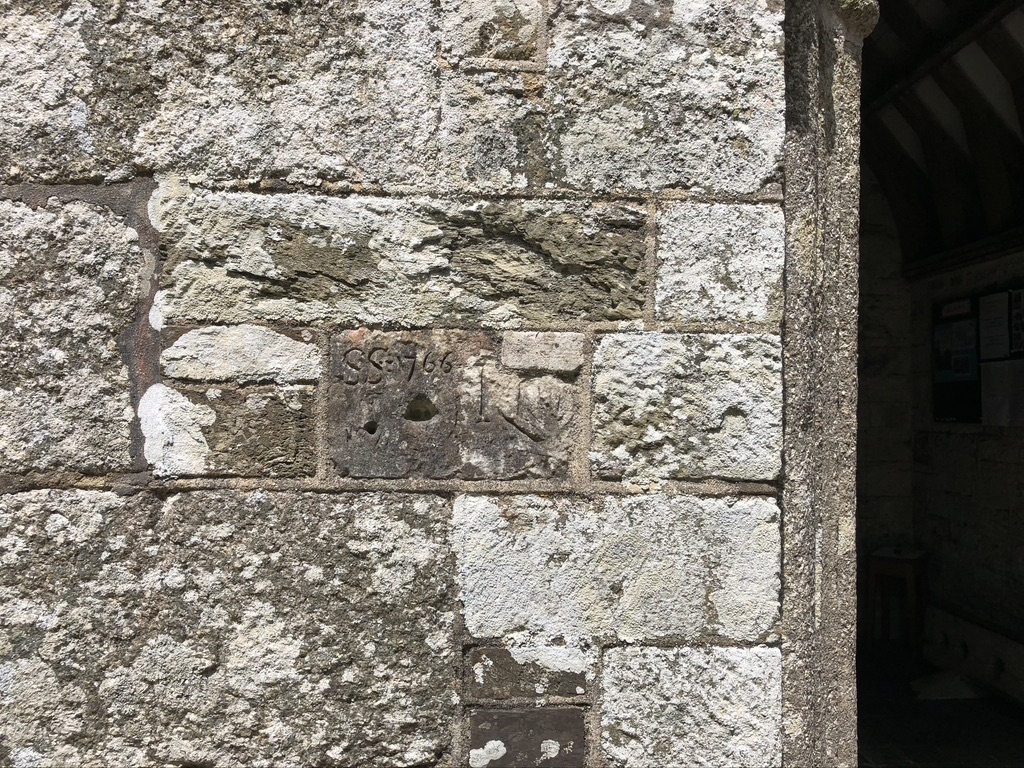
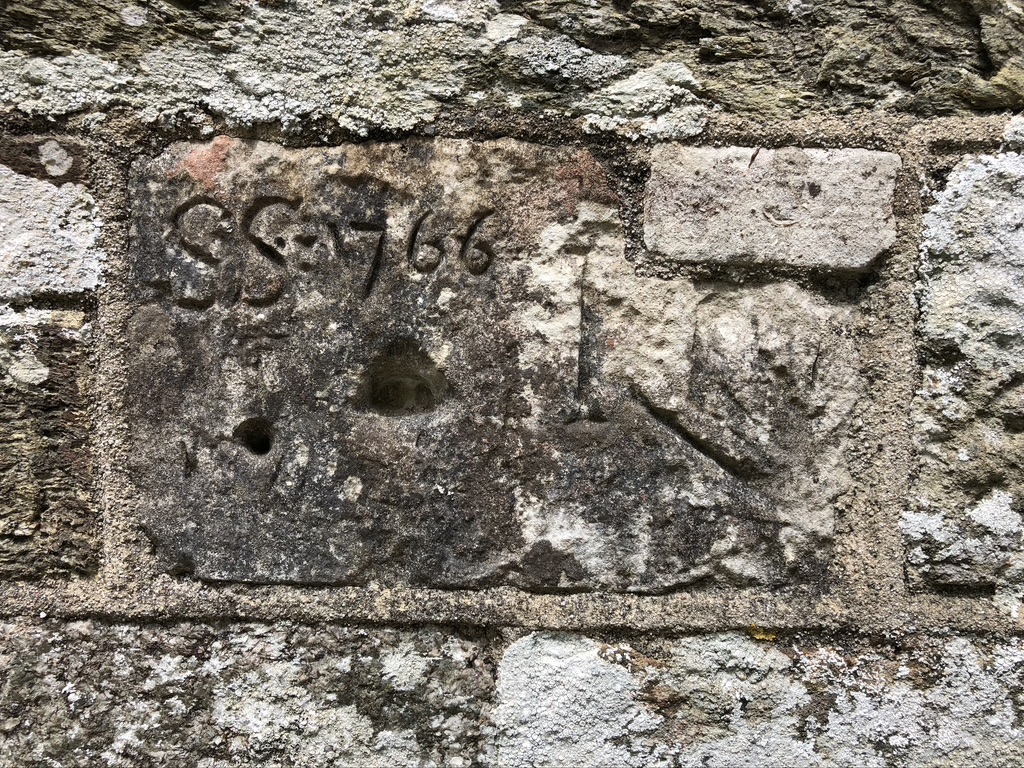
The dial is located prominently on the left side of the porch. Clearly the stone is different from and older than the surrounding stones (BSS dates the dial as C15), so it must have been rescued from the earlier building and reused in a typical dial position during the C18 reconstruction. The graffito SS 1766 makes a good case for being the date of relocation.

The recorded dial is under the date and has 3 or 4 adjacent indistinct short lines described (BSS) as ‘remote’. I take this to mean unlinked to the large style hole. To me they seem rather random and arguably not in the right place / at the right angle to be of much use. There’s the hint of an eroded circle. This basic dial’s main interest (apart from its extreme rarity in the county) arguably lies in the way it was incorporated and marked so appropriately during the rebuilding.

OTHER MARKS

A. I assume SS to be the initials of the stonemason who reset the dial – rather boastfully larger than the incised date. Given the date, it seems unlikely to reference ‘Saints’. B. As for the triangular indented ‘nostrils’ with the trace of a partial circle, I have no idea – possibly the site of a later fixing? C. The vertical line to the right is another puzzle, with its carefully cut decorative ends (one eroded). I’d like it to be a cross, but there’s no indication of a horizontal.

More interesting is the ‘pattern’ lower right. When I first looked at the stone, I presumed from the clearer lines radiating from a centre, the 3 or 4 apparent pocks, and the trace of a circle, that this was the recorded dial. The upwards direction of the lines suggested that the ‘dial’ had been upper left and that the stone was inverted when reused (as is often the case with dial stones), after which the initials and date were added.

Here’s how the stone might have looked. Perhaps there are actually 2 dials on it?

Church of St Feock . Feock . Cornwall – Scratch Dial
St Feock . Cornwall . Stocks

NOTE: see also the entry for MANACCAN for a second recorded Cornish dial; and St Martin for 1 or even 2 candidates as hitherto unrecorded dials.

GSS Category: Scratch Dial

All photos: Keith Salvesen

MANACCAN . CORNWALL . CHURCH OF ST MANACCUS . SCRATCH DIAL

St Manacca . Manaccan . Cornwall


CHURCH OF ST MANACCUS . MANACCAN . CORNWALL

GRADE 1. C12 and C15. Lizard Peninsula, S. of Helford River. Small village protected by a network of narrow roads from tourist hordes. 50.0832 / -5.127 / SW763250

Only 4 scratch dials are recorded for Cornwall, this being one. I assume the main reason is that the local building materials – granites, serpentine, and other hard rock – are unrewarding to work with when cutting a dial

DIAL

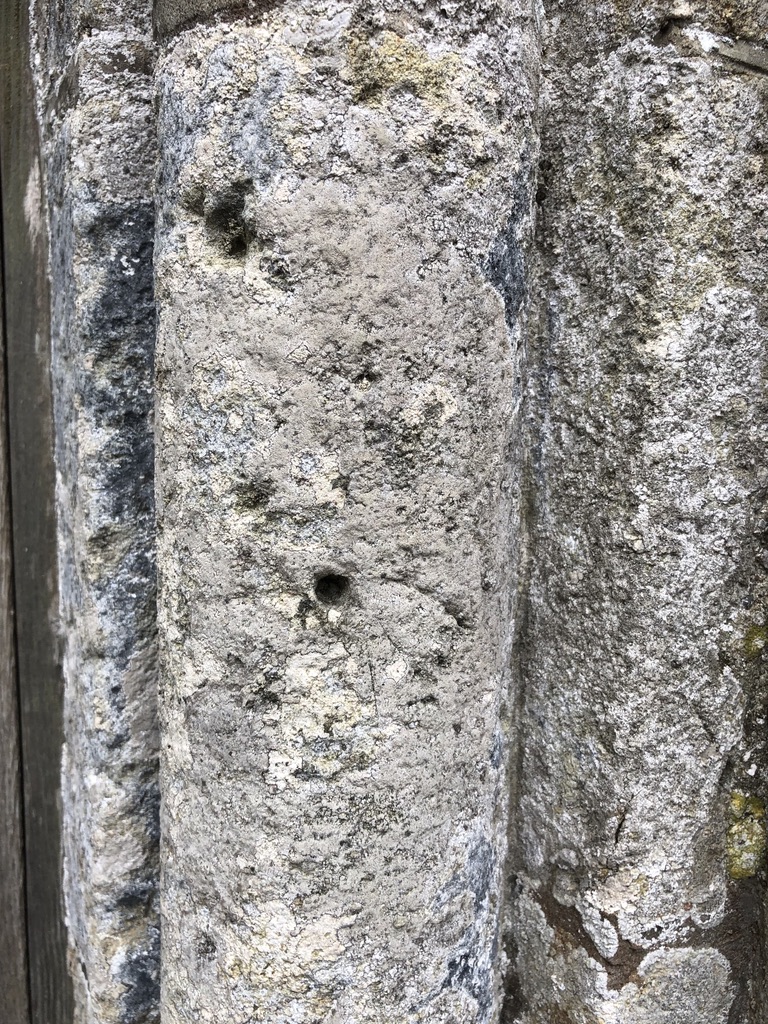
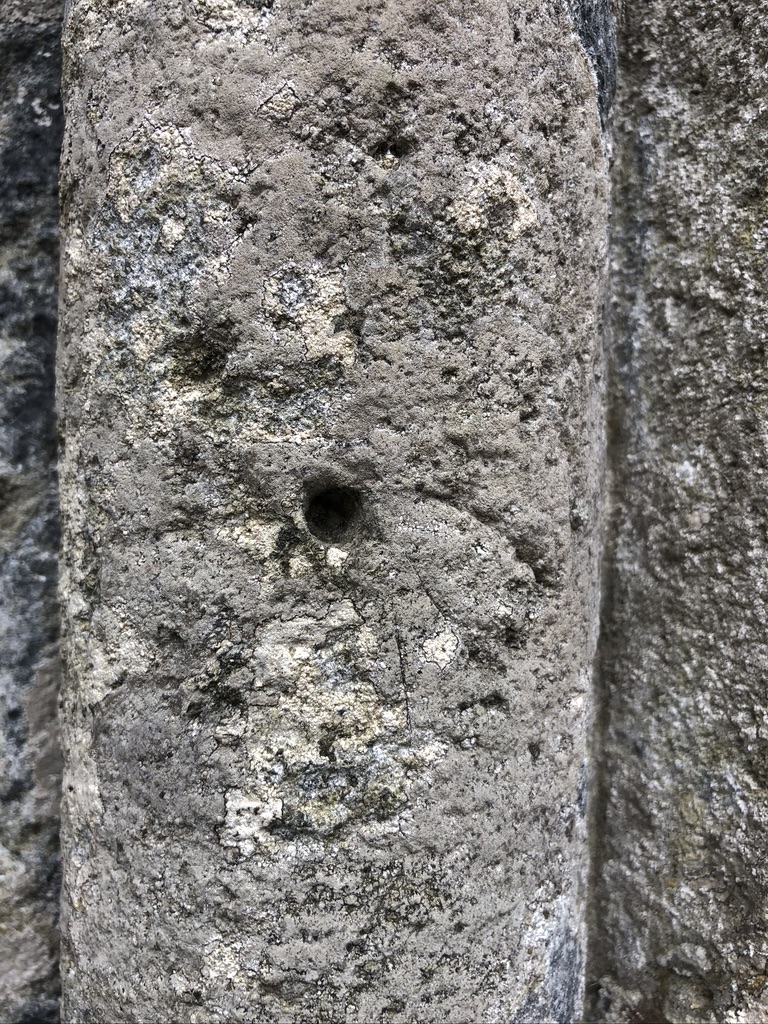
The small dial is cut to the right of the splendid Norman doorway, on a cylindrical pillar moulding. BSS suggests this may be a unique location. The lines curve away from the gnomon hole and there is the hint of a partial circle. The overall style is rustic and the condition is poor. It was noted in 2002 (L Burge) that there is a cross † ‘at Mass’ but on a dull day I could not make it out.

NOTE: see also the entry for FEOCK for a second recorded Cornish dial; and St Martin for 1 or even 2 candidates as hitherto unrecorded dials (link to be added).

GSS Category: Scratch Dial

All photos: Keith Salvesen
MANNINGFORD BRUCE . WILTS . ST PETER – DOUBLE SCRATCH DIAL

ST PETER . MANNINGFORD BRUCE . WILTS

GRADE 1 . On a Roman site. Late C11 or early C12 origin. Development C13 and C15, restoration 1882. Romanesque features. Between Amesbury and Marlborough, close to UPAVON. 51.3212 / -1.801 / SU139580

DIALS

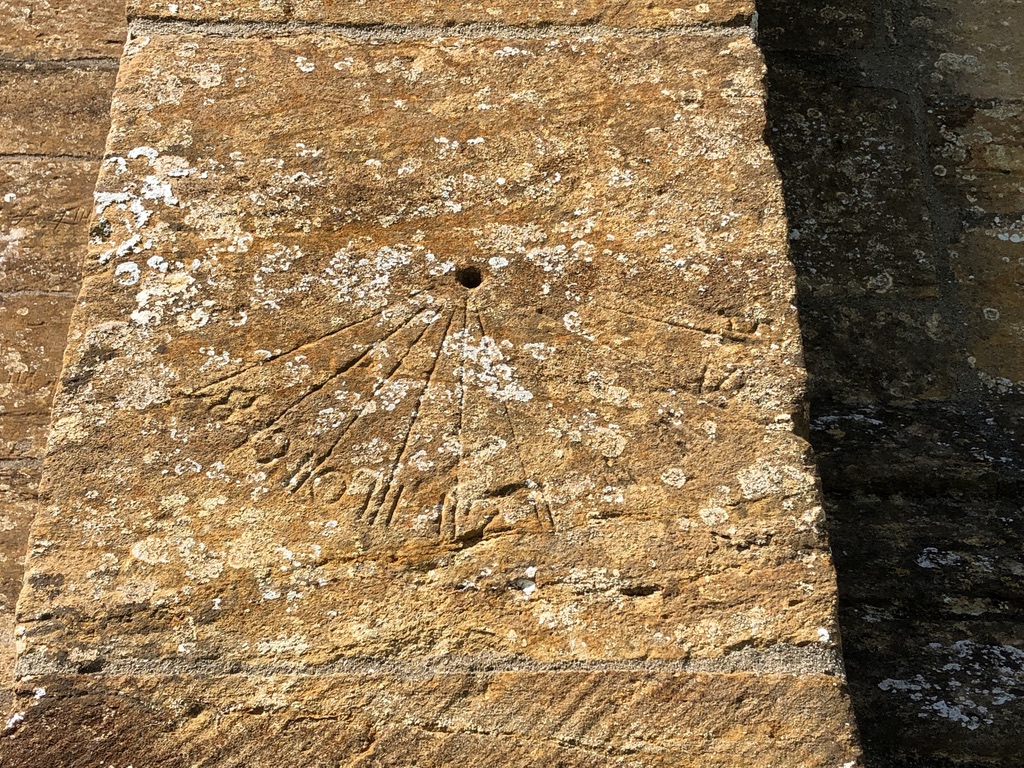
E. quoin stones of transept. Two adjacent and remarkably similar encircled dials with complete semicircles of radials. Both have additional pocks in LR quadrant. Both edge into the mortar at the top; and Dial 2 is cut short by the quoin edge RHS. Possibly this evidences relocation of one or both dials.

DIAL 1 (upper)

Complete semicircle of lines, 5 pocks. Equal 15º radials. BSS notes ‘eroded, damaged, irregular dial with 15º lines in both quadrants’.

DIAL 2 (lower)

Also complete semicircle of lines, 5 pocks, 15º radials. BSS notes as ‘worn’ and with shorter radials.

It is almost as if two people competed to make the most complete or accurate dial to the same design

St Peter . Manningford Bruce . Wilts – Scratch Dials

NOTES

Dial 3? Near the bottom of the image above there are 3 radials spreading downwards from the mortar line. The farthest left is vertical, and (if a dial) is the noon line. The lines were clearly deliberately cut, and it is quite possible that there is a filled style hole above them, though it is hard to tell from the image.

St Peter . Manningford Bruce . Wilts – possible 3rd scratch dial

Graffiti: Initials, dates on quoin stones

GSS Category – Scratch Dial

Dial photographs: Jenny John, to whom many thanks. I recently failed to visit St Peter, having driven through the village en route from Upavon to Marlborough. Next time, I clearly need to check it…

Photographs of the Church: Wilts Council / History Centre; ‘Vale of Pewsey Churches’

PULHAM . DORSET . ST THOMAS À BECKET – SCRATCH DIAL

St Thomas à Becket . Pulham . Dorset

PULHAM . DORSET † ST THOMAS À BECKET

GRADE II*. Fragments indicate C12 origin, otherwise mainly C15 with later additions and rebuilding. The dial survived the C19 work. C16 gargoyles of note. Situated some way down a long lane on the NE. edge of the village, next to the sizeable rectory. 9m SE. of Sherborne. 50.8754 / -2.4111 / ST71108

St Thomas à Becket . Pulham . Dorset – Scratch Dial

DIAL

The dial is set low down on the E. side of the S. porch. Dated by GLP as early C16. Faint, rather randomly cut, and much eroded. 6 definite lines, as GLP recorded. As dials go, it is somewhat underwhelming. In fact I had missed it on an earlier visit, so I am glad I returned to check again.

GSS Category: Scratch Dial

All photos: Keith Salvesen

MAIDEN NEWTON . DORSET . ST MARY . SCRATCH DIAL

St Mary . Maiden Newton . Dorset

DEDICATION † St Mary. Mid C12 / earlier foundation; main development C15; C19 restoration

LISTING † Grade I

LOCATION † 8 miles NE. of Dorchester, 12 miles SE. of Yeovil, in the valley below the A37 racetrack. Hardy’s ‘Chalknewton’. More of a small town than a village, with a few shops, a garage and a station rather than (as elsewhere locally) a single shop and a halt. 50.7775 2.5727 SY597977

St Mary . Maiden Newton . Dorset . Scratch Dial on Chancel doorway

DIAL † On arch stone, E. side of chancel door. GLP dates as early C15, with a ‘rough arc of 5 holes across 2 stones’. I was at a loss to see how this dial could have worked with such a shallow arc and without a style hole. However GLP points out that the arc’s approximate centre lies in a joint between 2 stones, so subsequent repointing presumably covered up the hole

NOTES † There is a fine sundial on S. face of tower, square slab with simple capping, iron gnomon and date 1630 BHO. See OLD DIAL menu LINK

GSS Category: Scratch Dial

All photos : Keith Salvesen

ALSTONE Glos. – ST MARGARET . SCRATCH DIAL

DEDICATION † ST MARGARET OF ANTIOCH – C12 origin, further building C13, later additions & restoration. The squat timber-framed bell-turret HE is C19.

LISTING † GRADE II*

LOCATION † Off the beaten track 5 miles NW. of Winchcombe, 7 miles E. of Tewksbury. One of several ‘dial’ hamlets or villages in the Parish of Overbury BHO LINK, reached by a network of rural lanes. The first sight of St Margaret and its bell-turret was an interesting surprise. 51.9906 / -2.0267 / SO982324

DIAL † W. jamb of the porch door, an encircled and seemingly random collection of pocks of different sizes and depths, some extending outside the circle including what must be the noon-line but marked several degrees to the left. An apparent style hole, mortared, is on roughly the right horizontal line, but way out of the natural vertical line. Very mysterious and impossible for an amateur to interpret. My tentative afterthought is that these anomalies were a way of adapting the dial and the shadow cast to adjust for the orientation of the church.

NOTES † At the time I visited, I was looking only for one dial based on the Glos. list compiled by TW, and this was obviously it. I didn’t anyway have time to investigate further. However, since then I have seen a clue that suggests another, possibly more complex dial. So I need to return one day to find it.

GSS Category: Scratch Dial

All photos: Keith Salvesen
CHESELBOURNE . DORSET . ST MARTIN – Scratch Dial, Old Dial (1631)

St Martin . Cheselbourne . Dorset

DEDICATION † ST MARTIN . Late C13 / early C14; tower C15. S. porch (dial location) C1500 HE, BLB

LISTING † GRADE I

A WONDERFUL CANONICAL DIAL IN DEEPEST DORSET

St Martin . Cheselbourne . Dorset . Scratch Dial

LOCATION † Seven miles NE. of Dorchester. Hidden in a dip in the remote folds of Dorset’s undulating downs, Cheselbourne (Ceseburne DB) is accessible only by narrow lanes. It is well worthwhile if you can understand the signposts well enough to reach the village. 50.7954 / -2.3388 / SY762995

St Martin . Cheselbourne . Dorset . Scratch Dial

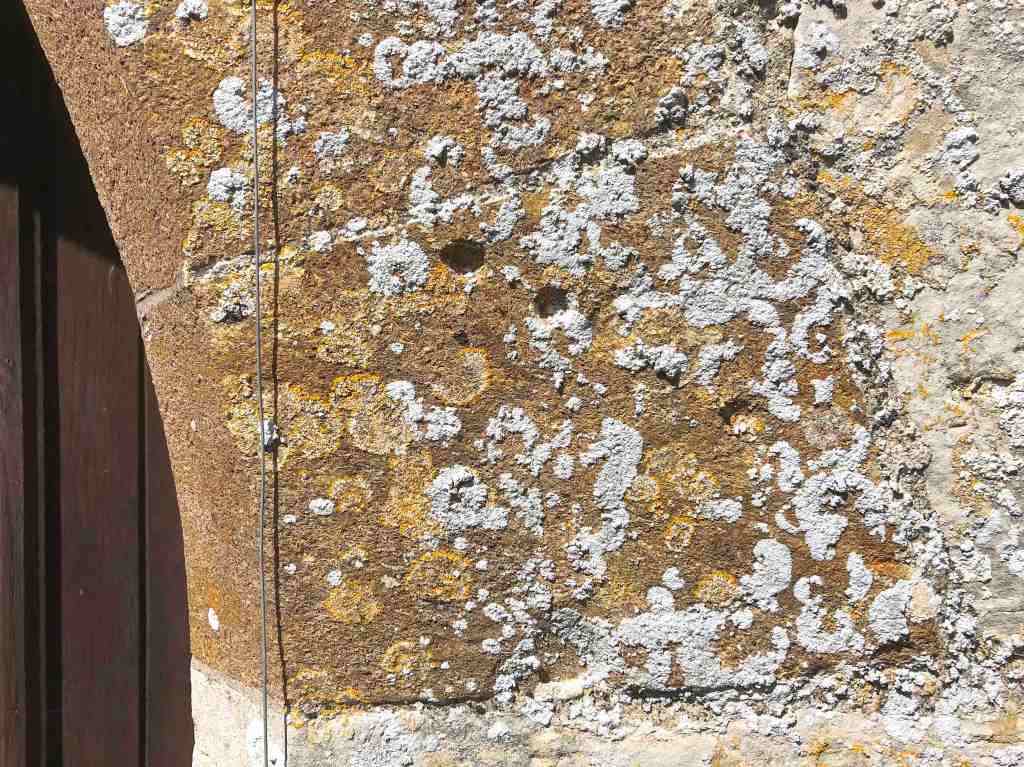
DIAL † A remarkable dial, ‘the most carefully cut and complete specimen of a medieval dial in Dorset’ EEC.

On S. wall, scratch dial.’ BLB – a scant note and considerable understatement. The 1631 sundial on the porch (see below) is better served

GLP dates this complex dial as late C15 / early C16, with 25 lines & 26 holes. ‘Each line ends in a hole, the vertical line being marked by 2 holes. The lines alternate in length, a long line running to the gnomon hole with a short line fitting in the angle between 2 of the long lines. The long lines accurately measure the hours; the short lines the half hours’.

Chancellor (ECC) noted crosses halfway along 2 lines, shown in his drawing of 1939. GLP could not trace these in 1996.

St Martin . Cheselbourne . Dial Drawing . Chancellor
St Martin . Cheselbourne . Dorset . Scratch Dial – S. Porch and obligatory drainpipe

NOTES † Above south porch arch, rectangular stone slab with Roman numerals, inscribed HC 1631 WM, with wrought iron gnomon (HE, BHO) LINK ; also a fine C15 churchyard cross with limestone 3-step plinth and Ham stone treads RCHM

The dial is flush with the wall above the South porch. There is a flat strip gnomon with ‘S’ supporter. The gnomon angle is 56 degrees to wall. Face very weathered. Shows 6am to 6pm in half hours. Noon numeral or mark worn away as are many hour lines, IIII for 4pm. Few half hour marks visible. Inscription: “HC 1631 WM” (initials of the Church Wardens)

GSS Category: Scratch Dial

All photos – Keith Salvesen