LOCATION † 3m SW of Yeovil, near E & W Coker 50.9048 / -2.6949 / ST512119
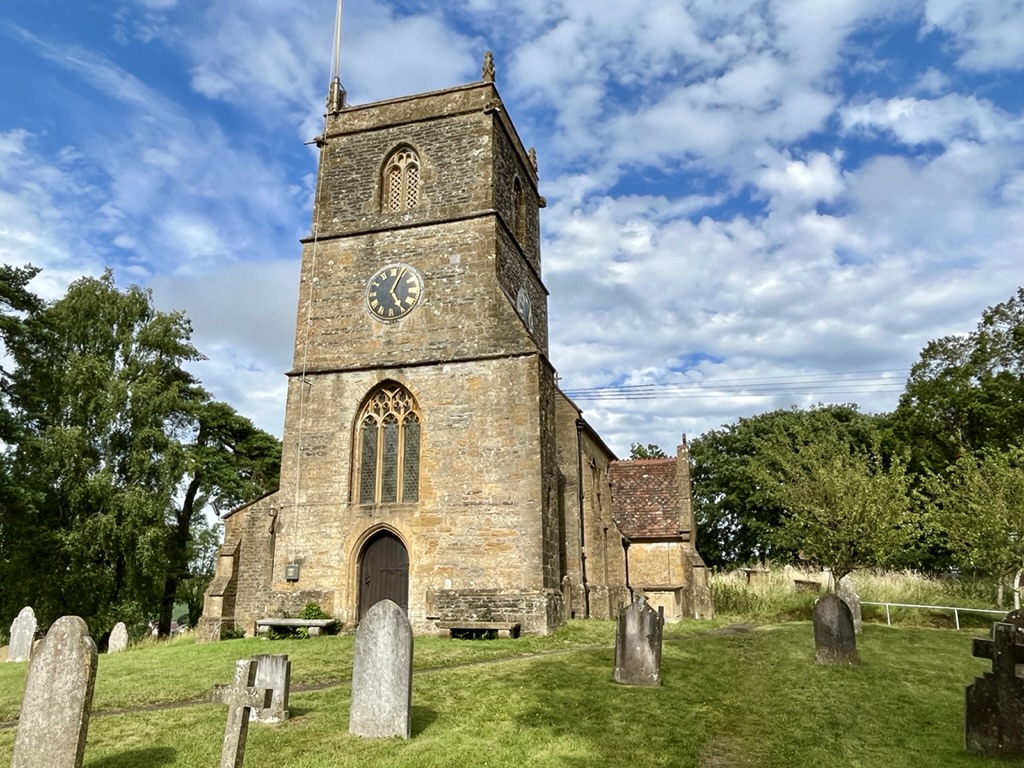
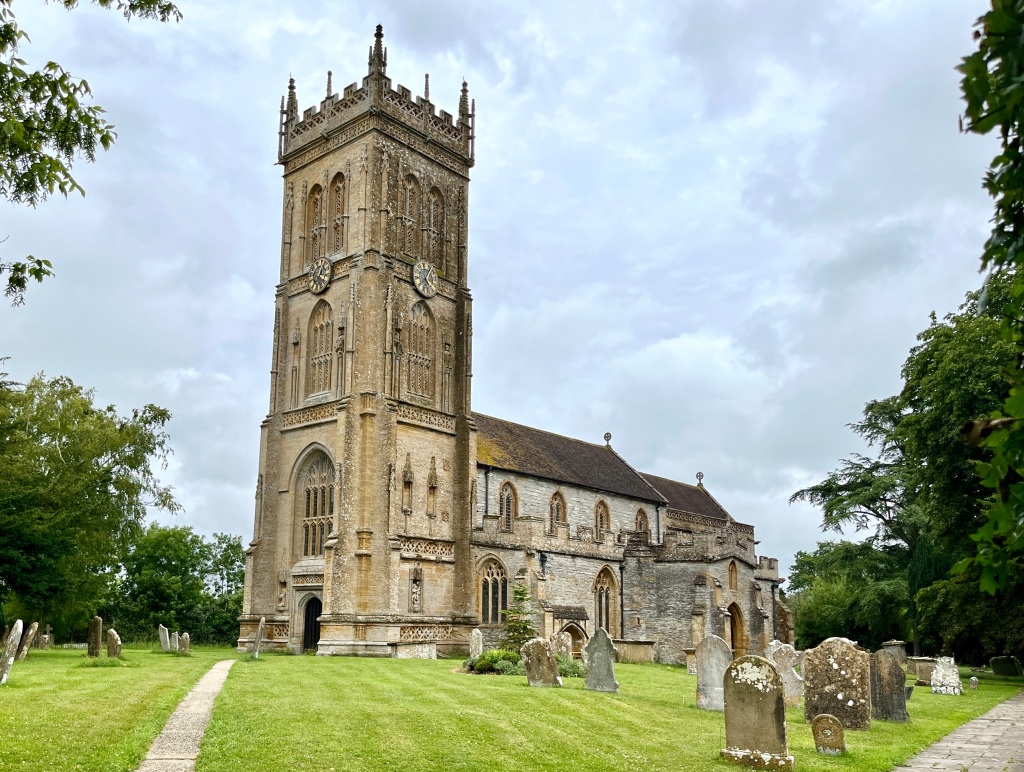
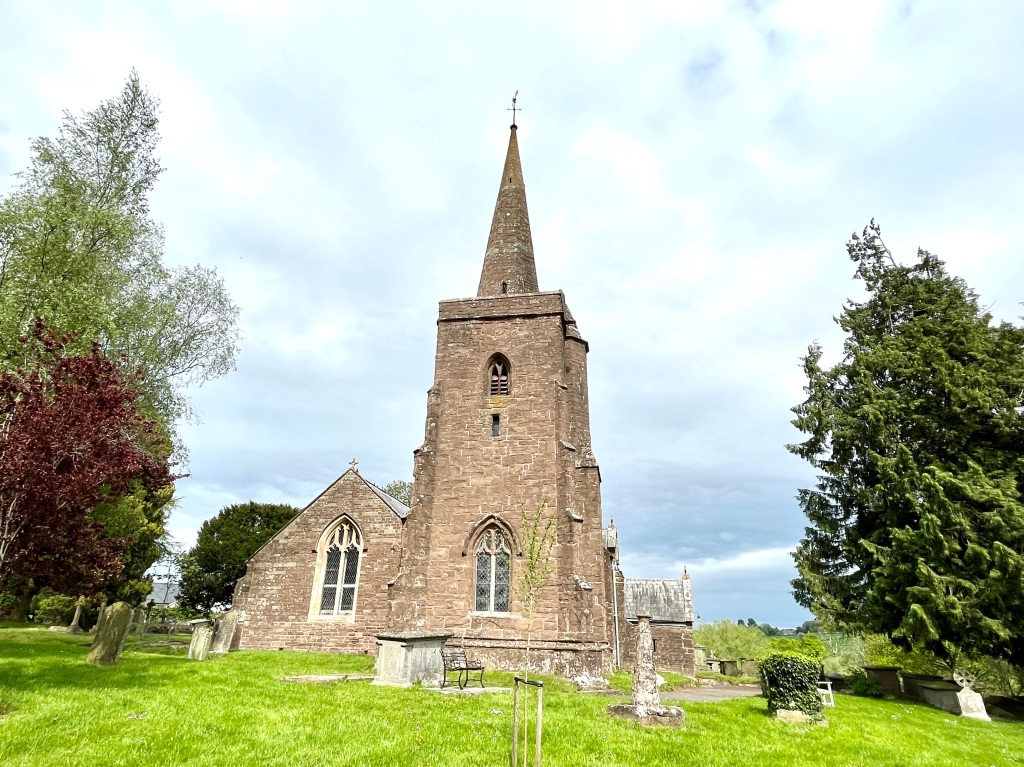
An extended village close to the A30 yet approached by lanes (as they are actually named) rather than roads. A peaceful feel to it, especially at dusk when this poor photo was taken. The church had ‘much work’ carried out in C15 and C18. Tower probably of 1123, in three stages, font possibly from same date. BLB.
I visited St Mary a couple of years ago at dusk (it was last on a list), so I have re-photographed the church and updated the post.
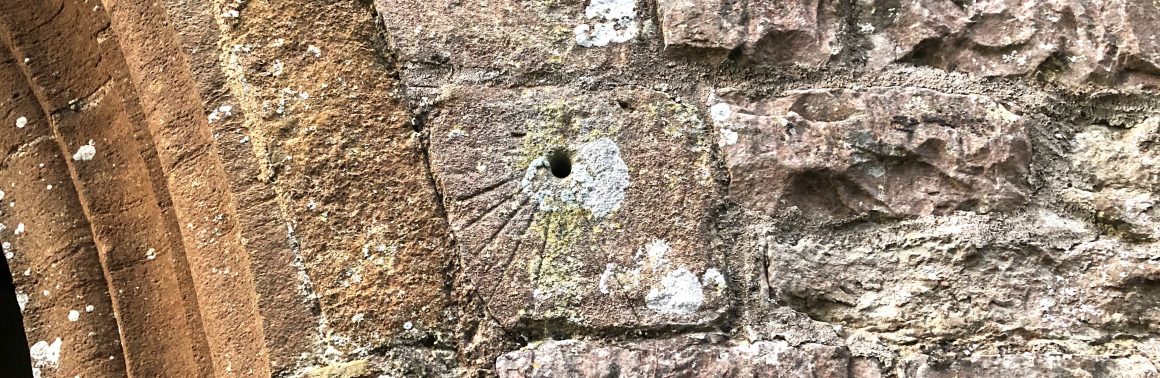
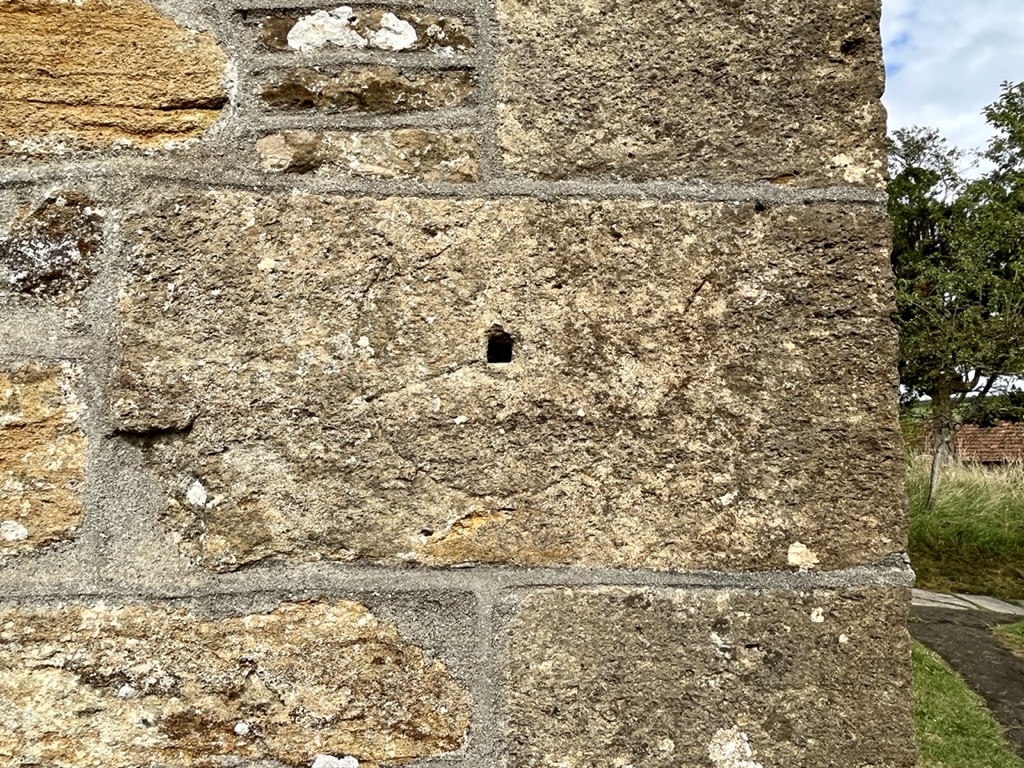
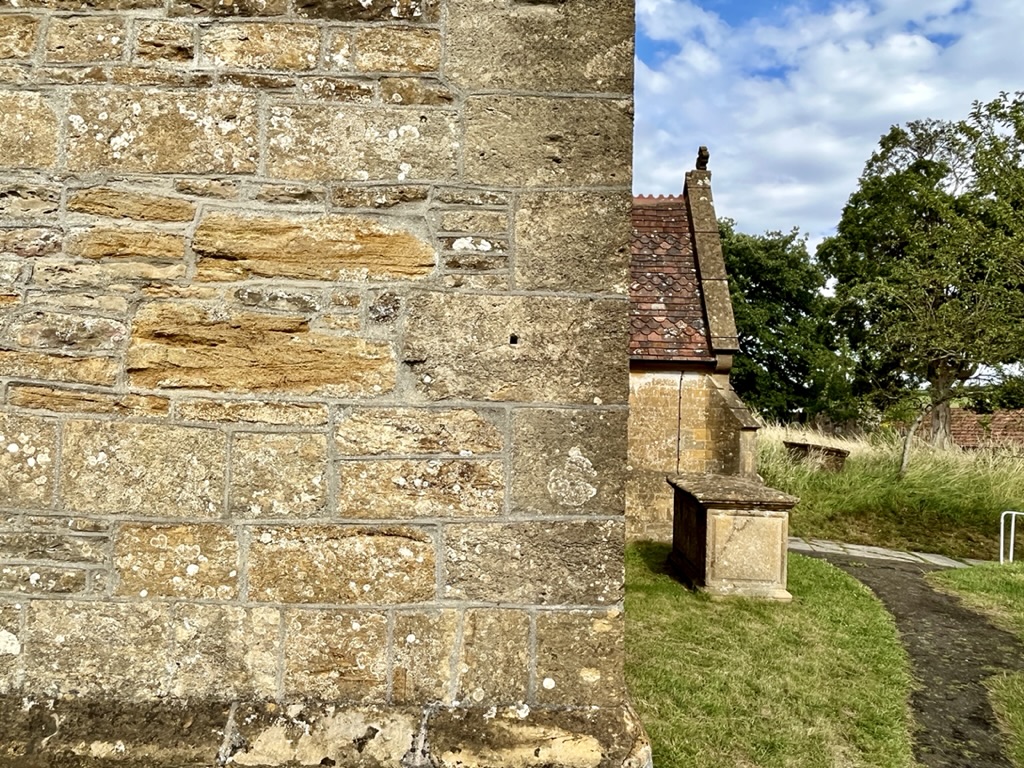
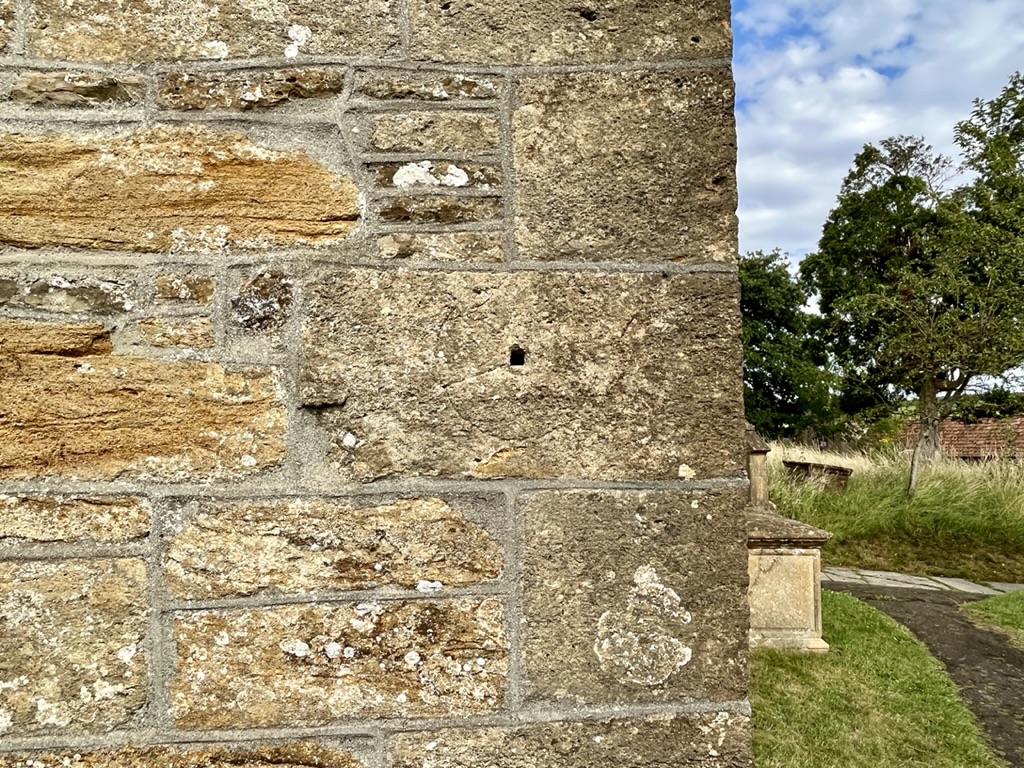
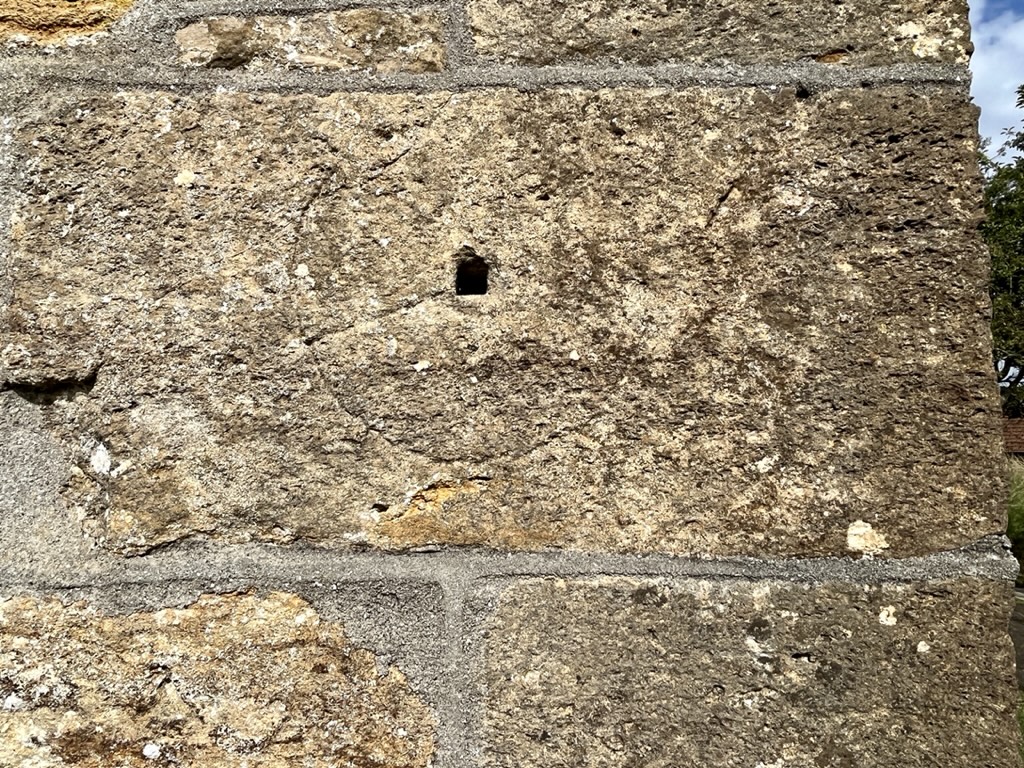
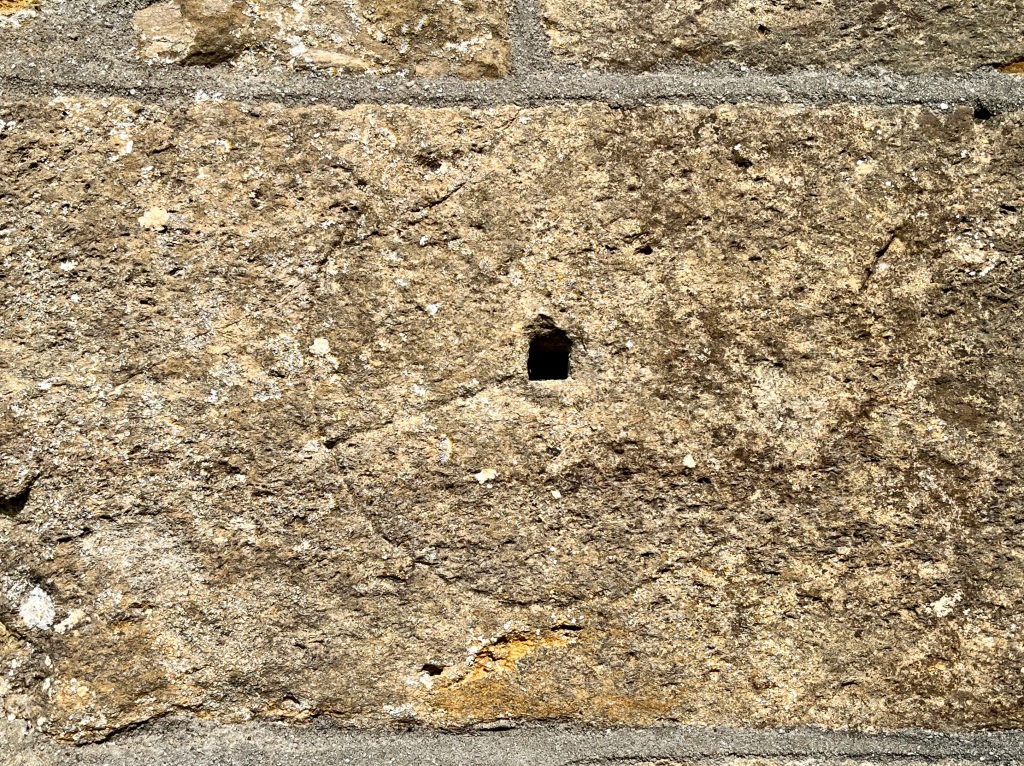
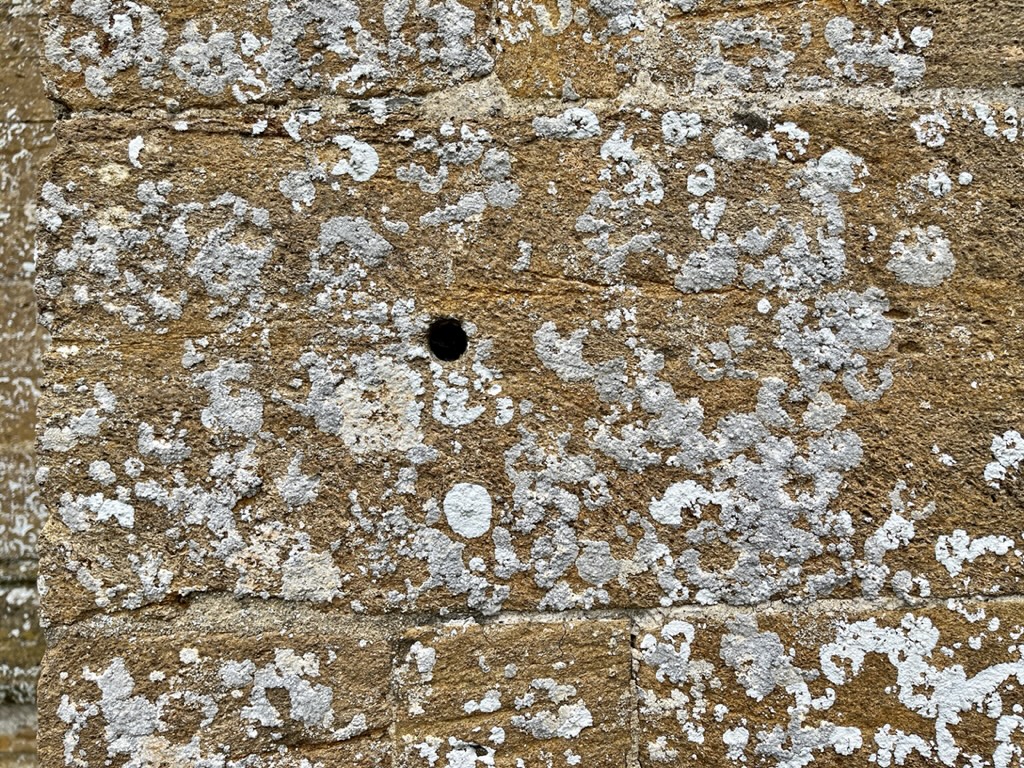
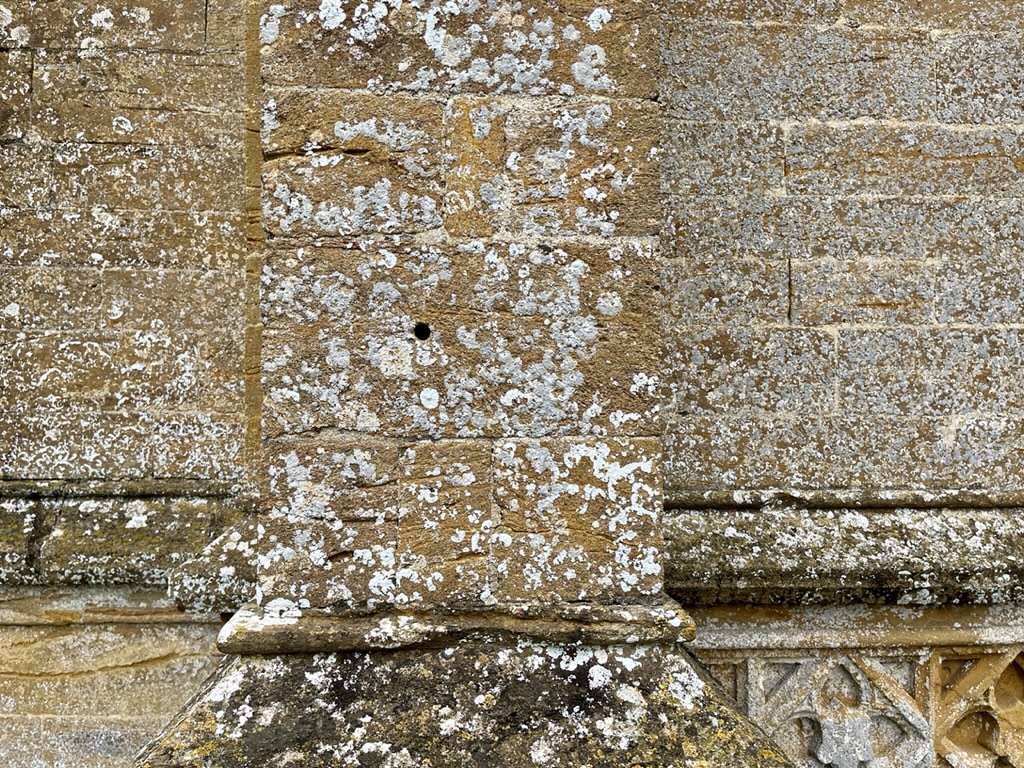
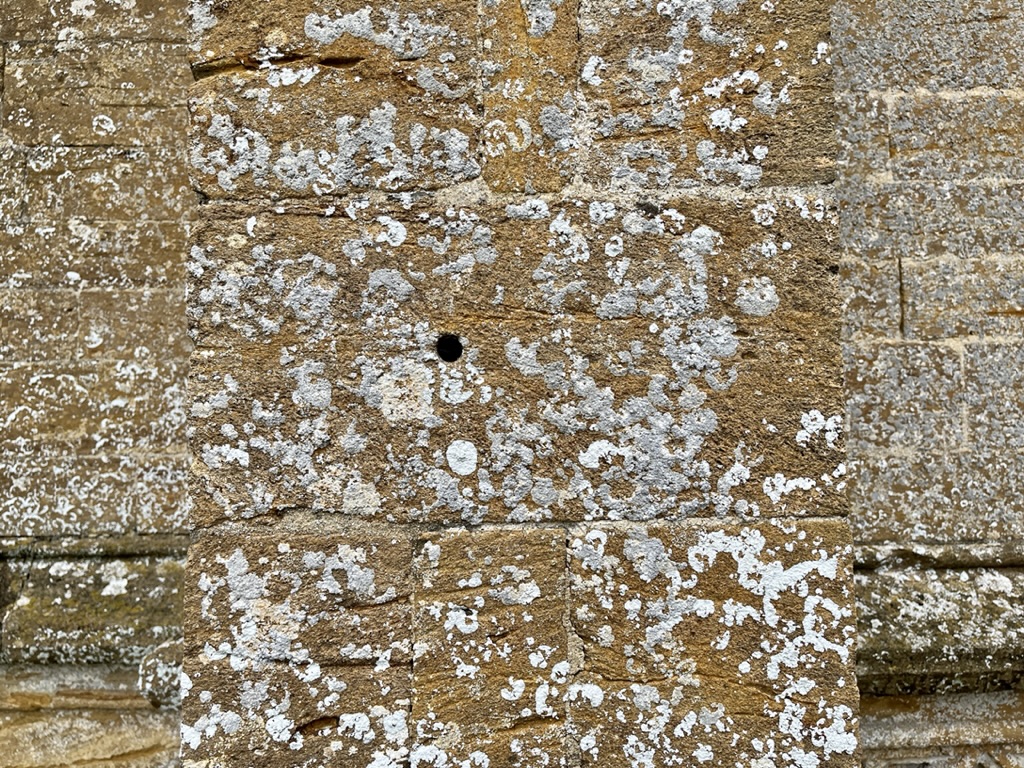
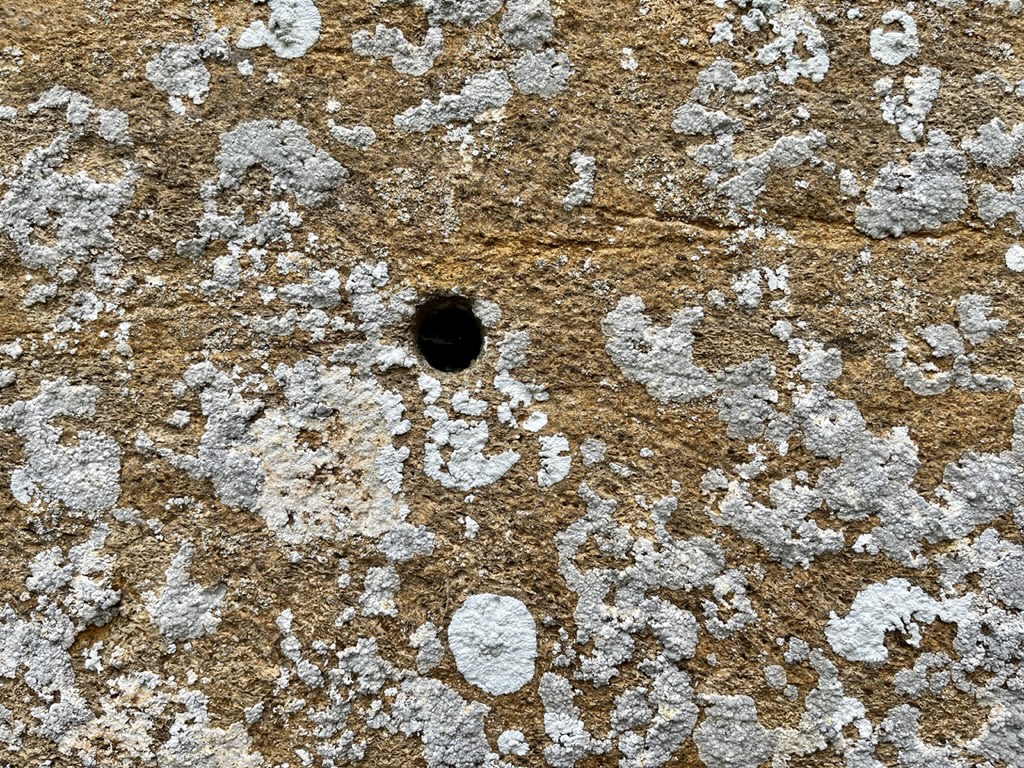
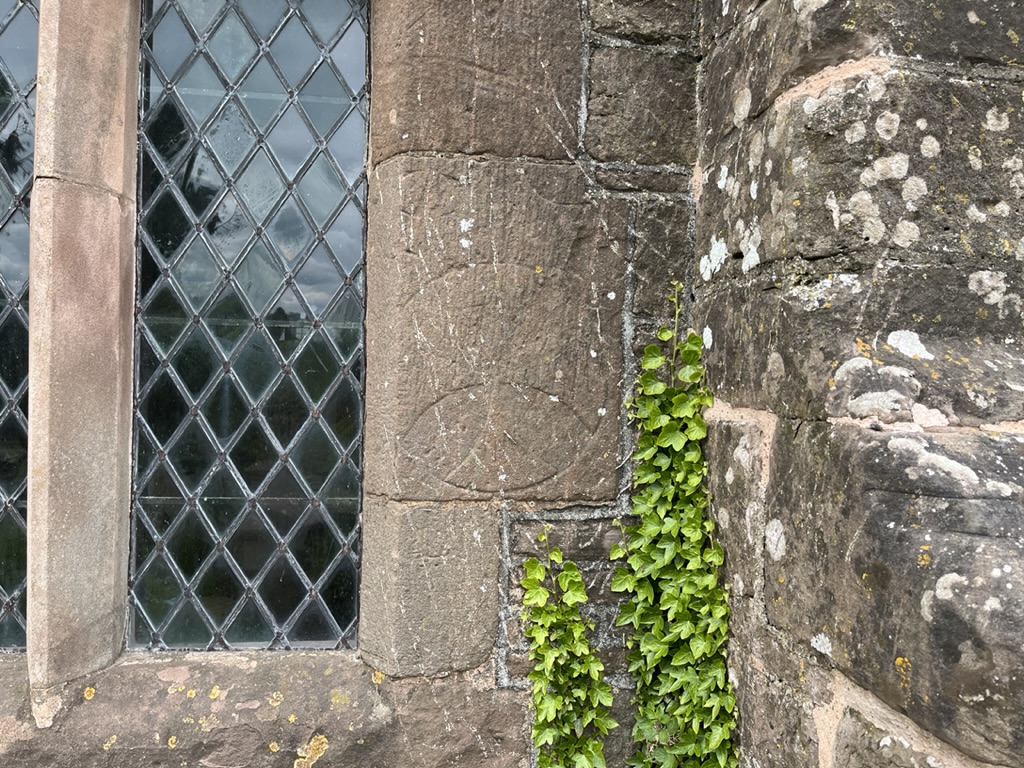
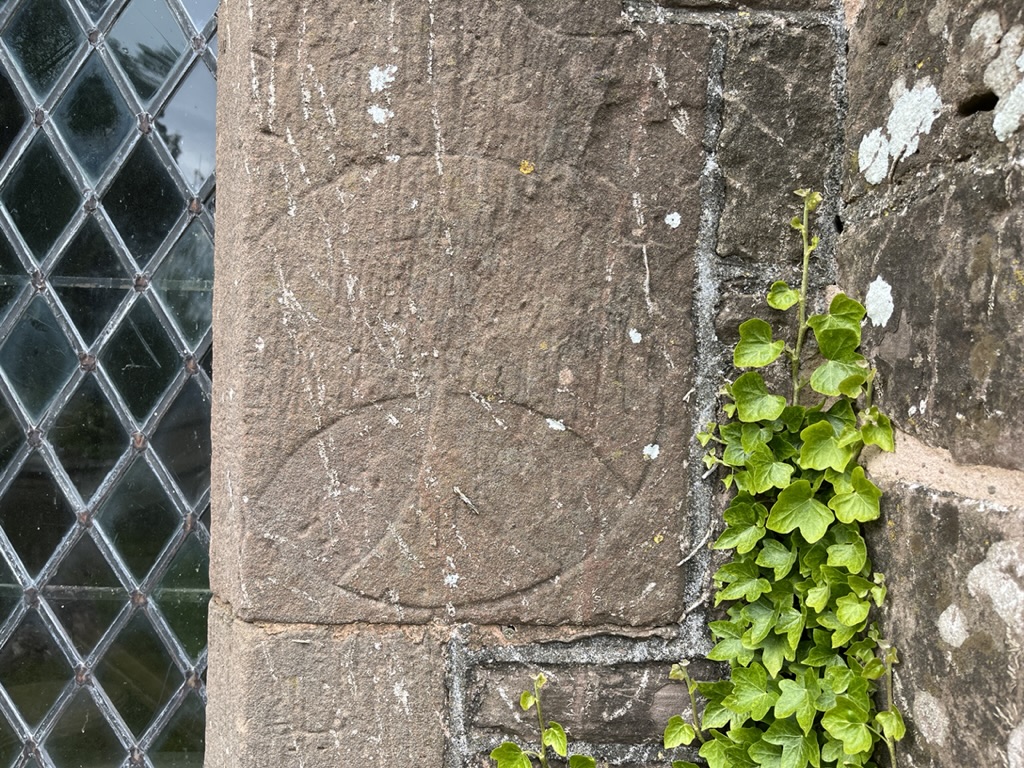
DIAL † At the W. end and quite easily overlooked. DEH did not investigate or list it in 1915. A full circle, one clear radial and a square style hole. Possible trace of outer circle top left. Not noted in BLB, HE, nor in TWC extensive list of Somerset dials. I found only one reference to this dial that led me here; since then, one passing reference to a sundial in the porch – perhaps this dial relocated in C15?
NOTES The circular font is thought to be original dating from 1123, and the clock mechanism was built and installed before 1707. There are 6 bells in the tower, 3 of which are from the Purdue (Closworth) foundry, with the earliest being dated 1591
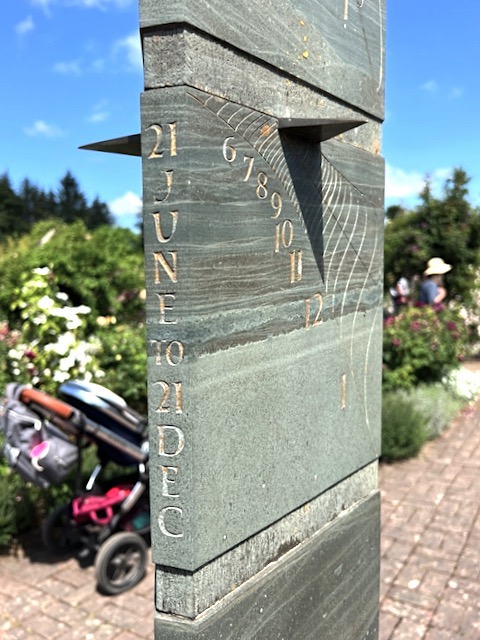
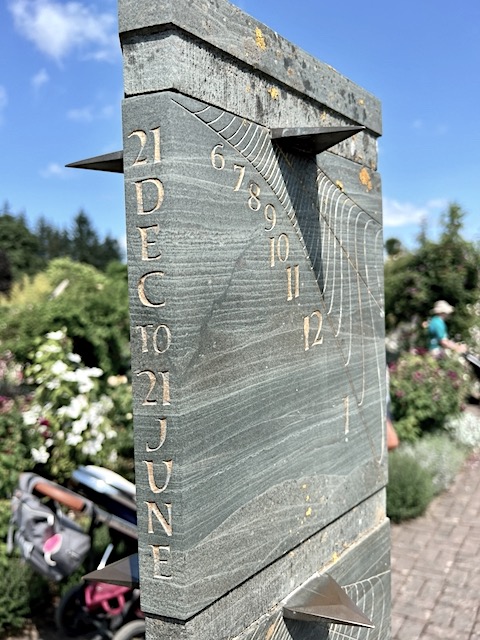
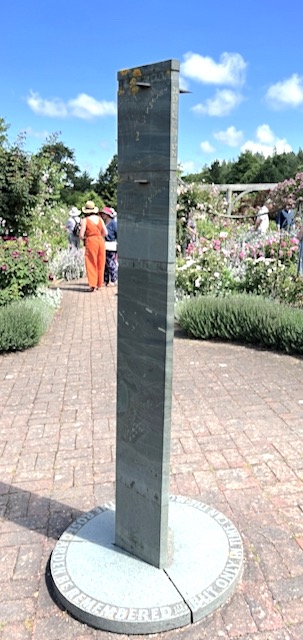
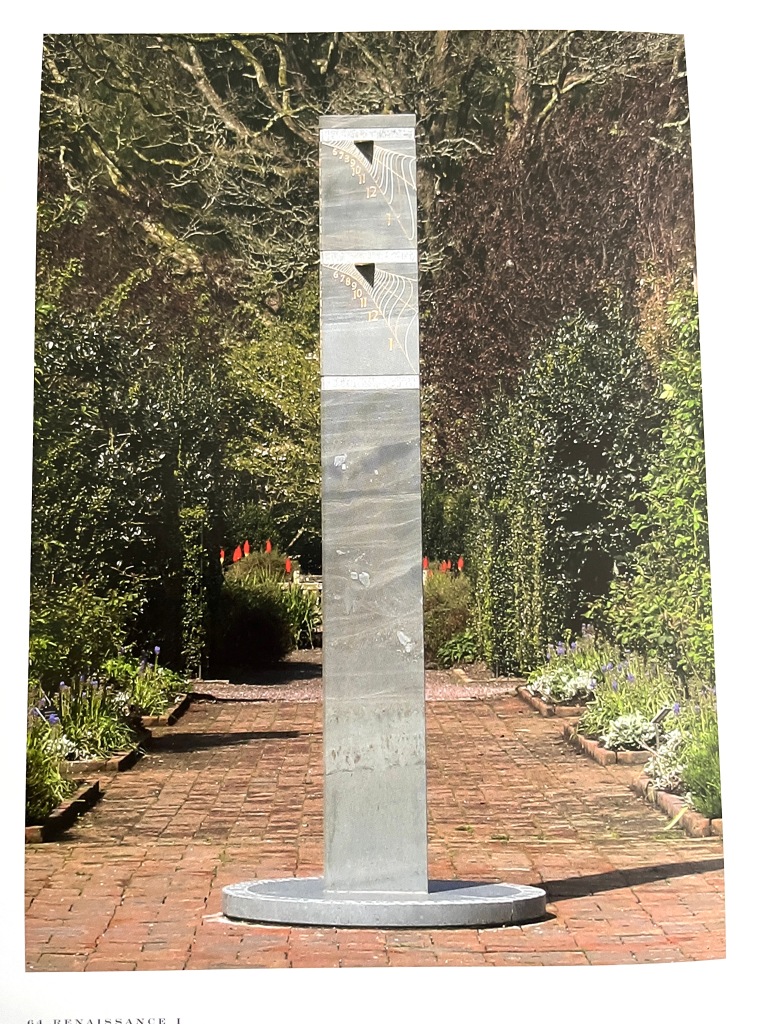
Renowned RHS gardens near Torrington, Devon. It’s a wonderful place. You can find out all about it HERE. For present purposes, the focus is on the very fine sundial installed in the gardens in 2004. This is a project of the BRITISH SUNDIAL SOCIETY and the description below is from the BSS record:
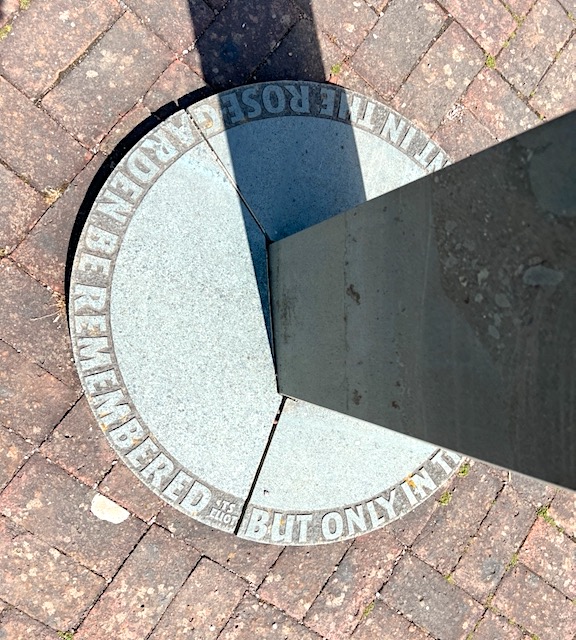
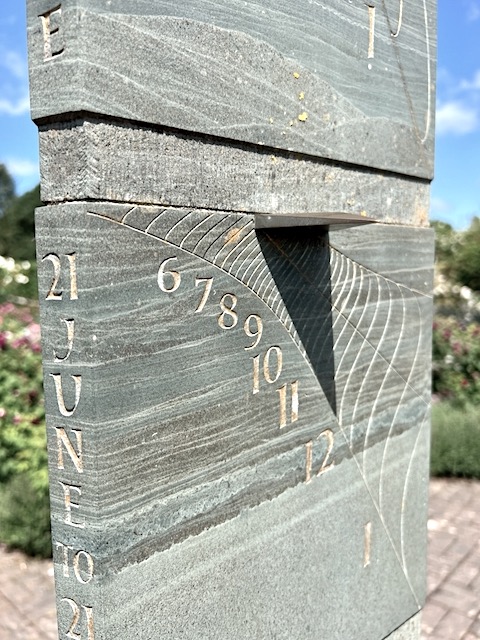
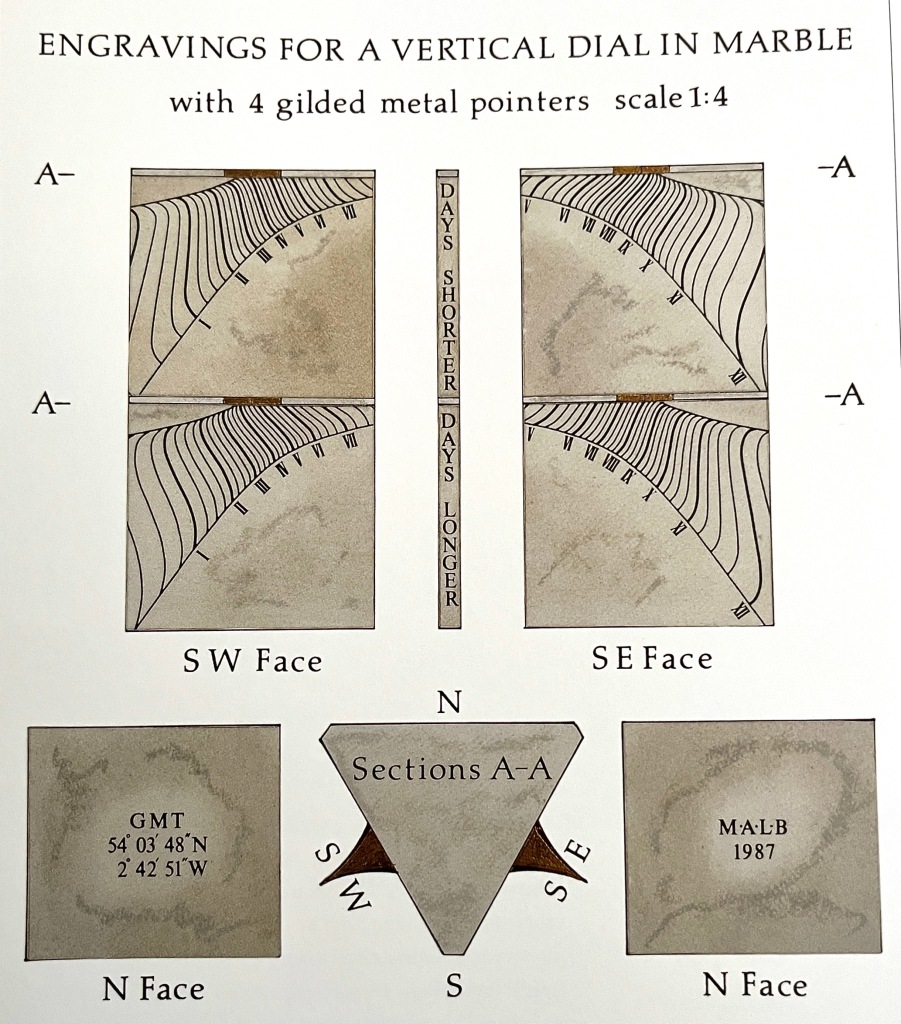
This is an unusual dial in the form of a triangular section pillar made of Delabole slate and 1820mm high. It was designed by Sir Mark Lennox-Boyd and made by Ben Jones. It carries a motto on the 610mm diameter slate base ‘But only in time can the moment in the rose-garden be remembered’ (T.S.Eliot, modified from a passage in Burnt Norton, the first of the Four Quartets).
On two of the faces are pairs of declining dials one above the other. The upper ones are drawn for December to June and the lower ones for June to December. The hour lines are corrected for the Equation of Time.There are three declination lines on each dial. Arabic numerals are used and the dials show BST. The easterly dial shows 5:30am to 1:30pm in half and quarter hours while the westerly dial shows 12:30pm to 9:30pm similarly divided. The north dial has dedications to V M Dickinson, M J C Wright, H Addy and R Addy.
DIAL IMAGES 1
All Photos: John Renner
DIAL IMAGES 2
Images taken from the designer’s magisterial book Sundials: History, Art, People, Science. The design below seems an excellent example of art meeting science.
GSS Category: Pillar Dial; Modern Sundial; Pillar Sundial
Credits: Photos by John Renner; material from the book by Mark Lennox-Boyd; British Sundial Society
GRADE 1 † C14, C15 with C19 restorations. Predominantly Perp. A large and impressive building in a small community, admired by PEV: ‘of great interest’. A companion to nearby Huish Episcopi. 9m NW of Yeovil. 50.9865 / -2.8042 / ST436210
NOTE: this post has been superseded in April 2024 after a visit in sunshine. The faint dial markings owing to poor light are now legible. The text is much the same. See the new post HERE
DIAL
St Martin . Kingsbury Episcopi . Som – Scratch Dial
The dial is located on the W buttress on the S side, and has a gnomon hole large enough to be seen from the church path. DEH visited in Sept 1912 and noted that, because the dial is about 8′ above ground level, it would have been moved to its present position during reconstruction of the tower (the oldest part of the church).
The dial is very eroded, and it is now hard to make out the details. DEH describes a complete wheel of thin lines without a circle. More than a hundred years later, the design is very faint indeed. Neither inspection nor photos reveal what DEH will have seen.
GRADE 1 † Records from 1254; low C14 tower (1st stage) later heightened; mainly C15 / 16. C16 waggon roofs. Bells from C17. Restorations 1870s. BLB notes coped gable with apex cross, but omits the prominent dial. A fine hillside church with wonderful views from high above the Wye valley. 6m S of Monmouth. 51.7932 / -2.6945 / SO521107
St Mary . Penallt Old Church . Monmouth – Vertical Dial
DIAL
An excellent dial, easy to miss. The tree-lined avenue that now leads to the church completely obscures the dial as you approach up the path. Trying to view the dial from other vantage points gives a sideways view. Attempting to take clear shots of the dial is a pleasurable challenge. Move branches aside.
The dial makes for an attractive gable end, and is surmounted by a cross. It is fairly damaged / eroded. A 6-to-6 dial with noon marked by a cross; IIII as IV. The gnomon is modern and rather squiggly / shiny for an old dial.
Dating the dial is not easy. A broad comparison with similar dial designs suggests ± 1800.
The Old Church is in a lovely setting, and besides TRELLECK this is the most rewarding dial to admire in the immediate area. Take a small picnic and sit in the churchyard for peak enjoyment. Other treats include a handsome door (1532) and a walk-though squint.
GRADE I † On a hilltop overlooking the village, next to the ruins of Wigmore Castle. Saxon origins with good remains of herringbone brickwork visible; early Norman nave c1050. Extended / altered / restored from C14 (tower) on. An impression of a fortified church, esp. tower at W end. 9m from Ludlow. 52.3166 / -2.8626 / SO412690
DIALS
DIAL 1
Dial 1 is on the SE face of the buttress in NE corner of the chancel (ie at the back of E end of the church), so at some stage re-sited as of little use for its intended purpose it its current position. There are 2 lines radiating from the style hole in the dial stone. In canonical terms, the deeper cut line equates roughly with Nones, and the upper line with Vespers, an unusually specific emphasis on the afternoon and evening, with no line for noon or earlier.
I wondered if, when relocated, the dial stone was rotated by 90º anticlockwise. If ‘corrected’, the short line would be the noon line, and the deeper-cut line would mark Tierce. But it is not very convincing and probably I am overthinking a very simple dial.
DIAL 1 ROTATED 90º
BSS DIAGRAM
DIAL 2
Dial 2 on the wall of S aisle is similarly simple with 2 lines only. One does not actually meet the gnomon. Of the sort that can be read more easily in B&W
DIAL 3
Dial 3 is low down on chancel, S doorway. There are 7 pocks in a semicircle, with the gnomon hole top centre. When I visited there were various obstacles in the supposed location. I found nothing to match the diagram below, and having moved a large planter to one side, this is the nearest pattern I could find.
SAXON HERRINGBONE PATTERN
GSS Category: Scratch Dial
All photos Keith Salvesen except Dial 2 (BSS records)
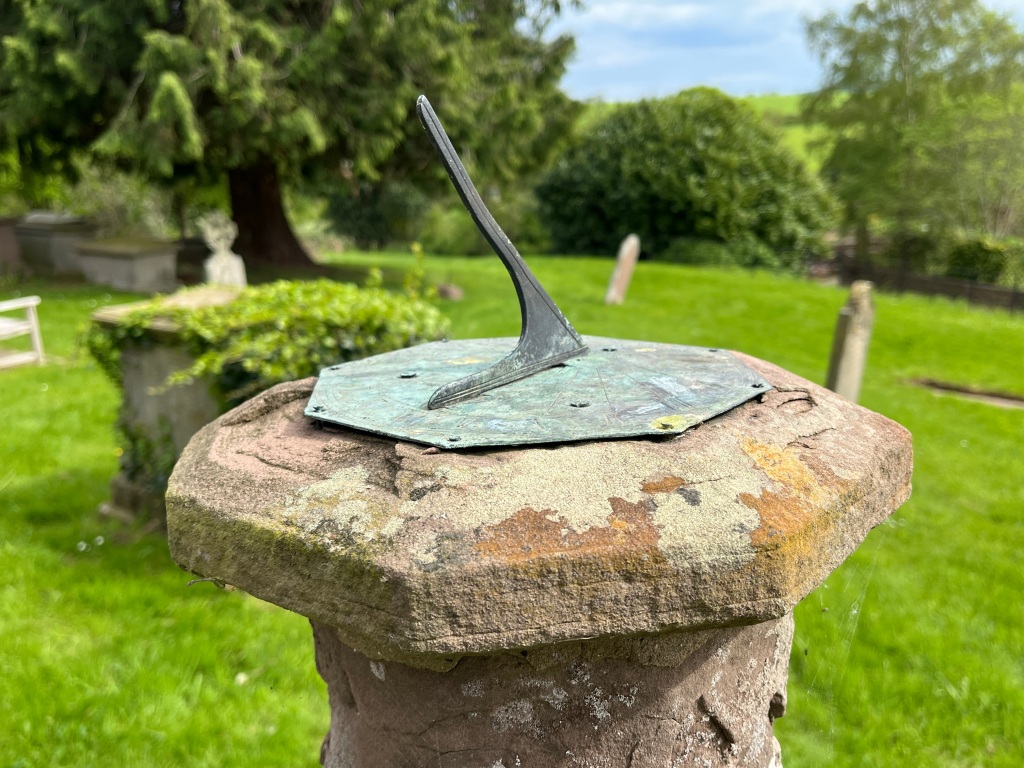
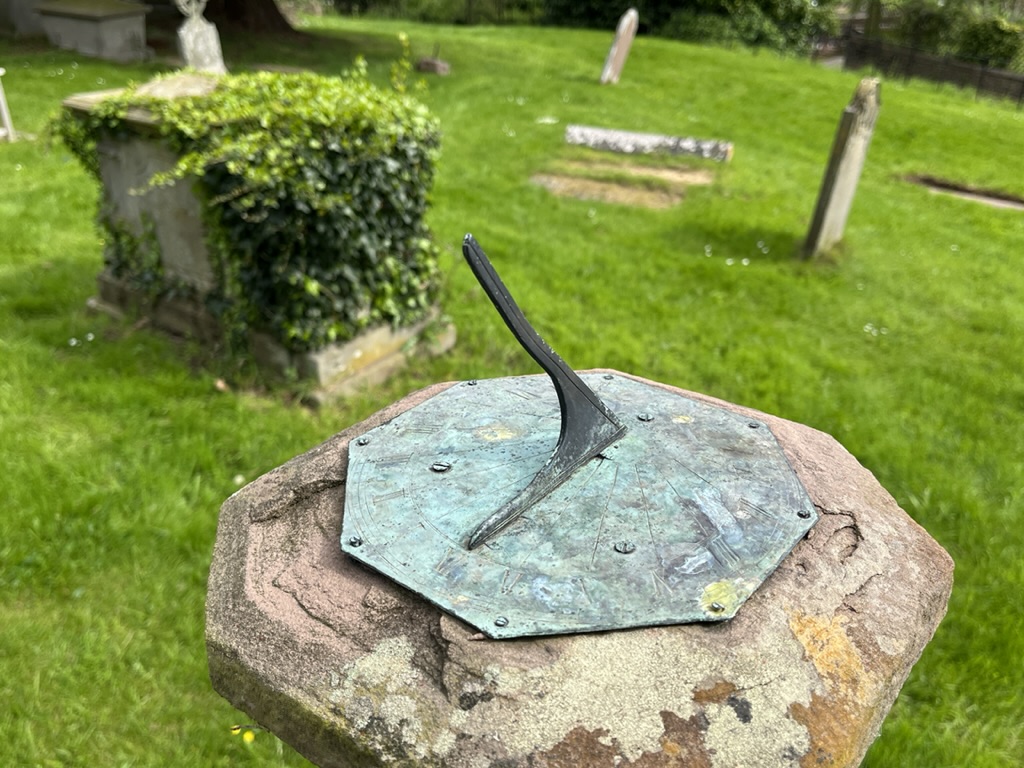
GRADE 1 † C14 & C15; records of C11 origins; trace Norman interlace patterns. Restorations ±1900; later replacement of the top of the spire, repurposed as sundial pillar. Only 1 other church (Itton, nearby) with this Dedication. 7m N of Monmouth; 7m SW of Ross-on-Wye. 51.8871 / -2.6838 / SO530211
PILLAR (STEEPLE) DIAL
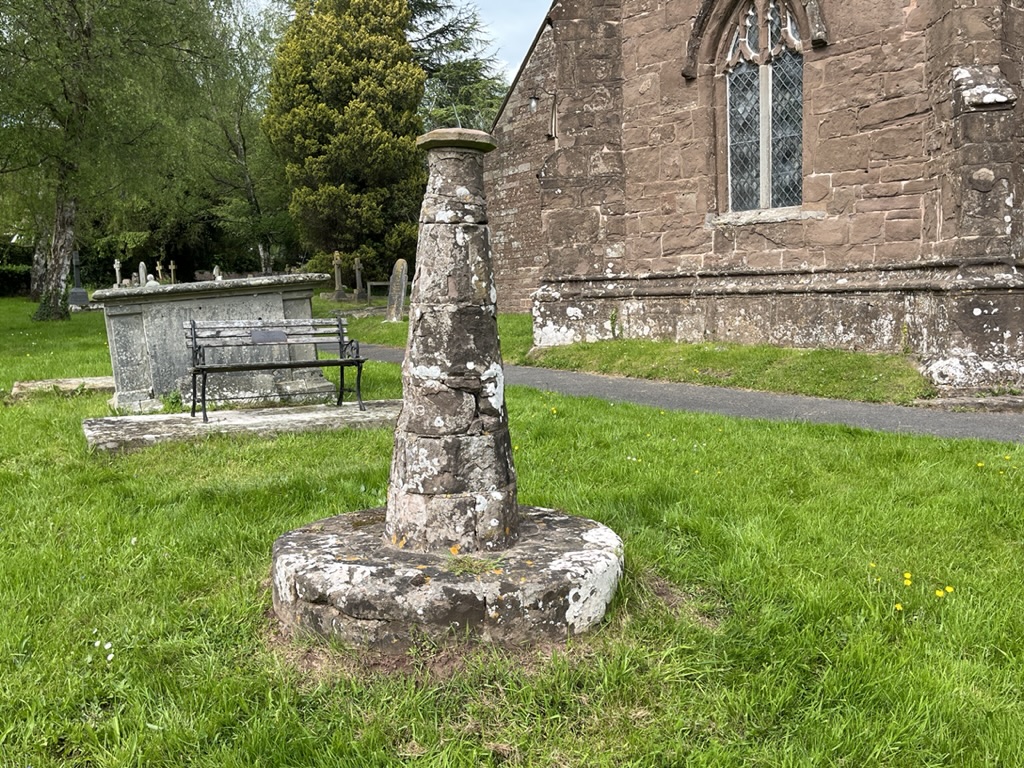
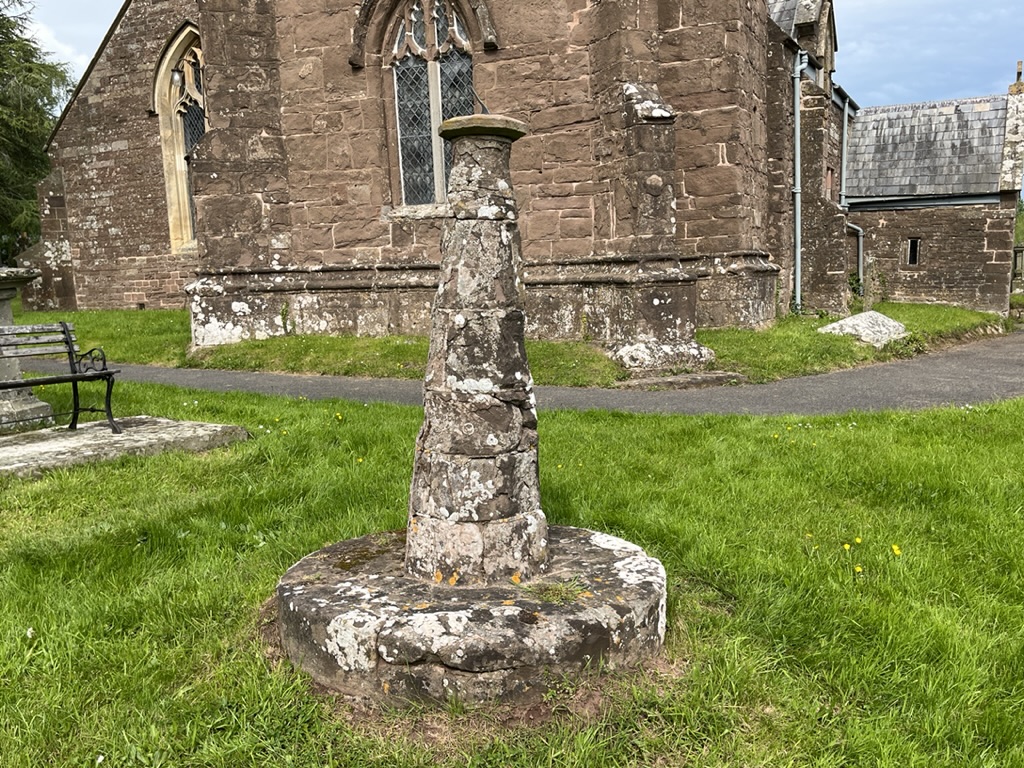
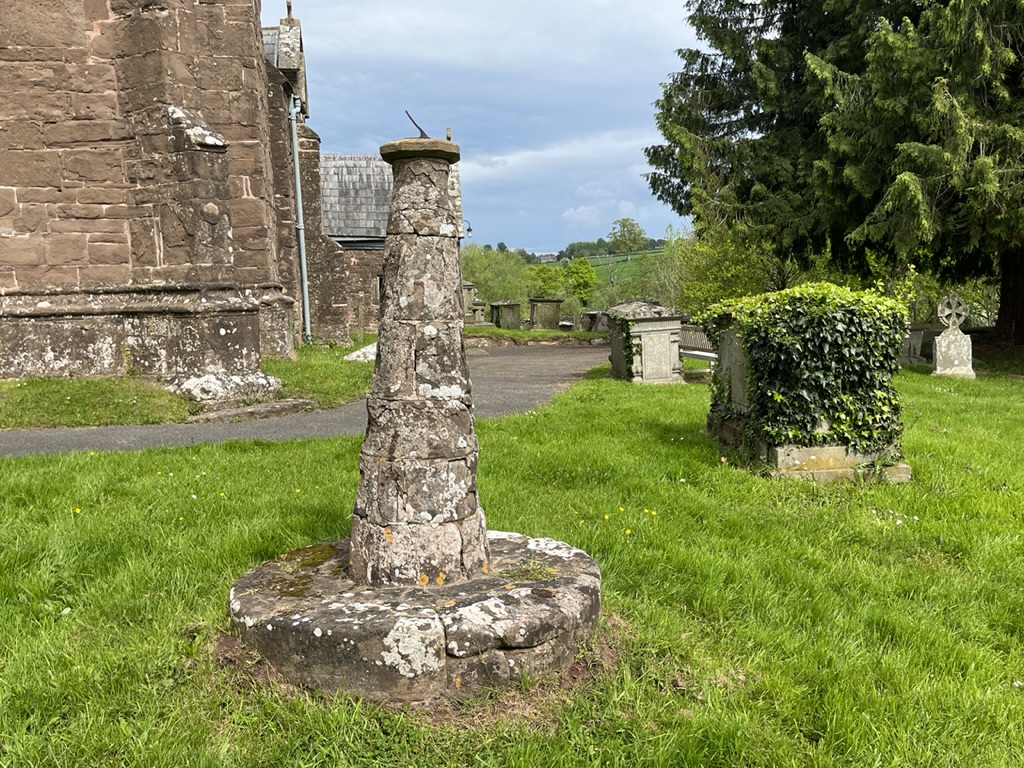
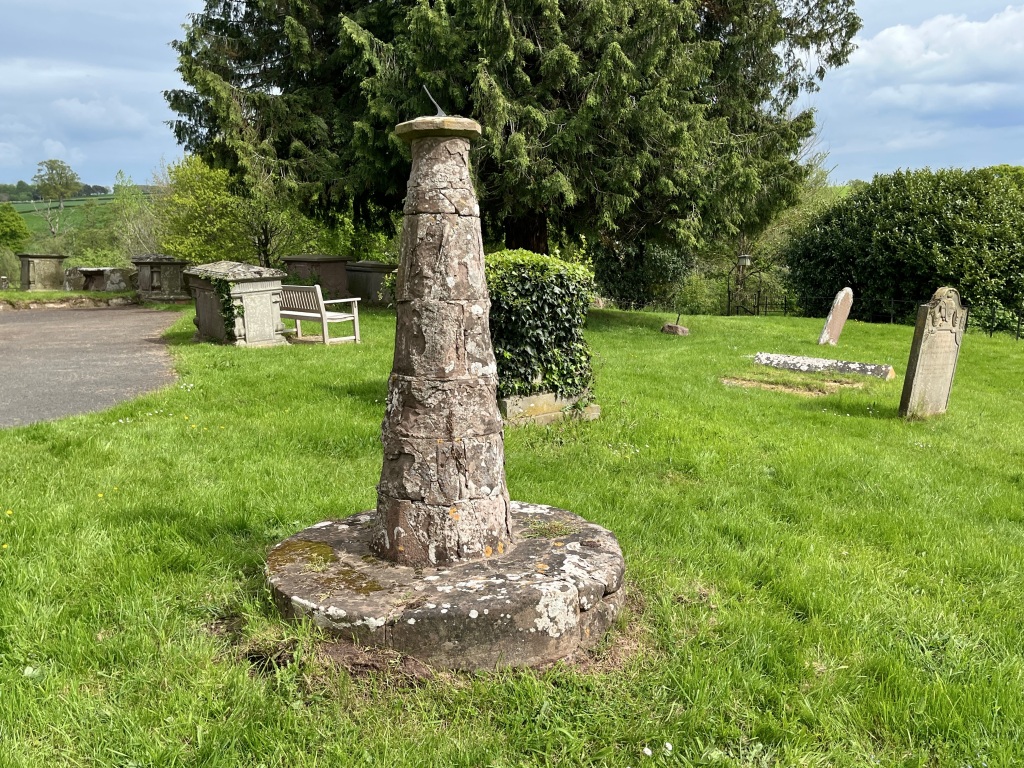
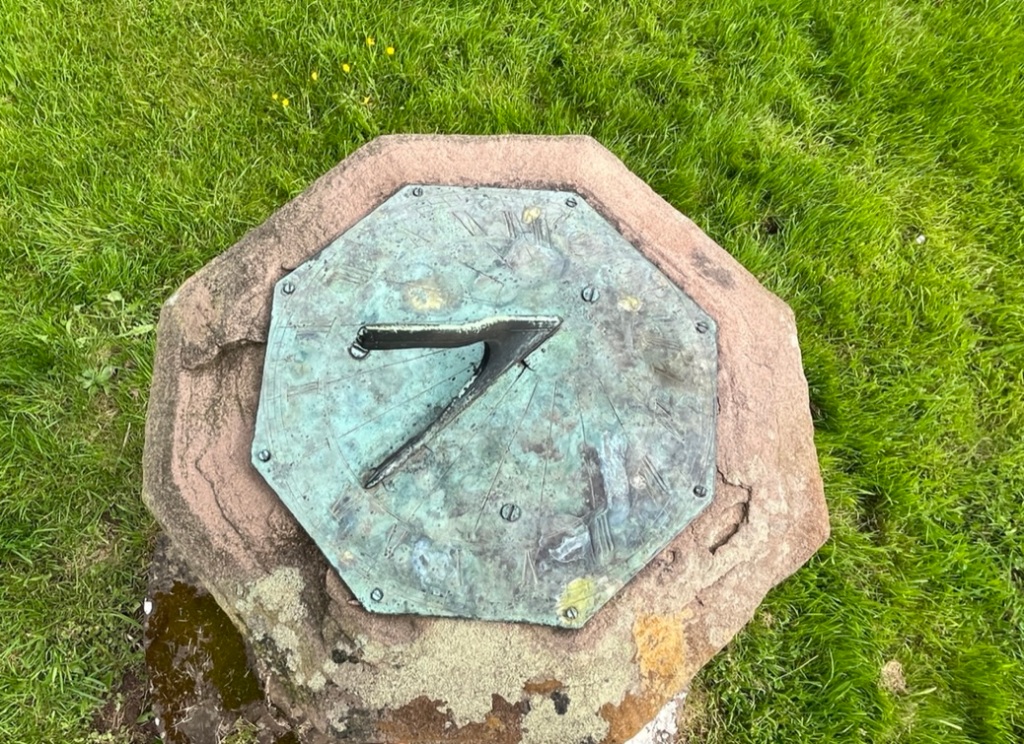
GV II †Tip of spire C14 adapted as horizontal sundial pillar late C19. In churchyard SW of the tower in an ideal place for admiration. Coursed & squared sandstone rubble, circular base. C14 masonryBLB
1. CHURCHYARD VIEW
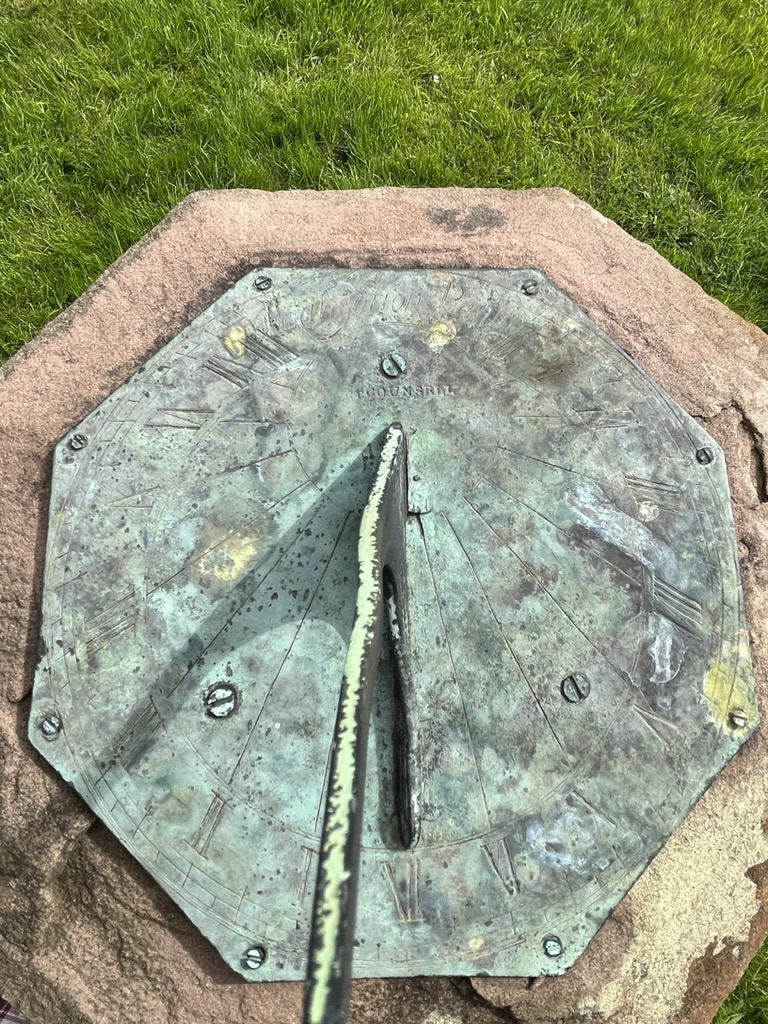
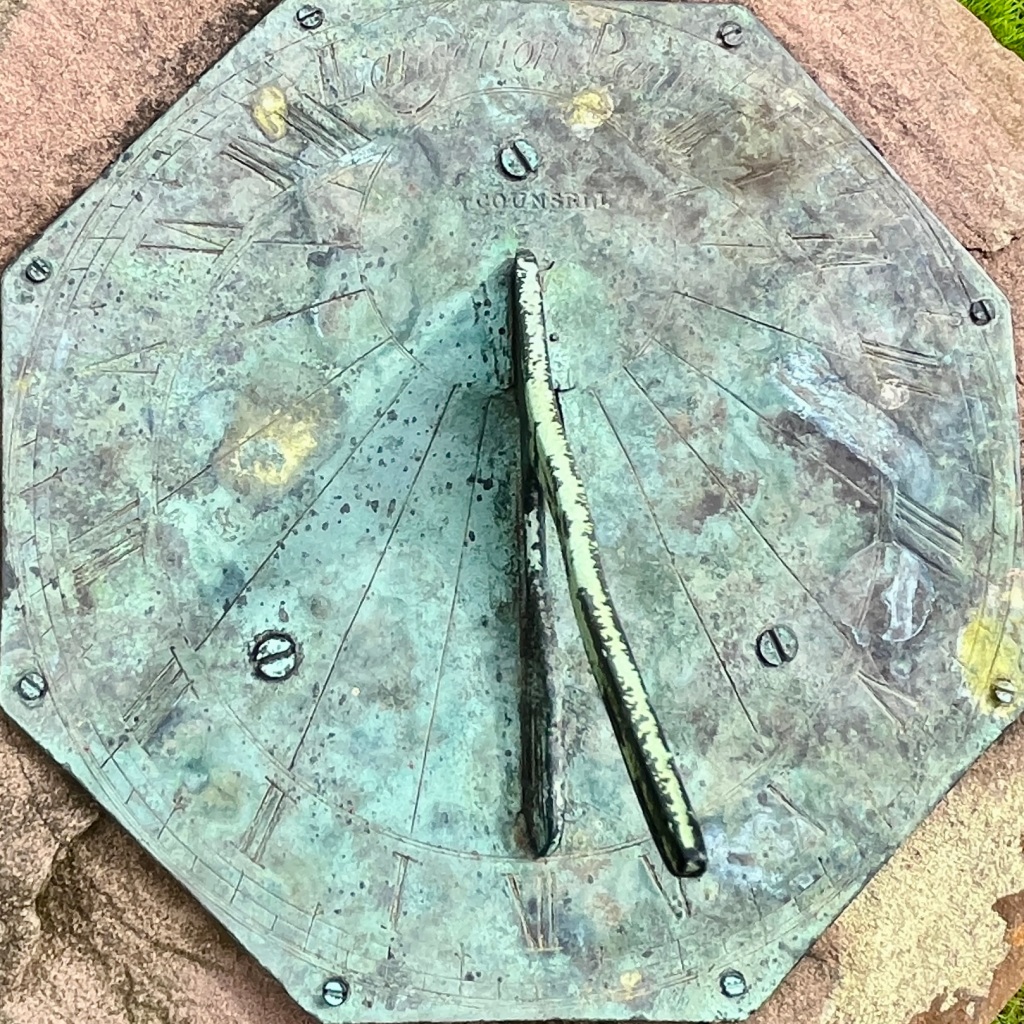
2. HORIZONTAL DIAL
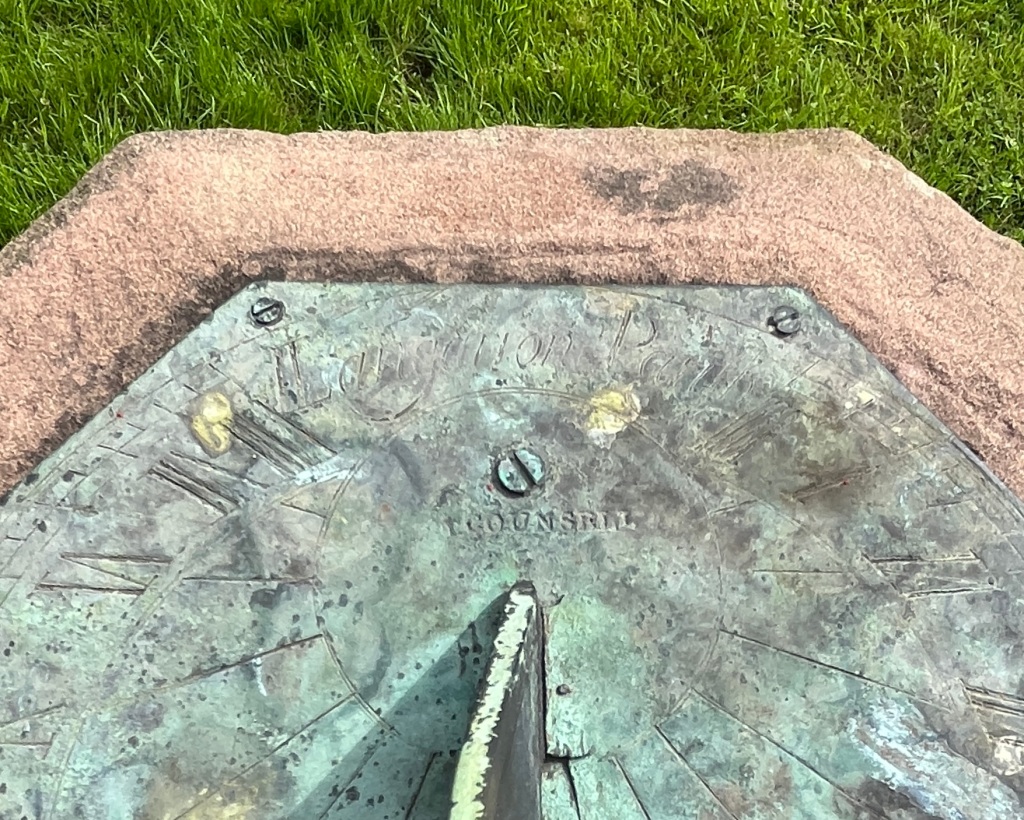
The dial is octagonal, with quarter-hours marked. IV as IIII. The inscription seems to be Llangarron Parish; and the maker’s name Counsell (though I can find no reference). The Roman numerals are conventional.
SCRATCH DIAL
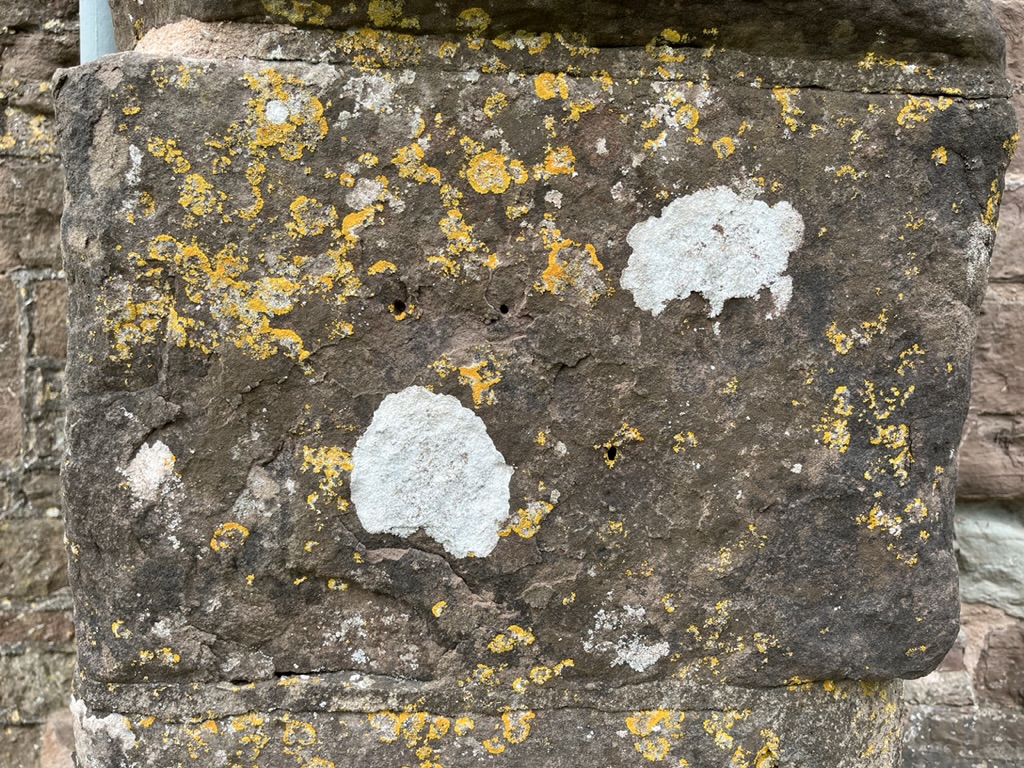
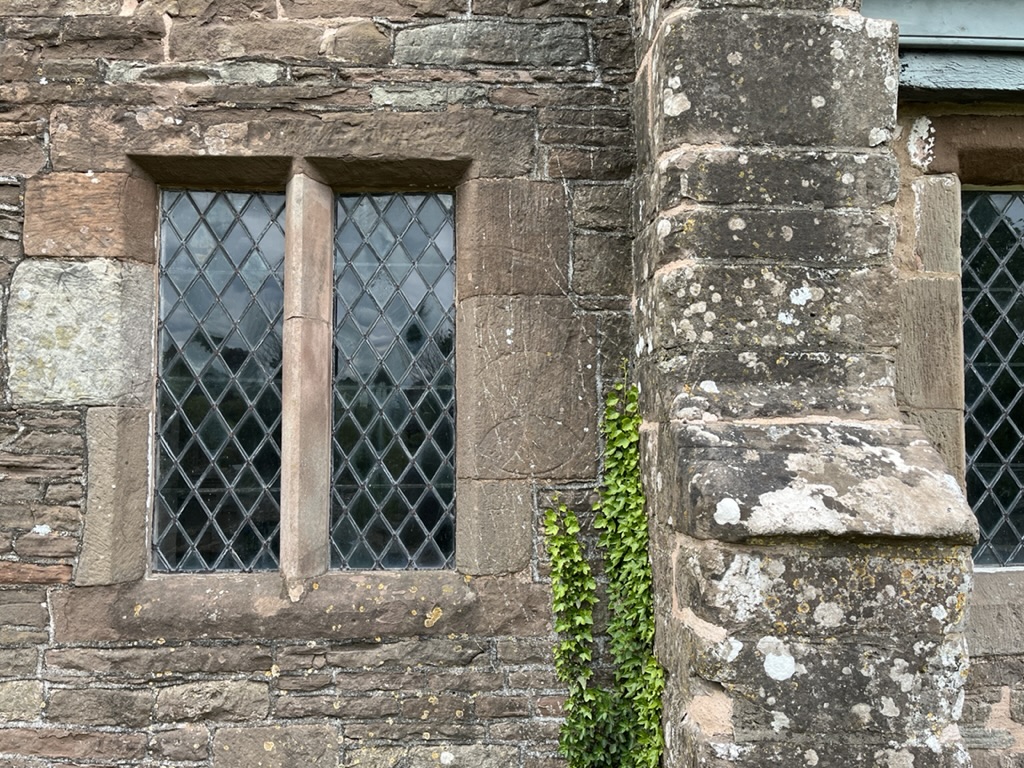
BSS records a scratch dial with 3 lines on the buttress to W of S porch, in a poor state. Notes include Max. length lines, mm 80. Hard as I looked, I couldn’t find a dial in the given location, or at any height on the buttress. Or elsewhere. Possibly the stonework has deteriorated since the original record was made. The best I can offer is the BSS sketch; and the most promising dial-like area of the buttress.
CONSECRATION CROSS
A fine consecration cross, one of the largest I have seen. One puzzle is that the cross is too large for the stone, so that LHS is cut off at the edge. It seems unlikely that the designer mis-measured to that extent. Possibly the stone was moved and trimmed to fit its present position during restoration.
Chartreuse de Mélan . Taninges . France – Vertical Dial
Cat / Salamander Hunky Punk
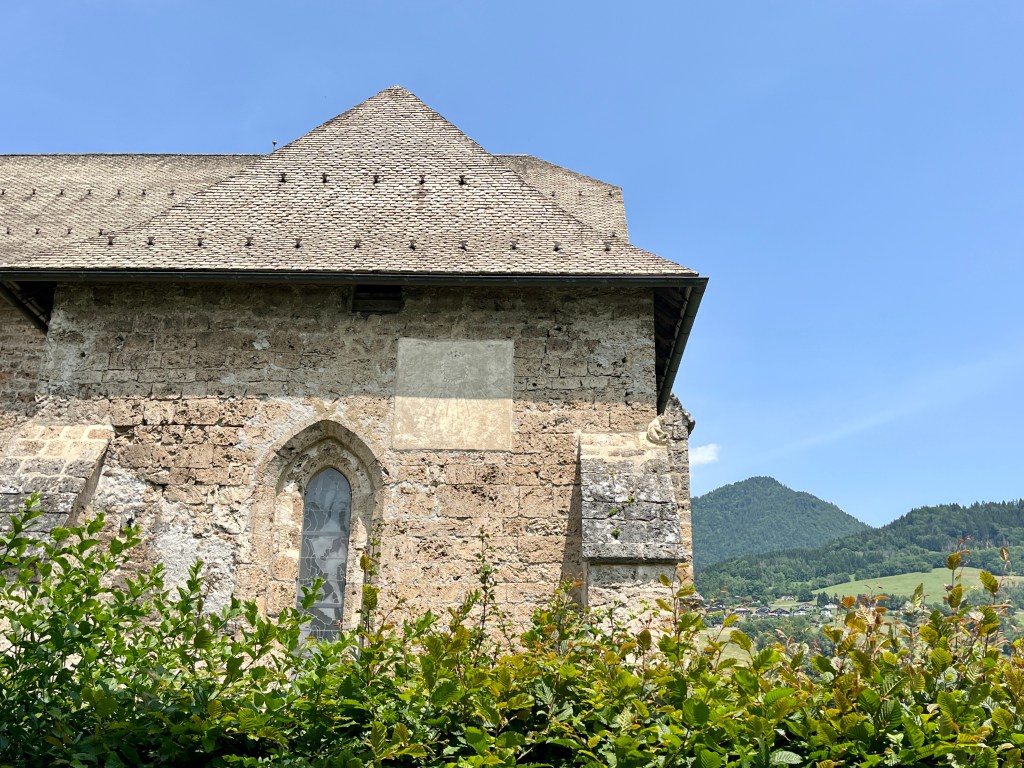
The Chartreuse was founded in 1285 as a Carthusian nunnery and continued its religious functions until the French Revolution. Thereafter it became a school and in due course an orphanage. A disastrous fire in 1967 destroyed almost all the buildings on the site, with loss of life. Only the church and its cloister now remain. The church is an exhibition space and the lawns around it feature examples of modern art, from interesting via enjoyable to a few that are a matter of personal taste.
Chartreuse de Mélan . Taninges . France – Vertical Dial
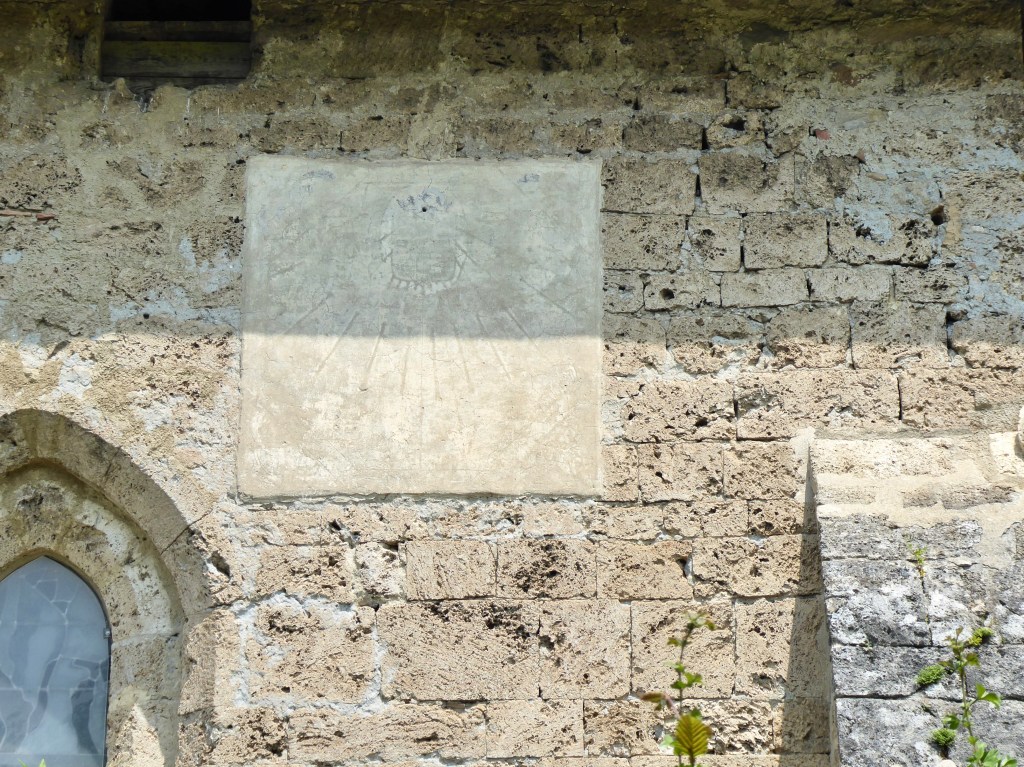
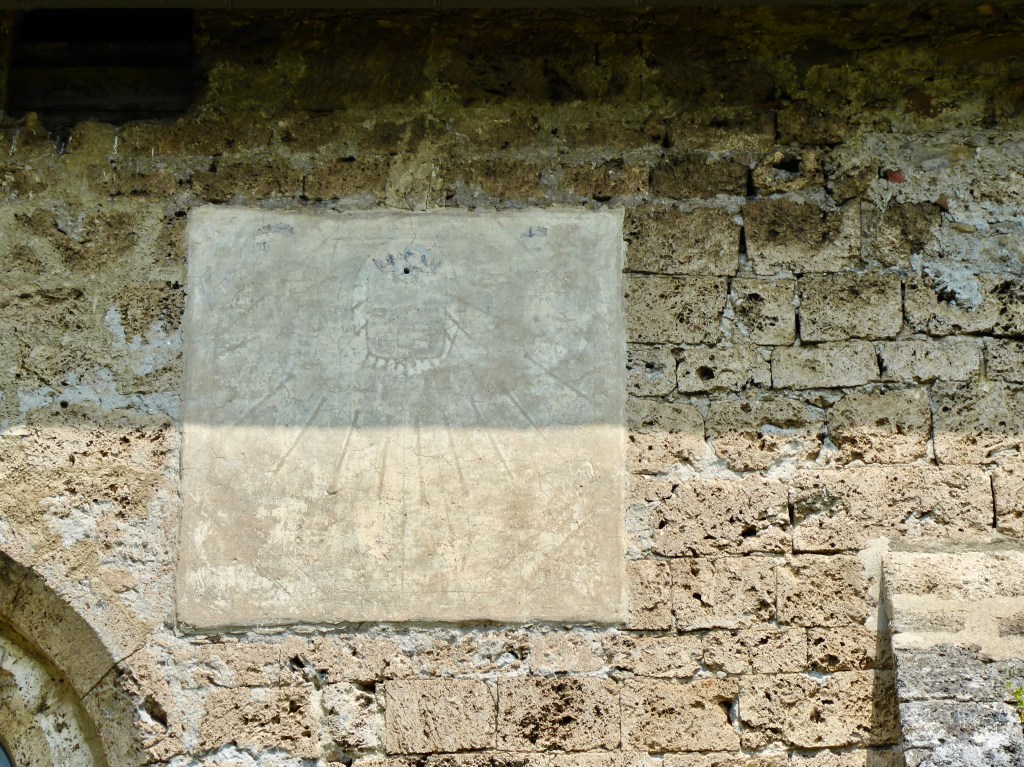
The dial is included by MICHEL LALOS in his excellent French Cadrans Solaires site. Anyone who has in interest in sundials in France will benefit hugely by using this free resource. It is accessible, informative, and easy to use – not least because the dials are featured by Départment with a map for dial locations. The entry for Mélan is :
Cadran peu déclinant de l’après-midi, gravé et peint sur enduit, très dégradé, fines lignes, demies, plus de chiffres dans bandeaux, traces de blason et décor
Dial slightly declining in the afternoon, engraved, painted on rendering, very degraded, fine lines, half-hour lines, numbers within a frame, traces of coat of arms and decoration.
There are paint remnants at the top of the dial, where (presumably) it has been protected by the eaves. The gnomon hole at the top of the coat of arms is square. The dial is obviously old and I wondered if it might be dateable. Checking the apparent shape of the escutcheon, I discovered that it was first recorded as an armorial design in late C17 and (conveniently) turns out to be known as French-style. Overall, one might reasonably conclude that this dial is C18.
MEMORIAL STONE 1690
Chartreuse de Mélan . Taninges . France – Memorial Tablet 1690
GSS Category: Vertical Dial; France Sundial; Cadrans Solaires; Dials Abroad
All photos: Keith Salvesen; source used MICHEL LALOS
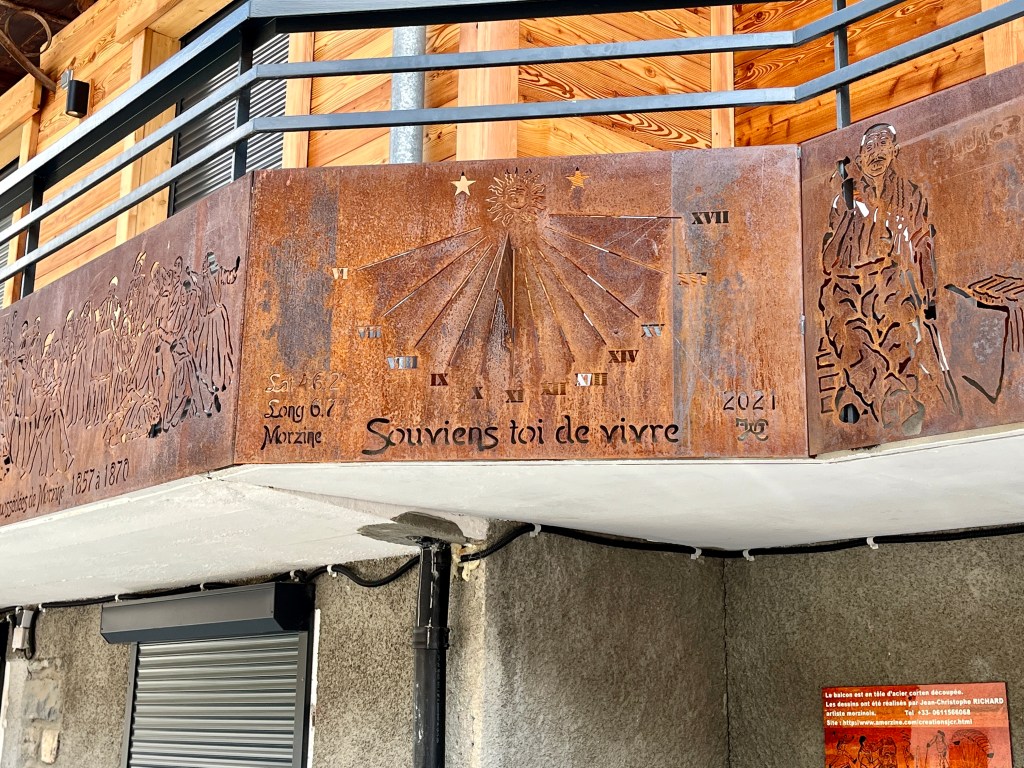
A charming rustic dial incorporated into an iron balcony in Morzine – a surprise find. It seems accurately designed for its specific location and aspect. Included are its longitude and latitude. The hours marked are (most unusually) from 6 to 17: a dial based on the 24-hour clock. The design includes the sun shining cheerfully above the gnomon with a star on either side. A most enjoyable dial to come across by chance. The motto is one we should all abide by…
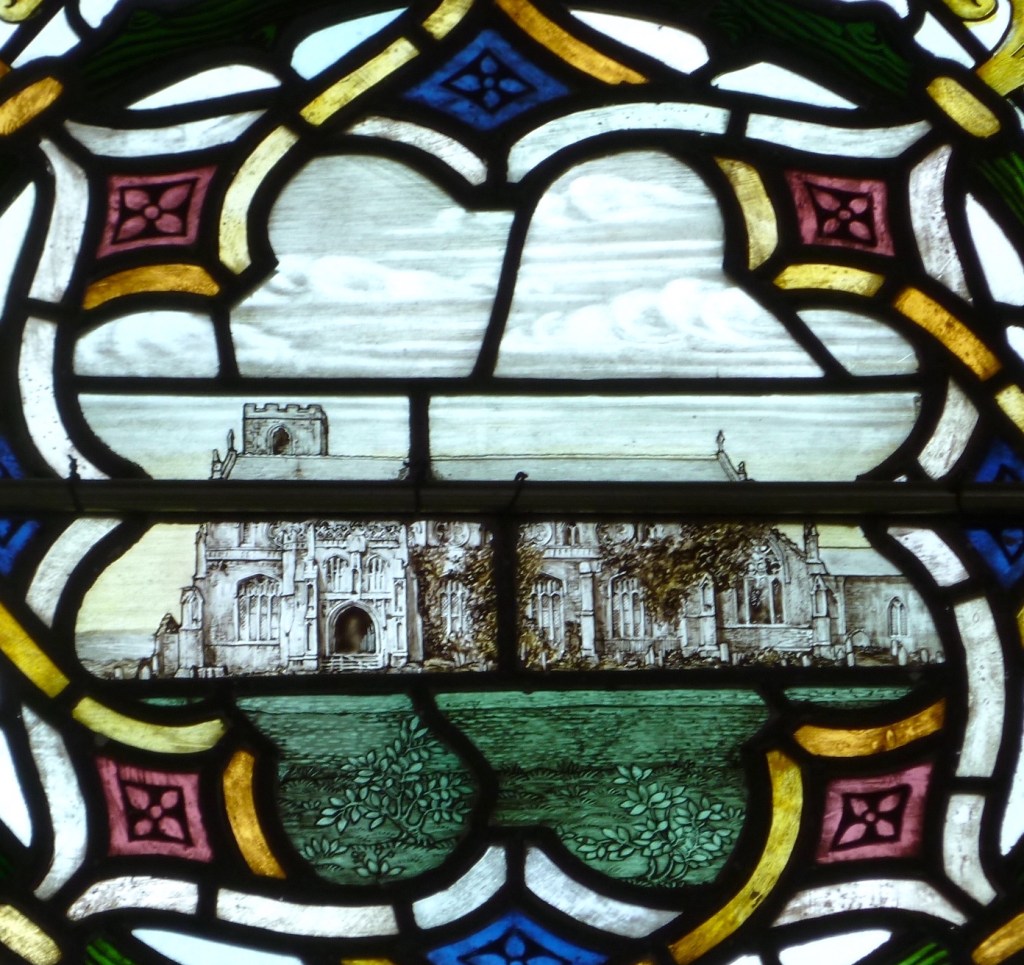
St Margaret of Antioch . Cley-Next-The-Sea . Stained Glass Window (cr Keith Salvesen)
ST MARGARET . CLEY-NEXT-THE-SEA . NORFOLK
GRADE 1 † C14 and C15. An important and rather wonderful church, part-ruined. One of SJ‘s 1000 Best Churches: a sea church stranded inland.PEV describes a most striking and improbable-looking building, splendid from the S, but splendid in large parts rather than as a whole. 52.9464 / 1.0475 / TG048431
DIAL
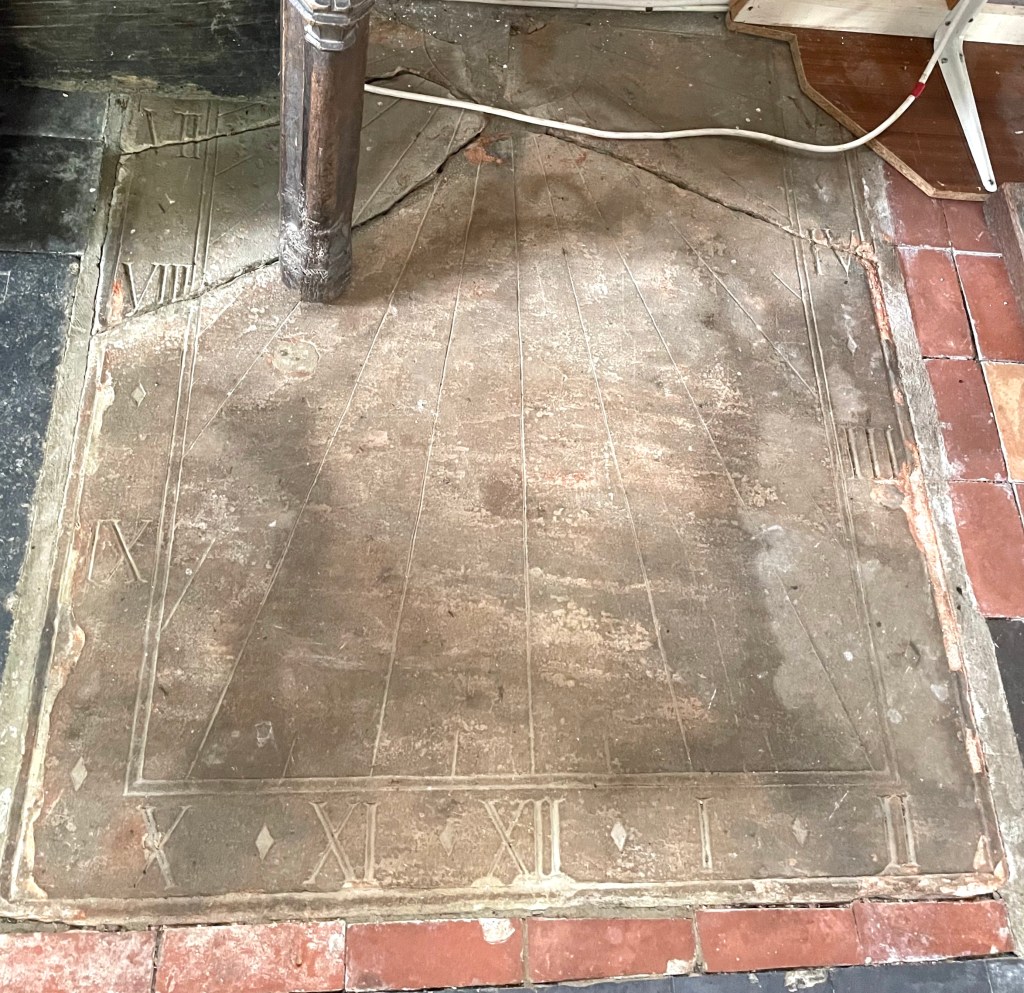
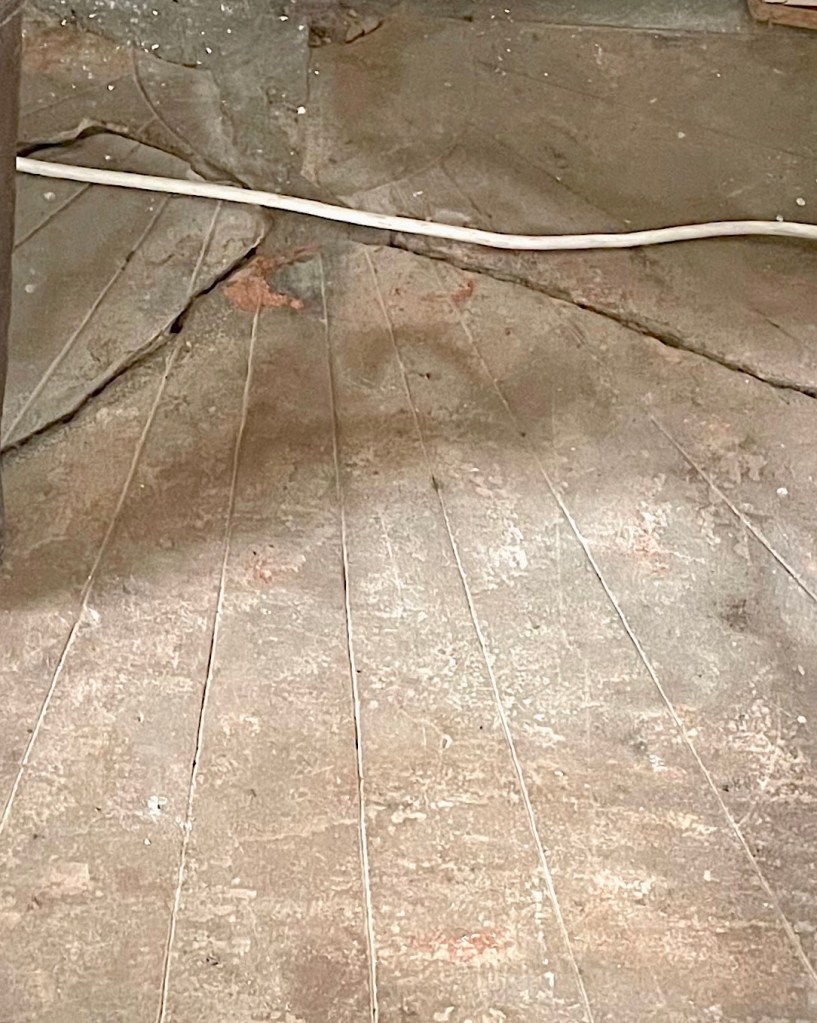
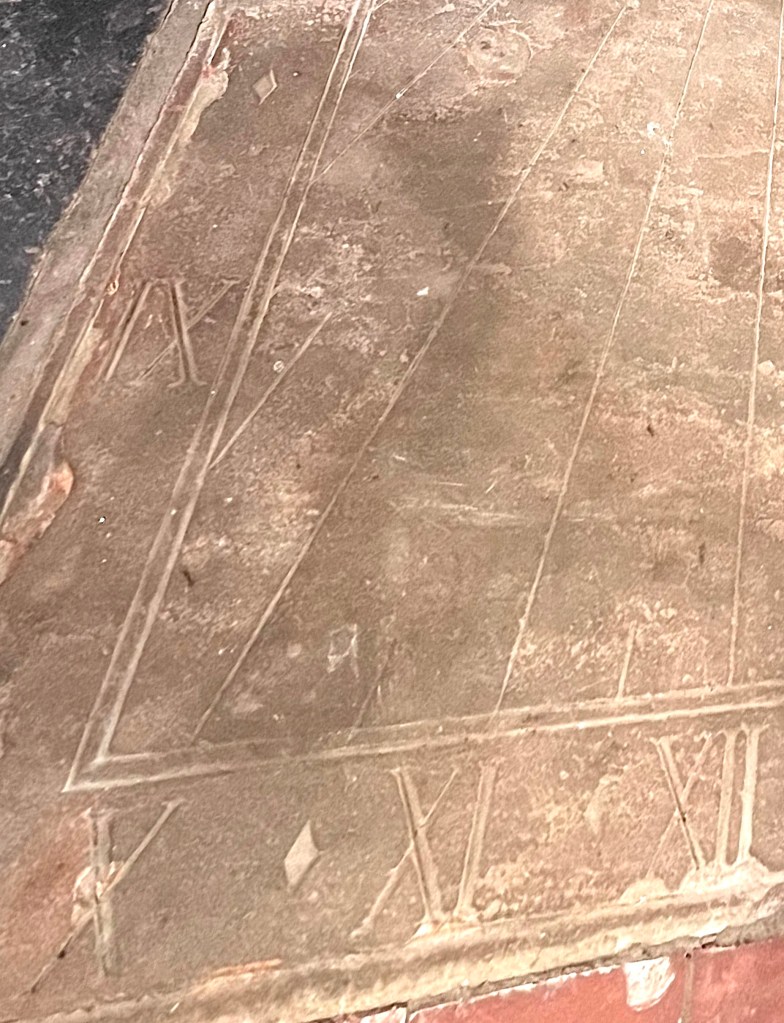
I am grateful to my friends in Cley, Hanne Siebers and Klausbernd Vollmar, for discovering and photographing this most unusually positioned dial that has been incorporated into the floor of the church, serving a new purpose despite its damaged state.
St Margaret . Cley-next-the-Sea – Vertical Dial set in the Chancel Floor (Hanne Siebers & Klausbernd Vollmar
The lines are more-or-less equally spaced, suggesting that the dial’s aspect was originally due S. The hours are separated by lozenges, and half-hours are marked. At the back / top end of the dial, there is considerable damage. It is just possible to make out a semicircle with a hole where the gnomon would have been. The incised numerals VII, VIII, III, and IV are less worn and indeed are surprisingly sharp, which might suggest that the dial was below a ledge of some sort that protected the upper part from weathering. One puzzle is the way in which VIII is split by a single crack, yet part of the numeral appears to be missing completely.
DATING THE DIAL
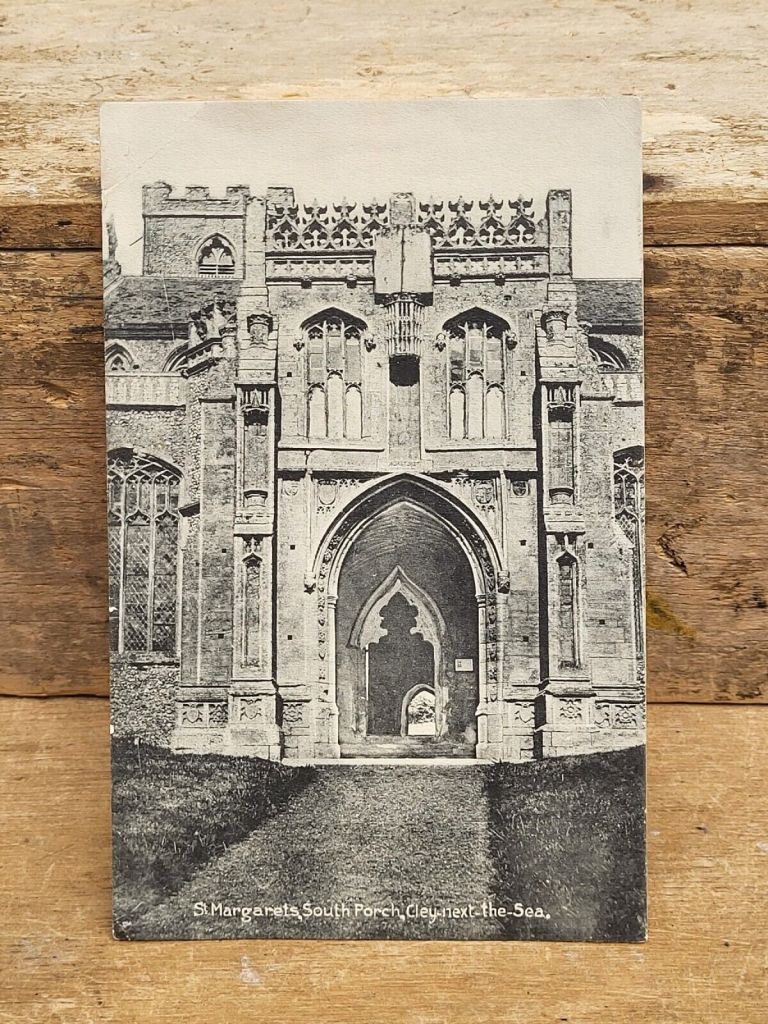
I initially thought that the dial was ±1800. The date of its removal and repositioning was unrecorded in the usual sources. As it turns out (with many thanks to Rev. Richard Lowery and Richard Jefferson) the change of location happened within the last 50 years or so. The dial had been high up on the S porch, but had become a danger. It was taken down and set in the floor of the chancel. The damage occurred at some stage during the relocation.
The earliest depiction I can find is a lovely drawing by John Sell Cotman dated 1818. It gives the dial due prominence and I think it can be confidently dated to ±1750. The work interestingly show the state of ruination as Cotman saw it.
St Margaret . Cley-next-the-Sea – John Sell Cotman – Art Institute of Chicago
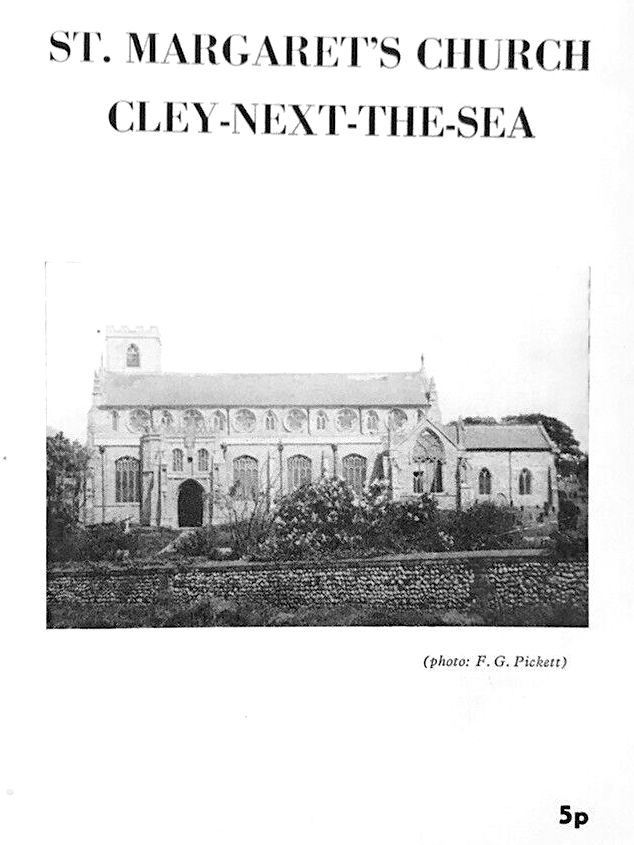
Old photos and postcards can be a good way to approximate a date (or a span)
In 1959, C L S Linnell produced a Booklet for the Church. It was obviously successful – there were 4 reprints, the last in 1973. The cover photo of the Church shows the dial in its rightful place (though quite probably it was not updated for the reprints). Certainly by 2000, the dial had been repurposed.
An excellent account of the church and some of its medieval details (roof bosses &co) can be found with this link NORFOLK CHURCHES.
GSS Category: Sundial; Vertical Dial; Old Dial; Repositioned Dial
Photographs: header photo, Keith Salvesen; dial photos (with edits for clarity), Hanne Siebers and Klausbernd Vollmar with thanks as ever for their interest in this dial project and for their excellent contributions from other churches; other images os / cc / as shown
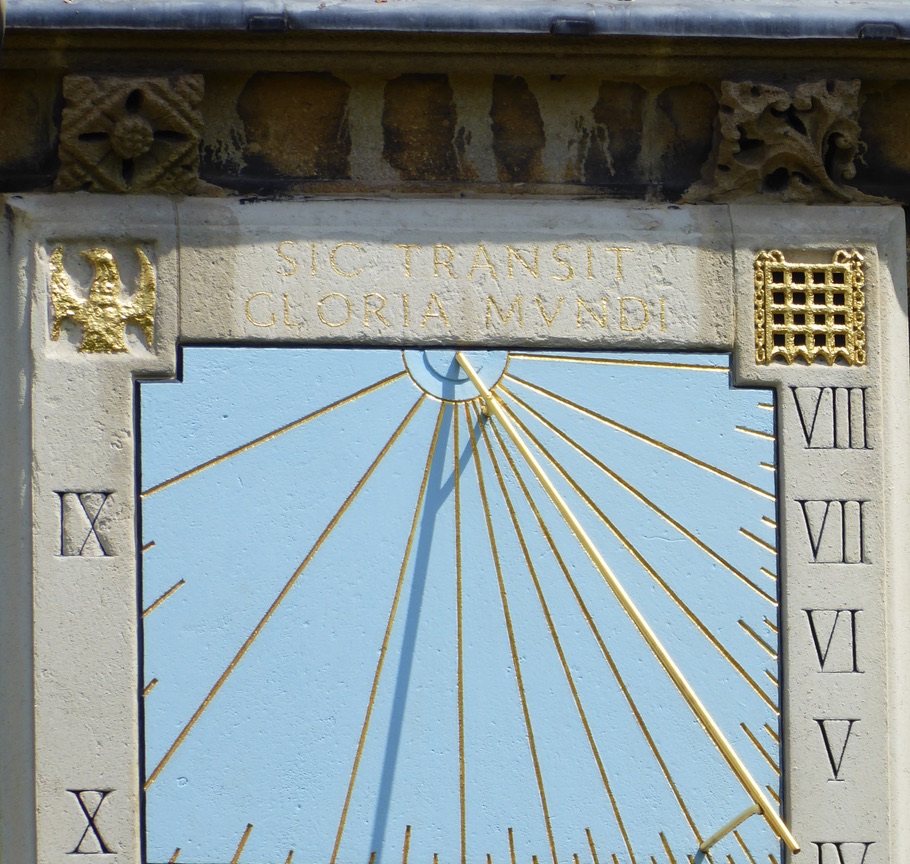
The sundial is located on the wall of the Hall, and – for those not entitled to enter the College – easily visible from the entrance by the Porters’ Lodge. It is dated 1927, replacing a dial known (from an old print) to have been in this position in C17 that was lost during C19 alterations to the Hall. The dial was the gift of a College benefactor. His initials and the year of installation are on the dial supports. The calculations were carried out by a Member of College who was a sundial expert.
The unequal positions of the hour markers take account of the SW aspect of the wall, showing more afternoon than morning hours for accuracy as the sun declines.
GSS Category: Vertical Dial; Old Dial; New Dial; Sundial Motto
All photos: Keith Salvesen
Text based on the entry for Christ’s College in the booklet ‘Cambridge Sundials’ by Margaret Stanier and Alex Brookes. This, and its companion for Oxford, are included in the bibliography.



















 GAUDIUM SUB SOLE . SUNDIALS . MEDIEVAL TO MODERN