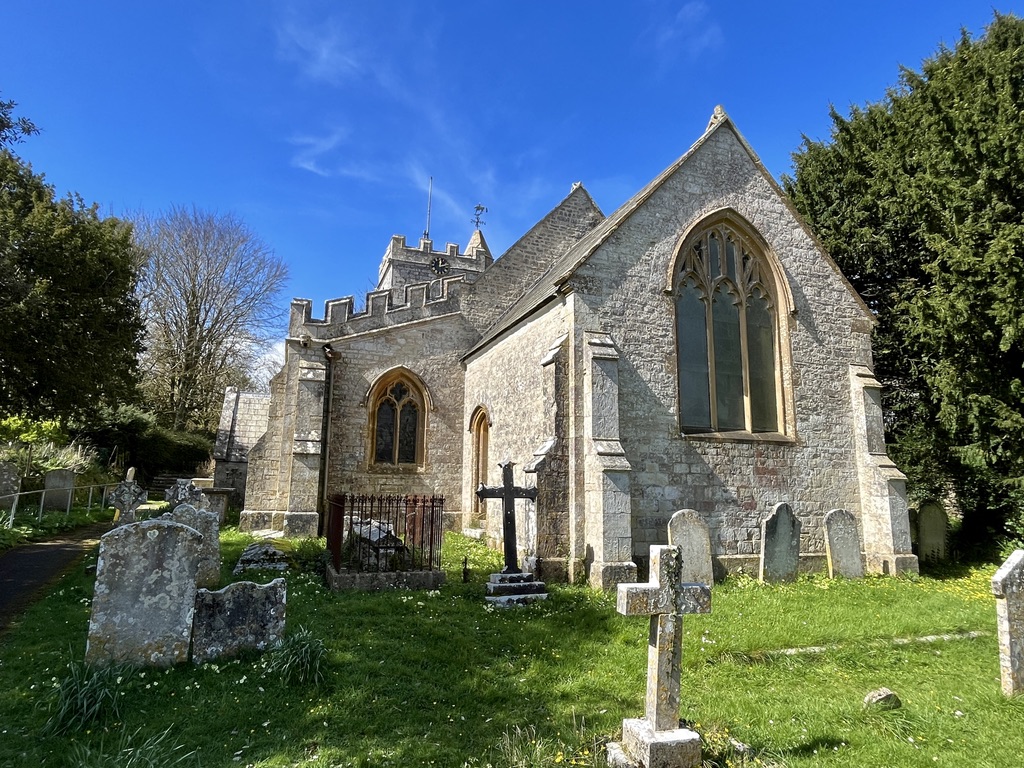
GRADE II* ☩ C15 west tower; otherwise mainly rebuilt 1846 retaining very little of the original church (?Ferry). Set in a pretty village close to the coast that has the feel of an earlier age (in a good way). 5m E of Weymouth. 50°38’45″N / 2°23’29″W / SY724829
DIAL
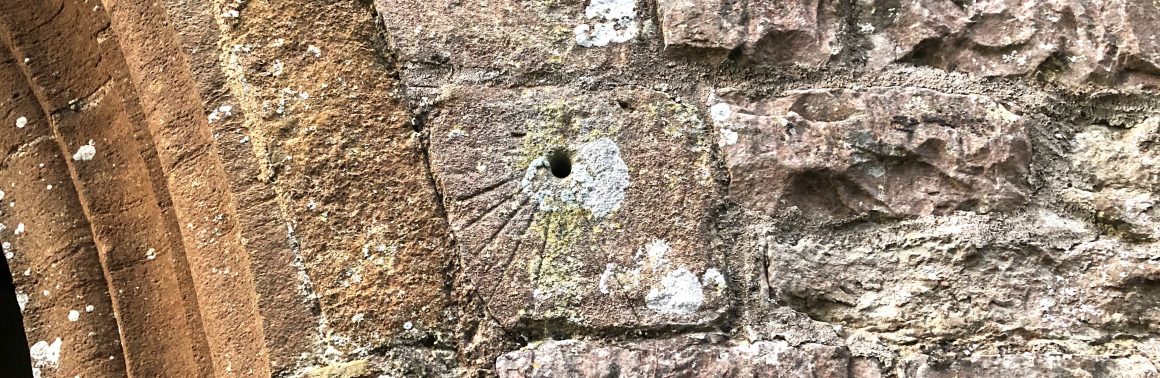
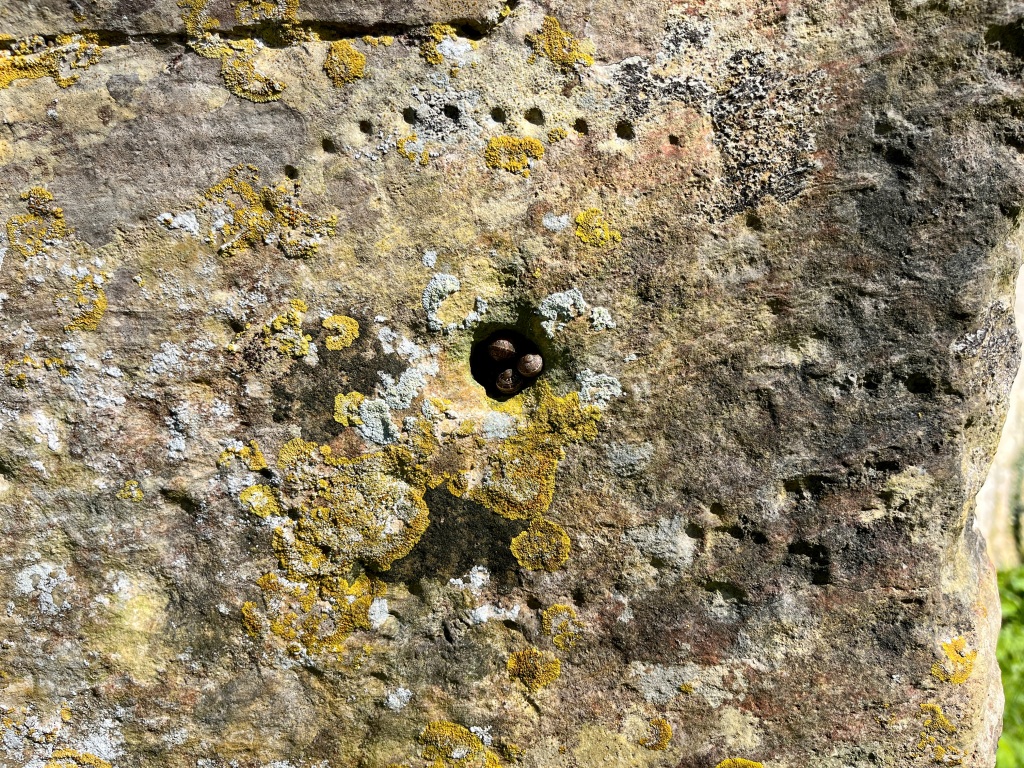
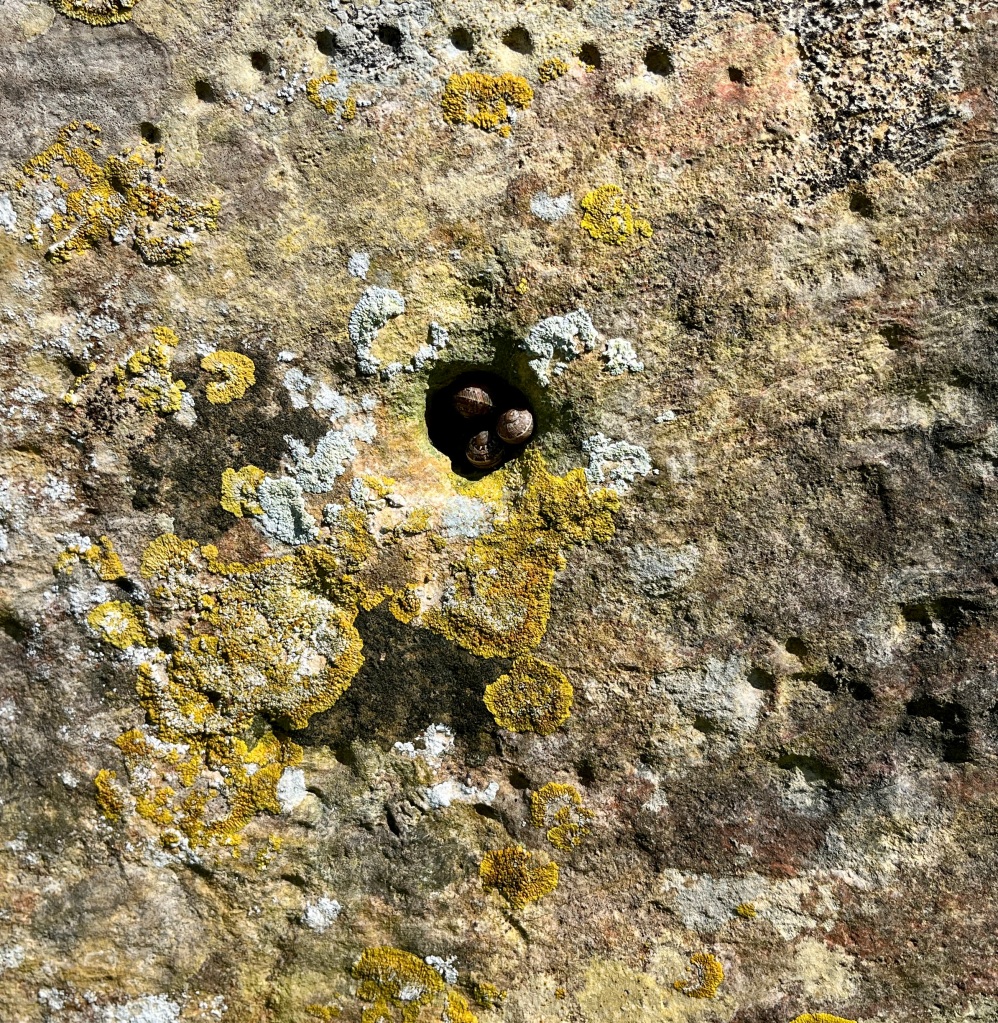
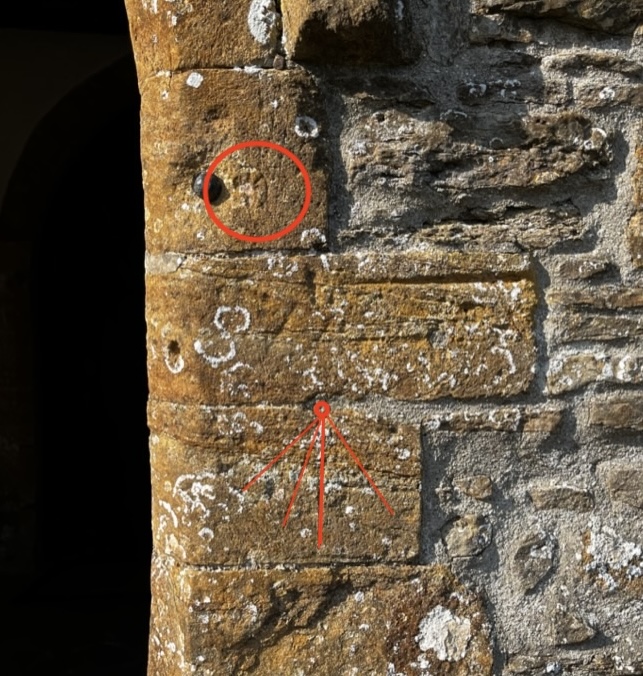
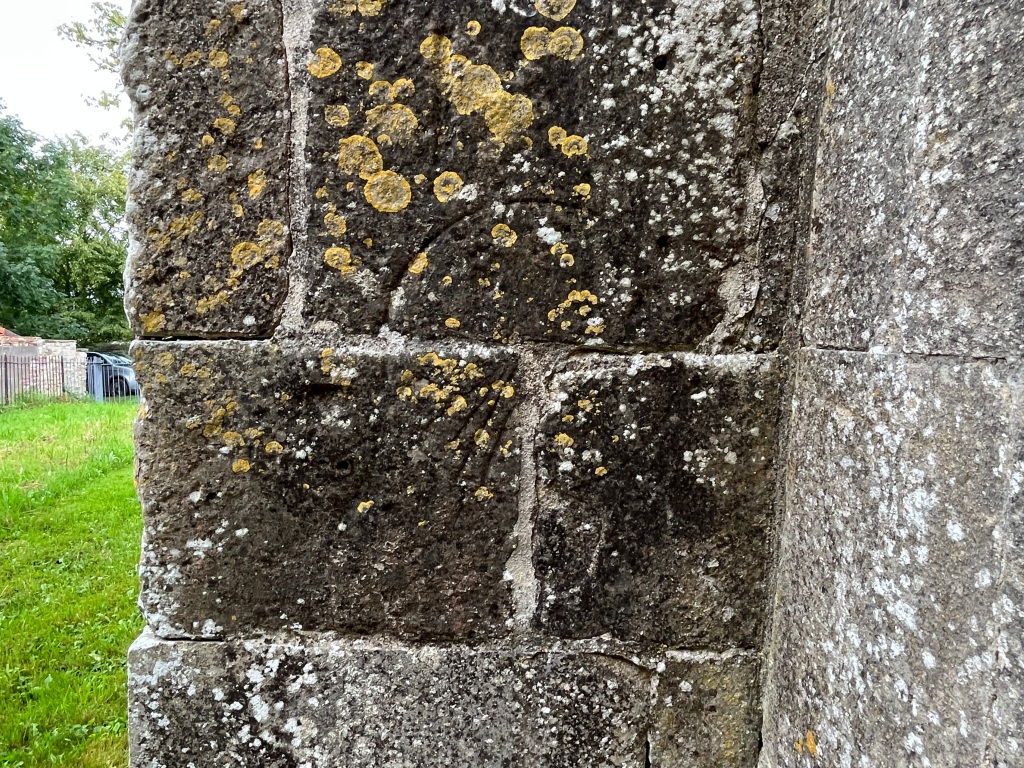
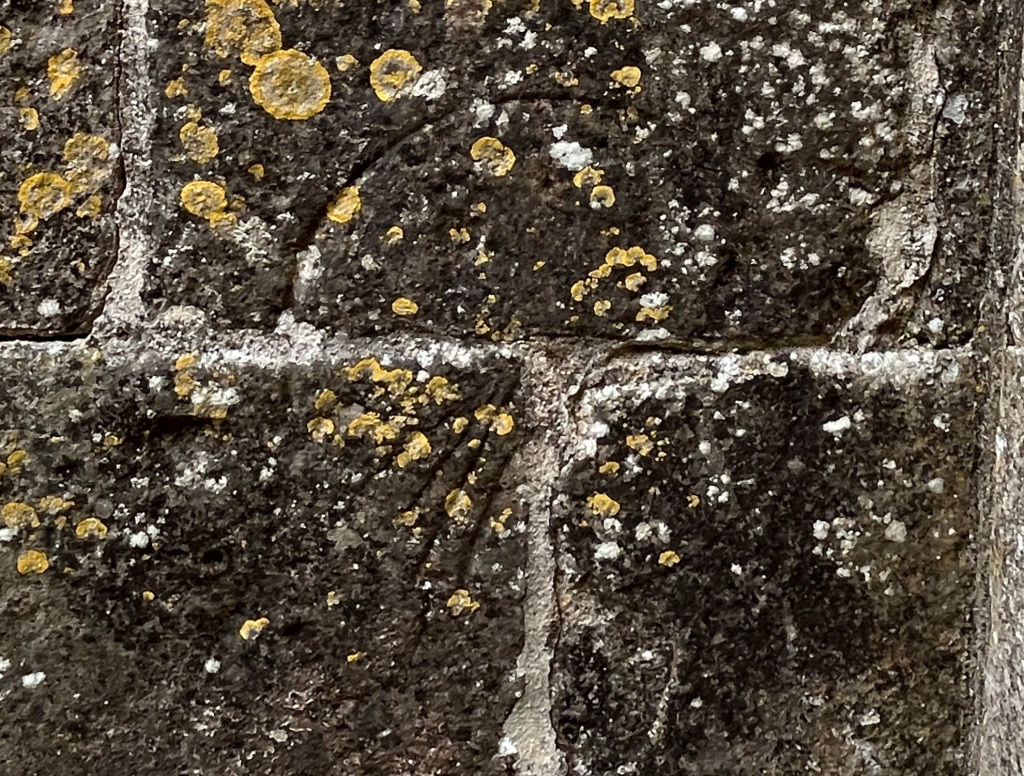
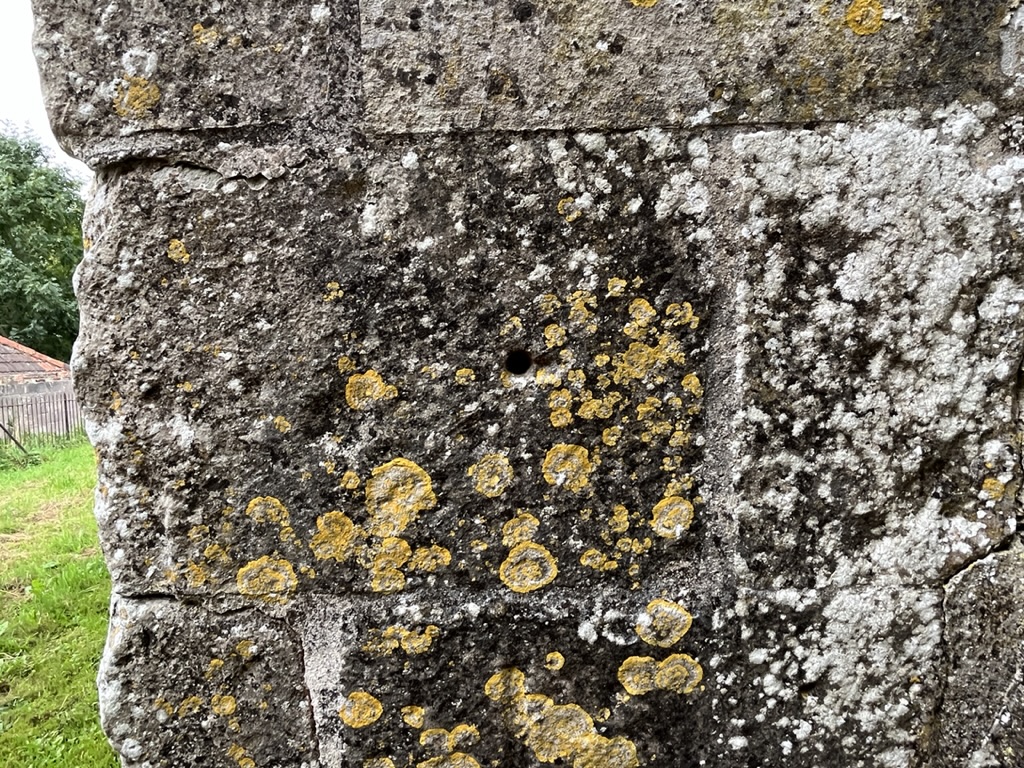
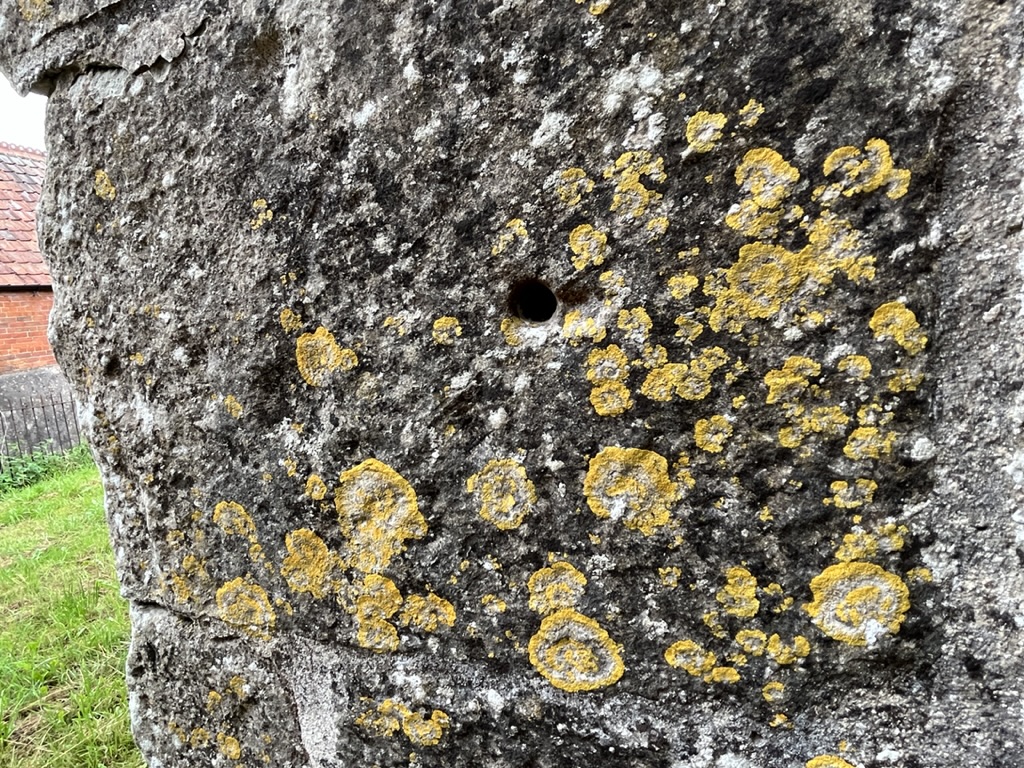
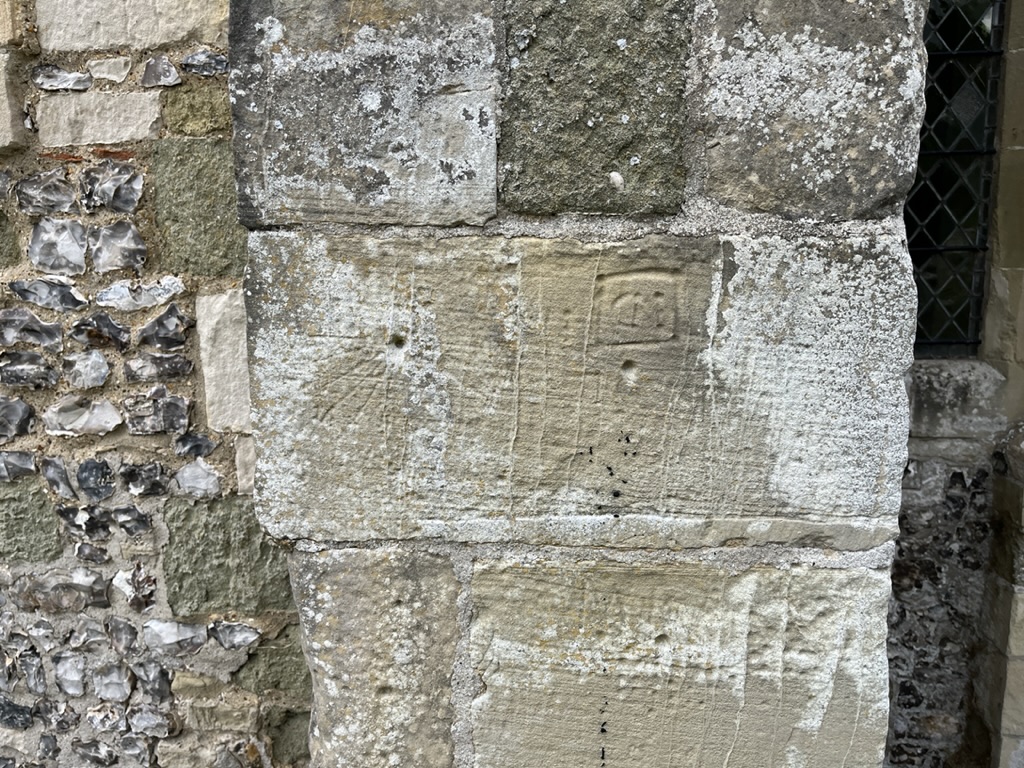
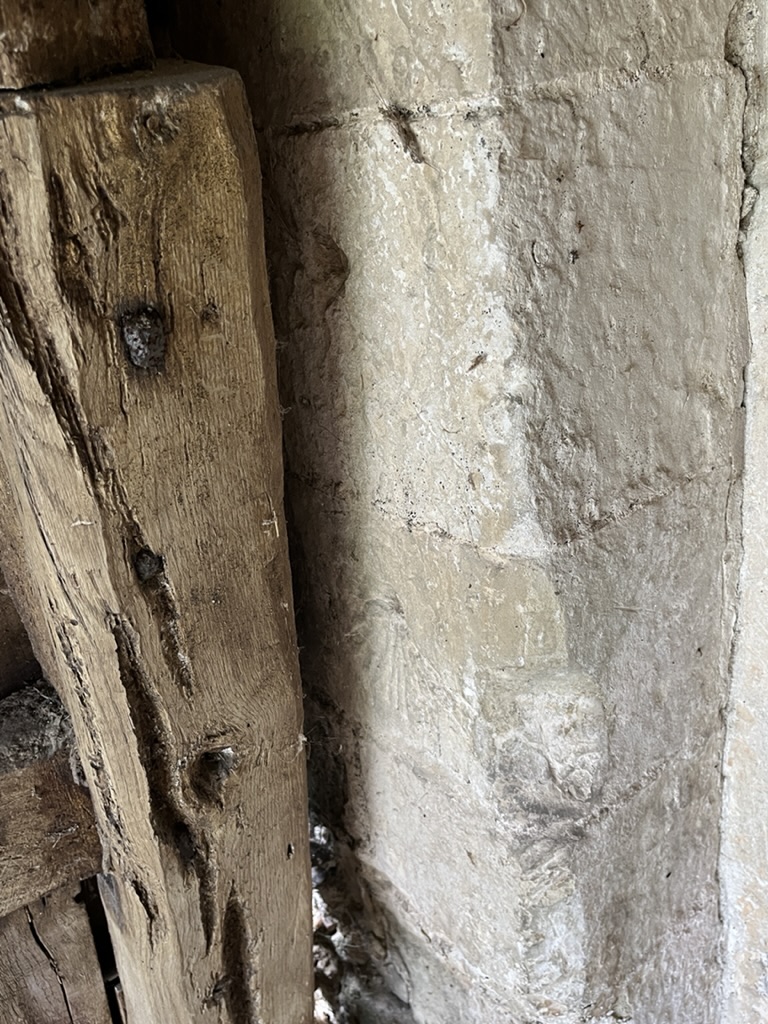
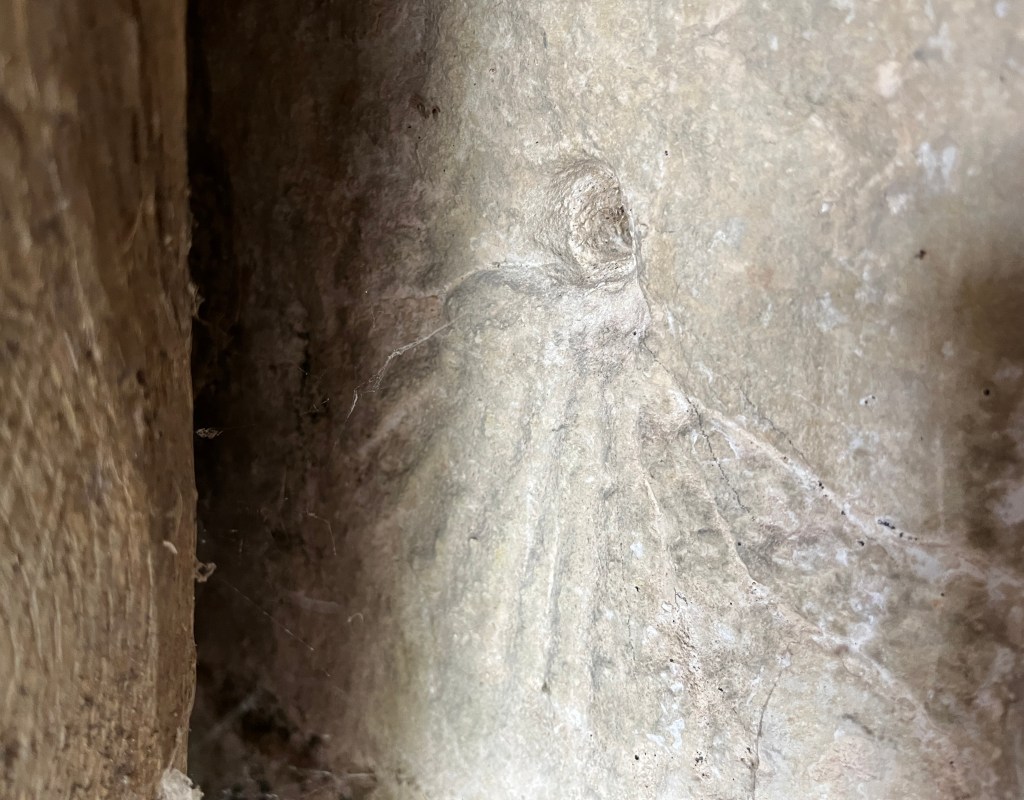
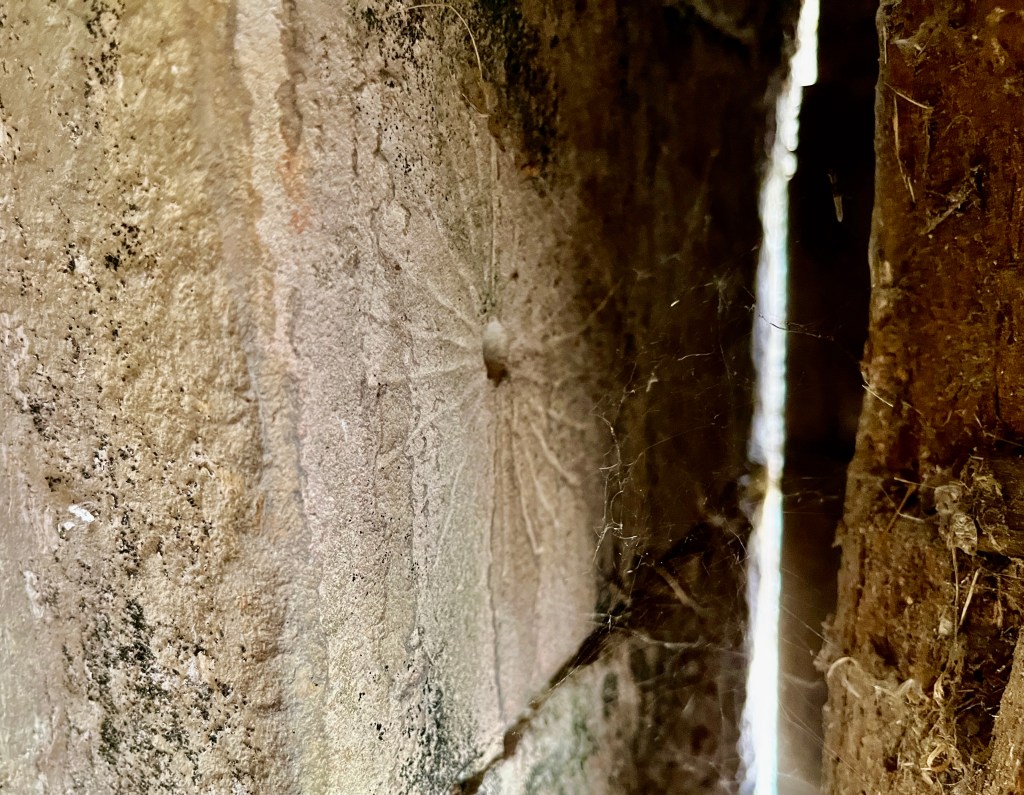
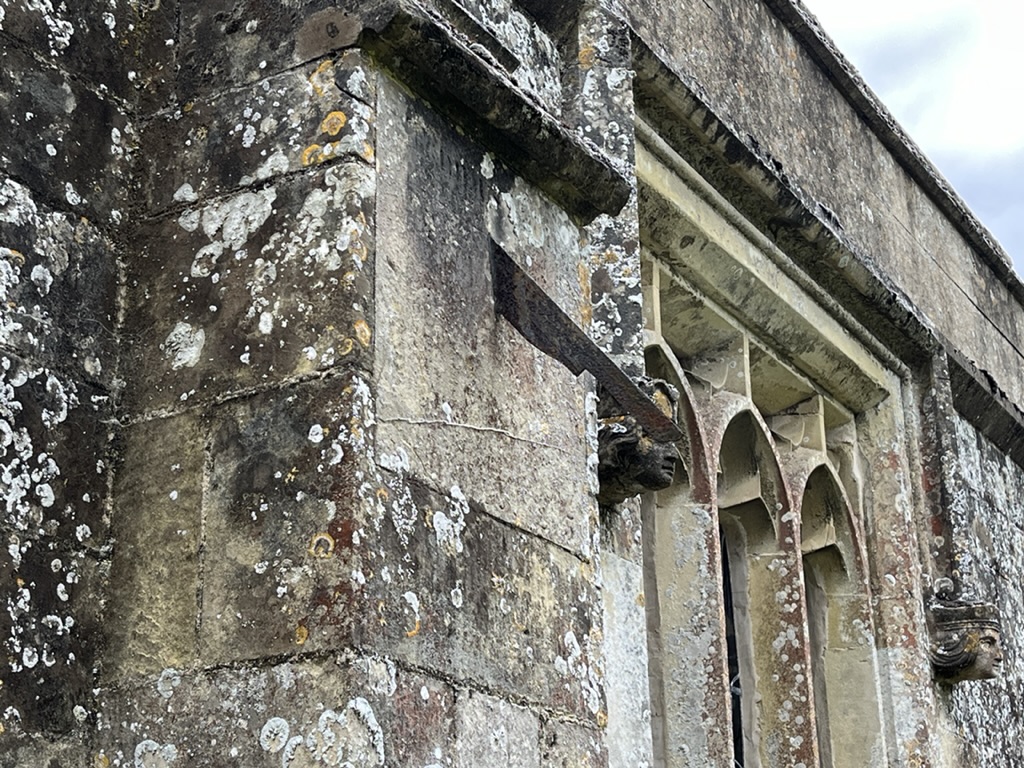
This unusual dial is cut on the SW buttress of the tower. I say cut, but in fact it is drilled in a complete circle of small holes surrounding a large gnomon hole centred on the dial stone. There are no lines at all (as with eg TRENTAFPUDDLETINTINHULL).
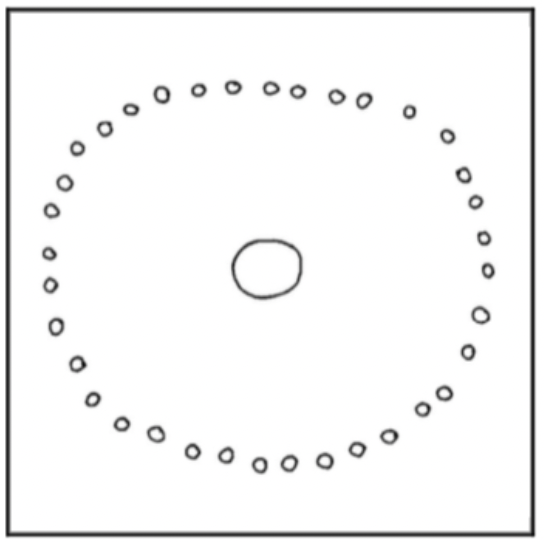
St Osmond . Osmington – Dial Diagram BSS
In all there are 36 holes that form an irregular circle flattened at the top. The ring of pocks is (unsurprisingly) not entirely accurate, as the diagram above (GLP; BSS) shows.
As for a noon line, I wonder if the short downward line of (apparent) small pocks, below and to the left of damaged area, mark noon. It’s not vertical, but the design of the dial and its position on the SW face of the buttress perhaps called for a slightly offset noon marker.
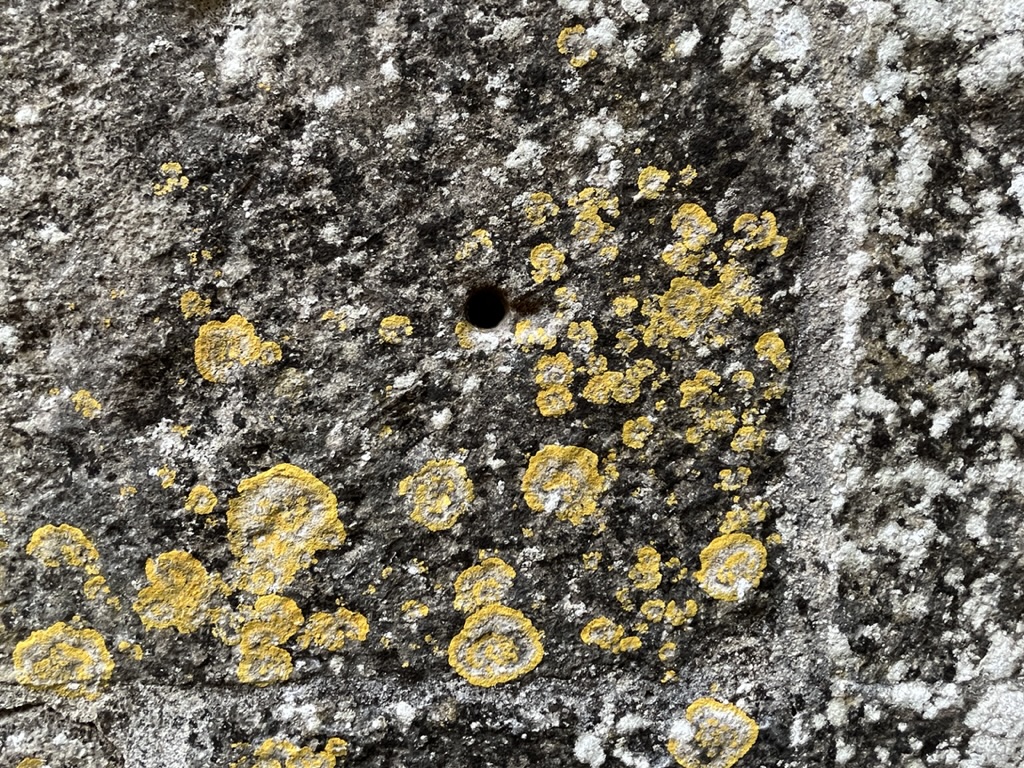
The gnomon hole has clearly been enlarged at some time, and sufficiently so to provide a modern home for small snails.
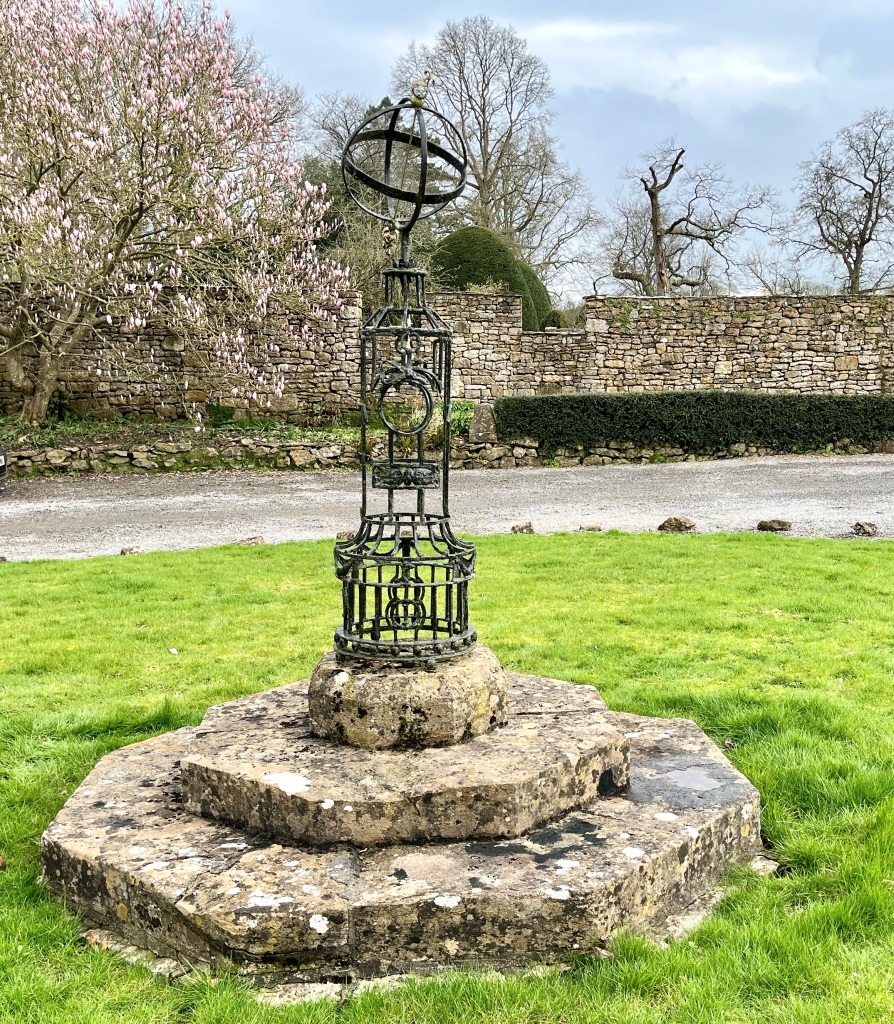
The entire contents of Sandford Orcas Manor, a fine example of country house Tudor, have been auctioned following 4 days of viewings. The sale has generated much interest and excitement both locally and well beyond. Such a complete disposal – even the family Bible (1702) was included – is quite rare. The house dates from mid C16 and has been in the same family for 300 years. It has a reputation for being ‘the most haunted house in England‘. The task of gathering statistics to support this proposition must have been a nightmare.
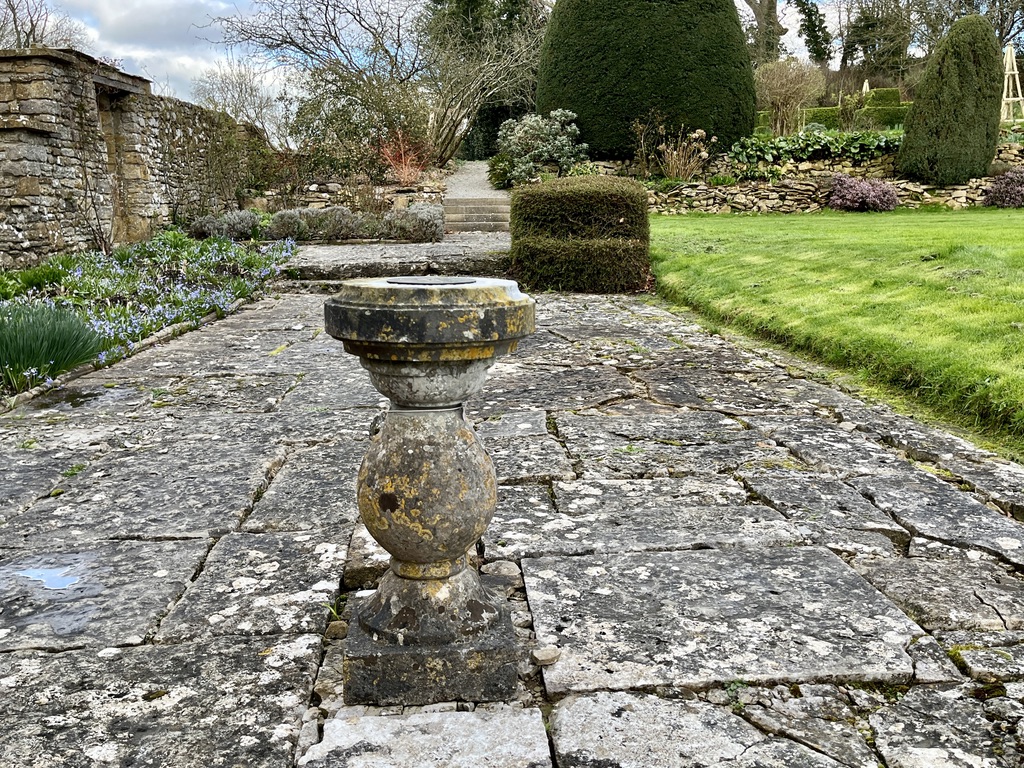
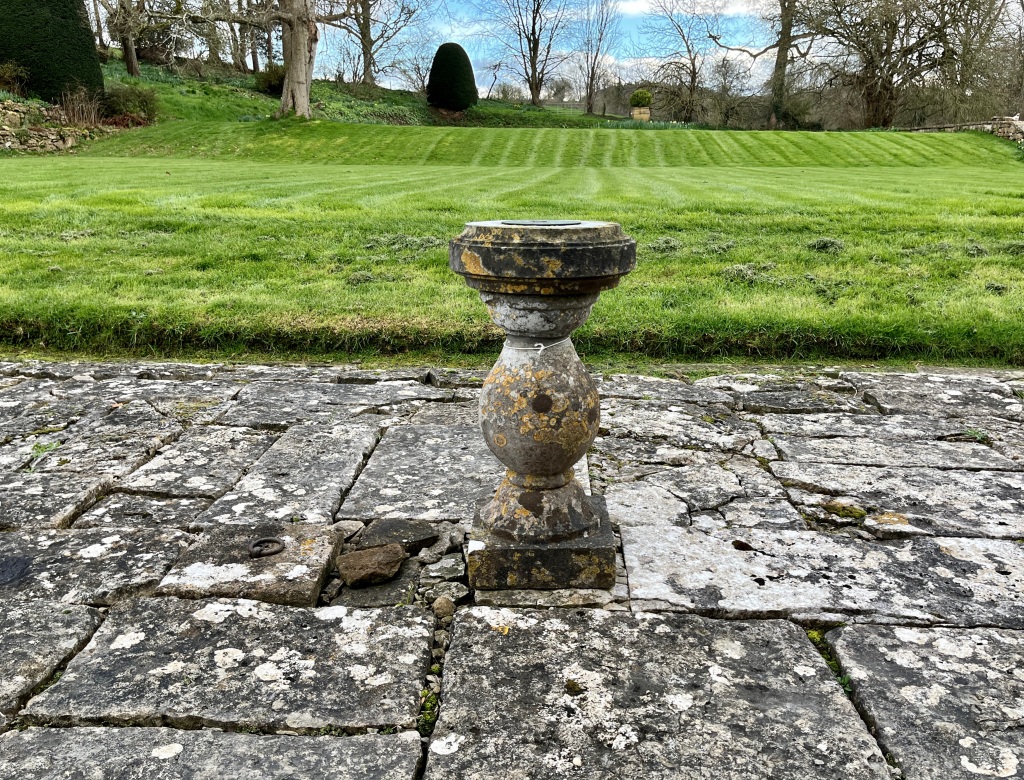
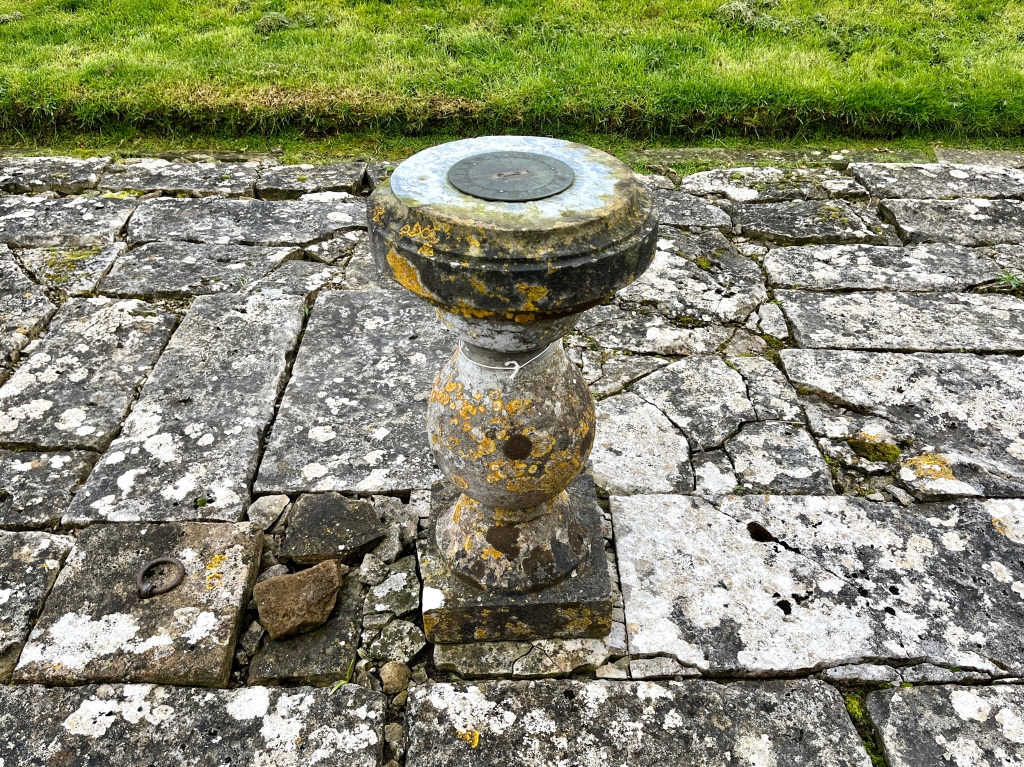
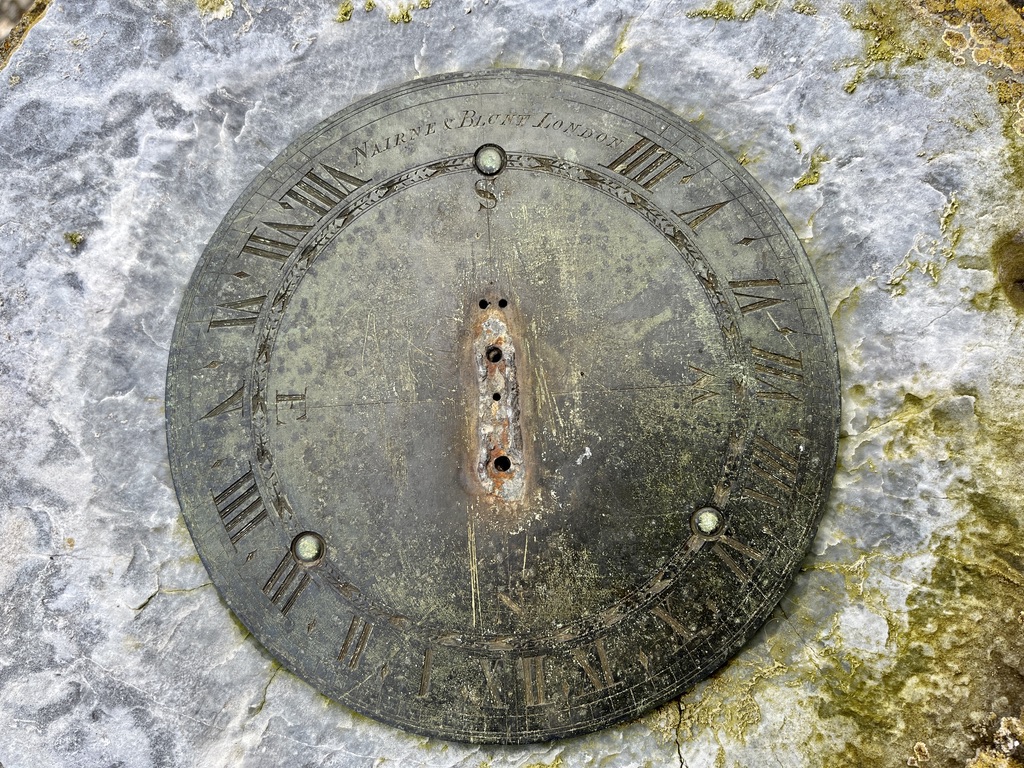
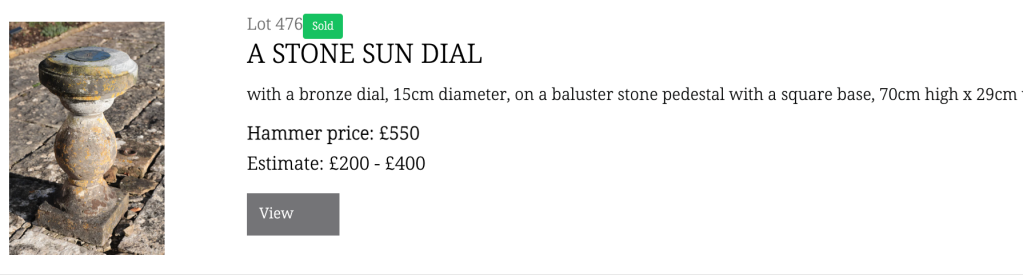
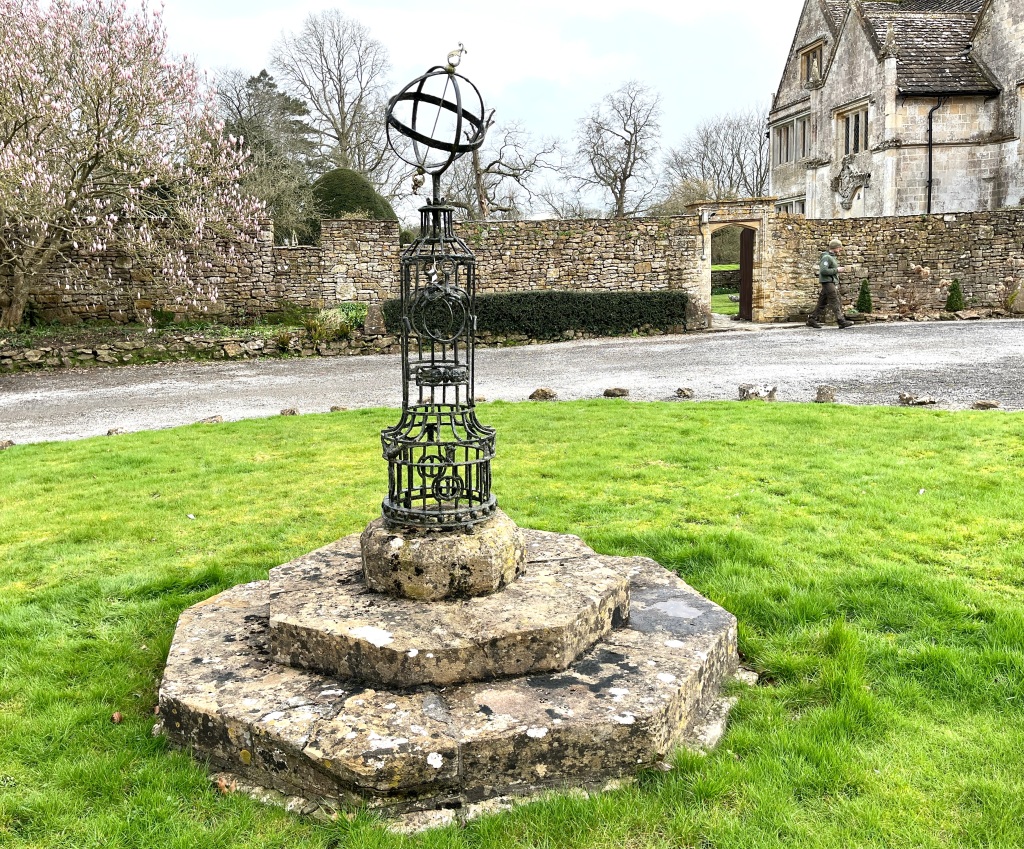
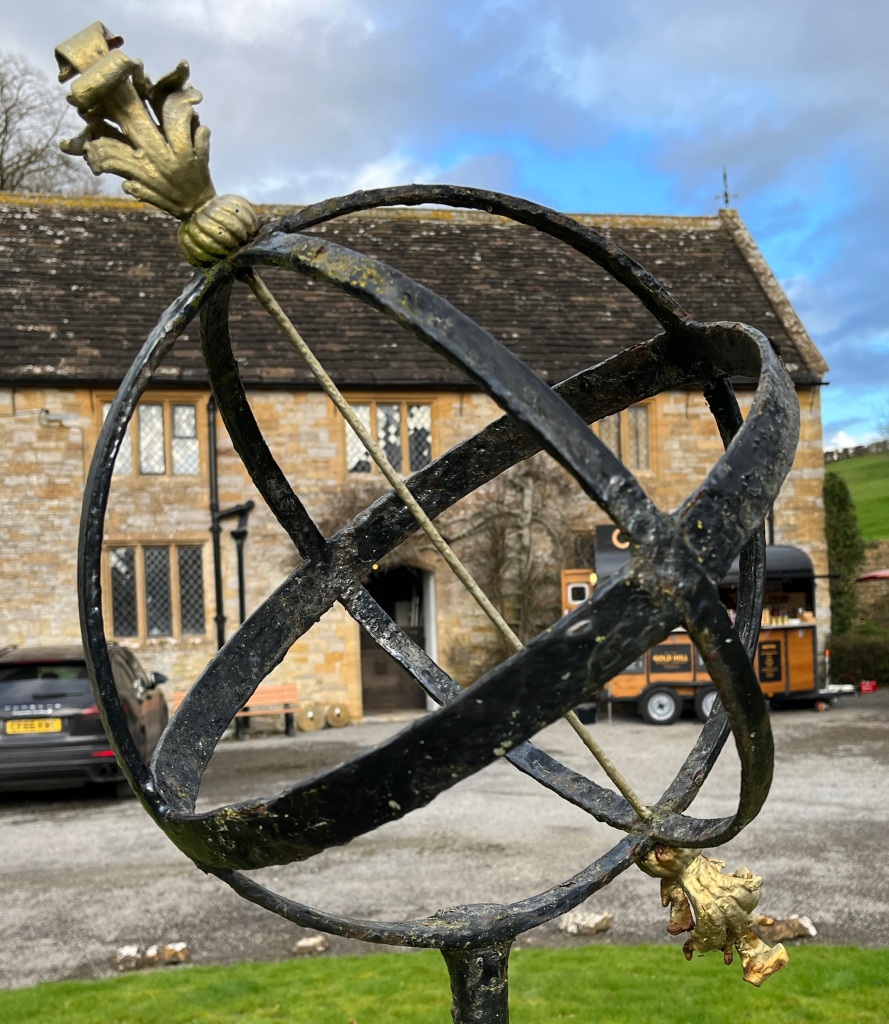
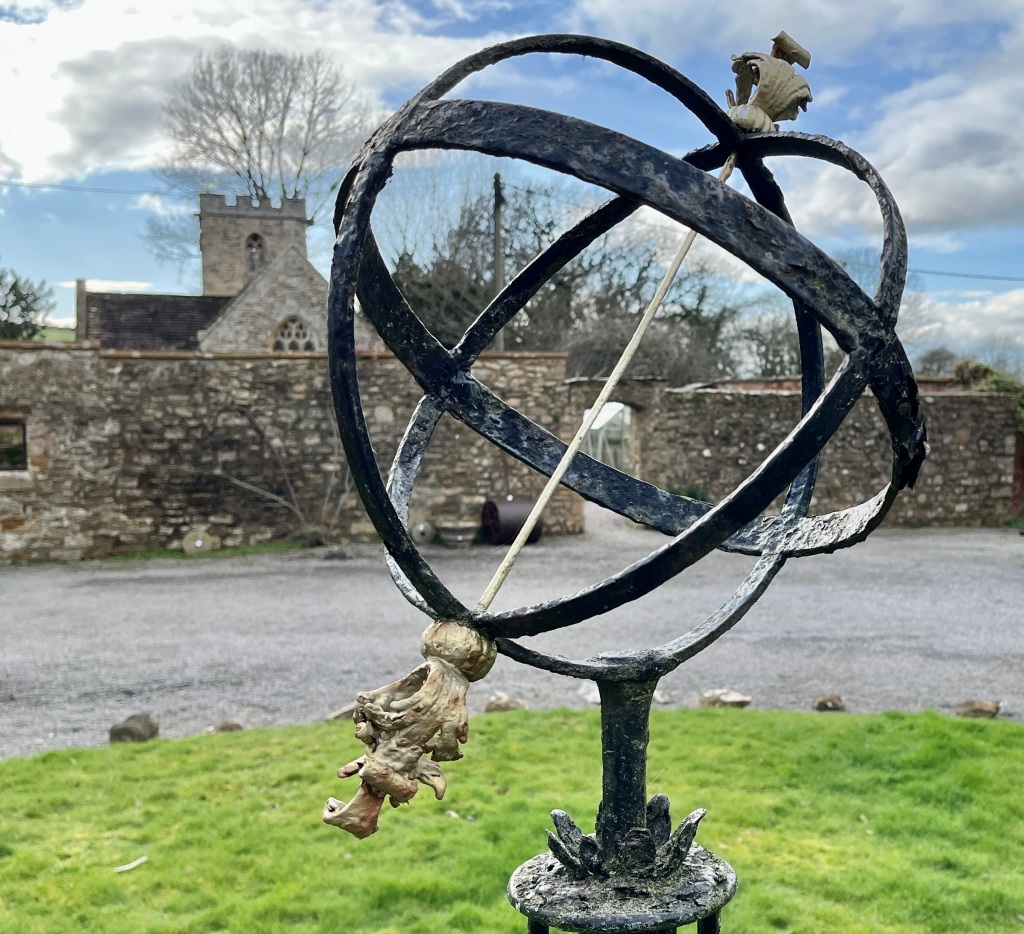
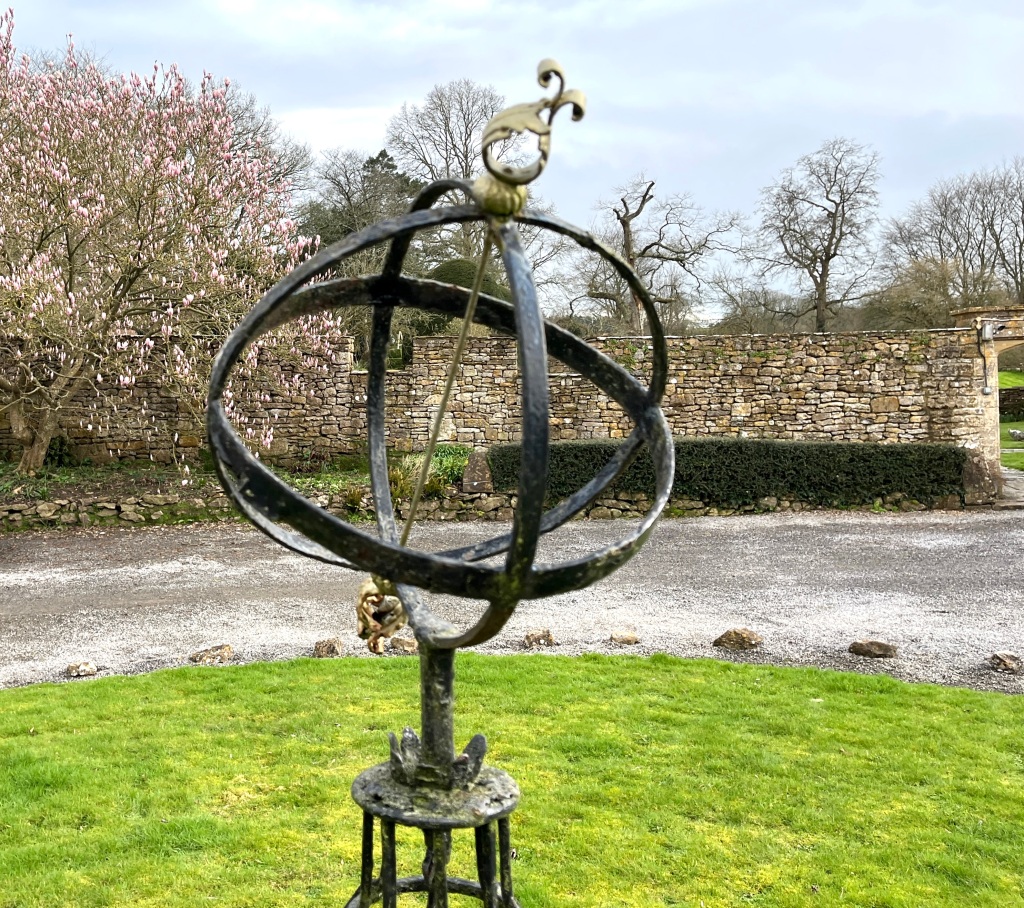
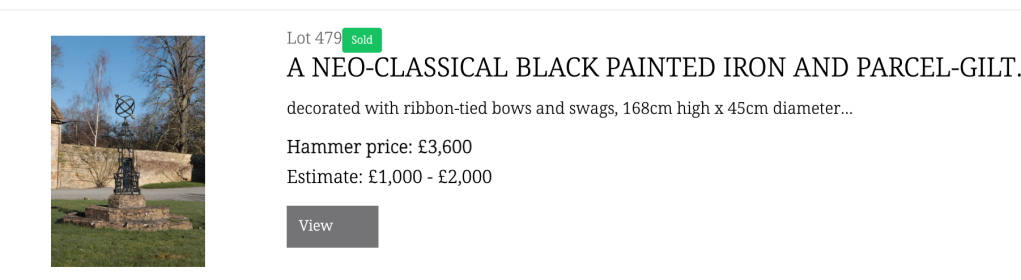
Two sundials were sold and are now removed from the property. One is a conventional garden dial, gnomon-less, on a baluster stone pedestal. The other is an armillary sphere grandly resting on a substantial triple plinth and supported by a tall ironwork obelisk.
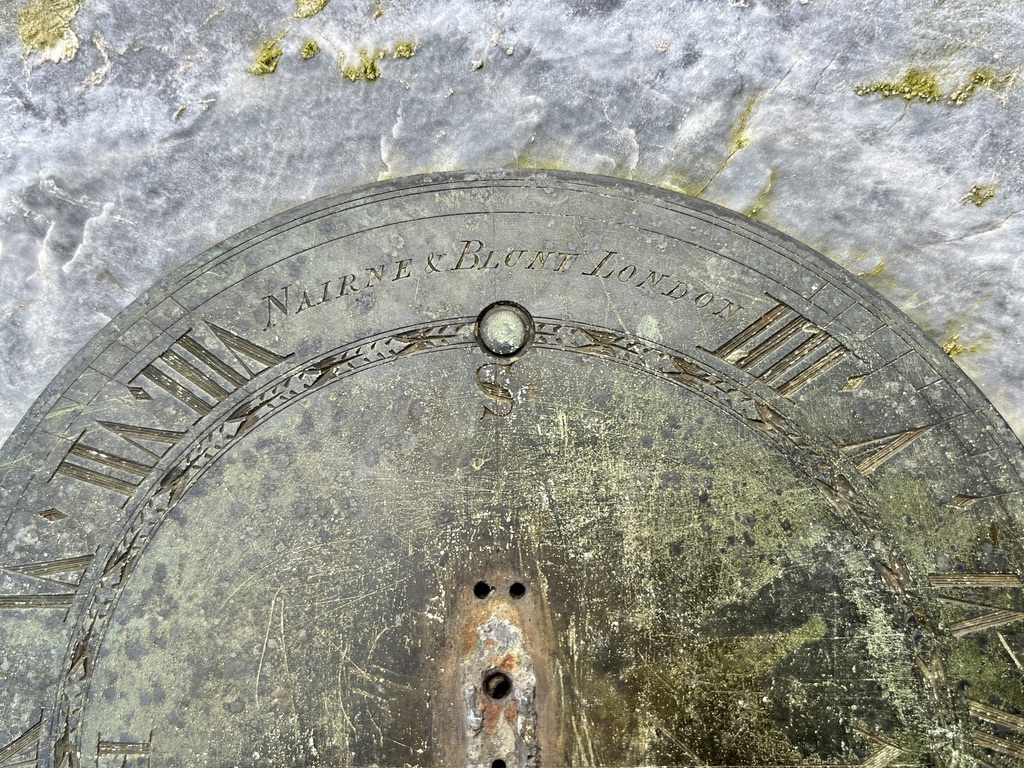
HORIZONTAL DIAL (C18) BY NAIRNE & BLUNT
Edward Nairne and Thomas Blunt established themselves in London as scientific instrument makers. They worked together between 1774 and 1793 and this dial must be from that period.
DEDICATION † ST ANDREW – C15, mid-C19 restoration; C13 font
LISTING † GRADE II*
LOCATION † 5 miles SW of Sherborne, a sprawling village set deep in farming country. Some fine old buildings dating from C16, now mixed in with modern housing. A fine village cross with C15 shaft. A friendly very rural place. No street lights. 50.8762 / -2.5445 / ST617086
In the early days of this site when I was researching scratch dials close to us in Dorset, I discovered that our own village church had one that was already recorded. It didn’t look very ‘dial-ish’ so I was pleased to find an authoritative drawing of it by GLP. My original post is HERE and see below for an image.
ST ANDREW . DIAL 2
The dial is semicircular, RHS of the porch, and just below Dial 1. The gnomon hole is in the mortar line, and plugged. The horizontal mortar line acts as a ‘6-to-6’ line, split by the vertical noon line. This is deeper incised than the three other visible lines.
East Stour is a small village 5m W of Shaftsbury, with the A30 dividing its church from the majority of its (potential) congregation. I had a good lunch in the pub as bell-ringing issues were being keenly discussed around me..
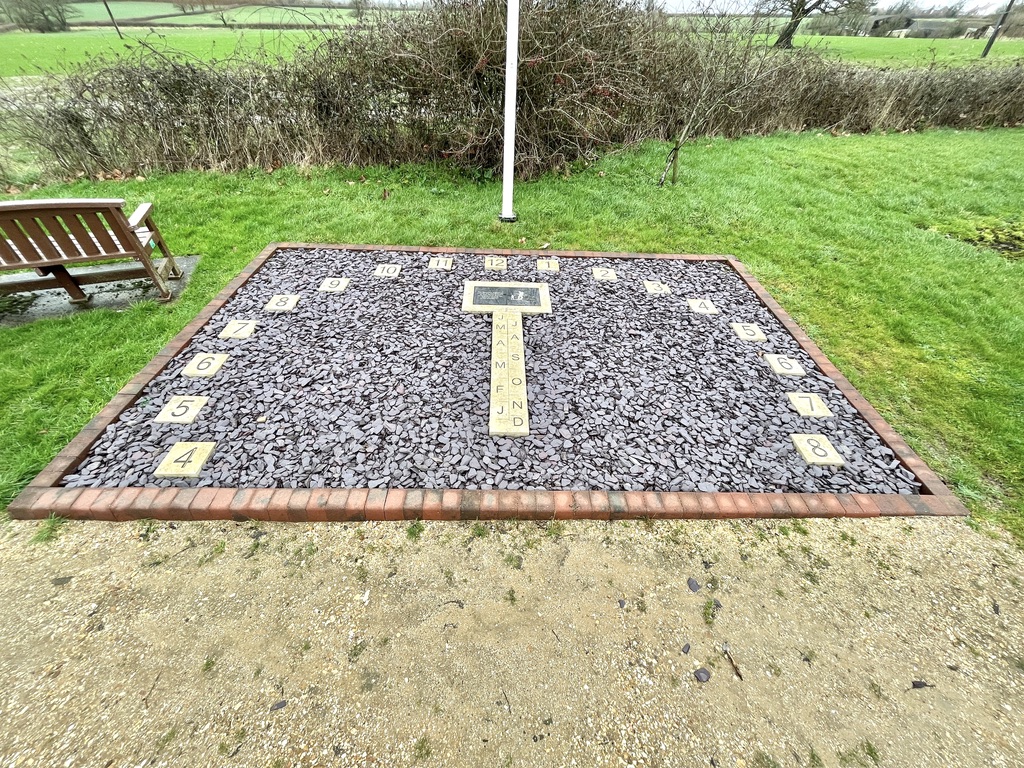
A short but perilous (no pavements) walk away is a very fine and beautifully designed analemmatic sundial in a small park by the Village Hall. It is a war memorial, and the dedication poignantly extends the commemoration to everyone from East Stour who has been affected by war.
BSS RECORD
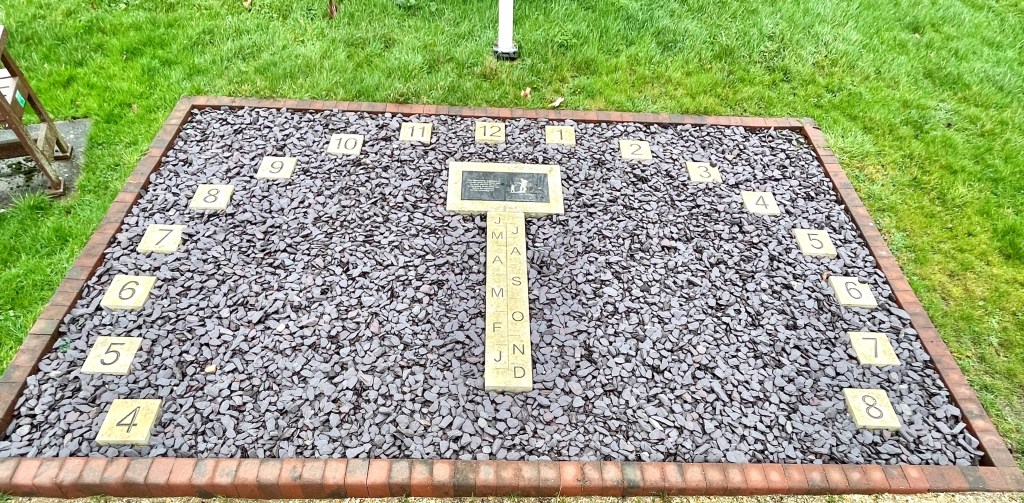
The dial is in the north corner of East Stour playing field. It is made from Portland stone and black granite with slate shingle infill. Granite tablet set into portland stone slab to N of date scale is all slightly canted and carries the laser-etched inscription: 4This Memorial is dedicated everyone from East Stour who has been affected by war. At the going down of the sun and in the morning, we will remember them.X To the right of the words is an etched image of a soldier, a child and three crosses. The dial shows Arabic hours for 5am to 8pm.
Delineation was by David Brown, content by Guy Gilding, letter-cutting and stone-laying by lan Viney of Stonemasons of Dorset Ltd, and groundwork by local builder.
GSS Category: Analemmatic Sundial; Memorial Sundial
GRADE II ✣ C12, C13, C16. Originally cruciform with crossing tower. Chancel arch blocked and west part of church partly dismantled 1868, gradual deterioration. Chancel used as a mortuary. Declared redundant 1970; now in the care of CCT. A surprising and rather poignant place to visit, all well worth examining. Note the bier. 3m SE of Warminster. 51.1728 / -2.1323 / ST908415
DIALS
St Leonard is a multi-dial church with 9 dials recorded by BSS (1994), of which some details are scant. Four are described only as ‘gnomon hole only’ / ‘cannot be classified’. Featured below are 8 designs that I have concluded are dials, or might be (if only doubtful) in a couple of cases.
DIAL 1
Dials 1 and 2 are together LHS of the Priest’s door
DIAL 2
DIAL 3
Hint of a circle, esp. ULQ
DIAL 4
A hint of a circle, esp ULQ
DIAL 5
Dial stone presumed to have been re-sited and rotated 90º
DIAL 6
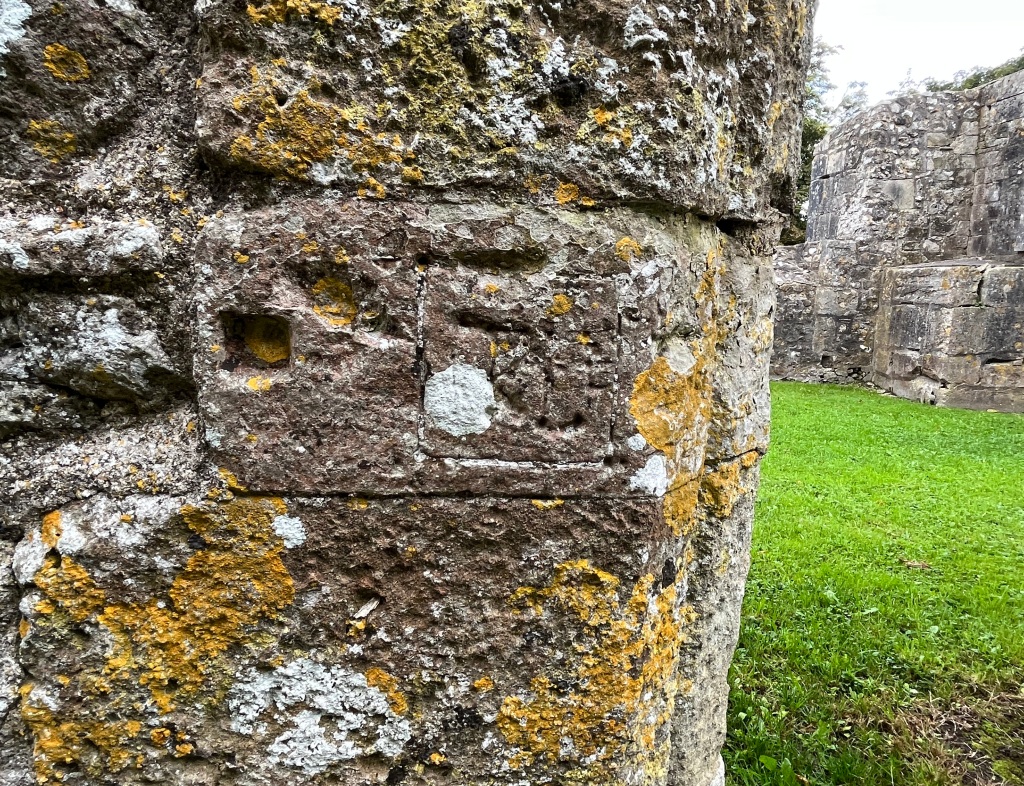
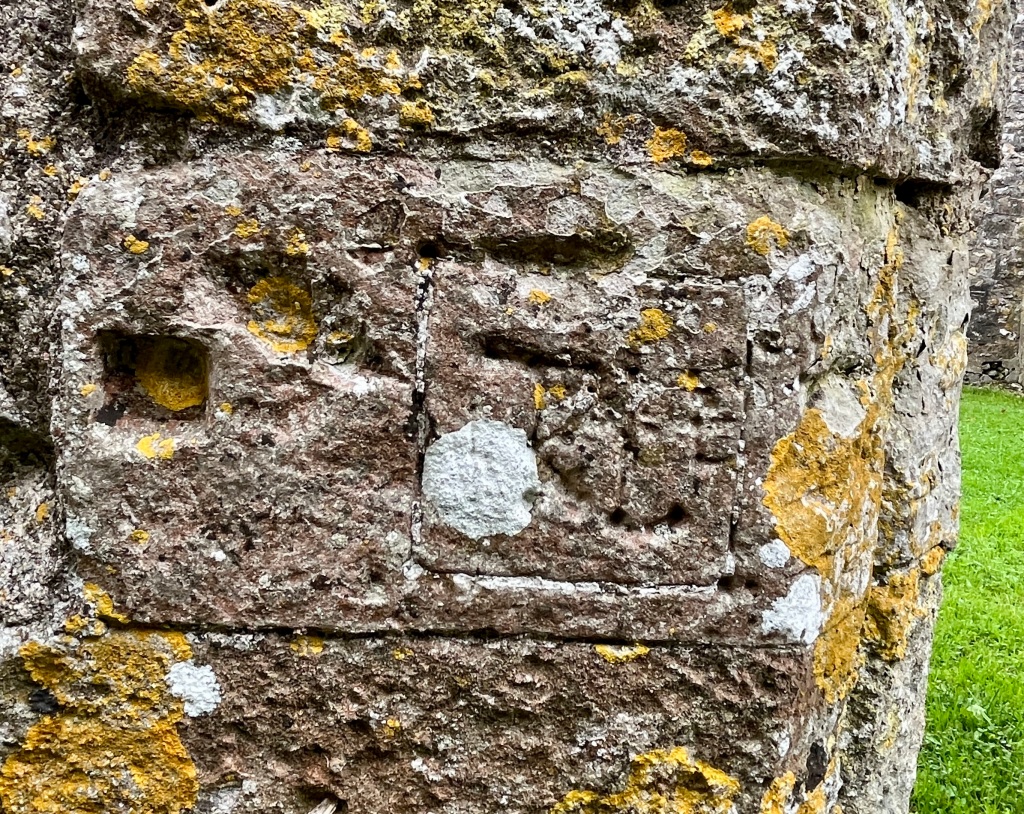
A remarkable dial within a square, with 2 large holes at bottom that appear to represent noon. It’s almost certainly unique. There’s mention of a Norman dial: perhaps this is it. There’s an apotropaic feel to it.
DIAL 7
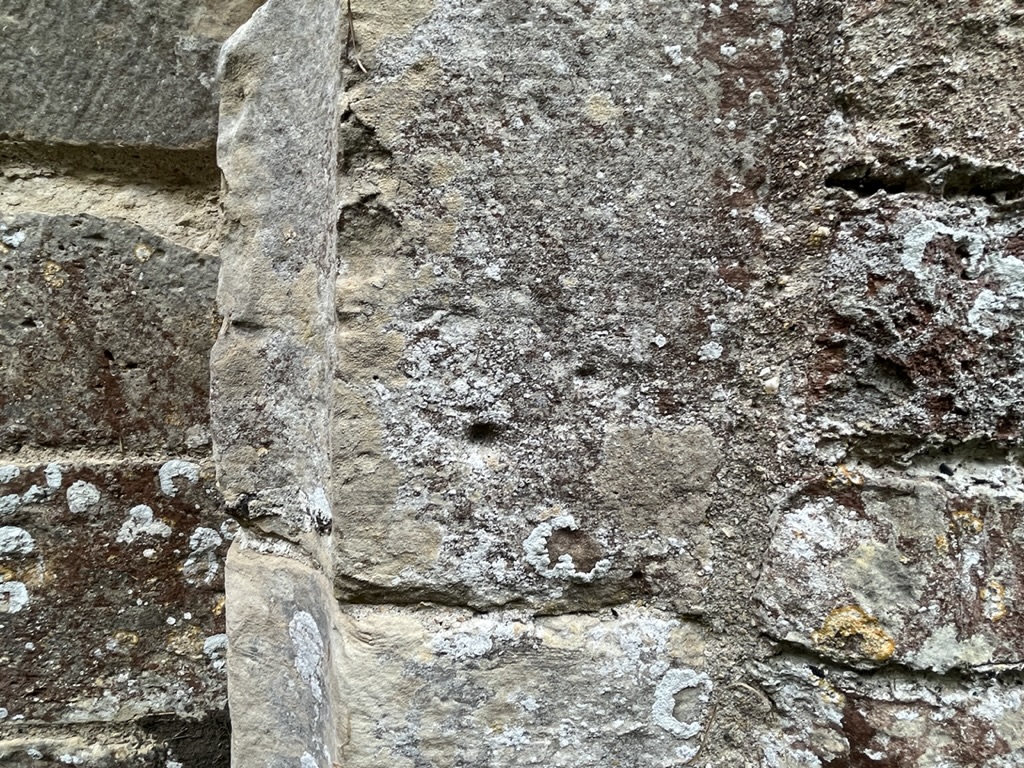
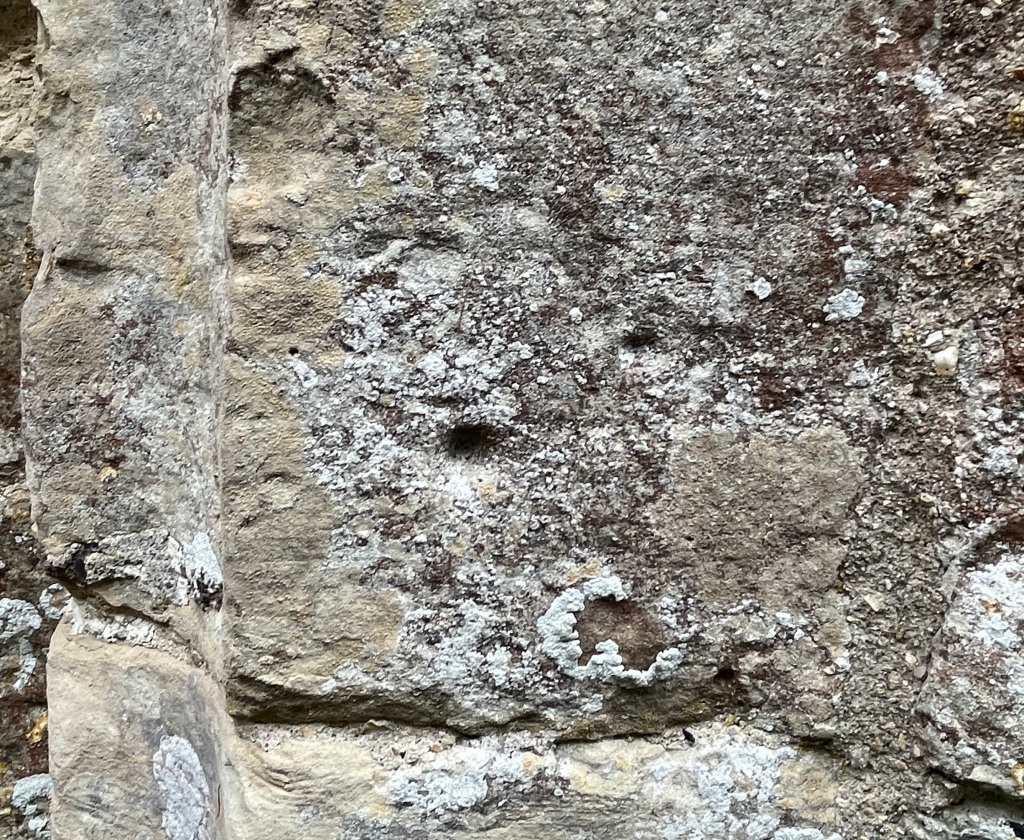
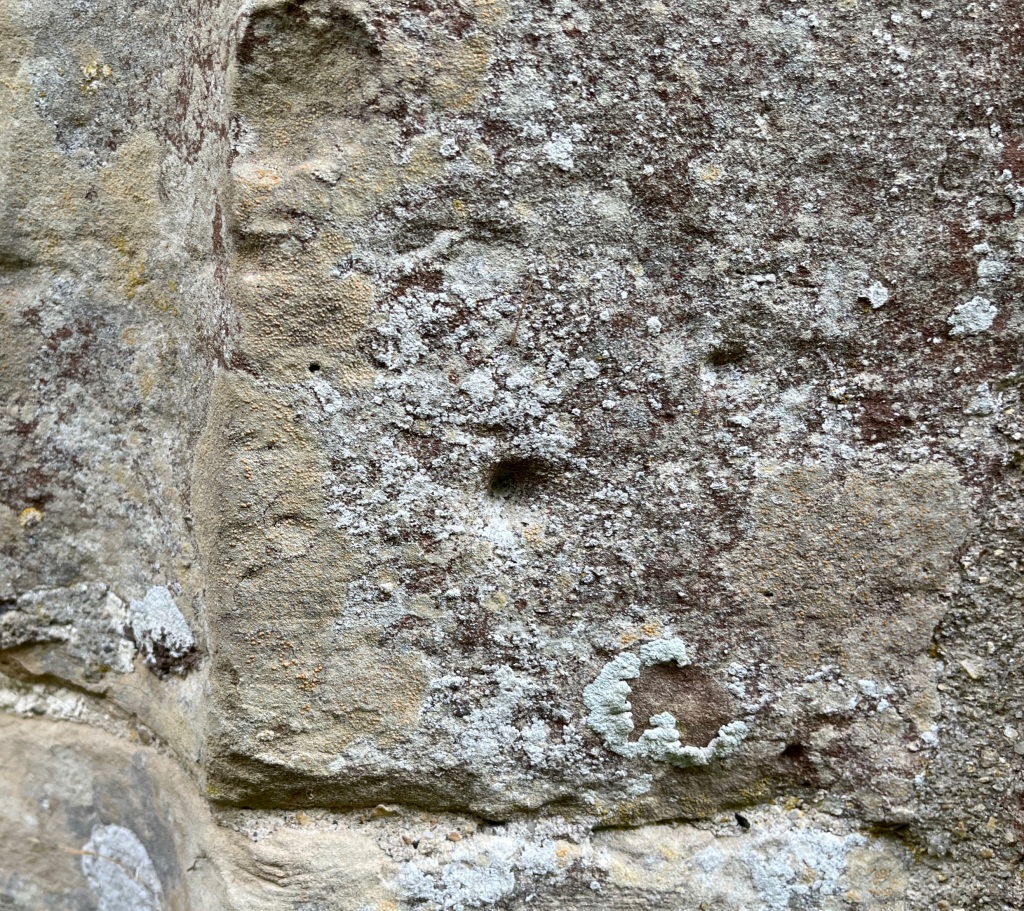
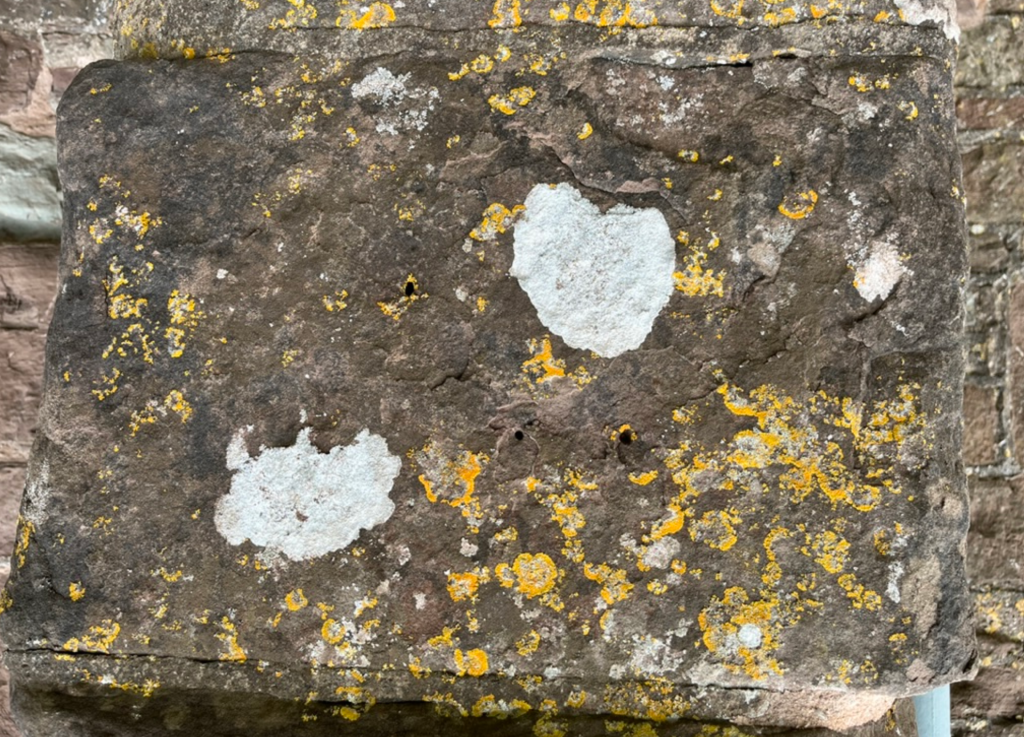
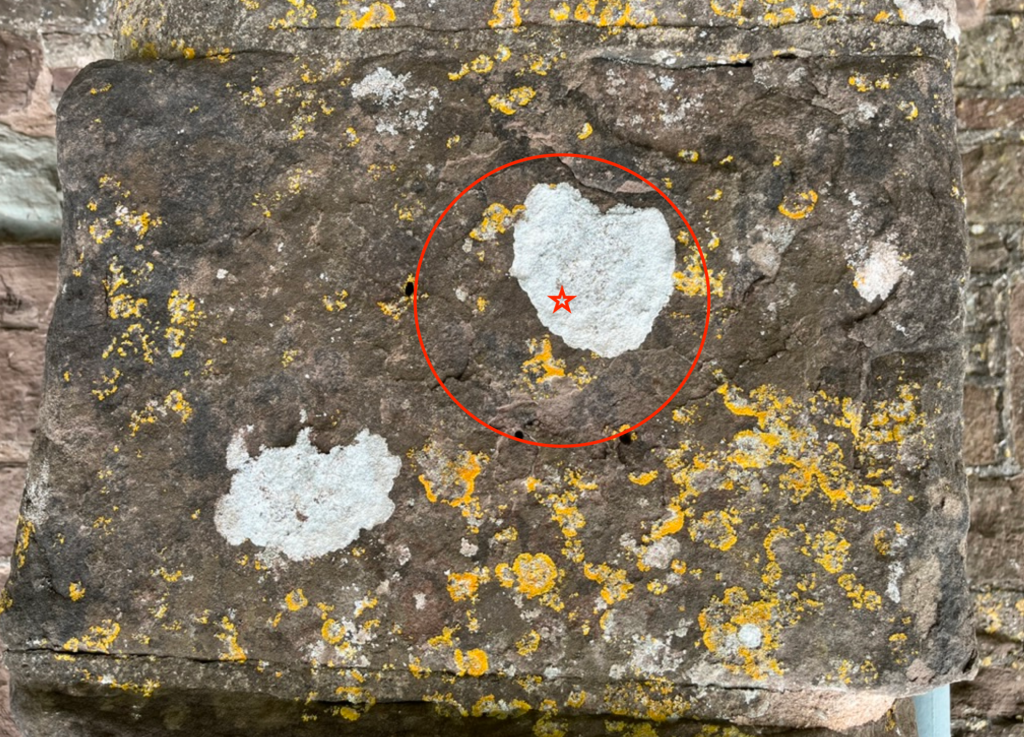
Nearly excluded from consideration. However the small holes are accurately on a circumference, and there’s the possibility of a small gnomon hole under the lichen. Borerline.
Probably not a dial but looks a bit more promising when rotated 90º. The pocks are (roughly) evenly spaced and there is a slight curve. No evident gnomon hole. Maybe simply a drilled design bored by a bored sacristan.
GRADE II ✣ A fine Norman church built late C11 (nave); chancel c1200; tower C13. Major restorations ±1900 (Ponting). An estimable entrance. Worthwhile (PEV) and (more graciously) one of Wiltshire’s most delightful churches (Betjeman). Lovely font; wall paintings; pilgrim crosses, protection marks & graffiti. 6m N of Salisbury. 51.1244 / -1.8301 / SU119361
All Saints also has a vertical dial which will feature separately
DIAL 1
Dial 1 is semicircular, located on the E buttress of the nave, close to the Priest’s door. It is in pleasingly good condition. Almost all lines of this 6-to-6 dial are visible, though much eroded RHS. The incisions are somewhat haphazard, and it is slightly odd that the most significant cut – the noon line – is so random.
DIALS WITHIN THE SOUTH PORCH
On entering the porch, the splendid door into the church itself invites immediate exploration inside. However, the porch conceals 3 scratch dials that a handful of people might like to investigate. There is scant reference to the scratch dials either side of the doorway. A dial LHS is recorded by BSS; one RHS is vaguely hinted at; another dial RHS is not noted anywhere that I can find, perhaps a new (modern) discovery.
DIAL 2
This dial is quite easy to find, half-concealed LHS but visible as one walks past. There are well defined lines, with the noon line probably the almost vertical one with a small pock at the end. I wondered if the straggly lines LRQ were later additions. Without them, the lines are all LLQ and (as with Dial 4 below) indicate mid-morning as the main part of the day for a service.
DIAL 3
Dial 3 is hidden away RHS of the fine door, even less accessible than dial 2. It is a fascinating example of a ’24 hour’ dial, with a full complement of spidery lines of random length of which almost all are still visible.
DIAL 4
Also RHS and even less visible is a conventional ‘morning’ dial, with 4 lines (the upper one is faint) leading down to the slightly deeper cut noon line. This configuration again suggests that mid-morning began the important part of the day for observance before noon.
If you want to know more about this church, in particular the inside, there is a good article HERE
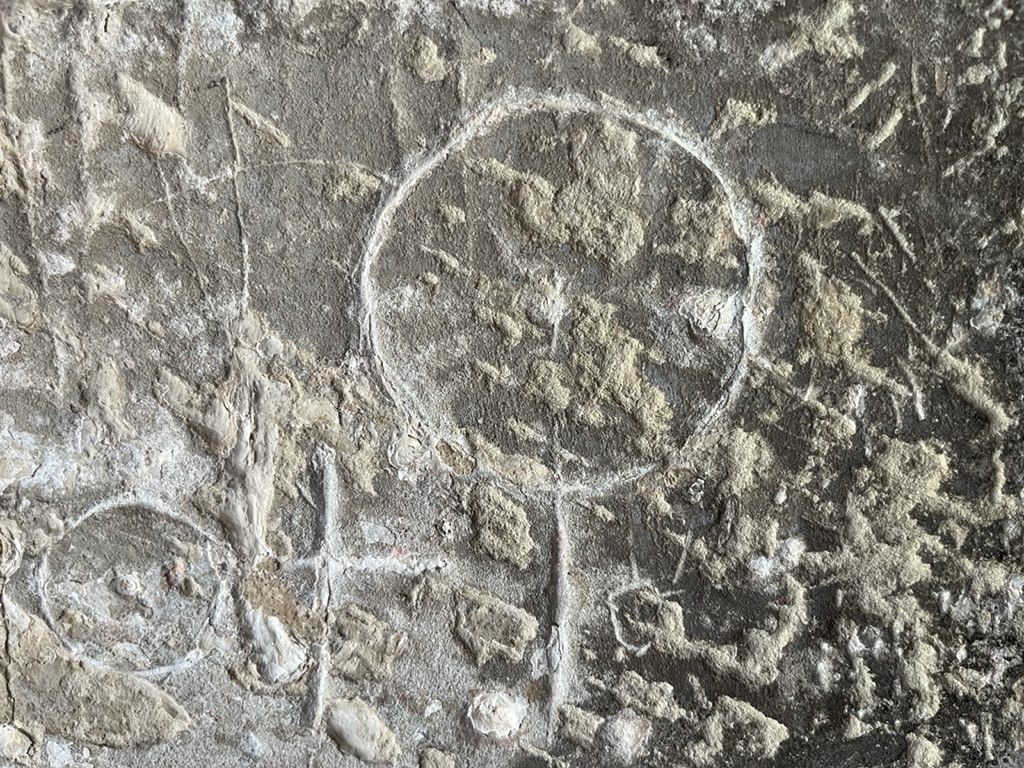
A selection of church marks in the porch. The 2 compass-drawn circles are not dials but [probably] ‘demon traps’. In superstitious medieval times it was believed that evil could be prevented from entering the holy building with protection marks. In this type, evil would become trapped within the never-ending circle. The VV and the M on the wooden door are Marian marks standing for the Virgin Mary, who bars entry to the church by evil.
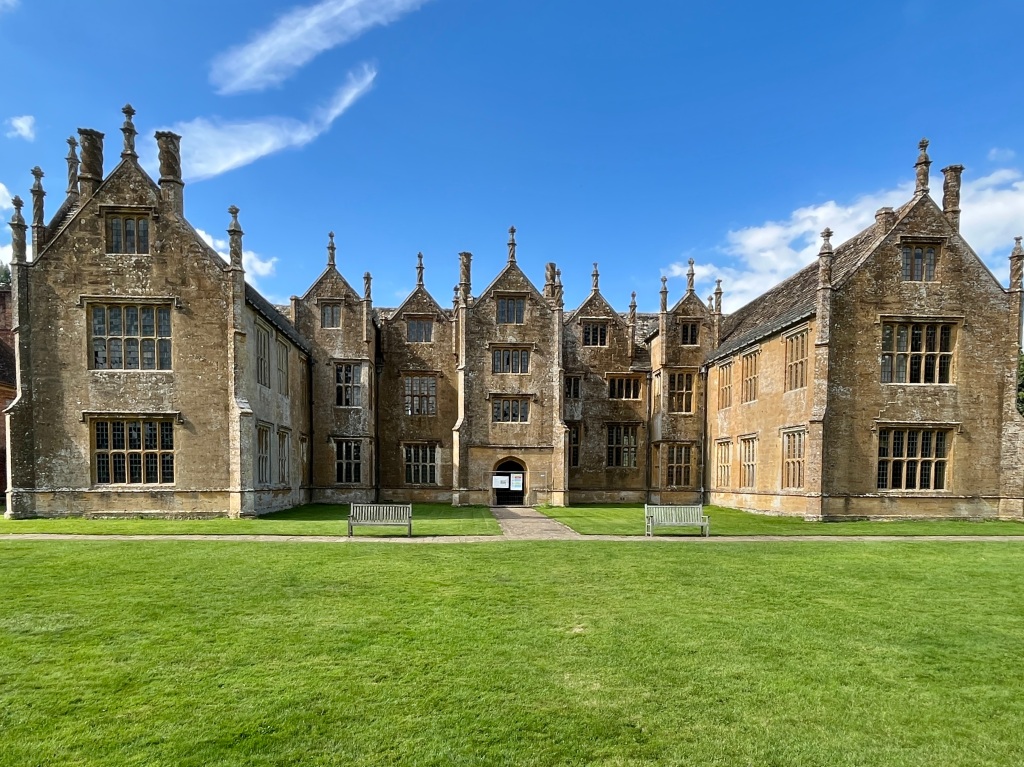
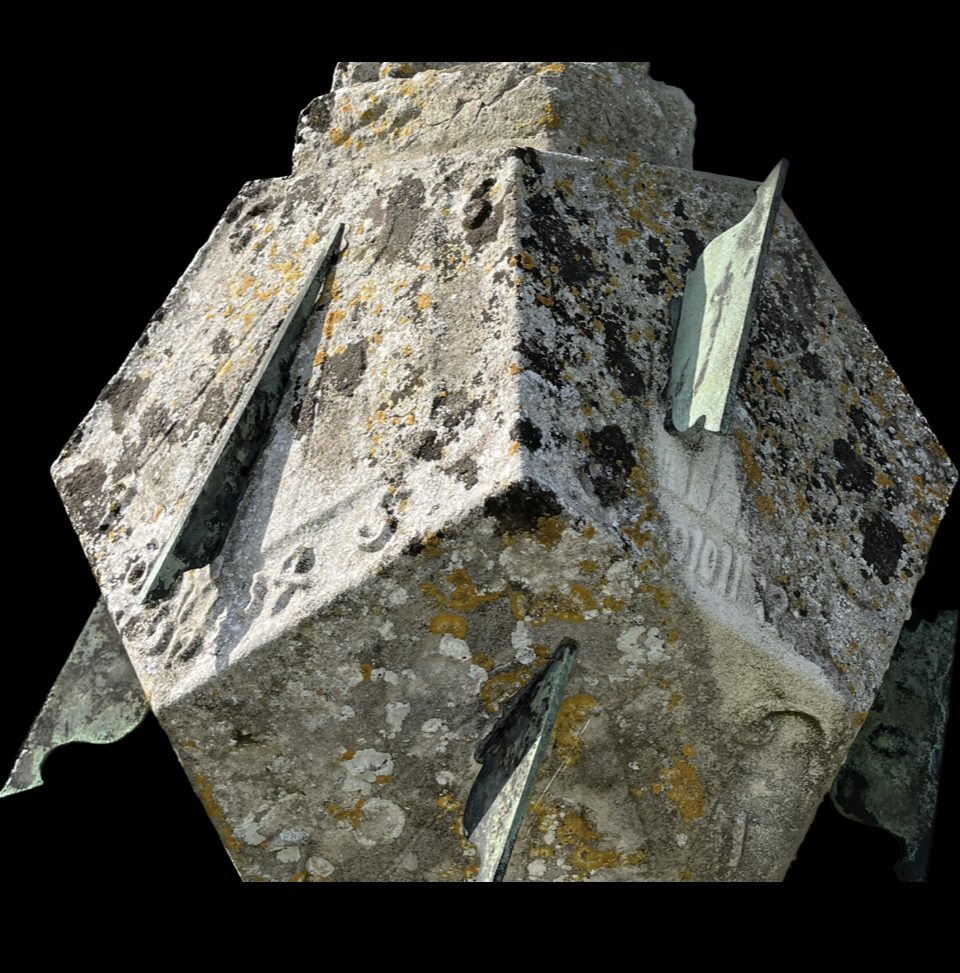
Barrington Court is a fine county house near Ilminster in Somerset, now in the care of NT. There is wonderful multi-faceted dodecahedral pillar dial in front of the house that I have written about HERE.
✣
Barrington Court . Som . Horizontal Dial
✣
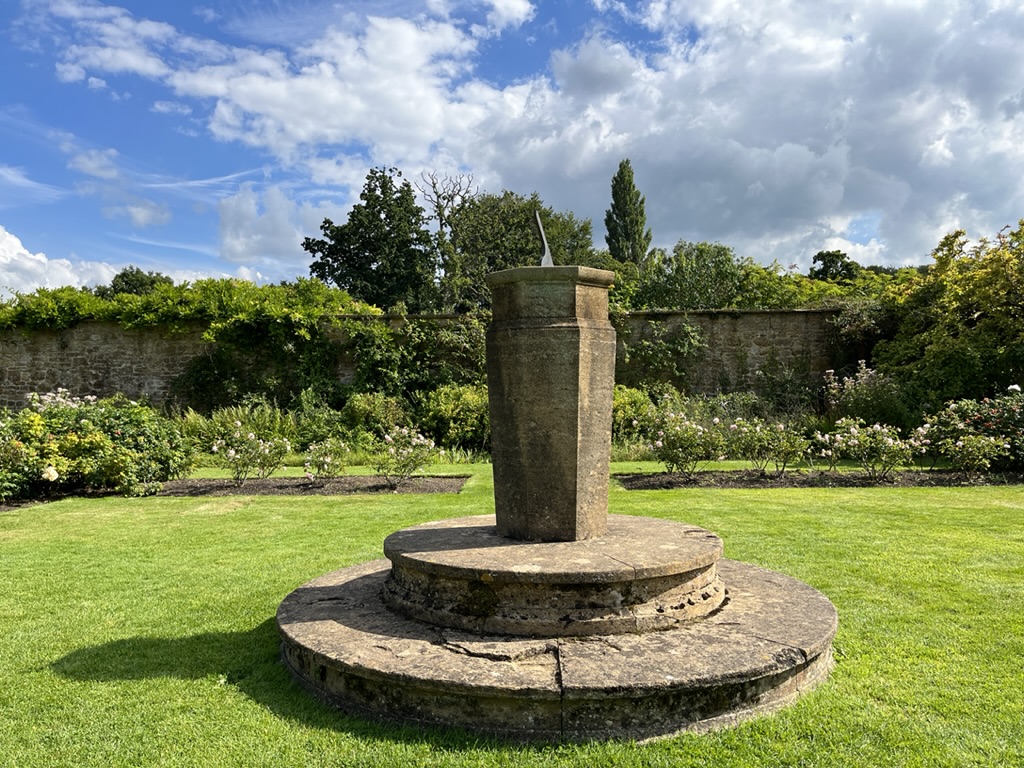
ROSE GARDEN DIAL
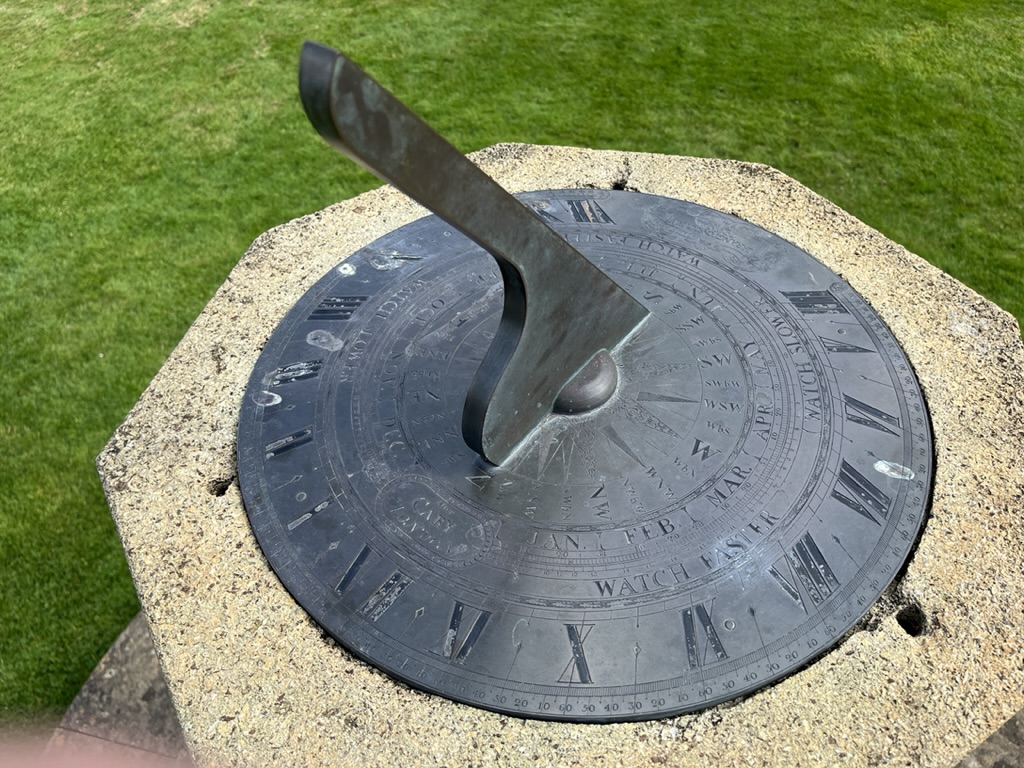
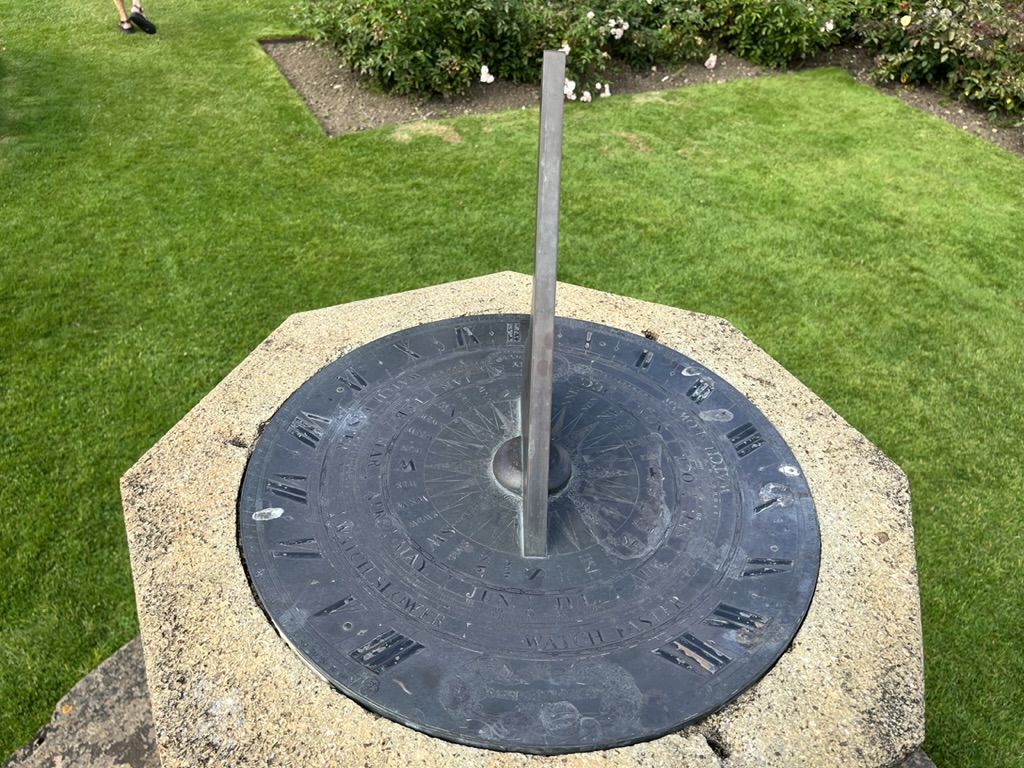
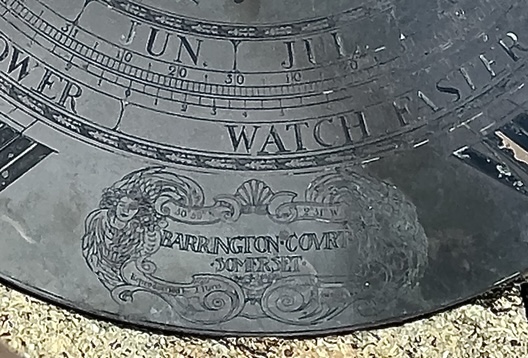
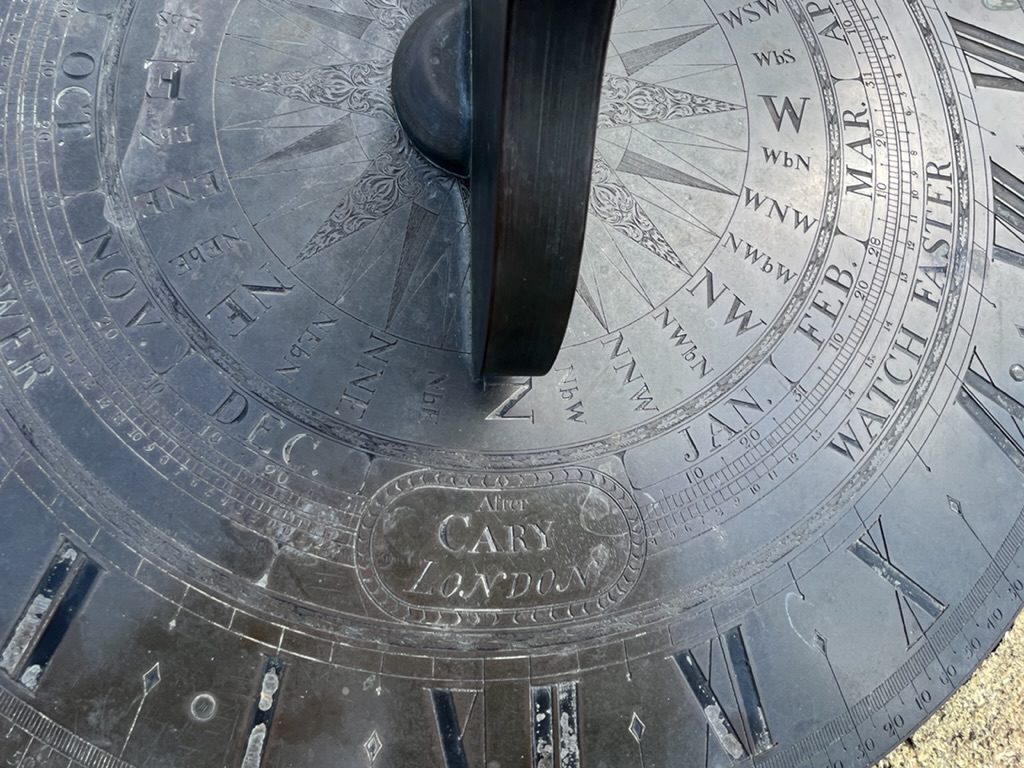
The sturdy horizontal pedestal dial stands on a double plinth in the centre of the large rose and iris garden. It has a sad recent history. In Spring 2000 the original C19 bronze dial plate by Carey was levered off and stolen. It has never been recovered.
Barrington Court . Som . Horizontal Dial after theft of plate in 2000
✣
On the bright side, a wonderful faithful reproduction by John Davis was installed in 2013, and the dial is restored to its glory for the future.
Barrington Court . Som . Horizontal Dial
✣
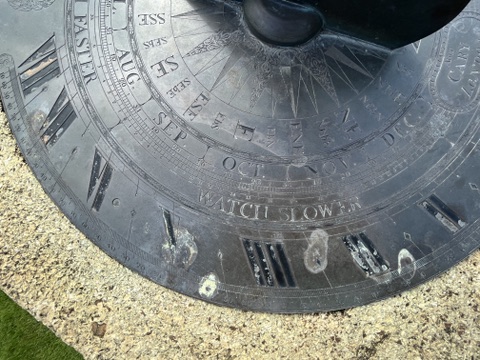
It is described as an attractive horizontal dial of some complexity. The Equation of Time scale is engraved around the dial; all points of compass are shown; and it has one minute time marks BSS. These complex features can be seen clearly in the final image below.
✣
Barrington Court . Som . Horizontal Dial
GSS Category: Horizontal Dial; Pedestal Dial
All photos: Keith Salvesen except NT / Simon Harris above
St Margaret & St Andrew . Littleham . Devon – Robert Cornford OS / CC
ST MARGARET & ST ANDREW . LITTLEHAM-cum-EXMOUTH . DEVON
GRADE II* ✣ Recorded from 1139; present building has C13 origins (chancel); 14th-century arcades; then Perpendicular with subsequent rebuilding and C19 restorations (Fulford). Resting place of Viscountess Nelson.
I have not visited the church myself, but Ian Logan contacted me about the vertical dial on the apex of the church porch. I have written this post around the dial, however Ian has produced an excellent detailed description of the church and its history that I highly commend.
St Margaret & St Andrew . Littleham . Devon – Ian Logan
St Margaret & St Andrew . Littleham . Devon
BSS record: A stone dial, rather crude in execution and in poor condition, is mounted on the church porch. It is about 600mm square and shows the hours VI – Vl undivided. Although the numerals look as though they are aligned with the hour lines, the hour lines themselves have disappeared. The church leaflet says that the dial dates from 1780.
St Margaret & St Andrew . Littleham . Devon
SCRATCH DIAL
There is an older dial – a scratch dial – on the right hand side of the porch doorway, probably C15. It is in poor condition, but there are 7 discernible lines radiating from the gnomon hole in the dial stone. These are two quite old photos of the dial (BSS). If anyone can provide a clear recent photo, it would be very welcome as an addition!
The ‘dawn’ line is now a prominent cleft in the damaged dial stone. The cluster of lines at and beyond noon LRQ indicate the most important part of the day for observance (none in canonical terms).
St Margaret & St Andrew . Littleham . Devon – Scratch Dial
MRS CROWLEY
This is an ideal place to use the wonderful drawing skills of Mrs Crowley to illustrate the vertical dial and scratch dial together. I have managed to obtain a copy of the comprehensive book of her Devon and Cornwall dial drawings, a work of wonder for dial-ologists.
GSS Category: Vertical Dial (1780); Scratch Dial
Credits: Keith Salvesen (photos); Ian Logan (photo, research); The Parish History Group (interesting and informative leaflet)
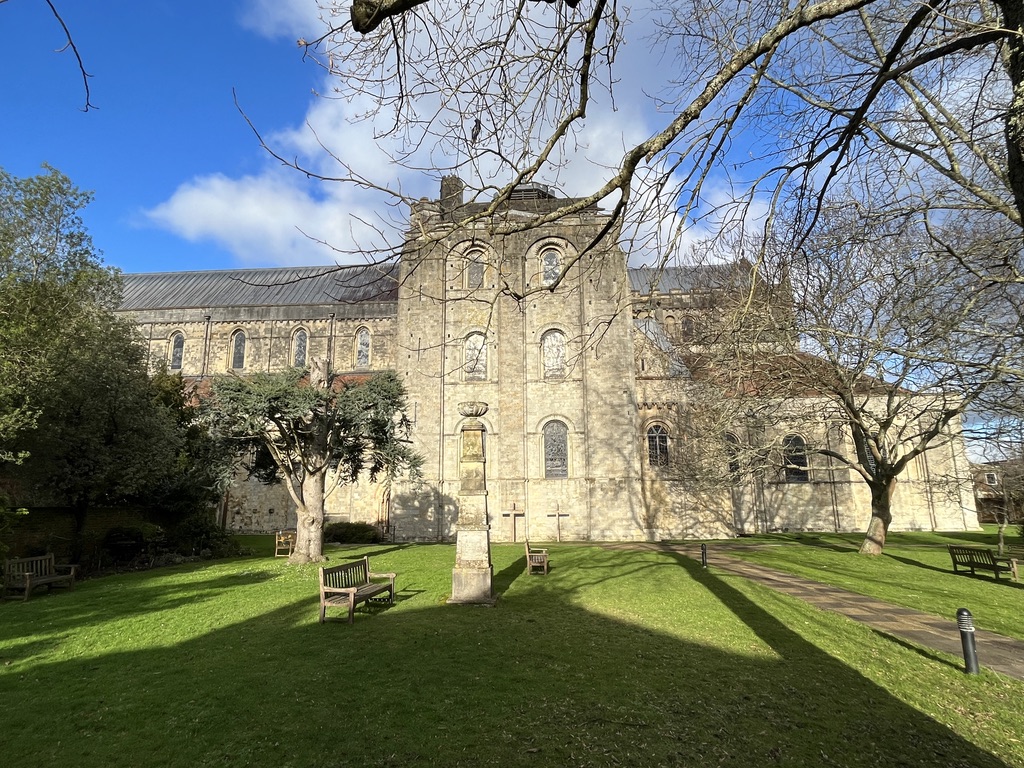
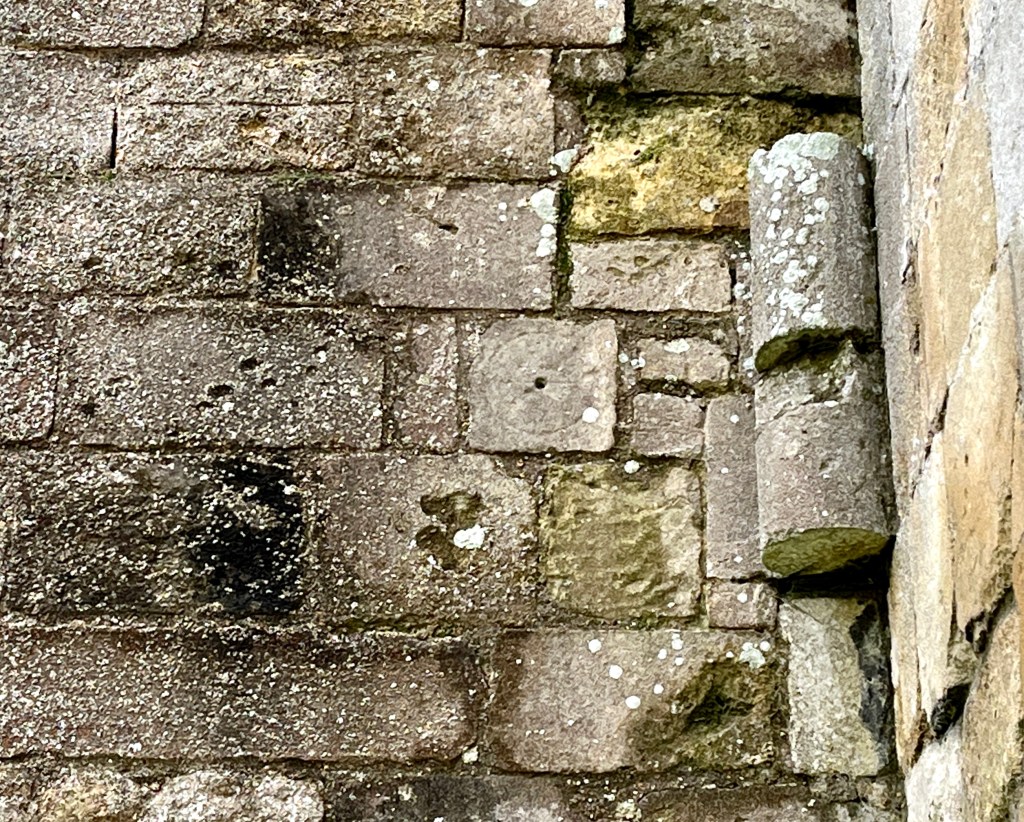
In a format variation, I will side-step the usual scene-setting para. In comparison with its host building, the somewhat elusive scratch-dial is an infinitesimal part. It is quite rare, I think, to find a scratch dial on a cathedral, abbey, or other major church building. Romsey has one that would be easily overlooked without clues. Next time I’m in Romsey I’ll take a proper camera on a sunny day.
DIAL
The dial is at the E end of the Abbey, inverted on the N face of the S buttress about 4 meters high.
The BSS record describes it as Accurately cut or made. Repositioned, eroded, damaged. Rudimentary (Norman) dial. Probably inverted (faint line and pock URQ. Too high for measurement.
GSS Category: Scratch Dial; Mass Dial; Norman Mass Dial
GRADE II ✣ C12, C15; T.H.Wyatt restoration 1845. A fine church by the R. Avon, with plenty of interest. Focus here is on the splendid C12 inner doorway of the porch with nook shafts and scalloped capitals, and an outer order of arch lozenges, inner of horizontal chevronsBHO. See below for Church History. 5m N of Salisbury. 51.1244 / -1.8301 / SU119361
SCRATCH DIALS
DIAL 1
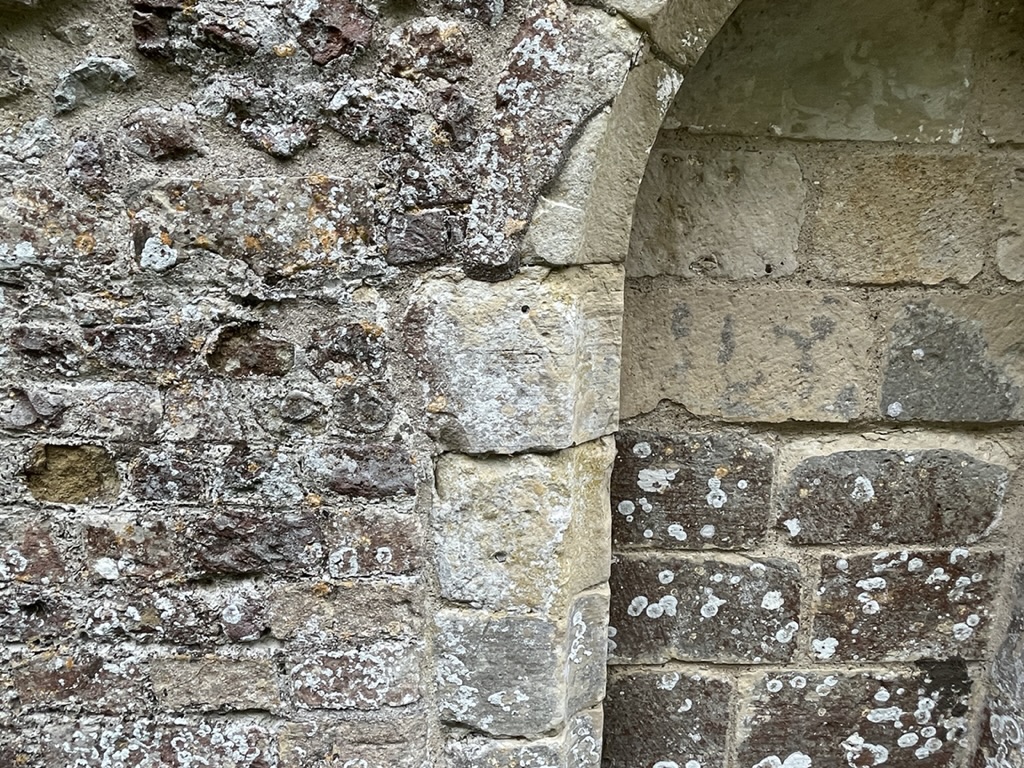
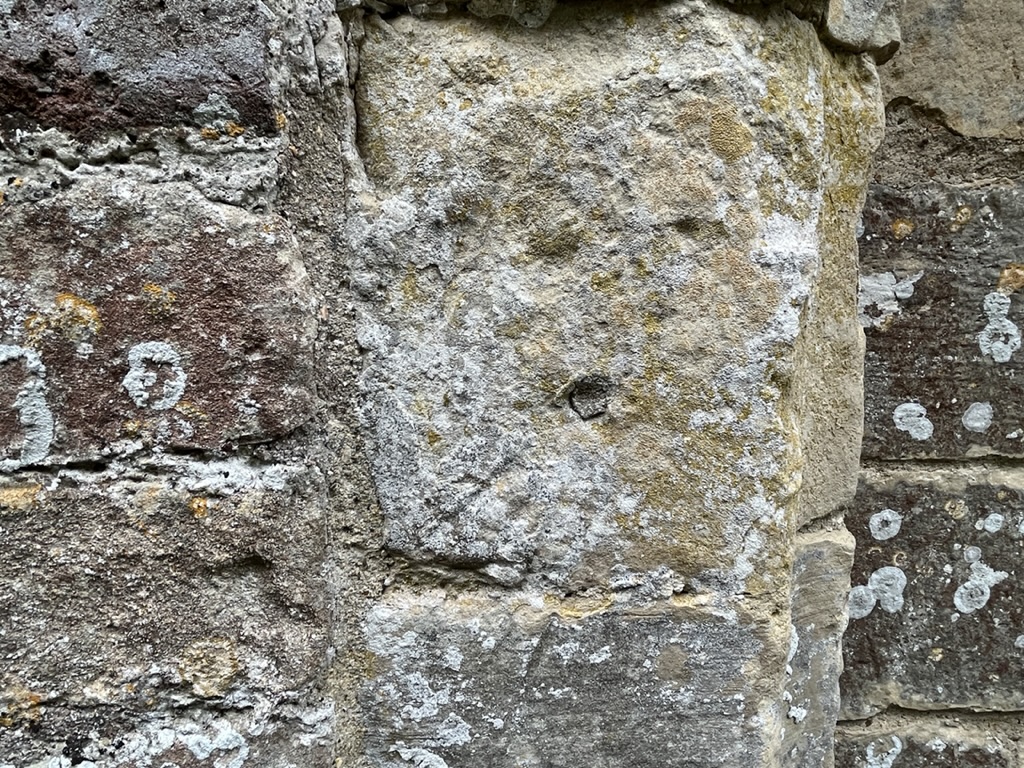
Dial 1 is by the capital LHS of the door, and quite easy to overlook. Weathered and damaged, with 3 lines visible within what remains of a double circle. Filled gnomon hole.
DIAL 2
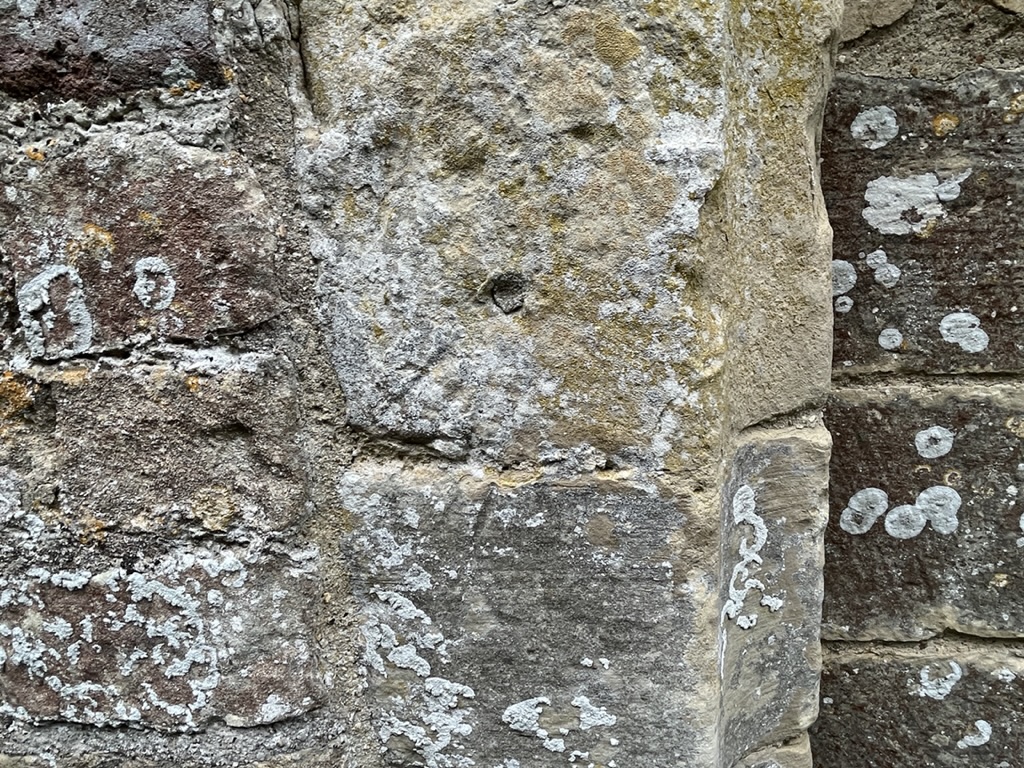
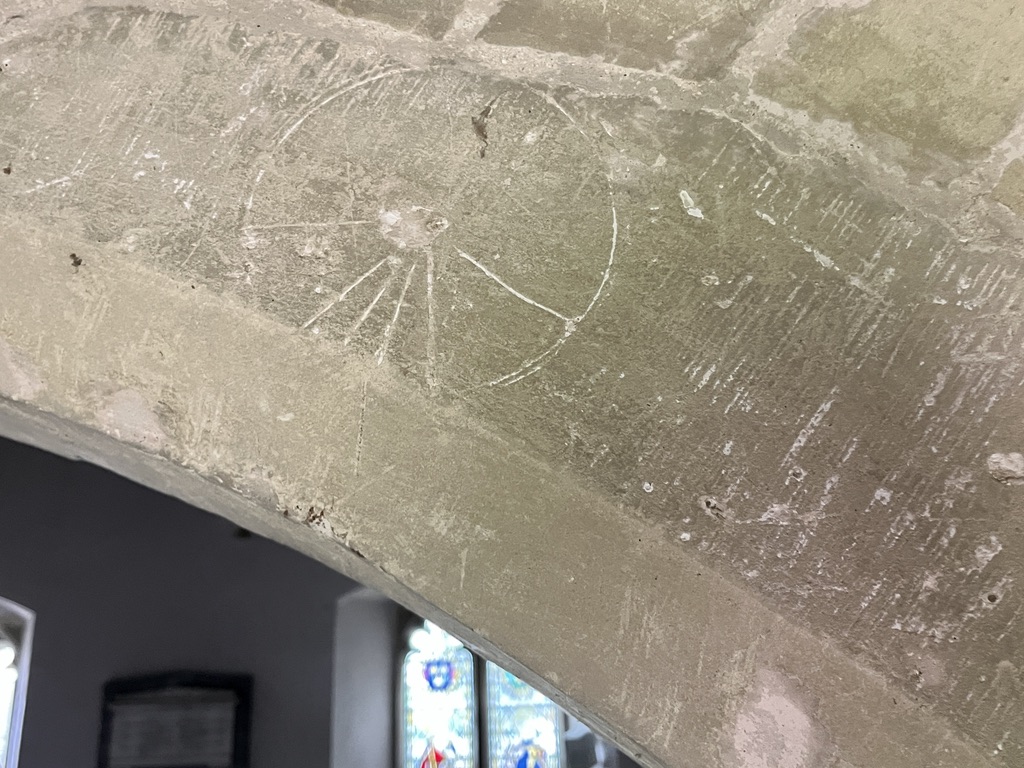
Dial 2 is RHS on the arch of the doorway, and much easier to read. A morning dial with 4 clear lines from 9 (terce) to noon, and another fainter line earlier. The random line LRQ was evidently added some time later. Filled gnomon hole and remnants of a narrow double circle, as with dial 1. Perhaps this dial was cut as a replacement for dial 1 which certainly seems earlier; they could hardly be contemporary.
DIALS 1 AND 2
CHURCH HISTORY
VERTICAL DIAL (CHANCEL BUTTRESS)
The dial is on a south buttress. Motto across the top in angular lettering reads: ‘Tempus Fugit’. Upright Arabic numerals – 10, 11, 12, 1, 2, 3, 4, 5 and 6 still just visible. Divided to 5 mins? Three-dot half hours (remnants of fleur-de-lys? Square frame with wide border, inset into stone of second buttress RHS of south porch. Needs restoring soon if it is to be saved. Would have been quite a good dial originally BSS
The most recent report was in 2005. Given the details mentioned above, the prediction of further deterioration has sadly come to pass.
GSS Category: Scratch Dial; Scratch Dial within porch; Vertical Dial


































 GAUDIUM SUB SOLE . SUNDIALS . MEDIEVAL TO MODERN