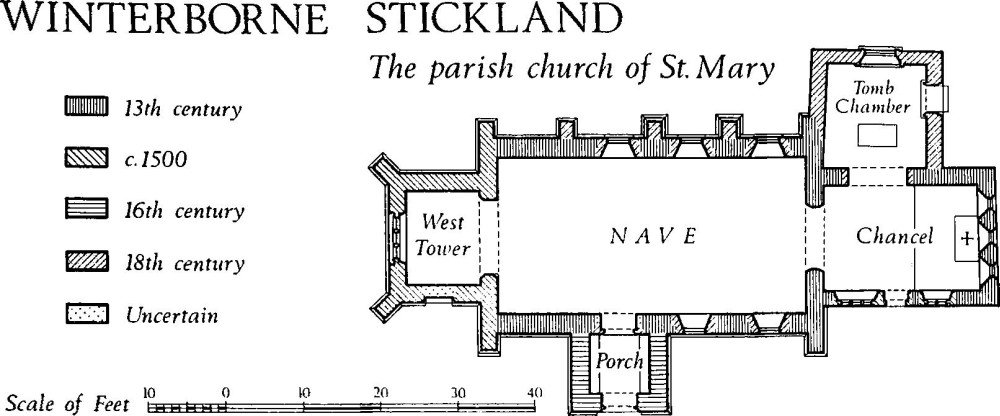
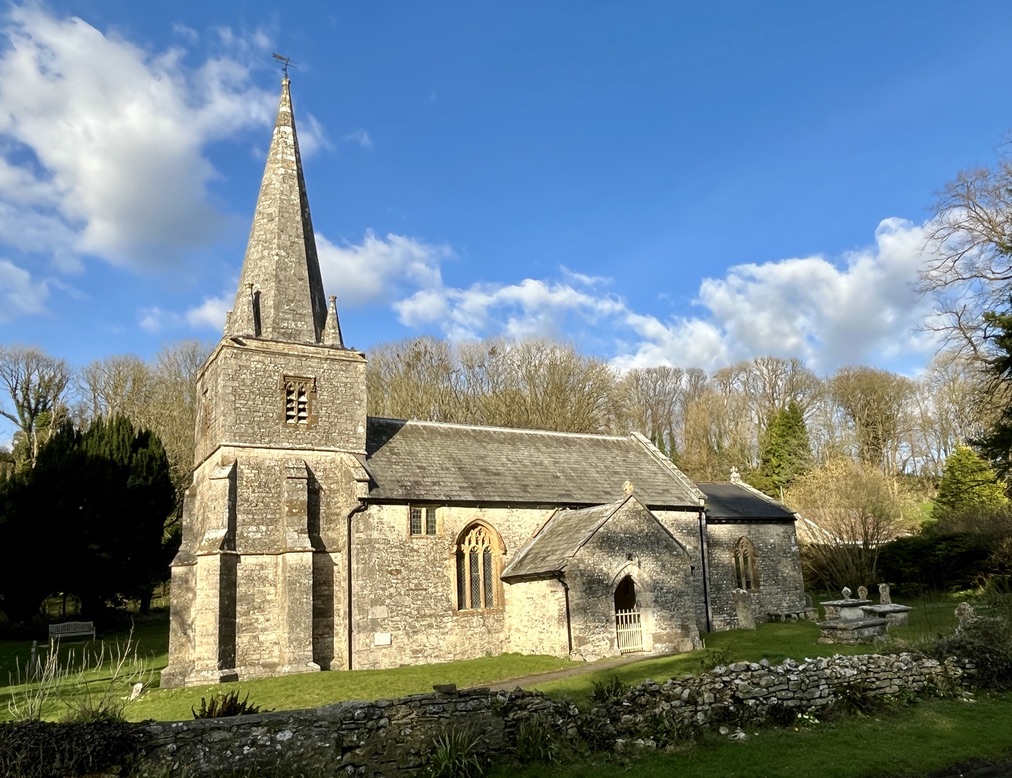
GRADE 1 ✣ C13 origins; Tower ± 1600; considerable restoration C18. A charming country church, seemingly plain but with much to justify its listing. Tomb chamber. 2 (perhaps 3) scratch dials, written up separately. Graffiti: C17 & 18 initials & dates on responds of tower arch. 5m S of Blandford. Close-by St Andrew’s at W/B Houghton makes a pleasant short visit. 50.8409 / -2.2363 / ST834046
❖ ❖ ❖
SUNDIAL
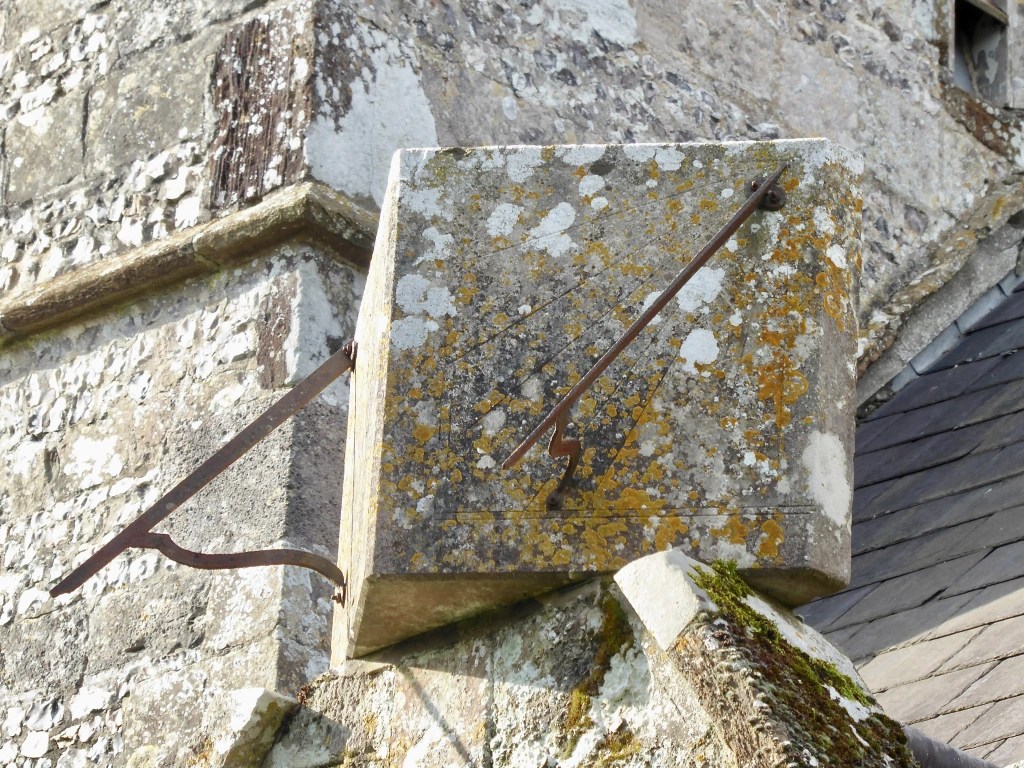
A fine double-faced dial on the S. porch gable, angled SE and SW. Both faces match in design, with identical scrolled iron gnomons. BHO dates to C18th. BSS mentions Roman numerals, but I couldn’t find any trace even with close-up photos.
❖ ❖ ❖
SW FACE
❖ ❖ ❖
SE FACE
❖ ❖ ❖
Geograph image from c2010 for comparison of condition of stone and lichen coverage
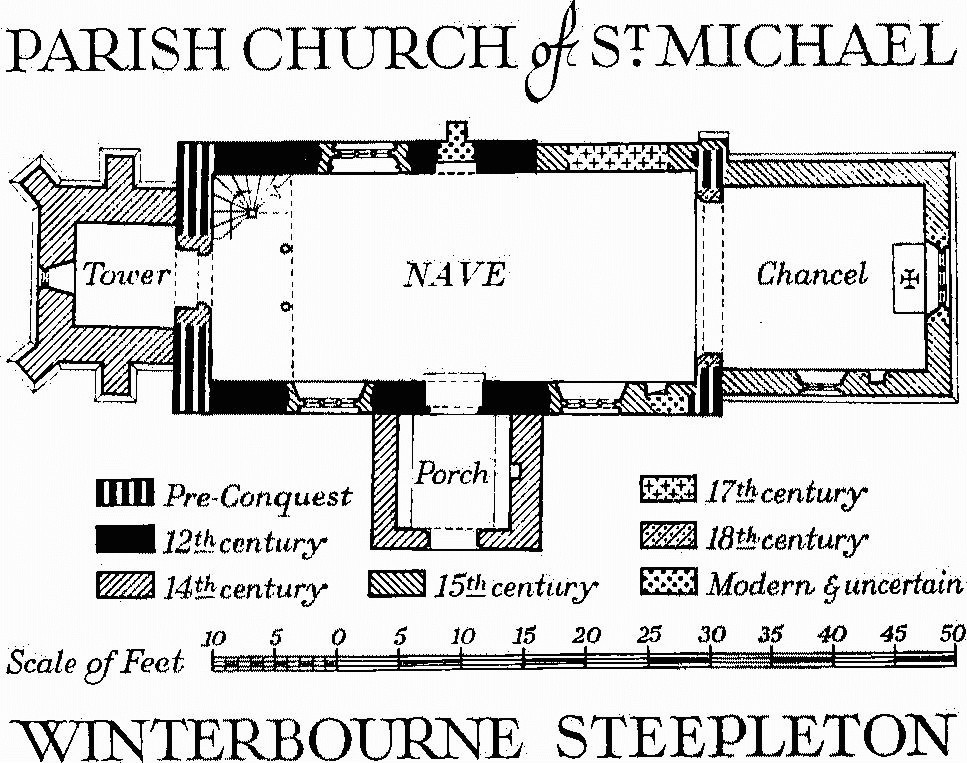
GRADE I † A fine early church in a lovely setting. C11 quoins to nave; C12 nave rebuilt; C14 3-stage W tower, porch; C15 chancel. Later alterations, restorations. Just W of Dorchester, yet seeming miles away in its peaceful valley. Visit Winterbourne Monkton while you are there (2 perhaps 3 dials). 50.7067 / -2.5266 / SY629898
DIALS
Two dials are recorded. I last visited this church more than 2 years ago, in early evening sunshine but with shadows on the church. I have recently been back in better light to re-photograph the main dial; and to check for another rudimentary dial noted on the S buttress of the tower in a 1997 survey. I didn’t find it on my first visit.
DIAL 1
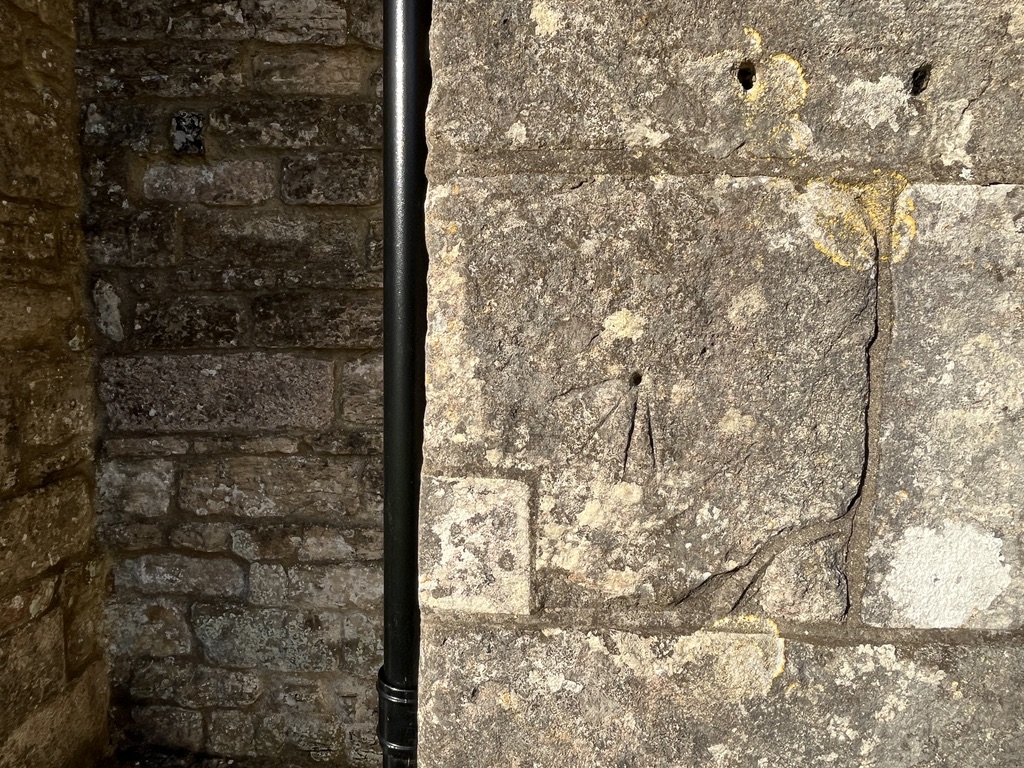
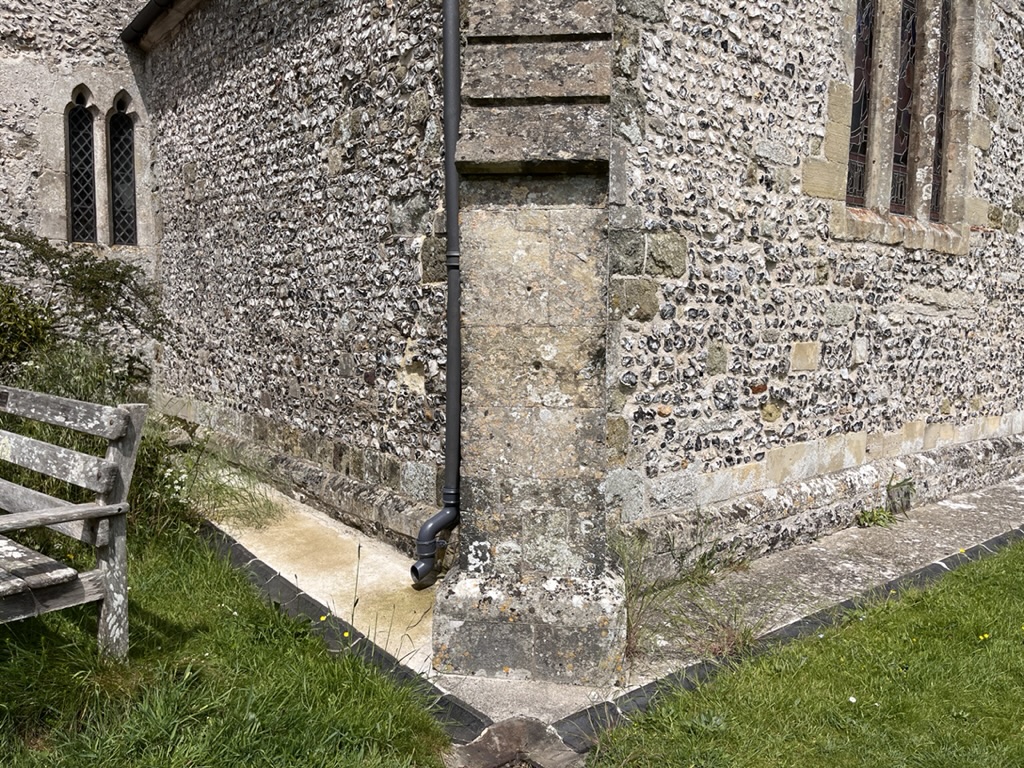
Dial 1 is located on a SW quoin stone of the nave. When examined in the 1990’s it was noted to be ‘behind a drainpipe’, which is no longer the case. By strange coincidence, when I revisited, the rest of the drainpipes were being repaired and repainted.
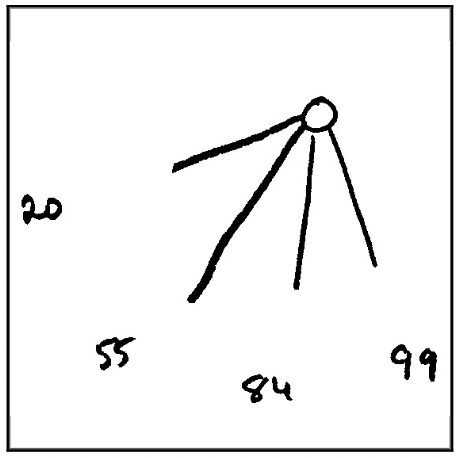
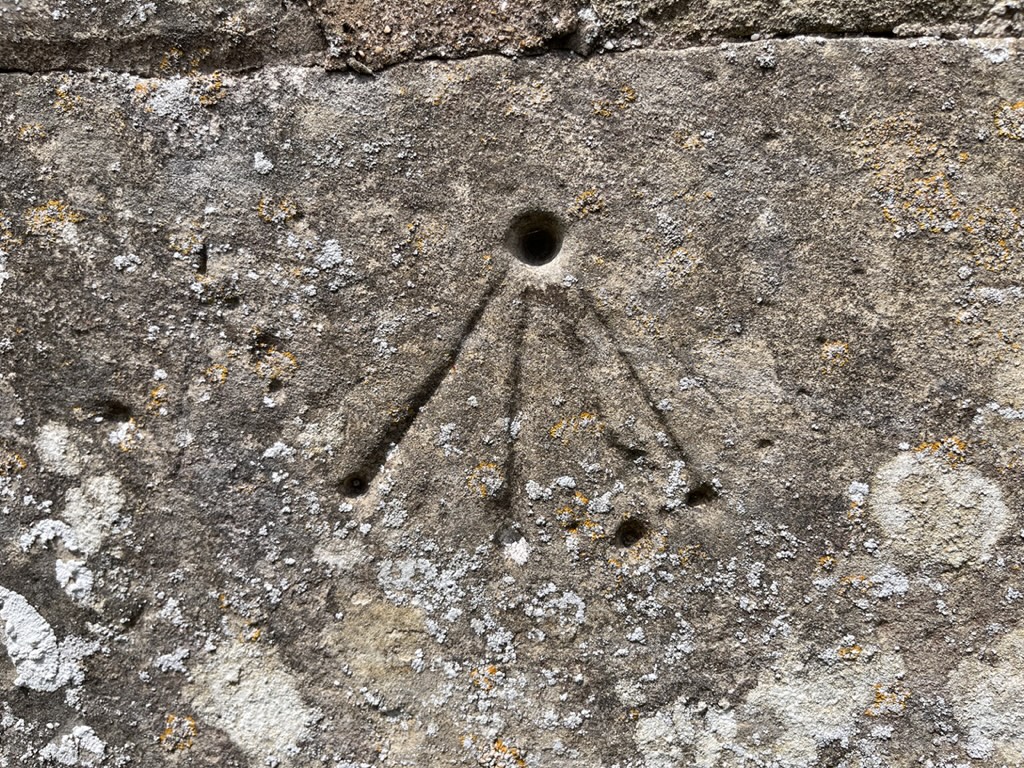
This is a straightforward 4-line morning dial with a pleasingly casual approach to straight lines. The two deeper incised lines suggest that late morning was the significant time of the day for observance.
DIAL 2
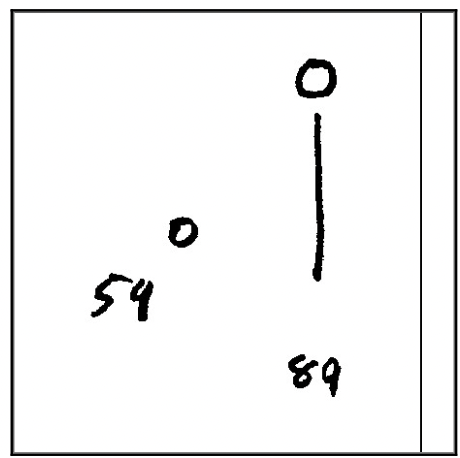
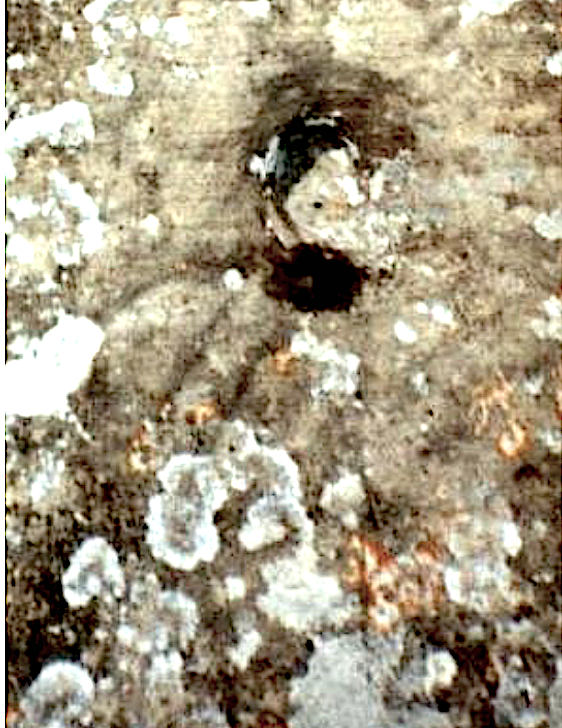
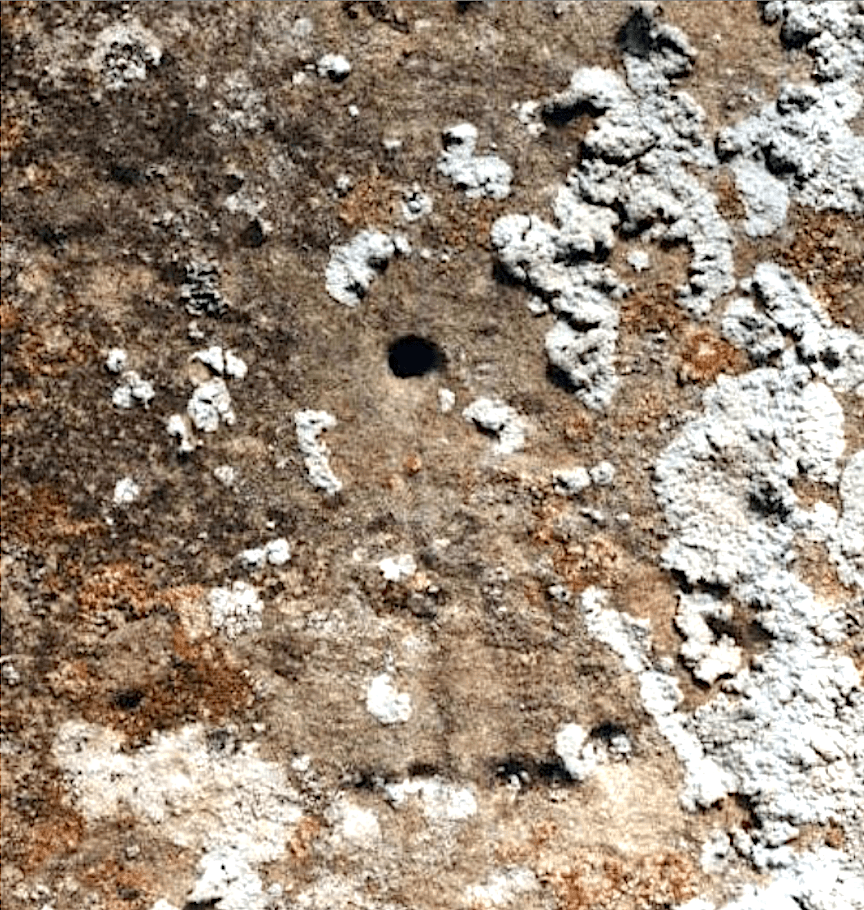
Dial 2 is so simple that I cannot claim to have discovered it this time round. It was recorded as being on S buttress of the tower, with 1 line a mere 45mm long, a small gnomon hole, and a pock LLQ . It was noted in 1997 as ‘very faint’. Although Dial 1 is mentioned in several places (eg BHO), I have found no additional reference to this tiny time marker. So for the second time I failed to find it, even in sunlight. However, a drawing was made and is all I can offer.
Do see the Saxon statue mentioned in the notice below (there is a similar one in Bradford on Avon), and indeed spend some time inside this interesting church.
GSS Category: Scratch Dial; Mass Dial; Eroded Dial
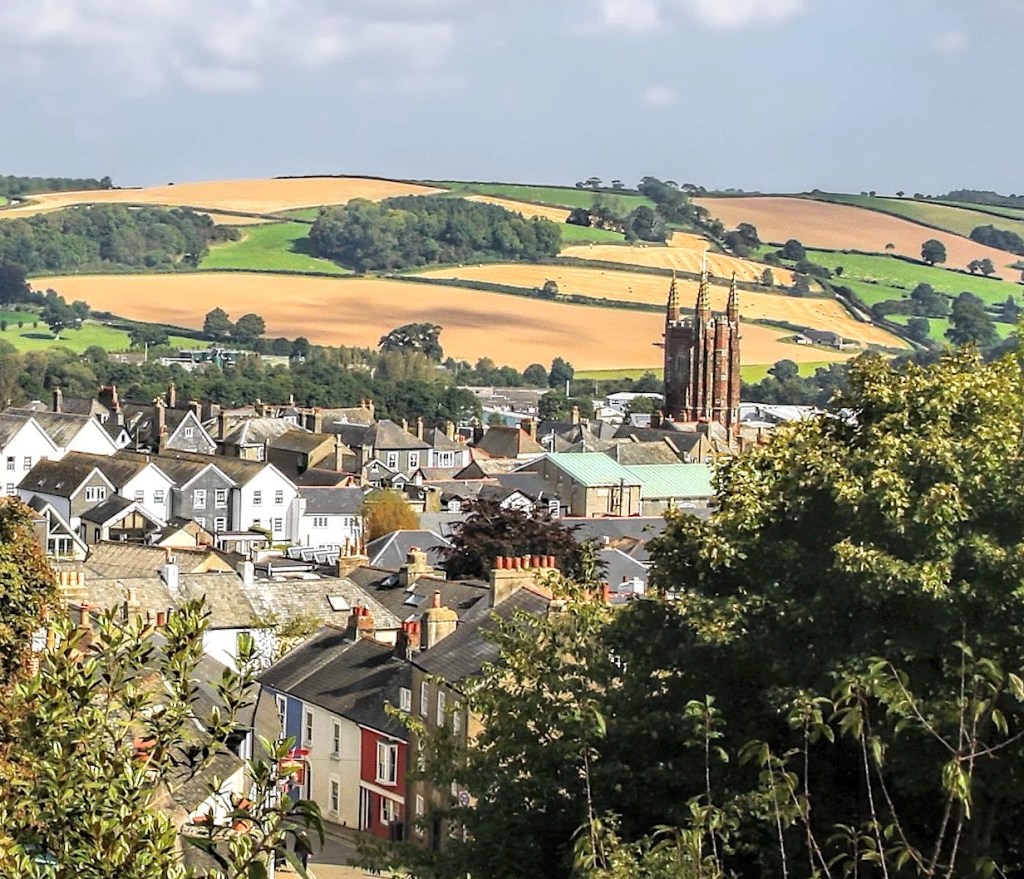
GRADE 1 ✣ A fine Perpendicular church on the site of Benedictine Priory, standing proudly near the centre of the town and visible from some distance away. Mainly built mid C15 using much red sandstone. The Grade denotes the importance of the building, and the interior offers much for the visitor. Also, see the splendid Norman motte and bailey castle nearby. 50.4319 / -3.6878 / SX802604
From the Parish website
SCRATCH DIAL
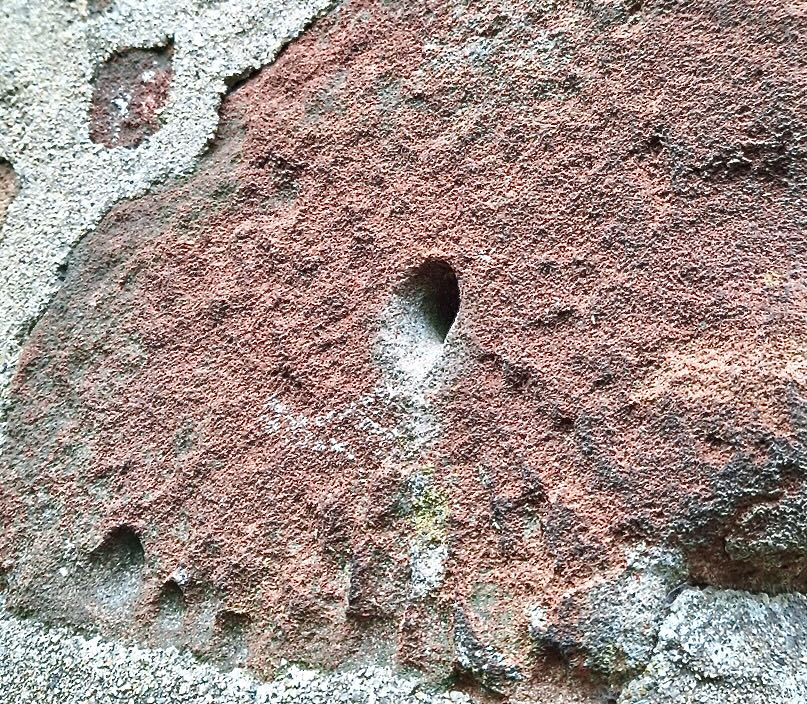
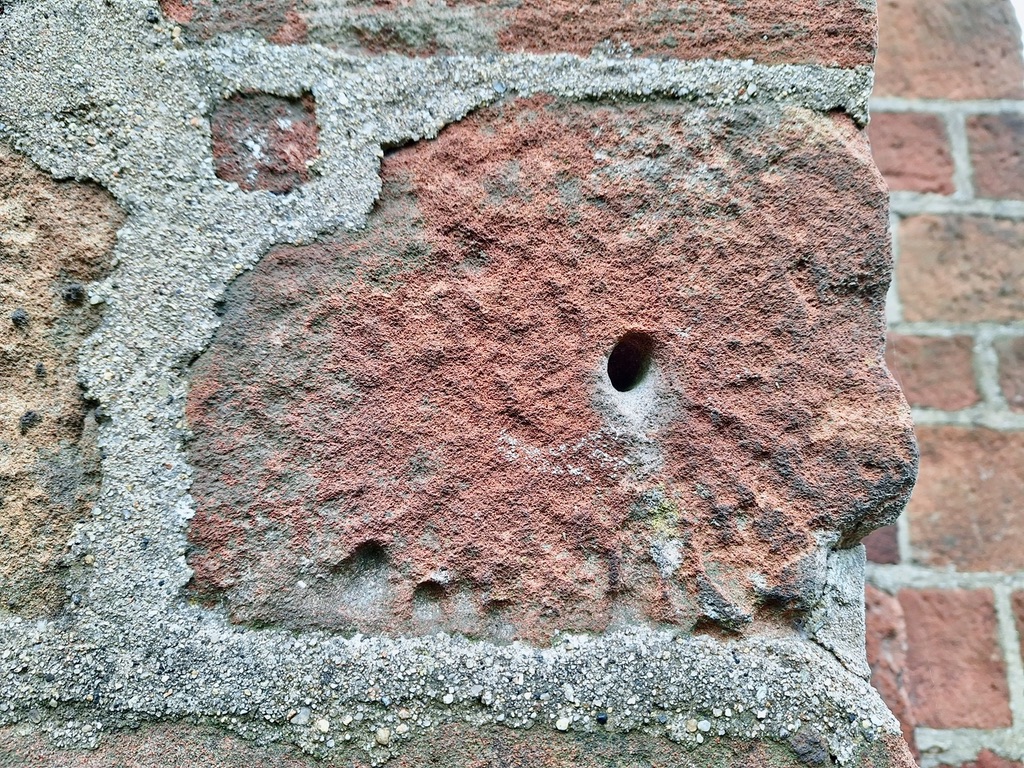
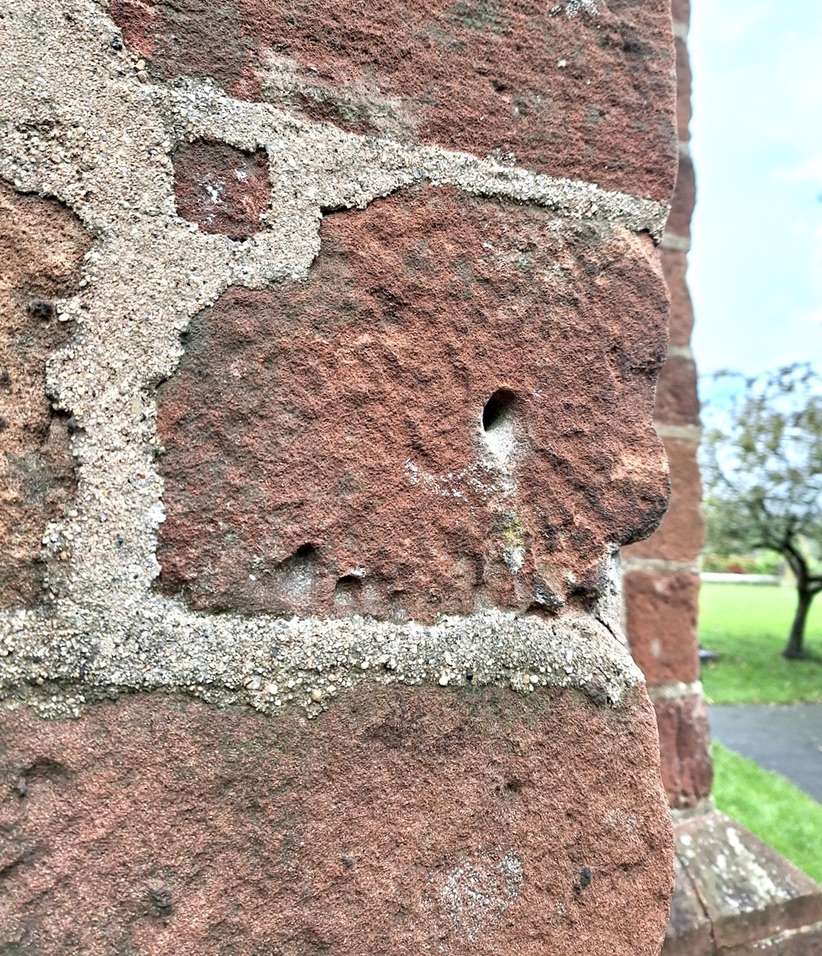
The dial is in a poor state, and tucked away on a buttress at E end of the church. It was clearly relocated from the sunny side at some time, thereafter serving a decorative function at best.
There are ±8 lines radiating from a large or enlarged gnomon hole. Unusually, they terminate in large pocks that are graduated down in size to noon and (as far as one can tell now) upwards LRQ from the noon line. At some stage the lowest holes and the bottom right corner were badly damaged but despite the remedial mortar, it is just possible to see that there were ‘afternoon holes’.
Credits: Erika Clarkson, for her detailed photos of the dial; wigulf . wiki . cc / os for the header image; Parish website for the view of Totnes and the church
GRADE 1 ✣ A fine Perpendicular church on the site of Benedictine Priory, standing proudly near the centre of the town and visible from some distance away. Mainly built mid-C15 using much red sandstone. The Grade denotes the importance of the building, and the interior offers much for the visitor. Also, see the splendid Norman motte and bailey castle nearby. 50.4319 / -3.6878 / SX802604
VERTICAL DIAL
St Mary online
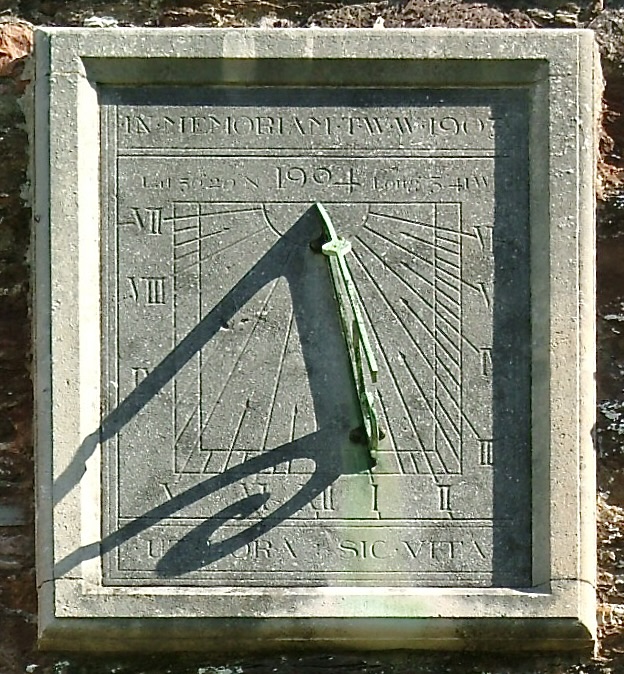
On the south wall of the church near the porch is a slate dial set in a stone frame. It declines west and shows the hours VII – VI divided into halves and quarters. Across the top is an inscription which reads In memoriam TWW 1903. Below it are the coordinates Lat 5020 ; Long 0340 W. Across the bottom of the dial is the quite common motto Ut Hora Sic Vita(Life is as an Hour).
The gnomon has a pierced nodus which causes a spot of light to appear on the dial plate. In my amateur experience, this is a relatively uncommon addition to a sundial’s capabilities.
GSS Category: Vertical Dial; Sundial with Nodus; Vertical Sundial Motto; Memorial Vertical Sundial
Photos: header, wigulf . wiki . cc / os; dial location, St Mary’s online; dial close-ups, BSS Bridol
Thanks to Erika Clarkson for giving me the details from a visit to St Mary’s, where she had found a scratch dial. I have written it up separately, being completely different in type and time.
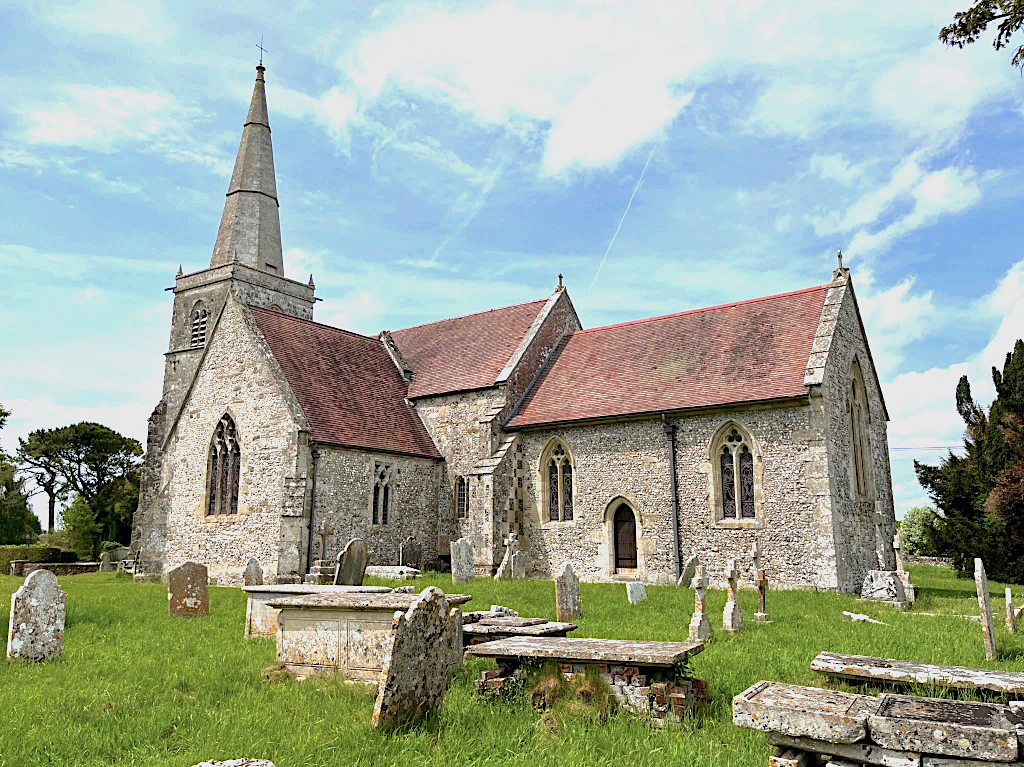
GRADE I † Early C12 origins; C13 chancel, tower; C14 / C15 transepts; other works then & later inc C18 spire, C19 restorations. A striking building in a small village just off the A354 Salisbury – Blandford Forum. Clock installed in honour of Winston Churchill 50.9754 / -1.9009 / SU070195
DIALS
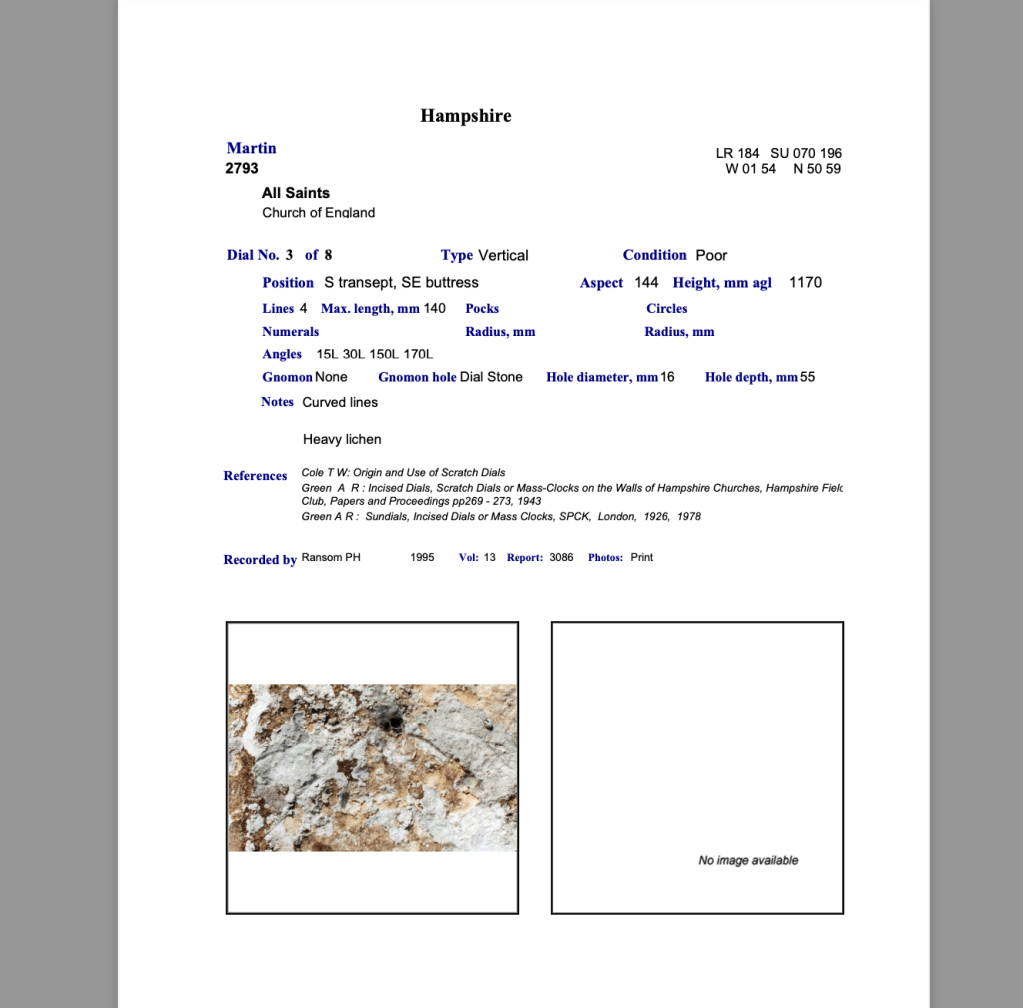
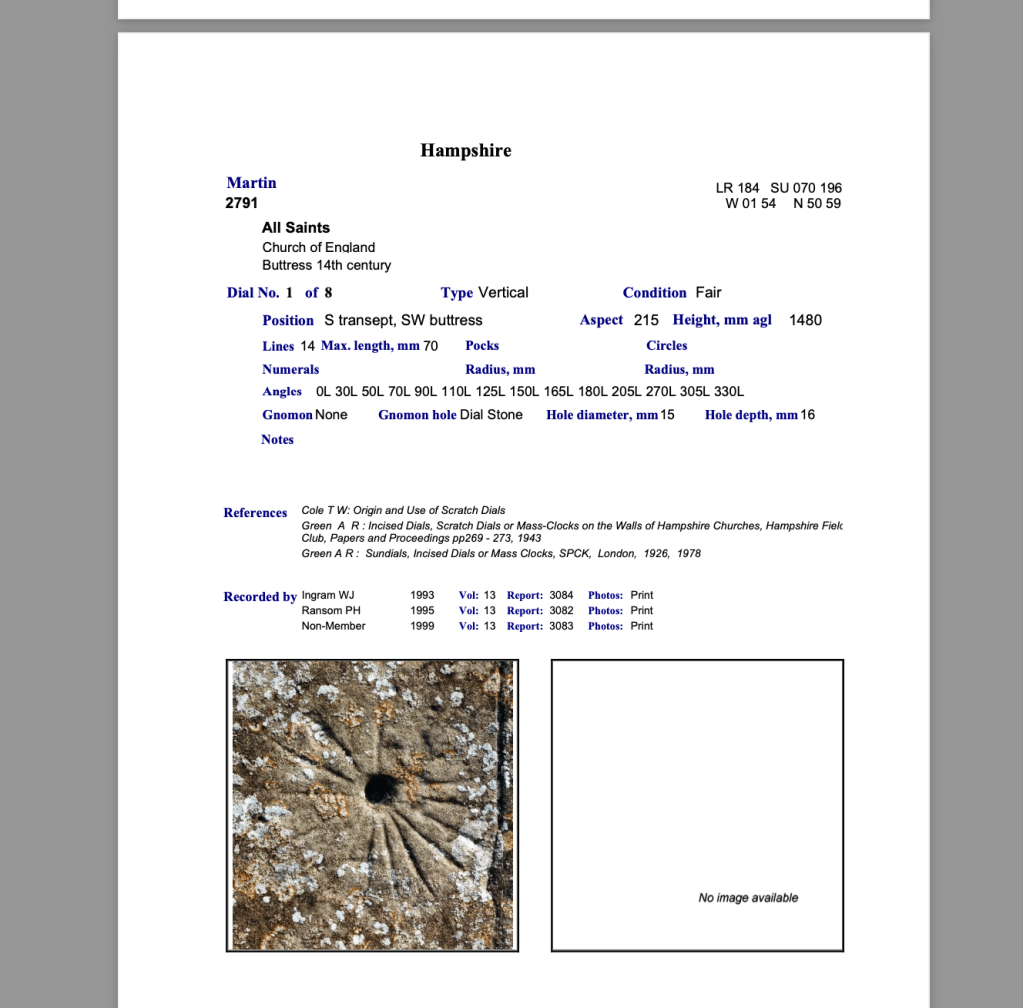
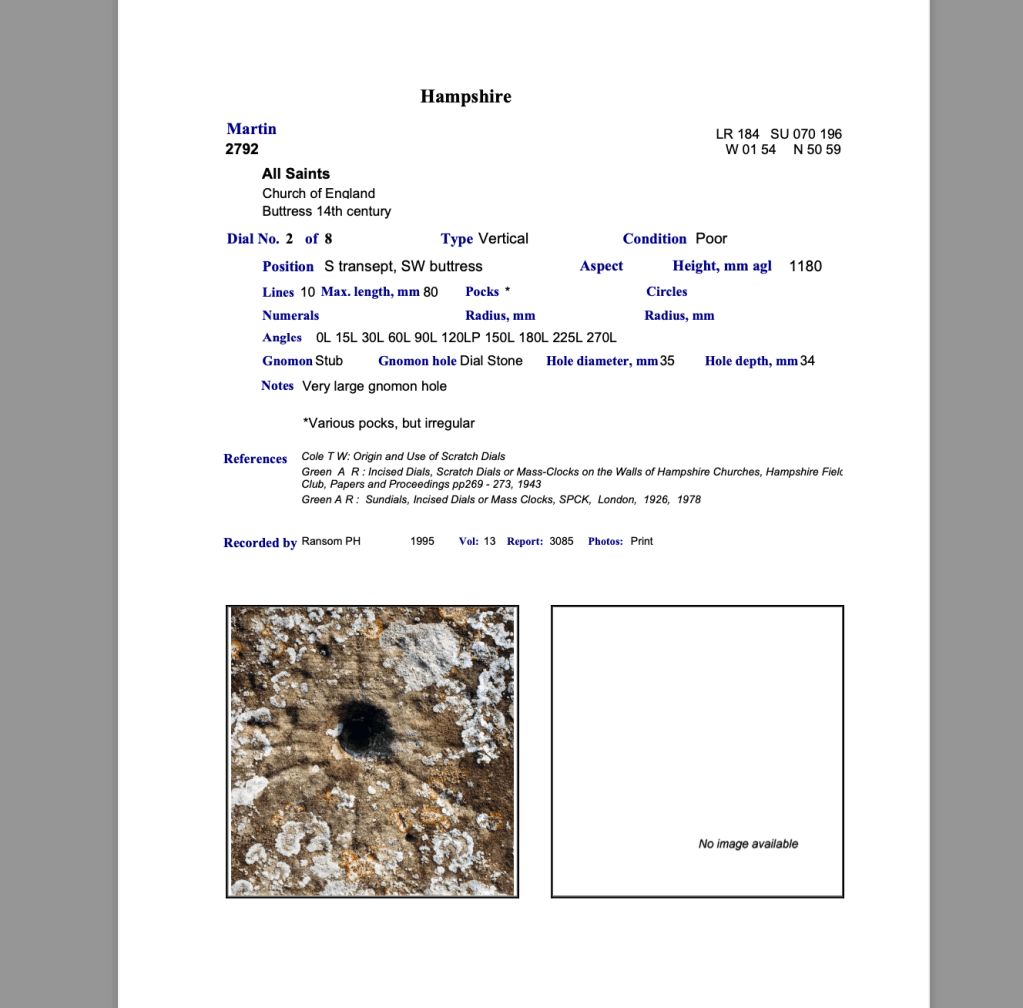
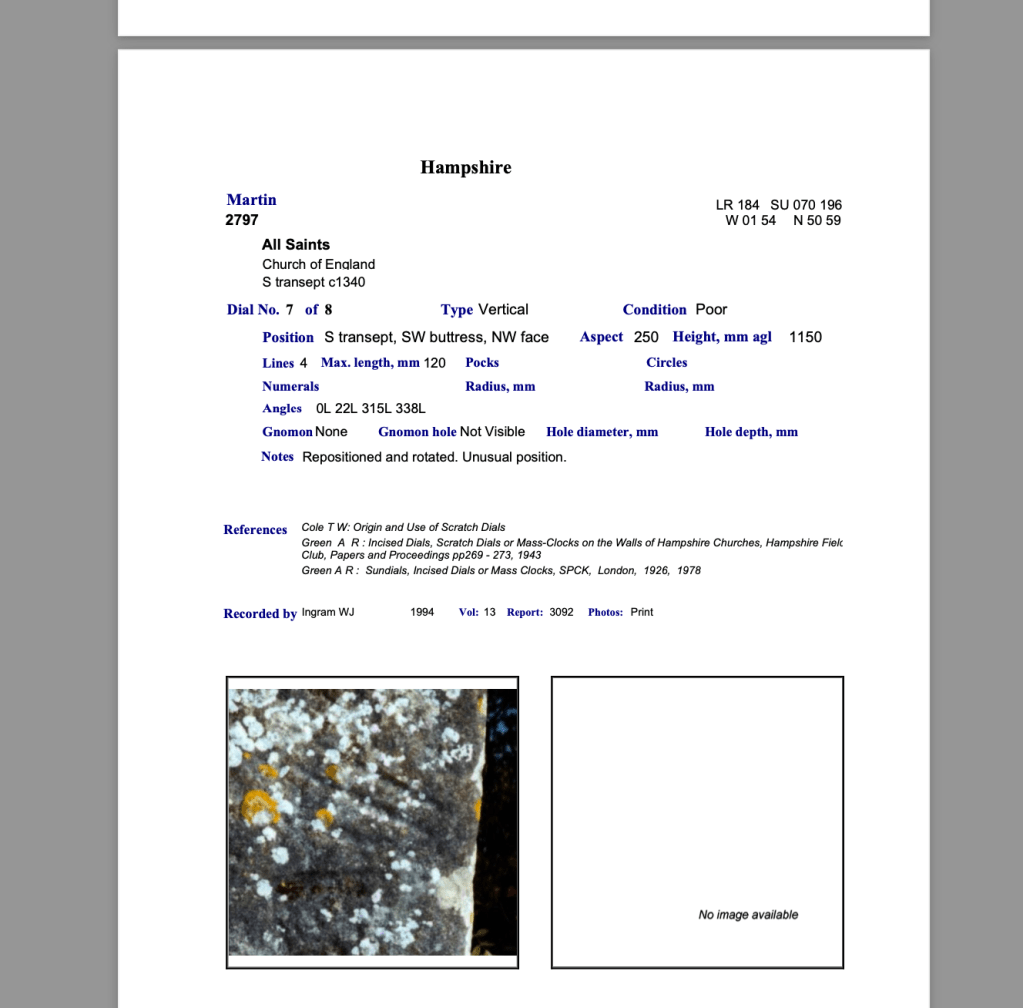
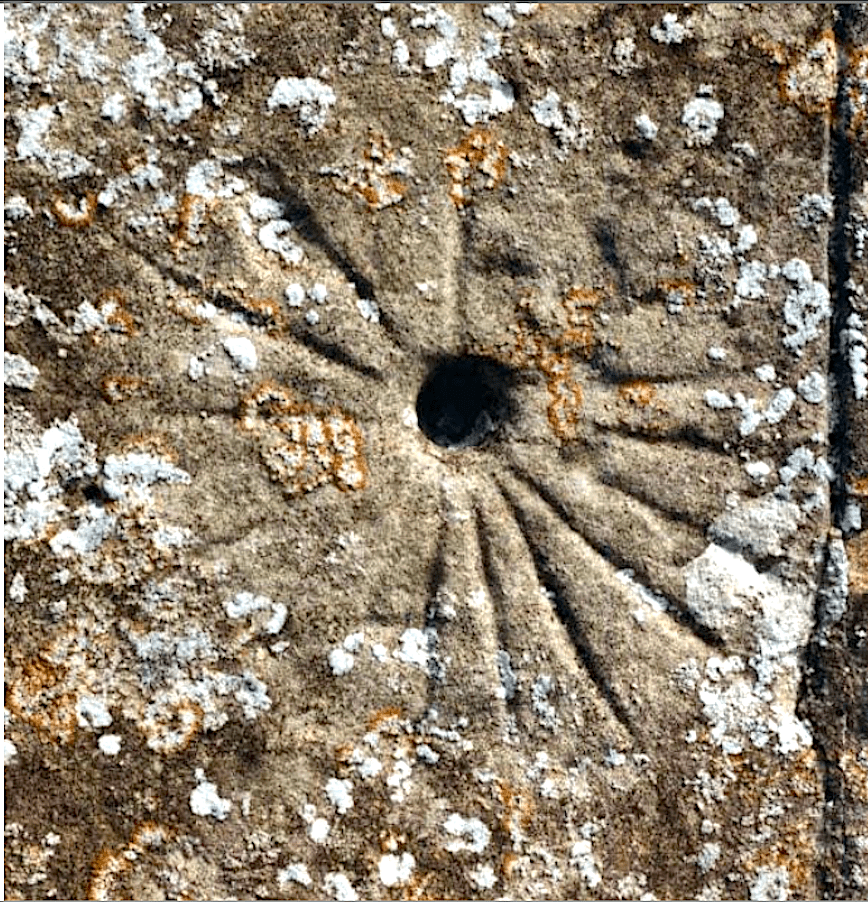
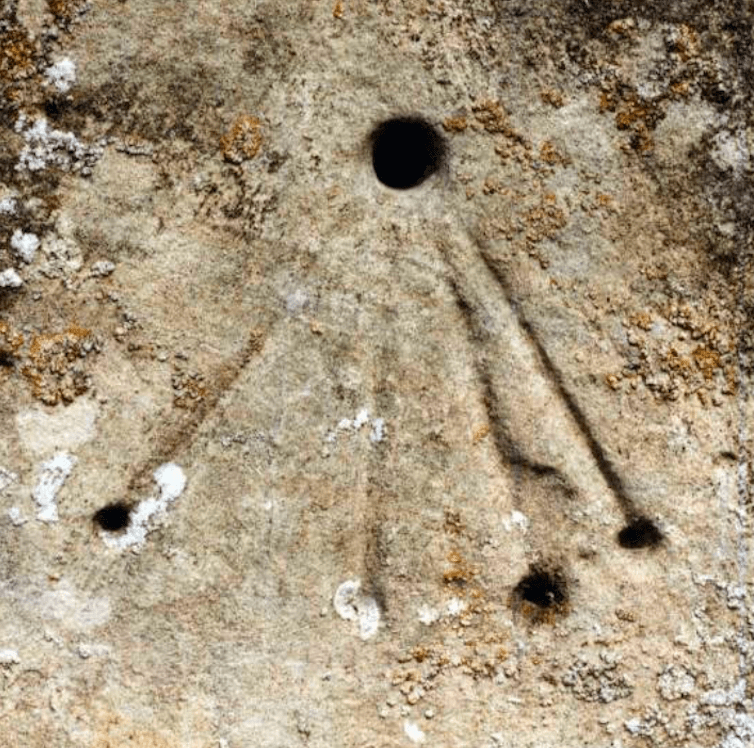
All Saints is a multiple dial church, with 8 listed in the BSS records. My dial count is 9. It’s a fine church, and dial-hunting was an easy pleasure. I have decided to let the dials speak for themselves without undue commentary on individual characteristics unless called for. Below the dials is an excellent article by the Hampshire Field Club that analyses all you need to know about each dial, and in particular the locations (for which I lost my notes).
BSS RECORDS
GALLERY OF 8 + 1 DIALS
DETAILED IMAGES
DIAL 1
DIAL 2
DIAL 3
DIAL 4
DIAL 5
DIAL 6
DIAL 7
DIAL 8
DIAL 9
This dial is included in the BSS records (bottom row LHS)
Volume VII Part I.pdf
Proceedings of the Hampshire Field Club, XV , Pt. 3, p. 27a.
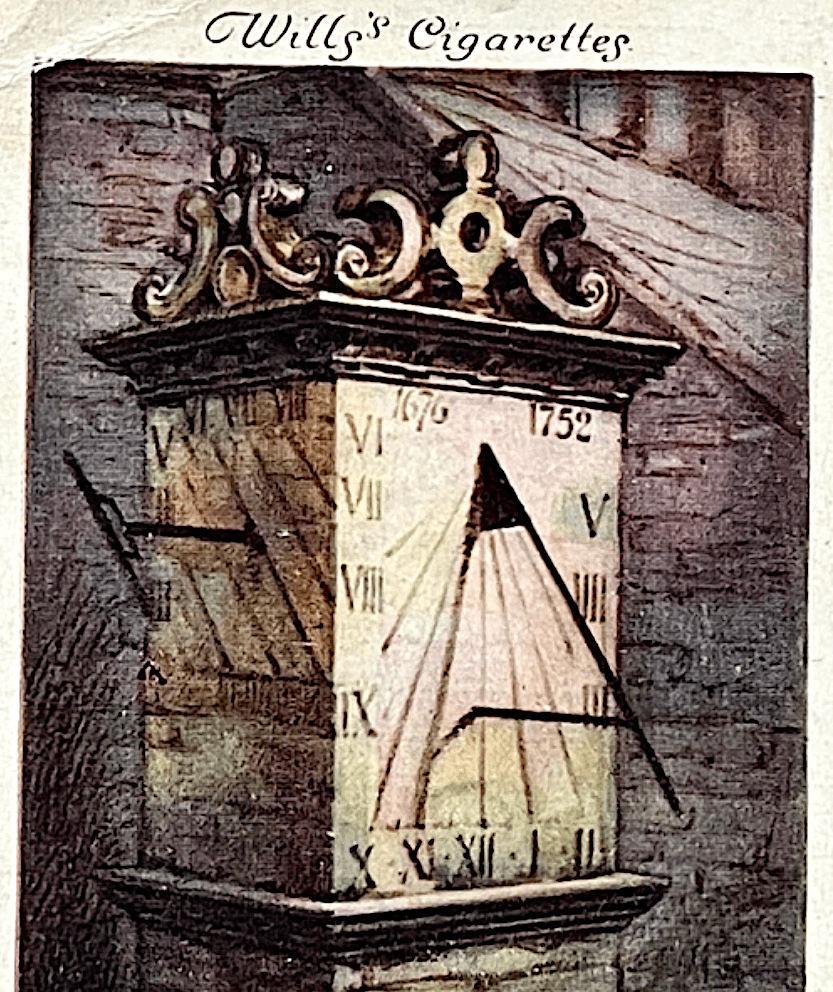
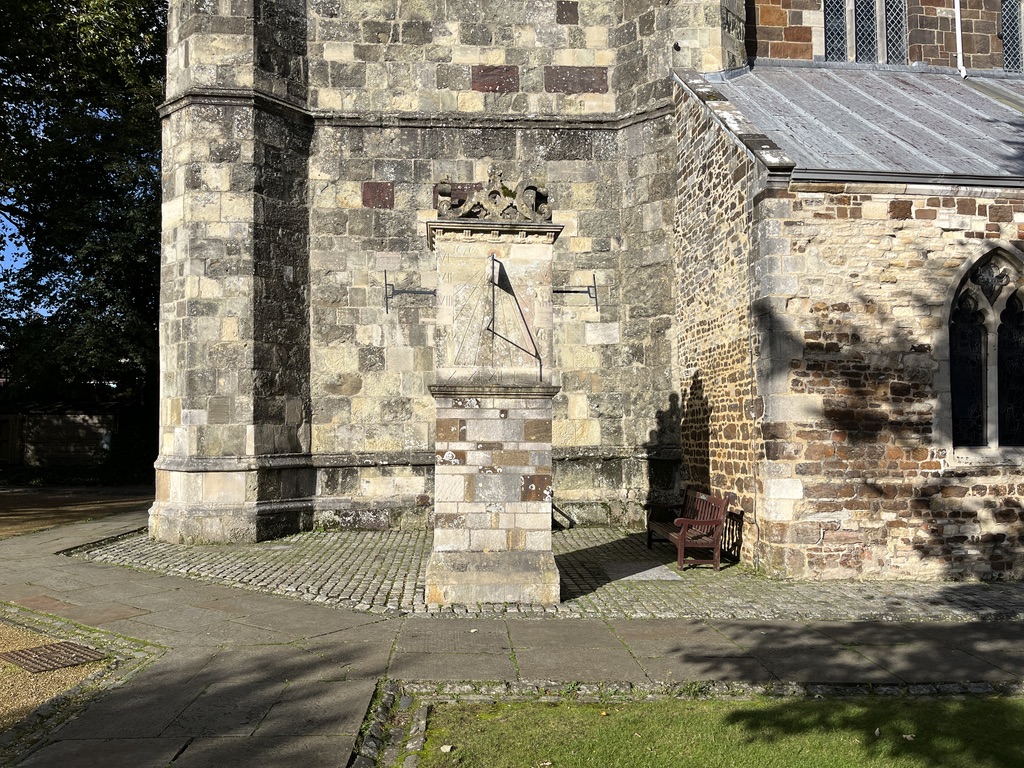
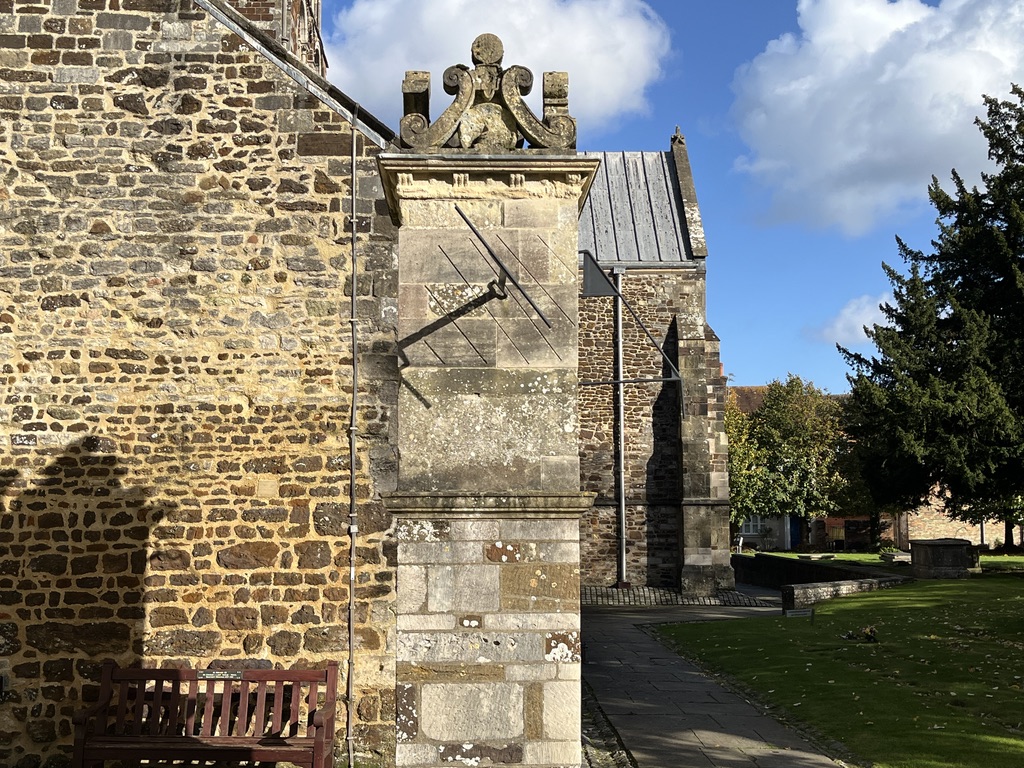
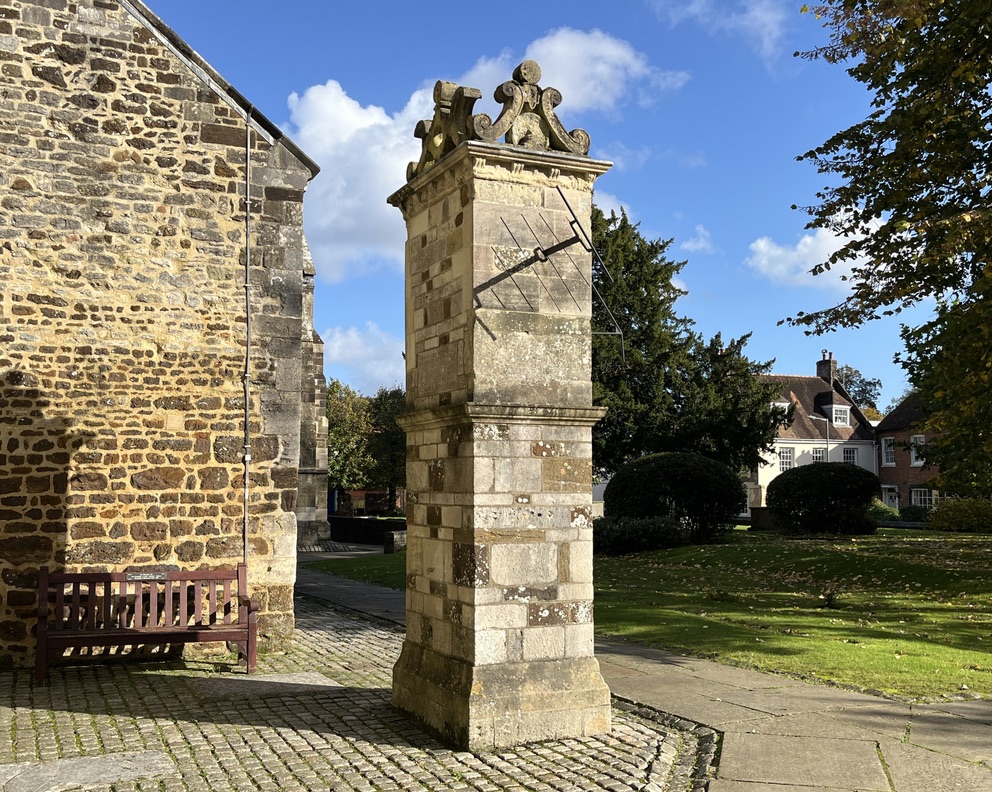
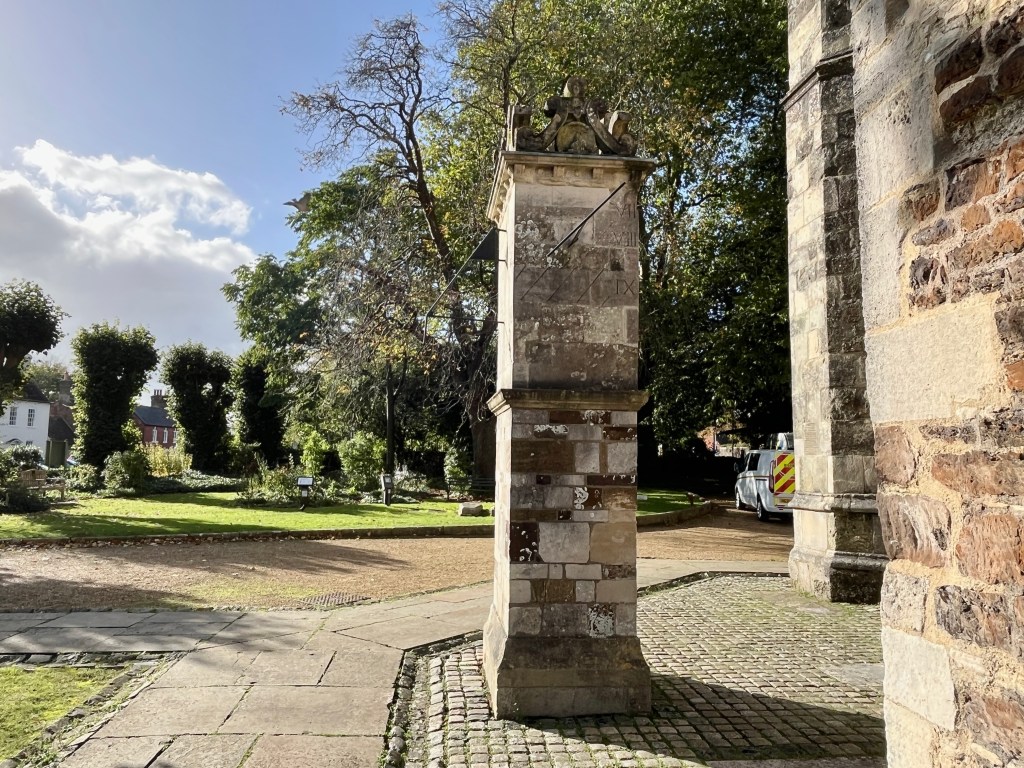
The origins of the Minster date back to the C8. The building seen today dates from early C12 with development during subsequent centuries. Leaving aside the merits of the splendid building, the impressively large stone block on the S side is unmissable. The plinth alone is 6′ high; S face is 4′ wide; E & W faces are 3′ wide. N face has an inscribed tablet only.
DIAL DATES
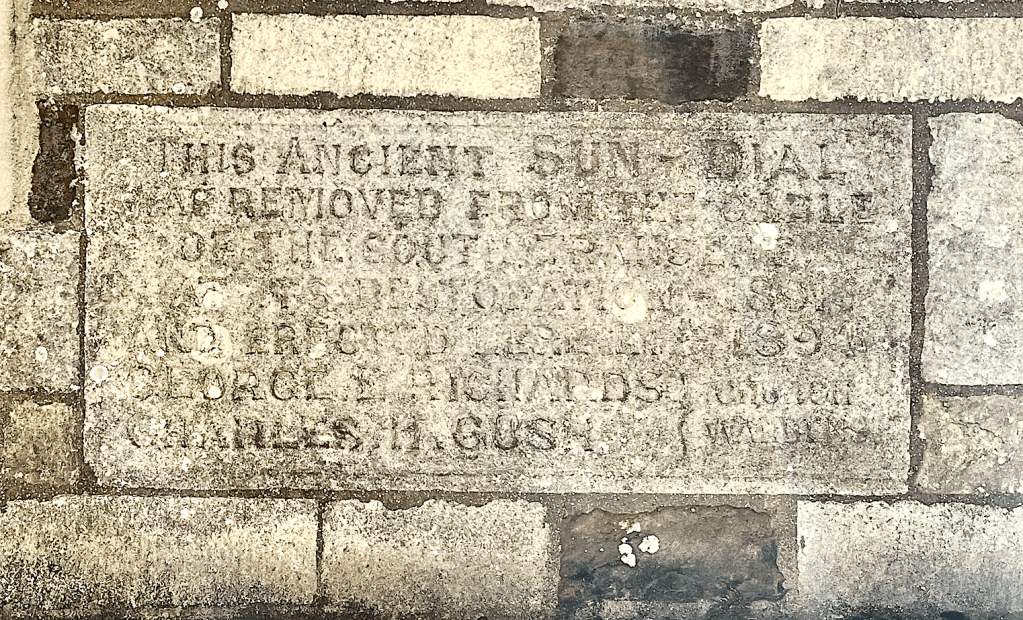
The images featured below give a good idea of each face, gnomon, and relative aspects, so I won’t go into more detail. However there is a conundrum about dates. There was at least one relocation of the dial, and areas of restoration / repair are evident. The inscription on N face is This ancient sun-dial was removed from the gable of the South transept at its restoration 1891 and was erected here 1894 George E Richards [and] Charles H Gush Churchwardens.
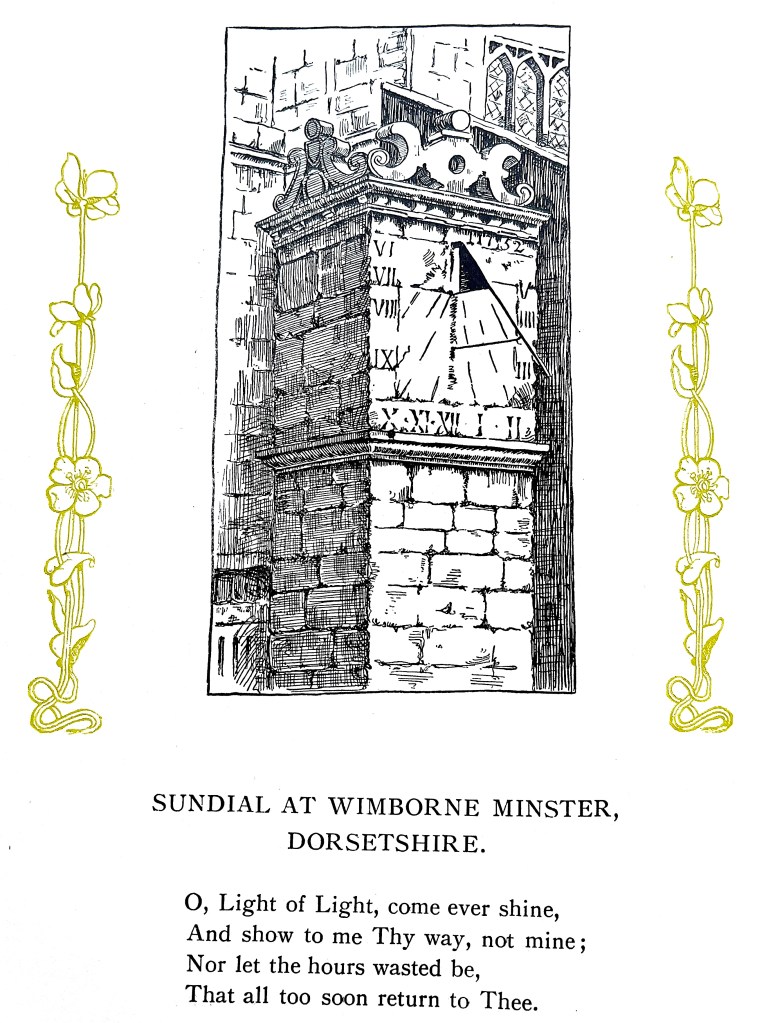
As seen today, the date 1676 is given top left of the south face on new stone. There is no date in the corresponding position on the right side. However in T G W Henslow’s delightful Ye Sundial Booke (1st ed 1914), his charming drawing shows the date 1732 in the top right of the south face with no date on the left side. And more confusingly, in the Wills’s cigarette card sundial series (1928, see below), both dates are shown.
LISTING Grade I ✣ C12 origins with abbey links; C12 chancel; C13 nave and refenestration, porch; C15, tower. An astonishing church beyond the scope of this project. Besides the building itself, there are wonderful early C14 wall paintings to admire, also C16 wagon roof & C13 coffin lids. Major restoration in 1911. A very unspoilt church retaining many medieval features PEV. In the care of CCT. 5m SE of Blandford Forum 50.8307 / -2.1107 / ST922034
DIAL
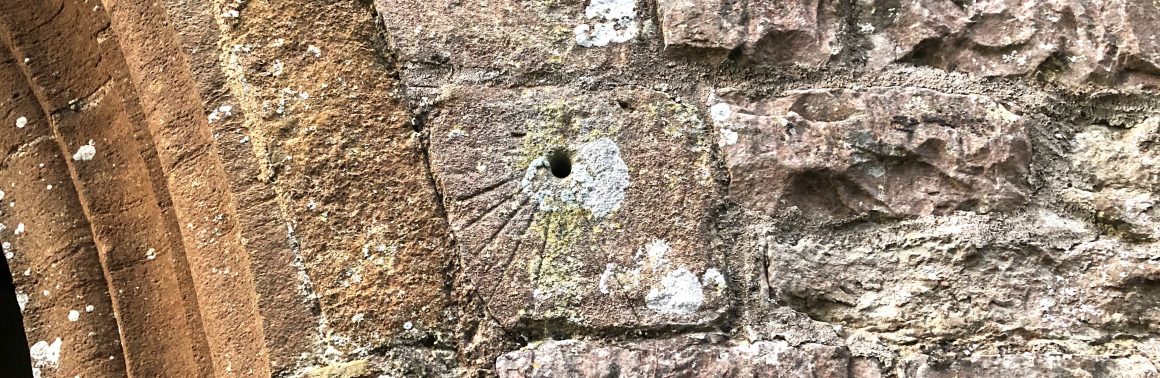
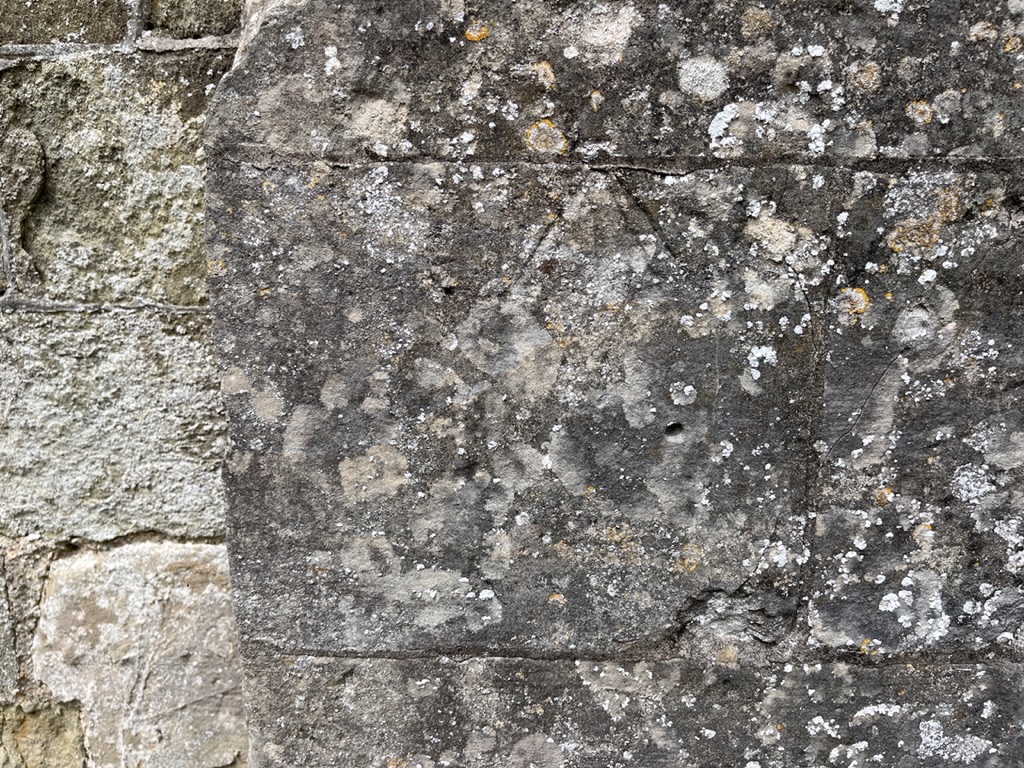
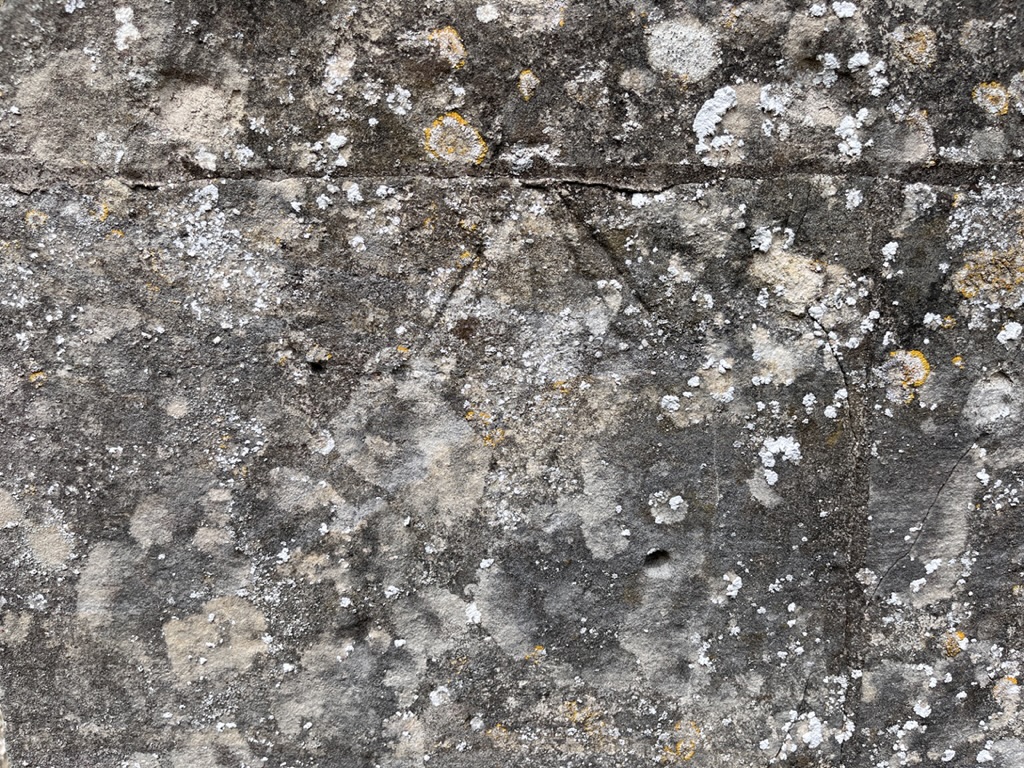
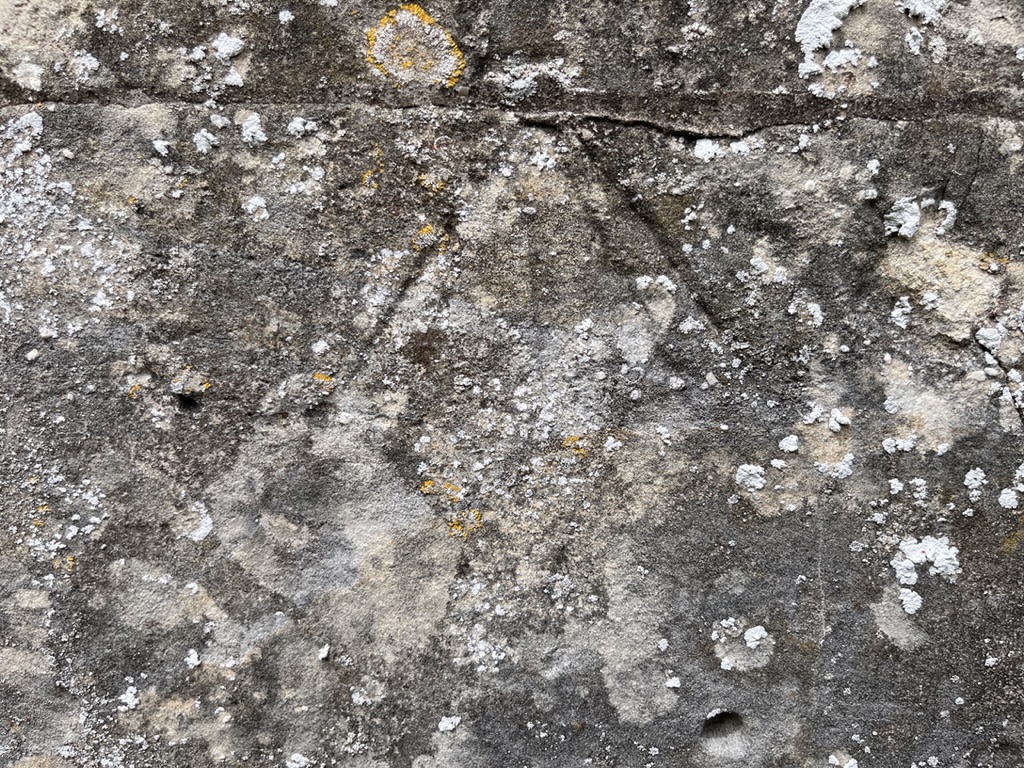
A number of features make this dial rather special. It is inside an intriguing church; it is cut into the architrave of a (historically) relocated doorway; and the design is endearingly haphazard. There are 5 radials from the gnomon hole, mainly LLQ from (roughly) Terce to just past midday. The lines are uneven in length, depth, spacing and straightness ,not least because of the oddly squarish perimeter. One can’t tell what lies behind the cement repair, but it doesn’t seem that the perimeter continues beyond what one can see.
BSS Diagrams
APOTROPAIC CIRCLES
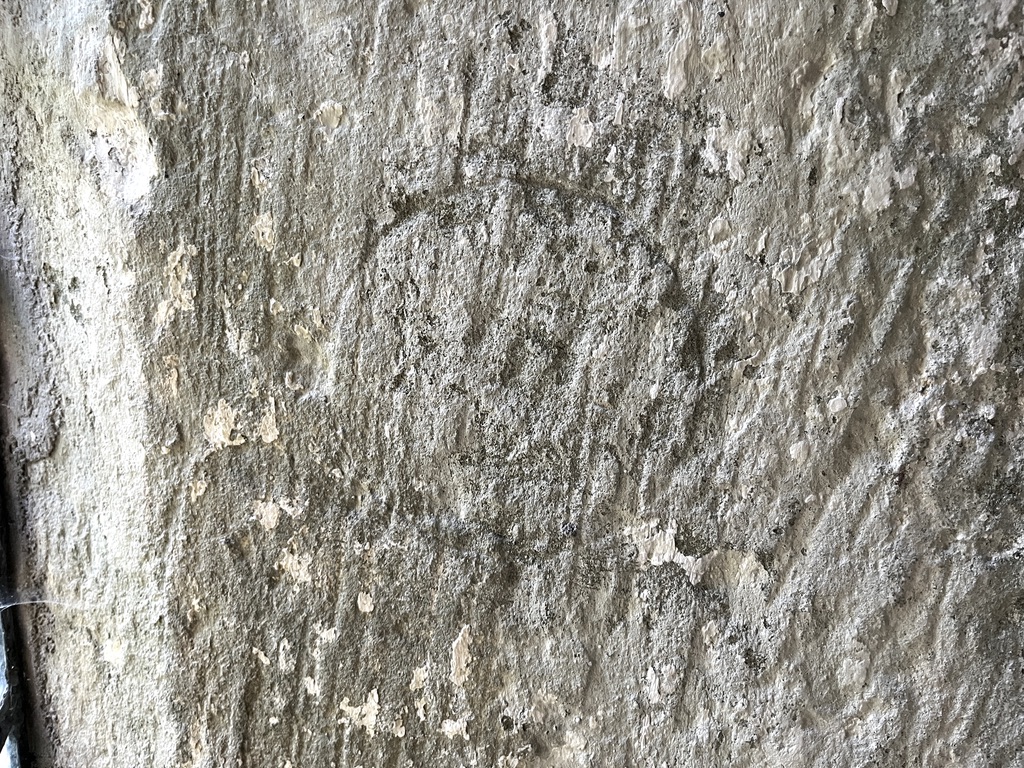
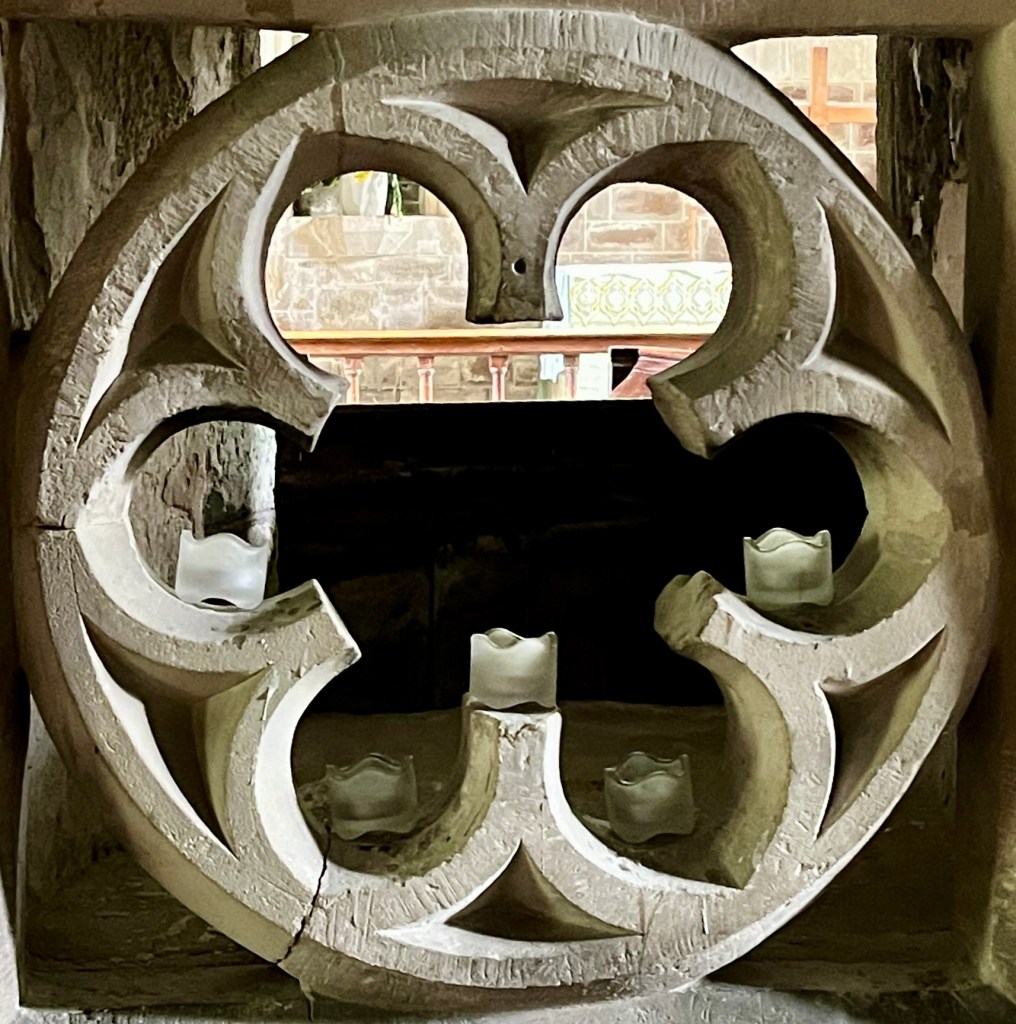
There are two circles cut into one of the window jamb, the lowest with a dot in the centre. These are a simple form of protection symbol, repelling evil and preventing it from entering the church. Some theorise that these and more complex designs (eg ‘daisy wheels’) trapped evil within the circle – so-called demon traps.
GSS Category: Scratch Dial; Mass Dial; Protection Mark, Apotropaic Symbol
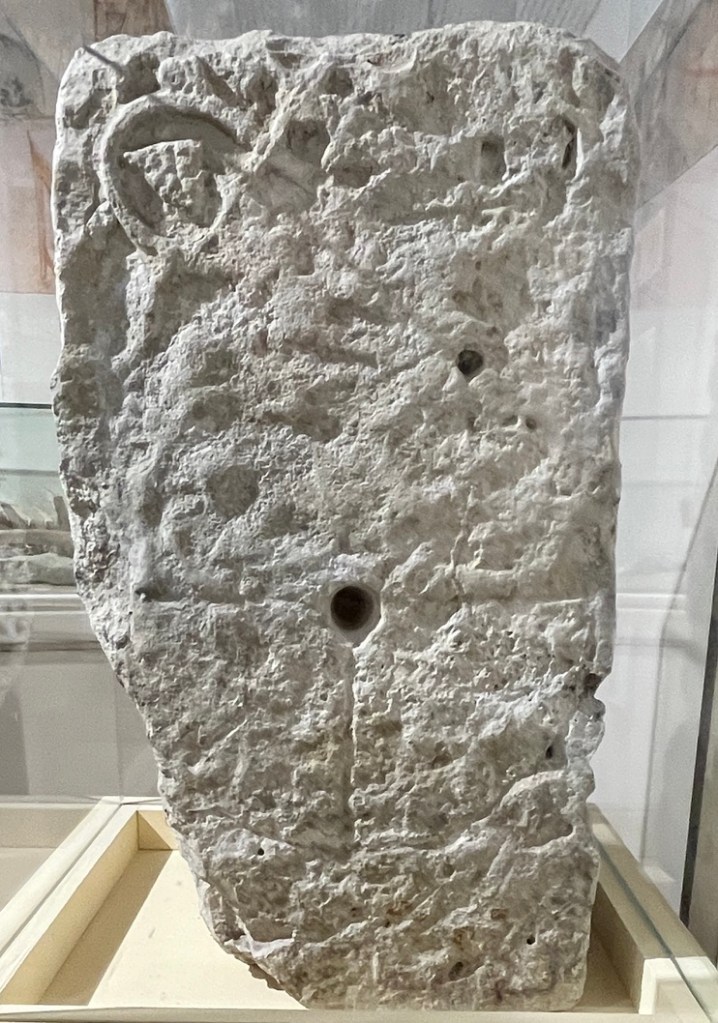
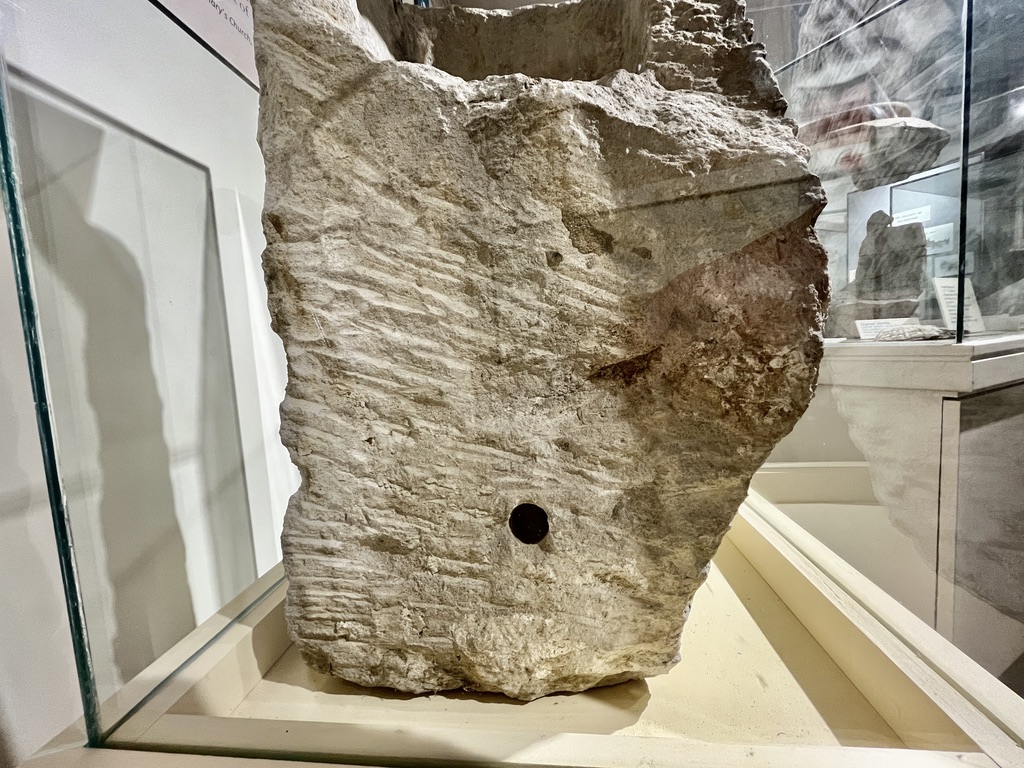
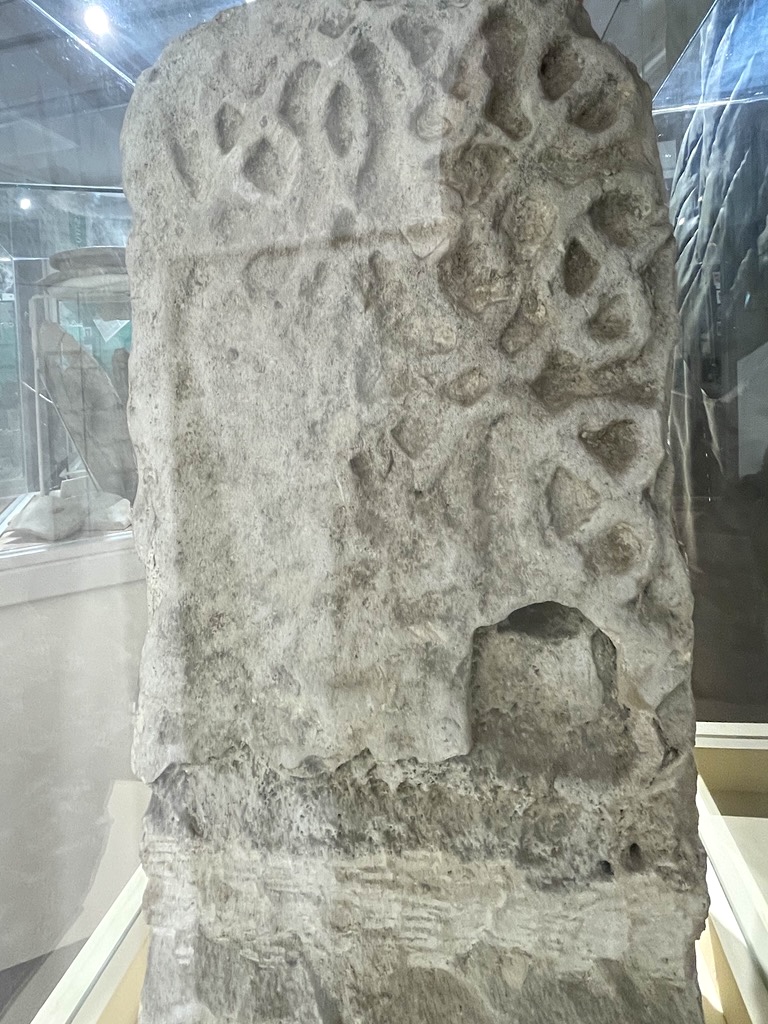
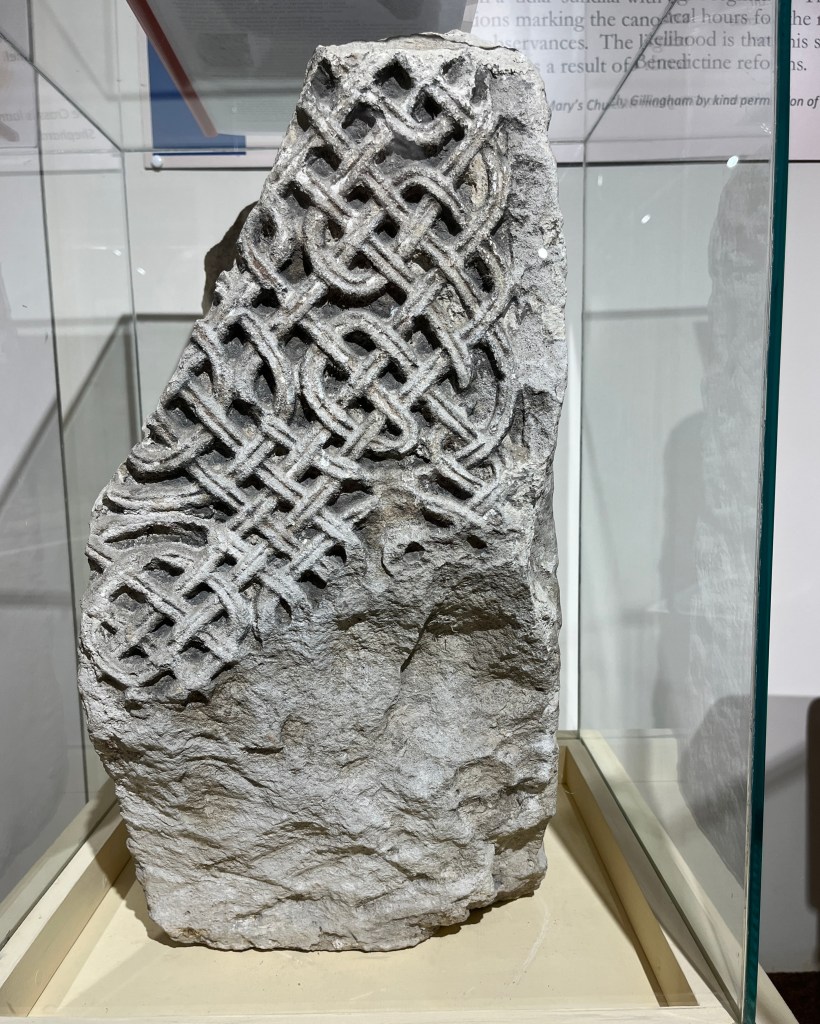
GILLINGHAM in Dorset has a well-curated Museum spanning prehistory to our lifetime. The many and varied displays include a very special one, a handsome carved fragment of an Anglo-Saxon standing cross. Below are images of all four sides of this wonderful stone. It is enhanced by the later addition of an early dial – a Tide dial.
TIDE DIAL
The dial has a complete horizontal (‘6-to-6’) line, an emphatic noon line, and a short deep line corresponding to the canonical Terce, marking the significant part of the day for observance. An arc of circumference is below; there is no hint of a complete circle.
✣
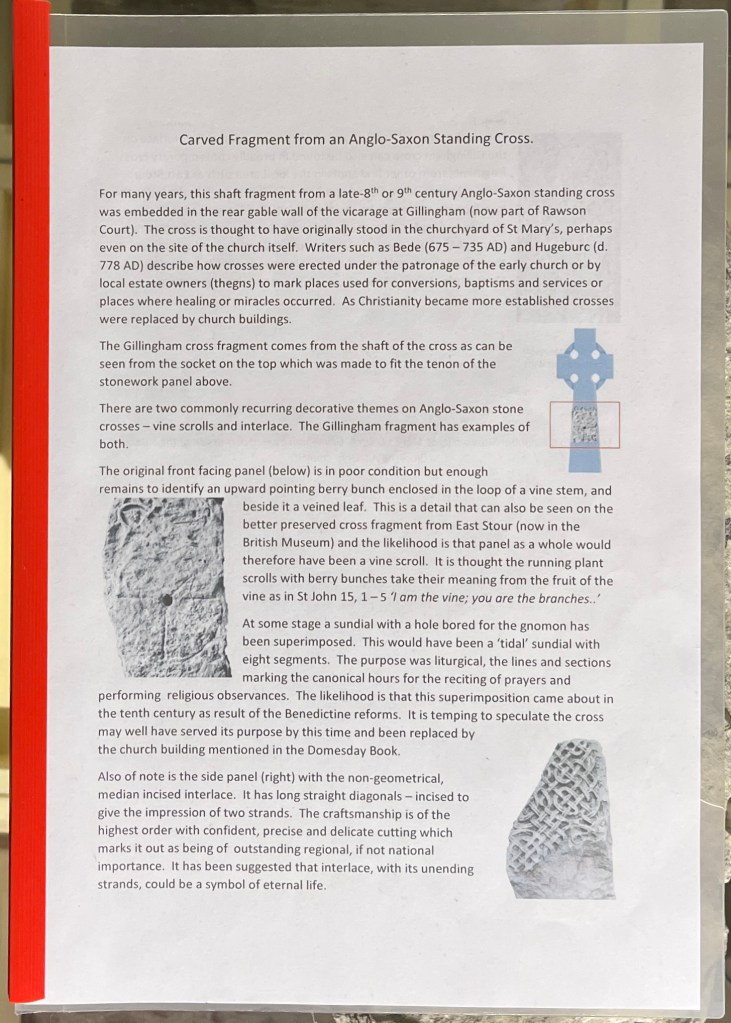
MUSEUM INFORMATION SHEET
✣
DIAL TWO?
Above right on the stone is a smaller hole with (from some angles) 3 very faint lines radiating from it. Very doubtful, but mentioned for completeness. Possibly an imitative attempt by a bored sacristan.
Second Dial above right?
✣
THE OTHER THREE SIDES
Gillingham Museum, where the stone is on loan from the Church of St Mary the Virgin, Gillingham.
Dr John Shepherd: Shephard J F (2023) – Carved fragment from an Anglo-Saxon standing cross and the arrival of Christianity in Gillingham in Annual Report and Review, Dorset Historic Churches Trust18, 6-7.
David Lloyd – Gillingham Local History Society
Images courtesy Tom Wickson (Dorset Historic Churches Trust)
LISTING II* ✣ Early C12 origin; nave extended late C12; early C14 chancel, transepts, squat tower; C15 porch; C19 north vestry and restoration. 3 squints (‘hagioscopes’, as I have recently discovered). 4m E of Blandford forum, nestled in a valley with several other Tarrants. 50.854 / -2.0902 / ST937060
DIAL
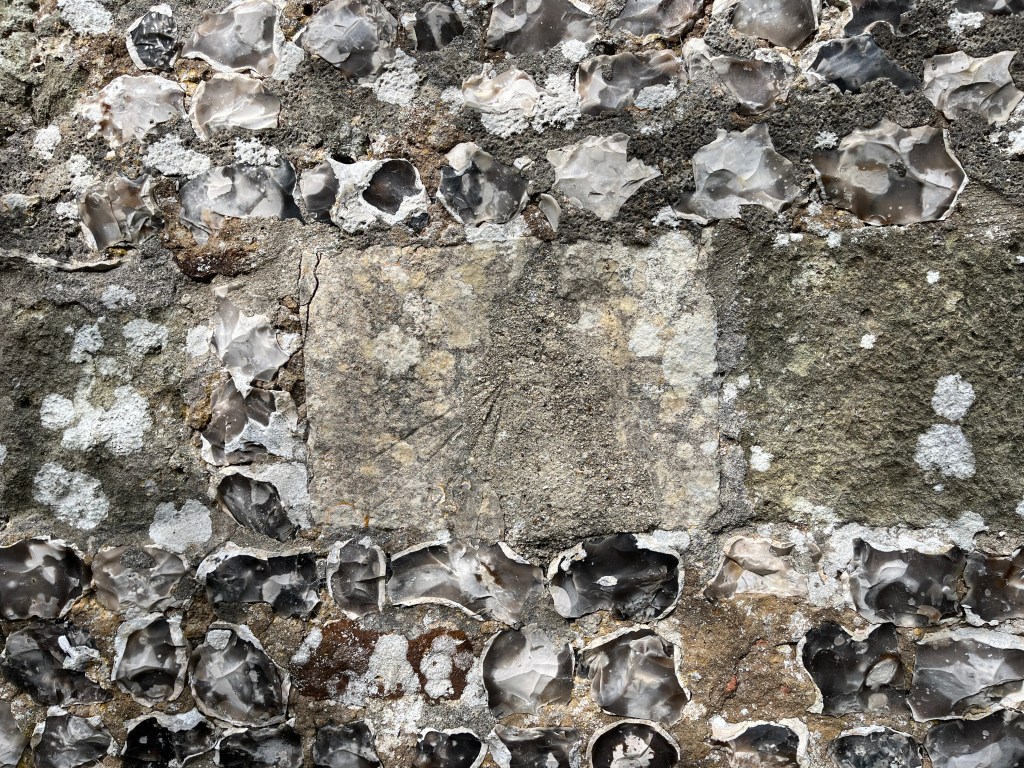
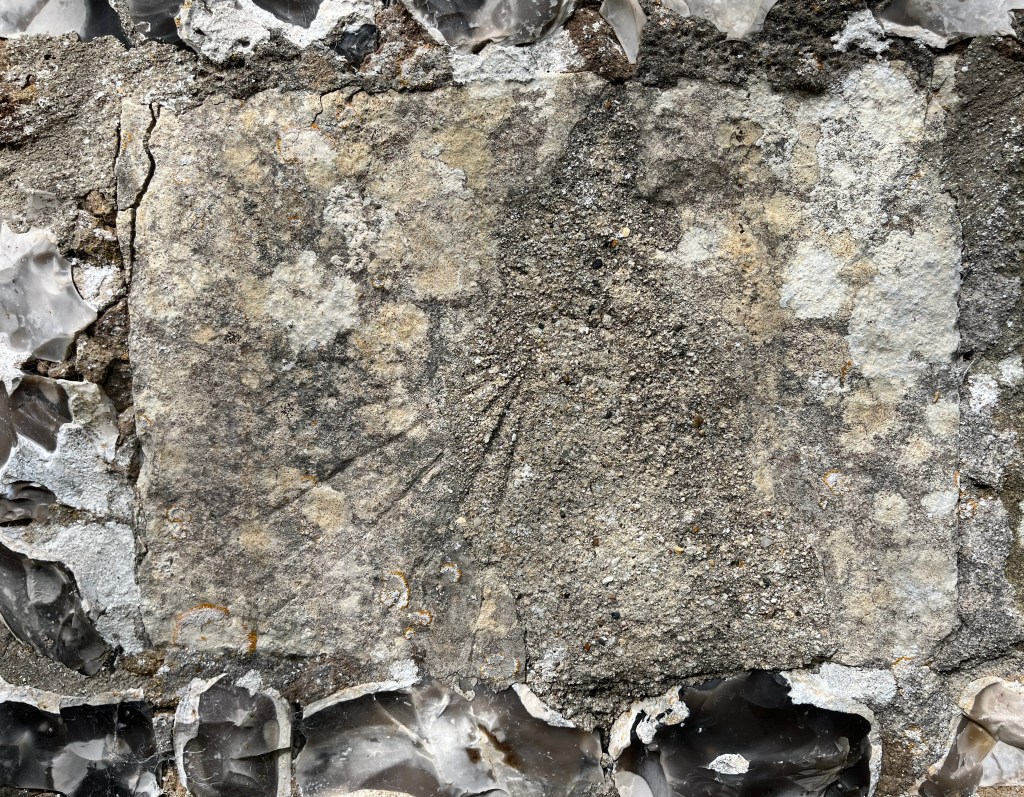
An attractively simple dial set in flint, perhaps not its original location. There are 6 lines LHS from the horizontal (6) down to to 11. Two are very faint. A morning dial, with 2 slightly deeper cut / longer lines suggesting Nones as the main time for observation. The absence of an obvious gnomon hole – open or filled – is a puzzle. There is a slightly paler area where the radials converge, perhaps marking the site of a gnomon hole filled centuries ago, now worn to a smooth patch
GSS Category: Scratch Dial; Mass Dial; Medieval Sundial Dorset
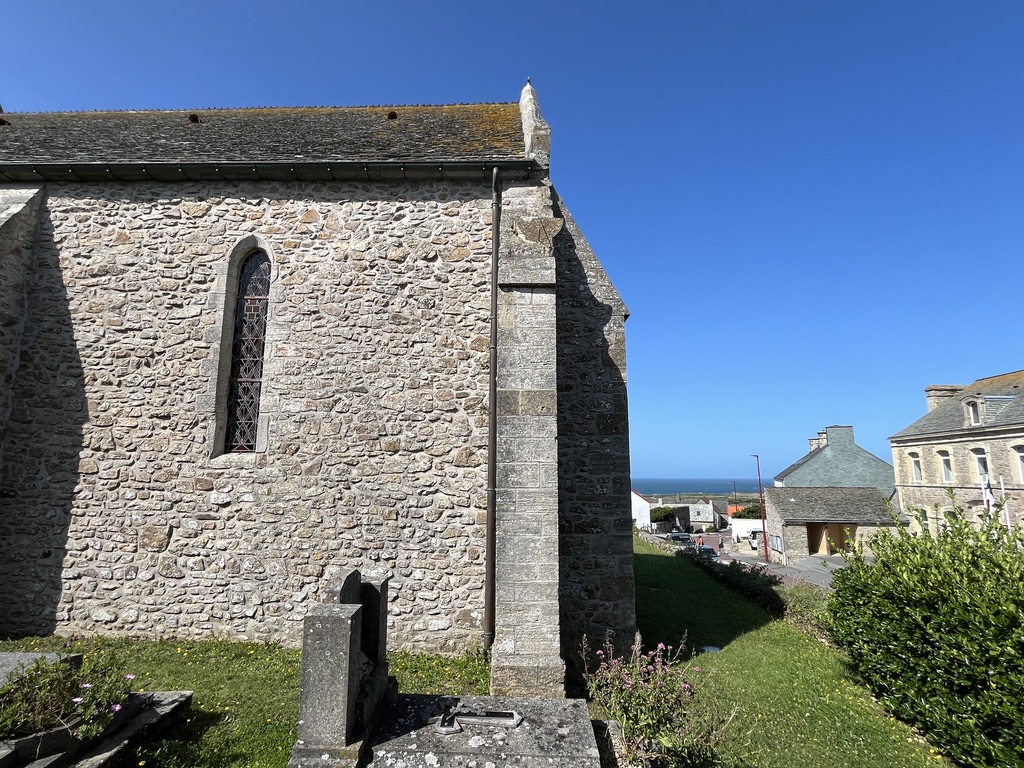
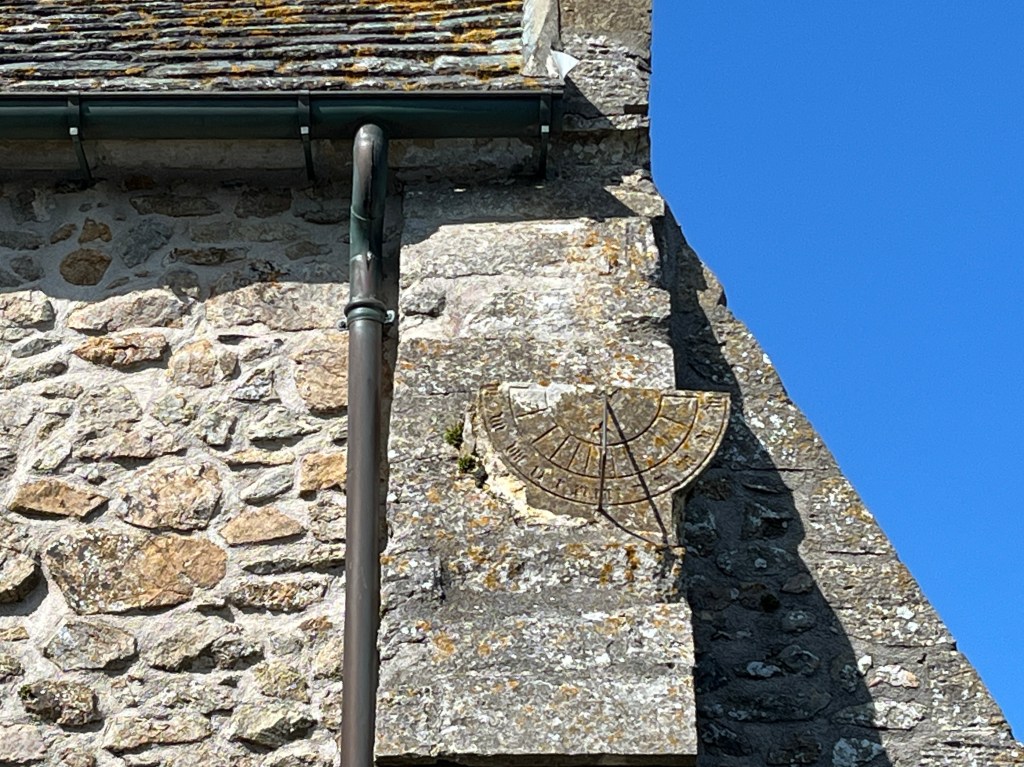
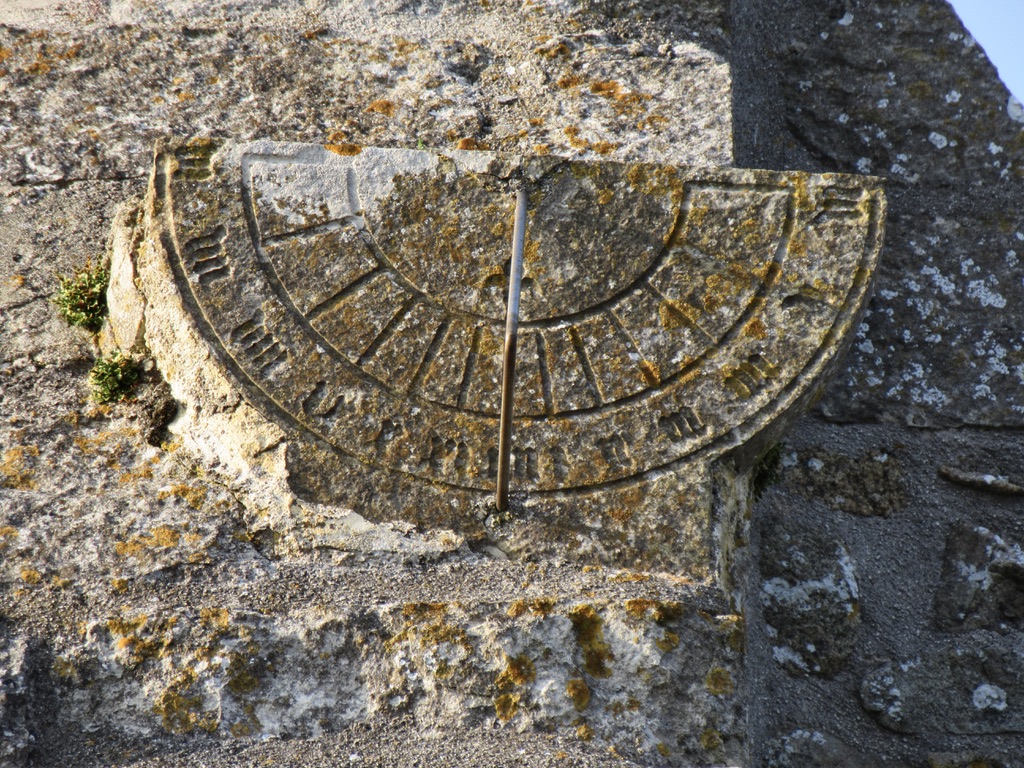
The church of St Gilles at Auderville is one of several churches in the region with similar dials located high up on one end, in this case the E buttress.
The dial is both canted and also slightly angled downwards, enough to notice from ground level. The Roman numerals are Blackletter, as can be found on other churches in the area. I haven’t come across the ‘horseshoe’ 9 before. The modern angled gnomon is plain and functional.
















































 GAUDIUM SUB SOLE: Scratch Dials & Sundials Medieval to Modern