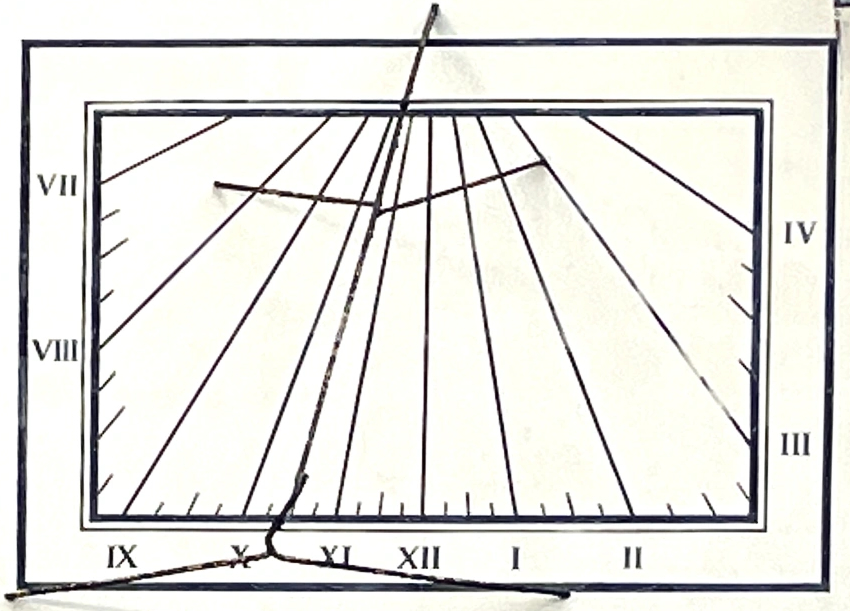
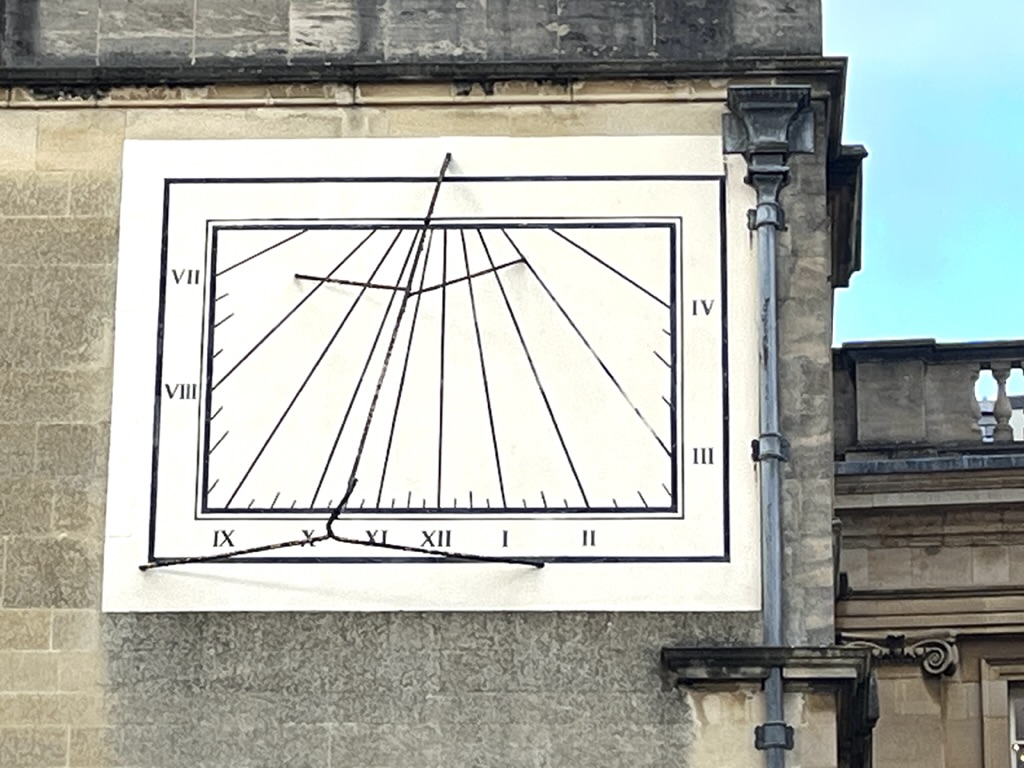
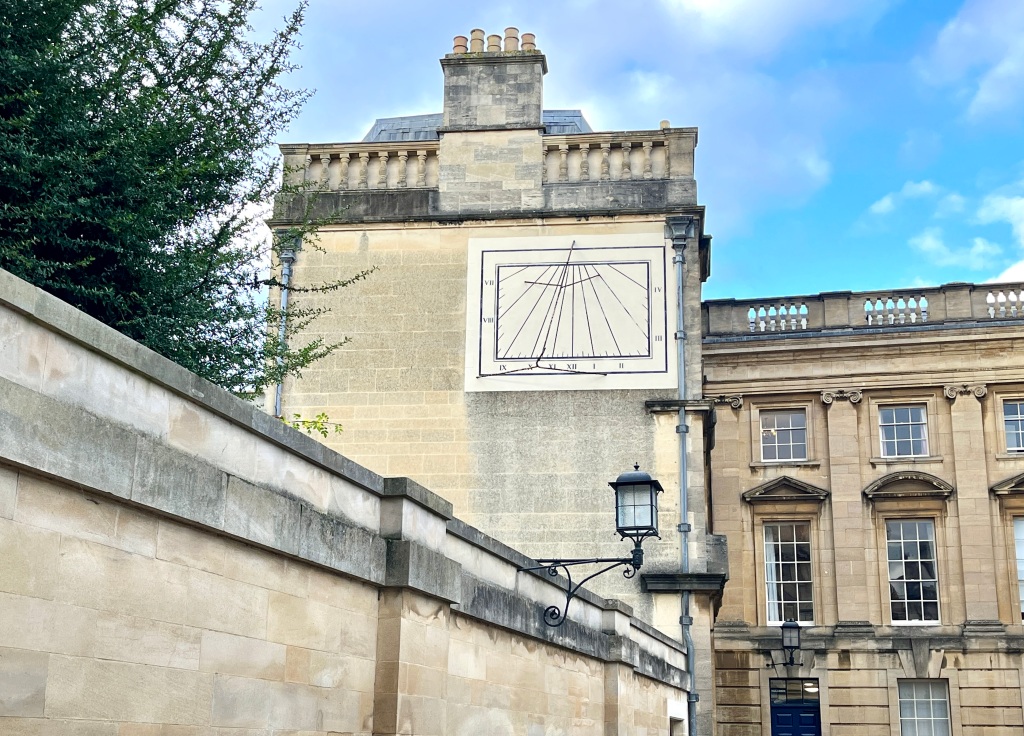
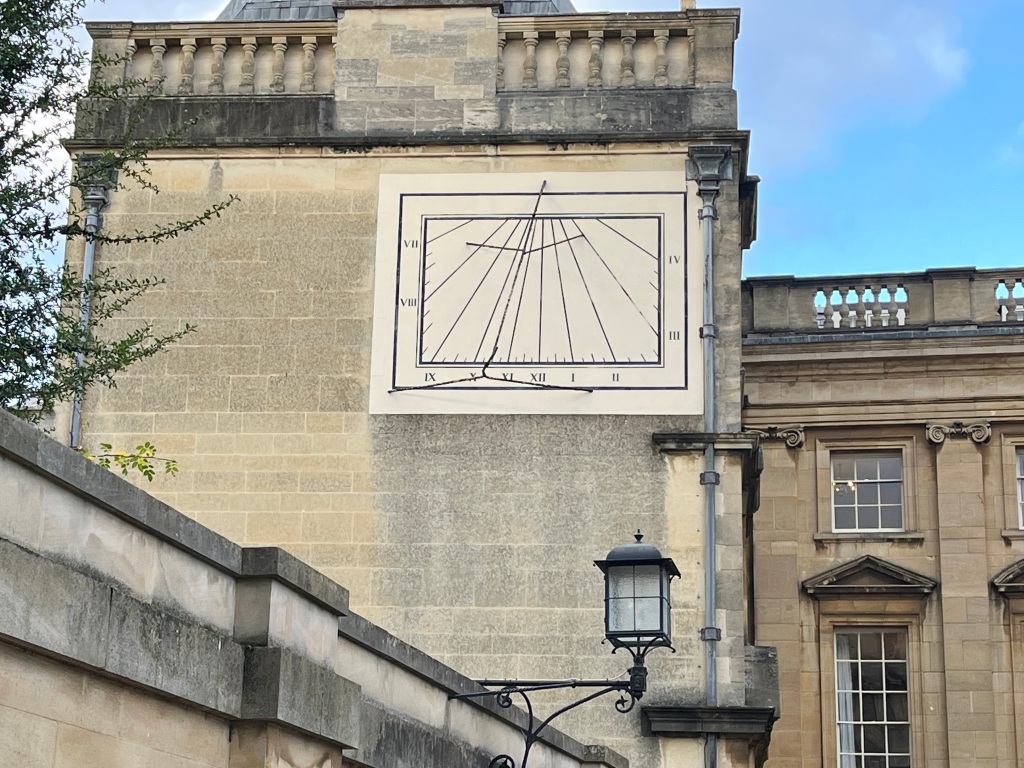
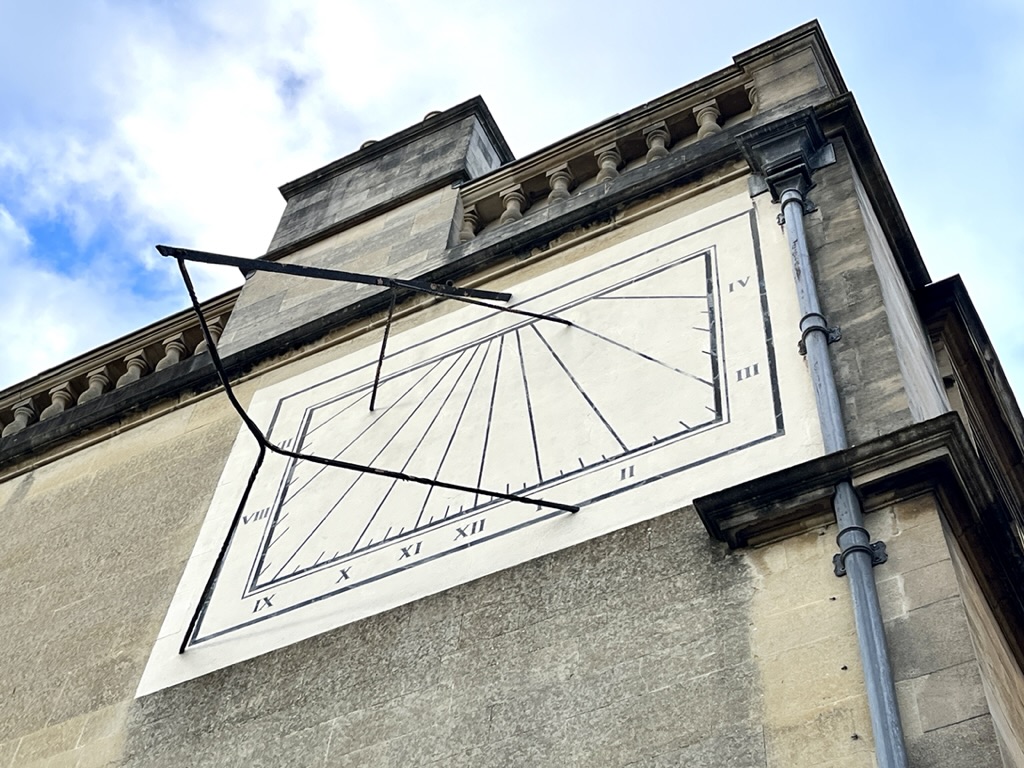
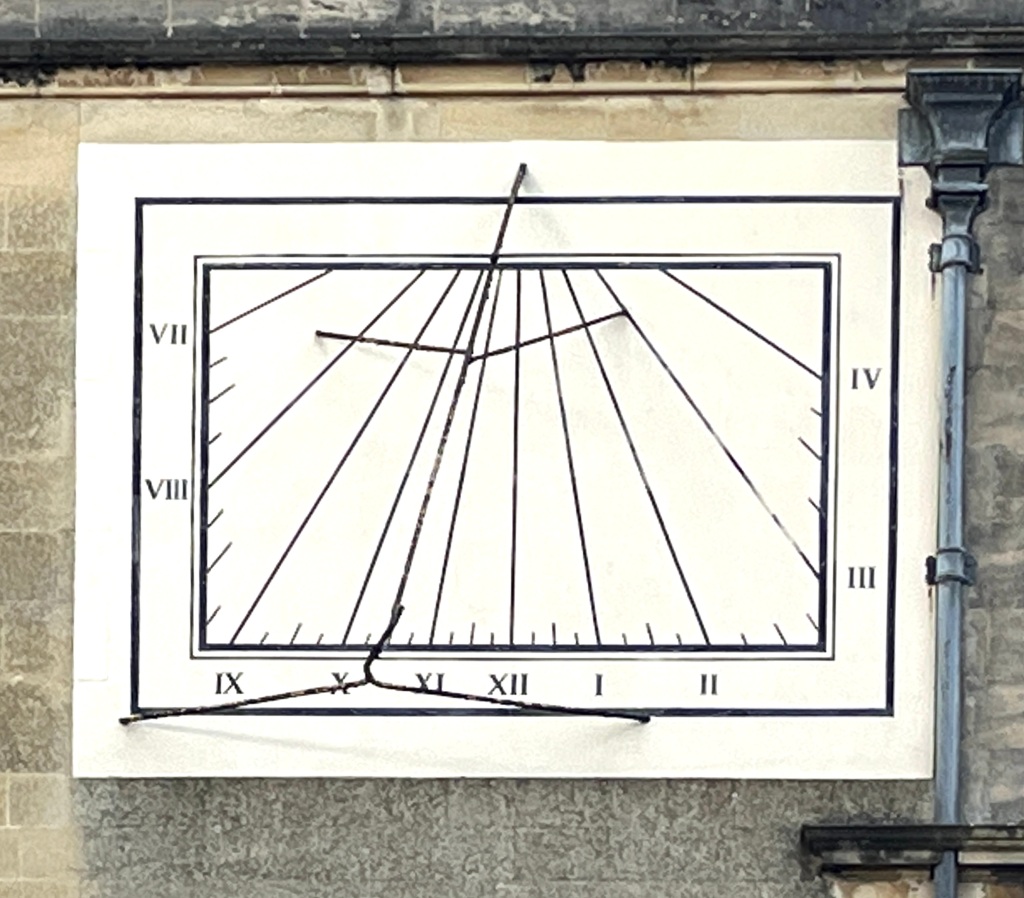
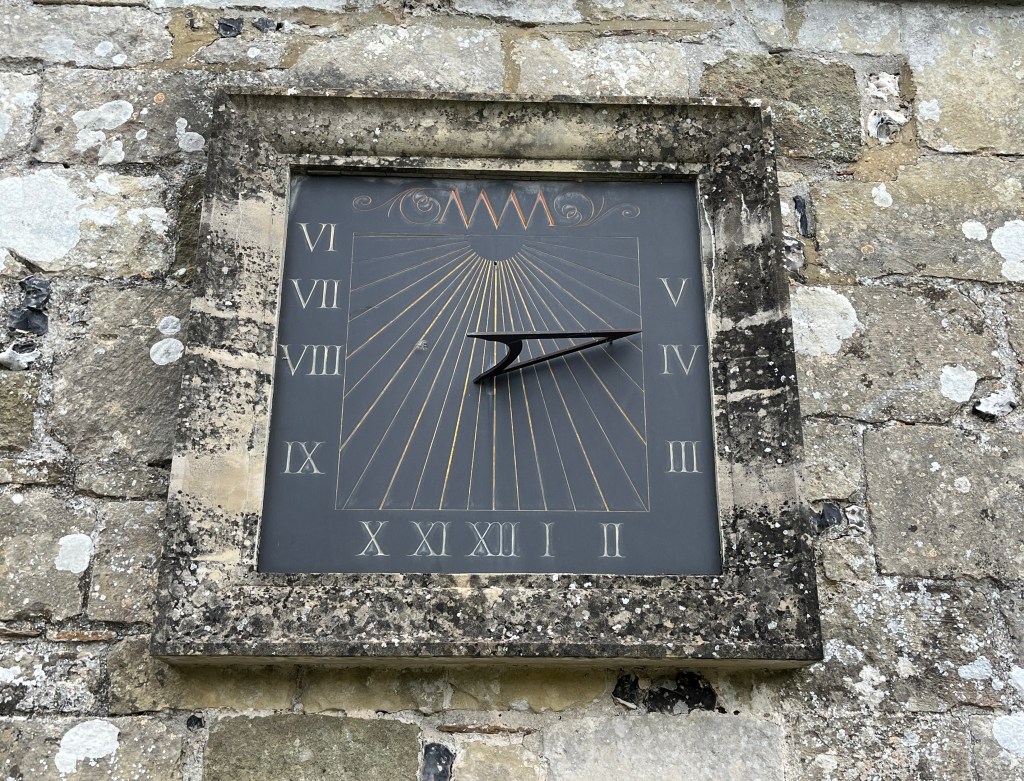
Located on W side of the Peckwater quad. c 1750, recently restored. Its position restricts the marked hour to VII – IV. Described rather harshly as a very plain and severely functional sundial of no great beauty in one source. Its simplicity and clarity in a City with many fine and some most elaborate sundials gives it some distinction.
Several other historic Christ Church dials both in the College and on the Cathedral (including mural dials) are sadly no longer extant. However, John Foad BSS points out that there is an outstanding multiple dial in the Pocock Garden, made by David Brown and installed 1998. There is also a small unobtrusive vertical dial elsewhere. These will have their own post in due course.
Christ Church Cathedral runs on Oxford time, five minutes and two seconds behind GMT. This is presumably a throwback to the late C19 before Standard Time was introduced by Statute, though there may be more arcane collegiate reasons.
To be linked in due course to the 2 modern sundials in the College.
GSS Category: Vertical Dial; Oxford Sundial; University Sundial; Old Sundial (C18)
GRADE II ✣ A fine Norman church built late C11 (nave); chancel c1200; tower C13. Major restorations ±1900 (Ponting). An estimable entrance. Worthwhile (PEV) and (more graciously) one of Wiltshire’s most delightful churches (Betjeman). Lovely font; wall paintings; pilgrim crosses, protection marks & graffiti. 6m N of Salisbury. 51.1244 / -1.8301 / SU119361
Note: separate post on the 4 scratch dials in the porchHERE
The dial is on the south wall of the tower, 8m up. Markings a bit unclear. Shows 8am to 7pm, 15 min marks. Half hours marked by triple dot pattern. Mounted in flint rubble wall of tower – rebuilt in 17th C – below and to the right of the clock. BSS Record
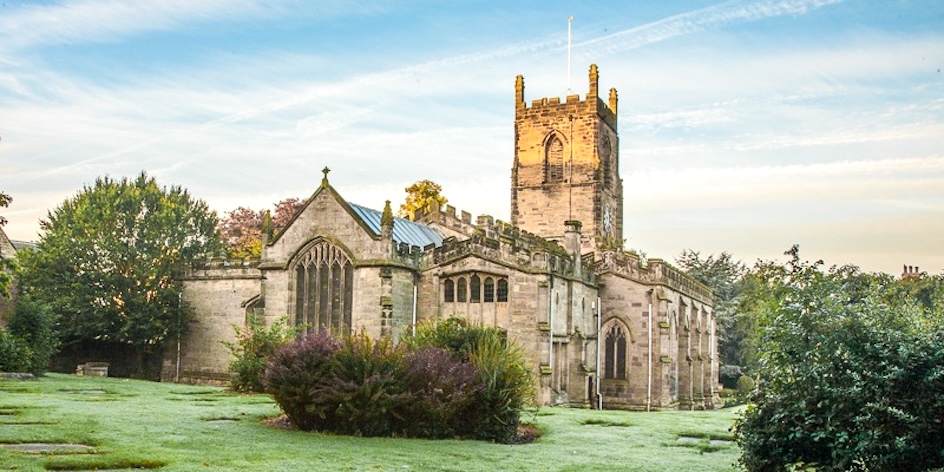
St Helen’s, Ashby-de-la-Zouch (from Church website)
‘
ST HELEN . ASHBY-de-la-ZOUCH
GRADE I ♱ C15 on older site; C19 enlargement. Listed as a building of exceptional interest. A fine church that invites investigation. Its orientation is significantly out of true. The focus is on the large vertical dial on the third stage of the mainly C15 tower. SK360167 / 52.7473 / -1.4668
SUNDIAL
St Helens . Ashby-de-la-Zouch – Vertical Dial (Erika Clarkson)
BSS RECORD
I am using the detailed BSS record for this dial, which is better informed and more concise than my own effort (discarded):
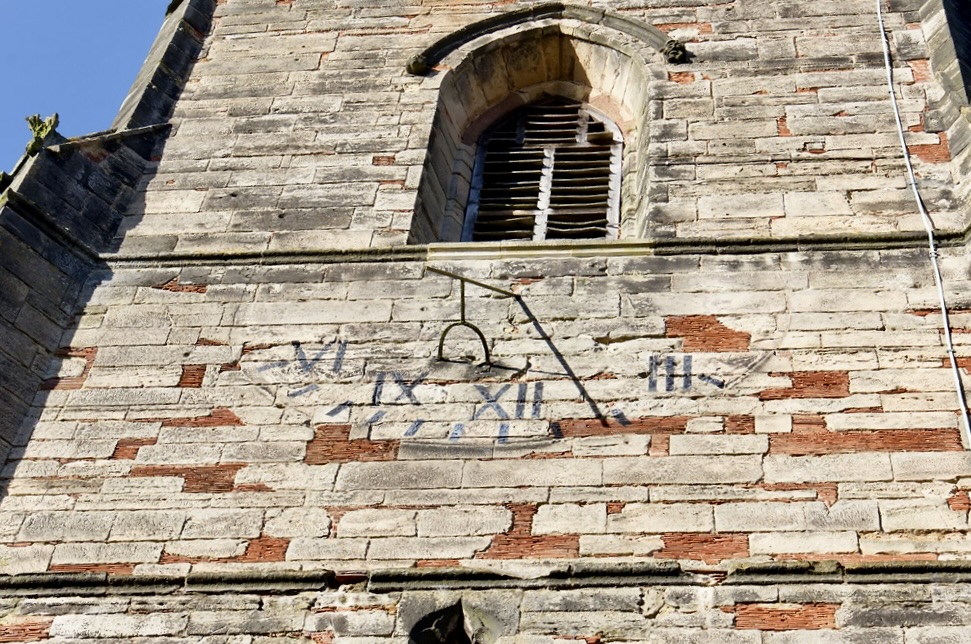
The dial is painted on the south wall of the tower, below the belfry. The hour lines and numerals were restored in August 2000. No markings previously remained though evidence of semicircular edging stones was visible. Interesting rod gnomon located near its end by a two legged ‘stirrup’ supporter. Shows 6am to 3pm in hours. Four 18in high numerals only (VI, IX, XII, III) inside the hour circle painted in black on stone, to be visible from the castle. No prior rendering. Restoration showed no evidence of any other attachments. Restoration by J A Tyldesley. Refer Church Booklet ‘The Restoration of the Ancient Sundial’.
To which I add that the gnomon / stirrup is slightly skewed, perhaps a correction of the church’s unaligned orientation.
St Helens . Ashby-de-la-Zouch – Vertical Dial (Erika Clarkson)
BSS also notes: Church website says “On the south wall of the Memorial chapel is a sundial which is easily overlooked”. Is this another dial? Any further information would be welcome.
The St Helen’s website is a model of its kind: informative, clear, interesting, and with excellent short videos of important aspects of the church https://www.sthelensashby.net/
FINGER PILLORY
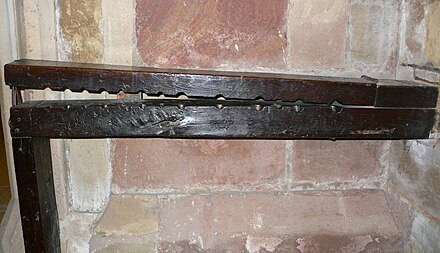
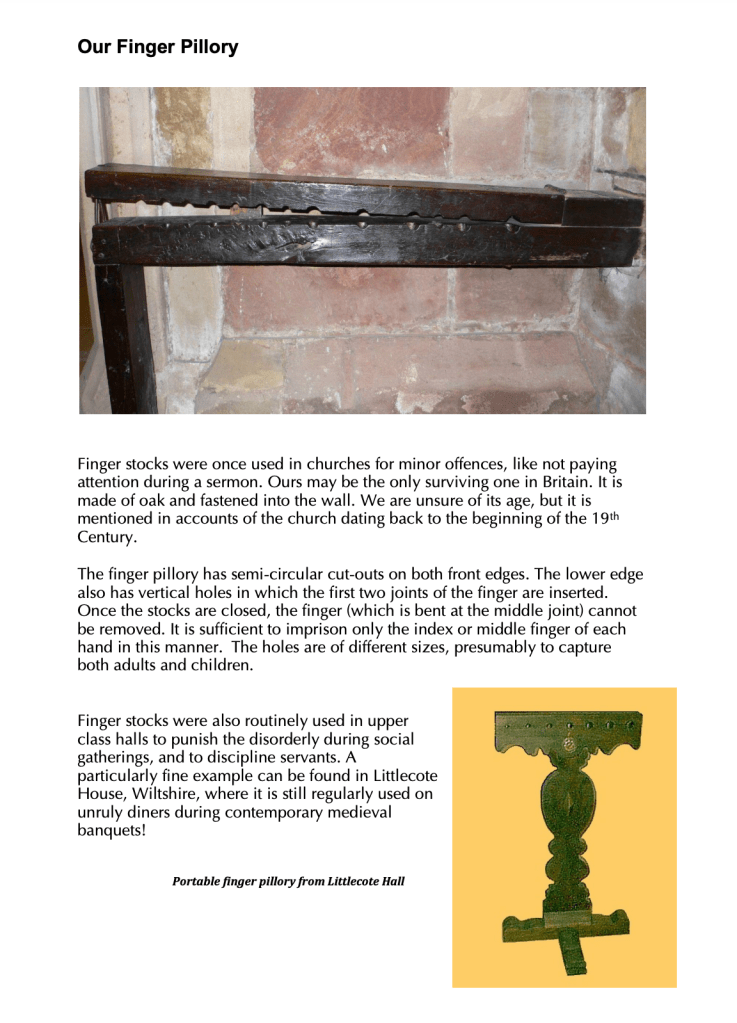
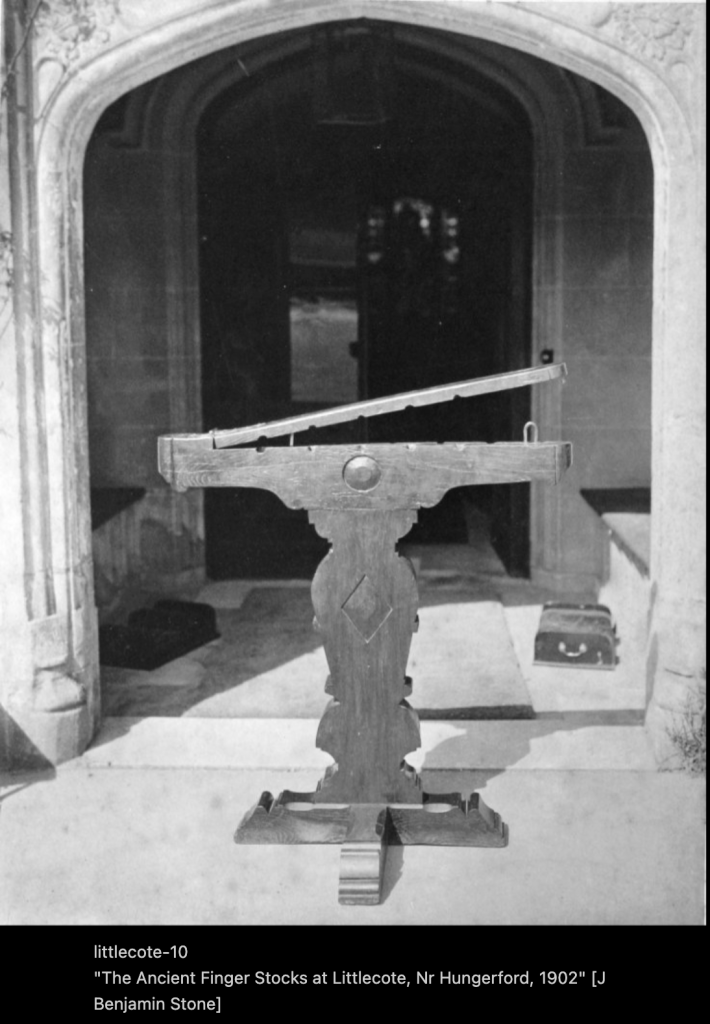
Adding to my pages dealing with interesting non-dial features in Medieval churches, the image above shows a most unusual treasure that I have not come across before, a FINGER PILLORY. It seems that there is only one other in the country (Littlecote House Wilts) . This device was used to punish minor miscreants in public for offences not serious enough to warrant the stocks.
Finger ‘stocks’ were used in churches for minor offences like not paying attention during a sermon.
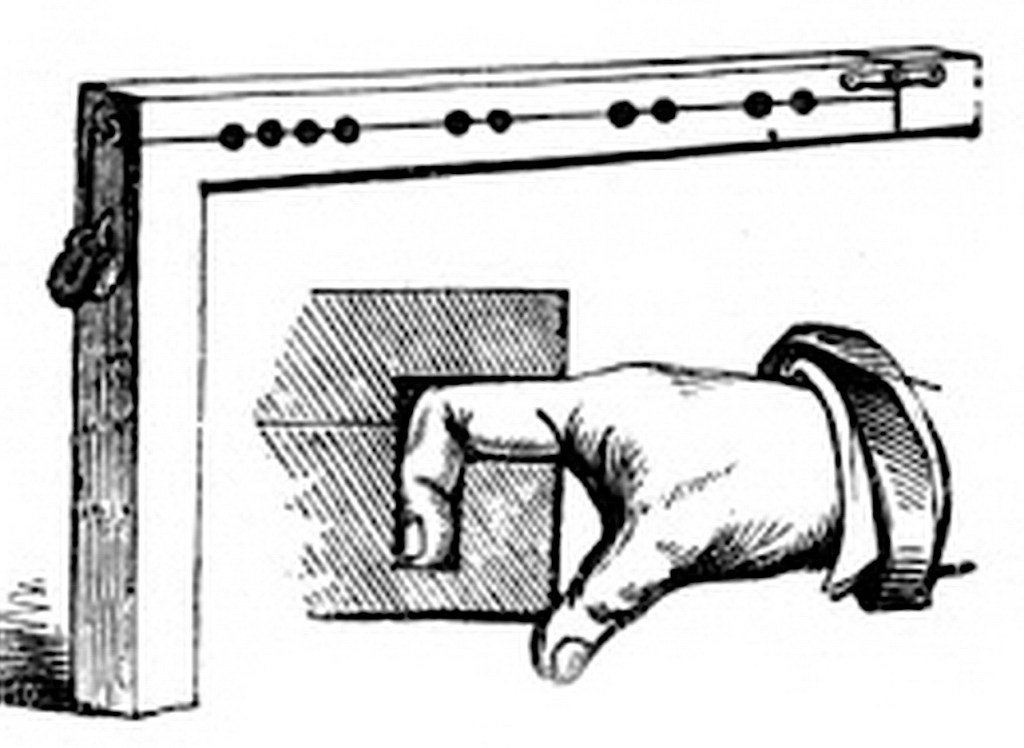
This drawing suggests another painful reminder to conform, with a finger being trapped inextricably at a right angle. I’d stick with listening to the sermon in preference.
GSS Category: Vertical Dial; Restored Church Dial; Rediscovered Church Sundial; Finger Pillory
Credits: Erika Clarkson; St Helen’s church website; OS / CC sources
GRADE II* ✣ Parish Church. C12 origins; C13 tower; further works C15, C17, C18; restorations 1896 ff. An attractive country church beside the Manor House, close to a remarkable village cricket ground (see below). 11m E of Tewksbury, 12m NE of Cheltenham. 51.9897 / -1.9129 / SP060323
VERTICAL DIAL
The dial is immediately above a 2-light Perpendicular window, and (when I visited) partly obscured by foliage. The gnomon-less dial is dated 1797
The dial is hard to read because of its weathered condition, its high position, and the difficulty taking a square-on photo. Little detail can be seen with the naked eye. There is evidence of a double rectangular border; and there are the remains of decoration above the dial face. The dial is prominently placed and (absent trees in front) would have been visible from quite a distance.
SCRATCH DIAL?
In his Glos dials survey, Tony Wood TW lists a scratch dial at Stanway without further detail. It is not noted in TWC’s much earlier list. I can find no other reference, and I did not find a convincing dial. The best candidate was this one, with 3 radials RHS emerging from a large hole. One other line LHS runs beside the hole rather than radiating from it. The other large hole to the left suggests that the pair may have held a fixture, and there is a similar pair lower down.
Tentative conclusion: this is possibly a scratch dial, but dubious. It might be more convincing if it were on its own.
CRICKET PITCH
Straying from dial-specific content, here is a small gallery of the extraordinary cricket pitch, the gift of J M Barrie who stayed at the house. The outfield includes significant areas of ridge and furrow undulations, rather more of a problem for fielders than batsmen I imagine. The pavilion, supported by staddle stones, is an excellent example of satisfying quirkiness. I found a old ball under it to chuck around for a while and decide which end to bowl from.
St Margaret & St Andrew . Littleham . Devon – Robert Cornford OS / CC
ST MARGARET & ST ANDREW . LITTLEHAM-cum-EXMOUTH . DEVON
GRADE II* ✣ Recorded from 1139; present building has C13 origins (chancel); 14th-century arcades; then Perpendicular with subsequent rebuilding and C19 restorations (Fulford). Resting place of Viscountess Nelson.
I have not visited the church myself, but Ian Logan contacted me about the vertical dial on the apex of the church porch. I have written this post around the dial, however Ian has produced an excellent detailed description of the church and its history that I highly commend.
St Margaret & St Andrew . Littleham . Devon – Ian Logan
St Margaret & St Andrew . Littleham . Devon
BSS record: A stone dial, rather crude in execution and in poor condition, is mounted on the church porch. It is about 600mm square and shows the hours VI – Vl undivided. Although the numerals look as though they are aligned with the hour lines, the hour lines themselves have disappeared. The church leaflet says that the dial dates from 1780.
St Margaret & St Andrew . Littleham . Devon
SCRATCH DIAL
There is an older dial – a scratch dial – on the right hand side of the porch doorway, probably C15. It is in poor condition, but there are 7 discernible lines radiating from the gnomon hole in the dial stone. These are two quite old photos of the dial (BSS). If anyone can provide a clear recent photo, it would be very welcome as an addition!
The ‘dawn’ line is now a prominent cleft in the damaged dial stone. The cluster of lines at and beyond noon LRQ indicate the most important part of the day for observance (none in canonical terms).
St Margaret & St Andrew . Littleham . Devon – Scratch Dial
MRS CROWLEY
This is an ideal place to use the wonderful drawing skills of Mrs Crowley to illustrate the vertical dial and scratch dial together. I have managed to obtain a copy of the comprehensive book of her Devon and Cornwall dial drawings, a work of wonder for dial-ologists.
GSS Category: Vertical Dial (1780); Scratch Dial
Credits: Keith Salvesen (photos); Ian Logan (photo, research); The Parish History Group (interesting and informative leaflet)
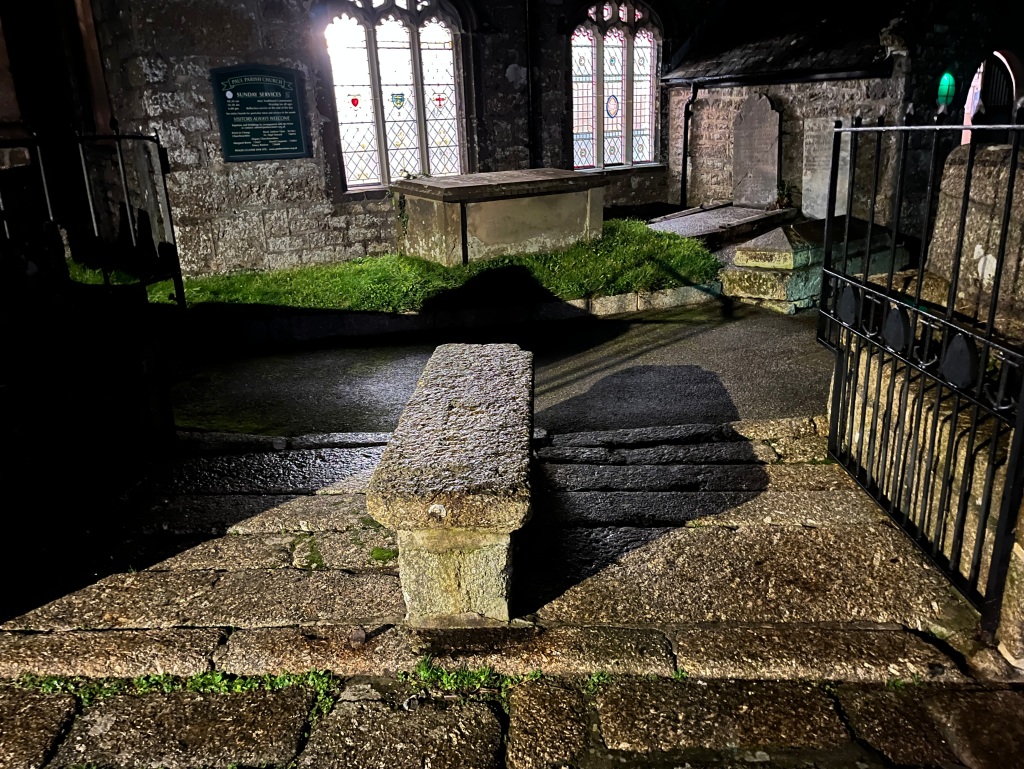
GRADE I ✣ C15; enlarged 1600; Restoration 1875. A most interesting church set on the hill above the famous small fishing village of Mousehole. St Pol has much to offer, not least a memorial to Dolly Pentreath, supposed last monoglot Cornish speaker; and a fine example of a coffin stone in the lychgate. The village churchyard has a small maze with a wonderful view LINK. Congenial pub. 50.0896 / -5.5461 / SW464270
DIAL
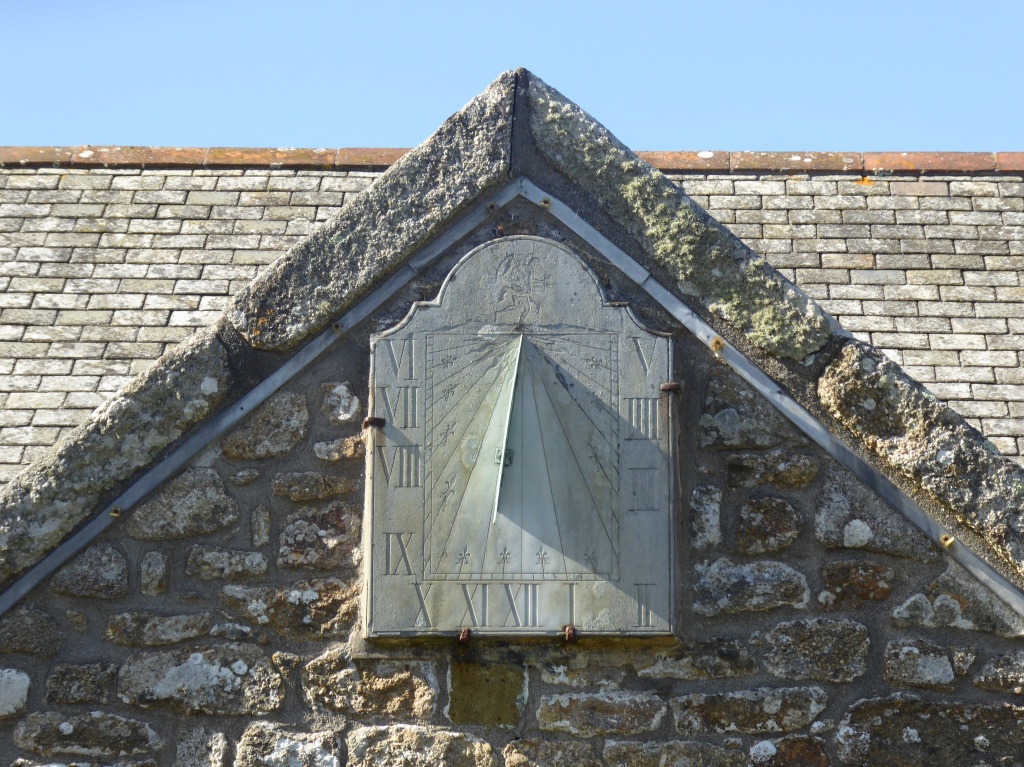
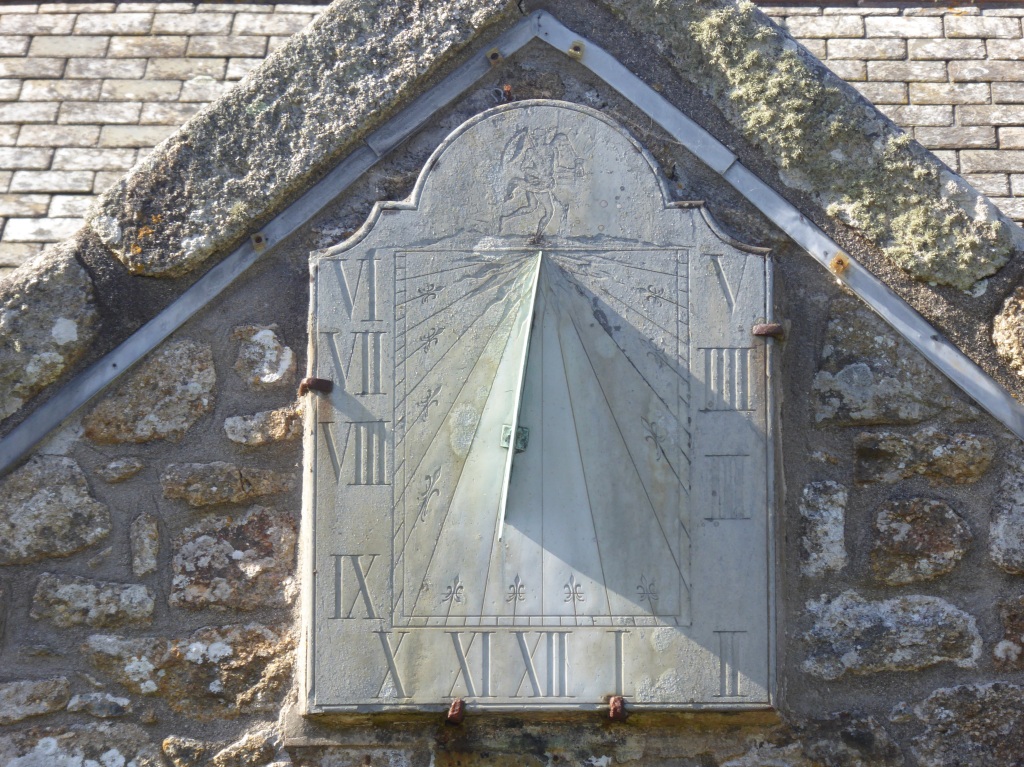
BSS notes that the engraving is excellent and remains clear to this day. The half hour lines each have a fleur de lys and all the lines originate from the sun’s rays around the gnomon root. Caroline Martin’s delightful small book on Cornish Sundials notes the interesting and unusual gnomon. To which one adds that the gnomon points to XI rather than noon.
MRS CROWLEY
One benefit from a recent visit to the Penzance area was to make the acquaintance of Mrs Crowley and her remarkable sketch books of the dials of Devon and Cornwall. Her progress around both counties in the 1950s produced dozens of beautifully produced drawings of dials. The details are so closely observed and the drawings so clear that it is difficult to imagine how she managed the task.
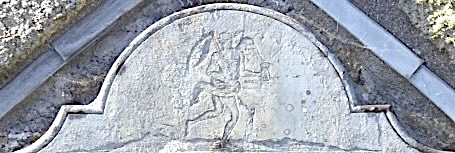
On this page, Mrs Crowley – who usually drew compete dials – has focussed on 3 dials with similar designs on the ogee tops above the gnomon. I think it probable that she chose not to make drawings of the complete dials because she was so taken with the similar depictions of Old Father Time with his scythe and hourglass. All 3 churches are within 10 miles of each other.
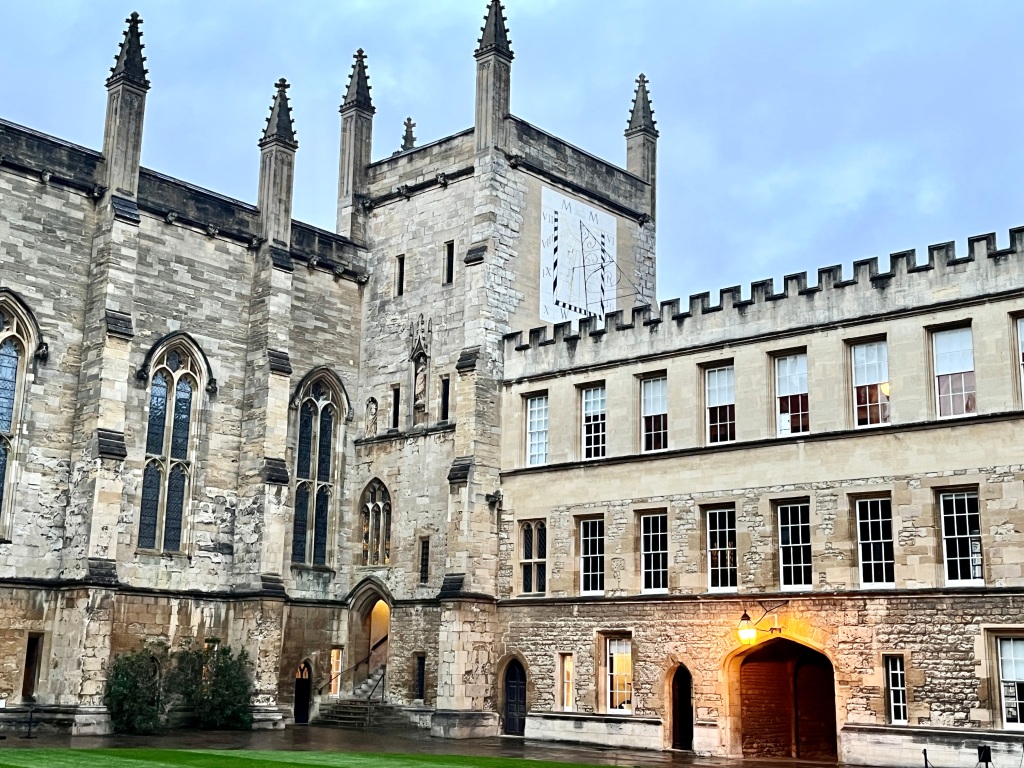
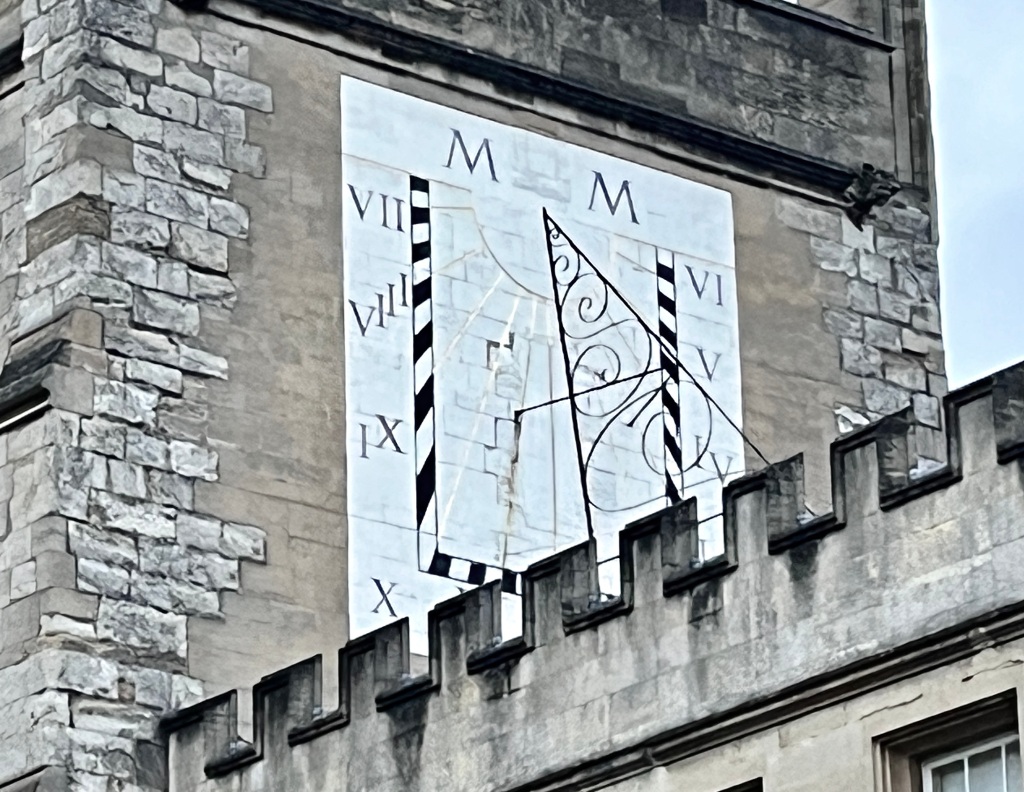
Dusk on a rainy November evening is not an ideal time to photograph high-up sundials, especially ones with intricate but delicate gnomons. Entering the Great Quadrangle, the sundial is visible on the Muniment Tower, beyond which is the Garden Quad. The position of the dial somewhat limits the photographer. A certain amount of refining has been needed in presentation, which I hope will be excused. The dial face is pale blue (white in some photos I have come across). The light conditions resulted in a rather startling blue that I have attempted not very successfully to tone down.
New College Oxford . Vertical Sundial
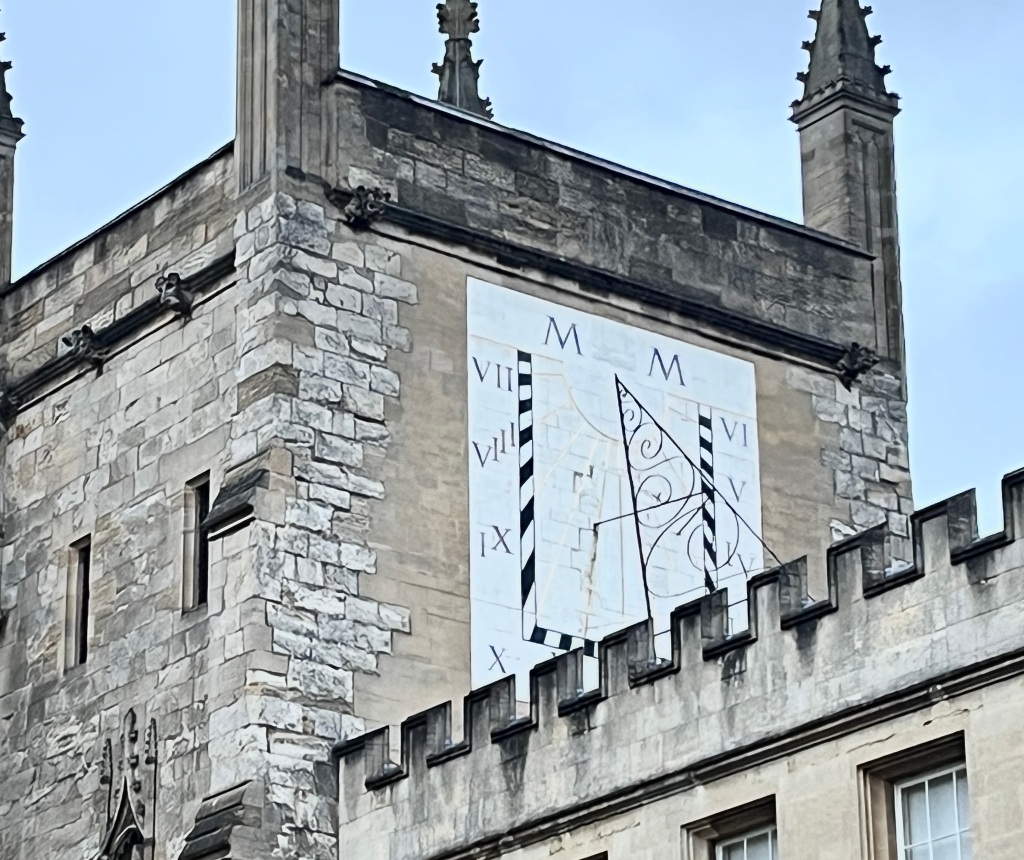
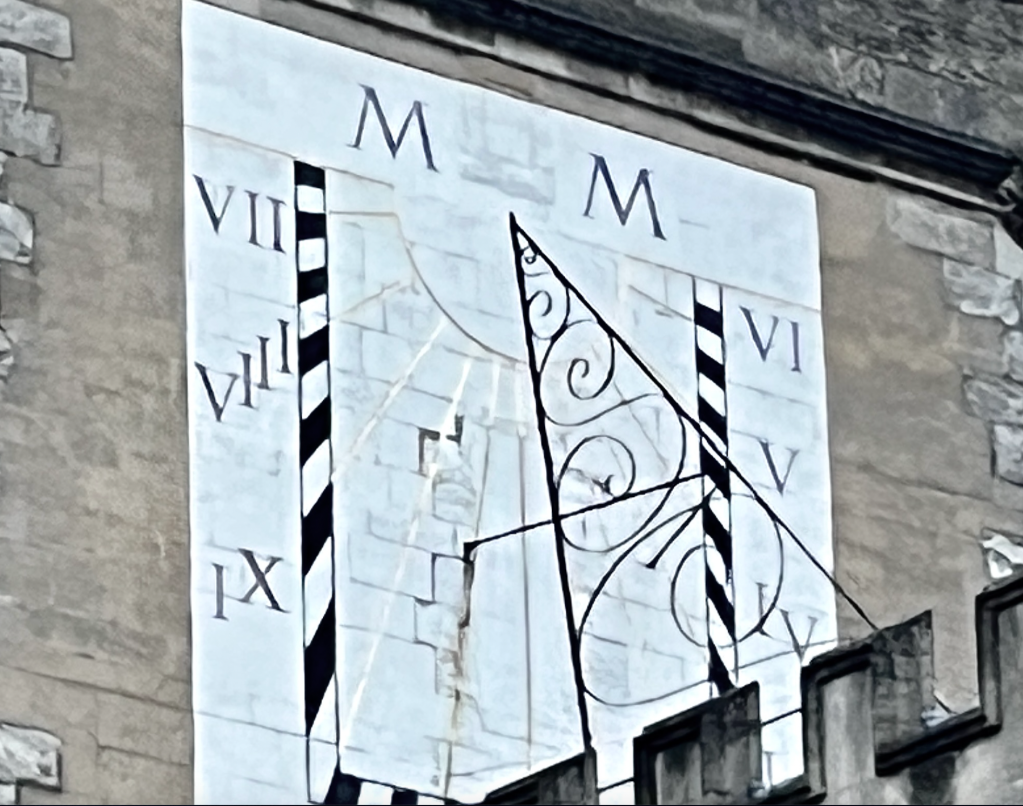
The New College Millennium dial is on the S facing wall of the Muniment Tower. Quite apart from photographic considerations, the high position means that it is not possible to see the whole dial from ground level. One cannot, for example, see that the M M at the top is matched by W W at the bottom, standing for William of Wykeham who founded New College in 1379; nor that noon is marked by a golden cross.
New College Oxford . Vertical Sundial
The dial marks quarter hours, as indicated by the chequered perimeter. Margaret Stanier mentions a wall-mounted plate showing the EQUATION OF TIME ; and she notes that there was a vertical dial in the same position from 1696 until c1850, then being obliterated by restoration and refacing.
BRITISH SUNDIAL SOCIETY ARTICLE – HARRIET JAMES
This excellent article from the BSS Bulletin Vol 12 .1 of Feb 2000 was published very shortly after the installation of the dial. It has all the material you need regarding the dial, and there are some very clear images that give a view of the whole dial. It also covers the original C17 dial in the gardens.
GSS Category: Vertical Dial; Millennium Dial; University Dial
All photos: Keith Salvesen. Source material: Margaret Stanier ‘Oxford Sundials’ 2003. College diagram: BLB; tip of the hat to Michael Lalos, a fellow dial enthusiast, who also used the BSS Bulletin
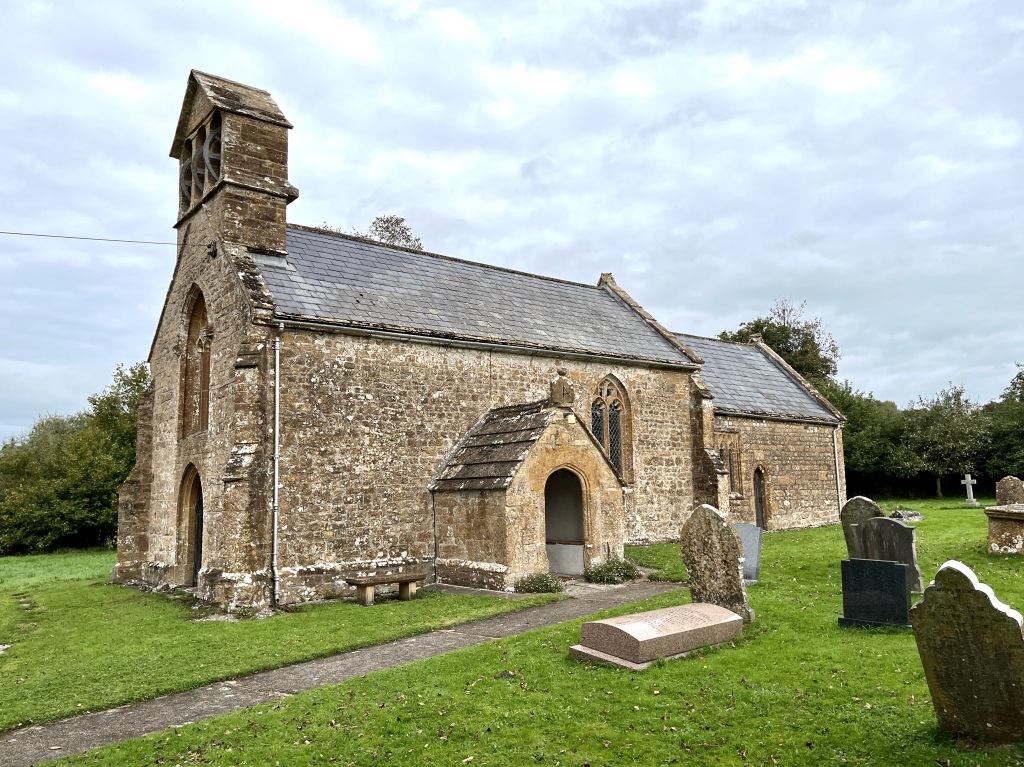
GRADE I ✣ Late C13, records from 1334. A charming small church, with its 3 bells hung on wheels. A plaque lists 19 men who returned safely from WW1; it is a ‘Doubly Thankful’ village with no casualties in WW2 either. See also neighbouring STOCKLINCH OTTERSEY, a closely linked church. Close to Barrington Court NT. 50.9508 / -2.8797 / ST383171
✣
DIAL
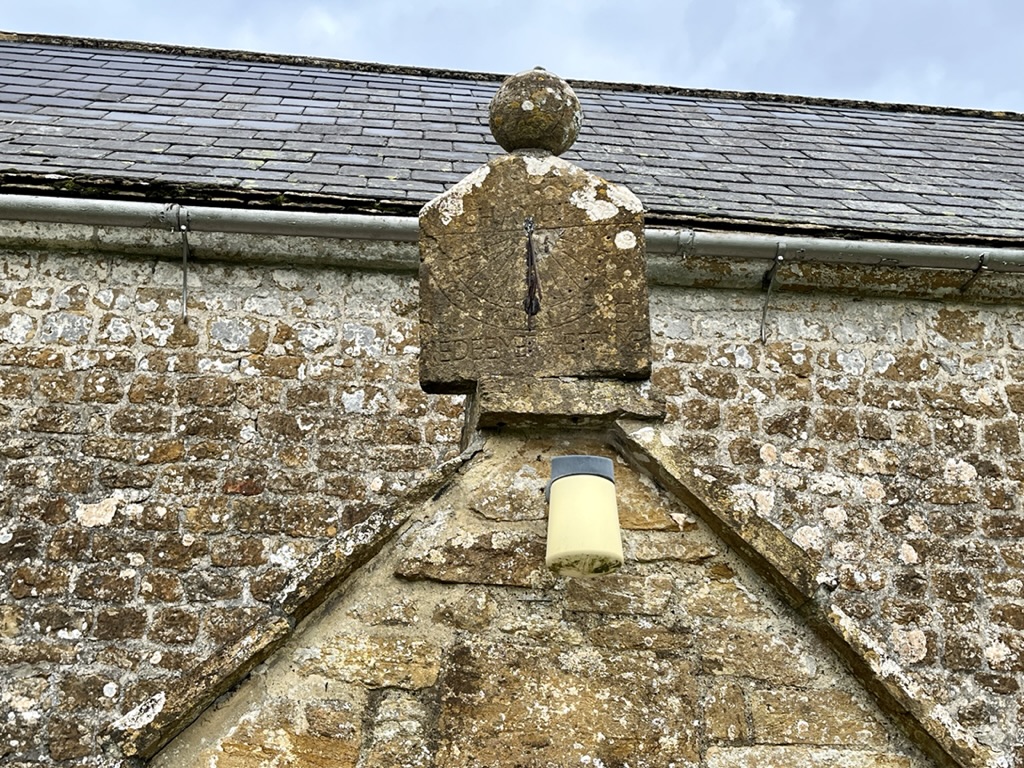
The dial is perched on the apex of the squat porch. It is square, significantly canted, and with ‘shoulders’ upon which rests a ball finial. Given its exposed position, the dial is in good condition. BSS dates it to 1612. There is a clear-cut semicircle with a full complement of lines, and with pocks marking the half hours.
CANTING
GNOMON ANGLES
INSCRIBED MOTTO
The words WATCH AND PRAY are inscribed above the dial face. Erosion and lichen have made it hard to see. Below the dial are the words REDEEME THE TIMES, with the final S fitted in above the line. The numerals – damaged LHS – are Arabic.
The dial is 10′ up on the SE corner of the nave. Gold lines on slate ground. Open gnomon. Numerals not gold. Date at top with scrolls all in Red. Uses XII and IV, with all numerals vertically arranged, and shows 6am to 6pm in half hours. Lines drawn from small semicircle at root. Full length half hour lines (BSS).
This is a fine MM dial and a pleasure to walk towards. Hopefully the gnomon can soon be pegged back into the upper hole, making the time of day easier to determine.
GRADE I † C12 origins (?); C15 inc tower & porch; C16 rebuilding / additions. Material from nearby Milton Abbey incorporated. C19 restorations. In proximity, a fine early vertical sundial (1690); 2 date stones (1569); scratch dial (probable?). Several excellent gargoyles N side. 2m W of Milton Abbey. 50.8259 / 2.3114 / ST781029.
VERTICAL DIAL
A fine dial in very good condition for its age. The gnomon is an amusing extension of the sun’s nose. I took the design LL corner to be an hour-glass, which would be appropriate. In close-up I wonder if it is a religious symbol; and if the design LR corner is a square and compass.
DATE STONES
THE BAGPIPER
SCRATCH DIAL
The dial design of a double circle with a hole in the centre is far from unusual. No lines, no pocks; just a stick needed to mark the passage of the day. This type is generally included in the Scratch / Mass Dial category of church marks; and I go along with that. However, having recently researched Cyffe Pypard and Fovant (both Wilts) which have several dials including this design, I am beginning wonder. It’s hard to think of a reason why a dial-cutter would not to add lines, pocks or both to a device specifically made to mark the passage of the day. But what if these are apotropaic symbols cut into the walls of the church to catch evil: ‘Demon Traps’ from which, once entered, encircled evil could never escape?
GSS Categories: Vertical Sundial; Old Sundial; Date Stones; Gargoyles / Hunky Punks; Scratch Dial















 GAUDIUM SUB SOLE . SUNDIALS . MEDIEVAL TO MODERN