L’ÉGLISE SAINT-SAUVEUR et SAINT ÉTIENNE . COGOLIN . VAR
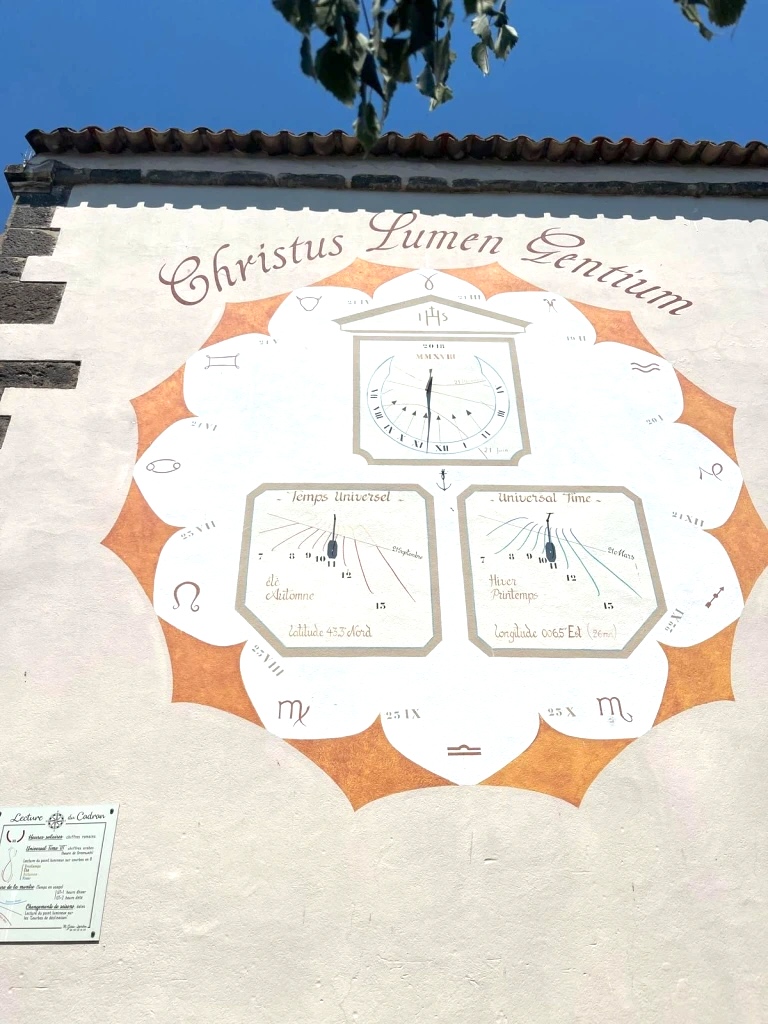
COGOLIN is an attractive and relatively small town with a harbour close to Port Grimaud. Both towns are a short jet-ski ride from St Tropez. The church, with its double dedication, may date to C11.
CHRIST IS THE LIGHT OF NATIONS
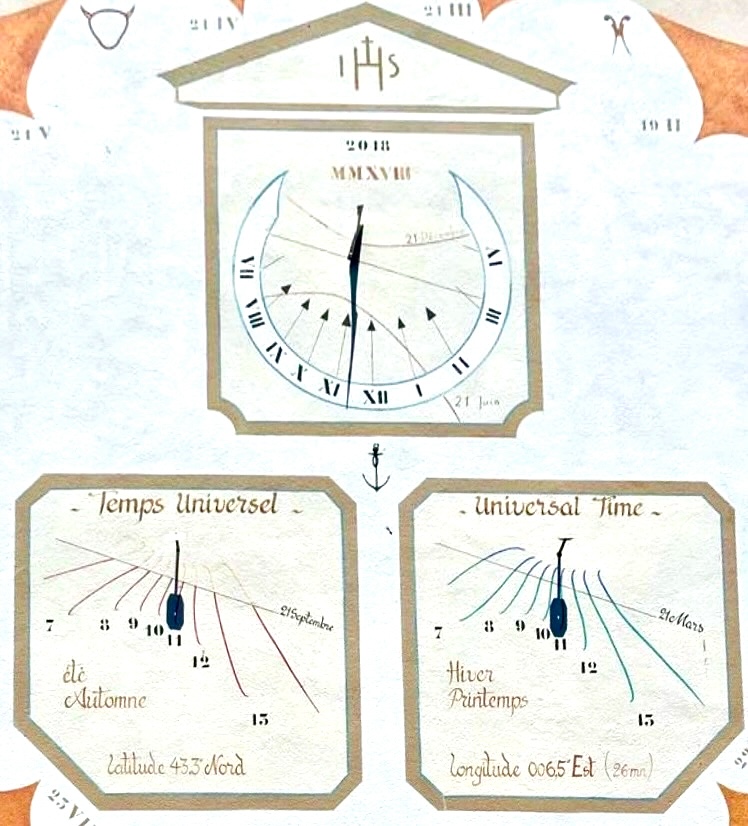
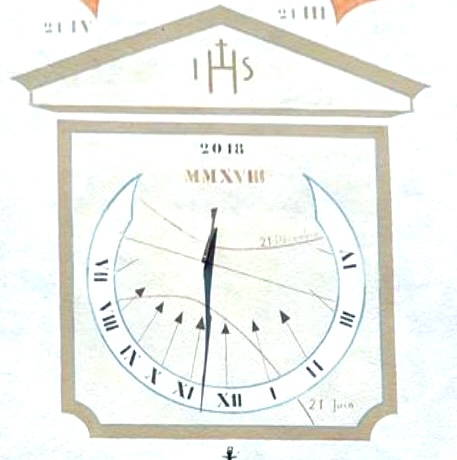
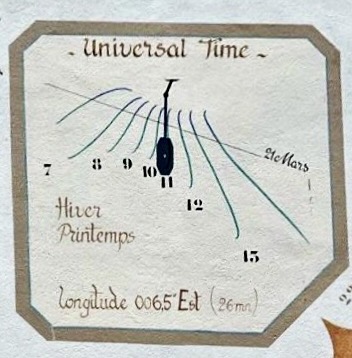
This intriguing dial was created by M. Garde-Lebreton in 2018. It manages to combine accuracy, legibility, and charm. An excellent bonus is the very careful explanation of the dial on a separate plate. An object lesson of modern dial design and analysis.
DIAL 2
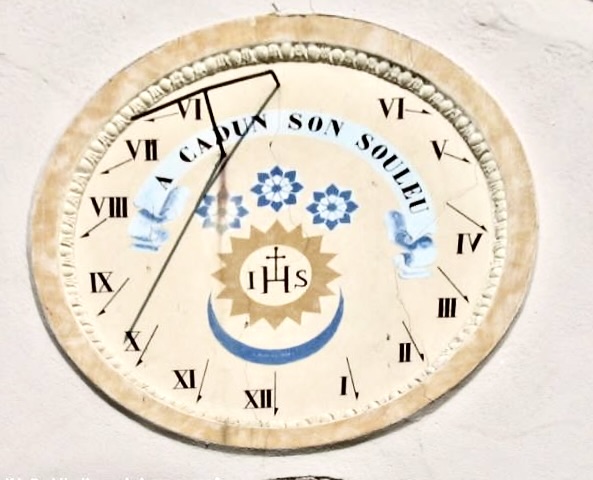
St-Sauveur has a second attractive dial, another good example of a modern dial that combines its purpose with cheerful style. Engraved and painted on cement.
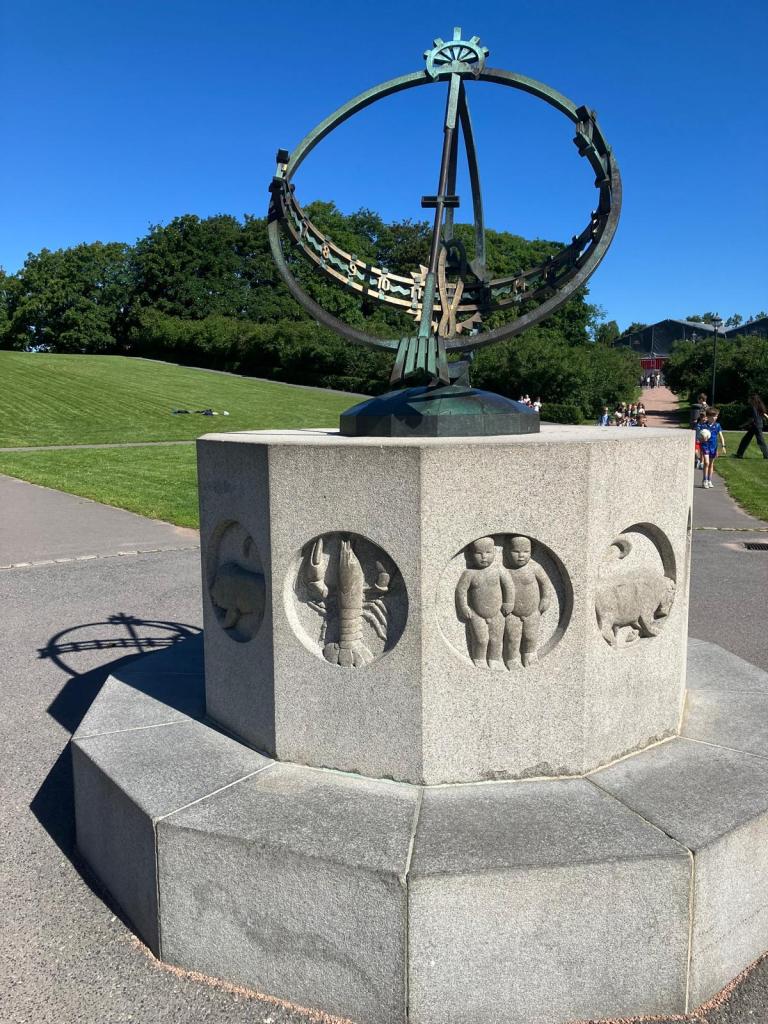
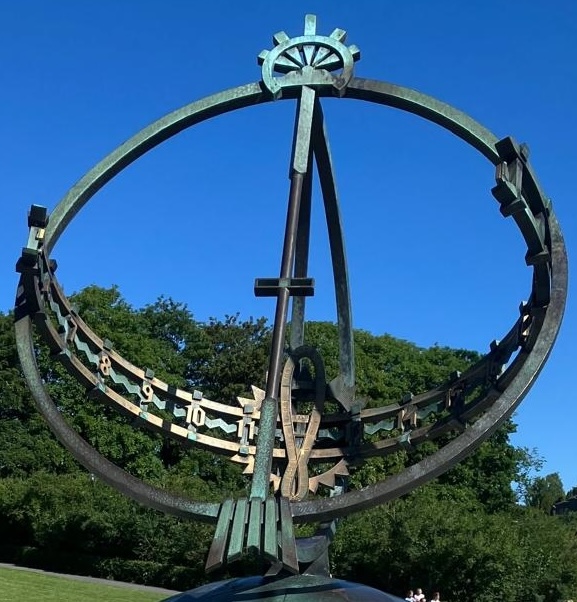
Gustav Vigeland (Thorsen) (1869 – 1943) was a Norwegian sculptor much admired for his creative imagination and productivity. His most notable work is the monumental ‘Vigeland Installation’ in the Frogner Park Oslo, compared to which his sundial is a footnote. Although generally acclaimed, Vigeland’s work is viewed by some as having uncomfortable connotations in several respects. The static interaction of the dozens of babies, children, women, and men might – nearly 100 years later – raise eyebrows. Having skimmed the topic I rather agree (despite being of Norwegian descent. Or because of it maybe).
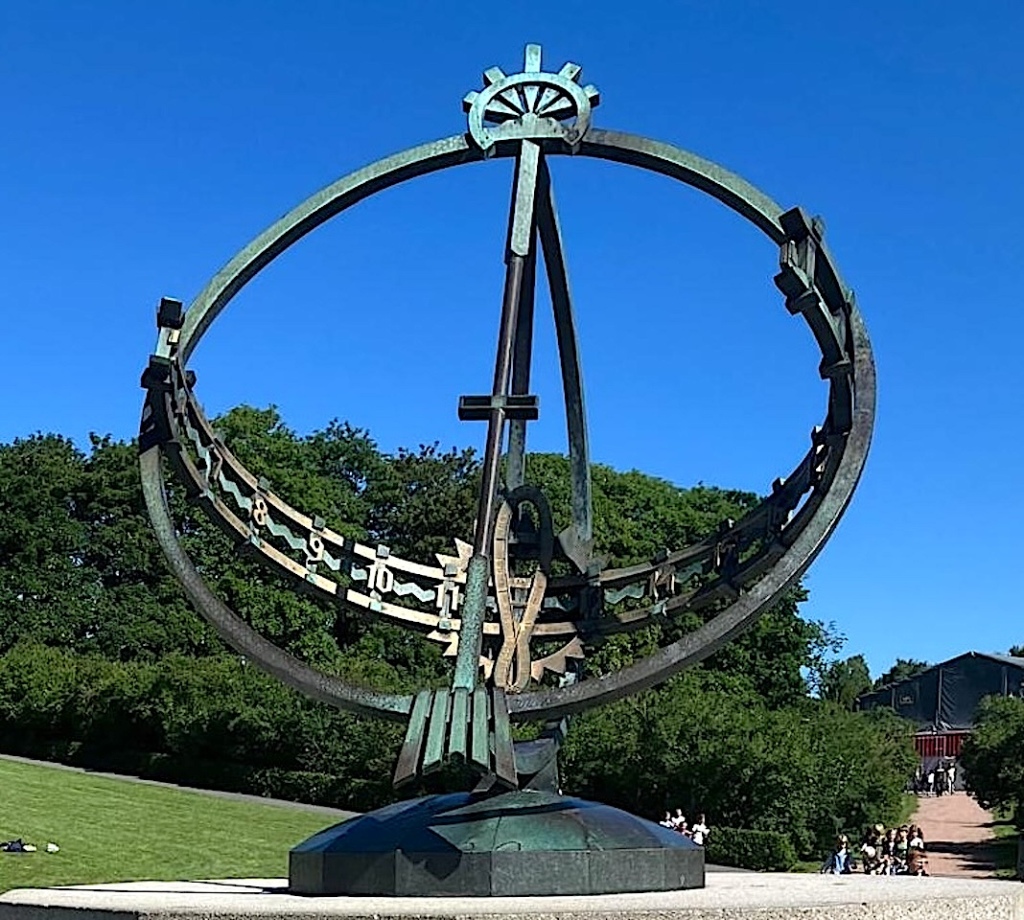
The armillary sphere was installed in 1930, a distinctively Scandinavian variation from designs further south in Europe, in a good way. The heavily sculpted dais is a duodecagon showing the Signs of the Zodiac in bold (lumpen?) relief.
BENJAMIN WEGNER
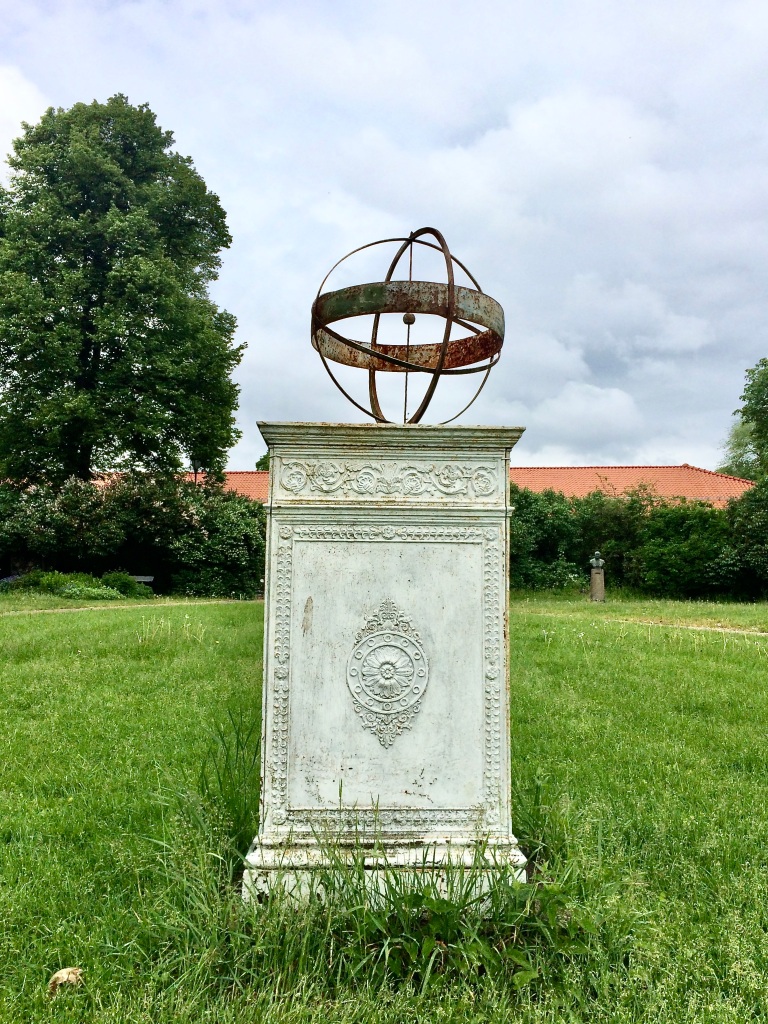
The armillary sphere is located outside the Frogner manor house (now the City Museum) in the south of the park. Wegner aquired the parkland in 1836, and the sphere was probably installed the following year.
Photographer: Vanasan, Wiki
There is very little information about this dial online, and only one clear photo that I could find. As often, Wiki can help clarify obscurity:
The sundial is constructed as an open globe, where the meridians cast a shadow on sunny days onto the inner part of the globe, hitting the inside of the equator line and thus showing the time, specifically the astronomical solar time. Odd Gunnar Skagestad wrote in 2020 that the nearly 200-year-old sundial is greatly neglected and called for efforts to preserve it
GSS Category: Armillary Sphere; City Sundial; Norway Sundial
All Vigeland photos Camilla Pennant; Wegner Dial, ‘Vanasan’
Corciano is an attractive small town 12km west of Perugia, walled and with much of its medieval origins still evident. In contrast, the Commune has commissioned interesting modern projects, for example a residential complex designed by Renzo Piano and inspired by Rubik’s cubes.
The town has initiated an ambitious project, financed by the municipality, to make an itinerary that combines culture, history, astronomy, landscape and science and can be used free of charge for everyone: citizens, schools and tourists.
BORGO del SOLE
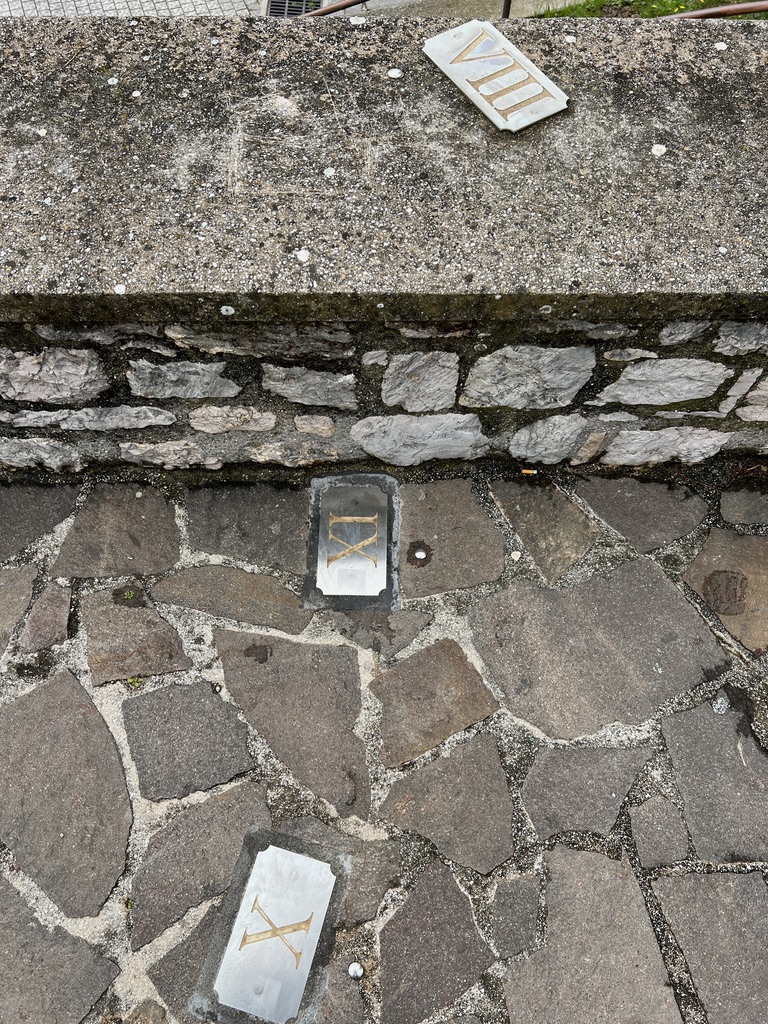
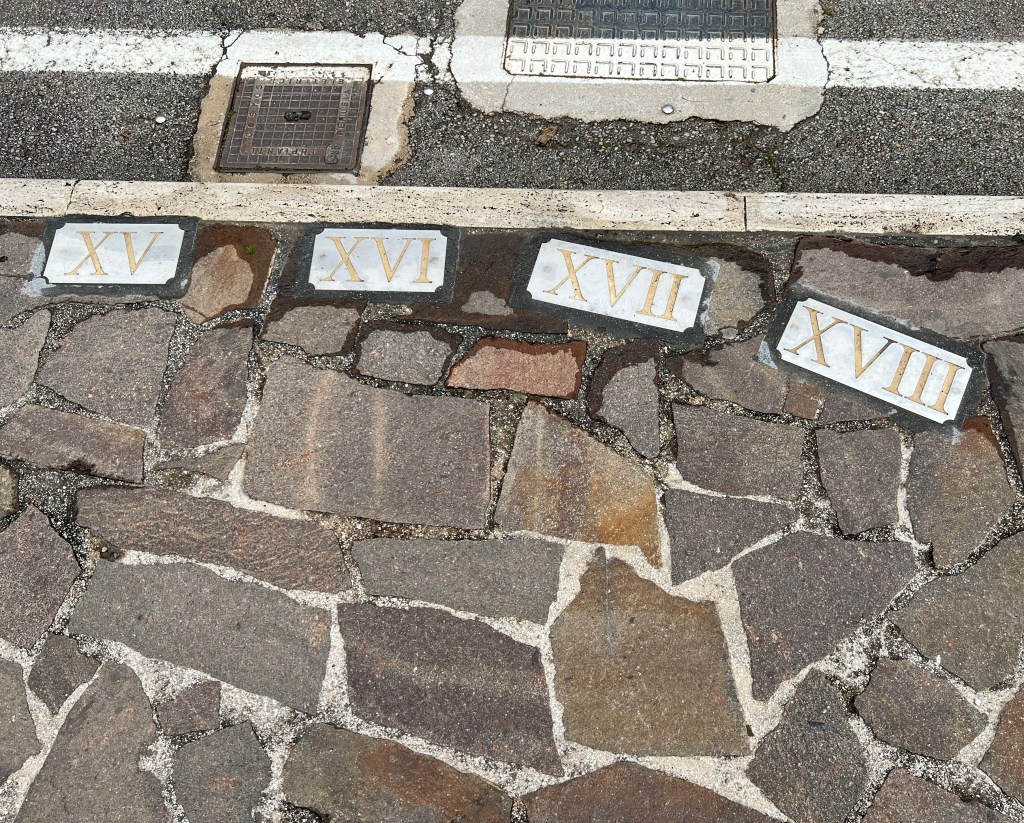
The Sundial Trail links 3 different kinds of sundial at sites carefully chosen for each type. These are an Armillary Sphere (Equatorial Dial); an Analemmatic Sundial; and a Ptolemaic Plinth in the Gardens. Other types of dial are planned.
Corciano is an attractive small town 12km west of Perugia, walled and with much of its medieval origins still evident. In contrast, the Commune has commissioned interesting modern projects, for example a residential complex designed by Renzo Piano and inspired by Rubik’s cubes.
The town has initiated an ambitious project, financed by the municipality, to make an itinerary that combines culture, history, astronomy, landscape and science and can be used free of charge for everyone: citizens, schools and tourists.
BORGO del SOLE
The Sundial Trail links 3 different kinds of sundial at sites carefully chosen for each type. These are an Armillary Sphere (Equatorial Dial); an Analemmatic Sundial; and a Ptolemaic Plinth in the Gardens. Other types of dial are planned.
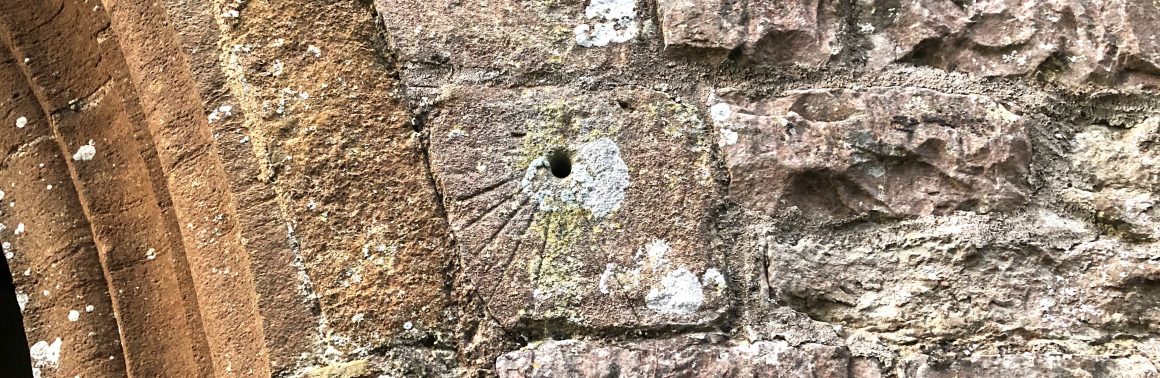
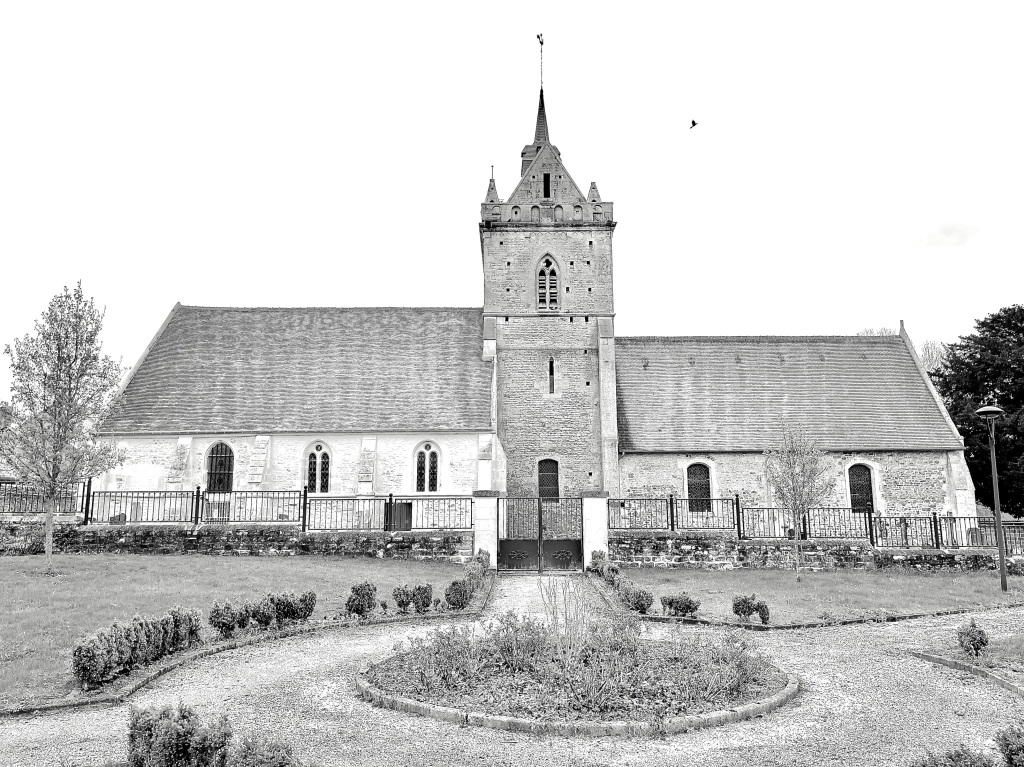
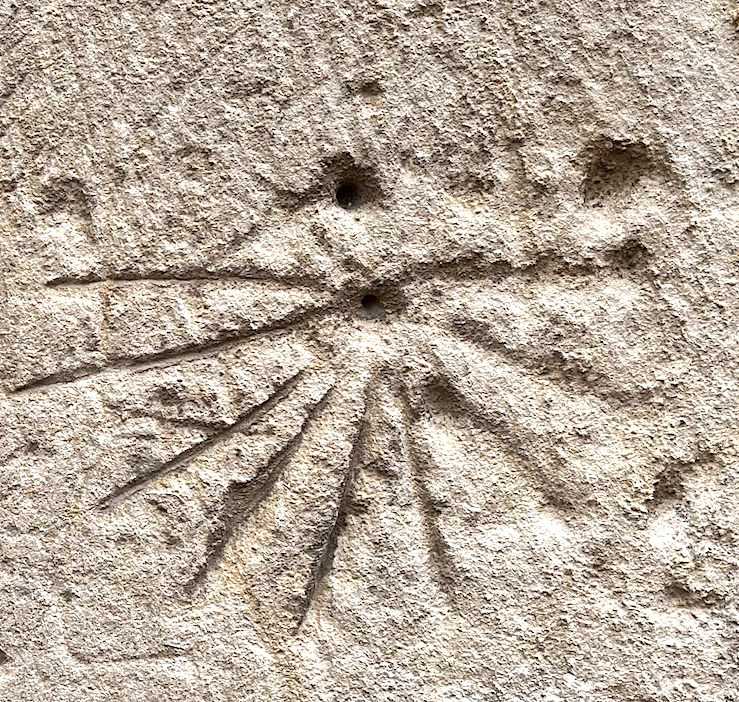
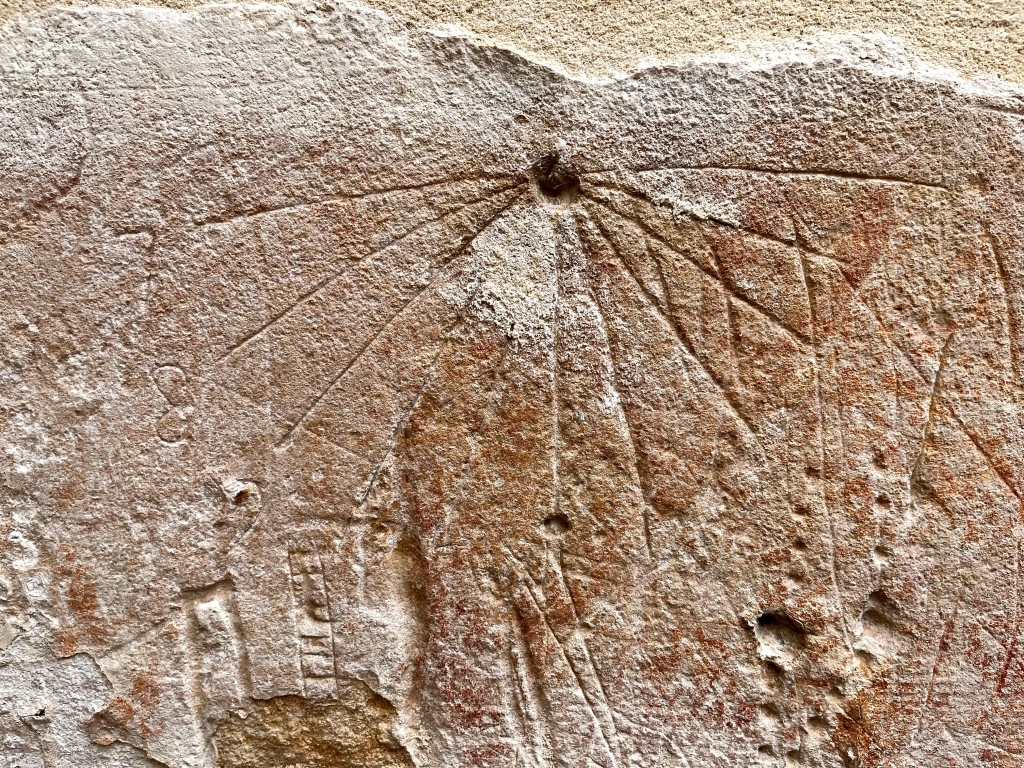
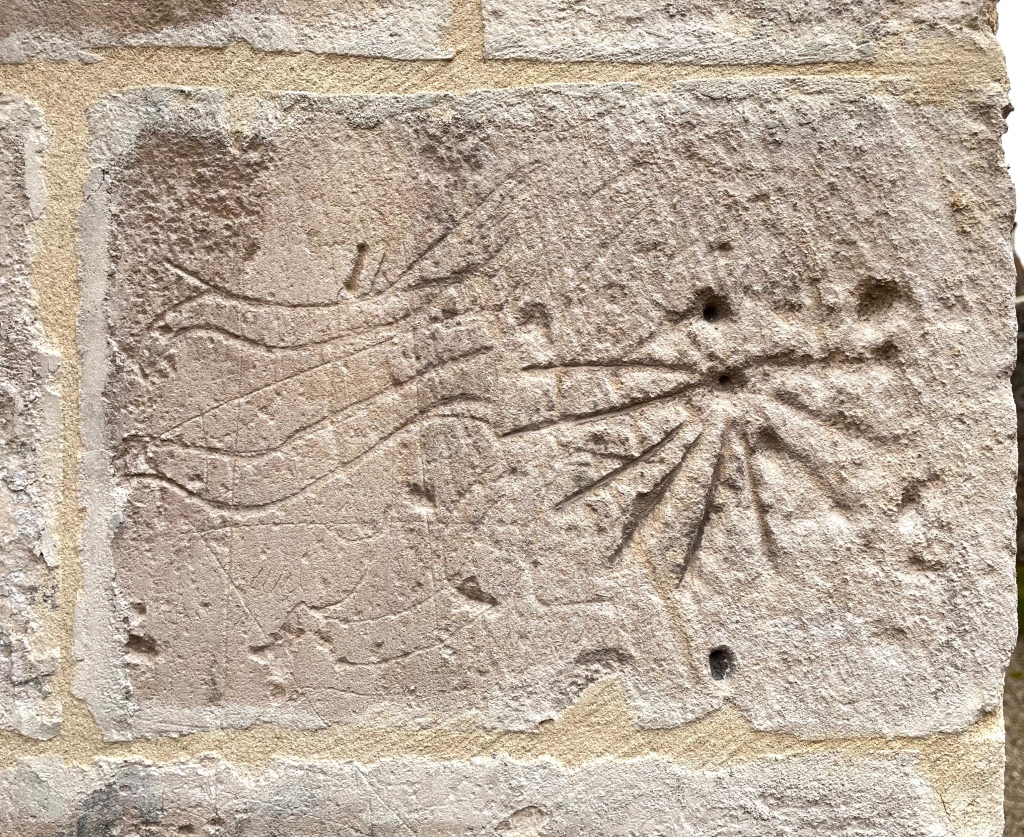
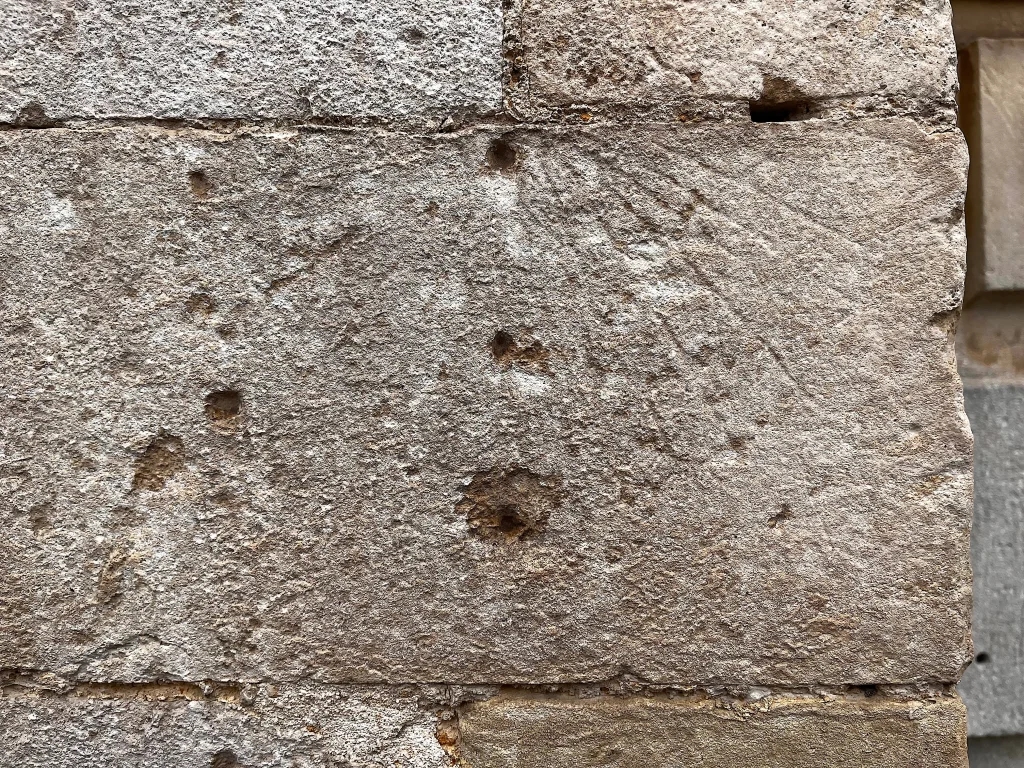
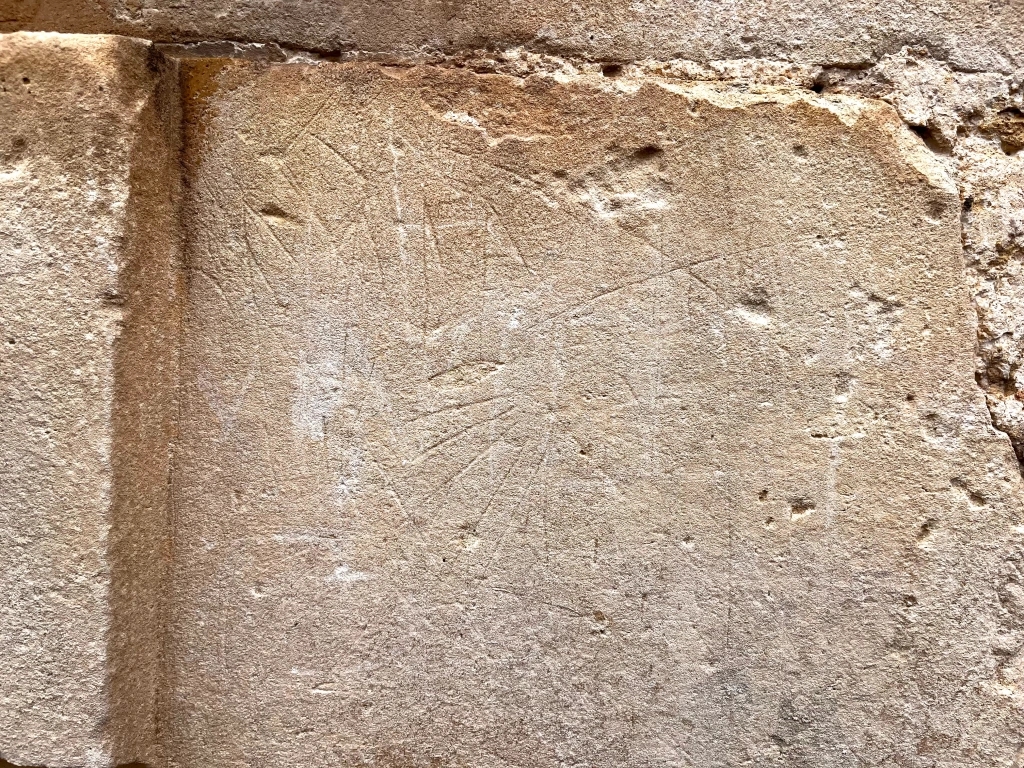
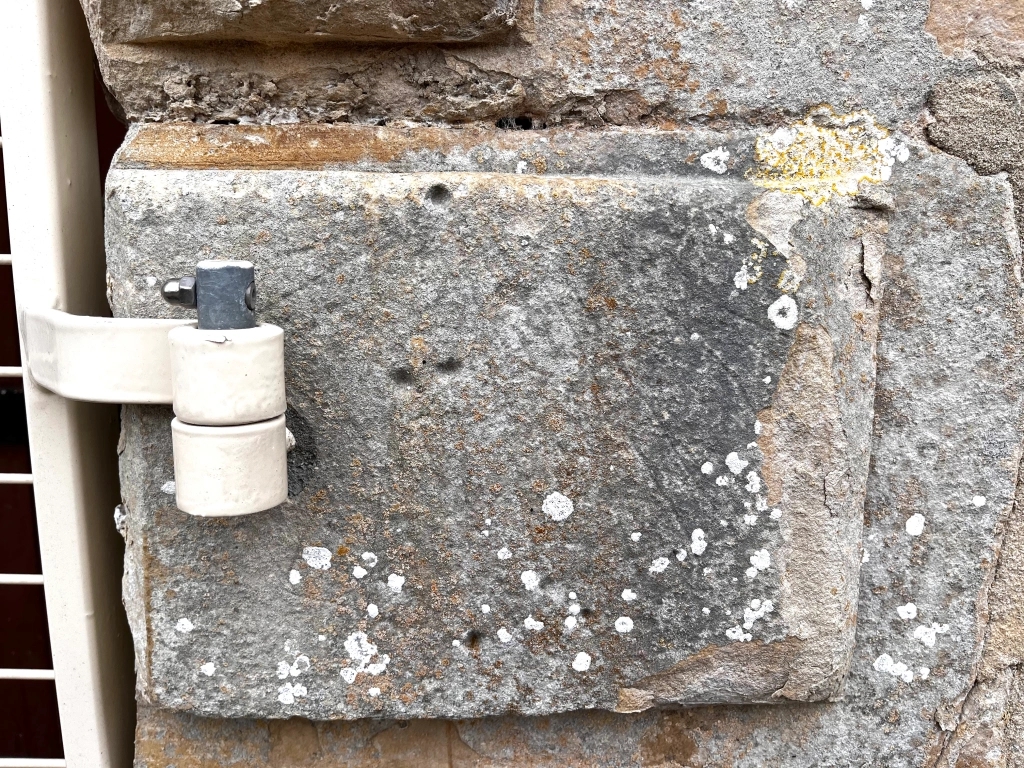
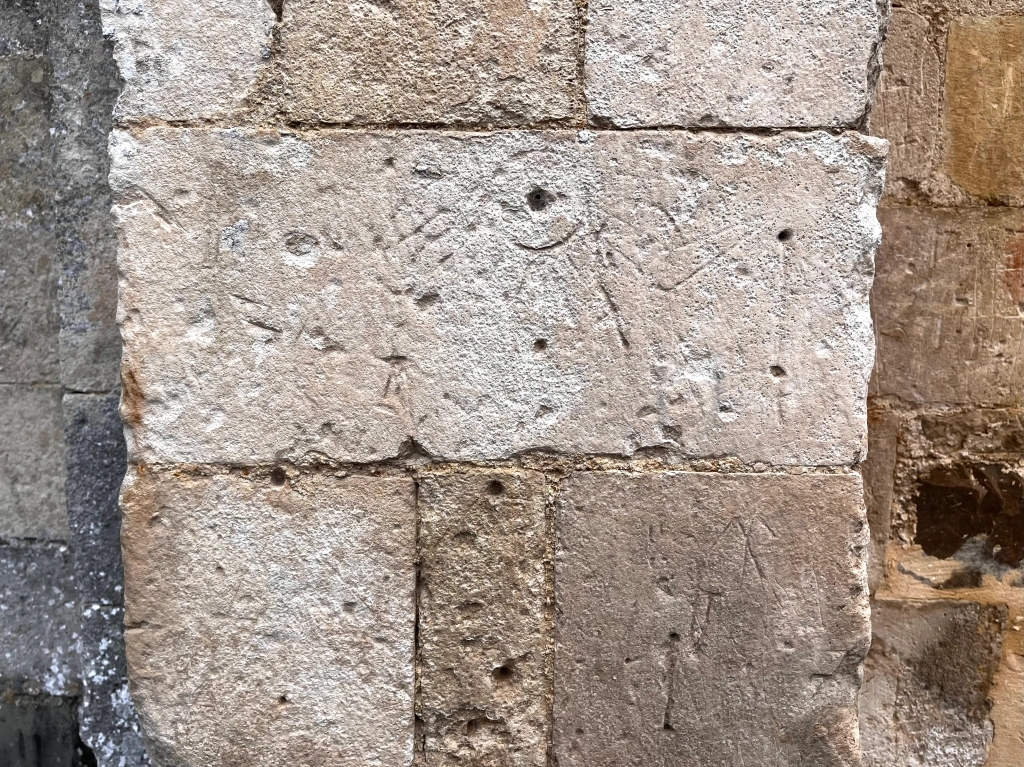
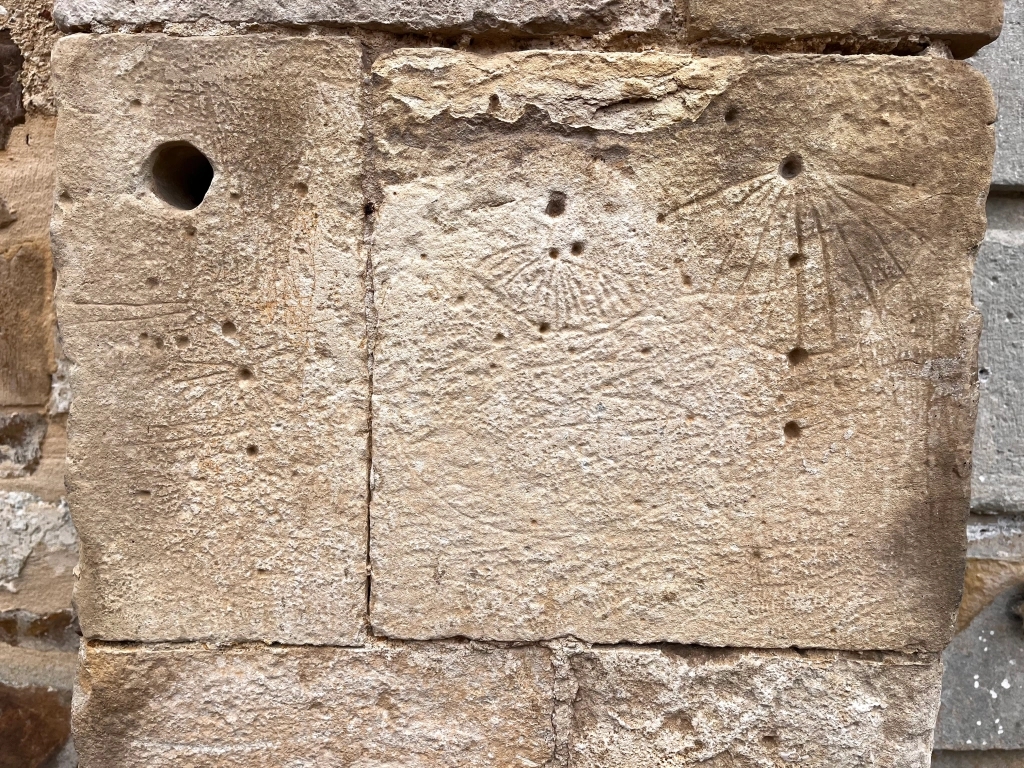
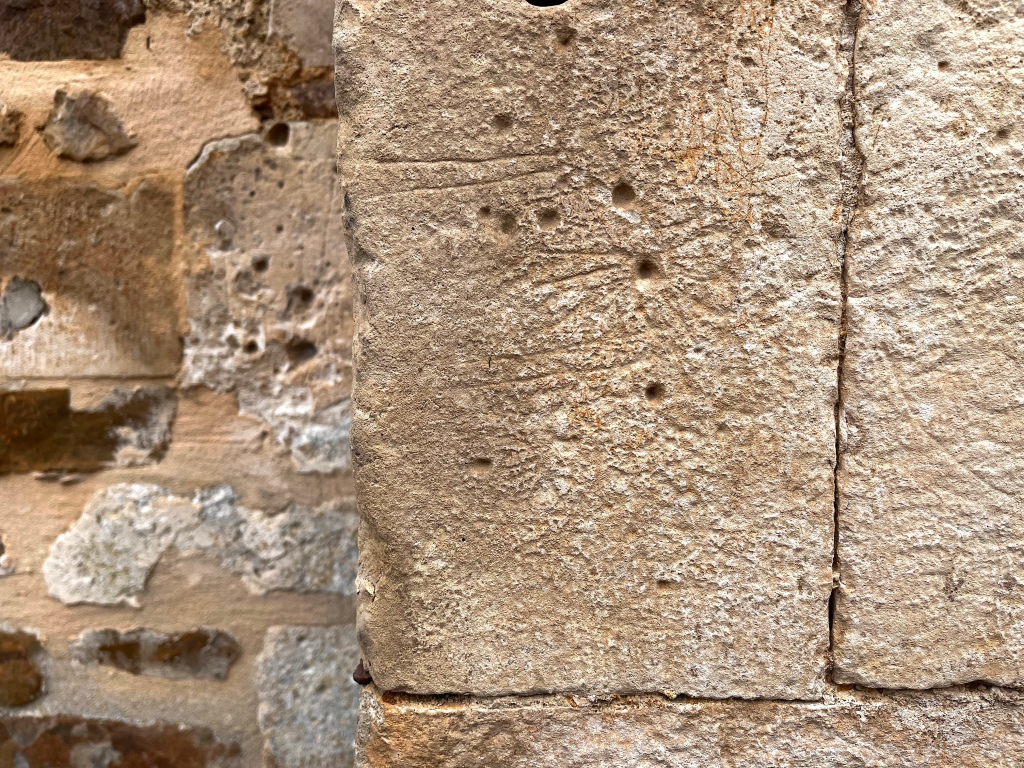
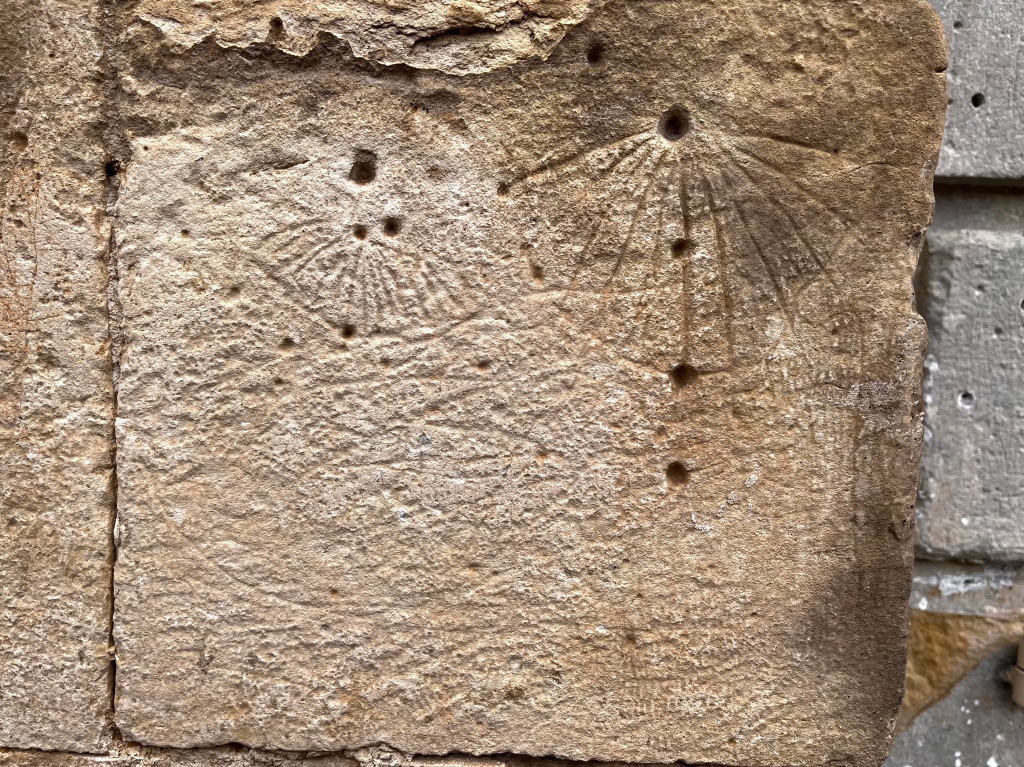
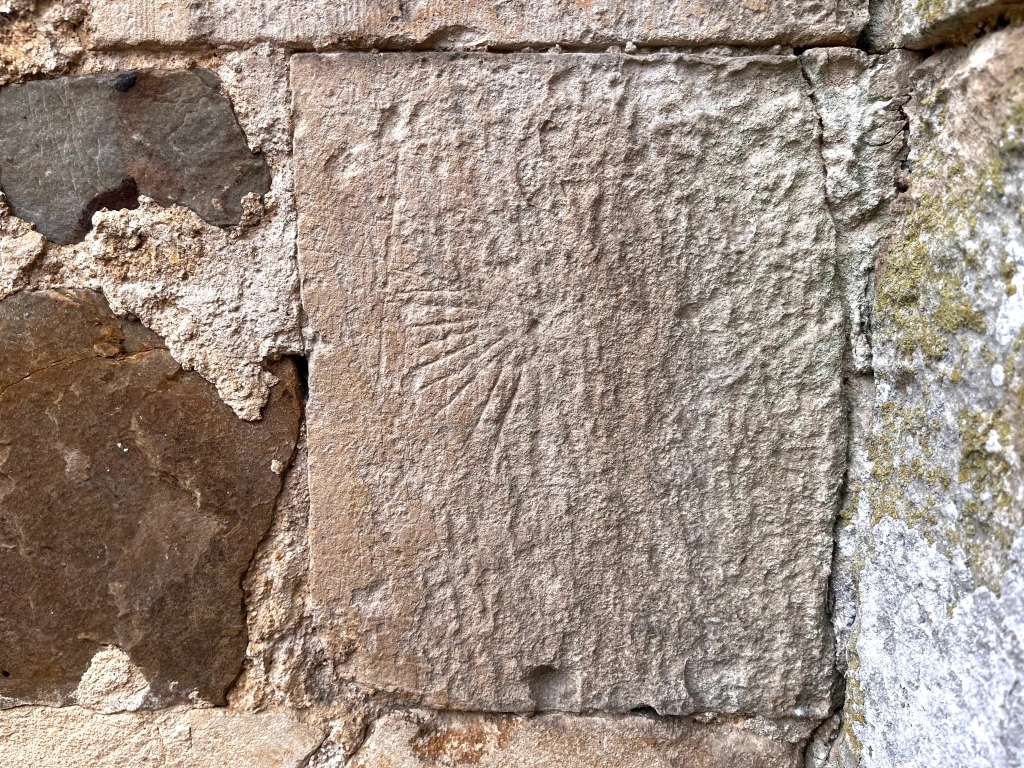
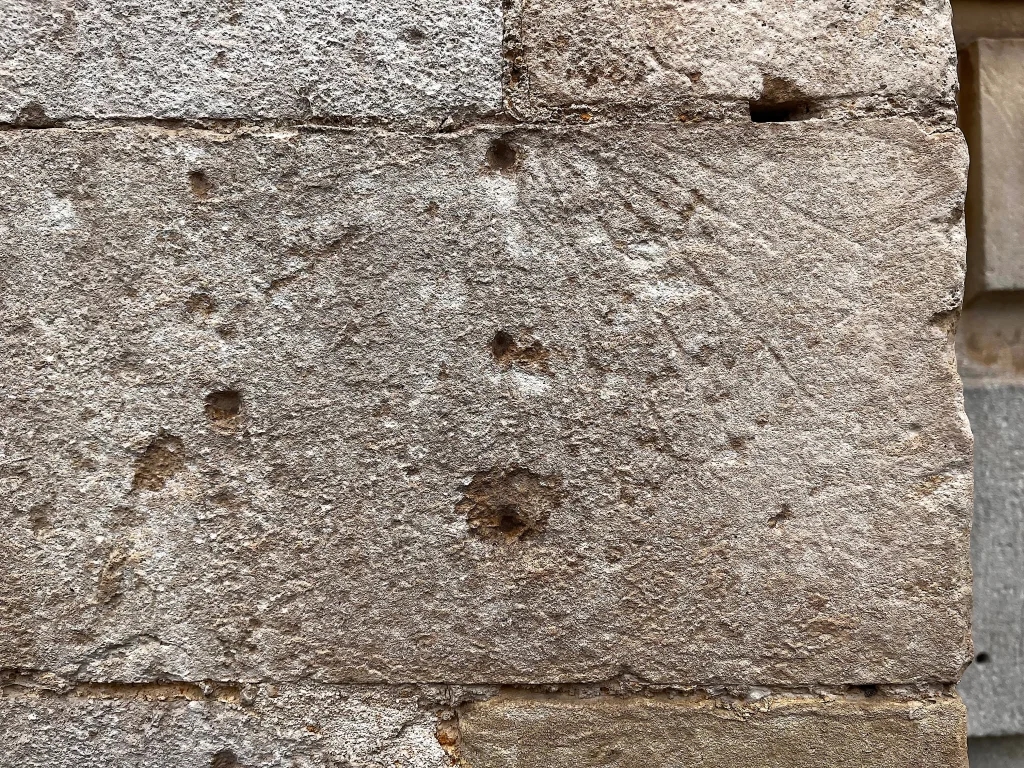
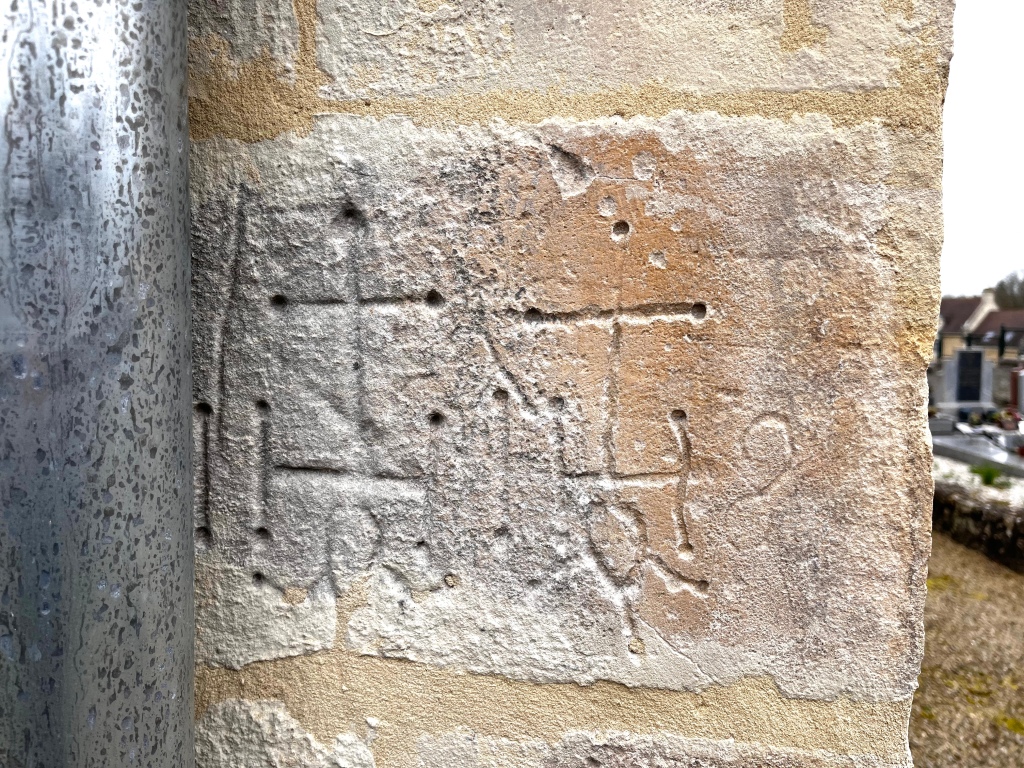
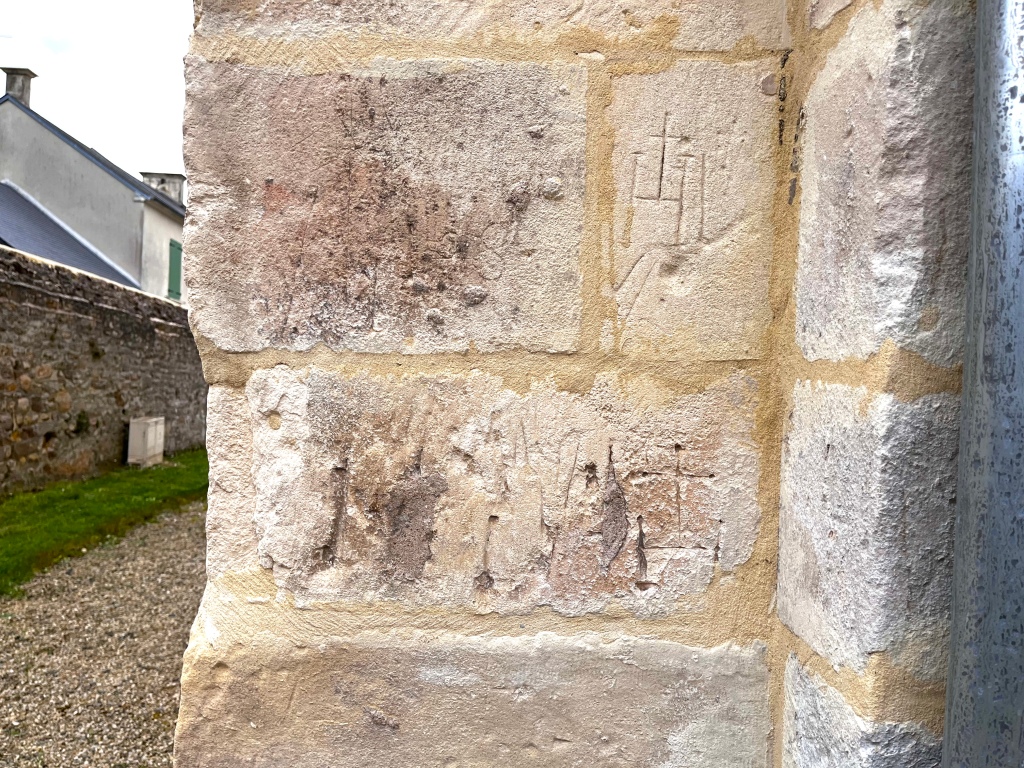
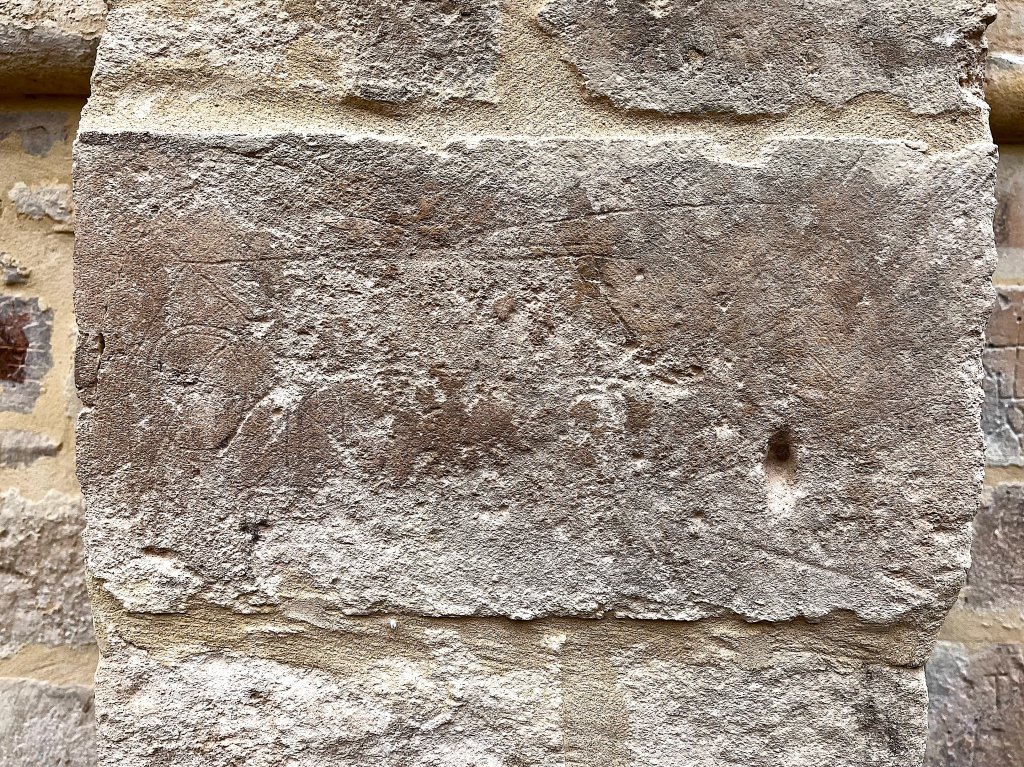
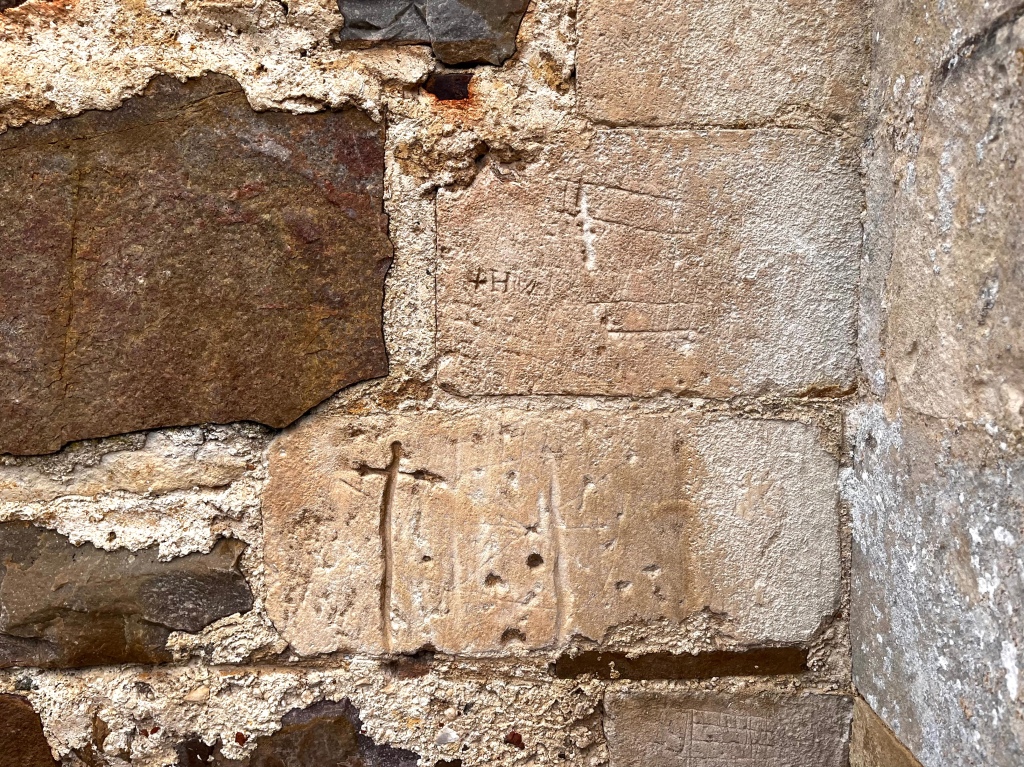
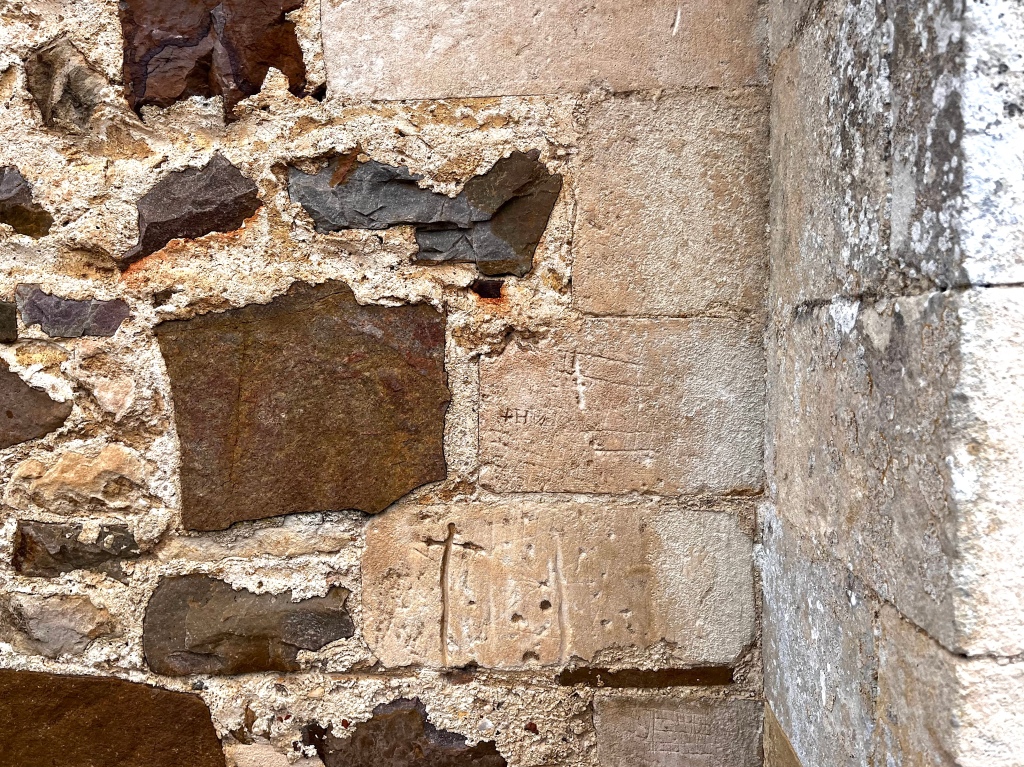
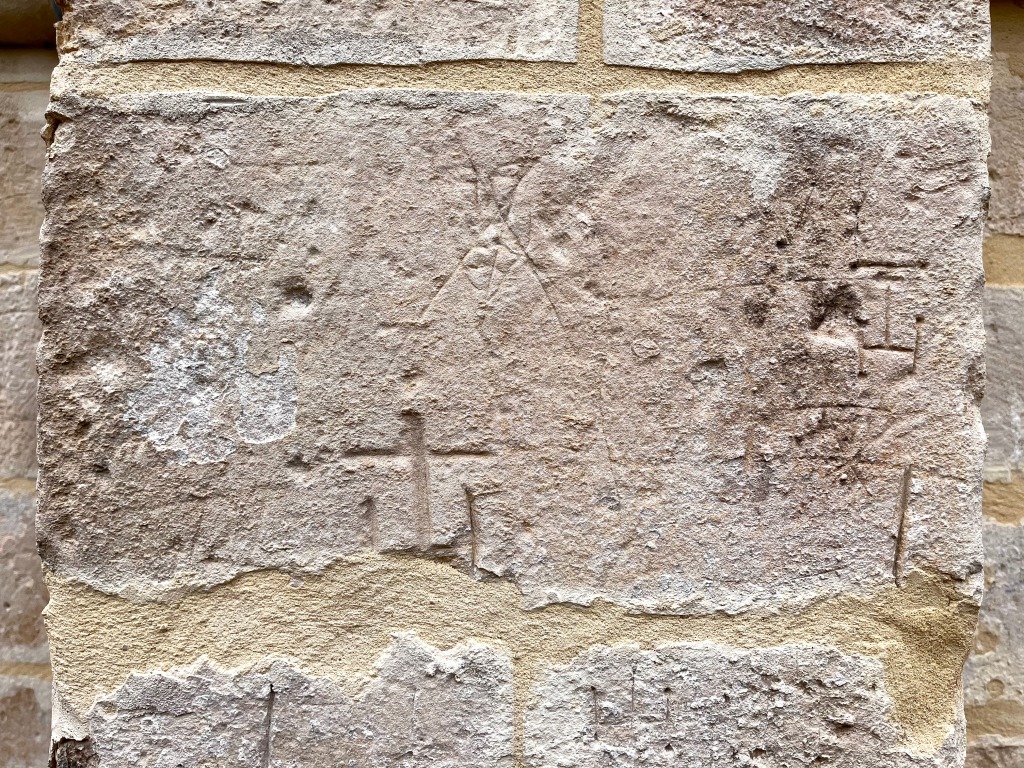
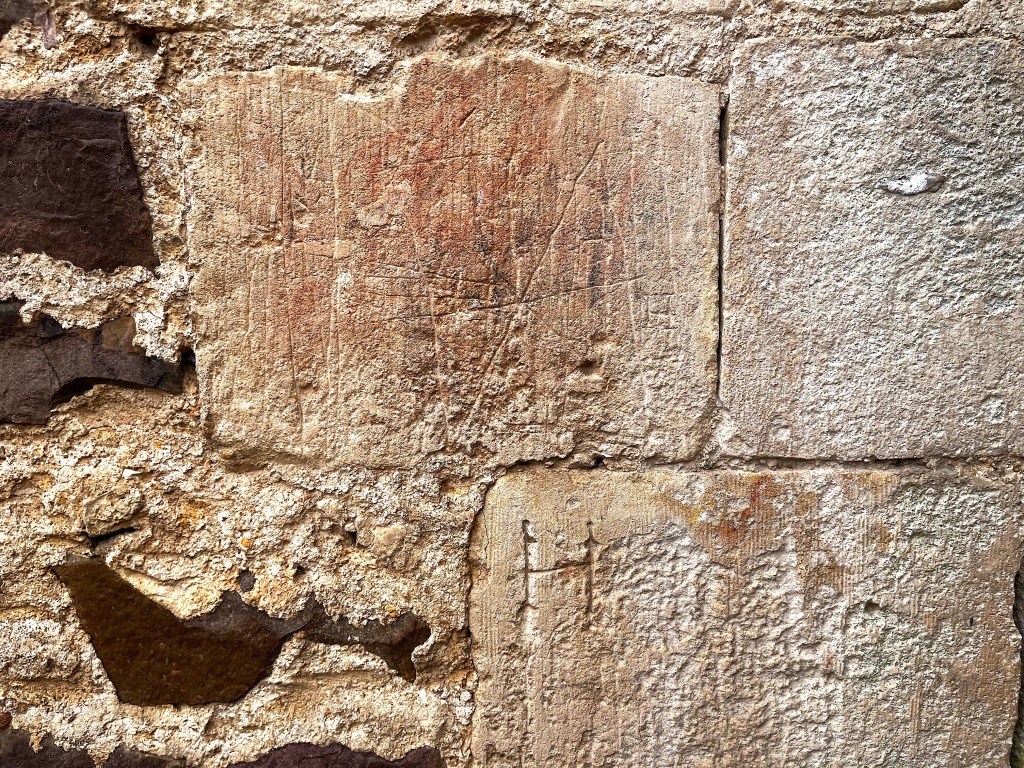
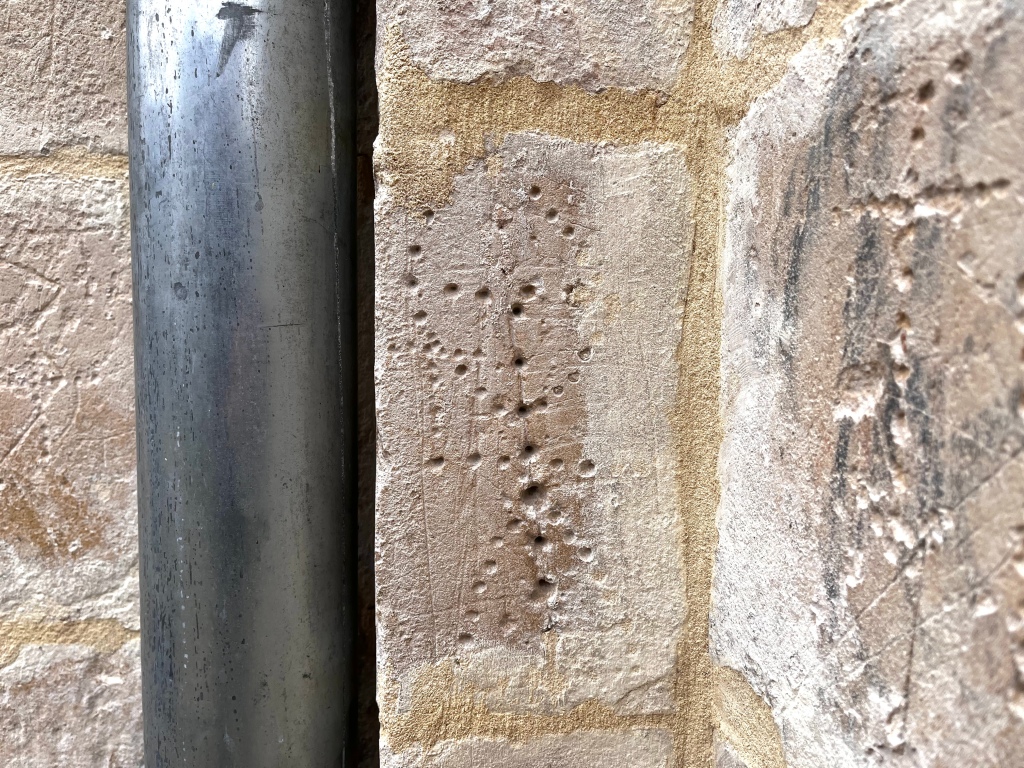
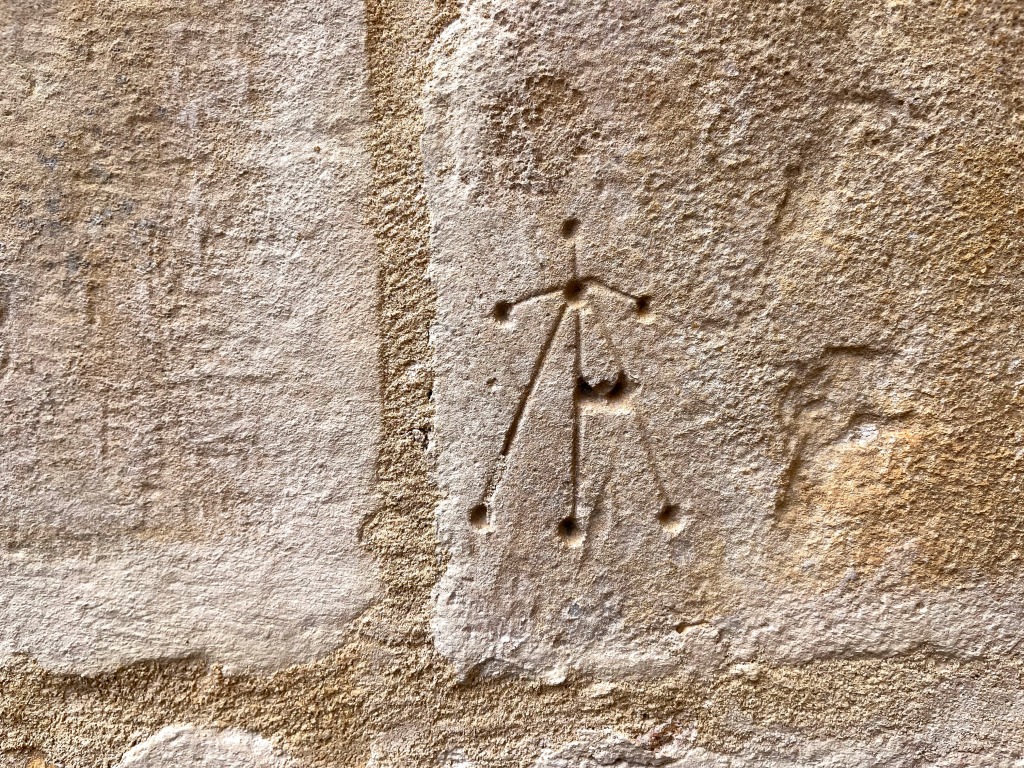
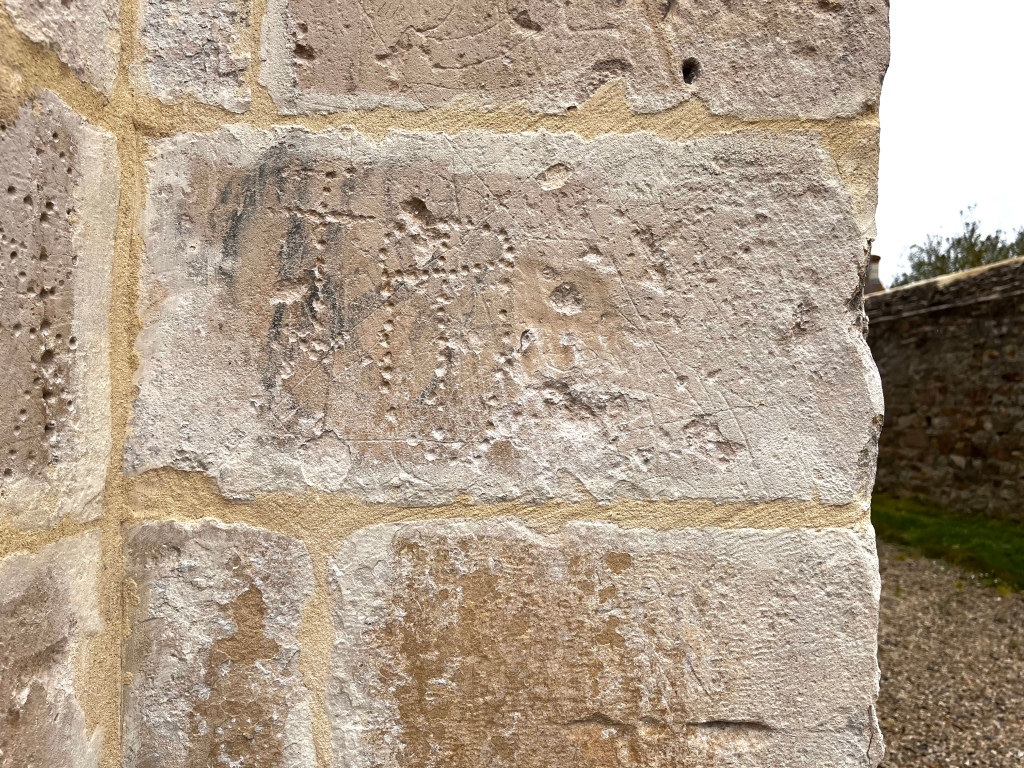
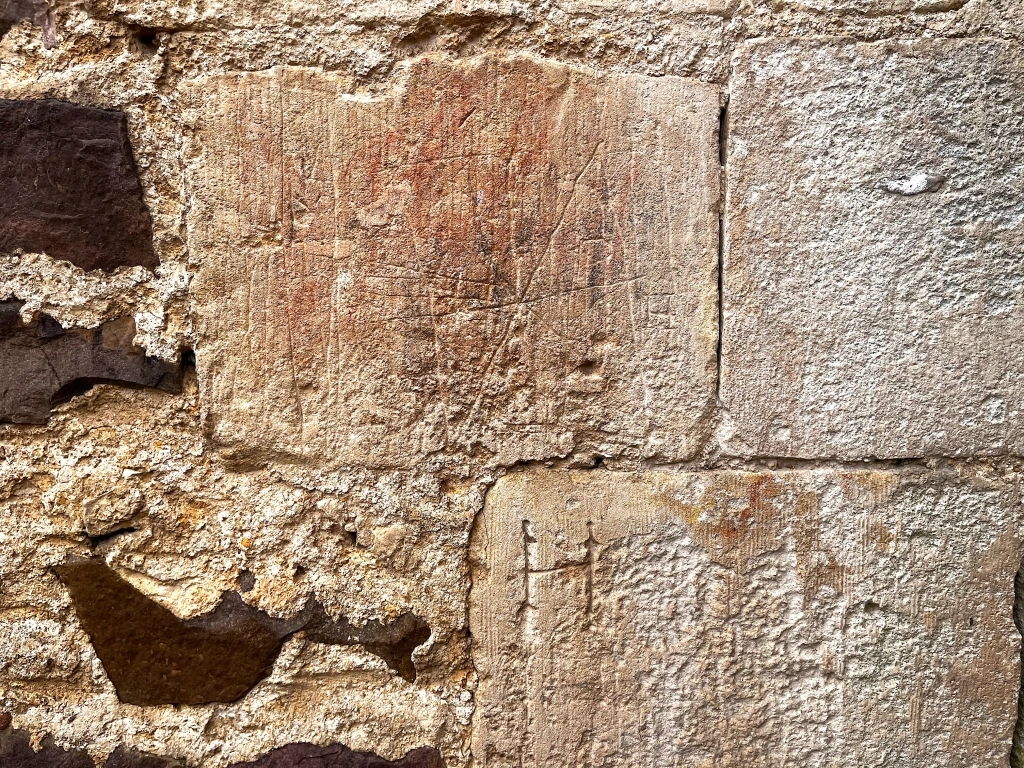
The area between Caen and Alençon contains a surprising number of churches with scratch dials. There are some rich pickings for scratch dial and church mark enthusiasts. It is not exactly a destination in itself, but is certainly vaut le voyage if you are in the region. Several churches have a plethora of designs and Urville is one of them. I gave up counting the dials and disentangling overlapping ones when the score reached twenty. 49° 01′ 31.44″ N, 0° 17′ 53.88″ W
There is no point in trying to analyse this amazing collection of dial art, nor guess its significance. It’s hard to find out much about the church at all except for the official write up to the effect This parish church, built in the village centre, replaced the former place of worship which had become too small. The present church is said to be C17. Using British churches as a guide, some of the dials & graffiti seem earlier. Presumably some of the original church’s stones were reused. It might make sense that the new church tempted the villagers to add to an existing display. Here is a varied selection.
DIALS
APOTROPAIC SYMBOLS, GRAFFITI and other designs
GSS Category: Scratch Dial (Normandy France); Mass Dial (Normandy France); Medieval Sundial (Normandy France); Church Graffiti; Apotropaic Symbols; Protection Marks
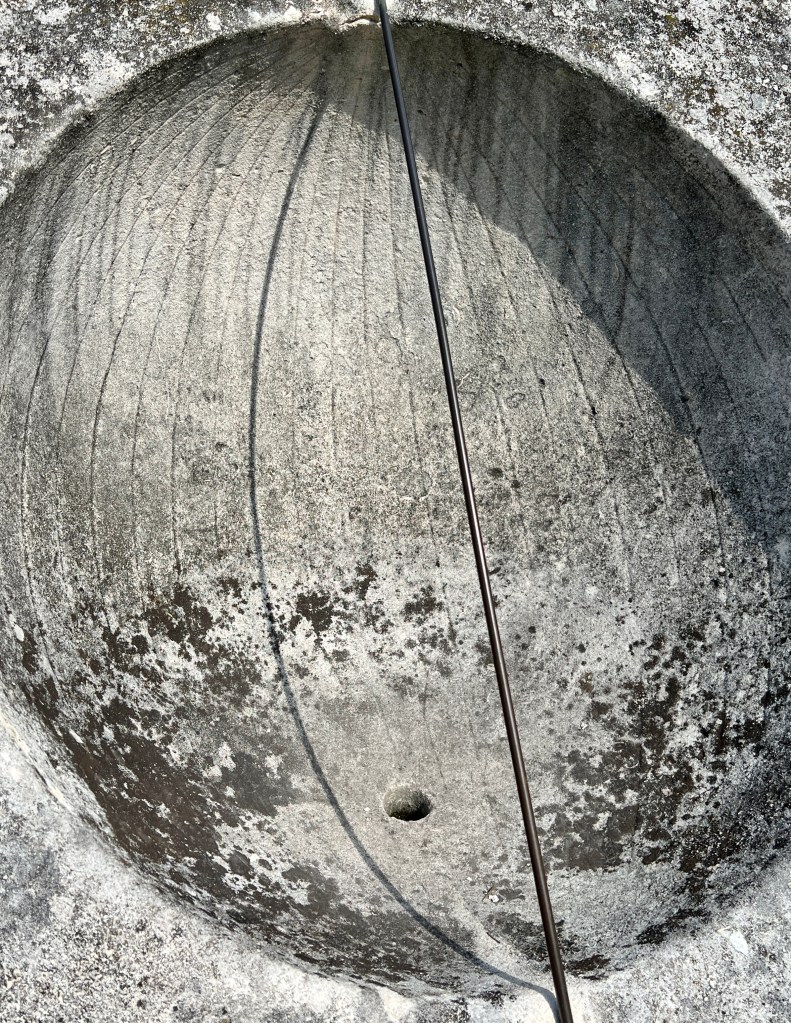
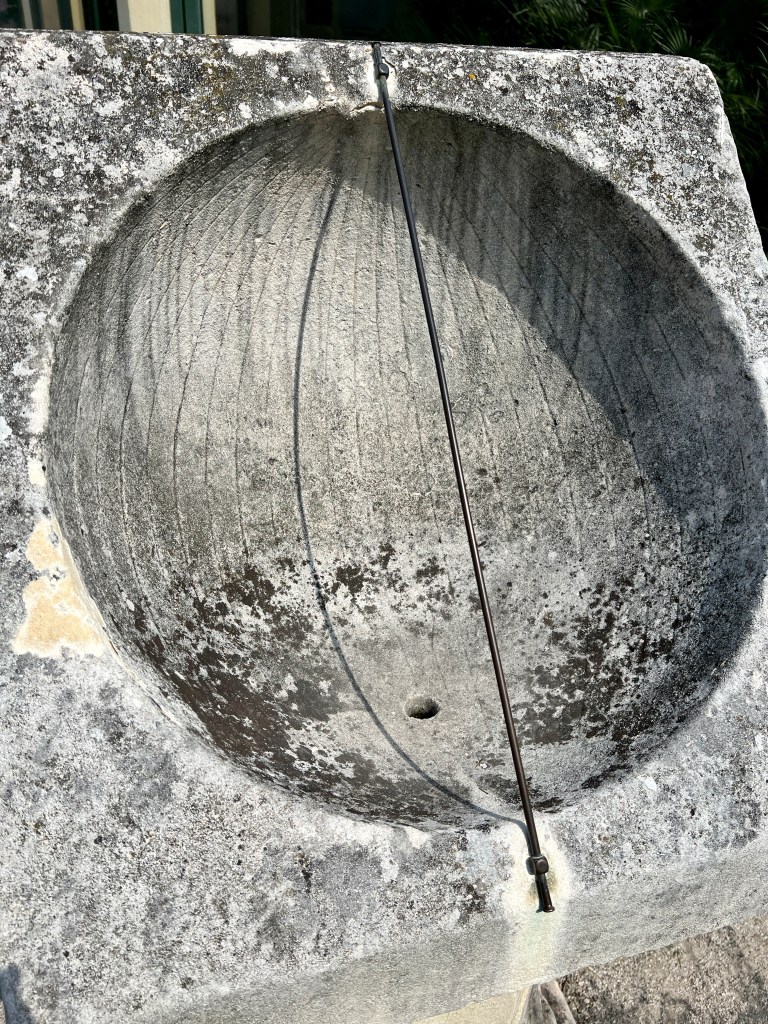
This wonderful example of a scaphe dial is one of 3 dials in the Botanical Gardens of Padua. There is also a cube dial and a cylinder dial (separate post). This first-ever public garden* was created in 1545, and the original layout has been preserved. This is not the space for a short wander round, but there’s plenty of interesting material online. It has been an important centre for scientific research since its inception and, unsurprisingly, it is a UNESCO World Heritage Site.
*Pisa’s botanical garden was actually completed a year earlier but disqualified on a technicality that I haven’t pursued.
GSS Category: Scaphe Dial; Botanical Garden Sundial; Europe Dials
EGNAZIO DANTI* 1536 – 1586 (also, Ignazio), Dominican monk and polymath, became renowned for his wide learning and intellectual precision. He was a mathematician, cartographer, astronomer (some say ‘cosmographer’) to Cosimo I, and much more. There’s plenty about him – and indeed about his 3 very different dials at SMN – online.
Recommended sites for an informed overview of the dial include that of the Basilica itself SMN.IT; also ARTELEONARDO and ACCADEMIAGALLERY
For those wishing to dig deep into the complex analysis and the historical context of the dial, you can do no better than study the lead article by Simone Bartolini & Marco Pierozzi in the BULLETIN OF THE BRITISH SUNDIAL SOCIETY VOLUME 22(iv) – December 2010. You can download it.
Egnazio Danti
ARMILLARY SPHERE
The armillary sphere consists of two perpendicular bronze circles with a diameter of 1.30 cm. The vertical one represents the meridian and indicates the exact moment when the sun is at its highest point, noon. On the equinox day, these two circles create a cross-shaped shadow, while elongated circle shadows are formed on other days. (AG)
REFORMATION OF THE CALENDAR
Danti’s sphere was installed on the S facade of the SMN in 1572. This device enabled him to determine the equinox precisely, and thus the true length of the year. Measurements the following spring confirmed the conjecture that the equinox was earlier than indicated by the Julian calendar, in fact by 11 days. As Wiki (always good on this sort of topic) puts it: The reforms of Julius Caesar in 45 BC put the Roman world on a solar calendar. This Julian calendar was faulty in that its intercalation still allowed the astronomical solstices and equinoxes to advance against it by about 11 minutes per year. Pope Gregory XIII introduced a correction in 1582; the Gregorian calendar was only slowly adopted by different nations over a period of centuries, but it is now by far the most commonly used calendar around the world.
MERIDIAN DIAL SMN Link to the article on Danti’s marvellous dial inside the Basilica
Chartreuse de Mélan . Taninges . France – Vertical Dial
Cat / Salamander Hunky Punk
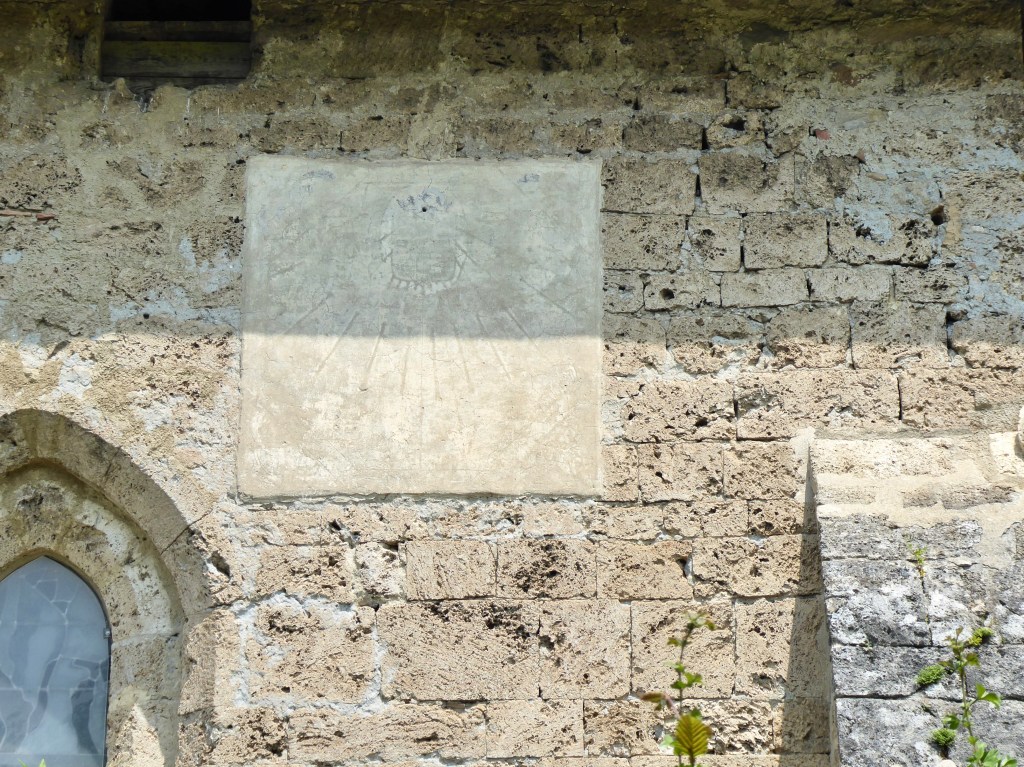
The Chartreuse was founded in 1285 as a Carthusian nunnery and continued its religious functions until the French Revolution. Thereafter it became a school and in due course an orphanage. A disastrous fire in 1967 destroyed almost all the buildings on the site, with loss of life. Only the church and its cloister now remain. The church is an exhibition space and the lawns around it feature examples of modern art, from interesting via enjoyable to a few that are a matter of personal taste.
Chartreuse de Mélan . Taninges . France – Vertical Dial
The dial is included by MICHEL LALOS in his excellent French Cadrans Solaires site. Anyone who has in interest in sundials in France will benefit hugely by using this free resource. It is accessible, informative, and easy to use – not least because the dials are featured by Départment with a map for dial locations. The entry for Mélan is :
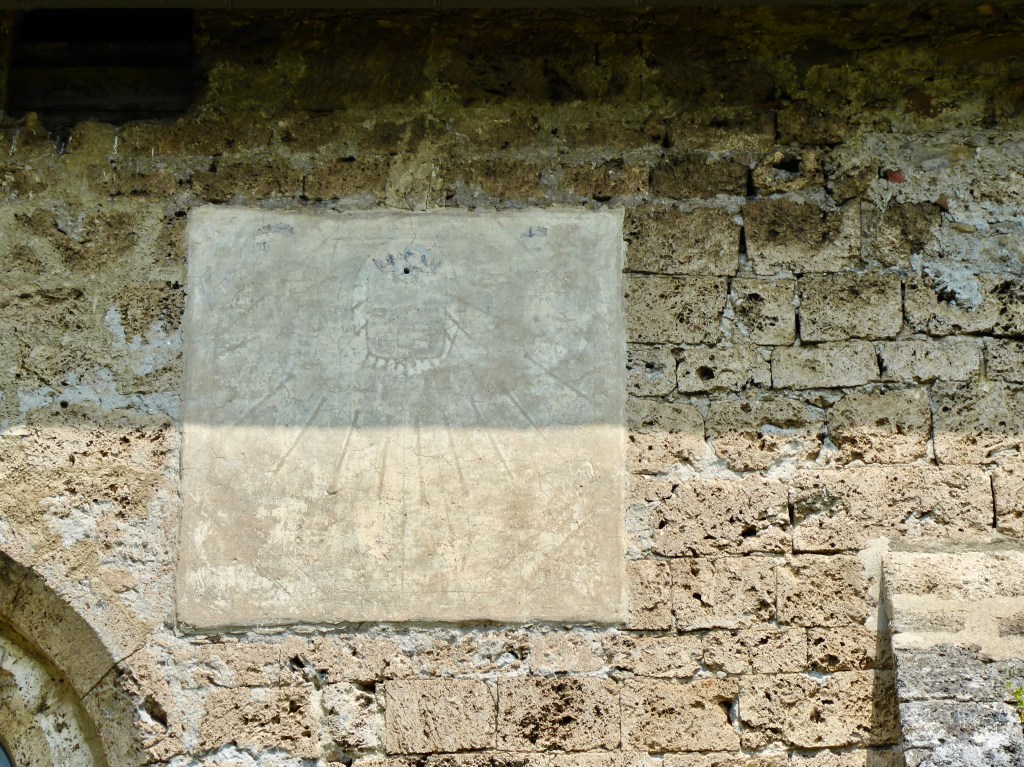
Cadran peu déclinant de l’après-midi, gravé et peint sur enduit, très dégradé, fines lignes, demies, plus de chiffres dans bandeaux, traces de blason et décor
Dial slightly declining in the afternoon, engraved, painted on rendering, very degraded, fine lines, half-hour lines, numbers within a frame, traces of coat of arms and decoration.
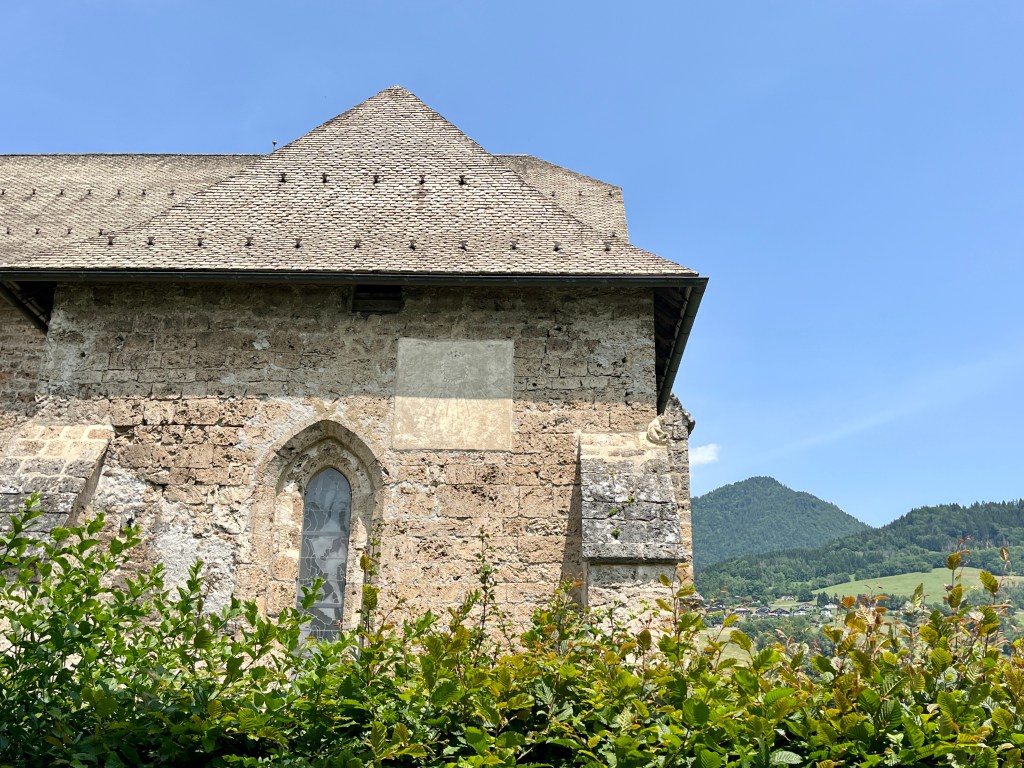
There are paint remnants at the top of the dial, where (presumably) it has been protected by the eaves. The gnomon hole at the top of the coat of arms is square. The dial is obviously old and I wondered if it might be dateable. Checking the apparent shape of the escutcheon, I discovered that it was first recorded as an armorial design in late C17 and (conveniently) turns out to be known as French-style. Overall, one might reasonably conclude that this dial is C18.
MEMORIAL STONE 1690
Chartreuse de Mélan . Taninges . France – Memorial Tablet 1690
GSS Category: Vertical Dial; France Sundial; Cadrans Solaires; Dials Abroad
All photos: Keith Salvesen; source used MICHEL LALOS
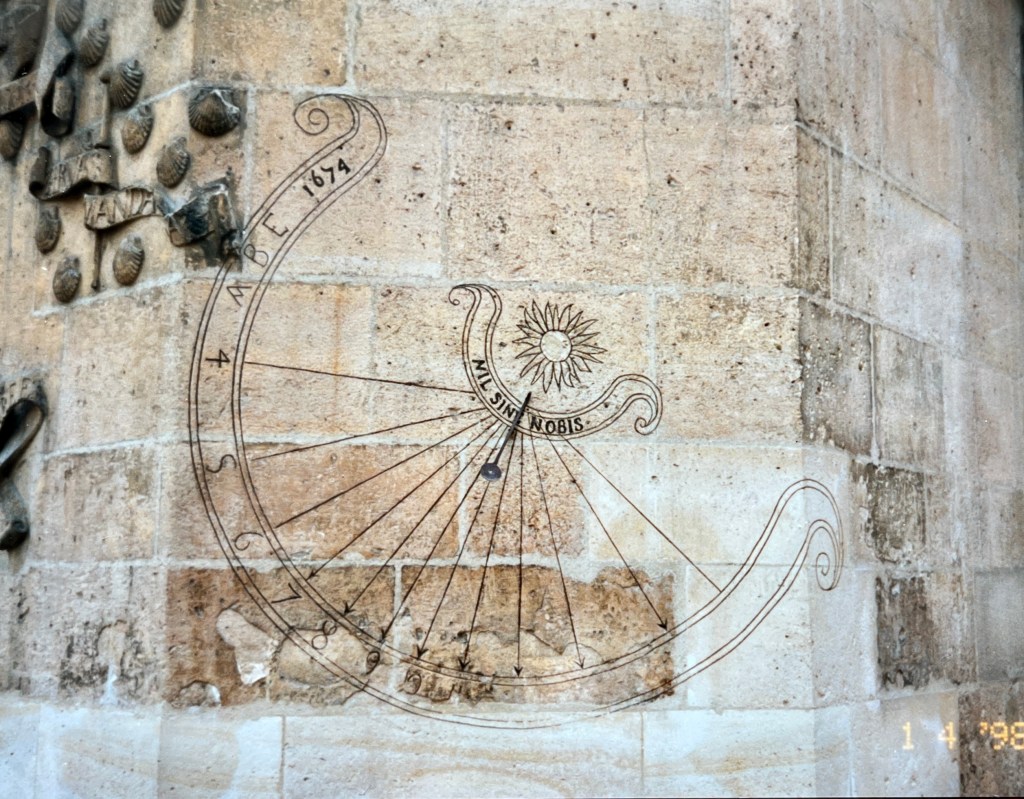
The collection of the National Museum of the Middle Ages is housed in a wonderful building, at one time an abbatiale. There is some debate about the dates of the origins and the building of the Hôtel; and of later rebuilding / restoration. The large sundial on the south wall of the courtyard is dated 1674. This was the reign of the Sun King (1643 – 1715), and a sun with its rays was an obviously fitting theme for the times.
See addendum Sep 2025 below, with thanks to Linda Roundhill
DIAL
The lines on the dial face are carefully graduated and the hours marked with Arabic numerals. Several lines terminate in arrows, suggesting a busy schedule of mainly forenoon masses.
MOTTO
NIL SINE NOBIS. A. B. F. 1674.
The inscription is usually translated as Nothing [Exists] Without Us. Margaret Gatty (1809-18730, in her comprehensive work The Book of Sun-Dials, gave the Cluny dial an unusually detailed entry:
NIL SINE NOBIS. A. B. F. 1674. Nothing exists without us.
A dial on the wall of a courtyard on the south side of the Hôtel Cluny, Paris, had this inscription. The word nobis referred to the rays of the sun which were represented on its face. The Hôtel Cluny, a very beautiful specimen of rather elaborate fourteenth century Gothic architecture, was bought in 1625 for the abbess and nuns of Port Royal, and was known as Port Royal de Paris. It was re-established by Louis XIV. in 1665, on a fresh basis, and was looked upon as schismatic by the community of Port Royal des Champs. This dial must have been erected in the time of the first abbess of the new foundation, Sœur Dorothée Perdreau, who held office till 1684.
Cluny Museum and its sundial: detailed entry by Margaret Gatty
SCALLOP SHELLS and HERALDIC MOTTOS
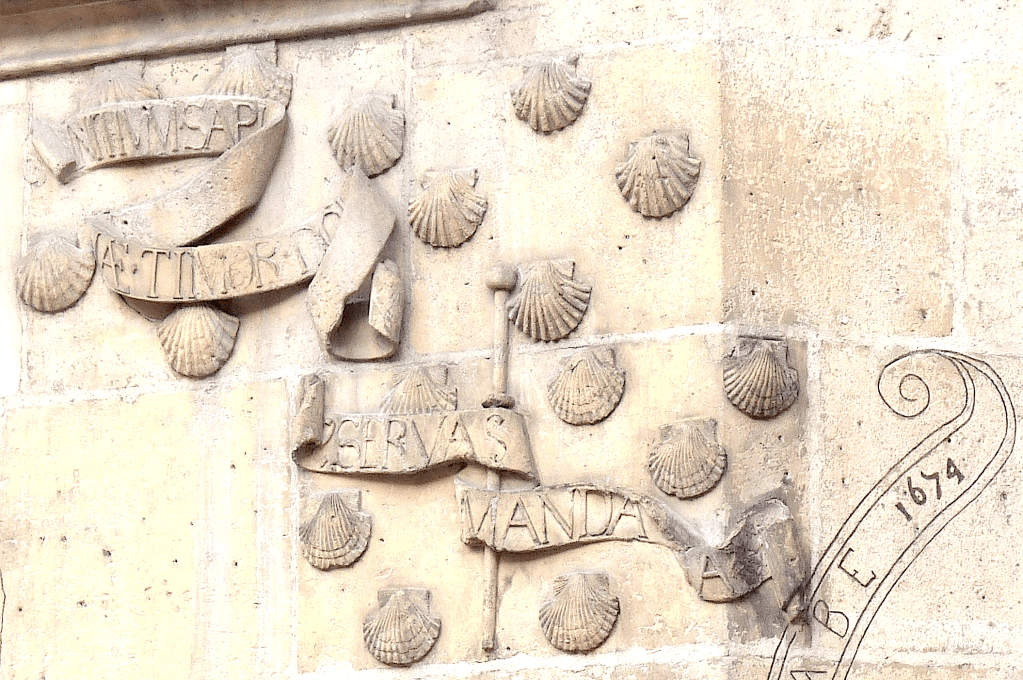
The scallop shells are interwoven with two inscriptions (or possibly a single one in two parts) which deserve a mention as part of the overall design. The shells themselves evidence an ancient Pilgrimage route that passed close by – the long Rue St Jacques is a few meters to the North.
The heraldic mottos are said to read, firstly: Servire Deo Regnare Est – To Serve God Is To Reign; MG suggests, without much conviction, that the other (or part of it) may be as shown below.
With very rusty Latin and a bit of internet work, I can’t make either interpretation fit the scrolls we can see. Possibly they relate to a different part of the Musée, and the shell one(s) are different. I’ll have to leave the reader to try to puzzle this out (all suggestions welcome).
ADDENDUM SEPTEMBER 2025
Many thanks to Linda Roundhill for solving the puzzle that I feebly left for others to interpret
The top left ribbon scroll with the scallop shells is a scripture verse “The fear of God is the beginning of wisdom”. From Proverbs 9. The lower left is a Christian catch phrase, ‘To serve God is to reign’, derived from John 12. This was hard because some of the letters are missing or hidden. The scroll on the right says “Keep My commandments” which is a short version of Matthew 19:17, and many other passages. Again, some letters are obscured.
GSS Category: Early Sundial / Vertical Dial; French Sundial; Sundial Motto
Credits: all photos Keith Salvesen – please seek use permission for these detailed ones; Musée Cluny for the Unicorn
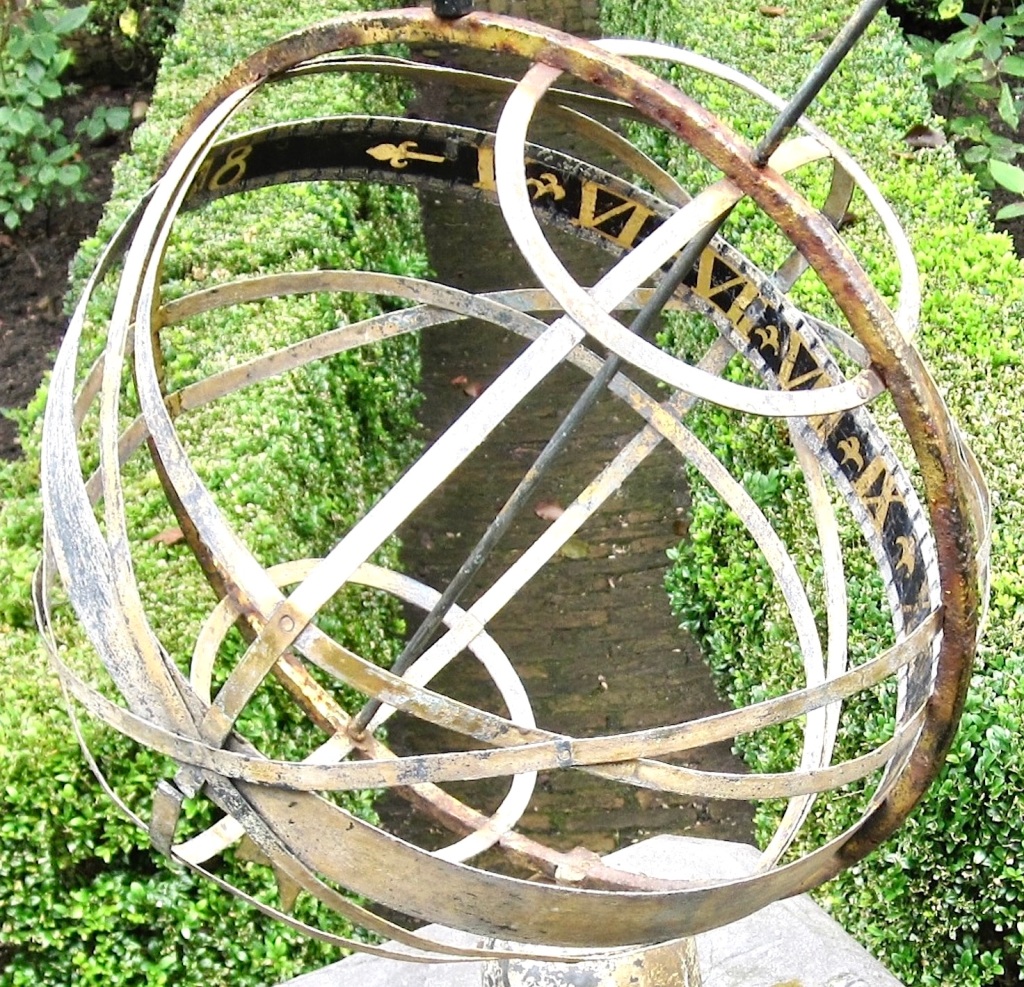
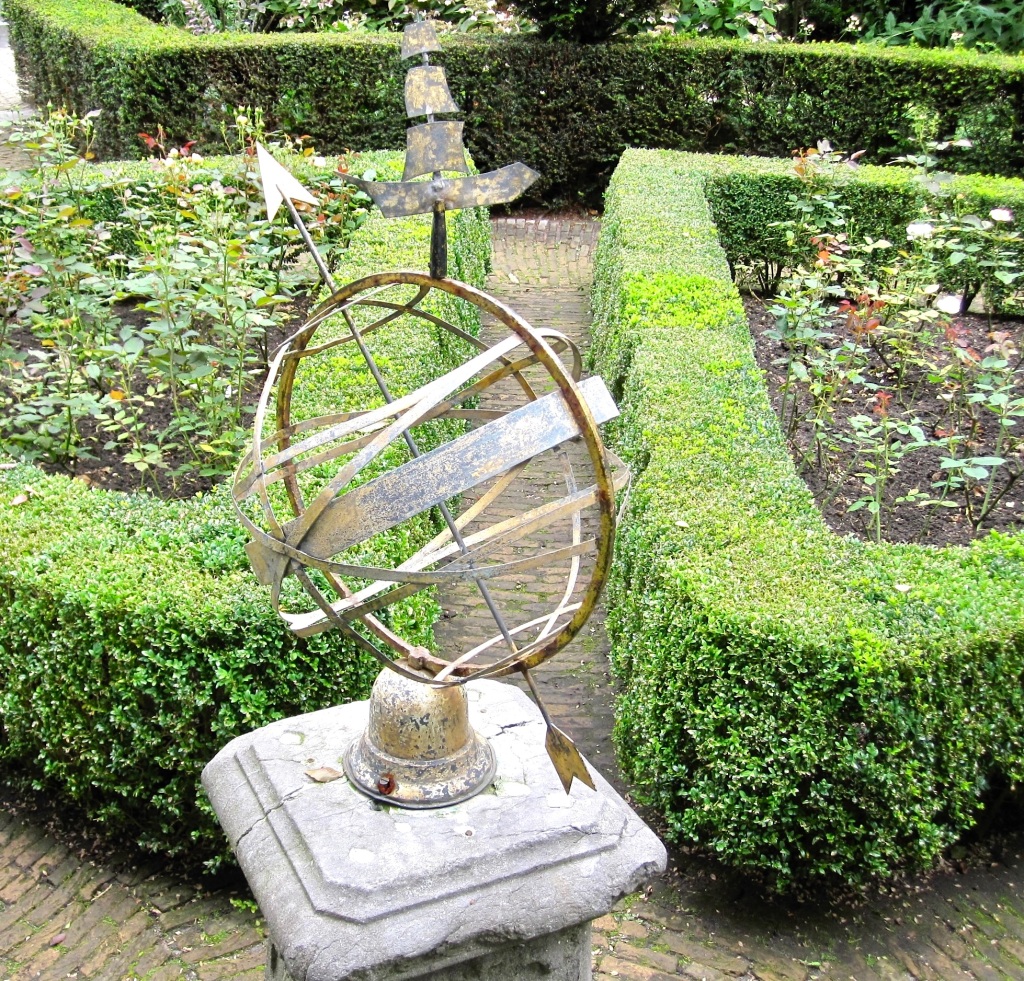
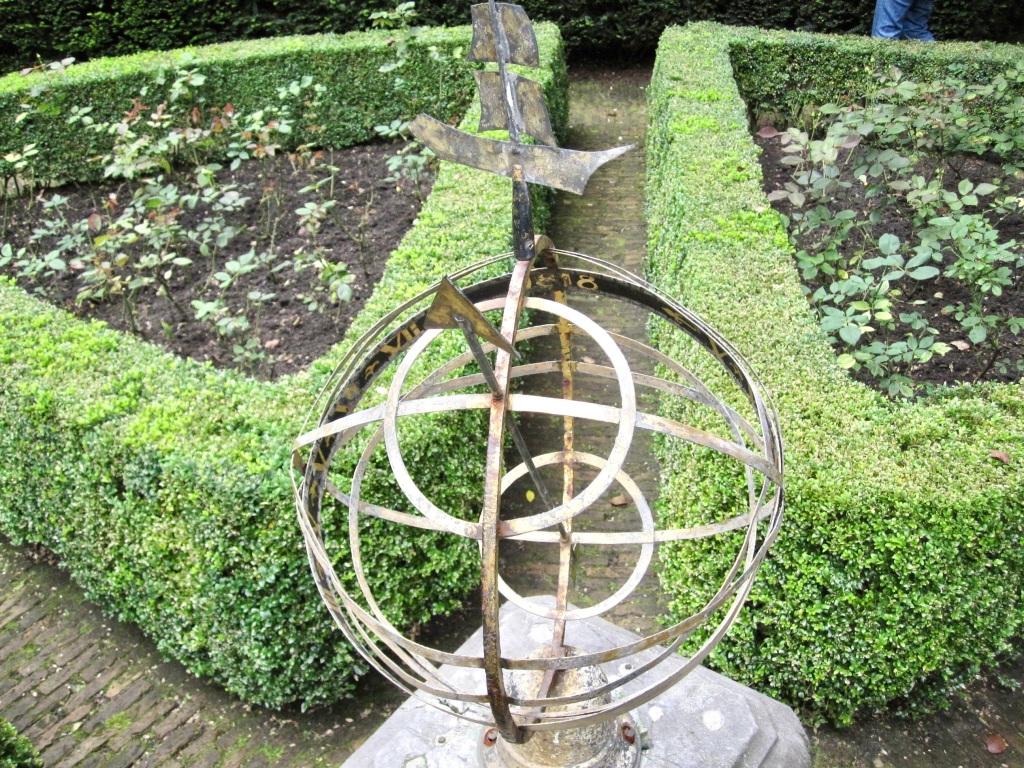
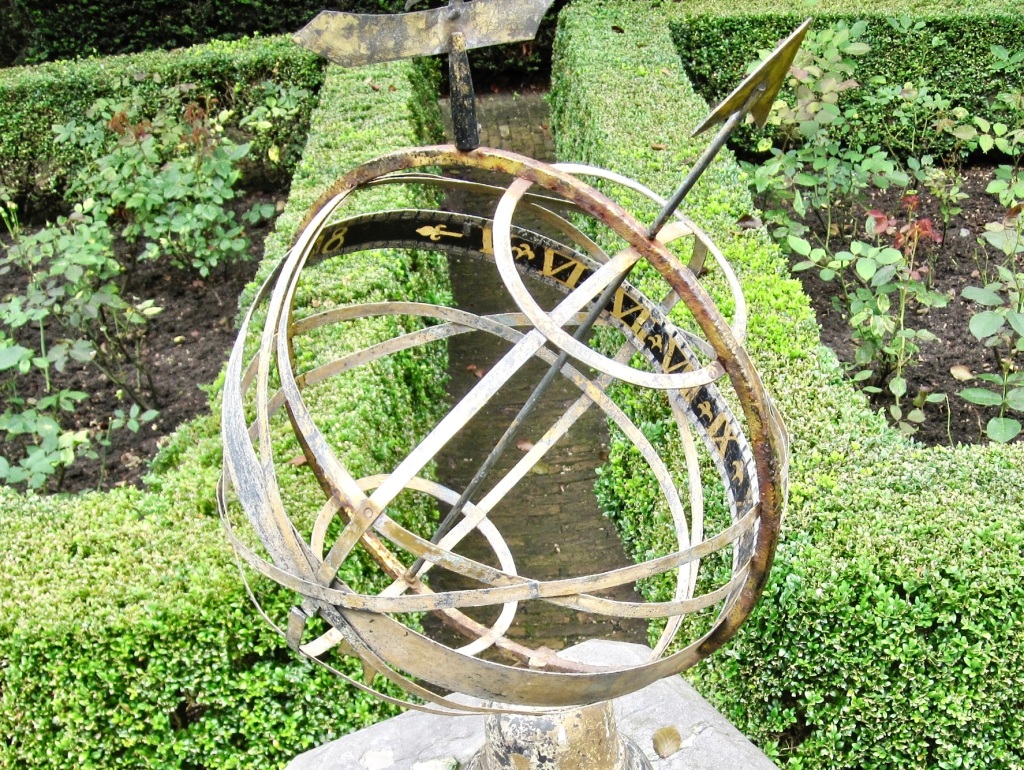
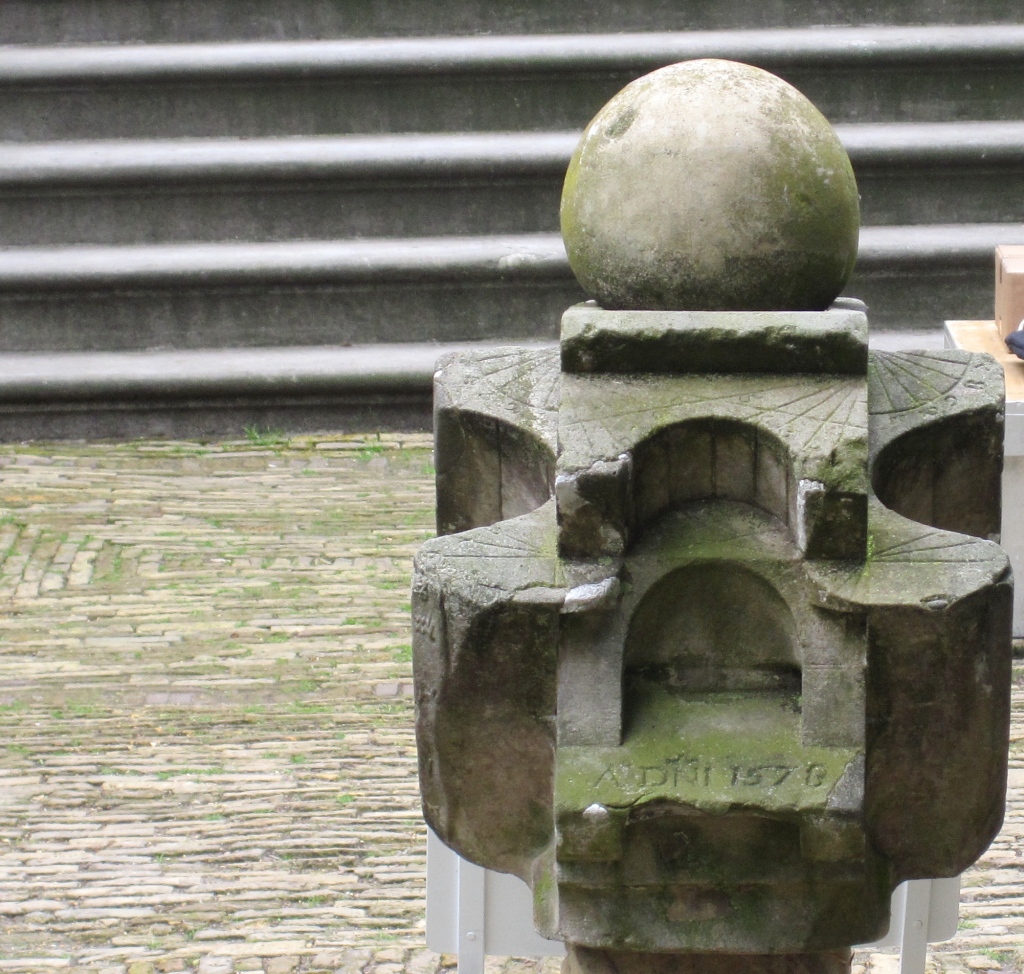
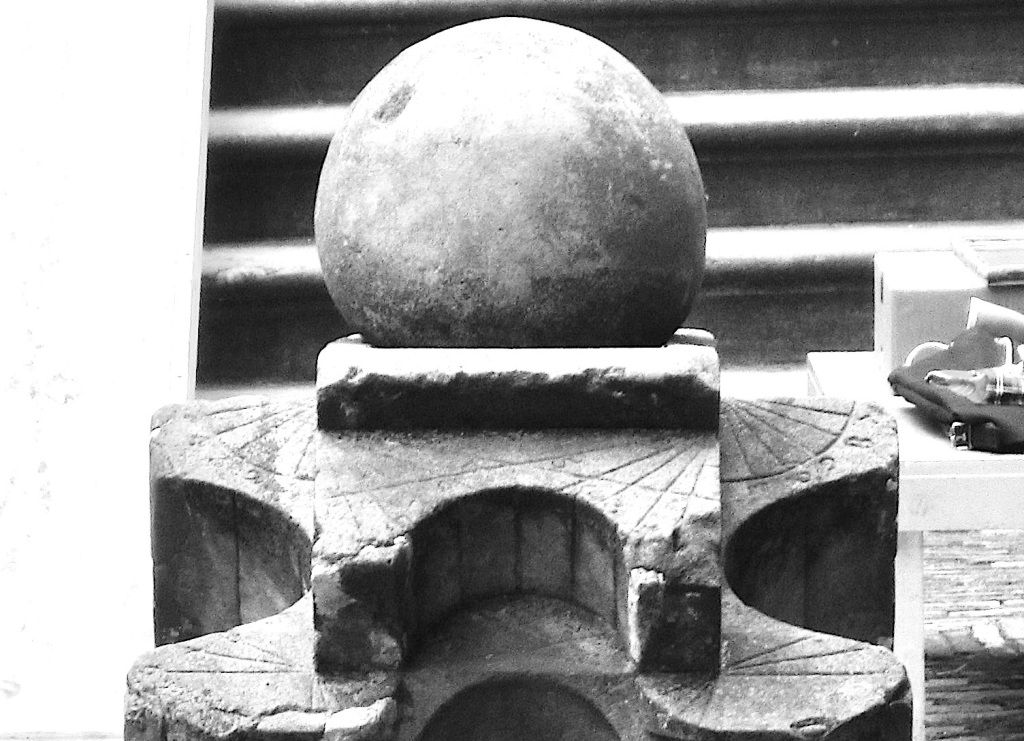
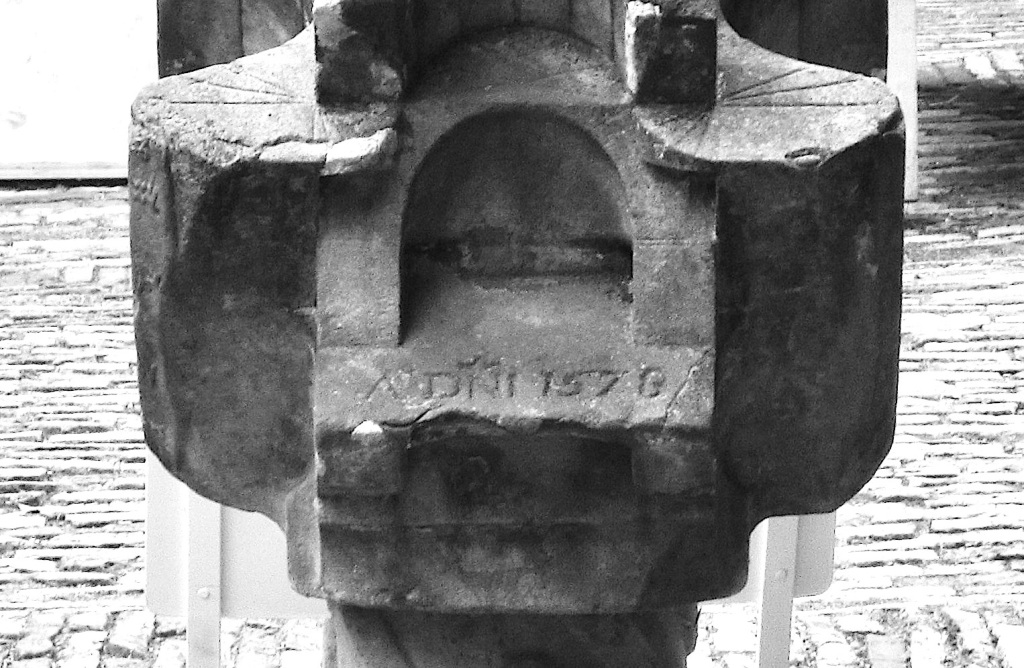
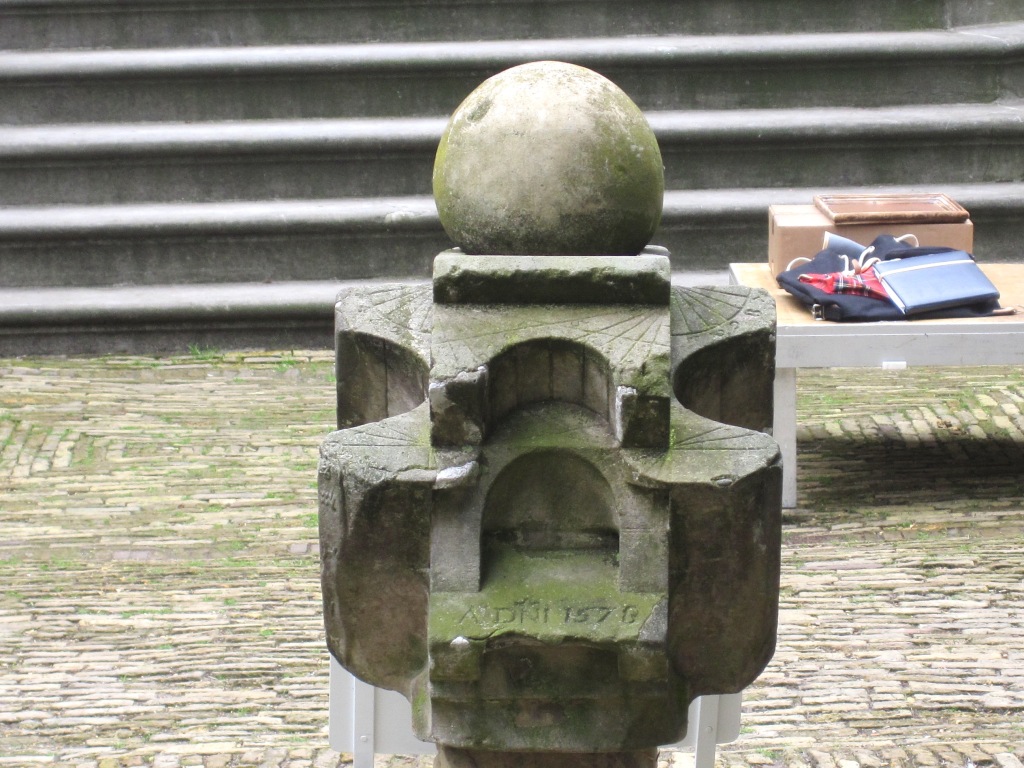
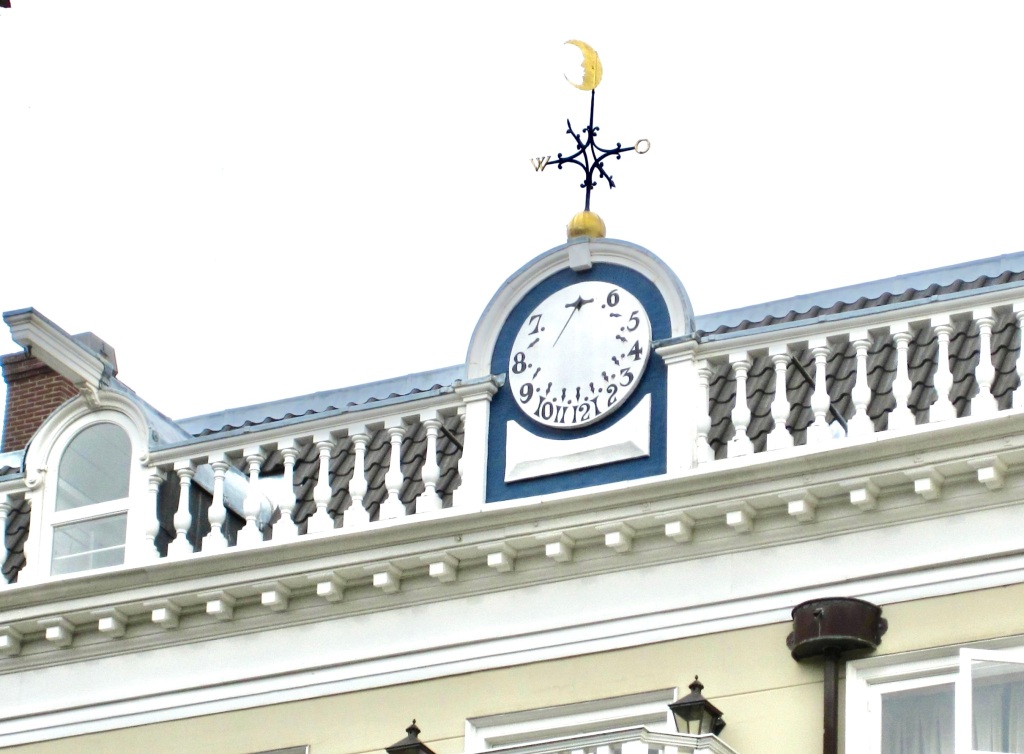
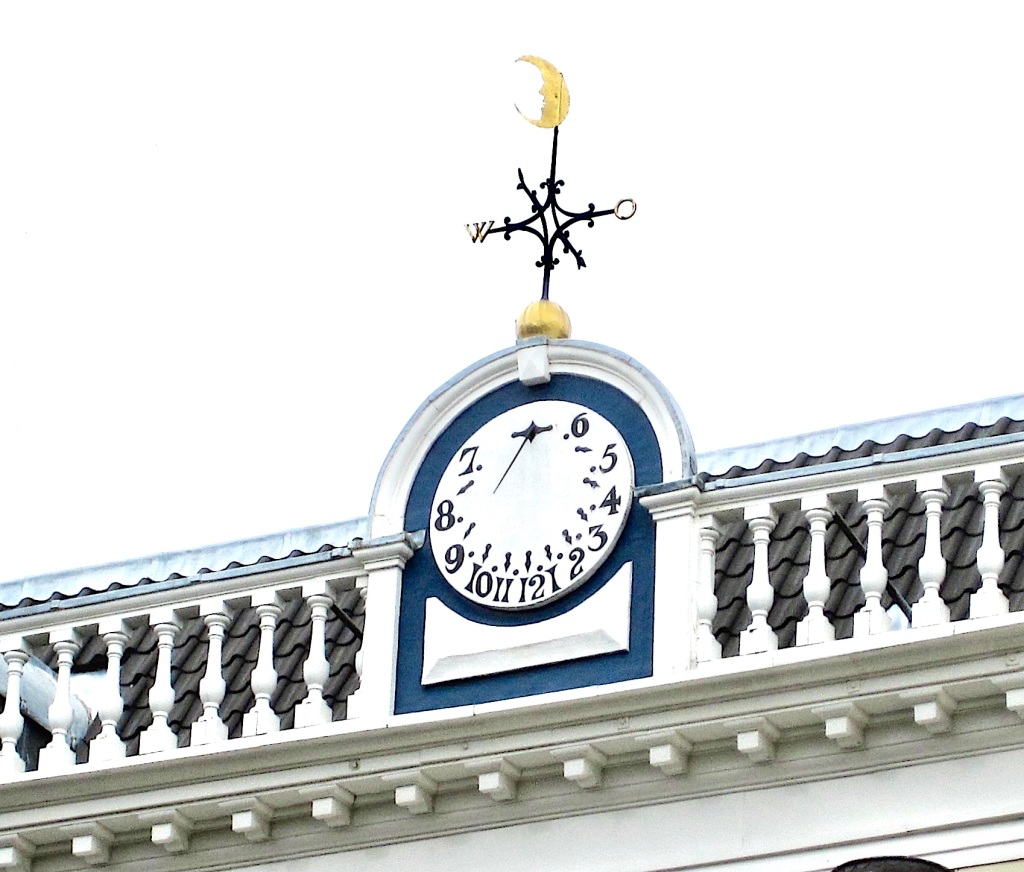
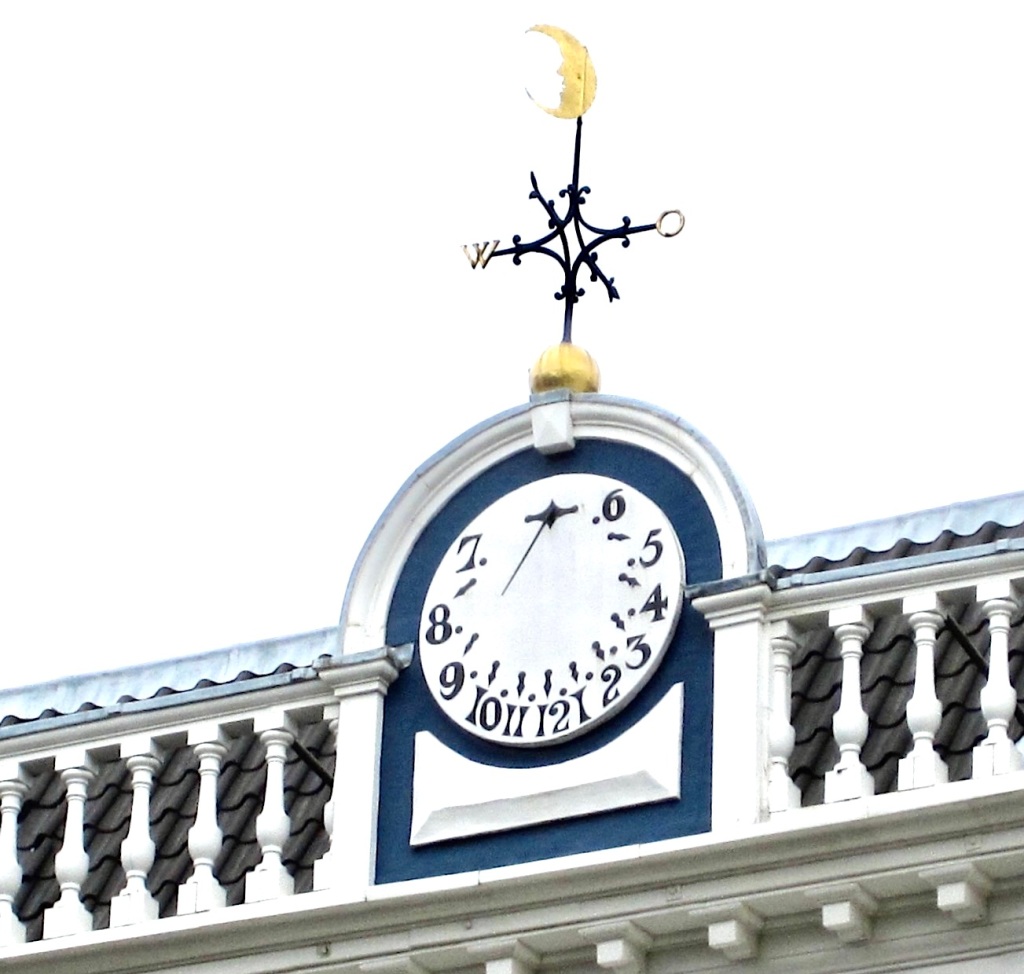
The attractive gardens of the Van Loon Museum contains 3 very different dials. In the centre is an armillary sphere (C19?). By the steps is a complicated early scaphe dial dated 1582. I have included B&W images, which can sometimes be useful for seeing details on multiple dials. The third dial with a weather vane is high up in the centre of the upper gallery overlooking the garden. I am trying to find out a date for it.
ARMILLARY SPHERE
SCAPHE / LECTERN DIAL 1578
Correctly know as a lectern dial because of its angle. Scotland in particular has many of these (eg Culzean), as it also has with obelisk dials (eg Kelburn Castle).
VERTICAL DIAL AND WEATHER VANE
GSS Categories: Armillary Sphere; Cube Dial; Multi Dial; Scaphe Dial; Modern Dial; Amsterdam Dial



























 GAUDIUM SUB SOLE . SUNDIALS . MEDIEVAL TO MODERN