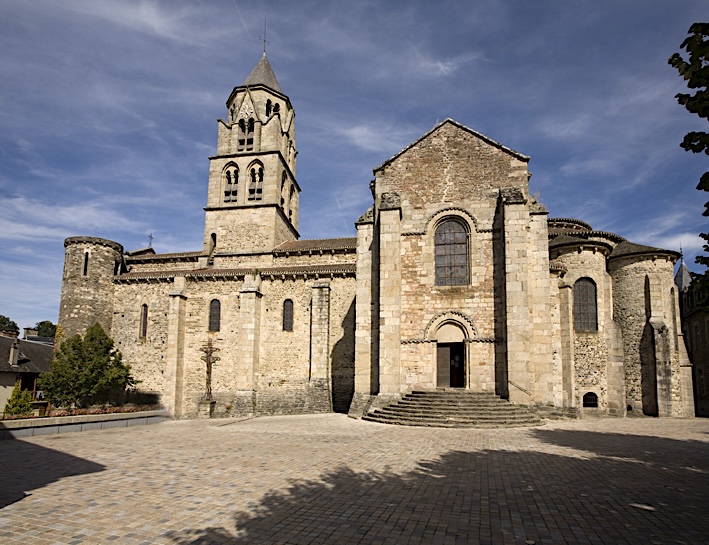
Records of a ‘primitive building’ on this site date from C6. Subsequent monastic development followed. The present building dates from C11 (chancel, N transept); C12 (nave); C13 (expansion). Later in its long history the Abbey survived turbulent times during the many uprisings and downfalls in France. The Abbey was restored in the early C20. There is a saying ‘He who owns a house in Uzerche has a castle in the Limousin‘
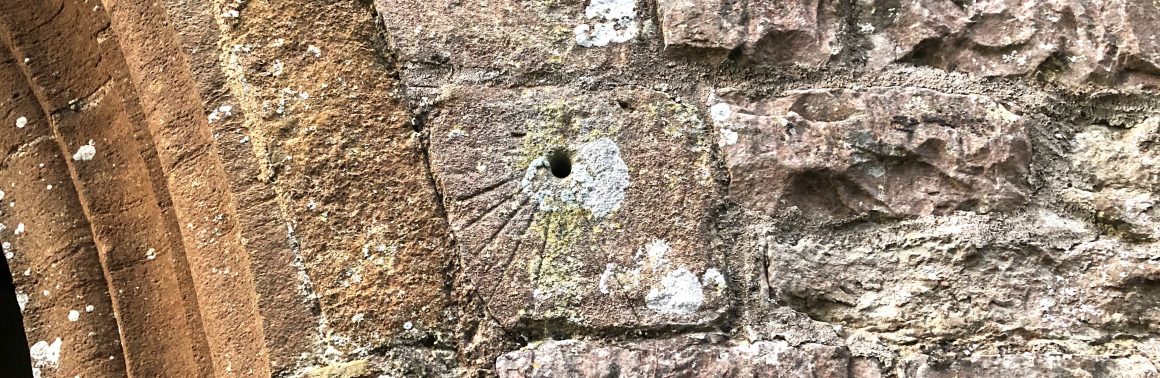
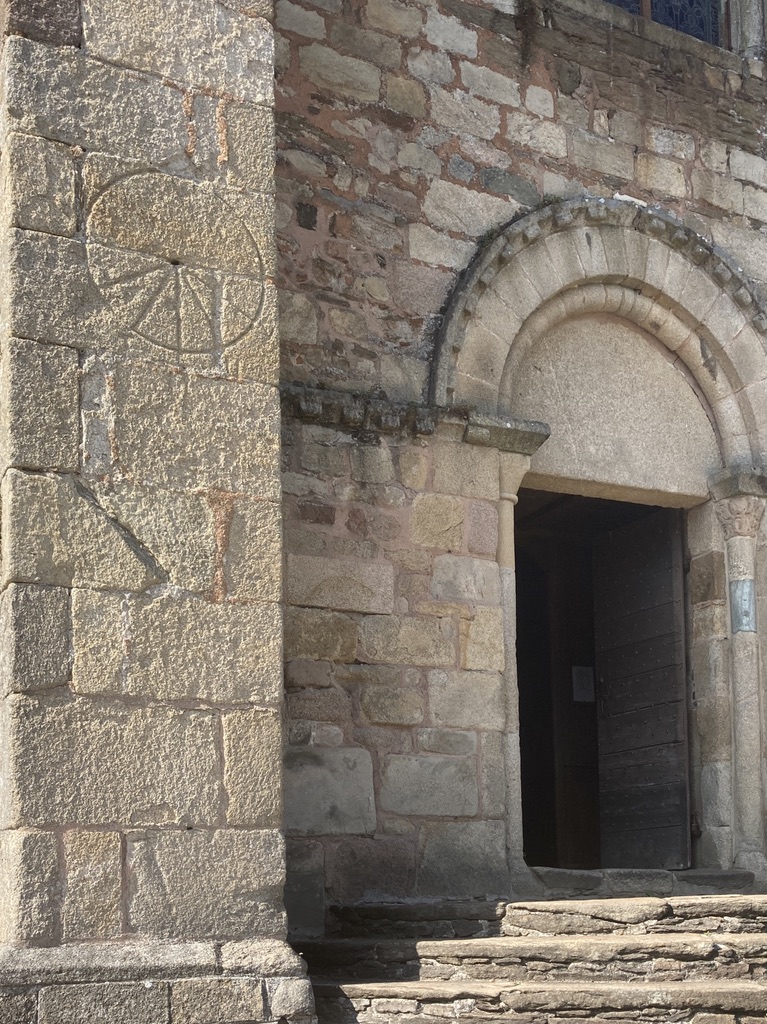
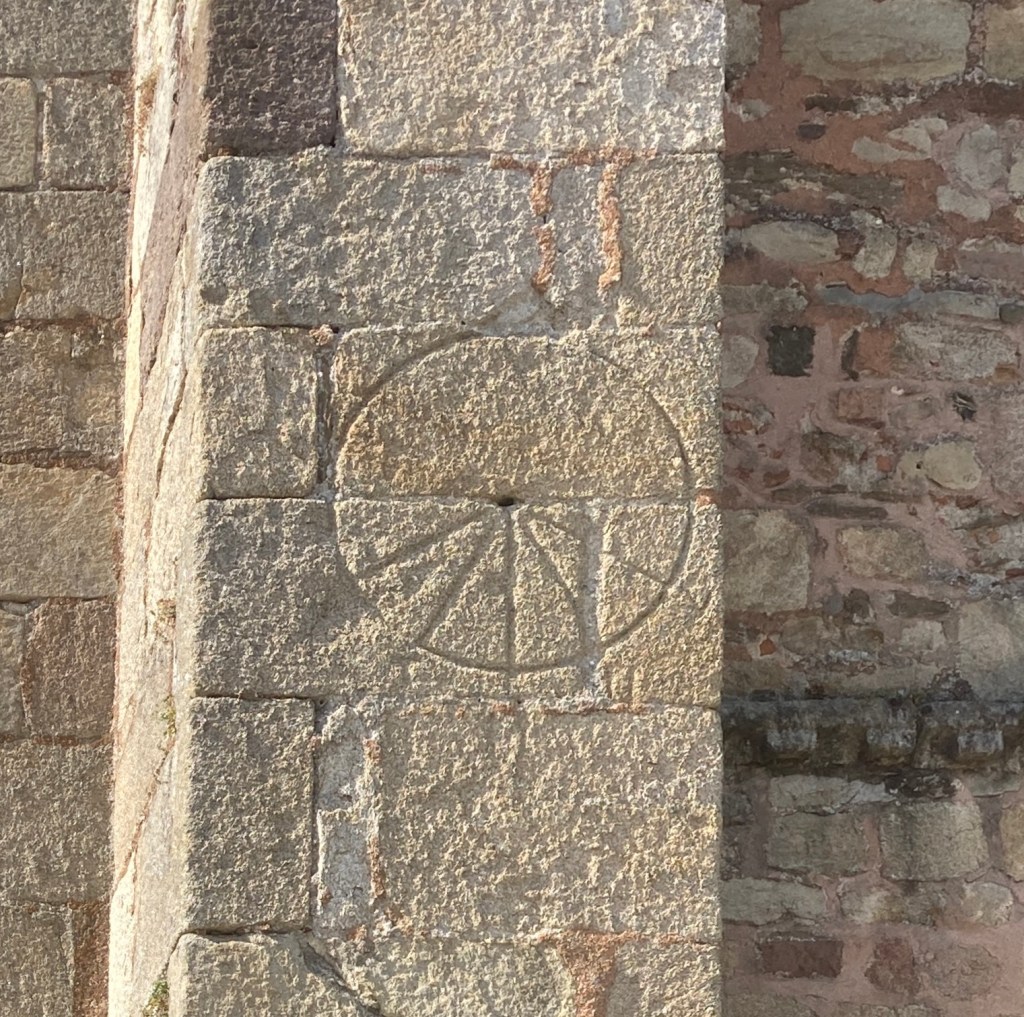
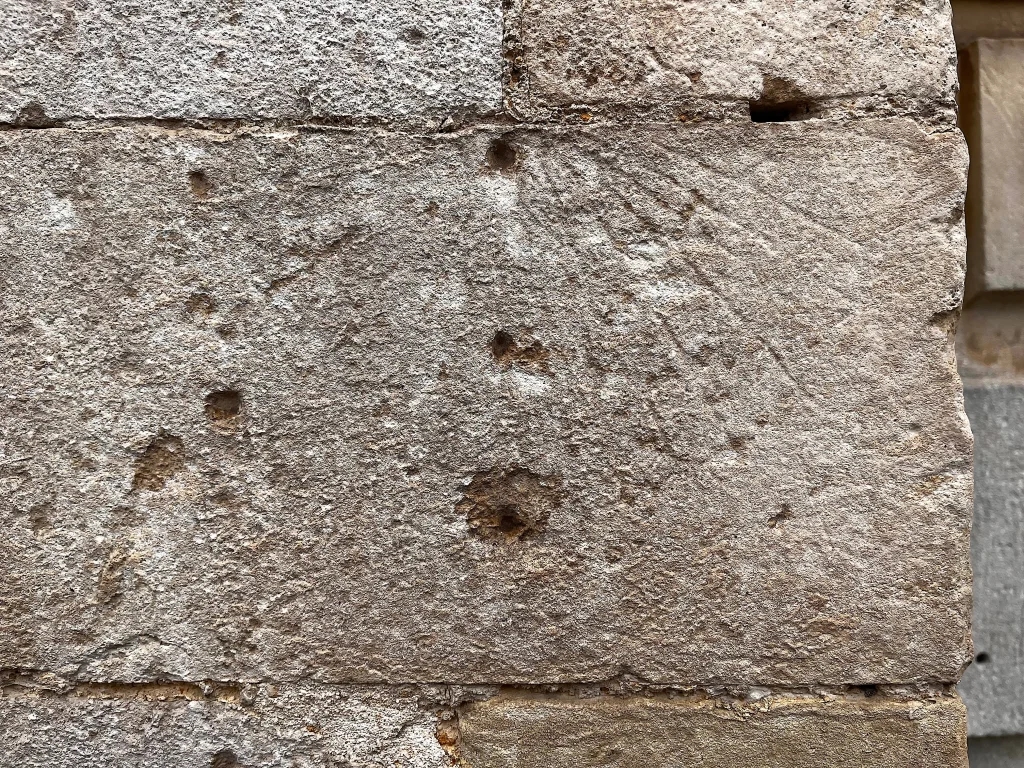
This unusually large dial is cut on the SW buttress of the imposing entrance doorway. It is too grand to be given the normal designation ‘scratch dial’. The much less used description ‘Mass dial’ seems more appropriate in this case. It is accurately cut , and within the circle the 5 radials form 6 segments in the lower half of the dial. It is in remarkably good condition apart from the damage to the lower right quadrant. Further research is needed to find a plausible date-span for the dial’s construction.
Photography: Plaxy Arthur, with many thanks; Jacques Mossot os / cc
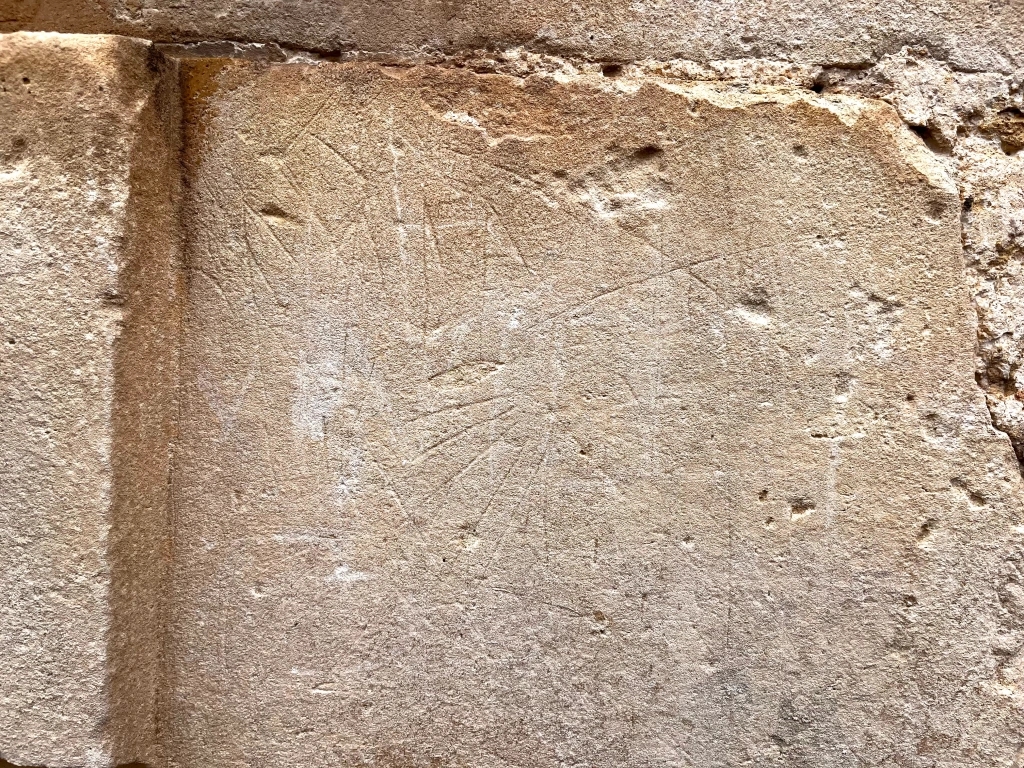
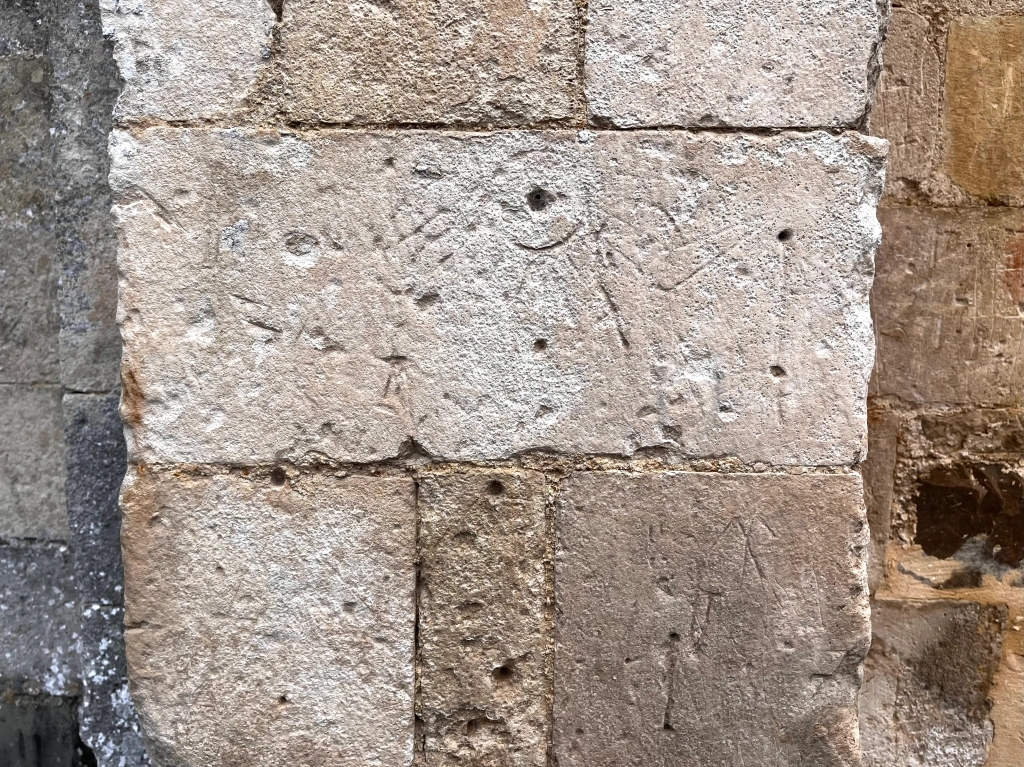
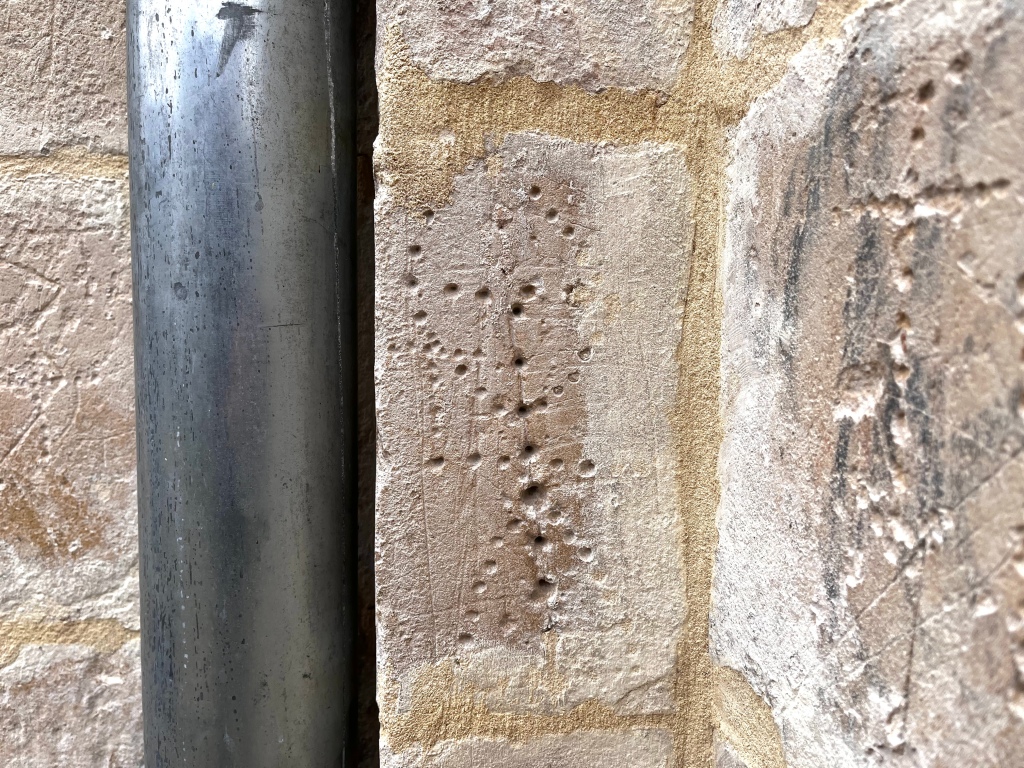
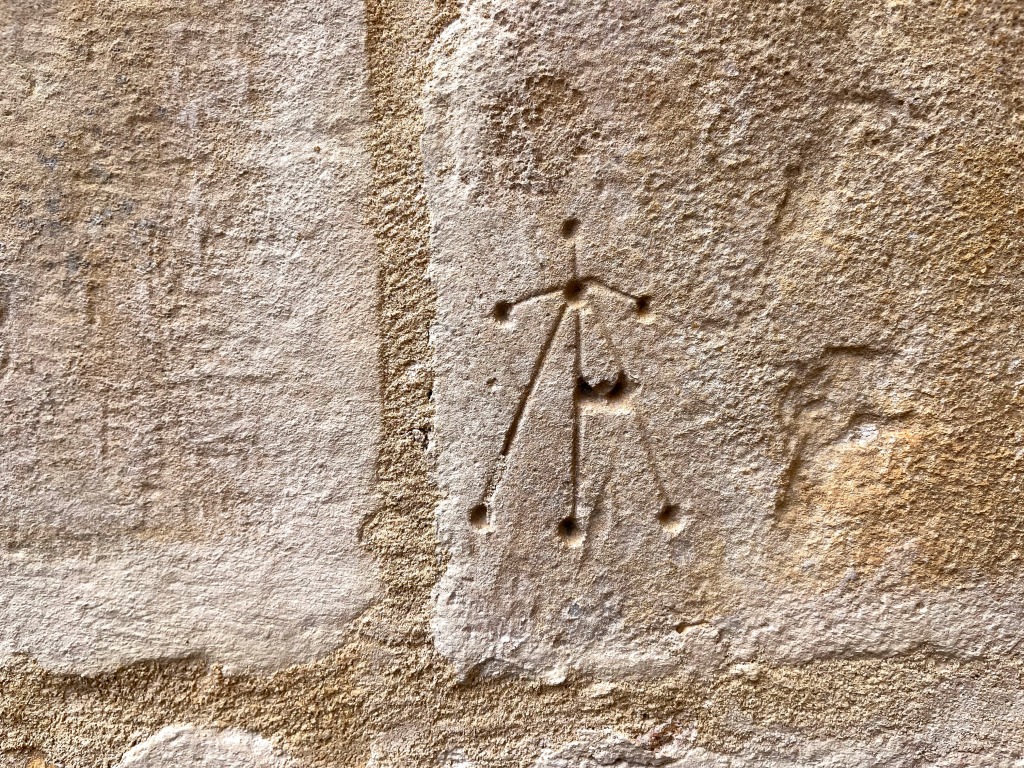
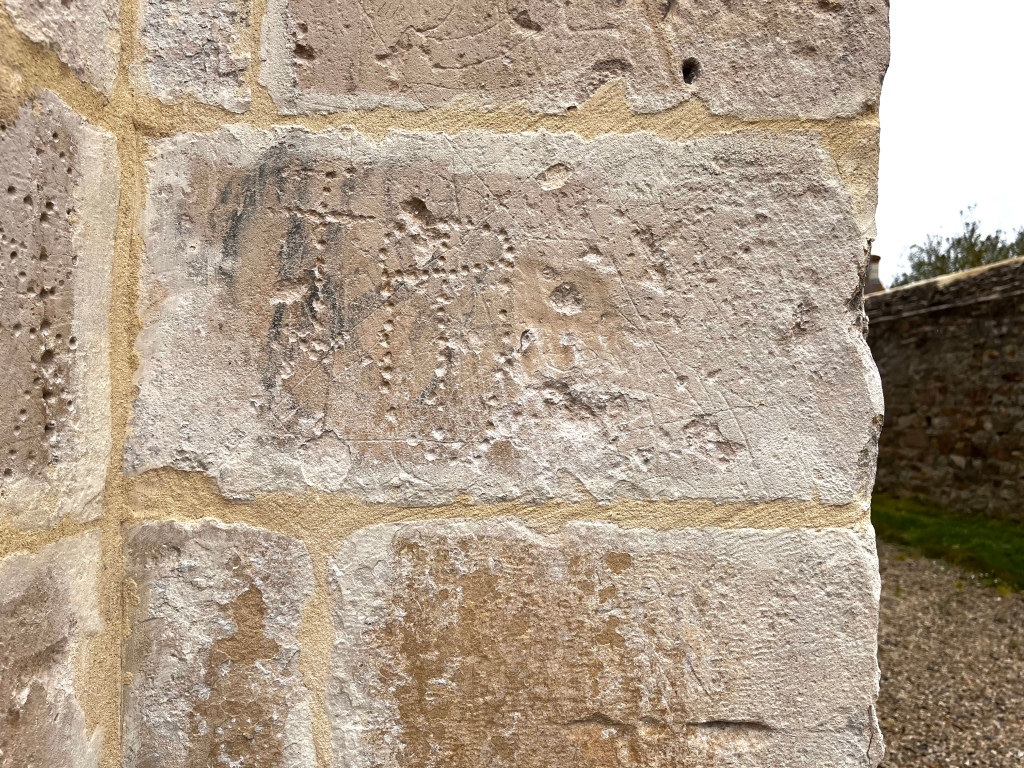
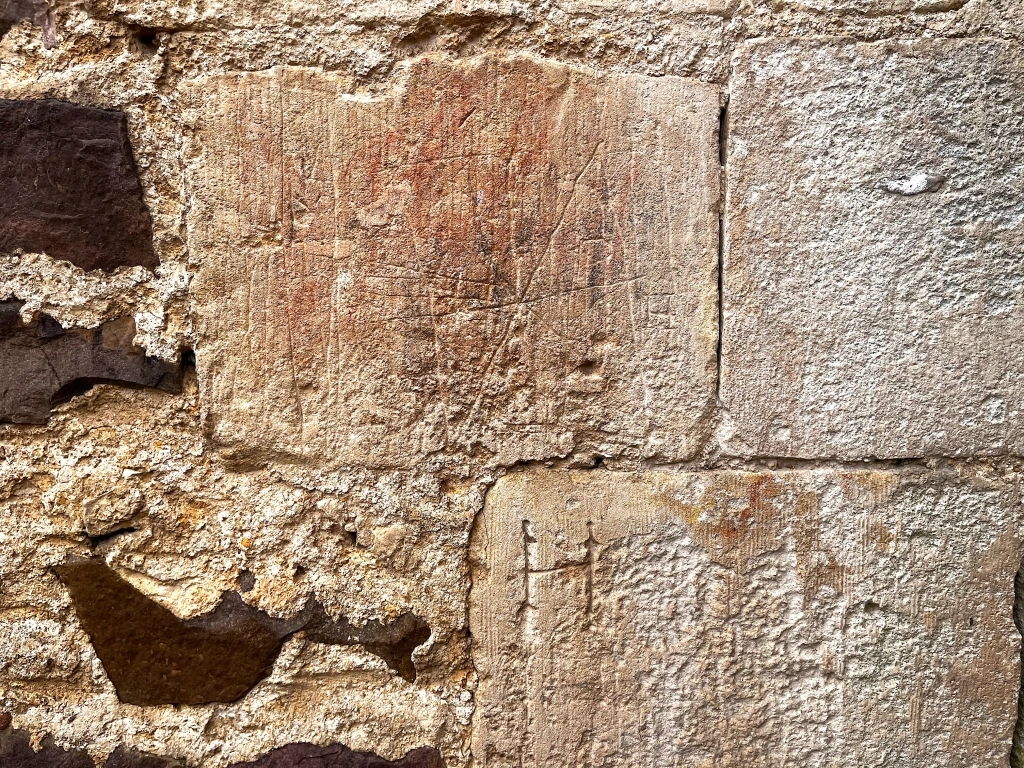
The area between Caen and Alençon contains a surprising number of churches with scratch dials. There are some rich pickings for scratch dial and church mark enthusiasts. It is not exactly a destination in itself, but is certainly vaut le voyage if you are in the region. Several churches have a plethora of designs and Urville is one of them. I gave up counting the dials and disentangling overlapping ones when the score reached twenty. 49° 01′ 31.44″ N, 0° 17′ 53.88″ W
There is no point in trying to analyse this amazing collection of dial art, nor guess its significance. It’s hard to find out much about the church at all except for the official write up to the effect This parish church, built in the village centre, replaced the former place of worship which had become too small. The present church is said to be C17. Using British churches as a guide, some of the dials & graffiti seem earlier. Presumably some of the original church’s stones were reused. It might make sense that the new church tempted the villagers to add to an existing display. Here is a varied selection.
DIALS
APOTROPAIC SYMBOLS, GRAFFITI and other designs
GSS Category: Scratch Dial (Normandy France); Mass Dial (Normandy France); Medieval Sundial (Normandy France); Church Graffiti; Apotropaic Symbols; Protection Marks
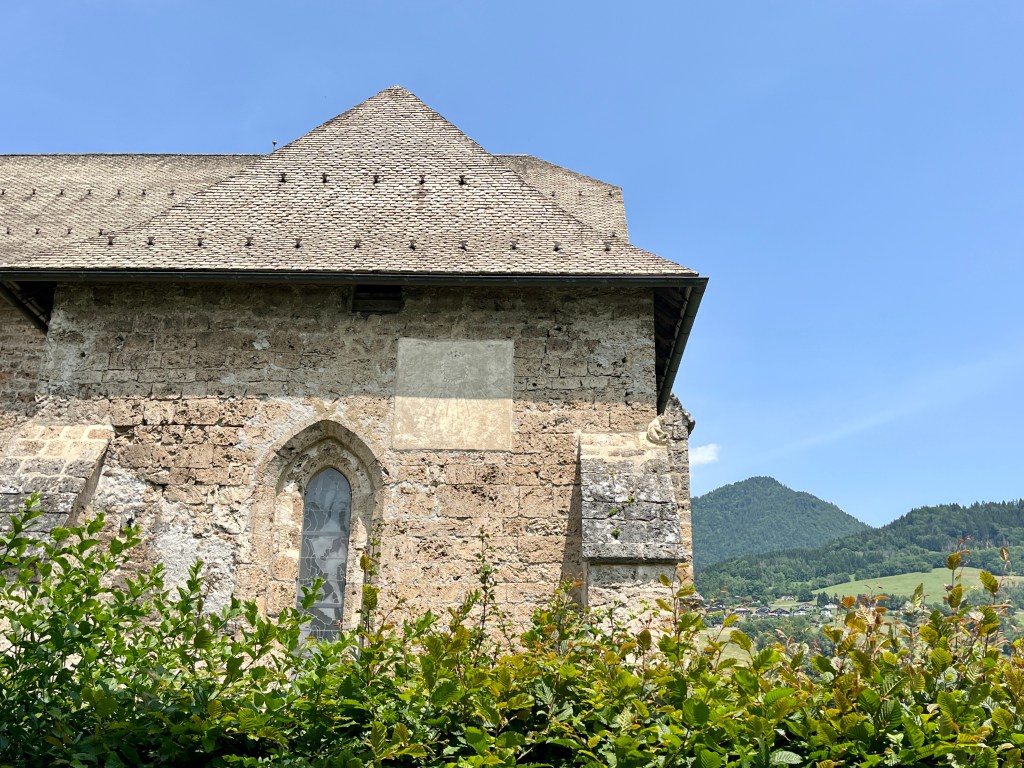
Chartreuse de Mélan . Taninges . France – Vertical Dial
Cat / Salamander Hunky Punk
The Chartreuse was founded in 1285 as a Carthusian nunnery and continued its religious functions until the French Revolution. Thereafter it became a school and in due course an orphanage. A disastrous fire in 1967 destroyed almost all the buildings on the site, with loss of life. Only the church and its cloister now remain. The church is an exhibition space and the lawns around it feature examples of modern art, from interesting via enjoyable to a few that are a matter of personal taste.
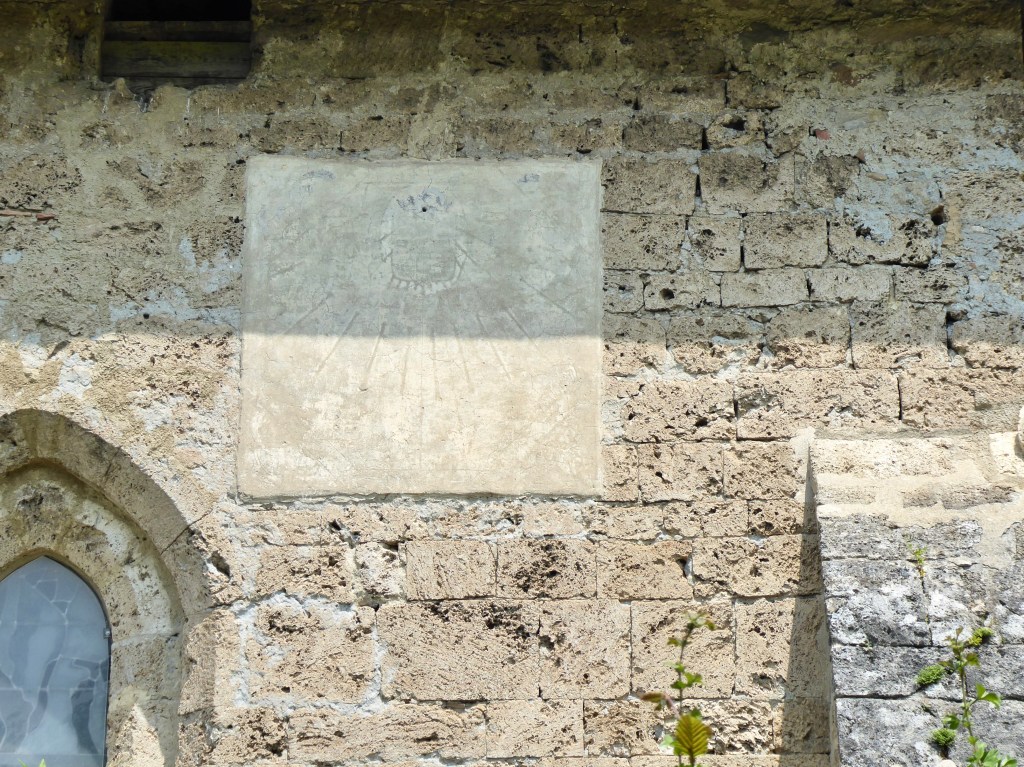
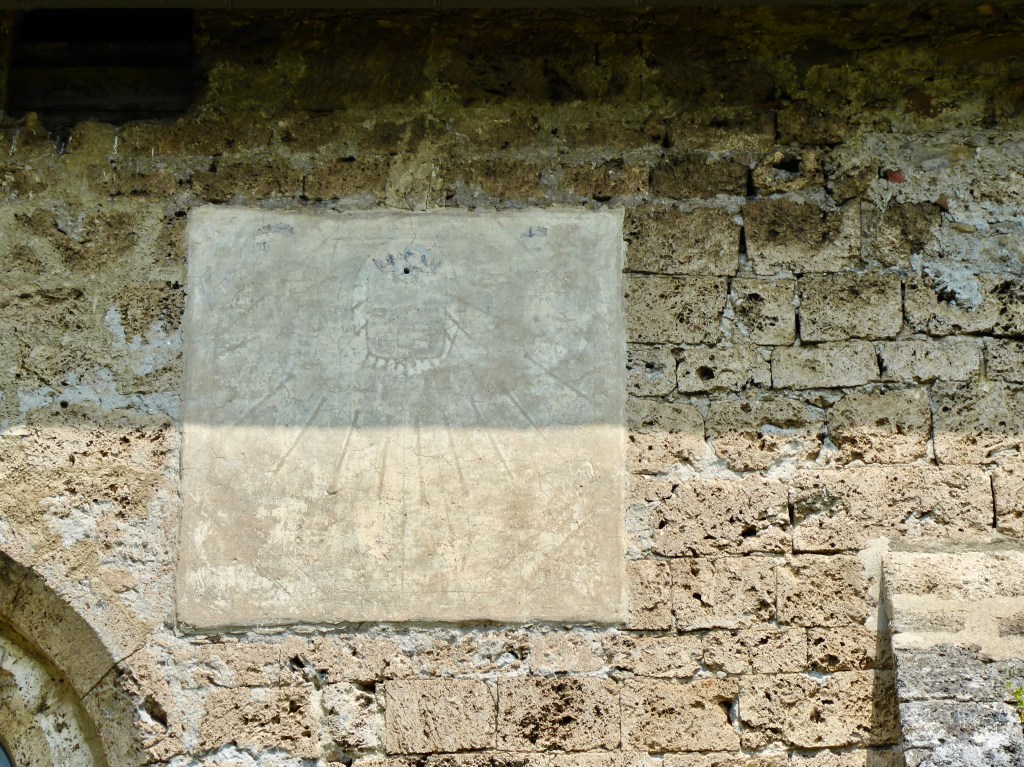
Chartreuse de Mélan . Taninges . France – Vertical Dial
The dial is included by MICHEL LALOS in his excellent French Cadrans Solaires site. Anyone who has in interest in sundials in France will benefit hugely by using this free resource. It is accessible, informative, and easy to use – not least because the dials are featured by Départment with a map for dial locations. The entry for Mélan is :
Cadran peu déclinant de l’après-midi, gravé et peint sur enduit, très dégradé, fines lignes, demies, plus de chiffres dans bandeaux, traces de blason et décor
Dial slightly declining in the afternoon, engraved, painted on rendering, very degraded, fine lines, half-hour lines, numbers within a frame, traces of coat of arms and decoration.
There are paint remnants at the top of the dial, where (presumably) it has been protected by the eaves. The gnomon hole at the top of the coat of arms is square. The dial is obviously old and I wondered if it might be dateable. Checking the apparent shape of the escutcheon, I discovered that it was first recorded as an armorial design in late C17 and (conveniently) turns out to be known as French-style. Overall, one might reasonably conclude that this dial is C18.
MEMORIAL STONE 1690
Chartreuse de Mélan . Taninges . France – Memorial Tablet 1690
GSS Category: Vertical Dial; France Sundial; Cadrans Solaires; Dials Abroad
All photos: Keith Salvesen; source used MICHEL LALOS
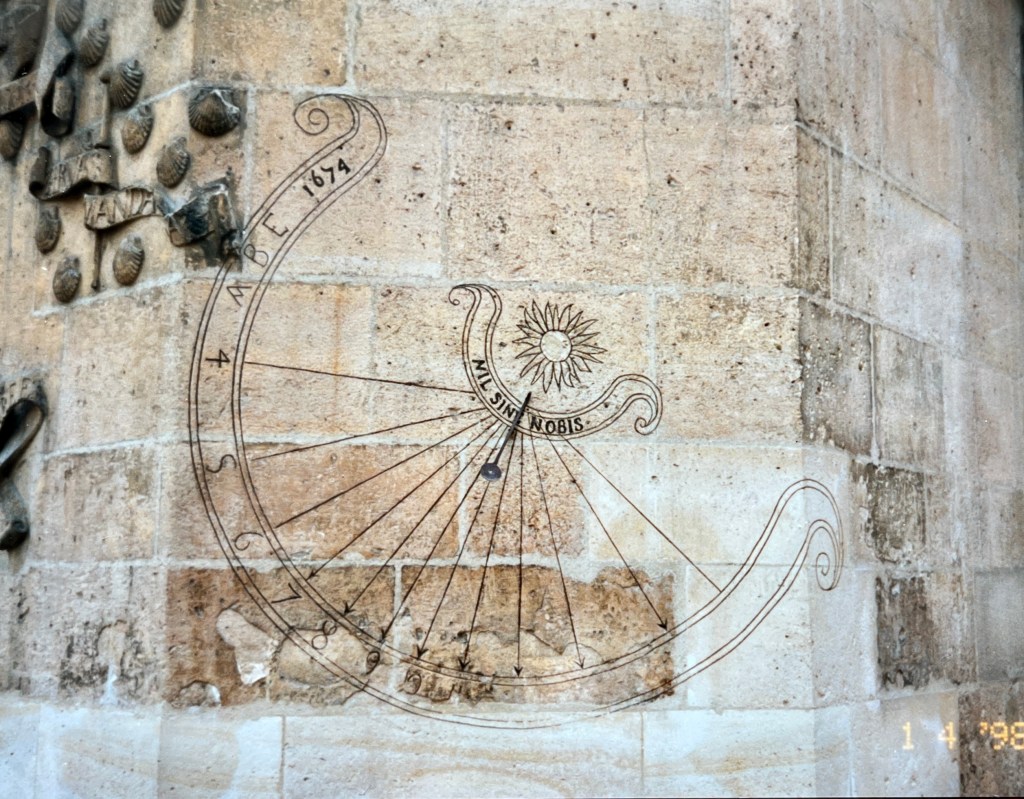
The collection of the National Museum of the Middle Ages is housed in a wonderful building, at one time an abbatiale. There is some debate about the dates of the origins and the building of the Hôtel; and of later rebuilding / restoration. The large sundial on the south wall of the courtyard is dated 1674. This was the reign of the Sun King (1643 – 1715), and a sun with its rays was an obviously fitting theme for the times.
See addendum Sep 2025 below, with thanks to Linda Roundhill
DIAL
The lines on the dial face are carefully graduated and the hours marked with Arabic numerals. Several lines terminate in arrows, suggesting a busy schedule of mainly forenoon masses.
MOTTO
NIL SINE NOBIS. A. B. F. 1674.
The inscription is usually translated as Nothing [Exists] Without Us. Margaret Gatty (1809-18730, in her comprehensive work The Book of Sun-Dials, gave the Cluny dial an unusually detailed entry:
NIL SINE NOBIS. A. B. F. 1674. Nothing exists without us.
A dial on the wall of a courtyard on the south side of the Hôtel Cluny, Paris, had this inscription. The word nobis referred to the rays of the sun which were represented on its face. The Hôtel Cluny, a very beautiful specimen of rather elaborate fourteenth century Gothic architecture, was bought in 1625 for the abbess and nuns of Port Royal, and was known as Port Royal de Paris. It was re-established by Louis XIV. in 1665, on a fresh basis, and was looked upon as schismatic by the community of Port Royal des Champs. This dial must have been erected in the time of the first abbess of the new foundation, Sœur Dorothée Perdreau, who held office till 1684.
Cluny Museum and its sundial: detailed entry by Margaret Gatty
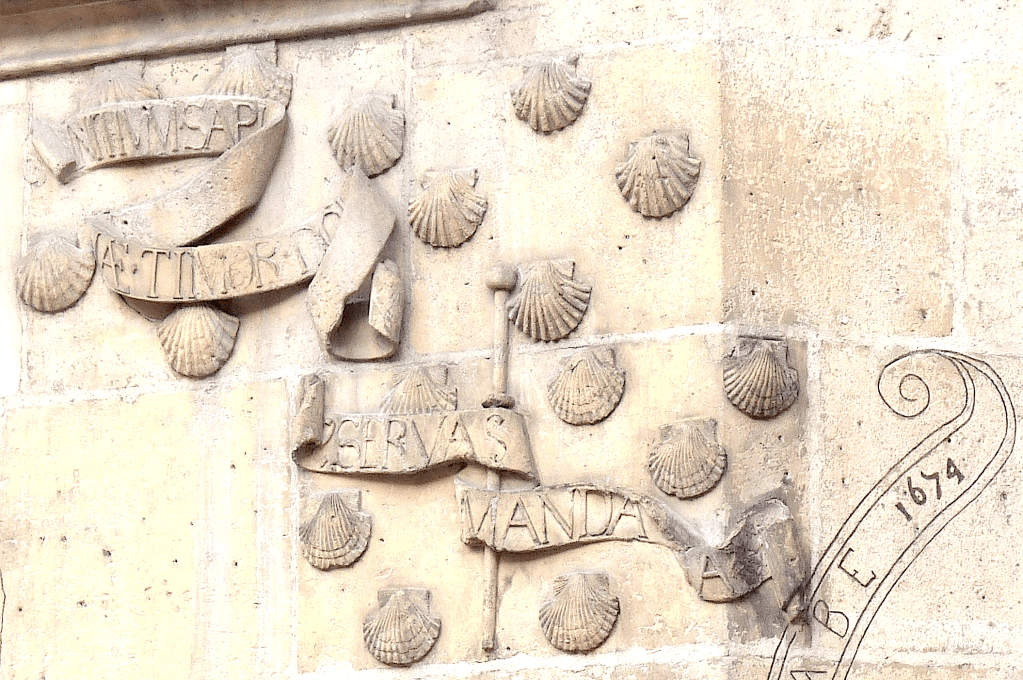
SCALLOP SHELLS and HERALDIC MOTTOS
The scallop shells are interwoven with two inscriptions (or possibly a single one in two parts) which deserve a mention as part of the overall design. The shells themselves evidence an ancient Pilgrimage route that passed close by – the long Rue St Jacques is a few meters to the North.
The heraldic mottos are said to read, firstly: Servire Deo Regnare Est – To Serve God Is To Reign; MG suggests, without much conviction, that the other (or part of it) may be as shown below.
With very rusty Latin and a bit of internet work, I can’t make either interpretation fit the scrolls we can see. Possibly they relate to a different part of the Musée, and the shell one(s) are different. I’ll have to leave the reader to try to puzzle this out (all suggestions welcome).
ADDENDUM SEPTEMBER 2025
Many thanks to Linda Roundhill for solving the puzzle that I feebly left for others to interpret
The top left ribbon scroll with the scallop shells is a scripture verse “The fear of God is the beginning of wisdom”. From Proverbs 9. The lower left is a Christian catch phrase, ‘To serve God is to reign’, derived from John 12. This was hard because some of the letters are missing or hidden. The scroll on the right says “Keep My commandments” which is a short version of Matthew 19:17, and many other passages. Again, some letters are obscured.
GSS Category: Early Sundial / Vertical Dial; French Sundial; Sundial Motto
Credits: all photos Keith Salvesen – please seek use permission for these detailed ones; Musée Cluny for the Unicorn
The secluded Monastery of Lluc is situated near Escorca in the Tramuntana mountains of Mallorca. It dates from the c13, and is famous for its Black Madonna, the discovery of which is said to have led to the monastery’s foundation . It is a place of pilgrimage. The location is remote and peaceful, though inevitably the monastery has become an essential stop on the tourist and coach party trail. We returned there recently, not having visited Mallorca for more than 20 years. The buildings were much as we remembered, but the parking and visitor arrangements were more regimented and complex. Before, one just drove down the narrow road from the main mountain road and parked in the forecourt area close to the buildings. Now, everything is (unsurprisingly) geared to a daily mass influx of people and their needs for sustenance and souvenirs. We were pleased to see that it is still possible to stay at Lluc in one of small rooms under a long covered walk where the monks once slept. You can even book a room for the night.
Lluc Monastery . Mallorca – Sundial
A short walk from the monastery, there is a path that leads up to a calvary and some great views. Along the way is an amazing multiple vertical sundial. It was designed by Rafael Soler, and carved in 1991. It displays with some style the evolution of sundials from medieval to modern. There are two historical dials, one solar dial, and two seasonal dials.
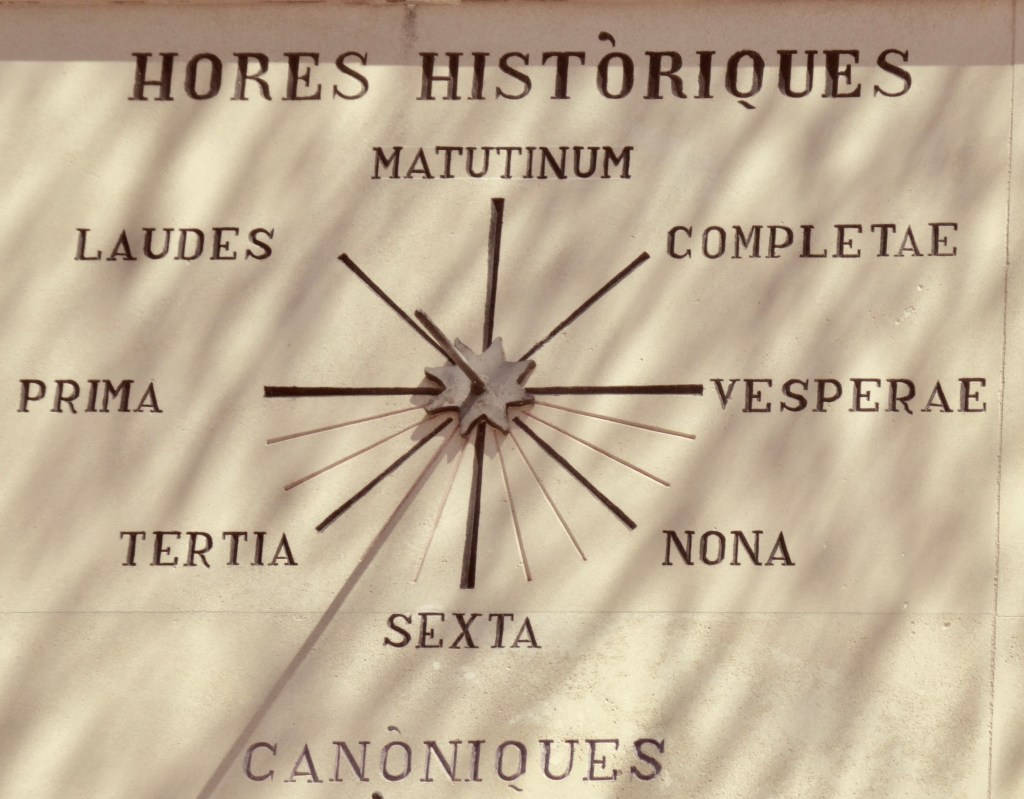
CANONICAL HOURS – LATINATE
This dial simply records the 3-hourly canonical divisions of the liturgical day (as with the early medieval mass / scratch dials), starting with midnight (top) and working counterclockwise round a central gnomon.
Lluc Monastery . Mallorca – Sundial (Canonical)
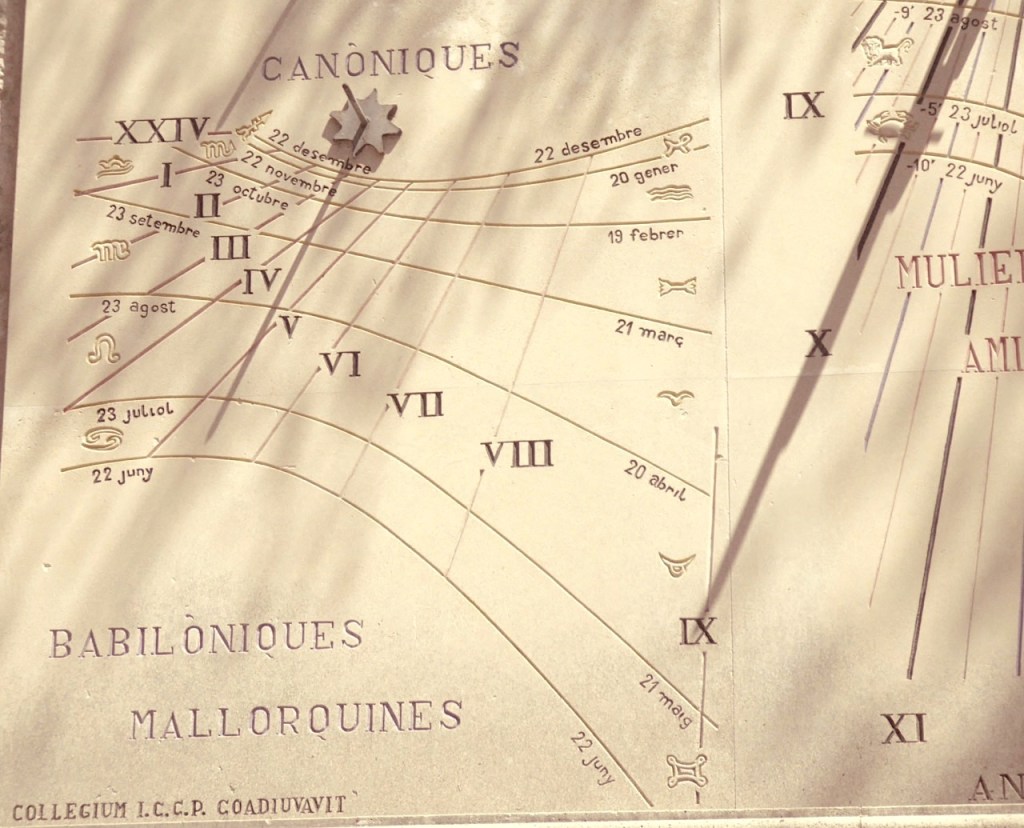
CANONICAL HOURS – BABYLONIAN / MALLORQUIN
A more complex dial, starting at noon shown as XXIV (I’m not clear why not XII) through to 21.00. The dial includes months and the signs of the Zodiac.
The centre dial shows true solar time. The polar gnomon (triangular) shows the hours, the pointer shows the date with the declination lines. The inscription MULIER AMICTER SOLE (Woman Clothed by the Sun) references an account in the Book of Revelations. You can find out more HERE
Lluc Monastery . Mallorca – Sundial
MEAN TIME DIAL (SUMMER /AUTUMN)
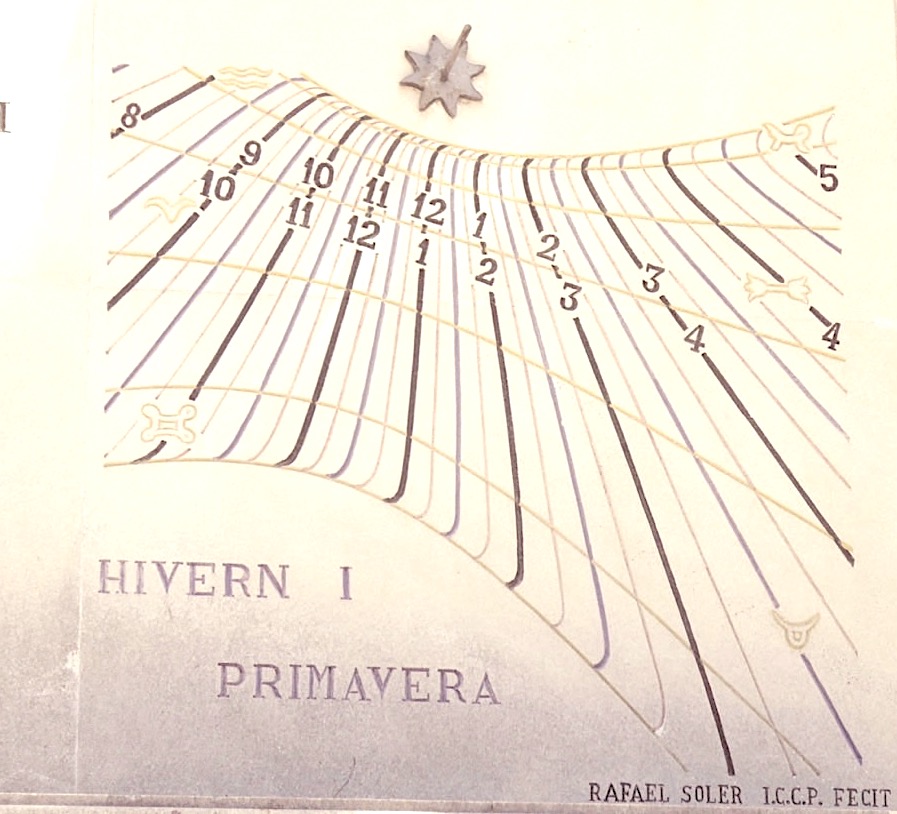
The two right-hand sundials are complementary and each covers two seasons. Presumably for a particular month, one dial will be reliable as to time and the ‘off-season’ one will not. The words are Catalan eg Hores Mitjanes = Mean Time; Estiu I Tardor = Summer and Autumn.
Lluc Monastery . Mallorca – Sundial
MEAN TIME DIAL (WINTER / SPRING)
Lluc Monastery . Mallorca – Sundial
BBS Record
The creation of these dials was obviously a labour of love and skill combined. There’s doubtless plenty more to be said about these sundials and the splendid ensemble but I decided not to get too technical – indeed, as an amateur I don’t understand enough to do so. The rather washed out appearance of the images was operator error – I had the camera on the wrong settings and didn’t realise until too late…
Lluc Monastery . Mallorca
GSS Category: canonical to modern multi-dial; sundial Lluc Mallorca
All photos: Keith Salvesen; snippet from BSS record
Original Credits: ‘Props to arby101ca and lumbricus, members of a geocaching & waymarking website called Groundspeak. They hiked to Lluc (respect!) and wrote informatively about these dials. I found relatively little elsewhere.
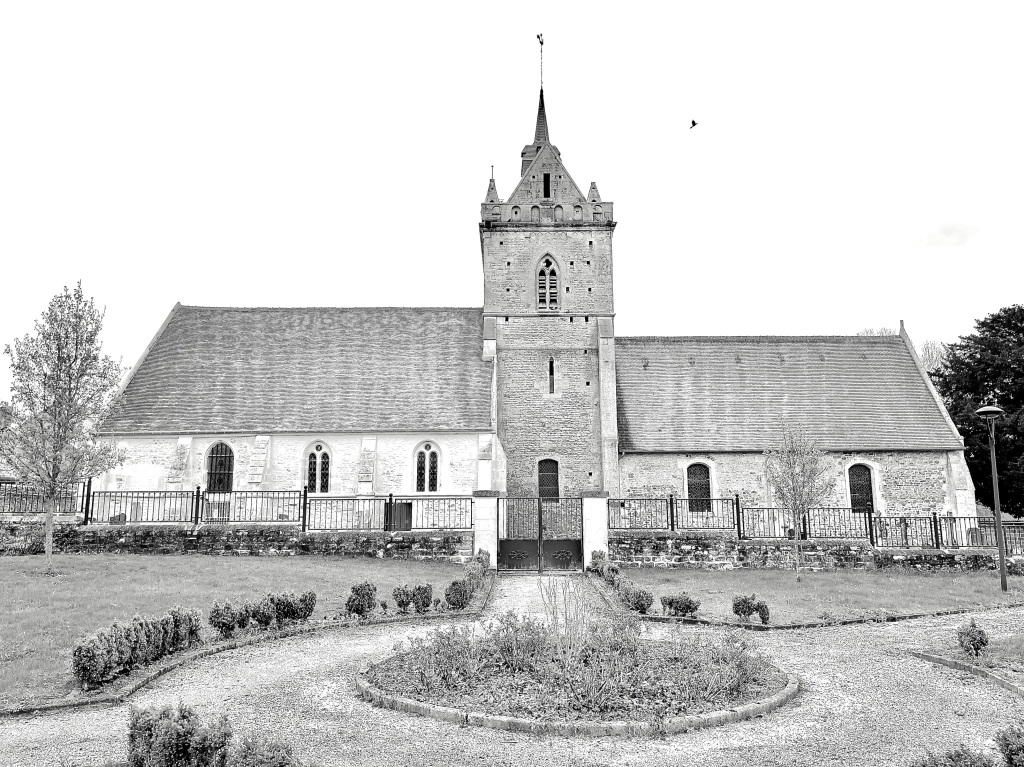
This unassuming little village is about 10 kms NE of Alençon, in the lower part of an area of Normandy south of Caen where medieval dials can be found on a number of village churches. Mostly, they are single examples but a handful of churches have a profusion of dials that are quite hard even to count let alone analyse.
DIAL
St Martin . Hautrive . Orne . Normandy – Scratch Dial
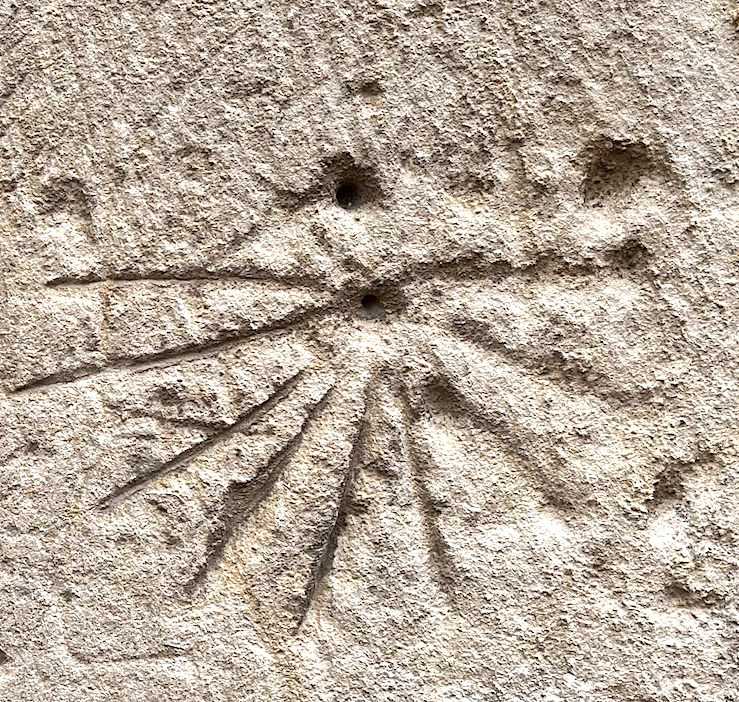
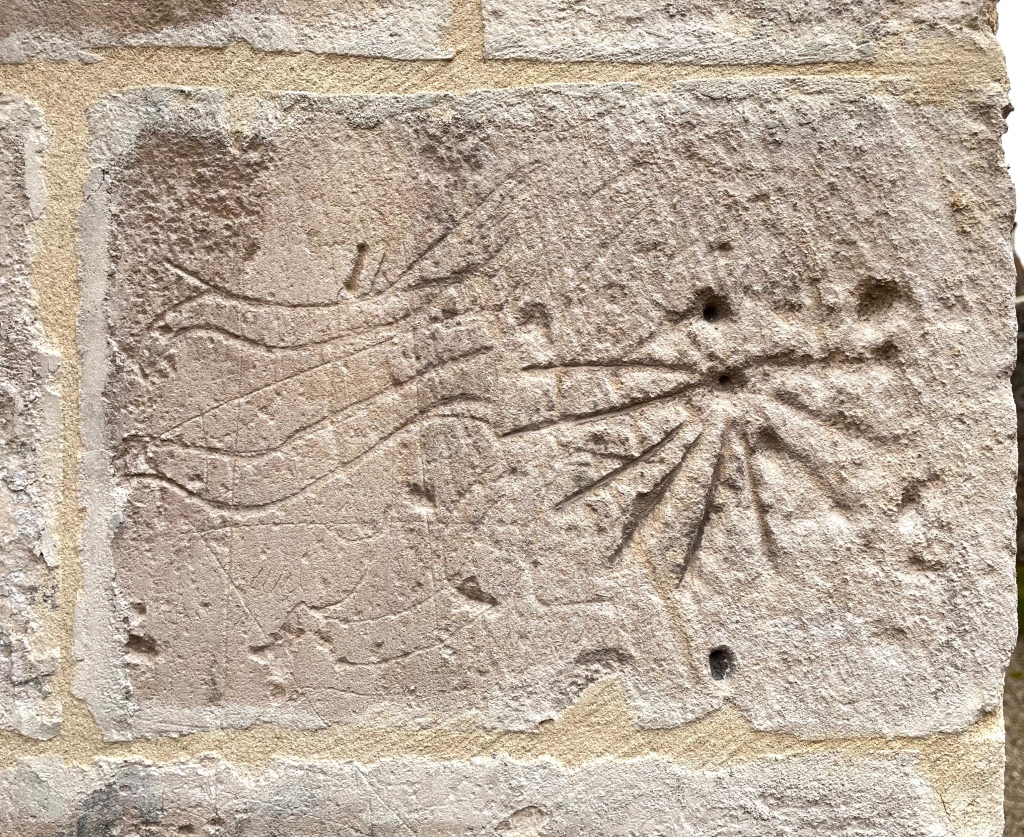
The dial is quite complex. Its position is on the quoin of the chancel, however the only reference I have found suggests it was at one time on the R side of the main doorway. The church is obviously well looked-after and its care may have involved relocation of stones when repairs were carried out.
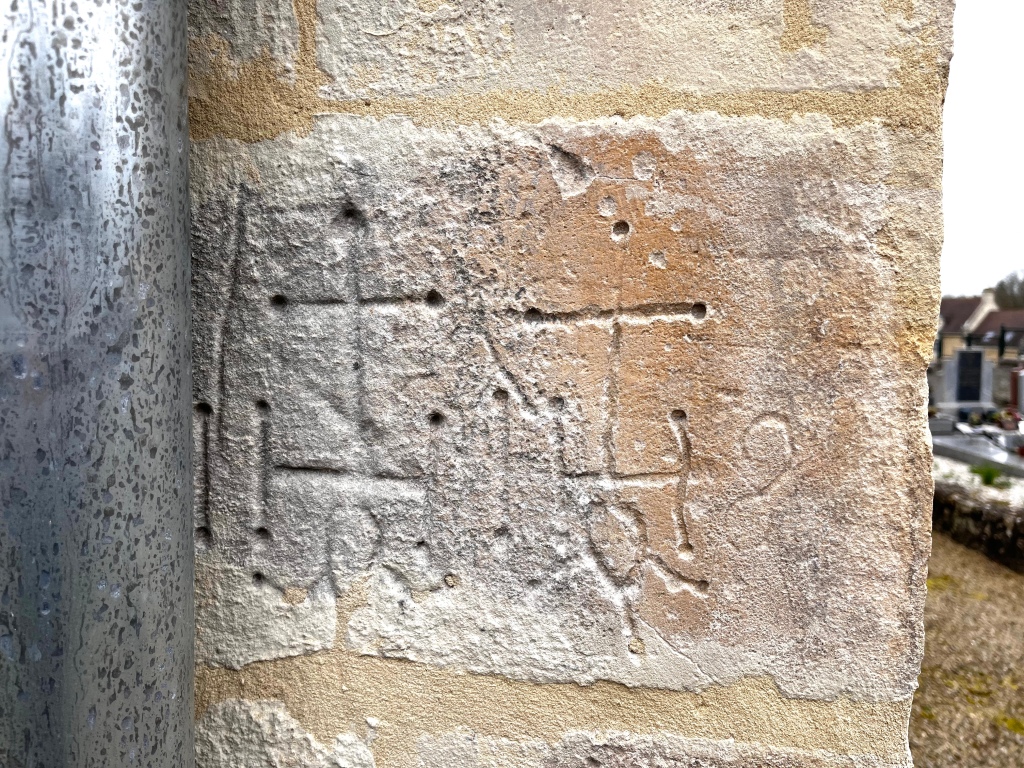
The details of the dial’s semicircular design are intricate. There is a big blocked gnomon hole that must have been enlarged over the years from something more proportionate. The noon line is emphasised by a large terminal pock. 10± visible lines radiate from the centre, though there must have been more. Most end in pocks: some single, some double, some triple. The pocks themselves have small lines around them, or 2 are joined to each other. Overall, the impression is of a perfectly serviceable traditional Mass dial that has been made enjoyably decorative.
I have included close-ups of the lower quadrants of the dial together with side shots to better show the complexity of the dial in its eroded state. I have never encountered one quite like this.
St Martin . Hautrive . Orne . Normandy – Scratch dial
GSS Category: Scratch Dial; Mass Dial; Medieval Dial France
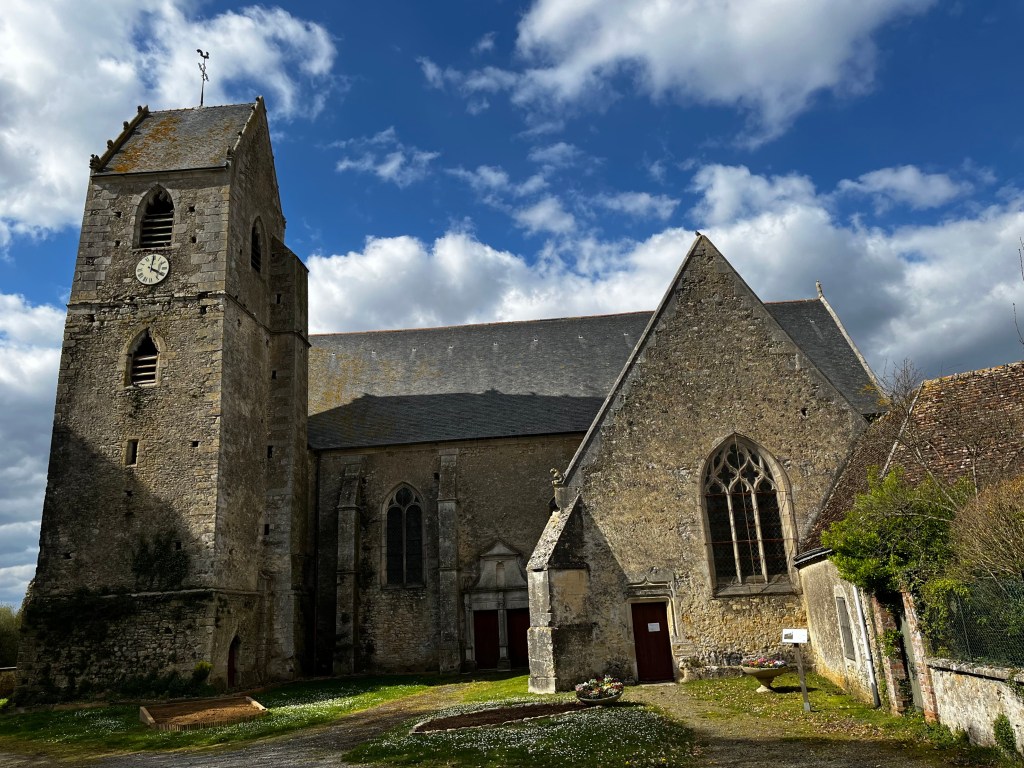
St Rémy du Val is about 12m SE of Alençon, in a countryside of fields and forests. The church of St Rémy et St Rigomer stands high above the river Bienne, beside a now-ruined small castle. It has early origins but dates mainly from C15. The strong tower also had a defensive purpose. At some stage a small and attractive renaissance double doorway was added, a pleasing architectural contrast.
DIAL
St Rémy et St Rigomer . St Rémy du Val . Normandy – scratch dial
The dial is located on the SW face of the buttress shown in the foreground of the header image. There is a definite tilt to this part of the church supported by the buttress, and to the adjacent buildings (the photo exaggerates it considerably).
I wasn’t expecting to find a dial (or even looking for one), and I was lucky to see such an unobtrusive example as we walked past. I later discovered that there is one other mention of it, and of a possible small dial close to it.
St Rémy et St Rigomer . St Rémy du Val . Normandy – Scratch Dial Gallery
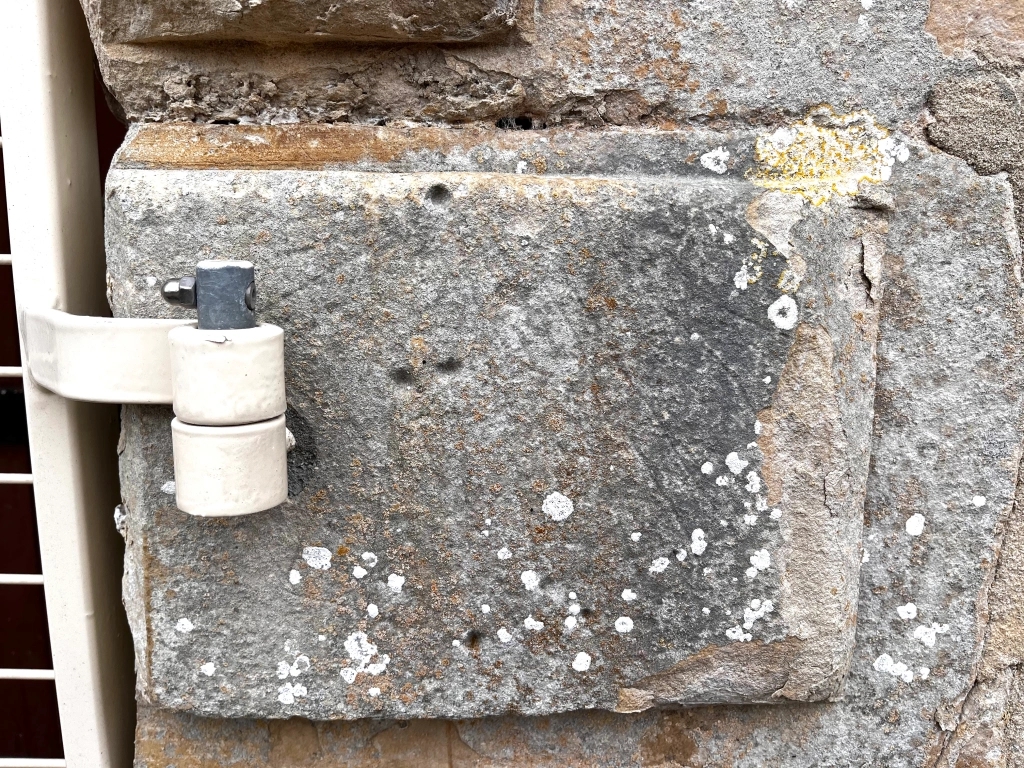
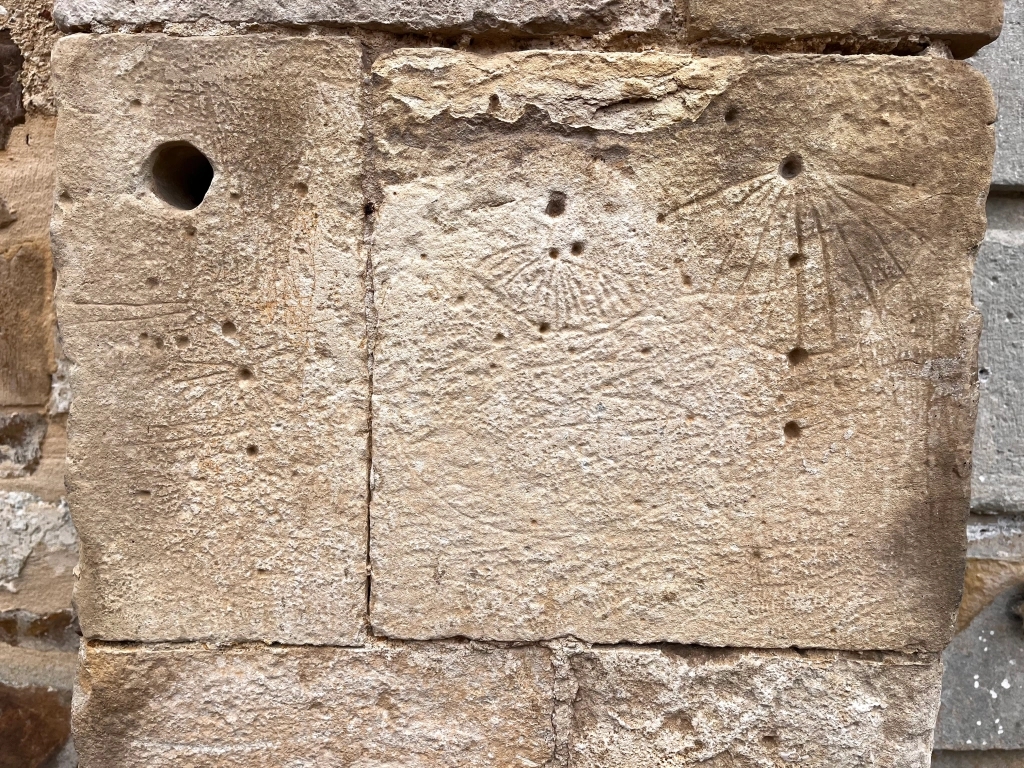
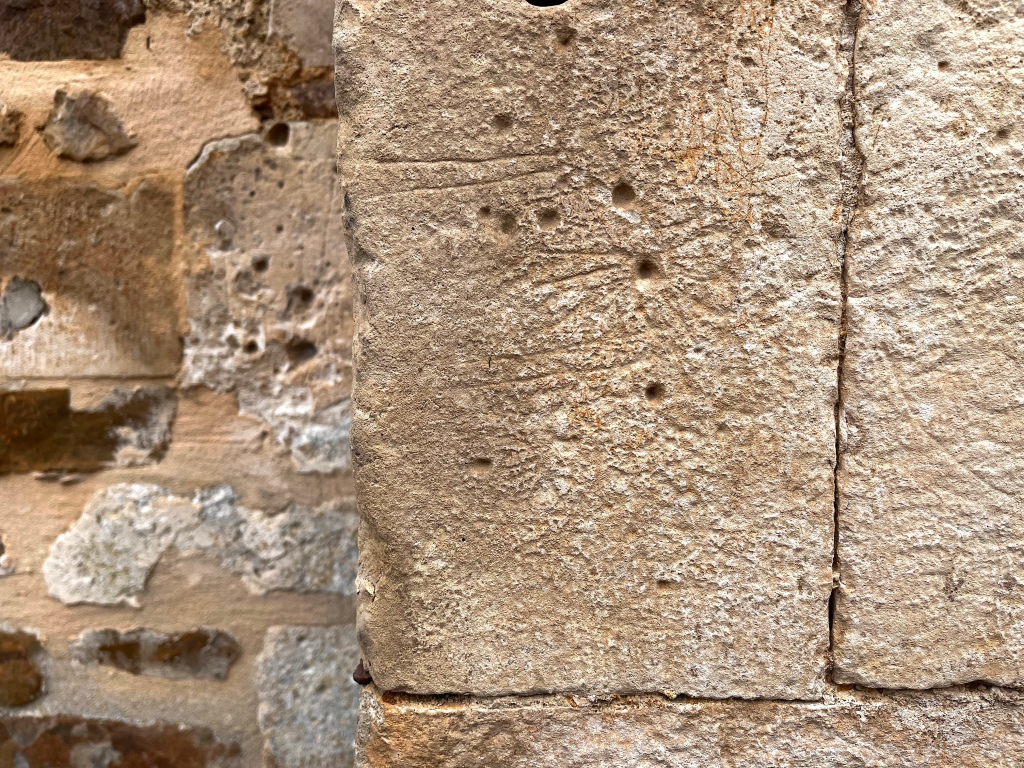
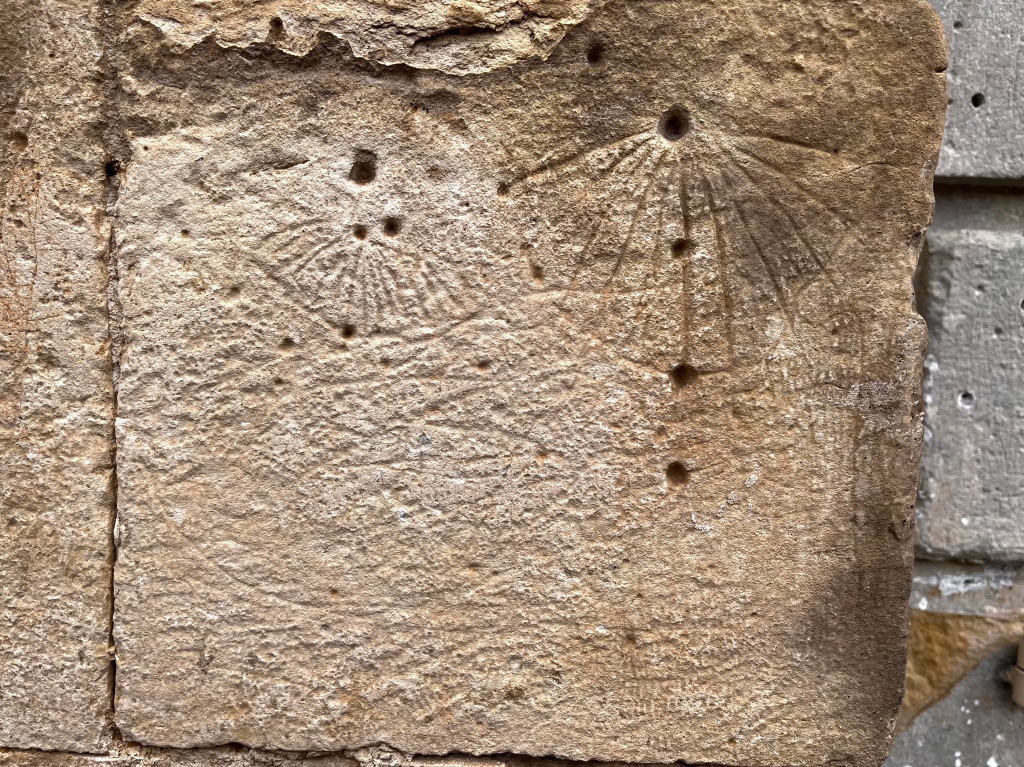
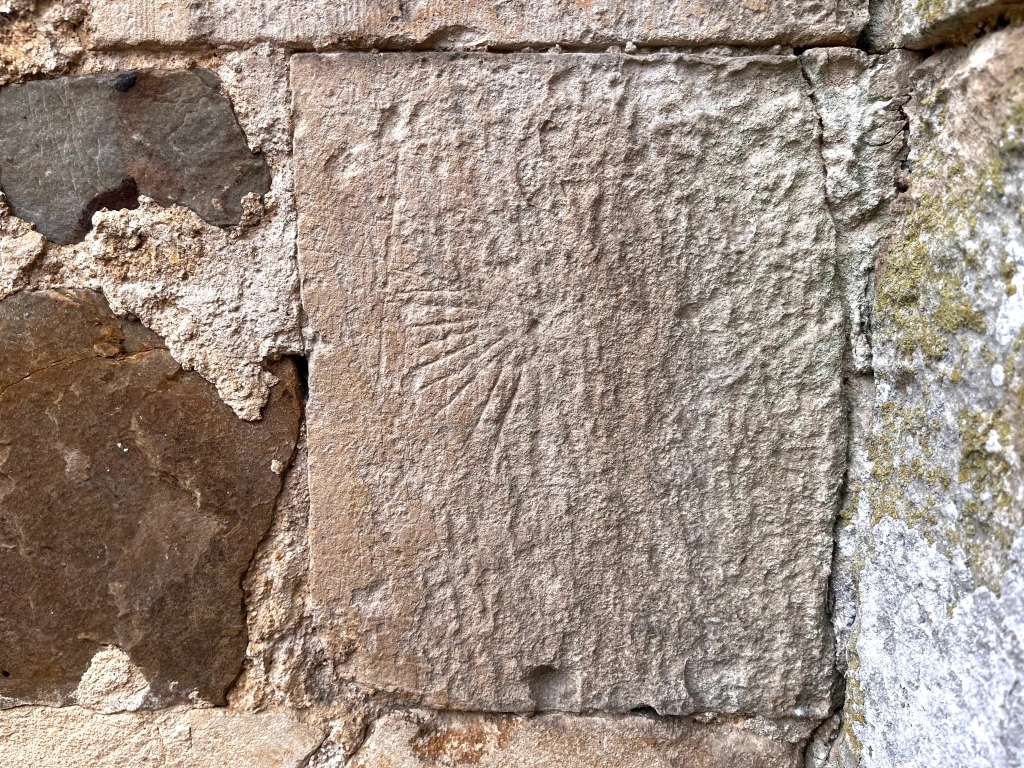
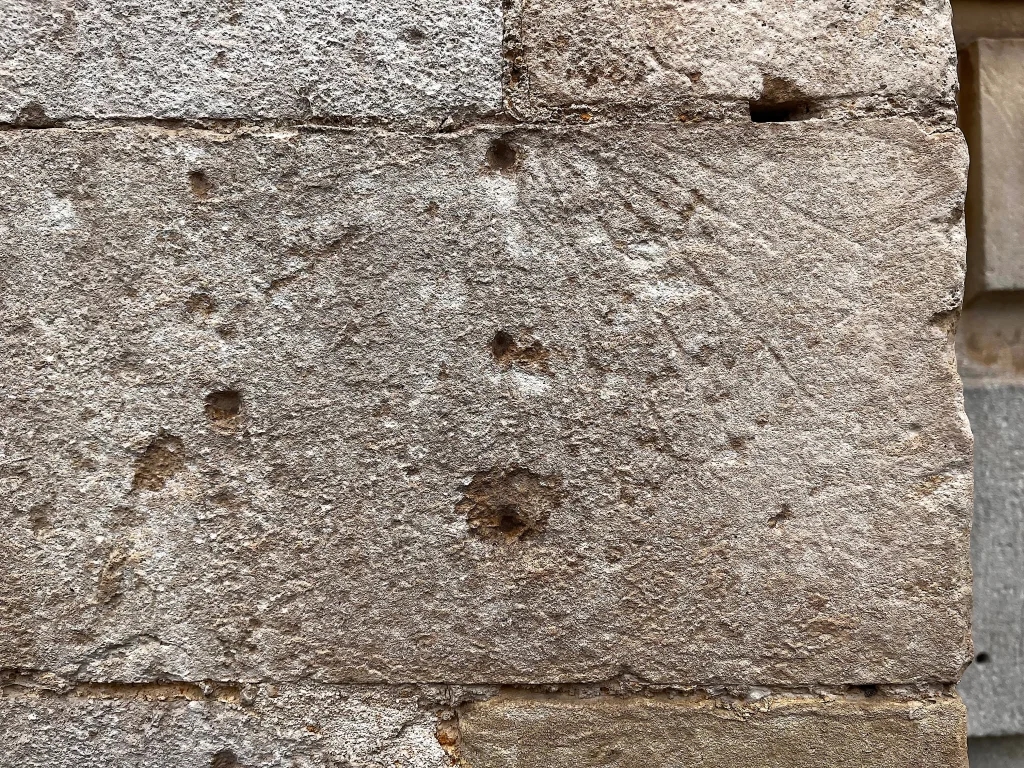
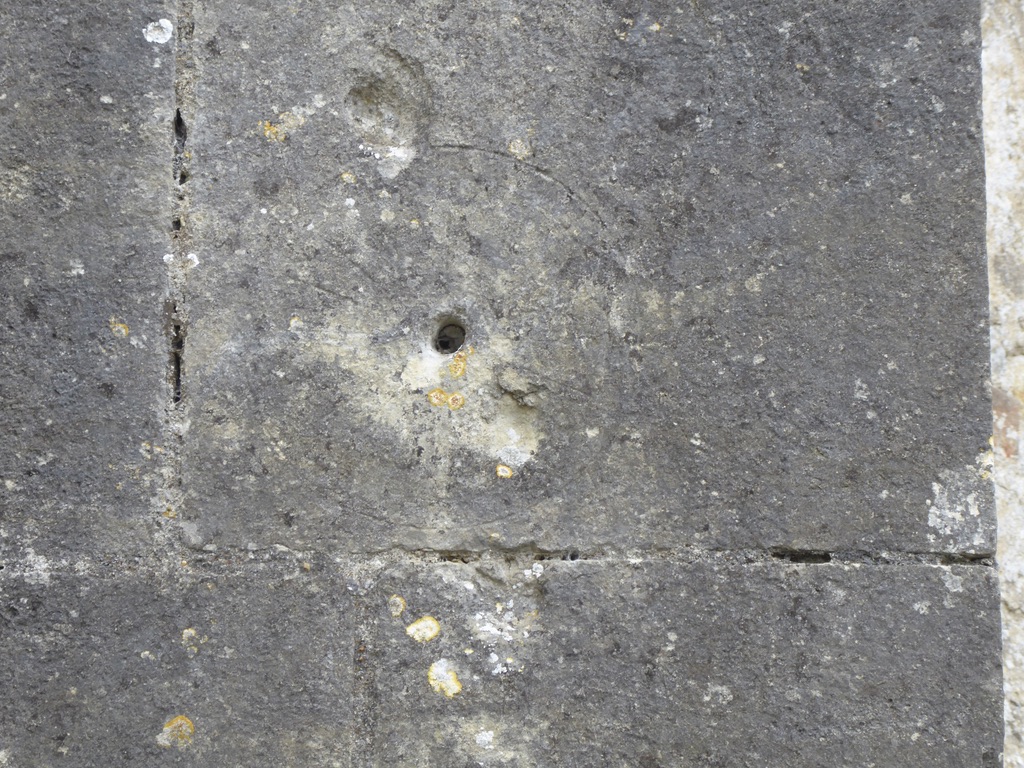
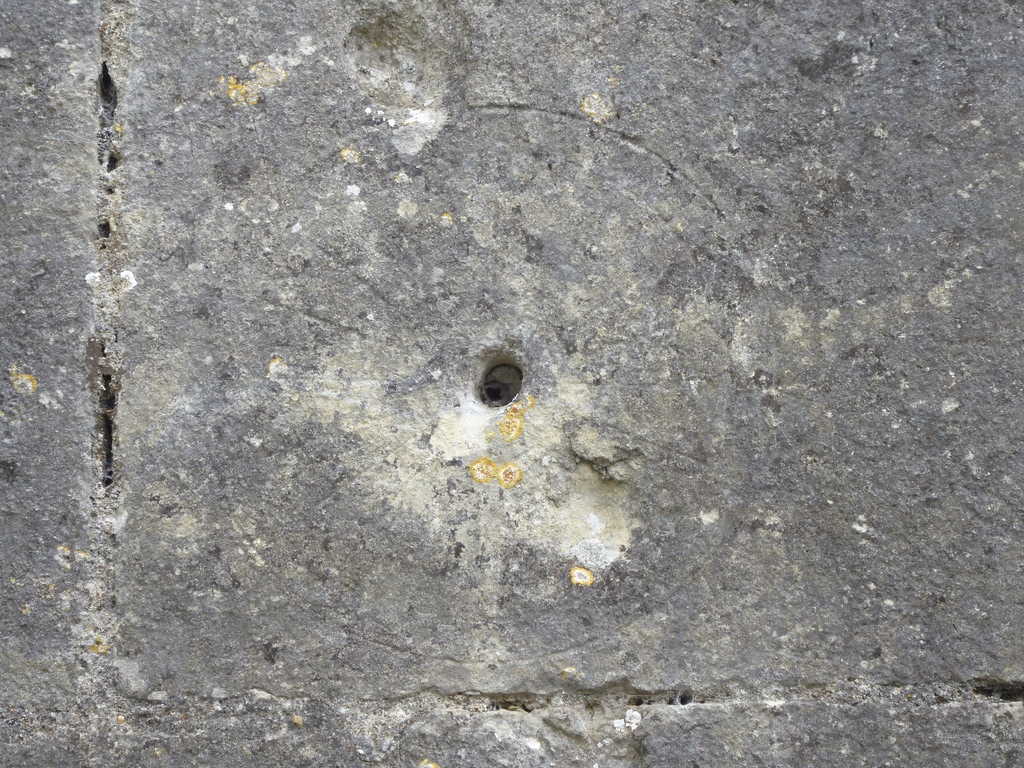
The dial is considerably eroded and quite badly damaged in the lower R quadrant. Close-to, its relative sophistication is evident. The radials are within a double circle and as far as one can tell do not overlap the inner circumference. Almost certainly the lines were incised all the way round the gnomon hole. There is a hint that in the lower half – or perhaps just the lower L quadrant – there are half-hour marks as well. Perhaps these details suggest a C16 dial.
St Rémy et St Rigomer . St Rémy du Val . Normandy – scratch dial (detail)
SMALL DIAL
Revised 2024
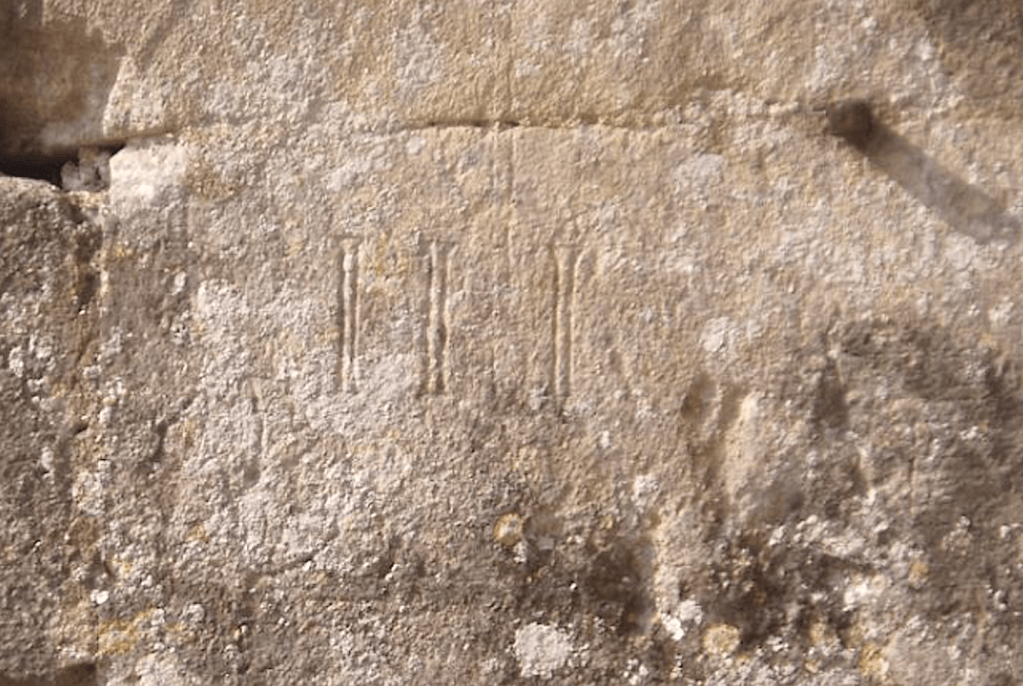
Michael Lalos, who runs a very good site for French sundials of all types, also found this small design. At first sight it doesn’t look very promising as a dial, and might be an apotropaic symbol (demon trap variety, where evil is contained within the circle). However I have since found a number of very similar designs that in their context and position are certainly dials.
With the benefit of hindsight and the hint from M. Lalos, I now think this is a small rustic dial, and much earlier than its counterpart. One oddity is that the informally curved noon line points upwards. It can be useful to rotate a dial 180º to see how it looks.
The noon line is now in (roughly) the right place. In addition, there is a very faint line LLQ that corresponds with the canonical observance time TERCE. The inversion that gives the dial its present orientation would have occurred during rebuilding / restoration at some stage in the church’s history.
GSS Category: Scratch Dial; Mass Dial; Medieval Sundials France
All photos Keith Salvesen except the last pair, Michael Lalos
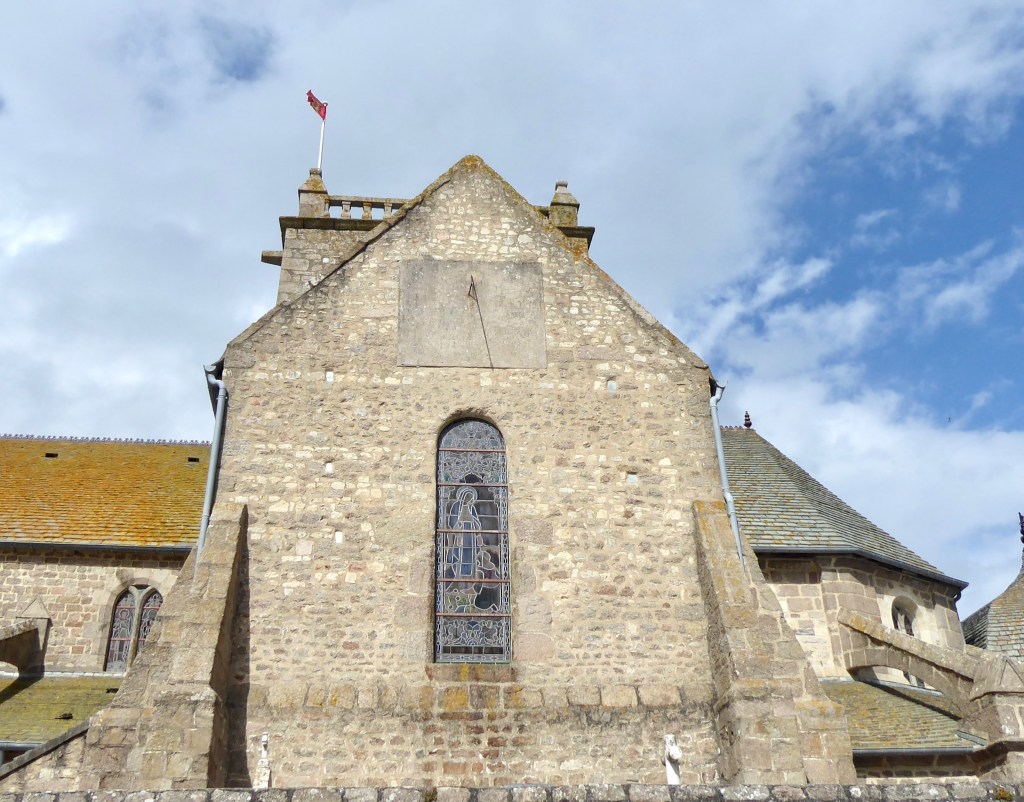
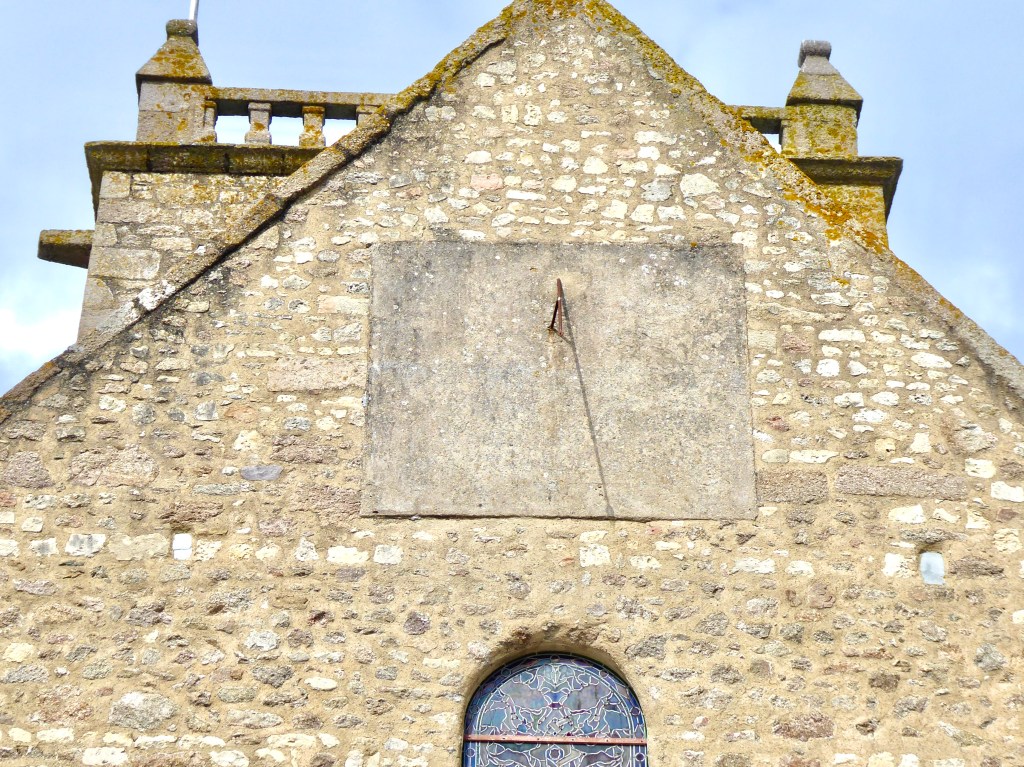
Barfleur is a small town / large village on the NE tip of the Contentin peninsula in Normandy, roughly due E of Cherbourg. The church of St Nicolas, despite the initial impression, was built mid-C17. Later additions and restoration mid-C19 incorporated an impressively large sundial (it doesn’t seem to have been a later addition).
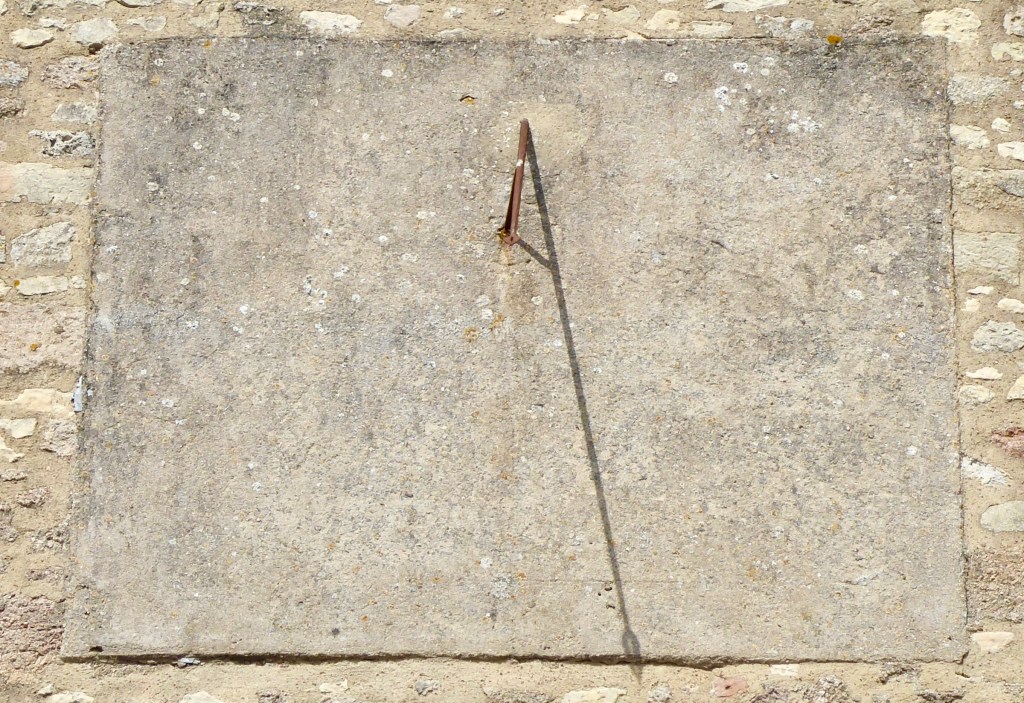
The face of the dial has almost entirely been obliterated, with half a dozen very faint lines just visible in the lower L quadrant. There is also the hint of a frame under the cast shadow, though it might simply be the remains of a horizontal line. Erosion by the sea over many decades has made the details speculative. The gnomon may possibly be original. Whether or not, the design of the tip is clever and includes a small hole at the tip that creates a neat spearhead.
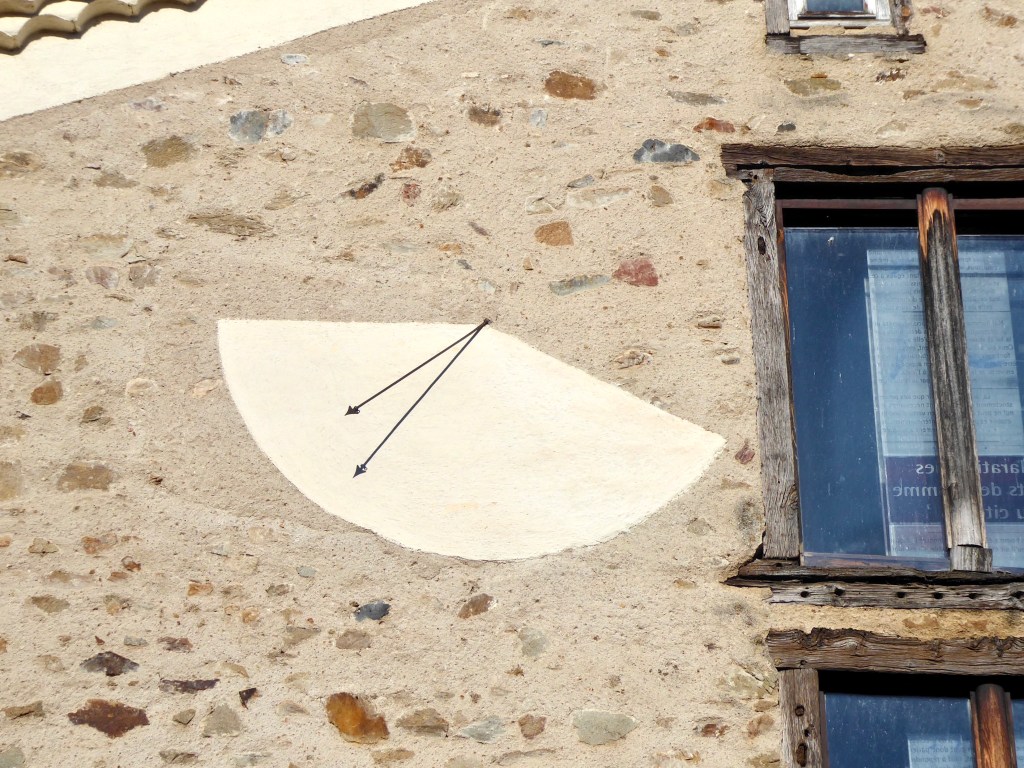
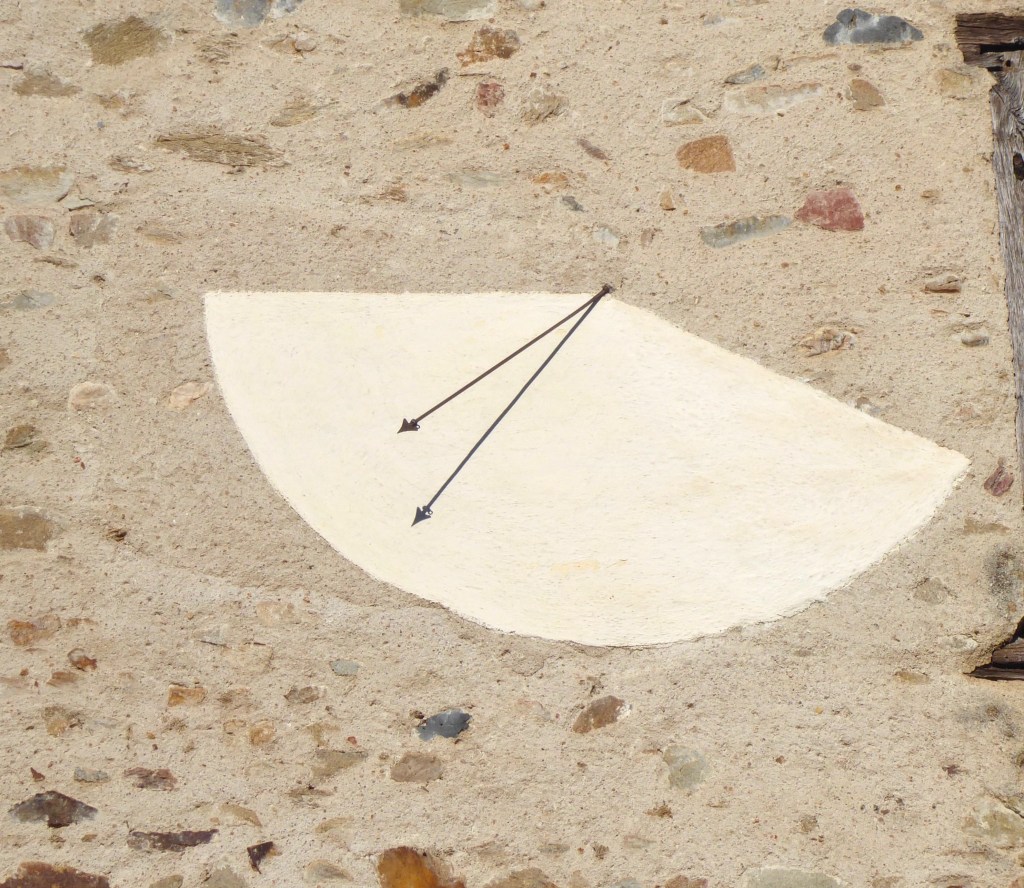
Lavaudieu is a small Auvergne town with a fine romanesque Abbey. For present purposes, the sundial on the wall of the Mairie is the attraction. On a bright sunny day, the simplicity and legibility of this civic dial is hard to beat. The ‘arrowheads’ might be considered a little too ornate for the overall design.
‘Moins est plus’ might be a good motto for the dial, as it is more generally. As soon as I saw it I knew it would be in my top 20 non-medieval dials. It still is.
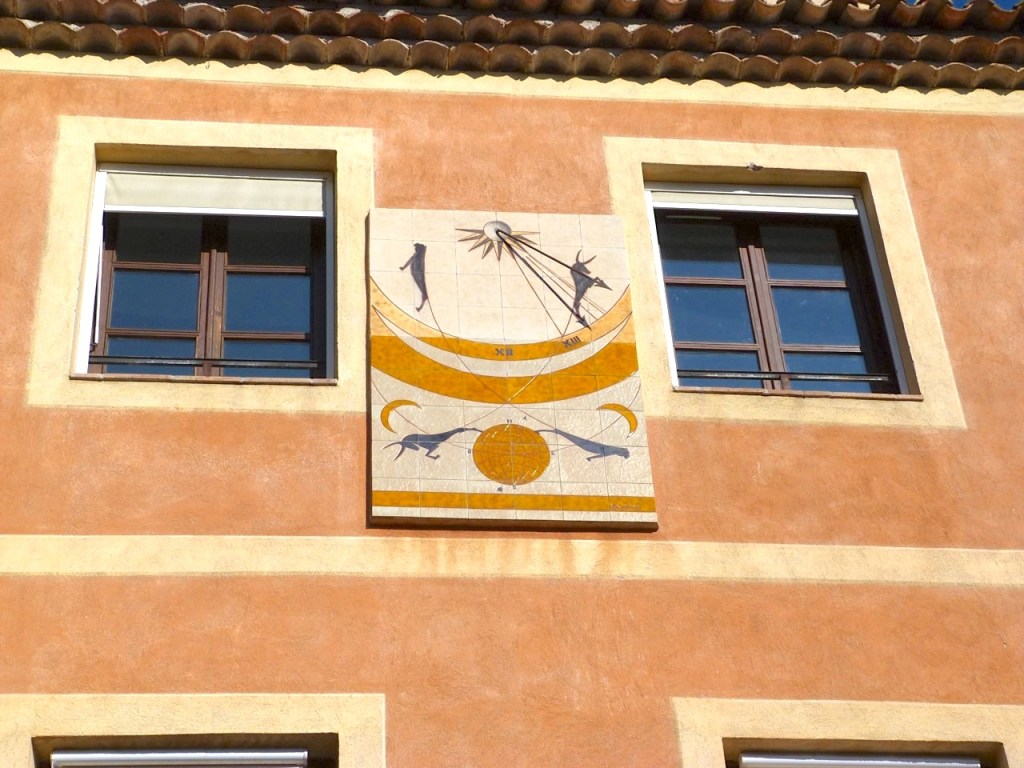
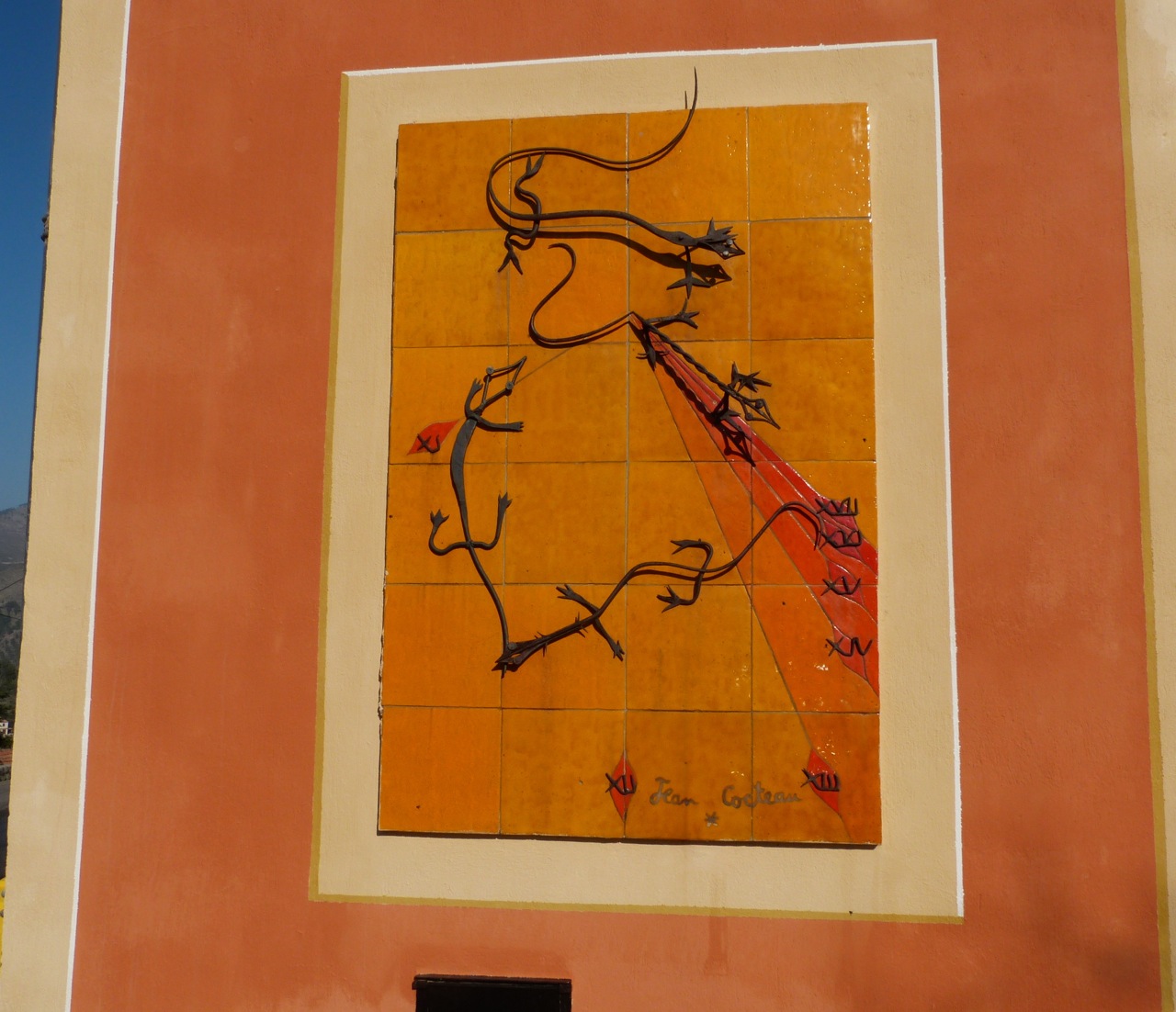
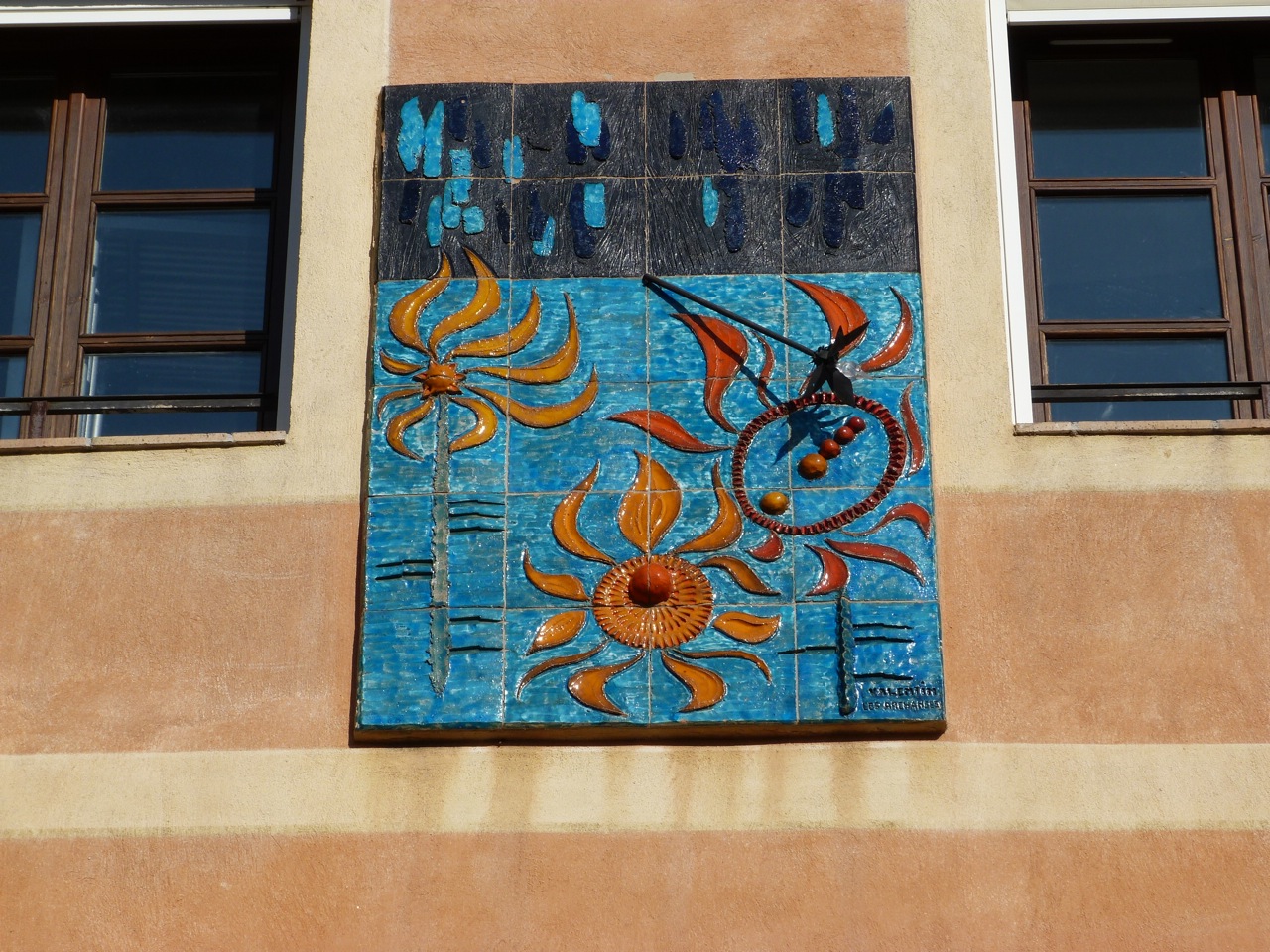
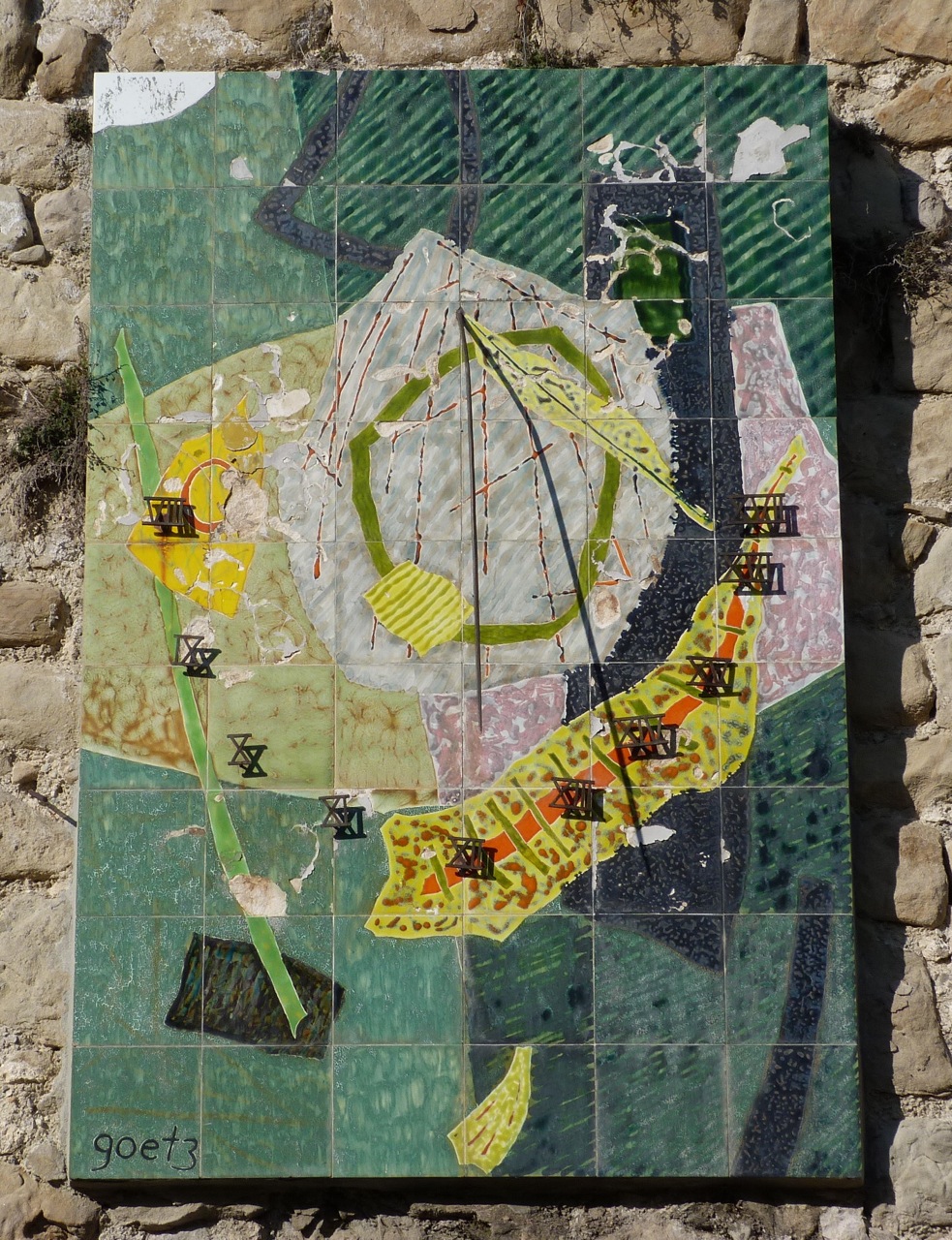
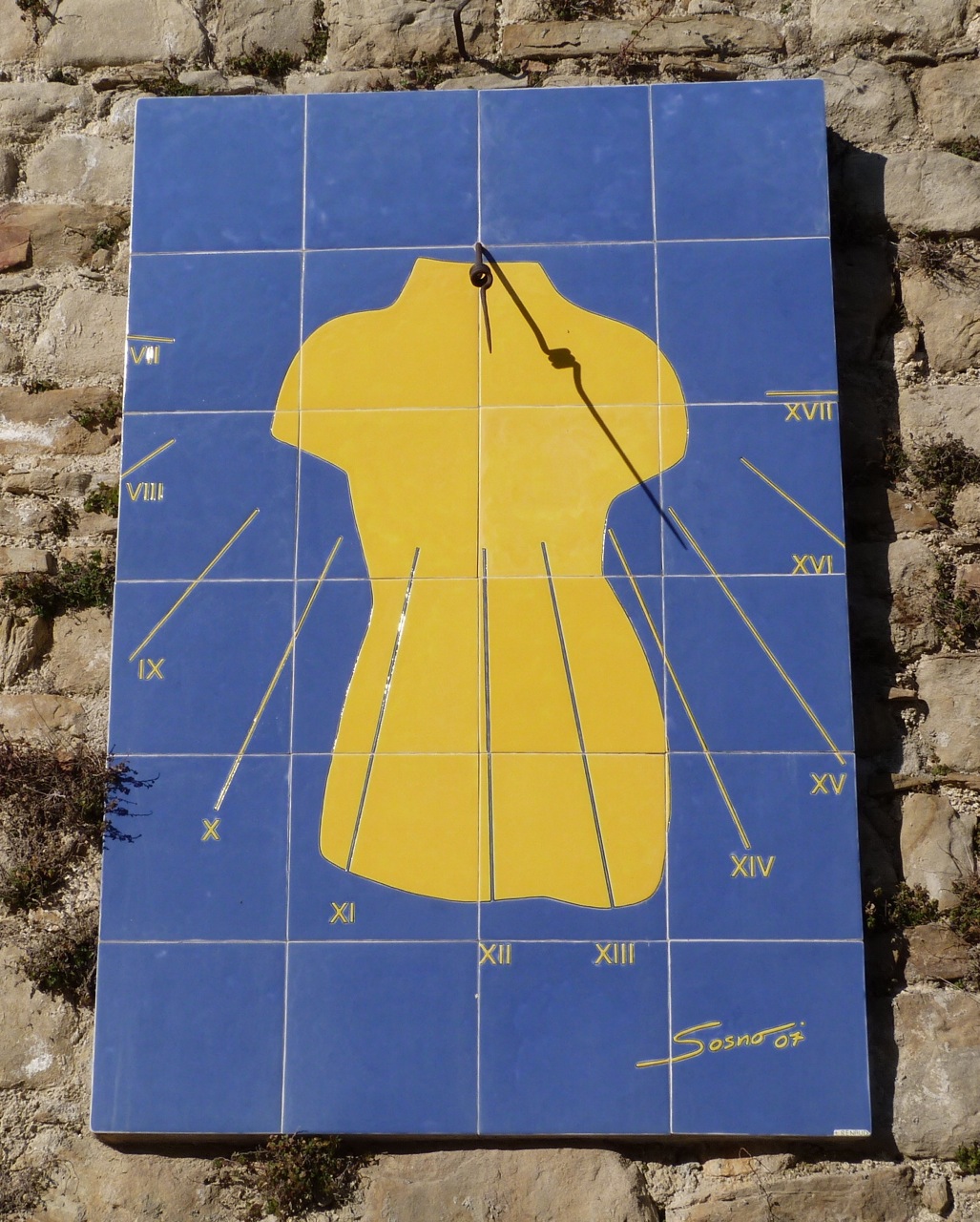
LES CADRANS SOLAIRES: THE CERAMIC TILE SUNDIALS OF COARAZE, PROVENCE
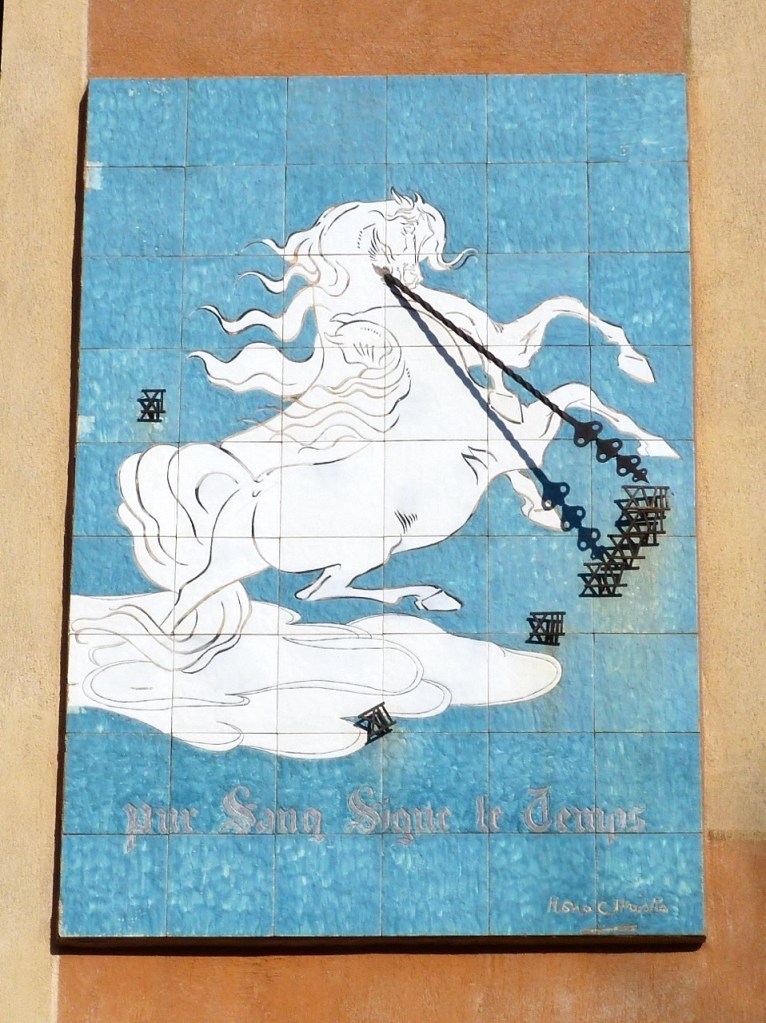
The nine sundials shown below are in Coaraze, a small medieval ‘village perché’ (650m) in the Alpes-Maritimes, Provence, north of Nice. They include sundials by artistic polymath Jean Cocteau (poet, novelist, dramatist, designer, artist and filmmaker); Ponce de Leon; and Henri Goetz, among others. They are located in two places in the village (1) on the front and side walls of the Marie (2) at the top of the village on a south-facing walls in the square in front of the church. They need no interpretation by me: everyone who views these wonderful sundials will experience their own personal response to each one.































 GAUDIUM SUB SOLE . SUNDIALS . MEDIEVAL TO MODERN