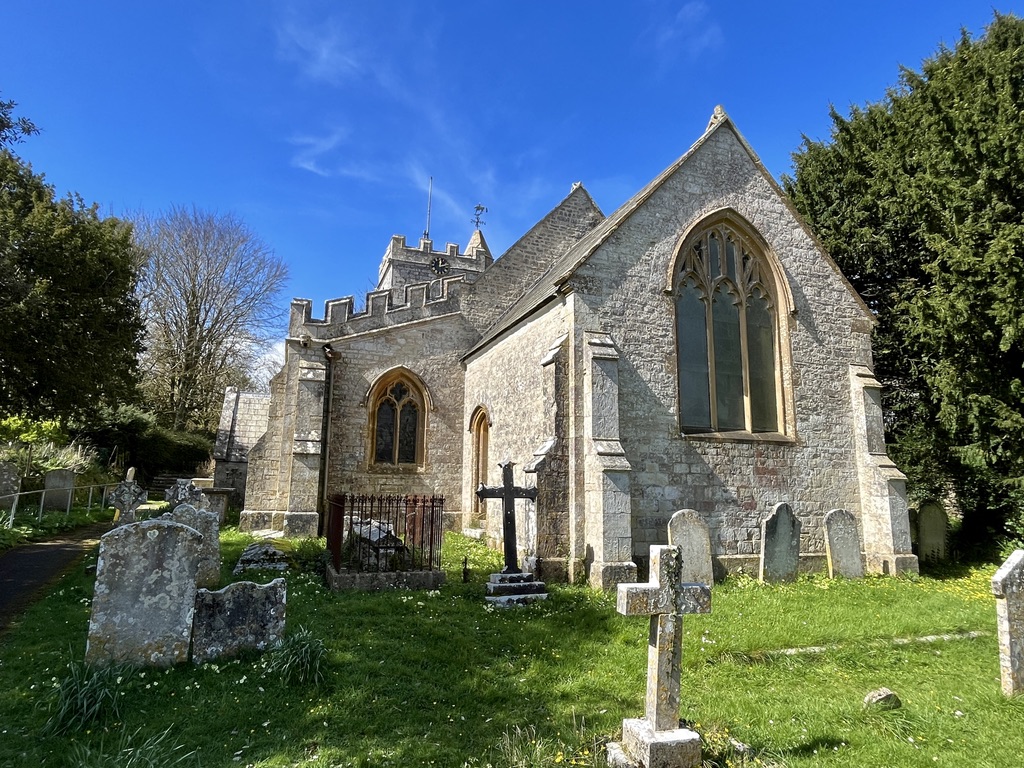
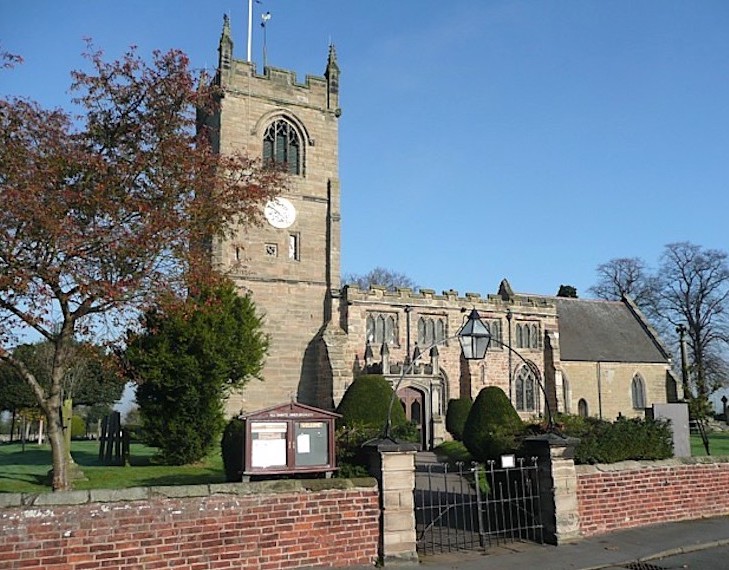
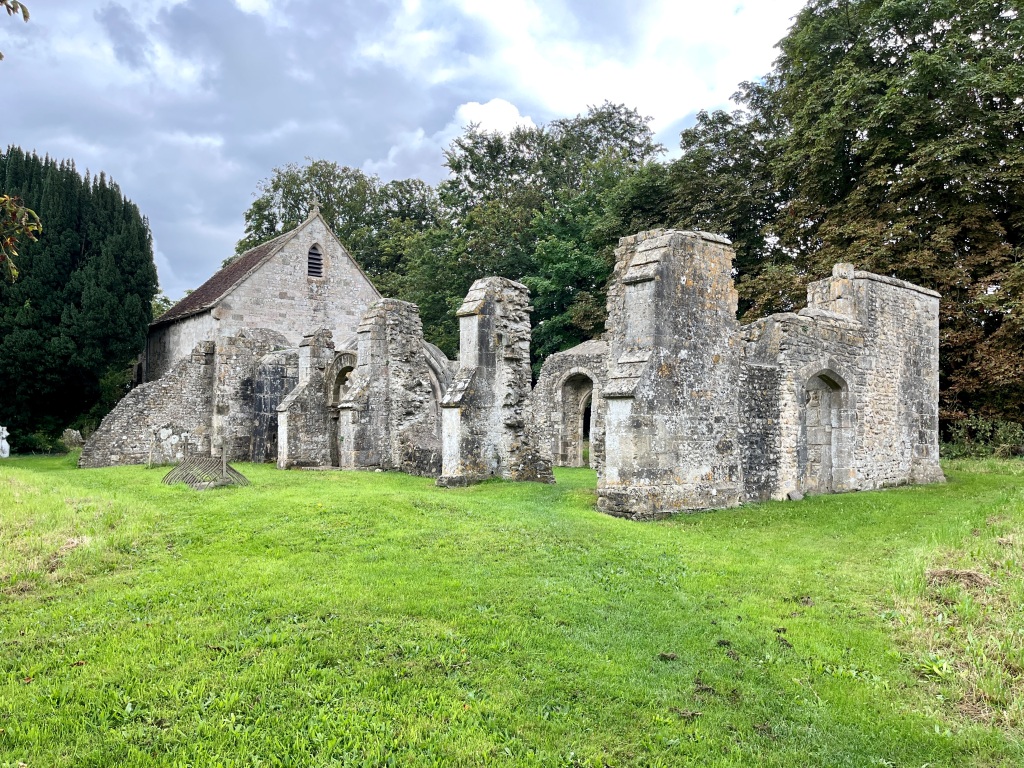
GRADE II* ☩ C15 west tower; otherwise mainly rebuilt 1846 retaining very little of the original church (?Ferry). Set in a pretty village close to the coast that has the feel of an earlier age (in a good way). 5m E of Weymouth. 50°38’45″N / 2°23’29″W / SY724829
DIAL
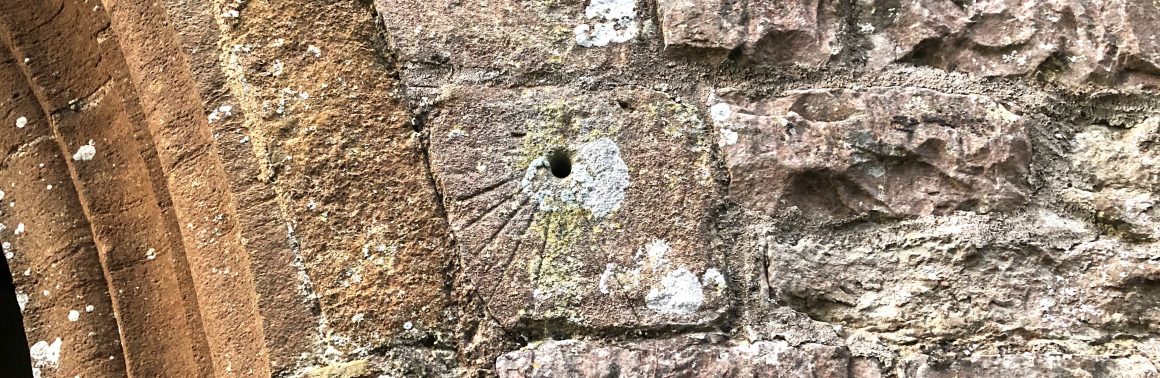
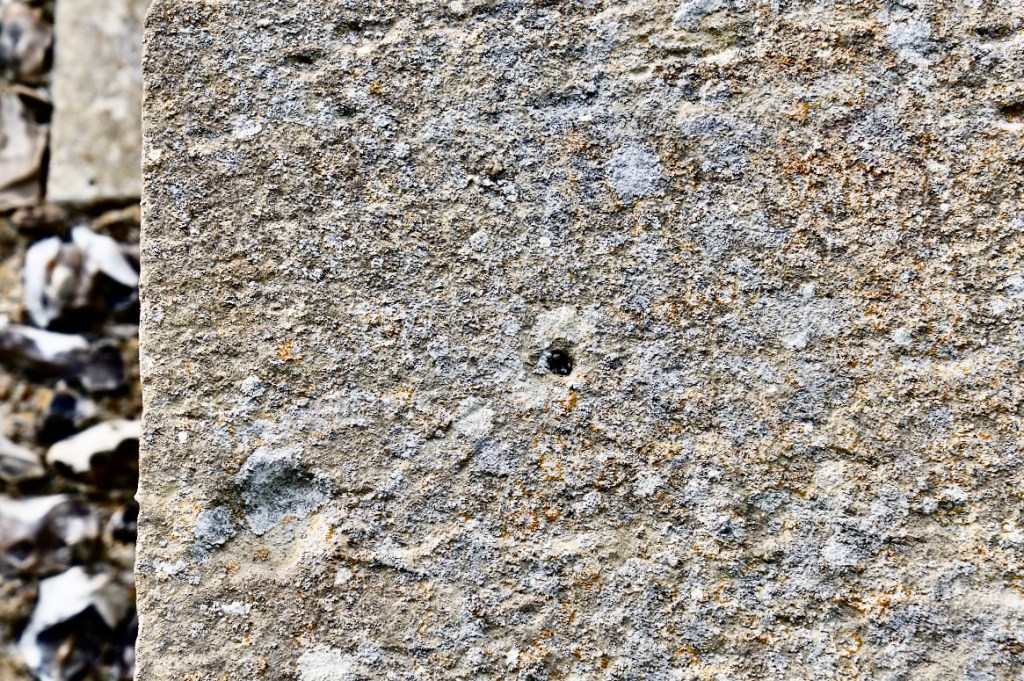
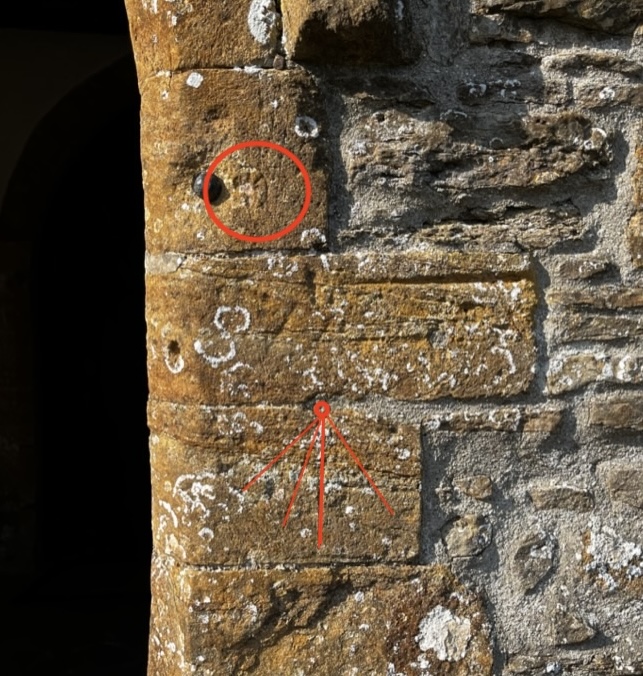
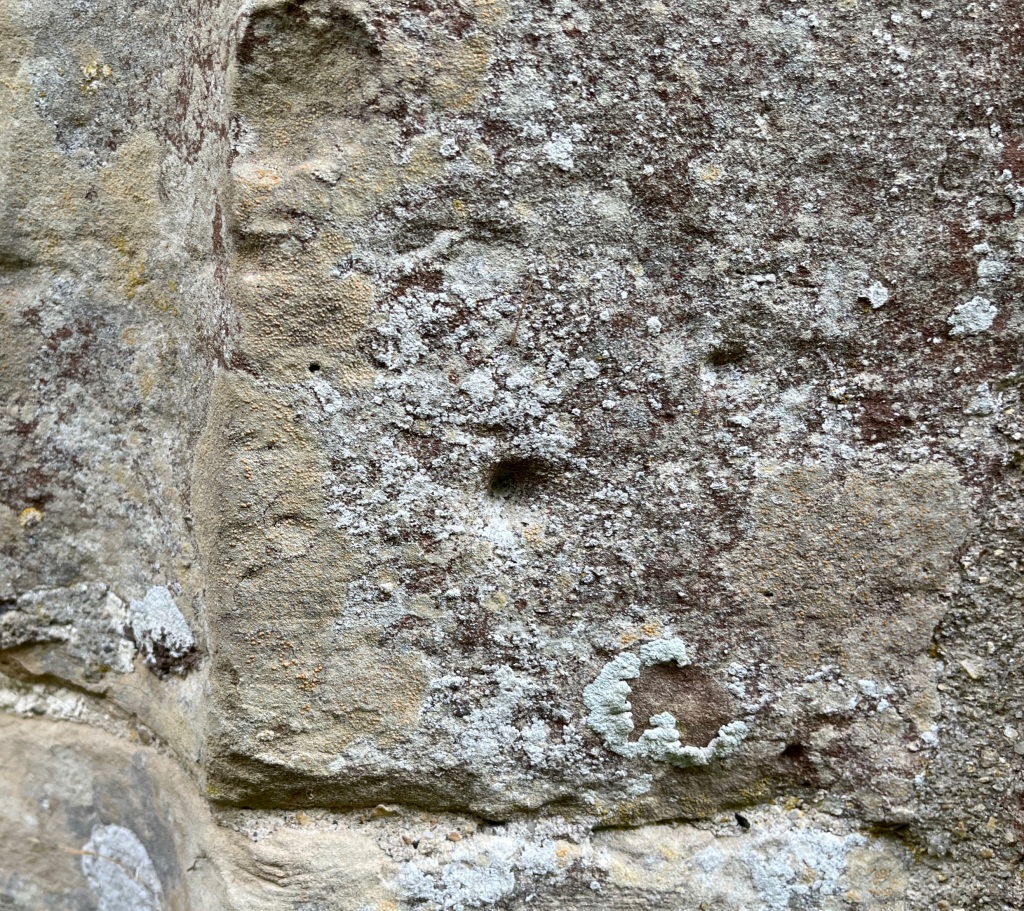
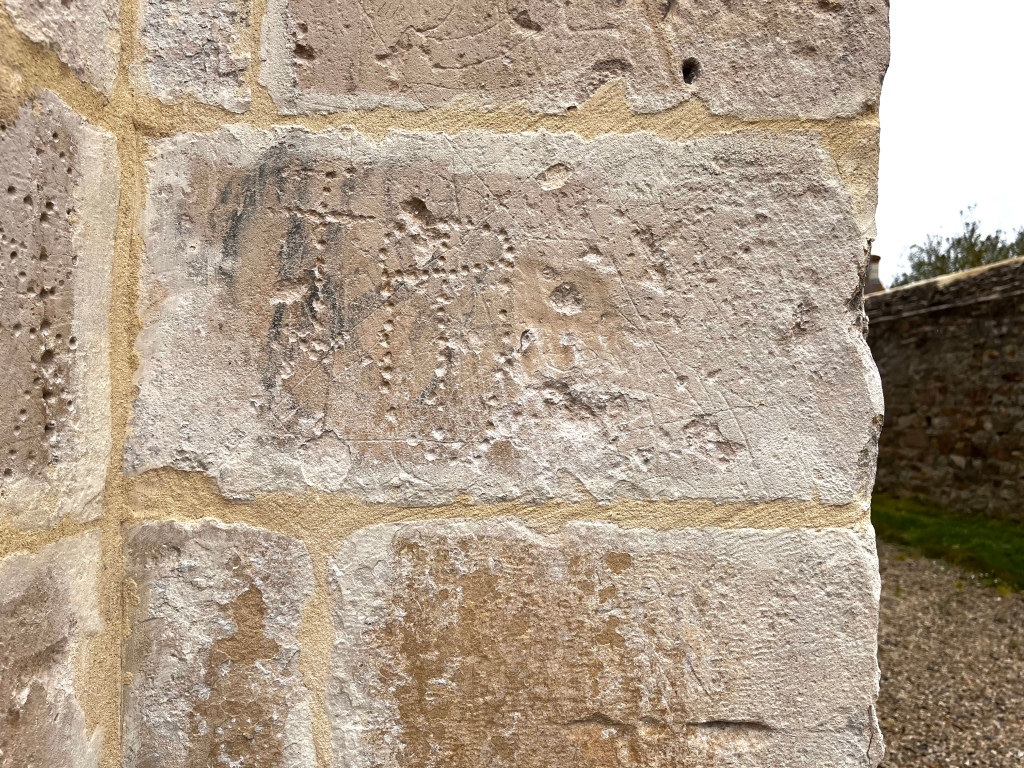
This unusual dial is cut on the SW buttress of the tower. I say cut, but in fact it is drilled in a complete circle of small holes surrounding a large gnomon hole centred on the dial stone. There are no lines at all (as with eg TRENTAFPUDDLETINTINHULL).
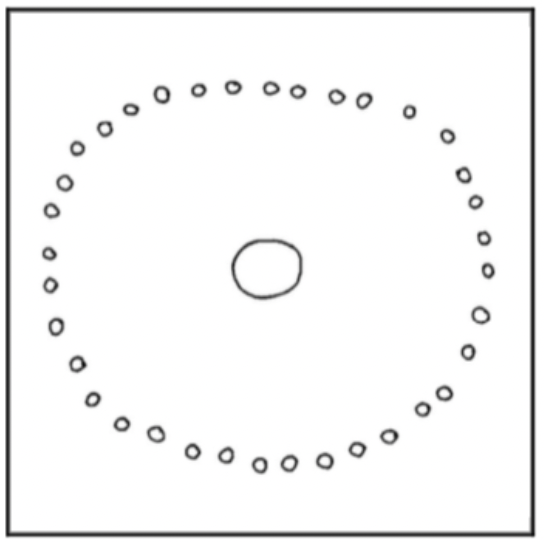
St Osmond . Osmington – Dial Diagram BSS
In all there are 36 holes that form an irregular circle flattened at the top. The ring of pocks is (unsurprisingly) not entirely accurate, as the diagram above (GLP; BSS) shows.
As for a noon line, I wonder if the short downward line of (apparent) small pocks, below and to the left of damaged area, mark noon. It’s not vertical, but the design of the dial and its position on the SW face of the buttress perhaps called for a slightly offset noon marker.
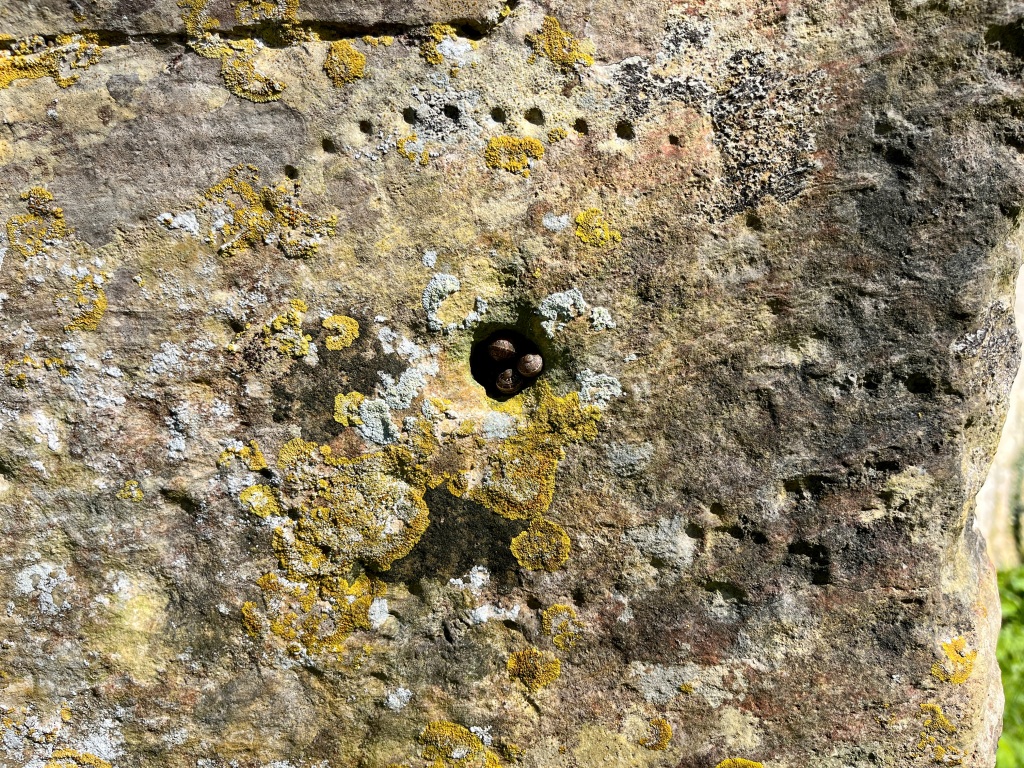
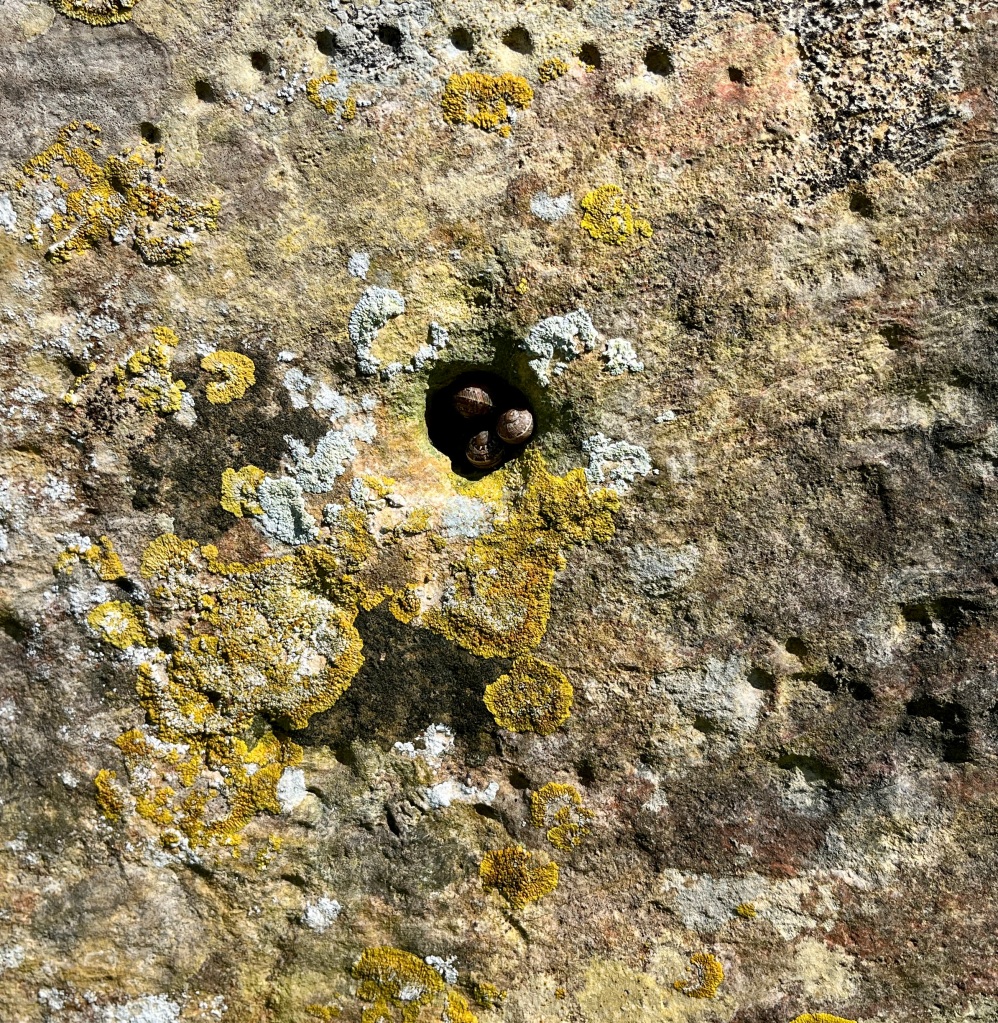
The gnomon hole has clearly been enlarged at some time, and sufficiently so to provide a modern home for small snails.
All Saints . Burnham Thorpe . Norfolk (Explore West Norfolk)
GRADE I ✣ First record DB 1087; first rector 1229. C13 expanded C14 & C15. The birthplace of Horatio Nelson; baptised in the C13 font. The gradual development reveals much of interest, enriched by the Nelson connection. A fine North Norfolk church. 52.9412 / 0.7549 / TF852417
DIALS
All Saints has 2 large clear dials on the same buttress. Contributor Erica Clarkson found an unobtrusive third dial on a quoin stone, not otherwise recorded as far as I can see.
All Saints . Burnham Thorpe . Norfolk (EC)
DIAL 1
A fine dial low down on the buttress. There are 3 pocks above the the gnomon hole in the mortar line. Below is a semi-circle of lines all ending in pocks, the noon one being largest. The well-defined lines cut LLQ suggest that morning / None was the main hour for observance.
DIAL 2
Dial 2 has 12 lines radiating from a plugged gnomon hole. There are no pocks. There’s minor puzzle: which is the noon line? The deepest cut line is the seventh line from the LHS horizontal rather than the sixth, and slightly offset to the right. In addition, 3 or 4 lines seem cut off at the mortar line, suggesting a rearrangement of the stonework at some time. (It might also explain why Dial 1 is so low down on the buttress).
DIAL 3
A simple time marker centred in the dial stone, from an earlier period. 2 lines are visible L side. Probably that was all that was required in (say) C13, in simpler times and before the church had developed. The position of the lines suggests that None was the (main) service time.
GSS Category: Scratch Dial; Mass Dial; Buttress Dial
Credits: All photos Erika Clarkson with thanks, except header as shown
All Saints Church . Kings Bromley . Staffs (Humphrey Bolton, Geo CC)
ALL SAINTS . KINGS BROMLEY . STAFFS
GRADE I † Late C11 nave, with remnants; C14 additions, C16 Perp W tower, C19 work. An attractive church in a pretty setting. 3 scratch dials are recorded. 5m N of Lichfield. 52.7507 / -1.8206 / SK122170
DIALS
Dial 1 and Dial 2 can be considered together, because Dial 2 is recorded as being superimposed on Dial 1. It is not uncommon for there to be some overlap between dials, but not to this extent. One might expect a second dial to be cut on a different stone so that it stands out as superseding the first. But perhaps it is the other way round – a rather basic dial over-cut by a more sophisticated one centered on the dial stone.
✣✣✣✣✣
DIAL 1
BSS regards this unusual dial highly. It is located on the buttress at E end of the nave. There are eroded remnants of two concentric circles RHS. Notes Worn. Important, poss. unique. Dial like conventional sundial. Double dial, see 2
The gnomon hole is in the centre of the dial stone, and is angled down. The confusion with Dial 2 makes it difficult to apportion the badly eroded lines
✣✣✣✣✣
DIAL 2
Dial 2 has an oblong gnomon hole just below the mortar line, slightly surprisingly because it prevents the mortar line from acting as the horizontal. It, too, is slanted downwards and it is hard to think how it could have held a peg, rod, or stick. In the confusion of the linear scratchings, I reckon 2 lines LHS come direct from the hole; and possibly 2 RHS.
✣✣✣✣✣
DIAL 3
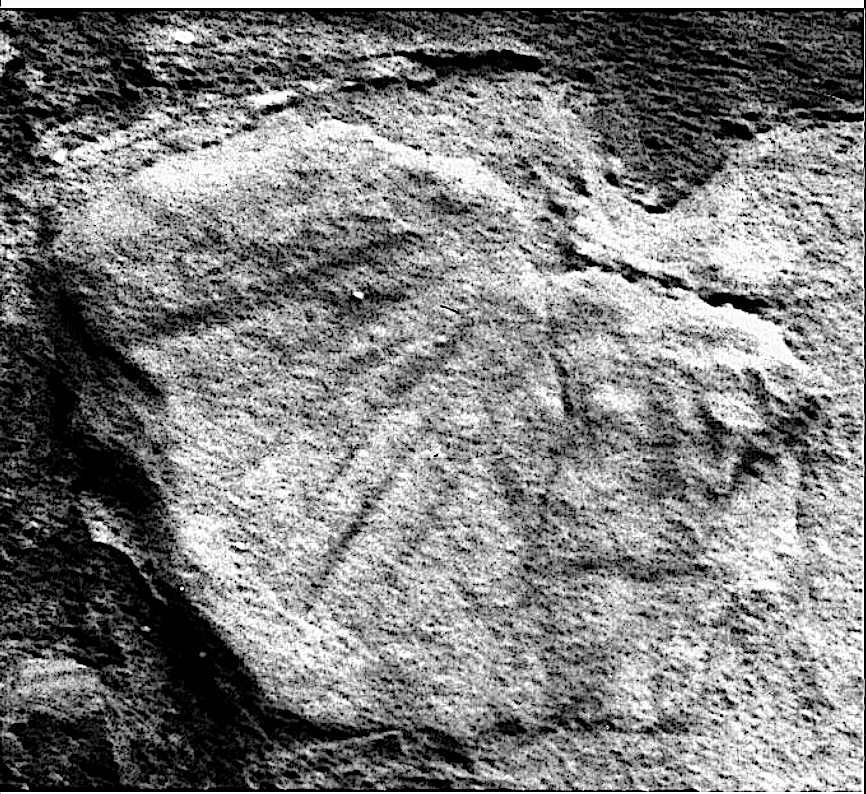
Dial 3 is on the S wall of the Chancel, under the first window. BBS notes On the verge of destruction. The image in the records is quite old. I have added a B&W version that is a bit easier to read.
DEDICATION † ST ANDREW – C15, mid-C19 restoration; C13 font
LISTING † GRADE II*
LOCATION † 5 miles SW of Sherborne, a sprawling village set deep in farming country. Some fine old buildings dating from C16, now mixed in with modern housing. A fine village cross with C15 shaft. A friendly very rural place. No street lights. 50.8762 / -2.5445 / ST617086
In the early days of this site when I was researching scratch dials close to us in Dorset, I discovered that our own village church had one that was already recorded. It didn’t look very ‘dial-ish’ so I was pleased to find an authoritative drawing of it by GLP. My original post is HERE and see below for an image.
ST ANDREW . DIAL 2
The dial is semicircular, RHS of the porch, and just below Dial 1. The gnomon hole is in the mortar line, and plugged. The horizontal mortar line acts as a ‘6-to-6’ line, split by the vertical noon line. This is deeper incised than the three other visible lines.
GRADE II ✣ C12, C13, C16. Originally cruciform with crossing tower. Chancel arch blocked and west part of church partly dismantled 1868, gradual deterioration. Chancel used as a mortuary. Declared redundant 1970; now in the care of CCT. A surprising and rather poignant place to visit, all well worth examining. Note the bier. 3m SE of Warminster. 51.1728 / -2.1323 / ST908415
DIALS
St Leonard is a multi-dial church with 9 dials recorded by BSS (1994), of which some details are scant. Four are described only as ‘gnomon hole only’ / ‘cannot be classified’. Featured below are 8 designs that I have concluded are dials, or might be (if only doubtful) in a couple of cases.
DIAL 1
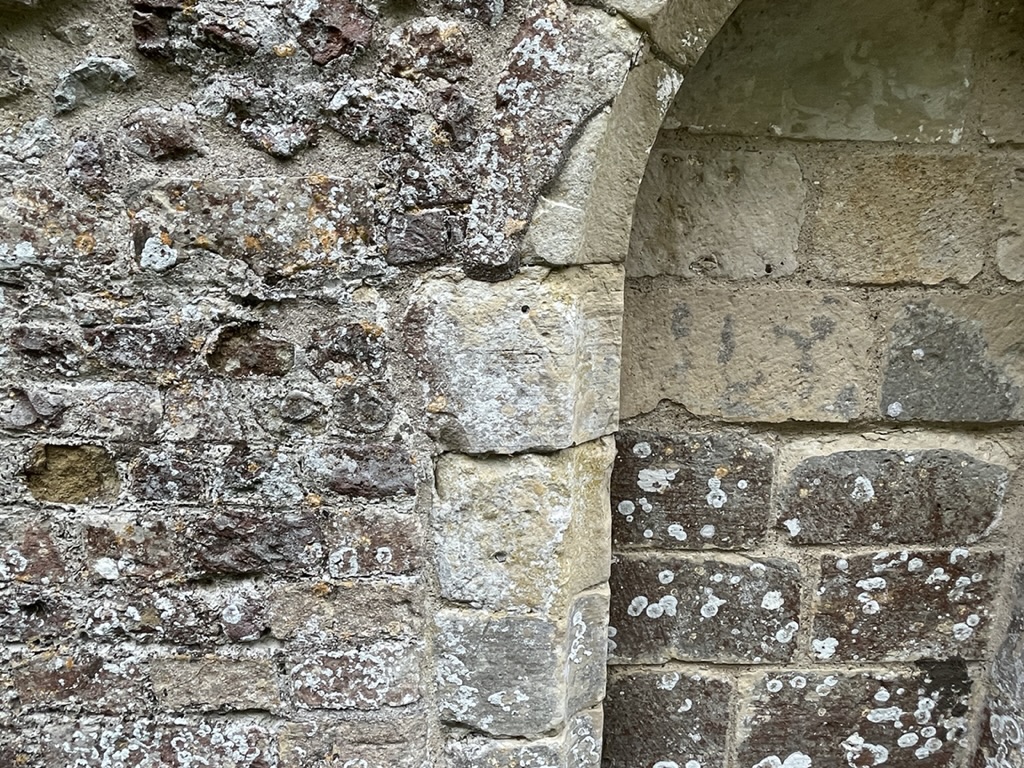
Dials 1 and 2 are together LHS of the Priest’s door
DIAL 2
DIAL 3
Hint of a circle, esp. ULQ
DIAL 4
A hint of a circle, esp ULQ
DIAL 5
Dial stone presumed to have been re-sited and rotated 90º
DIAL 6
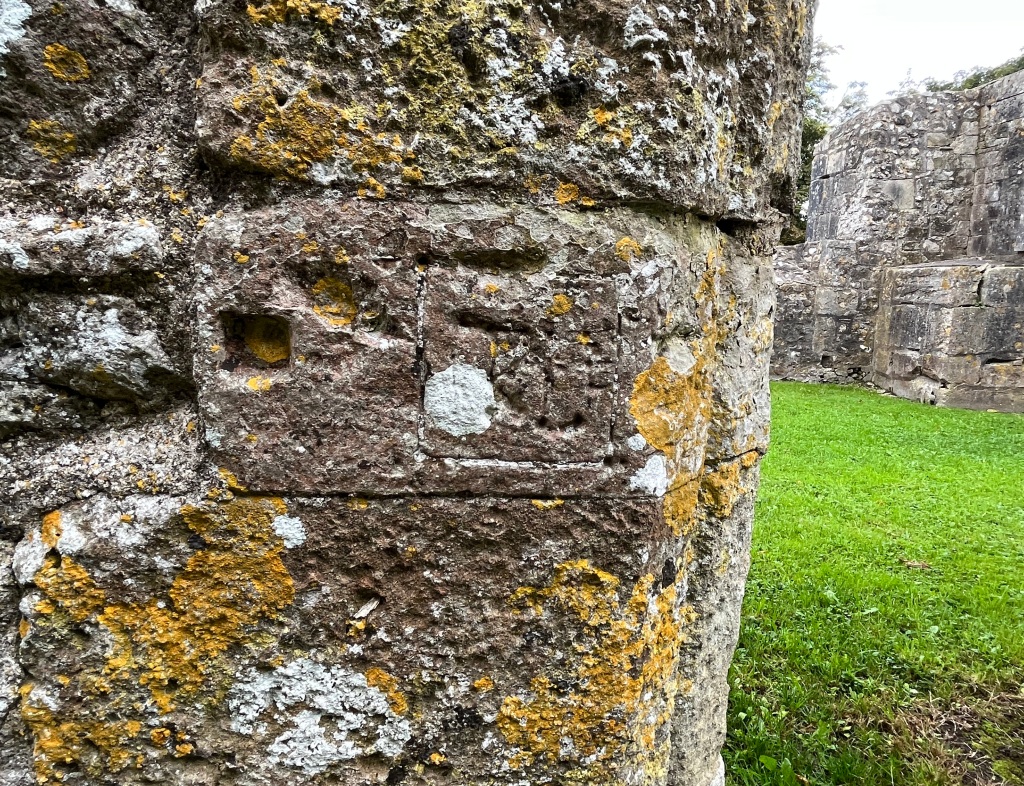
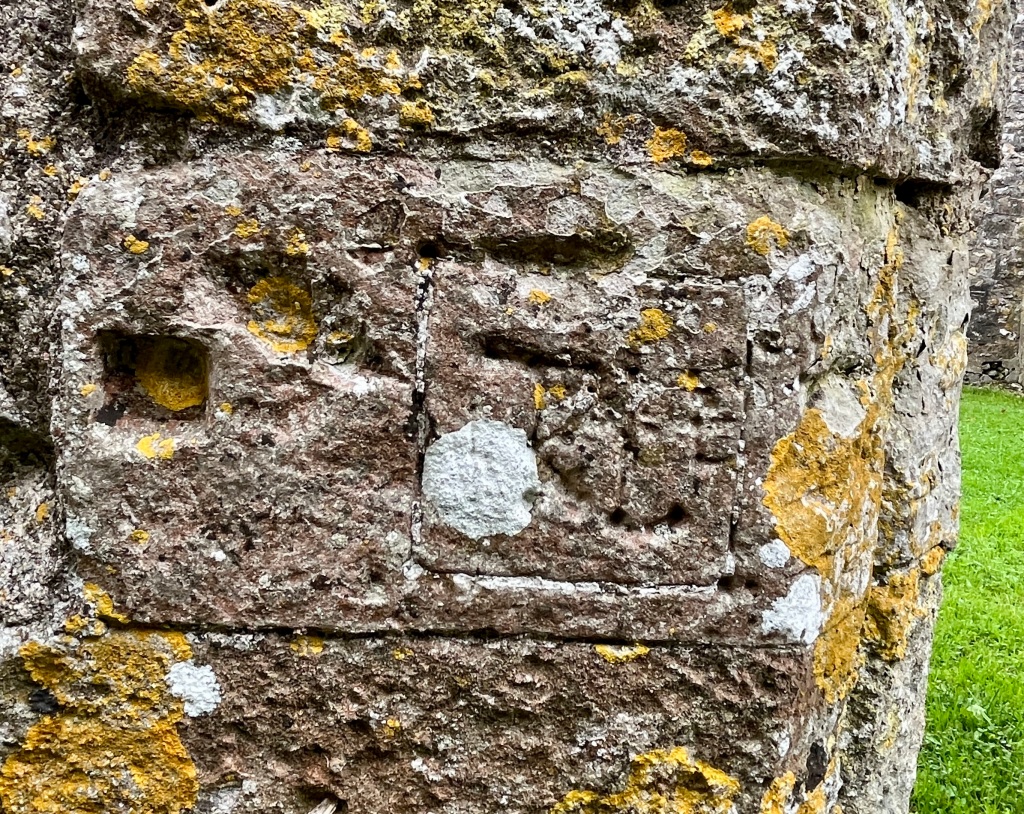
A remarkable dial within a square, with 2 large holes at bottom that appear to represent noon. It’s almost certainly unique. There’s mention of a Norman dial: perhaps this is it. There’s an apotropaic feel to it.
DIAL 7
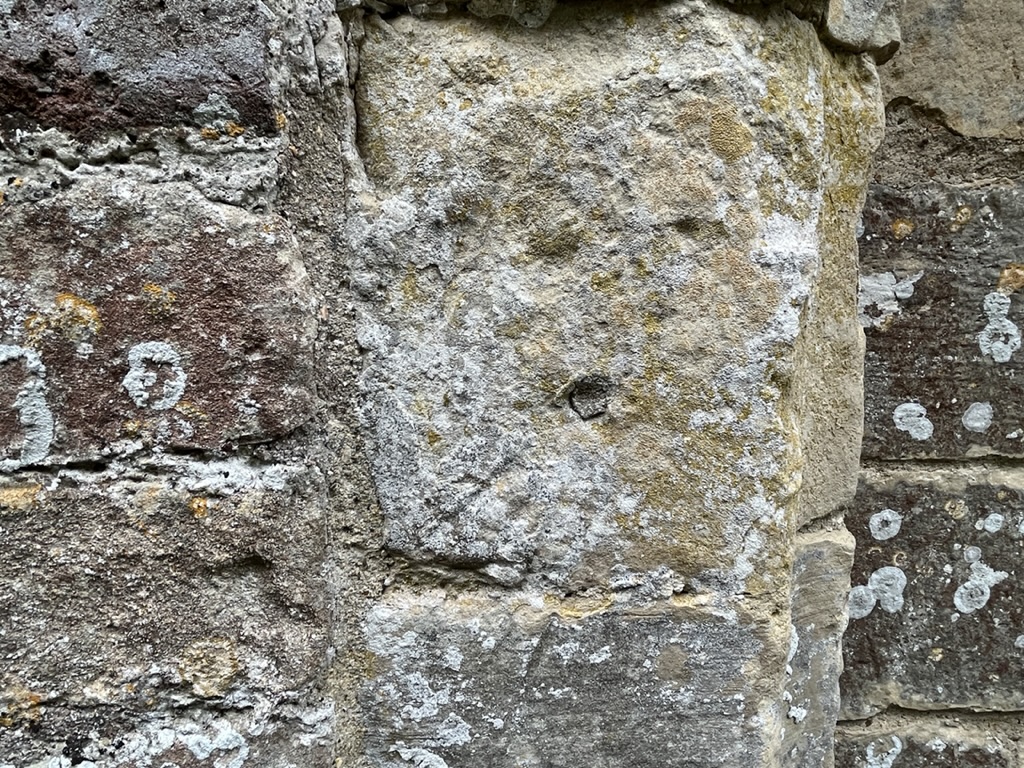
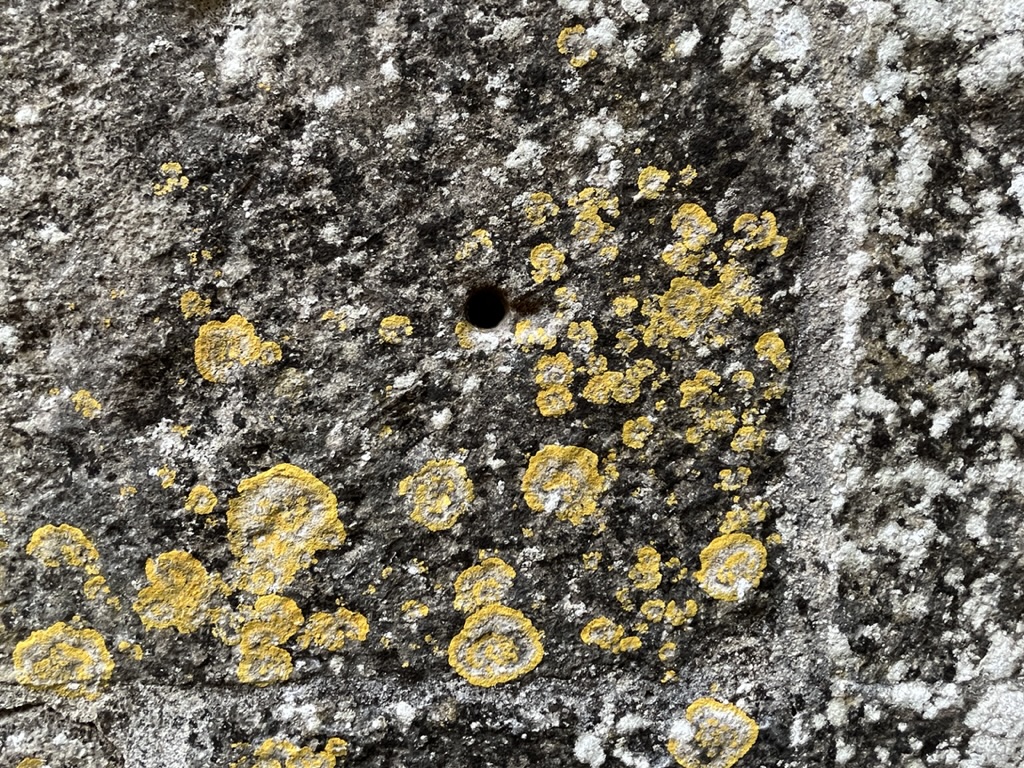
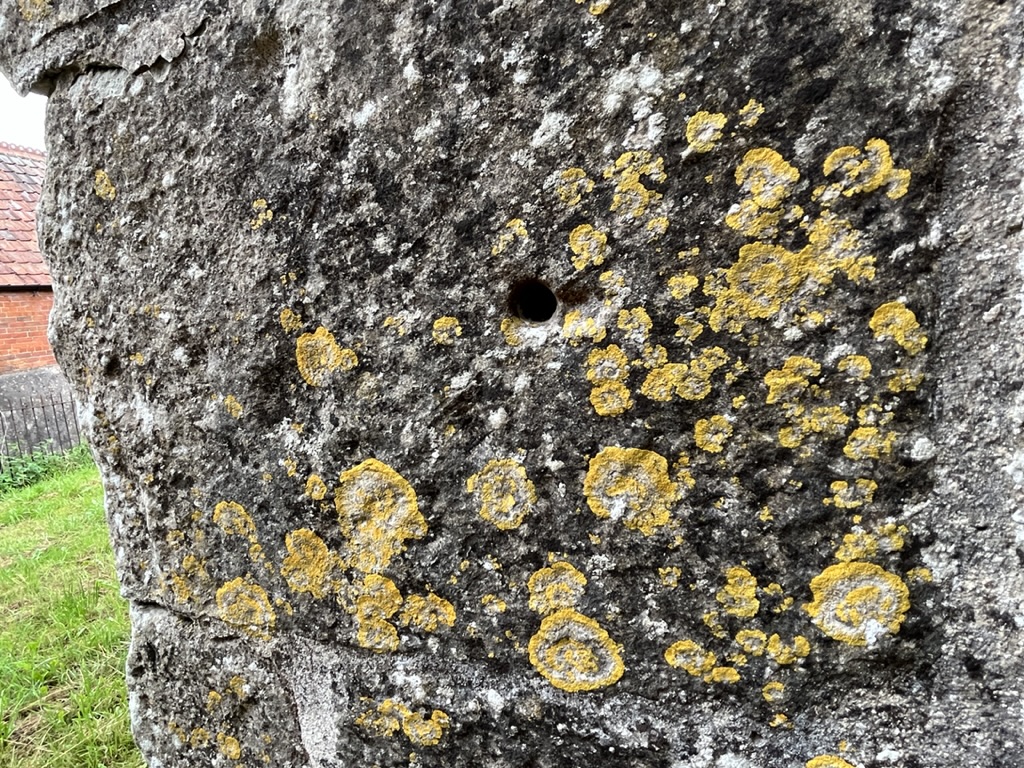
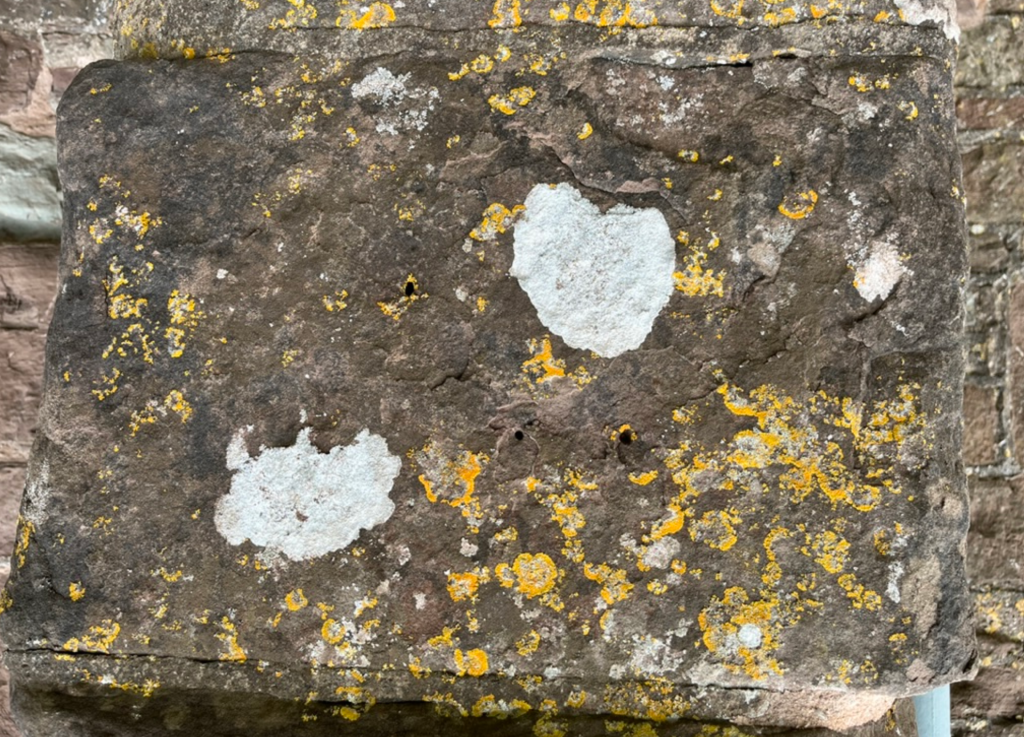
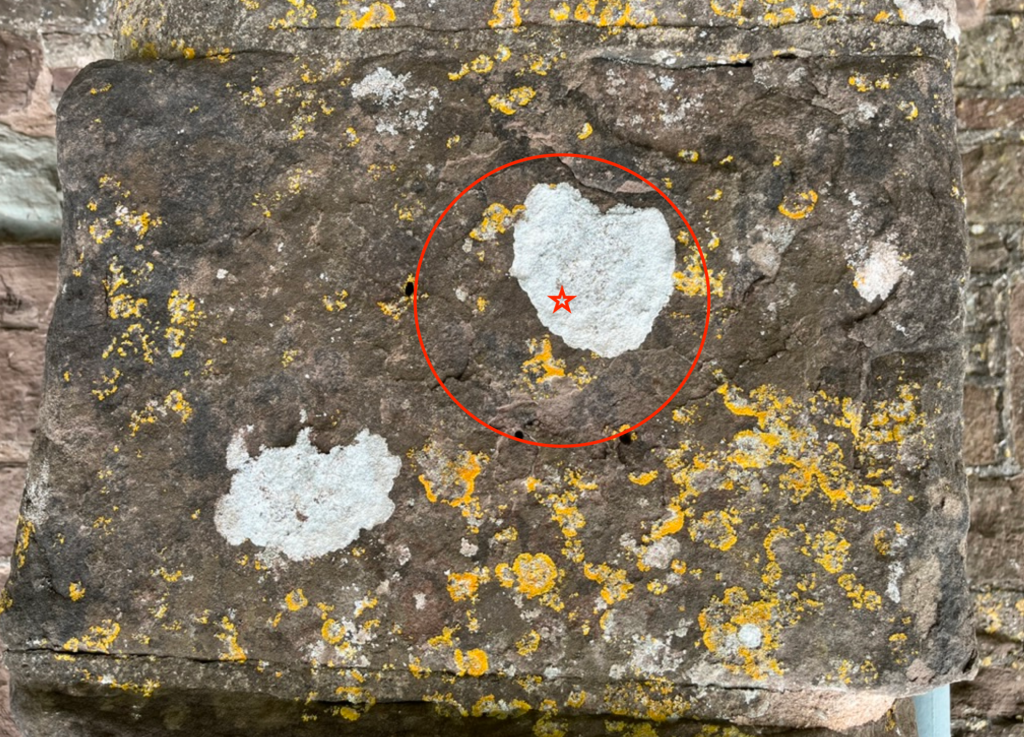
Nearly excluded from consideration. However the small holes are accurately on a circumference, and there’s the possibility of a small gnomon hole under the lichen. Borerline.
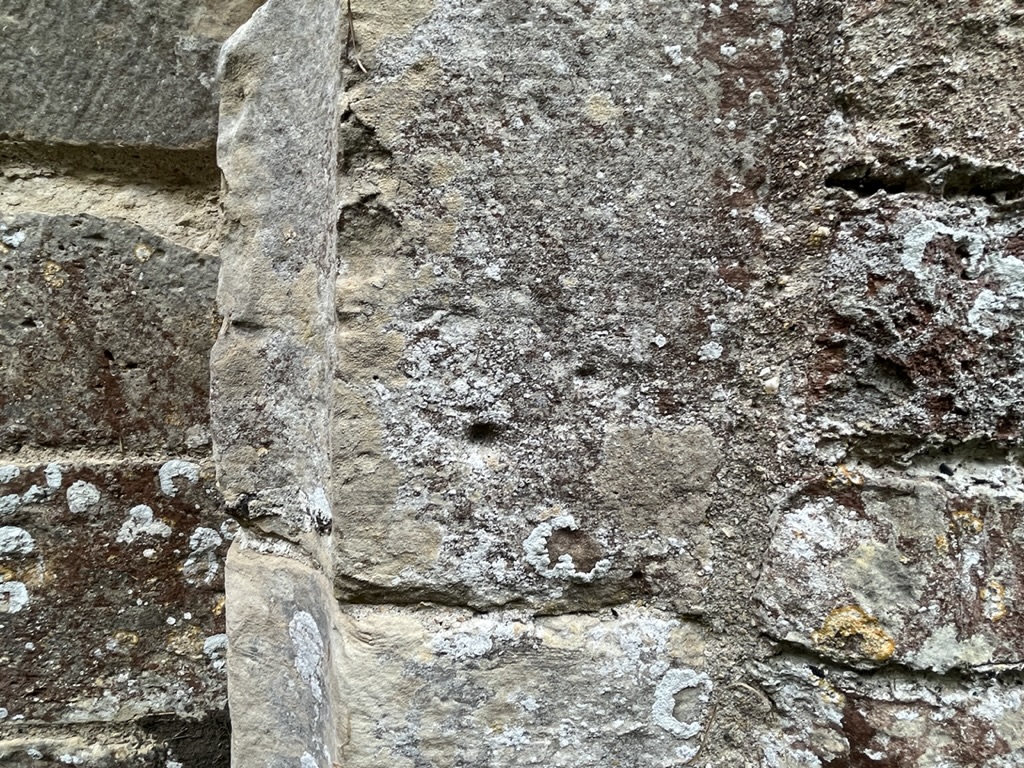
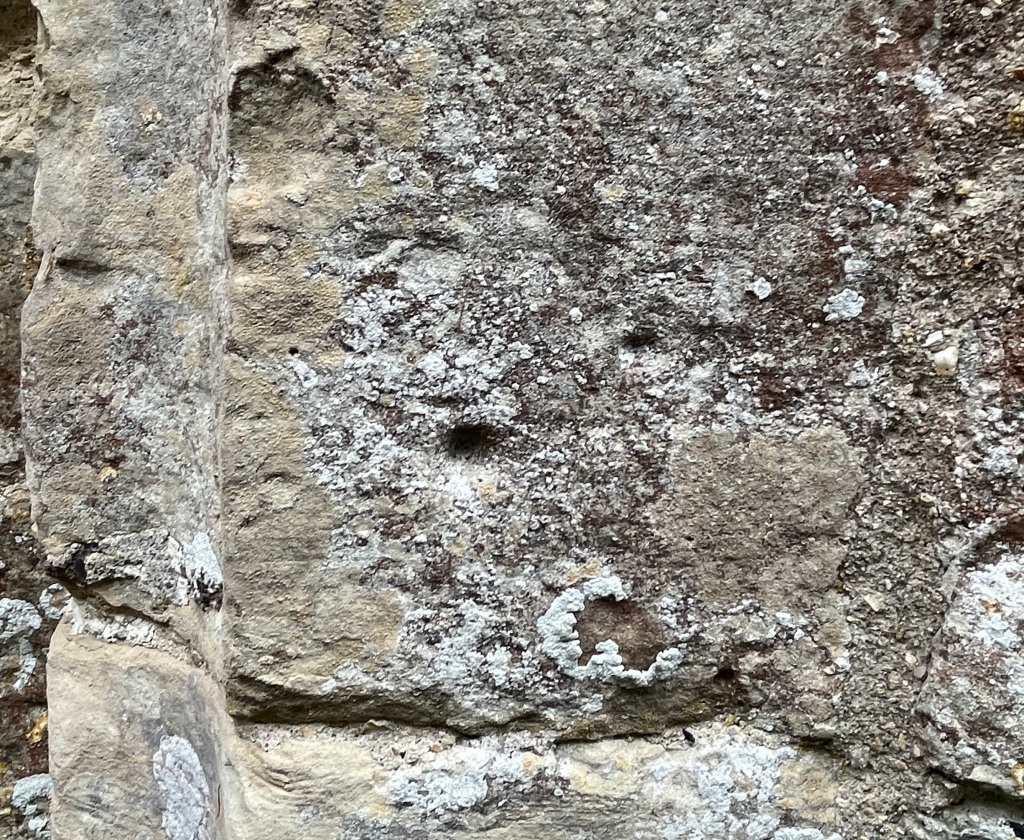
Probably not a dial but looks a bit more promising when rotated 90º. The pocks are (roughly) evenly spaced and there is a slight curve. No evident gnomon hole. Maybe simply a drilled design bored by a bored sacristan.
GRADE II ✣ A fine Norman church built late C11 (nave); chancel c1200; tower C13. Major restorations ±1900 (Ponting). An estimable entrance. Worthwhile (PEV) and (more graciously) one of Wiltshire’s most delightful churches (Betjeman). Lovely font; wall paintings; pilgrim crosses, protection marks & graffiti. 6m N of Salisbury. 51.1244 / -1.8301 / SU119361
All Saints also has a vertical dial which will feature separately
DIAL 1
Dial 1 is semicircular, located on the E buttress of the nave, close to the Priest’s door. It is in pleasingly good condition. Almost all lines of this 6-to-6 dial are visible, though much eroded RHS. The incisions are somewhat haphazard, and it is slightly odd that the most significant cut – the noon line – is so random.
DIALS WITHIN THE SOUTH PORCH
On entering the porch, the splendid door into the church itself invites immediate exploration inside. However, the porch conceals 3 scratch dials that a handful of people might like to investigate. There is scant reference to the scratch dials either side of the doorway. A dial LHS is recorded by BSS; one RHS is vaguely hinted at; another dial RHS is not noted anywhere that I can find, perhaps a new (modern) discovery.
DIAL 2
This dial is quite easy to find, half-concealed LHS but visible as one walks past. There are well defined lines, with the noon line probably the almost vertical one with a small pock at the end. I wondered if the straggly lines LRQ were later additions. Without them, the lines are all LLQ and (as with Dial 4 below) indicate mid-morning as the main part of the day for a service.
DIAL 3
Dial 3 is hidden away RHS of the fine door, even less accessible than dial 2. It is a fascinating example of a ’24 hour’ dial, with a full complement of spidery lines of random length of which almost all are still visible.
DIAL 4
Also RHS and even less visible is a conventional ‘morning’ dial, with 4 lines (the upper one is faint) leading down to the slightly deeper cut noon line. This configuration again suggests that mid-morning began the important part of the day for observance before noon.
If you want to know more about this church, in particular the inside, there is a good article HERE
A selection of church marks in the porch. The 2 compass-drawn circles are not dials but [probably] ‘demon traps’. In superstitious medieval times it was believed that evil could be prevented from entering the holy building with protection marks. In this type, evil would become trapped within the never-ending circle. The VV and the M on the wooden door are Marian marks standing for the Virgin Mary, who bars entry to the church by evil.
GRADE II* ✣ Parish Church. C12 origins; C13 tower; further works C15, C17, C18; restorations 1896 ff. An attractive country church beside the Manor House, close to a remarkable village cricket ground (see below). 11m E of Tewksbury, 12m NE of Cheltenham. 51.9897 / -1.9129 / SP060323
VERTICAL DIAL
The dial is immediately above a 2-light Perpendicular window, and (when I visited) partly obscured by foliage. The gnomon-less dial is dated 1797
The dial is hard to read because of its weathered condition, its high position, and the difficulty taking a square-on photo. Little detail can be seen with the naked eye. There is evidence of a double rectangular border; and there are the remains of decoration above the dial face. The dial is prominently placed and (absent trees in front) would have been visible from quite a distance.
SCRATCH DIAL?
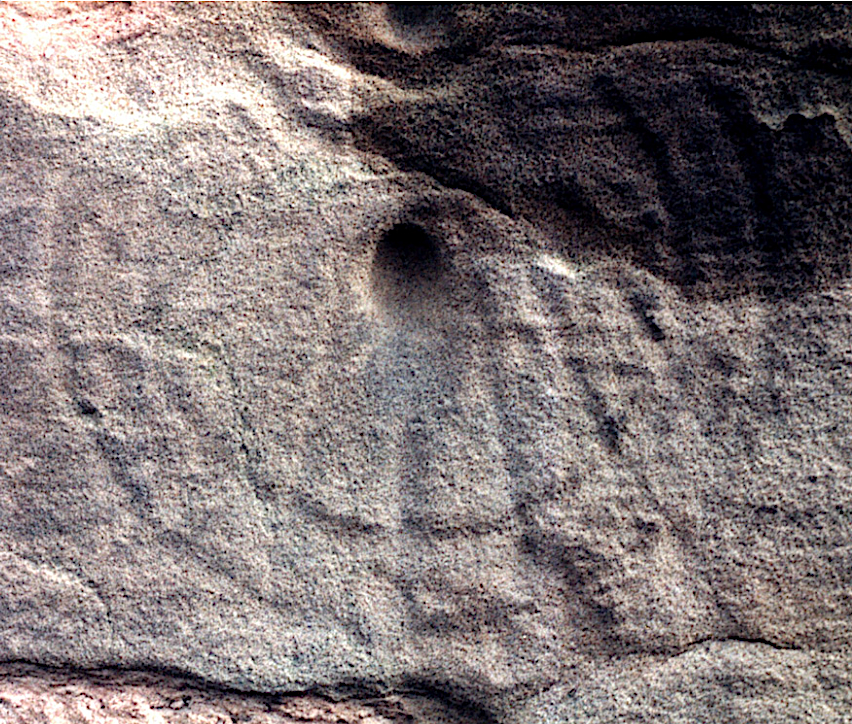
In his Glos dials survey, Tony Wood TW lists a scratch dial at Stanway without further detail. It is not noted in TWC’s much earlier list. I can find no other reference, and I did not find a convincing dial. The best candidate was this one, with 3 radials RHS emerging from a large hole. One other line LHS runs beside the hole rather than radiating from it. The other large hole to the left suggests that the pair may have held a fixture, and there is a similar pair lower down.
Tentative conclusion: this is possibly a scratch dial, but dubious. It might be more convincing if it were on its own.
CRICKET PITCH
Straying from dial-specific content, here is a small gallery of the extraordinary cricket pitch, the gift of J M Barrie who stayed at the house. The outfield includes significant areas of ridge and furrow undulations, rather more of a problem for fielders than batsmen I imagine. The pavilion, supported by staddle stones, is an excellent example of satisfying quirkiness. I found a old ball under it to chuck around for a while and decide which end to bowl from.
St Margaret & St Andrew . Littleham . Devon – Robert Cornford OS / CC
ST MARGARET & ST ANDREW . LITTLEHAM-cum-EXMOUTH . DEVON
GRADE II* ✣ Recorded from 1139; present building has C13 origins (chancel); 14th-century arcades; then Perpendicular with subsequent rebuilding and C19 restorations (Fulford). Resting place of Viscountess Nelson.
I have not visited the church myself, but Ian Logan contacted me about the vertical dial on the apex of the church porch. I have written this post around the dial, however Ian has produced an excellent detailed description of the church and its history that I highly commend.
St Margaret & St Andrew . Littleham . Devon – Ian Logan
St Margaret & St Andrew . Littleham . Devon
BSS record: A stone dial, rather crude in execution and in poor condition, is mounted on the church porch. It is about 600mm square and shows the hours VI – Vl undivided. Although the numerals look as though they are aligned with the hour lines, the hour lines themselves have disappeared. The church leaflet says that the dial dates from 1780.
St Margaret & St Andrew . Littleham . Devon
SCRATCH DIAL
There is an older dial – a scratch dial – on the right hand side of the porch doorway, probably C15. It is in poor condition, but there are 7 discernible lines radiating from the gnomon hole in the dial stone. These are two quite old photos of the dial (BSS). If anyone can provide a clear recent photo, it would be very welcome as an addition!
The ‘dawn’ line is now a prominent cleft in the damaged dial stone. The cluster of lines at and beyond noon LRQ indicate the most important part of the day for observance (none in canonical terms).
St Margaret & St Andrew . Littleham . Devon – Scratch Dial
MRS CROWLEY
This is an ideal place to use the wonderful drawing skills of Mrs Crowley to illustrate the vertical dial and scratch dial together. I have managed to obtain a copy of the comprehensive book of her Devon and Cornwall dial drawings, a work of wonder for dial-ologists.
GSS Category: Vertical Dial (1780); Scratch Dial
Credits: Keith Salvesen (photos); Ian Logan (photo, research); The Parish History Group (interesting and informative leaflet)
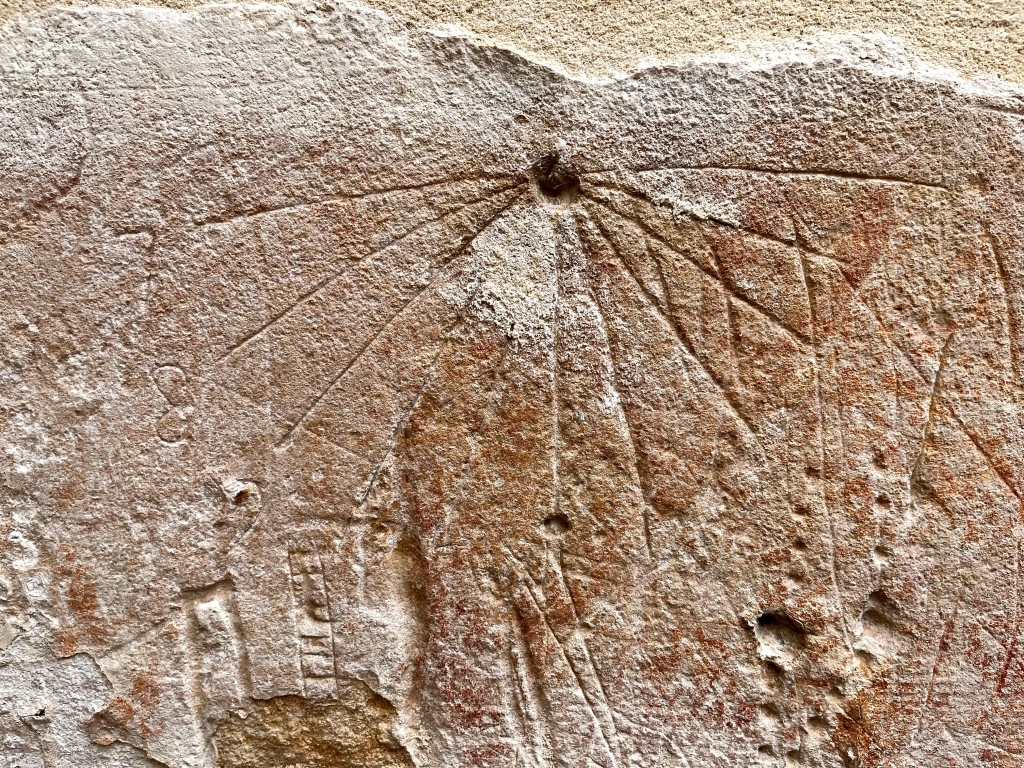
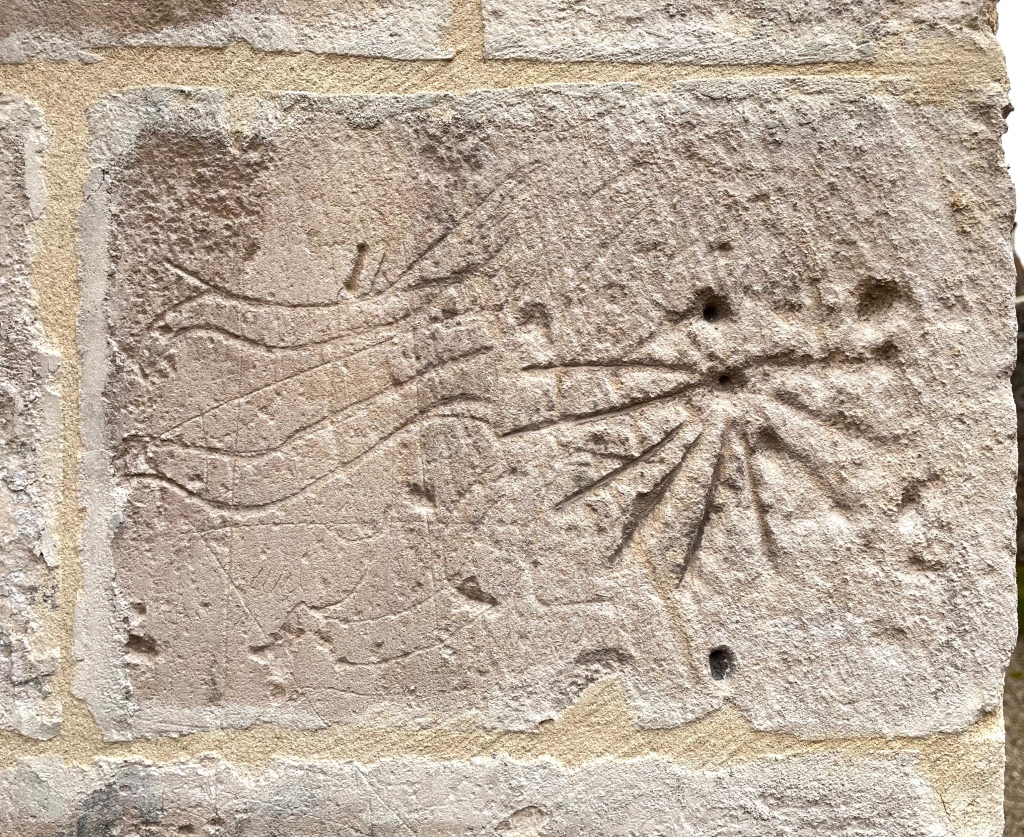
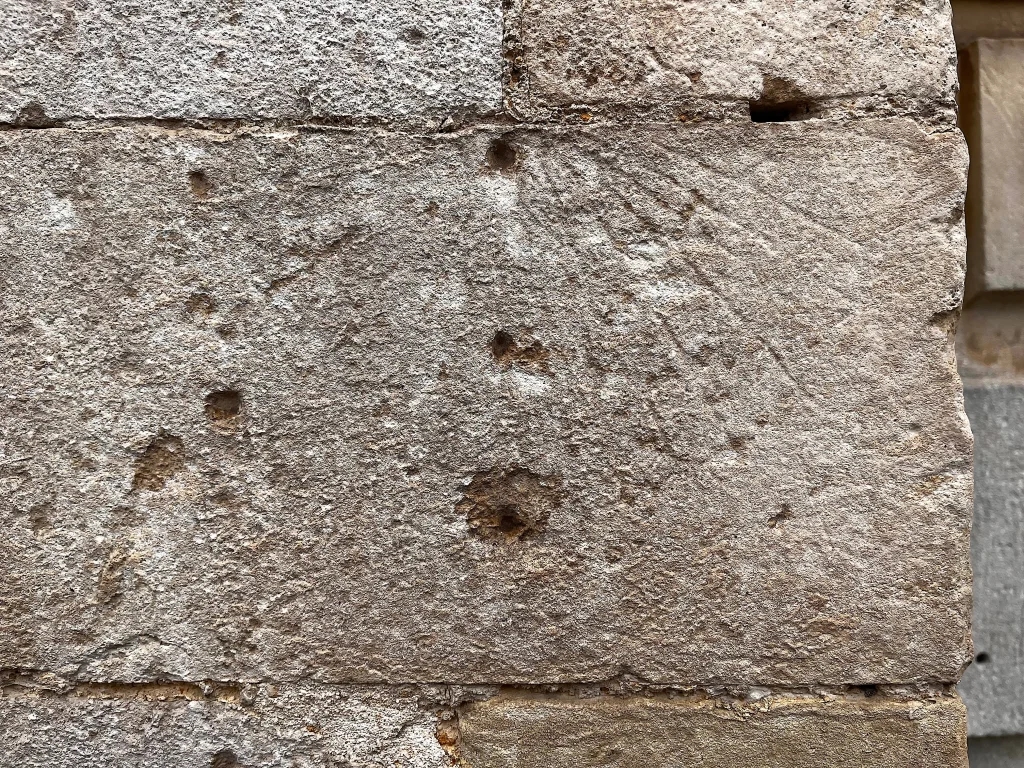
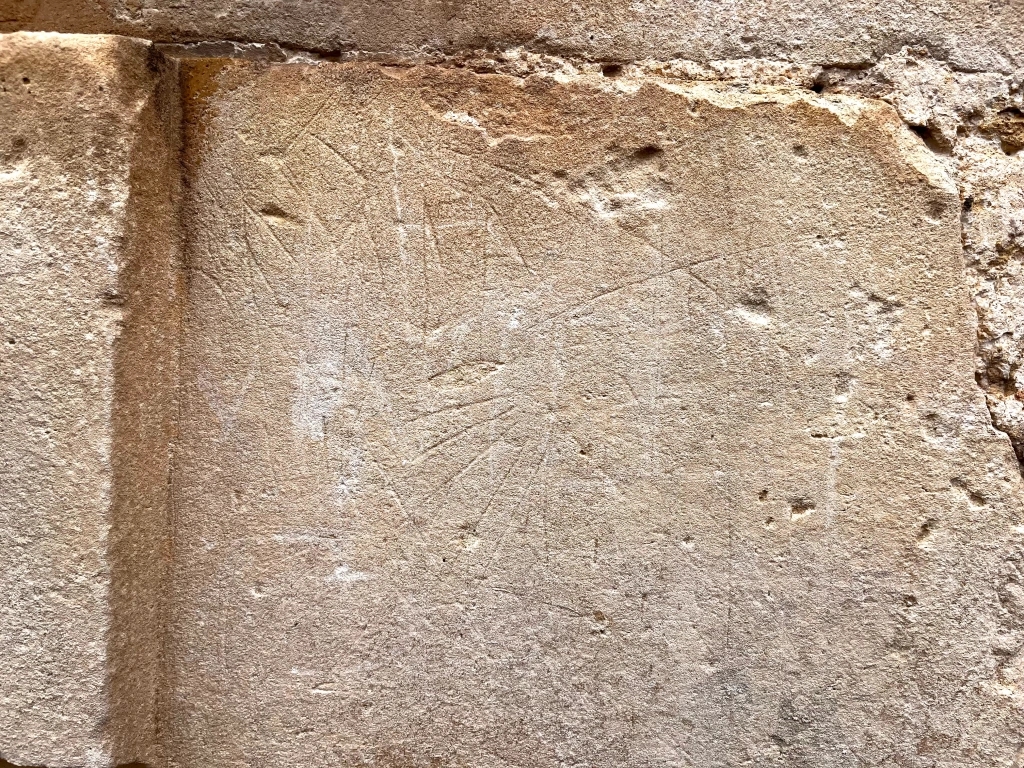
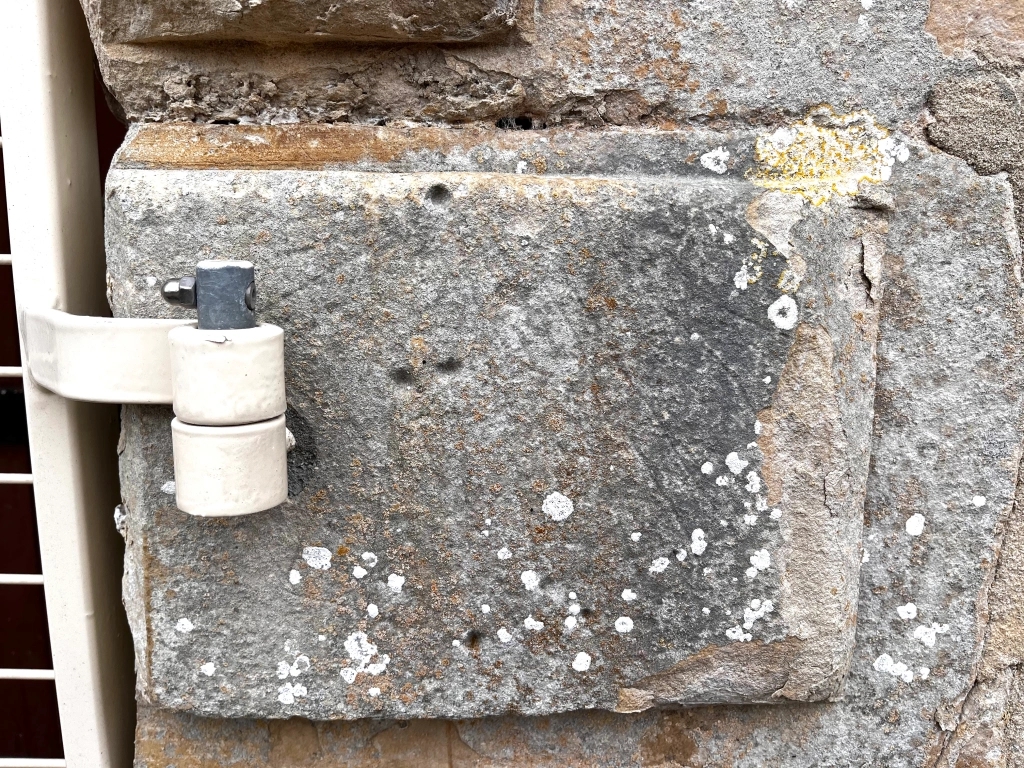
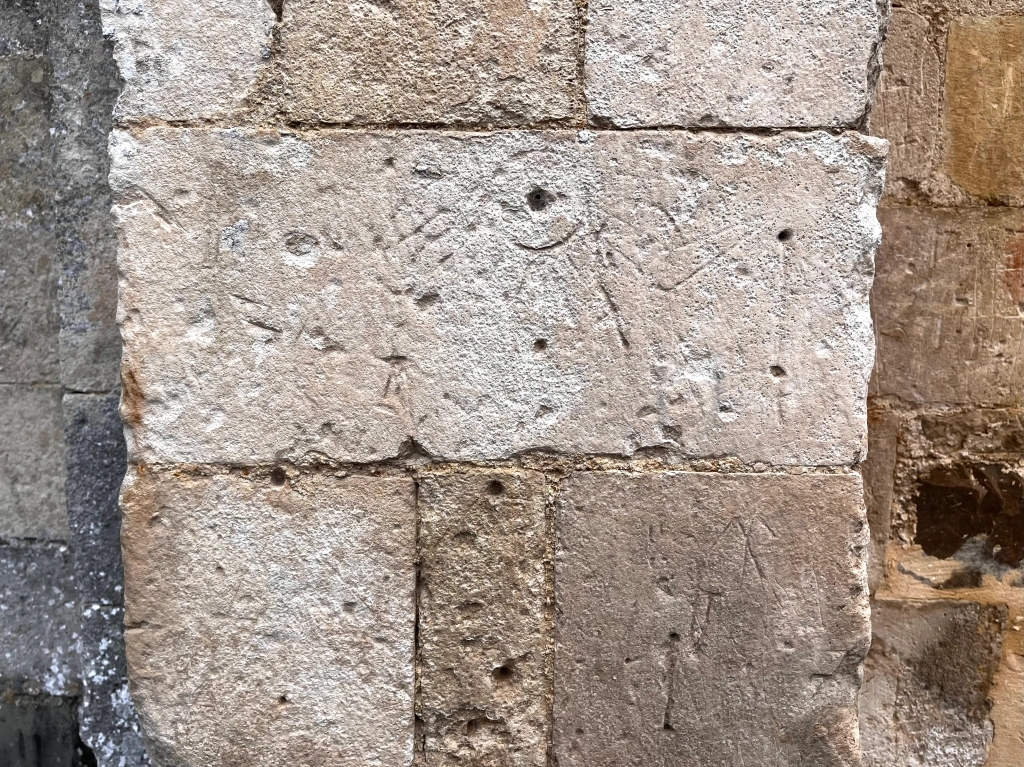
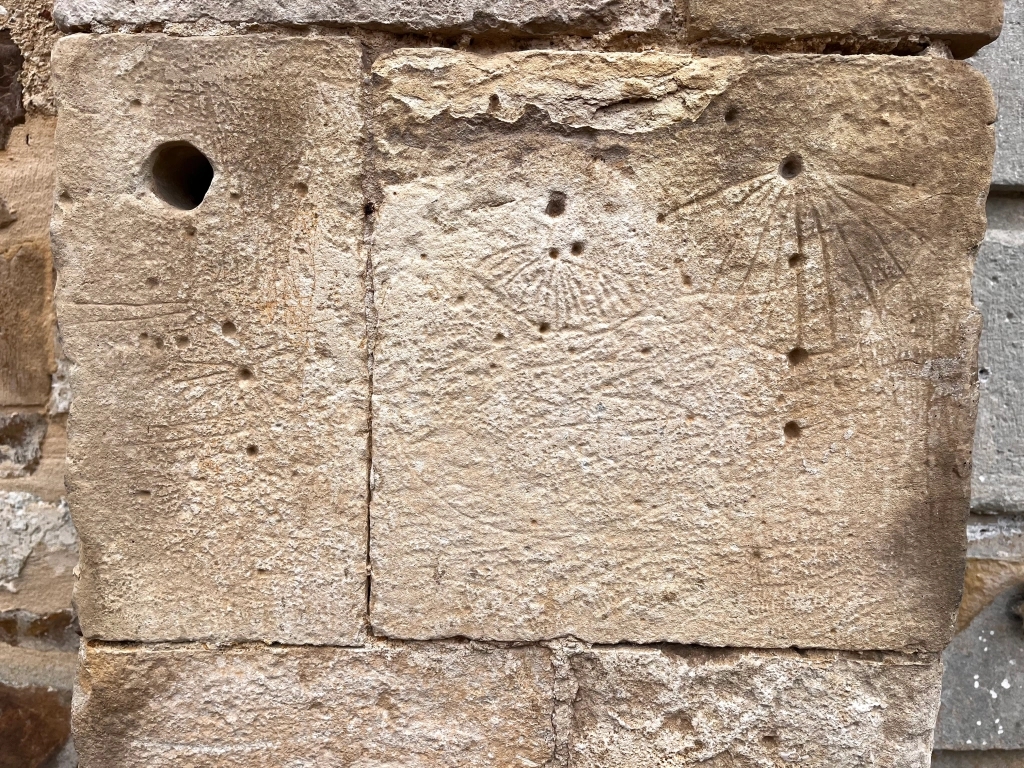
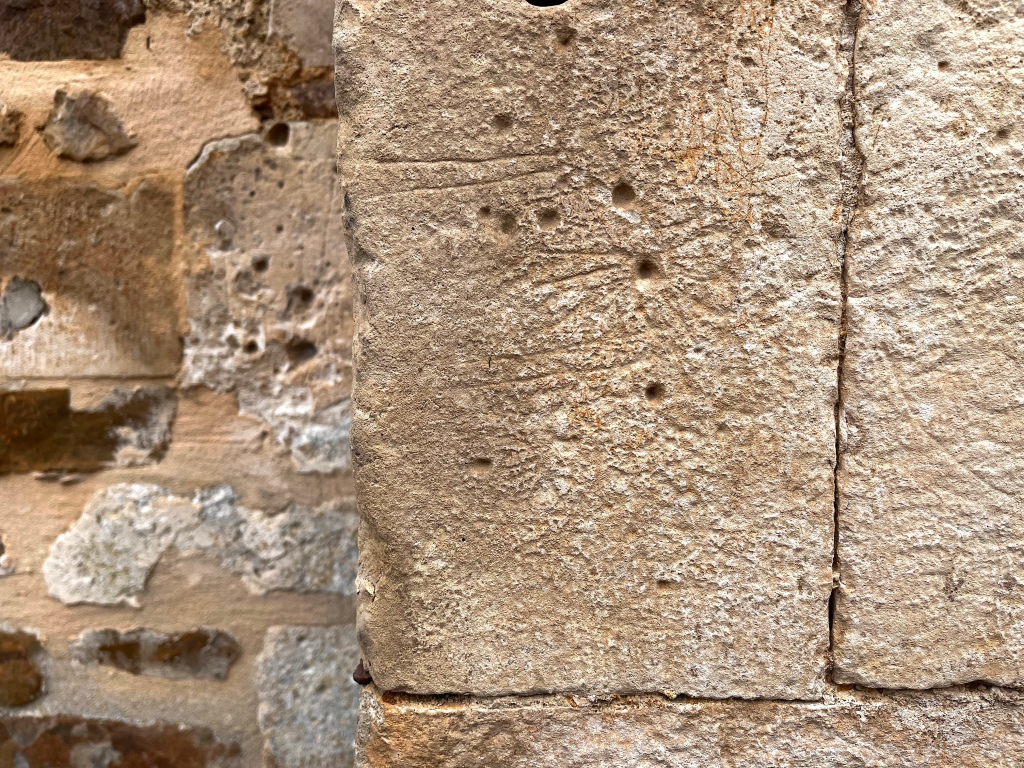
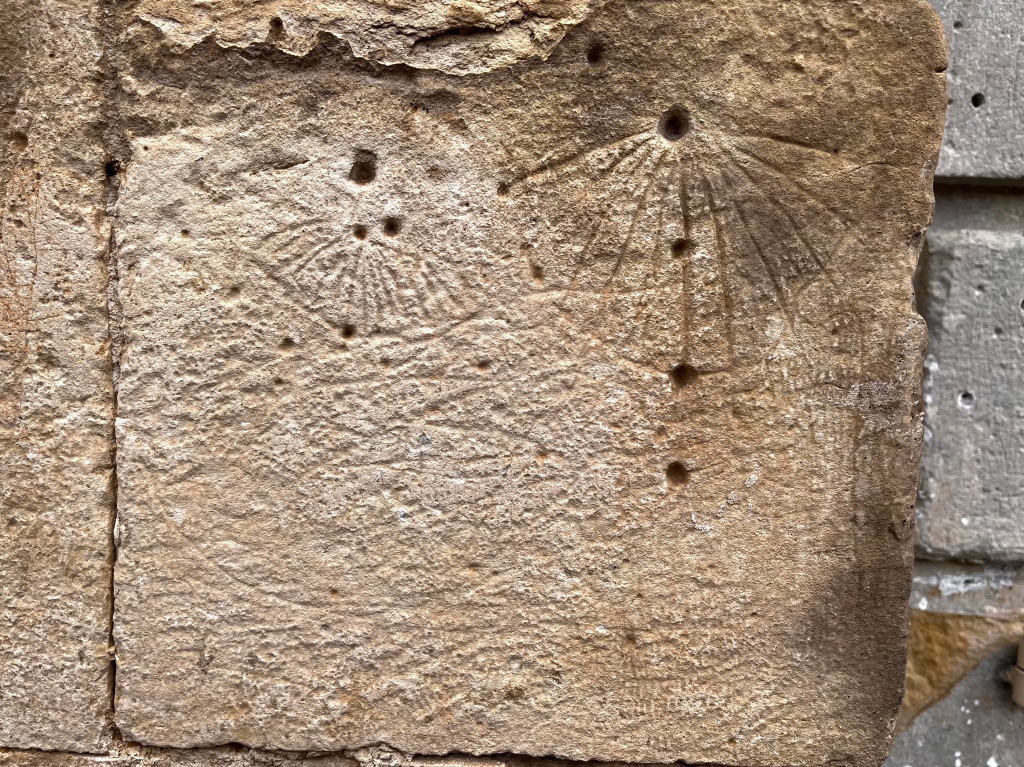
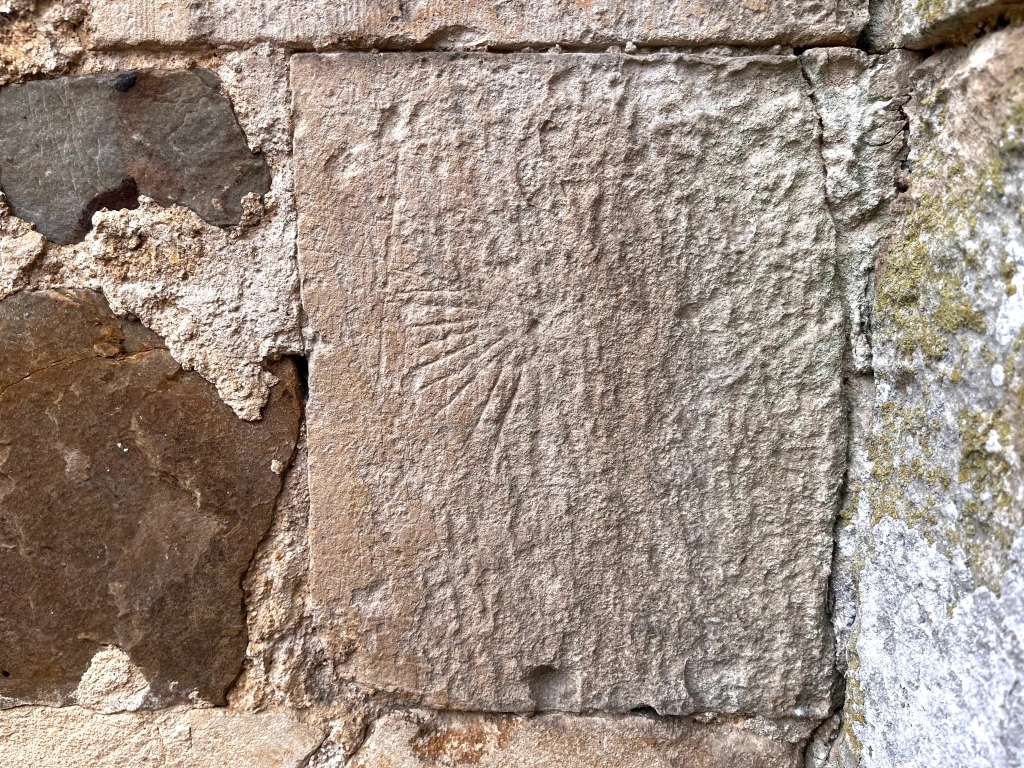
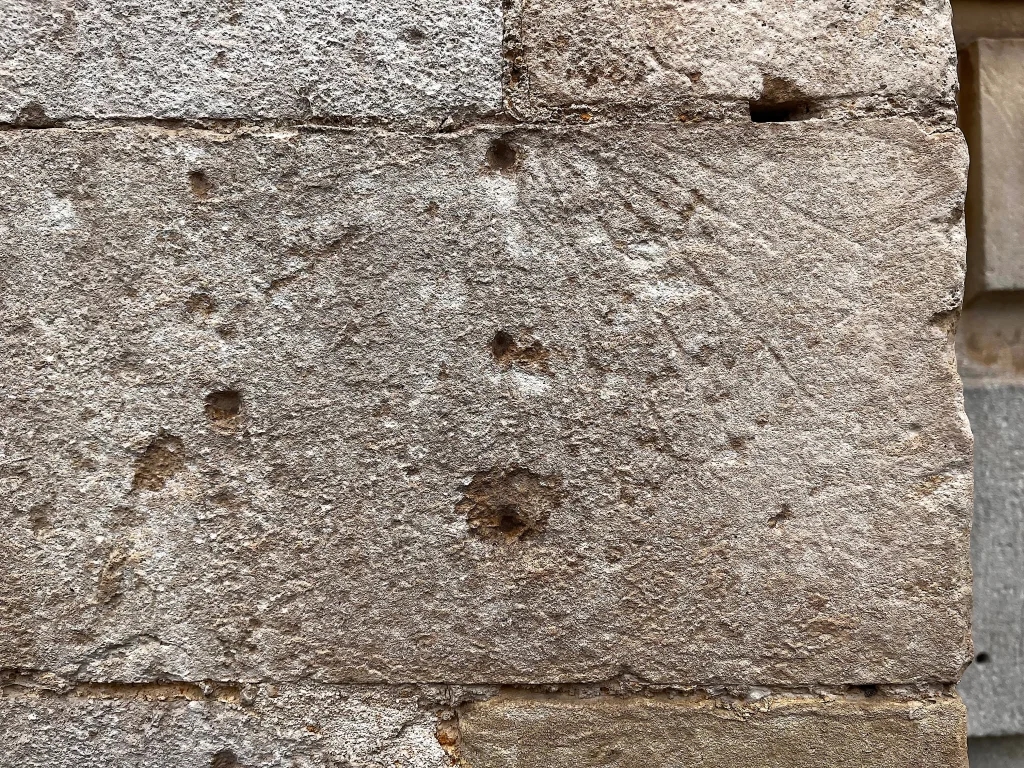
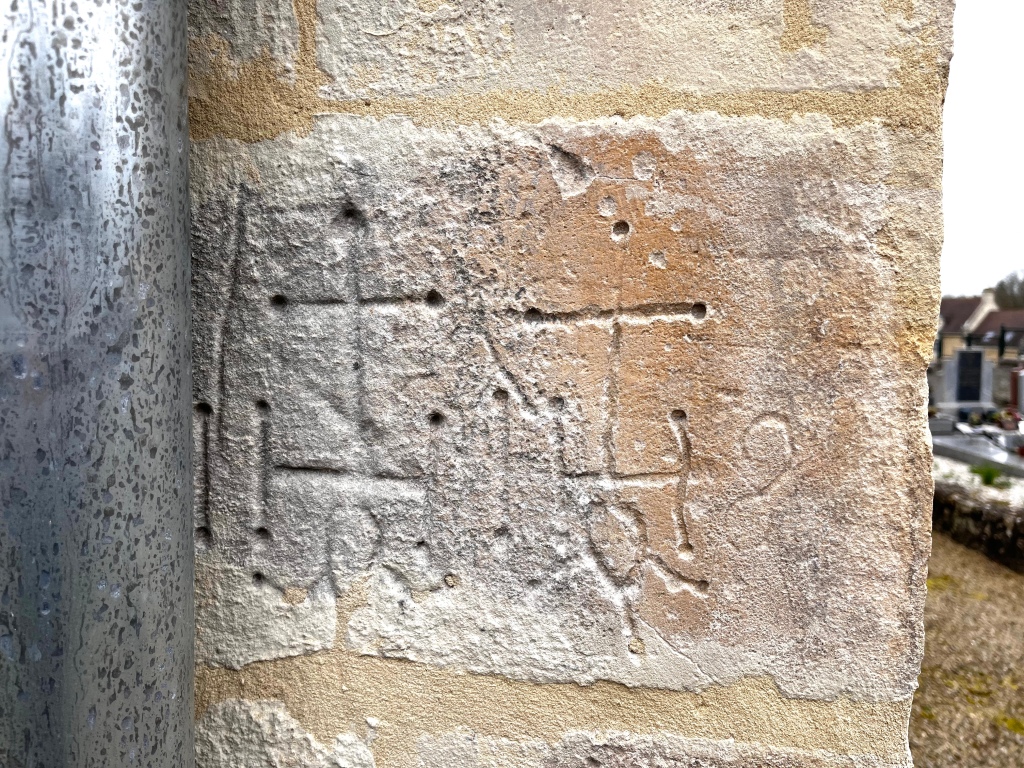
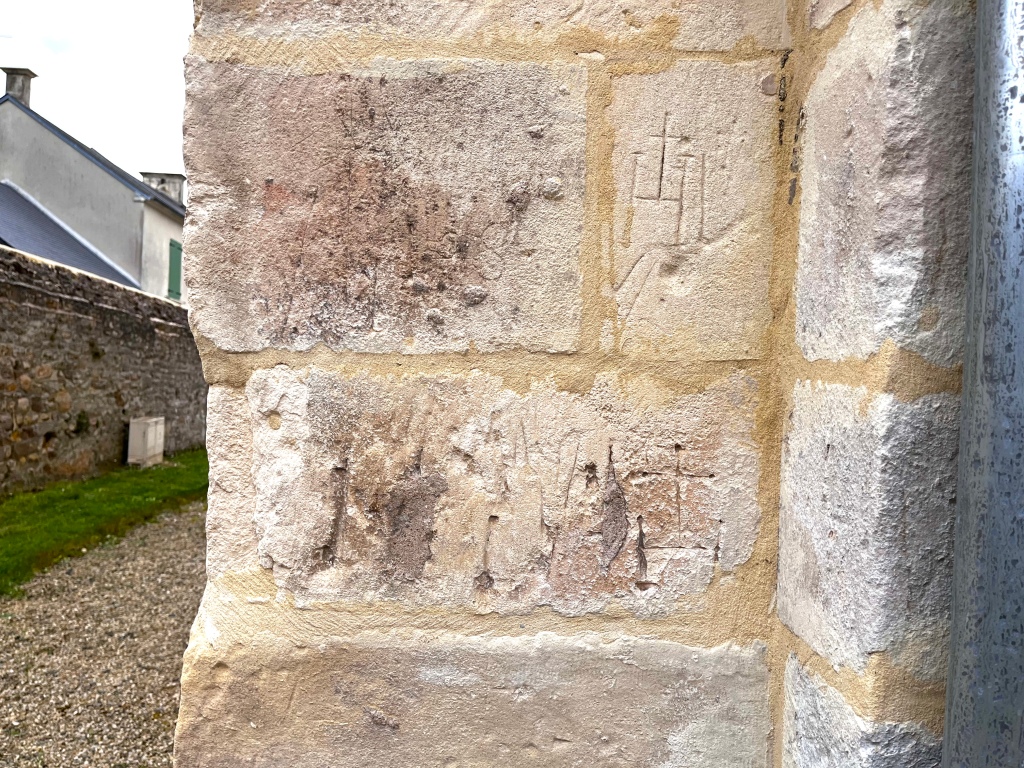
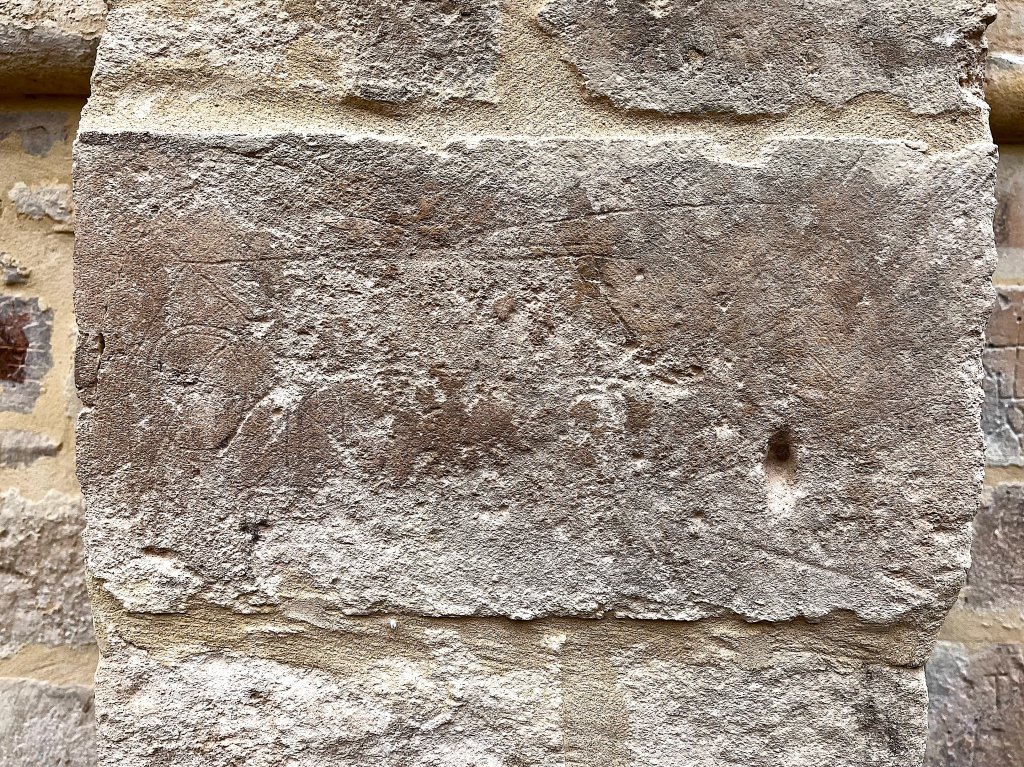
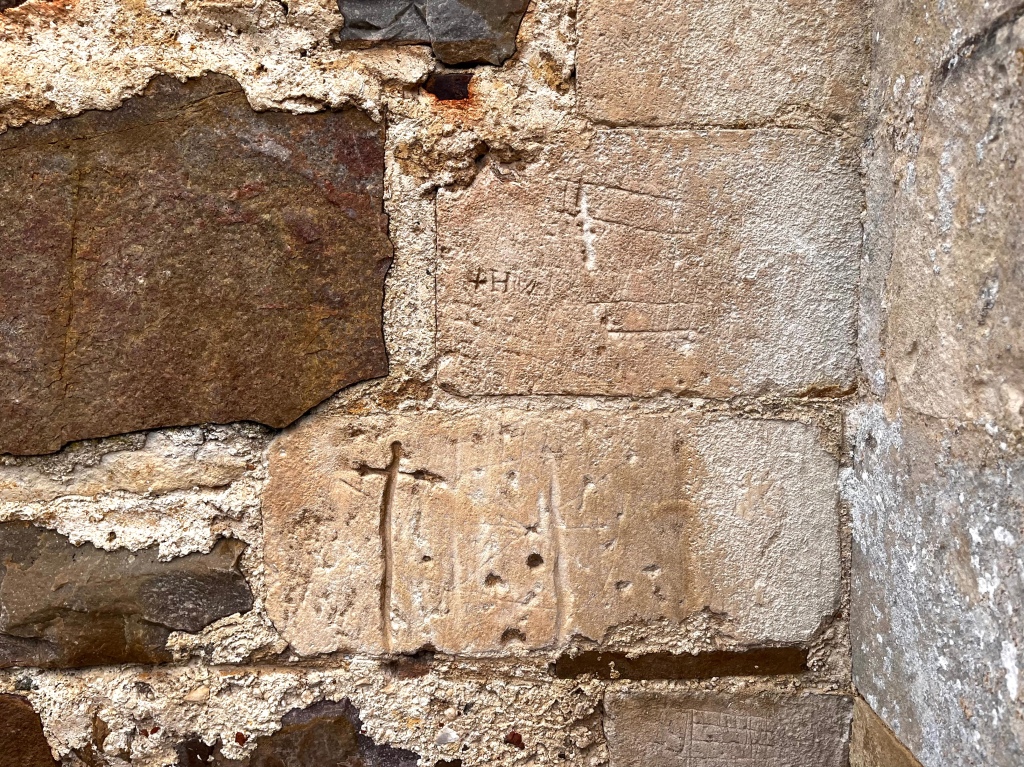
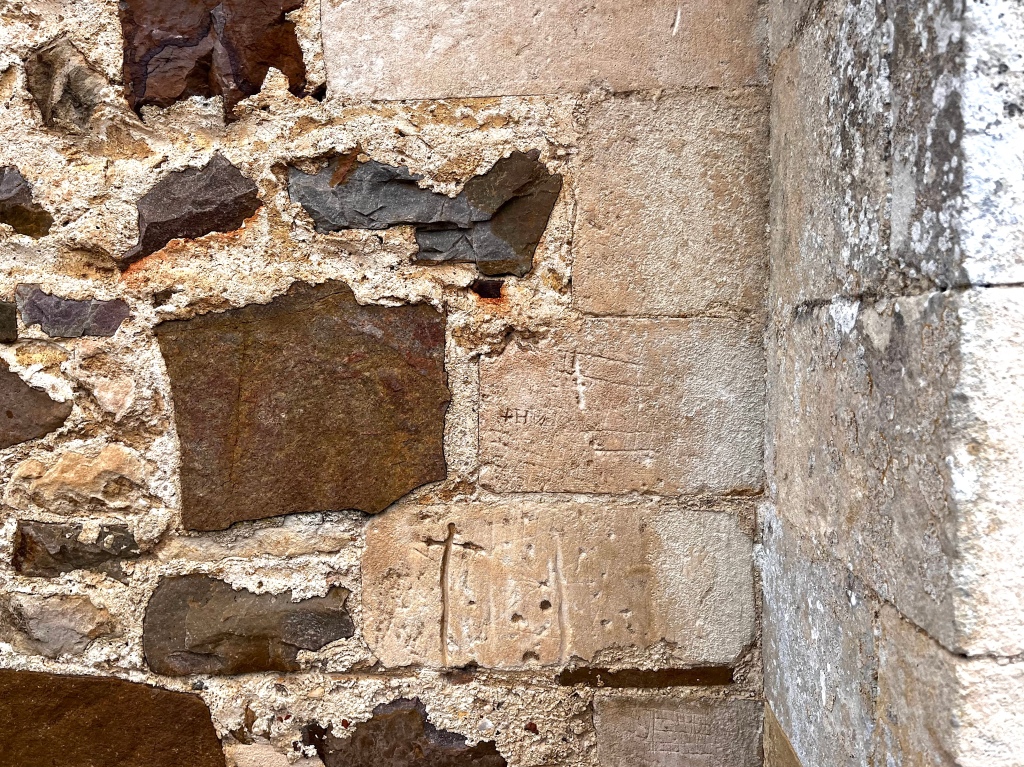
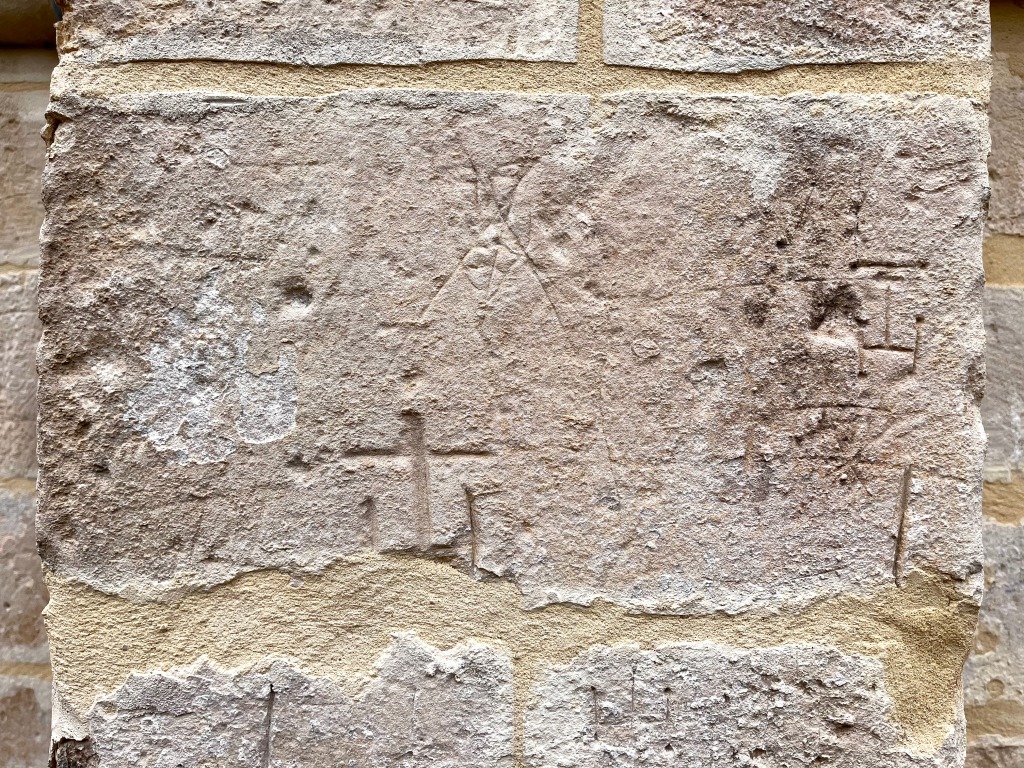
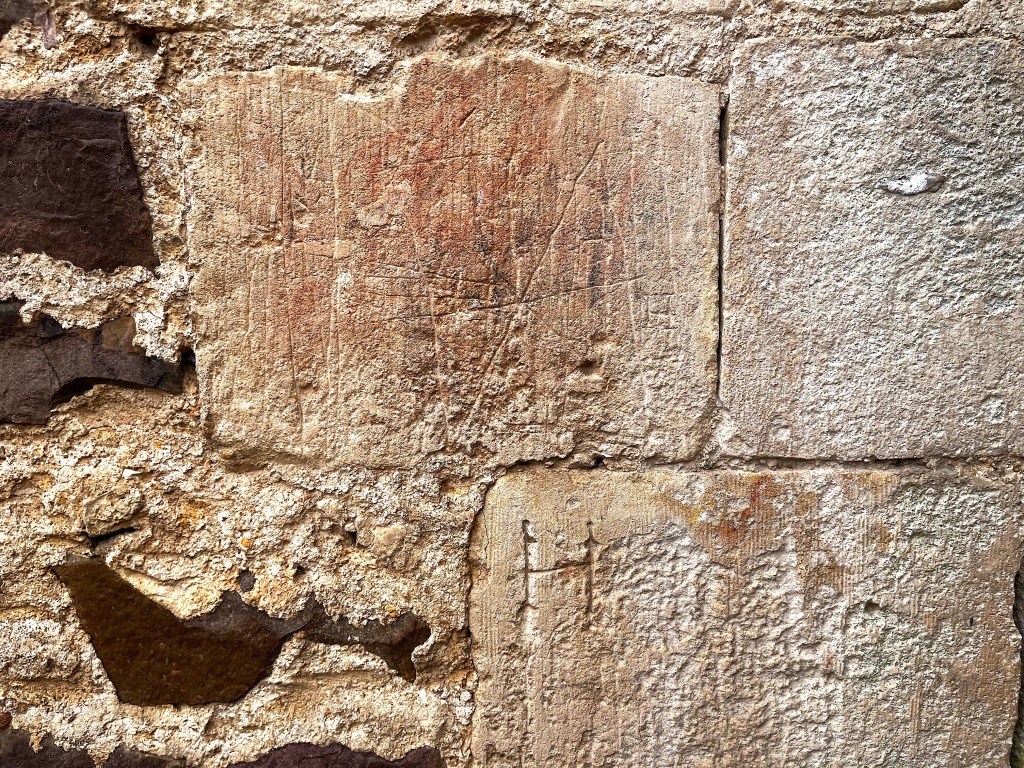
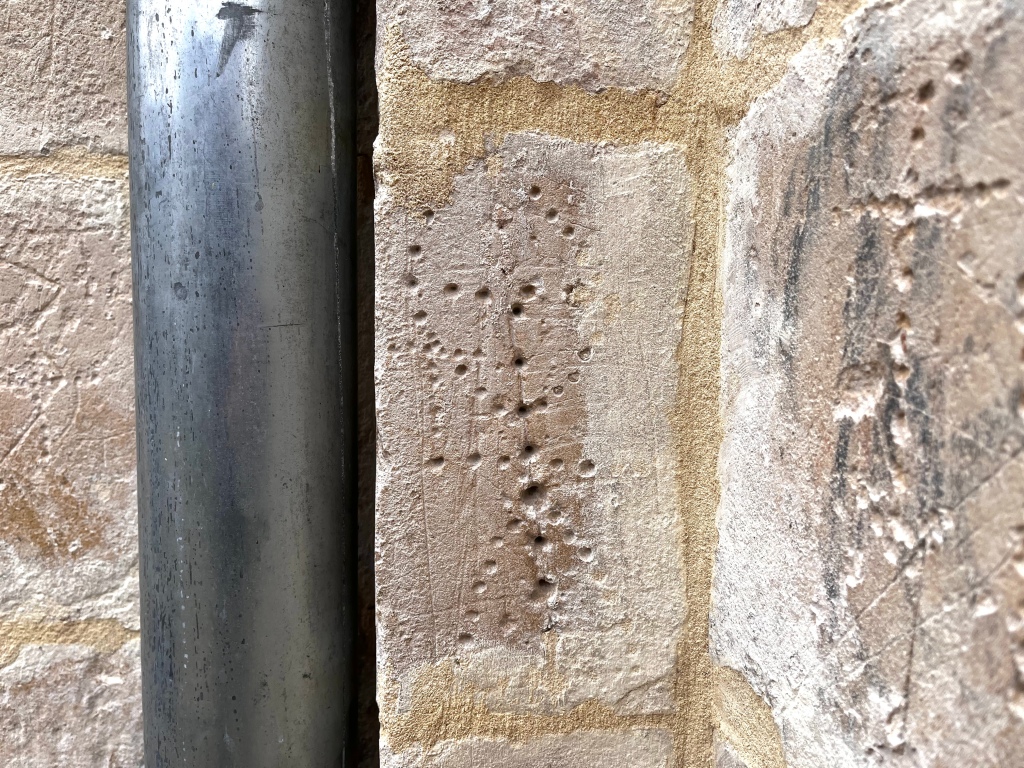
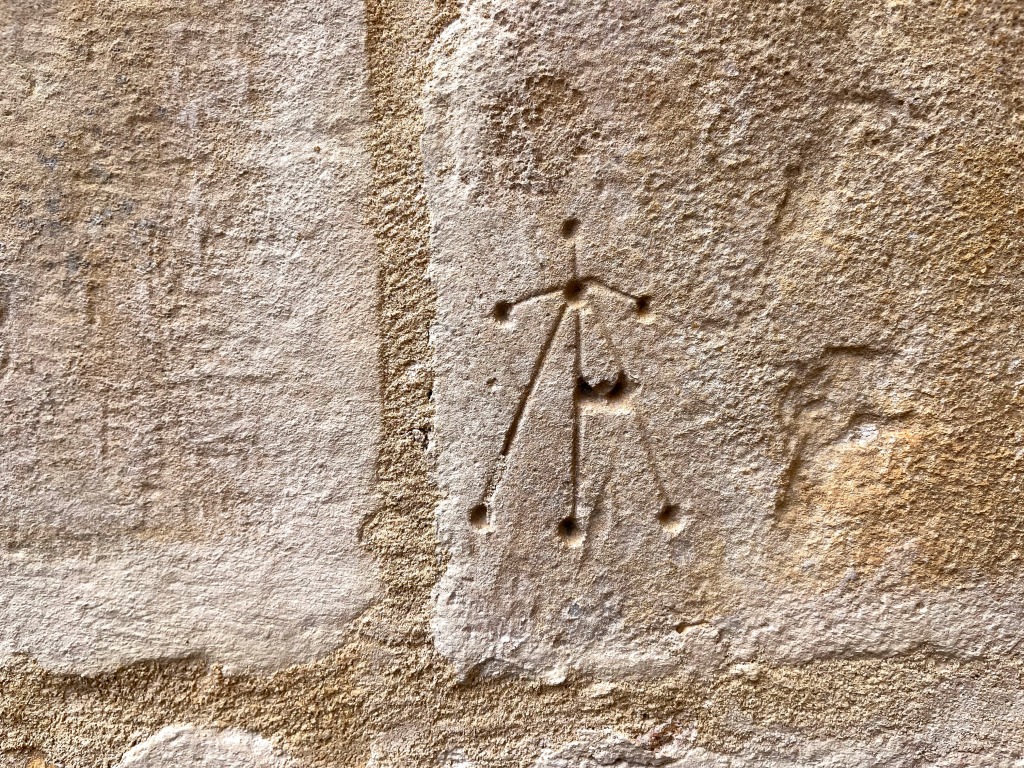
The area between Caen and Alençon contains a surprising number of churches with scratch dials. There are some rich pickings for scratch dial and church mark enthusiasts. It is not exactly a destination in itself, but is certainly vaut le voyage if you are in the region. Several churches have a plethora of designs and Urville is one of them. I gave up counting the dials and disentangling overlapping ones when the score reached twenty. 49° 01′ 31.44″ N, 0° 17′ 53.88″ W
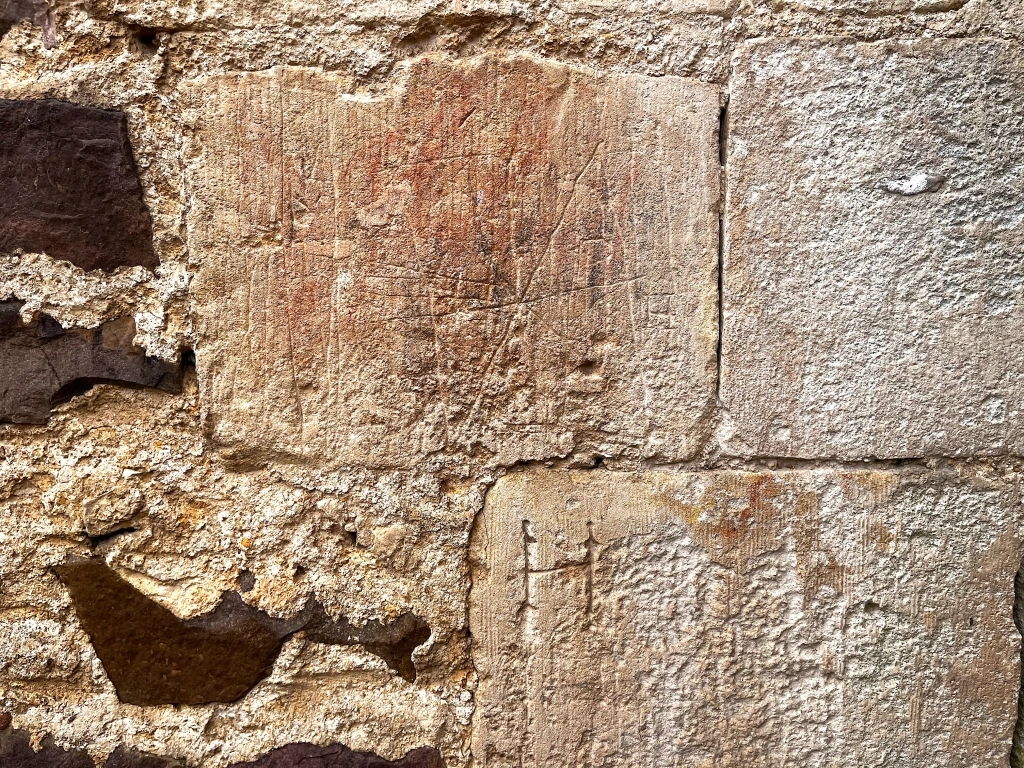
There is no point in trying to analyse this amazing collection of dial art, nor guess its significance. It’s hard to find out much about the church at all except for the official write up to the effect This parish church, built in the village centre, replaced the former place of worship which had become too small. The present church is said to be C17. Using British churches as a guide, some of the dials & graffiti seem earlier. Presumably some of the original church’s stones were reused. It might make sense that the new church tempted the villagers to add to an existing display. Here is a varied selection.
DIALS
APOTROPAIC SYMBOLS, GRAFFITI and other designs
GSS Category: Scratch Dial (Normandy France); Mass Dial (Normandy France); Medieval Sundial (Normandy France); Church Graffiti; Apotropaic Symbols; Protection Marks






























 GAUDIUM SUB SOLE . SUNDIALS . MEDIEVAL TO MODERN