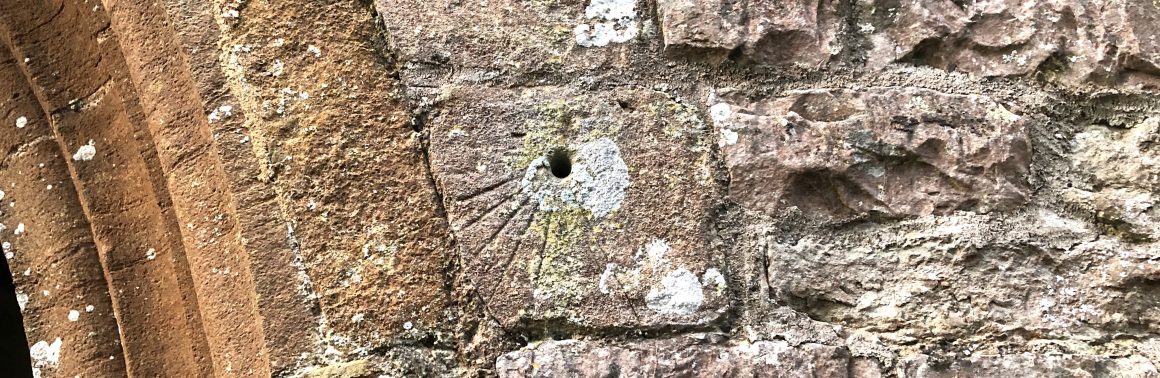
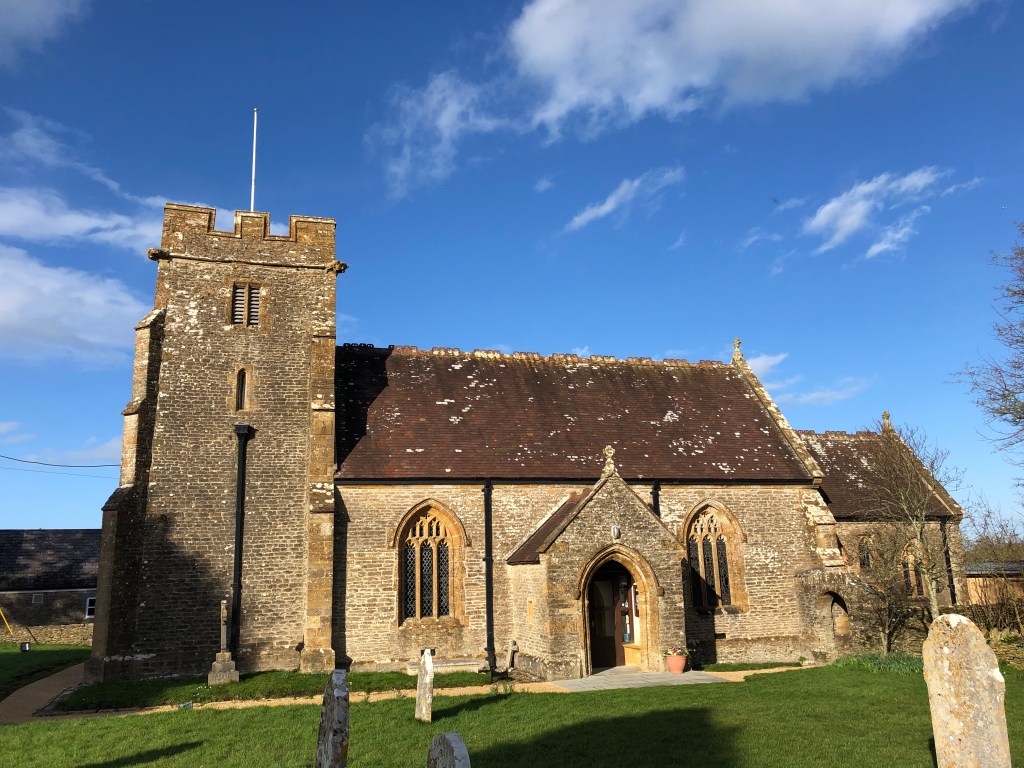
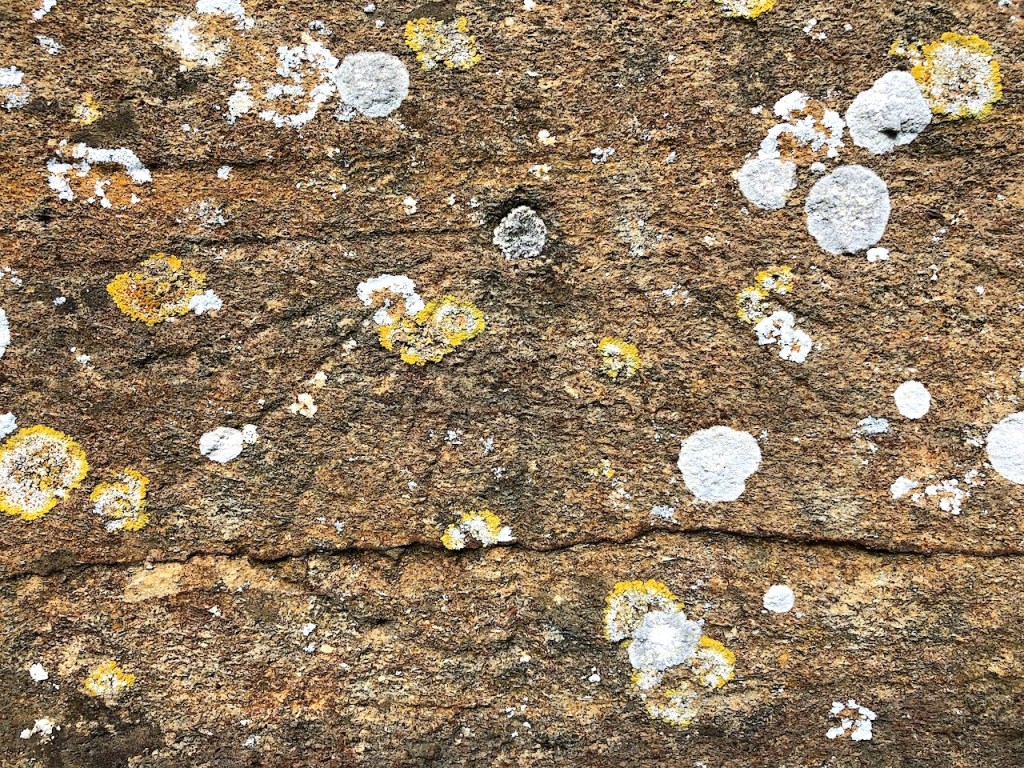
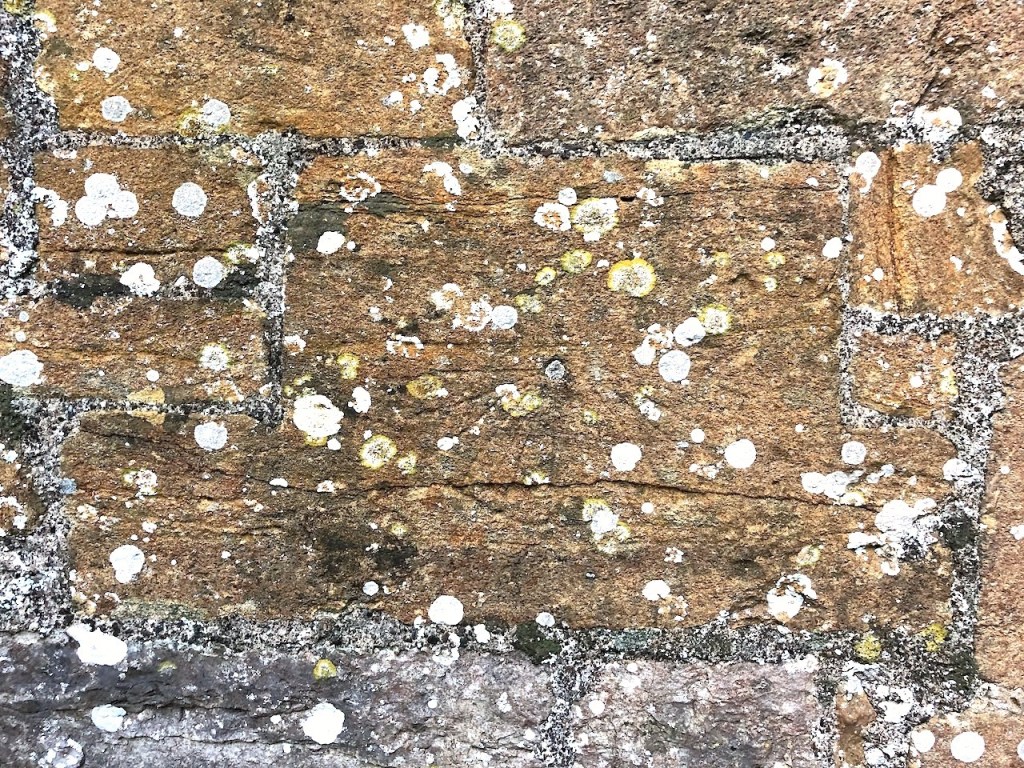
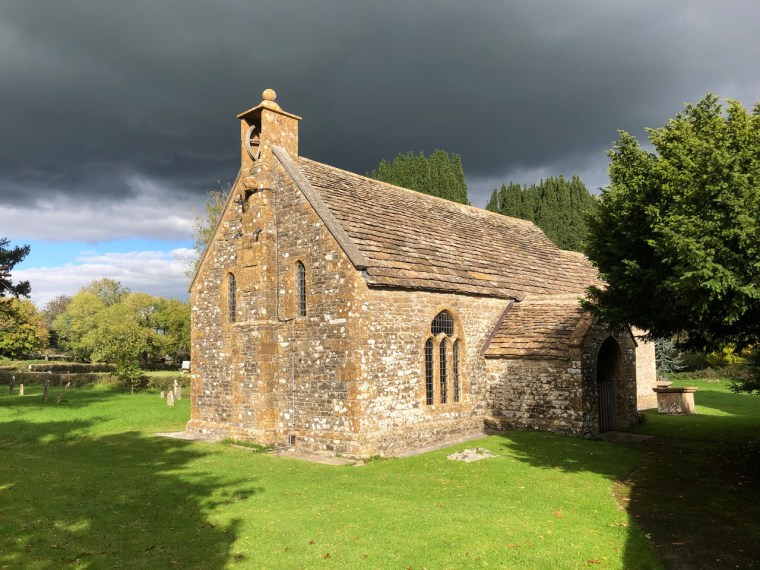
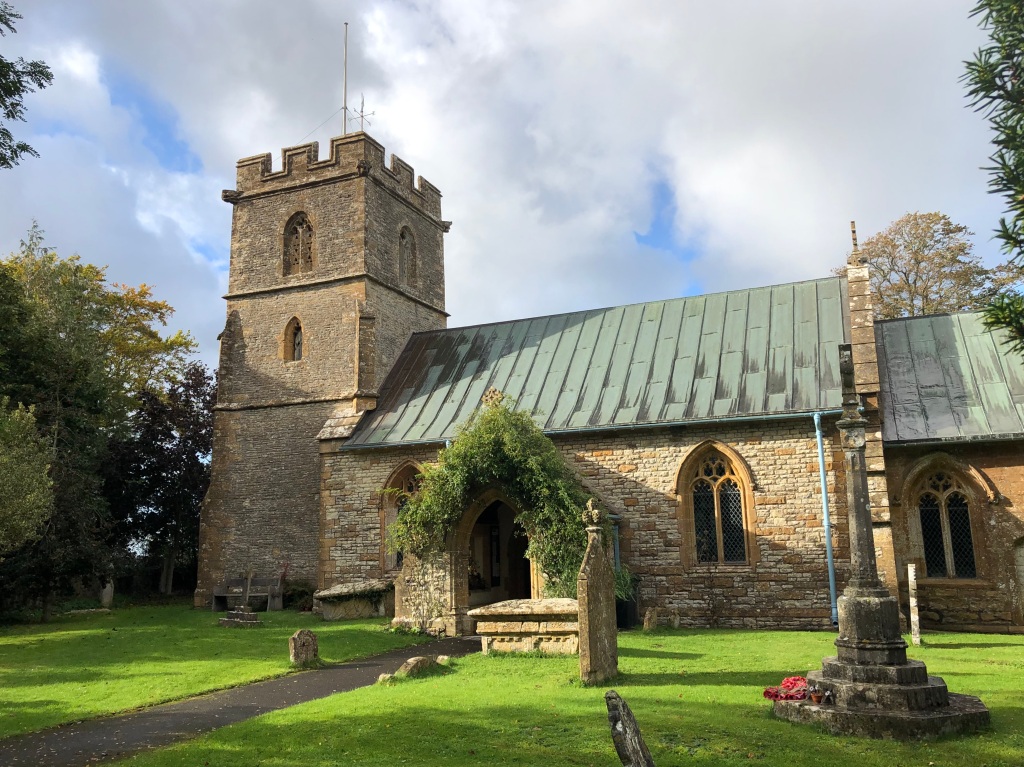
DEDICATION † ST JAMES the GREAT C12 origins, C13 tower, C15 rebuilding, later additions
LISTING † GRADE I
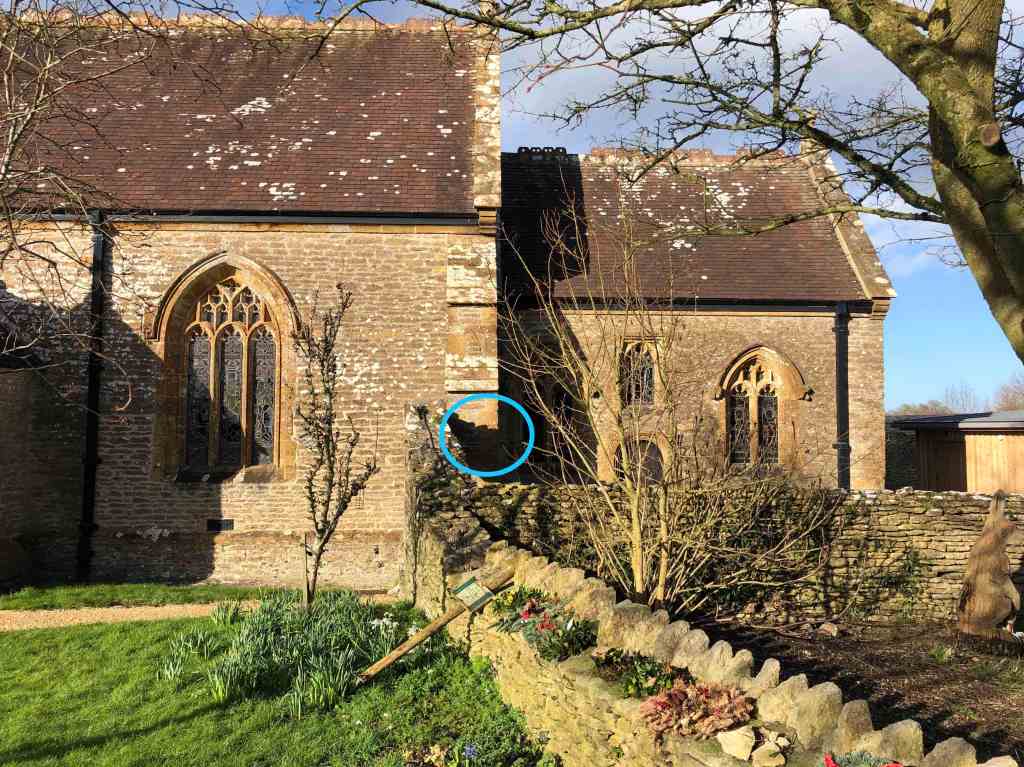
LOCATION † 3 miles S of Sherborne, a long narrow village on the main road to Dorchester – rather a traffic bottleneck. ‘A linear village slowly descending to marshy land…’(PEV) Church slightly set back in its peaceful-seeming churchyard. Besides the excellent scratch dial, there is a fine vertical sundial high on the S. buttress of the tower (merits a separate post in due course) 50.9132 / -2.5008 / ST648127
ADDENDUM: link to subsequent post featuring a hitherto unrecorded scratch dial and the vertical dial on the tower HERE
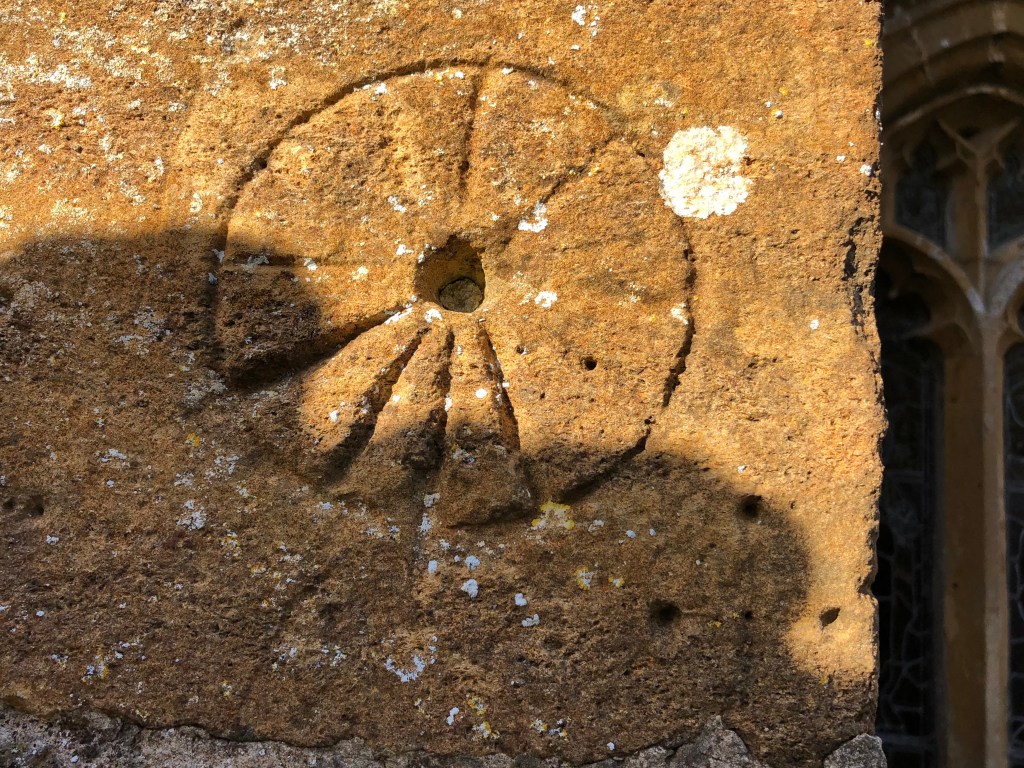
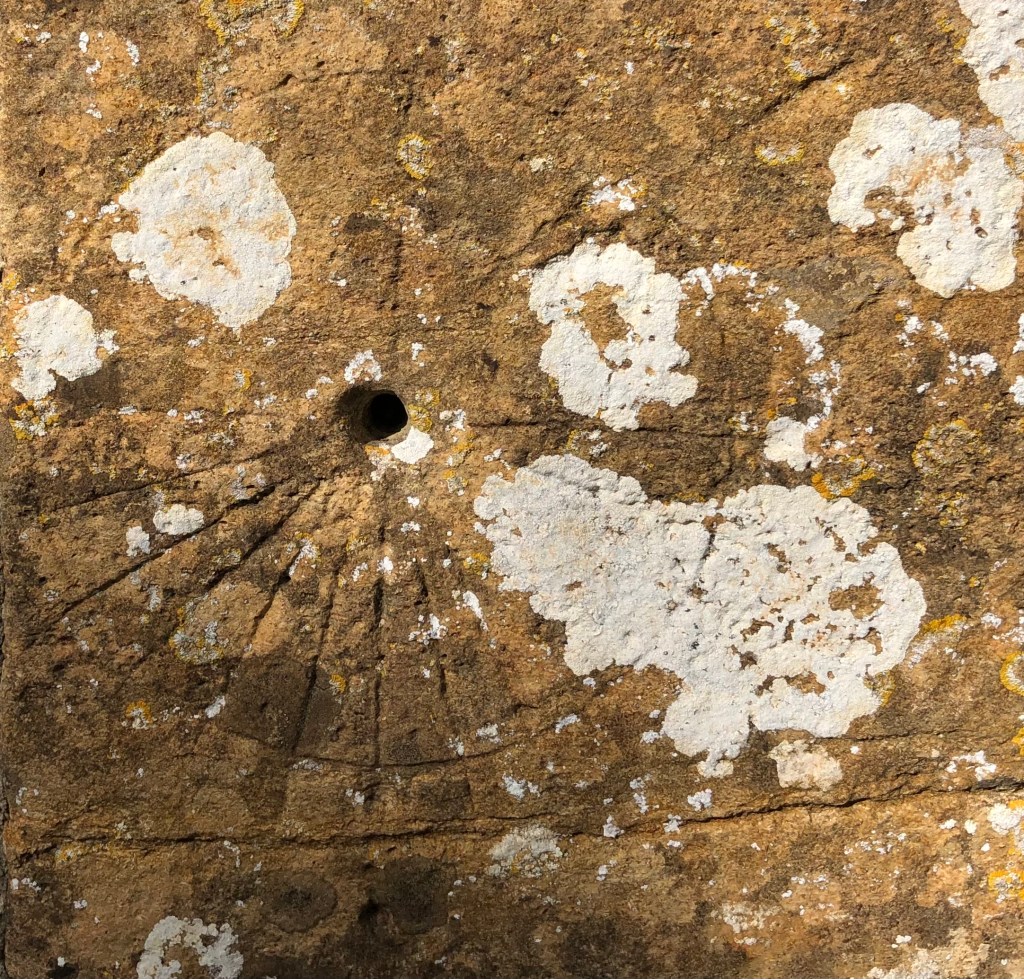
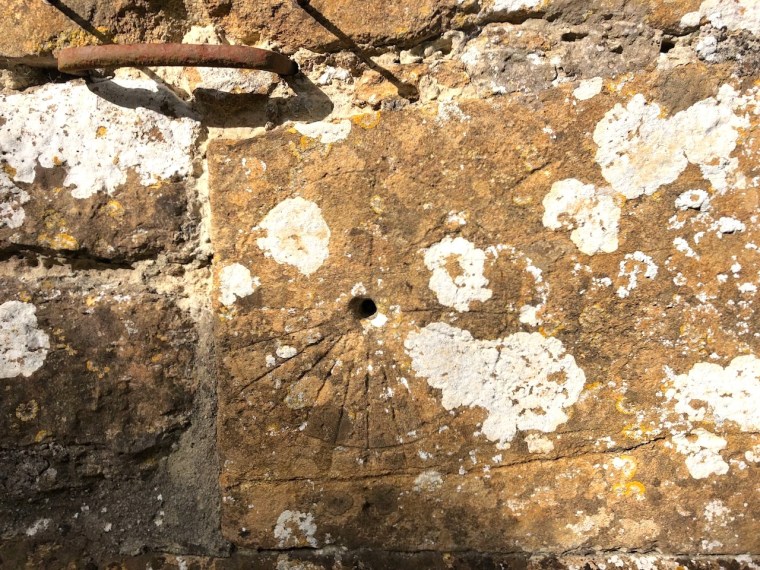
St James . Longburton . Dorset – Scratch Dial
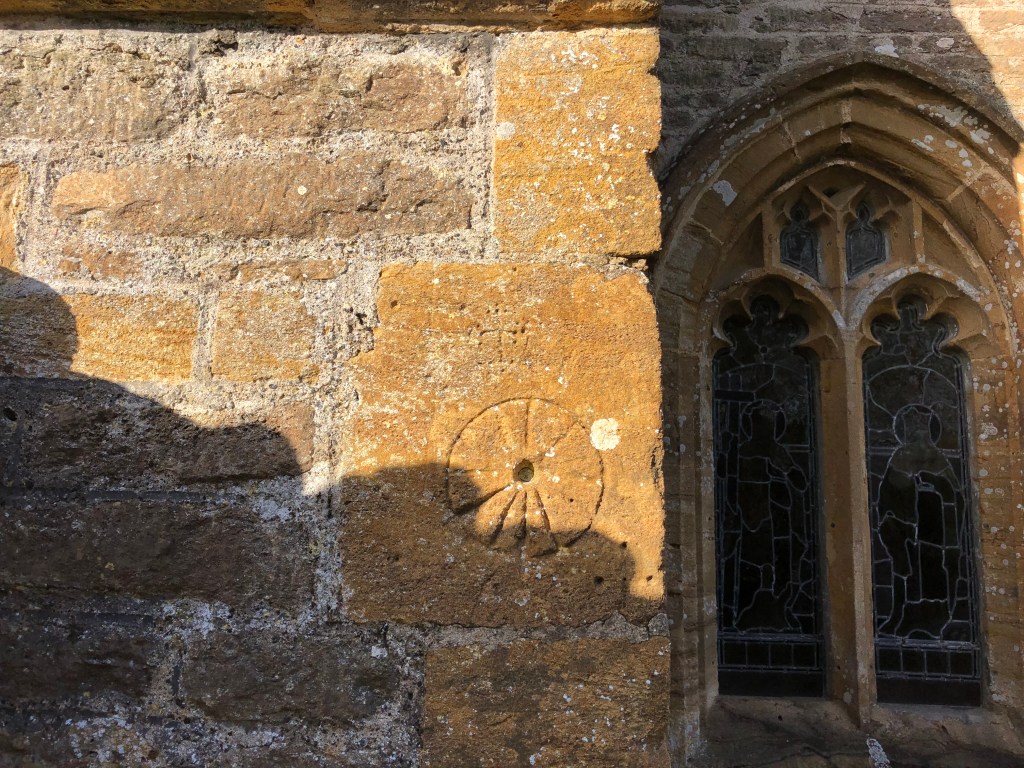
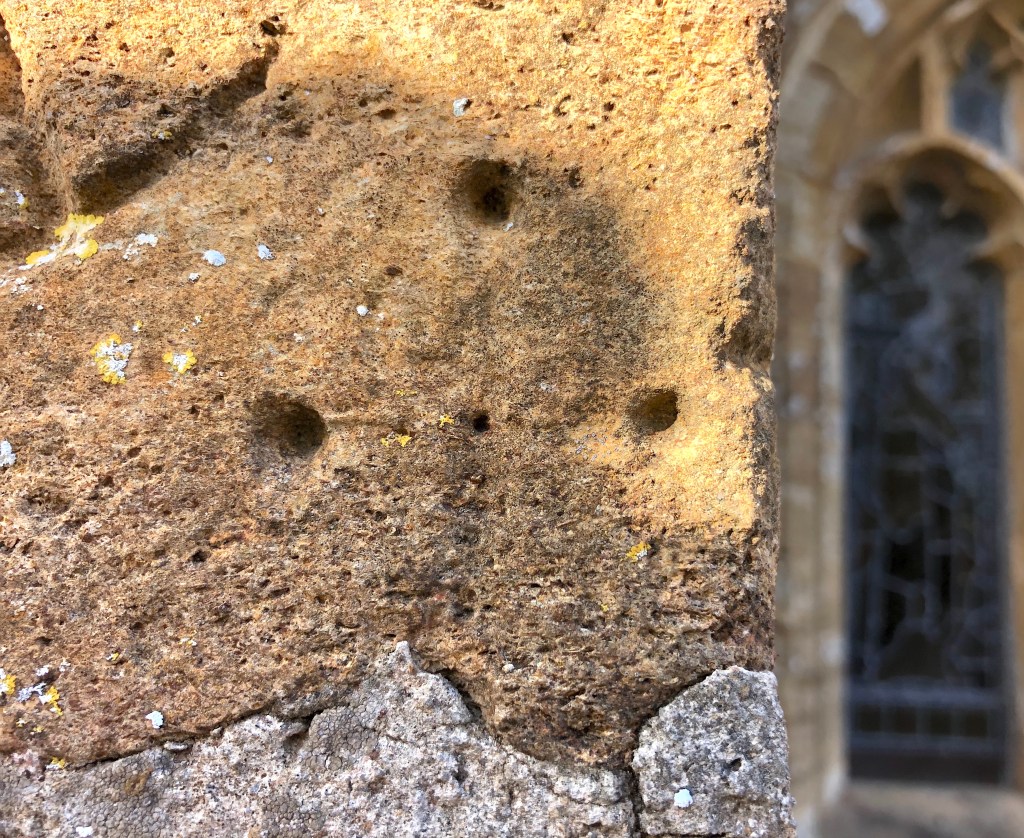
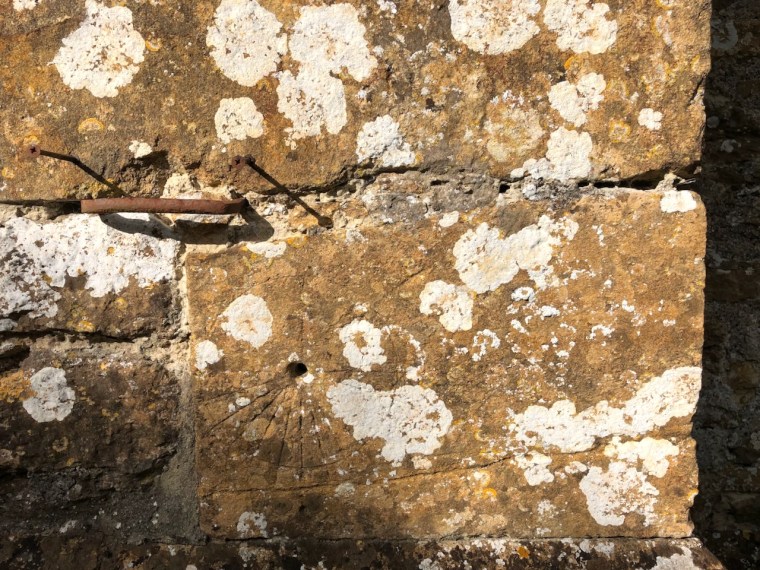
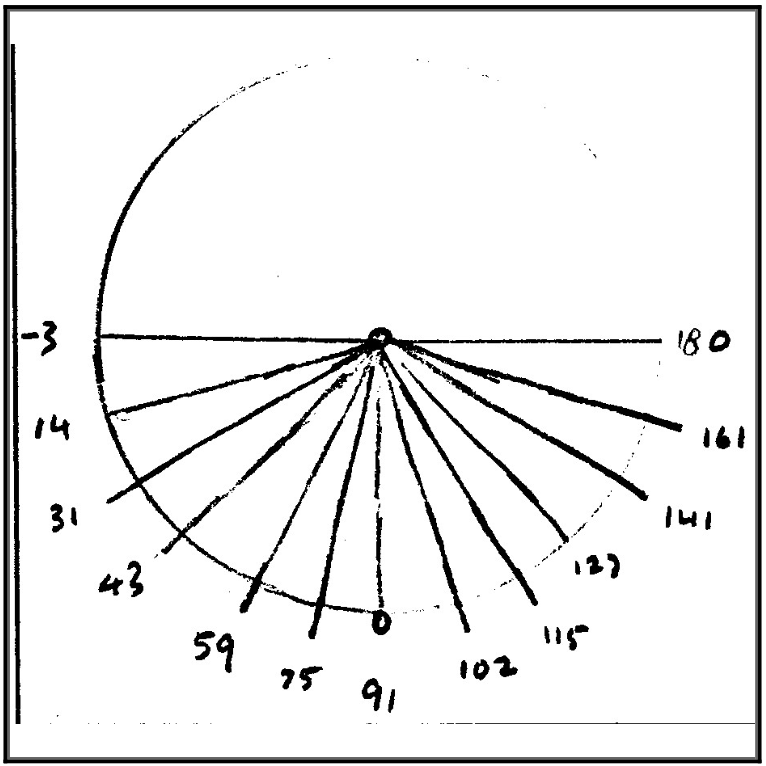
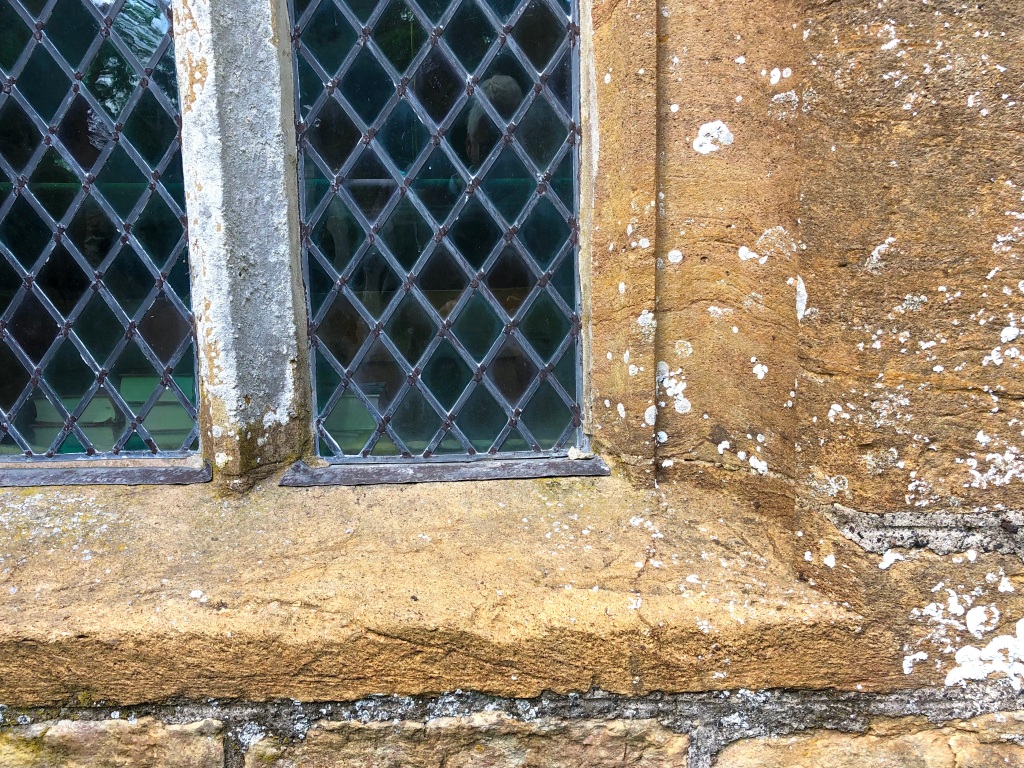
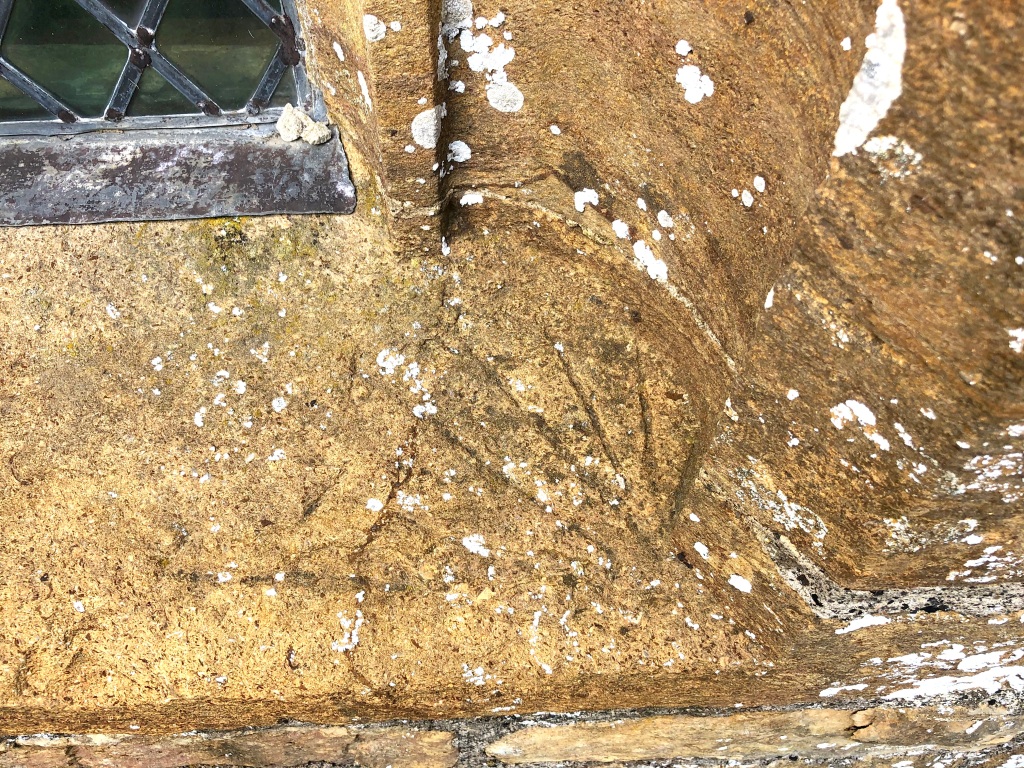
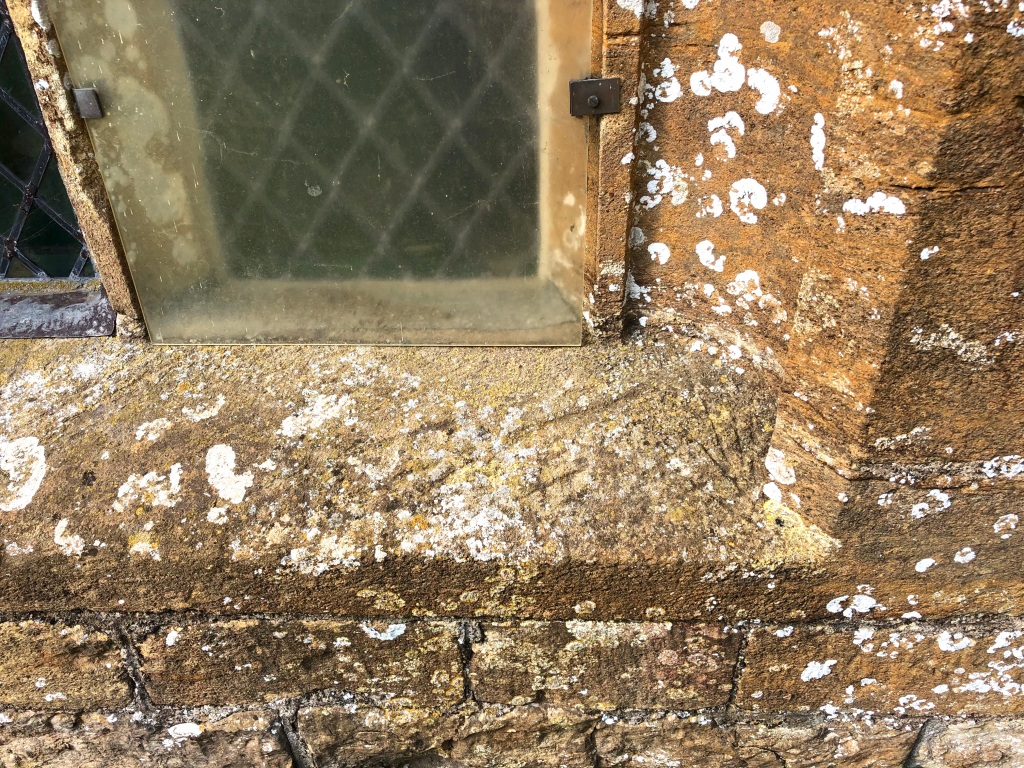
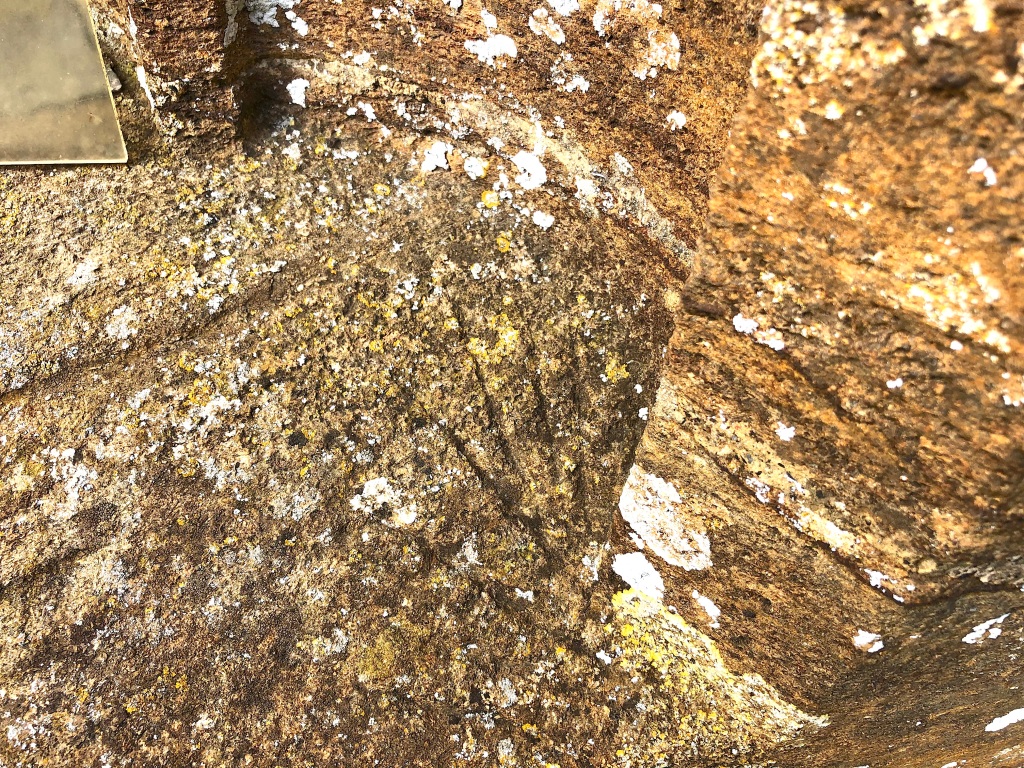
DIAL † Sundial: On S.E. buttress of nave—stone cut with scratch-dial and two crosses (BHO). Reached through a small stone gateway, not a location easily guessed. Dial in good condition, additional marks shown in images. 4 emphasised radials.
St James . Longburton . Dorset – Scratch Dial with crossesSt James . Longburton . Dorset – Scratch Dial location
NOTES † As mentioned, there is a fine vertical sundial with an interesting split gnomon on the tower S. buttress, to be posted soon. Also, excellent gargoyles and head stops. Below are the 2 crosses on the dial stone, one with dot decoration.
St James . Longburton . Dorset – 2 crosses adjacent to the dial
PART 1LINKfeatured Dials 1 & 2 on Rimpton church – two of the four dials identified and recorded by Dom Ethelbert Horne (DH) of Downside Abbey, the Father of modern dialling so to speak. In 1913 – 15 he made several trips around Somerset collecting dials, measuring and recording them in great detail. He went on to produce his pioneering book about dials, published in 1917.
LOCATION † Between Sherborne & Marston Magna, on the Som. / Dorset boundary. S 50.9948 / -2.5565 / ST610218
DOM ETHELBERT HORNE
DH (1852 – 1952) was a Benedictine monk at Downside Abbey. The Archives state that he was “a noted archaeologist, antiquary and folklorist… and published works on subjects as diverse as holy wells, mistletoe, scratch dials and St Aldhelm”. Between 1913 – 15 he made several tours around Somerset in search of scratch dials. In 1917, he published his delightfully written book ‘Primitive Sun Dials or Scratch Dials’ containing several chapters about dials, their construction and their purpose. These were followed by a detailed analysis, by district, of 224 dials that he located. He divided these into 12 main types, for each of which there are photographs, including a Rimpton dial (see Part 1). DH’s 4 Rimpton dials are numbers 212 – 215 in the Yeovil District list.
DIALS † This article covers DH dials 3 & 4 of the multiple dials on this church. I have visited the church twice and found other dials & less convincing candidates. These will be written up separately in Part 3.
DH DIAL 3
214. (3) This dial is on the w. side of the window to w. of priest’s door. It is 5 feet above the ground, the noon line is 5 1/4 inches in length, the style hole 5/8 of an inch in depth by 3/4 of an inch in diameter, and the aspect is s. by 15°e. Type 3.
NOTE † a. the trace of a circle, upper left and b. the small dial hanging down from the mortar line above. More on the additional dials on Rimpton church in Part 3.
LOCATION CONUNDRUM
The dial location given above presents a puzzle. Put simply, an error may have crept at some stage between DH finding and noting the dial shown here; transcribing his notes to a more formal record; preparing a draft for publication; or in the printing.
There are 4 prominent and obvious dials. Dials 1, 2 and 4 are unproblematic. However in 2 visits, I haven’t been able to locate Dial 3 (or any dial) as described and in that location. The remaining ‘obvious’ dial is on the W. side of the window to W. of the porch – the dial shown here (although it is plainly not ‘5 feet above the ground’). The converse is that the dial shown here, on the W. side of the window from dial 2 (see marked image) was missed by DH.
DH DIAL 4
St Mary . Rimpton . Som. DH Dial 4
215. (4) This dial is w. of the priest’s door. It is 4 feet 9 inches above the ground, the noon-line is 4 inches in length, the style hole is filled up, and the aspect is s.by15°e. Type5b.
St Mary . Rimpton . Som. DH Dial 4
NOTES † Comments on the question of Dial 3 would be welcome. There an interesting and informative Parish website that is well-worth visiting LINK.
DEDICATION † ST MARY Saxon origins, C11 core, C14 – 15 enlarged, tower added 1500
LISTING † Grade 1
LOCATION † A most interesting village a couple of miles N of Dorchester. The fine church stands close to the River Cerne as it rushes to join the nearby River Frome. The mark of the Trenchards is strongly evident here. Worth spending time in both church and village – I recommend reading the Pevsner entry or BLB / HE / BHO online before you do so. 50.733 / -2.4559 / SY679926
St Mary . Charminster . Dorset . Scratch Dial 1
DIALS † Two dials. Dial 1 is on the parapet of S. porch rhs. Dial 2 is on E .quoin of S. aisle, relocated and (not unusually) inverted. BLB mentions ‘sundials’ in passing. BHO describes it as ‘much worn’, but some features are very clearly visible. I’ve added a reverted image for comparison, which improves the readability.
St Mary . Charminster . Dorset . Scratch Dial 2 (as relocated and inverted)St Mary . Charminster . Dorset . Scratch Dial 2 (reverted for comparison)
St Mary . Charminster . Dorset . Scratch Dials 1 & 2
NOTES † Besides theses two dials, St Mary’s (fittingly) has a Marian mark VV (Virgo Virginum / Virgin of Virgins) in the porch, with other graffiti. This is one form of medieval RITUAL PROTECTION MARK [link in due course] to ward off evil. The terminal dots are often found (as also with small crosses with the same function). There is also an Undial (lower right) that I momentarily thought might be a (very) crude actual dial cut in the softer Ham stone, with a style hole and 2 coarsely curved radials.
Marian Mark (Ritual Protection Mark) St Mary Charminster Dorset; Undial with 2 curved radials
DEDICATION † ST ROCH (unique Anglican dedication) C14, earlier origins, records from 1297
LISTING † GRADE II*
LOCATION † A seemingly remote hamlet despite its proximity to Yeovil to NE. Reached down a long lane and set among wooded hills. A farming community with the feel of an earlier era. The church is behind the attractive manor house and approached by a private path 50.8910°N 2.6819°W ST 5224 1049
St Roch . Pendomer . Som. – Scratch Dial
DIAL † DEH (p.85) visited Pendomer during his tour of churches in June 1915. The combined types of dial he mentions do not include the double-dot circle (I haven’t seen one before). The marks are clear, the condition is good. The dial is located on the largest stone to the right of the doorway. For other visible marks, see below.
209. This dial is on the e. side of a blocked-up doorway on the s. side. It is 3 feet 11 inches above the ground, the noonline is 3 1/4 inches in length, the stylehole is 5/8 of an inch deep by 1/2 an inch in diameter, and the aspect is s. by 12° w. Type 11, combining 10. June 16th, 1915.
St Roch . Pendomer . Som. – Scratch Dial
OTHER MARKS † There are 2 distinct circles – not mentioned by DEH – to the left of the dial, overlapping each other and the dial. There’s a definite hint of a ‘daisy wheel’ in the larger circle, suggesting a Consecration Cross, but it is hard to see why two overlapping crosses would be cut; or why they would be superimposed on the dial or vice versa.
NOTES † The only other St Roch dedication is the Catholic Church, Glasgow. The font is thought to date back to the original C13 church. The list of incumbents is unbroken from Johannis Personis 1297 (I wonder if ‘Personis’ indicates that his second name, if he had one, was not known – so, ‘John Person’). Dial listed by TWC; not mentioned in online resources (HE, BLB, BHO).
Pendomer the hamlet is mentioned in the DOMESDAY BOOK. The link will take you to the wonderful Open Domesday Book online, an authoritative and fascinating resource. The DB Pendomer entry is featured and translated in the Pendomer links recommended below.
St Roch has an excellent Church Booklet available at the church or online HERE and an informative Pendomer website covering the history of the village and St Roch HERE
DEDICATION † ST MARY C14; C17 restoration; further work c. 1800
LISTING † Grade II*
LOCATION † 4 miles N. of Cerne Abbas (S. of Sherborne) 50.8611 / -2.4991 / ST649069
A very small, simple church (‘free chapel‘) tucked away under a hillside in a discreet corner of this hamlet. Approached along the edge of the drive of the former Rectory. Supposed hermetic origin. If you didn’t know it was there, you’d miss it – the bell-cote hardly shows above the trees.
DIAL † Low down on the SE quoin of the nave, well-preserved and readily visible. It seems complex considering the simplicity of the building. I’d be interested in an analysis of the dial / possible date – the varied radials and (as I assume) the ‘dropped dot’ at 12 (best seen in #6)
NOTES † Plenty of interest here despite (or because of) comparative remoteness. Medieval (C14?) N. door. C17 font and floor slabs. Graffiti (initials) on W. buttress, including tablets dated 1682 (date of restoration?) & 1799 (date of work inc. addition of bell-cote?). The large village green is perfect for a village cricket square. Listed RCHM & BHO; few mentions elsewhere.
SEE REVISED VERSION OF THIS POST HERELINK – APRIL 2021
FOLLOWING A VISIT IN APRIL SUNSHINE RATHER THAN JANUARY DRIZZLE, ENJOY THE DETAIL OF THIS UNUSUAL DIAL IN ALL ITS GLORY
DEDICATION † ST MARY THE VIRGIN – from mid C14, gradual expansion, C18 work
LISTING † Grade II*
LOCATION † South of Sherborne towards Cerne Abbas. Approached by lanes more than roads. 50.872 / -2.4558 / 2°27’20″W / ST68008
Straggling small village. Records from C12. In 1985 the Parish name was changed from Wootton Glanville (I haven’t explored the reason). A peaceful feel to the community.
DIAL † On W. buttress of S. wall of S. Chapel, with iron gnomon in square style hole. Dot dial with varied sizes (see close up #5). Suspicion of faint radials, but on a dark day it was hard to tell then or indeed from the photos – see diagram. BSS Gnomon is iron, 130mm long, rectangular cross section. Modern
NOTES † noted in RCHM / BHO but not BLB / HE / TWC
A village sunk in a valley just 4 miles north of Sherborne yet seemingly isolated in place and time by long narrow lanes. The church is on higher ground, by a fine manor house.
DIAL † Well-marked scratch dial on the E. side of the attractively simple porch, angled slightly into the arch. Since the porch is a C15 addition, the dial (which seems quite early) may perhaps have been relocated – it sits slightly awkwardly.
BLB LINK † HE LINK for Church (no mention of this dial)
NOTES † Very few references to this dial. Not mentioned in standard sources eg RCHM, or (as far as I have seen) online. However, included in Cole’s list for Dorset (p.10).
DEDICATION † ST MARY MAGDALENE – C14 / C15, later restoration
LISTING † Grade 2*
LOCATION † S. of the Sherborne – Yeovil A30 road, approx half way between the towns 50.9175 / 50°55’3″N / ST603132
One of the larger local villages, with more facilities than most inc. a school, a pub, a nearby station & a cricket club. In Doomsday book as Torneford
DIALS † Two unusual ‘sill’ scratch dials, both in the quoins of the E. corner of the window sills either side of the blocked chancel doorway, with the window jambs acting as gnomon. There is a rare internal dial in the chancel, to be featured when access to the church is possible (Covid).
ADDENDUM 2022: the rare interior dial on N side of the Chancel is now written up HERE
NOTES † Stone screen, c15 font, early organ, a number of Consecration crosses, from badly eroded Hamstone to clear-cut. Tithe Tomb in the churchyard with a basin into which tenants contributed to the wealth of the Lord of the Manor by making an annual payment ‘on St Thomas’s Day’ to be allowed to keep their own hay
Dial locations: E. corner of each window sill, jamb acting as gnomon
DEDICATION † ST MARY – C12 nave and chancel; later additions include bellcote & S. porch
LISTING † Grade 1
LOCATION † North-west of Maiden Newton 50.8054 / -2.6035 / ST575008
A very small secluded Dorset hamlet (comprising Lower & Higher) with a handful of houses, a handsome ford, and 2 rushing feeder streams for the upper River Frome.
DIALS † ‘On S. wall of nave, remains of two scratch-dials, reused’ (BHO)
Wraxall St Mary Dial 1aWraxall St Mary Dial 1b Wraxall St Mary Dial 2a Wraxall St Mary Dial 2b Wraxall St Mary Dial Locations
DEDICATION † St Andrew – early c15 (Saxon foundation)
LISTING † Grade 2*
LOCATION † Between Sherborne and Dorchester 50.837330 / -2.484810 / ST 6591.0426
A flint and Ham stone church in a small hamlet near the head of the Cerne Valley. Dominated by Minterne House (rebuilt 1900) and its extensive gardens with specialist trees & plants. Good walking country with a Hardy feeling. Minterne Parva is 1/2 mile S.
DIAL † S. Nave, W. of 1st window. Eroded, 3 clear radials. Square style hole.
NOTES † Dial not mentioned in RCHM / BHO / BLB / HE – only refs found in BE & a Dorset Life article; no query dials; 6 (possibly 7) Consecration Crosses