St Margaret & St Andrew . Littleham . Devon – Robert Cornford OS / CC
ST MARGARET & ST ANDREW . LITTLEHAM-cum-EXMOUTH . DEVON
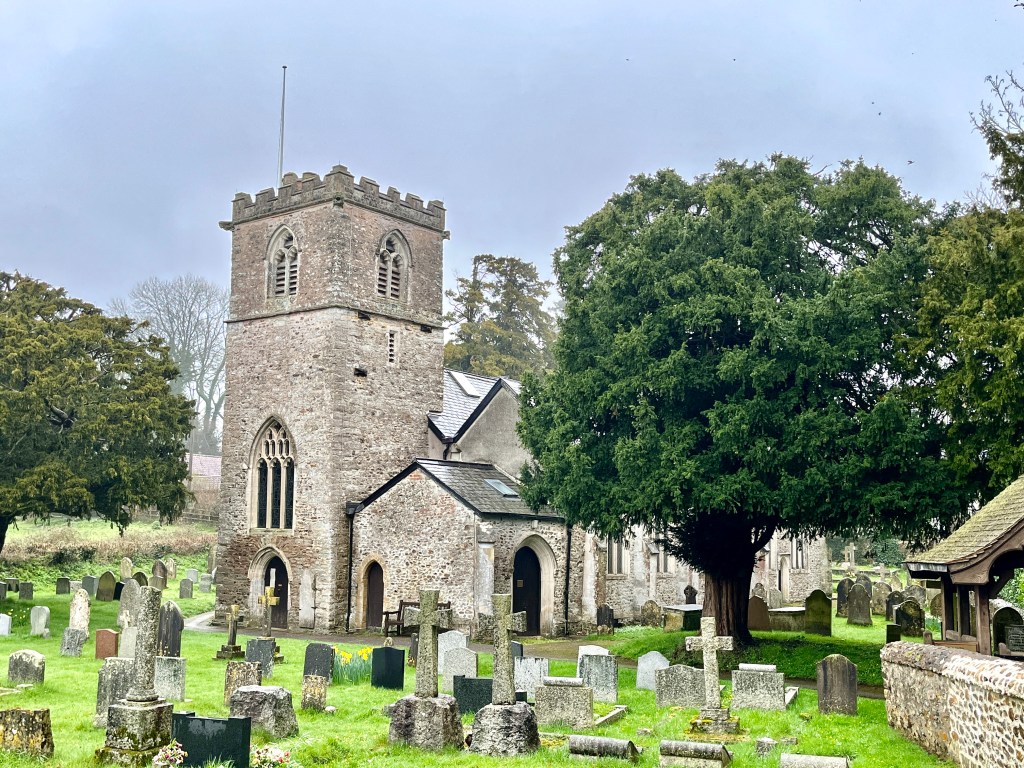
GRADE II* ✣ Recorded from 1139; present building has C13 origins (chancel); 14th-century arcades; then Perpendicular with subsequent rebuilding and C19 restorations (Fulford). Resting place of Viscountess Nelson.
I have not visited the church myself, but Ian Logan contacted me about the vertical dial on the apex of the church porch. I have written this post around the dial, however Ian has produced an excellent detailed description of the church and its history that I highly commend.
St Margaret & St Andrew . Littleham . Devon – Ian Logan
St Margaret & St Andrew . Littleham . Devon
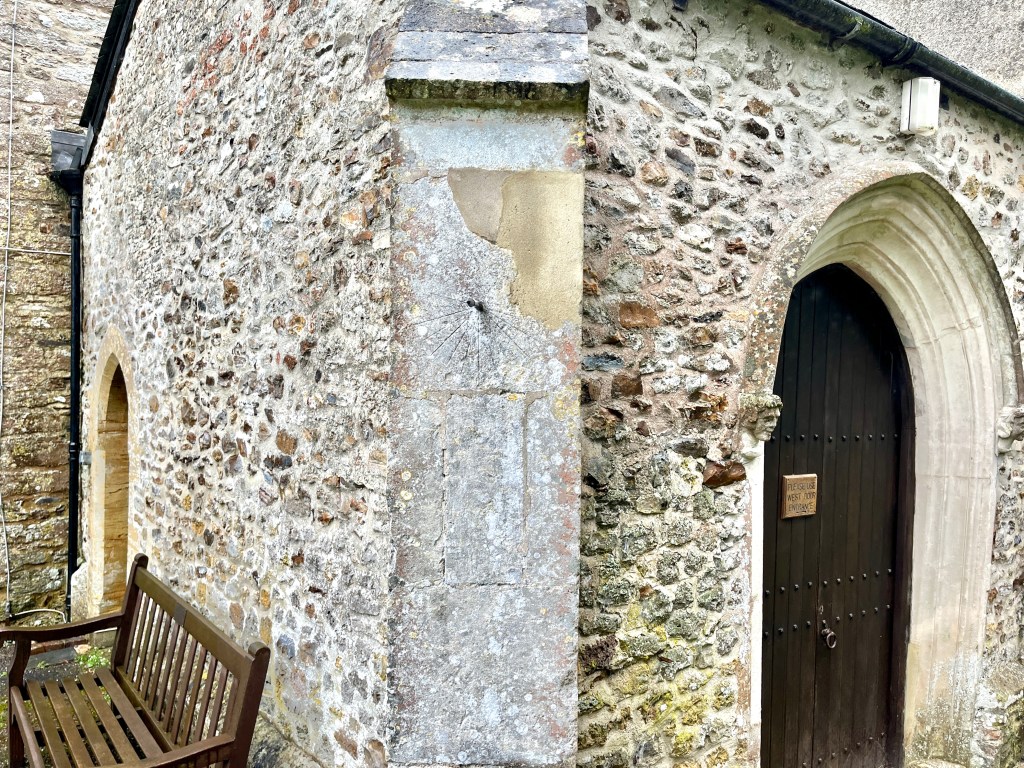
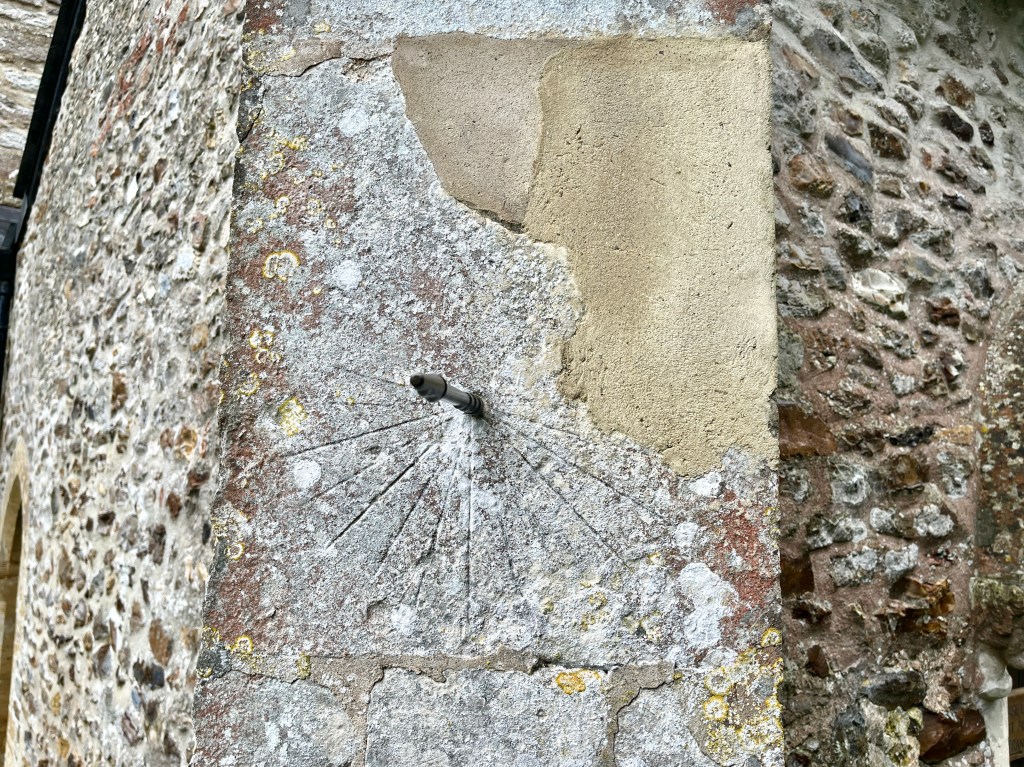
BSS record: A stone dial, rather crude in execution and in poor condition, is mounted on the church porch. It is about 600mm square and shows the hours VI – Vl undivided. Although the numerals look as though they are aligned with the hour lines, the hour lines themselves have disappeared. The church leaflet says that the dial dates from 1780.
St Margaret & St Andrew . Littleham . Devon
SCRATCH DIAL
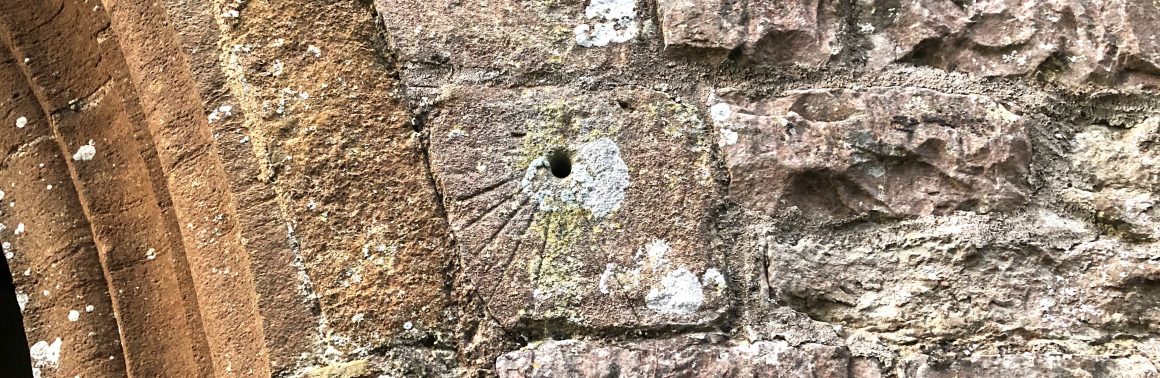
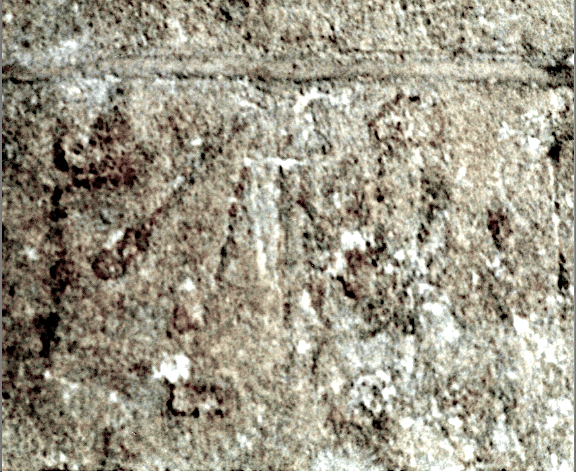
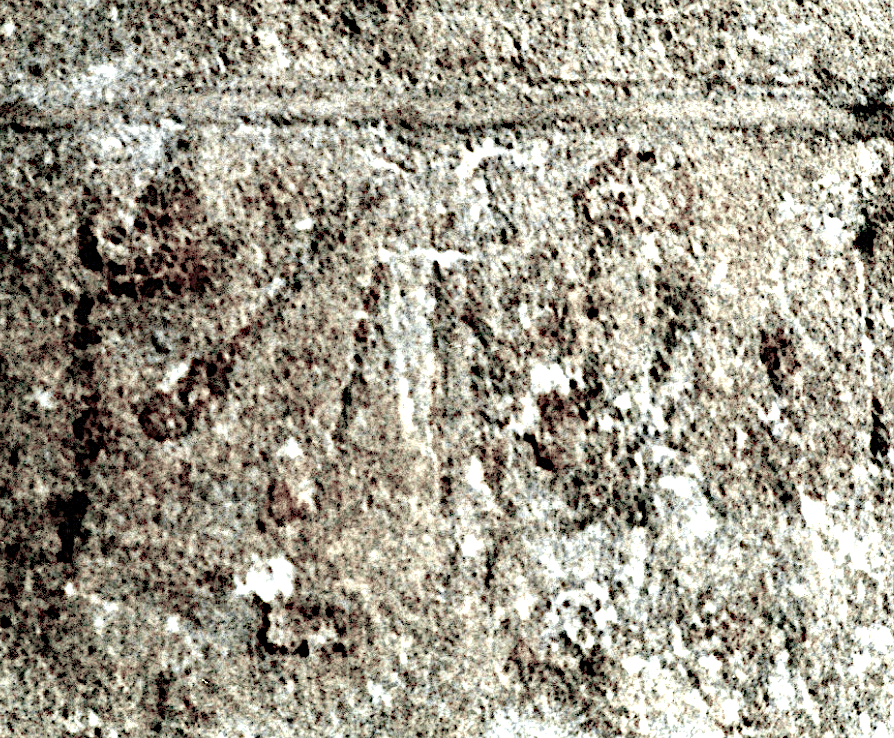
There is an older dial – a scratch dial – on the right hand side of the porch doorway, probably C15. It is in poor condition, but there are 7 discernible lines radiating from the gnomon hole in the dial stone. These are two quite old photos of the dial (BSS). If anyone can provide a clear recent photo, it would be very welcome as an addition!
The ‘dawn’ line is now a prominent cleft in the damaged dial stone. The cluster of lines at and beyond noon LRQ indicate the most important part of the day for observance (none in canonical terms).
St Margaret & St Andrew . Littleham . Devon – Scratch Dial
MRS CROWLEY
This is an ideal place to use the wonderful drawing skills of Mrs Crowley to illustrate the vertical dial and scratch dial together. I have managed to obtain a copy of the comprehensive book of her Devon and Cornwall dial drawings, a work of wonder for dial-ologists.
GSS Category: Vertical Dial (1780); Scratch Dial
Credits: Keith Salvesen (photos); Ian Logan (photo, research); The Parish History Group (interesting and informative leaflet)
GRADE I ✣ Saxon origins (c995?) perhaps on pagan site; Norman with continuing development. Vicars recorded from 1269. Careful restorations. Among the oldest and most architecturally significant parish churches of DevonSJ. A lovely location, concealed from potential marauders from the sea. Of great interest both inside and out; a church to explore thoroughly. The Church Guide (40pp) is excellent. Midway between Sidmouth and Seaton. 50.6902 / -3.1403 / SY195884
DIALS
There are three completely different dials. Dial 1 is a linear dial thought to be unique in Britain, with a buttress acting as gnomon. Dial 2, cut on the lintel of a blocked doorway, may be Saxon. Dial 3 is relatively conventional and located high on E corner quoin of the chancel.
DIAL 1
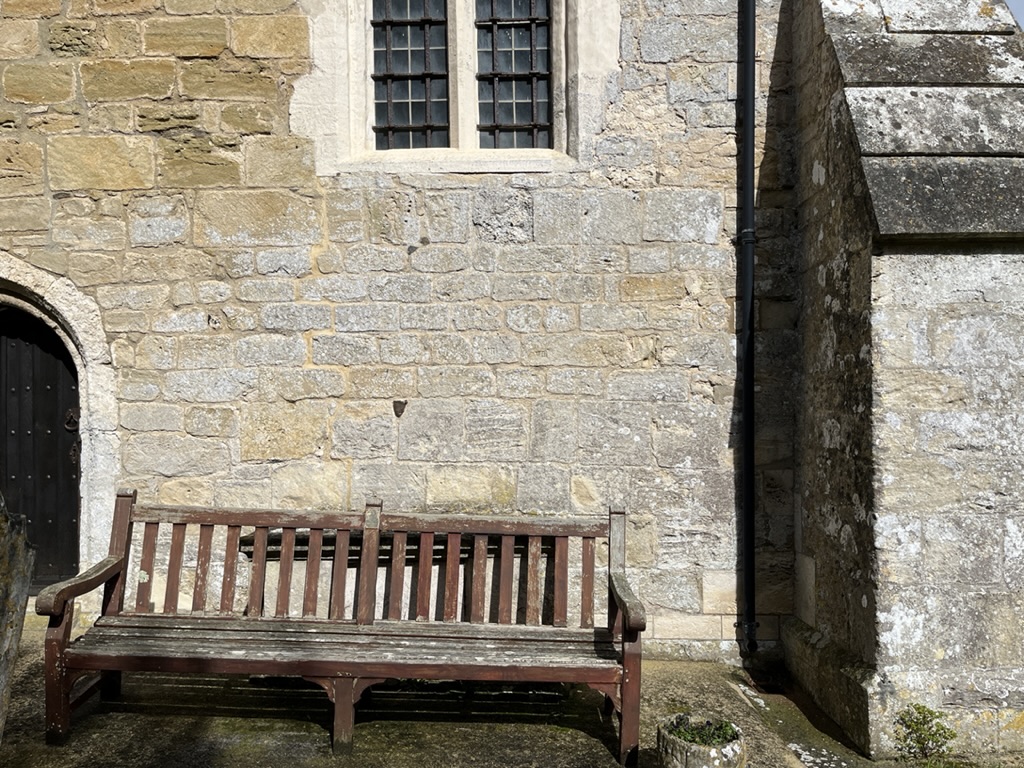
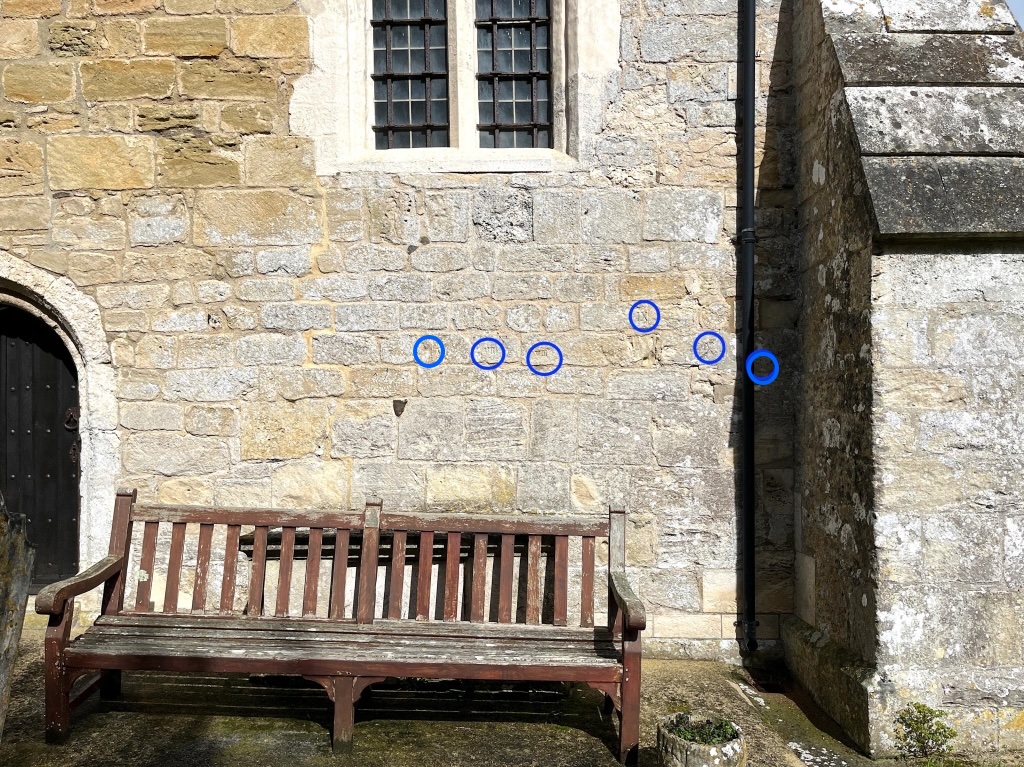
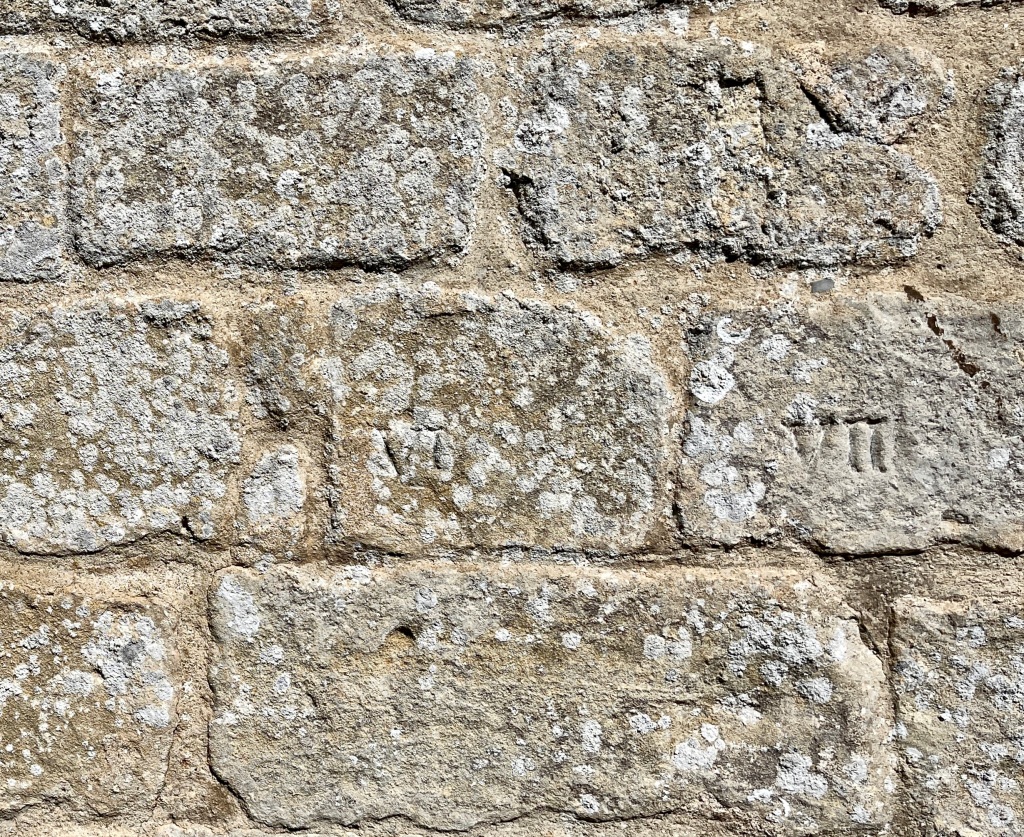
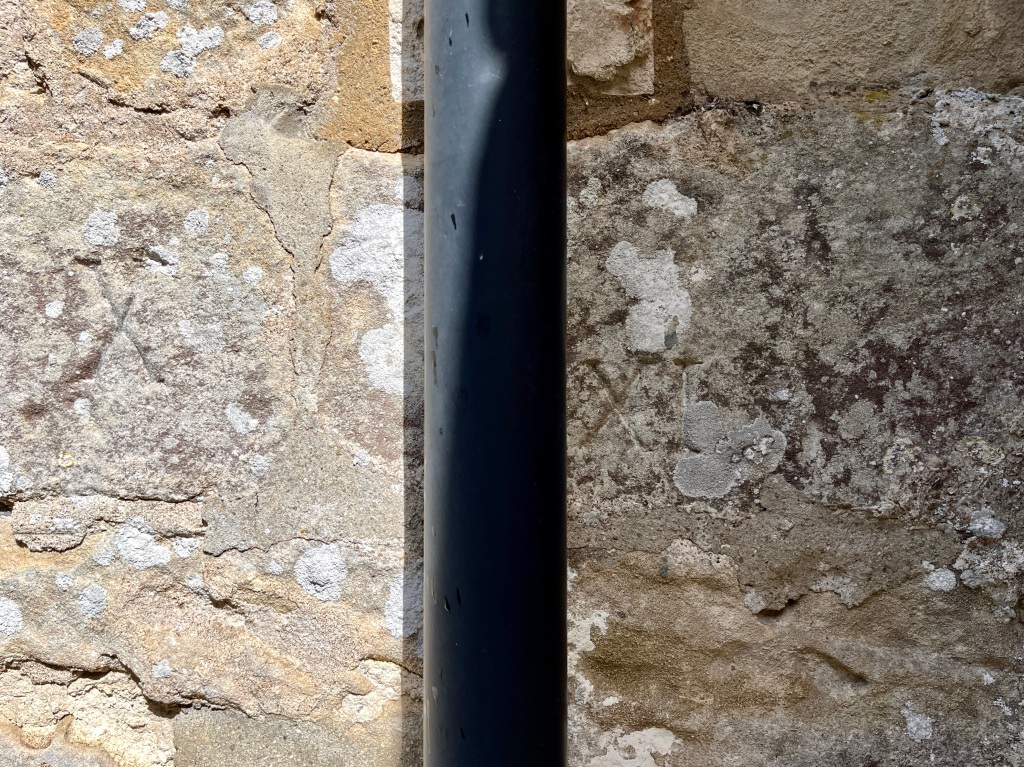
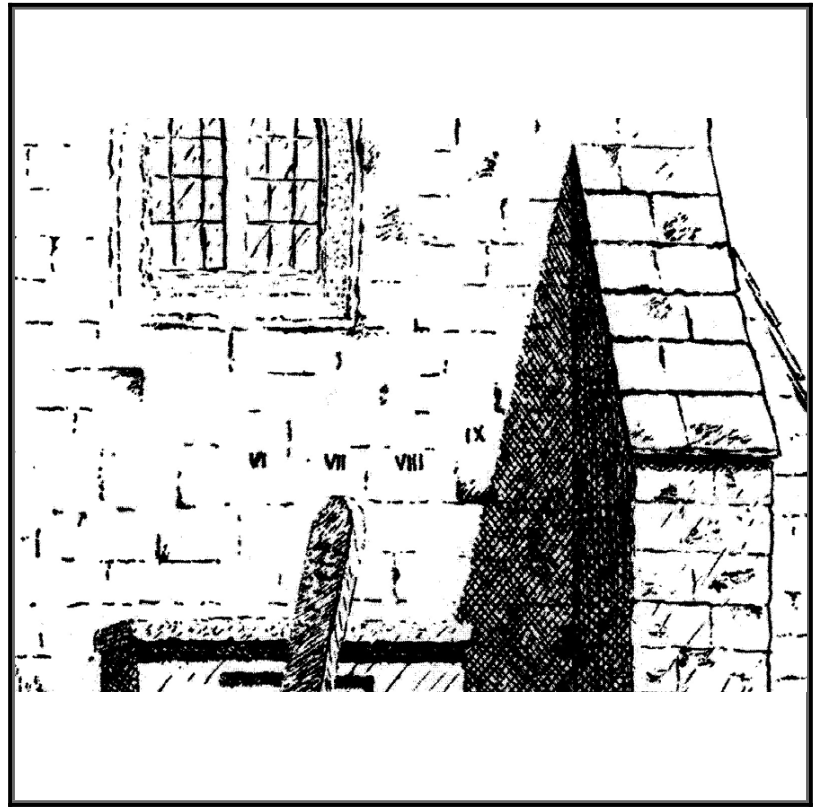
This remarkable dial is not circular but linear, and is thought to be unique. Roman numerals are cut in an approximate row along the chancel wall, so that the chancel buttress acts a gnomon casting a shadow that moves across the longitudinal numbers. XI is obscured behind the drainpipe.
VI, VII and VIII are thought to be original numerals; IX, X and XI are larger and later. The Guide to the church describes this dial as a ‘sun-clock’, which is surely a more appropriate and accurate name for it than ‘scratch dial’, and reflects its uniqueness.
There is another notable ‘buttress gnomon’ dial of a different kind at St Mary the Virgin, Iffley. It has 4 vertical incisions in a row, a compact marker of the passage of the day. Presumably it was designed to focus seasonally on the significant part of the day for Mass.
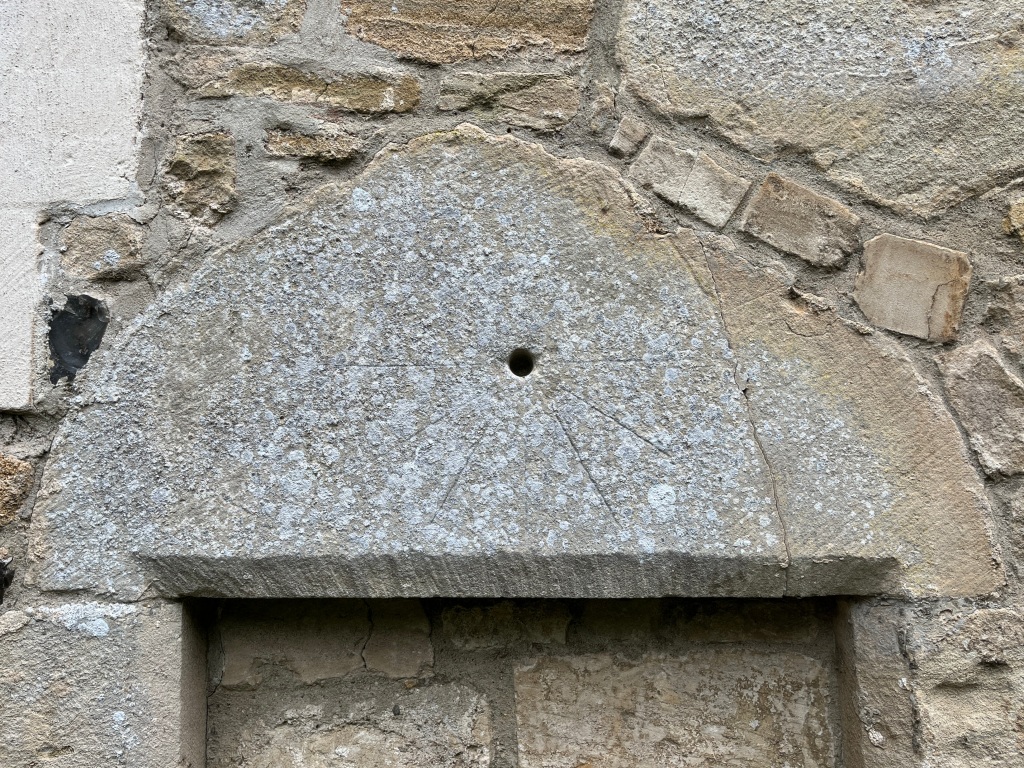
DIAL 2
Incised in the grey stone lintel of a blocked doorway believed to be Saxon. Unusual in that it has 6 lines (2 on the horizontal) cut almost with vertical symmetry, with no visible noon line. The 2 deeper cuts RHS suggest the time of day for the main Mass (None). The gnomon hole is big, perhaps enlarged at a later date. The BSS record includes the note Late Saxon / Norman? Originally on earlier church?
DIAL 3
A more familiar dial design high on a quoin stone at E end of chancel. There are 7 lines within a double circle. BSS notes that it has been re-sited, the top of the dial being on an adjacent stone. The gnomon is filled in a rectangle. Again, the two deeper cut afternoon lines suggest None as the main Mass time.
Drawings displayed inside the church
GRAFFITI
If you climb the stairs, as you surely will during your visit, you will find plenty of graffiti, much of it overpainted with long-weathered whitewash.
GSS Category: Scratch Dial; Mass Dial; Sun-clock; Unique Linear Sundial; Buttress as Gnomon; Medieval Graffiti
All photos Keith Salvesen; Drawings from Church & BSS
GRADE I † C12 origins (nave, chancel), gradual expansion C13, C14 and C15; restoration 1889. Norman doorway with fine Tympanum (long predating the inscription 1698). Good C15 wall paintings.Very close to the estuary, perfect for a walk or a bird-watch. 6m W of Lyme Regis. 50.7142 / -3.0546 / SY256910
DIALS
Three dials are recorded for St Michael. They are all similar and, unlike most multi-dial churches, their design give little sense of developing methods of marking the passage of the day.
DIAL 1
Dial 1 is located on the E quoin stone of the transept, with the gnomon hole in the mortar line. There are 3 distinct radials, and a 4th that is a faint trace. BSS records include the comment Rescratched and false gnomon added.
St Michael . Axmouth . Devon – Scratch Dial 1
The last record is dated 1994, since when the false gnomon has been removed. I have used an image from then; the dial is less easy to see now. The diagram below has a theoretical perimeter and time marks for a complete dial. The note no noon [line] is slightly surprising. Radial 3 looks vertical and possibly bifurcated in re-scratching.
St Michael . Axmouth . Devon – Scratch Dial 1
DIAL 2
St Michael . Axmouth . Devon – Scratch Dial 2
Dial 2 is cut on the Chancel chapel, E end of the wall, on a quoin stone. There are 4 lines radiating from a filled gnomon hole in the mortar line
In close-up (below) it is just possible to see that line 3 (L to R) is longer than the others. That could suggest a noon line incised slightly off true vertical. If so, on this simple dial it might be a casual approach to the medieval daylight hours. On a later, more sophisticated dial, it might represent a way to achieve accuracy on a church that was not square on to the true SWNE footprint.
DIAL 3
St Michael . Axmouth . Devon – Scratch Dial 3
Also situated on the wall of the chancel chapel, and again radiating from the mortar line. BSS notes 4 lines, but 2 cannot now be detected. However the suggestion that noon is marked by double lines is plausible. This might be for emphasis (as with a terminal pock or cross); or because the vertical was re-scratched.
GSS Category: Scratch Dial
Photos. Keith Salvesen; diagram and other material, BSS
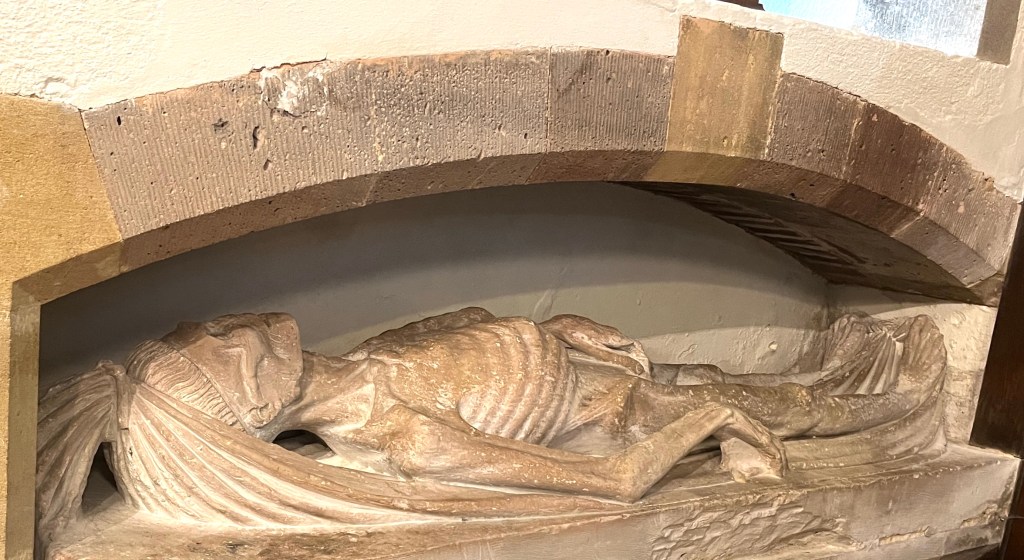
GRADE II* † Norman origins; rebuilding C15 & early C16; substantial restoration 1877. A church that repays one’s interest, with an intriguing Rood screen / reredos repositioning conundrum; and unusual chest tomb: on top lies the effigy of an emaciated cadaver partly covered by a shroudBLB. 14m E of Exeter, 5m W of Honiton. 50.7875 / -3.2659 / SY108994
DIALS
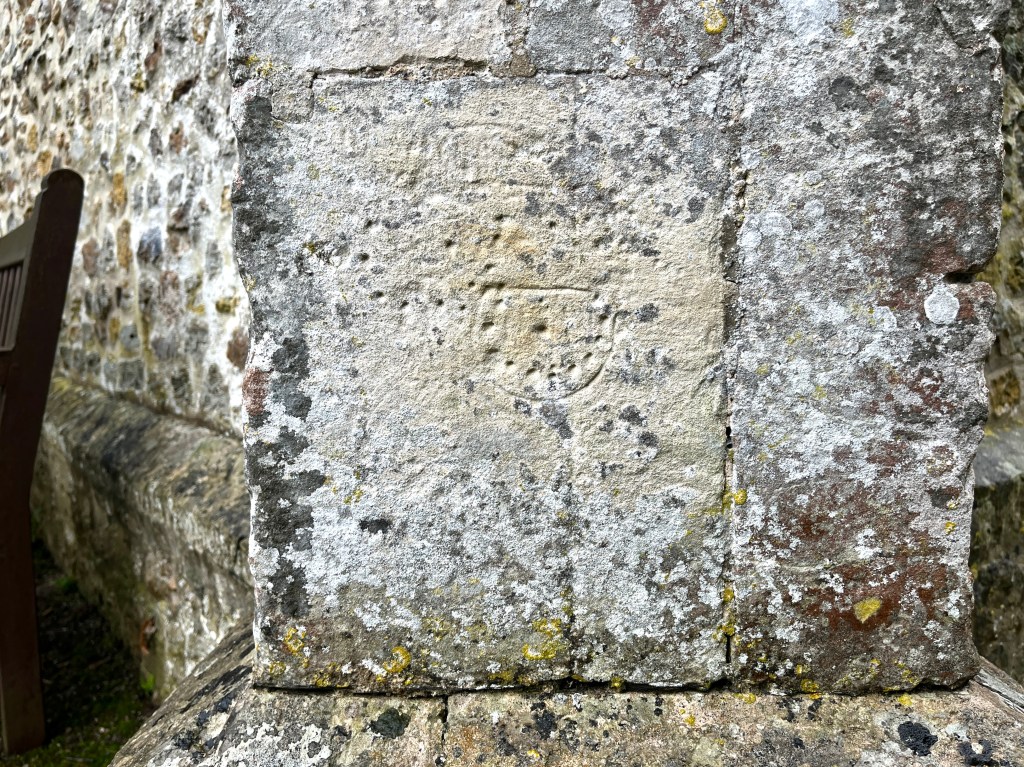
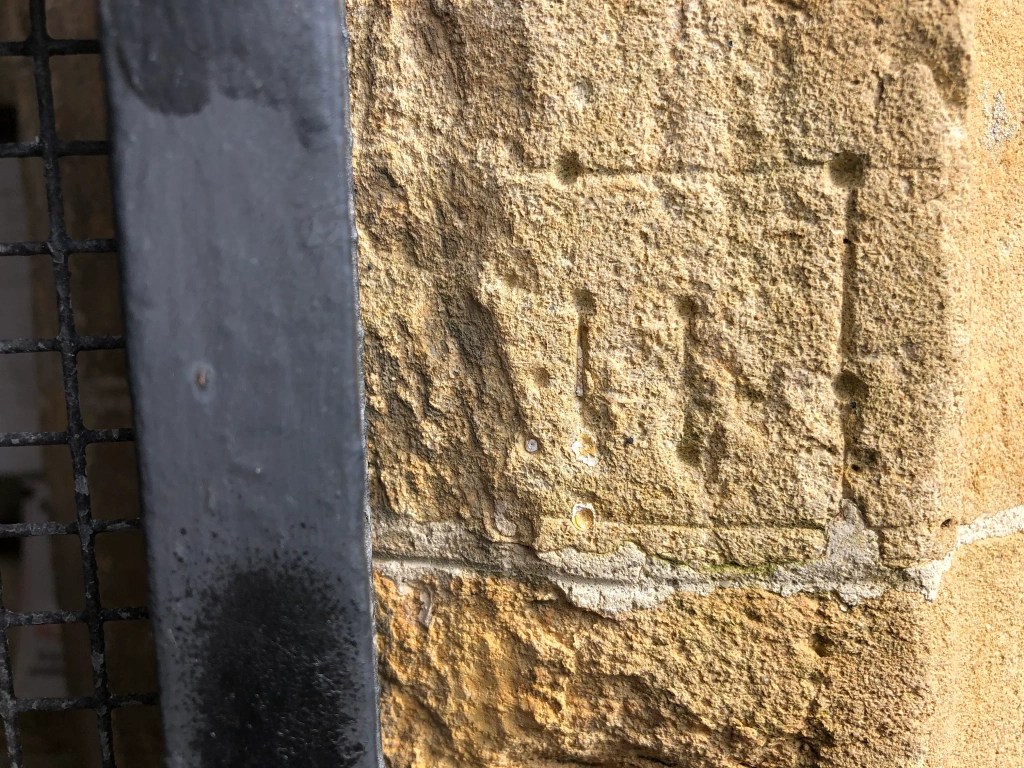
St Andrew has 3 scratch dials, the most obvious being visible from the lych gate and as one approaches S porch. The other 2 dials, very close together, are remarkable and probably unique (certainly so as a pair). Dial 3 may be doubtful. An additional basic but dial-ish scratching is shown below, as are various other church marks including a good example of a Consecration cross.
DIAL 1
St Andrew . Feniton . Devon – Scratch Dial 1
Dial 1 on the porch buttress is a straightforward design and easy to make out, but damaged and cement patched UR. There are 13 lines, some now very faint. The angles are more or less accurate at 15º. The vertical / noon line is not emphasised in any way, which is slightly unusual. The main Mass was presumably Terce, marked with a deeper cut line LHS. The gnomon hole has been filled with a rather well-chosen rounded arrow design; it is modern yet respectful of its purpose.
DIAL 2
St Andrew . Feniton . Devon – Scratch Dial 2
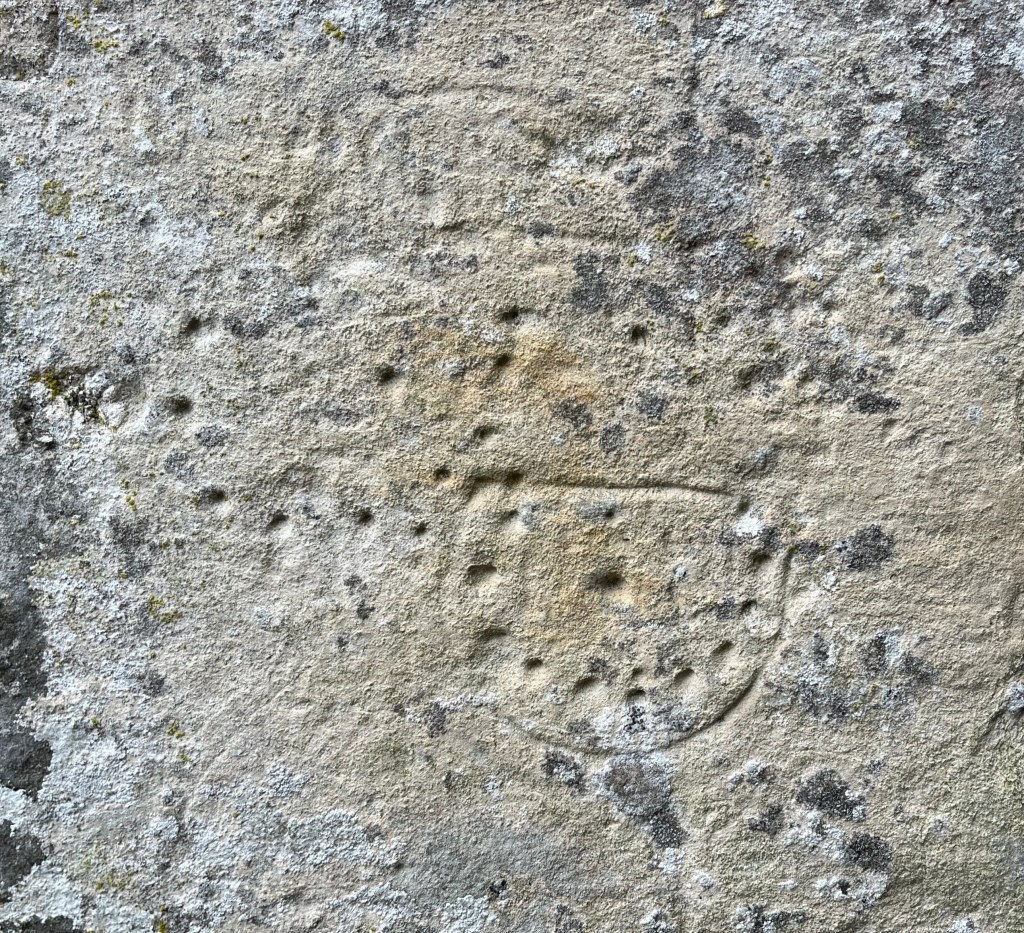
Dials 2 & 3 are adjacent low down on the same porch buttress as Dial 1. It is a remarkable juxtaposition. BSS suggests they are early dials – pre-1400?
Dial 2 consists of a pattern of pocks contained within what could be termed geometrically as the major segment of a circle. The horizontal line is incised more deeply. BSS suggests that 13 pocks are identifiably associated with the dial, with a few random ones besides. The quite shallow gnomon hole in such a small design presumably contained a stud rather than a rod.
A noon line is seemingly marked by the sightly offset double pocks just R of the vertical. Theres’s also a very small pock directly above the gnomon hole, conceivably a decorative-use-only marker for midnight and symmetry.
DIAL 3
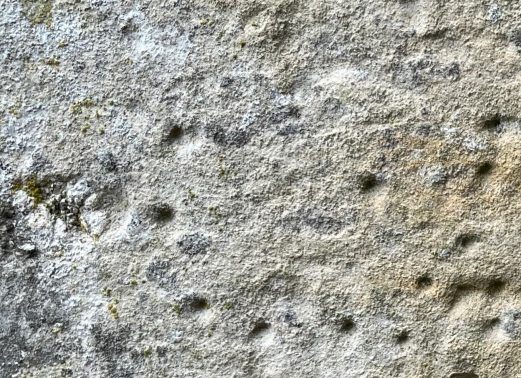
Dial 3 The BSS entry for this little configuration of dots describes a semi-circle of 8 pocks, with other associated pocks and no obvious gnomon hole. It concludes closely related to dial no. 2, possibly never used as a dial.
Perhaps it is not a dial at all. The rather untidy part-circle curves away NE after noon – pointlessly, if part of a dial. BSS notes that there is no central style hole. There is a single pock inside the perimeter that might have held a stud – but unlikely to be much use in that position. Some might suspect unserious pattern-copying efforts along the lines of Dial 2.
St Andrew . Feniton . Devon – Scratch Dial 3
My amateur reading of this buttress as a whole is firstly, that the low stone on which Dials 2 & 3 are located is not its original location. At some stage during all the rebuilding and restoration over the centuries it was re-sited. The little dial that ‘worked’ was then too low and would anyway have been an obsolete design. It was therefore superseded by a far larger, more modern (? mid C16) and very visible dial, accurately cut and ideal for marking the passage of the day for a larger, better educated community in a more modern era. Comparatively.
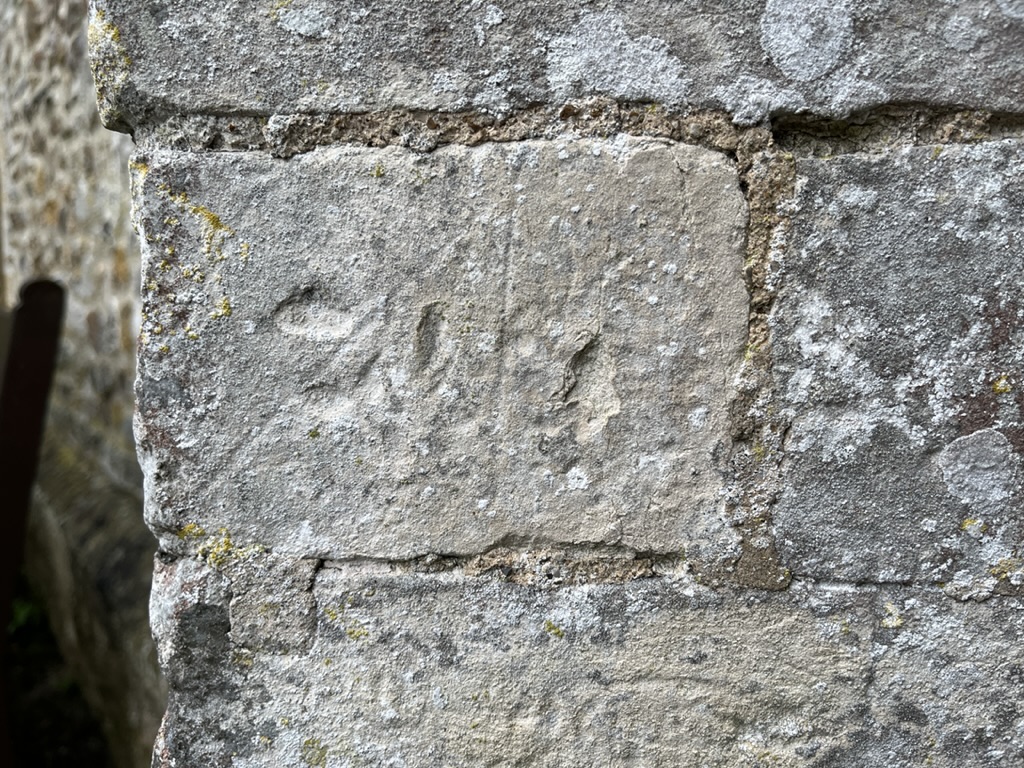
DIAL 4?
Both lines seem deliberately scratched. One is approximately vertical, the other could mark the Mass time Terce (cf Dial 1). The lines diverge from the mortar line, as do many simple dials – it means not having to drill a dial gnomon into stone. I have seen less convincing 2-line versions that have been recorded as dials. I am slightly in favour of it being a dial.
CONSECRATION CROSS
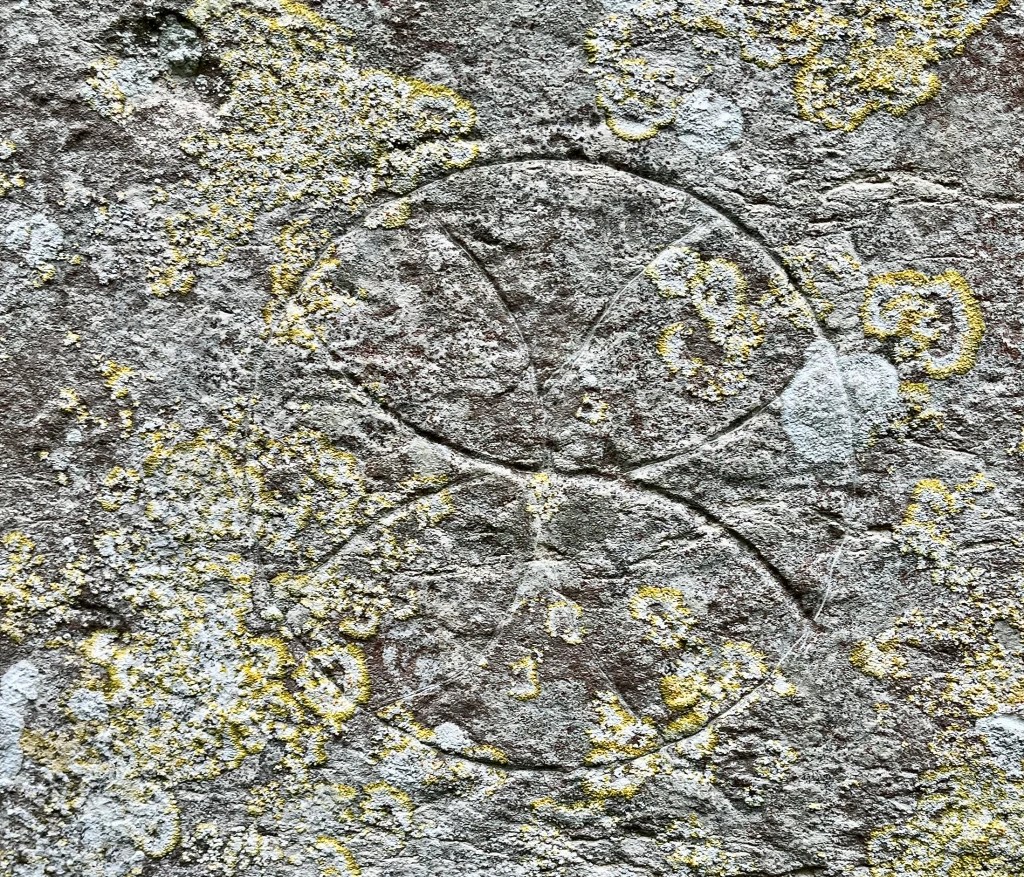
This is a good example of a rural consecration cross, incised on a buttress between 2 windows. From a distance the design might mislead and be seen as four petals, rather than a compass drawn cross. There are hints of an outer circle. This is a fairly common type of cross, but good see one that is relatively unworn. The four distinct quarters rule out ID as a protective hexfoil, although there is a similarity.
GRAFFITI
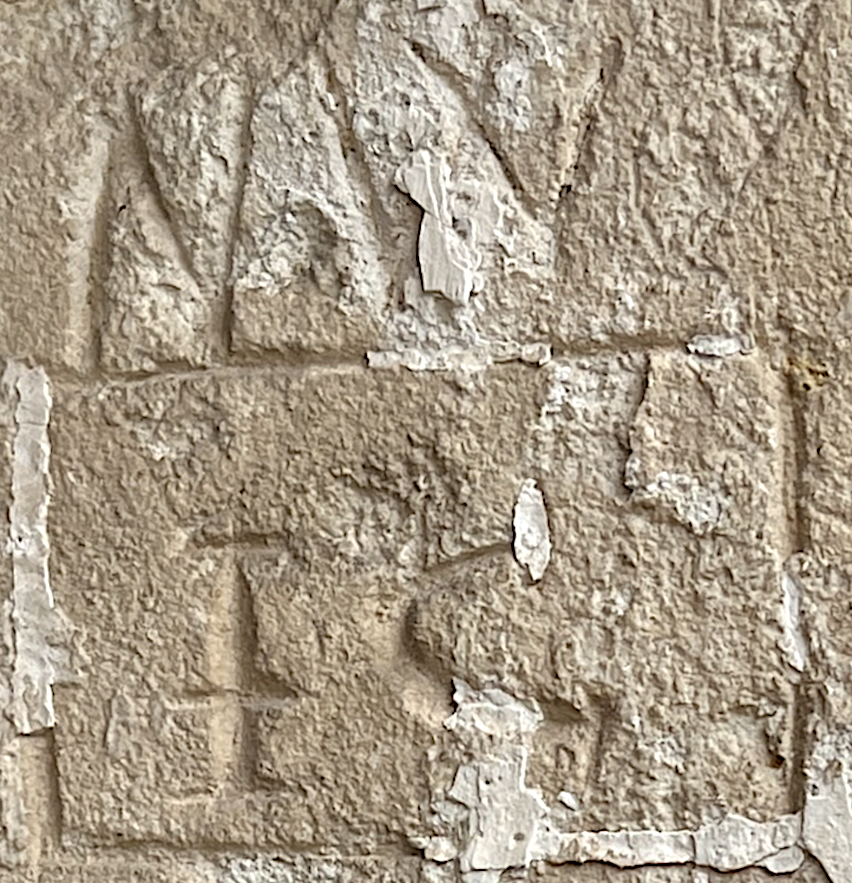
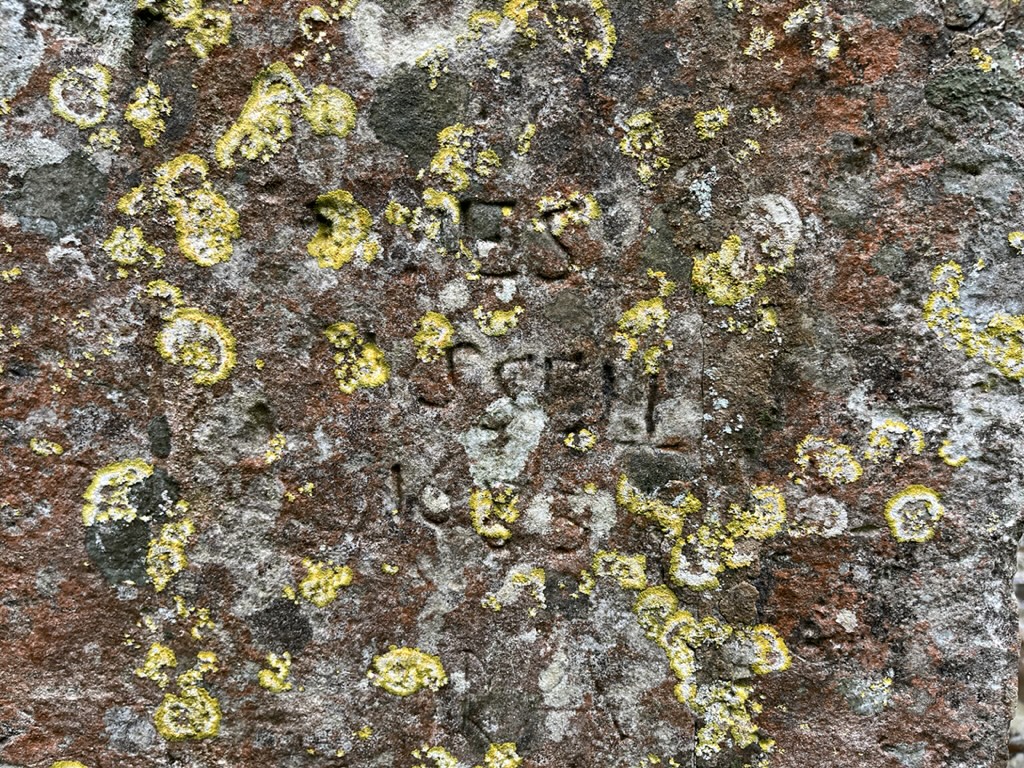
Graffiti on two adjacent stones, one example dated ?1675
PROTECTION MARK
This is very likely a ritual protection mark / apotropaic symbol designed both to prevent evil from entering the church, and to repel it. For that reason they are most often found inside or near porches. I haven’t encountered the pattern below before, but a group of dots with some joined by deep cut lines is a commonly found design – see an example from Dorset below.























 GAUDIUM SUB SOLE . SUNDIALS . MEDIEVAL TO MODERN