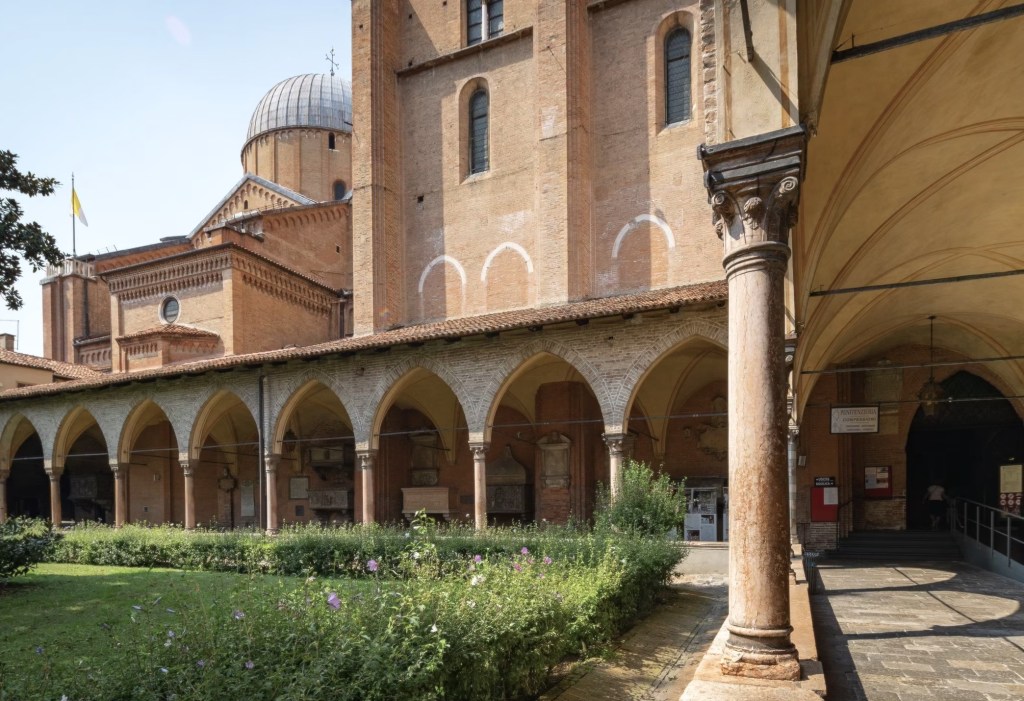
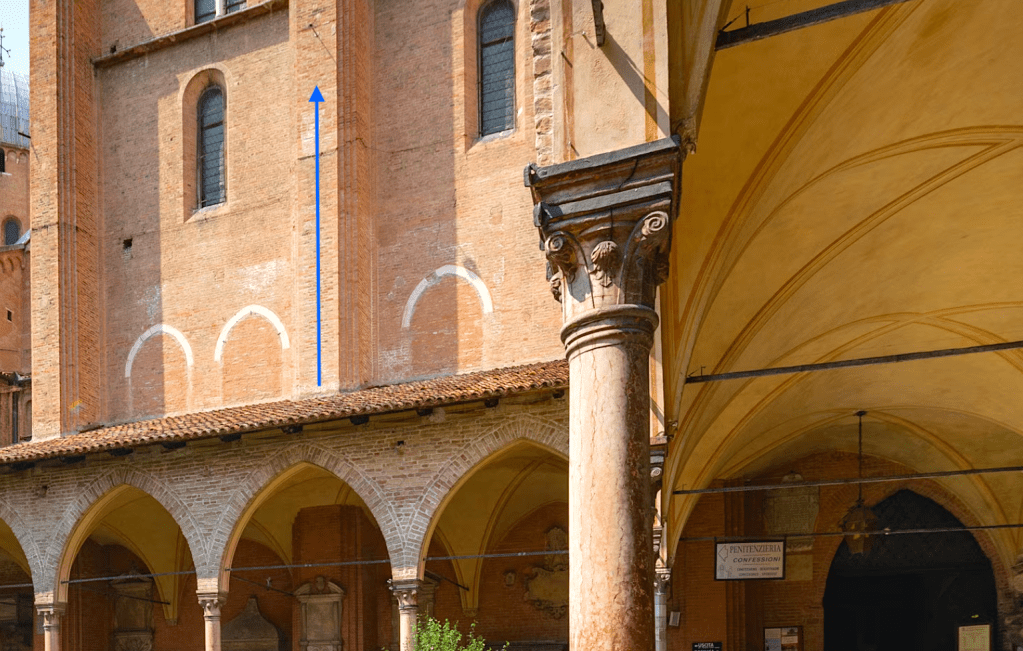
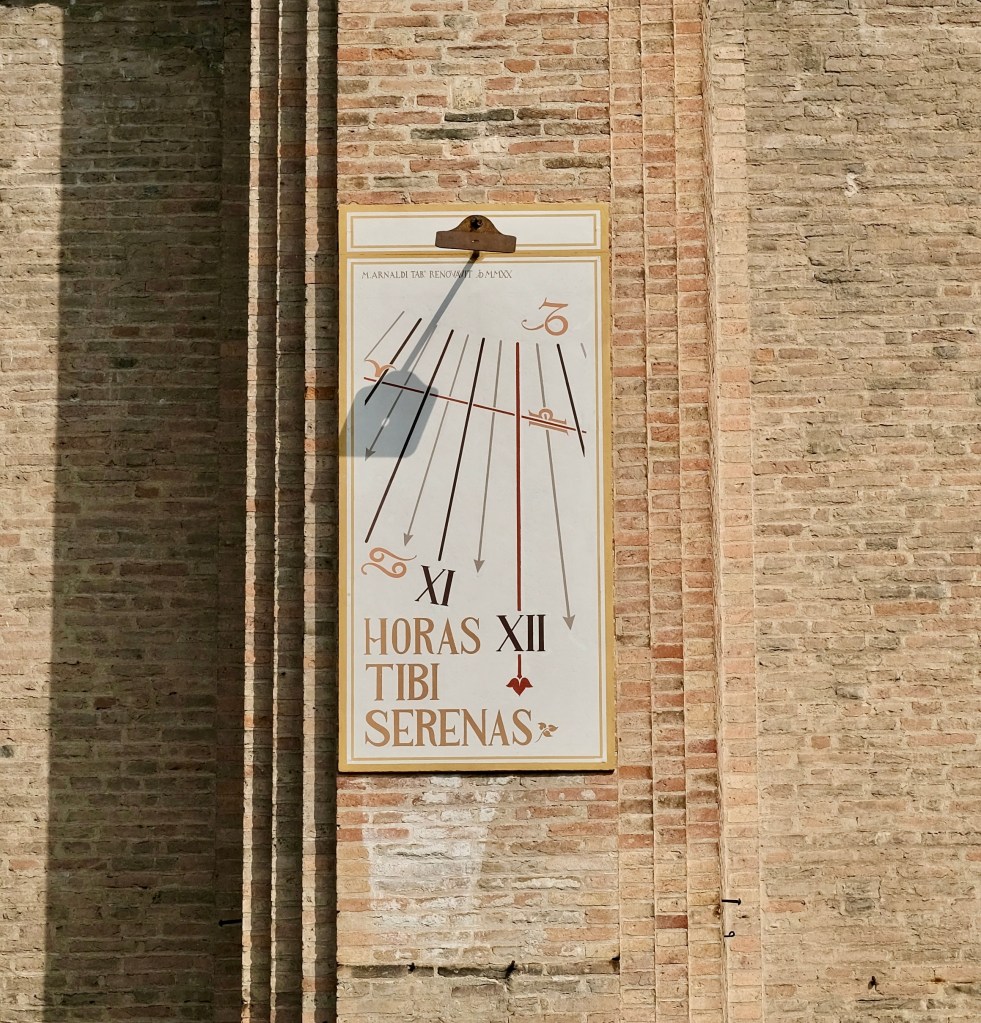
The oblong dial is located high up on the south side of the Basilica. Its modern design contrasts notably with its setting. I can imagine some debate over modern versus traditional styles. It was installed in 2020; a caption refers to renovation.
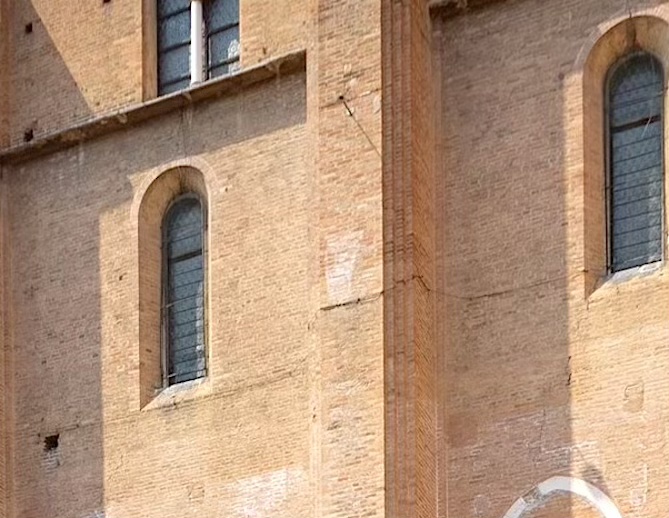
The dial’s height and size makes it very visible. John Renner, who took these photos, suggests convincingly that there must always have been a dial of some sort there, I’d have thought, to be visible to the friars from their cloister and help them say their hours on time. I have now managed to locate a photo taken from the cloister of an earlier dial with a much simpler day-marker. Probably it replaced an even earlier one.
The details of the new dial include 4 signs of the Zodiac; 2 midday roman numerals; 1/2 hours marked with pale arrowed lines; and a fairly traditional motto. The most interesting feature is the gnomon, which is tilted for accuracy and looks adjustable. As the photos clearly show, the sun’s rays are focused through a small hole onto the dial face – here, at exactly 9.30 am.
See HERE for the Scaphe Dial in the Padua Botanical Gardens (one of 3 dials there)
Basilica of St Anthony . Padua . Wiki
GSS Category: Modern Dial; Vertical Dial; Dials in Italy
All photos: John Renner, with thanks as always; Expedia for the old dial
The dial is 10′ up on the SE corner of the nave. Gold lines on slate ground. Open gnomon. Numerals not gold. Date at top with scrolls all in Red. Uses XII and IV, with all numerals vertically arranged, and shows 6am to 6pm in half hours. Lines drawn from small semicircle at root. Full length half hour lines (BSS).
This is a fine MM dial and a pleasure to walk towards. Hopefully the gnomon can soon be pegged back into the upper hole, making the time of day easier to determine.
GRADE II* † C13 origins; C15 tower; C19 restorations esp by Wyatt, some work reflecting the older styles. PEV – with an eye for quirks – notes Manual fire engine said to be early C18. 4m N of Wilton. 51.1188 / -1.8863 / SU080355
VERTICAL DIAL
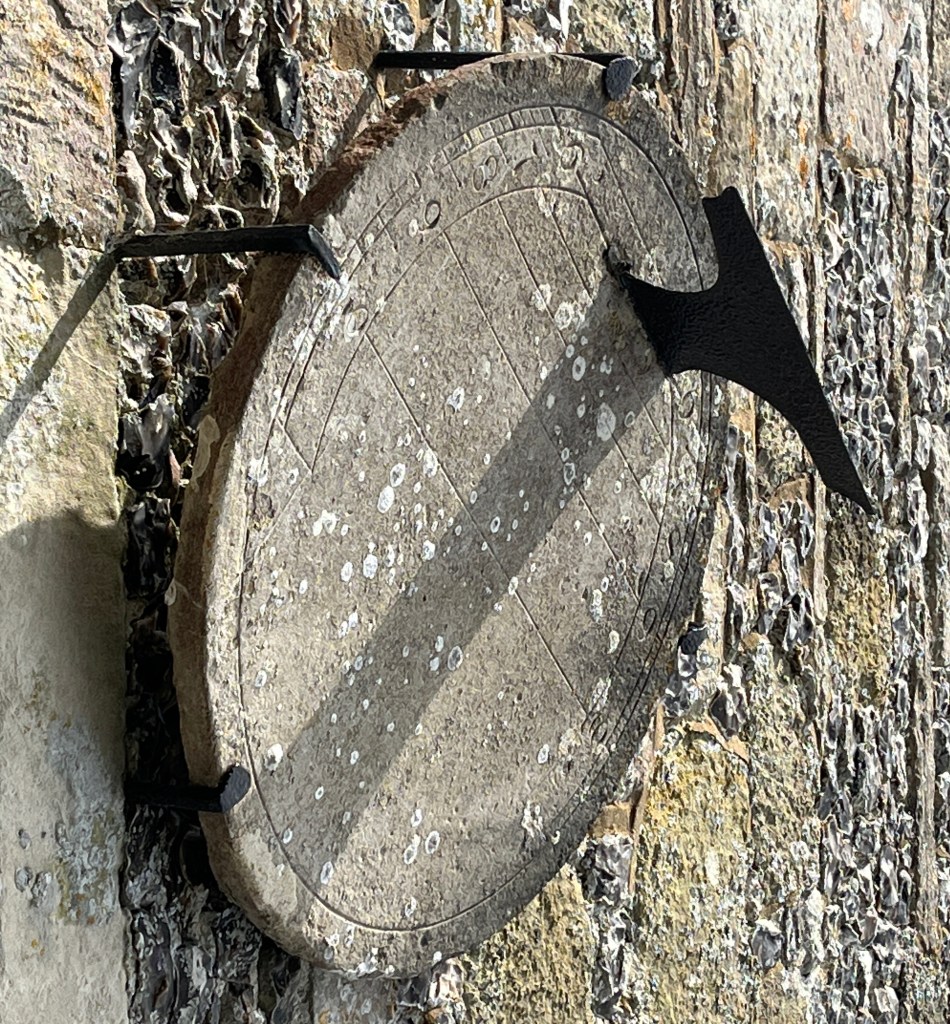
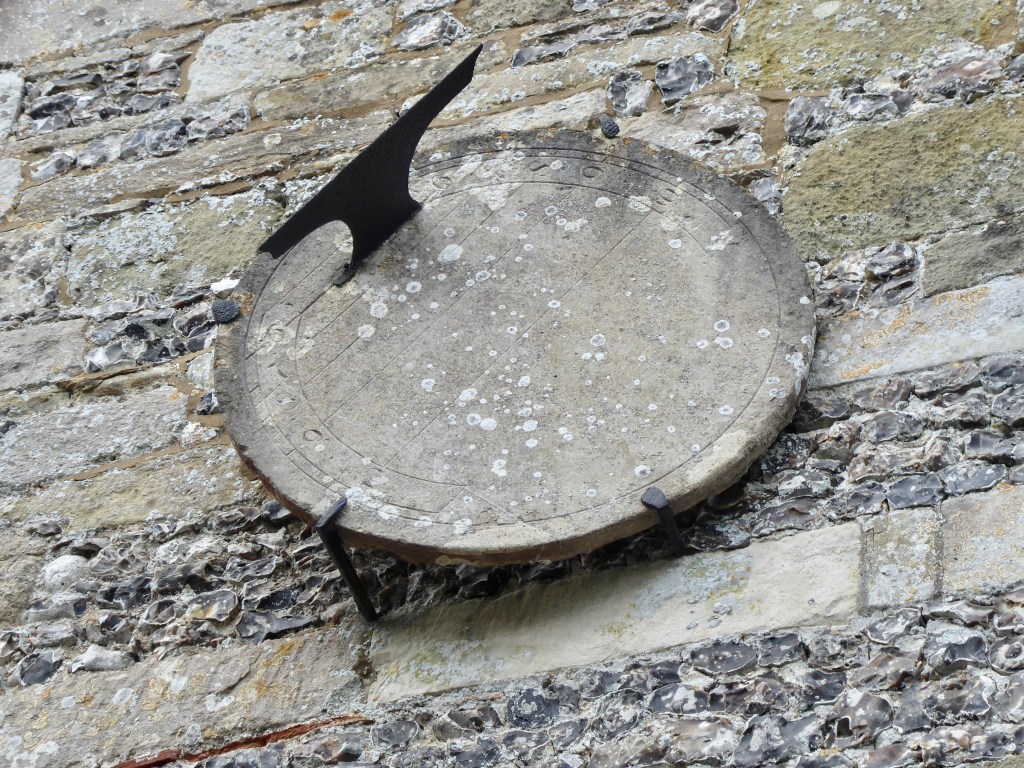
On a recent trip to the Wylye Valley to look at specific churches for scratch dials, I passed through Great Wishford. I stopped, not because I expected to find a scratch dial, but because I noticed an unusual circular dial on the E end – something like a satellite dish for receiving the sun’s rays. I hope someone will enjoy working out how the dial works in practice; or even whether, in its position and at that angle, it is accurate.
My amateur skills fall well short of understanding how the dial works in the technical sense. The position and angles of the dial and gnomon seem all wrong. The numbering, too. On a dull day I was fortunate to catch a moment when the sun cast a shadow.
GRADE I † C12 origins (?); C15 inc tower & porch; C16 rebuilding / additions. Material from nearby Milton Abbey incorporated. C19 restorations. In proximity, a fine early vertical sundial (1690); 2 date stones (1569); scratch dial (probable?). Several excellent gargoyles N side. 2m W of Milton Abbey. 50.8259 / 2.3114 / ST781029.
VERTICAL DIAL
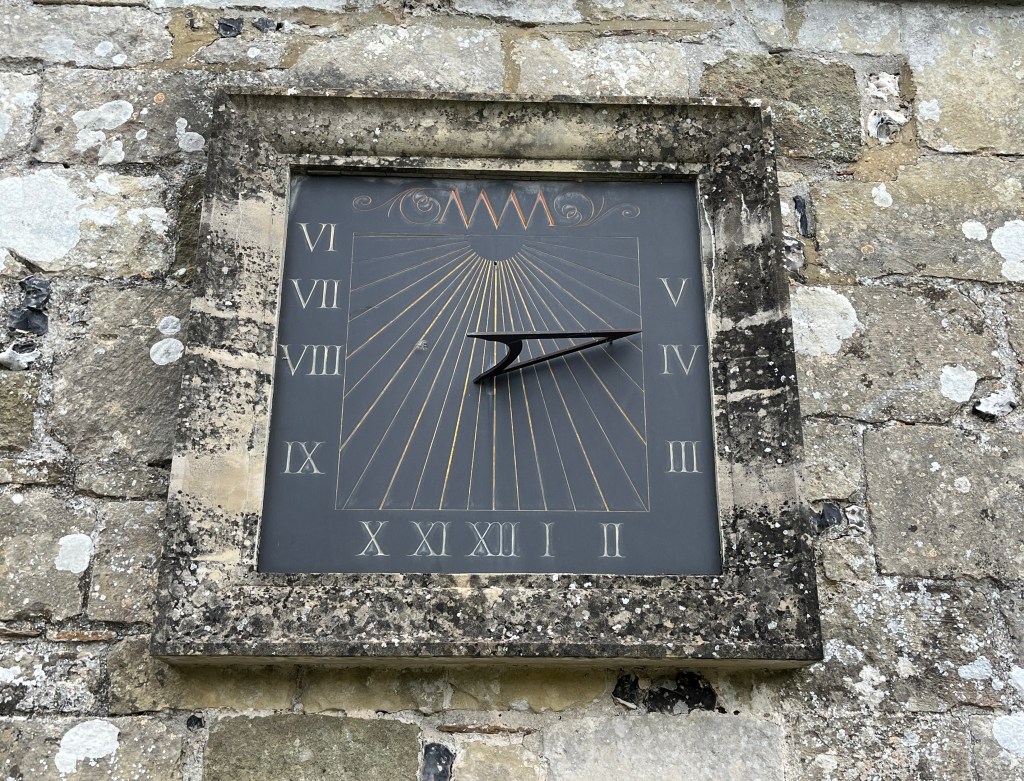
A fine dial in very good condition for its age. The gnomon is an amusing extension of the sun’s nose. I took the design LL corner to be an hour-glass, which would be appropriate. In close-up I wonder if it is a religious symbol; and if the design LR corner is a square and compass.
DATE STONES
THE BAGPIPER
SCRATCH DIAL
The dial design of a double circle with a hole in the centre is far from unusual. No lines, no pocks; just a stick needed to mark the passage of the day. This type is generally included in the Scratch / Mass Dial category of church marks; and I go along with that. However, having recently researched Cyffe Pypard and Fovant (both Wilts) which have several dials including this design, I am beginning wonder. It’s hard to think of a reason why a dial-cutter would not to add lines, pocks or both to a device specifically made to mark the passage of the day. But what if these are apotropaic symbols cut into the walls of the church to catch evil: ‘Demon Traps’ from which, once entered, encircled evil could never escape?
GSS Categories: Vertical Sundial; Old Sundial; Date Stones; Gargoyles / Hunky Punks; Scratch Dial
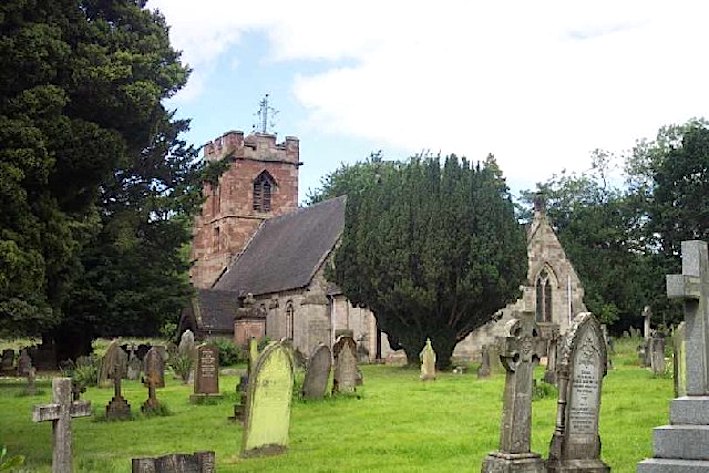
St Mary . Castle Bank . Stafford – Geoff Pick Geo CC / OS
CHURCH OF ST MARY . CASTLE BANK . STAFFORD
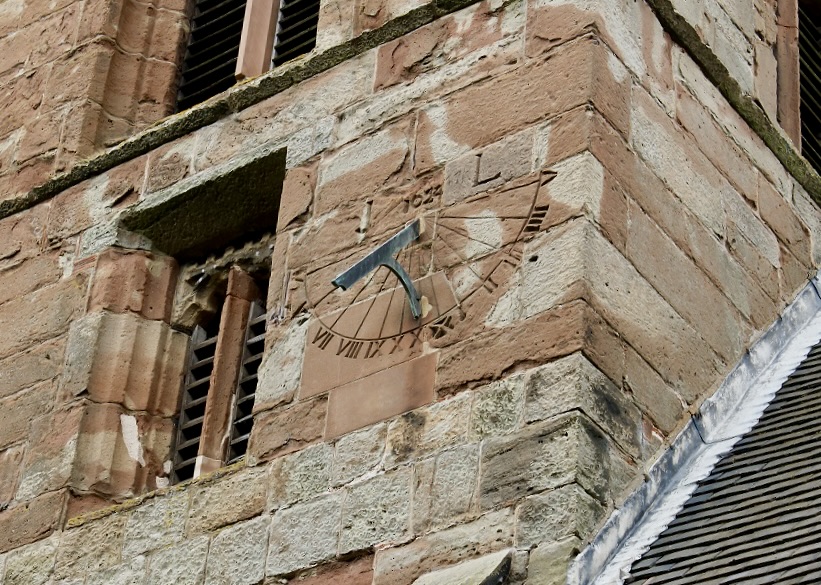
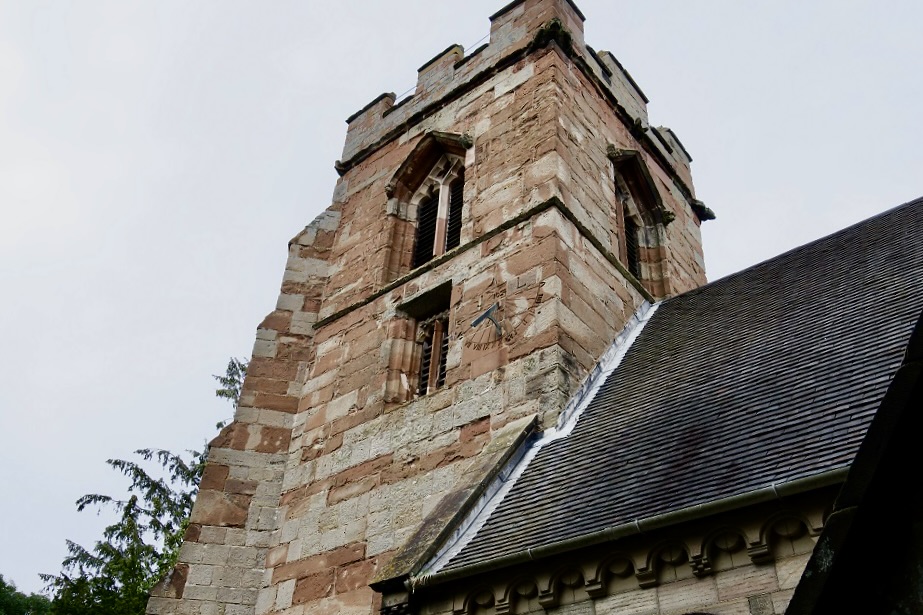
GV II* † C15 tower; otherwise mainly C19. Tower has 2 diagonal buttresses, plinth, south 2-light straight-headed window with sundial to right: incised inverted semi-circle with gnomon and inscription: J 1624 L BLB . In Newport Road below the castle, not to be confused with the large ‘collegiate’ parish church, also St Mary. 52.7969 / -2.141 / SJ905221
St Mary . Castle Church . – Vertical Sundial
DIAL
The vertical dial is high up on the S side of the tower, a semicircle with Roman numerals, with the date 1624 and on either side of it the letters J and L. The date may fit with work carried out on the upper stage of tower in C17. As can be seen, there has been good repair work on the dial, so that it is observably both ancient and modern.
GSS Category: Vertical Dial; Church Sundial; Old Sundial
All photos: Erika Clarkson, with many thanks for this and her other contributions to this project; Geoff Pick for his photo of the church Geo CC / OS
GRADE 1 † Records from 1254; low C14 tower (1st stage) later heightened; mainly C15 / 16. C16 waggon roofs. Bells from C17. Restorations 1870s. BLB notes coped gable with apex cross, but omits the prominent dial. A fine hillside church with wonderful views from high above the Wye valley. 6m S of Monmouth. 51.7932 / -2.6945 / SO521107
St Mary . Penallt Old Church . Monmouth – Vertical Dial
DIAL
An excellent dial, easy to miss. The tree-lined avenue that now leads to the church completely obscures the dial as you approach up the path. Trying to view the dial from other vantage points gives a sideways view. Attempting to take clear shots of the dial is a pleasurable challenge. Move branches aside.
The dial makes for an attractive gable end, and is surmounted by a cross. It is fairly damaged / eroded. A 6-to-6 dial with noon marked by a cross; IIII as IV. The gnomon is modern and rather squiggly / shiny for an old dial.
Dating the dial is not easy. A broad comparison with similar dial designs suggests ± 1800.
The Old Church is in a lovely setting, and besides TRELLECK this is the most rewarding dial to admire in the immediate area. Take a small picnic and sit in the churchyard for peak enjoyment. Other treats include a handsome door (1532) and a walk-though squint.
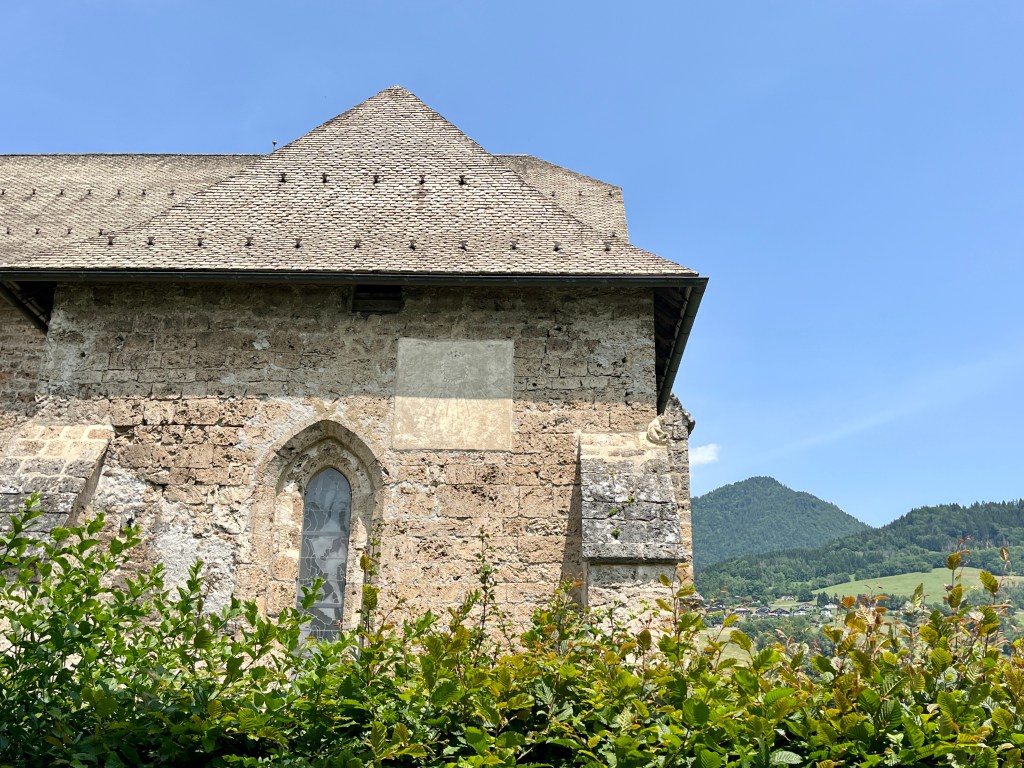
Chartreuse de Mélan . Taninges . France – Vertical Dial
Cat / Salamander Hunky Punk
The Chartreuse was founded in 1285 as a Carthusian nunnery and continued its religious functions until the French Revolution. Thereafter it became a school and in due course an orphanage. A disastrous fire in 1967 destroyed almost all the buildings on the site, with loss of life. Only the church and its cloister now remain. The church is an exhibition space and the lawns around it feature examples of modern art, from interesting via enjoyable to a few that are a matter of personal taste.
Chartreuse de Mélan . Taninges . France – Vertical Dial
The dial is included by MICHEL LALOS in his excellent French Cadrans Solaires site. Anyone who has in interest in sundials in France will benefit hugely by using this free resource. It is accessible, informative, and easy to use – not least because the dials are featured by Départment with a map for dial locations. The entry for Mélan is :
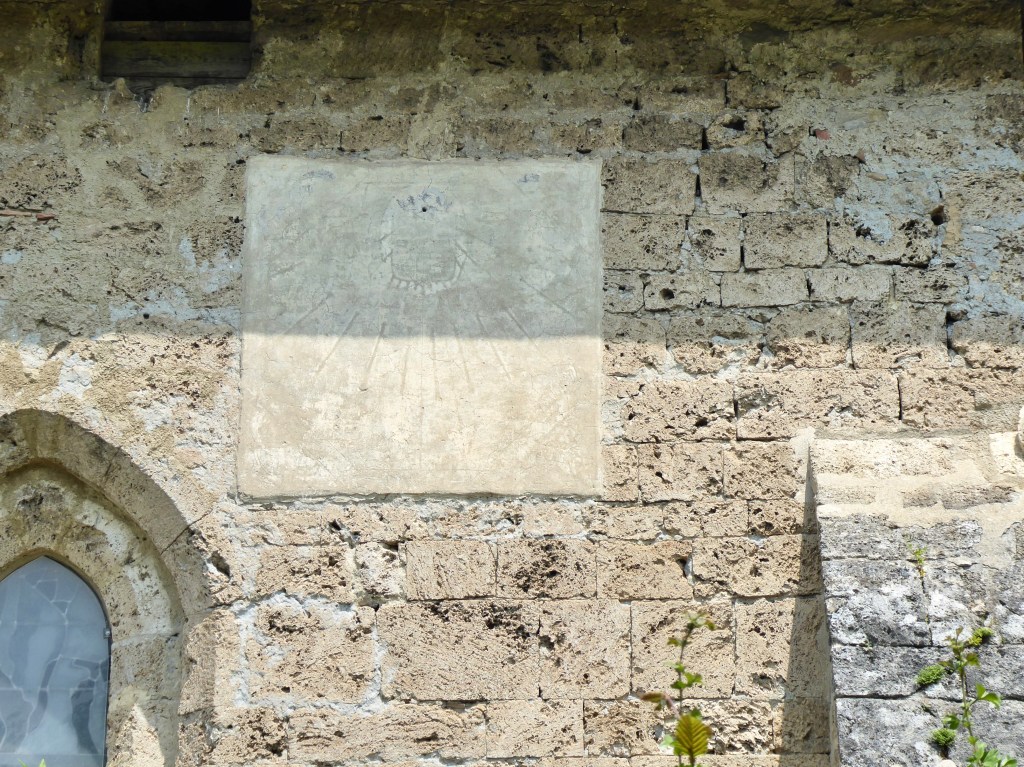
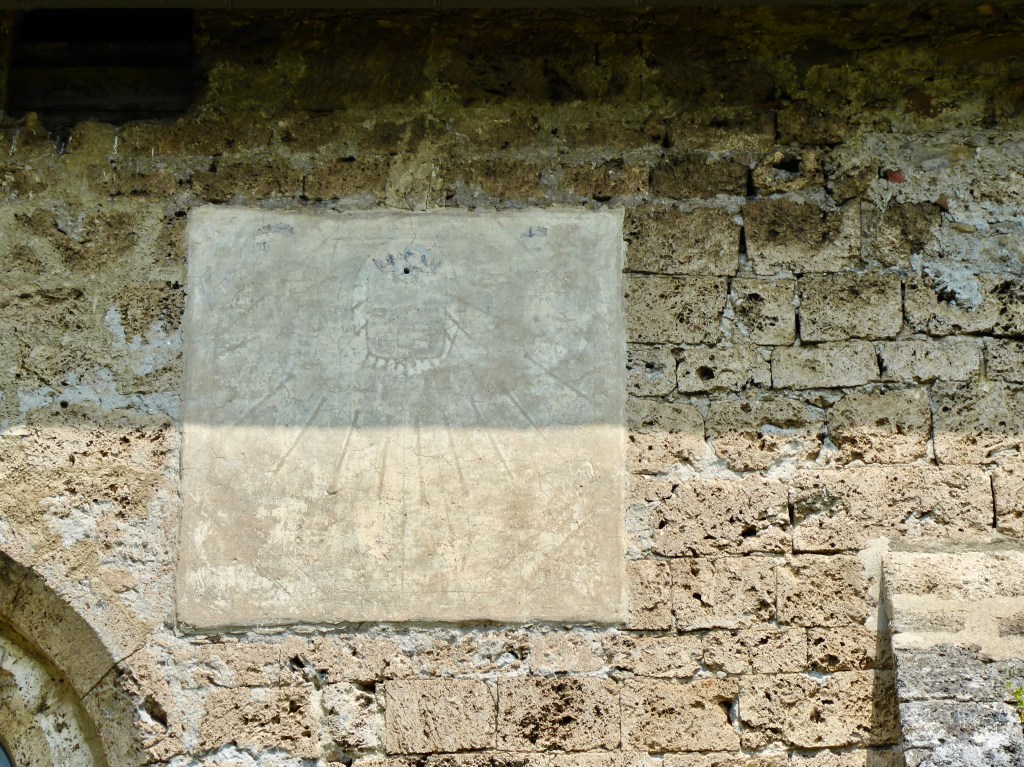
Cadran peu déclinant de l’après-midi, gravé et peint sur enduit, très dégradé, fines lignes, demies, plus de chiffres dans bandeaux, traces de blason et décor
Dial slightly declining in the afternoon, engraved, painted on rendering, very degraded, fine lines, half-hour lines, numbers within a frame, traces of coat of arms and decoration.
There are paint remnants at the top of the dial, where (presumably) it has been protected by the eaves. The gnomon hole at the top of the coat of arms is square. The dial is obviously old and I wondered if it might be dateable. Checking the apparent shape of the escutcheon, I discovered that it was first recorded as an armorial design in late C17 and (conveniently) turns out to be known as French-style. Overall, one might reasonably conclude that this dial is C18.
MEMORIAL STONE 1690
Chartreuse de Mélan . Taninges . France – Memorial Tablet 1690
GSS Category: Vertical Dial; France Sundial; Cadrans Solaires; Dials Abroad
All photos: Keith Salvesen; source used MICHEL LALOS
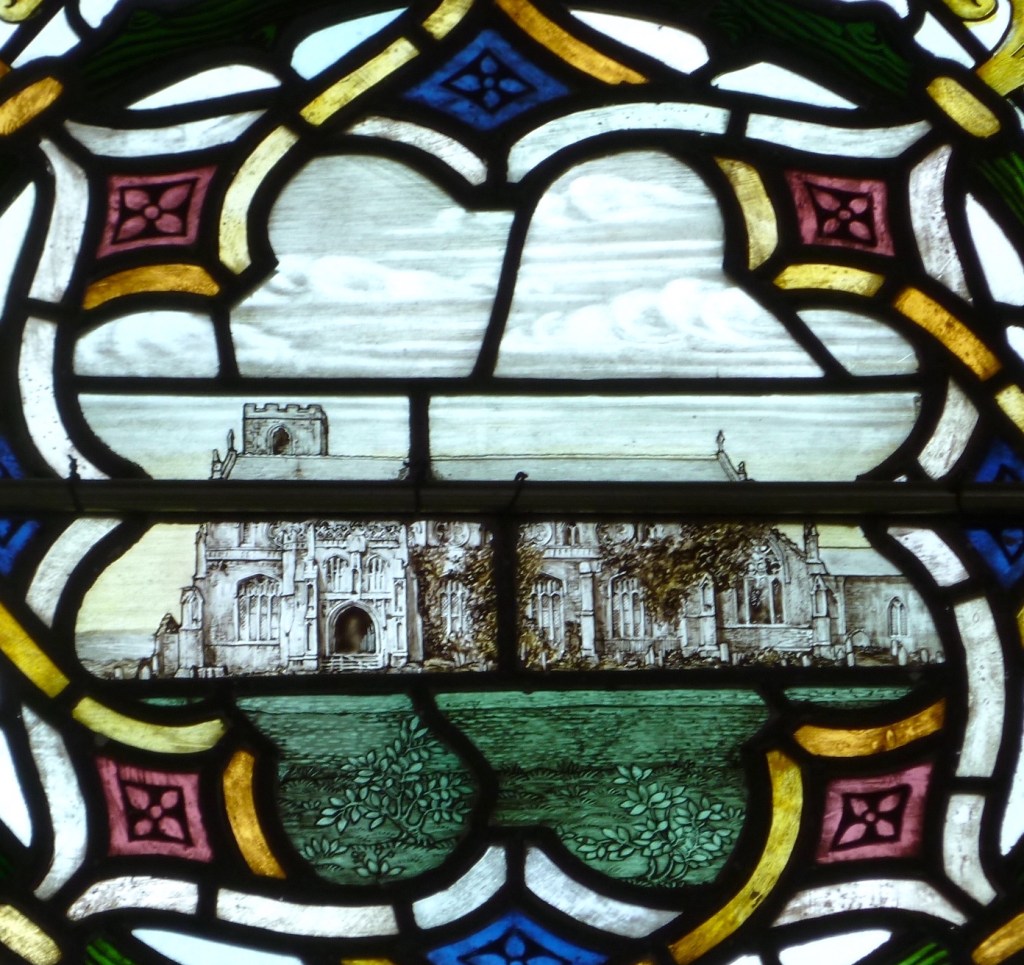
St Margaret of Antioch . Cley-Next-The-Sea . Stained Glass Window (cr Keith Salvesen)
ST MARGARET . CLEY-NEXT-THE-SEA . NORFOLK
GRADE 1 † C14 and C15. An important and rather wonderful church, part-ruined. One of SJ‘s 1000 Best Churches: a sea church stranded inland.PEV describes a most striking and improbable-looking building, splendid from the S, but splendid in large parts rather than as a whole. 52.9464 / 1.0475 / TG048431
DIAL
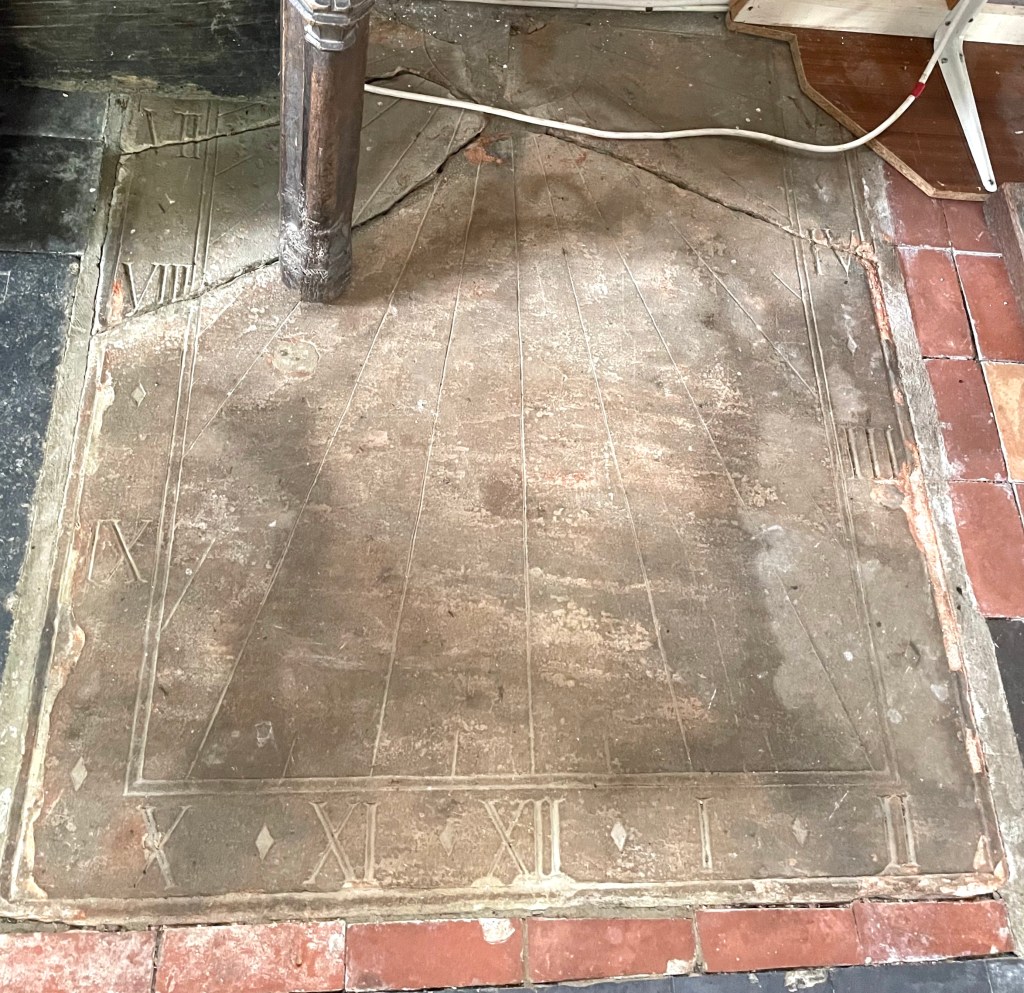
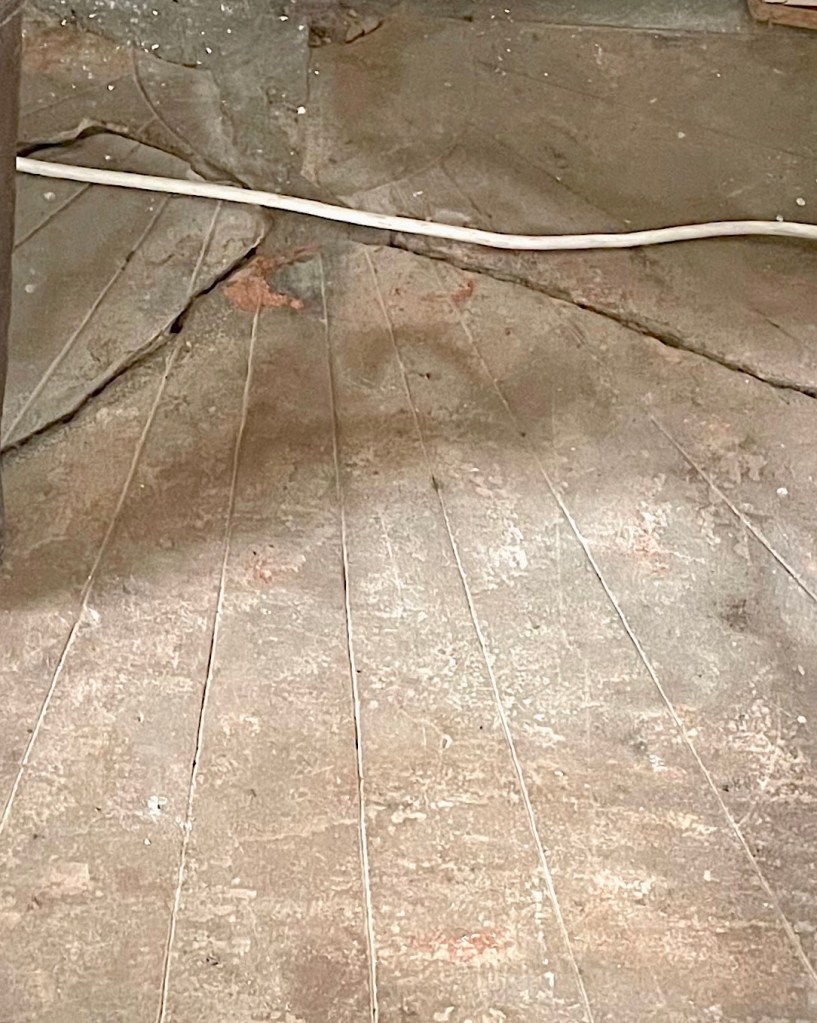
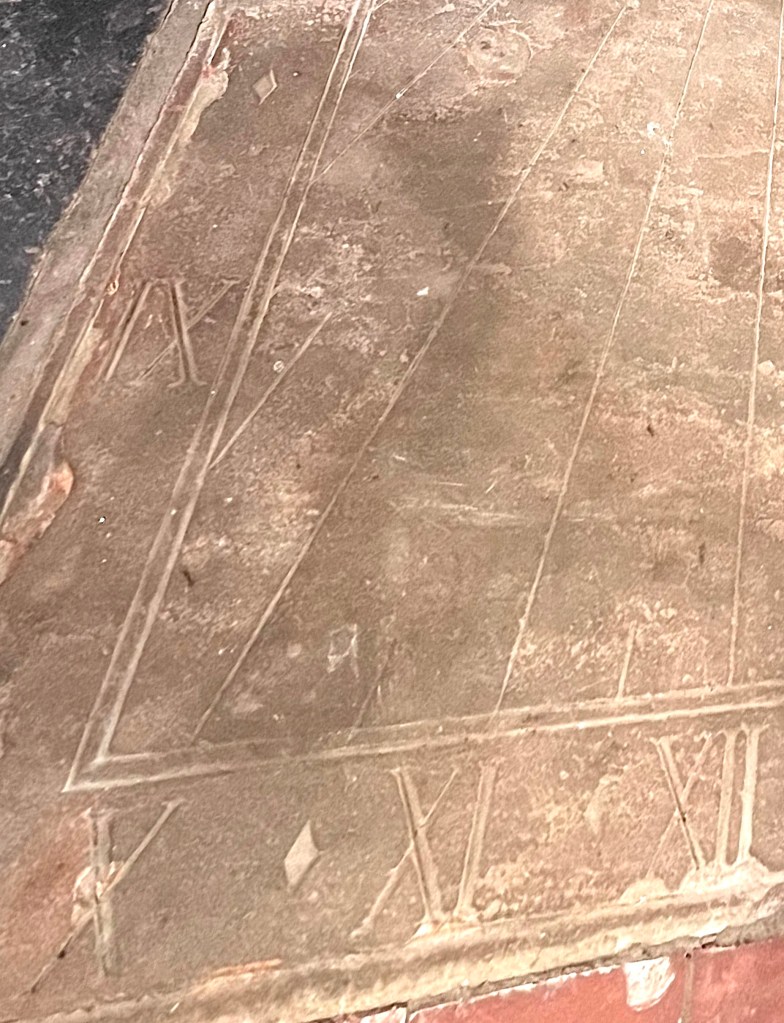
I am grateful to my friends in Cley, Hanne Siebers and Klausbernd Vollmar, for discovering and photographing this most unusually positioned dial that has been incorporated into the floor of the church, serving a new purpose despite its damaged state.
St Margaret . Cley-next-the-Sea – Vertical Dial set in the Chancel Floor (Hanne Siebers & Klausbernd Vollmar
The lines are more-or-less equally spaced, suggesting that the dial’s aspect was originally due S. The hours are separated by lozenges, and half-hours are marked. At the back / top end of the dial, there is considerable damage. It is just possible to make out a semicircle with a hole where the gnomon would have been. The incised numerals VII, VIII, III, and IV are less worn and indeed are surprisingly sharp, which might suggest that the dial was below a ledge of some sort that protected the upper part from weathering. One puzzle is the way in which VIII is split by a single crack, yet part of the numeral appears to be missing completely.
DATING THE DIAL
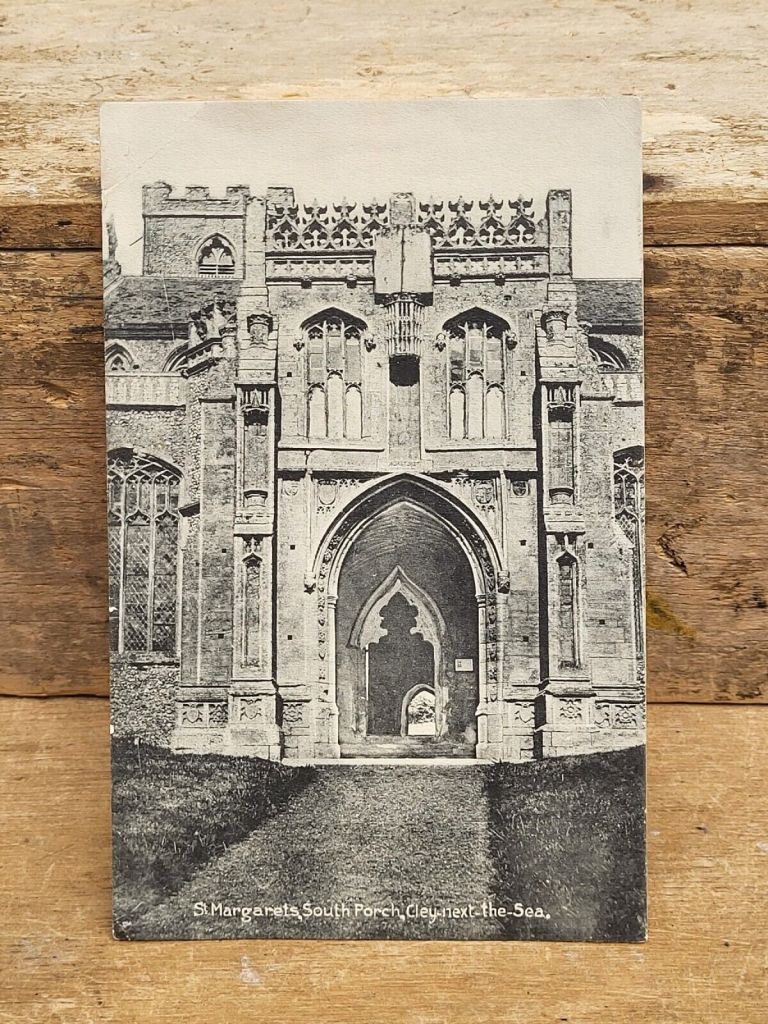
I initially thought that the dial was ±1800. The date of its removal and repositioning was unrecorded in the usual sources. As it turns out (with many thanks to Rev. Richard Lowery and Richard Jefferson) the change of location happened within the last 50 years or so. The dial had been high up on the S porch, but had become a danger. It was taken down and set in the floor of the chancel. The damage occurred at some stage during the relocation.
The earliest depiction I can find is a lovely drawing by John Sell Cotman dated 1818. It gives the dial due prominence and I think it can be confidently dated to ±1750. The work interestingly show the state of ruination as Cotman saw it.
St Margaret . Cley-next-the-Sea – John Sell Cotman – Art Institute of Chicago
Old photos and postcards can be a good way to approximate a date (or a span)
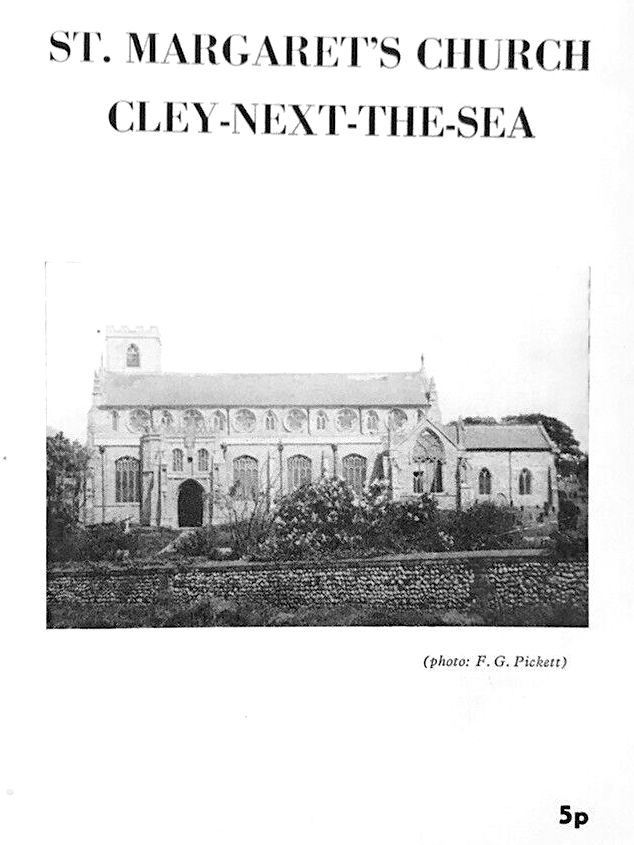
In 1959, C L S Linnell produced a Booklet for the Church. It was obviously successful – there were 4 reprints, the last in 1973. The cover photo of the Church shows the dial in its rightful place (though quite probably it was not updated for the reprints). Certainly by 2000, the dial had been repurposed.
An excellent account of the church and some of its medieval details (roof bosses &co) can be found with this link NORFOLK CHURCHES.
GSS Category: Sundial; Vertical Dial; Old Dial; Repositioned Dial
Photographs: header photo, Keith Salvesen; dial photos (with edits for clarity), Hanne Siebers and Klausbernd Vollmar with thanks as ever for their interest in this dial project and for their excellent contributions from other churches; other images os / cc / as shown
GRADE II* † Saxon origins (vestiges still visible); C13, C15; rebuilt tower 1667 (unusually, lower than the nave roof-line); restorations (Wyatt). Split from Burcombe village (S Burcombe) by A30 and hard to find. St John is the sole remnant of N Burcombe. Declared redundant 2005. I could not gain entry. 5m W of Salisbury. 51.0798 / 1.8971 / SU073311
DIAL
St John . Burcombe . Wilts – Scratch Dial
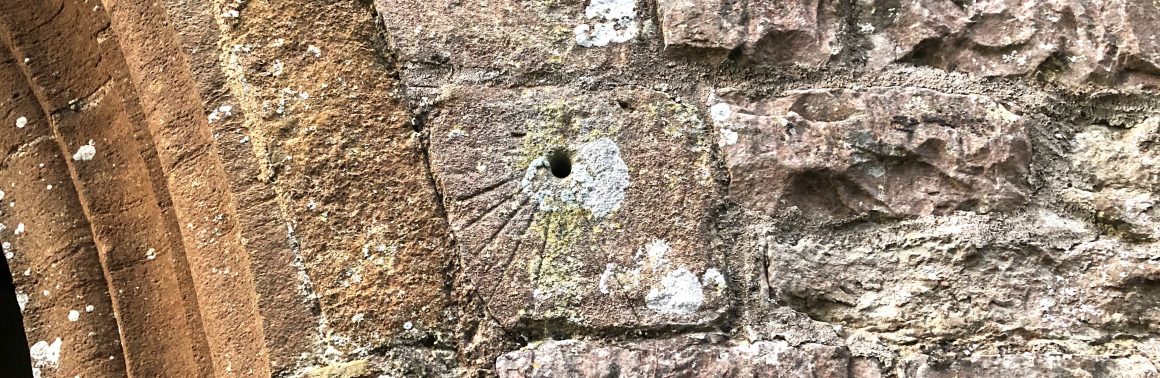
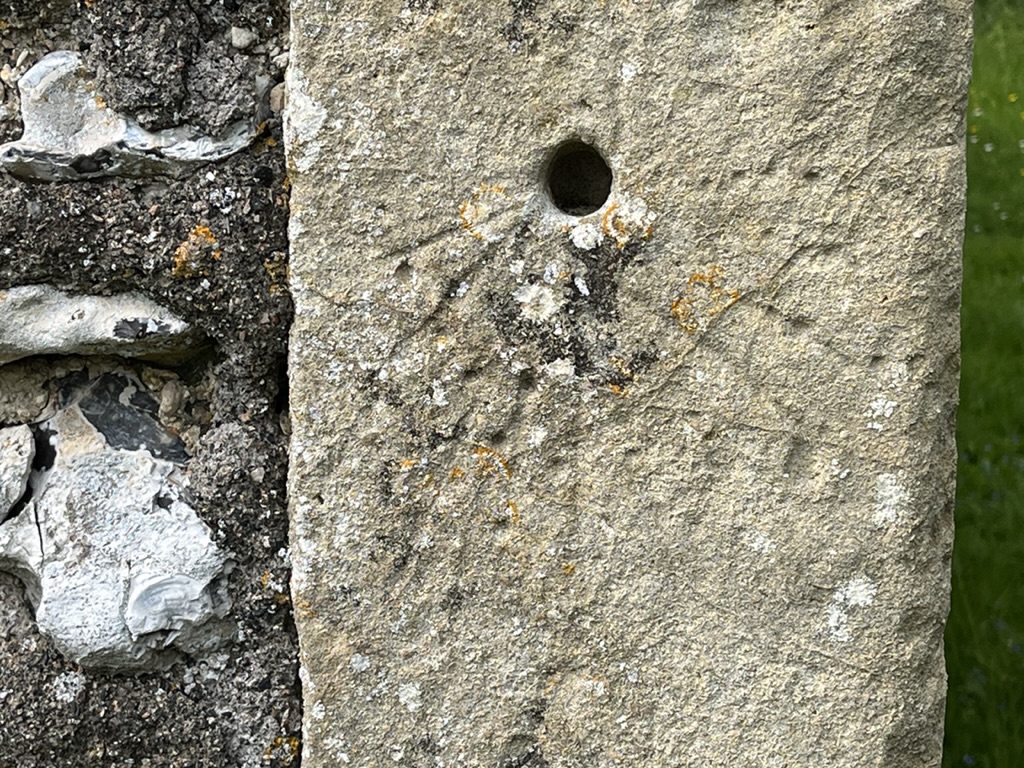
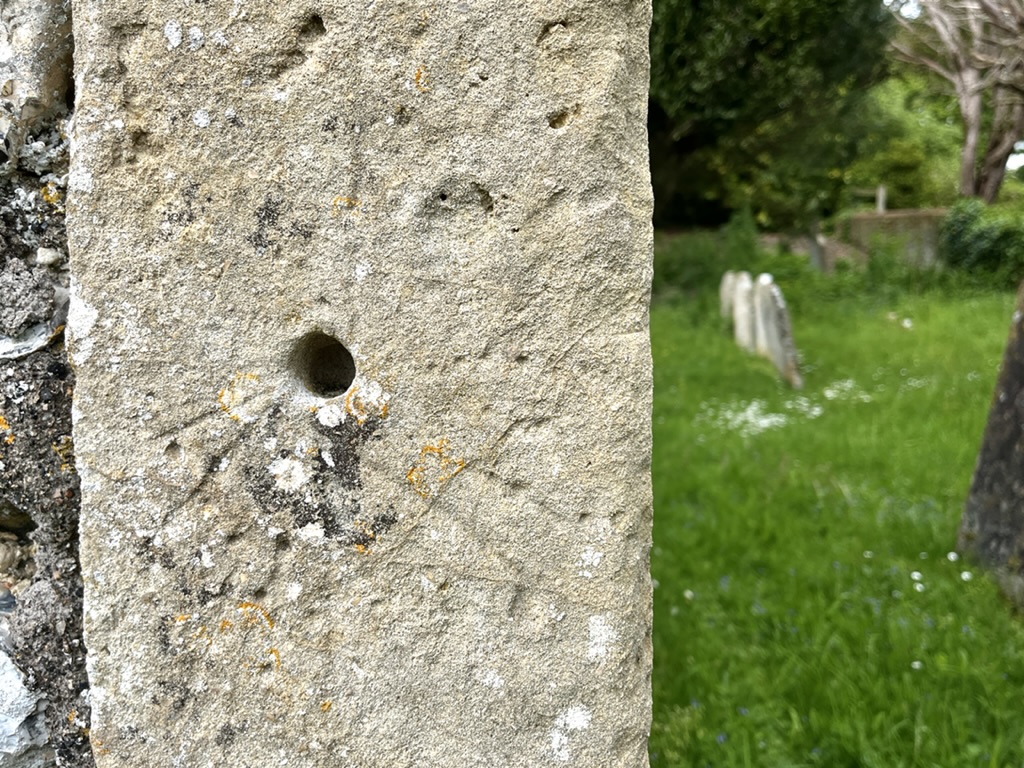
The Burcombe dial is a slight secret, mentioned in TWC‘s Wiltshire dial list but not elsewhere that I can see. St John is also hard to find: check the location carefully before you try. This is a pretty dial, a messy mix of lines and pocks below the horizontal. The noon line – usually an eye-catcher – is upstaged by lines with varying degrees of curve and pocking. It’s hard to interpret, but the two ‘raking light’ photos add a bit of perspective.
St John . Burcombe . Wilts – Scratch Dial
VERTICAL DIAL
St John . Burcombe . Wilts – Vertical Dial
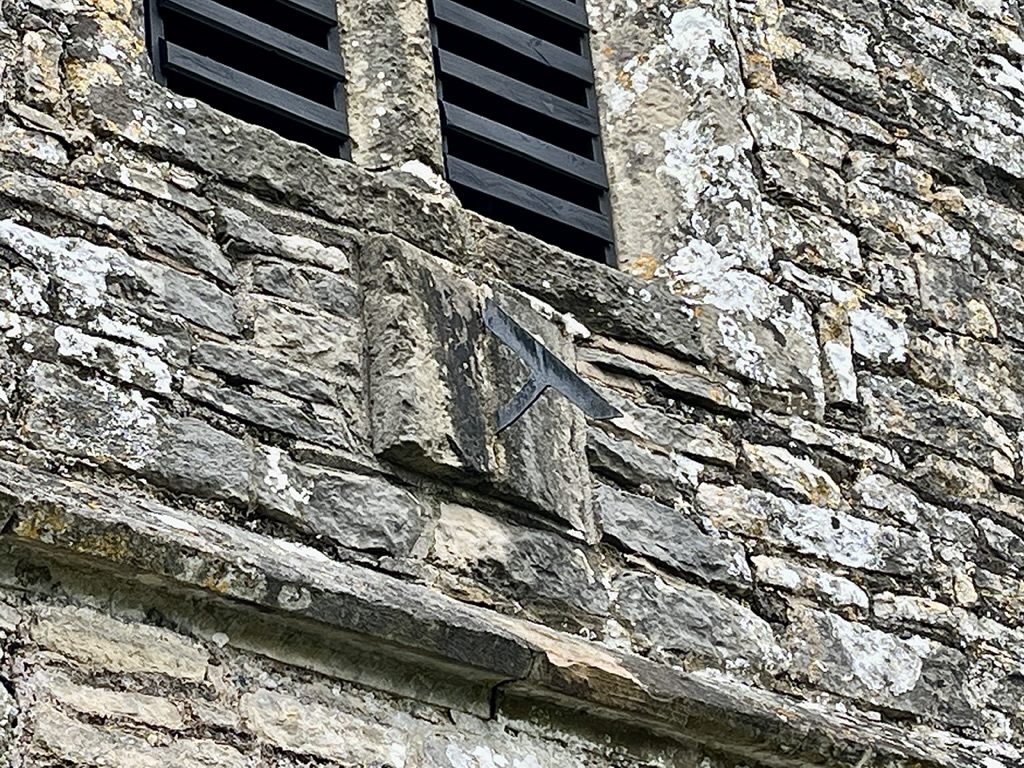
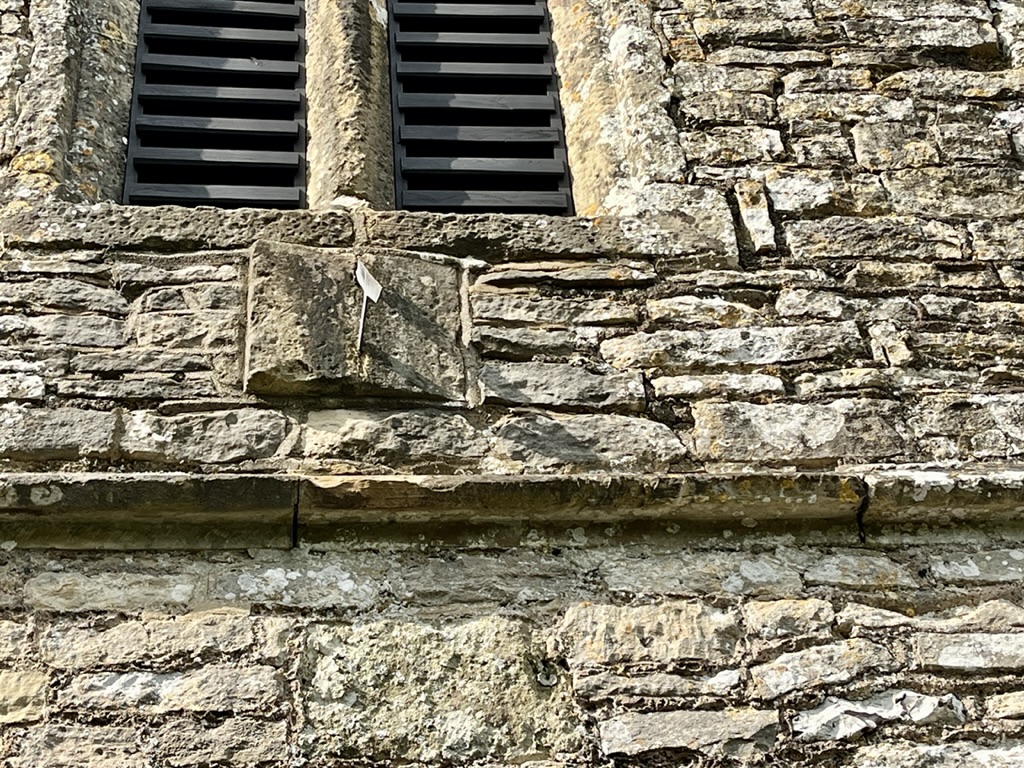
St John also has a canted vertical dial above the porch, with a pleasingly robust gnomon. It fits in with the stonework around it and looks old. However any details on the dial face have been eroded. Unfortunately I didn’t have a proper camera with me to check closely for lines etc. but I wouldn’t expect revelations.
Quaere placename – a mapping mistake
In the early 17th century, when John Speed prepared a map of Wiltshire he copied a version by Christopher Saxton, which showed but did not name North Burcombe. On his own map, Speed labelled the village Quaere (Latin for query), presumably because he intended to check the name later, but never did, and his engraver copied the annotation as if it were the village’s name. Later map printers in turn copied Speed’s map and ‘Quaere’ appeared on maps of Wiltshire for 145 years until Emanuel Bowen corrected the mistake in his 1755 map of the county. (WIKI)
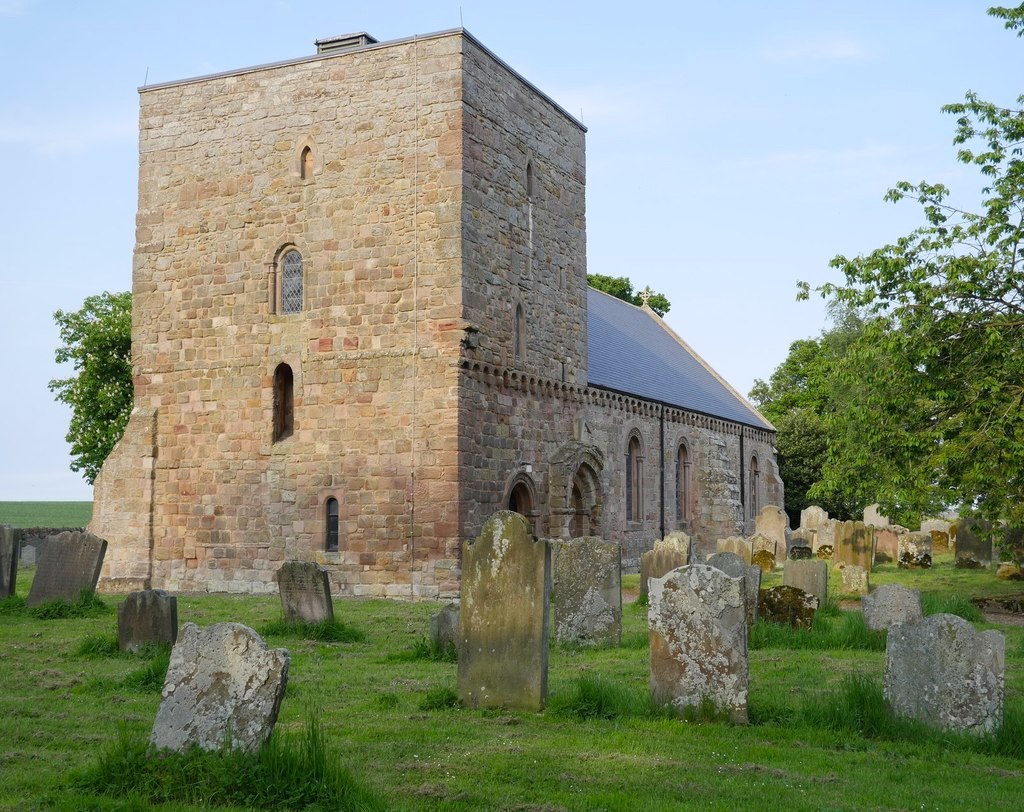
St Anne . Ancroft . Northumberland – James Towill Geo cc
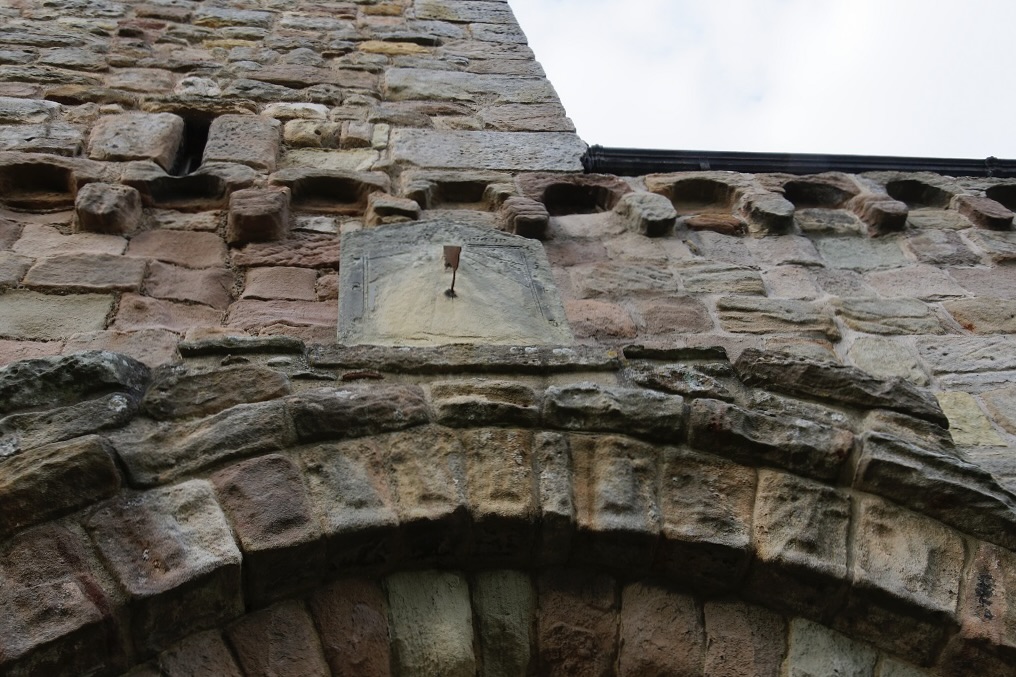
GRADE II* † C11th-century, built by monks of Holy Island as a chapel of ease. C13 / C14 pele tower added as protection from incursions by Scots. C19 restorations. At some time (? when the tower was built) the fine Norman entrance was blocked. Extensive views from the tower’s parapet. 3m S of Berwick-upon-Tweed. 55.7001 / -1.998 / NU002451
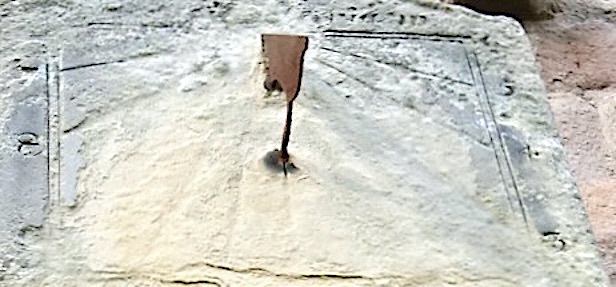
A weathered C18 vertical dial with a short gnomon that casts a very visible shadow. The shape of the dial stone, with its pedimented square, is very pleasing. The lines are enclosed in a frame, with Arabic numerals from 6 to 6 around its edge. The use of Arabic numerals rather than Roman suggests a later dial of this period. 9 lines are detectable, some only just. Only 6 numerals are clear. I can’t make any sense of the remains of the inscription. I wondered if some of the sandstone – especially LLQ – is repair or natural deterioration. Expanding this very good photograph, I think the latter: the dial is showing the signs of its age.
St Anne . Ancroft . Northumberland – Walter Baxter Geo cc
GSS Category: Vertical Dial; Old Dial; Gnomon Design
Credits: Erika Clarkson for introducing me to this church and for her photos that begat this post, so to speak; James Towill for his photo of St Anne’s uploaded to Geograph cc; Walter Baxter for his excellent close-up of the dial uploaded to Geograph cc and for his specific use permission to reproduce it full-size




























 GAUDIUM SUB SOLE . SUNDIALS . MEDIEVAL TO MODERN