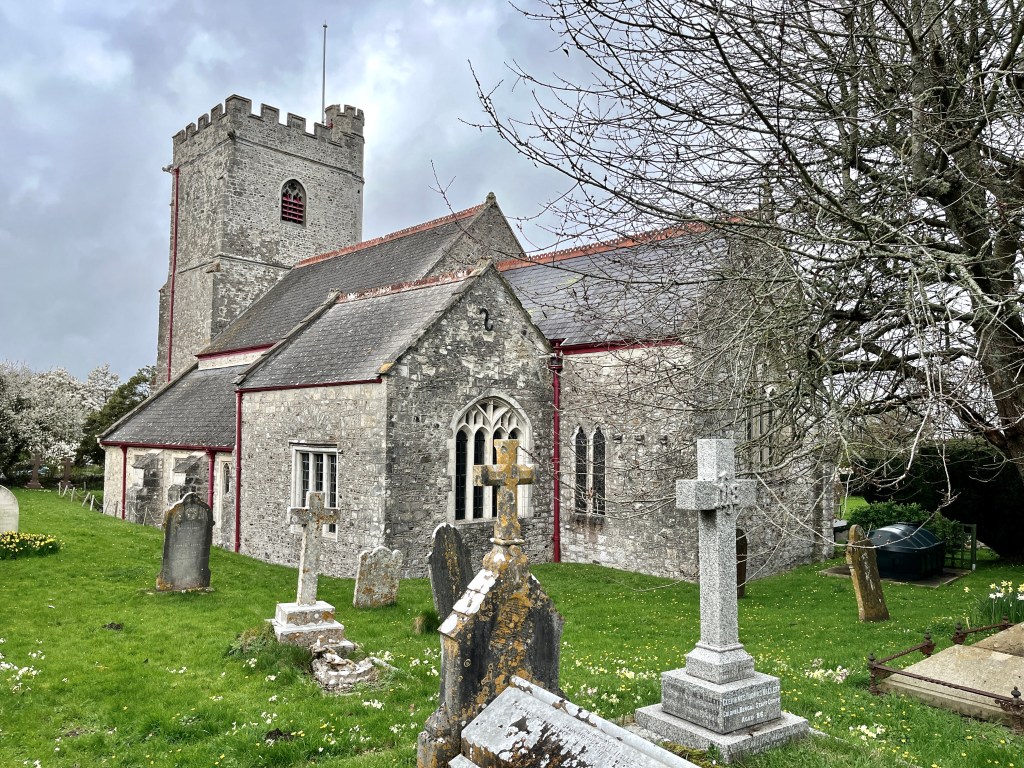
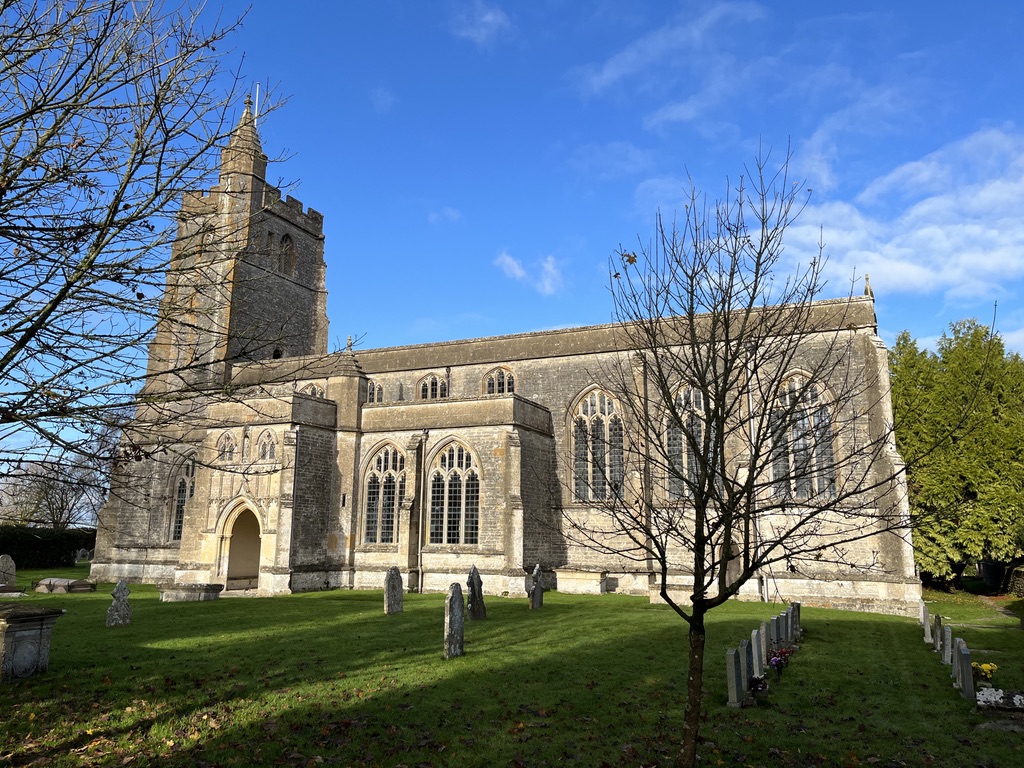
GRADE I † Late 12th-century origins (parts of nave & chancel evident). Mainly C15 with later additions; S porch added C17 using old stonework; extensive restoration 1865. C13 font; Purdue bell 1658. Off the beaten track in a valley midway between Dorchester & Weymouth. Hardy-esque. 50.6599 / -2.445 / SY686845
Bincombe Church 1802 (Gentleman’s Magazine)
DIAL
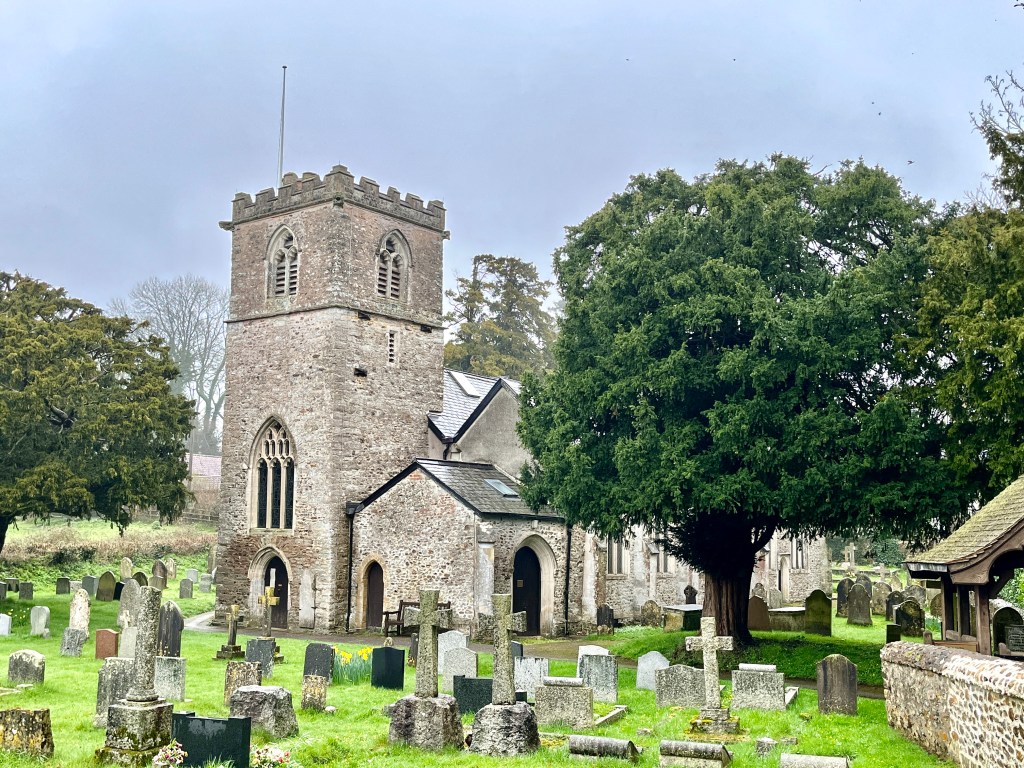
Bincombe is a hidden village in the folds of the hills inland from the pleasures of Weymouth. It’s a mere 20m from our house yet until I visited a church nearby, it wasn’t on my radar at all. I must have passed close by it hundreds of times.
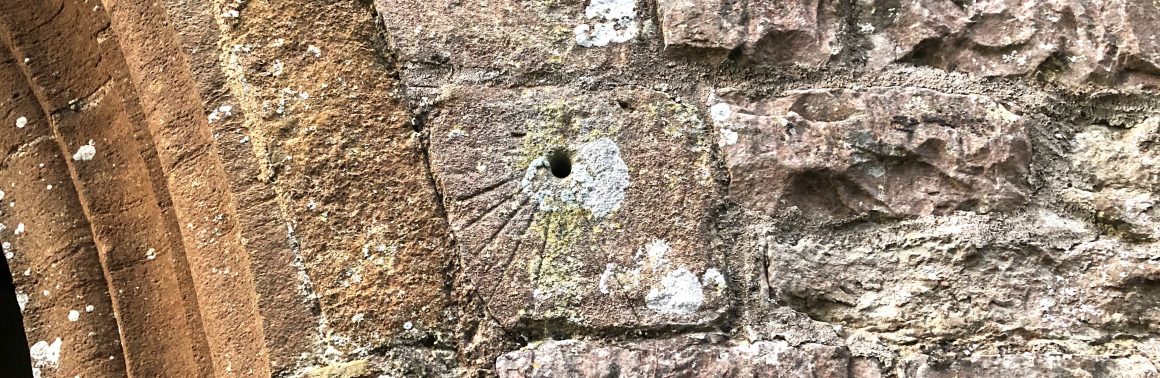
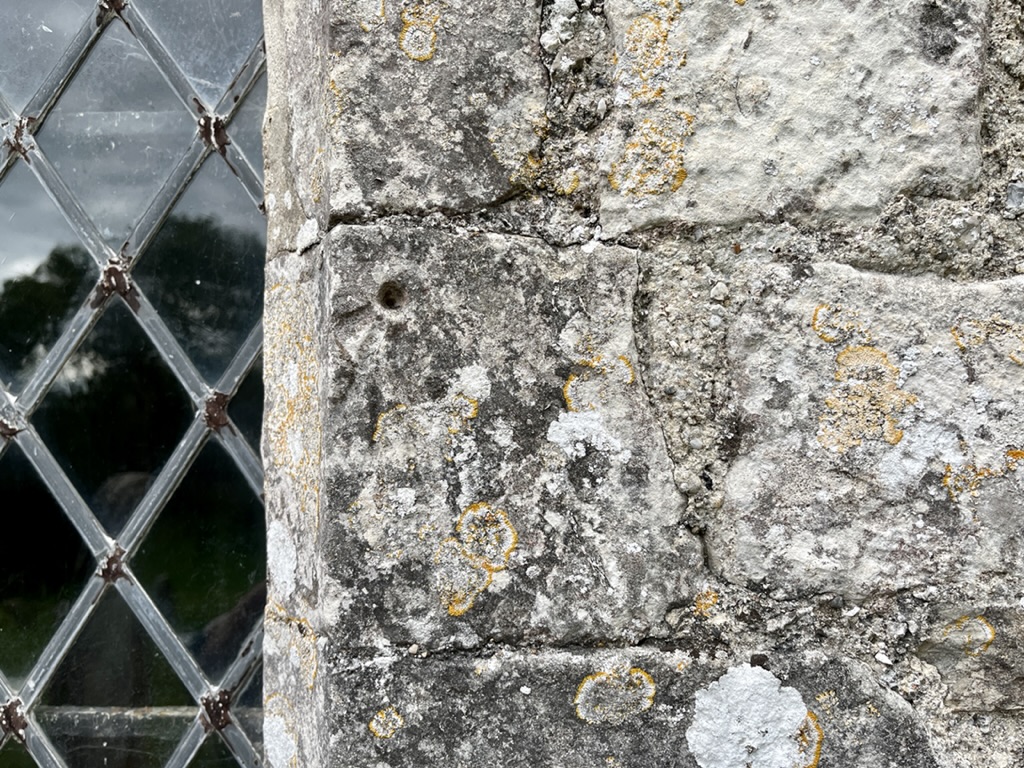
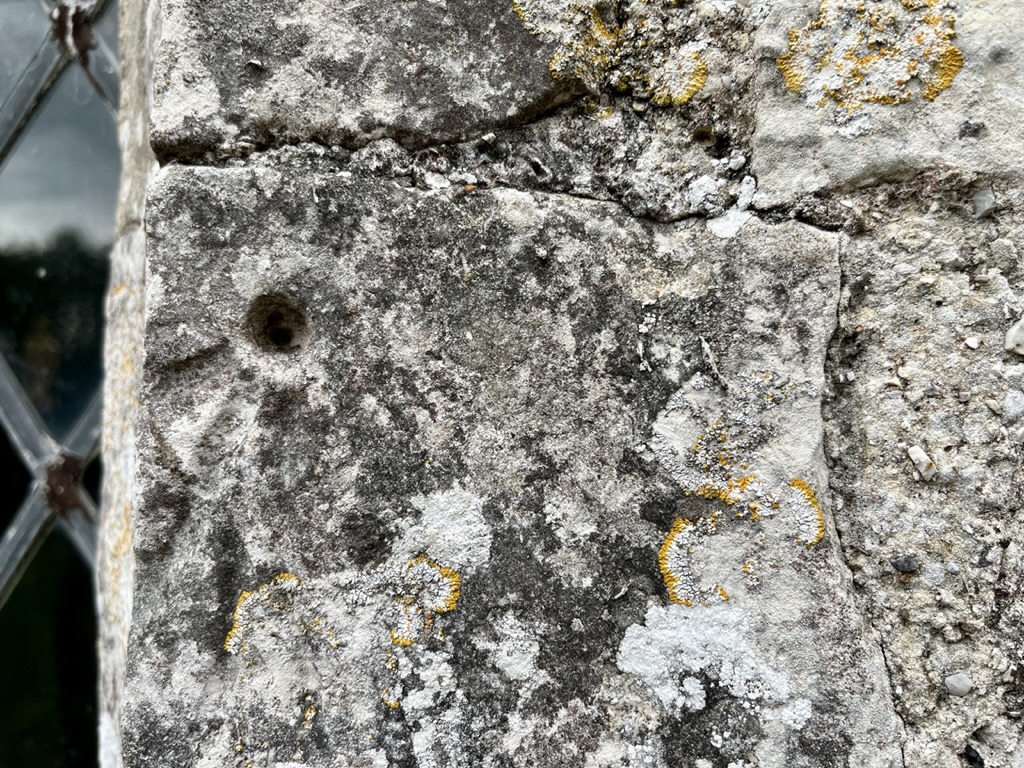
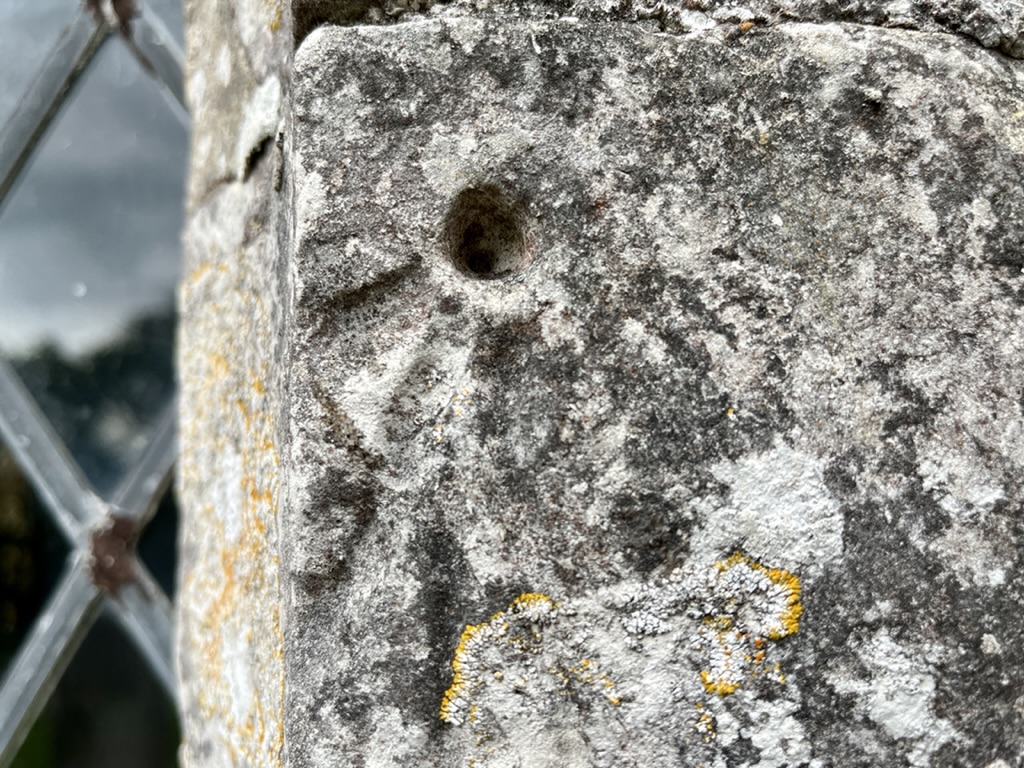
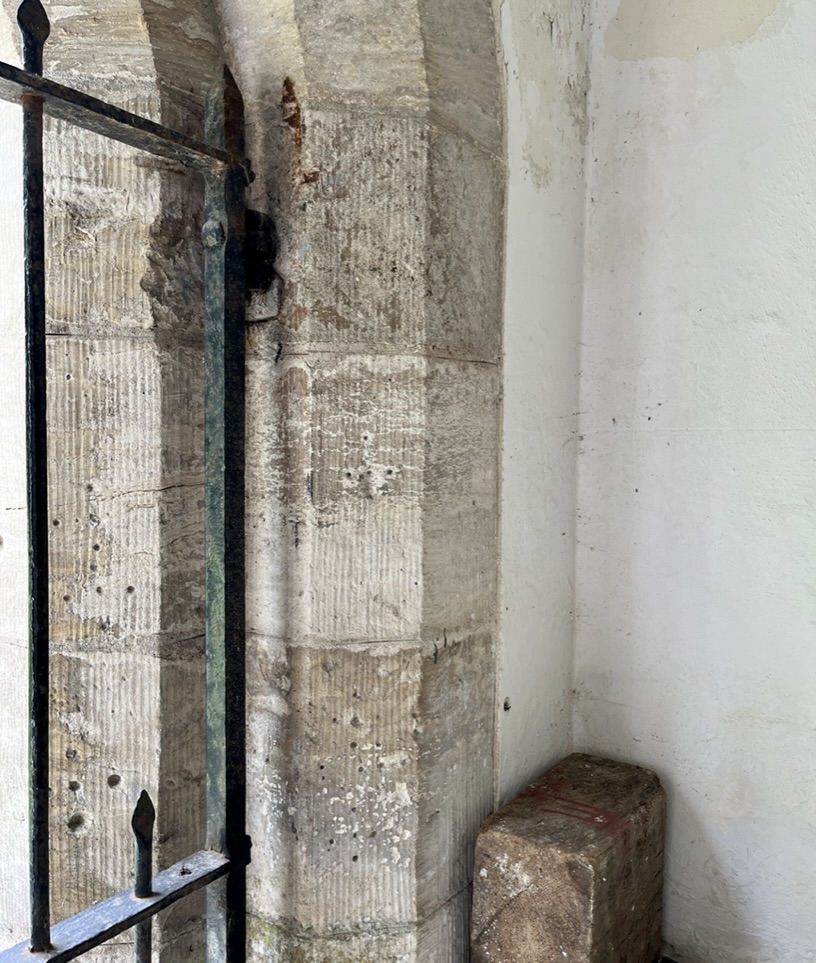
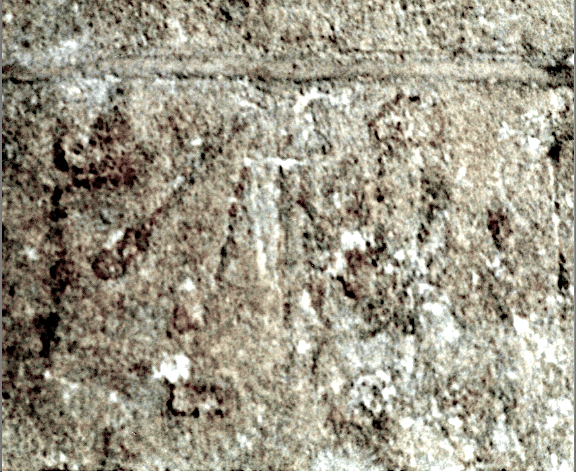
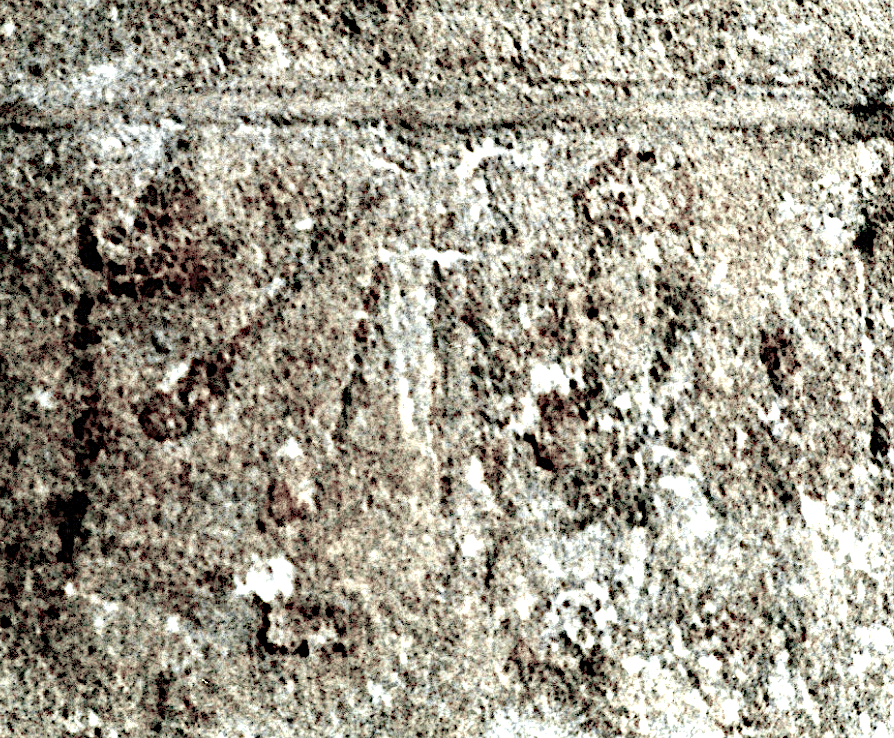
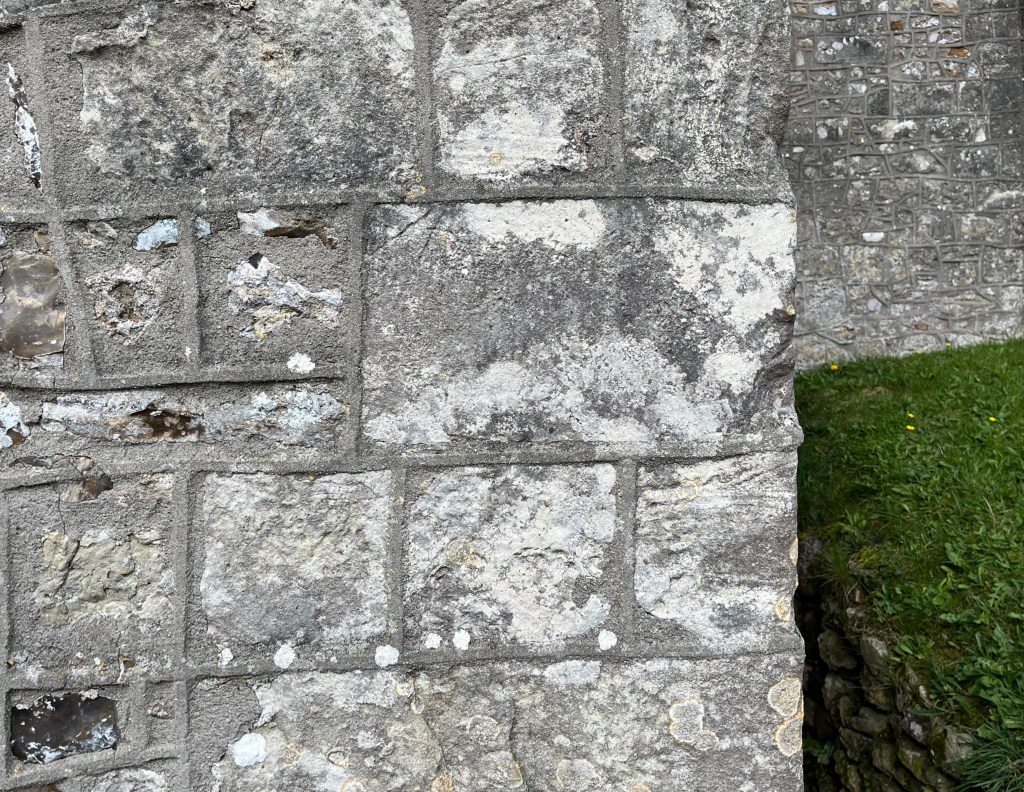
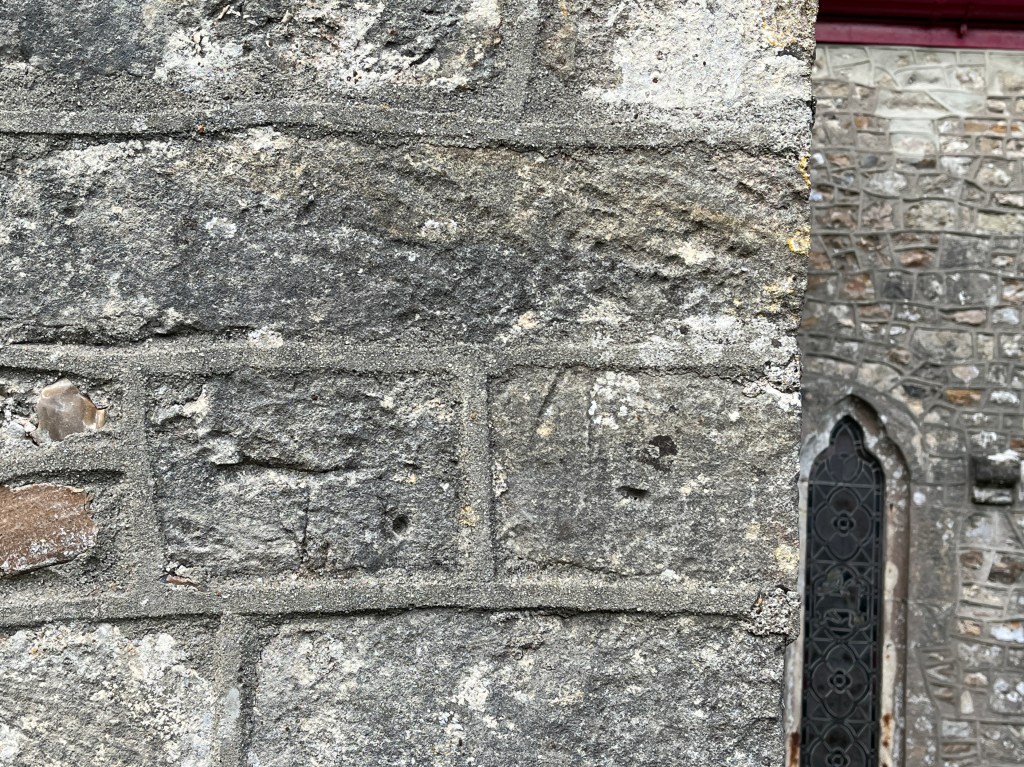
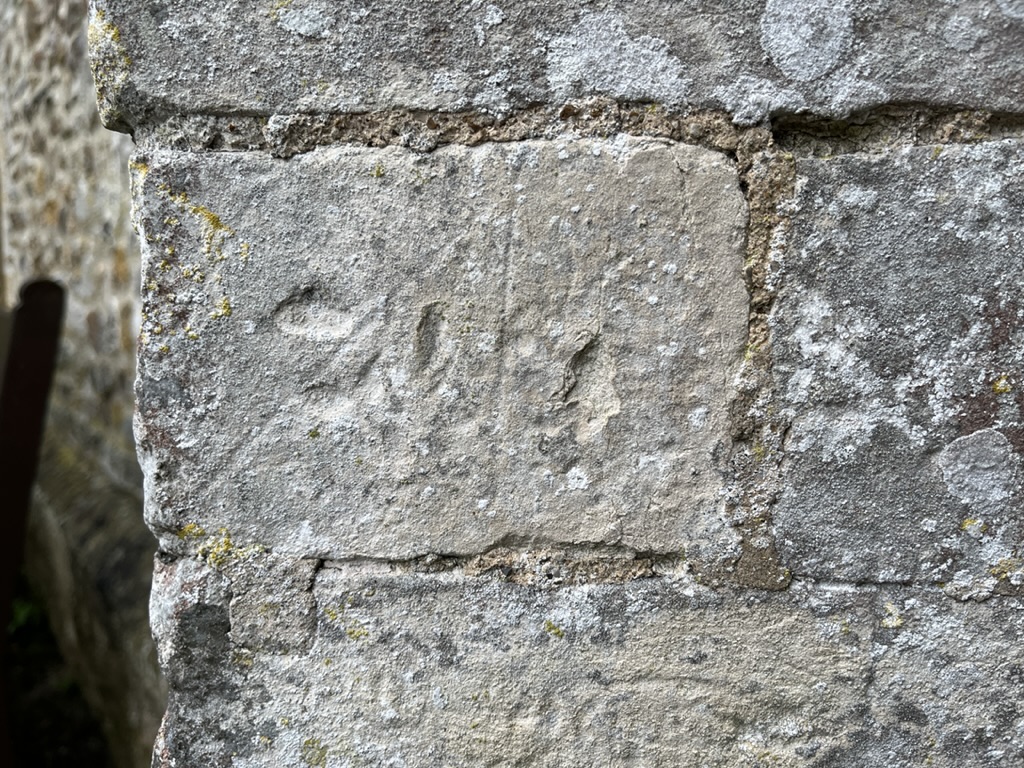
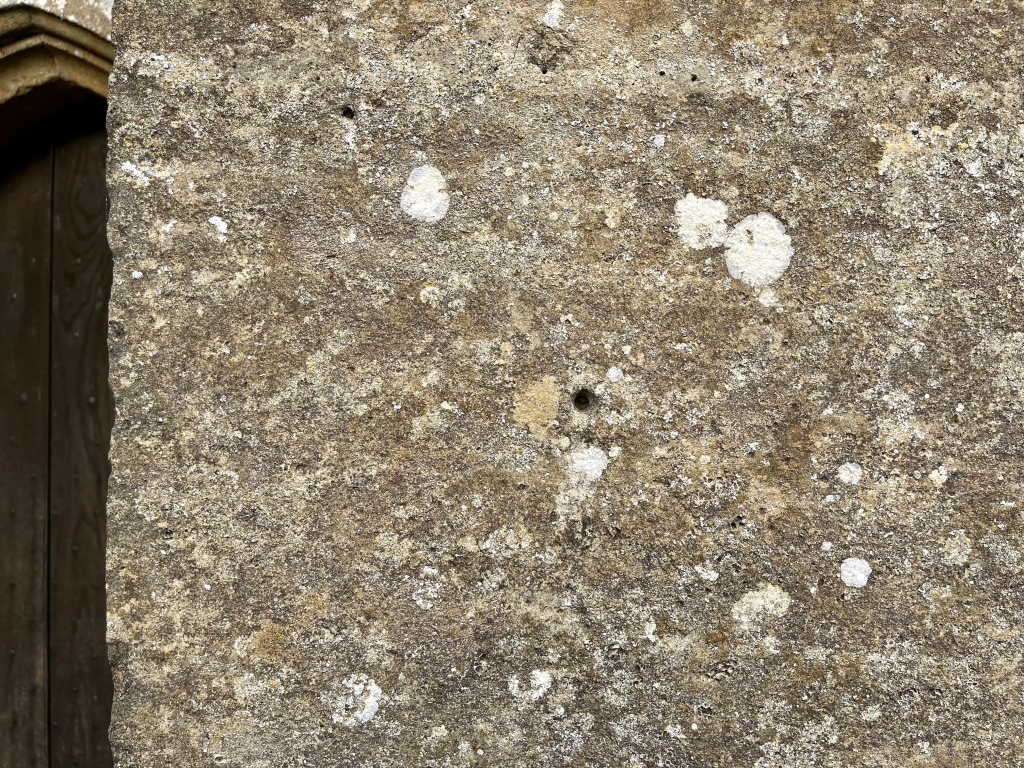
The dial is located on the E jamb of the SW chancel window, about 2m from ground level . GLP describes 4 short lines, with the noon indicator being the gap between two of them. He notes that the dial must have been moved to its position for reuse as part of the window jamb, truncating 2 lines LHS. Finally, he concludes that, the window being C15, the dial predates 1400.
Holy Trinity Bincombe – BSS Record
The dial, small and chunky, is in the top L corner of the dial stone. I haven’t seen one quite like it. The gnomon hole is surprisingly deep for such a little dial. In situ (and in the photos), there are ghosts of 2 or 3 lines LRQ angling towards the hole (but not converging?) Probably best disregarded.
CHURCH MARKS
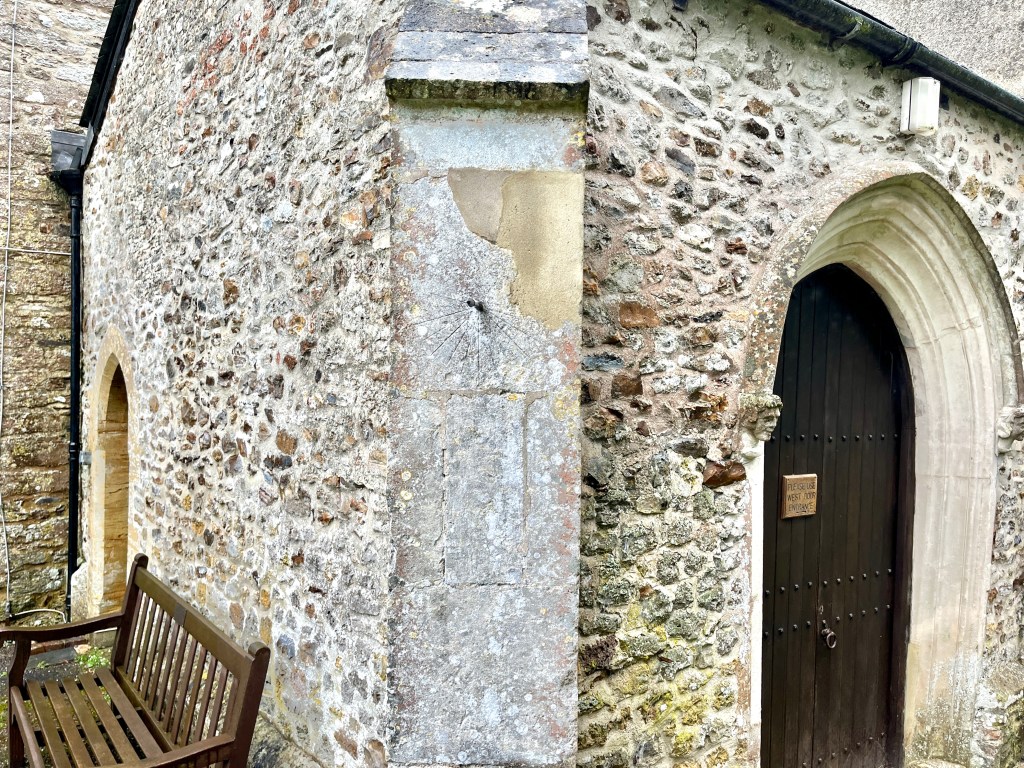
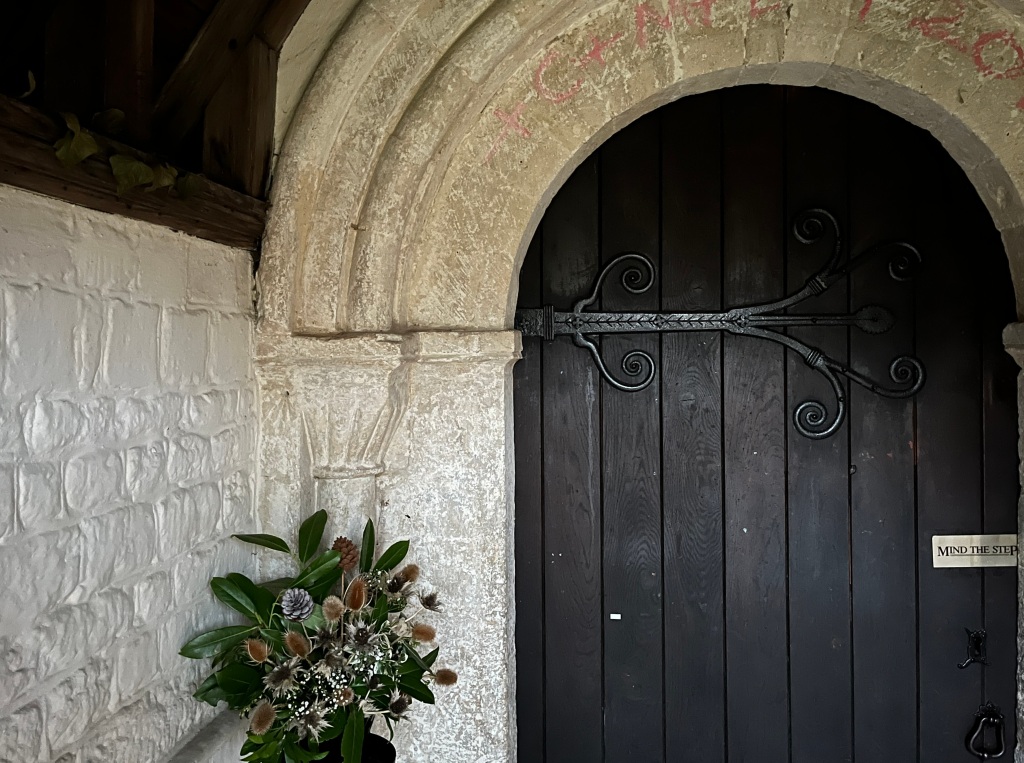
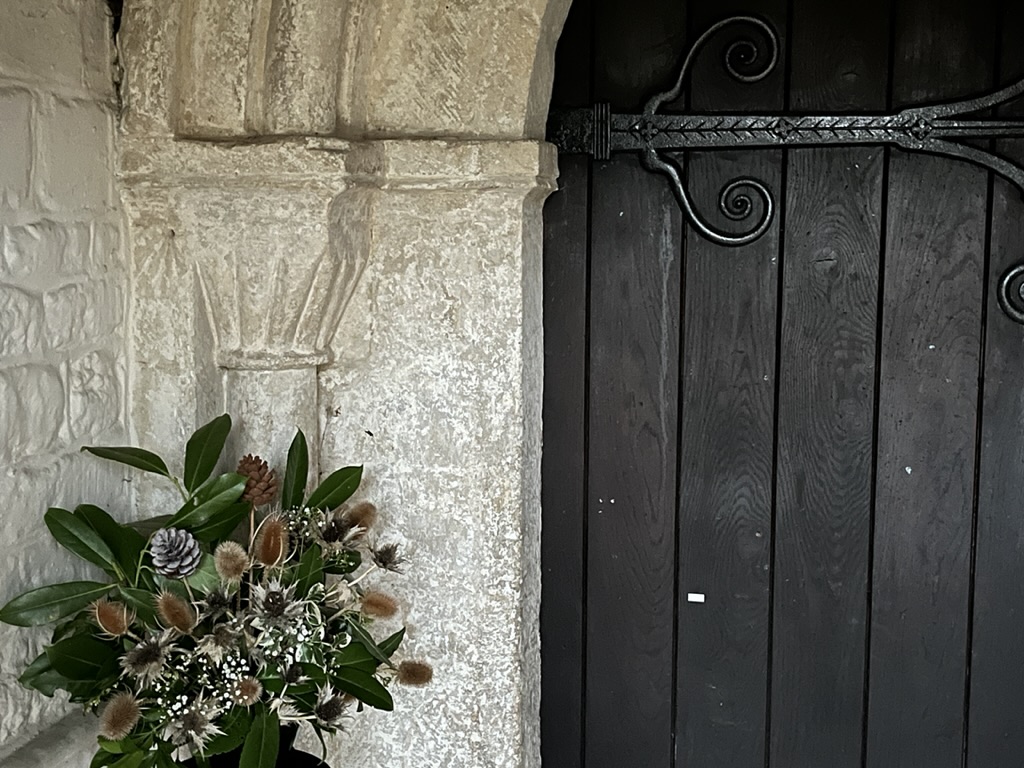
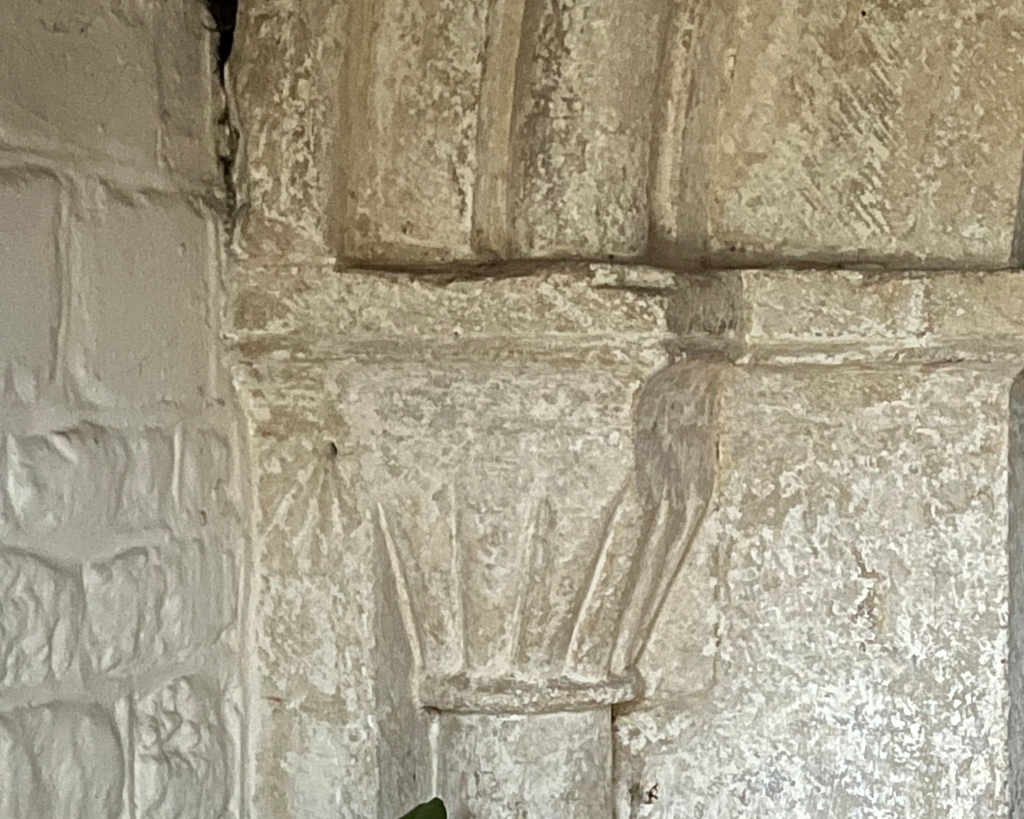
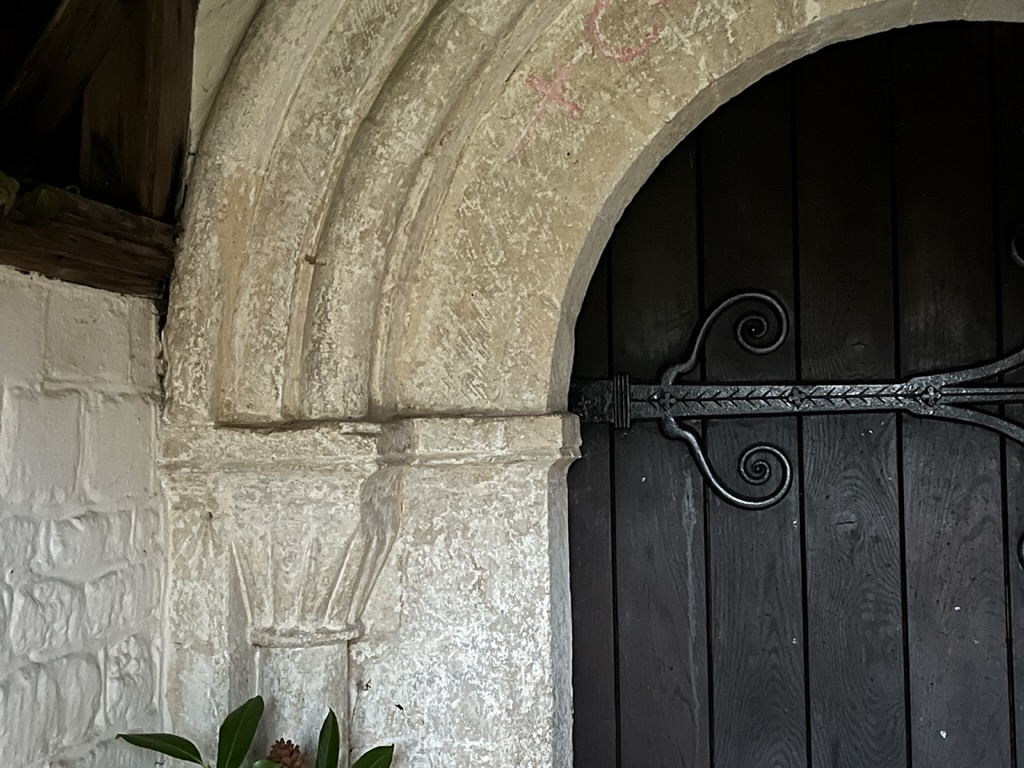
Holy Trinity has a fine selection of crosses / protection marks drilled into the porch entrance. Here are a couple of examples.
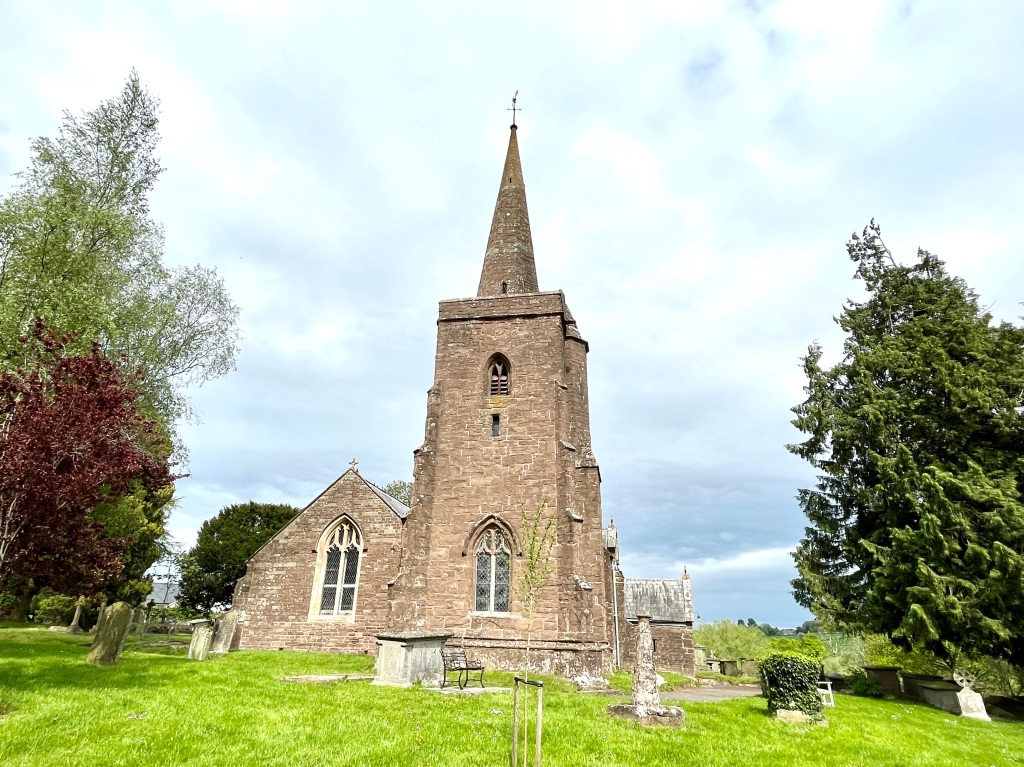
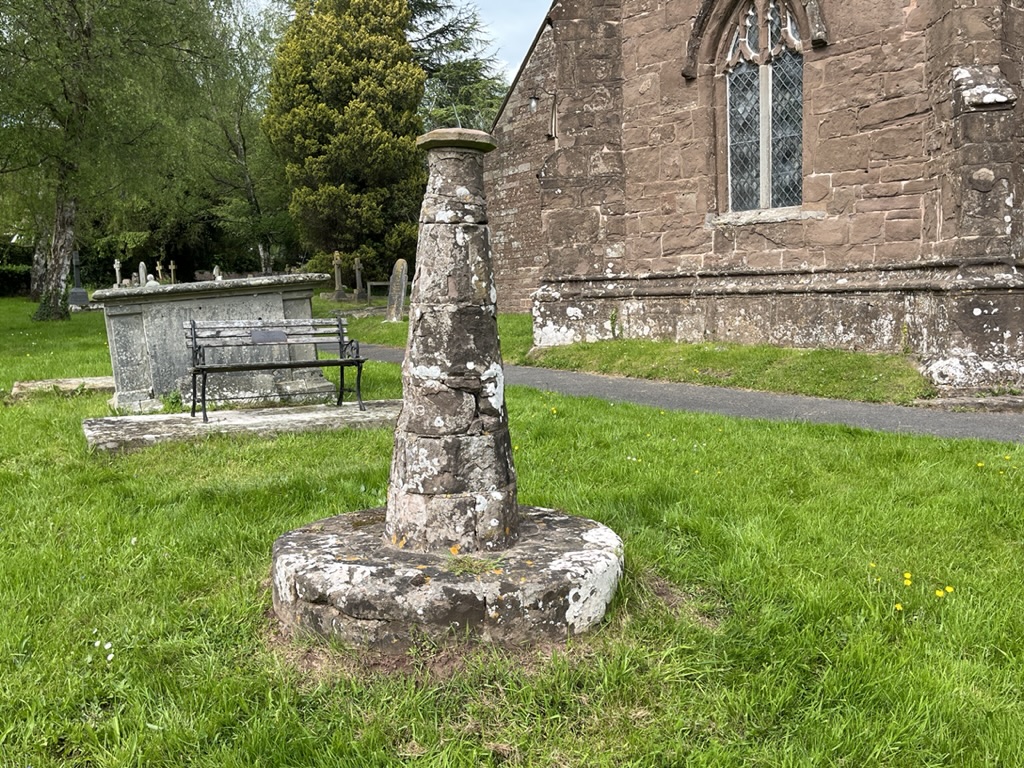
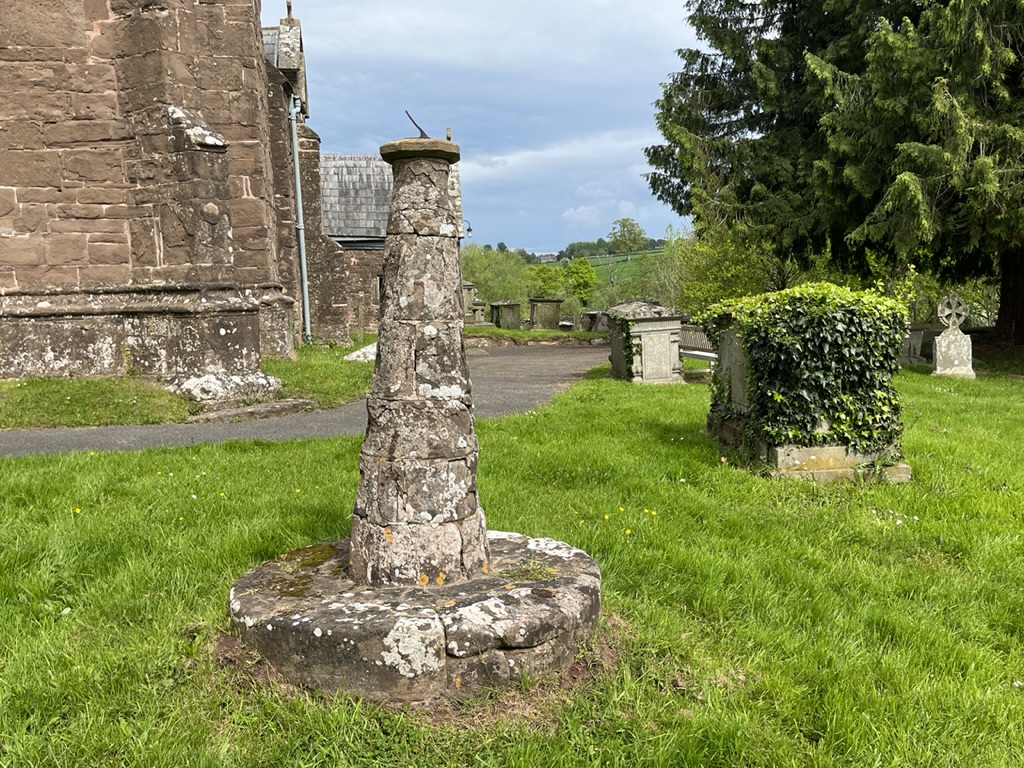
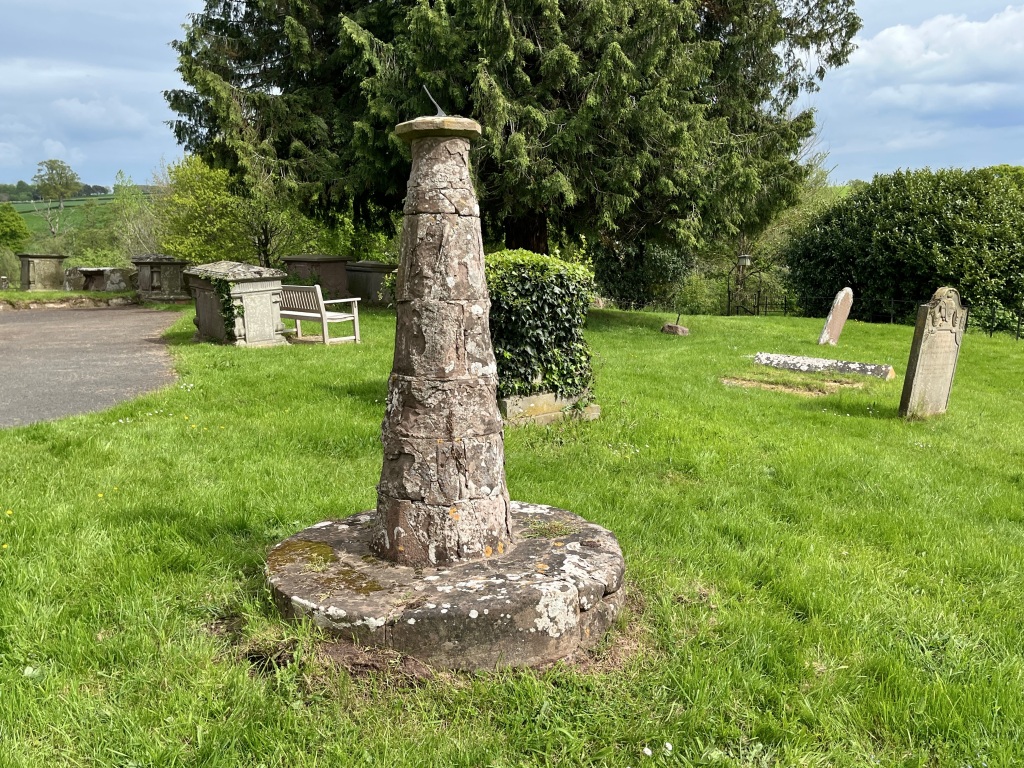
GRADE 1 † C14 & C15; records of C11 origins; trace Norman interlace patterns. Restorations ±1900; later replacement of the top of the spire, repurposed as sundial pillar. Only 1 other church (Itton, nearby) with this Dedication. 7m N of Monmouth; 7m SW of Ross-on-Wye. 51.8871 / -2.6838 / SO530211
PILLAR (STEEPLE) DIAL
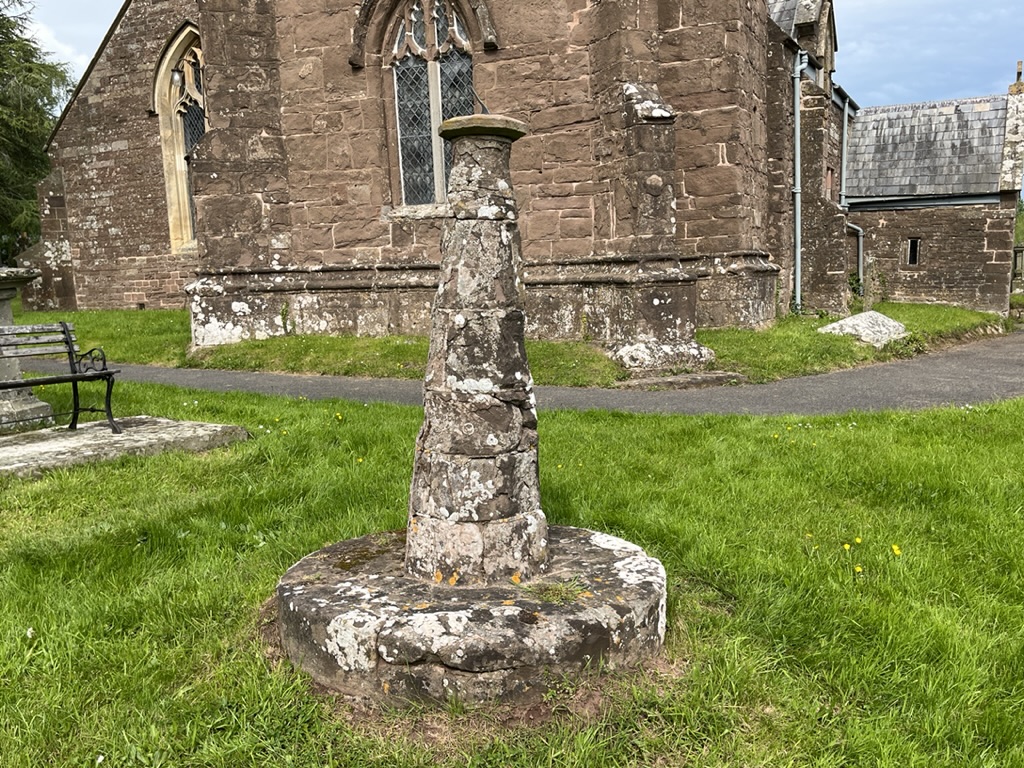
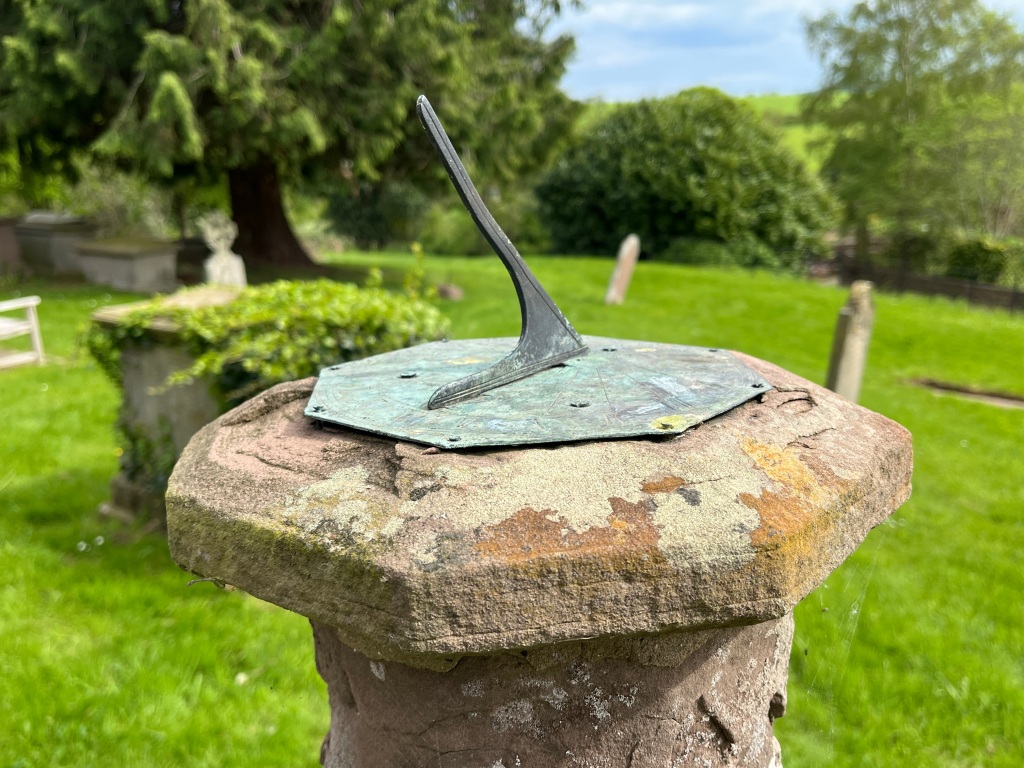
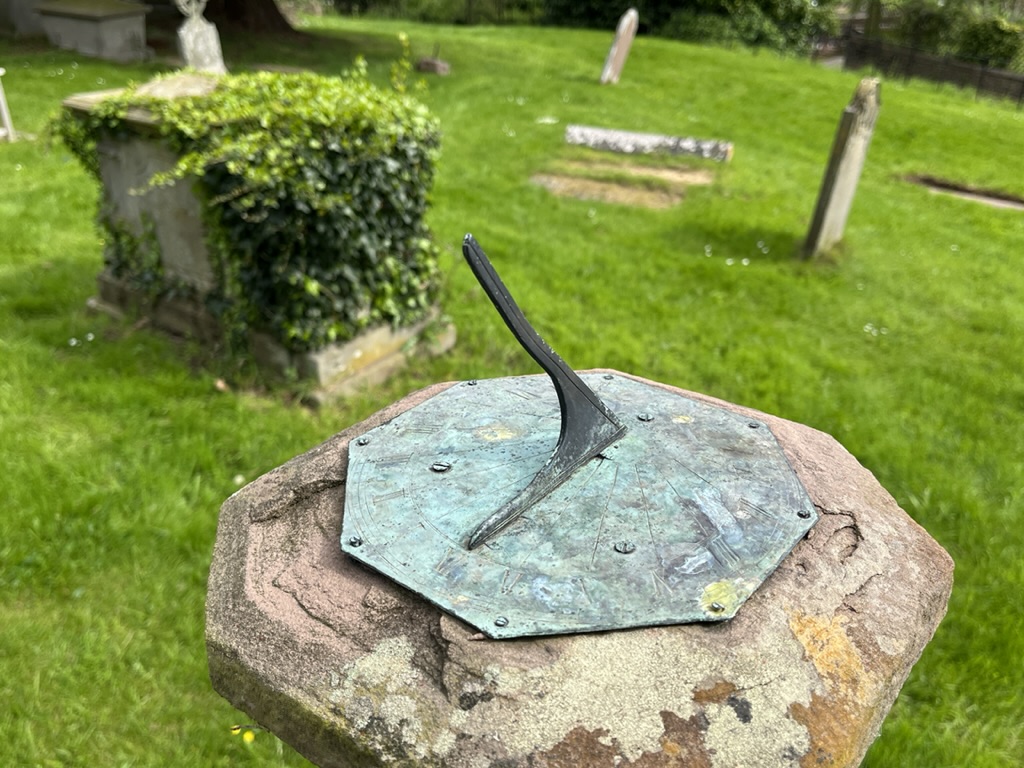
GV II †Tip of spire C14 adapted as horizontal sundial pillar late C19. In churchyard SW of the tower in an ideal place for admiration. Coursed & squared sandstone rubble, circular base. C14 masonryBLB
1. CHURCHYARD VIEW
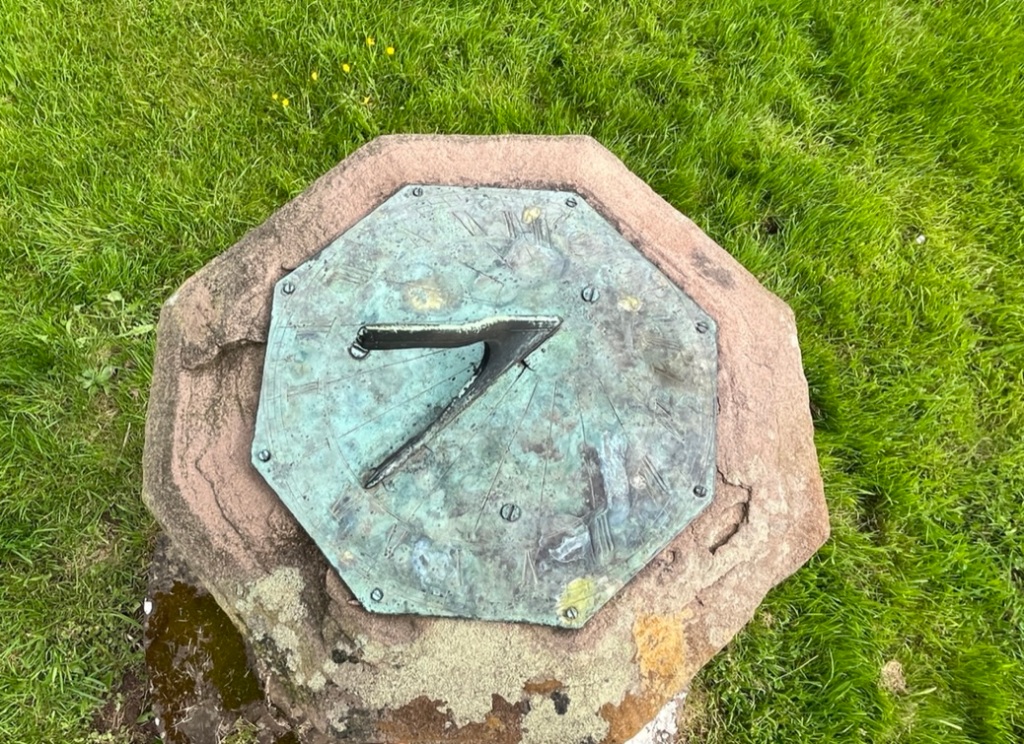
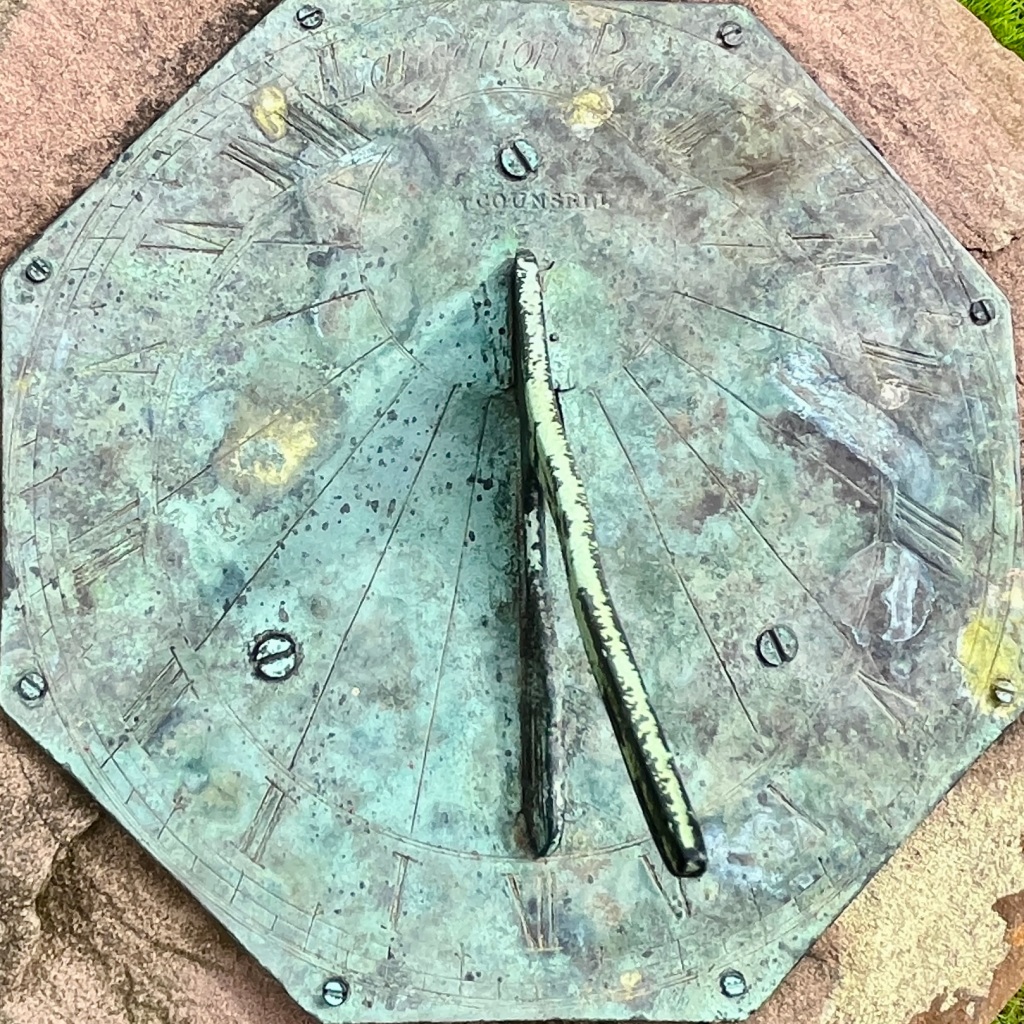
2. HORIZONTAL DIAL
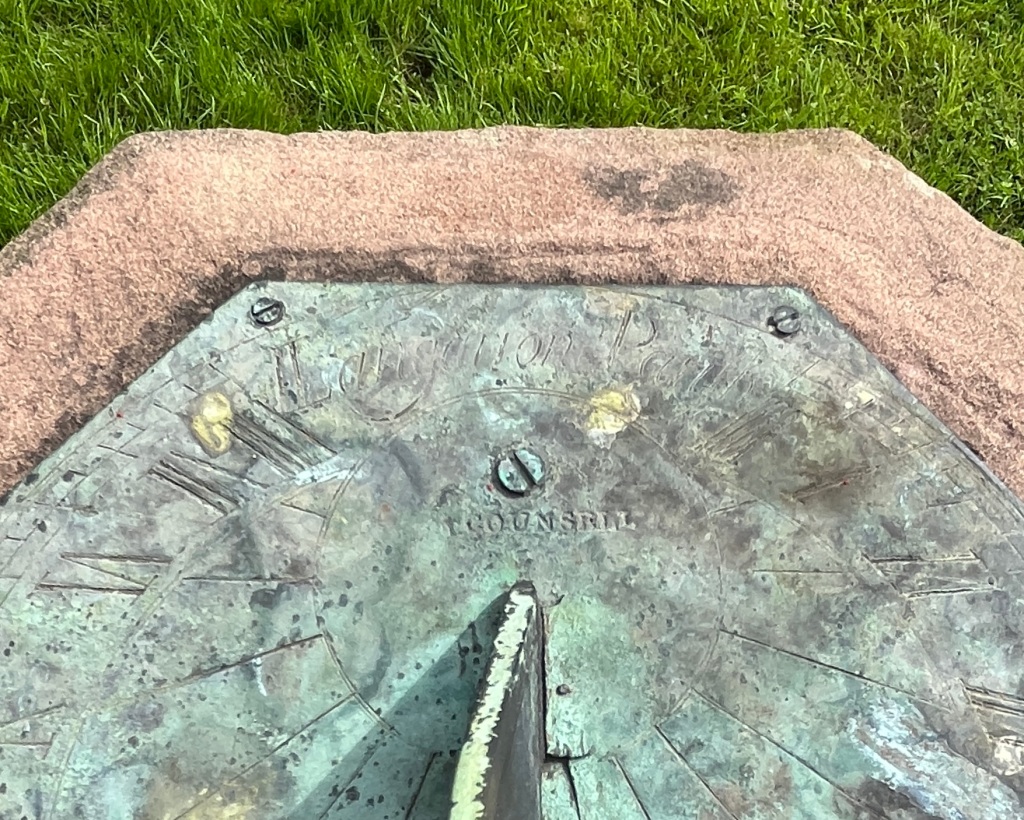
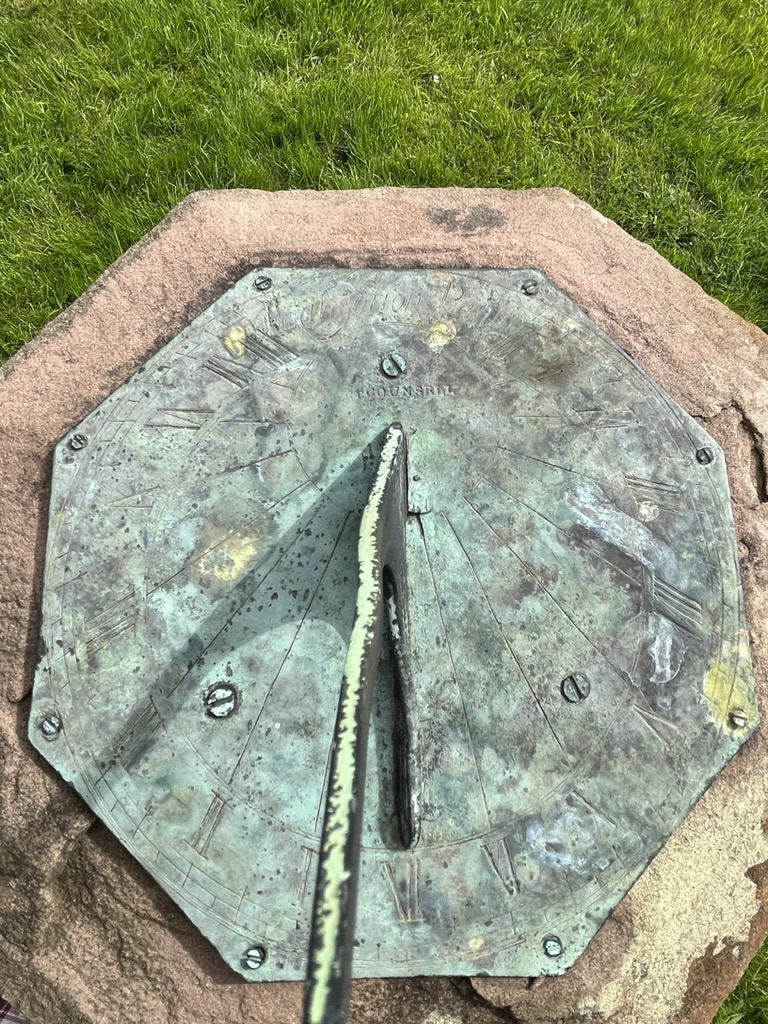
The dial is octagonal, with quarter-hours marked. IV as IIII. The inscription seems to be Llangarron Parish; and the maker’s name Counsell (though I can find no reference). The Roman numerals are conventional.
SCRATCH DIAL
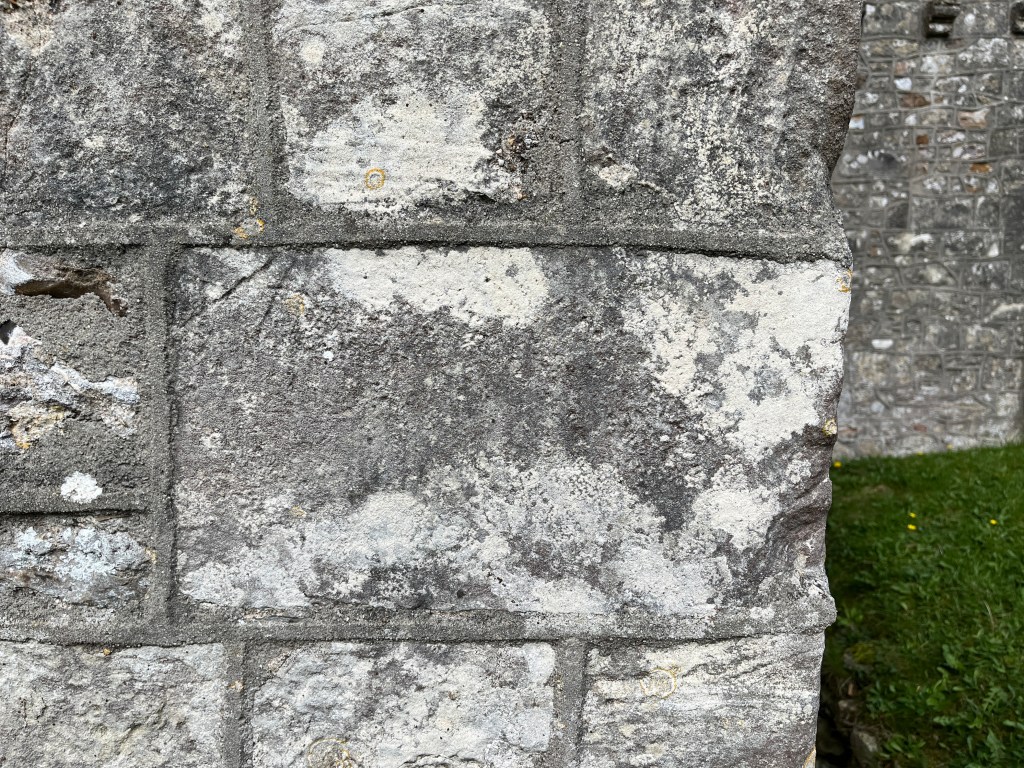
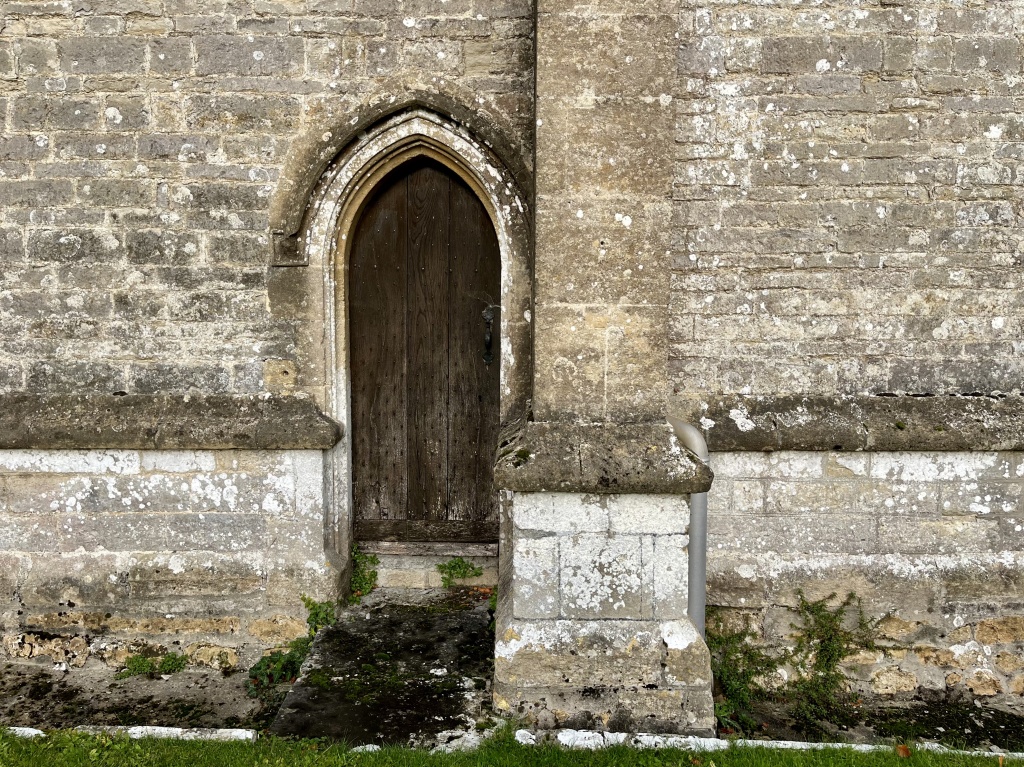
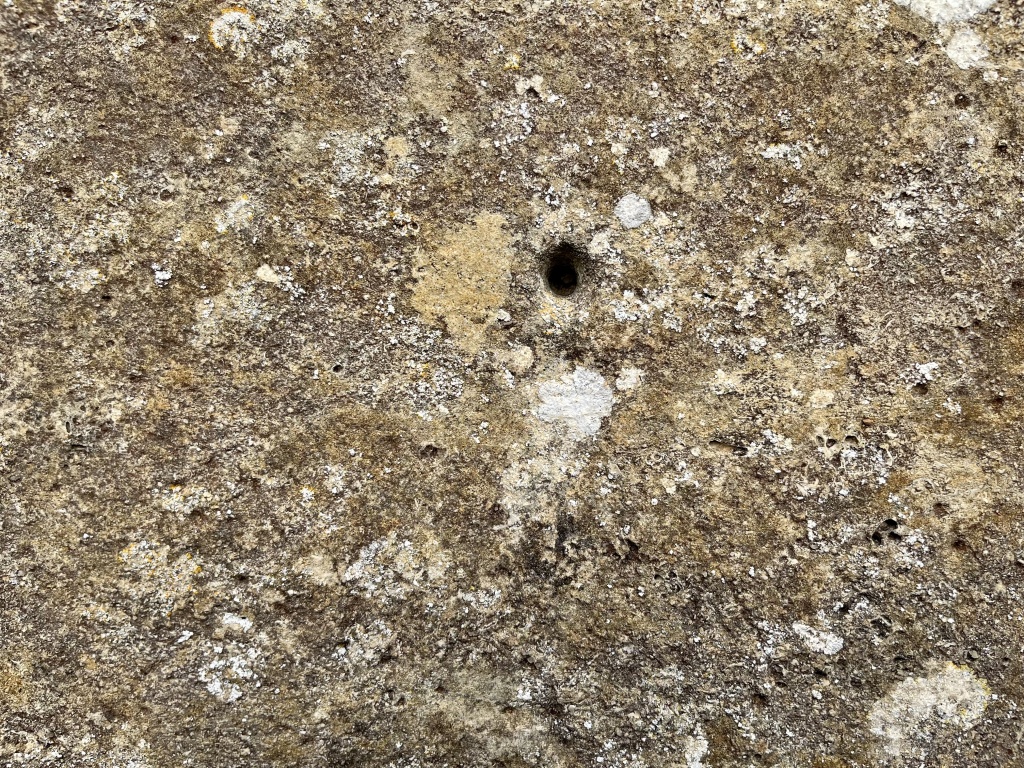
BSS records a scratch dial with 3 lines on the buttress to W of S porch, in a poor state. Notes include Max. length lines, mm 80. Hard as I looked, I couldn’t find a dial in the given location, or at any height on the buttress. Or elsewhere. Possibly the stonework has deteriorated since the original record was made. The best I can offer is the BSS sketch; and the most promising dial-like area of the buttress.
CONSECRATION CROSS
A fine consecration cross, one of the largest I have seen. One puzzle is that the cross is too large for the stone, so that LHS is cut off at the edge. It seems unlikely that the designer mis-measured to that extent. Possibly the stone was moved and trimmed to fit its present position during restoration.
GRADE I † Saxon origins; DB as Aelfsige. Dedication unknown. Dated to C14 (BLB notes C13 chancel & porch). C19 restoration. Incumbents recorded from 1353. In a most attractive setting down a long path, and grouped with a large medieval tithe barn, dovecote &co. 8m E of Lewes, 6m W of Polegate. 50.8299 / 0.1369 / TQ505055
DIALS
All 4 dials are cut on either side of the blocked S doorway of the nave. 1 LHS and 3 RHS, of which an adjacent pair are low down, almost at ground level.
DIAL 1
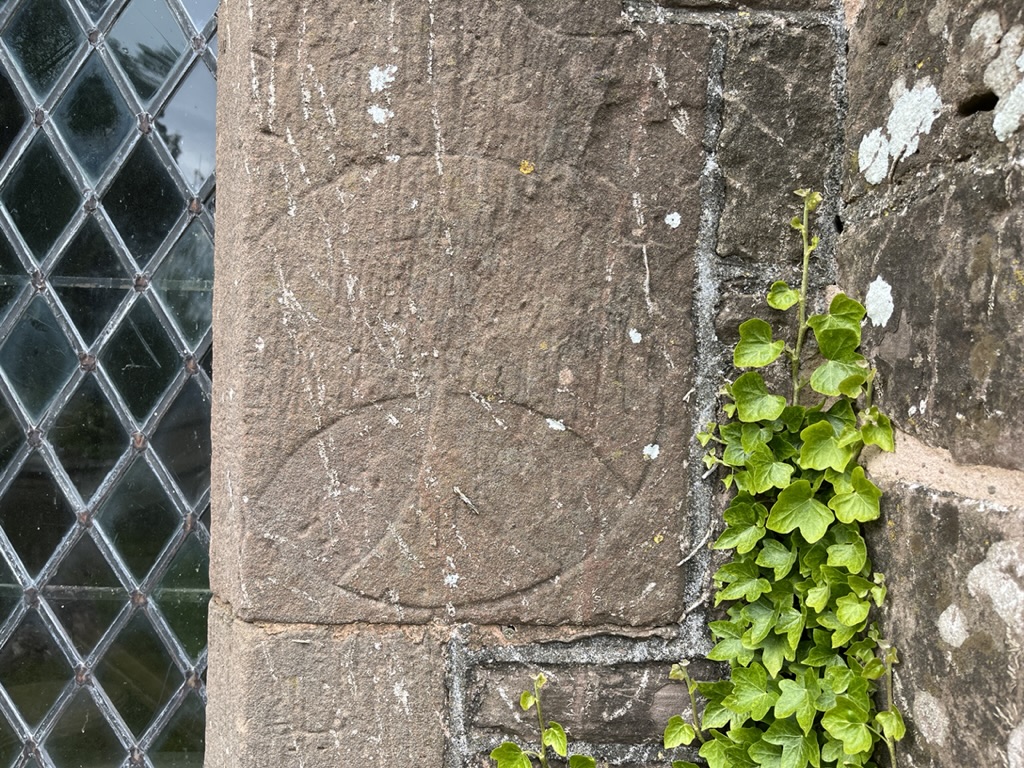
On the L jamb of the blocked doorway, the most advanced and clearest of the 4 dials. Mid-C15? Encircled, with a full cross of vertical (12-12) and horizontal (6-6) lines emphasised by deeper incision. The lower half has 6 additional lines (and hints of a couple more). A single line UR quadrant divides it fairly accurately. The gnomon hole is (now) rather large for the size of the dial but that may have happened in the course of its history.
Alciston Church . E Sussex – Scratch Dial 1
DIAL 2
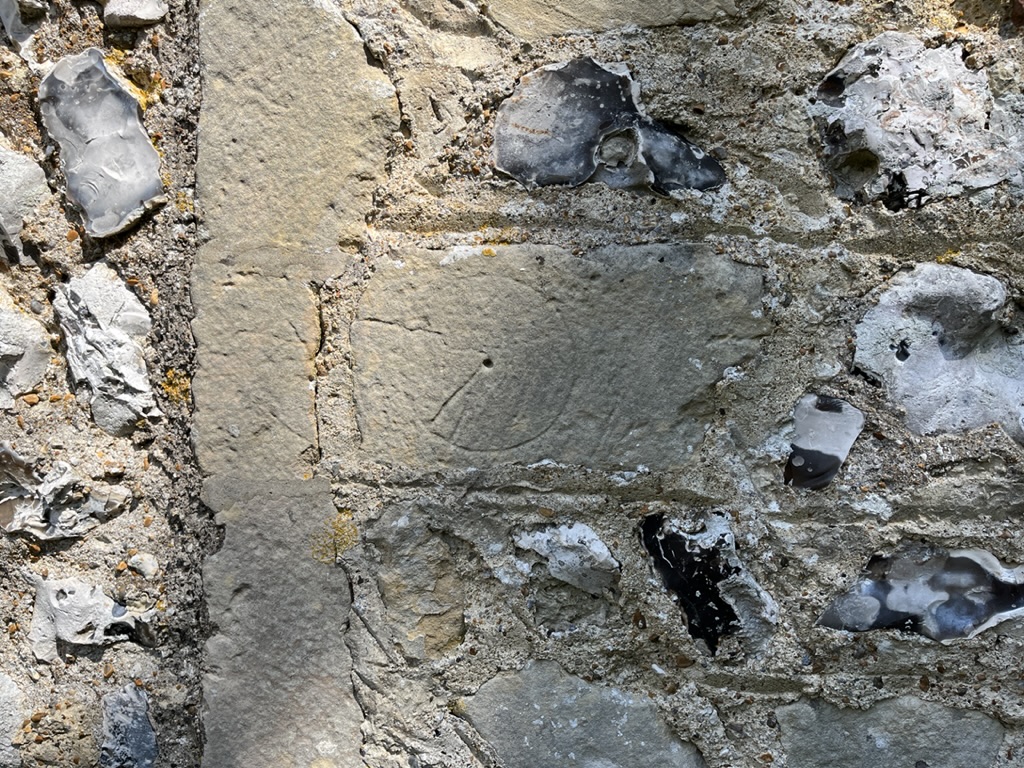
RHS of the doorway, the same height as Dial 1. A much simpler dial with 2 lines only. The worn circle contains just 2 lines LLQ, one faint and the other deeper cut. Possibly the faint line was originally the marker for Mass, and was superseded by a more visible line (hand-cut without a rule, it would seem).
Alciston Church . E Sussex – Scratch Dial 2
DIALS 3 & 4
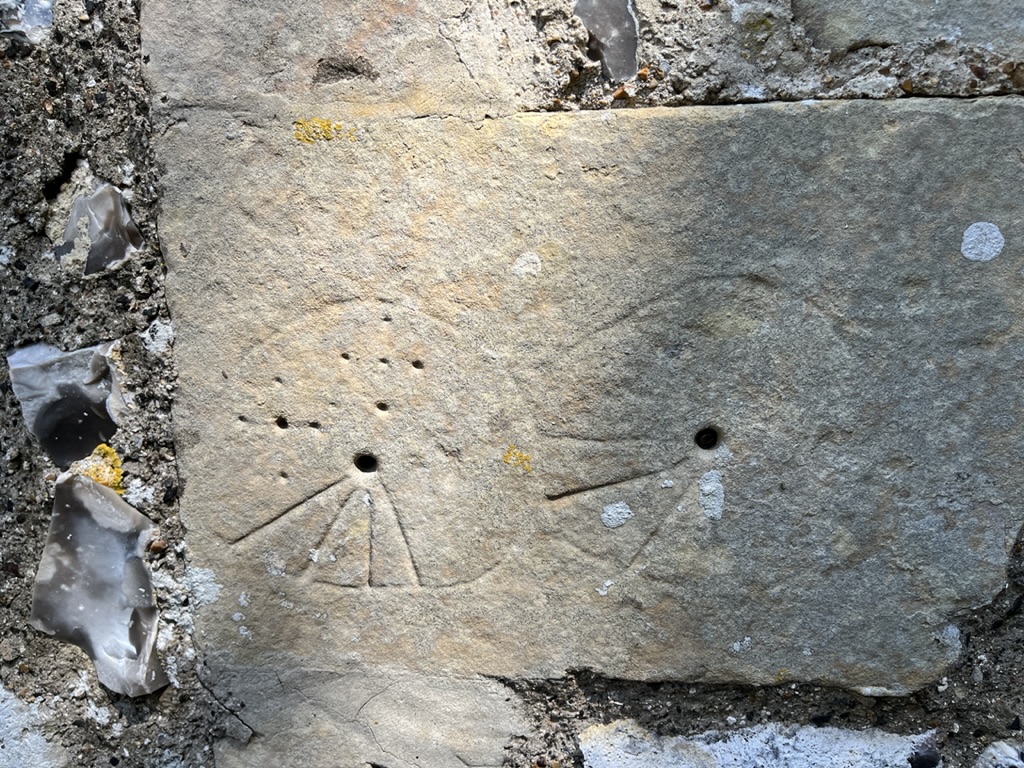
Just above ground level are 2 enjoyable dials on the same stone, presumably re-sited from a more visible position. However the stone sits comfortably with the overall design of the doorway, so I wonder whether all the dials (or those RHS) were moved to their present position when the doorway was blocked / during restoration?
The dials are adjacent – in fact, contiguous. Both circles are endearingly wonky, though the lines are cleanly cut. Dial 3 has been more carefully incised, with some attention paid to accuracy. Dial 4 probably came first and the more sophisticated Dial 3 later replaced it.
Dial 3 has 2 small dotted crosses within its circumference, also suggesting a later date than Dial 4. One cross consists of 4 separate dots; the other has the dots connected by lines (the vertical is very faint).
Alciston Church . E Sussex – Scratch Dial 3 & 4
DIALS 2, 3, and 4 as a group
Alciston is one of several rewarding churches in the area for a visit. You could combine it with climbing Firle Beacon which, at a height of 217m, counts as a Marilyn.
Frederick Barrett – Sussex Archaeological Collections 100 1962
GRADE I † C12 origins (nave, chancel), gradual expansion C13, C14 and C15; restoration 1889. Norman doorway with fine Tympanum (long predating the inscription 1698). Good C15 wall paintings.Very close to the estuary, perfect for a walk or a bird-watch. 6m W of Lyme Regis. 50.7142 / -3.0546 / SY256910
DIALS
Three dials are recorded for St Michael. They are all similar and, unlike most multi-dial churches, their design give little sense of developing methods of marking the passage of the day.
DIAL 1
Dial 1 is located on the E quoin stone of the transept, with the gnomon hole in the mortar line. There are 3 distinct radials, and a 4th that is a faint trace. BSS records include the comment Rescratched and false gnomon added.
St Michael . Axmouth . Devon – Scratch Dial 1
The last record is dated 1994, since when the false gnomon has been removed. I have used an image from then; the dial is less easy to see now. The diagram below has a theoretical perimeter and time marks for a complete dial. The note no noon [line] is slightly surprising. Radial 3 looks vertical and possibly bifurcated in re-scratching.
St Michael . Axmouth . Devon – Scratch Dial 1
DIAL 2
St Michael . Axmouth . Devon – Scratch Dial 2
Dial 2 is cut on the Chancel chapel, E end of the wall, on a quoin stone. There are 4 lines radiating from a filled gnomon hole in the mortar line
In close-up (below) it is just possible to see that line 3 (L to R) is longer than the others. That could suggest a noon line incised slightly off true vertical. If so, on this simple dial it might be a casual approach to the medieval daylight hours. On a later, more sophisticated dial, it might represent a way to achieve accuracy on a church that was not square on to the true SWNE footprint.
DIAL 3
St Michael . Axmouth . Devon – Scratch Dial 3
Also situated on the wall of the chancel chapel, and again radiating from the mortar line. BSS notes 4 lines, but 2 cannot now be detected. However the suggestion that noon is marked by double lines is plausible. This might be for emphasis (as with a terminal pock or cross); or because the vertical was re-scratched.
GSS Category: Scratch Dial
Photos. Keith Salvesen; diagram and other material, BSS
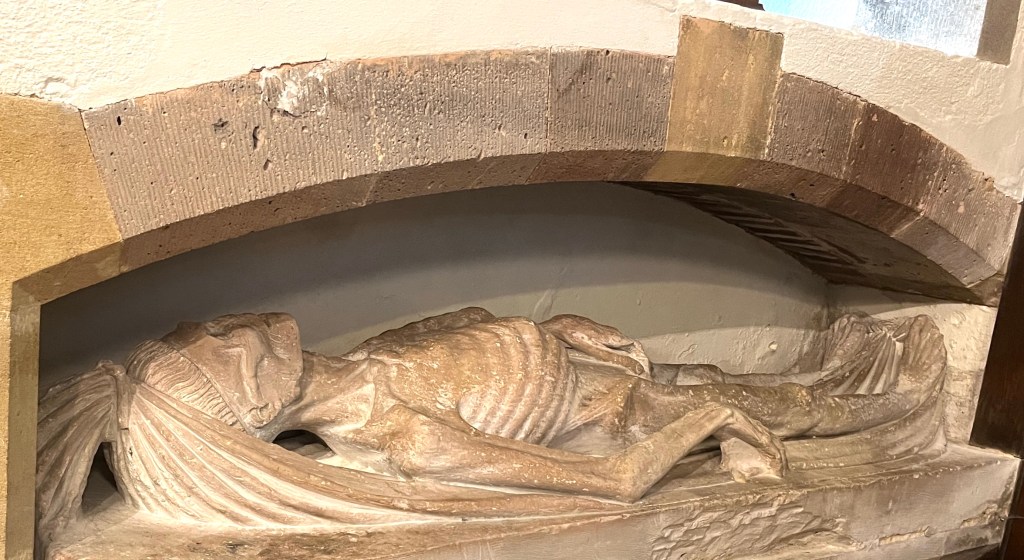
GRADE II* † Norman origins; rebuilding C15 & early C16; substantial restoration 1877. A church that repays one’s interest, with an intriguing Rood screen / reredos repositioning conundrum; and unusual chest tomb: on top lies the effigy of an emaciated cadaver partly covered by a shroudBLB. 14m E of Exeter, 5m W of Honiton. 50.7875 / -3.2659 / SY108994
DIALS
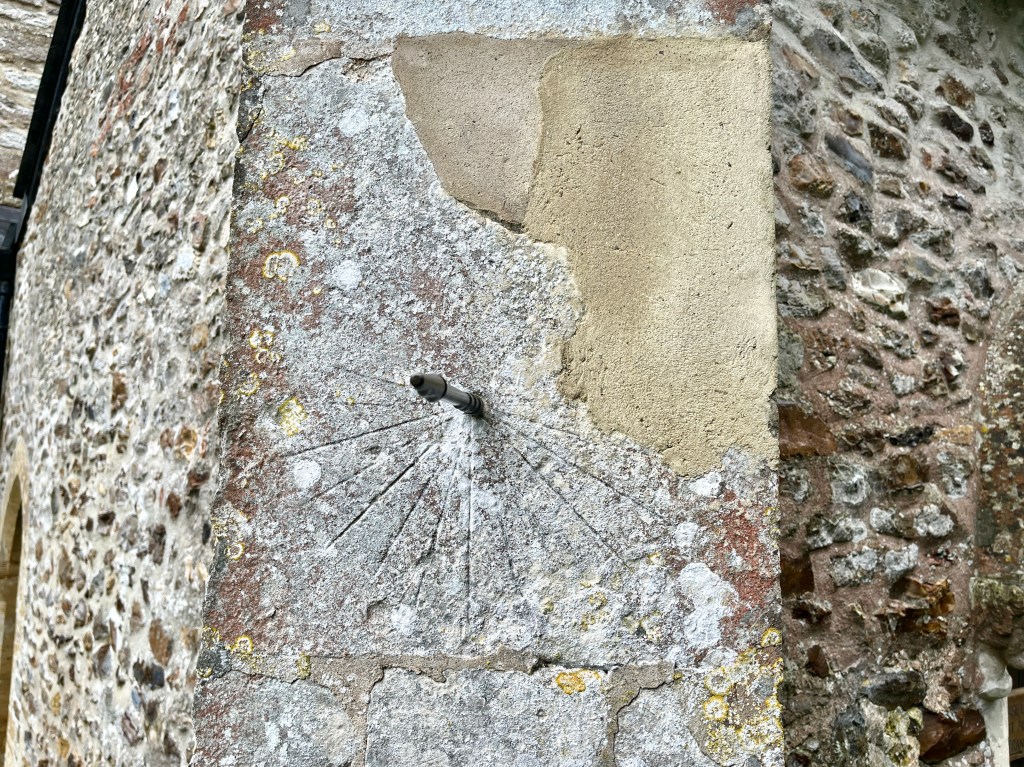
St Andrew has 3 scratch dials, the most obvious being visible from the lych gate and as one approaches S porch. The other 2 dials, very close together, are remarkable and probably unique (certainly so as a pair). Dial 3 may be doubtful. An additional basic but dial-ish scratching is shown below, as are various other church marks including a good example of a Consecration cross.
DIAL 1
St Andrew . Feniton . Devon – Scratch Dial 1
Dial 1 on the porch buttress is a straightforward design and easy to make out, but damaged and cement patched UR. There are 13 lines, some now very faint. The angles are more or less accurate at 15º. The vertical / noon line is not emphasised in any way, which is slightly unusual. The main Mass was presumably Terce, marked with a deeper cut line LHS. The gnomon hole has been filled with a rather well-chosen rounded arrow design; it is modern yet respectful of its purpose.
DIAL 2
St Andrew . Feniton . Devon – Scratch Dial 2
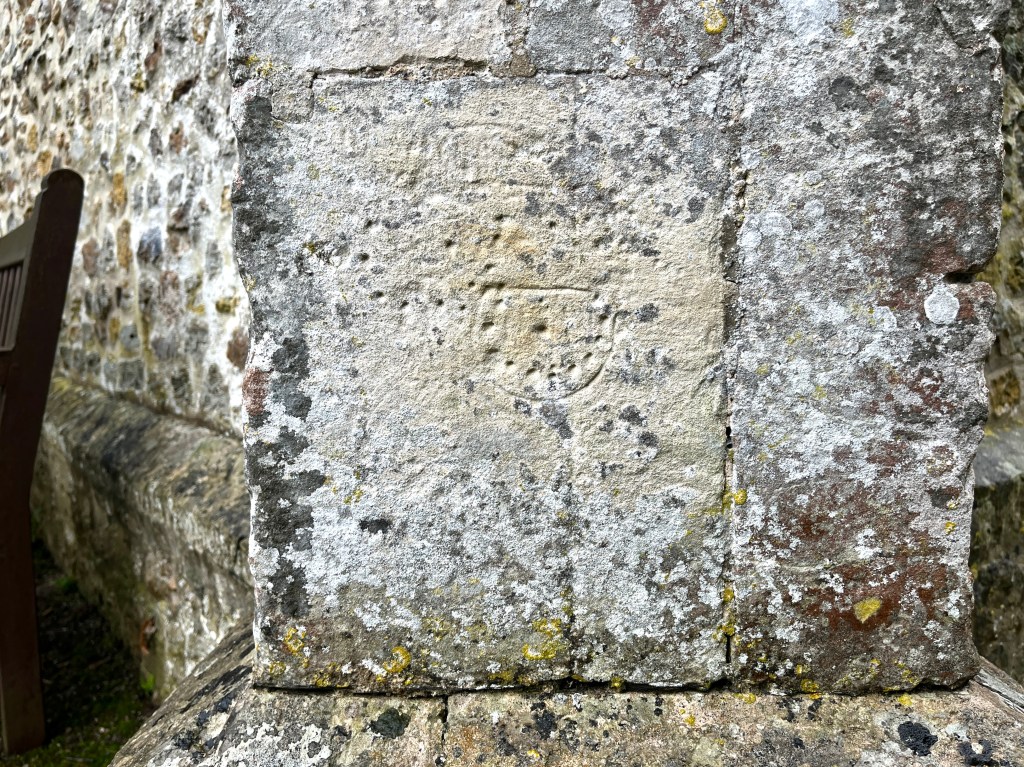
Dials 2 & 3 are adjacent low down on the same porch buttress as Dial 1. It is a remarkable juxtaposition. BSS suggests they are early dials – pre-1400?
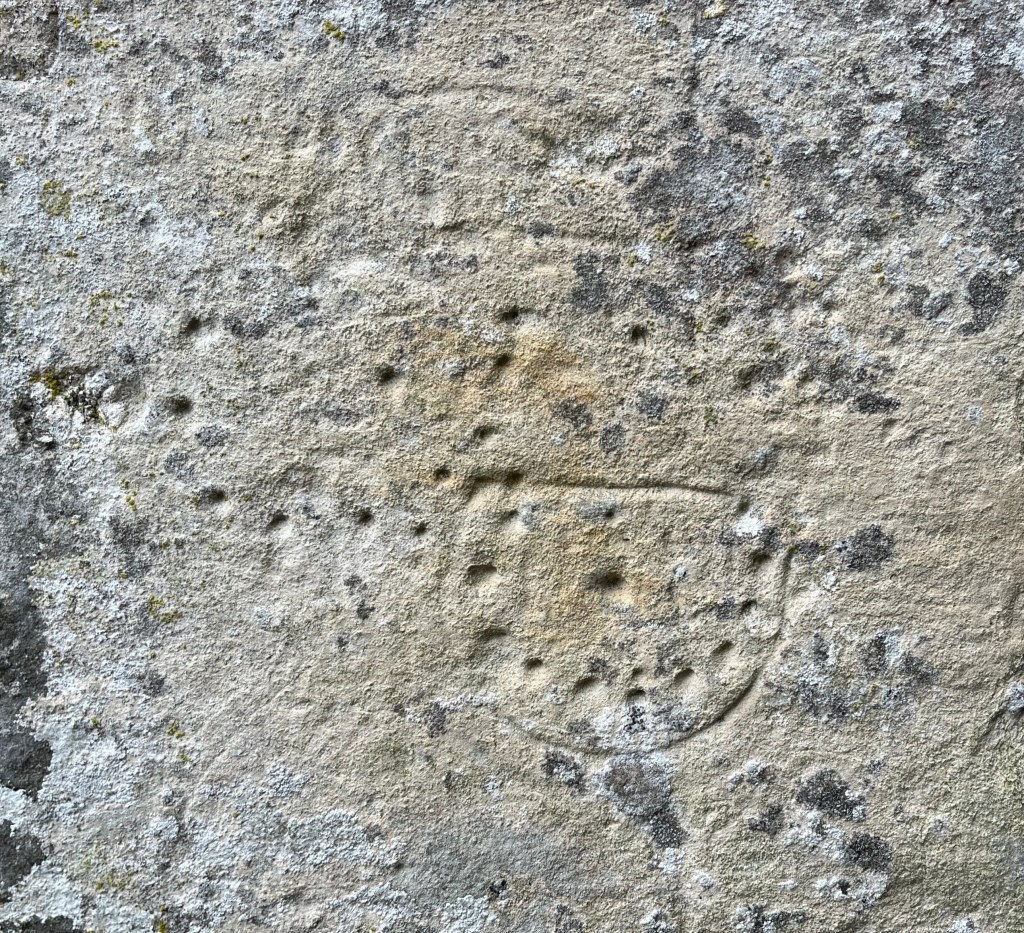
Dial 2 consists of a pattern of pocks contained within what could be termed geometrically as the major segment of a circle. The horizontal line is incised more deeply. BSS suggests that 13 pocks are identifiably associated with the dial, with a few random ones besides. The quite shallow gnomon hole in such a small design presumably contained a stud rather than a rod.
A noon line is seemingly marked by the sightly offset double pocks just R of the vertical. Theres’s also a very small pock directly above the gnomon hole, conceivably a decorative-use-only marker for midnight and symmetry.
DIAL 3
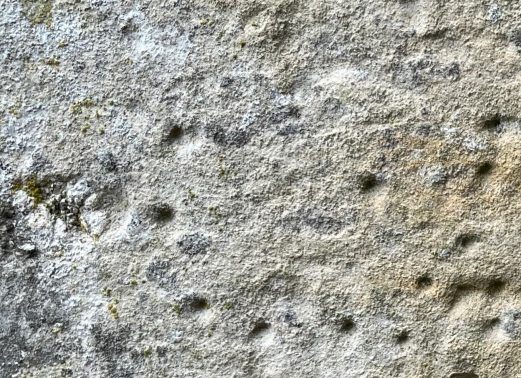
Dial 3 The BSS entry for this little configuration of dots describes a semi-circle of 8 pocks, with other associated pocks and no obvious gnomon hole. It concludes closely related to dial no. 2, possibly never used as a dial.
Perhaps it is not a dial at all. The rather untidy part-circle curves away NE after noon – pointlessly, if part of a dial. BSS notes that there is no central style hole. There is a single pock inside the perimeter that might have held a stud – but unlikely to be much use in that position. Some might suspect unserious pattern-copying efforts along the lines of Dial 2.
St Andrew . Feniton . Devon – Scratch Dial 3
My amateur reading of this buttress as a whole is firstly, that the low stone on which Dials 2 & 3 are located is not its original location. At some stage during all the rebuilding and restoration over the centuries it was re-sited. The little dial that ‘worked’ was then too low and would anyway have been an obsolete design. It was therefore superseded by a far larger, more modern (? mid C16) and very visible dial, accurately cut and ideal for marking the passage of the day for a larger, better educated community in a more modern era. Comparatively.
DIAL 4?
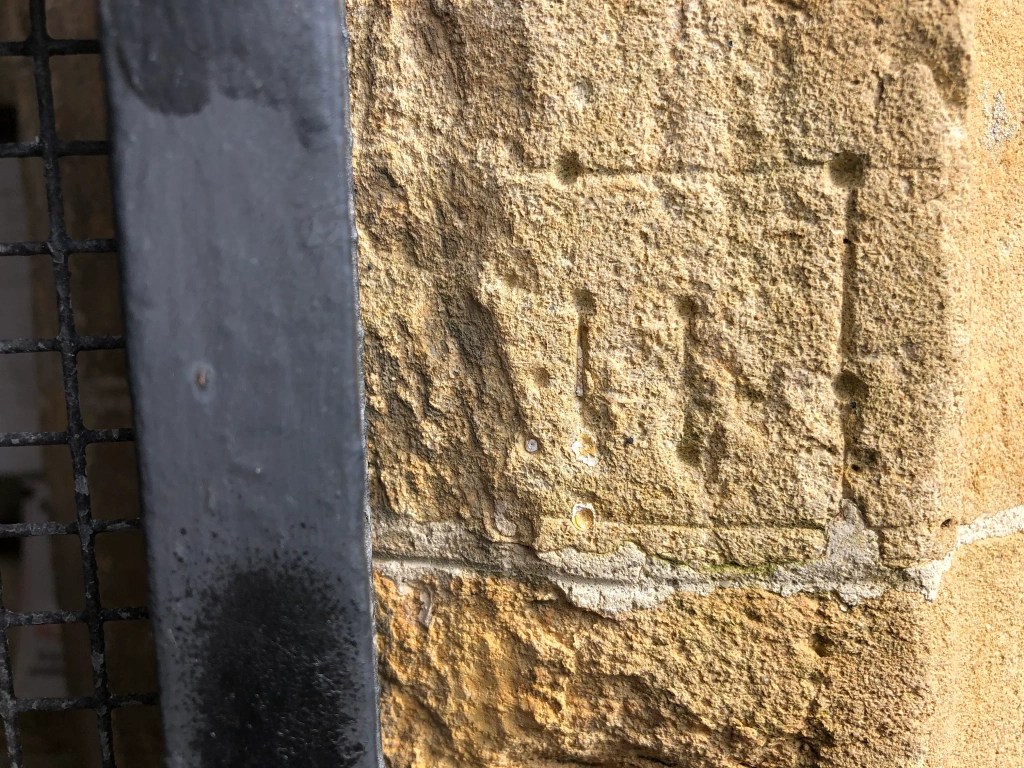
Both lines seem deliberately scratched. One is approximately vertical, the other could mark the Mass time Terce (cf Dial 1). The lines diverge from the mortar line, as do many simple dials – it means not having to drill a dial gnomon into stone. I have seen less convincing 2-line versions that have been recorded as dials. I am slightly in favour of it being a dial.
CONSECRATION CROSS
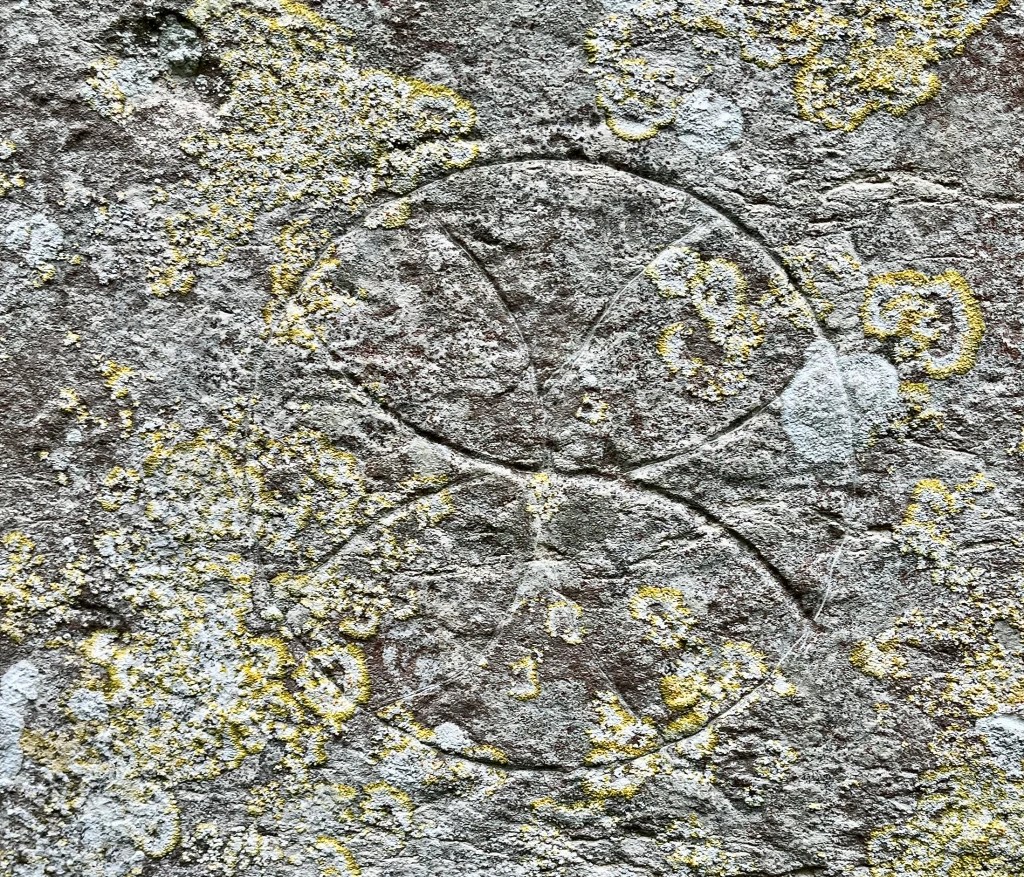
This is a good example of a rural consecration cross, incised on a buttress between 2 windows. From a distance the design might mislead and be seen as four petals, rather than a compass drawn cross. There are hints of an outer circle. This is a fairly common type of cross, but good see one that is relatively unworn. The four distinct quarters rule out ID as a protective hexfoil, although there is a similarity.
GRAFFITI
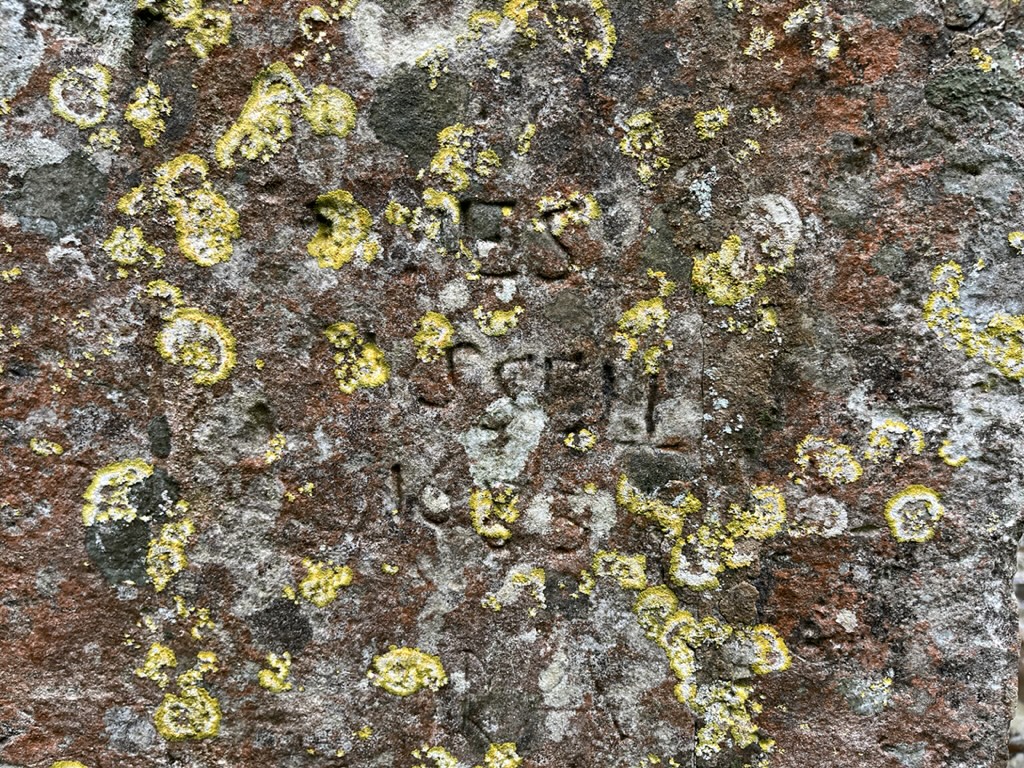
Graffiti on two adjacent stones, one example dated ?1675
PROTECTION MARK
This is very likely a ritual protection mark / apotropaic symbol designed both to prevent evil from entering the church, and to repel it. For that reason they are most often found inside or near porches. I haven’t encountered the pattern below before, but a group of dots with some joined by deep cut lines is a commonly found design – see an example from Dorset below.
GRADE I † Mainly early C15, some older fragments; later restorations. A huge church for a small village. Simon Jenkins awards it ** and with good reason. Wonderful bench ends, not to be missed. See BLB for more. Midway between Wincanton and Ilchester. 51.0417 / -2.5214 / ST635270
DIALS
DEH visited in April 1914 and recorded 3 dials, all on S facing buttresses, one close to the priest’s door. They are very eroded. There are possible remnants of 2 further dials, mentioned below.
DIAL 1
St Michael . North Cadbury . Som. – Scratch Dial
DEH169. (1) This dial is on the first buttress w. of the s. porch. It is 5 feet above the ground, the noon line is 4 inches in length, the stylehole is 5/8 of an inch in depth by 1/2 an inch in diameter, and the aspect is s. by 15° e.
Located on the buttress W of S porch. An obvious style hole with a semicircle (6 – 6) of unobtrusive small pocks. Photography has its limitations and St Michael tested them. Records mention 13 to 16 pocks. One can just make out the faintest of traces of lines at noon and 2.
BSS suggests a possible dial immediately above. Assuming a style hole in the mortar line, there are a few pocks in the immediate area, but rather disorganised. Doubtful rather than plausible.
DIAL 2
St Michael . North Cadbury . Som. – Scratch Dial
DEH170. (2) This dial is on the first buttress E. of the s. porch. It is 4 feet 10 inches above the ground, the noon line is 3 inches in length, the style hole is about 11/2 inches in depth by 3/4 of an inch in diameter. The aspect is s. by 15° e.
As with Dial 1, very eroded and with little visible detail even when one is quite close. There are 8 detectable lines with a perimeter of pocks, probably (BSS) 13 with extra pocks at 8.30 and 10.30 – presumably Mass indicators.
DIAL 3
St Michael . North Cadbury . Som. – Scratch Dial
DEH 171. (3) This dial is on a buttress e. of the priest’s door. It is 5 feet 8 inches above the ground, the noon line is 4 1/4 inches in length, the style hole is 7/8 of an inch in depth and 1/2 an inch in diameter, and the aspect is s. by 15° e.
Situated on S side of the chancel, on the buttress E of the Priests’ door. There are 13 lines and a full complement of 24 pocks. The line angles are at approx 15º intervals. BSS notes a possible ‘tiny dial’ above it.
MEDIEVAL GRAFFITI
The porch contains the original stone benches on either side. These are often troves of graffiti, in particular apotropaic symbols and other ritual protection marks designed to repel evil or to prevent its entering the church. These signs are quite common to find in other locations both outside and inside a church (see HERE). However, in many churches, stone benches were replaced in succeeding centuries. St Michael has retained the benches, on which there are excellent examples of marks that are relatively rare. There are hands here, and a medieval swastika (a Sanskrit word) from several centuries before its more recent symbolic adoption. It incorporates a repelling circle mark, where evil may be captured within its continuous circumference.
GRADE I † C12 origins on site of Saxon church; c13 rebuilding (chancel, nave), S porch added; C15 & later restorations (latest in 1936). Unheated and candlelit until 1975. Much of interest – remarkably secluded location, a Holy well, a direct link with Alice in Wonderland, an excellent riverside pub. Within ring road W of Oxford, N of Botley Road, at the end of a mile of narrow lane. Check a map before you go… 51.7691 / 1.2976 / SP485080
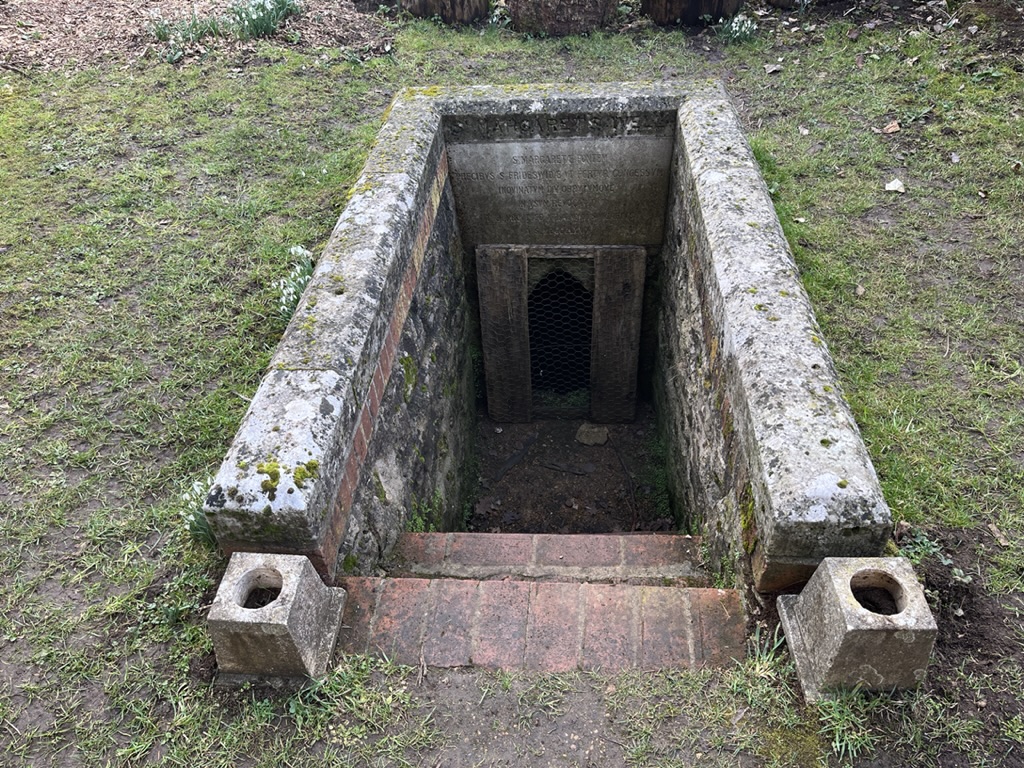
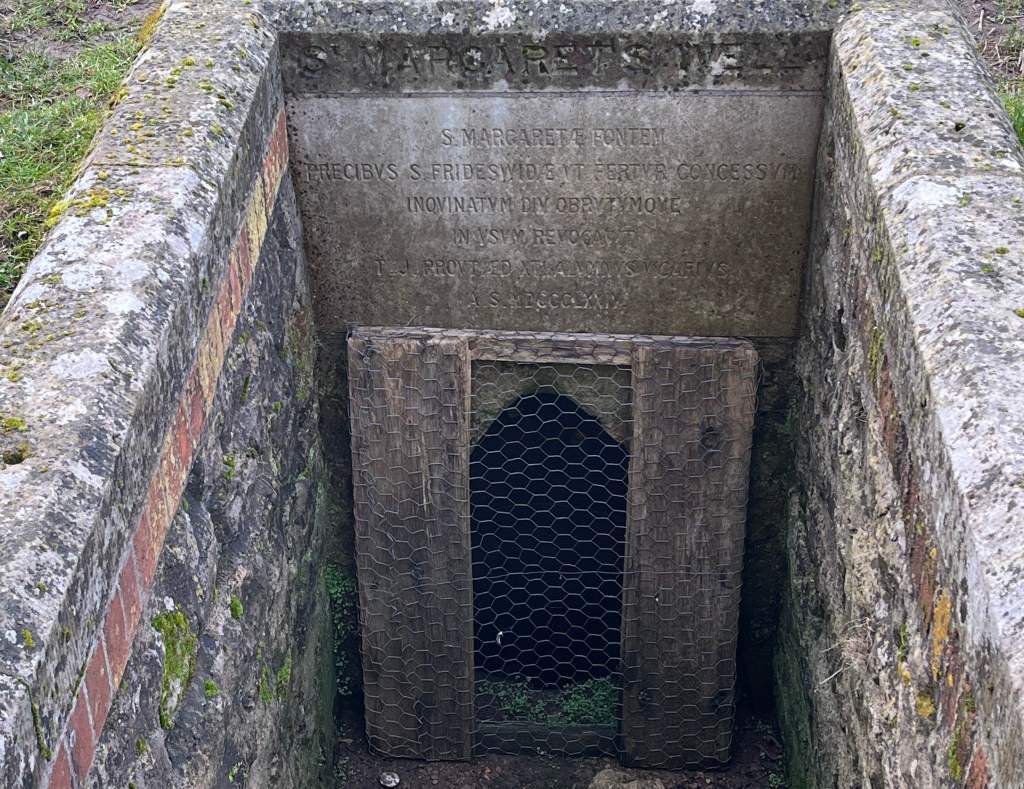
❖ The clearest illustrated article about St Margaret, its history, and its significance can be found at David Ross’s excellent BRITAIN EXPRESS. This includes the sad story of the celibate St Frideswide (C7), Patron Saint of Oxford and a roundabout system, & her suitor Algar. It also covers the origins of the Holy well, its healing powers and its link to Alice’s ‘treacle well’. An informed tour of the church ends with helpful directions to it.
DIALS
DIAL 1
St Margaret of Antioch . Binsey . Oxford – Scratch Dial 1
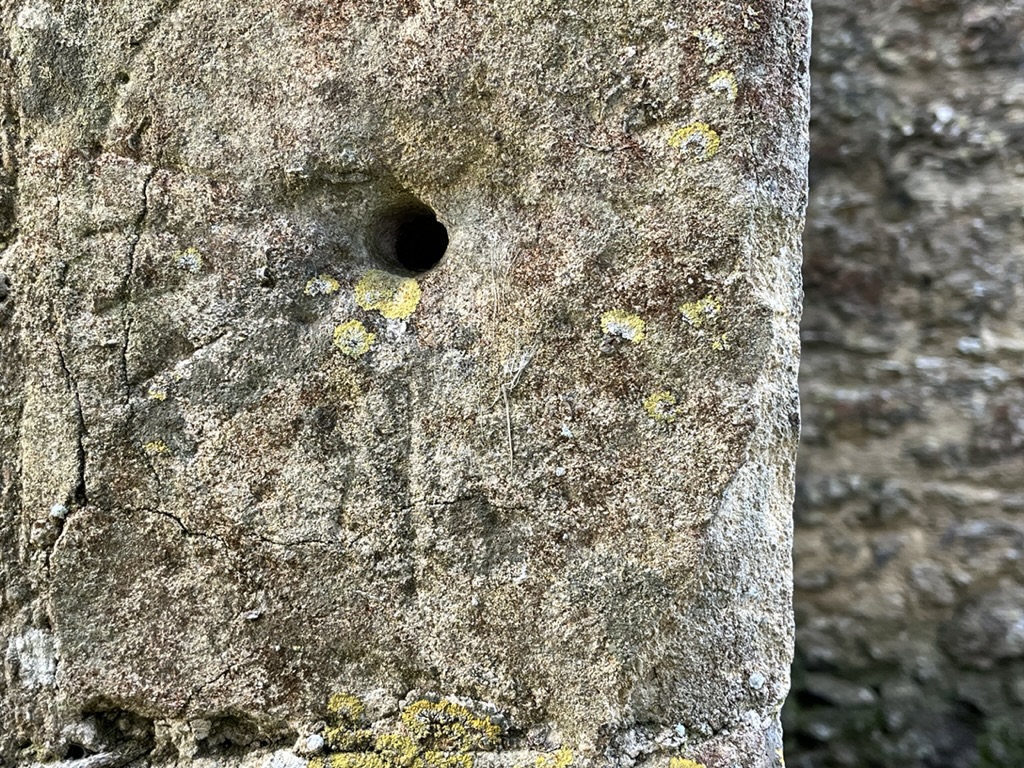
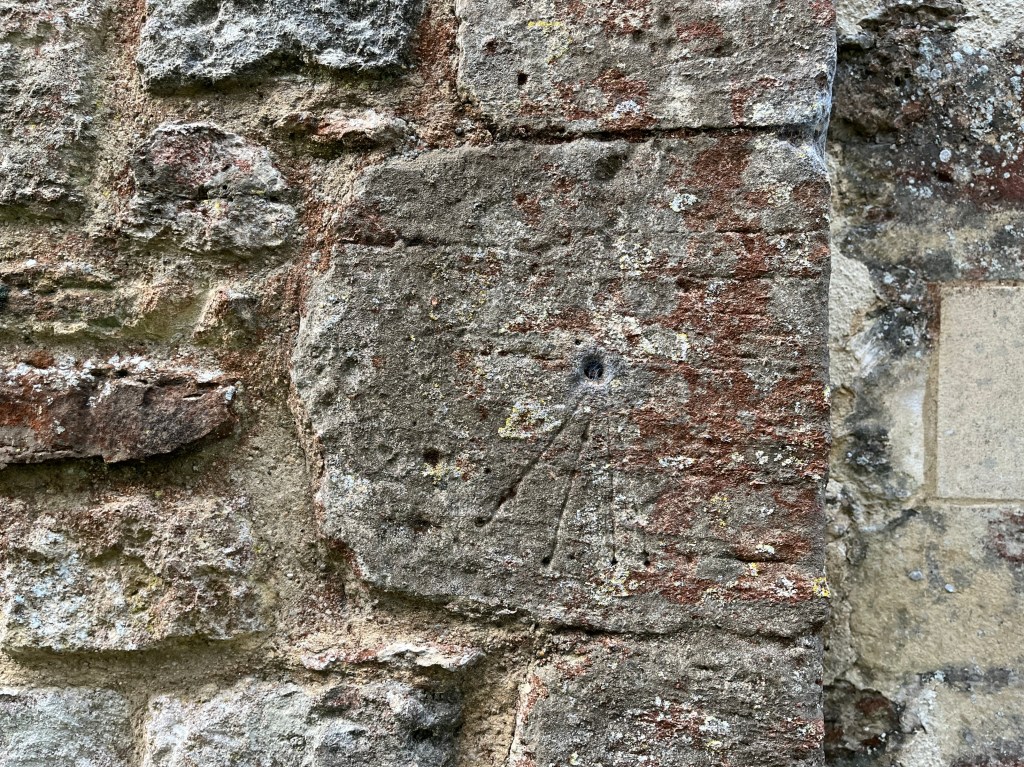
On the quoin RHS of the porch entrance, with a large slightly recessed gnomon hole. A morning dial, very eroded in the 3 other quadrants. Originally encircled (BSS)? The visible evidence of a complete circle is scant. 8 lines, some extending over split stone. The noon line is emphasised – longer and deeper cut. A hint of double pocks at lower end – just possibly a dotted cross ✣?
DIAL 2
St Margaret of Antioch . Binsey . Oxford – Scratch Dial 2
Located on the nave buttress adjoining the chancel. 4 lines radiating from a central hole in the dial stone, one slightly curved; 7 clear pocks all on or at the end of the lines. Unlike dial 1, there is no exact vertical line. The puzzle is to identify the noon line. On some dials, there is a notional noon line formed by a narrow gap between 2 near-vertical lines – not the case here. Presumably it is line 2, being extended and having 2 pocks. Line 3 is too flimsy for the task. Line 1 presumably marks a service time between Terce and noon.
ST MARGARET’S WELL
GRAFFITI ANCIENT & MODERN
There is a certain amount of graffiti in the porch, some of which is not medieval. Included are initials, 2 (unconvincing?) inverted Marian marks; and some scratchings of hard-to-decipher script, something I haven’t often seen.
After your visit you may need refreshment: I recommend the excellent nearby PERCH INN
St James . Cowley . Oxford (Parish Website – link below)
GRADE II* † Mid C12 – C15; early frescoes; 1860s work by G.E. Street with additions & rebuilding. Remarkably squat tower, C15. Unexpectedly up a secluded narrow lane just E of the bustle of Cowley – no one would guess that there is a C12 building there. 51.7306 / -1.2197 / SP539038
St James . Cowley . Oxford – porch with 2 scratch dials
DIALS
There are 2 dials, both inside the porch on either side of the entrance door. Disappointingly the porch gate was locked, so I could not get access. The photos of the pair taken late in the day are distinctly underwhelming…
DIAL 1
St James . Cowley . Oxford – BSS
Dial 1 is inside S porch LHS of the doorway, in the corner below the springing of the arch and above the moulding. 4 lines radiating from the style hole, with the noon line deeper cut.
DIAL 2
Dial 2 is also inside S porch, RHS of the doorway and above the capital of the pillar. There are 6 lines radiating from a quite noticeable style hole. BSS suggests there are 3 pocks (possibly more), though I could not see those details.
St James . Cowley . Oxford – BSS
OTHER MARKS
Besides the dials, there was a certain amount of graffiti with other scratchings in the area of the porch, not all of it medieval. There are a couple of Marian marks and what may be a very crude pentagram, a symbol to repel evil.
GSS Category: Scratch Dial; Mass Dial
All photos (for what they are worth) Keith Salvesen except header image from St James Parish website (their excellent photo replaces my poor ones taken from a different angle); and BSS (2 images)
C13 chapel located within an Iron-age hill fort Chisbury Camp. The Lord of the Manor built it to assert his social status by allowing the household of the manor, as well as local people, to attend services and pay their taxes without having to travel to the parish church at Great BedwynEH. Thatched, with flint walls. The chapel was deconsecrated in 1547 and after three centuries of use as a barn it was reduced to its present dilapidated state. It is however a scheduled Ancient Monument, now in the care of English Heritage.
CONSECRATION CROSS
GRAFFITI & MARIAN MARKS (VV)
There was no scratch dial and I wasn’t expecting to find one. However the chapel is interesting enough to merit inclusion, not least because consercation crosses and church marks generally are catered for in this project.
1. shows a (possible? probable?) Fleur de Lys with G Bedwyn scrawled below – 2. is one form of protection mark – 3. enclosed initials – 4. Marian mark VV – 5. ‘scratchings’ – 6. Marian mark VV and a design with a heart that I initially thought must make it recent… However the form of the W (similar to a Marian mark) is from a much earlier time, as is the date (if it is one) in Roman numerals. I can’t decipher it beyond ..15
GSS Category: Consecration Cross; Church Marks; Marian Symbol; Medieval Graffiti
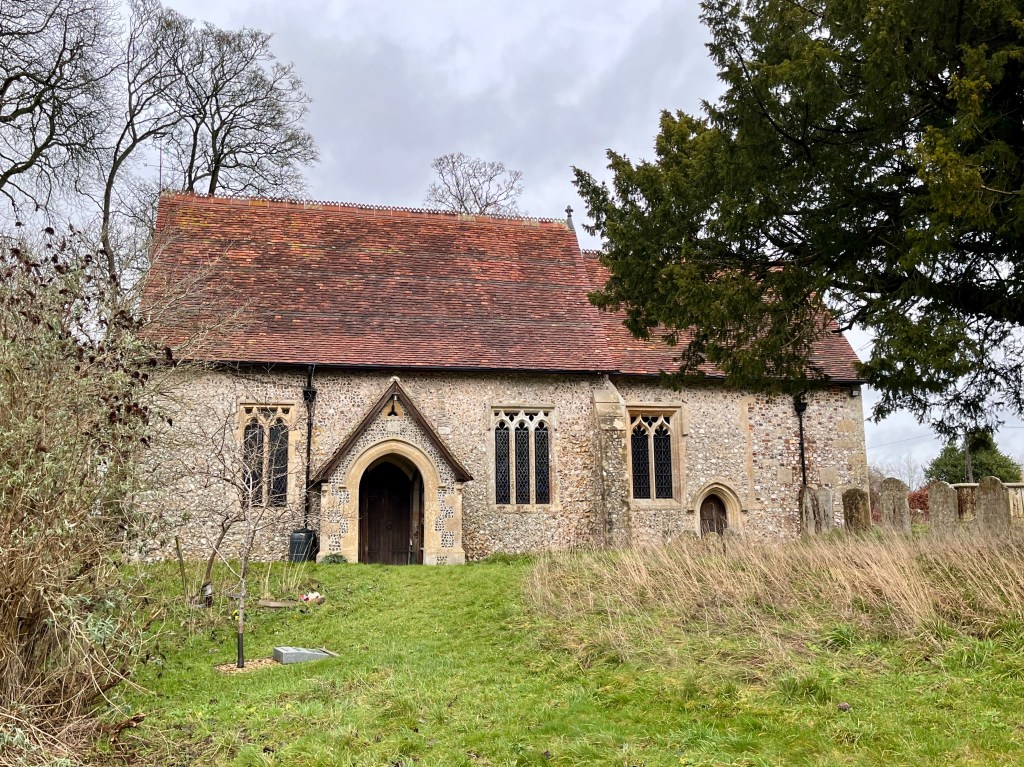
GRADE II* † Cll Saxon / Norman origins with simple nave – some features survive; C15 chancel; later additions / restoration 1882. A most surprising Palladian / Venetian E window. Detached timber-framed bell cote. Attractively set in a well-wilded churchyard. 6m W of Andover. 51.1944 / -1.611 / SU272439
DIAL
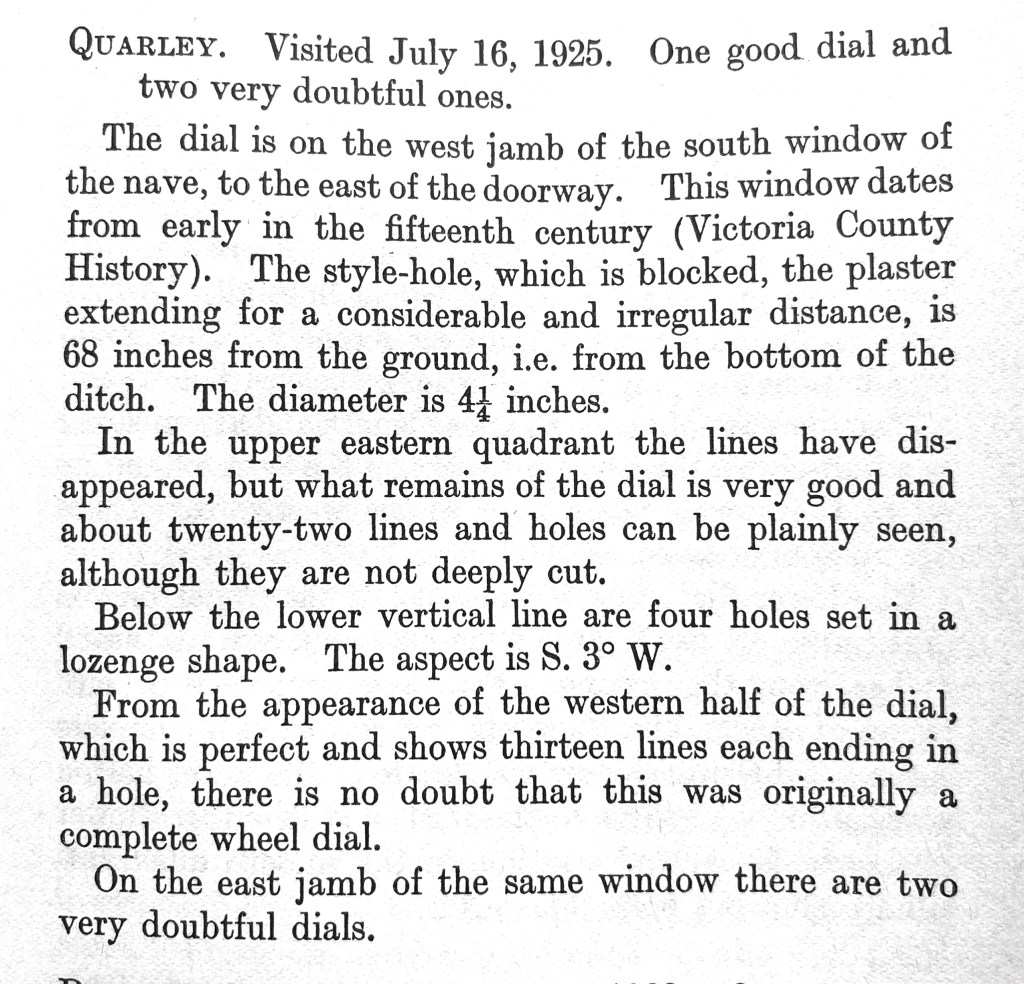
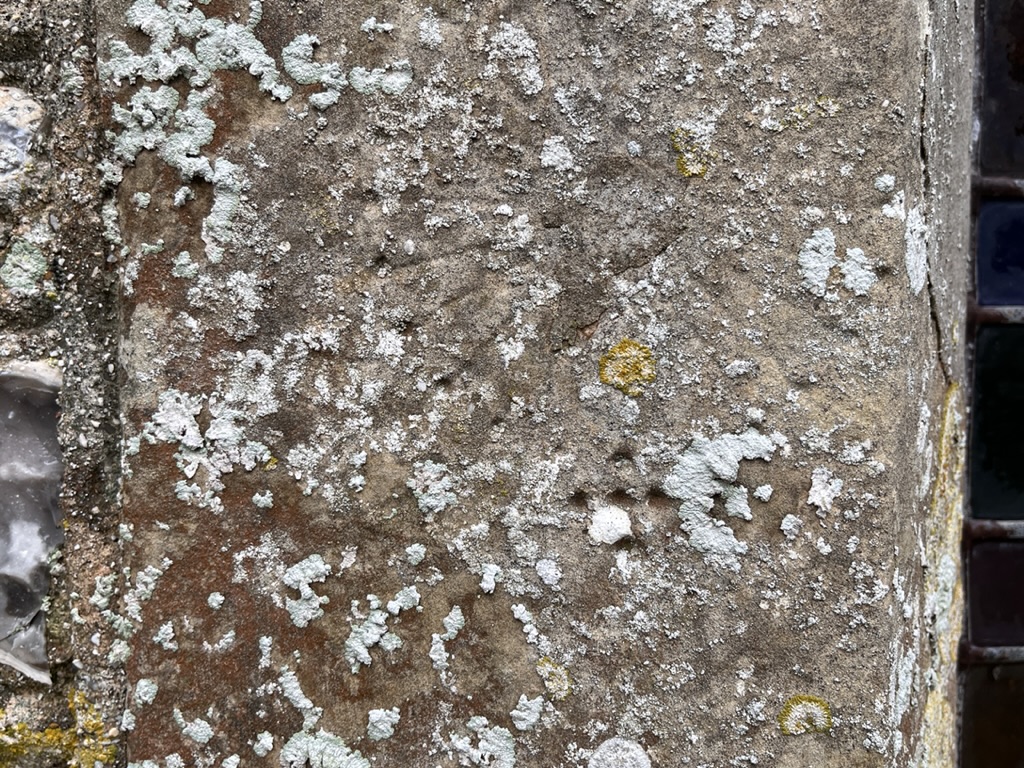
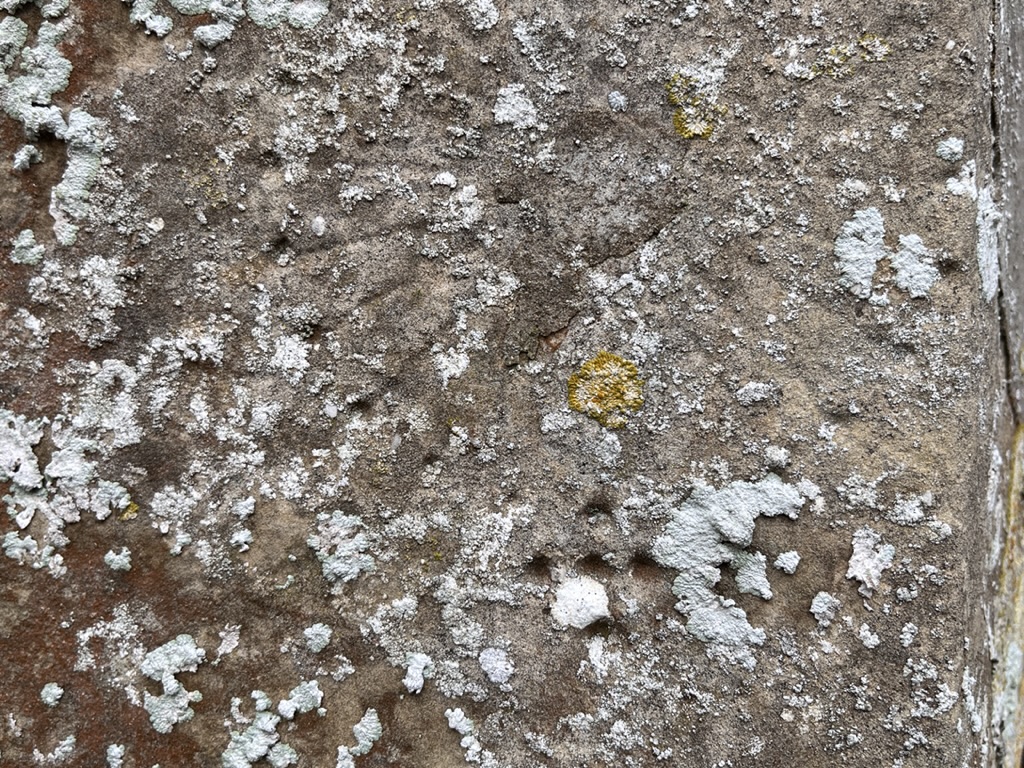
The dial is on the W jamb of the window E of the porch, first recorded by ARG in 1925. The gnomon hole is filled. ARG’s description is below. The more recent BSS entry records 19 visible / detectable lines and 21 pocks, with possible hints of a circle. On either view, this is an eroded 24-hour dial (esp URQ), with noon marked by a quincunx (like 5 on a die), which I haven’t seen before. One puzzle is why the dial was cut in such a position that it is truncated RHS.
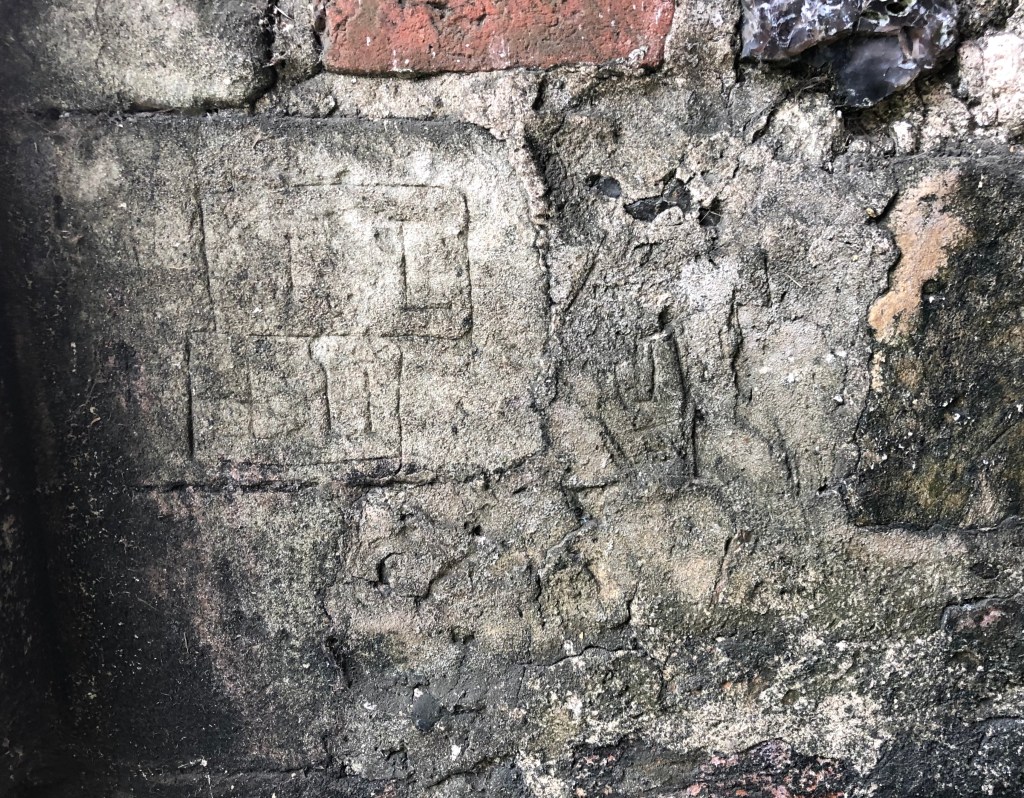
ARG noted two very doubtful dials on the E jamb of the same window; and in his text he refers to another doubtful on the buttress of the S Chapel. I couldn’t make out dials.
St Michael . Quarley . Hants – Scratch Dialwith Quincunx
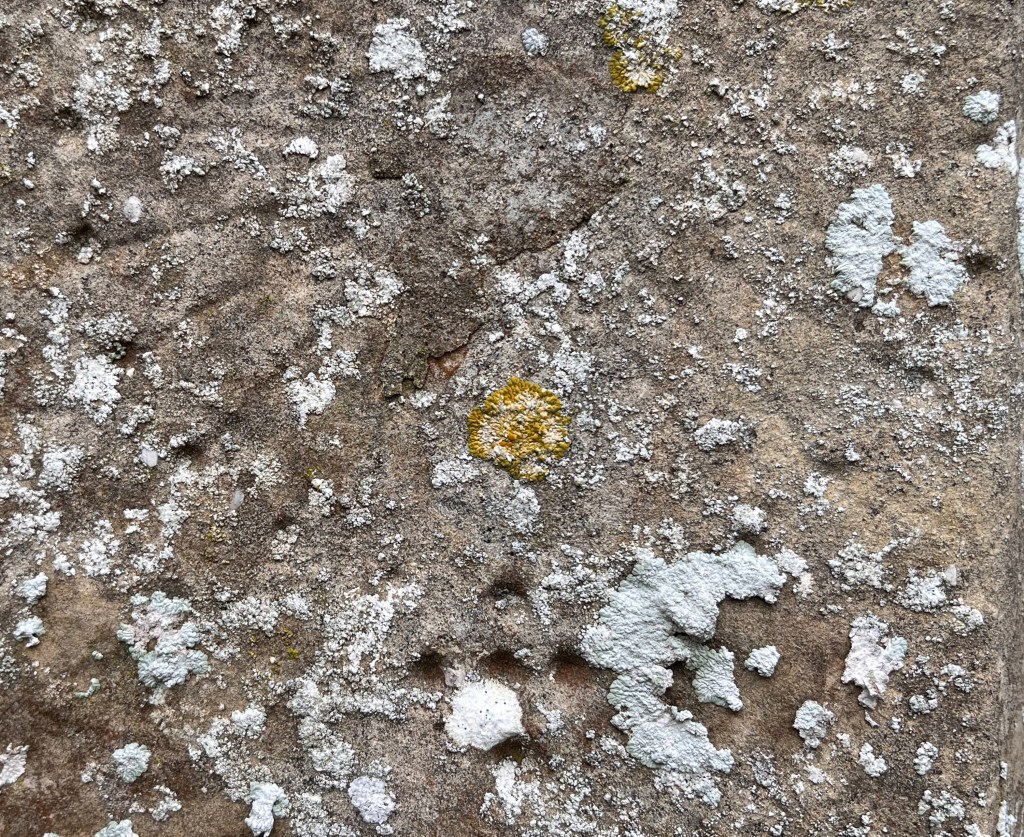
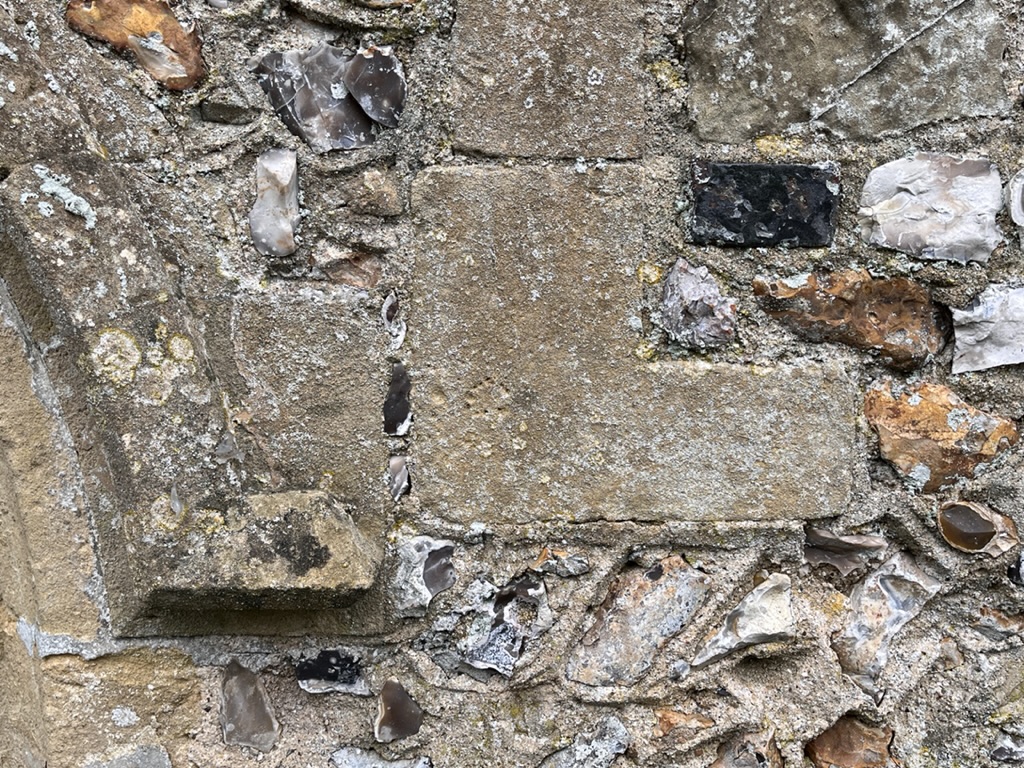
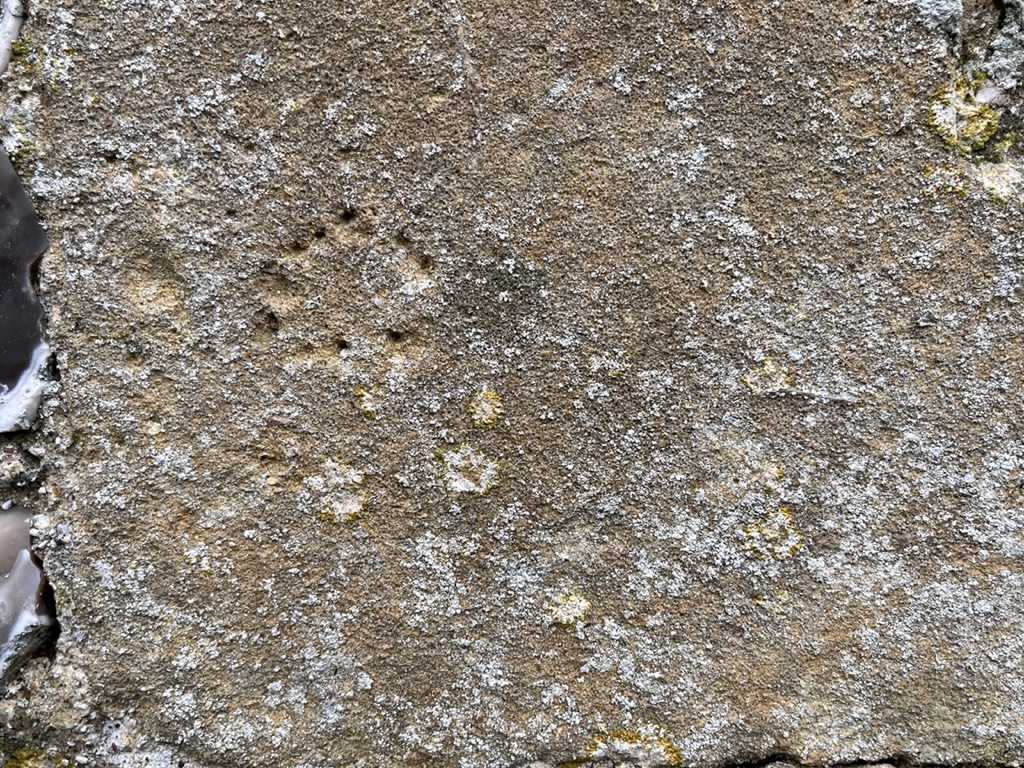
There was another mark that caught my eye, a small uneven circle of pocks. There’s no hint of a central hole. As I visit more churches, I see more of these little markings. They can’t be dials, and they seem unlikely to be purely decorative. My tentative theory is these little pock circles are a form of protection mark / apotropaic symbol). However I haven’t yet found such a design featured in the usual medieval building mark resources. Any theories welcome.
St Michael . Quarley . Hants – circle of pock marks



















































 GAUDIUM SUB SOLE . SUNDIALS . MEDIEVAL TO MODERN