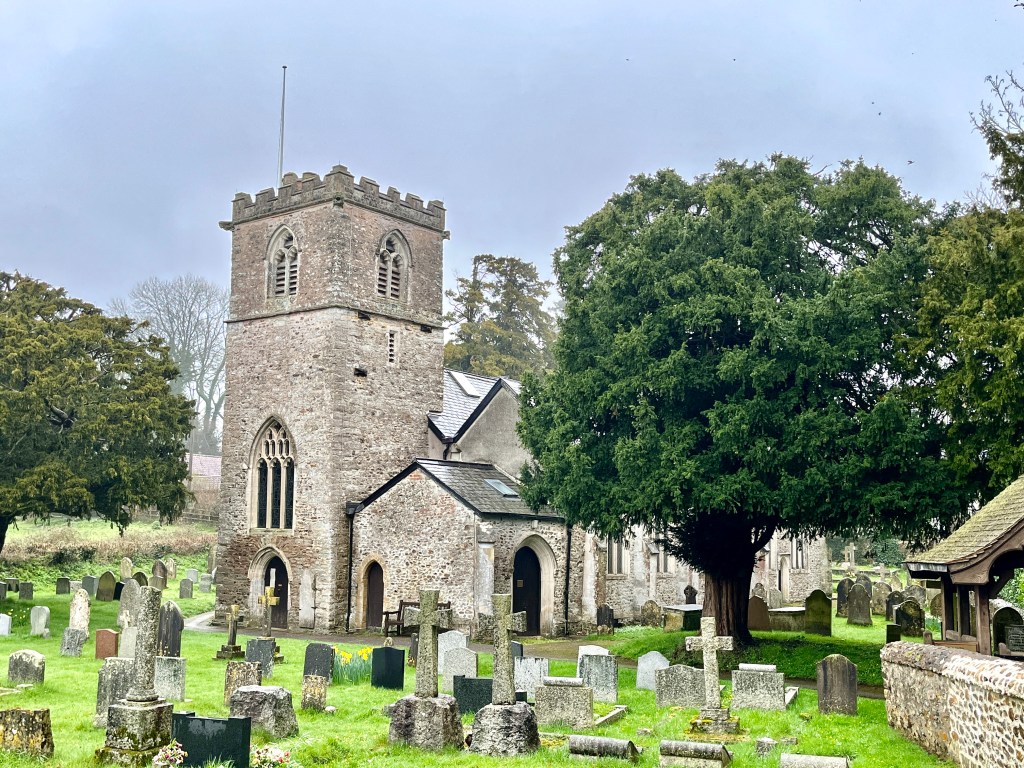
A lost village with a sad backstory. Once it was a remote small community in the centre of the vast acres of Salisbury Plain, with pretty cottages and a fine church. It was already a huge military training area before WW2 and the decision was made to evict the populace. As the record states: Given nowhere else to go, Imber’s villagers were ‘liberated’ of their homes in 1943, with just 47 days notice, to make way for American troops to train for the liberation of Europe during World War II.
The displaced population believed – or were led to believe – that in due course they would be able to return to their homes and to normality, but they were not permitted to go back. The cottages were replaced by large buildings to create battle scenarios. Only the Church of St Giles was left alone. You can read more HERE
DIALS
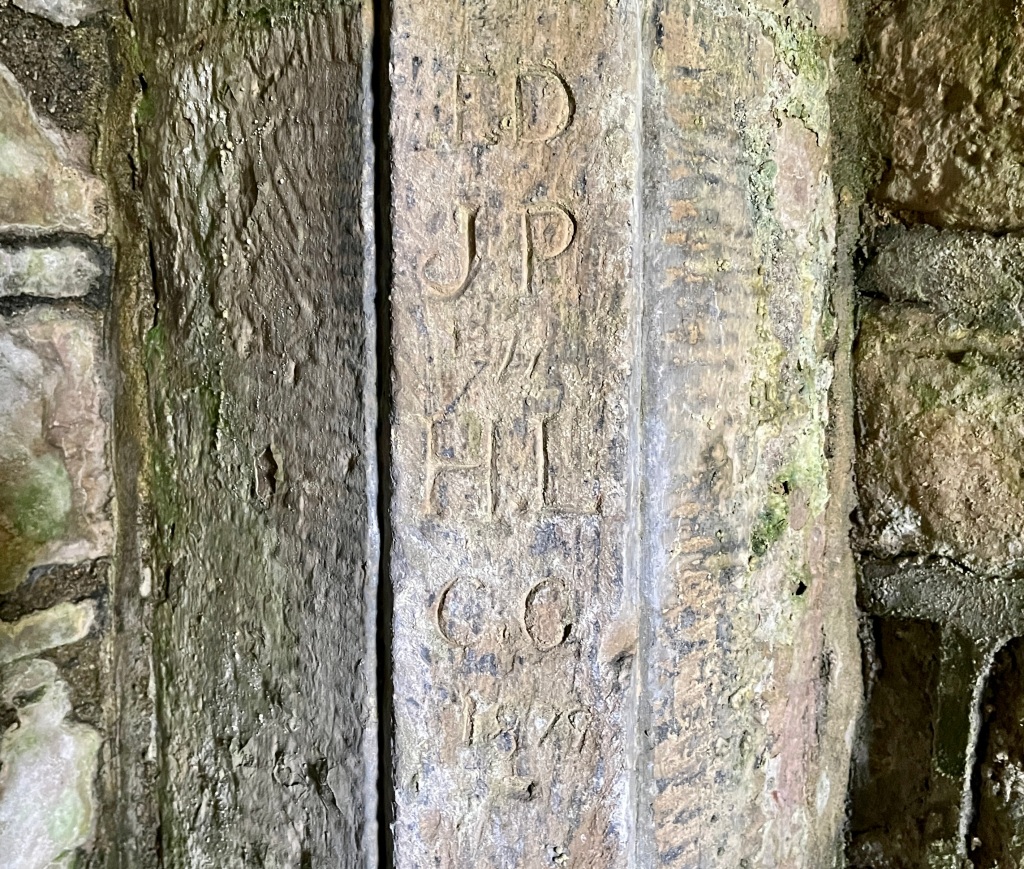
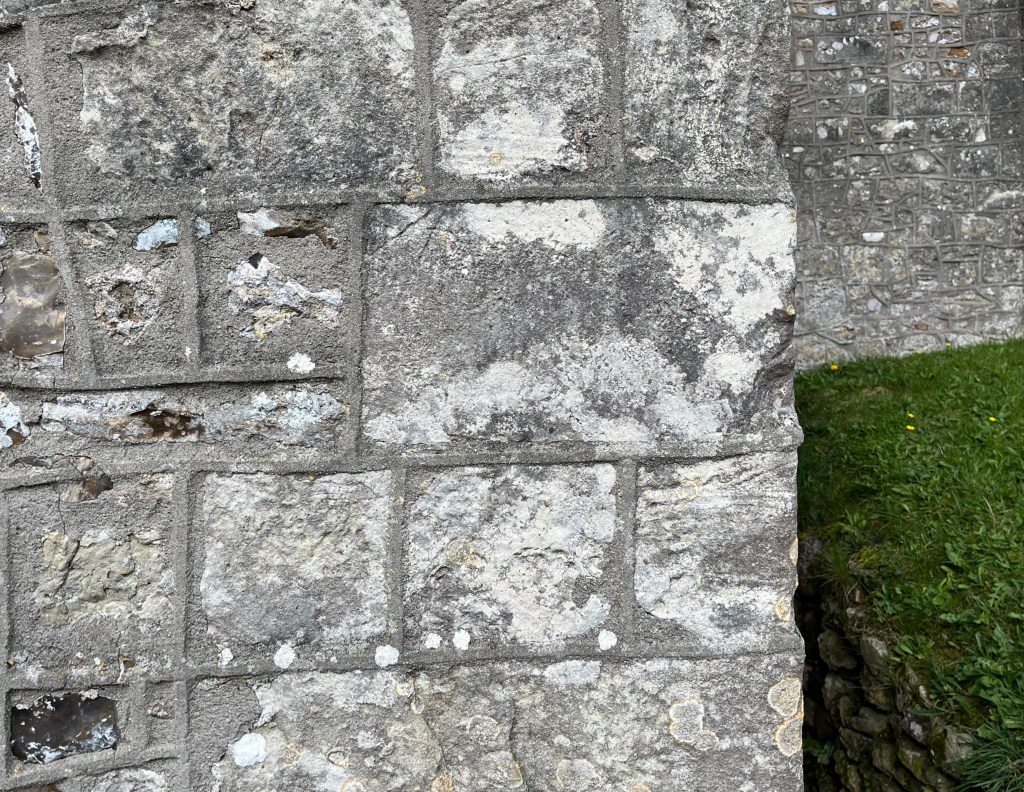
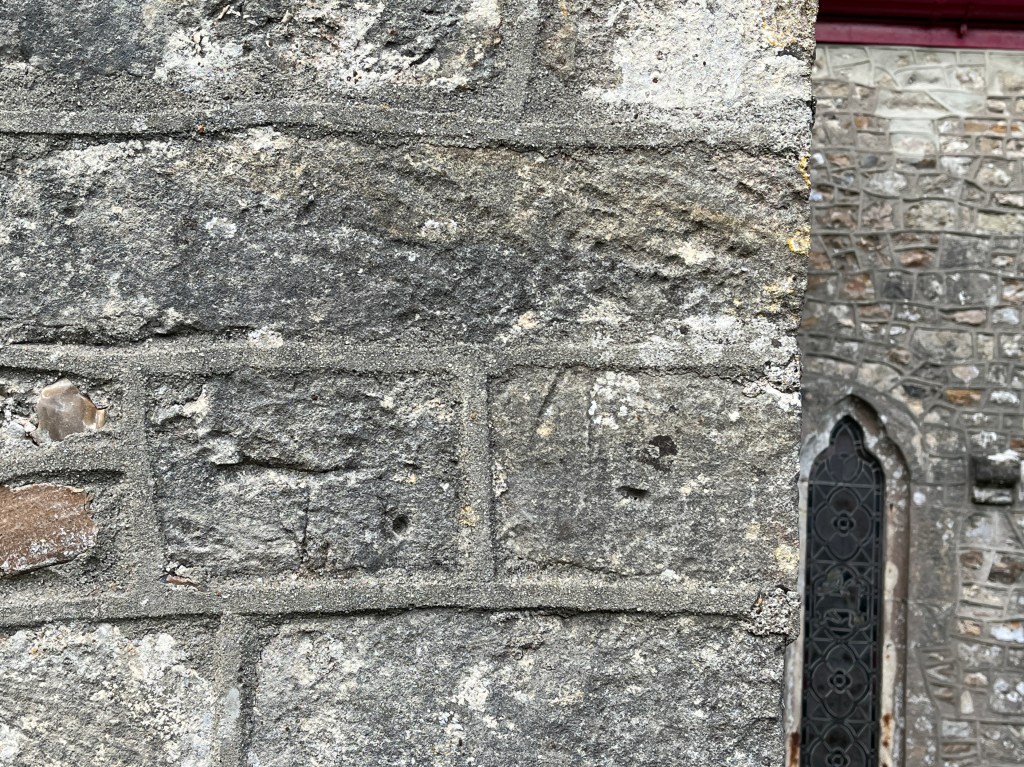
For obvious reasons, access is permitted on only a few specific days of the year. I recently visited on an Open Day, not least because I had found a clear record of two scratch dials. There aren’t any. However there is a wonderful collection of church marks of all types. Much of the trove is in inaccessible parts of the church.
GRAFFITI AND APOTROPAIC SYMBOLS IN THE PORCH
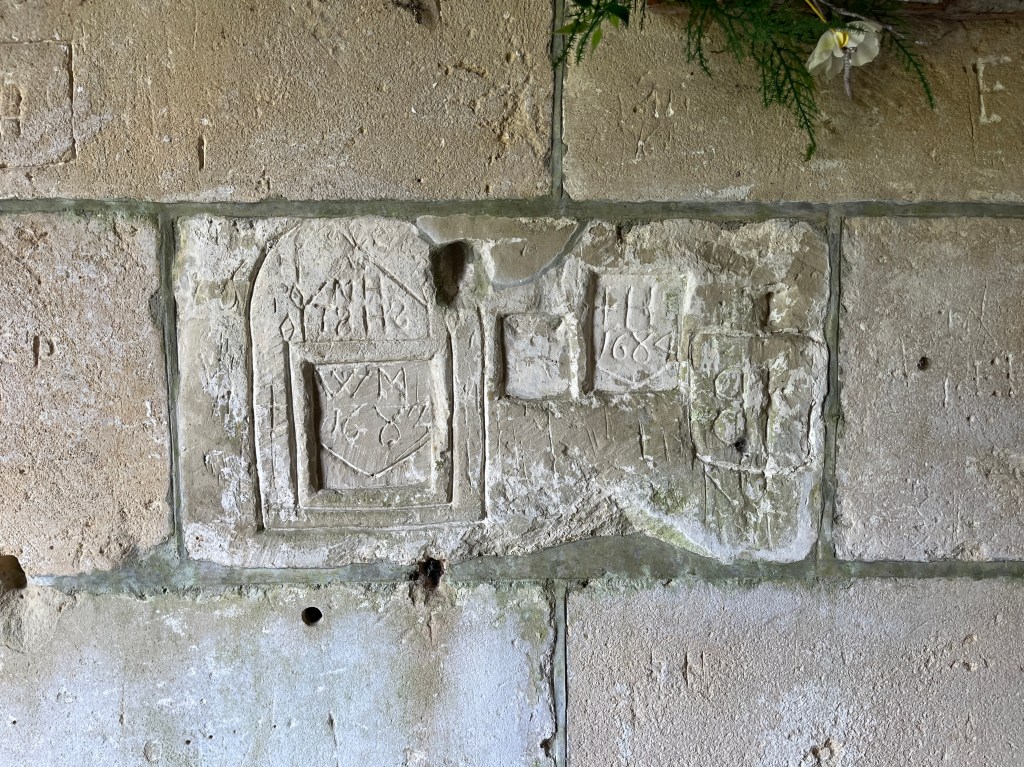
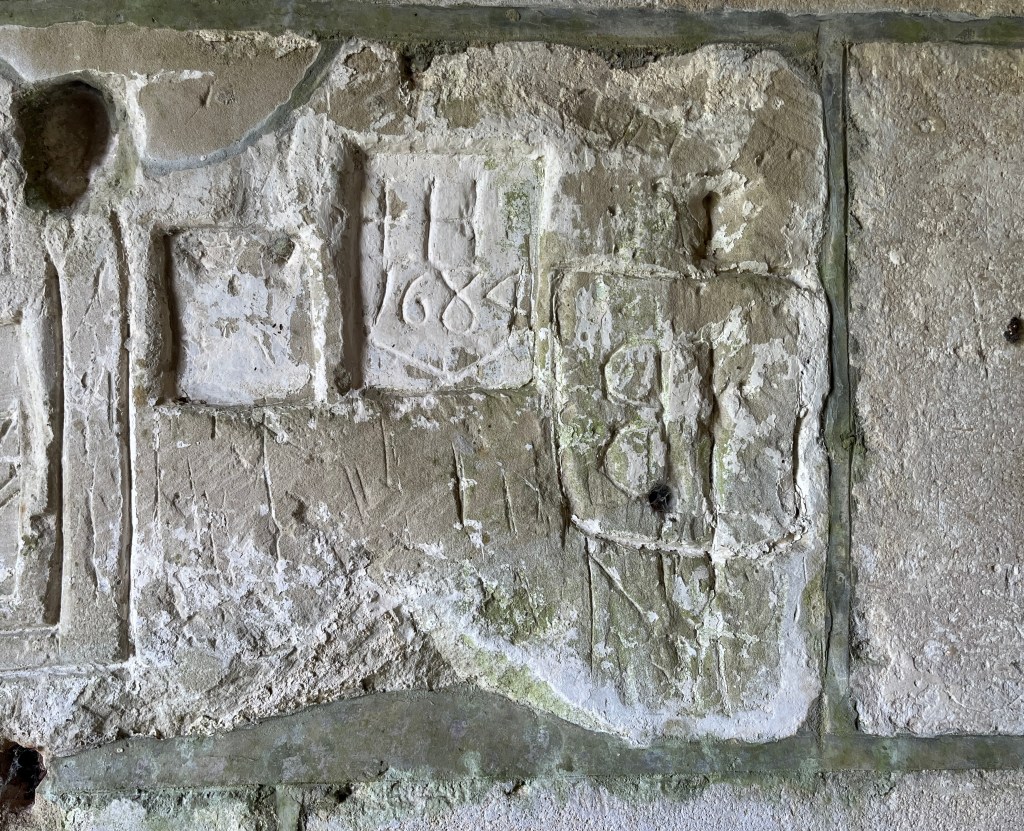
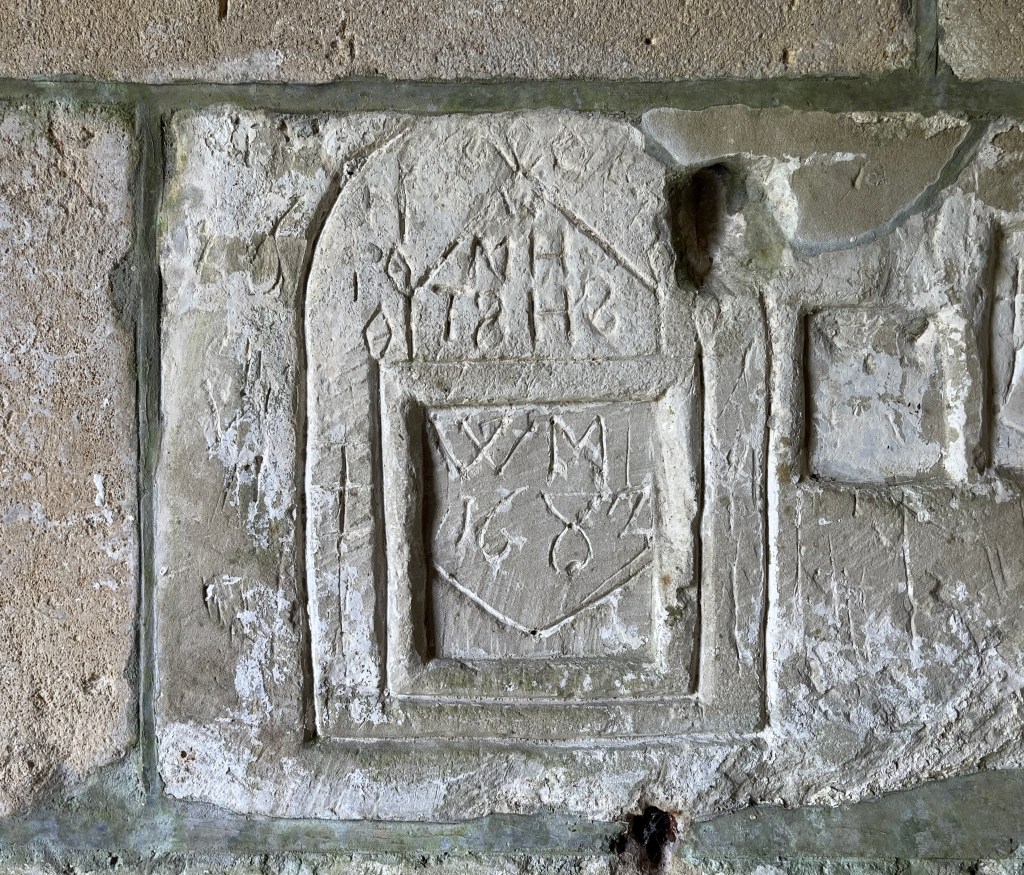
In the time available I briefly examined the porch. Shown below is an illustrative selection (by an amateur) from a far wider choice; I hope to return the Church. Meanwhile here are the key references for further exposition.
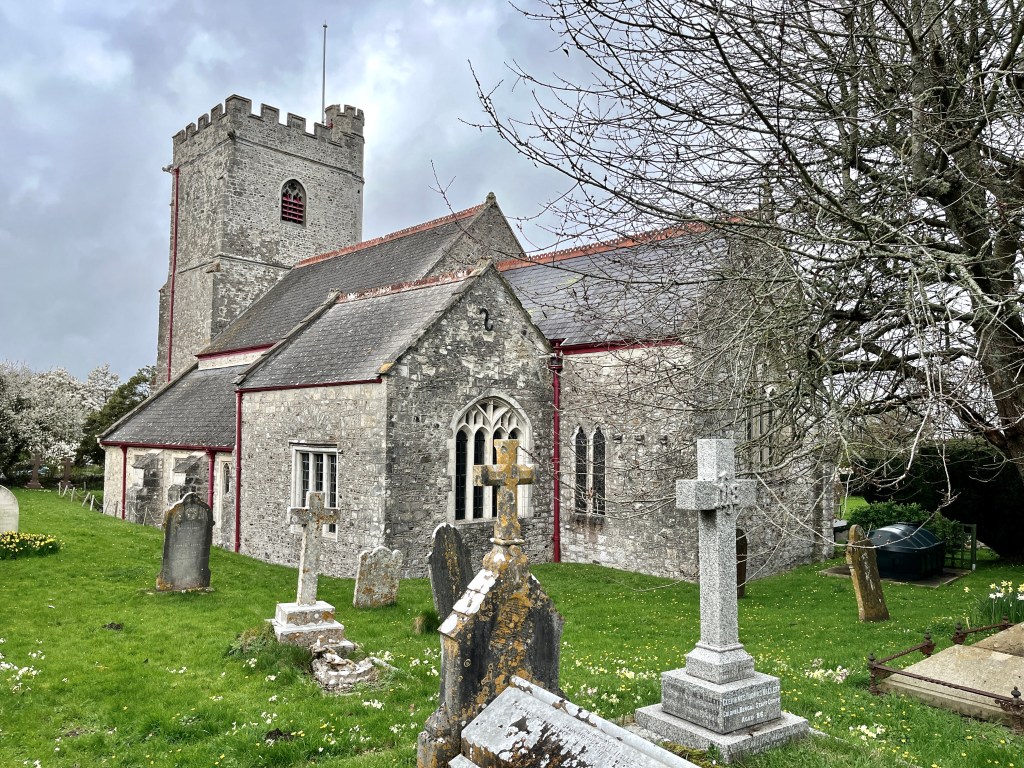
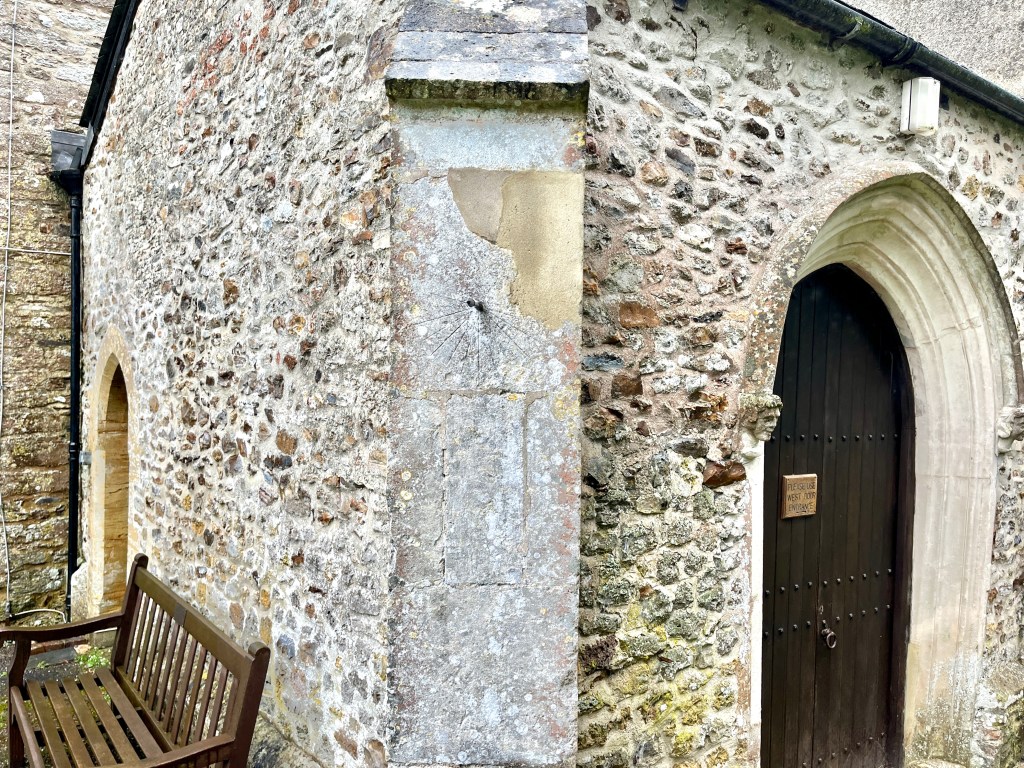
GRADE I ❖ Saxon origins; built C13; C15 work to tower; restorations 1870s. A remarkably uniform E.E. design HE; An E.E. church of exceptional purity and classicity PEV. Features of interest include an Anglo-Saxon tub font with rim inscribed in Latin; a C14 font; fine woodwork; C17(?) Royal Arms of puzzling design. Good graffiti on pillars. Outside, there is an unusual Dole Stone; and the scratch dial featured here. 2m S of Devizes. 51.326 / -2.0079 / ST995585
DIAL
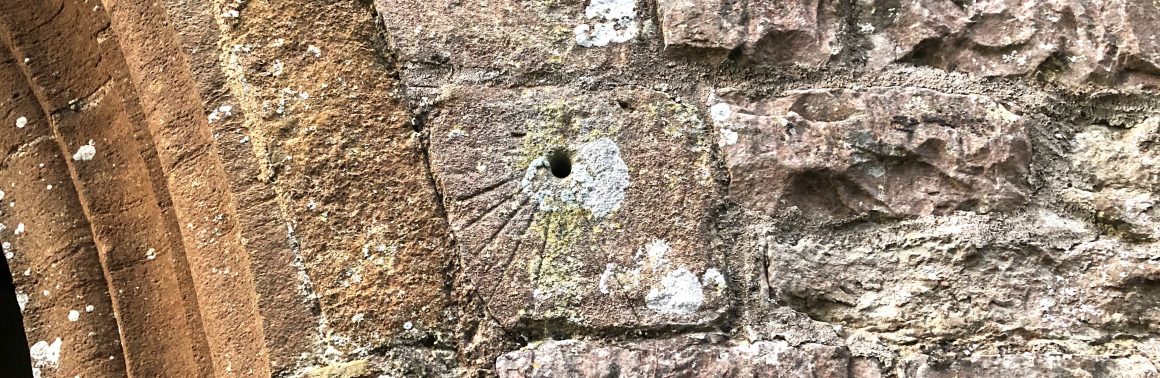
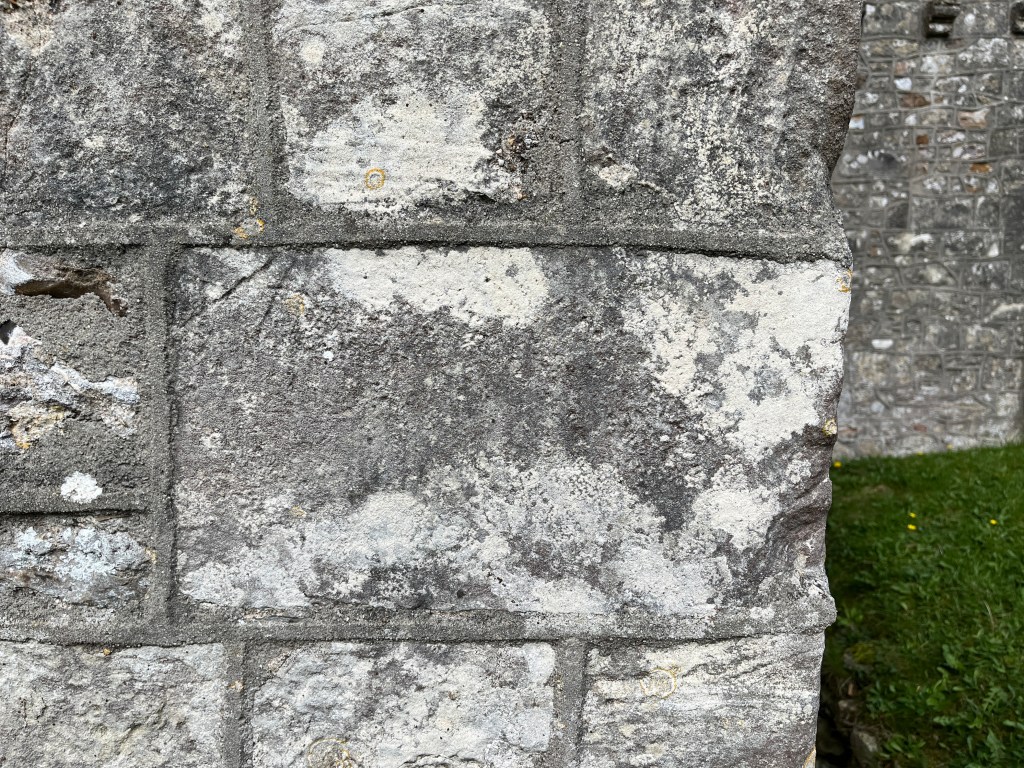
The dial is located on a quoin stone of the buttress at W end of S side. The gnomon hole is centred quite accurately, and surrounded by a ring of small pocks of roughly equal size. The spacing is uneven. 12 of them are drilled in the lower half, in a semicircle that includes the horizontal ‘6-to-6’ line. The other 7 are above the horizontal in the night zone. The pock at notional midnight has 3 on either side, forming an almost symmetrical design. These can only be for decorative purposes, being of no use in marking the passage of the day / night.
As for radial lines, despite erosion 5 lines are visible – 3 LLQ, a faint noon line, the horizontal line RHS. Each terminates with a pock. There remain hints of 2 or 3 others.
❖
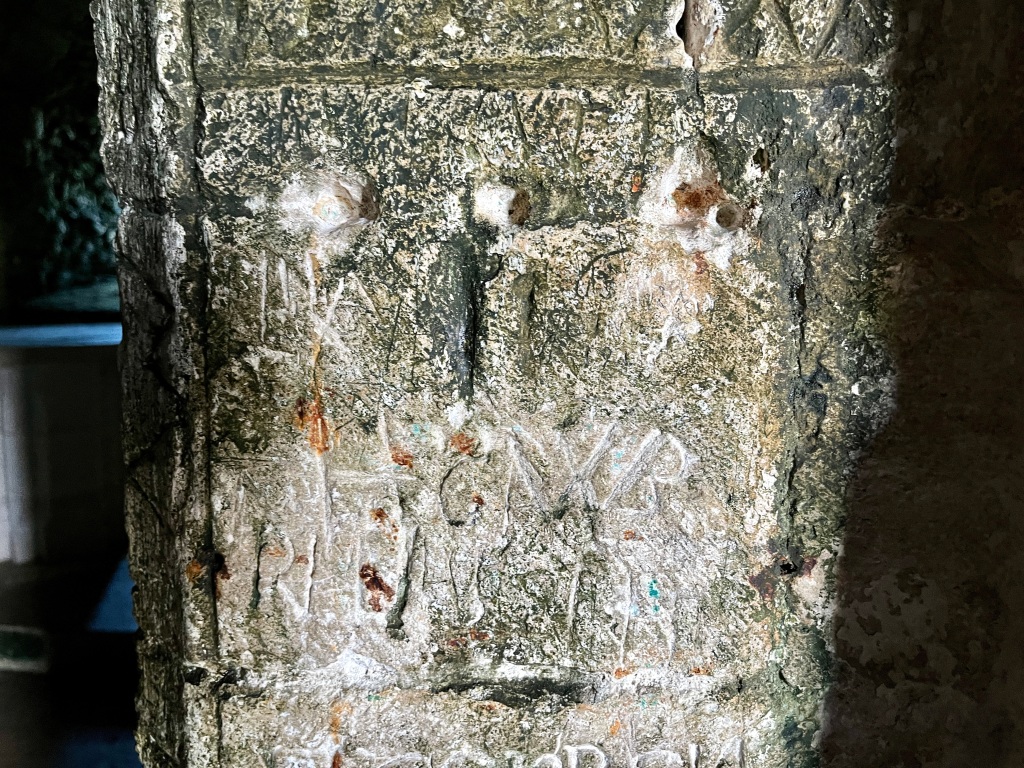
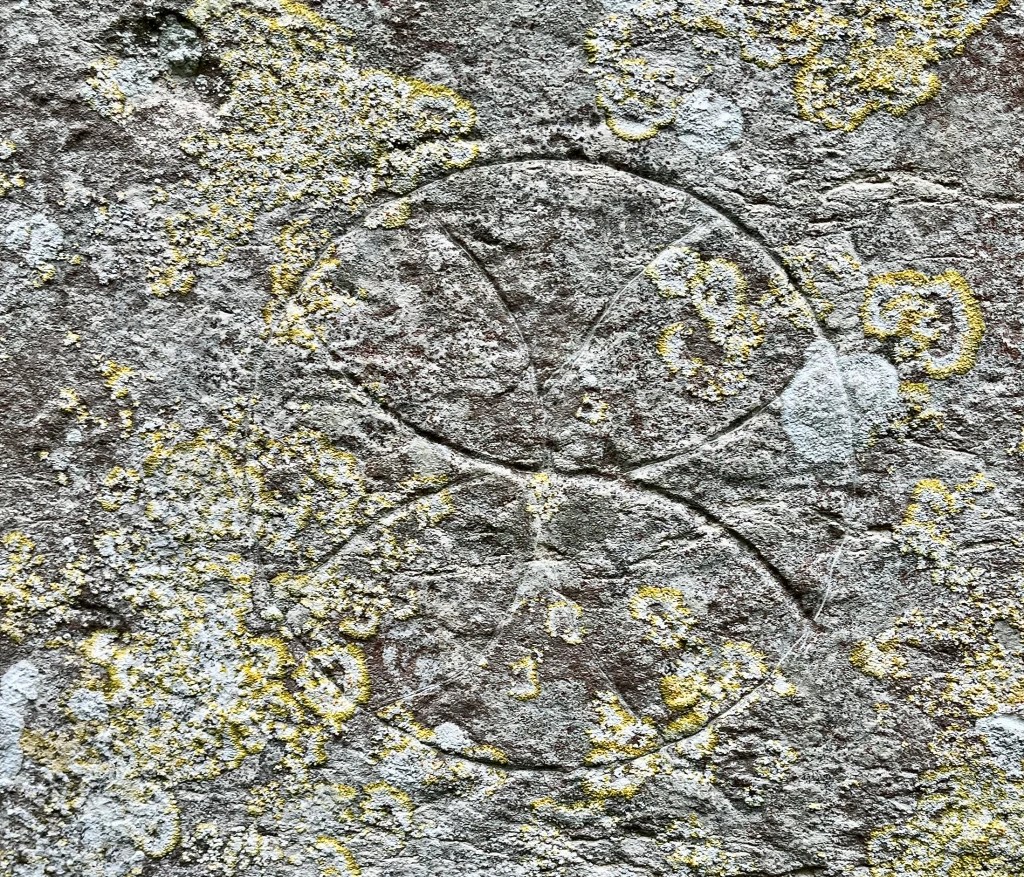
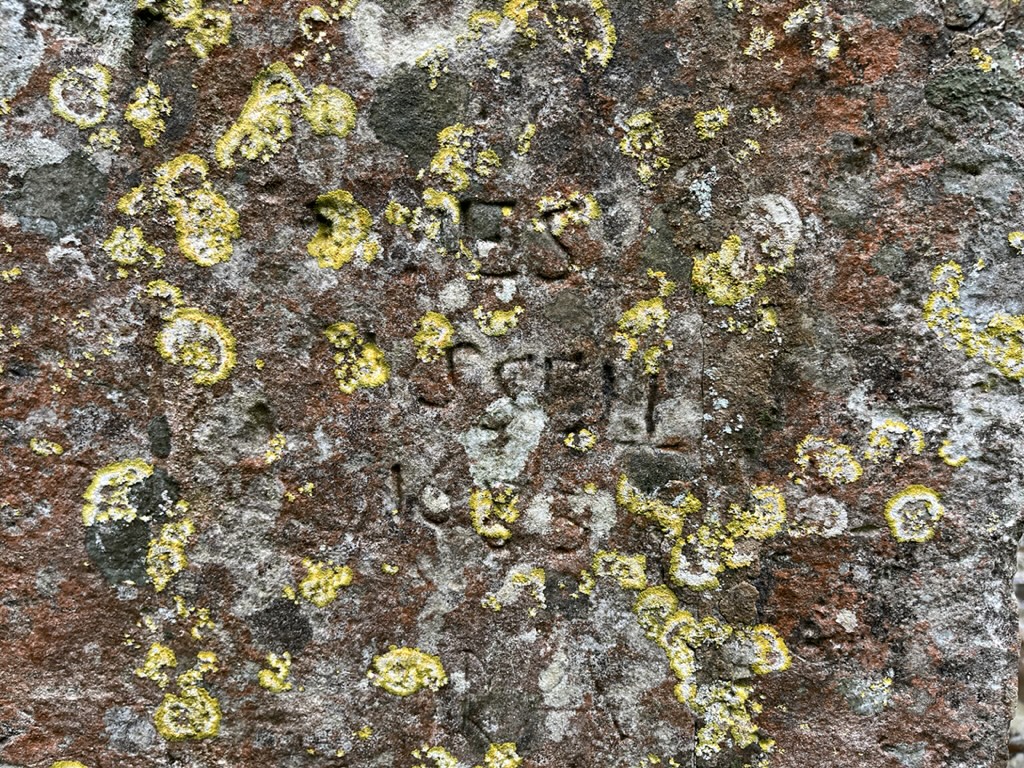
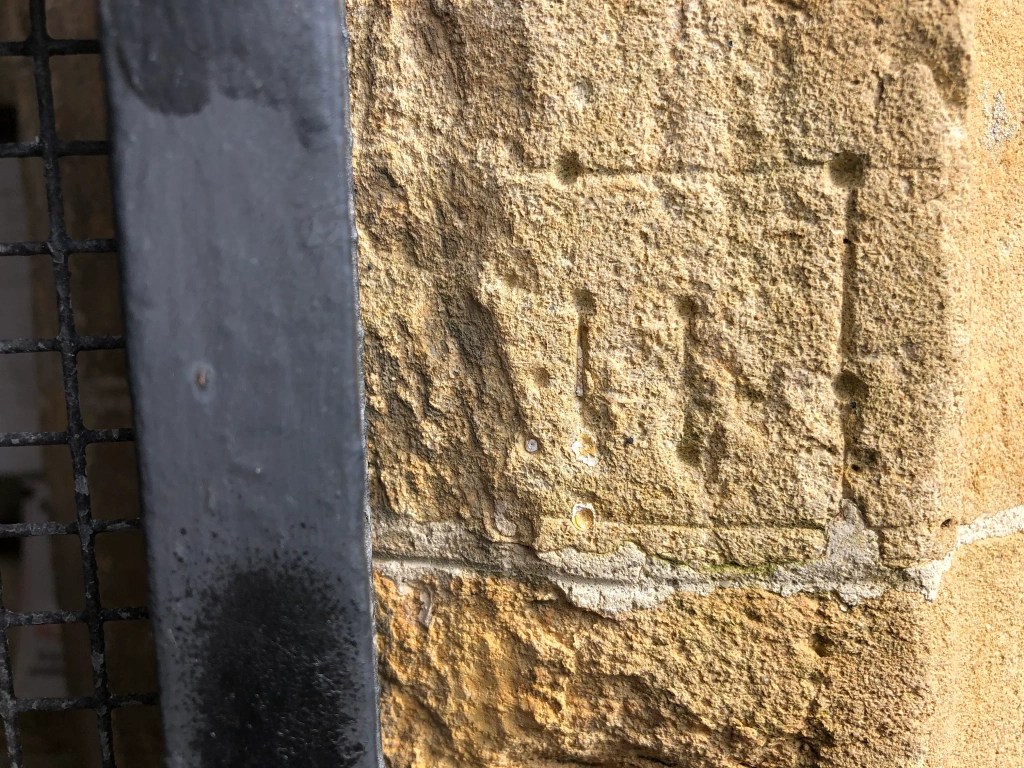
GRAFFITI . FONT WITH LATIN INSCRIPTION . COMPASS-DRAWN PROTECTION MARKS
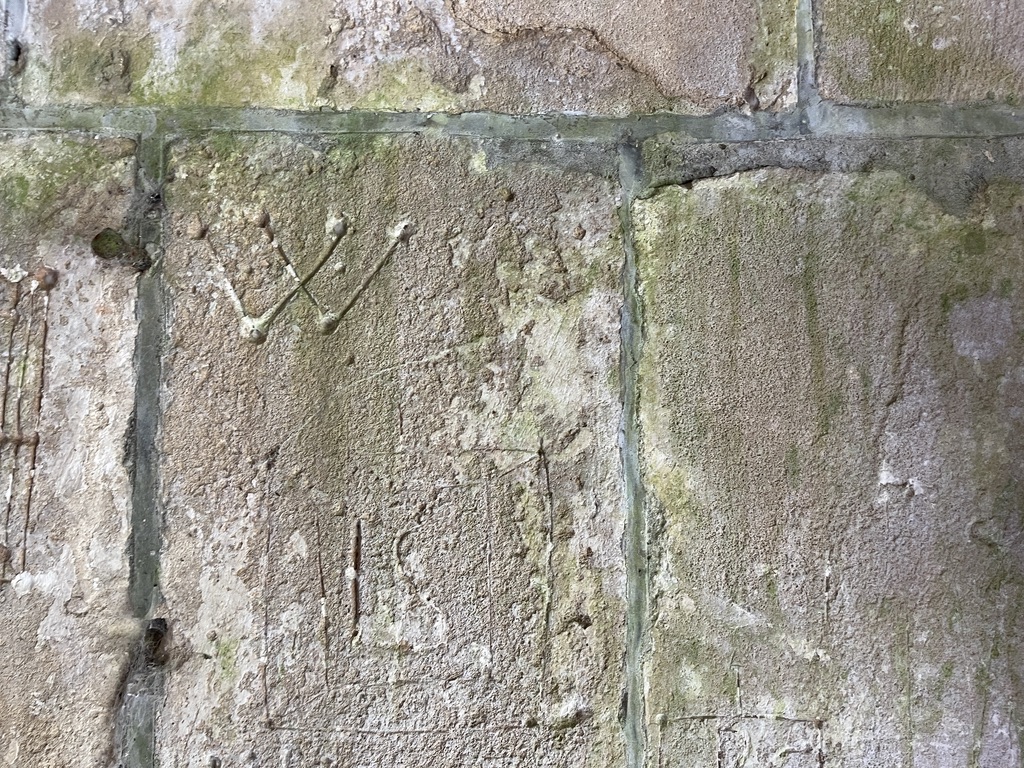
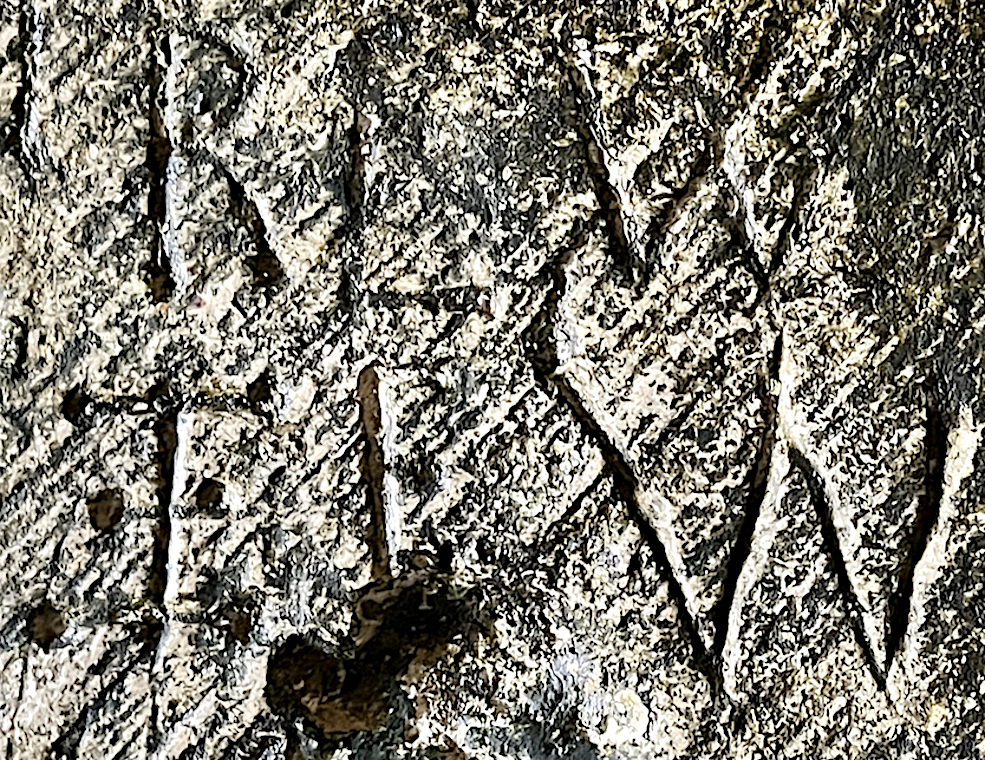
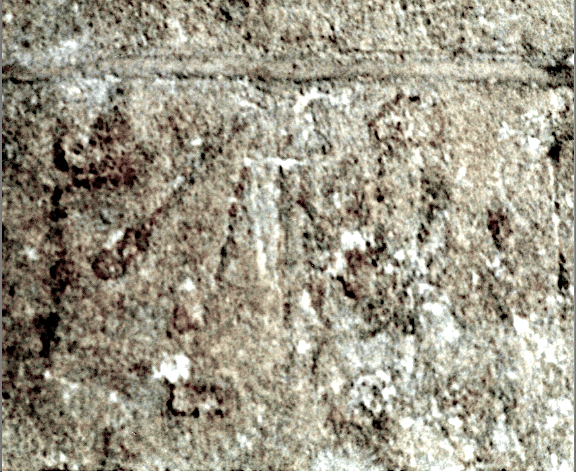
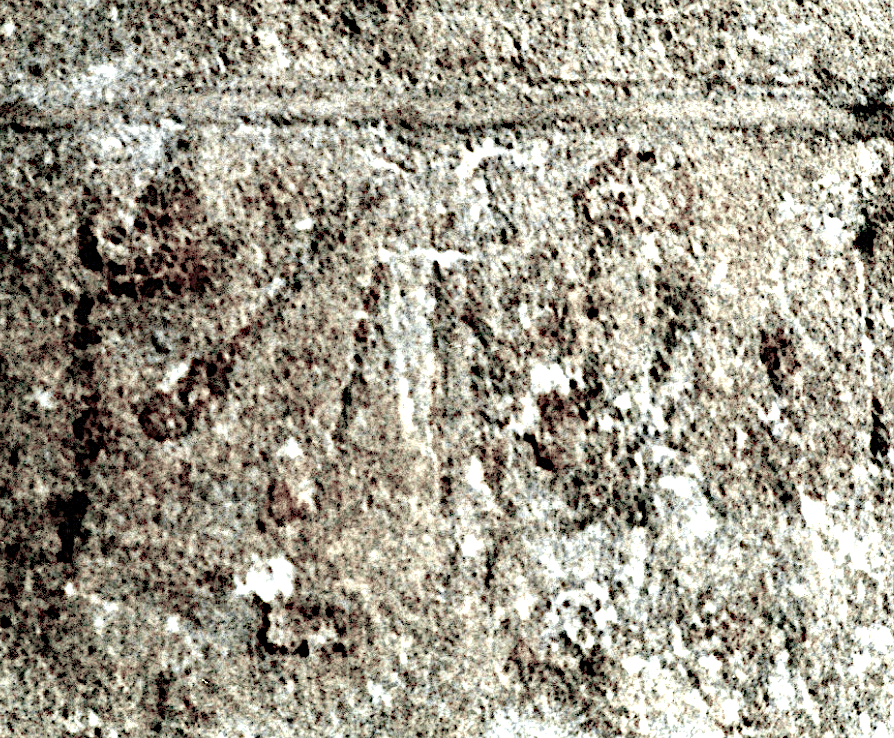
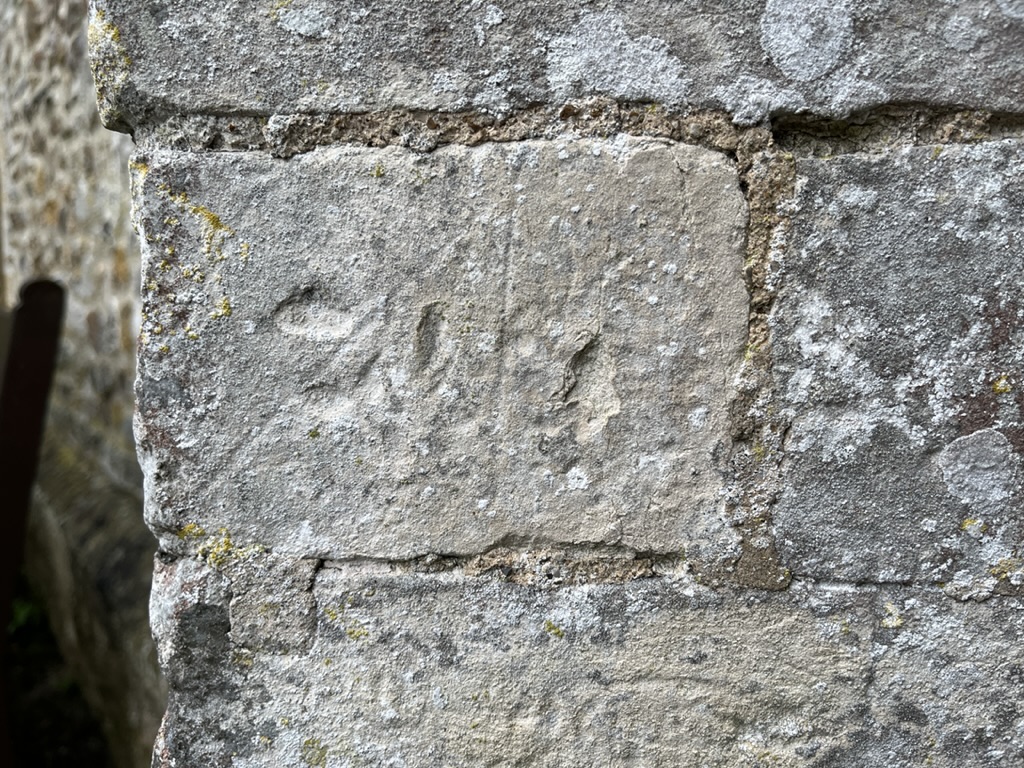
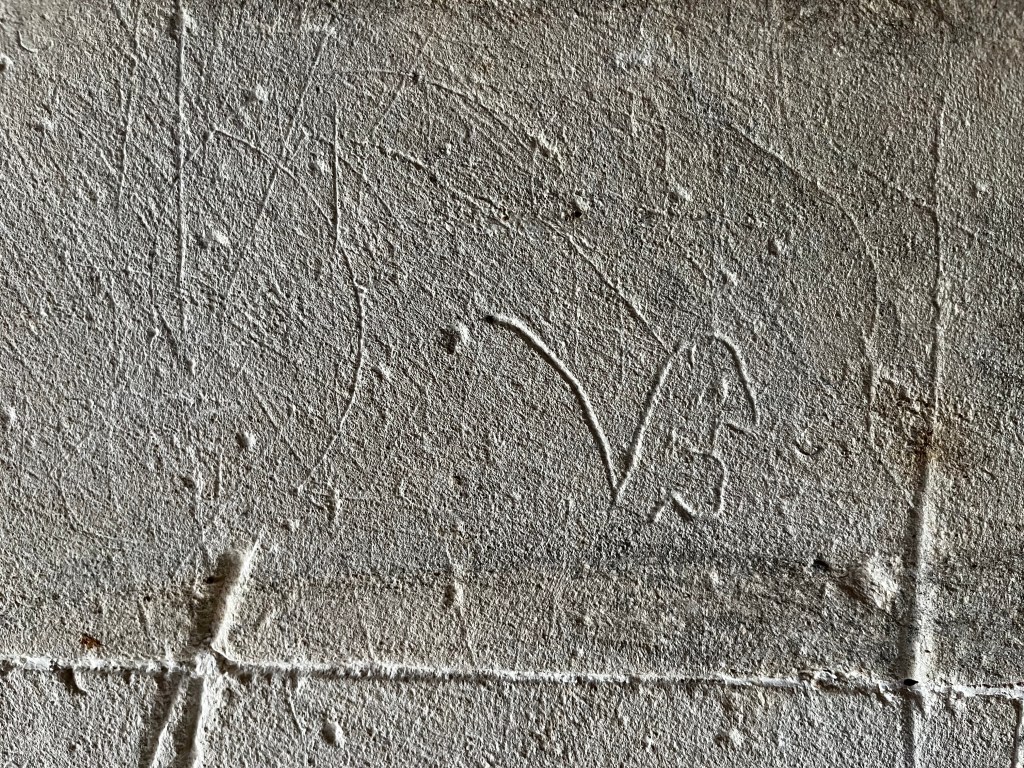
The VV in the first image, assuming it is an initial, is in the distinctive form of a Marian mark, a commonly found protection symbol standing for the ‘Virgin of Virgins’.
GSS Category: Scratch Dial; Mass Dial
All photos Keith Salvesen; header drawing from the Benefice site
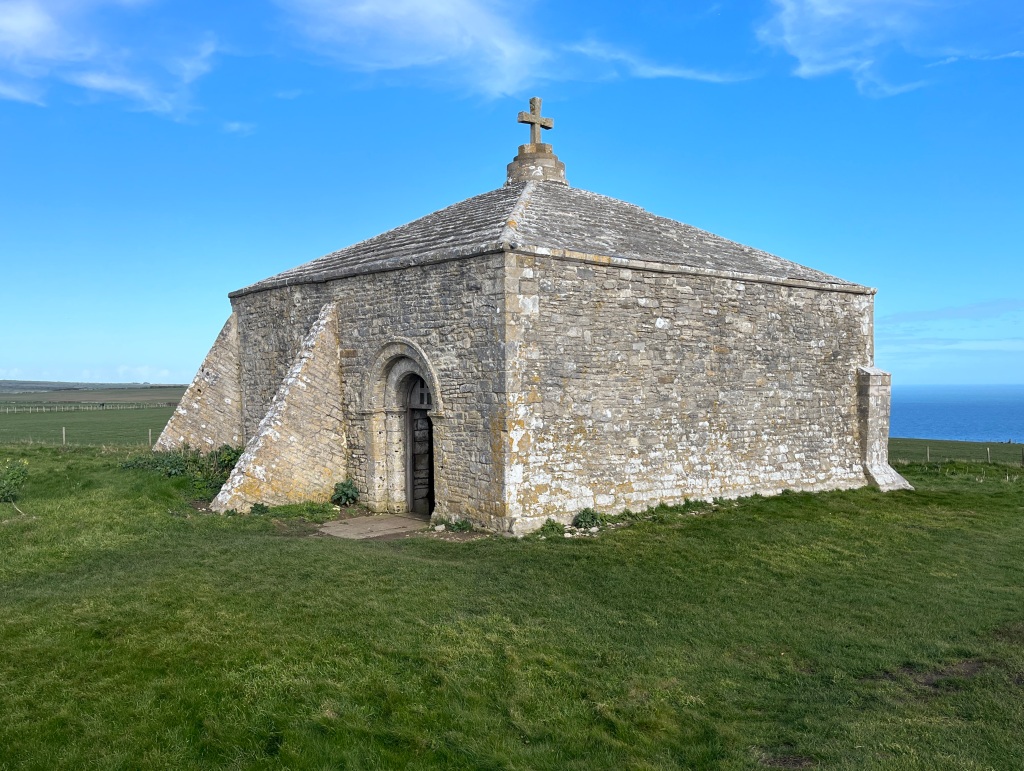
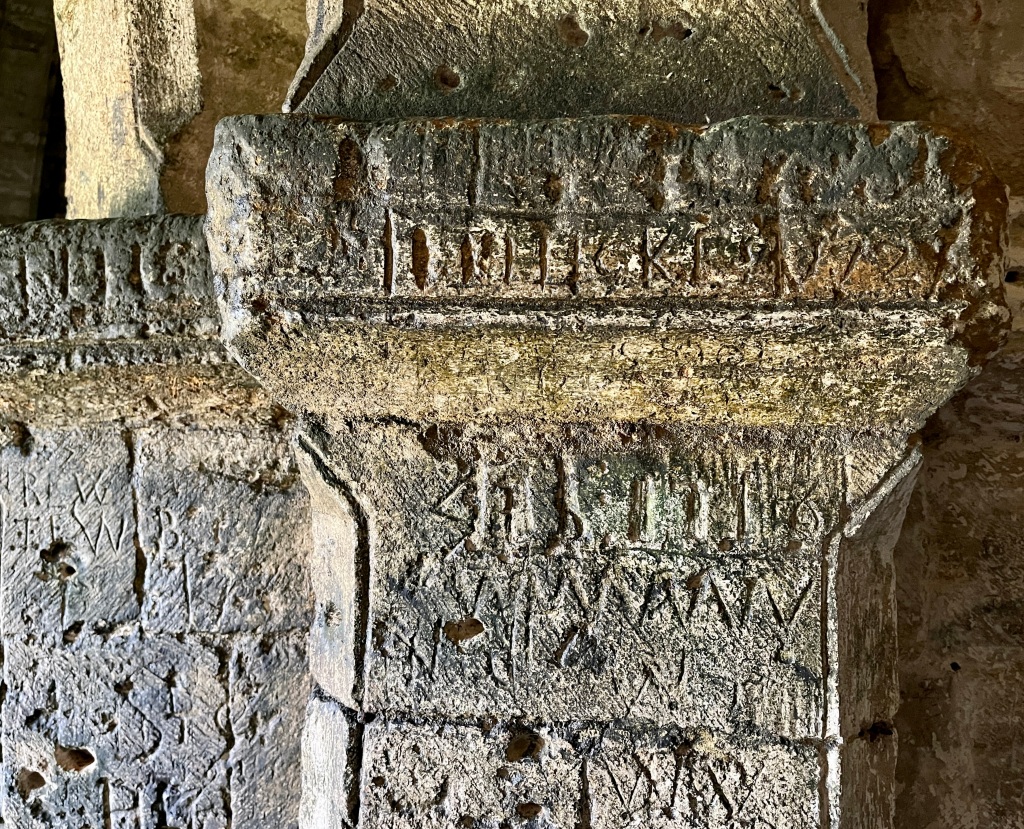
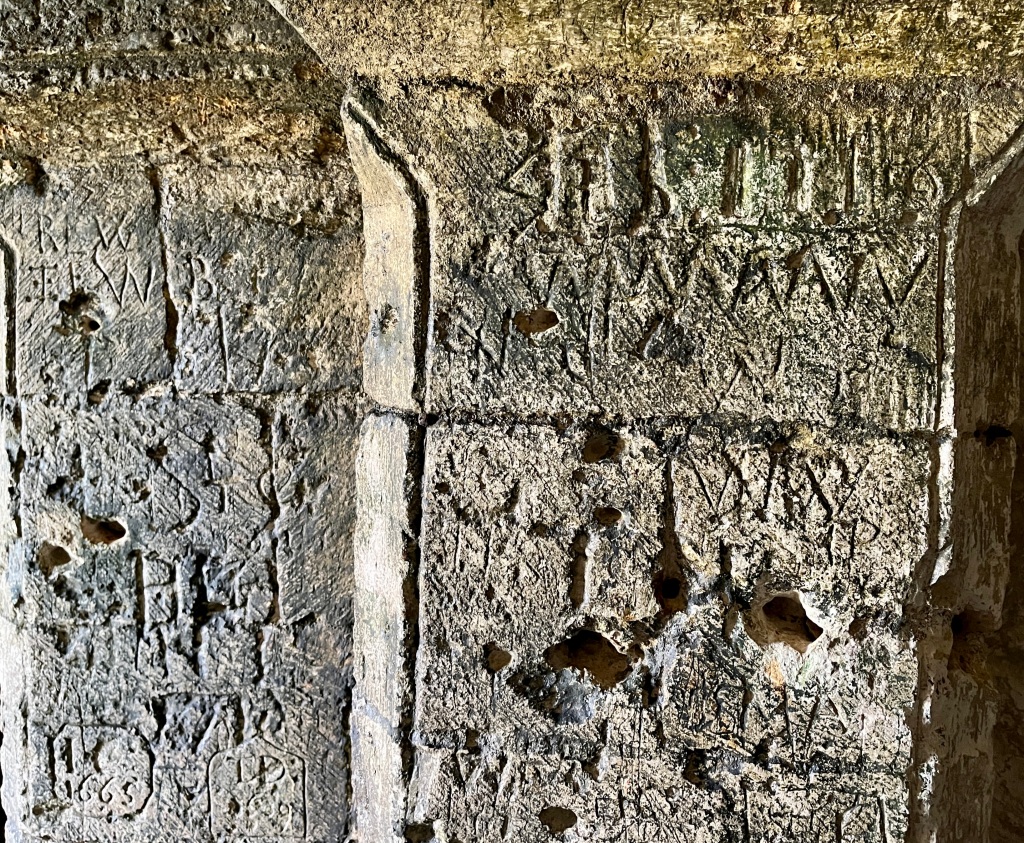
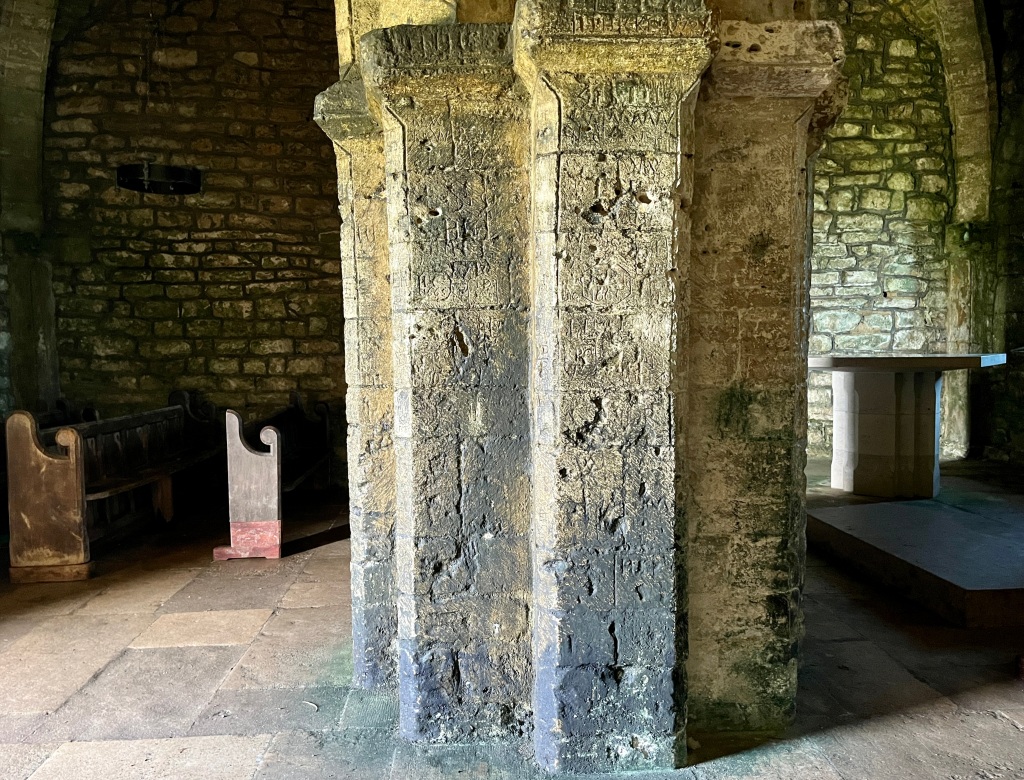
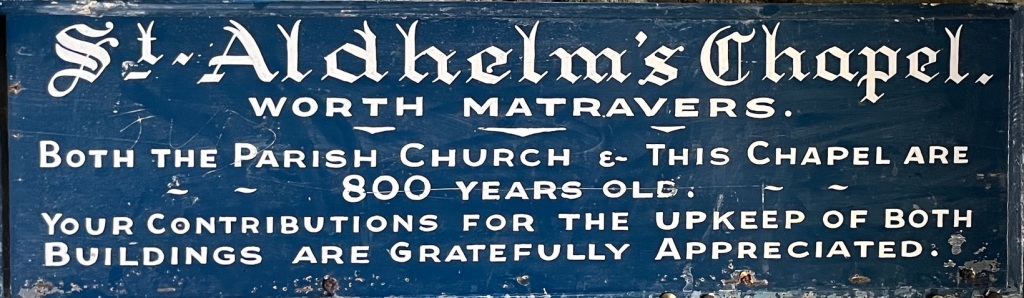
GRADE I ♱ St Aldhelm’s is an isolated Norman chapel high on the Dorset cliffs with only a coastguard station and a couple of cottages for company. Its quite a walk from the car park. There are various theories about the chapel and its purpose. Was it a chapel originally? There’s no evidence of an altar or piscina. Might it have been built as a watchtower before taking on a religious purpose, evidenced by payments made in C13 to a chaplain? There is a thorough Wiki entry for the chapelHERE.
Besides sundials from Saxon times to the present day, other medieval features merit inclusion here. The relevant pages can be found in the main menu. A broad category of ‘Church Marks’ includes protection marks such as the Marian VV, daisy wheels and other circular / interlocking circles dates and initials, taper marks, masons’ marks.
Commemorating the pioneering radar work carried out in WW2, with an inspired design that harks back to the fire beacons that warned of the Spanish Armada.
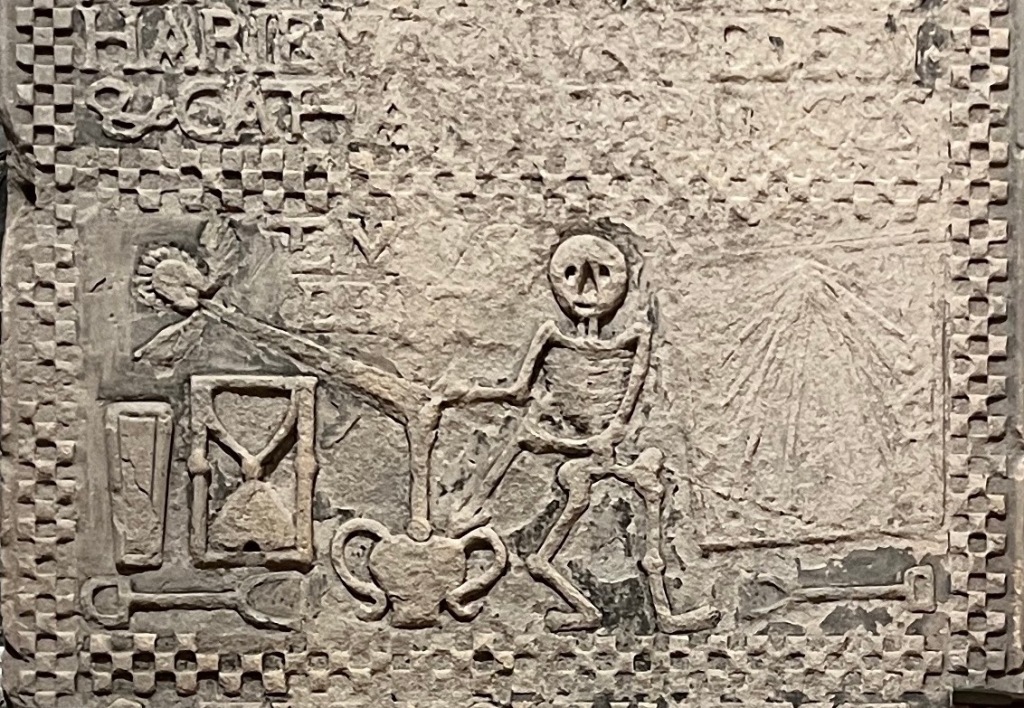
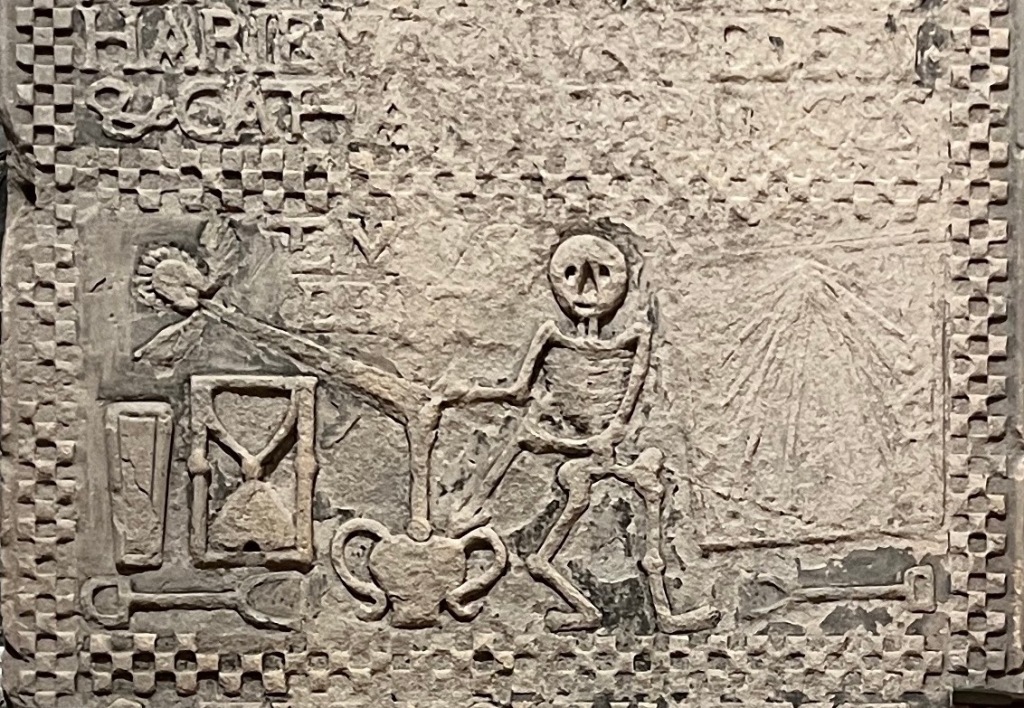
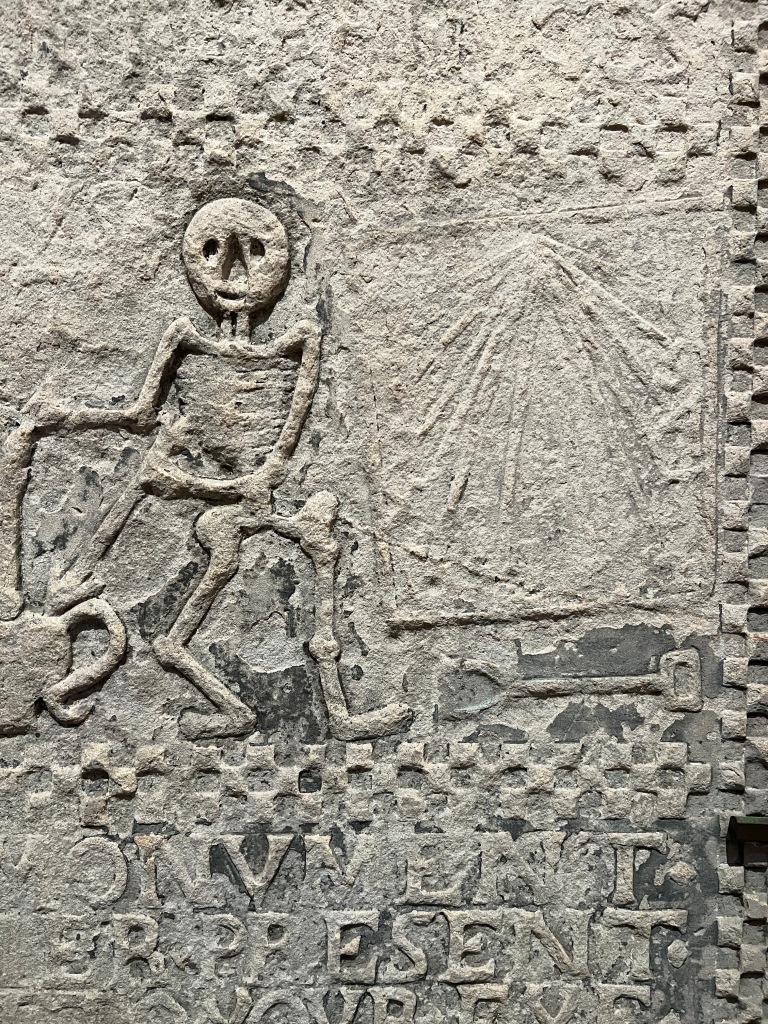
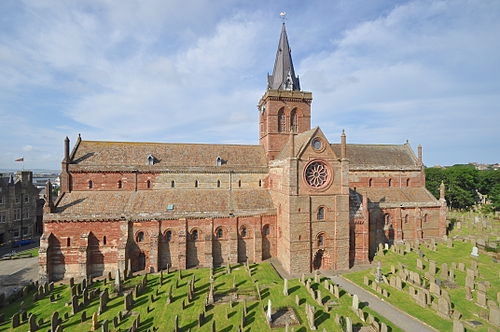
St Mungo . Kirkwall . Orkney – Grave slab with stylised memorial dial for Patrick Prince d. 1673
BSS RECORD
DIAL
This image of a dial appears on a grave slab that is now mounted on the interior south wall of the nave alongside many other such slabs. It is one of a number of symbols associated with death, carved in relief. The symbols are in a central panel between upper and lower panels containing text. The dial is illustrative / symbolic only and is roughly square, with hour lines radiating downwards from the top.
ICONOGRAPHY
The image represents Death breaking the urn of Life with an arrow. A flame bursts forth from the punctured vessel, from the tip of which the soul flies away in a northwesterly direction. An hour-glass with the sand run out, a sun-dial, two spades, and a coffin complete the doleful ideogram. The grave slab is for Patrick Prince, died 1673.
GSS Category: Scratch Dial; Cathedral Dial; Church Dial; Dial inside church
PHOTOS: All photos John Renner, with many thanks; Cathedral Stevekeiretsu Wiki OS CC; Print from Cathedral Guide
GRADE I ✣ C12 origins & remnants; C13 – C15 enlargement; C19 restorations (Wyatt). One of only 3 Dorset (early) churches with spires, with Trent and Winterbourne Steepleton (the Dorset village of Steeple only has a tower). The spire was originally much taller but has twice been reduced in height. The most important and interesting church in its neighbourhoodPEV. If you want to dig deeper there are plenty of excellent resources online eg HE, BLB, BHO. Midway between Shaftsbury and Blandford. 50.9295 / -2.1887 / ST868144
DIAL
The dial is located on the SW buttress of the tower, about 2m high. There are 12 lines, 6 of which extend beyond the circumference. Some have terminal pocks; the noon line has 2. GLP notes that the dial is quite accurately cut, but is at an angle and of little use in its present position. Probably it was relocated during later work.
GLP dates it to C14, and notes quite sternly that, whereas RCHM suggests perhaps C16, it gives no reason for this opinion.
GRAFFITO ON THE STONE BENCH INSIDE THE PORCH: W.D. 1773
GSS Category: Scratch Dial; Dorset Church with Spire
All photos: Keith Salvesen; Thanks as always to Gordon le Pard for Dorset dials
GRADE I † C12 origins (?); C15 inc tower & porch; C16 rebuilding / additions. Material from nearby Milton Abbey incorporated. C19 restorations. In proximity, a fine early vertical sundial (1690); 2 date stones (1569); scratch dial (probable?). Several excellent gargoyles N side. 2m W of Milton Abbey. 50.8259 / 2.3114 / ST781029.
VERTICAL DIAL
A fine dial in very good condition for its age. The gnomon is an amusing extension of the sun’s nose. I took the design LL corner to be an hour-glass, which would be appropriate. In close-up I wonder if it is a religious symbol; and if the design LR corner is a square and compass.
DATE STONES
THE BAGPIPER
SCRATCH DIAL
The dial design of a double circle with a hole in the centre is far from unusual. No lines, no pocks; just a stick needed to mark the passage of the day. This type is generally included in the Scratch / Mass Dial category of church marks; and I go along with that. However, having recently researched Cyffe Pypard and Fovant (both Wilts) which have several dials including this design, I am beginning wonder. It’s hard to think of a reason why a dial-cutter would not to add lines, pocks or both to a device specifically made to mark the passage of the day. But what if these are apotropaic symbols cut into the walls of the church to catch evil: ‘Demon Traps’ from which, once entered, encircled evil could never escape?
GSS Categories: Vertical Sundial; Old Sundial; Date Stones; Gargoyles / Hunky Punks; Scratch Dial
GRADE I † C12 origins (nave, chancel), gradual expansion C13, C14 and C15; restoration 1889. Norman doorway with fine Tympanum (long predating the inscription 1698). Good C15 wall paintings.Very close to the estuary, perfect for a walk or a bird-watch. 6m W of Lyme Regis. 50.7142 / -3.0546 / SY256910
DIALS
Three dials are recorded for St Michael. They are all similar and, unlike most multi-dial churches, their design give little sense of developing methods of marking the passage of the day.
DIAL 1
Dial 1 is located on the E quoin stone of the transept, with the gnomon hole in the mortar line. There are 3 distinct radials, and a 4th that is a faint trace. BSS records include the comment Rescratched and false gnomon added.
St Michael . Axmouth . Devon – Scratch Dial 1
The last record is dated 1994, since when the false gnomon has been removed. I have used an image from then; the dial is less easy to see now. The diagram below has a theoretical perimeter and time marks for a complete dial. The note no noon [line] is slightly surprising. Radial 3 looks vertical and possibly bifurcated in re-scratching.
St Michael . Axmouth . Devon – Scratch Dial 1
DIAL 2
St Michael . Axmouth . Devon – Scratch Dial 2
Dial 2 is cut on the Chancel chapel, E end of the wall, on a quoin stone. There are 4 lines radiating from a filled gnomon hole in the mortar line
In close-up (below) it is just possible to see that line 3 (L to R) is longer than the others. That could suggest a noon line incised slightly off true vertical. If so, on this simple dial it might be a casual approach to the medieval daylight hours. On a later, more sophisticated dial, it might represent a way to achieve accuracy on a church that was not square on to the true SWNE footprint.
DIAL 3
St Michael . Axmouth . Devon – Scratch Dial 3
Also situated on the wall of the chancel chapel, and again radiating from the mortar line. BSS notes 4 lines, but 2 cannot now be detected. However the suggestion that noon is marked by double lines is plausible. This might be for emphasis (as with a terminal pock or cross); or because the vertical was re-scratched.
GSS Category: Scratch Dial
Photos. Keith Salvesen; diagram and other material, BSS
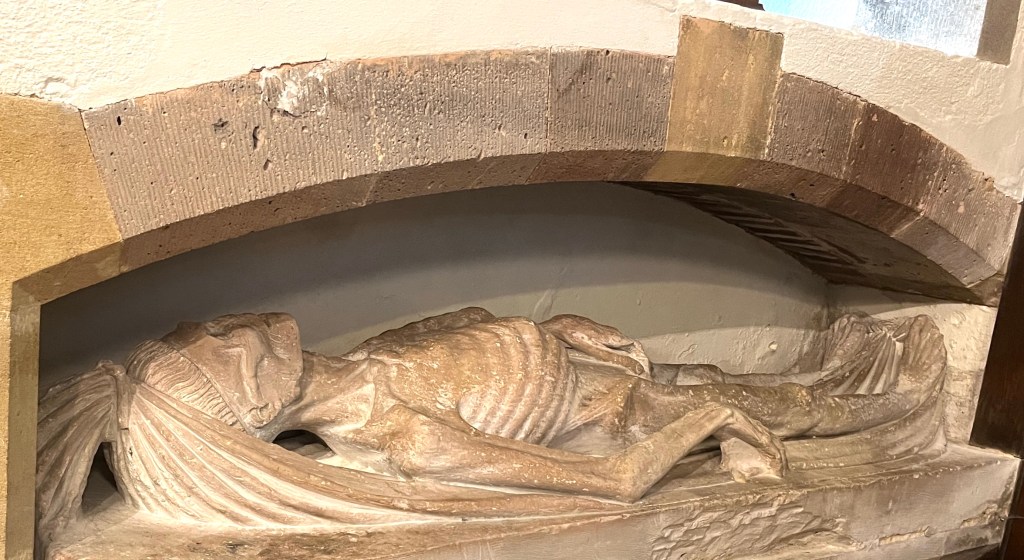
GRADE II* † Norman origins; rebuilding C15 & early C16; substantial restoration 1877. A church that repays one’s interest, with an intriguing Rood screen / reredos repositioning conundrum; and unusual chest tomb: on top lies the effigy of an emaciated cadaver partly covered by a shroudBLB. 14m E of Exeter, 5m W of Honiton. 50.7875 / -3.2659 / SY108994
DIALS
St Andrew has 3 scratch dials, the most obvious being visible from the lych gate and as one approaches S porch. The other 2 dials, very close together, are remarkable and probably unique (certainly so as a pair). Dial 3 may be doubtful. An additional basic but dial-ish scratching is shown below, as are various other church marks including a good example of a Consecration cross.
DIAL 1
St Andrew . Feniton . Devon – Scratch Dial 1
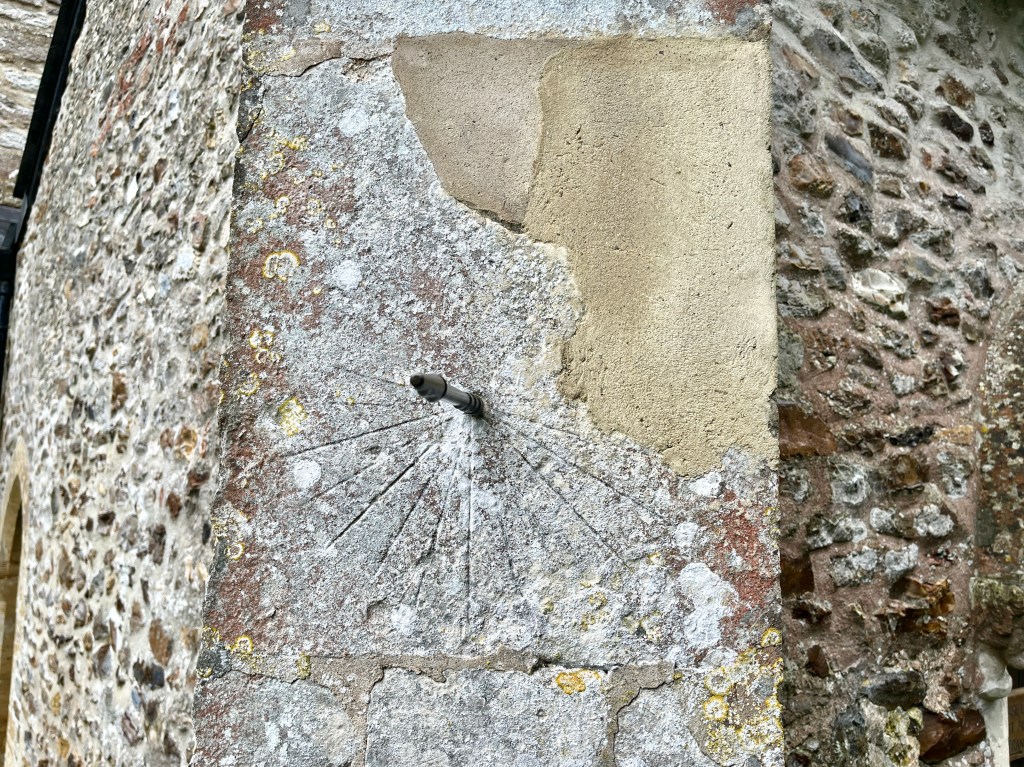
Dial 1 on the porch buttress is a straightforward design and easy to make out, but damaged and cement patched UR. There are 13 lines, some now very faint. The angles are more or less accurate at 15º. The vertical / noon line is not emphasised in any way, which is slightly unusual. The main Mass was presumably Terce, marked with a deeper cut line LHS. The gnomon hole has been filled with a rather well-chosen rounded arrow design; it is modern yet respectful of its purpose.
DIAL 2
St Andrew . Feniton . Devon – Scratch Dial 2
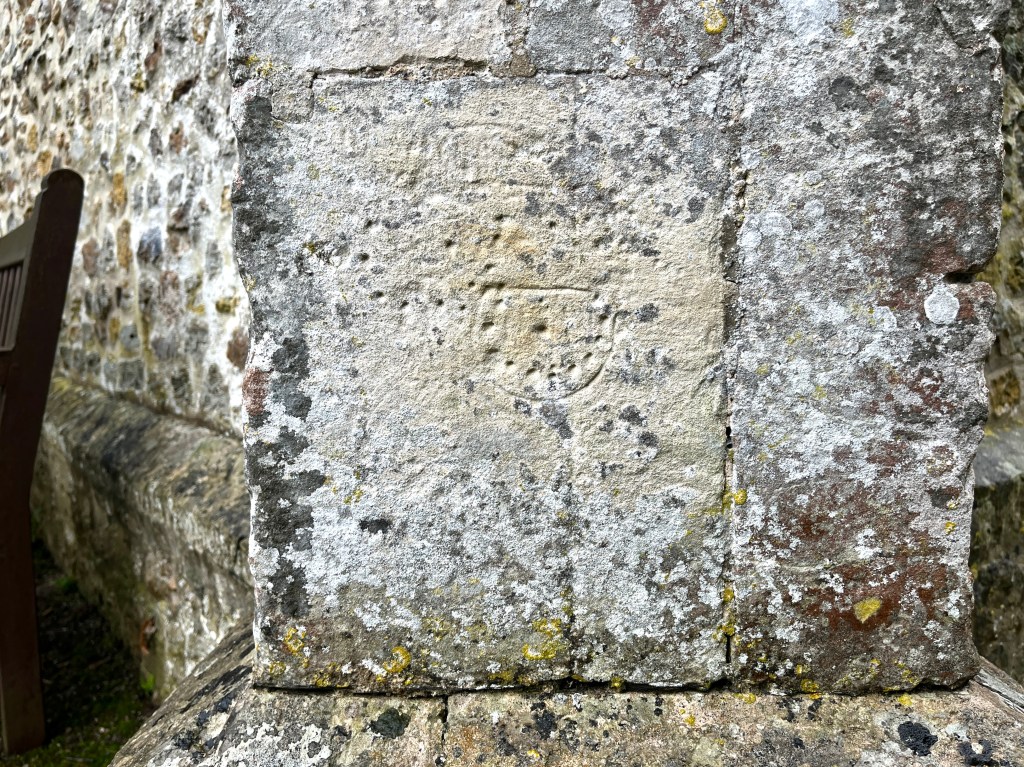
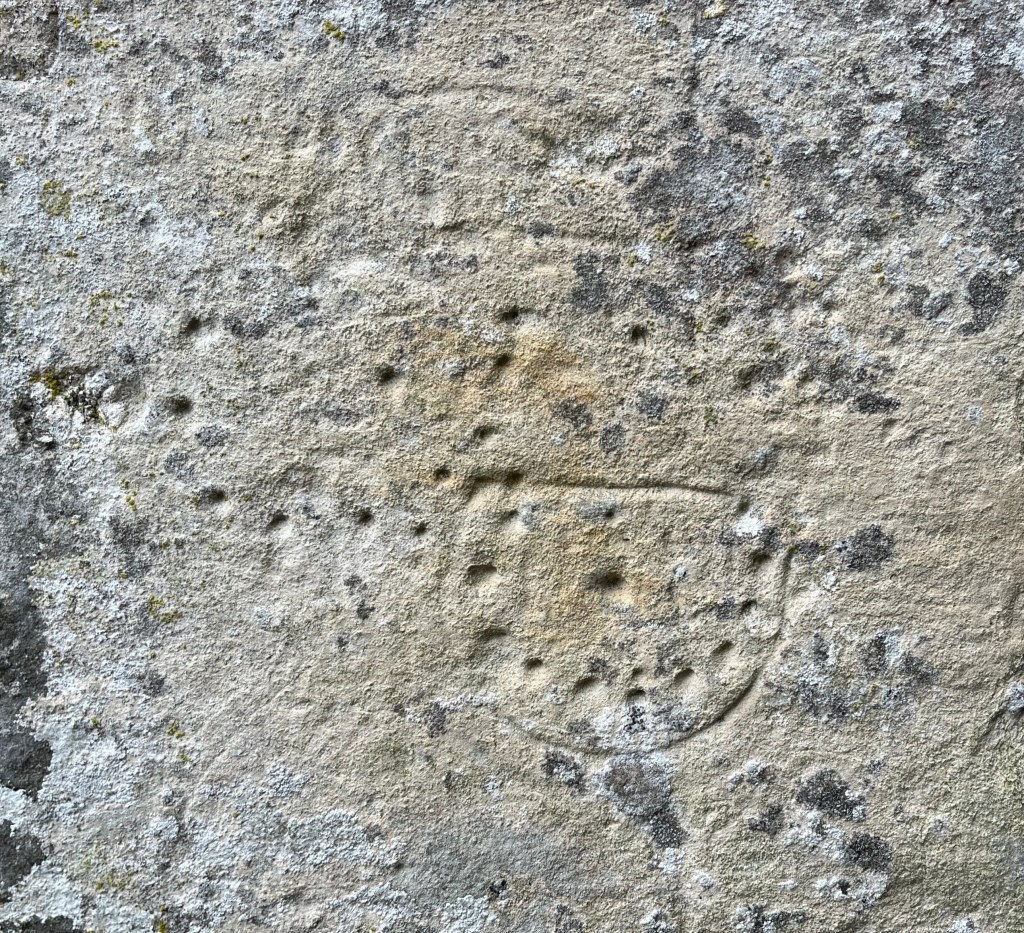
Dials 2 & 3 are adjacent low down on the same porch buttress as Dial 1. It is a remarkable juxtaposition. BSS suggests they are early dials – pre-1400?
Dial 2 consists of a pattern of pocks contained within what could be termed geometrically as the major segment of a circle. The horizontal line is incised more deeply. BSS suggests that 13 pocks are identifiably associated with the dial, with a few random ones besides. The quite shallow gnomon hole in such a small design presumably contained a stud rather than a rod.
A noon line is seemingly marked by the sightly offset double pocks just R of the vertical. Theres’s also a very small pock directly above the gnomon hole, conceivably a decorative-use-only marker for midnight and symmetry.
DIAL 3
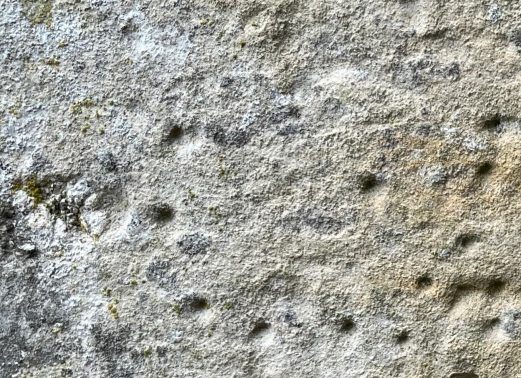
Dial 3 The BSS entry for this little configuration of dots describes a semi-circle of 8 pocks, with other associated pocks and no obvious gnomon hole. It concludes closely related to dial no. 2, possibly never used as a dial.
Perhaps it is not a dial at all. The rather untidy part-circle curves away NE after noon – pointlessly, if part of a dial. BSS notes that there is no central style hole. There is a single pock inside the perimeter that might have held a stud – but unlikely to be much use in that position. Some might suspect unserious pattern-copying efforts along the lines of Dial 2.
St Andrew . Feniton . Devon – Scratch Dial 3
My amateur reading of this buttress as a whole is firstly, that the low stone on which Dials 2 & 3 are located is not its original location. At some stage during all the rebuilding and restoration over the centuries it was re-sited. The little dial that ‘worked’ was then too low and would anyway have been an obsolete design. It was therefore superseded by a far larger, more modern (? mid C16) and very visible dial, accurately cut and ideal for marking the passage of the day for a larger, better educated community in a more modern era. Comparatively.
DIAL 4?
Both lines seem deliberately scratched. One is approximately vertical, the other could mark the Mass time Terce (cf Dial 1). The lines diverge from the mortar line, as do many simple dials – it means not having to drill a dial gnomon into stone. I have seen less convincing 2-line versions that have been recorded as dials. I am slightly in favour of it being a dial.
CONSECRATION CROSS
This is a good example of a rural consecration cross, incised on a buttress between 2 windows. From a distance the design might mislead and be seen as four petals, rather than a compass drawn cross. There are hints of an outer circle. This is a fairly common type of cross, but good see one that is relatively unworn. The four distinct quarters rule out ID as a protective hexfoil, although there is a similarity.
GRAFFITI
Graffiti on two adjacent stones, one example dated ?1675
PROTECTION MARK
This is very likely a ritual protection mark / apotropaic symbol designed both to prevent evil from entering the church, and to repel it. For that reason they are most often found inside or near porches. I haven’t encountered the pattern below before, but a group of dots with some joined by deep cut lines is a commonly found design – see an example from Dorset below.
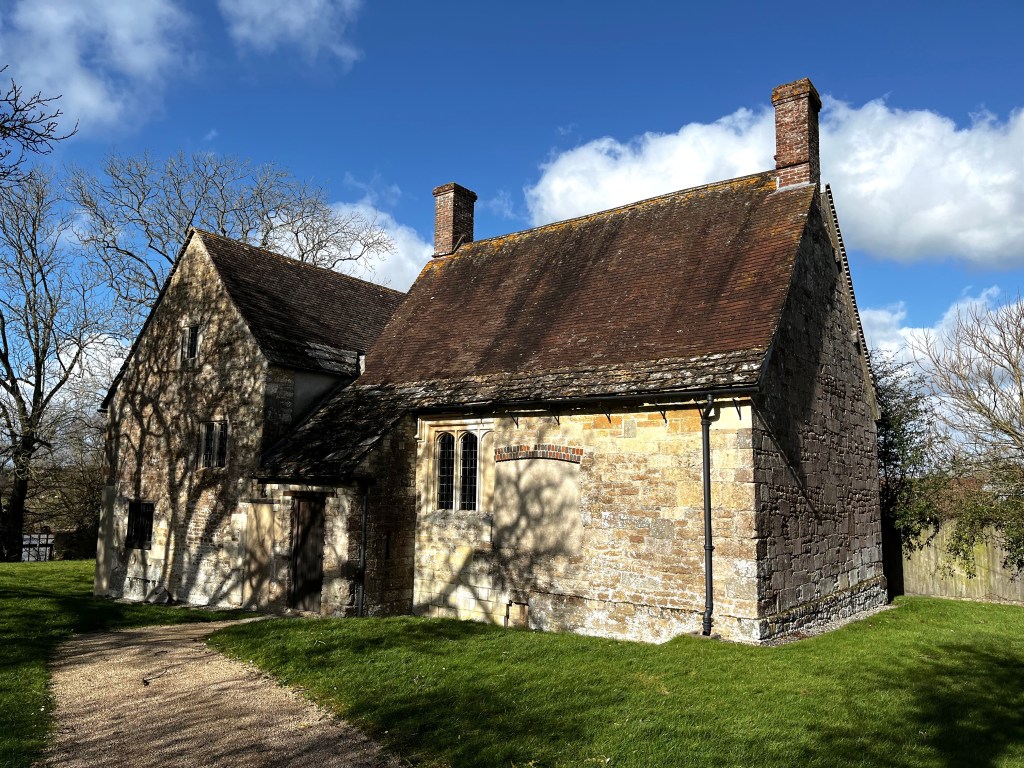
C13 chapel located within an Iron-age hill fort Chisbury Camp. The Lord of the Manor built it to assert his social status by allowing the household of the manor, as well as local people, to attend services and pay their taxes without having to travel to the parish church at Great BedwynEH. Thatched, with flint walls. The chapel was deconsecrated in 1547 and after three centuries of use as a barn it was reduced to its present dilapidated state. It is however a scheduled Ancient Monument, now in the care of English Heritage.
CONSECRATION CROSS
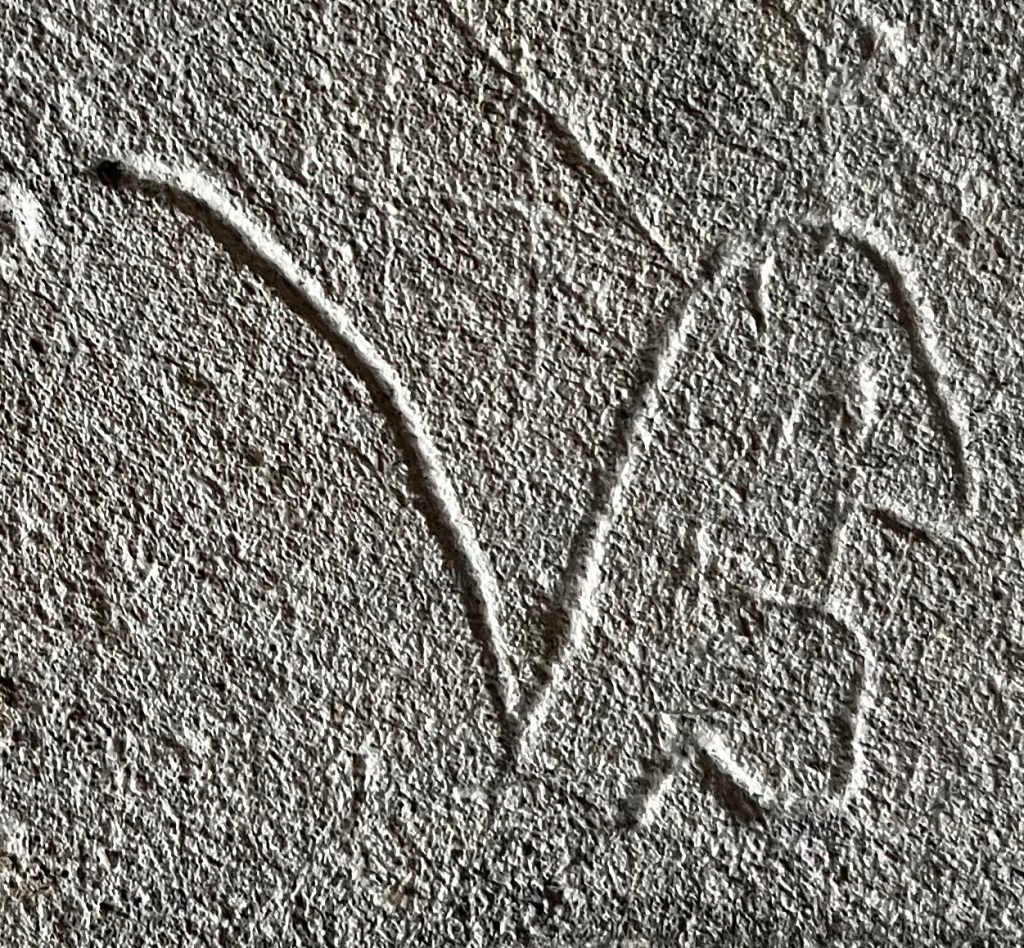
GRAFFITI & MARIAN MARKS (VV)
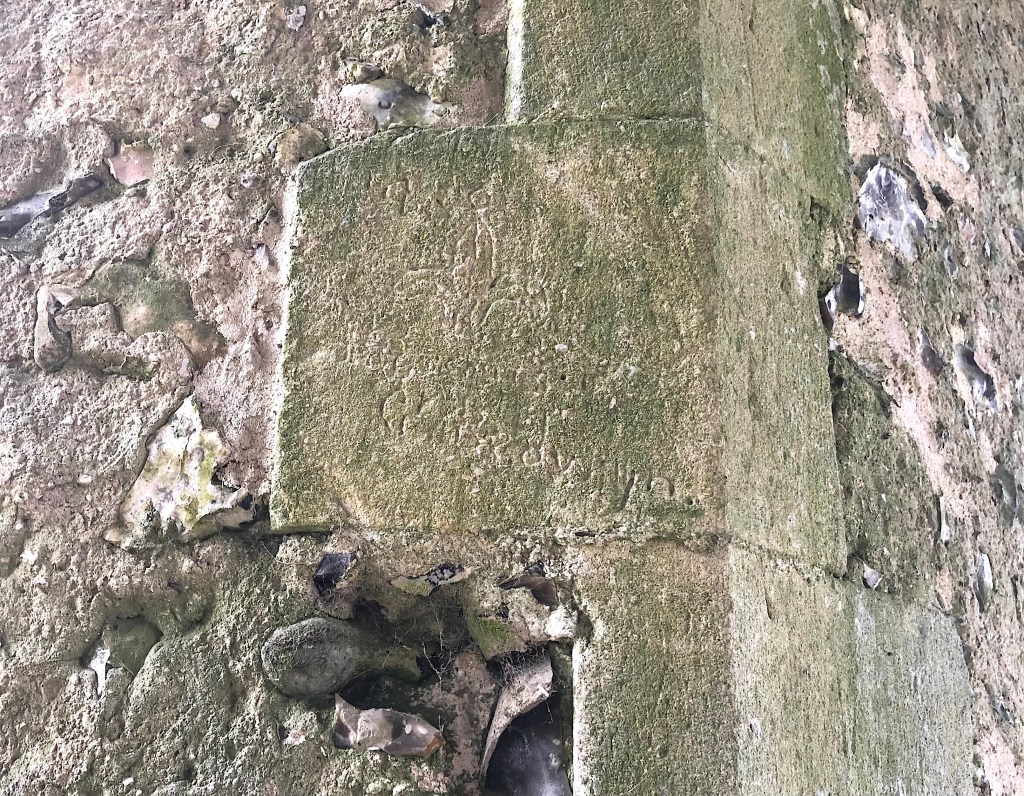
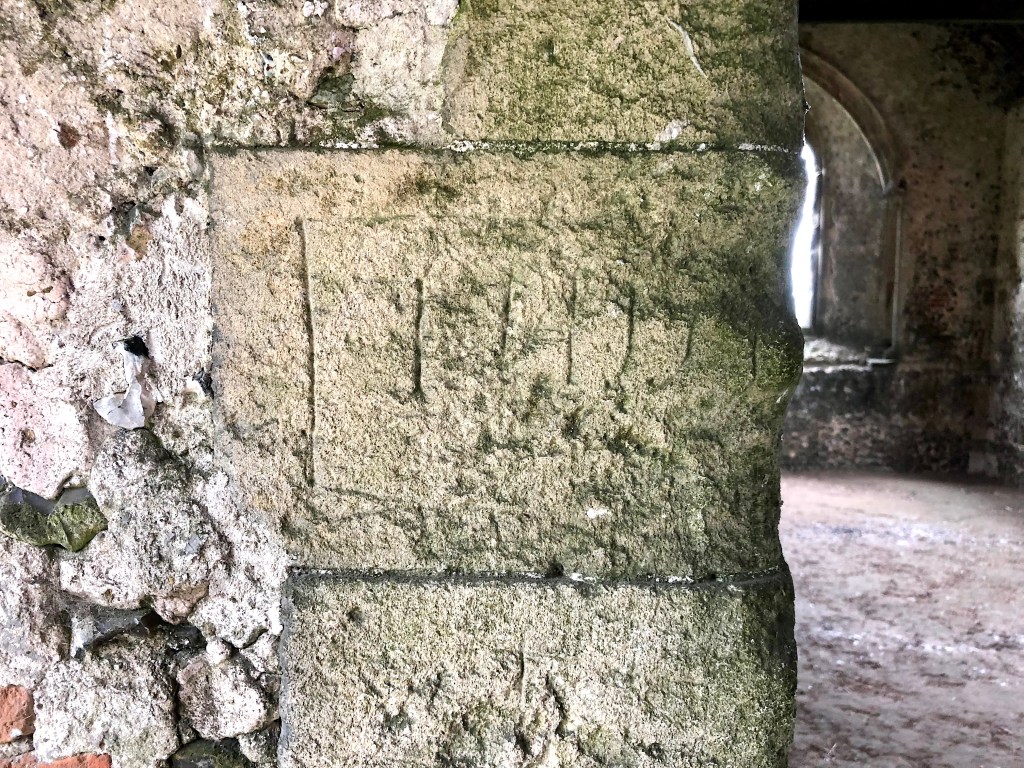
There was no scratch dial and I wasn’t expecting to find one. However the chapel is interesting enough to merit inclusion, not least because consercation crosses and church marks generally are catered for in this project.
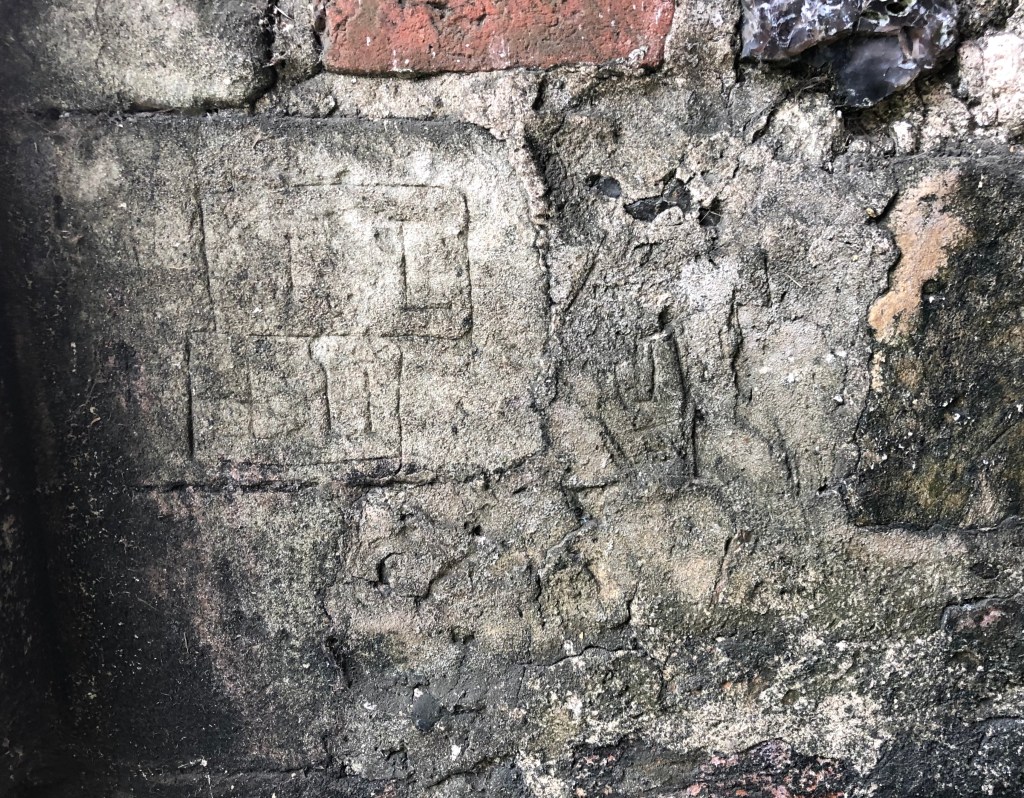
1. shows a (possible? probable?) Fleur de Lys with G Bedwyn scrawled below – 2. is one form of protection mark – 3. enclosed initials – 4. Marian mark VV – 5. ‘scratchings’ – 6. Marian mark VV and a design with a heart that I initially thought must make it recent… However the form of the W (similar to a Marian mark) is from a much earlier time, as is the date (if it is one) in Roman numerals. I can’t decipher it beyond ..15
GSS Category: Consecration Cross; Church Marks; Marian Symbol; Medieval Graffiti
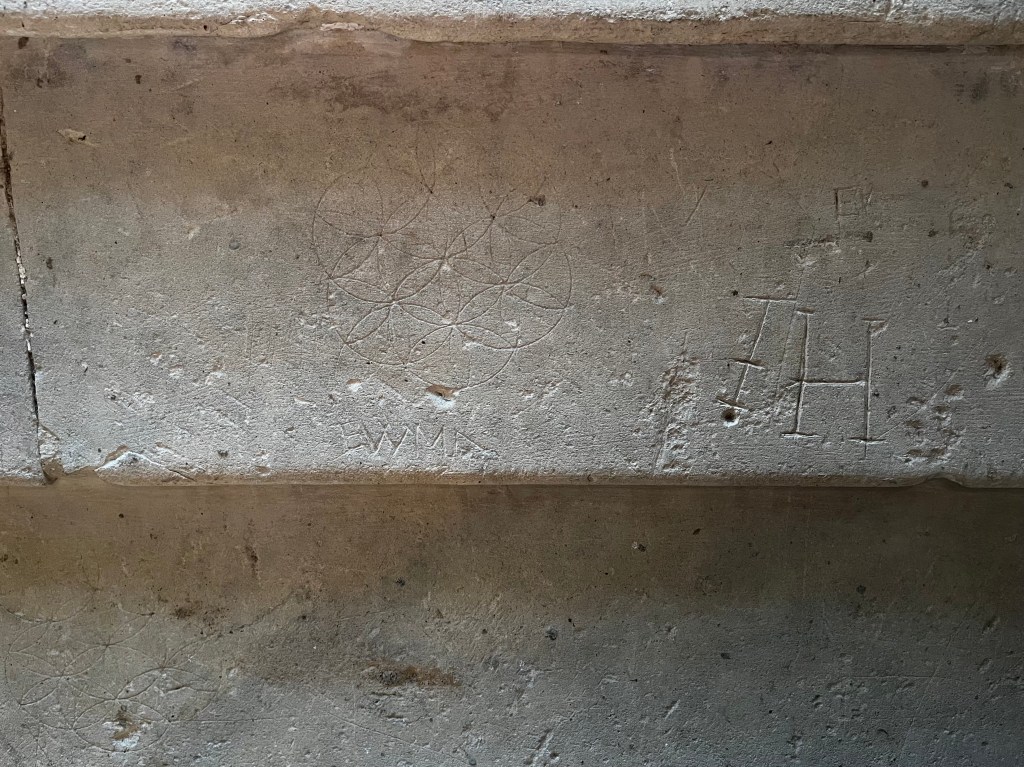
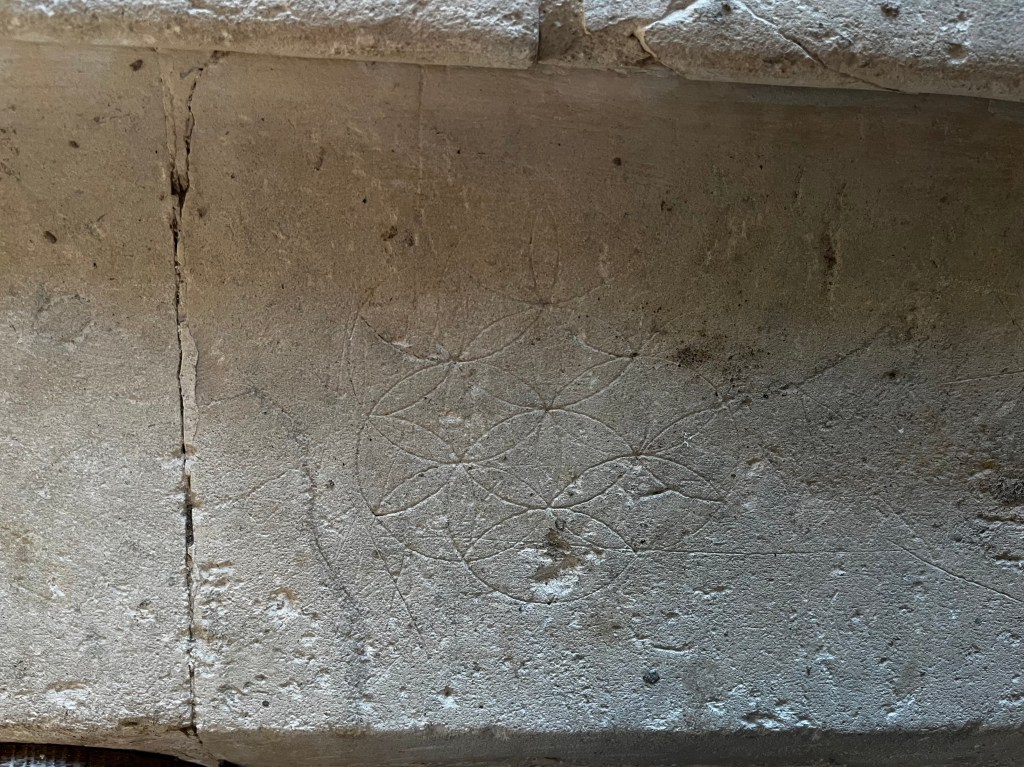
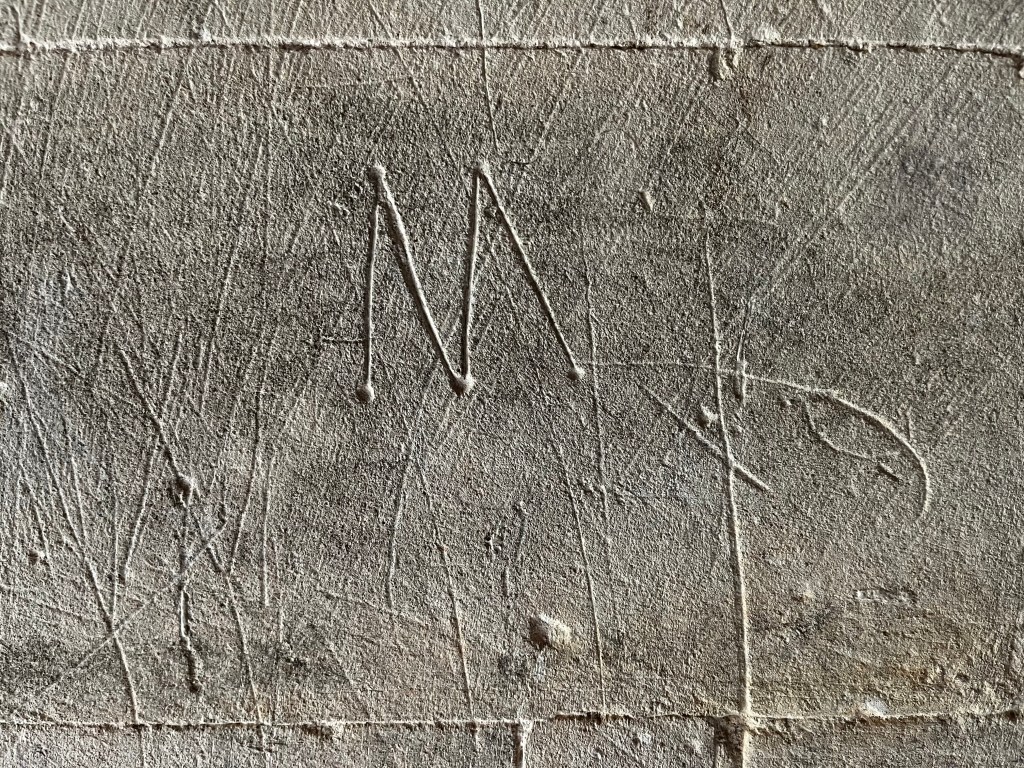
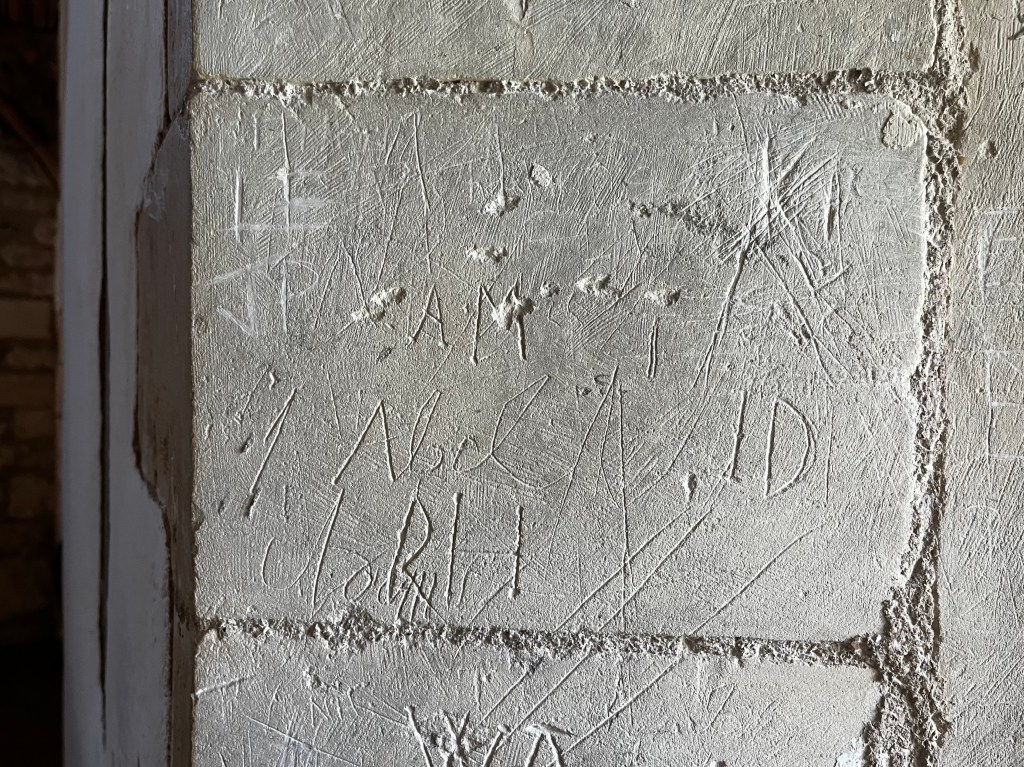
GRADE I † C14 The principal parts of a small stone manor house, built c1370 for the Sheriff of Somerset & Dorset. It has undergone many changes since, but the splendid timber roofs over the great hall and solar… (remain intact). Scheduled as an Ancient Monument. Under the care of English Heritage Two miles E of Sturminster Newton. 50.9213 / -2.2847 / ST800135
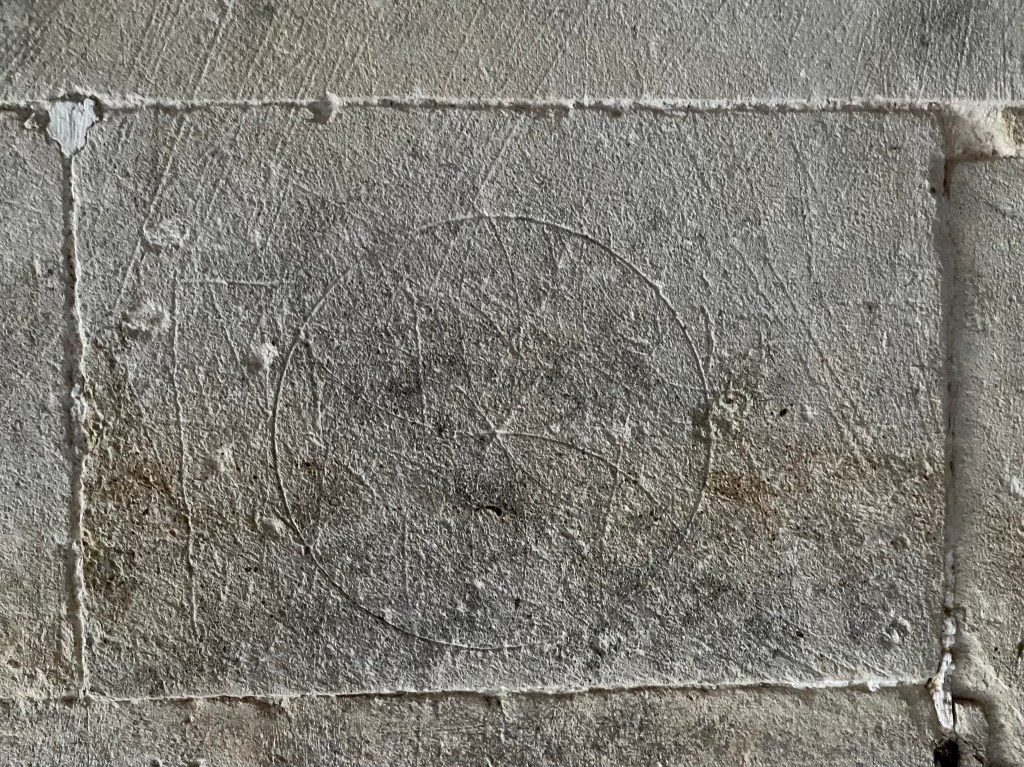
Fiddleford Manor . Sturminster Newton . Dorset – a wall of various types of church mark including a hexfoil
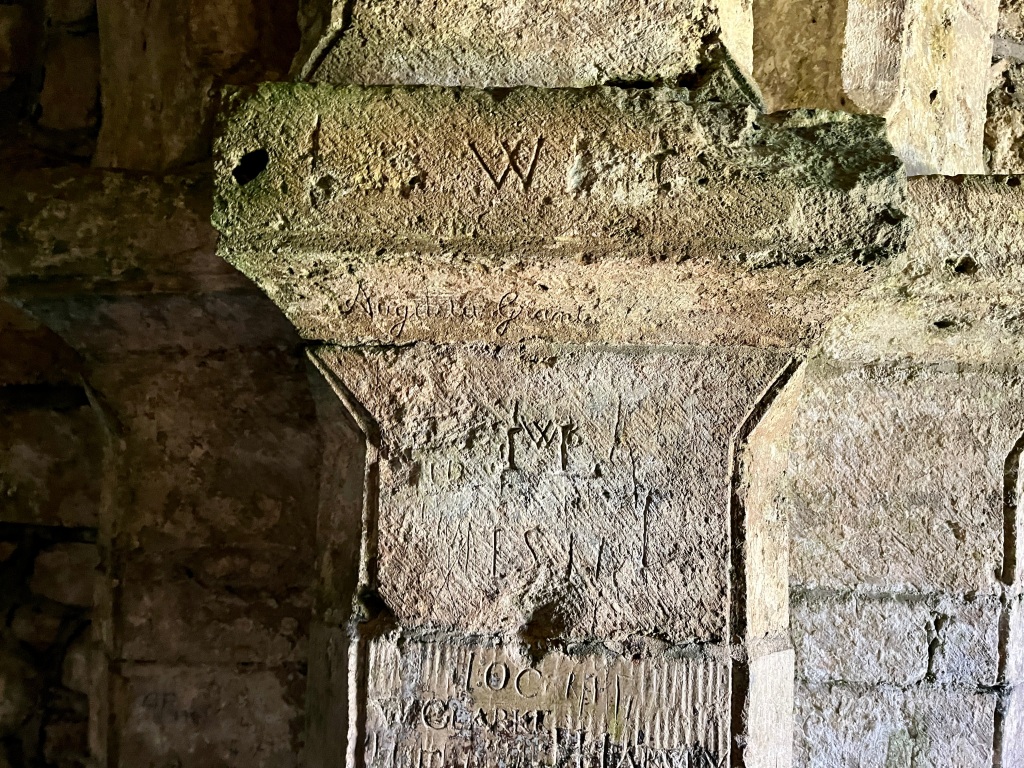
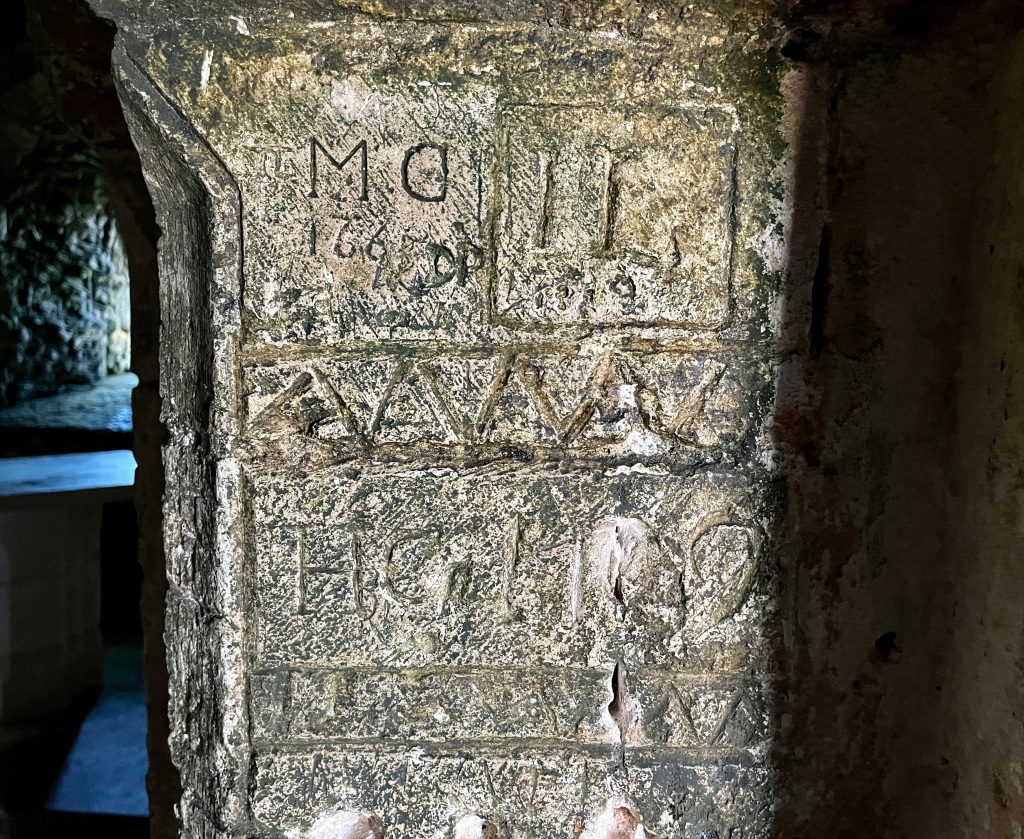
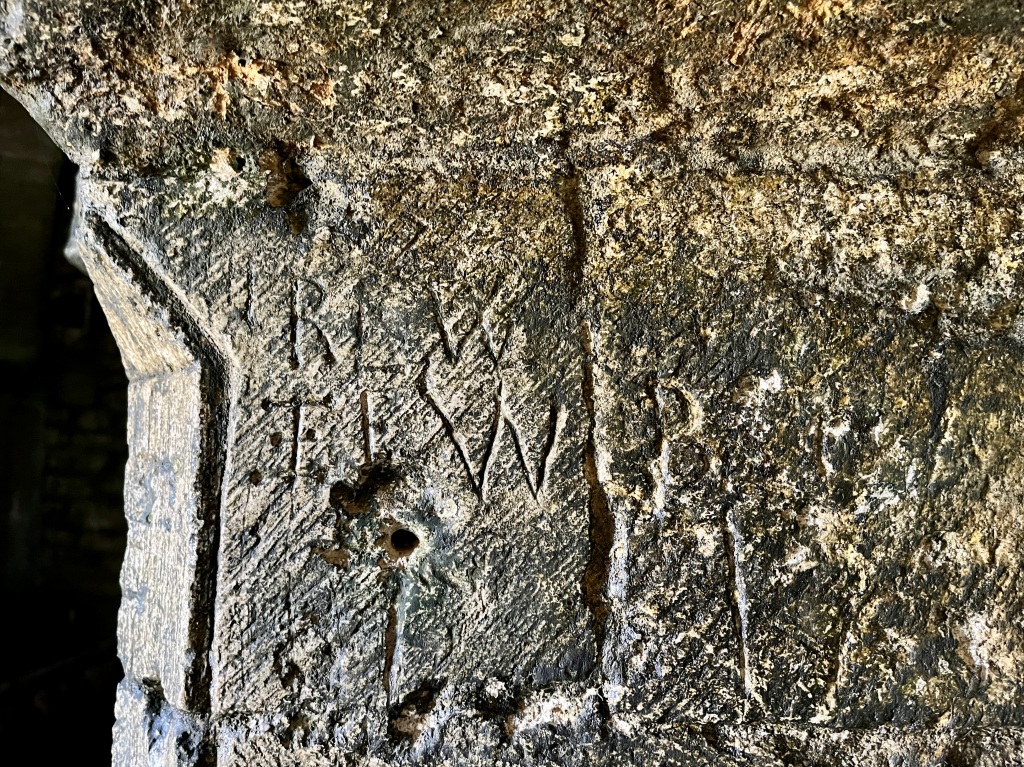
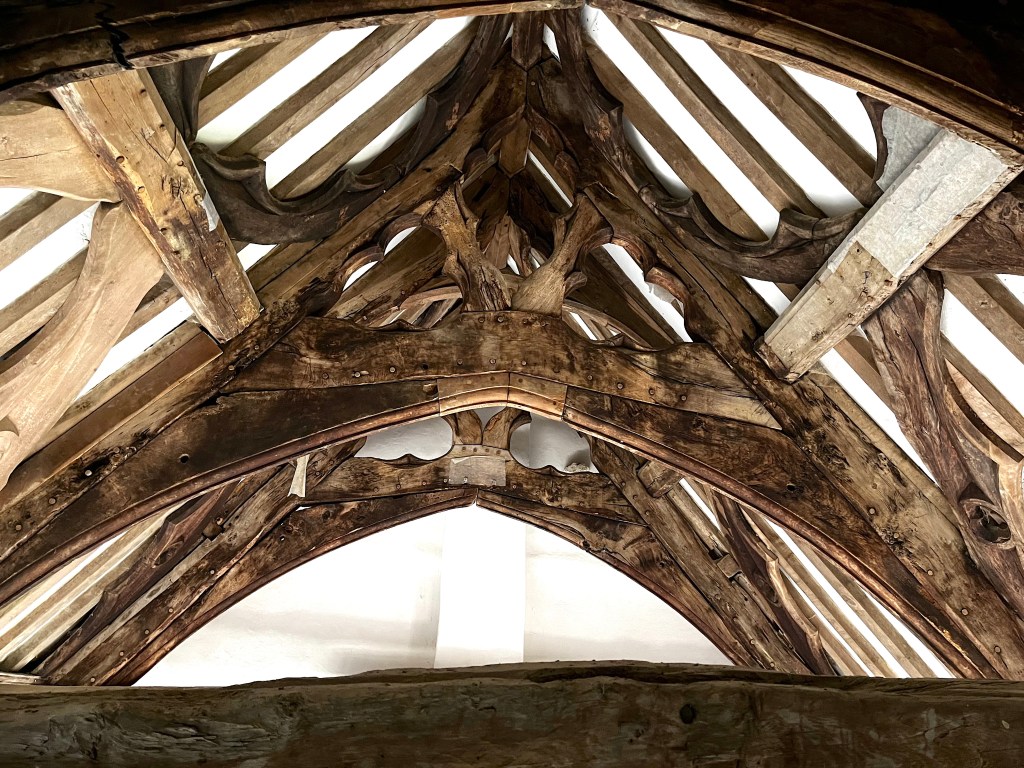
The most spectacular medieval manor house interior in Dorset PEV, an authoritative opinion that will never be challenged. There is no dial here, but the amazing graffiti could equally be found in a church, though generally not in such profusion. Besides dials of all kinds, this site includes medieval building marks – symbols, initials, dates, other graffiti. These categories can be found in the Menus on the front page. However, Fiddleford manor is so special that it deserves its own main entry rather than being relegated to a sub-menu.
HEXFOILS
MARIAN MARKS
GRAFFITI
GSS Category: Church Marks; Marian Marks; Ritual Protection; Hexfoils; Medieval Graffiti














































 GAUDIUM SUB SOLE . SUNDIALS . MEDIEVAL TO MODERN