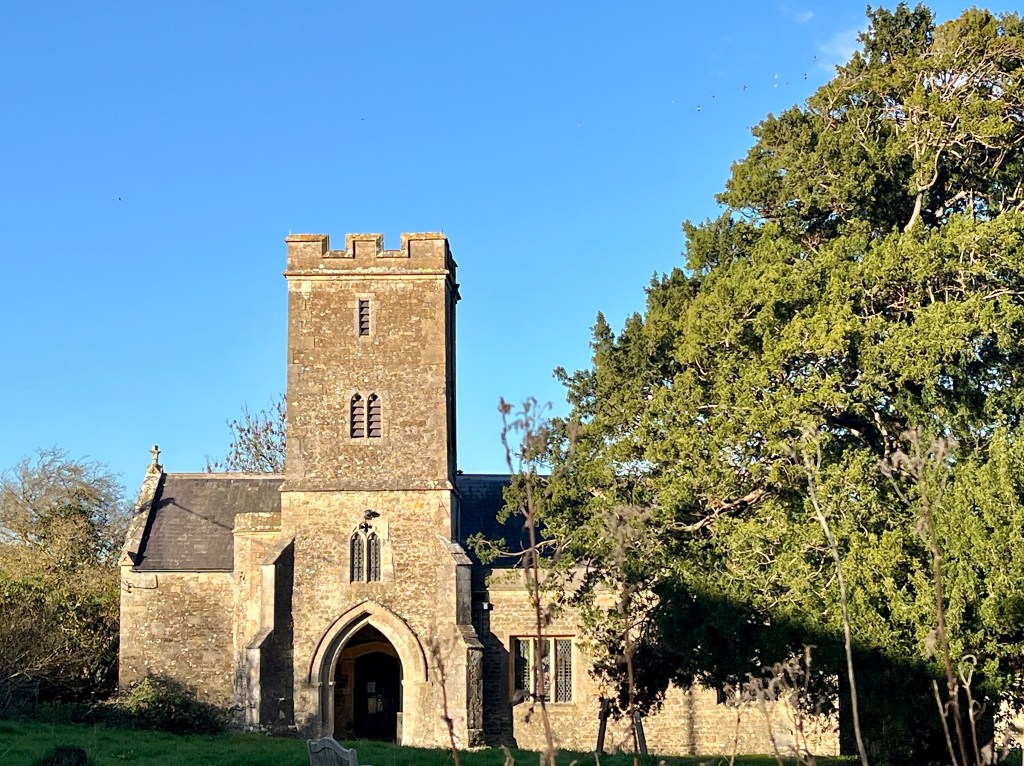
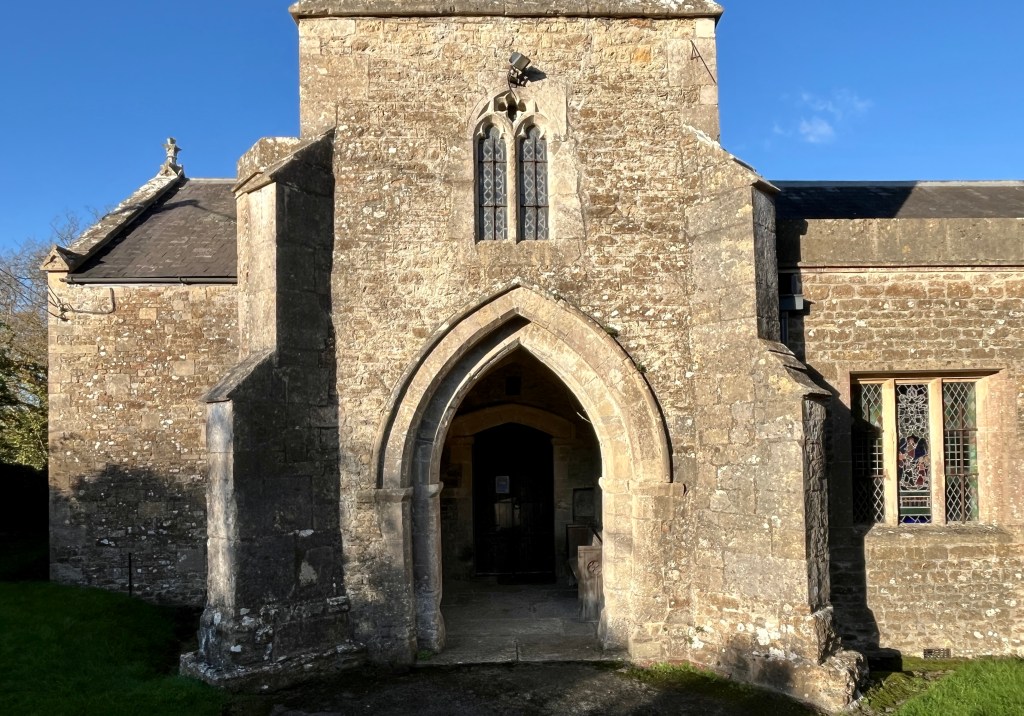
GRADE II* ❖ C12 to C15, with major C19 restoration. Local lias stone. Cruciform plan. Tower octagonal, in three stages, probably C15. In an area with several octagonal tower churches, this is the only one with 3 stages. Earliest recorded rector 1309. Close to Keinton Mandeville (2 dials). 3m NE of Somerton. 51.0828 / -2.6585 / ST539317
DIAL
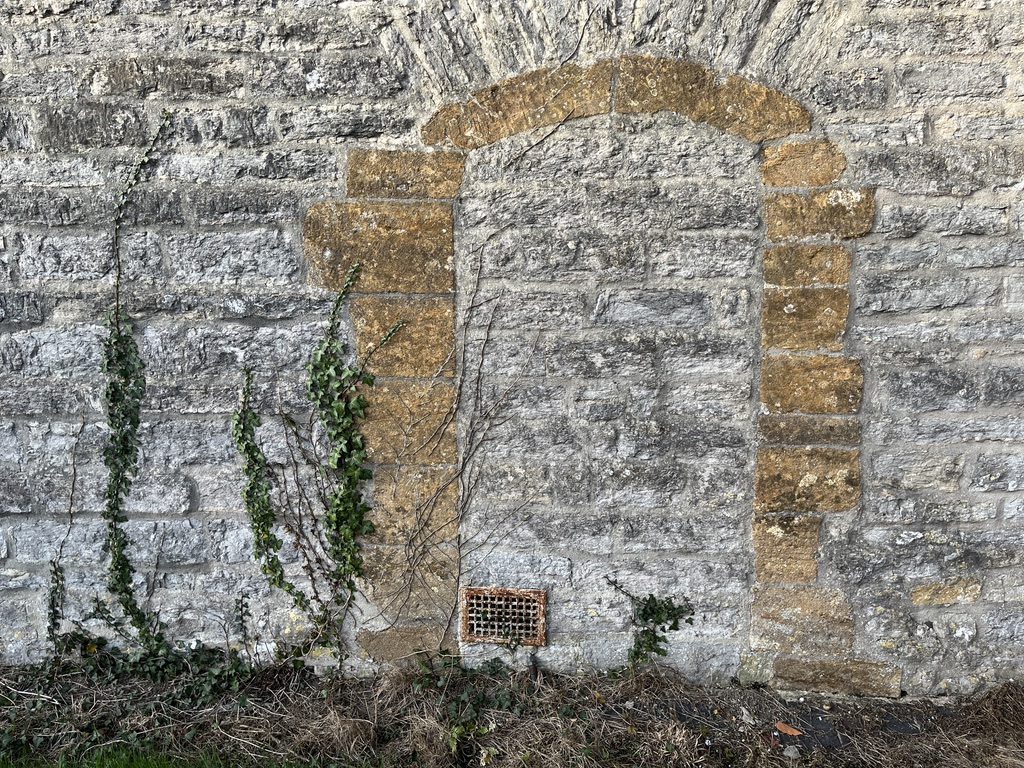
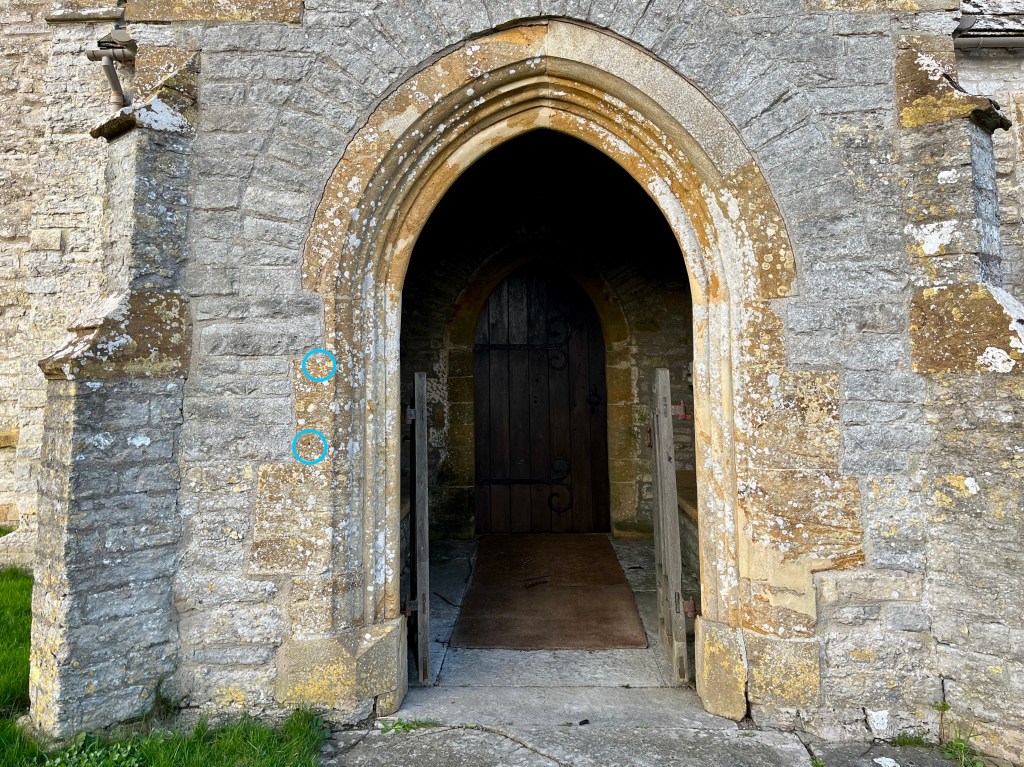
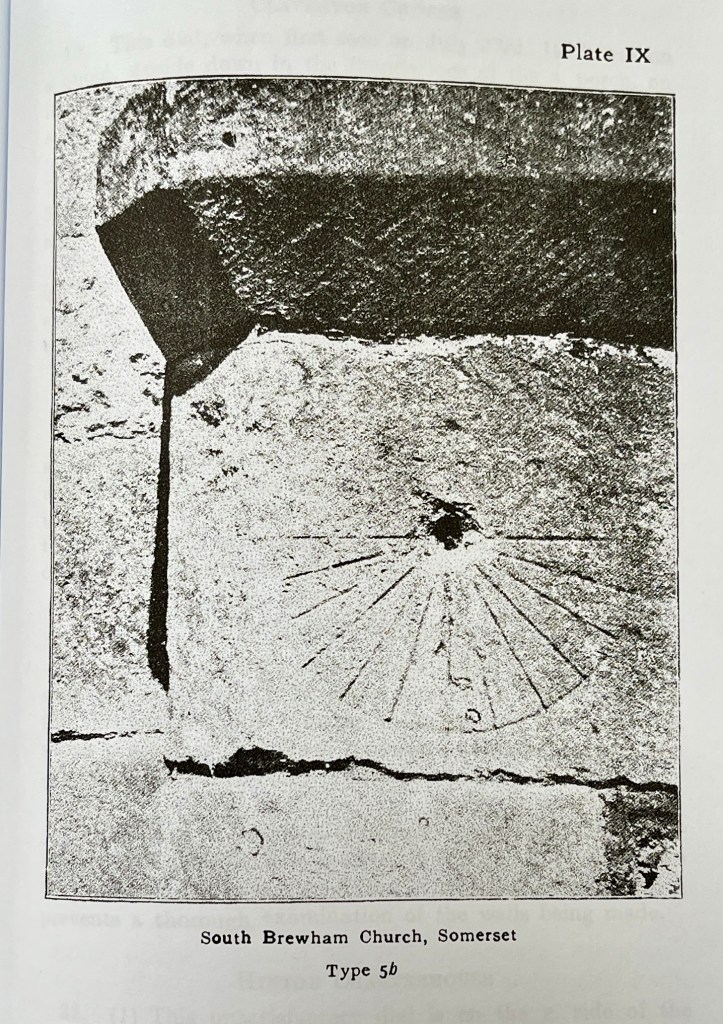
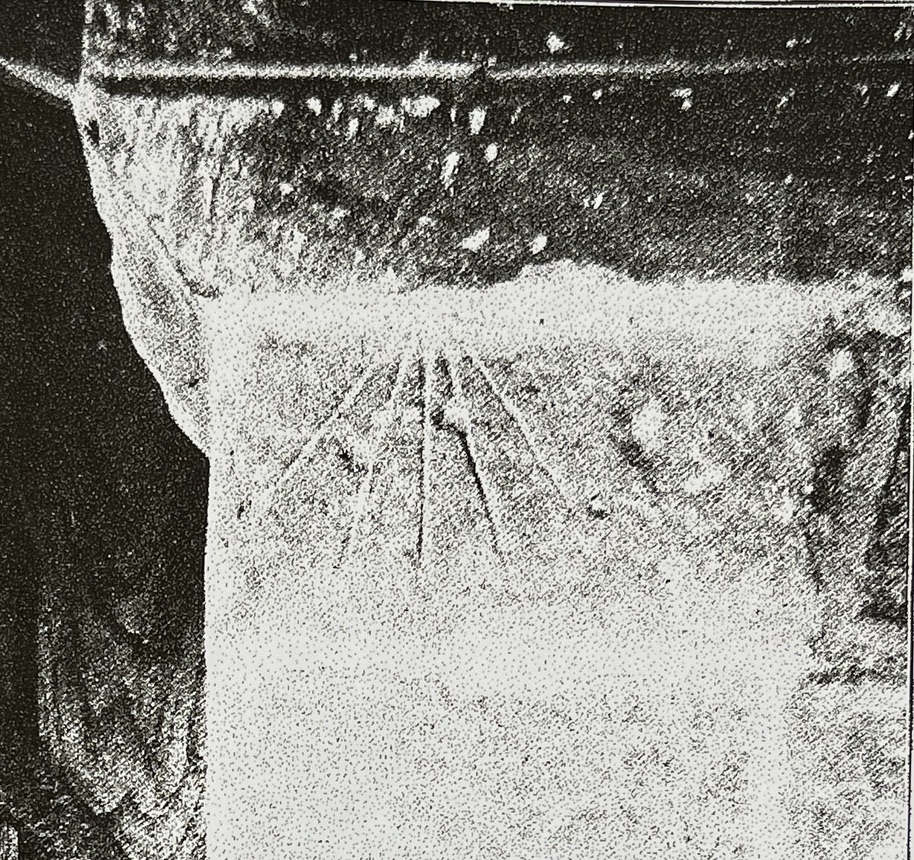
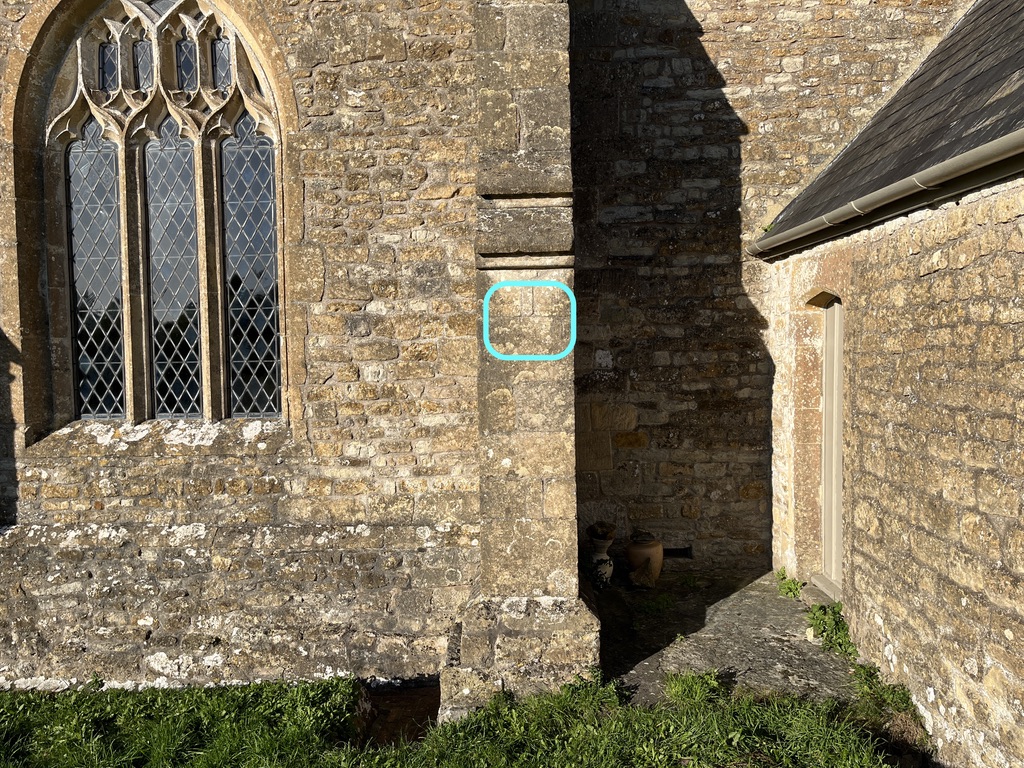
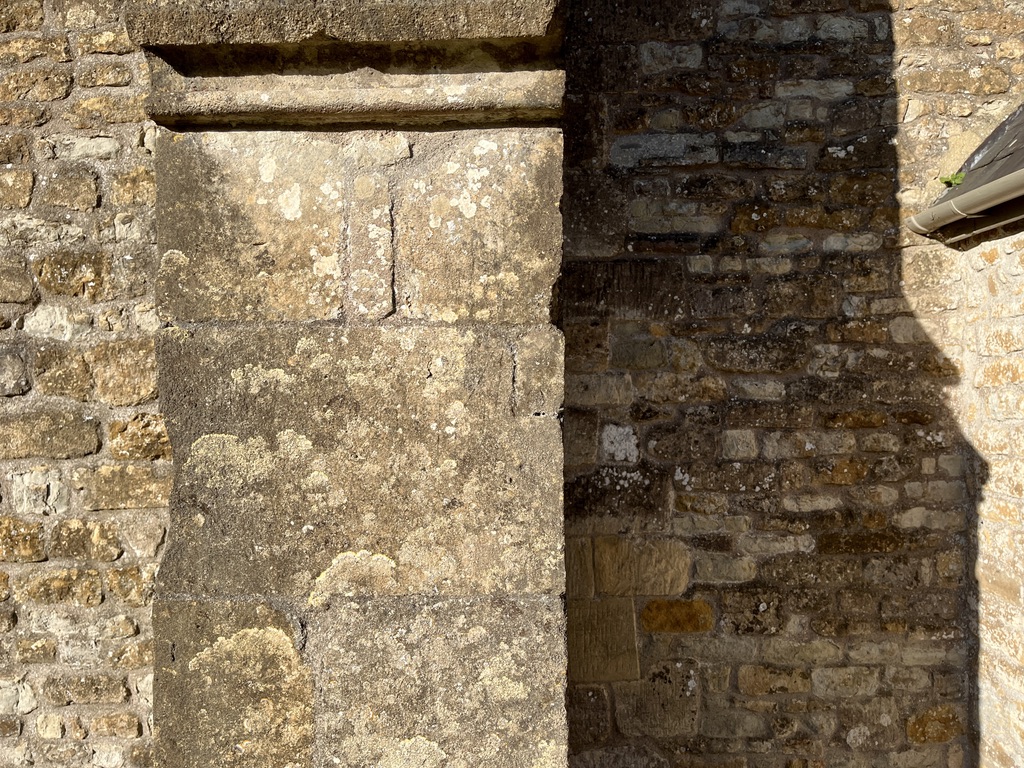
DEH visited on 26 May 1914. On W side of the blocked doorway on S side of the church, he found a dial low down. He noted a 5 inch noon line and a blocked style-hole in the mortar joint.
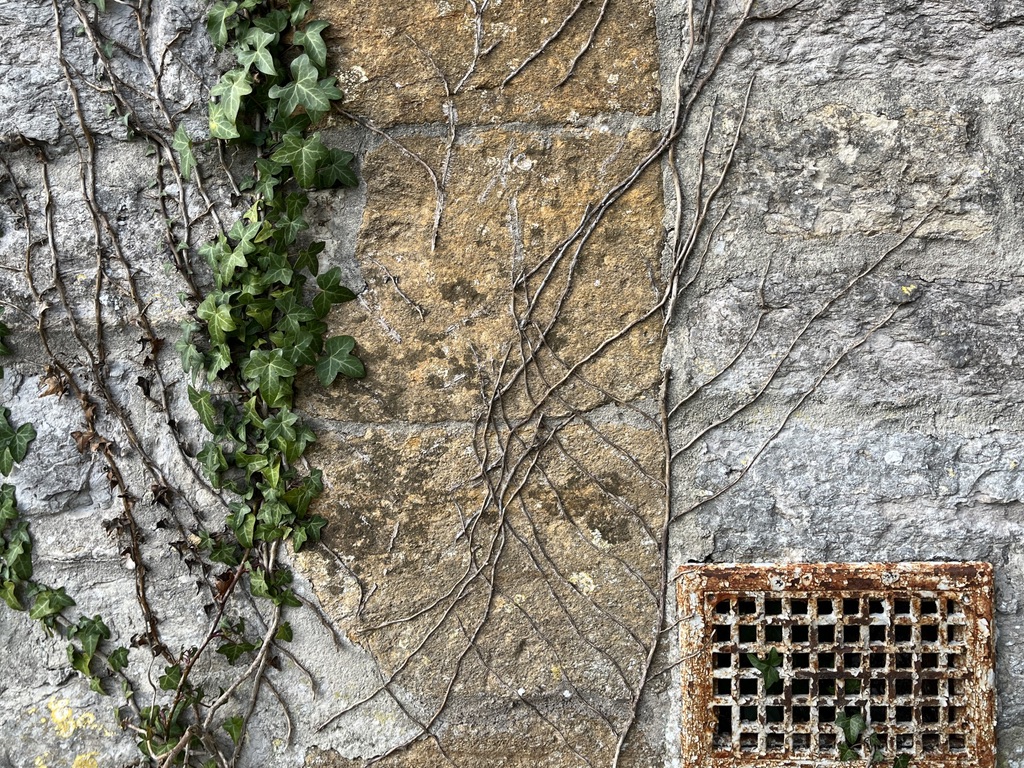
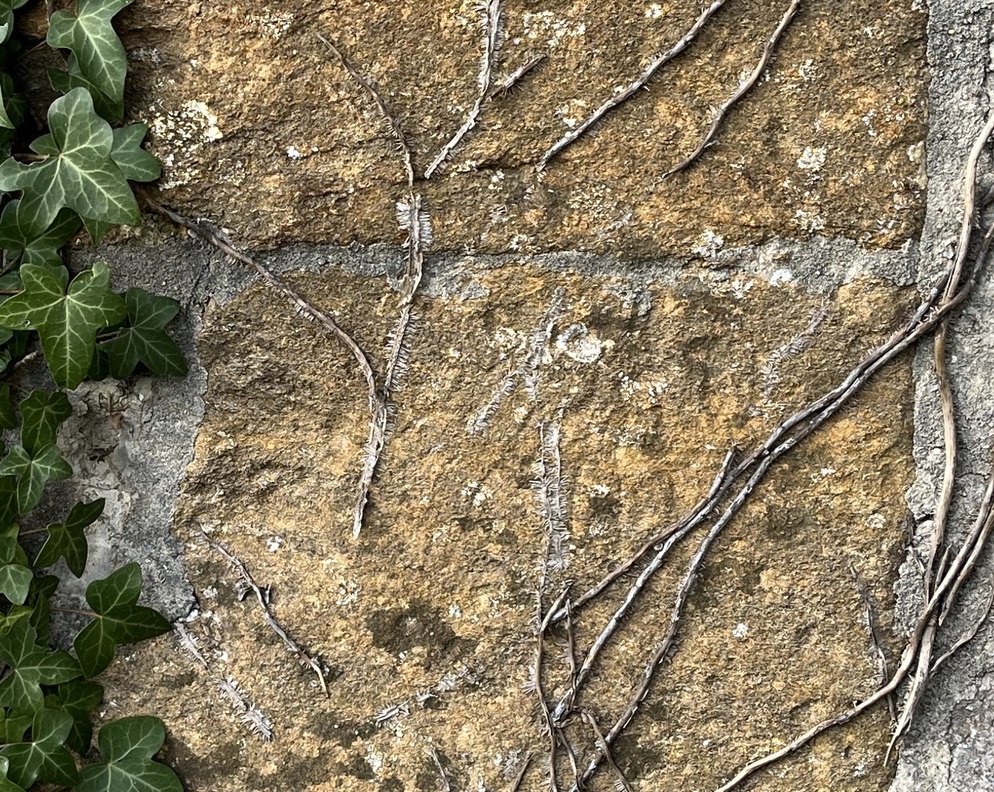
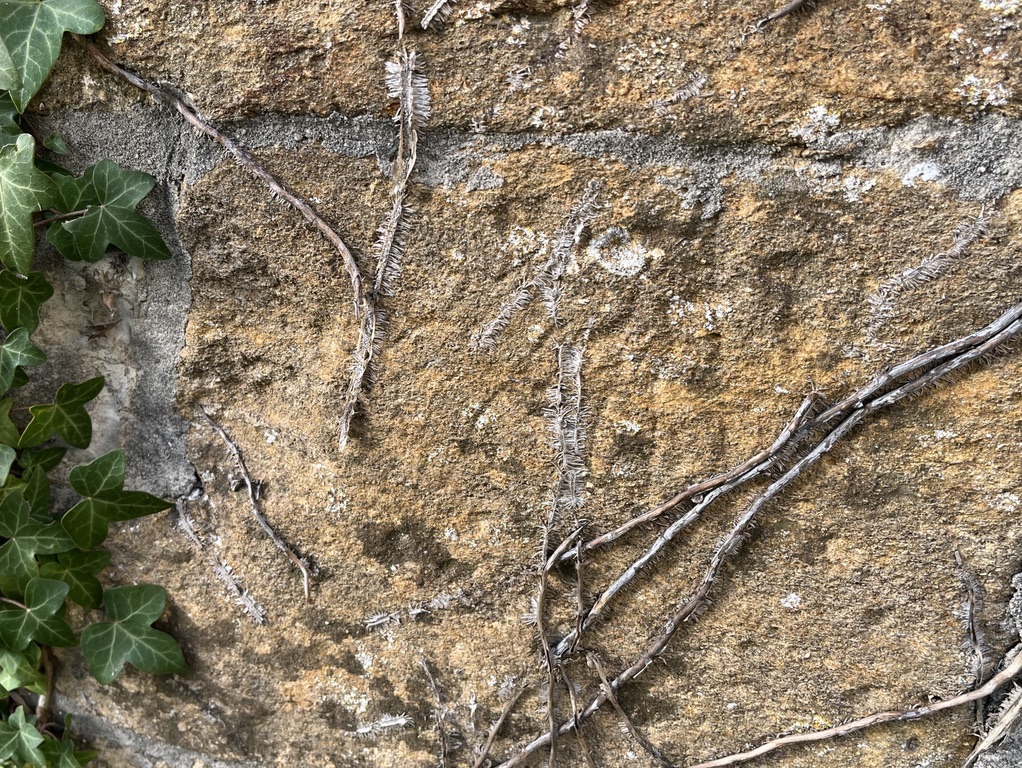
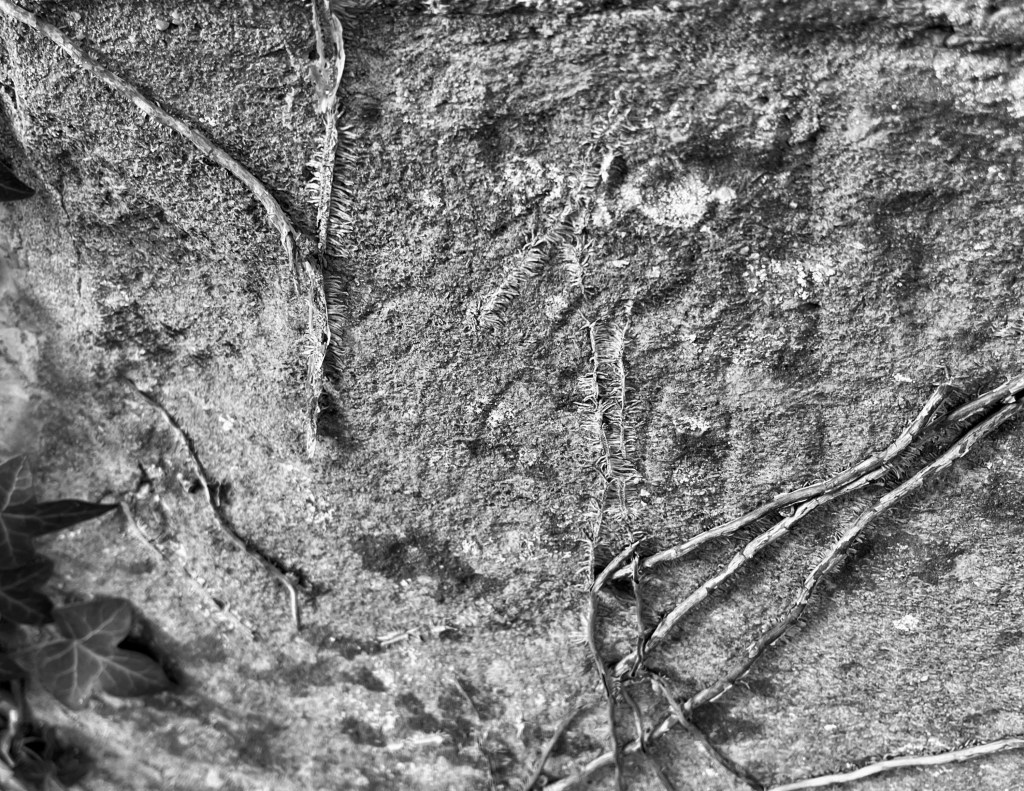
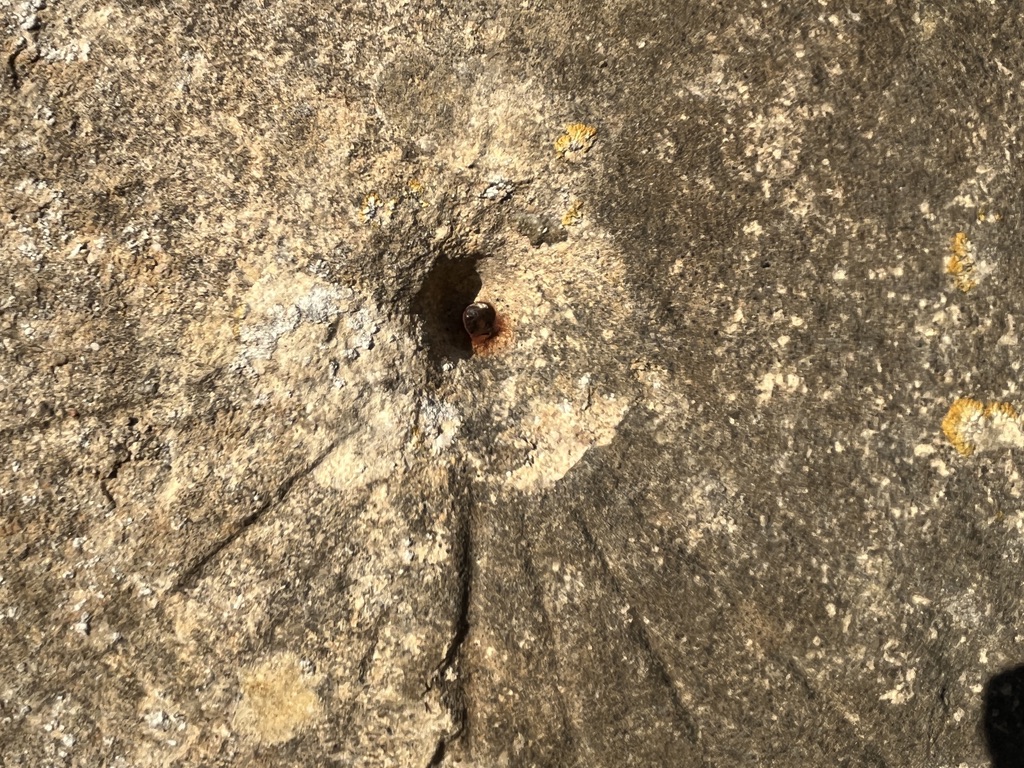
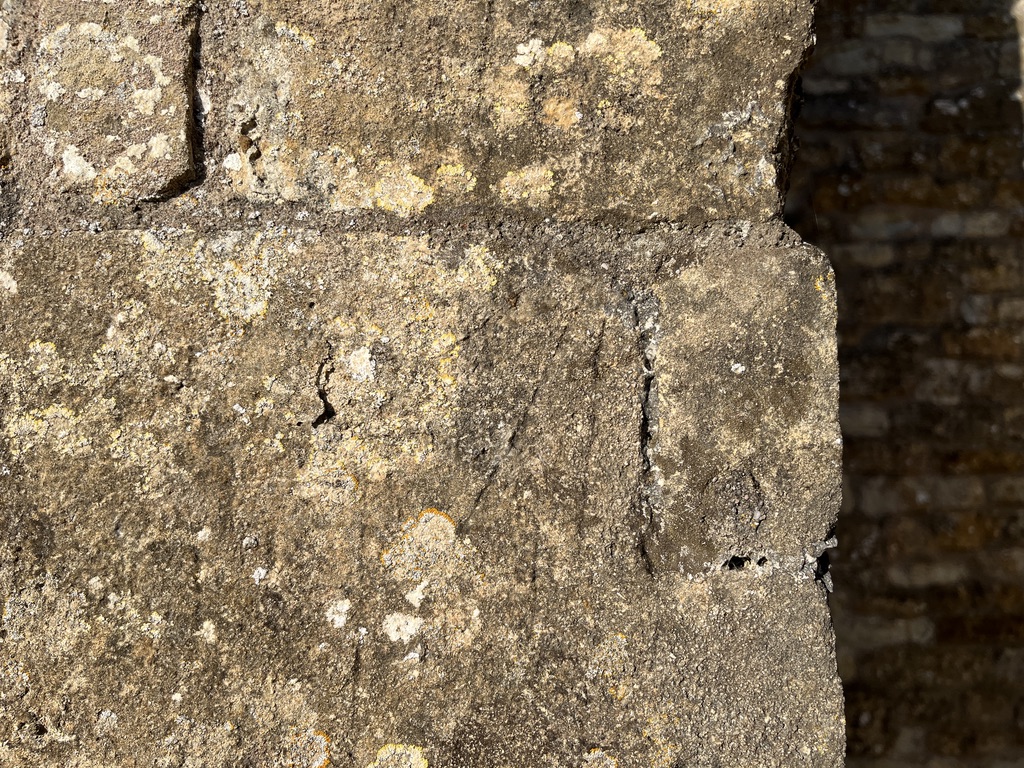
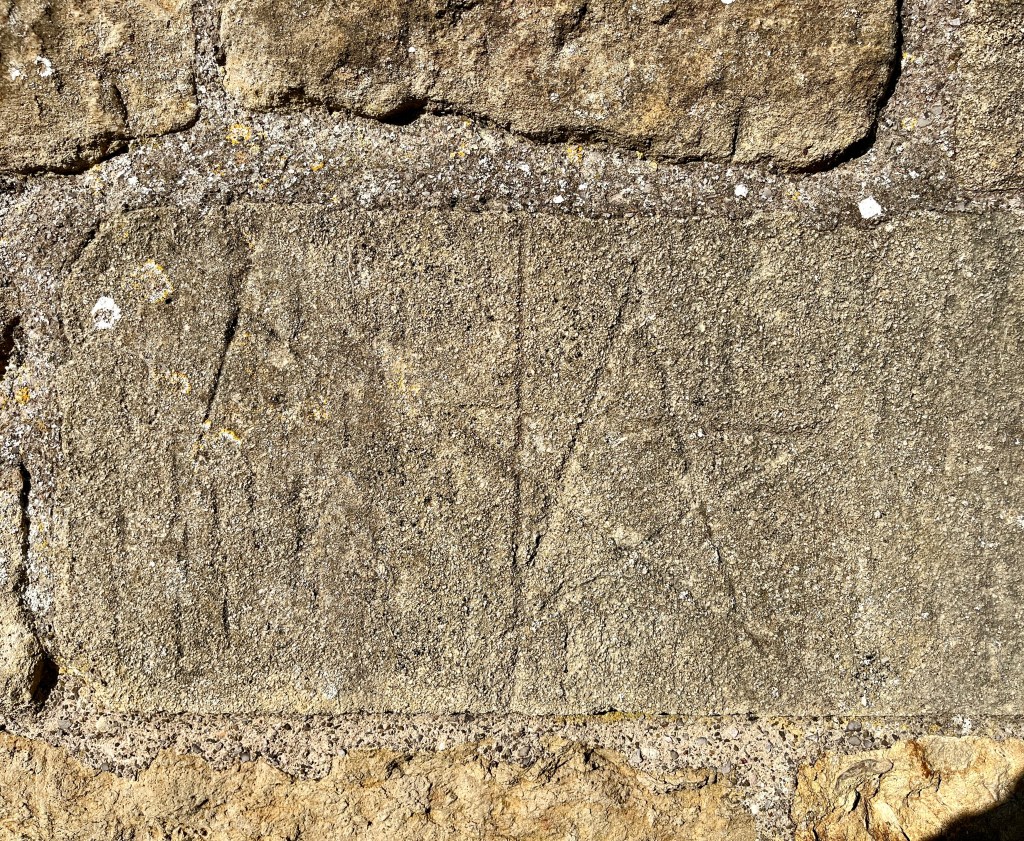
Eventually I found the dial, LHS amidst ivy both alive and dead. Its position close to ground level renders it useless for its purpose, yet it doesn’t seem to have been relocated. The ‘design’ consists of 4, perhaps 5, spidery radials descending untidily from the mortar line. It is 100+ years and a lot of ivy since DEH recorded the dial, and we can predict that it will soon be concealed by ivy, or eroded away.
B & W COMPARISON
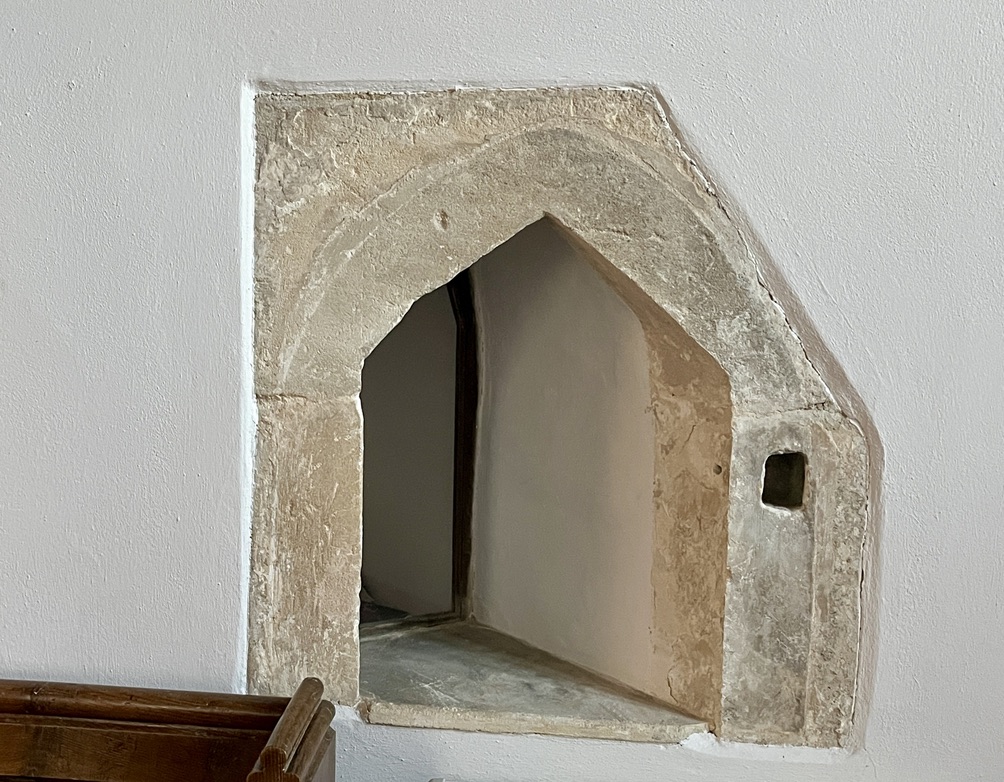
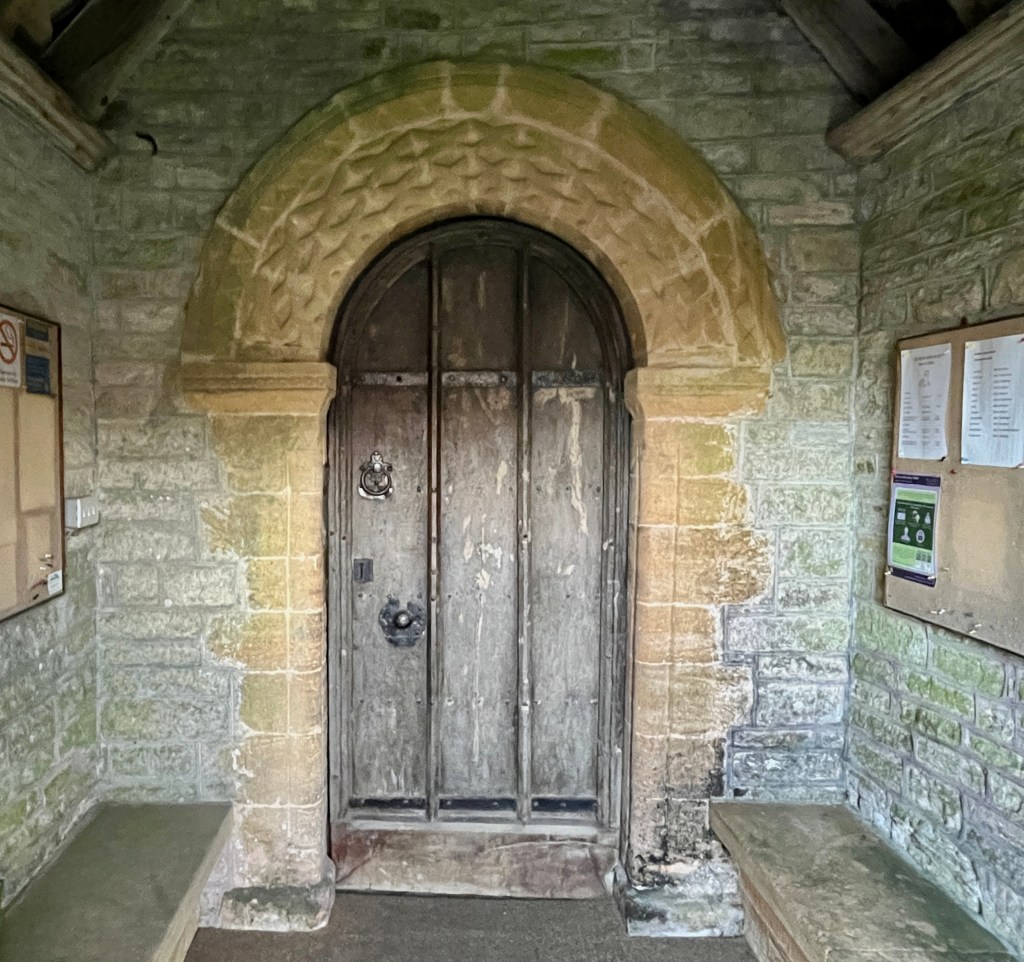
A fine Squint and a handsome Norman doorway
GSS Category: Scratch Dial; Mass Dial; Church erosion; Squint; Norman Doorway
All photos: Keith Salvesen / Rolling Harbour except excellent main photo, Geoff Pick / Wiki
GRADE II* ❖ Early origins; mainly C14 / C15; additions C19 (inc. Ferrey). PEV gives this small church quite a detailed entry. This is lias stone country. The building, the churchyard, and the setting make this a fine country church. There are 2 scratch dials. Visited by DEH on 10 Sept 1912. 12m N of Yeovil. 51.0566 / -2.6271 / ST561287
❖
DIAL 1
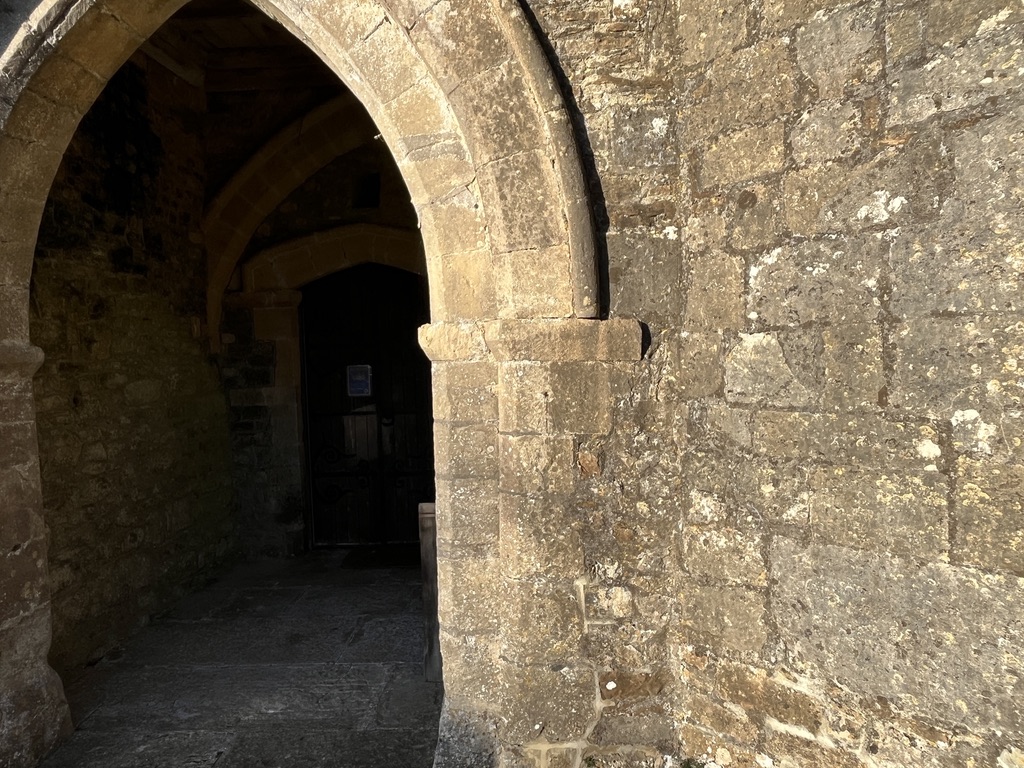
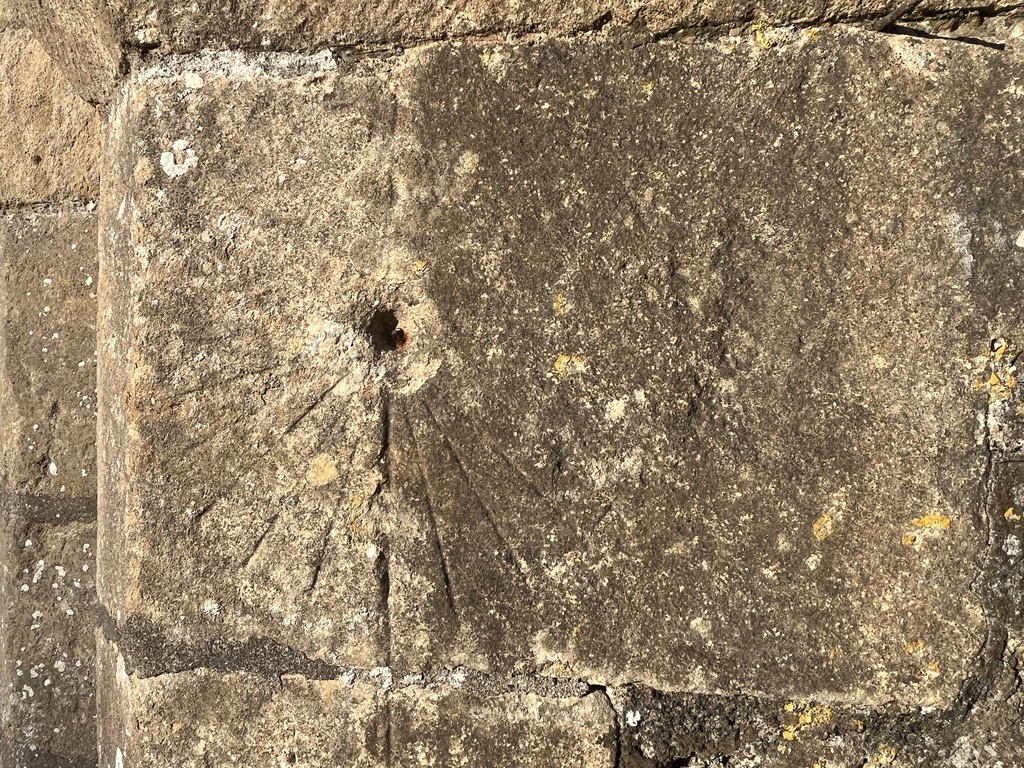
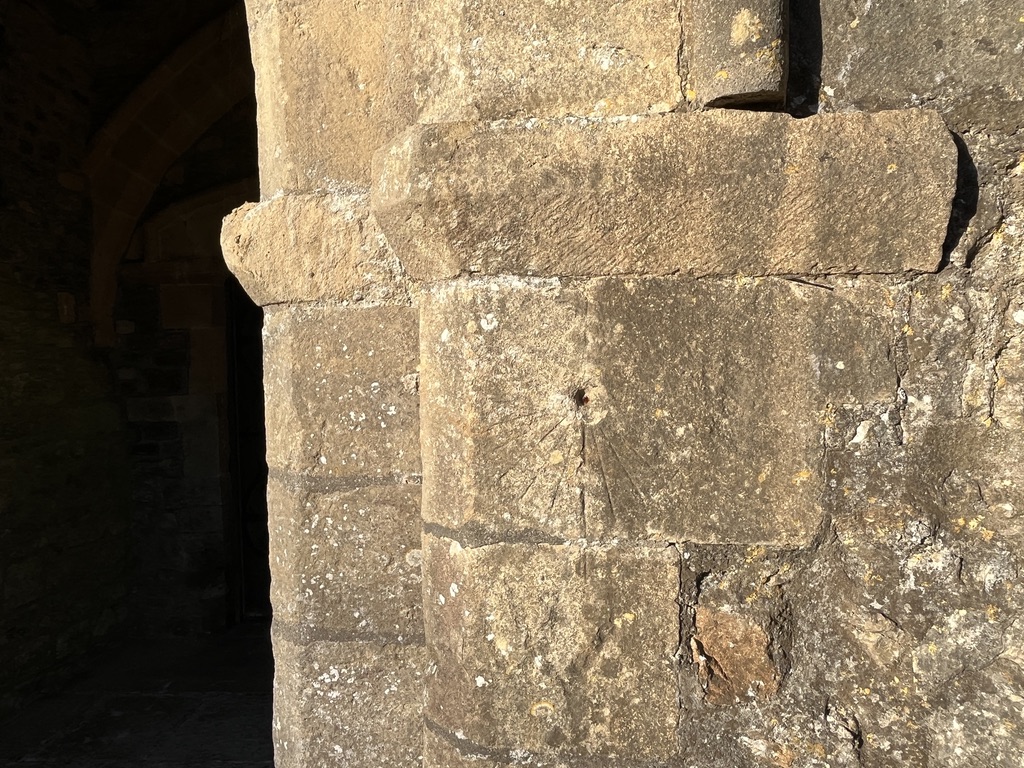
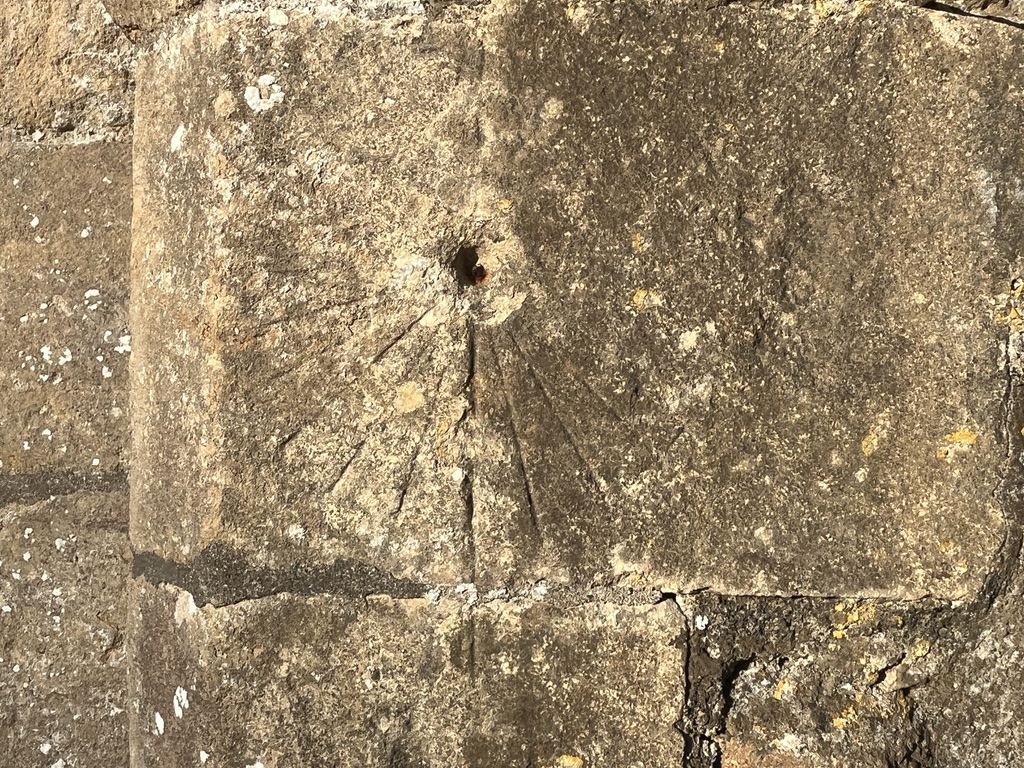
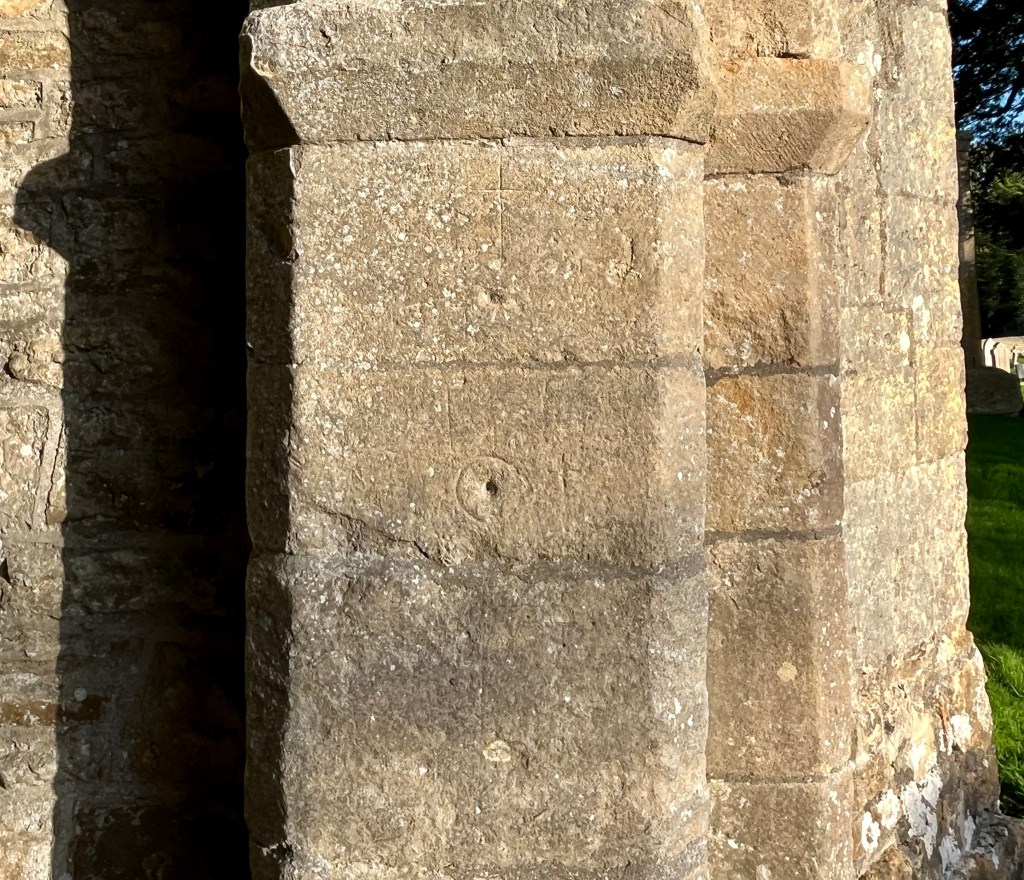
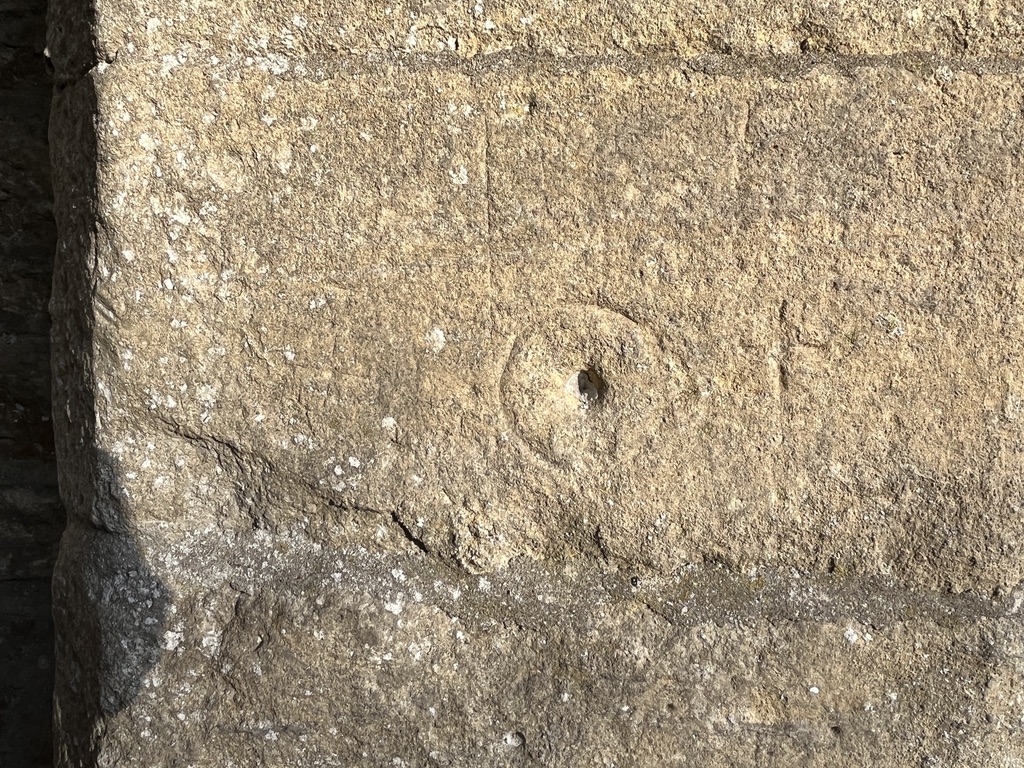
On a quoin stone W side of S porch, the gnomon hole easily seen. DEH calls it a faint scratchy dial, and thought that the hole may still contain the style. He seems not to have checked; later in his dialing project, he would have. There’s no trace now.
Babcary 1
DIAL 2
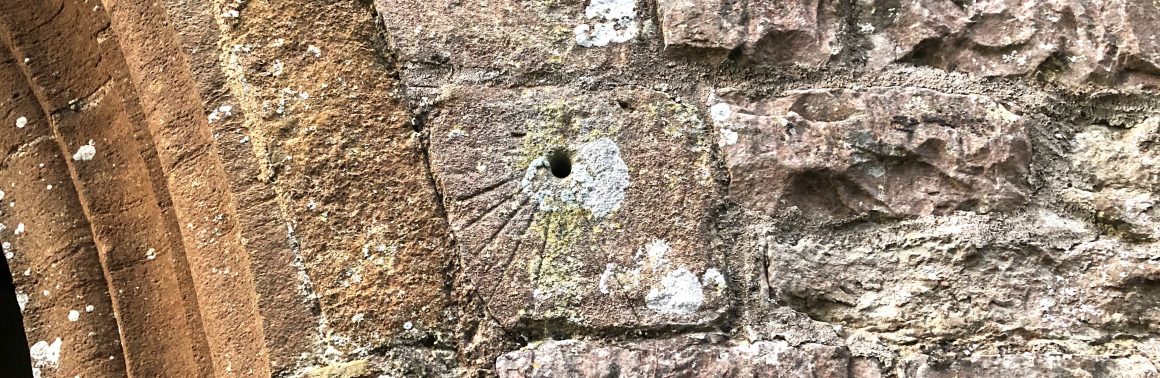
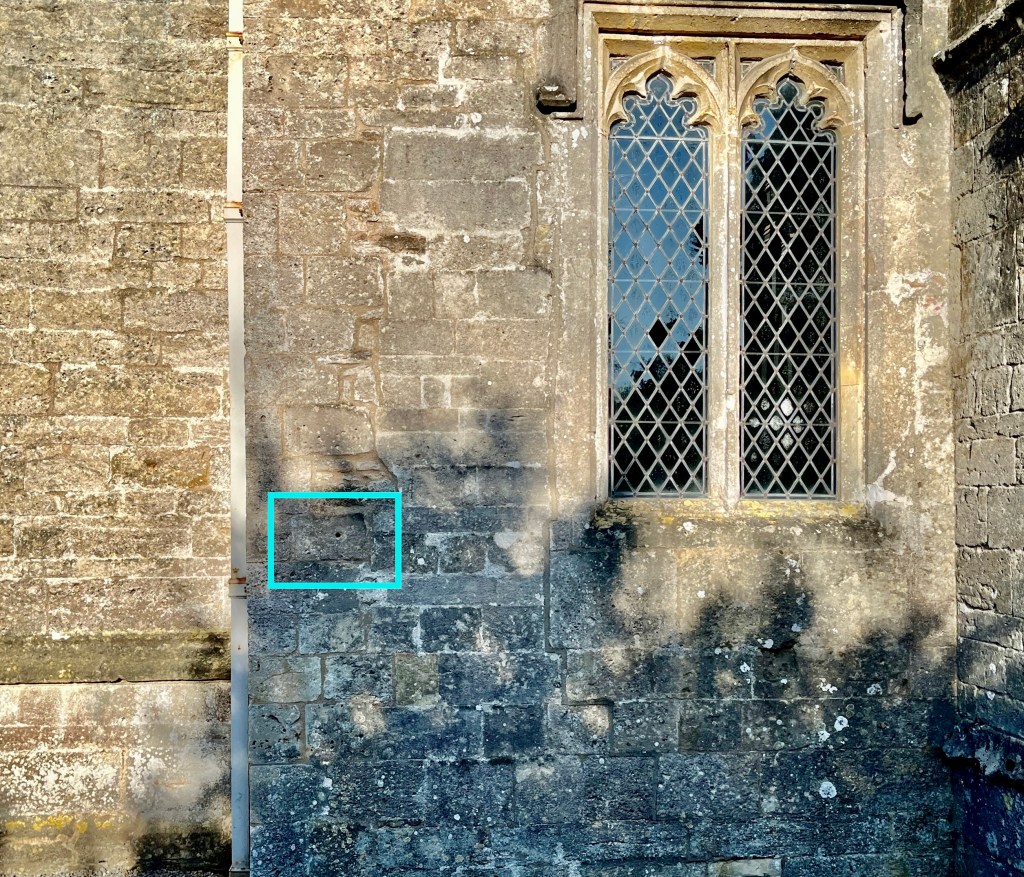
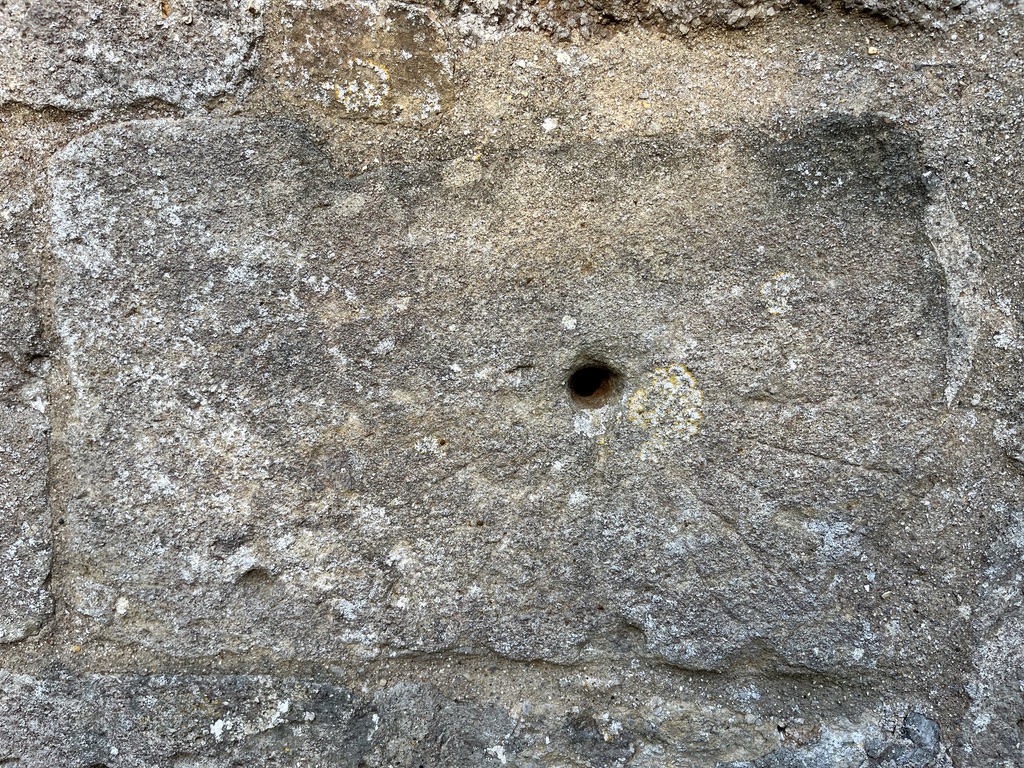
A few inches above Dial 1 is an indistinct dial, noted by DEH. But for his careful records, no one would notice it now, a century later. 4 faint and somewhat wonky radials can just be made out LLQ, descending from a shallow hole now covered by lichen. This has a slight bluish tinge suggestive of a copper rod being used as a gnomon, a speculation too far.
GGS Category: Scratch Dial; Mass Dial; Somerset Scratch Dial
GRADE II* ❖ C13 origins; subsequent interventions; much rebuilt late C19 with local stone cut and squared. 2-stage tower. 2 scratch dials and a vertical dial. Interesting and varied graffiti. A rewarding church to visit. 3m NE of Bruton. 51.1239 / 51°7’25″N / ST719361
DIALS
DEH visited St John on April 17th 1914, on his motorbike and with his camera. He recorded two scratch dials. Dial 1 is on E side of S porch. It has changed significantly since DEH recorded it in 1914. Dial 2 is on E side of the inner door of S porch, unchanged. The vertical dial at the top of the E buttress of the tower will be dealt with separately.
DIAL 1
Dom Ethelbert Horne, 1914
DIAL 1, with its large and damaged gnomon hole, is clearly visible as one approaches the church. The DEH photo above shows that in 1914, it had quite accurately cut even-spaced ‘6 – 6’ radials within a semicircle. A century later, erosion has reduced definable radials to 9, with overall decay of the lines. However, in the intervening years the noon-line has been cut deeper, and now extends onto the stone below.
GNOMON
DEH describes ‘part of the iron style… (is) level with the face of the stone, but rusted away at the sides’. It’s pleasing to find that it is still there. It’s not especially rare to find the remains of a metal rod gnomon, however most if not all those extant will have been put in place very much later than the date that the dial was cut.
DIAL 2
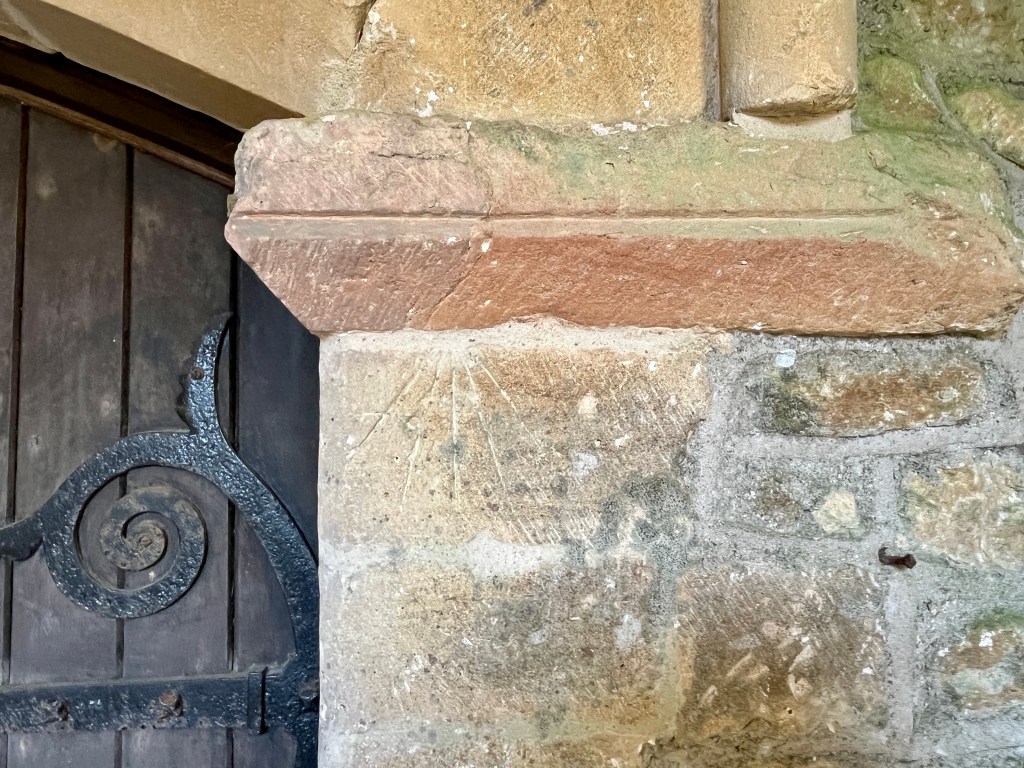
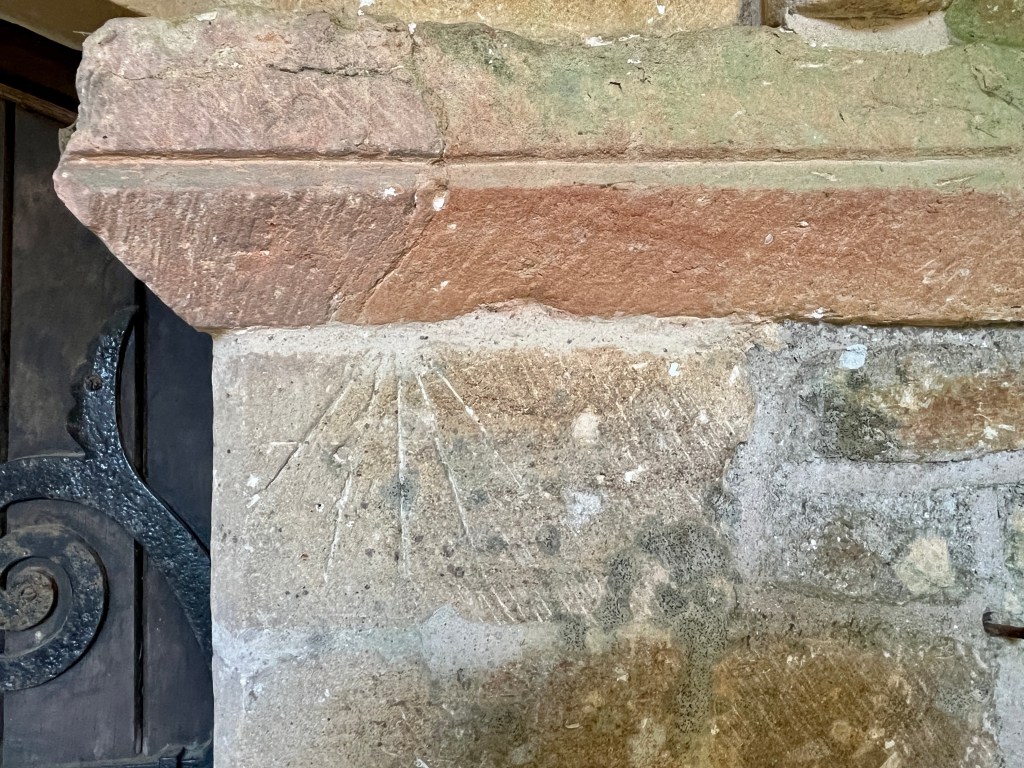
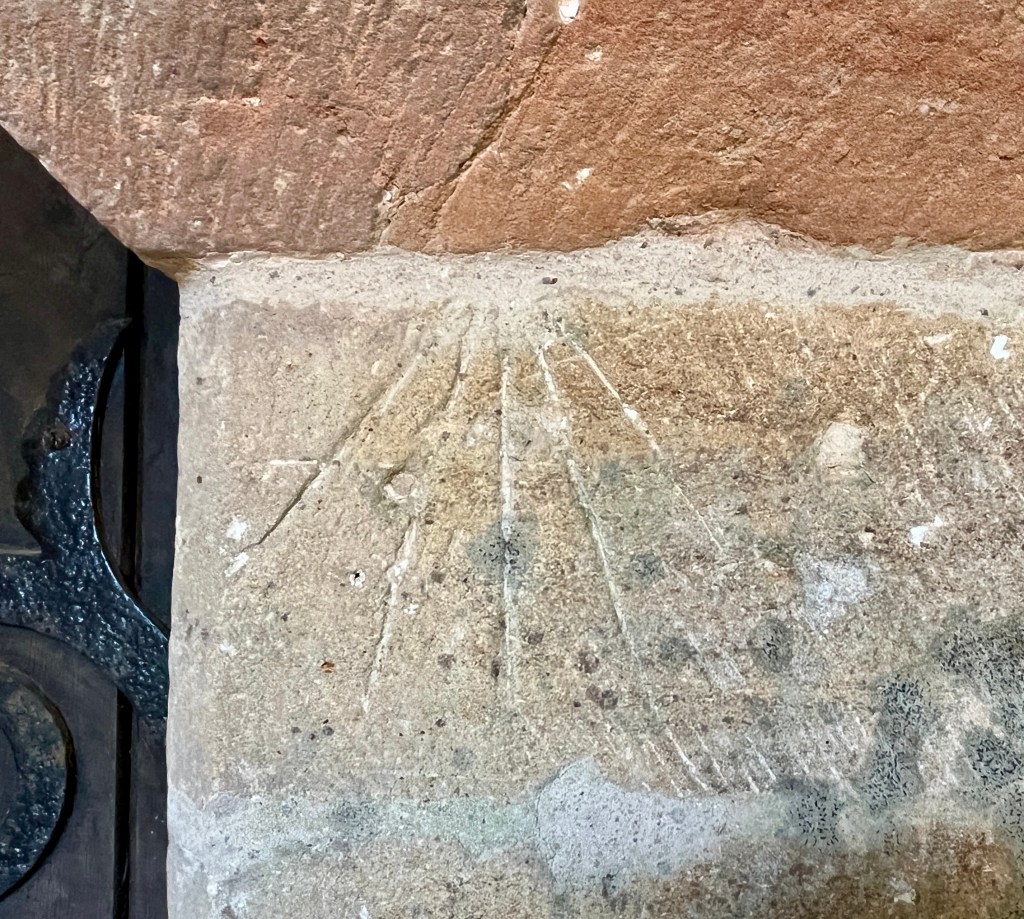
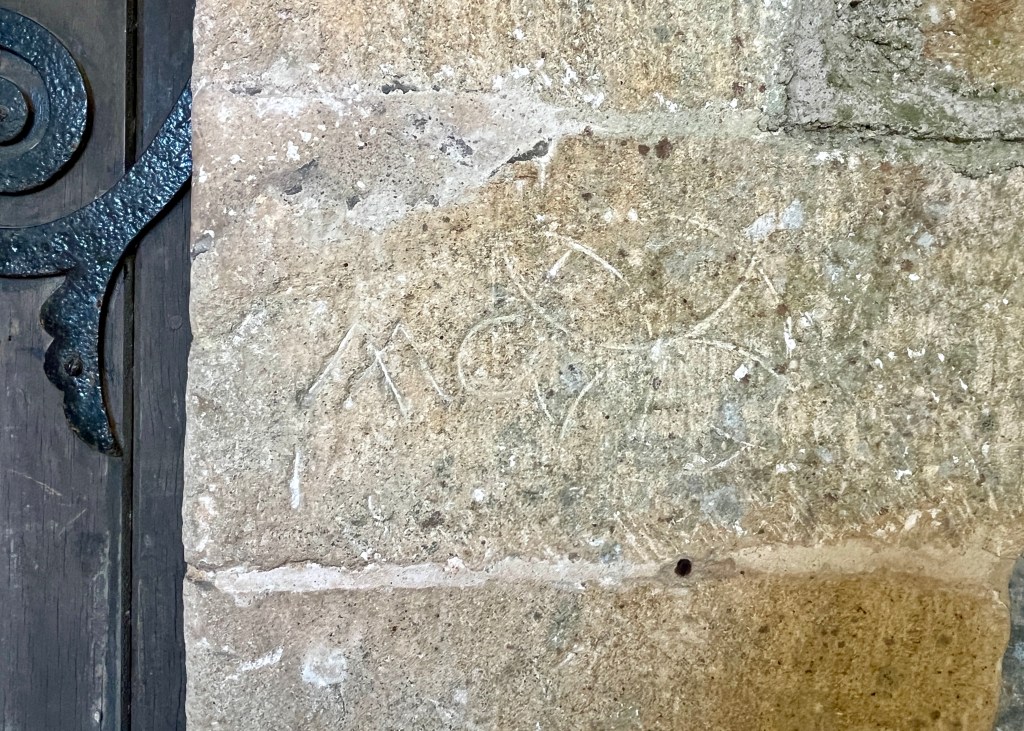
Stepping into the porch, Dial 2 is immediately visible. There are 5 radials descending from the mortar line. Pleasingly simple, and it is interesting to note that the photographs of this dial, almost a century apart, are much the same.
DOM ETHELBERT HORNE’S PHOTOS (April 17th 1914)
GRAFFITI
GSS Category: Scratch Dial; Mass Dial; Iron Gnomon; Church Graffiti
GRADE 1 ❖ Mainly C15, C16; C19 restoration. Plenty of interest for the visitor / church crawler, including C15 wagon roof; particularly well furnished interiorBLB; box pews; fine Jacobean woodwork. Peal of 6 bells (earliest 1613). Inc. by Simon Jenkins in ‘England’s Thousand Best Churches’, with photo. 51.1975 / -2.5873 / ST590444
DIAL
The existence of a scratch dial is debatable. The church was one of the earliest visited by DEH, on October 8th 1911. His record is one of the shortest of his entire project: On the buttress to the W of the priest’s door into the chancel is a stylehole at a height of 5′ 10″ from the ground. There are no remains of either a circle or lines, but from the soft nature of the stone they may have been weathered away.
Points in favour of dial status include its central position on the stone and the height. Against is the peculiarity of the hole itself; and the fact that the stone shows no sign of weathering, even 100+ years later,
GSS Category: Scratch Dial; Mass Dial; Doubtful Dail eg
GRADE II* ❖ Norman origins, C14 work, rebuilt C15, restored 1872. An attractive church both outside and in. Visited by DEH on 6 Oct 1911 on one of his early dial expeditions from Downside Abbey. Roughly halfway between Wells and Shepton Mallet. 51.199 / -2.6094 / ST575446
DIAL
DEH recorded a single dial on W corner of S aisle. He noted a 2.5 inch deep gnomon hole, and commented ‘…this dial is cut on soft red sandstone and has all 12 hour lines… many of them probably added to the original design’. More than 100 years later, only 9 are legible.
GSS Category: Scratch Dial; Mass Dial; Dial erosion
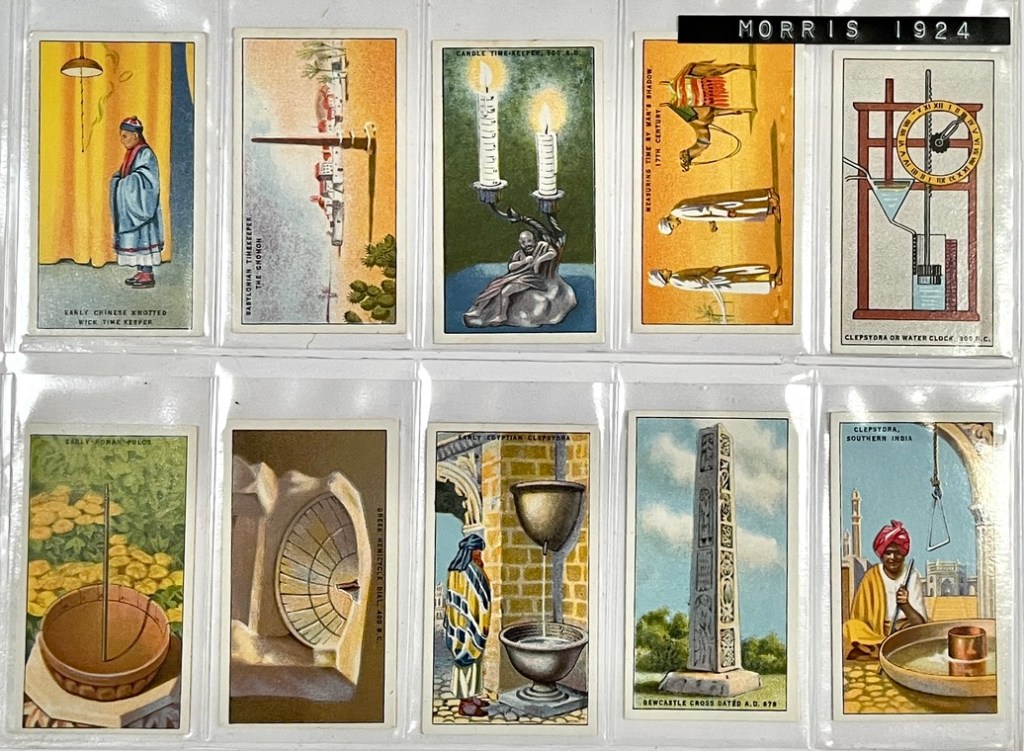
In the late C19, the first series of collectable themed cards were devised in America to encourage trade. The idea caught on, and these early examples of product placement gradually spread. Sportsmen (Cricketers), Nature, Actors, Military and Important People, were among the topics. By the turn of the century, British companies had taken up the challenge.
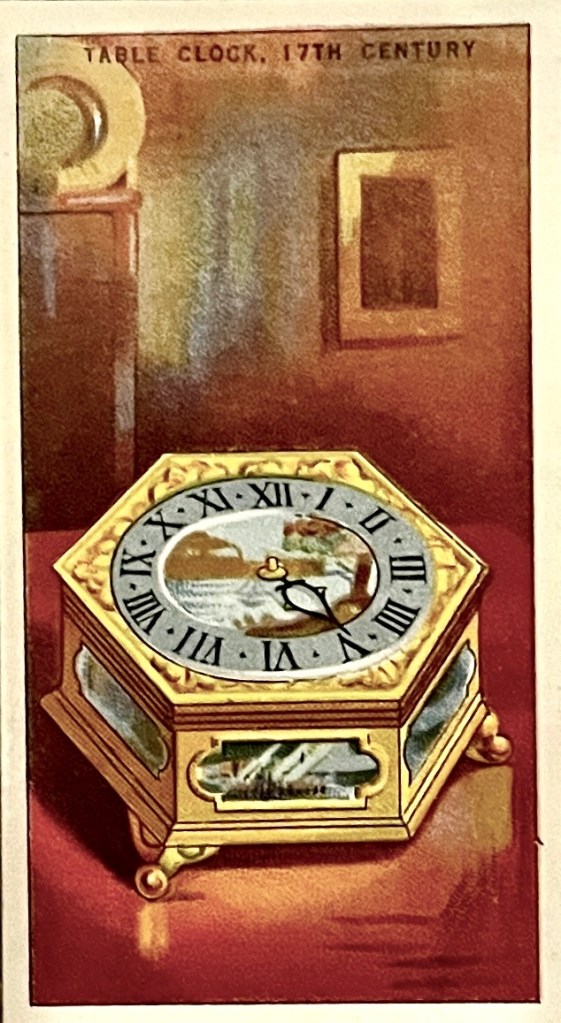
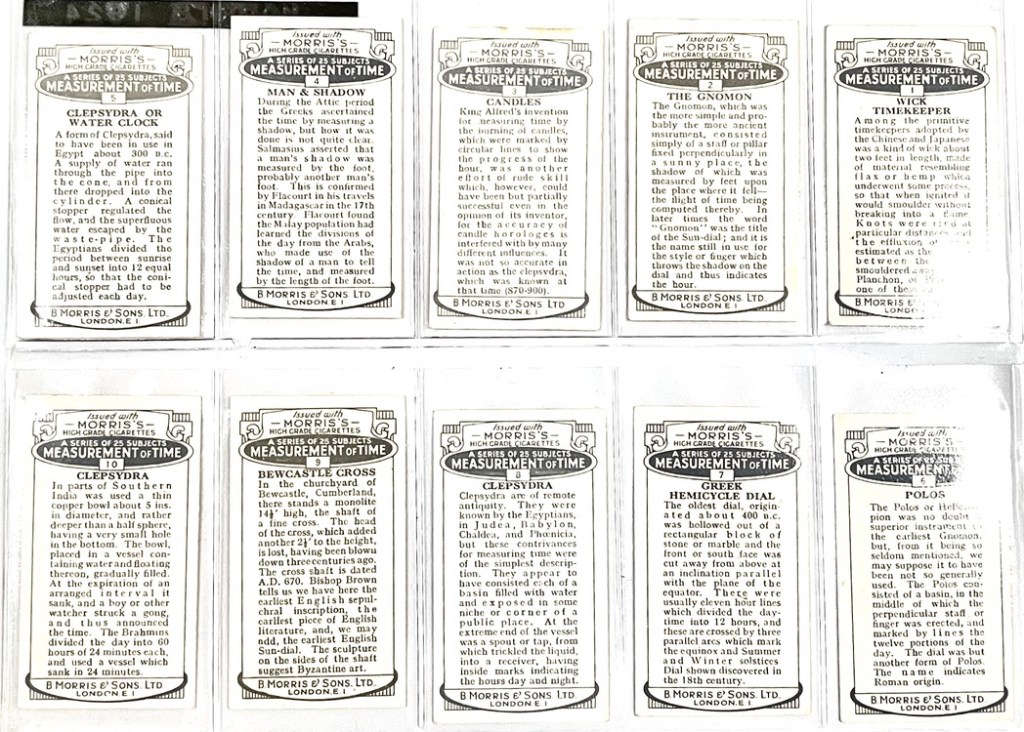
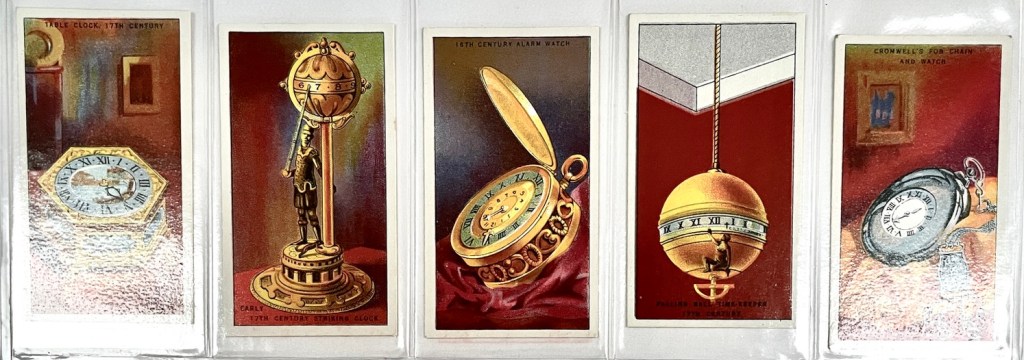
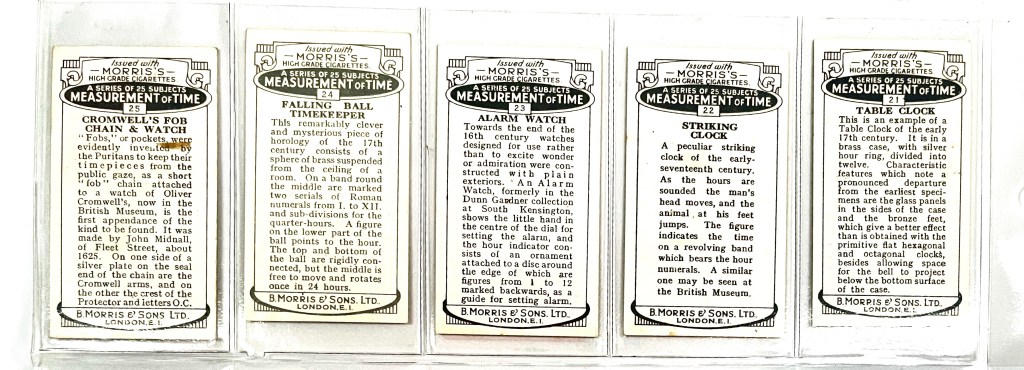
In 1924, Sundials became a novelty theme. The Phillip Morris Tobacco Company produced a set of 25 cards with the name Measurement of Time, the subject of this post. In the same year an astonishing set of 50 cards Ancient Sundials was produced by Fry’s (Chocolate) – see HERE. In 1928 a set of 25 cards Old Sundials by W.D. & H.O. Wills returned to the tobacco theme – see HERE
Besides covering a large number of dials from all parts of Britain, the obverse of the cards had a sundial-and-product motto or a pithy ditty. The collectors’ pages below show the front and the backs separately. Please note that you will have to read the text sides in reverse order to match the description to the correct dial.
Note: the 2 header images compensate for the 2 very poor photos (10, 11) that caught some glare.
NATIONAL PORTRAIT GALLERY: Explore the Cigarette Card Collection HERE
The British Sundial Society (BSS) has recently (2025) featured an excellent 5-page article by Martin Jenkins in the quarterly BSS Bulletin Vol. 37(iv) December 2025. It contains fascinating analyses of the dials including accuracy. A joy to read for any serious diallist!
GSS Category: Sundial cards; Sundial Art; Sundials in Commerce; Sundial picture sets; Composed mottos; Sundials in advertising.
GRADE II* ❖ C13 – C15; C19 restoration (some by T H Wyatt). Quite large, with nave, chancel, north and south porches, south vestry, west tower. Predominantly Perp. Busy history and plenty to look at, approval by PEV. 10m N of Castle Cary; 16m S of Shepton Mallet 51.124 / -2.4854 / ST661361
DIALS
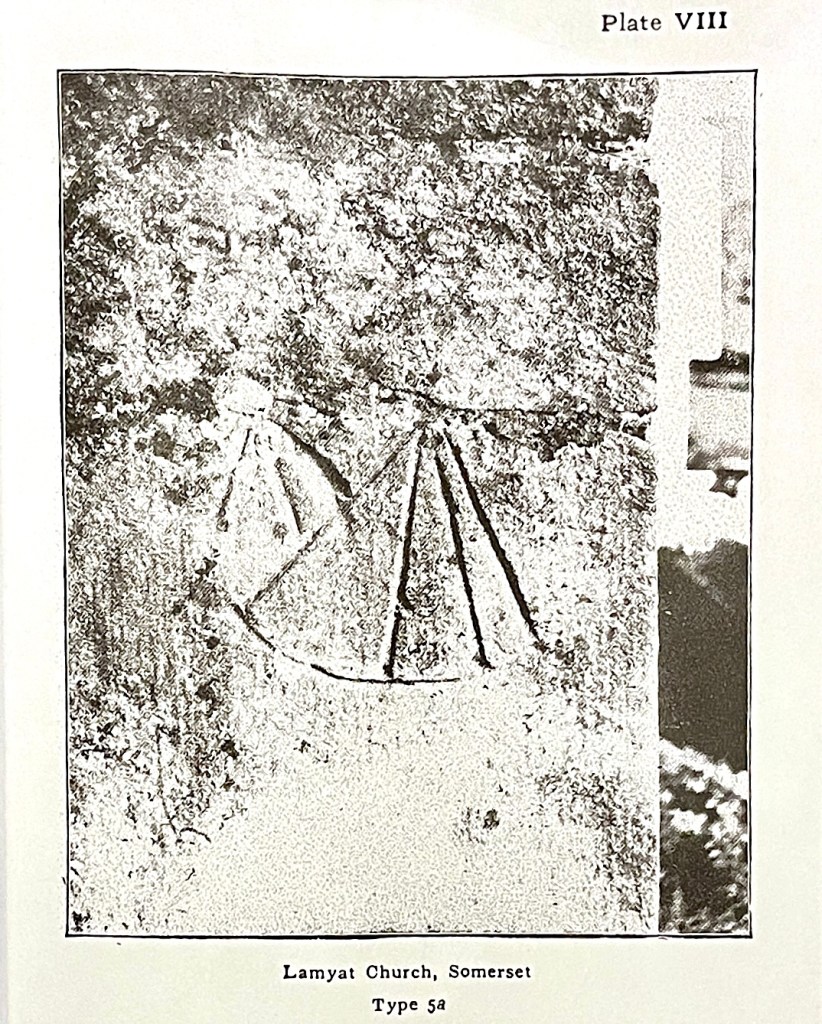
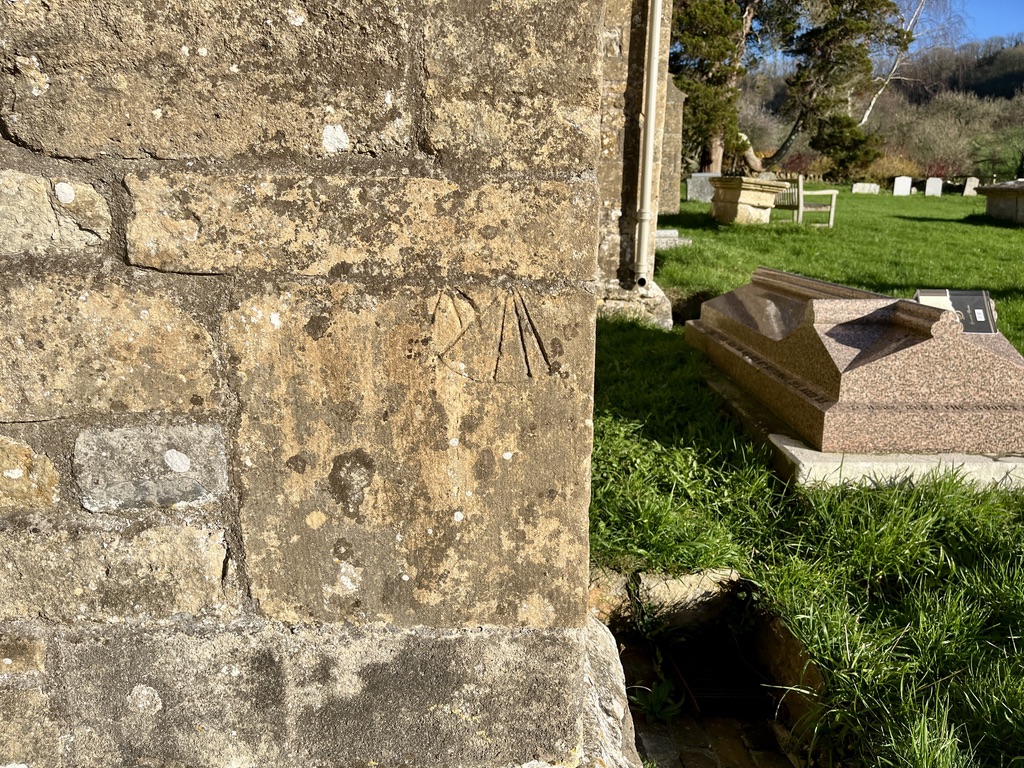
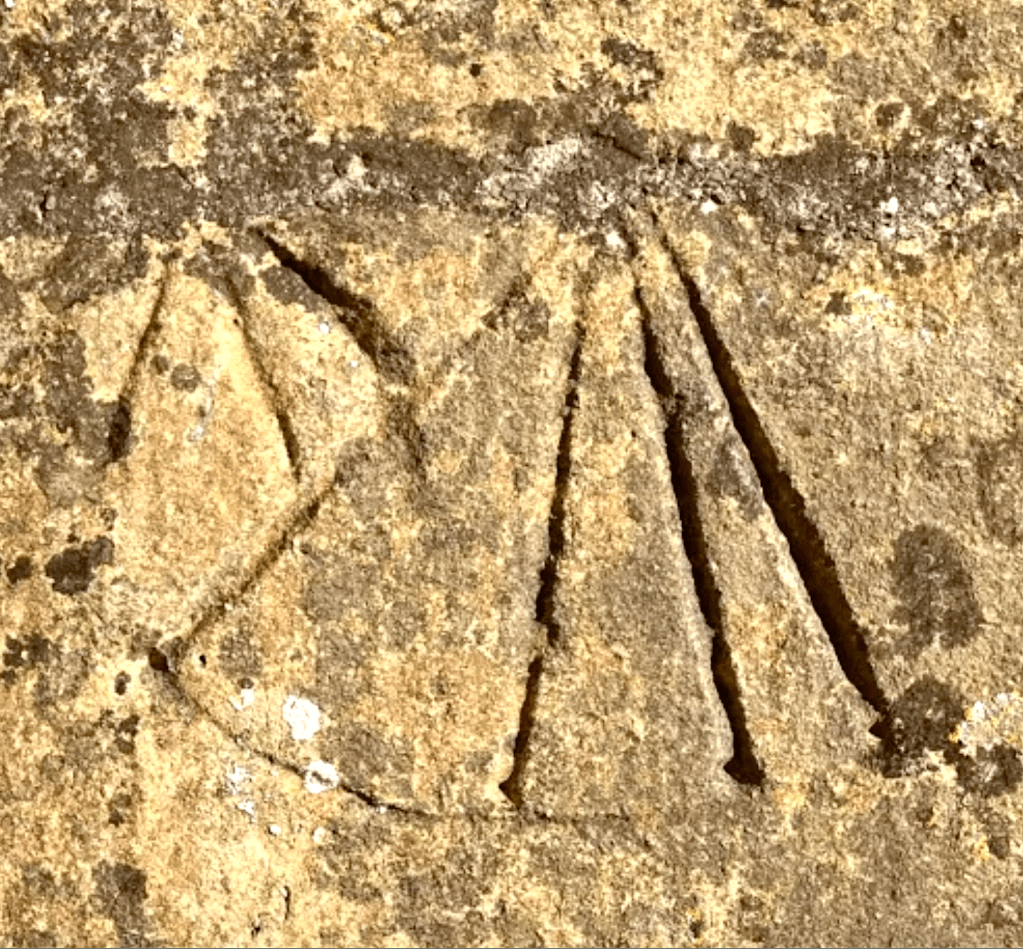
There are 3 dials (one unrecorded?). W of the porch, low down on a relocated quoin stone, there are 2 interesting near-overlapping dials cut on W face. This is a good example of ‘dials ancient and modern’: a small early dial – simple and rustic – superseded by a later dial cut with attention to detail. The 3rd dial is on the buttress E of the porch.
DEH visited the church on 16 October 1913 . By now he was using a camera to photograph selected dials, including Lamyatt. The quality of his images is surprisingly good. He also used a motorcycle to extend the scope of his researches from Downside Abbey. More about this extraordinary monk in due course.
Note: single ‘t’ Lamyatt; plugged gnomon hole, now invisible
DIALS 1 and 2
DEH visited the church on 16 October 1913 and recorded dials 1 & 2.
DIAL 1. This small dial has 3 radials emerging from a now undetectable gnomon hole in the corner of the mortar line ULQ. The deeper cut and crudely bent line RHS suggests that the main canonical hour for observance was Nones. In due course a replacement dial was called for.
DIAL 2
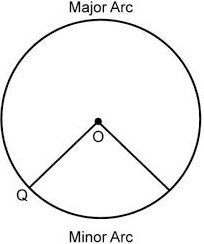
DIAL 2. On the same quoin stone, also W-facing, a later and far more practical dial was cut. 4 radials the same length fan out from a gnomon hole in the mortar line (the original plug?). These are arranged within a minor arc, and scale up both in width and depth LHS to RHS. The overall effect indicates competence and care by the maker.
The radials each end in a dot (one is barely detectable). The line spacing of the dial in its original position arrangement is a puzzle. In a literal way, noon would be exactly between lines 2 and 3, as sometimes found on other churches.
DIAL 3
On the buttress E of porch, at head height, a dial with 2 long lines descending from a mortar line that has a hint of a gnomon hole. It seems to be in its original position. Presumably the vertical mortar line – now a crack – acted as the noon line dividing the 2 radials from the smaller quoin stone.
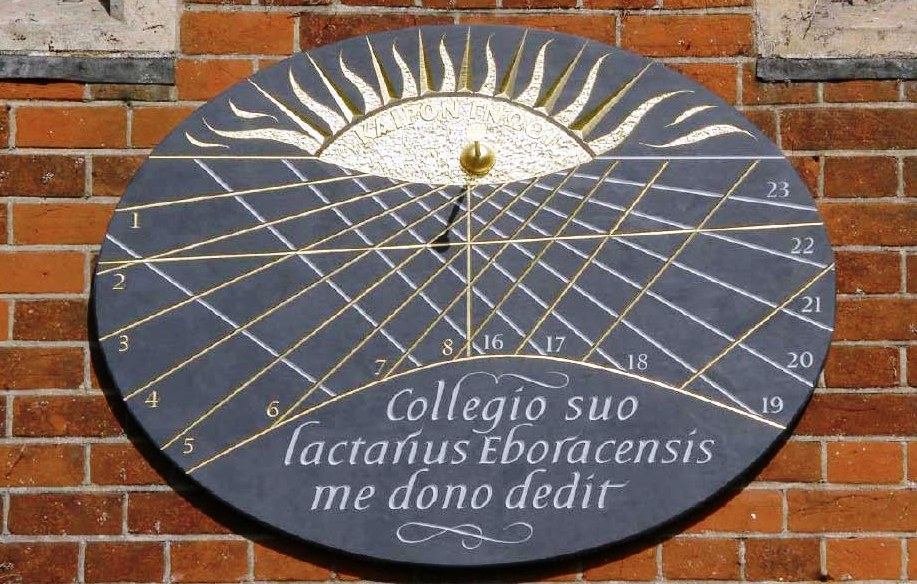
The dial is mounted on the north range of Old Court just above ground floor window level, to the right of staircase D, and declines about 4° west of south. It was designed by Frank King and made by the Cardozo Kindersley workshops in Cambridge. It has Babylonian and Italian hour-lines (showing hours since sunrise and since the previous sunset). The hours are read from the shadow of the brass nodus ball (this type of dial does not require a polar-directed gnomon). Across the top section of the dial, above the winter solstice curve, is a rising sun with the inscription ’ΚΑΙΡΟΝ ΓΝΩΘΙ’ (Know the time). Across the lower part, below the summer solstice, is inscribed ’Collegio suo / lactarius Eboracensis / me dono dedit’ (To his college the Yorkshire dairyman gave me as a gift). Around the rim of the dial are inscribed ’Babylonian hours since sunrise’ and ’Italian hours since sunset’. Ref: BSS Bulletin 22(iii), Sept 2010, pp 2-8, and 22(iv), Dec 2010, pp 9-11.
The use of the Greek motto reflects strong historical links between the College and Ely Cathedral, where the motto is also used. My recent piece on the Cathedral can be seen HERE.
For further details about the Selwyn Dial, see THE SELWYN DIAL – article by the maker Frank King BSS (7pp, detailed analysis) 2010, rich with knowledge.
GSS Category: Scratch Dial; Mass Dial; Re-sited Dial; Dial facing W
The Cathedral Church of the Holy and Undivided Trinity of Ely
❖
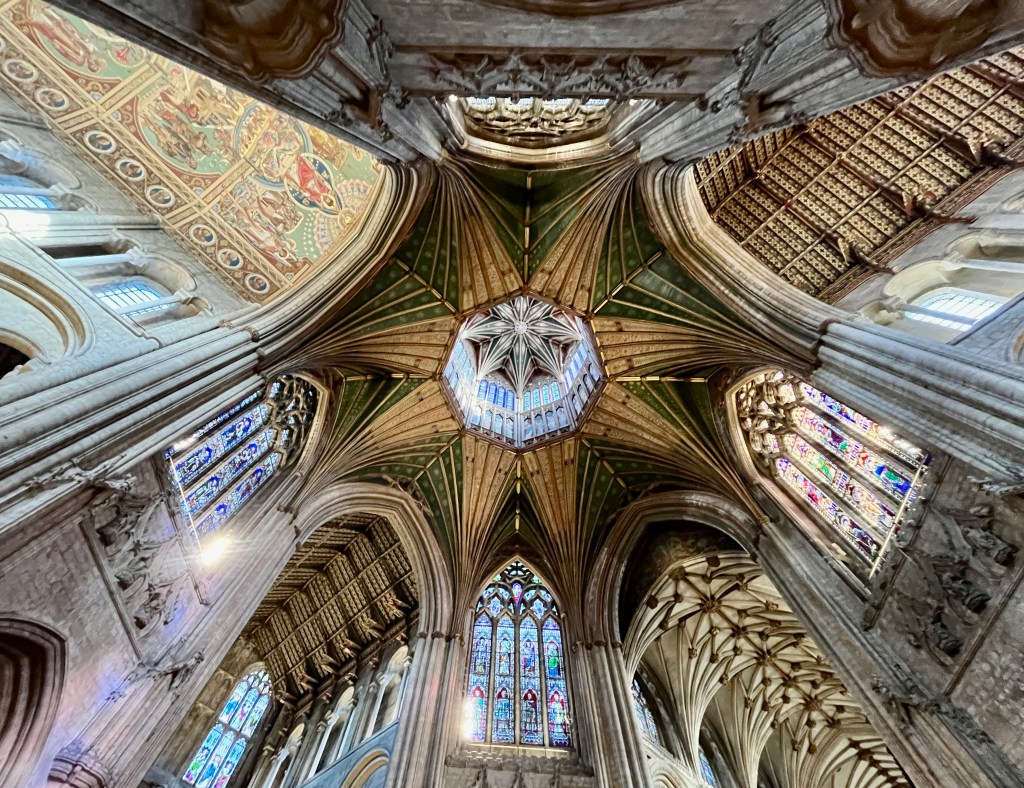
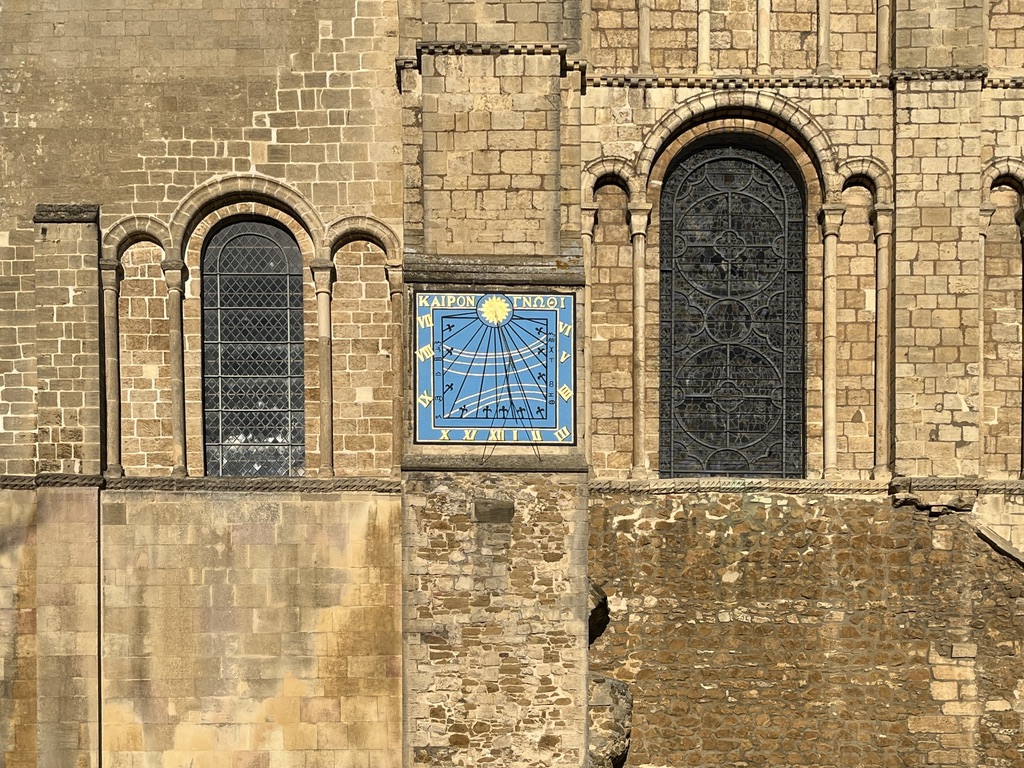
This project does not generally cover in detail the actual buildings on or near which dials are to be found. My header photo of the ethereal Octagon of the Cathedral will have to stand for the wonder of it all. The focus here is on the excellent vertical dial, high up and very legible, on the south-facing wall of the South Transept.
The earliest reference suggests that the original dial dates from 1690 when a Mr Rider was paid £10 for making it. The fine dial we see today was installed in 1963, replacing an old dial (not necessarily the original).
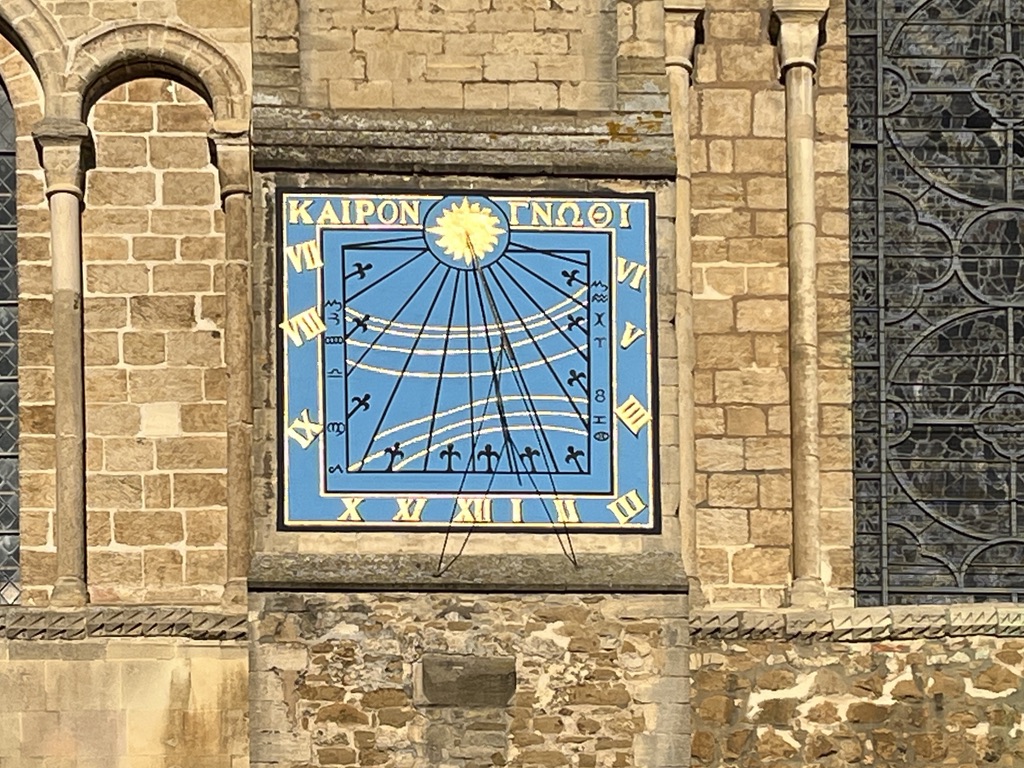
The new dial is worthy of the magnificent cathedral that it adorns. The radials are interspersed with half-hour marker crosses (possibly fleurs de lys). The roman numerals are arranged from 7 to 9 LHS; 10 to 2 along the base; 3 angled at the corner RHQ; and 4 (IIII) to 6 RHS. The signs of the Zodiac are painted on both sides of the dial, in a configuration that I don’t quite understand. The gnomon is a long slim metal rod emerging from a sun-blaze of 16 flames, supported by 2 similar rods.
MOTTO
ΚΑΙΡΟΝ ΓΝΩΘΙ
The meaning is variously given as Know the Season; Know the Time; Choose a Timely Moment; or a similar exhortation. The motto seems to be rare: found on a dial at Selwyn College Cambridge and at a University Library in Pennsylvania but I can’t find other locations.
Keith Salvesen / RH
Cultivate truth, good faith, experience, cleverness, sociability, and industry
The rather imprecise motto meanings can be traced to the era of Delphic aphorisms c500 BC. Some adorned Temples, and familiar to us are Know thyself, Nothing in excess and Give a pledge and trouble is at hand. My favourite (which I already observe) is Whatever you rebuke your neighbour for, do not do it yourself.
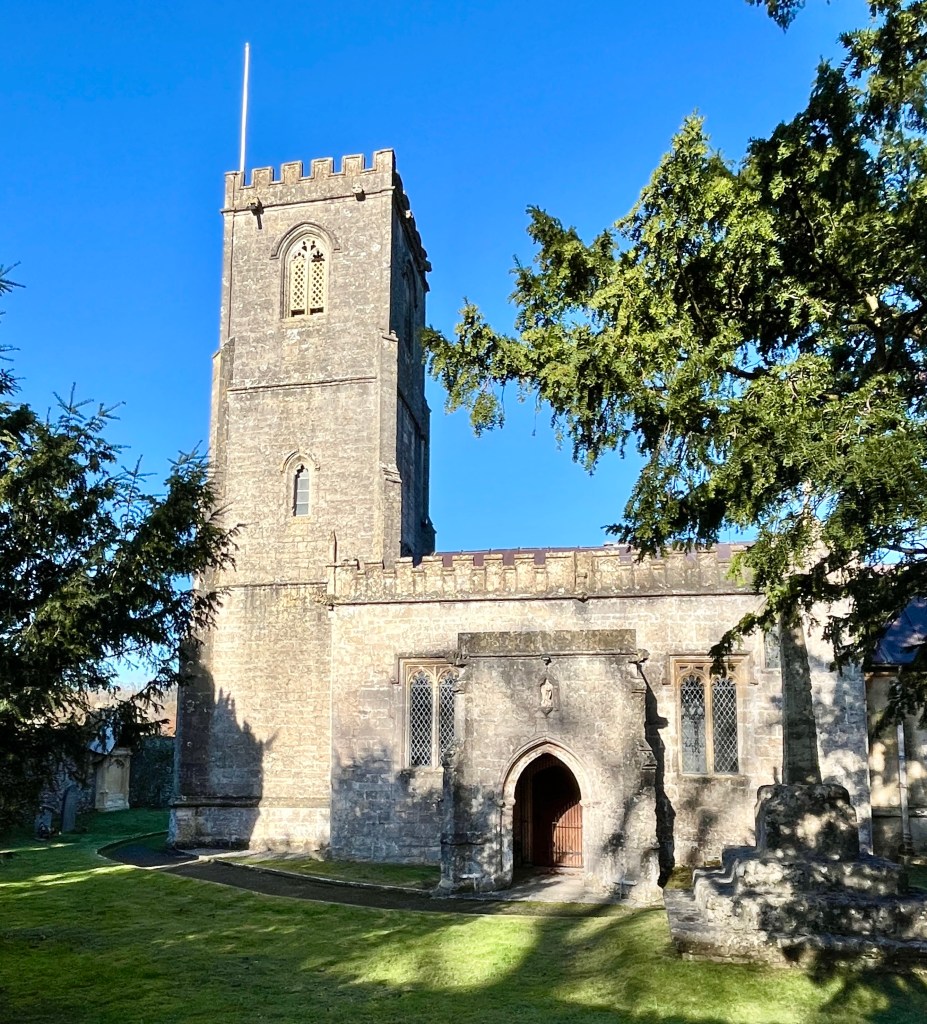
GRADE II* ❖ Original church built C12; rebuilt 1790; restorations 1860s. 5 bells, of which one cast in Bristol c1380 (PEV). Delightfully situated beyond a large farmyard (in adverse weather a visitor might wish they had brought wellies). 6m SE of Shepton Mallet. 51.1383 / -2.4807 / ST664377
DIAL
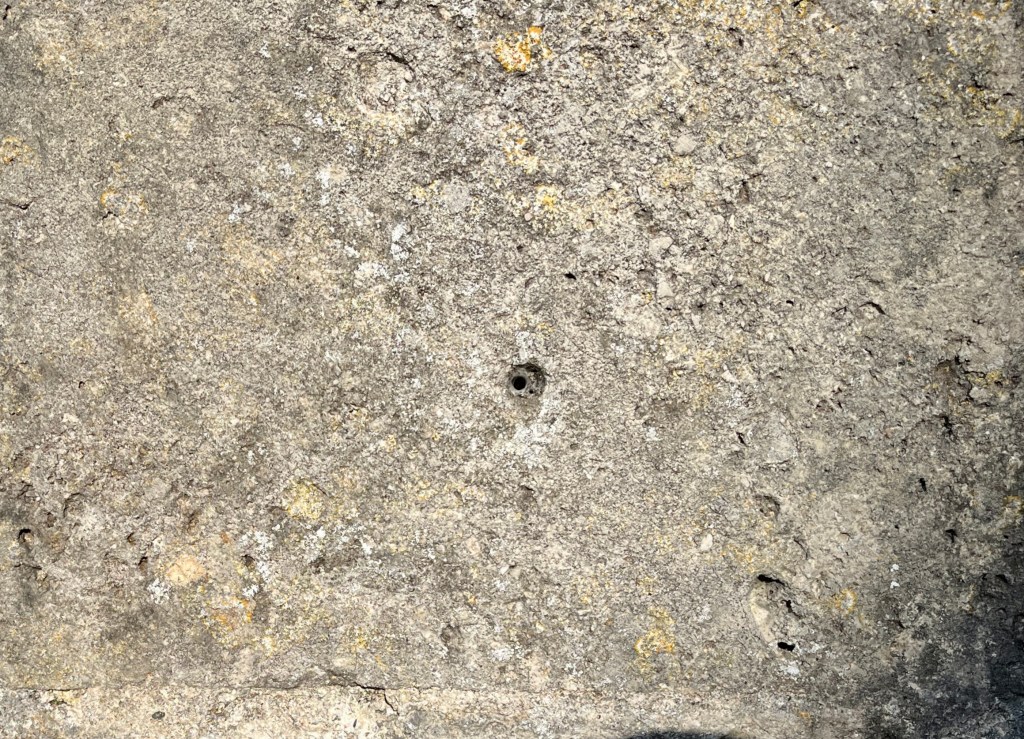
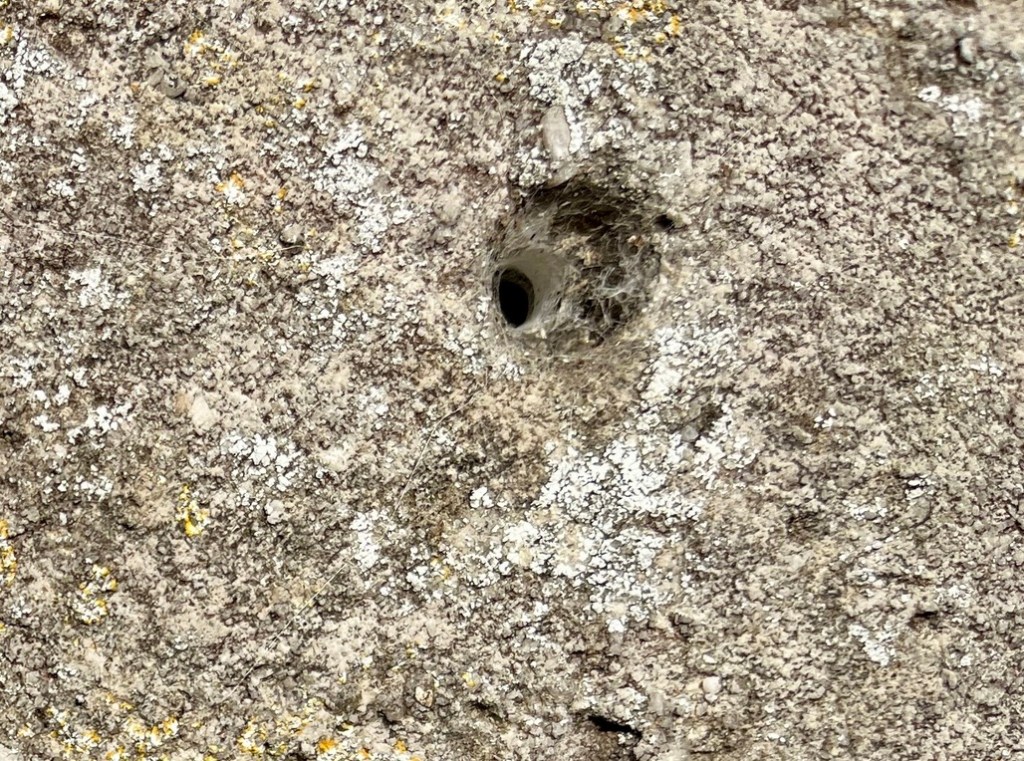
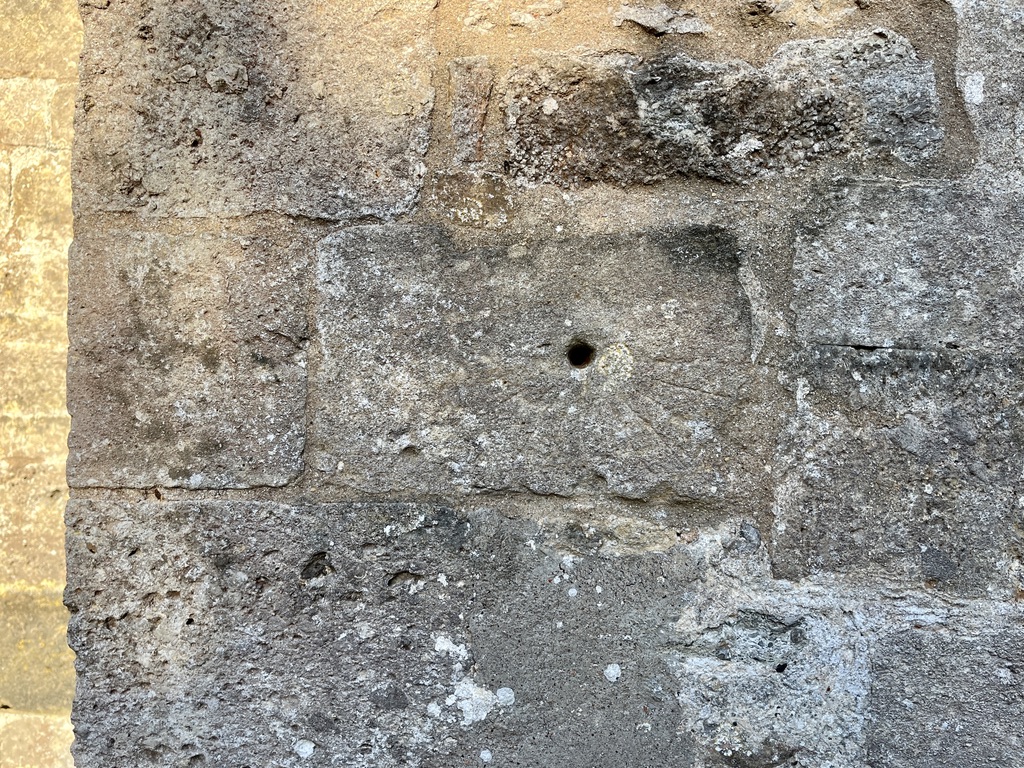
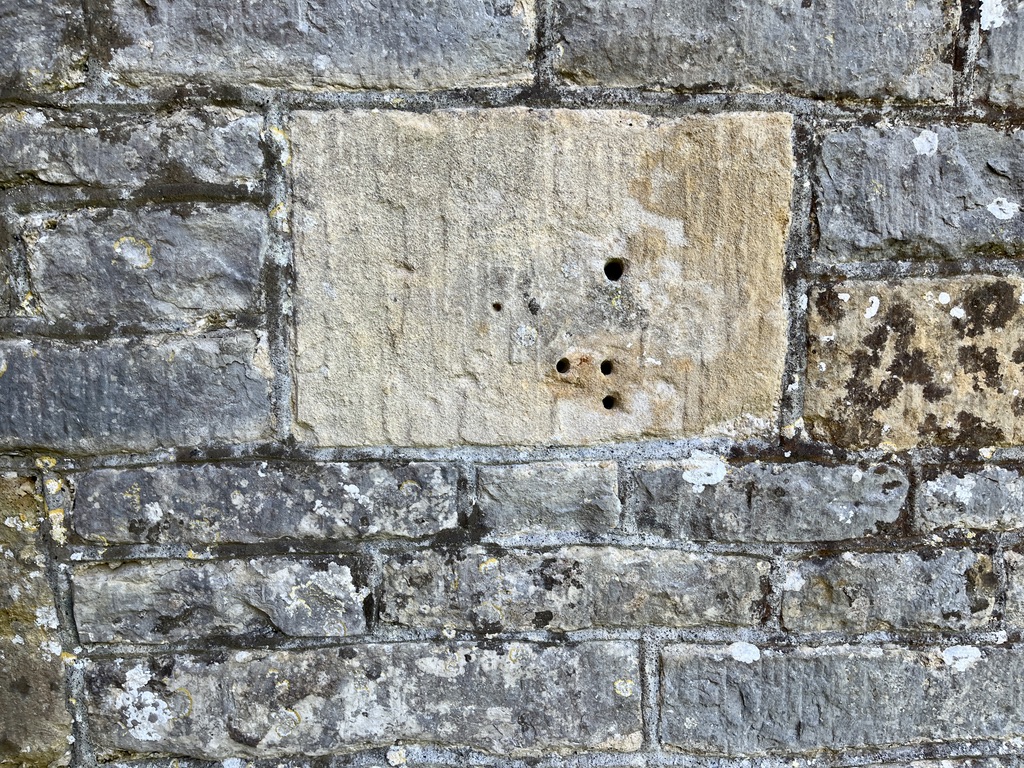
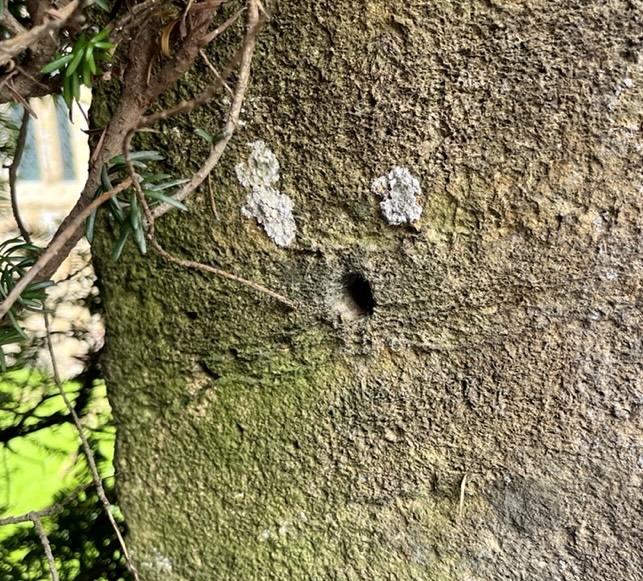
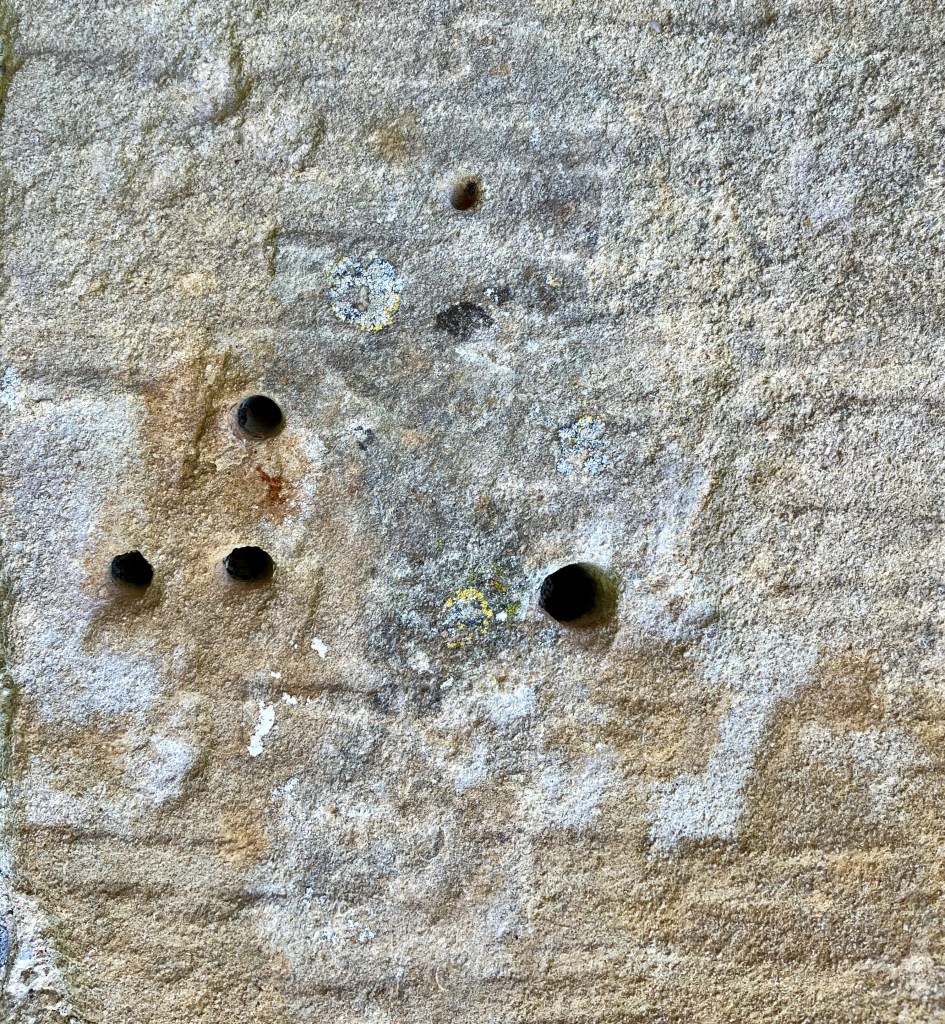
One of DEH’s early finds, in June 1912, as his researches spread out from Downside Abbey. He describes the dial as easily found, and ‘curious’. And so it is. I’d welcome any wise views on this unusual configuration.
‘There appears to be little doubt but that this arrangement of five holes is really a dial. While no other has been found exactly like it, it shows a family likeness to those on the churches of Seavington St Mary and Whitelackington’.
But each of these just has a single large style-hole, as opposed to the array at Milton.
Seavington St MaryWhitelackington
ROTATION
Occasionally it helps to rotate a dial image to check correct orientation. Not here though.
GSS Category: Scratch dial; Mass Dial; Repositioned dial; Dial interpretation; DEH – early research






















 GAUDIUM SUB SOLE . SUNDIALS . MEDIEVAL TO MODERN