LES CADRANS SOLAIRES: THE CERAMIC TILE SUNDIALS OF COARAZE, PROVENCE
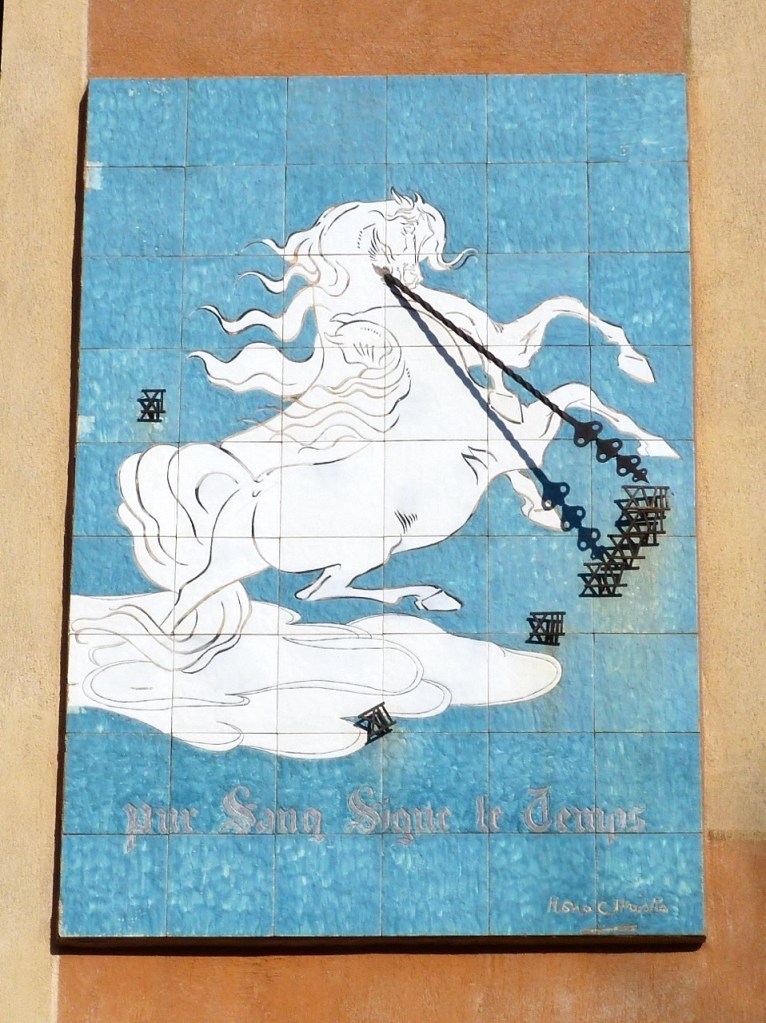
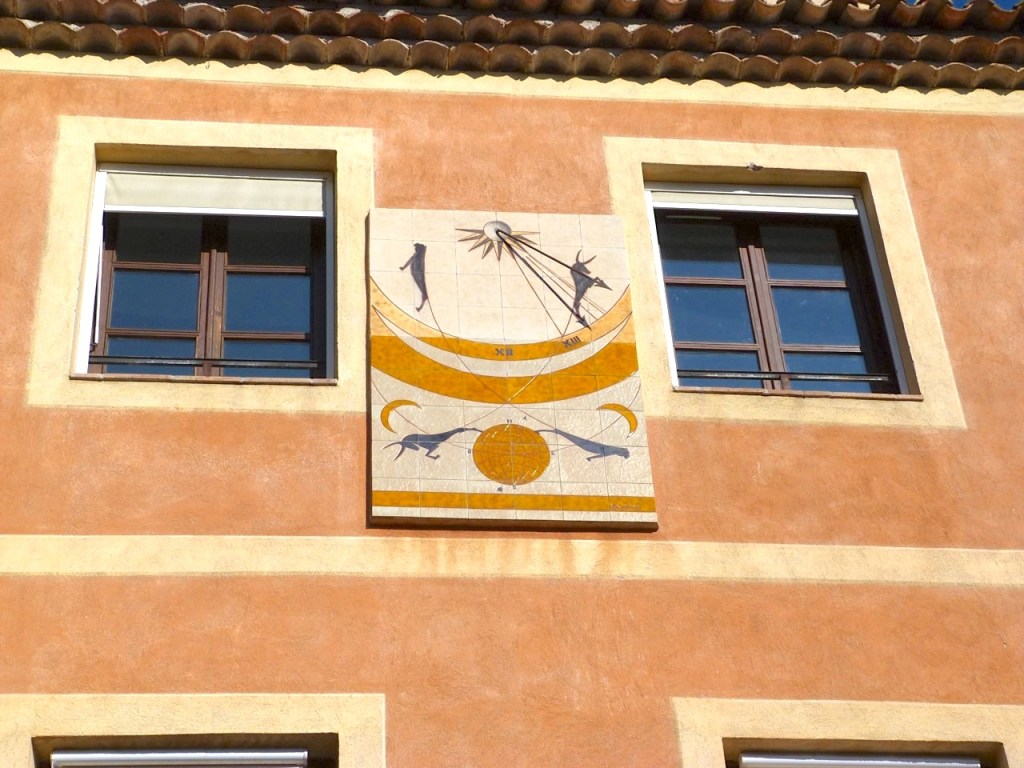
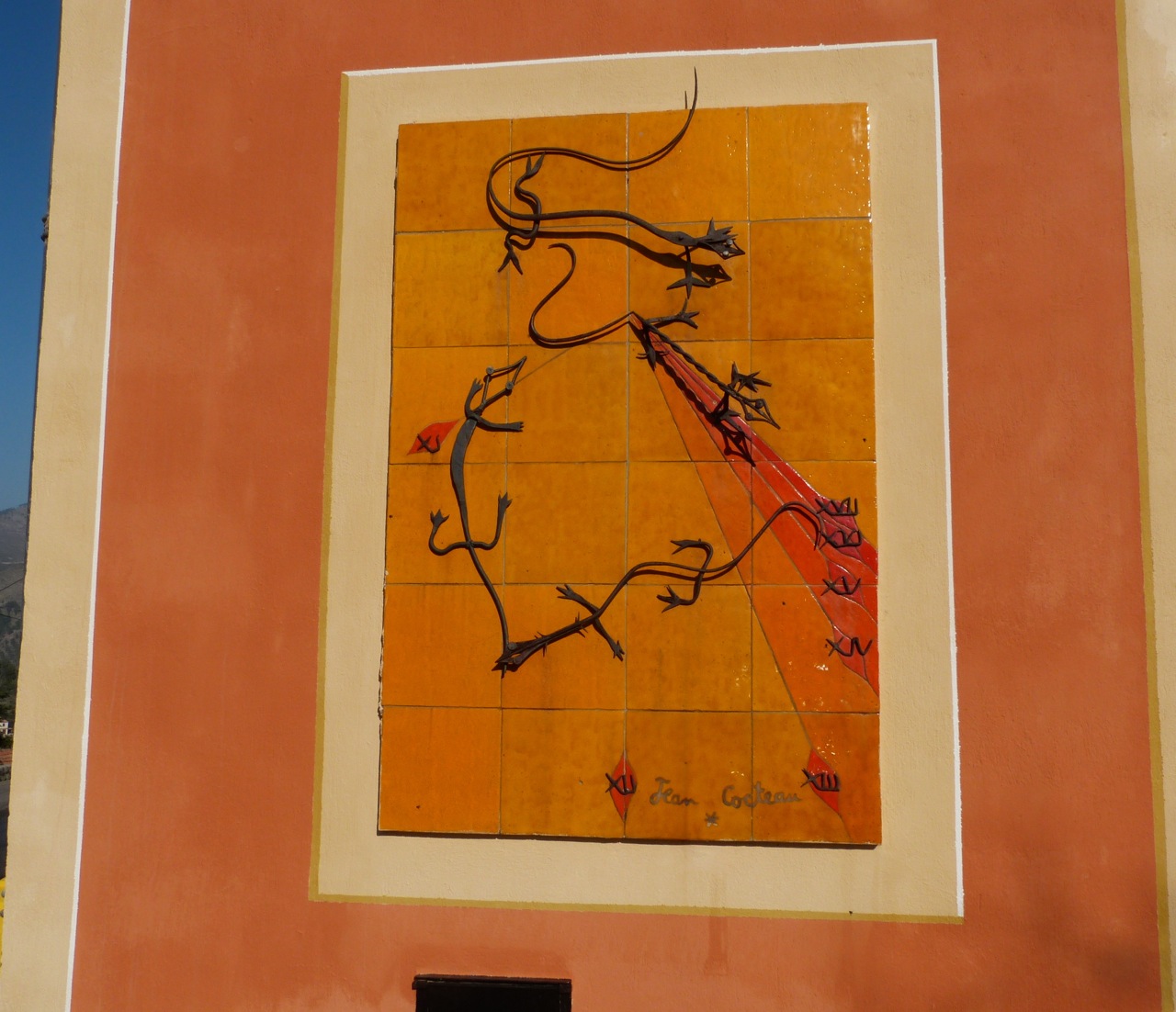
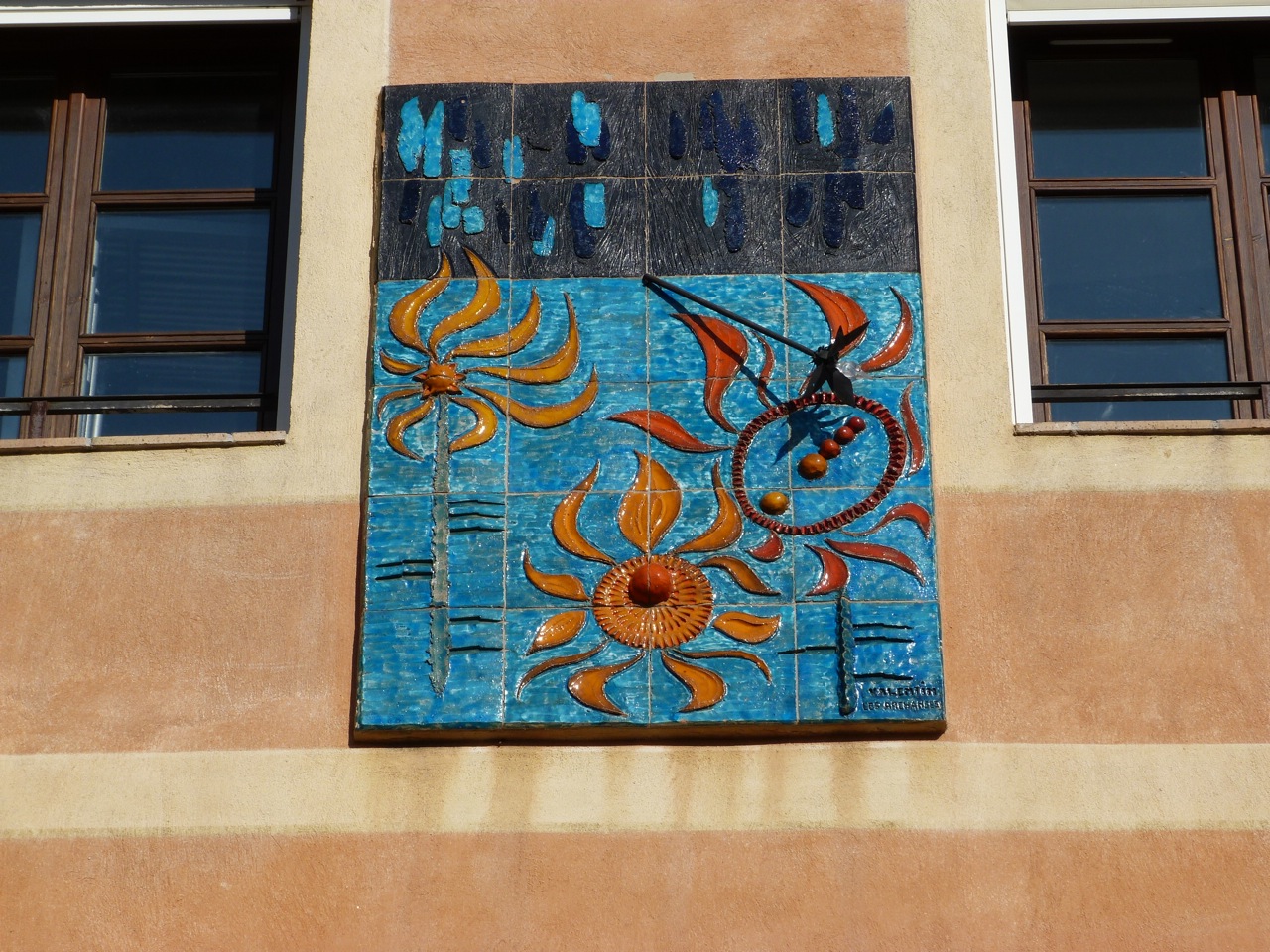
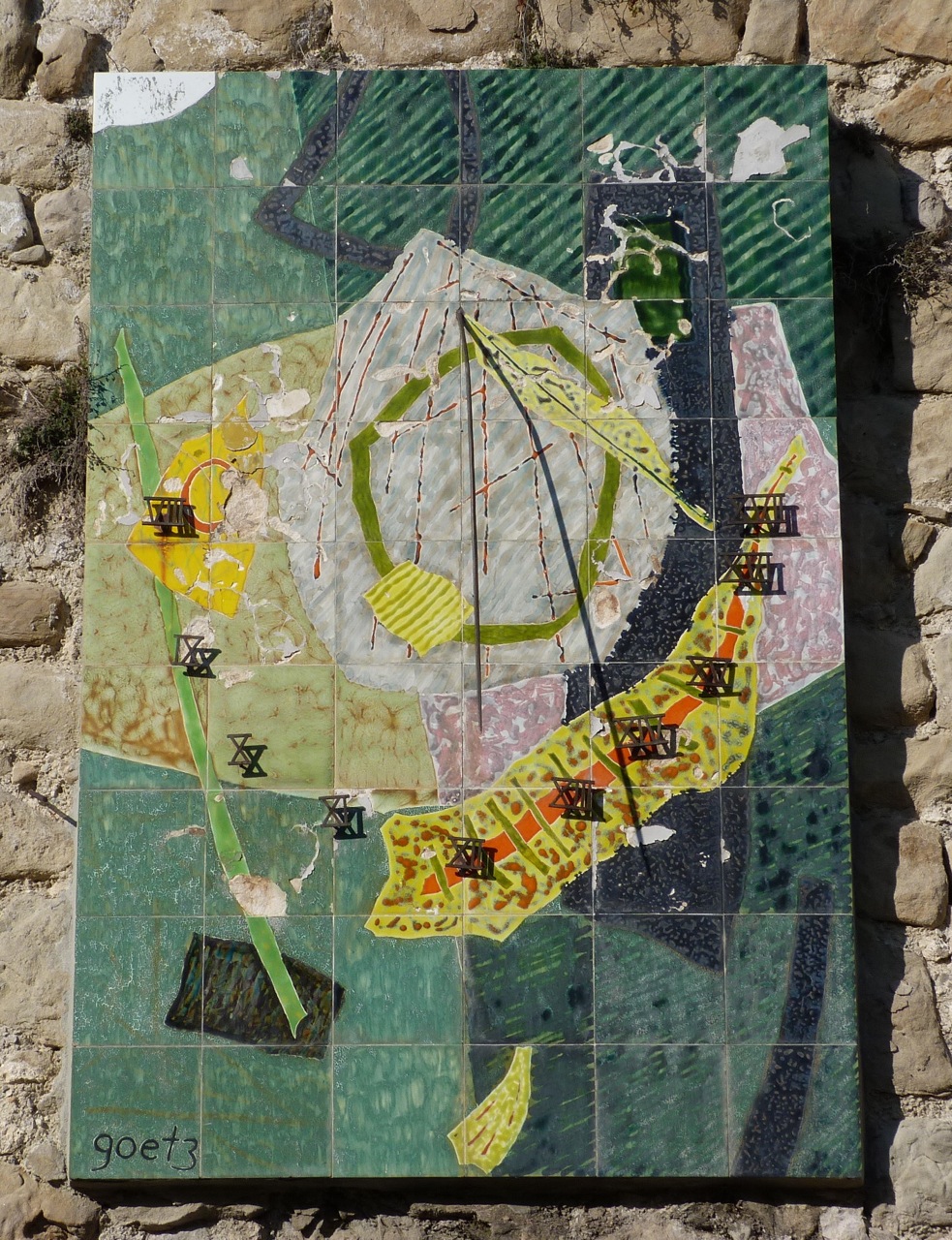
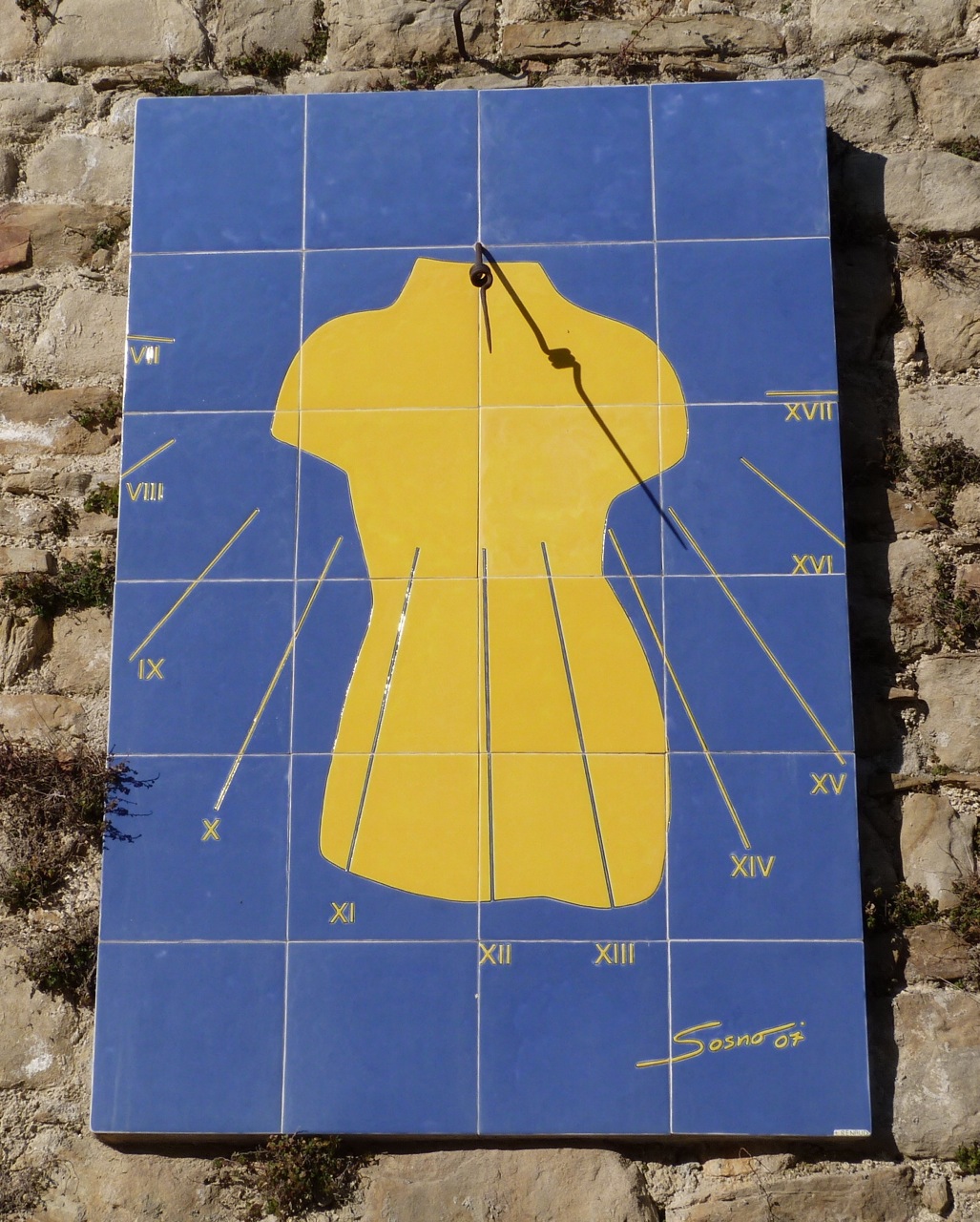
The nine sundials shown below are in Coaraze, a small medieval ‘village perché’ (650m) in the Alpes-Maritimes, Provence, north of Nice. They include sundials by artistic polymath Jean Cocteau (poet, novelist, dramatist, designer, artist and filmmaker); Ponce de Leon; and Henri Goetz, among others. They are located in two places in the village (1) on the front and side walls of the Marie (2) at the top of the village on a south-facing walls in the square in front of the church. They need no interpretation by me: everyone who views these wonderful sundials will experience their own personal response to each one.
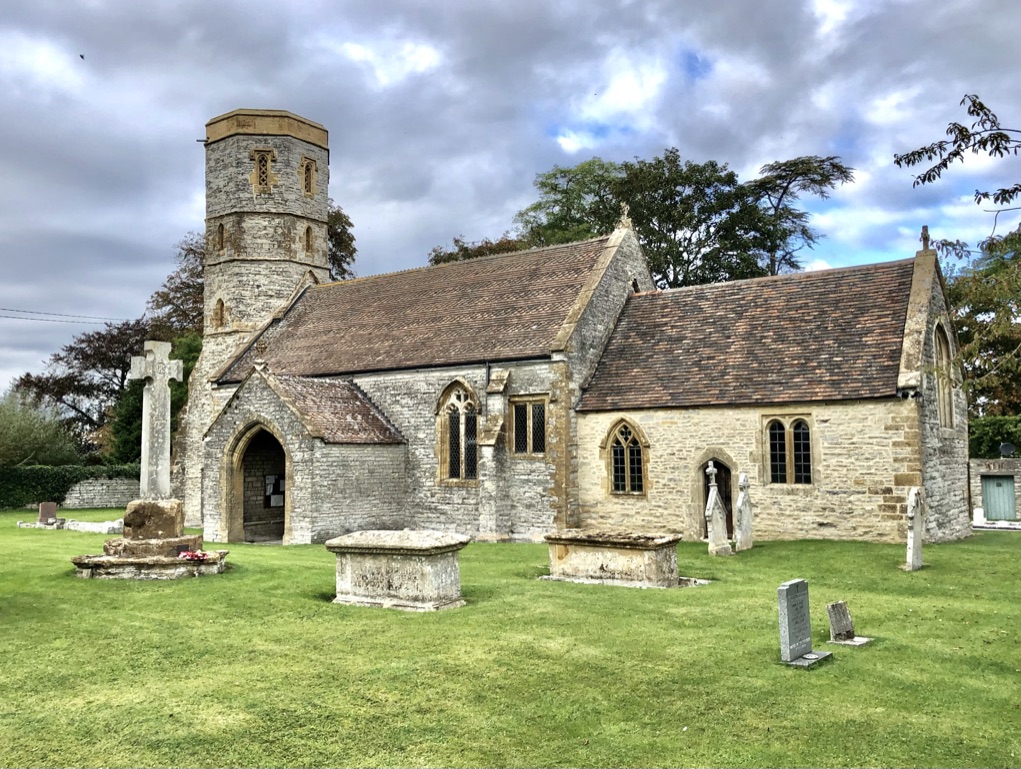
GRADE I. Early C14 on the site of an earlier ?C12 church. Unusual three octagonal stages on the square base of the tower. Porch of significance, with dial by inner door. Church situated close to the N. perimeter of RNAS Yeovilton. Historically spelled Podymore, sometimes adding Milton. 51.0219 / -2.6492 / ST545249
DIALS
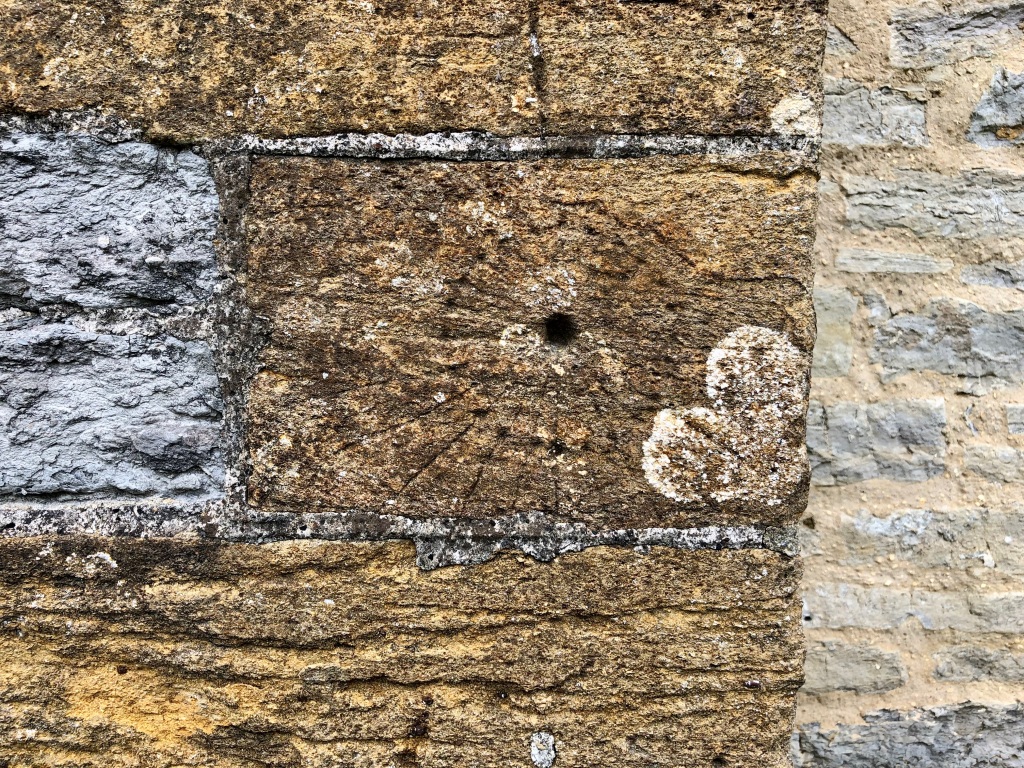
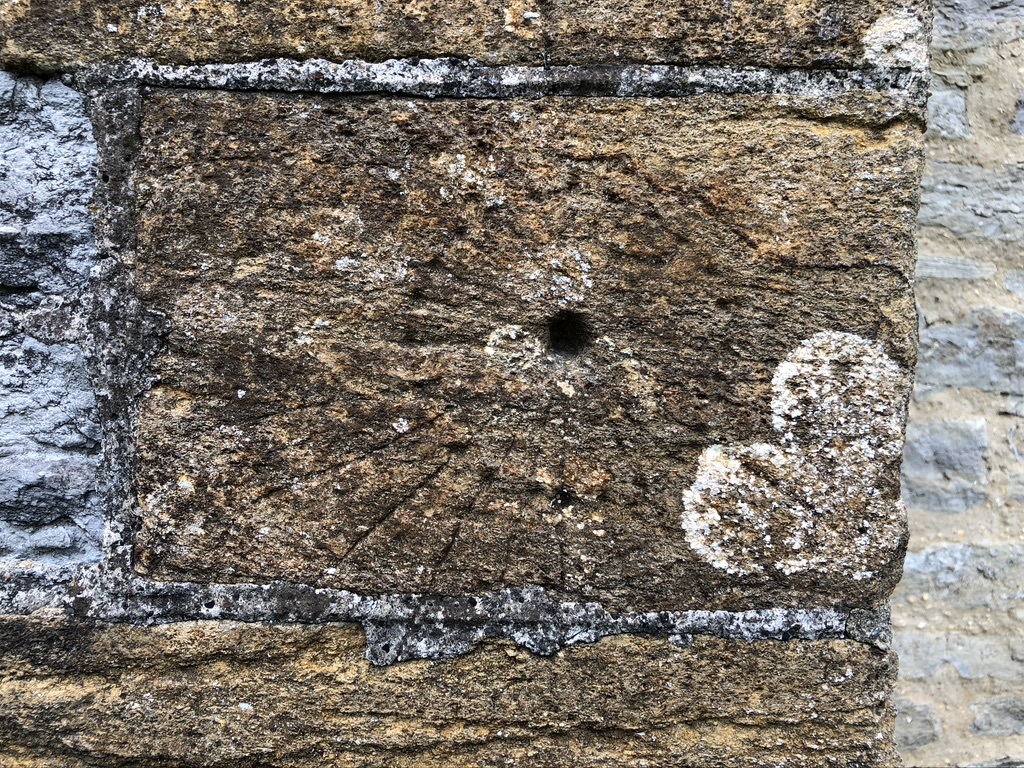
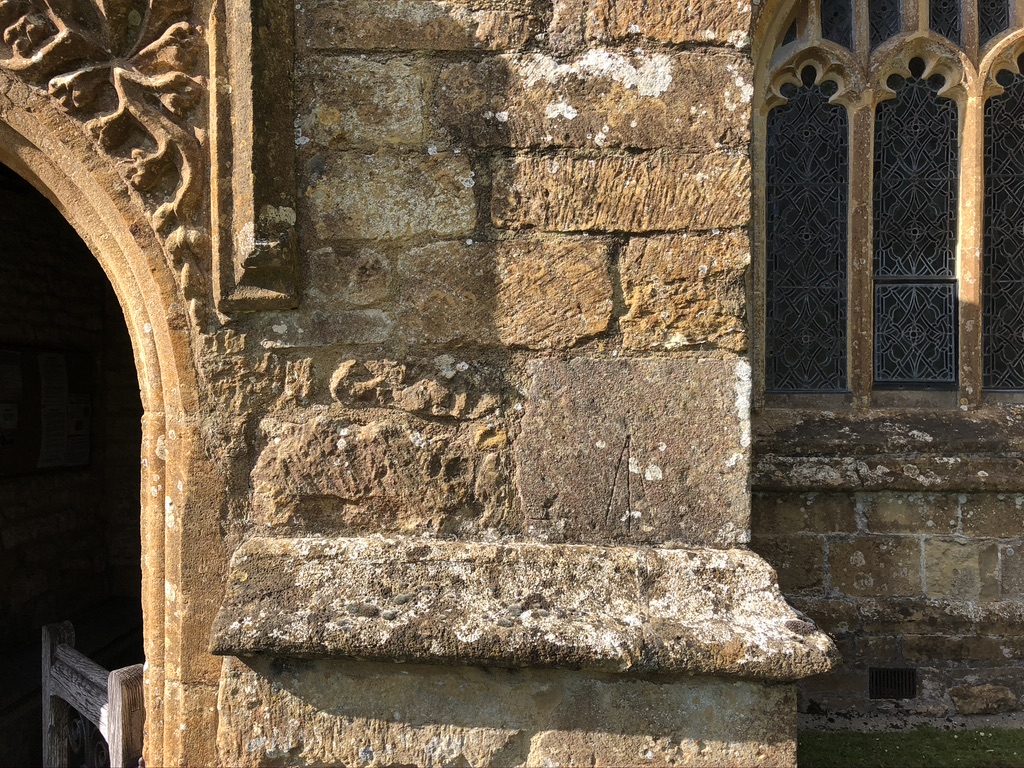
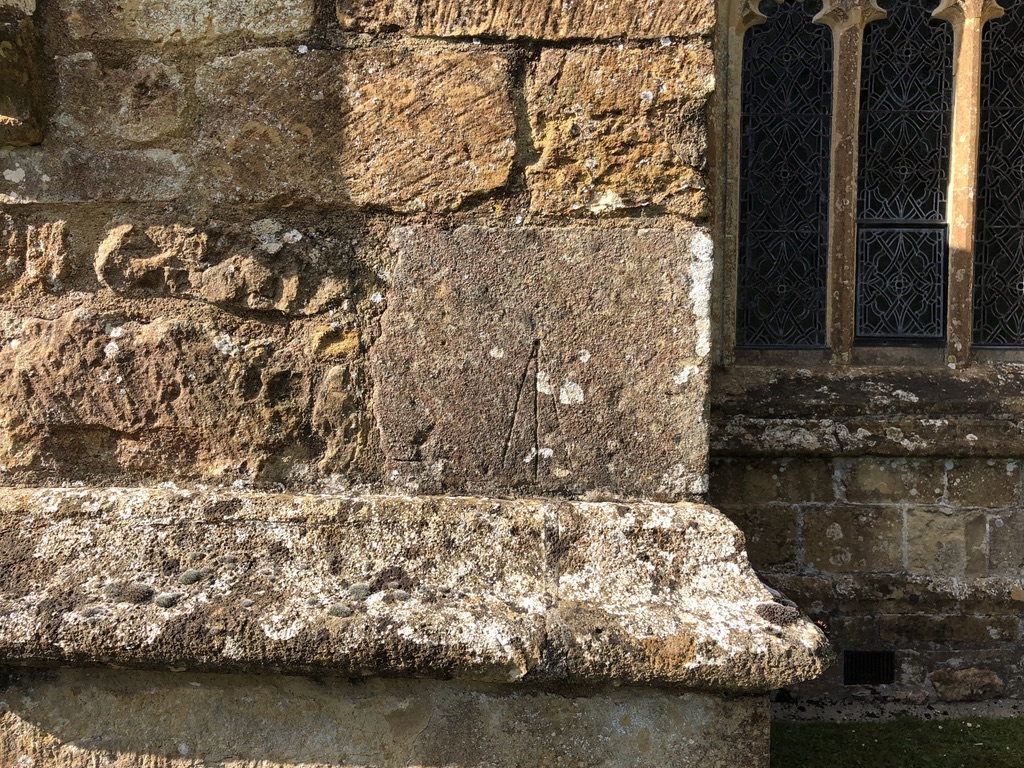
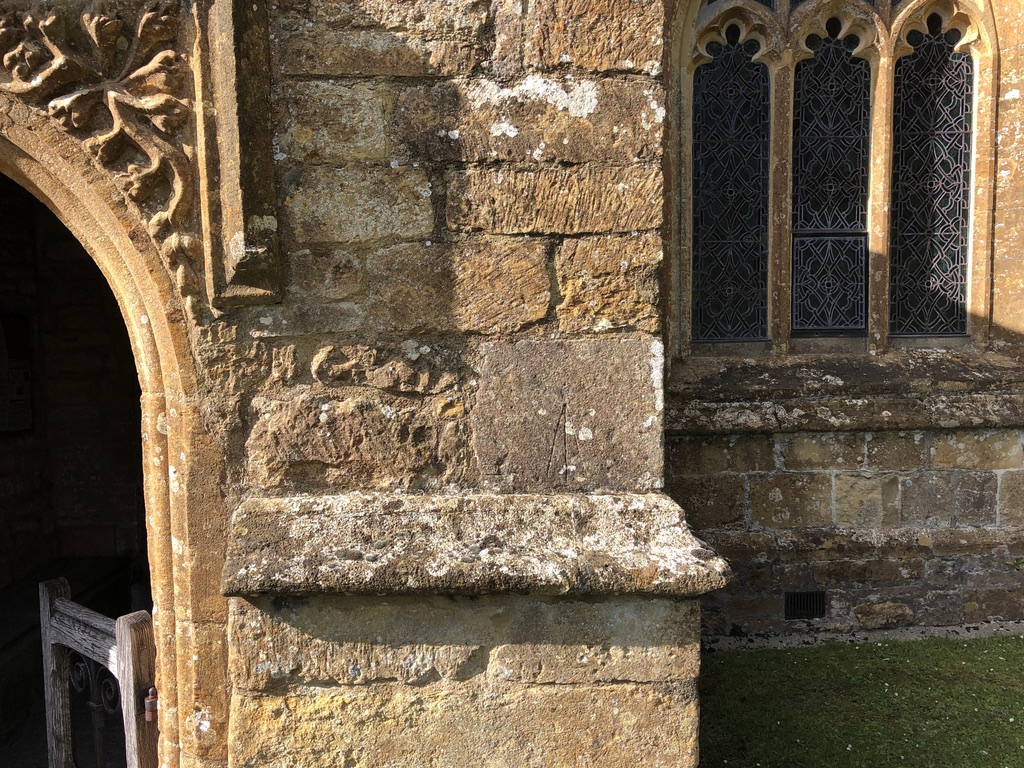
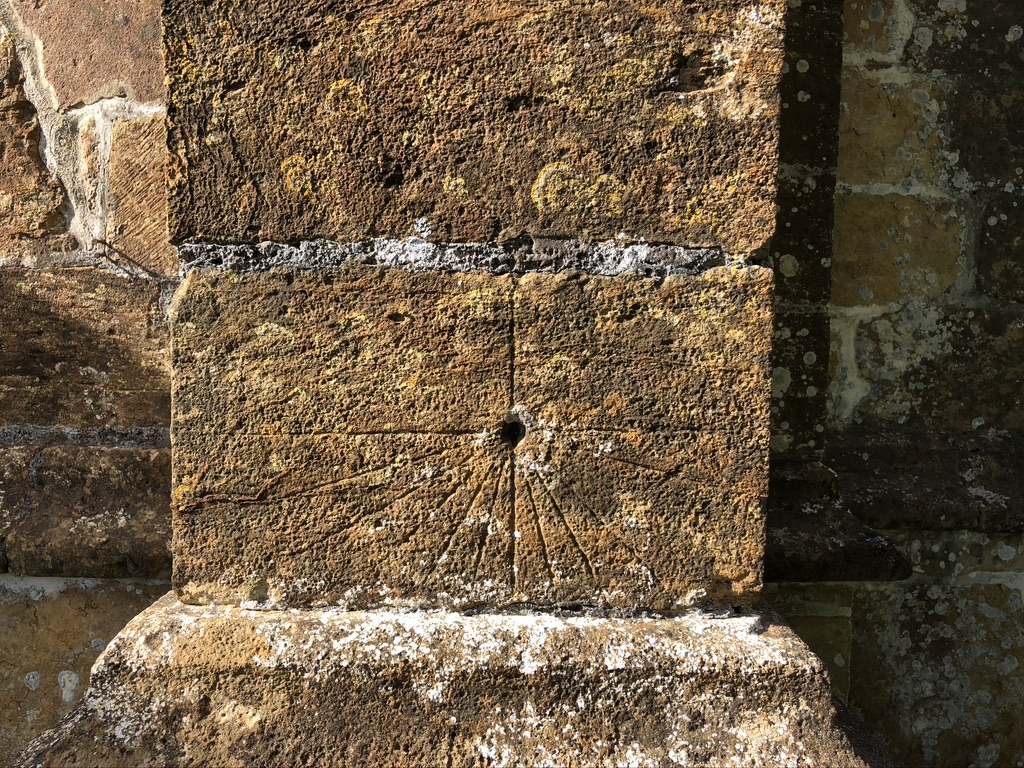
St Peter has a fine dial on a quoin stone at E. end of the nave, an unusually complete and very satisfying symmetrical design. DEH records this dial (as does BSS), and also a second dial inside the porch (a feature of churches in the area) that is rather a puzzle.
DIAL 1
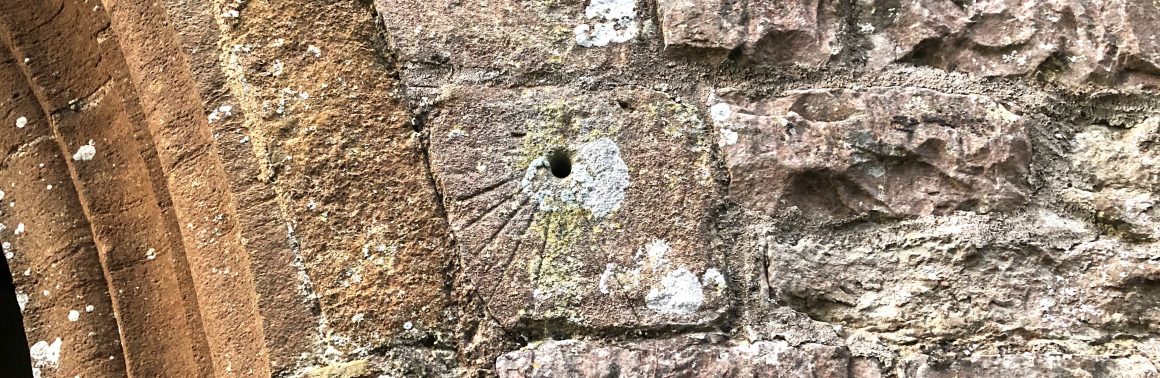
St Peter . Podimore . Somerset – Scratch Dial 1
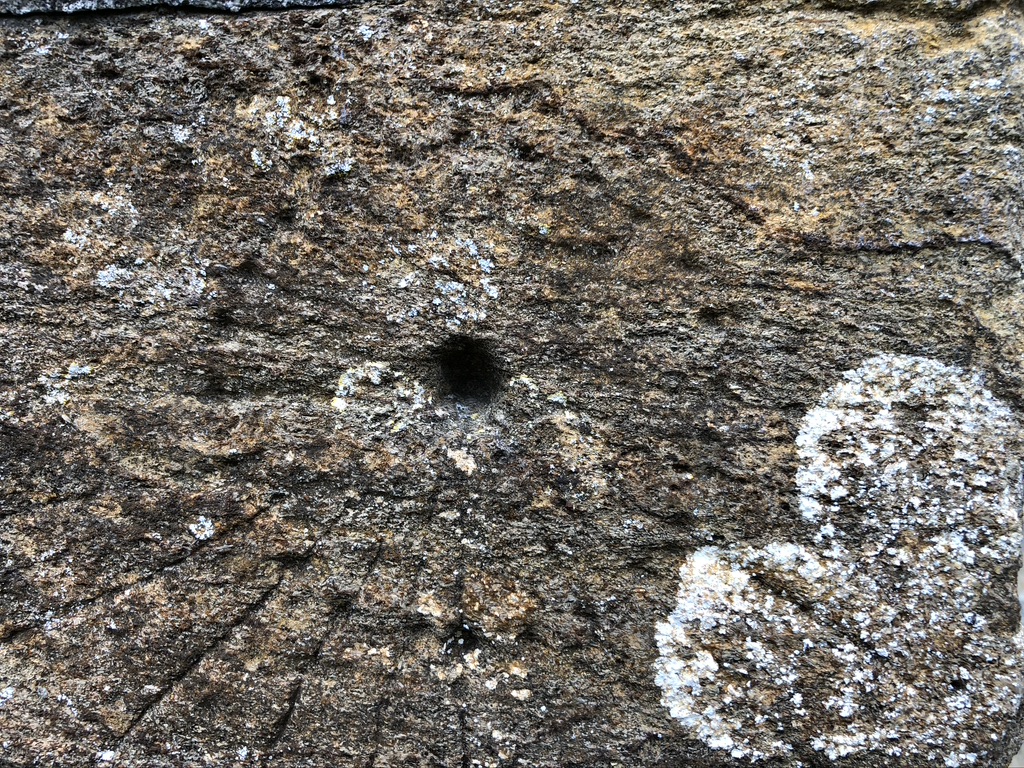
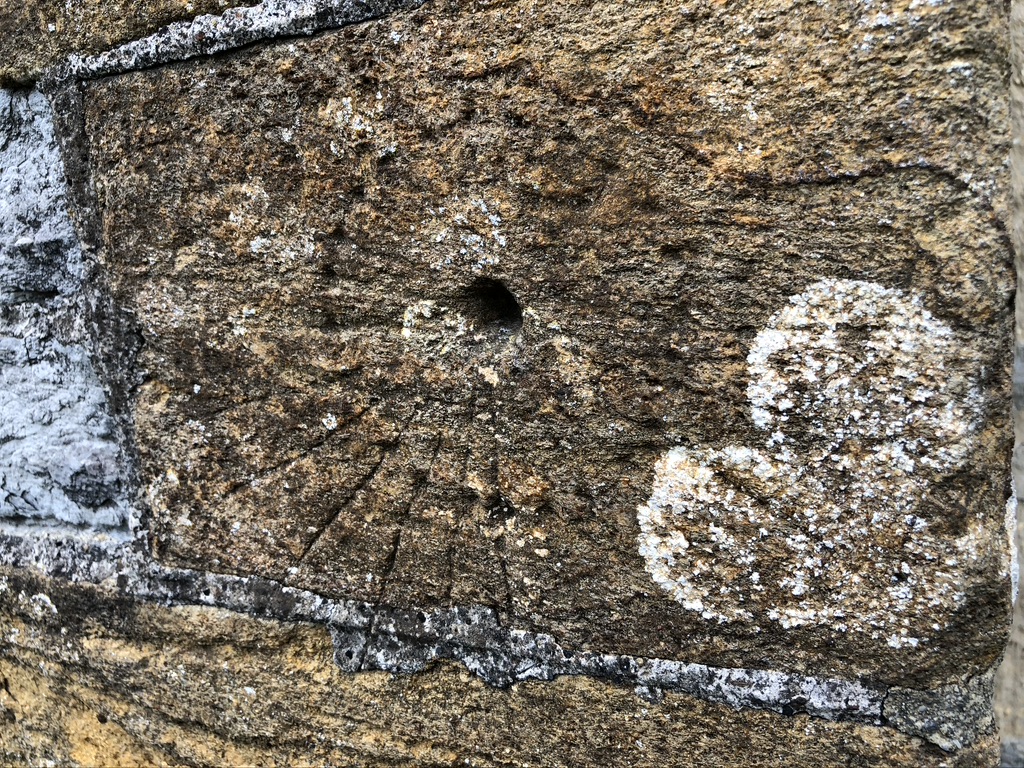
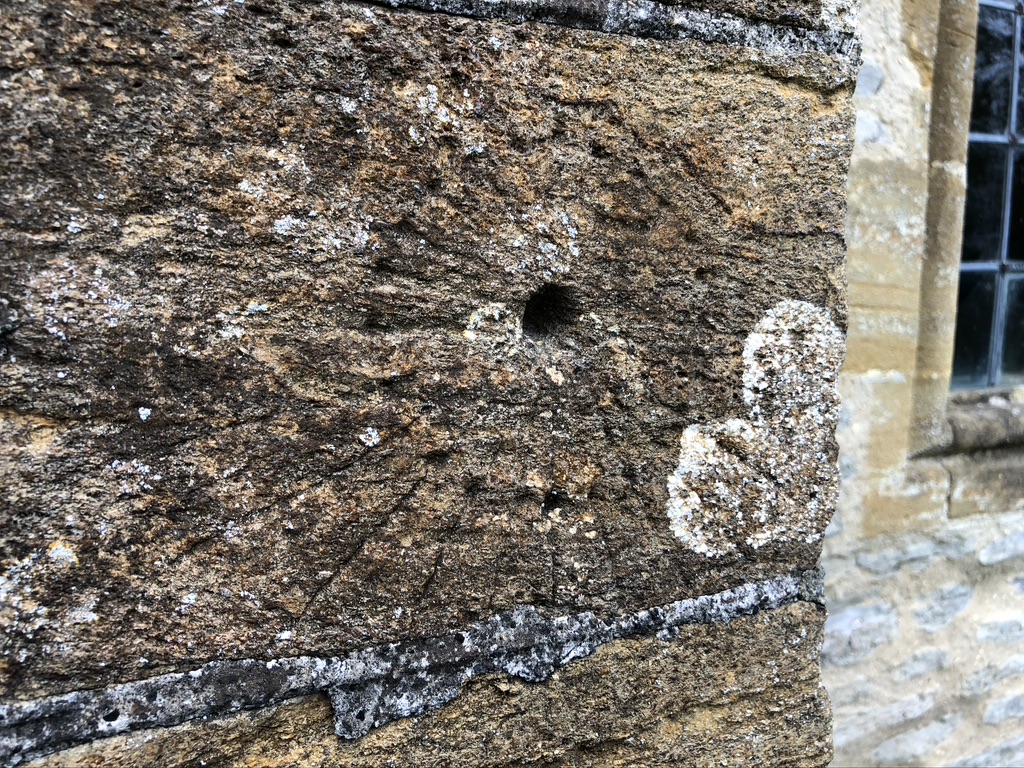
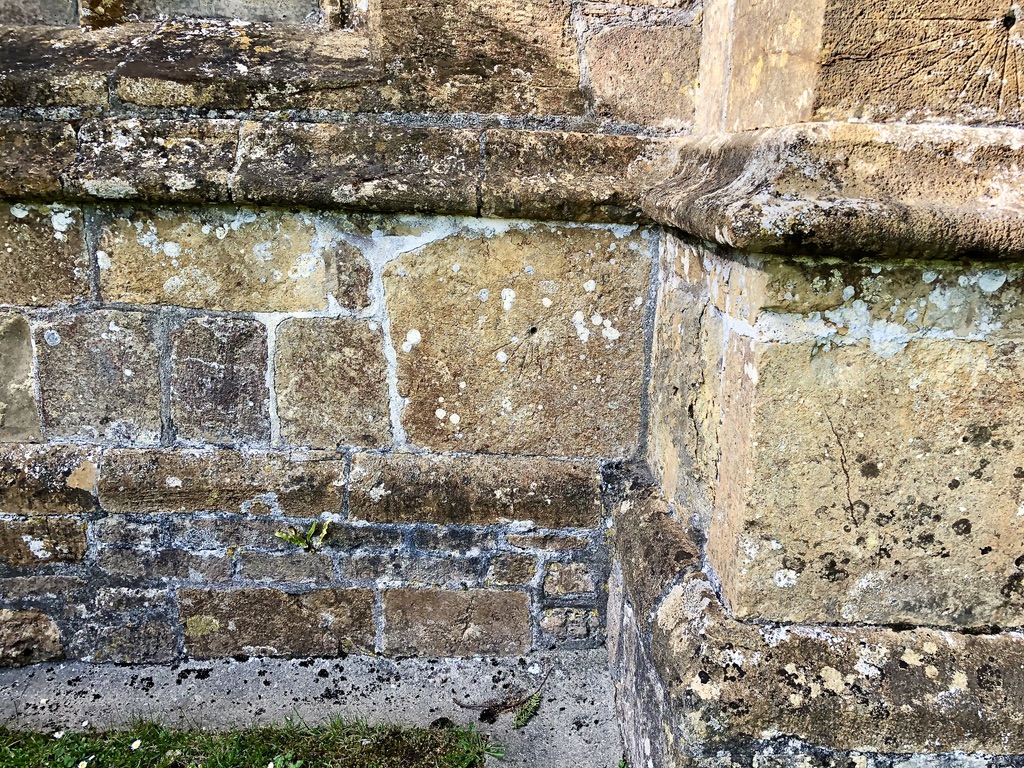
There is a full complement of 24 lines, each passing through a pock on its way to the perimeter. The line spacing is regular, each angle at 15º. The style hole is large relative to the careful proportions of the design. Overall the condition is good, the lower half more so than the upper. Some lines pass into (and perhaps beyond) the mortar joints, suggesting that a very strong and weather-resistant mix was used in medieval times (or extreme care taken with mortar repairs).
St Peter . Podimore . Somerset Scratch Dial 1
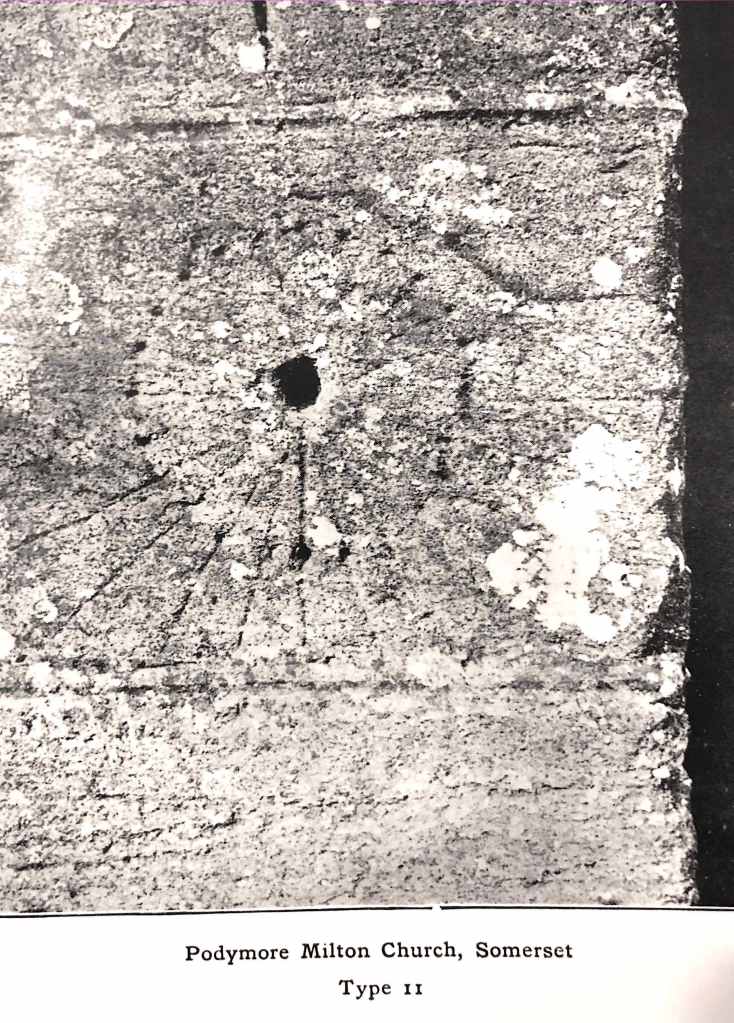
DEH visited in Oct 1914 and noted that the dial is elaborate and has lines and dots, and is also of unusual pattern. This dial is one of very few photographs included in his book. Note the spelling of the village in the caption. I wonder what kind of camera he took with him on his travels round Somerset?
211. (2) This dial is on a quoin at the s.e. corner of the nave. It is 4 feet 9 inches above the ground, the noonline is 4 1/2 inches in length, the stylehole is 3/4 of an inch deep by 3/4 of an inch in diameter, and the aspect is s. by 15° e. Type 11.
St Peter . Podimore . Somerset – Scratch Dial 1
DIAL 2
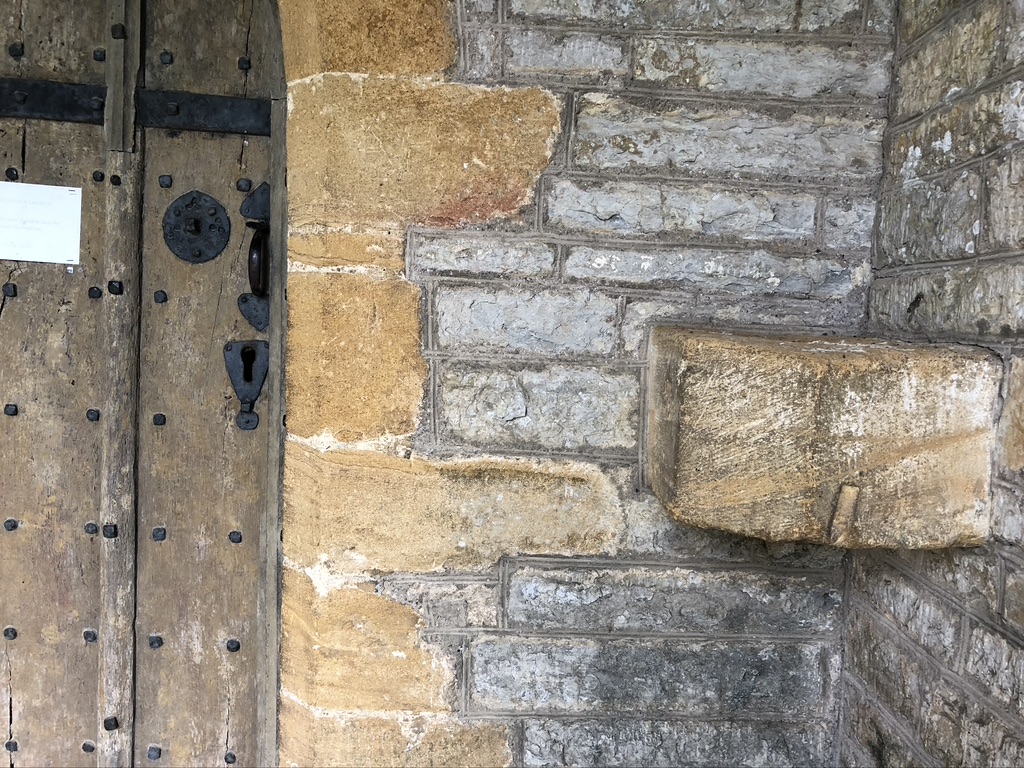
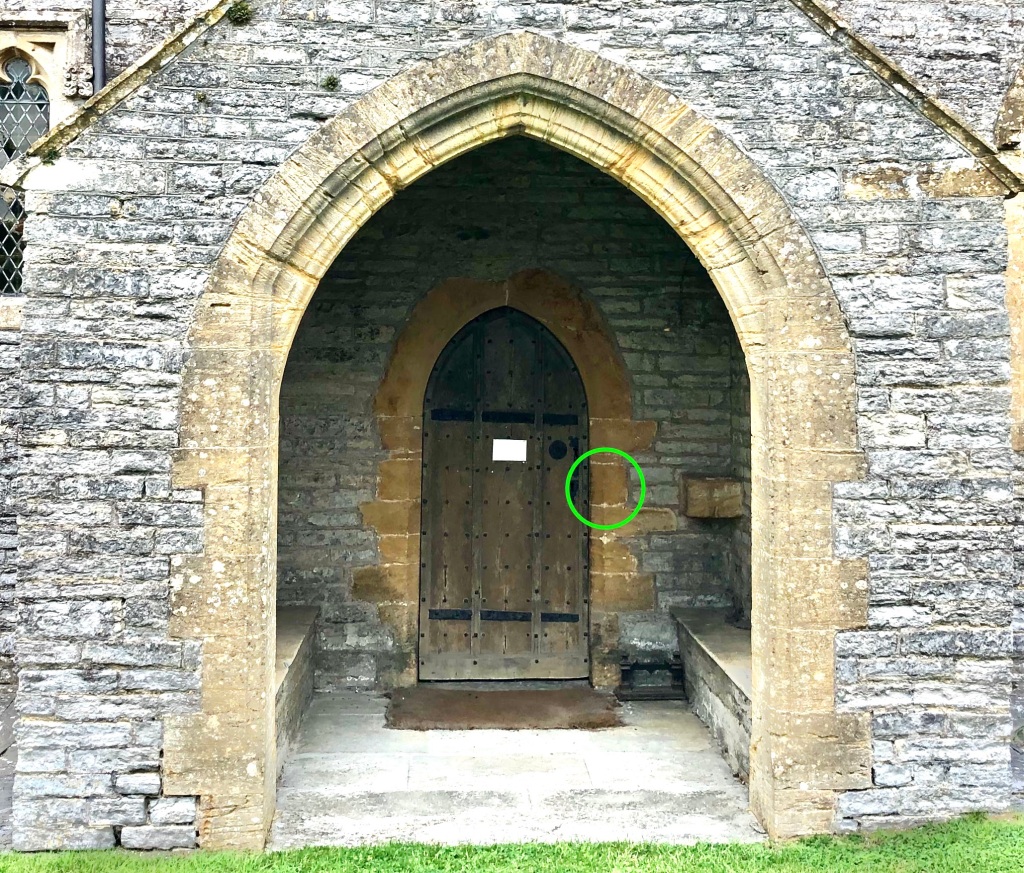
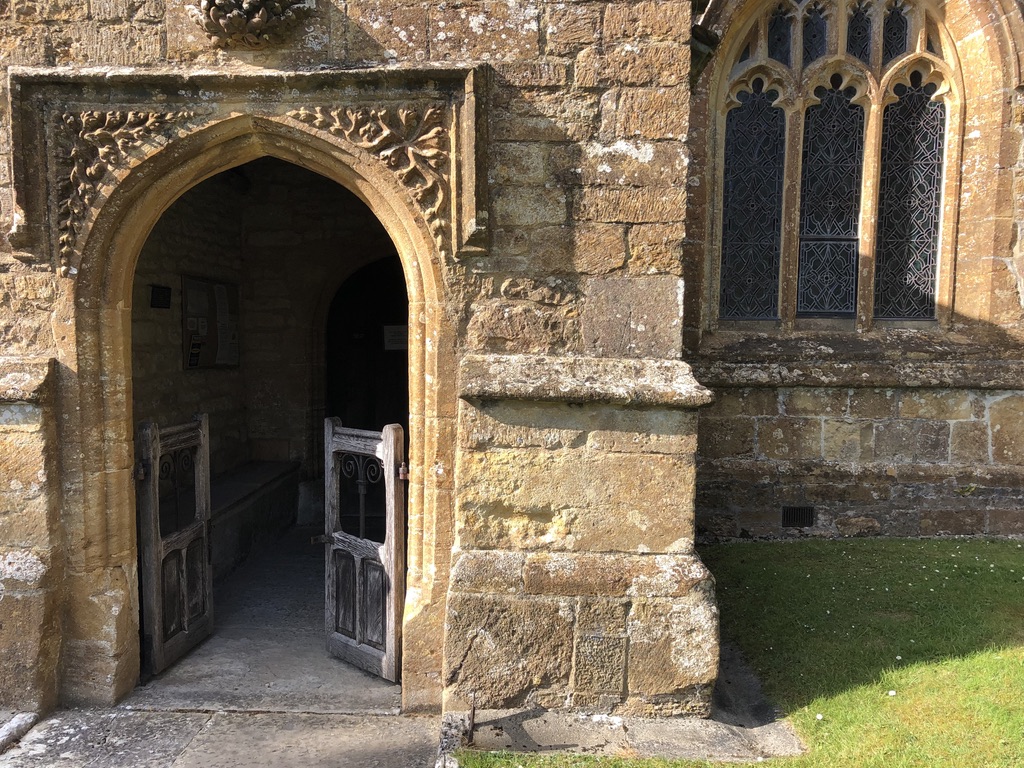
The dial inside the porch of St Peter is RHS of the door. BLB notes S porch, gabled, with outer 2-centre arch of 2 orders, the outer segmental, and inner plain pointed arch door and a possibly C16 door with old ironwork. The date of the original porch – restored 1871 – that covered the dial is unclear.
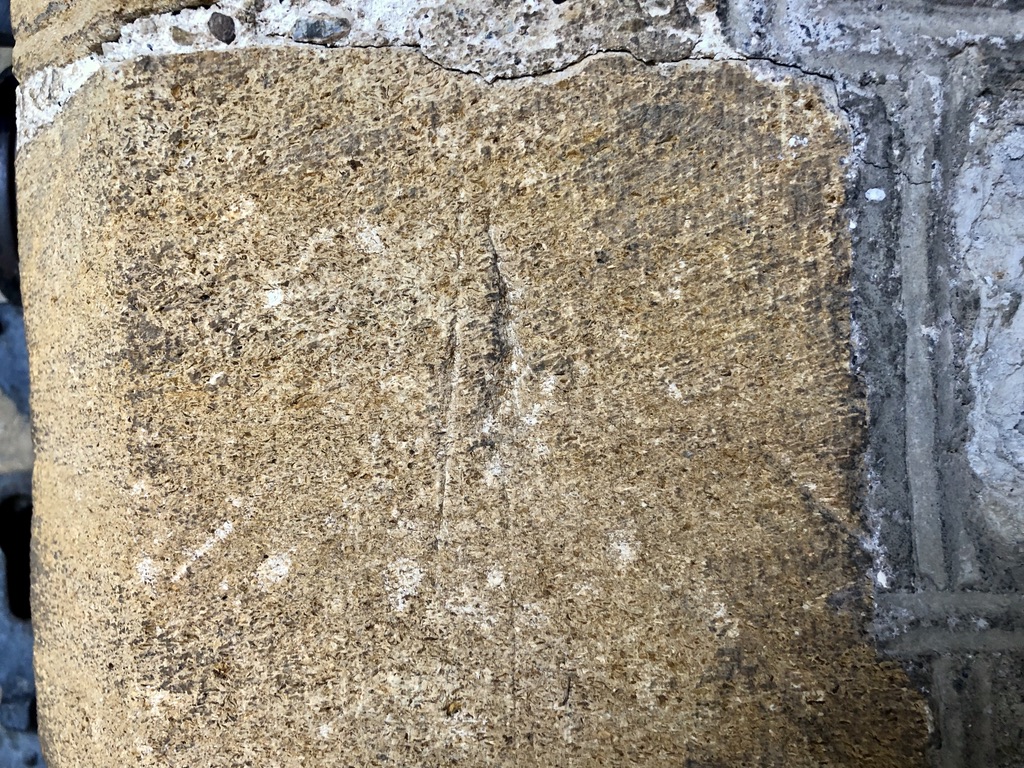
St Peter . Podimore . Somerset – Scratch Dial 2
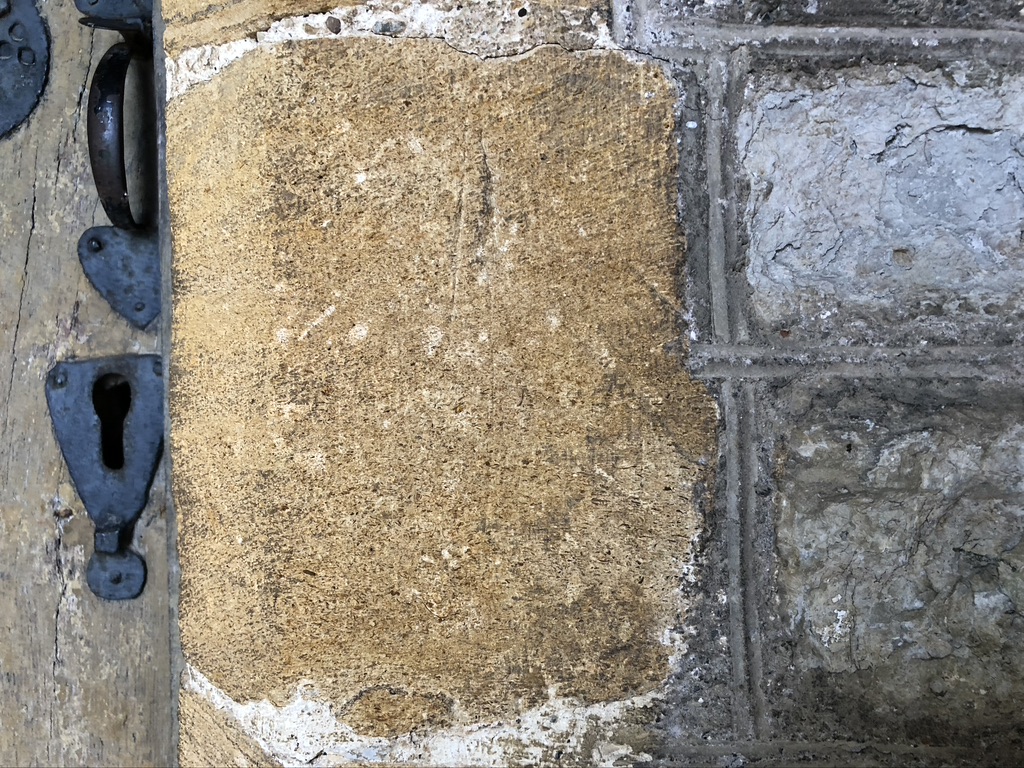
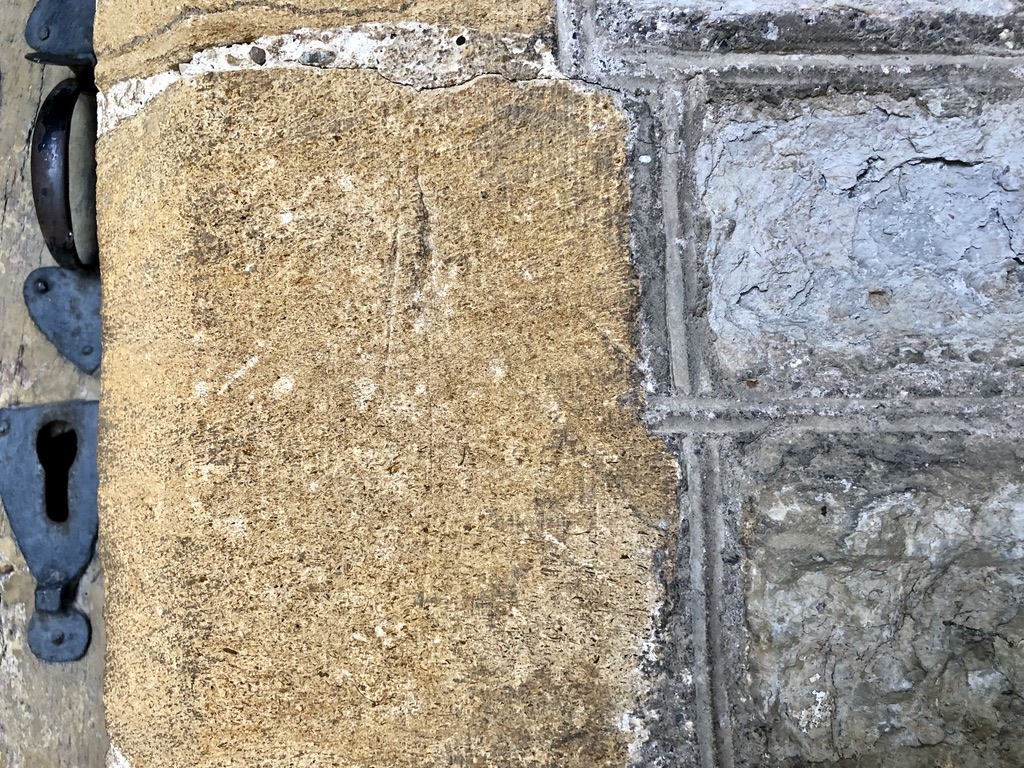
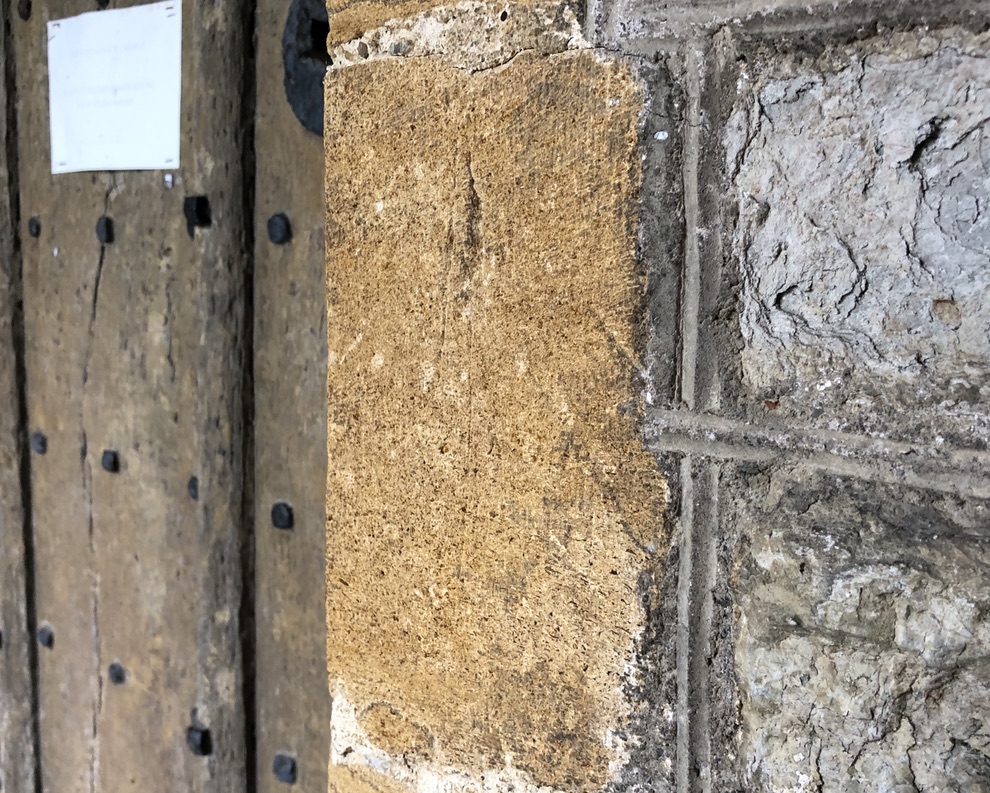
The dial, at latch level, is rustic and in poor condition. There are 2 clear lines, with the noon line cut deep at the top then scratched roughly a long way downwards before petering out. There’s no sign of a style hole where the lines meet, so the gnomon was presumably fixed in the mortar line just above. A partial / eroded line at the edge of the lower R quadrant could be consistent with Nones in the canonical Mass.
St Peter . Podimore . Somerset – Scratch Dial 2
MYSTERY
A mystery arises from DEH‘s record for this ‘within-porch’ dial: He noted 210. (1) This dial is on the w. side of the inner door of the s. porch. It is 4 feet 6 inches above the floor, the noonline is 1 inch in length, the stylehole is in a joint and filled, and the aspect is s. by 20° e. Type 2. I found no dial in that position nor with that description. My tentative theory is that, very rarely, DEH’s notes of a day’s dialling are unclear; features of one church / dial appear to be ascribed to another nearby. Probably I should return to the area and check the churches for a dial as he describes.
St Peter . Podimore . Somerset – Scratch Dial 2 within porch
GRADE II † Built 1860s in the centre of a pleasant, prosperous small town on the River Test. Fishing tackle emporia, smart gift shops, good restaurants and pubs, predominate. The flinty New Church replaced the crumbling C12 STOCKBRIDGE OLD CHURCH that had fallen into decay and disuse. Its fascinating remnants merit a visit. 51.1145 / -1.4934 / SU355351
DIALS
The excellent resource BRITAIN EXPRESS by David Ross gives a graphic account (below) of the move from the near-defunct medieval church on the edge of the town to the new-build glory in the High Street. Included in the upheaval was a scratch dial on a stone window jamb; and as I recently discovered while locating it, an unobtrusive second dial now on the side of a buttress.
Most of the 12th-century building was pulled down, leaving only the chancel, and a new church in Victorian Gothic style was built on Stockbridge High Street. Reports show that the townsfolk played an active part in transferring monuments, paintings, window frames, corbels, and other pieces of carved stonework from the old church to the new site. People brought their wheelbarrows and trundled down the High street carrying pieces of medieval masonry.
DIAL 1
St Peter . Stockbridge . Hants – scratch dial 1
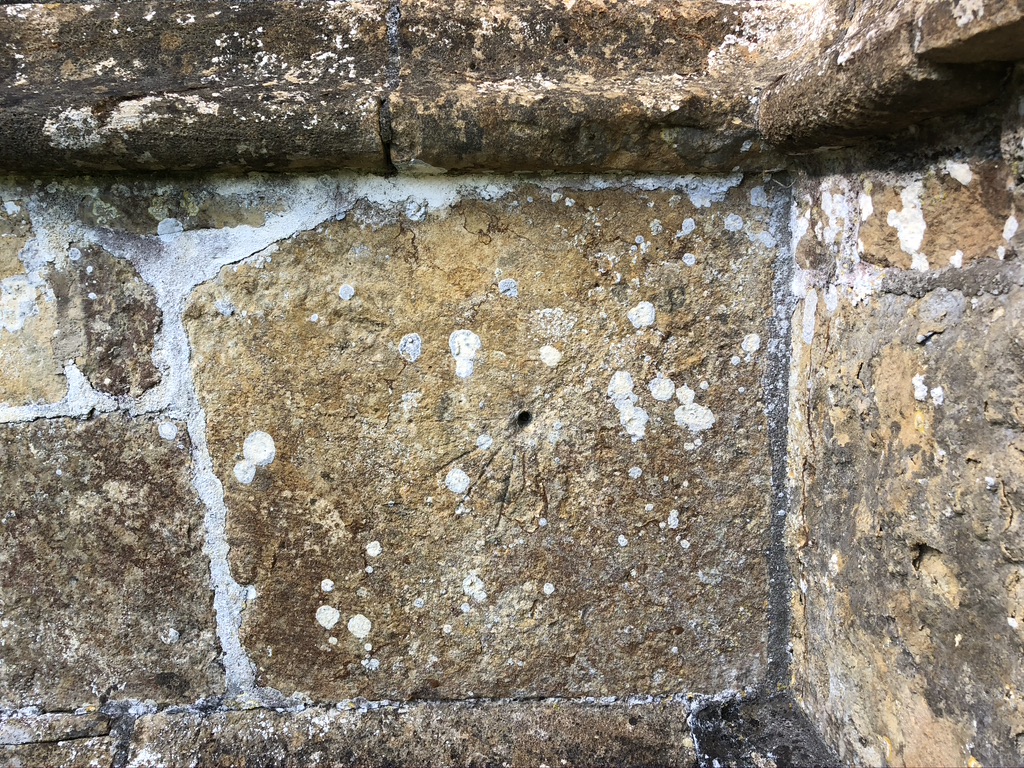
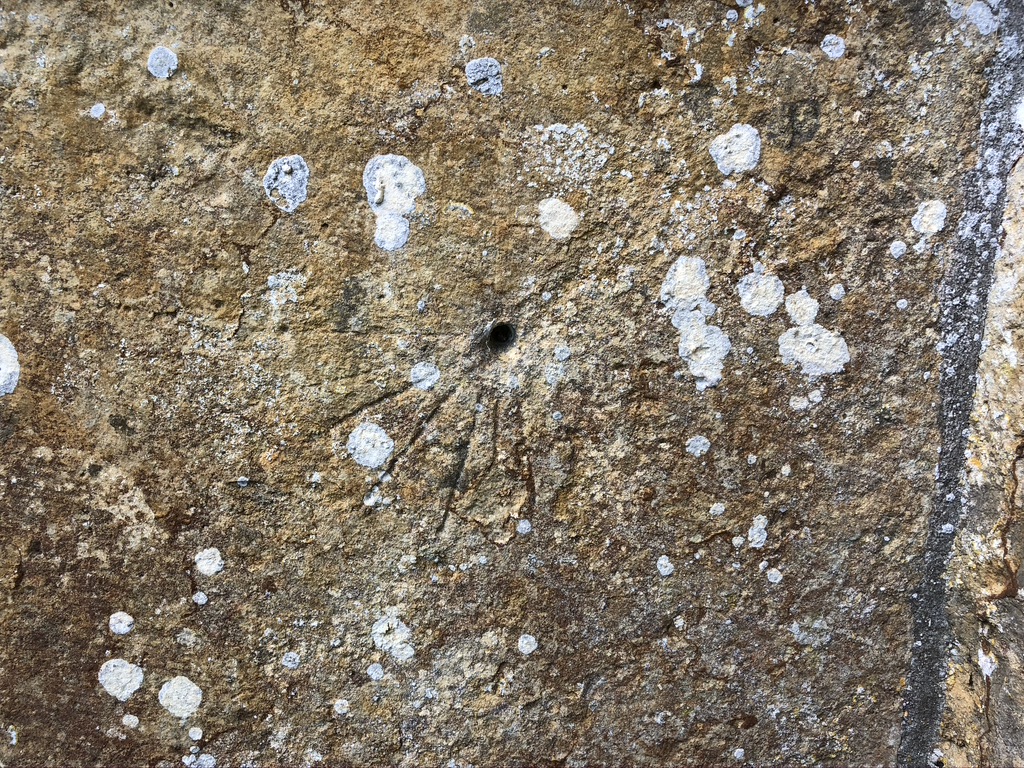
Dial 1 is on RHS of the double lancet window at the W end of the church. It is inverted, as is often the case with a relocated dial. The window is high enough to be awkward to photograph with only a phone to hand. There are 12 (13?) visible lines, each ending in a pock. Traces of others might be found with closer inspection or a decent photo. The style hole is relatively large, and the lines radiating from it are more or less evenly spaced rather than graduated.
ARG visited Stockbridge in May 1922. He recorded there is a style hole with a line above, and on each side of this four radiating lines. He added it is too high for a photo or for measurement. Which may explain his lower count of radials.
St Peter . Stockbridge . Hants – scratch dial 1 gallery
DIAL 2
By complete chance, in walking away from Dial 1, I noticed a small but familiar design in the inside W face of a buttress L of the porch.
St Peter . Stockbridge . Hants – scratch dial 2
This simple dial is unusual in being a quadrant with a quarter-circle border, like a small fan. In relocation, it looks as if it was rotated 90º. It makes most sense that the close-cut double lines originally formed the noon-line and the others mark 3 and 6: an afternoon dial.
St Peter . Stockbridge . Hants – scratch dial 2 rotated 90º
St Peter . Stockbridge . Hants – scratch dial 2 gallery
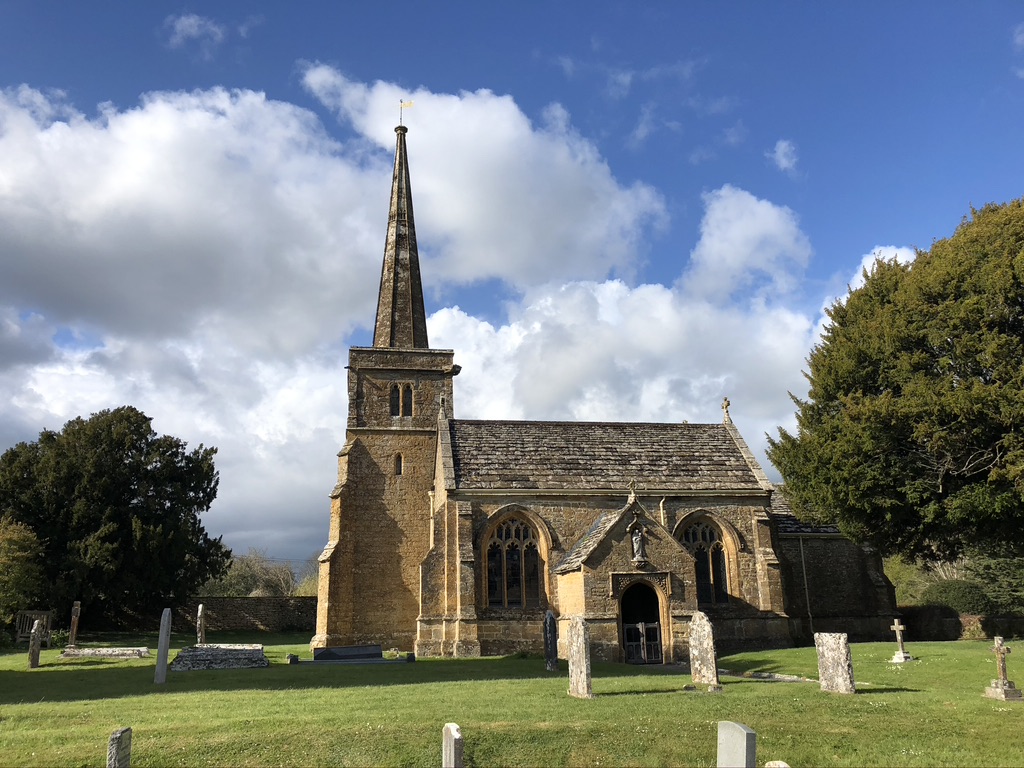
GRADE II* † C15 (C13 origins). Restored and N. aisle added C19. A handsome spired church, unusual in a region where most churches have towers, in the lovely setting of a small hamlet reached by a network of lanes. 51.0337 / -2.509 / ST644261
DIALS
St Mary is a most rewarding church to visit, both the exterior and interior. You will find brief points of note at Camelot Parishes. DEH on his visit in April 2014 recorded 2 medieval dials (2 & 3 below) but there are others, including a more elaborate later one with Roman numerals (C17?) above the porch.
DIAL 1
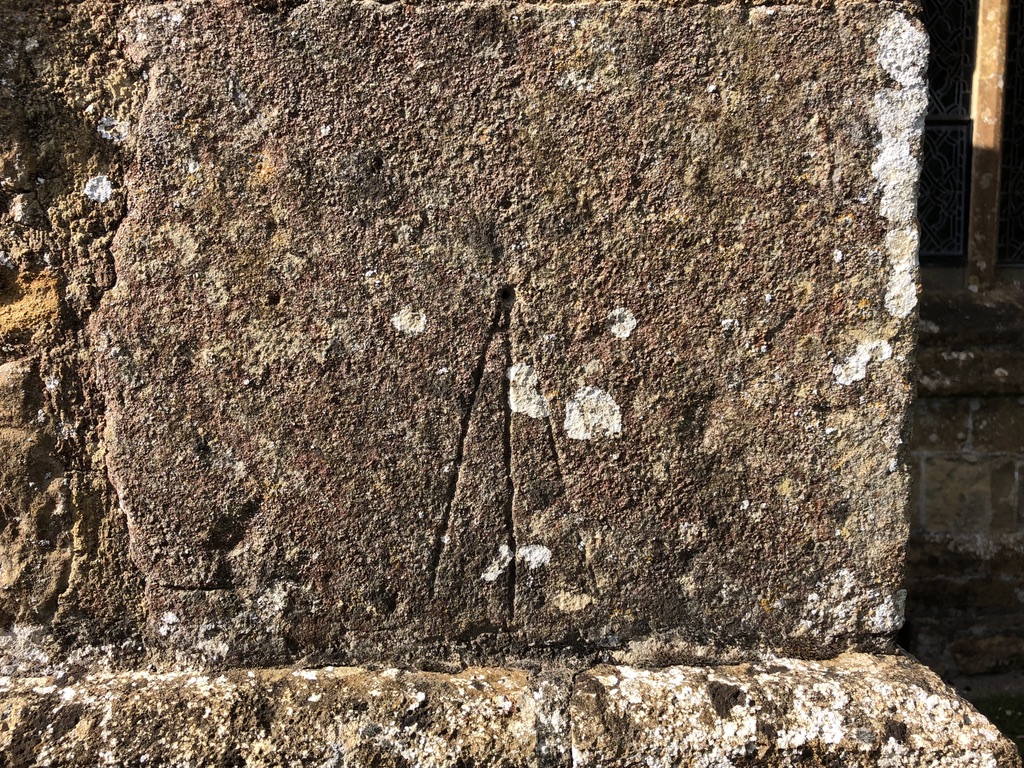
Compton Pauncefoot . Somerset . St Mary – scratch dial on the porch
Dial 1 A very visible 3-line dial on a large stone RHS of the porch. It consists simply of a small style hole with a long noon line and a single line the same length cut on each side. Despite its prominent location, the dial seems largely unremarked though perhaps it is mentioned in the church archives. The actual stone differs from the ones around it – perhaps it was relocated during restoration to a more prominent position on the porch. It is strange that DEH didn’t include this dial in his records for the church.
Compton Pauncefoot . Somerset . St Mary – scratch dial on the porch
DIAL 2
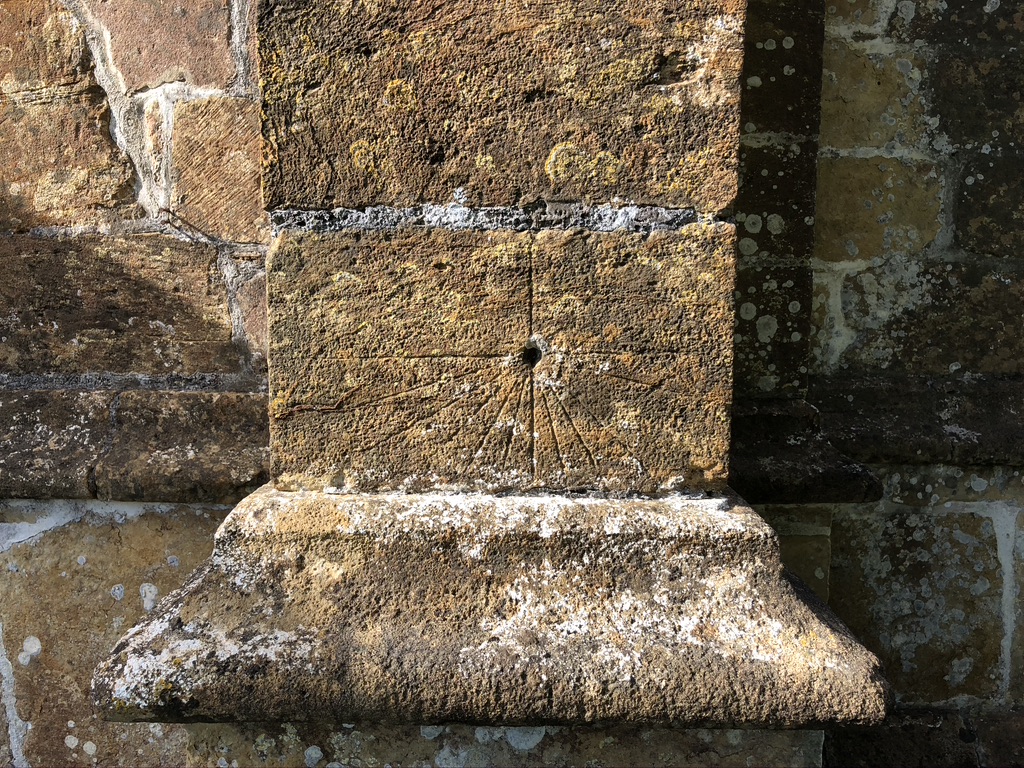
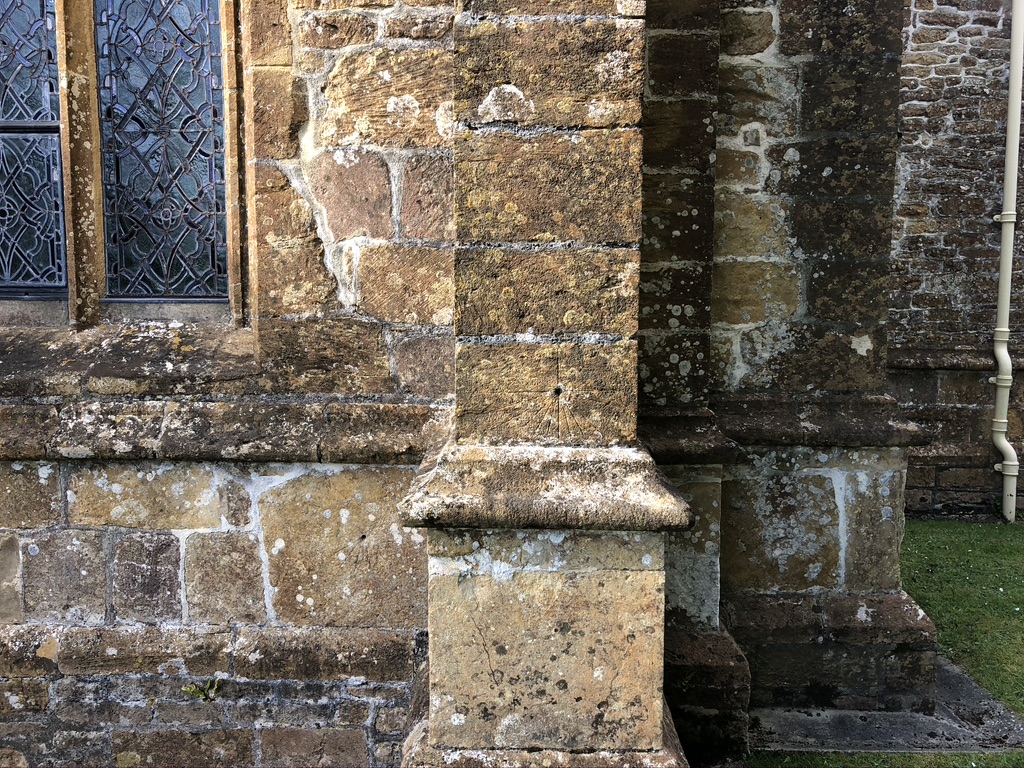
Compton Pauncefoot . Somerset . St Mary – scratch dial on the E buttress of the nave
Dial 2 is located on the buttress at E end of the nave. It is close to being an ideal dial for study. The style hole is (nearly) centred on the stone. The noon line is not only emphasised, it extends upwards to ‘midnight’. There’s a distinct optical impression of a circle. The horizontal (6-to-6) line extends almost the full width of the stone. Other lines are unusually long, reaching beyond the notional circle. They are carefully graduated to optimise the accuracy of the dial. One mystery is the absence of the 4-line. I couldn’t find a trace of one. It seems unlikely that a single line has eroded completely; but a reason for omitting one line on an otherwise complete and indeed symmetrical dial is hard to think of.
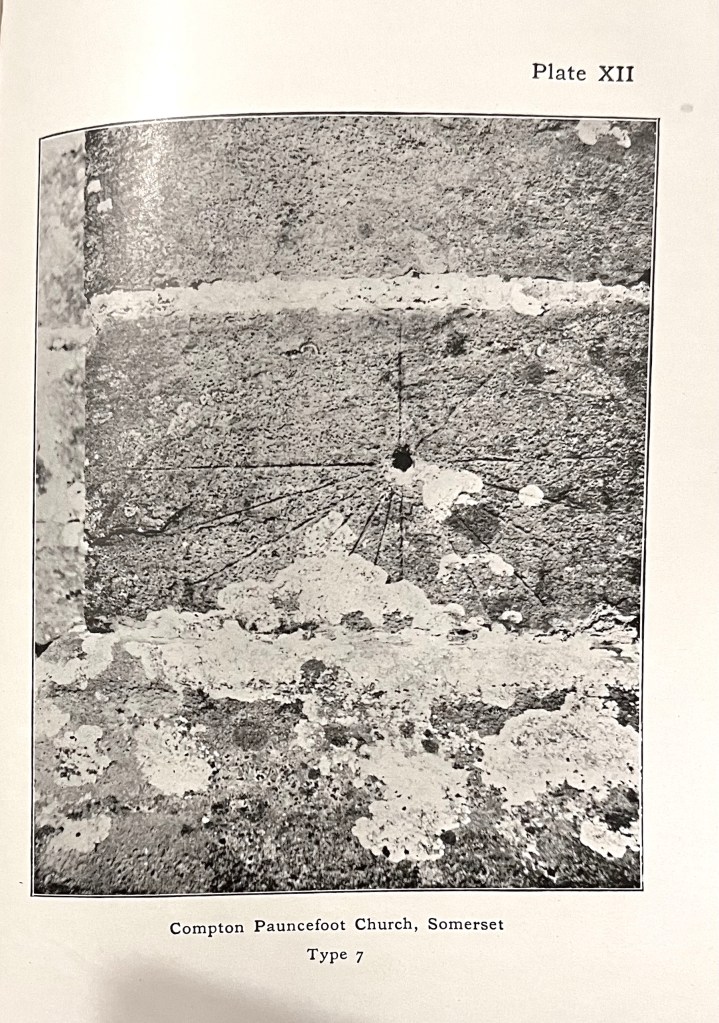
DEH chose the dial to illustrate Type 7
DEH177. (2) This dial is on the buttress at the s.e. corner of the nave. It is 4 feet 6 inches above the ground, the noon- line is 4 1/2 inches in length, the stylehole is 1 inch in depth by 3/4 of an inch in diameter, and the aspect is s. by 20°e. Type 7. April 24th, 1914.
Compton Pauncefoot . Somerset . St Mary – scratch dial on the E buttress of the nave
DIAL 3
Compton Pauncefoot . Somerset . St Mary – scratch dial beside the E buttress of the nave
Dial 3 is close to the same buttress, smaller, more rustic (earlier) and lower down. There are 9 certain lines and a couple of traces (one possibly above the 6 am horizontal). Their spacing is somewhat random. 4 lines end in pocks.
DEH 176. (1) This dial is on the wall w. of the buttress at s.e. corner of the nave. It is 2 feet 8 inches above the ground, the noonline is 4 1/2 inches in length, the stylehole is open, and the aspect is s. by 20° e. Type 3.
Compton Pauncefoot . Somerset . St Mary – scratch dial beside the E buttress of the nave
DIALS 4 a – d
Compton Pauncefoot . Somerset . St Mary – scratch dial(s)
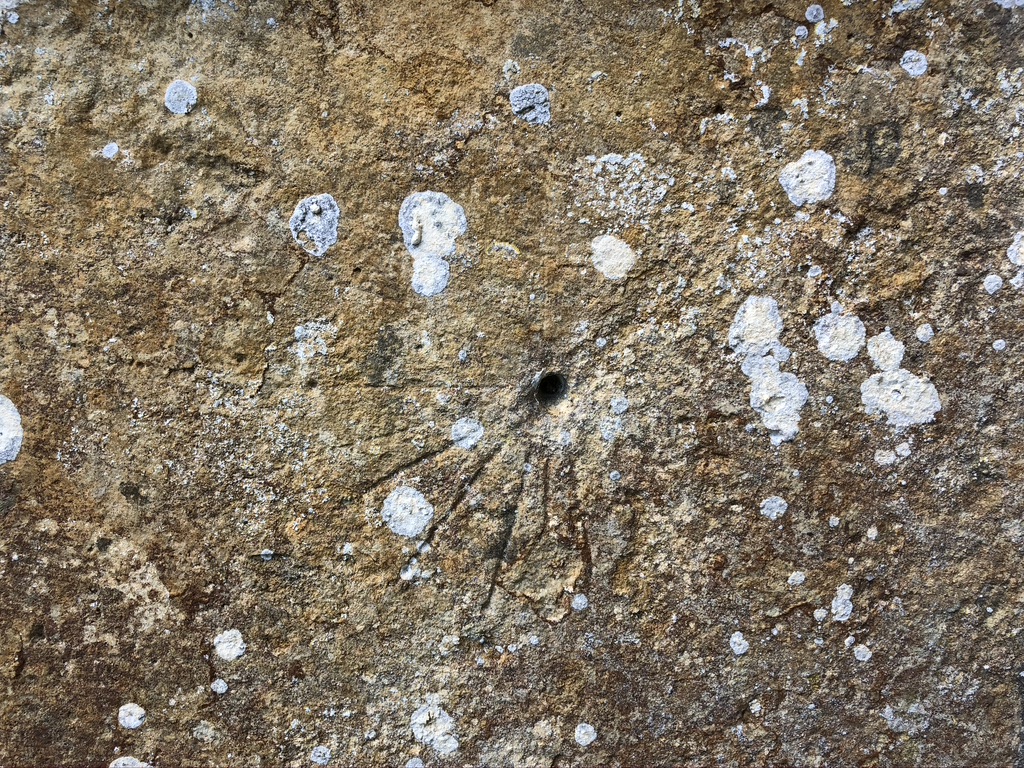
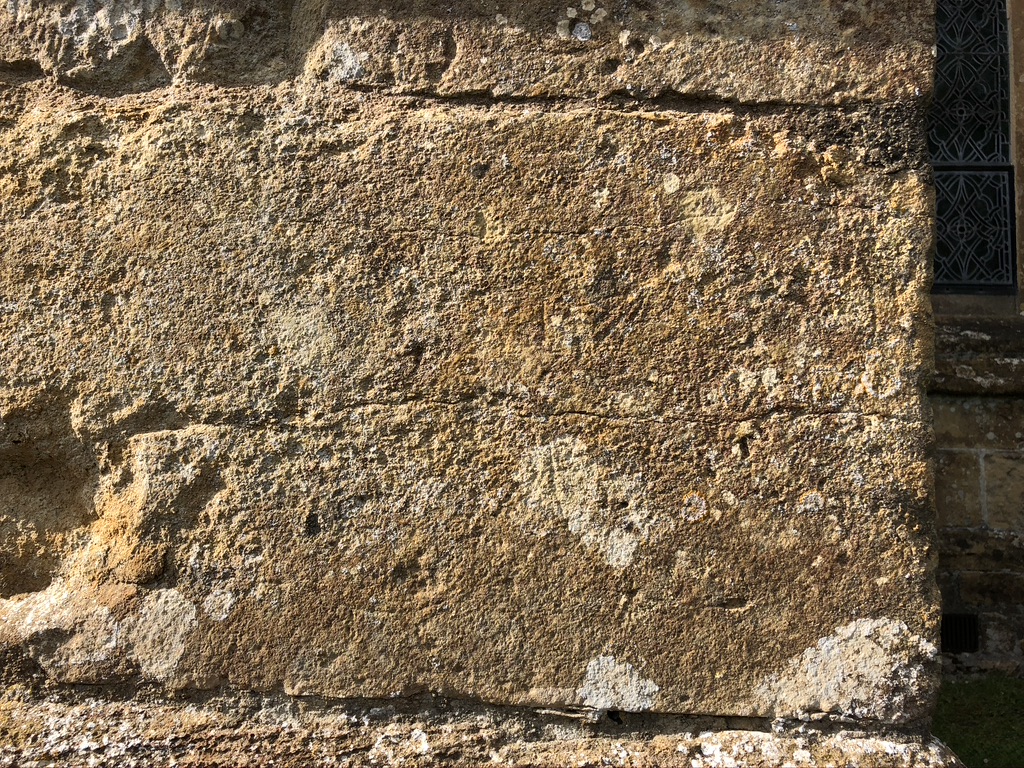
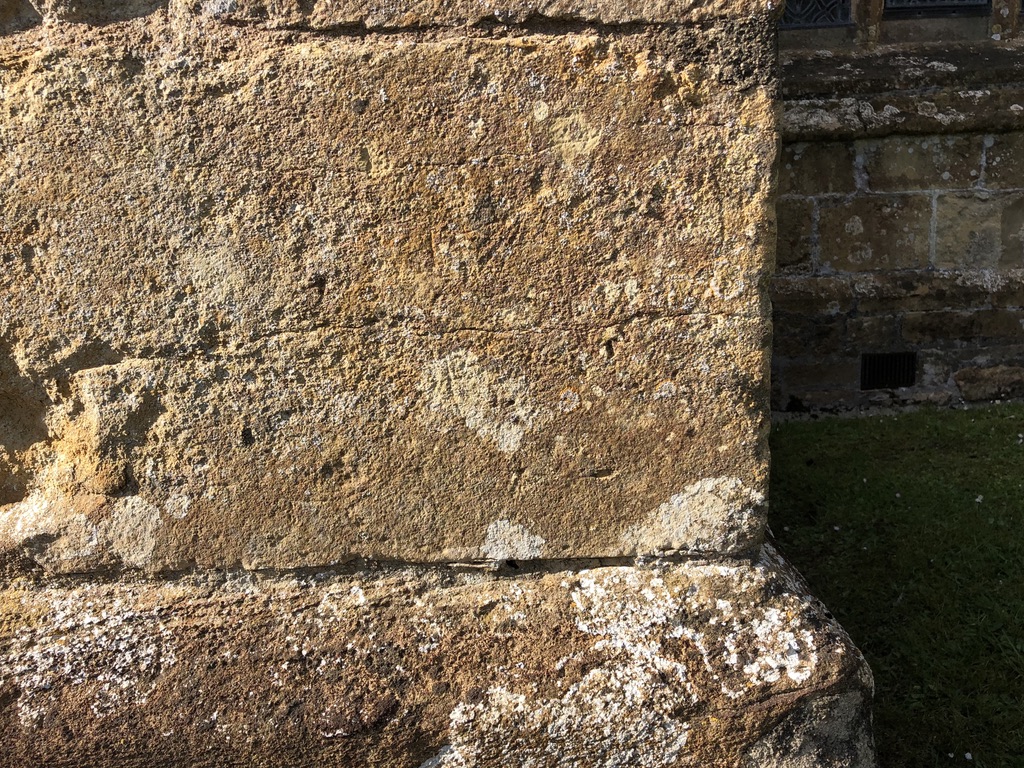
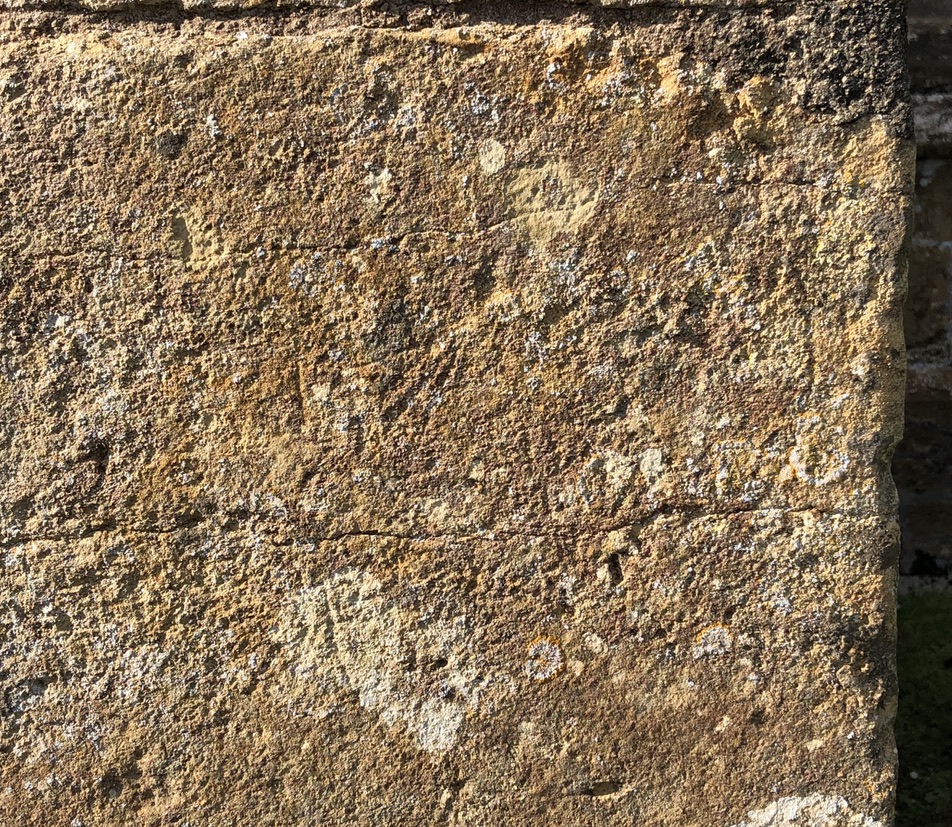
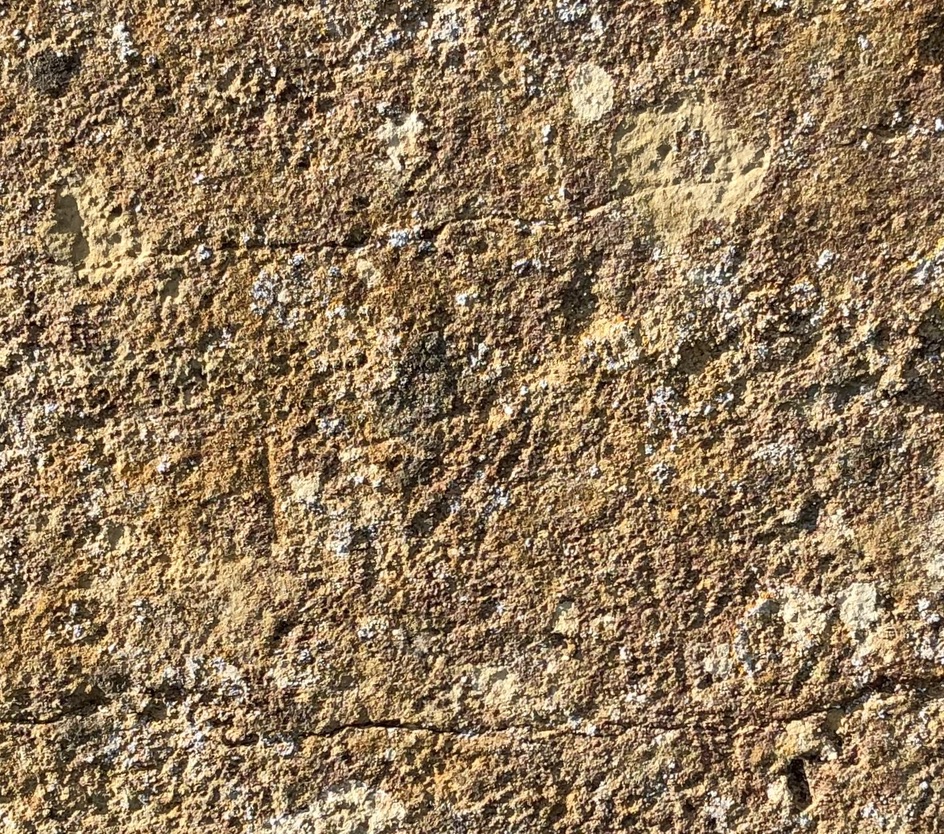
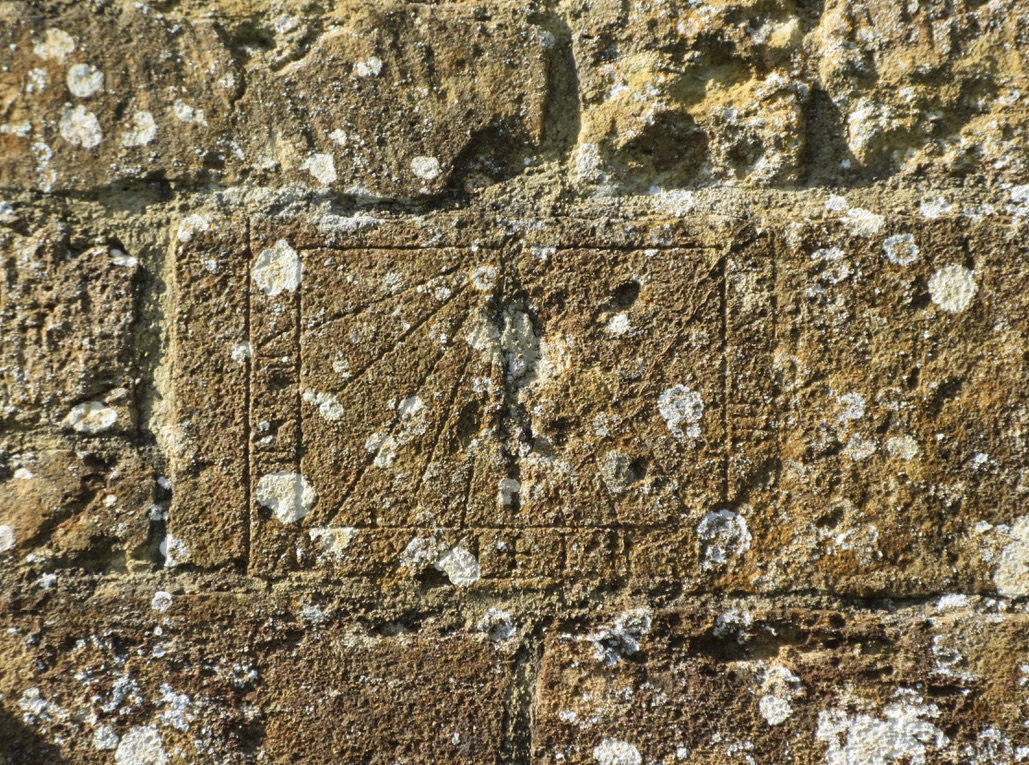
Dial 4 This is in fact a dial / dial-related group on a single quoin stone, but treated as a dial unit for convenience. The overall design has 4 elements. There are 3 eroded (part) circles – two overlapping – with a small rough dial within the top circle. In this group of interlinked components, each is of a type often identified either as dials or as remnants of eroded dials. See eg CHURCH STRETTON Such a collection on a single stone perhaps suggests experimentation with dial-making. Or the (part-)circles may simply be decoration or (not unknown) doodles. Anyway, I decided to lump them together as one dial rather than to try to sort out the tangle. Any interpretations would be welcome.
Compton Pauncefoot . Somerset . St Mary – scratch dial(s)
DIAL 5
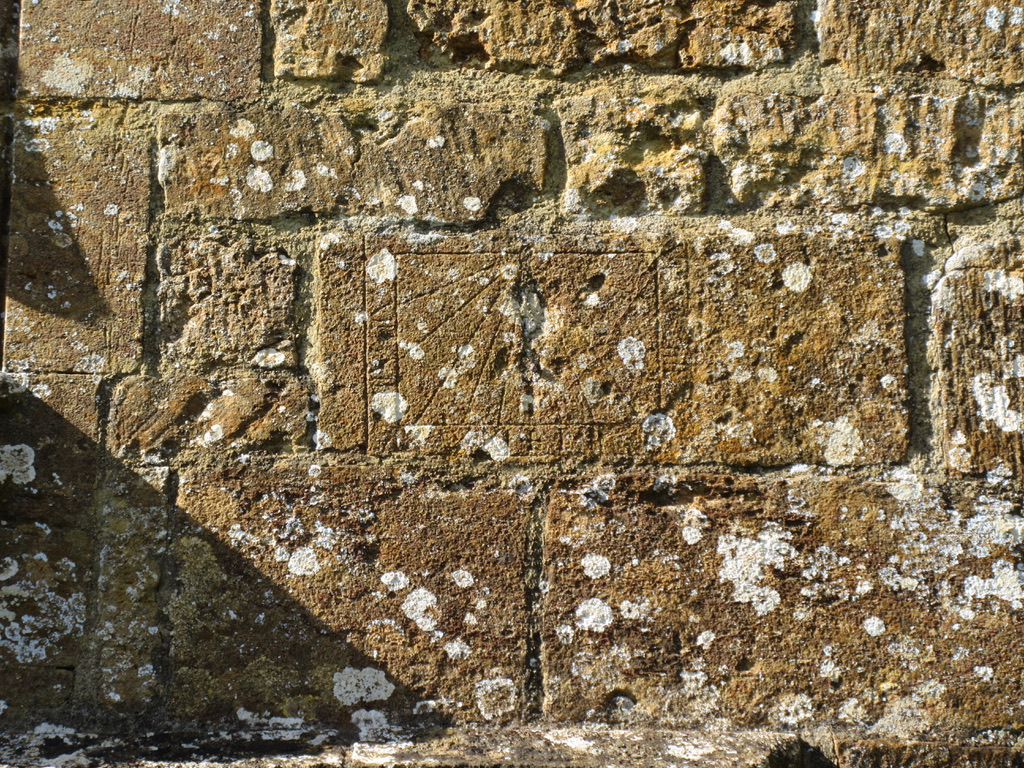
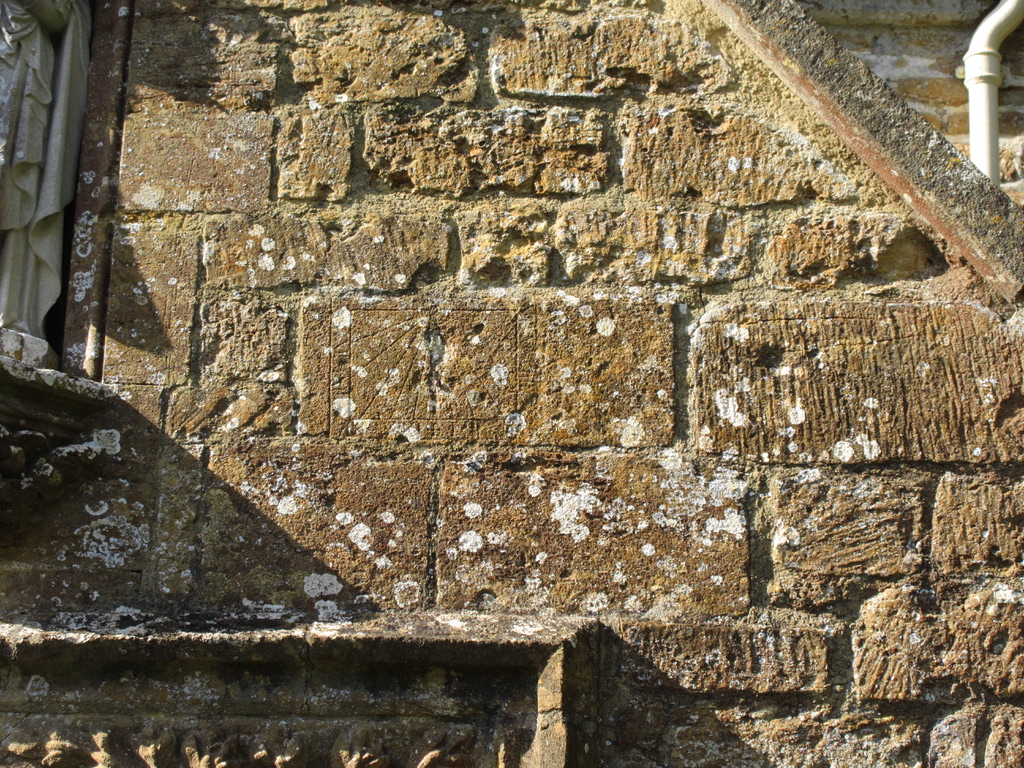
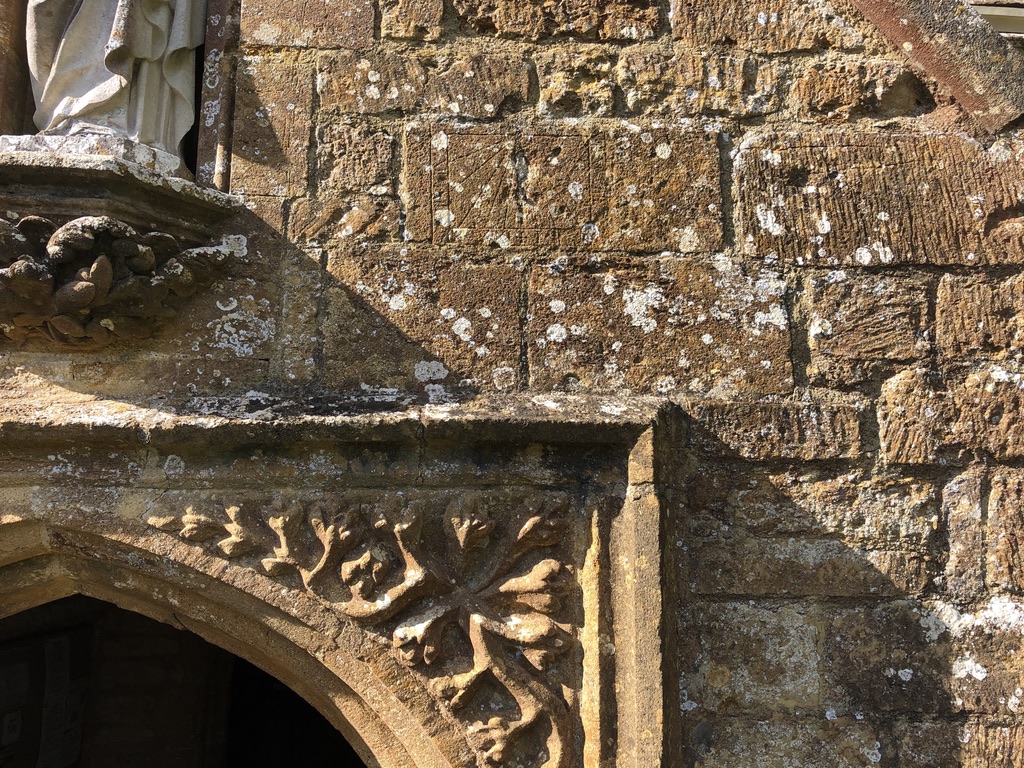
Compton Pauncefoot . Somerset . St Mary – scratch dial / C17 sundial
Dial 5 is a C17 later accurately incised dial on the fine porch above a cusped ogee-arched statue recess with foliated baseBLB with its C19 statue of Virgin and Child. This dial is similar to several others in S. Somerset & W. Dorset (some are included under the heading OLD DIALS). The radials are contained within a rectangle, carefully incised and graduated. The noon line is more deeply cut, and leads down from the damaged area at the top of which is a filled style hole. Possibly the area of damage immediately below it indicates that a metal gnomon plate was later fixed there. The frame round the dial shows Roman numerals (IV as IIII) except for noon, which is marked by a cross (a conventional style).
Compton Pauncefoot . Somerset . St Mary – scratch dial / C17 sundial
GRADE I † Early C12 traces, rebuilt and extended C15. S. tower added in 1638. Restored and added vestry C19. 2 bells cast on site in 1275, the oldest in Dorset. Notable C12 font. 50.8467 / -2.6524 / ST541054
SCIENTIFIC DIAL
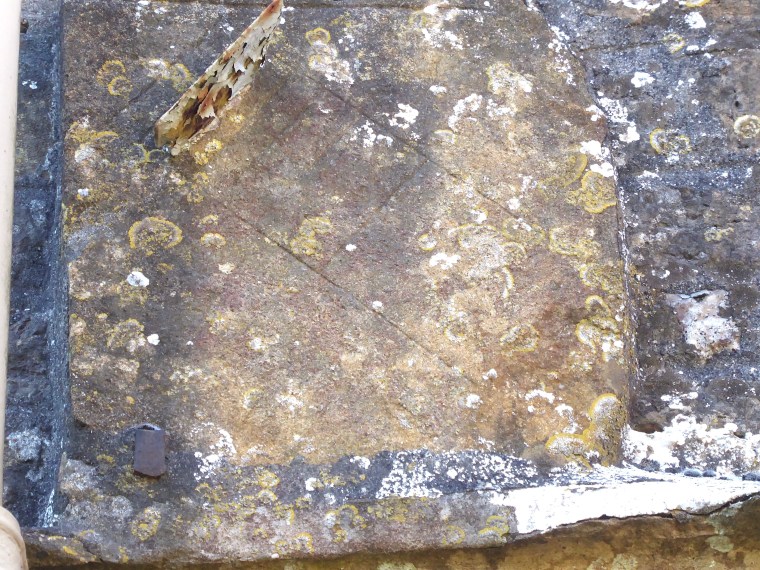
Once you have located the church at the very end of the hamlet – a dead end – of a very long lane, it immediately looks distinctive. In the present context, the dial on the tower – inscribed on S. parapet William Lardar Esq. Thomas Horsford Warden 1638 – is most unusual, not least because it faces due E.
DEH, in a rare excursion into Dorset while researching the scratch dials of Somerset in 1914, recorded this dial as a C17 scientific dial of 1638: E declining down to midday only. No trace of another dial for later in day.
GLP has written the definitive interpretation of the dial, and I include his complete record which explains the dial far better than I ever could.
It would be good to know if this blade of a gnomon is / may be original and has been (re)painted over the years. Also, to know why special dials were almost always sited next to a drainpipe…
GSS Category: Scientific Dial; Scratch Dial; Old Dial
All photos – Keith Salvesen; record extract – Gordon Le Pard





















 GAUDIUM SUB SOLE . SUNDIALS . MEDIEVAL TO MODERN