C13 chapel located within an Iron-age hill fort Chisbury Camp. The Lord of the Manor built it to assert his social status by allowing the household of the manor, as well as local people, to attend services and pay their taxes without having to travel to the parish church at Great BedwynEH. Thatched, with flint walls. The chapel was deconsecrated in 1547 and after three centuries of use as a barn it was reduced to its present dilapidated state. It is however a scheduled Ancient Monument, now in the care of English Heritage.
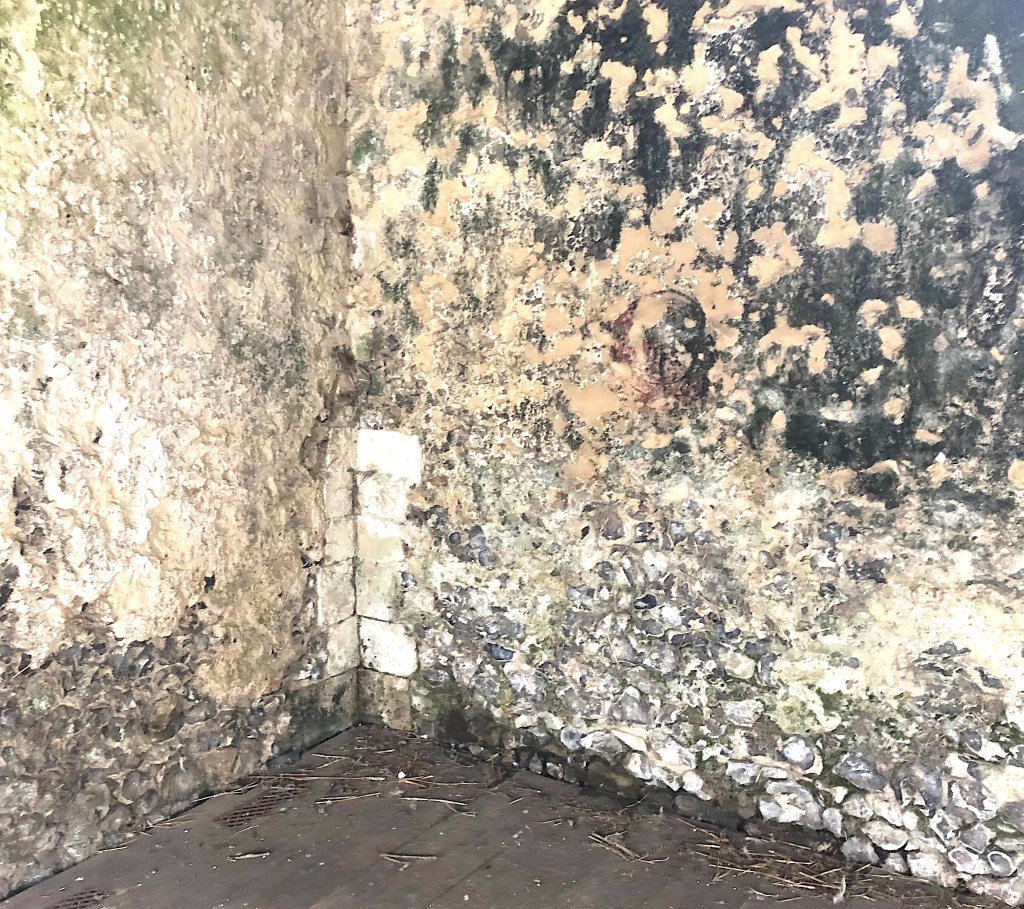
CONSECRATION CROSS
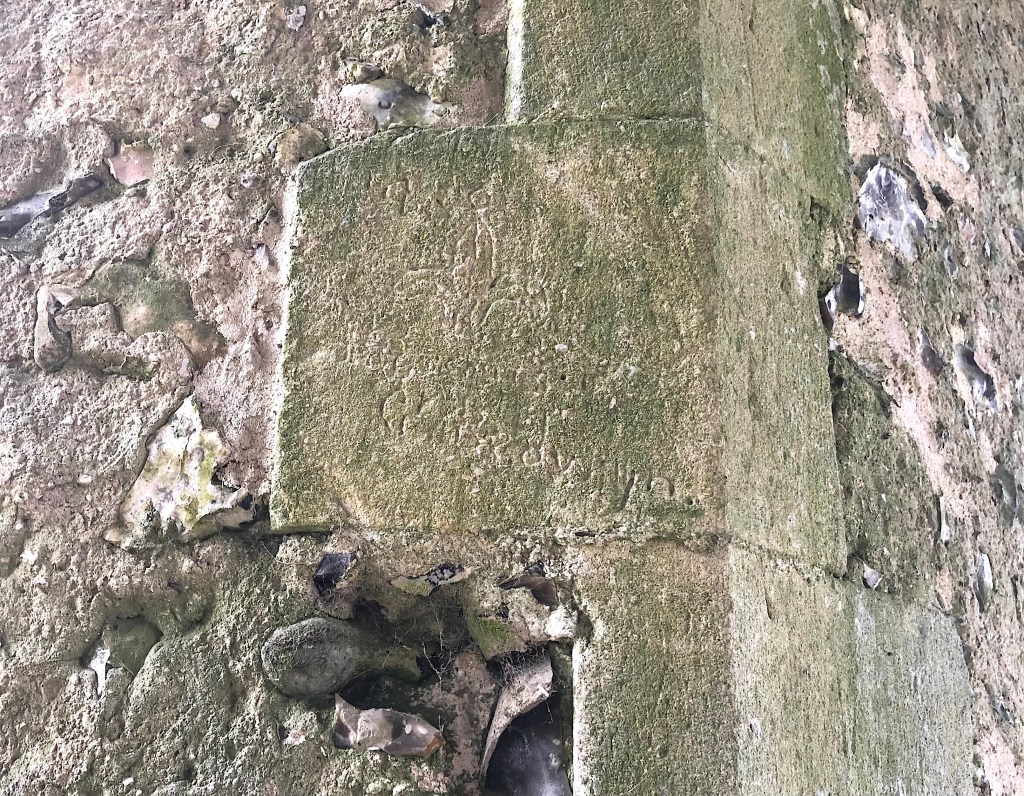
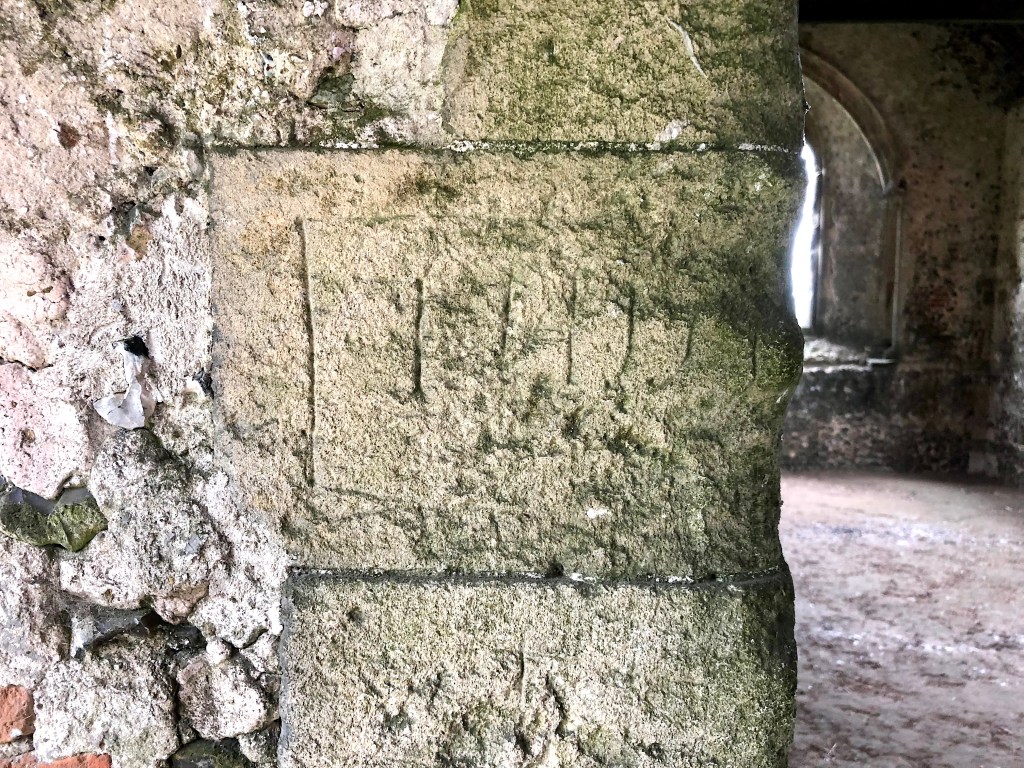
GRAFFITI & MARIAN MARKS (VV)
There was no scratch dial and I wasn’t expecting to find one. However the chapel is interesting enough to merit inclusion, not least because consercation crosses and church marks generally are catered for in this project.
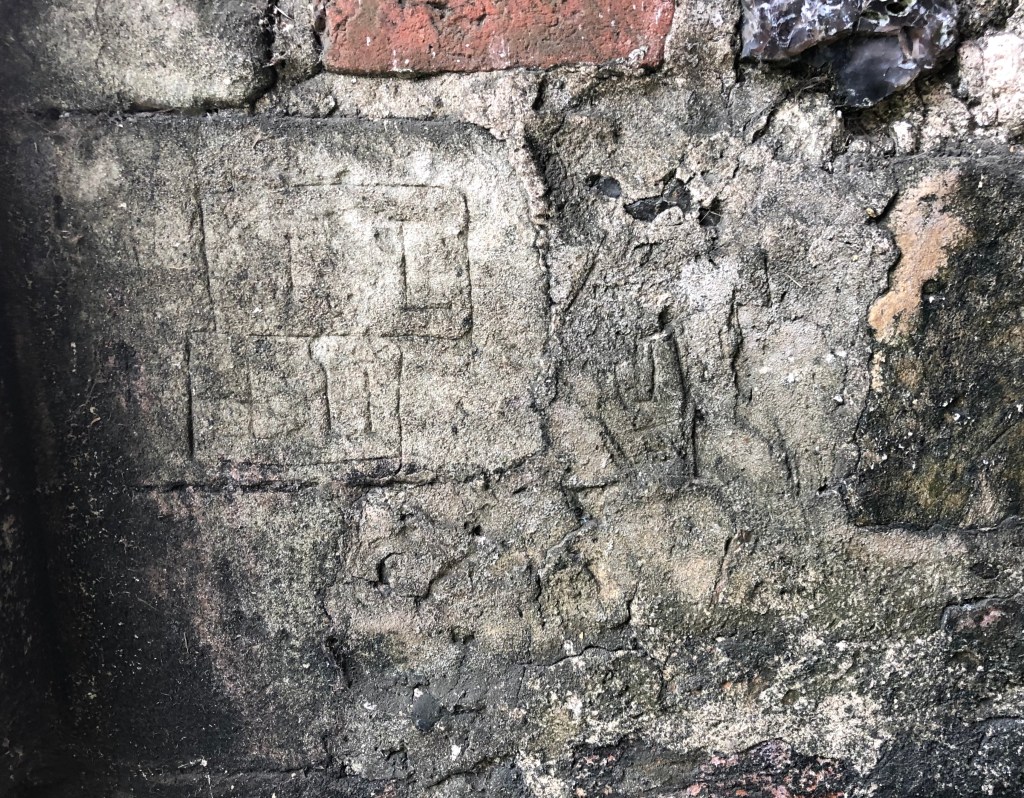
1. shows a (possible? probable?) Fleur de Lys with G Bedwyn scrawled below – 2. is one form of protection mark – 3. enclosed initials – 4. Marian mark VV – 5. ‘scratchings’ – 6. Marian mark VV and a design with a heart that I initially thought must make it recent… However the form of the W (similar to a Marian mark) is from a much earlier time, as is the date (if it is one) in Roman numerals. I can’t decipher it beyond ..15
GSS Category: Consecration Cross; Church Marks; Marian Symbol; Medieval Graffiti
GRADE II* Late C12, porched c1291; C15 alterations, C19 restoration. Attractively simple with its welcoming footpath, porch, and modest bell turret. Adjacent to S St Mary and 4m E of Ilminster. 50.931 / -2.8407 / ST410149
DIALS
BLB notes that the centre bay on south side has a blocked chamfered pointed-arched doorway, with diamond-leaded window inserted with cill just below springing. The dials are one above the other on W side of the doorway. Strangely, although DEH on his visit in 1915 records one dial in precisely this location, he doesn’t mention the second.
DEH noted that the buttresses either side of the recessed doorway inevitably block out the light for much of the day, as it had on the day he visited (possibly why he only found one dial?). He concluded that the buttresses were a later addition to the church (probably XVII Century), when the doorway was filled up.
DIAL 1
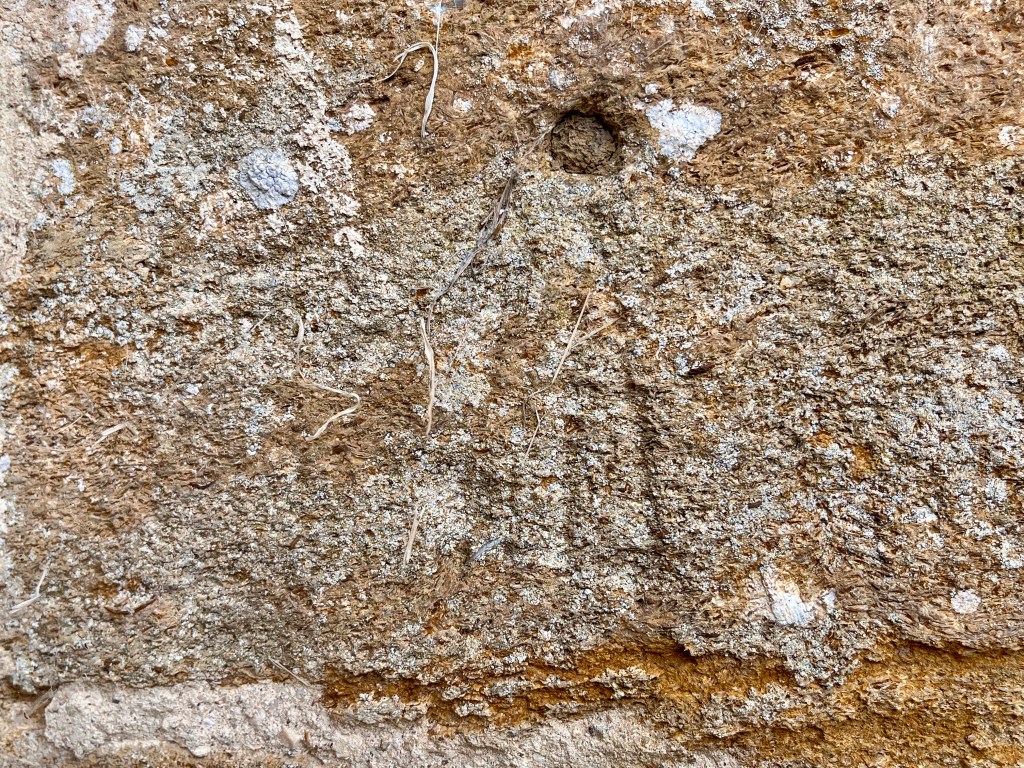
Seavington St Michael . Somerset – Scratch Dial 1
The uppermost, larger, less sophisticated, and the earliest of the 2 dials. 6, perhaps 7 lines. The ones either side of the noon line are slightly curved. Gnomon hole plugged though not with cement.
DIAL 2
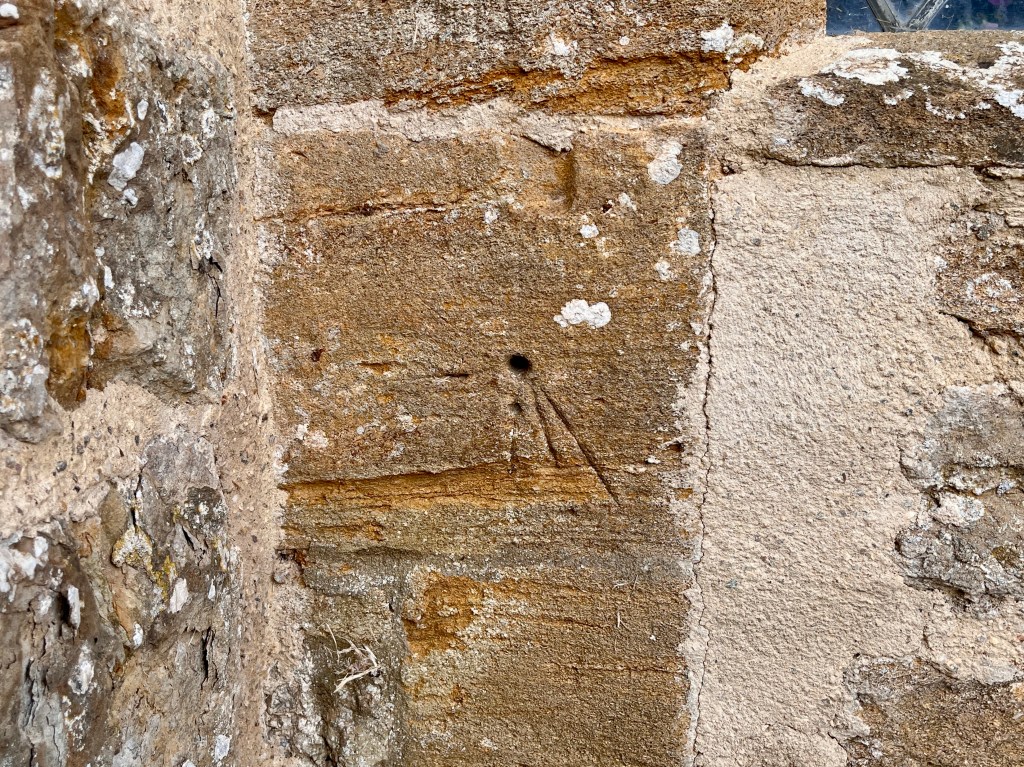
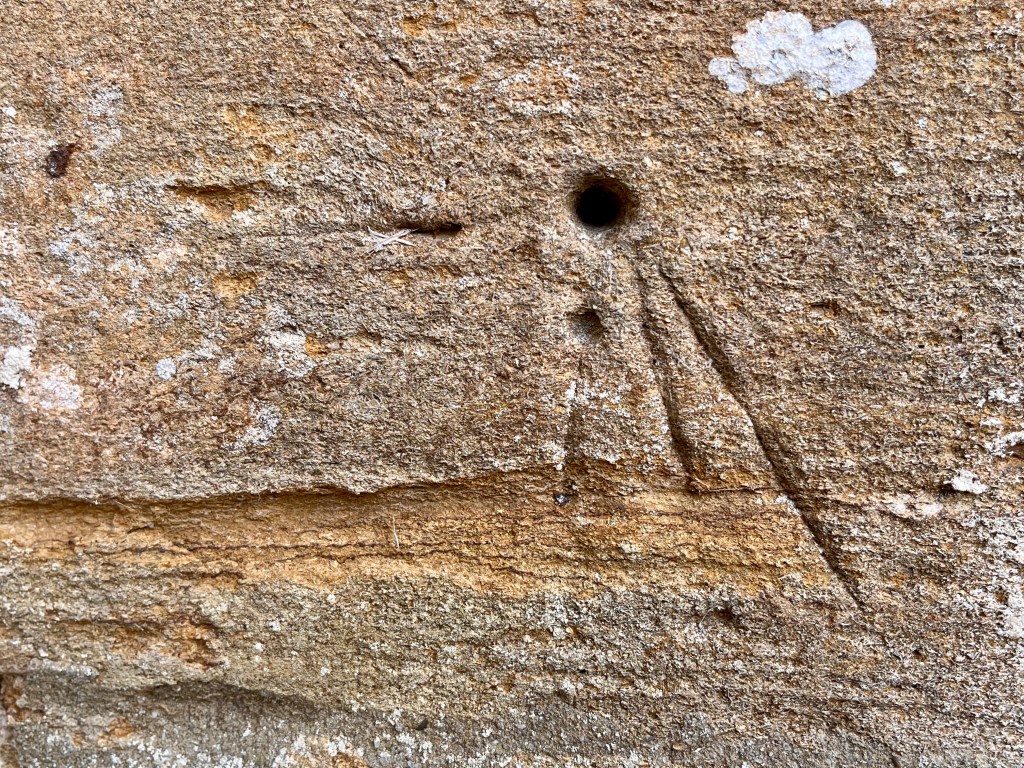
Seavington St Michael . Somerset – Scratch Dial 2
Beneath Dial 2 and far more visible. There are 6, perhaps 7 lines, of which the the afternoon lines are much the clearest. The noon line has an unusually prominent pock. The adjacent lines LRQ are even deeper cut. One is also elongated, probably indicating the most significant Mass of the day. One of the fainter lines LHS heads ineffectively above the horizontal. The gnomon hole is surprisingly deep.
MEDIEVAL GRAFFITI
The church porch has plenty of graffiti including initials, Marian marks, ritual protection (witch) marks, and pilgrim crosses
Seavington St Michael . Somerset – medieval graffiti
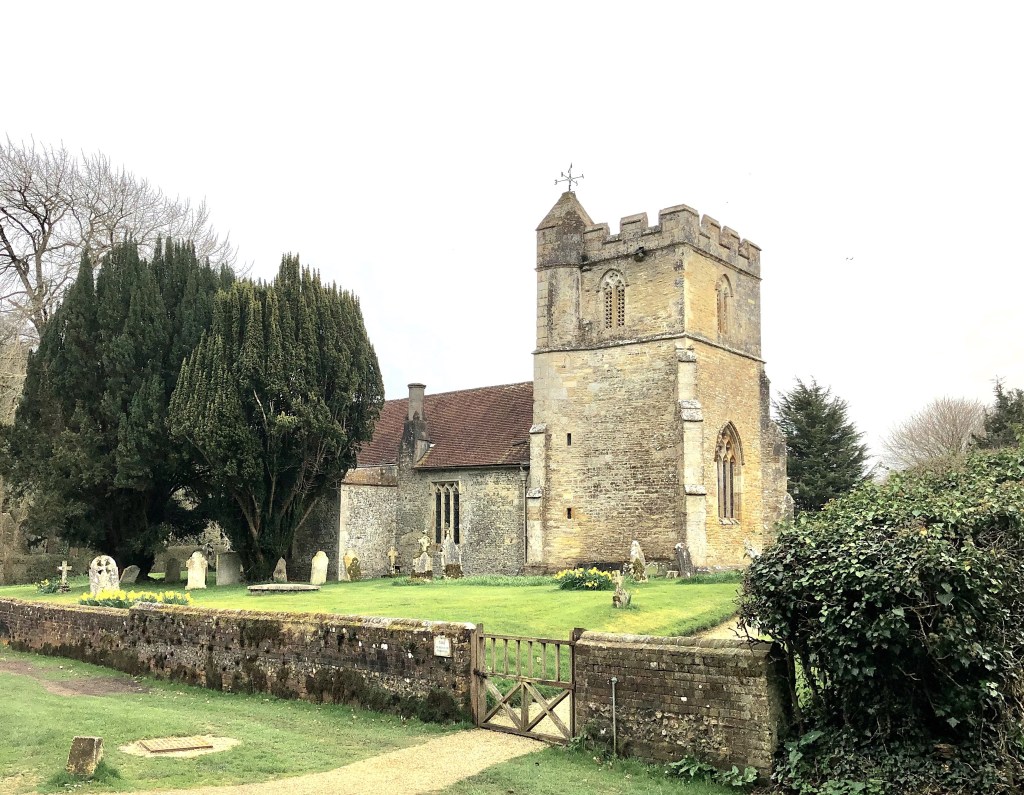
St Andrew . Melcombe Horsey . Dorset – north aspect
MELCOMBE HORSEY . DORSET . ST ANDREW
GRADE 1 † C14 origins, additional work C15, Chapels C16, partial C19 restoration. Adjacent to a fine manor house. The Parish confusingly includes Melcombe Bingham, Bingham’s Melcombe and Higher Melcombe, all in a secluded area steeped in medieval history. To explore further, BHO. 50.8178 / -2.324 / ST772020
DIAL
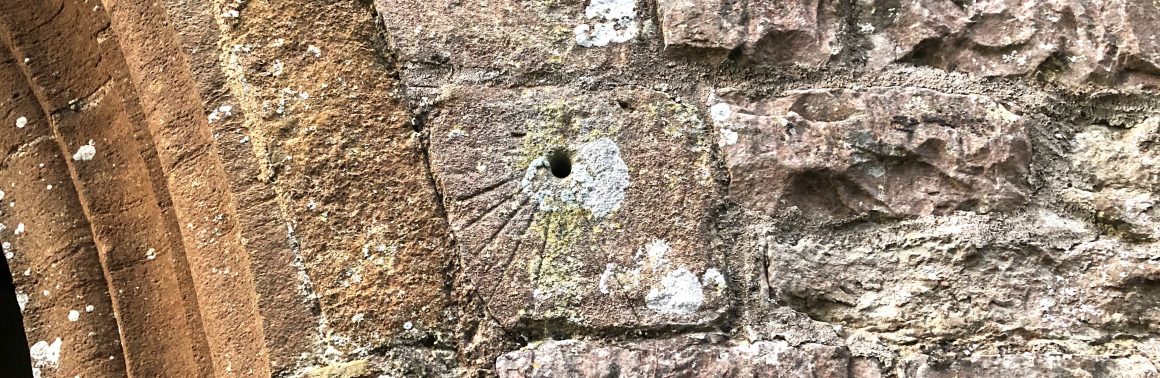
The church stands in the parkland of Bingham’s Melcombe House, a pleasant walk down a long drive. A single dial is recorded, located on a quoin stone of S.E. buttress of C16 Horsey Chapel. There are other church marks of interest (see below).
St Andrew . Melcombe Horsey . Dorset – scratch dial
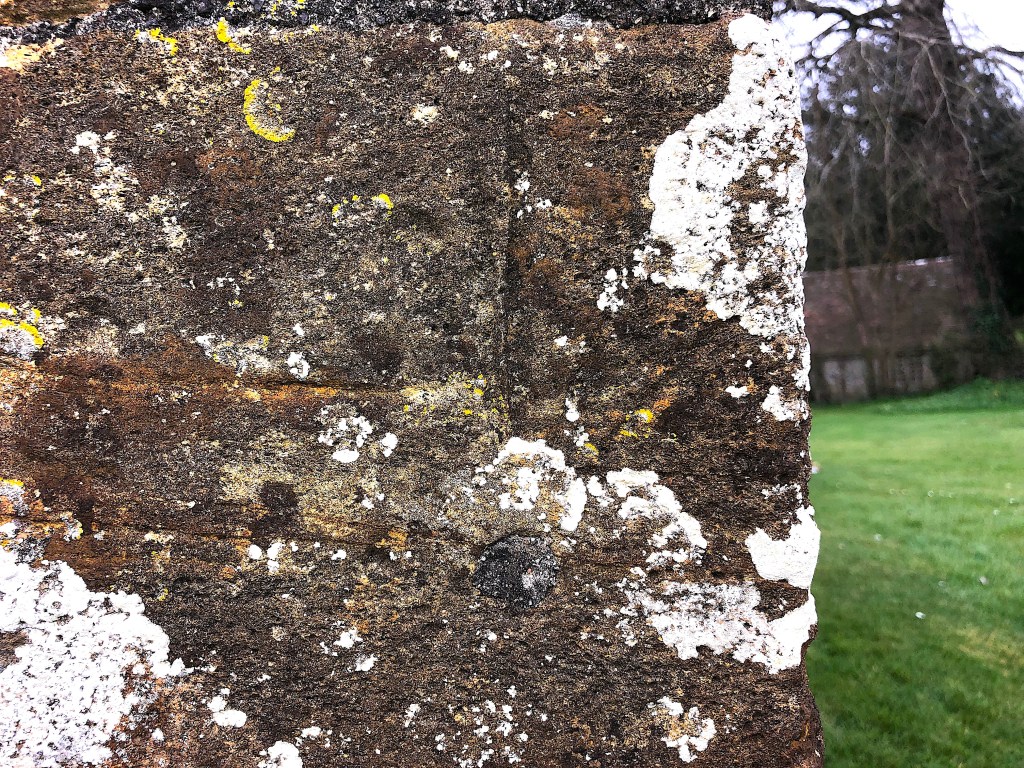
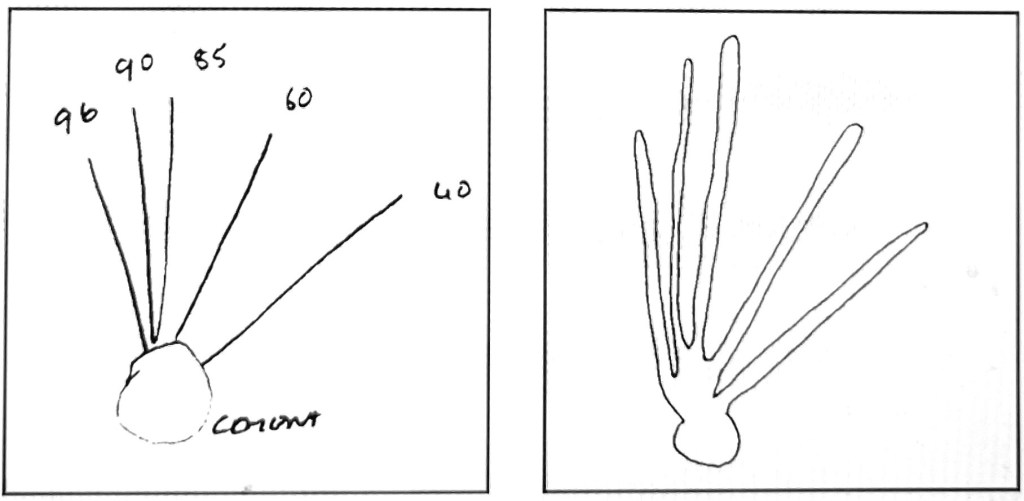
The dial is inverted, with 5 radials pointing upwards from a large cement-filled style hole. There are good reasons to suppose the dial was repositioned: it predates the building of the chapel, and so is cut on a reused stone; it is inverted (as often the case with relocated dials); and GLP points out that its angle would receive sunlight for half the day at most.
St Andrew . Melcombe Horsey . Dorset
St Andrew . Melcombe Horsey . Dorset – Scratch dial diagrams (BSS)
St Andrew . Melcombe Horsey . Dorset – south aspect
UNRECORDED DIALS?
There are 2 other configurations on earlier parts on S side of the church that give pause for thought. Both images below show patterns that are distinctly dial-ish.
The first is plausible in several respects: style hole just below the mortar line; 2 large pocks in the mortar line (the RHS one beyond the edge of an apparent circumference); the hint of a part-circle above the horizontal; a distinct curve of pocks in lower L quadrant; eroded and less organised pocks lower R.
Note: looking at this configuration some time later and having seen a great many more dials in the interim, I’d say this is definitely a dial; and the other is a ‘not-a-dial’
St Andrew . Melcombe Horsey . Dorset
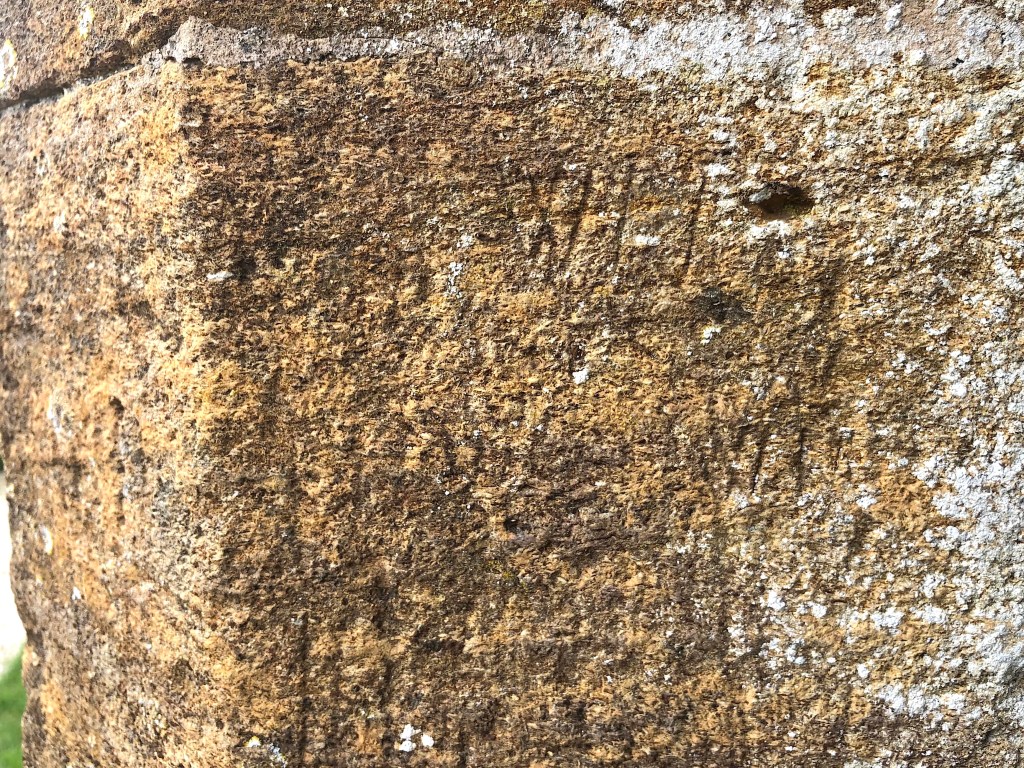
The second candidate is less clear. It is at an angle L of the S doorway – a conventional place for a dial. The case for it is weaker and unfortunately it looks less dial-like in the photograph than at the time. Doubtful rather than plausible.
St Andrew . Melcombe Horsey . Dorset – scratch dial?
St Andrew has plenty of further interest in the broader category of church marks. The porch is very rewarding. I usually post about such marks separately but the ones below deserve a place here.
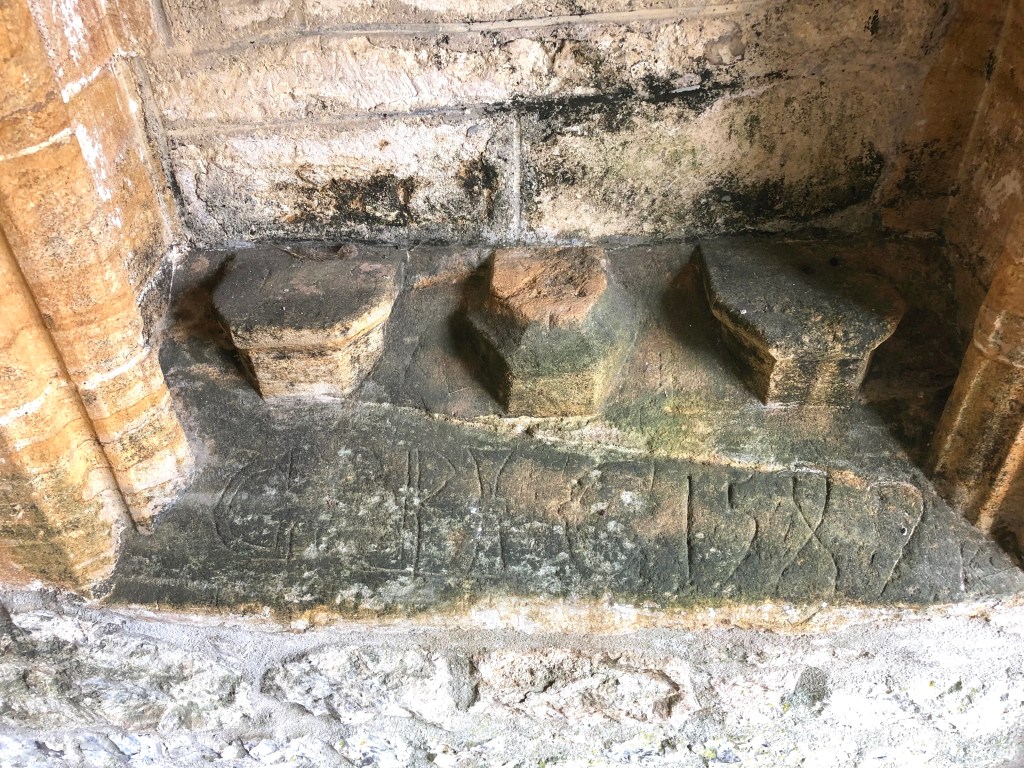
The top row shows Marian V V marks (Virgin of Virgins), one type of so-called ritual protection mark (or apotropaic symbols) designed to ward off evil. There are plenty of less commonly found marks. The main photograph shows mediaeval porch seats with a magnificent inscription (G – PIC?) dated 1589.
St Andrew . Melcombe Horsey . Dorset – Marian marks, protection marks, graffiti, dates
GSS Category: Scratch Dials; Apotropaic Marks, Marian Marks, Church Graffiti














 GAUDIUM SUB SOLE . SUNDIALS . MEDIEVAL TO MODERN