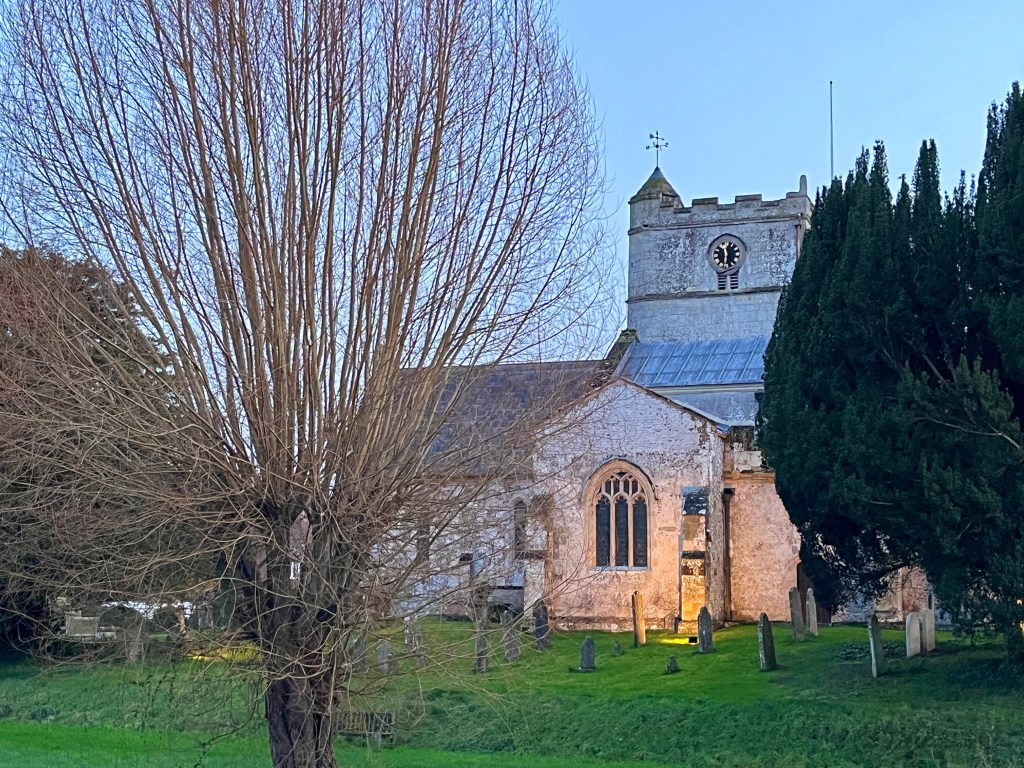
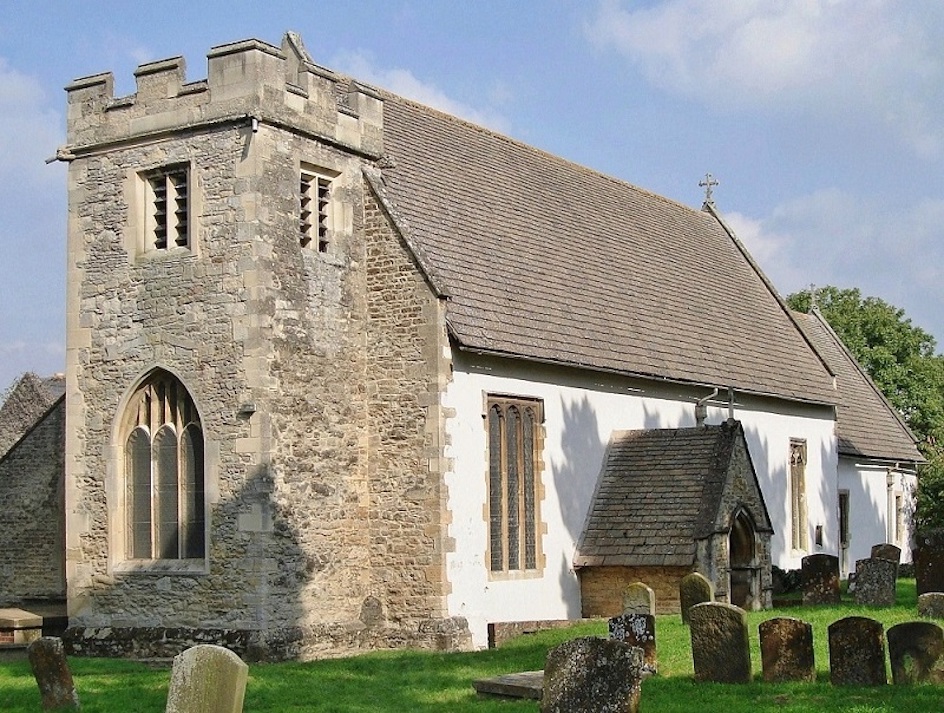
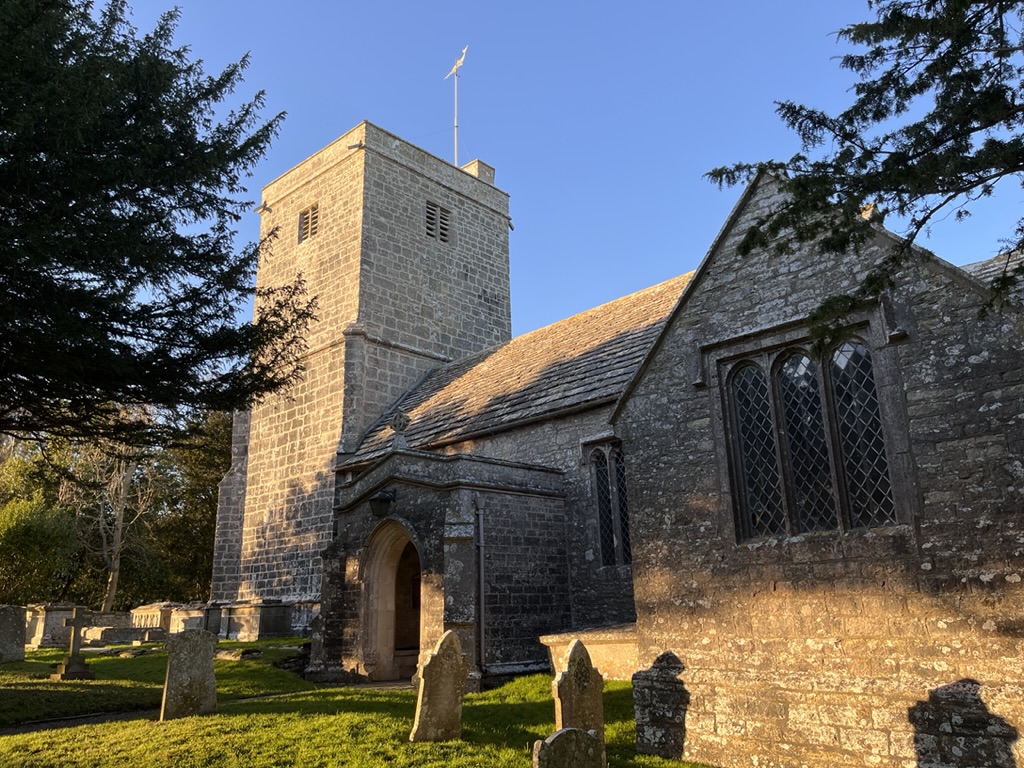
GRADE 1 † C12 south aisle, 2 Norman arches; C13 chancel; C14 tower; C15 nave & north transept. Restoration 1845 by T. H. Wyatt. Early (C12?) font carved from a single piece of Jurassic limestone. One of several fine Chalke Valley churches situated south of the A30 between Shaftesbury and Salisbury. It’s an attractive long cut between the two. 51.0361 / -1.8473 / SU108263
DIALS
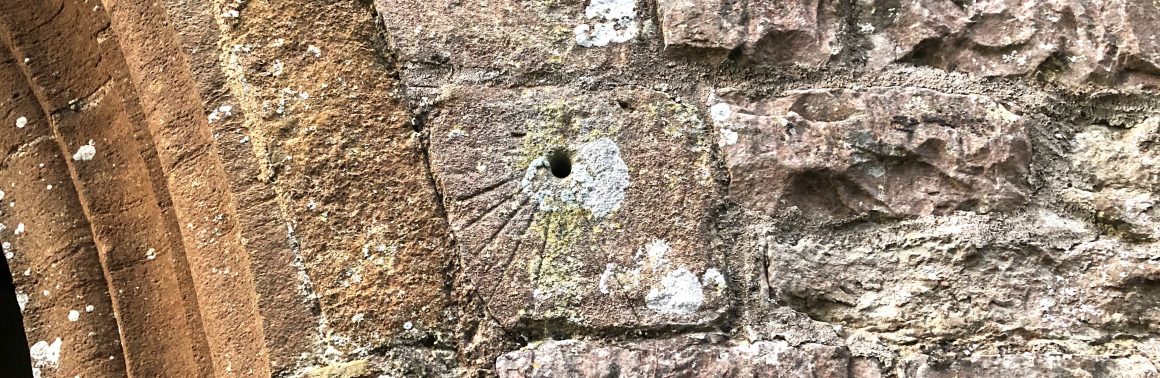
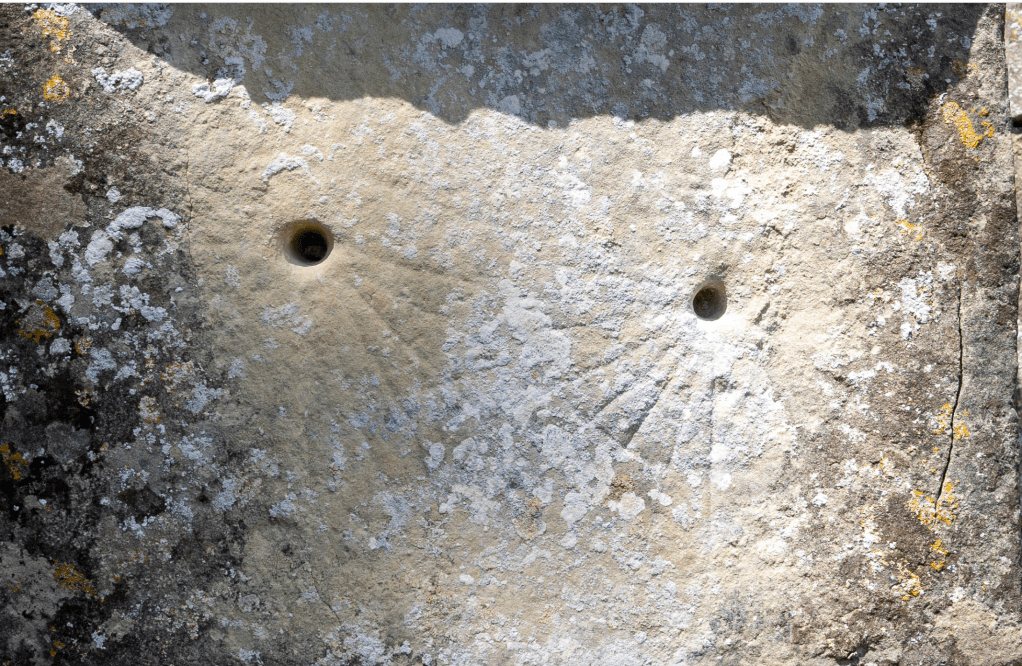
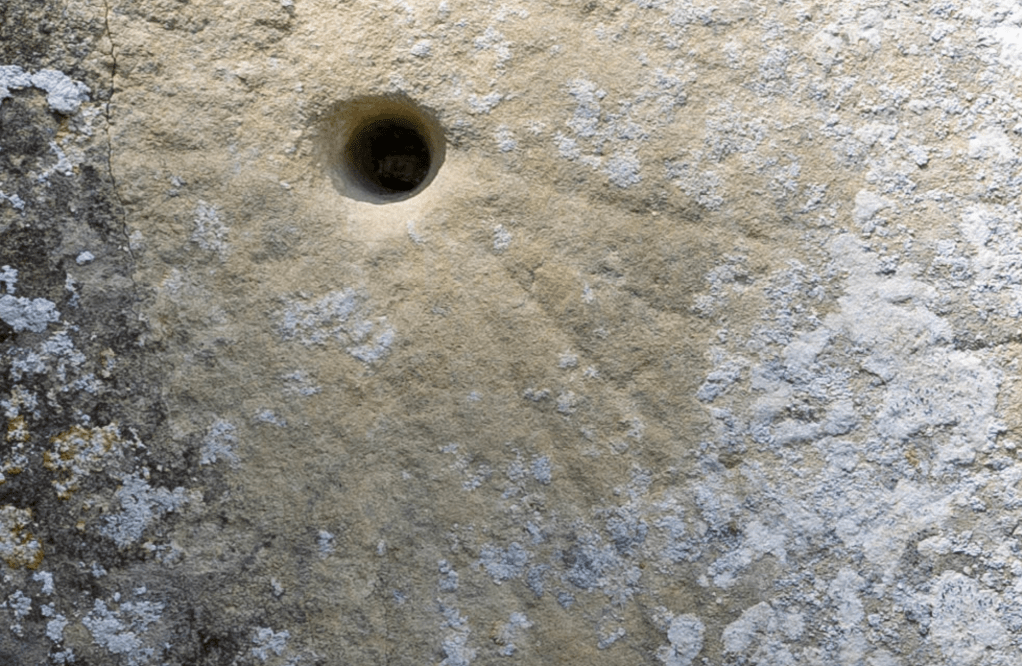
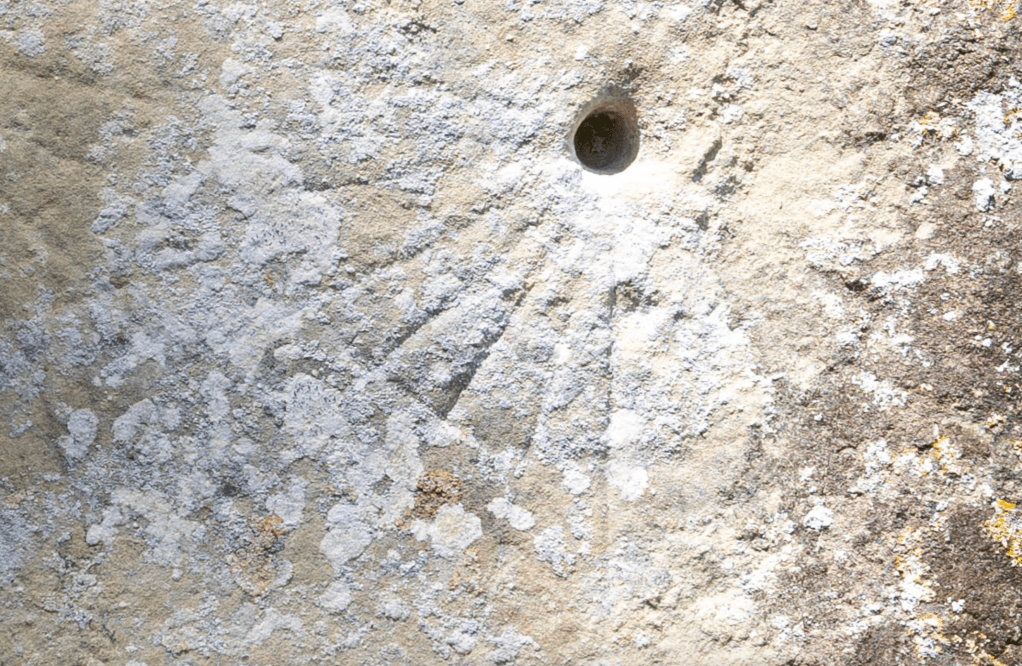
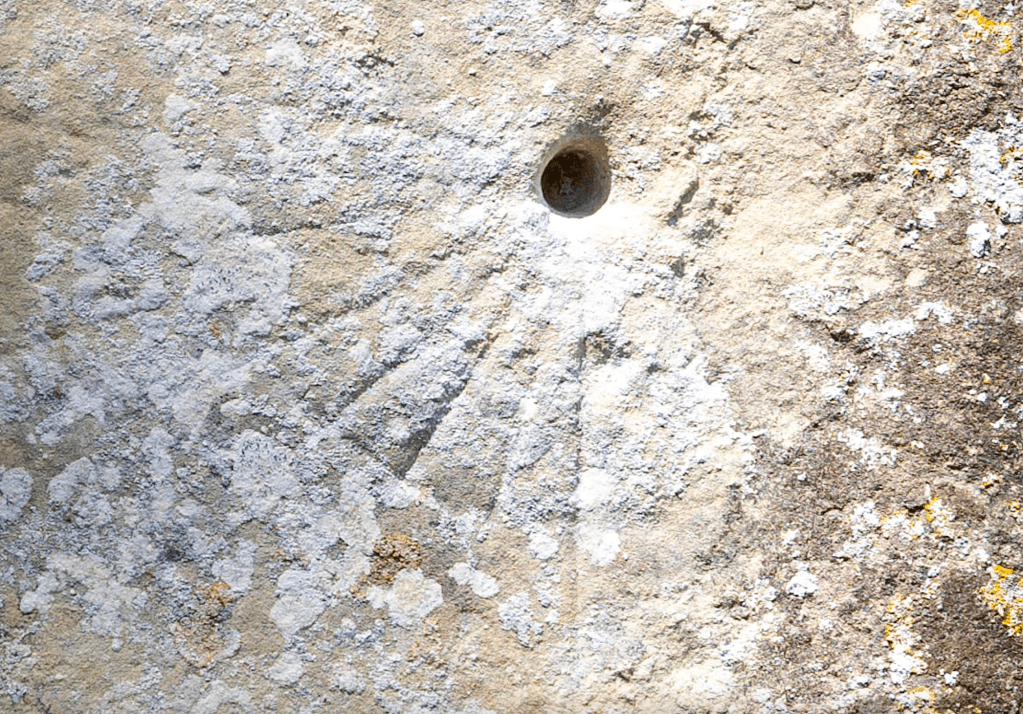
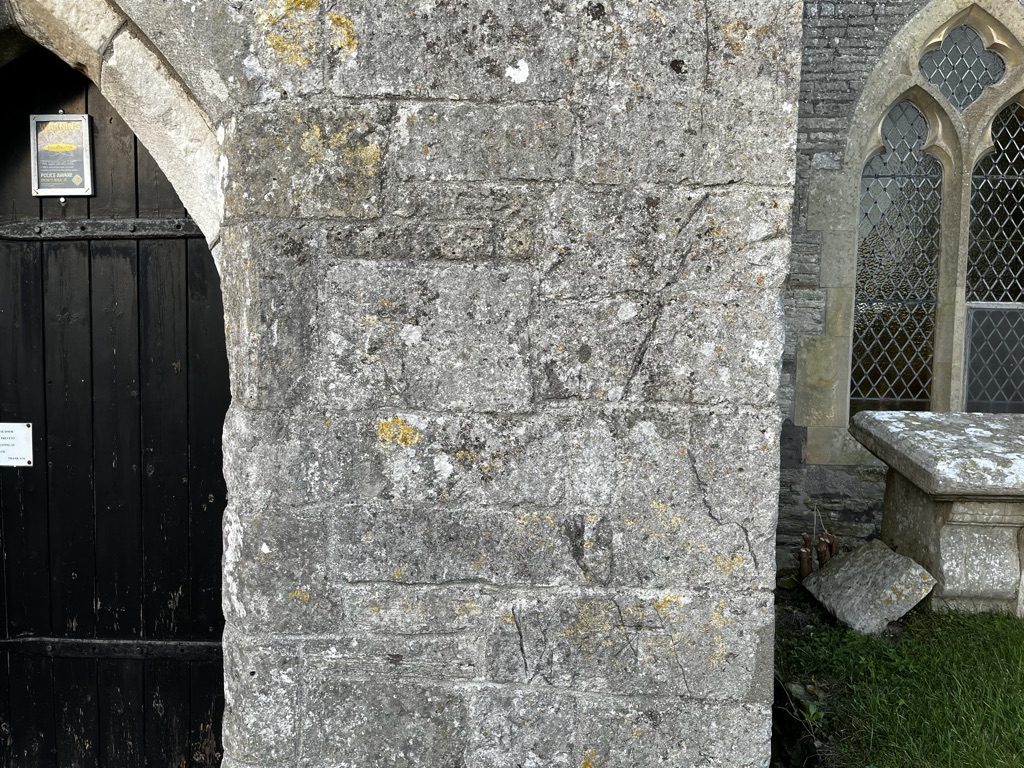
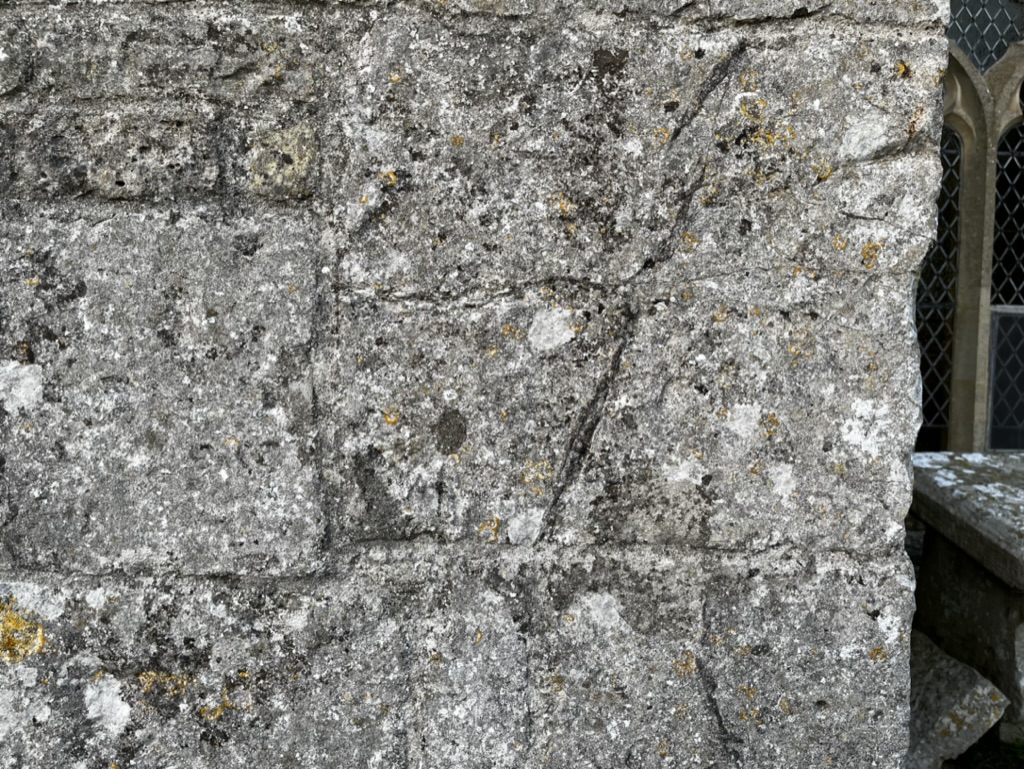
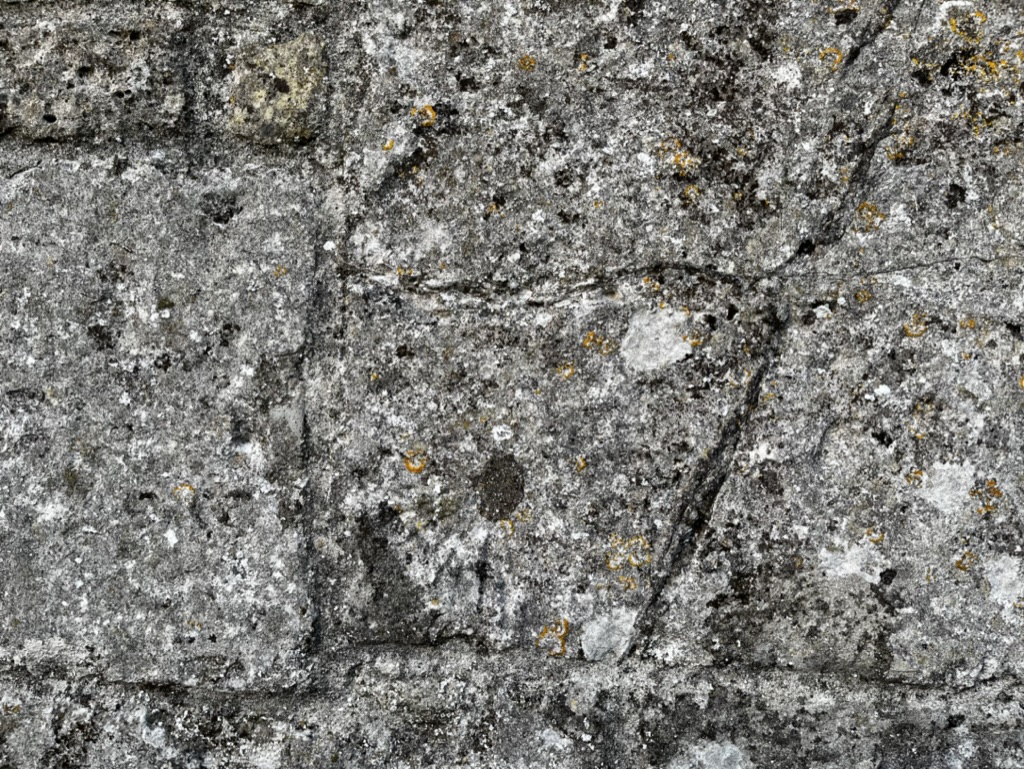
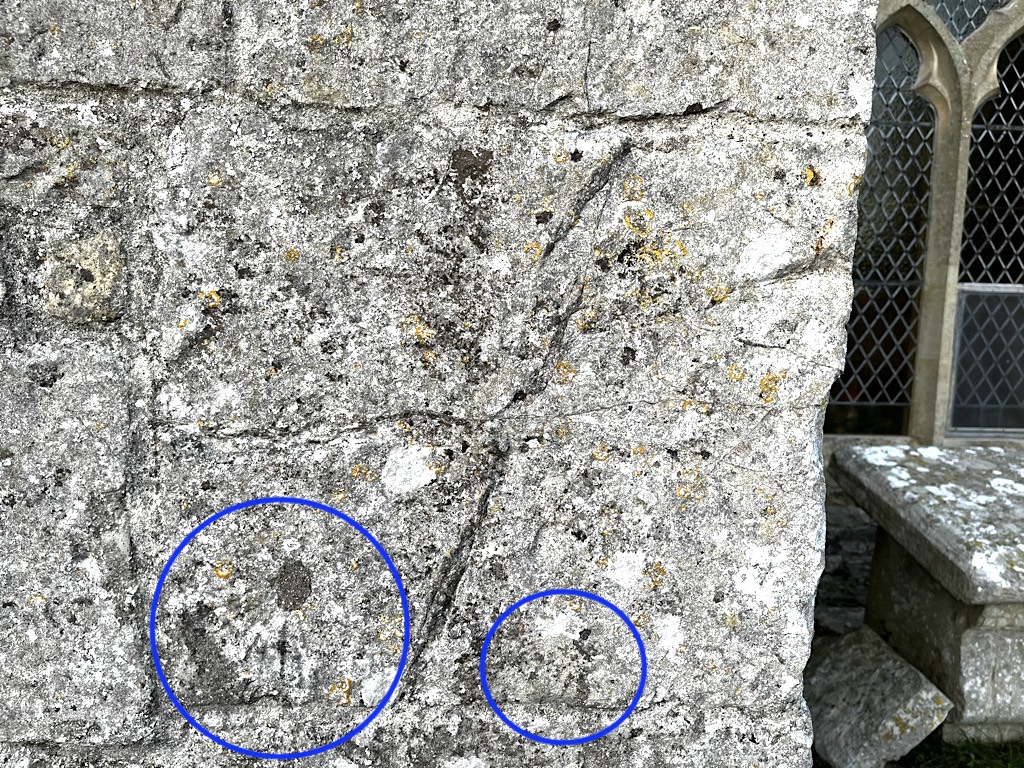
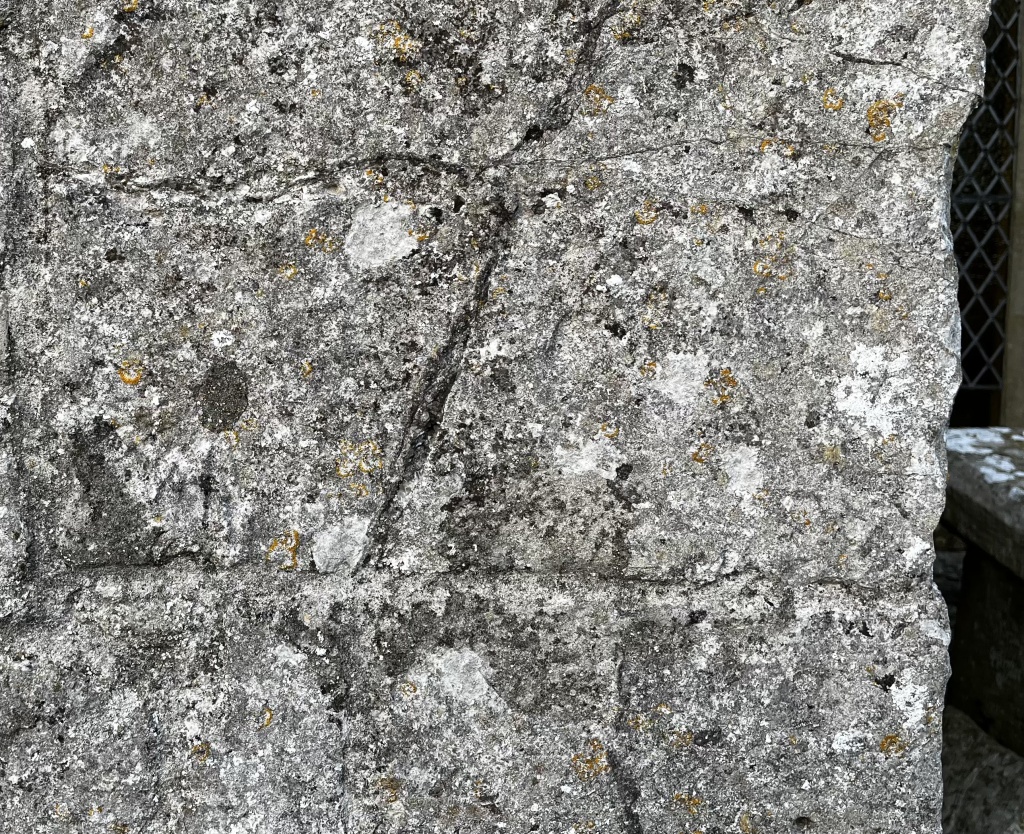
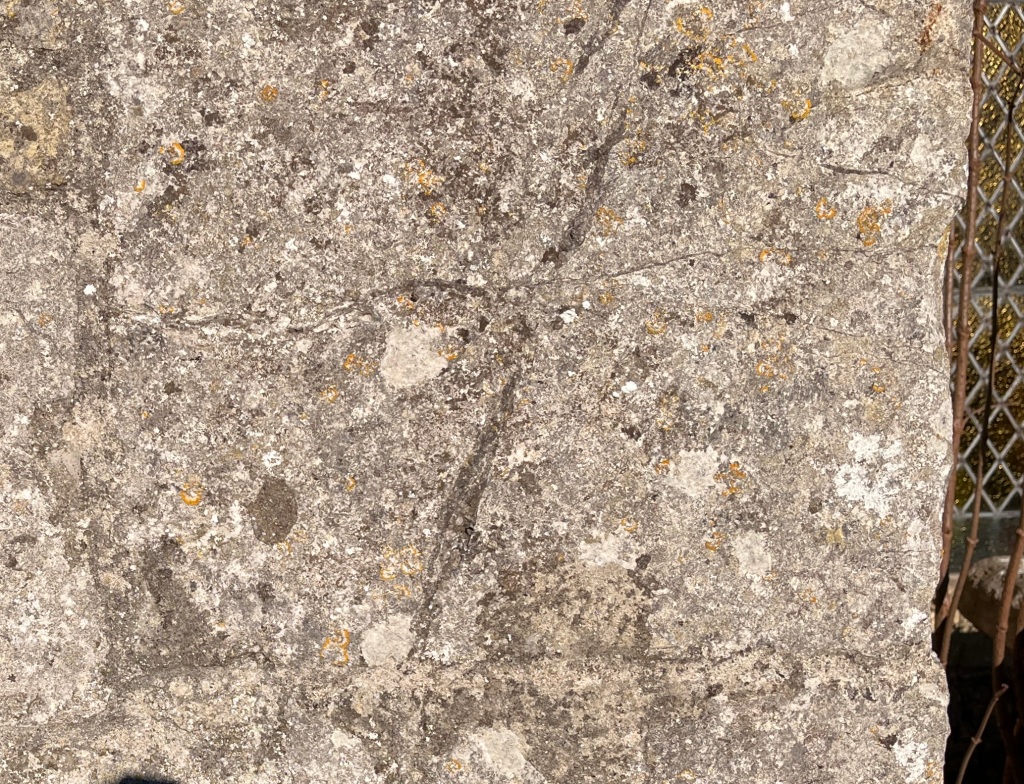
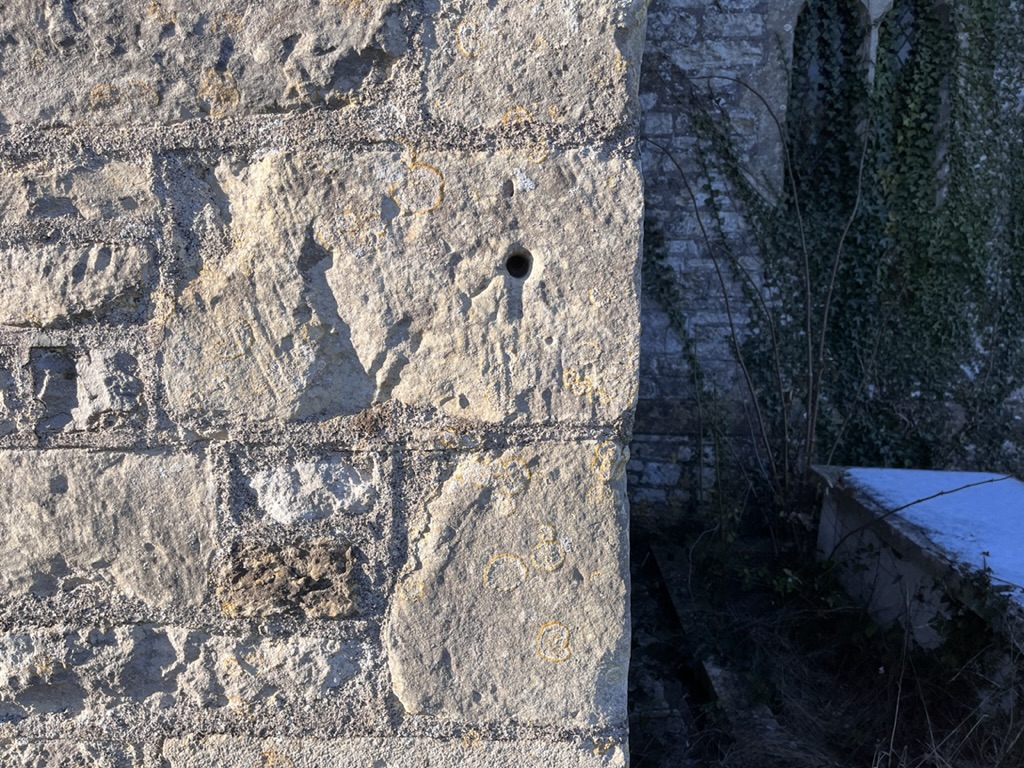
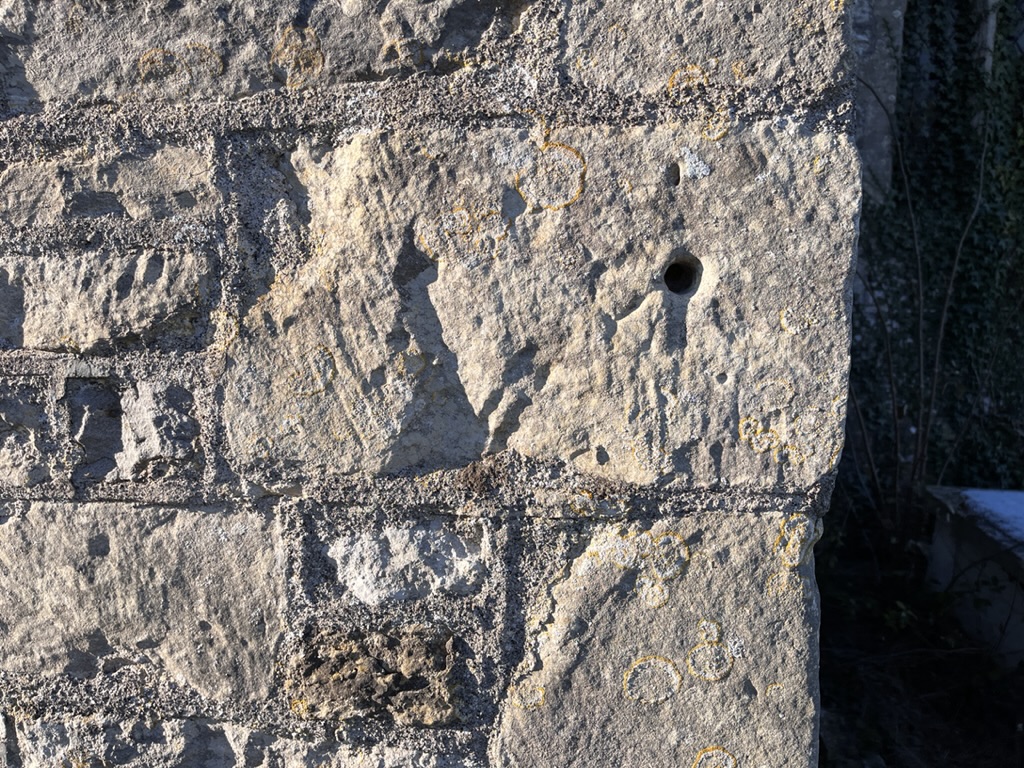
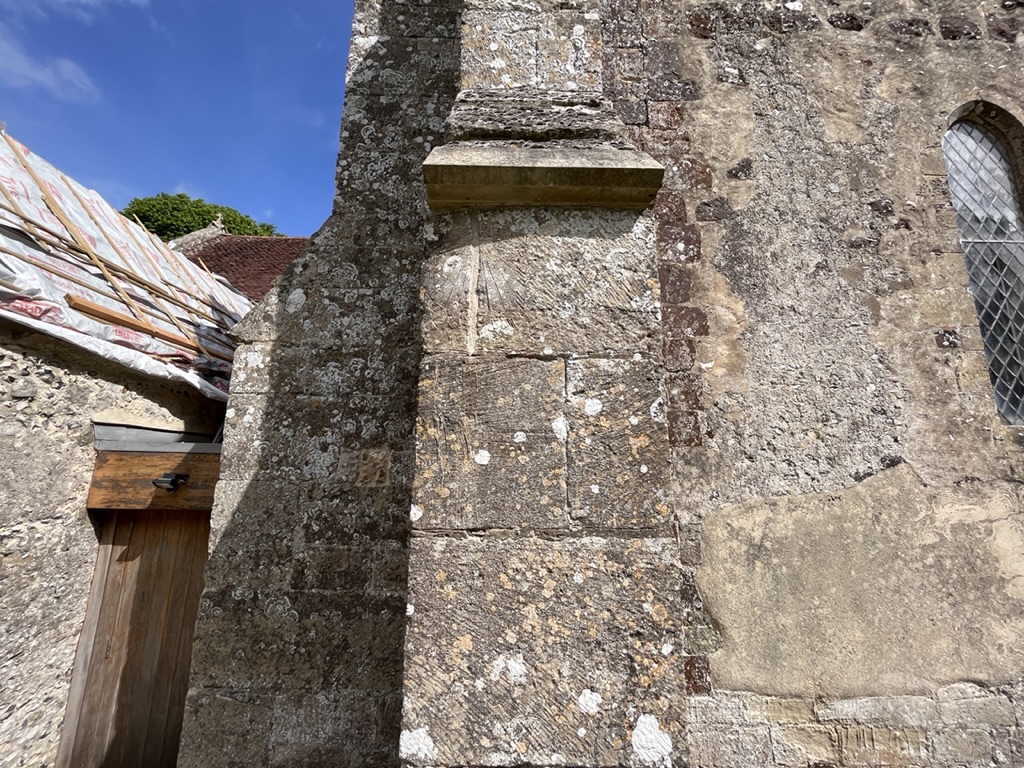
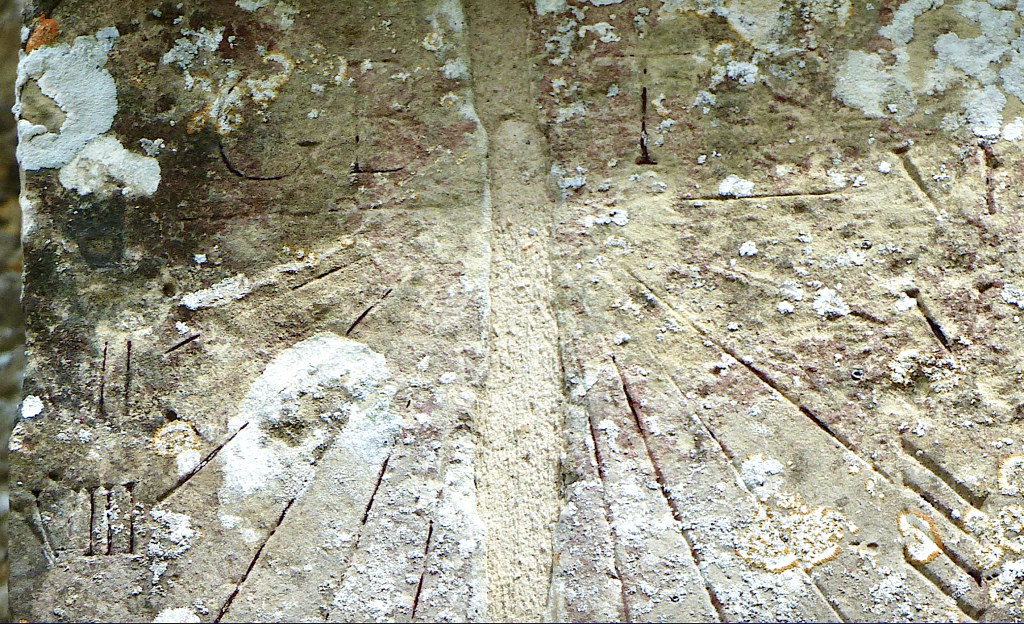
On the S-facing central buttress of the tower there are two adjacent scratch dials on the same stone that merge. It isn’t immediately clear (to me) which came first. Whichever, presumably the time came as the church developed when more accuracy in marking the day’s passage was required.
BSS references a 3rd dial on S wall. Other records mention two scratch dials and one sundial on south side. See below for an attempt to ID the sundial.
DIALS 1 (L) & 2 (R)
Coombe Bissett . Wilts . St Michael – Scratch Dials
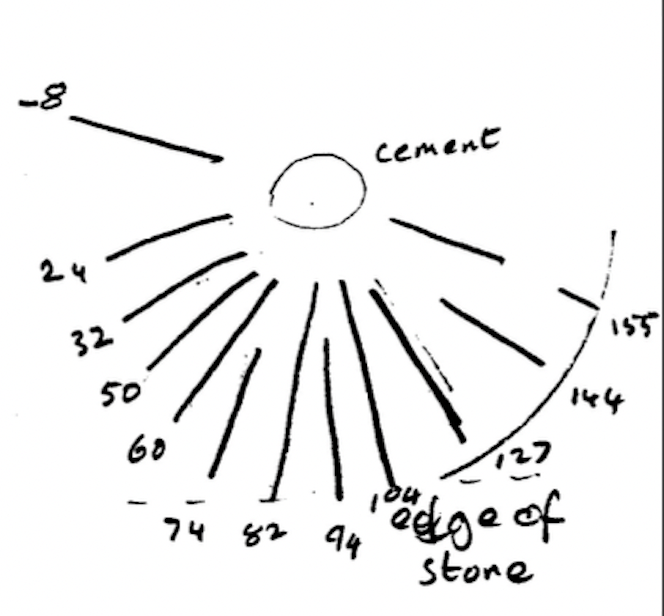
Dial 1 is recorded as: Irregular dial with 15° lines in both quadrants.
Dial 2 is noted as: Cannot be classified. Eroded, damaged. Mass or line deeply cut.
My visit was early evening, and the quality of the detail in my photos is unimpressive (see above). For example, there is only the hint of the part-circle of Dial 2. Fortunately, this is a church that another dial collector has visited and later he uploaded his photos to BHO / Disqus. Mark Wolstenholme’s excellent images give a much clearer and sharper view of the details of both dials and their intersection.
DIAL 3 (?)
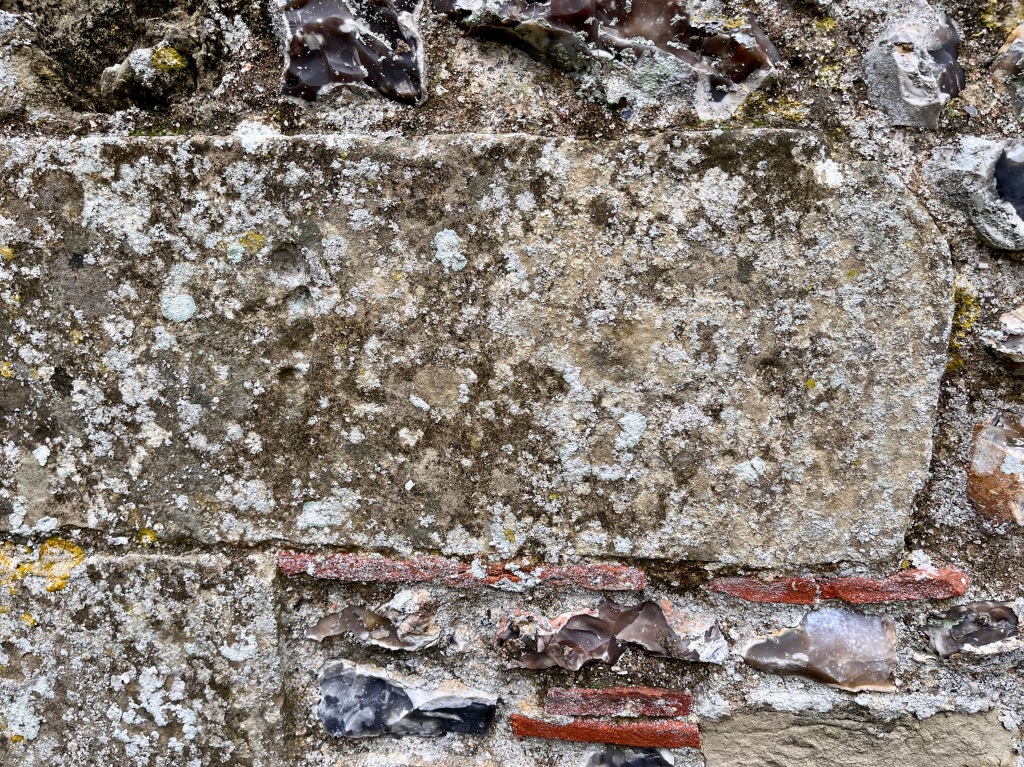
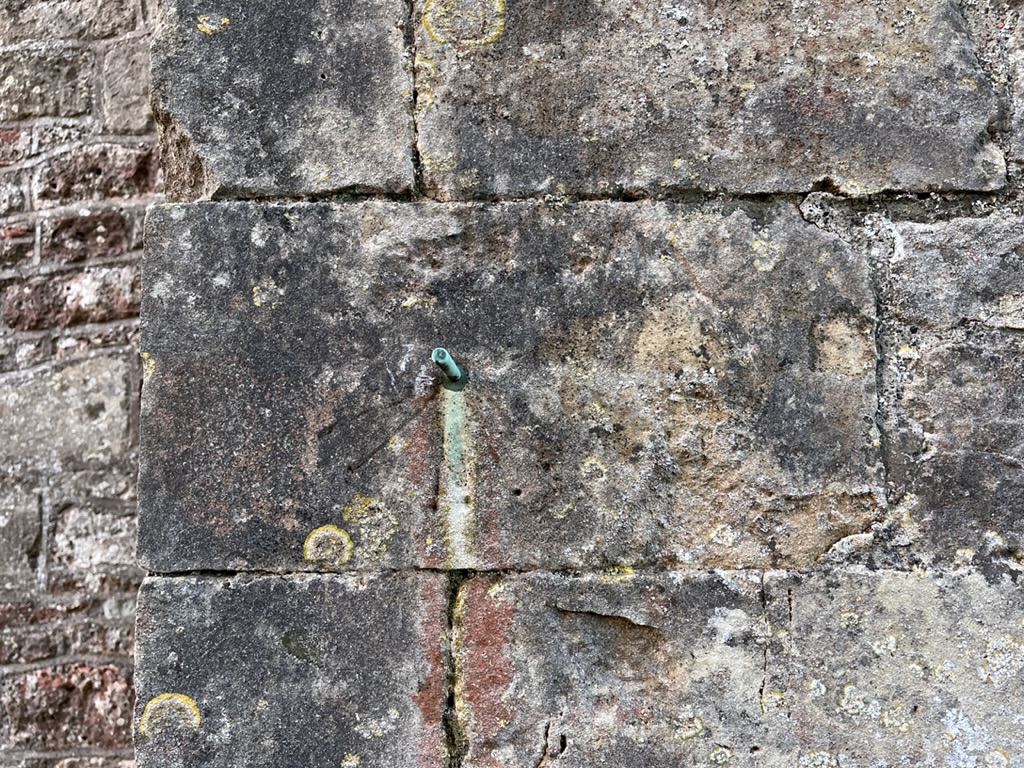
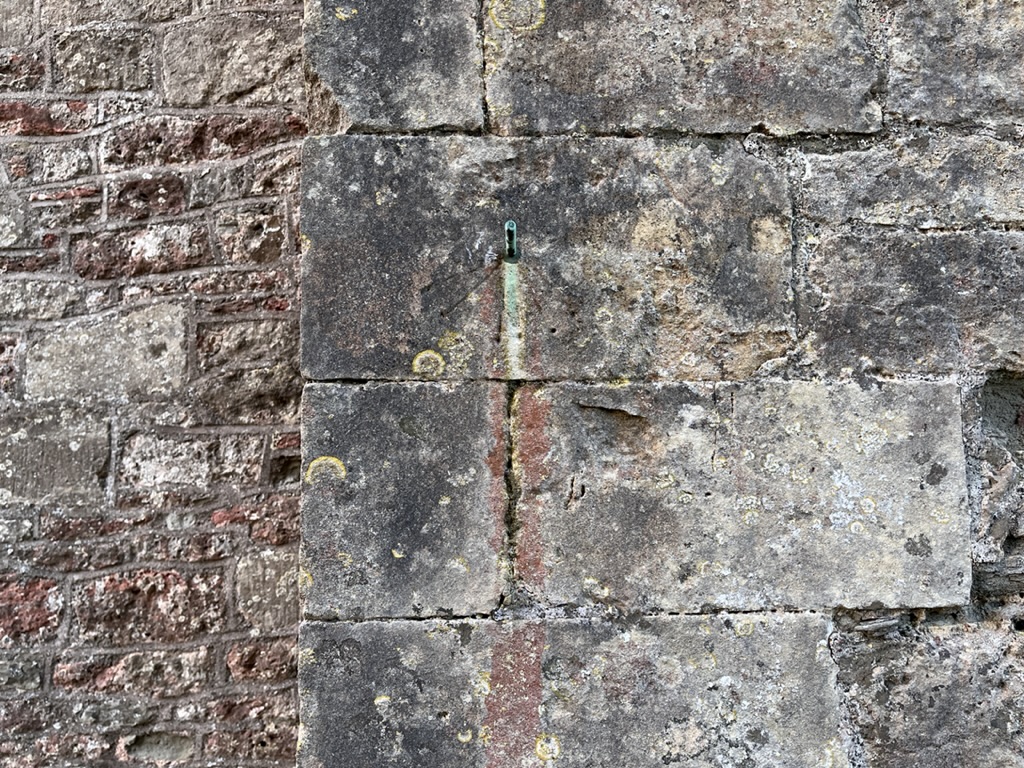
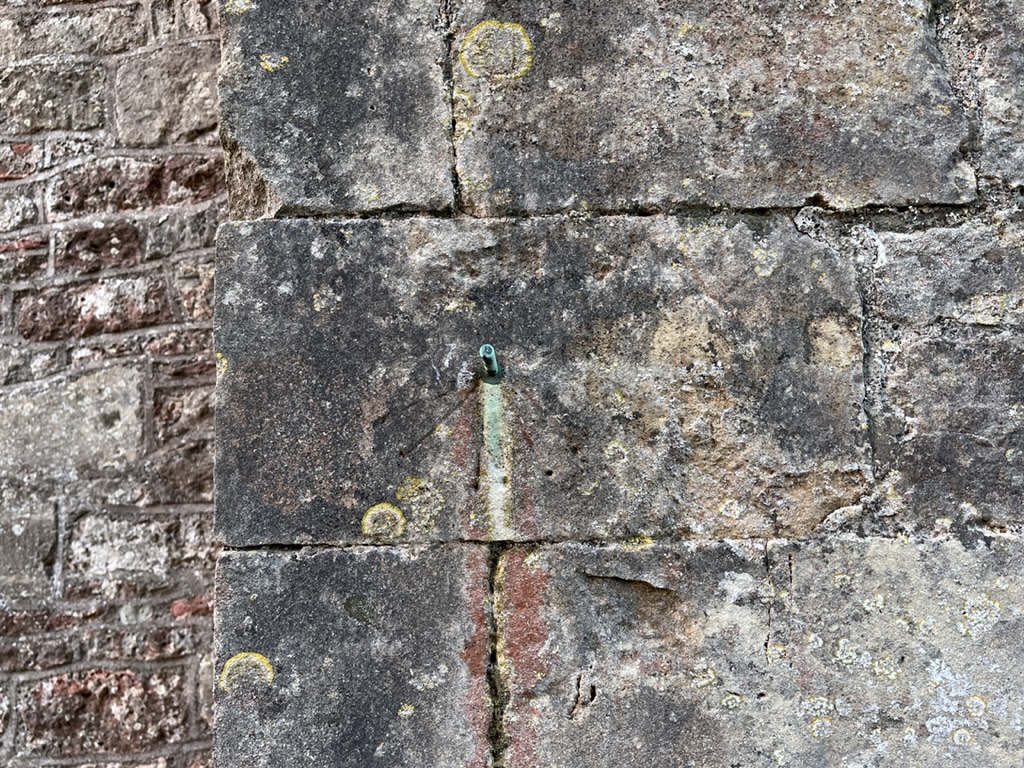
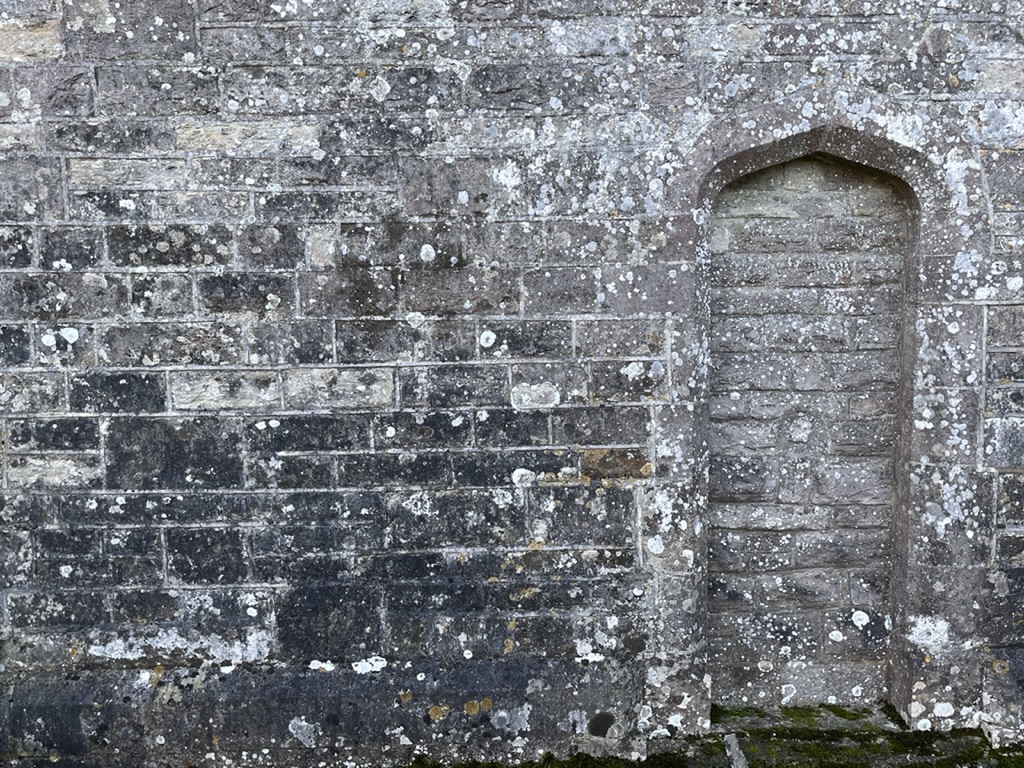
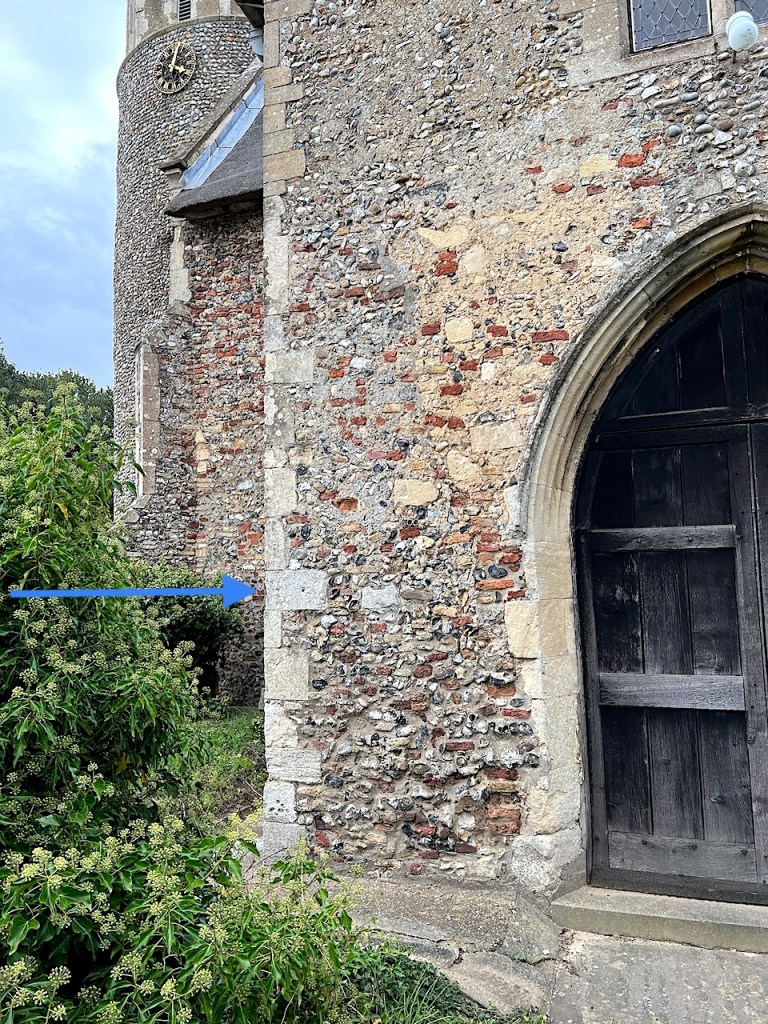
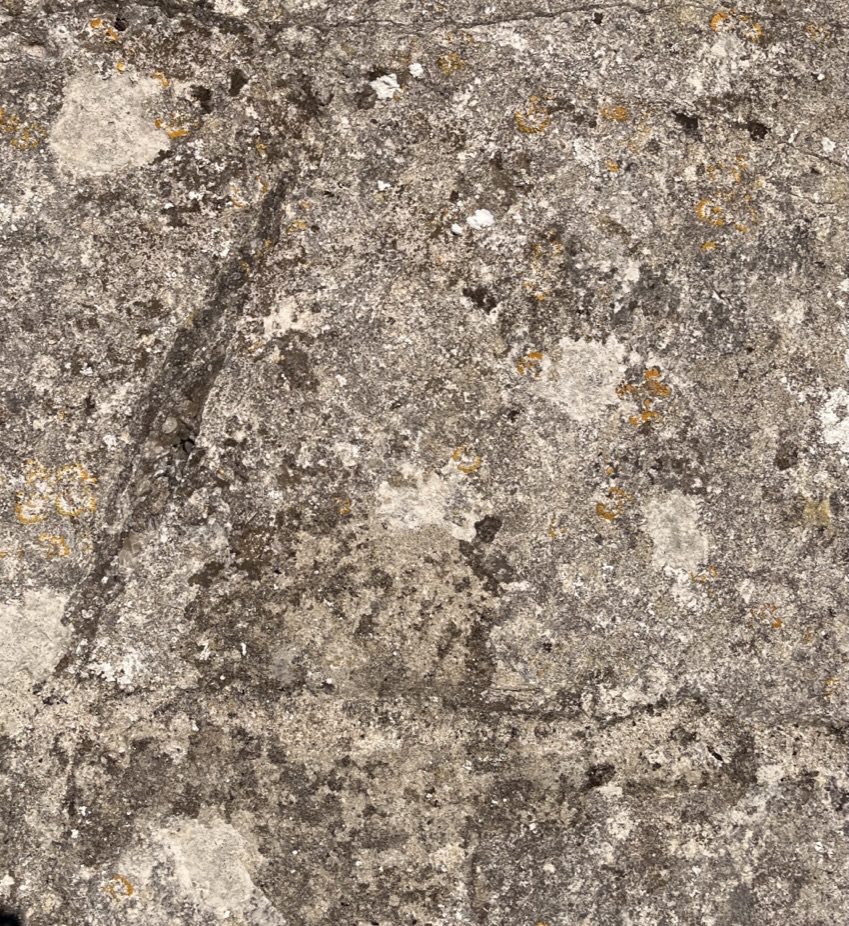
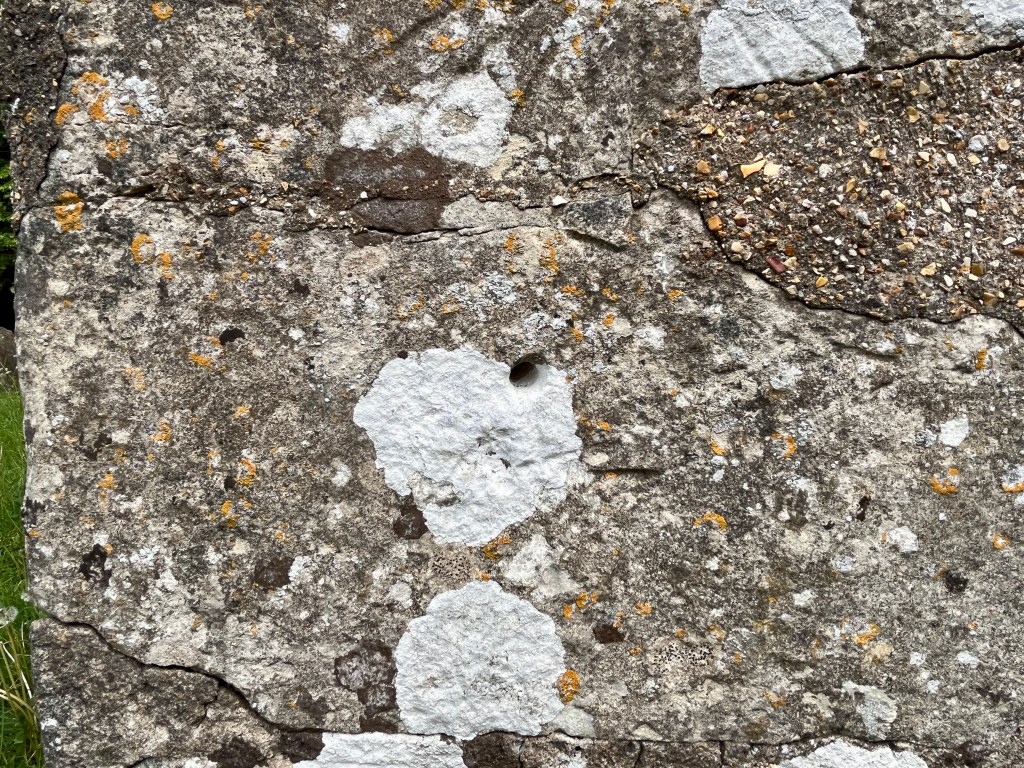
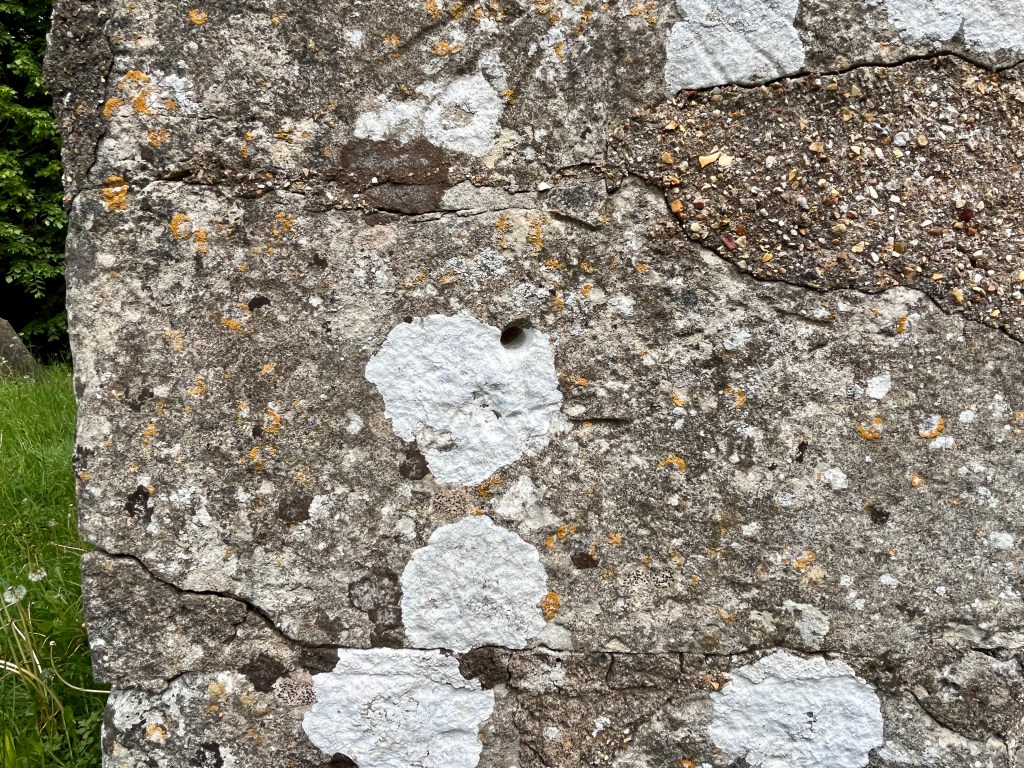
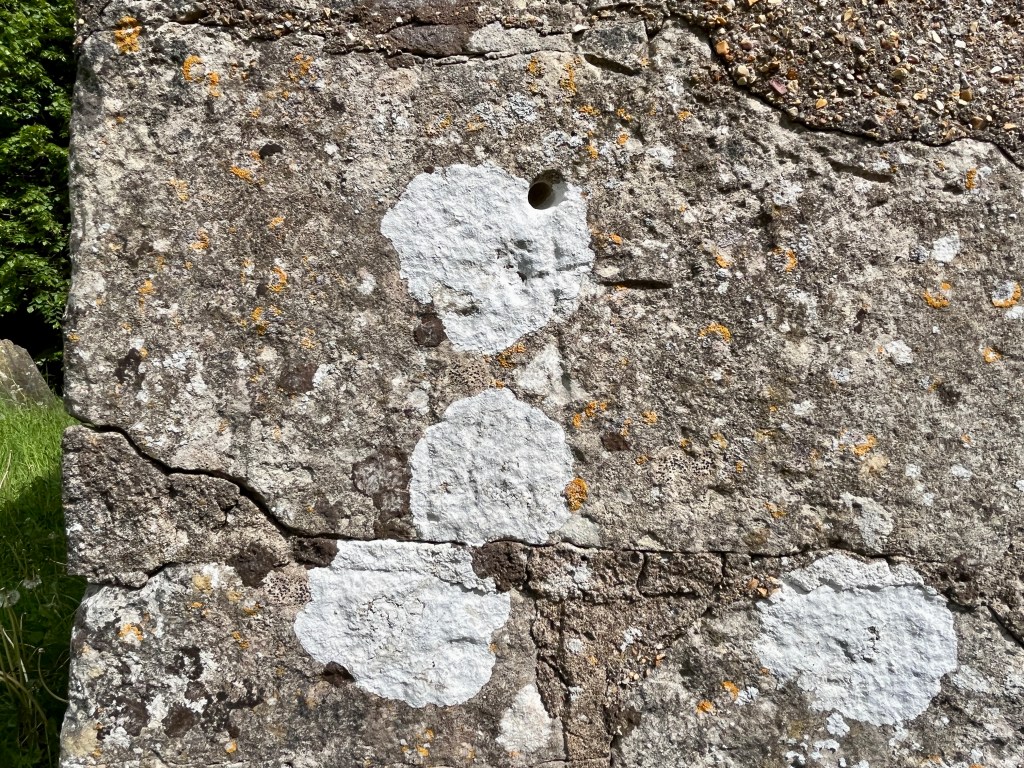
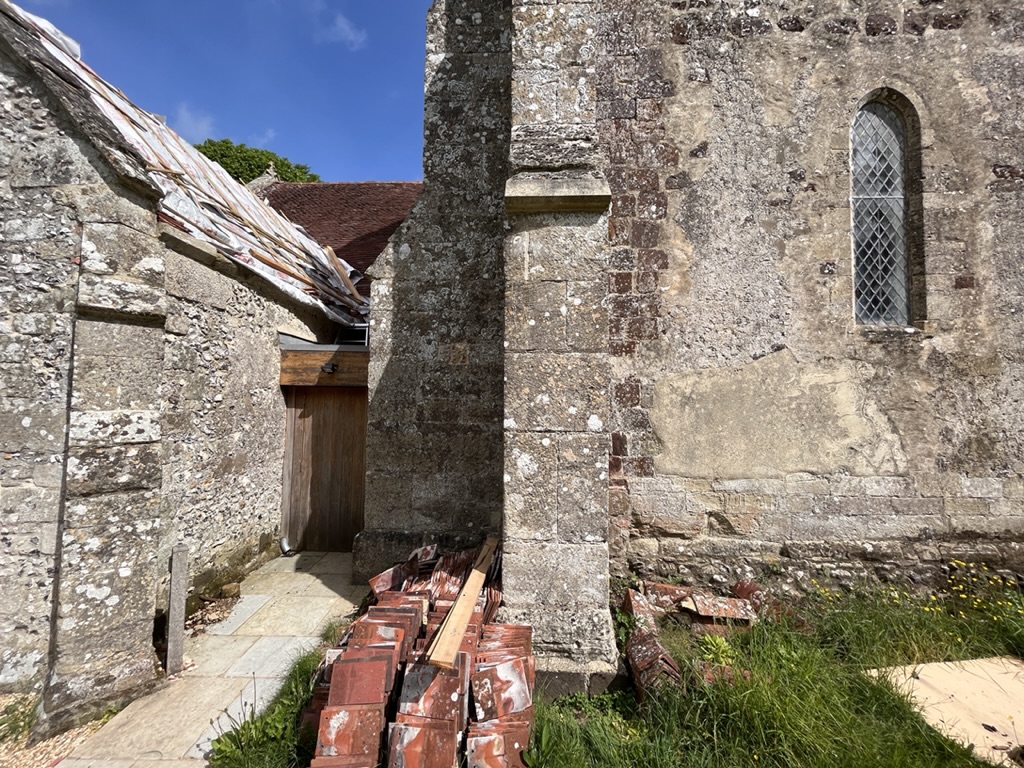
Another dial is recorded as being on the tower, S wall, a short distance W of the ‘dial buttress’ above. The description states Early Christian ‘Tombstone’ dial. Accurately cut or made. Modern replacement. I found this baffling, and the only conceivable candidate I could find in the area may or may not fit the bill. Somehow I doubt it. Suggestions of its purpose would be welcome…
Coombe Bissett . Wilts . St Michael
GSS Category: Scratch Dial; Mass Dial
Photos: Keith Salvesen; special thanks to Mark Wolstonholme who uploaded his detailed photos to the BHO site os and to Disqus os
GRADE I † C13, C14, C15, C18; C19 works & restorations. Cruciform, with a south aisle to the nave, south porch, and western tower. Single cell nave and chancel of c1220. Blocked north door in the nave. Unusual C19 2-stage tower is pleasingly incongruous. 6m W of Andover, just N of the dread A303. 51.2181 / -1.5988 / SU281466
DIALS
BSS records from 2013 are based on a survey in 1995 which mentioned 2 dials quite close to each other on SE angle of S transept. For both dials BSS notes: Known only from reference. No other details. No longer extant.
ARG made the original record on his visit in July 1925, noting one dial and a doubtful one, both on the SE angle of S transept. His descriptions are as follows:
DIAL 1. On the large quoin on SE angle of S transept... late C14. He described it as an imperfect dial, with some lines LLQ, 4 of which ended in pocks; and some pocks LRQ with 2 lines extending beyond them.
DIAL 2. Noted as close-by and slightly doubtful, with a very small style hole and perhaps 3 lines on the lower half.
I found nothing to match ARG’s descriptions but I did find a plausible and a doubtful dial in the same general area.
DIAL 1
St Peter and St Paul. Kimpton . Hants
This stone doesn’t match the others in the immediate vicinity, and gives the distinct impression that it has been relocated and probably resized to fit. I think it plausible to claim this as a crude and eroded dial with traces of stubby lines in the noon area. It looked quite convincing on the day. Possibly it was relocated to a more prominent position, whether as a working dial or perhaps as a decorative quirk.
DIALS 1 & 2 – LOCATION
St Peter and St Paul. Kimpton . Hants – Two adjacent scratch dials. Possibly.
DIAL 2
St Peter and St Paul. Kimpton . Hants
This design is on a long stone close to Dial 1. Image 1 shows the stone as it is, horizontal. The 4 graduated dents caught my eye, being clearly created for a reason. There’s a slight curve to them; and a patch of cement that may (as elsewhere) fill a gnomon hole. Also – revealed in close-up – there is undeniably a deliberate thin straight line that comes directly from the hole (if it is / was one).
Rotating a photo of a dial can be useful in interpreting it (Images 2 & 3). A 90º turn here reveals a slightly more meaningful dial design. That said, to work as a dial stone, the long horizontal block would have had to be relocated from a place where it was vertical.
St Peter & St Paul . Kimpton . Hants – print (BHO)
GSS Category: Scratch Dial; Mass Dial; Medieval Sundial
St James . Cowley . Oxford (Parish Website – link below)
GRADE II* † Mid C12 – C15; early frescoes; 1860s work by G.E. Street with additions & rebuilding. Remarkably squat tower, C15. Unexpectedly up a secluded narrow lane just E of the bustle of Cowley – no one would guess that there is a C12 building there. 51.7306 / -1.2197 / SP539038
St James . Cowley . Oxford – porch with 2 scratch dials
DIALS
There are 2 dials, both inside the porch on either side of the entrance door. Disappointingly the porch gate was locked, so I could not get access. The photos of the pair taken late in the day are distinctly underwhelming…
DIAL 1
St James . Cowley . Oxford – BSS
Dial 1 is inside S porch LHS of the doorway, in the corner below the springing of the arch and above the moulding. 4 lines radiating from the style hole, with the noon line deeper cut.
DIAL 2
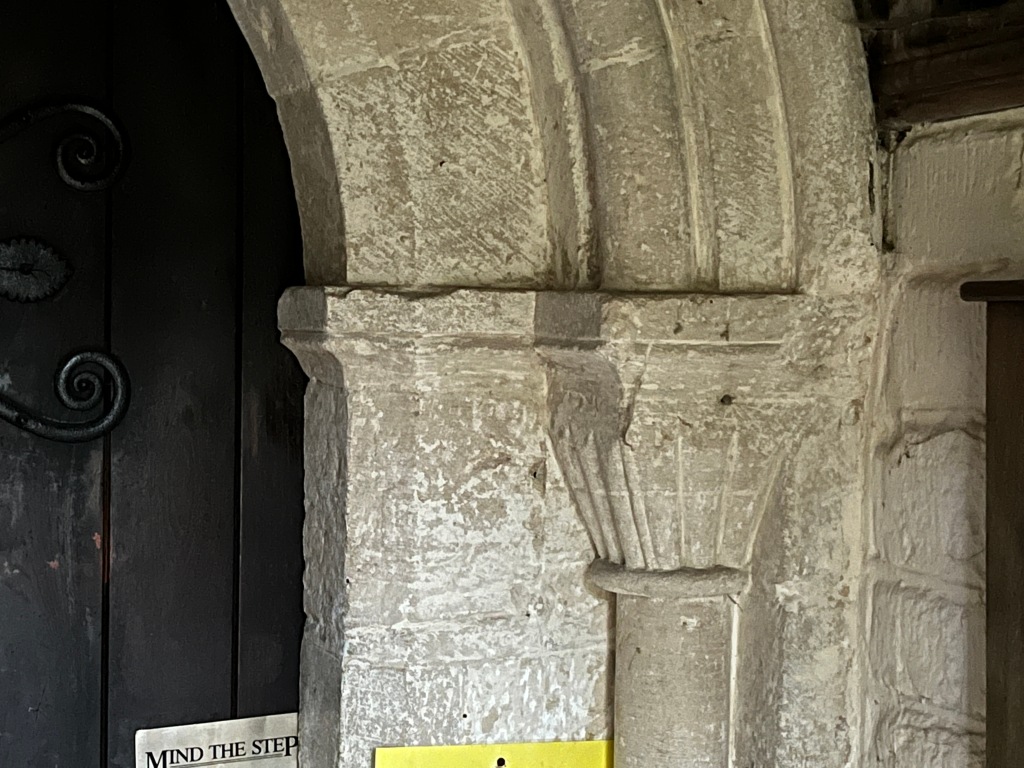
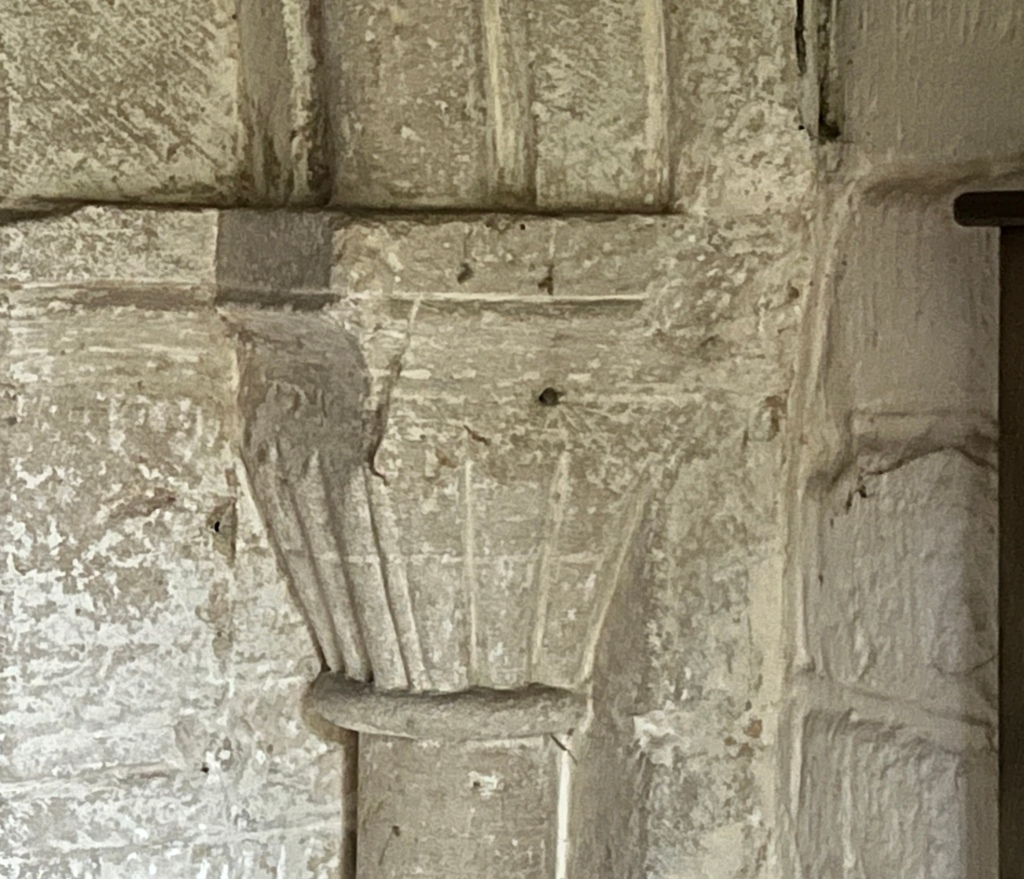
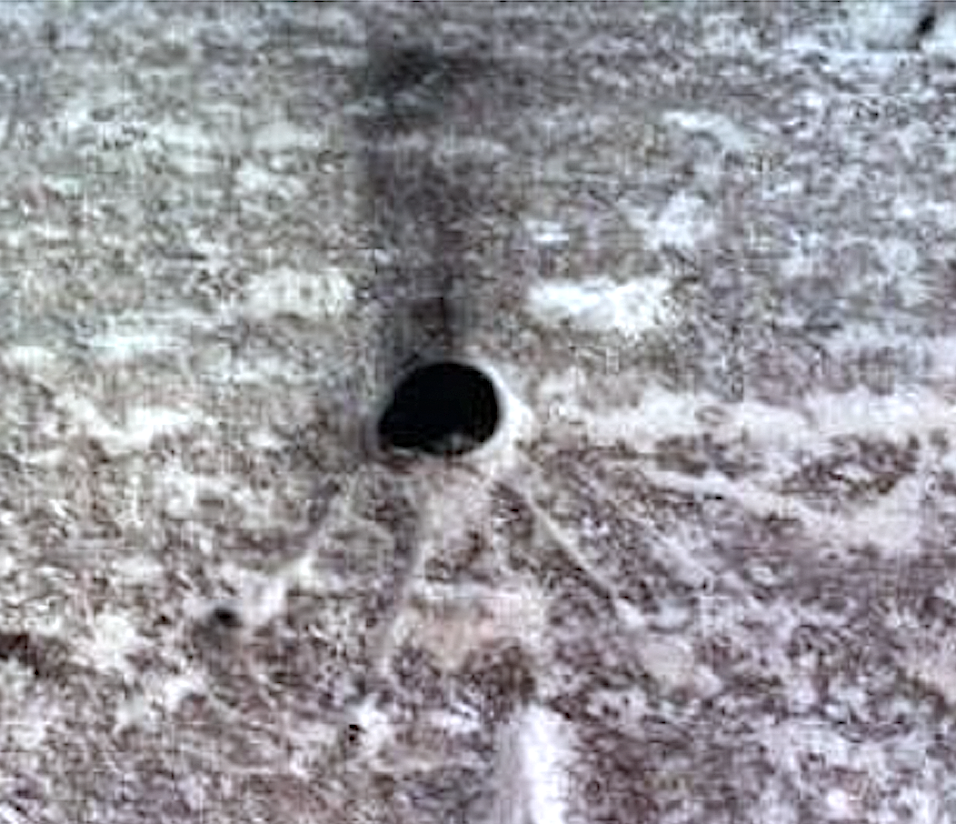
Dial 2 is also inside S porch, RHS of the doorway and above the capital of the pillar. There are 6 lines radiating from a quite noticeable style hole. BSS suggests there are 3 pocks (possibly more), though I could not see those details.
St James . Cowley . Oxford – BSS
OTHER MARKS
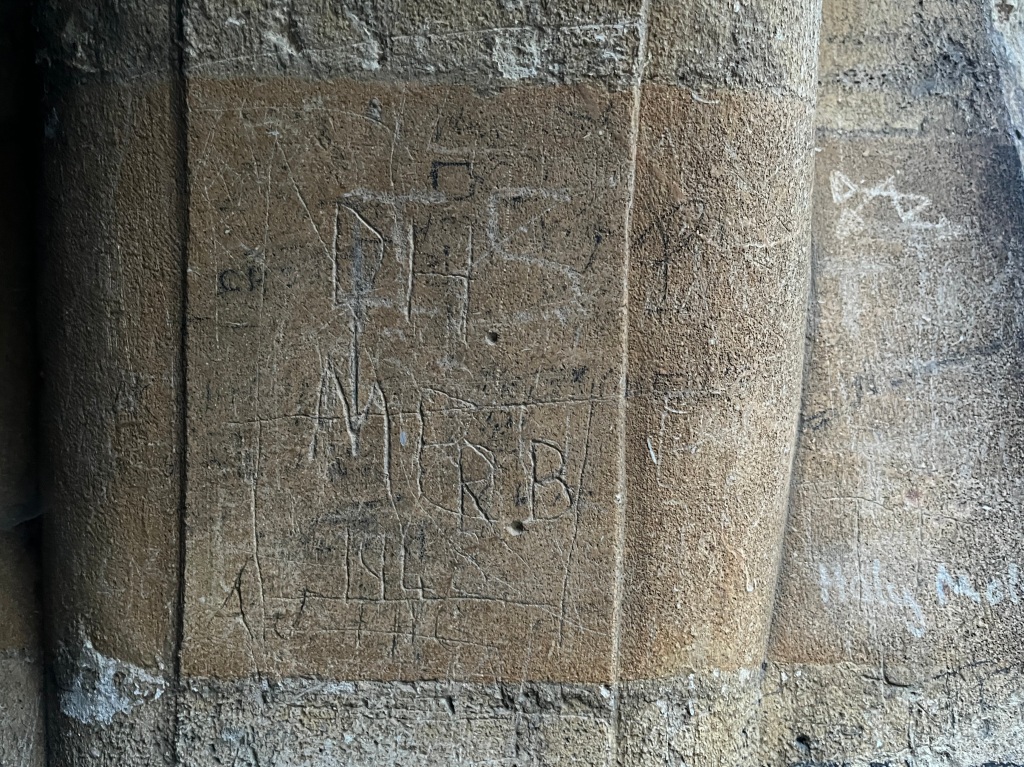
Besides the dials, there was a certain amount of graffiti with other scratchings in the area of the porch, not all of it medieval. There are a couple of Marian marks and what may be a very crude pentagram, a symbol to repel evil.
GSS Category: Scratch Dial; Mass Dial
All photos (for what they are worth) Keith Salvesen except header image from St James Parish website (their excellent photo replaces my poor ones taken from a different angle); and BSS (2 images)
GRADE 1 † C12 origins; mainly C14; much rebuilt C15/C16; further rebuilding late C18; restoration C19. One of only two churches with this Dedication (Fulbourne Cambs is the other). A pleasing and unpretentious church. Very close to Downside Abbey/. 51.2552 / -2.4896 / ST659507
DIALS
Downside Abbey was home to Dom Ethelbert Horne, the pioneer dial collector and analyst who covered Somerset with skill and determination, using a motorcycle to get around. He began the project in 1913, and recorded the dials at St Vigor on Nov 3 – perhaps they were his first finds. His book with its careful explanations is a vade mecum for any dial enthusiast (even one with no connection with the County).
DIAL 1
Dial 1 is located at SW corner of the nave, high up (7′) on a quoin stone. DEH noted The Mass line in this dial is sharp and distinct, and made at a different time from the other lines. He makes no comment on the design. There are 6 lines each with a terminal pock, with hints of a couple more. DEH makes no mention of a gnomon, but with his usual thoroughness measured the depth of the hole. It is certain, therefore, that the existing (copper?) rod was inserted relatively recently.
DIAL 2
Dial 2 is on the buttress between S porch and E end of the nave. DEH commented: Encircled. No hour lines can be seen on this ancient and badly worn dial. the remains of 2 circles close apart. Were it not for the noticeable gnomon hole, it would be easy to pass this one by.
DIAL 3
To be found on the W side of the entrance to S porch, 3′ 3″ high. Or so noted DEH very specifically. He mentions a style hole and a noon line 3½” long, but I spent some time examining this area and indeed the corresponding position on E side of the doorway (because field notes are occasionally confused), with no convincing dial identifiable. Here are photographs of the location, for what they are worth…
DEDICATION
In C6 there was a ‘hermit preacher’ and Christian missionary who became Bishop of Bayeux. He died c537 AD and was canonized as St Vigor (Lat.) or in due course Saint Vigeur (Fr.). The Norman conquest brought his followers to England and his name first appears in an eleventh-century breviary at Worcester.
Another account is that in the early C12, manorial rights for Stratton passed to a Norman family who came from Saint-Vigor-le-Grand, Normandy.
ST VIGOR IN FRESCO
Frescoes at the Churches of St Vigor Ste Suzanne Les Coevrons, and St Vigor de Neau cc / os / tourisme
GSS Category: Scratch Dials
All photos Keith Salvesen; St Vigor as credited; source material Bath Record Office, Wiki
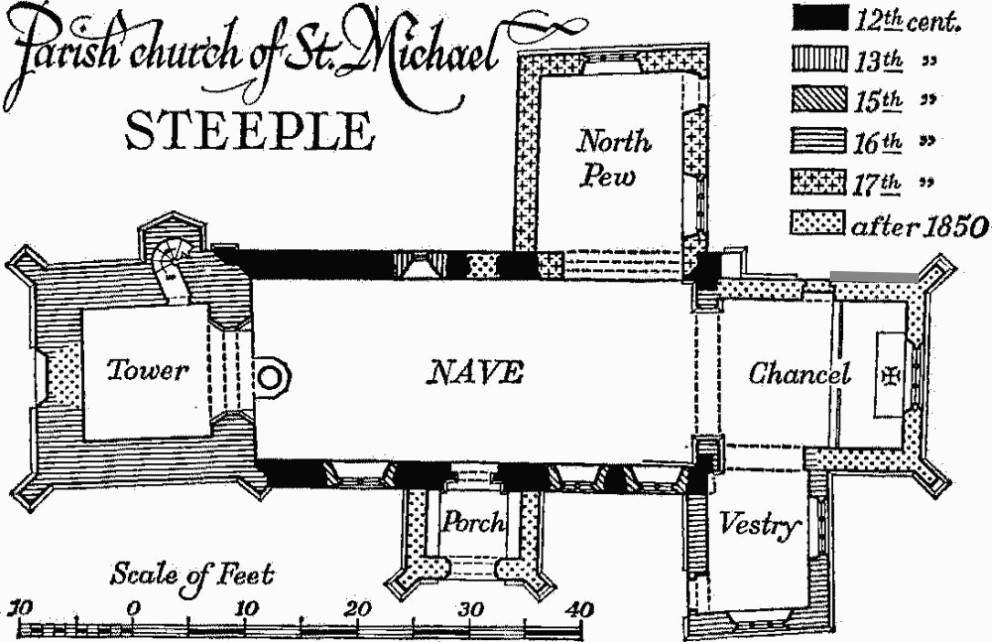
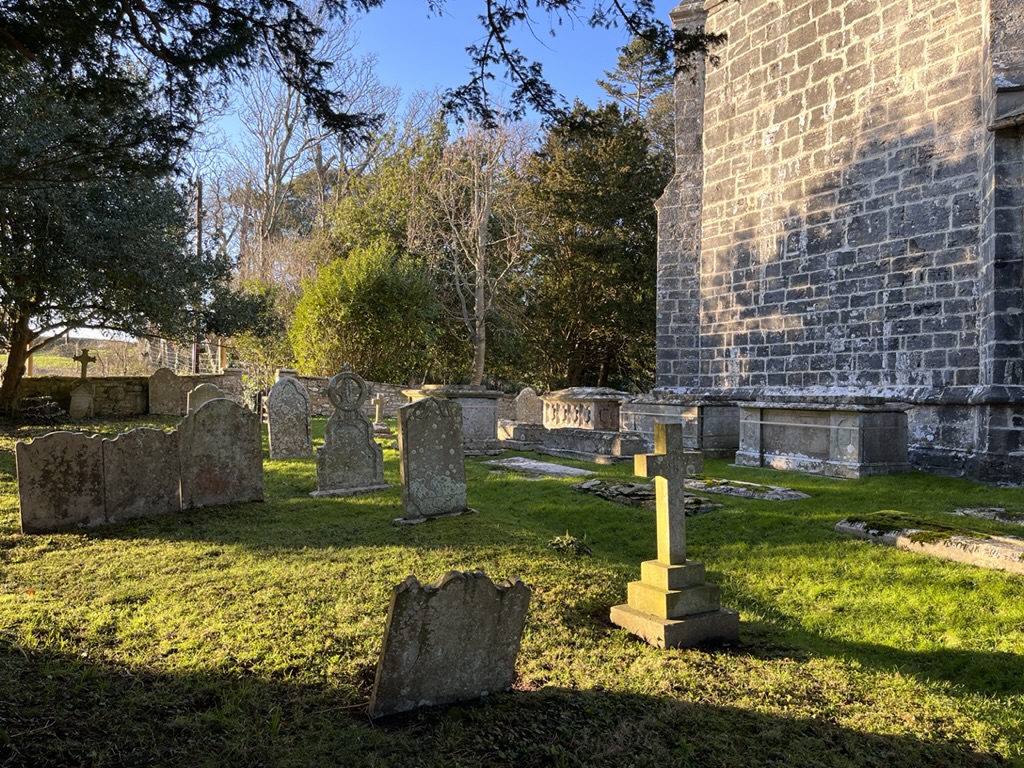
GRADE 1 † C12 origins (nave), enlarged C16 & C17. Mid-C19 restorations; chancel rebuilt. Despite the village name, C16 tower. Fascinating history, with strong links to George Washington: The Lawrence family, Lords of the Manor since the C16, married into the Washington family in 1381 and their Coat of Arms incorporates the Stars and StripesBLB. Much of interest inside inc an impressive barrel organ, and good stained glass E window. Fine chest tombs in the churchyard. 6m S of Wareham, inland from the jurassic coastline at Kimmeridge. 50.6275 / -2.1265 / SY911808
DIAL
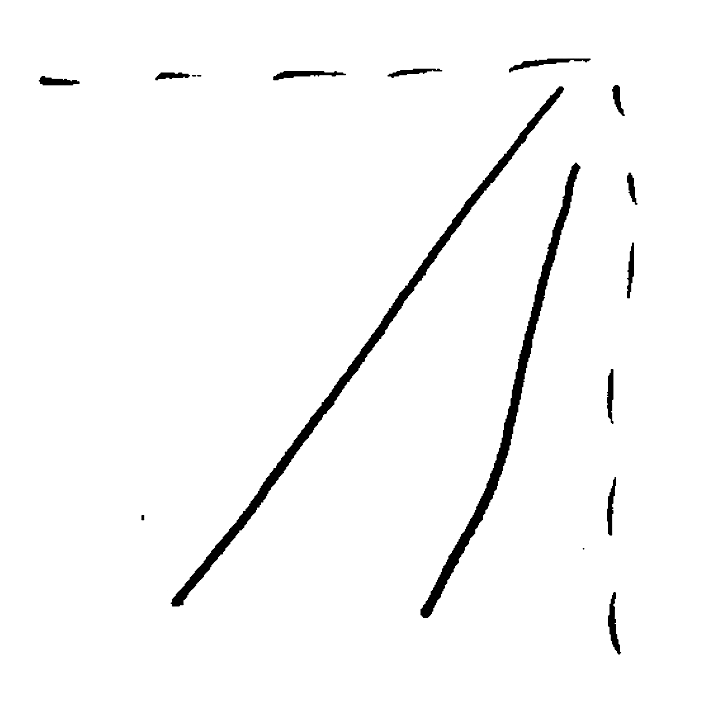
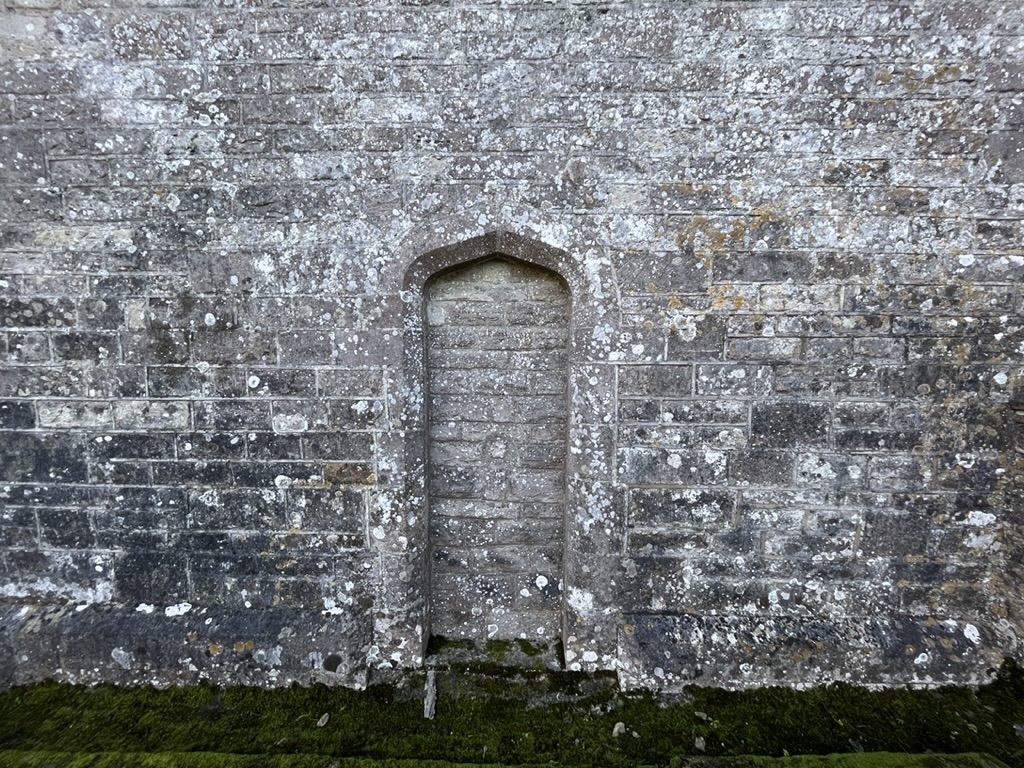
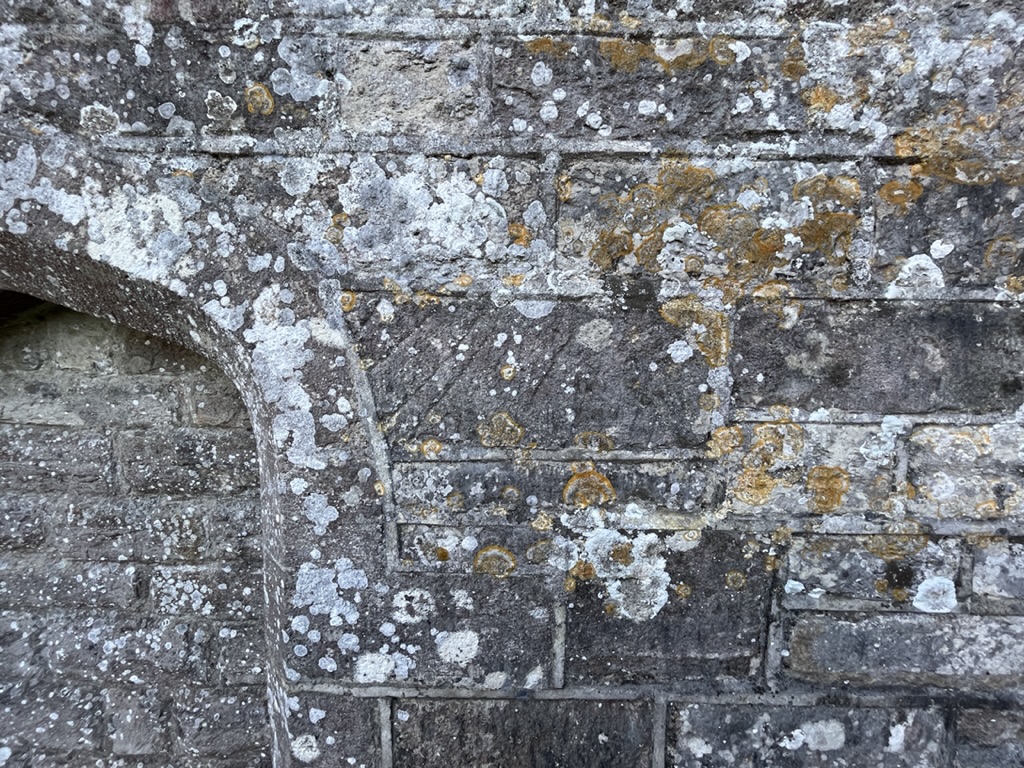
In his 1997 survey GLP noted a single dial relocated to the N wall of the Chancel, E of blocked N doorway. He described it as doubtful – superficially a poorly preserved dial… with 2 lines on a reshaped stone… no gnomon hole, probably relocated during C19 work on the chancel. He found other stones in the vicinity with similar markings – perhaps through weathering – and concluded that the ‘dial’ might not actually be a genuine one at all.
As with a couple of other Dorset churches recently, I couldn’t pinpoint a design such as GLP describes. There are obvious lines or striations on some stones eg top R of the doorway (see below), but little to report on the wall E of the door. The lack of a gnomon hole is one reason for missing eroded dials. This lack may also reinforce doubts about identifying dial-ish marks as being part of a dial. Anyway, if there is one, I missed it.
St Michael . Steeple . Dorset – BSS
The dilemma has been whether to post, rather pointlessly, a failed dial search. However this small secluded church has other merits. It earned its Grade I listing for special architectural or historic interest. I have included a few photos below to illustrate this. The Washington link is only one of the significant features.
St Michael . Steeple . Dorset – North Doorway
IMAGES OF ST MICHAEL AS COMPENSATION
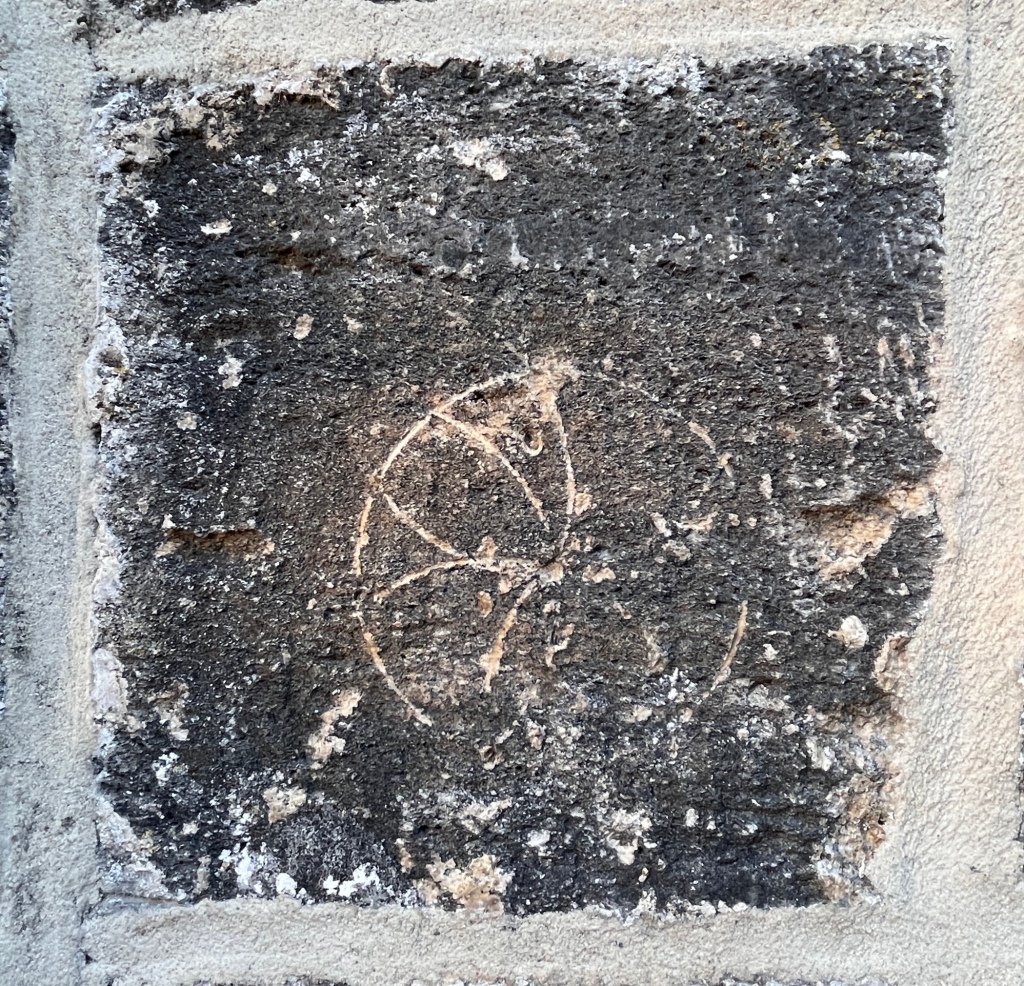
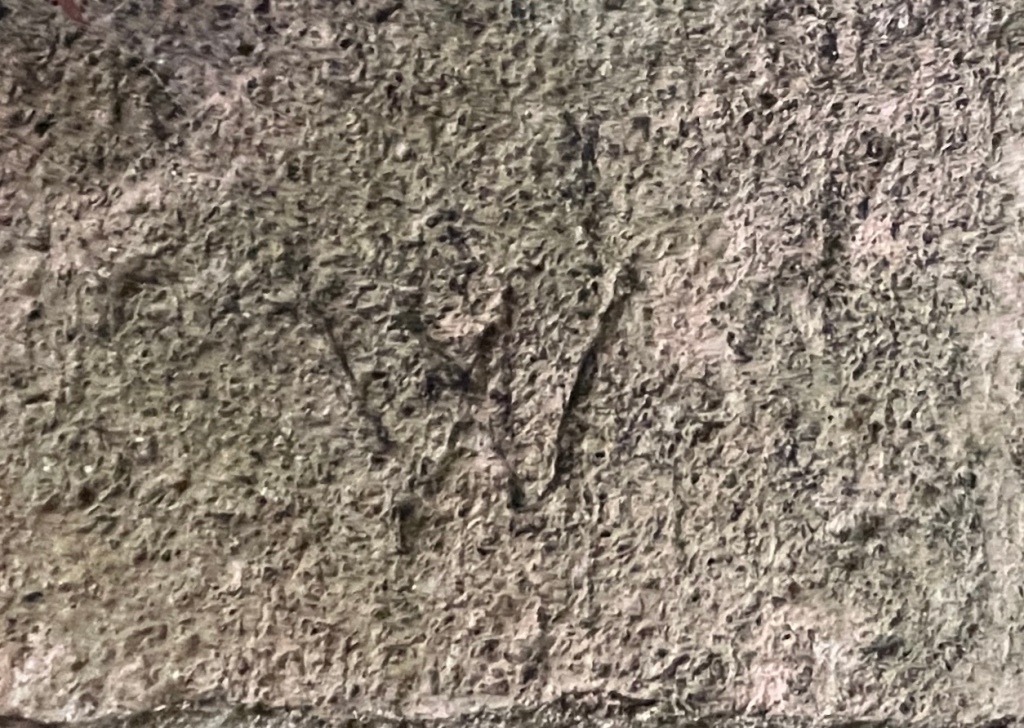
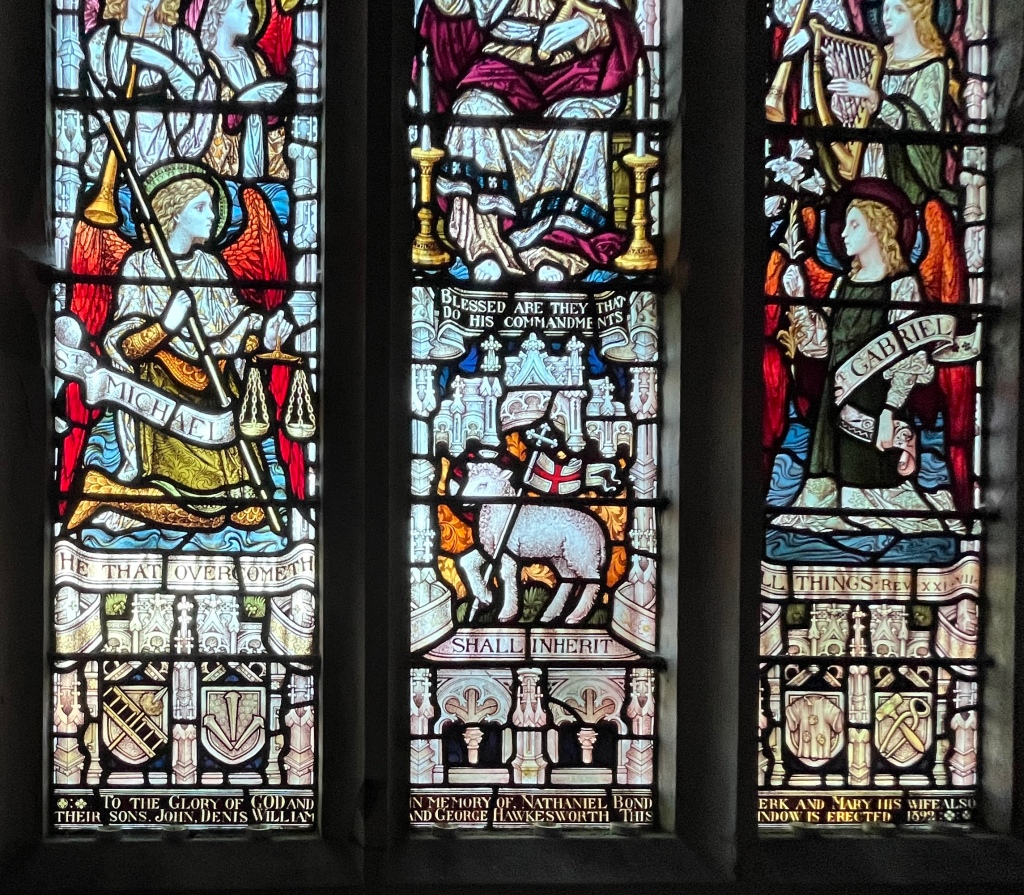
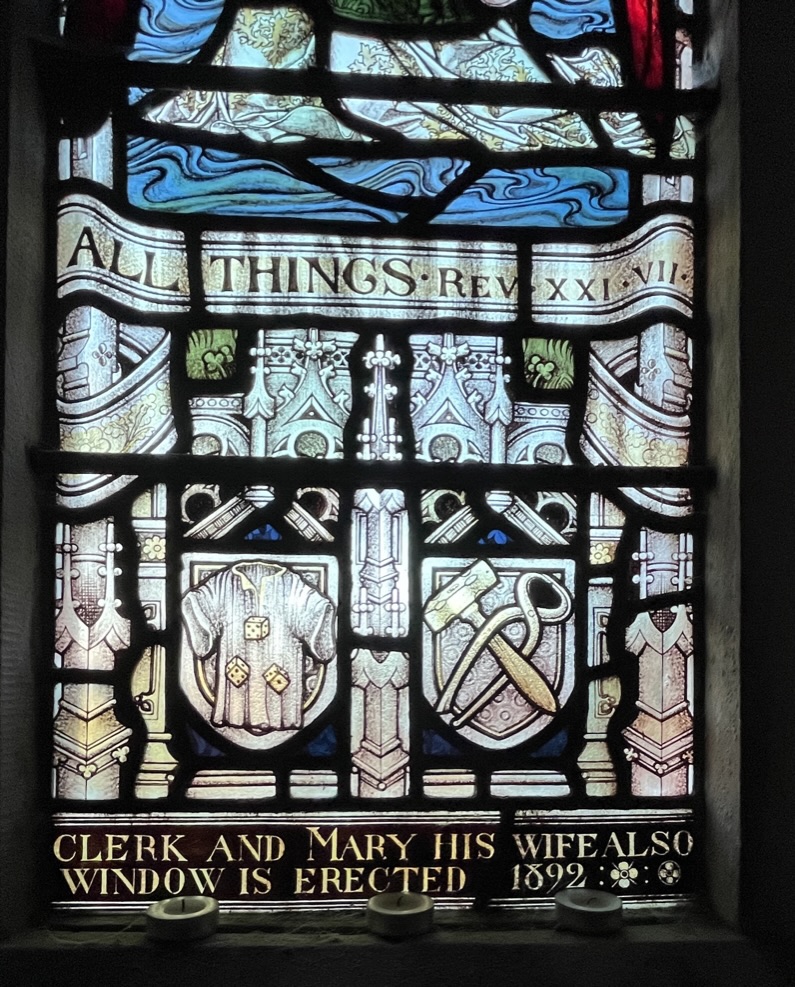
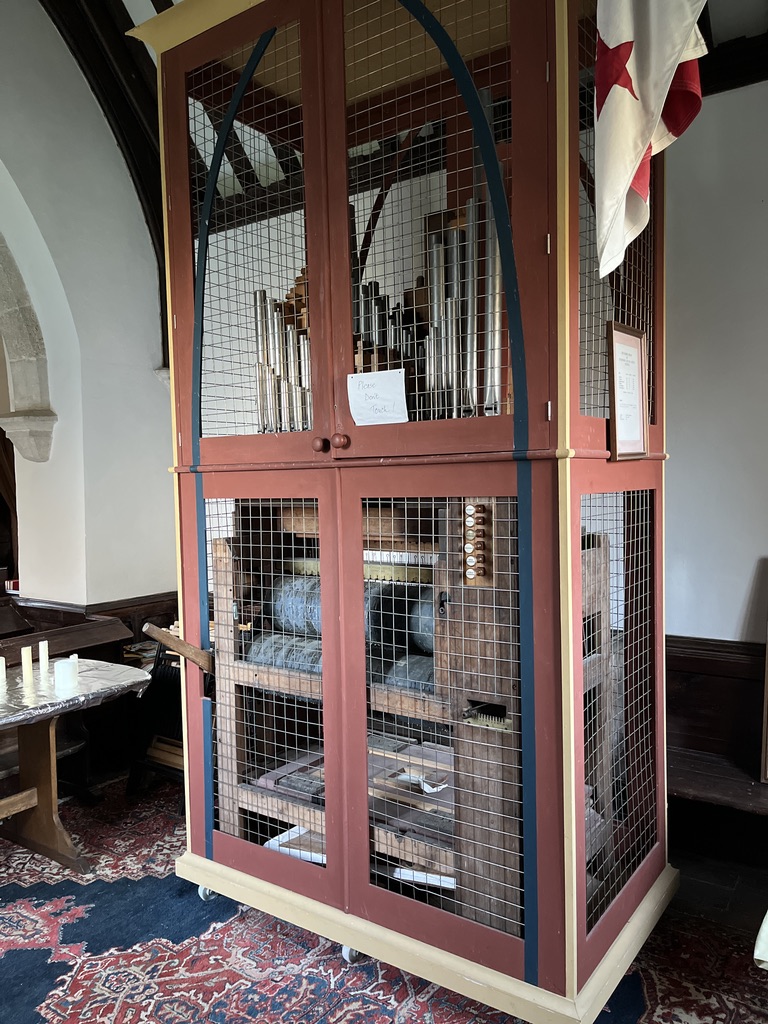
Chest Coffins in the churchyard; crude apotropaic (part-)hexfoil of uncertain age; Marian VV ‘witch’ mark inside the porch; 2 examples of the E window stained glass (image 2 shows dice used for the division of Christ’s robe); the barrel organ
St Michael . Steeple . Dorset – Chest Coffins, Hexfoil, Marian mark, Stained Glass, Barrel Organ
St Edmund . Acle . Norfolk (π ChurchCare / Keltek)
GRADE I † Norman traces; C13, C14; mid C19 restorations. Nave roof thatched; round W tower with octagonal bell stage; high porch; early font. A fascinating and most unusual building to admire, both the exterior and interior. 12m from Norwich. 52.6372 / 1.5474 / TG401102
DIAL
A fairly conventional encircled dial on a quoin stone on W side of the porch. The forenoon is well-marked, evidently the most important part of the day for religious observance. The emphatic gouge at (very roughly) Nones is presumably not contemporary, being very much at odds with the more carefully incised lines. Possibly it marks a later change of the principal Mass time to the afternoon (a new incumbent?). There are ± 8 lines but erosion and damage prevents an accurate count.
St Edmund . Acle . Norfolk – Scratch Dial (John Renner)
GSS Category: Scratch Dial; Mass Dial
PHOTOS: John Renner, with thanks; ChurchCare / Keltek (header image)
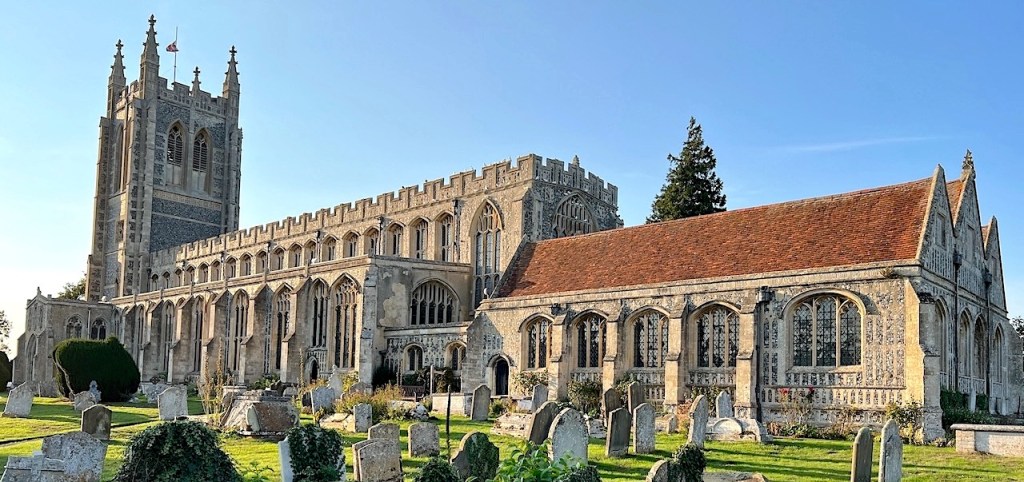
GRADE I † A magnificent church, the longest in Suffolk. Exemplar for the conversion of wool prosperity into stonework. Largely C15; W tower rebuilt 1903 (Bodley). SJ rating ***** a treasure house of English medieval art. A good overview at Great English ChurchesLONG MELFORD 4m N of Sudbury. 52.0878 / 0.7209 / TL865467
DIAL
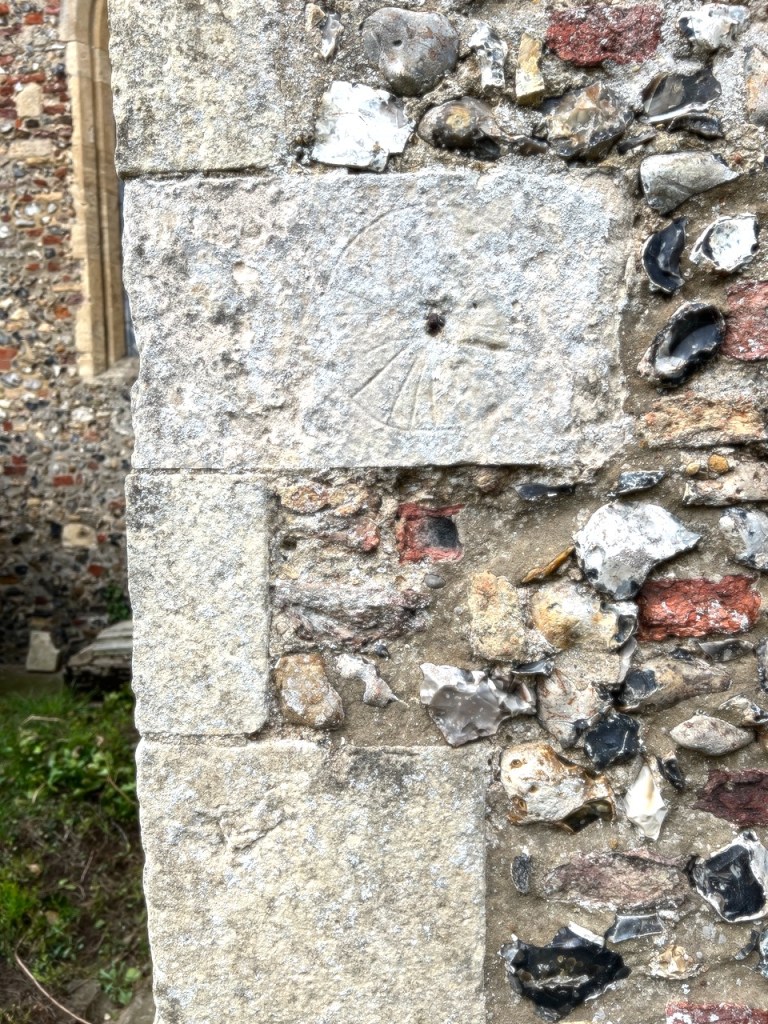
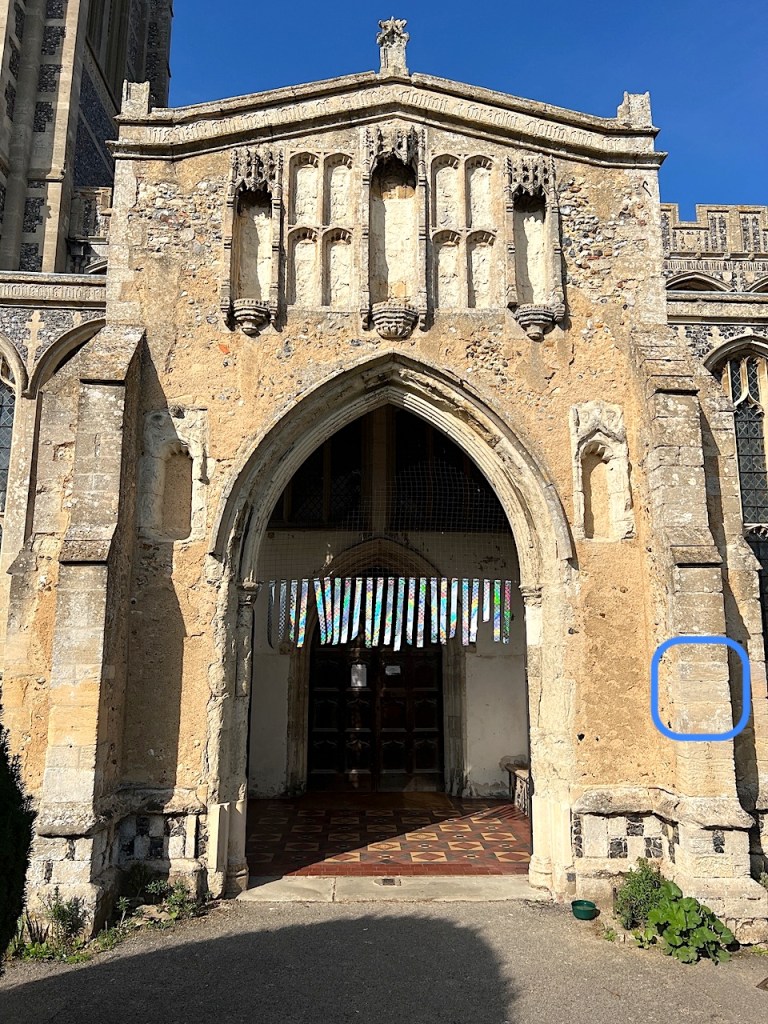
Holy Trinity . Long Melford . Suffolk – porch
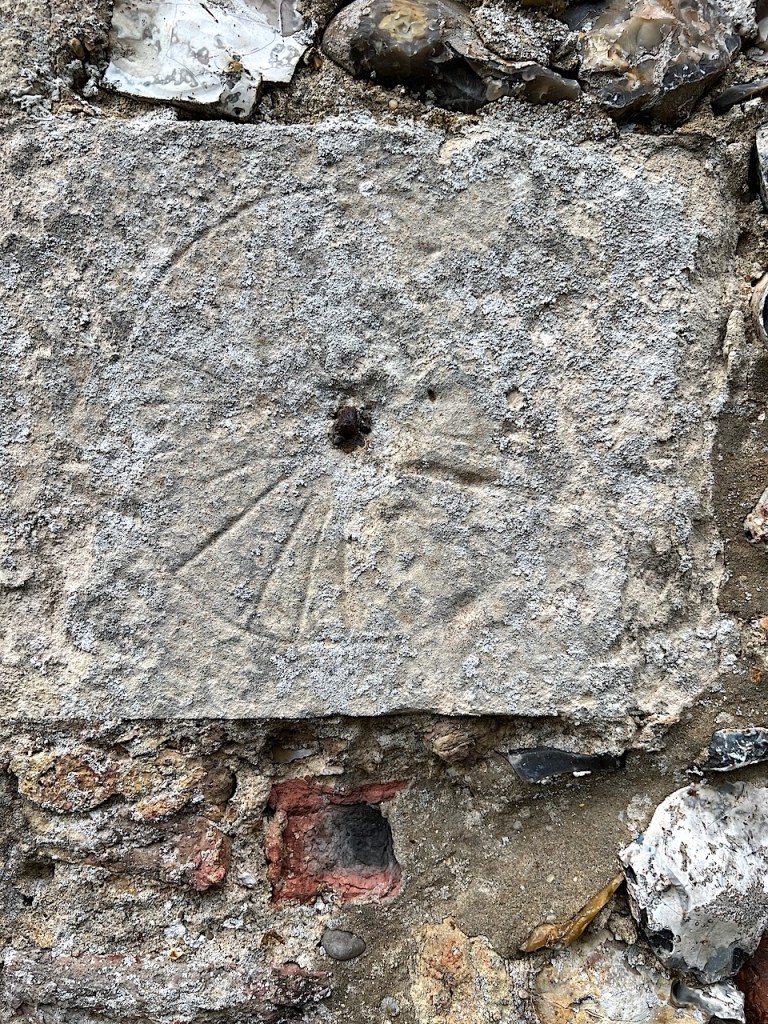
The dial is located on the buttress E of the porch, and easily visible. The style hole is in the mortar line, with 5 lines radiating downwards LHS to a perimeter arc. The presumed noon line and 1 are emphasised. There is a single, fainter afternoon line. The dial stone fits rather awkwardly into its space and the partly unfilled mortar line is strange. A possible relocation?
Holy Trinity . Long Melford . Suffolk – scratch dial
Seen in detail, there is a gap between the top end of the lines and the gnomon hole. The angles between the lines are graduated (rather than evenly spaced) as one might expect with a later dial. However, the angles widen as they approach noon rather than (as one would expect) narrowing. A left-field explanation might be that the church itself is at an angle, for which the dial is compensating. At some stage I need to investigate further but meanwhile, best to publish this and hope that someone can provide an answer.
Holy Trinity . Long Melford . Suffolk – Scratch Dial
GRADE I † Mostly early C14 and C15. Built with local stone: lias and ham. A fine C17 cube dial, 2 slightly unrewarding scratch dials, impressive gargoyles. A complete set of 5 bells dated 1582, 1621, 1623, 1664 and 1666, all by Purdue family. Some pews have graffiti from C17 on. 3m N of Yeovil. 50.9773 / -2.6086 / ST573199
I have previously posted about St Mary with the emphasis on the splendid CUBE DIAL high on the apex of the E end. I mentioned 2 scratch dials but because they fall into the separate Medieval Dial category I am giving them some more attention here.
MUDFORD: TWO SCRATCH DIALS
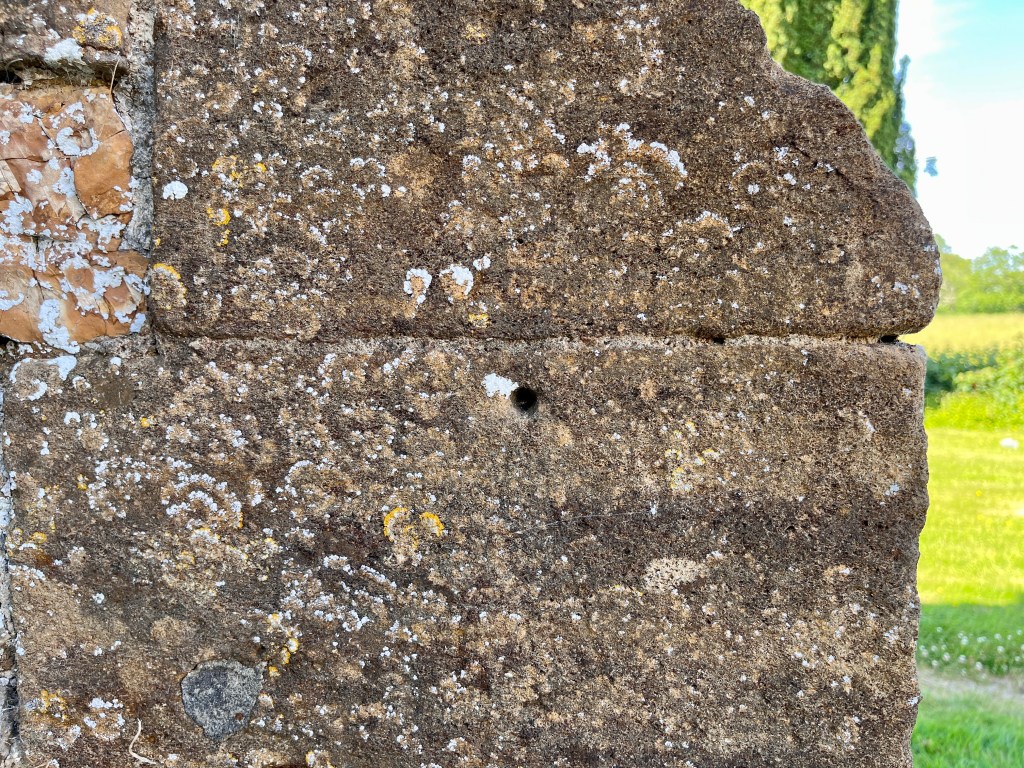
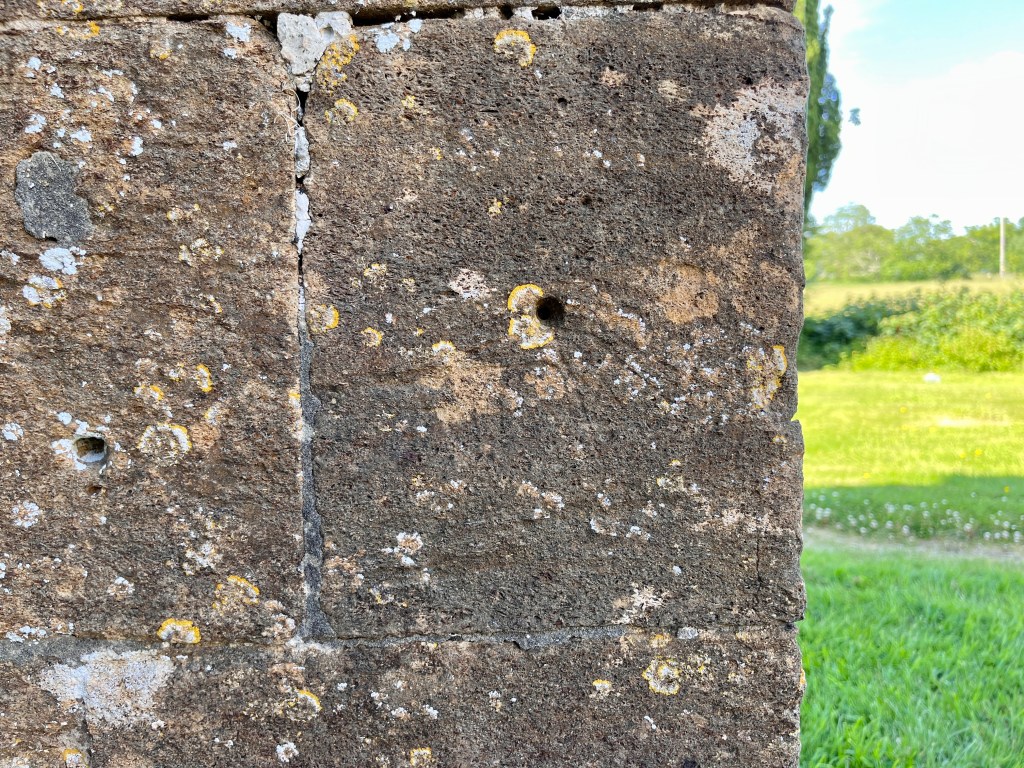
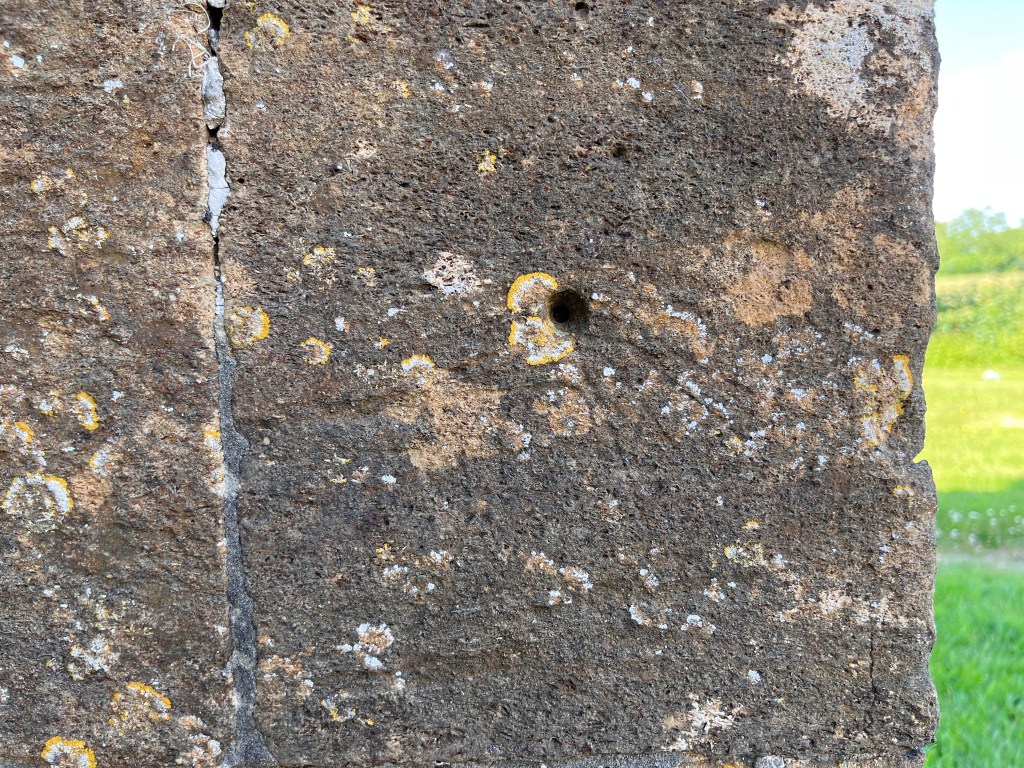
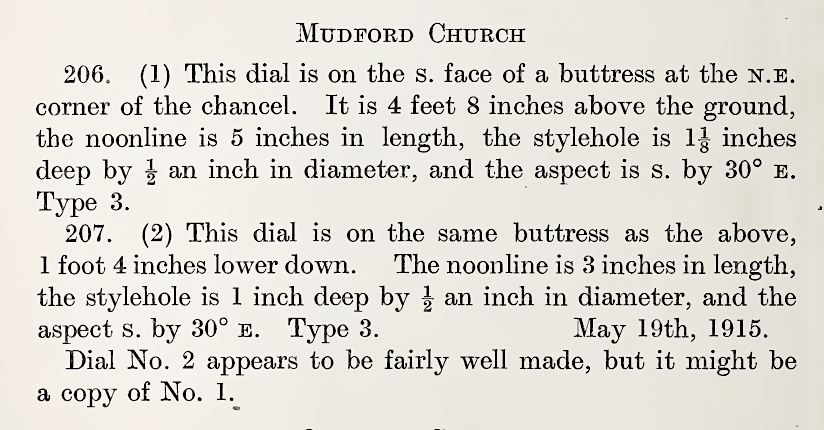
The two dials are on the inner face of the buttress at the E end of the church, one above the other – a less than optimal position.They were obviously relocated and incorporated during expansion / restoration and used as quoin stones for the buttress, though pointless as dials where they are now. The stones themselves are similar, but it seems unlikely that the 2 dials were adjacent before being moved.
Dial 1 is very simple: a style hole with 2 lines descending, the noon line and 1pm. A rod gnomon would very clearly mark the noon part of the day, perhaps indicating that Mass was not quite yet… or that it had been missed…
There is a similar 2-line dial at BROADMAYNE Dorset, where the 2 lines are at either side of the vertical (ie at 11 and 1), cut so that ‘noon’ is in effect the space between them. At COMPTON PAUNCEFOOT there is a large dial on the facade with 3 lines: noon and one each side.
Dial 2 has 4 clear lines radiating from the style hole. These are E of the vertical, marking roughly 1 to 4 (there is no noon line). On both dials there are faint hints of other lines now eroded.
DEH recorded the Mudford dials in May 2015 during a tour of several churches in the area
GRADE II* † C13 chancel; C14 nave and lower tower with porch (top stage added later); extensive mid-C19 restoration and rebuilding by J Hicks (Thomas Hardy is said to have drawn the plans while apprenticed.) Portland Stone. 5m SE of Dorchester. 50.6788 / -2.3857 / SY728866
DIALS
There are 3 dials. 2 are adjacent on E side of the porch which is (unusually) set in the tower. Dial 1 is eroded but visible. Dial 2 is vestigial and easily overlooked (eg by BHO / RCHM). Dial 3 is relocated well out of sight on the NE quoin of the church, a place it could never have been originally. It is much the clearest cut of the 3.
DIAL 1
St Martin . Broadmayne . Dorset – Scratch Dial 1
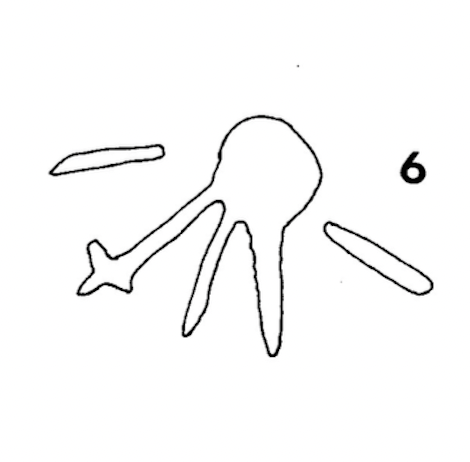
Dial 1 is visible as one walks up the path from the gate, but the details remain unclear even close to. The BSS record shows 12 lines within a partial circle, the lower part cut off at the edge of the dial stone, suggesting it may have been relocated during rebuilding. I’ve visited St Martin twice, in sunlight and in early evening, and frustratingly I haven’t been able to make out the complete dial shown below. The colour of the stone is a factor. RHS is quite eroded; or perhaps LHS was more deeply incised because it marked the most signifiant time of day for observance.
St Martin . Broadmayne . Dorset – Scratch Dial 1
DIAL 2
St Martin . Broadmayne . Dorset – Scratch Dial 2
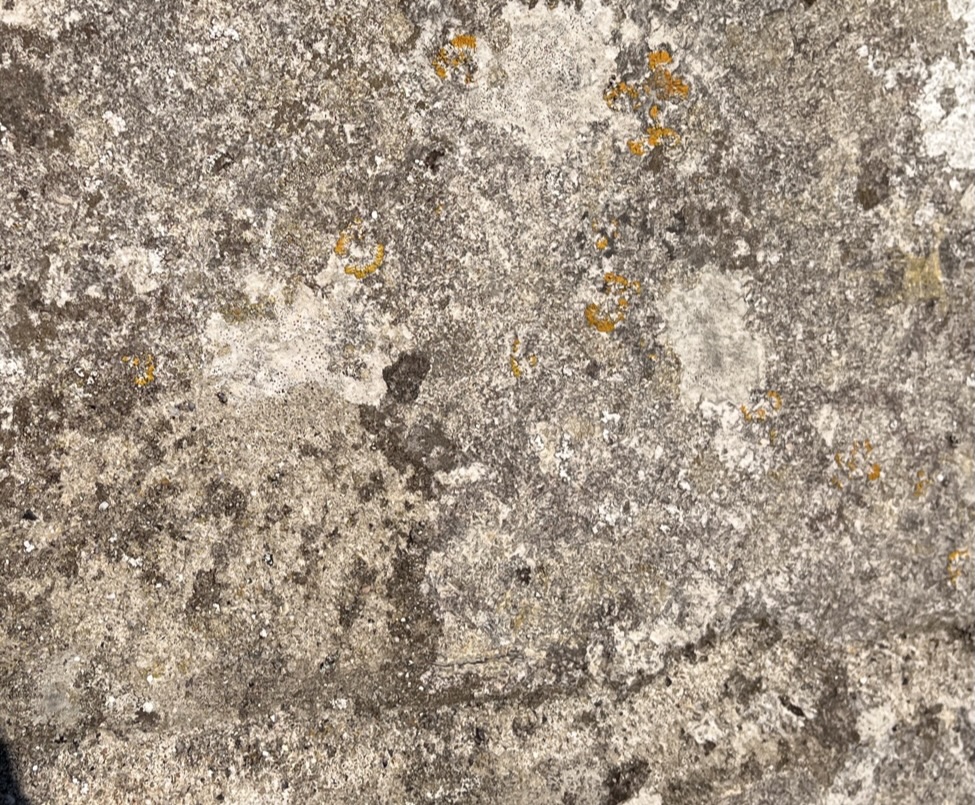
As indicated above, dial 2 is unrewarding. Records suggest 4 lines and 2 circles, though I couldn’t see the latter. The images below have been recoloured to bring out the details, such as they are…
St Martin . Broadmayne . Dorset – Scratch Dial 2
DIAL 3
Dial 3 is a small and simple one, with 4 lines. The noon line is emphasised; and the Mass line (Tierce) has a cross.
St Martin . Broadmayne . Dorset – Scratch Dial 3
UNRECORDED DIAL?
The fact that the hole in this buttress stone is centered made me look at it more closely. In 3D rather than in the photo, it is a plausible dial with 2 quite long lines, being the noon line and ‘1.00pm’. With a stick in the hole, it would have been perfectly serviceable for marking the sun’s progress from morning to afternoon. There is a similar dial at MUDFORD Somerset, where the 2 lines are at 11 and 1, cut so that the noon line is centered between them.
GRADE I † C12 origins with south transeptual tower; C12 north aisle and north chapel; C13 south chapel and aisle, tower rebuilt; C15 chapels demolished, chancel and north aisle rebuilt, south porch added; C17 tower rebuilt. A treasure for church enthusiasts of any sort. Even the bells have stories. For detailed church description and historical context: BHOSt George DamerhamHE has a short entry HERE. Church’s excellent GUIDE below. The ‘Vicars’ Board’ begins c1235. W of the A388 midway Salisbury to Ringwood. 50.9416 / -1.8483 / SU107158
DIALS
✣ Note: I missed a dial located most unusually on a cross in the cemetery ✣
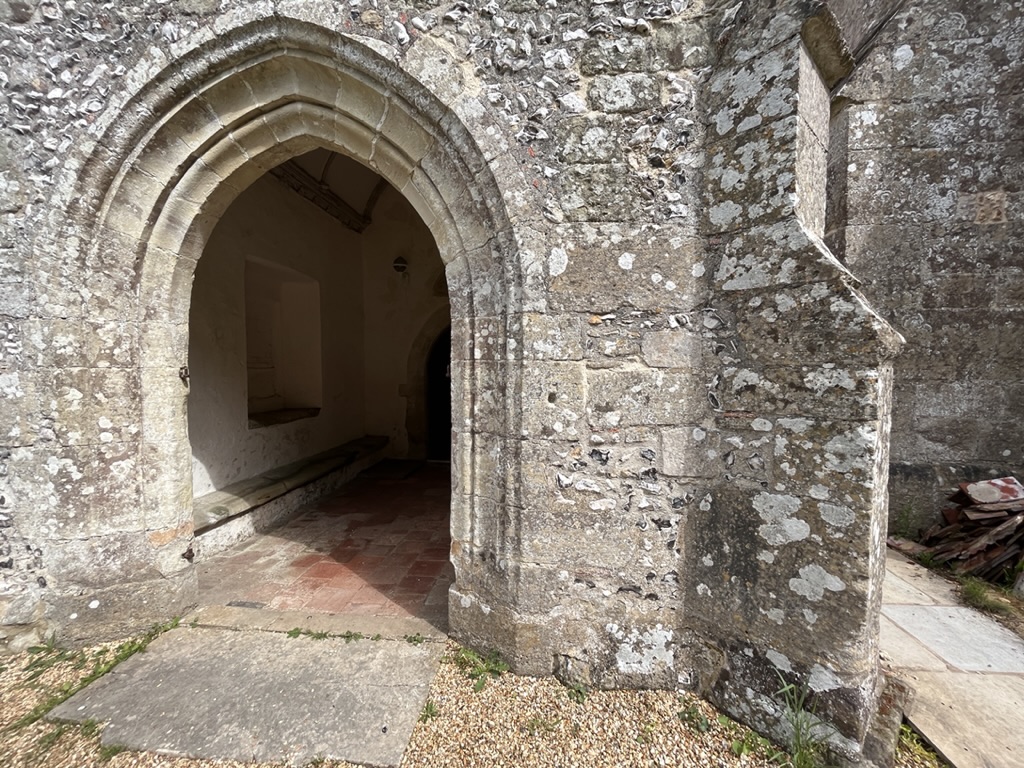
St George has 3 scratch dials. In addition there is a fine numbered dial that marks the transition to a more sophisticated era of ecclesiastical time-keeping. Within the porch on the upper R side of the original entrance I (believe I) found another simple dial of a kind found inside porches elsewhere, with traces of whitewash (eg Blackford Som. Bishops Sutton Hants Limington Som.)
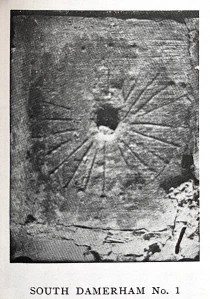
ARG visited in 1923. His comments on individual dials are briefly noted below, with his photo of dial 1.
DIAL 1
St George . Damerham . Hants – Scratch Dial 1
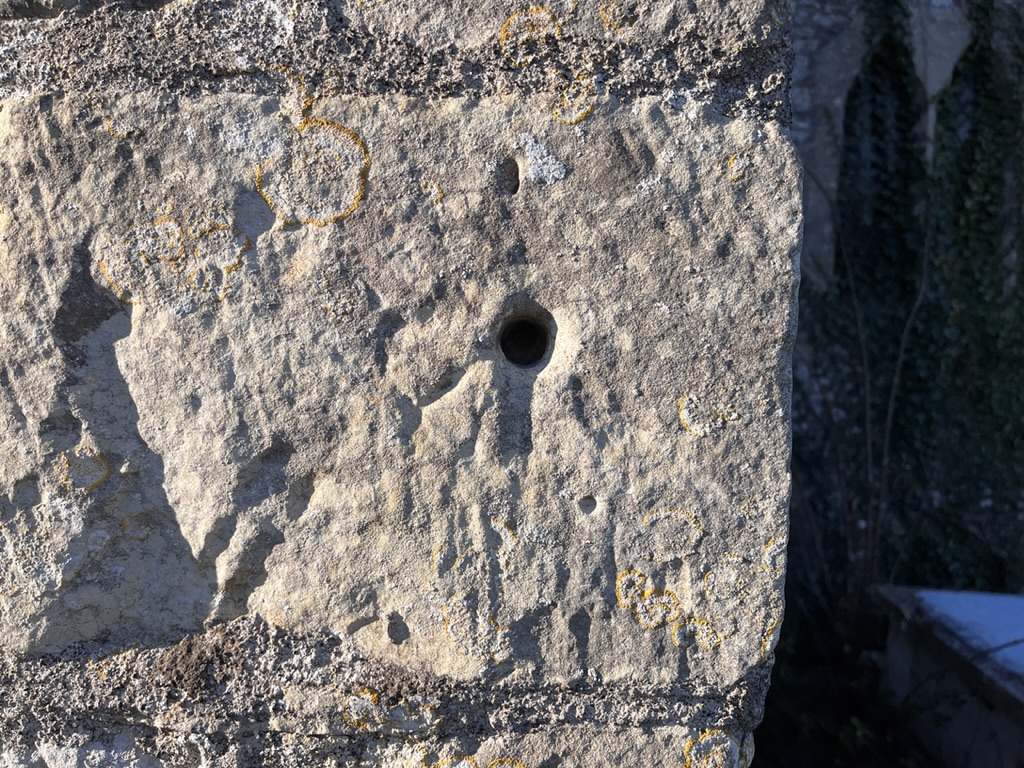
The main dial is easily found on the E jamb of the S porch. It has a very large gnomon hole in the centre of the dial stone, presumably enlarged over time. There are 20 lines, each with a terminal pock. It is perhaps unusual for a medieval dial to have a full circle of radii with end pocks that are all still visible centuries later.
ARGA rather large, good dial. Perhaps originally a full-wheel dial with 24 lines, now with 4 lines missing from upper quadrant.
St George . Damerham . Hants – Scratch Dial 1
DIAL 2
St George . Damerham . Hants – Scratch Dial 2
SW buttress of nave. Gnomon hole in the mortar line, from which 11 lines fan out below the horizontal. The design has been rearranged over the years, with the LR quadrant damaged and repaired without recutting the lines onto the cement.
ARG described the dial as a half-wheel. He commented on the disparity in the line length between LL and LR quadrants. but did not remark on the reason ie damage repair.
St George . Damerham . Hants – Scratch Dial 2
DIAL 3
St George . Damerham . Hants – Scratch Dial 3
Dial 3 is immediately below dial 2 on the same buttress. It is very basic and consists simply of a slightly skewed gnomon hole, with 3 lines in the LL quadrant, partially obscured by lichen just as ARG reported 100 years ago.
St George . Damerham . Hants – Scratch Dial 3
DIAL 4
St George . Damerham . Hants
The dial largely speaks for itself. I find it hard to date – C17? It seems very carefully cut, and the numerals are elegant. There’s some sophistication here. The dial is surmounted by the initials GB and TS
St George . Damerham . Hants – Scientific DialSt George . Damerham . Hants – Scientific DialSt George . Damerham . Hants – Scientific Dial
One intriguing feature of this dial is the mystery of the missing gnomon. In 2007 a contributor to the Geograph project, Trish Steel, uploaded a photo of the dial. It has a gnomon set into cracked mortar (unsurprising if it fell out). To an amateur it looks as if it may not have been in the right place anyway – too low? I wonder when it was first installed? It’s a very simple wedge of iron, perhaps inserted when the crack was originally repaired.
St George . Damerham . Hants – Scientific Dial with Gnomon
PORCH DIAL
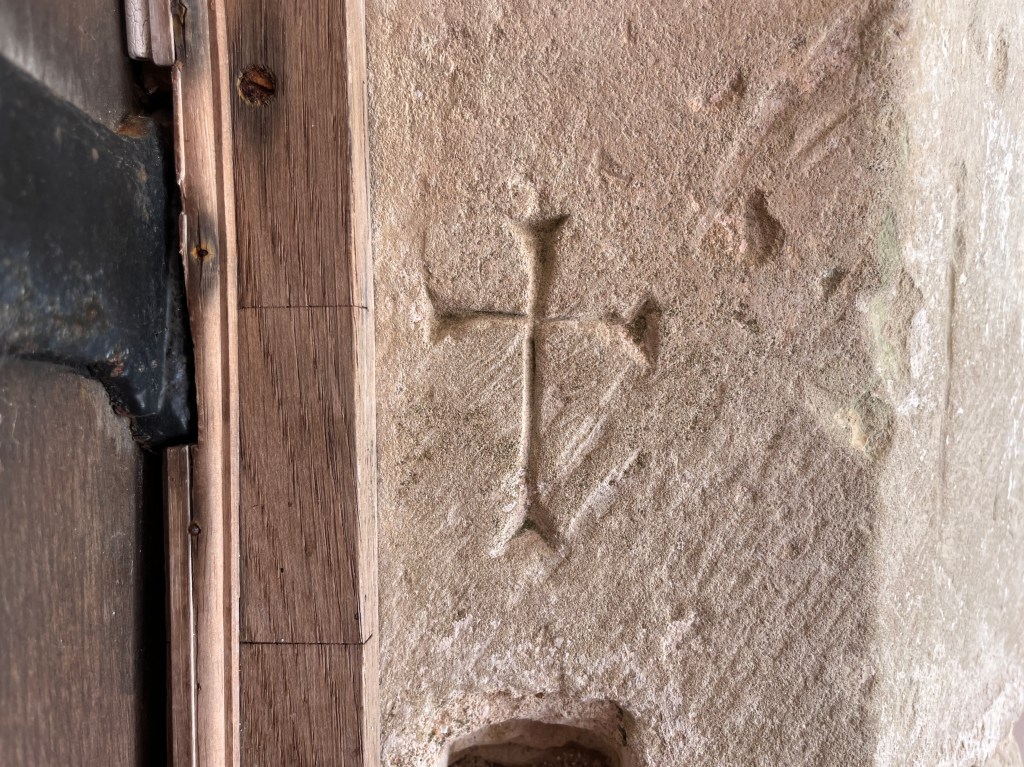
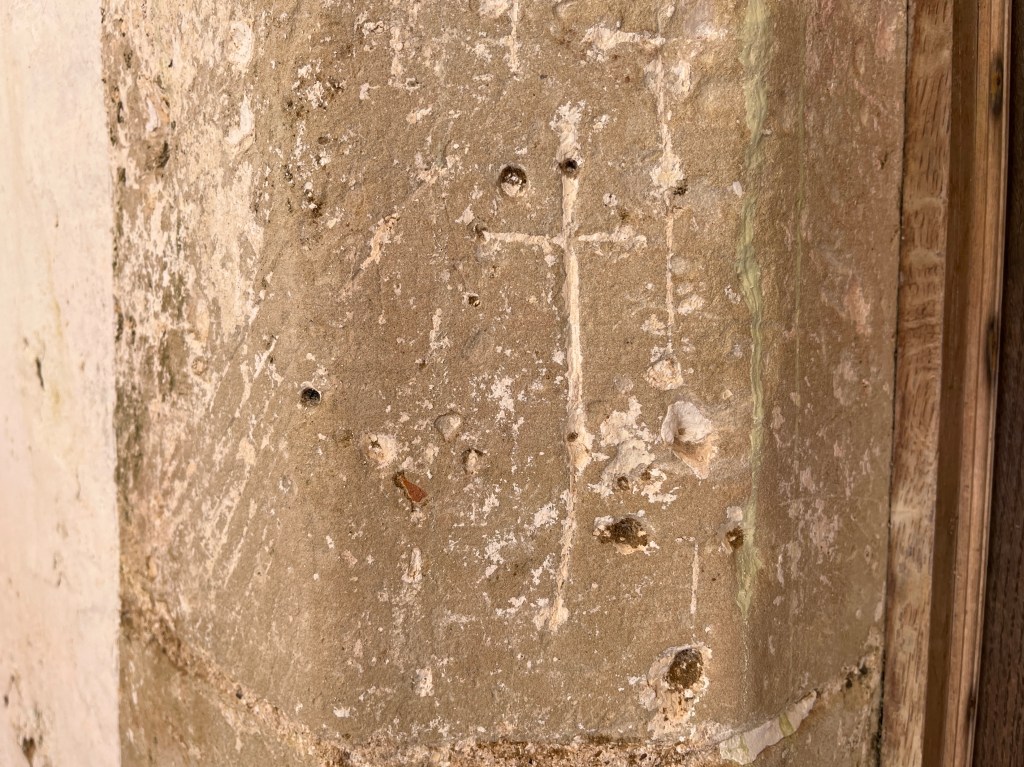
Within the S porch (added C15) the area around the original door has much medieval graffiti. St George was a church of pilgrimage, and inside there are pilgrim scallops incorporated in the fine wall-painting fragments. Both outside and inside the church, there are many crosses cut into the stone. Some may also be apotropaic in intention; some may be event marks (the porch is ideal for welcoming a new incumbent or a marriage).
On the jamb R of the door there are 3 distinct lines, equally separated, radiating downwards from roughly the same point, a plausible filled style hole. The design is clearly cut with no graffiti near it, with traces of whitewash. I have encountered other very similar internal porch dials (I need to cross-check and add links) in much the same position, and I am confident that this qualifies as another one.
St George . Damerham . Hants – Scratch Dial within the porch?
PILGRIMS’ PROGRESS
St George . Damerham . Hants – Pilgrim Crosses, Graffiti
RESOURCES FOR ST GEORGE DAMERHAM
There is a brief but helpful information sheet / guide in the church
An object lesson for a church guide: informative, interesting, and focussed on the most important features

































 GAUDIUM SUB SOLE . SUNDIALS . MEDIEVAL TO MODERN