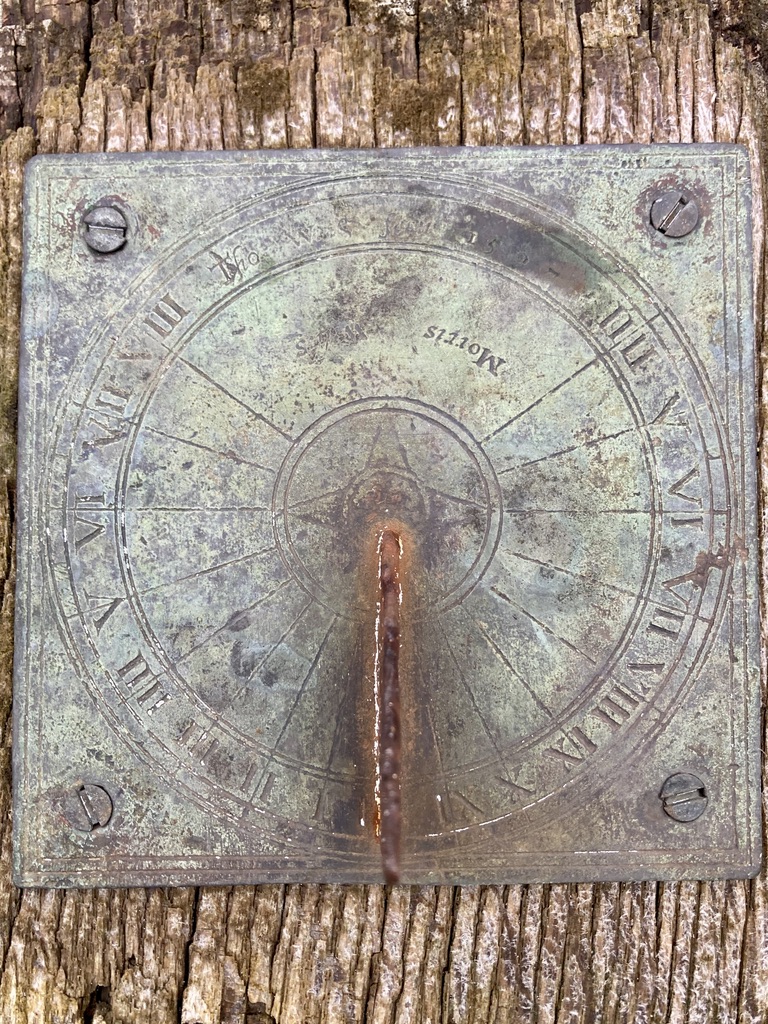
I recently met someone at a gathering of mutual friends, and we discussed sundials. He mentioned that he had an old dial in his garden, dated 1597 (the year of the first performance of The Merry Wives of Windsor). This was definitely a lead to take up.
PROVENANCE: The dial was bought in the 1950s in (probably) an antique shop in (possibly) Amersham. It was put on the pillar of an old birdbath, and remains in the same garden.
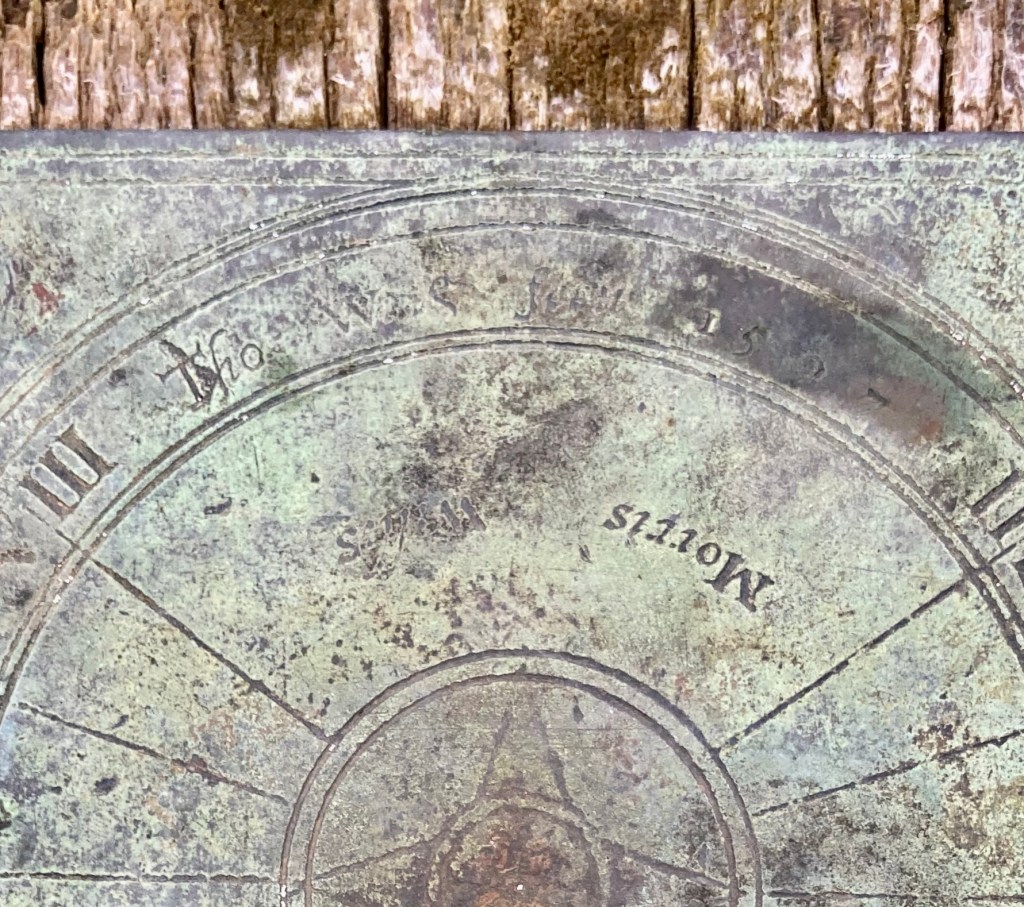
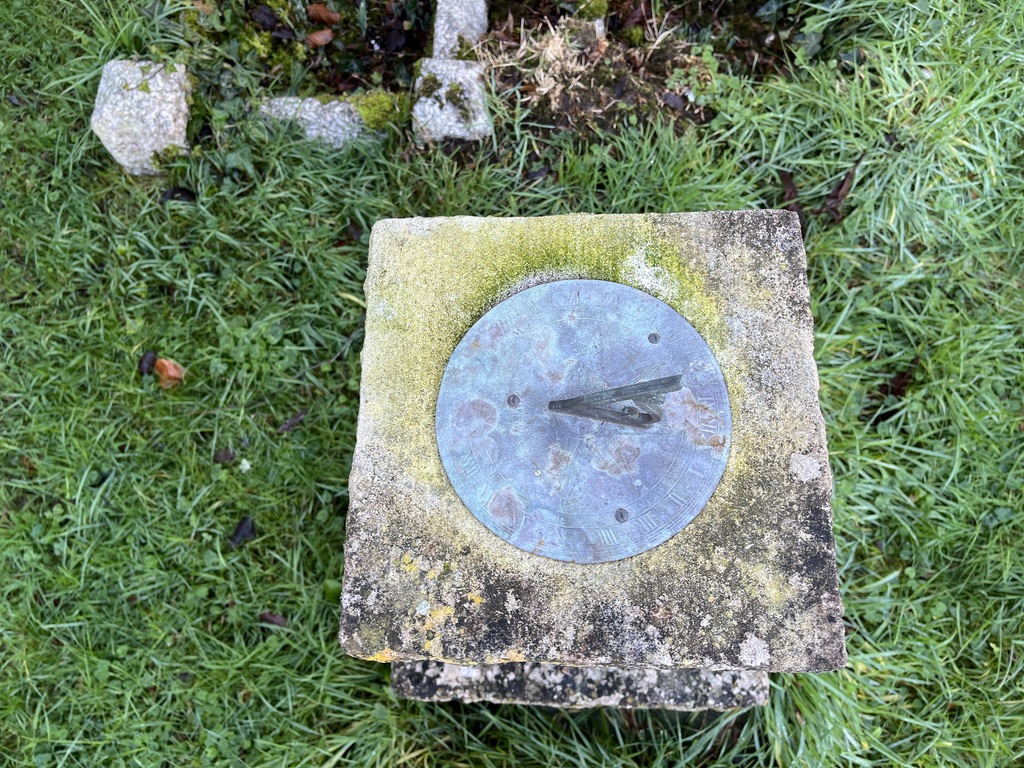
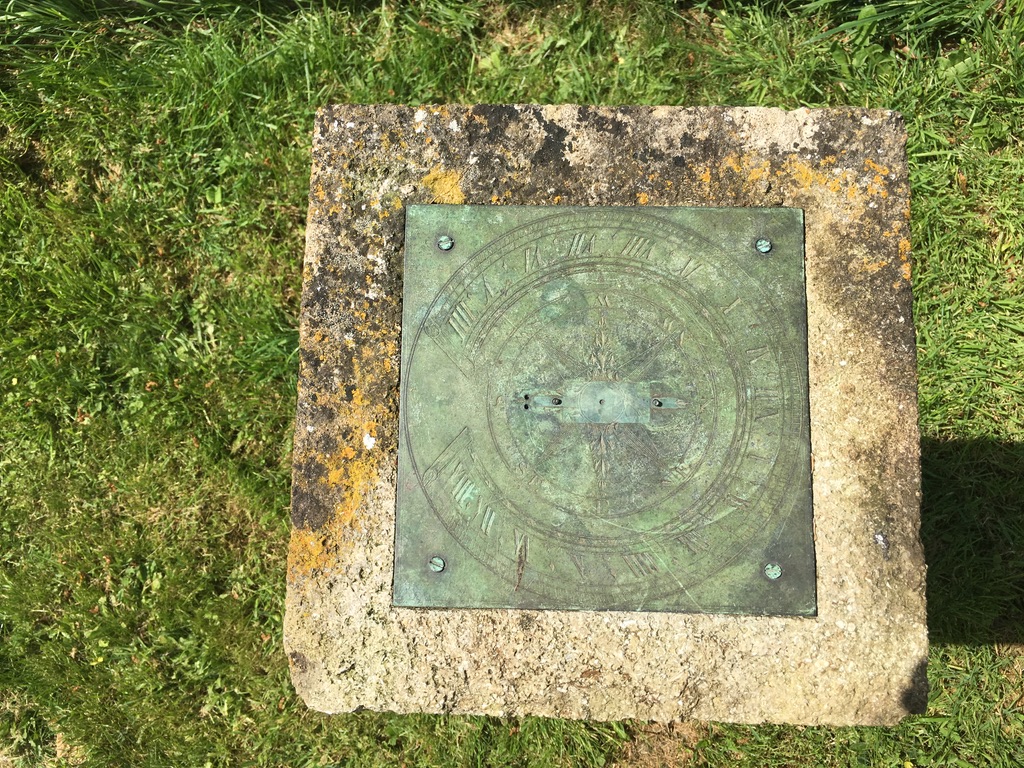
The dial is small, 4.25″ square. The photograph of the whole dial is just about clear enough to zero in on some of the details. I am hoping that the available clues will lead to ID of Tho. the maker and / or of Morris; and to the conclusion that the date is accurate [I do have in mind the generic chunky ‘genuine c17’ dials on eBay that in fact date from a rather more recent era].
I’d be pleased to have any information, advice, reaction, interpretation, wonderment or perplexity in relation to this dial. My email is sundials@gaudiumsubsole.org; or add a comment.
On the perimeter: Tho W S fecit (?) 1597
Nearer the centre: Morris and a word or name that starts or ends with W and S depending how one looks at it.
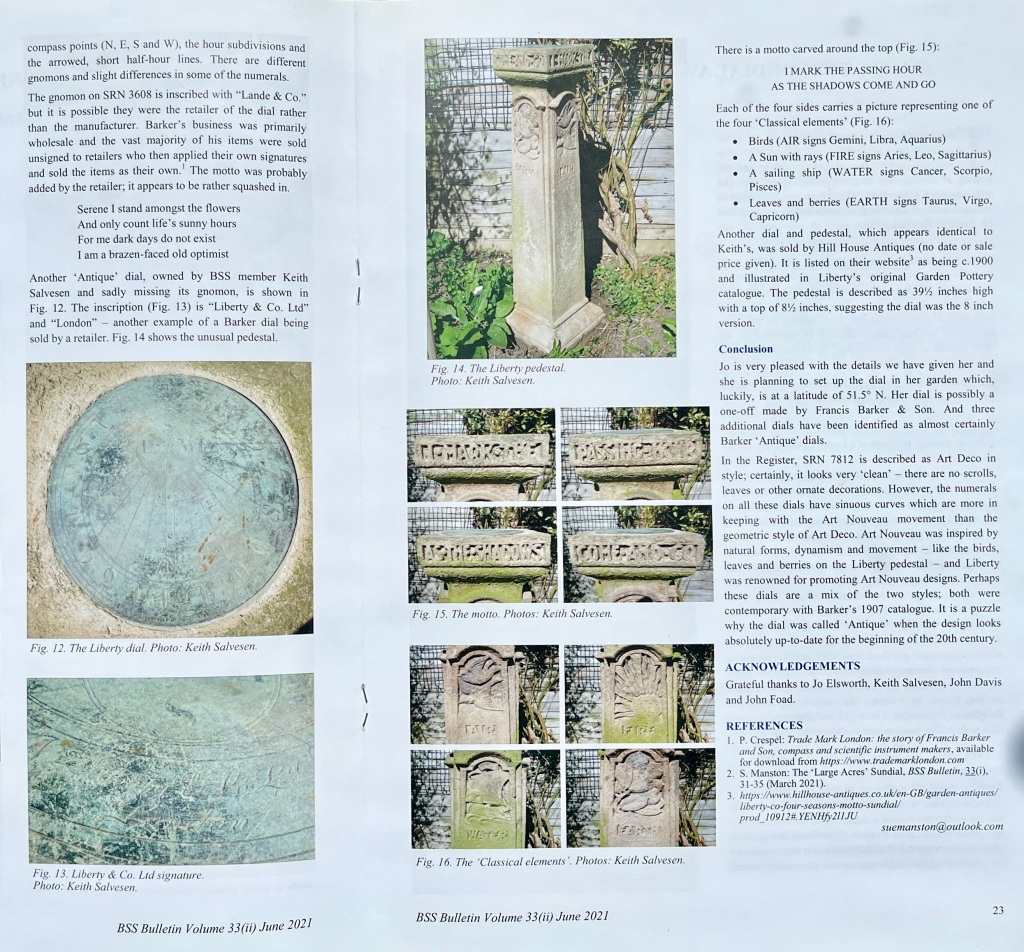
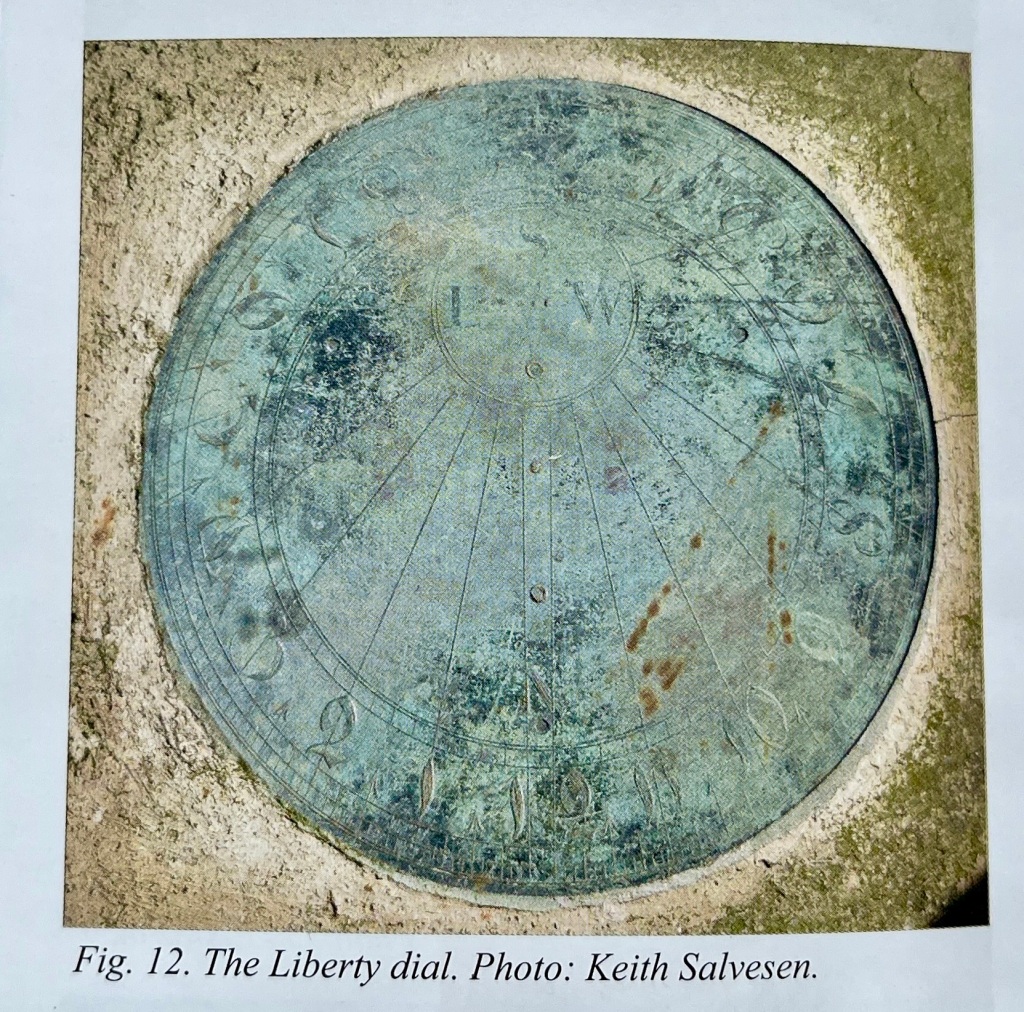
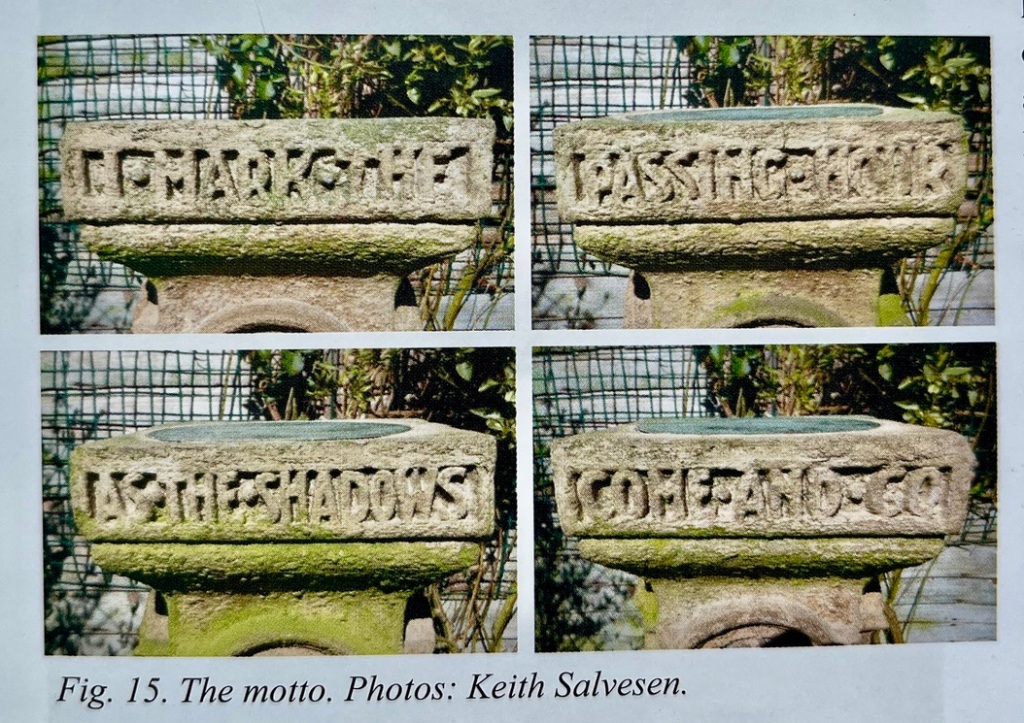
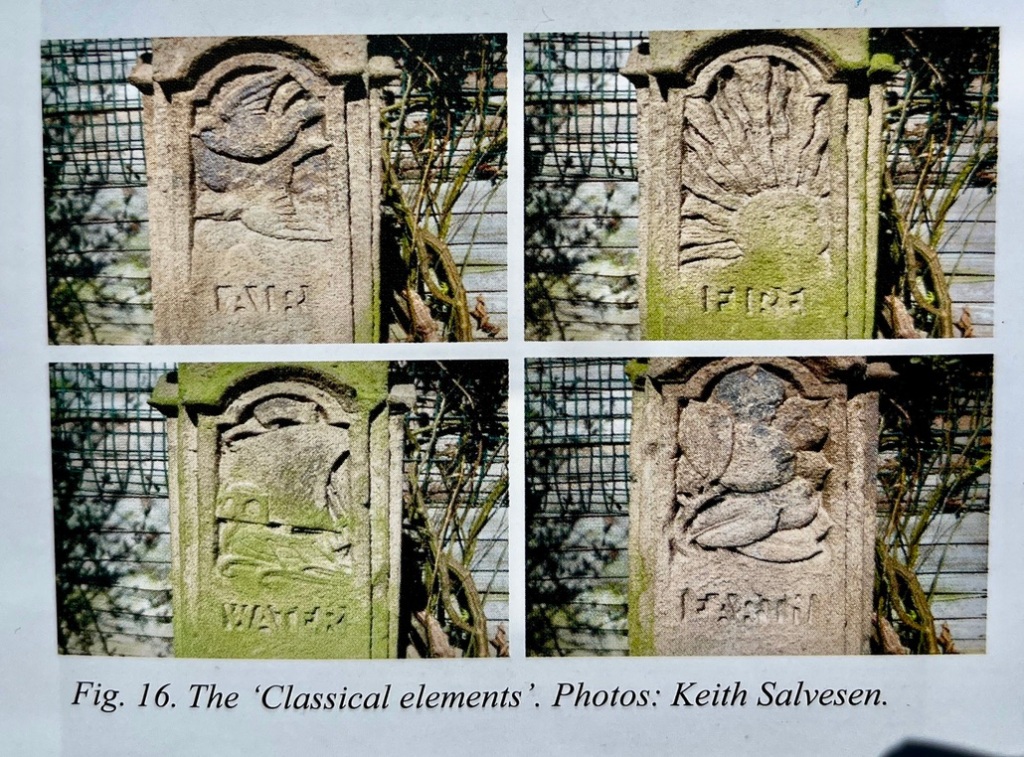
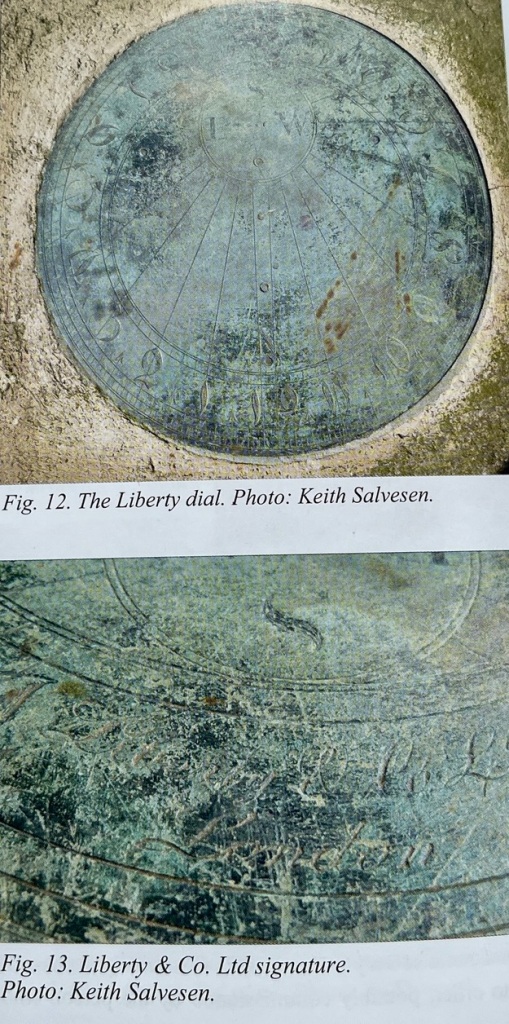
FRANCIS BARKER DIAL with LIBERTY ART NOUVEAU PEDESTAL
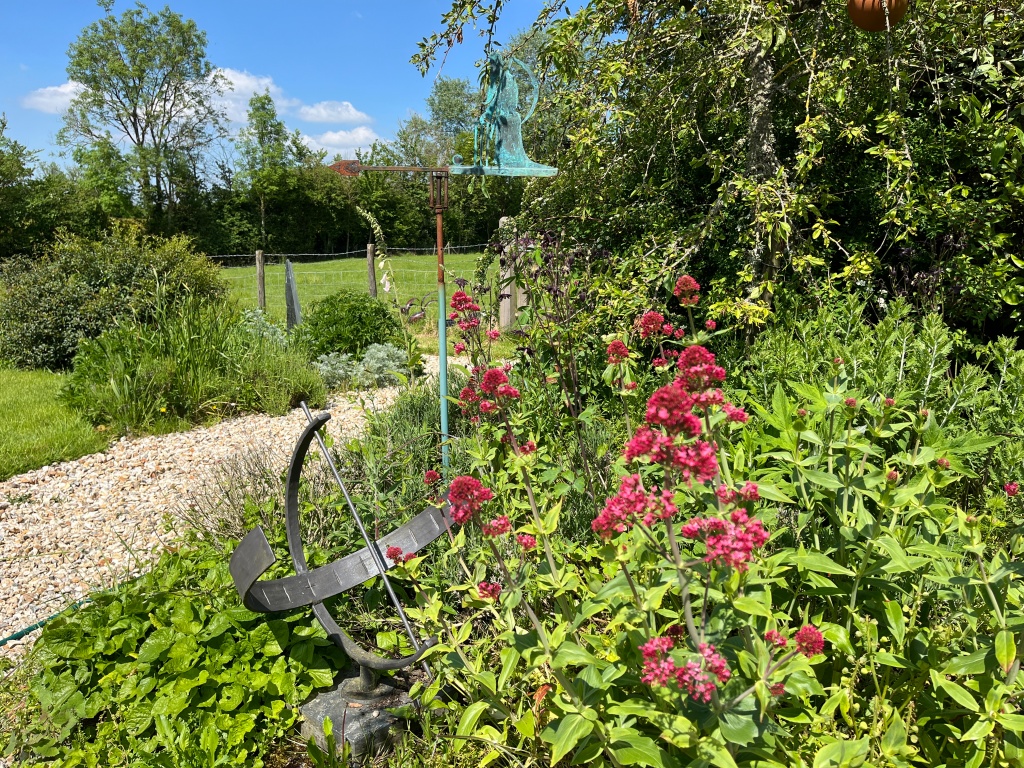
This is a gnomon-less sundial that I dug out of a pigsty at my home. I was about 10. The sty had layers of compacted earth and garden material that almost reached the top, the legacy of the previous owners. I had always wondered whether there might be hidden treasure, and eventually my curiosity got the better of me.
I gradually dug down until, suddenly, my spade hit something with a loud clonk. It took a while but eventually I was able to prise out… a prize. It has lived on as a garden ornament / flower pedestal for many years, with 4 changes of address. Eventually it has settled in Dorset.
Later – by then a BSS member – I sought advice about my dial. In due course Sue Manston included the dial in an detailed article by Jo Elsworth in the BSS Bulletin 118. Volume 33(ii) – June 2021
The author Jo Elsworth notes that similar dials have been described as ‘Antique’ and Art Deco. For the reasons she gives, the classification as Art Nouveau is the most approriate,
Also in the garden: a modern armillary sphere, watched over by Father Time
GSS Category: Horizontal Dial; Barker Sundial Plate; Liberty Sundial Pedestal; Art Nouveau Sundial.
All photos: Keith Salvesen; BSS article – Sue Manston, with thanks
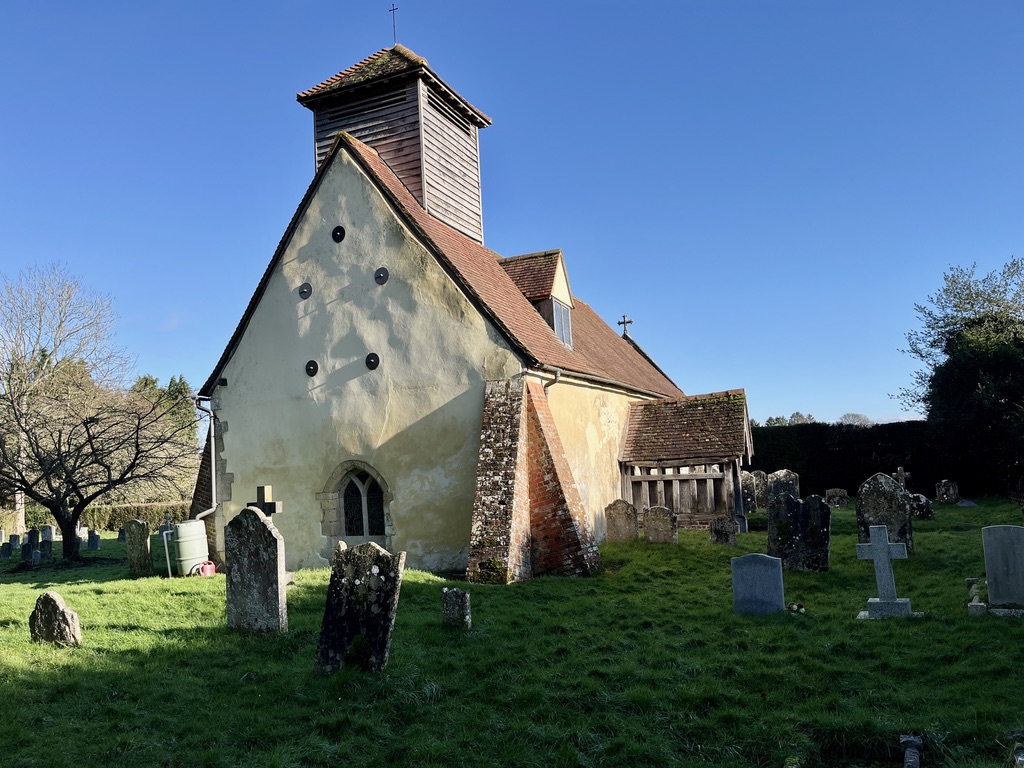
St Andrew is a fine church, and fully lives up to the interest its appearance suggests. Before looking closely at and inside the church for dials and apotropaic marks, I walked over to the sundial in the churchyard.
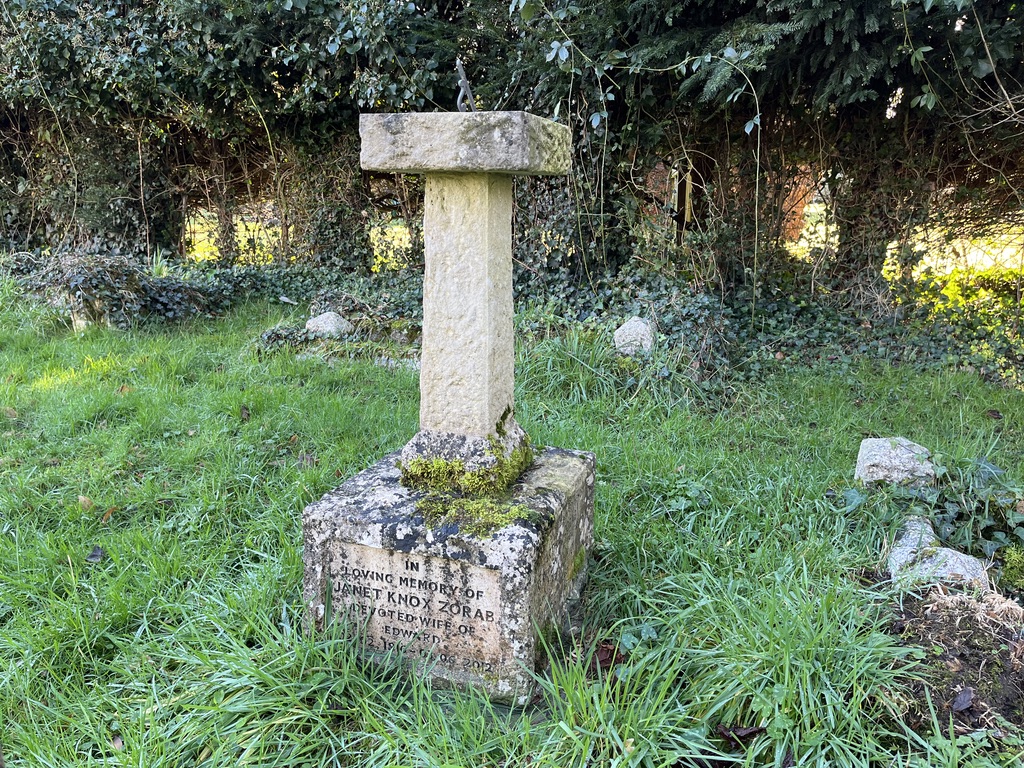
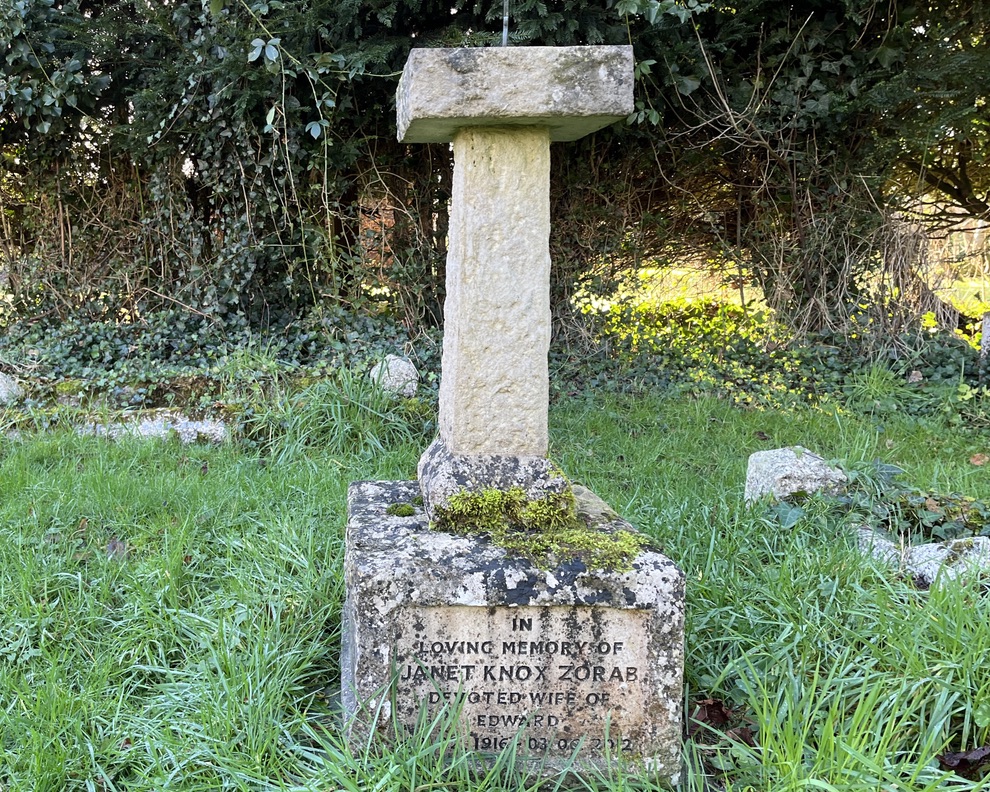
It proved to be a simple and quite elegant Memorial sundial for Janet Knox Zorab who lived to be nearly 100.
The dial plate and gnomon are conventional. The rustic feel to the churchyard and the closeness to a rather special church provide a peaceful setting for a memorial.
GSS Category: Horizontal Sundial; Pedestal Sundial; Memorial Sundial
The entire contents of Sandford Orcas Manor, a fine example of country house Tudor, have been auctioned following 4 days of viewings. The sale has generated much interest and excitement both locally and well beyond. Such a complete disposal – even the family Bible (1702) was included – is quite rare. The house dates from mid C16 and has been in the same family for 300 years. It has a reputation for being ‘the most haunted house in England‘. The task of gathering statistics to support this proposition must have been a nightmare.
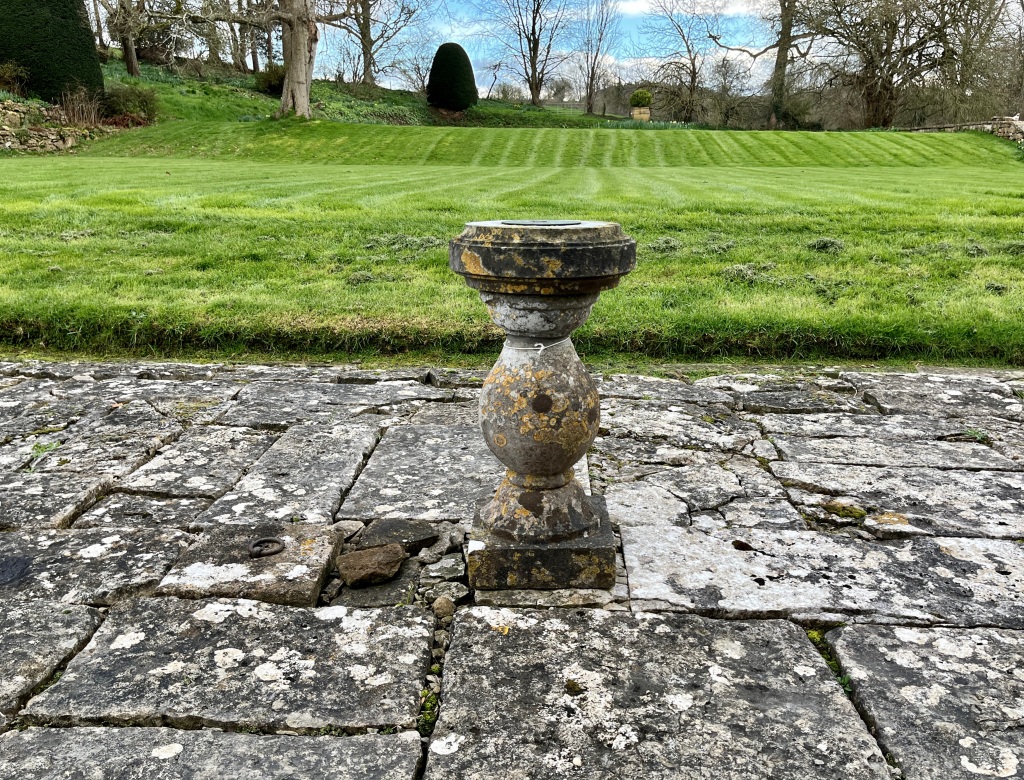
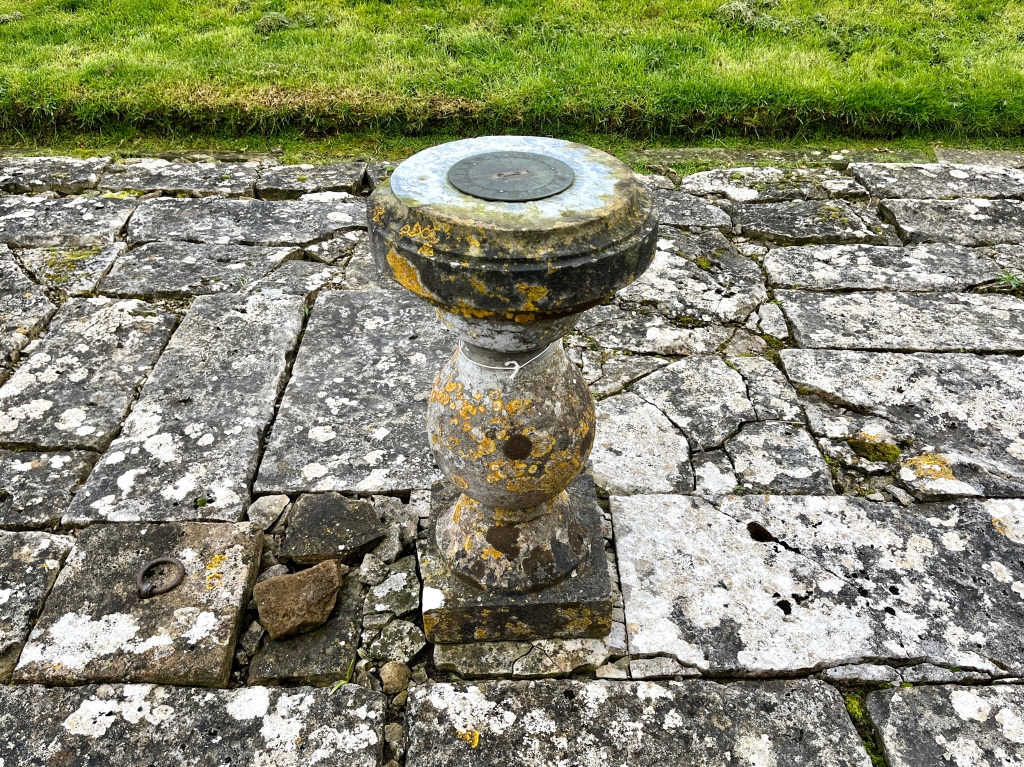
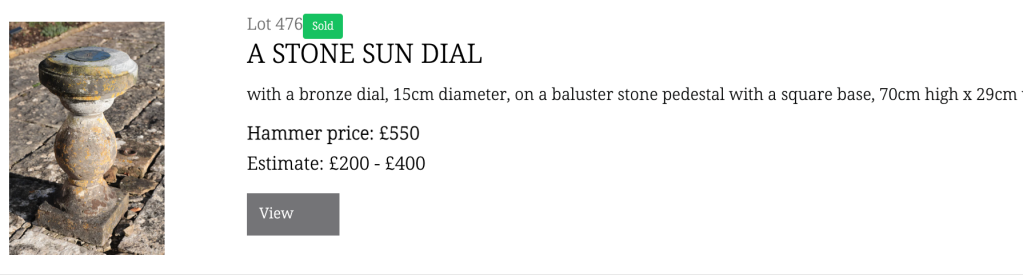
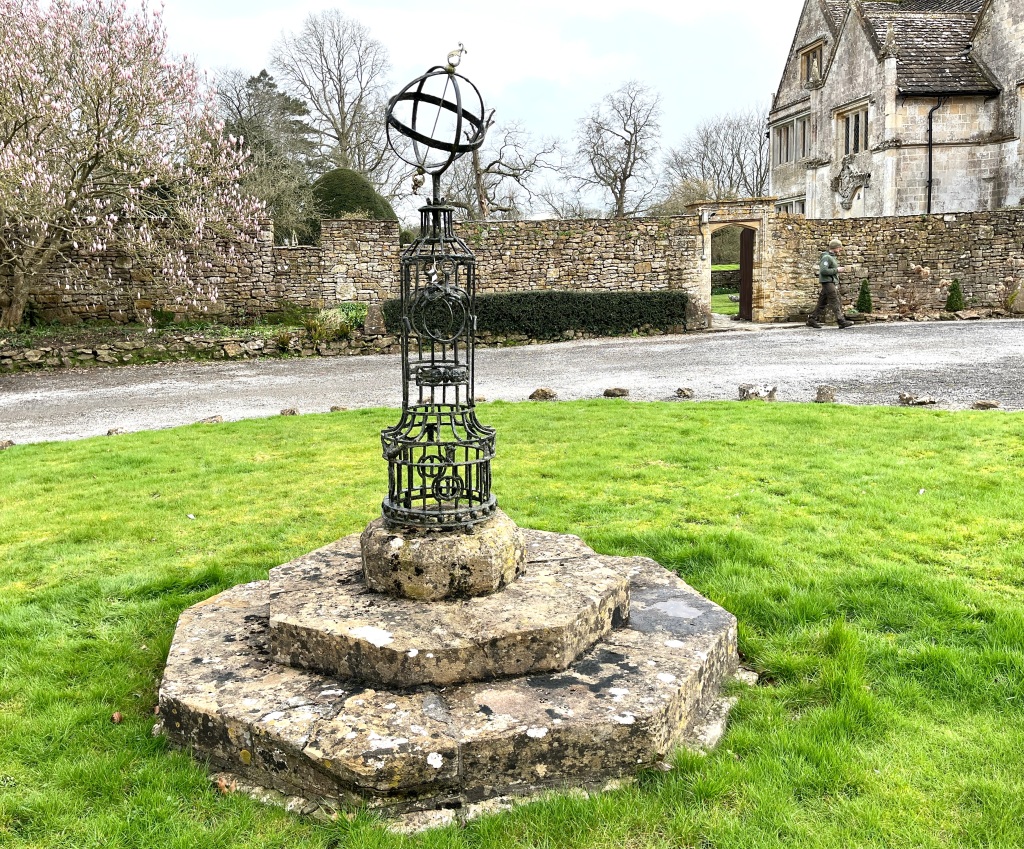
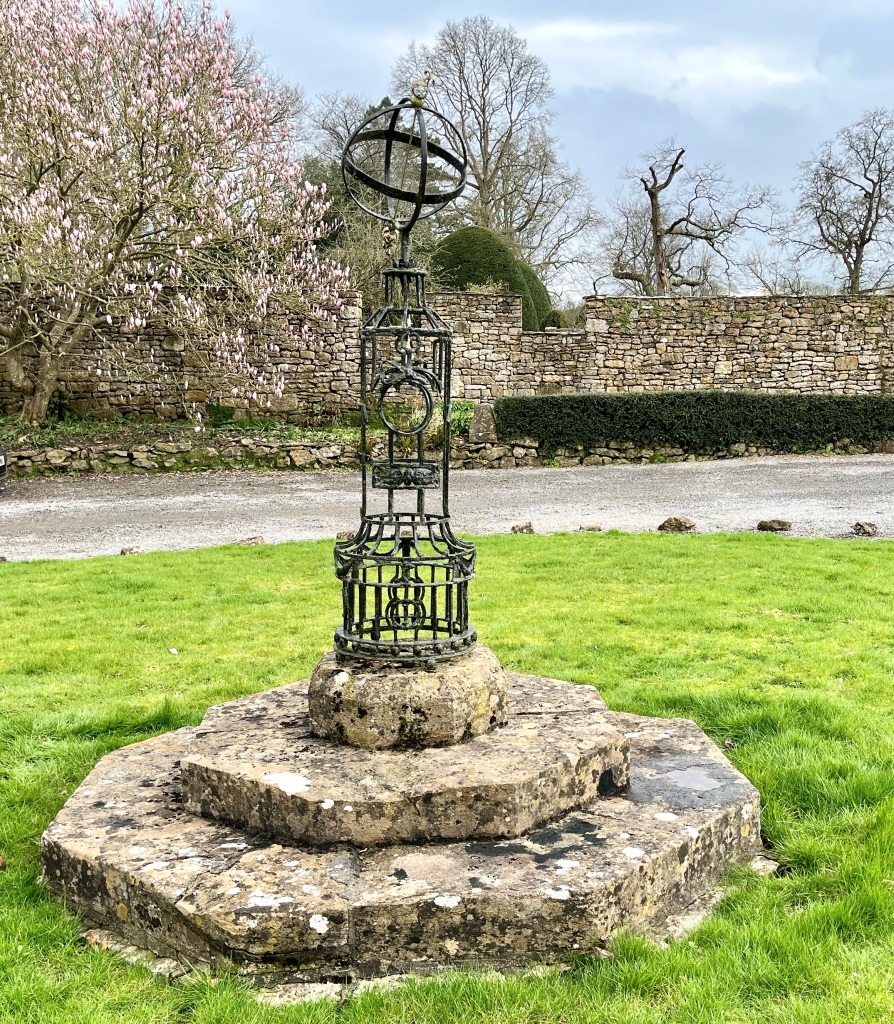
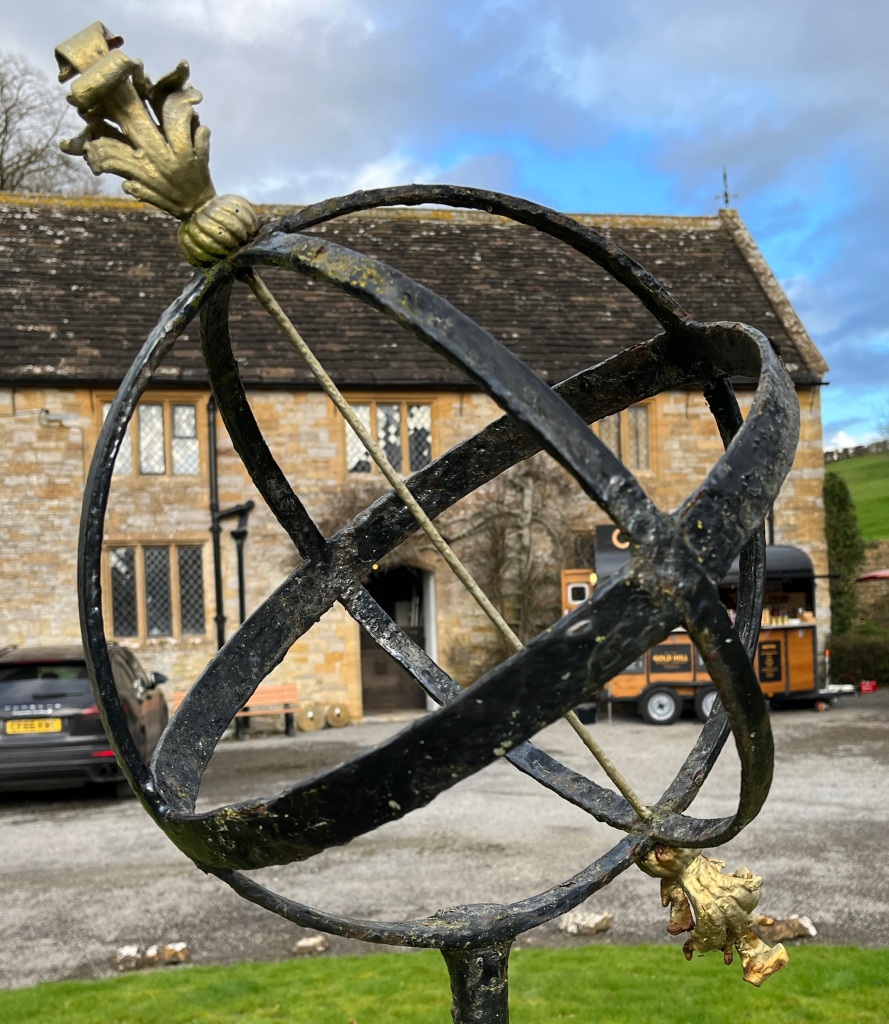
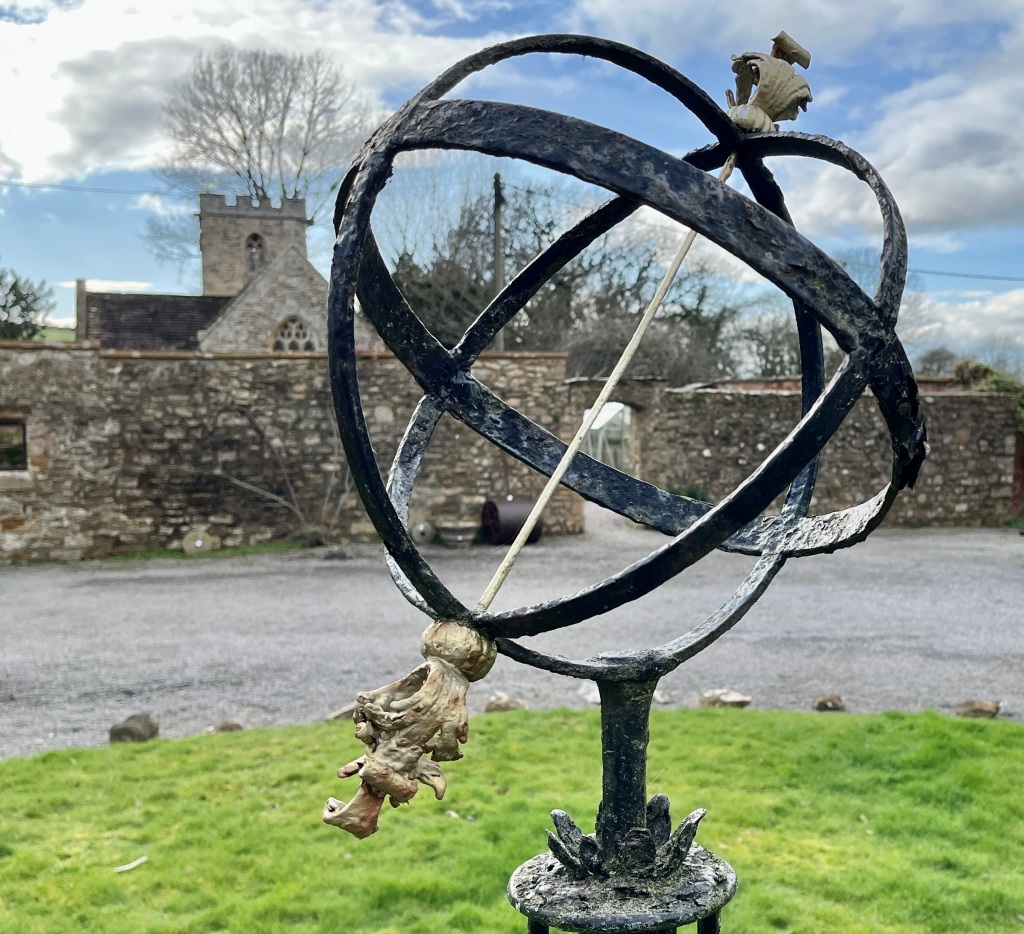
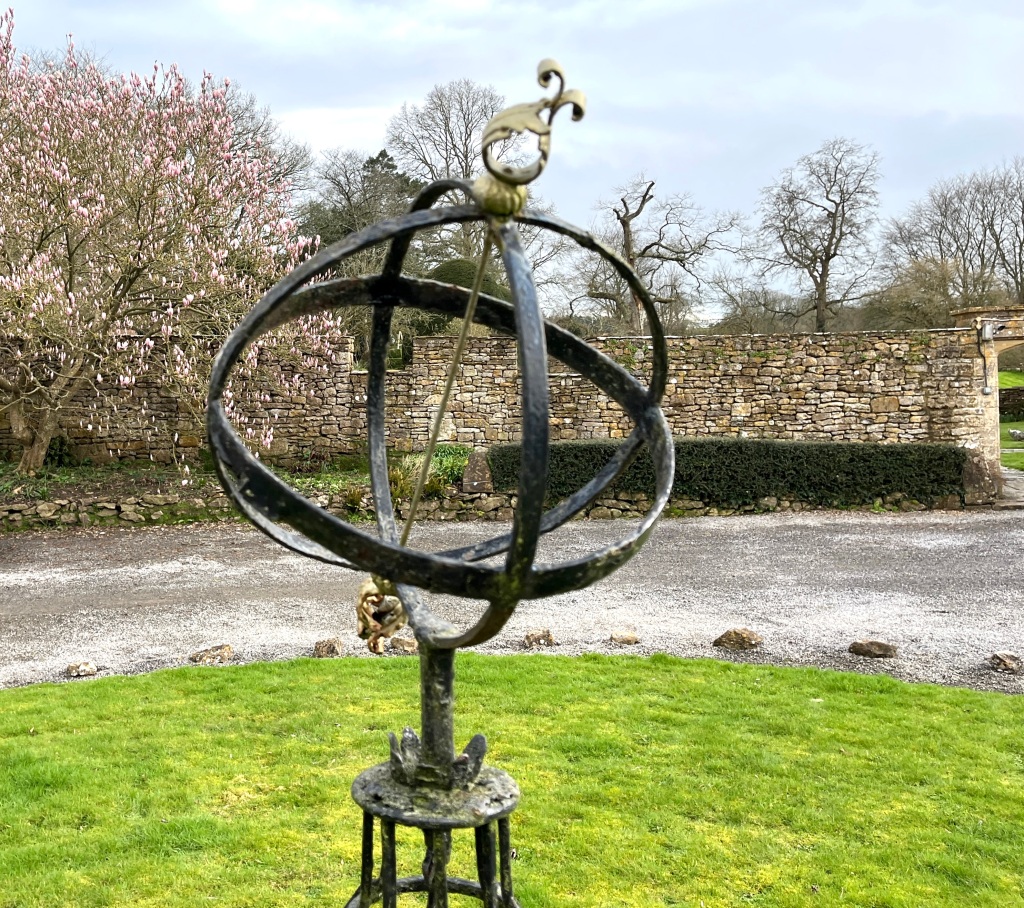
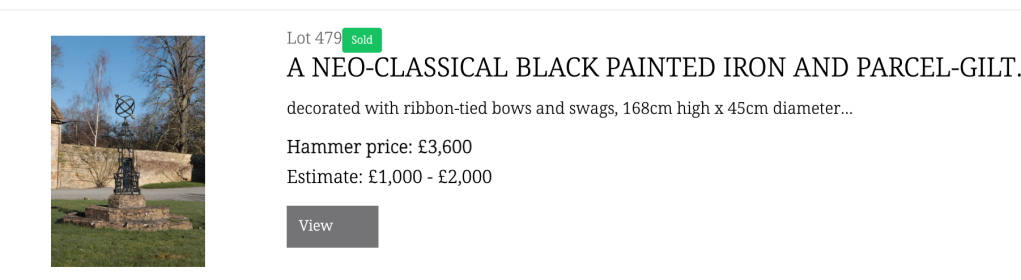
Two sundials were sold and are now removed from the property. One is a conventional garden dial, gnomon-less, on a baluster stone pedestal. The other is an armillary sphere grandly resting on a substantial triple plinth and supported by a tall ironwork obelisk.
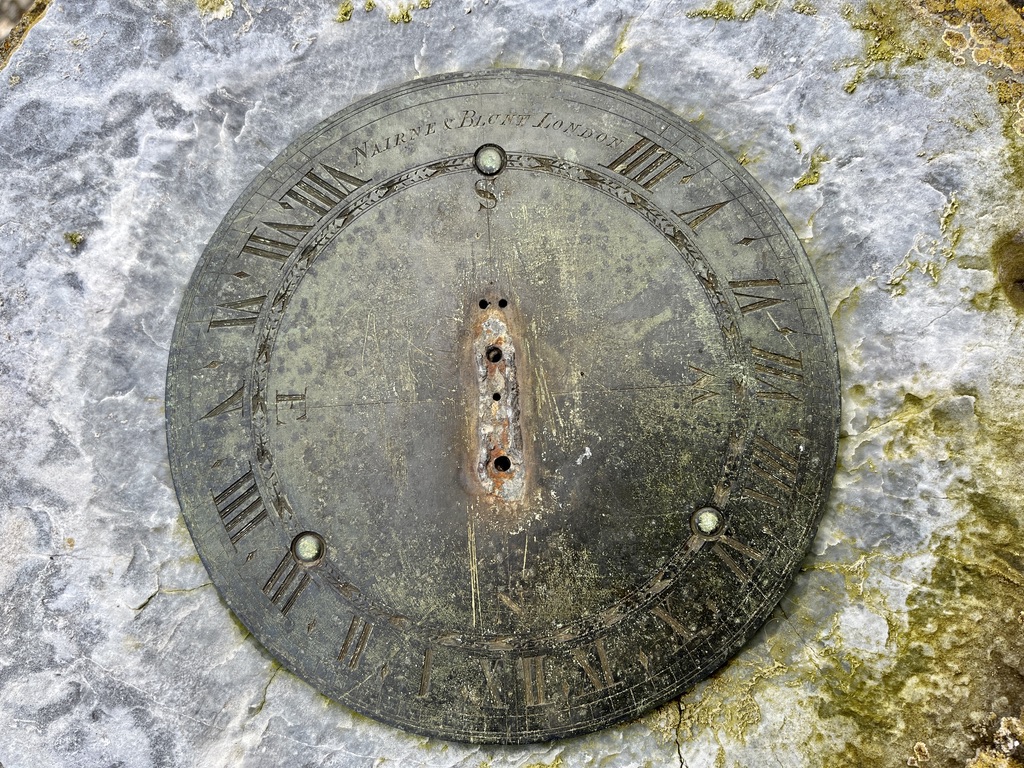
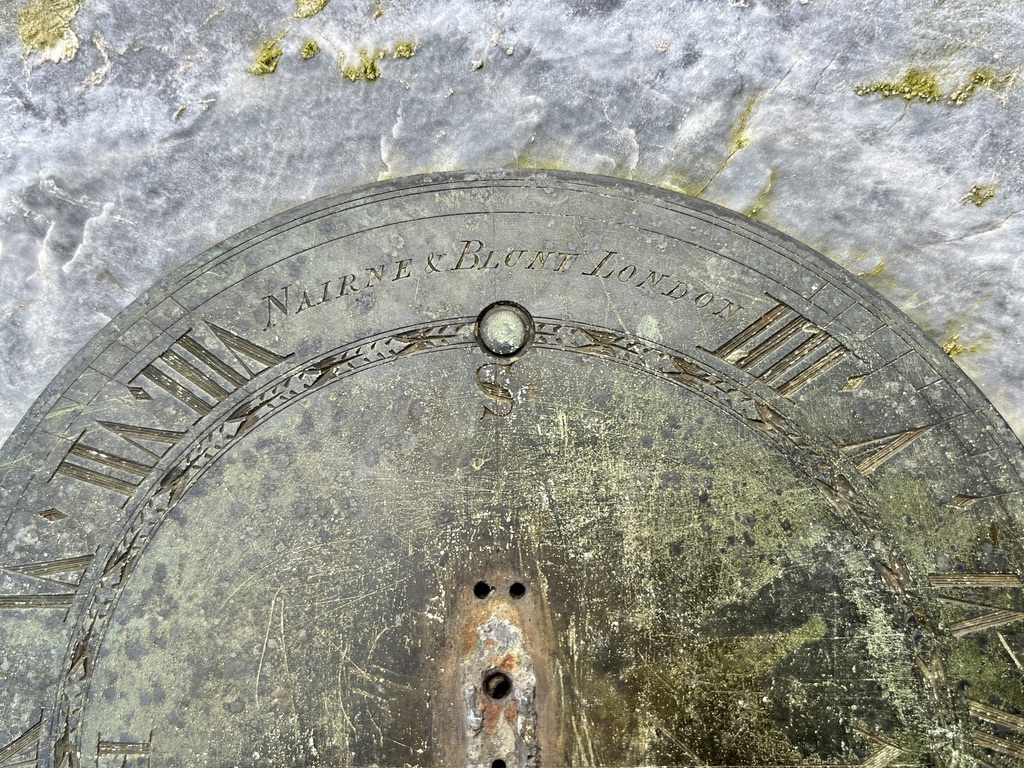
HORIZONTAL DIAL (C18) BY NAIRNE & BLUNT
Edward Nairne and Thomas Blunt established themselves in London as scientific instrument makers. They worked together between 1774 and 1793 and this dial must be from that period.
Rousham is a fine country house less than 20m N of Oxford, built for the Dormer family in 1635 and still in their possession. Its landscape gardens were designed by William Kent, the inspired founder of the great tradition of such gardens in England. Little has changed at Rousham since C18. The RH site notes: In ‘Around the World in Eighty gardens’ Monty Don says (William) Kent is the great genius of eighteenth-century garden design and Rousham is his masterpiece, one of the greatest gardens in the world”
DOLLAND SUNDIAL AT ROUSHAM HOUSE OXON
BSS RECORD
By the pigeon house in the rose garden east of the house is a bronze horizontal dial 314mm in diameter made by Dollond of London.. It shows the customary hours IV – VIII divided into halves and quarters.The hours are also displayed in Arabic numerals and divided into periods of 10 And 2 minutes. There is an Equation of Time scale and round the centre of the dial a 16-point compass rose. There is a noon gap to compensate for the 7/16″ thick gnomon. The dial is mounted on a tapering stone column with a circular capital.
DOLLAND
Dolland workshops were active from approx 1750 to 1850. The business was founded by John Dolland who was joined by his son Peter, and later other members of the family. The name became synonymous with the crafting of intricate and precise scientific instruments. Sundial plates were a (rare, I think) sideline. Dolland collections can be found in many museums and individual pieces in auction rooms. All items have the Dolland mark, but some cannot be attributed with certainty to a particular member of the family.
George Dollond was elected to a fellowship into the Royal Society in 1819 and was an active participant in founding the Astronomical Society in 1820 (Confusingly, his son was also called George)
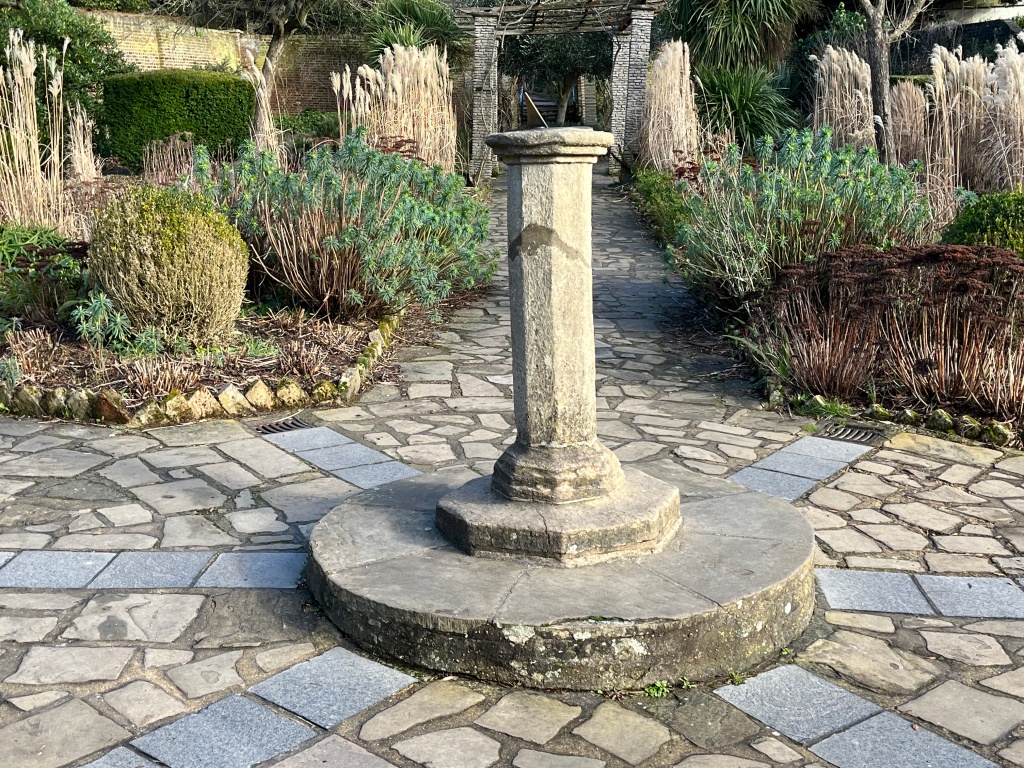
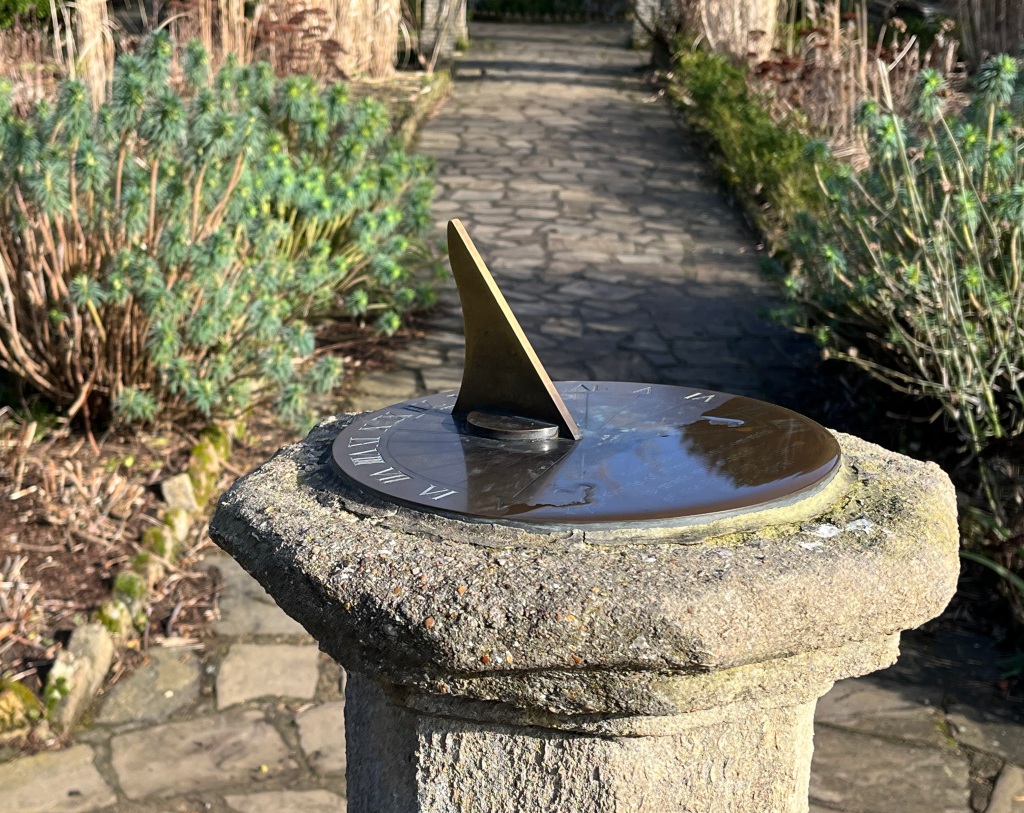
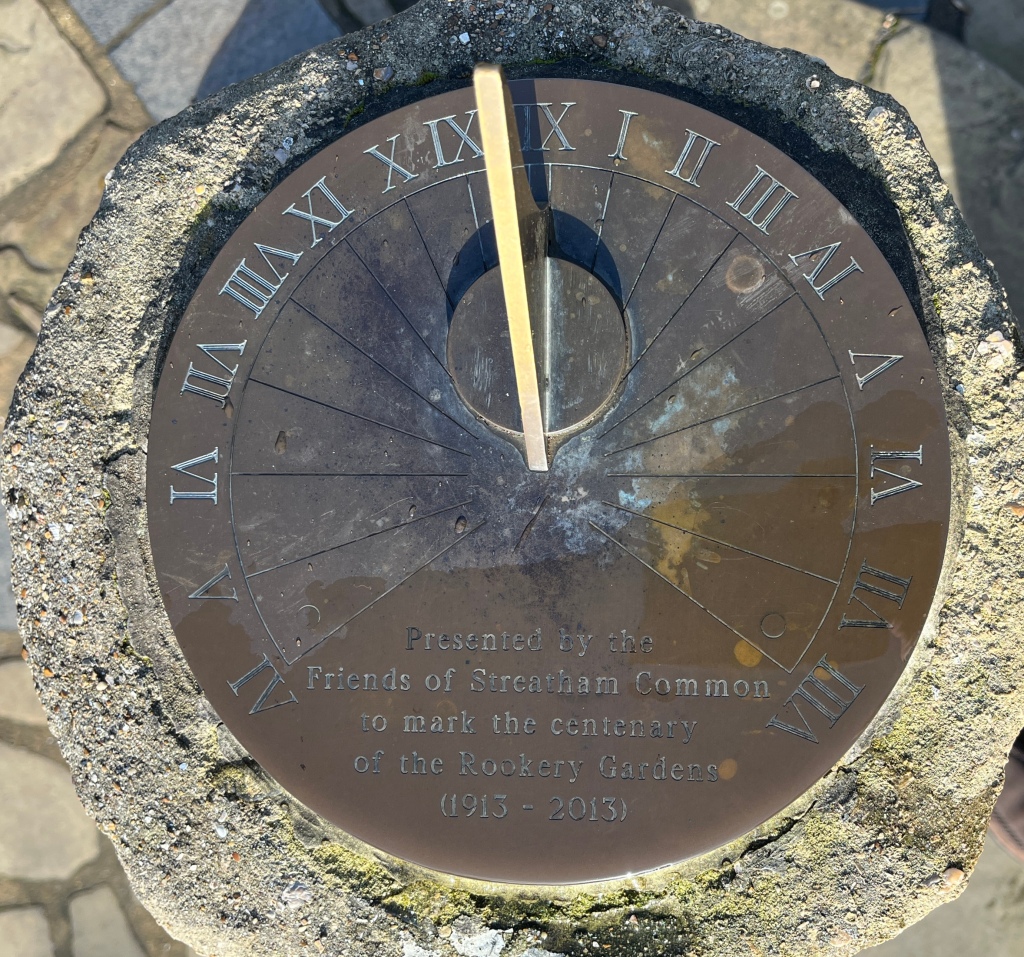
The day after Storm Isha wreaked havoc in various areas of the British Isles, there was a brief moment of sunshine during our short visit to London. We walked to the Rookery Gardens in Streatham, part of the estate of a large house that was demolished in 1912. The horizontal pedestal dial was immediately in front of us, demanding inspection. A very pleasing commemorative dial at the source of the western branch of the River Falcon, one of London’s many so-called Lost Rivers.
GSS Category: Horizontal Dial; Pedestal Dial
All photos Keith Salvesen; thanks to J & J for the productive walk
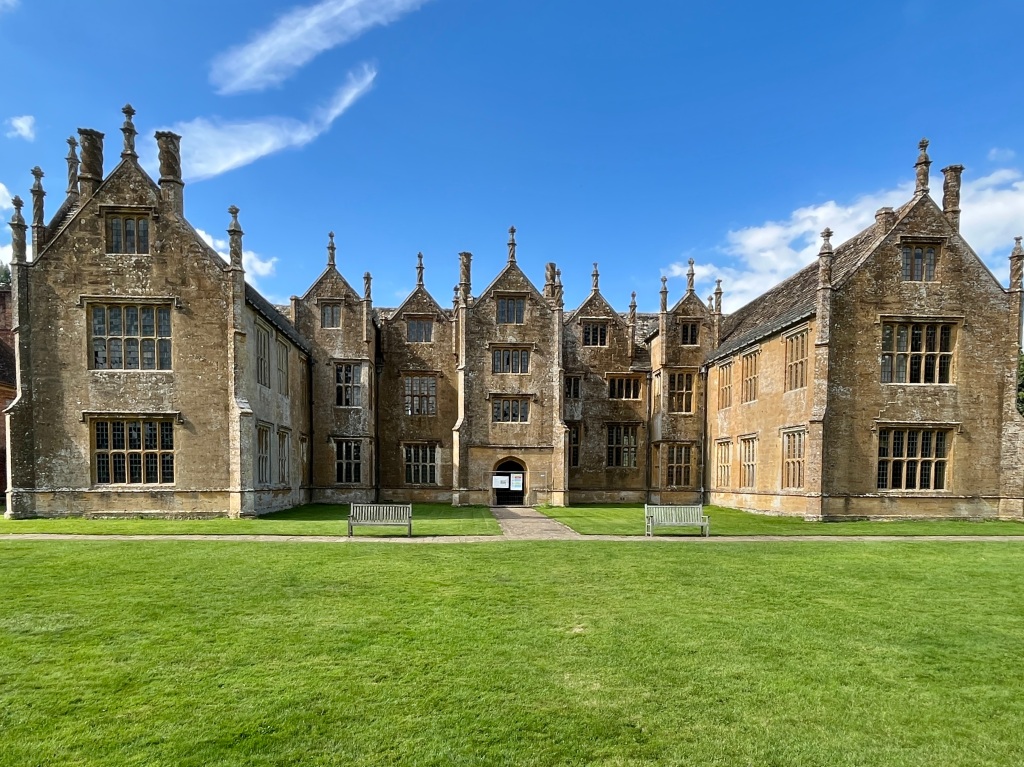
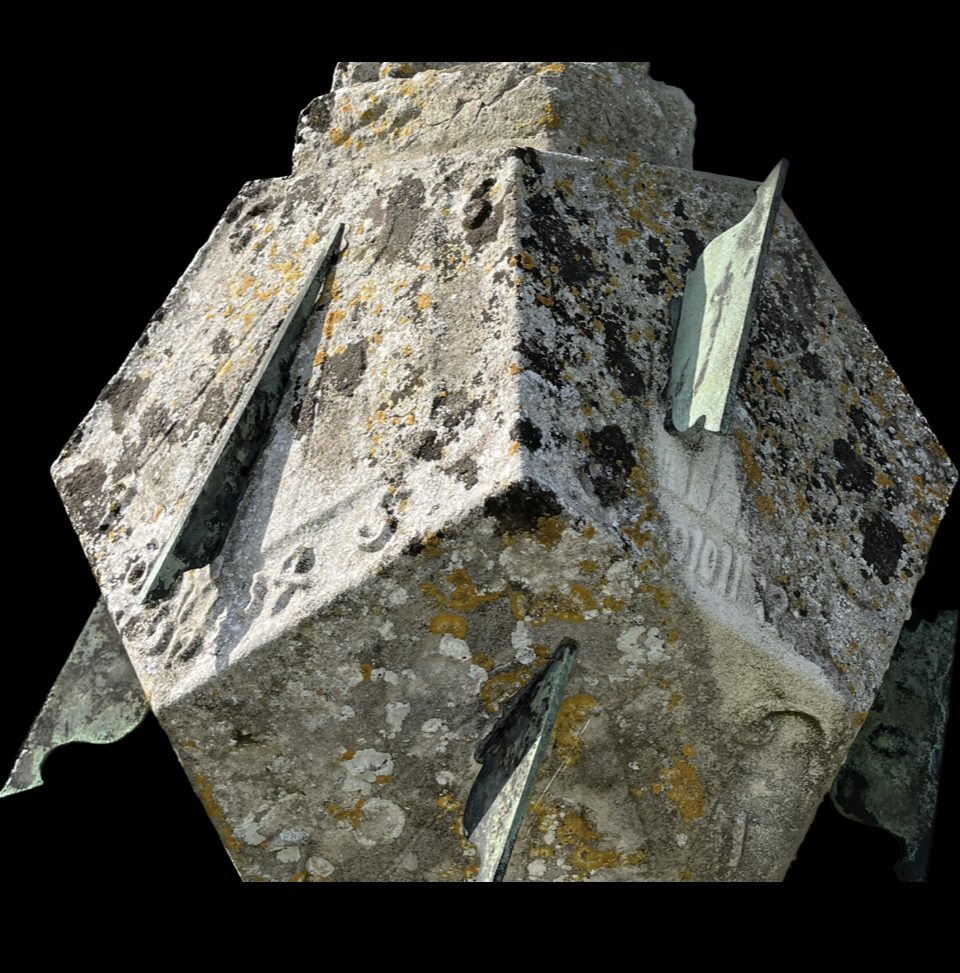
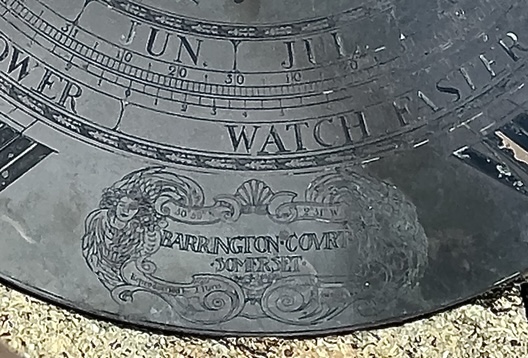
Barrington Court is a fine county house near Ilminster in Somerset, now in the care of NT. There is wonderful multi-faceted dodecahedral pillar dial in front of the house that I have written about HERE.
✣
Barrington Court . Som . Horizontal Dial
✣
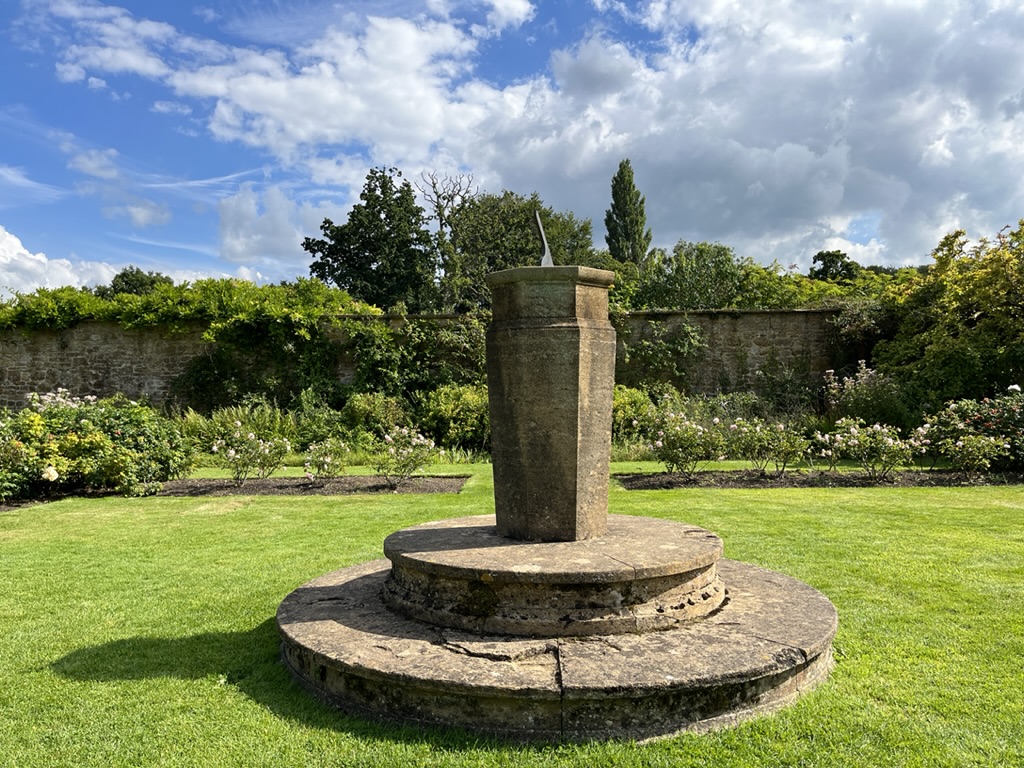
ROSE GARDEN DIAL
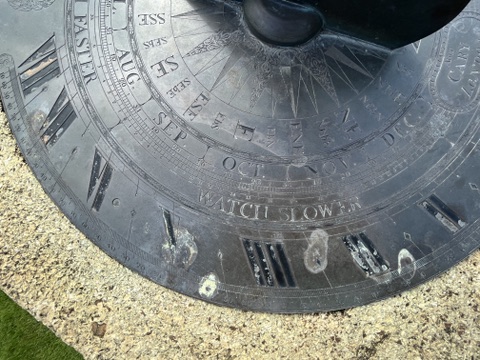
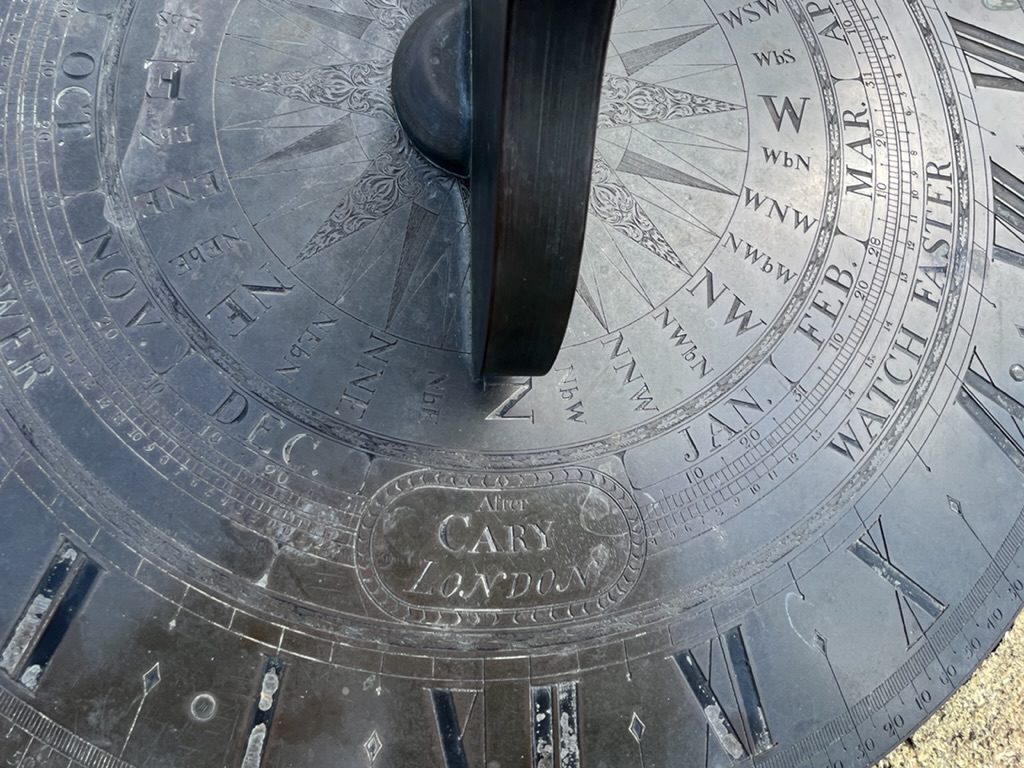
The sturdy horizontal pedestal dial stands on a double plinth in the centre of the large rose and iris garden. It has a sad recent history. In Spring 2000 the original C19 bronze dial plate by Carey was levered off and stolen. It has never been recovered.
Barrington Court . Som . Horizontal Dial after theft of plate in 2000
✣
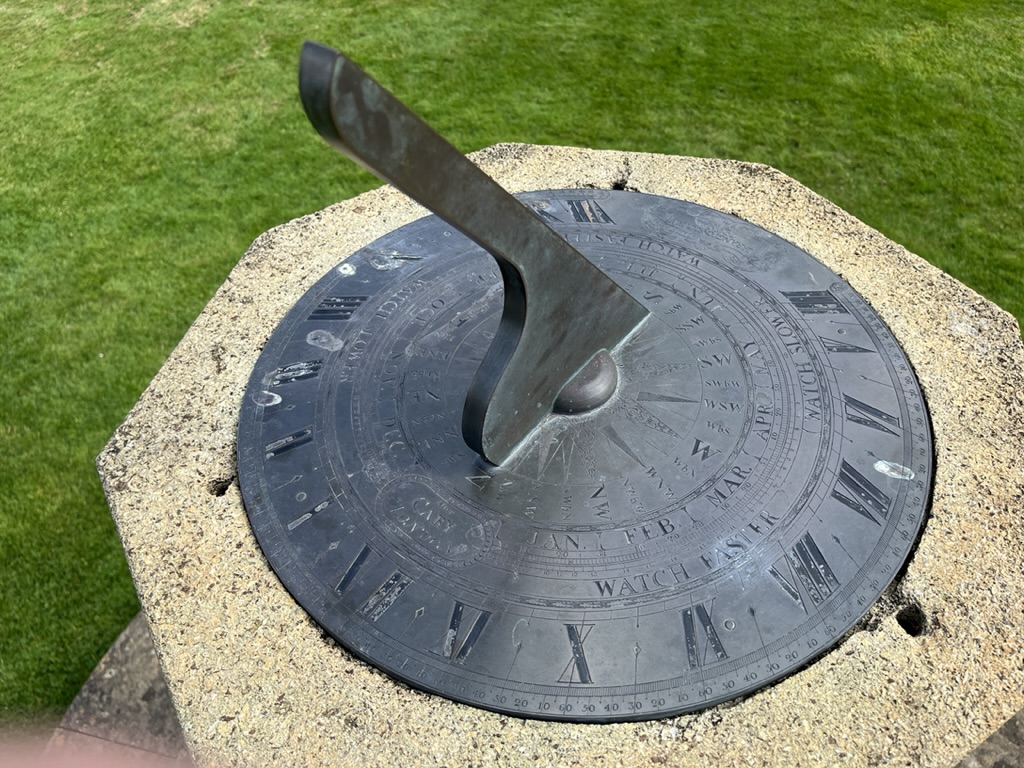
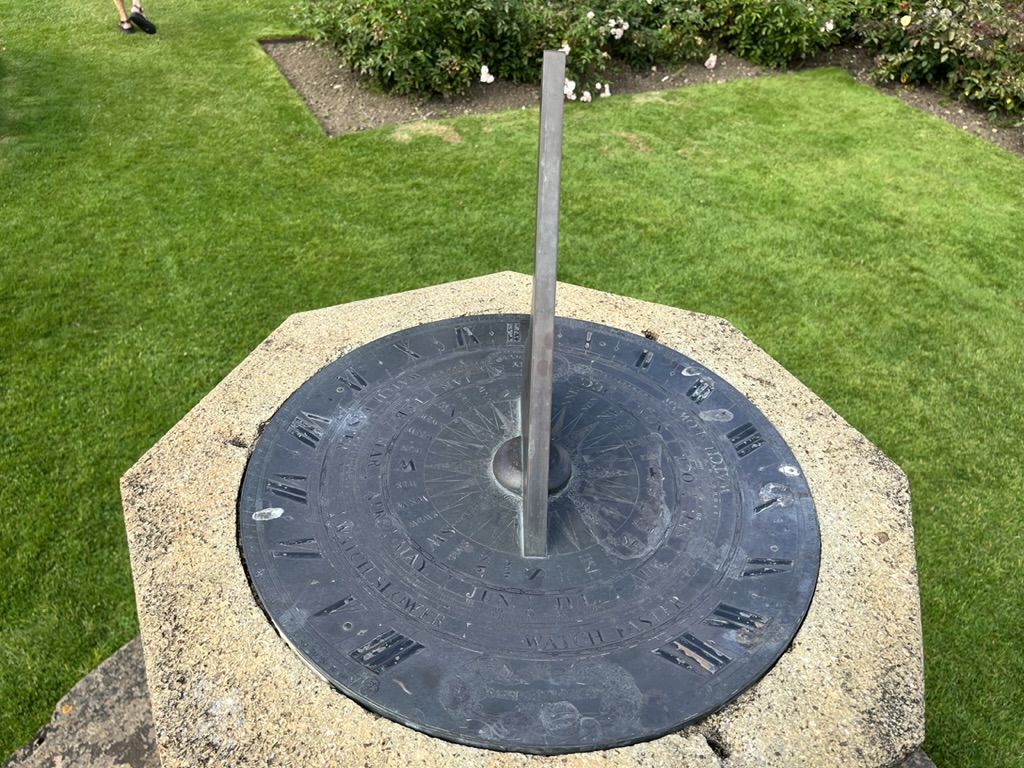
On the bright side, a wonderful faithful reproduction by John Davis was installed in 2013, and the dial is restored to its glory for the future.
Barrington Court . Som . Horizontal Dial
✣
It is described as an attractive horizontal dial of some complexity. The Equation of Time scale is engraved around the dial; all points of compass are shown; and it has one minute time marks BSS. These complex features can be seen clearly in the final image below.
✣
Barrington Court . Som . Horizontal Dial
GSS Category: Horizontal Dial; Pedestal Dial
All photos: Keith Salvesen except NT / Simon Harris above
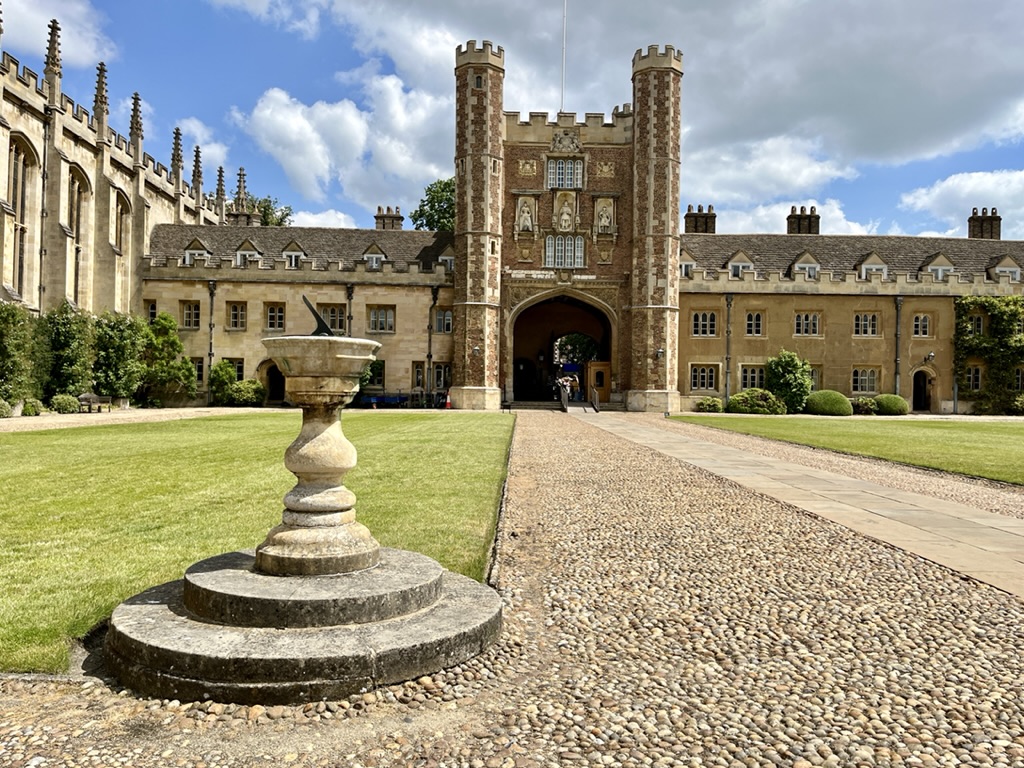
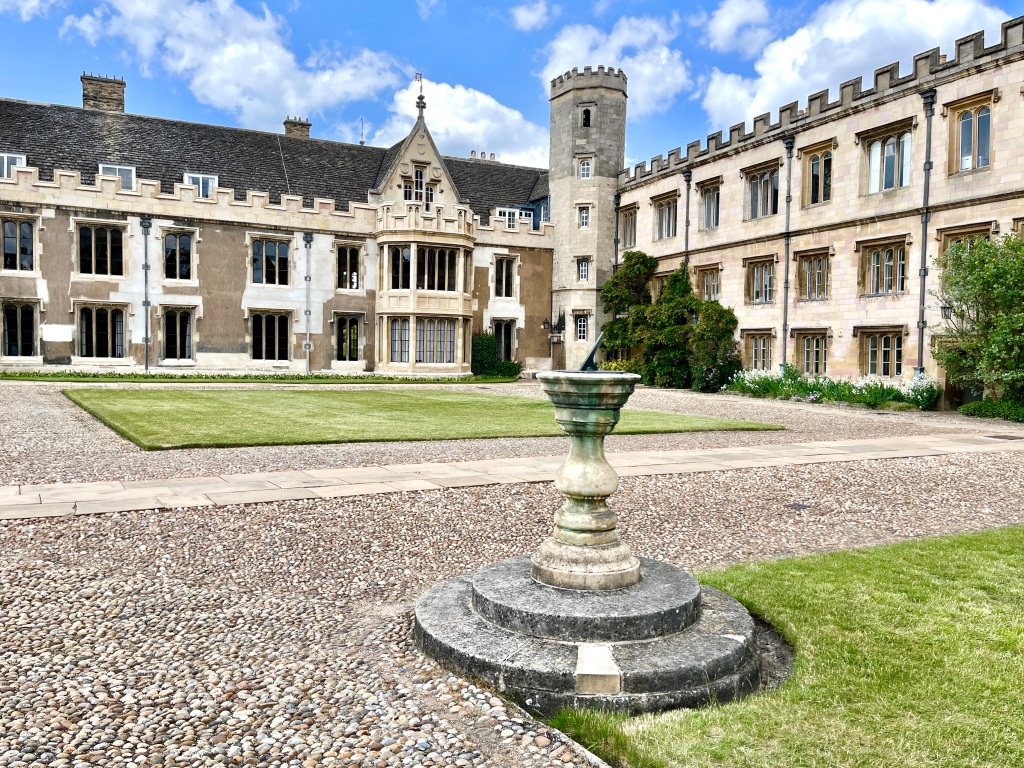
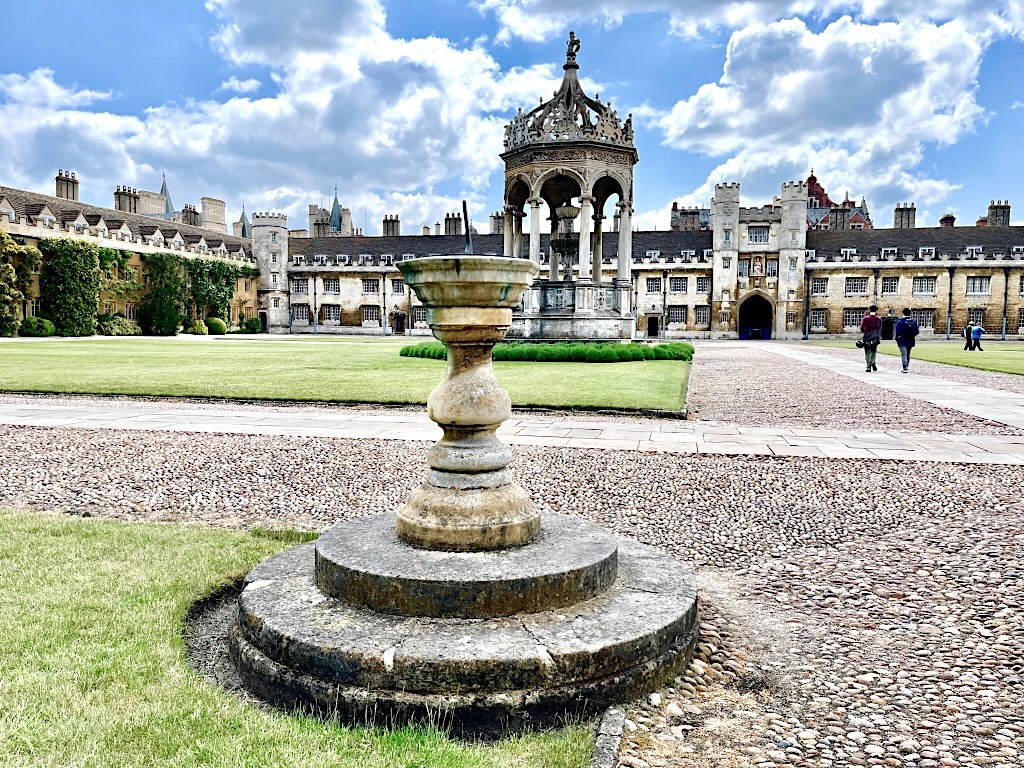
Trinity College Cambridge . Sundial – view from Master’s Lodge to Great Gate (Keith Salvesen)
TRINITY COLLEGE CAMBRIDGE . GREAT COURT
THE TALE OF TWO DIALS
GRADE II ✣ 1704, dial renewed in 1795 by Edward Troughton of London. Simple stone baluster with moulded base and cap, set on 2 steps. RCHM.
The fine C18 horizontal sundial in Great Court has a long history, and an intriguing twist in its story. Over a period of 3 years I must have walked past or near it thousands of times without giving it a glance. The passage of the day was marked by the chimes of the famous clock, a sound that stays with me even today.
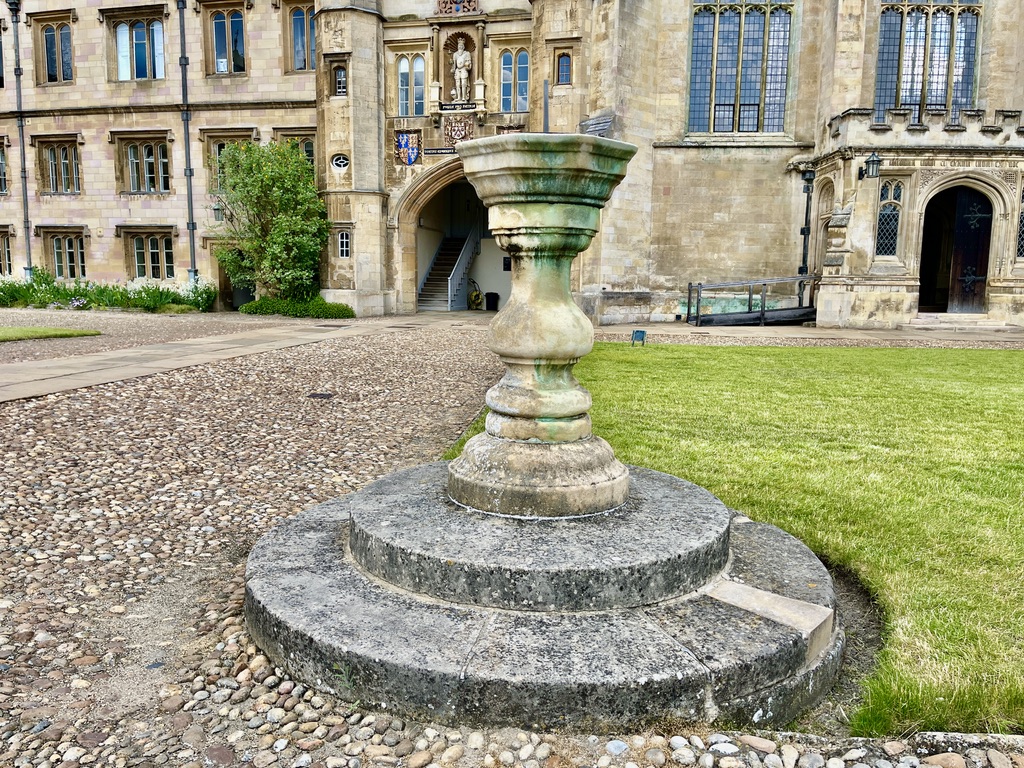
Trinity College Cambridge . Sundial – view towards the Master’s Lodge (Keith Salvesen)
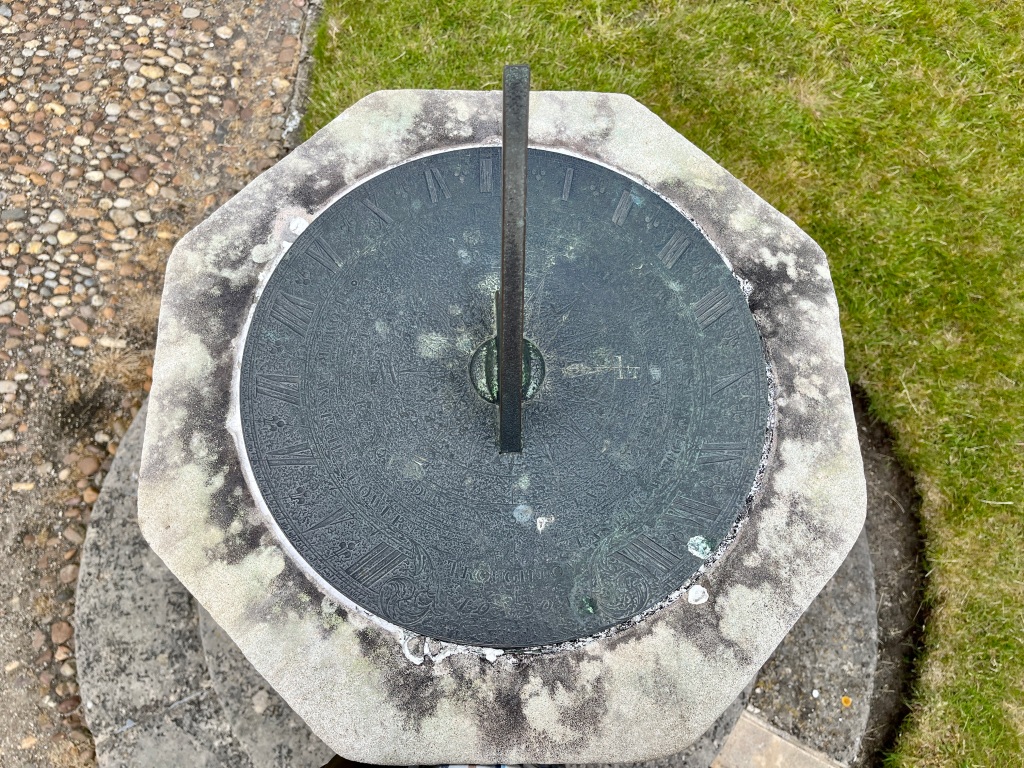
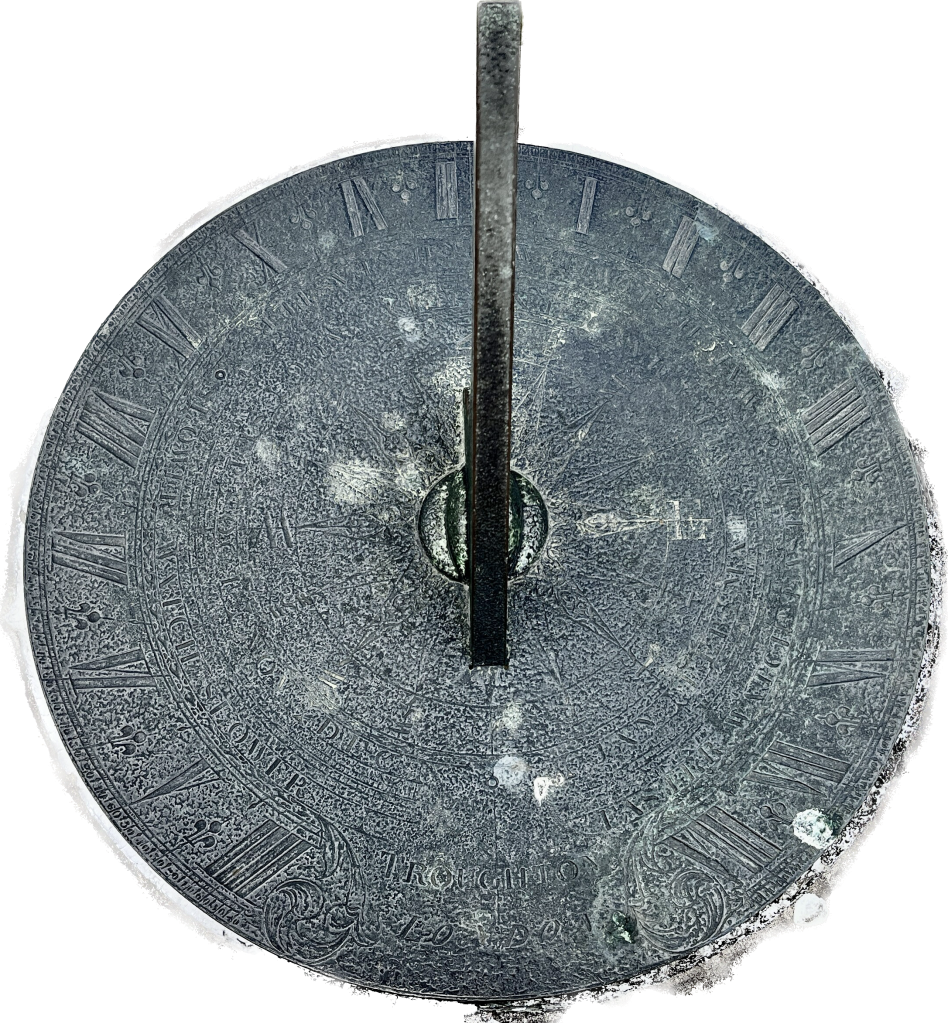
BSS notes that the dial is showing its age to some degree. This rather weathered dial is nevertheless pleasing, equipped as it is with a sturdily elegant gnomon and some nice decorative fleurs de lys marking the half hours between its Roman numerals. The central compass has floral infill and there are Equation of Time rings running anti-clockwise which indicate whether a watch would be faster or slower than the dial.
Trinity College Cambridge . Sundial – view from above (Keith Salvesen)
The description ends with an intriguing footnote:The baluster pedestal on which the dial stands may be the same one which supported an earlier dial by John England (see BSS Register, SRN 5295). Which leads to the story of the original dial that was in place until Troughton’s renewal in 1795.
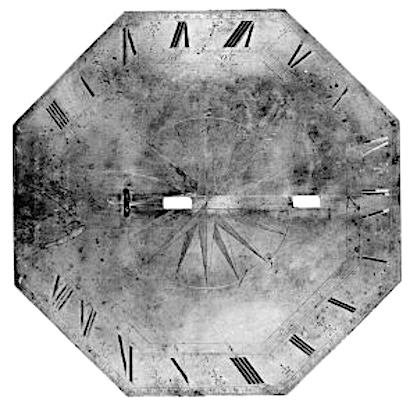
John England Dial Plate 1704
The image above shows a gnomon-less dial plate made by John England in 1704. Like the pedestal, the plate is octagonal. It was rediscovered in a cupboard in the College in 2002. BSS recorded the find as follows:
Perhaps because of its period of safe keeping, this horizontal brass dial by John England is in excellent condition, though the gnomon is missing. The engraved numerals are clear and the grooves still retain their wax infill. Small screws at the root of the style are conjectured to be pivots for an associated swinging telescope. Shows 4am to 8pm in intervals down to 1 min. Uses XII and IIII. Numerals read from outside the dial. Fleurs de lys half hour markers. Hours written in Arabic too (16-24 and 1-8) with 24 at Noon. Inscription mentions Trinity College. It is now stored in the Wren Library.
Trinity College Cambridge . Sundial – view S towards the Fountain (Keith Salvesen)
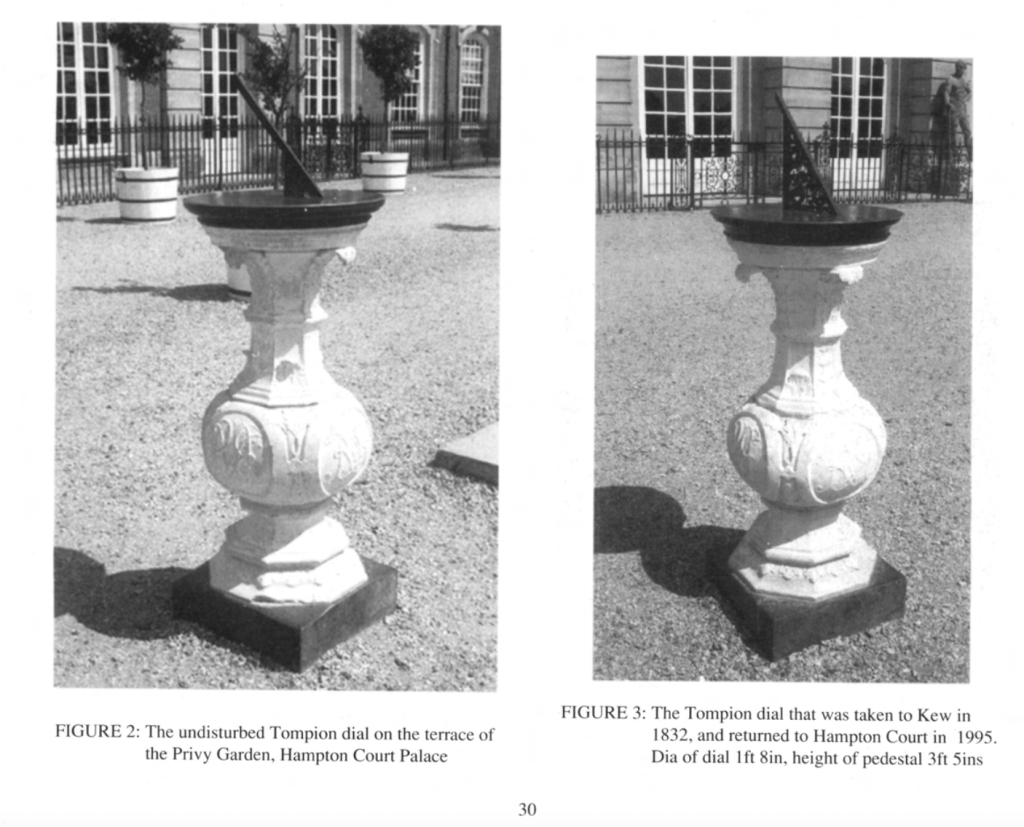
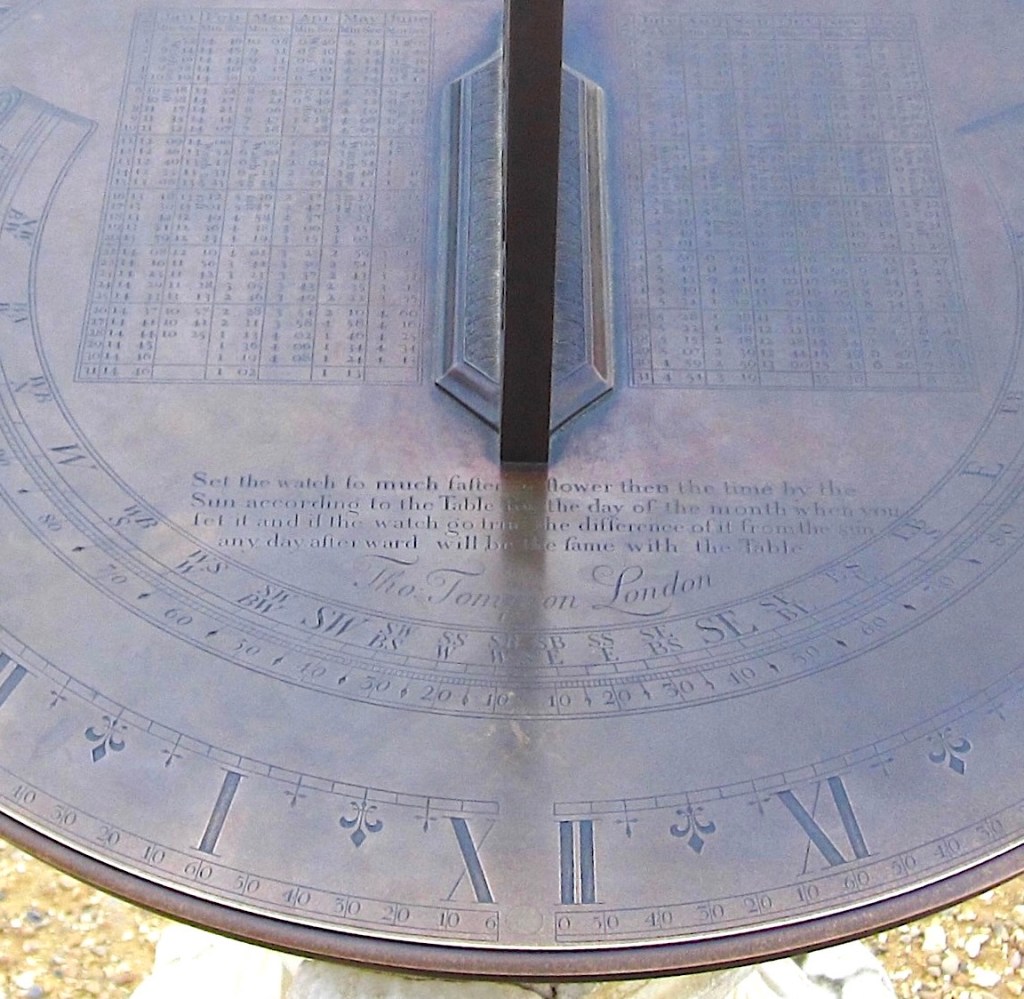
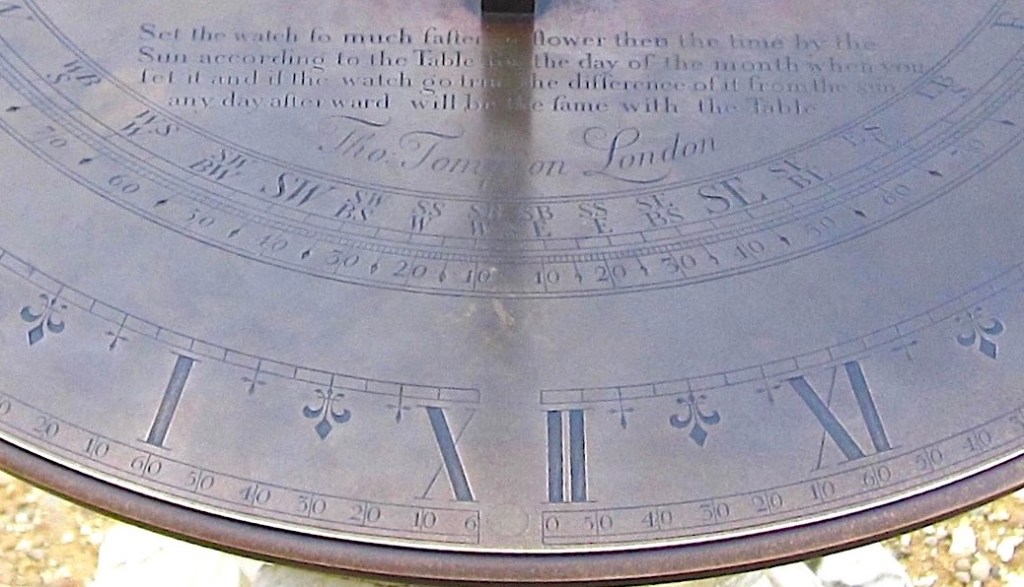
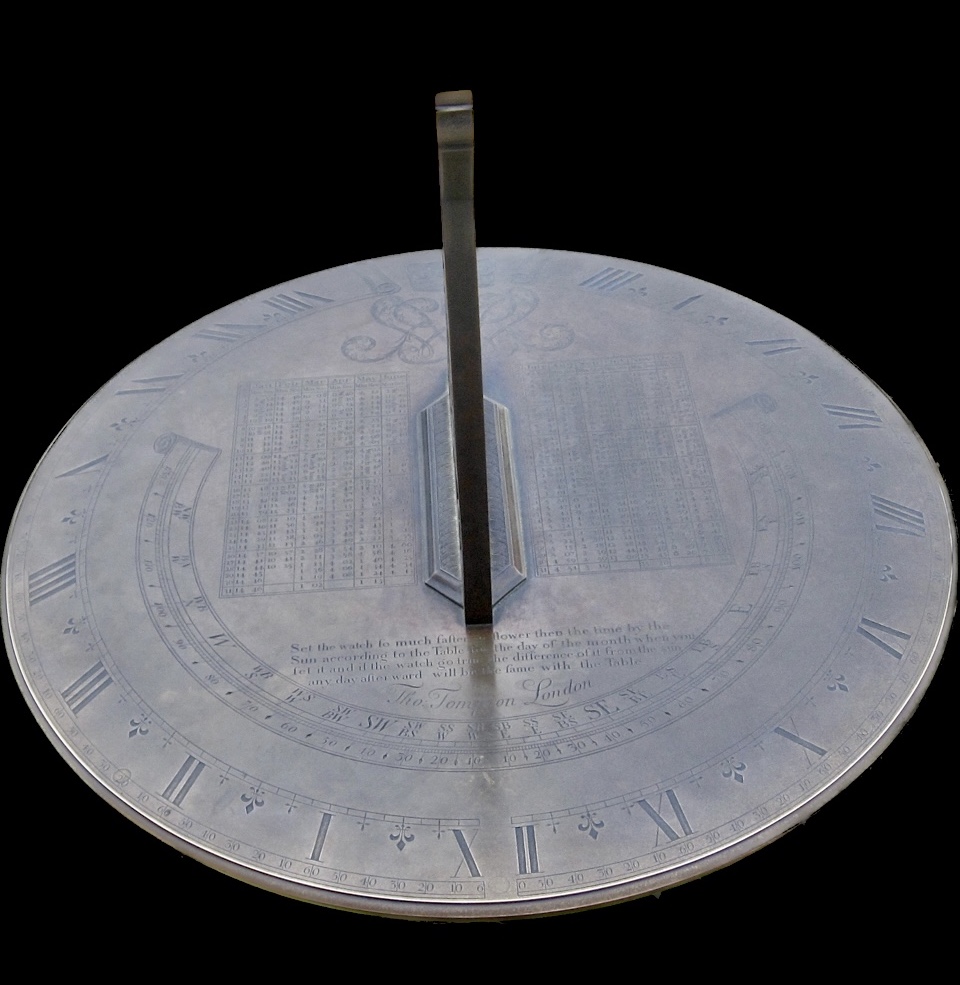
This famous Tompion dial in the Privy Garden at Hampton Court is one of a pair, the other being transferred in due course to Kew Gardens. The BSS Bulletin Jan 1997 includes side-by-side photos of both. The dial that stayed in situ, featured here, being on the left. The other dial was transferred to Kew in 1832 and not restored to Hampton Court until 1995.
I took these photos in 2011 when I was dialling-lite, and probably with an iPhone 3. Revisiting these images, I’m pleased at what a good job it did. Puzzlingly, during a quick trawl through the usual resources, inc. the Royal Collection, I have found it difficult to find any detailed images of this dial, though I found a RC image of dial 2.
Only the front of the plate is clear, and it is in remarkable good condition. There is just enough definition to give a good idea of the complexity of the calendar further back on the plate.
The precise date for the two dials in unclear. Tompion was baptised in 1639 and died in 1713. I have seen ‘towards the end of C17’; and the excellent Border Sundials points to evidence of installation in 1699.
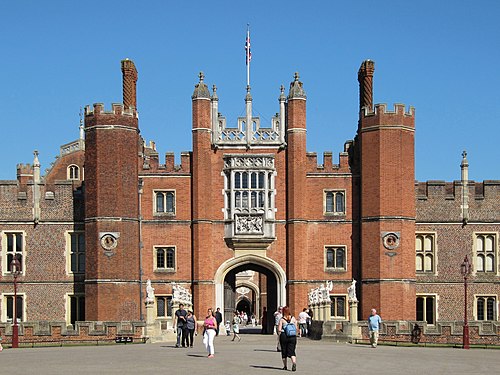
Probably, in a sundial resource, it is permissible to include an occasional linked item, and the wonderful Hampton Court astronomical clock merits admiration at any time. I was pleased to get a straight-on shot without resorting to trickery (of which there was not much available in 2011).
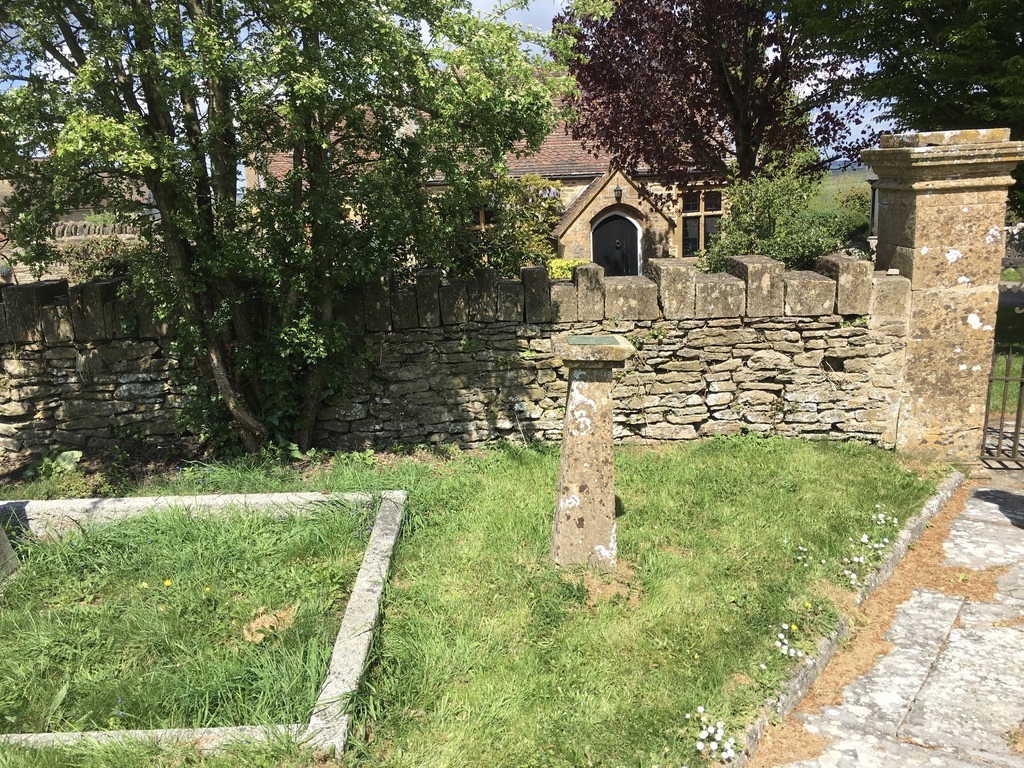
GV II* C13 origins with some C15 work but drastically restored in 1875 BLB. Fine chest tombs. Village of historical importance as a bell-foundry between C16 and C18, originating with the Purdue family. Notable bells survive from its earliest days eg. Wells Cathedral. Somerset / Dorset border 50.8883 / -2.6214 / ST563100
DIAL
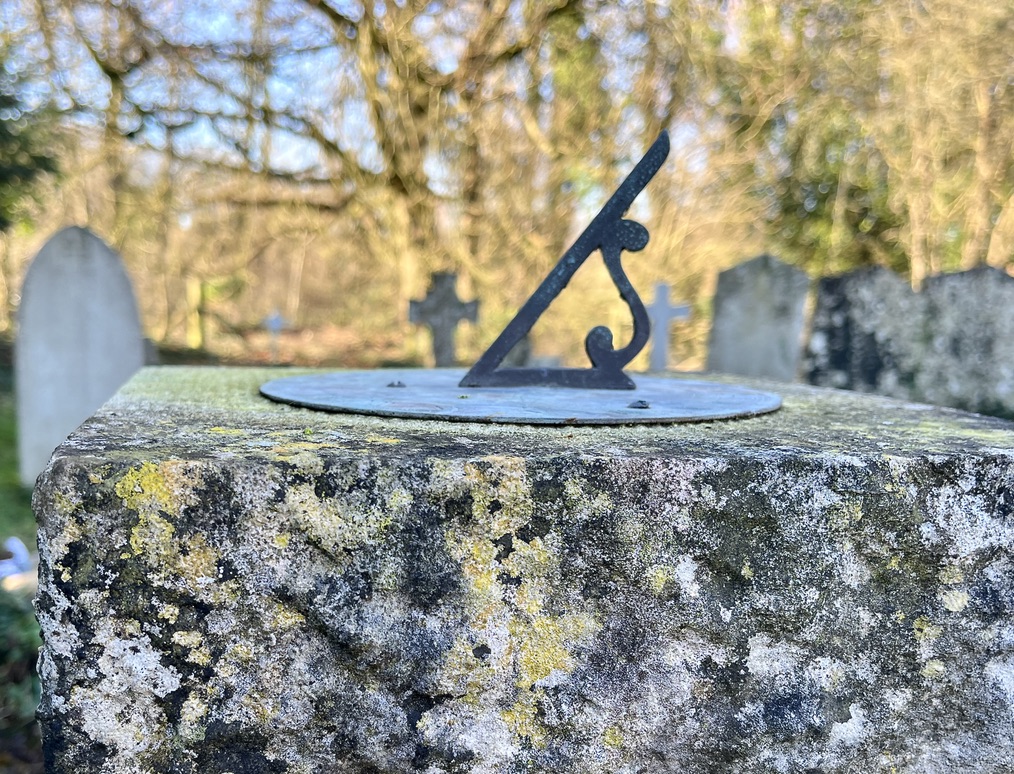
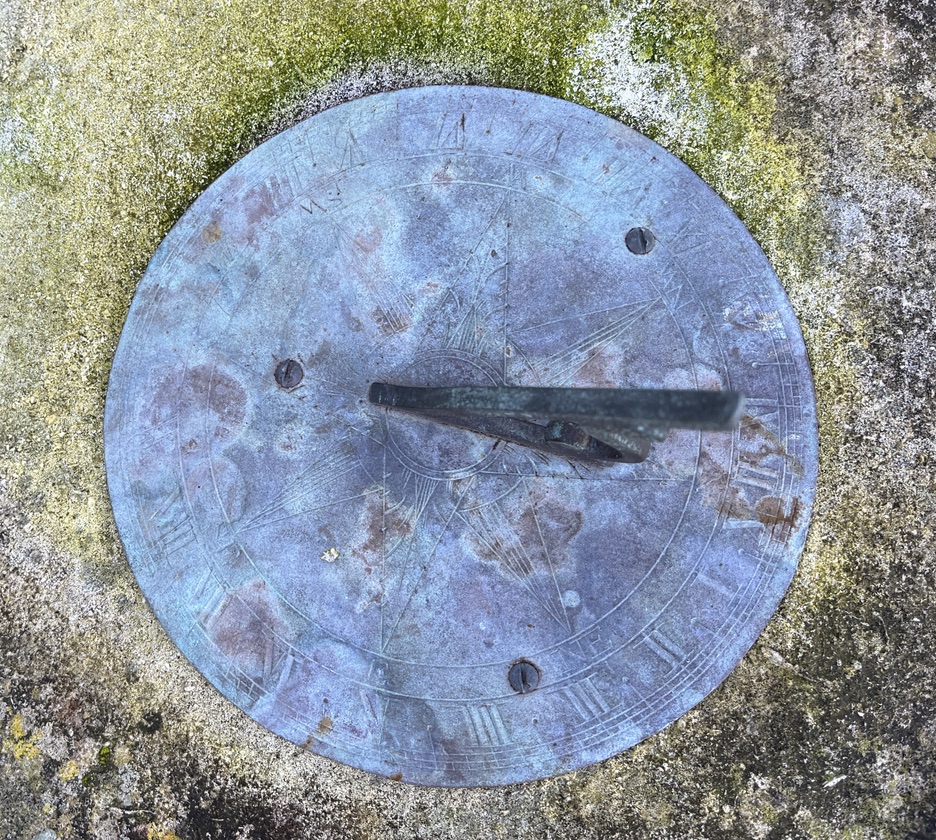
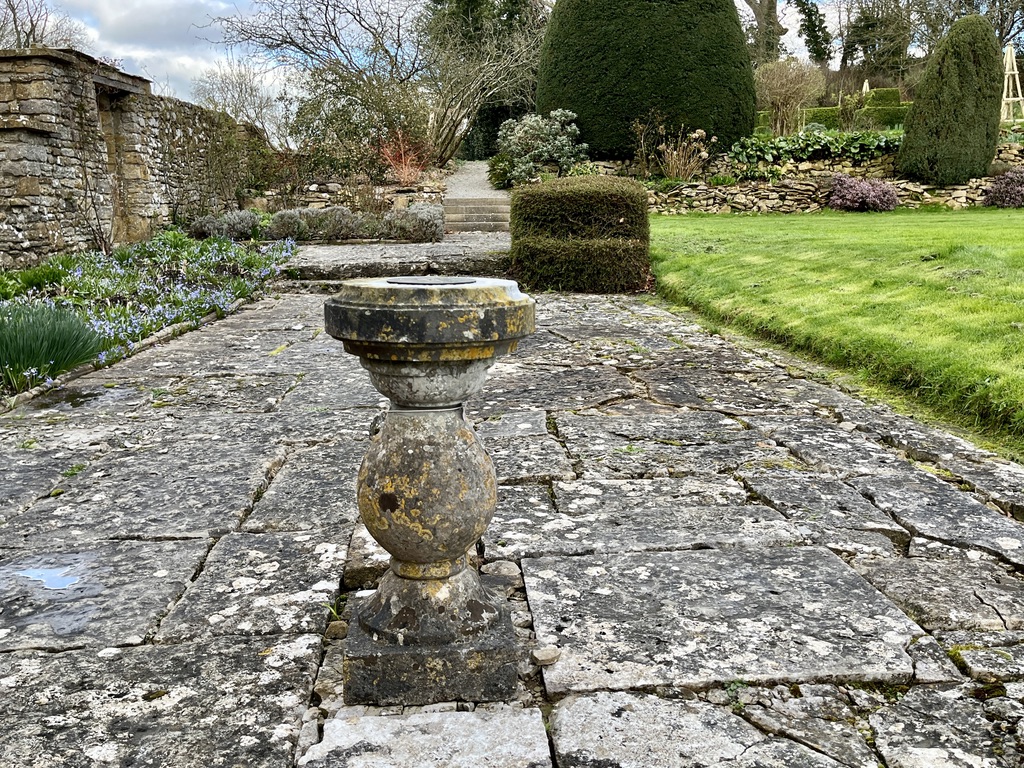
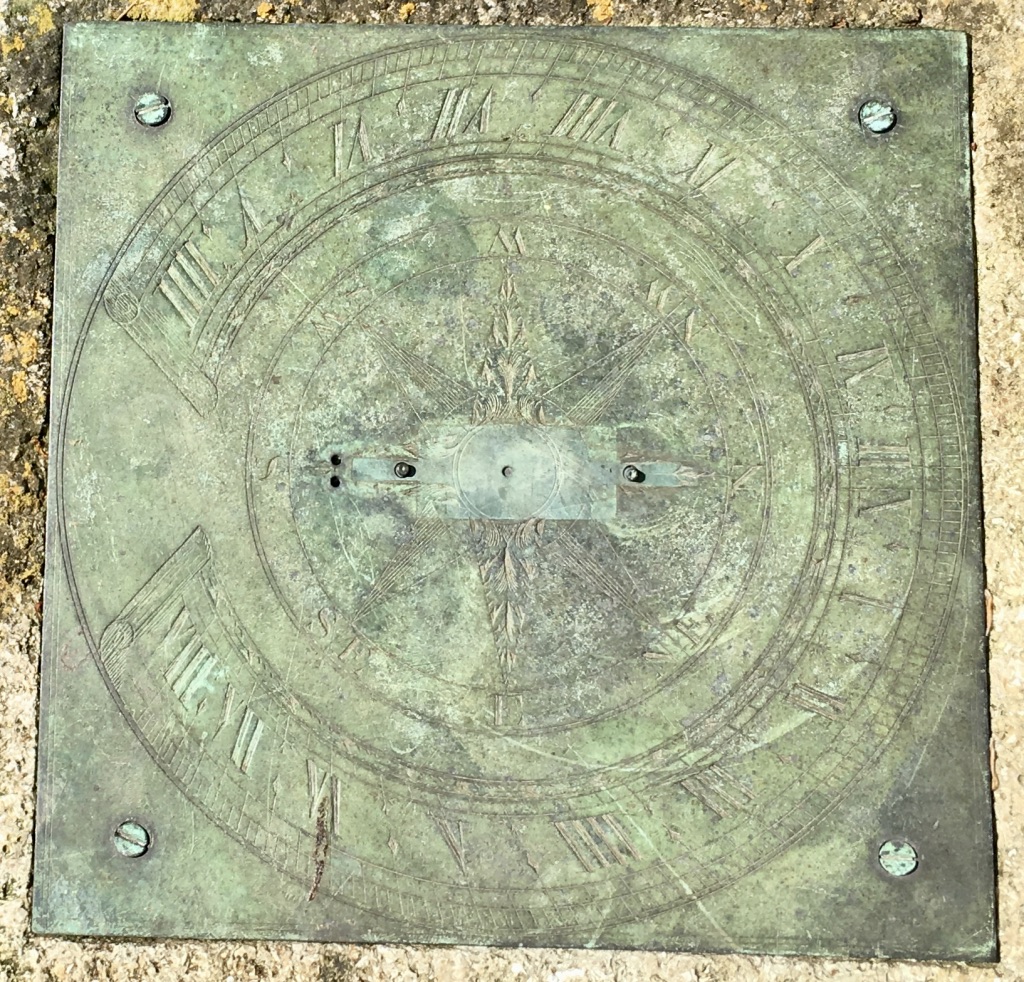
An agreeable churchyard dial in a pretty setting. Missing its gnomon, possibly vandalised (cf Lillington quite nearby). The dial plate is a familiar design, though without a maker’s mark or other indication of its origins.
✣
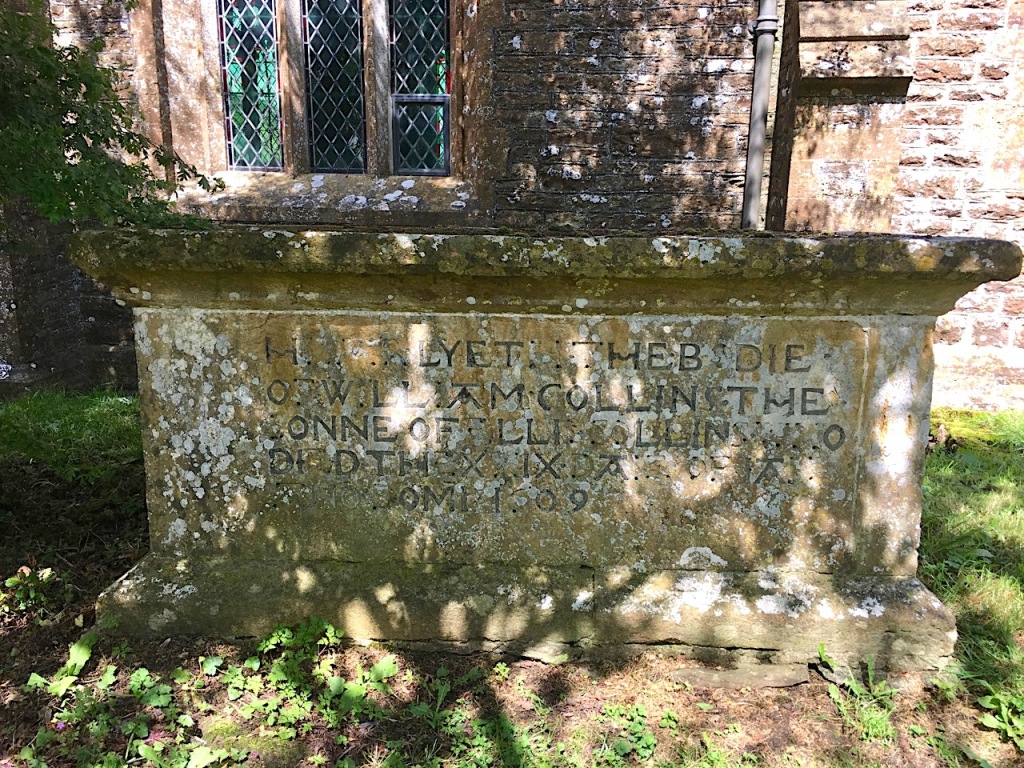
TOMB OF WILLIAM COLLINS, 1609
HERE . LYETH . THE . BODIE . OF . WILLIAM . COLLINS . THE . SONNE . OF . ELLIS . COLLINS . WHO DIED . THE . XXIX . OF . IAN . ANO . DOMI . 1609























 GAUDIUM SUB SOLE . SUNDIALS . MEDIEVAL TO MODERN