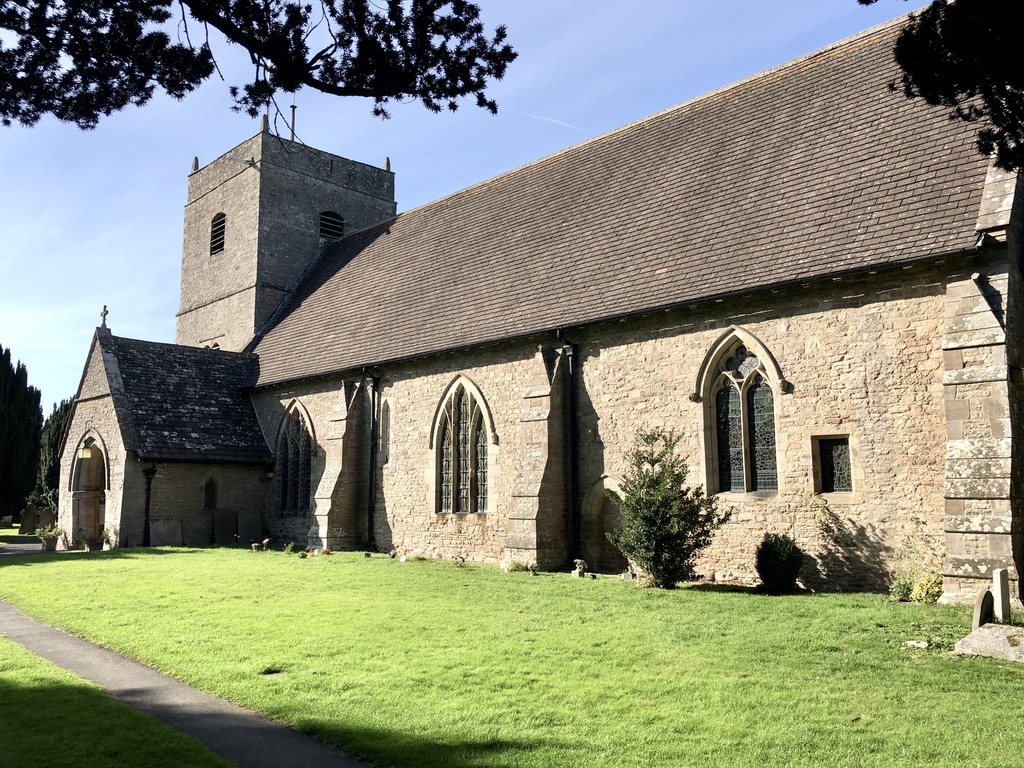
GRADE II* ❖ C13 nave, C14 west tower and late C14 chancel; mid- to late C19 restorations. Very close to the famous early church at Kilpeck. St Dubricius has just one farm for company. If you are going to Kilpeck, this small church is worth a short visit on the way. 51.9766 / -2.8154 / SO440312
DIAL
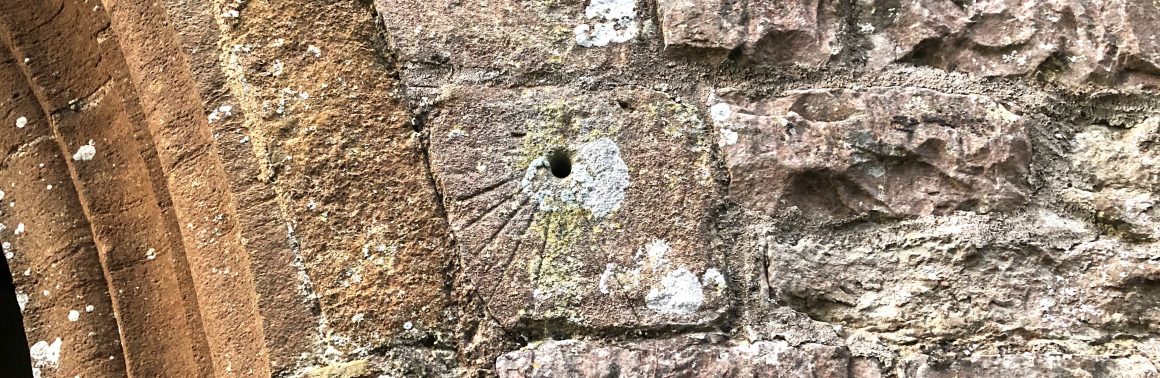
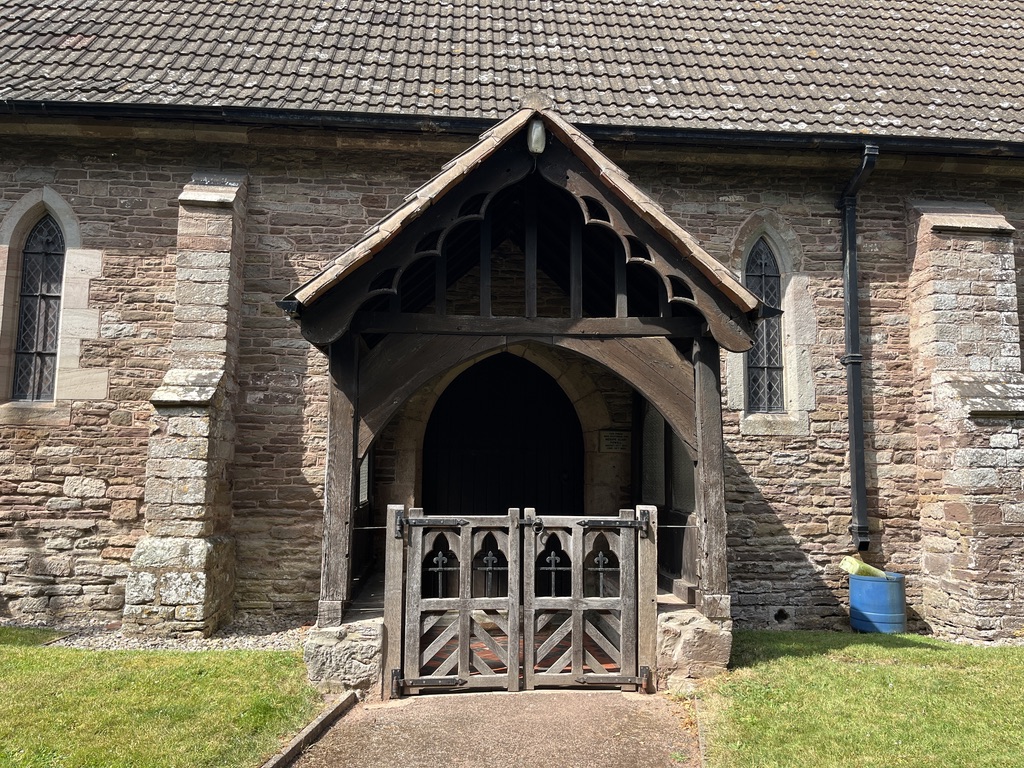
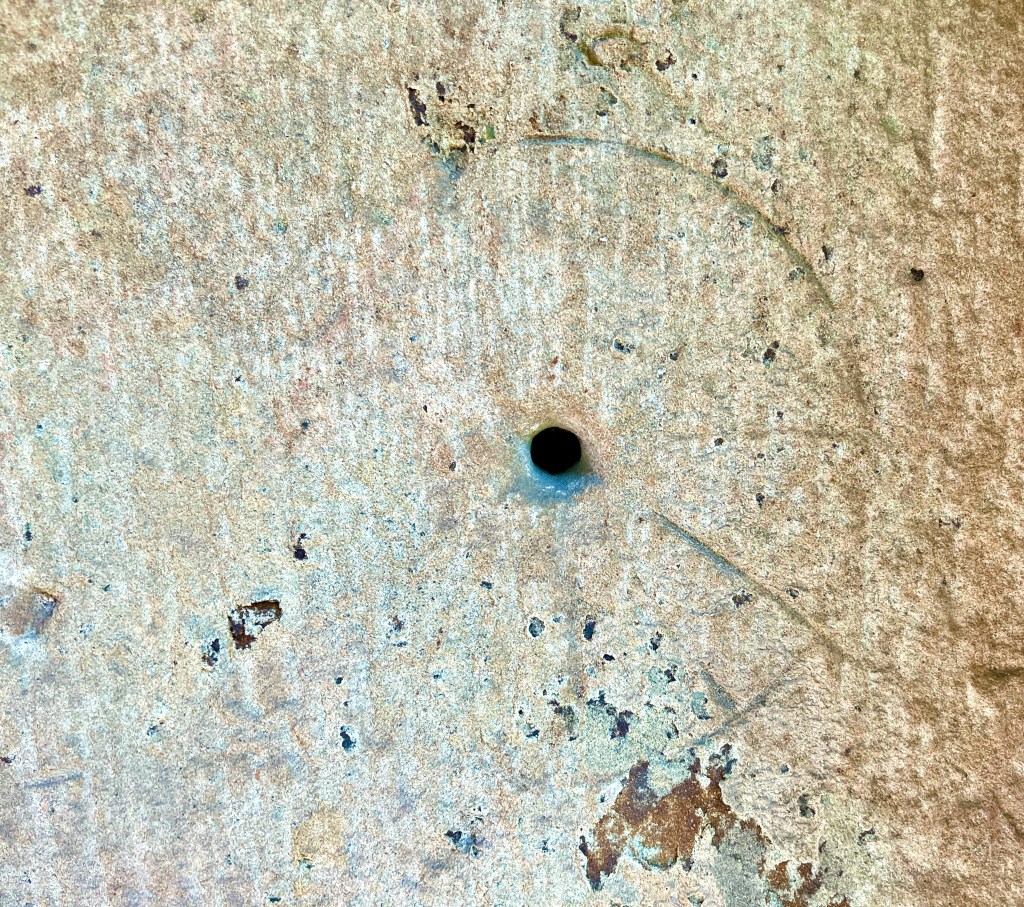
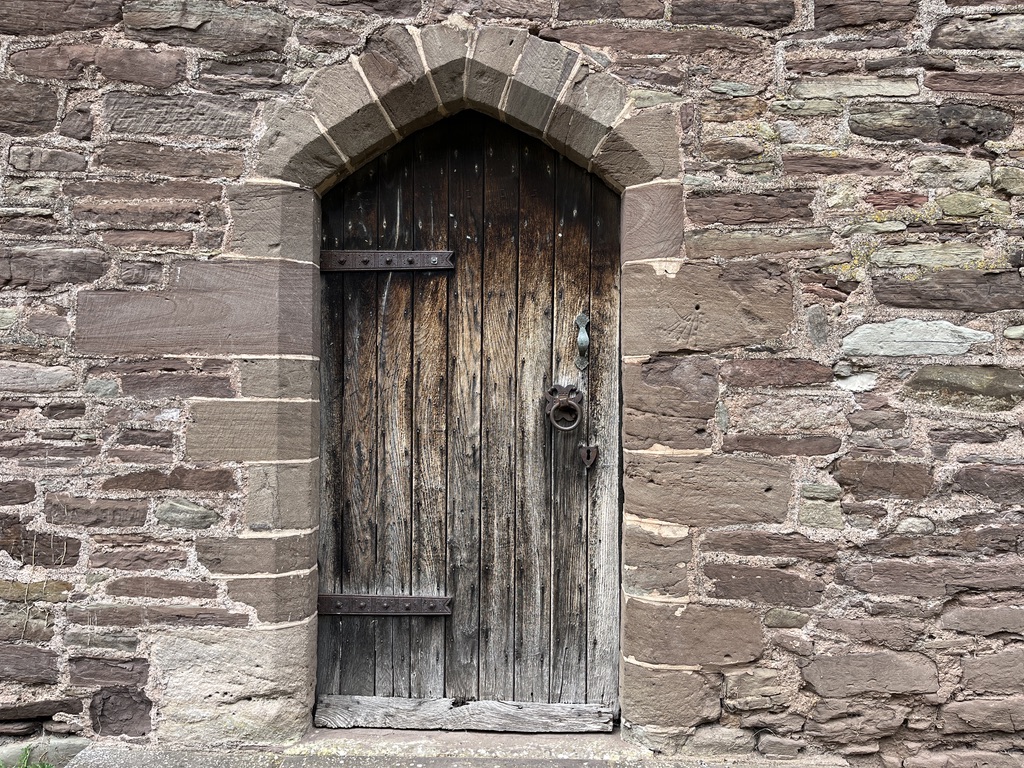
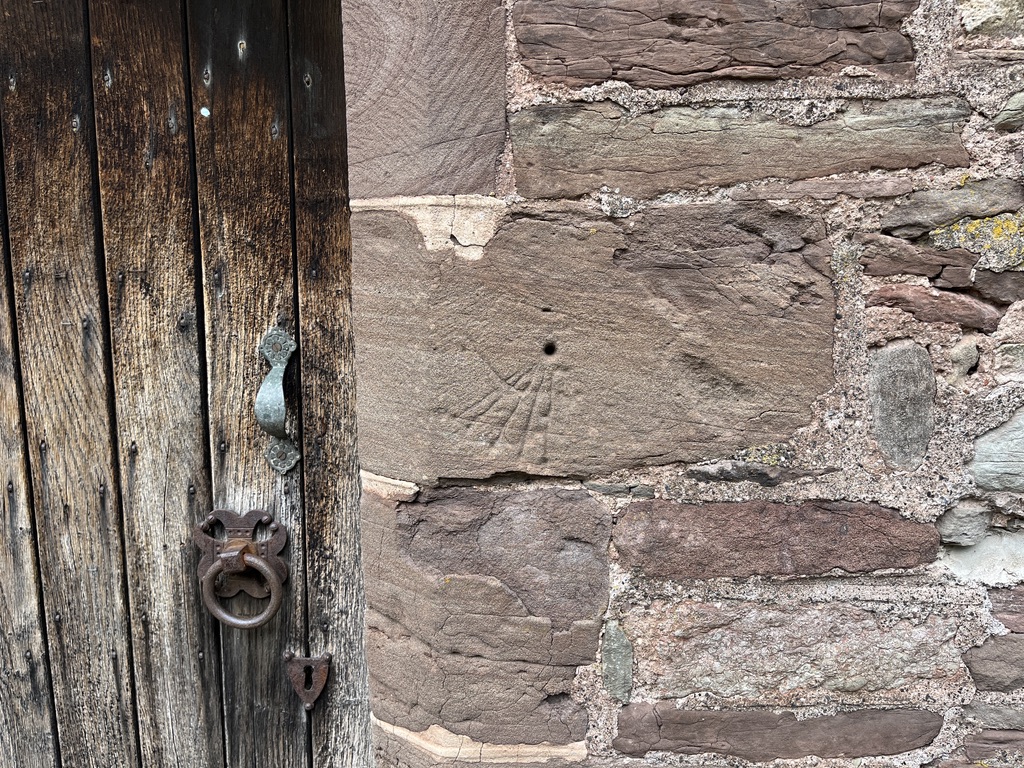
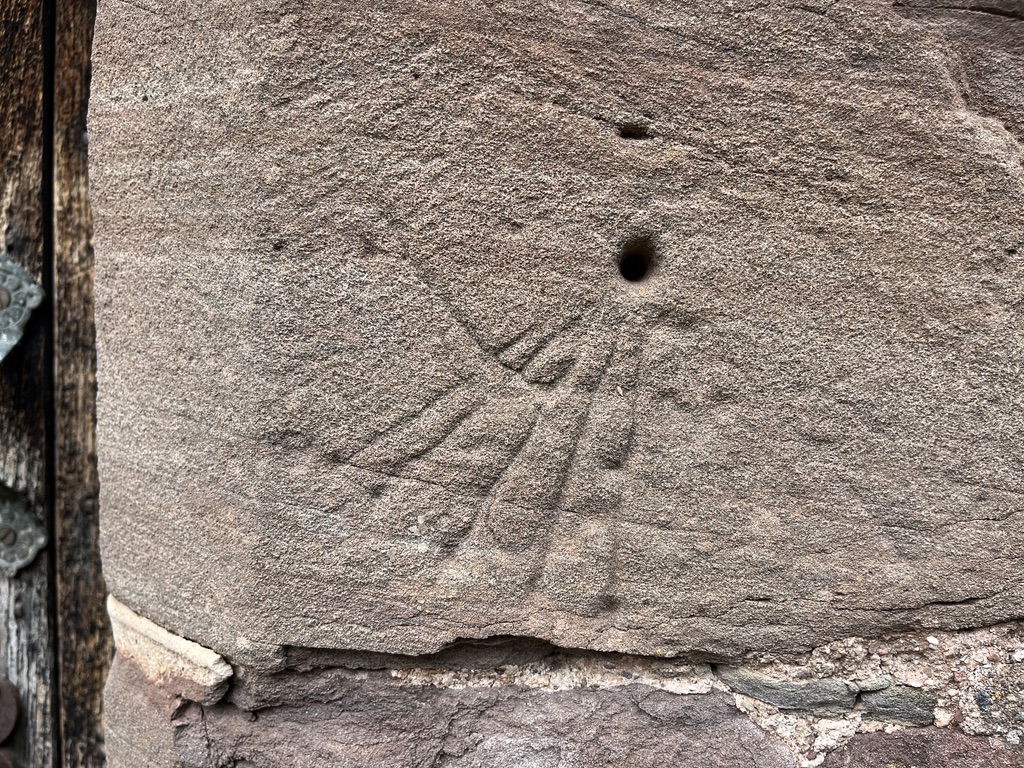
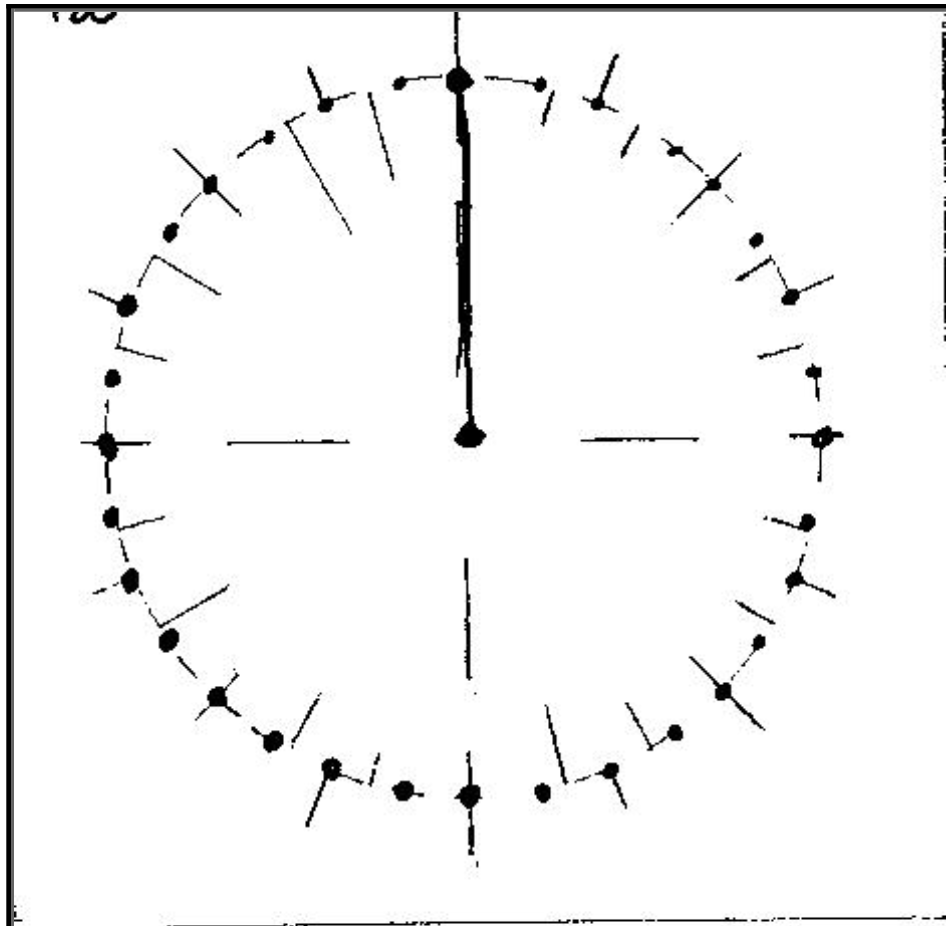
The dial is within the porch to the right of the doorway. It is encircled. The whole left half is now very faint. The clear straight line RHS at 3 extends beyond the circumference, suggesting that mid-afternoon marked the significant time of the day. Above it, at 6, a scratched rustic ‘line’. Just below there’s a near-obliterated straight line. With some imagination, there may even be a trace (see close-up) of a noon line. At some stage a copper rod has been used as a gnomon, with the blue coloration spreading below.
I’d like to have discovered when the porch was added, but none of the main resources give this (not even ‘mentioned in Pevsner’).
Grade 1 ✣ Foundations date to AD 745; Saxon work visible in sanctuary. Substantially Norman, built mid-C12 as a 4-chambered basilica (cf Kilpeck nearby). C13 – 14 alterations, additions. Restorations from mid C19. Impressive fibre glass spire installed 1970s. It replaces the last of several spire dramas since the original of c1320 was completed (see HERE). Situated in the Golden Valley of Herefs. 52.0412 / -2.9564 / SO344385
DIALS
DIAL 1
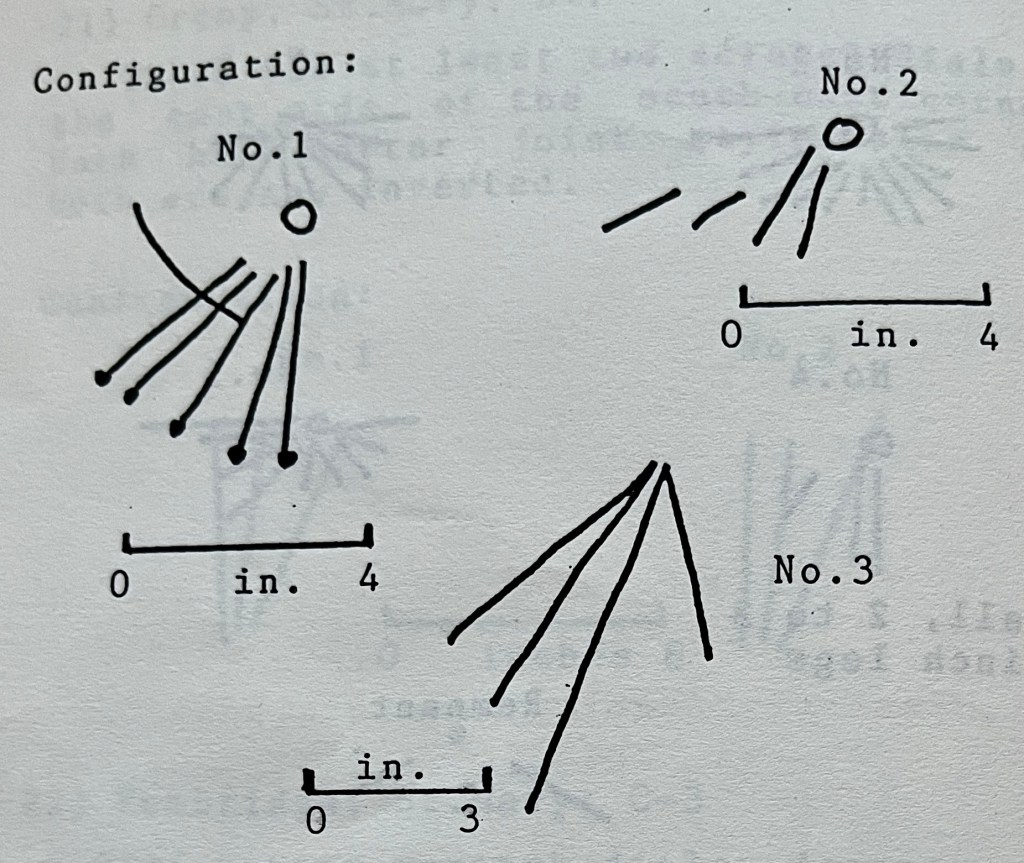
RHS of Priest’s door. A morning dial with 5 lines, each with a terminal pock. The noon line – slightly offset – has a pock halfway down.
❖❖❖❖
DIAL 2 [and 3]
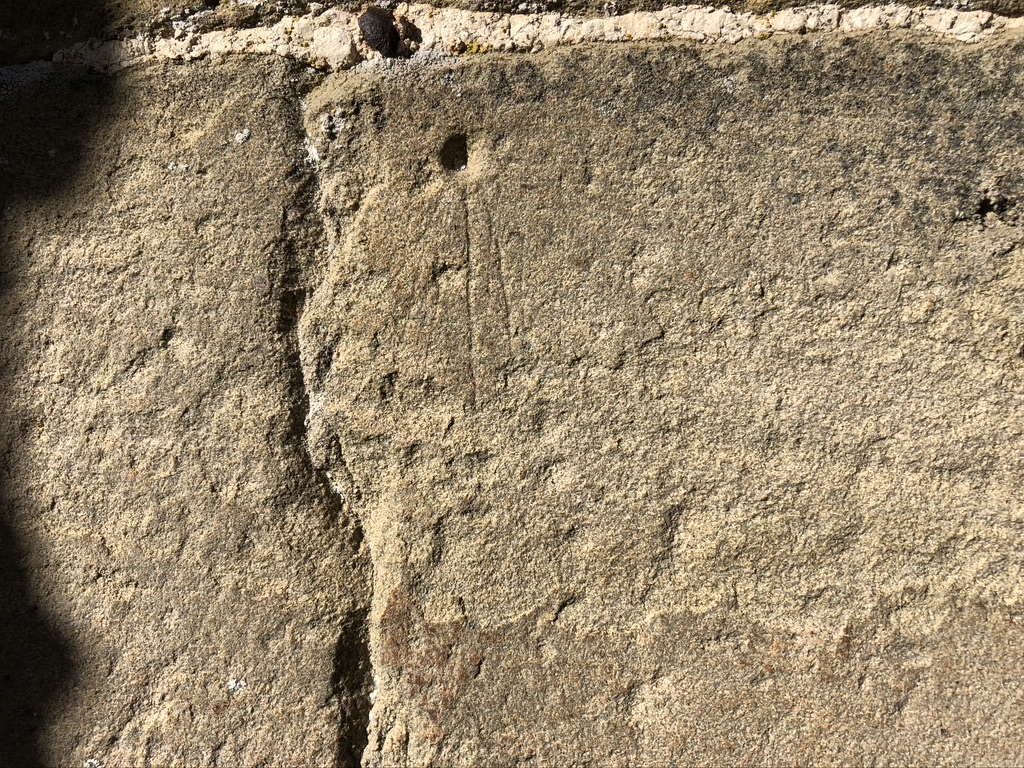
On a substantial buttress, a small dial so basic that I discounted it at first. The 2 lines do not even descend properly from the gnomon hole 3 ins above. The hole looks as though it has been enlarged at some time. I assume it predated and was succeeded by Dial 1.
❖❖❖❖
DIAGRAMS OF ALL DIALS INCLUDING DIAL 3*
Dial 2: the 2 short lines LHS are near-invisible now. I wonder if they were ever part of a dial.
Dial 3: this morning dial is close to Dial 2, but I missed it. It must be above the coping stone.
❖❖❖❖
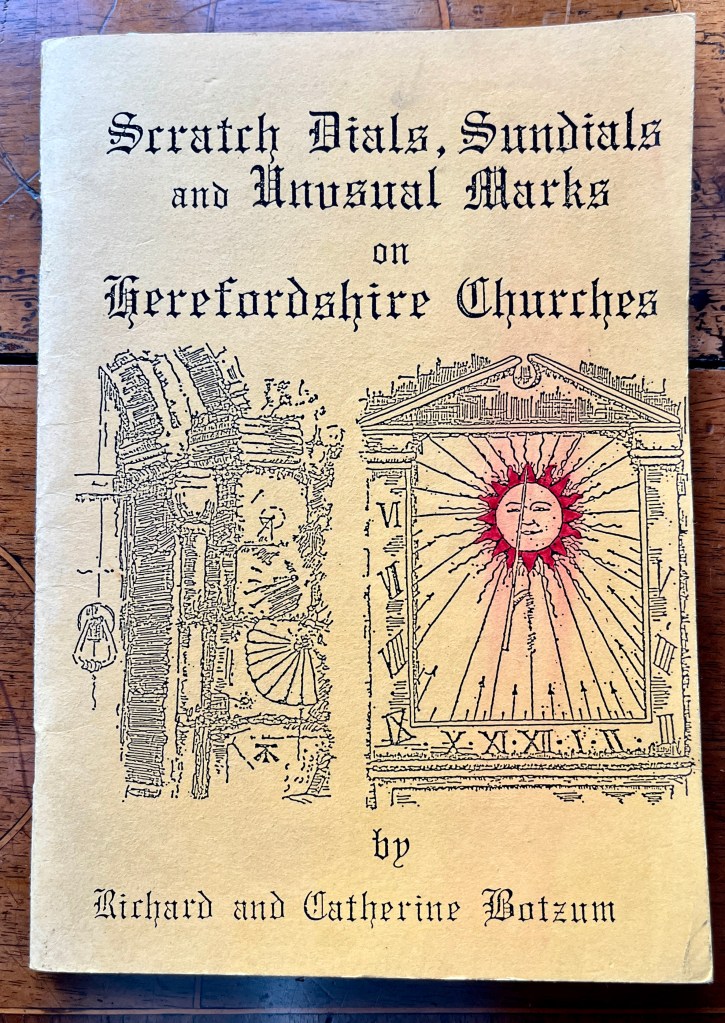
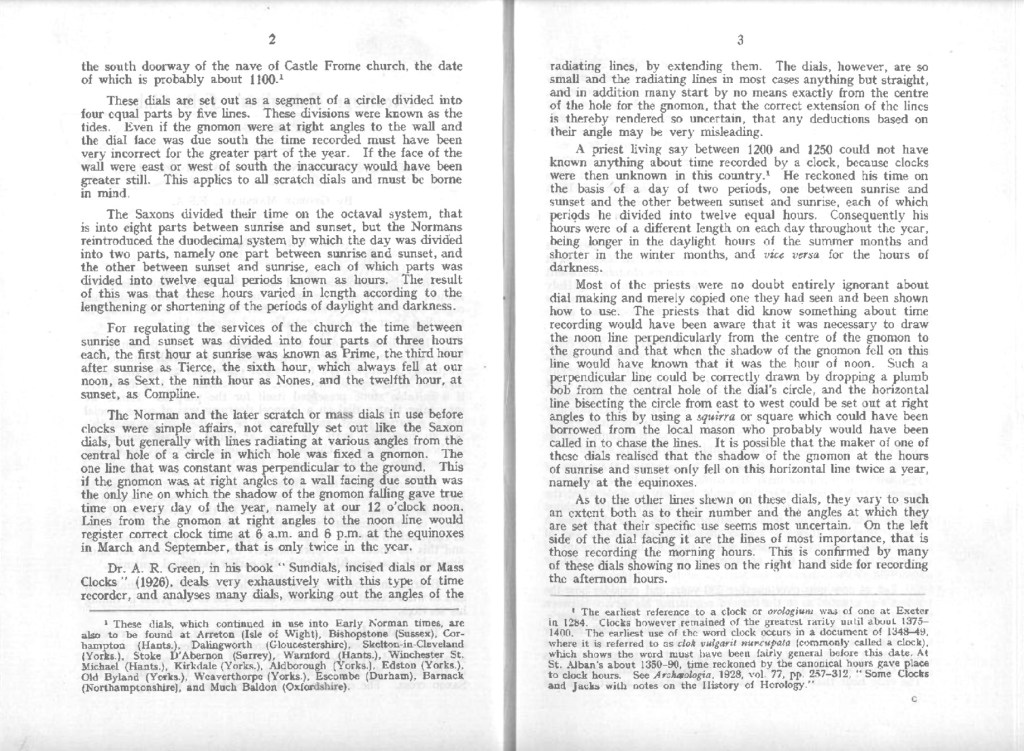
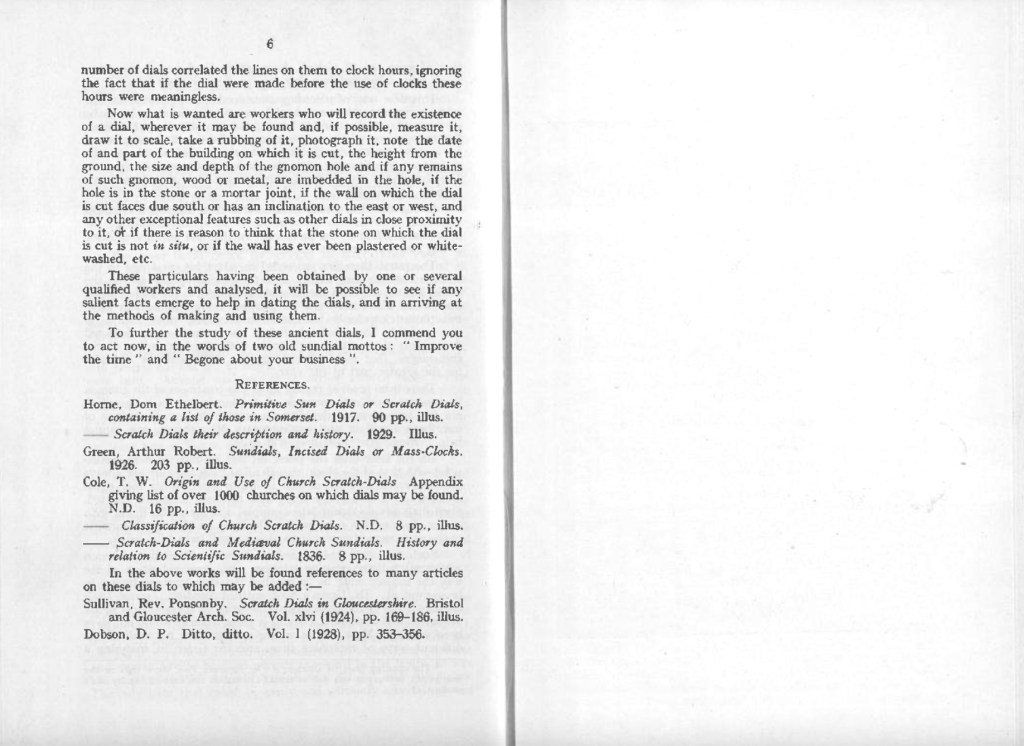
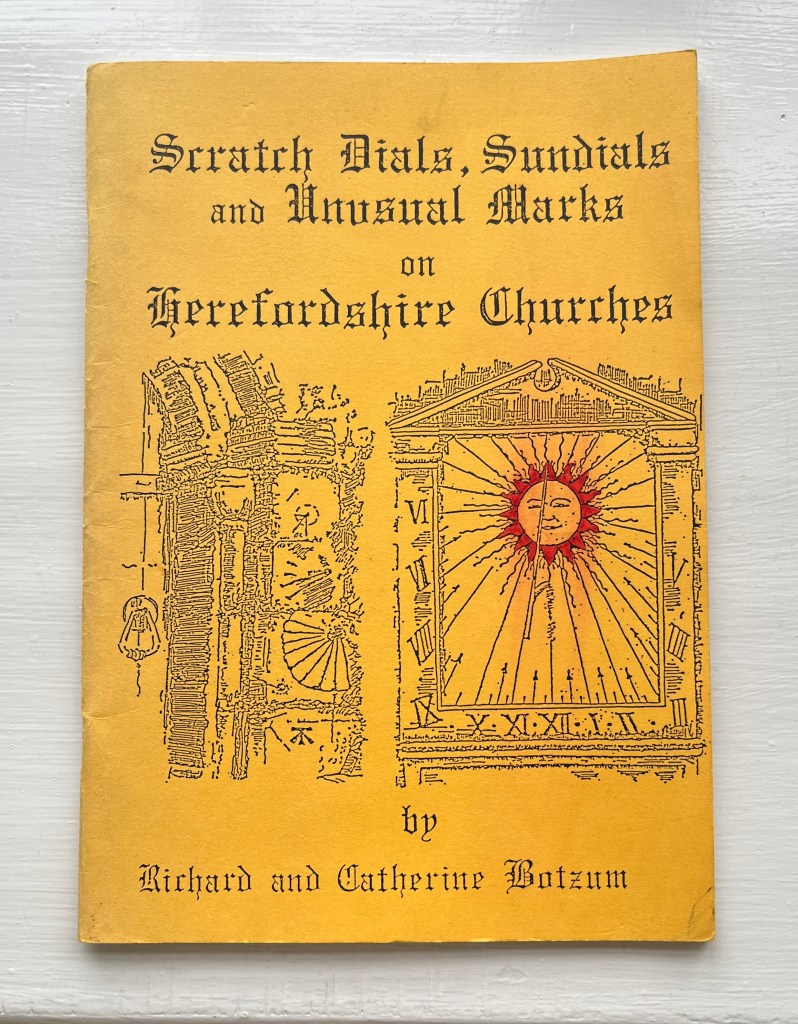
HEREFORDSHIRE DIALS The county is well-served by the excellent small book (1988) by Richard & Catherine Botzum. It covers both scratch dials and conventional church dials, with a few church marks at the end. It is a pleasant read, the sort of book I’d have enjoyed writing.
GSS Category: scratch dial; mass dial; early sundial
GRADE I † On a hilltop overlooking the village, next to the ruins of Wigmore Castle. Saxon origins with good remains of herringbone brickwork visible; early Norman nave c1050. Extended / altered / restored from C14 (tower) on. An impression of a fortified church, esp. tower at W end. 9m from Ludlow. 52.3166 / -2.8626 / SO412690
DIALS
DIAL 1
Dial 1 is on the SE face of the buttress in NE corner of the chancel (ie at the back of E end of the church), so at some stage re-sited as of little use for its intended purpose it its current position. There are 2 lines radiating from the style hole in the dial stone. In canonical terms, the deeper cut line equates roughly with Nones, and the upper line with Vespers, an unusually specific emphasis on the afternoon and evening, with no line for noon or earlier.
I wondered if, when relocated, the dial stone was rotated by 90º anticlockwise. If ‘corrected’, the short line would be the noon line, and the deeper-cut line would mark Tierce. But it is not very convincing and probably I am overthinking a very simple dial.
DIAL 1 ROTATED 90º
BSS DIAGRAM
DIAL 2
Dial 2 on the wall of S aisle is similarly simple with 2 lines only. One does not actually meet the gnomon. Of the sort that can be read more easily in B&W
DIAL 3
Dial 3 is low down on chancel, S doorway. There are 7 pocks in a semicircle, with the gnomon hole top centre. When I visited there were various obstacles in the supposed location. I found nothing to match the diagram below, and having moved a large planter to one side, this is the nearest pattern I could find.
SAXON HERRINGBONE PATTERN
GSS Category: Scratch Dial
All photos Keith Salvesen except Dial 2 (BSS records)
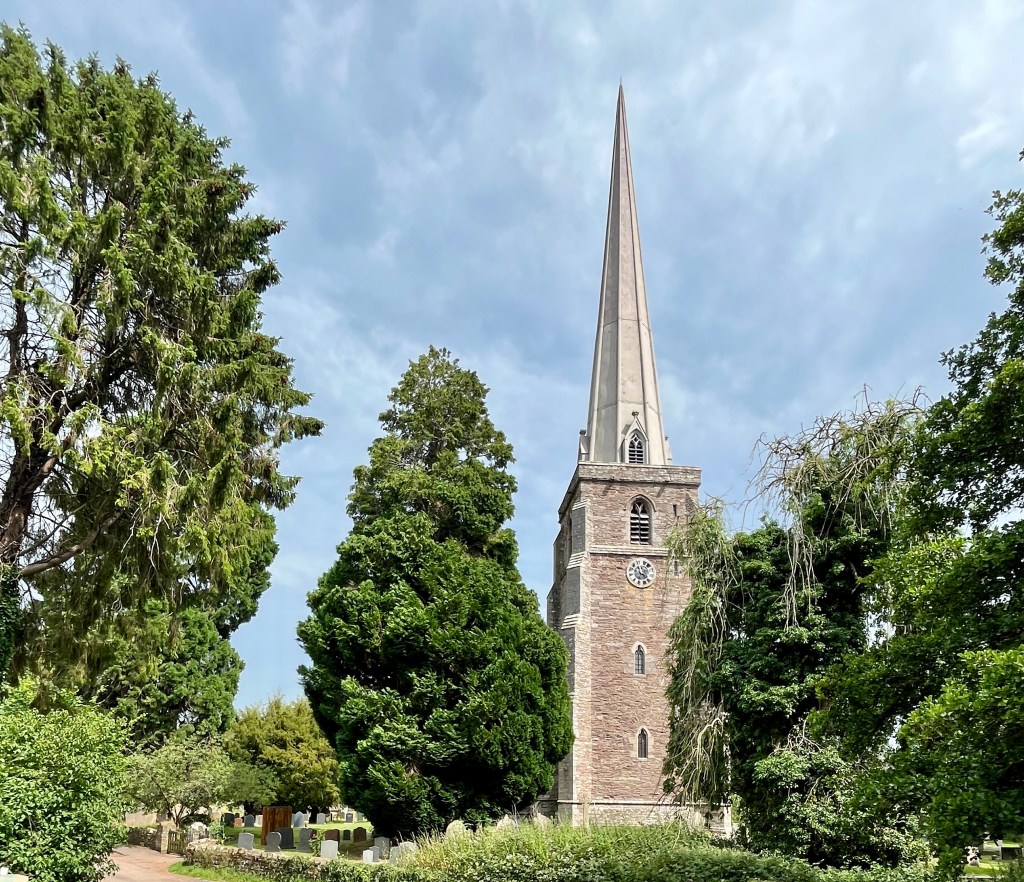
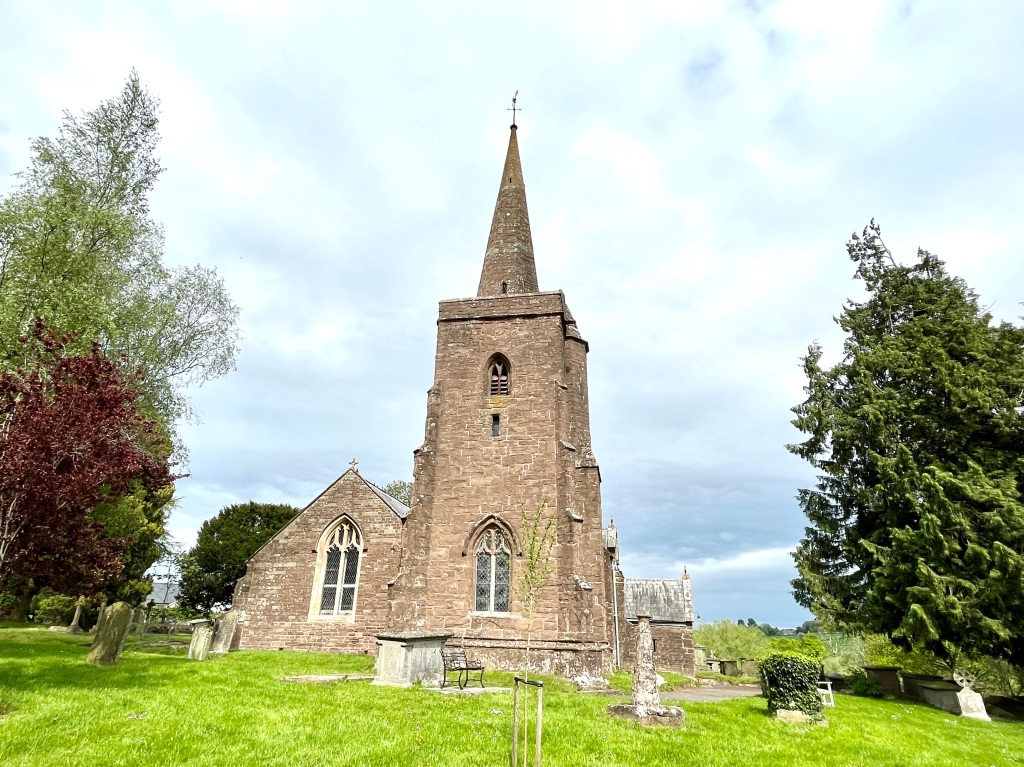
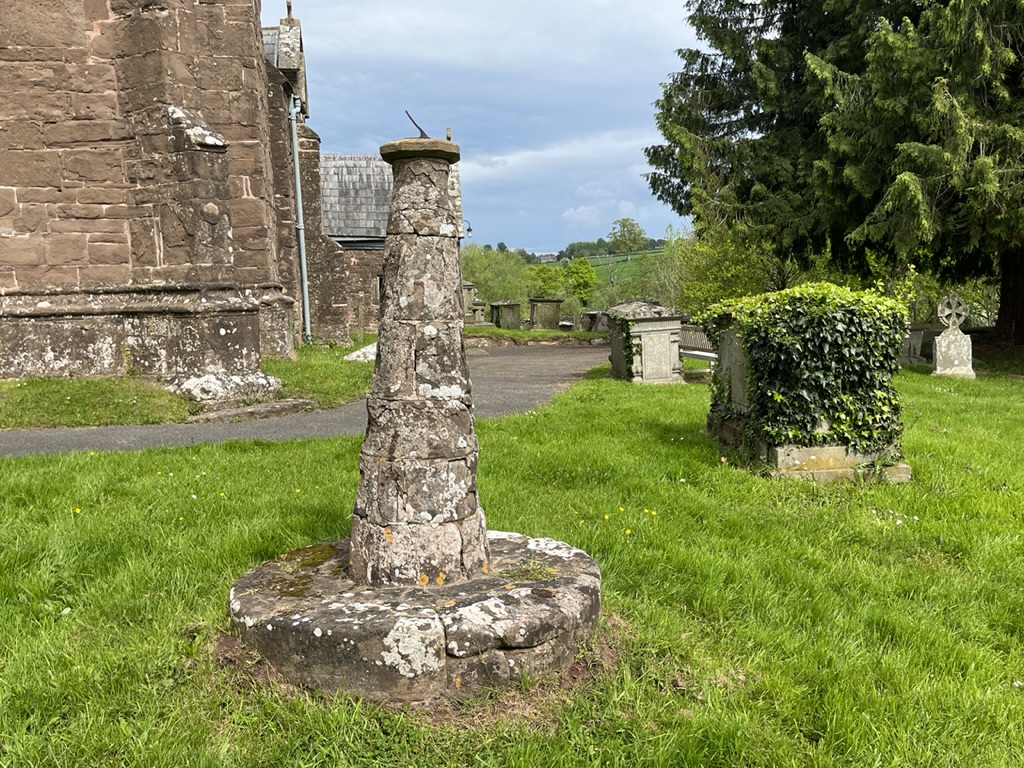
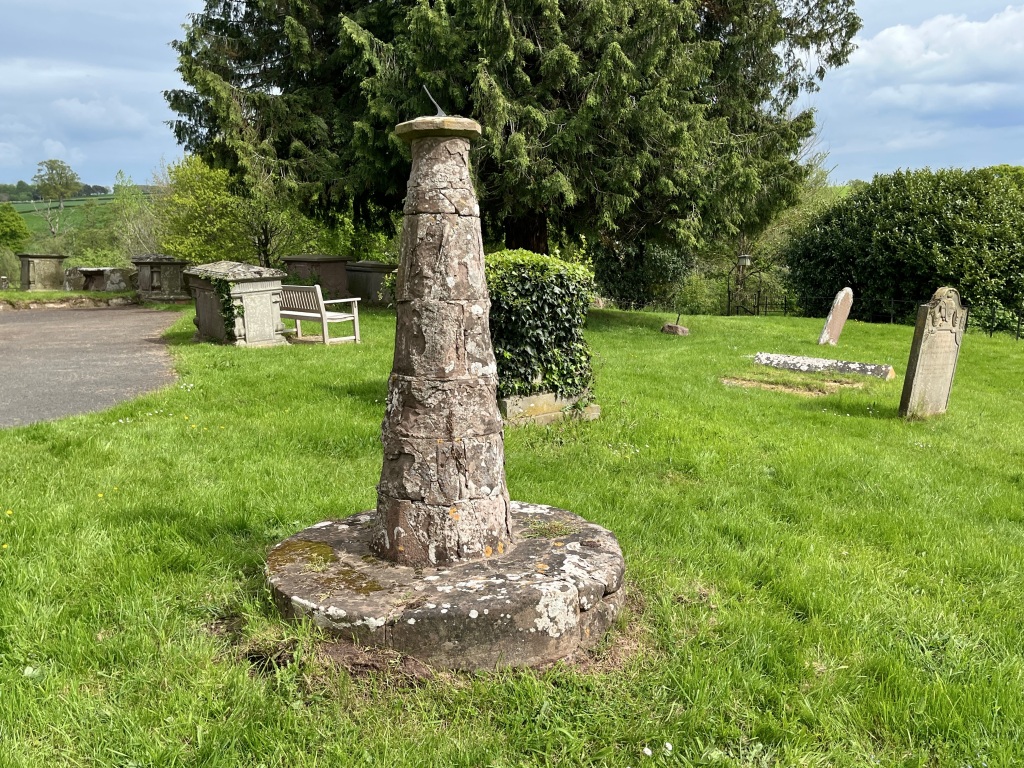
GRADE 1 † C14 & C15; records of C11 origins; trace Norman interlace patterns. Restorations ±1900; later replacement of the top of the spire, repurposed as sundial pillar. Only 1 other church (Itton, nearby) with this Dedication. 7m N of Monmouth; 7m SW of Ross-on-Wye. 51.8871 / -2.6838 / SO530211
PILLAR (STEEPLE) DIAL
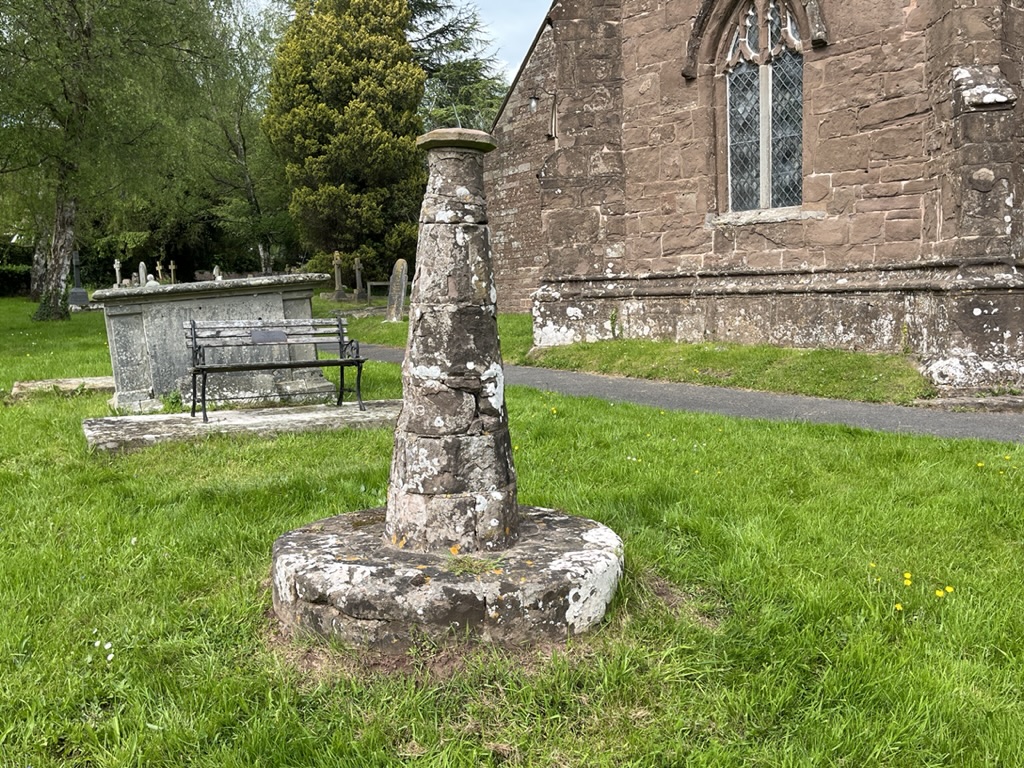
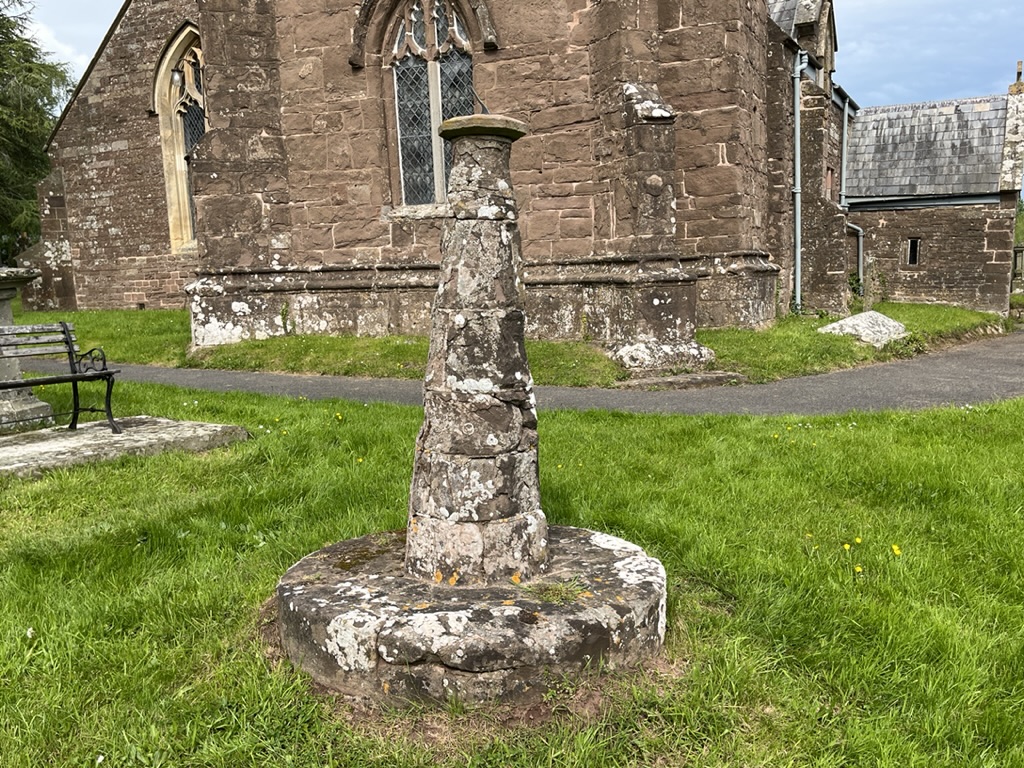
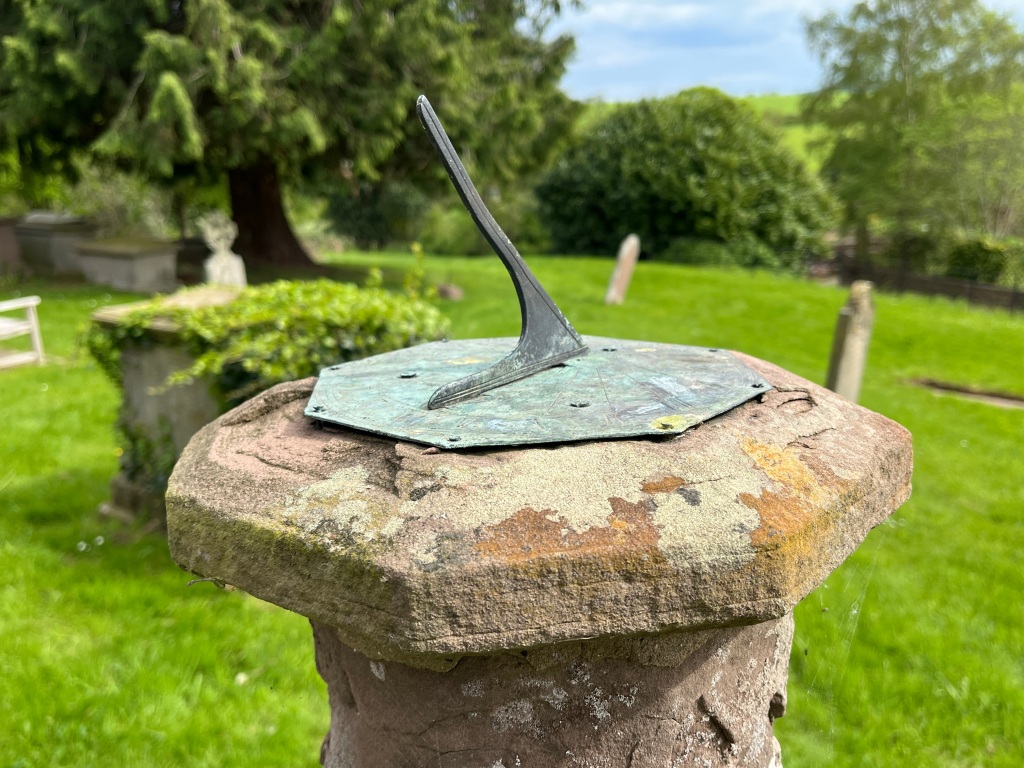
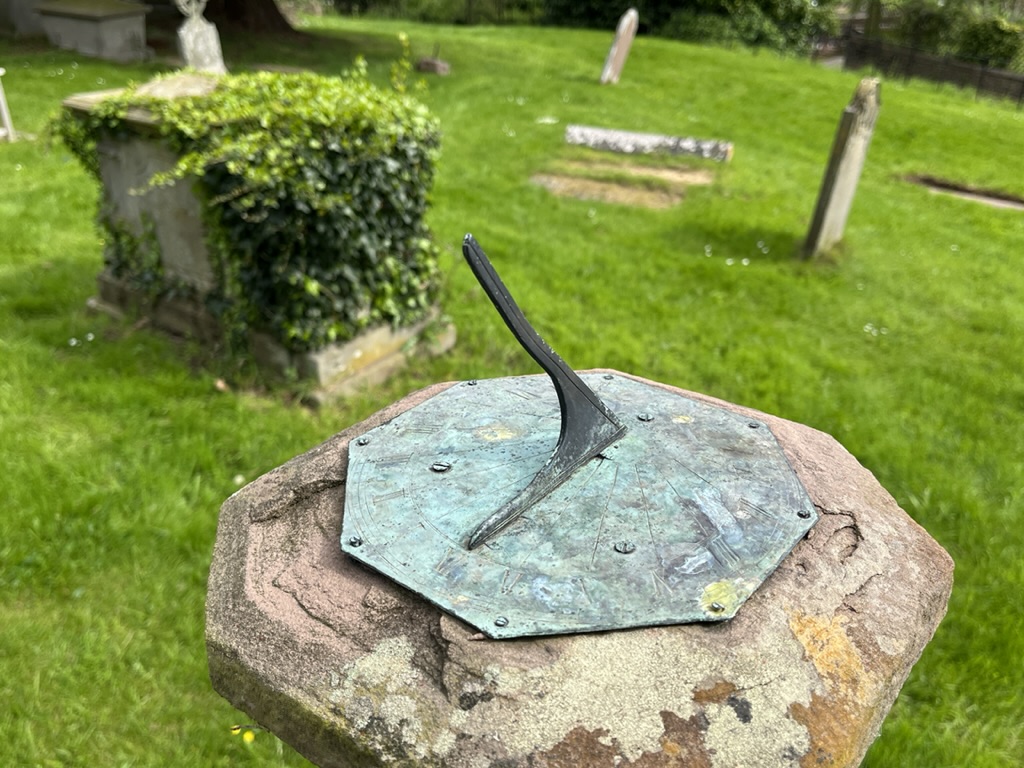
GV II †Tip of spire C14 adapted as horizontal sundial pillar late C19. In churchyard SW of the tower in an ideal place for admiration. Coursed & squared sandstone rubble, circular base. C14 masonryBLB
1. CHURCHYARD VIEW
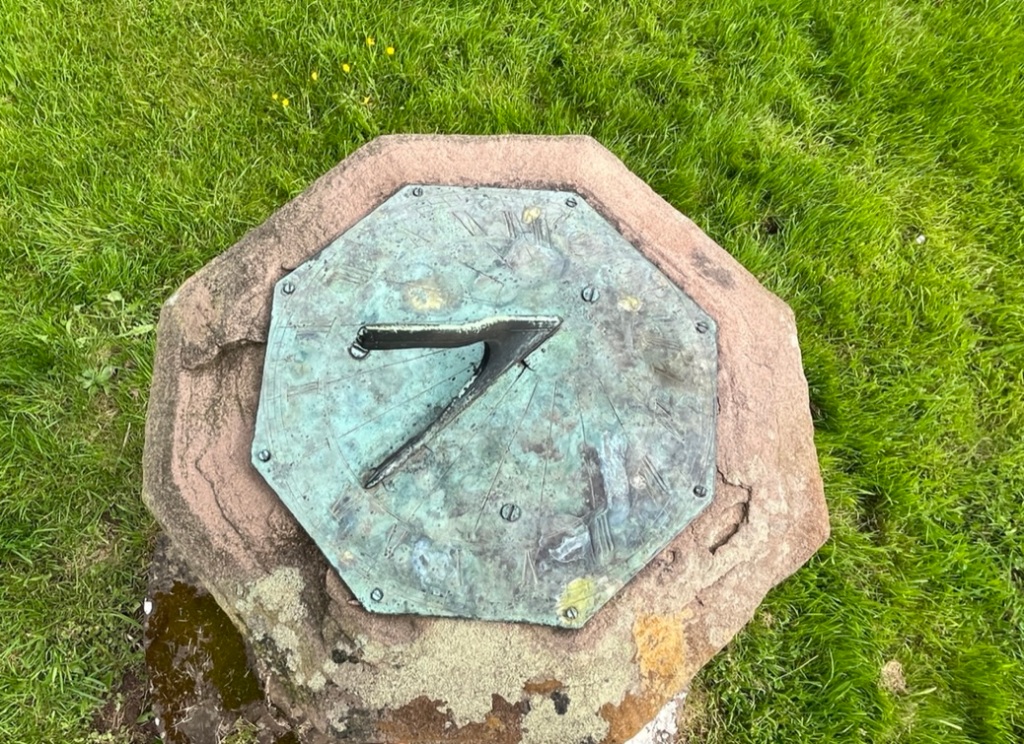
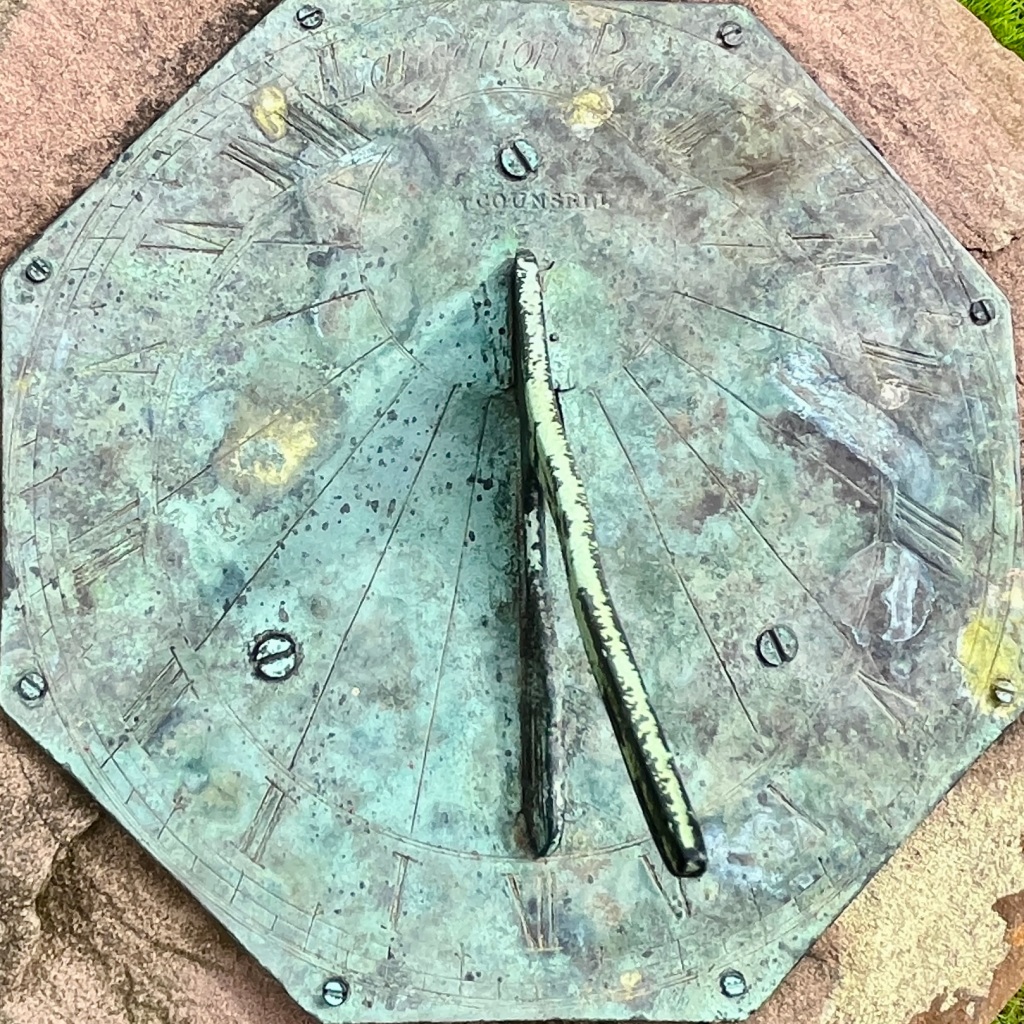
2. HORIZONTAL DIAL
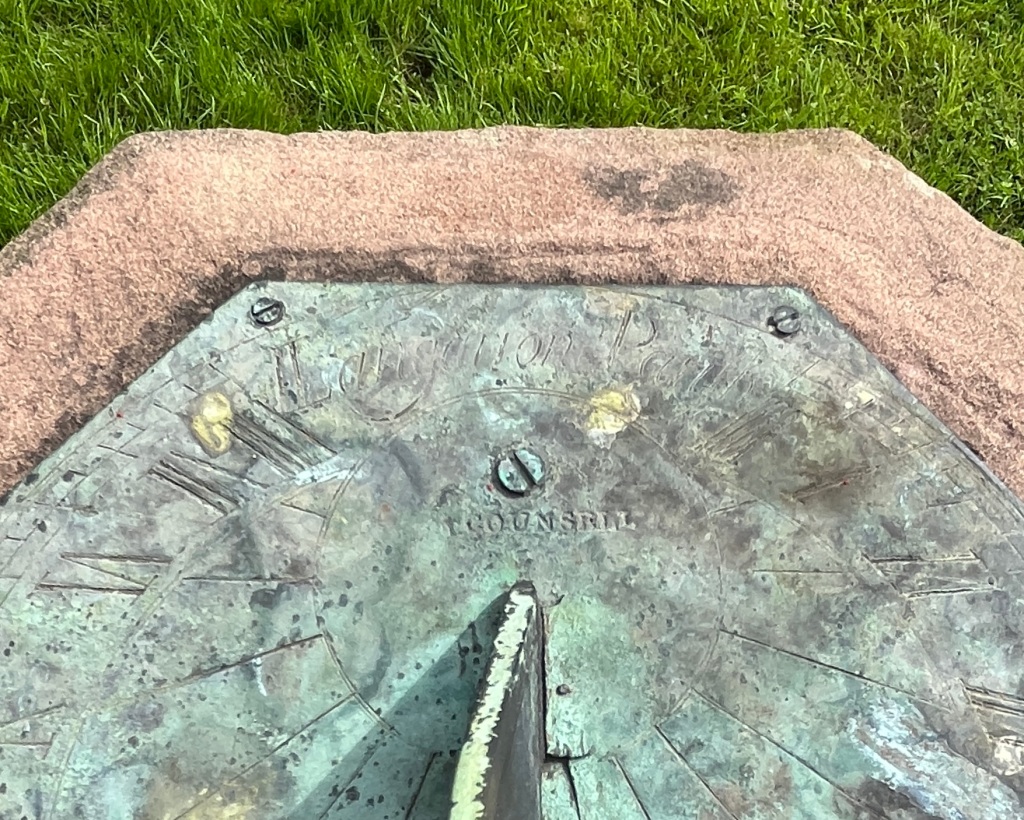
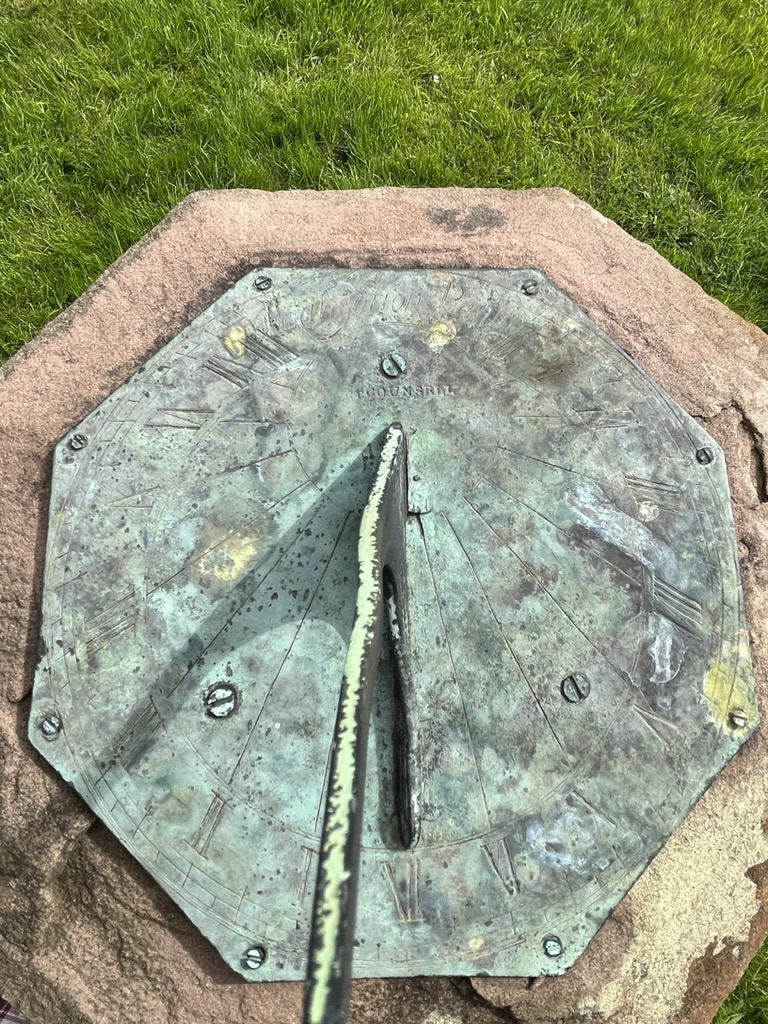
The dial is octagonal, with quarter-hours marked. IV as IIII. The inscription seems to be Llangarron Parish; and the maker’s name Counsell (though I can find no reference). The Roman numerals are conventional.
SCRATCH DIAL
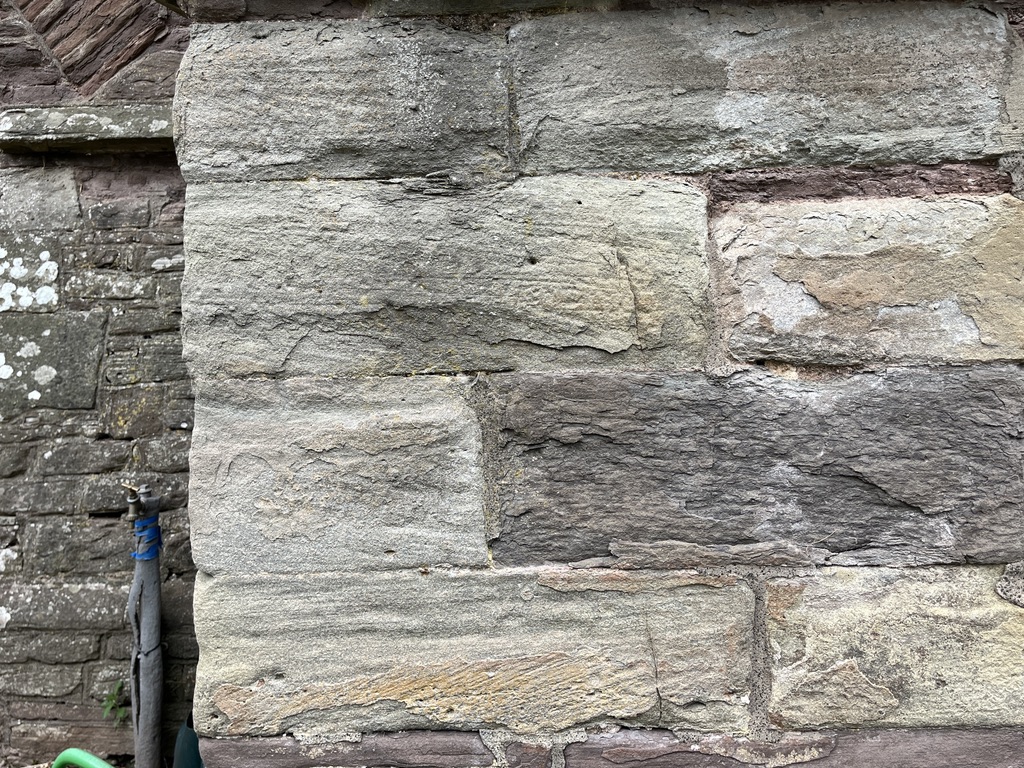
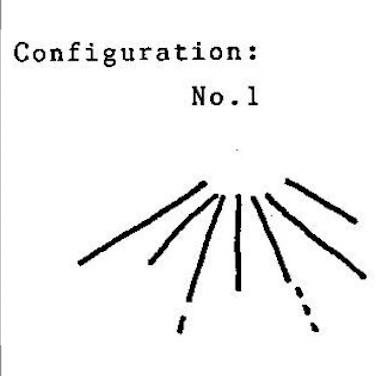
BSS records a scratch dial with 3 lines on the buttress to W of S porch, in a poor state. Notes include Max. length lines, mm 80. Hard as I looked, I couldn’t find a dial in the given location, or at any height on the buttress. Or elsewhere. Possibly the stonework has deteriorated since the original record was made. The best I can offer is the BSS sketch; and the most promising dial-like area of the buttress.
CONSECRATION CROSS
A fine consecration cross, one of the largest I have seen. One puzzle is that the cross is too large for the stone, so that LHS is cut off at the edge. It seems unlikely that the designer mis-measured to that extent. Possibly the stone was moved and trimmed to fit its present position during restoration.
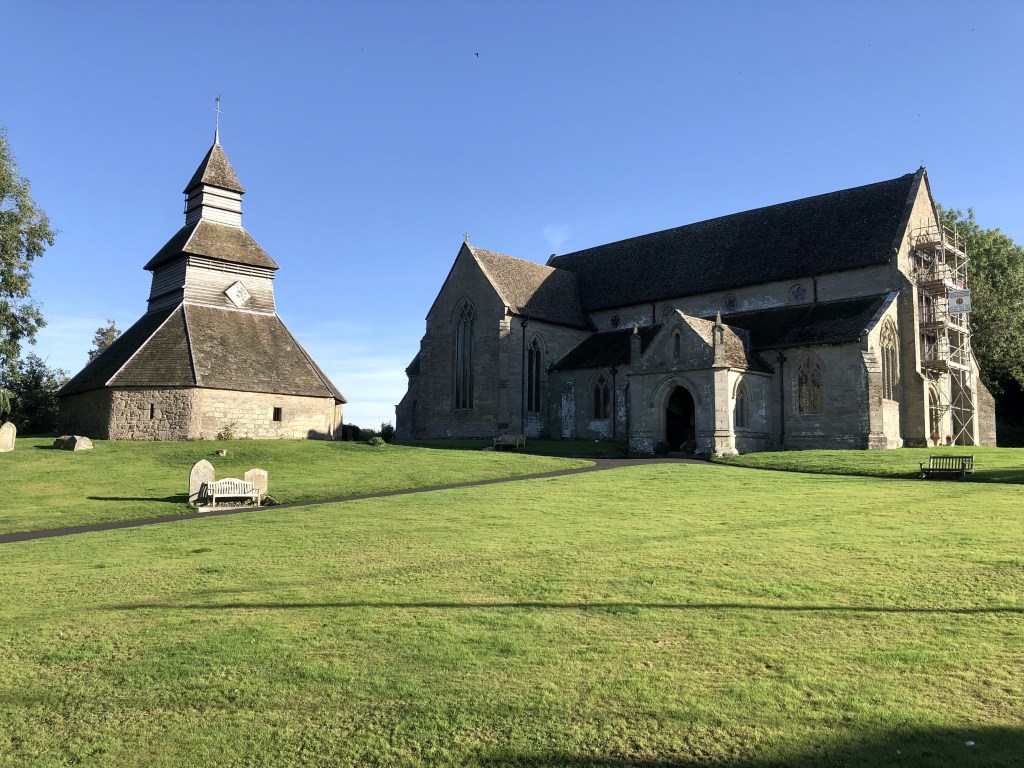
GRADE I † C12 and C13 origins on Norman site; nave, transepts and chancel arch rebuilt during early C14; N porch added late C14. Restorations 1871 and 1903-1909. Large and impressive (PEV). Fine interior, monuments, glass. Of equal note, the wonderful detached belfry with its hint of nordic influence – not to be missed. I have included a few images and notes at the end of this article. 52.2173 / -2.8929 / SO390580
DIALS
St Mary merits a collective noun for its dials. A confusion? There are obvious dials, plausible dials, doubtful dials, and 1 or 2 not previously noted as far as I can make out. On my visit I wasn’t equipped with details of dials I might expect to see, and I simply recorded the ones I found. All are on the S wall, starting from the W end. There are some differences from the BSS records.
DIAL 1
St Mary . Pembridge . Herefs – Scratch Dial 1
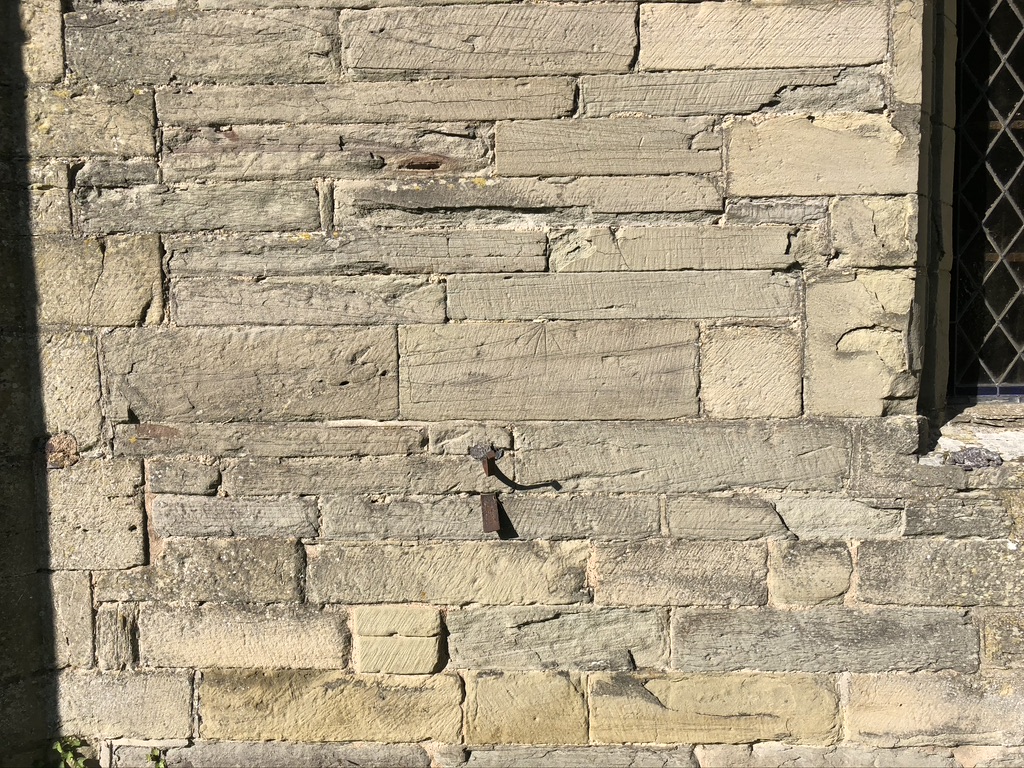
Dial 1 is a straightforward design among an attractive arrangement of stones. 7 lines, a couple emphasised, some faintly extended, hole in the mortar line.
St Mary . Pembridge . Herefs – Scratch Dial 1
DIALS 2 & 3
St Mary . Pembridge . Herefs – Scratch Dials 2 & 3
Dial 2 is the most interesting of them all, with its double square surround. There are 13 lines, spaced approximately evenly. Some of extend into or beyond the boxes, a couple are above the horizontal. BSS describes the dial as unique and suggests that it appears to be an attempt to follow the pattern for a sundial, but no evidence of sloping gnomon. The conclusion: a very mysterious dial.
Dial 3 is similar to dial 1, with 6 lines radiating from quite a deep hole where the stone meets the mortar line.
St Mary . Pembridge . Herefs – Scratch Dials 2 & 3
DIAL 4
St Mary . Pembridge . Herefs – Scratch Dial 4
Dial 4 is small and unobtrusive, just L of the doorway. The style hole is (slightly oddly?) in the top L corner rather than more prominently nearer the centre of the stone. There are 2 slender but clear lines, and 3 (4?) faint lines L of them.
St Mary . Pembridge . Herefs – Scratch Dial 4
DIAL 5
St Mary . Pembridge . Herefs – Scratch Dial 5
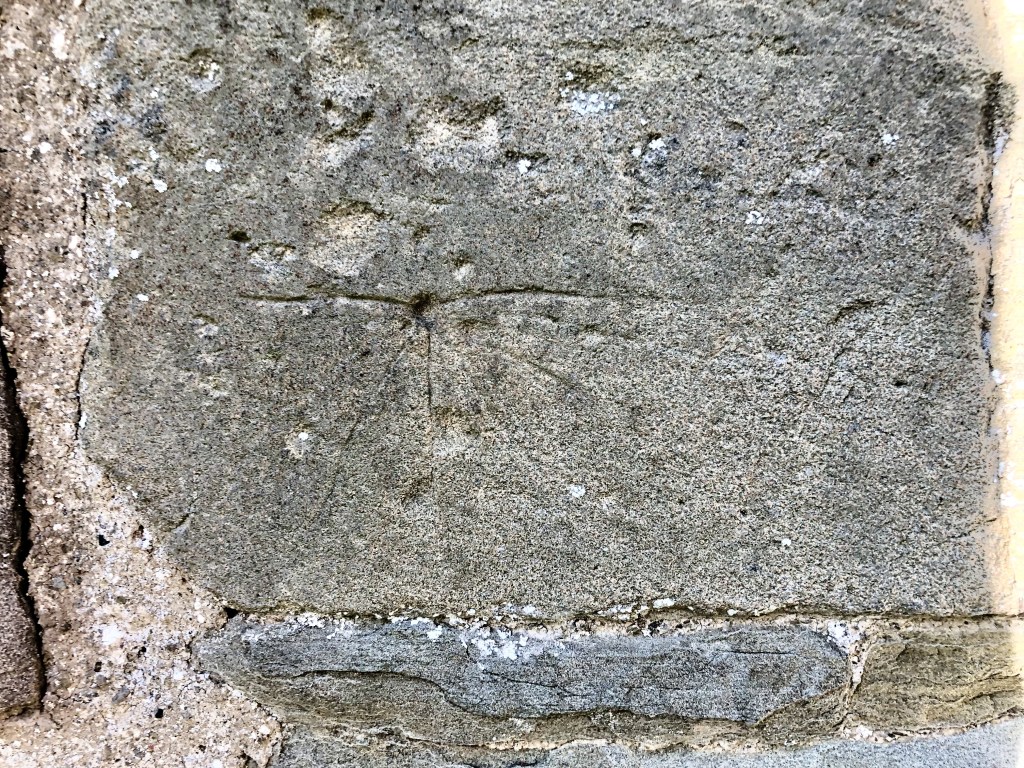
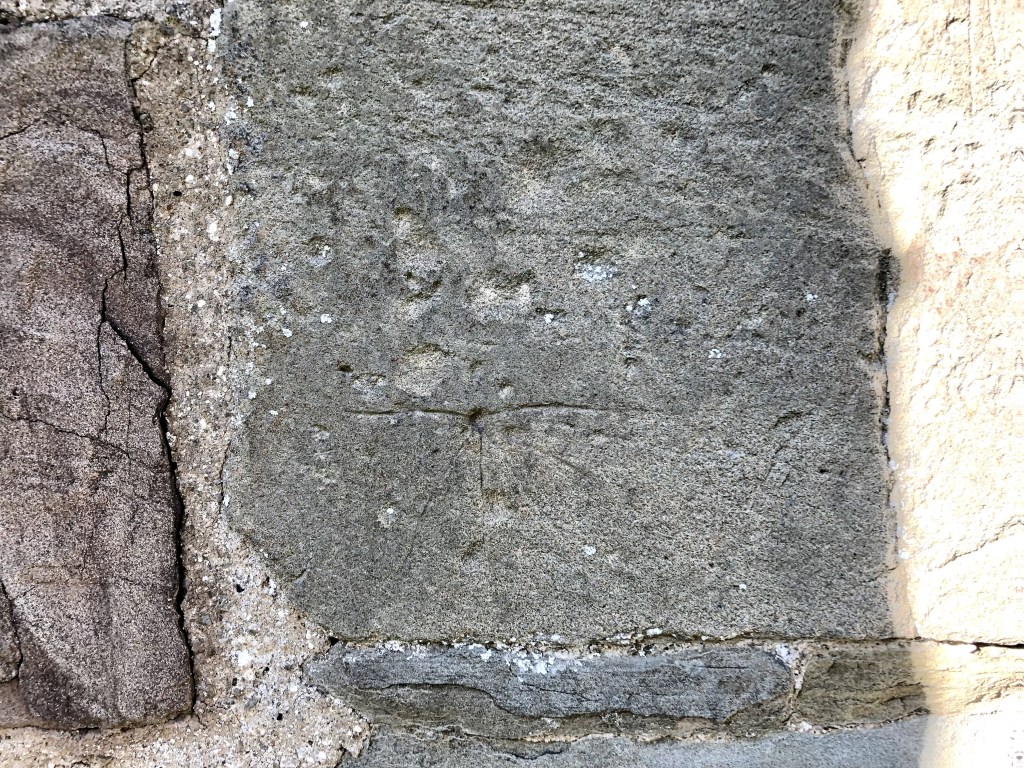
Dial 5 is below and to the left of dial 4. It is the most insect-like pattern I have come across – a line drawing might resemble a daddy-longlegs / cranefly. No line is straight, but within the wide variations in dial design and accuracy it would probably have served its purpose marking the passing hours. Unless it really is a carving of a cranefly…
St Mary . Pembridge . Herefs – Scratch Dial 5
DIAL 6
St Mary . Pembridge . Herefs – Scratch Dial 6
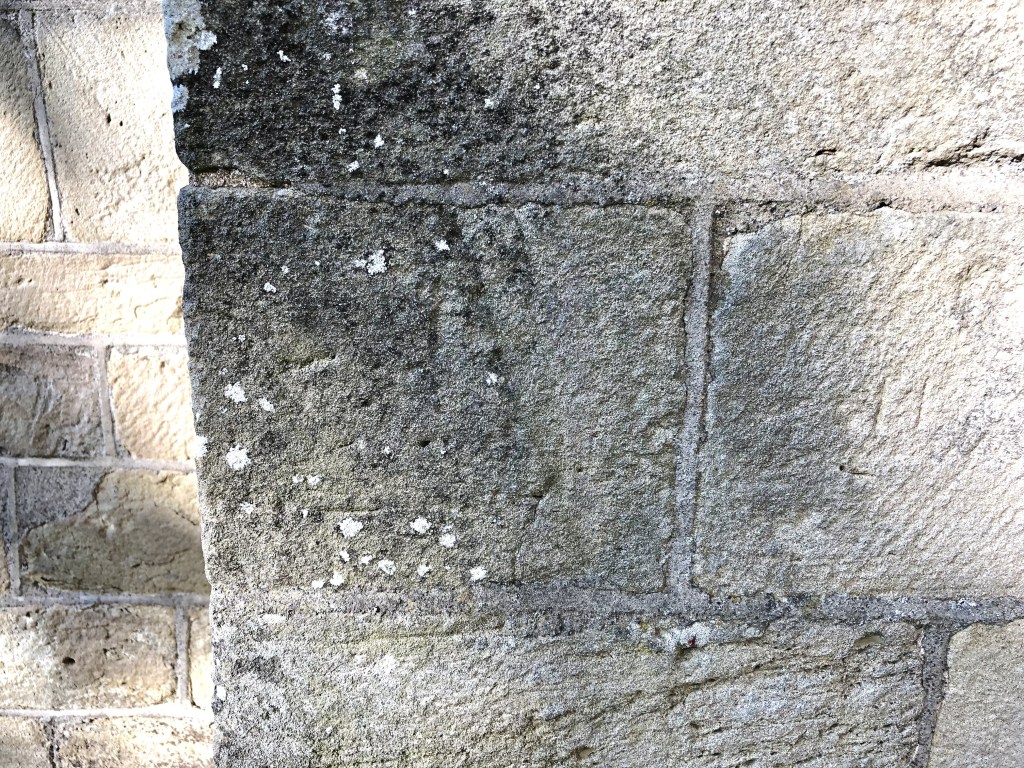
On darker stone and in shadow on a buttress, it would be easy to miss this dial. If it is one. At the time, I thought it was; and looking weeks later at the photos I still think so, just a noon line and what could be a Mass line.
St Mary . Pembridge . Herefs – Scratch Dial 6
DIAL CANDIDATES
BSS has a record of 2 dials that I didn’t notice
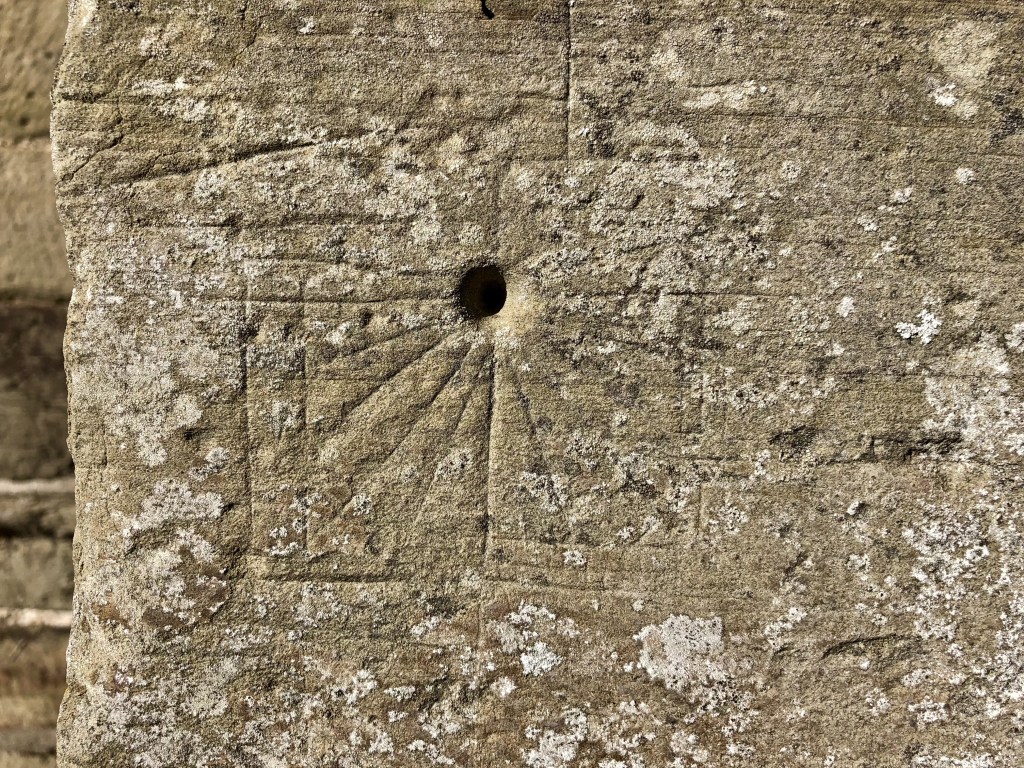
Here is a candidate for consideration. Two almost parallel lines that look deliberately scratched drop vertically down from an arguable style hole. I have come across a couple of similar dials – though each had some lines – where the vertical (noon line) was emphasised by being the space between two lines.
St Mary . Pembridge . Herefs – Scratch Dial 7?
ST MARY PEMBRIDGE: C13 BELFRY
PEV(Herefs p 542) considers this bell tower remarkable, and points out its structural relationship with Norway’s Stave Churches and Sweden’s Bell Houses. He dates it early C13, with later reconstructed in C17.
St Mary . Pembridge . Herefs – Belfry / Bell House
GRADE I † Dated from c1300, with a C12 tower that was originally separate, later incorporated when the church was extended and (BLB) much altered. Attractively distinctive to look at. 15m W of Leominster. 52.2045 / -3.0384 / SO29156
DIALS
St Mary is a multi-dial church with 6 recorded, one of which is doubtful. They range from conventional to basic. 3 are clustered on adjacent stones.
DIAL 1
Dial 1 is on the S wall, a fan-shaped edged quadrant radiating from the mortar line and stretching across 3 stones. It is near-symmetrical along the noon line. The 5 lines are spaced almost equally, the outer ones being incised more deeply, perhaps to draw attention to service times. The ‘1’ line is of interest, less accurately cut, bifurcating as it crosses onto the stone below, and ending in a single pock. This feature is so specific that it was presumably intended to emphasise a time of day of particular significance in the local community.
Kington Herefs St Mary – Dial 1
DIAL 2
Dial 2, on the S wall, is far simpler than Dial 1 but is also near-symmetrical from the noon line. 3 lines, the one to the L more of a straight scratch than a cut. The style hole is in a fault line in the stone (which may well be subsequent damage). Possibly the ‘1’ line crudely divides halfway down, beginning with a pock. This would match the similar emphasis in Dial 1, and perhaps supports the theory of a special ‘event’ mark.
Kington Herefs St Mary – Dial 2
DIAL 3
Dial 3 is also located by the door on the S wall, very damaged and eroded. 4 clear lines radiate from a style hole in the mortar line (there are also 2 very faint lines). Only the uppermost in the lower R quadrant survives for its full length.
Kington Herefs St Mary – Dial 3
DIALS 4 & 5
Dials 4 & 5 are beside and below Dial 2. Both are faint and barely more than token efforts at a dial, as if a youthful assistant priest had a knife and time on his hands.
Kington Herefs St Mary – Dial 4 & 5
Kington Herefs St Mary – Dial 2, 4, 5
DIAL 6
Dial 6 is a very simple dial (if it is one): a style hole within a deeply cut circle, and what could be a stubby noon line. The close-up b&w BSS photograph gives a good idea of it. There’s not a lot of confidence in the record: Position not known. Noon line only? Circle only and faint line at 90L. Possible noon marker. Doubtful dial.
Richard & Catherine Boztum, in their excellent illustrated booklet (cited below) of Herefordshire Church marks and scratch dials include dials 1 – 5, but not this one.
Kington Herefs St Mary – Dial 6 – BSS
I also have my doubts. St Mary has plenty of Church graffiti – initials, scratchings, small crosses, and in particular a number of apotropaic symbols (ritual protection marks). The design of ‘Dial 6’ is one of many forms of ‘witch mark’. And on St Mary itself, there is a more elaborate version of the circle-and-centre-hole mark.
Kington Herefs St Mary – Apotropaic mark
OTHER CANDIDATES?
Having in mind the rather basic design of some of the dials above, there are a couple of candidates that I photographed for later inspection. The first is at least plausible and matches the noon line symmetry of dials 1 & 2. The other is unconvincing. You be the judge…
Kington Herefs St Mary – Plausible Scratch Dial
Kington Herefs St Mary – doubtful scratch dial
GSS Category: Scratch Dials; Multi-dials
Photos: Header image: Ruth Harris (Geograph / Wiki / CC); all other photos Keith Salvesen except dial 6 BSS
REF: Botzum R and C : Scratch Dials, Sundials and unusual Marks on Herefordshire Churches. Lucton, Herefs, 1988
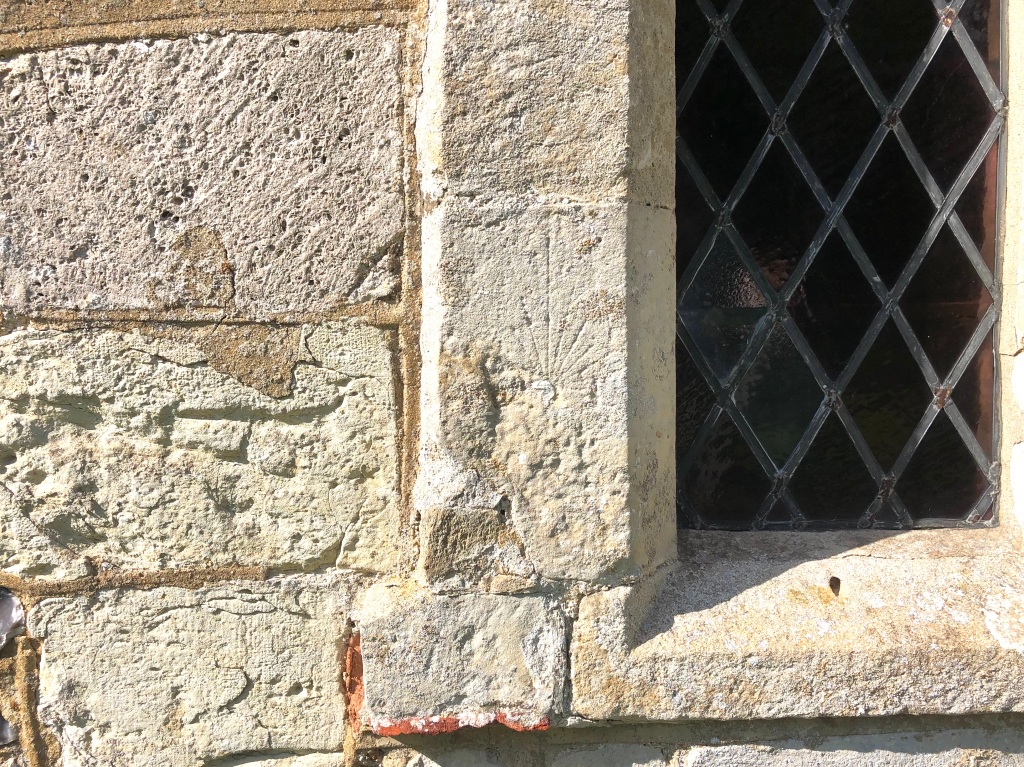
GRADE II* † C12 origins then C13 and C14 addition and rebuilding. Much C19 work inc. rebuilding tower & S porch. A most attractive long low church with timber belfry and spire. A rewarding church to explore: see BHO. 3m S of Stockbridge; 7m N of Romsey. 51.077 / -1.4872 / SU360309
DIALS
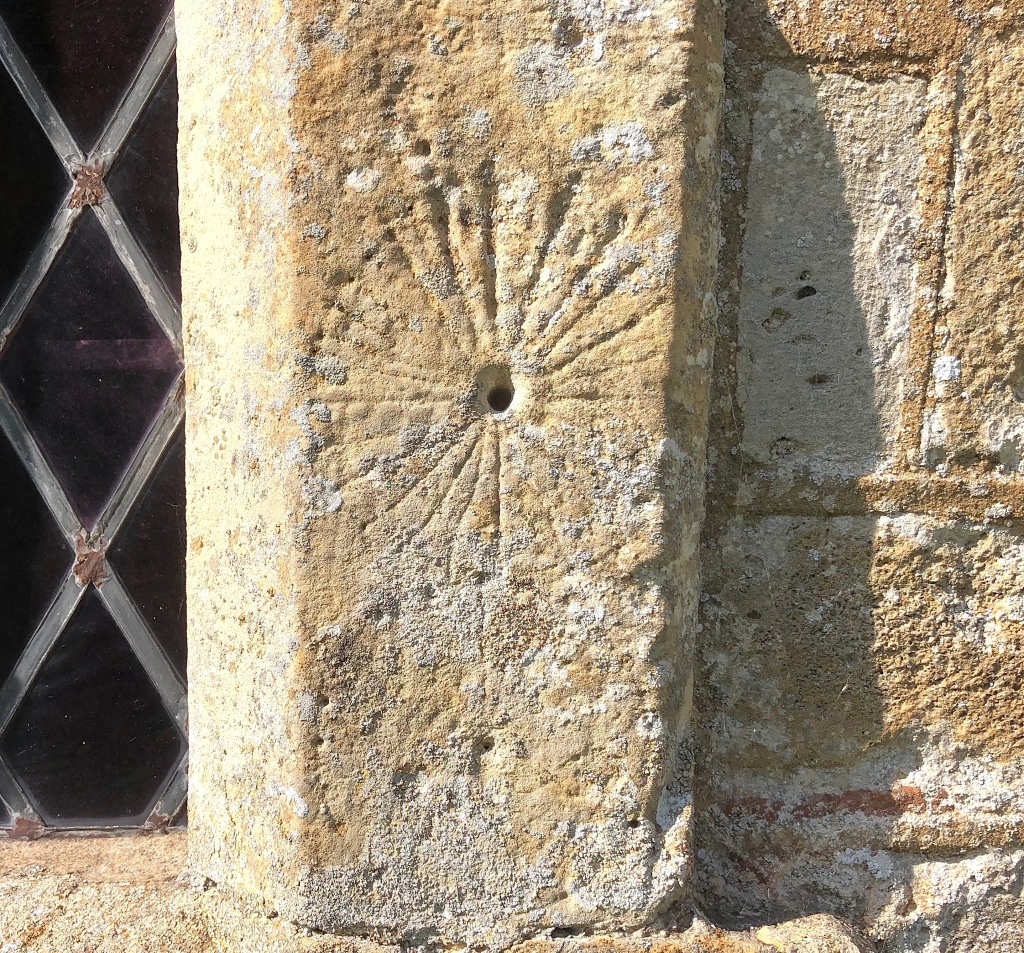
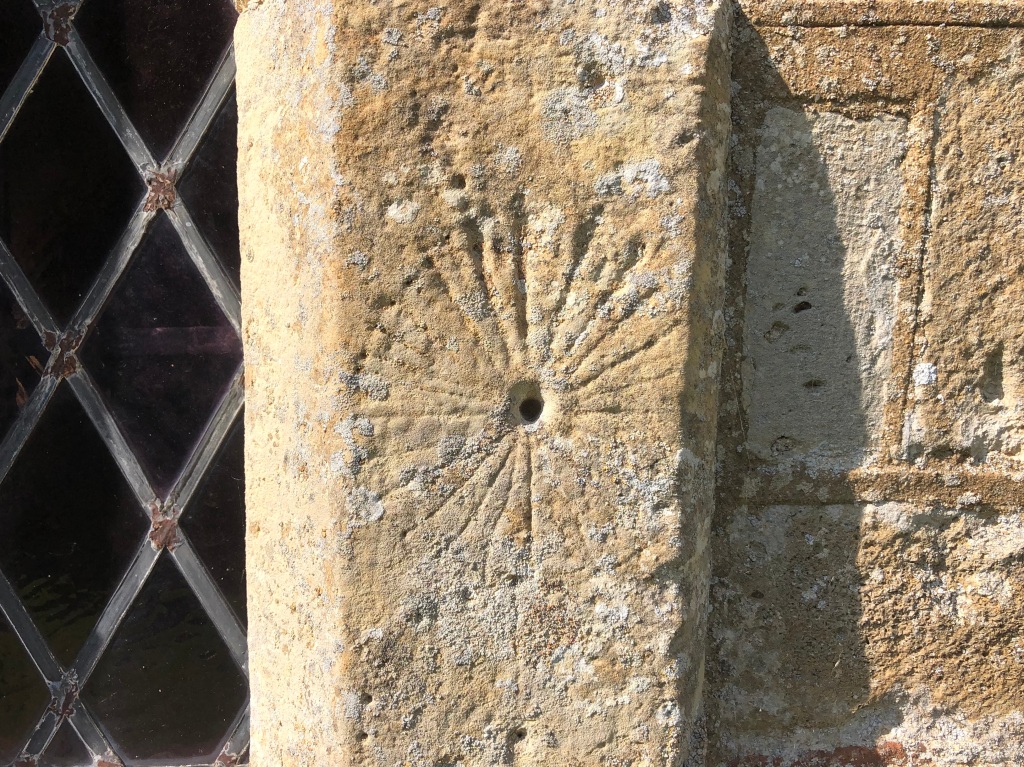
There are 4 dials recorded for the church, but only 3 are visible. The 4th seems now to be concealed behind a boiler. The 3 visible dials are all on the jambs of a S nave window. ARG notes that the window was inserted into an old doorway All are inverted, presumably during the 1880 restoration. Maybe this links up with the rebuilding of the S porch and relocation of stones originally there (a more obvious position). BHO notes various window alterations and the movement of stones incised with ornamental crosses and inscriptions… the stones have unfortunately been reset upside down.
St Peter & St Paul . Kings Somborne . Hants – 3 scratch dials
DIAL 1
St Peter & St Paul . Kings Somborne . Hants – Scratch Dial 1
Dial 1 is inverted on the L jamb. LHS and below, the style hole is badly damaged. Otherwise, the 12 lines are more or less clear, with differing lengths and angles. There is a trace of a semicircle, marked by perimeter pocks. The noon line is considerably elongated and, with 1, has larger perimeter pocks. 1 also has a short extension of 4 dots, perhaps to emphasise a service significant to this church or community.
DIALS 2 & 3
St Peter & St Paul . Kings Somborne . Hants – Scratch Dials 2 & 3
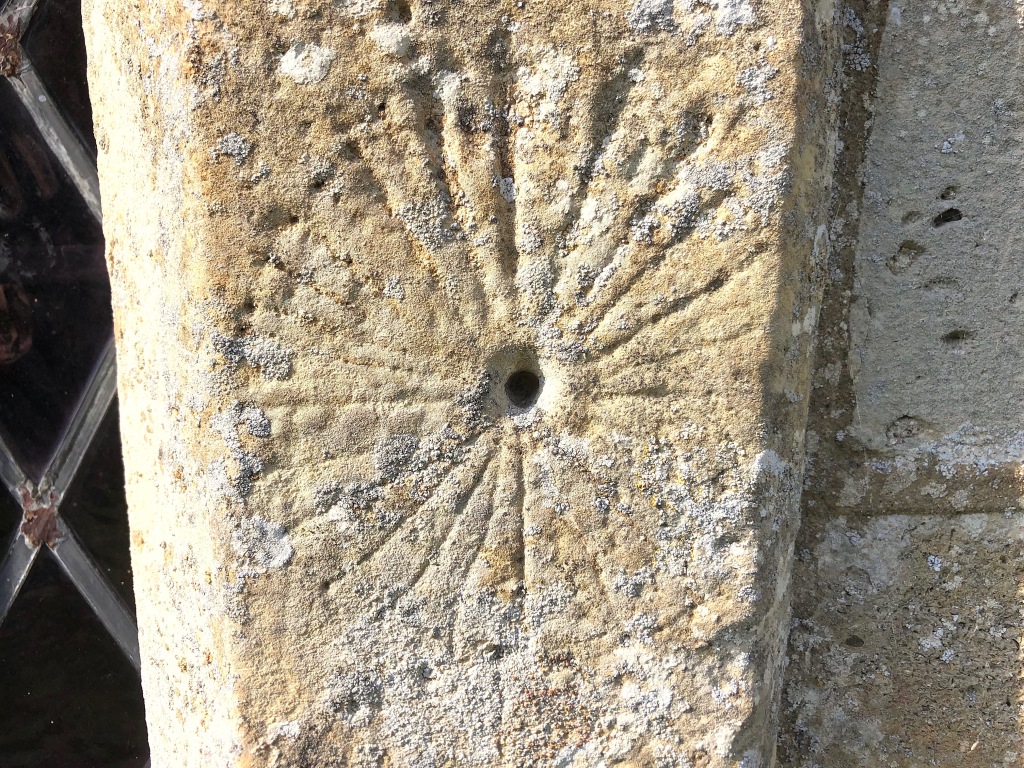
Both dials are on the R jamb, inverted, on the same stone, and actually touching. Unusually (perhaps very rare) both are complete circles with 24-hour marking. Dial 2 has 24 radials; Dial 3 has 24 pocks.
Dial 2 is encircled and imaginatively decorative, with radials for a full 24 hours. The spacing is somewhat random. The style hole is quite deep, and obviously enlarged. The (upside-down) noon line is deeper cut, as are 10, & 11. So too is 1, which is also extended with 2 pocks. This corresponds with Dial 1 and seems to confirm that some importance was attached to that time of day.
St Peter & St Paul . Kings Somborne . Hants – Scratch Dial 2
Dial 3 is also a complete circle, with a small style hole. It is eroded, with only the (upwards) noon line and a couple of fainter lines clear. Most of the daylight hours are marked by pocks on the circumference; close examination has shown that in fact there are 24 pocks. It appears as if squeezed into the space between the upper stone and the lower edge of the stone
St Peter & St Paul . Kings Somborne . Hants – Scratch Dials 2 & 3
BSS drawing of dial 3
DIAL 4
Dial 4 is located on the SE quoin stone of the Chancel. The record indicates that it has 12 lines, mostly curved, and 2 above the horizontal. BSS notes Position is obscured by a hut containing an oil tank. So much so that I couldn’t find it at all. I intend to try again next time I’m in the area – perhaps taking a torch.
ARG in 1923 recorded that the dial consisted of a circle with 10 lines in the lower half, 5 of which end in pocks; and 2 lines in the upper half. None of the lines are straight; most are distinctly curved. Sadly, although he photographed dials 2 & 3, he did not take dial 4.
GRADE II*. C12 origins, C13 with C14 additions (chancel, S. porch); tower rebuilt mid C18 after a collapse; Victorian restoration. Much of the medieval church in evidence. External and internal masons’ marks, graffiti etc. A pretty village on the R. Arrow, on the ‘Black & White Village Trail’ 52.2218 / -2.8497 / SO420585
DIAL 1
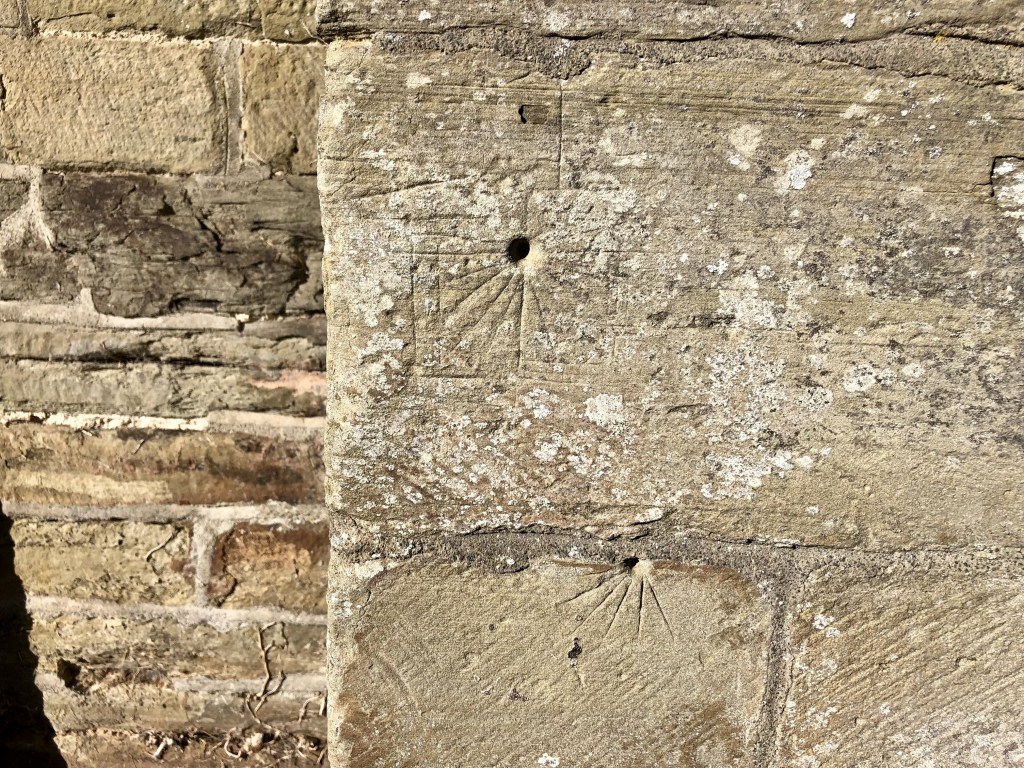
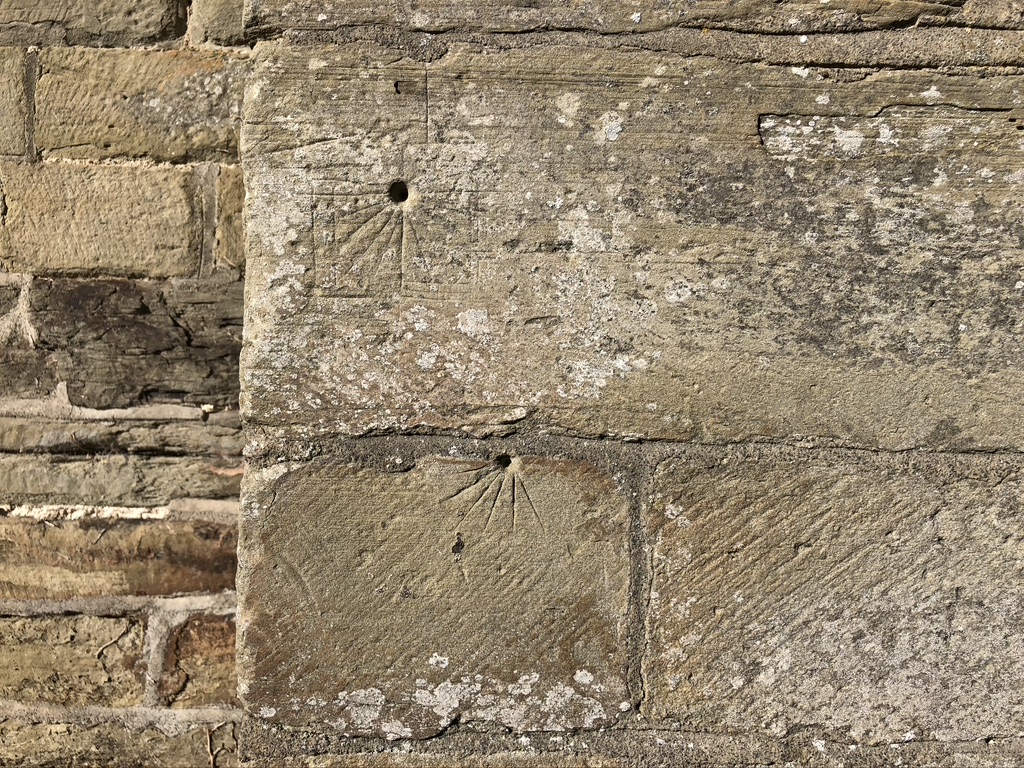
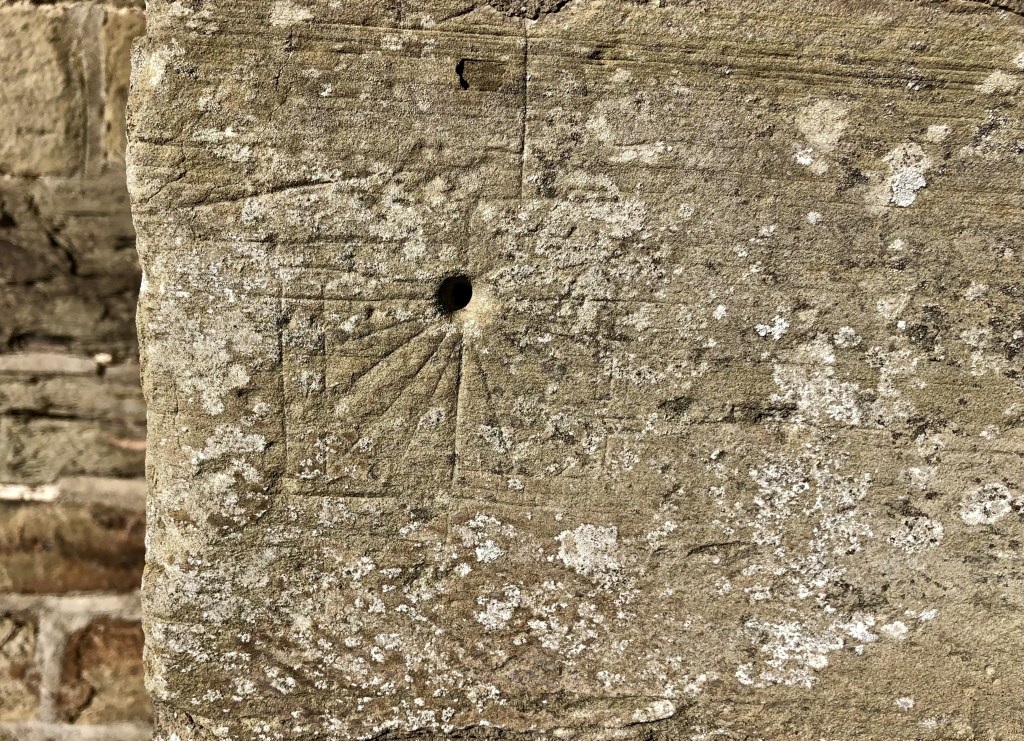
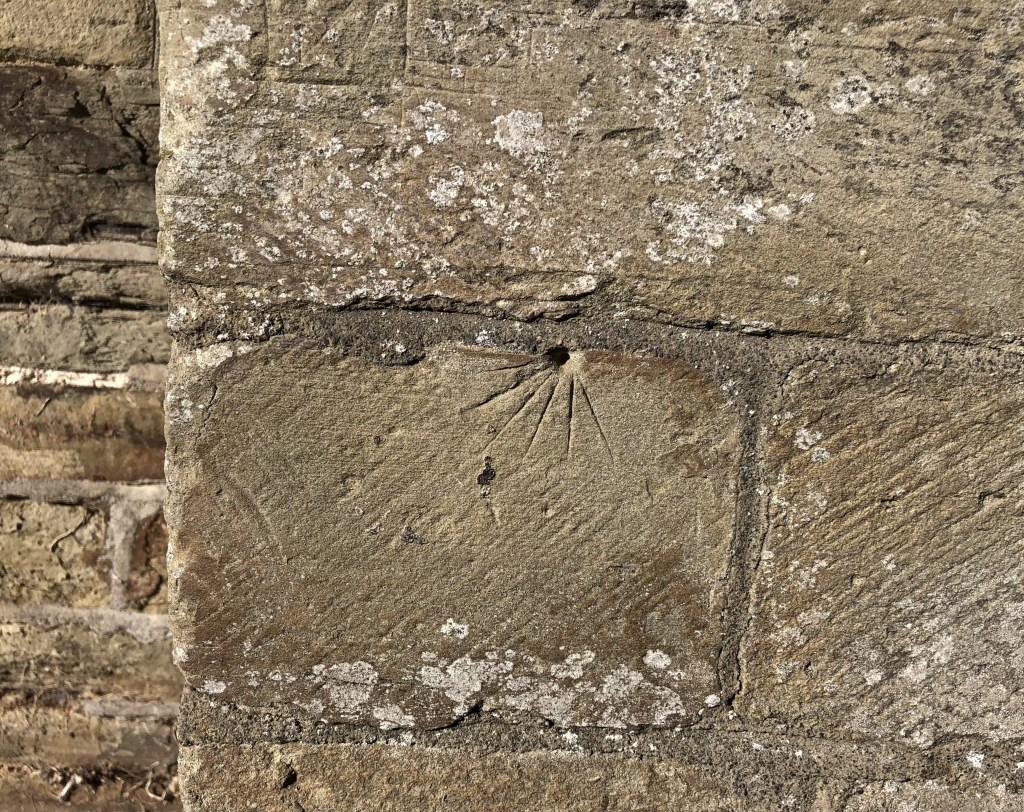
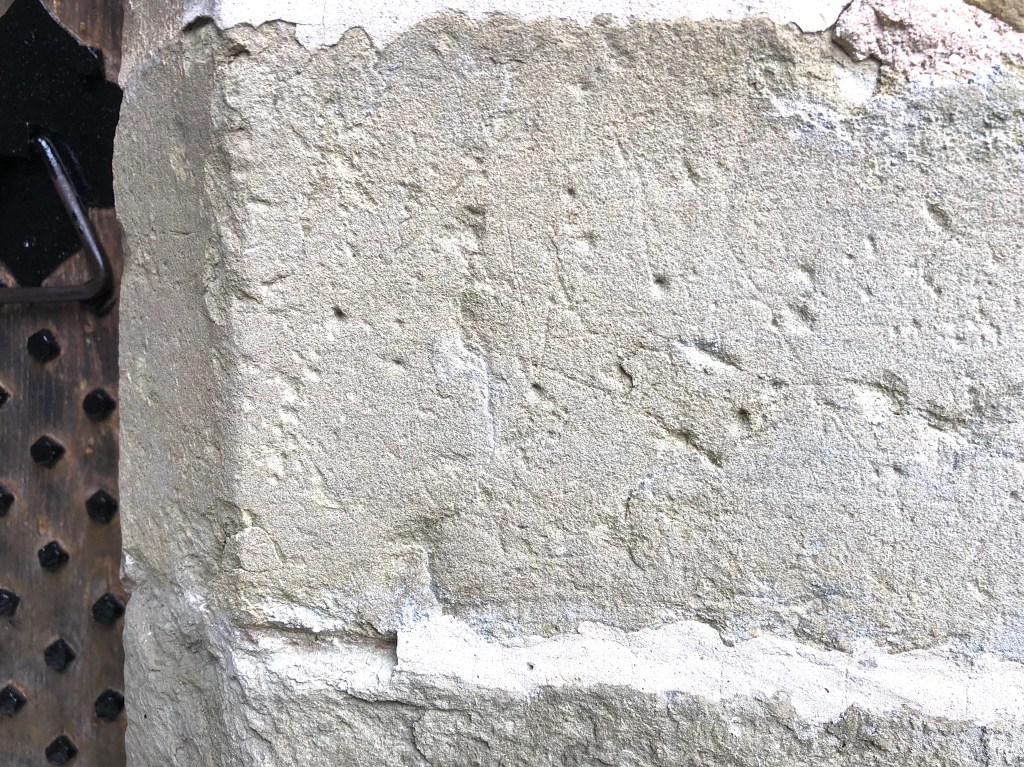
On the R. side of the S. porch, on the stone below the architrave. The stone below has marks that are probably apotropaic. 3 definite lines descending from the mortar line and through a slanting line that looks most like a fault in the stone – that may also apply to the 4th ridged line on the left side, or perhaps it was cut / added at a different time.
St Mary the Virgin . Eardisland . Herefordshire – Scratch Dial 1
St Mary the Virgin . Eardisland . Herefordshire – Scratch Dial 1
DIAL 2
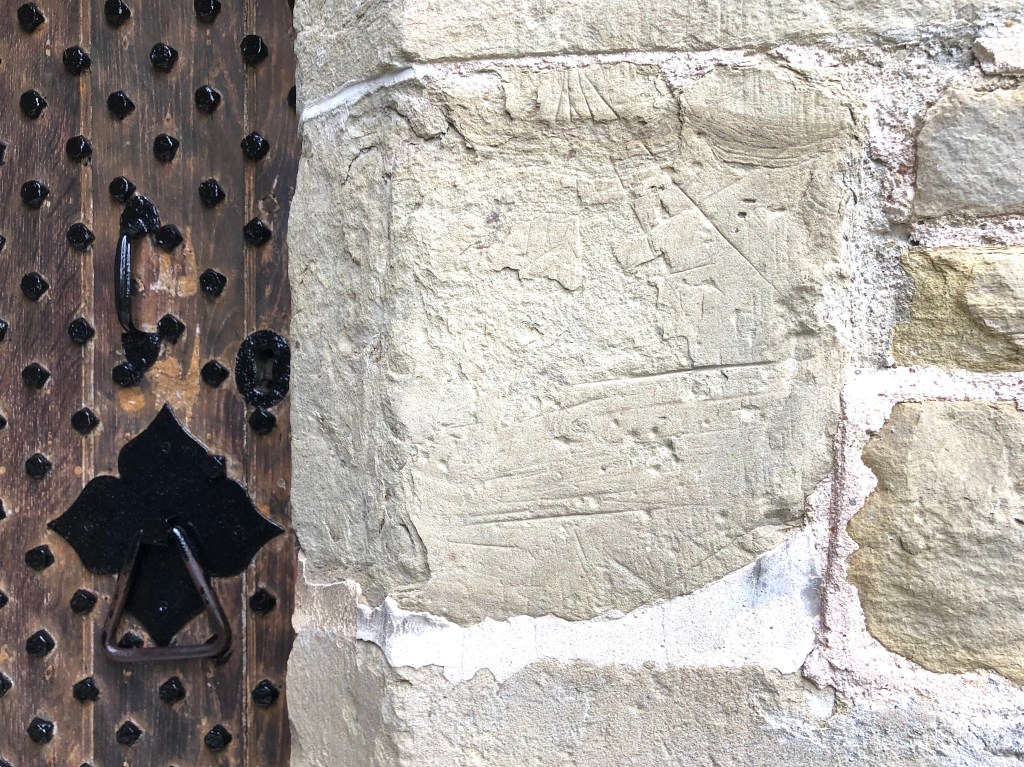
Cut into the large quoin stone on R. side of the priest’s door and spanning its width. The dial has a relatively complex design, perhaps combining its practical purpose with decorative effect. Erosion has made interpretation difficult. The style hole, now a small cave, is in the mortar line. The lower R quadrant shows part of 3 concentric semi-circles. There’s a hint – best seen top L – that at least the inner circle line continued above the horizontal. There’s little other sign of a more complete circle.
St Mary the Virgin . Eardisland . Herefordshire – Scratch Dial 2
Erosion and lichen obscure the finer details. BSS records 7 lines but a close-up photo in sunlight reveals about a dozen, with possibly some shorter lines (half-hour marks?). There are also pocks, 2 or 3 of which could relate to the dial – in particular the 2 ‘terminal’ ones adjacent to the noon line just above the mortar.
St Mary the Virgin . Eardisland . Herefordshire – Scratch Dial 2
St Mary the Virgin . Eardisland . Herefordshire – Scratch Dial 2
GRADE 1. C14, earliest record for the site 1275. Largely destroyed in 1643 during the Civil War, as was the adjacent castle. Almost entirely rebuilt in 1656. Late C19 alterations and extensions. Much of interest including a triple hammerbeam roof. Most notable as a rare example of a church built (or rebuilt) during the Commonwealth. 52.3471 / -2.9255 / SO370725
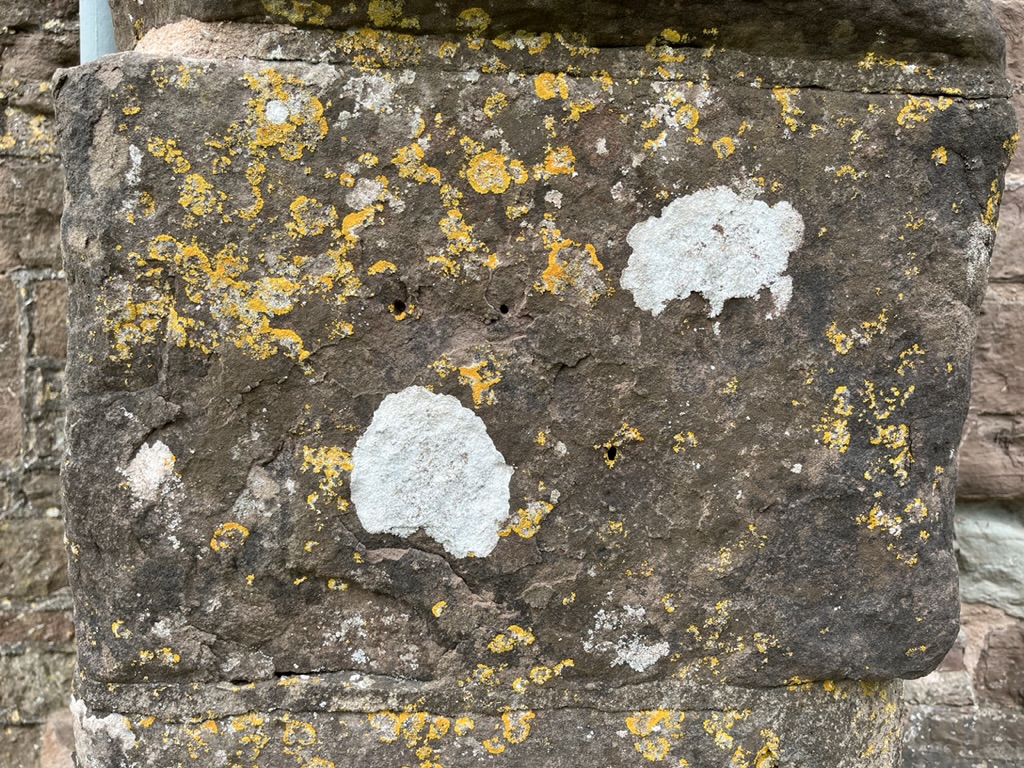
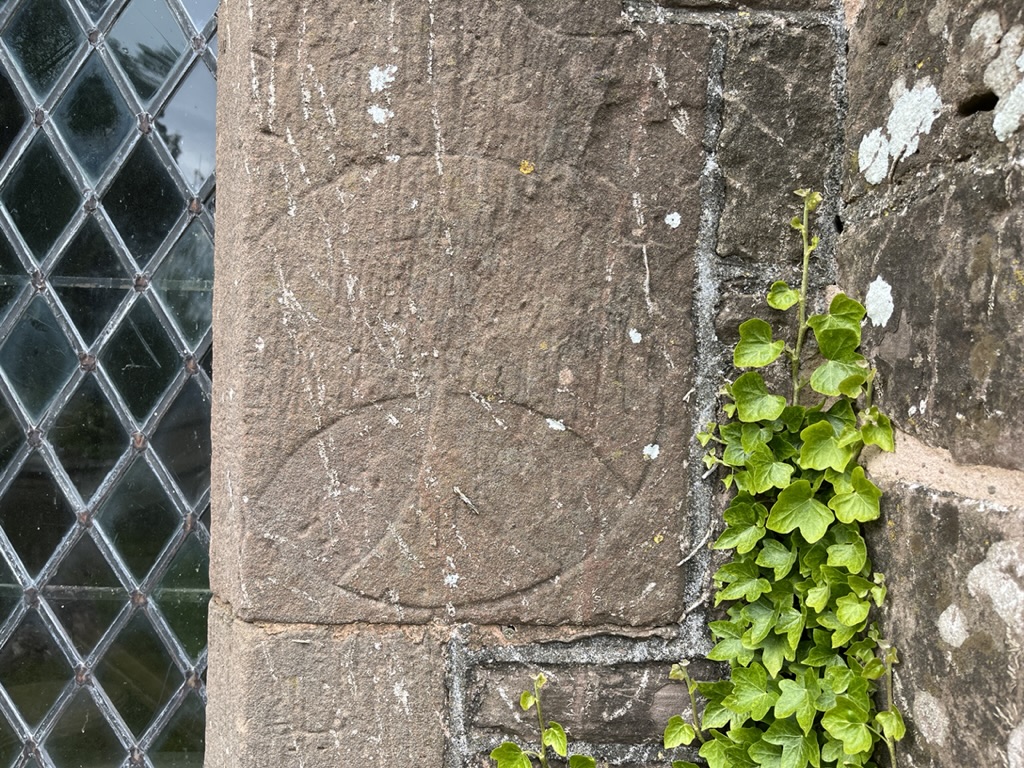
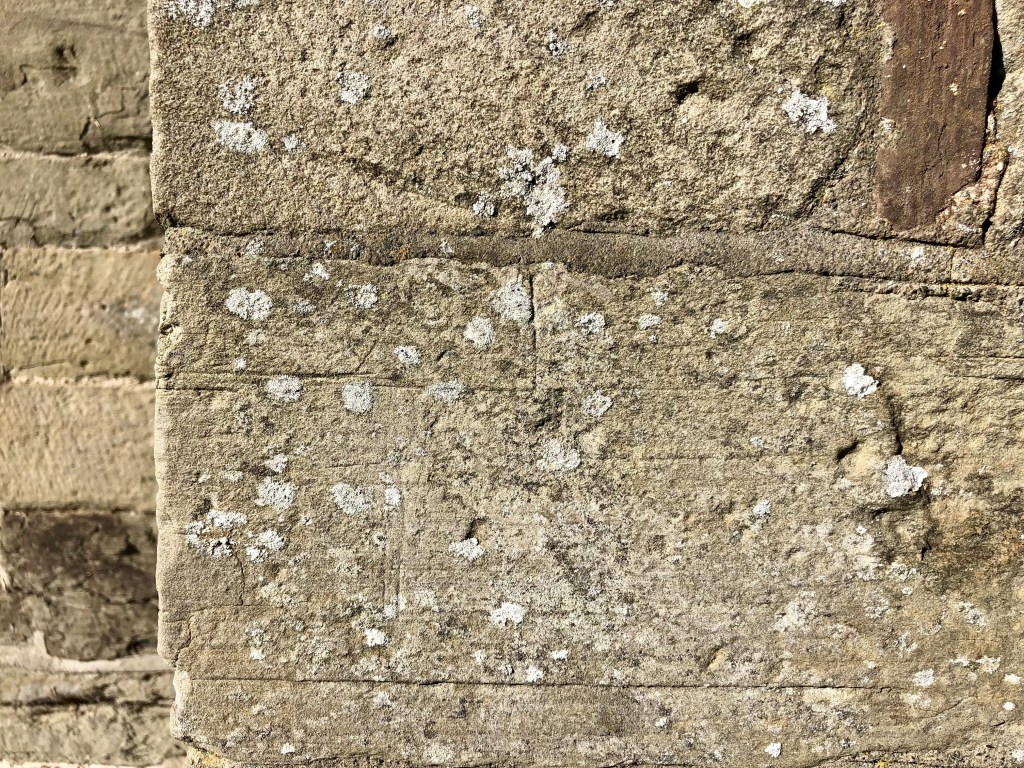
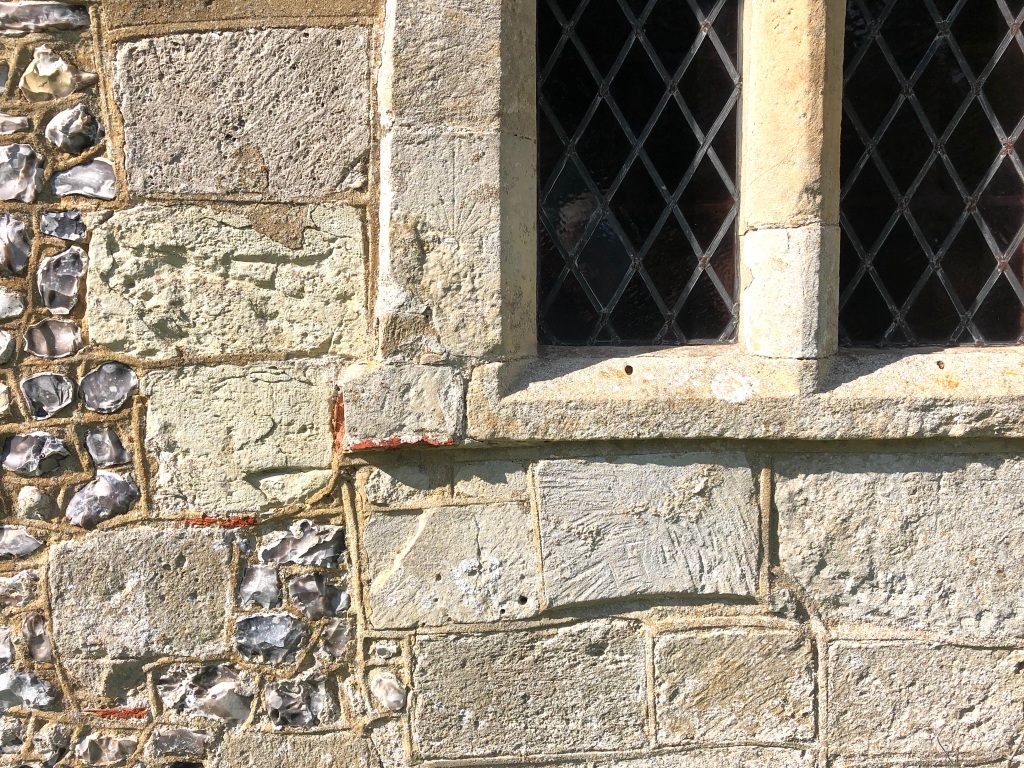
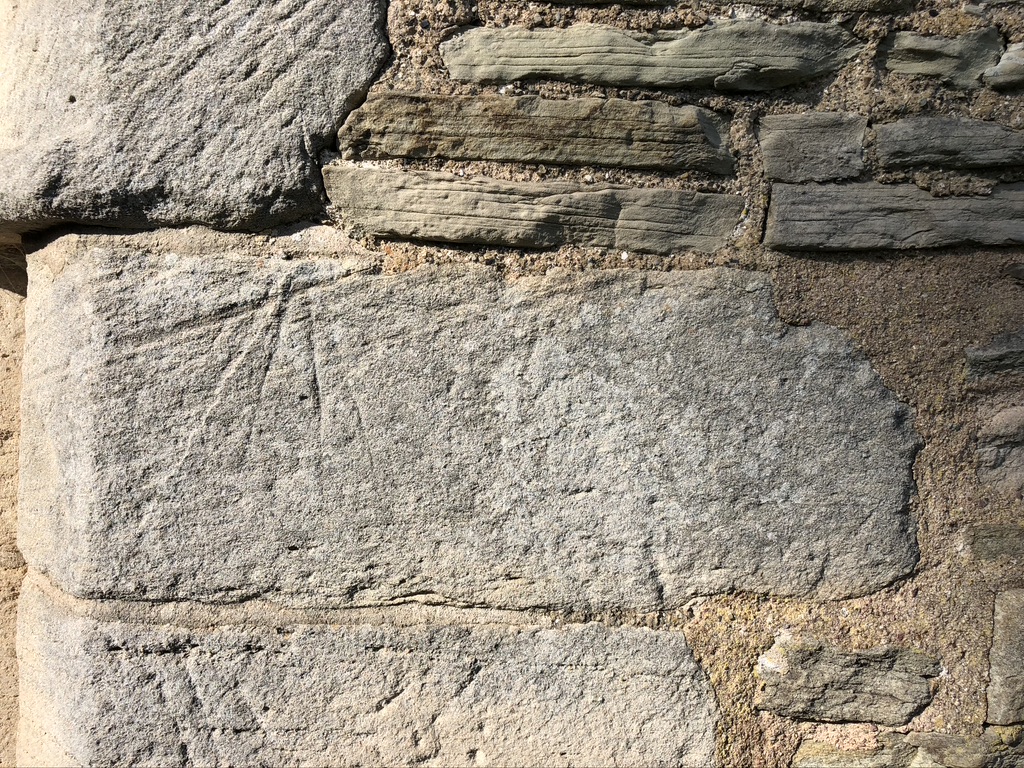
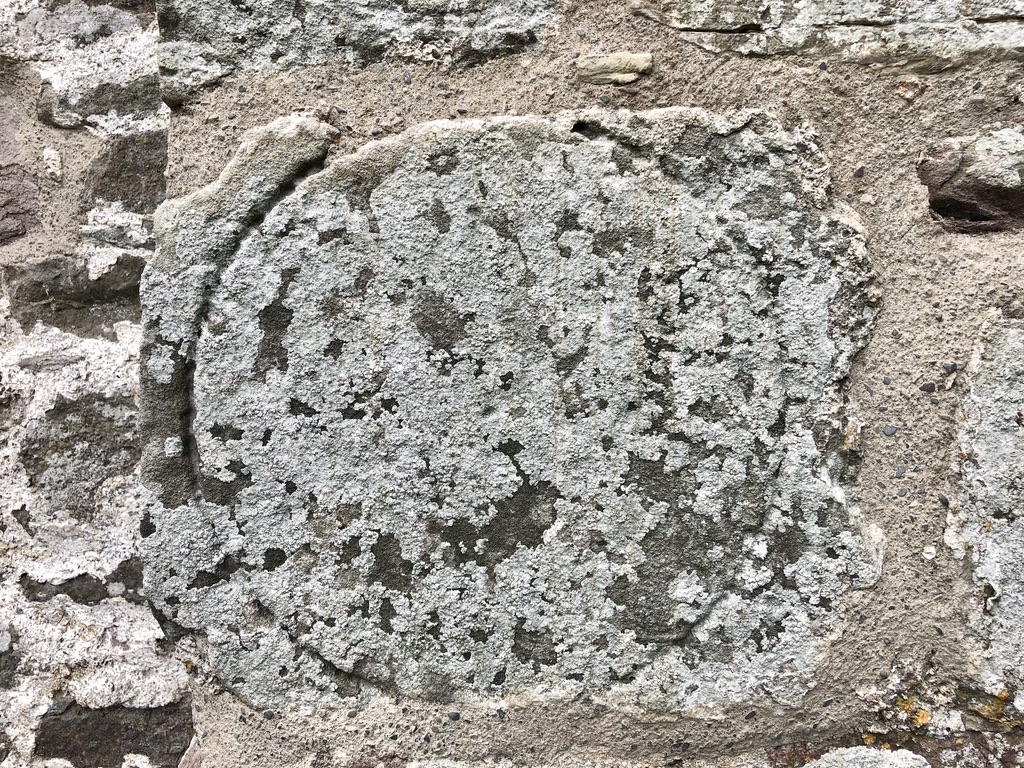
The dial, a large circle, is on a short buttress under the E. window. There are few detectable marks, not least because of the lichen that covers most of it. The presumed style hole is basically a dimple in the centre. The present position – and indeed the history of the building – indicates relocation. It’s hard to say how useful it might originally have been, but it adds to the remnants of the church’s medieval past.
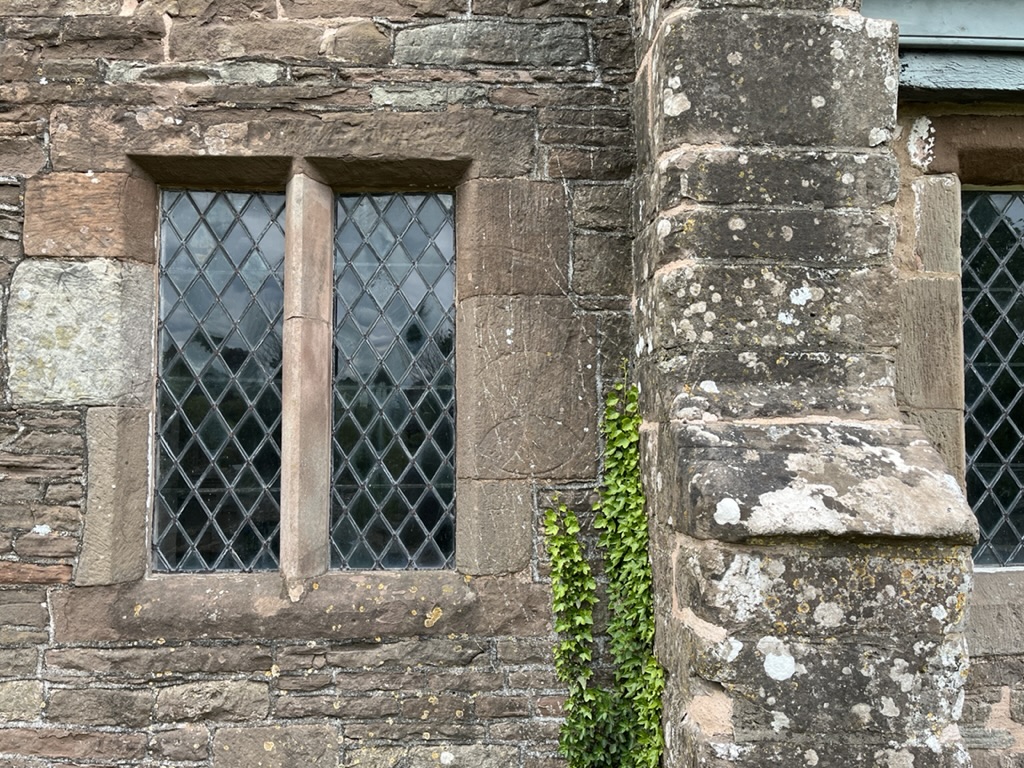
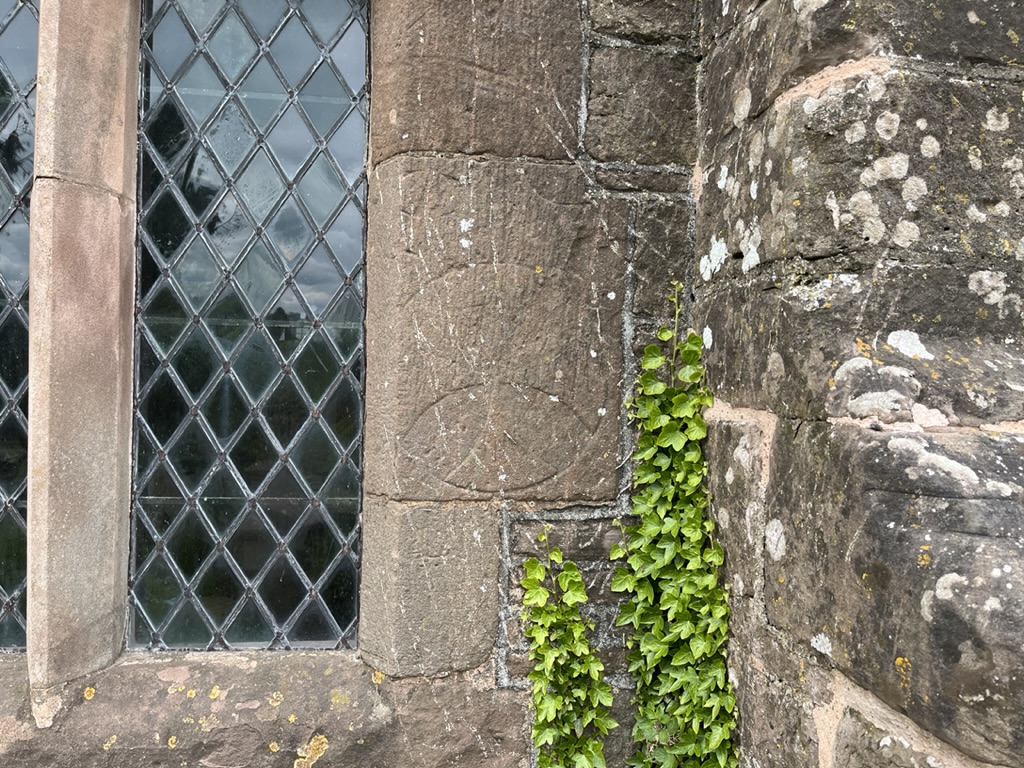
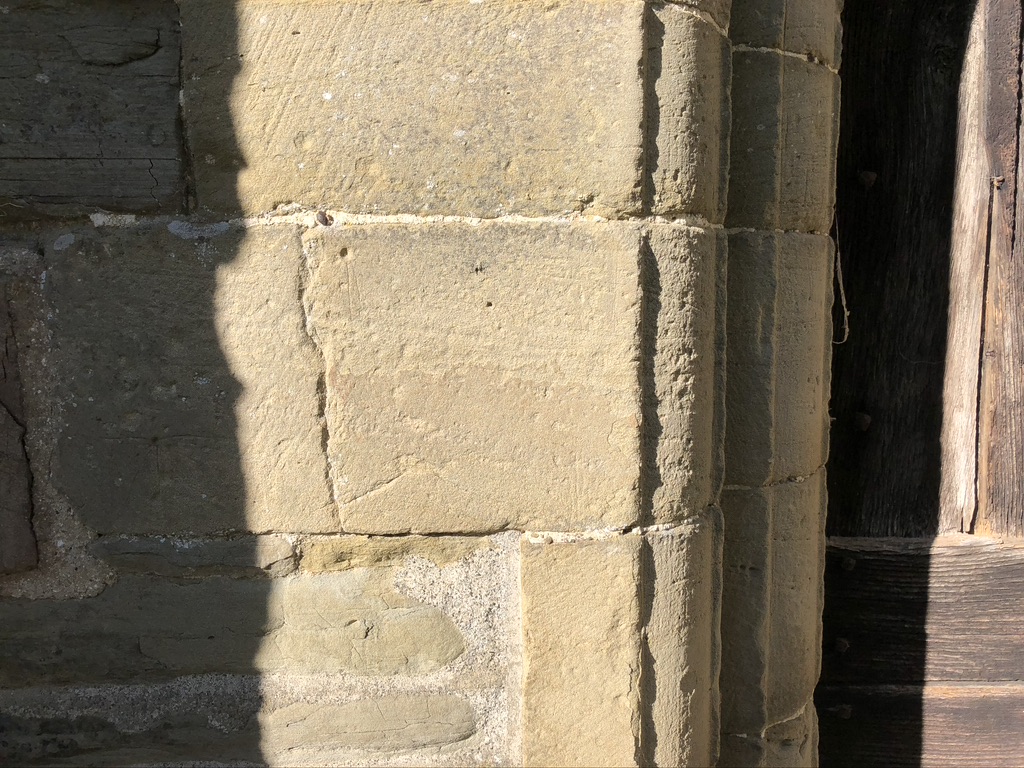
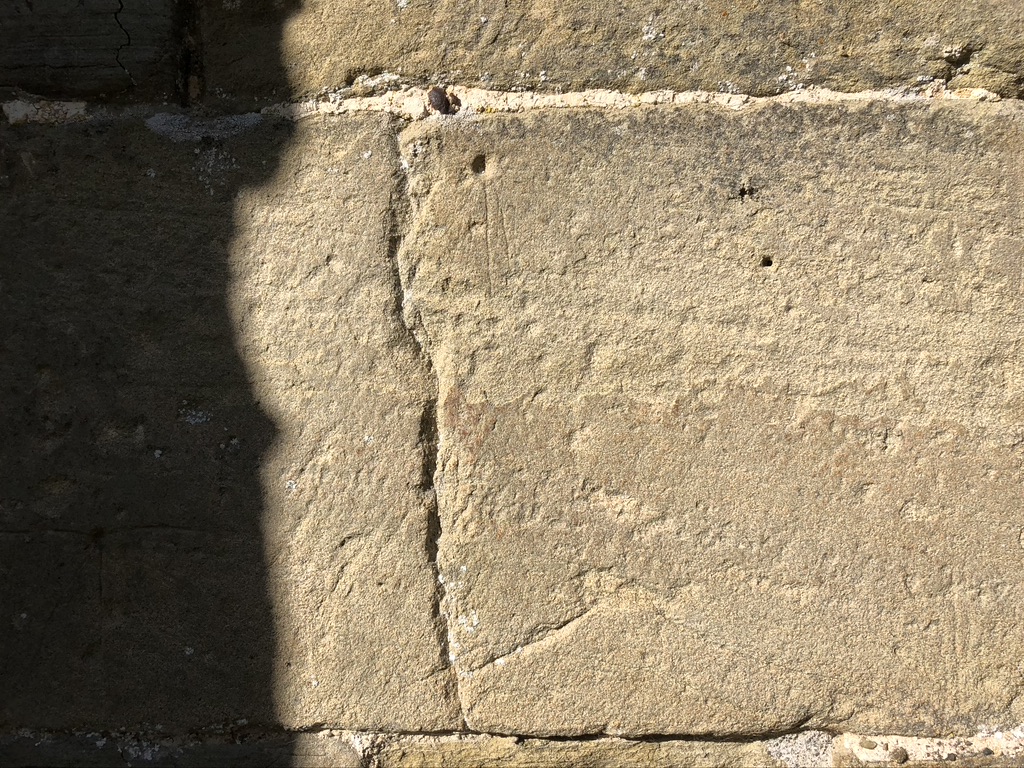
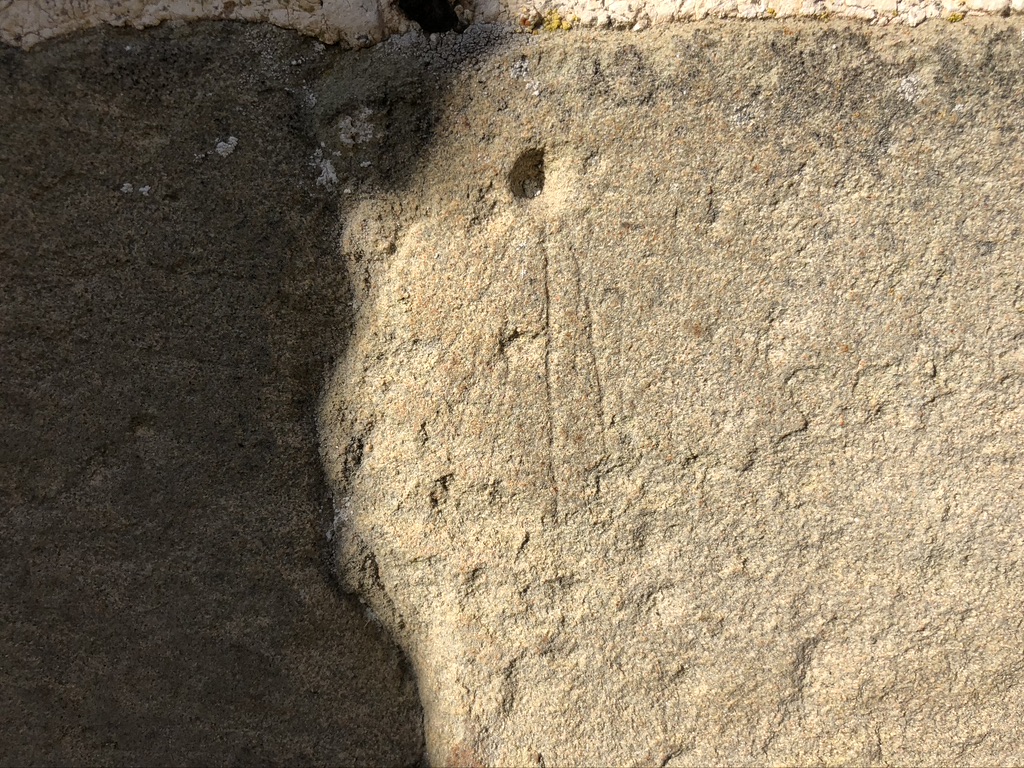
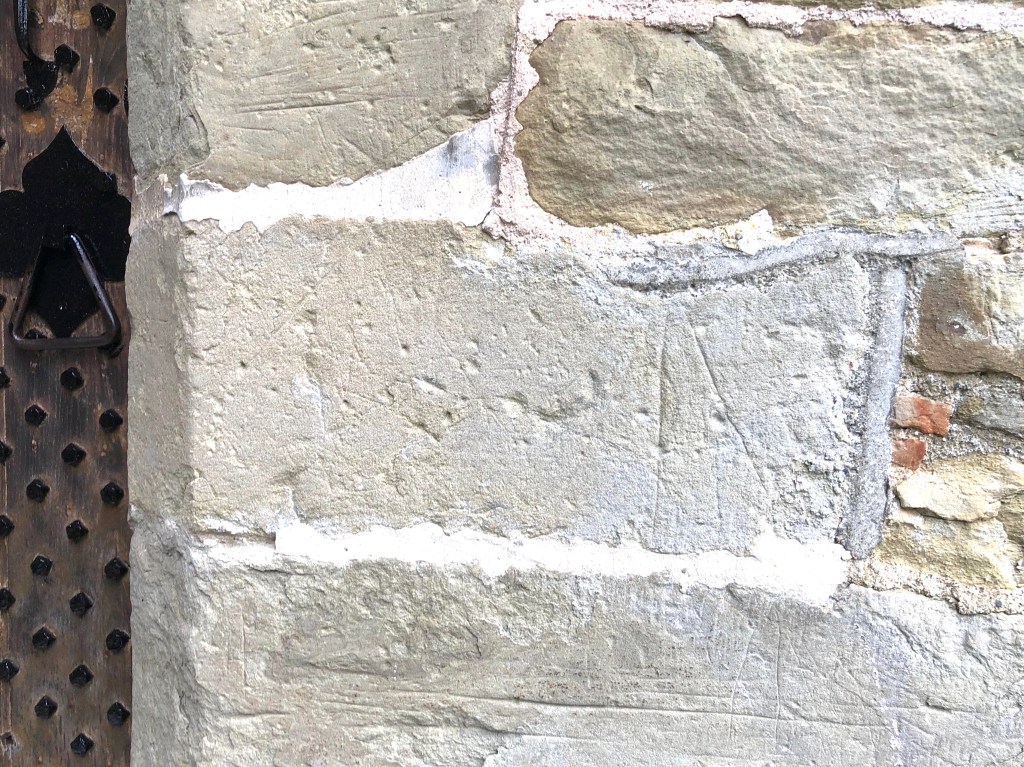
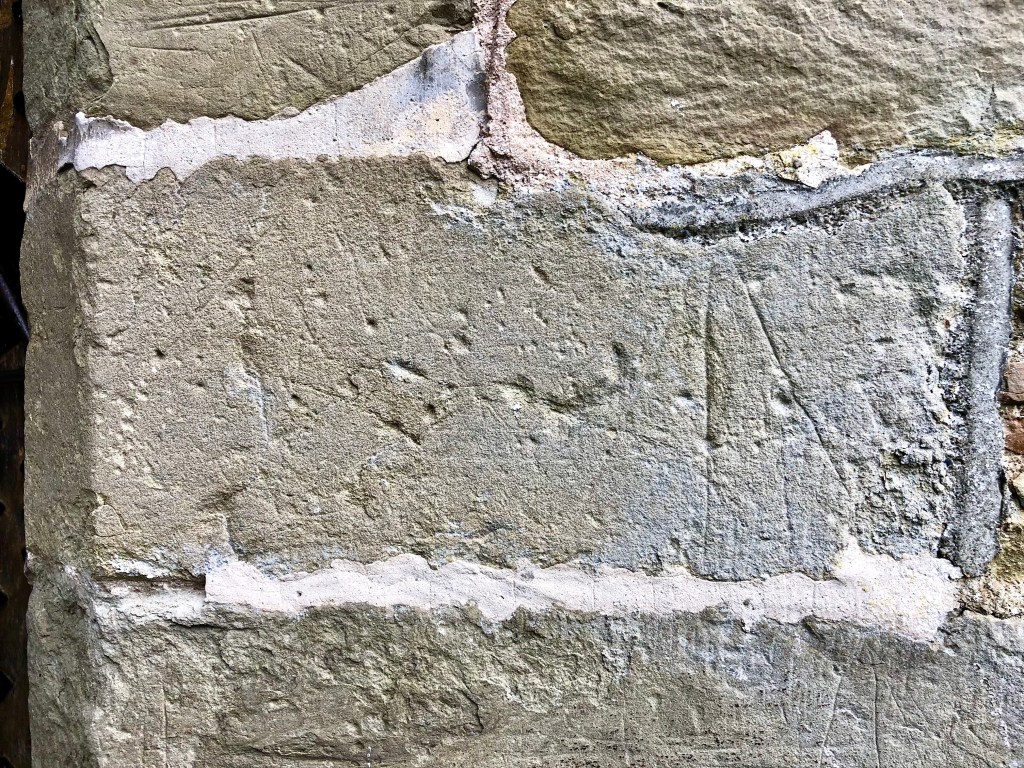
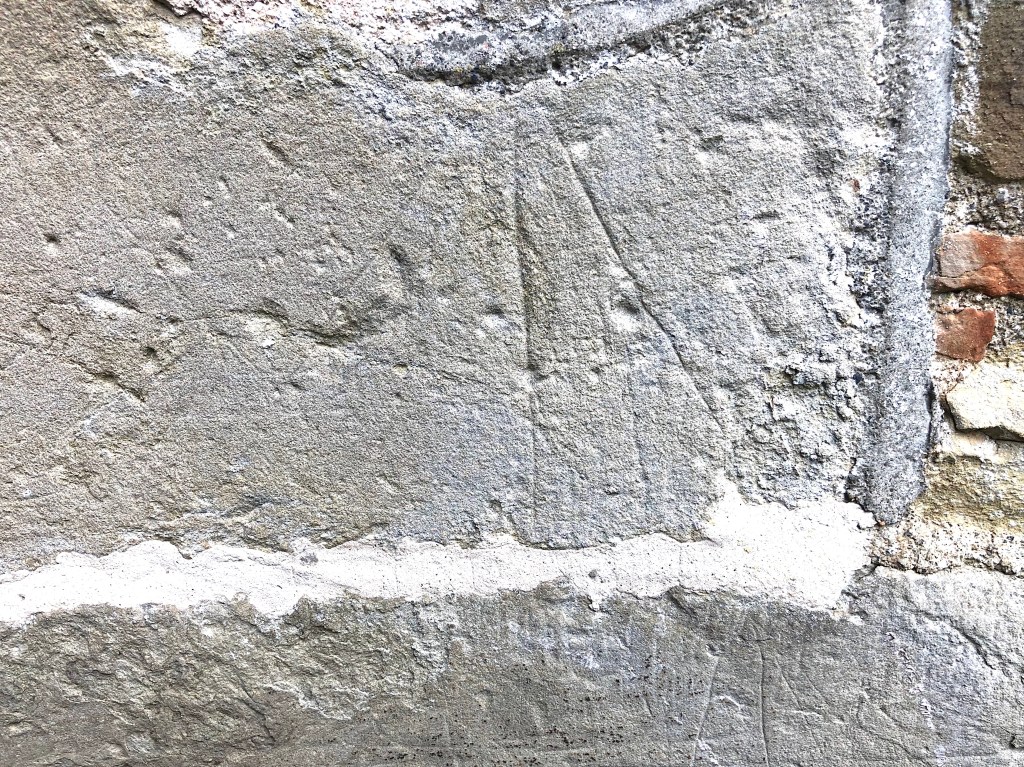
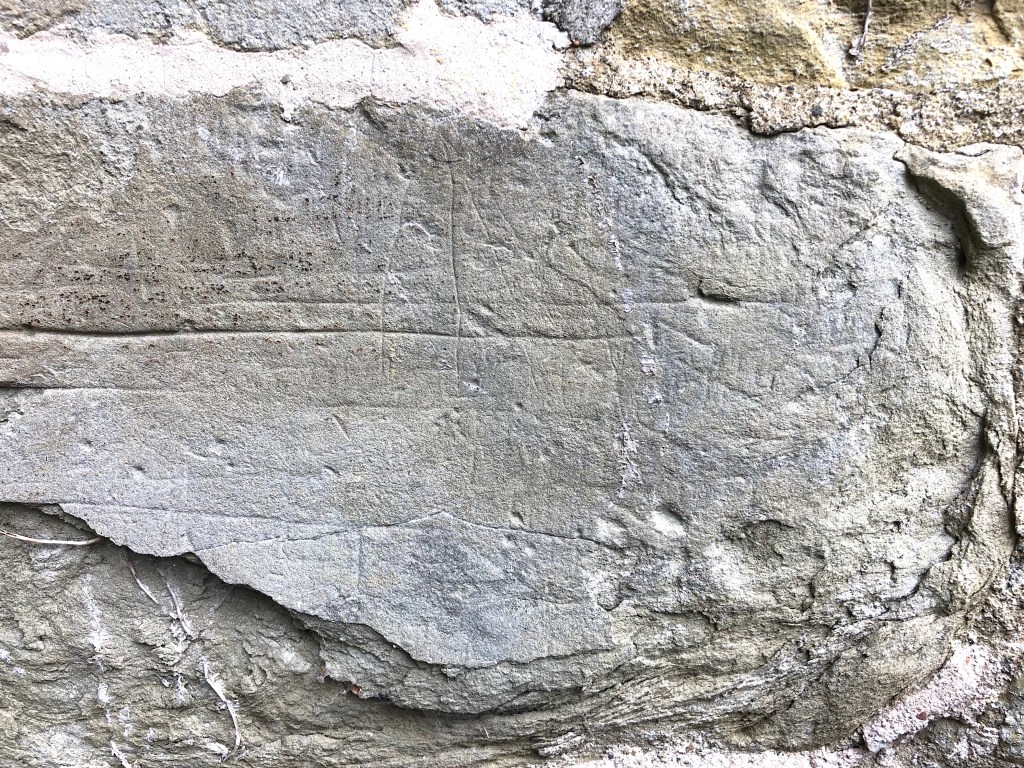
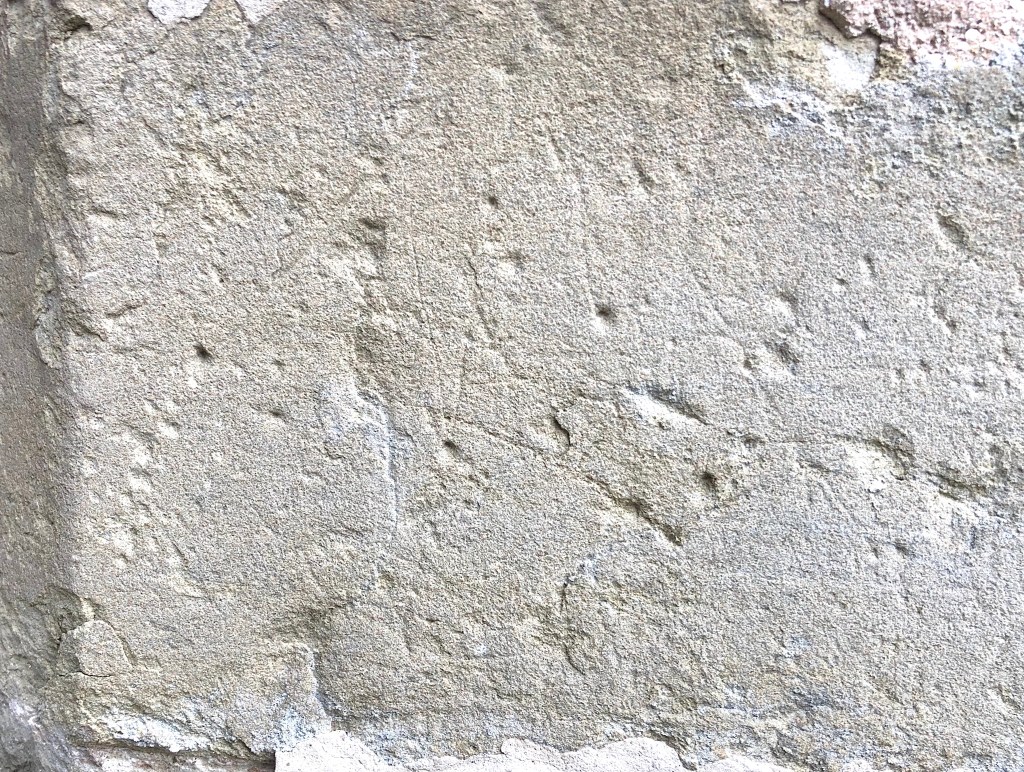
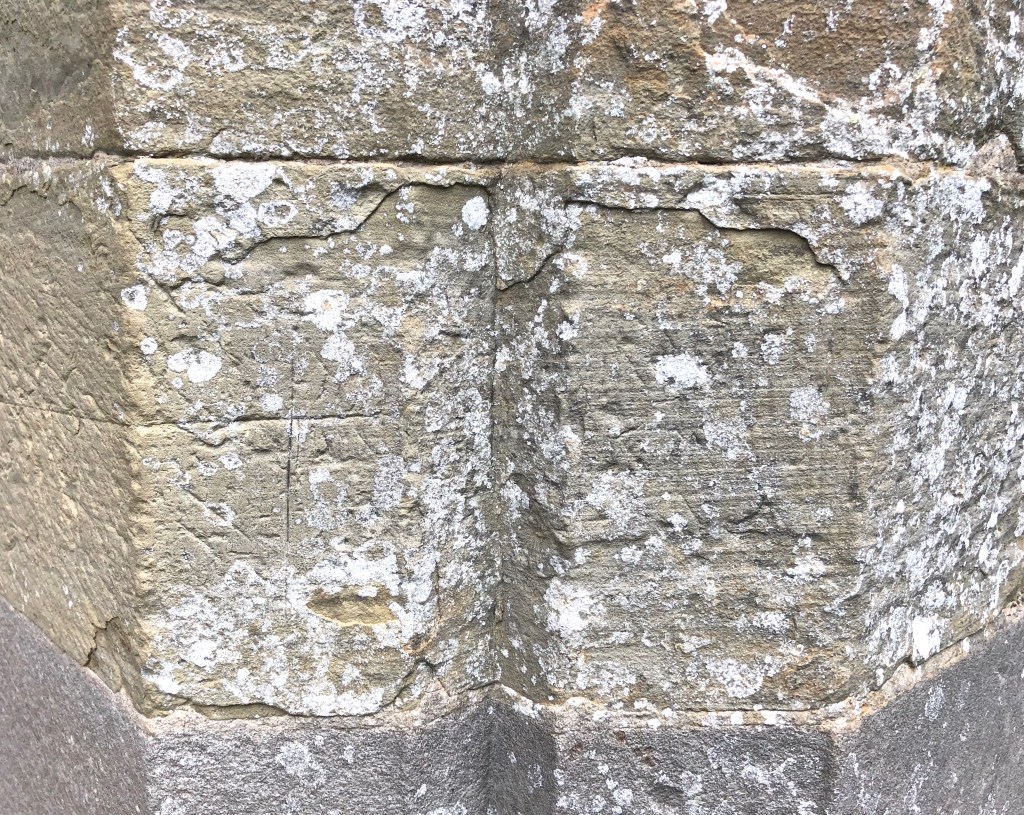
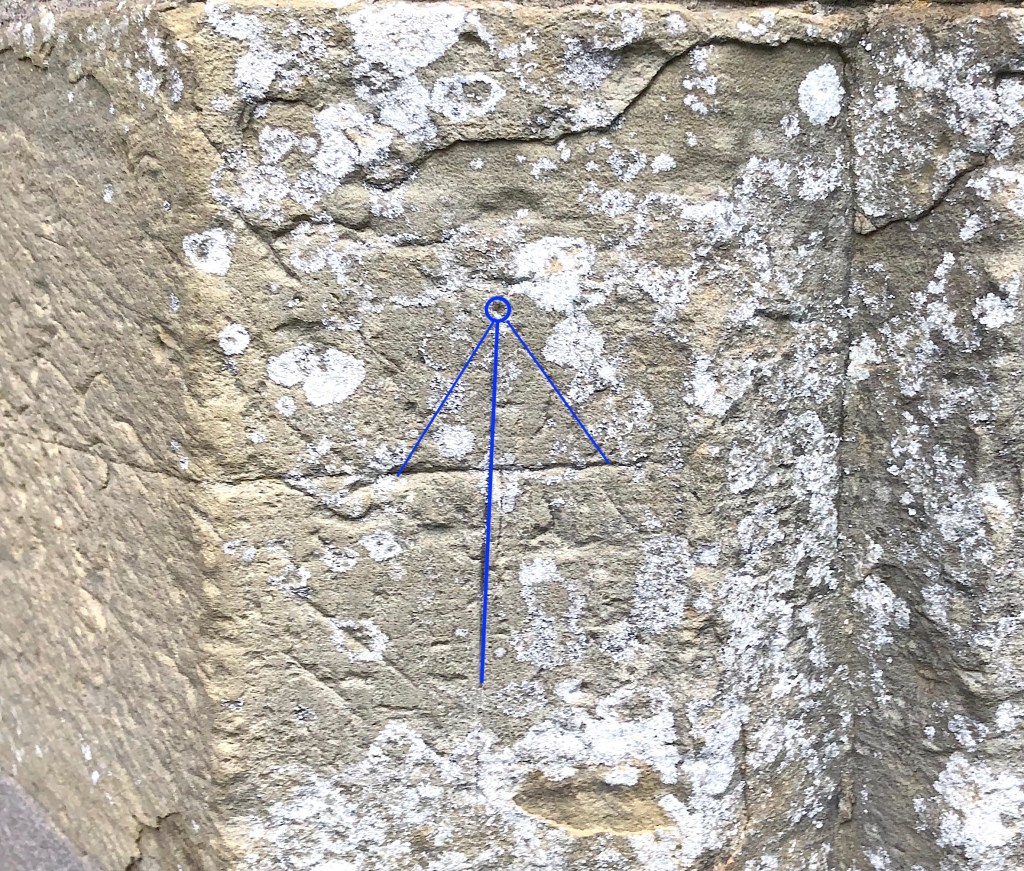
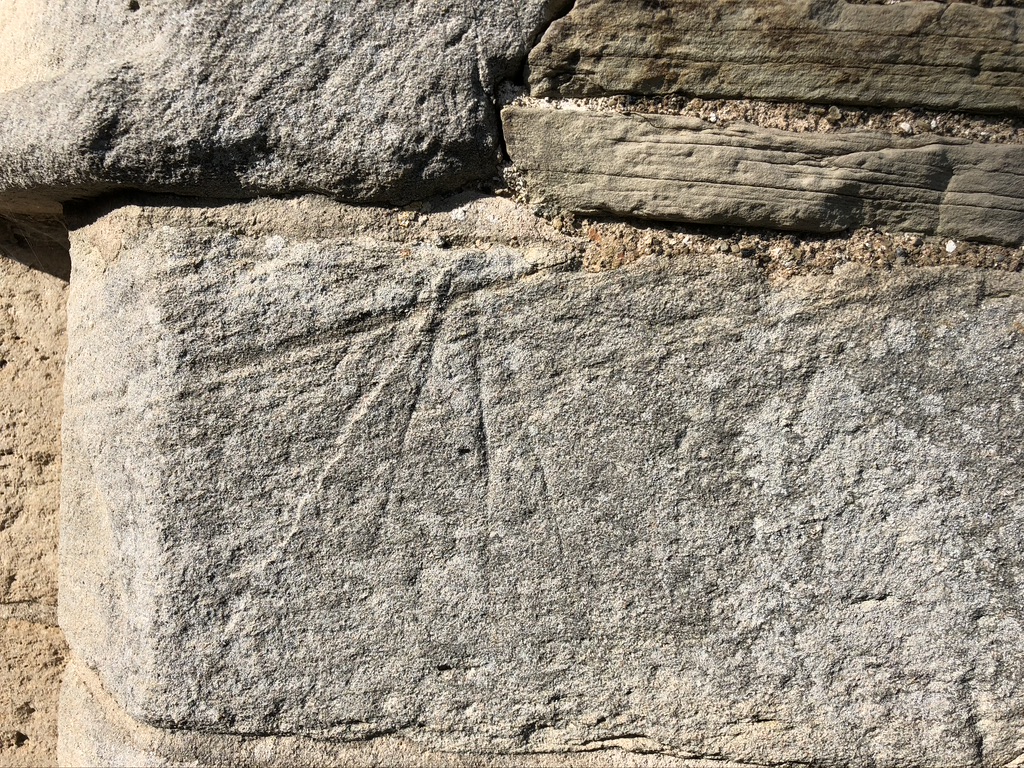
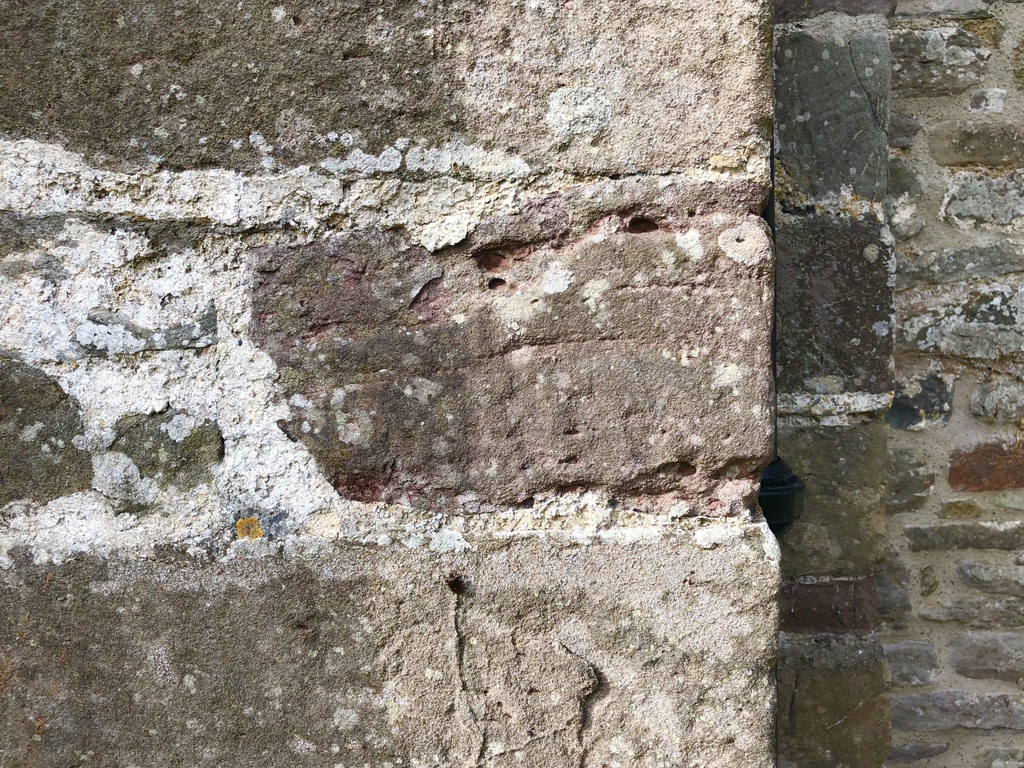
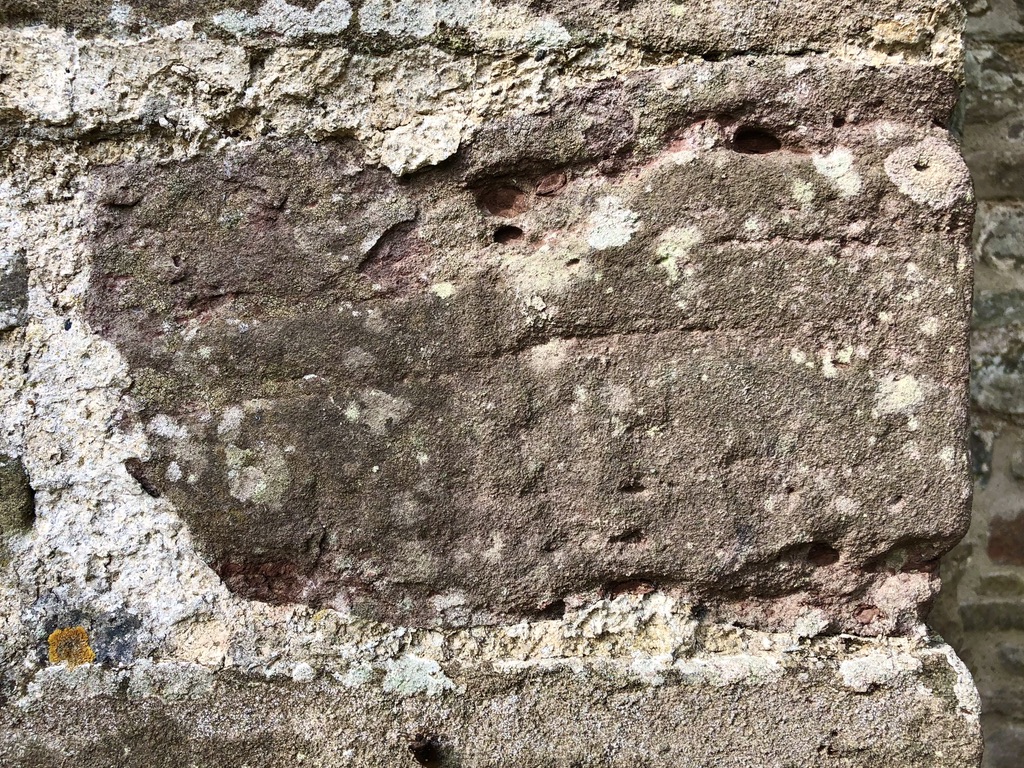
To the right of the E. buttress on the E. end, there is a darker reddish stone, of a type seen elsewhere in the stonework, that caught my eye. There were 2 distinct long downward lines from an apex where there might credibly be a style hole. My photos don’t show the stone and markings as clearly as they looked to the eye. I immediately thought it was a probable dial. If so – given its position – the stone was undoubtedly relocated during reconstruction. I leave these images as food for thought. Comments are welcome.













































 GAUDIUM SUB SOLE . SUNDIALS . MEDIEVAL TO MODERN