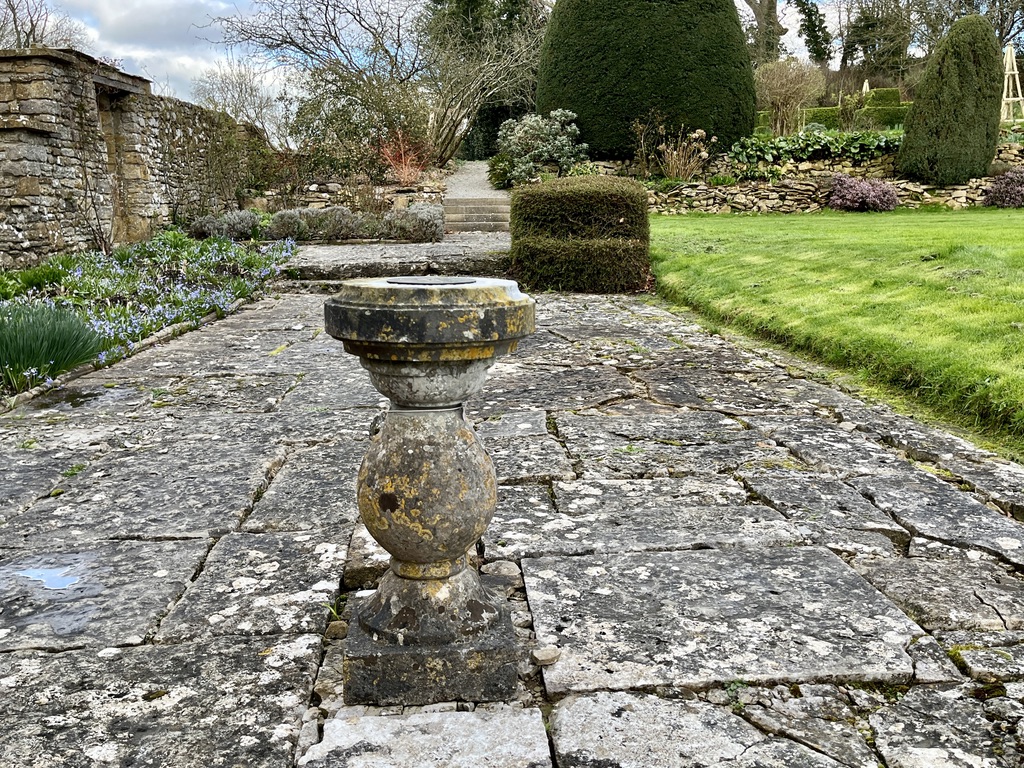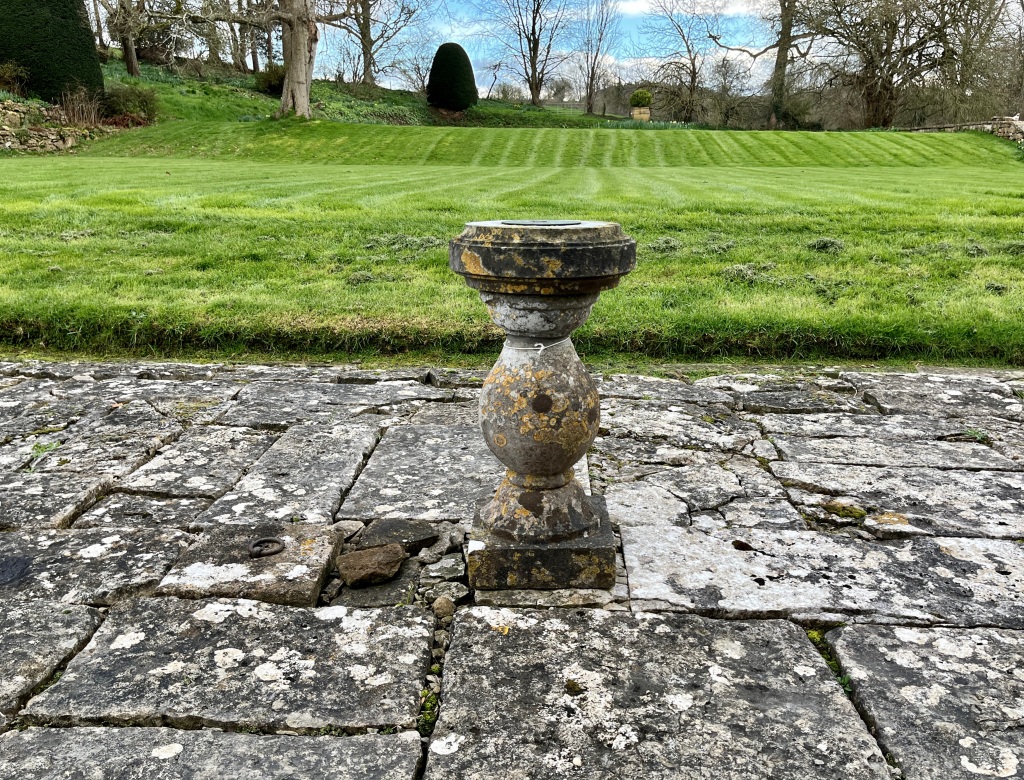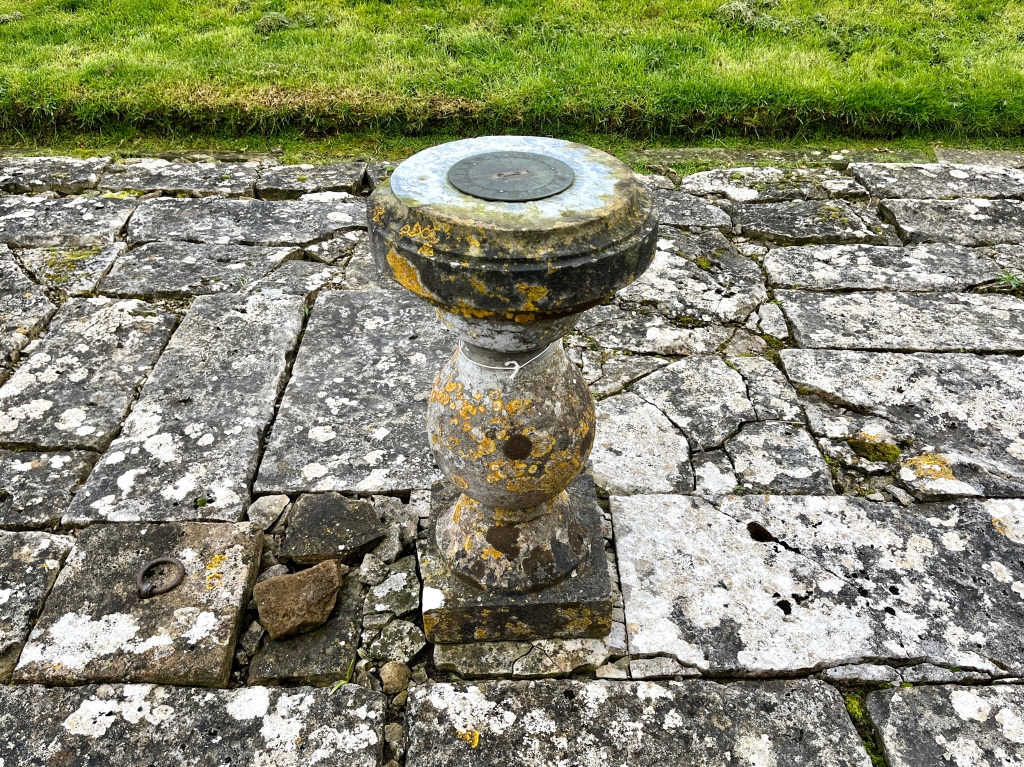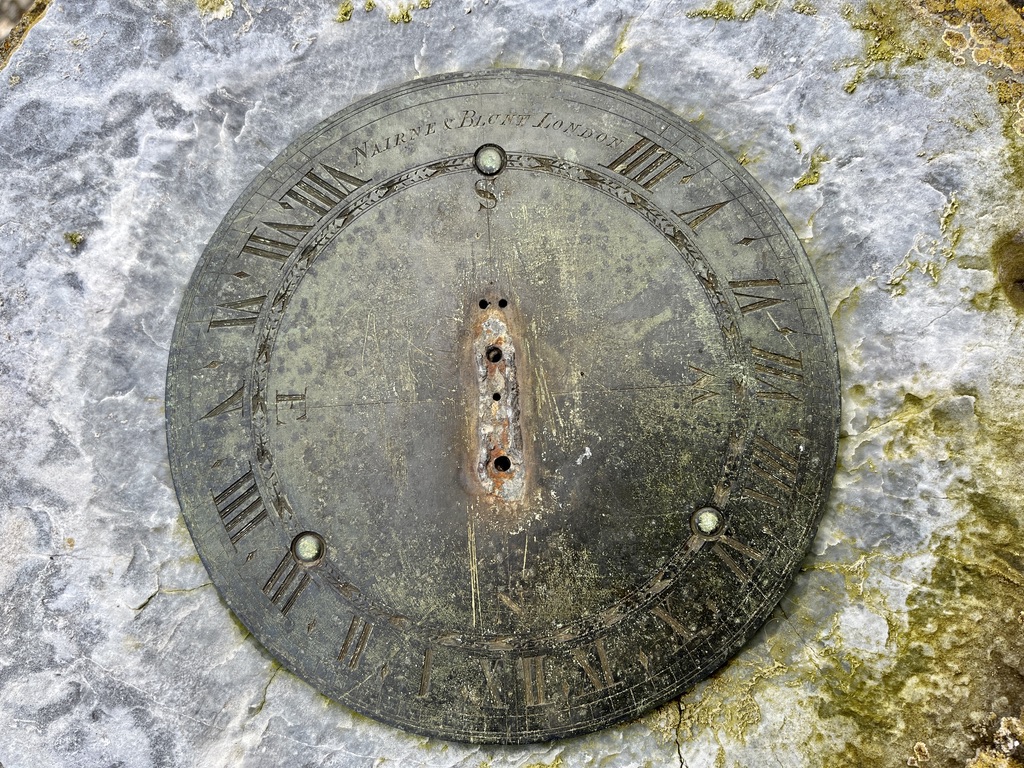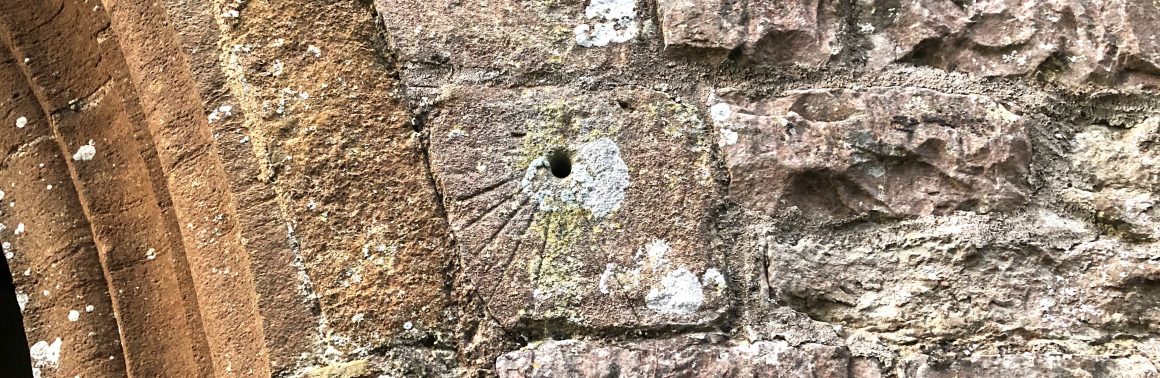
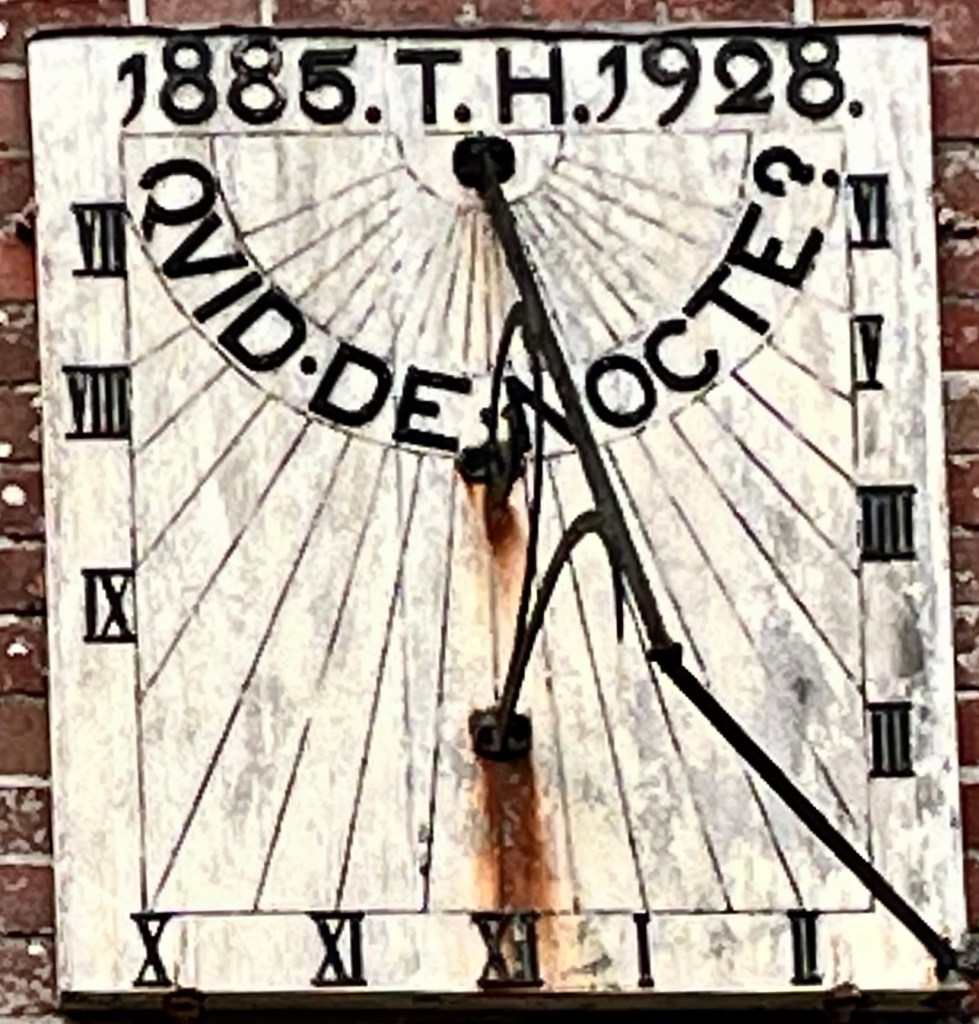
MAX GATE . DORCHESTER – Thomas Hardy’s Vertical Dial

MAX GATE

Max Gate is a fine house on the eastern edge of Dorchester, designed and built by Thomas Hardy (with his father and brother) in 1885. He lived there until his death in 1928. He had two wives, Emma and then Florence, and during the ‘Max Gate years’ there were complicated relationships, sadly beyond the scope of this article.

In 1940 the house was bequeathed to the National Trust by Hardy’s sister. It was listed Grade I in 1970 with the stipulation that it should be lived in. The NT gives generous access to the interior, and there are conducted tours of the house and grounds. It is not exactly ‘lived in’, but it does feel homely rather than museum-like. To see Hardy’s desk and other writerly items feels a privilege. ‘Tess’ was written there, also ‘Jude’, the ‘The Mayor of Casterbridge’, and much of his poetry.

MAX GATE – VERTICAL SUNDIAL

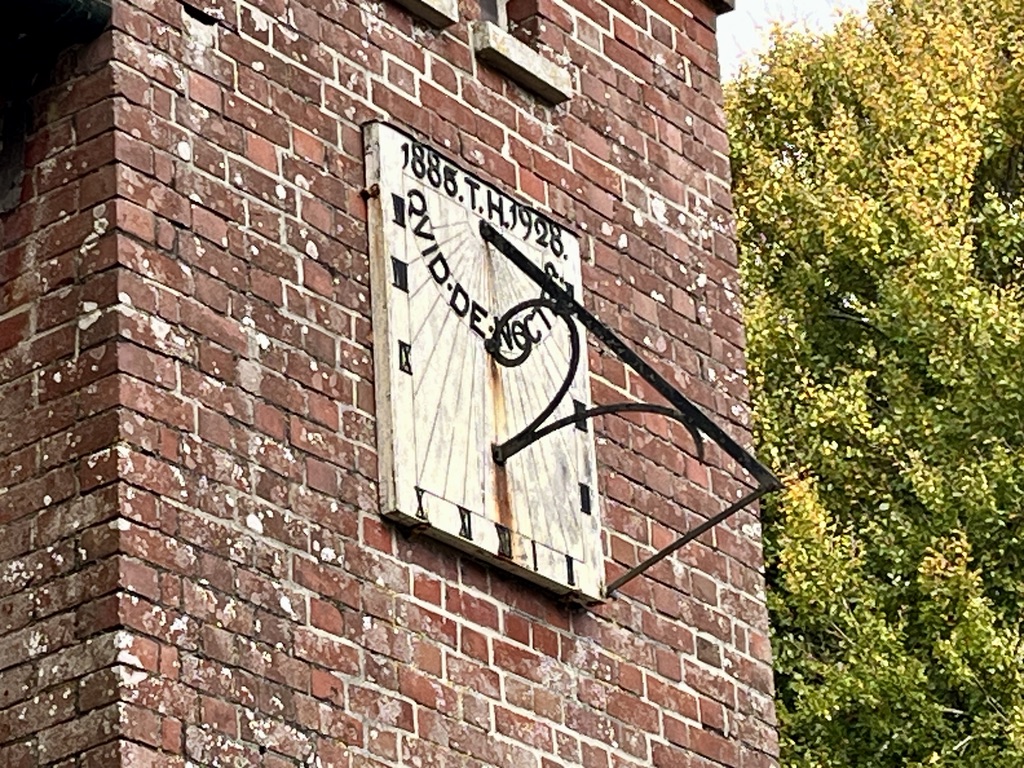
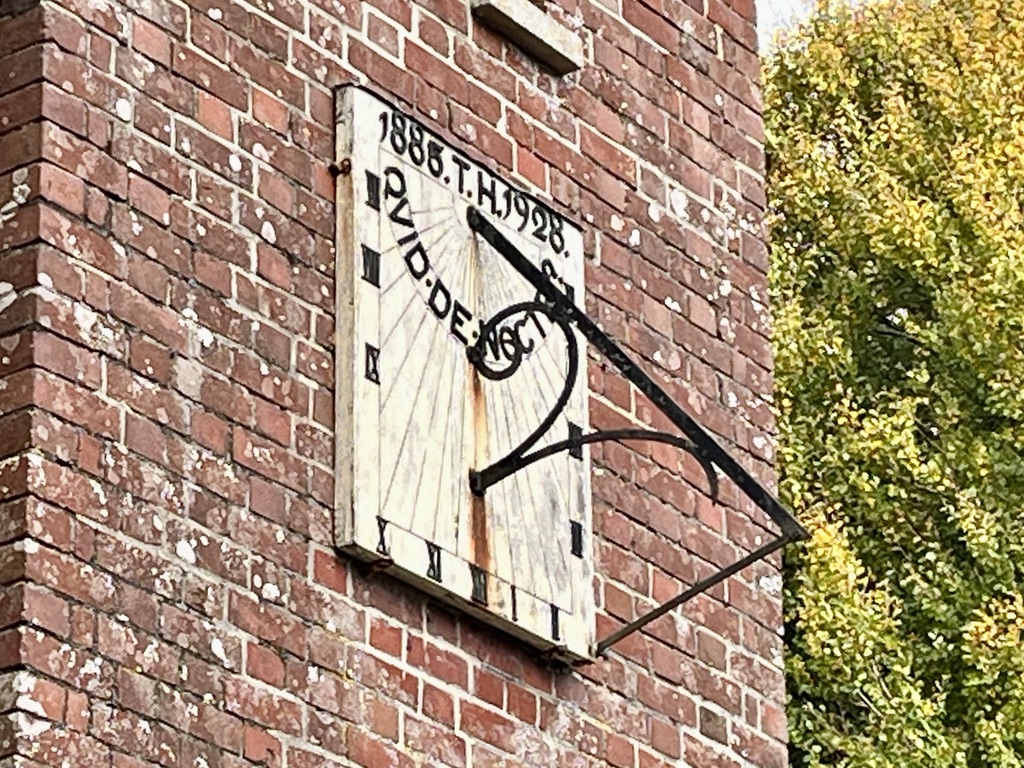
High up on the east tower, the dial is a good example of a sundial that (besides its primary use) acts as a memorial, and tastefully reflects the significance of the dedicatee. It is also very visible and easy to read at a distance. The lightly ornamental gnomon is moored at the bottom right corner as you face the dial. The style is simple, with 12 hours marked from 7.00am to 6.00pm and 24 radials to record half hours. The dial plate is white-painted wood. Overall the dial is in poor condition, but I gather that there are plans to carry out complete restoration during 2026.

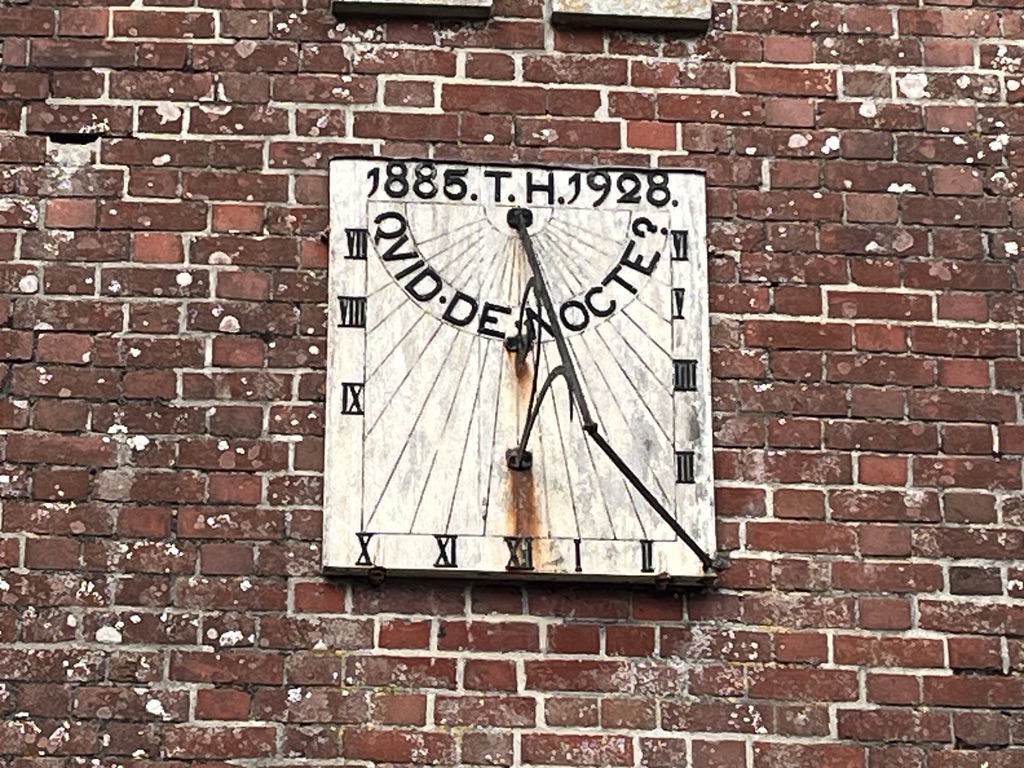
.

MOTTO

QUID DE NOCTE?

Literally, ‘WHAT OF THE NIGHT ?’ Interrogative sundials are relatively unusual, and I am unsure when the inclusion of question-marks began. The simplest reply might be ‘NIHIL’ – the sun is asleep.

.The marriage certificate (1839) of Thomas Hardy’s parents at Melbury Osmond church, Dorset

GSS Category: Vertical Dial; Memorial Dial; Dial Mottoes

Credits: Keith Salvesen (all photos); National Trust; Melbury Osmond church

HORIZONTAL DIAL 1597 – Mystery Provenance, Uncertain Date?

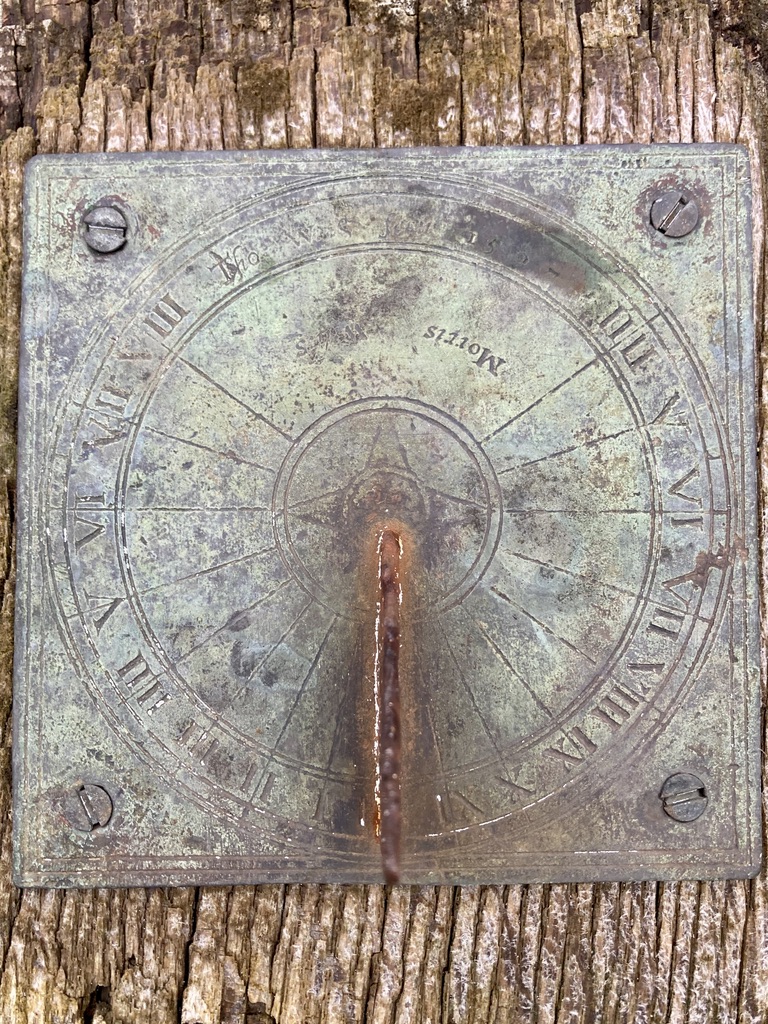
I recently met someone at a gathering of mutual friends, and we discussed sundials. He mentioned that he had an old dial in his garden, dated 1597 (the year of the first performance of The Merry Wives of Windsor). This was definitely a lead to take up.

PROVENANCE: The dial was bought in the 1950s in (probably) an antique shop in (possibly) Amersham. It was put on the pillar of an old birdbath, and remains in the same garden.

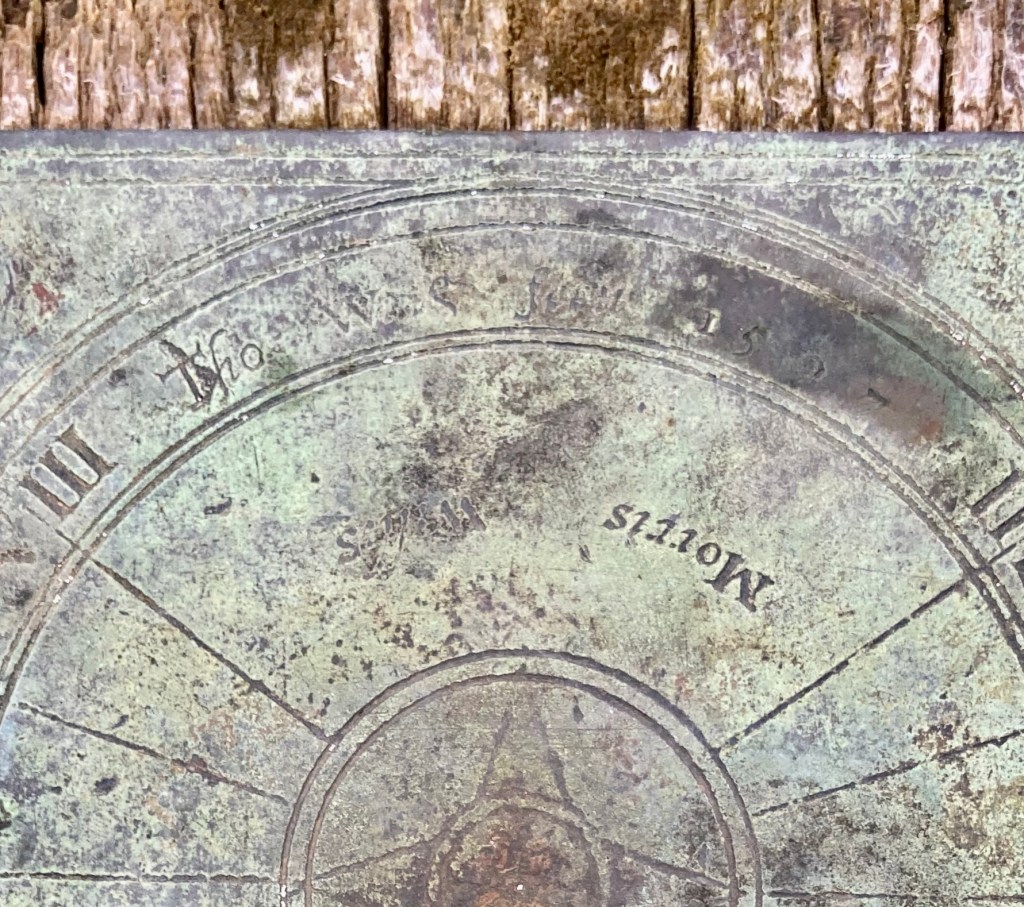
The dial is small, 4.25″ square. The photograph of the whole dial is just about clear enough to zero in on some of the details. I am hoping that the available clues will lead to ID of Tho. the maker and / or of Morris; and to the conclusion that the date is accurate [I do have in mind the generic chunky ‘genuine c17’ dials on eBay that in fact date from a rather more recent era].

I’d be pleased to have any information, advice, reaction, interpretation, wonderment or perplexity in relation to this dial. My email is sundials@gaudiumsubsole.org; or add a comment.

On the perimeter: Tho W S fecit (?) 1597

Nearer the centre: Morris and a word or name that starts or ends with W and S depending how one looks at it.

GSS Category: Horizontal Dial; Dial Date; C16 Horizontal Sundial

JARDIN PRÉVERT . COTENTIN . MANCHE – Armillary Sphere

JARDIN DE PRÉVERT . COTENTIN . MANCHE

This idiosyncratic garden is close to Port Racine in the NW corner of the Cotentin peninsular, in the Vallée des Moulins. There is a tumbling stream that at one time flowed past more than a dozen mills, of which some ruins remain. The garden was created in homage to the poet and screen-writer Jacques Prévert. After his death (1977), trees were planted by his wife, Yves Montand, Juliette Gréco, and Picasso among others, a quality tribute to his artistic achievements.

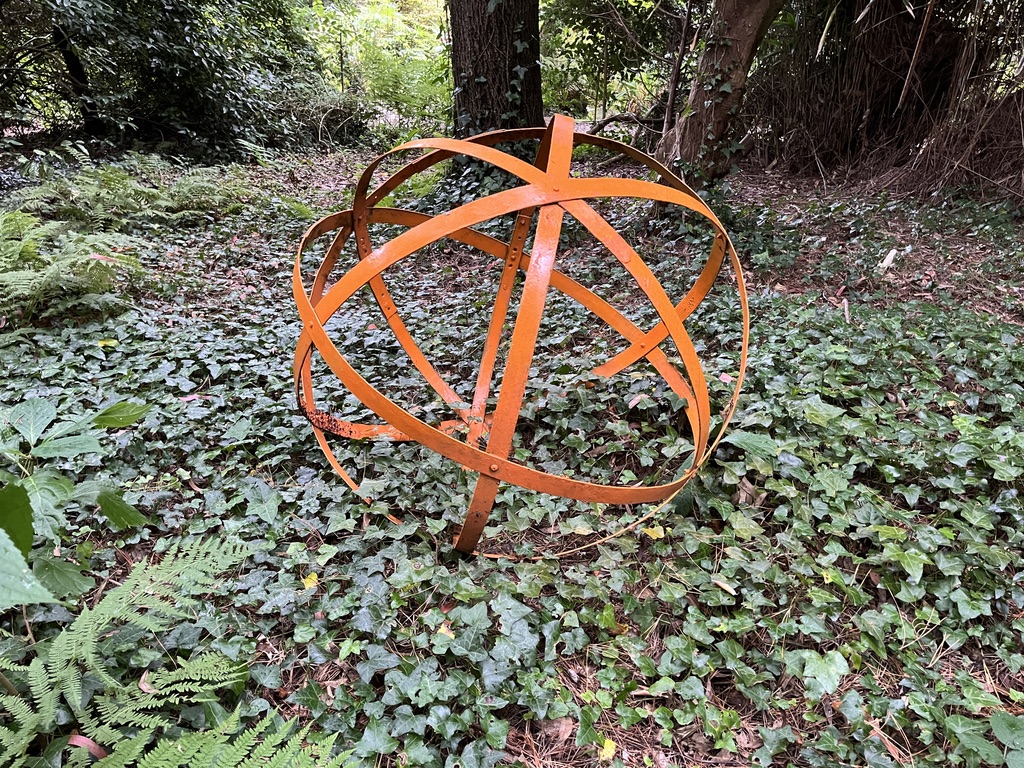
Amid the peaceful woodland bordering the stream are artfully twisting paths. These reveal clusters of metalwork sculptures, inscribed poems hanging from trees, and plenty of somewhat surreal creations. In amongst the foliage I spotted this sphere. Enjoy the poem.

An orange on the table
Your dress on the rug
And you in my bed
Sweet gift of the present
Freshness of the night
Warmth of my life

GSS Category: Armillary Sphere; Sundial Art

All photos Keith Salvesen except JT (os)

TINTINHULL GARDEN (NT) . SOMERSET . ARMILLARY SPHERE

TINTINHULL HOUSE (COURT) . SOMERSET

GRADE I ⚘ C17 Attractive small manor house with lovely gardens and a small arboretum. NT. Plenty of information online. Don’t miss St Margaret’s with its remarkable scaphe dial above the porch, and 6+ scratch dials – links below. 4m NW of Yeovil

ARMILLARY SPHERE

A fine armillary sphere surmounted by a charming pairing of an exotic galleon and a delicately stylised sun. The gardens as they are now were designed by Phyllis Reiss after she and her husband bought the house in 1933. She died in 1961, leaving the property to NT. My guess is that the dial dates to mid-1930 as the new gardens took shape.

TINTINHULL GARDENS . DECORATIVE FEATURES ON THE ARMILLARY SPHERE

LINK POSTS

TINTINHULL . ST MARGARET . MULTIPLE SCRATCH DIALS

TINTINHULL . ST MARGARET . TRIPLE POLAR SCAPHE DIAL

======================

GSS CATEGORY: Armillary Sphere; Equatorial Dial

All photos: Keith Salvesen

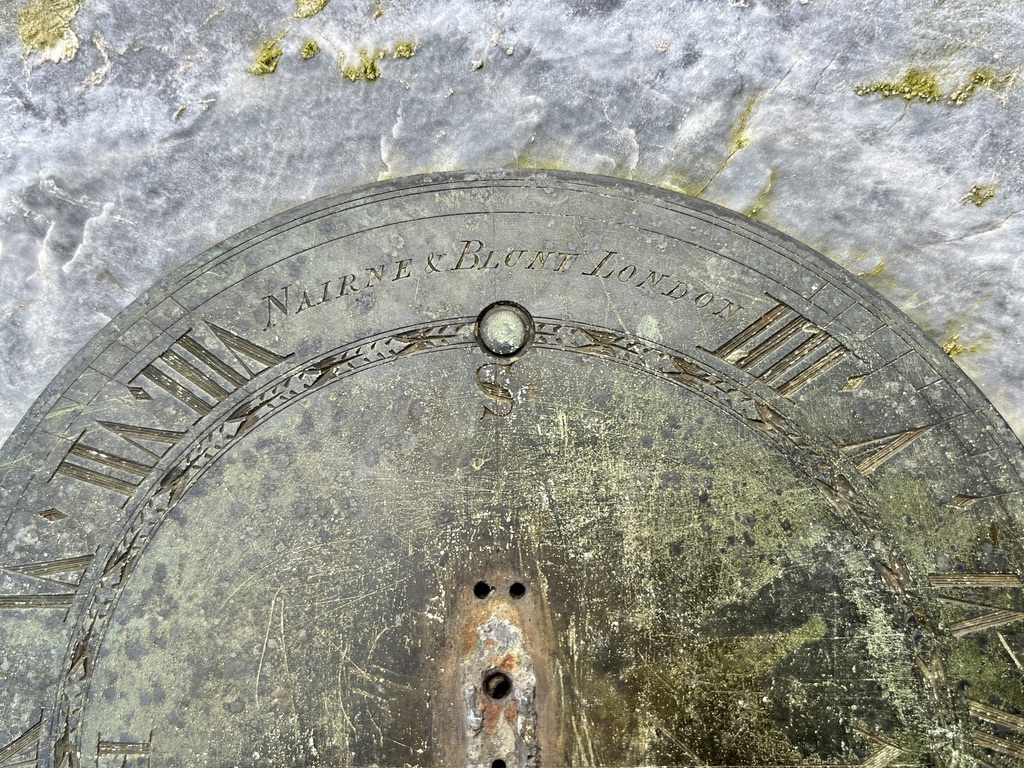
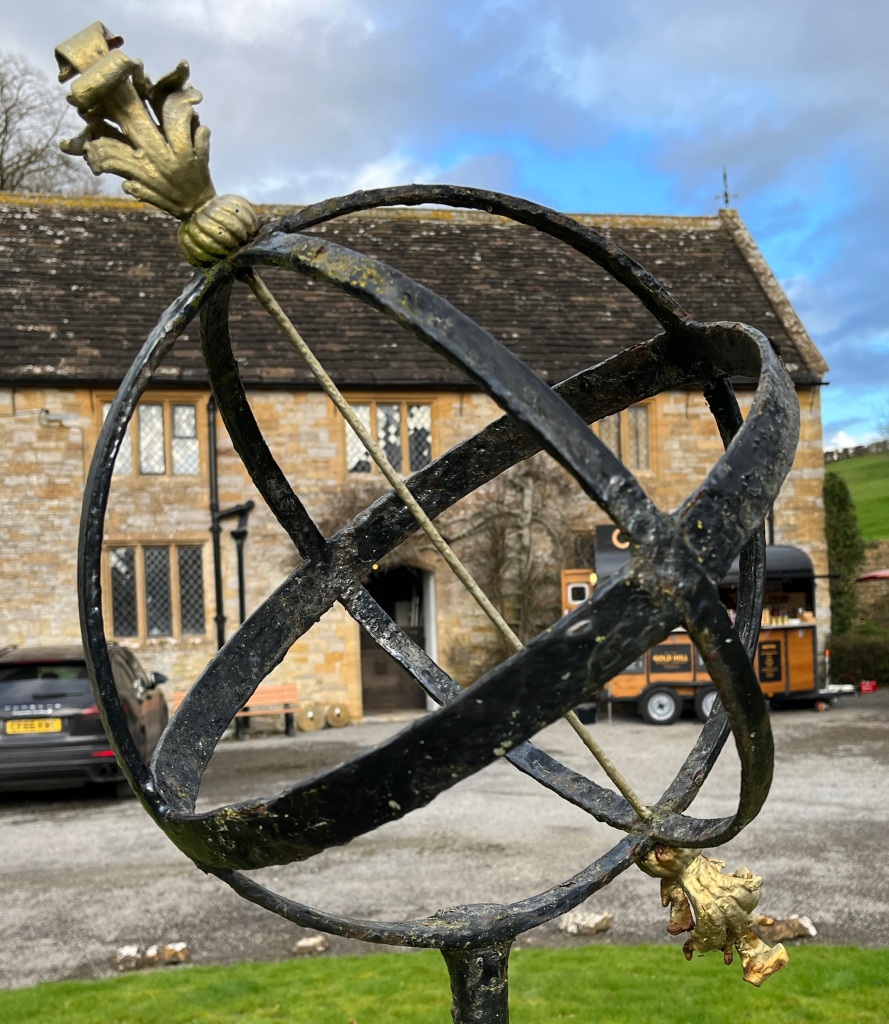
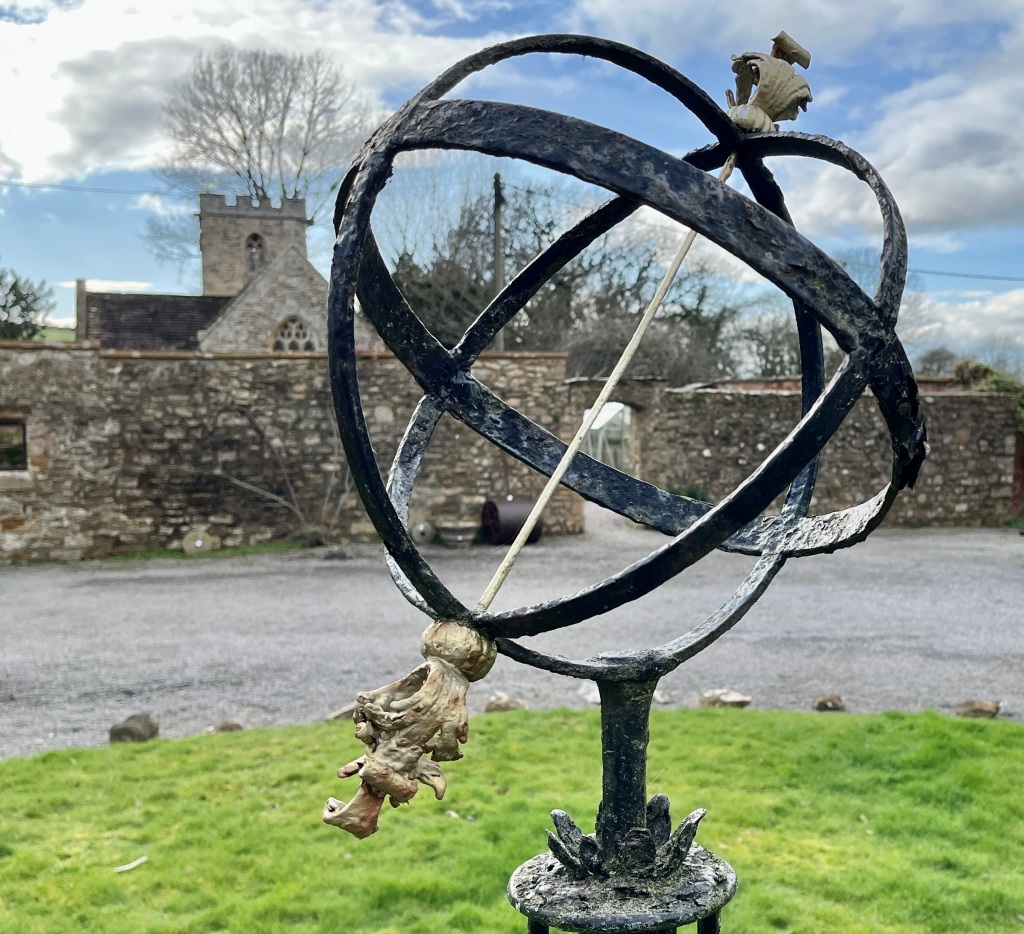
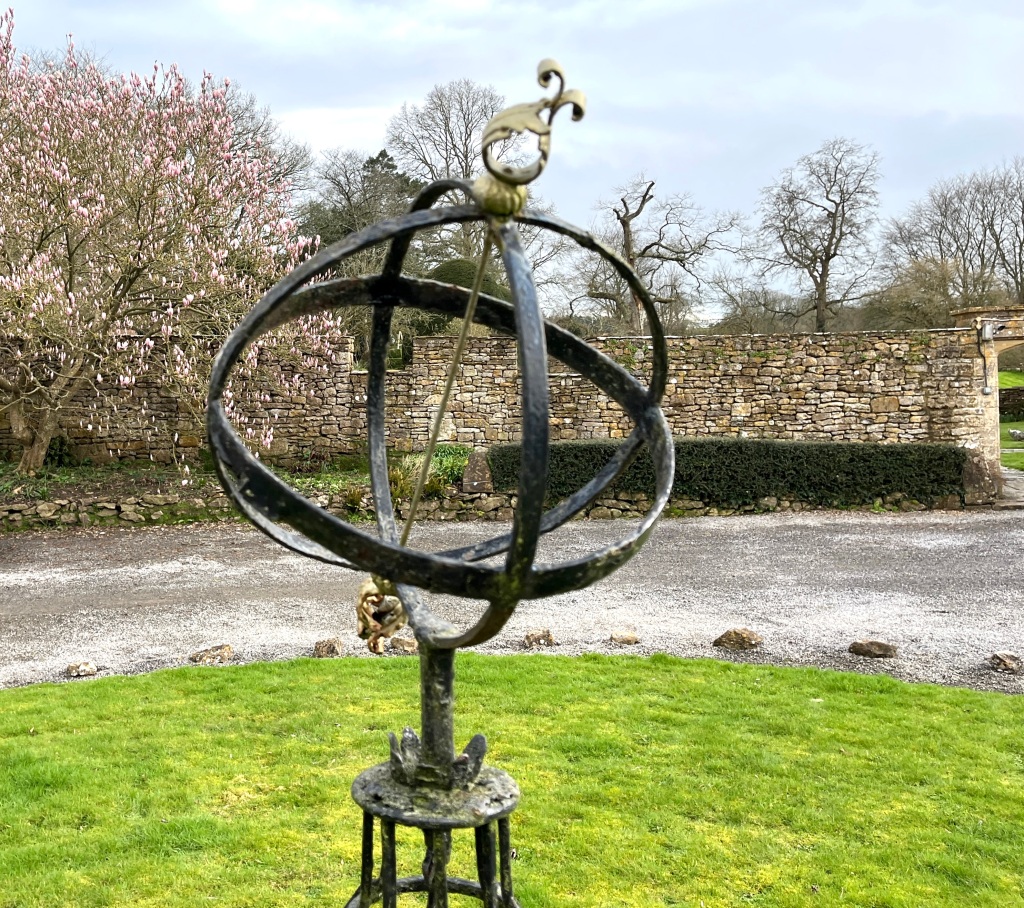
SANDFORD ORCAS MANOR . DORSET . Horizontal Dial (Nairne & Blunt); Armillary Sphere

Sandford Orcas Manor . Som. (Dukes)

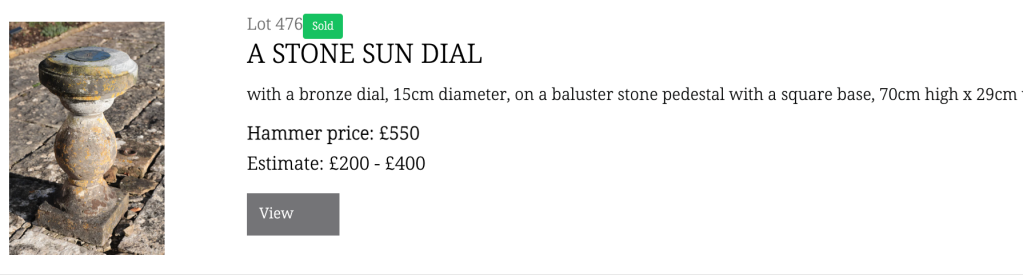
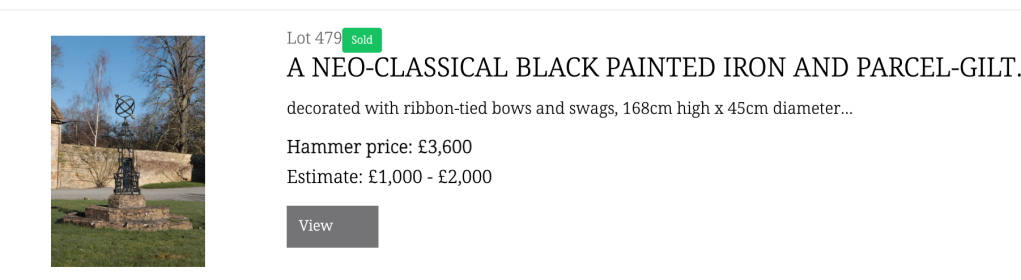
The entire contents of Sandford Orcas Manor, a fine example of country house Tudor, have been auctioned following 4 days of viewings. The sale has generated much interest and excitement both locally and well beyond. Such a complete disposal – even the family Bible (1702) was included – is quite rare. The house dates from mid C16 and has been in the same family for 300 years. It has a reputation for being ‘the most haunted house in England‘. The task of gathering statistics to support this proposition must have been a nightmare.

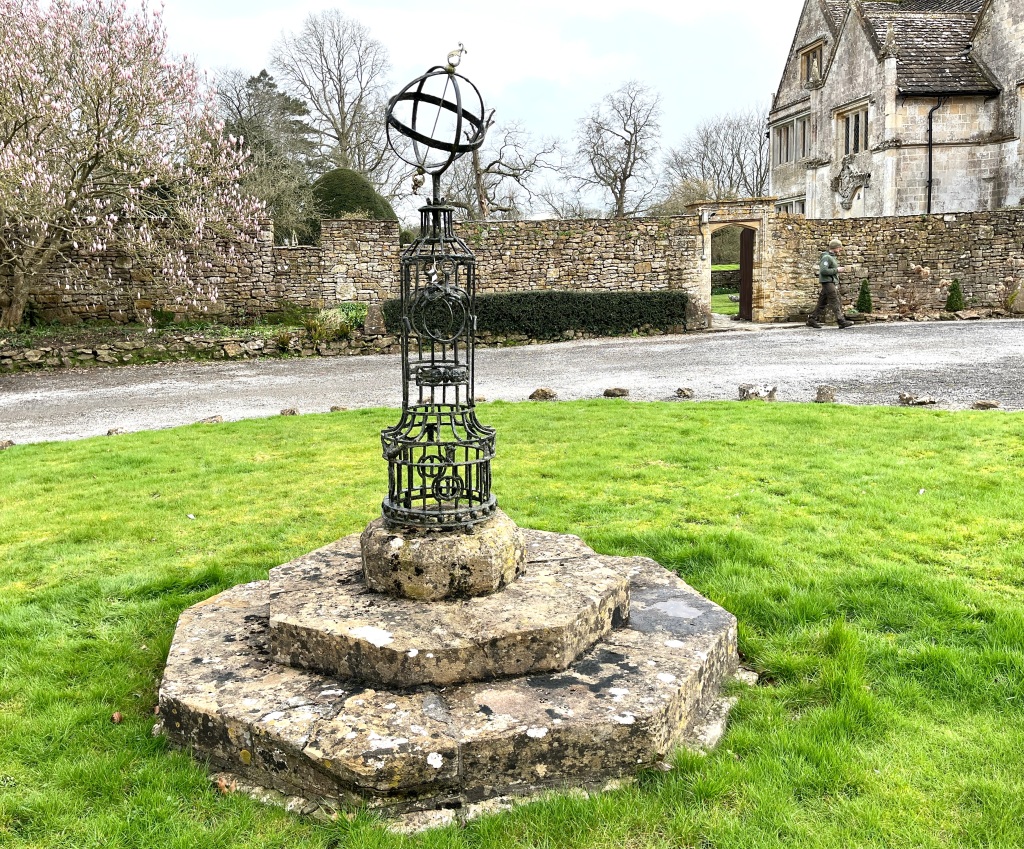
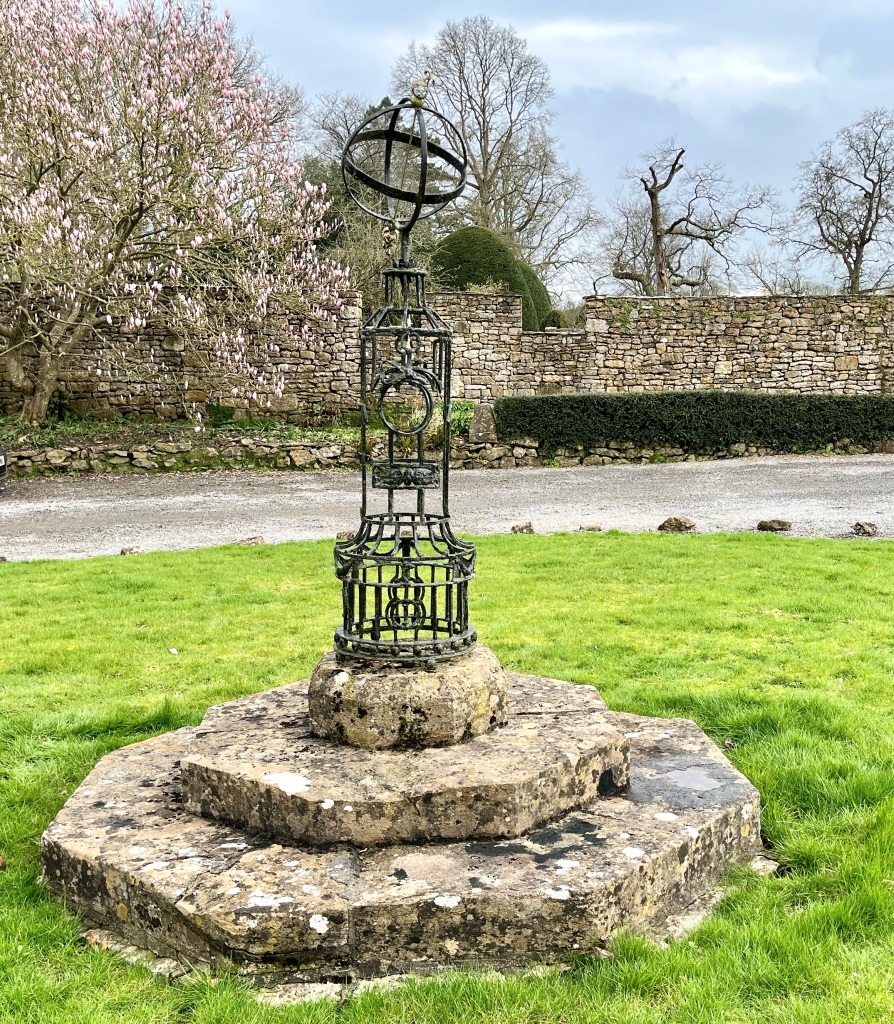
Two sundials were sold and are now removed from the property. One is a conventional garden dial, gnomon-less, on a baluster stone pedestal. The other is an armillary sphere grandly resting on a substantial triple plinth and supported by a tall ironwork obelisk.

HORIZONTAL DIAL (C18) BY NAIRNE & BLUNT

Edward Nairne and Thomas Blunt established themselves in London as scientific instrument makers. They worked together between 1774 and 1793 and this dial must be from that period.

ARMILLARY SPHERE

GSS Categories: Horizontal Sundial; Garden Sundial; Pedestal Dial; Armillary Sphere

All photos Keith Salvesen except header, Dukes Auctioneers

ROUSHAM HOUSE . OXFORDSHIRE – Dollond Horizontal Sundial

DOLLAND SUNDIAL AT ROUSHAM HOUSE OXON

BSS RECORD

By the pigeon house in the rose garden east of the house is a bronze horizontal dial 314mm in diameter made by Dollond of London.. It shows the customary hours IV – VIII divided into halves and quarters.The hours are also displayed in Arabic numerals and divided into periods of 10 And 2 minutes. There is an Equation of Time scale and round the centre of the dial a 16-point compass rose. There is a noon gap to compensate for the 7/16″ thick gnomon. The dial is mounted on a tapering stone column with a circular capital.

DOLLAND

Dolland workshops were active from approx 1750 to 1850. The business was founded by John Dolland who was joined by his son Peter, and later other members of the family. The name became synonymous with the crafting of intricate and precise scientific instruments. Sundial plates were a (rare, I think) sideline. Dolland collections can be found in many museums and individual pieces in auction rooms. All items have the Dolland mark, but some cannot be attributed with certainty to a particular member of the family.

George Dollond was elected to a fellowship into the Royal Society in 1819 and was an active participant in founding the Astronomical Society in 1820 (Confusingly, his son was also called George)

LINK TO THE ROUSHAM SITE

GSS Category: Horizontal Sundial; Country House Sundial; Dolland Sundial

All photos: Keith Salvesen

ROOKERY GARDENS . STREATHAM . LONDON – Horizontal Dial

ROOKERY GARDENS . STREATHAM . LONDON

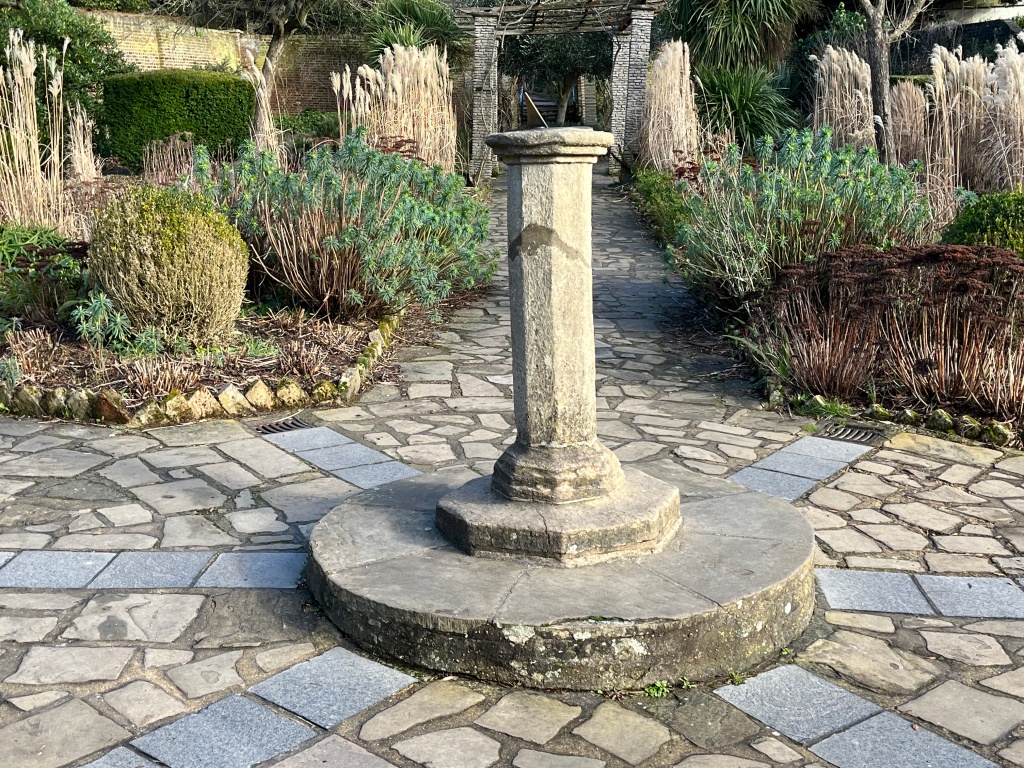
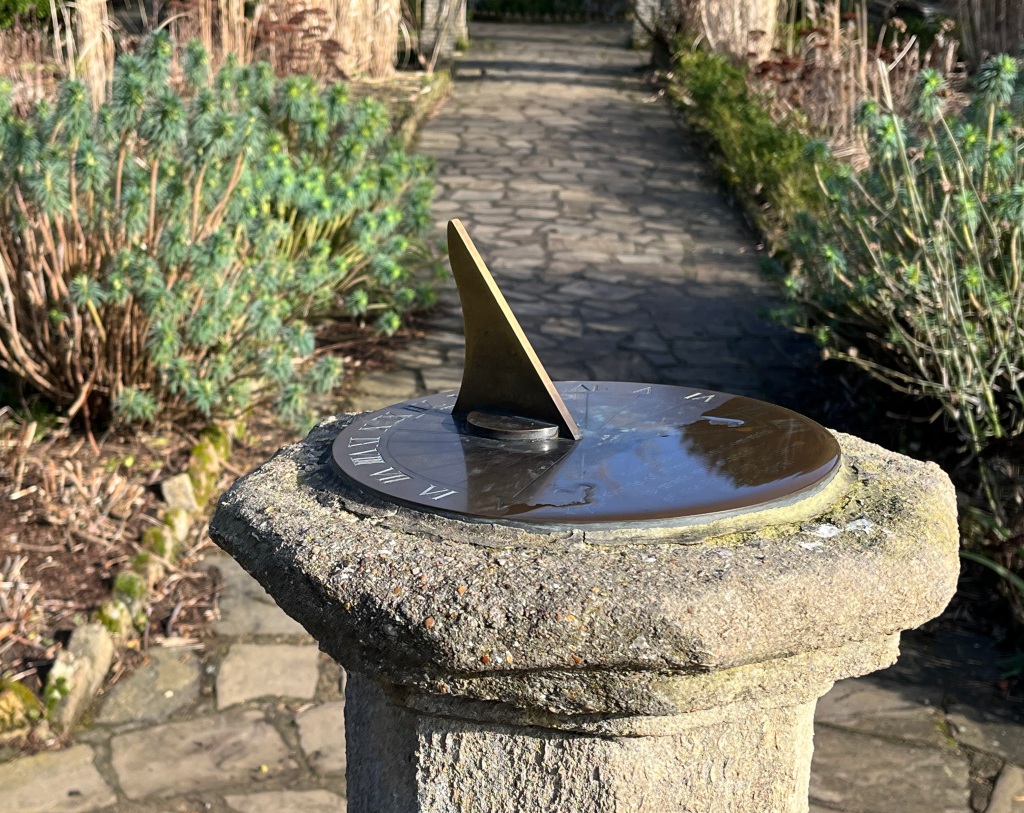
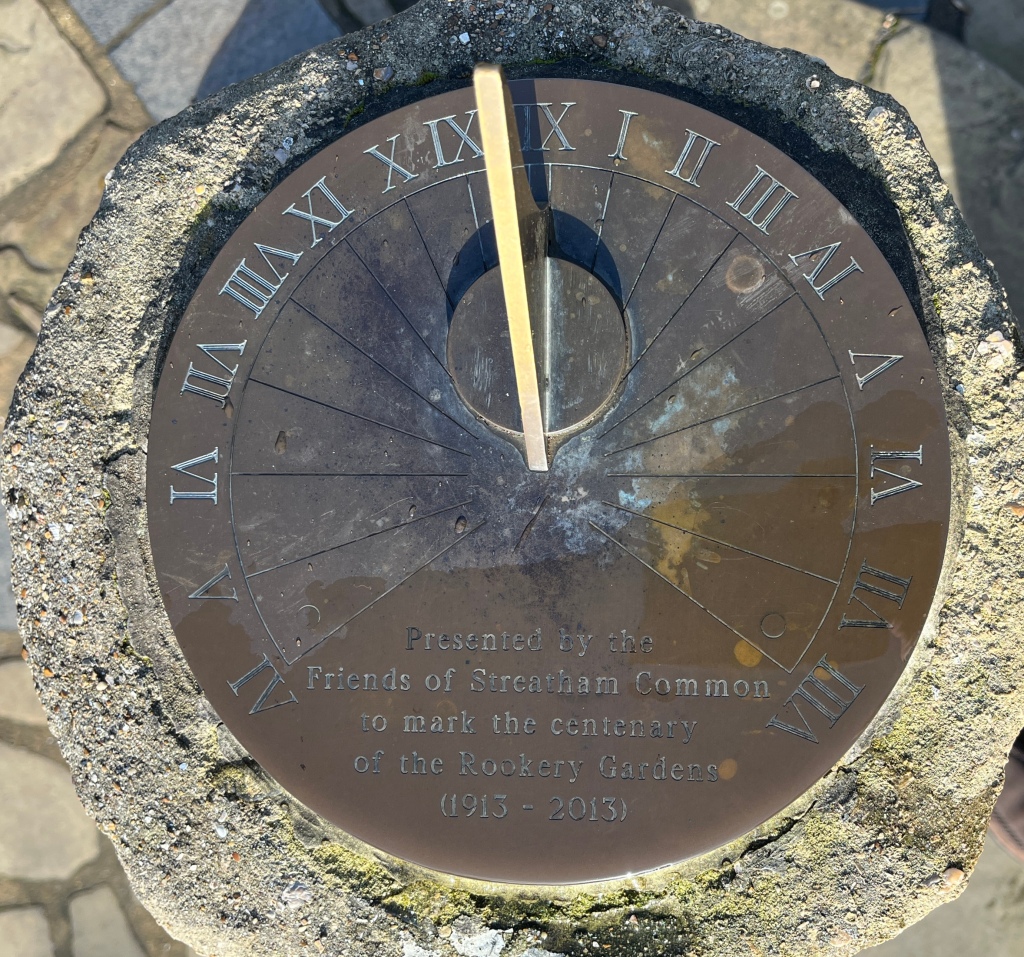
The day after Storm Isha wreaked havoc in various areas of the British Isles, there was a brief moment of sunshine during our short visit to London. We walked to the Rookery Gardens in Streatham, part of the estate of a large house that was demolished in 1912. The horizontal pedestal dial was immediately in front of us, demanding inspection. A very pleasing commemorative dial at the source of the western branch of the River Falcon, one of London’s many so-called Lost Rivers.

GSS Category: Horizontal Dial; Pedestal Dial

All photos Keith Salvesen; thanks to J & J for the productive walk

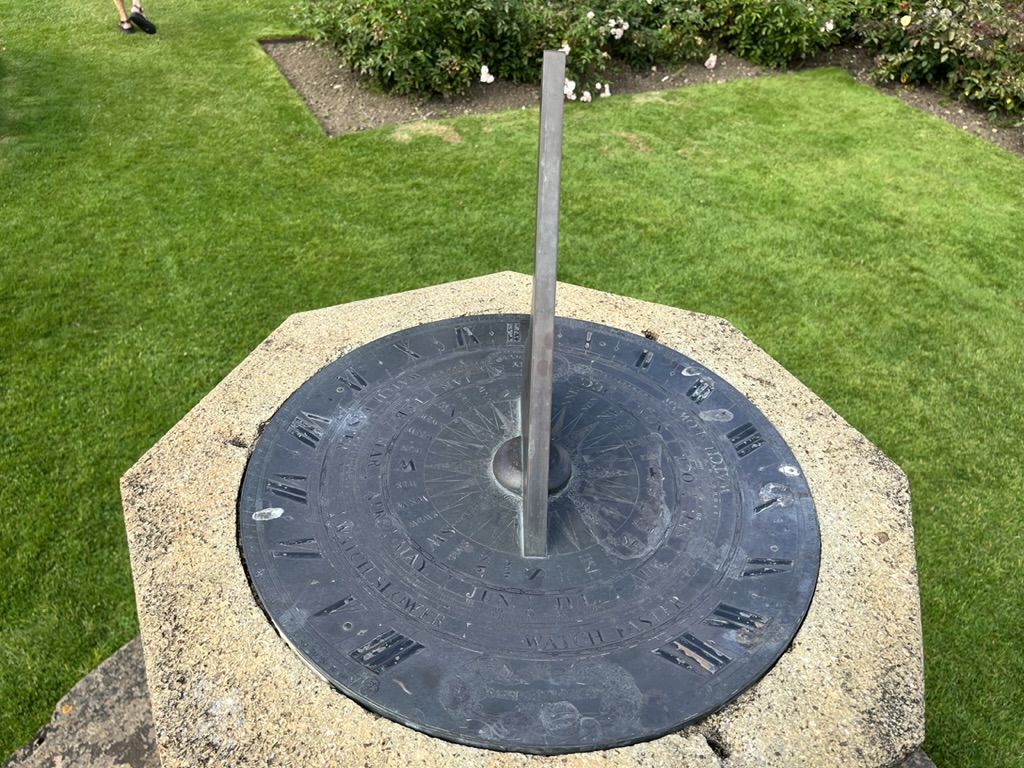
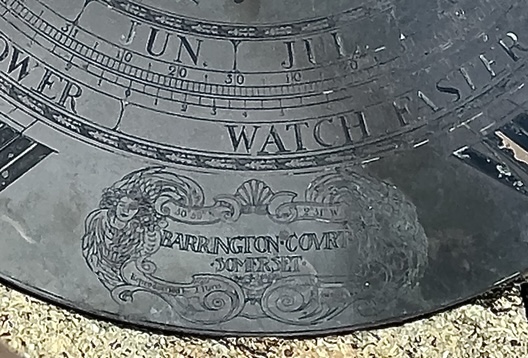
BARRINGTON COURT . SOM . HORIZONTAL DIAL

Barrington Court . Somerset

BARRINGTON COURT . SOMERSET

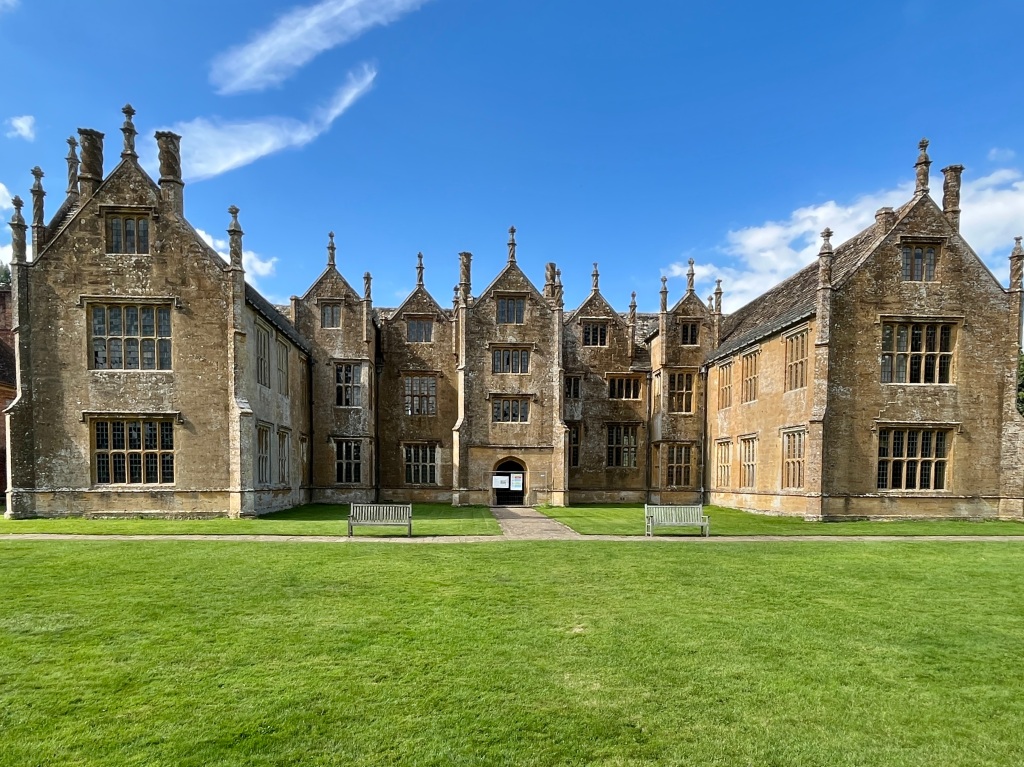
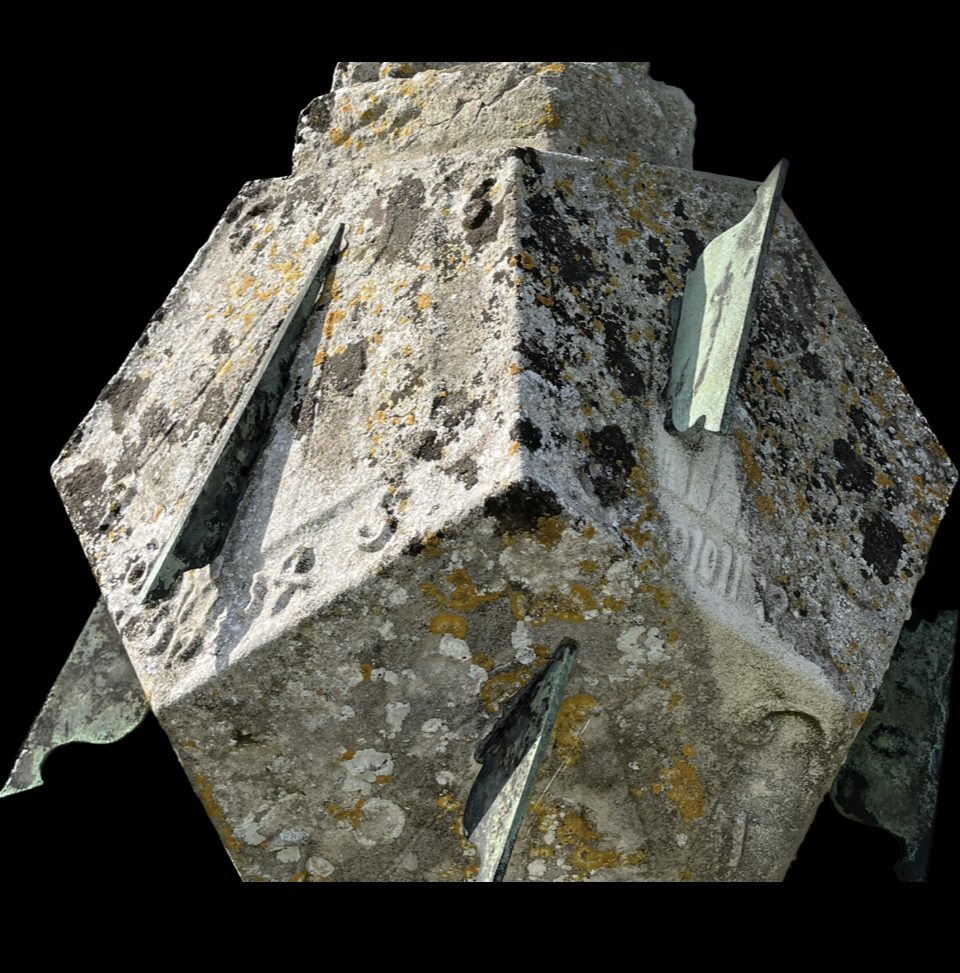
Barrington Court is a fine county house near Ilminster in Somerset, now in the care of NT. There is wonderful multi-faceted dodecahedral pillar dial in front of the house that I have written about HERE.

Barrington Court . Som . Horizontal Dial

ROSE GARDEN DIAL

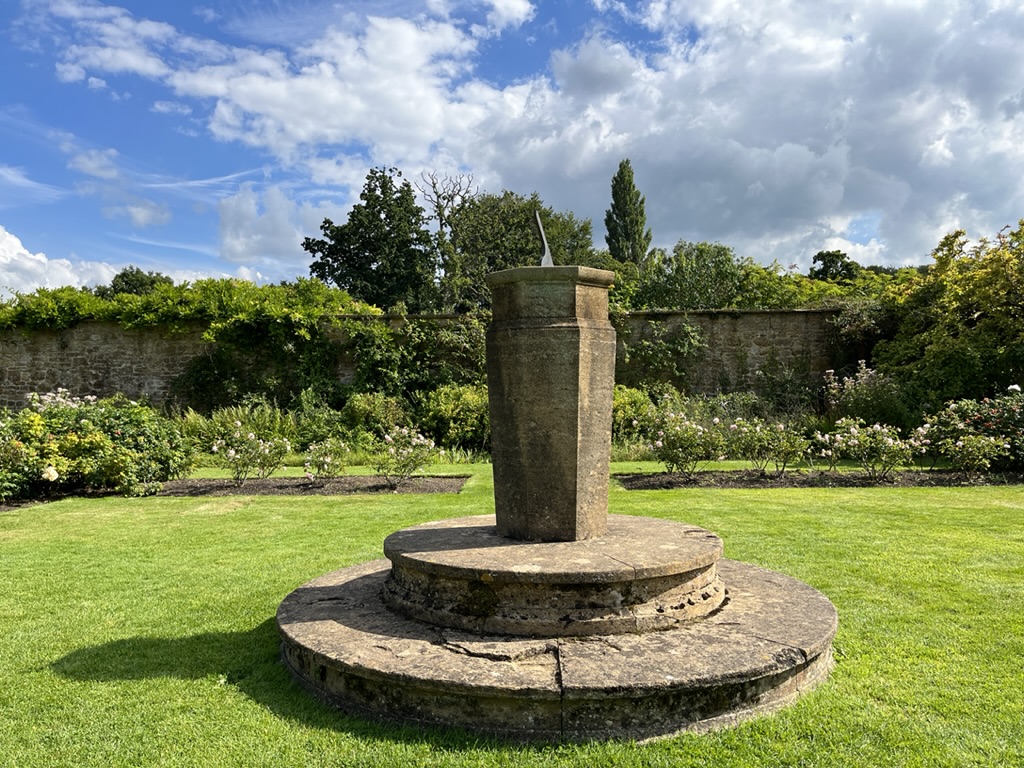
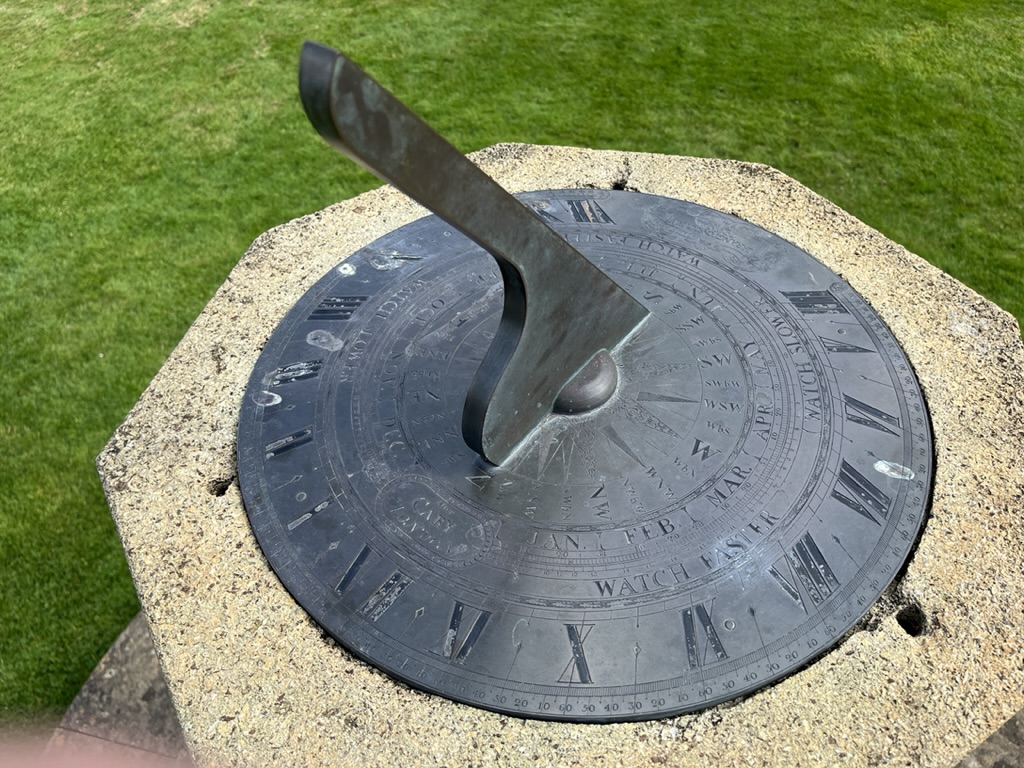
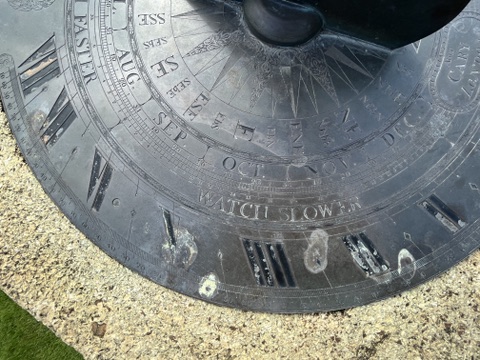
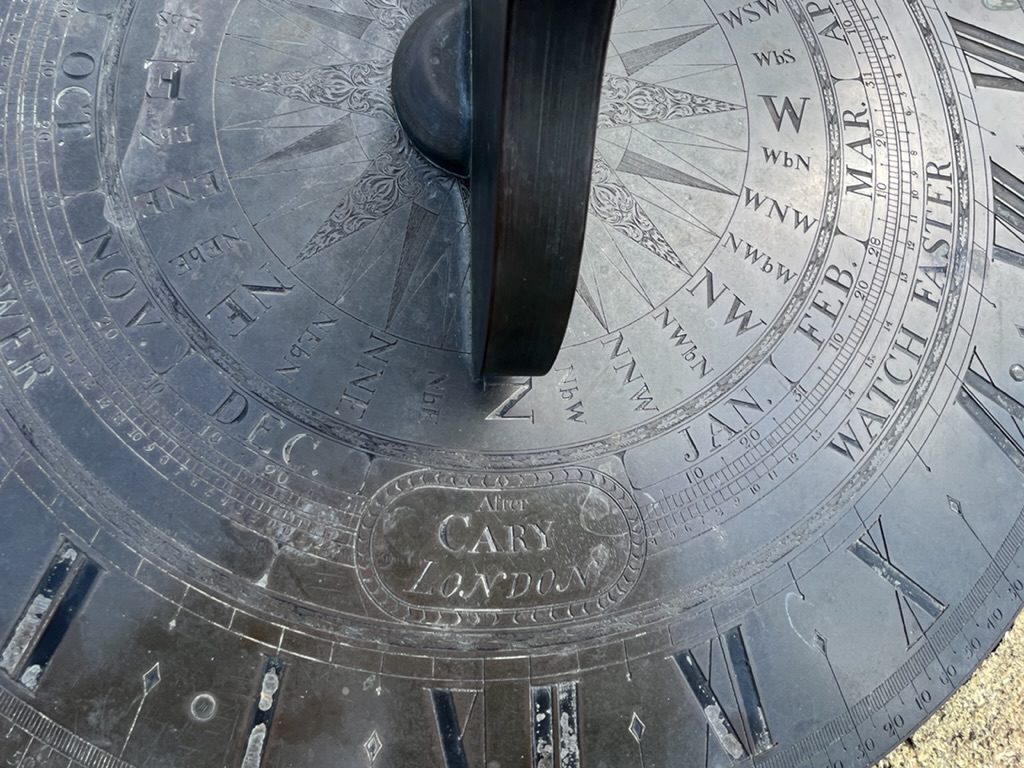
The sturdy horizontal pedestal dial stands on a double plinth in the centre of the large rose and iris garden. It has a sad recent history. In Spring 2000 the original C19 bronze dial plate by Carey was levered off and stolen. It has never been recovered.

Barrington Court . Som . Horizontal Dial after theft of plate in 2000

On the bright side, a wonderful faithful reproduction by John Davis was installed in 2013, and the dial is restored to its glory for the future.

It is described as an attractive horizontal dial of some complexity. The Equation of Time scale is engraved around the dial; all points of compass are shown; and it has one minute time marks BSS. These complex features can be seen clearly in the final image below.

GSS Category: Horizontal Dial; Pedestal Dial

All photos: Keith Salvesen except NT / Simon Harris above

HAMPTON COURT PALACE . PRIVY GARDEN . THOMAS TOMPION’S DIAL

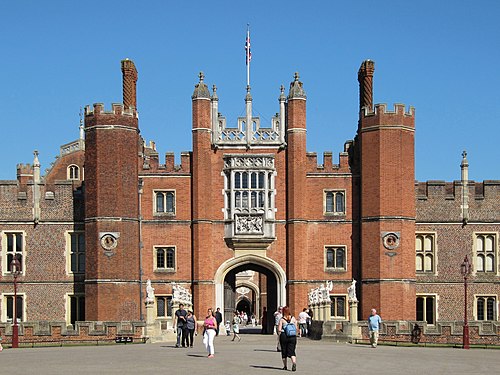
Hampton Court Palace – CC / OS

HAMPTON COURT . TOMPION DIAL

Hampton Court Palace . Privy Garden . Tompion Sundial – Keith Salvesen

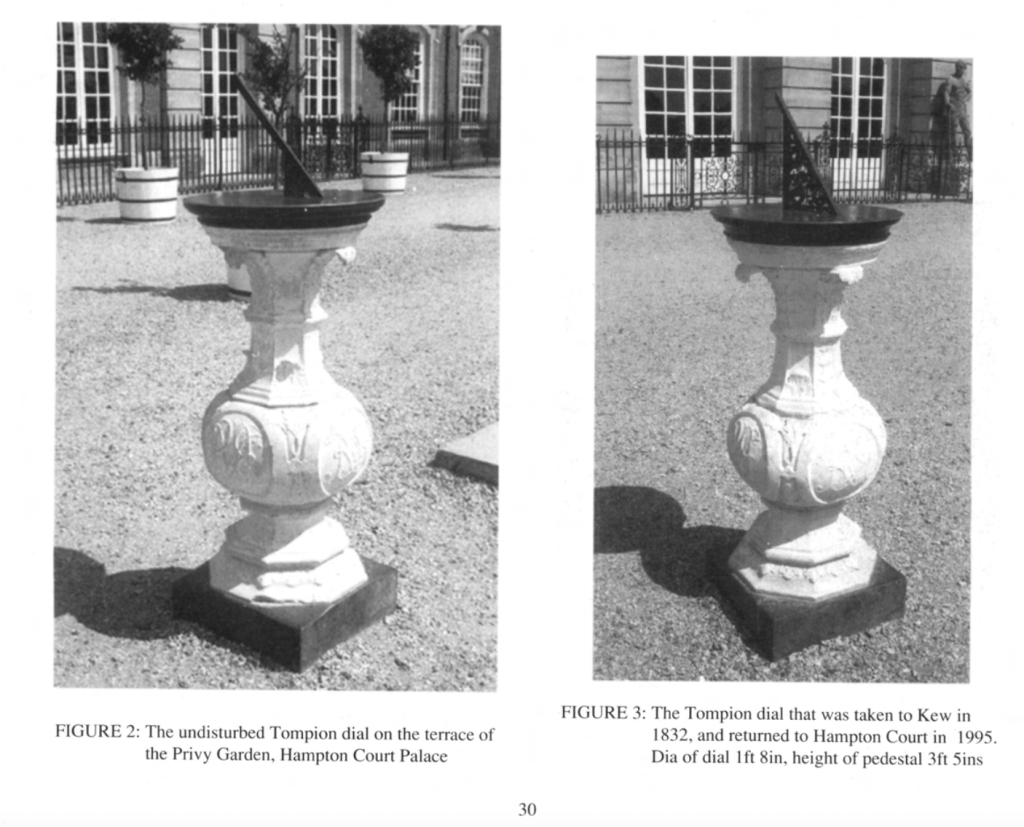
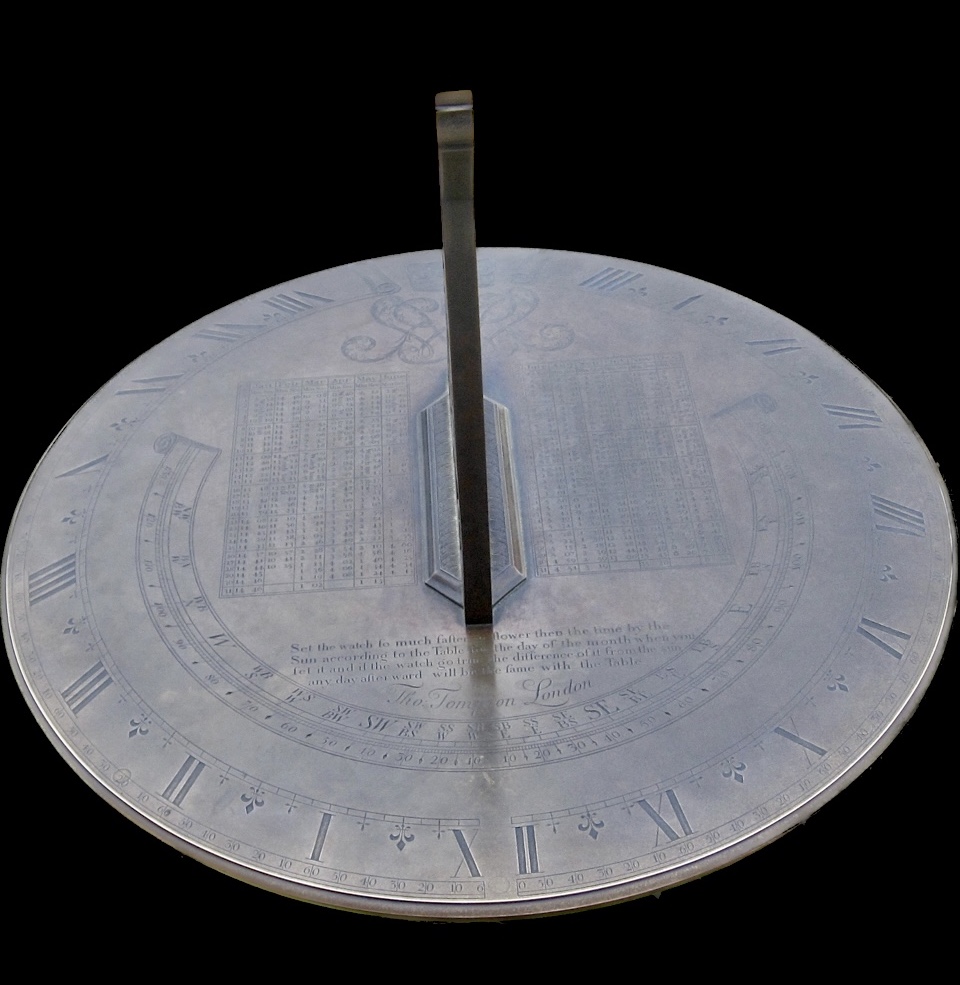
This famous Tompion dial in the Privy Garden at Hampton Court is one of a pair, the other being transferred in due course to Kew Gardens. The BSS Bulletin Jan 1997 includes side-by-side photos of both. The dial that stayed in situ, featured here, being on the left. The other dial was transferred to Kew in 1832 and not restored to Hampton Court until 1995.

I took these photos in 2011 when I was dialling-lite, and probably with an iPhone 3. Revisiting these images, I’m pleased at what a good job it did. Puzzlingly, during a quick trawl through the usual resources, inc. the Royal Collection, I have found it difficult to find any detailed images of this dial, though I found a RC image of dial 2.

Hampton Court . Tompion Dial 2 . Royal Collection

Hampton Court Palace . Privy Garden . Tompion Sundial – Keith Salvesen

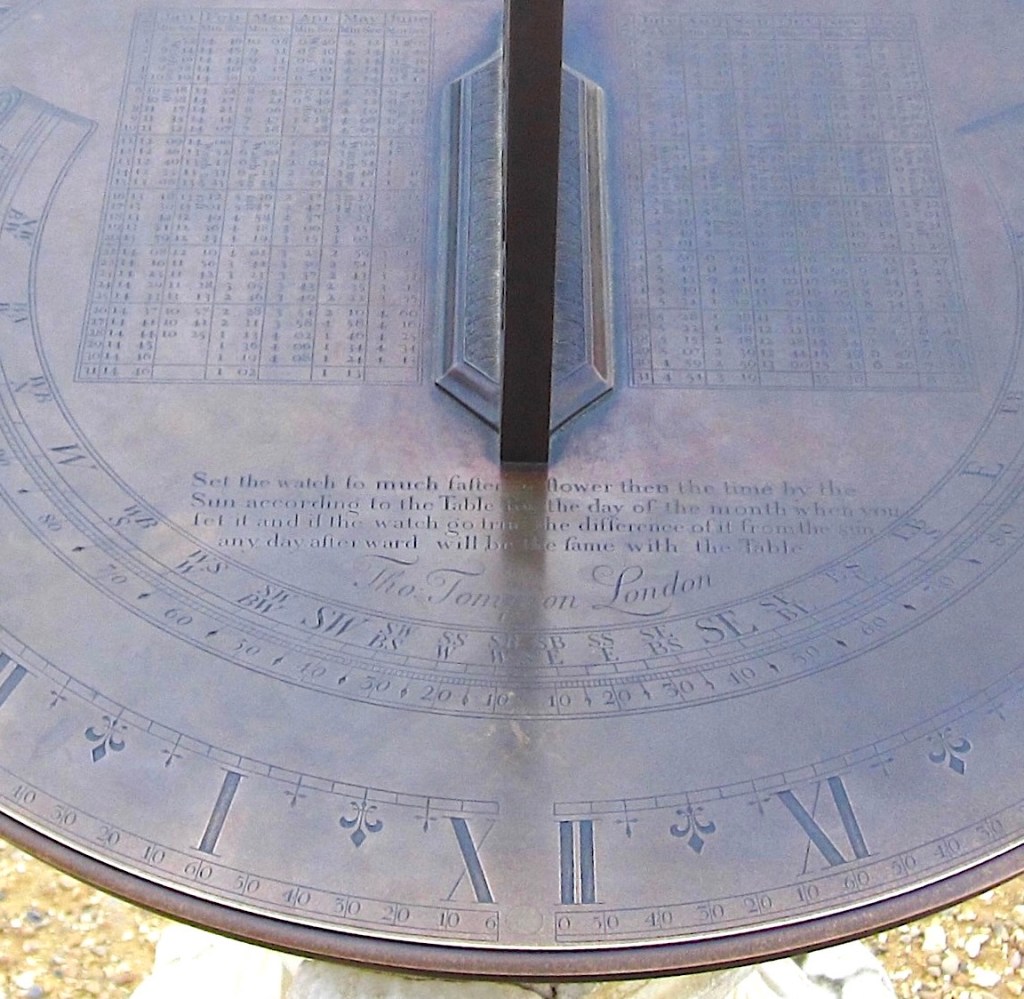
Only the front of the plate is clear, and it is in remarkable good condition. There is just enough definition to give a good idea of the complexity of the calendar further back on the plate.

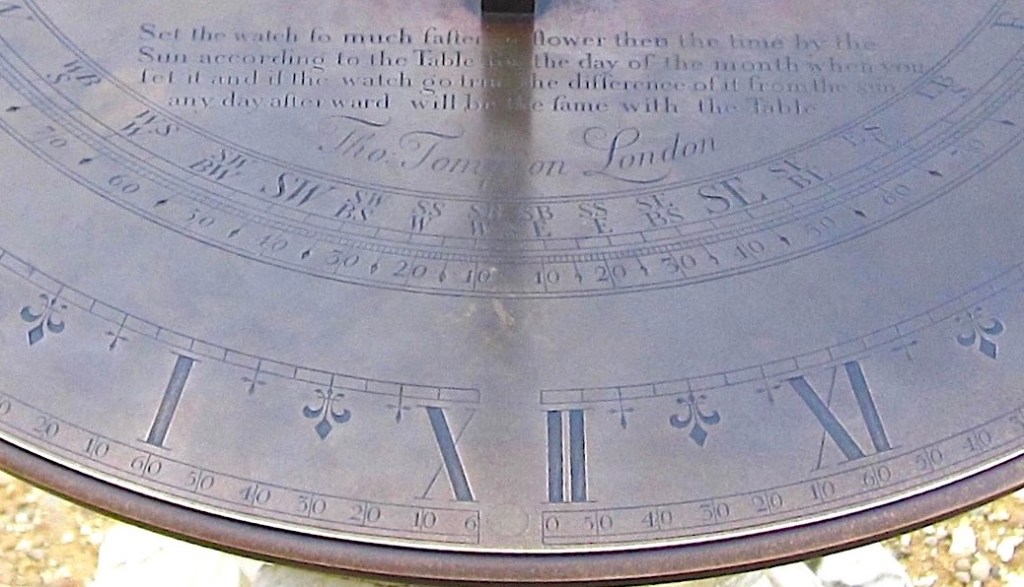
INSCRIPTION

Hampton Court Palace . Privy Garden . Tompion Sundial – Keith Salvesen

The precise date for the two dials in unclear. Tompion was baptised in 1639 and died in 1713. I have seen ‘towards the end of C17’; and the excellent Border Sundials points to evidence of installation in 1699.

Royal Museums . Greenwich

Royal Museums . Greenwich – crop

Hampton Court Palace . Privy Garden . Tompion Sundial – Keith Salvesen

Probably, in a sundial resource, it is permissible to include an occasional linked item, and the wonderful Hampton Court astronomical clock merits admiration at any time. I was pleased to get a straight-on shot without resorting to trickery (of which there was not much available in 2011).

.

Hampton Court Palace . Privy Garden . Tompion Sundial . Keith Salvesen

GSS Category: Horizontal Dial; Horizontal Dial with Calendar; Tompion Sundial; Pedestal Dial

All photos; Keith Salvesen except as stated

PADUA . BOTANICAL GARDENS . SCAPHE DIAL

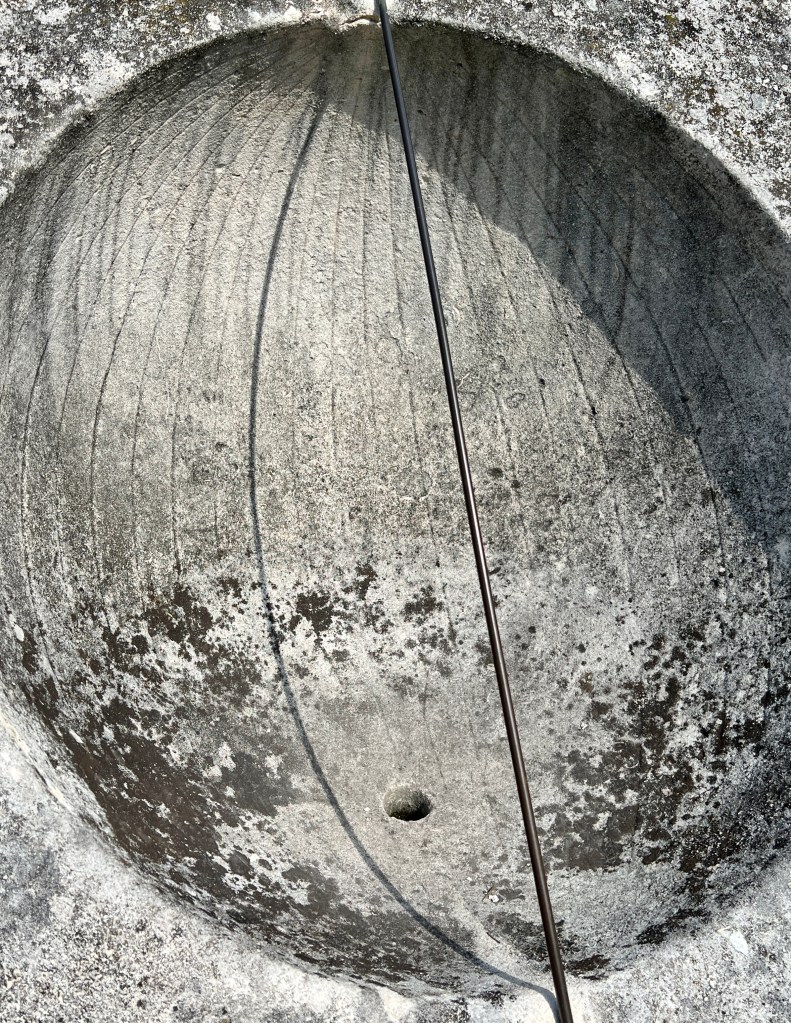
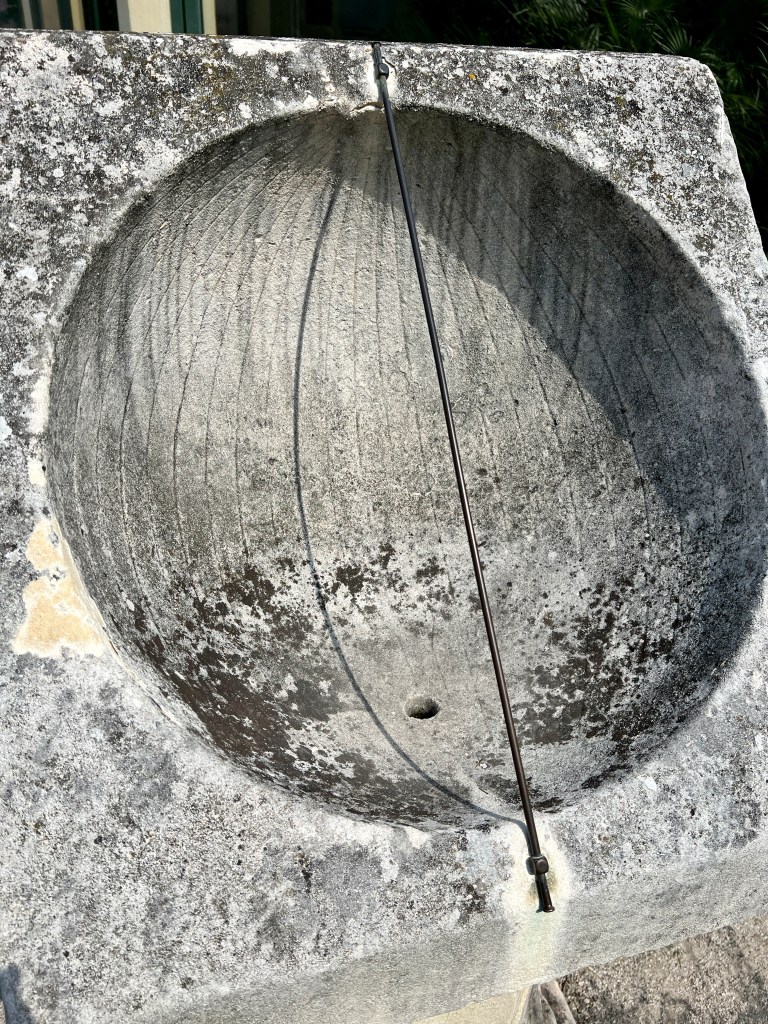
This wonderful example of a scaphe dial is one of 3 dials in the Botanical Gardens of Padua. There is also a cube dial and a cylinder dial (separate post). This first-ever public garden* was created in 1545, and the original layout has been preserved. This is not the space for a short wander round, but there’s plenty of interesting material online. It has been an important centre for scientific research since its inception and, unsurprisingly, it is a UNESCO World Heritage Site.

*Pisa’s botanical garden was actually completed a year earlier but disqualified on a technicality that I haven’t pursued.

GSS Category: Scaphe Dial; Botanical Garden Sundial; Europe Dials

All photos: John Renner, with many thanks