GRADE 1 ❖ C13 traces, mainly C14, C15. C19 restorations. Little information HE / BLB, but this link is informative https://sussexparishchurches.org/church/ripe-st-john-the-baptist/. One of a cluster of interesting churches in the area. 8 miles E of Lewes. 50.8684 / 0.15 / TQ513098
DIALS
❖
DIAL 1
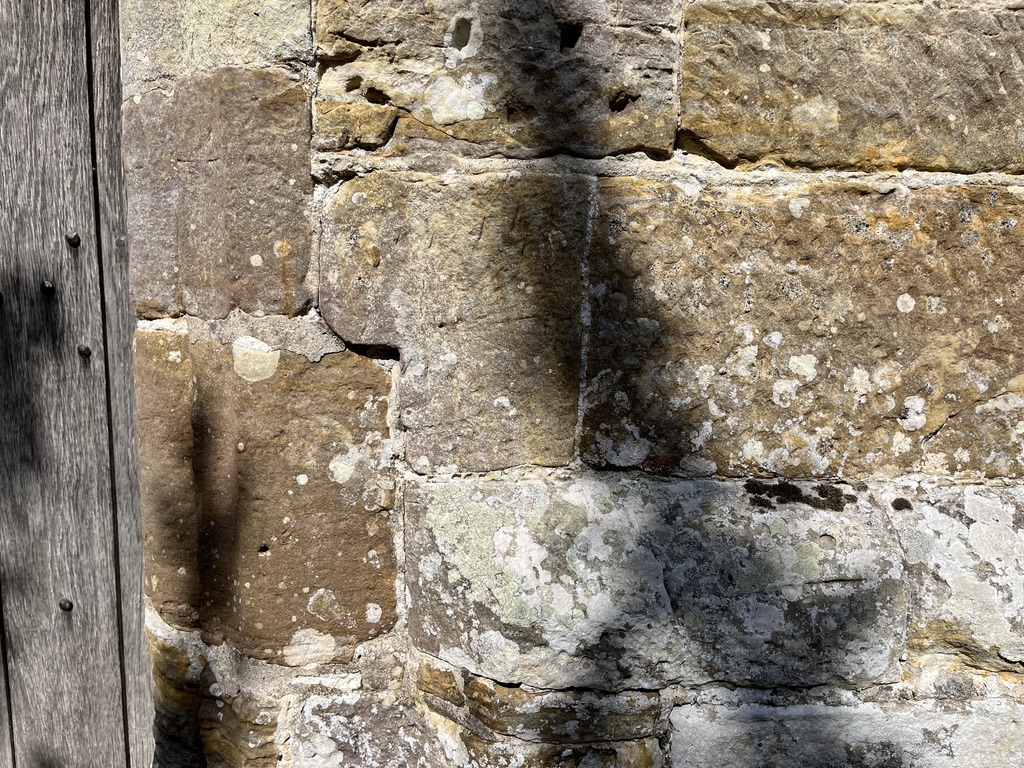
The church is said to have 3 dials, though I could only find 2 definite ones. The first is very rough, with ?2 lines dropping down from a plugged hole, and some scrapes around the area. It’s hard to see how it marked the course of the day effectively. The hardness of the stone may explain it.
❖
DIAL 2
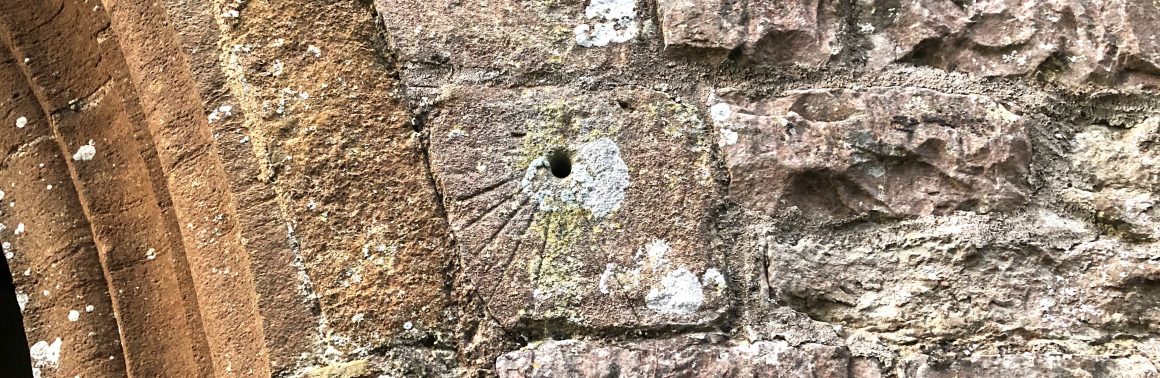
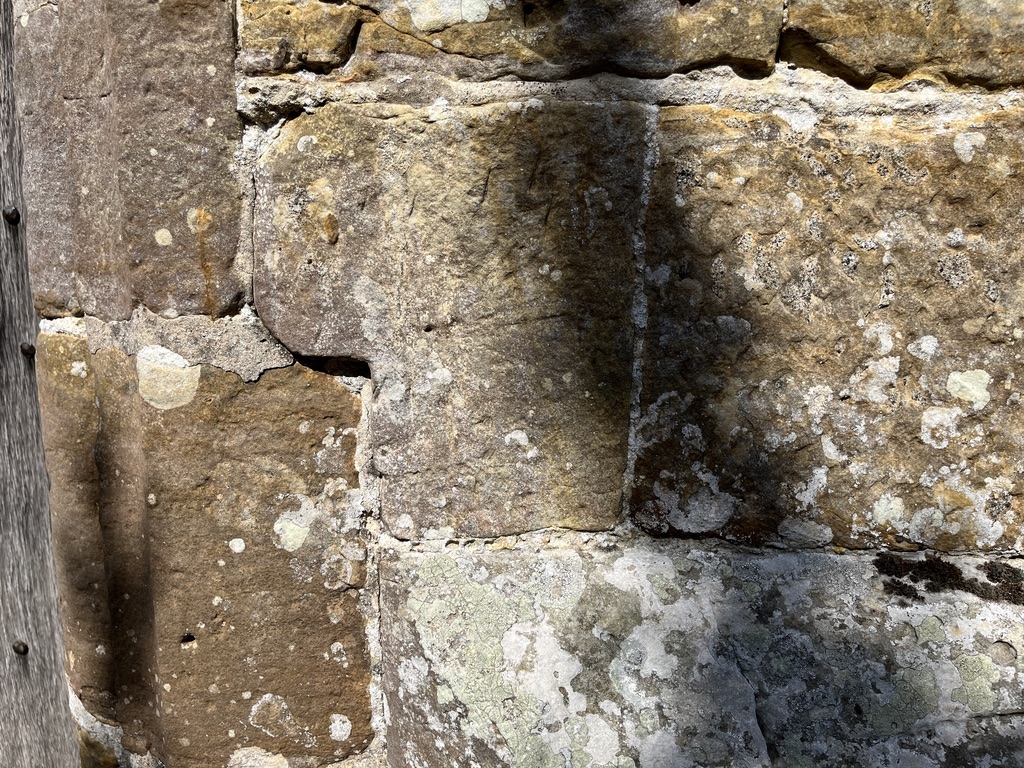
An intriguing dial in quadrant form, and cut on a shaped stone re-sited from elsewhere on the church. The images below show the dial as it is now, located URQ – the least effective location for marking the passage of today.
Two orientations could have worked: as a morning dial (LLQ) or an afternoon dial (RLQ). But then the stone would have needed to be recut…
❖
DIAL 3?
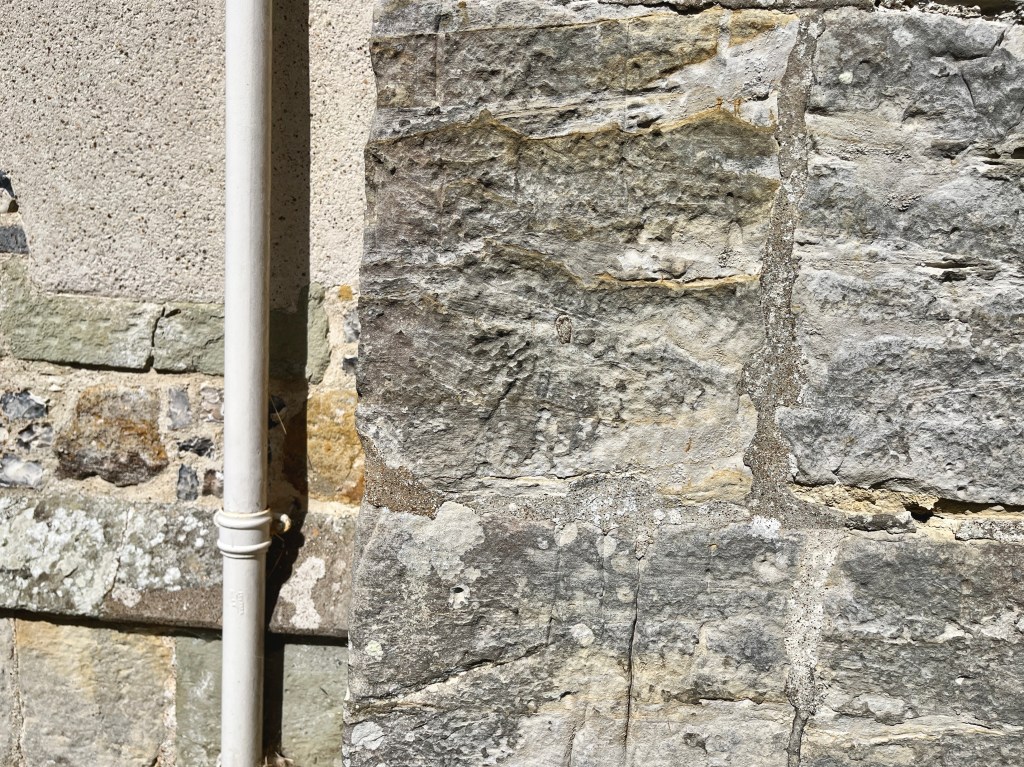
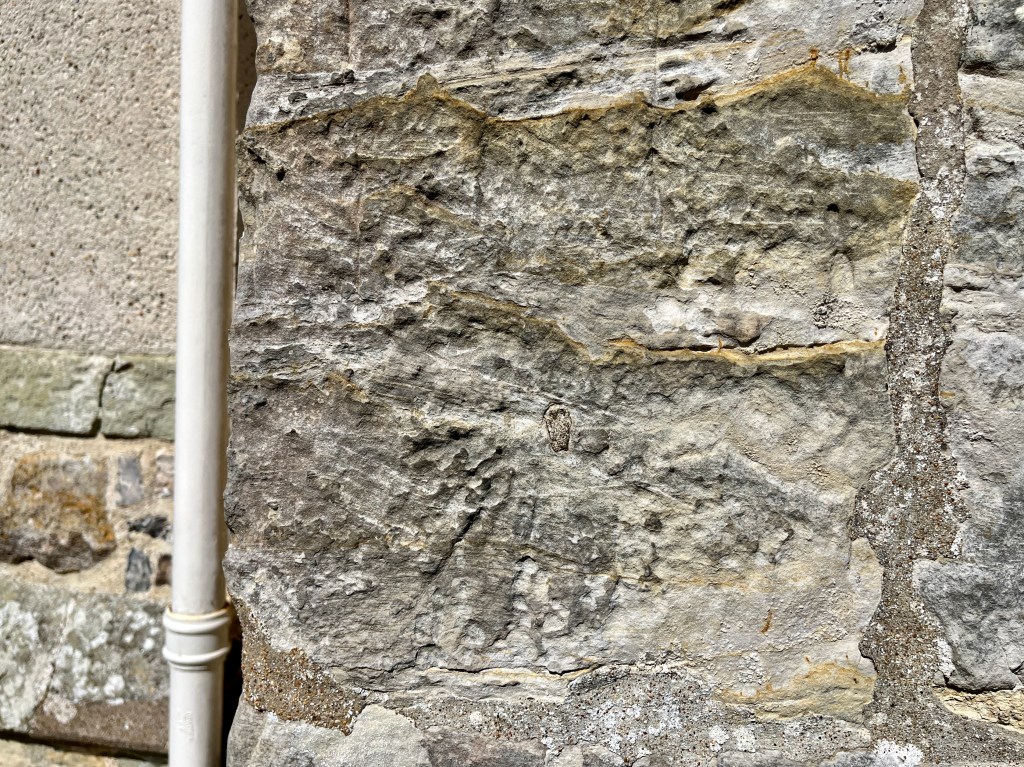
I did not find a definite 3rd dial, but on an adjacent stone to the others is one with a mix of holes. Two have faint lines / possible radials. If I had to choose one, it would be top left. Any helpful views welcome.
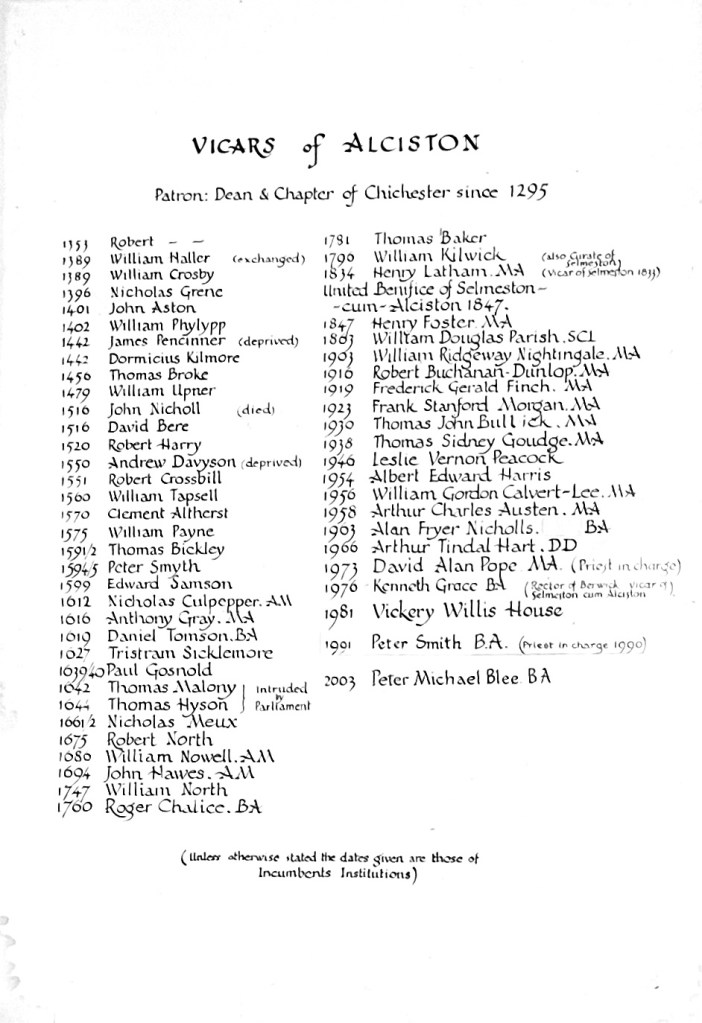
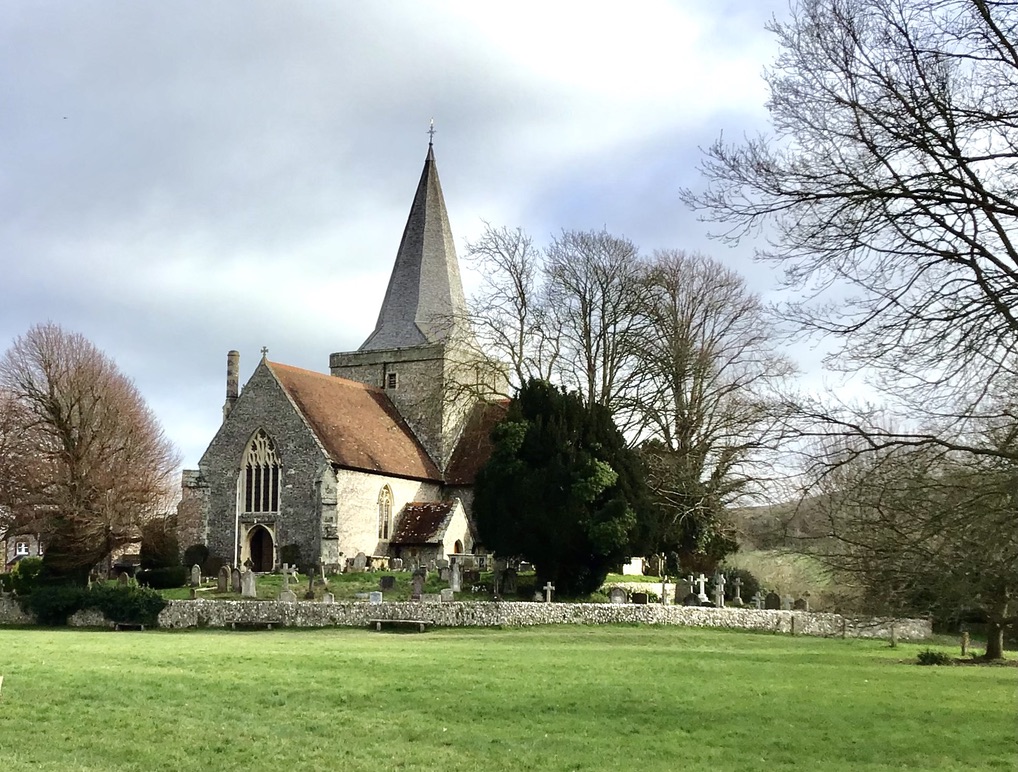
GRADE I † Saxon origins; DB as Aelfsige. Dedication unknown. Dated to C14 (BLB notes C13 chancel & porch). C19 restoration. Incumbents recorded from 1353. In a most attractive setting down a long path, and grouped with a large medieval tithe barn, dovecote &co. 8m E of Lewes, 6m W of Polegate. 50.8299 / 0.1369 / TQ505055
DIALS
All 4 dials are cut on either side of the blocked S doorway of the nave. 1 LHS and 3 RHS, of which an adjacent pair are low down, almost at ground level.
DIAL 1
On the L jamb of the blocked doorway, the most advanced and clearest of the 4 dials. Mid-C15? Encircled, with a full cross of vertical (12-12) and horizontal (6-6) lines emphasised by deeper incision. The lower half has 6 additional lines (and hints of a couple more). A single line UR quadrant divides it fairly accurately. The gnomon hole is (now) rather large for the size of the dial but that may have happened in the course of its history.
Alciston Church . E Sussex – Scratch Dial 1
DIAL 2
RHS of the doorway, the same height as Dial 1. A much simpler dial with 2 lines only. The worn circle contains just 2 lines LLQ, one faint and the other deeper cut. Possibly the faint line was originally the marker for Mass, and was superseded by a more visible line (hand-cut without a rule, it would seem).
Alciston Church . E Sussex – Scratch Dial 2
DIALS 3 & 4
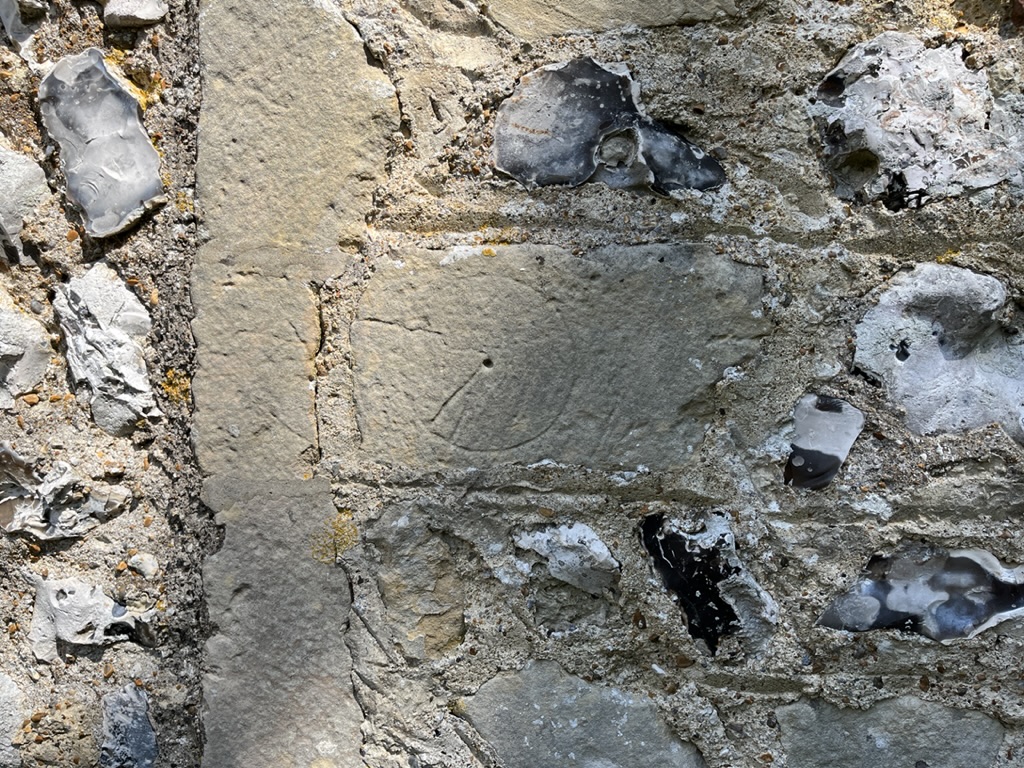
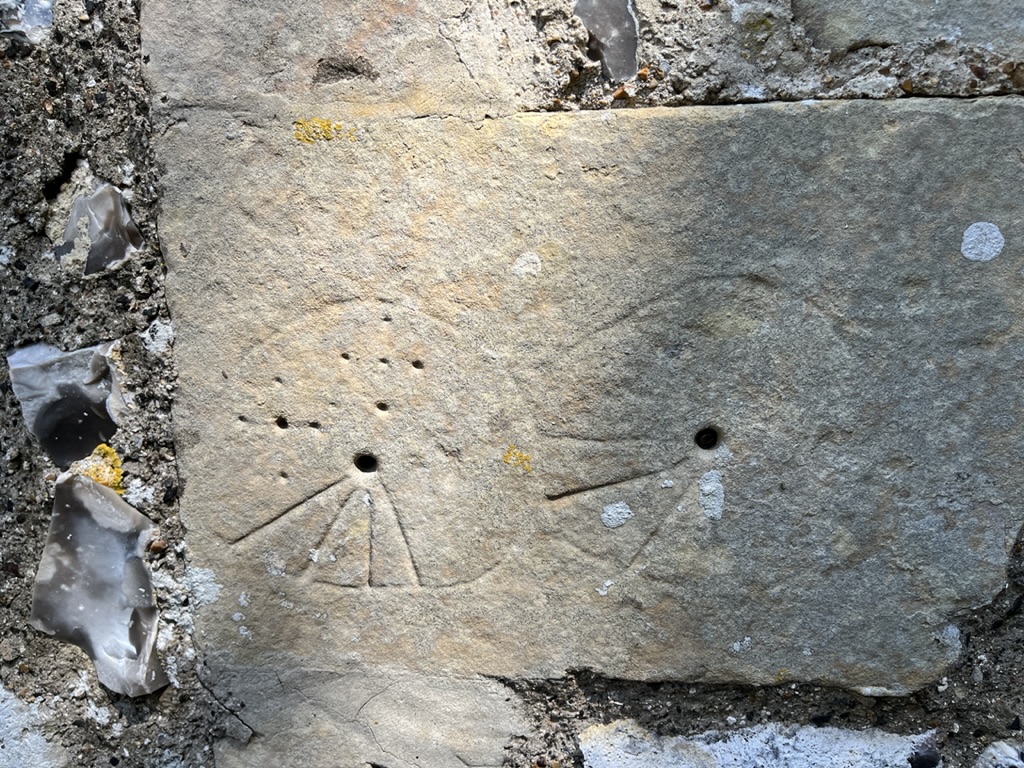
Just above ground level are 2 enjoyable dials on the same stone, presumably re-sited from a more visible position. However the stone sits comfortably with the overall design of the doorway, so I wonder whether all the dials (or those RHS) were moved to their present position when the doorway was blocked / during restoration?
The dials are adjacent – in fact, contiguous. Both circles are endearingly wonky, though the lines are cleanly cut. Dial 3 has been more carefully incised, with some attention paid to accuracy. Dial 4 probably came first and the more sophisticated Dial 3 later replaced it.
Dial 3 has 2 small dotted crosses within its circumference, also suggesting a later date than Dial 4. One cross consists of 4 separate dots; the other has the dots connected by lines (the vertical is very faint).
Alciston Church . E Sussex – Scratch Dial 3 & 4
DIALS 2, 3, and 4 as a group
Alciston is one of several rewarding churches in the area for a visit. You could combine it with climbing Firle Beacon which, at a height of 217m, counts as a Marilyn.
Frederick Barrett – Sussex Archaeological Collections 100 1962
GRADE 1 † C14 flint-faced cruciform church of considerable interest, in an attractive setting between Lewes and Polegate. Oddly, the usual reliable research resources (BLB, BHO, HE) have minimal or no entry for St Andrew. Luckily the CUCKMERE CHURCHES website gives helpful details. 50.8066 / 0.1581 / TQ521030
St Andrew . Alfriston . Sussex – Scratch Dial
DIAL
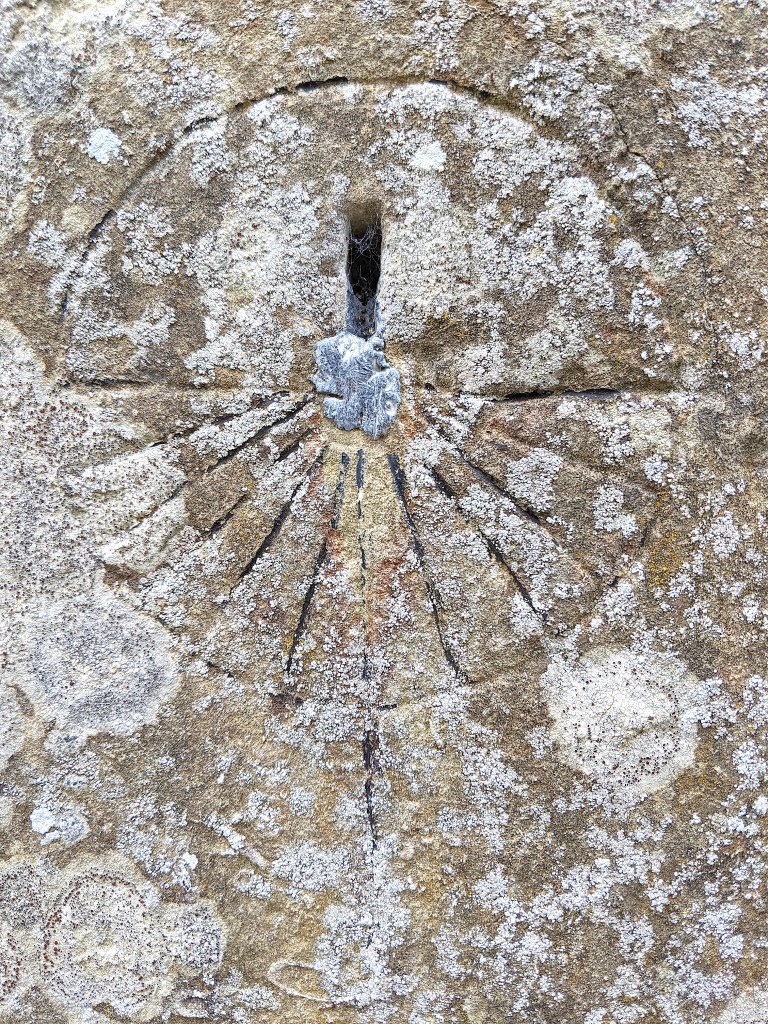
The neat compact dial is located on the S porch, on a W side quoin stone. It is encircled, with 12 radials of which the noon line – though the faintest – extends some way beyond the circumference. The style used in the original style hole, now blocked, was evidently superseded by an iron gnomon set in the oblong hole above the cement; probably not earlier than C17. This adaptation is also found at St Michael Litlington, situated opposite Alfriston on the E side of the Cuckmere valley. The dials there are famous and I will post about them separately.
St Andrew . Alfriston . Sussex – Scratch Dial
The radials are contained within the lower half of the dial (below the 6 – 6 horizontal) and are rather randomly spaced at (roughly) the 15º intervals usual in this design. In a later dial, the lines would be graduated. This form is a Canonical dial designed to mark the times of Mass. The significant lines were Terce, Sext and None – the 3rd, 6th (noon) and 9th hours. These are not emphasised here (eg by being cut wider, deeper or longer) although on many dials they are . There is a suggestion (BSS) that at some time the dial was recut / rescratched.
St Andrew . Alfriston . Sussex – Scratch Dial
GSS Category: Scratch Dial
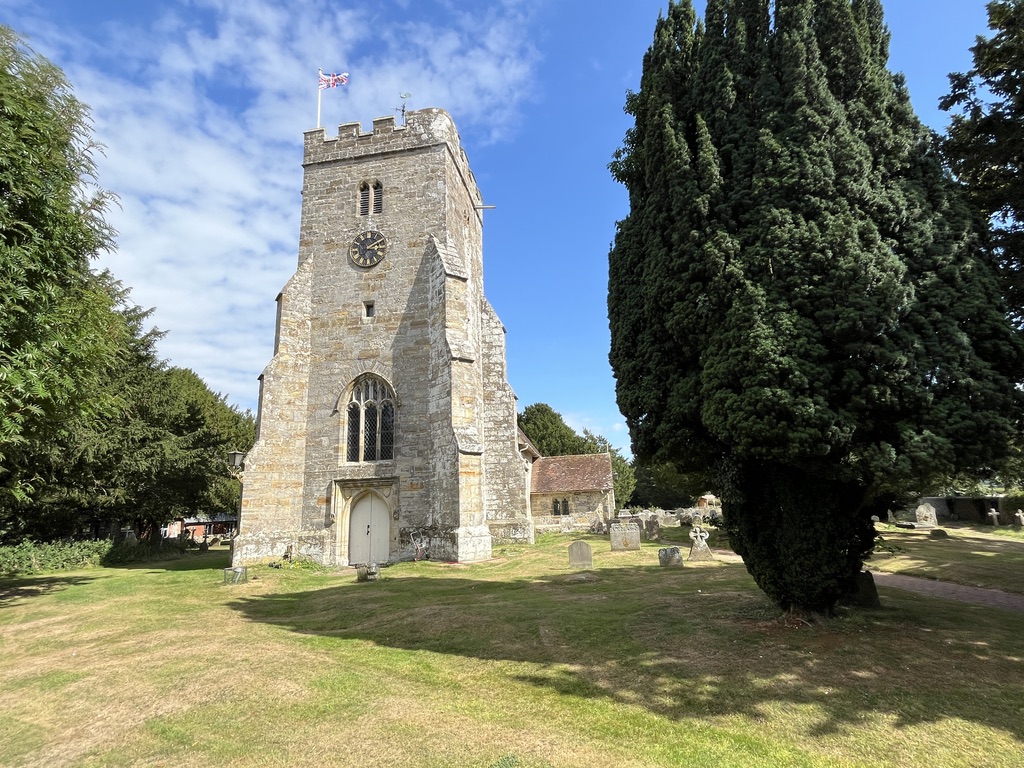
Photos: John Renner (dial); Camilla Pennant (church view across the village green known as the Tye)











 GAUDIUM SUB SOLE . SUNDIALS . MEDIEVAL TO MODERN