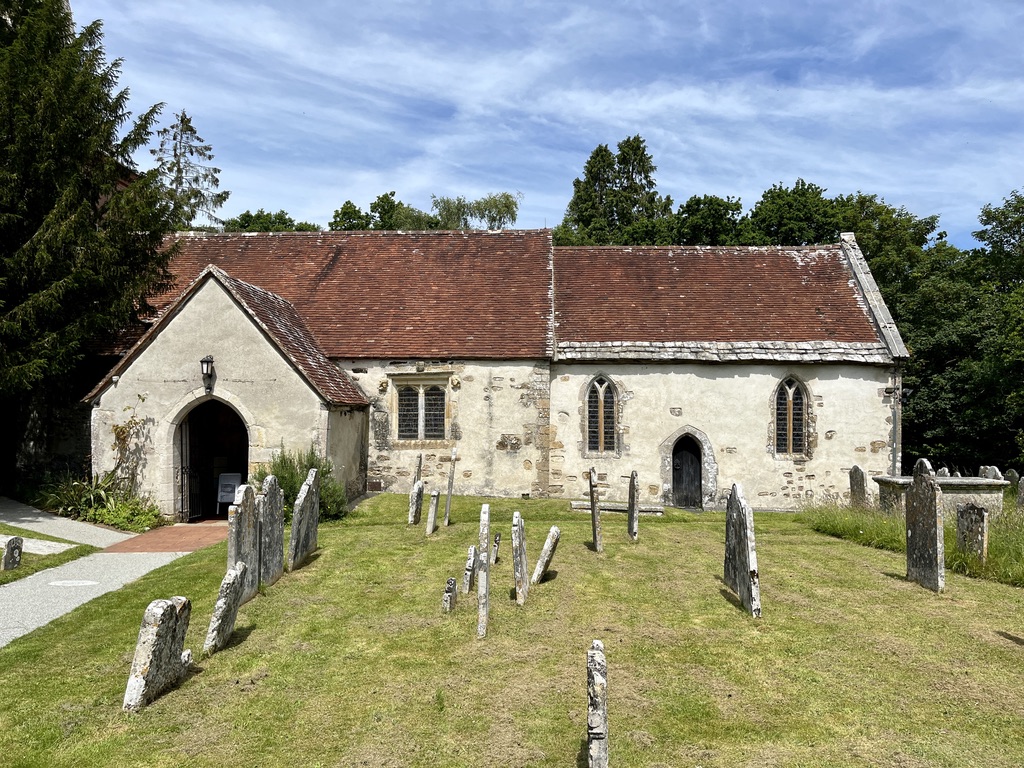
GRADE II* ✣ C13; C15 chancel rebuilt; C16 porch, bell-cote; later restorations esp 1847. A fascinating small church with plenty to offer the visitor besides the look of it including: medieval protection marks and graffiti; remains of wall paintings; tiles; good pew ends; an intriguing porch; a nice memorial horizontal dial in the churchyard; and the grave of Noel Thelwell (beloved pony cartoonist) and his wife. The church information sheets are models of their kind. 3m N of Romsey; 8m S of Stockbridge. 51.0193 / -1.5084 / SU345245
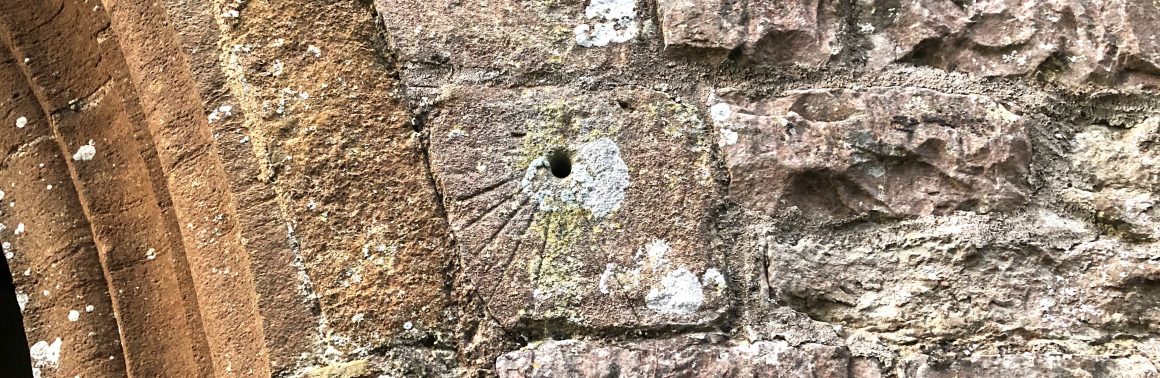
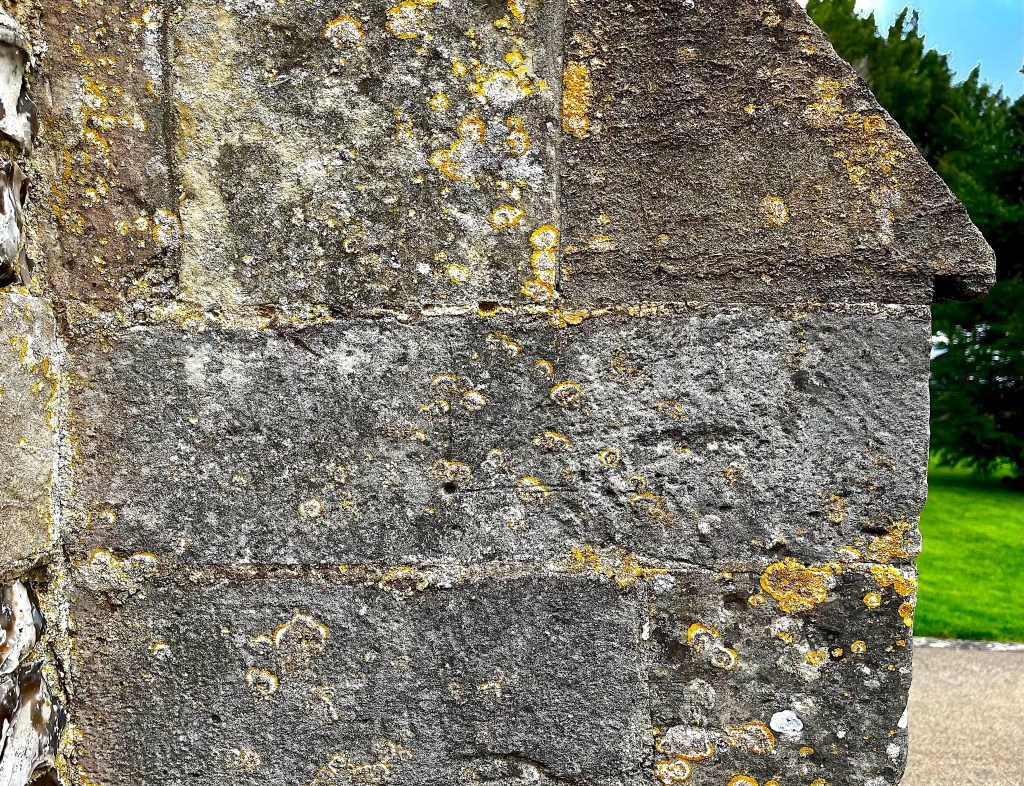
The dial was recorded in April 1922 by ARG, the originator of scratch dial research in Hampshire. He, like pioneer Somerset dial researcher DEH 10 years earlier, was equipped with a camera.
ARG noted 4 definite lines of equal length, perhaps more under the lichen. Located on SE quoin stone of the chancel, facing due S. Style hole about 4 ft high, in mortar line (thus forming the horizontal / 6-to-6 line).
There were several later descriptions of this dial. The last official BSS record (photo below) was made in 1994.
❖
DIAL IN JANUARY 2024
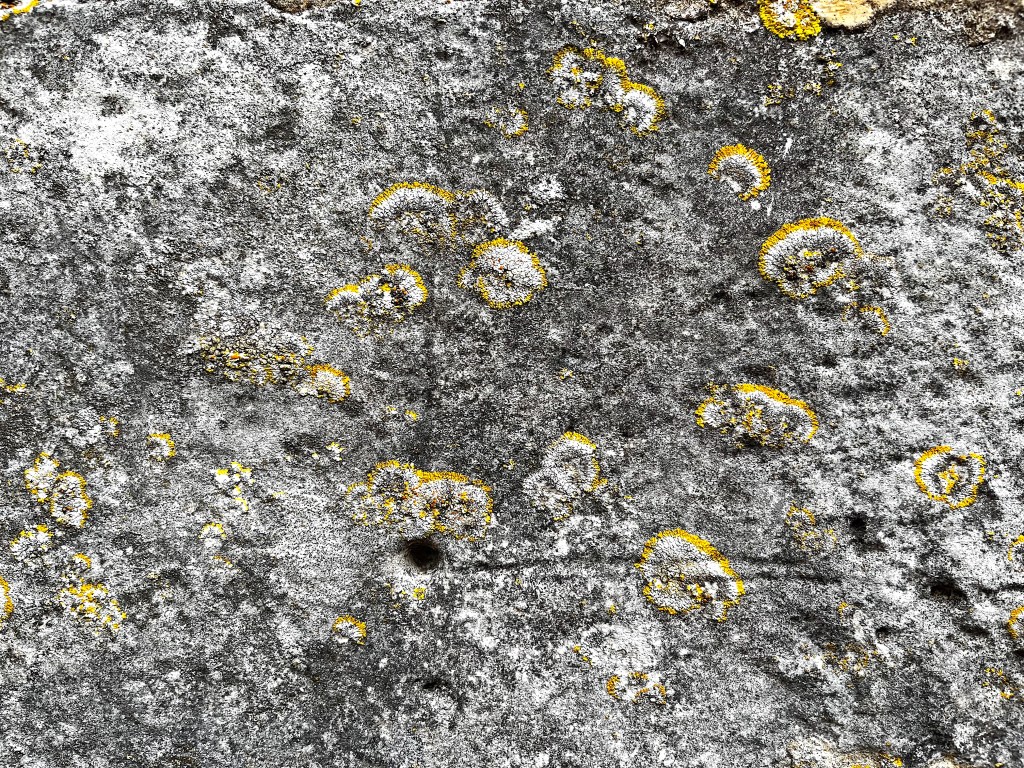
The condition of the dial may have deteriorated from weathering, however the apparent repair work since 1994 may be the reason why the lines are now so indistinct.
❖
GRAFFITI and PROTECTION MARKS
FUTHER READING
HAMPSHIRE FIELD CLUB & ARCHAEOLOGICAL SOCIETY HERE
GSS Category: Scratch Dial; Mass Dial; Church Graffiti; Protection Mark; Marian Mark
GRADE II* ❖ C12; chancel, porch late C13; enlargements; late C19 / early C20 restorations. Excellent late Norman south door. C12 font. The oldest church in the New Forest. The village and church have great military significance. WW1: a Military Hospital for severe casualties of non-British soldiers. WW2: Divisional HQ for planning D-Day. Large churchyard, commemorative graves, and a fine memorial. The church contains a moving exhibition of the wartime history. Queen Mary visited and seeing that Sikhs were lacking turbans, supplied them; and seeing broom handles being used as crutches, supplied walking sticks. 50.8146 / -1.5681 / SU305017
DIAL
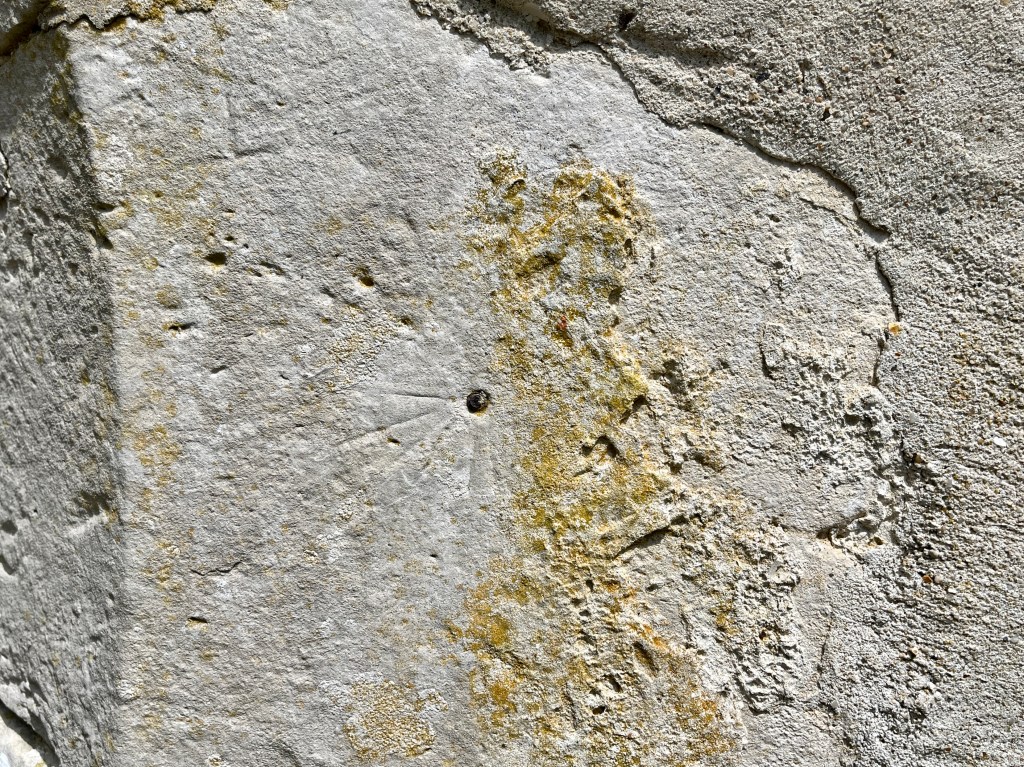
The dial is on E jamb of S Porch, late C13. The right side is concealed by render of some sort. Despite erosion, it is possible to make out 8 lines. Iron gnomon remnant protruding.
ARG visited in June 1924. He detected part of an indistinct circle, but 100 years later there is no trace. He noted that the style-hole retains its metal gnomon, broken off and projecting very slightly. The original? It is rare enough to find remnants of metal in a gnomon hole, let alone (if ever) to be able to identify one as pre-1600.
Amusingly innovative metal gnomon. Clungungford . Salop
A special gravestone
GSS Category: Scratch Dial; Mass Dial; Dial with gnomon remnant
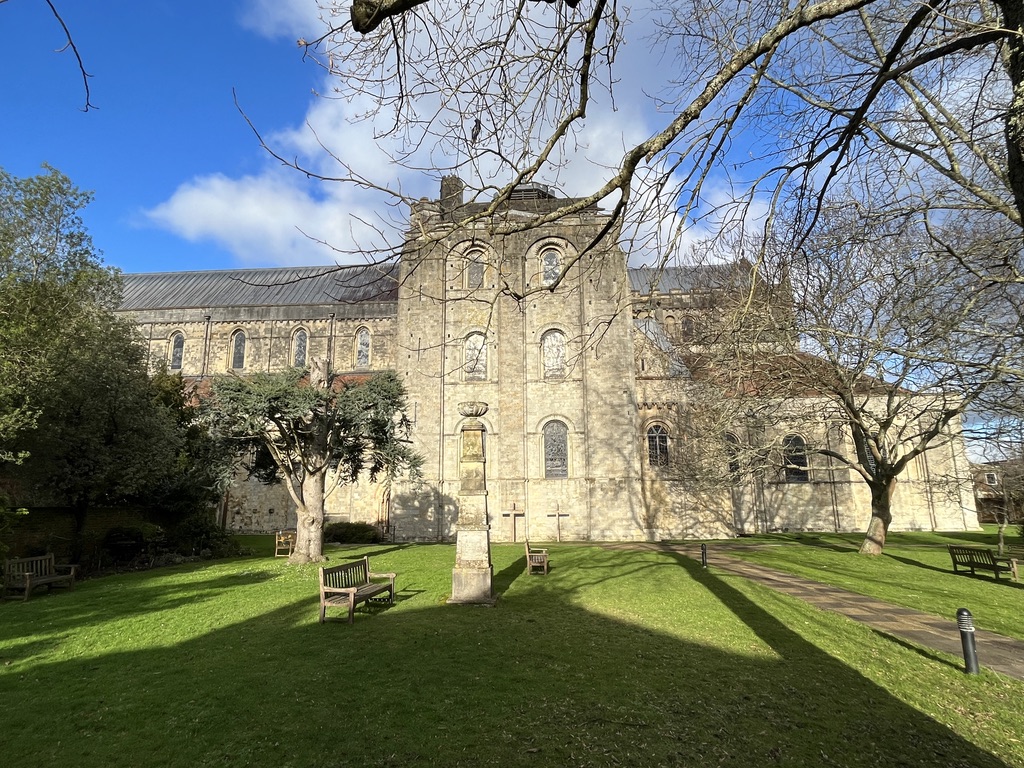
In a format variation, I will side-step the usual scene-setting para. In comparison with its host building, the somewhat elusive scratch-dial is an infinitesimal part. It is quite rare, I think, to find a scratch dial on a cathedral, abbey, or other major church building. Romsey has one that would be easily overlooked without clues. Next time I’m in Romsey I’ll take a proper camera on a sunny day.
DIAL
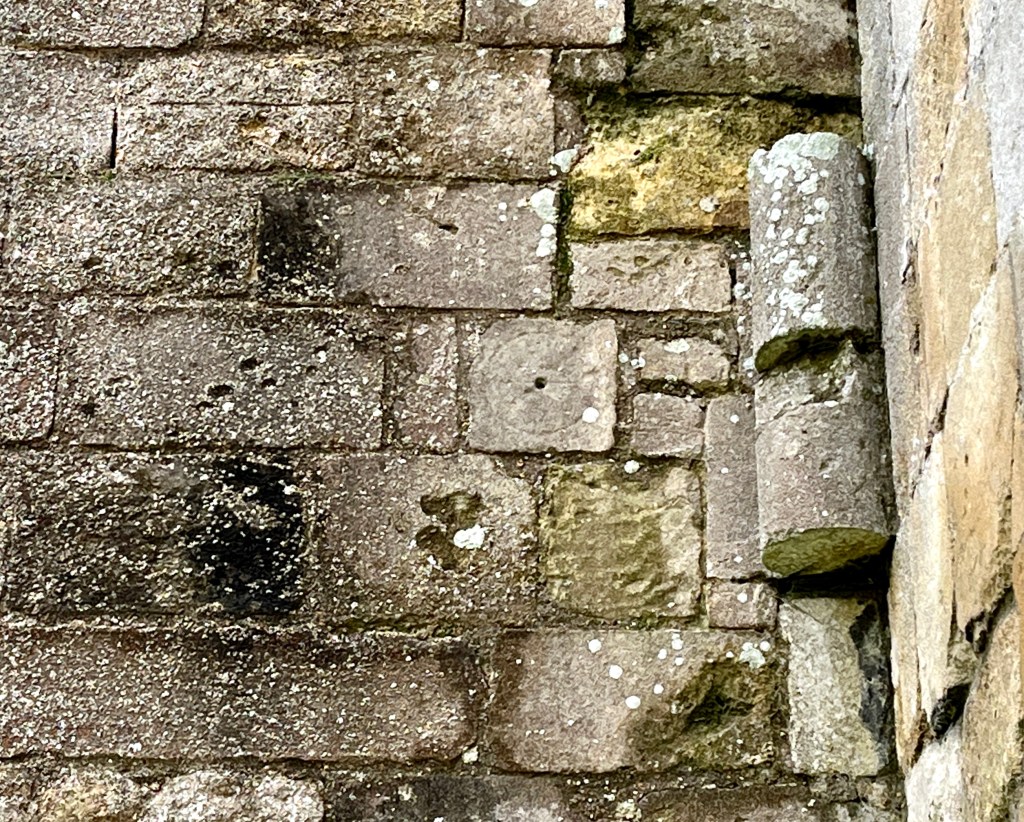
The dial is at the E end of the Abbey, inverted on the N face of the S buttress about 4 meters high.
The BSS record describes it as Accurately cut or made. Repositioned, eroded, damaged. Rudimentary (Norman) dial. Probably inverted (faint line and pock URQ. Too high for measurement.
GSS Category: Scratch Dial; Mass Dial; Norman Mass Dial
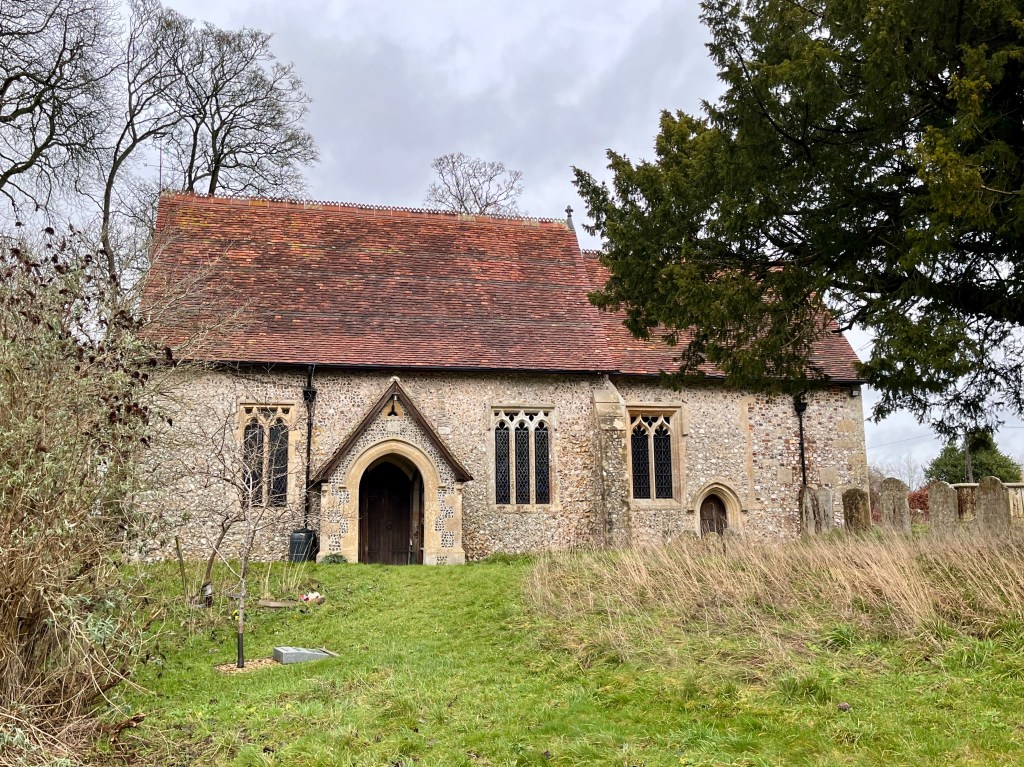
GRADE II* † Cll Saxon / Norman origins with simple nave – some features survive; C15 chancel; later additions / restoration 1882. A most surprising Palladian / Venetian E window. Detached timber-framed bell cote. Attractively set in a well-wilded churchyard. 6m W of Andover. 51.1944 / -1.611 / SU272439
DIAL
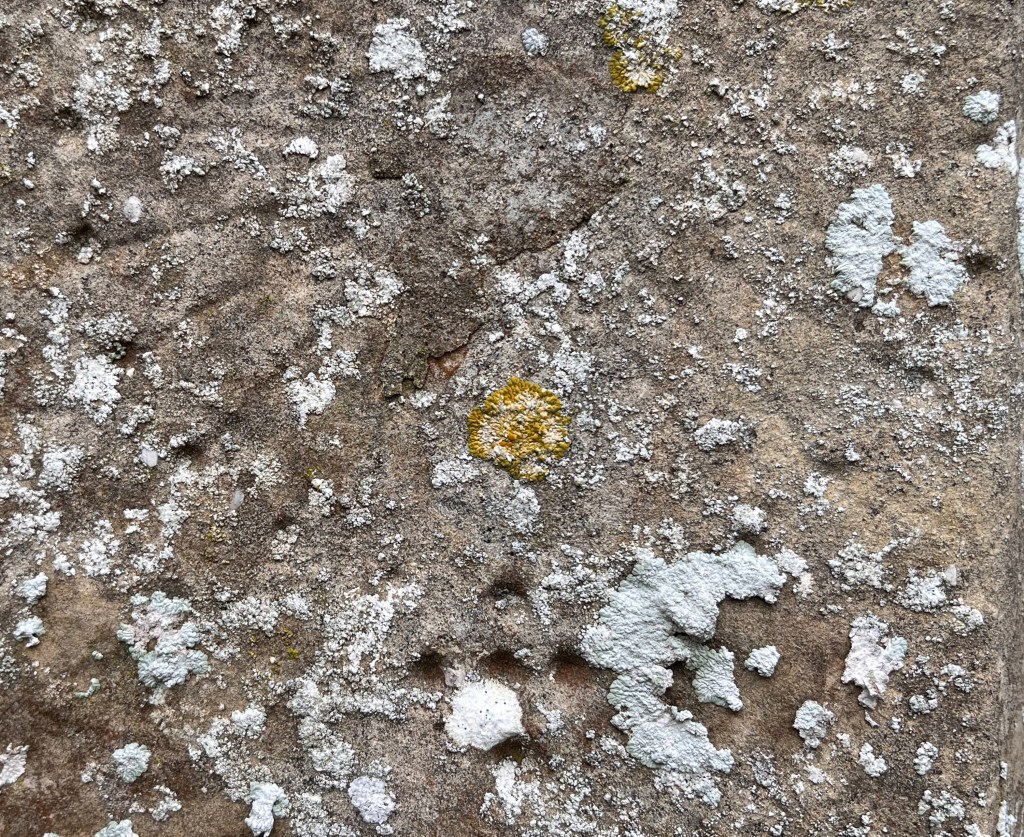
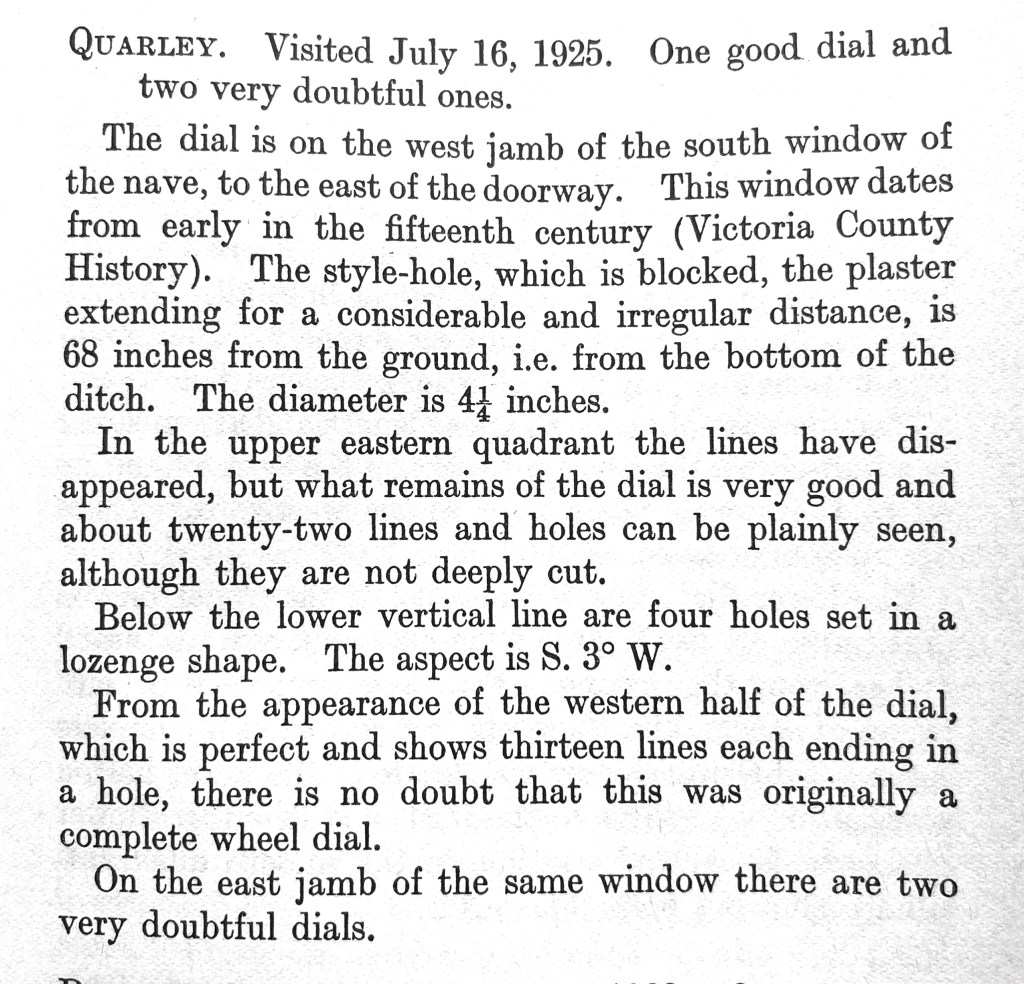
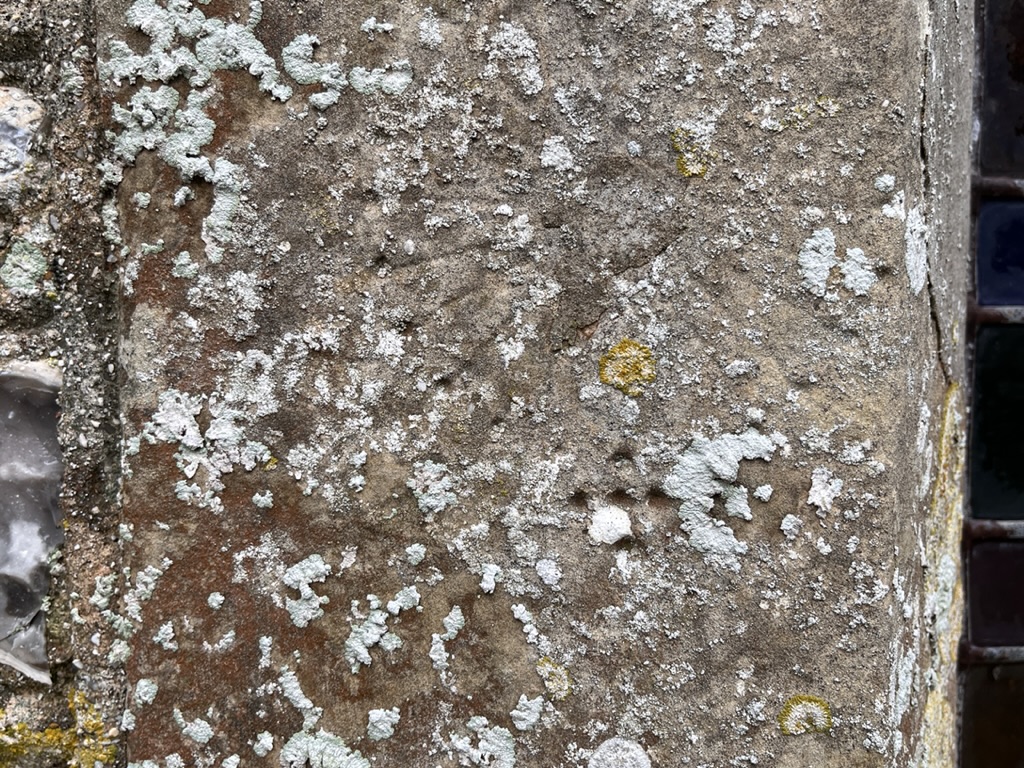
The dial is on the W jamb of the window E of the porch, first recorded by ARG in 1925. The gnomon hole is filled. ARG’s description is below. The more recent BSS entry records 19 visible / detectable lines and 21 pocks, with possible hints of a circle. On either view, this is an eroded 24-hour dial (esp URQ), with noon marked by a quincunx (like 5 on a die), which I haven’t seen before. One puzzle is why the dial was cut in such a position that it is truncated RHS.
ARG noted two very doubtful dials on the E jamb of the same window; and in his text he refers to another doubtful on the buttress of the S Chapel. I couldn’t make out dials.
St Michael . Quarley . Hants – Scratch Dialwith Quincunx
There was another mark that caught my eye, a small uneven circle of pocks. There’s no hint of a central hole. As I visit more churches, I see more of these little markings. They can’t be dials, and they seem unlikely to be purely decorative. My tentative theory is these little pock circles are a form of protection mark / apotropaic symbol). However I haven’t yet found such a design featured in the usual medieval building mark resources. Any theories welcome.
St Michael . Quarley . Hants – circle of pock marks
GRADE I † C12 origins with south transeptual tower; C12 north aisle and north chapel; C13 south chapel and aisle, tower rebuilt; C15 chapels demolished, chancel and north aisle rebuilt, south porch added; C17 tower rebuilt. A treasure for church enthusiasts of any sort. Even the bells have stories. For detailed church description and historical context: BHOSt George DamerhamHE has a short entry HERE. Church’s excellent GUIDE below. The ‘Vicars’ Board’ begins c1235. W of the A388 midway Salisbury to Ringwood. 50.9416 / -1.8483 / SU107158
DIALS
✣ Note: I missed a dial located most unusually on a cross in the cemetery ✣
St George has 3 scratch dials. In addition there is a fine numbered dial that marks the transition to a more sophisticated era of ecclesiastical time-keeping. Within the porch on the upper R side of the original entrance I (believe I) found another simple dial of a kind found inside porches elsewhere, with traces of whitewash (eg Blackford Som. Bishops Sutton Hants Limington Som.)
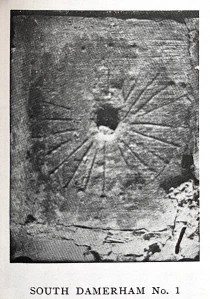
ARG visited in 1923. His comments on individual dials are briefly noted below, with his photo of dial 1.
DIAL 1
St George . Damerham . Hants – Scratch Dial 1
The main dial is easily found on the E jamb of the S porch. It has a very large gnomon hole in the centre of the dial stone, presumably enlarged over time. There are 20 lines, each with a terminal pock. It is perhaps unusual for a medieval dial to have a full circle of radii with end pocks that are all still visible centuries later.
ARGA rather large, good dial. Perhaps originally a full-wheel dial with 24 lines, now with 4 lines missing from upper quadrant.
St George . Damerham . Hants – Scratch Dial 1
DIAL 2
St George . Damerham . Hants – Scratch Dial 2
SW buttress of nave. Gnomon hole in the mortar line, from which 11 lines fan out below the horizontal. The design has been rearranged over the years, with the LR quadrant damaged and repaired without recutting the lines onto the cement.
ARG described the dial as a half-wheel. He commented on the disparity in the line length between LL and LR quadrants. but did not remark on the reason ie damage repair.
St George . Damerham . Hants – Scratch Dial 2
DIAL 3
St George . Damerham . Hants – Scratch Dial 3
Dial 3 is immediately below dial 2 on the same buttress. It is very basic and consists simply of a slightly skewed gnomon hole, with 3 lines in the LL quadrant, partially obscured by lichen just as ARG reported 100 years ago.
St George . Damerham . Hants – Scratch Dial 3
DIAL 4
St George . Damerham . Hants
The dial largely speaks for itself. I find it hard to date – C17? It seems very carefully cut, and the numerals are elegant. There’s some sophistication here. The dial is surmounted by the initials GB and TS
St George . Damerham . Hants – Scientific DialSt George . Damerham . Hants – Scientific DialSt George . Damerham . Hants – Scientific Dial
One intriguing feature of this dial is the mystery of the missing gnomon. In 2007 a contributor to the Geograph project, Trish Steel, uploaded a photo of the dial. It has a gnomon set into cracked mortar (unsurprising if it fell out). To an amateur it looks as if it may not have been in the right place anyway – too low? I wonder when it was first installed? It’s a very simple wedge of iron, perhaps inserted when the crack was originally repaired.
St George . Damerham . Hants – Scientific Dial with Gnomon
PORCH DIAL
Within the S porch (added C15) the area around the original door has much medieval graffiti. St George was a church of pilgrimage, and inside there are pilgrim scallops incorporated in the fine wall-painting fragments. Both outside and inside the church, there are many crosses cut into the stone. Some may also be apotropaic in intention; some may be event marks (the porch is ideal for welcoming a new incumbent or a marriage).
On the jamb R of the door there are 3 distinct lines, equally separated, radiating downwards from roughly the same point, a plausible filled style hole. The design is clearly cut with no graffiti near it, with traces of whitewash. I have encountered other very similar internal porch dials (I need to cross-check and add links) in much the same position, and I am confident that this qualifies as another one.
St George . Damerham . Hants – Scratch Dial within the porch?
PILGRIMS’ PROGRESS
St George . Damerham . Hants – Pilgrim Crosses, Graffiti
RESOURCES FOR ST GEORGE DAMERHAM
There is a brief but helpful information sheet / guide in the church
An object lesson for a church guide: informative, interesting, and focussed on the most important features
GRADE II † C12 origins (c1190), mostly destroyed by a fire in 1681 and rebuilt. Dilapidation and a new Parish church built in the village centre in 1883 led to demolition of all but the Chancel. In the 1920s used as a mortuary chapel. Stones mark the outline of part of the nave. In the care of CCT. 8m S of Basingstoke. 51.1687 / -1.138 / SU603414
DIALS
Both dials are on the south wall of the Chancel, L of the blocked Priest’s door.
St Mary . Preston Candover Old Church . Dials
DIAL 1
St Mary . Preston Candover Old Church – ScraDial 1
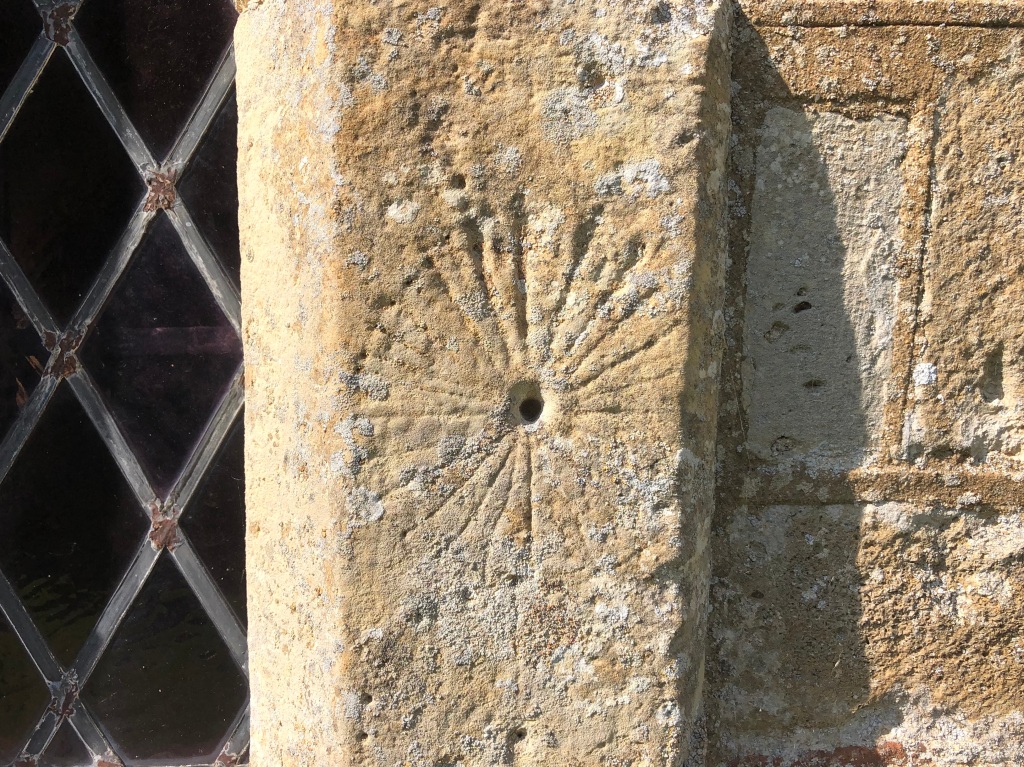
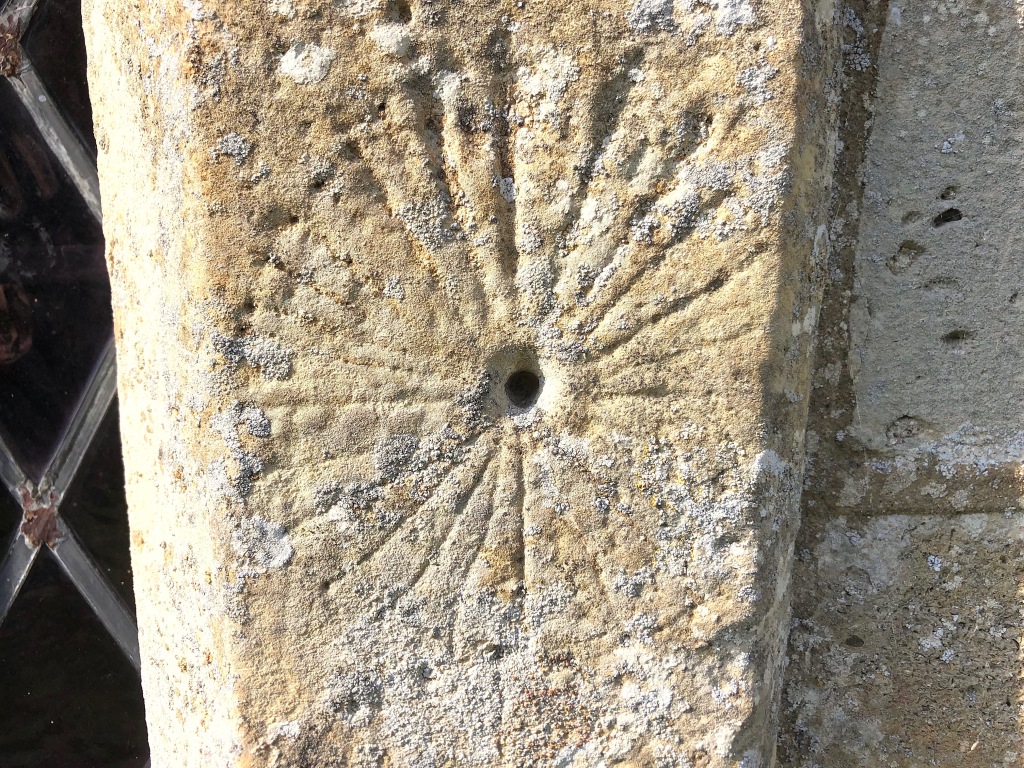
Dial 1 is small and, remarkably, on the lowest stone of the doorway where it would have been of negligible use. It was obviously repositioned during rebuilding and in the process rotated 90º clockwise so that the deeper cut noon line is horizontal rather than vertical to the ground. Encircled but not accurately – slightly elliptical. There are a dozen lines or so radiating from the gnomon in the dial stone, with the afternoon lines emphasised (ARG in 1924found it ‘much damaged by weather’)
St Mary . Preston Candover Old Church Dial BSS
A R Green – Dial 1 1924
DIAL 2
St Mary . Preston Candover Old Church –
Dial 2 is eroded and in a poor state. Though larger than Dial 1, it is less visible, and ARG did not record it in his 1924 survey. It seems to have been cut on softer stone. Lichen makes it harder to read. The blocked gnomon hole is more or less in the centre of the dial stone. There are 7 definite lines leading from it, 2 angled into the upper half of the dial. It looks as if it might once have been encircled, but it is now hard to tell. BSS notes Crudely cut or made. Eroded. Trace of circle only. Partly hidden by rendering
St Mary . Preston Candover Old Church Dial BSS
NOTE In the churchyard is a sundial made up of a twelfth-century capital and base, both being set upside down HE
GSS Category: Scratch Dial; Mass Dial
Credits: Tina Osgood, taken during a recent visit; header image Basingstoke Gazette
GRADE I † C12 origins (nave c1150) on Saxon site, still with Norman features. Gradual C13 / C14 development and C18 / C19 works / restoration. Wooden-shingled bell turret, as other churches locally (eg Medstead.) Of relevance here, S porch added C18. 2m E of Alresford. 51.0843 / -1.1362 / SU605320
DIALS
ARG visited in 1923 and recorded dials 1, 2, 3 but not dial 4 (high up above dial 3). Dials 1 & 2 are LHS of the original Norman doorway, within the later-added porch. ARG rightly discounted the very prominent OS benchmark below dial 3 that had elsewhere been recorded as a dial.
DIAL 1
The most striking of the dials, not least because of the graffiti that surrounds it. It is cut on the W jamb (outer) of the original Norman doorway (c1150), inside the much later S porch. There are 4 strong lines descending from the style hole in the mortar line, and a short arc LHS.
St Nicholas . Bishops Sutton . Hants – Scratch Dial 1
The image above also shows the much less distinct dial 2 at the same level on the inner jamb. The triangular design above both is ornamentation on the slim column. Dial 1 is remarkably undamaged / unweathered considering the long period before the porch was added. It must have predated the C17 graffiti, which is itself in very good condition.
St Nicholas . Bishops Sutton . Hants – Scratch Dial 1St Nicholas . Bishops Sutton . Hants – Scratch Dial 1
DIAL 2
Dial 2 is also cut on the W jamb (inner) of the original Norman doorway (c1150) within the S porch. Very faint and hard to make out, even close to; easy to overlook. There are 4 discernible lines, with the hint of a double line at noon. The remains of whitewash make examination even more difficult.
St Nicholas . Bishops Sutton . Hants – Scratch Dial 2St Nicholas . Bishops Sutton . Hants – Scratch Dial 2
DIAL 3
St Nicholas . Bishops Sutton . Hants – Scratch Dial 3
Very visible as one walks up the church path, on a quoin stone on the SE corner of the nave. The dial is cut inside an eroded semicircle, with the style hole in the mortar line. Unsophisticated. There are 11 lines radiating below the horizontal, at rather random angles. It looks uncomfortable, as if it may originally have extended upwards onto an earlier stone: ARG notes that it is on one of the original large quoins C1150 (which does not match nearby stones), suggesting relocation of the adjacent stones or even of the dial stone itself.
St Nicholas . Bishops Sutton . Hants – Scratch Dial 3
ARG suggests that there is no obvious vertical / noon line. However the 2 deeper cut lines either side of noon may be intended to emphasise a ‘noon space’ between them, as is occasionally found elsewhere. ARG also posits that Dial 3 may be an interesting example of a ‘summer-only’ dial, though I can’t tell why: it faces more or less due S.
DIAL 4
Dial 4 is high up on a quoin stone above Dial 3. It’s a very simple small dial with 4 lines leading from a style hole in the dial stone. There is a presumed Mass line (Terce), a noon line, a very faint short line, and an extended slightly curved line. BSS comments that the dial was at some time repositioned, being of little use in its present location.
St Nicholas . Bishops Sutton . Hants – Scratch Dial 4
St Nicholas . Bishops Sutton . Hants – Benchmark below Dial 3
St Nicholas . Bishops Sutton . Hants – Graffiti RHS doorway inc. apotropaic VV mark
GSS Category: Scratch Dial; Mass Dial; Medieval Sundial
GRADE I † C12 cruciform church enlarged C13 and thereafter. Small timber bell turret added C17. Victorian restoration 1893 (CE Ponting), with addition of porch. Set into an alarmingly steep hillside, with a considerable drop for the unwary. Approached by a now-rare permissive path through private property. Currently (2022) there are building works, with the W end under wraps. 10 miles S of Salisbury. 50.9642 / -1.8368 / SU115183
DIAL
St Andrew has one dial, prominently situated on the buttress of the S chapel and best seen from quite high up the slope. ARG visited in 1923, describing it as very distinct. C15.
St Andrew . Rockbourne . Hants – scratch dial
ARG recorded 13 lines in a semicircle, each ending in a pock, with the angles (almost) equidistant. He noted that the lines are all in the lower half, but does not mention the interesting tilt of the dial, the purpose of which is unclear. Perhaps an adjustment of angle to allow for the slope (as it was in C15 when the dial was cut) and achieve greater accuracy? The large gnomon hole is blocked with a cement plug.
St Andrew . Rockbourne . Hants – Scratch Dial
Looked at closely there is a 14th line also with a dot, fainter than the rest, on the upper right side, squeezed in between the clearer top two lines. There are 2 or 3 additional dots that form part of the circumference and possibly were at the end of fainter lines now eroded. Overall, a medieval dial that is less straightforward than it appears at first.
GRADE II* † C12 origins then C13 and C14 addition and rebuilding. Much C19 work inc. rebuilding tower & S porch. A most attractive long low church with timber belfry and spire. A rewarding church to explore: see BHO. 3m S of Stockbridge; 7m N of Romsey. 51.077 / -1.4872 / SU360309
DIALS
There are 4 dials recorded for the church, but only 3 are visible. The 4th seems now to be concealed behind a boiler. The 3 visible dials are all on the jambs of a S nave window. ARG notes that the window was inserted into an old doorway All are inverted, presumably during the 1880 restoration. Maybe this links up with the rebuilding of the S porch and relocation of stones originally there (a more obvious position). BHO notes various window alterations and the movement of stones incised with ornamental crosses and inscriptions… the stones have unfortunately been reset upside down.
St Peter & St Paul . Kings Somborne . Hants – 3 scratch dials
DIAL 1
St Peter & St Paul . Kings Somborne . Hants – Scratch Dial 1
Dial 1 is inverted on the L jamb. LHS and below, the style hole is badly damaged. Otherwise, the 12 lines are more or less clear, with differing lengths and angles. There is a trace of a semicircle, marked by perimeter pocks. The noon line is considerably elongated and, with 1, has larger perimeter pocks. 1 also has a short extension of 4 dots, perhaps to emphasise a service significant to this church or community.
DIALS 2 & 3
St Peter & St Paul . Kings Somborne . Hants – Scratch Dials 2 & 3
Both dials are on the R jamb, inverted, on the same stone, and actually touching. Unusually (perhaps very rare) both are complete circles with 24-hour marking. Dial 2 has 24 radials; Dial 3 has 24 pocks.
Dial 2 is encircled and imaginatively decorative, with radials for a full 24 hours. The spacing is somewhat random. The style hole is quite deep, and obviously enlarged. The (upside-down) noon line is deeper cut, as are 10, & 11. So too is 1, which is also extended with 2 pocks. This corresponds with Dial 1 and seems to confirm that some importance was attached to that time of day.
St Peter & St Paul . Kings Somborne . Hants – Scratch Dial 2
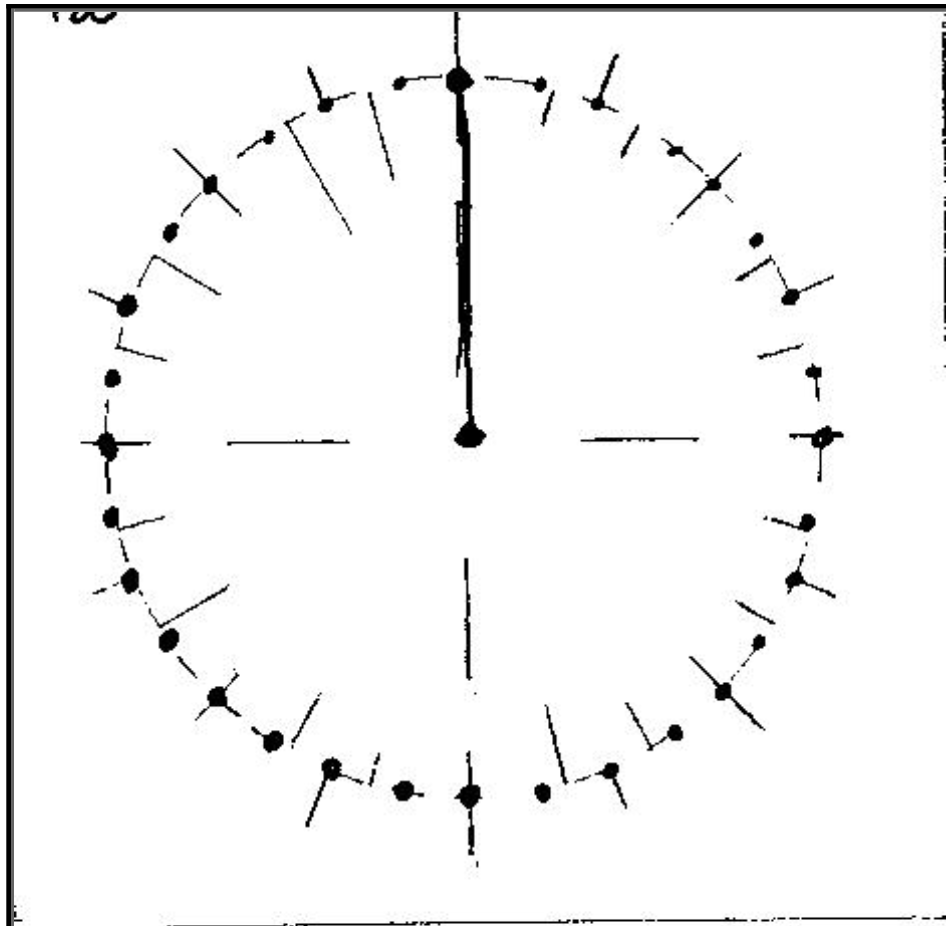
Dial 3 is also a complete circle, with a small style hole. It is eroded, with only the (upwards) noon line and a couple of fainter lines clear. Most of the daylight hours are marked by pocks on the circumference; close examination has shown that in fact there are 24 pocks. It appears as if squeezed into the space between the upper stone and the lower edge of the stone
St Peter & St Paul . Kings Somborne . Hants – Scratch Dials 2 & 3
BSS drawing of dial 3
DIAL 4
Dial 4 is located on the SE quoin stone of the Chancel. The record indicates that it has 12 lines, mostly curved, and 2 above the horizontal. BSS notes Position is obscured by a hut containing an oil tank. So much so that I couldn’t find it at all. I intend to try again next time I’m in the area – perhaps taking a torch.
ARG in 1923 recorded that the dial consisted of a circle with 10 lines in the lower half, 5 of which end in pocks; and 2 lines in the upper half. None of the lines are straight; most are distinctly curved. Sadly, although he photographed dials 2 & 3, he did not take dial 4.
GRADE II † Built 1860s in the centre of a pleasant, prosperous small town on the River Test. Fishing tackle emporia, smart gift shops, good restaurants and pubs, predominate. The flinty New Church replaced the crumbling C12 STOCKBRIDGE OLD CHURCH that had fallen into decay and disuse. Its fascinating remnants merit a visit. 51.1145 / -1.4934 / SU355351
DIALS
The excellent resource BRITAIN EXPRESS by David Ross gives a graphic account (below) of the move from the near-defunct medieval church on the edge of the town to the new-build glory in the High Street. Included in the upheaval was a scratch dial on a stone window jamb; and as I recently discovered while locating it, an unobtrusive second dial now on the side of a buttress.
Most of the 12th-century building was pulled down, leaving only the chancel, and a new church in Victorian Gothic style was built on Stockbridge High Street. Reports show that the townsfolk played an active part in transferring monuments, paintings, window frames, corbels, and other pieces of carved stonework from the old church to the new site. People brought their wheelbarrows and trundled down the High street carrying pieces of medieval masonry.
DIAL 1
St Peter . Stockbridge . Hants – scratch dial 1
Dial 1 is on RHS of the double lancet window at the W end of the church. It is inverted, as is often the case with a relocated dial. The window is high enough to be awkward to photograph with only a phone to hand. There are 12 (13?) visible lines, each ending in a pock. Traces of others might be found with closer inspection or a decent photo. The style hole is relatively large, and the lines radiating from it are more or less evenly spaced rather than graduated.
ARG visited Stockbridge in May 1922. He recorded there is a style hole with a line above, and on each side of this four radiating lines. He added it is too high for a photo or for measurement. Which may explain his lower count of radials.
St Peter . Stockbridge . Hants – scratch dial 1 gallery
DIAL 2
By complete chance, in walking away from Dial 1, I noticed a small but familiar design in the inside W face of a buttress L of the porch.
St Peter . Stockbridge . Hants – scratch dial 2
This simple dial is unusual in being a quadrant with a quarter-circle border, like a small fan. In relocation, it looks as if it was rotated 90º. It makes most sense that the close-cut double lines originally formed the noon-line and the others mark 3 and 6: an afternoon dial.
St Peter . Stockbridge . Hants – scratch dial 2 rotated 90º
St Peter . Stockbridge . Hants – scratch dial 2 gallery














































 GAUDIUM SUB SOLE . SUNDIALS . MEDIEVAL TO MODERN